Tag: Disaster

Dealing with Hurricane Season 2019 … and beyond

Go Lean Commentary

Welcome to Hurricane Season 2019.
I wish I could say it will be uneventful. I can’t …

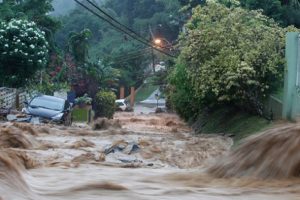
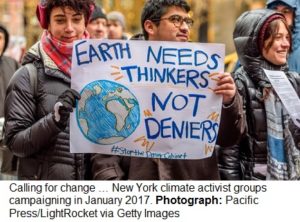
Just the opposite, scientists have told us that as the earth’s atmosphere heats more and more, that Climate Change-fueled events will only worsen and worsen. So far, Spring 2019 has been proof positive. We have seen floods, tornadoes, unusual wintry weather, etc. As reported in a previous blog-commentary, the planet must prepare to “rinse and repeat“.
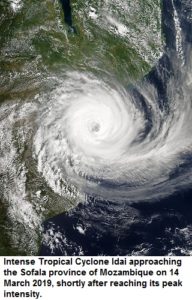
June 1st is the official start of the Atlantic Hurricane Season, so every year at this time we have to start dealing with the realities of hurricanes and Caribbean life. The 2013 book Go Lean…Caribbean (Page 10) declares that we need “to provide new guards for our future security”. This is not our first year planning for and dealing with Hurricane Season; nor will it be our last. “This” is our new reality. The book relates on Page 11:

Whereas the earth’s climate has undeniably changed resulting in more severe tropical weather storms, it is necessary to prepare to insure the safety and security of life, property and systems of commerce in our geographical region. As nature recognizes no borders in the target of its destruction, we also must set aside border considerations in the preparation and response to these weather challenges.

This theme – planning for and dealing with Hurricane Season – aligns with many previous Go Lean commentaries; see here, this consideration from recent years:

https://goleancaribbean.com/blog/?p=15012 Hurricane Season 2018 and Puerto Rico continued sufferings
https://goleancaribbean.com/blog/?p=12068 Hurricane Season 2017 and ‘Climate Change’ Abatement

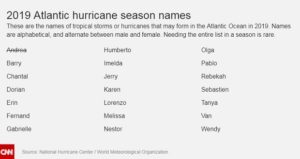
Dealing with Hurricane Seasons must include more than just naming hurricanes or responding to the storms’ devastation; we must also mitigate the threat of Climate Change and do our share to reduce global warming. Yes, we must!

Why?

Because we are responsible for the causes of Climate Change; so says this recent report; consider the story here:

Title: 99.9999% chance humans are causing global warming, and other science-based facts on Climate Change for Earth Day
By: Doyle Rice and Elizabeth Weise

Climate change is real and increasingly a part of our daily lives. New research and studies out in just the past six months highlight the latest facts about the human-caused shift to our global weather systems and its effects on our planet.

First among them, there’s no longer any question that rising temperatures and increasingly chaotic weather are the work of humanity. There’s a 99.9999% chance that humans are the cause of global warming, a February study reported. That means we’ve reached the “gold standard” for certainty, a statistical measure typically used in particle physics.

The mechanism is well understood and has been for decades. Humans burn fossil fuels such as oil, coal and gas, which release carbon dioxide (CO2), methane and other gases into the Earth’s atmosphere and oceans. CO2 is the greenhouse gas that’s most responsible for warming.

Study lead author Benjamin Santer of the Lawrence Livermore National Laboratory in Livermore, California, told Reuters that “the narrative out there that scientists don’t know the cause of climate change is wrong.”

Hottest on record
The past five years have been the five warmest since record-keeping began in the late 1800s. The Earth has experienced 42 straight years (since 1977) with an above-average global temperature, according to the National Oceanic and Atmospheric Administration.

Based on five separate data sets that keep track of the Earth’s climate, the global average temperature for the first 10 months of 2018 was about 1.8 degrees above what it was in the late 1800s. That was when industry started to emit large amounts of greenhouse gases into the atmosphere.

Australia experienced record summer heat in January of this year. The town of Port Augusta reached the hottest day since record-keeping began in 1962 with a temperature of 121, according to the Guardian.

The heat was so intense it caused bats to fall from trees, according to the Australian Broadcasting Corporation.

Carbon dioxide up 46%
Increasing amounts of carbon dioxide and other gases being released into the atmosphere by industry, transportation and energy production from burning fossil fuels are enhancing what’s known as the planet’s natural greenhouse effect.

Carbon dioxide is the most prevalent among all greenhouse gases produced by human activities, attributed to the burning of fossil fuels.

The atmospheric carbon dioxide level for March was 411.97 parts per million and continue to rise. It has now reached levels in the atmosphere not seen in 3 million years.

That’s an increase of 46% from just before the Industrial Revolution in the 1800s, when CO2 levels were around 280 parts per million. Levels began to rise when humans began to burn large amounts of fossil fuels to run factories and heat homes, releasing CO2 and other greenhouse gasses into the atmosphere.

Scientists say to keep a livable planet, we need to cut the level to 350 parts per million.

Rising seas
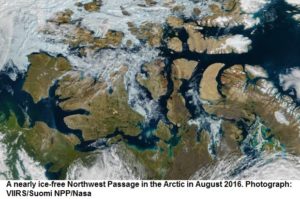
A consequence of higher temperatures is the melting of the polar ice caps, which is causing sea levels to rise. The world’s oceans have risen about an inch in the past 50 years due to melting glaciers alone, a study published this month in the journal Nature found.

The Earth’s glaciers are now losing up to 390 billion tons of ice and snow per year, the study suggests.

Global warming has caused over 3 trillion tons of ice to melt from Antarctica in the past quarter-century and tripled ice loss there in the past decade, another study, released in June, said.

More: Life after solving climate change: Not mud huts and gruel but clean air and warm homes

Source: Posted for “Earth Day 2019” on April 22, 2019; retrieved June 1, 2019 from: https://www.yahoo.com/now/earth-day-2019-high-temperatures-131301815.html
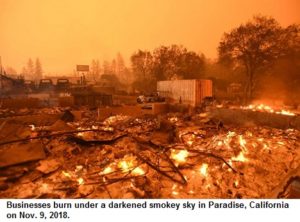
99.9999% is a special number! It is near to Six Sigma – process which 99.9999998% of products manufactured are statistically expected to be free of defects (3.4 defects per million). So this near sign of operational perfection means that it is “on us”. If we accept that us humans are the cause of Climate Change, then that means that us humans can stop the bad actions and do good ones. As reported here previously, we only have until 2030 as a fix window to try to effect change; (after that, there is no hope for a turn-around):

[A report from the] UN Intergovernmental Panel on Climate Change (IPCC) … asserts that if there are no mitigations [by 2030], then the catastrophic future that we all dread will be unavoidable. Life may continue on the planet, but the status quo would be no more. …

After [2030], there may not be any turning back from a Greenhouse planet. Once we accept this fact – the eventuality of the Climate Change Catastrophe – only then can we start to make efforts to address the truth: our “house is on fire”. …

Fixing Climate Change in the US or Canada is out-of-scope for this Go Lean movement; but we still need them to act. We also need Europe, China, India – all Big Polluters – and all countries of the world to act. We must stand on soap boxes, podiums and stages and tell the world – everyone must listen; we must make them listen. This is now everyone’s job, everyone’s responsibility. …

There is … a roadmap [for] reforming and transforming the Caribbean’s societal engines to abate Climate Change; [it] is possible; it is conceivable, believable and achievable.

The current US President, Donald Trump, is not a partner in the effort to abate Climate Change. He is a denier! He is also undermining legitimate scientific efforts – see Appendix VIDEO.

The start of Hurricane Season 2019 reminds us to recommit to the urgency to mitigate and remediate Climate Change. While we must Go Green here in the Caribbean, we must do more too. We must urge the rest of the world to Go Green. Otherwise, our small tropical islands will be the first to become extinct. It is that serious!

Let’s lean-in to this Go Lean roadmap to effect change here in the homeland and then lets urge the rest of the world to also do more. Yes, we can make a difference here in the homeland and around the world. 🙂

About the Book
The book Go Lean…Caribbean serves as a roadmap for the introduction and implementation of the technocratic Caribbean Union Trade Federation (CU), for the elevation of Caribbean society – for all member-states. This CU/Go Lean roadmap has these 3 prime directives:

  • Optimization of the economic engines in order to grow the regional economy to $800 Billion & create 2.2 million new jobs.
  • Establishment of a security apparatus to ensure public safety and protect the resultant economic engines.
  • Improve Caribbean governance to support these engines, including a separation-of-powers between the member-states and CU federal agencies.

The Go Lean book provides 370-pages of turn-by-turn instructions on “how” to adopt new community ethos, plus the strategies, tactics, implementations and advocacies to execute so as to reboot, reform and transform the societal engines of Caribbean society.

Download the free e-Book of Go Lean … Caribbean – now!

Who We Are
The movement behind the Go Lean book – a non-partisan, apolitical, religiously-neutral Community Development Foundation chartered for the purpose of empowering and re-booting economic engines – stresses that reforming and transforming the Caribbean societal engines must be a regional pursuit. This was an early motivation for the roadmap, as pronounced in the opening Declaration of Interdependence (Pages 12 – 13):

xi. Whereas all men are entitled to the benefits of good governance in a free society, “new guards” must be enacted to dissuade the emergence of incompetence, corruption, nepotism and cronyism at the peril of the people’s best interest. The Federation must guarantee the executions of a social contract between government and the governed.

xvi. Whereas security of our homeland is inextricably linked to prosperity of the homeland, the economic and security interest of the region needs to be aligned under the same governance. Since economic crimes … can imperil the functioning of the wheels of commerce for all the citizenry, the accedence of this Federation must equip the security apparatus with the tools and techniques for predictive and proactive interdictions.

xxiv. Whereas a free market economy can be induced and spurred for continuous progress, the Federation must install the controls to better manage aspects of the economy: jobs, inflation, savings rate, investments and other economic principles. Thereby attracting direct foreign investment because of the stability and vibrancy of our economy.

Sign the petition to lean-in for this roadmap for the Caribbean Union Trade Federation.

—————-

Appendix VIDEO – Climate Change: Why Trump’s panel on climate science is controversial – https://www.usatoday.com/videos/news/2019/02/27/climate-change-why-trumps-panel-climate-science-controversial/2998078002/

Posted February 26, 2019 – President Trump’s pick for leading a climate change panel is notorious for denying the science behind human-caused global warming. We dive into the counter-arguments on climate change. USA TODAY.

Share this post:
, ,

Continuity of Business: Learning from Instagram’s system failures

Go Lean Commentary

Spent time on Social Media lately? It’s all the rage!
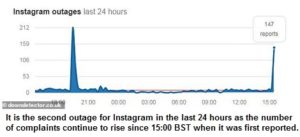
Most Social Media sites – think: Twitter, Facebook and Instagram – allow consumer accounts for free. Their business model is to sell “eye balls”, advertisements based on a large (and growing) viewing audience. The goal of this business model is to fulfill the promise of being connected with friends (physical and virtual); following the sun … with 24-7-365 coverage.

(This writer, while living in North America, has actual friends on Facebook who live and work in India and Pakistan).

According to a previous blog-commentary, Continuity of Business (CoB) is the simple concept to ensure that if there are any extraordinary events – i.e. emergencies and natural disasters – that the tools and techniques are in place to pick-up and continue for business-as-usual. This is important for these Social Media business models.

For these sites, if the promise of 24-7-365 is broken, then it is Big News. See the example here of the recent incident with Instagram and the related VIDEO (of an earlier outage in March):

Title: Instagram back online after a worldwide outage left irritated users complaining of being unable to load pictures on the site

  • The issue focused around new content on the site not loading correctly 
  • It appeared that existing and older content could still be seen and viewed  
  • The latest stories were also unable to be found or seen by users on the app  

By: Joe Pinkstone For Mailonline

Instagram crashed for some users around the world, with people complaining they were unable to load new pictures on the app.

Reports have now stopped coming in and it appears to be resolved, but there is no official word from the Facebook-owned site.

The home page was displaying older pictures but new content failed to appear, at least for some users.

The problem stretched to stories as well, although older stories could still be loaded and viewed.

The reason behind the issue remains unknown but the outage started around 3:37pm BST.

Affected areas included Europe, Australia, South America and the mainland US and a smattering of users complained of login and website trouble (seven and five per cent of complaints, respectively).

But the primary issue appeared to be with the news feed as 86 per cent of all issues centered around the lack of content loading, according to outage site “downdetector“.

This was the second outage of the last 24 hours for Instagram as a spike in user complaints was also seen around 8pm BST yesterday.

It comes exactly a month after the Mark Zuckerberg empire of Facebook, Instagram and WhatsApp was struck by a huge outage.

Facebook and Instagram were forced to apologise after users at this time were unable to load the sites and were faced with a ‘can’t be reached’ message for four hours.

Whatsapp, owned by Facebook, also suffered a four hour outage for some users internationally.

Downdetector.co.uk reported over 7,700 complaints that Facebook was down in the UK.

MailOnline has approached Instagram for comment.

Source: Published May 14, 2019  Retrieved May 23, 2019 from: https://www.dailymail.co.uk/sciencetech/article-7028163/Instagram-CRASHED-people-world.html

———-

VIDEO – Facebook was down for hours on Wednesday, including Instagram and Messenger – https://youtu.be/36z5hMH-2qk


CBS News
Published on Mar 13, 2019 –
Facebook was partially down in the United States on Wednesday. In many cases, the platform wasn’t working at all. BBC News’ Dave Lee reports from San Francisco.

Subscribe to the CBS News Channel HERE: http://youtube.com/cbsnews
Watch CBSN live HERE: http://cbsn.ws/1PlLpZ7
Follow CBS News on Instagram HERE: https://www.instagram.com/cbsnews/
Like CBS News on Facebook HERE: http://facebook.com/cbsnews
Follow CBS News on Twitter HERE: http://twitter.com/cbsnews
Get the latest news and best in original reporting from CBS News delivered to your inbox. Subscribe to newsletters HERE: http://cbsn.ws/1RqHw7T
Get your news on the go! Download CBS News mobile apps HERE: http://cbsn.ws/1Xb1WC8
Get new episodes of shows you love across devices the next day, stream CBSN and local news live, and watch full seasons of CBS fan favorites like Star Trek Discovery anytime, anywhere with CBS All Access. Try it free! http://bit.ly/1OQA29B

CBSN is the first digital streaming news network that will allow Internet-connected consumers to watch live, anchored news coverage on their connected TV and other devices. At launch, the network is available 24/7 and makes all of the resources of CBS News available directly on digital platforms with live, anchored coverage 15 hours each weekday. CBSN. Always On.

There is a plan for a home-grown Social Media site for the Caribbean, my.Caribbean.gov. This is embedded in the book Go Lean…Caribbean, which serves as a roadmap for the introduction and implementation of the technocratic Caribbean Union Trade Federation (CU). There will be the need to employ our own CoB strategies, tactics and implementations to ensure 24-7-365 compliance. This means learning lessons from other sites like Facebook and Instagram; (same company by the way). Our CoB plans must be “Step One, Day One” in the Go Lean roadmap.

The Go Lean book features one advocacy (Page 111) for fostering Social Media sites in the Caribbean. That advocacy is entitled: “10 Ways to Impact Social Media“. These “10 Ways” include the following highlights, headlines and excerpts:

1 Lean-in for the Caribbean Single Market – Ratify treaty for the CU.
This treaty allows for the unification of the region into one market, thereby expanding to an economy of 30 countries, 42 million people and GDP of over $800 Billion (circa 2010), thereby creating the economies of scale to deploy technology investments such as web portal www.myCaribbean.gov and e-Deliveries. The portal will grant free access, email, IM, and profile pages for CU stakeholders (resident, visitor & Diaspora). The CU will also facilitate deployments of Libraries through out the region. These edifices will serve as learning centers and arrange for the public’s access to the Internet.
2 CU Social Media Home Pages – Facebook & Twitter

The CU will use Facebook (FB) & Twitter for normalized communications with stakeholders. The CU will feature its own channel on Facebook and Twitter for publishing notices and accessing the www.myCaribbean.gov portal. CU users can even log-on to the portal with FB or Twitter user profiles. Trending data will be published and available for data-mining.

3 Hi Density Wi-Fi & Mobile
4 Diaspora Marketing & Tourism Outreach
5 CU Asian Outreach
6 Contact Center for e-Government Services
7 Contact Center for Tech Support
8 Reverse-911 Messaging
9 Postal Union Interface

The accedence of the CU will transfer jurisdiction of the region’s postal efforts to the Caribbean Postal Union. The CPU will employ hybrid e-mail/postal mail schemes (Last-leg, First-leg, FB/Twitter delivery notification) to facilitate efficiency.

10 Big Data Informatics

Internet & Communication Technologies are regarded as the “great equalizer”; it is where small states and large states are able to easily compete on the basis of merit, talent and competence, not just population size. The theme of doubling-down on the ICT & ‘Social Media’ landscape has been detailed in many previous Go Lean commentaries; consider this sample list here:

https://goleancaribbean.com/blog/?p=15075 e-Government 3.0 – Improved governance is the first benefactor of ICT & Social Media
https://goleancaribbean.com/blog/?p=11453 Location Matters – For location of Data Centers – even in a Virtual World
https://goleancaribbean.com/blog/?p=9839 Alibaba Cloud stretches global reach with four new Data Center facilities
https://goleancaribbean.com/blog/?p=8823 Lessons from China – WeChat: Model for Caribbean Social Media
https://goleancaribbean.com/blog/?p=4381 Net Neutrality and the innovation culture – It must matter here in the Caribbean

The Caribbean’s Social Media offering is just a subset of the overall Electronic Commerce (e-Commerce) landscape. This can lower the cost of living and doing business in the homeland. In order to furnish the prospects of e-Commerce, we need to have our Caribbean Cloud enabled all the time, the whole 24-7-365.

Will we suffer from the periodic outages as Instagram just reported?

The Go Lean roadmap prepared for this eventuality with its Data Center “Arts & Sciences”; notice this excerpt from Page 106:

High Availability (HA)
HA is a system design approach (hardware, software and networking) that ensures operational performance will be met, like parallel processing or mirroring. There are systems (i.e. hospitals, banking, electrical grid) that must maximize availability and minimize downtime. Recovery time or estimated time of repair is closely related to availability, optimizing the time to recover from planned or unplanned outages.
A CU mission is to facilitate quick recoveries after hurricanes [and other disasters].

ICT, Social Media and e-Commerce are positioned to impact Caribbean communities. Compared to our status quo, we must be better than the examples in the foregoing stories; we must sustain our systems and processes. This is how we will be a better homeland to live, work and play.  🙂

About the Book
The book Go Lean…Caribbean serves as a roadmap for the introduction and implementation of the technocratic Caribbean Union Trade Federation (CU), for the elevation of Caribbean society – for all member-states. This CU/Go Lean roadmap has these 3 prime directives:

  • Optimization of the economic engines in order to grow the regional economy to $800 Billion & create 2.2 million new jobs.
  • Establishment of a security apparatus to ensure public safety and protect the resultant economic engines.
  • Improve Caribbean governance to support these engines, including a separation-of-powers between the member-states and CU federal agencies.

The Go Lean book provides 370-pages of turn-by-turn instructions on “how” to adopt new community ethos, plus the strategies, tactics, implementations and advocacies to execute so as to reboot, reform and transform the societal engines of Caribbean society.

Download the free e-Book of Go Lean … Caribbean – now!

———

Who We Are
The movement behind the Go Lean book – a non-partisan, apolitical, religiously-neutral Community Development Foundation chartered for the purpose of empowering and re-booting economic engines – stresses that reforming and transforming the Caribbean societal engines must be a regional pursuit. This was an early motivation for the roadmap, as pronounced in the opening Declaration of Interdependence (Pages 12 – 13):

xi. Whereas all men are entitled to the benefits of good governance in a free society, “new guards” must be enacted to dissuade the emergence of incompetence, corruption, nepotism and cronyism at the peril of the people’s best interest. The Federation must guarantee the executions of a social contract between government and the governed.

xvi. Whereas security of our homeland is inextricably linked to prosperity of the homeland, the economic and security interest of the region needs to be aligned under the same governance. Since economic crimes … can imperil the functioning of the wheels of commerce for all the citizenry, the accedence of this Federation must equip the security apparatus with the tools and techniques for predictive and proactive interdictions.

xxiv. Whereas a free market economy can be induced and spurred for continuous progress, the Federation must install the controls to better manage aspects of the economy: jobs, inflation, savings rate, investments and other economic principles. Thereby attracting direct foreign investment because of the stability and vibrancy of our economy.

Sign the petition to lean-in for this roadmap for the Caribbean Union Trade Federation.

Share this post:
, ,
[Top]

Hurricane in Africa? That’s ‘Climate Change’

Go Lean Commentary

This is the headline, in case you missed it:

“Mozambique Braces for More Floods as Cyclone Deaths Climb”. Bloomberg News Source. Posted 19 March 2019. Retrieved 21 March 2019.

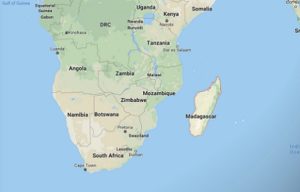
Mozambique is not a Caribbean country in the typical bulls-eye for hurricanes. No, this is a country in the South African region; not normally threatened by tropical cyclones or hurricanes. This is proof-positive that something is wrong with the earth’s climate.  This is the reality of Climate Change.
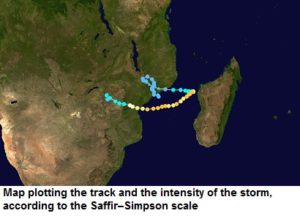
We told you so …

In fact, we told you (in 2018) that climate conditions will go from bad to worse on a daily basis and that we only have 12 years, before the damage we are causing to the planet will be irreversible.

We did not give this warning about Africa; this is not our charter. But we can still learn by observing-and-reporting on developments there. See here, the consequential damage from this cyclone:

Reference: Cyclone Idai
Intense Tropical Cyclone Idai is regarded as one of the worst tropical cyclones on record to affect Africa and the Southern Hemisphere as a whole. The storm caused catastrophic damage in multiple nations, leaving more than 400 people dead and hundreds more missing.[4] Its death toll is comparable to that of south-west Indian Ocean cyclones Eline in 2000, and Gafilo in 2004.[5] The tenth named storm and record-breaking eighth intense tropical cyclone of the 2018–19 South-West Indian Ocean cyclone season, Idai originated from a tropical depression that formed off the eastern coast of Mozambique on 4 March.

The depression made landfall in the aforementioned country later in the day and remained a tropical cyclone throughout the entirety of its trek over land. On 9 March, the depression reemerged into the Mozambique Channel and was upgraded into Moderate Tropical Storm Idai next day. The system then began a stint of rapid intensification, reaching an initial peak intensity as an intense tropical cyclone with winds of 175 km/h (110 mph) on 11 March. Idai then began to weaken due to ongoing structural changes within its inner core, falling to tropical cyclone intensity. Idai’s intensity remained stagnant for about a day or so before it began to re-intensify. On 14 March, Idai reached peak intensity with maximum sustained winds of 195 km/h (120 mph) and a minimum central pressure of 940 hPa (27.76 inHg). Idai then began to weaken as it approached the coast of Mozambique due to less favorable conditions. On 15 March, Idai made landfall near Beira, Mozambique, as an intense tropical cyclone, subsequently weakening into a remnant low on 16 March.

Idai brought strong winds and caused severe flooding in Madagascar, Mozambique, Malawi, and Zimbabwe that has killed 431 people – 268 in Mozambique, 104 in Zimbabwe, 56 in Malawi, and one in Madagascar – and affected more than 2.6 million others. Catastrophic damage occurred in and around Beira in southern Mozambique. The President of Mozambique stated that more than 1,000 people may have died in the storm.[3] A major humanitarian crisis unfolded in the wake of the cyclone, with hundreds of thousands of people in urgent need of assistance across Mozambique and Zimbabwe. In the former nation, rescuers were forced to let people die in order to save others.


Source: Wikipedia – retrieved March 21, 2019 from: https://en.wikipedia.org/wiki/Cyclone_Idai

Over 1,000 dead!!! Ouch!

While Climate Change is a global crisis, our focus, our scope is limited to the Caribbean member-states.

From our Caribbean homes, we can NOT reach across the oceans and fix the climate in Africa, What we can do is mitigate the environment here at home.

Then name, blame and shame the culprit nations that are crippling our planet with more pollutants.

Due to the laws of hypocrisy, we cannot “Cry Wolf” to anyone until we conform ourselves. This theme and assertion was elaborated in these other/previous blog-commentaries from the movement behind the book Go Lean…Caribbean:

https://goleancaribbean.com/blog/?p=15511 Plastics and Styrofoam – A Mitigation Plan
https://goleancaribbean.com/blog/?p=14925 Climate Change Doubt?! Numbers Don’t Lie
https://goleancaribbean.com/blog/?p=14832 Manifesting Environmental Change
https://goleancaribbean.com/blog/?p=11858 Islands are Disappearing – The Cautionary Tale of Kiribati
https://goleancaribbean.com/blog/?p=10367 Science of Sustenance – Green Batteries for Fossil-Fuel-Free Energy
https://goleancaribbean.com/blog/?p=9455 Fix ‘Climate Change’ – Yes, We Can
https://goleancaribbean.com/blog/?p=7103 COP21 – ‘Climate Change’ Acknowledged
https://goleancaribbean.com/blog/?p=7056 Electric Cars: ‘Necessity is the Mother of Invention’
https://goleancaribbean.com/blog/?p=915 Go ‘Green’ … Caribbean

It is possible to mitigate the contributors to Climate Change. We can burn less fossil fuels; we can engage more alternative energy options (solar, wind, tidal); use electric cars and public transit. But the efforts must be executed across the whole world.

At a bare minimum, we must do our part; each individual, family, community and nation. No one can be excused. For this we must be prepared to name, blame and shame the dissenters.

This should be a national emergency. Check that! This is a global emergency!

There are still deniers of Climate Change. Those ones should not be debated; just ignored; we must proceed forward as if these ones are inconsequential. Think Flat-Earth theorists; see a related VIDEO in the Appendix below.

These ones should not even get an audience.

I assure you: No one in Mozambique is a Climate Change denier today. Can we say the same for Caribbean stakeholders … in government, security or economic leadership?

This must be a basic requirement for Caribbean leadership. If a politician dissents, we must vote them out of office. If a security/government official dissents, then we must replace them. If a business leader dissents, we must boycott their establishments. This is what is meant by name, blame and shame.

This is how we must now act to forge change in our communities. And then, the whole world. This is the quest of many young protesters around the world, today. They have indicted the older generation for mis-management; see story and VIDEO here:

Title: ‘It’s Literally Our Future.’ Here’s What Youth Climate Strikers Around the World Are Planning Next
By: Suyin Haynes 

Inside the U.K. houses of parliament, the grown-ups were at work. Outside, thousands of others — many of whom were not old enough to vote — were doing their best to make sure business was anything but usual. With their chants echoing down the streets, they were among an estimated 1.6 million students in over 120 countries who left school on March 15 in protest of adult inaction on climate change. “It shocks me how great a length we have to go to be heard,” said 16-year-old Miranda Ashby, who’d traveled more than two hours to London with roughly 50 of her classmates. “We are protesting now because if not now, when?”

The school climate strikes started with teen activist Greta Thunberg standing vigil outside Sweden’s parliament one Friday last August. “When I first started this strike, I didn’t really expect anything,” Thunberg told TIME on March 14, shortly after Norwegian lawmakers nominated her for the Nobel Peace Prize.
Thunberg’s idea has grown into a global movement; the March 15 action was its biggest yet. Extensive coverage of the strikes by media outlets and individuals on social media have helped elevate the cause in the minds of people across the world. Meanwhile, the lack of a centralized organizational hub makes it easy for teenagers to arrange actions in their own towns and cities; rallies took place in more than 2,200 towns and cities worldwide on March 15. “We’re tired of waiting for politicians to care,” says Nosrat Fareha, an organizer for the Sydney strikes, where 30,000 young people turned out — more than three times Fareha’s expected estimate.

In Uganda, where drought and desertification are already devastating, the walk-out took place despite officials blocking strikers from an intended rally location in Kampala. “I realized that my country has to change too,” 14-year-old organizer Leah Namugerwa says. And in the U.S., 17-year-old Feliquan Charlemagne, National Creative Director of the U.S. movement, believes the energy of March for Our Lives, the 2018 student-led initiative for gun control, must be harnessed for this cause too. Born in the Caribbean island of St Thomas, Charlemagne and his family have personally suffered the powerful effects of climate change, after Hurricane Irma devastated the island in September 2017. “This is not something we can play around with,” he says. “This is literally our future.”

It’s also their present. The warning of the landmark October 2018 report from the United Nations’ Intergovernmental Panel on Climate Change, that the planet was only 12 years away from catastrophe unless “far-reaching and unprecedented changes” are taken, weighs heavily on the minds of young organizers, who are quick to point out that they are the ones who have to live in that world. The deadline means there’s a lot of work to be done, and they don’t have time to wait to grow up first.

Their most pressing hope is for immediate policy measures to meet the terms of the Paris Agreement, limiting the global temperature increase to 1.5° celsius this century, as well as specific local action. In Australia, campaigners want to halt the proposed construction of a controversial coal mine. For activists across the U.S., preservation of public lands and political implementation of the Green New Deal are top priorities. And in the U.K., organizers want a fair portrayal of the climate crisis in school curricula and government information. And they’ve had some success already: youth organizers have met with members of the European Parliament and their strikes have been welcomed by leaders including Angela Merkel and U.N. Secretary General Antonio Guterres. “It really has changed the discourse,” says Sini Harkki, program manager at Greenpeace Nordic.

But at least for now, that’s all they can change; the youth that draws them to the cause is also an obstacle. Most of the movement’s participants are not just battling the obvious challenges of political inertia, powerful fossil fuel lobbies and disbelieving critics—they are also too young to play a bigger role in business or politics. And so they are determined to continue the Friday strikes. The U.K. Student Climate Network is demanding a meeting with political leaders, U.S. activists are planning a mass strike for May 3 and a pan-European organizer meeting is also in the pipeline. And Thunberg, no longer on her own, is committed to striking every Friday until Sweden reduces its carbon emissions in line with the Paris Agreement. “I know I have something to say,” Thunberg says, referring to her frank speeches in front of international leaders. “I have a message I want to get out and I want people to listen.” Students worldwide have heard her loud and clear. It’s up to the world’s politicians to act.

Source: Time Magazine Online Edition – posted March 20, 2019; retrieved March 22, 2019 from http://time.com/5554775/youth-school-climate-change-strike-action/

———-

VIDEO – Youth Climate Strike – http://time.com/5554775/youth-school-climate-change-strike-action/

Posted March 20, 2019 – ‘It Will Be Too Late for My Generation.’ Meet the Teens Who Organized a Massive Climate Change Protest

These young people get it: name, blame and shame the culprits and bad actors affecting Climate Change and the urgent mitigation that must be done. And as for Africa? We hereby present them a role model to follow.

The Public Campaign of environmentalists and activists is Spot-On: “Think Global. Act Local.” 🙂

About the Book
The book Go Lean…Caribbean serves as a roadmap for the introduction and implementation of the technocratic Caribbean Union Trade Federation (CU), for the elevation of Caribbean society – for all member-states. This CU/Go Lean roadmap has these 3 prime directives:

  • Optimization of the economic engines in order to grow the regional economy to $800 Billion and create 2.2 million new jobs.
  • Establishment of a security apparatus to ensure public safety and protect the resultant economic engines.
  • Improve Caribbean governance to support these engines, including a separation-of-powers between the member-states and CU federal agencies.

The Go Lean book provides 370-pages of turn-by-turn instructions on “how” to adopt new community ethos, plus the strategies, tactics, implementations and advocacies to execute so as to reboot, reform and transform the societal engines of Caribbean society.

Download the free e-Book of Go Lean … Caribbean – now!

Who We Are
The movement behind the Go Lean book – a non-partisan, apolitical, religiously-neutral Community Development Foundation chartered for the purpose of empowering and re-booting economic engines – stresses that reforming and transforming the Caribbean societal engines must be a regional pursuit. This was an early motivation for the roadmap, as pronounced in the opening Declaration of Interdependence (Pages 12 – 13):

i. Whereas the earth’s climate has undeniably changed resulting in more severe tropical weather storms, it is necessary to prepare to insure the safety and security of life, property and systems of commerce in our geographical region. As nature recognizes no borders in the target of its destruction, we also must set aside border considerations in the preparation and response to these weather challenges.

xi. Whereas all men are entitled to the benefits of good governance in a free society, “new guards” must be enacted to dissuade the emergence of incompetence, corruption, nepotism and cronyism at the peril of the people’s best interest. The Federation must guarantee the executions of a social contract between government and the governed.

xvi. Whereas security of our homeland is inextricably linked to prosperity of the homeland, the economic and security interest of the region needs to be aligned under the same governance. Since economic crimes … can imperil the functioning of the wheels of commerce for all the citizenry, the accedence of this Federation must equip the security apparatus with the tools and techniques for predictive and proactive interdictions.

xxiv. Whereas a free market economy can be induced and spurred for continuous progress, the Federation must install the controls to better manage aspects of the economy: jobs, inflation, savings rate, investments and other economic principles. Thereby attracting direct foreign investment because of the stability and vibrancy of our economy.

Sign the petition to lean-in for this roadmap for the Caribbean Union Trade Federation.

————

Appendix VIDEO – An Astronomer Responds To Flat Earth Theory – https://youtu.be/thxbiR-XfJo

Tech Insider
Published on Jan 9, 2018
– Business Insider UK sat down with Dr Stuart Clark, who spoke to us about a range of subjects regarding astronomy and astrophysics. We asked him what he thought of flat earth theory, a school of thought which believes that the earth is not spherical but flat.

“All our physics is constructed now, the physics of orbits of things going around the earth is all constructed with this three dimensional world. And the pictures from space show our world as a globe and yet somehow there are some people that still seem to believe the earth is flat.”

“My own pet theory is that they’re doing it for comic effect.”

Tech Insider tells you all you need to know about tech: gadgets, how-to’s, gaming, science, digital culture, and more.

Subscribe to our channel and visit us at: http://www.businessinsider.com/sai

TI on Facebook: https://www.facebook.com/techinsider

TI on Instagram: https://www.instagram.com/tech_insider/

TI on Twitter: https://twitter.com/techinsider

Share this post:
, , , ,
[Top]

Montserrat: No ‘Irish Luck’

Go Lean Commentary

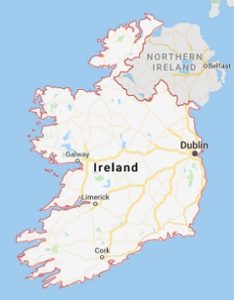
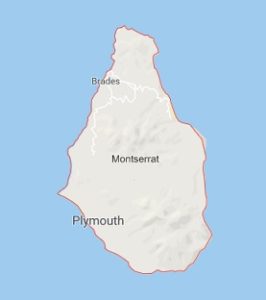
We have an island in the Caribbean – Montserrat – that is coupled, compared and contrasted with Ireland in fact, fiction and folklore …

Montserrat is nicknamed “The Emerald Isle of the Caribbean” both for its resemblance to coastal Ireland and for the Irish ancestry of many of its inhabitants.[3][4]Wikipedia

Maybe the coupling-comparison-contrast with Ireland can also apply to their luck:

Wherever the origin of the phrase ‘Luck of the Irish‘ stems from or what is was originally intended to mean, fact is that the Irish are indeed very fortunate people. They are proud of themselves, their country and culture, hardworking, funny and nowadays loved by nations all over the world. – Tour Ireland Blog Nov 26, 2015

But the reality of Irish Luck is only evident after all the hard-work and heavy-lifting; consider this historicity:

The Irish Luck = Bad Luck? During Ireland’s past, many Irish were forced to emigrate due to the potato famine for instance. Often, abroad, the Irish were treated badly and had to struggle to make a living. Some emigrants didn’t even survive the sea crossing, others grew ill and with no health care, suffered badly. Childhood disease saw many families lose their children, with that their reason for succeeding was not so great and depression followed in many cases by alcohol abuse. Many of the original Irish settlers in the US, the UK and Australia never saw their family again. Indeed on the night before a person emigrated a party was held, a sort of ‘funeral’ wake which is a traditional Irish custom when someone dies. Therefore, some believe that the expression is rather an ironic one, stating that the Irish are not lucky after all.
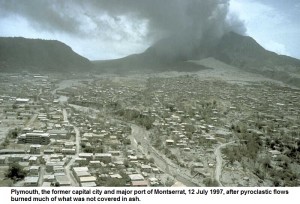
Montserrat “luck” is also fleeting – “not so lucky”:

On 18 July 1995, the previously dormant Soufrière Hills volcano, in the southern part of the island, became active. Eruptions destroyed Montserrat’s Georgian era capital city of Plymouth. Between 1995 and 2000, two-thirds of the island’s population was forced to flee, primarily to the United Kingdom, leaving fewer than 1,200 people on the island as of 1997 (rising to nearly 5,000 by 2016).[5][6] –  Wikipedia

As we approach St. Patrick’s Day 2019, we are reminded how we love Ireland and the Irish …

… we love Montserrat too.

Consider the previous treatments we gave to Ireland and the Irish people in these previous blog-commentaries from the movement behind the book Go Lean … Caribbean; see relevant summaries here:

The ‘Luck of the Irish’ – Past, Present and Future – March 17, 2015

Why do people wear green? It’s a move of solidarity for Irish people and culture.

This is a big deal considering the real history.

This subject also has relevance for the Caribbean as Saint Patrick’s Day is a public holiday in the British Caribbean Territory of Montserrat, in addition to the Republic of Ireland,[10] Northern Ireland,[11] and the Canadian province of Newfoundland and Labrador. While not a holiday elsewhere, this day is venerated by the Irish Diaspora around the world,

This subject also provides a case study for the Caribbean, as the Irish Diaspora is one of the most pronounced in the world. This is the model of what we, in the Caribbean, do not want to become.

The Diaspora, broadly interpreted, contains all those known to have Irish ancestors, i.e., over 100 million people, which is more than fifteen times the population of the island of Ireland, which was about 6.4 million in 2011.

In July 2014, the Irish Government appointed Jimmy Deenihan as Minister of State for the Diaspora.[3]

Ireland has fared better since those dire days of the potato famine, but still its people, the Diaspora, endured a lot of misery, resistance and discrimination in their foreign homes. … The usual path for new immigrants is one of eventual celebration, but only after a “long train of abuses”: rejection, anger, protest, bargaining, toleration and eventual acceptance. Wearing green today – or any other March 17th’s – is a statement of acceptance and celebration of the Irish; as a proud heritage for what they have endured and accomplished.

Frederick Douglass [Irish Odyssey]: Role Model for Single Cause – Death or Diaspora – March 17, 2016

The Caribbean can learn an important lesson from a 150 year-old Role Model, Frederick Douglass. His is a powerful lesson for the advocacy of Single Cause. … Mr. Douglass remained steadfast and committed to one cause primarily: abolition of slavery and civil rights for African-Americans. …

The legacy of Frederick Douglass, is that if an oppressed population didn’t find refuge, the only outcome would be Death or Diaspora.

The Diaspora prophecy happened, then in Ireland and today, especially here in the Caribbean! (In [that] previous blog, it was revealed that after 1840, emigration from Ireland became a massive, relentless, and efficiently managed national enterprise. In 1890 40% of Irish-born people were living abroad. By the 21st century, an estimated 80 million people worldwide claimed some Irish descent; which includes more than 36 million Americans who claim Irish as their primary ethnicity).

Caribbean citizens are also pruned to emigrate … to foreign shores (North America and Europe) seeking refuge. In a previous blog-commentary it was asserted that the US – the homeland  for Frederick Douglass – has experienced accelerated immigration in recent years. Published rates of societal abandonment among the college educated classes have reported an average of 70 percent in most member-states …. For this reason, there is solidarity for the Diaspora of Ireland and the Diaspora of the Caribbean.

Caribbean Ghost Towns [- i.e. Plymouth, Montserrat]: It Could Happen…Again – February 11, 2015

The Caribbean is in crisis today; but even more so, if left unchecked, the crisis gets worst tomorrow …. There is no guarantee of our survival. Communities and societies do fail; success is not assured; the work must be done, we must “sow if we want to reap”.

The reality of ghost towns, in the Caribbean and around the world, is a reminder to failing communities of where the road ends. …

A town often becomes a ghost town because the economic activity that supported it has failed, or due to natural or human-caused disaster ….

There is a ghost town that is an incumbent de jure capital: Plymouth in the Caribbean island of Montserrat. This city was abandoned in 1997 due to volcanic eruptions and is now part of an Exclusion Zone ….

The Go Lean book posits that many Caribbean communities suffer from a mono-industrial complex (Page 3), therefore the risk is high for the same ghost town eventuality like so many other towns have experienced. Yes, ghost towns could happen in the Caribbean … again.

What is the Way Forward for Montserrat?

That previous Go Lean commentary about “Irish Luck” from March 17, 2015 also related the successful Way Forward pursued by modern day Ireland – we need solidarity with this Irish model:

The Republic of Ireland ranks among the wealthiest countries in the world in terms of GDP per capita.[11] After joining the European Union, Ireland enacted a series of liberal economic policies that resulted in rapid economic growth. The country achieved considerable prosperity from 1995 to 2007, during which it became known as the Celtic Tiger. This was halted by an unprecedented financial crisis that began in 2008, in conjunction with the concurrent global economic crash.[12][13]
——-
See this VIDEO here:

VIDEO – Ireland is back in business – https://youtu.be/qg1cwyjDlHY

FRANCE 24 English
Published on Feb 11, 2016 –
Ireland’s strong economic recovery will be the main backdrop to the country’s general elections on February 26. After five years in power, Prime Minister Enda Kenny’s conservative government are keen to highlight the fact that when they took the job, Ireland’s economy was close to collapse. Public finances are now back on track, and the brutal seven-year austerity programme and bailout plan are a thing of the past. However, opposition parties argue that many people have been left on the sidelines during these tough times. This report takes a closer look at one of the “ingredients” of Ireland’s economic recovery: an extremely low corporation tax. A programme prepared by Patrick Lovett and Laura Burloux.

Subscribe to France 24 now : http://f24.my/youtubeEN

FRANCE 24 live news stream: all the latest news 24/7 http://f24.my/YTliveEN

Visit our website : http://www.france24.com
Subscribe to our YouTube channel : http://f24.my/youtubeEN
Like us on Facebook : https://www.facebook.com/FRANCE24.Eng…
Follow us on Twitter : https://twitter.com/France24_en

——-
See this additional story – How did IRELAND step out of POVERTY? – in this VIDEO here:
https://youtu.be/sDzSIuW6uiM
——-

Montserrat now has the model by which to follow: regional integration in a EU-styled Single Market. This model will work for the rest of the Caribbean too. This is the quest of the Go Lean movement, to provide a roadmap for the introduction and implementation of the Caribbean Union Trade Federation (CU). The book Go Lean … Caribbean addresses this model and prepares the regional institutions accordingly.
This remediation allows us to better appreciate what the Luck of the Irish really means – the end result of the required hard-work and heavy-lifting – as conveyed in this Classic Irish Blessing:

May you always have…
Walls for the winds
A roof for the rain
Tea beside the fire
Laughter to cheer you
Those you love near you
And all your heart might desire.

All in all, the Luck of the Irish “finally fulfilled” means a better homeland to live, work and play. 🙂

About the Book
The book Go Lean…Caribbean serves as a roadmap for the introduction and implementation of the technocratic Caribbean Union Trade Federation (CU), for the elevation of Caribbean society – for all member-states. This CU/Go Lean roadmap has these 3 prime directives:

  • Optimization of the economic engines in order to grow the regional economy to $800 Billion and create 2.2 million new jobs.
  • Establishment of a security apparatus to ensure public safety and protect the resultant economic engines.
  • Improve Caribbean governance to support these engines, including a separation-of-powers between the member-states and CU federal agencies.

The Go Lean book provides 370-pages of turn-by-turn instructions on “how” to adopt new community ethos, plus the strategies, tactics, implementations and advocacies to execute so as to reboot, reform and transform the societal engines of Caribbean society.

Download the free e-Book of Go Lean … Caribbean – now!

Who We Are
The movement behind the Go Lean book – a non-partisan, apolitical, religiously-neutral Community Development Foundation chartered for the purpose of empowering and re-booting economic engines – stresses that reforming and transforming the Caribbean societal engines must be a regional pursuit. This was an early motivation for the roadmap, as pronounced in the opening Declaration of Interdependence (Pages 12 – 13):

xi. Whereas all men are entitled to the benefits of good governance in a free society, “new guards” must be enacted to dissuade the emergence of incompetence, corruption, nepotism and cronyism at the peril of the people’s best interest. The Federation must guarantee the executions of a social contract between government and the governed.

xvi. Whereas security of our homeland is inextricably linked to prosperity of the homeland, the economic and security interest of the region needs to be aligned under the same governance. Since economic crimes … can imperil the functioning of the wheels of commerce for all the citizenry, the accedence of this Federation must equip the security apparatus with the tools and techniques for predictive and proactive interdictions.

xxiv. Whereas a free market economy can be induced and spurred for continuous progress, the Federation must install the controls to better manage aspects of the economy: jobs, inflation, savings rate, investments and other economic principles. Thereby attracting direct foreign investment because of the stability and vibrancy of our economy.

Sign the petition to lean-in for this roadmap for the Caribbean Union Trade Federation.

Share this post:
, , , ,
[Top]

5 Years Later – Climate Change: Coming so fast, so furious

Go Lean Commentary

A little less conversation, a little more action – Elvis Presley song

3 years ago – Paris COP21 – the world came together and devised a plan to tackle the global threat of Climate Change. This year, many of the same players came back together to implement the actions.

So we went from “planning the plan” to now “planning the action”.

This is a slow-motion response to a fast-moving threat.

This commentary is the second of a 4-part series – 2 of 4 – from the movement behind the Go Lean book in consideration of the 5 year anniversary of the book’s publication. The theme on these 4 submissions is “5 Years Later and what is the condition now“. The focus here is on the Agents of Change that the book identified: Globalization, Climate Change, Technology and the Aging Diaspora.

The first entry in this series asked the question: “Have the problems lessened, or have they intensified?

The answer is so emphatic! Climate Change has been all the rage in these 5 short years. The fast-and-furious threat is more than just academic; this is real-life and real-bad; especially for us in the Caribbean.

The other commentaries in the series are cataloged as follows:

  1. 5 Years Later: New Post Office Eco-system – Globalization issues ‘loud and clear’ now.
  2. 5 Years Later: Climate Change – Coming so fast, so furious.
  3. 5 Years Later: Technology – Caribbean fully on board.
  4. 5 Years Later: Aging Diaspora – Finding Home … anywhere.

The Go Lean book was written 5 years ago as a 5 Year Plan to reform and transform the Caribbean region. Had the plan been adopted by the regional stakeholders, then the Agents of Change would have been better addressed. The plan, or roadmap, to introduce and implement the Caribbean Union Trade Federation is still rearing to start; and while we cannot single-handedly solve Climate Change, we can better prepare the region for the heavy-lifting involved. The book describes the community ethos to adopt plus the many strategies, tactics and implementation that need to be executed.
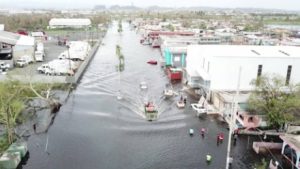
After the 2013 publication of the Go Lean book, many countries came together for COP21 (December 2015), also known as the Paris Accords. As alluded to above, this year’s follow-up, Katowice (Poland) 2018 had a few less participants for this “put speech into action” plan. See the news article about COP24 here:

News Title: Nations agree on rules for implementing Paris climate agreement
Sub-title: Nations dragged a deal over the line Saturday to implement the landmark 2015 Paris climate treaty after marathon UN talks that failed to match the ambition the world’s most vulnerable countries need to avert dangerous global warming.

Katowice, Poland – Delegates from nearly 200 states finalised a common rule book designed to deliver the Paris goals of limiting global temperature rises to well below two degrees Celsius (3.6 Fahrenheit).

“Putting together the Paris agreement work programme is a big responsibility,” said COP24 president Michal Kurtyka as he gavelled through the manual following the talks in Poland that ran deep into overtime.

“It has been a long road. We did our best to leave no-one behind.”

But environmental groups said the package agreed in the Polish mining city of Katowice lacked the bold ambition needed to protect states already dealing with devastating floods, droughts and extreme weather made worse by climate change.

“We continue to witness an irresponsible divide between the vulnerable island states and impoverished countries pitted against those who would block climate action or who are immorally failing to act fast enough,” executive director of Greenpeace Jennifer Morgan said.

The final decision text was repeatedly delayed as negotiators sought guidelines that are effective in warding off the worst threats posed by our heating planet while protecting the economies of rich and poor nations alike.

“Without a clear rulebook, we won’t see how countries are tracking, whether they are actually doing what they say they are doing,” Canada’s Environment Minister Catherine McKenna told AFP.

At their heart, negotiations were about how each nation funds action to mitigate and adapt to climate change, as well as how those actions are reported.

Developing nations wanted more clarity from richer ones over how the future climate fight will be funded and pushed for so-called “loss and damage” measures.

This would see richer countries giving money now to help deal with the effects of climate change many vulnerable states are already experiencing.

Another contentious issue was the integrity of carbon markets, looking ahead to the day when the patchwork of distinct exchanges — in China, the Europe Union, parts of the United States — may be joined up in a global system.

“To tap that potential, you have to get the rules right,” said Alex Hanafi, lead counsel for the Environmental Defense Fund in the United States.

“One of those key rules — which is the bedrock of carbon markets — is no double counting of emissions reductions.”

The Paris Agreement calls for setting up a mechanism to guard against practices that could undermine such a market, but finding a solution has proved so problematic that the debate has been kicked down the road to next year.

‘System needs to change’

One veteran observer told AFP Poland’s presidency at COP24 had left many countries out of the process and presented at-risk nations with a “take it or leave it” deal.

Progress had “been held up by Brazil, when it should have been held up by the small islands. It’s tragic.”

One of the largest disappointments for countries of all wealths and sizes was the lack of ambition to reduce emissions shown in the final COP24 text.

Most nations wanted the findings of the Intergovernmental Panel on Climate Change (IPCC) to form a key part of future planning.

It highlighted the need for carbon pollution to be slashed to nearly half by 2030 in order to hit the 1.5C target.

But the US, Saudi Arabia, Russia and Kuwait objected, leading to watered-down wording.

The final statement from the Polish COP24 presidency welcomed “the timely conclusion” of the report and invited “parties to make use of it” — hardly the ringing endorsement many nations had called for.

“There’s been a shocking lack of response to the 1.5 report,” Morgan told AFP. “You can’t come together and say you can’t do more!”

With UN talks well into their third decade sputtering on as emissions rise remorselessly, activists have stepped up grassroots campaigns of civil disobedience to speed up action on climate.

“We are not a one-off protest, we are a rebellion,” a spokesman for the Extinction Rebellion movement, which disrupted at least one ministerial event at the COP, told AFP.

“We are organising for repeated disruption, and we are targeting our governments, calling for the system change needed to deal with the crisis that we are facing.”

Source: AFP – France24 News Service – Posted December 16, 2018; retrieved December 18, 2018 from: https://www.france24.com/en/20181215-cop24-poland-climate-summit-deal-paris-climate-agreement-negotiations-un-environment

—————-

VIDEO # 1 – Nations agree on rules for implementing Paris climate agreement – https://youtu.be/SBUZS3cl2X0

FRANCE 24 English
Published on Dec 17, 2018 – Nations dragged a deal over the line Saturday to implement the landmark 2015 Paris climate treaty after marathon UN talks that failed to match the ambition the world’s most vulnerable countries need to avert dangerous global warming.

Visit our website: http://www.france24.com

FRANCE 24 live news stream: all the latest news 24/7 http://f24.my/YTliveEN

———————

VIDEO # 2 – UN climate talks: ‘A transition to a greener economy is possible’ – https://youtu.be/qqbQ1hyWc_Y

FRANCE 24 English
Uploaded on Dec 15, 2018

Subscribe to France 24 now: http://f24.my/youtubeEN

FRANCE 24 live news stream: all the latest news 24/7 http://f24.my/YTliveEN

Visit our website: http://www.france24.com

One notable absentee from Katowice has been the United States of America. This is due to the sad fact that the “Leader of the Free World” – a moniker assigned to the US President – is a Climate Change denier. Donald Trump campaigned on his denial and has manifested his dismay with subsequent actions. His blatant disregard was previously detailed in a prior Go Lean commentary from June 1, 2017, as follows:

Its June 1st, the start of the Hurricane season. According to Weather Authorities, it is going to be a tumultuous season, maybe even more destructive than last year….

Thanks Climate Change.

What hope is there to abate the threats from Climate Change?

Thanks to the Paris Accord, there is now hope; (we remember the effectiveness of the accord to abate “Acid Rain”).

But wait! The American President – Donald Trump – announces that he is withdrawing the United States from the Paris Accord. WTH?!?!

The Caribbean status quo is unsustainable under the real threats of Climate Change. The region must reboot, reform and transform. We must do the heavy-lifting ourselves; we cannot expect relief and refuge from others, like the American Super-Power. We must find and “sail” under our own power. 🙂

The Caribbean is more on the frontlines of Climate Change distress than the US – think hurricanes. We do not have the luxury to deny, defer and dispute. We must “batten down the hatches” and prepare for the worst. (Many claim this is also the disposition of many American destinations, think California forest fires). So we must take the lead ourselves for our own relief!

The Caribbean frontlines have been depicted in many previous Go Lean blog-commentaries. Consider the sample – as follows – highlighting some of the many Climate Change-infused storms that have impacted our region and others over the short timeframe – 5 years – since the publication of the Go Lean book:

https://goleancaribbean.com/blog/?p=15996 Good Governance: Stepping Up in an Emergency
October 2018 Trinidad heavy rains – not associated with a hurricane.
https://goleancaribbean.com/blog/?p=14925 ‘Climate Change’ Reality!? Numbers Don’t Lie
There is no longer any doubt, the Numbers don’t lie: the earth has had 400 straight warmer-than-average months.
https://goleancaribbean.com/blog/?p=13391 After Maria, Failed-State Indicators: Destruction and Defection
Hurricane Maria devastated Puerto Rico and other Caribbean islands. 1 year and a half later, recovery is still slow and frustrating. Islands like Dominica, are still struggling to recover; Ross University fled there to go to Barbados.
https://goleancaribbean.com/blog/?p=12996 After Irma, Failed-State Indicators: Destruction and Defection 
Hurricane Irma devastated Caribbean islands, like Saint Martin.
https://goleancaribbean.com/blog/?p=12977 After Irma, Barbuda Becomes a ‘Ghost Town’
Climate Change threats are real for the twin-island nation of Antigua and Barbuda. Barbuda is no more, after Hurricane Irma.
https://goleancaribbean.com/blog/?p=12924 Hurricane Categories – The Science
Category 5 Hurricanes – Once rare; now normal and common.
https://goleancaribbean.com/blog/?p=12879 Disaster Preparation: ‘Rinse and Repeat’
Hurricane Harvey proved that even the advanced democracy of the USA is not ready.
https://goleancaribbean.com/blog/?p=12834 Hurricane Andrew – 25 Years of Hoopla
Climate Change disasters are not new; 1992 storm was an eye-opener.
https://goleancaribbean.com/blog/?p=7896 The Logistics of Disaster Relief
Preparing for the worst” means being more efficient and technocratic.
https://goleancaribbean.com/blog/?p=7449 ‘Crap Happens’ – So What Now?
Hurricane Wilma brought chaos to this city’s economic engines in 2004.
https://goleancaribbean.com/blog/?p=6189 A Lesson in History – ‘Katrina’ is helping today’s crises
There are many lessons learned from this 2005 American disaster.
https://goleancaribbean.com/blog/?p=4741 Vanuatu and TuvaluInadequate response to human suffering
Lessons learned from these small Pacific Islands climate failures.

So it has been 5 years since the publication of the Go Lean book. Climate Change was identified as an Agent of Change that the region was struggling with and losing. Since then, conditions have worsened. The book asserts that the entire region must unite in order to “hope for the best and prepare for the worst”. The “hope” is really a call to action, that the regional neighbors would confederate and join in to the global campaign of mitigating and abating Climate Change. This aligns with the first pronouncement (Page 11) of the opening Declaration of Interdependence:

i. Whereas the earth’s climate has undeniably changed resulting in more severe tropical weather storms, it is necessary to prepare to insure the safety and security of life, property and systems of commerce in our geographical region. As nature recognizes no borders in the target of its destruction, we also must set aside border considerations in the preparation and response to these weather challenges.

The Go Lean book – a roadmap for the introduction and implementation of the technocratic Caribbean Union Trade Federation (CU) – presents a 370-page roadmap for re-booting the economic, security and governmental institutions of the 30 member-states in the Caribbean region, especially in light of the realities of Climate Change. While this is a global battle, we, the Caribbean member-states, are on the frontlines, so we must be doubly prepared for the surety of destruction from this threat. We must do our share and “Go Green” to arrest our own carbon footprint. We must not be hypocritical as we call on the Big Polluting nations to reform – we must reform ourselves, so as to have moral authority.

As detailed in a previous blog-commentary, the dire effects of Climate Change may be irreversible after the next 12 years, if we do not work to abate this disaster. So we must fight!

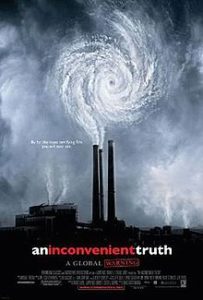
This is an inconvenient truth: We must fight like our lives depend on it. A product of these COP24 Katowice Accords, is now definitive plans and rules for implementing abatements around the world; carbon footprints must be reduced … globally, now!

A change has now come to the Caribbean region. This is Climate Change and it is not a good thing. Now is the time for a permanent union to provide efficient stewardship for our economic, security and governing engines. All regional stakeholders – the people and governing institutions – are hereby urged to lean-in to the empowerments described in the book Go Lean … Caribbean. Yes, we can … make our region, these islands and coastal states, better places to live, work and play.

There is the successful track record of abating environment pollution: remember Acid Rain in the 1990’s. So despite the doom and gloom, mitigation and abatement of Climate Change is conceivable, believable and achievable. 🙂

Sign the petition to lean-in for this roadmap for the Caribbean Union Trade Federation. 

Download the free e-book of Go Lean … Caribbean – now!

Share this post:
, ,
[Top]

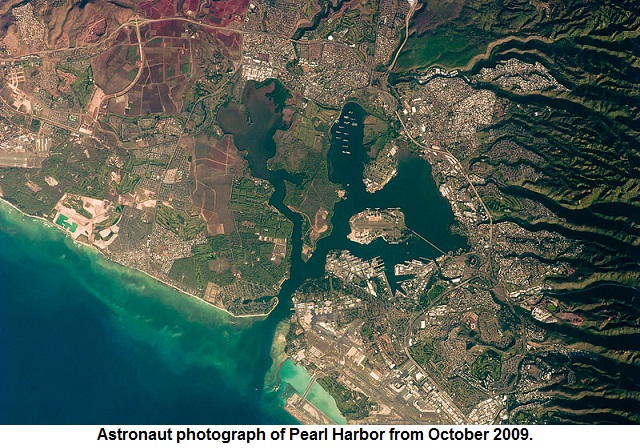
This Day in 1941: Pearl Harbor – ENCORE

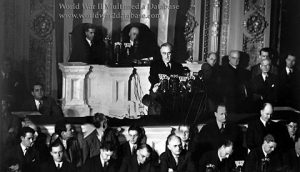
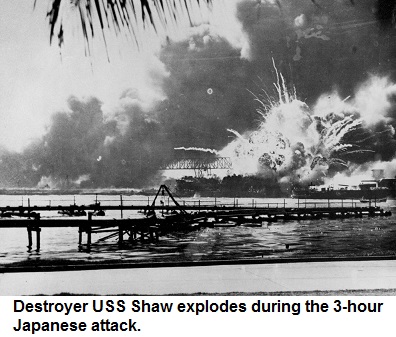
This day 77 years ago is a “day that will live in infamy”.
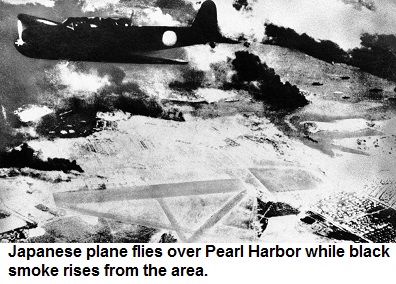
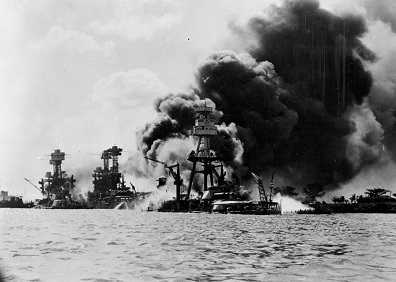
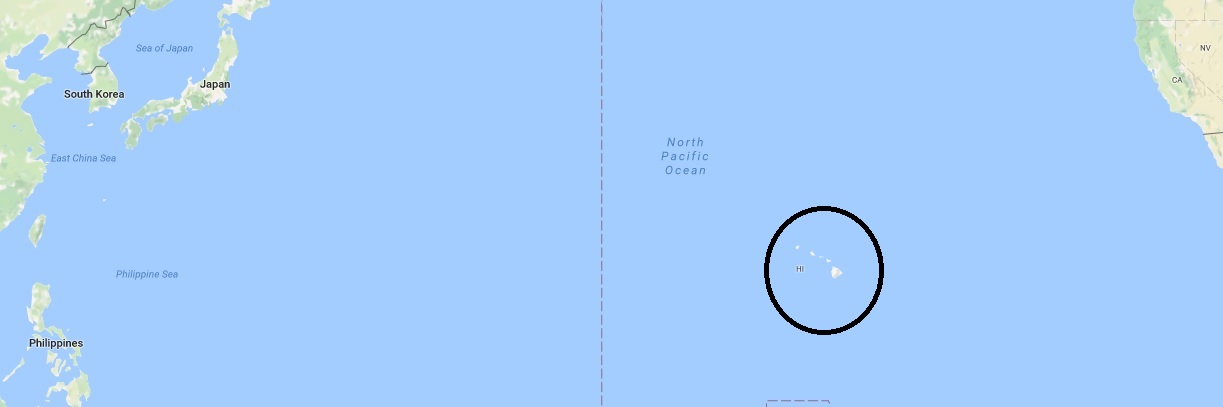
This is the anniversary of the Japanese attack on the United States Navy at Pearl Harbor, Hawaii. This event changed the world, as it ushered the US into World War II when they declared war against Japan the next day. Japan (Hirohito) was aligned with Germany (Hitler) and Italy (Mussolini), so by the US declaring war on Japan, the direct and immediate result was Germany and Italy declared war against the United States.

Germany, Italy, Japan, United States of America, …. these are just a sample of the countries involved in the conflict; it was a global war, the second one in 30 years.

There are a lot of lessons for the Caribbean in this history. This was the theme of this previous blog-commentary on December 7, 2016 during the 75th Anniversary commemoration. That entry is being Encored here-now, for the 2018 commemoration:

——————–

Go Lean Commentary – Lessons Learned from Pearl Harbor

What would you do if backed into a corner and there’s a threat on your life?

For many people their natural impulse is to come out fighting. They say that this is not aggression, rather just a survival instinct.

Believe it or not, this depiction describes one of the biggest attacks in American history: the Japanese Attack on Pearl Harbor. See VIDEO here:

VIDEO – World War II History: Attack on Pearl Harbor – http://www.history.com/topics/world-war-ii/world-war-ii-history/videos/attack-pearl-harbor

Retrieved December 7, 2016 from History.com – On December 7, 1941, Japan launches a surprise attack on American soil at Pearl Harbor.

cu-blog-lessons-learned-from-pearl-harbor-photo-2

cu-blog-lessons-learned-from-pearl-harbor-photo-3

cu-blog-lessons-learned-from-pearl-harbor-photo-4

This is the 75th Anniversary of that attack – a few days ago: December 7. That’s a lot of years and a lot of lessons. Still, 75 is a pretty round number, like 25, 50 and 100. This commentary has been reserved for now, a few days late on purpose because of the best-practice to “not speak ill of the dead” at a funeral or memorial service. But a “lessons learned analysis” is still an important exercise for benefiting from catastrophic efforts. After 75 years since the Pearl Harbor Attack on December 7, 1941, this post-mortem analysis is just as shocking as it was on this “day of infamy”.

Consider the details of this maligning article here (and the Appendices below); notice that it assumes a conspiracy:

Title: How U.S. Economic Warfare Provoked Japan’s Attack on Pearl Harbor
By: Robert Higgs

cu-blog-lessons-learned-from-pearl-harbor-photo-1Ask a typical American how the United States got into World War II, and he will almost certainly tell you that the Japanese attacked Pearl Harbor and the Americans fought back. Ask him why the Japanese attacked Pearl Harbor, and he will probably need some time to gather his thoughts. He might say that the Japanese were aggressive militarists who wanted to take over the world, or at least the Asia-Pacific part of it. Ask him what the United States did to provoke the Japanese, and he will probably say that the Americans did nothing: we were just minding our own business when the crazy Japanese, completely without justification, mounted a sneak attack on us, catching us totally by surprise in Hawaii on December 7, 1941.

You can’t blame him much. For more than 60 years such beliefs have constituted the generally accepted view among Americans, the one taught in schools and depicted in movies—what “every schoolboy knows.” Unfortunately, this orthodox view is a tissue of misconceptions. Don’t bother to ask the typical American what U.S. economic warfare had to do with provoking the Japanese to mount their attack, because he won’t know. Indeed, he will have no idea what you are talking about.

In the late nineteenth century, Japan’s economy began to grow and to industrialize rapidly. Because Japan has few natural resources, many of the burgeoning industries had to rely on imported raw materials, such as coal, iron ore or steel scrap, tin, copper, bauxite, rubber, and petroleum. Without access to such imports, many of which came from the United States or from European colonies in southeast Asia, Japan’s industrial economy would have ground to a halt. By engaging in international trade, however, the Japanese had built a moderately advanced industrial economy by 1941.

At the same time, they also built a military-industrial complex to support an increasingly powerful army and navy. These armed forces allowed Japan to project its power into various places in the Pacific and east Asia, including Korea and northern China, much as the United States used its growing industrial might to equip armed forces that projected U.S. power into the Caribbean and Latin America, and even as far away as the Philippine Islands.

When Franklin D. Roosevelt became president in 1933, the U.S. government fell under the control of a man who disliked the Japanese and harbored a romantic affection for the Chinese because, some writers have speculated, Roosevelt’s ancestors had made money in the China trade.[1] Roosevelt also disliked the Germans (and of course Adolf Hitler), and he tended to favor the British in his personal relations and in world affairs. He did not pay much attention to foreign policy, however, until his New Deal began to peter out in 1937. Afterward, he relied heavily on foreign policy to fulfill his political ambitions, including his desire for reelection to an unprecedented third term.

When Germany began to rearm and to seek Lebensraum aggressively in the late 1930s, the Roosevelt administration cooperated closely with the British and the French in measures to oppose German expansion. After World War II commenced in 1939, this U.S. assistance grew ever greater and included such measures as the so-called destroyer deal and the deceptively named Lend-Lease program. In anticipation of U.S. entry into the war, British and U.S. military staffs secretly formulated plans for joint operations. U.S. forces sought to create a war-justifying incident by cooperating with the British navy in attacks on German U-boats in the north Atlantic, but Hitler refused to take the bait, thus denying Roosevelt the pretext he craved for making the United States a full-fledged, declared belligerent—an end that the great majority of Americans opposed.

In June 1940, Henry L. Stimson, who had been secretary of war under Taft and secretary of state under Hoover, became secretary of war again. Stimson was a lion of the Anglophile, northeastern upper crust and no friend of the Japanese. In support of the so-called Open Door Policy for China, Stimson favored the use of economic sanctions to obstruct Japan’s advance in Asia. Treasury Secretary Henry Morgenthau and Interior Secretary Harold Ickes vigorously endorsed this policy. Roosevelt hoped that such sanctions would goad the Japanese into making a rash mistake by launching a war against the United States, which would bring in Germany because Japan and Germany were allied.

Accordingly, the Roosevelt administration, while curtly dismissing Japanese diplomatic overtures to harmonize relations, imposed a series of increasingly stringent economic sanctions on Japan. In 1939 the United States terminated the 1911 commercial treaty with Japan. “On July 2, 1940, Roosevelt signed the Export Control Act, authorizing the President to license or prohibit the export of essential defense materials.” Under this authority, “[o]n July 31, exports of aviation motor fuels and lubricants and No. 1 heavy melting iron and steel scrap were restricted.” Next, in a move aimed at Japan, Roosevelt slapped an embargo, effective October 16, “on all exports of scrap iron and steel to destinations other than Britain and the nations of the Western Hemisphere.” Finally, on July 26, 1941, Roosevelt “froze Japanese assets in the United States, thus bringing commercial relations between the nations to an effective end. One week later Roosevelt embargoed the export of such grades of oil as still were in commercial flow to Japan.”[2] The British and the Dutch followed suit, embargoing exports to Japan from their colonies in southeast Asia.

An Untenable Position
cu-blog-lessons-learned-from-pearl-harbor-photo-6
Roosevelt and his subordinates knew they were putting Japan in an untenable position and that the Japanese government might well try to escape the stranglehold by going to war. Having broken the Japanese diplomatic code, the Americans knew, among many other things, what Foreign Minister Teijiro Toyoda had communicated to Ambassador Kichisaburo Nomura on July 31: “Commercial and economic relations between Japan and third countries, led by England and the United States, are gradually becoming so horribly strained that we cannot endure it much longer. Consequently, our Empire, to save its very life, must take measures to secure the raw materials of the South Seas.”[3]

Because American cryptographers had also broken the Japanese naval code, the leaders in Washington knew as well that Japan’s “measures” would include an attack on Pearl Harbor.[4] Yet they withheld this critical information from the commanders in Hawaii, who might have headed off the attack or prepared themselves to defend against it. That Roosevelt and his chieftains did not ring the tocsin makes perfect sense: after all, the impending attack constituted precisely what they had been seeking for a long time. As Stimson confided to his diary after a meeting of the war cabinet on November 25, “The question was how we should maneuver them [the Japanese] into firing the first shot without allowing too much danger to ourselves.”[5] After the attack, Stimson confessed that “my first feeling was of relief … that a crisis had come in a way which would unite all our people.[6]

Source: The Independent Institute – Online Community – Posted: May 1, 2006; retrieved December 7, 2016 from: http://www.independent.org/newsroom/article.asp?id=1930
——–
See Appendices below for cited references and profiles of the Author and the Organization.

So this establishes why the Japanese may have been motivated to attack Pearl Harbor in the first place. The motivation seems more complicated than initially reported.

The Bible declares that:

“For there is nothing hidden that will not become manifest” – Luke 8:17

cu-blog-lessons-learned-from-pearl-harbor-photo-7

cu-blog-lessons-learned-from-pearl-harbor-photo-5

After 75 years, the before-during-after facts associated with the Pearl Harbor Attack should be available for full disclosure. What are the lessons here for the Caribbean and today’s effort to secure the Caribbean homeland while expanding the regional economy? We truly want to consider these main points, these lessons; (the hyperlinks refer to previous Go Lean commentaries):

Lessons

Territories have a status of disregard Hawaii (Pearl Harbor) and Philippines were attacked by the Japanese. These were both US Territories at the same. The levels of protection and preparedness for territories are sub-standard compared to the American mainland. As a result there was no meaningful plan for the air defense of Hawaii.
Colonialism is/was really bad Japan protested the sub-standard reality of the native Asians under the European colonial schemes. A people oppressed, suppressed and repressed would not remain docile forever; “that a downtrodden people would not stay down, that they would rise and revolt, that they would risk their lives and that of their children to pursue freedom.” – Go Lean book Page 251.
White Supremacy is/was a really bad construct The US Territories (Hawaii and Philippines) were not the first targets for Japan. They targeted all European colonies (British, French and Dutch) territories. Their campaign was to rail against White Supremacy.
Bullies only respond to a superior force Japan avail themselves of expansion opportunities in Far-East Asia as the European powers became distracted in the time period during and after World War I. (Manchuria in China was occupied by Japan starting in 1931). Only a superior force, the US, was able to assuage their aggression.
Economic Warfare can back a Government into a corner When the supply of basic needs (food, clothing, shelter and energy) are curtailed, a crisis ensues. When people are in crisis, they consider “fight or flight” options. Japan chose to fight; Caribbean people choose flight.
Societies can double-down on a bad Community Ethos Japan’s aggression was a direct result of their community ethos that honored Samurai warrior and battle culture. Men would walk the streets with their swords, ready for a challenge. On the other hand, the US (and Western Europe) community ethos of racism was so ingrained that the natural response in the US, post-Pearl Harbor, was to intern Japanese Americans in camps.
All of these bad community ethos were weeded out with post-WWII Human Rights reconciliations. – Go Lean book Page 220.
Double Standards are hard to ignore Japan felt justified in their Pacific aggression because of the US’s regional aggression in the Americas. Before Pearl Harbor, they withdrew from the League of Nations in protest of double standards.
Even after WWII, this double standard continues with countries with Veto power on the UN Security Council.
People have short memories There are movements to re-ignite many of the same developments that led to the devastation of WWII: right wing initiatives in Japan and Germany; Human Rights disregard for large minority groups (Muslims, etc.).
The more things change, the more they remain the same.

This discussion is analyzing the concept of “fight or flight”. According to Anthropologists, individuals and societies facing a crisis have to contend with these two options for survival. The very concept of refugees indicate that most people choose to flee; they choose internal displacement or refuge status in foreign countries. This point is consistent with the theme in the book Go Lean … Caribbean that this region is in crisis and as a result people have fled from their beloved homelands to foreign destinations in North America and Europe. How bad? According to one report, we have lost 70 percent of our tertiary-educated population.

Enough said! Our indictment is valid. Rather than flee, we now want the region to fight. This is not advocating a change to a militaristic state, but rather this commentary, and the underlying Go Lean book, advocates devoting “blood, sweat and tears” to empowering change in the Caribbean region. The book states this in its introduction (Page 3):

We cannot ignore the past, as it defines who we are, but we do not wish to be shackled to the past either, for then, we miss the future. So we must learn from the past, our experiences and that of other states in similar situations, mount our feet solidly to the ground and then lean-in, to reach for new heights; forward, upward and onward. This is what is advocated in this book: to Go Lean … Caribbean!

The Go Lean book serves as a roadmap for the introduction and implementation of the Caribbean Union Trade Federation (CU). One mission of this roadmap is to reduce the “push and pull” factors that contributes to the high emigration rates. For the most part the “push and pull” factors relate to the societal defects among the economic, security and governing engines. Another mission is to incentivize the far-flung Diaspora to consider a return to the region. Overall, the Go Lean roadmap asserts that the economy of the Caribbean is inextricably linked to the security of the Caribbean. The roadmap therefore proposes an accompanying Security Pact to accompany the CU treaty’s economic empowerment efforts. The plan is to cooperate, collaborate and confer with all regional counterparts so as to provide an optimized Caribbean defense, against all threats, foreign and domestic. This includes the American Caribbean territories (just like Pearl Harbor was on the American territory of Hawaii) of Puerto Rico and the US Virgin Islands. These American protectorates are included in this CU regional plan.

This CU/Go Lean regional plan strives to advance all of Caribbean society with these 3 prime directives:

  • Optimization of the economic engines in order to grow the regional economy to a $800 Billion Single Market by creating 2.2 million new jobs.
  • Establishment of a security apparatus to protect the resultant economic engines.
  • Improvement of Caribbean governance in support of these endeavors.

The Go Lean book stresses the effectiveness and efficiency of protecting life and property of all Caribbean stakeholders: residents, trading partners, visitors, etc.. This is why the book posits that some deployments are too big for any one member-state to manage alone – especially with such close proximities of one island nation to another – there are times when there must be a cross-border multi-lateral coordination – a regional partnership. This is the vision that is defined in the book (Pages 12 – 14), starting with these statements in the opening Declaration of Interdependence:

x. Whereas we are surrounded and allied to nations of larger proportions in land mass, populations, and treasuries, elements in their societies may have ill-intent in their pursuits, at the expense of the safety and security of our citizens. We must therefore appoint “new guards” to ensure our public safety and threats against our society, both domestic and foreign.

xii. Whereas the legacy in recent times in individual states may be that of ineffectual governance with no redress to higher authority, the accedence of this Federation will ensure accountability and escalation of the human and civil rights of the people for good governance, justice assurances, due process and the rule of law. As such, any threats of a “failed state” status for any member state must enact emergency measures on behalf of the Federation to protect the human, civil and property rights of the citizens, residents, allies, trading partners, and visitors of the affected member state and the Federation as a whole.

xvi. Whereas security of our homeland is inextricably linked to prosperity of the homeland, the economic and security interest of the region needs to be aligned under the same governance.

The Go Lean roadmap is not a call for a revolt against the governments, agencies or institutions of the Caribbean region, but rather a petition for a peaceful transition and optimization of the economic, security and governing engines in the region. To establish the security optimization, the Go Lean book presents a series of community ethos that must be adapted to forge this change. In addition, there are these specific strategies, tactics, implementation and advocacies to apply:

Community Ethos – new Economic Principles Page 21
Community Ethos – new Security Principles Page 22
Community Ethos – Minority Equalization Page 24
Community Ethos – Impacting the Greater Good Page 34
Strategy – Mission – Enact a Defense Pact to defend the homeland Page 45
Tactical – Fostering a Technocracy Page 64
Tactical – Homeland Security – Naval Operations Page 75
Tactical – Homeland Security – Militias Page 75
Implementation – Assemble – US Overseas Territory into CU Page 96
Implementation – Foreign Policy Initiatives at Start-up Page 102
Implementation – Security Initiatives at Start-up Page 103
Implementation – Ways to Promote Independence Page 120
Planning – Ways to Model the EU – Constructs after WW II Page 130
Advocacy – Ways to Better Manage the Social Contract Page 170
Advocacy – Ways to Improve Homeland Security Page 180
Advocacy – Ways to Mitigate Terrorism Page 181
Advocacy – Ways to Improve Intelligence Gathering Page 182
Advocacy – Ways to Enhance Tourism – Mitigate Risky Image Page 190
Advocacy – Ways to Improve Emergency Management Page 196
Advocacy – Ways to Preserve Caribbean Heritage Page 218
Advocacy – Ways to Impact US Territories Page 244

Now is the time to lean-in to this roadmap and “fight” for Caribbean change, as depicted in the book Go Lean…Caribbean. At this time, there are no State Actor adversaries – like Imperial Japan – seeking to cause harm to our homeland, but that status quo can change very quickly. Some Caribbean member-states are still de facto “colonies”, so enemies of our colonial masters – France, Netherlands, US, UK – can quickly “pop up”. We must be ready and on guard to any possible threats and security risks.

The movement behind the Go Lean … Caribbean book seeks to make this homeland a better place to live, work and play. Since the Caribbean is arguably the best address of the planet, tourism is a primary concern. So security here in our homeland must take on a different priority. Tourists do not visit war zones – civil wars, genocides, active terrorism, Failed-States and rampant crime. Already our societal defects (economics) have created such crises that our people have chosen to flee as opposed to “fight”. We do not need security threats as well; we do not need Failed-States. We are now preparing to “fight” (exert great efforts), not flee, to wage economic war to elevate our  communities.

This will not be easy; this is heavy-lifting, but success is possible. The strategies, tactics and implementations in the Go Lean roadmap are conceivable, believable and achievable. 🙂

Download the book Go Lean … Caribbean – now!

———–

Appendix A – Reference Notes:
1.  Harry Elmer Barnes, “Summary and Conclusions,” in Perpetual War for Perpetual Peace:A Critical Examination of the Foreign Policy of Franklin Delano Roosevelt and Its Aftermath (Caldwell, Id.: Caxton Printers, 1953), pp. 682–83.
2.  All quotations in this paragraph from George Morgenstern, “The Actual Road to Pearl Harbor,” in Perpetual War for Perpetual Peace, pp. 322–23, 327–28.
3.  Quoted ibid., p. 329.
4.  Robert B. Stinnett, Day of Deceit: The Truth about FDR and Pearl Harbor (NewYork: Free Press, 2000).
5.  Stimson quoted in Morgenstern, p. 343.
6.  Stimson quoted ibid., p. 384.

 ——-

Appendix B – About the Author:

Robert Higgs is a Senior Fellow in Political Economy at the Independent Institute and Editor at Large of the Institute’s quarterly journal The Independent Review. He received his Ph.D. in economics from JohnsHopkinsUniversity, and he has taught at the University of Washington, LafayetteCollege, SeattleUniversity, the University of Economics, Prague, and GeorgeMasonUniversity.

——-

Appendix C – About the Independent Institute:

The Independent Institute is a non-profit, non-partisan, scholarly research and educational organization that sponsors in-depth studies of critical social and economic issues.

The mission of the Independent Institute is to boldly advance peaceful, prosperous, and free societies grounded in a commitment to human worth and dignity.

Today, the influence of partisan interests is so pervasive that public-policy debate has become too politicized and is largely confined to a narrow reconsideration of existing policies. In order to fully understand the nature of public issues and possible solutions, the Institute’s program adheres to the highest standards of independent scholarly inquiry.
Source: http://www.independent.org/aboutus/

Share this post:
, , , ,
[Top]

Good Governance: Stepping Up in an Emergency

Go Lean Commentary

Do you know what SOS stands for?

Of course you know what it infers – “Emergency; Need Help” – but what does the letters stand for? There are a lot of lessons for us to learn with this encyclopedic consideration, here:

SOS
noun: SOS; plural noun: SOSs

  1. an international code signal of extreme distress, used especially by ships at sea.
    • an urgent appeal for help.
    • BRITISH: a message broadcast to an untraceable person in an emergency.
      i.e.: “here is an SOS message for Mr. Arthur Brown about his brother, who is dangerously ill”

Origin
Early 20th century (1905): letters chosen as being easily transmitted and recognized in Morse code; by folk etymology an abbreviation of “Save Our Souls“.
Translated to Morse code, SOS looks like this:

“. . . – – – . . .”

Source: Retrieved October 25, 2018 from: 1. https://www.google.com/search?q=Dictionary#dobs=SOS 2. https://www.rd.com/culture/sos-meaning/

SOS, plus 911 and other emergency outreach numbers, are all calls for help. In modern society, it is expected that someone-somewhere will respond.

That expectation is within the assumption of Good Governance. It is expected that someone-somewhere will step-up in the time of emergencies …

… failing this, we would have a Failed-State.

Unfortunately, this is the reality and actuality in the Caribbean. Consider these recent examples:

  • In January 2010, a 7.0 Magnitude Earthquake flattened large swaths of urban communities in Haiti. After 8 years, the people are still calling out for help. Some relief organizations – i.e. American Red Cross – that responded, fleeced the people more so than helped them.
  • In September 2017, Hurricane Irma devastated the twin island nation of Antigua & Barbuda. Rather than recovery and rebuilding on Barbuda, the government has just removed the people and made it a Ghost Town.
  • Later in September 2017, there was Hurricane Maria that devastated some Caribbean islands, Puerto Rico included. Power was out for parts of the island for 9 months; the PR government try to assert that the number of deaths were 64 people; and yet demographers and other social scientists counted the mortality rate for 4th Quarter 2017 and the 4th Quarters in previous years and the real [death] count is more like: 4600+.

  • In October 2018, there were heavy rains – not associated with a hurricane – over Trinidad & Tobago. The islands experienced severe flooding, at record levels. As days went by, conditions on the ground got worse and worse.

    See the VIDEO presentation of this news story in the Appendix below.

What is common about these true scenarios in recent history, is that the people sent out an SOS and it appears that no one responded – or too little response too late. Or worse still, only “pirates” responded and further exploited the victims.

Where is the expectation that someone-somewhere would step-up in these times of emergency? Someone honest, responsible, integral and accountable …

The Caribbean member-states are failing in their delivery of the implied Social Contract; defined in a previous blog-commentary, as follows:

“citizens surrender some of their freedoms and submit to the authority of the State in exchange for protection of remaining natural and legal rights”.

Failures in the delivery of the Social Contract is part-and-parcel of the crises afflicting the Caribbean. We suffer from an alarming societal abandonment rate because of the following 2 reasons:

  • Push – Deficient response, recovery and rebuilding after natural disasters have caused Caribbean people to seek refuge abroad; i.e. Puerto Rico may have lost 14% of their population after Hurricane Maria in 2017.
  • Pull – The perception is that other lands (North America and Europe) do better at delivering the basic needs – economics, security and governance – for their people.

All in all, other people do better in delivering on the Social Contract and responding to pleas of SOS. Assuaging this deficiency is the quest of the book Go Lean…Caribbean, to introduce and implement the Caribbean Union Trade Federation (CU), to do better at addressing our Homeland Security needs. It is past time for someone to step-up in response to emergencies. The book asserts this on its opening page (Page 3):

The economy of the Caribbean is inextricably linked to the security of the region. Therefore the CU treaty includes a security pact to implement the mechanisms to ensure greater homeland security. These efforts will monitor and mitigate against economic crimes, systemic threats and also facilitate natural disaster planning and response agencies.

So when a Caribbean community puts out an SOSon land, at sea or in the air – there will be someone there to respond.

When 911 calls 911, the CU responds … through its aligning agencies and institutions.

This is Good Governance. As reported in the previous submission in this series, Puerto Rico may have lost 470,000 people – 14% of the population – since Hurricanes Maria and Irma in September 2017 – Source posted February 20, 2018. We need to do better with our regional stewardship in the future.

This commentary is the second of a 5-part series (2 of 5) from the movement behind the Go Lean book in consideration of the Good Governance needs for a new Caribbean regime. The other commentaries in the series are cataloged as follows:

  1. Good Governance: … Versus Partisan Politics
  2. Good Governance: Stepping Up in an Emergency
  3. Good GovernanceThe Kind of Society We Want
  4. Good GovernanceGetting ‘Out of the Way’ of Local Economic Empowerment
  5. Good GovernanceGood Corporate Compliance

This need for Good Governance is embedded in this plan to elevate Caribbean life. There is the need to reboot, reform and transform all societal engines including: economics, security and governance. The member-state governments is the only security offering in this region, notwithstanding Non-Governmental Organizations (NGO’s). We need to do better at coordinating all of these facets of Caribbean life. This is the prime directive of this CU/Go Lean roadmap, as declared in these statements:

  • Optimization of the economic engines in order to grow the regional economy to $800 Billion & create 2.2 million new jobs.
  • Establishment of a security apparatus to ensure public safety and protect the resultant economic engines.
  • Improvement of Caribbean governance to support these engines, including a separation-of-powers between the member-states and CU federal agencies.

Good Governance … Emergency Operations … Homeland Security …

These are all part of the Go Lean book’s emphasis on New Guards. Notice these references in the opening Declaration of Interdependence (Pages 11 – 12):

iii. Whereas the natural formation of the landmass for our society is that of an archipelago of islands, inherent to this nature is the limitation of terrain and the natural resources there in. We must therefore provide “new guards” and protections to ensure the efficient and effective management of these resources.

x. Whereas we are surrounded and allied to nations of larger proportions in land mass, populations, and treasuries, elements in their societies may have ill-intent in their pursuits, at the expense of the safety and security of our citizens. We must therefore appoint “new guards” to ensure our public safety and threats against our society, both domestic and foreign. …

xi. Whereas all men are entitled to the benefits of good governance in a free society, “new guards” must be enacted to dissuade the emergence of incompetence, corruption, nepotism and cronyism at the peril of the people’s best interest. The Federation must guarantee the executions of a social contract between government and the governed.

xii. Whereas the legacy in recent times in individual states may be that of ineffectual governance with no redress to higher authority, the accedence of this Federation will ensure accountability and escalation of the human and civil rights of the people for good governance, justice assurances, due process and the rule of law. As such, any threats of a “failed state” status for any member state must enact emergency measures on behalf of the Federation to protect the human, civil and property rights of the citizens, residents, allies, trading partners, and visitors of the affected member state and the Federation as a whole.

These statements provide a glimpse of a new Caribbean that is ready for these New Guards. These are not foreigners. These are fellow Caribbean brothers and sisters, representing the 30 member-states in the region. They have the desire to help; they only need Good Governance … (Good Governance fulfillment will allow for more funding).

The CU structure allows for an Emergency Management functionality within the Homeland Security Department. The CU‘s version is modeled after the Federal Emergency Management Agency (FEMA) in the US. That agency’s emergency response is based on small, decentralized teams trained in such areas as the National Disaster Medical System (NDMS), Urban Search and Rescue (USAR), Disaster Mortuary Operational Response Team (DMORT), Disaster Medical Assistance Team (DMAT), and Mobile Emergency Response Support (MERS).

The Go Lean book provides 370-pages of turn-by-turn instructions on “how” to adopt new community ethos, plus the strategies, tactics, implementations and advocacies to execute so as to reboot, reform and transform the societal engines of Caribbean society. We need to be better at responding to the SOS calls in our region. In fact, the Go Lean roadmap proposes (Page 76) “the best practice of electronic notification for Emergency Management. This includes an Emergency Broadcasting-Alert system for TV & radio, plus advances in contact center technologies like Reverse 911, Automated-Robo calls to every active phone in a location – and text message blasting to every cell phone”.

In addition, there is one advocacy in the book for fostering a better Emergency Management eco-system. This includes Disaster Planning, Response & Recovery. Consider the specific plans, excerpts and headlines from the book on Page 196 entitled:

10 Ways to Improve Emergency Management

1 Lean-in for the Caribbean Single Market
This treaty allows for the unification of the region into one market, thereby expanding to an economy of 30 countries, 42 million people and a GDP of over $800 Billion (according to 2010 metrics). This treaty calls for a collective security agreement for the Caribbean member-states so as to prepare-respond to natural disasters, emergency incidents and assuage against systemic threats against the homeland. The CU employs the professional arts and sciences of Emergency Management to spread the costs, risks and premium base across the entire region and refers to more  than  just medical scenarios, but rather any field of discipline that can impact the continuity of a community or an individual. The CU also has the direct responsibility for emergencies in the Exclusive Economic Zone and Self Governing Entities.
2 Trauma Centers
3 Airlift / Sealift – Getting there by Helicopters, Airplanes and Boats

In addition to Air Ambulances (helicopters & airplanes), the CU will deploy Water Ambulances to quickly convey the injured to trauma centers among the islands. The vessels will all be equipped with certified and trauma-trained EMTs.

4 Mobile Surgical Centers and Tele-Medicine

The CU will deploy specialized trailers that function as surgical operating theaters, recovery rooms and diagnostic laboratories. The mobile hospitals will include attendant functions for pharmaceuticals, power, and communications. The communications allow for tele-medicine tactics to engage specialized clinicians that may be remote. These trailers can be positioned at sites of emergency events to better respond after disasters or when normal infrastructure is compromised.

5 Epidemiology – Viral & Bacterial Rapid Response

Due to the systemic threat, epidemic response and disease control will be coordinated at the CU Cabinet level, by the Department of Health. In the event of an outbreak, the CU will assume jurisdiction of the emergency “event” with the authority to commandeer local resources, quarantine populations and blockade transport to/from the affected area.

6 Mobile Command Centers
The CU will deploy specialized trailers equipped as mobile command centers for marshaling the on-site response for emergency “events”. The cutting-edge trailers will feature advanced communications, monitoring and power sources. The trailers can be positioned strategically in advance, re-located at the outset of “events”, or rolled-out in response.
7 Intelligence Gathering & Analysis
8 Casualty Insurance Plans – Reinsurance “Sidecars”
9 Volunteer Fire – Rescue Brigades

A lot of the residential areas in the Caribbean region are sparsely populated and hard to justify for permanent Fire-

Rescue installations, so the CU will facilitate Volunteer Fire-Rescue brigades and supply the necessary training, tools, and support services. Even the surgeons, nurses and EMTs for the trauma centers may be structured as part-timers.

10 ITIL – Information Technology Infrastructure Library

This Go Lean book presents that the roll-out of the Emergency Management apparatus will be Day One / Step One of the Go Lean/CU roadmap. Many more highlights have been detailed in previous blog-commentaries; consider this sample:

https://goleancaribbean.com/blog/?p=15886 Industrial Reboot – Reinsurance 101
https://goleancaribbean.com/blog/?p=15543 Ross University Saga – No Caribbean Unity in Disaster Response
https://goleancaribbean.com/blog/?p=15310 Industrial Reboot with Trauma Centers
https://goleancaribbean.com/blog/?p=13746 Failure to Launch – Security: Caribbean Basin Security Dreams
https://goleancaribbean.com/blog/?p=13251 Funding Caribbean Risk
https://goleancaribbean.com/blog/?p=13155 Industrial Reboot – Pipelines 101 – Strategy for Quick Recovery
https://goleancaribbean.com/blog/?p=12994 The Science of ‘Power Restoration’
https://goleancaribbean.com/blog/?p=12949 Charity Management: Grow Up Already!
https://goleancaribbean.com/blog/?p=10771 Logical Addresses – ‘Life or Death’ Consequences
https://goleancaribbean.com/blog/?p=10566 Funding the Caribbean Security Pact
https://goleancaribbean.com/blog/?p=7896 The Logistics of Disaster Relief
https://goleancaribbean.com/blog/?p=7449 ‘Crap Happens’ – So What Now?
https://goleancaribbean.com/blog/?p=4308 911 – Emergency Response: System in Crisis

We want Good Governance. So we must reform and transform our Caribbean governing engines and Homeland Security apparatus. We must be able to better respond-rebuild-recover from emergencies.

This commitment should be in our delivery of the Social Contract. This is how we can make the Caribbean a better homeland to live, work and play.

The people and institutions of the region are hereby urged to lean-in to this Go Lean roadmap; this plan is conceivable, believable and achievable. 🙂

Download the free e-Book of Go Lean … Caribbean – now!

Sign the petition to lean-in for this roadmap for the Caribbean Union Trade Federation.

———————-

Appendix VIDEO – Kelly Village and Trinidad and Tobago witness the biggest floods in their history – https://youtu.be/ywQaCK4vu04

KellyVillageTV
Published on Oct 20, 2018 – It was a depressing scene walking amongst the villagers today. The camera truly couldn’t capture the devastation and shock in the area. The one emergency center is full and the people are begging for assistance tonight. #KVTV #Trinidad #Flood

Share this post:
, ,
[Top]

Retail Apocalypse and Sears – Another One Bites the Dust – ENCORE

Another one bites the dust …

Sears has filed for Bankruptcy protection. This may be more than just reorganization; this might be complete dissolution.

See the VIDEO and excerpt of the news article here:

VIDEO – Sears files for Chapter 11 bankruptcy protection – https://www.usatoday.com/videos/news/nation/2018/10/15/sears-files-chapter-11-bankruptcy-protection/38160609/

—————–

Title: Sears files for Chapter 11 bankruptcy protection, to close 142 more stores
By: , USA TODAY

October 15, 2018 – Sears Holdings, whose presence permeated American life for generations, filed for Chapter 11 bankruptcy protection early Monday in a last-ditch attempt to avoid entombment in the graveyard of once-great retailers that failed to adapt to the digital age.
For Sears — which was the largest retailer in the nation before the rise of Walmart and, later, Amazon — bankruptcy marks the culmination of years of decline defined by store closures, sales declines, cost cuts and borrowing.

The company, which also owns discount retailer Kmart, has fallen into disrepair amid a perilous retail landscape in which customers increasingly shop online or seek out more-appealing alternatives.

For Kmart, known for its one-time “blue-light specials,” catchy jingles, and collections created by celebrities, the case marks a second brush with death. Kmart merged with Sears in 2005 after surviving bankruptcy once before.

Sears Holdings will close another 142 stores by about the end of the year, on top of a recently announced round of 46 store closures, as part of the bankruptcy. The company has 687 stores and about 68,000 employees.

See the remaining news story here (retrieved from this source on October 16, 2018):https://www.usatoday.com/story/money/2018/10/15/sears-bankruptcy/1595399002/?csp=chromepush

This was predicted. This is the dreaded, feared Retail Apocalypse. Truth be told, this is relevant for the Caribbean as well. This assertion was made in a prior commentary on April 18, 2017. See an Encore of that submission here-now:

=====================

Go Lean Commentary – Retail Apocalypse – Preparing for the Inevitable

Remember the dream … of 7 Fat Cows and 7 Skinny Cows?

The articulation of the dream was that the 7 Fat Cows represented 7 prosperous years while the 7 Skinny Cows represented 7 years of famine with poverty and distress. – The Bible; Genesis Chapter 41.
CU Blog - Retail Apocalypse - Preparing for the Inevitable - Photo 0

In that Bible drama of Joseph in ancient Egypt, those circumstances were more than just in a dream; it was a prophecy of prosperity and famine. It came true!

Joseph was able to use the foresight to prepare that kingdom for adversity, after first exploiting the opportunities.

Here it comes again.

There is feast and famine “in the cards” as related to the retail eco-system. On one end of the spectrum , there will be prosperity for electronic commerce stakeholders, but on the other end, for brick-and-mortar establishments, there will be a Retail Apocalypse.

Will be? Actually, the threat has already manifested!

This is the assertion in this news article by the financial-economic magazine Business Insider:

CU Blog - Retail Apocalypse - Preparing for the Inevitable - Photo 1

Title: The retail apocalypse has officially descended on America
By: Hayley Peterson

Thousands of mall-based stores are shutting down in what’s fast becoming one of the biggest waves of retail closures in decades.

More than 3,500 stores are expected to close in the next couple of months.

Department stores like JCPenney, Macy’s, Sears, and Kmart are among the companies shutting down stores, along with middle-of-the-mall chains like Crocs, BCBG, Abercrombie & Fitch, and Guess.

CU Blog - Retail Apocalypse - Preparing for the Inevitable - Photo 2

Some retailers are exiting the brick-and-mortar business altogether and trying to shift to an all-online model.

For example, Bebe is closing all its stores — about 170 — to focus on increasing its online sales, according to a Bloomberg report.

Some are going out of business altogether, like The Limited which recently shut down all 250 of its stores.

Others, such as Sears and JCPenney, are aggressively paring down their store counts to unload unprofitable locations and try to stanch losses.

CU Blog - Retail Apocalypse - Preparing for the Inevitable - Photo 3Sears is shutting down about 10% of its Sears and Kmart locations, or 150 stores, and JCPenney is shutting down about 14% of its locations, or 138 stores.

According to many analysts, the retail apocalypse has been a long time coming in the US, where stores per capita far outnumber that of any other country.

The US has 23.5 square feet of retail space per person, compared with 16.4 square feet in Canada and 11.1 square feet in Australia, the next two countries with the most retail space per capita, according to a Morningstar Credit Ratings report from October.

Visits to shopping malls have been declining for years with the rise of e-commerce and titanic shifts in how shoppers spend their money. Visits declined by 50% between 2010 and 2013, according to the real-estate research firm Cushman & Wakefield.

And people are now devoting bigger shares of their wallets to restaurants, travel, and technology than ever before, while spending less on apparel and accessories.

As stores close, many shopping malls will be forced to shut down as well.

When an anchor store like Sears or Macy’s closes, it often triggers a downward spiral in performance for shopping malls.

Not only do the malls lose the income and shopper traffic from that store’s business, but the closure often triggers “co-tenancy clauses” that allow the other mall tenants to terminate their leases or renegotiate the terms, typically with a period of lower rents, until another retailer moves into the anchor space.

To reduce losses, malls must quickly find a replacement tenant for the massive retail space that the anchor store occupied, which is difficult — especially in malls that are already financially strapped — when major department stores are reducing their retail footprints.

That can have grave consequences for shopping malls, especially in markets where it’s harder to transform vacant mall space into non-retail space like apartments, according to analysts.

The nation’s worst-performing malls — those classified in the industry as C- and D-rated — will be hit the hardest by the store closures.

The real-estate research firm Green Street Advisors estimates that about 30% of all malls fall under those classifications. That means that nearly a third of shopping malls are at risk of dying off as a result of store closures.
Source: Business Insider e-Zine. Posted 03/21/2017; retrieved 04/17/2017 from: http://www.businessinsider.com/the-retail-apocalypse-has-officially-descended-on-america-2017-3

CU Blog - Retail Apocalypse - Preparing for the Inevitable - Photo 4

Related:

1. Monday Market Mayhem – The Retail Apocalypse – Look out Wall Street

2. Dollar General is defying the retail apocalypse and opening 1,000 stores

See the related AUDIO Podcast below here:

———–

AUDIO Podcast – Wal-Mart battles Amazon with discounts for online ordering and store pickup – https://www.marketplace.org/2017/04/14/business/its-battle-amazon-walmart-offers-discounts-ordering-online-and-picking-store

Published April 14, 2017 – Big Box giant Wal-Mart battling e-Commerce giant Amazon for New Economy fulfillment.

As noted in the foregoing, the Retail Apocalypse is affecting the news in the United States. It’s only the news today, tomorrow will be jobs, the next day the finance apparatus holding the debt (mortgages and security instruments on Wall Street) for the many shopping malls and then soon, the rest of the economy will be impacted.

This is so familiar. Remember the housing-real estate bubble in 2003 to 2010. This previous blog-commentary identified the following 5 steps of a bubble:

1.   Displacement

2.   Boom

3.   Euphoria

4.   Profit Taking

5.   Panic

Here we go again! Sounds like a crisis is imminent.

The book Go Lean…Caribbean serves as a roadmap for the introduction and implementation of the technocratic Caribbean Union Trade Federation (CU) and Caribbean Central Bank (CCB); it declares that a crisis is a terrible thing to waste – quoting famed American Economist Paul Romer. Though the impending crisis is slated for the US, the actuality of economic contagions mean that the Caribbean member-states will be affected as well.

Where do the tourists come from that drive the Caribbean region’s primary economic driver?

The question is rhetorical; the answer is obvious!

The Go Lean book seeks to prepare the Caribbean region for the change dynamics impacting the world. The “Agents of Change” at play in the foregoing news source are as follows:

  • Technology
  • Globalization

The underlying issue with the Retail Apocalypse is not the demand for retail products, it is the supply. Consumers are still demanding and consuming fashion and commodities, just not at shopping malls; e-Commerce is “all the rage”.

Consider the experience of this commentator:

I went to buy 3 pairs of slacks.

I was only able to find one – with the brand, make, size and color – at a Big Box retail store. So then I went home and matched the brand, model, size with the e-Commerce merchant Amazon.com and acquired the same pants in 2 divergent colors that the Big Box retailer did not have in inventory. 3 days later, the whole shopping expedition was over; I acquired 3 pairs of slacks, primarily from the online merchant and delivered by the shipping company United Parcel Service (UPS).

The quest of the Go Lean/CU roadmap is to elevate the Caribbean’s societal engines – not the US – starting first with economics (jobs, commercial developments and entrepreneurial opportunities). In fact, the following 3 statements are identified as the prime directives of the CU:

  • Optimization of the economic engines in order to grow the regional economy to $800 Billion & create 2.2 million new jobs.
  • Establishment of a security apparatus to protect the resultant economic engines.
  • Improve Caribbean governance – as e-Commerce alters sales & border taxes – to support these engines.

The changes taking place in the US with the Retail Apocalypse will eventually traverse the Caribbean member-states as well. This is the parallel with the opening Bible Drama. A crisis is coming and we have the opportunity to exploit the prosperous years and prepare for the famine. The Caribbean region – all 30 member-states – needs to better exploit e-Commerce. There are so missing ingredients, fully detailed in the Go Lean book; see  this sample advocacy on Page 198:

10 Ways to Foster e-Commerce

1 Leverage the full population – 42 million people in all 30 member-states to deploy the CU and the CCB.
2 Regional Currency (Caribbean Dollar or C$)
3 Card Culture
The CU will seek to foster the eco-system for e-payments beyond government activity. To assimilate this change, a card culture, on Main Street, will entail utilizing debit/credit cards, benefits pay cards, and even smart cards on cruise ships.
The CU will collectively bargain with the cruise lines to deploy C$ electronic “purses” to facilitate port-side and onboard retail commerce. All of these changes will garner a better monetary multiplier on the CU economy, by expanding M1.
4 CU Social Media
The CU web portal www.myCaribbean.gov will grant free access, email, IM, and profile pages for CU stakeholders, even normalizing communications thru social media sites. This will facilitate internet commerce activities in the region, as the CU will have hot data on profiles, habits and previous activities, thereby creating opportunities for measured marketing.
5 A Market for the Downloads of Intellectual Properties
6 Remittance Methods (Card & Email)
7 Mobile Apps – Hi-Density Wi-Fi
8 Regional Postal Services – CPU
The CU will assume the responsibility for mail services in the region; (all member-state postal employees will become federal civil servants). The embrace of the Caribbean Postal Union allows for parcel mail to be optimally shipped and delivered throughout the region, with Customs considerations in place. The CPU will therefore ensure the fulfillment side of e-commerce, even allowing for computer applications for printing electronic stamps/barcodes for value savings.
9 Turnpike Logistics
10 Customs and Import Optimizations

The missing ingredients for this new marketplace – electronic commerce – are not just banking-related, the full eco-system must be enabled: electronic (technology), commerce (trade) and fulfillment (logistics). The implementation of these provisions will constitute a New Day for the region. Overall, the Go Lean book stresses the community ethos, strategies, tactics, implementations and advocacies to reboot, reform and transform the economic engines of Caribbean society, so as to benefit from changes coming due to the Retail Apocalypse, this New Day.

Though not directly mentioned in the Go Lean book, this Retail Apocalypse is planned for in the roadmap. A comprehensive view of  the technocratic stewardship for the region’s economic engines, including the banking eco-system, is presented early in the book with these opening pronouncements in the Declaration of Interdependence (Page 13 and 14):

xxiv. Whereas a free market economy can be induced and spurred for continuous progress, the Federation must install the controls to better manage aspects of the economy: jobs, inflation, savings rate, investments and other economic principles. Thereby attracting direct foreign investment because of the stability and vibrancy of our economy.

xxvii. Whereas the region has endured a spectator status during the Industrial Revolution, we cannot stand on the sidelines of this new economy, the Information Revolution. Rather, the Federation must embrace all the tenets of Internet Communications Technology (ICT) to serve as an equalizing element in competition with the rest of the world. The Federation must bridge the digital divide and promote the community ethos that research/development is valuable and must be promoted and incentivized for adoption.

The points of effective, technocratic banking and retail stewardship were further elaborated upon in previous blog/commentaries. Consider this sample:

https://goleancaribbean.com/blog/?p=11184 Big Bank investing $Billion on ‘Fintech’ for e-Commerce positioning
https://goleancaribbean.com/blog/?p=8823 Lessons from China – WeChat: Model for Caribbean Social Media
https://goleancaribbean.com/blog/?p=8704 Lesson from MetroCard
https://goleancaribbean.com/blog/?p=7991 Transformations: Caribbean Postal Union – Delivering the Future
https://goleancaribbean.com/blog/?p=7034 The Future of Money
https://goleancaribbean.com/blog/?p=6635 New Security Chip in Credit Cards Unveiled
https://goleancaribbean.com/blog/?p=5668 Move over Mastercard/Visa – Time for Local Banking Cards
https://goleancaribbean.com/blog/?p=4425 Cash, Credit or iPhone …
https://goleancaribbean.com/blog/?p=3889 Royal Bank of Canada’s EZPay – Ready for Change
https://goleancaribbean.com/blog/?p=3881 The Need for Regional Cooperation for Cyber-Security & e-Security
https://goleancaribbean.com/blog/?p=3858 Model of Central Banking Technocracy: ECB 1 trillion Euro stimulus
https://goleancaribbean.com/blog/?p=2488 Model of an E-Commerce Fulfillment Company: Alibaba
https://goleancaribbean.com/blog/?p=1416 Model of an E-Commerce Fulfillment Company: Amazon
https://goleancaribbean.com/blog/?p=1350 PayPal’s model to pay for e-Commerce
https://goleancaribbean.com/blog/?p=906 Bitcoin model to pay for e-Commerce
https://goleancaribbean.com/blog/?p=528 Facebook to pay for e-Commerce

Warning to all retail stakeholders – buyers, sellers and governments: Change is coming!

This is a familiar stance – preparing for the inevitable – for the Go Lean movement; there have been previous warnings of disruptive changes; see this sample here:

https://goleancaribbean.com/blog/?p=7847 To the Personal Computer industry: Cloud Computing, Smartphones and Tablets are making actual laptop and desktop computers inconsequential.
https://goleancaribbean.com/blog/?p=6151 To the regional government’s Revenue Officials: 3-D Printing is coming and will change fabrication to local rather than import. This will disrupt border taxes revenue expectations.
https://goleancaribbean.com/blog/?p=6016 To the Infrastructure Planners: Climate Change is making Caribbean summers hot-hot-hot and northern winters milder; there must be cooperative refrigeration to provide relief, otherwise people will leave for northern destinations.
https://goleancaribbean.com/blog/?p=5784 To Jamaica’s Public Safety Officials: Human Rights protections must be extended to people who identify as LGBT. Whether you agree or not, the international community will force you to respect their rights for life, liberty and the pursuit of happiness.
https://goleancaribbean.com/blog/?p=5210 To the Cruise Line industry: The Caribbean region’s collective bargaining will extract greater benefits and protections for port city commerce.
https://goleancaribbean.com/blog/?p=5155 To the Caribbean Power Grip: Home-based batteries will allow for successful deployments of solar/wind power generation and require less power from the grid.
https://goleancaribbean.com/blog/?p=4767 To the regional government’s Revenue Officials: Under the WTO regime, customs duties must eventually be eliminated; same too with conditional property taxes. VAT or Sales Taxes are OK.

As for the Retail Apocalypse, now is the time for all stakeholders of Caribbean banking, retail and governments to lean-in for the empowerments for e-Commerce described here-in and in the book Go Lean … Caribbean. This is where the marketplace is going, not just tomorrow, but already here today. We can do this; we can elevate our communities and our retail eco-systems. We can be a better place to live, work and play. 🙂

Download the free e-book of Go Lean … Caribbean – now!

Sign the petition to lean-in for the roadmap for the Caribbean Union Trade Federation.


Share this post:
, , , ,
[Top]

Climate Change Catastrophe: 12 Year Countdown

Go Lean Commentary

So do not make any plans beyond 12 years …

… that is the warning …

… from the UN Intergovernmental Panel on Climate Change (IPCC). The report from this respected body asserts that if there are no mitigations, then the catastrophic future that we all dread will be unavoidable. Life may continue on the planet, but the status quo would be no more. See the news story on the UN Report here and the continuation in the Appendix below:

Title: We have 12 years to limit climate change catastrophe, warns UN
Sub-title: Urgent changes needed to cut risk of extreme heat, drought, floods and poverty, says IPCC

The world’s leading climate scientists have warned there is only a dozen years for global warming to be kept to a maximum of 1.5C, beyond which even half a degree will significantly worsen the risks of drought, floods, extreme heat and poverty for hundreds of millions of people.
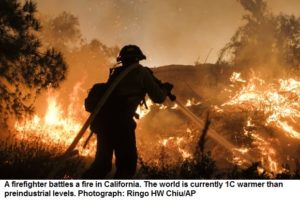
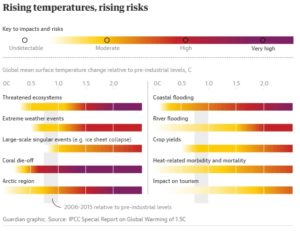
The authors of the landmark report by the UN Intergovernmental Panel on Climate Change (IPCC) released on Monday say urgent and unprecedented changes are needed to reach the target, which they say is affordable and feasible although it lies at the most ambitious end of the Paris agreementpledge to keep temperatures between 1.5C and 2C.

The half-degree difference could also prevent corals from being completely eradicated and ease pressure on the Arctic, according to the 1.5C study, which was launched after approval at a final plenary of all 195 countries in Incheon in South Korea that saw delegates hugging one another, with some in tears.

“It’s a line in the sand and what it says to our species is that this is the moment and we must act now,” said Debra Roberts, a co-chair of the working group on impacts. “This is the largest clarion bell from the science community and I hope it mobilises people and dents the mood of complacency.”

Policymakers commissioned the report at the Paris climate talks in 2016, but since then the gap between science and politics has widened. Donald Trump has promised to withdraw the US – the world’s biggest source of historical emissions – from the accord. The first round of Brazil’s presidential election on Sunday put Jair Bolsonaro into a strong position to carry out his threat to do the same and also open the Amazon rainforest to agribusiness.

The world is currently 1C warmer than preindustrial levels. Following devastating hurricanes in the US, record droughts in Cape Town and forest fires in the Arctic, the IPCC makes clear that climate change is already happening, upgraded its risk warning from previous reports, and warned that every fraction of additional warming would worsen the impact.


See the remaining article in the Appendix below.

Source: Posted The Guardian – London Daily Newspaper October 8, 2018;retrieved October 15, 2018 from: https://www.theguardian.com/environment/2018/oct/08/global-warming-must-not-exceed-15c-warns-landmark-un-report

This is not Armageddon … yet. But the Bible does provide a justification that redeeming mankind will only happen at the precipice, just as man’s perilous rule reaches the point of unavoidable destruction of the planet. That scripture reads:

18  But the nations became wrathful, and your own wrath came, and the appointed time came for the dead to be judged and to reward+ your slaves the prophets+ and the holy ones and those fearing your name, the small and the great, and to bring to ruin those ruining* the earth.”+ – Revelation 11:18 New World Translation

Yes, truly, “we” are ruining the earth. Some people (countries) more so than others. But despite whether we are the guilty culprits or not, we still only have one planet … and it needs some attention. Or else …

… after 12 years, no more earth, the way we know it.

All the evidence is in front of us. To ignore it, we do so at our own peril. As related previously, the Numbers don’t lie: as of this past May, the earth has had 400 straight warmer-than-average months. See other aligned blog-commentaries that echoed this assessment:

https://goleancaribbean.com/blog/?p=14925 Climate Change Doubt?! Numbers Don’t Lie
https://goleancaribbean.com/blog/?p=14832 Manifesting Environmental Change
https://goleancaribbean.com/blog/?p=11858 Islands are Disappearing – The Cautionary Tale of Kiribati
https://goleancaribbean.com/blog/?p=9455 Fix ‘Climate Change’ – Yes, We Can
https://goleancaribbean.com/blog/?p=7103 COP21 – ‘Climate Change’ Acknowledged
https://goleancaribbean.com/blog/?p=6893 A Meteorologist’s View On Climate Change
https://goleancaribbean.com/blog/?p=4673 Climate Change‘ Merchants of Doubt … to Preserve Profits!!
https://goleancaribbean.com/blog/?p=2465 Book: ‘This Changes Everything: Capitalism vs. the Climate’
https://goleancaribbean.com/blog/?p=2276 Climate Change May Affect Food Supply Within a Decade
https://goleancaribbean.com/blog/?p=1883 Climate Change May Bring More Kidney Stones
https://goleancaribbean.com/blog/?p=1817 Caribbean grapples with intense cycles of flooding & drought

Are we saying that the earth will be destroyed in 12 years?

No!

But the mitigations that are feasible to assuage this problem, only have a limited shelf-life. After 12 years, there may not be any turning back from a Greenhouse planet. Once we accept this fact – the eventuality of the Climate Change Catastrophe – only then can we start to make effort to address the truth: our “house is on fire”.

There should be no doubt, we must act now.

What are we going to do about it?

Yes, we can … make a difference … still. But now we cannot hit or miss; we are at the precipice.

Perhaps this reality now is why one of the world’s most notorious Climate Change Denier is finally, begrudgingly, owning up to the fact that … “there might be something to this Climate Change” thing.

We’re talking about US President Donald Trump. See  the VIDEO here:

VIDEO – President Donald Trump’s ’60 Minutes’ Interview: Climate Change, etc. –  https://youtu.be/_D8OfRiEff4

TODAY
Published on Oct 15, 2018 – In an interview with “60 Minutes,” President Trump backed off earlier statements that climate change is a hoax, and also said that he doesn’t “trust everybody” in the White House. He also commented on Supreme Court Justice Brett Kavanaugh’s confirmation and the ongoing Russia investigation.

This is how destiny works. We can run from it, deny it or hide. But it will still catch up with us.

The earth is destined to suffer great catastrophes due to Climate Change … in 12 years!

Let’s do our share, everyone, everywhere to see if we can abate this reality.

The book Go Lean…Caribbean – available to download for free – serves as a roadmap for the introduction and implementation of the technocratic Caribbean Union Trade Federation (CU), to reform and transform all of Caribbean society – all 30 member-states. There is the need to shepherd our own communities to do our share to abate Climate Change. While the problem is too big for us alone in our region, we must still act … nonetheless. We cannot sit back, fold our arms and expect everyone else to do the heavy-lifting. No, we must even lead, since we are on the frontlines of over-heated hurricanes.

This is a lesson learned from Canada; they are on the frontline of melting ice-caps – think icy Northwest Passage – so they are stepping-up to act and show the world how to act. They are not waiting for “deniers to wake up and stop denying”; they are putting in their mitigation now … anyway. Then they are telling and showing the world what to do in following their example. This was detailed in a previous Go Lean commentary as follows:

Canada … has the longest total coastline among all of the countries of the world, at 125,567 miles. …

If Climate Change is to continue unabated, this country has a lot to lose – catastrophic storms, melting ice caps, thawing permafrost and rising sea level. …

Canada is prepared to take the lead, to put the Western Hemisphere on its shoulders and carry the load for arresting Climate Change. …

Thank you Canada for this model. Now, we – the Caribbean – need to step up to carry our own load for better mitigation of Climate Change threats; we need to do our part in lowering our own carbon footprint. We can make a difference. Canada can make a difference. As related in a previous blog-commentary, the same as the threat of Acid Rain was subjugated, so too, curative measures can be put in place to lower the greenhouse gases in the environment. This is why Canada has a Champion for the Environment – Catherine McKenna – at the Cabinet level.

Good model …

The Go Lean roadmap addresses all aspects of Caribbean society – economics, security and governance – and then declares: “Do this; Do that; Do Something; Do Everything”. The roadmap presents these prime directives in this regards:

Fixing Climate Change in the US or Canada is out-of-scope for this Go Lean movement; but we still need them to act. We also need Europe, China, India – all Big Polluters – and all countries of the world to act. We must stand on soap boxes, podiums and stages and tell the world – everyone must listen; we must make them listen. This is now everyone’s job, everyone’s responsibility.

We only have 12 years!

Make no plans for Year 13 and beyond. 🙁

There is hope! The Go Lean book and roadmap stresses that reforming and transforming the Caribbean’s societal engines to abate Climate Change is possible; it is conceivable, believable and achievable. But this is heavy-lifting.

The Go Lean book provides 370-pages of turn-by-turn instructions on “how” to prepare and respond for Climate Change catastrophes. See this sample of strategies, tactics, implementations and advocacies from the book:

Community Ethos – Deferred Gratification Page 21
Community Ethos – Economic Systems Influence Individual Choices / Incentives Page 21
Community Ethos – The Consequences of Choices Lie in the Future Page 21
Community Ethos – “Crap” Happens Page 23
Strategy – Mission – Prepare for Natural Disasters Page 45
Strategy – Agents of Change – Climate Change Page 57
Tactical – Confederating a Permanent Union Page 63
Tactical – Fostering a Technocracy Page 64
Separation of Powers – Emergency Management Page 76
Separation of Powers – Meteorological & Geological Service Page 79
Anecdote – “Lean” in Government Page 93
Implementation – Security Initiatives at Start-up – Unified Command & Control Page 103
Implementation – Industrial Policy for CU Self Governing Entities Page 103
Implementation – Ways to Deliver Page 109
Implementation – Ways to Foster International Aid Page 115
Implementation – Ways to Benefit from Globalization – Produce, Not Just Consume Page 119
Advocacy – Ways to Better Manage the Social Contract Page 170
Advocacy – Ways to Foster Cooperatives Page 176
Advocacy – Ways to Improve for Natural Disasters Page 184
Advocacy – Ways to Improve Emergency Management Page 196
Advocacy – Ways to Improve Transportation – CNG Buses and Electric Street Cars Page 205
Advocacy – Ways to Develop the Auto Industry – Embrace Alternative Energy Page 206

Are we up to this challenge?

We must work at it … as if our life depends on it.

It does!

We need all hands on deck! This is an Inconvenient Truth but its the truth nonetheless. We urge all Caribbean stakeholders to lean-in to this Go Lean roadmap for change, to get our homeland more active in the solution and abatement of Climate Change. Let’s get going. 🙂

Download the free e-Book of Go Lean … Caribbean – now!

Sign the petition to lean-in for this roadmap for the Caribbean Union Trade Federation.

—————-

Appendix – We have 12 years to limit climate change catastrophe, warns UN (Cont’d)

This is the continuation of the news article from the Guardian Newspaper …

Scientists who reviewed the 6,000 works referenced in the report, said the change caused by just half a degree came as a revelation. “We can see there is a difference and it’s substantial,” Roberts said.

At 1.5C the proportion of the global population exposed to water stress could be 50% lower than at 2C, it notes. Food scarcity would be less of a problem and hundreds of millions fewer people, particularly in poor countries, would be at risk of climate-related poverty.

At 2C extremely hot days, such as those experienced in the northern hemisphere this summer, would become more severe and common, increasing heat-related deaths and causing more forest fires.

But the greatest difference would be to nature. Insects, which are vital for pollination of crops, and plants are almost twice as likely to lose half their habitat at 2C compared with 1.5C. Corals would be 99% lost at the higher of the two temperatures, but more than 10% have a chance of surviving if the lower target is reached.

Sea-level rise would affect 10 million more people by 2100 if the half-degree extra warming brought a forecast 10cm additional pressure on coastlines. The number affected would increase substantially in the following centuries due to locked-in ice melt.

Oceans are already suffering from elevated acidity and lower levels of oxygen as a result of climate change. One model shows marine fisheries would lose 3m tonnes at 2C, twice the decline at 1.5C.

Sea ice-free summers in the Arctic, which is warming two to three times faster than the world average, would come once every 100 years at 1.5C, but every 10 years with half a degree more of global warming.

Time and carbon budgets are running out. By mid-century, a shift to the lower goal would require a supercharged roll-back of emissions sources that have built up over the past 250 years.

The IPCC maps out four pathways to achieve 1.5C, with different combinations of land use and technological change. Reforestation is essential to all of them as are shifts to electric transport systems and greater adoption of carbon capture technology.

Carbon pollution would have to be cut by 45% by 2030 – compared with a 20% cut under the 2C pathway – and come down to zero by 2050, compared with 2075 for 2C. This would require carbon prices that are three to four times higher than for a 2C target. But the costs of doing nothing would be far higher.

“We have presented governments with pretty hard choices. We have pointed out the enormous benefits of keeping to 1.5C, and also the unprecedented shift in energy systems and transport that would be needed to achieve that,” said Jim Skea, a co-chair of the working group on mitigation. “We show it can be done within laws of physics and chemistry. Then the final tick box is political will. We cannot answer that. Only our audience can – and that is the governments that receive it.”

He said the main finding of his group was the need for urgency. Although unexpectedly good progress has been made in the adoption of renewable energy, deforestation for agriculture was turning a natural carbon sink into a source of emissions. Carbon capture and storage projects, which are essential for reducing emissions in the concrete and waste disposal industries, have also ground to a halt.

Reversing these trends is essential if the world has any chance of reaching 1.5C without relying on the untried technology of solar radiation modification and other forms of geo-engineering, which could have negative consequences.

In the run-up to the final week of negotiations, there were fears the text of the report would be watered down by the US, Saudi Arabia and other oil-rich countries that are reluctant to consider more ambitious cuts. The authors said nothing of substance was cut from a text.

Bob Ward, of the Grantham Research Institute on Climate Change, said the final document was “incredibly conservative” because it did not mention the likely rise in climate-driven refugees or the danger of tipping points that could push the world on to an irreversible path of extreme warming.

The report will be presented to governments at the UN climate conference in Poland at the end of this year. But analysts say there is much work to be done, with even pro-Paris deal nations involved in fossil fuel extraction that runs against the spirit of their commitments. Britain is pushing ahead with gas fracking, Norway with oil exploration in the Arctic, and the German government wants to tear down Hambach forest to dig for coal.

At the current level of commitments, the world is on course for a disastrous 3C of warming. The report authors are refusing to accept defeat, believing the increasingly visible damage caused by climate change will shift opinion their way.

“I hope this can change the world,” said Jiang Kejun of China’s semi-governmental Energy Research Institute, who is one of the authors. “Two years ago, even I didn’t believe 1.5C was possible but when I look at the options I have confidence it can be done. I want to use this report to do something big in China.”

The timing was good, he said, because the Chinese government was drawing up a long-term plan for 2050 and there was more awareness among the population about the problem of rising temperatures. “People in Beijing have never experienced so many hot days as this summer. It’s made them talk more about climate change.”

Regardless of the US and Brazil, he said, China, Europe and major cities could push ahead. “We can set an example and show what can be done. This is more about technology than politics.”

James Hansen, the former Nasa scientist who helped raised the alarm about climate change, said both 1.5C and 2C would take humanity into uncharted and dangerous territory because they were both well above the Holocene-era range in which human civilisation developed. But he said there was a huge difference between the two: “1.5C gives young people and the next generation a fighting chance of getting back to the Holocene or close to it. That is probably necessary if we want to keep shorelines where they are and preserve our coastal cities.”

Johan Rockström, a co-author of the recent Hothouse Earth report, said scientists never previously discussed 1.5C, which was initially seen as a political concession to small island states. But he said opinion had shifted in the past few years along with growing evidence of climate instability and the approach of tipping points that might push the world off a course that could be controlled by emissions reductions.

“Climate change is occurring earlier and more rapidly than expected. Even at the current level of 1C warming, it is painful,” he told the Guardian. “This report is really important. It has a scientific robustness that shows 1.5C is not just a political concession. There is a growing recognition that 2C is dangerous.”

Source: Posted The Guardian – London Daily Newspaper October 8, 2018;retrieved October 15, 2018 from: https://www.theguardian.com/environment/2018/oct/08/global-warming-must-not-exceed-15c-warns-landmark-un-report

Related: Overwhelmed by climate change? Here’s what you can do

Share this post:
, , , ,
[Top]

Industrial Reboot – Reinsurance 101

Go Lean Commentary

Continuity of Business (CoB)

It’s a simple concept; it asserts that if there are any extraordinary events – i.e. emergencies and natural disasters – that the tools and techniques are in place to pick-up and continue for business-as-usual. For some companies, this field is so formalized that they have stakeholders (team) with the responsibilities to ensure that “no stone is left un-turned”. These companies have a C-level executive with this responsibility, i.e. …

  • VP of Risk [Management]
  • Director of Disaster Recovery

One popular risk mitigation strategy is to buy “insurance“. Yet the Caribbean is in crisis! Due to Climate Change realities, there are fewer and fewer “Property & Casualty” insurance products available to Caribbean stakeholders.

This is Sad!

Yes, it is that simple: insurance is a protection to ensure the continuation of business operations, and is expected  for all modern business operations. This theme was addressed in a previous blog-commentary by the movement behind the book Go Lean…Caribbean, in relation to the need to ensure the continuation of a community in the wake of Caribbean natural disasters. That submission presents this quotation:

… an insurance strategy could be even smarter for rainy days or catastrophes; it allows the hedging of risks by leveraging across a wider pool; more people – savers – put-in and only a few … or just one withdraws. This is also the approach of the thoughtful Caribbean Catastrophe Risk Insurance Fund (CCRIF).
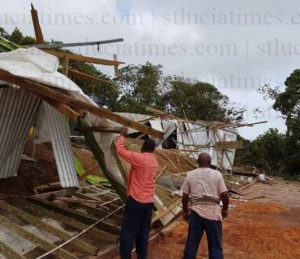
It is very sad when communities are not able to save or insure a “Rainy Day” fund for when it rains, especially in the tropical region where it doesn’t just rain, but pours and storms.

What is sadder is when the heavy-lifting of “savings” or insurance is done, but the dollar amount is not enough; because a “penny saved is only just a penny”.

The Caribbean’s industrial landscape is in crisis. It must reboot; we do not have adequate “Property & Casualty” offerings. The identified CCRIF Catastrophe Fund, though it’s too-little-too-late, is for member-states governments, by the member-states governments. Individuals and companies need not apply; yet still, there is the need. Individuals, institutions and enterprises need the protection of a viable CoB solution. This glaring need is so obvious, right now on the heels of Tropical Storm Kirk. Though not a major storm, it brought major destruction to one particular business. See the full story here:

Title: Poultry farmer loses 2000 chickens during storm

Poultry farmer Linus Bernadine suffered a major setback Thursday night, when high winds associated with Tropical Storm Kirk destroyed his chicken houses at Babonneau.

Bernadine told St Lucia Times it resulted in the loss of 2000 broiler chicks.

He explained that the loss has impacted significantly on his livelihood.

“This is what I am expecting to put bread on my table,”  Bernadine stated.

He estimated that his losses are in the region of some $90,000.

Bernadine said he does not know how he will recover from the calamity.

“Right now I am just on the farm demolishing things,” he said.

“What happened is that these birds, I just got them on Wednesday last week and the storm was Thursday night,” Bernadine disclosed.

The poultry farmer recalled having left his home for Vieux Fort to pick up the chicks.

“I got back home about ten past nine in the night, I put the birds down and that was it,” he stated.

“Friday morning I had no choice but to bury them,” he told St Lucia Times, adding that both of the chicken pens on his property had been destroyed by the storm and the chicks that were in them died.

“I am flat down – everything is just gone,” Bernadine lamented.

“I have a capacity of about 7000 birds and all of that is flat down,” he said.

Source: St Lucia Times Daily Newspaper – Posted September 30th, 2018; retrieved October 2, 2018 from: https://stluciatimes.com/2018/09/30/poultry-farmer-loses-2000-chickens-during-storm/

Needless to say, the underlying problem in the foregoing story is “money”, the lack of money in Caribbean communities for restoring business operations in the wake of disasters.

The lack of money is the root of all evil” – Pejorative Pun credited to “Rev. Ike”

There is not enough money in the St. Lucia pool. The Go Lean book simply declares that there needs to be a Bigger pool, one that individuals, institutions and enterprises can participate in. The Go Lean book proposed the solution of Reinsurance Sidecars, related in the book on Page 101 as follows:

Hurricane Insurance Fund
The risk pool for a 42-million population is so much lower than each member-state’s sole mitigation efforts. The CU will establish (contract with a service provider) reinsurance funds (& sidecars) from Day One, and glean the excess premiums-over-claims as profit.

So this is the solution that is proposed in the Go Lean book, to allow for Reinsurance Sidecars in the regional Capital Markets. This way more liquidity will be brought to the marketplace and investors can share in the risk … and profit. See a fuller definition of Sidecars here:

Reinsurance Sidecars, conventionally referred to as “sidecars”, are financial structures that are created to allow investors to take on the risk and return of a group of insurance policies (a “book of business”) written by an insurer or reinsurer (henceforth re/insurer) and earn the risk and return that arises from that business. A re/insurer will only pay (“cede”) the premiums associated with a book of business to such an entity if the investors place sufficient funds in the vehicle to ensure that it can meet claims if they arise. Typically, the liability of investors is limited to these funds. These structures have become quite prominent in the aftermath of Hurricane Katrina as a vehicle for re/insurers to add risk-bearing capacity, and for investors to participate in the potential profits resulting from sharp price increases in re/insurance over the four quarters following Katrina. An earlier and smaller generation of sidecars were created after 9/11 for the same purpose. 
Source:
Retrieved October 13, 2017 from: https://en.wikipedia.org/wiki/Reinsurance_sidecar

The introduction of Reinsurance Sidecars will reboot the entire industrial landscape in the Caribbean. With this product, businesses will have the Property & Casualty insurance products to provide some assurances; also banks will be able to compel their loan clients to maintain these coverages. This is the whole definition of “Escrows”, that of banks requiring Property & Casualty insurance for their loan customers:

In layman’s terms, this means an escrow service is basically a middleman between a buyer and a seller, or in the case of a mortgage, a middleman between a homeowner and the county (for property taxes), insurance companies, and anyone else who the homeowner designates to pay with funds from the escrow account.

1. Imagine the effect of sidecars on bank escrow processing departments.

2. Imagine the effect of sidecars on the insurance retail and wholesale markets.

3. Imagine the effect of business insurance on businesses.

4. Imagine the effect of business continuity on community continuity.

5. Imagine the effect of an industrial reboot on Caribbean life and our day-to-day reality.

So the goal here is to better explore the industrialization of Reinsurance Sidecar products and escrow processing. We must pursue this reboot of our industrial landscape; we need to foster the many new opportunities (jobs, entrepreneurism and industrial development). This is the declaration of the book Go Lean…Caribbean – available to download for free; it serves as a roadmap for the introduction and implementation of the technocratic Caribbean Union Trade Federation (CU); this is a confederation of all 30 member-states – the larger pool – to execute a reboot of the Caribbean economic eco-system. This CU/Go Lean roadmap has these 3 prime directives:

  • Optimization of the economic engines in order to grow the regional economy to $800 Billion & create 2.2 million new jobs.
  • Establishment of a Homeland Security and Emergency Management apparatus to ensure public safety and protect the resultant economic engines.
  • Improvement of Caribbean governance to support these engines, including a separation-of-powers between the member-states and CU federal agencies.

The Go Lean book stresses that reforming and transforming the Caribbean economic engines must be a regional pursuit – always remember the reality of a larger pool. This was an early motivation for the roadmap, as pronounced in the opening Declaration of Interdependence (Pages 11 – 13):

i. Whereas the earth’s climate has undeniably changed resulting in more severe tropical weather storms, it is necessary to prepare to insure the safety and security of life, property and systems of commerce in our geographical region. As nature recognizes no borders in the target of its destruction, we also must set aside border considerations in the preparation and response to these weather challenges.

xvi. Whereas security of our homeland is inextricably linked to prosperity of the homeland, the economic and security interest of the region needs to be aligned under the same governance. Since economic crimes … can imperil the functioning of the wheels of commerce for all the citizenry, the accedence of this Federation must equip the security apparatus with the tools and techniques for predictive and proactive interdictions.

xxiv. Whereas a free market economy can be induced and spurred for continuous progress, the Federation must install the controls to better manage aspects of the economy: jobs, inflation, savings rate, investments and other economic principles. Thereby attracting direct foreign investment because of the stability and vibrancy of our economy.

xxvi. Whereas the Caribbean region must have new jobs to empower the engines of the economy and create the income sources for prosperity, and encourage the next generation to forge their dreams right at home, the Federation must therefore foster the development of new industries… . In addition, the Federation must invigorate the enterprises related to existing industries … – impacting the region with more jobs.

This is the vision of an industrial reboot! This transformation is where and how the economic eco-system is reinforced, re-engaged and re-engineered. With this reboot in the Caribbean, new jobs can be created, companies started and industries optimized.

Despite the references to “industrial”, there are benefits to individuals as well.

Mortgages and houses will have protections, this means the Caribbean home will be more secure. This fits the quest of the Go Lean movement, to make the Caribbean a better homeland to live, work and play.

The foregoing news article related the agri-business of a Chicken Farm. Have you eaten chicken lately?
Probably! For some people it’s everyday!

So the out-workings of this industrial reboot will also have an effect on consumer goods. That’s food and shelter, part of the pantheon of basic needs: food, clothing and shelter.

The Go Lean book provides 370-pages of turn-by-turn instructions on “how” to adopt new community ethos, plus the strategies, tactics, implementations and advocacies to execute so as to reboot, reform and transform the societal engines of Caribbean society. One advocacy in rebooting the industrial landscape is to work to improve the delivery systems for our food supply. All Caribbean islands and coastal states should have chicken farms. It is unconscionable that ALL CHICKENS may be imported from abroad. Surely, we can provide the industrial landscape so that every community have their own chicken farms.

Surely …

This will mean that we will have to manage and mitigate the risks of storms and natural disasters; remember Climate Change.

Consider these specific excerpts and headlines from the book on Page 162 entitled:

10 Ways to Better Manage Food Consumption

1 Lean-in for the Caribbean Single Market
The CU will allow for the unification of the region into one market, thereby creating a single economy of 30 member-states, 42 million people and a GDP of over $800 Billion – the CU will take the lead in facilitating the food supply and distribution systems to ensure the region can feed itself, more from local production and less from trade. Though the cost savings of imports should never be ignored, some CU countries (Greater Antilles, Belize, Guyana & Suriname) have a low opportunity cost for increasing food production for the regional market. Thus a mission of the CU is to streamline the systems, processes, logistics, funding, training, and market promotions so that the Caribbean can fulfill this basic need.
2 Public Health Dynamics – Produce Deserts & Farmers Market
3 “Nouvelle” Caribbean Cuisine
4 Agri-Business
Many of the member-states get 90% (or more) of their food supplies from imports; even fish is imported from Alaska, despite the 1,063,000 square miles of harvestable waters of the Caribbean Sea. The CU will implement agri-business (and aqua-culture) investments to generate more regional options for food production: cooperatives (co-ops), farm credit, common grazing lands, fisheries oversight, canaries, aqua-culture endeavors, etc.
5 Logistics for the Food Supply
6 Fresh Frozen
7 Food Labeling
8 Export – Help Regional Businesses Find Foreign Markets
9 Media Industrial Complex
10 Food Tourism

Rebooting the industrial landscape of the Caribbean is not a new subject for this Go Lean roadmap. In fact, this commentary has previously identified a number of different industries that can be rebooted under this roadmap. See the list of previous submissions on Industrial Reboots here:

  1. Industrial RebootsFerries 101 – Published June 27, 2017
  2. Industrial RebootsPrisons 101 – Published October 4, 2017
  3. Industrial RebootsPipeline 101 – Published October 5, 2017
  4. Industrial RebootsFrozen Foods 101 – Published October 6, 2017
  5. Industrial RebootsCall Centers 101 – Published July 2, 2018
  6. Industrial RebootsPrefab Housing 101 – Published July 14, 2018
  7. Industrial RebootsTrauma 101 – Published July 18, 2018
  8. Industrial RebootsAuto-making 101 – Published – July 19, 2018
  9. Industrial RebootsShipbuilding 101 – Published – July 20, 2018
  10. Industrial RebootsFisheries 101 – Published – July 23, 2018
  11. Industrial RebootsLottery 101 – Published – July 24, 2018
  12. Industrial RebootsCulture 101 – Published – July 25, 2018
  13. Industrial RebootsTourism 2.0 – Published – July 27, 2018
  14. Industrial RebootsCruise Tourism 2.0 – Published – July 27, 2018
  15. Industrial Reboots – Reinsurance Sidecars 101 – Published Today – October 2, 2018

Reinsurance Sidecars – remember the name. While these, and other derivative products, are not commonly known in the Caribbean today, they will be. They are too important for our future.

Don’t ever forget, as this fact often gets overlooked, they are also vastly profitable investment products. See the VIDEO‘s in the Appendices for more details on Reinsurance Sidecar derivatives as investment products.

In summary, our Caribbean region needs a better industrial landscape so as to make our homeland better. In fact, one of the reasons why so many Caribbean citizens have emigrated away from the homeland is the lack of the ability to quickly recover after natural disasters. This is why Homeland Security – preparation and response of emergencies – is coupled with economic policies for rebooting the societal engines in the region. So creating a new economic landscape will require rebooting the industrial landscape.

So as an enterprise, an institution or an individual, we need good insurance options – a Continuity of Business. A bigger-better regional risk pool is paramount for a better Caribbean. This is how we can make our region a better homeland to live, work and play.  We urge all Caribbean stakeholders to lean-in to this roadmap for industrial reboots, security enhancements and economic empowerments. 🙂

Download the free e-Book of Go Lean … Caribbean – now!

Sign the petition to lean-in for this roadmap for the Caribbean Union Trade Federation.

————-

Appendix A VIDEO – What is REINSURANCE? What does REINSURANCE mean? REINSURANCE meaning, definition & explanation – https://youtu.be/7Qe4-Ei2PHY


The Audiopedia

Published on May 17, 2017 – What is REINSURANCE? What doe REINSURANCE mean? REINSURANCE meaning – REINSURANCE pronunciation – REINSURANCE definition – REINSURANCE explanation – How to pronounce REINSURANCE?
Source: Wikipedia.org article, adapted under https://creativecommons.org/licenses/… license.

  • Category: Education
  • License: Creative Commons Attribution license (reuse allowed)

————-

Appendix B VIDEO – What Is Financial Reinsurance? – https://youtu.be/W45REh7Pt7I


ehowfinance

Published on May 25, 2015 – What Is Financial Reinsurance?. Part of the series: Small Business Tips. Financial reinsurance is a key component to any successful business. Learn about financial reinsurance with help from a business consultant and marketing expert in this free video clip. Read more: http://www.ehow.com/video_12214988_fi…

————-

Appendix C VIDEO – Reinsurance the perfect Hedge Fund Strategy to Diversify a Portfolio – https://youtu.be/rfp2gRsFD2M


BGN – Blockchain Global News

Published on Mar 2, 2016 – Jane King interviews Don Steinbrugge, Managing Director, Agecroft Partners. For more information please visit http://www.agecroftpartners.com

Share this post:
, , , ,
[Top]