Go Lean Commentary
“Why’s everybody always pickin’ on me?” – The Coasters – Charlie Brown Song; (see Appendix A).
It would seem that Haitians all around the world can sing the chorus to this above song. The history of Haiti is frequented with hardships in their own country and they have understandingly pursued a better life abroad. However, the Haitian Diaspora have also experienced oppression, discrimination and exclusionary treatment abroad and have had to endure a “hard welcome” in most foreign countries.
The book Go Lean…Caribbean serves as a roadmap for elevating Caribbean society, for all 30 member-states, including Haiti. As such there are direct references in the book regarding Haiti’s historicity; (Pages 238 & 306).
In addition to history, Haiti also has a different geography compared to most Caribbean nations. They share the same island with the Dominican Republic. The oppression, discrimination and exclusionary treatment of Haitians started on that island. Over the years, the governmental administrations of the Dominican Republic have favored “white” immigrant refugees over other races; Dominican troops often forcibly expelled illegal Haitians. Most notably, the 1937 Parsley Massacre of Haitian immigrants, a government-sponsored genocide in October 1937, at the direct order of then President Rafael Trujillo. He ordered the execution of the Haitian population living in the borderlands. The violence resulted in the killing of 20,000 ethnic Haitian civilians during approximately five days. (See Appendix B for additional historic references and inferences).
The US and other countries in the Caribbean neighborhood have also been harsh in their treatment of Haitian refugees. Consider this story of a conflict with the Bahamas, and the protests from the Haitian Diaspora in Miami:
1. News Article Title: Local Miami Haitian leaders protest Bahamian immigration policy
http://www.wsvn.com/story/27344225/local-haitian-leaders-protest-bahamian-immigration-policy – Posted: November 10, 2014
MIAMI (WSVN) — Local leaders are stepping up to stop a deportation dilemma regarding an immigration policy.
The policy forces families of Haitian descent out of the Bahamas.
Florida State Representative Daphne Campbell spoke out on the issue at a press conference in Little Haiti Monday morning. “I’m asking all, all cruises and all tourists, to make sure every industry boycotts the Bahamas to end discrimination against Haitian children,” Campbell stated. “Boycott Bahamas! Boycott Bahamas! Boycott Bahamas!”
Activists are now asking for the public’s support in helping to protect the future of Haitian families.
————Video: WSVN Newscast – http://www.wsvn.com/story/27344225/local-haitian-leaders-protest-bahamian-immigration-policy?autoStart=true&topVideoCatNo=default&clipId=10832494
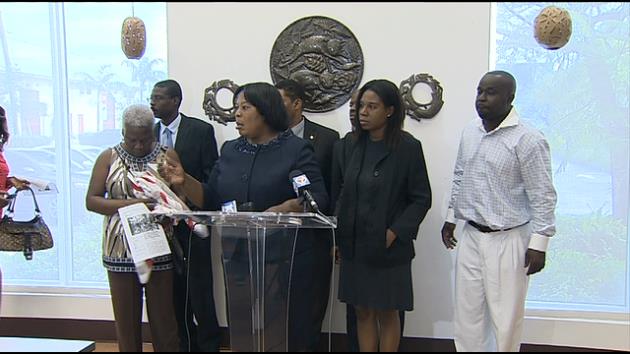
Though the leader of the accusing team has her detractors/problems, (South Florida state Rep. Daphne Campbell faces IRS investigation and she is already facing a Florida Medicaid fraud probe), the subject of her accusation may still have merit. What are the facts of the case regarding Haitian children in the Bahamas?
The Bahamas does not automatically grant citizenship to people born of foreign parentage in its homeland. There are special provisos even if one parent is a Bahamian citizen; many details of which are gender-biased. (There were attempts to correct these provisos in Parliament this past year, but this legislative reform was stalled).
This citizenship criteria is not standard … compared to the US, Canada, and most western European countries. Ironic as these countries are also the source of most tourists visiting the Bahamas, the #1 economic driver for the country. So any traction in this Boycott Bahamas campaign can potentially have a negative impact – remember “Boycott Apartheid in South Africa”.
What’s worse, the Universal Declaration of Human Rights or UDHR (as related in Go Lean book Page 220) have specific prohibitions against national governments enforcing laws that effectuate discrimination against minority groups.
(The UDHR was adopted by the United Nations General Assembly in 1948, partly in response to the atrocities of World War II, composed by a committee led by former American First Lady Eleanor Roosevelt. Although the UDHR was a non-binding resolution, it is now considered by some to have acquired the force of international customary law which may be invoked in appropriate circumstances by national and other judiciaries. The UDHR urges member nations to promote a number of human, civil, economic and social rights, asserting these rights as part of the “foundation of freedom, justice and peace in the world”).
This means you Bahamas! Are you ready to receive the onslaught of darts from the international community? Economic sanctions, formal or informal, are debilitating!
This is not just a Haitian -versus- Bahamian issue. The same immigration-border-encroaching issues are trending with the US, Dominican Republic and Puerto Rico. This following news article relates this controversy:
2. Title: Haitian Illegal Immigration Through Puerto Rico Is Skyrocketing Too – http://news.yahoo.com/haitian-illegal-immigration-puerto-rico-skyrocketing-too-021611125.html;_ylt=AwrBJR6DB9dTyzoAHyzQtDMD – Posted: July 26, 2014
While U.S. immigration agencies grapple with a recent surge of tens of thousands of illegal immigrants at the Mexican border, the number of Haitians trying to enter the U.S. illegally through Puerto Rico has skyrocketed as well.
In 2011, only 12 Haitians made the trek through the Dominican Republic to Puerto Rico, a U.S. territory in the Caribbean Sea. That number had ballooned to 1,760 as of last year, according to U.S. Coast Guard statistics, CBS News reports.
“That’s new, and that’s something we’re trying to target,” Capt. Mark Fedor, the Coast Guard’s chief of response for the Southeast and Caribbean, told CBS.
“Organized smugglers in the Dominican Republic are advertising their services to Haitians and saying, ‘We’ll smuggle you through the Dominican Republic, put you on a boat to Puerto Rico or to one of the islands in the Mona Pass – a much shorter journey and we can get you to the United States that way.’ And I think people are responding to that,” he said.
The Dominican smugglers often drop their Haitian charges off at Mona Island, an uninhabited Puerto Rican island 40 miles off of the Dominican coast in the Mona Pass.
“As soon as you’re in Puerto Rico, it’s like you’re in the United States,” Lolo Sterne, coordinator for Haiti’s Office of Migration, told the Associated Press last year.
Once in Puerto Rico, the illegal Haitian immigrants are able to fly to destinations in the U.S. without having to show a passport. All they need is a driver’s license, according to the Associated Press.
The new route through the Mona Pass is seen as more desirable as the U.S. Coast Guard has increased patrols of normal routes taken by immigrants from Haiti and the Dominican Republic. As the AP points out, it has become more difficult to travel directly to the U.S. mainland or through Miami, which has historically served as the choice destination for illegal immigrants from the Caribbean.

Haiti and its 9+ million residents need change. In fact, all of the Caribbean’s 42 million people need change/empowerment.
The purpose of the Go Lean roadmap is to turn-around the downward trends in the Caribbean today, to reverse course and elevate society in the Caribbean as a whole and Haiti in particular. The CU, applying best-practices for community empowerment has these 3 prime directives, pronounced as follows:
- Optimization of the economic engines in order to grow the regional economy to $800 Billion & create 2.2 million new jobs.
- Establishment of a security apparatus to protect the resultant economic engines.
- Improve Caribbean governance, with consideration for minority equalization, to support these engines.
How exactly can the CU impact Haiti to reboot that failing state? The answer can be found in the history of post-war Europe, where the Marshall Plan was instrumental in rebooting that continent. The book Go Lean…Caribbean details a Marshall Plan-like roadmap for Haiti, and all other failing Caribbean institutions.
The related subjects of economic, security and governing dysfunction among European and Caribbean member-states have been a frequent topic for blogging by the Go Lean promoters, as sampled here:
| https://goleancaribbean.com/blog/?p=2809 | A Lesson in History: Economics of East Berlin |
| https://goleancaribbean.com/blog/?p=2480 | A Lesson in History: Community Ethos of WW II |
| https://goleancaribbean.com/blog/?p=2330 | ‘Raul Castro reforms not enough’, Cuba’s bishops say |
| https://goleancaribbean.com/blog/?p=1531 | A Lesson in History: 100 Years Ago Today – World War I |
| https://goleancaribbean.com/blog/?p=1433 | Caribbean loses over 70% of tertiary educated citizens to the brain drain |
| https://goleancaribbean.com/blog/?p=1014 | All is not well in the sunny Caribbean |
| https://goleancaribbean.com/blog/?p=623 | Only at the precipice, do they change |
| https://goleancaribbean.com/blog/?p=599 | Ailing Puerto Rico open to radical economic fixes |
| https://goleancaribbean.com/blog/?p=451 | CariCom Chairman to deliver address on slavery/colonization reparations |
The goal of the Go Lean roadmap is simple: to make Haiti (and by extension the rest of the Caribbean) a better place to live, work and play so that citizens would not feel compelled to risk life-and-limb to flee for foreign shores. The goal extends further in the mission to reverse course and encourage the repatriation of the Haitian/Caribbean Diaspora. To accomplish these goals, the book details a series of community ethos, strategies, tactics, implementations and advocacies to empower all the factions of Haitian life in the Caribbean region and in the Diaspora:
| Community Ethos – Economic Systems Influence Choices & Incentives | Page 21 |
| Community Ethos – Consequences of Choices Lie in the Future | Page 21 |
| Community Ethos – Anti-Bullying and Mitigation | Page 23 |
| Community Ethos – Minority Equalization | Page 24 |
| Community Ethos – Ways to Impact the Future | Page 26 |
| Community Ethos – Ways to Manage Reconciliations | Page 34 |
| Community Ethos – Ways to Impact the Greater Good | Page 37 |
| Strategy – Vision – Integrate region into a Single Market Economy | Page 45 |
| Strategy – Agents of Change – Globalization | Page 57 |
| Tactical – Separation of Powers – Department of Homeland Security | Page 75 |
| Implementation – Ways to Foster International Aid | Page 115 |
| Planning – 10 Big Ideas … for the Caribbean Region – Haiti & Cuba | Page 127 |
| Planning – Ways to Ways to Model the EU | Page 130 |
| Planning – Reasons Why the CU Will Succeed – Germany Reconciliation Model | Page 132 |
| Planning – Ways to Improve Failed-State Indices – Haiti – first on the region list | Page 134 |
| Planning – Lessons from East Germany – European post-war rebuilding | Page 139 |
| Planning – Lessons from Canada’s History | Page 146 |
| Advocacy – Ways to Grow the Economy | Page 151 |
| Advocacy – Ways to Create Jobs | Page 152 |
| Advocacy – Ways to Foster Empowering Immigration | Page 174 |
| Advocacy – Ways to Impact Justice | Page 178 |
| Advocacy – Ways to Enhance Tourism | Page 187 |
| Advocacy – Ways to Impact the Diaspora – Haitians in Miami | Page 217 |
| Advocacy – Ways to Protect Human Rights | Page 220 |
| Advocacy – Ways to Help Women | Page 226 |
| Advocacy – Ways to Impact Youth | Page 227 |
| Advocacy – Ways to Impact the Dominican Republic | Page 237 |
| Advocacy – Ways to Re-boot Haiti | Page 238 |
| Advocacy – Ways to Impact US Territories | Page 244 |
| Appendix – Dominican Republic – Rafael Trujillo Regime | Page 306 |
The conclusion of the Go Lean book relates the experiences and motivations of the US Supreme Court for the 1954 landmark decision Brown versus Board of Education. The unanimous wisdom of the 9 Justices on the Court should not be ignored, it was strewn from the experiences of modern society waging two world wars; they saw the rampage, devastation of 60 million deaths around the world and appreciated the wisdom that a downtrodden people would not stay down, that they would rise and revolt, that they would risk their lives and that of their children to pursue freedom.
How impactful is the Haitian Diaspora in the Bahamas? With a total national population of 320,000 and one estimate (July 2013) of 50,000 Haitian and/or Haitian-Bahamians, there is an imminent wave of dissent for the Bahamas to contend with. Don’t wait Bahamas, deal with your domestic issues now! Learn from the experiences of your neighbors, as depicted in the Go Lean book:
US: Lessons from the US Constitution (Page 145)
Canada: Reconciliation with First Nations (Page 146)
Guyana: Indo-Guyanese versus Afro-Guyanese (Page 174)
Trinidad: Indo-Trinidadians versus Afro-Trinidadians (Page 240)
Now is the time for all of the Caribbean to learn the lessons from [economic] history of other successful (US & Canada) and unsuccessful societies. The Go Lean book posits that the Caribbean is in a serious crisis, but asserts that this crisis would be a terrible thing to waste. The people and governing institutions of the Bahamas, Haiti and the region as a whole are hereby urged to lean-in for the empowerments described in the book Go Lean … Caribbean. This is a big deal for the region, we can all strive to make our Caribbean homeland a better place to live, work, and play.
Download the free e-book of Go Lean … Caribbean – now!
———–
Appendix A – The song: Charlie Brown by The Coasters – http://youtu.be/_UnPzp2lmNk
———–
Appendix B – Homework for additional credit: better understand the history of Haiti and its consequential impact on the world.
Video Title: Black In Latin America (Episode 1): Haiti and The Dominican Republic- The Roots of Division
This scholarly work was produced and narrated by noted Professor Henry Louis Gates. This was part of a series developed for the Public Broadcasting System (PBS) , a network of public TV stations in the US. The other features in the series, include:
Black In Latin America (Episode 2): Cuba: The Next Revolution
Black In Latin America (Episode 3): Brazil: A Racial Paradise?
Black In Latin America (Episode 4): Mexico & Peru: The Black Grandma in the Closet
My question is, why do illegal Haitians think that they could go into someone’s else’s country and not abide by their laws? They need to abide by the laws of the Land! I lived in the Bahamas and it is horrible! They come uninvited, squat on the land (and will fight the landowners when they are asked to get off) steal electricity, water, over crowd the Hospitals and schools. They do not contribute to the Bahamas financially because only trade among themselves, save their money so that they can send back to Haiti to take care of Family member there, to put another Haitian on a sloop to enter the Bahamas illegally! What everyone is failing to understand is No two illegals can come into the Bahamas have children and they are Bahamians, that has been the law from July 9 1973! And then the Haitian Community is following this Beast Dapnhe Campbell and her empt Jetta Baptiste! both Whom have Stole and lied to their own people! Jetta is on the Run from the Bahamas because she stole money from her own haitian people! Bahamians don’t hate HAitians, they just have a problem with the illegal ones! The Bahamas should Boycott SOuth Florida! Trust me they would not want that to happen!