Month: December 2014

Robots help Amazon tackle Cyber Monday

Go Lean Commentary

To understand American commerce, one must learn the BIG shopping “days of the week” – Friday, Saturday, Monday, Tuesday, as follows:

    • Black Friday – This is the Friday following the Thanksgiving Day holiday in the US (the fourth Thursday of November). Since the early 2000’s, it has been regarded as the beginning of the Christmas shopping season, and most major retailers open very early and offer promotional sales. Black Friday is not a public holiday, but some states observe “The Day After Thanksgiving” as a holiday for state government employees, sometimes in lieu of another federal holiday such as Columbus Day.[5] Many non-retail employees and schools have both Thanksgiving and the day after off, followed by a weekend, thereby increasing the number of potential shoppers. In 2014, $50.9 billion was spent during the 4-day Black Friday weekend. While approximately 133 million U.S. consumers shopped during the same period.[6]
    • Small Business Saturday – This refers to the Saturday after Thanksgiving during one of the busiest shopping periods of the year. First observed in 2010, it is a counterpart to Black Friday and Cyber Monday, which feature big box retail and e-commerce stores respectively. By contrast, Small Business Saturday encourages holiday shoppers to patronize brick-and-mortar businesses that are small and local. Small Business Saturday is a registered trademark of American Express Corporation. Small Business Saturday UK began in the UK in 2013 after the success of Small Business Saturday in America.[7]
    • Cyber Monday – This is a marketing term for the Monday after the Thanksgiving holiday. The term was created by marketing companies to persuade people to shop online. The term made its debut on November 28, 2005, in a Shop.org press release entitled “‘Cyber Monday Quickly Becoming One of the Biggest Online Shopping Days of the Year”.[2] According to the Shop.org/Bizrate Research 2005 eHoliday Mood Study, “77 percent of online retailers said that their sales increased substantially on the Monday after Thanksgiving, a trend that is driving serious online discounts and promotions on Cyber Monday this year (2005)”. In 2014, Cyber Monday online sales grew to a record $2.68 billion, compared with last year’s $2.29 billion. However, the average order value was $124, down slightly from 2013’s $128.[3] The deals on Cyber Monday are online-only and generally offered by smaller retailers that cannot compete with the big retailers. Black Friday generally offers better deals on technology; with nearly 85% more data storage deals than Cyber Monday. The past Black Fridays saw far more deals for small appliances, cutlery, and kitchen gadgets on average than Cyber Monday. Cyber Monday is larger for fashion retail. On the past two Cyber Mondays, there was an average of 45% more clothing deals than on Black Friday. There were also 50% more shoe deals on Cyber Monday than on Black Friday.[4] Cyber Monday has become an international marketing term used by online retailers in Argentina, Canada, Chile, China, Colombia, Denmark, Germany, Ireland, Uganda, Japan, Portugal, Sweden and the United Kingdom.
    • Giving Tuesday – refers to the Tuesday after Thanksgiving. It is a movement to create a national day of giving at the beginning of the Christmas and holiday season. Giving Tuesday was started in 2012 by the “92nd Street Y” (Young Men’s and Young Women’s Hebrew Association in New York, NY) and the United Nations Foundation as a response to commercialization and consumerism in the post-Thanksgiving season (Black Friday and Cyber Monday).[8][9] This occasion is often stylized as #GivingTuesday for purposes of hashtag activism.

That’s a lot of commerce … and philanthropy too!

This encyclopedic discussion is necessary for the Caribbean to model the best-practices of American commerce. The focus of this commentary is the role of one company in the pantheon of Cyber Monday, Amazon. This firm has previously been featured in a Go Lean blog, and is identified as a model for Caribbean logistics, our means for delivering the mail; this is the vision for the Caribbean Postal Union (CPU).

The focus of the book Go Lean…Caribbean and the CPU is not just postal mail, but rather logistics. Mail requires logistics, but logistics encompasses so much more than just mail. So we would want to model a successful enterprise in this industry space, like Amazon, not just another postal operation, like the US Postal Service (Page 99).

Amazon provides a good example of lean technocratic efficiency. So Amazon is a good model, not just for the CPU but the entire Caribbean Union Trade Federation (CU). The Go Lean book, serves as a roadmap for the introduction and implementation of the technocratic CU.

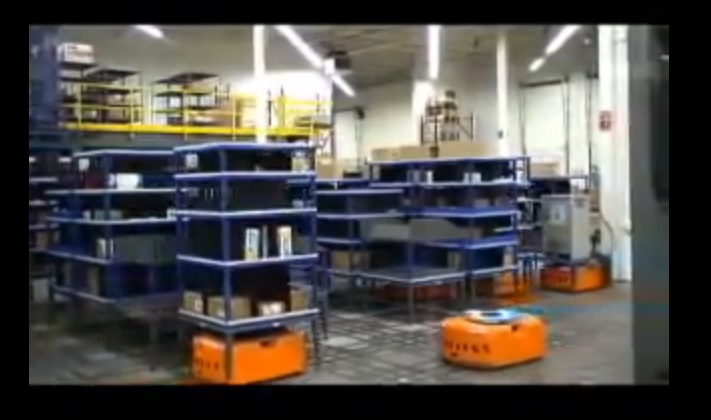
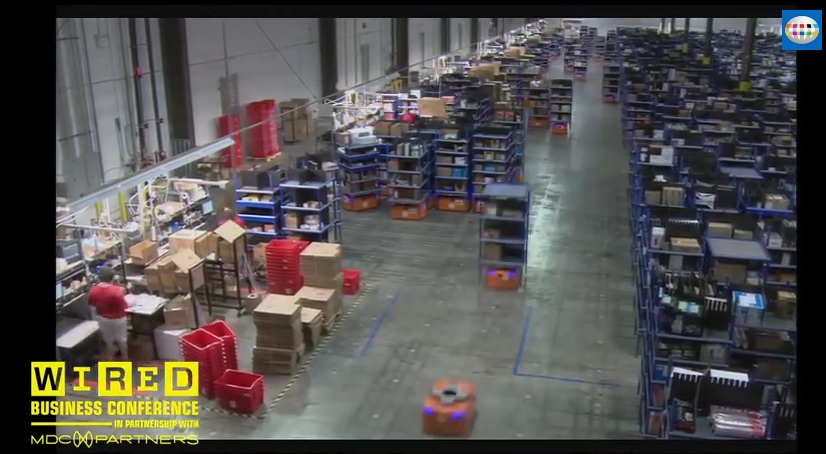
One reason why Amazon is modeled for their lean stature is their use of automation. This following VIDEO depicts the creative solution of using robots to facilitate logistics in a warehouse environment:

VIDEO: Robots help Amazon tackle Cyber Monday – http://www.cbsnews.com/videos/robots-help-amazon-tackle-cyber-monday/

December 1, 2014 – Cyber Monday is the biggest sales day of the year for online retail giant, Amazon. Last year, Amazon customers ordered 426 items every second on Cyber Monday, and this year that number is expected to grow. In addition to the 80-thousand seasonal workers they employ to fulfill orders, thousands of robots also crawl the warehouse floors. CNET.com’s KaraTsuboi takes us inside an Amazon fulfillment center to watch the robots in action. (VIDEO plays best in Internet Explorer).

Lean, automation, robotics, technocratic …

… welcome to the new Caribbean.

This is the mission of Go Lean roadmap, to elevate the economic engines of Caribbean society; industrial policy plays a key role in this roadmap. The region needs the jobs, so we need job creators: companies. These companies, or better stated, Direct Foreign Investors, need a pro-innovation environment to deploy their automated solutions. The Go Lean roadmap allows the structure of Self-Governing Entities (SGE) to incentivize industrial developments in the region. It is the expectation that robots and automated systems will flourish. The independence of the SGE structure neutralizes conflicts with “labor”.

Related issues have previously been detailed in these Go Lean commentaries listed here:

Disney World – Successful Role Model of a SGE
Using SGE’s to Welcome the Dreaded ‘Plutocracy’
Where the Jobs Are – Ship-breaking under SGE Structure
Fairgrounds as SGE and Landlords for Sports Leagues
Puerto Rico’s Comprehensive Cancer Center Project Breaks Ground – Model of Medical SGE

In addition to the roadmap encouraging robotic automation, the CU will directly employ such technologically innovative products and services to impact its own prime directives; the CPU is such a reflection; more automation and less labor. The CU’s prime directives are identified with the following 3 statements:

  • Optimization of the economic engines in order to grow the regional economy to $800 Billion & create 2.2 million new jobs.
  • Establishment of a security apparatus to protect the resultant economic engines.
  • Improve Caribbean governance to support these engines.

The CPU features economic, security and governing concerns.

The Go Lean roadmap seeks to change the entire eco-system of Caribbean logistics and resulting commerce  – the interaction with postal operations. This vision is defined early in the book (Page 12 & 14) in the following pronouncements in the Declaration of Interdependence:

xv. Whereas the business of the Federation and the commercial interest in the region cannot prosper without an efficient facilitation of postal services, the Caribbean Union must allow for the integration of the existing mail operations of the governments of the member-states into a consolidated Caribbean Postal Union, allowing for the adoption of best practices and technical advances to deliver foreign/domestic mail in the region.

xxvii. Whereas the region has endured a spectator status during the Industrial Revolution, we cannot stand on the sidelines of this new economy, the Information Revolution. Rather, the Federation must embrace all the tenets of Internet Communications Technology (ICT) to serve as an equalizing element in competition with the rest of the world. The Federation must bridge the digital divide and promote the community ethos that research/development is valuable and must be promoted and incentivized for adoption.

Amazon is not our only example. A previous blog/commentary identified Chinese company Alibaba as a fitting role model for Caribbean consideration. There are so many best-practices around the world for the region to study and glean insights and wisdom from. The successful application of this roadmap will foster such best-practices for the delivery of the CPU logistics in the Caribbean. The wisdom the Go Lean book gleans are presented as a series of community ethos, strategies, tactics, implementations and advocacies; a detailed sample is listed as follows:

Community Ethos – Deferred Gratification Page 21
Community Ethos – People Respond to Incentives Page 21
Community Ethos – Job Multiplier Page 22
Community Ethos – Intelligence Gathering Page 23
Community Ethos – Lean Operations Page 24
Community Ethos – Ways to Impact the Future Page 26
Community Ethos – Ways to Foster Genius Page 27
Community Ethos – Ways to Help Entrepreneurship Page 28
Community Ethos – Promote Intellectual Property Page 29
Community Ethos – Ways to Bridge the Digital Divide Page 31
Community Ethos – Ways to Improve Sharing Page 35
Strategy – Customers – Citizens and Member-states Governmental Page 47
Tactical – Separation of Powers – Postal Services Page 78
Tactical – Separation of Powers – Interstate Commerce Administration Page 79
Implementation – Year 1 / Assemble Phase – Establish   CPU Page 96
Anecdote – Implementation Plan – Mail Services – US Dilemma Page 99
Implementation – Steps to Implement   Self-Governing Entities Page 105
Implementation – Improve Mail Services – Electronic Supplements Page 108
Implementation – Ways to Deliver Page 109
Planning – 10 Big Ideas for the Caribbean Region Page 127
Advocacy – Ways to Improve Interstate Commerce Page 129
Advocacy – Ways to Grow the Economy Page 151
Advocacy – Ways to Create Jobs Page 152
Advocacy –Ways to Improve Governance Page 168
Advocacy – Ways to Foster Technology Page 197
Advocacy – Ways to Foster e-Commerce Page 198
Advocacy – Ways to Promote Call Centers Page 212
Advocacy – Ways to Impact Urban Living Page 234

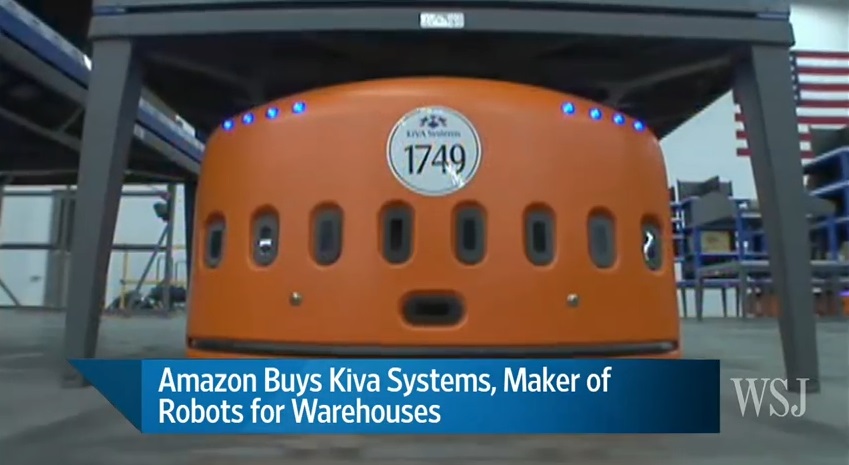
Following the Amazon’s example (and Alibaba’s example) will spur the Caribbean to embrace more robotic technologies. This field is new, fresh and ready for innovation. There is a level-playing-field for any innovator to earn market share. The underlying company in the foregoing VIDEO is Kiva Systems – a Massachusetts based company that manufactures mobile robotic fulfillment systems.[10][11] They rolled out a great product, then “Lo-and-behold”, they were acquired by a major e-Commerce company. Today, they are a subsidiary of Amazon, yet their material-handling systems are currently used by many other retailers including: The Gap, Walgreens, Staples, Gilt Groupe, Office Depot, Crate & Barrel, Saks 5th Avenue, and more.[12]
CU Blog - Robots help Amazon tackle Cyber Monday - Photo 3

CU Blog - Robots help Amazon tackle Cyber Monday - Photo 2

CU Blog - Robots help Amazon tackle Cyber Monday - Photo 1

CU Blog - Robots help Amazon tackle Cyber Monday - Photo 4

This commentary therefore features the subjects of commerce, logistics and entrepreneurship. The Caribbean can emulate this model from Amazon. The biggest ingredient missing in the region is the ‘will’. But the ‘will’ can be fostered anew in the Caribbean. This is the heavy-lifting for the CU, instituting such new community ethos.

Now is the time for all of the Caribbean, the people and governing institutions, to lean-in for the empowerments in the book Go Lean … Caribbean. This is a Big Idea for the region; that of a Cyber Caribbean, in which Cyber Mondays may become a big deal for our region – not only as consumers, but producers as well. Therefore, this roadmap is not just a plan for delivering the mail/packages, but rather a plan for delivering the future.

We must employ whatever tools and techniques, robotics included, to make the region a better homeland to live, work and play.

Does “play“include Robots? Yes, indeed. Consider this fun VIDEO here.  🙂

Supplemental VIDEO – The Nutcracker performed by Dancing Kiva Order Fulfillment Robots: http://youtu.be/Vdmtya8emMw

Download the book Go Lean … Caribbean – now!

————–

AppendixSource References:

2.    “‘Cyber Monday’ Quickly Becoming One of the Biggest Online Shopping Days of the Year”. Shop.org.
3.    “Fundivo – Cyber Monday Statistics”. Fundivo.
4.    “What’s the difference between Black Friday and Cyber Monday?”. Mirror.co.uk. Mirror.co.uk. Nov 28, 2013. Retrieved 2014-11-25.
5.    “Pima County in Arizona Replaces Columbus Day with Black Friday”. BestBlackFriday.com. 2013-08-07.
6.    “”Fundivo – Black Friday Statistics””. Fundivo.
7.    Small Business Saturday Hailed as Success. The Telegraph. 8 December 2013″. Telegraph.co.uk. 8 December 2013. Retrieved 2 December 2014.
8.   Fox, Zoe (October 23, 2012). “6 Inspiring Organizations Joining in #GivingTuesday”. Retrieved February 15, 2014.
9.    “#GivingTuesday: About”. Giving Tuesday. Retrieved February 15, 2014.
10.  http://www.kivasystems.com/about-us-the-kiva-approach/
11.   http://www.boston.com/business/technology/innoeco/2012/03/amazon_buys_warehouse_robotics.html
12.  http://www.kivasystems.com/about-us-the-kiva-approach/history/
Share this post:
, , , , ,

Michigan Unemployment – Then and Now

Go Lean Commentary

The tagline “a better place to live, work and play” is the focus for empowering the Caribbean, placing equal emphasis on all 3 spheres of activity. But the focus of work is easier said than done. Without work, the Caribbean will continue to suffer societal abandonment – our good people would simply leave to go elsewhere to find the missing work element. They will do this despite how pleasant the “live” and “play” elements may be in our society.

This is a lesson learned from Detroit, Michigan USA.

The book Go Lean…Caribbean serves as a roadmap to elevate the Caribbean “work” environment. It analyses the regional disposition and then seeks solutions by studying the performances of other global cities, especially in the US.

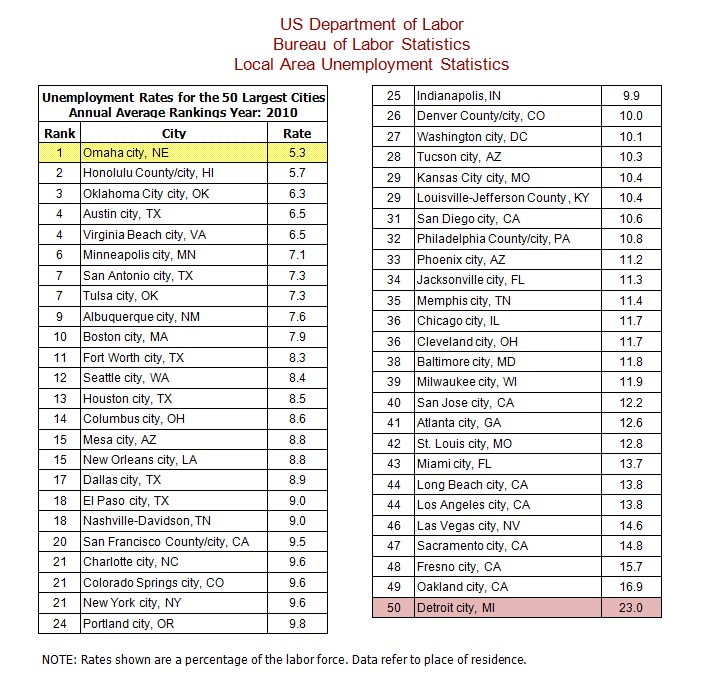
The following chart highlights 50 cities, 2 of which were studied for the Go Lean book, a good example, Number 1 on the chart: Omaha, Nebraska and Number 50 on the chart: Detroit, Michigan, the once great industrial city.

CU Blog - Michigan Unemployment - Then and Now - Photo 2

The lessons from Omaha have already been a subject of this commentary. Now we focus on the other end of the chart, Detroit; this city specifically and the overall State of Michigan in general.

The entire eco-system of jobs was crippled in Michigan during the recent Great Recession (2007 – 2009). In response to the crisis throughout the country, the US federal government began extending unemployment benefits as a safety-net. There was a federal program to provide additional weeks of unemployment benefits to people starting in 2008.[2] The program was then extended again and again; the most recent extension was provided by the American Taxpayer Relief Act of 2012, which continued the supplemental unemployment benefits until the end of 2013.[2] Only then was the comfort level established that the “recession was over”, and the recovery was well enough in hand.

The United States Department of Labor’s Bureau of Labor Statistics reports that in November 2013 the average (mean) duration of unemployment was 37.2 weeks. [3] The median duration was 17.0 weeks. 22.6% of people who were unemployed found a new job in less than 5 weeks, while 37.3% had been unemployed for 27 weeks or more.[3]

These numbers were very bad during the throes of the Great Recession. In line with the following article, which quotes statistics, the impact on the streets of Michigan were 1 million unemployed. See article here:

Michigan unemployment tops 15% – July 2009
Sub-title: Government says jobless rate is the highest for a state since 1984. Rate tops 10% in 15 states and District of Columbia.
By: Ben Rooney, CNNMoney.com staff writer
CU Blog - Michigan Unemployment - Then and Now - Photo 1NEW YORK (CNNMoney.com) — Michigan became the first state in 25 years to suffer an unemployment rate exceeding 15%, according to a report released Friday by the Labor Department.

The state’s unemployment rate rose to 15.2% in June (2009). It was the highest of any state since March 1984, when West Virginia’s unemployment rate exceeded 15%.

Michigan, which has been battered by the collapse of the auto industry and the housing crisis, has had the highest unemployment rate in the nation for 12 months in a row.

Rhode Island had the second highest unemployment rate at 12.4%, followed by Oregon at 12.2%.

A total of 15 states and the District of Columbia had unemployment rates of at least 10%.

Friday’s report from the U.S. Labor Department also showed that six states recorded record-high unemployment rates in June.

Over the month, jobless rates increased in 38 states and the District   of Columbia. Michigan’s 1.1 percentage point increase from May to June was the highest in the nation, followed by Wyoming’s 0.9 point increase.

On an annual basis, jobless rates where higher in all 50 states and the District of Columbia. Michigan also recorded the highest yearly increase at 7.1 percentage points. Oregon came in second with a year-over-year increase of 6.3 percentage points in its unemployment rate.

The national unemployment rate rose for the ninth straight month in June, climbing to 9.5% from 9.4%, and hitting another 26-year high. Nearly 3.4 million jobs have been lost during the first half of 2009, more than the 3.1 million lost in all of 2008.

Unemployment rates decreased in five states, and seven states had no rate change.

North Dakota’s 4.2% jobless rate was the lowest in the nation, followed by Nebraska at 5%.

The Midwest and West both had jobless rates of 10.2%. The jobless rate in the Northeast rose to 8.6% from 8.3% but was the lowest of any U.S. region. In the South, unemployment rose to 9.2%.

Non-farm payroll employment fell in 39 states and the District of   Columbia in June. California had the largest month-over-month decrease in jobs.

Payrolls increased in 10 states and were unchanged in one state. The largest over-the-month increase occurred in North Carolina.

Source: CNN Money Online Financial News Site (Posted July 17, 2009; retrieved 12-02-2014)http://money.cnn.com/2009/07/17/news/economy/state_unemployment_report/

The Great Recession was truly a crisis. That was then; this is now.

Detroit still has the highest unemployment rate of the 50 largest cities in the U.S., at more than three times the national average for May, which was 6.3%. The unemployment rate for Detroit hovered at 23%, six percentage points ahead of the nearest on the list — Oakland City, Calif., at 16.9%, according to the Bureau of Labor Statistics in June 24, 2014.[4]

Once the metrics fall so low, there is no place to go but up.

In the past year Michigan is starting to finally feel the beneficial effects of the recovery. From those ghastly numbers of 1 million in 2009, the numbers petitioning for the Extended Unemployment Compensation (EUC) at December 19, 2013 were slightly “over 43,000 people in Michigan”. (The extension measure failed in the US Congress – the economy was a victim of its own success).

The Go Lean publishers are here to observe and report. Detroit in specific and Michigan is general is starting now to experience a turn-around. While there may be an ongoing hardship for those 43,000 people, the overall economy of Michigan has greatly improved since 2009, as the foregoing article relates, when the state “recorded the highest yearly unemployment increase of 7.1 percentage points”.

Michigan unemployment rate edges toward pre-recession numbers
Sub-title: …but employment hasn’t recovered
By: Emily Lawler – elawler@mlive.com MLive.com

LANSING, MI – Michigan’s seasonally unadjusted unemployment rate dropped to 7.1 percent in October, according to data released by the state Department of Technology, Management and Budget.

October’s 7.1 number is a .1 percent decline from September and the third monthly decline in a row. A year ago, in October 2013, unemployment was more than a point higher at 8.6 percent.

That’s the lowest rate this year and in fact the lowest since January through March of 2008.

“October’s 7.1 percent jobless rate was the lowest in Michigan since the January thorugh March 2008 period, and close matched pre-recession rates from 2003 to 2007. However, Michigan employment remains far below pre-recession levels,” noted the Department in a press release.

In October 2007, total employment in the state was 4.6 million. In October 2014, total employment in the state was 4.4 million.

Gov. Rick Snyder issued a statement on the unemployment:

“There is optimism and opportunity in Michigan as our state’s economy continues to move forward. More people are working and our labor force is growing as companies create more and better jobs. Our reinvention is helping working families and we are seeing results.

“But while we can recognize this accomplishment, there is more to do to fulfill our goal of the brightest possible future. We need to continue creating an environment for success, and that includes building a workforce with in-demand skills – and making sure a pathway to those skills is available for Michigan students and adults.”

Emily Lawler is a Capitol/Lansing business reporter for MLive Media Group.
Source: http://www.mlive.com/lansing-news/index.ssf/2014/11/michigan_unemployment_rate_edg.html

The book Go Lean…Caribbean serves as a roadmap for the introduction and implementation of the technocratic Caribbean Union Trade Federation (CU). The CU is set to optimize Caribbean society, not Detroit, starting with economic empowerment. In fact, the Go Lean roadmap has 3 prime directives:

  • Optimization of the economic engines in order to grow the regional economy to $800 Billion & create 2.2 million new jobs.
  • Establishment of a security apparatus to protect the resultant economic engines.
  • Improve Caribbean governance to support these engines.

The CU will foster the right climate for Direct Foreign Investments, entrepreneurial initiatives, industrial development, and preparation for a ready, willing and able work force.

These points are pronounced early in the Go Lean book with the Declaration of Interdependence (Pages 12 – 14) with many statements that demonstrate the need to empower the Caribbean labor force:

xx. Whereas the preparation of our labor force can foster opportunities and dictate economic progress for current and future generations, the Federation must ensure that educational and job training opportunities are fully optimized for all residents of all member-states, with no partiality towards any gender or ethnic group. The Federation must recognize and facilitate excellence in many different fields of endeavor, including sciences, languages, arts, music and sports. This responsibility should be executed without incurring the risks of further human flight, as has been the past history.

xxiv. Whereas a free market economy can be induced and spurred for continuous progress, the Federation must install the controls to better manage aspects of the economy: jobs, inflation, savings rate, investments and other economic principles. Thereby attracting direct foreign investment because of the stability and vibrancy of our economy.

xxv. Whereas the legacy of international democracies had been imperiled due to a global financial crisis, the structure of the Federation must allow for financial stability and assurance of the Federation’s institutions. To mandate the economic vibrancy of the region, monetary and fiscal controls and policies must be incorporated as proactive and reactive measures. These measures must address threats against the financial integrity of the Federation and of the member-states.

xxvi. Whereas the Caribbean region must have new jobs to empower the engines of the economy and create the income sources for prosperity, and encourage the next generation to forge their dreams right at home, the Federation must therefore foster the development of new industries, like that of ship-building, automobile manufacturing, pre-fabricated housing, frozen foods, pipelines, call centers, and the prison industrial complex. In addition, the Federation must invigorate the enterprises related to existing industries like tourism, fisheries and lotteries – impacting the region with more jobs.

Despite the weaknesses of its current dilemma, Detroit does have strengths. The city is working hard to turn-around. See VIDEO here of a Job Fair for STEM (Science, Technology, Engineering, Math) jobs peculiar to the Motor City:

Engineering Society of Detroit job fair on Monday – Posted November 9, 2014

Video – http://www.wxyz.com/money/job-finder/engineering-society-of-detroit-job-fair-on-monday#Job%20fair%20today:

We must learn from Detroit. The Go Lean book details a series of community ethos, strategies, tactics, implementations and advocacies to impact jobs in the Caribbean region, member-states, cities and communities. Below is a sample:

Assessment – Anecdote – Caribbean Single Market & Economy Page 15
Assessment – Anecdote – Dutch Caribbean – Integration & Secessions Page 16
Assessment – Anecdote – French Caribbean – Organization & Discord Page 17
Assessment – Anecdote – Puerto Rico – The Greece of the Caribbean Page 18
Community Ethos – Economic Systems Influence Individual Choices & Incentives Page 21
Community Ethos – Voluntary Trade Creates Wealth Page 21
Community Ethos – Consequences of Choices Lie in the Future Page 21
Community Ethos – Minority Equalization Page 24
Community Ethos – Lean Operations Page 24
Community Ethos – Return on Investments Page 24
Community Ethos   – Ways to Foster Genius Page 27
Community Ethos – Ways to Help Entrepreneurship Page 28
Community Ethos – Ways to Impact Turn-Around Page 33
Community Ethos – Ways to Manage Reconciliations Page 34
Community Ethos – Ways to Impact the Greater Good Page 37
Strategic – Vision – Integrating Region in to a Single Market Page 45
Strategy – Mission –   Facilitate Job-Creating Industries Page 46
Strategic – Agents of Change – Globalization Page 57
Tactical – $800 Billion Economy – How and When – High Multiplier Industries Page 70
Tactical – Separation of Powers – State Department – Self-Governing Entities Page 80
Implementation – Ways to Pay for Change Page 101
Implementation – Foreign Policy Initiatives at Start-up Page 102
Implementation – Ways to Deliver Page 109
Implementation – Ways to Benefit from Globalization Page 119
Planning – 10 Big Ideas – Cuba/Haiti Page 127
Planning – Ways to Make the Caribbean Better Page 131
Planning – Lessons Learned from 2008 Page 136
Planning – Lessons from Omaha Page 138
Planning – Lessons from Detroit Page 140
Advocacy – Ways to Grow the Economy Page 151
Advocacy – Ways to Create Jobs Page 152
Advocacy – Battles in the War Against Poverty Page 222
Advocacy – Ways to Impact the Middle Class Page 223
Advocacy – Ways to Impact Urban Living Page 234

Other subjects related to the pros-and-cons of job empowerments for the region have been blogged in other Go Lean…Caribbean commentaries, as sampled here::

Making a Great Place to Work® – Detroit Employer Example
Where the Jobs Are – Entrepreneurism in Junk
The Geography of Joblessness
Continued Discriminationor Latins/Caribbeans in Job Markets
Where the Jobs Are – Computers Reshaping Global Job Market
Where the Jobs Are – One Scenario: Shipbreaking
Casino   Jobs – Changing/Failing Business Model
The Future of Golf; Vital for Tourism Jobs
STEM Jobs Are Filling   Slowly – High Demand, Low Supply
Where the Jobs Were – British public sector now strike over ‘poverty pay’
Where the Jobs Are – Fairgrounds as SGE & Landlords for Sports Leagues
Self-employment jobs on the rise in the Caribbean – World Bank

The purpose of this roadmap is to elevate Caribbean society. To succeed we must apply lessons from advanced economy countries like the US, and the cities there in; lessons from their good, bad and ugly experiences of the past.

The Go Lean movement (book and blog commentaries) posits that there is less effort to remediate the Caribbean homeland, than to flee to a city like Detroit and try to thrive as an alien in that land. So the book thusly advocates to “prosper where planted”. With the appropriate effort, as defined in the Go Lean book, the Caribbean can truly become a better place to live, work and play.

Download the book Go Lean…Caribbean now!

—————–

Source References:

  1. http://www.michigan.gov/uia/0,4680,7-118–318402–s,00.html
  2. Ayres, Sarah (20 November 2013). “Why Congress Must Extend Emergency Unemployment Benefits”. Center for American Progress. Retrieved 9 January 2014.
  3. “Economic News Release: Table A-12 Unemployed person by duration of unemployment”. Bureau of Labor Statistics. 6 December 2013. Retrieved 9 January 2014.
  4. http://www.marketwatch.com/story/should-you-move-to-detroit-2014-06-24. Retrieved December 2, 2014.
Share this post:
, , ,
[Top]

Making a Great Place to Work®

Go Lean Commentary

The book Go Lean…Caribbean represents a quest to make the Caribbean a better place to live, work and play. The focus on this commentary is on work. There is actually a formula to making an organization a Great Place to Work®; that formula is so regimented that it is copyrighted and patented, and thus the ® symbol. This effort is pursued by the Great Place to Work® Institute. Below is their corporate information and accompanying VIDEO:

Video: The Great Place to Work Institute Model – http://youtu.be/IneDx950xRA

Great Place to Work Institute co-founder Robert Levering discusses the history of the Institute and how after 25 years of researching the best companies to work for around the world, that high levels of trust between employees and managers is the main element found in great workplaces. – Uploaded on Nov 7, 2011

————————

CU Blog - Making a Great Place To Work - Photo 1For over 25 years we’ve studied and identified great workplaces around the world.

Your company can be a great workplace, and you have the power to make it happen. It begins with an investment in building trust throughout your organization. The return will be a more vibrant enterprise, more innovative products and more satisfying relationships. Employees who trust their managers give their best work freely, and their extra effort goes right to the company’s bottom line. Managers who trust their employees allow innovative ideas to bubble up from all levels of the company. Employees who trust each other report a sense of camaraderie and even the feeling of being part of a family. Together they deliver far more than the sum of their individual efforts.

We’ve built the Great Place to Work® Model on 25 years of research and surveys of millions of employees.

Many of the best performing companies have followed this insight and seen tremendous results. At the Great Place to Work® Institute, we’ve spent 25 years tracking these leaders and learning from their successes. By surveying millions of employees and studying thousands of businesses, we’ve created a model for building performance based on trust. It’s our contribution to a global shift in businesses that is changing the way the world works.

We know that trust is the single most important ingredient in making a workplace great.

Our data show that building workplace trust is the best investment your company can make, leading to better recruitment, lower turnover, greater innovation, higher productivity, more loyal customers and higher profits. Our model provides specific, actionable steps to get you there. While you’ll be the one to lead your company on this journey, we can provide steady guidance from one of our 40 offices around the world.

We know that great workplaces are better financial performers.

Companies of all sizes look to us for our assessment tools, trainings, advisory services, conferences and workshops. The world looks to us to identify the best workplaces through our renowned lists. It’s all part of our passion to create a better world by helping you create a great workplace. Wherever you are on your journey, we invite you to join us and create yours.

Our clients are those companies and organizations that wish to maintain Best Company environments, those that are ready to dramatically improve the culture within their workplaces, and those in between the two. We know that organizations that build trust and create a rewarding cycle of personal contribution and appreciation create workplace cultures that deliver outstanding business performance.
Great Place to Work® – Corporate Website (Retrieved 12/01/2014)http://www.greatplacetowork.com/about-us

CU Blog - Making a Great Place To Work - Photo 2

The Go Lean book stresses the need to create great work places. It serves as a roadmap for the introduction and implementation for the technocratic Caribbean Union Trade Federation (CU). As a federation or federal government, there will be the need to employ (and empower) a Civil Service workforce; this labor pool is projected to be only 30,000 people, thusly embracing lean (or agile) delivery methodologies.

Lean relates to management, the Great Place to Work® concept, on the other hand, relates more to character and organizational culture. In fact the foregoing source material highlights one attribute more so than any other: Trust. They relate that from the employee’s perspective, a great workplace is one where they:

  • TRUST the people they work for;
  • Have PRIDE in what they do; and
  • ENJOY the people they work with.

So “Trust” is the defining principle of great workplaces. Consider the example of one company, in the Detroit Metro area, Credit Acceptance Corporation in the Appendix below.

While federal employees, civil servants, are among the stakeholders for Caribbean empowerment, they are not the only stakeholders the CU must cater to; there are other stakeholders that cover other aspects of Caribbean life. In fact, the prime directives of the CU covers these 3 focus areas:

  • Optimization of the economic engines in order to grow the regional economy to $800 Billion & create 2.2 million new jobs.
  • Establishment of a security apparatus to protect the resultant economic engines.
  • Improve Caribbean governance to support these engines.

The roadmap identifies, qualifies and proposes the establishment of a technocratic civil service throughout the region (Page 173). The book posits that an empowered, effective labor force, coupled with advanced technology tools and processes can adequately meet the needs of the region’s super-national government. Imagine kiosks, websites, call centers and mobile applications (Page 197) as opposed to big-bulky edifices with bureaucratic staffers working a queue (think “permits/licensing” in any typical US state – see Page 93 for the example of Nebraska’s “lean” conversion with the Department of Environmental Quality). This technology-led vision is fully detailed in the book (Page 168), encompassing the tactical approach of a “separation-of-powers” with the member-states for specific governmental functionality that will be assumed under CU jurisdiction (Page 71).

In addition to these public sector employees, the Go Lean roadmap also focuses on private enterprises. While there is no plan to micro-manage private companies in the free market, there is the plan to rate/rank companies that are effective and efficient. Imagine: 10 Great Places to Work – Bahamas, 10 Great Places to Work – Dominican Republic, 10 Great Places to Work – Jamaica, so on and so on.

Previously, Go Lean blogs commented on job developments, in the public sector and also with industrial and entrepreneurial endeavors. These points were depicted in the following sample:

Funding Caribbean Entrepreneurs – The ‘Crowdfunding’ Way
Where the Jobs Are – Entrepreneurial Jobs
Jamaica’s Public Pension Under-funded
The Criminalization of American Business – Bad Examples
STEM Jobs Are Filling Slowly
British public sector workers strike over ‘poverty pay’
Puerto Rico Governor Signs Bill on Small-Medium-Enterprises
Self-employment on the rise in the Caribbean – World Bank

Now is the time for all Caribbean stakeholders, employees in the public and private sectors, to lean-in to this regional solution for Caribbean empowerment. The end result, a better workplace and a better homeland; in total, a better place to live, work and play.

Download the book Go Lean … Caribbean – now!

————

APPENDIX: Culture Without Compromise – One Case / One Company:

http://www.greatplacetowork.com/publications-and-events/blogs-and-news/2435-culture-without-compromise

This year, Credit Acceptance, a Michigan-based indirect finance company, secured one of the coveted spots on the FORTUNE 100 Best Companies to Work For list for the first time—a goal the company has actively been working toward since 2001 under the leadership of CEO Brett Roberts. While related efforts were numerous and spanned a 13-year period, there are 3 key takeaways to be learned from Credit Acceptance’s journey to greatness from our case study: Culture Without Compromise.

CU Blog - Making a Great Place To Work - Photo 3

Share this post:
, , ,
[Top]