Tag: Diaspora

Britain’s Neglected Diaspora

Go Lean Commentary

Oh, how the mighty has fallen!

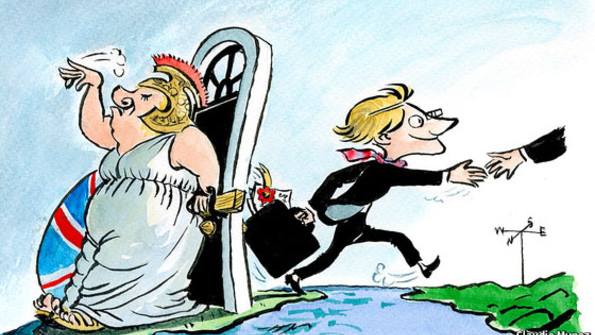
It is not only the Third World that struggles with brain drain. According to the foregoing news article, Great Britain, one of the world’s richest economies, also has a problem keeping their highly skilled workers as home. Accordingly, the article reports that there are over 5 million British expatriates living abroad.

Title: Message to the British Diaspora: “… and don’t come back”

CU Blog - Britain's neglected diaspora - Photo 1

Sub-title: Some 5 million Britons live abroad. The country could do far more to exploit its high-flying expats

When British politicians talk about winning the “global economic race” (as they often do) they have athletes like Gregor Wilson in mind. Mr. Wilson taught himself to code as a child. He started and built his first company while at university and sold it on graduating. His second venture, a software firm, is booming and will soon be ready to take on more staff. He is also preparing to leave Britain for good.

In the popular imagination, British expats are leathery retirees in the Mediterranean. But from 2006 onwards the weak pound, the bursting of Spain’s property bubble and rising taxes in France made the costas less attractive. The number of old Britons emigrating annually has more than halved since then. Dean Blackburn, head of HSBC Expat, part of the high-street bank, says that a different breed of emigrant is now on the march: the ambitious graduate bound for North America or Asia.

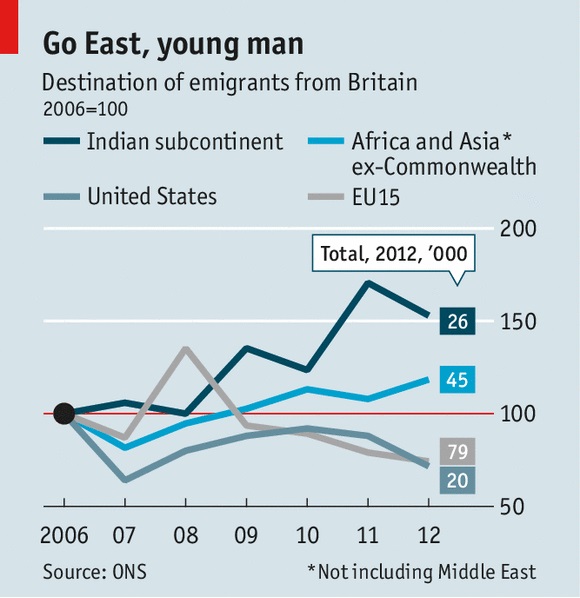
CU Blog - Britain's neglected diaspora - Photo 2The sharpest rise has been among those moving to the glittering East (see chart). Mr Wilson will build his business in Hong Kong. The web, along with the reach of the English language and the cachet of a British degree, gives young people like him opportunities undreamed-of by their parents’ generation. They are also un-tethered for longer: on average, they buy a house and form a family later in life than did previous generations. Figures from the Office for National Statistics show that, since the eve of the economic crisis, emigration is down by 19% overall but up by 8% among 15- to 24-year-olds.

High housing costs help to drive young folk abroad. For the monthly rent on a rabbit hutch anywhere near central London, graduates live grandly elsewhere. “We can afford to travel around Australia, rent an apartment with a sea view and save some money,” explains Emma, a publisher and recent Oxford graduate who moved to Melbourne last year. Those with advanced degrees are especially likely to leave for countries where pay and research facilities are better.

This is regrettable. Britain’s productivity rate is puny; firms and factories badly need such skilled employees. But it is also an opportunity—which the country is squandering.

According to the World Bank, the British diaspora (at nearly 5m people, roughly the size of Scotland) is the largest of any rich country and the eighth biggest overall. Britain’s many expats could strengthen its trading links, channel investment into its economy and generally burnish the national brand. But Britain’s government seems to have “no coherent strategy” for engaging with them, says Alan Gamlen of the Oxford Diasporas Programme, a research unit at OxfordUniversity.

Of 193 UN member states, 110 have formal programmes to build links with citizens abroad. Britain is not one of them. The Foreign and Commonwealth Office’s database of Britons abroad is patchy. Of all the high-flying expats with British passports your correspondent asks, only one—Danny Sriskandarajah, a migration expert based in South Africa—has had any contact with local embassies or with UKTI, Britain’s trade-promotion body. And his Indian friend has received much more attention from his consulate.

Indeed, India is a trailblazer in this field. It has an entire ministry for its emigrants. Mr. Gamlen says it partly has this to thank for the success of its IT industry, built by Indians lured home from Silicon Valley and Europe. Other countries are similarly welcoming. Italy and France even reserve parliamentary seats for their diasporas.

The British government would probably have to work harder than most to sustain ties with the country’s expats. Britons are relatively good at melting into other countries without trace. They are a individualistic bunch, have Commonwealth links and a native language that often makes it easy to integrate.

Kiwi seeds
New Zealand offers a good model for Britain’s hands-off diplomats to emulate. Wellington has spent 30 years encouraging firms and philanthropists to root out Kiwis abroad. Its proudest achievement is the Kiwi Expat Association, a public-private partnership that supports and connects overseas New Zealanders through social media and networking events, and helps them return home if they so wish. Britain might also make it easier to bring spouses into the country. Expats who want to move back with their non-British partners often collide with their home country’s ever-tougher immigration regime.

If Britain does not want its talented globetrotters, others do. Germany actively recruits Britons to take apprenticeships there. Middle Eastern governments tour British universities doling out visas. Mr. Wilson was contacted out of the blue by the Chinese authorities, who invited him to relocate his firm and offered to pay for his flight. “America and China seem really keen to attract us,” he says. “Britain just doesn’t seem that interested.”
The Economist Magazine – (Posted 08/09/2014) –
http://www.economist.com/news/britain/21611102-some-5m-britons-live-abroad-country-could-do-far-more-exploit-its-high-flying-expats-and?fsrc=nlw
The analysis is straight forward, this is Globalization 101. In a global economy, the economic rules of supply and demand are magnified globally. Highly skilled individuals are a commodity that is in demand, customers for that commodity emerged from all corners of the earth.

For the Caribbean, the lessons are very pointed, the exacerbated brain drain, estimated at 70%, with one country Guyana registering a 81% ratio, will not go away on its own. There must be a concerted effort of mitigations and solutions to remediate the problem. The book Go Lean…Caribbean is the concerted mitigation effort on behalf of the Caribbean region. The book Go Lean…Caribbean serves as a roadmap for the introduction and implementation of the technocratic Caribbean Union Trade Federation (CU).

This roadmap is for the elevation of Caribbean society, including the Diaspora. There is no laissez-faire attitude toward this population, there are specific missions to impact the Diaspora into the effort to empower the Caribbean. In fact, the prime directives of the CU are presented as the following 3 statements:

  • Optimization of the economic engines in order to grow the regional economy to $800 Billion & create 2.2 million new jobs.
  • Establishment of a security apparatus to protect the resultant economic engines.
  • Improve Caribbean governance to support these engines.

The book posits that, just like Great Britain in the foregoing article, the Caribbean is in crisis with this brain drain problem. This point is stressed early in the book (Page 13) in the following pronouncements in the Declaration of Interdependence:

 xix.   Whereas our legacy in recent times is one of societal abandonment, it is imperative that incentives and encouragement be put in place to first dissuade the human flight, and then entice and welcome the return of our Diaspora back to our shores. This repatriation should be effected with the appropriate guards so as not to imperil the lives and securities of the repatriated citizens or the communities they inhabit. The right of repatriation is to be extended to any natural born citizens despite any previous naturalization to foreign sovereignties.

xx.   Whereas the results of our decades of migration created a vibrant Diaspora in foreign lands, the Federation must organize interactions with this population into structured markets. Thus allowing foreign consumption of domestic products, services and media, which is a positive trade impact. These economic activities must not be exploited by others’ profiteering but rather harnessed by Federation resources for efficient repatriations.

This commentary previously related details of the vibrant Caribbean Diaspora, such as the causes of emigration, efforts to reduce the “push-and-pull” factors and the region’s continuous interaction with the “exile community”, in these earlier Go Lean blogs:

https://goleancaribbean.com/blog/?p=1896 American “Pull” Factors – Crisis in Black Homeownership
https://goleancaribbean.com/blog/?p=1698 American “Pull” Factors – STEM Jobs Are Filling Slowly
https://goleancaribbean.com/blog/?p=1683 British public sector workers strike over ‘poverty pay’
https://goleancaribbean.com/blog/?p=1596 Book Review: ‘Prosper Where You Are Planted’
https://goleancaribbean.com/blog/?p=1433 Caribbean loses more than 70 percent of tertiary educated to brain drain
https://goleancaribbean.com/blog/?p=1350 PayPal expands payment services to 10 markets
https://goleancaribbean.com/blog/?p=1296 Remittances to Caribbean Increased By 3 Percent in 2013
https://goleancaribbean.com/blog/?p=1256 Traditional 4-year College Degree are Terrible Investments for the Caribbean Region
https://goleancaribbean.com/blog/?p=841 Having Less Babies is Bad for the   Economy
https://goleancaribbean.com/blog/?p=740 Trade/Foreign Mission Offices – Why not … a profit center?

Losing a portion of  any population is bad for any economy. But losing large portions of a skilled population, is worst still as it creates a debilitating brain drain.

So how do we, in the Caribbean, find success when even John Bull (metonym referring to England) has failed? The foregoing article identifies a best practice: Diaspora outreach. This plan requires capturing a database of all Caribbean Diaspora and their legacies, a natural feature of the myCaribbean.gov social media site.

The Go Lean roadmap spells out the full details of the plan to engage the Diaspora residing, working, and studying in foreign lands. (Many students study abroad and never return “home”). The goal is to expand trade and absolutely-positively encourage a repatriation to their Caribbean homelands.

The CU will surely not abandon their Caribbean expatriates, even though these ones may have abandoned the Caribbean.

In line with the foregoing article, the Go Lean book details a series of community ethos, strategies, tactics, implementations and advocacies to foster the best practices in Diaspora outreach, thus furthering interaction with far-flung Caribbean stakeholders:

Community Ethos – Deferred Gratification Page 21
Community Ethos – People Respond to Incentives Page 21
Community Ethos – Economic Systems Influences Choices & Incentives Page 21
Community Ethos – The Consequences of Choice Lie in the Future Page 21
Community Ethos – Job Multiplier Page 22
Community Ethos – Lean Operations Page 24
Community Ethos – Return on Investments Page 24
Community Ethos – Ways to Impact the Future Page 26
Community Ethos – Ways to Help Entrepreneurship Page 28
Community Ethos – Ways to Impact Research & Development Page 30
Community Ethos – Ways to Manage Reconciliations Page 34
Community Ethos – Ways to Impact the Greater Good Page 37
Strategy – Mission – Repatriate Diaspora Page 46
Strategy – Customers – Diaspora Page 47
Tactical – Separation of Powers – Department of State – Foreign Affairs Page 80
Implementation – Year 1 / Assemble Phase Page 96
Implementation – Year 4 / Repatriate Phase Page 98
Implementation – Improve Mail Services – e-Mail for Diaspora Page 108
Implementation – Ways to Deliver Page 109
Implementation – Ways to Impact Social Media Page 111
Implementation – Trade Mission   Objectives Page 117
Implementation – Reasons to Repatriate Page 118
Implementation – Ways to Benefit from Globalization Page 119
Planning – Ways to Improve Trade Page 128
Advocacy – Ways to Grow the Economy Page 151
Advocacy – Ways to Create Jobs Page 152
Advocacy – Ways to Improve Education Page 159
Advocacy – Ways to Foster Technology Page 197
Advocacy – Ways to Impact the Diaspora Page 217
Advocacy – Ways to Impact British Territories Page 245
Appendix – Analysis of Caribbean Diaspora by Country of Residence Page 267
Appendix – Analysis of Caribbean Remittances Page 268
Appendix – Analysis of Caribbean Emigration Page 269
Appendix – Alternative Remittance Modes Page 270
Appendix – Puerto Rican Diaspora Population in the US Page 304

This roadmap focuses on the Caribbean, arguably the world’s best address, not Great Britain, a less than tropical, less than paradisiacal land . Now is the time for all of the Caribbean, the people and governing institutions, to lean-in for the changes in this Go Lean … Caribbean roadmap.

This is a big deal for the region. This roadmap is not just a plan, its a prescription for what ails the region; it advocates for the CU to serve as a delivery vehicle to carry the hopes and dreams of generations of Caribbean residents…and Diaspora.

The region needs this delivery; the region needs this cure. The region needs this roadmap to be a better place to live, work and play.

Download the book Go Lean … Caribbean – now!

 

Share this post:
, , , ,

Many drug inmates who get break under new plan to be deported

Go Lean Commentary

A crisis is coming!

Due to changes in US drug policy – 2 States have de-criminalized Marijuana and the new national ethos is that drug users are victims more so than villains (See VIDEO below) – incarcerated drug felons will have their sentences reduced. For those that are non-citizens, the likelihood is that they will be immediately deported to their homelands. Notice the trend, the US federal government will not want to pay billions of dollars to maintain these prisoners in the system or out of the system. So they would rather send them “home” and make them someone else’s problem. For the inmates with Caribbean heritage, that “someone else” would be the Caribbean member-states.

By: Liz Goodwin, Yahoo News

Many drug inmates who get break under new plan to be deported.

Thousands to land back in Mexico after early release.

US Drug Inmates PhotoThousands of federal prisoners set to be released early thanks to a change in drug rules will most likely be quickly deported to their home countries next year.

The U.S. Sentencing Commission, a group that controls advisory sentencing guidelines for federal judges, voted last week to shave an average of two years off the sentences of up to 46,000 inmates jailed for drug crimes. The first ones will be released on Nov. 1, 2015.

The group has begun to reverse older policies that sent people away for decades for nonviolent drug crimes, part of a larger criminal justice reform push that has attracted bipartisan support. In 2007, the group lightened sentences for crack offenders. Inmates will have to apply for the sentence reductions with the help of public defenders, and federal judges will have a year to decide who qualifies for early release.

But many of the people who will benefit from the change in policy will likely be deported as soon as they qualify for the sentence reduction. A quarter of all the qualifying inmates are not U.S. citizens, according to the group’s analysis, complicating the picture many have of drug offenders as gang-affiliated young men in run-down, poor urban neighborhoods. Many of the offenders, in fact, were caught with drugs in their vehicles as they tried to cross the border and were prosecuted in Texas. The Lone Star state has nearly 21 percent of all the prisoners who will benefit from the early release. Of those 10,296 prisoners in Texas, up to a third will be deported once released.

The hefty noncitizen portion of offenders could cut the state a break, since the criminal justice system does not have enough probation officers and halfway homes to handle the influx that’s expected when the first releases begin in November 2015.

“There wouldn’t have been enough facilities to absorb the number of people who would be released,” said Maureen Franco, public defender in the Western District of Texas, which covers much of the state’s border with Mexico.

Giving the judges a year to consider the early release petitions will also allow Immigration and Customs Enforcement time to make sure it has enough beds for the prisoners while they await their deportation.

Franco said her immigrant clients are just as eager for early release as those who are citizens, despite the deportation that awaits them. She’s already heard from some of them who are emailing her and asking when they can get out.

This might be in part because immigrants living illegally in the U.S. are not eligible for many programs in federal prison — they also can’t live in lower-security facilities. “It’s a much harsher sentence,” said Marjorie Meyers, federal public defender in the Southern District of Texas.

Ricardo Hinojosa, a vice chair of the Sentencing Commission and a federal judge in Laredo, brought up concerns before the group’s vote that the offenders who are sent back to Mexico will not be rigorously supervised by that country’s probation system. “Many of them will be tempted to come back, and maybe quicker, because of the fact that many of them have families on this side of the border,” Hinojosa said.

Those who are caught trying to come back over the border face up to 10 years in federal prison. They might fear the violence in Mexico, particularly if they were involved in drugs, more than detention in America, where at least they are safe.

Prisoners who had legal immigration status but were not citizens can try to fight their deportation, but it’s a long shot. “It’s very hard to fight,” Meyers said.
Yahoo News Online Source (Retrieved 07/22/2014) –
http://news.yahoo.com/many-drug-inmates-who-get-break-under-new-plan-to-be-deported-134758280.html
Photo Credit (Above): Andrew Burton – Getty Images

Video Credit (Below): White House National Drug Control Strategy:  http://www.whitehouse.gov/ondcp/drugpolicyreform

Ready or not, here they come!

For the Caribbean, the answer most likely is “Not Ready”!

This is a crisis that is looming. The book Go Lean…Caribbean declares that a crisis is a terrible thing to waste and that we should not waste this opportunity to elevate our own security engines in the region. If we do it right, we can even profit from the crisis as well. The overriding theme of the foregoing news article is the need for a prison industrial complex – the field of “penology”. With this coming crisis – November 2015 – the publishers of the book Go Lean…Caribbean see opportunities for commerce.

The Go Lean book serves as a roadmap for the introduction and implementation of the technocratic Caribbean Union Trade Federation (CU). With 2 American territories in the Caribbean (Puerto Rico & the US Virgin Islands), an immediate plan to host US federal prisoners is not so radical. Plus, this could mean billions of dollars for the Caribbean.

The Go Lean book goes further and posits that the region must prepare its own security apparatus for its own security needs. But while we are building facilities (prisons, jails, and detention centers) for our own needs, we can employ the strategy of over-building and insourcing for other jurisdictions. Had we been ready now, with this Go Lean roadmap, we would have been able to embrace the opportunities presented by the US Drug Policy Change. These unwanted “inmates” could have been guests in Caribbean facilities now – for a fee; a lower fee than the US federal government currently incurs, but more revenues than the Caribbean currently generates.

So then what happens when these US drug inmates are released?

“Mejor el diablo sabe que el diablo no tiene” – Spanish expression. The English translation is “Better the Devil you know than the Devil you don’t know”.

The Go Lean roadmap asserts that it is better to structure crime intelligence analysis around a population that we know is a “risk” than to watch/monitor everybody. At some point the Caribbean Diaspora in US Federal prisons will be sent home. We want to be prepared for them. If not only to offer them new chances of productive citizenship, then at least to closely guard against their post-incarceration activities. We already know these ones have a preponderance to engage in illicit activities, so it is prudent to “watch” them.

This point is pronounced early in the book with the Declaration of Interdependence (Page 12) that claims:

x. Whereas we are surrounded and allied to nations of larger proportions in land mass, populations, and treasuries, elements in their societies may have ill-intent in their pursuits, at the expense of the safety and security of our citizens. We must therefore appoint “new guards” to ensure our public safety and threats against our society, both domestic and foreign. The Federation must employ the latest advances and best practices of criminology and penology to assuage continuous threats against public safety. The Federation must allow for facilitations of detention for convicted felons of federal crimes, and should over-build prisons to house trustees from other jurisdictions.

xvi. Whereas security of our homeland is inextricably linked to prosperity of the homeland, the economic and security interest of the region needs to be aligned under the same governance. Since economic crimes … can imperil the functioning of the wheels of commerce for all the citizenry, the accedence of this Federation must equip the security apparatus with the tools and techniques for predictive and proactive interdictions.

The goal of Go Lean…Caribbean, roadmap is to confederate under a unified entity made up of all 30 Caribbean member-states. Then provide homeland security for our neighborhood, contending with man-made and natural threats. The CU security goal is not for world dominance, or promotion of idealistic concepts. No, it is simply for public safety! The CU is set to optimize Caribbean society through a number of missions. The Go Lean roadmap has 3 prime directives:

  • Optimization of the economic engines in order to grow the regional economy to $800 Billion & create 2.2 million new jobs.
  • Establishment of a security apparatus to protect the resultant economic engines.
  • Improve Caribbean governance to support these engines.

This Go Lean roadmap calls for the establishment of professional penology arts and sciences, a Caribbean prison industrial complex. This will include the prison/jail/detention facilities and the rest of the eco-system: bail enforcement, witness protection, probation/parole, anti-recidivism, intelligence gathering, job training/placement and in-prison labor options. There are lots of lessons (from global examples) to learn and apply in perfecting the Caribbean model. For one, we do not want the profit motive – the book speaks of learning from “Peonage Past and Ensuring Corporate Governance” (Page 211); rather we want to be motivated by the Greater Good. The CU security directive should always be in support of growing Caribbean society, not leading the charge – no police state – but rather supporting the lead or “bringing up the rear”.

In recent blog submissions, this commentary highlighted the security provisions that must be enacted to improve homeland security, as soon as possible:

https://goleancaribbean.com/blog/?p=1674 Obama’s Plans for $3.7 Billion Immigration Crisis Funds
https://goleancaribbean.com/blog/?p=1554 Status of Forces Agreement = Security Pact
https://goleancaribbean.com/blog/?p=1386 Marijuana De-criminalization – In Jamaica, a Puff Peace
https://goleancaribbean.com/blog/?p=1076 References to the Caribbean Regional Security System
https://goleancaribbean.com/blog/?p=392 Jamaica to receive World Bank funds to   help in crime fight

Look seriously at the issues in the foregoing news article.

These inmates in Federal prisons are persona non-grata in the US. So they will have no choice but to come home…eventually. Whereas these are not the type of new residents we may want in the Caribbean, ready or not, they are coming. It is better to be prepared. What’s worse, these ones may now have even better-tuned-skills and abilities for operating in the illicit world – many criminals learn how to be better criminals in prison.

The Go Lean book details a series of community ethos, strategies, tactics, implementations and advocacies to provide increased public safety & security in the Caribbean region:

Economic Principle – People Respond to Incentives in Predictable Ways Page 21
Economic Principle – Economic Systems Influence Choices & Incentives Page 21
Economic Principle – Consequences of Choices Lie in Future Page 21
Community Ethos – Privacy –vs- Public Protection Page 23
Community Ethos – Intelligence Gathering Page 23
Community Ethos – Witness Security & Protection Page 23
Community Ethos – Light Up the Dark Places Page 23
Community Ethos – “Crap” Happens Page 23
Community Ethos – Lean Operations Page 24
Community Ethos – Ways to Improve Sharing Page 35
Community Ethos – Ways to Impact the Greater Good Page 37
Tactical – Confederating a non-sovereign union Page 63
Tactical – Separation of Powers – Homeland Security Page 75
Tactical – Separation of Powers – Justice Department Page 77
Implementation – Ways to Pay for Change Page 101
Implementation – Start-up Foreign Policy Initiatives Page 102
Implementation – Start-up Security Initiatives Page 103
Planning – Ways to Make the Caribbean Better Page 131
Planning – Ways to Improve Failed-State Indices Page 134
Advocacy – Ways to Grow the Economy Page 151
Advocacy – Ways to Mitigate Black Markets Page 165
Advocacy – Ways to Improve Governance Page 168
Advocacy – Ways to Better Manage the Social Contract Page 170
Advocacy – Ways to Impact Justice Page 177
Advocacy – Ways to Reduce Crime Page 178
Advocacy – Ways to Improve Homeland Security Page 180
Advocacy – Ways to Mitigate Terrorism Page 181
Advocacy – Ways to Improve Intelligence Gathering and Analysis Page 182
Advocacy – Ways to Improve for Natural Disasters Page 184
Advocacy – Ways to Impact the Prison Industrial Complex Page 211
Advocacy – Ways to Protect Human Rights Page 220
Appendix – Prison Industrial Complex Model: Nauru Detention Center Page 290

We console with the communities that have to deal with this impending crisis – a lot of the inmates are identified as Mexican; while this is not in scope for the CU, there are a lot of lessons that the Caribbean can learn from this country’s dysfunction in dealing with its public safety, especially along the US border. This region is near Failed-State status.

The Go Lean roadmap is the Caribbean’s aspiration to mitigate against Failed-State indices. This is underlying to the prime directive of the CU, to elevate the economics, security and governing engines of the Caribbean. This is not an easy task; this is heavy-lifting, and thus the book features the turn-by-turn directions to implement the appropriate provisions. This is a sensible roadmap to make the Caribbean homeland a better place to live, work and play.

Download the book Go Lean … Caribbean – now!

Share this post:
,
[Top]

Miami’s Caribbean Marketplace Re-opens

Go Lean Commentary

Make no mistake: having a warm welcome in a City of Refuge is not as good as being safe and secure at home. Yet, when conditions mandate that one take flight, a warm welcome is greatly appreciated.

According to the foregoing article, the City of Miami now extends a warm welcome … to the Caribbean Diaspora. While Miami profits from this embrace, the benefits for the Caribbean are not so great.

This is the American Immigrant experience, one of eventual celebration, but only after a “long train of abuses”: rejection, anger, protest, bargaining, toleration and eventual acceptance. The experience in Miami today is one of celebration.

The book Go Lean…Caribbean champions the cause of retaining Caribbean citizens in the Caribbean, even inviting the Diaspora back to their homelands. So the idea of celebrating a cultural contribution at a center in a foreign land is a paradox. Yes, we want the positive image, but no, we do not want to encourage more assimilation in the foreign land.

However, the book declares: It is what it is!

The book serves as a roadmap for the introduction and implementation of the Caribbean Union Trade Federation (CU), a technocratic federal government to administer and optimize the economic/security/ governing engines in the homeland of the region’s 30 member-states. The CU strives to elevate Caribbean image at home and abroad. There are many empowerments in the roadmap for the far-flung Diaspora to improve the interaction with the Caribbean community. So the cultural center in the foregoing article is germane to the Go Lean discussion.

The entire article is listed as follows:

CU Blog - Miami's Caribbean Marketplace Re-opens - Photo 1 Sub-title: The Caribbean Marketplace has become a cultural icon in the Little Haiti community and re-opens with much fanfare….

By: Fabiola Fleuranvil | Noire Miami

The long awaited re-opening of the Caribbean Marketplace (CMP) is back as a cultural marker in the vibrant Little Haiti community. For years, the venue has been a strong figure along Little Haiti’s main corridor and has been easily identified by its bright colors and vibrant activity of vendors as well as Haitian and Caribbean culture. After undergoing a lengthy renovation to transform this cultural gem into a community staple for unique arts and crafts, Caribbean culture, special events, and community events, the highly anticipated reopening positions the Caribbean Marketplace as a vibrant addition to the Little Haiti Cultural Center next door and the burgeoning arts and culture spirit in Little Haiti.

The re-establishment of this Marketplace is a collaborative effort of the City of Miami in partnership with the Miami-Dade Department of Cultural Affairs, the Little Haiti Cultural Complex (LHCC), the Northeast Second Avenue Partnership (NE2P) and District 5 Commissioner Keon Hardemon.

The 9,500-square-foot space includes a refreshment and concession area, gift shops, arts and crafts, retail vendors and space available for private events. The renovations reflect the beautiful diversity of the Caribbean. Low rates, technical and marketing assistance will be provided to all vendors. It is anticipated that new businesses will be created in this cultural hub, resulting in employment opportunities for the local community.

Physical Address for the Caribbean Marketplace: 5925   NE 2nd Ave, Miami (Besides the Little Haiti Cultural Center) Hours: Thursday – Sunday, 11AM – 11PM
Miami Herald Daily Newspaper  (Retrieved 07-16-2014) –
http://www.miami.com/little-haiti039s-caribbean-marketplace-reopens-article

The Miami community is doing even more to embrace the exile populations in its metropolis, (including jurisdictions up to West Palm Beach). They have declared an entire month (June) for celebrating Caribbean communities; the term “month” is a loose definition, it starts in the Spring and forwards deep into the Summer. The following is a sample of events planned for this year (2014).

Caribbean-American Heritage “Month” events around South Florida:

CU Blog - Miami's Caribbean Marketplace Re-opens - Photo 2

3rd Annual Colors of the Caribbean

Saturday, June 14, 4PM – 11PM – Hollywood Arts Park – Hollywood Blvd & US1

What do you get when you blend the diverse, authentic ingredients of the Caribbean? You get a Caribbean inspired day of food, arts and culture, entertainment and irie vibes. Colors of the Caribbean features: Junkanoo procession, Moko Jumbies (Stilt walkers), Steelpan music, and live performances by Wayne Wonder (Jamaica), Midnite (Virgin Islands), Kevin Lyttle (St Vincent), Harmoniq (Haiti), music by DJ Majestic (DC/Trinidad & Tobago), and more.

AllSpice: Flavors of the Caribbean

Friday, June 20, 6PM – 10PM – Borland Center, 4885PGABlvd,Palm BeachGardens

The Caribbean Democratic Club of Palm Beach County presents a Taste of the Caribbean in celebration of Caribbean American Month.

Caribbean Style Week

June 23-29 – Westfield Mall Broward, 8000 West Broward Blvd, Plantation

The Caribbean American Heritage Foundation hosts a week-long showcase featuring both popular and upcoming Caribbean fashion designers and brands. Fashion pieces will be available for purchase during the fashion expo.

Caribbean Heritage Month Travel Experience/Travel Expo

June 28-29 – Westfield Mall Broward, 8000 West Broward Blvd, Plantation

The Caribbean Travel Expo celebrates and promotes each individual as a destination for your next vacation. The expo experience will also showcase live music, cultural performances, and special surprise giveaways over the weekend.

Caribbean: Crossroads of the World Exhibit

April 18 – Aug 17 – PerezArt MuseumMiami (PAMM), 1103 Biscayne Blvd, Miami

Highlighting over two centuries of rarely seen works — from paintings and sculptures to prints, photographs, installations, films, and videos — dating from the Haitian Revolution to the present, this exhibition advances our understanding of the Caribbean and its artistic heritage and contemporary practices.
http://www.miami.com/caribbean-american-heritage-month-events-around-south-florida-article)

The Go Lean…Caribbean clearly recognizes the historicity of Cuban and Afro-Caribbean (Haitian, Jamaican, Dominican, Bahamian, etc) exiles in Miami. They went through the “long train of abuses”. But today, their communities dominate the culture of South Florida, resulting in a distinctive character that has made Miami unique as a travel/tourist destination; see VIDEO below. The expression “take my talents to South Beach” now resonates in American society.

This commentary previously featured subjects related to the Caribbean Diaspora in South Florida. The following here is a sample:

https://goleancaribbean.com/blog/?p=1433 Caribbean loses more than 70 percent of tertiary educated to brain drain
https://goleancaribbean.com/blog/?p=1148 Sports Bubble – Franchise values in basketball
https://goleancaribbean.com/blog/?p=689 eMerge conference aims to jump-start Miami   tech hub
https://goleancaribbean.com/blog/?p=235 Tourism’s changing profile

At the outset, the Go Lean roadmap recognizes the value and significance of Cuban and Haitian exile communities in the pantheon of Caribbean life. Any serious push for Caribbean integration must consider Diaspora communities, like the Cuban/Haitian exiles in Miami. This intent was pronounced early in the book with these statements in the Declaration of Interdependence (Pages 12 & 13):

xiii.      Whereas the legacy of dissensions in many member-states (for example: Haiti and Cuba) will require a concerted effort to integrate the exile community’s repatriation, the Federation must arrange for Reconciliation Commissions to satiate a demand for justice.

xix.      Whereas our legacy in recent times is one of societal abandonment, it is imperative that incentives and encouragement be put in place to first dissuade the human flight, and then entice and welcome the return of our Diaspora back to our shores. This repatriation should be effected with the appropriate guards so as not to imperil the lives and securities of the repatriated citizens or the communities they inhabit. The right of repatriation is to be extended to any natural born citizens despite any previous naturalization to foreign sovereignties.

xx.      Whereas the results of our decades of migration created a vibrant Diaspora in foreign lands, the Federation must organize interactions with this population into structured markets. Thus allowing foreign consumption of domestic products, services and media, which is a positive trade impact. These economic activities must not be exploited by others’ profiteering but rather harnessed by Federation resources for efficient repatriations.

It was commonly accepted that Cuban exiles and other Caribbean Diaspora were sitting, waiting in Miami for change in their homelands; then they would return to claim their earned positions of respect. Along the way, the Survive-then-Thrive strategy was supplanted with a new Thrive-in-America strategy – credited to the next generation’s assimilation of the American Dream and the long duration of Caribbean dysfunctions, i.e. the Castros still reign after 55 years. Miami subsequently emerged as the trading post for the Caribbean and all of Latin America. The Caribbean is now hereby urged to lean-in to the community ethos, strategies, tactics, implementations and advocacies to finally re-boot Caribbean society; as detailed in the book Go Lean … Caribbean sampled here:

Community   Ethos – Economic Systems Influence Individual Choices & Incentives Page 21
Community   Ethos – Voluntary Trade Creates Wealth Page 21
Community   Ethos – Anti-Bullying and Mitigation Page 23
Community   Ethos – Minority Equalization Page 24
Community   Ethos – Lean Operations Page 24
Community   Ethos – Return on Investments Page 24
Community   Ethos – Ways to Impact Turn-Arounds Page 33
Community   Ethos – Ways to Manage Reconciliations Page 34
Community   Ethos – Ways to Impact the Greater Good Page 37
Strategic – Vision – Integrating Region in to a Single Market Page 45
Strategic – Agents of Change – Globalization Page 57
Tactical – Fostering a Technocrary Page 64
Tactical – Separation of Powers – State Department – Culture Administration Page 81
Tactical – Separation of Powers – Federal Courts – Truth & Reconciliation Commissions Page 90
Implementation – Ways to Pay for Change Page 101
Implementation – Foreign Policy Initiatives at Start-up Page 102
Implementation – Ways to Deliver Page 109
Implementation – Trade Mission Objectives Page 117
Implementation – Reasons to Repatriate Page 118
Implementation – Ways to Benefit from Globalization Page 119
Planning – 10 Big Ideas – Cuba/Haiti Page 127
Planning – Ways to Make the Caribbean Better Page 131
Advocacy – Ways to Grow the Economy Page 151
Advocacy – Ways to Impact the Diaspora Page 217
Advocacy – Ways to Preserve Caribbean Heritage Page 218
Advocacy – Ways to Improve the Arts Page 230
Advocacy – Ways to Promote Music Page 231
Advocacy – Ways to Re-boot Cuba Page 236
Advocacy – Ways to Re-boot Haiti Page 238

The foregoing article addresses the story of the Caribbean Marketplace facility to promote Caribbean culture in the South Florida market, and even provide some economic benefits (trade, job, import/export options). The Go Lean book focuses on these economic issues to the Nth degree, and also addresses the important issues regarding Caribbean societal elevation: music, sports, art, education, repatriation and heritage. This cultural center in the foregoing article aligns with the Go Lean roadmap.

Just like Miami grew, and prospered so much over the last 50 years, with help from our people, the Caribbean can also be a better place to live, work and play. This is a new day for the Caribbean!

It’s time now for change; not just change for change sake, but the elevations that were identified, qualified and proposed in the book Go Lean…Caribbean. It’s time to lean-in. Then we can move from celebrating the Diaspora in a foreign land to celebrating their return to the Caribbean, the best address in the world.

Download the book Go Lean…Caribbean now!

Share this post:
, , , , , , ,
[Top]

British public sector workers strike over ‘poverty pay’

Go Lean Commentary

The grass is not greener on the other side.

Go from being a big fish in small pond, to small fish in big pond.

These expressions are relevant in considering the fate of so many Caribbean Diaspora that had fled their Caribbean homelands over the past decades to take residence in Great Britain. Many of them sought refuge as career civil servants; (one reason [a] was the acute racism and intolerance encountered in private enterprises). These ones are faced with the harsh reality that pay scales in the public sector have not kept pace with inflation; they are now at poverty level. See the news article here:

By: Tess Little (Editing by Stephen Addison)

British strike 1LONDON (Reuters) – Hundreds of thousands of public sector workers including teachers, council workers and firefighters staged a 24-hour pay strike on Thursday in a stoppage that has prompted Prime Minister David Cameron to pledge a crackdown on union powers.

Protesters marched through the streets of many of Britain’s main cities in one of the biggest co-ordinated labour stoppages for three years.

Denouncing what they called “poverty pay,” they demanded an end to restrictions on wage rises that have been imposed by the government over the past four years in an effort to help reduce Britain’s huge budget deficit.

In London, demonstrators marched towards Trafalgar Square at midday, chanting “Low pay, no way, no slave labour” to the beat of a drum. A giant pair of inflatable scissors, carried by members of the National Union of Teachers (NUT), read “Education cuts never heal.”

Firefighter Simon Amos, 47, marched wearing his uniform behind a flashing fire engine parading members of the Fire Brigades Union (FBU). “The government [is] making us pay more for our pension for it to be worth the same, and making us work longer,” he said.

British strike 2The biggest public sector union involved, Unison, said early reports showed the strike had led to 3,225 school closures with more than 1,000 others partially closed.

Refuse collectors, school support staff, cleaners, street sweepers, care workers, nursery assistants and social workers were joining the strike, it added.

Hot spots, it said, included the North East, Wales and East Midlands where most council offices had closed, while more than 60 picket lines have closed most services in Newcastle.

“It is a massive decision by local government and school support workers to sacrifice a day’s pay by going on strike, but today they are saying enough is enough,” said Unison General Secretary, Dave Prentis in a statement.

Britain’s coalition government has enforced a policy of pay restraint for public sector workers since coming to power in 2010, imposing a pay freeze until 2012 and then a one percent pay rise cap, resulting in a fall in income in real terms [compared to inflation].

The Cabinet Office played down the impact of the strike, saying that most schools in England and Wales were open and that fire services were operating throughout the country.

British strike 3On Wednesday, Cameron told parliament he planned to limit unions’ powers to call strikes.

“How can it possibly be right for our children’s education to be disrupted by trade unions acting in this way” he said.

Tough new laws would be proposed in the Conservative manifesto for next year’s general election, he added.

These would include the introduction of a minimum threshold in the number of union members who need to take part in a strike ballot for it to be legal.

The manifesto could also back the introduction of a time limit on how long a vote in favour of industrial action would remain valid.

The NUT mandate for Thursday’s strike, for example, came from a 2012 strike ballot based on a turnout of just 27 percent, Cameron said.

The issue of minimum voting thresholds last arose three months ago when a strike by London Underground train drivers caused huge disruption in the capital, prompting Mayor Boris Johnson to demand that at least half of a union’s members should vote in favour for a strike to go ahead.
Source: Reuters News Service; retrieved 07/10/2014 from: http://news.yahoo.com/public-sector-workers-strike-over-poverty-pay-105040672.html

Frankly, the Caribbean Diaspora employed in the British public sector can now do better at home … in the Caribbean.

This is the assertion of the book Go Lean…Caribbean. That once the proposed empowerments are put in place, the Caribbean Diaspora should consider repatriating to their ancestral homelands.

Unfortunately for the Caribbean, this societal abandonment has continued, since the early days of the “Windrush Generation”[a] right up to now. In a recent blog post, this commentary related analysis by the Inter-American Development Bank that the Caribbean endures a brain drain of 70% among the college educated population; (https://goleancaribbean.com/blog/?p=1433).

Change has now come to the Caribbean.

The book Go Lean…Caribbean serves as a roadmap for the introduction and implementation of the technocratic Caribbean Union Trade Federation (CU). This roadmap will spearhead the elevation of Caribbean society. The prime directives of the CU are presented as the following 3 statements:

  • Optimization of the economic engines in order to grow the regional economy & create 2.2 million new jobs at home.
  • Establishment of a security apparatus to protect the resultant economic engines.
  • Improve Caribbean governance to support these engines.

The book posits that the improved conditions projected over the 5 years of the roadmap will neutralize the impetus for Caribbean citizens to flee, identified as “push and pull” factors. This point is stressed early in the book (Page 13) in the following pronouncements in the opening Declaration of Interdependence:

xix.   Whereas our legacy in recent times is one of societal abandonment, it is imperative that incentives and encouragement be put in place to first dissuade the human flight, and then entice and welcome the return of our Diaspora back to our shores. This repatriation should be effected with the appropriate guards so as not to imperil the lives and securities of the repatriated citizens or the communities they inhabit. The right of repatriation is to be extended to any natural born citizens despite any previous naturalization to foreign sovereignties.

xx.   Whereas the results of our decades of migration created a vibrant Diaspora in foreign lands, the Federation must organize interactions with this population into structured markets. Thus allowing foreign consumption of domestic products, services and media, which is a positive trade impact. These economic activities must not be exploited by others’ profiteering but rather harnessed by Federation resources for efficient repatriations.

This foregoing article highlights other issues that have been prominently addressed in the Go Lean book, namely that of the Civil Service and Labor Relations. There is the need for a professional staff in the Federal Civil Service. They require marketable benefits and compensation. There is also a role for Labor Unions to play in the elevation of Caribbean society. The Go Lean roadmap envisions an inclusionary attitude towards unions. The Go Lean community ethos is that of being partners with unions, not competitors. The book features specific tools and techniques that can enhance management-labor relationships.

These issues constitute heavy-lifting for the regional administration of the Caribbean:

  • fostering best practices for federal civil service and labor unions,
  • minimizing the brain drain, and
  • facilitating repatriation to the homeland.

These issues cannot be glossed over or handled lightly; this is why the Go Lean book contains 370 pages of finite details for managing change in the region. The book contains the following sample of community ethos, strategies, tactics, implementations and advocacies to impact the Caribbean homeland:

Community Ethos – Economic Systems Influence Choices & Incentives Page 21
Community Ethos – The Consequences of Choices Lie in the Future Page 21
Community Ethos – Job Multiplier Page 22
Community Ethos – Lean Operations Page 24
Community Ethos – Return on Investments Page 24
Community Ethos – Ways to Impact the Future Page 26
Community Ethos – Ways to Improve Negotiations Page 32
Strategy – Competition – Remain home   –vs- Emigrate Page 49
Strategy – Agents of Change – Aging Diaspora Page 57
Tactical – Separation of Powers – Versus Member-States Governments Page 71
Implementation – Year 1 / Assemble Phase – Establish Civil Service Page 96
Implementation – Ways to Deliver Page 109
Implementation – Trade Mission Objectives Page 116
Implementation – Reasons to Repatriate Page 118
Anecdote – Experiences of a Repatriated Resident Page 126
Planning  – 10 Big Ideas for the Caribbean Region Page 127
Advocacy – Ways to Create Jobs Page 152
Advocacy – Ways to Impact Labor Unions Page 164
Advocacy – Ways to Manage Federal Civil Service Page 173
Anecdote – Experiences of Diaspora Member Living Abroad Page 216
Advocacy – Ways to Impact the Diaspora Page 217

The Go Lean roadmap has simple motives: fix the problems in the homeland to make the Caribbean a better place to live, work, learn and play. There should be no need to go abroad and try to foster an existence in a foreign land. So for those of Caribbean heritage working in the British Civil Service, we hear your pleas. Our response: Come home; come in from the cold.

Now is the time for all of the Caribbean, the people residing in the homeland and those of the Diaspora, to lean-in for the empowerments described in the book Go Lean … Caribbean. This Big Idea for the region is a dramatic change; one that is overdue. The policies & practices of the past have failed Caribbean society. Too many people left, yet have little to show for it.

Caribbean music icon Bob Marley advocated this same charter for the Caribbean Diaspora. He sang to “come in from the cold” in the opening song of his last album Uprisings in 1980. How “spot-on’ were his words in the following music/video:

Download the free e-Book of Go Lean … Caribbean – now!

———————

Appendix – Cited Reference
a: “There was plenty of work in post-war Britain and industries such as British Rail, the National Health Service and public transport recruited almost exclusively from Jamaica and Barbados”. Retrieved July 10, 2014 from: http://en.wikipedia.org/wiki/British_African-Caribbean_people#The_.22Windrush_generation.22

Share this post:
, , ,
[Top]

Book Review: ‘Prosper Where You Are Planted’

Go Lean Commentary

The Caribbean is in crisis; according to a report by the Inter-American Development Bank (IDB), over 70% of college educated citizens have fled the region, looking for better opportunity. The fact that the percentage is so high is evident that it is more prosperous abroad than at home. This is the harsh reality. This is also an economic fact as many Caribbean states get 4 to 7 percent of their GDP as remittances back to the homeland from the Diaspora living abroad, mostly in North America and Western Europe.

But this is a losing proposition for the Caribbean – no doubt it is better to get 100% of Gross Domestic Production. In the same report by the IDB, it was stated that Caribbean member-states lose 10 to 11 percent of GDP from emigration and the “spent” cost of education on those expatriates, (https://goleancaribbean.com/blog/?p=1433), so whatever the level of remittance from the Diaspora, the community is still losing. What we need is the option to prosper where we’re planted in the Caribbean. This goal obviously requires heavy-lifting and is easier said than done. This is the focus of the book Go Lean…Caribbean, to elevate the Caribbean economy so that there would be optimal opportunities at home and no need to supplant to another land.

So how do we prosper where we’re planted? While this is a simple question (based on the Bible principle of Psalms 1:3), the answer is more complex. One writer, Dani Johnson, has advocated this theme in a series of books:

Title ISBN                               
First Steps to Wealth 978-0-9789551-8-2
Grooming the Next Generation for Success 978-1-4587-9610-3
Spirit-Driven Success 978-0-7684-9651-2

The below article (and VIDEO) is a review of her last book First Steps to Wealth: it breaks down into bite-size morsels the big meal of wealth building.

The book Go Lean…Caribbean concurs with First Steps to Wealth, but rather than individual wealth, it serves as a roadmap for the introduction and implementation of the technocratic Caribbean Union Trade Federation (CU) to do the heavy-lifting of optimizing community wealth and nation-building for the region.

By: Sheryl Nance-Nash
Title: Dani Johnson Offers Her 12 Laws for Creating Wealth – and Keeping It
DailyFinance e-Zine (Posted 07/23/2013 Retrieved 06/30/2014) –
http://www.dailyfinance.com/2011/07/23/dani-johnson-offers-her-12-laws-for-creating-wealth-and-keepi/

CU Blog - Book Review - Prosper Where You Are Planted - Photo 1

Dani Johnson says she was groomed by her drug addict parents to fail — financially, emotionally and socially. She seemed well on her way to living down to that expectation — by 17 she was pregnant, at 21, homeless. Two years later though, she was a millionaire, thanks to the thriving company she built manufacturing and selling her own nutritional and skin care products. She sold that company in 1996. Then, she lost her fortune, spending almost all of it and trusting the wrong people with the rest.

Today, as a multimillionaire with six businesses that employ more than 30 people, she knows a thing or two about wealth. She says there are three things you need to know about money: how to make it and more of it; how to keep it; and how to turn it into your slave.

“Ninety-eight percent of the population will end up dead or broke by age 65. Only two percent of the population will succeed,” says Johnson in her new book, First Steps to Wealth. “Where do you want to be?” she asks. You need a financial vision.

When she started raking in the cash, she didn’t have the vision thing down yet. “I believed I had to wear Christian Dior suits and $500 shoes to be successful. I believed wealth was about a new Mercedes Benz convertible, and the 6,000 square-foot house with a swimming pool, view of the mountains and tennis courts. But when I got those things, I never felt successful. I had a $250,000 wardrobe and $250,000 in jewelry, and I still felt this gaping hole in my belly that made me feel I was a failure,” she writes.

Challenge Yourself to Apply the Laws to Your Life

Everything starts with a decision. “There’s a theory that if you find your passion that’s where you’ll be successful, but I believe you have to go with what’s in front of you. I saw a box of weight-loss products in the backseat of my car and though I had no interest in selling, I made a decision that I needed to find out how to sell those products because if I relied on being a cocktail waitress it would take months to be able to afford an apartment,” says Johnson, who was homeless and suicidal then. She started a business from the trunk of her car and a phone booth.

“If I didn’t make that decision, I would still be broke. I didn’t want to sell, but it was the door in front of me,” says Johnson. When her first sales call ended with a hang up, she called another weight-loss product company, observed how they handled her, and developed a script from that. She used their advertisements to shape her own. To make a long story short, in 45 days she had $18,000 in sales.

Johnson credits her fortune to what she calls the 12 Laws of Success — fundamental principles that moved her from an impoverished past to a prosperous present. She has spent the last two decades telling others how those principles can help them too.

Law No. 1 – The Law of Vision

In her book she asks, “What are the things you dreamed of doing in your life? Do you remember what those dreams looked like? What happened to those dreams? “If you want to be successful financially, expand your income to fit your dreams. This is the Law of Vision. “For without vision, we perish. It is important to list where we want to go, what we want to do, and with whom we want to do it. If you do not know what you want, no one can help you get it,” she writes. But what do you want?

Law No. 2 – The Law of the Mind

There is something very different about the wealthy: The way they think, how they make decisions, act upon them, and how they see circumstances and react to them. It’s their mindset, says Johnson. What’s the right mindset? “It’s saying every time you meet a roadblock, ‘How can I make it happen?'” You decide to go around a problem, or dig a hole underneath a problem to make things happen, instead of quitting. Watch the company you keep. “You’re a product of your environment. I listen to uplifting music and life-giving audios,” says Johnson.

Law No. 3 – The Law of Value

The marketplace pays for value. What determines your value? Your skill set. Quite simply, “If you increase your skill, you will increase your pay.” Your value is not personality, looks, or where you were born, but has everything to do with your skills, she writes. Everybody is in control of his or her skills.

“Go beyond the basics. If I had focused just on weight-loss products, I would have been like everybody else, but we decided to go a step further, to focus on people — what makes them tick, to deal with bigger issues,” says Johnson. Not only did delving deeper into the customer distinguish her from competitors, it birthed another business, a training program for personal and professional development.

Law No. 4 – The Law of Reaping and Sowing

This is the greatest of all the laws, she says. “You have been taught a lie that success is about being lucky or being in the right place at the right time. But the bottom line, says Johnson, we reap what we sow. “If you waste money, you are going to reap what you sow. If you feed your financial problems and are focused on stressing out and not being able to pay your bills, you will have more problems. Focus on finding answers. Feed the solution, not the problem,” she writes.

Giving is also key. “With our businesses, we give 10% of our gross sales right off the top — to the poor, orphans, widows, or for freeing children out of the sex trade. That is about 30% of our net profit. When we do that, we have found that even more comes back to us,” she writes. She co-founded the nonprofit King’s Ransom Foundation, which serves the needy globally. She spread her generosity on ABC’s Secret Millionaire earlier this year. Johnson says giving motivates her. “The only reason I work is to be able give to the kids, the orphans. I don’t have to work another day in my life. My kids are set.”

Law No. 5 – The Law of Desire

Johnson says desire always reveals design and destiny. Everyone was born with a design to succeed. You were born with everything in you. “You have enthusiasm, persistence, faith, adventurous spirit, and the gift to get over it,” says Johnson. The only thing you’re lacking is the skill to succeed. “That’s the part you have to learn and invest in,” she writes. You were designed with wealth in mind. Replace the poverty mentality with a whole new way of thinking. No amount of debt is too small to pay off. “If you invest your money is something that makes more money, you create wealth. If you spend that money, the money is gone. Your monthly income is supposed to grow something, just like seed. But most people live from paycheck to paycheck, which means they are eating all of their seed. They have nothing to plant and grow.”

Law No. 6 – The Law of Teachability

There are people around you who have success in some areas of their lives. When you are teachable, you find them. When you are unteachable, you think you are them. Being teachable means you are hungry, pursuing success, and willing to learn from masters. When you follow this law you will achieve whatever you pursue.

Law No. 7 – The Law of Forgiveness

When you do not forgive, you make decisions out of bitterness. “This kills your time for being productive and creating wealth,” says Johnson.

Law No. 8 – The Law of Promotion

If you can be faithful with the little things, if you grow and improve what you have, then you will be made a ruler over much more. Johnson insists, “Prosper where you are planted.” Your answer might be right in front of you, and maybe you don’t like it. “The road to success is often paved with things we do not want to do,” says Johnson.

Then too, “People are always trying to hit a home run. Life doesn’t work like that. They try to make one big jump and flop. Work with what you have. If you have a job that you might think is ‘little’, be the best at it, effect people there, make a difference wherever you are.” Instead of always seeking something else, focus on where you are, whether it’s your job, your business, your relationships. “You will never prosper if you don’t,” says Johnson.

Law No. 9 – The Law of Focus

It’s simple: Whatever you focus on is what you get good at. She asks, “Where is your focus?”

Johnson used to work 100 hour weeks. “My marriage was miserable and I didn’t deserve the title mother,” says Johnson, whose five children are now 12 to 24. After a nervous breakdown in the 1990s, her priorities changed. “I decided that family came first and that I would only work 20 hours a week — that required focus. I discovered I was wasting 80 hours a week.” When she started working less, she was so focused that her income tripled. She began delegating. “Don’t think you’re the only one who can do something,” says Johnson, whose businesses include danijohnson.com, publishing company Call to Freedom, investment, software, real estate and oil firms.

Law No. 10 – The Law of Honor

Honoring people is the key to successful relationships, personal and professional. Says Johnson, “It’s about honoring people, giving them what they want. When you honor people, they honor you back, but it is not always the one you honor who honors you back.”

Law No. 11 – The Law of Decision

Everything in life boils down to choices. When you finally make a decision, everything begins to click. Make a decision.

Law No. 12 – The Law of Action

When we sit with indecision, we invite our enemies — procrastination, fear, unbelief, and excuses — into our lives, writes Johnson. When you immediately follow your decisions with action, a funnel of favor begins. Doors begin to open. People begin to help. Your life’s purpose becomes clear, and self-motivation mobilizes you from the inside out.

If the thought of trying to put all 12 laws into play seems overwhelming, there’s one good place to start. Says Johnson, “Change your attitude.

Rather than 12 Laws, the Go Lean roadmap uses cutting-edge delivery of best practices to employ strategies, tactics and implementations to impact its prime directives; identified with the following 3 statements:

  • Optimization of the economic engines in order to grow the regional economy to $800 Billion & create 2.2 million new jobs.
  • Establishment of a security apparatus to protect the resultant economic engines.
  • Improve Caribbean governance to support these engines.

The successful execution of these directives will allow Caribbean stakeholders to prosper, while remaining as residents in their homeland. The Go Lean book seeks to optimize the entire Caribbean economic/security/governance eco-system to reach this goal. This vision is defined early in the book (Page 13 & 14) in the following pronouncements in the Declaration of Interdependence:

xix.   Whereas our legacy in recent times is one of societal abandonment, it is imperative that incentives and encouragement be put in place to first dissuade the human flight, and then entice and welcome the return of our Diaspora back to our shores. This repatriation should be effected with the appropriate guards so as not to imperil the lives and securities of the repatriated citizens or the communities they inhabit. The right of repatriation is to be extended to any natural born citizens despite any previous naturalization to foreign sovereignties.

xxvi.   Whereas the Caribbean region must have new jobs to empower the engines of the economy and create the income sources for prosperity, and encourage the next generation to forge their dreams right at home, the Federation must therefore foster the development of new industries… In addition, the Federation must invigorate the enterprises related to existing industries … – impacting the region with more jobs.

The Go Lean book details (Page Numbers included below) features of assessments, community ethos, strategies, tactics, implementations and advocacies to plant and exploit local opportunities in the Caribbean region. These features are listed here to correspond with references from Dani Johnson’s book in the foregoing article:

Prosper   Where You Are Planted References Go Lean…Caribbean References
Assessment – 98% of the population will end up dead or   broke by age 65. Impacting   Retirement (Page 221); Improving   Elder-Care (Page 225).
Learning from   competitors Lessons from New   York City (Page 137); Canada (Page 146)
A “Hustling” Attitude Entrepreneurship Ethos (Page 28)
Law No. 1 – The Law of Vision Strategy – Vision (Page 45)
Law   No. 2 – The Law of the Mind Advocacies – Overcoming Obstacles (Pages 121 – 124)
Law No. 3 – The Law of Value Community Ethos – Genius (Page 27), Intellectual Property (Page 29), Turn-around (Page 33)
Law No. 4 – The Law of Reaping and Sowing Community Ethos – Return on Investments (Page 24), Lean Operations (Page 24), Non-Governmental Organizations   (Page 25)
Law No. 5 – The Law of Desire Strategy – Missions (Page 45)
Law No. 6 – The Law of Teachability Planning – Lessons Learned from … (Pages 135 – 146)
Law No. 7 – The Law of Forgiveness Community Ethos – Reconciliation (Page 34)
Law No. 8 – The Law of Promotion Optimize Existing Competencies (Page 58) – Tourism (Page 190), Banking (Page 199), Agriculture (Pages 162, 183 & 208)
Law No. 9 – The Law of Focus Implementation – Fostering a Lean   Technocracy (Page 64), Delivery   Arts (Page 109)
Law No. 10 – The Law of Honor Advocacy – One Percent (Page 224), Foundations (Page 219)
Law No. 11 – The Law of Decision Community Ethos – Intelligence Gathering   & Analysis (Page 23);    Impact Research & Development – Big   Data Analysis (Page 30)
Law No. 12 – The Law of Action Implementation – Delivery Arts &   Sciences (Page 109)

Now is the time for all of the Caribbean, the people and governing institutions, to lean-in for the empowerments described in the book Go Lean … Caribbean. It is time for the region to prosper right here where we are planted.

The Caribbean can succeed in this effort to improve the Caribbean as a place to live, work and play. There are previous blog commentaries that delve into these same issues:

https://goleancaribbean.com/blog/?p=1325 Puerto Rico Governor Signs Bill on SME’s
https://goleancaribbean.com/blog/?p=1296 Remittances to Caribbean Increased By 3 Percent in 2013
https://goleancaribbean.com/blog/?p=1014 Jack M. Mintz Commentary: All is not well in the sunny Caribbean
https://goleancaribbean.com/blog/?p=623 Only at the precipice, do they change
https://goleancaribbean.com/blog/?p=599 Ailing Puerto Rico open to radical economic fixes
https://goleancaribbean.com/blog/?p=398 Self-employment on the rise in the Caribbean – World Bank
https://goleancaribbean.com/blog/?p=364 Time Value of Money

Caribbean Music icon Bob Marley advocated a similar pledge, based on Psalms 1:3, in his song “We’d be Forever Loving Jah” (Album: Uprisings 1980) with the following lyrical stanza:

‘Cause just like a tree, planted, planted by the rivers of water
That bringeth forth fruits, bringeth forth fruits in due season.
Everything in life got its purpose,
Find its reason in every season,
Forever, yeah!
(We’ll be forever loving Jah) We’ll be forever!

See Bob Marley Embedded VIDEO here: https://youtu.be/VuAXl1LYY6o

Download the book Go Lean … Caribbean – now!

Share this post:
, , , ,
[Top]

St Croix’s Tim Duncan to Return to Spurs For Another Season

Go Lean Commentary

Congratulations Tim Duncan. You deserve your champion’s accolades.

Tim Duncan Photo

This commentary has previously sided with Mr. Duncan’s opponent in the recent NBA Finals. Here below are the previous blogs citing a hope for the Miami Heat’s dominance in the NBA Playoff tournament.

https://goleancaribbean.com/blog/?p=1148 Sports Bubble – Franchise values in basketball
https://goleancaribbean.com/blog/?p=689 eMerge conference aims to jump-start Miami tech hub

But talent recognizes talent!

It is also good news, according to this foregoing news article, that Mr. Duncan will be returning for at least one more season.

By: The Caribbean Journal Staff

Tim Duncan isn’t going anywhere.

The St Croix native, who recently won his fifth NBA championship, will be returning to the San Antonio Spurs for his 18th NBA season.

The team announced Monday that the 38-year-old Duncan had exercised his player option for the 2014-2015 season, putting to rest any notion that he would be retiring.

Duncan helped the Spurs to a dominant 4-1 series win over the Miami Heat in this month’s NBA Finals.

The Christiansted native is one of five players in the history of the NBA to win five championships and five MVPs (either NBA Finals or regular season), along with Michael Jordan, Magic Johnson, Bill Russell and Kareem Abdul-Jabbar.

Duncan leads all active players in career wins, with 898.
Caribbean Journal Online News Source  (Posted 06-23-2014; retrieved 06-26-2014) –
http://www.caribjournal.com/2014/06/23/st-croixs-tim-duncan-to-return-to-spurs-for-another-season/

There is something bigger than sports alone at play here. As the foregoing news article depicts, Mr. Duncan is a member of the Caribbean Diaspora. He is recognized as one of the best in his field of endeavor; perhaps one of the best of all time. This is a claim of the book Go Lean … Caribbean, that sports require a genius qualifier and that genius  ability can be found in abundance in the Caribbean. Mr. Duncan makes us all proud: Christiansted, St. Croix, the US Virgin Islands and all of the Caribbean.

The Go Lean book serves as a roadmap for the introduction and implementation of the Caribbean Union Trade Federation (CU), a technocratic federal government to administer and optimize the economic/security/ governing engines of the region’s 30 member-states. At the outset, the roadmap recognizes the value of sports with these statements in the Declaration of Interdependence (Page 13 & 14):

xxvi.     Whereas the preparation of our labor force can foster opportunities and dictate economic progress for current and future generations, the Federation must ensure that educational and job training opportunities are fully optimized for all residents of all member-states, with no partiality towards any gender or ethnic group. The Federation must recognize and facilitate excellence in many different fields of endeavor, including sciences, languages, arts, music and sports. This responsibility should be executed without incurring the risks of further human flight, as has been the past history.

xxxi.     Whereas sports have been a source of great pride for the Caribbean region, the economic returns from these ventures have not been evenly distributed as in other societies. The Federation must therefore facilitate the eco-systems and vertical industries of sports as a business, recreation, national pastime and even sports tourism – modeling the Olympics.

The Go Lean roadmap calls for the market organizations to better explore the economic opportunities for sports. Sports can be big business! But even when money is not involved, other benefits abound. As such the CU will enhance the engines to elevate sports at all levels: amateur, intercollegiate and professional.

The other issue related to Tim Duncan is that of “image”. Mr. Duncan could be a proud ambassador of Caribbean character. Personally, he does not advocate any political or economic agenda, so others must do that for him. As a public figure, his story is free to relate to the listening world of how impactful a Caribbean heritage can be.

The subjects of sports and Caribbean image have been related in many previous Go Lean blogs; highlighted here in the following samples:

a. https://goleancaribbean.com/blog/?p=1446 Caribbean   Players in the 2014 World Cup
b. https://goleancaribbean.com/blog/?p=1341 College   World Series Time
c. https://goleancaribbean.com/blog/?p=1214 The Art &   Science of Temporary   Stadiums – No White Elephants
d. https://goleancaribbean.com/blog/?p=1148 Sports Bubble –   Franchise values in   basketball
e. https://goleancaribbean.com/blog/?p=1020 Sports Revolutionary: Advocate Jeffrey Webb
f. https://goleancaribbean.com/blog/?p=857 Caribbean Image: Dreadlocks
g. https://goleancaribbean.com/blog/?p=498 Book Review: ‘The Sports Gene’
h. https://goleancaribbean.com/blog/?p=334 Bahamians Make Presence Felt In Libyan   League
i. https://goleancaribbean.com/blog/?p=318 Collegiate Sports in the Caribbean
j. https://goleancaribbean.com/blog/?p=60 Could the Caribbean Host the Olympic Games?

The book Go Lean…Caribbean has an economic empowerment agenda, but there are still huge benefits for the region related to sports. The strategy is to consolidate the region’s 30 member-states / 4 languages into a Single Market of 42 million people – leverage for a viable sports landscape. The CU facilitation of applicable venues (stadia, arenas, fields, temporary structures) on CU-owned fairgrounds plus the negotiations for broadcast/streaming rights/licenses will elevate the art, science and genius of sports as an enterprise in the region.

Now is the time for all of the Caribbean to lean-in to the following community ethos, strategies, tactics, implementations and advocacies detailed in the book Go Lean … Caribbean to re-boot the delivery of the regional solutions to elevate the Caribbean region through sports:

Community Ethos – People Respond to Incentives in Predictable Ways Page 21
Community Ethos – Return on Investments Page 24
Community Ethos – Ways to Foster Genius Page 27
Community Ethos – Ways to Improve Negotiations Page 32
Community Ethos – Ways to Promote Happiness Page 36
Strategic – Vision – Integrating Region in to a Single Market Page 45
Strategic – Staffing – Sporting Events at Fairgrounds Page 55
Tactical – Fostering a Technocracy Page 64
Tactical – Separation of Powers – Sports & Culture Administration Page 81
Tactical – Separation of Powers – Fairgrounds Administration Page 83
Implementation – Steps to Implement Self-Governing Entities (Fairgrounds) Page 105
Implementation – Ways to Deliver Page 109
Planning – Ways to Make the Caribbean Better Page 131
Advocacy – Ways to Grow the Economy Page 151
Advocacy – Ways to Improve Local Government – Parks & Recreation Page 169
Advocacy – Ways to Impact Events Page 191
Advocacy – Ways to Promote Fairgrounds Page 192
Advocacy – Ways to Foster Technology Expositions Page 197
Advocacy – Ways to Improve Sports Page 229
Advocacy – Ways to Impact Urban Living – Sports Leagues Page 234

The foregoing article celebrates a Caribbean Champion. But there is more to celebrate with Caribbean life, culture and the homeland. With the Go Lean executions, we can all be champions, by making the Caribbean a better place to live, work and play.

Download the book Go Lean…Caribbean now!


Share this post:
, , , ,
[Top]

COB Master Plan 2025 – Reach for the Lamp-Post

Go Lean Commentary

“Keep your feet on the ground and keep reaching for the stars” – Casey Kasem (1932 – 2014).

The world lost another icon of Rock-n-Roll last week with news of the passing of renowned DJ and Media Host Casey Kasem. He was well known for his closing salutation quoted above.

“Reaching for the stars” should be more than a radio catch phrase; it should be a community ethos. This is noticeably missing in the 2025 Master Plan for the University of the Bahamas. They appear to be striving for the cutting edge of 1985; they are not reaching for the stars, they are reaching for the lamp-post.

Title: College of The Bahamas Master Plan 2014-2024
The College’s plan to accommodate growth in programs and to improve campus life through the creation of a more beautiful and cohesive campus.

“Twenty-five percent growth in student enrollment is what the Master Plan for the University of the Bahamas seeks to accommodate”. Visit the link… to view this newly produced infomercial on the blueprint for the physical growth that will undergird the impending University.
Vimeo – Video Sharing Site (Retrieved 06/23/2014) – http://vimeo.com/98270213

College of The Bahamas Master Plan 2014-2024 from The College of The Bahamas on Vimeo.

Make no mistake; it is a good thing that the College of the Bahamas (COB) is graduating to the University of the Bahamas (in 2015). It is also incontrovertible that COB is inadequate in meeting tertiary education needs of Bahamians, not to think of the rest of the world. Don’t agree? Consider how many Bahamian students matriculate abroad; now consider how many foreign students matriculate at COB.

Debate over!

This is more than just an academic discussion, as the subject of Caribbean students abandoning their homeland for foreign shores is a motivator for the book Go Lean…Caribbean. The book serves as a roadmap for the introduction and implementation of the technocratic Caribbean Union Trade Federation (CU). This effort mitigates published reports that the Caribbean loses over 70% of tertiary educated citizens due to brain drain; (https://goleancaribbean.com/blog/?p=1433).

COB PhotoSo as the sole tertiary education institution in the Bahamas, it would be expected that a Master Plan would “dream a little dream” and strive to counter the negative realities of students matriculating abroad. Instead COB delivered a plan that only inches forward – only reaching for the lamp-post. The inadequacy in the Master Plan highlights the need for the Go Lean roadmap for elevating Caribbean society. The CU, using cutting edge delivery of best practices, will employ strategies, tactics and implementations to impact its prime directives; identified with the following 3 statements:

  • Optimization of the economic engines in order to grow the regional economy to $800 Billion & create 2.2 million new jobs.
  • Establishment of a security apparatus to protect the resultant economic engines.
  • Improvement of Caribbean governance to support these engines.

The Go Lean book posits that the Caribbean is in crisis, with the debilitating brain drain/societal abandonment rate, but that this crisis can be a useful because a “crisis is a terrible thing to waste”. Therefore the roadmap seeks to change the entire eco-system of Caribbean education and learning solutions. This vision is defined early in the book (Page 13 & 14) in the following pronouncements in the Declaration of Interdependence:

xix.   Whereas our legacy in recent times is one of societal abandonment, it is imperative that incentives and encouragement be put in place to first dissuade the human flight, and then entice and welcome the return of our Diaspora back to our shores…

xxi.   Whereas the preparation of our labor force can foster opportunities and dictate economic progress for current and future generations, the Federation must ensure that educational and job training opportunities are fully optimized for all residents of all member-states, with no partiality towards any gender or ethnic group. The Federation must recognize and facilitate excellence in many different fields of endeavor, including sciences, languages, arts, music and sports. This responsibility should be executed without incurring the risks of further human flight, as has been the past history.

xxvii.   Whereas the region has endured a spectator status during the Industrial Revolution, we cannot stand on the sidelines of this new economy, the Information Revolution. Rather, the Federation must embrace all the tenets of Internet Communications Technology (ICT) to serve as an equalizing element in competition with the rest of the world. The Federation must bridge the digital divide and promote the community ethos that research/development is valuable and must be promoted and incentivized for adoption.

So what (also how/when) should be featured in a Master Plan/roadmap for effectuating change in the tertiary education landscape for the Bahamas and the rest of the Caribbean?

The answer is not as simple as A-B-C-1-2-3. The answer requires heavy-lifting, a long reach, and a consideration of the economic realities of the region. Thus the Casey Kasem axiom is so applicable:

“Keep your feet on the ground and keep reaching for the stars”.

“Reaching for the stars” would include fostering Research & Development (R&D) on our college campuses. Also, the deployment of cutting-edge technologies to avail the benefits of e-Learning would deter the trend (and necessity) of young students studying abroad; thus minimizing the temptations to remain abroad or to subsequently emigrate. This would mean staying grounded!

The Go Lean book details a lot more, a series of assessments, community ethos, strategies, tactics, implementations and advocacies to foster the elevation of college education in the Caribbean region:

Community Ethos – Economic Systems Influence Choices & Incentives Page 21
Community Ethos – People Respond to Incentives Page 21
Community Ethos – Consequences of Choices Lie in the Future Page 21
Community Ethos – Return on Investments Page 24
Community Ethos – Ways to Impact the Future Page 26
Community Ethos – Ways to Foster Genius Page 27
Community Ethos – Ways to Impact Research & Development Page 30
Community Ethos – Ways to Bridge the Digital Divide Page 31
Community Ethos – Ways to Impact the Greater Good Page 37
Anecdote – Valedictorian Now Diaspora Member Page 38
Strategy – Vision – Realistic, Achievable, Demanding, & Inspirational Goal Page 45
Strategy – Mission – Local Education to Compete with the Best in the World Page 46
Tactical – Separation of Powers – Education Department – University Admin Page 85
Tactical – Separation of Powers – Labor Department – On-the-Job Training Page 89
Implementation – Ways to Pay for Change Page 101
Implementation – Steps to Implement Campuses   as Self-Governing Entities Page 105
Implementation – Ways to Deliver Page 109
Advocacy – Ways to Grow the Economy Page 151
Advocacy – Ways to Create Jobs Page 152
Advocacy – Ways to Improve Education Page 159
Advocacy – Ways to Impact Student Loans Page 160
Advocacy – Ways to Improve Libraries Page 187
Advocacy – Ways to Foster Technology Page 197
Advocacy – Ways to Impact Youth Page 227
Appendix – Education & Economic Growth Page 258
Appendix – Measuring Education Page 266

Now is the time for all of the Caribbean, the people and governing institutions, to lean-in for the empowerments described in the book Go Lean … Caribbean. This is a big deal for the region. This book is not just a Master Plan; it is roadmap with turn-by-turn directions of how to get from Point A, where we can only hope to dream of reaching the lamp-post, to Point B, where we can finally dream about reaching the stars.

The Bahamas in particular, and the Caribbean region as a whole needs the deliveries of Go Lean … Caribbean. Otherwise, we have no hope to incite/retain our young people to work towards promoting a better future for the Caribbean, and making it a better place to live, work, learn and play.

Thank you Casey Kasem, for reminding us, (with song, great-story-telling and a heartfelt out-reach), what it means to keep our feet on the ground while continuing to reach for the stars. Rest in Peace!

Download the book Go Lean … Caribbean – now!
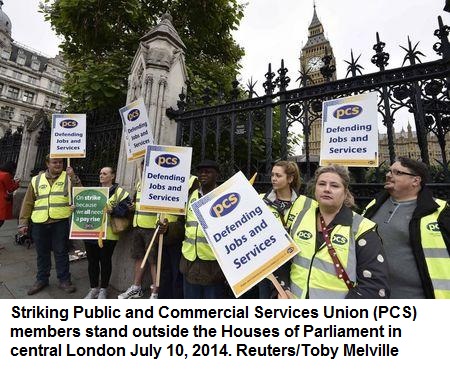
Share this post:
, , , , , ,
[Top]

Caribbean Players in the 2014 World Cup

FIFA 2014Go Lean Commentary

Soccer (Association Football) is the world’s most popular game. The book Go Lean … Caribbean contemplates greater exploration of the economic opportunities associated with the business of sports – the Caribbean has a failing record in this important area. This quest must therefore give consideration to the eco-system of the World Cup. As such, the news story in the foregoing article synchronizes with the Go Lean book in that it depicts the societal abandonment by so many Caribbean athletes and the lack of professional opportunities in the Caribbean homeland. The two issues: lack of opportunities and society abandonment is a cause-and-effect conundrum. See article here:

Caribbean Journal – Caribbean e-Zine Online Site (Posted 06/14/2014; retrieved 06/21/2014) –
http://www.caribjournal.com/2014/06/16/caribbean-players-in-the-2014-world-cup/
There aren’t any teams from the traditional Caribbean in the 2014 World Cup in Brazil (although there are several from the wider Caribbean Basin), but that doesn’t mean there isn’t a strong Caribbean contingent. From powerhouses like the Netherlands and England to up-and-coming teams like Costa Rica, there are a number of Caribbean footballers in Brazil this month. Here are some of the featured Caribbean athletes:

Raheem Sterling

Raheem SterlingThe 19-year-old phenom who plays for England was actually born in Kingston, Jamaica. A midfielder, he plays professionally for Liverpool.

Raphael Varane

, Raphael VaraneVarane who plays professionally for Real Madrid, is a centre back for the French World Cup team. He is of Martiniquais heritage, as his father comes from the island.

Daniel Sturridge

Daniel SturridgeThe England striker is of Jamaican heritage, as both sides of his grandparents are Jamaican. Like Sterling, he plays for Liverpool professionally. (And he keeps up his ties to Jamaica with a charity in Portmore).

Alex Oxlade-Chamberlain

Alex Oxlade-ChamberlainOxlade-Chamberlain, the son of former England international player Mark Chamberlain, is of Jamaican heritage. A winger and central midfielder, he plays professionally for Arsenal.

Jean Beausejour

Jean BeausejourBeausejour, a 30-year-old left winger for Chile, is the son of a Haitian father. He plays professionally for Wigan Athletic in England.

Nigel de Jong

Nigel de JongMuch of the Netherlands’ football success over the years has come from the Caribbean nation of Suriname, and the trend continues today. de Jong, of Surinamese heritage, is a defensive midfielder who plays professionally for Milan.

Jeremain Lens

Jeremain LensLens, a striker, is of Surinamese heritage (and has even played internationally for the country). He plays professionally for FC Dyanmo Kyiv.

Georginio Wijnaldum

Georginio WijnaldumWijnald is of Surinamese heritage, and plays for professionally for PSV in the Netherlands. For Oranje, he’s a midfielder.

Leroy Fer

Leroy FerThe Norwich City player is a central midfielder who plays for (and was born in) the Netherlands. His roots, however, come from Curacao, where he comes from a family of sporting talents.

Jozy Altidore

Jozy AltidoreThe Haitian-American Altidore is one of the leaders of the American World Cup squad. A striker by trade, he plays professionally for Sunderland.

Chris Smalling

Chris SmallingSmalling, of Jamaican heritage, is a centre back for England who plays professionally for Manchester United.

Patrick Pemberton

Patrick PembertonCosta Rica has a Caribbean coastline, and it’s an area with a distinct heritage and culture in large part due to an influx of immigration from Caribbean countries like Jamaica in the 19th [and early 20th century for the construction of the Panama Canal]. One result [has been] last names like Pemberton in a Spanish-speaking country. Patrick Pemberton, a native of Puerto Limon, and is the lead goalie for the Costa Rican World Cup side, playing professionally for LD Alajuelense.

Marvin Chavez

Marvin ChavezThe winger Chavez is part of a group of Garifuna players on the Honduran side, those who live on the Caribbean coast of the country — indeed, almost half of the team is comprised of those of Garifuna heritage. Chavez plays professionally in Chivas USA in MLS.

David Myrie

David MyrieDavid Myrie, a defender for the Costa Rican team, hails from the Caribbean area of Puerto Viejo. He plays professionally for the Costa Rican side Herediano.

Loic Remy

Loic RemyThe 27-year-old native of Lyon is of Martiniquais heritage and plays for France. Professionally, the striker plays for Queens Park Rangers in England.

Jonathan de Guzman

Jonathan de GuzmanThe midfielder for the Netherlands is the son of a Jamaican mother. He plays professionally for Swansea City, on loan from Spain’s Villareal.

The Go Lean book serves as a roadmap for the introduction and implementation of the Caribbean Union Trade Federation (CU), a technocratic federal government to administer and optimize the economic/security/ governing engines of the region’s 30 member-states. At the outset, the roadmap recognizes the value of sports with these statements in the Declaration of Interdependence (Page 13 & 14):

xxi.     Whereas the preparation of our labor force can foster opportunities and dictate economic progress for current and future generations, the Federation must ensure that educational and job training opportunities are fully optimized for all residents of all member-states, with no partiality towards any gender or ethnic group. The Federation must recognize and facilitate excellence in many different fields of endeavor, including sciences, languages, arts, music and sports. This responsibility should be executed without incurring the risks of further human flight, as has been the past history.

xxxi.     Whereas sports have been a source of great pride for the Caribbean region, the economic returns from these ventures have not been evenly distributed as in other societies. The Federation must therefore facilitate the eco-systems and vertical industries of sports as a business, recreation, national pastime and even sports tourism – modeling the Olympics.

The Go Lean roadmap posits that sport genius qualifiers are found throughout Caribbean society. With the planned market organizations of this roadmap, sports can be more lucrative for Caribbean residents, Diaspora and their legacies. This is big business! There is money to be made in sports endeavors like the World Cup, as stated here:

World Cup Brazil will generate $4 billion in total revenue for FIFA, or 66% more than the previous tournament in South Africa in 2010. The vast majority of the money will come from the sale of television and marketing rights. The World Cup generates more revenue for its association than any other sports tournament, save the Olympics. – Source: Forbes Magazine; retrieved June 5, 2014 from: http://www.forbes.com/sites/mikeozanian/2014/06/05/the-billion-dollar-business-of-the-world-cup/

This subject of sports and World Cup Soccer relates to many previous Go Lean blogs; highlighted here in the following samples, including tangential issues like societal abandonment/brain drain and Caribbean image:

a. https://goleancaribbean.com/blog/?p=1433 Caribbean   loses more than 70 per cent of tertiary educated to brain drain
b. https://goleancaribbean.com/blog/?p=1341 College   World Series Time
c. https://goleancaribbean.com/blog/?p=1214 The Art &   Science of Temporary   Stadiums – No White Elephants
d. https://goleancaribbean.com/blog/?p=1148 Sports Bubble –   Franchise values in   basketball
e. https://goleancaribbean.com/blog/?p=1020 Sports   Revolutionary: Advocate   Jeffrey Webb
f. https://goleancaribbean.com/blog/?p=857 Caribbean Image: Dreadlocks
g. https://goleancaribbean.com/blog/?p=498 Book Review: ‘The   Sports Gene’
h. https://goleancaribbean.com/blog/?p=334 Bahamians Make   Presence Felt In   Libyan League
i. https://goleancaribbean.com/blog/?p=318 Collegiate Sports   in the Caribbean
j. https://goleancaribbean.com/blog/?p=60 Could the Caribbean Host the Olympic Games?

The Caribbean already competes on the world stage, in all other aspects of life. But for the World Cup it is unfortunate that we have to compete with teams aligned to other countries, as shown in the foregoing article.

While it’s too late for this year, perhaps in the near future, at the end of this roadmap, there will be more recognition of the Caribbean contribution to the World Cup. Take the dream one step further and imagine a unified Caribbean team fielding its best athletes in competition with the rest of the world. This is the basic strategy of the CU, to confederate and collaborate as a unified team for sports and most other endeavors. The Go Lean roadmap asserts that no one Caribbean member-state can thrive alone.

Though Go Lean is an economic empowerment agenda, there are huge benefits for the region related to sports: optimization of eco-systems for amateur, intercollegiate and professional engagements. The CU facilitation is straight-forward: to supply the missing elements of the previous generations: applicable venues (stadia, arenas, fields, temporary structures) and broadcast/streaming capabilities.

Now is the time for all of the Caribbean to forge permanent change by implementing the Five Year roadmap advocated in the book Go Lean … Caribbean. The hope is to keep our “star” athletes at home, playing for the home team and home country. Then finally, with the Go Lean executions in place, the Caribbean can become a better place for all citizens to live, work and play.

Download the book Go Lean … Caribbean – now!

Share this post:
, , , , ,
[Top]

Caribbean loses more than 70 percent of tertiary educated to brain drain

Go Lean Commentary

The chart in the foregoing news article is more than troubling, it is just plain bad.

According to the analysis by the Inter-American Development Bank, the people in the “Caribbean 6” countries, including the Bahamas, Barbados, Guyana, Jamaica, Suriname, and Trinidad & Tobago have wasted money on educating their populations, especially tertiary (college) education.

“Say it aint so…”

Brain Drain 70 percent Chart

Title: IDB: T&T lost more than 70 per cent of tertiary educated from brain drain
T&T has lost more than 70 per cent of its tertiary level educated labour force through emigration to developed countries, according to an Inter-American Development Bank (IDB) report released Tuesday.

The report looks at events up to 2012.

The T&T labour force, according to statistics from the Central Statistical Office is made up of 635,100 persons as at the first quarter of 2013.

The report entitled, Is there a Caribbean Sclerosis? Stagnating Economic Growth in the Caribbean, said 79 per cent of the labour force in T&T who received tertiary level education up to 2011 migrated to member countries of the Organisation for Economic Co-operation and Development (OECD).

“The OECD has been called a think tank, monitoring agency, rich man’s club and un-academic university. Whatever you want to call it, the OECD has a lot of power. Over the years, it has dealt with a range of issues, including raising the standard of living in member countries, contributing to the expansion of world trade and promoting economic stability,” according to Investopedia. The term “OECD countries” is often used loosely in economics as a euphemism for developed countries.

“Euro sclerosis” was a term coined in the 1970s to describe stagnant integration, high unemployment, and slow job creation in Europe relative to the United States, authors of the report explained. Since then, the term has been used more generally to refer to overall economic stagnation, they said.
The Guardian – Trinidad Daily Newspaper (Retrieved 06/19/2014) –
http://m.guardian.co.tt/business-guardian/2014-06-19/idb-tt-lost-more-70-cent-tertiary-educated-brain-drain

There is a similar concern expressed in the book Go Lean…Caribbean that education in the Caribbean needs to undergo a total re-boot, to be re-evaluated/re-organized, since the region has for far too long “fattened frogs for snakes”. The book further charges that this issue is not just in the CariCom states as the Caribbean 6 group represents, but also in the Dutch, French, and Spanish Caribbean. This problem is a real crisis for the Caribbean.

Alas, the book posits that a “crisis is a terrible thing to waste” and thereafter proposes solutions and mitigations to effectuate change in the Caribbean. The book Go Lean…Caribbean serves as a roadmap for the introduction and implementation of the technocratic Caribbean Union Trade Federation (CU).

The roadmap is for the elevation of Caribbean society. The prime directives of the CU are presented as the following 3 statements:

  • Optimization of the economic engines in order to grow the regional economy to $800 Billion & create 2.2 million new jobs.
  • Establishment of a security apparatus to protect the resultant economic engines.
  • Improve Caribbean governance to support these engines.

The book posits that all of the Caribbean is in crisis with this brain drain problem. This point is stressed early in the book (Page 13) in the following pronouncements in the Declaration of Interdependence:

xix.   Whereas our legacy in recent times is one of societal abandonment, it is imperative that incentives and encouragement be put in place to first dissuade the human flight, and then entice and welcome the return of our Diaspora back to our shores. This repatriation should be effected with the appropriate guards so as not to imperil the lives and securities of the repatriated citizens or the communities they inhabit. The right of repatriation is to be extended to any natural born citizens despite any previous naturalization to foreign sovereignties.

xx.   Whereas the results of our decades of migration created a vibrant Diaspora in foreign lands, the Federation must organize interactions with this population into structured markets. Thus allowing foreign consumption of domestic products, services and media, which is a positive trade impact. These economic activities must not be exploited by others’ profiteering but rather harnessed by Federation resources for efficient repatriations.

This blog obviously relates to the now vibrant Caribbean Diaspora, the causes of emigration, and the continuous interaction with the “exile community”. These subjects have previously been covered in these Go Lean blogs, highlighted here in the following samples:

a. https://goleancaribbean.com/blog/?p=1296 Remittances to Caribbean Increased By 3 Percent in 2013
b. https://goleancaribbean.com/blog/?p=1256 Is a Traditional 4-year Degree a Terrible Investment?
c. https://goleancaribbean.com/blog/?p=1112 Zuckerberg’s  $100 Million for Newark’s Schools was a waste
d. https://goleancaribbean.com/blog/?p=607 Antigua Completes Construction of New National Library
e. https://goleancaribbean.com/blog/?p=599 Ailing Puerto Rico open to radical economic fixes
f. https://goleancaribbean.com/blog/?p=459 CXC and UK publisher hosting CCSLC workshops in Barbados
g. https://goleancaribbean.com/blog/?p=353 Book Review: ‘Wrong – Nine Economic Policy Disasters and What We Can Learn…’ – Example of Irish Famine leading to Emigration

The foregoing news article focuses on the tertiary emigration rates for Trinidad & Tobago, but the accompanying chart/photo demonstrates that many Caribbean countries have this same problem: 89% in Guyana, 61% in the Bahamas. These numbers validate the crisis.

How did this crisis come about? What are the past/present experiences and what are the future prospects of the Caribbean Diaspora? An examination of this subject is most effective using an analogy of a road journey. A review of the past helps us to better understand the roadmap. The road began at some point in the past and continued up to today. Where will the road end?

The Go Lean book posits that the Caribbean is the greatest address in the world. So why would people want to leave? The book answers by relating “push” and “pull” factors. Push, in that the dire economic conditions in the Caribbean homeland, plus governmental failures in response, caused responsible people to look elsewhere to fulfill their responsibilities and aspirations. On the other hand, pull factors came from the geo-political circumstances in the world. For the Anglophone Caribbean, the pull factors were tied to their British colonial status. At the end of the second World War, British labor markets were devastated and so the invitation went out to the Caribbean colonies to come to England for gainful employment opportunities. The 1948 British Nationality Act gave British citizenship to all people living in Commonwealth countries, and full rights of entry and settlement in Britain. Many West Indians were attracted by these better prospects in what was often referred to as the mother country. The ship MV Empire Windrush brought the first group of 492 immigrants to Tilbury near London on 22 June 1948. The Windrush was en route from Australia to England via the Atlantic, docking in Kingston, Jamaica. An advertisement had appeared in a Jamaican newspaper offering cheap transport on the ship for anybody who wanted to come and work in the UK [a].

Today, a majority of the African-Caribbean population in the UK is of Jamaican origin; other notable representation is from Trinidad & Tobago, Saint Kitts & Nevis, Barbados, Grenada, Antigua & Barbuda, Saint Lucia, Dominica, Montserrat, Anguilla, Saint Vincent & the Grenadines, Guyana, and Belize.

Parallel anecdotes exist for American, Dutch and French Caribbean colonies. (In total, there were over 60 million deaths from World War II; with very few losses in the Caribbean).

In the decades that followed European sclerosis, as cited in the foregoing article, the target of Caribbean emigrants shifted to North American destinations,

The Go Lean book posits that the recent global financial crisis has created economic stagnation in the very same countries in which the Caribbean Diaspora sought refuge. These countries are no longer a place of refuge – it is time to repatriate back to the Caribbean. But not back to the same parasite economies of 1948, or 1958, 1978, not even 2008. The Go Lean roadmap calls for a Caribbean re-boot, creating a Single Market of all Caribbean countries despite their European/American legacies; this is the plan for “Step One, Day One”. This approach allows for the optimizations discussed above for the economic, security and governing engines.

The Go Lean book details a series of community ethos, strategies, tactics, implementations and advocacies to foster the Caribbean re-boot:

Anecdote – Caribbean Single Market & Economy Page 15
Anecdote – Dutch Caribbean: Integration & Secessions Page 16
Anecdote – French Caribbean: Organization & Discord Page 17
Anecdote – Puerto Rico: The Greece of the Caribbean Page 18
Community Ethos – Deferred Gratification Page 21
Community Ethos – Economic Systems Influences Choices & Incentives Page 21
Community Ethos – The Consequences of Choice Lie in the Future Page 21
Community Ethos – Lean Operations Page 24
Community Ethos – Return on Investments Page 23
Community Ethos – Ways to Impact the Future Page 26
Community Ethos – Ways to Foster Genius Page 27
Community Ethos – Ways to Help Entrepreneurship Page 28
Community Ethos – Ways to Bridge the Digital Divide Page 31
Community Ethos – Ways to Manage Reconciliations Page 34
Strategy – Vision – Single Market & Economy Page 45
Tactical – Separation of Powers – Federal versus   Member-States Page 71
Implementation – Year 1 / Assemble Phase Page 96
Implementation – Year 4 / Repatriate Phase Page 98
Implementation – Ways to Pay for Change Page 101
Implementation – Ways to Deliver Page 109
Implementation – Reasons to Repatriate Page 118
Advocacy – Ways to Grow the Economy Page 151
Advocacy – Ways to Create Jobs Page 152
Advocacy – Ways to Improve Education Page 159
Advocacy – Ways to Impact Student Loans Page 160
Advocacy – Ways to Improve Governance Page 168
Advocacy – Ways to Better Manage the Social Contract Page 170
Advocacy – Ways to Reduce Crime – Repatriates’ Hate Crime Status Page 178
Advocacy – Ways to Impact the Diaspora Page 217
Advocacy – Ways to Preserve Caribbean Heritage Page 218
Advocacy – Ways to Impact Retirement Page 221
Advocacy – Ways to Improve Elder-Care Page 225
Appendix – Analysis of Caribbean Diaspora Page 267
Appendix – Analysis of Caribbean Remittances Page 268
Appendix – Analysis of Caribbean Emigration Page 269
Appendix – Alternative Remittance Modes Page 270
Appendix – Interstate Compacts Page 278
Appendix – Jamaica’s International Perception Page 297
Appendix – Nuyorican Movement Page 303
Appendix – Puerto Rican Population in the US Page 304

Now is the time for all of the Caribbean, the people and governing institutions, to lean-in for the regional re-boot described in the book Go Lean…Caribbean. This big deal for the Caribbean will neutralize the “push and pull” factors that contributed to previous emigration patterns and a vibrant Diaspora. Losing 60, 70 and 80 percent of the college educated population is not a formula for nation-building success.

(One solution is the adoption of e-Learning schemes for residential educational options).

Caribbean Beach #2The Caribbean region features the world’s best address. The world should be beating down the doors to come to the Caribbean, not the Caribbean people beating down doors to get out. Already the best place to play, the region now needs to become better places to live and work. This is possible, if we Go Lean.

Download the book Go Lean … Caribbean – now!

———–

Appendix – Cited Reference:
a. Retrieved June 21, 2014 from: http://en.wikipedia.org/wiki/British_African-Caribbean_people.


Share this post:
, , ,
[Top]

PayPal expands payment services to 10 markets

PayPal PhotoGo Lean Commentary

PayPal [a], the subject of the below news article, is an electronic payment company and this industry of electronic payments has become very important in the strategy for elevating the Caribbean economy. This is digital currency and not “hard money”, so there are no paper stock or coinage issues to be managed with this approach, but there are numerous risk and fraud issues. PayPal is starting to do business in some of the world’s most challenging markets, like Nigeria; this is a good resume for the Caribbean deployment of electronic payment systems.

By: Eric Auchard and Jason Neely

LONDON (Reuters) – PayPal is entering 10 new countries this week, including Nigeria, providing online payment alternatives for consumers via mobile phones or PCs in markets often blighted by financial fraud.

Rupert Keeley, the executive in charge of the EMEA region of PayPal, the payments unit of eBay Inc., said in an interview on Monday the expansion would bring the number of countries it serves to 203.

Starting on Tuesday, consumers in Nigeria, which has 60 million users and has Africa’s largest population, along with nine other markets in sub-Saharan Africa, Eastern Europe and Latin America will be able to make payments through PayPal.

“PayPal has been going through a period of reinvention, refreshing many of its services to make them easier to use on mobile (phones), allowing us to expand into fast-developing markets,” Keeley said.

Once the services go live, customers in the 10 countries with access to the Web and a bank card authorized for Internet transactions will be able to register for a PayPal account and make payments to millions of sites worldwide.

Initially, PayPal is only offering “send money” services for consumers to pay for goods and services at PayPal-enabled merchant sites while safeguarding their financial details. This is free to consumers and covered by fees it charges merchants.

“We think we can give our sellers selling into this market a great deal of reassurance,” said Keeley, a former regional banking executive with Standard Chartered Plc and senior executive with payment card company Visa Inc .

PayPal does not yet cover peer-to-peer transactions, which allow consumers to send money to other consumers. It has not yet enabled local merchants in the new markets to receive payments, nor is it offering other forms of banking services, he said.

A 2013 survey of 200 UK ecommerce sites by Visa’s CyberSource unit estimated that 1.26 percent of online orders are fraudulent and that 85 percent of merchants expected fraud to increase or remain static last year.

CyberSource also estimated that suspicion of fraudulent transactions result in 8.2 percent of online orders in Latin America being rejected by merchants, compared with 5.5 percent in Europe and 2.7 percent in the United States and Canada.

Such fraud can include ID theft, social engineering, phishing and automated harvesting of customer financial data via botnets, or networks of computers controlled by hackers.

A total of 80 million Internet users stand to gain access to PayPal global services this week, including those in five European markets – Belarus, Macedonia, Moldova, Monaco and Montenegro, four in the African nations of Nigeria, Cameroon, Ivory Coast, and Zimbabwe, as well as Paraguay. Internet usage figures are based on research by Euromonitor International.

PayPal counts 148 million active accounts worldwide.

Last week, MasterCard Inc , the world’s second-largest debit and credit card company, and a PayPal rival in payment processing, said it was working with the Nigerian government on a pilot to overlay payment technology on a new national identity card.

PayPal has operated in 190 markets since 2007 and added three countries – Egypt, Georgia and Serbia last year. Roughly a quarter of the $52 billion in payment volumes PayPal reported in the first quarter of 2014 were for cross-border transactions. PayPal reported $1.8 billion in revenue during the period.
Reuters News Service (Retrieved 06/16/2014) –
http://news.yahoo.com/paypal-expands-payment-services-nigeria-9-other-markets-141457269–sector.html

Central Banks print currency notes and determine the quantity, measured as M0. But there is no need for that activity with digital money, yet still, there is a big role for a Central Bank with command-and-control of the economy. This relates to M1 monetary supply. M1 refers to the measurement of the total of currency/money in circulation (M0) plus overnight bank deposits (like demand deposits, travelers’ checks & other checkable deposits). So when digital currencies are factored in, though there is no M0, there is still an increase in M1 nonetheless. As M1 values increase, there is a dynamic to create money “from thin-air”, called the money multiplier. The more money in the system, the more liquidity for investment and development opportunities.

Digital currencies are “reaping” the benefits of monetary supply without “sowing” the hard work of actual money/stock/coinage management!

This subject is detailed in the book Go Lean…Caribbean, which serves as a roadmap for the introduction of the Caribbean Union Trade Federation (CU) and the Caribbean Central Bank (CCB). This Go Lean roadmap has 3 prime directives:

  • Optimization of the economic engines in order to grow the regional economy to $800 Billion & create 2.2 million new jobs.
  • Establishment of a security apparatus to protect the resultant economic engines.
  • Improve Caribbean governance to support these engines.

This subject of electronic payment systems has been previously covered in these Go Lean blogs, highlighted here in the following samples:

a.     https://goleancaribbean.com/blog/?p=906 – Bitcoin needs regulatory framework to change ‘risky’ image
b.     https://goleancaribbean.com/blog/?p=528 – Facebook plans to provide mobile payment services
c.      https://goleancaribbean.com/blog/?p=360 – How to Create Money from Thin Air

This Go Lean/CU/CCB roadmap looks to employ electronic/digital currency schemes to impact the growth of the regional economy. This is defined early in the book in Verse XXIV (Page 13) of the Declaration of Interdependence, with these words:

Whereas a free market economy can be induced and spurred for continuous progress, the Federation must install the controls to better manage aspects of the economy: jobs, inflation, savings rate, investments and other economic principles…

Creating the CU/CCB governance is “Step One, Day One” in the Go Lean roadmap. Implementing this framework for electronic payments allows for emergence of the regional currency of the Caribbean Dollar. This currency emergence allows for the foundation, so that the regional society can be elevated, economically and governmentally.

The Go Lean posits that the business model of PayPal can be fully deployed in the region. Even though PayPal transacts in every CU member-state, except Cuba and Haiti [b], they have provided an example of how to develop an online electronic payment scheme. There is also the need to model other electronic schemes like Visa/MasterCard and Smart Cards (for Cruise Tourism).

The Go Lean book details a series of community ethos, strategies, tactics, implementations and advocacies to foster the proper controls for electronic payments in the Caribbean region:

Community Ethos – Money Multiplier Principle Page 22
Community Ethos – Lean Operations Page 24
Community Ethos – Cooperatives Page 25
Community Ethos – Promote Intellectual Property Page 29
Community Ethos – Ways to Bridge the Digital Divide Page 31
Strategy – Vision of Caribbean Single Market Page 45
Tactical – Separation of Powers – Central Banking Page 73
Implementation – Assemble Central Bank   Cooperative Page 93
Implementation – Ways to Deliver Page 109
Implementation – Ways to Impact Social   Media Page 111
Planning – Ways to Better Manage Image Page 129
Anecdote – Caribbean Currencies Page 149
Advocacy – Ways to Mitigate Black Markets Page 165
Advocacy – Ways to Foster Cooperatives Page 176
Advocacy – Ways to Impact Cruise Tourism Page 193
Advocacy – Ways to Foster Technology Page 197
Advocacy – Ways to Foster e-Commerce Page 198
Advocacy – Reforms for Banking Regulations Page 199
Appendix – Alternative Remittance Modes Page 270

Now is the time for all of the Caribbean, the people and governing institutions, to lean-in for the empowerments described in the book Go Lean … Caribbean. This is the basis for the CU vision, a better place to live, work and play.

Download the book Go Lean … Caribbean – now!

————————-

Appendix – Cited References:

a.   PayPal

PayPal is an international e-commerce business allowing payments and money transfers to be made through the Internet. Online money transfers serve as electronic alternatives to paying with traditional paper methods, such as checks and money orders. It is subject to the US economic sanction list and subject to other rules and interventions required by US laws or government.

PayPal is an acquirer, performing payment processing for online vendors, auction sites, and other commercial users, for which it charges a fee. The fee depends on what currency or payments the seller is using. In addition, eBay purchases made by credit card through PayPal may incur extra fees if the buyer and seller use different currencies.

On October 3, 2002, PayPal became a wholly owned subsidiary of eBay. Its corporate headquarters are in San Jose, California, United States at eBay’s North First Street satellite office campus. The company also has significant operations in Omaha, Scottsdale, Charlotte, Boston, Baltimore and Austin in the United States; Chennai and Bangalore in India; Dublin and Dundalk in Ireland; Kleinmachnow in Germany; and Tel Aviv in Israel. Since July 2007, PayPal has operated across the European Union as a Luxembourg-based bank.

Source: Retrieved June 16, 2014 from: http://en.wikipedia.org/wiki/PayPal

b.   PayPal Countries

PayPal’s tagline: We get where you’re coming from. We are available in 193 markets and 26 currencies. Spend and receive safely over borders and language barriers. We’re here for you, wherever you are.

Anguilla Haiti
Antigua and Barbuda Jamaica
Aruba Martinique
Bahamas Montserrat
Barbados Netherlands Antilles
Belize Puerto Rico (USA)
Bermuda Saint Barthélemy (France)
British Virgin Islands Saint Kitts and Nevis
Cayman Islands Saint Lucia
Dominica Saint Martin (France / The Netherlands)
Dominican Republic Saint Vincent and the Grenadines
French Guiana Suriname
Grenada Trinidad and Tobago
Guadeloupe Turks and Caicos
Guyana Virgin Islands (USA)


Share this post:
, , , ,
[Top]