Tag: Green Energy

Dealing with Hurricane Season 2019 … and beyond

Go Lean Commentary

Welcome to Hurricane Season 2019.
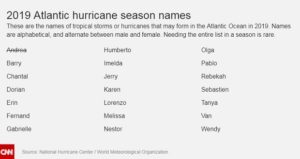
I wish I could say it will be uneventful. I can’t …

Just the opposite, scientists have told us that as the earth’s atmosphere heats more and more, that Climate Change-fueled events will only worsen and worsen. So far, Spring 2019 has been proof positive. We have seen floods, tornadoes, unusual wintry weather, etc. As reported in a previous blog-commentary, the planet must prepare to “rinse and repeat“.
June 1st is the official start of the Atlantic Hurricane Season, so every year at this time we have to start dealing with the realities of hurricanes and Caribbean life. The 2013 book Go Lean…Caribbean (Page 10) declares that we need “to provide new guards for our future security”. This is not our first year planning for and dealing with Hurricane Season; nor will it be our last. “This” is our new reality. The book relates on Page 11:

Whereas the earth’s climate has undeniably changed resulting in more severe tropical weather storms, it is necessary to prepare to insure the safety and security of life, property and systems of commerce in our geographical region. As nature recognizes no borders in the target of its destruction, we also must set aside border considerations in the preparation and response to these weather challenges.

This theme – planning for and dealing with Hurricane Season – aligns with many previous Go Lean commentaries; see here, this consideration from recent years:

https://goleancaribbean.com/blog/?p=15012 Hurricane Season 2018 and Puerto Rico continued sufferings
https://goleancaribbean.com/blog/?p=12068 Hurricane Season 2017 and ‘Climate Change’ Abatement

Dealing with Hurricane Seasons must include more than just naming hurricanes or responding to the storms’ devastation; we must also mitigate the threat of Climate Change and do our share to reduce global warming. Yes, we must!

Why?

Because we are responsible for the causes of Climate Change; so says this recent report; consider the story here:

Title: 99.9999% chance humans are causing global warming, and other science-based facts on Climate Change for Earth Day
By: Doyle Rice and Elizabeth Weise

Climate change is real and increasingly a part of our daily lives. New research and studies out in just the past six months highlight the latest facts about the human-caused shift to our global weather systems and its effects on our planet.

First among them, there’s no longer any question that rising temperatures and increasingly chaotic weather are the work of humanity. There’s a 99.9999% chance that humans are the cause of global warming, a February study reported. That means we’ve reached the “gold standard” for certainty, a statistical measure typically used in particle physics.

The mechanism is well understood and has been for decades. Humans burn fossil fuels such as oil, coal and gas, which release carbon dioxide (CO2), methane and other gases into the Earth’s atmosphere and oceans. CO2 is the greenhouse gas that’s most responsible for warming.

Study lead author Benjamin Santer of the Lawrence Livermore National Laboratory in Livermore, California, told Reuters that “the narrative out there that scientists don’t know the cause of climate change is wrong.”

Hottest on record
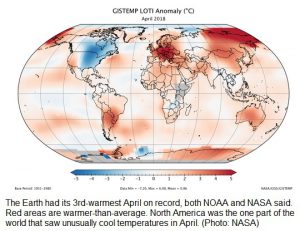
The past five years have been the five warmest since record-keeping began in the late 1800s. The Earth has experienced 42 straight years (since 1977) with an above-average global temperature, according to the National Oceanic and Atmospheric Administration.

Based on five separate data sets that keep track of the Earth’s climate, the global average temperature for the first 10 months of 2018 was about 1.8 degrees above what it was in the late 1800s. That was when industry started to emit large amounts of greenhouse gases into the atmosphere.

Australia experienced record summer heat in January of this year. The town of Port Augusta reached the hottest day since record-keeping began in 1962 with a temperature of 121, according to the Guardian.

The heat was so intense it caused bats to fall from trees, according to the Australian Broadcasting Corporation.

Carbon dioxide up 46%
Increasing amounts of carbon dioxide and other gases being released into the atmosphere by industry, transportation and energy production from burning fossil fuels are enhancing what’s known as the planet’s natural greenhouse effect.

Carbon dioxide is the most prevalent among all greenhouse gases produced by human activities, attributed to the burning of fossil fuels.

The atmospheric carbon dioxide level for March was 411.97 parts per million and continue to rise. It has now reached levels in the atmosphere not seen in 3 million years.

That’s an increase of 46% from just before the Industrial Revolution in the 1800s, when CO2 levels were around 280 parts per million. Levels began to rise when humans began to burn large amounts of fossil fuels to run factories and heat homes, releasing CO2 and other greenhouse gasses into the atmosphere.

Scientists say to keep a livable planet, we need to cut the level to 350 parts per million.

Rising seas
A consequence of higher temperatures is the melting of the polar ice caps, which is causing sea levels to rise. The world’s oceans have risen about an inch in the past 50 years due to melting glaciers alone, a study published this month in the journal Nature found.

The Earth’s glaciers are now losing up to 390 billion tons of ice and snow per year, the study suggests.

Global warming has caused over 3 trillion tons of ice to melt from Antarctica in the past quarter-century and tripled ice loss there in the past decade, another study, released in June, said.

More: Life after solving climate change: Not mud huts and gruel but clean air and warm homes

Source: Posted for “Earth Day 2019” on April 22, 2019; retrieved June 1, 2019 from: https://www.yahoo.com/now/earth-day-2019-high-temperatures-131301815.html
99.9999% is a special number! It is near to Six Sigma – process which 99.9999998% of products manufactured are statistically expected to be free of defects (3.4 defects per million). So this near sign of operational perfection means that it is “on us”. If we accept that us humans are the cause of Climate Change, then that means that us humans can stop the bad actions and do good ones. As reported here previously, we only have until 2030 as a fix window to try to effect change; (after that, there is no hope for a turn-around):

[A report from the] UN Intergovernmental Panel on Climate Change (IPCC) … asserts that if there are no mitigations [by 2030], then the catastrophic future that we all dread will be unavoidable. Life may continue on the planet, but the status quo would be no more. …

After [2030], there may not be any turning back from a Greenhouse planet. Once we accept this fact – the eventuality of the Climate Change Catastrophe – only then can we start to make efforts to address the truth: our “house is on fire”. …

Fixing Climate Change in the US or Canada is out-of-scope for this Go Lean movement; but we still need them to act. We also need Europe, China, India – all Big Polluters – and all countries of the world to act. We must stand on soap boxes, podiums and stages and tell the world – everyone must listen; we must make them listen. This is now everyone’s job, everyone’s responsibility. …

There is … a roadmap [for] reforming and transforming the Caribbean’s societal engines to abate Climate Change; [it] is possible; it is conceivable, believable and achievable.

The current US President, Donald Trump, is not a partner in the effort to abate Climate Change. He is a denier! He is also undermining legitimate scientific efforts – see Appendix VIDEO.

The start of Hurricane Season 2019 reminds us to recommit to the urgency to mitigate and remediate Climate Change. While we must Go Green here in the Caribbean, we must do more too. We must urge the rest of the world to Go Green. Otherwise, our small tropical islands will be the first to become extinct. It is that serious!

Let’s lean-in to this Go Lean roadmap to effect change here in the homeland and then lets urge the rest of the world to also do more. Yes, we can make a difference here in the homeland and around the world. 🙂

About the Book
The book Go Lean…Caribbean serves as a roadmap for the introduction and implementation of the technocratic Caribbean Union Trade Federation (CU), for the elevation of Caribbean society – for all member-states. This CU/Go Lean roadmap has these 3 prime directives:

  • Optimization of the economic engines in order to grow the regional economy to $800 Billion & create 2.2 million new jobs.
  • Establishment of a security apparatus to ensure public safety and protect the resultant economic engines.
  • Improve Caribbean governance to support these engines, including a separation-of-powers between the member-states and CU federal agencies.

The Go Lean book provides 370-pages of turn-by-turn instructions on “how” to adopt new community ethos, plus the strategies, tactics, implementations and advocacies to execute so as to reboot, reform and transform the societal engines of Caribbean society.

Download the free e-Book of Go Lean … Caribbean – now!

Who We Are
The movement behind the Go Lean book – a non-partisan, apolitical, religiously-neutral Community Development Foundation chartered for the purpose of empowering and re-booting economic engines – stresses that reforming and transforming the Caribbean societal engines must be a regional pursuit. This was an early motivation for the roadmap, as pronounced in the opening Declaration of Interdependence (Pages 12 – 13):

xi. Whereas all men are entitled to the benefits of good governance in a free society, “new guards” must be enacted to dissuade the emergence of incompetence, corruption, nepotism and cronyism at the peril of the people’s best interest. The Federation must guarantee the executions of a social contract between government and the governed.

xvi. Whereas security of our homeland is inextricably linked to prosperity of the homeland, the economic and security interest of the region needs to be aligned under the same governance. Since economic crimes … can imperil the functioning of the wheels of commerce for all the citizenry, the accedence of this Federation must equip the security apparatus with the tools and techniques for predictive and proactive interdictions.

xxiv. Whereas a free market economy can be induced and spurred for continuous progress, the Federation must install the controls to better manage aspects of the economy: jobs, inflation, savings rate, investments and other economic principles. Thereby attracting direct foreign investment because of the stability and vibrancy of our economy.

Sign the petition to lean-in for this roadmap for the Caribbean Union Trade Federation.

—————-

Appendix VIDEO – Climate Change: Why Trump’s panel on climate science is controversial – https://www.usatoday.com/videos/news/2019/02/27/climate-change-why-trumps-panel-climate-science-controversial/2998078002/

Posted February 26, 2019 – President Trump’s pick for leading a climate change panel is notorious for denying the science behind human-caused global warming. We dive into the counter-arguments on climate change. USA TODAY.

Share this post:
, ,

Way Forward – For Energy: ‘Trade’ Winds

Go Lean Commentary

While the Caribbean is among the best addresses on the planet, it is among the most expensive energy-wise.

So what is the Way Forward for optimizing our energy infrastructure?

While we need to look forward, we also need to look backwards. This was the assertion of the 2013 book Go Lean … Caribbean, which advocates for the installation and deployment of a regional power grid heavily dependent on wind energy. The book states (Page 113):

The Bottom Line on Alternative Energy
The economic history of the Caribbean featured wind power on the merchant sail ships to and from Europe and the African continent during the Slave Trade. Now 250 years later, wind is a source of economic energy once again – this time to power wind turbines to generate electricity for power grids. The winds are so consistent for portions of the Caribbean that the eastern island chain is branded the Windward Islands.

The region also has two other sources for alternative energy: solar and tidal. There is no plan to build or use nuclear energy, beyond any existing facilities. After the Fukushima incident in Japan, March 2011, the economic impact of nuclear is too negative – tourism may be impacted.

The Go Lean book relates a vision of transforming to 100% renewable energy in the Caribbean, asserting that this could bring the energy cost down from one of the highest in the world to one of the lowest. The book continues:

The … installation of a multi-national/regional power grid [will mean] power-sharing between member-states. The end result being lower costs (from $.35/kWh to $.088), lower pollution and less imports of foreign oil – granting energy independence.

This is not just a theoretical plan. No, there are glimpses of this strategy already in motion – for wind – in the Caribbean and the results-successes are undeniable. See this actuality in this sample news article here:

Title: Wind Farm Saves Jamaica $54M on Oil Imports, Energy Minister Says
By: Oswald T. Brown 

April 17, 2019 – Jamaican Energy Minister Fayval Williams said Wigton Windfarm Limited has saved the country’s government over $54 million on oil imports.

The energy minister, speaking Friday at Wigton Windfarm’s Initial Public Offering (IPO) investor briefing at the Montego Bay Convention Centre in Rose Hall, St. James, said the production of clean energy from the facility has enabled the country to avoid the purchase of 800,000 barrels of oil, and the emission of one million tons of carbon dioxide, thereby reducing the country’s carbon footprint, the Jamaica Gleaner reported.
Wigton, located in Rose Hill, South Manchester, is the largest wind energy facility in the English-speaking Caribbean.

The company, which is a subsidiary of the Petroleum Corporation of Jamaica (PCJ), began operating in 2004 with the commissioning of a 20.7 megawatt-generating plant, Wigton I.

This was followed by the development of Wigton II in 2010, which generates 18 megawatts of energy. Wigton III, the 24-megawatt expansion of the facility, was officially commissioned into service in June 2016 by Prime Minister Andrew Holness.

Williams commended the company for the progress made since its inception and lauded the IPO as a “bold strategy.”

“I can say that I am truly pleased with the strides that Wigton has made over these years,” she said. “The growth in [renewable energy] globally will undoubtedly bring greater investment opportunities in the future for a company like Wigton and we want Jamaica to be a part of this growing global movement in an even greater way. I believe we have the will and the capacity, and as a government, we are putting the plans in place to ensure that we maximize our renewable energy potential.”

Jamaicans will have the opportunity to purchase shares in Wigton from when the IPO opened on April 17 to its closure on May 1.

Source: Retrieved April 19, 2019 from: https://washingtoninformer.com/wind-farm-saves-jamaica-54m-on-oil-imports-energy-minister-says/

This news article depicts the manifestation of wisdom and best practices – a delivery from the Go Lean book. This is the Way Forward for Energy for the Caribbean region.

This commentary continues the consideration on the Way Forward for the full Caribbean and the individual member-states. This submission here focuses on energy while many others in the series contemplated how the member-states can reform and transform their societies. This is entry 7-of-9 for this April 2019 compilation of commentaries; (the list started as 3, grew dynamically to 6 and will finalized with 9). The full series of commentaries related to the Way Forward is presented as follows:

  1. Way Forward: Puerto Rico learns its “status” with America
  2. Way Forward: Virgin Islands – America’s youngest colony
  3. Way Forward: Bahamas – “Solutions White Paper” – An Inadequate Plan
  4. Way Forward: Jamaica: The need to reconcile the Past
  5. Way Forward: Caribbean Media Strategy & Deliveries
  6. Way Forward: Strategy for Justice: Special Prosecutors et al
    ———
  7. Way Forward: Strategy for Energy – ‘Trade’ Winds
  8. Way Forward: Strategy for Independence – Territory Realities
  9. Way Forward: “Whatever it takes” – Life Imitating Art

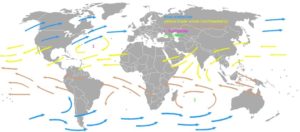
This series posits that “no man is an island” and further that “no island is an island”; so the technocratic deployments for energy – as for other strategies – need the benefits of a leveraged confederacy, as in the Caribbean Union ‘Trade‘ Federation (CU). It is the assertion here that the political Caribbean can elevate society with implementations to harness the trade winds, on the land, at  the coast, and in the territorial waters:

Cape Cod Wind Farm, Massachusetts, USA

Trade winds; how ironic!?

Yellow = Westerly Trade Winds

This is the same natural phenomena – Westerlies – that propelled commercial interest in the Caribbean / New World region; with the ease of westerly winds, this actuality can now contribute to sustainable energy deliveries. We need to pay attention to the “colors of the wind” – see Appendix B VIDEO below.

As related in a previous blog-commentary, wind is not the only option for our alternative energy Way Forward. The full universe of alternative options may include hydro-electric – at waterfalls – and geo-thermal at hot-springs and/or geysers – in volcano zones. Coupled with the implementation of a regional grid, these benefits are too attractive to ignore: environmental (no fossil fuels) and economic (affording conveniences of modern life). While only some Caribbean member-states have the natural features to pursue these foregoing options, all of the 30 member states, on the other hand, can ideally take advantage of these options here:

  • Wind – The wind always blows in the Caribbean – i.e. Trade Winds – and its free.
  • Solar – The sun always shines in the Caribbean and its free. Some member-states are implementing this option now to great fanfare and great results. See the news story in the Appendix A below.
  • Tidal – The tides always rise and fall in the Caribbean and its free..

This theme – environmental and economic benefits of alternative energy – aligns with many previous commentaries from the movement behind the book Go Lean…Caribbean; see this sample list here:

https://goleancaribbean.com/blog/?p=14832 Counter-culture: Manifesting Change – Environmentalism
https://goleancaribbean.com/blog/?p=13985 EU Assists Barbados in Renewable Energy Self-Sufficiency
https://goleancaribbean.com/blog/?p=10367 Science of Sustenance – Green Batteries
https://goleancaribbean.com/blog/?p=7056 Electric Cars – Better energy deliveries solves transportation as well
https://goleancaribbean.com/blog/?p=5155 Tesla unveils super-battery to power homes from wind & solar options
https://goleancaribbean.com/blog/?p=4587 Model: Burlington, Vermont, USA – City powered 100% by renewables
https://goleancaribbean.com/blog/?p=915 Go ‘Green’ … Caribbean

Basic needs are not just limited to food, clothing and shelter in our modern times. No, energy deliveries must be counted as a basic need too. This is why our Caribbean communities spend so much of their family, community and national budgets on electricity supplies (or oil imports); this accounts to a lot of the economic pie. But the consideration for energy in our region goes beyond economics, there is also the consideration for “standards of care”. Our reality in the Summer heat – think: ‘Hotter than July‘ – is that we need air-conditioning solutions. Otherwise life in the homeland is unbearable.

So our Way Forward for Green Energy solution is for the motivation for economic optimization and environmental impact.

Environmental considerations also include combating Climate Change; this is important for Caribbean stakeholders, as Climate Change is one of the great threats that imperil our lives and livelihoods. Our status quo is that we must be prepared in our disaster planning to ‘Rinse and Repeat’ every hurricane season.

Wind energy is therefore a win-win for the Caribbean; solar too – see Appendix A below. The Caribbean energy needs are undeniable. The effects of fossil-fueled-driven Climate Change are undeniable. Lastly, the need for alternate energy, to lower the costs of living in the Caribbean, is undeniable. We hereby urge all Caribbean stakeholders – citizens, businesses and government leaders – to lean-in to this Go Lean … Caribbean roadmap.

This is how we can make the Caribbean homeland a better place to live, work and play.  🙂

About the Book
The book Go Lean…Caribbean serves as a roadmap for the introduction and implementation of the technocratic Caribbean Union Trade Federation (CU), for the elevation of Caribbean society – for all member-states. This CU/Go Lean roadmap has these 3 prime directives:

  • Optimization of the economic engines in order to grow the regional economy to $800 Billion and create 2.2 million new jobs.
  • Establishment of a security apparatus to ensure public safety and protect the resultant economic engines.
  • Improve Caribbean governance to support these engines, including a separation-of-powers between the member-states and CU federal agencies.

The Go Lean book provides 370-pages of turn-by-turn instructions on “how” to adopt new community ethos, plus the strategies, tactics, implementations and advocacies to execute so as to reboot, reform and transform the societal engines of Caribbean society.

Download the free e-Book of Go Lean … Caribbean – now!

Who We Are
The movement behind the Go Lean book – a non-partisan, apolitical, religiously-neutral Community Development Foundation chartered for the purpose of empowering and re-booting economic engines – stresses that reforming and transforming the Caribbean societal engines must be a regional pursuit. This was an early motivation for the roadmap, as pronounced in the opening Declaration of Interdependence (Pages 12 – 13):

xi. Whereas all men are entitled to the benefits of good governance in a free society, “new guards” must be enacted to dissuade the emergence of incompetence, corruption, nepotism and cronyism at the peril of the people’s best interest. The Federation must guarantee the executions of a social contract between government and the governed.

xvi. Whereas security of our homeland is inextricably linked to prosperity of the homeland, the economic and security interest of the region needs to be aligned under the same governance. Since economic crimes … can imperil the functioning of the wheels of commerce for all the citizenry, the accedence of this Federation must equip the security apparatus with the tools and techniques for predictive and proactive interdictions.

xxiv. Whereas a free market economy can be induced and spurred for continuous progress, the Federation must install the controls to better manage aspects of the economy: jobs, inflation, savings rate, investments and other economic principles. Thereby attracting direct foreign investment because of the stability and vibrancy of our economy.

Sign the petition to lean-in for this roadmap for the Caribbean Union Trade Federation.

————

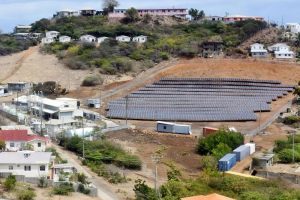
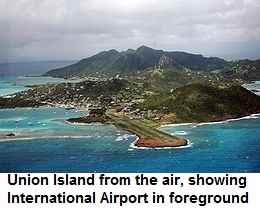
Appendix A – Historic Day on Union Island with electricity produced solely from solar

April 16, 2019 – For the very first time during the day, electricity on Union Island was produced using solely solar photovoltaic (PV) and battery energy storage.

“Today’s historic event is possible after the successful completion of the Union Island Solar PV and Battery Energy Storage project last month. Over the past weeks, we have been testing the system to ensure the process runs smoothly. The Company is pleased with the outcome in this noteworthy project,” a post on VINLEC’s Facebook page said on Tuesday.

“In the near future, the solar PV farm will generate electricity on the island during the day to supply to the grid. We anticipate that on sunny days, the solar plant will generate excess electricity than is required to supply the average daytime load on the island. The excess electricity will be stored in batteries. The expected annual energy output is approximately 32 per cent of the electricity generated in Union Island in 2018.
“VINLEC wishes to express sincerest thanks to the residents of Union Island for their support and understanding during this process,” the post said.

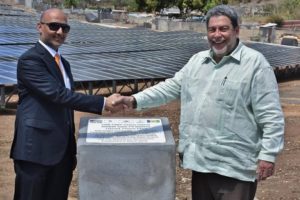
The UAE-CREF Union Island 600KW Solar PV Battery Hybrid Power Plant was officially opened on March 25, 2019. The project was funded under the UAE Caribbean Renewable Energy Fund at a cost of US$3 million and developed in collaboration with VINLEC on behalf of the Government of SVG.

The Solar Power Plant displaces 320,000 litres of diesel fuel per year at savings of EC$500,000.00.

Source: Retrieved April 20, 2019 from: https://searchlight.vc/searchlight/press-release/2019/04/16/historic-day-on-union-island-with-electricity-produced-solely-from-solar/?fbclid=IwAR3E4tyrnqKbveKKZAF0R1bPlglav2rWCkyOZTL1zxv_O9xZfdEOd2tQB9Y

————

Appendix B VIDEO – Pocahontas | Colors of the Wind | Disney Sing-Along – https://youtu.be/O9MvdMqKvpU

Disney
Published on Jul 9, 2016 –
Paint with all the colors of the wind for this sing along.

More Disney!
Instagram: http://Instagram.com/Disney
Twitter: http://Twitter.com/Disney
Facebook: http://Facebook.com/Disney
Tumblr: http://disney.tumblr.com/

A Little Disney History: From humble beginnings as a cartoon studio in the 1920s to its preeminent name in the entertainment industry today, Disney proudly continues its legacy of creating world-class stories and experiences for every member of the family.

Share this post:
, , ,
[Top]

Hurricane in Africa? That’s ‘Climate Change’

Go Lean Commentary

This is the headline, in case you missed it:

“Mozambique Braces for More Floods as Cyclone Deaths Climb”. Bloomberg News Source. Posted 19 March 2019. Retrieved 21 March 2019.

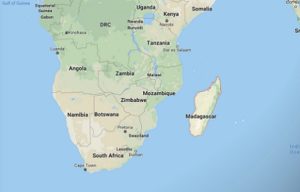
Mozambique is not a Caribbean country in the typical bulls-eye for hurricanes. No, this is a country in the South African region; not normally threatened by tropical cyclones or hurricanes. This is proof-positive that something is wrong with the earth’s climate.  This is the reality of Climate Change.
We told you so …

In fact, we told you (in 2018) that climate conditions will go from bad to worse on a daily basis and that we only have 12 years, before the damage we are causing to the planet will be irreversible.

We did not give this warning about Africa; this is not our charter. But we can still learn by observing-and-reporting on developments there. See here, the consequential damage from this cyclone:

Reference: Cyclone Idai
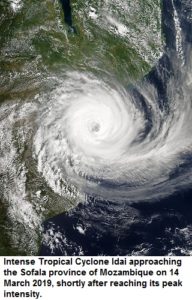
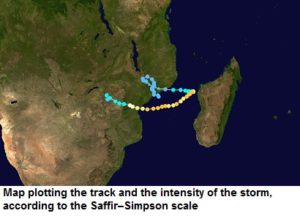
Intense Tropical Cyclone Idai is regarded as one of the worst tropical cyclones on record to affect Africa and the Southern Hemisphere as a whole. The storm caused catastrophic damage in multiple nations, leaving more than 400 people dead and hundreds more missing.[4] Its death toll is comparable to that of south-west Indian Ocean cyclones Eline in 2000, and Gafilo in 2004.[5] The tenth named storm and record-breaking eighth intense tropical cyclone of the 2018–19 South-West Indian Ocean cyclone season, Idai originated from a tropical depression that formed off the eastern coast of Mozambique on 4 March.
The depression made landfall in the aforementioned country later in the day and remained a tropical cyclone throughout the entirety of its trek over land. On 9 March, the depression reemerged into the Mozambique Channel and was upgraded into Moderate Tropical Storm Idai next day. The system then began a stint of rapid intensification, reaching an initial peak intensity as an intense tropical cyclone with winds of 175 km/h (110 mph) on 11 March. Idai then began to weaken due to ongoing structural changes within its inner core, falling to tropical cyclone intensity. Idai’s intensity remained stagnant for about a day or so before it began to re-intensify. On 14 March, Idai reached peak intensity with maximum sustained winds of 195 km/h (120 mph) and a minimum central pressure of 940 hPa (27.76 inHg). Idai then began to weaken as it approached the coast of Mozambique due to less favorable conditions. On 15 March, Idai made landfall near Beira, Mozambique, as an intense tropical cyclone, subsequently weakening into a remnant low on 16 March.

Idai brought strong winds and caused severe flooding in Madagascar, Mozambique, Malawi, and Zimbabwe that has killed 431 people – 268 in Mozambique, 104 in Zimbabwe, 56 in Malawi, and one in Madagascar – and affected more than 2.6 million others. Catastrophic damage occurred in and around Beira in southern Mozambique. The President of Mozambique stated that more than 1,000 people may have died in the storm.[3] A major humanitarian crisis unfolded in the wake of the cyclone, with hundreds of thousands of people in urgent need of assistance across Mozambique and Zimbabwe. In the former nation, rescuers were forced to let people die in order to save others.


Source: Wikipedia – retrieved March 21, 2019 from: https://en.wikipedia.org/wiki/Cyclone_Idai

Over 1,000 dead!!! Ouch!

While Climate Change is a global crisis, our focus, our scope is limited to the Caribbean member-states.

From our Caribbean homes, we can NOT reach across the oceans and fix the climate in Africa, What we can do is mitigate the environment here at home.

Then name, blame and shame the culprit nations that are crippling our planet with more pollutants.

Due to the laws of hypocrisy, we cannot “Cry Wolf” to anyone until we conform ourselves. This theme and assertion was elaborated in these other/previous blog-commentaries from the movement behind the book Go Lean…Caribbean:

https://goleancaribbean.com/blog/?p=15511 Plastics and Styrofoam – A Mitigation Plan
https://goleancaribbean.com/blog/?p=14925 Climate Change Doubt?! Numbers Don’t Lie
https://goleancaribbean.com/blog/?p=14832 Manifesting Environmental Change
https://goleancaribbean.com/blog/?p=11858 Islands are Disappearing – The Cautionary Tale of Kiribati
https://goleancaribbean.com/blog/?p=10367 Science of Sustenance – Green Batteries for Fossil-Fuel-Free Energy
https://goleancaribbean.com/blog/?p=9455 Fix ‘Climate Change’ – Yes, We Can
https://goleancaribbean.com/blog/?p=7103 COP21 – ‘Climate Change’ Acknowledged
https://goleancaribbean.com/blog/?p=7056 Electric Cars: ‘Necessity is the Mother of Invention’
https://goleancaribbean.com/blog/?p=915 Go ‘Green’ … Caribbean

It is possible to mitigate the contributors to Climate Change. We can burn less fossil fuels; we can engage more alternative energy options (solar, wind, tidal); use electric cars and public transit. But the efforts must be executed across the whole world.

At a bare minimum, we must do our part; each individual, family, community and nation. No one can be excused. For this we must be prepared to name, blame and shame the dissenters.

This should be a national emergency. Check that! This is a global emergency!

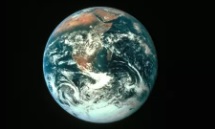
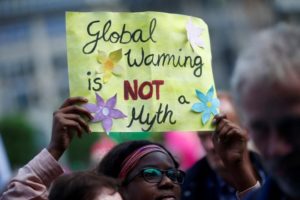
There are still deniers of Climate Change. Those ones should not be debated; just ignored; we must proceed forward as if these ones are inconsequential. Think Flat-Earth theorists; see a related VIDEO in the Appendix below.

These ones should not even get an audience.

I assure you: No one in Mozambique is a Climate Change denier today. Can we say the same for Caribbean stakeholders … in government, security or economic leadership?

This must be a basic requirement for Caribbean leadership. If a politician dissents, we must vote them out of office. If a security/government official dissents, then we must replace them. If a business leader dissents, we must boycott their establishments. This is what is meant by name, blame and shame.

This is how we must now act to forge change in our communities. And then, the whole world. This is the quest of many young protesters around the world, today. They have indicted the older generation for mis-management; see story and VIDEO here:

Title: ‘It’s Literally Our Future.’ Here’s What Youth Climate Strikers Around the World Are Planning Next
By: Suyin Haynes 

Inside the U.K. houses of parliament, the grown-ups were at work. Outside, thousands of others — many of whom were not old enough to vote — were doing their best to make sure business was anything but usual. With their chants echoing down the streets, they were among an estimated 1.6 million students in over 120 countries who left school on March 15 in protest of adult inaction on climate change. “It shocks me how great a length we have to go to be heard,” said 16-year-old Miranda Ashby, who’d traveled more than two hours to London with roughly 50 of her classmates. “We are protesting now because if not now, when?”

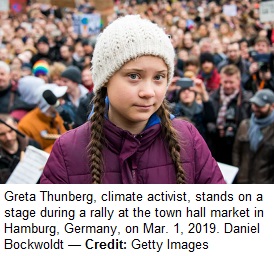
The school climate strikes started with teen activist Greta Thunberg standing vigil outside Sweden’s parliament one Friday last August. “When I first started this strike, I didn’t really expect anything,” Thunberg told TIME on March 14, shortly after Norwegian lawmakers nominated her for the Nobel Peace Prize.
Thunberg’s idea has grown into a global movement; the March 15 action was its biggest yet. Extensive coverage of the strikes by media outlets and individuals on social media have helped elevate the cause in the minds of people across the world. Meanwhile, the lack of a centralized organizational hub makes it easy for teenagers to arrange actions in their own towns and cities; rallies took place in more than 2,200 towns and cities worldwide on March 15. “We’re tired of waiting for politicians to care,” says Nosrat Fareha, an organizer for the Sydney strikes, where 30,000 young people turned out — more than three times Fareha’s expected estimate.

In Uganda, where drought and desertification are already devastating, the walk-out took place despite officials blocking strikers from an intended rally location in Kampala. “I realized that my country has to change too,” 14-year-old organizer Leah Namugerwa says. And in the U.S., 17-year-old Feliquan Charlemagne, National Creative Director of the U.S. movement, believes the energy of March for Our Lives, the 2018 student-led initiative for gun control, must be harnessed for this cause too. Born in the Caribbean island of St Thomas, Charlemagne and his family have personally suffered the powerful effects of climate change, after Hurricane Irma devastated the island in September 2017. “This is not something we can play around with,” he says. “This is literally our future.”

It’s also their present. The warning of the landmark October 2018 report from the United Nations’ Intergovernmental Panel on Climate Change, that the planet was only 12 years away from catastrophe unless “far-reaching and unprecedented changes” are taken, weighs heavily on the minds of young organizers, who are quick to point out that they are the ones who have to live in that world. The deadline means there’s a lot of work to be done, and they don’t have time to wait to grow up first.

Their most pressing hope is for immediate policy measures to meet the terms of the Paris Agreement, limiting the global temperature increase to 1.5° celsius this century, as well as specific local action. In Australia, campaigners want to halt the proposed construction of a controversial coal mine. For activists across the U.S., preservation of public lands and political implementation of the Green New Deal are top priorities. And in the U.K., organizers want a fair portrayal of the climate crisis in school curricula and government information. And they’ve had some success already: youth organizers have met with members of the European Parliament and their strikes have been welcomed by leaders including Angela Merkel and U.N. Secretary General Antonio Guterres. “It really has changed the discourse,” says Sini Harkki, program manager at Greenpeace Nordic.

But at least for now, that’s all they can change; the youth that draws them to the cause is also an obstacle. Most of the movement’s participants are not just battling the obvious challenges of political inertia, powerful fossil fuel lobbies and disbelieving critics—they are also too young to play a bigger role in business or politics. And so they are determined to continue the Friday strikes. The U.K. Student Climate Network is demanding a meeting with political leaders, U.S. activists are planning a mass strike for May 3 and a pan-European organizer meeting is also in the pipeline. And Thunberg, no longer on her own, is committed to striking every Friday until Sweden reduces its carbon emissions in line with the Paris Agreement. “I know I have something to say,” Thunberg says, referring to her frank speeches in front of international leaders. “I have a message I want to get out and I want people to listen.” Students worldwide have heard her loud and clear. It’s up to the world’s politicians to act.

Source: Time Magazine Online Edition – posted March 20, 2019; retrieved March 22, 2019 from http://time.com/5554775/youth-school-climate-change-strike-action/

———-

VIDEO – Youth Climate Strike – http://time.com/5554775/youth-school-climate-change-strike-action/

Posted March 20, 2019 – ‘It Will Be Too Late for My Generation.’ Meet the Teens Who Organized a Massive Climate Change Protest

These young people get it: name, blame and shame the culprits and bad actors affecting Climate Change and the urgent mitigation that must be done. And as for Africa? We hereby present them a role model to follow.

The Public Campaign of environmentalists and activists is Spot-On: “Think Global. Act Local.” 🙂

About the Book
The book Go Lean…Caribbean serves as a roadmap for the introduction and implementation of the technocratic Caribbean Union Trade Federation (CU), for the elevation of Caribbean society – for all member-states. This CU/Go Lean roadmap has these 3 prime directives:

  • Optimization of the economic engines in order to grow the regional economy to $800 Billion and create 2.2 million new jobs.
  • Establishment of a security apparatus to ensure public safety and protect the resultant economic engines.
  • Improve Caribbean governance to support these engines, including a separation-of-powers between the member-states and CU federal agencies.

The Go Lean book provides 370-pages of turn-by-turn instructions on “how” to adopt new community ethos, plus the strategies, tactics, implementations and advocacies to execute so as to reboot, reform and transform the societal engines of Caribbean society.

Download the free e-Book of Go Lean … Caribbean – now!

Who We Are
The movement behind the Go Lean book – a non-partisan, apolitical, religiously-neutral Community Development Foundation chartered for the purpose of empowering and re-booting economic engines – stresses that reforming and transforming the Caribbean societal engines must be a regional pursuit. This was an early motivation for the roadmap, as pronounced in the opening Declaration of Interdependence (Pages 12 – 13):

i. Whereas the earth’s climate has undeniably changed resulting in more severe tropical weather storms, it is necessary to prepare to insure the safety and security of life, property and systems of commerce in our geographical region. As nature recognizes no borders in the target of its destruction, we also must set aside border considerations in the preparation and response to these weather challenges.

xi. Whereas all men are entitled to the benefits of good governance in a free society, “new guards” must be enacted to dissuade the emergence of incompetence, corruption, nepotism and cronyism at the peril of the people’s best interest. The Federation must guarantee the executions of a social contract between government and the governed.

xvi. Whereas security of our homeland is inextricably linked to prosperity of the homeland, the economic and security interest of the region needs to be aligned under the same governance. Since economic crimes … can imperil the functioning of the wheels of commerce for all the citizenry, the accedence of this Federation must equip the security apparatus with the tools and techniques for predictive and proactive interdictions.

xxiv. Whereas a free market economy can be induced and spurred for continuous progress, the Federation must install the controls to better manage aspects of the economy: jobs, inflation, savings rate, investments and other economic principles. Thereby attracting direct foreign investment because of the stability and vibrancy of our economy.

Sign the petition to lean-in for this roadmap for the Caribbean Union Trade Federation.

————

Appendix VIDEO – An Astronomer Responds To Flat Earth Theory – https://youtu.be/thxbiR-XfJo

Tech Insider
Published on Jan 9, 2018
– Business Insider UK sat down with Dr Stuart Clark, who spoke to us about a range of subjects regarding astronomy and astrophysics. We asked him what he thought of flat earth theory, a school of thought which believes that the earth is not spherical but flat.

“All our physics is constructed now, the physics of orbits of things going around the earth is all constructed with this three dimensional world. And the pictures from space show our world as a globe and yet somehow there are some people that still seem to believe the earth is flat.”

“My own pet theory is that they’re doing it for comic effect.”

Tech Insider tells you all you need to know about tech: gadgets, how-to’s, gaming, science, digital culture, and more.

Subscribe to our channel and visit us at: http://www.businessinsider.com/sai

TI on Facebook: https://www.facebook.com/techinsider

TI on Instagram: https://www.instagram.com/tech_insider/

TI on Twitter: https://twitter.com/techinsider

Share this post:
, , , ,
[Top]

5 Years Later – Climate Change: Coming so fast, so furious

Go Lean Commentary

A little less conversation, a little more action – Elvis Presley song

3 years ago – Paris COP21 – the world came together and devised a plan to tackle the global threat of Climate Change. This year, many of the same players came back together to implement the actions.

So we went from “planning the plan” to now “planning the action”.

This is a slow-motion response to a fast-moving threat.

This commentary is the second of a 4-part series – 2 of 4 – from the movement behind the Go Lean book in consideration of the 5 year anniversary of the book’s publication. The theme on these 4 submissions is “5 Years Later and what is the condition now“. The focus here is on the Agents of Change that the book identified: Globalization, Climate Change, Technology and the Aging Diaspora.

The first entry in this series asked the question: “Have the problems lessened, or have they intensified?

The answer is so emphatic! Climate Change has been all the rage in these 5 short years. The fast-and-furious threat is more than just academic; this is real-life and real-bad; especially for us in the Caribbean.

The other commentaries in the series are cataloged as follows:

  1. 5 Years Later: New Post Office Eco-system – Globalization issues ‘loud and clear’ now.
  2. 5 Years Later: Climate Change – Coming so fast, so furious.
  3. 5 Years Later: Technology – Caribbean fully on board.
  4. 5 Years Later: Aging Diaspora – Finding Home … anywhere.

The Go Lean book was written 5 years ago as a 5 Year Plan to reform and transform the Caribbean region. Had the plan been adopted by the regional stakeholders, then the Agents of Change would have been better addressed. The plan, or roadmap, to introduce and implement the Caribbean Union Trade Federation is still rearing to start; and while we cannot single-handedly solve Climate Change, we can better prepare the region for the heavy-lifting involved. The book describes the community ethos to adopt plus the many strategies, tactics and implementation that need to be executed.
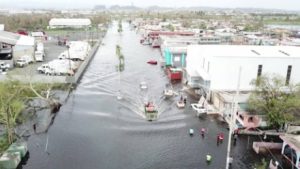
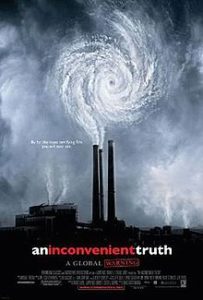
After the 2013 publication of the Go Lean book, many countries came together for COP21 (December 2015), also known as the Paris Accords. As alluded to above, this year’s follow-up, Katowice (Poland) 2018 had a few less participants for this “put speech into action” plan. See the news article about COP24 here:

News Title: Nations agree on rules for implementing Paris climate agreement
Sub-title: Nations dragged a deal over the line Saturday to implement the landmark 2015 Paris climate treaty after marathon UN talks that failed to match the ambition the world’s most vulnerable countries need to avert dangerous global warming.

Katowice, Poland – Delegates from nearly 200 states finalised a common rule book designed to deliver the Paris goals of limiting global temperature rises to well below two degrees Celsius (3.6 Fahrenheit).

“Putting together the Paris agreement work programme is a big responsibility,” said COP24 president Michal Kurtyka as he gavelled through the manual following the talks in Poland that ran deep into overtime.

“It has been a long road. We did our best to leave no-one behind.”

But environmental groups said the package agreed in the Polish mining city of Katowice lacked the bold ambition needed to protect states already dealing with devastating floods, droughts and extreme weather made worse by climate change.

“We continue to witness an irresponsible divide between the vulnerable island states and impoverished countries pitted against those who would block climate action or who are immorally failing to act fast enough,” executive director of Greenpeace Jennifer Morgan said.

The final decision text was repeatedly delayed as negotiators sought guidelines that are effective in warding off the worst threats posed by our heating planet while protecting the economies of rich and poor nations alike.

“Without a clear rulebook, we won’t see how countries are tracking, whether they are actually doing what they say they are doing,” Canada’s Environment Minister Catherine McKenna told AFP.

At their heart, negotiations were about how each nation funds action to mitigate and adapt to climate change, as well as how those actions are reported.

Developing nations wanted more clarity from richer ones over how the future climate fight will be funded and pushed for so-called “loss and damage” measures.

This would see richer countries giving money now to help deal with the effects of climate change many vulnerable states are already experiencing.

Another contentious issue was the integrity of carbon markets, looking ahead to the day when the patchwork of distinct exchanges — in China, the Europe Union, parts of the United States — may be joined up in a global system.

“To tap that potential, you have to get the rules right,” said Alex Hanafi, lead counsel for the Environmental Defense Fund in the United States.

“One of those key rules — which is the bedrock of carbon markets — is no double counting of emissions reductions.”

The Paris Agreement calls for setting up a mechanism to guard against practices that could undermine such a market, but finding a solution has proved so problematic that the debate has been kicked down the road to next year.

‘System needs to change’

One veteran observer told AFP Poland’s presidency at COP24 had left many countries out of the process and presented at-risk nations with a “take it or leave it” deal.

Progress had “been held up by Brazil, when it should have been held up by the small islands. It’s tragic.”

One of the largest disappointments for countries of all wealths and sizes was the lack of ambition to reduce emissions shown in the final COP24 text.

Most nations wanted the findings of the Intergovernmental Panel on Climate Change (IPCC) to form a key part of future planning.

It highlighted the need for carbon pollution to be slashed to nearly half by 2030 in order to hit the 1.5C target.

But the US, Saudi Arabia, Russia and Kuwait objected, leading to watered-down wording.

The final statement from the Polish COP24 presidency welcomed “the timely conclusion” of the report and invited “parties to make use of it” — hardly the ringing endorsement many nations had called for.

“There’s been a shocking lack of response to the 1.5 report,” Morgan told AFP. “You can’t come together and say you can’t do more!”

With UN talks well into their third decade sputtering on as emissions rise remorselessly, activists have stepped up grassroots campaigns of civil disobedience to speed up action on climate.

“We are not a one-off protest, we are a rebellion,” a spokesman for the Extinction Rebellion movement, which disrupted at least one ministerial event at the COP, told AFP.

“We are organising for repeated disruption, and we are targeting our governments, calling for the system change needed to deal with the crisis that we are facing.”

Source: AFP – France24 News Service – Posted December 16, 2018; retrieved December 18, 2018 from: https://www.france24.com/en/20181215-cop24-poland-climate-summit-deal-paris-climate-agreement-negotiations-un-environment

—————-

VIDEO # 1 – Nations agree on rules for implementing Paris climate agreement – https://youtu.be/SBUZS3cl2X0

FRANCE 24 English
Published on Dec 17, 2018 – Nations dragged a deal over the line Saturday to implement the landmark 2015 Paris climate treaty after marathon UN talks that failed to match the ambition the world’s most vulnerable countries need to avert dangerous global warming.

Visit our website: http://www.france24.com

FRANCE 24 live news stream: all the latest news 24/7 http://f24.my/YTliveEN

———————

VIDEO # 2 – UN climate talks: ‘A transition to a greener economy is possible’ – https://youtu.be/qqbQ1hyWc_Y

FRANCE 24 English
Uploaded on Dec 15, 2018

Subscribe to France 24 now: http://f24.my/youtubeEN

FRANCE 24 live news stream: all the latest news 24/7 http://f24.my/YTliveEN

Visit our website: http://www.france24.com

One notable absentee from Katowice has been the United States of America. This is due to the sad fact that the “Leader of the Free World” – a moniker assigned to the US President – is a Climate Change denier. Donald Trump campaigned on his denial and has manifested his dismay with subsequent actions. His blatant disregard was previously detailed in a prior Go Lean commentary from June 1, 2017, as follows:

Its June 1st, the start of the Hurricane season. According to Weather Authorities, it is going to be a tumultuous season, maybe even more destructive than last year….

Thanks Climate Change.

What hope is there to abate the threats from Climate Change?

Thanks to the Paris Accord, there is now hope; (we remember the effectiveness of the accord to abate “Acid Rain”).

But wait! The American President – Donald Trump – announces that he is withdrawing the United States from the Paris Accord. WTH?!?!

The Caribbean status quo is unsustainable under the real threats of Climate Change. The region must reboot, reform and transform. We must do the heavy-lifting ourselves; we cannot expect relief and refuge from others, like the American Super-Power. We must find and “sail” under our own power. 🙂

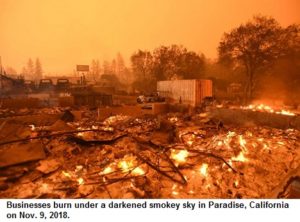
The Caribbean is more on the frontlines of Climate Change distress than the US – think hurricanes. We do not have the luxury to deny, defer and dispute. We must “batten down the hatches” and prepare for the worst. (Many claim this is also the disposition of many American destinations, think California forest fires). So we must take the lead ourselves for our own relief!

The Caribbean frontlines have been depicted in many previous Go Lean blog-commentaries. Consider the sample – as follows – highlighting some of the many Climate Change-infused storms that have impacted our region and others over the short timeframe – 5 years – since the publication of the Go Lean book:

https://goleancaribbean.com/blog/?p=15996 Good Governance: Stepping Up in an Emergency
October 2018 Trinidad heavy rains – not associated with a hurricane.
https://goleancaribbean.com/blog/?p=14925 ‘Climate Change’ Reality!? Numbers Don’t Lie
There is no longer any doubt, the Numbers don’t lie: the earth has had 400 straight warmer-than-average months.
https://goleancaribbean.com/blog/?p=13391 After Maria, Failed-State Indicators: Destruction and Defection
Hurricane Maria devastated Puerto Rico and other Caribbean islands. 1 year and a half later, recovery is still slow and frustrating. Islands like Dominica, are still struggling to recover; Ross University fled there to go to Barbados.
https://goleancaribbean.com/blog/?p=12996 After Irma, Failed-State Indicators: Destruction and Defection 
Hurricane Irma devastated Caribbean islands, like Saint Martin.
https://goleancaribbean.com/blog/?p=12977 After Irma, Barbuda Becomes a ‘Ghost Town’
Climate Change threats are real for the twin-island nation of Antigua and Barbuda. Barbuda is no more, after Hurricane Irma.
https://goleancaribbean.com/blog/?p=12924 Hurricane Categories – The Science
Category 5 Hurricanes – Once rare; now normal and common.
https://goleancaribbean.com/blog/?p=12879 Disaster Preparation: ‘Rinse and Repeat’
Hurricane Harvey proved that even the advanced democracy of the USA is not ready.
https://goleancaribbean.com/blog/?p=12834 Hurricane Andrew – 25 Years of Hoopla
Climate Change disasters are not new; 1992 storm was an eye-opener.
https://goleancaribbean.com/blog/?p=7896 The Logistics of Disaster Relief
Preparing for the worst” means being more efficient and technocratic.
https://goleancaribbean.com/blog/?p=7449 ‘Crap Happens’ – So What Now?
Hurricane Wilma brought chaos to this city’s economic engines in 2004.
https://goleancaribbean.com/blog/?p=6189 A Lesson in History – ‘Katrina’ is helping today’s crises
There are many lessons learned from this 2005 American disaster.
https://goleancaribbean.com/blog/?p=4741 Vanuatu and TuvaluInadequate response to human suffering
Lessons learned from these small Pacific Islands climate failures.

So it has been 5 years since the publication of the Go Lean book. Climate Change was identified as an Agent of Change that the region was struggling with and losing. Since then, conditions have worsened. The book asserts that the entire region must unite in order to “hope for the best and prepare for the worst”. The “hope” is really a call to action, that the regional neighbors would confederate and join in to the global campaign of mitigating and abating Climate Change. This aligns with the first pronouncement (Page 11) of the opening Declaration of Interdependence:

i. Whereas the earth’s climate has undeniably changed resulting in more severe tropical weather storms, it is necessary to prepare to insure the safety and security of life, property and systems of commerce in our geographical region. As nature recognizes no borders in the target of its destruction, we also must set aside border considerations in the preparation and response to these weather challenges.

The Go Lean book – a roadmap for the introduction and implementation of the technocratic Caribbean Union Trade Federation (CU) – presents a 370-page roadmap for re-booting the economic, security and governmental institutions of the 30 member-states in the Caribbean region, especially in light of the realities of Climate Change. While this is a global battle, we, the Caribbean member-states, are on the frontlines, so we must be doubly prepared for the surety of destruction from this threat. We must do our share and “Go Green” to arrest our own carbon footprint. We must not be hypocritical as we call on the Big Polluting nations to reform – we must reform ourselves, so as to have moral authority.

As detailed in a previous blog-commentary, the dire effects of Climate Change may be irreversible after the next 12 years, if we do not work to abate this disaster. So we must fight!

This is an inconvenient truth: We must fight like our lives depend on it. A product of these COP24 Katowice Accords, is now definitive plans and rules for implementing abatements around the world; carbon footprints must be reduced … globally, now!

A change has now come to the Caribbean region. This is Climate Change and it is not a good thing. Now is the time for a permanent union to provide efficient stewardship for our economic, security and governing engines. All regional stakeholders – the people and governing institutions – are hereby urged to lean-in to the empowerments described in the book Go Lean … Caribbean. Yes, we can … make our region, these islands and coastal states, better places to live, work and play.

There is the successful track record of abating environment pollution: remember Acid Rain in the 1990’s. So despite the doom and gloom, mitigation and abatement of Climate Change is conceivable, believable and achievable. 🙂

Sign the petition to lean-in for this roadmap for the Caribbean Union Trade Federation. 

Download the free e-book of Go Lean … Caribbean – now!

Share this post:
, ,
[Top]

Climate Change Catastrophe: 12 Year Countdown

Go Lean Commentary

So do not make any plans beyond 12 years …

… that is the warning …

… from the UN Intergovernmental Panel on Climate Change (IPCC). The report from this respected body asserts that if there are no mitigations, then the catastrophic future that we all dread will be unavoidable. Life may continue on the planet, but the status quo would be no more. See the news story on the UN Report here and the continuation in the Appendix below:

Title: We have 12 years to limit climate change catastrophe, warns UN
Sub-title: Urgent changes needed to cut risk of extreme heat, drought, floods and poverty, says IPCC

The world’s leading climate scientists have warned there is only a dozen years for global warming to be kept to a maximum of 1.5C, beyond which even half a degree will significantly worsen the risks of drought, floods, extreme heat and poverty for hundreds of millions of people.
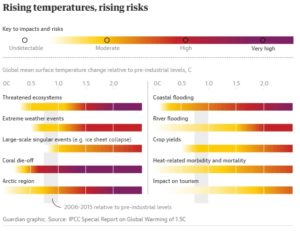
The authors of the landmark report by the UN Intergovernmental Panel on Climate Change (IPCC) released on Monday say urgent and unprecedented changes are needed to reach the target, which they say is affordable and feasible although it lies at the most ambitious end of the Paris agreementpledge to keep temperatures between 1.5C and 2C.

The half-degree difference could also prevent corals from being completely eradicated and ease pressure on the Arctic, according to the 1.5C study, which was launched after approval at a final plenary of all 195 countries in Incheon in South Korea that saw delegates hugging one another, with some in tears.

“It’s a line in the sand and what it says to our species is that this is the moment and we must act now,” said Debra Roberts, a co-chair of the working group on impacts. “This is the largest clarion bell from the science community and I hope it mobilises people and dents the mood of complacency.”

Policymakers commissioned the report at the Paris climate talks in 2016, but since then the gap between science and politics has widened. Donald Trump has promised to withdraw the US – the world’s biggest source of historical emissions – from the accord. The first round of Brazil’s presidential election on Sunday put Jair Bolsonaro into a strong position to carry out his threat to do the same and also open the Amazon rainforest to agribusiness.

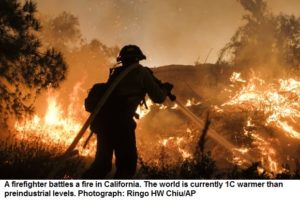
The world is currently 1C warmer than preindustrial levels. Following devastating hurricanes in the US, record droughts in Cape Town and forest fires in the Arctic, the IPCC makes clear that climate change is already happening, upgraded its risk warning from previous reports, and warned that every fraction of additional warming would worsen the impact.


See the remaining article in the Appendix below.

Source: Posted The Guardian – London Daily Newspaper October 8, 2018;retrieved October 15, 2018 from: https://www.theguardian.com/environment/2018/oct/08/global-warming-must-not-exceed-15c-warns-landmark-un-report

This is not Armageddon … yet. But the Bible does provide a justification that redeeming mankind will only happen at the precipice, just as man’s perilous rule reaches the point of unavoidable destruction of the planet. That scripture reads:

18  But the nations became wrathful, and your own wrath came, and the appointed time came for the dead to be judged and to reward+ your slaves the prophets+ and the holy ones and those fearing your name, the small and the great, and to bring to ruin those ruining* the earth.”+ – Revelation 11:18 New World Translation

Yes, truly, “we” are ruining the earth. Some people (countries) more so than others. But despite whether we are the guilty culprits or not, we still only have one planet … and it needs some attention. Or else …

… after 12 years, no more earth, the way we know it.

All the evidence is in front of us. To ignore it, we do so at our own peril. As related previously, the Numbers don’t lie: as of this past May, the earth has had 400 straight warmer-than-average months. See other aligned blog-commentaries that echoed this assessment:

https://goleancaribbean.com/blog/?p=14925 Climate Change Doubt?! Numbers Don’t Lie
https://goleancaribbean.com/blog/?p=14832 Manifesting Environmental Change
https://goleancaribbean.com/blog/?p=11858 Islands are Disappearing – The Cautionary Tale of Kiribati
https://goleancaribbean.com/blog/?p=9455 Fix ‘Climate Change’ – Yes, We Can
https://goleancaribbean.com/blog/?p=7103 COP21 – ‘Climate Change’ Acknowledged
https://goleancaribbean.com/blog/?p=6893 A Meteorologist’s View On Climate Change
https://goleancaribbean.com/blog/?p=4673 Climate Change‘ Merchants of Doubt … to Preserve Profits!!
https://goleancaribbean.com/blog/?p=2465 Book: ‘This Changes Everything: Capitalism vs. the Climate’
https://goleancaribbean.com/blog/?p=2276 Climate Change May Affect Food Supply Within a Decade
https://goleancaribbean.com/blog/?p=1883 Climate Change May Bring More Kidney Stones
https://goleancaribbean.com/blog/?p=1817 Caribbean grapples with intense cycles of flooding & drought

Are we saying that the earth will be destroyed in 12 years?

No!

But the mitigations that are feasible to assuage this problem, only have a limited shelf-life. After 12 years, there may not be any turning back from a Greenhouse planet. Once we accept this fact – the eventuality of the Climate Change Catastrophe – only then can we start to make effort to address the truth: our “house is on fire”.

There should be no doubt, we must act now.

What are we going to do about it?

Yes, we can … make a difference … still. But now we cannot hit or miss; we are at the precipice.

Perhaps this reality now is why one of the world’s most notorious Climate Change Denier is finally, begrudgingly, owning up to the fact that … “there might be something to this Climate Change” thing.

We’re talking about US President Donald Trump. See  the VIDEO here:

VIDEO – President Donald Trump’s ’60 Minutes’ Interview: Climate Change, etc. –  https://youtu.be/_D8OfRiEff4

TODAY
Published on Oct 15, 2018 – In an interview with “60 Minutes,” President Trump backed off earlier statements that climate change is a hoax, and also said that he doesn’t “trust everybody” in the White House. He also commented on Supreme Court Justice Brett Kavanaugh’s confirmation and the ongoing Russia investigation.

This is how destiny works. We can run from it, deny it or hide. But it will still catch up with us.

The earth is destined to suffer great catastrophes due to Climate Change … in 12 years!

Let’s do our share, everyone, everywhere to see if we can abate this reality.

The book Go Lean…Caribbean – available to download for free – serves as a roadmap for the introduction and implementation of the technocratic Caribbean Union Trade Federation (CU), to reform and transform all of Caribbean society – all 30 member-states. There is the need to shepherd our own communities to do our share to abate Climate Change. While the problem is too big for us alone in our region, we must still act … nonetheless. We cannot sit back, fold our arms and expect everyone else to do the heavy-lifting. No, we must even lead, since we are on the frontlines of over-heated hurricanes.

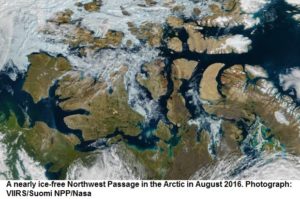
This is a lesson learned from Canada; they are on the frontline of melting ice-caps – think icy Northwest Passage – so they are stepping-up to act and show the world how to act. They are not waiting for “deniers to wake up and stop denying”; they are putting in their mitigation now … anyway. Then they are telling and showing the world what to do in following their example. This was detailed in a previous Go Lean commentary as follows:

Canada … has the longest total coastline among all of the countries of the world, at 125,567 miles. …

If Climate Change is to continue unabated, this country has a lot to lose – catastrophic storms, melting ice caps, thawing permafrost and rising sea level. …

Canada is prepared to take the lead, to put the Western Hemisphere on its shoulders and carry the load for arresting Climate Change. …

Thank you Canada for this model. Now, we – the Caribbean – need to step up to carry our own load for better mitigation of Climate Change threats; we need to do our part in lowering our own carbon footprint. We can make a difference. Canada can make a difference. As related in a previous blog-commentary, the same as the threat of Acid Rain was subjugated, so too, curative measures can be put in place to lower the greenhouse gases in the environment. This is why Canada has a Champion for the Environment – Catherine McKenna – at the Cabinet level.

Good model …

The Go Lean roadmap addresses all aspects of Caribbean society – economics, security and governance – and then declares: “Do this; Do that; Do Something; Do Everything”. The roadmap presents these prime directives in this regards:

Fixing Climate Change in the US or Canada is out-of-scope for this Go Lean movement; but we still need them to act. We also need Europe, China, India – all Big Polluters – and all countries of the world to act. We must stand on soap boxes, podiums and stages and tell the world – everyone must listen; we must make them listen. This is now everyone’s job, everyone’s responsibility.

We only have 12 years!

Make no plans for Year 13 and beyond. 🙁

There is hope! The Go Lean book and roadmap stresses that reforming and transforming the Caribbean’s societal engines to abate Climate Change is possible; it is conceivable, believable and achievable. But this is heavy-lifting.

The Go Lean book provides 370-pages of turn-by-turn instructions on “how” to prepare and respond for Climate Change catastrophes. See this sample of strategies, tactics, implementations and advocacies from the book:

Community Ethos – Deferred Gratification Page 21
Community Ethos – Economic Systems Influence Individual Choices / Incentives Page 21
Community Ethos – The Consequences of Choices Lie in the Future Page 21
Community Ethos – “Crap” Happens Page 23
Strategy – Mission – Prepare for Natural Disasters Page 45
Strategy – Agents of Change – Climate Change Page 57
Tactical – Confederating a Permanent Union Page 63
Tactical – Fostering a Technocracy Page 64
Separation of Powers – Emergency Management Page 76
Separation of Powers – Meteorological & Geological Service Page 79
Anecdote – “Lean” in Government Page 93
Implementation – Security Initiatives at Start-up – Unified Command & Control Page 103
Implementation – Industrial Policy for CU Self Governing Entities Page 103
Implementation – Ways to Deliver Page 109
Implementation – Ways to Foster International Aid Page 115
Implementation – Ways to Benefit from Globalization – Produce, Not Just Consume Page 119
Advocacy – Ways to Better Manage the Social Contract Page 170
Advocacy – Ways to Foster Cooperatives Page 176
Advocacy – Ways to Improve for Natural Disasters Page 184
Advocacy – Ways to Improve Emergency Management Page 196
Advocacy – Ways to Improve Transportation – CNG Buses and Electric Street Cars Page 205
Advocacy – Ways to Develop the Auto Industry – Embrace Alternative Energy Page 206

Are we up to this challenge?

We must work at it … as if our life depends on it.

It does!

We need all hands on deck! This is an Inconvenient Truth but its the truth nonetheless. We urge all Caribbean stakeholders to lean-in to this Go Lean roadmap for change, to get our homeland more active in the solution and abatement of Climate Change. Let’s get going. 🙂

Download the free e-Book of Go Lean … Caribbean – now!

Sign the petition to lean-in for this roadmap for the Caribbean Union Trade Federation.

—————-

Appendix – We have 12 years to limit climate change catastrophe, warns UN (Cont’d)

This is the continuation of the news article from the Guardian Newspaper …

Scientists who reviewed the 6,000 works referenced in the report, said the change caused by just half a degree came as a revelation. “We can see there is a difference and it’s substantial,” Roberts said.

At 1.5C the proportion of the global population exposed to water stress could be 50% lower than at 2C, it notes. Food scarcity would be less of a problem and hundreds of millions fewer people, particularly in poor countries, would be at risk of climate-related poverty.

At 2C extremely hot days, such as those experienced in the northern hemisphere this summer, would become more severe and common, increasing heat-related deaths and causing more forest fires.

But the greatest difference would be to nature. Insects, which are vital for pollination of crops, and plants are almost twice as likely to lose half their habitat at 2C compared with 1.5C. Corals would be 99% lost at the higher of the two temperatures, but more than 10% have a chance of surviving if the lower target is reached.

Sea-level rise would affect 10 million more people by 2100 if the half-degree extra warming brought a forecast 10cm additional pressure on coastlines. The number affected would increase substantially in the following centuries due to locked-in ice melt.

Oceans are already suffering from elevated acidity and lower levels of oxygen as a result of climate change. One model shows marine fisheries would lose 3m tonnes at 2C, twice the decline at 1.5C.

Sea ice-free summers in the Arctic, which is warming two to three times faster than the world average, would come once every 100 years at 1.5C, but every 10 years with half a degree more of global warming.

Time and carbon budgets are running out. By mid-century, a shift to the lower goal would require a supercharged roll-back of emissions sources that have built up over the past 250 years.

The IPCC maps out four pathways to achieve 1.5C, with different combinations of land use and technological change. Reforestation is essential to all of them as are shifts to electric transport systems and greater adoption of carbon capture technology.

Carbon pollution would have to be cut by 45% by 2030 – compared with a 20% cut under the 2C pathway – and come down to zero by 2050, compared with 2075 for 2C. This would require carbon prices that are three to four times higher than for a 2C target. But the costs of doing nothing would be far higher.

“We have presented governments with pretty hard choices. We have pointed out the enormous benefits of keeping to 1.5C, and also the unprecedented shift in energy systems and transport that would be needed to achieve that,” said Jim Skea, a co-chair of the working group on mitigation. “We show it can be done within laws of physics and chemistry. Then the final tick box is political will. We cannot answer that. Only our audience can – and that is the governments that receive it.”

He said the main finding of his group was the need for urgency. Although unexpectedly good progress has been made in the adoption of renewable energy, deforestation for agriculture was turning a natural carbon sink into a source of emissions. Carbon capture and storage projects, which are essential for reducing emissions in the concrete and waste disposal industries, have also ground to a halt.

Reversing these trends is essential if the world has any chance of reaching 1.5C without relying on the untried technology of solar radiation modification and other forms of geo-engineering, which could have negative consequences.

In the run-up to the final week of negotiations, there were fears the text of the report would be watered down by the US, Saudi Arabia and other oil-rich countries that are reluctant to consider more ambitious cuts. The authors said nothing of substance was cut from a text.

Bob Ward, of the Grantham Research Institute on Climate Change, said the final document was “incredibly conservative” because it did not mention the likely rise in climate-driven refugees or the danger of tipping points that could push the world on to an irreversible path of extreme warming.

The report will be presented to governments at the UN climate conference in Poland at the end of this year. But analysts say there is much work to be done, with even pro-Paris deal nations involved in fossil fuel extraction that runs against the spirit of their commitments. Britain is pushing ahead with gas fracking, Norway with oil exploration in the Arctic, and the German government wants to tear down Hambach forest to dig for coal.

At the current level of commitments, the world is on course for a disastrous 3C of warming. The report authors are refusing to accept defeat, believing the increasingly visible damage caused by climate change will shift opinion their way.

“I hope this can change the world,” said Jiang Kejun of China’s semi-governmental Energy Research Institute, who is one of the authors. “Two years ago, even I didn’t believe 1.5C was possible but when I look at the options I have confidence it can be done. I want to use this report to do something big in China.”

The timing was good, he said, because the Chinese government was drawing up a long-term plan for 2050 and there was more awareness among the population about the problem of rising temperatures. “People in Beijing have never experienced so many hot days as this summer. It’s made them talk more about climate change.”

Regardless of the US and Brazil, he said, China, Europe and major cities could push ahead. “We can set an example and show what can be done. This is more about technology than politics.”

James Hansen, the former Nasa scientist who helped raised the alarm about climate change, said both 1.5C and 2C would take humanity into uncharted and dangerous territory because they were both well above the Holocene-era range in which human civilisation developed. But he said there was a huge difference between the two: “1.5C gives young people and the next generation a fighting chance of getting back to the Holocene or close to it. That is probably necessary if we want to keep shorelines where they are and preserve our coastal cities.”

Johan Rockström, a co-author of the recent Hothouse Earth report, said scientists never previously discussed 1.5C, which was initially seen as a political concession to small island states. But he said opinion had shifted in the past few years along with growing evidence of climate instability and the approach of tipping points that might push the world off a course that could be controlled by emissions reductions.

“Climate change is occurring earlier and more rapidly than expected. Even at the current level of 1C warming, it is painful,” he told the Guardian. “This report is really important. It has a scientific robustness that shows 1.5C is not just a political concession. There is a growing recognition that 2C is dangerous.”

Source: Posted The Guardian – London Daily Newspaper October 8, 2018;retrieved October 15, 2018 from: https://www.theguardian.com/environment/2018/oct/08/global-warming-must-not-exceed-15c-warns-landmark-un-report

Related: Overwhelmed by climate change? Here’s what you can do

Share this post:
, , , ,
[Top]

Plastics and Styrofoam – A Mitigation Plan

Go Lean Commentary

So where do all the used plastics – and Styrofoam – go?

In a landfill …

… and may not degrade for a thousand years!

But for the ones that end up in the water (oceans and seas), they too do not degrade. They linger, pollute and disrupt eco-systems.

No one can just “stick their head in the sand”; this issue must be addressed, the crisis must be assuaged, the threat must be mitigated. See this crisis as depicted in this VIDEO here:

VIDEO – How Much Plastic is in the Ocean? – https://youtu.be/YFZS3Vh4lfI

It’s Okay To Be Smart

Published on Mar 28, 2017 – What can you do to make the oceans plastic-free?

Ocean plastic pollution is a massive environmental problem. Millions of tons of plastic waste enter the ocean every year, even plastic that goes in the trash can often ends up in the sea! This week we learn about the Great Pacific Garbage Patch and look at the dangers ocean plastic poses to ocean animals. Plus, a few tips for you to reduce your own plastic use!

Sample Resources

Plastic Oceans Foundation: http://www.plasticoceans.org/

United Nations “Clean Seas” program: http://www.cleanseas.org/

Ocean plastic pollution resources from Monterey Bay Aquarium: https://www.montereybayaquarium.org/c…

Welcome to the Caribbean! We are 30 member-states in an all-coastal region – with many archipelagos (i.e. the Bahamas alone features over 700 islands). We have a lot of waterways and seascapes to contend with … and manage! So this global problem of plastics and Styrofoam is a local problem too.

Think global; act local!

What are we doing in our Caribbean region to mitigate the problem of plastics and Styrofoam? One member-state, St. Lucia, has proposed something; see the full news story here:

Title: Saint Lucia to ban Styrofoam and plastics

August 13th, 2018 – Saint Lucia plans to phase-out Styrofoam food service containers and plastics, both plates and cups, beginning December 1, 2018, with a total ban on their importation before the end of next year.
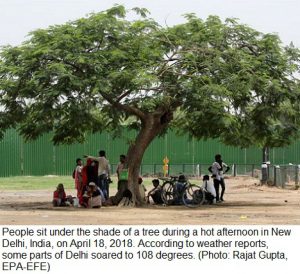
The announcement came in a statement from Minister of Education, Innovation, Gender Relations and Sustainable Development, Doctor Gale Rigobert.

Rigobert said the Government of Saint Lucia is cognizant of the negative impact on the environment and human health from food service containers made from Polystyrene and Expanded Polystyrene, also known as Styrofoam, along with Plastics.

However, she observed that the administration recognises that the healthier alternative to these products, such as biodegradable and compostable food service containers, are more costly.

” We are doing our very best to alleviate this issue,” the minister explained.

She disclosed that over the last few months, the Department of Sustainable Development, in partnership with other key agencies such as the Saint Lucia Solid Waste Management Authority, the Department of Finance, the Ministry of Commerce and the Customs and Excise Department, has been working towards the development of a strategy to eliminate single use plastics, polystyrene and expanded polystyrene from the Saint Lucia market.

“To date, we have completed fiscal analyses, conducted a survey of the key suppliers of these products and we have also identified suppliers of the biodegradable and compostable food service containers, all this to ensure that Saint Lucia creates the enabling environment to facilitate this process,” Rigobert stated.

She explained that in light of this, the Department of Sustainable Development will be taking a phased approach to facilitate a smooth transition for all stakeholders.

“The phase-out, along with a ban on the importation of Styrofoam food service containers, and plastics, both plates and cups, will commence December 1, 2018 with a total ban culminating by November 30, 2019:”

Rigovert revealed that in order to ensure adequate sensitisation, the Department of Sustainable Development will continue its campaign to educate the general public on the options they have available to them during this phase.

“With respect to plastic bottles, discussions are ongoing with major stakeholders to finalize legislation that would curb and control their use,” the minister noted.

“I encourage you to join the fight to reduce your dependency on single use plastics and Styrofoam by utilizing re-useable bottles, food containers, cutlery and shopping bags. Let us act responsibly in our everyday consumption and production,”Rigobert stated.
Source: St. Lucia Times – Daily Newspaper – Posted 08-13-2018; retrieved 08-21-2018: https://stluciatimes.com/2018/08/13/saint-lucia-to-ban-styrofoam-and-plastics/

This problem is bigger than just the Caribbean member-state of St Lucia. They did not start this fight; nor can they finish it. This is BIG Deal that is too big for any one member-state or the full Caribbean region alone. This will require a global effort, including some Caribbean mitigation!

But here in the Caribbean, we cannot expect others to do all the heavy-lifting and clean-up; we must do our share; clean-up our own environment. This has been a frequent theme by the movement behind the book Go Lean … Commentaryavailable for download now. In the book, and in previous Go Lean blog-commentaries, it was asserted that we – the Caribbean region – must do our share to “Go Green” so as to assuage our own contributions to global pollution and greenhouse gases; yes, we must keep our own neighborhoods clean and optimize our own industrial footprint, so that we may be less hypocritical – have moral authority – in calling for reform from the big polluting nations. This sample – as follows – depicts some previous blog-commentaries that relates this theme:

https://goleancaribbean.com/blog/?p=14832 Counter-culture: Manifesting Change – Environmentalism
https://goleancaribbean.com/blog/?p=14174 Canada: “Follow Me” for Model on Environmental Action
https://goleancaribbean.com/blog/?p=12724 Lessons from Colorado: Water Management Arts & Sciences
https://goleancaribbean.com/blog/?p=12144 Book Review: ‘Sea Power’ – The Need for Good Oversight
https://goleancaribbean.com/blog/?p=9455 Fix ‘Climate Change’ and other Environmental Issues? Yes, We Can
https://goleancaribbean.com/blog/?p=2465 Book Review: ‘This Changes Everything: Capitalism vs. the Climate’
https://goleancaribbean.com/blog/?p=2276 Climate Change May Affect Food Supply Within a Decade
https://goleancaribbean.com/blog/?p=1656 Blue is the New Green
https://goleancaribbean.com/blog/?p=915 Go ‘Green’ … Caribbean

From the foregoing news articles and these previous blog-commentaries, we see the compelling need for a concerted anti-pollution-Go Green effort in our region. We must “Reduce, Re-use, Recycle”. Who will stand-up and lead this charge?

“Here I am, send me” – The Bible; Isaiah 6:8

This is the charter of the Go Lean book. It serves as a roadmap for the introduction and implementation of the technocratic Caribbean Union Trade Federation (CU). The roadmap depicts how this federal government is designed to stand-up and lead the charge to assuage and mitigate the threats on Caribbean life. The book identifies a list of crises as Agents of Change that are crippling our way of life. We can add pollution to that list. As a Single Market, we need a regional sentinel to be on guard and to tackle these “plastics pollution” problems.

Why regional?

Because the national effort has been unsuccessful; in many cases, even unknown, unavailable and unfunded.

No, individual member-states will not be able to succeed in this effort; we need a regional effort; it is too big to tackle alone; so we must acknowledge our regional dependency or interdependence to have any chance of success. This vision is embedded in the opening Declaration of Interdependence, pronouncing as follows, (Pages 11, 12):

vi. Whereas the finite nature of the landmass of our lands limits the populations and markets of commerce, by extending the bonds of brotherhood to our geographic neighbors allows for extended opportunities and better execution of the kinetics of our economies through trade. This regional focus must foster and promote diverse economic stimuli.

viii. Whereas the population size is too small to foster good negotiations for products and commodities from international vendors, the Federation must allow the unification of the region as one purchasing agent, thereby garnering better terms and discounts.

x. Whereas we are surrounded and allied to nations of larger proportions in land mass, populations, and treasuries, elements in their societies may have ill-intent in their pursuits, at the expense of the safety and security of our citizens. We must therefore appoint “new guards” to ensure our public safety and threats against our society, both domestic and foreign. …

xi. Whereas all men are entitled to the benefits of good governance in a free society, “new guards” must be enacted to dissuade the emergence of incompetence, corruption, nepotism and cronyism at the peril of the people’s best interest. The Federation must guarantee the executions of a social contract between government and the governed.

The Go Lean book and previous blog-commentaries posit that the “whole is worth more than the sum of its parts”, that from this roadmap disparate Caribbean nations can speak with “one voice” … collectively as a Single Market and be heard. The international community – the big polluters – would therefore have more respect and accountability to our regional Caribbean entity, rather than the many (30) Small Island Development States. But while contributing to the problem ourselves, though on a smaller scale, we cannot just say to these big polluters:

“You break it, you fix it”.

No, we must unite and take our stand in this fight … to mitigate plastics and Styrofoam … and advocate for change!

As related in the Go Lean roadmap, the CU Trade Federation is designed to elevate Caribbean society, but not just against pollution, rather these other engines in the regional construct as well. The roadmap therefore has these 3 prime directives:

  • Optimize the economic engines of the Caribbean to elevate the regional economy to grow to $800 Billion & create 2.2 million new jobs.
  • Establish a security apparatus to ensure public safety and protect the resultant economic engines over the seas & land.
  • Improve Caribbean governance to support these engines.

So the CU will serve as the regional administrator to optimize the economy, homeland security and governing engines for the Caribbean. These efforts are already important in the fight for Climate Change abatement; so the same can apply for the mitigation of polluting plastics and Styrofoam.

The Go Lean book provides 370-pages of turn-by-turn instructions on “how” to adopt new community ethos, plus the strategies, tactics, implementations and advocacies to execute so as to reboot, reform and transform the societal engines of Caribbean society. This is the heavy-lifting that we must do to sustain our planet, region, island and communities.

We can all do more!

Some hotel resorts in the Caribbean have already embraced the strategy of being early-adopters of plastics-Styrofoam bans. See a related article here from St Lucia:

Bay Gardens Resorts discontinues use of Expanded Polystyrene EPS (Styrofoam) products https://stluciatimes.com/2017/02/17/bay-gardens-resorts-discontinues-use-expanded-polystyrene-eps-styrofoam-products/

Change has come to the Caribbean region. This heavy-lifting is the quest of the CU/Go Lean roadmap; to make the Caribbean region more self-reliant collectively; to act more proactively and reactively for our own emergencies and natural disaster events; and to be more efficient in our governance.

If “plastics pollution” is not arrested, then even more devastating changes will come. So there is the need for our region to establish a regional Sentinel, a permanent union to provide efficient stewardship for our economic, security and governing engines.

Now is the time for all of the Caribbean, the people and governing institutions, to lean-in to the efforts and empowerments to mitigate and abate “plastics pollution”. It is also time to lean-in to this roadmap described in the book Go Lean … Caribbean. Plastic pollution is a Big Deal. We have other Big Deals too, so as to reform and transform our society. We must make our waterways and homelands better places to live, work and play. 🙂

Download the e-Book of Go Lean … Caribbean – now!

Sign the petition to lean-in for this roadmap for the Caribbean Union Trade Federation.

Share this post:
, , , ,
[Top]

‘Climate Change’ Reality!? Numbers Don’t Lie

Go Lean Commentary

It’s simple: Numbers don’t lie!

There are many subjective topics: best this, greatest that! If a company thinks they are successful – i.e. one of the fastest growing firms – but they do not have money in the bank, they are “in the RED”, then frankly their Balance Sheet simply doesn’t lie, they are insolvent.

The same for the subjective topic of Climate Change. Is Global Warming real? Is the planet getting warmer?

There is no longer any doubt, the Numbers don’t lie: the earth has had 400 straight warmer-than-average months. See the full story of this actuality here:

VIDEO – This weather event hasn’t happened since 1984 https://www.usatoday.com/videos/weather/2018/05/17/weather-event-hasnt-happened-since-1984/618961002/

Published May 17, 2018 – NOAA climate scientists say April 2018 marked the planet’s 400th consecutive month with above-average temperatures. USA TODAY

———–

Title: Earth just had its 400th straight warmer-than-average month thanks to global warming

It was December 1984, and President Reagan had just been elected to his second term, Dynasty was the top show on TV and Madonna’s Like a Virgin topped the musical charts.

It was also the last time the Earth had a cooler-than-average month.

Last month marked the planet’s 400th consecutive month with above-average temperatures, federal scientists from the National Oceanic and Atmospheric Administration announced Thursday.

The cause for the streak? Unquestionably, it’s climate change, caused by humanity’s burning of fossil fuels.

“We live in and share a world that is unequivocally, appreciably and consequentially warmer than just a few decades ago, and our world continues to warm,” said NOAA climate scientist Deke Arndt. “Speeding by a ‘400’ sign only underscores that, but it does not prove anything new.”

Climate scientists use the 20th-century average as a benchmark for global temperature measurements. That’s because it’s fixed in time, allowing for consistent “goal posts” when reviewing climate data. It’s also a sufficiently long period to include several cycles of climate variability.

“The thing that really matters is that, by whatever metric, we’ve spent every month for several decades on the warm side of any reasonable baseline,” Arndt said.

NOAA’s analysis found last month was the 3rd-warmest April on record globally. The unusual heat was most noteworthy in Europe, which had its warmest April on record, and Australia, which had its second-warmest.

Portions of Asia also experienced some extreme heat: In southern Pakistan, the town of Nawabshah soared to a scalding 122.4 degrees on April 30, which may have been the warmest April temperature on record for the globe, according to Meteo France.

Argentina also had its warmest April since national records began there in 1961.

North America was the one part of the world that didn’t get in on the heat parade. Last month, the average U.S. temperature was 48.9 degrees, 2.2 degrees below average, “making it the 13th-coldest April on record and the coldest since 1997,” NOAA said.

For the year-to-date, the Earth is seeing its 5th-warmest start to the year.

A separate analysis of global temperature data from NASA also found last month was the third-warmest April on record.

Another milestone was reached in April, also related to the number “400”: Carbon dioxide — the gas scientists say is most responsible for global warming — reached its highest level in recorded history at 410 parts per million.

This amount is highest in at least the past 800,000 years, according to the Scripps Institute of Oceanography.

Source: Retrieved May 18, 2018 from: https://www.usatoday.com/story/news/world/2018/05/17/global-warming-april-400th-consecutive-warm-month/618484002/

Once we accept the facts, then we can move on to debating solutions.

Perhaps there was some debate when it was 4 straight months, or 20 straight months; but 400 straight months is an abundance of obvious. Our argument should not be whether Climate Change is real, it should be:

What are we going to do about it?

Option A or Option B?

i.e. There are serious debates for terminating the use of fossil fuels immediately! There is no doubt “we” must employ solar, wind and tidal power generating solutions now. But that is still not enough! How do we fill the gaps in the vacuum for power generation?

  • Option A: Nuclear.
  • Option B: Natural Gas.

Pro’s and Con’s abound!

Anyone who still argues the incontrovertible facts of the reality of Climate Change, should just be ignored, ridiculed and rendered to the “trash heap” of history.

Wait, what?! The US President, Donald J. Trump, is a Climate Change denier, so what are we saying?

Yes, we should ignore, ridicule and render his policies to the “trash heap” of history, while we move forward with our Climate Change abatement.

While this commentary is from the movement behind the book Go Lean…Caribbean, these words to ignore-ridicule-render Trump are also the declaration of …

Climate Change is one of the biggest threats for the Caribbean region. The region must therefore work to mitigate this threat. Yes, we can! We have many successful track records of effecting environmental changes.

Hurricane Season 20018 is about to begun; (June 1).
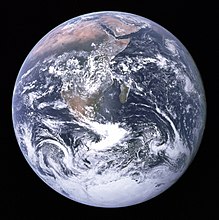
Climate Change can exacerbate storms… These represent a Clear-and-Present Danger for the Caribbean … for many US communities as well. The US President should not be so dismissive.

In the previous blog-commentary, it was asserted …

The reality of Caribbean life: we must contend with natural disasters, not of our making, “again and again”. The situation can be described as “Rinse and Repeat“.

The book Go Lean…Caribbean – available to download for free – serves as a roadmap for the introduction and implementation of the technocratic Caribbean Union Trade Federation (CU), to reform and transform all of Caribbean society – all 30 member-states. There is the need to shepherd our communities to abate for Climate Change episodes – before and after storms. This CU/Go Lean roadmap has these 3 prime directives:

Fixing Climate Change in the US is out-of-scope for this Go Lean…Caribbean effort. Our scope is the Caribbean only. But we must not be hypocritical … or parasitic. We must do our own heavy-lifting and fix our own communities, in preparation for a global abatement initiative – no matter how small we may perceive our impact may be because of our small size in the grand scheme of the planet’s population. How else do we shame the Big Polluters?!

The Go Lean movement has previously detailed many related issues and advocacies for Climate Change awareness and abatement. Consider this sample of previous blog-commentaries:

https://goleancaribbean.com/blog/?p=14832 Manifesting Environmental Change
https://goleancaribbean.com/blog/?p=13985 EU Assists Barbados to Go Green
https://goleancaribbean.com/blog/?p=11858 Looking and Learning from the Cautionary Tale of Kiribati
https://goleancaribbean.com/blog/?p=9455 Fix ‘Climate Change’ – Yes, We Can
https://goleancaribbean.com/blog/?p=7103 COP21 – ‘Climate Change’ Acknowledged
https://goleancaribbean.com/blog/?p=6893 A Meteorologist’s View On Climate Change
https://goleancaribbean.com/blog/?p=4673 Climate Change‘ Merchants of Doubt … to Preserve Profits!!
https://goleancaribbean.com/blog/?p=2465 Book: ‘This Changes Everything: Capitalism vs. the Climate’
https://goleancaribbean.com/blog/?p=2276 Climate Change May Affect Food Supply Within a Decade
https://goleancaribbean.com/blog/?p=1883 Climate Change May Bring More Kidney Stones
https://goleancaribbean.com/blog/?p=1817 Caribbean grapples with intense cycles of flooding & drought
https://goleancaribbean.com/blog/?p=915 Go ‘Green’ … Caribbean

The Go Lean book and roadmap stresses that reforming and transforming the Caribbean’s societal engines to abate Climate Change is possible; it is conceivable, believable and achievable. But this is heavy-lifting.

The Go Lean book provides 370-pages of turn-by-turn instructions on “how” to prepare and respond for Climate Change-infused storms. This quest is the actual title of one advocacy in the Go Lean book. Consider the specific plans, excerpts and headlines here from Page 184, entitled:

10 Ways to Improve for Natural Disasters

1 Lean-in for the Caribbean Single Market and Economy
This allows for the unification of the 30 member-states into one market, thereby spreading the risk and premium base across a market of 42 million people. The Caribbean member-states have Hurricane Katrina styled disasters (relatively speaking) every year.
2 Caribbean Emergency Management Agency – Federal Disaster Declarations

Modeled after FEMA in the US, this agency will be charged with the preparation, response and reconstruction for the regions for the eventual manifestations of hurricanes, earthquakes, tsunamis, flooding and other declared disasters, natural and man-made like medical epidemic, drought, pollution, oil spills, terrorism, etc.

3 Support Services for First Responders

Training, licensing and standards for Emergency Managers, Paramedics, Firefighters, Search and Rescue resources. For major disasters, some of these resources will come from international origins; they will need the support services (language translation, guides, maps, etc.) and coordination to maximize their results.

4 Animal Partner Training and Development

Maintain plantations for the training, development and boarding of “search & rescue” dogs, cadavers dogs and other service animals (horses, mules, pigs, etc.) so that there will be local resources within the region. (We cannot always depend on international responses in light of other regions experiencing their own disasters). These animals need not be owned by any one member-state, they can be on loan from CU resources

5 Siren Warnings & Notifications
6 Airlift & Sealift Authorizations

The CU Emergency Management Agency can license, regulate and authorize (air & sea) vessels and vehicles for emergency deployment in a disaster zone, before during and after the disastrous event.

7 JUA-style Insurance Fund

The fiduciary management of premiums and claims to allow the immediate response for reconstruction after disasters. These financial services, sidecars traded in markets can be direct or indirect as in reinsurance or insurer-of-last-resort.

8 Economic Crime Enforcement During and After Disasters
9 Disaster Declaration Loans
10 Building Codes and Standards

The Numbers – 400 straight months of above-average temperatures – tell the truth! We do not have a choice to just ignore this reality. We must prepare! Any Caribbean community leader who do not endorse proactive measures of a regional disaster apparatus needs to be ignored, ridiculed and rendered to the “trash heap” of history.

We need serious leaders … only! Climate Change can be abated, remember Acid Rain. We urge all Caribbean stakeholders to lean-in to this Go Lean roadmap for change, to make our homeland safer. This is a necessary step in forging a better homeland to live, work and play. 🙂

Download the free e-Book of Go Lean … Caribbean – now!

Sign the petition to lean-in for this roadmap for the Caribbean Union Trade Federation.

Share this post:
, , , ,
[Top]

Counter-culture: Manifesting Change – Environmentalism

Go Lean Commentary

News Flash: The hippies of the 1960’s grew up! They became middle class suburbanites. They traded in their tie-dye T-shirts for Polo shirts; and their Volkswagen Beetles for ‘Soccer-Mom’ Minivans.

Did the revolution for the 60’s Hippies simply fail? Did they retreat into the mainstream?
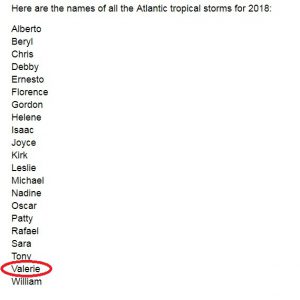
No and No, they simply won, their fight; the changes the counter-culture demanded were manifested:

The counter-culture has been argued to have diminished in the early 1970s, and some have attributed two reasons for this. First, it has been suggested that the most popular of its political goals—civil rightscivil libertiesgender equalityenvironmentalism, and the end of the Vietnam War—were “accomplished” (to at least some degree); and also that its most popular social attributes—particularly a “live and let live” mentality in personal lifestyles (the “sexual revolution“)—were co-opted by mainstream society.[57][65] Second, a decline of idealism and hedonism occurred as many notable counter-culture figures died, the rest settled into mainstream society and started their own families, and the “magic economy” of the 1960s gave way to the stagflation of the 1970s[57]—the latter costing many in the middle-classes the luxury of being able to live outside conventional social institutions. The counter-culture, however, continues to influence social movements, art, music, and society in general, and the post-1973 mainstream society has been in many ways a hybrid of the 1960s establishment and counter-culture.[65]Wikipedia.

Wait, what?!

The fights for civil rights, civil liberties, gender equality, environmentalism, and the “end of the Vietnam War” was successful. The world – America and Western Europe – we live in today is radically different than the world before the 1960’s. So they – the counter-culturists – are able to declare some relative victory.

Unfortunately, while that success was only limited, the Caribbean was left out in this fight … and the victory tour.

For example, the mentality to “live and let live” which is present in the US and other countries is painfully absent in the Caribbean. Many Caribbean citizens have fled the Caribbean orthodoxy, many being “pushed”, to live in a society where they can “live and let live”.

Let’s consider one fight that was manifested by the counter-culture: environmentalism.

At its crux, environmentalism is an attempt to balance relations between humans and the various natural systems on which we depend in such a way that all the components are accorded a proper degree of sustainability. There was a relative success for environmentalism in the US with the creation and facilitation of the EPA (Environmental Protection Agency). This new independent federal agency was established by the 37th US President Richard Nixon in December 1970. The Administrator of the EPA is accorded Cabinet rank, so it wields power and authority to effect change in American society. In fact, under the 44th President, Barack Obama, the EPA began to impose regulations on carbon emissions from cars, power plants and other industries who contribute to Climate Change.

Despite all the accomplishments with environmental protection (land, air and water), there is still more work to do. In fact, Climate Change has been identified as one of the biggest threats for the Caribbean region. There is a need for our Caribbean communities to stand-up and fight for better Climate Change mitigations. This commentary asserts that there is the need to re-kindle that old counter-cultural vigor and vigilance.

This commentary – entry 2 of 4 – is a continuation in this series on the counter-culture of the 1960’s/1970’s. This series from the movement behind the book Go Lean … Caribbean considers the experiences of how people deviated from the mainstream society to forge change in their communities. The people – youth mostly – were scorned and ridiculed, but they persisted … and manifested the needed change. The other commentaries in the series are cataloged as follows:

  1. Counter-culture: Embracing the Change – Battling against Orthodoxy
  2. Counter-culture: Manifesting Change – Environmentalism & ‘Climate Change’ abatement
  3. Counter-culture: Monetizing the Change – Education, Workplace, Healthcare & Retirement Mandates
  4. Counter-culture: Pushing for Change – Is Ganja here to stay?

All of these commentaries convey “how” the stewards for a new Caribbean can take a “page from the counter-culture book” so as to shepherd societal change in this region.

Yes, we can!

We need that 1960’s vigor and vigilance in our efforts to abate Climate Change today. Remember the powerful anthem by R&B singer Marvin Gaye Mercy, Mercy Me! See the VIDEO here:

VIDEO-AUDIO – Marvin Gaye: Mercy, Mercy Me! (1971)https://youtu.be/U9BA6fFGMjI

Published on Aug 21, 2007
Marvin Gaye – Mercy, Mercy Me (the ecology); Rest in Peace Marvin

———–

VIDEO-AUDIO – Robert Palmer – Mercy Mercy Me/I Want You (1991)https://youtu.be/RMT-oiiY7DE

Published on Aug 20, 2006
A cover of two Marvin Gaye’s “Mercy Mercy Me” and “I Want You” singles from Robert Palmer (Rest in Peace).

  • Category: Music 
  • License: Standard YouTube License

The science has proven that Climate Change is man-made – it is not just Mother Nature – and so man can mitigate the risks and remediate the threats. While this is a global problem, one man, one community, one country and one region can make a difference. Since we are on the frontlines of this battle – due to our vulnerabilities with hurricanes (see Appendix A below) – we need to be front-and-center in the fight.

We have the successful track record of Acid Rain.

In a previous blog-commentary (October 13, 2016), it was related that previous fight against Acid Rain is a good model for Climate Change today. Consider this direct quote:

Remember Acid Rain?

That was a big deal in the 1970’s and 1980’s. It was a big environmental problem; the stakeholders came together – many kicking and screaming – to put in the remediation and mitigation and now the problem is greatly abated. See the encyclopedia details of the problem in the Appendix A below, where it is reported that Acid Rain levels have dropped 65% since 1976.

Climate Change is another area of atmospheric pollution that can also be abated with a lot of the same strategies, tactics and implementations as was employed to abate Acid Rain. But instead of the smoke stacks of factories and power plants, the problematic culprit this time is fossil fuels.

Fossil fuels and carbon emission = Climate Change!

Unlike Acid Rain, the “bad actors” for Climate Change are not just industrial installations; this time it is “almost everybody”. Cars are one of the biggest contributors. There is no denying this cause-effect any more. The problem is now globally acknowledged! There are new international agreements – Paris Conference of the Parties (COP) or COP21 – to curb fossil fuels / carbon dioxide emissions. 195 countries have signed on to these accords, including big polluters China (#1) and the US (#2).

The overall goal of these international accords is to achieve significant environmental benefits through reductions in emissions of greenhouse gases, the primary causes of Climate Change. The remediation and mitigations employ regulatory and market based approaches for controlling GHG [(Greenhouse Gases)] elements. It should be noted that the COP21 accord is a non-binding agreement, but the biggest contribution is that the community will is now entrenched.

The book Go Lean … Caribbean uses an alternate technical term for “community will”; it identifies “community ethos”, as “the fundamental character or spirit of a culture; the underlying sentiment that informs the beliefs, customs, or practices of a society” (Page 20). So, in everyday practical terms, it will now be politically incorrect to pursue policies in denial of Climate Change.

The Go Lean book presents a 370-page roadmap for rebooting, re-organizing and restructuring the economic, security and governmental institutions of the 30 member-states in the Caribbean region, especially in light of the realities of Climate Change. … We must “Go Green” to arrest our own carbon footprint, so that we may be less hypocritical – have moral authority – in calling for reform from the big polluting nations.

The timing for this commentary, and reminder, is crucial! We are on the threshold of the 2018 hurricane season and the scientists are expecting a catastrophic one … again. See the related article in Appendix A below.

We must do better this year and in the future, compared to how we did last year. In 2017, 2 major storms impacted the Caribbean regions, leaving death, destruction, dysfunction and defection in their wake:

  • Irma – A Category 5 storm on September 4, 2017; this caused devastation in many islands, hitting Barbuda and the Virgin Islands especially hard.
  • Maria – A Category 5 storm on September 18, 2017; this caused devastation in many islands, hitting Puerto Rico and Dominica especially hard.

Remember that Hurricane Season is imminent.

Remember Acid Rain …

Remember the Hippies …

In the previous submission in this “counter-culture” series, it was asserted …

… the ‘Hippies’ stood in the track of an oncoming locomotive … and stopped the train!

We need to apply the lessons-learned from the counter-culture most urgently in getting our communities ready for Climate Change abatement.

The book Go Lean…Caribbean – available to download for free – serves as a roadmap for the introduction and implementation of the technocratic Caribbean Union Trade Federation (CU), to reform and transform all of Caribbean society – all 30 member-states. There is the need to shepherd our communities through major challenges, ones that are too big for any one member-state alone; we need to confederate. This CU/Go Lean roadmap has these 3 prime directives:

  • Optimization of the economic engines in order to grow the regional economy to $800 Billion & create 2.2 million new jobs.
  • Establishment of a security apparatus to ensure public safety and protect the resultant economic engines; including a disaster planning and response functionality.
  • Improve Caribbean governance to support these engines, including a separation-of-powers between the member-states and CU federal agencies.

The Caribbean needs the spirit of the previous counter-culture to “stop the train” that is on our track. Can we remember and role-model the previous rebels and revolutionaries who did not settle for the status quo? Yes, we can!

No we are not saying become hippies! Yes, we are saying to counter the status quo.

The movement behind the Go Lean book has previously detailed many related issues and advocacies for Climate Change awareness and abatement. Consider this sample of previous blog-commentaries:

https://goleancaribbean.com/blog/?p=14174 Canada says: “Follow-me” for Model on ‘Climate Change’ Action
https://goleancaribbean.com/blog/?p=13985 EU Assists Barbados to Go Green
https://goleancaribbean.com/blog/?p=11858 Looking and Learning from the Cautionary Tale of Kiribati
https://goleancaribbean.com/blog/?p=10367 The Science of Green Batteries
https://goleancaribbean.com/blog/?p=9455 Fix ‘Climate Change’ – Yes, We Can
https://goleancaribbean.com/blog/?p=7449 Due to Climate Change, ‘Crap Happens’ – So What Now?
https://goleancaribbean.com/blog/?p=7103 COP21 – ‘Climate Change’ Acknowledged
https://goleancaribbean.com/blog/?p=6893 A Meteorologist’s View On Climate Change
https://goleancaribbean.com/blog/?p=6016 ‘Hotter than July’ – Reality in the Caribbean
https://goleancaribbean.com/blog/?p=4673 Climate Change‘ Merchants of Doubt … to Preserve Profits!!
https://goleancaribbean.com/blog/?p=2465 Book: ‘This Changes Everything: Capitalism vs. the Climate’
https://goleancaribbean.com/blog/?p=2276 Climate Change May Affect Food Supply Within a Decade
https://goleancaribbean.com/blog/?p=1883 Climate Change May Bring More Kidney Stones
https://goleancaribbean.com/blog/?p=1817 Caribbean grapples with intense cycles of flooding & drought
https://goleancaribbean.com/blog/?p=915 Go ‘Green’ … Caribbean

The Go Lean book and roadmap stresses that reforming and transforming the Caribbean’s societal engines is possible; it is conceivable, believable and achievable. But changing society entails changing the people in society, their attitudes and values.

We saw change manifest with the counter-culture of the 1960’s/1970’s. As related above, “the post-1973 mainstream society has been in many ways a hybrid of the 1960s establishment and counter-culture”.

We now need to change our people, our Caribbean people. We need them committed, devoted and inspired to adopt the appropriate community ethos to derail the current trajectory – to doom – and move our countries in a new direction.

The Go Lean book provides 370-pages of turn-by-turn instructions on “how” to forge a counter-cultural revolution transition in the Caribbean; it details the new community ethos that needs to be adopted, plus the strategies, tactics, implementations and advocacies to execute so as to reboot, reform and transform the societal engines of Caribbean society.

We urge all Caribbean stakeholders to lean-in to this roadmap for change, to make our homeland a better place to live, work and play. 🙂

Download the free e-Book of Go Lean … Caribbean – now!

Sign the petition to lean-in for this roadmap for the Caribbean Union Trade Federation.

————-

Appendix – Grenada’s Forestry Department Concerned About ‘Climate Change’ And Its Effects On Hurricanes

By: Maryam J. Tawfiq-iLAND Resilience Project

With the announcement from Colorado State University hurricane researchers of their projections for the 2018 Atlantic Hurricane Season the forestry department of the ministry of agriculture in Grenada is concerned with the likely effects of this year’s storm and of them possibly intensifying.
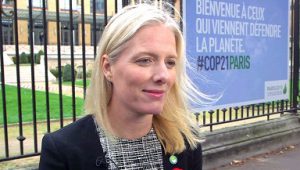
The 14 named storms of the 2018 season will be slightly above-average, said a report from the university. It projects that seven of the storms will become hurricanes; three of them “major’’ hurricanes.

Ever more people around the world seem to be experiencing freak storms, floods and droughts — including catastrophes that devastate whole regions. The reasons for these complex weather events aren’t straightforward. Some say the crazy weather we’re experiencing is due to greenhouse gas emissions around the world; others disagree.

Anthony Jeremiah, acting chief forestry officer, said the ministry of agriculture is adopting “active preparedness measures’’, admitting that “we are very much concerned regarding the destruction that can arise from hurricanes’’.

During the 2017 Atlantic basin hurricane season, six major storms – all of which were Category 3 or higher – produced devastating human, material and financial losses across the southern United States and the Caribbean.

Last year’s above-average storm activity was foreseeable. Hurricane intensity ticked up in 2016 and scientists have predicted this trend will hold as global temperatures continue to rise.

Though the Caribbean is facing increasing vulnerability to hurricanes, many in the region hold very different opinions about the severity of climate change. According to results from the latest Vanderbilt University Americas Barometer survey, a strong majority of Caribbean residents perceive climate change as a “very serious” problem. In contrast, just 44 percent of the U.S. public does.

The 2018 Atlantic hurricane season runs from June 1 to Nov. 30.

Source: Posted May 5, 2018; retrieved May 8, 2018 from: https://stluciatimes.com/2018/05/05/grenadas-forestry-department-concerned-about-climate-change-and-its-effects-on-hurricanes/

Share this post:
, , ,
[Top]

Canada: “Follow Me” for Model on ‘Climate Change’ Action

Go Lean Commentary

It is good to have friends …

    … people who share comradery with you, empathize with your challenges and are willing to collaborate with you on solutions.

For the Caribbean, when it comes to Climate Change concerns, we have that friend … Canada. Yippee!

But that was not always the case. This is now only possible because of new leadership. Back in 2015, Canada elected a new government and Prime Minister – Justin Trudeau. Out with the old, in with the new; see 2015 news article in Appendix below. Rather than “sticking their head in the sand” – this means you United States of America – Canada is “taking the reins” to forge attitudinal change among the world’s Great Powers.
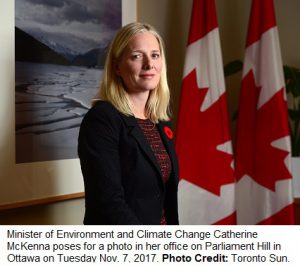
But Canada’s motivation is more than just being the “leader of the pack”, they have real concerns, risks and threats:

Canada, the second largest country in the world by total area, is comprised by ten provinces and three territories. Canada also has the longest total coastline among all of the countries of the world, at 125,567 miles.
Countries With The Most Coastline – World Atlas 

If Climate Change is to continue unabated, this country has a lot to lose – catastrophic storms, melting ice caps, thawing permafrost and rising sea level.

Ditto for the Caribbean. (We similarly have lots of coastlines).

Truly, Canada can look at their Caribbean brethren – Canada’s shares the same British Colonial heritage with 18 of the 30 Caribbean member-states – and pronounce: Follow Me!

This declaration was truly the theme of the presentation by Catherine McKenna, Minister of Environment and Climate Change as she visited the US cities of Miami, Florida and Houston, Texas. Listen to the full AUDIO-Podcast news story here:

Newswire Title: Minister of Environment and Climate Change, Catherine McKenna, promotes NAFTA, climate action, and ocean protection, in Houston and Miami

Canada NewsWire – MIAMI, Jan. 24, 2018 – Canada’s Minister of Environment and Climate Change, Catherine McKenna, travelled to Houston, Texas; and Miami, Florida, to promote NAFTA, increased collaboration on ocean health, coastal solutions, clean technology, and renewable energy opportunities.

In Houston, Minister McKenna met with the Mayor of Houston, Sylvester Turner. Mayor Turner is Co-Chair of US Climate Mayors, a coalition of 391 US mayors working together to meet the goals of the Paris Agreement. They discussed NAFTA and the importance of the Canada-US trade relationship to the economy of Houston and of Texas. Texas sells $24.1 billion in goods and services to Canada, and 459 700 jobs depend on trade and investment with Canada. The Mayor noted that the city remains a global oil-and-gas centre while diversifying and taking advantage of the opportunity of clean growth and renewable energy.

During her visit to Houston, the Minister visited BP’s Wind Energy Remote Operations Center, where logistics and conditions for 16 wind farms across the US are monitored. Today, Texas produces more wind energy than any US state, and power generated by wind is expected to exceed coal-generated power in the state, in 2018.

As part of the Climate Campus tour, Minister McKenna visited the University of Houston, where she met with professors and students working on energy and environment law. She also met with researchers at the new Hurricane Resilience Research Institute created after Hurricane Harvey. The Institute is focused on issues including flood-mitigation management during severe storms and the building of resilient communities. Minister McKenna hosted a town hall at Texas A&M University at Galveston and met with ocean scientists looking at ocean health, energy, and maritime complex and visited one of the University’s ocean research vessels.

In Miami, Minister McKenna emphasized the importance of NAFTA to the Florida economy at a round table with Florida businesses and trade associations and in discussions with the Mayor of South Miami, Philip Stoddard. Canada is Florida’s most important economic partner. Each year, Canada and Florida trade $8 billion worth of goods, and 620 000 jobs in Florida depend on trade with Canada.

Minister McKenna met with representatives of NextEra Energy, Inc., North America’s largest generator of energy from wind and sun and the third-largest utility in the US. They discussed opportunities for further investment by NextEra Energy in Canada’s North as well as in provinces such as Alberta, Saskatchewan, and Ontario.

The Minister visited the Brickell City Centre Climate Ribbon and the City of Miami Beach Convention Center. These two sites showcase how the city is adapting to sea-level rise and more frequent, intense, and prolonged tidal flooding exacerbated by climate change. The Climate Ribbon, which was designed in part by Guelph-based company RWDI, spans the length of three city blocks and acts as an architectural air conditioner in the summer and umbrella when it rains.

The City of Miami Beach Convention Center has the world’s single-largest pumping station, which removes displaced groundwater that is surging due to rising sea levels. The Convention Center is home to a living sea wall and natural mangroves, which help to mitigate and adapt to the impacts of flooding caused by climate change.

The Minister also convened a round table of ocean and environmental experts to discuss Canada’s G7 presidency focus on ocean protection and marine litter.

Quotes
“My meetings in Houston and Miami reinforced the strong ties between Canada and these important Canadian partners on trade and the environment. I was heartened to see the shared commitment by local governments and business to NAFTA and the good middle-class jobs it creates in both countries. It was also incredible to see the transition of the economies of both Houston and Miami toward clean growth and to meet with innovative clean-energy and clean-technology companies, many of which are looking at investment opportunities in Canada. I was also impressed by the leadership from the mayors of both Houston and Miami on climate change as well as the efforts to build more communities more resilient to extreme weather events.” – Catherine McKenna, Minister of Environment and Climate Change

View original content: http://www.newswire.ca/en/releases/archive/January2018/24/c5640.html

——–

AUDIO-Podcast – Canadian Minister Of Environment And Climate Change Visits Miami – https://soundcloud.com/wlrn/444pm-canadian-minister-of-environment-and-climate-change-visits-miami

Published on February 5, 2018 – The Canadian Minister of Environment and Climate Change, Catherine McKenna, promotes Climate Action and ocean protection in Miami.

The book Go Lean…Caribbean and accompanying blogs have asserted that the threat of Climate Change is real. There is no scientific doubt of this reality – just consider the destructive realities of this past hurricane season – the only doubt is political. If the US wants to deny this reality, they do so at their own peril – remember the American territory of Puerto Rico. Canada is prepared to take the lead, to put the Western Hemisphere on its shoulders and carry the load for arresting Climate Change.

Thank you Canada for this model. Now, we – the Caribbean – need to step up to carry our own load for better mitigation of Climate Change threats; we need to do our part in lowering our own carbon footprint. We can make a difference. Canada can make a difference. As related in a previous blog-commentary, the same as the threat of Acid Rain was subjugated, so too, curative measures can be put in place to lower the greenhouse gases in the environment. This is why Canada has a Champion for the Environment – Catherine McKenna – at the Cabinet level.

Good model …

The book Go Lean…Caribbean – available to download for free – prepares the Caribbean region for the heavy-lifting of monitoring, managing and mitigating the acute risks of Climate Change to the environment from a Caribbean perspective. These Climate Change threats are real for us: Global Warming and rising sea-levels. We must act now! Though no Caribbean country is among the BIG polluters, we must still act, just so that we are not hypocritical … and provide a good model ourselves.

Then there are the economic issues. Catherine McKenna, in the foregoing presentation to Miami officials, related that there is no need for a trade-off between environment and economics. No, it can be economically sound, and even advantageous, to cater to environmental needs. Imagine the fuel cost savings from alternative energy options, new industrial expressions for transportation solutions and construction jobs for retrofitting previous structures.

The Go Lean book serves as a roadmap for the introduction and implementation of the technocratic Caribbean Union Trade Federation (CU), for the elevation of Caribbean society – for all member-states. This CU/Go Lean roadmap has these 3 prime directives:

  • Optimization of the economic engines in order to grow the regional economy to $800 Billion and create 2.2 million new jobs.
  • Establishment of a security apparatus to ensure public safety and protect the resultant economic engines.
  • Improve Caribbean governance to support these engines, including a separation-of-powers between the member-states and CU federal agencies.

The effort to reform and transform the Caribbean societal engines as a regional pursuit has always been among the motivations of this Go Lean roadmap, as pronounced in the opening Declaration of Interdependence (Pages 12 – 13):

i. Whereas the earth’s climate has undeniably changed resulting in more severe tropical weather storms, it is necessary to prepare to insure the safety and security of life, property and systems of commerce in our geographical region. As nature recognizes no borders in the target of its destruction, we also must set aside border considerations in the preparation and response to these weather challenges.

iii. Whereas the natural formation of the landmass for our society is that of an archipelago of islands, inherent to this nature is the limitation of terrain and the natural resources there in. We must therefore provide “new guards” and protections to ensure the efficient and effective management of these resources.

iv. Whereas the natural formation of the landmass is in a tropical region, the flora and fauna allows for an inherent beauty that is enviable to peoples near and far. The structures must be strenuously guarded to protect and promote sustainable systems of commerce paramount to this reality.

xi. Whereas all men are entitled to the benefits of good governance in a free society, “new guards” must be enacted to dissuade the emergence of incompetence, corruption, nepotism and cronyism at the peril of the people’s best interest. The Federation must guarantee the executions of a social contract between government and the governed.

xvi. Whereas security of our homeland is inextricably linked to prosperity of the homeland, the economic and security interest of the region needs to be aligned under the same governance. Since economic crimes … can imperil the functioning of the wheels of commerce for all the citizenry, the accedence of this Federation must equip the security apparatus with the tools and techniques for predictive and proactive interdictions.

xxiv. Whereas a free market economy can be induced and spurred for continuous progress, the Federation must install the controls to better manage aspects of the economy: jobs, inflation, savings rate, investments and other economic principles. Thereby attracting direct foreign investment because of the stability and vibrancy of our economy.

The Go Lean book provides 370-pages of turn-by-turn instructions on “how” to adopt new community ethos, plus the strategies, tactics, implementations and advocacies to execute so as to monitor, manage and mitigate the challenges of Climate Change. The book also present lessons from Canada. One advocacy specifically focuses on the path of wisdom Canada undertook during the course of its 150-year history. That advocacy (Page 146) is entitled: 10 Lessons from Canada’s History; consider some specific plans, excerpts and headlines from that advocacy in the book:

1 Lean-in for the Caribbean Single Market
This treaty calls for the confederation of the Caribbean region into a single market of 30 member-states and 42 million people, similar to the original 1867 confederation for Canada. The history of Canada synchronizes with the aspirations of the CU Trade Federation. In this Canadian context, confederation generally describes the political process that united the colonies in the 1860s and related events, and the subsequent incorporation of other colonies and territories. Today, Canada is a “G8” advanced economy, made up of 10 provinces and 3 territories, ranking among the largest in the world, due its abundant natural resources and well-developed trade networks, including one with the US, a long and complex relationship. Canada has been a Northern Star, as a guide and refuge to Caribbean hopes and dreams.
2 Confederation for Defense – Strength in Numbers

The American Civil War caused security threats for Canada. The Union (US North) encouraged Irish immigration and sourced their Army (a million-man strong) with many Irish fighters. Since many Irish immigrants maintained animosity towards the British, there were documented cases of terroristic attacks against Canadian targets, i.e. the Fenian (an Irish Brotherhood) raids. This corresponded with the Little Englander philosophy, whereby Britain no longer wanted to maintain troops in its colonies.

Confederation was therefore necessary to promote security for the related colonies of Ontario, Quebec, New Brunswick and Nova Scotia – amounting to a population of slightly over 2 million people

3 Multiple Cultural Legacies and Languages
4 Better than a Republic – (Civil War Lesson for a Technocracy)
5 Assuage Human Flight – Provide Alternative
6 Neighbor: Frienemy

Despite the cooperation needed for the St. Lawrence Waterway – (see Appendix UA) – the stated US desire, doctrine of Manifest Destiny, was to govern the entire North American continent. The US had fought wars against English-Canada interests and many believed that the US would annex the other colonies governed directly by England, as the US acquired the Oregon Territory. These reasons provided the motivation for the initial Canadian Confederation to expand from coast-to-coast, and serve as a role-model for the CU to target the entire region of the Caribbean Sea geography.

7 Aboriginal Relations Need Local Governance
8 Mastering Natural Resources

The Oil, Fisheries, Forest/Timber of Canada has been managed to contribute success to its economic engines. Plus, strategic Public Works (see Canadian Pacific Railway in Appendix UB) have provided great models for the CU today.

9 Federal / Provincial Outsourcing
10 Population Concerns – Not enough Natural Growth

In addition, the book presents these Appendices that details more examples of prudence in Canada’s history:

  • Appendix UA – St. Lawrence Waterway (Page 308)
  • Appendix UB – Canadian Pacific Railway (Page 309)

Lastly, these previous blog-commentaries detail a lot of the issues and developments in the quest for the Caribbean to lower our own carbon footprint and mitigate for Climate Change. See this sample:

https://goleancaribbean.com/blog/?p=13985 EU Assists Barbados to Go Green
https://goleancaribbean.com/blog/?p=11858 Looking and Learning from the Cautionary Tale of Kiribati
https://goleancaribbean.com/blog/?p=10367 The Science of Green Batteries
https://goleancaribbean.com/blog/?p=9455 Fix ‘Climate Change’ – Yes, We Can
https://goleancaribbean.com/blog/?p=7449 Due to Climate Change, ‘Crap Happens’ – So What Now?
https://goleancaribbean.com/blog/?p=7103 COP21 – ‘Climate Change’ Acknowledged
https://goleancaribbean.com/blog/?p=6893 A Meteorologist’s View On Climate Change
https://goleancaribbean.com/blog/?p=6016 ‘Hotter than July’ – Reality in the Caribbean
https://goleancaribbean.com/blog/?p=4673 Climate Change‘ Merchants of Doubt … to Preserve Profits!!
https://goleancaribbean.com/blog/?p=2465 Book: ‘This Changes Everything: Capitalism vs. the Climate’
https://goleancaribbean.com/blog/?p=2276 Climate Change May Affect Food Supply Within a Decade
https://goleancaribbean.com/blog/?p=1883 Climate Change May Bring More Kidney Stones
https://goleancaribbean.com/blog/?p=1817 Caribbean grapples with intense cycles of flooding & drought
https://goleancaribbean.com/blog/?p=915 Go ‘Green’ … Caribbean

We must learn from Canada and prepare for new governmental leadership to shepherd our homeland. We have the heavy-lifting task of championing Climate Change, to minimize further damage to our region. We have no further excuse! We know that the US will not take the lead in this regards; we must look elsewhere and within!

Now is the time for all of the Caribbean – the people, businesses, institutions and governments – to lean-in for the optimizations and opportunities to abate Climate Change and to lean-in to this Go Lean roadmap. This emulates Canada.

We must stand-up for ourselves; and while “things are bad” environmentally; the Caribbean disposition will only get worse if nothing is done. We must start this quest ourselves! While this quest is easier said than done, and takes a lot of heavy-lifting, it is conceivable, believable and achievable to make our homeland a better place to live, work and play. 🙂

Download the free e-book of Go Lean … Caribbean – now!

Sign the petition to lean-in for this roadmap for the Caribbean Union Trade Federation.

———-

Appendix – Climate change ‘important priority,’ Canada’s new environment minister says

The international community is “really excited” to see Canada back at the table for climate change talks in Paris, Canada’s new environment and climate change minister said Tuesday.

Catherine McKenna, who is in Paris meeting with environment and energy ministers from around the world in advance of the UN climate change conference, said the Canadian delegation has received a “huge reception” and she has made it clear that climate change will be a “very important priority” for the new Liberal government.
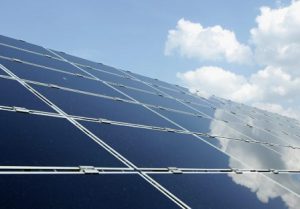
“We haven’t been at these types of climate negotiations and what I’ve learned is that there’s a real appetite to get a global framework, a new global framework to tackle climate change,” McKenna said Tuesday. “But there’s still a lot of work to do.”

Former prime minister Stephen Harper skipped the UN climate change summit in New York last year, but he did send his environment minister. Under the Conservative government, Canada withdrew from the Kyoto agreement that required developed countries to reduce their emissions by 2012.

See the rest of the article at this link here:
Source: Posted November 10, 2015; retrieved February 6, 2018 from: https://www.ctvnews.ca/politics/climate-change-important-priority-canada-s-new-environment-minister-says-1.2651321

Related 2015 VIDEO:

Published November 10, 2015 – Minister of Environment and Climate Change Catherine McKenna says she “will do whatever she can” to help the climate talks.

Share this post:
, ,
[Top]

EU Assists Barbados in Renewable Energy Self-Sufficiency

Go Lean Commentary

The dream of transforming to 100% renewable energy in the Caribbean can be realized. There is hope for this reality.

If only we can get the people behind it.

Our people …

So far other people are doing it for us. Thank you, European Union (EU), for talking the talk for us, and opening your wallets and walking the walk.

If only now we can step-in, step-up and step out ourselves … to do a better job of delivering basic needs, including energy.

This is the actuality of the latest developments taking place in the Caribbean. See this story here of a Green Energy initiative in Barbados:

Title: EU Assists Barbados in renewable Energy Self-Sufficiency

PRESS RELEASE – Barbados has received 1.12 million Euros (BBD$2.7M) from the European Union towards the advancement of energy self-sufficiency from renewable resources. This is the first payment of a total contribution of 3 million Euros. This activity is in line with the country’s commitment to the United Nations Framework Convention on Climate Change of reducing its total and per capita greenhouse gas emissions.

A major objective of the EU’s support is the engagement of the private sector in renewable energy power generation and should result in consumers making increasing use of energy efficiency measures during the 36 month duration of the programme and after.

Some of the guidelines which will be used for performance assessment of the programme include the introduction of a favourable licence regime for independent power producers with generation systems larger than 1 megawatt, by March 2019. Another requirement is that by 2019 at least 30 megawatt of renewable energy will be installed by public and private entities. In addition, it is expected that there will be the establishment and implementation of a renewable energy roadmap according to defined milestones.

EU Ambassador Daniela Tramacere said: “This is another effort by the EU to assist Barbados in transforming its economy which is heavily dependent on fossil fuels, which result in annual drain on its foreign reserves.”

The Barbados government is also expected to adopt and implement energy sector reform measures that are expected to prepare the country for the transition towards renewable energy and energy efficiency on the basis of the national energy policy.
Source: St Lucia Times Daily Newspaper; posted 01/05/2018; retrieved 01/12/2018 from:
https://stluciatimes.com/2018/01/05/eu-assists-barbados-renewable-energy-self-sufficiency/

This is the reality of Caribbean life. We have deliverables that must be delivered and yet we do not. We wait for other people to deliver for us. Time to Grow Up, you people of the Caribbean! It’s time to put on your “Big Boy pants and walk like a man”!

This is the call of the movement behind the book Go Lean…Caribbean – available to download for free. The book serves as a roadmap for the introduction and implementation of the technocratic Caribbean Union Trade Federation (CU), for the elevation of all Caribbean society – for all 30 member-. The book explains that the Caribbean is in crisis, people are fleeing day-in and day-out. Their people are “pushed and pulled” to other lands that do a better job of managing basic needs. Energy costs in the Caribbean are among the highest in the world. Therefore the CU/Go Lean roadmap has these 3 prime directives:

  • Optimization of the economic engines in order to grow the regional economy to $800 Billion and create 2.2 million jobs.
  • Establishment of a security apparatus to ensure public safety and protect the resultant economic engines.
  • Improve Caribbean governance to support these engines, including a separation-of-powers between the member-states and CU federal agencies.

Notwithstanding, Barbados is doing more for regional integration and problem-solving …

… the [CARICOM] Secretary-General lauded the significant role Barbados continues to play in the Community with its Prime Minister having responsibility for the regional flagship initiative, the CARICOM Single Market and Economy (CSME). – Report

The technology, systems and processes are available right now for Caribbean communities to fulfill the dream of a society consuming renewable energy sources 100%.

We must work harder ourselves to fulfill this dream here in our region. Doing so is win-win as it accomplishes 2 important objectives: environmental (no fossil fuels) and economic (affording conveniences of modern life):

  • Solar – The sun always shines in the Caribbean and its free.
  • Wind – The wind always blows in the Caribbean – i.e. Trade Winds – and its free.
  • Tidal – The tides always rise and fall in the Caribbean and its free – see Appendix VIDEO below.

No doubt, these renewable options bring many benefits in arresting “Climate Change” – there is no scientific doubt that burning fossil fuels contribute to greenhouse houses. (The only doubt is political , not scientific). The Caribbean is in peril because of the actuality of greenhouse gases, think hurricane activities. Consider these recent blog-commentaries:

https://goleancaribbean.com/blog/?p=13391 After Maria: Destruction and Defection for Puerto Rico
https://goleancaribbean.com/blog/?p=12996 After Irma, Failed State Indicators: Destruction and Defection
https://goleancaribbean.com/blog/?p=12977 After Irma, Barbuda Becomes a ‘Ghost Town’
https://goleancaribbean.com/blog/?p=12879 Remembering Harvey, Disaster Preparation: ‘Rinse and Repeat’
https://goleancaribbean.com/blog/?p=12856 Remembering Harvey, Hurricane Flooding – ‘Who Knew?’
https://goleancaribbean.com/blog/?p=9334 Hurricane Categories – The Science
https://goleancaribbean.com/blog/?p=6189 A Lesson in History – ‘Katrina’ is helping today’s crises
https://goleancaribbean.com/blog/?p=2119 Cooling Effect – Oceans and the Climate
https://goleancaribbean.com/blog/?p=1817 Caribbean grapples with intense new cycles of flooding & drought

In addition to science (meteorology), there are economic benefits as well. These too cannot be ignored. There is the example of the US City of Burlington, Vermont where they saved over $20 million in a few years by migrating to renewable energy sources. This meant their local households have not experienced energy costs increases since before the year 2009.

With economics, comes the consideration of “standard of care”. There is a reality to living in the Caribbean heat where air-conditioning is essential otherwise life is unbearable – think: Hotter than July’ – yet most people are not able to afford the excessive costs of this modern comfort.

So the environmental and economic issues must be the primary focus for any Green Energy consideration! The Go Lean book initiates with the pronouncement that our region is in crisis and struggling with these issues. The pressing needs are pronounced early in the book in the Declaration of Interdependence (Page 11), with these opening statements:

i. Whereas the earth’s climate has undeniably changed resulting in more severe tropical weather storms, it is necessary to prepare to insure the safety and security of life, property and systems of commerce in our geographical region. As nature recognizes no borders in the target of its destruction, we also must set aside border considerations in the preparation and response to these weather challenges.

xi. Whereas all men are entitled to the benefits of good governance in a free society, “new guards” must be enacted to dissuade the emergence of incompetence, corruption, nepotism and cronyism at the peril of the people’s best interest. The Federation must guarantee the executions of a social contract between government and the governed.

xii. Whereas the legacy in recent times in individual states may be that of ineffectual governance with no redress to higher authority, the accedence of this Federation will ensure accountability and escalation of the human and civil rights of the people for good governance, justice assurances, due process and the rule of law. …

xxiv. Whereas a free market economy can be induced and spurred for continuous progress, the Federation must install the controls to better manage aspects of the economy: jobs, inflation, savings rate, investments and other economic principles. Thereby attracting direct foreign investment because of the stability and vibrancy of our economy.

Combating Climate Change should be important for Caribbean stakeholders. Deploying more efficient and cost-effective power generation options should also be of paramount importance in this region. But the motivation behind the Go Lean book is even bigger still; it is to elevate all of Caribbean society – above and beyond just combating Climate Change or just lowering costs.

With the unmistakable benefits of Green Energy systems, it should not matter who leads, Caribbean stakeholders or the EU, as long as the Caribbean region proceeds down this path. Well, according to the foregoing news article, the EU has stepped up. We now need all Caribbean stakeholders to lean-in to this focused effort.

The Caribbean is struggling with the costs and reality of energy. The Go Lean book related (Page 100) in 2013 that this region pays one of the highest rates in the world; averaging US$0.35 /kWh. The book, in presenting more optimized solutions, posits that the average energy costs can come down to US$0.088/kWh with just a better mix of fossil-fuels and renewables.

Other communities are doing this – lower energy costs due to 100% renewable energy – now, as the model of City of Burlington, Vermont referred to previously. If this city can get to 100% renewables, despite harsh winters for 3 months every year, imagine how much more so the Caribbean communities with their near-365 days of sunshine. Even some European communities are successful at this quest. This is en vogue right now, despite the different geographies and climates.

The Go Lean book provides 370-pages of turn-by-turn instructions on “how” to adopt new community ethos, plus the strategies, tactics, implementations and advocacies to execute so as to reboot, reform and transform the societal engines of Caribbean society and to foster the progress in the pursuits of green energy generation.

The Caribbean energy needs are undeniable. The effects of fossil-fueled-driven Climate Change are also undeniable. The need to lower the costs of living in the Caribbean is therefore undeniable as well. The Caribbean region must therefore move forward – we do not have the luxury of standing still – alternative energy options are now vast and available. There is simply the need for the commitment. The Go Lean roadmap portrays that we must engage these alternatives if we want to make this region a better homeland to live, work and play.

The Go Lean book opened (Page 3) with the job description for the CU technocracy to make better provisions for the region’s basic needs: food, clothing, shelter and energy. There is the need now to fully embrace renewable energy options, maybe even for 100%. There are even grants – i.e. from the EU – to pursue this course of action.

We have no further excuse!

Now is the time for all of the Caribbean – the people, businesses, institutions and governments – to lean-in for the optimizations and opportunities of Green Energy options; and to lean-in to this Go Lean roadmap.

The vision of 100% renewable energy is now more than just a dream. 🙂

Download the free e-Book of Go Lean … Caribbean – now!

Sign the petition to lean-in for this roadmap for the Caribbean Union Trade Federation.

———–

Appendix VIDEO – Tidal Power 101 – https://youtu.be/VkTRcTyDSyk

Student Energy

Published on May 17, 2015 – Tidal power converts the energy from the natural rise and fall of the tides into electricity. Learn more about Tidal Power and all types of energy at www.studentenergy.org

  • Category: Education
  •  License: Standard YouTube License
Share this post:
, , ,
[Top]