Tag: Disaster

‘Too Big To Fail’ – China’s Version

Go Lean Commentary

A New World Order is good!

A New World Order is bad!

Now with the global accountability, Bad Actors cannot hide; they are called into account quickly – they are named, blamed and shamed; (think of the 2014 Boko Haram kidnapping of young girls in Africa).

That is good!

But with global interactions, any one contagion in one part of the world can easily and quickly affect the rest of the world. This is true of viruses; epidemics become pandemics – think of the currency of COVID-19. In addition to infectious diseases, the same consequence can happen with economic contagions.

… spread of an economic crisis from one market or region to another and can occur at both a domestic or international level. Contagion can occur because many of the same goods and services, especially labor and capital goods, can be used across many different markets and because virtually all markets are connected through monetary and financial systems. – Investopedia

This was the reality with the 2008 Great Recession crisis, and the Sovereign Debt crisis a decade ago …

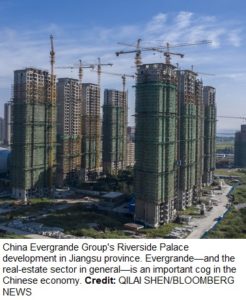
… and it may be happening again now with a “Too Big To Fail” crisis in China. See the full news story & VIDEO here:

News Article – Title: China: What is Evergrande and is it too big to fail?
Sub-title: Global financial markets have been on high alert as cash-strapped Chinese property giant Evergrande faces several key tests in the coming days.

The world’s most indebted real estate developer is set to hit a series of deadlines for bond interest payments, totalling tens of millions of dollars.

As the company struggles to meet those payments, it has started to repay some investors in its wealth management business with property.

What does Evergrande do?

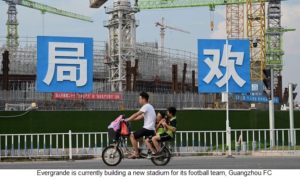
Businessman Hui Ka Yan founded Evergrande, formerly known as the Hengda Group, in 1996 in Guangzhou, southern China.

Evergrande Real Estate currently owns more than 1,300 projects in more than 280 cities across China.

The broader Evergrande Group now encompasses far more than just real estate development.

Its businesses range from wealth management, making electric cars and food and drink manufacturing. It even owns one of country’s biggest football teams – Guangzhou FC.

Mr Hui was once Asia’s richest person and, despite seeing his wealth plummet in recent months, has a personal fortune of more than $10bn (£7.3bn), according to Forbes.

Why is Evergrande in trouble?

Evergrande expanded aggressively to become one of China’s biggest companies by borrowing more than $300bn.

Last year, Beijing brought in new rules to control the amount owed by big real estate developers.

The new measures led Evergrande to offer its properties at major discounts to ensure money was coming in to keep the business afloat.

Now, it is struggling to meet the interest payments on its debts.

This uncertainty has seen Evergrande’s share price tumble by around 80% this year. Its bonds have also been downgraded by global credit ratings agencies.

Why would it matter if Evergrande collapses?

There are several reasons why Evergrande’s problems are serious.

Firstly, many people bought property from Evergrande even before building work began. They have paid deposits and could potentially lose that money if it goes bust.

There are also the companies that do business with Evergrande. Firms including construction and design firms and materials suppliers are at risk of incurring major losses, which could force them into bankruptcy.

The third is the potential impact on China’s financial system.

“The financial fallout would be far reaching. Evergrande reportedly owes money to around 171 domestic banks and 121 other financial firms,” the Economist Intelligence Unit’s (EIU) Mattie Bekink told the BBC.

If Evergrande defaults, banks and other lenders may be forced to lend less.

This could lead to what is known as a credit crunch, when companies struggle to borrow money at affordable rates.

A credit crunch would be very bad news for the world’s second largest economy, because companies that can’t borrow find it difficult to grow, and in some cases are unable to continue operating.

This may also unnerve foreign investors, who could see China as a less attractive place to put their money.

Is Evergrande ‘too big to fail’?

The very serious potential fallout of such a heavily-indebted company collapsing has led some analysts to suggest that Beijing may step in to rescue it.

The EIU’s Mattie Bekink thinks so: “Rather than risk disrupting supply chains and enraging homeowners, we think the government will probably find a way to ensure Evergrande’s core business survives.”

Others though are not sure.

In a post on China’s chat app and social media platform WeChat, the influential editor-in-chief of state-backed Global Times newspaper Hu Xijin said Evergrande should not rely on a government bailout and instead needs to save itself.

This also chimes with Beijing’s aim to rein in corporate debt, which means that such a high profile bailout could be seen as setting a bad example.

Reporting by Peter Hoskins and Katie Silver

Source: BBC Business News – Retrieved September 29, 2021 from: https://www.bbc.com/news/business-58579833
Related VIDEO:


Posted September 28, 2021 – What China’s Evergrande crisis means for the world.
This key excerpt from this foregoing news article laments a credit crunch:

This could lead to what is known as a credit crunch, when companies struggle to borrow money at affordable rates.

A credit crunch would be very bad news for the world’s second largest economy, because companies that can’t borrow find it difficult to grow, and in some cases are unable to continue operating.

We saw the world’s largest economy, the USA, deal with “A Too Big to Fail” crisis. We also saw the European Union deal with their crisis. Now we get to see China – the #2 largest economy  – deal with this issue.

What lessons do we learn?

How can we apply those lessons in the Caribbean?
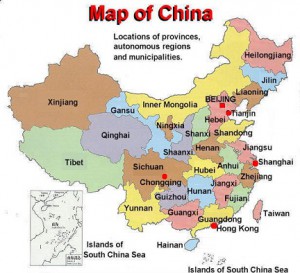
As related previously, China subscribes to a more technocratic approach, rather than the Western model of yielding to the Crony-Capitalism influences for bail-outs; this was the conclusion of the foregoing news article:

… Beijing’s aim to rein in corporate debt, which means that such a high profile bailout could be seen as setting a bad example.

Consider our insights here; these 6 points extracted from previous blog-commentaries on Too Big To Fail contagions and a bad Debt culture:

1. Lessons Learned from 2008: Too Big to Fail –vs- Too Small to Thrive – September 18, 2018

“Too Big to Fail” was a Big Deal. This is more than just an academic discussion …. In 2008 the biggest impact of the global financial contagions was the dilution of net worth for the citizens of the affected countries: US, Canada and Western Europe. These economies are the primary source of Caribbean tourists; since tourism is the primary economic driver, this was a real problem for the pocketbooks of every individual and institution in the region.

The 2008 Great Recession / Financial Crisis exposed the trappings of the interconnected global economy. If we, in the Caribbean, are going to “play in this sandbox” – transact in this marketplace – then we must be prepared and On Guard, for the risks, threats and dangers.

2. Lessons Learned from 2008: Still Recovering – September 20, 2018

When policies are put in place that allow greedy people – bad actors – to continue unabated, bad things happen … to the bad actors and to society in general. This reality is something that stewards of every society must contend with. Every community is required to implement public safety provisions – at great expense. But the lesson is undisputed: whatever law enforcement costs, pales in comparison to lawlessness.

This actuality applies all the more so to economic crimes and misdeeds; this was definitely true with all the economic crimes leading up to the Great Recession of 2008 – lost of net worth estimated at $11 Trillion. And yet, the US is throwing out much of the wisdom gleaned after 2008. There is the trend now to undo a lot of the reforms that were implemented after the Financial Crisis – to de-fang the Dodd-Frank regulations. This is unwise! The regulations that were imposed are designed to mitigate the risk of subsequent economic meltdowns.

History does repeat itself. …

2008 was a giant mess for the US. We want to learn and apply lessons from their experiences. But truthfully, we have no power there. We have no vote and no voice to change them. We can only protect ourselves from their abusive activities; (the abuse to the American-self and the interconnected world). The bad trend of America stripping the new financial protections has begun – already after less than 10 years.

3. ‘Too Big To Fail’ – Caribbean Version – November 14, 2014

The Caribbean region has not been front-and-center to many financial crises in the past, compared to the 465 US bank failures between 2008 and 2012.[a] But over the past few decades, there have been some failures among local commercial banks and affiliated insurance companies where the institutions could not meet demands from depositors for withdrawal. Consider these examples from Jamaica and Trinidad …

With the advent of the CARICOM Single Market & Economy (CSME), a more integrated region is expected to lead to greater linkages among the member-states of this existing economic union.

4. Day of Reckoning for NINJA Loans – January 19, 2017

It is time for the Day of Reckoning for one of the players in the recent housing bubble and financial crisis, referred to as the Great Recession of 2008. Industry stakeholders had been “skimming of the public coffers for mortgage guarantees and giving unwise mortgages to people who had what was considered NINJA qualification:

  • NIncome
  • NJob or Assets

Such activities in the retail mortgage industry, plus bad practices in the wholesale lending, credit ratings and mortgage-back securities industries had congealed to form a “perfect storm” for disaster in the financial markets (Wall Street, et al) in the US and around the world.

Many innocent people lost fortune and faith in the American eco-system. There had to be an accounting of the “sins and sinister plots”; there had to be a Day of Reckoning. That day came for one Michigan-based (Detroit area) company, United Shore Financial Services. See the full story here …

5. Lessons from Iceland – Model of Recovery – September 23, 2015

There are so many lessons the Caribbean region can learn from the island Republic of Iceland. …

During the bad days of the Great Recession – at the precipice of disaster – the country deviated from other troubled regions …

    Iceland let its banks fail in 2008 because they proved too big to save.

How does it relate to the Caribbean? The Caribbean is at the precipice … now; many of the member-states are near Failed-State status, while others are still hoping to recover from the devastating Great Recession of 2008. Turn-around should not take this long – 7 years. Strategies, tactics and implementations of best-practices to effect a turn-around must be pursued now.

Iceland has now recovered, and complaining about a 2% unemployment rate. What did they do that was so radically different than other locations? For one, they changed course regarding economics, security and governing policies. An ultra-capitalist movement had taken hold of the country and business communities; they pursued an aggressive “boom-or-bust” strategy, that ultimately “busted”, rather than continue on that road, the country – all aspects of society – altered course and returned to a path of sound fundamentals.

They rebooted and turned-around! Iceland embraced all aspects of turn-around strategies, mandating bankruptcies and “wind-downs” so that the economy – and society in general – could start anew.

6. Beware of Vulture Capitalists – February 25, 2016

… just say “No” to debt!

Many bad things happen when people, institutions and countries depend on debt. A “slippery slope” can emerge … from dependence, to reliance, to requirement, to a “vital” status, to … debt slavery. Emancipation from debt slavery is not so easy, as many times its a voluntary slavery. The ransom to redeem from slavery is all about money, finance and/or economics. This is why the sage advice from a Subject Matter Expert in Economics is: The further one stays away from debt, the better!

It’s a lesson learned, as chronicled in the 2013 book Go Lean … Caribbean, from Detroit; not only does debt impact the past, but the future as well. Debt can be so bad that at times the providers … and collectors of debt may be derisively called “vultures” …

This dire disposition of debt is not exclusive nor limited to Detroit. This applies to many other communities, in North America, Europe (think Greece), Latin America and even in the Caribbean.

Some may conclude: “this Evergrande Debt Crisis is a Chinese problem for China to deal with alone”. Right?

Such people may think that this drama ”is none of our business”.

Alas, we have learned so much about economic contagions to know that this can affect us … quickly. Plus, in the last decades, China has emerged as a global giant in trade and also a regional player in the Caribbean for foreign investment and infrastructure-building. We are in too deep! See this portrayal in this excerpt from a previous blog-commentary:

China’s Caribbean Playbook: America’s Script – September 2, 2015

China has invested heavily in the Caribbean, as of recent; see [this] list here of selected announcements …

Just what is China’s motive, their end game?

Should we be leery or should we just embrace [the badly needed] help from whatever sources?

How much of this questioning is influenced by a pro-American yearning? Pro-Christian yearning? Fear of strangers? Racist under-valuing of non-White/European races?

There is the need for the Caribbean to take stock of its thoughts-feelings-actions and give all of these questions serious deliberation.

If this Golden Rule is true: “he who has the gold makes the rules”, then we will be held to account to stakeholders in China, as their many state-own companies are definitely “bringing gold” to the table. …

[China’s] This focus on trade is very familiar.

This is the same playbook of the United States of America in building the world’s largest Single Market economy. (Remember, with the Army Corp of Engineers, the US built the Panama Canal, but with more strings attached). China is simply following the same American script – minus the cronyism and militarism – of promoting trade of their products, services and capital.

Capital? Yes, many of the projects highlighted in the foregoing news articles are being financed by China’s state-owned banks and lending institutions. They are “putting their money, where their mouth is”.
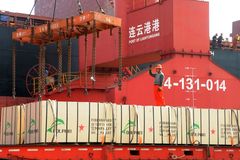
The possibility of an economic contagion originating out of China should scare us.

(We are still dealing with the Coronavirus COVID-19 pandemic, which originated out of China).

So let’s pay more than the usual attention … about the news and developments of this Evergrande Debt crisis. This is our business too. We must look, listen, learn, lend-a-hand and lead our own stewardship for economic contagions in our Caribbean region.

Everyone in the Caribbean are urged to lean-in to this consideration to glean the insights, strategies, tactics and implementations of China in managing this Evergrande crisis.

We are not being asked to change China; no, we are being asked to change “us”. It is heavy-lifting to remediate and mitigate threats and protect our society; but this is what it takes to lead: to reform and transform our society. Yes, we can make our regional homeland a better place to live, work and play.

Let’s get started; let’s stay alert; let’s protect our homeland … 🙂

About the Book
The book Go Lean…Caribbean serves as a roadmap for the introduction and implementation of the technocratic Caribbean Union Trade Federation (CU) and the accompanying Caribbean Central Bank (CCB), for the elevation of Caribbean society – for all member-states. This CU/Go Lean roadmap has these 3 prime directives:

  • Optimization of the economic engines in order to grow the regional economy to $800 Billion & create 2.2 million new jobs.
  • Establishment of a security apparatus to ensure public safety and protect the resultant economic engines.
  • Improve Caribbean governance to support these engines, including a separation-of-powers between the member-states and CU federal agencies.

The Go Lean book provides 370-pages of turn-by-turn instructions on “how” to adopt new community ethos, plus the strategies, tactics, implementations and advocacies to execute so as to reboot, reform and transform the societal engines of Caribbean society.

Download the free e-Book of Go Lean … Caribbean – now!

Who We Are
The movement behind the Go Lean book – a non-partisan, apolitical, religiously-neutral Community Development Foundation chartered for the purpose of empowering and re-booting economic engines – stresses that reforming and transforming the Caribbean societal engines must be a regional pursuit. This was an early motivation for the roadmap, as pronounced in the opening Declaration of Interdependence (Pages 12):

x. Whereas we are surrounded and allied to nations of larger proportions in land mass, populations, and treasuries, elements in their societies may have ill-intent in their pursuits, at the expense of the safety and security of our citizens. We must therefore appoint “new guards” to ensure our public safety and threats against our society, both domestic and foreign. The Federation must employ the latest advances and best practices … to assuage continuous threats against public safety.

xi. Whereas all men are entitled to the benefits of good governance in a free society, “new guards” must be enacted to dissuade the emergence of incompetence, corruption, nepotism and cronyism at the peril of the people’s best interest. The Federation must guarantee the executions of a social contract between government and the governed.

xvi.  Whereas security of our homeland is inextricably linked to prosperity of the homeland, the economic and security interest of the region needs to be aligned under the same governance. Since economic crimes … can imperil the functioning of the wheels of commerce for all the citizenry, the accedence of this Federation must equip the security apparatus with the tools and techniques for predictive and proactive interdictions.

xiv.  Whereas a free market economy can be induced and spurred for continuous progress, the Federation must install the controls to better manage aspects of the economy: jobs, inflation, savings rate, investments and other economic principles. Thereby attracting direct foreign investment because of the stability and vibrancy of our economy.

Sign the petition to lean-in for this roadmap for the Caribbean Union Trade Federation.
Share this post:
, ,

Why not share … ? – Encore

There is still flooding in certain parts of the US.
There is still drought in certain parts of the US.

These two regions are still not sharing. Why continue this problem … unabated?!

Perhaps it is denial

This was the contention in a previous blog-commentary in June 27, 2014 where we highlighted the actuality of Climate Change and urged our American counterparts to get ready; invest in infrastructure to share water resources. Now, a popular Comedian/Pundit is making the same urging, though more comically.

See the Host here on HBO’s Real Time with Bill Maher as he lambasted this lack of sharing. See this embedded VIDEO here:

VIDEO – New Rule: America’s Pipe Dream – Real Time with Bill Maherhttps://youtu.be/SAsExSNfNXQ

So why still no sharing?

Why are factions in this country (USA) continuing to deny the actuality of Climate Change? For one, the age-old standard may have a lot to do with the issue:

You break it; you buy it.

Acknowledging the problem comes with the responsibility to “do something” about it; to address it; fix it; mitigate it and prepare for it.

We raised these points in that previous June 27, 2014 blog-commentary; it is only apropos to Encore it again now.

—————————————

Go Lean CommentaryFloods in Minnesota, Drought in California – Why Not Share?

Millions across Minnesota are in the middle of a flooding disaster as a severe storm system moves over the central U.S.. See this VIDEO:

VIDEO – CBS News; posted June 23, 2014; retrieved June 27 from: http://www.cbsnews.com/videos/minnesota-communities-face-weeks-of-flooding/
Title: Minnesota communities face weeks of flooding

(VIDEO plays best in Internet Explorer).

At the same time, California continues to endure serious drought conditions. Many feel, though not supported by the facts, that this may be the worst drought in California history. See the aligning VIDEO here:

VIDEO – Win Rosenfeld, NBC News; posted June 2, 2014; retrieved June 27 from: https://www.youtube.com/watch?v=Gx7vFqU8iGY
Title: California’s Drought History | Debunker

So on the one hand, part of the United States is experiencing too much water and in other parts of the country, too little water. This is Climate Change 101. If only, there would be some equalizing between “the feast and the famine” with water.

This was the point/comment of one viewer of the CBS News Video:

Why are we not building a WATER PIPELINE from these flood prone areas to the parched West and South?!?!? If we can afford an OIL pipeline all the way to the southern gulf, we can definitely build a desperately needed pipeline for water! – By: uberengineer – June 24, 2014

This comment was spot on! According to the book Go Lean … Caribbean, pipelines can be strategic, tactical and operationally efficient. They can mitigate challenges of Mother Nature, create jobs and grow the economy at the same time.

The Go Lean book identifies that there are “agents-of-change” that our world have to now contend with. Proactively managing the cause-and-effect of these agents can yield great benefits and alleviate much suffering. The agents-of-change for the Caribbean are identified as follows:

Technology
Aging Diaspora
Climate Change
Globalization

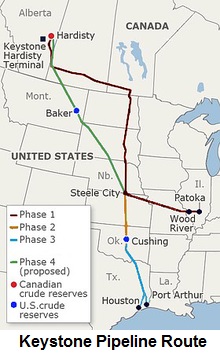
If the suggestion of above commentator Uber Engineer is to be seriously considered in the US, this would fall under the scope of the US federal government as two states California and Minnesota are involved – neither state has jurisdiction over the other. Plus, the many states in between (Iowa, Nebraska, Colorado, Utah and Nevada) where a pipeline would traverse would also have to be factored into the equation. Under US law this approach is called an Interstate Compact. Uber Engineer is right! This pipeline strategy is already being deployed for oil in the US with the TransCanada Keystone [a] Pipeline project, running from southern Canada down to the Gulf of Mexico; (see route map in the photo).

The question is: who can contemplate such a solution for the Caribbean marketplace? The Go Lean book posits that Climate Change is wreaking havoc on Caribbean life as well and that Caribbean stakeholders must proactively consider the benefits of pipeline deployments in the region. This book purports that a new technology-enhanced industrial revolution is emerging, in which there is more efficiency gleaned from installing, monitoring and maintaining pipelines. Caribbean society must participate, not just spectate the developments in this revolution. This point is pronounced early in the book with this Declaration of Interdependence (Page 11 &14), with the opening and subsequent statements:

i.     Whereas the earth’s climate has undeniably changed resulting in more severe tropical weather storms, it is necessary to prepare to insure the safety and security of life, property and systems of commerce in our geographical region. As nature recognizes no borders in the target of its destruction, we also must set aside border considerations in the preparation and response to these weather challenges.

xxvi.       Whereas the Caribbean region must have new jobs to empower the engines of the economy and create the income sources for prosperity, and encourage the next generation to forge their dreams right at home, the Federation must therefore foster the development of new industries, like that of … pipelines …

xxvii.     Whereas the region has endured a spectator status during the Industrial Revolution, we cannot stand on the sidelines of this new economy, the Information Revolution. Rather, the Federation must embrace all the tenets of Internet Communications Technology (ICT) to serve as an equalizing element in competition with the rest of the world. The Federation must bridge the digital divide and promote the community ethos that research/development is valuable and must be promoted and incentivized for adoption.

This book Go Lean… Caribbean, serves as a roadmap for the introduction and implementation of the technocratic Caribbean Union Trade Federation (CU) to elevate society of the 30 Caribbean member-states. This agency will assume jurisdiction for the Caribbean Sea, the 1,063,000 square-mile international waters under the guise of an Exclusive Economic Zone. This approach allows for cooperation and equalization between the feast-and-famine conditions in the region. This is a real solution to real problems! In fact the CU/Go Lean roadmap has these 3 prime directives:

  • Optimization of the economic engines in order to grow the regional economy.
  • Establishment of a security apparatus to protect the resultant economic engines.
  • Improve Caribbean governance to support these engines.

The Go Lean book details the economic principles and community ethos to adopt, plus the executions of strategies, tactics, implementations and advocacies to forge Research & Development with pipelines and industrial growth in Caribbean communities:

Economic Principles – People Choose because Resources are Limited Page 21
Economic Principles – All Choices Involve Costs Page 21
Economic Principles – People Respond to Incentives Page 21
Economic Principles – Economic Systems Influence Individual Choices Page 21
Economic Principles – Voluntary Trade Creates Wealth Page 21
Economic Principles – Consequences of Choices Lie in the Future Page 21
Community Ethos – Job   Multiplier Page 22
Community Ethos – “Crap” Happens Page 23
Community Ethos – Lean Operations Page 24
Community Ethos – Return on Investments (ROI) Page 24
Community Ethos – Cooperatives Page 25
Community Ethos – Ways to Impact the Future Page 26
Community Ethos – Ways to Help Entrepreneurship Page 28
Community Ethos – Ways to Impact Research & Development Page 30
Community Ethos – Ways to Improve Negotiations Page 32
Community Ethos – Ways to Improve Sharing Page 35
Community Ethos – Impact the Greater Good Page 37
Anecdote – Pipeline Transport – Strategies, Tactics &   Implementations Page 43
Strategy – Vision – Confederating 30 Member-states in a Union Page 45
Strategy – Agents of Change – Technology Page 57
Strategy – Agents of Change – Aging Diaspora Page 57
Strategy – Agents of Change – Globalization Page 57
Strategy – Agents of Change – Climate Change Page 57
Tactical – Fostering a Technocracy Page 64
Tactical – Growing Economy – New High Multiplier Industries Page 68
Separation of Powers – Interstate   Commerce Administration Page 79
Separation of Powers – Interior Department – Exclusive Economic Zone Page 82
Implementation – Assemble – Pipeline as a Focused   Activity Page 96
Implementation – Ways to Pay for Change Page 101
Implementation – Benefits from the Exclusive Economic Zone Page 104
Implementation – Ways to Develop a Pipeline Industry Page 107
Implementation – Ways to Deliver Page 109
Planning – 10 Big Ideas – Pipeline Projects Page 127
Advocacy – Ways to Grow the Economy Page 151
Advocacy – Ways to Create Jobs Page 152
Advocacy – Ways to Better Manage the Social Contract – Infrastructure Page 170
Advocacy – Ways to Ways to Impact Public Works – Ideal for Pipelines Page 175
Advocacy – Ways to Foster Cooperatives Page 176
Advocacy – Ways to Better Manage Natural Resources – Water   Resources Page 183
Advocacy – Ways to Impact Extractions – Pipeline Strategy   Alignment Page 195
Advocacy – Ways to Improve Emergency Management Page 196
Advocacy – Ways to Foster Technology Page 197
Advocacy – Ways to Ways to Improve Monopolies – Foster   Cooperatives Page 202
Advocacy – Ways to Improve Transportation – Pipeline Options Page 205
Advocacy – Ways to Impact Rural Living – Minimize Irrigation   Downsides Page 235
Appendix – Interstate Compacts Page 278
Appendix – Pipeline Maintenance Robots Page 283
Appendix – North Dakota Example – Oil Drilling Economic-Societal   Effects Page 334

Historically, pipelines are cheaper than alternative modes of transport for liquid materials like oil, natural gas and water. Plus the cost of water in all aspects of modern society is no longer negligible. Just conduct an acid test at a friendly neighborhood Gas Station; while a gallon of gas may be high, the equivalent pricing for cool drinking water is within the same range.

Water is only free in our society when it is raining; for all other times, there are costs associated with storage and distribution.

Thusly, the economic principles of pipelines are sound.

CU Blog - Floods in Minnesota, Drought in California - Why Not Share - Photo 2

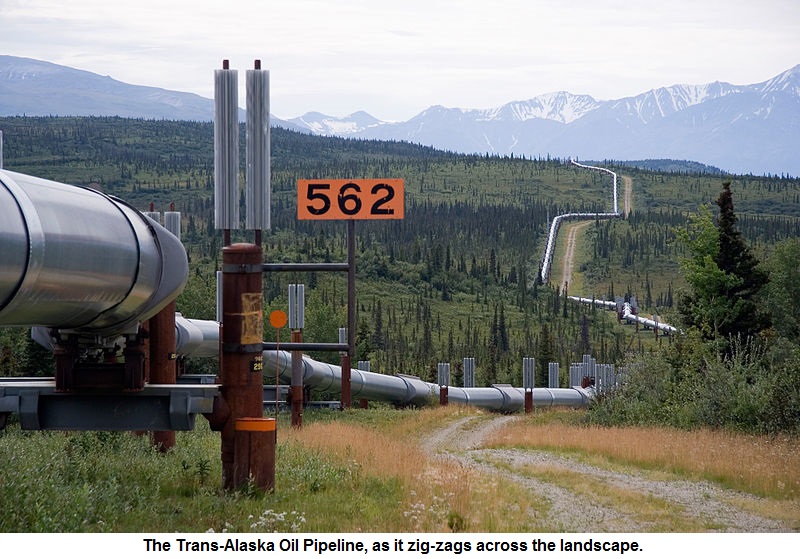
Pipelines can be above ground, underground and/or underwater. (See Trans-Alaska Pipeline photo). There is a role for many schemes of pipeline deployments in the vision for the reboot of the Caribbean homeland. The roadmap Go Lean … Caribbean identifies pipelines as strategic, tactical and operationally mandatory for any chance at success in making the Caribbean a better place to live, work and play.

Download the book Go Lean … Caribbean – now!

——–

Appendix – Referenced Source:

a.     Keystone Pipeline (Retrieved June 27, 2014 from: http://en.wikipedia.org/wiki/Keystone_Pipeline):

The Keystone Pipeline System is an oil pipeline system in Canada and the United States. It runs from the Western Canadian Sedimentary Basin in Alberta, Canada, to refineries in the United States in Steele City, Nebraska; Wood River and Patoka, Illinois; and the Gulf Coast of Texas. In addition to the synthetic crude oil (syncrude) and diluted bitumen (dilbit) from the oil sands of Canada, it also carries light crude oil from the Williston Basin (Bakken) region in Montana and North Dakota.

CU Blog - Floods in Minnesota, Drought in California - Why Not Share - Photo 1Three phases of the project are in operation, and the fourth is awaiting U.S. government approval. Upon completion, the Keystone Pipeline System would consist of the completed 2,151-mile (3,462 km) Keystone Pipeline (Phases I and II), Keystone Gulf Coast Expansion (Phase III), and the proposed Keystone XL Pipeline Project (Phase IV). Phase I, delivering oil from Hardisty, Alberta, to Steele City, Wood River, and Patoka, was completed in the summer of 2010. Phase II, the Keystone-Cushing extension, was completed in February 2011 with the pipeline from Steele City to storage and distribution facilities at Cushing, Oklahoma. These two phases have the capacity to deliver up to 590,000 barrels per day (94,000 m3/d) of oil into the Mid-West refineries. Phase III, the Gulf Coast Extension, which was opened in January 2014, has capacity up to 700,000 barrels per day (110,000 m3/d). The proposed Phase IV, would begin in Hardisty, Alberta, and extend to Steele City, essentially replacing the existing phase I pipeline.

The Keystone XL proposal faced criticism from environmentalists and some members of the United States Congress. In January 2012, President Barack Obama rejected the application amid protests about the pipeline’s impact on Nebraska’s environmentally sensitive Sand Hills region. TransCanada Corporation changed the original proposed route of Keystone XL to minimize “disturbance of land, water resources and special areas”; the new route was approved by Nebraska Governor Dave Heineman in January 2013. On April 18, 2014 the Obama administration announced that the review of the controversial Keystone XL oil pipeline has been extended indefinitely, until at least after the November 4, 2014 mid-term United States elections.


Share this post:
,
[Top]

Zero Sum: Regional Tourism should not be a competition – Encore

Just recently in the Caribbean, we have had to contend with some superlative challenges to our regional tourism product. Consider:

The Clear and Present Dangers of doing business in the Caribbean have been “clear” and “present”.

There is the need for Non-Zero-Sum Thinking. For far too long, Caribbean member-states have been thinking Zero Sum – for one to gain, another one must lose – just trying to outshine each other, with no consideration as to how well or badly the other places fare:

I got mine; I don’t care if you get yours!

Your loss is my gain!

This reflects competition, when really what we need is cooperation, collaboration, convention, collective-bargaining, collusion, consensus-building, confederation …

The requested change is for a new cooperative Community Ethos – the underlying sentiment that informs the beliefs, customs, or practices of society – that we should adopt to coordinate our economic engine on a regional basis.

This is the continuation of the February 2021 Teaching Series for the movement behind the 2013 book Go Lean…Caribbean. (Every month, we present a series relevant to Caribbean life, culture and economics). For this month, we are looking at the subject of Zero Sum Thinking and lamenting how cooperation would be so much more preferred to competition. This fourth entry, 4-of-6, encores a previous blog-commentary that addressed this subject thoroughly; this aligned with the full treatment of this subject. Consider the full catalog of this series, as it is being presented:

  1. Zero Sum: Lesson 101 – No more “Gold Standard”
  2. Zero Sum: Realities of Globalism – “Non-Zero Sum” for the whole world
  3. Zero Sum: ICT as a tool, the “Great Equalizer”
  4. Zero Sum: Regional Tourism should not be a competition – Encore
  5. Zero Sum: Book Review – Racism is a factor; “Us vs Them”
  6. Zero Sum: How to fix “Inequality” – Raise the tide, all boats are elevated

We started this series on Zero Sum by looking at the economic principle that since we are no longer on a “Gold Standard”, any view of “haves versus have-nots” is no longer an issue. We, the full 30 Caribbean member-states, can now all win, gain and grow. Since we have been here and said this before, it is only apropos that we reconsider that previous blog-commentary from June 16 2018, as it relates this assertion.

———————-

Go Lean Commentary – Regional Tourism Coordination – No Longer Optional

No one can hide anymore!

There are 30 different member-states, with 5 different colonial legacies and 4 different languages, and yet people around the world only considers our region as One Caribbean:

Event Consequence to Perception
Devastating hurricane Oops, the Caribbean is unable to function commercially
Devastating earthquake Oops, the Caribbean is unable to function commercially
Emergence of a pandemic Oops, the Caribbean is unable to function commercially

All of the Caribbean member-states are in this “same boat”, so this is a matter of image and geographic misconceptions, more so than it is about disasters.

So, good or bad, the fate of one Caribbean member-state is tied to the other member-states, when it comes to tourism. See this point conveyed in this news article here:

Title: Geographic misconceptions hurting Caribbean economies
By Sarah Peter

Nassau, Bahamas – The mistaken perception among many travelers of the complete devastation of the Caribbean in the wake of the 2017 hurricane season caused further economic destruction to the region’s economy.
That’s according to the Chair of the Caribbean Tourism Organization (CTO), Joy Jibrilu. She raised the concern amid staggering losses among countries which were not impacted by the 2017 Hurricane season.

Jibrilu says following the devastation caused by hurricanes Irma and Maria to some islands in the region, many travelers called and canceled for countries who were not impacted by the storm.

This resulted in a significant drop in hotel room demand across the entire Caribbean. In light of that another disaster, an economic storm, was created which resulted in great losses in tourism revenue and a challenge for tourism officials.

“All our travel partners, all of them without exception called and said that we have heard the Caribbean  is closed.”

She further added that  Caribbean islands irrespective of if they were not actually impacted by the storm were economically  affected.

We all lost when people were not sure if or when to book if they canceled. You saw a dip in bookings because people thought that the islands which were not impacted were. We must quantify the figures of lost business so we can share the story with the world to tell them how serious it is. “

The chair of the CTO says that over one billion US dollars in tourism revenue was lost in the wake of last year’s hurricane season, the costliest hurricane season on record.

Jibrilu, who is also the Director of Tourism for the island of Barbados says the region’s reconstruction and recovery effort has been estimated at close to  6 billion dollars.

“Tourism is the region’s greatest driver of foreign exchange tax revenue and reliable vehicle of poverty reduction and human capital development for the region’s small island developing states. The tragedy is that the dampening of demand occurred even among islands that were not in the path of the storm.  This contributes to  an economic disaster as tourism visitation dropped of resulting in significant losses in revenue.”

Jilbrilu blamed the international media for the problem. She says their reports describes the region as if it was one country as opposed to several different islands. The chairman of the CTO says this inaccurate reporting is costing a region millions and negatively impacting lives in the region.

“First of all if we look at international news reporters when they talk about a hurricane they say the “Caribbean” has been impacted. They generalize and say the entire Caribbean. As a result, people look at the Caribbean as a whole unit as oppose to all these different countries, thousands of miles away from each other. To put it in context the Bahamas alone from north to south covers one hundred thousand square miles that is further than the distance of  Toronto to New York.  So if a storm happens in New York no one would say I am not going to Toronto. They just would not, it just does not make sense but when people lump the Caribbean  together as just one region ( as if it was just one country ) it  is negative.”

Jilbrilu says the region’s economy and people lives depend on accurate reporting and think making the international media more aware of this matter is a matter of economic prosperity or suffering for the region’s people.

“What we have done is to educate people of the geography of the Caribbean, that the same time it takes to travel from the Bahamas to Barbados is the same as traveling from London in the UK to Rome, Italy. So what happens to the Bahamas does not impact Barbados and vice versa.  We really  want to get that message out.”

Jilbrilu made the disclosure at the 2018 annual Caribbean Aviation Meetup in the Bahamas. Dubbed as the Caribbean region’s largest aviation conference the annual event brings together major players from the aviation and tourism industries aimed at tackling problems faced by the  World and the Caribbean’s Tourism and Aviation industries.
Source: Posted and retrieved June 15, 2018 from: https://stluciatimes.com/2018/06/15/geographic-misconceptions-hurting-caribbean-economies/

As related in the foregoing, the whole world knew of the 2017 devastation from Hurricanes Irma and Maria. But the affected (wiped-out) islands were only Barbuda, Grenada and Puerto Rico. And yet:

… following the devastation caused by hurricanes Irma and Maria to some islands in the region, many travelers called and canceled for countries who were not impacted.

Again, this is a matter of image and geographic misconceptions, more so than it is about disasters or even tourism. The world is telling the Caribbean: Better band together to assuage your challenges. We are united in affliction, we might as well be united in solutions. Yes, it is no longer optional for our region to confederate as a Single Market. This, we must do!

Confederation is not a bad thing! In a previous blog-commentary, it was asserted that our Caribbean member-states all suffer from the same inadequate image, and thusly we can all benefit from a regional elevation. Yes, the effect of regional integration could be an Increased Caribbean Tourism Market Share. That commentary quoted:

It’s time to take inventory of Caribbean tourism:

It has been weighed in the balance; it has been measured …
It has been found wanting!

Tourism is the current dominant industry; the goal is to “stand on the shoulders” of previous accomplishments, add infrastructure not possible by just one member-state alone and then reap the benefits. Imagine this manifestation in just this one new strategy: inter-island ferries that connect all islands for people, cars and goods.

The movement behind the book Go Lean … Caribbean seeks to reboot the economic engines of the Caribbean member-states. So while tourism is the region’s primary economic driver, it is inadequate for providing the needs of the people in the region, and inadequate for dealing with the crisis of natural disasters. We must do better!

The Go Lean book serves as a roadmap for the introduction and implementation of the Caribbean Union Trade Federation (CU). The CU is designed to be a technocratic intergovernmental entity that shepherds economic growth for the Caribbean region and mitigate against all security-disaster challenges. The goal is to reboot and optimize the region’s economic, security and governing engines with a regional focus.

The Go Lean/CU roadmap will employ strategies, tactics and implementations to impact its prime directives; identified with the following 3 statements:

  • Optimization of the economic engines in order to grow the regional economy to $800 Billion & create 2.2 million new jobs.
  • Establishment of a security apparatus to ensure public safety and protect the resultant economic engines. This includes a professional disaster planning and response organization.
  • Improvement of Caribbean governance to support these engines, including a separation-of-powers between the member-states and CU federal agencies, as in Self-Governing Entities.

The Go Lean book provides 370-pages of turn-by-turn instructions on “how” to adopt new community ethos, plus the strategies, tactics, implementations and advocacies to execute so as to elevate Caribbean image in good times and bad. One advocacy seeks to optimize the Caribbean tourism brand throughout the world; consider some specific plans, excerpts and headlines from the book on Page 133 entitled:

10 Ways to Better Manage Image

1 Lean-in for the Caribbean Single Market
This will allow for the unification of the region into one market of 42 million people across 30 member-states, with a GDP of $800 Billion (according to 2010 figures). In addition, the treaty calls for collective bargaining with foreign countries and industry representatives for causes of significance to the Caribbean community. There are many times when the media portray a “negative” depiction of Caribbean life, culture and people. The CU will have the scale to effectuate negotiations to better manage the region’s image, and the means by which to enforce the tenets.
2 Media Industrial Complex
The Caribbean Central Bank will settle electronic payments transactions; this will allow electronic commerce to flourish in the region. With the payment mechanisms in place, music, movies, TV shows and other media (domestic and foreign) can be paid for and downloaded legally. For a population base of 42 million, this brings a huge economic clout.
3 Respect for Intellectual Property
4 Sentinel in Hollywood
5 Anti-Defamation League
This Pro-Jewish organization provides a great model for marshalling against negative stereotypes that can belittle a race. The CU will study, copy, and model a lot of the successes of the Anti-Defamation League. This organization can also be consulted with to coach the CU’s efforts. (Consider the example of Uptown Yardies Rasta Gang in the game Grand Theft Auto [206]).
6 Power of the Boycott
The CU is an economic negotiating bloc. The power to ban, boycott and censure trade in intellectual property is a powerful deterrent for producers to be balanced in their media portrayals. A CU federal agency will assume the role to rate pending moves, as performed by MPAA in the US. While the content may not be banned outright, placing a Rated R, NC-17 or X label to a film will affect the economic results from the box office. This is the “power of the purse”.
7 Freedom of the Press
8 Libel and Slander Litigation and Enforcement
9 Public Relations and Press Releases
To facilitate effective communications, the CU’s agencies will embrace the role of “Press Secretaries” to disseminateaccurate records, news and portrayals of Caribbean life. This role is Offensive rather than the above Defensive tactics.
10 Image Award Medals and Recognition
Following the model of the NAACP Image Awards, the CU will recognize and give accolades for individual and institutions that portray a positive “image” of Caribbean life and CU initiatives. This would be similar to the Presidential Medal of … / Congressional Medal of …

The likelihood of more hurricanes in the Caribbean is undeniable. This is further exacerbated with the reality of Climate Change. Our Caribbean region must be prepared to Rinse & Repeat. It is no longer an option to maybe manage our image on a regional level. The world must know that we are bigger than just whatever island has been recently impacted by a natural disaster. This challenge is heavy-lifting because, as a region, we rarely muster an adequate response to our natural disasters.

The Go Lean book explains further that the Caribbean region must install a security apparatus with the directive to prepare and respond to natural disasters. The efficiency and effectiveness of a Caribbean Emergency Management Agency must be streamlined to ensure the world of the business continuity of our systems of commerce. This quotation is derived from the book at Page 184:

Modeled after FEMA in the US, this agency will be charged with the preparation, response and reconstruction for the regions for the eventual manifestations of hurricanes, earthquakes, tsunamis, flooding and other declared disasters, natural and man-made like medical epidemic, drought, pollution, oil spills, terrorism, etc.

This is what it means to be a technocracy, to promote the best delivery arts and sciences, in this case for Professional Emergency Management; as explained further at Page 64:

The CU treaty calls for a collective security agreement for the Caribbean member-states to prepare-respond to natural disasters, emergency incidents and assuage against systemic threats against the homeland. The CU employs the professional arts and sciences of Emergency Management to spread the costs and risks across the entire region. Outside of hurricanes or earthquakes, the emergency scope includes medical trauma, pandemic incidents and industrial accidents (i.e. oil or chemical spills) – any scenario that can impact the continuity of the economic engines and/or community.

This above scenario describes the dynamics of regional tourism promotion and protection. Yes, managing regional tourism means optimizing the planning and response for natural disasters. This is no longer optional for this homeland. We are compelled to invest in this integration and collaboration. We must have the leverage to spread the costs, risks and premium base across the entire region. Only then will the rest of the world know that any hurricane in the Caribbean does not mean a shutdown of the entire Caribbean region. Our image will then be:

Be our guests … in rain and shine.

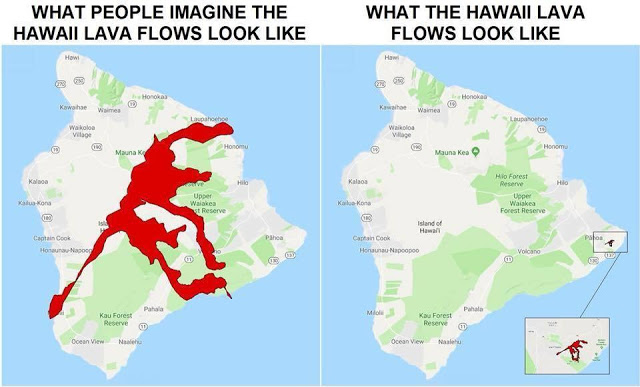
Consider this Hawaiian example; yes this problem of promoting tourism while contending with natural disasters is not just an issue for the Caribbean. Rather, the US State of Hawaii is contending with the same thing right now, with the active Kīlauea volcano. See related news VIDEO in the Appendix below.

There is the need for better stewardship of the economic engines on touristic islands, be it Hawaii or the Caribbean. It is what it is! And our situations will worsen; things will get worse before they get worst. This is due to the reality and eventuality of Climate Change. This need to assuage against the threats and realities of Climate Change was an original intent of the Go Lean roadmap. The opening Declaration of Interdependence stresses this (Page 11) in the first of many pronouncements:

i. Whereas the earth’s climate has undeniably changed resulting in more severe tropical weather storms, it is necessary to prepare to insure the safety and security of life, property and systems of commerce in our geographical region. As nature recognizes no borders in the target of its destruction, we also must set aside border considerations in the preparation and response to these weather challenges.

The Go Lean movement has previously detailed many related issues and advocacies for disaster awareness and abatement. Consider this sample of previous blog-commentaries:

https://goleancaribbean.com/blog/?p=15012 In Life or Death: No Love for Puerto Rico
https://goleancaribbean.com/blog/?p=14925 ‘Climate Change’ Reality!? Numbers Don’t Lie
https://goleancaribbean.com/blog/?p=14832 Example of Manifesting Environmental Change
https://goleancaribbean.com/blog/?p=13391 After Maria, Failed-State Indicators: Destruction and Defection for Puerto Rico
https://goleancaribbean.com/blog/?p=12996 After Irma, Failed State Indicators: Destruction and Defection
https://goleancaribbean.com/blog/?p=12977 After Irma, Barbuda Becomes a ‘Ghost Town’
https://goleancaribbean.com/blog/?p=12900 The Logistics of Disaster Relief
https://goleancaribbean.com/blog/?p=12879 Disaster Preparation: ‘Rinse and Repeat’
https://goleancaribbean.com/blog/?p=11858 Looking and Learning from the Cautionary Tale of Kiribati
https://goleancaribbean.com/blog/?p=9455 Fix ‘Climate Change’ – Yes, We Can
https://goleancaribbean.com/blog/?p=7103 COP21 – ‘Climate Change’ Acknowledged
https://goleancaribbean.com/blog/?p=6893 A Meteorologist’s View On Climate Change
https://goleancaribbean.com/blog/?p=4673 Climate Change‘ Merchants of Doubt … to Preserve Profits!!
https://goleancaribbean.com/blog/?p=2465 Book: ‘This Changes Everything: Capitalism vs. the Climate’
https://goleancaribbean.com/blog/?p=2276 Climate Change May Affect Food Supply Within a Decade
https://goleancaribbean.com/blog/?p=1883 Climate Change May Bring More Kidney Stones
https://goleancaribbean.com/blog/?p=1817 Caribbean grapples with intense cycles of flooding & drought

In summary, the issues in this commentary relate more to image and geographic misconceptions than they do tourism and natural disasters. Do we have the global reputation to “take a punch and stand back up”.

Unfortunately, no!

So we must reform and transform the Caribbean’s societal engines so as to assuage the dangers of Climate Change and natural disasters; pandemics too. This is the quest of the Go Lean roadmap, and this is not just a pipe dream; it is conceivable, believable and achievable for our regional stakeholders to do better and be better.

All Caribbean stakeholders – residents and tourists alike – are urged to lean-in to this roadmap for change … and empowerment. Yes, we can make the region a better place to live work and play. 🙂

Sign the petition to lean-in for this roadmap for the Caribbean Union Trade Federation.

—————-

Appendix VIDEO – Hawaii tourism hit hard by Kilauea volcano eruption – https://youtu.be/89ppKLS5ufI

CBS Evening News
Published on Jun 2, 2018 – As molten lava destroys more homes in Hawaii, police have been ordered to arrest people who refuse to evacuate. Thousands have already been forced to flee to safety. Now, dramatic images broadcast around the world are having another impact — on tourism. CBS News correspondent Carter Evans reports.

Share this post:
, , ,
[Top]

Mineral Extraction 101 – Restoration after Extraction – Cool Sites

Go Lean Commentary

We have been known to say … repeatedly:

We cannot change the past.
All we can do is learn from the past and change the present/future.

We talk the talk with this verbiage; we also walk the walk.

A lot of harm has been done to the Caribbean, environmentally, due to mining and Mineral Extraction. The earth has been scarred-and-scotched. But …

… there is now the opportunity to not just learn wisdom from those previous bad experiences but also to transform the scarred-and-scotched land into “Cool Sites”. We can and should make attractions for visitors, sightseers and adventure-seekers.

We can turn lemons into lemonade.

If we succeed at doing this, we will not be the first ones or the only ones. No, this strategy has developed into a globally-recognized Best Practice for reclaiming scarred-and-scotched terrains, damaged by previous mining or extraction activities. See this portrayed in this “Feature Article” here:

Title 1: Abandoned mines transformed into amazing tourist attractions
By:
Mark Johanson

What do you do with a mine after it’s fulfilled its original purpose?

An increasing number of destinations across the globe are turning sources of extraction into places of attraction.

Here’s a look at six innovative regeneration projects that are breathing new life into former industrial wastelands, including one that opened earlier this year.

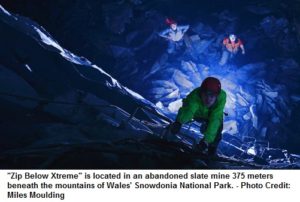
Zip Below Xtreme

This new thrill ride from Go Below Underground Adventures is located in an abandoned slate mine at depths that reach 375 meters (1,230 feet) beneath the mountains of Wales’ Snowdonia National Park.

It became the deepest zip wire in the world when it opened to the public in March 2105 and also claims to be the world’s longest subterranean attraction with three miles (five kilometers) of track, including a bloodcurdling 21-meter freefall.

Zip Below Xtreme, Conwy Falls Caf, A5 (Pentrefoelas Road), Betws-y-coed, Snowdonia, Wales, UK; +44 016 9071 0108

Salina Turda

Salina Turda was the first major experiment in turning a disused mine into a non-traditional tourist attraction when it opened to the public in 1992.

Located in the heart of Transylvania, in western Romania, visitors descend 120 meters underground along the same elevator shafts that once hauled salt to the surface.

At the bottom sits an underground theme park with a grab bag of attractions like a miniature golf course, Ferris wheel, bowling alley and underground boating lake.

Salina Turda also has a spa and wellness center capitalizing on the healing properties of the cave’s naturally occurring salts and 80% humidity.

Salina Turda, Aleea Durgaului 7, Turda, Romania; +40 3642 60940

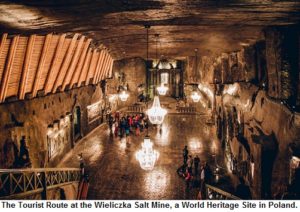
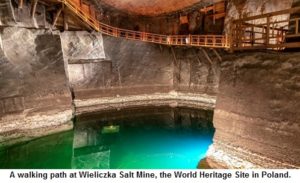
Wieliczka Salt Mine

Wieliczka Salt Mine was included alongside the Galapagos Islands and Yellowstone National Park on UNESCO’s first set of World Heritage Sites.

It remains one of Poland’s top tourist attractions to this day, drawing more than 1.2 million annual visitors.

Built in the 13th century, it was one of the world’s oldest continuously operating mines until workers ceased production in 2007.

Now, Wieliczka is perhaps better known as “Poland’s Underground Salt Cathedral,” where visitors can tour some 22 chambers, including intricate chapels, statues and chandeliers all carved out of rock salt by miners over the centuries.

A newer addition to Wieliczka is the hotel and health resort, located 125 meters underground.

It offers treatment services in chambers that offer a constant temperature and high humidity, are free of pollution and allergens and rich in micronutrients.

The disused mine is also a hub of Polish culture, hosting a regular series of concerts, art exhibitions and special events.

Wieliczka Salt Mine, ul. Danilowicza 10, 32-020 Wieliczka, Poland; +48 1227 87302 

[See the Appendix VIDEO below.]

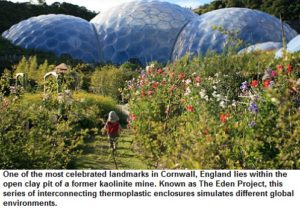
The Eden Project

One of the most celebrated landmarks in Cornwall, England lies within the open clay pit of a former kaolinite mine.

The Eden Project, as it’s known, is a series of interconnecting thermoplastic enclosures that emulate different global environments, from the 1.6-acre Mediterranean Biome to the 3.9-acre Tropical Biome — one of the world’s largest indoor rainforests.

This “pit to paradise” project first opened to the public in March 2001 and added an additional education facility, The Core, in 2005 to help communicate its central message about the interdependence of people and plants.

The former mine was seeping mineral waste as recently as October 1998, but now welcomes hundreds of thousands of visitors each year not only for the gardens, but also for art exhibitions, ice skating and a popular concert series called The Eden Sessions.

The Eden Project, Bodelva, Cornwall, UK; +44 01726 811911

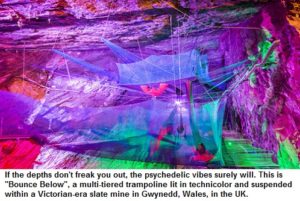
Bounce Below

What do you get when you mix 930 square meters of bouncy nets, one disused cavern and the classic childhood game of Chutes and Ladders?

That, in essence, is the recipe for Bounce Below, a multi-tiered trampoline lit in Technicolor and suspended within a Victorian-era slate mine in Gwynedd, Wales.

Bounce Below opened to the public last July as “the world’s largest underground trampoline,” offering one-hour timeslots to enjoy three separate nets spread across a distance of 180 feet (55 meters) from top to bottom.

Each level is connected by a series of vertigo-inducing slides and ramps, and surrounded by walls of mesh to keep visitors from bouncing out into the abyss.

Bounce Below, Llechwedd Slate Caverns, Blaenau Ffestiniog; +44 1248 601 444

MORE: Deep thrills: The crazy cave trampolines of Wales

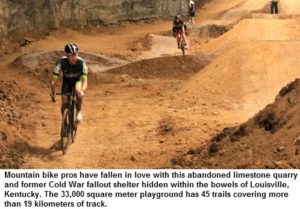
Mega Cavern

Over the past few months, mountain bike pros have flocked to the most unlikely of locations to perfect their skills: an abandoned limestone quarry and former Cold War fallout shelter hidden within the bowels of Louisville, Kentucky.

The latest attraction at the Louisville Mega Cavern easily snagged the title of world’s largest indoor bike park when it opened to the public this February, 30 meters below the Louisville Zoo.

The 33,000 square meter playground has 45 trails covering more than 19 kilometers of track, including a mix of BMX-style jump courses and beginner-level alternatives.

One of the best features of the manmade cavern — which also includes zip lines, aerial ropes courses and tram rides — may be its four-season appeal.

At a constant 10 degrees Celsius (50 F), Mega Cavern maintains the same temperature in the dead of winter as it does in the dog days of summer.

Mega Cavern, 1841 Taylor Ave., Louisville, Kentucky; +1 877 614 6342

===============

Mark Johanson is a freelance travel and culture writer based in Santiago, Chile.

Source: CNN – May 19, 2015; retrieved January 25, 2021 from: https://edition.cnn.com/travel/article/abandoned-mines-tourist-attractions/index.html

Wow, even World Heritage Sites have emerged from previous mines around the world. They did it! We can too!

Alas, our Mineral Extraction activities in the Caribbean is less-mining and more top-of-the-land excavations. Still, the same strategy can be pursued. There have been a lot of “Cool Sites” for visitors, sightseers and adventure-seekers. Look at this actuality at a lot of the “Old Mines”in the US State of Arizona.

Title 2: Arizona’s Mining Attractions
Subtitle: History & Culture
By: Edie Jarolim

Fascinated by underground activities? You’ll hit pay dirt in Arizona, home to the most famous gold mine that might never have existed and host to the world’s largest gem and mineral show.

This quick zip through the state’s mining highlights includes everything from Old West towns that rose and fell by their mineral wealth to today’s thriving museums and exhibitions. (Museum of Northern Arizona pictured above).

Mining in Southern Arizona

The legacy of the silver vein that established one of the world’s most notorious western towns lies mainly in the town’s name: Prospector Ed Schieffelin was warned that venturing into Apache territory would earn him only his Tombstone.

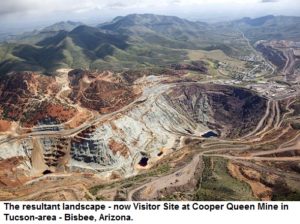
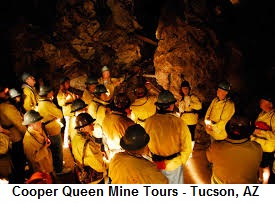
Prosperous for far longer was nearby Bisbee, offering tours of the Copper Queen Mine with the miners who once worked there, vistas into the gaping Lavender mine pit and the Bisbee Mining and Historical Museum, a Smithsonian Institution affiliate. Many mine executives bedded down at the Gadsden Hotel in nearby Douglas, which smelted the ore from Bisbee’s mines.

In Tucson, the University of Arizona Mineral Museum is among the top in the country, and the Arizona-Sonora Desert Museum features excellent earth science exhibits.

Ajo, a trim mining company town near Organ Pipe Cactus National Monument in the southwest, has two small museums and one large open pit mine overlook.

But mining is far from being history in “The Copper State.” At Asarco’s Mission mine, just south of Tucson, visitors can learn about the industry and see modern copper strip-mining in action.

Nearly a million visitors descend on tiny Quartzsite, just east of the California border, for the QIA PowWow – Gem & Mineral Show in late January. And that’s just a prelude to events in Tucson, where the Tucson Gem and Mineral Show and dozens of smaller shows around town draw national and international throngs during the first two weeks of February, outdoing every other gathering of its kind.

Mining in Central Arizona

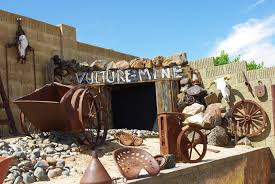
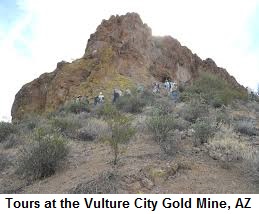
Northwest of Phoenix, Wickenburg once hosted the Arizona Territory’s richest gold mine. Now you can visit Robson’s Ranch & Mining Camp, which re-creates an old mining camp, or take a self-guided tour of the abandoned Vulture Mine.

Drive the winding mountain roads from Wickenburg up to Jerome, where sights include Jerome State Historic Park, a former mine owner’s mansion, the Jerome Historical Society Mine Museum and the Gold King Mining Museum & Ghost Town. In nearby Clarkdale, the Verde Canyon Railroad runs along tracks once used to haul minerals from Jerome.

Mining-related attractions along the spectacular Apache Trail east of Phoenix include the rare ore specimens at Superstition Mountain Museum, re-created Goldfield Ghost Town and the Lost Dutchman State Park, named for the world-renowned gold mine that prospectors are still trying to find.

Mining in Northern & Western Arizona

In the northwest, off old Route 66 near Oatman (an abandoned boomtown popular for its resident burros), the Gold Road Mine offers underground tours and gold panning. The Museum of Northern Arizona in Flagstaff highlights the geology, fossils and minerals of the Colorado Plateau.

About the Author  – Edie Jarolim
is the author of three travel guides and one dog guide. Her book, “Getting Naked for Money: An Accidental Travel Writer Reveals All,” is a memoir about her career as a guidebook editor for Frommer’s, Rough Guides, and Fodor’s and as a Tucson-based freelance travel writer.

Source: Visit Arizona Website – Retrieved January 25, 2021 from: https://www.visitarizona.com/like-a-local/arizonas-mining-attractions/

Considering the 2 foregoing embedded articles, we see that this whole subject aligns with the strategy asserted in the 2013 book Go Lean…Caribbean to promote World Heritage Sites in the region. As the time of publication, the Go Lean book identified the 21 World Heritage Sites in the region. But the take-away from the narrative was that more “Cool Site” could be fostered.

We have the need to pursue this strategy for reclaiming scarred-and-scotched lands in the region. This approach of “Cool Sites” can compliment our existing tourism products. This is truly a deep-dive in the Mineral Extraction ecosystem, as we had previously asserted that Mineral Extraction strategies are incompatible with tourism, but now we are confessing that “Reclaimed Mines” can have some touristic appeal; it allows us to explore more Eco-Tourism endeavors.

This is the continuation of the January 2021 Teaching Series from the movement behind the Go Lean book. Every month, as we engage in an effort to message about reforming and transforming the Caribbean economic engines, we recognize that our Caribbean disposition is tenuous. Our people had made a lot of mistakes in the past, but we are still required to forge a bright future for the Caribbean youth.

This is submission 5-of-6 for this January series. This issue is consistent for our discussion of regional life and culture. We want to make sound decisions about how to use for Natural Resources to enrich our people; and we want to learn from past mistakes. See the full series catalog here as follows:

  1. Mineral Extraction 101Raw Materials ==> Finished Goods
  2. Mineral Extraction 101Lesson from History: Jamaica’s Bauxite
  3. Mineral Extraction 101Industrial Reboot – Modern factories – Small footprints
  4. Mineral Extraction 101Commerce of the Seas – Encore
  5. Mineral Extraction 101 – Restoration after Extraction – Cool Sites
  6. Mineral Extraction 101Sovereign Wealth Fund – Not the Panacea

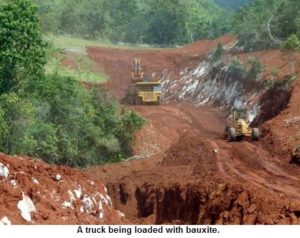
Previously Mineral Extraction – mining and drilling – have been very much destructive to the environment; think Jamaica, Guyana and Suriname Bauxite mining. This is why we have consistently urged Caribbean stakeholders to:

Just Say No … to Mining.

But since we cannot go back in time to our forefathers and change their decisioning, we can only fix the present to harness a better future. The strategy of fostering World Heritage Sites allow us to do both. In fact, this was the rationale of the United Nations in 1948 – after the destruction of World War II – to make concerted efforts to preserve, protect and promote monumental sites of historical significance. See this encyclopedic discussion from Page 248 of the Go Lean book:

The Bottom Line on UNESCO
The United Nations Educational Scientific and Cultural Organization (UNESCO) is a specialized agency of the United Nations. Its purpose is to contribute to peace and security by promoting international collaboration through education, science, and culture in order to further universal respect for justice, the rule of law, and human rights along with fundamental freedom proclaimed in the UN Charter. It is the heir of the League of Nations’ International Commission on Intellectual Cooperation.

Projects sponsored by UNESCO include literacy, technical, and teacher-training programs; international science programs; the promotion of independent media and freedom of the press; translations of world literature; attempts to bridge the worldwide digital divide; the promotion of cultural diversity; and international cooperation agreements to secure the world’s culture and natural heritage (as in the World Heritage Sites).

A UNESCO World Heritage Site is a place of outstanding cultural or natural importance to the common heritage of humanity.

The designation is a forest, mountain, lake, desert, monument, building, complex, or city [district] of special cultural or physical significance. The list is maintained by the International World Heritage Programme administered by the UNESCO World Heritage Committee, composed of 21 states parties which are elected by their General Assembly. (Under certain conditions, listed sites can obtain funds from the World Heritage Fund). The programme was founded with the Convention Concerning the Protection of World Cultural and Natural Heritage, which was adopted by the General Conference of UNESCO on 16 November 1972. Since then, 189 states parties have ratified the convention.

As detailed above, that abandoned Salt Mine in Wieliczka, Poland is a classic World Heritage Site. (Poland is an Eastern European country with no commonality with our Caribbean actuality, and yet we can benefit from a consideration of their Best Practices). It is a role model for us to emulate in the Caribbean. It enjoys huge visitor traffic;  see more details here:

The [former salt] mine is currently one of Poland’s official national Historic Monuments, whose attractions include dozens of statues and four chapels carved out of the rock salt by the miners. The older sculptures have been supplemented with new carvings made by contemporary artists. About 1.2 million people visit the Wieliczka Salt Mine annually.[2] – Source: Wikipedia.

The Go Lean movement had always strategized for greater inclusion of World Heritage Sites (WHS); there are currently 21 sites with the WHS designation. 21, but why can there not be more?! In fact, there is a full advocacy in the book to double-down on all things WHS. Consider these excerpts, headlines and summaries from Page 248 of the book:

10 Ways to Promote World Heritage Sites

1 Lean-in for the Caribbean Single Market & Economy initiative: Caribbean Union Trade Federation (CU).

By embracing the Caribbean Single Market & Economy (CSME) initiative, the CU will allow for the unification of the region into one market of 42 million people, GDP over $800 Billion (based on 2010) that can instill better governance for the region’s World Heritage Sites; (see Appendix ZH on Page 330). In addition to opening a new market for intra-regional tourism, the CU effort will enhance the influx of foreign tourists; promote Art/Eco/Event tourism; enhance cultural pride and anchor the expansion of an Art/Culture eco-system (covering education, media, theater, exhibitions, and events).

2 Oversight of Natural Resources

The CU will assume jurisdiction of oversight on natural resources of the common areas between the member-states. This authority will be granted with the accedence of the CU treaty and the successful petition to the United Nations for an Exclusive Economic Zone. While many of the 21 World Heritage Sites are cultural, the remaining are of natural origins, and thus proper governance is essential – the CU will collaborate and co-partner with member-states on this effort.

3 Economic Impact: Tourism

The status quo for tourism in the region peaks during the peak winter season. Those tourists come to the region for the sun, sand, and surf. On the other hand, eco-tourism around the World Heritage Sites (WHS) tends not to be climate related. Therefore traffic is more consistent year round.

4 Economic Impact: Economic Zones

The CU will strategize the designation of economic zones (Enterprise/Empowerment zone, Industrial Parks, Self-Governing Entities, etc.) near World Heritage Sites. These zones come under CU jurisdiction and allow the regional authority to dictate the nature of industrial activities in those neighborhoods.

5 Economic & Failed-State Crimes
6 Emergency Management
7 Multi-Language Access
8 Cultural/Educational Impact – Essays, Scholarships and Student Loans
9 Foundations Alignment
10 Nominate More WHS Sites

There are many other sites in the Caribbean that can easily qualify for designation of World Heritage Sites. The CU will assume the functions of publicity agents to nominate, lobby and campaign UNESCO to grant the CU more WHS sites. In the past this effort was discouraged because of the attendant costs of maintaining these sites; this dynamic now changes.

So reclaiming a scarred-and-scotched terrain to foster World Heritage Sites is consistent with the Go Lean roadmap. It’s part of the overall Turn-around strategy; to reboot, restore, recover, rebuild, revive and revitalize the OLD into something NEW. In fact, we have presented strategies, tactics and implementations in many previous Go Lean blog-commentaries. See this sample list here:

https://goleancaribbean.com/blog/?p=20052 Rise from the Ashes – Natural/Man-Made Disasters: Protect Paradise
https://goleancaribbean.com/blog/?p=20013 Rise from the Ashes – Phoenix Mythology – This is Good Governance
https://goleancaribbean.com/blog/?p=18475 Refuse to Lose – Direct Foreign Investors ‘Wind-Downs’
https://goleancaribbean.com/blog/?p=17358 Marshall Plan – A Lesson in History – Model for Rebooting
https://goleancaribbean.com/blog/?p=14445 Repairing the Breach: Image can impact Economics and Opportunities
https://goleancaribbean.com/blog/?p=10140 Detroit revitalizing City by demolishing thousands of structures
https://goleancaribbean.com/blog/?p=7449 ‘Crap Happens’ – So What Now? Recovering and Revitalizing
https://goleancaribbean.com/blog/?p=2857 There are Jobs and growth in the Recycling Industry – Yes, we can!
https://goleancaribbean.com/blog/?p=970 The Turn-around of Detroit is a business, not charity

Accordingly, we are responsible for cleaning up any mess that we make. It is also true that we have to clean up the messes that our forefathers made. This is the actuality of shortsighted Mineral Extraction. Previous generations may have gotten some benefit, while we got none, and yet we now have to clean-up the resultant mess. Challenge accepted!

There is the familiar mantra in eco-tourism: “Leave nothing but footprints and take nothing but memories”. This was not the default ethos in the past, resulting in today’s scarred-and-scotched terrain. That was the “lemons” that we were given. Creating tourist attractions and “cool” sites is the “lemonade” that we can now make and enjoy.

This strategy of fostering new World Heritage Sites on reclaimed mines or a re-configured mineral pits is transforming. Yes, we can! This strategy has succeeded elsewhere – think Poland – and it could happen in our regional homeland as well. Instead of just having the costs of doing business, we could have the profit from eco-tourism at our WHS locations. We only needed this role model as a guide and roadmap.

We urge all Caribbean stakeholders to lean-in to this roadmap. We have looked, listened, learned, and lend-a-hand for this issue. Now we are ready to lead. Success from this roadmap is conceivable, believable and achievable. We can proceed carefully and cautiously with Mineral Extraction while we make our homeland better places to live, work and play. 🙂

About the Book
The book Go Lean…Caribbean serves as a roadmap for the introduction and implementation of the technocratic Caribbean Union Trade Federation (CU), for the elevation of Caribbean society – for all member-states. This CU/Go Lean roadmap has these 3 prime directives:

  • Optimization of the economic engines in order to grow the regional economy to $800 Billion & create 2.2 million new jobs.
  • Establishment of a security apparatus to ensure public safety and protect the resultant economic engines.
  • Improve Caribbean governance to support these engines, including a separation-of-powers between the member-states and CU federal agencies.

The Go Lean book provides 370-pages of turn-by-turn instructions on “how” to adopt new community ethos, plus the strategies, tactics, implementations and advocacies to execute so as to reboot, reform and transform the societal engines of Caribbean society.

Download the free e-Book of Go Lean … Caribbean – now!

Who We Are
The movement behind the Go Lean book – a non-partisan, apolitical, religiously-neutral Community Development Foundation chartered for the purpose of empowering and re-booting economic engines – stresses that reforming and transforming the Caribbean societal engines must be a regional pursuit. This was an early motivation for the roadmap, as pronounced in the opening Declaration of Interdependence (Pages 11 – 12):

x. Whereas we are surrounded and allied to nations of larger proportions in land mass, populations, and treasuries, elements in their societies may have ill-intent in their pursuits, at the expense of the safety and security of our citizens. We must therefore appoint “new guards” to ensure our public safety and threats against our society …

xi. Whereas all men are entitled to the benefits of good governance in a free society, “new guards” must be enacted to dissuade the emergence of incompetence, corruption, nepotism and cronyism at the peril of the people’s best interest. The Federation must guarantee the executions of a social contract between government and the governed.

xii. Whereas the legacy in recent times in individual states may be that of ineffectual governance with no redress to higher authority, the accidence of this Federation will ensure accountability and escalation of human and civil rights of the people for good governance, justice assurances, due process and the rule of law. …

xvi. Whereas security of our homeland is inextricably linked to prosperity of the homeland, the economic and security interest of the region needs to be aligned under the same governance. Since economic crimes … can imperil the functioning of the wheels of commerce for all the citizenry, the accedence of this Federation must equip the security apparatus with the tools and techniques for predictive and proactive interdictions.

Sign the petition to lean-in for this roadmap for the Caribbean Union Trade Federation.

—————–

Appendix VIDEO – In the footsteps of Goethe and Chopin – the Tourist route – https://youtu.be/YoQXxgfreH4


Wieliczka Salt Mine

Posted Nov 21, 2017 –
Kopernik, Chopin, Goethe, Bush, Baden-Powell – and many more. Wieliczka Salt Mine is a tourist attraction for at least 600 years. Brine lakes, mejestic wooden casings, chapels, monuments carved in salt. Wieliczka dazzles, suprises, falls in memory. Visiting the Tourist route is not only the beautiful views but also a solid lesson about geology, mining techniques, and history. There are also many adittional attractions like 5D cinema, restaurant, palyground and many more.

Share this post:
, , ,
[Top]

How to fix the COVID economy?

Go Lean Commentary

To fix the economy, we have to fix the pandemic – President-Elect Joe Biden, as a candidate in September 2020.
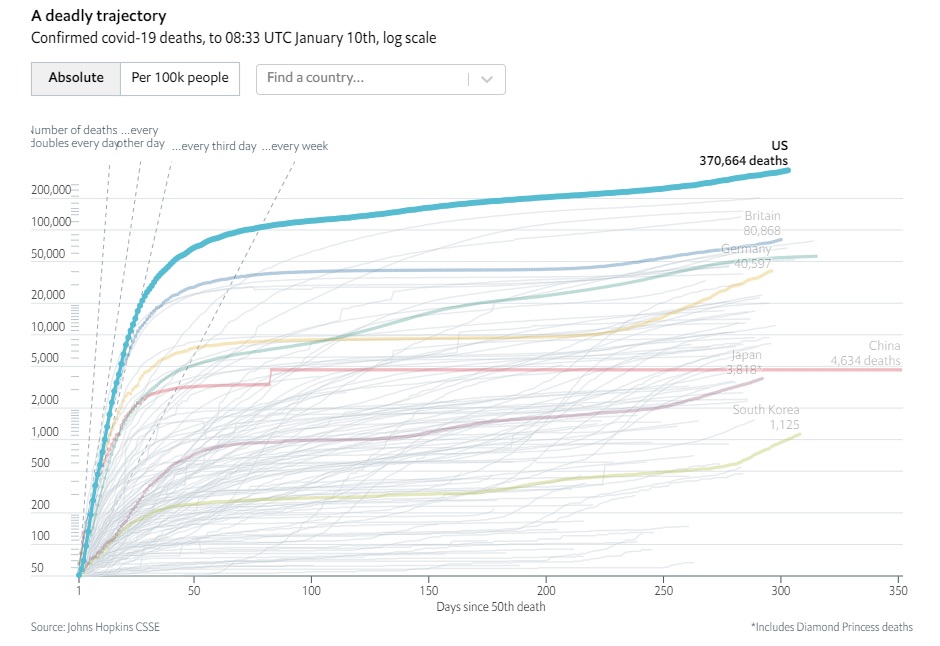

See VIDEO in the Appendix below.

Unfortunately, the solution is not so simple … for the Caribbean communities. For the 30 member-states that constitute the political Caribbean, we have to do more than this 1 thing of fixing the pandemic in order to fix our economy. Our solution is more complicated. Plus even that 1 thing will not be so simple. (Many of our citizens refuse capitulation).

The Caribbean is different …

… than the American economy referred in the foregoing quotation. For one, we have a mono-industrial economy: Tourism. Yes, we have to mitigate the threats of Coronavirus, and then we also need to diversify from that mono-industrial reality. The defect of a touristic industrial footprint is characterized by the actuality of being nothing more than parasites to some host economy. Who is the host?

The same United States of America that now President-Elect Joe Biden was seeking to preside over. So at this juncture, we cannot recover our Caribbean economy until America recovers theirs.

That will not be so simple, even after remediating the contagious disease threat of the pandemic, communities will have to deal with the economic fallout from the pandemic for a long time, maybe even decades. See this assertion from the globally praised Business news magazine The Economist in an October 23, 2020 story here:

VIDEO – Covid-19: how to fix the economy | The Economisthttps://youtu.be/p0tCPwyJ6JI

The Economist
Posted October 23, 2020 – Governments will have to deal with the economic fallout from the pandemic for decades to come. If they get their response wrong, countries risk economic stagnation and political division. Read more here: https://econ.st/3ojORKY

Find The Economist’s most recent coverage of covid-19 here: https://econ.st/3m212Kj

Read our special report on the economic impact of the COVID-19 pandemic: https://econ.st/37mGlos

How the pandemic is reshaping banking: https://econ.st/3kj1qnq

Why America’s economy is beating forecasts: https://econ.st/3kdzDEK

How the covid-19 pandemic is forcing a rethink in economic policy-making: https://econ.st/2IIhX69

How recessions create long-term psychological and economic scars: https://econ.st/3o55XvH

What past pandemics can teach us about the economic effects of pandemics: https://econ.st/37mzwmy

———

Related:  https://youtu.be/KJhlo6DtJIk

This foregoing VIDEO identified the threats against the orthodox American economy as being the following:

  • Digital Economy,
  • Actuality of trade with China, and
  • Repercussions from the recent 2008 Financial Crisis; preponderance for austerities.

Before the Coronavirus COVID-19 pandemic, the Caribbean was also mired deep in chaos from these three factors. Once the pandemic challenges are remediated we still have to re-focus and address these issues. So we had chaos before, and now we have new chaos. We so badly need to reboot our economy to be chaos-free once and for all.

This was the quest of the 2013 book Go Lean…Caribbean. It identified the same 3 threats as (and more like Climate Change); see here:

  • Technology – falling behind with the adoption of Internet Communications Technologies.
  • Globalization – we only consume, not produce, so we are shifted hither-and-thither by bigger economies.
  • 2008 Consequences – access to foreign capital (think: US Dollars) make or break our local economies

So in retrospect, the Go Lean book, serving as a roadmap for the introduction of the Caribbean Union Trade Federation (CU), identified solutions for fixing the Caribbean economy as of 2003, like a more diversified economy. Had the CU been introduced and implemented then, the chaos that we had just before the pandemic would have been remediated by now.

The Go Lean book says in its opening foreword:

Many people love their homelands and yet still begrudgingly leave; this is due mainly to the lack of economic opportunities. The Caribbean has tried, strenuously, over the decades, to diversify their economy away from the mono-industrial trappings of tourism, and yet tourism is still the primary driver of the economy. Prudence dictates that the Caribbean nations expand and optimize their tourism products, but also look for other opportunities for economic expansion. The requisite investment of the resources (time, talent, treasuries) for this goal may be too big for any one Caribbean member-state. Rather, shifting the responsibility to a region-wide, professionally-managed, deputized technocracy will result in greater production and greater accountability. This deputized agency is the Caribbean Union Trade Federation (CU). This book advocates that all Caribbean member-states (independent & dependent) lean-in to this plan for confederacy, collaboration and convention.

The chaos of today’s pandemic would have been lessened too, under a CU regime, as the Go Lean roadmap calls for the appropriate strategies, tactics and implementations to assuage the threats of epidemics and pandemics. This was related in a previous blog-commentary from March 24, 2015; see this excerpt here:

A Lesson in History – SARS in Hong Kong
The CU is not designed to just be in some advisory role when it comes to pandemic crises, but rather to possess the authority to act as a Security Apparatus for the region’s Greater Good. This is the mandate as pronounced in the opening Declaration of Interdependence (Page 11) related to climate change, but it applies equally to pandemics, to …

    “protect the entire region it is necessary to prepare to insure the safety and security of life, property and systems of commerce in our geographical region. As nature recognizes no borders in the target of its destruction, we also must set aside border considerations in the preparation and response to these … challenges”.

Legally, each Caribbean member-state would ratify a Status of Forces Agreement that would authorize this role for the CU agencies (Emergency Management and Disease Control & Management) to serve as a proxy and deputy of the Public Health administrations for each member-state. This would thusly empower these CU agencies to quarantine and detain citizens with probable cause of an infectious disease. The transparency, accountability and chain-of-command would be intact with the appropriate checks-and-balances of the CU’s legislative and judicial oversight. This is a lesson learned from Hong Kong 2003 with China’s belligerence.

This is how we could have fixed the Caribbean economy for this 2020’s decade. It is not just a simple one or two tasks; no, it is a long list of heavy-duty tactics and tasks; (in fact the Go Lean book identifies 144 different advocacies).  This theme, rebooting the economic engines of the Caribbean member-states, aligns with many previous commentaries from the Go Lean movement; see a sample list here:

https://goleancaribbean.com/blog/?p=20571 Banking on the Inter-American Development Bank for crisis funding
https://goleancaribbean.com/blog/?p=19741 Keep the Change: Mono-Industrial Economy Exhaustion
https://goleancaribbean.com/blog/?p=19572 MasterClass: Economics and Society
https://goleancaribbean.com/blog/?p=19568 Big Hairy Audacious Goal – Need ‘Big Brother’ for Pandemics
https://goleancaribbean.com/blog/?p=19452 BHAG – Regional Currency – ‘In God We Trust’
https://goleancaribbean.com/blog/?p=18566 Reviewing How an Impactful Bank Can Change an Economy
https://goleancaribbean.com/blog/?p=18524 One Step Closer to transforming local economies: e-Money Solutions
https://goleancaribbean.com/blog/?p=17337 Industrial Reboots – A 18-part Series on diversification
https://goleancaribbean.com/blog/?p=360 Central Banks Can Create Money from ‘Thin Air’ – Here’s How

How to fix the COVID economy for the Caribbean member-states?

We still need to reboot or change the industrial landscape!

We always did! Now we are at the precipice; we have no choice but to change.

The pandemic will pass. There are vaccines available now. As depicted in this excerpt from a previous blog-commentary from August 29, 2020:

Pandemic Playbook – COVID Vaccine: To Be or Not To Be
The world is enduring the Coronavirus COVID-19 pandemic crisis; it is wreaking havoc on the world’s economic engines – $250 Billion a day in losses – and Public Health deliveries. The only hope is a vaccine, of which there are a number of them in development [distribution]. …
Don’t get it twisted! The Caribbean member-states boast a Service industrial economy – tourism. To participate in this industry space will require compliance. Tourists – by air for resort-based stay-overs or cruise line passengers – will not want to expose themselves to possible infections.

Lastly, individuals can simply chose to exit societal functioning – a self-imposed quarantine; think: Leper Colony. These ones will have to take a seat – with a view – and watch life pass them by.

Do we then need to embrace some austerity measures so as to transform our Red Ink into Black”? Please God, No!

As depicted in this excerpt from a previous blog-commentary from July 7, 2016:

A Lesson in Economic Fallacies – Austerity: Dangerous Idea?
Those who advocate to remediate Caribbean economics needs to avoid a series of Economic Fallacies. …

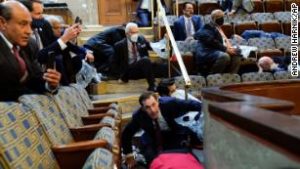
One common remediation for economic crisis has been Austerity. What is Austerity? And is this a good thing or bad thing? First, the dictionary definition is: “reduced availability of luxuries and consumer goods, as brought about by government policy”. …

“Austerity is a very dangerous idea. First of all, it doesn’t work. As the past four years and countless historical examples from the last 100 years show, while it makes sense for any one state to try and cut its way to growth, it simply cannot work when all states try it simultaneously: all we do is shrink the economy. In the worst case, austerity policies worsened the Great Depression and created the conditions for seizures of power by the forces responsible for the Second World War: the Nazis and the Japanese military establishment.” …

What exactly is the Go Lean plan to counter the economic fallacy of austerity?

Economic growth …
… as in creating jobs through industrial and entrepreneurial endeavors – for a grand total of 2.2 million new jobs.

So how will we fix the economy for the Caribbean member-states after this COVID crisis?

We must now do the things that we should have been doing all the while. Consider:

  • We must reboot the economic engines;
  • Confederate the regional economy into a Single Market;
  • Diversify the industrial landscape;
  • Create new jobs in new industries;
  • Lean-in to the strategies, tactics and implementations of the Go Lean roadmap.

Are we Ready? Are you Ready?

It is past time that we do the heavy-lifting to make our homeland a better place to live, work and play. Let’s get busy! We have planned the work; now we need to work the plan.  🙂

About the Book
The book Go Lean…Caribbean serves as a roadmap for the introduction and implementation of the technocratic Caribbean Union Trade Federation (CU) and the Caribbean Central Bank (CCB), for the elevation of Caribbean society – for all member-states. This CU/Go Lean roadmap has these 3 prime directives:

  • Optimization of the economic engines in order to grow the regional economy to $800 Billion and create 2.2 million new jobs.
  • Establishment of a security apparatus to ensure public safety and protect the resultant economic engines.
  • Improve Caribbean governance to support these engines, including a separation-of-powers between the member-states and CU federal agencies.

The Go Lean book provides 370-pages of turn-by-turn instructions on “how” to adopt new community ethos, plus the strategies, tactics, implementations and advocacies to execute so as to reboot, reform and transform the societal engines of Caribbean society.

Download the free e-Book of Go Lean … Caribbean – now!

Who We Are
The movement behind the Go Lean book – a non-partisan, apolitical, religiously-neutral Community Development Foundation chartered for the purpose of empowering and re-booting economic engines – stresses that reforming and transforming the Caribbean societal engines must be a regional pursuit. This was an early motivation for the roadmap, as pronounced in the opening Declaration of Interdependence (Pages 12 – 13):

xi. Whereas all men are entitled to the benefits of good governance in a free society, “new guards” must be enacted to dissuade the emergence of incompetence, corruption, nepotism and cronyism at the peril of the people’s best interest. The Federation must guarantee the executions of a social contract between government and the governed.

xvi. Whereas security of our homeland is inextricably linked to prosperity of the homeland, the economic and security interest of the region needs to be aligned under the same governance. Since economic crimes … can imperil the functioning of the wheels of commerce for all the citizenry, the accedence of this Federation must equip the security apparatus with the tools and techniques for predictive and proactive interdictions.

xxiv. Whereas a free market economy can be induced and spurred for continuous progress, the Federation must install the controls to better manage aspects of the economy: jobs, inflation, savings rate, investments and other economic principles. Thereby attracting direct foreign investment because of the stability and vibrancy of our economy.

Sign the petition to lean-in for this roadmap for the Caribbean Union Trade Federation.

———–

Appendix VIDEO – Can’t fix the economy until you fix the pandemic –  https://fb.watch/2WWGfEn_Bs/ 


CBS Evening News with Norah O’Donnell

Posted September 29, 2020 – “You can’t fix the economy until you fix the COVID-19 crisis,” Joe Biden says of job losses during the pandemic, “and he has no intention of doing anything about making it better for you all at home in terms of your health and your safety.”

LIVE: https://cbsn.ws/33c1tv4

Share this post:
, , ,
[Top]

American Democracy? We can do better! – Encore

Supporters of President Donald Trump climb the west wall of the the U.S. Capitol on Wednesday, Jan. 6, 2021, in Washington. (AP Photo/Jose Luis Magana)

It does not take much to ascertain that there is something wrong in America – even a blind man can see it.

Everyone who pursues truth and justice can easily conclude:

We can do better!

The actuality is that Donald Trump is a failed experiment. This man lie, cheat and steal – past and present – yet he is perched on top of the American government structure and branded as the Leader of the Free  World.

Not this one; not this time! This President lost his re-election bid on November 3, 2020 and has since pursued a “scorched earth” approach to damage the American democracy that rejected him. This January 6 insurrection – see Appendix B VIDEO below – was the product of a direct urging to “go down Pennsylvania Avenue and take back our country”.

People shelter in the House gallery as protesters try to break into the House Chamber at the U.S. Capitol on Wednesday, Jan. 6, 2021, in Washington. (AP Photo/Andrew Harnik)

The Bible clearly shows that:

“If you are faithful in little things, you will be faithful in large ones. But if you are dishonest in little things, you won’t be honest with greater responsibilities.” – Luke 16:10 New Living Translation

Donald Trump “lied, cheated and stole” the little things entrusted to him over the years – businesses, education (as a student and as Trump University owner), marriages, foundations – we should not be surprised that he continues to do it now.

But this commentary is not about the failings of Donald Trump; it is about the failings of America. In a previous commentary – from November 14, 2020 – from the movement behind the 2013 book Go Lean…Caribbean, this salient point was made:

Decision 2020 – It is what it is; ‘we are who we are’
The four (4) years of the Trump Administration was a “circus and he proved to be a clown”; there was one infraction after another. …
America has not changed! The 2020 Decision for the President of the United States (POTUS) has not led to any reformation or transformation – it is what it was. American has doubled-down on being America.

This is a Cautionary Tale for Caribbean people, in the homeland and in the Diaspora. Many Caribbean people look to the US as a “city on the hill”, a role model for advanced democracies.

The election is over: Joe Biden defeated the incumbent Donald Trump at the November 3rd polling. He won, not by changing the hearts and minds of undecided people, but rather doubling-down on his base to get their electoral support; (Trump did likewise; this time with an even greater turnout than 2016, [5 million more votes]). The people in this country are still entrenched in their ideologies.

Surely, it is obvious here that the problem is the institutions of America, not just the individuals.

Surely, we can do better … here in the Caribbean homeland.

We presented this thesis before. It is only apropos to encore the thesis again … in this previous blog-commentary from June 30, 2015 with the title: “Better than America? Yes, we can!”. See that encore here-now:

————————–

Go Lean CommentaryBetter than America? Yes, we can!

Is America the “Greatest Country in the World”?

Perhaps this was arguable in the past? Today? Hardly … see VIDEO here; (excuse the profanity):

VIDEO: America, the Greatest? –


Published on Oct 21, 2012 – Jeff Daniels, who portrays news anchor Will McAvoy in the HBO Series “The Newsroom”, delivered a stunning, hard-hitting, accurate, and intelligent monologue/response when asked why America is the greatest country in the world. A sobering outlook on the state of the USA. (CAUTION ON THE ADULT LANGUAGE).

Even in the past when the “Greatest” label was arguable, it didn’t apply to everyone! America was the Greatest Country, maybe, if you were:

White, Anglo-Saxon, Rich, Male and Straight

But if you were any of the following, then God help you:

Black
Brown – Hispanic
Native American
Jewish
Catholic
Woman
Gay
Persons with Disabilities (Physical or Mental)
Slavic – Eastern European
Muslim
Communists
Atheist
Poor

CU Blog - Better than America - Yes We Can - Photo 2Yes, building a multi-cultural society is not easy. The book Go Lean … Caribbean describes the challenge as heavy-lifting. America has failed at this challenge, hands-down. In previous blog- commentaries, many defects of American life were detailed, (including the propensity for Crony-Capitalism). See the list of defects here: Housing, education, job hunting, prisons, drug crime prosecutions, and racial profiling.

But despite this list and the reality of this subject, America tries …

This is an important consideration for the planners of Caribbean empowerment. The Caribbean, a region where unfortunately, we have NOT … tried.

The social science of Anthropology teaches that communities have two choices when confronted with endangering crises: fight or flight. The unfortunate reality is that we have chosen the option of flight; (we have no ethos for fighting for our homeland).

The book Go Lean … Caribbean asserts that no society can prosper with a high abandonment rate – reported at 70% for educated classes. The primary mission of the Go Lean book is to “battle” against the “push-and-pull” factors that draw so many of our Caribbean citizens away from their homelands to go to the US. While we cannot change/fix America, we can…

Lower the “push” factors!

The purpose of the Go Lean book is to fix the Caribbean, to be better than America. The Go Lean book serves as a roadmap for the introduction and implementation of the technocratic Caribbean Union Trade Federation (CU) to pursue the quest to elevate the Caribbean region through empowerments in economics, security and governance. It is the assertion that Caribbean citizens can stay home and effect change in their homelands more effectively than going to America to find the “Greatest Country in the World”. The book therefore asserts that the region can turn-around from failing assessments by applying best-practices, and forging new societal institutions to impact the Greater Good for all the Caribbean. This point was pronounced in the opening Declaration of Interdependence (Pages 10 – 14) with these acknowledgements and statements:

xi.   Whereas all men are entitled to the benefits of good governance in a free society, “new guards” must be enacted to dissuade the emergence of incompetence, corruption, nepotism and cronyism at the peril of the people’s best interest. The Federation must guarantee the executions of a social contract between government and the governed.

xii. Whereas the legacy in recent times in individual states may be that of ineffectual governance with no redress to higher authority, the accedence of this Federation will ensure accountability and escalation of the human and civil rights of the people for good governance, justice assurances, due process and the rule of law. As such, any threats of a “failed state” status for any member state must enact emergency measures on behalf of the Federation to protect the human, civil and property rights of the citizens, residents, allies, trading partners, and visitors of the affected member state and the Federation as a whole.

xxxiii. Whereas lessons can be learned and applied from the study of the recent history of other societies, the Federation must formalize statutes and organizational dimensions to avoid the pitfalls of communities like … Detroit, Indian (Native American) Reservations… On the other hand, the Federation must also implement the good examples learned from developments/ communities like New York City, … Canada, the old American West and tenants of the US Constitution.

This is the quest of Go Lean…Caribbean roadmap, to reboot the region’s societal engines; employing best-practices and better strategies, tactics and implementations to impact its prime directives; identified with the following 3 statements:

  • Optimization of the economic engines in order to grow the regional economy to $800 Billion & create 2.2 million new jobs.
  • Establishment of a security apparatus to protect the resultant economic engines and mitigate challenges/threats to the region’s public safety.
  • Improvement of Caribbean governance to support these engines.

The Go Lean book stresses key community ethos, strategies, tactics, implementations and advocacies necessary to transform and turn-around the eco-systems of Caribbean society. These points are detailed in the book as follows:

Community Ethos – Economic Principles – Economic Systems Influence Individual Choices Page 21
Community Ethos – Economic Principles – Consequences of Choices Lie in the Future Page 21
Community Ethos – Governing Principles – Lean Operations Page 24
Community Ethos – Ways to Impact the Future Page 26
Community Ethos – Ways to Promote Happiness Page 36
Community Ethos – Ways to Impact the Greater Good Page 37
Strategy – Vision – Confederate all 30 member-states/ 4 languages into a Single Market Page 45
Strategy – Mission – Build and foster local economic engines Page 45
Tactical – Ways to Foster a Technocracy Page 64
Tactical – Growing the Economy to $800 Billion GDP Page 68
Tactical – Separation-of-Powers – CU Federal Government versus Member-State Governance Page 71
Implementation – Assemble All Regionally-focus Organizations of All Caribbean Communities Page 96
Planning – 10 Big Ideas – American Model: Kennedy’s Quest for the Moon Page 127
Planning – Ways to Make the Caribbean Better Page 131
Planning – Lessons Learned New York City – Managing as a “Frienemy” Page 137
Planning – Lessons Learned from Detroit – Turn-around from Failure Page 140
Planning – Lessons Learned from Indian Reservations – Pattern of Ethnic Oppression Page 141
Planning – Lessons Learned from the American West – How to Win the Peace Page 142
Planning – Lessons Learned from the US Constitution – America Tries – Each Generation Improves Page 145
Advocacy – Ways to Grow the Economy Page 151
Advocacy – Ways to Create Jobs Page 152
Advocacy – Ways to Improve Governance Page 168
Advocacy – Ways to Better Manage the Social Contract Page 170
Advocacy – Ways to Impact Justice Page 177
Advocacy – Ways to Improve Homeland Security Page 180
Advocacy – Ways to Preserve Caribbean Heritage Page 218

The threats of the repressive American past have not always been domestic; there have been times when American dysfunction have reached across borders, including Caribbean countries, and disrupted the peace and progress. This is an important lessons for the Caribbean to learn from considering the history of “American Greatness”; the following previous blog/commentaries apply:

https://goleancaribbean.com/blog/?p=5506 Edward Snowden Case Study: One Person Making a Difference
https://goleancaribbean.com/blog/?p=4166 A Lesson in History: Panamanian Balboa
https://goleancaribbean.com/blog/?p=789 A Lesson in History: America’s War on the Caribbean

The Go Lean roadmap seeks to empower and elevate Caribbean societal engines to make us better than the American eco-system. Tall order?

Yes, we can!

According to the foregoing VIDEO (and Appendix [A VIDEO] below), other communities have done it. Consider Europe, all grown up now.

We can apply these models and lessons from these societies to obtain success. This vision is conceivable, believable and achievable!

Yes we can … make the Caribbean region a better place to live, work and play.  🙂

Download the free e-Book of Go Lean … Caribbean – now!

———

Appendix A VIDEO – Comedic Commentary – Bill Maher: America Isn’t #1 – https://youtu.be/T8UqdPKbpWM

Uploaded on Jul 11, 2009 – Bill Maher rants on America letting people know we need to reclaim that title and to quit replying on old adages.

———

Appendix B VIDEO – Katy Tur Breaks Down the Breach of the U.S. Capitol – https://youtu.be/AZsP4C2RRPo

The Tonight Show Starring Jimmy Fallon
Posted January 7, 2021 – 
Katy Tur breaks down the events that unfolded during the official count of electoral votes, shares why Trump’s statement on the situation did more harm than good and explains why debunking conspiracy theories is a lost cause.

The Tonight Show Starring Jimmy Fallon. Stream now on Peacock: https://bit.ly/3gZJaNy

Subscribe NOW to The Tonight Show Starring Jimmy Fallon: http://bit.ly/1nwT1aN

Watch The Tonight Show Starring Jimmy Fallon Weeknights 11:35/10:35c

Get more The Tonight Show Starring Jimmy Fallon: https://www.nbc.com/the-tonight-show

Share this post:
, , , , , , ,
[Top]

Brexit Manifestation: Not So Good

Go Lean Commentary

Brexit is hereby ratified as of today; the new “rules of the road” go into effect tomorrow – January 1, 2021. (Brexit = British Exit from the European Union).
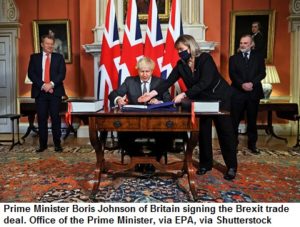
It will be a scary time, as the manifestation of Brexit is “Not So Good”.

Britain wanted their freedom to choose – done. See the historicity in the Appendix VIDEO below.

But there is no freedom from the consequences of that choice. See the manifestation of the Brexit Trade and Inter-European relations as defined in this New York Times article here:

Title: Brexit, finalized
More than four years after Britain voted to leave the European Union, new travel and trade rules will go into effect tomorrow, concluding a saga that has divided Britons and dominated British politics.

The two sides reached an agreement last week, after nearly a year of trade negotiations. Yesterday, Britain’s Parliament approved the deal. Tomorrow brings the end of free movement of people between Britain and the E.U.

I talked to Mark Landler, The Times’s London bureau chief, about what it all means and what comes next. (Our conversation has been edited for brevity.)

CLAIRE: How will the new relationship between Britain and the E.U. affect people’s everyday lives?
MARK: The purpose of the 1,200-page trade deal between Britain and the E.U. was to avoid very disruptive changes, such as tariffs and quotas. But there will be an array of other bureaucratic requirements that did not exist before Jan. 1.

People won’t see a sudden shift in the price of fresh fruit and vegetables in London supermarkets. But it’ll have an impact on Britons who, for example, want to bring their dog on vacation to the continent or who want to get a job somewhere in the E.U.

Trade. Travel. Anything else?
Britain withdrew from the Erasmus exchange program, which allowed British students to study in E.U. countries and vice versa. It’s one highly visible example of things that will change in the post-Brexit era.

Something else, which may take a little bit longer to play out, is this idea of separatism and independence. Scotland, for example, was against Brexit, and it could fuel a new push to break off from the rest of Britain.

What will this mean for Britain’s economy?
A lot of stuff still needs to be negotiated. A major driving force of the British economy is the services sector, including legal, financial, consulting and other services. Virtually none of that is covered yet in the trade agreement.

How did the pandemic affect the process?
Without it, the negotiations for the trade deal would have been the biggest story in the country. But Brexit was almost completely overshadowed by the coronavirus. Britain is preoccupied with this health crisis, which will muffle the immediate effects of Brexit. But over time those will become more visible. Which means that the debate over Brexit may not be finished in the country.

Will this deliver the “global Britain” that pro-Brexit campaigners hoped for?
One of the driving arguments in favor of Brexit was throwing off the shackles of the E.U., so that Britain would become this agile, dynamic, independent economy that could strike deals with everyone in the world. But rising protectionism and populism have made making free-trade agreements harder. The “global Britain” arguments looked more valid in May 2016 than in January 2021. In a way, the Brexit vision is four and a half years too late.

Source: Retrieved December 31, 2020 from: https://messaging-custom-newsletters.nytimes.com/template/oakv2?campaign_id=9&emc=edit_nn_20201231&instance_id=25533&nl=the-morning&productCode=NN&regi_id=69450329&segment_id=48102&te=1&uri=nyt%3A%2F%2Fnewsletter%2Fa44d74cb-100d-5436-887d-e9c6aa325dbf&user_id=de9db917120d820078919cfacc03d8b3

So according to this foregoing, Brexit was the UK’s quest for agility.  🙁

The words and feelings of a known African proverb is ringing so loud right now; (this was related in a previous Go Lean commentary from July 6, 2016):

“If you want to go fast, go alone. If you want to go far, go together.”

The thing about being agile and nimble is that not everyone in society is fast. Some people are slow … and old, and disabled. Yes, society has a greater responsibility than just getting to a destination quickly, it must ensure that everyone gets “there” … eventually.

This sounds eerily familiar; this sounds like a violation of the Code of Hammurabi; we addressed this in another previous Go Lean  commentary from March 22, 2017; see this except here:

[The] Code of Hammurabi was enacted within the Babylonian Empire, a Super Power in the ancient world. … Despite the passage of 3,800 years, there is a lesson to glean from this ancient legal precept for us today. Despite the irrelevance of so many of the 282 statutes, there in the preface of the codified Law is this statement:

    “So that the strong should not harm the weak”

Despite how much advances we have made in the millennia since King Hammurabi of Babylon reigned, this concept seems to be void in so many societies; this concept …

  • … is not in the Caribbean.
  • … is not in the United States.
  • … is not in the New World.

There is an obvious “ignorance or negligence of this concept” in the New World. Consider the experience in the United States, where the American DNA seems to be based on a consistent pattern of the “strong abusing the weak” and the long civil rights struggle to overcome the abuse. This is American History and the American Experience. …

A detail analysis of the root causes of Brexit presented that there was a loud minority in the United Kingdom that objected to the freedom of movements of people, goods and capital in the integrated European Union. The British contingent wanted to Exit the regional responsibility of hospitality towards the poor, sick and huddled masses of the European continent. The Brexiters wanted Independence from their neighbors in fulfilling any Social Contract to their citizens.

This is an important consideration for Caribbean stakeholders as we are calling for the same interdependence that the EU enjoy. This desired interdependence is the needed inter-state cooperation that is the only hope for Caribbean member-states to finally reform and transform. Any such cooperation for Britain is now in jeopardy or unlikely. 18 Caribbean member-states are current or former territories of the British Commonwealth. So this Brexit discussion – unitary independence – is relevant for our consideration as it is turning out to be more hype than hope.

The roadmap presented in the 2013 book Go Lean … Caribbean introduces the Caribbean Union Trade Federation (CU), a technocratic federal government – modeled after the EU – to administer and optimize the economic, security, and governing engines of all 30 member Caribbean states – legacies from British, Dutch, French and Spanish imperial expressions. We need  the hope of regional interdependence movement, not the hype of nationalistic independence. That previous July 6, 2016 commentary stated:

A philosophical attack on the EU is an attack on the Caribbean’s future. We must be aware … and be on guard.

In truth, the EU has prospered; it has been a win-win for all of its members. It has endured hardships (consider for example, the sovereign debt crisis in Greece) that under previous European regime’s would have resulted in wars; on two occasions, World Wars. Now so much of the rest of the world – especially Africa and the MiddleEast – wants what the EU has. This is why one of the greatest challenges for the EU as a whole and for each individual member-state is immigration. A basic requirement of the economic integration of the EU is the free movement of labor. So anytime, a refugee find their way inside EU borders, they can travel to any member-state. The only way to prevent this free movement is to exit the EU. This is the British decision.

The foregoing New York Times article reported that the UK has started to experience the dreaded economic stagnation that was feared by anti-Brexiters.

In addition, the issue of disunity remains; the Brexit vote showed that some elements in the United Kingdom are not so “united”. Just two years earlier, a referendum in Scotland to secede from the United Kingdom – and join the EU as a full member including the Eurozone Monetary Union – was narrowly defeated. There may still be a call to renew the quest for Scottish Independence, and maybe even spur a similar campaign for Northern Ireland, thereby eliminating the new Customs border between the Republic of Ireland and the UK country of Northern Ireland. << Photo 2 >>
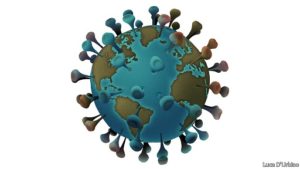
The Go Lean roadmap prepared the Caribbean for Agents of Change; one of them is globalization, which produces 2 classes of people: producers and consumers. There is always a Comparative Analysis as to which locale is better suited to procure raw materials and then which locale is best to produce finished goods. Such a Comparative Analysis results in winners and losers from the consideration. The UK’s complaint about the EU was actually a complaint about globalization; the UK was losing out in the Globalization battles and becoming consumers more and more then producing less and less. Those who cling to nationalism tend to be among the losing classes from Globalization battles.

The lesson for the Caribbean Union, if we do not want to lose our own battles, is to be lucky in our Comparative Analysis. Luck is defined as the intersection of preparation and opportunity.

The Coronavirus COVID-19 pandemic has taught the Caribbean the important lesson that we are not prepared for the threats that come from one aspect of Globalization, the free and frequent movement of people across borders and continents. This pandemic started as a flare-up of a contagious respiratory disease in Wuhan, China; then in short order, the infections traversed the planet: to Europe and North America, then onto our Caribbean communities. We were not prepared and suffered accordingly, both medically and economically.

The Go Lean book trumpets that “a crisis is a terrible thing to waste”. In the Caribbean, we want our homeland to be a better place to live, work and play. So we must enable our infrastructure so that we can produce more and consume less. This is the quest of our regional economic empowerments. Then we need to better protect our communities with a robust Security Apparatus to defend across economic crimes, natural disasters and epidemics/pandemics.

This is the lesson we can learn here in the Caribbean homeland from the crisis in the UK and the EU, that we must be prepared for the challenges of globalization in order to get lucky. It just does not happen naturally; the opportunities for profit nor the protection from dangers.

In 2013, the Go Lean book scanned the landscape in the Caribbean and found a lot of deficiencies in the planning, preparations and infrastructure related to the societal engines for economics, security and governance. We too would only be losers in the battles of globalization. So the strategies, tactics and implementations were published that would mitigate and remediate these challenges. These are present in the 370-book, as described below.

In addition, there have been 6 years of continuous blogging on how to apply the strategies, tactics and implementations of the roadmap to better prepare the Caribbean against the pangs of distress from globalization. This theme – empowerments and protections in the battle of globalization – has been frequently detailed in many previous Go Lean blog-commentaries. Consider this sample:

https://goleancaribbean.com/blog/?p=18834 A Lesson in History: Free Trade Agreement of the Americas
https://goleancaribbean.com/blog/?p=16341 The Caribbean is ready for a regional Post Office solution
https://goleancaribbean.com/blog/?p=16208 In Defense of Trade – Bilateral Tariffs: No one wins
https://goleancaribbean.com/blog/?p=16192 In Defense of Trade – China Realities
https://goleancaribbean.com/blog/?p=15875 Amazon: ‘What We Should Want To Be When We Grow Up’
https://goleancaribbean.com/blog/?p=11358 Retail Apocalypse – Preparing for the Inevitable
https://goleancaribbean.com/blog/?p=7789 New Guards for Global Trade
https://goleancaribbean.com/blog/?p=7601 New Guards for Caribbean Sovereign Debt
https://goleancaribbean.com/blog/?p=7327 New Guards for Disease Control
https://goleancaribbean.com/blog/?p=6867 How to address high consumer prices
https://goleancaribbean.com/blog/?p=6341 New Guards for Tourism Stewardship
https://goleancaribbean.com/blog/?p=6103 New Guards Against Deadly Threats
https://goleancaribbean.com/blog/?p=5597 Dire Straits of Labor Unions (Collective Bargaining) during Globalization
https://goleancaribbean.com/blog/?p=833 European Model: One currency, divergent economies
https://goleancaribbean.com/blog/?p=242 Effects of Globalization: The Erosion of the Middle Class

The events related to UK, EU and Brexit are important for us in the Caribbean to consider … and learn from. In fact, we are in competition with the European world in terms of trade, and losing. We lose in the movement of people, products and capital  as they all move out to these countries … with only a little coming back in.
As a region and a society we need to go farther than we have previously accomplished – not necessarily faster – so we need to go together. We need to get united and stay united. We need interdependence, not independence. This is the quest, a Big Hairy Audacious Goal, but still conceivable, believable and achievable.

Everyone in the Caribbean – citizens and institutions alike  – are hereby urged to lean-in to this Go Lean roadmap. This is how we can make our homeland a better place to live, work and play. 🙂

About the Book
The book Go Lean…Caribbean serves as a roadmap for the introduction and implementation of the technocratic Caribbean Union Trade Federation (CU), for the elevation of Caribbean society – for all member-states. This CU/Go Lean roadmap has these 3 prime directives:

  • Optimization of the economic engines in order to grow the regional economy to $800 Billion & create 2.2 million new jobs.
  • Establishment of a security apparatus to ensure public safety and protect the resultant economic engines.
  • Improve Caribbean governance to support these engines, including a separation-of-powers between the member-states and CU federal agencies.

The Go Lean book provides 370-pages of turn-by-turn instructions on “how” to adopt new community ethos, plus the strategies, tactics, implementations and advocacies to execute so as to reboot, reform and transform the societal engines of Caribbean society.

Download the free e-Book of Go Lean … Caribbean – now!

Who We Are
The movement behind the Go Lean book – a non-partisan, apolitical, religiously-neutral Community Development Foundation chartered for the purpose of empowering and re-booting economic engines – stresses that reforming and transforming the Caribbean societal engines must be a regional pursuit. This was an early motivation for the roadmap, as pronounced in the opening Declaration of Interdependence (Pages 12):

x. Whereas we are surrounded and allied to nations of larger proportions in land mass, populations, and treasuries, elements in their societies may have ill-intent in their pursuits, at the expense of the safety and security of our citizens. We must therefore appoint “new guards” to ensure our public safety and threats against our society, both domestic and foreign. The Federation must employ the latest advances and best practices … to assuage continuous threats against public safety.

xi. Whereas all men are entitled to the benefits of good governance in a free society, “new guards” must be enacted to dissuade the emergence of incompetence, corruption, nepotism and cronyism at the peril of the people’s best interest. The Federation must guarantee the executions of a social contract between government and the governed.

xiv.  Whereas a free market economy can be induced and spurred for continuous progress, the Federation must install the controls to better manage aspects of the economy: jobs, inflation, savings rate, investments and other economic principles. Thereby attracting direct foreign investment because of the stability and vibrancy of our economy.

Sign the petition to lean-in for this roadmap for the Caribbean Union Trade Federation.

—————–

Appendix VIDEO – Brexit explained: Boris Johnson’s new trade deal with the EU – https://youtu.be/mFCKLBsmF_w

Channel 4 News
Posted December 30, 2020 – Brexit is finally over. The UK has finally agreed a trade deal with the European Union – which will start on 1 January, 2021.

But what’s in the deal? And what will change as a result?
(Subscribe: https://bit.ly/C4_News_Subscribe)

The Brexit saga has seen off two British prime ministers – Theresa May and David Cameron. But now Boris Johnson has reached a deal with Ursula von der Leyen, the president of the EU Commission.

After years of debate over the single market, the customs union, tariffs, and the border in Northern Ireland, the two sides have finally found a compromise.

The Brexit referendum in 2016 caused a huge division in UK politics, with MPs split between Leave and Remain. The issue has also divided the Conservative and Labour parties. Some wanted Brexit to be overturned and called for a second referendum. Others said the UK should have a “hard” Brexit, with a more divisive split from Europe.

You can watch our full series of Brexit explainers here: https://www.youtube.com/playlist?list…

——-

Watch more of our explainer series here – https://www.youtube.com/playlist?list…
Get more news at our site – https://www.channel4.com/news/
Follow us: Facebook – https://www.facebook.com/Channel4News/
Twitter – https://twitter.com/Channel4News

Share this post:
, , , ,
[Top]

2020 Review: No Perfect Vision

Go Lean Commentary

The expression goes: “Hindsight is 2020 – Perfect Vision”.

The concept is simple: while looking forward is uncertain, looking back is perfect.

As this year 2020 comes to a close, we would like to acknowledge that this year did not unfold the way anyone expected or hoped. Our forecast was wrong. See this excerpt from a previous blog-commentary of June 7, 2019:

Blog # 900 – 2020: Where Vision is Perfected
Do “you” have 20/20 vision?

… Unfortunately, for the 30 member-states of the Caribbean, the answer is an undisputed “No”. We have the greatest address on the planet and yet our societal engines (economics, security and governance) are so dysfunctional that our people are “beating down the doors” to get out. In a recent blog-commentary [(June 4, 2019)] from the movement behind the 2013 book Go Lean…Caribbean, this historic fact was enunciated:

    “The Caribbean region has exported more of its people than any other region of the world since the abolition of slavery in 1834. While the largest Caribbean immigrant sources to the U.S. are Cuba, the Dominican Republic, Jamaica and Haiti, U.S. citizen migrants also come from Puerto Rico and the U.S. Virgin Islands.”

The same as vision can be corrected with glasses and lenses, community vision or planning can also be perfected with reboots and turn-around activities. Our current vision is bad, we need correction. We cannot see (nor seem to care about) all of our citizens that are fleeing the homeland and looking for refuge elsewhere. Yes, we need to correct our vision; we need to get back to 20/20.
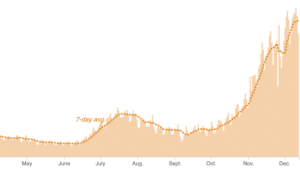

2020 is not just a reference to vision; it is also the next year on our calendar. This intersection allows us to use the actuality of 2020 to perfect our vision for Caribbean planning. …

The Go Lean movement, introducing the Caribbean Union Trade Federation (CU), is bent on planning or presenting a new Vision for the year 2020. 2020 is a milestone in a lot of ways: new decade, new generation, even a new census (from an American perspective).

The “Perfected Vision” we had hoped for did not materialize. In fact the number 2020 has turned out to be one of the most unsavory numbers; think 13 or 666.

There are other numbers that are en vogue as well, think 330,000 and 5 million. That number 330,000 refers to the number of Americans dead as a result of the Coronavirus COVID-19 pandemic. This is the number just for the US! While other countries have had losses, the American death toll best describes the absurdity of the devastation of this horrible year. (America being the last remaining Super Power).

There are people that question that death count. (The long train of denial is part of the story of 2020). The  number of people denying the actualities of 2020 could be higher too, as the 45th President Donald Trump, despite obvious egregious speech and actions (policies) garnered even more votes than in 2016: 5 million more.

Imagine the depraved indifference. You just buried a loved one, limited to only 10 people at the graveside ceremony, and people question the validity of the death. This is the effects of a lie; lying tears down, not build up.

The actuality of “Lies and Lying” seems to be the theme of this 2020 year. The year opened with the biggest news headlines being related to the Impeachment Trial of President Donald Trump in the US Senate. Underlying to this case was the lies and deceitful behavior of the POTUS in dealing with the government leaders of the Eastern European country of Ukraine. Mr. Trump wanted the Ukrainian president to announce an investigation into Hunter Biden, the son of the expected Democratic opponent, Joe Biden, in the November 3, 2020 General Election.

That lie set the stage for the whole year; (Joe Biden was the eventual winner of the Decision 2020 and won with more than 7 million votes over Mr. Trump).

Next came the threat of the Wuhan-China birthed Coronavirus. Rather than facing the challenge head-on by containing it – as executed by other presidents with other epidemics, think SARS and Ebola – this was presented by President Trump as a hoax, so everyone lost their vigilance … until it was too late.

More threats and challenges emerged in which truth needed to be the leading weapon, but instead lies and denial was the dominant characteristic. See this theme as developed in this news article/editorial review here:

VIDEO – The biggest Pinocchios of 2020 – https://www.washingtonpost.com/video/politics/the-biggest-pinocchios-of-2020-fact-checker/2020/12/18/93200b2e-24a6-4fbb-be9c-f00a72a72973_video.html

The Fact Checker tackles some of the most Pinocchio worthy claims of 2020. (The Washington Post)

—————

Title: The biggest Pinocchios of 2020

It’s time for our annual roundup of the biggest Pinocchios of the year.

Donald Trump 

Ever since President Trump burst on the political scene in 2015, we have noted that we faced a challenge in not letting him dominate this list of the biggest falsehoods. The president is a serial exaggerator without parallel in U.S. politics. He not only consistently makes false claims, but also repeats them, in some cases hundreds of times, even though they have been proved wrong.

In 2019, Trump took seven of the 13 spots. He earned six spots in 2018 and 2017, five in 2016 and three in 2015. Even so, we cheated a bit because in some cases Trump’s false claims on a particular subject were so numerous and varied that we created all-around categories.

The explosion of false and misleading statements from Trump during his presidency is well documented in our database. We have struggled to keep up with his torrent of falsehoods during the final weeks of the campaign, when he barnstormed the country making 600 to 700 false or misleading claims a week. The next update will show he crossed the 25,000 mark by mid-October.

So in this remarkable year, we have given up trying to keep Trump to about half of the list. In 2020, Trump will earn seven of 10 spots, with three all-around categories — his false claims about the coronavirus pandemic, the U.S. election and the violence that erupted after the death of George Floyd in police custody. President-elect Joe Biden earns two spots, while the last slot goes to a GOP hopeful in a Senate race.

Nevertheless, this may be Trump’s last appearance on this annual list. As of Jan. 21, we will set a high bar for fact-checking his statements. He will be a defeated ex-president, and we tend to focus on claims made by people in power. In other words, we hope to ignore him and concentrate on people who really matter in national policy debates.

In compiling this list, we mostly focused on claims that earned Four Pinocchios during the year. To keep it simple, in some cases, we have shortened or paraphrased the quotes in the headlines. To read the full column, click on the link embedded in the quote. The all-around categories have links within the summaries.

We generally do not list the Pinocchios of the Year in any particular order, but the collection of coronavirus and election claims are especially consequential. The president’s statements affected both the health of U.S. citizens and American democracy and will undoubtedly influence how historians assess his performance as president.

Coronavirus falsehoods
A global pandemic would be a challenge for any U.S. president. But through his constant lies about the crisis, Trump managed to consistently make the situation worse for the United States. He minimized the danger at first, dismissing the novel coronavirus as less serious than the seasonal flu and something that would go away on its own. He touted bogus cures and quick fixes. He oversold achievements, such as falsely claiming that he led the world in a China ban and that U.S. testing for the virus was on track. He blamed others, falsely saying, for instance, that President Barack Obama bungled the swine flu pandemic and left behind an “empty cupboard” of ventilators. He invented a fairy tale about House Speaker Nancy Pelosi “dancing” in the streets of Chinatown and attacked Anthony S. Fauci, the renowned director of the National Institute of Allergy and Infectious Diseases, with bogus complaints. He also repeatedly lowballed the death count, falsely claiming he saved millions of lives. He often wrongly said 85 percent of mask-wearers catch the virus — insisting it was true even after he was corrected. And this is only scratching the surface of his falsehoods.

Election lies
Throughout 2020, Trump seeded the ground for challenging the presidential election results with bogus claims of election fraud. More than 200 times, he warned about the alleged dangers of mail-in voting. (His own administration highlighted how his false claims on voting-by-mail were almost identical to the Russian propaganda being spread online to destabilize U.S. politics.) In his campaign rallies, Trump sprinkled his speeches with tall tales about election malfeasance. So when Biden decisively defeated him in the 2020 election, the president and his allies engaged in a scorched-earth effort to challenge the vote count in key swing states. His claims were repeatedly tossed out of court by judges and denied by election officials, but Trump has kept repeating the false claims, even after the electoral college affirmed Biden’s win. Trump still refuses to concede. These lies may have long-term consequences, undermining Americans’ faith that votes will be correctly counted.

Bogus violence claims
The killing of George Floyd, a Black man, in Minneapolis by police led to a national reckoning on race. But Trump saw the incident as a way to gain an electoral edge, so he repeatedly hyped claims about “professional anarchists, violent mobs, or, arsonists, looters, criminals, rider rioters, antifa and others.” antifa is a moniker, not a single group with a clear organizational structure or leader, and no cases could be found in which someone who self-identifies as antifa led violent acts at protests across the country. The White House tweeted (and later deleted) a 58-second video that employed out-of-context social clips to lob unproven accusations and create a misleading impression of what has happened during the Floyd protests. Trump himself tweeted an outrageous conspiracy theory about a Buffalo man injured by police. He also falsely claimed that Obama never tried to tackle the problem of police brutality during his presidency. And he repeatedly — and falsely — said that Biden supported efforts to defund police.

No president has done more for Blacks since Lincoln
Trump is not a modest man. More than 30 times, he declared he has done more for Black people than any other president — or, he might generously concede, since Abraham Lincoln. Historians scoffed at his claim, saying that Lyndon B. Johnson, who signed into law the Civil Rights Act of 1964 and the Voting Rights Act of 1965, is clearly the recent president who had the most lasting impact on the lives of Black Americans. Many other presidents were also ranked higher than Trump.

Joe Scarborough got away with murder
Some dozen times, Trump insinuated that MSNBC anchor Joe Scarborough might have murdered a congressional aide. This was an old claim, debunked by The Washington Post in 2017. But Trump often smears those who challenge him. He has a long-running feud with the “Morning Joe” husband-and-wife team of Scarborough and Mika Brzezinski. Still, even after four years of Trump, it remains astounding to see the president make a thinly veiled murder accusation devoid of evidence.

I will always protect people with preexisting conditions
Trump understands little about health-care policy. But he does understand that the Affordable Care Act’s protections for people with preexisting health conditions are highly popular. So in every speech, he includes this line, even though it is directly contradicted by the policies his administration has pursued, including asking the Supreme Court to strike down the entire ACA, thus ending the guarantee for patients with preexisting conditions. Few claims better illustrate the gap between Trump’s words and actions.

Trump is the most pro-gay president in American history
Technically Trump did not say this, but he retweeted a video — proclaiming “My great honor!!!” — that was narrated by Richard Grenell, a longtime spinmeister and booster of the president. The video makes the provocative claim that Trump — whose administration is often criticized by LGBTQ rights advocates as anti-gay — is actually the most “pro-gay” president in U.S. history. The core of the video is actually a lengthy attack on Biden as anti-LGBTQ. The video is a stew of misleading timelines, out-of-context quotes and claims easily debunked — which was typical of Trump campaign material.

Joe Biden

I was arrested trying to see Nelson Mandela
In one of the strangest tall tales, Biden three times asserted that he had the “great honor” of being arrested with the U.N. ambassador on the streets of Soweto trying to get to see Nelson Mandela “on Robbens Island.” Never mind that Soweto, a township near Johannesburg, is nearly 900 miles from Robben — not Robbens — Island, which is off the coast of Cape Town. No one knew what Biden was talking about, including Andrew Young, the former ambassador. Eventually Biden explained he was separated from Black colleagues at the airport. That’s not an arrest.

Trump has a plan to deplete Social Security
There cannot be an election without Democrats making bogus claims about an alleged GOP attack on Social Security. The Biden campaign followed this technique when it asserted that Trump had a “plan” to eliminate the payroll tax that funds Social Security. Trump certainly made confusing comments before he reiterated that any diversion for a payroll tax holiday would come out of general funds. But that did not stop Democrats from ginning up a letter from the chief actuary of Social Security to estimate the impact of a plan that did not exist — which the Biden campaign weaponized into attack ads and the candidate repeated on the campaign trail.

Other Parties

I created a foundation 10 years ago that helped inner-city kids
Bryant “Corky” Messner, a first-time candidate who unsuccessfully challenged Sen. Jeanne Shaheen (D-N.H.), during his campaign touted an organization, the Messner Foundation, which he said selects low-income students every year to receive college scholarships. But tax records examined by The Fact Checker showed that in the first 10 years of the foundation’s existence, only one student received a scholarship from Messner’s foundation — and even more money was given to an elite private school that Messner’s sons were attending at the time. Yet for years Messner and the foundation have suggested that many students had been the recipients of funds.

Source: Posted December 18, 2020; retrieved December 20, 2020 from: https://www.washingtonpost.com/politics/2020/12/18/biggest-pinocchios-2020/

It has been a year filled with darkness; the only remedy is light, or enlightening knowledge. Even the Bible says:

You will know the truth and the truth will set you free. The Bible – John 8:32 New Living Translation

So truth is connected to freedom and freedom to truth. The President of the United States is considered the Leader of the Free World, but that title has been dubious for 2020, as so much of what has gone wrong this year has Mr. Trump’s fingerprints on it. Consider these, the major 2020 events of the year:

In addition, the movement behind the Go Lean book always publishes a Teaching Series every month. The subject matters of those series have propelled the “Caribbean” discussion forward in terms of how to reform and transform our society. Consider these topics for the applicable months of 2020:

January Forging Change – How? An Art & a Science – 4-part series
February Brain Drain Actuality – The Good, Bad & the Ugly – 5-part series
March Big Hairy Audacious Goal – Yes, we can – 7-part series
April Keep the Change – Some Pandemic changes are good for transforming the world – 5-part series
May Good Leadership – Essential for Progress – Here is how – 6-part series
June Rise from the Ashes – COVID-19 is the last to devastate us; time to rebuild – 7-part series
July Black Image and Black Lives Matter – This means the Caribbean too – 6-part series
August Pandemic Playbook – Fail to plan; plan to fail – 7-part series
September Toxic Environments – A compelling reason for  the Exile “Push” – 7-part series
October Decision 2020 – Impact of the Caribbean Diaspora – 5-part series
November Decision 2020 – After the Vote Analysis – 5-part series
December Long Train of Abuses – a 6-part series

We lost a lot during 2020 – see the “Review” in the Appendix VIDEO below. For the Caribbean, we lost people to death and to the Diaspora. So we have no choice; we must reform and transform. This is still the goal, this is the Way Forward.

A crisis is a terrible thing to waste.

If this premise is true, then the needed changes for Caribbean survival should be forthcoming, as 2020 has been all crises all the time.

Let’s get busy …

… the end of the pandemic is in sight – with the release of vaccines – the emergency will subside, but we must not ignore the urgent-emergent need to protect our Caribbean future.

Yes, we can …

When is the time to act? Now! It is always now! Now is the time to reboot and turn-around the societal engines of economics, security and governance. People are listening now. They are ready, willing and able to Be the Change that our society needs. They are ready, willing and able to make the Caribbean a better place to live, work and play. 🙂

About the Book
The book Go Lean…Caribbean serves as a roadmap for the introduction and implementation of the technocratic Caribbean Union Trade Federation (CU), for the elevation of Caribbean society – for all member-states. This CU/Go Lean roadmap has these 3 prime directives:

  • Optimization of the economic engines in order to grow the regional economy to $800 Billion & create 2.2 million new jobs.
  • Establishment of a security apparatus to ensure public safety and protect the resultant economic engines.
  • Improve Caribbean governance to support these engines, including a separation-of-powers between the member-states and CU federal agencies.

The Go Lean book provides 370-pages of turn-by-turn instructions on “how” to adopt new community ethos, plus the strategies, tactics, implementations and advocacies to execute so as to reboot, reform and transform the societal engines of Caribbean society.

Download the free e-Book of Go Lean … Caribbean – now!

Who We Are
The movement behind the Go Lean book – a non-partisan, apolitical, religiously-neutral Community Development Foundation chartered for the purpose of empowering and re-booting economic engines – stresses that reforming and transforming the Caribbean societal engines must be a regional pursuit. This was an early motivation for the roadmap, as pronounced in the opening Declaration of Interdependence (Pages 12 – 13):

xi. Whereas all men are entitled to the benefits of good governance in a free society, “new guards” must be enacted to dissuade the emergence of incompetence, corruption, nepotism and cronyism at the peril of the people’s best interest. The Federation must guarantee the executions of a social contract between government and the governed.

xvi. Whereas security of our homeland is inextricably linked to prosperity of the homeland, the economic and security interest of the region needs to be aligned under the same governance. Since economic crimes … can imperil the functioning of the wheels of commerce for all the citizenry, the accedence of this Federation must equip the security apparatus with the tools and techniques for predictive and proactive interdictions.

xxiv. Whereas a free market economy can be induced and spurred for continuous progress, the Federation must install the controls to better manage aspects of the economy: jobs, inflation, savings rate, investments and other economic principles. Thereby attracting direct foreign investment because of the stability and vibrancy of our economy.

Sign the petition to lean-in for this roadmap for the Caribbean Union Trade Federation. 

—————-

Appendix VIDEO – “CBS This Morning” looks back on a historic year with a roundup of all the news that mattered in 2020 – https://youtu.be/0etgUEHz6zM


CBS This Morning

Posted December 21, 2020 –
2020 will be a year we’ll always remember, and one that has forever changed our country. The coronavirus claimed the lives of more than 300,000 Americans, businesses closed, and tens of millions of people filed for unemployment. We also elected a new president, and witnessed the growing demand to end racial injustice. “CBS This Morning” looks back at the pivotal moments and people that shaped this year.

Watch “CBS This Morning” HERE: http://bit.ly/1T88yAR

Download the CBS News app on iOS HERE: https://apple.co/1tRNnUy

Download the CBS News app on Android HERE: https://bit.ly/1IcphuX

Like “CBS This Morning” on Facebook HERE: http://on.fb.me/1LhtdvI

Follow “CBS This Morning” on Twitter HERE: http://bit.ly/1Xj5W3p

Follow “CBS This Morning” on Instagram HERE: http://bit.ly/1Q7NGnY

Get new episodes of shows you love across devices the next day, stream local news live, and watch full seasons of CBS fan favorites anytime, anywhere with CBS All Access. Try it free!

http://bit.ly/1OQA29B

Each weekday morning, “CBS This Morning” co-hosts Gayle King, Anthony Mason and Tony Dokoupil deliver two hours of original reporting, breaking news and top-level newsmaker interviews in an engaging and informative format that challenges the norm in network morning news programs. The broadcast has earned a prestigious Peabody Award, a Polk Award, four News & Documentary Emmys, three Daytime Emmys and the 2017 Edward R. Murrow Award for Best Newscast. The broadcast was also honored with an Alfred I. duPont-Columbia Award as part of CBS News division-wide coverage of the shootings at Sandy Hook Elementary School in Newtown, Connecticut. Check local listings for “CBS This Morning” broadcast times.

Share this post:
, ,
[Top]

Long Train of Abuses: Puerto Rico – “Take the Heat” or “Get out of the Kitchen” – Encore

Face it Puerto Rico, you have not been handling the heat!
The phrase if you can’t stand the heatget out of the kitchen means if an activity is too difficult or the pressure of a situation is too great for someone to handle, then perhaps it would be best to stop doing it and/or leave. – Source

Perhaps now this Caribbean island will be honest, with itself, and make the necessary adjustments:

Get Out!

The American eco-system is just not working for Puerto Rico (PR). They are enduring a Long Train of Abuses; they are nearly a Failed-State. They have the option to reboot; perhaps consider the actuality of statehood; becoming the 51 State of United States of America.

But PR is reluctant for that heat-pressure also! 🙁

There are so many lessons to learn and apply from other societies faced with the same dilemma. Consider Ireland and the Philippines:

  • Ireland The Irish had a Long Train of Abuses to endure in their homeland – the United Kingdom with  England, Wales and Scotland – especially during the 19th Century. Then in the 20th Century the abuse was expected to continue. After losing 49,000 citizens in World War I (1914-1918), fighting and sacrificing on behalf of a country that irrefutably did not love them back, the Republic of Ireland was formed and took their leave. During World War II, Ireland remained neutral and alienated from the conflict or loses.
    Source: Retrieved December 14, 2020 from: https://en.m.wikipedia.org/wiki/World_War_I_casualties
  • Philippines As a Spanish colony, Universal Suffrage eluded this homeland. Voting Rights were only extended to citizens that spoke Spanish. Then in 1898, the USA defeated Spain and occupied the archipelago. Now Voting Rights were only extended to citizens that spoke English or Spanish. Universal Suffrage only came to this oppressed, repressed and suppressed land when they secured autonomy and independence … from the USA. For the majority Tagalog-speaking people, they were second-class citizens no more.
    Source: Retrieved December 14, 2020 from https://en.wikipedia.org/wiki/Philippines#Colonial_rule

What a Long Train of Abuses these communities had to endure.

Remember the bad colonial orthodoxy that was discussed previously; we have to War Against Orthodoxy to make progress as an organized society. When defects are embedded in the law (constitution), the only remedy is to change the law, otherwise the Long Train of Abuses continues. This is the harsh reality with Puerto Rico, with these identified-qualified defects:

When the flaws are built into the foundation, the end result of any defective processing will just be defective output:

Garbage In Garbage Out

This subject of the Long Train of Abuses is the Teaching Series for this month of December 2020. Every month we present issues that are germane to Caribbean life and culture and how to address them. For this month, we are looking at the Long Train of Abuses that the US Territory Puerto Rico have had to endure – failingly, since they experience such an alarming abandonment rate. This is the final entry, 6-of-6. This one asserts that the foundation for Puerto Rico these past 100 years is not designed for success; the only option is failure or more failure. The dysfunction in PR’s societal will not improve under the current structure; they must make a change – they cannot take the heat, they must “get out of the kitchen”. The other entries in the full catalog for this series are as follows:

  1. Long Train of Abuses: Enough Already – Colonialism Be Gone!
  2. Long Train of Abuses: Overseas Masters – Cannot See Overseas
  3. Long Train of Abuses: Religious Leadership in Politics – Reconciling Trump
  4. Long Train of Abuses: Religious Character in Society – Human Rights
  5. Long Train of Abuses: Dutch Hypocrisy – Liberal Amsterdam vs Conservative Antilles
  6. Long Train of Abuses: Puerto Rico – “Take the Heat” or “Get out of the Kitchen”

The status quo for Puerto Rico is unsustainable; they must make a change. But which option should they pursue? Statehood like Alaska and Hawaii did or independence like the Philippines did (from America) or Ireland did from the UK?

We had deliberated these arguments before in a previous blog-commentary from April 3, 2019. it is only apropos to Encore that previous submission. See here/now:

————-

Go Lean Commentary –  Way Forward – Puerto Rico: Learns its status with America

You love America.
But does “she” love you back?

This is the reality of unrequited love. The people of the island of Puerto Rico love America – they give blood, sweat and tears. But America does not always love the island back. This has always been evident and obvious, but now even more so after Hurricane Maria devastated the island in 2017 and the US Federal Government lackluster response. Puerto Ricans, on the island and in the Diaspora, must accept that they are treated as the “ugly step-child”.

Today, we learn that the 45th President of the United States, Donald J. Trump, is now vocalizing that there is a fast approaching limit for gratitude towards Puerto Rico. See that story here:

VIDEO – Puerto Rico’s governor sending warning to Trump – https://news.yahoo.com/puerto-ricos-governor-sending-warning-175145864.html

CNN – Posted March 28, 2019 – “If the bully gets close, I’ll punch the bully in the mouth,” Rosselló said when asked about a tense meeting Wednesday between members of the Trump administration and Puerto Rican officials. “It would be a mistake to confuse courtesy with [lack of] courage.”

———–

Title: Puerto Rico’s governor warns Trump: ‘If the bully gets close, I’ll punch the bully in the mouth’
By: David Knowles
Puerto Rico Gov. Ricardo Rosselló is through playing nice with President Trump.

After months of soft-pedaling his criticism of the president as Puerto Rico struggles to recover from Hurricane Maria in 2017, Rosselló voiced his frustration with the White House in a Thursday interview with CNN.

    “If the bully gets close, I’ll punch the bully in the mouth,” Rosselló said when asked about a tense meeting Wednesday between members of the Trump administration and Puerto Rican officials. “It would be a mistake to confuse courtesy with [lack of] courage.”

The Washington meeting — which was attended by White House trade adviser Peter Navarro and members of Rosselló’s government — was requested after reports that Trump was considering halting further disaster relief to the beleaguered U.S. territory.
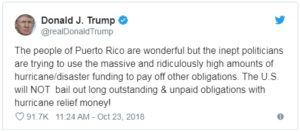
In a Wednesday meeting with Senate Republicans, Trump said the amount of aid Puerto Rico had so far received “is way out of proportion to what Texas and Florida and others have gotten,” according to Sen. Marco Rubio, R-Fla., who attended the meeting.

Though it has already slashed benefits, Puerto Rico faces a $600 million shortfall to administer food stamps. So far the U.S. government has spent more than $6 billion on disaster relief to Puerto Rico in the wake of Hurricane Maria, which was blamed for killing more than 3,000 people. In June, Texas received $5 billion in federal aid for housing and infrastructure repairs stemming from Hurricane Harvey, which left 103 people dead.

Rosselló, who avoided criticizing Trump in a 2018 interview with Yahoo News, lashed out at the president over his latest reported comments.

“He treats us as second-class citizens, that’s for sure,” Rosselló told CNN. “And my consideration is I just want the opportunity to explain to him why the data and information he’s getting is wrong. I don’t think getting into a kicking and screaming match with the president does any good. I don’t think anyone can beat the president in a kicking and screaming match. What I am aiming to do is make sure reason prevails, that empathy prevails, that equality prevails and that we can have a discussion.”

Trump, whose administration’s response to Maria was criticized as inadequate, has long been seen as reluctant to offer aid to Puerto Rico. In October the president again signaled his disapproval of giving aid that might be used to help alleviate the financial distress the island was experiencing even before Maria hit.

Source: Posted March 28, 2019; retrieved March 29, 2019 from: https://news.yahoo.com/puerto-ricos-governor-warns-trump-if-the-bully-gets-close-ill-punch-the-bully-in-the-mouth-162447705.html?.tsrc=notification-brknews

There is no love for Puerto Rico … within their American eco-system.

This theme aligns with previous commentaries from the movement behind the book Go Lean…Caribbean; see a sample list here:

https://goleancaribbean.com/blog/?p=15012 In Life or Death: No Love for Puerto Rico
https://goleancaribbean.com/blog/?p=14101 ‘We Are The World’ Style Campaign to Help Puerto Rico
https://goleancaribbean.com/blog/?p=13391 After Maria, Failed-State Indicators: Destruction and Defection for PR
https://goleancaribbean.com/blog/?p=11647 Righting a Wrong: Puerto Rico’s Bankruptcy
https://goleancaribbean.com/blog/?p=7963 ‘Like a Good Neighbor’ – Being there for Puerto Rico
https://goleancaribbean.com/blog/?p=6260 Puerto Rico Bondholders Coalition Launches Ad Campaign
https://goleancaribbean.com/blog/?p=599 Ailing Puerto Rico open to radical economic fixes

As related in this previous blog-commentary, Puerto Rico devotes more human capital – and sacrifice – to US military endeavors than any other state or territories per capita.

Never kill yourself for people who are willing to watch you die.

Way Forward
This consideration brings to mind, an overall discussion of the Way Forward for this country – Puerto Rico – and all Caribbean countries. Our current disposition is dire, a crisis, near-Failed-State status. Yet, the movement behind the Go Lean book posits that a “crisis is a terrible thing to waste”. Here for April 2019, we present a full series of commentaries related to the Way Forward for these 30 Caribbean member-states. The full series is presented as follows:

  1. Way Forward: Puerto Rico learns its “status” with America.
  2. Way Forward: Virgin Islands – America’s youngest colony
  3. Way Forward: ‘Solutions White Paper’ – An Inadequate Plan for the Bahamas

In this series – incomplete as of this date, many other national plans will follow – reference is made to the need for a more comprehensive roadmap for elevating the societal engines of Caribbean communities. Of all the plans out there, this – roadmap presented in Go Lean…Caribbean – is the only one that double-downs on the prospect of regional interdependence.

No man is an island; no island is an island.

Considering entry 1 of 3 of this series for April, what should be the Way Forward for Puerto Rico?

There are 3 options that have been detailed by this Go Lean movement. Here, again, with references to updated information:

Whatever the selection by the people of Puerto Rico – it should be their choice alone – the Go Lean movement still presents the strategies, tactics and implementations to make this island a better homeland to live, work and play. But, it is hardwork …

Actually, it is overdue work. It is the same “Growing Up“, “Managing Your Affairs“, “Taking Care of Business” that was always needed for this island nation.

Others (countries) have done “it” well – we can learn from them; i.e. consider the Iceland experience.

Some have done “it” bad – we must learn from that too; i.e. consider Republic of Venezuela.

With the proper guidance, blood, sweat and tears, it is conceivable, believable and achievable for this island to actualize and be recognized as one of the greatest addresses on the planet – not just some “ugly step-child”.  🙂

About the Book
The book Go Lean…Caribbean serves as a roadmap for the introduction and implementation of the technocratic Caribbean Union Trade Federation (CU), for the elevation of Caribbean society – for all member-states. This CU/Go Lean roadmap has these 3 prime directives:

  • Optimization of the economic engines in order to grow the regional economy to $800 Billion and create 2.2 million new jobs.
  • Establishment of a security apparatus to ensure public safety and protect the resultant economic engines.
  • Improve Caribbean governance to support these engines, including a separation-of-powers between the member-states and CU federal agencies.

The Go Lean book provides 370-pages of turn-by-turn instructions on “how” to adopt new community ethos, plus the strategies, tactics, implementations and advocacies to execute so as to reboot, reform and transform the societal engines of Caribbean society.

Download the free e-Book of Go Lean … Caribbean – now!

Who We Are
The movement behind the Go Lean book – a non-partisan, apolitical, religiously-neutral Community Development Foundation chartered for the purpose of empowering and re-booting economic engines – stresses that reforming and transforming the Caribbean societal engines must be a regional pursuit. This was an early motivation for the roadmap, as pronounced in the opening Declaration of Interdependence (Pages 12 – 13):

xi. Whereas all men are entitled to the benefits of good governance in a free society, “new guards” must be enacted to dissuade the emergence of incompetence, corruption, nepotism and cronyism at the peril of the people’s best interest. The Federation must guarantee the executions of a social contract between government and the governed.

xvi. Whereas security of our homeland is inextricably linked to prosperity of the homeland, the economic and security interest of the region needs to be aligned under the same governance. Since economic crimes … can imperil the functioning of the wheels of commerce for all the citizenry, the accedence of this Federation must equip the security apparatus with the tools and techniques for predictive and proactive interdictions.

xxiv. Whereas a free market economy can be induced and spurred for continuous progress, the Federation must install the controls to better manage aspects of the economy: jobs, inflation, savings rate, investments and other economic principles. Thereby attracting direct foreign investment because of the stability and vibrancy of our economy.

Sign the petition to lean-in for this roadmap for the Caribbean Union Trade Federation.

————–

Appendix A – Florida lawmaker introduces bill to make Puerto Rico 51st State

TAMPA, Fla. (WFLA) – A Florida congressman and Puerto Rico’s non-voting representative in Congress have introduced a bill that seeks to make the U.S. territory the 51st state.

The Puerto Rico Admission Act of 2019, which is sponsored by Rep. Darren Soto, D-Florida, and Puerto Rico Resident Commissioner Jenniffer González-Colón, would give the island statehood within 90 days of passage.

Our historic legislation will finally end over 120 years of colonialism and provide full rights and representation to over 3.2 million Americans.”

The legislation is partly in response to the Trump administration’s handling of Hurricane Maria relief efforts. According to reports, President Trump complained to Senate Republicans about the amount of disaster aid designated for Puerto Rico. He also asked why the island was given more money than some states affected by hurricanes.

“We have seen time and time again that colonial status is simply not working. Look no further than the abysmal Hurricane Maria recovery efforts and the draconian PROMESA law to prove this point all too well,” Soto added. “The Puerto Rican people have spoken. It’s time for Congress to finally make Puerto Rico a state!”

“From the day I was sworn in as Puerto Rico’s sole representative in Congress, and filed the Puerto Rico Admission Act, I stated very clearly that I would work different strategies, across all platforms to achieve the full equality for Puerto Rico, which can only be achieved through statehood, For more than a century the people of Puerto Rico have been U.S. citizens, but has been denied the right to vote for the President and members of Congress, leaving us without representation in the federal government, which enact the laws that rule the land. Democracy and equality for American citizens is an issue of justice and civil rights. Us, as American citizens, want to have the same benefits and duties, as all American citizens have in the states,” she continued.

Governor Ricardo Rossello was also in attendance and called on members of Congress to support the bill and “join in our quest to achieve equal treatment for the over 3 million U.S. citizens in Puerto Rico.”

Source: Posted March 30, 2019; retrieved April 2, 2019 from: https://www.wfla.com/news/florida/florida-lawmaker-introduces-bill-to-make-puerto-rico-51st-state/1888575456

Share this post:
, , ,
[Top]

Long Train of Abuses: Overseas Masters – Cannot See Overseas

Go Lean Commentary

What is the weather right now in Amsterdam, London, Paris and/or Washington DC?
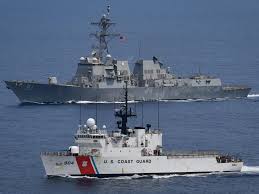
Do you know? Does it even matter?

Chances are, the people in those cities also do not think of the specificities of our weather in the Caribbean. They might think it is warm in the winter and hot in the summer, but they may not understand the flooding-drought cycles, the humidity or the pervasive threat of tropical cyclones: Hurricanes.

They do not know … and may not care.

This is the alarming dangers of having Overseas Masters; they may not appreciate the need or landscape for local efficiencies in our daily stewardship. They may not care about the details and thusly, may not even allow the audience for us to enunciate the challenges of our problems or the solutions. They may even veto regulations and measures on our end that are best practices because they might violate some political “day-dream” on their end.

The concern may be trivial … or it may be life-or-death. This issue is just another scenario where there is a Long Train of Abuse for colonial pawns … compared to their imperial-host counterparts.

Here is an example of trivial:

Imagine this scenario …

… a Group Purchasing Agreement for Coast Guard boats is vetoed because a different manufacturer offers a better discount on their boats and snow removal equipment all bundled together.

This is our reality in the Caribbean. The need for us to deploy the best local governing strategy, tactic and implementation have never been greater, yet our hands may be tied for our own self-determination.

Now for an example approaching life-or-death. See this story below from Martinique in the French Caribbean. This is the grave matter of environmental poisoning, with a chemical not allowed in Metropolitan France but tolerated in the French Antilles. Grasp the summary from this excerpt:

“… the issue is how overseas territories get treated; there’s contempt, distance, condescension, lack of respect.”

Say it ain’t so!

See the full news article here, as published by the BBC:

Title: The Caribbean islands poisoned by a carcinogenic pesticide
By:
Tim Whewell, BBC News, Martinique

“First we were enslaved. Then we were poisoned.” That’s how many on Martinique see the history of their French Caribbean island that, to tourists, means sun, rum, and palm-fringed beaches. Slavery was abolished in 1848. But today the islanders are victims again – of a toxic pesticide called chlordecone that’s poisoned the soil and water and been linked to unusually high rates of prostate cancer.

“They never told us it was dangerous,” Ambroise Bertin says. “So people were working, because they wanted the money. We didn’t have any instructions about what was, and wasn’t, good. That’s why a lot of people are poisoned.” He’s talking about chlordecone, a chemical in the form of a white powder that plantation workers were told to put under banana trees, to protect them from insects.
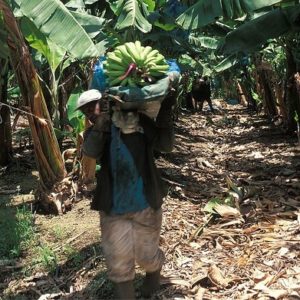
Ambroise did that job for many years. Later, he got prostate cancer, a disease that is commoner on Martinique and its sister French island of Guadeloupe than anywhere else in the world. And scientists blame chlordecone, a persistent organic pollutant related to DDT. It was authorised for use in the French West Indies long after its harmful effects became widely known.

“They used to tell us: don’t eat or drink anything while you’re putting it down,” Ambroise, now 70, remembers. But that’s the only clue he and other workers in Martinique’s banana plantations in the 1970s, 80s and early 90s had about the possible danger. Few if any were told to wear gloves or masks. Now, many have suffered cancer and other illnesses.
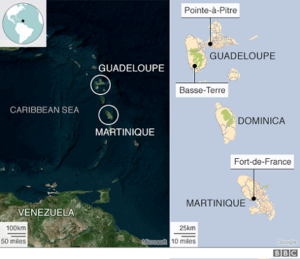
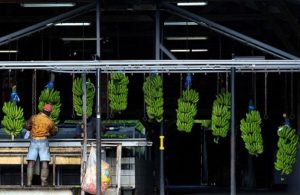
Chlordecone is an endocrine disrupter, meaning it can affect hormonal systems.

One of the world’s leading experts on the chemical, Prof Luc Multigner, of Rennes University in France, says epidemiological studies have shown increased risk of premature births and increased risk of adverse brain development in children at the exposure levels people in Martinique and Guadeloupe face through contaminated food consumption.

He also says: “There is enough toxicological and experimental data to conclude that chlordecone is carcinogenic.”

Following a detailed study Prof Multigner and colleagues conducted on Guadeloupe in 2010, he estimates chlordecone is responsible for about 5-10% of prostate cancer cases in the French West Indies, amounting to between 50 to 100 new cases per year, out of a population of 800,000.

Chlordecone stays in the soil for decades, possibly for centuries. So more than 20 years after the chemical ceased to be used, much of the land on Martinique cannot be used for growing vegetables, even though bananas and other fruit on trees are safe.

Rivers and coastal waters are also contaminated, which means many fishermen cannot work. And 92% of Martinicans have traces of chlordecone in their blood.

“You try to have a healthy kind of life. So maybe you will limit the effects of the poison. But you are not sure,” says historian Valy Edmond-Mariette, aged 31. “My friends and I were asking ourselves: do we really want children? Because if we give them breast milk, maybe they will have chlordecone in their blood. And I think nobody should be asking themselves this kind of question, because it’s awful.”

Production of chlordecone was stopped in the United States – where it was marketed as Kepone – as far back as 1975, after workers at a factory producing it in Virginia complained of uncontrollable shaking, blurred vision and sexual problems. In 1979, the World Health Organization classed the pesticide as potentially carcinogenic.

But in 1981 the French authorities authorised chlordecone for use in banana plantations in the French West Indies – and even though it was finally banned in 1990, growers lobbied for – and got – permission to carry on using stocks until 1993.

That’s why – for many Martinicans – chlordecone stirs up painful historical memories. “A lot of people talk about chlordecone like a new kind of slavery,” says Valy, whose own ancestors were enslaved. For two centuries, until 1848, Martinique was a colony that depended on the production of sugar by enslaved people. And in the late 20th Century, some of the big banana growers who used chlordecone were the direct descendants of those slave-owning sugar exporters, part of a small white minority known as the békés.

“Those are still the same group of people who have uncontested domination of the land,” says Guilaine Sabine, activist in a grassroots organisation called Zero Chlordecone Zero Poison. As well as campaigning for free blood tests for everyone on the island, members of the group have taken part in a new wave of protests over the last year aiming to draw attention to businesses that activists say have profited from the production and use of toxic pesticides. The demonstrations have been small, and some protesters have been convicted of violence against the police. But they reflect wider anger over the slow pace of France’s response to the chlordecone catastrophe.
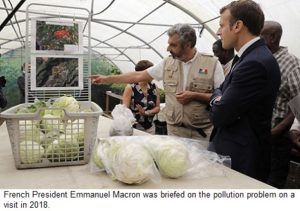
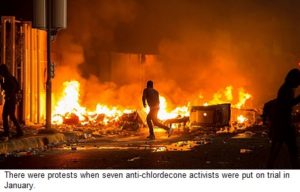
It was only in 2018 – after more than 10 years of campaigning by French Caribbean politicians – that President Emmanuel Macron accepted the state’s responsibility for what he called “an environmental scandal”. He said France had suffered “collective blindness” over the issue. A law to create a compensation fund for agricultural workers has now been passed. But payouts haven’t started yet.

Martinique is an integral part of France, but one of the island’s MPs, Serge Letchimy, says it would never have taken the state so many years to react if there had been pollution on the same scale in Brittany, for example, or elsewhere in European France. “The issue is how overseas territories get treated. There’s contempt, distance, condescension, lack of respect.”

Prof Multigner says the original documents of the official body that authorised use of the pesticide in 1981 have disappeared for unknown reasons, hampering attempts to investigate how the decision was taken.

But the state’s representative on Martinique, Prefect Stanislas Cazelles, insists there was no discrimination against the islanders.

“The Republic is on the side of the oppressed, of the weakest here, just as in the European part of France,” he says.

The state is working to find ways to decontaminate the land – some scientists think chlordecone can potentially be biodegraded quite quickly – and ensure there is no trace of the pesticide in the food chain. And the prefect hopes the independent commission that will judge compensation claims will generally rule in favour of former farm workers who say they are victims of the pesticide.

Ambroise, who worked with chlordecone for so many years, had an operation to remove his cancer in 2015. But he still suffers from thyroid disease and other problems that may be connected to chlordecone’s known effects on the hormonal system.

Meanwhile the historian, Valy, had blood cancer when she was just 25. Her doctor does not think it was due to chlordecone. But Valy says no-one can be sure.

Worrying about the effects of the pesticide, she says, can be exhausting. “But in the end, you can’t control everything. You have to admit that to some extent, you’re poisoned, so you just deal with it.”  😐

Source: Posted November 20, 2020; Retrieved December 6, 2020 from:  https://www.bbc.com/news/stories-54992051?fbclid=IwAR06kJWJa0snsL2On46rTiCpNKfxOFEhyF_G3uiyXKUk9Lpsp9hVMZjl60Q

This is not theoretical; this is the Long Train of Abuses we have had to endure here in the Caribbean.

This is the continuation of the monthly Teaching Series from the movement behind the 2013 book Go Lean…Caribbean. The book presents issues that are germane to Caribbean life and culture and how to address them: problems and solutions. For this month of December 2020, we are looking at the Long Train of Abuses that could-would-should move our people to change, to reform and transform. This is entry 2-of-6; this one asserts that a system of Overseas Masters is inherently flawed as a strategy for governance in a local community – “they” cannot see overseas.

  • Too many things can go wrong.
  • Too many things have gone wrong.

These “gone wrong’ considerations are among the lessons for this Teaching Series this month. See the full catalog of the series this month:

  1. Long Train of Abuses: Enough Already – Colonialism Be Gone!
  2. Long Train of Abuses: Overseas Masters – Cannot See Overseas
  3. Long Train of Abuses: Religious Leadership in Government – Reconciling Trump
  4. Long Train of Abuses: Religious Character in Society – Human Rights
  5. Long Train of Abuses: Dutch Hypocrisy – Liberal Amsterdam vs Conservative Antilles
  6. Long Train of Abuses: Puerto Rico – “Take the Heat” or “Get out of the Kitchen”

This submission looks specifically at an example in the French Antilles. But the foregoing example of French mis-management is just another case of “For Export Only”-labeled products. For stakeholders in the host country, their overseas territory is far enough to be considered for “exports”. This is why the Caribbean region must no longer endure these Long Train of Abuses.

The Go Lean book, serving as a roadmap for the introduction and implementation of the Caribbean Union Trade Federation (CU), asserts that Caribbean stakeholders must instantiate the technocratic security and governing apparatus to deliver in the Caribbean for the people of the Caribbean; for us by us. Our motivation is economic as well. Imagine our “trade” prospects.

In the foregoing news story, the threat on locally-grown produce was exposed because of the contaminating agents still in the soil in Martinique. Imagine a neighboring Caribbean island – i.e. Dominica – consuming fresh produce from Martinique. This is why any effort for a Caribbean Single Market must be coupled with a Security-Public-Safety apparatus as well.

Enough already! We do not want to be just an Export or Foreign Market. No, we want to be considered neighbors; we must protect each other.

We have addressed this theme before. Consider this sample of previous blog-commentaries that highlighted the roles and responsibilities to foster regional trade and regional harmony:

https://goleancaribbean.com/blog/?p=19570 European Role Model: Not when ‘Push’ comes to ‘Shove’
Under normal conditions, the EU boast Free Movement of people and universal protections of civil rights in every jurisdiction. But, now something has broken that European tranquility, the COVID-19 pandemic.The end-result may be closed borders, banned exports of critical supplies and withholding of humanitarian aid. That is “me first” nationalism, instead of the best-practice of interdependence.
https://goleancaribbean.com/blog/?p=18834 A Lesson in History: Free Trade Agreement of the Americas
Free Trade would allow for all 30 member-states to have a tariff-free trading environment. We need to consider this at least to fulfill our Food Security needs.
https://goleancaribbean.com/blog/?p=17282 Way Forward – For Independence: Territory Realities
A roadmap for a “bigger organization” tied to the geographical neighborhood, as opposed to the colonial legacy with “overseas masters” up to 8,000 miles away.
https://goleancaribbean.com/blog/?p=15567 Caribbean Unity? Need French Antilles
There must be a regional integration that will integrate the entire region. Yes, this effort posits that any integration without the French territories is like building a skyscraper on a shaky foundation. What a skyscraper really needs is: Bedrock, Baby! The Caribbean Union needs all French territories.
https://goleancaribbean.com/blog/?p=10554 Welcoming the French in Formal Integration Efforts
The islands of Martinique, Guadeloupe, Saint Martin and Saint Barthélemy want to do more with their tropical neighbors; they want to confederate, collaborate and convene on different issues related to community development and nation-building. The rest of the Caribbean should embrace this invitation.
https://goleancaribbean.com/blog/?p=10043 Caribbean Integration Plan for Greater Prosperity
Greater prosperity can be had in the Caribbean only by embracing regional integration. A new model of interdependence and regional integration is far better than the status quo. Like the African proverb says:”If you want to go fast, go alone. If you want to go far, go together”.

“For export only” …

… just this label seems to be the catalyst for investigating the possibility of abuse. See this related story in this VIDEO here:

VIDEO – For Export Only – Pesticides (1981) – https://youtu.be/CPFLPGL_Lrg


Concord Media

Posted August 6, 2015 – Available to buy at: http://www.concordmedia.org.uk/produc… or buy or rent and watch now on: https://vimeo.com/ondemand/forexporto…

The export of pesticides banned in the West, to third world countries, and the disastrous effects of this policy.

Made in 1981 this film reflects the cultural attitudes of the country and language of the time it was made. The issues raised are timeless. The film quality may not be to modern standards.

Distributed by Concord Media
Website: http://concordmedia.org.uk
Twitter: http://twitter.com/ConcordMedia
Facebook: http://www.facebook.com/ConcordMedia59
Vimeo: https://vimeo.com/concordmedia/vod_pages

In general, it is no longer acceptable for “imperial countries” to still own colonies – the inherent threats were manifested in World War I and World War II. In the post WWII reconciliations, it was frown upon to perpetuate colonial ecosystems. To navigate around such a Eliminate Colonies mandate, the Republic of France simply declared their Caribbean territories as a member-sub-state of France, an Overseas Department.

These initiatives proved to just be empty gestures …

So now, while “on paper” these 4 Caribbean islands (and French Guiana too) are supposed to be part of First World France, it is irrefutable that France treats them simply as Third World territories. For example, as depicted in the foregoing news story of shipping and tolerating dangerous chemicals that had previously been banned in Metropolitan France.  🙁

This is a continuation of the Long Train of Abuses.

So this is our urging for all Caribbean member-states of French heritage; (plus British, Dutch and American):

Get out … now!

We hereby urge all stakeholders to lean-in to an alternative, a better Way Forward, this Go Lean roadmap. This is our plan to make our regional homeland a better place to live, work and play.

Yes, we can. Yes, we must! 🙂

About the Book
The book Go Lean…Caribbean serves as a roadmap for the introduction and implementation of the technocratic Caribbean Union Trade Federation (CU), for the elevation of Caribbean society – for all member-states. This CU/Go Lean roadmap has these 3 prime directives:

  • Optimization of the economic engines in order to grow the regional economy to $800 Billion & create 2.2 million new jobs.
  • Establishment of a security apparatus to ensure public safety and protect the resultant economic engines.
  • Improve Caribbean governance to support these engines, including a separation-of-powers between the member-states and CU federal agencies.

The Go Lean book provides 370-pages of turn-by-turn instructions on “how” to adopt new community ethos, plus the strategies, tactics, implementations and advocacies to execute so as to reboot, reform and transform the societal engines of Caribbean society.

Download the free e-Book of Go Lean … Caribbean – now!

Who We Are
The movement behind the Go Lean book – a non-partisan, apolitical, religiously-neutral Community Development Foundation chartered for the purpose of empowering and re-booting economic engines – stresses that reforming and transforming the Caribbean societal engines must be a regional pursuit. This was an early motivation for the roadmap, as pronounced in the opening Declaration of Interdependence (Pages 12 – 13):

x. Whereas we are surrounded and allied to nations of larger proportions in land mass, populations, and treasuries, elements in their societies may have ill-intent in their pursuits, at the expense of the safety and security of our citizens. We must therefore appoint “new guards” to ensure our public safety and threats against our society, both domestic and foreign. The Federation must employ the latest advances and best practices … to assuage continuous threats against public safety.

xi. Whereas all men are entitled to the benefits of good governance in a free society, “new guards” must be enacted to dissuade the emergence of incompetence, corruption, nepotism and cronyism at the peril of the people’s best interest. The Federation must guarantee the executions of a social contract between government and the governed.

xvi. Whereas security of our homeland is inextricably linked to prosperity of the homeland, the economic and security interest of the region needs to be aligned under the same governance. Since economic crimes, including piracy and other forms of terrorism, can imperil the functioning of the wheels of commerce for all the citizenry, the accedence of this Federation must equip the security apparatus with the tools and techniques for predictive and proactive interdictions.

xxiv. Whereas a free market economy can be induced and spurred for continuous progress, the Federation must install the controls to better manage aspects of the economy: jobs, inflation, savings rate, investments and other economic principles. Thereby attracting direct foreign investment because of the stability and vibrancy of our economy.

Sign the petition to lean-in for this roadmap for the Caribbean Union Trade Federation.

Share this post:
, , , , ,
[Top]