Category: Ethos

Bad Ethos Retarding ‘New Commerce’

Go Lean Commentary

Unlike most places, the Bahamas mandates that restaurants charge 18% gratuity … even for take-out operations. This is extreme, as gratuity is universally accepted as remuneration for the Wait Staff. But when the mode of operation is “take-out”, gratuity is superfluous – there is no Wait Staff.

Further, this “take-out gratuity” it is an example of …

rent-seeking – extracting uncompensated value from others without making any contribution – getting something for nothing.

To mandate gratuity under this extreme is really a bad community ethos – fundamental character or spirit of a culture; the underlying sentiment that informs the beliefs, customs, or practices of a group or society.

Remember, this old maxim:

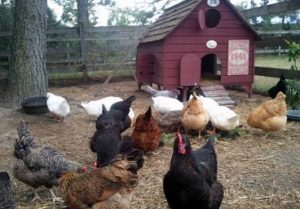
The chickens have come home to roost
This expression was renewed by Malcolm X after the assassination of President John F. Kennedy, The adage dates back to at least 1810 when the English poet Robert South wrote, “Curses are like young chickens; they always come home to roost”. From an agricultural expression, it is true, domesticated foul may wander about all day – think Free Range – but in the evening, they do return to their default nesting location, the hen-house. This saying is comparing a person’s evil or foolish deeds to chickens. If a person does wrong, the “payback” might not be immediate. But at some point, at the end of the day, those “chickens” will come home to roost. “One has to face the consequences of one’s past actions”.

The lesson-learned is simple: we are NOT entitled to other people’s money.

Now, there is a New Economy, the bad attitudes about other people’s money have repercussions and consequences. Foolish policies like mandatory gratuity on take-out dinning are not tolerated under the New Economy regime. Places like the Bahamas – and other Caribbean member-states – must reform and transform.

The New Economy has brought forward a “Sharing Eco-System” in which industrial trends like ride-sharing, home-sharing and delivery assignments have emerged. There is now the concept of “ghost” restaurants – delivery services only; see details in the Appendices below.

Welcome to the Gig Economy.

Want a piece of this?
End mandatory gratuity on Restaurant Take-out activities!

All of these developments have created new jobs, new businesses and new opportunities. If we want a piece of this New Economy, then we have to adapt; we must rid ourselves of the bad community ethos and adopt some new ones. This theme – positioning our society for the New Economy – aligns with previous commentaries; see a sample list here:

https://goleancaribbean.com/blog/?p=17040 Uber: A Better ‘Mousetrap’
https://goleancaribbean.com/blog/?p=13916 Model of ‘Gig Economy’ – Mother’s Love in Haiti
https://goleancaribbean.com/blog/?p=10220 Waging a Successful War on Rent
https://goleancaribbean.com/blog/?p=8262 UberEverything in Africa – Model of ‘Gigs’
https://goleancaribbean.com/blog/?p=7646 Going from ‘Good to Great’
https://goleancaribbean.com/blog/?p=5542 Economic Principle: Bad Ethos of Rent-Seeking
https://goleancaribbean.com/blog/?p=2571 More Business Travelers flock to Airbnb

The Caribbean region must prepare and foster opportunities and dictate economic progress, so we must “weed out” bad practices and/or “rent” in our community ethos; instead we must pursue better ethos, as in the Greater Good. The book  Go Lean…Caribbean defines this attribute as follows (Page 37):

“The greatest good to the greatest number of people which is the measure of right and wrong”. – Jeremy Bentham (1748 – 1832).

There are repercussions and consequences of bad community ethos.  For one, people feel cheated, they leave-flee-abandon their homeland!

People may love their homeland, but seek refuge in more progressive societies, on foreign shores. The reasons why people leave in the first place have been identified as “Push and Pull”:

  • “Push” refers to the reasons people who feel compelled to leave, to seek refuge in a foreign land. “Refuge” is an appropriate word; because of societal defects – like unearned entitlements – many from the Caribbean must leave as refugees – think DisabilityDomestic-abuseMedically-challenged and LGBT – for their life, liberty and pursuit of happiness.
  • “Pull”, on the other hand refers to the lure of a more prosperous life abroad; many times our people are emigrating to communities where there are less rent-seeking and Crony-Capitalism practices.

If only we can mitigate these “push and pull” factors, then we can dissuade our societal abandonment and have a chance of reforming and transforming our societal engines in the homeland. Having an entitled attitude towards other people’s money is a bad attitude. The reality of the New Economy is premised on good business values and good societal values: Win-Win.

A Win-Win for Caribbean stakeholders is the motive for this movement behind the Go Lean book. We want to change – reform and transform – our Caribbean society by optimizing the eco-systems for economics, security and governance.

Yes, we can …

… it is heavy-lifting, but conceivable, believable and achievable that we can make changes and succeed in elevating our communities. This is about bad attitudes and bad habits. We have seen this before. The Go Lean book relates (Page 20):

Change is not easy …

Just ask anyone attempting to quit smoking. Not only are there physiological challenges, but psychological ones as well, to the extent that it can be stated with no uncertainty that “change begins in the head”. In psycho-therapy the approach to forge change for an individual is defined as “starting in the head” (thoughts, visions), penetrating the heart (feelings, motivations) and then finally manifesting in the hands (actions). This same body analogy is what is purported in this book for how the Caribbean is to embrace change – following this systematic flow:

  • Head – Plans, models and constitutions
  • Heart – Community Ethos
  • Hands – Actions, Reboots, and Turn-arounds

Leaning in and going lean for Caribbean regional integration hereto requires engaging all three body parts, figuratively speaking, none more important than the heart. The people of the Caribbean must change their feelings about elements of their society – elements that are in place and elements missing. This is referred to as “Community Ethos”.

Let’s get started. Let’s quit smoking, rent-seeking and all other bad habits and practices. This is how we can make our homeland a better place to live, work and play. 🙂

About the Book
The book Go Lean…Caribbean serves as a roadmap for the introduction and implementation of the technocratic Caribbean Union Trade Federation (CU), for the elevation of Caribbean society – for all member-states. This CU/Go Lean roadmap has these 3 prime directives:

  • Optimization of the economic engines in order to grow the regional economy to $800 Billion & create 2.2 million new jobs.
  • Establishment of a security apparatus to ensure public safety and protect the resultant economic engines.
  • Improve Caribbean governance to support these engines, including a separation-of-powers between the member-states and CU federal agencies.

The Go Lean book provides 370-pages of turn-by-turn instructions on “how” to adopt new community ethos, plus the strategies, tactics, implementations and advocacies to execute so as to reboot, reform and transform the societal engines of Caribbean society.

Download the free e-Book of Go Lean … Caribbean – now!

Who We Are
The movement behind the Go Lean book – a non-partisan, apolitical, religiously-neutral Community Development Foundation chartered for the purpose of empowering and re-booting economic engines – stresses that reforming and transforming the Caribbean societal engines must be a regional pursuit. This was an early motivation for the roadmap, as pronounced in the opening Declaration of Interdependence (Pages 12 – 13):

xi. Whereas all men are entitled to the benefits of good governance in a free society, “new guards” must be enacted to dissuade the emergence of incompetence, corruption, nepotism and cronyism at the peril of the people’s best interest. The Federation must guarantee the executions of a social contract between government and the governed.

xvi. Whereas security of our homeland is inextricably linked to prosperity of the homeland, the economic and security interest of the region needs to be aligned under the same governance. Since economic crimes … can imperil the functioning of the wheels of commerce for all the citizenry, the accedence of this Federation must equip the security apparatus with the tools and techniques for predictive and proactive interdictions.

xxi. Whereas the preparation of our labor force can foster opportunities and dictate economic progress for current and future generations, the Federation must ensure that educational and job training opportunities are fully optimized for all residents of all member-states, with no partiality towards any gender or ethnic group. The Federation must recognize and facilitate excellence in many different fields of endeavor, including sciences, languages, arts, music and sports. This responsibility should be executed without incurring the risks of further human flight, as has been the past history.

xxiv.  Whereas a free market economy can be induced and spurred for continuous progress, the Federation must install the controls to better manage aspects of the economy: jobs, inflation, savings rate, investments and other economic principles. Thereby attracting direct foreign investment because of the stability and vibrancy of our economy.

xxvi.  Whereas the Caribbean region must have new jobs to empower the engines of the economy and create the income sources for prosperity, and encourage the next generation to forge their dreams right at home, the Federation must therefore foster the development of new industries, like that of ship-building, automobile manufacturing, prefabricated housing, frozen foods, pipelines, call centers, and the prison industrial complex. In addition, the Federation must invigorate the enterprises related to existing industries like tourism, fisheries and lotteries – impacting the region with more jobs.

Sign the petition to lean-in for this roadmap for the Caribbean Union Trade Federation.

——————

Appendix – What Are Ghost Restaurants?

If you’re tuned into restaurant trends, you may have heard of ghost restaurants. These new types of foodservice establishments are increasing in popularity as more and more restaurateurs decide to depart from traditional brick-and-mortar establishments and focus on delivery instead. If you want to learn more about what ghost restaurants are, how they work, and how you can start a successful one, keep reading.

What Is a Ghost Restaurant?
A ghost restaurant, also known as a virtual restaurant or delivery-only restaurant, is a foodservice establishment that offers take-out only. These “ghostly” eateries don’t have a storefront, so customers can’t come to pick up their own food. Ghost restaurants deliver food directly to their patrons, often through the use of third-party delivery services.

Mostly Made-to-Order
Generally, virtual restaurants function just like traditional restaurants, in that customers’ food is prepared once they order it. As a result, many establishments offer a lot of customization options for their menu items.

Where Do Ghost Restaurants Work Best?
This type of foodservice model is especially great for high-rent areas. Instead of hoping to find a prime location to draw foot traffic, restaurateurs can establish their virtual restaurant in any neighborhood they see fit, so long as their delivery service can easily access customers.

Making the Most of Their Space
Many popular fast-casual establishments in cities are bound by the requirement for seating and waiting space, even though a large percentage of their customers aren’t dining in. So, offering only delivery helps virtual restaurants avoid the problem of underutilized space.

Advantages of Ghost Restaurants
Here are some things that ghost restaurants can do that traditional eateries can’t:

  • Flexibility of concept: Being app- or web-based means that you can change your menu whenever you like, without having to worry about updating signage or printed materials.
  • Adjustable menu: If an ingredient becomes too expensive or is no longer accessible in your area, you can easily swap out your menu items to suit what is available to you.
  • Smaller financial investment: Think about all the expensive elements that don’t apply to virtual restaurants: decor, signage, dinnerware, and additional staff members to serve as servers or hosts.
  • Opportunity for experimentation: Ghost restaurants are the perfect opportunity to experiment with new concepts, because you can easily scrap ideas that aren’t working.

What Is a Ghost Restaurant Kitchen Like?
In virtual restaurants, the kitchen is where a lot of your investment goes. Because you don’t have to allow square footage for a dining area, you have much more room to customize your kitchen space. Depending on your budget, you can opt for some specialized cooking equipment that you probably never had room for in a traditional restaurant.

Using One Kitchen for Several Concepts
You can even own multiple ghost restaurants and operate them out of the same kitchen. Especially if your menus have ingredient overlap, you can prepare food for two separate concepts in one efficient space.

Source: Retrieved May 21, 2019 from: https://www.webstaurantstore.com/blog/2348/what-are-ghost-restaurants.html

————–

Appendix VIDEO – How Ghost Restaurants are Changing the Food Industry – https://youtu.be/59sPK73YjA0

Cheddar
Published on Feb 23, 2019 –
With the rise of delivery services has come the rise of Ghost Restaurants which will cook your food and deliver it, but you’d never be able to order “for here”.

Subscribe to Cheddar on YouTube: http://chdr.tv/subscribe

Connect with Cheddar!
On Facebook: http://chdr.tv/facebook
On Twitter: http://chdr.tv/twitter
On Instagram: http://chdr.tv/instagram
On Cheddar.com: http://chdr.tv/cheddar

Share this post:
, , ,

Barbados Diaspora – Not the Panacea

Go Lean Commentary

“Come home Bajans …”
“… in 2020”?

This is the campaign challenge to all Barbadian (Bajan) Disapora, to consider coming back to Barbados. For good! (See the story of a sample repatriate/re-patriot in the VIDEO in the Appendix below).

Is this the vision? Yes, this is the hope that is expressed by the island-nation’s Prime Minister:

During her address, the Prime Minister highlighted some of the struggles this country faced in the past and stressed that democracy was a precious gift that must be nurtured and protected, so persons would always have a voice.

She noted that all Barbadians, not only the 300,000 living here but those overseas, must all work together to build the best Barbados.
(See full article below).

But wait, is the Honorable Prime Minister Mia Amor Mottley openly admitting that the country is NOT yet at that destination? But still, she is calling for Bajans to come home.

In all due respect, Madam Prime Minister, “they” are not listening. The Diaspora – of all Caribbean countries – never listens to the appeals of their former homelands. Alas, Barbados is not the first to waste time, talent and treasuries to engage their Diaspora and urge them to come back and/or to invest in the homeland.

This quest had been pursued throughout the Caribbean. Yet the failures has been loud.

Why? Because they – the Diaspora – are gone!

Yes, there is this preponderance for governments (and citizenry alike) in the region to pursue this same Diaspora strategy. During the calendar year of 2017, we published a number of commentaries on this Caribbean pre-occupation, with these entries relating these homelands:

The Diaspora is not the panacea, or cure-all, for the Caribbean ills. This is the assertion of the movement behind the book Go Lean … Caribbean – available to download for free. Why are we so emphatic in this assertion? The troubling flaw for the Diaspora strategy is that the expectation is that these people who have left ‘here” will now turnaround and fix what is broken here. This is a fallacy! This mistake was committed by these previous governments and unfortunately is being pursued anew in Barbados. See the full news article here:

Title: Come Home Bajans In 2020
By: Sharon Austin

Prime Minister Mia Amor Mottley has urged Barbadians living across the world to come home for 2020.

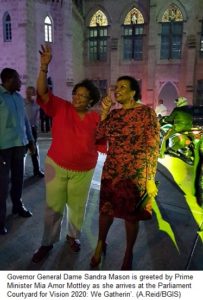
Ms. Mottley made the appeal tonight at the launch of We Gatherin’ Barbados 2020 in Parliament’s Courtyard before a large crowd, including those “watch parties” of Barbadians and friends in Geneva, New York, Beijing, Canada, Washington and Australia.

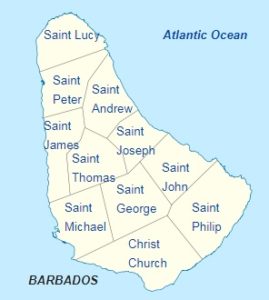
The Prime Minister told her audience: “Coming together in 2020 isn’t about a single moment in time, but it is about a process. It is about the building of a nation from St. Lucy to St. Philip, from the west coast to the east coast….  2020 must be about defining who we are as that one people, in this one space….

“2020 is that point, ironically, where vision is perfected, but we have a bigger vision ahead of us…. We, as Barbadians, will play that role because we…live in a world that we see changing around us, and by 2030 we want to be that country in the world that…will no longer contribute to the destruction of mother earth,  but that will work to make our placement on this earth carbon neutral.”

Ms. Mottley noted that Barbados was accustomed to excellence and highlighted the island’s lead in cane breeding in the 19th century.  She asked how did the country reach such levels of excellence in so many fields, but failed to tell the story to citizens to inspire them to greater heights, not just here, but in the world.

“So 2020, my friends, is about that conversation…telling our story, sharing our passions, coming home for that inspiration…. 2020 is about making that difference to your old primary school or making that difference to the church that helped nurture you in your parish.  2020 is about families recognizing that time on this earth is way too short and we need to get together a little more,” she explained.

She added that Barbados must be that place where global business must be transacted.

During her address, the Prime Minister highlighted some of the struggles this country faced in the past and stressed that democracy was a precious gift that must be nurtured and protected, so persons would always have a voice.

She noted that all Barbadians, not only the 300,000 living here but those overseas, must all work together to build the best Barbados.

We Gatherin’ is a 12-month global celebration of Barbadian excellence, and a recommitment to this country’s successful future and core values that have defined us as a people.  2020 has been designated as the year for Barbadians and those who love this country to come home, reconnect with family and friends, and invest in the rebuilding and development of Barbados.

The initiative will begin in the north of the island in January 2020, and move southward every month, allowing each designated parish to showcase its icons, social life and the food for which it is renowned.  The parish celebrations will culminate in St. Michael in November, and We Gatherin’ will climax in December in Barbados.

[Author Sharon Austin can be reached at:] sharon.austingill-moore@barbados.gov.bb

Source: Posted February 22, 2019; retrieved April 30, 2019 from: http://gisbarbados.gov.bb/blog/come-home-bajans-in-2020/?fbclid=IwAR1toA1bQXh0epcWWvxGYh2KNdWXjIrCt5-uPHLOZRAa-_csRF9zaIb844Q

This seems so innocent, so practical, yet as a strategy to elevate the Barbadian society, it is so flawed. This was eloquently explained in a previous blog-commentary, as follows:

The premise for the criticism of this Diaspora strategy is that the ones that have fled the region have done so for a reason; they have been “pushed” or “pulled” away from their homeland. They may still love their “past” country, but can only do so much from abroad. Plus, history documents that they are less inclined to invest back in their country; they are burdened with the concerns of today and the future, that it is illogical to think that they are concerned about their yesterdays. Thusly, all efforts to outreach the Diaspora are usually futile. All of these prior commentaries relate this basic truth about catering to the Diaspora:

The subtle [Diaspora outreach] message to the Caribbean population is that they need to leave their homeland, go get success and then please remember to invest in us afterwards.

… It is so unfortunate that the people in the Caribbean are beating down the doors to get out of their Caribbean homeland, to seek refuge in these places like the US, Canada and Western Europe. … As a result, we have such a sad state of affairs for our Caribbean eco-system as we are suffering from a bad record of societal abandonment.

Thank you, all Diaspora members that have looked back and lent a hand, but the heavy-lifting of reforming and transforming our society must really come from the people who are in the homeland and in the region. For starters, we must try to dissuade people from leaving in the first place and help them to prosper where planted. The record shows that those who do leave, tend to be the ones that we can least afford to lose. These include the professional classes and highly educated ones; one report presents an abandonment rate of 70 percent of the college-educated populations.

Picture a family with limited food supply, serving dinner and “making extra plates” for family members who have left or passed. This would be illogical. We need to be more pragmatic and work a different strategy to assuage our crisis. We need a strategy that embraces those who are still here, not those that “used to be”.

So the problem of a Diaspora-outreach strategy is that it double-downs on the failure of why the Diaspora left in the first place. We need to employ new strategies for the underlying failures. When we look at our Caribbean homeland and see the many failures, we realize that the people on some islands … and the people in their Diaspora cannot solve the problems in the homeland … alone. No, something bigger and better is needed.

So rather than the strategy to “Invite the Diaspora to Remember Us”, there needs to be a Way Forward with strategies, tactics and implementations to elevate the societal engines of Barbados. This Way Forward has just been exhausted in a series of 9 commentaries for the month of April 2019. The Way Forward is presented in the Go Lean book, as it serves as a roadmap for the introduction and implementation of the Caribbean Union Trade Federation (CU). This will benefit Barbados and the rest of the 30 Caribbean member-states.

The foregoing article asserted that Barbados has been home to excellence in the past. This is so true. A lot of the Diaspora that have left – and/or their children – have excelled in their foreign abodes. Look here at this list:

Reference: Prominent Bajans Around the World

Actors

Musicians (sample)

Source: Retrieved April 30, 2019 from: https://en.wikipedia.org/wiki/List_of_Eastern_Caribbean_people#Barbados

An elevated society, allows for accomplished people to accomplish right at home.

The goal of the Go Lean roadmap is to facilitate the Caribbean to be a better place to live, work and play. We would do the heavy-lifting, not expecting some Diaspora member to “swing in and save all of society”. No, the Diaspora is not coming to the rescue. Rather a Caribbean confederacy, constituted by all 30 member-states, is the Way Forward; it is our best option.

By us pointing focus on the Diaspora, it encourages more and more people to abandon the homeland and join the Diaspora. Any country growing their Diaspora is bad for that country and bad for the Diaspora members. Despite the foregoing list of accomplished Bajans, most Diaspora members, only barely survive in the foreign lands, especially the first generation. So any official policy to encourage emigration and living-working-abroad – on a permanent basis – is a flawed policy, not a panacea.

So policies that double-down on the Diaspora is actually doubling-down on failure. There should be no need “to leave and remember”. We should never want people to have to leave. We strongly urge every stakeholder of Barbados, and all of the Caribbean member-states, to lean-in to this roadmap to elevate our homeland.

Yes, we can make our homelands better places to live, work and play. 🙂

About the Book
The book Go Lean…Caribbean serves as a roadmap for the introduction and implementation of the technocratic Caribbean Union Trade Federation (CU), for the elevation of Caribbean society – for all member-states. This CU/Go Lean roadmap has these 3 prime directives:

  • Optimization of the economic engines in order to grow the regional economy to $800 Billion and create 2.2 million new jobs.
  • Establishment of a security apparatus to ensure public safety and protect the resultant economic engines.
  • Improve Caribbean governance to support these engines, including a separation-of-powers between the member-states and CU federal agencies.

The Go Lean book provides 370-pages of turn-by-turn instructions on “how” to adopt new community ethos, plus the strategies, tactics, implementations and advocacies to execute so as to reboot, reform and transform the societal engines of Caribbean society.

Download the free e-Book of Go Lean … Caribbean – now!

Who We Are
The movement behind the Go Lean book – a non-partisan, apolitical, religiously-neutral Community Development Foundation chartered for the purpose of empowering and re-booting economic engines – stresses that reforming and transforming the Caribbean societal engines must be a regional pursuit. This was an early motivation for the roadmap, as pronounced in the opening Declaration of Interdependence (Pages 12 – 13):

xi. Whereas all men are entitled to the benefits of good governance in a free society, “new guards” must be enacted to dissuade the emergence of incompetence, corruption, nepotism and cronyism at the peril of the people’s best interest. The Federation must guarantee the executions of a social contract between government and the governed.

xvi. Whereas security of our homeland is inextricably linked to prosperity of the homeland, the economic and security interest of the region needs to be aligned under the same governance. Since economic crimes … can imperil the functioning of the wheels of commerce for all the citizenry, the accedence of this Federation must equip the security apparatus with the tools and techniques for predictive and proactive interdictions.

xix. Whereas our legacy in recent times is one of societal abandonment, it is imperative that incentives and encouragement be put in place to first dissuade the human flight, and then entice and welcome the return of our Diaspora back to our shores. This repatriation should be effected with the appropriate guards so as not to imperil the lives and securities of the repatriated citizens or the communities they inhabit. The right of repatriation is to be extended to any natural born citizens despite any previous naturalization to foreign sovereignties.

xx. Whereas the results of our decades of migration created a vibrant Diaspora in foreign lands, the Federation must organize interactions with this population into structured markets. Thus allowing foreign consumption of domestic products, services and media, which is a positive trade impact. These economic activities must not be exploited by others’ profiteering but rather harnessed by Federation resources for efficient repatriations.

xxiv.  Whereas a free market economy can be induced and spurred for continuous progress, the Federation must install the controls to better manage aspects of the economy: jobs, inflation, savings rate, investments and other economic principles. Thereby attracting direct foreign investment because of the stability and vibrancy of our economy.

Sign the petition to lean-in for this roadmap for the Caribbean Union Trade Federation.

—————-

Appendix VIDEO – Moving to Barbados? –  https://youtu.be/zpiNbrk7qXo


Liz Neptune

Published on Sep 1, 2016 – So this is the start of my month-long stay in Barbados, my first attempt at living there. A small intro of things to come. A “vacation” that turned in a self-discovering retreat, an amazing adventure and a 2nd chance at love!!

Rate, comment and Subscribe!

If you enjoy my videos please consider a: 1 Time Donation to Paypal: https://bit.ly/2C3rGyT
or Subscribe to Me: https://www.subscribestar.com/liz-nep…

Check out my MERCHANDISE STORE! https://www.lizneptune.com/shop-1

For photography and film/video services, email liznikols@gmail.com

Connect with me!! IG:
@lizzzneptune
http://www.lizneptune.com
https://www.facebook.com/Neptune-Medi…

SC: tracylorde
TW: @lizzzneptune

Share this post:
, ,
[Top]

Way Forward – ‘Whatever it takes’: Life Imitating Art

Go Lean Commentary

First, we planned the plan …
Now, we must work the plan.

We must pursue the end goals of this plan, ‘whatever it takes’. This is the closing message for our April 2019 series on the Way Forward for the Caribbean. This Way Forward is the plan that was planned, that now needs to be worked.

Why is this plan so important? It might be the best hope for our failing Caribbean homeland.

This Way Forward plan is embedded in the 2013 book Go Lean…Caribbean; this book presents the strategies, tactics and implementations to impact Caribbean society. But first, the book assesses that the 30 member-states of the region are in a crisis – at the precipice of Failed-State status.

The book asserts that all Caribbean islands and coastal states have failed to adapt to these undeniable Agents of Change impacting our society, as well as the whole world:

Globalization, Climate Change, Technology and an Aging Diaspora.

These Agents of Change are devastating Caribbean life … for all people, in all communities. But, a crisis is a terrible thing to waste – according to the Go Lean book (Page 8). The Go Lean book therefore asserts that since we are “all in the same boat” we need to work together – to form the Caribbean Union Trade Federation (CU) – to seek solutions to our problems. This is the Way Forward; this is the plan that we have planned and must now work. But this is more than just a plan; this is a movement.

The movement behind the Go Lean book posits that one identifying symptom is the high societal abandonment rate. The countries of the Caribbean region are experiencing high abandonment rates. Some communities have lost 50 percent of their populations; (think Puerto Rico, USVI, French Antilles, Dutch Antilles); while others have lost 70 percent – on the average – of their college-educated populations – this constitutes a brain drain.

Think that through: 50 percent or half of the population … gone over time.

This reminds us of a recent movie: 2018 “Marvel Studio’s: Avengers Infinity War”. In that plot-line, a villain came along and “snapped his fingers” and wiped out half of the population – see this review here of last year’s movie. At one point that movie was called Avengers Infinity War Part I, to be followed in 2019 by the sequel with the working title Avengers Infinity War Part II. But in the recent months, the formal title was revealed for this movie:

Avengers Endgame.

One of the advertising taglines for this movie is ‘whatever it takes’.

Considering the “Art imitating Life and Life imitating Art” mantra, the reference to this Avengers Endgame movie is spot on for the Caribbean today: Our “life needs to imitate the Art” of Marvel movie-making. We need to work the plan, our Way Forward to bring back our people – the 50 percent – who had left. We must facilitate their return, “whatever it takes”.

See the movie trailer here:

VIDEO – Avengers Endgame | Whatever It Takes – https://youtu.be/Znvv-lUNx8U


Mr. Krepshus

Published on Mar 15, 2019 –

Instagram: @mrkrepshus
Facebook: Mr. Krepshus
Twitter: @MrKrepshus
Become a Patreon today: https://www.patreon.com/mrkrepshus

This is an “Fan-Made” edit for “Avengers: Endgame”
Trailer Music: Really Slow Motion & Giantapes Music – The Last Watch
Outro Music: Lil Pump – Drug Addicts (Instrumental)

Patreon Shoutouts: Shiva, Kaiser Marrero, Daxtyn P Cook, Manny Arriaga, Justin, Chase Minden, Christopher Yee, Ali Paterson, Ana Maria Bobirnea, Andrew B Dahl, George Terrell, Jacob Rowe, Joep Rijsman, John Leffler, Justin, Maison Gamble, NicxMeister, Terence Tuhina.

Copyright Disclaimer Under Section 107 of the Copyright Act 1976, allowance is made for “fair use” for purposes such as criticism, comment, news reporting, teaching, scholarship, and research. Fair use is a use permitted by copyright statute that might otherwise be infringing. Non-profit, educational or personal use tips the balance in favor of fair use. No copyright infringement intended.

#Avengers #Endgame #Marvel #FanEdit

So for the Caribbean, we need to adopt the required community ethos, drop the bad ethos, execute the strategies, tactics and implementations … to elevate our society. We need to do the heavy-lifting,  ‘whatever it takes’; we must succeed.

Lives, livelihoods, identities and cultures are at stake.

This commentary completes this series on the Way Forward for the full Caribbean and the individual member-states. This submission here reminds us that we are losing large numbers of our population – sometimes half – and we need to do the heavy-lifting to bring them back – repatriation. There is a Way Forward for repatriating our Diaspora. This entry 9-of-9 for this April 2019 compilation of commentaries is advocating for heroic team-ups, just like the movie. The full series of commentaries related to the Way Forward is presented as follows:

  1. Way Forward: Puerto Rico learns its “status” with America
  2. Way Forward: Virgin Islands – America’s youngest colony
  3. Way Forward: Bahamas – “Solutions White Paper” – An Inadequate Plan
  4. Way Forward: Jamaica: The need to reconcile the Past
  5. Way Forward: Caribbean Media Strategy & Deliveries
  6. Way Forward: Strategy for Justice: Special Prosecutors et al
  7. Way Forward: Strategy for Energy – ‘Trade’ Winds
  8. Way Forward: Strategy for Independence – Territory Realities
    ———
  9. Way Forward: “Whatever it takes” – Life Imitating Art

This series had asserted that yes, “no man is an island”, and actually “no island is an island” either. No one Caribbean member-state is able to make an impact in the quest to turn-around our failing dispositions. We need the full team of neighbors. We need a collaborative and heroic team-up; we need to do ‘whatever it takes’.

Super-hero movies is a frequent theme for this Go Lean movement. There is a parallel for the stakeholders of our community planning the plan and working the plan. We have published a lot of commentaries reviewing superhero films and depicting their relevance; see a sample list here:

https://goleancaribbean.com/blog/?p=16940 Film: Captain Marvel
Women Empowerment: We need “Sheroes” in Facts and Fiction
https://goleancaribbean.com/blog/?p=14911 Film: Avengers Infinity War
Art Imitating Life – Was ‘Thanos’ Right?
https://goleancaribbean.com/blog/?p=14359 Film: Black Panther
Wakanda Forever – Conceive, Believe and Achieve
https://goleancaribbean.com/blog/?p=13579 Film: Thor Ragnarok
Colonialism’s Bloody History Revisited
https://goleancaribbean.com/blog/?p=12035 Film: Wonder Woman
Lean-in for ‘Wonder Woman Day’
https://goleancaribbean.com/blog/?p=7151 Film: Star Wars – The Force Awakens
The Caribbean is Looking for Heroes … ‘to Return’
https://goleancaribbean.com/blog/?p=5964 Film: Tomorrowland
Feed the right wolf

It is now time for Caribbean people to be heroic. ‘Whatever it takes’, one person can make a difference …

This was related in a previous Go Lean commentary, as follows:

… one man (or woman) can make a difference! Such a person can impact their community, country … and the whole world.

“The only thing necessary for the triumph of evil is for good men to do nothing” – Edmund Burke; 1729 – 1797; an Irish statesman, member of British Parliament and supporter of the American Revolution.

The Go Lean roadmap posits that the CU should foster the genius potential in Caribbean citizens and incubate their potential to maximum production. We should let “heroes be heroes” in their fields of endeavor here at home, no matter how diverse. Many Caribbean Diaspora has done this exactly, abroad in benefiting other communities, while their homelands languish.

We want and need our people back. These ones have joined the Diaspora, whose meaning is “they are scattered about”. These Diaspora members may have left recently for better opportunities or education; (Push & Pull reasons). We can now create the opportunities here in the home region with the emergence of a Single Market as opposed to the local-only status quo they left. We are now prepared to do ‘whatever it takes’; look here, we have now planned these many industrial reboots:

Ferries Prefab Housing Lottery Navy Piers
Prisons Trauma Culture Payment Cards
Pipeline Auto-making Tourism 2.0
Frozen Foods Shipbuilding Cruise Tourism 2.0
Call Centers Fisheries Reinsurance Sidecars

Or perhaps, the Diaspora who left 50, 40, 30 years ago may now be primed to return as retirees. In many cases, their original plan was always to come back home; but “home” was not better, not good, and not even safe. Now, however, we are prepared to do ‘whatever it takes’ to make our communities ready. This was an original motivation for the Go Lean roadmap; the book identified the Agents of Change (Page 57) that imperil our communities:

Aging Diaspora
The demographics of the world we inhabit were shaped by the events in the aftermath of World War II. Many members of the Diaspora avail themselves of opportunities in Europe and North America during their rebuilding effort. So those that repatriated in the 1950’s and 1960’s now comprise an aging Diaspora – with the desire to return to the “town of their boyhood”. They should be welcomed back and incentivized to repatriate.

The “Welcome Mat” comes with challenges; of which the CU is prepared to accommodate: health care, disabilities, elder-care, entitlements, etc. These are all missions for the CU.

Yes, to all of those from this homeland who have fled: We want you back and we will do ‘whatever it takes’.

We are hereby presenting ourselves to do the heroic work, the heavy-lifting of preparing our society to better accommodate these repatriates, in all phases of life, young, mature adults and senior citizens. The Go Lean book therefore provides 370-pages of turn-by-turn instructions on “how” to adopt new community ethos, plus the strategies, tactics, implementations and advocacies to execute so as to reboot the region’s societal engines. Consider the details and headlines here on how the region can better prepare to accommodate the repatriation of the Diaspora to the Caribbean (Page 118):

10 Reasons to Repatriate to the Caribbean

1 Lean-in for the Caribbean Single Market
This treaty allows for the unification of the region into one market, hereby expanding to an economy of 30 countries, 42 million people and a GDP of over $800 Billion (according to 2010 figures). This accedence creates a “new” land of opportunity for so many ventures, and so many protections – the Caribbean will be a better place to live, work and play. The economic engines of the CU should therefore “flash the signs of opportunity” to come back home. The CU will not ignore the reasons why a lot of people emigrated in the first place, in some cases there were political and human rights refugees. Therefore, integral to the repatriation plan is a mission for formal Reconciliation Commissions that will allow many issues to be settled and set aside – punishing the past short circuits the future.
2 “New Guards” for Public Safety
The CU implements the anti-crime measures and provides special protections for classes of repatriates and retirees. Crimes against these special classes are marshaled by the CU, superseding local police. Since the CU will also install a penal system, with probation and parole, the region can institute prisoner exchange programs and in-source detention for foreign governments, especially for detainees of Caribbean heritage.
3 “New Guards” for Economic Stability
A Single Market and currency union, with non-political, technocratic Caribbean Central Bank leadership, will allow for the long-term adoption of monetary and economic best practices. Plus, with a strong currency, viable capital markets, and consumer finance options, a prosperous life for the middle class would be easily sustainable.
4 Citizenship at the CU/Federal Level
Over the decades, many Caribbean expatriates renounced their indigenous citizenship. The CU would extend new citizenship rights to this group, and their children (legacies) which will entitle them to infinite residency, equal civil rights but conditional employment, requiring labor certification or self-owned businesses. They would be issued CU passports.
5 Gerontology Initiatives
The Diaspora is aging! They therefore have special needs germane to senior citizens. The CU will facilitate the needs of the aging repatriates and ensure that the proper institutions are in place and appropriately managed. This includes medical, housing, economic and social areas of responsibility. This issue will be coupled with the CU’s efforts for the host countries to extend entitlement benefits to this region, including medical and Social/National Insurance pensions.
6 US, Canada and EU Closing Doors
7 “No Child Left Behind” Lessons
8 Quick Recovery from Natural Disasters
9 Educational Inducements in the Region
The CU will facilitate e-Learning schemes for institution in the US, Canada and the EU. The repatriates will have an array of educational choices for themselves and their offspring (legacies). This will counter the previous bad experience of students emigrating for advanced educational opportunities and then never returning, resulting in a brain drain.
10 Import US, Canada and EU Cultural Institutions

There have been a number of blog-commentaries by the Go Lean promoters that have detailed the prospects for Caribbean repatriation, the Way Forward. See a sample list here:

https://goleancaribbean.com/blog/?p=15093 ‘Time to Go’ – Windrush: 70th Anniversary of UK Migration
https://goleancaribbean.com/blog/?p=13604 ‘I Want You Back’: Caribbean to the Diaspora
https://goleancaribbean.com/blog/?p=11314 Forging Change: Home Addiction
https://goleancaribbean.com/blog/?p=10566 Funding the Caribbean Security Pact to Better Protect Repatriates
https://goleancaribbean.com/blog/?p=9214 Time to Go: Spot-on for Protest
https://goleancaribbean.com/blog/?p=9219 Time to Go: Logic of Senior Immigration
https://goleancaribbean.com/blog/?p=9646 Time to Go: American Vices; Don’t Follow
https://goleancaribbean.com/blog/?p=7151 The Caribbean is Looking for Heroes … ‘to Return’
https://goleancaribbean.com/blog/?p=5695 Repenting, Forgiving and Reconciling the Past

The foregoing addressed “Pull” factors. Alas, we are also prepared to do ‘whatever it takes’ to address the Push factors …

Many people have fled the Caribbean homeland in search of refuge. While the expansion of the Caribbean Diaspora is a real tragedy, it is not so improbable. Our region has societal defects and dysfunctions that have to be assuaged. We cannot be alarmed when people choose to leave for their prospects and rights for life, liberty and/or property. We must not be surprised when/if these ones turn their back on any interest to even help their former homelands. (This is why the Go Lean movement has consistently urged regional leaders not to invest valuable resources in trying to solicit investment from the Diaspora). There is no excuse for inaction or complacency of the status quo; we need the heavy-lifting to assuage our societal defects.

So yes, the Way Forward means fixing the bad orthodoxies that imperiled our citizens or ignore the needy; think minorities like LGBTDisabilityDomestic-abuseetc.. We cannot change the past; but we can change the future. We must do ‘whatever it takes’.

This is easier said than done. This is why the effort to reform and transform society is considered heroic!

Yes, we can…

Everyone in the Caribbean – residents and Diaspora – are hereby urged to lean-in to this Go Lean roadmap; to be heroic. We can succeed to make our homeland a better place to live, work and play. 🙂

About the Book

The book Go Lean…Caribbean serves as a roadmap for the introduction and implementation of the technocratic Caribbean Union Trade Federation (CU), for the elevation of Caribbean society – for all member-states. This CU/Go Lean roadmap has these 3 prime directives:

  • Optimization of the economic engines in order to grow the regional economy to $800 Billion and create 2.2 million new jobs.
  • Establishment of a security apparatus to ensure public safety and protect the resultant economic engines.
  • Improve Caribbean governance to support these engines, including a separation-of-powers between the member-states and CU federal agencies.

The Go Lean book provides 370-pages of turn-by-turn instructions on “how” to adopt new community ethos, plus the strategies, tactics, implementations and advocacies to execute so as to reboot, reform and transform the societal engines of Caribbean society.

Download the free e-Book of Go Lean … Caribbean – now!

Who We Are

The movement behind the Go Lean book – a non-partisan, apolitical, religiously-neutral Community Development Foundation chartered for the purpose of empowering and re-booting economic engines – stresses that reforming and transforming the Caribbean societal engines must be a regional pursuit. This was an early motivation for the roadmap, as pronounced in the opening Declaration of Interdependence (Pages 12 – 13):

xi. Whereas all men are entitled to the benefits of good governance in a free society, “new guards” must be enacted to dissuade the emergence of incompetence, corruption, nepotism and cronyism at the peril of the people’s best interest. The Federation must guarantee the executions of a social contract between government and the governed.

xvi. Whereas security of our homeland is inextricably linked to prosperity of the homeland, the economic and security interest of the region needs to be aligned under the same governance. Since economic crimes … can imperil the functioning of the wheels of commerce for all the citizenry, the accedence of this Federation must equip the security apparatus with the tools and techniques for predictive and proactive interdictions.

xix. Whereas our legacy in recent times is one of societal abandonment, it is imperative that incentives and encouragement be put in place to first dissuade the human flight, and then entice and welcome the return of our Diaspora back to our shores. This repatriation should be effected with the appropriate guards so as not to imperil the lives and securities of the repatriated citizens or the communities they inhabit. The right of repatriation is to be extended to any natural born citizens despite any previous
naturalization to foreign sovereignties.

xxiv.  Whereas a free market economy can be induced and spurred for continuous progress, the Federation must install the controls to better manage aspects of the economy: jobs, inflation, savings rate, investments and other economic principles. Thereby attracting direct foreign investment because of the stability and vibrancy of our economy.

Sign the petition to lean-in for this roadmap for the Caribbean Union Trade Federation.


Share this post:
, ,
[Top]

Way Forward – For Justice: Special Prosecutors – Encore

The talk of Special Prosecutors is all the rage today, April 18, 2019:

In the US, the Special Prosecutor looking into the Russian Interference of the 2016 Election, Robert Mueller, has released the Official Report showing the key findings of his two-year investigation; (the 400-page document can be found here). Much of this investigation looked “under the covers” of the current President of the US, Donald J. Trump, his close associates, campaign, corporate and charitable organizations; in total 35 people were indicted, found guilty and/or confessed to federal crimes. (Many state prosecutions are still pending).

This is American justice at work. Will this be satisfying? Will there be accountability and consequences for any wrongdoing?

This is the quest and the process – American Style.

Many in the Caribbean long for this aspect of life from the American system. They want to see justice in the Caribbean homeland. They perceive injustice, corruption and inefficiency in the regional institutions for law-and-order. If only we had those deliveries “here” at home.

We do …

The planners for a new Caribbean detailed the Way Forward for Justice in the Caribbean homeland. This was embedded in a roadmap to elevate the societal engines of the region. That roadmap is described in the 2013 book Go Lean…Caribbeanavailable for download now. A previous blog-commentary from November 18, 2014 detailed the justice strategies that are designed in the roadmap for this new Caribbean regime.

On the heels of Robert Mueller in the US, it is a good time to Encore that previous blog – see below.

This commentary continues the consideration on the Way Forward for the full Caribbean region and the individual member-states. The movement behind the Go Lean book queried many stakeholders in and around the Caribbean with the question:

Somebody, anybody … please tell me:
What is the ‘Way Forward‘ for ­­­­­­­­­­­­­­­­­___________ <<< Entered Country Name here >>>?
We cannot continue like this.

(This question was asked on several social media platforms, that cater to populations and Diaspora of Jamaica, Bahamas, Barbados, Saint Vincent & Grenadines, St Lucia, the Turks & Caicos Islands, and just the Caribbean people in general).

The responses all conveyed a similar theme – the need for justice, the complaint of corruption, the lack of law-and-order. So this commentary here addresses all of these concerns by doubling-down on this series for the Way Forward. Each entry in the series depicted how the Caribbean member-states can reform and transform their society. This is entry 6-of-6 for this April 2019 compilation of commentaries; (thus far, subsequent entries may follow). The full series of commentaries related to the Way Forward is presented as follows:

  1. Way Forward: Puerto Rico learns its “status” with America
  2. Way Forward: Virgin Islands – America’s youngest colony
  3. Way Forward: Bahamas – “Solutions White Paper” – An Inadequate Plan
  4. Way Forward: Jamaica: The need to reconcile the Past
  5. Way Forward: Caribbean Media Strategy & Deliveries
    ———
  6. Way Forward: Strategy for Justice: Special Prosecutors et al

This series posits that “no man is an island” and that “no island is an island”; so with the technocratic deployment of a leveraged  confederacy, the political Caribbean can elevate all their societal engines: economics, security and governance.

See that previous blog-commentary entitled “Justice Strategy: Special Prosecutors … et al” here-now:

———-

Go Lean Commentary – Justice Strategy: Special Prosecutors … et al

(Dateline: November 18, 2014) – The quest to elevate Caribbean society is a three-prong approach: economics, security and governance.

Economic optimizations are easiest to introduce; show up with investments (money) and jobs and almost any community will acquiesce. But to introduce empowerments for security and/or governing engines is more complicated, as changes in these categories normally require a political process; implying consensus-building and compromise. (Think: Iraq – “A military solution to a political problem?”; see Footnote 1)

This is what the book Go Lean…Caribbean calls “heavy-lifting”.

This Go Lean book posits that “bad actors” will always emerge in times of economic optimizations to exploit opportunities, with bad or evil intent. In support of this argument, the book relates a number of law-and-order episodes from world history: Pirates of the Caribbean (Page 181) and the Old American West (Page 142). In addition to the direct book references, there are a number previously published blogs/commentaries that covered subjects and dimensions for Caribbean justice institutions:

Role Model for Justice – The Pinkertons
Economic Crime Enforcement – The Criminalization of American Business
America’s Navy – 100 Percent – Model for Caribbean
A Lesson in History: 100 Years Ago – World War I
Here come the Drones … and the Concerns
Caribbean “Terrorists” travel to Venezuela for jihadist training
Jamaica to receive World Bank funds to help in crime fight
US slams Caribbean human rights practices
10 Things We Want from the US and 10 Things We Don’t Want: Pax Americana

It is evident that justice is very important to this roadmap for societal elevation. We do not want to only react (after the fact) to episodes undermining public security or the integrity of law-and-order in the homeland. We want to have a constant sentinel. This will be accomplished with two regional agencies (defined later): Justice Department and Homeland Security Department.

The Caribbean governance structures were developed under the tutelage of 4 European legacies (British, Dutch, French, Spanish) and the United States of America (territories of Puerto Rico & US Virgin Islands and the dominant cultural influence in the region). We now have fitting role models of their societies for the management of justice institutions. This commentary urges their best-practices.

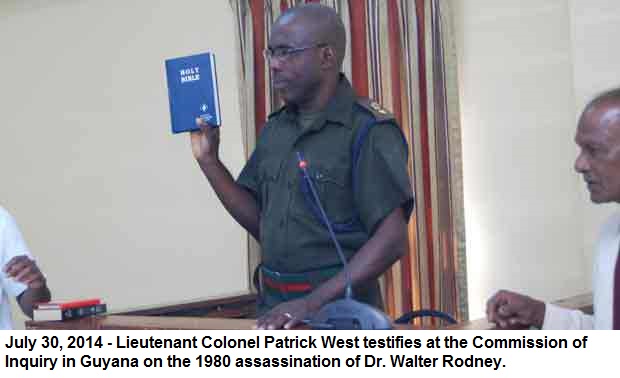
The Go Lean book serves as a roadmap for the introduction and implementation of the technocratic Caribbean Union Trade Federation (CU). Normally, when there are questions of integrity in the due-process in executive, legislative or judicial branches of government, the curative measure is a Special Prosecutor (American) or a Commission of Inquiry (European and United Nations).

As defined in the following encyclopedia source reference, these measures are normally reactive, but for the CU, the strategy is proactive…from Day One:

1. UNITED STATES

A Special Prosecutor generally is a lawyer from outside the government appointed by an Attorney General or, in the United States, by Congress to investigate a government official for misconduct while in office. A reasoning for such an appointment is that the governmental branch or agency may have political connections to those it might be asked to investigate. Inherently, this creates a conflict of interest and a solution is to have someone from outside the department lead the investigation. The term “Special Prosecutor” may have a variety of meanings from one country to the next, from one government branch to the next within the same country, and within different agencies within each government branch. Critics of the use of Special Prosecutors argue that these investigators act as a “fourth branch” to the government because they are not subject to limitations in spending or have deadlines to meet.

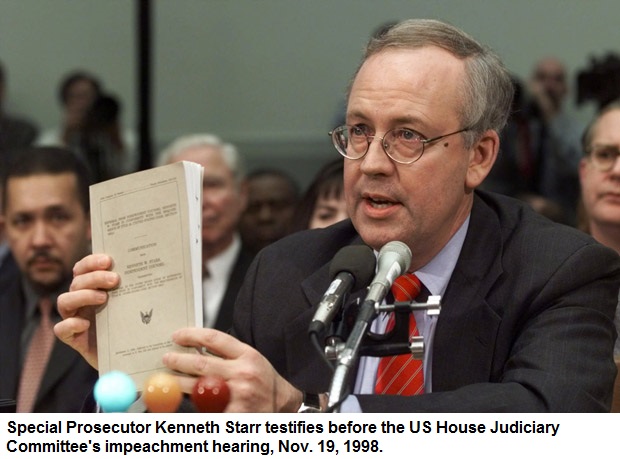
STARR

Federal government
Attorneys in the United States may be appointed/hired particularly or employed generally by different branches of the government to investigate. When appointed/hired particularly by the judicial branch to investigate and, if justified, seek indictments in a particular judicial branch case, the attorney is called Special Prosecutor. When appointed/hired particularly by a governmental branch or agency to investigate alleged misconduct within that branch or agency, the attorney is called Independent Counsel.

State government
Special Prosecutors may also be used in a state prosecution case when the prosecutor for the local jurisdiction has a conflict of interest in a case or otherwise may desire another attorney handle a case.
Source: Wikipedia Online Encyclopedia (Retrieved November 17, 2014) – http://en.wikipedia.org/wiki/Special_prosecutor

2. BRITISH DOMINION

A Royal Commission is a major ad-hoc formal public inquiry into a defined issue in some monarchies. They have been held in the United Kingdom, Australia, Canada, New Zealand, Bahrain, Malaysia, Hong Kong and Saudi Arabia. A Royal Commission is similar in function to a Commission of Enquiry (or Inquiry) found in other countries such as Ireland, South Africa, and Hong Kong; (all examples here are from the British Dominion).

CU Blog - Justice Strategy - Special Prosecutors - Photo 1

A Royal Commissioner has considerable powers, generally greater even than those of a judge but restricted to the Terms of Reference of the Commission. The Commission is created by the Head of State (the Sovereign, or his/her representative in the form of a Governor-General or Governor) on the advice of the Government and formally appointed by Letters Patent. In practice—unlike lesser forms of inquiry—once a Commission has started the government cannot stop it. Consequently governments are usually very careful about framing the Terms of Reference and generally include in them a date by which the commission must finish.

Royal Commissions are called to look into matters of great importance and usually controversy. These can be matters such as government structure, the treatment of minorities, events of considerable public concern or economic questions.

Many Royal Commissions last many years and, often, a different government is left to respond to the findings. In Australia—and particularly New South Wales—Royal Commissions have been investigations into police and government corruption and organised crime using the very broad coercive powers of the Royal Commissioner to defeat the protective systems that powerful, but corrupt, public officials had used to shield themselves from conventional investigation.

Royal Commissions usually involve research into an issue, consultations with experts both within and outside of government and public consultations as well. The Warrant may grant immense investigatory powers, including summoning witnesses under oath, offering of indemnities, seizing of documents and other evidence (sometimes including those normally protected, such as classified information), holding hearings in camera if necessary and—in a few cases—compelling all government officials to aid in the execution of the Commission.

The results of Royal Commissions are published in reports, often massive, of findings containing policy recommendations. These reports are often quite influential, with the government enacting some or all recommendations into law.
Source: Wikipedia Online Encyclopedia (Retrieved November 17, 2014) –
http://en.wikipedia.org/wiki/Royal_Commission

3. NETHERLANDS

Though never a member of British Dominion, the Kingdom of the Netherlands has a similar process. An example of a Commission of Inquiry in the Netherlands include this case study:

  • From mid-2010 to December 2011 the Commission of Inquiry carried out an independent study of the sexual abuse of minors in the Roman Catholic Church from 1945 to 2010.

Source: Investigation of Roman Catholic Church Online Site (Retrieved Nov. 17, 2014) –
http://www.onderzoekrk.nl/english-summery.html

4. UNITED NATIONS

a. Commissions and Investigative Bodies

The UN Security Council has established a wide-variety of Commissions to handle a variety of tasks related to the maintenance of international peace and security. Commissions have been created with different structures and a wide variety of mandates including investigation, mediation, or administering compensation. Below is a list of all commissions established by the Security Council, with a short description prepared on the basis of the Repertoire, as well as links to the sections covering them in the Repertoire (Public Relations Publication). They are organized by region, and then under relevant areas or sub-regions, placed chronologically starting with those established most recently:

1946-1951 1952-1955 1956-1958 1959-1963 1964-1965 1966-1968 1969-1971 1972-1974 1975-1980 1981-1984 1985-1988 1989-1992 1993-1995 1996-1999 2000-2003 2004-2007 2008-2009 2010-2011

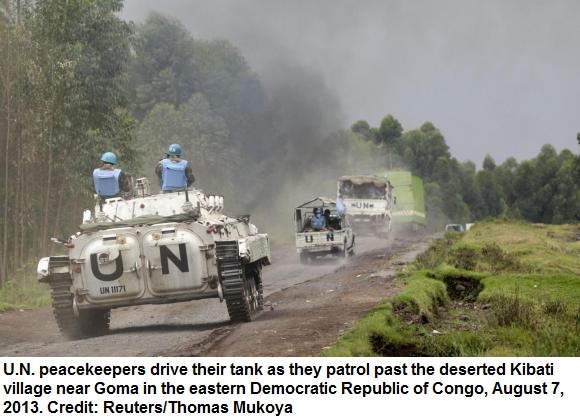
U.N. peacekeepers drive tank as they patrol past deserted Kibati village

For more information on the investigative and fact-finding powers of the Security Council, see this section on Article 34:

  • Article 34 – Investigation of disputes & fact-finding.
    Article 34 of the UN Charter empowers the Security Council to investigate any dispute, or any situation that is likely to endanger international peace and security. The provision covers investigations and fact-finding missions mandated by the Security Council or by the Secretary-General to which the Council expressed its support or of which it took note. Furthermore, this section has also looked at instances in which Member-States demanded or suggested to the Council that an investigation be carried out or a fact-finding mission be dispatched.

b. UN Commission for Conventional Armaments

The Commission for Conventional Armaments was established on 13 February 1947 to formulate proposals for carrying out General Assembly resolution 41 (I) of 14 December 1946 concerning the general regulation and reduction of armaments. This was a standing Commission, but it was formally dissolved on 30 January 1952.

Source: United Nations Online Archive – Retrieved Nov. 17, 2014 – http://www.un.org/en/sc/repertoire/subsidiary_organs/commissions_and_investigations.shtml

Normally a Special Prosecutor assignment has a limited time expiration. Also a Commission of Inquiry refers to individuals employed, during conciliation (Footnote 2), to investigate the facts of a particular dispute and to submit a report stating the facts and proposing terms for the resolution of the differences. Such a commission is one of many bodies available to governments to inquire/investigate into various issues. The commissions may report findings, give advice and make recommendations; and while their findings may not be legally binding, they can be highly influential.

The declared assignment documents for Special Prosecutors and/or Commissions of Inquiries are called “Warrants”.

The foregoing encyclopedic source explains that “Warrants” may grant immense investigatory powers, including summoning witnesses under oath, offering of indemnities, seizing of documents and other evidence, holding hearings, and compelling aid from government officials. This description provides the role-model for the CU‘s effort in justice and security. The Trade Federation will feature a federal Justice Department, with a separation-of-powers, a ‘Divide’, with the regional member-states. On the CU side of the ‘Divide’ is the jurisdiction for economic crimes, systemic threats, regional escalations and marshaling of any offenses on the federally-regulated grounds, Self-Governing Entities.

This separation-of-powers mandate also dictates that the CU‘s Homeland Security apparatus is the local manifestation of the United Nations Security (Peacekeeping) Forces , except for a regional scope only. This specific federal department will handle a variety of tasks related to the maintenance of regional peace and security.

The book Go Lean…Caribbean posits that the region must prepare its own security apparatus for its own security needs. So the vision is that all Caribbean member-states will authorize the CU as Special Prosecutors and Commissions of Inquiries. These warrants would legally authorize the regional “Justice Institutions”, covering law enforcement and regional defense, all encompassed in the book’s Homeland Security roadmap.

The CU would thusly be set to optimize Caribbean society through economic empowerment, and the aligning security dynamics. In fact, the Go Lean roadmap has 3 prime directives:

  • Optimization of the economic engines in order to grow the regional economy to $800 Billion & create 2.2 million new jobs.
  • Establishment of a security apparatus to protect the resultant economic engines.
  • Improve Caribbean governance to support these engines.

There is the need to ensure the economic engines in all 30 Caribbean member-states; plus extractions (mining, drilling) in the Exclusive Economic Zone (EEZ) of the Caribbean Sea. This point is pronounced early in the book with the Declaration of Interdependence (Page 12) that claims:

x.   Whereas we are surrounded and allied to nations of larger proportions in land mass, populations, and treasuries, elements in their societies may have ill-intent in their pursuits, at the expense of the safety and security of our citizens. We must therefore appoint “new guards” to ensure our public safety and threats against our society, both domestic and foreign. The Federation must employ the latest advances and best practices … to assuage continuous threats against public safety.

xi.  Whereas all men are entitled to the benefits of good governance in a free society, “new guards” must be enacted to dissuade the emergence of incompetence, corruption, nepotism and cronyism at the peril of the people’s best interest. The Federation must guarantee the executions of a social contract between government and the governed.

xii. Whereas the legacy in recent times in individual states may be that of ineffectual governance with no redress to higher authority, the accedence of this Federation will ensure accountability and escalation of the human and civil rights of the people for good governance, justice assurances, due process and the rule of law. As such, any threats of a “failed state” status for any member-state must enact emergency measures on behalf of the Federation to protect the human, civil and property rights of the citizens, residents, allies, trading partners, and visitors of the affected member-state and the Federation as a whole.

xvi. Whereas security of our homeland is inextricably linked to prosperity of the homeland, the economic and security interest of the region needs to be aligned under the same governance. Since economic crimes, including piracy and other forms of terrorism, can imperil the functioning of the wheels of commerce for all the citizenry, the accedence of this Federation must equip the security apparatus with the tools and techniques for predictive and proactive interdictions.

The treaty to establish the “new guards”, the Homeland Security Force and Federal Justice Department within the Caribbean Union Trade Federation gets legal authorization from the provisions of Special Prosecutors and Commissions of Inquiries, therefore enacting a Status of Forces Agreement with the initiation of the confederation. This elaborate process would be “Step One, Day One” in the Go Lean roadmap. The Go Lean book also details a series of community ethos, strategies, tactics, implementations and advocacies to provide increased public accountability and security in the Caribbean region:

Community Ethos – Economic Principle – Consequences of Choices Lie in Future Page 21
Community Ethos – Security Principle – Privacy –vs- Public Protection Page 23
Community Ethos – Security Principle – Whistleblower Protection Page 23
Community Ethos – Security Principle – Witness Security & Protection Page 23
Community Ethos – Security Principle – Anti-Bullying and Mitigation Page 23
Community Ethos – Security Principle – Intelligence Gathering Page 23
Community Ethos – Governing Principle – Minority Equalization Page 24
Community Ethos – Governing Principle – Lean Operations Page 24
Community Ethos – Governing Principle – Cooperatives Page 25
Community Ethos – Ways to Manage Reconciliations Page 34
Community Ethos – Ways to Improve Sharing Page 35
Community Ethos – Ways to Impact the Greater Good Page 37
Strategy – Vision – Trade Federation with Proxy Powers of a Confederacy Page 45
Strategy – Mission – Defense Pact to Defend against Systemic Threats Page 45
Strategy – Mission – Protect Stakeholders   with Vigorous Law-and-Order measures Page 45
Tactical – Confederating a Non-Sovereign Union Page 63
Tactical – Fostering a Technocracy Page 64
Tactical – Separation of Powers – Homeland Security Page 75
Tactical – Separation of Powers – Justice Department – District Attorneys as Special Prosecutors Page 77
Tactical – Separation of Powers – Justice Department – CariPol: Marshals & Investigations Page 77
Tactical – Separation of Powers – Justice Department – Witness Protection Page 77
Tactical – Separation of Powers – Trade Anti-Trust Regulatory Commission Page 77
Implementation – Foreign Policy Initiatives at Start-up Page 102
Implementation – Start-up Security Initiatives Page 103
Implementation – Start-up Benefits from the EEZ – Security – Interdictions & Piracy Page 104
Implementation – Steps to Implement Self-Governing Entities – Security and Justice Page 105
Implementation – Ways to Foster International Aid – Military Aid Page 115
Planning – Ways to Make the Caribbean Better – Safety Measures for the Rich and Poor Page 131
Planning – Ways to Improve Failed-State Indices – Law Enforcement Oversight Page 134
Planning – Lessons Learned from the West Indies (WI)   Federation – Regiment on the Ready Page 135
Planning – Lessons from the American West – Law & Order Needed Enforcements Page 142
Advocacy – Ways to Grow the Economy Page 151
Advocacy – Ways to Create Jobs Page 152
Advocacy – Ways to Improve Governance Page 168
Advocacy – Ways to Better Manage the Social Contract Page 170
Advocacy – Ways to Improve Leadership Page 171
Advocacy – Ways to Impact   Justice Page 177
Advocacy – Ways to Reduce Crime Page 178
Advocacy – Ways to Improve Homeland Security Page 180
Advocacy – Ways to Mitigate Terrorism Page 181
Advocacy – Ways to Improve Intelligence Gathering & Analysis Page 182
Advocacy – Ways to Protect Human Rights Page 220
Appendix – Art of War Chapters – Chapter 7 – Engaging The Security Force Page 327

Everyone in the Caribbean, the people and institutions, are hereby urged to lean-in to this Go Lean roadmap for elevation of Caribbean society. The roadmap calls for the heavy-lifting so that the justice institutions (permanent Special Prosecutors/Commissions of Inquiries) of the CU can execute their role in a just manner, thus impacting the Greater Good; see VIDEO below of South Africa’s example. This produces the output of a technocratic system bent on efficiency and effectiveness. In practice, this would mean accountability, transparency, and checks-and-balances in the execution of the rule-of-law.

This is the change for the Caribbean: elevated Public Safety, Law Enforcement and Homeland Security, all necessary to make the Caribbean a better place to live, work and play.

Download the free e-Book of Go Lean … Caribbean – now!

————–

Footnote:
1 – Iraq: A military solution to a political problem?

2 – Conciliation: The process of adjusting or settling disputes in a friendly manner through extra judicial means.

————–

Video: Marikana Commission of Inquiry has concluded its hearings – http://youtu.be/k0XAfRzjSXc


The Marikana Commission of Inquiry in South Africa has concluded its hearings after two years of attempting to establish what happened during the violent Wage Strike at Lonmin Platinum Mine in August 2012. 34 people were shot and killed in a confrontation with the police. 10 others including 2 police officers and 2 Mine Guards were also killed in the days preceding the August 16th tragedy.

Share this post:
, ,
[Top]

Way Forward – Caribbean ‘Single Market’ for Media

Go Lean Commentary

The host asked American media icon Oprah Winfrey this BIG Question at the promotional event for Apple on March 25, 2019:

“Why are you here?”
Ms. Winfrey: “They are in a Billion pockets …”

———
VIDEO – Oprah to return to TV as part of Apple TV+ – https://youtu.be/8PdJvXfw76k

CNBC Television
Published on Mar 25, 2019 – Oprah Winfrey takes the stage at Apple’s Steve Jobs Theater to announce her inclusion in the company’s new streaming service, Apple TV+.

» Subscribe to CNBC: http://cnb.cx/SubscribeCNBC
About CNBC: From ‘Wall Street’ to ‘Main Street’ to award winning original documentaries and Reality TV series, CNBC has you covered. Experience special sneak peeks of your favorite shows, exclusive video and more.
Connect with CNBC News Online
Get the latest news: http://www.cnbc.com/
Find CNBC News on Facebook: http://cnb.cx/LikeCNBC
Follow CNBC News on Twitter: http://cnb.cx/FollowCNBC
Follow CNBC News on Google+: http://cnb.cx/PlusCNBC
Follow CNBC News on Instagram: http://cnb.cx/InstagramCNBC #CNBC

This is the reality of the Apple eco-system: 1 billion is 1 billion. The Way Forward for the television-media-video industry is this simple undeniable fact:

Numbers matter.

Numbers matter and size matters … when it comes to media!

This theme has been exhaustingly covered in many previous commentaries by the movement behind the book Go Lean…Caribbean. Consider this sample here:

https://goleancaribbean.com/blog/?p=15858 Network Mandates for a New Caribbean
https://goleancaribbean.com/blog/?p=14224 How the Youth are Consuming Media Today
https://goleancaribbean.com/blog/?p=13474 Future Focused – Radio is Dead … Almost
https://goleancaribbean.com/blog/?p=8813 Lessons from China – Size Does Matter … for Hollywood
https://goleancaribbean.com/blog/?p=8328 YouTube Millionaire: ‘Tipsy Bartender’
https://goleancaribbean.com/blog/?p=6464 Sports Role Model – ‘WWE Network’
https://goleancaribbean.com/blog/?p=4381 Net Neutrality: It Matters in the Caribbean too
https://goleancaribbean.com/blog/?p=3244 Sports Role Model – espnW.

The Caribbean media markets (TV, radio and newspaper) should expect this same change in our region. The devices – computers, tablets, smartphones – will supplant traditional media: TV, radio, newspapers, books, etc..

This eventuality was anticipated in the book Go Lean … Caribbean. The book serves as a roadmap for the introduction and implementation of the Caribbean Union Trade Federation (CU). The roadmap is designed to elevate Caribbean society and the book relates that media – Internet Communications Technologies (ICT) actually – is a BIG element in this elevation quest.

Apple’s devices also proliferate in the Caribbean; (though no where close to 1 billion units). We therefore have the opportunity to prepare our media offerings for direct-to-consumers via their devices. This is already the Go Lean strategy for the new social media site: www.myCaribbean.gov. As related in a previous blog-commentary:

Change has come to the world and to the Caribbean region. The advent of Internet Communications Technologies (ICT) now has voluminous options for media to be delivered without the large footprint … or investment. Now anyone can easily publish VIDEO’s and Music files to the internet and sell them to the public – models abounds: i.e. pay-per-play, or subscription.

Apple – see their strategies and options in the Appendix below – is not the only game in town…

… there is also Google, and sometimes Amazon.

All in all, devices abound; no need for expensive satellites and broadcast towers.

This is the Way Forward for Caribbean media. We must be ready for this New Media eco-system.

This commentary continues this recent series – April 2019 – for the Way Forward for our Caribbean region and individual member-states. In fact, we just recently completed a 4-part series as follows:

  1. Way ForwardPuerto Rico learns its “status” with America
  2. Way Forward: Virgin Islands – America’s youngest colony
  3. Way Forward: Bahamas – “Solutions White Paper” – An Inadequate Plan
  4. Way Forward: Jamaica: The need to reconcile the Past
    ——–
  5. Way Forward: Caribbean Media Strategy & Deliveries

This entire series asserts that “no man is an island” and that “no island is an island”, therefore the full Caribbean region – all 30 member-states and 42 million people – need to combine, collaborate and confederate to form a Single Market for media and other economic activities. Our failure to do so in the past have imperiled our economic, security and governmental engines.

(With no viable Single Market, our people fled and left in exile to other Single Market destinations: US, Canada and EU countries).

We should now be ready for the challenge and change in our Caribbean society; we must be ready to reform and transform, despite the heavy-lifting. We should be up to the task, because the rest of the world is counting the devices – 1 billion for Apple.

We must also count … and be counted. Otherwise our Caribbean people will just be Less Than.

This quest – of the Go Lean/CU roadmap – for the Caribbean Way Forward is conceivable, believable and achievable. We must do the heavy-lifting ourselves to forge our Single Media Market and thereafter make our homeland a better place to live, work and play. 🙂

About the Book
The book Go Lean…Caribbean serves as a roadmap for the introduction and implementation of the technocratic Caribbean Union Trade Federation (CU), for the elevation of Caribbean society – for all member-states. This CU/Go Lean roadmap has these 3 prime directives:

  • Optimization of the economic engines in order to grow the regional economy to $800 Billion and create 2.2 million new jobs.
  • Establishment of a security apparatus to ensure public safety and protect the resultant economic engines.
  • Improve Caribbean governance to support these engines, including a separation-of-powers between the member-states and CU federal agencies.

The Go Lean book provides 370-pages of turn-by-turn instructions on “how” to adopt new community ethos, plus the strategies, tactics, implementations and advocacies to execute so as to reboot, reform and transform the societal engines of Caribbean society.

Download the free e-Book of Go Lean … Caribbean – now!

Who We Are
The movement behind the Go Lean book – a non-partisan, apolitical, religiously-neutral Community Development Foundation chartered for the purpose of empowering and re-booting economic engines – stresses that reforming and transforming the Caribbean societal engines must be a regional pursuit. This was an early motivation for the roadmap, as pronounced in the opening Declaration of Interdependence (Pages 12 – 14):

xi. Whereas all men are entitled to the benefits of good governance in a free society, “new guards” must be enacted to dissuade the emergence of incompetence, corruption, nepotism and cronyism at the peril of the people’s best interest. The Federation must guarantee the executions of a social contract between government and the governed.

xvi. Whereas security of our homeland is inextricably linked to prosperity of the homeland, the economic and security interest of the region needs to be aligned under the same governance. Since economic crimes … can imperil the functioning of the wheels of commerce for all the citizenry, the accedence of this Federation must equip the security apparatus with the tools and techniques for predictive and proactive interdictions.

xxiv. Whereas a free market economy can be induced and spurred for continuous progress, the Federation must install the controls to better manage aspects of the economy: jobs, inflation, savings rate, investments and other economic principles. Thereby attracting direct foreign investment because of the stability and vibrancy of our economy.

xxvii. Whereas the region has endured a spectator status during the Industrial Revolution, we cannot stand on the sidelines of this new economy, the Information Revolution. Rather, the Federation must embrace all the tenets of Internet Communications Technology (ICT) to serve as an equalizing element in competition with the rest of the world. The Federation must bridge the digital divide and promote the community ethos that research/development is valuable and must be promoted and incentivized for adoption.

xxviii. Whereas intellectual property can easily traverse national borders, the rights and privileges of intellectual property must be respected at home and abroad. The Federation must install protections to ensure that no abuse of these rights go with impunity, and to ensure that foreign authorities enforce the rights of the intellectual property registered in our region.

xxx. Whereas the effects of globalization can be felt in every aspect of Caribbean life, from the acquisition of food and clothing, to the ubiquity of ICT, the region cannot only consume, it is imperative that our lands also produce and add to the international community, even if doing so requires some sacrifice and subsidy.

Sign the petition to lean-in for this roadmap for the Caribbean Union Trade Federation. 

—————

Appendix –  Apple TV app vs. Apple TV Channels vs. Apple TV Plus: What’s the difference?

Apple has three new ways to get you watching more TV shows and movies. Unfortunately they all have very similar names, and all start with “Apple TV.”

On March 25 in Cupertino, Apple CEO Tim Cook finally took the wraps off his company’s latest “service” ambitions. It was an Apple event without any new gadgets. Instead we saw a news and magazine aggregation app, a subscription gaming play and an Apple credit card.

Most of the event focused on streaming TV shows and movies, however, culminating in Apple’s new television service with original shows from stars like Jenifer Aniston, Reese Witherspoon and Kumail Nanjiani and producers like J.J. Abrams and Oprah Winfrey. It’s called Apple TV Plus.

But Apple also talked about updates to its new TV app, which includes a new Channels option. So what’s actually new and what do we know? Here’s a cheat sheet.

Apple TV app

Introduced in 2016, this app for the Apple TV streamer as well as iPhones and iPadsprovides a single place to browse, discover and resume watching TV shows and movies from apps like HuluAmazon Prime Video, ESPN, PlayStation Vue and many more. It shows individual episodes and movies but doesn’t let you watch them from within the Apple TV app itself. Instead you’ll select one and get bounced out to the app in question (such as Hulu for The Handmaid’s Tale) to begin or resume watching.

An updated version of the app, coming in May 2019, will integrate purchases from iTunes TV shows and movies, as well as provide suggestions for more TV shows and movies to watch. Apple says the app will also come to smart TVs from Samsung this spring, as well as SonyLG and Vizio TVs and Roku and Amazon Fire TV streamers and TVs in the future. It would also be available to MacOS computers this fall.

More: Apple TV app coming to Macs, smart TVs in 2019

Apple TV Channels

This is an all-new addition to the Apple TV app that allows subscribers to add content from a variety of partners, including HBO, Showtime, Epix, Starz, Britbox and more. You subscribe within the TV app, with no additional apps, accounts or passwords required. The same goes for watching content: Instead of being bounced out to the HBO Now app, for example, you can watch your Game of Thrones episode within the Apple TV app itself. Users can also share Apple TV channels subscriptions via Apple’s Family Sharing feature.

The service sounds similar to Amazon’s Prime Channels service, available now. Apple didn’t announce pricing, but one report says services like HBO will be discounted.

More: Apple TV Channel’s streaming service is here and wants to run the show

Apple TV Plus

Coming this fall, this is a separate TV streaming service that will be home to original TV shows, movies and documentaries exclusive to Apple. Apple has a multiyear partnership deal with Oprah and deals with Reese Witherspoon, J.J. Abrams and dozens of others. The company has spent more than $1 billion budget and has committed to 30 shows and a handful of movies. They include Steven Spielberg’s Amazing Stories series, The Morning Show starring Witherspoon, Jennifer Aniston and Steve Carell about workplace relationships and Little America, which features stories that center around immigrants. Pricing for an Apple TV Plus subscription was not announced.

More: Apple introduces Apple TV Plus for its original shows

Source: Posted March 29, 2019; retrieved April 8 2019 from: https://www.cnet.com/news/apple-tv-app-vs-apple-tv-channels-vs-apple-tv-plus-whats-the-difference/

Share this post:
,
[Top]

Way Forward – Jamaica: Must reconcile the Past

Go Lean Commentary

“Sometimes we have to reach back to the past before we can launch forward into the future.”

We have all heard this “slingshot analogy” in different variations; like this one:

We have to know where we came from in order to know where we are going.

Any similar theme rings true!

Even in God’s word the Bible, the concept is presented that while a man reaps what he sows, he can be punished for the sins of his father – Exodus 34:7 – because chances are very great that he will commit the same infractions, as his father did; (and see Appendix VIDEO below):

An apple does not fall far from the tree

We are a product of our environment

Our nurture can override our nature

This is a consideration for Jamaica … and how this community can foster a Way Forward, away from its near-Failed-State status quo to a different destination of a prosperous homeland.

This commentary asserts that Jamaica must first reconcile its bad past before it can have a good future.

Why? Because of this premise here:

“If an empire is destroyed by its enemies, it will rise up again.
But if destroyed internally, it will be gone forever”. – Source.

This is the historicity of Jamaica and the sullied past that must be reconciled. This refers to the original plan for integration for the British Caribbean, the West Indies Federation.

Jamaica used to be a colony of the British Empire (United Kingdom); the quest for independence and autonomy was set forth as a long journey; the planners for stewardship of the British Caribbean conceived this West Indies Federation for 10 British territories to have the scale and leverage to be effective and efficient for regional economics, security and governance.

There was a West Indies Dollar, West Indies Regiment (today’s Jamaica Defense Force), University of the West Indies, and the West Indies Cricket Federation just to name a few of the institutions that were formed for this integration purpose – some remain today. But this Federation only lasted 4 years (1958 – 1962). This entity was not destroyed by its enemies, rather it was destroyed internally, by its own people, starting first and foremost with Jamaica. The 2013 book Go Lean … Caribbean – a roadmap for a new integration movement: Caribbean Union Trade Federation (CU) – related this historic summary:

Jamaican Dynamic Appendix (Page 302)
Jamaica’s nationalistic ideals doomed the Federation; they were the largest population base and felt trivialized by the Federation. They believed that the smaller islands were draining Jamaica’s wealth; their share of the seats in the federal parliament was smaller than its share of the total Federation population. Jamaica was also remote to most of the other islands in the Federation, lying several hundred miles to the west. And many in Jamaica were upset that Kingston had not been chosen as the federal capital.

10 Lessons Learned from the West Indies Federation – #3: Jamaican Dynamic (Page 135)
Among the Caribbean nations, Haiti is highest on the 2012 Failed State Index (#7), Jamaica is among the next set of Caribbean countries at #119, just slightly behind South Africa (#115) and Albania (#118). Obviously, the nation-building needs of Jamaica has been truncated, plus the country’s brain drain is worst in the region with almost a matching population living abroad in a Diaspora as opposed to residing in and contributing to the local economy. The CU will ensure better representation of larger populated states by employing a bicameral legislative branch: while the Senate is “one-man-one-vote” (2 Senators per state), the lower house has balanced representation based on population.

Geographically, Jamaica is not the furthest west (Belize), nor south (Aruba) in the region. The Capitol for the CU is slated for a Federal District on the border of Haiti and the Dominican Republic. …

The Way Forward for Jamaica is that this country must now reconcile their bad behavior in the “regional sandbox” and learn how to play nice with others. Only then can the benefits of collaboration, cooperation and confederation come home … finally.

Only then can this country have a good future. (Since 1962, Jamaica has played in the “sandbox” alone, to its own peril). This theme – this Way Forward – aligns with previous commentaries from the Go Lean movement; see this sample list here:

https://goleancaribbean.com/blog/?p=16408 Bad Community Ethos on Violence; Start at Home, spills out to Streets
https://goleancaribbean.com/blog/?p=15521 Caribbean Unity? What a Joke – Tourism Missteps in Jamaica et al
https://goleancaribbean.com/blog/?p=14242 Money Matters – Jamaicans follow the jobs, right out of the country
https://goleancaribbean.com/blog/?p=13040 Jamaican Diaspora – Not the ‘Panacea’; Rather need Region Partners
https://goleancaribbean.com/blog/?p=4840 Jamaican Poll: ‘Bring back the British!’
https://goleancaribbean.com/blog/?p=313 What’s Holding Back Jamaica’s Reforms? – They must reboot!

Jamaica needs to reach back into their past, learn what it was that they did wrong – their fathers did wrong (see Appendix VIDEO below) – accept the learned-lessons, turn a new leaf and then march forward into the future with a determination and devotion to think, feel and act differently and better. This sounds so much like the Serenity Prayer that Alcoholics and Addicts are urged to enchant everyday:

Lord, give me the courage to change the things I can change
The serenity to accept the things I cannot change
And the wisdom to know the difference.

Today, this Way Forward is the courage, serenity and wisdom at work for Jamaica.

This commentary continues this recent series for the Way Forward for many other Caribbean member-states. Just recently, we completed a 3-part series categorized as follows:

  1. Way Forward: Puerto Rico learns its “status” with America
  2. Way Forward: Virgin Islands – America’s youngest colony
  3. Way Forward: Bahamas – “Solutions White Paper” – An Inadequate Plan
    ——–
  4. Way Forward: Jamaica: The need to reconcile the Past

This entire series asserts that “no man is an island” and that in fact “no island is an island”. Jamaica have always needed to collaborate and confederate with its regional neighbors. Their failure to do so, only imperiled their economic, security and governmental engines. Then their people fled; they left and joined communities abroad where the needed integration, cooperation and harmony existed.

This must now be reconciled. The stakeholders in Jamaica and from Jamaica are hereby urged to lean-in to this integration plan, this Go Lean roadmap, to make Jamaica a better homeland to live, work and play. Finally …

🙂

About the Book
The book Go Lean…Caribbean serves as a roadmap for the introduction and implementation of the technocratic Caribbean Union Trade Federation (CU), for the elevation of Caribbean society – for all member-states. This CU/Go Lean roadmap has these 3 prime directives:

  • Optimization of the economic engines in order to grow the regional economy to $800 Billion and create 2.2 million new jobs.
  • Establishment of a security apparatus to ensure public safety and protect the resultant economic engines.
  • Improve Caribbean governance to support these engines, including a separation-of-powers between the member-states and CU federal agencies.

The Go Lean book provides 370-pages of turn-by-turn instructions on “how” to adopt new community ethos, plus the strategies, tactics, implementations and advocacies to execute so as to reboot, reform and transform the societal engines of Caribbean society.

Download the free e-Book of Go Lean … Caribbean – now!

Who We Are
The movement behind the Go Lean book – a non-partisan, apolitical, religiously-neutral Community Development Foundation chartered for the purpose of empowering and re-booting economic engines – stresses that reforming and transforming the Caribbean societal engines must be a regional pursuit. This was an early motivation for the roadmap, as pronounced in the opening Declaration of Interdependence (Pages 12 – 13):

xi. Whereas all men are entitled to the benefits of good governance in a free society, “new guards” must be enacted to dissuade the emergence of incompetence, corruption, nepotism and cronyism at the peril of the people’s best interest. The Federation must guarantee the executions of a social contract between government and the governed.

xvi. Whereas security of our homeland is inextricably linked to prosperity of the homeland, the economic and security interest of the region needs to be aligned under the same governance. Since economic crimes … can imperil the functioning of the wheels of commerce for all the citizenry, the accedence of this Federation must equip the security apparatus with the tools and techniques for predictive and proactive interdictions.

xxiv. Whereas a free market economy can be induced and spurred for continuous progress, the Federation must install the controls to better manage aspects of the economy: jobs, inflation, savings rate, investments and other economic principles. Thereby attracting direct foreign investment because of the stability and vibrancy of our economy.

Sign the petition to lean-in for this roadmap for the Caribbean Union Trade Federation.

—————–

Appendix VIDEO – Does God Punish Children for the Sins of Their Parents? – https://youtu.be/C3OGrGAxqGE

Dr. Sean McDowell
Published on Oct 31, 2018 – 
Does God hold children accountable for when their parents do bad things? Is culpability for sin passed on from one generation to the next? Sean briefly answers these questions.

Share this post:
,
[Top]

Way Forward – Common ‘Solutions’ for the Bahamas – An Inadequate Plan

Go Lean Commentary

Flash back to 1958 …

The planners for stewardship of the British Caribbean conceived the West Indies Federation, and they left-off, left-out …

… the Bahamas. – (See Appendix B below).

Wow! This country was reported to have a population between 88,000 (1955) and 113,000 (1960) and yet the planners made no provision for their Way Forward. They assumed that their fate would be tied to the neighboring United States of America.

So while the instincts and wisdom of these planners were that the common lands of the British Caribbean needed to integrate to deploy common solutions, these ones felt that the poor Bahamas could just be satisfied with a Way Forward of being “parasites” of a larger more prosperous host, the USA.

The more things changed, the more they have remained the same!

In the 60 years since, the Bahamas has made progress; sometimes 2 steps forward, 1 step back; sometimes 1 step forward, 2 steps back. All the governmental developments in those 60 years (i.e.: women’s suffrage, majority rule populist party, independence, opposition party emergence, flip-flop of power between parties, etc.) have only resulted in a realignment of the stakeholders within the same regime – like “reshuffling the decks on the Titanic”. The “parasite” status remains.

Thusly, there is the need for a Way Forward for this country, for the Bahamas. A call had gone out for such a Way Forward plan; one that finally considers integration with its neighbors and strategic alliances and partnerships.

The call has been heeded. One national commentator composed and published a White Paper to address this quest for a Way Forward. This publication identified some viable solutions, but still under the overall strategy of being tied to the American hegemony – depending on American trade and security. That White Paper – see the full publication here – is presented with these following 5 parts:

White Paper Title: A Nation in Chaos – The Solution Series – EXCERPT
By: Stephen McQueen

Part 1: Scope of The Problem

Part 2: Simple but Multifaceted

Part 3: The Re-education Process

Part 4: Self-Economic Empowerment

Part 5: The Need for Strategic Alliances

    … those that have a common enemy might well find that they also have shared interests and can therefore be of benefit to each other in a common cause. Therein lies the concept of being allies.

    For small island nations like The Bahamas, one wonders for what common cause if any should we ally ourselves with other nations? And, do we not already have allies in the Caribbean Community (CARICOM), Commonwealth Heads of Government (CHOGM), The Commonwealth, the United Nations (UN) and the Organization of American States (OAS)? Notwithstanding the fact that I am largely unaware of the benefits of being involved with the above-mentioned communities, as a lay person, it appears that we may not be deriving the kind of benefit that The Bahamas truly needs for economic protection from much larger and far more economically and otherwise powerful nations. The UN provides peace-keeping forces, CARICOM is an economic body for the Caribbean, and the Caribbean Single Market and Economy (CSME) is a regional agreement signed on by some Caribbean nations and is intended to strengthen member states’ economic power and stability. Dr. Christopher Curry of the University of The Bahamas believes that CSME will strengthen The Bahamas’ hand against the WTO. (Curry, 2019)

    Isn’t it time that we as a people look within and collectively raise ourselves to a better standing upon the world’s stage?

    The position of “First World” nations toward small island nations like The Bahamas and the Caribbean wreaks of containment – a philosophy designed and intentionally carried out to prevent the growth, development and advancement of developing nations even after we have been pillaged for hundreds of years. According to Curry, “First, Second, Third World are social constructs devised by global north states to designate other states in a subordinate role to the ‘more advanced states’.” (Curry, 2019) It is a philosophy intended to prevent our nations from becoming global leaders and masters of our own destinies by subjugating our nations to rules designed for and by “First World” nations for their greater benefit and the furtherance of their economies. For instance, and without any justification, and merely because it had the wherewithal so to do, “the Netherlands adds Bahamas to Tax Havens blacklist.” (Robards, 2019)

See the full White Paper here: https://goleancaribbean.com/blog/?p=17118

This published plan, despite the best intentions, is inadequate!

The Bahamas needs more! See the Appendix VIDEO below depicting the current economic outlook from an external viewpoint.

It turns out that the Bahamas wants more than just a “parasite” status with the US; they want to be considered protégés. After 60 years of an ever-increasing brain-drain, in which the country has sat idle and watched 61 percent of its tertiary-educated citizens abandoned the homeland for life in the Diaspora abroad – mostly to the US homeland. This country now wants to be a homeland where its citizens can prosper where planted.

Is there a Way Forward for that?!

Way Forward
This commentary continues the consideration on the Way Forward – this one just for the Bahamas – for the rest of the Caribbean region. This member-state is in dire straits, near-Failed-State status with Push-and-Pull factors pressuring the youth to seek refuge elsewhere. Yet, the movement behind the book Go Lean…Caribbean asserts that this crisis can be useful as an excuse to forge change in the Bahamian homeland. It is high time to reform and transform the Bahamas.

This is entry 3-of-3 for this April 2019 series of commentaries related to the Way Forward for Caribbean member-states. The full series is presented as follows:

  1. Way Forward: Puerto Rico learns its “status” with America
  2. Way Forward: Virgin Islands – America’s youngest colony
  3. Way Forward: “Solutions White Paper” – An Inadequate Plan for the Bahamas

While this series posits that “no man is an island”, this entry doubles down on the assertion that “no island is an island” either; that the Bahamas and all the tropical islands and coastal states of the political Caribbean need to come together, collaborate, cooperate, convene, and confederate for a better stewardship for their full homelands.

There is no longer any excusing, rationalizing or minimizing the reality of the Bahamian plight. One of their communities, the 2nd city of Freeport, has already been identified as falling into a Ghost Town status. A Way Forward for that city alone has already been published by this movement behind the Go Lean book. Consider this excerpt:

Excerpt from: Blog # 400 – A Vision of Freeport as a Self-Governing Entity

Freeport is beautiful! “It has great potential” …

… unfortunately, this has been the descriptor for over 60 years: “Great Potential”. In actuality, this town is the epitome of a failing community as it has been “rocked” by one crisis after another: hurricanesfinancial crisisabandonment by Direct Foreign Investors, abandonment by residents, and the eventual manifestation of deficient planning; bringing the age-old lesson to the fore: “when you fail to plan, you plan to fail”.

The complaint there of the everyday man, everyday, is that the oversight of the city’s affairs by the central government in Nassau is deficient, flawed and shortsighted for Freeport. The critics are demanding a referendum to consider different secession options from Nassau. But the options being considered are not “all of nothing from Nassau”, but rather, Freeport is seeking some degree of autonomy and then becoming a Self-Governing Entity (SGE) … .

There is a lot of history associated with the issues of SGE’s and Freeport.

The closest, most successful SGE is in the Orlando, Florida area: Walt Disney World Resort. This resort is administered as a SGE, empowered by the Reedy Creek Improvement District, a special government district created in 1965 that essentially gave the Walt Disney Company the standard powers and autonomy of an incorporated city. Today, the resort hosts 52.5 million visitors as the most popular vacation destination in the world. But early in the site selection process (1959), Walt Disney’s team toured Freeport for consideration for his planned resort[a]. Today tourism is the primary economic driver for Freeport, but declining, with only less than 280,000[b] annual visitors. (Freeport’s economic history has been likened to the Concorde Supersonic jet airplane; considered advanced for a time and then … the cutting-edge had an expiration date, so it became stagnant and stale in its appeal).

It is time now for empowerments like this in all of the Bahamas, and all of the Caribbean! It is time now to build a foundation on the unified society that was once envisioned for the British West Indies. But now we have the hindsight to realize that we need to go even deeper for a more sound foundation. We need and want all of the West Indies: American, British, Dutch, French and Spanish. We want such a firmer foundation. We want:

Bedrock, Baby!

Yes, we can. These strategies, tactics and implementations proposed here in the Go Lean roadmap are conceivable, believable and achievable. We must do this now! We must make our homeland a better place to live, work and play.

We encourage everyone in the Bahamas in particular and the Caribbean in general to lean-in for this Go Lean roadmap.  🙂

About the Book
The book Go Lean…Caribbean serves as a roadmap for the introduction and implementation of the technocratic Caribbean Union Trade Federation (CU), for the elevation of Caribbean society – for all member-states. This CU/Go Lean roadmap has these 3 prime directives:

  • Optimization of the economic engines in order to grow the regional economy to $800 Billion and create 2.2 million new jobs.
  • Establishment of a security apparatus to ensure public safety and protect the resultant economic engines.
  • Improve Caribbean governance to support these engines, including a separation-of-powers between the member-states and CU federal agencies.

The Go Lean book provides 370-pages of turn-by-turn instructions on “how” to adopt new community ethos, plus the strategies, tactics, implementations and advocacies to execute so as to reboot, reform and transform the societal engines of Caribbean society.

Download the free e-Book of Go Lean … Caribbean – now!

Who We Are
The movement behind the Go Lean book – a non-partisan, apolitical, religiously-neutral Community Development Foundation chartered for the purpose of empowering and re-booting economic engines – stresses that reforming and transforming the Caribbean societal engines must be a regional pursuit. This was an early motivation for the roadmap, as pronounced in the opening Declaration of Interdependence (Pages 12 – 13):

xi. Whereas all men are entitled to the benefits of good governance in a free society, “new guards” must be enacted to dissuade the emergence of incompetence, corruption, nepotism and cronyism at the peril of the people’s best interest. The Federation must guarantee the executions of a social contract between government and the governed.

xvi. Whereas security of our homeland is inextricably linked to prosperity of the homeland, the economic and security interest of the region needs to be aligned under the same governance. Since economic crimes … can imperil the functioning of the wheels of commerce for all the citizenry, the accedence of this Federation must equip the security apparatus with the tools and techniques for predictive and proactive interdictions.

xxiv. Whereas a free market economy can be induced and spurred for continuous progress, the Federation must install the controls to better manage aspects of the economy: jobs, inflation, savings rate, investments and other economic principles. Thereby attracting direct foreign investment because of the stability and vibrancy of our economy.

Sign the petition to lean-in for this roadmap for the Caribbean Union Trade Federation.

————–

Appendix A VIDEO – Discussing The Bahamian Economy – https://youtu.be/Hx0XPWYp0zQ

World Investment News
Published on Jul 19, 2016 – World Investment News Editor-in-Chief Stan Aron and Project Director Simone Goldsmith discuss the different facets and the potential of the economy of The Bahamas, published in the 2016 July and August edition of Harvard Business Review.

World Investment News Online sites:
https://twitter.com/WINNENews
https://www.facebook.com/worldinvestm… 
https://www.linkedin.com/company/worl…

———–
MORE: See an additional VIDEO here on the Bahamas economic landscape – Financial Sector:
Chapter 1: What will drive growth in the Bahamas? – https://youtu.be/do4VmKgA10c

————–

Appendix B – 10 Territories in the British West Indies – Go Lean Book (Page 301)

West Indies Federation Population Distribution as of 1958
Province Capital Population Area (km²) Pop. %
Antigua and Barbuda St. John’s 57,000 440 1.75%
Barbados Bridgetown 234,000 431 7.17%
Cayman Islands (attached to Jamaica) George Town 9,000 264 0.28%
Dominica Roseau 61,000 750 1.87%
Grenada St. George’s 91,000 344 2.79%
Jamaica Kingston 1,660,000 10,991 50.85%
Montserrat Plymouth 13,000 102 0.40%
Saint Christopher (St. Kitts) – Nevis – Anguilla Basseterre 55,600 351 1.70%
Saint Lucia Castries 95,000 616 2.91%
Saint Vincent and the Grenadines Kingstown 83,000 389 2.54%
Trinidad and Tobago Port-of-Spain 900,000 5,131 27.57%
Turks and Caicos Islands (attached to Jamaica) Cockburn Town 6,000 430 0.18%
Federation of the West Indies Chaguaramas 3,264,600 20,239 km2 100.00%
Share this post:
,
[Top]

Way Forward – Virgin Islands: America’s Youngest Colony

Go Lean Commentary

The US Virgin Islands – St. Thomas, St. Croix and St. Johns – are 80 miles east of Puerto Rico. Their small population only peaks at about 110,000; they have a lot of challenges sustaining and elevating their society. If only their economy was bigger.

Wait, wait … next door Puerto Rico has a population of over 3 million people. Bigger economy! Bigger problems!

Obviously, size … of the economy is not the predictor for success.

Nor is age…

… the US Virgin Islands, as an entity, is in fact the youngest US Territory in North America; having been acquired from Denmark only in 1917 – see VIDEO below.

There must be something more?!

Maybe race! Maybe, if we have a population of homogeneous people who can form a brotherhood and work hand-in-hand without any concern for racial differences – “Power to the People”. Well, this land has a majority Black population – unique for any domicile (State or Territory) in the United States. It is a 76% majority! Here is the actual demographic breakdown from the last census (2010):

There are many people in America – especially in the Black community – that have theorized that if they had a “majority Black land in America” they could really be a more prosperous society.

Well, they have the US Virgin Islands, and what is the disposition? See summaries here:

U.S. Virgin Islands GDP Decreases in 2017 [by 2%]
Tourism spending declines following Hurricanes Irma and Maria
Today, the Bureau of Economic Analysis (BEA) is releasing estimates of gross domestic product (GDP) for the U.S. Virgin Islands (USVI) for 2017, in addition to estimates of GDP by industry and compensation by industry for 2016. These estimates were developed under the Statistical Improvement Program funded by the Office of Insular Affairs (OIA) of the U.S. Department of the Interior.

The U.S. Virgin Islands suffered extensive damage from two major hurricanes in September 2017. These hurricanes affected the availability of various source data used in the estimation of USVI GDP, including financial statements for the territorial government and its independent agencies.

Source: US Government Bureau of Economic Analysis – Posted December 17, 2018; retrieved April 3, 2019 from: https://www.bea.gov/news/2018/us-virgin-islands-gdp-decreases-2017

————–

Welcome to the Virgin Islands, One of the Most Indebted Places in the U.S.
The U.S. territory is running out of options as it faces rising debt and pension obligations, a declining population and tepid response to proposed new bond offerings

By: Heather Gillers

A U.S. territory famed for its white-sand beaches and azure waters is in a precarious financial position. This time, it isn’t just Puerto Rico.

The U.S. Virgin Islands shares many of the same fiscal problems as its Caribbean neighbor 80 miles to the west: high levels of debt, mounting pension obligations and a declining population.

Source: Wall Street Journal – posted January 26, 2017; retrieved April 3, 2019 from: https://www.wsj.com/articles/welcome-to-the-virgin-islands-one-of-the-most-indebted-places-in-the-u-s-1485426604

Obviously, race … of the demography is not the predictor for success. (Let this be the last word on this unnerving subject!)

The problems facing small Caribbean islands, or young Caribbean islands or Black Caribbean islands, are the same problems facing all Caribbean islands … it is failure to adapt to these undeniable Agents of Change:

It is Globalization, Climate Change, Technology and an Aging Diaspora.

These Agents of Change are devastating Caribbean life … for all people, in all the islands and coastal states. The book Go Lean…Caribbean asserts that we are “all in the same boat” and need to work together – to confederate – to seek solutions to our problems.

A crisis is a terrible thing to waste – Go Lean book (Page 8)

The Way Forward is a roadmap to actually consolidate, collaborate, and confederate the 30 member-states of the Caribbean region into a technocratic confederation. These USVI islands are among the “best addresses on the planet” …

… and yet, the residents, leaders and stakeholders cannot seem to provide proper stewardship for managing the affairs of these islands.

This theme – remediating and mitigating the failures in Caribbean island life – aligns with previous commentaries from the movement behind the book Go Lean…Caribbean; see this sample list here as it relates to the US Virgin Islands; (but truth be told, there is application for the British Virgin Islands as well):

https://goleancaribbean.com/blog/?p=13995 Island life is hard – The need for Congressional Interstate Compacts
https://goleancaribbean.com/blog/?p=12959 Island life is hard – America Should Scrap the ‘Jones Act’
https://goleancaribbean.com/blog/?p=10771 Island life is hard – The need for Logical Addresses
https://goleancaribbean.com/blog/?p=6867 Island life is hard – How to address high consumer prices
https://goleancaribbean.com/blog/?p=4551 Island life is hard – Between a ‘rock and a hard place’

The Virgin Islands, the youngest American colony, are among the most beautiful places on the planet – it is paradise. See the VIDEO here:

VIDEO – Almanac: The U.S. Virgin Islands – https://cbsn.ws/2JSVJi7

CBS News – Posted March 31, 2019 – On March 31, 1917 the U.S. took possession of St. Thomas, St. John, St. Croix and about 50 other smaller Caribbean islands, which they purchased from Denmark for $25 million. Jane Pauley reports.

But this paradise is the flora and fauna; the societal engines, on the other hand, need some work.  As related in the previous blog-commentary in this series, Puerto Rico suffers from the same fate as the Virgin Islands – “island life is hard”. So there needs to be a roadmap to reform and transform all “island life”.

Way Forward
This commentary continues the consideration on the Way Forward for Caribbean islands – for the Virgin Islands – and the rest of the Caribbean. This territory here is in dire straits, near-Failed-State status. Yet, the movement behind the Go Lean book asserts that any crisis can be useful, as an excuse to forge change. It is high time to change/elevate the societal engines of the Virgin Islands. This is entry 2-of-3 for this April 2019 series of commentaries related to the Way Forward for Caribbean member-states. The full series is presented as follows:

  1. Way Forward: Puerto Rico learns its “status” with America
  2. Way Forward: Virgin Islands – America’s youngest colony
  3. Way Forward: ‘Solutions White Paper’ – An Inadequate Plan for the Bahamas

This series posits that “no man is an island”; or that “no island is an island”; that these Caribbean island-states need to come together, collaborate, cooperate, convene, and confederate for a better stewardship for the full region.

Yes, we can…

The Go Lean movement presents the strategies, tactics and implementations to make the US Virgin Islands – as part of the full US Territories – a better homeland to live, work and play. The book identify these main points, as follows (Page 244):

10 Ways to Impact US Territories

  1. Lean-in for the Caribbean Single Market & Economy (CSME) initiative: Caribbean Union Trade Federation (CU).
  2. Trading Partners based on Nature not Politics
  3. Disaster Preparation & Response
  4. Dual Currency
  5. Emigration Circuit Breaker
  6. Homeland Security Pact – NATO style
  7. Intelligence Gathering
  8. Cruise Line Collective Bargaining
  9. Transportation / Turnpike Hub & Spokes
  10. Spanish Integration – Reversal of European Imperialistic Maneuvers

Yes, it is conceivable, believable and achievable that with the proper guidance, “blood, sweat and tears”, this island chain can in fact actualize to be one of the greatest addresses on the planet.

Enough already! This is the Way Forward! It is now past time to lean-in to this roadmap to reform and transform our homeland. 🙂

About the Book
The book Go Lean…Caribbean serves as a roadmap for the introduction and implementation of the technocratic Caribbean Union Trade Federation (CU), for the elevation of Caribbean society – for all member-states. This CU/Go Lean roadmap has these 3 prime directives:

  • Optimization of the economic engines in order to grow the regional economy to $800 Billion and create 2.2 million new jobs.
  • Establishment of a security apparatus to ensure public safety and protect the resultant economic engines.
  • Improve Caribbean governance to support these engines, including a separation-of-powers between the member-states and CU federal agencies.

The Go Lean book provides 370-pages of turn-by-turn instructions on “how” to adopt new community ethos, plus the strategies, tactics, implementations and advocacies to execute so as to reboot, reform and transform the societal engines of Caribbean society.

Download the free e-Book of Go Lean … Caribbean – now!

Who We Are
The movement behind the Go Lean book – a non-partisan, apolitical, religiously-neutral Community Development Foundation chartered for the purpose of empowering and re-booting economic engines – stresses that reforming and transforming the Caribbean societal engines must be a regional pursuit. This was an early motivation for the roadmap, as pronounced in the opening Declaration of Interdependence (Pages 12 – 13):

xi. Whereas all men are entitled to the benefits of good governance in a free society, “new guards” must be enacted to dissuade the emergence of incompetence, corruption, nepotism and cronyism at the peril of the people’s best interest. The Federation must guarantee the executions of a social contract between government and the governed.

xvi. Whereas security of our homeland is inextricably linked to prosperity of the homeland, the economic and security interest of the region needs to be aligned under the same governance. Since economic crimes … can imperil the functioning of the wheels of commerce for all the citizenry, the accedence of this Federation must equip the security apparatus with the tools and techniques for predictive and proactive interdictions.

xxiv. Whereas a free market economy can be induced and spurred for continuous progress, the Federation must install the controls to better manage aspects of the economy: jobs, inflation, savings rate, investments and other economic principles. Thereby attracting direct foreign investment because of the stability and vibrancy of our economy.

Sign the petition to lean-in for this roadmap for the Caribbean Union Trade Federation.

Share this post:
,
[Top]

Way Forward – Puerto Rico: Learns its status with America

Go Lean Commentary

You love America.
But does “she” love you back?

This is the reality of unrequited love. The people of the island of Puerto Rico love America – they give blood, sweat and tears. But America does not always love the island back. This has always been evident and obvious, but now even more so after Hurricane Maria devastated the island in 2017 and the US Federal Government lackluster response. Puerto Ricans, on the island and in the Diaspora, must accept that they are treated as the “ugly step-child”.

Today, we learn that the 45th President of the United States, Donald J. Trump, is now vocalizing that there is a fast approaching limit for gratitude towards Puerto Rico. See that story here:

VIDEO – Puerto Rico’s governor sending warning to Trump – https://news.yahoo.com/puerto-ricos-governor-sending-warning-175145864.html

CNN – Posted March 28, 2019 – “If the bully gets close, I’ll punch the bully in the mouth,” Rosselló said when asked about a tense meeting Wednesday between members of the Trump administration and Puerto Rican officials. “It would be a mistake to confuse courtesy with [lack of] courage.”

———–

Title: Puerto Rico’s governor warns Trump: ‘If the bully gets close, I’ll punch the bully in the mouth’
By: David Knowles
Puerto Rico Gov. Ricardo Rosselló is through playing nice with President Trump.

After months of soft-pedaling his criticism of the president as Puerto Rico struggles to recover from Hurricane Maria in 2017, Rosselló voiced his frustration with the White House in a Thursday interview with CNN.

    “If the bully gets close, I’ll punch the bully in the mouth,” Rosselló said when asked about a tense meeting Wednesday between members of the Trump administration and Puerto Rican officials. “It would be a mistake to confuse courtesy with [lack of] courage.”

The Washington meeting — which was attended by White House trade adviser Peter Navarro and members of Rosselló’s government — was requested after reports that Trump was considering halting further disaster relief to the beleaguered U.S. territory.

In a Wednesday meeting with Senate Republicans, Trump said the amount of aid Puerto Rico had so far received “is way out of proportion to what Texas and Florida and others have gotten,” according to Sen. Marco Rubio, R-Fla., who attended the meeting.

Though it has already slashed benefits, Puerto Rico faces a $600 million shortfall to administer food stamps. So far the U.S. government has spent more than $6 billion on disaster relief to Puerto Rico in the wake of Hurricane Maria, which was blamed for killing more than 3,000 people. In June, Texas received $5 billion in federal aid for housing and infrastructure repairs stemming from Hurricane Harvey, which left 103 people dead.

Rosselló, who avoided criticizing Trump in a 2018 interview with Yahoo News, lashed out at the president over his latest reported comments.

“He treats us as second-class citizens, that’s for sure,” Rosselló told CNN. “And my consideration is I just want the opportunity to explain to him why the data and information he’s getting is wrong. I don’t think getting into a kicking and screaming match with the president does any good. I don’t think anyone can beat the president in a kicking and screaming match. What I am aiming to do is make sure reason prevails, that empathy prevails, that equality prevails and that we can have a discussion.”

Trump, whose administration’s response to Maria was criticized as inadequate, has long been seen as reluctant to offer aid to Puerto Rico. In October the president again signaled his disapproval of giving aid that might be used to help alleviate the financial distress the island was experiencing even before Maria hit.

Source: Posted March 28, 2019; retrieved March 29, 2019 from: https://news.yahoo.com/puerto-ricos-governor-warns-trump-if-the-bully-gets-close-ill-punch-the-bully-in-the-mouth-162447705.html?.tsrc=notification-brknews

There is no love for Puerto Rico … within their American eco-system.

This theme aligns with previous commentaries from the movement behind the book Go Lean…Caribbean; see a sample list here:

https://goleancaribbean.com/blog/?p=15012 In Life or Death: No Love for Puerto Rico
https://goleancaribbean.com/blog/?p=14101 ‘We Are The World’ Style Campaign to Help Puerto Rico
https://goleancaribbean.com/blog/?p=13391 After Maria, Failed-State Indicators: Destruction and Defection for PR
https://goleancaribbean.com/blog/?p=11647 Righting a Wrong: Puerto Rico’s Bankruptcy
https://goleancaribbean.com/blog/?p=7963 ‘Like a Good Neighbor’ – Being there for Puerto Rico
https://goleancaribbean.com/blog/?p=6260 Puerto Rico Bondholders Coalition Launches Ad Campaign
https://goleancaribbean.com/blog/?p=599 Ailing Puerto Rico open to radical economic fixes

As related in this previous blog-commentary, Puerto Rico devotes more human capital – and sacrifice – to US military endeavors than any other state or territories per capita.

Never kill yourself for people who are willing to watch you die.

Way Forward
This consideration brings to mind, an overall discussion of the Way Forward for this country – Puerto Rico – and all Caribbean countries. Our current disposition is dire, a crisis, near-Failed-State status. Yet, the movement behind the Go Lean book posits that a “crisis is a terrible thing to waste”. Here for April 2019, we present a full series of commentaries related to the Way Forward for these 30 Caribbean member-states. The full series is presented as follows:

  1. Way Forward: Puerto Rico learns its “status” with America.
  2. Way Forward: Virgin Islands – America’s youngest colony
  3. Way Forward: ‘Solutions White Paper’ – An Inadequate Plan for the Bahamas

In this series – incomplete as of this date, many other national plans will follow – reference is made to the need for a more comprehensive roadmap for elevating the societal engines of Caribbean communities. Of all the plans out there, this – roadmap presented in Go Lean…Caribbean – is the only one that double-downs on the prospect of regional interdependence.

No man is an island; no island is an island.

Considering entry 1 of 3 of this series for April, what should be the Way Forward for Puerto Rico?

There are 3 options that have been detailed by this Go Lean movement. Here, again, with references to updated information:

Whatever the selection by the people of Puerto Rico – it should be their choice alone – the Go Lean movement still presents the strategies, tactics and implementations to make this island a better homeland to live, work and play. But, it is hardwork …

Actually, it is overdue work. It is the same “Growing Up“, “Managing Your Affairs“, “Taking Care of Business” that was always needed for this island nation.

Others (countries) have done “it” well – we can learn from them; i.e. consider the Iceland experience.

Some have done “it” bad – we must learn from that too; i.e. consider Republic of Venezuela.

With the proper guidance, blood, sweat and tears, it is conceivable, believable and achievable for this island to actualize and be recognized as one of the greatest address on the planet – not just some “ugly step-child”.  🙂

About the Book
The book Go Lean…Caribbean serves as a roadmap for the introduction and implementation of the technocratic Caribbean Union Trade Federation (CU), for the elevation of Caribbean society – for all member-states. This CU/Go Lean roadmap has these 3 prime directives:

  • Optimization of the economic engines in order to grow the regional economy to $800 Billion and create 2.2 million new jobs.
  • Establishment of a security apparatus to ensure public safety and protect the resultant economic engines.
  • Improve Caribbean governance to support these engines, including a separation-of-powers between the member-states and CU federal agencies.

The Go Lean book provides 370-pages of turn-by-turn instructions on “how” to adopt new community ethos, plus the strategies, tactics, implementations and advocacies to execute so as to reboot, reform and transform the societal engines of Caribbean society.

Download the free e-Book of Go Lean … Caribbean – now!

Who We Are
The movement behind the Go Lean book – a non-partisan, apolitical, religiously-neutral Community Development Foundation chartered for the purpose of empowering and re-booting economic engines – stresses that reforming and transforming the Caribbean societal engines must be a regional pursuit. This was an early motivation for the roadmap, as pronounced in the opening Declaration of Interdependence (Pages 12 – 13):

xi. Whereas all men are entitled to the benefits of good governance in a free society, “new guards” must be enacted to dissuade the emergence of incompetence, corruption, nepotism and cronyism at the peril of the people’s best interest. The Federation must guarantee the executions of a social contract between government and the governed.

xvi. Whereas security of our homeland is inextricably linked to prosperity of the homeland, the economic and security interest of the region needs to be aligned under the same governance. Since economic crimes … can imperil the functioning of the wheels of commerce for all the citizenry, the accedence of this Federation must equip the security apparatus with the tools and techniques for predictive and proactive interdictions.

xxiv. Whereas a free market economy can be induced and spurred for continuous progress, the Federation must install the controls to better manage aspects of the economy: jobs, inflation, savings rate, investments and other economic principles. Thereby attracting direct foreign investment because of the stability and vibrancy of our economy.

Sign the petition to lean-in for this roadmap for the Caribbean Union Trade Federation.

————–

Appendix A – Florida lawmaker introduces bill to make Puerto Rico 51st State

TAMPA, Fla. (WFLA) – A Florida congressman and Puerto Rico’s non-voting representative in Congress have introduced a bill that seeks to make the U.S. territory the 51st state.

The Puerto Rico Admission Act of 2019, which is sponsored by Rep. Darren Soto, D-Florida, and Puerto Rico Resident Commissioner Jenniffer González-Colón, would give the island statehood within 90 days of passage.

Our historic legislation will finally end over 120 years of colonialism and provide full rights and representation to over 3.2 million Americans.”

The legislation is partly in response to the Trump administration’s handling of Hurricane Maria relief efforts. According to reports, President Trump complained to Senate Republicans about the amount of disaster aid designated for Puerto Rico. He also asked why the island was given more money than some states affected by hurricanes.

“We have seen time and time again that colonial status is simply not working. Look no further than the abysmal Hurricane Maria recovery efforts and the draconian PROMESA law to prove this point all too well,” Soto added. “The Puerto Rican people have spoken. It’s time for Congress to finally make Puerto Rico a state!”

“From the day I was sworn in as Puerto Rico’s sole representative in Congress, and filed the Puerto Rico Admission Act, I stated very clearly that I would work different strategies, across all platforms to achieve the full equality for Puerto Rico, which can only be achieved through statehood, For more than a century the people of Puerto Rico have been U.S. citizens, but has been denied the right to vote for the President and members of Congress, leaving us without representation in the federal government, which enact the laws that rule the land. Democracy and equality for American citizens is an issue of justice and civil rights. Us, as American citizens, want to have the same benefits and duties, as all American citizens have in the states,” she continued.

Governor Ricardo Rossello was also in attendance and called on members of Congress to support the bill and “join in our quest to achieve equal treatment for the over 3 million U.S. citizens in Puerto Rico.”

Source: Posted March 30, 2019; retrieved April 2, 2019 from: https://www.wfla.com/news/florida/florida-lawmaker-introduces-bill-to-make-puerto-rico-51st-state/1888575456

Share this post:
,
[Top]

White Paper: A Nation in Chaos – The Solution Series

A Nation in Chaos – The Solution: Part 1
By: Stephen McQueen, BSc., PEd. – Preserving The Bahamas © 2019 – All Rights Reserved.

Scope of The Problem

The Bahamas is in chaos! We have challenges with income and expenses, assets and liabilities. While one notable problem is the high unemployment rate in the country among the native work force, another challenge is the newfound tax eco-system.

Unemployment among Bahamians is still at an unacceptable level – 10.10% according to the last available official statistics. (Trading Economics, 2019) Foreign workers seem to have more work opportunities than do Bahamians – especially noted within the construction industry. While the new government of The Bahamas – elected in May 2017 – promised that their election to office would be the people’s time, we (the people) have been saddled with an increase in Value Added Tax (VAT) that now stands at 12%. This means that for every $100 spent by Bahamians an additional $12 must be paid to the government of The Bahamas despite possibly being one of the individuals fired upon the government taking office in 2017.

This actuality became self-evident recent with the announcement of a new Foreign Direct Investment project near Freeport on the island of Grand Bahama, OBAN Energies LLC, an oil storage facility and oil refinery; (henceforth referred to as OBAN).

Furthermore, the OBAN deal was historic in its intent and in actuality – none of which reflected well on the leadership of our government and our people as a whole; the primary ‘deal breaker’ for OBAN signed a forged signature, and the nation’s chief was clueless about it. (Caribbean News Now, 2018) What’s more is that the deal seems to still be very much alive when it should have been banished entirely due to the glaring illegality of it all, and the forger should have been arrested and prosecuted as almost any Bahamian would have been for a similar crime.

In addition, illegal immigration continues to plague our country and the forces that support and demand the granting of citizenship to persons that have entered our land illegally and to their offspring have gathered their resources to ensure to the very best of their abilities that their end goal is successfully met. In a previous post entitled “The Constitution of The Bahamas – Is He/she a Citizen or Not?”, I asked lawyers to chime in and give their legal opinion so as to clarify any misunderstanding on my part, but not one lawyer responded – they were all amazingly “mum” on this crucial issue while Queen Counsel (QC) Fred Smith – legal advocate with a local Human Rights organization – continued his legal assault on the people of The Bahamas and while our government sat by seemingly dumbfounded concerning how or whether or not to respond. (Rolle, 2017) Seemingly as a consequence of the former, there are now illegal immigrants through social media bravely and brazenly accusing Bahamians of being hateful amongst other things.

This appears to be the classic strategy straight out of the feminists and LGBTQ playbook; it attempts to flip the script so that they are painted as innocents while others that stand for what is right are painted as evil thus placing righteousness on defense so that those who stand for God and country are so occupied with defending themselves that they do not have the wherewithal to focus on the real issues presented by evil and its forces. The script must be re-flipped so that evil is made to defend itself and not be perceived as right.

Last, but by no means least among the challenges that define this Nation in Chaos, The Bahamas like other Caribbean nations, continues to experience the effects of illicit drug use/abuse and crime – violent crimes in particular. How many of our young men are now walking the streets “counting lamp poles” (street lights) because their minds have been lost to the use and/or abuse of some illicit drug? It is worth noting that the roots of our drug and crime problems – in practice – can be traced as far back as the bootlegging days when white Bahamians began taking advantage of the Prohibition era in America that was directly responsible for the accumulation of their wealth. (Saunders, 2003) The issues associated with today’s drug and crime “epidemic” cannot be relegated entirely to a modern Bahamas – to the “younger generation”; regrettably, these are the blossoms and trees from the seeds of yesteryear’s generation.

How many more must be murdered before we realize and accept that we need to chart a new course – a different direction? What is that direction? The direction itself is not new but making the change will put us on a different path – one that leads to true success as a people that has rekindled its love for God.

For those that have kept silent when you should have spoken up with us, let the words of Dr. Martin Luther King Jr. ring loudly in your ear and deep within your spirit: “In the end, we will remember not the words of our enemies, but the silence of our friends.” (Good Reads, Inc., 2019)

——————

A Nation in Chaos – The Solution: Part 2

Simple but Multifaceted

The Way Forward is not complicated, but it does involve multiple layers and steps to achieve success. Those layers include spiritual realignment, ‘re-education’, self-economic empowerment and strategic alliances just to name a few.

Before we can address the solution properly, it is important to determine how the present state of our country came to be. As strange as it may appear to the younger minds, there was a time in The Bahamas when seeing an ambulance on an emergency run was big news and being part of nearly 100 persons running for several blocks and even into another neighbourhood to see a fire truck put out a fire was sad but seriously exciting at the same time. I recall a time when neighbours actually knew each other beyond a glancing smile – when we hung out on each other’s ‘porch’. We were friends and the relationships felt as though we were all family; we were a village raising each other’s children. There was a time when hearing of a murder was “unheard of” and totally unbelievable. What changed for The Bahamas? We became a nation obsessed with the pursuit of wealth by any means necessary – we left God.

There is an aspect of Bahamian and by extension Caribbean life that greatly contributes to our current cultural disposition and is woven into the fabric of our society that seems often overlooked and provided a rite of passage even. While there has been some chatter about its impact, no serious debate or time has been given to examine fully its sociological impact upon our peoples and the correlation between it and crimes of passion, violent crime and share apathy toward educational development.

What is this powerful entity? Music.

A study in Jamaica revealed that adolescent females were far more likely to act upon the sexually explicit lyrics of dancehall songs than were their male counter parts. It concluded that:

There is a correlation between hard-core dancehall genre and the sexual and violent behavior of adolescents. (Crawford, 2010)

The report deems the effects of such music upon adolescents as a public health concern. While this particular study focused only on the impact upon youth, it begs the question of how both the larger society within Jamaica, The Bahamas, Trinidad and Tobago along with other Caribbean islands are impacted by the same. Given that The Bahamas has a very heavy reggae and dancehall music culture, together with our own Rake ‘n’ Scrape and Junkanoo music as well as the influence of rap artists across our airwaves but more specifically the wide selection of songs by our local D. J.’s that are sufficiently sexually and in some instances even violently explicit, we should have cause for concern regarding the impact being had upon our own society through our various media houses.

There are many that would have us believe a relationship with God Almighty is nonsensical, still, they have no solution for the continued onslaught of death and destruction that leaves more than 100 persons ‘obitualized’ in the Thursday newspaper and eulogized yearly from near weekly murders. (Smith, 2019) They have no solution for the scourge of illicit drug use/abuse that continues to plague our communities. While reports, depending upon the system employed to interpret statistics, may not accurately quantify or qualify the crime rate of Caribbean nations and the Caribbean as a whole, it is clear that we as a region continue to grapple with reducing the commission of crime, and in particular violent crime. The complexity of crime analysis for the Caribbean region has also been noted:

“…the uneven distribution of the region’s population among countries, considerably complicates crime analysis. While there are 20 to 30 countries and territories in the Caribbean (depending on how they are counted) some 88 percent of the population is found in just five countries…” (United Nations and World Bank, 2007)

The report went on to state that as a result of the high diversity of the Caribbean and most of the population being situated in just a few countries, the smaller islands’ crime experience may differ from those of larger islands. It further affirmed that crime data is generally extremely problematic and that the Caribbean is an …

“excellent case study of just how deceptive they can be.” (United Nations and World Bank, 2007)

Moreover, the report states that the best source of crime data is retrieved through household standardized surveys that have their own complications, but even more complex are the official crime figures presented by governments since they are generally based on police statistics that do not reflect unreported crime that is suspected to be even higher. Additionally, the report warns that regional crime rate comparisons are even more complicated since under-reporting by countries cannot be appropriately gauged.

Notwithstanding the diversity of the Caribbean and the challenges that accompany it, God provides us with solutions that if followed would greatly improve our communities and country as a whole. Consider for example these words in the revered Christian textbook, the Bible; here the Apostle Paul is paraphrased in this one text:

Secularism does not solve moral issues, but godliness solves both moral and secular issues. (1 Timothy 4:8)

How then does godliness solve the aforementioned issues? The Bible relates more, like at Proverbs 29:18 where it tells us that when the word of God is absent, people do whatever they feel like doing – they do what is right in their own eyes. When the word of God is honoured by a nation, then that nation begins to live in peace firstly, with God, and then with each other. They become a blessed nation. (Proverbs 14:34)

If you still think that spiritual realignment makes no sense, consider God’s position when the nation of Israel turned their backs on Him. In chapters 22 and 23 of the book of Jeremiah, God determined to punish wicked leaders that accepted bribes rather than carry out justice and that oppress the poor through burdensome taxation. He decided to punish the lying prophets and hypocritical priests as well – this demonstrates that God is not partial when it comes to righteousness; He will not only punish the ungodly but even those that profess godliness but secretly reject Him in their hearts. God had determined that He will literally kill not only the wicked but also their children will die in the streets and will also die in foreign lands.

Do we not see this every week in our own country? Do we believe that this is by pure chance because all of the wicked are not killed? The day of judgment will address all who remain whether they are wicked or righteous. He is not a God that shows favouritism when people refuse to live righteously. (2 Chronicles 19:7; Romans 2:11) This is what the word of God (the Bible) means when it says that sin is a reproach to any people – it means that sin shames and destroys our future while we live on earth, and if by some reason evil people escape a struggling future on earth, they will not by any means escape an eternal flame in the hereafter. (2 Peter 3:9-18) He is a God of both love and justice and love not only requires but also demands justice.

Remember the words of Dr. Martin Luther King Jr.:

… and there comes a time when one must take a position that is neither safe, nor politic, nor popular, but one must take it because it is right. (Reads, 2019)

Dr. Martin Luther King Jr. had it right on this issue because he recognized that “…injustice anywhere is an injustice everywhere.” (Reads, Good Reads Quotes, 2019)

——————

A Nation in Chaos – The Solution: Part 3

The Re-education Process

Notwithstanding the various types of education: academic, kinesthetic/hands-on, institutionalized and non-institutionalized, education remains the key component to an individual’s success and by extension, it remains the key component to a nation’s success.
According to Dr. Christopher Curry of the University of The Bahamas, “Ministry of Education is now emphasizing teaching skills rather than content. Mastery of content is much easier in technological age but learning how to think critically and developing certain skills requires more attention of educators.” Recent thinking by various professionals concerning education is not focused on ‘how smart one is’ but rather on ‘how one is smart’. This former school of thought (pun intended) suggests that some are smarter than others and therefore those ‘less smart’ may be relegated to lesser and perhaps even demeaning opportunities to make a better life while the latter school of thought suggests that everyone is smart but in different ways. Dr. Curry further noted that, “there is a general need to shift away from a liberal education curriculum (a vestige of colonialism) and develop more diverse curricula that address practical experiential learning grounded in Bahamian realities. Additionally, there is a need to focus more on vocational training and practicums.

Believing that one is smart in a way that is different from another provides for him or her to seek out options related to how he is smart and to specialize in those areas, thus, possibly creating new industries and greater financial security for the newly discovered demand.

Much has been made of the education or the ‘mis-education’ of black people usually in terms of colonialism upon us whether imposed by others historically or self-imposed in modern times and rightly so. In his book, The Mis-education of the Negro, Carter G. Woodson stated that the negro has been mentally conditioned to accept the power and control of the oppressor over him. Woodson further stated that “When you control a man’s thinking you do not have to worry about his actions. You do not have to tell him not to stand here or go yonder. He will find his “proper place” and will stay in it. You do not need to send him to the back door. He will go without being told. In fact, if there is no back door, he will cut one for his special benefit. His education makes it necessary.” (Woodson, 1933, p.5)

While the aforementioned view is often in some form or another levied against imperialism and Christianity, and despite my views to the contrary regarding its attack upon the latter, the concept is nonetheless valid. Think about it; absolutely nothing that one deliberately does has been done without firstly thinking about it – even when such actions appear to be spontaneous the subconscious mind is still at work. In the Bible – the revered Christian educational textbook – the Apostle Paul put it this way concerning the preaching of the gospel:

“Since we have the same spirit of faith, according to what has been written, I believed, and so I spoke, we also believe, and so we also speak.” – 2 Corinthians 4:13.

In other words, our actions are determined by our convictions, and our convictions are determined by our beliefs; our beliefs are determined by our choice of education, and by extension, the outcome of our lives is determined by the same. A valid question at this point becomes “What do you believe and why?” An equally important question is “Whom do you believe?” This second question is extremely valuable because what one believes is often determined by whom one believes. If one believes someone to be trustworthy while another is not, then the tendency will be to believe the words or case of the trusted party over the other person. Asked another way, both questions could be rolled into this one question: “Who or what informs your education and why?” As one considers the latter part of this question, one should also think about whether or not the education source is trustworthy, and for what reason or reasons might the source be providing the education. The late great Robert (Bob) Nester Marley had it right when he sang the words “Emancipate yourself from mental slavery…” to his famous song, Redemption Song. (Marley, 1992, Verse 2, Line 1)

The vestiges of colonialism inclusive of language, idioms and colonial-like buildings continue to outlast their Colonial era in the Caribbean – to the extent that we now find pleasure in preserving art, artifacts and some physical structures as glorified antiques of what for some was a savage representation of gross oppression. Perhaps one of the greatest and most persistent, stubborn relic from the Colonial era is our Commonwealth system of governance headed by Her Majesty, Queen Elizabeth II, and represented by our collective Governors General as Her Majesty’s official representative in Commonwealth nations.

An equally staunch representative pillar of this system is Her Majesty’s Privy Council – the highest court in most Caribbean Commonwealth nations – save for Britain itself. Since it appears that we cannot be trusted to justly govern and adjudicate ourselves, we must turn to “The Lords of Her Majesty’s Most Honourable Privy Council” (Wikipedia, Privy Council of the United Kingdom, 2019) – now known as The “Judicial Committee of the Privy Council” (Wikipedia.org, 2019) – for a final verdict/judicial position on any sufficiently crucial matter that may come before them. We as people of the diaspora continue to live with their potent effects, and they seem to keep us colonized. A joint report by the United Nations and the World Bank on Drugs and Crime for the Caribbean region notes the following:

“The area was colonized by Denmark, France, the Netherlands, Spain, the United Kingdom, and the United States, and each power left its mark on the language, culture, and politics of the areas it held. Some countries retain varying degrees of dependence on these powers.” (Bank, 2007)

It is perhaps abundantly clear that we cannot change the past nor reject the usage of all that has come to be – particularly language – we can however determine their power over our peoples going forward. Re-education must then take into consideration not only the intended outcome but also the environment as it currently exists for those affected.

What exactly is being purported or suggested as part of a re-education process?

In response to this very important question, there are at least several considerations to be had but they are not here put forth in any particular order of priority. The Bahamas must take into consideration a total overhaul of the system that has been inherited through past generations since we continue to produce only a “D” average nationally in our schools. As we journey onto a better educational path, Dr. Curry suggests that we “do away with standardized tests that do not accurately measure student performance…” We then, must be willing to acknowledge that the system that we cling to is not appropriate for our success, and in the words of Woodson, that the negro perhaps continues to “unconsciously contribute to their own undoing by perpetuating the regime of the oppressor.” (Woodson, Preface, 1933)

Thus, education for Bahamians, our Caribbean family and the diaspora must take on new meaning – it must mean more than imparting information designed only to equip us for noble yet menial jobs. It must be designed to produce creativity, innovation and genius at international levels that make us the envy of our region and world. It must be designed to make Bahamians world leaders in a global village not just economically but also morally. Dr. Curry further reminds us that “Education is the vehicle to social change.

Our students are our greatest resource. We must invest through education in human capital.” (Curry, 2019) This investment in “human capital” must be designed to bring forth the very best for our Caribbean nations. There is no question that government can and should play the major role in the re-education of Bahamians, and the private sector must employ its vast resources in this effort as well since they stand to benefit greatly or suffer loss pending the educational standing of Bahamians – this sector is inclusive of non-Bahamian entities domiciled in The Bahamas. Government and private entities working in partnership could use ideas from Finland – the world’s #1 in education (Ijeoma, 2018) – as a starting platform.

All things considered concerning any move of government to re-educate Bahamians, this re-education process must not be left to the government of The Bahamas or the private sector alone. Instead, we as individual citizens must seek to lead the way for our own success story. This can be done by seeking opportunities to expand our knowledge by using all freely available avenues and then those that are cost effective. As an example, websites such as https://www.codecademy.com/ and https://www.courses.com/education that provide free online courses can be a starting point in taking the initiative to better one’s self. Persons can also enroll and take advantage of our very own FREE Destination Success Mentoring Programme: https://www.facebook.com/pg/Destination-Success-351756121639670/about/?ref=page_internal.

Take back your life by taking responsibility for its outcome. The Bible tells us that wealth provides protection as does wisdom – the difference being that wisdom can preserve one’s life beyond the ability of wealth. (Ecclesiastes 7:12) The example of the people of Laish in Judges 18:7 and following demonstrates this very fact – that wealth provides a level of comfort beyond need but that without wisdom destruction is still possible. So, create a vision for your future and go for it, but do not leave God out of it – instead consult Him first and foremost and then go back and thank Him for the success experienced.

——————

A Nation in Chaos – The Solution: Part 4

Self-Economic Empowerment

It is said that one cannot speak of political independence without first having economic independence. Said another way, an old proverbs states:

He who has the gold makes the rules.

We see this reality play out from homes to businesses on a micro scale.

The individual that may be considered the “chief breadwinner” generally determines how much money goes toward those things required for operating a home; this includes bills, groceries and entertainment etc. Very little if any may be put towards savings and/or investment. From a business perspective, one’s boss or employer determines the job description that will accompany a salary.

On a macro level, other governments or international financial institutions set rules and policies in place that the borrowing government must agree with in order to receive funds that may be critical to the sustenance, growth and development of an economy. According to Dr. Christopher Curry of the University of The Bahamas, “Historically, international monetary organizations lend developing or underdeveloped nations with a very high interest rate attached to the loan. For example, in the 1970’s Jamaica was crippled with debt when it borrowed a huge loan from the International Monetary Fund (IMF) at 25% interest rate. This led to wide scale inflation.” (Curry D. C., 2019) Banks determine the terms or conditions that must be met in order to approve or disburse a loan to the now “on the leash” borrower.

As with other nations, both small and great, The Bahamas seems caught in a tangled web of ever-increasing debt. According to a local report, the country’s national debt currently stands at approximately 8 billion U. S. dollars – an increase of some US$137 million for the first quarter of the 2018-2019 fiscal year which represents almost 70 percent of our gross domestic product (GDP). “As an aside, GDP gives a false impression of a country’s true economic status, especially in territories like The Bahamas where there is an extreme wealth gap between the ‘haves and the have-nots-. Foreign Direct Investment (FDI) and local wealthy elites mask the fact that the majority of Bahamians are living below the poverty line. (Curry D. C., 2019)” Curry’s statement appears supported by a report noted by the Nassau Guardian that demonstrates the inequality of wealth distribution in The Bahamas as the second highest in the Caribbean. (Robards, Report: Bahamas has second-highest economic and social inequality in Caribbean, 2019)

Few nations have successfully navigated themselves through the oceans of complexities that will steer their economies to a budget surplus, let alone a foreign reserves surplus. We, in the Caribbean, have been greatly challenged in becoming the masters of our own destiny, and in any number of matters, seem to have been deliberately hamstrung from excelling as a people both by internal as well as external forces. Following emancipation in 1838, The Bahamas fell victim to an economic system that has been described by a former govern as practical slavery:

Rather than a monopoly of land, the important elements in this elite’s economic and social control were a monopoly of the credit available to the majority of the population and the operation of a system of payment in truck. The credit and truck systems frequently left the lower classes in debt and, as a governor of the colony in the late nineteenth century remarked, in a position of “practical slavery.”

Dr. Gayle Saunders in her masterful work, Bahamian Society After Emancipation, states that the “…truck system…was a means of ensuring that the peasant farmers remained constantly indebted to the owners. In a similar way, the pineapple, sponge, fishing and boat building industries were also prone to such control.” (Saunders, 1994) The Caribbean as a region has also experienced this credit and truck system to varying degrees; in fact, we are continuing to experience this system even today in the form of mega loans from China that require our governments to grant work permits to hundreds if not thousands of Chinese workers that will repatriate those funds to their state-owned companies while we repay both the loan and associated interests on monies that our governments never truly receive. Through this system, Caribbean governments and our people gain capital works and an exponentially swollen debt without any real economic expansion because our people receive comparatively little employment opportunities with such projects since the labour force is always largely imported as part and parcel of the “new deal.”

This “new deal” is exactly the kind of country manipulations by mega multi-national corporations with their governments’ approval and overt assistance in economically enslaving vulnerable nations within the Caribbean and as far away as Africa and the Middle East and was exposed by John Perkins in his best seller book, The New Confessions of an Economic Hit Man.
We, as a region, are not likely to achieve self-economic empowerment while allowing ourselves to be exploited through modern-day credit and truck systems that bind our economic engines and ingenuity to economic neo-Colonialism. Nonetheless, The Bahamas and the Caribbean region as a nation and a people respectively must seek and develop ways together that will lift us to loftier heights that hold our governments accountable to our people and greatly mitigate against internal and external forms of exploitation for our growth and development. “Banks and other lending institutions both locally and internationally have essentially replaced the old Bay Street oligarchs as the new lender and perpetuator of debt dependency” notes Dr. Curry. (Curry D. C., 2019) The “Bay Street oligarchs” are the mercantile elites that controlled the city of Nassau on the island of New Providence in The Bahamas and that exploited peasant farmers across The Bahamas, through the share and credit and truck systems that ensured the elites’ continued wealth and power over the local economy to the detriment of the average black Bahamian labourer.

In retrospect, it seems little wonder that governments past and present have appeared reluctant to diversify the Bahamian economy. The oligarchs of Bahamian society have long had tourism as their “cash cow” as a direct benefit and development of bootlegging which gave them commercial and then political control of Nassau and by extension The Bahamas – a control that they still possess today. They, along with foreign investors, continue to be the prime benefactors of the tourism industry that’s replete with hotels and cruise ships that now develop and own entire islands in The Bahamas. (McCarthy, 2018) Meanwhile, the average Bahamian remain for the most part little more than a servile component of the Bahamian economic pie. (Saunders D. G., 2003)

In order for The Bahamas and the Caribbean to achieve economic success, it is imperative for our citizenry to achieve the same as individuals. The reason that a democracy elects people to parliament is so that the government would better the lives of its people by representing through laws and policies, the will of the majority. In words attributed to Abraham Lincoln, a former president of the United States of America, “Government of the People, by the People and for the People should never perish from the face of the Earth.” (Wikipedia, 2019)

Given that the well-being of individuals is greatly and often directly tied to the state of one’s financial resources, it is imperative that Caribbean governments diligently seeks to financially empower each of their citizens through creative and innovative opportunities rather than burdening its them through onerous taxes such VAT, duty, excise and environmental taxes. Prosperity of the citizenry does not come through them being excessively taxed, nor does it come through the World Trade Organization (WTO) regulations that lead to an extraction of capital from our economies rather than an expansion for local markets through the non-discrimination clause imposed by the WTO upon participating nations since the Caribbean nations cannot compete in export to the global market.

If a government finds it necessary to tax its citizens beyond their ability to prosper, then the country will be an economic – and I dare say even a moral failure – a Failed-State. Consider the plight of Haiti with all of her natural disasters and complexities – according to Peter Hallward, much – if not most – of its plight is due to the deliberately punitive foreign and economic policies of the United States and some of its allies. Hallward asserts that an understanding of Haiti’s plight is incomplete without the historical backdrop of the United States as a former colonial and currently occupying power if only via the United Nation’s Peace Keeping Forces.

Whether we approve of the notion that the fiscal stability of a person affects their morality and by extension their attitude toward the commission of crimes, the reality is that a country is more at risk of experiencing unrests of all kinds when individuals cannot adequately or comfortably provide for their families. The Bible, God’s word, teaches us that when a country prospers, its citizens prosper also; so then, when citizens are not prospering, one can presume that the country may not be prospering (Jeremiah 29:4-5,7).

What then, does one do when a government fails to provide innovative and creative ways for its citizens to prosper?

Well, for starters, it’s past time for us to stop relying entirely on the government of The Bahamas to save our personal and local economies; we must now consider ways of monetizing ourselves through the internet. This may mean forming alliances/partnerships with both local and/or international investors. This can be done without having to establish what is commonly referred to in today’s Western society as brick-and-mortar businesses. The internet allows for billions of dollars to exchange hands without the business owner having or needing a physical establishment to conduct business.

The internet is the new vehicle for self-economic empowerment. In fact, the internet is the new economy. It is available to billions of people – many of whom have great financial resources and are willing, ready and able to spend on products that fulfills a need or desire in their lives. Many big-name brick and mortar business have shuttered under the weight of online businesses, or they have closed many store locations and released tens of thousands of employees. As a  result of this Retail Apocalypse, entire shopping malls have closed because their clients have opted to shop online instead, and many more such business are expected to close in the coming year as online shoppers continue to multiply in number because of the convenience and safety of the online experience and the share exponential volume of increasing shoppers, i.e. Amazon . Of course, as with any business, the internet economy comes with its own risks, however, fear of the risks should not be allowed to prevent one from becoming economically empowered.

One of the great things about the internet economy is that a democratically elected government is bound to play by a new set of rules that generally favours the individual over the government. What we want: “At the end of the day we want to live an autonomous life — free from institutions or agencies that provide unnecessary encumbrances to economic freedom.” (Curry D. C., 2019)

At times, governments can seem to have greater obligations to align with entities unbeknown to the common person. In his book, The New Economic Hitmen, John Perkins states the he is:

“haunted by the ways in which that bank, its sister organisations, and I empowered…
corporations to spread their cancerous tentacles across the planet. I’m haunted by the payoffs to the leaders of poor countries, the blackmail, and the threats that if they resisted, if they refused to accept loans that would enslave their countries in debt…jackals would overthrow or assassinate them.” (Perkins, 2006)

If the above quotation accurately describes the plight of poor countries around the world, it is no wonder that the voices of the people could mean very little to politicians, and it may very well explain why some governments go ahead with otherwise foolish decisions that simply further economically enslave their citizens so much that they have little or no real hope of a recovery for centuries thereafter. If those statements are true, they make that much more important for persons to empower themselves financially rather than waiting for the government to do it.

With individual financial empowerment comes the ability to steer and drive one’s own economy, or at the very least, to have a genuine say in how it grows and develops. King Solomon put it this way, “Money answers all things (Ecclesiastes 10:19). In other words, our world today requires some form of currency to enjoy life, conduct business and create new opportunities; that currency is mainly money. It can be one’s own money or the money of an investor that has been leveraged to do business. In any case, money is required to build and control one’s economy, and trillions of it exists in various forms or expressions from the dollar bill to products, services and commodities.

We must allow our mind’s eyes to be opened so that any existing blindness can be removed. God tells us in his word that “He is the light of the world for salvation from sin, and that it is he who gives us the ability to acquire wealth, and in other cases, it is He who blesses us with wealth” – (Deuteronomy 8:18). For the Christian, our challenge is to avoid at all cost having a craving for wealth – we are not to chase after it (1 Timothy 6:9-11). In other words, we are not to be lovers of money; do God’s will, create and plan for financial success, but allow God to determine the outcome of that plan as we work it day by day. The idea is that believers should not pursue wealth as an officer of the law may pursue a criminal in a hot pursuit. Many believers have sold/lost their souls doing just that. I wish to borrow a medical slogan and apply it to our apparent financial and spiritual woes: “Be wise. Immunize.”

——————

A Nation In Chaos – The Solution: Part 5
The Need for Strategic Alliances

Someone once said that “the enemy of my enemy is my friend.” In other words, those that have a common enemy might well find that they also have shared interests and can therefore be of benefit to each other in a common cause. Therein lies the concept of being allies. Miriam-Webster’s online dictionary defines the word ally as “a sovereign or state associated with another by treaty or league; a person or group that provides assistance and support in an ongoing effort, activity, or struggle; often now used specifically of a person who is not a member of a marginalized or mistreated group but who expresses or gives support to that group.” All of those definitions suggest that allies are connected by a common cause.

For small island nations like The Bahamas, one wonders for what common cause if any should we ally ourselves with other nations? And, do we not already have allies in the Caribbean Community (CARICOM), Commonwealth Heads of Government (CHOGM), The Commonwealth, the United Nations (U. N.) and the Organization of American States (O. A. S.)? Notwithstanding the fact that I am largely unaware of the benefits of being involved with the above-mentioned communities, as a lay person, it appears that we may not be deriving the kind of benefit that The Bahamas truly needs for economic protection from much larger and far more economically and otherwise powerful nations. The U. N. provides peace-keeping forces, CARICOM is an economic body for the Caribbean, and the Caribbean Single Market and Economy (C. S. M. E.) is a regional agreement signed on by some Caribbean nations and is intended to strengthen member states’ economic power and stability. Dr. Christopher Curry of the University of The Bahamas believes that CSME will strengthen The Bahamas’ hand against the W. T. O. (Curry, 2019)

There appears to be a great push by the World Trade Organization’s (WTO) member states for The Bahamas to accede to the WTO, and our nation’s leaders seem “hell-bent” to do so irrespective of what seems to be compelling concerns on the part of most of the citizenry that are sufficiently courageous and adept at speaking to the issue and to what it may mean for our local economy, and by extension, The Bahamas’ sovereignty – the bigger picture. Little has been openly shared, let alone discussed with the wider public relative to how a WTO membership will affect the laws of The Bahamas in order to accommodate the current and new mandates that must be accepted with such a membership.

A fitting question is:

Why has our government sought to only present a one-sided perspective of WTO membership – that is the view that says we must join because we have no choice – rather than a complete view that shows both assets and liabilities?

Dr. Curry states that “the big issue with WTO from my perspective is the non-discriminatory clause. As such, it assumes all parties are on equal footing and have equal access to trade deals. It prevents regional tariffs and protective markets that are needed for small island states like The Bahamas.” (Curry, 2019)

The big players of the WTO have allied themselves to extract and pursue a course or path that is economically, politically and socially beneficial for their countries’ growth and development. Dr. Curry states it this way:

“They have created the guise of equality but operate in the context of profound inequality which they have authored and tailored to ensure their self-interests are maintained.” (Curry, 2019)

This means in part, that they will blacklist and penalize small nation states for monies that they believe ought to be repatriated into their coffers having branded us as tax havens – meaning we are not taxing their citizens that invest in our local economies so that we can send a portion of those taxed dollars back to WTO controlling-membership countries. The Bahamas, despite knowledge and evidence to the contrary, is said to have no natural resources. For the purpose of this paper, let’s presume that the aforementioned statement is true. Taken at face-value, if we have no natural resources (and many first-world nations have none either), nor have the technological advantages that first-world nations have, how else can we compete in this global village save for tourism and banking – both industries that are controlled by external forces? I might add that both are industries that can be crippled by the issuance of a “state department” warning to citizens of a first-world nation.

Dr. Curry states that the WTO’s “non-discriminatory clause would allow multi-national companies to bid on resources on equal playing field with Bahamian entrepreneurs.” The non-discriminatory clause does not level the playing field but instead removes the protection of small local business that do not have the resources nor the market access to compete with multi-national global corporations within our own local market. The evidence of this is already clear as it relates to Chinese imports and sale prices at much lower rates than local merchants can afford to compete against.

The position of “First World” nations toward small island nations like The Bahamas and the Caribbean wreaks of containment – a philosophy designed and intentionally carried out to prevent the growth, development and advancement of developing nations even after we have been pillaged for hundreds of years. According to Curry, “First, Second, Third World are social constructs devised by global north states to designate other states in a subordinate role to the ‘more advanced states’.” (Curry, 2019) It is a philosophy intended to prevent our nations from becoming global leaders and masters of our own destinies by subjugating our nations to rules designed for and by “first-world” nations for their greater benefit and the furtherance of their economies. For instance, and without any justification, and merely because it had the wherewithal so to do, “the Netherlands adds Bahamas to Tax Havens blacklist.” (Robards, 2019)

It is said that a WTO membership provides the legal framework to bind countries like The Bahamas to just such a thing among other even more sinister obligations. While it is our view that Bahamians should be entitled to the same preferential business treatment available to foreign entities within The Bahamas, The Tribune 242 online edition demonstrates that the European Union’s (EU) legislative demands are factual examples of how foreign bodies determine what, if any laws, are implemented in The Bahamas or Caribbean signees for or against our people. Neil Hartnell of Tribune242.com reported:

Brian Moree QC, senior partner at McKinney, Bancroft & Hughes, told Tribune Business that the elimination of such preferences was likely to prove “more challenging” than the European Union’s (EU) other demand for Bahamian-domiciled corporate vehicles to have “economic substance.” (Hartnell, 2019)

There is nothing democratic about EU obligations for Caribbean nations, and there is nothing about Hartnell’s report that reflects a sovereign Bahamas.

Clearly, the EU and the Organisation for Economic Cooperation and Development (OECD) have determined to make an example of The Bahamas for all and sundry that would dear stand up against their colonial and financial masters. The actions of the EU and the predicament of The Bahamas are consistent with the word of God that teaches: “The rich rules over the poor, and the borrower is slave to the lender.” (Proverbs 22:7) Below is yet another example of the EU’s ability to exert pressure and change laws in what should be a sovereign nation as tax laws and related fees in The Bahamas are being changed to comply with EU demands as reported by Eye Witness News: “In an effort to satisfy and comply with international tax standards outlined by the European Union (EU), some Bahamian business owners will experience a change in their annual business license fees this year, according to Peter Turnquest, Deputy Prime Minister and Minister of Finance.” (Sealy, 2019)

In his book, The New Confessions of an Economic Hit Man, John Perkins states that he worked for a large US corporation in which his role was purely “…to produce highly inflated economic forecasts… much of my job revolved around arranging huge loans that countries like Indonesia and Panama could never repay.” (Perkins, 2016) He further states that, “I had written papers, given lectures, and taken every possible opportunity to convince them of the importance of optimistic forecasts, of huge loans, of infusions of capital that would spur gross national product and make the rich much richer… It had required less than a decade to arrive at this point, where the seduction, the coercion, had taken a much more subtle form, a sort of gentle style of brainwashing.” (Perkins, 2016)  The point here is that mechanisms are being used by those that have allied themselves to collude against small nation states such as The Bahamas in order to continually enslave us to financial debt and obligations that we may never be able to pay off for generations to come if ever. It is necessary that we as a nation seek out allies that also have the capacity to buffer us against losing those things that we hold most dear to our collective good and identity.

In a country with a judiciary that seems to pride itself on being independent of the government, where are your voices now? However, as Dr. Curry alludes, and rightly so, that they are not independent of the Executive.  At a time when there appears to be an onslaught of external forces attacking the very foundation that you stand on – the law – why do you seem to distantly silent? Where are your voices when we as a people need you as internal allies to legally guide and challenge, if necessary, any and all actions of the government of The Bahamas along with any external forces that threaten our very democracy? Where are you now that we need you? This challenge of internal alliances is not only for the judiciary. There are many well-intentioned pro-Bahamas groups on social media; there is a grave need for us to band together in a deliberately, coordinated and thoroughly thought-through fashion so as to maximize benefits for our nation. At some point, marching in the downtown area must become insufficient in our move toward greater progress as a sovereign nation. Social media must not be relegated to an avenue merely for venting our frustrations. Rather, we must delve deeply into the mechanisms that produce the outcomes of our country and our world so that we through God become the true determiners of our destiny. At the very least, we must become allies in this fight for our nation’s identity, sovereignty and its future.

Again, in the Bible, in Luke 16:9, Jesus spoke of creating allies when he said, when he said:

Make to yourselves friends of the mammon of unrighteousness; that, when ye fail, they may receive you into everlasting habitations.

Paraphrased, Jesus is saying that believers must ally ourselves with unbelievers that are sympathetic toward our cause because despite the fact that they are not Christians, some share some of our values and even some of our hopes, dreams and aspirations, therefore, they will be willing to support our cause. It must be understood that Jesus is not teaching us to be friends with unrighteousness, but that we ought to learn how to live among the unrighteous without becoming unrighteous. The apostle Paul said that we cannot avoid unrighteous people as long as we live, but we must not be unrighteous in our own lives. (1 Corinthians 10:9-10) As a nation, we must seek out allies. We do not have to journey alone as a nation, and we do not have to “sell our souls” as it were to make progress.

There is another form of alliance needed by all Caribbean countries – one that is military in nature. It is obvious that individually and collectively we do not possess the capabilities required to protect ourselves and our very coveted resources – coveted both by corrupt leaders within and without as our histories amply demonstrate. When foreign forces can enter one’s borders, violate the legal framework and systems and be escorted out of country with impunity, then that country truly has grave national security issues that must be addressed forthwith and with the greatest of determination for a firm and actionable resolution. Haiti’s recent debacle of foreign nationals doing exactly the aforementioned may be ideal as a case study and also as a possible turning point for the better. (Watching The Hawks, 2019)

Armed conflict and war are to be avoided at nearly all costs, and having the capabilities to strike back at a severe threat may very well thwart “bullies” from “beating up on the little guy.” Unfortunately, Haiti appears to have been the weakest link in the chain of Caribbean little guys for centuries despite the fact that it was their strength that made them this continual target of bullies. (Wikipedia, 2019)

Shouldn’t the Caribbean have the inherent right to “stand your ground” without further bullying? Cuba has been embargoed for some 60 years (Wikipedia, 2019), and despite its strong ties with super powers like Russia and China, their plight has not significantly improved if at all.

Besides Haiti, the rest of the Caribbean, Africa and Middle Eastern nations have all been victims of ‘the Big Stick policy’ stated as “Speak softly, and carry a Big Stick, you will go far.” This policy was articulated and made popular by American president, Theodore Roosevelt. According to Wikipedia, “Roosevelt described his style of foreign policy as “the exercise of intelligent forethought and of decisive action sufficiently far in advance of any likely crisis.” “The idea is negotiating peacefully but also having strength in case things go wrong. Simultaneously threatening with the Big Stick, or the military, ties in heavily with the idea of Realpolitik, which implies a pursuit of political power that resembles Machiavellian ideals. It is comparable to gunboat diplomacy, as used in international politics by imperial powers.” (Wikipedia, 2019)

But without any formal, powerful allies that are prepared to step in and stop it, continual bullying by others and corruption from within, Haiti continues to be the economic punching bag and football of the Caribbean. (Autonomous Media, 2019)

How long will the rest of the world simply pay the people of the Caribbean nothing more than “lip service?” The powers that be will not stop paying the Caribbean lip service as long as we serve their greater purpose – human capital that builds their economies and nations instead of ours. Who dares to provide Big Stick diplomacy in protection of the Caribbean? Isn’t it time that we as a people look within and collectively raise ourselves to a better standing upon the world’s stage?

Despite anything and everything, our greatest ally must always be God. We must learn to trust Him, and He will direct our paths. (Proverbs 3:5-8)

————————–

About the Author

Stephen McQueen is a Bahamian that is professionally trained in the art of Public Speaking and Communication. He is the author of the 2006 USA Best Book Awards finalist, “You Can, I Know You Can!” that focuses in a very practical manner on daily being the best that one can be.

Mr. McQueen is a former Instructor of the Bahamas Technical and Vocational Institute in Nassau Bahamas where he has taught Public Speaking and English language at Basic, Bahamas Junior Certificate of Education (BJC) and Bahamas General Certificate of Secondary Education (BGCSE) levels. He is a graduate of Southern College, Nassau Bahamas with a Baccalaureate and Teaching Certificate in Primary Education.

Mr. McQueen is also the author of When I Was Little © 2017, storyjumper.com and the Co-Publisher of Memories of The Beach, © 2017, storyjumper.com and Summer Times, © 2017, storyjumper.com. Additionally, Mr. McQueen is a certified Tour Guide of the government of The Bahamas through its Bahama Host program. Bahama Host is designed to professionally train persons to work directly in the tourism industry with regard to public relations. He is also a trained and licenced Marriage Officer with more than twenty (20) years of service in local and touristic weddings. His work with wedding ceremonies has been done at prestigious resorts in Nassau and other Bahamian Family Islands.

——————-

References

Autonomous Media. (2019, March). U. S. Marines Caught in Haiti. Retrieved from facebook.com: https://www.facebook.com/MediaAutonomy/videos/1014816648728131/

Bank, U. N. (2007). Crime, Violence and Development: Trends, Costs and Policy Options in the Caribbean. United Nations and World Bank.

Bibles, C. (2016). English Standard Version. In C. Bibles, The Holy Bible (pp. 1 Tim. 4:8, Prov. 29:18; 14:34, Jeremiah 23-24, 2 Chron. 19:7, Rom. 2:11). Wheaton, IL: Good News Publishers.

Bibles, C. (2016). English Standard Version Bible. In C. Bibles, The Bible (pp. 2 Cor. 4:13, Ecc. 7:12). Wheaton,IL: Good News Publishers.

Bibles, C. (2016). English Standard Version. In C. Bibles, The Holy Bible (pp. Jeremiah 29:4-5,7; Ecclesiastes 10:19; Deuteronomy 8:18; 1 Timothy 6:9-11). Wheaton, IL: Good News Publishers.

Bibles, L. (2009). King James Version. In The Holy Bible (p. Luke 16:9). Bellingham, WA: Logos Research Systems, Inc.

Bibles, C. (2016). English Standard Version. In C. Bibles, The Holy Bible (pp. Proverbs 22:7; Luke 16:9; 1 Corinthians 10:9-10; Proverbs 3:5-8). Wheaton, IL: Good News Publishers.

Caribbean News Now. (2018, March 23). https://www.Oban-energies-former-president-appears-for-town-hall-meeting-on-grand-bahama-oil-refinery-deal. Retrieved from Caribbeannewsnow.com: https://www.caribbeannewsnow.com/2018/03/23/oban-energies-former-president-appears-for-town-hall-meeting-on-grand-bahama-oil-refinery-deal/

Crawford, A. D. (2010, March 2). The effects of dancehall genre on adolescent sexual and violent behavior in Jamaica: A public health concern. Retrieved from National Center for Biotechnology Information: https://www.ncbi.nlm.nih.gov/pmc/articles/PMC3354427/

Curry, D. C. (2019, March 12). On Education in The Caribbean. Nassau, New Providence, The Bahamas.

Curry, D. C. (2019, March 20). The True Face of the Bahamian Economy. Nassau, New Providence, The Bahamas.

Curry, D. C. (2019, March 12). On The Need for Strategic Alliances. Nassau, New Providence, The Bahamas.

Fox Business. (2019). Retail Apocalypse: These big retailers closing stores, filing for bankruptcy. Retrieved from foxbusiness.com: https://www.foxbusiness.com/retail/features-retail-apocalypse-bankruptcy-stores-closing

Good Reads, Inc. (2019). Retrieved from goodreads.com: https://www.goodreads.com/quotes/11236-in-the-end-we-will-remember-not-the-words-of

Haar, B. t. (2016, July 9). Clingendael Magazine. Retrieved from clingendael.org: https://www.clingendael.org/publication/government-people-people-people#

Hallward, P. (2010, January 13). Our Role in Haiti’s Plight. Retrieved from theguardian.com: https://www.theguardian.com/commentisfree/2010/jan/13/our-role-in-haitis-plight

Hartnell, N. (2018, October 31). National Debt Grows $137M. Retrieved from tribune242.com: http://www.tribune242.com/news/2018/oct/31/national-debt-grows-137m/

Hartnell, N. (2019, January 3). Shocked If No Fight Over Tax Breaks End. Retrieved from tribune242.com: http://www.tribune242.com/news/2019/jan/03/shocked-if-no-fight-over-tax-breaks-end/

Ijeoma, C. (2018, October). facebook.com. Retrieved from Facebook: https://www.facebook.com/cijeoma1/videos/10156159342478743/.

Johnson, H. (2009, June 3). Comparative Studies in Society and History. Retrieved from cambridge.org: https://www.cambridge.org/core/journals/comparative-studies-in-society-and-history/article/modified-form-of-slavery-the-credit-and-truck-systems-in-the-bahamas-in-the-nineteenth-and-early-twentieth-centuries/B097CBE0F0E2F491346ABD0ACD2AA53D

Logos Research Systems, Inc. (2009). King James Version. In I. Logos Research Systems, The Holy Bible (p. Luke 16:9). Bellingham, W. A.: Logos Research Systems, Inc.

Marley, R. (. (2019). Redemption Song – Bob Marley and The Wailers. Retrieved from genius.com: https://genius.com/Bob-marley-and-the-wailers-redemption-song-lyrics

McCarthy, D. (2018, October 24). Disney Cruise Line Gets Approval for Second Bahamas Private Island. Retrieved from travelmarketreport.com: https://www.travelmarketreport.com/articles/Disney-Cruise-Line-Gets-Approval-for-Second-Bahamas-Private-Island

Perkins, J. (2006). The New Confessions. In J. Perkins, The New Confessions of an Economic Hitman (p. 1). Berrett-Koehler Publishers, Inc.

Perkins, J. (2016). The Deceptive Resume. In J. Perkins, The New Confessions of an Economic Hit Man (p. 147). Oakland, CA: Berrett-Koehler Publishers, Inc.

Reads, G. (2019). Good Reads Quotes. Retrieved from goodreads.com: https://www.goodreads.com/quotes/54247-there-comes-a-time-when-one-must-take-a-position

Reads, G. (2019). Good Reads Quotes. Retrieved from goodreads.com: https://www.goodreads.com/book/show/14349760-injustice-anywhere-is-injustice-everywhere?ac=1&from_search=true

Robards, C. (2018, May 2). National Debt Close to $8 Billion. Retrieved from thenassauguardian.com: https://thenassauguardian.com/2018/05/02/national-debt-close-to-8-billion/

Robards, C. (2019, March 22). Report: Bahamas has second-highest economic and social inequality in Caribbean. Retrieved from thenassauguardian.com: https://thenassauguardian.com/2019/03/22/report-bahamas-has-second-highest-economic-and-social-inequality-in-caribbean/?fbclid=IwAR0tPJ5qug6XwLzMAOK5Ge195rwZEWaKLJ3F3X5CGEPX2jQ5zQEorg6Uf8M

Robards, C. (2019, January 2). Netherlands Adds Bahamas to Tax Havens Blacklist. Retrieved from thenassauguardian.com: https://thenassauguardian.com/2019/01/02/netherlands-adds-bahamas-to-tax-havens-black-list/

Rolle, R. (2017, October 12). Smith Lashes Out at ‘Visionless’ FNM. Retrieved from tribune242.com: http://www.tribune242.com/news/2017/oct/12/smith-lashes-out-visionless-fnm/

Saunders, G. (1994). The Blockade Running Era in The Bahamas: Blessing or Curse? In G. Saunders, Bahamian Society After Emancipation (pp. 95, 96). Princeton, NJ: Markus Wiener Publishers.

Saunders, D. G. (2003). Prohibition. In D. G. Saunders, Bahamian Society After Emancipation (pp. 102, 104, 111, 112, 113). Princeton, NJ: Markus Wiener Publishers.

Saunders, D. G. (2003). The Changing Face of Nassau. In D. G. Saunders, Bahamian Society After Emancipation (p. 134). Princeton ,NJ: Markus Wiener Publishers.

Sealy, T. (2019, January 4). Change in Business License Fee Structure. Retrieved from eyewitnessnews.com: https://ewnews.com/change-in-business-license-fee-structure

Smith, S. (2019, January 2). 2018 murder count lowest in nine years. Retrieved from thenassauguardian.com: https://thenassauguardian.com/2019/01/02/2018-murder-count-lowest-in-nine-years/

Taylor, K. (2019, January 16). Retail Apocalypse. Retrieved from businessinsider.com: https://www.businessinsider.com/the-american-retail-apocalypse-in-photos-2017-3#as-customers-increasingly-shop-online-malls-are-suffering-the-consequences-2

Thomas, L. (2019, March 19). 74% of consumers go to Amazon when they’re ready to buy something. That should be keeping retailers up at night. Retrieved from cnbc.com: https://www.cnbc.com/2019/03/19/heres-why-retailers-should-be-scared-of-amazon-dominating-e-commerce.html

Trading Economics. (2019). Bahamas Unemployment Rate. Retrieved from tradingeconomics.com: https://tradingeconomics.com/bahamas/unemployment-rate

United Nations and World Bank. (2007). Crime, Violence, and Development: Trends, Costs, and Policy Options in the Caribbean. United Nations and World Bank.

Watching The Hawks. (2019, March). Watching The Web. Retrieved from facebook.com: https://www.facebook.com/watch/?v=313703612620743

Wikipedia. (2019, February 13). Privy Council of the United Kingdom. Retrieved from wikipedia.org: https://en.wikipedia.org/wiki/Privy_Council_of_the_United_Kingdom

Wikipedia. (2019, February 13). wikipedia.org. Retrieved from Wikipedia: https://en.wikipedia.org/wiki/Privy_Council_of_the_United_Kingdom

Wikipedia.org. (2019, March 8). Judicial Committee of the Privy Council. Retrieved from Wikipedia: https://en.wikipedia.org/wiki/Judicial_Committee_of_the_Privy_Council

Wikipedia. (2019, February 15). Gettysburgh Address. Retrieved from wikipedia.org: https://en.wikipedia.org/wiki/Gettysburg_Address

Wikipedia. (2019, March 18). Big Stick Ideology. Retrieved from Wikipedia: https://en.wikipedia.org/wiki/Big_Stick_ideology

Wikipedia. (2019, March 21). Haitian Revolution. Retrieved from wikipedia.org: https://en.wikipedia.org/wiki/Haitian_Revolution

Wikipedia. (2019, February 8). United States embargo against Cuba. Retrieved from wikipedia.org: https://en.wikipedia.org/wiki/United_States_embargo_against_Cuba

Woodson, C. G. (1933). Preface. In G. C. Woodson, The Mis-Education of the Negro (p. 4). Washington, D. C.: Tribeca Books.

Woodson, C. G. (1933). The Mis-Education of the Negro. Tribeca Books.

 

Share this post:
,
[Top]