Go Lean Commentary
The book Go Lean … Caribbean seeks to elevate society in the entire Caribbean homeland. The book, serving as a roadmap with turn-by-turn directions, seeks to transform – remediate and mitigate – the engines of regional economics, security and governance. This means optimizing justice institutions to ensure “liberty, equality and justice for all”.
Here’s a question for the Caribbean in general, and considering the subsequent news article, the Bahamas in particular:
Do minorities have any rights if the majority do not accord them?
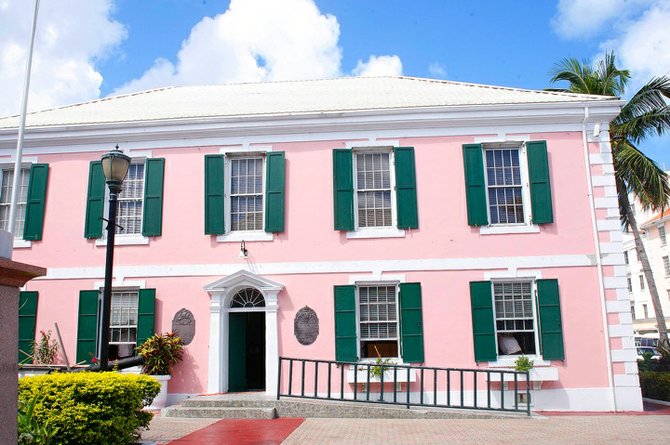
Bahamas Parliament – House of Assembly – Nassau
This is a serious issue!
This relates to the June 7th, 2016 referendum in the Bahamas. The measure listed 4 bills for constitutional amendments relating to Gender Equality, designed to correct some inequities in the legal structures of the country. The following summaries apply:
BILL 1: Would allow a child born outside of the Bahamas to a Bahamian mother and a non-Bahamian father to have citizenship.
BILL 2: Would allow a foreign man married to a Bahamian woman to seek citizenship.
BILL 3: Would allow an unmarried Bahamian father to pass his citizenship to a child born to a foreign mother.
BILL 4: Would end discrimination based on sex.
(Source: https://en.wikipedia.org/wiki/Bahamian_constitutional_referendum,_2016 )
Update June 8, 2016: The Referendum failed in every constituency and every precinct. The ‘No‘ Vote movement succeeded overwhelmingly; see a related article here.
Like most societies, there are males and females, majorities and minorities. So an even more grave issue is brought to mind:
Human / Natural Rights of Men versus Women and Majorities versus Minorities
 The Human Rights premise is: for those people who are not treated equal in a society, their rights should NOT be dependent on some popularity contests among the majority. No one should have to seek someone else’s permission to be happy. This is easier said than done, as our Caribbean is notorious for repression for those who do not conform with the majority.
This commentary asserts that natural rights / human rights should be accorded, no matter the results of some referendum.
The disposition of the Bahamas “lay in the balance” from this referendum. What message has been sent to the world: inviting or disinviting?
The book Go Lean … Caribbean addresses these issues, from the perspective of economics and nation-building. This book serves as a roadmap for the introduction and implementation of the Caribbean Union Trade Federation (CU); the purpose of which is to elevate Caribbean society, for all 30 member-states. The book stresses the need to guarantee human rights protections for all Caribbean people (Page 220), recognizing that the region is diverse in ethnicities and cultures.
Can’t we all just get along?! – Rodney King 1994
If we fail to try, or send the wrong message as to our inclusiveness, we suffer a dire consequence – “brain drain”. This is also the strong point made by the Bahamas Chamber of Commerce and Employers Confederation in the following news article:
By: Neil Hartnell, Business Editor, The Tribune Daily Newspaper
(Source: Posted May 6, 2016; retrieved June 2, 2016 from: http://www.tribune242.com/news/2016/may/06/referendum-outcomes-brain-drain-impact/)The upcoming constitutional referendum’s outcome could have far-reaching consequences for the Bahamian economy and its ability to reverse the “brain drain”, a senior private sector executive warned yesterday.
Edison Sumner, the Bahamas Chamber of Commerce and Employers Confederation’s (BCCEC) chief executive, told Tribune Business that the four Bills that Bahamians will vote on have profound implications beyond gender equality.
Depending on the outcome, Mr Sumner said the referendum may impact the Bahamas’ ability to retain – and attract – the ‘best and brightest’, including future generations of entrepreneurs and managers, given that it would affect how citizenship is bestowed.
“The Bahamas already complains, as does the region, about there being a ‘brain drain’,” he told Tribune Business, referring to how many college and university graduates elected to remain abroad after completing their studies.
Most cited the lack of opportunity, and economic diversification, as the reasons behind this choice, but Mr Sumner warned that this trend could be exacerbated depending on which way Bahamians vote.
The Bills, as designed, will enable a child born outside the Bahamas to automatically become a Bahamian citizen at birth if either of the parents was a Bahamian citizen at birth.
They will also “enable a Bahamian woman married to a foreign man to secure for him the same entitlements to citizenship that a Bahamian man married to a foreign woman already has under the constitution”.
The Bahamian father of a child born outside of marriage will be able to pass on his citizenship to that child if the third Bill is approved by the electorate, while the fourth Bill effectively enshrines gender equality as a fundamental right under the constitution.
Mr Sumner said that, viewed strictly from an economic and workforce perspective, the Bills would eventually have major ramifications for the Bahamas’ ability to expand its labour and entrepreneur pools, plus its attraction for investors.
Making it easier for children born to Bahamians in the circumstances outlined by the Bills to obtain citizenship/status, he added, would be key to ensuring these people became positive contributors to the Bahamas’ economic development and growth
“Those born to a Bahamian parent outside the outside the country, or born outside marriage, may find themselves in a precarious position where they are not Bahamian, and have no more entitlement to become Bahamian,” Mr Sumner explained.
“We want to retain as much of our intellectual capital in the Bahamas as possible to help us grow the economy, the education system, the infrastructure of the country.
“It has to be one of those situations where they must see the benefits in coming to the Bahamas, getting their citizenship here, and helping to build the country and the economy.”
Mr Sumner also warned that Bahamian employers needed to “pay attention” to what happens with the Bills and the referendum, given that the outcome might impact employee workplace relations and hiring practices.
Given that the constitution “trumps all legislation”, he added that the Employment Act, Industrial Relations Act and other labour legislation might be impacted by the referendum.
So voting wrong on the referendum could exacerbate the “brain drain”? Yes! Justice for all? No!
Public referendums are a product of a democratic process. But there is something else more important: rule of law or a constitution. This normally defines the moral code by which a society is to judge “right from wrong”. For many Caribbean nations, their constitutions embed principles from the Judeo-Christian principles – from the Bible. But does that mean they are “Christian nations”. Just consider the comments of one of the founding fathers of the Bahamas, Arthur D. Hanna. See VIDEO here:
VIDEO – Hon. A. D. Hanna debunks the “Christian nation” myth – https://youtu.be/0q0o2-4t3UI
Published on Nov 15, 2014 – Founding Father, framer of the constitution and former Governor-General Arthur Dion Hanna makes it abundantly clear that the Bahamas is NOT a Christian nation. (recorded at the Bahamas Historical Society, 13th November, 2014)
A Christian character is preferred for the individual; a “Christian nation”, not so much. A Christian nation would impose orthodoxy and dogma, prohibiting gender equality and establishing men as the “head” in their families and communities; plus a Christian nation would prohibit the activities of the LGBT communities, due to the religious orthodoxy. This orthodoxy premise often lead victims to flee their homeland to find refuge abroad, exacerbating the “brain drain” further.
So what principle would be recommended for a Caribbean nation or the region as a whole? The Go Lean book (Page 37) answers: the Greater Good:
“It is the greatest good to the greatest number of people which is the measure of right and wrong”. Jeremy Bentham (1748-1832)
The Go Lean book (Page 20) advocates for all of the Caribbean the community ethos of the Greater Good – “fundamental character or spirit of a culture; the underlying sentiment that informs the beliefs, customs, or practices of a group or society”. But respect for the sovereign territories of each member-state mandates that we respect the individual laws enacted there. (Though we can use peer-pressure to foster change).
The Go Lean/CU roadmap employs a tactic of a “Separation-of-Powers between CU federal agencies and Caribbean member-state governments”; so the limitations of national laws in a member-state does not have to override the CU. The CU constitution would apply to the installation of Exclusive Economic Zones (EEZ) and Self-Governing Entities (SGE) that operate in controlled bordered territories like campuses, industrial parks, research labs and industrial plants.
This roadmap brings hope to assuage the Caribbean orthodoxy.
The CU – applying the Greater Good principle – would facilitate the regional prime directives:
- Optimization of the economic engines in order to grow the regional economy to $800 Billion & create 2.2 million new jobs.
- Establishment of a security apparatus to protect the resultant economic engines, specifically in EEZ’s and SGE’s.
- Improvement of Caribbean governance, with the appropriate separation-of-powers, to support these engines.
The book Go Lean … Caribbean asserts that CU controlled territories – like EEZ’s and SGE’s – can be strategic, tactical and operationally efficient for elevating Caribbean society and mandating “justice for all”. These sites can serve as peer pressure on the rest of the region. These points are pronounced early in the book with this Declaration of Interdependence (Page 12), including these statements:
xi. Whereas all men are entitled to the benefits of good governance in a free society, “new guards” must be enacted to dissuade the emergence of incompetence, corruption, nepotism and cronyism at the peril of the people’s best interest. The Federation must guarantee the executions of a social contract between government and the governed.
xii. Whereas the legacy in recent times in individual states may be that of ineffectual governance with no redress to higher authority, the accedence of this Federation will ensure accountability and escalation of the human and civil rights of the people for good governance, justice assurances, due process and the rule of law. As such, any threats of a “failed state” status for any member state must enact emergency measures on behalf of the Federation to protect the human, civil and property rights of the citizens, residents, allies, trading partners, and visitors of the affected member state and the Federation as a whole.
xiii. Whereas the legacy of dissensions in many member-states … will require a concerted effort to integrate the exile community’s repatriation, the Federation must arrange for Reconciliation Commissions to satiate a demand for justice.
xvi. Whereas security of our homeland is inextricably linked to prosperity of the homeland, the economic and security interest of the region needs to be aligned under the same governance. Since economic crimes, including piracy and other forms of terrorism, can imperil the functioning of the wheels of commerce for all the citizenry, the accedence of this Federation must equip the security apparatus with the tools and techniques for predictive and proactive interdictions.
The subject of optimizing justice institutions and the “truth and consequences” of justice failures have been directly addressed and further elaborated upon in these previous blog/commentaries:
| https://goleancaribbean.com/blog/?p=8099 | Caribbean Image: ‘Less Than’? |
| https://goleancaribbean.com/blog/?p=7989 | Political Transformation results in “free money” |
| https://goleancaribbean.com/blog/?p=7628 | ‘A Change Is Gonna Come’ – Inevitable for the Caribbean |
| https://goleancaribbean.com/blog/?p=7490 | Push Factor: Interpersonal Violence / Domestic |
| https://goleancaribbean.com/blog/?p=5784 | Push Factor: Caribbean Unjust LGBT Treatments – ‘Say It Ain’t So’! |
| https://goleancaribbean.com/blog/?p=5695 | Repenting, Forgiving and Reconciling the Past |
| https://goleancaribbean.com/blog/?p=5304 | Mitigating the Eventual ‘Abuse of Power’ |
| https://goleancaribbean.com/blog/?p=4840 | Caribbean Orthodoxy: Jamaican Poll – ‘Bring back the British!’ |
| https://goleancaribbean.com/blog/?p=4240 | Bad Policy – Immigration Policy Exacerbates Productivity Crisis |
| https://goleancaribbean.com/blog/?p=2994 | Justice Strategy: Special Prosecutors … et al |
| https://goleancaribbean.com/blog/?p=2709 | Caribbean Study: 58% Of Boys Agree to Female ‘Discipline’ |
| https://goleancaribbean.com/blog/?p=695 | Help for Abused Women Depicts Societal Defects |
The Go Lean book itself details the economic principles and community ethos to adopt, plus the executions of strategies, tactics, implementations and advocacies to mitigate the “push and pull” factors that imperil our Caribbean region:
| Community Ethos – Economic Principles – All Choices Involve Costs | Page 21 |
| Community Ethos – Economic Principles – People Respond to Incentives | Page 21 |
| Community Ethos – Economic Principles – Economic Systems Influence Individual Choices | Page 21 |
| Community Ethos – Economic Principles – Voluntary Trade Creates Wealth | Page 21 |
| Community Ethos – Economic Principles – Consequences of Choices Lie in the Future | Page 21 |
| Community Ethos – Security Principles – Privacy –vs- Public Protection | Page 23 |
| Community Ethos – Security Principles – Whistleblower Protection | Page 23 |
| Community Ethos – Security Principles – Witness Security & Protection | Page 23 |
| Community Ethos – Security Principles – Anti-Bullying and Mitigation | Page 23 |
| Community Ethos – Governing Principles – Minority Equalization | Page 24 |
| Community Ethos – Governing Principles – Lean Operations | Page 24 |
| Community Ethos – Governing Principles – Cooperatives | Page 25 |
| Community Ethos – Ways to Manage Reconciliations | Page 34 |
| Community Ethos – Ways to Improve Sharing | Page 35 |
| Community Ethos – Ways to Impact the Greater Good | Page 37 |
| Strategy – Vision – Trade Federation with Proxy Powers of a Confederacy | Page 45 |
| Strategy – Mission – Build and Foster Local Economic Engines | Page 45 |
| Strategy – Mission – Protect Stakeholders with Vigorous Law-and-Order measures | Page 45 |
| Tactical – Confederating a Non-Sovereign Union | Page 63 |
| Tactical – Fostering a Technocracy | Page 64 |
| Tactical – Separation of Powers – Homeland Security | Page 75 |
| Tactical – Separation of Powers – Justice Department | Page 77 |
| Implementation – Foreign Policy Initiatives at Start-up | Page 102 |
| Implementation – Start-up Security Initiatives | Page 103 |
| Implementation – Start-up Benefits from the EEZ – Security – Interdictions | Page 104 |
| Implementation – Steps to Implement Self-Governing Entities – Security and Justice | Page 105 |
| Implementation – Ways to Foster International Aid – For oppressed minority groups | Page 115 |
| Planning – Ways to Make the Caribbean Better – Measures for the Rich and Poor | Page 131 |
| Planning – Ways to Improve Failed-State Indices – Law Enforcement Oversight | Page 134 |
| Planning – Lessons from the American West – Law & Order needed for progress | Page 142 |
| Advocacy – Ways to Grow the Economy | Page 151 |
| Advocacy – Ways to Create Jobs | Page 152 |
| Advocacy – Ways to Improve Governance | Page 168 |
| Advocacy – Ways to Better Manage the Social Contract | Page 170 |
| Advocacy – Ways to Improve Leadership | Page 171 |
| Advocacy – Ways to Impact Justice | Page 177 |
| Advocacy – Ways to Reduce Crime | Page 178 |
| Advocacy – Ways to Improve Homeland Security | Page 180 |
| Advocacy – Ways to Mitigate Terrorism | Page 181 |
| Advocacy – Ways to Improve Intelligence Gathering & Analysis | Page 182 |
| Advocacy – Ways to Protect Human Rights | Page 220 |
The Caribbean is comprised of males and females, majorities and minorities. Everyone must be afforded every opportunity for life, liberty and the pursuit of happiness. But “push and pull” emigration factors are real and important considerations for the Caribbean. The standards of justice – or lack there-of – have and can contribute to the “push” factors for people abandoning their homeland.
The foregoing news article depicts the crisis for the Bahamas.
The strong references to “brain drain” in the foregoing article and this commentary indicate that many in the community have felt oppressed or repressed, and have thusly “taken their talents to South Beach” or South New York, or South Toronto, or South London, etc. Since we need our talented human resources to build-up our own communities, we must examine all the debilitating factors – societal defects – in our homelands. We need to do better. The Caribbean in general and Bahamas in particular needs to send this message to the world that in our homeland, the legal premise must be:
… liberty, equality and justice for all.
The Go Lean … Caribbean roadmap seeks to employ strategies, tactics and implementations to dissuade the societal abandonment, invite the Diaspora to repatriate and further to recruit empowering immigrants to join us in our quest to make the Caribbean a better place to live, work and play. 🙂