Tag: Gender

“From the back of the Bus to the White House” – No need to Imagine – Encore

We all know the history …

… yet it should still be vocalized; it should be shouted from the rooftops and from the steeples. There is a dramatic change in the administration of America today.

Congratulations Kamala Harris!
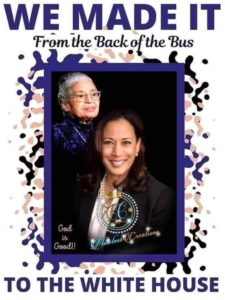
We applaud you … here and now … as we applauded you in the recent past. In fact, we had published a blog-commentary on March 7, 2019 shortly after Ms. Harris commenced her campaign for President of the United States (POTUS). Now today, she is the Vice-President.

    1. One step away…
    1. One heartbeat away …

Now is an appropriate time to Encore that previous blog-commentary; see it here-now:

——————–

Go Lean CommentaryWomen Empowerment – Kamala Harris: From Caribbean Legacy to the White House?
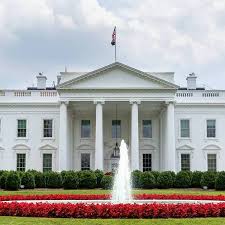
Who is the most powerful person in the world?

No doubt, the President of the United States. But this is not just an American drama, as the holder of that office is often considered the “Leader of the Free World“.

Free World?!

Q: Are there other worlds? A: Sure, countries like North Korea, Cuba, Venezuela, Yemen and others, may not consider the American Hegemony. But, most ironic, all those countries are considered Failed-States. So in summary, the President of the US is considered the Leader of all functioning societies on the planet – including our Caribbean member-states.

There is a chance, that a person of Caribbean heritage – an empowering woman: California Senator Kamala Harris – could assume that office. See the introductory news story / VIDEO here:

VIDEO – Who Is Kamala Harris? | 2020 Presidential Candidate | NYT News – https://youtu.be/cO_CZCebc5U

The New York Times
Published on Jan 21, 2019 – Senator Kamala Harris, Democrat of California, is joining the race for the White House. Ms. Harris becomes the fourth woman currently serving in Congress to announce her presidential ambitions.
Read the story here: https://nyti.ms/2FSqIHD Subscribe: http://bit.ly/U8Ys7n
More from The New York Times Video: http://nytimes.com/video

———-

Whether it’s reporting on conflicts abroad and political divisions at home, or covering the latest style trends and scientific developments, New York Times video journalists provide a revealing and unforgettable view of the world. It’s all the news that’s fit to watch.

So can she go from Caribbean Legacy to the White House? That would be shocking and empowering, considering that “Jamaican” comes with certain stereotypes. See a related news article here, detailing the affinity and conflict “she” has with her Jamaican father/heritage:

Title: Donald Harris slams his daughter Senator Kamala Harris for fraudulently stereotyping Jamaicans and accuses her of playing Identity Politics
By: Jamaican Global

Professor Donald Harris Kamala Harris’ Jamaican father, has vigorously dissociated himself from statements made on the New York Breakfast Club radio show earlier this week attributing her support for smoking marijuana to her Jamaican heritage. Professor Harris has issued a statement to jamaicaglobalonline.com in which he declares:

    “My dear departed grandmothers(whose extraordinary legacy I described in a recent essay on this website), as well as my deceased parents , must be turning in their grave right now to see their family’s name, reputation and proud Jamaican identity being connected, in any way, jokingly or not with the fraudulent stereotype of a pot-smoking joy seeker and in the pursuit of identity politics. Speaking for myself and my immediate Jamaican family, we wish to categorically dissociate ourselves from this travesty.”

This is the line – “Half my family’s from Jamaica. Are you kidding me?” – that has been repeated over by virtually every news media since Kamala Harris gave that response to the interviewer on New York’s Breakfast Club radio show when asked if she smoked marijuana.

Jamaica’s venerable Gleaner newspaper headlined:

    US Presidential Candidate Kamala Harris wants Marijuana Legalized, cites Jamaican roots.

While the locally based online news source Loop reported:

    Kamala Harris cites Jamaican roots in support of ganja legislation.

The Georgia based Macon Telegraph  was less subtle. Its report screamed:

    Kamala Harris supports legal pot. “Half my family’s from Jamaica. Are you kidding me?”

The 2020 presidential hopeful with a Jamaican heritage said she not only smoked but added “I inhale”. Perhaps said jokingly at first in the spirit of the interview, she proceeded to suggest that her Jamaican father’s side of the family would be disappointed in her if she did not support the legalization of marijuana. And that IS a serious statement. Now Harris’ father has come out vigorously dissociating himself from his daughter’s statement.

And well he might. V.G. McGee in a op ed piece published on January 12 in Urbanislandz writes “ Back in 2014 while running for re-election for California attorney general, she wasn’t in support of legalizing recreational use of the plant , but it is good that she has evolved on the issue and we can thank her Jamaican relatives for influencing her changing opinion.” So, the perception created by Ms. Harris’ statement is real and has caused some unease amongst Jamaicans at home and in the diaspora and now, it seems, her father and his Jamaican family. For some, it is more than mere unease; one Jamaican commenting on social media expressed the concern that “soon my job will be singling me out to drug test me since I am from Jamaica. What a stereotype”. Her concern is not unfounded given the experience of Jamaicans travelling to US ports having sniffer dogs around them in customs halls.

The Indian/Jamaican Marijuana connection: Did Kamala Harris deliberately and unfairly stereotype Jamaica as a nation of pot smokers? 

An ironic twist in Ms. Harris’ associating marijuana smoking with her Jamaican heritage that seems to have escaped her as well as media watchers is the fact that it is also very much a part of her Indian heritage that she is so proud of claiming. Is she aware that it was India that bequeathed a marijuana culture to Jamaica? In her authoritative Encyclopedia of Jamaican Heritage (2003) Oliver Senior writes:

    ‘The practice of cultivating, smoking and otherwise consuming the herb (marijuana) is believed to have been popularized by Indian indentured immigrants who began to arrive from 1845. The local name ‘ganja’ is Indian. The concept of ganja as a holy herb is a Hindu one; it is widely used to enhance the religious experience in parts of India (despite government prohibition).

This seeming lack of knowledge about the connection between her Indian and Jamaican heritage provides additional ammunition for some Jamaicans who are of the view that Ms. Harris tends to downplay her Jamaican heritage when it suits her, crediting her Tamil Indian mother with the most significant influence on her life and outlook and rarely talks about her father’s influence. Her father Donald, hardly ever gets credit except when mentioned alongside her mother, but rarely as an individual. Even when asked by her host in the now famous ‘marijuana interview’ about her motivation to enter the presidential race, Ms. Harris referenced ONLY her mother whom she said, raised her and her sister Maya with many beliefs and rules – one being never to sit and complain about something, but to do something about it. Yet, anyone who has read ‘Reflections of a Jamaican Father’ Donald Harris’ heart-warming account of how he raised his two daughters, will immediately realize that there is another side to the Kamala Harris story. In that article Donald Harris writes:

    “As a child growing up in Jamaica, I often heard it said by my parents and family friends ‘member whe you come fram’ (remember from where you came). To this day I continue to retain the deep social awareness and strong sense of identity which that grassroots Jamaican philosophy fed in me. As a father, I naturally sought to develop the same sensibility in my two daughters.”

Continuing, Harris says:

    “My message to them was that the sky is the limit on what one can achieve with effort and determination and that in the process, it is important not to lose sight of those who get left behind by social neglect or abuse and lack of access to resources or ‘privilege’.

If Kamala Harris inherits some of ‘that deep social awareness’ and heeds the advice of her Jamaican father, she will make an excellent President of the United States of America.

Source: Posted February 15, 2019; retrieved March 7, 2018 from: https://www.jamaicaglobalonline.com/donald-harris-slams-his-daughter-senator-kamala-harris-for-fraudulently-stereotyping-jamaicans-and-accusing-her-of-playing-identity-politics/

How realistic is the notion of a Kamala Harris presidency?

History is on her side!

“Last time we knocked on the door  – this time, we are going to kick the son-of-a-bitch in!”

In the last presidential election (2016) Democratic Candidate Hillary Clinton knocked-on-the-door and won the popular vote, but lost out in the Electoral College. (Today, investigations are concluding on the possibility that the eventual winner, Donald J. Trump, may have benefited from illegal campaign funding activities and collusion with the foreign government of Russia – he may have cheated). So yes, a woman can win the office.

Based on the “Blue Wave” of the 2018 General Election (Mid-terms) results, there is reason to believe that the 2020 race will have a Democratic Party winner, rather than the Republican incumbent. Plus, ex-President Barack Obama proved that a “Black” person can win the office.

Will this combination propel Kamala Harris to the Office of the Presidency?

There is still a long journey to go, with a lot of obstacles to overcome and challenges to meet. But many women have overcame obstacles and met challenges to obtain their goals to impact society. In fact, this is the very theme this month of this series of commentaries from the movement behind the book Go Lean … Caribbean. This is part 3 of 6 for Women History Month; this series addresses how one woman can make a difference in society; and how society can make a difference for women; this is because qualities like courage, problem-solving, determination and a zeal for justice flourishes with some women … as it does with some men.

Other commentaries in this series include these entries:

  1. Women History Month 2019: Thoughts, Feelings, Speech and Actions
  2. Women History Month 2019Viola Desmond – The Rosa Parks of Canada
  3. Women History Month 2019: Kamala Harris – Caribbean Legacy to the White House?
  4. Women History Month 2019: Captain Marvel – We need “Sheroes”
  5. Women History Month 2019Ellevest CEO: Sallie Krawcheck
  6. Women History Month 2019: Accepting Black Women As Is

For Kamala Harris to win the presidency, she will have to “win over” America; but first she must “win over” the Democratic Party; even before that, she must “win over” the Black community. Some people think that will be her biggest challenge; see a related news article/opinion-editorial here:

Title: Kamala Harris Can’t Count on the Black Vote in 2020
Opinion by: Luther Campbell

Kamala Harris will have trouble persuading black voters to make her president in 2020. First, the U.S. senator from California must explain why Donald Trump has a better prison-reform record than she had as the Golden State’s attorney general. Then she’ll have to overcome the perception she’ll do anything to climb to the top.

On the street, many blue-collar African-Americans, especially men, have already made up their minds not to vote for her. Between 2004 and 2016, when Harris worked as San Francisco’s district attorney and state attorney general, she supported legislation that sent kids who skipped school to jail. And she opposed federal supervision of California’s prisons after a U.S. Supreme Court ruling declared the overcrowded facilities inflicted cruel and unusual punishment on inmates.

When she appealed a court order to implement new parole programs, Harris cited the need to use prisoners as slave labor to fight wildfires and pick up highway trash.

Though black voters want politicians who’ll put away thugs and killers terrorizing the neighborhood, they don’t support those who deny defendants rehabilitation and send them to prison for crimes they didn’t commit to line private prison companies’ pockets.

Harris rose to prominence in California after an affair with married, but separated, former San Francisco Mayor Willie Brown, who recently wrote a column that mentioned their relationship. Brown said he influenced Harris’ career by appointing her to two state commissions when he was California Assembly speaker. He also helped her in her first race for San Francisco district attorney.

When Harris, whose mother is from India and father is from Jamaica, decided it was time to take her talents to Washington, D.C., she married Douglas Emhoff, a rich white lawyer. For better or worse, black men don’t want to vote for a black woman who married a white man or was the mistress of a powerful black man.

Like everyone else, black voters want help from one of their own. The Bushes made sure their people got oil money. Bill Clinton let the telecommunications industry gobble up small radio and TV stations. And Donald Trump is looking out for his developer buddies through a tax cut and opportunity zones that gentrify minority neighborhoods. Meanwhile, Harris has let black people know they can’t count on her.

Source: Posted February 5, 2019; retrieved March 7, 2019 from: https://www.miaminewtimes.com/news/kamala-harris-cant-count-on-the-black-vote-to-win-in-2020-11068985

(This foregoing writer is not endorsed by this commentary; his editorial seems misogynistic).

Women in Politics? To the highest office in the land? This theme aligns with previous Go Lean commentaries asserting that ” Yes, they can!”; see a sample list here:

https://goleancaribbean.com/blog/?p=14718 ‘At the Table’ or ‘On the Menu’
https://goleancaribbean.com/blog/?p=13063 Gender Equity without a ‘Battle of the Sexes’
https://goleancaribbean.com/blog/?p=12035 Fact & Fiction: Lean-in for ‘Wonder Woman Day’
https://goleancaribbean.com/blog/?p=8306 Women Get Ready for New Lean-In Campaign
https://goleancaribbean.com/blog/?p=6937 Women in Politics – Yes, They Can!
https://goleancaribbean.com/blog/?p=6836 #FatGirlsCan – Women do not have to be a ‘Ten’ to have impact

For those of us in the Caribbean, we have No Vote and No Voice in this 2020 presidential race. But we can observe-and-report. We can apply the proven “5-L” methodology: Look, Listen and Learn how to overcome orthodoxies to finally get the best person elected for the job, despite any race or gender.

We can also Lend-a-hand! (Many people of Caribbean heritage live in the US – many can vote). In fact, we – Jamaicans, Cubans, Puerto Ricans – were target demographics in the 2016 race.

Lastly, there is the opportunity to Lead – especially to define good leadership; recognizing attributes and personal qualities are bigger and of more importance than race and/or gender. We need to apply these lessons and leadership development in the Caribbean member-states.

So “Yes, we can” … learn from this American drama and learn to make our Caribbean homeland a better place to live, work and play. 🙂

About the Book
The book Go Lean…Caribbean serves as a roadmap for the introduction and implementation of the technocratic Caribbean Union Trade Federation (CU), for the elevation of Caribbean society – for all member-states. This CU/Go Lean roadmap has these 3 prime directives:

  • Optimization of the economic engines in order to grow the regional economy to $800 Billion and create 2.2 million new jobs.
  • Establishment of a security apparatus to ensure public safety and protect the resultant economic engines.
  • Improve Caribbean governance to support these engines, including a separation-of-powers between the member-states and CU federal agencies.

The Go Lean book provides 370-pages of turn-by-turn instructions on “how” to adopt new community ethos, plus the strategies, tactics, implementations and advocacies to execute so as to reboot, reform and transform the societal engines of Caribbean society.

Download the free e-Book of Go Lean … Caribbean – now!

Who We Are
The movement behind the Go Lean book – a non-partisan, apolitical, religiously-neutral Community Development Foundation chartered for the purpose of empowering and re-booting economic engines – stresses that reforming and transforming the Caribbean societal engines must be a regional pursuit. This was an early motivation for the roadmap, as pronounced in the opening Declaration of Interdependence (Pages 12 – 13):

xi. Whereas all men are entitled to the benefits of good governance in a free society, “new guards” must be enacted to dissuade the emergence of incompetence, corruption, nepotism and cronyism at the peril of the people’s best interest. The Federation must guarantee the executions of a social contract between government and the governed.

xvi. Whereas security of our homeland is inextricably linked to prosperity of the homeland, the economic and security interest of the region needs to be aligned under the same governance. Since economic crimes … can imperil the functioning of the wheels of commerce for all the citizenry, the accedence of this Federation must equip the security apparatus with the tools and techniques for predictive and proactive interdictions.

xxiv. Whereas a free market economy can be induced and spurred for continuous progress, the Federation must install the controls to better manage aspects of the economy: jobs, inflation, savings rate, investments and other economic principles. Thereby attracting direct foreign investment because of the stability and vibrancy of our economy.

Sign the petition to lean-in for this roadmap for the Caribbean Union Trade Federation.

Share this post:
, , , ,

Long Train of Abuses: Religious Character in Society – Human Rights

Go Lean Commentary

This is a continuation of the monthly Teaching Series from the movement behind the 2013 book Go Lean…Caribbean on the Long Train of Abuses that have molded our people and our society. We have a lot of defects that is obvious for all to see, within the region or from an external global view. After 525 years, our societal character is cemented; we have the greatest address on the planet and an abundance of hospitality, but we have many societal flaws that dominate.

People can see it and/or feel it without actually being here.

Did you know?

“Customers can hear a smile through the phone.” – Contact Center Experts

This is true because it is hard to fake sincerity; despite the senses, proof of a good/bad heart comes through. The actuality of a good/bad heart has been evident through out Caribbean history. The moral sense of right-wrong, good-bad and right-wrong for the Caribbean has been based on the Judeo-Christian standard. As related in the last blog-commentary in this series, the premise was established that Caribbean society was molded with a Christian expansion motivation; make that Christendom.

How do we know it is Christendom, instead of Christianity?

By the character fruitage of our society. That same Judeo-Christian standard, the Bible, clearly defines how to assess:

… love one another; just as I have loved you. By this all will know that you are my disciples, if you have love among yourselves.”​— John 13:34, 35 NWT

We have failed, far too often, to show love to our neighbors.

Many times, we have even fostered a Climate of Hate, especially for people different from the majority of the population in power. Thusly, many people in our society have had to endure a Long Train of Abuses. This is what was related in a previous blog-commentary from June 14, 2016:

Climate of Hate
Our Caribbean society, far too often, promotes a “climate of hate”. Consider these three examples:

  • Haitian Immigrants– Many Caribbean countries express vitriol towards Haitian migrants.
  • LGBT– Still clinging to the archaic “Buggery” laws, many countries persecute gays in their society as degenerates.
  • Equality-seeking Women– Just last week, a referendum failed in the Bahamas 3 to 1.

The Caribbean member-states, collectively and individually, need to curb its “climate of hate” and to pay more than the usual attention to the lessons from …

This discussion is important because our failures to exhibit a Christian character – or any religious influence – has led to a lot of societal defects – Human Rights abuses – and eventual societal abandonment. See here, as related in a different previous commentary from July 2, 2015 entitled “Buggery in Jamaica – ‘Say It Ain’t So’!”:

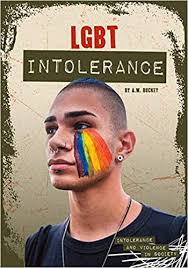
… this defect – LGBT Intolerance – was listed among the blatant Human Rights abuses in the region.

This is an important consideration for the planners of Caribbean empowerment. The Caribbean, a region where unfortunately, we have NOT … tried to be as tolerant as may be required, expected and just plain moral.

We must do better!

The book Go Lean … Caribbean asserts that Caribbean society’s prosperity has been hindered with a high abandonment rate – reported at 70% for educated classes region-wide, but an even higher 85% in Jamaica [some countries]. The primary mission of the Go Lean book is to “battle” against the “push-and-pull” factors that draw so many of our Caribbean citizens away from their homelands to go to more progressive countries.

The Go Lean book campaigns to lower the “push” factors!

The purpose of the Go Lean book is to fix the Caribbean; to be better. The Go Lean book serves as a roadmap for the introduction and implementation of the technocratic Caribbean Union Trade Federation (CU) to pursue the quest to elevate the Caribbean region through empowerments in economics, security and governance. It is the assertion that Caribbean citizens can stay home and effect change in their homelands more effectively than going to some foreign countries to find opportunities for life, liberty and the pursuit of happiness. The book therefore asserts that the region can turn-around from failing assessments by applying best-practices, and forging new societal institutions to impact the Greater Good for all the Caribbean.

Rather than promote “peace and love” or even Human Rights, the Christian communities have exacerbated a Climate of Hate.

A Long Train of Abuses, ouch!

Research shows that the men most likely to abuse their wives are evangelical Christians who attend church sporadically. Church leaders in Australia say they abhor abuse of any kind. But advocates say the church is not just failing to sufficiently address domestic violence, it is both enabling and concealing it.

Remember the bad religious orthodoxy that was discussed in the last entry in this blog series; how these ‘hatreds’ were embedded in national edicts (Law-and-Order) over the centuries, decades and years: Slavery, Colonialism , Patriarchy / Gender Rights, White Supremacy, Buggery / LGBT Rights, Child Abuse.

This monthly Go Lean Teaching Series always presents issues that are germane to Caribbean life and culture and how to address them. For this month of December 2020, we are looking at the Long Train of Abuses that have pushed our people away from the homeland. This is entry 4-of-6; this one asserts that the embedded religiosity in Caribbean society has real world consequences, bad consequences. The toxicity and dysfunction in our society is among the Long Train of Abuses that we have had to endure. The full catalog of the series this month is as follows:

  1. Long Train of Abuses: Enough Already – Colonialism Be Gone!
  2. Long Train of Abuses: Overseas Masters – Cannot See Overseas
  3. Long Train of Abuses: Religious Leadership in Government – Reconciling Trump
  4. Long Train of Abuses: Religious Character in Society – Human Rights
  5. Long Train of Abuses: Dutch Hypocrisy – Liberal Amsterdam vs Conservative Antilles
  6. Long Train of Abuses: Puerto Rico – “Take the Heat” or “Get out of the Kitchen”

All the defects identified and qualified here are reflective of Human Rights abuses.

Human Rights deficiencies despite the Christian premise. Wow! This is because it is not Christianity at work in the Caribbean; it is Christendom. So we need greater protections than just a copy of the Bible in everyone’s “night stand”. We need to reboot and end this Long Train of Abuses, now!

How?

The Go Lean book, serves as a roadmap for the introduction and implementation of the Caribbean Union Trade Federation (CU), an apolitical, religiously-neutral, economic-focused technocracy. The Go Lean book presents an action plan to better foster the Greater Good“the greatest good to the greatest number of people which is the measure of right and wrong” (Page 37). In addition, the book provides 370-pages of turn-by-turn instructions on “how” to adopt new community ethos, plus the strategies, tactics and implementations to execute so as to transform the Caribbean’s stance on Human Rights. In one specific advocacy (Page 220), there are action items for the heavy-lifting work that needs to be done. See here for summaries, excerpts and highlights from this Chapter entitled “10 Ways to Protect Human Rights“:

1 Lean-in for Caribbean Integration
This regional re-boot will allow for the unification of the region into one market, thereby creating a single economy of 30 member-states, 42 million people and a GDP of over $800 Billion. The CU will assume the primary coordination for the region’s economy and the requisite security to protect the resultant economic engines. While the CU is an economic initiative, there is a mission to monitor/mitigate Fail State Indices, and Human Rights violations constitute a Failed State Indicator.
2 Watchful World

A CU mission is to monitor the image of the Caribbean to the rest of the world. Not only will the world be watching the activities in the region, but the “story” being told will be directed to depict a positive behind-the-scenes view, that the region is the best place to live-work-play.

3 Caribbean [Persons] with Disabilities
4 Women & Youth

The CU will allow for empowerment and protections of women & children, orphans & widows, in compliance with Judeo-Christian precepts, Human Rights requirements, & natural instincts. These efforts will include the special needs for young girls, adult women and senior women.

5 LGBT Toleration

It is no longer acceptable to deny natural rights or Human Rights to those with alternate sexual orientation. In fact, qualifications for current EU grants depend on compliance of this requirement, (not granting rights for same-sex marriage), allowing this class to live free of discrimination, hazing, bullying and abuse. These rules are codified under Article 8 of the European Convention on Human Rights. This provides a right to respect for one’s “private and family life, his home and his correspondence” [248]. The CU federal oversight is mandatory as these clauses clash with pro-Christian values.

6 Reconciliations
7 Future Focus
8 Justice Focus
9 Tourist Omnipresence
10 Long-Form Journalism

Human Rights versus Christian Character?

It seems like such a “joke” that this advocacy is even necessary – but the need is great. Where is the Christian love? What a reproach to God that such behavior have brought a Climate of Hate in the name of God. Actually, this apostasy is exactly what the Bible prophesied for these times – the Last Days. See here:

You will be chased out of the synagogues. And the time will come when people will kill you and think they are doing God a favor. – John 16:2 Contemporary English Version

The Long Train of Abuses is predictable, but not good.

Other societies have done better; they have done the heavy-lifting for everyone – majority and minority – to prosper where planted in their homeland. We can, and must do it too; or watch our citizens – and those that love them – flee to those better lands.  These better lands has formulated Human Rights standards and conventions and expect all “Men/Women of Goodwill” to comply.

One such convention is CEDAW or the “Convention on the Elimination of All Forms of Discrimination Against Women”. See the full details in Appendix A below. (Also see Appendix B VIDEO as it relates the subject of gender-based violence being endured in the Caribbean region and around the world during this COVID-19 pandemic). Notice that one of the few countries that have not ratified CEDAW is the “Holy See” or the Vatican.

Holy See
The jurisdiction of the Bishop of Rome, known as the pope, which includes the apostolic episcopal see of the Diocese of Rome with universal ecclesiastical jurisdiction of the worldwide Catholic Church, as well as a sovereign entity of international law, governing the Vatican City. – Wikipedia

The Holy See being tolerant of a Long Train of Abuses is indicative of Christendom and not Christianity.

The Caribbean member-states must foster a better homeland that protects all of its residents and promotes prosperity, despite whatever the Churches are doing or not doing. What’s more, we must hold religious organizations accountable for their actions and violations of Human Rights standards and modern justice requirements.

This Go Lean movement has previously detailed many related issues and advocacies for Human Rights mandates in our region; consider this sample of previous blog-commentaries:

https://goleancaribbean.com/blog/?p=20561 How to mitigate Human Rights Abuses? Build on ‘Diversity & Inclusion’
https://goleancaribbean.com/blog/?p=20559 Toxic Environment – Homophobia: Hate not Fear
https://goleancaribbean.com/blog/?p=20557 Toxic Environment – It Infects Everything – Think “Cross” burnings
https://goleancaribbean.com/blog/?p=19002 Remembering Auschwitz – Still Relevant considering modern atrocities
https://goleancaribbean.com/blog/?p=15580 Caribbean Unity? Religion’s Role: False Friend
https://goleancaribbean.com/blog/?p=14482 International Women’s Day – Protecting Rural Women
https://goleancaribbean.com/blog/?p=11224 ‘Loose Lips Sink Ships’ – Fanatical Theologians Undermine Tourism
https://goleancaribbean.com/blog/?p=10216 Waging a Successful War on Orthodoxy
https://goleancaribbean.com/blog/?p=9766 Rwanda’s Catholic bishops apologize for genocide
https://goleancaribbean.com/blog/?p=6718 A Lesson in History Before the Civil War: Compromising Human Rights
https://goleancaribbean.com/blog/?p=5695 Repenting, Forgiving and Reconciling the Past
https://goleancaribbean.com/blog/?p=4971 A Lesson in Church History – Royal Charters: Truth & Consequence
https://goleancaribbean.com/blog/?p=341 US slams Caribbean human rights practices

Human Rights, the concept and the practice has been fleeting here in the Caribbean, not just among the governmental leaders but the citizenry as well. Leaders have not protected Human Rights for all and the citizenry have not demanded it … among the majorities – vocal outcries may be limited to minority groups only.

Enough already! It is time to think of the Greater Good for all people not just the most populous; from one aspect or another, anyone and everyone may be considered a minority.

There needs to be a force for moral good for all, but that has not come from the religious influences in the region, so it must come from the State (or Federal Government) instead, despite a formal Separation of Church and State.

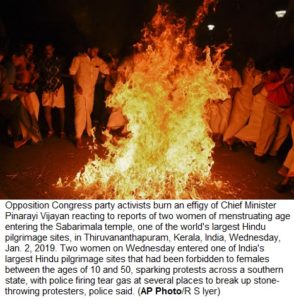
This is not just a Christian indictment. We saw the same issue in India with the Hindu population (also a Caribbean minority):

Transforming Hindus versus Women – What it means for us?
Women of menstruating age were forbidden to pray at the temple until the [Indian] Supreme Court lifted the ban in September [2018]. The ban was informal for many years but became law in 1972.

Some devotees have filed a petition saying the court decision revoking the ban was an affront to the celibate deity Ayyappa. …”

The concept is simple for “States“, while they must allow for Freedom of Religion, they cannot allow religious intimidation of their citizens. No More!

This is an issue of Orthodoxy and it is not only a concern in India. Even here in the Caribbean we have to make progress. Clearly we understand the oppression, suppression and repression experienced in India prohibiting women to pray in the Temple, and so there is the acceptance that it is right for that State to act against continued abuse. There has always been a need for States to legislate morality in society over the years.

Based on the foregoing, Hindus suffer the same abuse record as Christianity and Islam towards women. Bad religious orthodoxies seem to always exist when matters of faith are involved, so the State must regulate the behavior of Churches to ensure no violation of basic Human Rights.

We must do better; we must pursue the Greater Good … always.

We hereby urge all stakeholders – the faithful and the faithless – to lean-in to this Way Forward – a formal separation of Church and State – for societal progress; this is the quest of the Go Lean roadmap. This is our plan to make our regional homeland a better place to live, work and play.  🙂

About the Book
The book Go Lean…Caribbean serves as a roadmap for the introduction and implementation of the technocratic Caribbean Union Trade Federation (CU), for the elevation of Caribbean society – for all member-states. This CU/Go Lean roadmap has these 3 prime directives:

  • Optimization of the economic engines in order to grow the regional economy to $800 Billion & create 2.2 million new jobs.
  • Establishment of a security apparatus to ensure public safety and protect the resultant economic engines.
  • Improve Caribbean governance to support these engines, including a separation-of-powers between the member-states and CU federal agencies.

The Go Lean book provides 370-pages of turn-by-turn instructions on “how” to adopt new community ethos, plus the strategies, tactics, implementations and advocacies to execute so as to reboot, reform and transform the societal engines of Caribbean society.

Download the free e-Book of Go Lean … Caribbean – now!

Who We Are
The movement behind the Go Lean book – a non-partisan, apolitical, religiously-neutral Community Development Foundation chartered for the purpose of empowering and re-booting economic engines – stresses that reforming and transforming the Caribbean societal engines must be a regional pursuit. This was an early motivation for the roadmap, as pronounced in the opening Declaration of Interdependence (Pages 12 – 13):

x. Whereas we are surrounded and allied to nations of larger proportions in land mass, populations, and treasuries, elements in their societies may have ill-intent in their pursuits, at the expense of the safety and security of our citizens. We must therefore appoint “new guards” to ensure our public safety and threats against our society, both domestic and foreign. The Federation must employ the latest advances and best practices … to assuage continuous threats against public safety.

xi. Whereas all men are entitled to the benefits of good governance in a free society, “new guards” must be enacted to dissuade the emergence of incompetence, corruption, nepotism and cronyism at the peril of the people’s best interest. The Federation must guarantee the executions of a social contract between government and the governed.

xxiv. Whereas a free market economy can be induced and spurred for continuous progress, the Federation must install the controls to better manage aspects of the economy: jobs, inflation, savings rate, investments and other economic principles. Thereby attracting direct foreign investment because of the stability and vibrancy of our economy.

Sign the petition to lean-in for this roadmap for the Caribbean Union Trade Federation.
—————–

Appendix A – Title: Convention on the Elimination of All Forms of Discrimination Against Women

The Convention on the Elimination of all Forms of Discrimination Against Women (CEDAW) is an international treaty adopted in 1979 by the United Nations General Assembly. Described as an international bill of rights for women, it was instituted on 3 September 1981 and has been ratified by 189 states.[1] Over fifty countries that have ratified the Convention have done so subject to certain declarations, reservations, and objections, including 38 countries who rejected the enforcement article 29, which addresses means of settlement for disputes concerning the interpretation or application of the Convention.[2] Australia’s declaration noted the limitations on central government power resulting from its federal constitutional system. The United States and Palau have signed, but not ratified the treaty. The Holy SeeIranSomaliaSudan, and Tonga are not signatories to CEDAW. …

See the full details at https://en.wikipedia.org/wiki/Convention_on_the_Elimination_of_All_Forms_of_Discrimination_Against_Women ; retrieved December 9, 2020.

—————–

Appendix B VIDEOSt. Lucia: #CaribbeanYouthAgainstCovid19​ and #YouthAgainstCovid19​ – Jasmyn Joseph https://youtu.be/FsDU7P1o_RM

UNFPA Caribbean
Due to #COVID19​, the health and safety of women and girls has been compromised. Women and girls are disproportionately impacted by this pandemic. In this last episode of the #youthagainstcovid19​ campaign Jasmyn Joseph talks about the ways this pandemic has been affecting women and girls around the world and the actions we as a community can take to promote #genderequality​ during covid-19.

Share this video, so other youth can get informed and take action against gender inequality during covid19!

Share this post:
, , , ,
[Top]

Decision 2020 – Latino Gender Gap – More Toxic Masculinity

Go Lean Commentary

“… When Mexico sends its people, they’re not sending their best. … They’re sending people that have lots of problems, and they’re bringing those problems with us [them]. They’re bringing drugs. They’re bringing crime. They’re rapists. And some, I assume, are good people.” – Donald Trump Announcement of running for President June 16, 2015 – Source: WashingtonPost

From the beginning of his presidential political career, Donald Trump named, blamed and shamed Mexicans and by extension all Latinos (sometimes referred to as Hispanics or Chicanos). From this moment, Trump was strongly opposed by many Latinos for his entire presidential tenure. See here, from the previous blog-commentary on Celebrity Chef Jose Andrés:

Andrés planned to open a restaurant in the Trump International Hotel in Washington, DC, in 2016. After Donald Trump made disparaging comments about Mexicans in June 2015, Andrés withdrew from the contract with the Trump Organization, which then sued him.[13] Andrés counter-sued, and the parties reached a settlement in April 2017.[14] Andrés remains an outspoken critic of Trump.[15][16]

A Latinos for Trump rally in Miami on Sunday October 18, 2020. Mario Cruz/EPA, via Shutterstock

Trump was strongly opposed by many Latinos“, except for some men …

While there has been a consistent disgust towards Donald Trump, due to his Latin bashing, why has there been an exception among these men?

Blame it on Latin Machismo – Toxic Masculinity! See the rationale in the related Appendix VIDEO below … and in this New York Times article here:

Title: The Latino gender gap
It’s not just the public polls. Recent private polls conducted by political campaigns are filled with bad news for President Trump. He is doing eight to 10 percentage points worse in many congressional districts than he did in 2016, Dave Wasserman of The Cook Political Report writes.

His struggles have jeopardized the Republicans’ Senate majority and will probably lead to further Democratic gains in the House. “It would be a pleasant surprise if we only lost 10 House seats,” one Republican member of Congress told The Cook Political Report.

But there is one exception, and it will be familiar to regular readers of this newsletter: Trump and other Republicans don’t seem to be doing worse among Latino voters than in 2016. Nationwide, Republicans are still winning about one-third of the Latino vote, polls show.

As a result, Trump still has a good chance to win both Florida and Texas. Similarly, Senator John Cornyn of Texas continues to lead narrowly in his own re-election race, and House Republicans could hold onto districts in California, Florida and Texas.

Why is Trump holding steady with Latinos? There is no one answer, partly because Latinos are such a diverse group (many of whom also identify as white). But an important part of the explanation appears to involve gender.

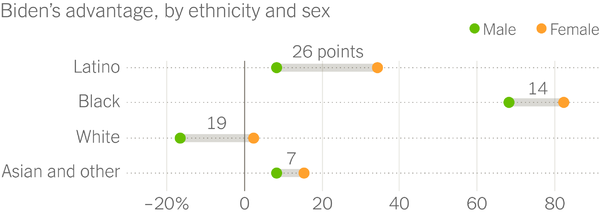
Recent Times polls of battleground states show that the gender gap among Latino voters — 26 percentage points — is significantly larger than it is among Black, white or Asian voters:

Among Latina women, Biden leads Trump by a whopping 34 percentage points (59 percent to 25 percent). Among Latino men, Biden’s lead is only eight points (47 percent to 39 percent). These patterns are similar across both Latino college graduates and those without a degree.

Stephanie Valencia, the president of Equis Research, which focuses on Latino voters, told us that its polls suggest that Latino men may have even moved slightly toward Trump this year. If so, they are the only large demographic group to do so.

In effect, gender seems to be outweighing ethnicity for some Latino men.

Race may get more attention, but gender also plays a huge and growing role in politics: The gender gap, which was virtually zero in the 1960s and ’70s, could reach a record high this year. The trend — men moving to the right and women to the left — is occurring in other high-income democracies as well, for a complicated mix of reasons, as Eric Levitz explains in New York magazine.

My colleague Jennifer Medina recently wrote an eye-opening story called “The Macho Appeal of Donald Trump,” focused on Latino men. The whole story is worth reading, but here is a key passage:

    … what has alienated so many older, female and suburban voters is a key part of Mr. Trump’s appeal to these men, interviews with dozens of Mexican-American men supporting Mr. Trump shows: To them, the macho allure of Mr. Trump is undeniable. He is forceful, wealthy and, most important, unapologetic. In a world where at any moment someone might be attacked for saying the wrong thing, he says the wrong thing all the time and does not bother with self-flagellation.

The story was set in Arizona — a state that could decide the election.

Source: New York Times – posted October 22, 2020; retrieved October 27, 2020 from: https://messaging-custom-newsletters.nytimes.com/template/oakv2

Did you get that?

… what has alienated so many older, female and suburban voters is a key part of Mr. Trump’s appeal to these men, interviews with dozens of Mexican-American men supporting Mr. Trump shows: To them, the macho allure of Mr. Trump is undeniable. He is forceful, wealthy and, most important, unapologetic.

It is not just Mexican-American men alone; the same attributes are common for all Latin males. This is not good! (We have this actuality with Hispanic men in Cuba, Dominican Republic and Puerto Rico).

This is the complaint that has emerged from Latin America and the Caribbean by so many women. The Toxic Masculinity is so thick, it can be cut with a knife. We addressed this actuality just recently; notice this excerpt:

Toxic Environment ==> Toxic Masculinity – October 2, 2020
We find that in certain societies, the “man code” has penetrated all aspects of society, not just prisons; think “locker room talk”, “Blue Codes” for conduct among law enforcement officials or bonding among soldiers in foxholes or trench-warfare ; there is even a “code of silence” among gang members or organized crime figures.

Toxic Masculinity is just one more way that Toxic Environments have affected the “community quest” to live, work and play in the Caribbean. Needless to say, community stewards cannot allow Toxic Masculinity to dominate society; think bullying, domestic violence, sexual harassment in the workplace. It is unfortunate but true, “bad actors” will always seek to exploit any weakness for their own selfish gain. So we must be prepared to curb the toxicity and promote a positive community ethos instead.

This is sad that our Dirty Laundry in the Latin America and Caribbean region is being exposed to the world. It is our Bad Community Ethos that should be named, blamed and shamed.

So many of our Latin men love the personage of Donald Trump, even though it is obvious that he does not love “them/us” back!

That is pathetic; we must do better.

This is the continuation of the monthly Teaching Series from the movement behind the 2013 book Go Lean…Caribbean. These Teaching Series address issues germane to Caribbean life and culture; this is entry 3-of-5, continuing the thesis that many people from Caribbean member-states have a voice in the American General Election for November 3; but our voice may not be all that positive, as many of our people – who subscribe to the Latin male machismo ethos – are doubling-down on our negative community ethos. It is hard for us to vent about the disgust towards the words and actions (or inactions) of the Trump Administration these last 4 years when we are taking comfort in the same negative vibes.

Our Caribbean Diaspora is relevant in America’s Decision 2020 due to the fact that our numbers are strong – upwards of 22 million people, 7 percent of the US population; this is enough to have relevance in a political race. But we need to think, feel, say and act properly.

American citizens of Caribbean heritage should be pursuing the Greater Good right now; people are watching and listening; they are noticing the disregard for the threats affecting our regional homeland and they expect us to demand change, not validate the Status Quo. Consider here, how this thesis is cataloged in the Teaching Series this month:

  1. Decision 2020: Puerto Rico claps back at Trump
  2. Decision 2020Haiti’s Agenda 2016 ==> 2020 – Trump never cared
  3. Decision 2020: Latino Gender Gap – More Toxic Masculinity
  4. Decision 2020More Immigration or Less
  5. Decision 2020What’s Next for Cuba & Venezuela

Yes, Decision 2020 allows us to analyze the motivations and sensibilities of not just the American eco-system, but also the Caribbean’s heart.

The problems of Toxic Masculinity and/or Latin Machismo has been addressed and detailed in many previous commentaries; see this chronological sample here:

Bahamas Study: 58% Of Boys Agree to Female ‘Discipline’ – October 21, 2014
Many times people flee the region to mitigate abusive situations; even more troubling, as victims they may have encountered an attitude of complacency and indifference among public safety authorities. The following article [Study] posits that this attitude is deeply entrenched in society, even among the next (younger) generation:

    FIFTY-eight per cent of high school boys and 37 per cent of high school girls participating in a recent academic survey believe men should discipline their female partners, according to a new College of the Bahamas study. …

Change has now come to the Caribbean. As the foregoing article [Study] depicts the problem of domestic violence is tied to a community ethos. This ‘negative’ ethos must be uprooted and replaced with a new, progressive spirit, starting at the adolescent level, when attitudes are pliable and sensitive to strategic messaging.

———–

Helping Black Caribbean Men & Boys – Hurt People Hurt People – March 3, 2018

Black men and boys” …

… this is a special group in the population of the New World, the Americas. This group has been victims and villains. To the point that academicians and clinicians alike can conclude that “hurt people hurt people”.

Societal defects within this group are higher than normal, compared to other populations groups. This includes violence, delinquencies, incarceration, repression and hopelessness. …

The New World experience for people of African descent is one of struggle; but our people have made a lot of progress over the last 2 centuries especially; that means we have “ruffled a lot of feathers” along the way. Caribbean music icon Bob Marley worded it perfectly in a song that was released posthumously: “Buffalo Soldier”. The lyrics say:

    Fighting on arrival; fighting for survival.

That fight though, was not always successful.

The experience of the Black men and boys in the New World is that these ones have often been hurt. Consider just the US experience with Lynchings … where “a total of 4,733 persons had died by lynching since 1882”; (Black men and boys were almost always the victims, with a few sprinkling of women here and there).

There is no excusing, rationalizing or minimizing this injustice. This “hurt” was state-action, state-sponsored and extra-judicial via mob-violence. (Other countries in the Americas also had lynchings, not just the Southern States of the US).

With this above introduction, is there any wonder that the crime rate is higher for Black men and boys than any other sub-group in the population? This is the accepted premise that “hurt people hurt people”.

This fact causes  breach in society. How do “we” repair this breach in societal dynamics? …

The Go Lean book presents 370 pages of instructions for how to reform and transform the Caribbean member-states. It stresses the key community ethos, strategies, tactics, implementations and advocacies necessary to shepherd a better society.

———–

Bad Ethos on Home Violence – December 23, 2018

People do tend to be a product of their environment and their early molding. Most times the discipline and attitudes learned at home forms the adult character that people become.

This is good … and bad! …

This concept refers to the “ethos” (a Greek word meaning “character” that is used to describe the guiding beliefs or ideals); we see that it is not just a personal attribute but also refer to a community characteristic. Thus the word community ethos. …

“Charity begins at home”.

Everyone knows that and assumes that. The good actions you exert towards others – strangers – is an exercise that starts at home, towards family. This is also true in the reverse: the bad actions you exert towards strangers, tend to stem from the practice to malevolent behavior towards family. Thusly, domestic violence do connect to violent crimes, think rape.

This is not just some academic thesis; this is real life and real bad, in Jamaica right now. See these two supporting news stories:

  1. Domestic Abuse – 15 percent of women experience violence – see Appendix A below.
  2. Tourist Rapes – A Black-eye for hospitality towards foreigners – see Appendix B below.

… The Go Lean book provides 370-pages of turn-by-turn instructions on “how” to adopt new community ethos, plus the strategies, tactics, implementations and advocacies to execute so as to reboot, reform and transform the societal engines of Caribbean society. Domestic violence and rape tend to victimize women. So the Go Lean book specifically – on Page 226 – presented an advocacy to help women; featuring this title: 10 Ways to Empower Women.

———-

Unequal Justice: Bullying Magnified to Disrupt Commerce – September 28, 2019
Analogies abound … as to why it is important to “nip bullying in the bud”. If we do nothing – or not enough – then conditions of Unequal Justice go from “bad to worse”. The bad actor can emerge from terrorizing a family, to a neighborhood, to a community, to a nation, to a region, to a hemisphere, to the whole world. Think: Nazi Germany, Imperial Japan, Soviet Russia, British Empire, Napoleonic France, Spanish Inquisition, and more …

Unchecked, bad actors in the community become tyrants – they can even affect the local economic engine.

In this series commentary, reference is made to the fact that Tourism, as the Number 1 economic driver in the region, is vulnerable to Bad Actors disrupting peaceful hospitality trade – we must protect our societal engines from tyrants, bullies and terrorists. So there is always the need to ensure justice institutions are optimized in the region; visitors will refuse to come and enjoy our hospitality if there are active threats or perceived instabilities. (At the same time, residents flee to foreign shores in search of refuge). So the need for justice in the Caribbean tourism deliveries transcends borders, politics, class and race.

As a presidential candidate, Donald Trump presented himself as a tyrant, bully, yet he won in 2016 thanks to many Hispanic men. They doubled-downed on Toxic Masculinity!

This is not “putting our best foot forward”. We can/must do better than Trump, better than Toxic Masculinity.

In the aforementioned previous blog-commentary, we asked:

How can we remediate and mitigate Toxic Masculinity? For one thing, we must start early. Then we must not settle for the bad orthodoxy of “boys will be boys”. It has been proven again and again that bad instincts can be corrected and weeded out of society. Yes, the solution is: reform and transform.

We must strive to do better in our homeland, otherwise our people will continue to flee in search of refuge. Toxic Masculinity exist in our society, we must work to dislodge it, message against it, coach it out of our young people and foster positive values and ethos in its place.

We definitely do not want to export our Toxic Masculinity to foreign lands, nor assimilate other people’s toxicity. We must recognize bad and filter it out of society.

Yes, we can …

Now, let’s abandon the toxic and work to make the Caribbean – our part of the world – a better place to live, work and play. 🙂

About the Book
The book Go Lean…Caribbean serves as a roadmap for the introduction and implementation of the technocratic Caribbean Union Trade Federation (CU), for the elevation of Caribbean society – for all member-states. This CU/Go Lean roadmap has these 3 prime directives:

  • Optimization of the economic engines in order to grow the regional economy to $800 Billion and create 2.2 million new jobs.
  • Establishment of a security apparatus to ensure public safety and protect the resultant economic engines.
  • Improve Caribbean governance to support these engines, including a separation-of-powers between the member-states and CU federal agencies.

The Go Lean book provides 370-pages of turn-by-turn instructions on “how” to adopt new community ethos, plus the strategies, tactics, implementations and advocacies to execute so as to reboot, reform and transform the societal engines of Caribbean society.

Download the free e-Book of Go Lean … Caribbean – now!

Who We Are
The movement behind the Go Lean book – a non-partisan, apolitical, religiously-neutral Community Development Foundation chartered for the purpose of empowering and re-booting economic engines – stresses that reforming and transforming the Caribbean societal engines must be a regional pursuit. This was an early motivation for the roadmap, as pronounced in the opening Declaration of Interdependence (Pages 12 – 13):

xi. Whereas all men are entitled to the benefits of good governance in a free society, “new guards” must be enacted to dissuade the emergence of incompetence, corruption, nepotism and cronyism at the peril of the people’s best interest. The Federation must guarantee the executions of a social contract between government and the governed.

xvi. Whereas security of our homeland is inextricably linked to prosperity of the homeland, the economic and security interest of the region needs to be aligned under the same governance. Since economic crimes … can imperil the functioning of the wheels of commerce for all the citizenry, the accedence of this Federation must equip the security apparatus with the tools and techniques for predictive and proactive interdictions.

xxiv. Whereas a free market economy can be induced and spurred for continuous progress, the Federation must install the controls to better manage aspects of the economy: jobs, inflation, savings rate, investments and other economic principles. Thereby attracting direct foreign investment because of the stability and vibrancy of our economy.

Sign the petition to lean-in for this roadmap for the Caribbean Union Trade Federation.
—————–

Appendix VIDEO – Trump’s “Macho Man” Image Working? – https://youtu.be/kOfnbd5Er7w

The View
Posted October 15, 2020 – A ‘New York Times’ report pointed out that despite a majority of Latino voters favoring Democrats, Hispanic men remain a stable part of Pres. Trump’s base due to his “macho allure” – Ana Navarro weighs in.

Subscribe to our YouTube channel: http://bit.ly/2Ybi4tM
MORE FROM ‘THE VIEW’: Full episodes: http://abcn.ws/2tl10qh
Twitter: http://twitter.com/theview
Facebook: http://facebook.com/TheView
Instagram: http://instagram.com/theviewabc

——-

Related: VIDEO – President Trump’s dance moves [to the song “YMCA” by the Village People] go viral – https://www.youtube.com/watch?v=u9X3nUmDJuY

Share this post:
, ,
[Top]

Toxic Environment ==> Toxic Masculinity

Go Lean Commentary

Every society, the Caribbean included, have both men and women that play a part in the fabric of society – in good, bad and ugly ways:

  • Male versus female
  • His versus Hers
  • Masculine versus Feminine
  • Masculinity versus Femininity

There is no problem with femininity, in this context, but “Woe Neely” there are issues with masculinity. The focus of this commentary is Toxic Masculinity.

The movement behind the 2013 book Go Lean…Caribbean just completed – during the month of September 2020 – a 6-part Teaching Series on the actuality of Toxic Environments. We’ve got it bad! See how this was related in the opening entry:

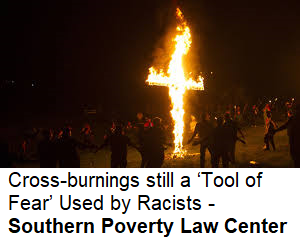
A Toxic Environment in a community is likened to a weak foundation for a house; think a workplace filled with harassment and discrimination or a neighborhood with blatant racism where minorities endure burning crosses … .

Consider here, the full catalog of the September series, plus this supplement:

  1. Toxic Environment: Ready for Football – Washington “Redskins”
  2. Toxic Environment: Homophobia – The problem is the Hate, not the Fear – Encore
  3. Toxic Environment: Opposite of Diversity & Inclusion
  4. Toxic Environment: Lessons from Yugoslavia
  5. Toxic Environment: Ease of Doing Business
  6. Toxic Environment: Make the Caribbean Great (Anew) – Encore
    ————–
  7. Toxic Environment ==> Toxic Masculinity

There is another dysfunctional angle of Toxicity that we did not consider last month, that of Toxic Masculinity. It is bad! Such that there are media advice to avoid even dating our Caribbean men – see Appendix B VIDEO below. See the full definition in Appendix A below, plus this summary excerpt here:

Toxic masculine traits are characteristic of the unspoken code of behavior among men in prisons, where they exist in part as a response to the harsh conditions of prison life.

Other traditionally masculine traits such as devotion to work, pride in excelling at sports, and providing for one’s family, are not considered to be “toxic”.

“Men in prison” – if only the toxicity ended there. Rather we find that in certain societies, the “man code” has penetrated all aspects of society, not just prisons; think “locker room talk”, “Blue Codes” for conduct among law enforcement officials or bonding among soldiers in foxholes or trench-warfare ; there is even a “code of silence” among gang members or organized crime figures.

Toxic Masculinity is just one more way that Toxic Environments have affected the “community quest” to live, work and play in the Caribbean. Needless to say, community stewards cannot allow Toxic Masculinity to dominate society; think bullying, domestic violence, sexual harassment in the workplace. It is unfortunate but true, “bad actors” will always seek to exploit any weakness for their own selfish gain. So we must be prepared to curb the toxicity and promote a positive community ethos instead. Community ethos? That is defined in the Go Lean book (Page 20) as:

  1. the fundamental character or spirit of a culture; the underlying sentiment that informs the beliefs, customs, or practices of a group or society; dominant assumptions of a people or period: In the Greek ethos the individual was highly valued.
  2. the character or disposition of a community, group, person, etc.

This focus, fostering change in the community ethos, has been a mission for this Go Lean movement from the beginning of this movement. This theme has been elaborated in many previous blog-commentaries; consider this sample here:

https://goleancaribbean.com/blog/?p=18337 Unequal Justice: Bullying Magnified to Disrupt Commerce
https://goleancaribbean.com/blog/?p=17652 A Lesson in History – 25 years after the “OJ Murders”
https://goleancaribbean.com/blog/?p=16408 Bad Ethos on Home Violence
https://goleancaribbean.com/blog/?p=14413 Helping Black Caribbean Men & Boys – Hurt People Hurt People
https://goleancaribbean.com/blog/?p=5238 #ManifestJustice – Lessons from the Prison Eco-System
https://goleancaribbean.com/blog/?p=2709 Bahamas Study: 58% Of Boys Agree to Female ‘Discipline’
https://goleancaribbean.com/blog/?p=2201 Students developing nail polish to detect date rape drugs

It is simple, if we want to grow our society, we must work hard to make it a better place to live, work and place for everyone, not just some people. We must accept that there are negatives in our society, Toxicity Masculinity is one of the things that we must Be On-guard against.

The seriousness of this subject was related in a previous Go Lean commentary from April 29, 2014 relating the societal defect of Domestic Violence:

Abused wives find help by going to ‘Dona Carmen’
An underlying mission of the CU [the Go Lean roadmap] is to dissuade further human flight and incentivize repatriation of the far-flung Diaspora. Many who had fled previously obtained refugee status due to the abuse and persecution from domestic perpetrators. These issues must be addressed and targeted for solutions and reconciliations.

In fact, the foregoing embedded article refers to the new enforcements introduced in Brazil in a 2006 law. That’s was just 8 years ago. (A similar Domestic Violence law was enacted in the Bahamas in 2008). A survey of other Latin American countries unveils even more new laws recently enacted in the Caribbean, Central and South America. Change has finally come.

Change has come to the Caribbean, but as the roadmap depicts, the problem of domestic violence (a human rights abuse) had persisted long before, and is thusly rooted in a [bad] community ethos. An ethos that must be uprooted and replaced with a new, progressive spirit, even within the public service entities, whose job it is to “serve & protect”. This is the new lean Caribbean!

The Go Lean book, serving as a roadmap for the introduction of the Caribbean Union Trade Federation (CU), asserts that Caribbean stakeholders must do the heavy-lifting to mitigate and remediate societal defects. There must be a technocratic security apparatus that works hand-in-hand with any economic optimization efforts and governing empowerments. We must have a good societal foundation; respect and protection of people and their rights for life, liberty and the pursuit of happiness. This was the purpose of last month’s Teaching Series, to focus on that foundation. There is a glaring need for reform, as we have a long track record of bad behavior like hate, bigotry, xenophobia and bullying in our Caribbean communities.

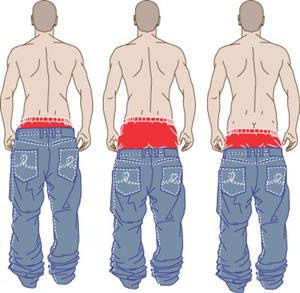
Have you ever notice the habit of men wearing their pants in a sagging manner, where their underwear is openly exposed? This is Toxic Masculinity run amok. This habit originated in prisons – see the relevant VIDEO in Appendix C below – while this has become common in the Black American community, it is not limited there, and it is more than just an American drama now.

Florida Town Drops Ordinance Against Sagging Pants, Saying It Targets Black Men
A controversial 13-year-old ban on sagging pants in a Florida town has been repealed because it disproportionately targeted African American men, city officials say. The Opa-locka, Fla., ordinance, originally passed in 2007, was voted down 4-1 by the City Commission, according to the Miami Herald. The legislation had stated men could not wear pants that exposed their underwear in city parks and buildings, with a citation as punishment for violation. A similar law was passed for women in 2013, but now both are expected to be overturned after a subsequent commission meeting.

The Caribbean is not the first nor the last Toxic Environment; there have been many in the past and even now in the present.

It is Toxic to allow prison culture to dominate our normal society. It is also Toxic to allow the “Strong to Abuse the Weak”; this is classic bullying.

How can we remediate and mitigate Toxic Masculinity? For one thing, we must start early. Then we must not settle for the bad orthodoxy of “boys will be boys”. It has been proven again and again that bad instincts can be corrected and weeded out of society. Yes, the solution is: reform and transform.

We must strive to do better in our homeland, otherwise our people will continue to flee in search of refuge. Toxic Masculinity exist in our society, we must work to dislodge it, message against it, coach it out of our young people and foster positive values and ethos in its place.

So we urge all stakeholders in the Caribbean – citizens and institutions – to lean-in to this Go Lean roadmap for the elevation of the Caribbean’s societal engines: economy, security and governance. We can do better and be better.  🙂

About the Book
The book Go Lean…Caribbean serves as a roadmap for the introduction and implementation of the technocratic Caribbean Union Trade Federation (CU), for the elevation of Caribbean society – for all member-states. This CU/Go Lean roadmap has these 3 prime directives:

  • Optimization of the economic engines to grow the regional economy to $800 Billion & create 2.2 million new jobs.
  • Establishment of a security apparatus to ensure public safety and protect the resultant economic engines.
  • Improve Caribbean governance to support these engines, including a separation-of-powers between the member-states and CU federal agencies.

The Go Lean book provides 370-pages of turn-by-turn instructions on “how” to adopt new community ethos, plus the strategies, tactics, implementations and advocacies to execute so as to reboot, reform and transform the societal engines of Caribbean society.

Download the free e-Book of Go Lean … Caribbean – now!

Who We Are
The movement behind the Go Lean book – a non-partisan, apolitical, religiously-neutral Community Development Foundation chartered for the purpose of empowering and re-booting economic engines – stresses that reforming and transforming the Caribbean societal engines must be a regional pursuit. This was an early motivation for the roadmap, as pronounced in the opening Declaration of Interdependence (Pages 11 – 13):

x. Whereas we are surrounded and allied to nations of larger proportions in land mass, populations, and treasuries, elements in their societies may have ill-intent in their pursuits, at the expense of the safety and security of our citizens. We must therefore appoint “new guards” to ensure our public safety and threats against our society, both domestic and foreign. The Federation must employ the latest advances and best practices of criminology and penology to assuage continuous threats against public safety. ….

xi. Whereas all men are entitled to the benefits of good governance in a free society, “new guards” must be enacted to dissuade the emergence of incompetence, corruption, nepotism and cronyism at the peril of the people’s best interest. The Federation must guarantee the executions of a social contract between government and the governed.

xvi. Whereas security of our homeland is inextricably linked to prosperity of the homeland, the economic and security interest of the region needs to be aligned under the same governance. Since economic crimes … can imperil the functioning of the wheels of commerce for all the citizenry, the accedence of this Federation must equip the security apparatus with the tools and techniques for predictive and proactive interdictions.

xxiv.  Whereas a free market economy can be induced and spurred for continuous progress, the Federation must install the controls to better manage aspects of the economy: jobs, inflation, savings rate, investments and other economic principles. Thereby attracting direct foreign investment because of the stability and vibrancy of our economy.

Sign the petition to lean-in for this roadmap for the Caribbean Union Trade Federation. 
————-

Appendix A – Reference: Toxic Masculinity

The concept of toxic masculinity is used in academic and media discussions of masculinity to refer to certain cultural norms that are associated with harm to society and to men themselves. Traditional stereotypes of men as socially dominant, along with related traits such as misogyny and homophobia, can be considered “toxic” due in part to their promotion of violence, including sexual assault and domestic violence. The socialization of boys in patriarchal societies often normalizes violence, such as in the saying “boys will be boys” with regard to bullying and aggression.

Self-reliance and emotional repression are correlated with increased psychological problems in men such as depression, increased stress, and substance abuse. Toxic masculine traits are characteristic of the unspoken code of behavior among men in prisons, where they exist in part as a response to the harsh conditions of prison life.

Other traditionally masculine traits such as devotion to work, pride in excelling at sports, and providing for one’s family, are not considered to be “toxic”. The concept was originally used by authors associated with the mythopoetic men’s movement such as Shepherd Bliss to contrast stereotypical notions of masculinity with a “real” or “deep” masculinity that they say men have lost touch with in modern society. Critics of the term argue that its meaning incorrectly implies gender-related issues are caused by inherent male traits.[1]

Etymology and usage
The term toxic masculinity originated in the mythopoetic men’s movement of the 1980s and 1990s.[2] It later found wide use in both academic and popular writing.[3] Popular and media discussions in the 2010s have used the term to refer to traditional and stereotypical norms of masculinity and manhood. According to the sociologist Michael Flood, these include “expectations that boys and men must be active, aggressive, tough, daring, and dominant”.[4]

Mythopoetic movement
Some authors associated with the mythopoetic men’s movement have referred to the social pressures placed upon men to be violent, competitive, independent, and unfeeling as a “toxic” form of masculinity, in contrast to a “real” or “deep” masculinity that they say men have lost touch with in modern society.[5][6] The academic Shepherd Bliss proposed a return to agrarianism as an alternative to the “potentially toxic masculinity” of the warrior ethic.[7] Sociologist Michael Kimmel writes that Bliss’s notion of toxic masculinity can be seen as part of the mythopoetic movement’s response to male feelings of powerlessness at a time when the feminist movement was challenging traditional male authority:

Thus Shepherd Bliss, for example, rails against what he calls ‘toxic masculinity’—which he believes is responsible for most of the evil in the world—and proclaims the unheralded goodness of the men who fight the fires and till the soil and nurture their families.[8]

Academic usage
In the social sciencestoxic masculinity refers to traditional cultural masculine norms that can be harmful to men, women, and society overall; this concept of toxic masculinity is not intended to demonize men or male attributes, but rather to emphasize the harmful effects of conformity to certain traditional masculine ideal behaviors such as dominance, self-reliance, and competition.[9][10] Toxic masculinity is thus defined by adherence to traditional male gender roles that consequently stigmatize and limit the emotions boys and men may comfortably express while elevating other emotions such as anger.[11] It is marked by economic, political, and social expectations that men seek and achieve dominance (the “alpha male“).

In a gender studies context, Raewyn Connell refers to toxic practices that may arise out of what she terms hegemonic masculinity, rather than essential traits.[3] Connell argues that such practices, such as physical violence, may serve to reinforce men’s dominance over women in Western societies. She stresses that such practices are a salient feature of hegemonic masculinity, although not always the defining features.[3][12]

Terry Kupers describes toxic masculinity as involving “the need to aggressively compete and dominate others”[13] and as “the constellation of socially regressive male traits that serve to foster domination, the devaluation of women, homophobia and wanton violence”.[14][15] According to Kupers, toxic masculinity includes aspects of “hegemonic masculinity” that are socially destructive, “such as misogyny, homophobia, greed, and violent domination”. He contrasts these traits with more positive traits such as “pride in [one’s] ability to win at sports, to maintain solidarity with a friend, to succeed at work, or to provide for [one’s] family”.[14] Feminist author John Stoltenberg has argued that all traditional notions of masculinity are toxic and reinforce the oppression of women.[16][17]

Gender norms
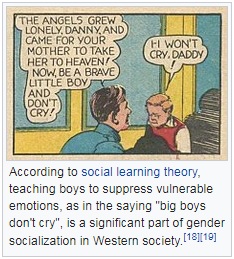
According to social learning theory, teaching boys to suppress vulnerable emotions, as in the saying “big boys don’t cry”, is a significant part of gender socialization in Western society.[18][19]

According to Kupers, toxic masculine norms are a feature of life for men in American prisons, where they are reflected in the behavior of both staff and inmates. The qualities of extreme self-reliance, domination of other men through violence, and avoiding the appearance of either femininity or weakness, comprise an unspoken code among prisoners.[20][21] Suppressing vulnerable emotions is often adopted in order to successfully cope with the harsh conditions of prison life, defined by punishment, social isolation, and aggression. These factors likely play a role in suicide among male prisoners.[20][22]

Toxic masculinity can also take the form of bullying of boys by their peers and domestic violence directed toward boys at home.[23] The often violent socialization of boys produces psychological trauma through the promotion of aggression and lack of interpersonal connection. Such trauma is often disregarded, such as in the saying “boys will be boys” with regard to bullying.[24] The promotion of idealized masculine roles emphasizing toughness, dominance, self-reliance, and the restriction of emotion can begin as early as infancy. Such norms are transmitted by parents, other male relatives, and members of the community.[18][25] Media representations of masculinity on websites such as YouTube often promote similar stereotypical gender roles.[25]

Some traditionally prescribed masculine behaviors can produce such harmful effects as violence (including sexual assault and domestic violence), promiscuity, risky and/or socially irresponsible behaviors including substance abuse, and dysfunction in relationships.[18][26]

Health effects
The American Psychological Association has warned that “traditional masculinity ideology” is associated with negative effects on mental and physical health.[27][28] Men who adhere to traditionally masculine cultural norms, such as risk-taking, violence, dominance, primacy of work, need for emotional control, desire to win, and pursuit of social status, tend to be more likely to experience psychological problems such as depressionstressbody image problems, substance abuse and poor social functioning.[29] The effect tends to be stronger in men who also emphasize “toxic” masculine norms, such as self-reliance, seeking power over women, and sexual promiscuity or “playboy”[clarification needed] behavior.[10][30]

The social value of self-reliance has diminished over time as modern American society has moved more toward interdependence.[25] Both self-reliance and the stifling of emotional expression can work against mental health, as they make it less likely for men to seek psychological help or to possess the ability to deal with difficult emotions.[25] Preliminary research suggests that cultural pressure for men to be stoic and self-reliant may also shorten men’s lifespans by causing them to be less likely to discuss health problems with their physicians.[31][32]

Toxic masculinity is also implicated in socially-created public health problems, such as elevated rates of alcoholism and certain types of cancer among men, [33] or the role of “trophy-hunting” sexual behavior in rates of transmission of HIV and other sexually transmitted infections.[34][non-primary source needed]

Psychiatrist Frank Pittman wrote about the ways in which men are harmed by traditional masculine norms, suggesting this includes shorter lifespans, greater incidence of violent death, and ailments such as lung cancer and cirrhosis of the liver.[17]

Source: Retrieved October 2, 2020 from: https://en.wikipedia.org/wiki/Toxic_masculinity

————-

Appendix B VIDEO – 5 Reasons Why You shouldn’t Date a Caribbean Man – https://youtu.be/cWrorwRSGh4

OJ Merge
Posted Sep 12, 2020 –  Hey guys – hope you are well, we’ve missed you! In this video, we will be talking the common reasons why “not to date a Caribbean” man. Check out this latest upload, and if you like this video make sure you hit that like button. Talk to us in the comments sections and if you’re new hit that SUBSCRIBE button and turn on your notifications to be notified each time we upload new content!

#datingJamaican #jamaicanmen #caribbeanmen

To learn more:
Visit our website: www.ojmerge.com
Stream our music on SoundCloud: https://soundcloud.com/ojmerge
Link to intro/outro song: https://www.youtube.com/watch?v=x7pOe
Follow us on Linked In: www.linkedin.com/in/ojmerge
Follow us on Twitter: https://twitter.com/OjMerge
Follow us on Instagram: @ojmerge
Email us at ojmerge@gmail.com
Background music:
El Guiso by Dubaquinho | https://soundcloud.com/dubaquinho
Music promoted by https://www.free-stock-music.com
Creative Commons Attribution 3.0 Unported License https://creativecommons.org/licenses/…

————-

Appendix C VIDEO – More than 90 percent of sagging pants arrests are African American men – https://youtu.be/oKYkUahHwtI

Posted Jun 3, 2019 – Local newscast from Shreveport, Louisiana about a biased municipal ordinance banning ‘Sagging Pants”.

Share this post:
, , , ,
[Top]

Toxic Environment – Homophobia: Hate not Fear – Encore

What is a phobia?

Well, a summary of the definition is a “persistent and excessive fear”. The encyclopedic definition is as follows:

A phobia is a type of anxiety disorder defined by a persistent and excessive fear of an object or situation.[1] Phobias typically result in a rapid onset of fear and are present for more than six months.[1] Those affected will go to great lengths to avoid the situation or object, to a degree greater than the actual danger posed.[1] If the object or situation cannot be avoided, they experience significant distress.[1] Other symptoms can include fainting, which may occur in blood or injury phobia,[1] and panic attacks, which are often found in agoraphobia.[6] Around 75% of those with phobias have multiple phobias.[1] – Source: Wikipedia

There are other fears that are mistakenly called phobias that are really something else. (This is the focus on this commentary). See the continuation of the above definition:

Several terms with the suffix -phobia are used non-clinically (usually for political or deterrent purpose) to imply irrational fear or hatred. Examples include:

  • Chemophobia – Negative attitudes and mistrust towards chemistry and synthetic chemicals.
  • Homophobia – Negative attitudes and feelings toward homosexuality or people who are identified or perceived as being lesbian, gay, bisexual or transgender (LGBT).
  • Xenophobia – Fear or dislike of strangers or the unknown, sometimes used to describe nationalistic political beliefs and movements.
  • Islamophobia – Fear of anything Islamic

Usually these kinds of “phobias” are described as fear, dislike, disapproval, prejudice, hatred, discrimination or hostility towards the object of the “phobia”.[53]

Don’t get it twisted, these are not fears; these constitute hatred. Prejudice, hatred and discrimination exercised in a persistent and excessive manner is truly toxic. Imagine being on the receiving end of such treatment, such irrational fear or hatred.

How much can you tolerate? How much should you tolerate? This is like having a burning cross on your front lawn. How long before you want to leave?

This is a continuation on the Teaching Series from the movement behind the 2013 book Go Lean…Caribbean, related to Toxic Environments. The pseudo-phobias – irrational fear or hatred – all contribute to unbearable circumstances at home; thusly they contribute to the Exodus of so many Caribbean people; this exacerbates the Brain Drain and societal abandonment in the region. We’ve got it bad!

Every month, the movement behind the Go Lean book presents a Teaching Series to address issues germane to Caribbean life and culture. For this month of September 2020, we are looking at the actuality of persecuted minorities in this homeland. Unfortunately, Toxic Environments have long reaching consequences on the community quest to live, work and play. This is entry 2-of-6; it presents the thesis that the “strong in society should not be allowed to abuse the weak” just to allay some pseudo-fears. This is an important consideration, as it depicts the heavy-lifting that the Caribbean stakeholders must do.

Consider here, the full catalog of the series this month:

  1. Toxic Environment: Ready for Football – Washington “Redskins”
  2. Toxic Environment: Homophobia – The problem is the Hate, not the Fear
  3. Toxic Environment: Opposite of Diversity & Inclusion
  4. Toxic Environment: Lessons from Yugoslavia
  5. Toxic Environment: Ease of Doing Business
  6. Toxic Environment: Make the Caribbean Great (Anew)

The Go Lean book, serving as a roadmap for the introduction of the Caribbean Union Trade Federation (CU), asserts that Caribbean stakeholders must do the heavy-lifting to mitigate and remediate societal defects. While the purpose of the roadmap is to optimize the economic, security and governing engines of society, the roadmap recognizes that we must retain people in the homeland. No people = no society = no culture. Therefore, we must have a good societal foundation; respect and protection of all people and their rights for life, liberty and the pursuit of happiness. The purpose of this month’s Teaching Series is to focus on that foundation. There is a glaring need for reform, as we have a long track record of bad behavior like hate, bigotry, xenophobia and intolerance in our Caribbean communities.

As related in the previous submission in this month’s series, the Caribbean has fostered a Toxic Environment in our culture; it has been so bad that these identified bad behaviors have flourished. This is not good, as a Toxic Environment pits villains against victims and in the long run, the victims – and all those that love them – will seek refuge elsewhere. This is true with all Toxic Environments – think Asylum-seekers. Asylum-seeking is the manifesting of the Push dynamics for Caribbean abandonment:

  • “Push” refers to people who feel compelled to leave, to seek refuge in a foreign land. “Refuge” is an appropriate word; because of societal defects, many from the Caribbean must leave as refugees – think LGBTDisabilityDomestic-abuseMedically-challenged – for their life, liberty and pursuit of happiness.
  • “Pull”, on the other hand refers to the lure of a more liberal life abroad; many times our people are emigrating for societies that have better expressions of the rights for “life, liberty and the pursuit of happiness”.

The Caribbean is not the first nor the last Toxic Environment; there have been many in the past and even now in the present. Think Nazi Germany, who persecuted (i.e. Concentration Camps) many minority groups (Jews, Gypsies, homosexuals, etc.). Today, we have more bad role models of hate, bigotry, xenophobia and intolerance – like in the Muslim Word, (think ISIS), where persecuted minorities are frequently targeted. (There have been instances of public killing of convicted homosexuals).

We must look, listen and learn from these past and present Toxic Environments, then work towards making our society better – more tolerant. We cannot afford to keep losing our people; that will degrade our culture further. Using an analogy from medical trauma, our society is bleeding populations – we must stop the bleeding – otherwise the patient – our unique culture – will die.

How bad is our society? While not ISIS, we are recognized as one of the worst in our attitudes and toleration of homosexual practices.

Say it ain’t so …

This was our initial reaction in researching and writing about the Buggery Laws in the Anglo-Caribbean. Those laws seemed so barbaric for our modern times. And yet, they persists. A previous Go Lean commentary from July 2, 2015 identified this example of our severe Caribbean Toxicity. Consider this summary:

While this commentary directly targets Jamaica, the majority of the countries and overseas territories of the former British Empire, still criminalize sexual acts between consenting adults of the same sex and other forms of sexual orientation, gender identity and expression. This has been described as being the result of “the major historical influence” or legacy of the British Empire. In most cases, it was former colonial administrators that established anti-gay legislation or sodomy acts during the 19th century. … The majority of countries then retained these laws following independence.

Since that 2015 date, we have published a few additional commentaries that advocated for more tolerance for citizens – and visitors – with alternative life styles. Consider this list of previous blog-commentaries:

https://goleancaribbean.com/blog/?p=20292 Conscientizing on VIDEO: Advocating for Empathy
https://goleancaribbean.com/blog/?p=19217 Brain Drain – ‘Live and Let Live’: Introducing Localism
https://goleancaribbean.com/blog/?p=17820 Caribbean ‘Pride’ – “Can we all just get along”
https://goleancaribbean.com/blog/?p=14830 Counter-culture: Embracing the Change
https://goleancaribbean.com/blog/?p=11224 ‘Loose Lips Sink Ships’ – Leaders Undermine Tourism
https://goleancaribbean.com/blog/?p=10216 Waging a Successful War on Orthodoxy
https://goleancaribbean.com/blog/?p=8200 Respect for Minorities: Climate of Hate
https://goleancaribbean.com/blog/?p=8186 Respect for Minorities: ‘All For One’
https://goleancaribbean.com/blog/?p=341 Homosexual Intolerance listed among blatant human rights abuses

It is simple, if we want to grow our society, we must work hard to make it a better place to live, work and place for everyone, not just some people. Remember the old nursery rhyme: “rich man, poor man, beggar man, thief; doctor, lawyer, Indian Chief”.

It is Toxic to allow the “Strong to Abuse the Weak” – including LGBT – in our society.

Now is a good time to address those bad Buggery Laws that still prevail in the Anglo-Caribbean. It is apropos to Encore the full blog-commentary from July 2015; see that here now:

——————-

Go Lean Commentary Buggery in Jamaica – ‘Say It Ain’t So’!

This commentary has asserted that the Caribbean region can be a better society than the United States of America. Yes, we can!

But to even start the discussion, we must first:

Live and let live!

t So - Photo 3The topic of intolerance has been acute in the news as of late. We have the extreme example of the Islamic State in Iraq and Syria (ISIS) beheading non-Muslims because… well, just because. And the example of the US legalizing Gay Marriage may be considered too tolerant for some people’s good taste.

Where does the Caribbean fit in this discussion?

If ISIS is one end of a scale and Gay Marriage in America is another end, then one Caribbean member-state, Jamaica, would be closer to …

ISIS!

Yes, it is that bad. Say it ain’t so.

See Appendix-VIDEO’s below …

While this commentary directly targets Jamaica, the majority of the countries and overseas territories of the former British Empire, still criminalize sexual acts between consenting adults of the same sex and other forms of sexual orientation, gender identity and expression. This has been described as being the result of “the major historical influence” or legacy of the British Empire. In most cases, it was former colonial administrators that established anti-gay legislation or sodomy acts during the 19th century; see Appendix below. The majority of countries then retained these laws following independence.[1][2].

There is an effort now to transform society in Jamaica (and other countries) in this regards. There are Gay Pride Activities being planned for this Summer of 2015. See the relevant news article here:

Title: J-FLAG Is Planning Gay Pride Activities, But No Parade For August – Exec
Source: Jamaica Gleaner Daily Newspaper Online Site; posted June 30, 2015; retrieved from: http://jamaica-gleaner.com/article/news/20150630/j-flag-planning-gay-pride-activities-no-parade-august-exec  

Local gay lobby, J-FLAG, is refuting reports that it will host a road parade in August when the group plans to have a series of gay pride activities.

Social media has been abuzz since yesterday following a report that the group would host a parade, similar to what is done in the United   States and other countries.

However, executive director of J-FLAG, Dane Lewis, says the report is wrong, adding that Jamaica is not ready for such an event.

Meanwhile, he says the group is planning a week-long series of activities starting on Emancipation Day, August 1, to mark growing tolerance for members of the lesbian, gay, bisexual, and transgender (LGBT) community.

Some years ago, an attempt to host a gay parade was thwarted after anti-gay supporters reportedly planned attacks against marchers.

Jamaica is accused of being one of the most homophobic places on earth.

Last week, the US government released a report noting that anti-gay laws and the dancehall culture are responsible for perpetuating homophobia in Jamaica.
Additional reference sources: http://jflag.org/

t So - Photo 1
———–

VIDEO: Executive Director of JFLAG, Dane Lewis: “We Are Jamaicans” – https://youtu.be/sJ-17R5DCoI


Published on Jan 17, 2013 – “We Are Jamaicans” is funded with the kind support of the Caribbean Vulnerable Communities Coalition (CVC) through its Global Fund Vulnerablised Project.

Building a diverse society is not easy. The book Go Lean … Caribbean describes the challenge as heavy-lifting. Though the US had failed at this challenge, it proudly boasts that it got better with every generation. The Caribbean on the other hand, leaves much to be desired in terms of the willingness to change and keep pace with progressive societies. (Now the US, Canada, Ireland and other countries have legalized Gay Marriage).

In a previous blog-commentaries, this defect – Homosexual Intolerance – was listed among the blatant human rights abuses in the region.

This is an important consideration for the planners of Caribbean empowerment. The Caribbean, a region where unfortunately, we have NOT … tried to be as tolerant as may be required, expected and just plain moral.

We must do better!

The book Go Lean … Caribbean asserts that Caribbean society’s prosperity has been hindered with a high abandonment rate – reported at 70% for educated classes region-wide, but an even higher 85% in Jamaica. The primary mission of the Go Lean book is to “battle” against the “push-and-pull” factors that draw so many of our Caribbean citizens away from their homelands to go to more progressive countries.

The Go Lean book campaigns to lower the “push” factors!

The purpose of the Go Lean book is to fix the Caribbean; to be better. The Go Lean book serves as a roadmap for the introduction and implementation of the technocratic Caribbean Union Trade Federation (CU) to pursue the quest to elevate the Caribbean region through empowerments in economics, security and governance. It is the assertion that Caribbean citizens can stay home and effect change in their homelands more effectively than going to some foreign countries to find opportunities for life, liberty and the pursuit of happiness. The book therefore asserts that the region can turn-around from failing assessments by applying best-practices, and forging new societal institutions to impact the Greater Good for all the Caribbean. This point was pronounced in the opening Declaration of Interdependence (Pages 10 – 14) with these acknowledgements and statements:

xi.   Whereas all men are entitled to the benefits of good governance in a free society, “new guards” must be enacted to dissuade the emergence of incompetence, corruption, nepotism and cronyism at the peril of the people’s best interest. The Federation must guarantee the executions of a social contract between government and the governed.

xii. Whereas the legacy in recent times in individual states may be that of ineffectual governance with no redress to higher authority, the accedence of this Federation will ensure accountability and escalation of the human and civil rights of the people for good governance, justice assurances, due process and the rule of law. As such, any threats of a “failed state” status for any member state must enact emergency measures on behalf of the Federation to protect the human, civil and property rights of the citizens, residents, allies, trading partners, and visitors of the affected member state and the Federation as a whole.

xxxiii. Whereas lessons can be learned and applied from the study of the recent history of other societies, the Federation must formalize statutes and organizational dimensions to avoid the pitfalls of communities like … Egypt. On the other hand, the Federation must also implement the good examples learned from developments/ communities like New York City, … Canada, … and tenants of the US Constitution.

The CU/Go Lean vision to elevate Caribbean society must also consider the issue of image. There is the need for a sentinel role for Caribbean image, as there are a lot of times that Caribbean life and people are denigrated in the media: news, film, TV, books, magazines. It’s unfortunate when we are guilty of scathing allegations. The Go Lean roadmap calls for the CU to assume a role of protecting and projecting positive Caribbean images. The plan is to use cutting edge delivery of best practices; the applicable CU agencies will employ strategies, tactics and implementations to impact the Go Lean prime directives; identified with the following 3 statements:

  • Optimization of the economic engines in order to grow the regional economy to $800 Billion & create 2.2 million new jobs.
  • Establishment of a security apparatus to protect the resultant economic engines and mitigate challenges/threats to public safety for all citizens… LGBT or straight.
  • Improvement of Caribbean governance to support these engines.

Jamaica has a failing economy.

Jamaica’s primary economic driver is tourism. So …

t So - Photo 2

Is the Caribbean ready for this economic activity? A bridge too far, too soon?

t So - Photo 4Jamaica has a long way to go; the country has been described by some Human Rights groups as the most homophobic place on Earth because of the high level of violent crime directed at LGBT people; (Padgett, Tim: “The Most Homophobic Place on Earth?”Time Magazine posted 12 April 2006). The United States Department of State said that in 2012, “homophobia was [unacceptably] widespread in the country” (2012 Country Reports on Human Rights Practices: Jamaica, Bureau of Democracy, Human Rights and Labor, U.S. Department of State, pages 20-22). As depicted in the VIDEO below, even President Obama indicted the island on a recent official State Visit.

Why is this country’s homophobia so acute compared to other countries? For one, they have held on emphatically to the British Laws on Buggery – see Appendix below – from their colonial days; even though the host country of England has already abandoned the laws (in 1967).

Jamaica is partying like it’s 1899!

This is therefore a matter of community ethos. The Go Lean book defines community ethos as the fundamental character or spirit of a culture; the underlying sentiment that informs the beliefs, customs, or practices of a group or society; the dominant assumptions of a people or period. This tropical paradise of Jamaica, as defined in the foregoing news article and VIDEO continues to spur bad attitudes, bad ideas, bad speech and bad actions towards the LGBT community. This is unbecoming of a progressive society in 2015.

Alas, this is a crisis…for victims and their loved ones. The Go Lean book posits that this crisis can be averted, that the crisis is a “terrible thing to waste”. The Go Lean roadmap seeks to optimize the eco-systems for Jamaica and the entire Caribbean. The book stresses new community ethos, strategies, tactics, implementations and advocacies necessary to transform and turn-around the eco-systems of the regional society. These points are detailed in the book as follows:

Who We Are – SFE Foundation – Comprised of Caribbean Diaspora Page 8
Community Ethos – Economic Principles – Economic Systems Influence Individual Choices Page 21
Community Ethos – Economic Principles – Consequences of Choices Lie in the Future Page 21
Community Ethos – Governing Principles – Lean Operations Page 24
Community Ethos – Ways to Impact the Future Page 26
Community Ethos – Ways to Promote Happiness Page 36
Community Ethos – Ways to Impact the Greater Good Page 37
Strategy – Vision – Confederate all 30 member-states into a Single Market Page 45
Strategy – Mission – Build and foster local economic engines Page 45
Strategy – Mission – Repatriate the Diaspora, even Minorities like those of the LGBT community Page 46
Tactical – Ways to Foster a Technocracy Page 64
Tactical – Growing the Economy to $800 Billion GDP Page 68
Tactical – Separation-of-Powers – CU Federal Government versus Member-State Governance Page 71
Anatomy of Advocacies – Examples of Individuals Who Made Impact Page 122
Planning – 10 Big Ideas – Homeland Security Pact Page 127
Planning – Ways to Make the Caribbean Better Page 131
Planning – Ways to Improve Failed-State Indices – Minority and Human Rights Page 134
Planning – Lessons Learned from US Constitution – Equal Protection for all Minorities Page 145
Advocacy – Ways to Grow the Economy Page 151
Advocacy – Ways to Create Jobs Page 152
Advocacy – Ways to Improve Governance – For All Citizens Page 168
Advocacy – Ways to Better Manage the Social Contract – Security against “Bad Actors” Page 170
Advocacy – Ways to Impact Justice – Internal Affairs Reporting Line Page 177
Advocacy – Ways to Remediate and Mitigate Crime – Hate Crime Qualifiers Page 178
Advocacy – Ways to Improve Homeland Security Page 180
Advocacy – Ways to Mitigate Terrorism – Consider Bullying as Junior Terrorism Page 181
Advocacy – Ways to Impact Youth – Collaborating with Foundations Page 218
Advocacy – Ways to Re-boot Jamaica Page 239
Advocacy – Ways to Impact British Territories Page 245

Looking at the disposition of the island nation of Jamaica’s, we see that its societal engines are failing.

Could the investment in the diversity of its people be at the root of the problem?

The failing indices and metrics of Jamaica have been considered in previous blog/commentaries; see sample here:

https://goleancaribbean.com/blog/?p=4840 Jamaican Poll: ‘Bring back the British!’
https://goleancaribbean.com/blog/?p=3694 Looking for a job in Jamaica, go to Canada
https://goleancaribbean.com/blog/?p=2830 Jamaica’s Public Pension Under-funded
https://goleancaribbean.com/blog/?p=392 Jamaica to receive World Bank funds to help in crime fight
https://goleancaribbean.com/blog/?p=313 What’s Holding Back Jamaica’s Reforms

The Go Lean roadmap seeks to empower and elevate Caribbean societal engines to make Jamaica, and the rest of the Caribbean, better places to live, work and play … for all citizens, including the LGBT communities.

Most of the Jamaican Diaspora that has abandoned the island now lives in the US, Canada or the UK. Their new home-communities are more tolerant societies of their LGBT neighbors.

Perhaps, there is some correlation.

This commentary is not urging the abandonment of the Judeo-Christian moral code; Jesus Christ instructed to “let them be” at Luke 22:51 (The Message Translation). Rather this commentary urges tolerance and moderation: Live and let live!

Fight the hate!

Yes, we can … do this. Yes, we must do this. 🙂

Download the book Go Lean … Caribbean – now!
———–

Appendix VIDEO: US President Obama’s LGBT comments at Youth Leaders Town Hall – https://youtu.be/636mgw1THpc?t=5m1s


Published on Apr 9, 2015 – President Obama delivers remarks and answers questions at a town hall with Young Leaders of the Americas at University of the West Indies in Kingston, Jamaica. April 9, 2015.
———–

Appendix VIDEO: Gay rights in Jamaica – https://youtu.be/_nSgMGoBAmU

playbutton-300x300

———–

Appendix – Encyclopedic Reference: Buggery in English Common Law

The British English term buggery is very close in meaning to the term sodomy, often used interchangeably in law and popular speech. It may also be a specific common law offenceencompassing both sodomy and bestiality.

In English law “buggery” was first used in the Buggery Act 1533, while Section 61 of the Offences against the Person Act 1861, entitled “Sodomy and Bestiality”, defined punishments for “the abominable Crime of Buggery, committed either with Mankind or with any Animal”. The definition of “buggery” was not specified in these or any statute, but rather established by judicial precedent.[1] Over the years the courts have defined buggery as including either [of these]:

  1. anal intercourse or oral intercourse by a man with a man or woman[2] or
  2. vaginal intercourse by either a man or a woman with an animal,[3]

But [no other] form of “unnatural intercourse”[4] [was defined], the implication being that anal sex with an animal would not constitute buggery. Such a case has not, to date, come before the courts of a common law jurisdiction in any reported decision. However, it seems highly improbable that a person would be exculpated of a crime associated with sex with animals only by reason of the fact that penetration involved the anus rather than the vagina. In the 1817 case of Rex v. Jacobs, the Crown Court ruled that oral intercourse, even with an underage and/or non-consenting person, did not constitute buggery or sodomy.[4]

At common law consent was not a defence[5] nor was the fact that the parties were married.[6] In the UK, the punishment for buggery was reduced from hanging to life imprisonment by the Offences against the Person Act 1861. As with the crime of rape, buggery required that penetration must have occurred, but ejaculation is not necessary.[7]

Most common law jurisdictions have now modified the law to permit anal sex between consenting adults.[8] Hong Kong did so retroactively in 1990, barring prosecution for “crimes against nature” committed before the Crimes (Amendment) Ordinance 1990 entered into force except those that would still have constituted a crime if they had been done thereafter. In England and Wales, homosexual buggery was decriminalised in 1967 with an age of consent at 21 years, whereas all heterosexual intercourse had an age of consent at 16 years. The Sexual Offences Act 2003 did not fully remove buggery as a concept in United Kingdom law, as the previous law is retained for complainants (consensual or “pseudo-consensual”) under the age of 16, or 18 with regards to an adult perceived to be in a “position of trust”. As the law stands, buggery is still charged, exclusively regarding “pseudo-consensual” anal intercourse with those under 16/18, because children cannot legally consent to buggery although they may appear to do so. Rape is charged when the penetration is clearly not consensual. Buggery with an animal is still unlawful under Section 69 of the Sexual Offences Act 2003.

In the Republic of Ireland, the Criminal Law (Sexual Offences) Act 1993 abolished the offence of “buggery between persons”.[9] For some years prior to 1993, criminal prosecution had not been made for buggery between consenting adults. The 1993 Act created an offence of “buggery with a person under the age of 17 years”,[10] penalised similar to statutory rape, which also had 17 years as the age of consent. The Criminal Law (Sexual Offences) Act 2006 replaced this offence with “defilement of a child”, encompassing both “sexual intercourse” and “buggery”.[11] Buggery with an animal is still unlawful under Section 69 of the Sexual Offences Act 2003. In 2012 a man was convicted of this offence for supplying a dog in 2008 to a woman who had intercourse with it and died.[12]

Etymology – The word bugger and buggery are still commonly used in modern English as a mild exclamation. “Buggery” is also synonymous with anal sex.

The word “bugger” was derived, via the French bougre, from Bulgar, that is, “Bulgarian”, meaning the medieval Bulgarian heretical sect of the Bogomils, which spread into Western Europe and was claimed by the established church to be devoted to the practice of sodomy.[13] “Buggery” first appears in English in 1330, though “bugger” in a sexual sense is not recorded until 1555.[14]

(Source: https://en.wikipedia.org/wiki/Buggery)

Share this post:
, , , , , ,
[Top]

This Day 100 Years Ago – Women’s Right To Vote

Go Lean Commentary

Why does it take so long …

    … for people to reform and transform Civil Rights?

Why?

Basic Fact in life: Nobody gives up power unless they are forced to!

Power concedes nothing without a demand. It never did and it never will.” – Frederick Douglass

On this day exactly 100 Years Ago, American Women were finally able to obtain the power they were demanding; with the ratification of the Nineteenth Amendment to the US Constitution; they finally succeeded …

The Nineteenth Amendment (Amendment XIX) to the United States Constitution prohibits the states and the federal government from denying the right to vote to citizens of the United States on the basis of sex. Initially introduced to Congress in 1878, several attempts to pass a women’s suffrage amendment failed until passing the House of Representatives on May 21, 1919, followed by the Senate on June 4, 1919. It was then submitted to the states for ratification. On August 18, 1920, Tennessee was the last of the necessary 36 ratifying states to secure adoption. The Nineteenth Amendment’s adoption was certified on August 26, 1920: the culmination of a decades-long movement for women’s suffrage at both state and national levels. – Source: Wikipedia.

So after the journey for women’s voting rights started in 1848, their destination was finally reached 70 years later. In a previous blog-commentary from the movement behind the 2013 book Go Lean…Caribbean, the historicity of Women in Politics was detailed and we see exactly how long gender empowerment took to manifest here in the Caribbean region:

Click to Enlarge

While the US granted women citizens their Right to Vote in 1920, the rest of the region took up to 41 years later for these same basic rights to be accorded. It is evident that despite the fact that women in one jurisdiction won the right to vote, that same right was denied right “next door”. This is sad! We have always needed all women’s participation in the democratic process; we have needed their vote and their voice; and even their leadership. This was further explained in that previous blog from November 14, 2015:

The Caribbean member-states, despite their differences, (4 languages, 5 colonial legacies, terrain: mountains -vs- limestone islands), have a lot in common. Some similarities include:

  • Lack of equality for women compared to men.
  • The government is the largest employer.

So the reality of Caribbean life is that while the governmental administrations are not fully representative of the populations, they are responsible for all societal engines: economy, security and governance.

This is bad and this is good! Bad, because all the “eggs are in the same basket”. Good, because there is only one entity to reform, reboot and re-focus.

So how do we seriously consider reforming government in the Caribbean?

  • Start anew.
  • Start with politics and policy-makers.
  • Start with the people who submit for politics, to be policy-makers.
  • Start with people who participate in the process.

Considering the status-quo of the region – in crisis – there is this need to start again. But this time we need more women.

There is so much for us to learn from the historicity of August 18, 1920. Though women fought and bled to gain these rights, they still needed the approval of men to secure these rights for them. See how this was dramatized in this AUDIO-Podcast here:

AUDIO-PODCast – Suffrage isn’t Simple – https://play.acast.com/s/historythisweek/suffrageisntsimple

History.com Today: August 18, 1920 – In the third row of the legislative chamber in Nashville, Tennessee, 24 year-old Harry Burn sits with a red rose pinned to his lapel. He’s there to vote on the 19th Amendment, which will determine if women nationwide will be able to vote. Burn’s shocking, unexpected vote, “yes,” will turn the tides of history, even though women had already been voting for decades before 1920, and many women still won’t be able to vote for decades to come. So, what did the 19th Amendment actually do for women in America? And what, on this 100th anniversary, does it show us about our own right to vote today?

What a fine story – what a takeaway! But wow; that woman needed her young (24-year-old) son to validate her citizenship value and vote to allow her to have the same rights that was automatically assured for him. Too sad! This is not right!

Martin Luther King is quoted to have said that the “arc of history is long and it bends towards justice”. Therefore, it is imminent that all oppressed people will eventually rise up and demand their rights to equality. This lesson was related in a previous Go Lean commentary:

So “change is gonna come“; it would be wiser for opponents to just concede that fact. This is a lesson for the Caribbean to learn from military strategies: if combatants know that the end result of a fight would be imminent defeat, they should not fight; rather they should just concede and negotiate favorable terms of surrender.

Let’s consider gender equality … there have actually been real ‘Battles of the Sexes’, where the end results have benefited women – to the victor goes the spoils.

… we need those empowerments in the Caribbean too; we need our local opposition to concede – without a battle – that they cannot win in abusing others.

The subject of fostering gender equality is not new to this Go Lean movement. See this sample list of previous blog-commentaries that have elaborated on this subject of women, their vote and their voice:

https://goleancaribbean.com/blog/?p=18503 Learn about the ‘Most Powerful Woman in the World’
https://goleancaribbean.com/blog/?p=16944 Women Empowerment – Accepting Black Women ‘As Is’
https://goleancaribbean.com/blog/?p=16942 Women Empowerment – Power of ‘Her’ Wallet
https://goleancaribbean.com/blog/?p=16940 Women Empowerment – We need “Sheroes” in Facts and Fiction
https://goleancaribbean.com/blog/?p=13063 Gender Equity without a ‘Battle of the Sexes’
https://goleancaribbean.com/blog/?p=12035 Life imitating Art – Lean-in for ‘Wonder Woman Day’
https://goleancaribbean.com/blog/?p=8306 Women Get Ready for New Lean-In Campaign
https://goleancaribbean.com/blog/?p=8155 Bahamas Referendum Outcome: Impact on the ‘Brain Drain’
https://goleancaribbean.com/blog/?p=6937 Women in Politics – Yes, They Can!
https://goleancaribbean.com/blog/?p=6836 Role Model – #FatGirlsCan – Empowering Women
https://goleancaribbean.com/blog/?p=6434 ‘Good Hair’ and the Strong Black Woman

The Go Lean movement have always advocated for the full participation of girls and women in Caribbean society. We look forward to that participation in our economic, security and governing engines. Yes, women in business; yes, women in the military and police forces; and yes, women in government.

Yes, we can …

100 years and still only mild progress. We must do better – transformations do not readily manifest for us; our orthodoxy is stubborn:

i.e. The Bahamas did not grant the same right to vote until 1961.

We must reboot from this bad orthodoxy.

The world is not going backwards, forward only. We know where we need to be and what we need to do. So let’s just do it! This is how “Advanced Democracies” or “Matured Societies” work – always reforming; always transforming; trying and striving to be better and do better.

Doing better?! We know exactly how! This is the purpose of the Go Lean book and roadmap; it provides guidance and action plans on “how” to adopt new community ethos, plus the strategies, tactics, implementations and advocacies to execute so as to help women to impact our homeland. This is the why, the what and the how for making the Caribbean region a better place to live, work and play.

We urge everyone to lean-in to this roadmap. 🙂

————-

About the Book
The book Go Lean…Caribbean serves as a roadmap for the introduction and implementation of the technocratic Caribbean Union Trade Federation (CU), for the elevation of Caribbean society – for all member-states. This CU/Go Lean roadmap has these 3 prime directives:

  • Optimization of the economic engines in order to grow the regional economy to $800 Billion and create 2.2 million new jobs.
  • Establishment of a security apparatus to ensure public safety and protect the resultant economic engines.
  • Improve Caribbean governance to support these engines, including a separation-of-powers between the member-states and CU federal agencies.

The Go Lean book provides 370-pages of turn-by-turn instructions on “how” to adopt new community ethos, plus the strategies, tactics, implementations and advocacies to execute so as to reboot, reform and transform the societal engines of Caribbean society.

Download the free e-Book of Go Lean … Caribbean – now!

Who We Are
The movement behind the Go Lean book – a non-partisan, apolitical, religiously-neutral Community Development Foundation chartered for the purpose of empowering and re-booting economic engines – stresses that reforming and transforming the Caribbean societal engines must be a regional pursuit. This was an early motivation for the roadmap, as pronounced in the opening Declaration of Interdependence (Pages 12 – 13):

xi. Whereas all men are entitled to the benefits of good governance in a free society, “new guards” must be enacted to dissuade the emergence of incompetence, corruption, nepotism and cronyism at the peril of the people’s best interest. The Federation must guarantee the executions of a social contract between government and the governed.

xii. Whereas the legacy in recent times in individual states may be that of ineffectual governance with no redress to higher authority, the accedence of this Federation will ensure accountability and escalation of the human and civil rights of the people for good governance, justice assurances, due process and the rule of law. As such, any threats of a “failed state” status for any member state must enact emergency measures on behalf of the Federation to protect the human, civil and property rights of the citizens, residents, allies, trading partners, and visitors of the affected member state and the Federation as a whole.

xiv.  Whereas a free market economy can be induced and spurred for continuous progress, the Federation must install the controls to better manage aspects of the economy: jobs, inflation, savings rate, investments and other economic principles. Thereby attracting direct foreign investment because of the stability and vibrancy of our economy.

xxi.  Whereas the preparation of our labor force can foster opportunities and dictate economic progress for current and future generations, the Federation must ensure that educational and job training opportunities are fully optimized for all residents of all member-states, with no partiality towards any gender or ethnic group. The Federation must recognize and facilitate excellence in many different fields of endeavor, including sciences, languages, arts, music and sports. This responsibility should be executed without incurring the risks of further human flight, as has been the past history.

Sign the petition to lean-in for this roadmap for the Caribbean Union Trade Federation.

Share this post:
, , ,
[Top]

RIP Katherine Johnson – STEM Forerunner & Rocket Scientist – Encore

The world is mourning the passing of the STEM (Science, Technology, Engineering & Mathematics) Forerunner & Rocket Scientist Katherine Johnson (1918 – 2020).

She died today at the ripe old age of 101. See this news headlines and excerpt here:

Title: Katherine Johnson, groundbreaking NASA mathematician depicted in ‘Hidden Figures,’ dies at 101
Katherine Johnson, a NASA mathematician and trailblazer for racial justice who is one of the space agency’s most inspirational leaders, has died. She was 101.

Johnson died Monday of natural causes at a retirement community in Newport News, Va., family attorney Donyale Y. H. Reavis told The Associated Press.

See the full article here: https://www.foxnews.com/science/katherine-johnson-nasa-mathematician-hidden-figures-dies

We have detailed her life before, in a previous blog-commentary in planning for her 98th birthday in 2016. There was a movie too! A wonderful feature film starring famed African-American actress Teraji P. Henson. See that previous original blog-commentary that was published on August 16, 2016, here-now:

=================

** August 26, 2016 **

This day is the 98th birthday for “Katherine Johnson”.

CU Blog - 'Hidden Figures' - Art Imitating Life - Photo 2

Who is Katherine Johnson? And why is she important in the discussion of Caribbean empowerment?

Katherine Johnson (1918 – ) was a rocket scientist, physicist, and mathematician before there were rocket scientists. Why is this important? It is as 19th century Essayist Oscar Wilde dubbed it:

“Life imitates Art far more than Art imitates Life”.

The focus here is on the “Art imitating Life”; no, even further than “art” is the “science”. The “art” in this case is the movie “Hidden Figures”. The “science” is the mathematics associated with rockets and trajectory: Rocket Science.

The movie HIDDEN FIGURES is the incredible untold story of Katherine Johnson (Taraji P. Henson), Dorothy Vaughn (Octavia Spencer) and Mary Jackson (Janelle Monáe)—brilliant African-American women working at NASA, who served as the brains behind one of the greatest operations in history: the launch of astronaut John Glenn into orbit, a stunning achievement that restored the nation’s confidence, turned around the Space Race, and galvanized the world. The visionary trio crossed all gender and race lines to inspire generations to dream big. – 20 Century Fox Studio

This is the power associated with film. It’s an art that can promote a science. This is in harmony with a previous blog/commentary – by the Go Lean … Caribbean movement – regarding Caribbean Diaspora member and Hollywood great, Sidney Poitier, it was declared that …

… “Movies are an amazing business model. People give money to spend a couple of hours watching someone else’s creation and then leave the theater with nothing to show for the investment; except perhaps a different perspective”.

The untold story of Katherine Johnson is not so “unfamiliar” to the African-American experience. There has been millions of similar tales, where those with genius-qualifying abilities had to languish in a world where they were considered “less than“. (See the Appendix VIDEO below).

Oh, how wrong that world was!

Today, we tell the tale of Katherine Johnson. We celebrate her for her accomplishments and inspiration she provides to future generations of scientists, mathematicians, African-descendents and women. She is the definition of “Shero”; she is all of that! See how this is portrayed in the new film here, opening in January 2017:

VIDEO: Movie Trailer ‘Hidden Figures’ – https://youtu.be/RK8xHq6dfAo

Published on August 14, 2016 – Watch the new trailer for [the movie] #HiddenFigures, based on the incredible untold true story. Starring Taraji P. Henson, Octavia Spencer & Janelle Monáe. In theaters this January [2017].

Why is this discussion of Katherine Johnson important in the discussion of Caribbean empowerment?

R_1980-L-00022 001This is a story of one person making a difference! Her accomplishments required a resolve, determination and conviction to not buckle under the acute pressure to maintain the status quo. Her efforts and life’s pursuits helped to forge change in her homeland for her and all others that followed. The book Go Lean … Caribbean identified subjects like this as advocates; relating that their successful completion of their advocacy tend to benefit more than just them but the whole world (Page 122).

The story of Katherine Johnson is now being told as a movie. Movies can be effective for the goal of displaying a better view of people … and the community failings they have had to overcome. Previous Go Lean commentaries presented details of other movies that had the potential of reflecting and effecting change in society. See this sample here:

‘Concussion’ – The Movie; The Cause
Lesson from ‘Star Wars’ – ‘Heroes can return’
The Movie ‘Good Hair’ and the Strong Black Woman
Movie ‘Tomorrowland’ – Feed the Right Wolf
Documentary Movie: ‘Merchants of Doubt’ – Scary Proposition
Movie Lesson: ‘Only at the precipice, do they change’

The heroism of Katherine Johnson is against the backdrop of America’s segregation past. There is no way to justify America’s days of racial separation and oppression. Good riddance!

Surely, today our communities reflect a more inclusive environment. Surely?

Unfortunately, no!

America, still, and the Caribbean more, is plagued with a “climate of hate” in too many places. Far too often, in our own backyards, a class of people is oppressed, repressed and suppressed just because …

… the reasons do not even matter. It is just plain wrong and unwise and unproductive for our mission to retain our local geniuses.

Our community needs all hands on deck, with everybody contributing: all races, all genders, all ages, all classes of people. This point has also been conveyed in previous Go Lean commentaries; consider this sample here:

Respect for Minorities: Climate of Hate
Gender Equality Referendum Outcome: Impact on the ‘Brain Drain’
The Plea for Women in Politics
A Lesson in Civil War History – Compromising Human Rights
Socio-Economic Change: The Demographic Theory of Elderly Suicide
LGBT & Buggery in Jamaica – ‘Say It Ain’t So’!
The ‘Luck of the Irish’ – Past, Present and Future Lessons
10 Things We Don’t Want from the US: #7 Discrimination of Immigrants

The book Go Lean…Caribbean (and subsequent blog/commentaries) relates that we must do better than the American history. We have a problem now with societal abandonment for “push and pull” reasons. In order to encourage people to stay home and impact their homeland, we need to protect and promote those with genius qualifiers. There is a lot at stake.

This Go Lean book serves as a roadmap for the introduction and implementation of the technocratic Caribbean Union Trade Federation (CU). Fostering genius is very important to this movement. The book states (Page 27):

The CU assumes a mission of working with educational and youth agencies to identify and foster “genius” in our society, as early as possible. Geniuses are different from everyone else, although they maybe fairly easy to spot, defining exactly what makes one person a genius is a little trickier. Some researchers & theorists argue that the concept of genius is too limiting and doesn’t really give a full view of intelligence; they feel that intelligence is a combination of many factors; thereby concluding that genius can be found in many different  abilities and endeavors. The CU posits that any one person can make a difference and positively impact their society; so the community ethos of investment in this specially identified group, geniuses, would always be a worthwhile endeavor.

Fostering STEM (Science, Technology, Engineering and Mathematics) careers is integral to the Go Lean/CU roadmap. The goal is to identify students early with high aptitude in STEM areas, then develop them through academies and science fairs. The CU will even fund free tuition for these ones at local colleges/universities or forgive-able loans for those wishing to matriculate abroad. This is a matter of community ethos, defined as in the book as the fundamental spirit of a culture that drives the beliefs, customs and practices of a society. The book refers to this spirit motivating our Focus on the Future. This spirit would be embedded in every aspect of the Go Lean/CU roadmap. See here how the prime directives reflects this:

  • Optimization the economic engines of the Caribbean to elevate the regional economy to grow to $800 Billion and create 2.2 million new (direct & indirect) jobs, including STEM-related industries with a projection of 40,000 Research & Development direct jobs and 20,000 Technology direct jobs.
  • Establishment of a security apparatus to protect the people and economic engines.
  • Improvement of Caribbean governance to support these economic and security engines.

The Go Lean roadmap provides turn-by-turn directions on how to reform Caribbean STEM education initiatives – also the economic and governance aspects as a whole. The roadmap opens with a Declaration of Interdependence, pronouncing the approach of regional integration (Page 13 & 14) as a viable solution to elevate the region’s educational opportunities:

xix.  Whereas our legacy in recent times is one of societal abandonment, it is imperative that incentives and encouragement be put in place to first dissuade the human flight, and then entice and welcome the return of our Diaspora back to our shores …

xxi.  Whereas the preparation of our labor force can foster opportunities and dictate economic progress for current and future generations, the Federation must ensure that educational and job training opportunities are fully optimized for all residents of all member-states, with no partiality towards any gender or ethnic group. The Federation must recognize and facilitate excellence in many different fields of endeavor, including sciences, languages, arts, music and sports. This responsibility should be executed without incurring the risks of further human flight, as has been the past history.

xxvii. Whereas the region has endured a spectator status during the Industrial Revolution, we cannot stand on the sidelines of this new economy, the Information Revolution. Rather, the Federation must embrace all the tenets of Internet Communications Technology (ICT) to serve as an equalizing element in competition with the rest of the world. The Federation must bridge the digital divide and promote the community ethos that research/development is valuable and must be promoted and incentivized for adoption.

The Go Lean book envisions the CU – a confederation of the 30 member-states of the Caribbean chartered to do the heavy-lifting of empowering and elevating the Caribbean economy. The mission is to mitigate further brain drain of Caribbean citizens with STEM abilities.  The book details the economic principles and community ethos to adopt, plus the executions of strategies, tactics, implementations and advocacies to optimize STEM initiatives in the Caribbean region:

Community Ethos – Deferred Gratification Page 21
Community Ethos – Economic Systems Influence Choices & Incentives Page 21
Community Ethos – Job Multiplier – Indirect Jobs from Direct Ones Page 22
Community Ethos – Anti-Bullying and Mitigation Page 23
Community Ethos – Minority Equalization Page 24
Community Ethos – Return on Investments Page 24
Community Ethos – Ways to Impact the Future – Foster a Future Focus Page 27
Community Ethos – Ways to Foster Genius – For STEM & other fields Page 26
Community Ethos – Ways to Help Entrepreneurship Page 28
Community Ethos – Promote Intellectual Property Page 29
Community Ethos – Ways to Impact Research & Development Page 30
Community Ethos – Ways to Close the Digital Divide Page 31
Community Ethos – Ways to Impact the Greater Good Page 37
Anecdote – Valedictorian and Caribbean Diaspora Member Page 38
Strategy – Customers – Citizens, Business Community & Diaspora Page 47
Strategy – Meeting Region’s Needs Today, Preparing For Future Page 58
Tactical – Separation of Powers – Patent, Standards, & Copyrights Page 78
Tactical – Separation of Powers – Education Department Page 85
Implementation – Assemble all Super-Regional Governing Entities Page 96
Implementation – Trends in Implementing Data Centers Page 106
Implementation – Ways to Deliver Page 109
Implementation – Better Manage Debt – Better Student Loans Dynamics Page 114
Planning – Ways to Improve Trade Page 128
Planning – Ways to Make the Caribbean Better Page 131
Advocacy – Ways to Grow the Economy Page 151
Advocacy – Ways to Create Jobs Page 152
Advocacy – Ways to Improve Education Page 159
Advocacy – Ways to Impact Student Loans – Forgivable Provisions Page 160
Advocacy – Ways to Foster Empowering Immigration – STEM Professionals Page 174
Advocacy – Ways to Foster Technology Page 197
Advocacy – Ways to Impact the Diaspora Page 217

Katherine Johnson Receives Presidential Medal of FreedomThe Go Lean movement celebrates Katherine Johnson today as a role model in STEM. (Though she is an African-American with no Caribbean connection). She is recognized worldwide – just wait until the movie is released – as a woman of accomplishment – in 2015 she was awarded the Presidential Medal of Freedom:

“So if you think your job is pressure-packed, hers meant that forgetting to carry the one might send somebody floating off into the solar system.” – US President Barack Obama said in honoring Katherine Johnson on November 24, 2015.

This day – August 26 – is also Women’s Equality Day – commemorating women being granted the right to vote in the US on August 26, 1920.

So we celebrate all women that strive to achieve; there are those that do a lot; there are also women that choose to do little, or nothing. We celebrate them too. That is their equal right!

Yes, we can all do better than the past experiences from our communities. The Caribbean can be better!

Now is the time for all of the Caribbean, women and men, to lean-in for the empowerments described in the book Go Lean … Caribbean. This roadmap will result in more positive socio-economic changes throughout the region; it will make the Caribbean a better place to live, work and play. 🙂

Download the book Go Lean … Caribbean – now!

——-

Appendix VIDEO: Celebrating Katherine Johnson’s Great Mind – Human Computerhttps://youtu.be/Bdr9QBRcPEk

Published on Sep 1, 2015 – In the early days of spaceflight, if NASA needed to plot a rocket’s path or confirm a computer’s calculations, they knew who to ask: Katherine Johnson.

Share this post:
, , , ,
[Top]

UPDATE: The Most Powerful Woman in the World

Update – Go Lean Commentary

There are many female political leaders; think Prime Ministers, Presidents and of course Monarchs, i.e. Queen Elizabeth II.

Who, among them, wields the most power? Neither!

[Introducing] ”The most powerful woman in the world: Christine Lagarde” – 60 Minutes October 20, 2019 story.

The correct answer is Christine Lagarde, the former Minister of Finance (2007–2011) for France, who then led the International Monetary Fund for 8 years (2011–2019) and who now will assume the role of President of the European Central Bank (ECB) starting November 1, 2019. See this related news article here:

Title – What to expect from ECB’s new President Christine Lagarde?
By:
Giles Coghlan
On November the first Christine Lagarde will take over the Presidency of the European Central Bank. She inherits an ECB in 2019 in a very similar position to Mario Draghi had in 2011 which is a climate of global uncertainty and  political instability. Draghi started his time at the ECB vowing to do ‘whatever it takes’. His last hurrah  last month can be summarised as him being willing to stick the course for ‘as long as it takes’ in terms of using easier policy to support the economy. He also looked outside of the bank for Fiscal policy stimulus as a necessary future assistance.

So what will Lagarde do? Current expectations are that she will carry on where Draghi left off. Bloomberg reported that in terms of Governing Council politics she will have an ally with Germany’s nomination of Isabel Schnable. Schnable is an academic economist with a track record of defending monetary stimulus against attacks from fellow Germans. With her on the council Lagarde will have an ally making her job much easier in leading the ECB.

So, in a nutshell, expectations are for more of the same from Lagarde as we had from Draghi.

Source: Posted by Bloomberg.com October 25, 2019 from: https://www.forexlive.com/news/!/what-to-expect-from-ecbs-new-president-christina-lagarde-20191025

Christine Lagarde’s authority is not a vesting of political power; she has only been appointed to these roles, due to her core competence with monetary policies and controls, but yet she has exceeded the terms of all of those who appointed her.

Madame Lagarde wields economic power …

… this could be more impactful than anything political or military. The IMF holds a treasure chess of $1 Trillion and her new jobs as President of the ECB puts her in charge of the 2nd largest money supply in the world. See this depicted in the VIDEO here, based on the TV News Magazine 60 Minutes:

VIDEO – Christine Lagarde on the global economy: We are all in this together – https://cbsn.ws/35LGjmC

Published on October 20, 2019 – As she leaves her position as head of the International Monetary Fund to run the European Central Bank, Christine Lagarde tells John Dickerson about the possible signs of a global recession.

Christine Lagarde has been discussed before in a Go Lean commentary. See this previous blog-commentary from January 17, 2019:

… the overt favoritism of economic bailouts toward White Westerners was exposed and commiserated. This reflects the need for reconciliation. For the Caribbean, considering our European history, presence and future, we need to participate in this reconciliation. See this article here addressing the flawed favoritism of the International Monetary Fund (IMF), (the intergovernmental financial institution composed of 189 countries working to foster global monetary cooperation, secure financial stability, facilitate international trade, promote high employment and sustainable economic growth, and reduce poverty around the world”). It appears that the ‘International’ in the brand IMF has not been as global as they claimed.

… the lacerating verdict of the IMF’s top watchdog on the fund’s tangled political role in the eurozone debt crisis, the most damaging episode in the history of the Bretton Woods institutions.

It describes a “culture of complacency”, prone to “superficial and mechanistic” analysis, and traces a shocking breakdown in the governance of the IMF, leaving it unclear who is ultimately in charge of this extremely powerful organisation.

The report by the IMF’s Independent Evaluation Office (IEO) goes above the head of the managing director, Christine Lagarde. It answers solely to the board of executive directors, and those from Asia and Latin America are clearly incensed at the way European Union insiders used the fund to rescue their own rich currency union and banking system.

The European Central Bank has also been discussed in many Go Lean commentaries before. See this list of sample previous blog-commentaries:

https://goleancaribbean.com/blog/?p=13744 Failure to Launch – Economics: The Quest for a ‘Single Currency’
ECB and the Eurosystem to take care of the “Euro” currency; their roles and tasks to monitor-manage inflation and price stability.
https://goleancaribbean.com/blog/?p=3858 ECB unveils 1 trillion Euro stimulus program
This commentary reports on the Stimulus move by the European Central Bank (ECB) to mitigate falling aggregate demand in their regional economy. It explains that economic news from Europe is germane for Caribbean consideration as that region is our largest trading partner after North America; plus the Dutch and French Caribbean member-states are directly impacted. Lastly, the Go Lean roadmap is modeled after the structures of the EU and the ECB.
https://goleancaribbean.com/blog/?p=833 One currency, divergent economies
Europe has the safety net of the economies-of-scale of 508 million people and a GDP of $15 Trillion in 28 member-states in the EU; (the Eurozone subset is 18 states, 333 million people and $13.1 Trillion GDP). The US has 50 states and 320 million people. Shocks and dips can therefore be absorbed and leveraged across the entire region. The EU is still the #1 economy in the world; the US is #2.
The Go Lean roadmap calls for the establishment of the allied Caribbean Central Bank (CCB) to manage the monetary affairs of this region. The book describes the breath-and-width of the CCB, modeled in many ways after the ECB.
https://goleancaribbean.com/blog/?p=360 How to Create Money from Thin Air
The system of Central Bank Reserves and the commercial banks facilitating deposits and loans in a continuous cycle, allows money to be “created from thin air”. The Caribbean Central Bank is modeled after the European Union and the European Central Bank (ECB). The CCB leaders will be schooled in the arts and sciences of monetary affairs by the ECB.

A discussion of Christine Lagarde is more than just a discussion of monetary policy; no, it is also a consideration of “Women in Power”. As detailed in a previous blog-commentary by the movement behind the 2013 book Go Lean … Caribbean, “there is no doubt that more and more women need to be engaged in societal leadership” – men have often ruled with disregard for the needs of women – so there should be more female participation in economic policy-making and optimization. For this, Christine Lagarde is a role model. That previous blog-commentary stated:

The Go Lean movement advocates for more women in position of authority and decision-making in the new Caribbean. Why is this necessary?

Simple: With 50% of the population, there is the need for 50% of the representation; (this is the target). …
Among the crises that the region contends with is human flight, the brain drain or abandonment of the highly educated citizenry. Why do they leave? For “push-and-pull” reasons!

“Push” refers to deficient conditions at home that makes people want to flee. “Pull” refers to better conditions abroad that appeals to Caribbean residents. They want that better life.

We want that better life right here in the Caribbean. We want skilled, empowered professional women to feel welcome and to be invited to execute their core-competence right here in our homeland. That previous blog-commentary continues:

Consider the example of Rwanda. …  This country has endured a lot (Genocide in the 1990’s between Hutu and Tutsi tribes). Now, despite being a poorer African country, they have healed a lot of social issues. They now have many women in policy-making roles; and they have  transformed their society and now feature a great turn-around story.

Change has come to the Caribbean. As the Go Lean roadmap depicts, there is the need to foster more collaboration and optimization in the region’s economic and governing eco-system. This must include all ready, willing and able-minded stakeholders, men or women.

Let’s get started! Let get more able-minded people in economic, fiscal and monetary governance. Let’s lean-in to this Go Lean roadmap and make our Caribbean homeland a better place to live, work and play. 🙂

About the Book
The book Go Lean…Caribbean serves as a roadmap for the introduction and implementation of the technocratic Caribbean Union Trade Federation (CU) and the Caribbean Central Bank (CCB), for the elevation of Caribbean society – for all member-states. This CU/Go Lean roadmap has these 3 prime directives:

  • Optimization of the economic engines in order to grow the regional economy to $800 Billion and create 2.2 million new jobs.
  • Establishment of a security apparatus to ensure public safety and protect the resultant economic engines.
  • Improve Caribbean governance to support these engines, including a separation-of-powers between the member-states and CU federal agencies.

The Go Lean book provides 370-pages of turn-by-turn instructions on “how” to adopt new community ethos, plus the strategies, tactics, implementations and advocacies to execute so as to reboot, reform and transform the societal engines of Caribbean society.

Download the free e-Book of Go Lean … Caribbean – now!

Who We Are
The movement behind the Go Lean book – a non-partisan, apolitical, religiously-neutral Community Development Foundation chartered for the purpose of empowering and re-booting economic engines – stresses that reforming and transforming the Caribbean societal engines must be a regional pursuit. This was an early motivation for the roadmap, as pronounced in the opening Declaration of Interdependence (Pages 12 – 13):

xi. Whereas all men are entitled to the benefits of good governance in a free society, “new guards” must be enacted to dissuade the emergence of incompetence, corruption, nepotism and cronyism at the peril of the people’s best interest. The Federation must guarantee the executions of a social contract between government and the governed.

xvi. Whereas security of our homeland is inextricably linked to prosperity of the homeland, the economic and security interest of the region needs to be aligned under the same governance. Since economic crimes … can imperil the functioning of the wheels of commerce for all the citizenry, the accedence of this Federation must equip the security apparatus with the tools and techniques for predictive and proactive interdictions.

xxi. Whereas the preparation of our labor force can foster opportunities and dictate economic progress for current and future generations, the Federation must ensure that educational and job training opportunities are fully optimized for all residents of all member-states, with no partiality towards any gender or ethnic group. The Federation must recognize and facilitate excellence in many different fields of endeavor, including sciences, languages, arts, music and sports. This responsibility should be executed without incurring the risks of further human flight, as has been the past history.

xxiv. Whereas a free market economy can be induced and spurred for continuous progress, the Federation must install the controls to better manage aspects of the economy: jobs, inflation, savings rate, investments and other economic principles. Thereby attracting direct foreign investment because of the stability and vibrancy of our economy.

Sign the petition to lean-in for this roadmap for the Caribbean Union Trade Federation. 

Share this post:
, , ,
[Top]

Caribbean ‘Pride’ – “Can we all just get along” – Encore

Here is a hardball question for the Caribbean:

Can we all just get along? – Rodney King 1993; on the occasion of L.A. Riots after the acquittal of police officers who beat him.

Here’s a softball question:

Can we welcome 3 million tourists for just this one weekend?

This is the cultural and economic reality taking place this weekend. New York City (NYC) is commemorating the 50th Anniversary of the Stonewall Riots – today is the exact date. Yes, NYC went from oppression and intolerance to acceptance and celebration; even now enjoying 3 million additional visitors for this commemoration.

Title: Stonewall Riots
The Stonewall riots (also referred to as the Stonewall uprising or the Stonewall rebellion) were a series of demonstrations by members of the gay (LGBT) community against an excessive and violent police raid that began in the early morning hours of June 28, 1969, at the Stonewall Inn in the Greenwich Village neighborhood of Manhattan, New York City. They are widely considered to constitute the most important event leading to the gay liberation movement[1][2][3][4] and the modern fight for LGBT rights in the United States.[5][6]
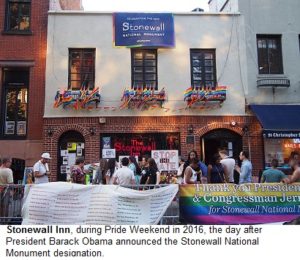
Gay Americans in the 1950s and 1960s faced an anti-gay legal system. Early homophile groups in the U.S. sought to prove that gay people could be assimilated into society, and they favored non-confrontational education for homosexuals and heterosexuals alike. The last years of the 1960s, however, were very contentious, as many social/political movements were active, including the civil rights movement, the counterculture of the 1960s, and the anti-Vietnam War movement. These influences, along with the liberal environment of Greenwich Village, served as catalysts for the Stonewall riots.

Very few establishments welcomed openly gay people in the 1950s and 1960s. Those that did were often bars, although bar owners and managers were rarely gay. At the time, the Stonewall Inn was owned by the Mafia.[8][9][10] It catered to an assortment of patrons and was known to be popular among the poorest and most marginalized people in the gay community: drag queens, transgender people, effeminate young men, butch lesbians, male prostitutes, and homeless youth. Police raids on gay bars were routine in the 1960s, but officers quickly lost control of the situation at the Stonewall Inn. Tensions between New York City police and gay residents of Greenwich Village erupted into more protests the next evening, and again several nights later. Within weeks, Village residents quickly organized into activist groups to concentrate efforts on establishing places for gays and lesbians to be open about their sexual orientation without fear of being arrested.

After the Stonewall riots, gays and lesbians in New York City faced gender, race, class, and generational obstacles to becoming a cohesive community. Within six months, two gay activist organizations were formed in New York, concentrating on confrontational tactics, and three newspapers were established to promote rights for gays and lesbians. Within a few years, gay rights organizations were founded across the U.S. and the world. On June 28, 1970, the first gay pride marches took place in New York, Los Angeles, San Francisco,[11] and Chicago commemorating the anniversary of the riots. Similar marches were organized in other cities. Today, LGBT Pride events are held annually throughout the world toward the end of June to mark the Stonewall riots.[12] The Stonewall National Monument was established at the site in 2016.[13] 


Source:
Retrieved June 28, 2019; see the full encyclopedic reference at: https://en.wikipedia.org/wiki/Stonewall_riots

So, they learned “to get along”.

And now they are laughing “all the way to the bank” …

VIDEO – Pride, passion, progress: Inside Stonewall’s impact 50 years later – https://www.today.com/video/pride-passion-progress-inside-stonewall-s-impact-50-years-later-62866501801

Posted June 28, 2019 – As New York City preps to celebrate World Pride this weekend, NBC’s Joe Fryer goes inside The Stonewall Inn, the historic landmark that sparked the modern movement for LGBTQ rights. He hears from those who took part in the uprising 50 years ago.

There is a lesson here for us in the Caribbean.

We have a long way to go for some of our communities in the Caribbean to be a more tolerant society. But we must walk-trot-run this journey; we must reflect a more pluralistic democracy; we must learn to “live and let live”.

And if we want to double-down on tourism – we do – then we cannot invite people to enjoy our hospitality but then condemn them – in words and actions – for their lifestyle choices.

This – 50th Anniversary of Stonewall – is not our first close-examination of the toleration of the Caribbean or visiting LGBT community. In fact, now is a good time to Encore the blog-commentary from July 2, 2015 lamenting the harsh treatment in Jamaica for their LGBT citizens.

See a related news-commentary here:

Title: Stonewall 50: Don’t Forget the Black & Brown LGBTQ Struggle
Sub-title: Black queer and transgender people have always had to remind the rest of the community of [their] prominence —despite the fact that the movement was co-led by [them] since the beginning.
Source: https://www.thedailybeast.com/stonewall-50-dont-forget-the-black-and-brown-lgbtq-struggle

The world have adopted a more tolerant stance – so must we in the Caribbean. See that Encore here as follows:

————-

Go Lean CommentaryBuggery in Jamaica – ‘Say It Ain’t So’!

This commentary has asserted that the Caribbean region can be a better society than the United States of America. Yes, we can!

But to  even start the discussion, we must first:

Live and let live!

t So - Photo 3The topic of intolerance has been acute in the news as of late. We have the extreme example of the Islamic State in Iraq and Syria (ISIS) beheading non-Muslims because… well, just because. And the example of the US legalizing Gay Marriage may be considered too tolerant for some people’s good taste.

Where does the Caribbean fit in this discussion?

If ISIS is one end of a scale and Gay Marriage in America is another end, then one Caribbean member-state, Jamaica, would be closer to …

ISIS!

Yes, it is that bad. Say it ain’t so.

See Appendix-VIDEO’s below …

While this commentary directly targets Jamaica, the majority of the countries and overseas territories of the former British Empire, still criminalize sexual acts between consenting adults of the same sex and other forms of sexual orientation, gender identity and expression. This has been described as being the result of “the major historical influence” or legacy of the British Empire. In most cases, it was former colonial administrators that established anti-gay legislation or sodomy acts during the 19th century; see Appendix below. The majority of countries then retained these laws following independence.[1][2].

There is an effort now to transform society in Jamaica (and other countries) in this regards. There are Gay Pride Activities being planned for this Summer of 2015. See the relevant news article here:

Title: J-FLAG Is Planning Gay Pride Activities, But No Parade For August – Exec
Source: Jamaica Gleaner Daily Newspaper Online Site; posted June 30, 2015; retrieved from: http://jamaica-gleaner.com/article/news/20150630/j-flag-planning-gay-pride-activities-no-parade-august-exec  

Local gay lobby, J-FLAG, is refuting reports that it will host a road parade in August when the group plans to have a series of gay pride activities.

Social media has been abuzz since yesterday following a report that the group would host a parade, similar to what is done in the United   States and other countries.

However, executive director of J-FLAG, Dane Lewis, says the report is wrong, adding that Jamaica is not ready for such an event.

Meanwhile, he says the group is planning a week-long series of activities starting on Emancipation Day, August 1, to mark growing tolerance for members of the lesbian, gay, bisexual, and transgender (LGBT) community.

Some years ago, an attempt to host a gay parade was thwarted after anti-gay supporters reportedly planned attacks against marchers.

Jamaica is accused of being one of the most homophobic places on earth.

Last week, the US government released a report noting that anti-gay laws and the dancehall culture are responsible for perpetuating homophobia in Jamaica.
Additional reference sources: http://jflag.org/

t So - Photo 1
———–

VIDEO: Executive Director of JFLAG, Dane Lewis: “We Are Jamaicans” – https://youtu.be/sJ-17R5DCoI


Published on Jan 17, 2013 – “We Are Jamaicans” is funded with the kind support of the Caribbean Vulnerable Communities Coalition (CVC) through its Global Fund Vulnerablised Project.

Building a diverse society is not easy. The book Go Lean … Caribbean describes the challenge as heavy-lifting. Though the US had failed at this challenge, it proudly boasts that it got better with every generation. The Caribbean on the other hand, leaves much to be desired in terms of the willingness to change and keep pace with progressive societies. (Now the US, Canada, Ireland and other countries have legalized Gay Marriage).

In a previous blog-commentaries, this defect – Homosexual Intolerance – was listed among the blatant human rights abuses in the region.

This is an important consideration for the planners of Caribbean empowerment. The Caribbean, a region where unfortunately, we have NOT … tried to be as tolerant as may be required, expected and just plain moral.

We must do better!

The book Go Lean … Caribbean asserts that Caribbean society’s prosperity has been hindered with a high abandonment rate – reported at 70% for educated classes region-wide, but an even higher 85% in Jamaica. The primary mission of the Go Lean book is to “battle” against the “push-and-pull” factors that draw so many of our Caribbean citizens away from their homelands to go to more progressive countries.

The Go Lean book campaigns to lower the “push” factors!

The purpose of the Go Lean book is to fix the Caribbean; to be better. The Go Lean book serves as a roadmap for the introduction and implementation of the technocratic Caribbean Union Trade Federation (CU) to pursue the quest to elevate the Caribbean region through empowerments in economics, security and governance. It is the assertion that Caribbean citizens can stay home and effect change in their homelands more effectively than going to some foreign countries to find opportunities for life, liberty and the pursuit of happiness. The book therefore asserts that the region can turn-around from failing assessments by applying best-practices, and forging new societal institutions to impact the Greater Good for all the Caribbean. This point was pronounced in the opening Declaration of Interdependence (Pages 10 – 14) with these acknowledgements and statements:

xi.   Whereas all men are entitled to the benefits of good governance in a free society, “new guards” must be enacted to dissuade the emergence of incompetence, corruption, nepotism and cronyism at the peril of the people’s best interest. The Federation must guarantee the executions of a social contract between government and the governed.

xii. Whereas the legacy in recent times in individual states may be that of ineffectual governance with no redress to higher authority, the accedence of this Federation will ensure accountability and escalation of the human and civil rights of the people for good governance, justice assurances, due process and the rule of law. As such, any threats of a “failed state” status for any member state must enact emergency measures on behalf of the Federation to protect the human, civil and property rights of the citizens, residents, allies, trading partners, and visitors of the affected member state and the Federation as a whole.

xxxiii. Whereas lessons can be learned and applied from the study of the recent history of other societies, the Federation must formalize statutes and organizational dimensions to avoid the pitfalls of communities like … Egypt. On the other hand, the Federation must also implement the good examples learned from developments/ communities like New York City, … Canada, … and tenants of the US Constitution.

The CU/Go Lean vision to elevate Caribbean society must also consider the issue of image. There is the need for a sentinel role for Caribbean image, as there are a lot of times that Caribbean life and people are denigrated in the media: news, film, TV, books, magazines. It’s unfortunate when we are guilty of scathing allegations. The Go Lean roadmap calls for the CU to assume a role of protecting and projecting positive Caribbean images. The plan is to use cutting edge delivery of best practices; the applicable CU agencies will employ strategies, tactics and implementations to impact the Go Lean prime directives; identified with the following 3 statements:

  • Optimization of the economic engines in order to grow the regional economy to $800 Billion & create 2.2 million new jobs.
  • Establishment of a security apparatus to protect the resultant economic engines and mitigate challenges/threats to public safety for all citizens… LGBT or straight.
  • Improvement of Caribbean governance to support these engines.

Jamaica has a failing economy.

Jamaica’s primary economic driver is tourism. So …

t So - Photo 2

Is the Caribbean ready for this economic activity? A bridge too far, too soon?

t So - Photo 4Jamaica has a long way to go; the country has been described by some Human Rights groups as the most homophobic place on Earth because of the high level of violent crime directed at LGBT people; (Padgett, Tim: “The Most Homophobic Place on Earth?”Time Magazine posted 12 April 2006). The United States Department of State said that in 2012, “homophobia was [unacceptably] widespread in the country” (2012 Country Reports on Human Rights Practices: Jamaica, Bureau of Democracy, Human Rights and Labor, U.S. Department of State, pages 20-22). As depicted in the VIDEO below, even President Obama indicted the island on a recent official State Visit.

Why is this country’s homophobia so acute compared to other countries? For one, they have held on emphatically to the British Laws on Buggery – see Appendix below – from their colonial days; even though the host country of England has already abandoned the laws (in 1967).

Jamaica is partying like it’s 1899!

This is therefore a matter of community ethos. The Go Lean book defines community ethos as the fundamental character or spirit of a culture; the underlying sentiment that informs the beliefs, customs, or practices of a group or society; the dominant assumptions of a people or period. This tropical paradise of Jamaica, as defined in the foregoing news article and VIDEO continues to spur bad attitudes, bad ideas, bad speech and bad actions towards the LGBT community. This is unbecoming of a progressive society in 2015.

Alas, this is a crisis…for victims and their loved ones. The Go Lean book posits that this crisis can be averted, that the crisis is a “terrible thing to waste”. The Go Lean roadmap seeks to optimize the eco-systems for Jamaica and the entire Caribbean. The book stresses new community ethos, strategies, tactics, implementations and advocacies necessary to transform and turn-around the eco-systems of the regional society. These points are detailed in the book as follows:

Who We Are – SFE Foundation – Comprised of Caribbean Diaspora Page 8
Community Ethos – Economic Principles – Economic Systems Influence Individual Choices Page 21
Community Ethos – Economic Principles – Consequences of Choices Lie in the Future Page 21
Community Ethos – Governing Principles – Lean Operations Page 24
Community Ethos – Ways to Impact the Future Page 26
Community Ethos – Ways to Promote Happiness Page 36
Community Ethos – Ways to Impact the Greater Good Page 37
Strategy – Vision – Confederate all 30 member-states into a Single Market Page 45
Strategy – Mission – Build and foster local economic engines Page 45
Strategy – Mission – Repatriate the Diaspora, even Minorities like those of the LGBT community Page 46
Tactical – Ways to Foster a Technocracy Page 64
Tactical – Growing the Economy to $800 Billion GDP Page 68
Tactical – Separation-of-Powers – CU Federal Government versus Member-State Governance Page 71
Anatomy of Advocacies – Examples of Individuals Who Made Impact Page 122
Planning – 10 Big Ideas – Homeland Security Pact Page 127
Planning – Ways to Make the Caribbean Better Page 131
Planning – Ways to Improve Failed-State Indices – Minority and Human Rights Page 134
Planning – Lessons Learned from US Constitution – Equal Protection for all Minorities Page 145
Advocacy – Ways to Grow the Economy Page 151
Advocacy – Ways to Create Jobs Page 152
Advocacy – Ways to Improve Governance – For All Citizens Page 168
Advocacy – Ways to Better Manage the Social Contract – Security against “Bad Actors” Page 170
Advocacy – Ways to Impact Justice – Internal Affairs Reporting Line Page 177
Advocacy – Ways to Remediate and Mitigate Crime – Hate Crime Qualifiers Page 178
Advocacy – Ways to Improve Homeland Security Page 180
Advocacy – Ways to Mitigate Terrorism – Consider Bullying as Junior Terrorism Page 181
Advocacy – Ways to Impact Youth – Collaborating with Foundations Page 218
Advocacy – Ways to Re-boot Jamaica Page 239
Advocacy – Ways to Impact British Territories Page 245

Looking at the disposition of the island nation of Jamaica’s, we see that its societal engines are failing.

Could the investment in the diversity of its people be at the root of the problem?

The failing indices and metrics of Jamaica have been considered in previous blog/commentaries; see sample here:

https://goleancaribbean.com/blog/?p=4840 Jamaican Poll: ‘Bring back the British!’
https://goleancaribbean.com/blog/?p=3694 Looking for a job in Jamaica, go to Canada
https://goleancaribbean.com/blog/?p=2830 Jamaica’s Public Pension Under-funded
https://goleancaribbean.com/blog/?p=392 Jamaica to receive World Bank funds to help in crime fight
https://goleancaribbean.com/blog/?p=313 What’s Holding Back Jamaica’s Reforms

The Go Lean roadmap seeks to empower and elevate Caribbean societal engines to make Jamaica, and the rest of the Caribbean, better places to live, work and play … for all citizens, including the LGBT communities.

Most of the Jamaican Diaspora that has abandoned the island now lives in the US, Canada or the UK. Their new home-communities are more tolerant societies of their LGBT neighbors.

Perhaps, there is some correlation.

This commentary is not urging the abandonment of the Judeo-Christian moral code; Jesus Christ instructed to “let them be” at Luke 22:51 (The Message Translation). Rather this commentary urges tolerance and moderation: Live and let live!

Fight the hate!

Yes, we can … do this. Yes, we must do this. 🙂

Download the book Go Lean … Caribbean – now!
———–

Appendix VIDEO: US President Obama’s LGBT comments at Youth Leaders Town Hall – https://youtu.be/636mgw1THpc?t=5m1s


Published on Apr 9, 2015 – President Obama delivers remarks and answers questions at a town hall with Young Leaders of the Americas at University of the West Indies in Kingston, Jamaica. April 9, 2015.
———–

Appendix VIDEO: Gay rights in Jamaica – https://youtu.be/_nSgMGoBAmU

playbutton-300x300

———–

Appendix – Encyclopedic Reference: Buggery in English Common Law

The British English term buggery is very close in meaning to the term sodomy, often used interchangeably in law and popular speech. It may also be a specific common law offenceencompassing both sodomy and bestiality.

In English law “buggery” was first used in the Buggery Act 1533, while Section 61 of the Offences against the Person Act 1861, entitled “Sodomy and Bestiality”, defined punishments for “the abominable Crime of Buggery, committed either with Mankind or with any Animal”. The definition of “buggery” was not specified in these or any statute, but rather established by judicial precedent.[1] Over the years the courts have defined buggery as including either [of these]:

  1. anal intercourse or oral intercourse by a man with a man or woman[2] or
  2. vaginal intercourse by either a man or a woman with an animal,[3]

But [no other] form of “unnatural intercourse”[4] [was defined], the implication being that anal sex with an animal would not constitute buggery. Such a case has not, to date, come before the courts of a common law jurisdiction in any reported decision. However, it seems highly improbable that a person would be exculpated of a crime associated with sex with animals only by reason of the fact that penetration involved the anus rather than the vagina. In the 1817 case of Rex v. Jacobs, the Crown Court ruled that oral intercourse, even with an underage and/or non-consenting person, did not constitute buggery or sodomy.[4]

At common law consent was not a defence[5] nor was the fact that the parties were married.[6] In the UK, the punishment for buggery was reduced from hanging to life imprisonment by the Offences against the Person Act 1861. As with the crime of rape, buggery required that penetration must have occurred, but ejaculation is not necessary.[7]

Most common law jurisdictions have now modified the law to permit anal sex between consenting adults.[8] Hong Kong did so retroactively in 1990, barring prosecution for “crimes against nature” committed before the Crimes (Amendment) Ordinance 1990 entered into force except those that would still have constituted a crime if they had been done thereafter. In England and Wales, homosexual buggery was decriminalised in 1967 with an age of consent at 21 years, whereas all heterosexual intercourse had an age of consent at 16 years. The Sexual Offences Act 2003 did not fully remove buggery as a concept in United Kingdom law, as the previous law is retained for complainants (consensual or “pseudo-consensual”) under the age of 16, or 18 with regards to an adult perceived to be in a “position of trust”. As the law stands, buggery is still charged, exclusively regarding “pseudo-consensual” anal intercourse with those under 16/18, because children cannot legally consent to buggery although they may appear to do so. Rape is charged when the penetration is clearly not consensual. Buggery with an animal is still unlawful under Section 69 of the Sexual Offences Act 2003.

In the Republic of Ireland, the Criminal Law (Sexual Offences) Act 1993 abolished the offence of “buggery between persons”.[9] For some years prior to 1993, criminal prosecution had not been made for buggery between consenting adults. The 1993 Act created an offence of “buggery with a person under the age of 17 years”,[10] penalised similar to statutory rape, which also had 17 years as the age of consent. The Criminal Law (Sexual Offences) Act 2006 replaced this offence with “defilement of a child”, encompassing both “sexual intercourse” and “buggery”.[11] Buggery with an animal is still unlawful under Section 69 of the Sexual Offences Act 2003. In 2012 a man was convicted of this offence for supplying a dog in 2008 to a woman who had intercourse with it and died.[12]

Etymology – The word bugger and buggery are still commonly used in modern English as a mild exclamation. “Buggery” is also synonymous with anal sex.

The word “bugger” was derived, via the French bougre, from Bulgar, that is, “Bulgarian”, meaning the medieval Bulgarian heretical sect of the Bogomils, which spread into Western Europe and was claimed by the established church to be devoted to the practice of sodomy.[13] “Buggery” first appears in English in 1330, though “bugger” in a sexual sense is not recorded until 1555.[14]

(Source: https://en.wikipedia.org/wiki/Buggery)

Share this post:
, , , ,
[Top]

A Lesson in History – 25 years after the “OJ Murders”

Go Lean Commentary

Do you remember the O.J. Simpson case; where he was accused of killing 2 people including his ex-wife? Do you realize, that was 25 years ago now?

Yep! The deaths took place on June 12, 1994.

“The arc of the moral universe is long, but it bends toward justice” – Martin Luther King, quoting Theodore Parker.

There is a lesson in history when we consider the OJ Murders from 1994: things always work itself out towards justice, fairness and freedom … eventually. Sometimes though, the milestones in the journey towards a more just society are reversed or negative; we may make 2 steps forward with 1 step back; or 1 step forward and 2 steps back.

This is just the reality of change in society.

Our lesson in history teaches us that there was a bad orthodoxy in modern society, regarding both race and gender. Many times, minorities – those of the Black-and-Brown races – and women had to endure a lot more abuse than would be any acceptable standard in a just society. Plus when it comes to women, intersectionality (race, age, religion, LGBT, etc.) also applies, so even when one group get more civil rights granted, progress for some other women’s groups  may continue to trail. Yet, still …

… You’ve have come a long way, Baby!

The book Go Lean…Caribbean addresses this history as the actuality of Natural Law. The book states (Page 226):

The Bottom Line on Natural Law and Women’s Rights

17th century natural law philosophers in Britain and America, such as Thomas Hobbes, Jean-Jacques Rousseau and John Locke, developed the theory of natural rights in reference to ancient philosophers such as Aristotle and the Christian theologist Aquinas. Like the ancient philosophers, 17th century natural law philosophers defended slavery and an inferior status of women in law.

Relying on ancient Greek philosophers, natural law philosophers argued that natural rights where not derived from god, but were “universal, self-evident, and intuitive”, a law that could be found in nature. They believed that natural rights were self-evident to “civilized man” who lives “in the highest form of society”. Natural rights derived from human nature, a concept first established by the ancient Greek philosopher Zeno of Citium in Concerning Human Nature. Zenon argued that each rational and civilized male Greek citizen had a “divine spark” or “soul” within him that existed independent of the body. Zeno founded the Stoic philosophy and the idea of a human nature was adopted by other Greek philosophers, and later natural law philosophers and western humanists. Aristotle developed the widely adopted idea of rationality, arguing that man was a “rational animal” and as such a natural power of reason.

Concepts of human nature in ancient Greece depended on gender, ethnic, and other qualifications and 17th century natural law philosophers came to regard women along with children, slaves and non-whites, as neither “rational” nor “civilized”. Natural law philosophers claimed the inferior status of women was “common sense” and a matter of “nature”. They believed that women could not be treated as equal due to their “inner nature”. The views of 17th century natural law philosophers were opposed in the 18th and 19th century by Evangelical natural theology philosophers such as William Wilberforce and Charles Spurgeon, who argued for the abolition of slavery and advocated for women to have rights equal to that of men. Modern natural law theorists, and advocates of natural rights, claimed that all people have a human nature, regardless of gender, ethnicity or other qualifications; therefore all people have natural rights [120].

These thoughts on Natural Law and Women’s Rights persist to this day, despite how archaic they may seem.

Before the OJ Murders, there was an obvious nonchalance about domestic violence in America.
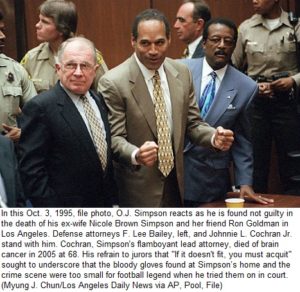
“Mind your own business”

“You’re not in mortal danger”

OJ Simpson was not the first domestic abuser nor was he the last; but now, in the 25 years since, the country has been more forthright and responsive. They have listened to the outcries of victims and the needs of abusers. It is no longer acceptable for the rest of society to just “mind their own business”.

What changed?

Later that same year in 1994, Congress debated and passed the Violence Against Women Act (VAWA)- see the summarized details in Appendix B below – and many mitigations were put in place as a result.

The actuality of the infamous OJ Simpson case propelled VAWA; and though “he” still walks the street without any murder conviction – see Appendix A – the country can still credit him, for perpetrating a crisis and forcing more sensible jurisprudence over the time, with the “long arc of the moral universe bending toward justice”.

This theme – mitigating domestic violence – aligns with many previous Go Lean commentaries; see a sample here:

https://goleancaribbean.com/blog/?p=16408 Mitigating the Bad Ethos on Home Violence
https://goleancaribbean.com/blog/?p=13664 High Profile Sexual Harassment Accusers – Finally Believed
https://goleancaribbean.com/blog/?p=7490 A Lesson in the History of Interpersonal Violence – Domestic
https://goleancaribbean.com/blog/?p=695 Abused Latina wives find help by going to ‘Dona Carmen’

To this day, 25 years later – the OJ Simpson Murder Prosecution is still considered the “Trial of the Century”.

This OJ Murder drama – arrest, criminal trial acquittal; civil trial culpability – facilitated a lot of dialogue and debate on American Justice. There was always an American penchant to protect “White Women from Black Men”; this was the premise for so many extra-judicial executions (think the 4,733 recognized cases of Lynchings) in the American past. So the 1995 acquittal in the OJ Simpson Criminal case drove a wedge between “Black America versus White America”. For many in the African-American community, they recognized that the double standard of Rich White Justice versus Poor Black Justice may have finally swung favorably for a Black defendant. A previous Go Lean commentary added this observation:

There it is, the United States, where there seems to be a Great Divide in justice, one set of standards for the rich, another set for the poor.

The grass is not greener on that (American) side!

The reasons for emigration are “push-and-pull”. This source book identifies and qualifies a “pull” factor, the issue of justice in America. The book informs the reader that America should not be considered alluring from a justice perspective, especially if the reader/audience is poor and of a minority ethnicity.

This leaves the “push” factors. The Caribbean must address its issues, as to why its population is so inclined to emigrate. This is the purpose of the Go Lean roadmap. It features the assessments, strategies, tactics and implementations to make the Caribbean a better place to live, work and play.

In contrast, back in the 1990’s, White America “dug in their heels” on this OJ Murder Case that despite any reasonable doubt in the court case, this Black Man had murdered the two White victims. They therefore yearned of the “Bad Old Days” of meting out immediate justice on presumed Black offenders. The defective landscape in American justice had left “an open sore to fester“.

This open sore has still not healed; think “Make America Great Again”; see Appendix C VIDEO below.

In many previous Go Lean commentaries, the dimensions of continuous racial inequities in the US mainland had been detailed and debated; see this sample here:

https://goleancaribbean.com/blog/?p=16944 Accepting Black Women ‘As Is’ – A Case for Women Empowerment
https://goleancaribbean.com/blog/?p=16532 European Reckoning – Settlers -vs- Immigrants
https://goleancaribbean.com/blog/?p=15123 Blacks get longer prison sentences from ‘Republican’ Judges
https://goleancaribbean.com/blog/?p=14627 Nature or Nurture: Cop-on-Black Shootings embedded in America’s DNA
https://goleancaribbean.com/blog/?p=9216 ‘Time to Go’ – No Respect for our Hair
https://goleancaribbean.com/blog/?p=9214 ‘Time to Go’ – Spot-on for Protest

All in all, it remains the conclusion of this commentary:

“No Justice; No Peace”.

“The long arc of the moral universe bends toward justice”.

The OJ Murder drama demonstrated a lesson for us, that justice is not perfect in the US, and we as Caribbean immigrants cannot effect change there.

But we can effect change here in the Caribbean homeland … (one person can make a difference).

Yes, the heavy-lifting of reforming and transforming Caribbean justice institutions is conceivable, believable and achievable. We must ensure the proper response and protections for domestic violence here in our region. We must  protect the victims and prosecute the abusers. We must ensure that the Strong Never Abuse the Weak with impunity.

This is how … and why we must act now. We must step-in, step-up and step forward to ensure our homeland is a better place to live, work and play for everyone: strong and weak, men and women, rich and poor. 🙂

About the Book
The book Go Lean…Caribbean serves as a roadmap for the introduction and implementation of the technocratic Caribbean Union Trade Federation (CU), for the elevation of Caribbean society – for all member-states. This CU/Go Lean roadmap has these 3 prime directives:

  • Optimization of the economic engines in order to grow the regional economy to $800 Billion and create 2.2 million new jobs.
  • Establishment of a security apparatus to ensure public safety and protect the resultant economic engines.
  • Improve Caribbean governance to support these engines, including a separation-of-powers between the member-states and CU federal agencies.

The Go Lean book provides 370-pages of turn-by-turn instructions on “how” to adopt new community ethos, plus the strategies, tactics, implementations and advocacies to execute so as to reboot, reform and transform the societal engines of Caribbean society.

Download the free e-Book of Go Lean … Caribbean – now!

Who We Are
The movement behind the Go Lean book – a non-partisan, apolitical, religiously-neutral Community Development Foundation chartered for the purpose of empowering and re-booting economic engines – stresses that reforming and transforming the Caribbean societal engines must be a regional pursuit. This was an early motivation for the roadmap, as pronounced in the opening Declaration of Interdependence (Pages 12 – 13):

x. Whereas we are surrounded and allied to nations of larger proportions in land mass, populations, and treasuries, elements in their societies may have ill-intent in their pursuits, at the expense of the safety and security of our citizens. We must therefore appoint “new guards” to ensure our public safety and threats against our society, both domestic and foreign. The Federation must employ the latest advances and best practices of criminology and penology to assuage continuous threats against public safety. …

xi. Whereas all men are entitled to the benefits of good governance in a free society, “new guards” must be enacted to dissuade the emergence of incompetence, corruption, nepotism and cronyism at the peril of the people’s best interest. The Federation must guarantee the executions of a social contract between government and the governed.

xvi. Whereas security of our homeland is inextricably linked to prosperity of the homeland, the economic and security interest of the region needs to be aligned under the same governance. Since economic crimes … can imperil the functioning of the wheels of commerce for all the citizenry, the accedence of this Federation must equip the security apparatus with the tools and techniques for predictive and proactive interdictions.

xxiv. Whereas a free market economy can be induced and spurred for continuous progress, the Federation must install the controls to better manage aspects of the economy: jobs, inflation, savings rate, investments and other economic principles. Thereby attracting direct foreign investment because of the stability and vibrancy of our economy.

Sign the petition to lean-in for this roadmap for the Caribbean Union Trade Federation. 

————–

Appendix A –  25 years after murders, OJ says ‘Life is fine’

By: Linda Deutsch, Associated Press June 10, 2019

LOS ANGELES (AP) — After 25 years living under the shadow of one of the nation’s most notorious murder cases, O.J. Simpson says his life has entered a phase he calls the “no negative zone.”

In a telephone interview, the 71-year-old Simpson told The Associated Press he is healthy and happy living in Las Vegas. And neither he nor his children want to look back by talking about June 12, 1994 , when his ex-wife Nicole Brown Simpson and her friend Ronald Goldman were stabbed to death and Simpson was transformed from Hall of Fame football hero to murder suspect.

“We don’t need to go back and relive the worst day of our lives,” he said. “The subject of the moment is the subject I will never revisit again. My family and I have moved on to what we call the ‘no negative zone.’ We focus on the positives.”

But the pain has not faded for Goldman’s family.

“Closure,” said Goldman’s sister Kim, “isn’t a word that resonates with me. I don’t think it’s applicable when it comes to tragedy and trauma and loss of life.”

“I don’t suffocate in my grief,” she said. “But every milestone that my kid hits, every milestone that I hit, you know, those are just reminders of what I’m not able to share with my brother and what he is missing out on.”

Ron Goldman, then 25, was returning a pair of sunglasses that Nicole Brown Simpson’s mother had left at a restaurant where he worked when he and Simpson’s ex-wife were stabbed and slashed dozens of times.

O.J. Simpson’s televised “Trial of the Century” lasted nearly a year and became a national obsession, fraught with issues of racism, police misconduct, celebrity and domestic violence.

Represented by a legal “Dream Team” that included Johnnie Cochran Jr. and F. Lee Bailey, he was acquitted by a jury in 1995 in a verdict that seemed to split the country along racial lines, with many white Americans believing he got away with murder and many black people considering him innocent.

He has continued to declare his innocence. The murder case is officially listed as unsolved.

The victims’ families subsequently filed a civil suit against him, and in 1997 he was ordered to pay $33.5 million for the wrongful deaths of his ex-wife and Goldman. Some of his property was seized and auctioned, but most of the judgment has not been paid.

For a man who once lived for the spotlight , Simpson has generally kept a low profile since his release from prison in October 2017 after serving nine years for a robbery and kidnapping conviction in Las Vegas. He insisted his conviction and sentence for trying to steal back his own memorabilia were unfair but said: “I believe in the legal system and I honored it. I served my time.”

After his release from prison in Nevada, many expected him to return to Florida, where he had lived for several years. But friends in Las Vegas persuaded him to stay there.

“The town has been good to me,” Simpson said. “Everybody I meet seems to be apologizing for what happened to me here.”

His time in the city hasn’t been without controversy. A month after his release, an outing to a steakhouse and lounge off the Las Vegas Strip ended in a dispute. Simpson was ordered off the property and barred from returning.

No such problems have occurred since, and Simpson is among the most sought-after figures in town for selfies with those who encounter him at restaurants or athletic events he attends occasionally.

He plays golf almost every day. The knees that helped him run to football glory at the University of Southern California and with the NFL’s Buffalo Bills have been replaced, and he recently had laser surgery on his eyes.

Simpson said he remains close to his children and other relatives. His parole officer has given him permission to take short trips, including to Florida, where his two younger children, Justin and Sydney, have built careers in real estate.

His older daughter, Arnelle, lives with him much of the time but also commutes to Los Angeles.

“I’ve been to Florida two or three times to see the kids and my old buddies in Miami. I even managed to play a game of golf with them,” he said. “But I live in a town I’ve learned to love. Life is fine.”

He also visited relatives in Louisiana, he said, and spoke to a group of black judges and prosecutors in New Orleans.

The glamor of his early life is just a memory.

After his football career, Simpson became a commercial pitchman, actor and football commentator. Once a multimillionaire, he says most of his fortune was spent defending himself from the murder charges.

Simpson declined to discuss his finances other than to say he lives on pensions.

To coincide with Wednesday’s anniversary, Kim Goldman will launch a 10-week podcast, “Confronting: O.J. Simpson,” in which she will interview her brother’s friends, the detective who investigated the killings, attorneys for the defense and prosecution, and two of the 12 jurors who acquitted Simpson. She will continue to make the case that Simpson was guilty.

___

Linda Deutsch is a retired special correspondent for The Associated Press. She covered all of Simpson’s legal cases during her 48-year career as a Los Angeles-based trial reporter.

Source: Posted and retrieved June 10, 2019 from: https://news.yahoo.com/ap-exclusive-25-years-murders-045033971.html?.tsrc=notification-brknews

————–

Appendix B – Violence Against Women Act

The Violence Against Women Act of 1994 (VAWA) is a United States federal law (Title IV, sec. 40001-40703 of the Violent Crime Control and Law Enforcement ActH.R. 3355) signed as Pub.L. 103–322 by President Bill Clinton on September 13, 1994 (codified in part at 42 U.S.C. sections 13701 through 14040). The Act provided $1.6 billion toward investigation and prosecution of violent crimes against women, imposed automatic and mandatory restitution on those convicted, and allowed civil redress in cases prosecutors chose to leave un-prosecuted. The Act also established the Office on Violence Against Women within the Department of Justice.

VAWA was drafted by the office of Senator Joe Biden (D-DE) and co-written by Democrat Louise Slaughter, the Representative from New York, with support from a broad coalition of advocacy groups.[1] The Act passed through Congress with bipartisan support in 1994, clearing the United States House of Representatives by a vote of 235–195 and the Senate by a vote of 61–38, although the following year House Republicans attempted to cut the Act’s funding.[2] In the 2000 Supreme Court case United States v. Morrison, a sharply divided Court struck down the VAWA provision allowing women the right to sue their attackers in federal court. By a 5–4 majority, the Court overturned the provision as exceeding the federal government’s powers under the Commerce Clause.[3][4]

VAWA was reauthorized by bipartisan majorities in Congress in 2000 and again in December 2005. The Act’s 2012 renewal was opposed by conservative Republicans, who objected to extending the Act’s protections to same-sex couples and to provisions allowing battered undocumented immigrants to claim temporary visas, but it was reauthorized in 2013, after a long legislative battle. As a result of the United States federal government shutdown of 2018–2019, the Violence Against Women Act expired on December 21, 2018. It was temporarily reinstated via a short-term spending bill on January 25, 2019, but expired again on February 15, 2019. The House of Representatives passed a bill reauthorizing VAWA in April 2019; the bill, which includes new provisions protecting transgender victims and banning individuals convicted of domestic abuse from purchasing firearms, has yet to be considered by the Senate as of April 11[, 2019].[5]

See the full article here: https://en.wikipedia.org/wiki/Violence_Against_Women_Act retrieved June 10, 2019.

————–

Appendix C VIDEO – Is ‘make America great again’ racist? – https://youtu.be/kIQdb-1Lxso

Fox News
Published on Sep 9, 2016

‘The O’Reilly Factor’ examines Bill Clinton’s criticism of the slogan.

Share this post:
, , ,
[Top]