“I write the songs that make the whole world sing; I write the songs of love and special things; I write the songs that make the young girls cry; … I am music and I write the songs”. – Barry Manilow (see Appendix A below).
The publishers of the book Go Lean…Caribbean want to forge change in the Caribbean. How do we go about doing that?
The book identifies music as one of the viable approaches.
Consider what happened in 2014, with this song (Happy by Pharrell Williams) and related experiences:
As the foregoing VIDEO depicts, the song moved us all. In this writer’s opinion, one of the promoters of the Go Lean book and movement, this is the song of the year (2014).
The book Go Lean…Caribbean serves as a roadmap for the introduction and implementation of the Caribbean Union Trade Federation (CU), an initiative to bring change and empowerment to the Caribbean region, to make the region a better place to live, work and play. From the outset, the book recognized the significance of music in the Caribbean change/empowering plan with these statements in the opening Declaration of Interdependence (Page 12 & 14):
xxi. Whereas the preparation of our labor force can foster opportunities and dictate economic progress for current and future generations, the Federation must ensure that educational and job training opportunities are fully optimized for all residents of all member-states, with no partiality towards any gender or ethnic group. The Federation must recognize and facilitate excellence in many different fields of endeavor, including sciences, languages, arts, music and sports. This responsibility should be executed without incurring the risks of further human flight, as has been the past history.
xxxii. Whereas the cultural arts and music of the region are germane to the quality of Caribbean life, and the international appreciation of Caribbean life, the Federation must implement the support systems to teach, encourage, incentivize, monetize and promote the related industries for arts and music in domestic and foreign markets. These endeavors will make the Caribbean a better place to live, work and play.
The purpose of the Go Lean roadmap is not specifically on music, but rather change, and yet there is the acknowledgement that music can help forge change.
This Go Lean roadmap calls for the heavy-lifting in shepherding important aspects of Caribbean life. In fact, the empowerment roadmap has these 3 prime directives:
Optimization of the economic engines in order to grow the regional economy to $800 Billion & create 2.2 million new jobs.
Establishment of a security apparatus to protect the resultant economic engines.
Improve Caribbean governance to support these engines.
The book describes the CU as a hallmark of a technocracy, a commitment to efficiency and effectiveness, and also includes a commitment to concepts of fun, such as music, arts, sports, film/media (Hollywood-related), heritage and overall happiness. In fact, there are a total of 144 different missions for the CU. While much focus is on “live and work” activities, many others are targeting the areas of “play”‘; music is definitely a play-time activity … for young and old.
As depicted in the foregoing VIDEO, “music” can be used to forge change. The Go Lean book declares that before any real change takes root in the Caribbean that we must reach the heart, that there must be an adoption of new community ethos – the national spirit that drives the character and identity of its people. We must therefore use effective and efficient drivers to touch the heart and forge this change. How? Here’s one suggestion, (from Appendix A):
Oh, my music makes you dance and gives you spirit to take a chance
And I wrote some rock ‘n roll so you can move
Music fills your heart, well that’s a real fine place to start
The Go Lean roadmap was constructed with the community ethos in mind to forge change, plus the execution of related strategies, tactics, implementations and advocacies to make the change permanent. The following is a sample of these specific details from the book:
Community Ethos – Deferred Gratification
Page 21
Community Ethos – Economic Principles – People Choose
Page 21
Community Ethos – Economic Principles – People Respond to Incentives in Predictable Ways
Page 21
Community Ethos – Economic Principles – The Consequences of Choices Lie in the Future
Page 21
Community Ethos – Governing Principles – Lean Operations
Page 24
Community Ethos – Ways to Impact the Future
Page 26
Community Ethos – Ways to Foster Genius
Page 27
Community Ethos – Ways to Promote Intellectual Property
Page 29
Community Ethos – Ways to Impact Research & Development
Page 30
Community Ethos – Ways to Bridge the Digital Divide
Page 31
Community Ethos – Ways to Impact Turn-Around
Page 33
Community Ethos – Ways to Promote Happiness
Page 36
Community Ethos – Ways to Impact the Greater Good
Page 37
Strategy – Vision – Confederate 30 Member-States
Page 45
Strategy – Mission – Celebrate the Music, Sports, Art, People and Culture of the Caribbean
Page 46
Tactical – Confederating a Permanent Union
Page 63
Tactical – Fostering a Technocracy
Page 64
Implementation – Ways to Pay for Change
Page 101
Implementation – Ways to Deliver
Page 109
Implementation – Ways to Impact Social Media
Page 111
Planning – 10 Big Ideas for the Caribbean Region – Cyber-Caribbean
Page 127
Planning – Ways to Make the Caribbean Better
Page 136
Planning – Reasons Why the CU Will Succeed
Page 137
Advocacy – Ways to Grow the Economy
Page 151
Advocacy – Ways to Create Jobs
Page 152
Advocacy – Ways to Improve Communications
Page 186
Advocacy – Ways to Foster e-Commerce
Page 198
Advocacy – Ways to Impact Hollywood
Page 202
Advocacy – Ways to Impact Beauty Pageants
Page 203
Advocacy – Ways to Preserve Caribbean Heritage
Page 218
Advocacy – Ways to Improve the Arts
Page 230
Advocacy – Ways to Promote Music
Page 231
While the roadmap is optimistic; it is realistic too. There is the acknowledgement that the business of music (Show Business in general) has changed in the light of modern dynamics, particularly due to Internet & Communications Technologies. To spur more development in music, the economic engines of the music/show business must be secured. This point was previously detailed in these Go Lean blog/commentaries:
Introduction of a Bahamian ‘Carnival’; Big Change for Country
“Do what you have always done, get what you’ve always got” – Old Adage.
The quest to change the Caribbean is more complex than just playing or listening to music. This is serious, this is heavy-lifting; but all the earnest effort will be a waste unless people are moved to change. So we must use all effective tools to forge the required change; music is one of the best.
Even if we fail, at least we would have had fun trying to execute the plan. As depicted in the underlying video (Appendix B): “Because I’m happy”.
This is the mandate of the Go Lean roadmap: making the Caribbean a better place to live, work and play; and having fun while doing it. Everyone is encouraged to lean-in to this roadmap:
Clap along if you feel like happiness is the truth
Because I’m happy
Clap along if you know what happiness is to you
Because I’m happy
Clap along if you feel like that’s what you wanna do
Because I’m happy
Appendix A – Song: “I Write The Songs”; written, produced and performed by Barry Manilow:
I’ve been alive forever
And I wrote the very first song
I put the words and the melodies together
I am music
And I write the songs
I write the songs that make the whole world sing
I write the songs of love and special things
I write the songs that make the young girls cry
I write the songs, I write the songs
My home lies deep within you
And I’ve got my own place in your soul
Now when I look out through your eyes
I’m young again, even tho’ I’m very old
I write the songs that make the whole world sing
I write the songs of love and special things
I write the songs that make the young girls cry
I write the songs, I write the songs
Oh, my music makes you dance and gives you spirit to take a chance
And I wrote some rock ‘n roll so you can move
Music fills your heart, well that’s a real fine place to start
It’s from me, it’s for you
It’s from you, it’s for me
It’s a worldwide symphony
I write the songs that make the whole world sing
I write the songs of love and special things
I write the songs that make the young girls cry
I write the songs, I write the songs
I write the songs that make the whole world sing
I write the songs of love and special things
I write the songs that make the young girls cry
I write the songs, I write the songs
Now starts the quest to change the Caribbean, to empower its economic, security and governing engines so as to elevate society. The book Go Lean…Caribbean posits that for any permanent change to take root, an accompanying community ethos – the fundamental character/spirit that informs the beliefs, customs, or practices – must first be adopted. How do we go about doing that?
Change is not easy! It can come about in two ways: revolution or evolution. The Go Lean book is asserting for evolutionary change. The book describes (Page 20) that change begins in the “heart”. This figurative body part is associated with feelings, values and commitments. This is why the heart is considered the “seat of motivation”. The people of the Caribbean must change their feelings about elements of their society – elements that are in place and elements missing.
The book identifies a number of best-practices for forging change or adopting new community ethos. According to a previous blog/commentary that was a review of the book ‘Chasing Youth Culture and Getting It Right’, it was established that forging change in the region requires selling to the Caribbean youth. In the past, this audience has been quick to abandon the region and set the destination of their hopes and dreams on to foreign shores. But the Go Lean roadmap requires youth participation and their engagement in the homeland. So this audience must be sold on this vision to make the region a better place to live, work and play.
What process do we use to sell to the Caribbean youth, our target market? (And by extension to the entire Caribbean).
The book Go Lean…Caribbean serves as a roadmap for the introduction and implementation – a Sales Process – of the technocratic Caribbean Union Trade Federation (CU). This initiative to bring change and empowerment to the Caribbean region will require the application of best-practices in Delivery arts and sciences. This Go Lean roadmap is set to deliver, with these 3 prime directives:
Optimization of the economic engines in order to grow the regional economy to $800 Billion & create 2.2 million new jobs.
Establishment of a security apparatus to protect the resultant economic engines.
Improve Caribbean governance to support these engines.
Frankly, selling economic empowerment to the public is easy…
… just show up with a boat-load of jobs and people will “cow tail” and cooperate; (the heavy-lifting is involved in selling industry stakeholders). Security and governing changes on the other hand require much more heavy-lifting: consensus-building, convincing and compromise of existing institutions and officials. This is the charter of the CU, to employ a Sales Process to persuade these different stakeholders. Persuasion equals selling.
The Go Lean roadmap includes the steps for this goal; to apply a technocratic Sales Process. Consider the details of this source/article; (references here to “company” would relate to the CU while “customer” relate to Caribbean stakeholders):
Title: What is your Sales Process?
…for achieving the sales edge? Do you have one? Is it working? Do you need one?
Our answer to this last question is a loud YES. Not all sales people are rainmakers. In fact only 20% of the sales population possess the intuition and luck to make things just happen. And with these sales personalities, your best bet is to let them “do their thing” with some management to make sure your goals are met and your image maintained. The remaining 80% of sales people, however, are most successful when they follow a specific sales process that details steps along the way and the tools to use at each step.
You should define and standardize your company’s sales process based on best-practices within your team, your industry, and the sales field in general. Here are some guidelines for creating a sales process workflow to get you started:
LEVEL 1—Contact Type. First start by defining your contact types. One of the mistakes we frequently see is confusion (and therefore a lack of appropriate prioritization) around whether a contact type is a Suspect, Prospect, or Lead.
Suspect. A suspect is a name and a name only. In fact, it may only be the company name. You may not know the contact name of the buyer most likely to purchase your products and services. Or, if you have a name, it may be a reader of a publication, a listener to a radio station, or an attendee at a trade show, and you don’t know if this person is the appropriate buyer. You only suspect this “entity” is a target for your products or services.
Prospect. A prospect is a suspect that has engaged with you in some way, whether it is an action taken on a web visit, a phone inquiry, etc. Your goal in this stage is to qualify this prospect to the point that you know the decision-maker and you’ve identified an interest level in your products and/or services.
Lead. A prospect becomes a lead when you’ve established a future (maybe not immediate) need. The more immediate the need, the more hot the lead. Before you can move the lead to the assess phase, you must determine what information you most need to know. For example, what is their decision-making process/timeline, do they understand your offering and value proposition, does your solution align with their business problem, etc?
Customer. A customer is someone who bought, or has contracted to buy, your product and/or service.
LEVEL 2—Process Milestones. The process for converting suspects into prospects, prospects into leads, leads into customers is much like playing a baseball game. You’d love to hit a home run every time you step to the plate, but the game is really won on first and second base hits. This is where your focus should be. And like baseball, where you don’t get to skip second base to speed your journey to home plate, you must also make sure you touch every milestone within your sales process. Not doing so can result in wasted time quoting or selling to unqualified opportunities. Build out the second level of your sales process to include the milestones in your standard sales process, including:
Engage. This is the first milestone in the sales process and usually happens during the Suspect to Prospect conversion phase. Engaging a suspect can include their inquiry into you or your inquiry into them, but does require that you have interacted with the contact (either through marketing or sales efforts) to introduce yourselves, your company, your offering, and uncover their general need.
Qualify. Once you’ve engaged the suspect and determined they fit your overall target profile, you need to qualify the lead further to make sure it’s a “fit” with your company and what you offer. We recommend creating a Lead Qualification Checklist to help define what makes a good lead and to ensure it’s fully qualified before moving the lead to the next milestone.
Assess. Once you have qualified the lead using the criteria you defined, you must assess the opportunity before expending the resources to develop a quote or proposal. You want to make sure you understand the key factors driving the lead’s buying criteria. Such as, what are the specifics of their need, what is the main decision-making factor, what is their budget, do they understand your value proposition, and are they looking at competition?
Propose. You’ve assessed the opportunity to the level you required during the assess stage, and now it’s time to move into the proposal stage. Make sure your proposal process is appropriate for the buying cycle. You want your proposal created with the right amount of detail and speed to meet the decision-maker’s needs. Consider including all terms, as well as credit, inside the proposal to avoid slowing the approval, and therefore the sales process, down.
Close. At this phase of the pipeline, you must follow-up to uncover and combat any possible objections, negotiate terms, and close the deal. Too many deals are lost at this phase due to neglect. In the sales and marketing industry we call this “dying on the vine.” Define what activities, and how often, you must implement during this phase to stay on top of the closing process.
SALE! Hopefully at this point, you’ve done such a good job of managing your sales process and pipeline that you have moved your lead to a sale. Congratulations! In the event you lose a deal at any phase of the process, make sure to track why.
LEVEL 3—Tools. Finally, you must determine what sales tools you have or need to help move your potential customer through the sales process from milestone to milestone. For instance at the Engagement stage you will need Lead Generation Tools and at the Qualify Stage you will need marketing materials, lead qualification checklists, etc. Go-To-Market Strategy – Sales & Marketing Resource Center (Retrieved 12/21/2014) – http://www.gtms-inc.com/What-is-your-Sales-Process_ep_123.html
Contact types, process milestones and tools…
… these three elements from the foregoing article require detailed instructions, turn-by-turn directions to apply the best-practices.
So the CU has to “Win Friends and Influence People“. How do we go about doing this? Answer: using the Sales Process in the foregoing article.
The Caribbean is not the first entity required to execute a monumental task of forging change. There are lessons to learn and apply from other successful (and parallel) endeavors. One role model for successfully executing this art was Dale Carnegie; see Appendix below. Insights from Dale Carnegie’s teachings can be gleaned and applied as best-practices for the region’s people and institutions to emulate.
The Go Lean book describes the CU as a hallmark of technocracy, a commitment to efficiency and effectiveness in the Sales Process. As depicted in the foregoing article, selling change is a Big Deal and requires some sales tools and persuasion. But the Go Lean roadmap is not exclusive to a “Sales Cycle”; there is a parallel effort, a “Lean-in Cycle”. There are some differences, as depicted here:
Sales Cycle
Go Lean/Lean-in Cycle
1
Engage
Engage
2
Qualify
Qualify
3
Assess
Assess
4
Propose
Messaging
5
Close
Execute/Implement
6
Sale
Assimilate
While the Go Lean roadmap advocates for evolutionary change, not revolutionary, there is still some benefit to formal protests. This relates back to community ethos – there are certain issues that must simply not be tolerated – people must get “mad as hell and refuse to take it anymore”. This attitude was the motivation for the Go Lean book (Page 3); where it relates that despite the world’s greatest address, the people of the Caribbean have “beaten down their doors” to get out. This status quo is not to be tolerated. This demands protesting… through messaging!
The roadmap lists multiple approaches for messaging: a benign protest movement and the arts (music, festivals, visual and performance arts, sports, film, media and literature). This paints the picture of both overt and subliminal messaging. Yes! All tried-and-true tools are to be employed. The Sales Process/Messaging plan was constructed with the following community ethos in mind. The roadmap also details the execution of these strategies, tactics, implementation and advocacies to forge the identified permanent change in the region. The following is a sample of these specific details from the book:
Community Ethos – Deferred Gratification
Page 21
Community Ethos – Economic Principles – People Choose
Page 21
Community Ethos – Economic Principles – People Respond to Incentives in Predictable Ways
Page 21
Community Ethos – Economic Principles – The Consequences of Choices Lie in the Future
Page 21
Community Ethos – Governing Principles – Minority Equalization
Page 23
Community Ethos – Governing Principles – Lean Operations
Page 24
Community Ethos – Governing Principles – Cooperatives
Page 25
Community Ethos – Ways to Impact the Future
Page 26
Community Ethos – Ways to Foster Genius
Page 27
Community Ethos – Ways to Promote Intellectual Property
Page 29
Community Ethos – Ways to Impact Research & Development
Page 30
Community Ethos – Ways to Bridge the Digital Divide
Page 31
Community Ethos – Ways to Impact Turn-Arounds
Page 33
Community Ethos – Ways to Promote Happiness
Page 36
Community Ethos – Ways to Impact the Greater Good
Page 37
Strategy – Vision – Confederate 30 Member-States
Page 45
Strategy – Mission – Celebrate the Music, Sports, Art, People and Culture of the Caribbean
Page 46
Strategy – Competitive Analysis – How does the Caribbean stack up?
Page 49
Strategy – Managing Agents of Change (Understand the Market and Plan the Business)
Page 57
Tactical – Confederating a Permanent Union
Page 63
Tactical – Fostering a Technocracy
Page 64
Tactical – Separating Powers between the CU and Member-states
Page 71
Implementation – Ways to Pay for Change
Page 101
Implementation – Ways to Deliver
Page 109
Planning – 10 Big Ideas for the Caribbean Region
Page 127
Planning – Ways to Make the Caribbean Better
Page 136
Planning – Reasons Why the CU Will Succeed
Page 137
Planning – Ways to Measure Progress
Page 147
Advocacy – Ways to Grow the Economy
Page 151
Advocacy – Ways to Create Jobs
Page 152
Advocacy – Ways to Improve Communications
Page 186
Advocacy – Ways to Improve Libraries – Portals for Digital Access
Page 187
Advocacy – Ways to Impact Events
Page 191
Advocacy – Ways to Foster Technology
Page 197
Advocacy – Ways to Preserve Caribbean Heritage
Page 218
Advocacy – Ways to Improve Sports
Page 229
Advocacy – Ways to Improve the Arts
Page 230
Advocacy – Ways to Promote Music
Page 231
Previously Go Lean blog/commentaries have stressed impacting the community, forging change, through overt and subliminal protests (like fun-and-games). The following sample applies:
The quest to change the Caribbean will require some protests, but this alone will not inspire all to engage. The strategy of fun-and-games is also effective, for some, especially the youth, but still not all elements of society will respond. These facts posit that “change” is serious business, maybe even life-and-death. So different theories will have to be tested, engaged and measured; (plan, do & review).
We must reach our audience – our communities – then grab their attention to send a message of the need for change and to lean-in to this roadmap to elevate Caribbean society. This is heavy-lifting but in the end, the result is a better homeland, a better place to live, work and play.
We encourage all of the Caribbean to lean-in now, to Go Lean. 🙂
APPENDIX – How to Win Friends and Influence People – Dale Carnegie
Dale Carnegie (1888 – 1955) was an American writer and lecturer and the developer of famous courses in self-improvement, salesmanship, corporate training, public speaking, and interpersonal skills. Born into poverty on a farm in Missouri, he was the author of How to Win Friends and Influence People (1936), a massive bestseller that remains popular today. He also wrote several other books. One of the core ideas in his books is that it is possible to change other people’s behavior by changing one’s behavior toward them. (Source: http://en.wikipedia.org/wiki/Dale_Carnegie)
Video: How to Be More Social – A take on “How to Win Friends and Influence People by Dale Carnegie” – http://youtu.be/kuYBNuEs6sA
Published on Oct 11, 2014 – How to Be More Social – How to Win Friends and Influence People by Dale Carnegie (summary, review). How to Win Friends and Influence People was one of the first books I read that really increased my social IQ. It has always stayed as one of my most favorite books and I definitely recommend reading it.
Summary of the VIDEO: Big Concept 1: Become genuinely interested in other people.
Big Concept 2: Show respect for the other man’s opinions. Never tell a man he is wrong.
Big Concept 3: Talk in terms of the other man’s interest.
What do you get for $5.3 Billion? There must be some return on that investment.
The book Go Lean … Caribbean asserts that the US Federal Election-Campaign system is not the model that the Caribbean should want to emulate. This book relates that $5.3 Billion was spent for the 2008 Federal Elections (Page 116), a lot of it contributed by corporations, resulting in a lot of influence peddling. This drama was vividly demonstrated this Saturday evening when the “lame-duck” Congress (the Senate in particular), delayed the required Omnibus Spending Bill – just in time – to extort favorable legislation that would roll back some of the federal regulations enacted after the Great Recession of 2008 to protect against banking systemic risks.
The Shadow Influences spearheading these changes are known to adhere to the principle that “a crisis is a terrible thing to waste” – a quotation credited to famed American Economist Paul Romer. While others will think that this drama was just politics as usual, the following article depicts the more strategic nature of the new legislation, to foster the environment and industry for financial derivative trading – this is too specific for any life-long politician (the US Senate) to advocate on the sly. No, this has the fingerprints of Wall Street Shadow Influences all over it. (See Appendix below for encyclopedic references on derivatives and swaps). See the news article here:
Title: A Christmas Present For The Banks From The Omnibus Bill Forbes Magazine Investing Online Blog (Posted 12/13/2014; retrieved 12/15/2014) – http://www.forbes.com/sites/robertlenzner/2014/12/13/wall-street-reverses-ban-on-trading-derivatives-backed-by-uncle-sam/ By: Robert Lenzner, Contributor
Wall Street banks like Citigroup and JP Morgan Chase have flexed the power of their influence to pressure Congress and the White House into a key change in the law that will allow the trading of risky financial derivatives in bank operations that are insured by the Federal Deposit Insurance Corp. This means the nation’s largest banks used the deadline for passing the Omnibus spending bill as pressure to reverse a key section of the Dodd-Frank bill of 2010 that was meant to prohibit a federal government bailout of swaps entities.
It was the existence of over $500 billion of Credit Default Swaps on the balance sheet of AIG in 2008 that threatened to bankrupt the largest insurance company in the world. So, in effect, six years later, the same Wall Street banks that were bailed out by federal largesse, are being given a legislative gift that will enable them to freely trade the securities that brought Lehman Bros down in 2008 — and obtain access to the benefit of insurance and loans from the federal government.
Behind the scenes, unbenownst to the media or the public, the nation’s Too Big To Fail banks used the Omnibus spending bill that is necessary to finance federal spending in 2015 to undo this little-known Dodd Frank provision that might have restricted the volume of trading in financial derivatives that have been a major source of profits as well as controversy since the 2008 financial crisis. Most financial derivatives will be able to be traded in entities holding deposits guaranteed by the Federal Deposit Insurance Corp. and subject to borrowing at the Federal Reserve’s discount window. This is a key advantage for the banks that will enable them to increase their activity in these securities.
Former Rep. Barney Frank, who was a key sponsor of the Wall Street reform legislation, attacked the change in Dodd-Frank as “a road map for further attacks on our protection against financial instability.” Frank was incensed that the last-minute procedure was “inserted with no hearings, no chance for further modification, and no chance for debate into a mammoth bill in the last days of a lame-duck Congress.”
If President Obama signs the Omnibus spending bill, he will have effectively rewarded Wall Street by reversing a provision that prohibits any federal assistance from being provided to “swaps entities,” including registered swaps dealers, security-based swap dealers, major swap participants and major security-based swap participants, according to information obtained by Forbes. This measure required banks to remove their swaps dealing from the bank itself and do its trading in non-bank affiliates not eligible for deposit insurance. Access to the Fed’s discount window would also be denied in case of a financial crisis in the markets.
The net effect of the changes in the Omnibus spending bill would be to expand permissible swaps activities within a bank and to only exclude swaps based on asset-backed securities that are unregulated and not of a credit quality.
All very technical, but the net result is to allow Citigroup, JP Morgan Chase and others to use the Fed’s discount window to borrow money in case of a crisis that roiled the derivative market for credit swaps again as took place in September 2008. In effect, it means the major banks need not limit their trading of financial derivatives to non-bank operations that the market will never be fooled into thinking some future risk of danger has just been avoided. It is a complex holiday present for Wall Street. And it is a warning sign that other sections of the Dodd-Frank Wall Street reform may also be vulnerable to political rollback.
The crisis of the 2008 Great Recession was the lynchpin for the Go Lean movement, (book and blogs). This book, serving as a roadmap for the introduction and implementation of the Caribbean Union Trade Federation (CU), posits that the effects of the 2008 Great Recession continue to linger in the Caribbean. Therefore the book advocates learning lessons from 2008 and to turn-around, reform, and reboot the region’s economic, security and governing engines to ensure that “never again” will our society be so vulnerable to the financial misgivings of our American neighbors; or the “plutocratic” elements there-in.
The field of economics is not always solutions-oriented; sometimes, they have been responsible for the problem. Consider this VIDEO snippet here:
Published on Apr 19, 2012 – Since the repeal of Glass-Steagall in 1999, the total notional value of derivatives has grown by over 700% for holdings companies and 674% for commercial banks. Even more alarming, since the third quarter of 2008 when the cracks in the financial system were clearly evident, derivatives at the commercial banks have grown from $175 TRILLION to $234 TRILLION ” a $59 TRILLION increase. To put this in perspective, the cumulative Gross Domestic Product in the United States over that same time frame (Q3 2008 through Q3 2010) was approximately $32 TRILLION.
Despite our region’s small size (42 million people in 30 member-states), we do have some control over our own destiny. We want to be a protégé, not a parasite.
The CU’s prime directives, elevating the Caribbean’s economic-security-governing engines, recognize that the changes the region needs must start first with the adoption of new community ethos and controls. Early in the book, the need for this shift is pronounced (Declaration of Interdependence –Page 13) with these statements:
xxiv. Whereas a free market economy can be induced and spurred for continuous progress, the Federation must install the controls to better manage aspects of the economy: jobs, inflation, savings rate, investments and other economic principles. Thereby attracting direct foreign investment because of the stability and vibrancy of our economy.
xxv. Whereas the legacy of international democracies had been imperiled due to a global financial crisis, the structure of the Federation must allow for financial stability and assurance of the Federation’s institutions. To mandate the economic vibrancy of the region, monetary and fiscal controls and policies must be incorporated as proactive and reactive measures. These measures must address threats against the financial integrity of the Federation and of the member-states.
The Go Lean book, and previous blog/commentaries, stressed the key community ethos, strategies, tactics, implementation and advocacies necessary to effect change in the region ourselves, to improve the stewardship over the economy. They are detailed as follows:
Who We Are – 2008 Internal Experiences
Page 8
Community Ethos – Economic Principles
Page 21
Community Ethos – Security Principles – Private Interest –vs- Public Protection
Page 23
Community Ethos – Security Principles – “Light Up Dark Place”
Page 23
Community Ethos – Governing Principles – Lean Operations
Page 24
Community Ethos – Ways to Impact the Future
Page 26
Community Ethos – Impact Research and Development
Page 30
Community Ethos – Ways to Improve Negotiations
Page 32
Community Ethos – Ways to Impact Turn-around – 2008 Crisis
Page 33
Community Ethos – Ways to Impact the Greater Good
Page 37
Strategy – Mission – Fortify the Stability of the Securities Markets
Page 47
Strategy – CU Stakeholders to Protect – Banks & Depositors
Page 47
Tactical – Growing the Economy – Minimizing Bubbles
Advocacy – Ways to Impact Labor Unions – 2008 Effects on Main Street Jobs
Page 164
Anecdote – Caribbean Industrialist – Growing without Shadow Influence
Page 189
Advocacy – Reforms for Banking Regulations
Page 199
Advocacy – Ways to Impact Wall Street
Page 200
Appendix – Whitepaper: The 2008 Financial Crisis and Its Aftermath
Page 276
Appendix – Currency Capital Controls
Page 325
The points of effective, technocratic regional stewardship, especially in response to the 2008 Great Recession / Financial Crisis, were further elaborated upon in these previous blog/commentaries:
The 2008 Great Recession brought major upheaval to American and Caribbean societies, plus the rest of the world. Much of the world is interconnected; this is even more acute in our region. Our economy is structured as parasites on the US economy. According to the foregoing news article, our parasitic host is not worthy of our devotion. What qualifies the Go Lean promoters to make these assessments? Principals of this publishing foundation were also there in 2008, engaged with major stakeholders of the Global Financial crisis: Lehman Brothers, JPMorganChase, Citigroup, etc. They were on the inside looking out, not the outside looking in. They were equipped to discern the Shadow Influence.
The Go Lean movement advocates the role of protégé, not parasite. We must diversify our economy and additionally cater to other markets, other countries and other industries. This is the purpose of the Go Lean roadmap, to provide a turn-by-turn direction to accomplish this diversification.
If we want to make our homeland a better place to live, work and play then we cannot depend on the stewards of the US economy to shepherd the Caribbean. Look! Despite the cruel and harsh lessons from 2008, it appears – from the foregoing article and the Appendix below – that the Wall Street Shadow Influence wants to repeat the “Bubble” that lead up to 2008. When they succeed, they profit; but when they fail, the “low man” on Main Street – and parasite economies like the Caribbean – has to endure the pain, not Wall Street.
The Go Lean roadmap does not seek to change America, (though we lobby against these arbitrary “Derivative” rule changes in the Omnibus Budget Bill); only teach the lessons to the Caribbean. We can do so much better.
In finance, a derivative is a contract that derives its value from the performance of an underlying entity. This underlying entity can be an asset, index, or interest rate, and is often called the “underlying”.[1][2] Derivatives can be used for a number of purposes – including insuring against price movements (hedging), increasing exposure to price movements for speculation or getting access to otherwise hard to trade assets or markets.[3]
Some of the more common derivatives include forwards, futures, options, swaps, and variations of these such as collateralized debt obligations, credit default swaps, and mortgage backed securities. Most derivatives are traded over-the-counter (off-exchange) or on an exchange such as the Chicago Mercantile Exchange, while most insurance contracts have developed into a separate industry. Derivatives are one of the three main categories of financial instruments, the other two being equities (i.e. stocks or shares) and debt (i.e. bonds and mortgages).
Speculation Derivatives can be used to acquire risk, rather than to hedge against risk. Thus, some individuals and institutions will enter into a derivative contract to speculate on the value of the underlying asset, betting that the party seeking insurance will be wrong about the future value of the underlying asset. Speculators look to buy an asset in the future at a low price according to a derivative contract when the future market price is high, or to sell an asset in the future at a high price according to a derivative contract when the future market price is less.
Risks The use of derivatives can result in large losses because of the use of leverage, or borrowing; (see VIDEO below). Derivatives allow investors to earn large returns from small movements in the underlying asset’s price. However, investors could lose large amounts if the price of the underlying moves against them significantly. There have been several instances of massive losses in derivative markets, such as the following:
American International Group (AIG) lost more than US$18 billion through a subsidiary over the preceding three quarters on credit default swaps (CDSs).[42] The United States Federal Reserve Bank announced the creation of a secured credit facility of up to US$85 billion, to prevent the company’s collapse by enabling AIG to meet its obligations to deliver additional collateral to its credit default swap trading partners.[43]
The loss of US$7.2 Billion by Société Générale in January 2008 through mis-use of futures contracts.
The loss of US$6.4 billion in the failed fund Amaranth Advisors, which was long natural gas in September 2006 when the price plummeted.
The loss of US$4.6 billion in the failed fund Long-Term Capital Management in 1998.
The loss of US$1.3 billion equivalent in oil derivatives in 1993 and 1994 by Metallgesellschaft AG.[44]
The loss of US$1.2 billion equivalent in equity derivatives in 1995 by Barings Bank.[45]
UBS AG, Switzerland’s biggest bank, suffered a $2 billion loss through unauthorized trading discovered in September 2011.[46]
This comes to a staggering $39.5 billion; the majority in the last decade after the Commodity Futures Modernization Act of 2000 was passed.
Financial Reform and Government Regulation Under US law and the laws of most other developed countries, derivatives have special legal exemptions that make them a particularly attractive legal form to extend credit.[47] The strong creditor protections afforded to derivatives counterparties, in combination with their complexity and lack of transparency however, can cause capital markets to underprice credit risk. This can contribute to credit booms, and increase systemic risks.[47] Indeed, the use of derivatives to conceal credit risk from third parties while protecting derivative counterparties contributed to the financial crisis of 2008 in the United States.[47][48]
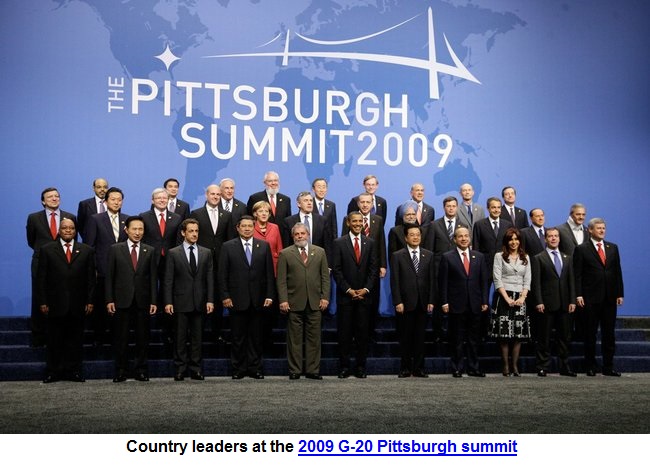
In November 2012, the SEC and regulators from Australia, Brazil, the European Union, Hong Kong, Japan, Ontario, Quebec, Singapore, and Switzerland met to discuss reforming the OTC derivatives market, as had been agreed by leaders at the 2009 G-20 Pittsburgh summit (see Photo) in September 2009.[54] In December 2012, they released a joint statement to the effect that they recognized that the market is a global one and “firmly support the adoption and enforcement of robust and consistent standards in and across jurisdictions”, with the goals of mitigating risk, improving transparency, protecting against market abuse, preventing regulatory gaps, reducing the potential for arbitrage opportunities, and fostering a level playing field for market participants.[54] They also agreed on the need to reduce regulatory uncertainty and provide market participants with sufficient clarity on laws and regulations by avoiding, to the extent possible, the application of conflicting rules to the same entities and transactions, and minimizing the application of inconsistent and duplicative rules.[54] At the same time, they noted that “complete harmonization – perfect alignment of rules across jurisdictions” would be difficult, because of jurisdictions’ differences in law, policy, markets, implementation timing, and legislative and regulatory processes.[54]
VIDEO: Leverage Explained – https://youtu.be/GESzfA9odgE When things turn out good, big risk means big return; but if it turns out bad, you lose everything and left with a debt.
Welcome to the fight Mr. Browne; welcome to the struggle to elevate Caribbean society.
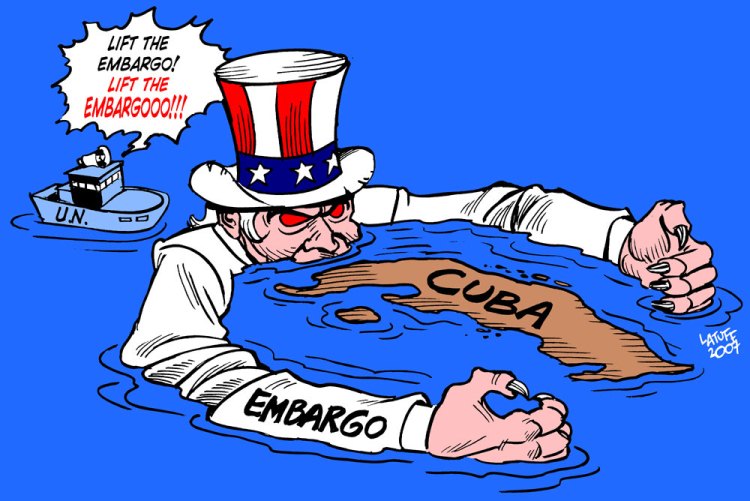
The publishers of the book Go Lean…Caribbean monitor the organizational developments of the Caribbean Community super-national organization. The Chairman position rotates among the Heads of Government for the 15 member-states. This year’s turn at the helm is Antigua & Barbuda; just in time after the June election of Gaston Browne as the new Prime Minister. This is a “baptism in fire” for Mr. Browne, as he is new in the leadership role for Antigua and also new for the CariCom. His latest regional salvo is a “shot across the bow” of American foreign policy, calling for the end of the US embargo on Cuba. See full article & VIDEO here:
HAVANA, Cuba — Chairman of the Caribbean Community (CARICOM) Gaston Browne, prime minister of Antigua and Barbuda called on the United States president and congress to end its “senseless embargo of Cuba now.”
Browne was speaking at the opening ceremony of the fifth CARICOM-Cuba Summit in Havana, Cuba, on Monday. He said that CARICOM’s solidarity with Cuba was manifested by the region’s repeated calls “in every council in every part of the world” for an end to the embargo.
The CARICOM chairman also took the opportunity to express profound appreciation to the host for its role in the fight against Ebola disease.
“Cuban doctors, nurses and technicians have not only put their lives at risk to save lives in West Africa; they have saved lives around the world by helping to contain and control the spread of Ebola. They deserve our deep respect, our great gratitude and our enduring thanks,” he stated.
The prime minister noted that trade between the two sides had grown but was mindful of the challenges that existed for its expansion. He referred to the work being done on a protocol to widen the existing trade and development agreement and stated he had no doubt that a mutually satisfactory result would be achieved.
Browne said a practical machinery had to be established to expand trade and investment.
“Central to such machinery is effective and affordable transportation for the movement of goods and people between our countries. In this connection, I call on this summit meeting to place high priority on creating mechanisms to move goods, services and passengers throughout our countries. I am convinced that if Cuba and CARICOM countries can jointly build a transportation network, all our economies will benefit,” he added.
He pointed to the advantages particularly in the field of tourism that such a network could bring.
“If Cuba and CARICOM countries can establish the air transportation links and a network of collaboration between our hotels, multi-destination tourism — that offers the distinctiveness of our culturally-rich countries — could be a winner for all of us,” he said.
The CARICOM chairman suggested that CARICOM and Cuba share their knowledge and experience in sports, particular athletics.
He joked that “if we teach Cubans to play cricket, we might produce a Caribbean cricket team that would restore West Indian cricket to the heights it once majestically enjoyed.”
Browne said that areas for co-operation between CARICOM and Cuba existed at a broad level and it was up to “us to be creative and ingenious in the ways in which we bolster each other.”
“On matters such as climate change and global warming; on financial services and the dictates of the countries of the Organization for Economic Cooperation and development; on the marginalization of our concerns by the G20, we should be coordinating our positions and acting in unison. We may not be able to stand-up to them alone, but they cannot ignore us if we stand-up together,” the prime minister said. Caribbean News Now – Regional News Source (Posted 12/11/2014) – http://www.caribbeannewsnow.com/headline-CARICOM-chair-calls-for-an-end-to-US-embargo-on-Cuba-23985.html
Published on May 20, 2014 – America’s long-standing trade embargo with Cuba is facing calls to be eased from an unlikely source. President Obama’s administration has relaxed some of its provisions but there are growing calls to lift it completely.
The “acting in unison” rallying cry from Mr. Browne aligns with the assertions of the Go Lean book, that the challenges the Caribbean face are too big for any one Caribbean member-state to tackle alone. Rather, shifting the responsibility to a region-wide, professionally-managed, deputized technocracy will result in greater production and greater accountability. This deputized agency is the Caribbean Union Trade Federation (CU). The Go Lean book is a roadmap for the introduction and implementation of the CU.
Though this CU effort shares some similar goals, there is no association of the Go Lean publishers to the CariCom. Instead, the Go Lean movement is external to CariCom. In fact, the book assesses that most of CariCom executions have failed – Pages 92, 167, 255 – and proposes the CU as the next step of integration evolution for the Caribbean region.
In addition to the book, the publishers have previously addressed CariCom’s efforts and mis-firings in the following Go Lean blogs entries:
The foregoing article stressed the potential for Caribbean elevation with the imminent re-integration of Cuba. The CariCom Chairman’s urging for the US to end the trade embargo is a great start – just talk – but the actions associated with Cuba’s full integration are weighty. The Go Lean book describes the heavy-lifting associated with this quest.
This book, Go Lean… Caribbean, details the step-by-step roadmap for elevating the entire Caribbean, including Cuba, into a confederation of 30 member-states of the region into a “single market”. Thusly, the prime directives of the CU are pronounced in these statements:
Optimization of the economic engines in order to grow the regional economy to $800 Billion & create 2.2 million new jobs.
Establishment of a security apparatus to protect the resultant economic engines.
Improve Caribbean governance to support these engines.
The Go Lean book details the series of community ethos, strategies, tactics, implementations and advocacies designed to re-boot and integrate Cuba in to an optimized Caribbean brotherhood:
Anecdote – Caribbean Single Market & Economy
Page 15
Community Ethos – Economic Systems Influence Individual Choices & Incentives
Page 21
Community Ethos – Job Multiplier
Page 22
Community Ethos – “Crap” Happens
Page 23
Community Ethos – Lean Operations
Page 24
Community Ethos – Cooperatives
Page 25
Community Ethos – Ways to Impact the Future
Page 26
Community Ethos – Ways to Manage Reconciliations
Page 34
Community Ethos – Ways to Impact the Greater Good
Page 37
Strategic – Vision – Integrated Region in a Single Market
Page 45
Strategic – Vision – Agents of Change
Page 57
Tactical – Confederating a Non-sovereign Union
Page 63
Tactical – Fostering a Technocracy
Page 64
Tactical – Growing to $800 Billion Regional Economy
Page 67
Tactical – Separation of Powers – Office of Trade Negotiations
Page 80
Tactical – Separation of Powers – Federal Courts – Truth & Reconciliation Commissions
Page 90
Anecdote – Turning Around CariCom
Page 92
Anecdote – “Lean” in Government
Page 93
Implementation – Assemble & Create Super-Regional Organs to represent all Caribbean
Page 96
Implementation – Ways to Pay for Change
Page 101
Implementation – Foreign Policy Initiatives at Start-up
Page 102
Implementation – Ways to Deliver
Page 109
Implementation – Reasons to Repatriate to the Caribbean
Page 118
Implementation – Ways to Benefit from Globalization
The foregoing news article and this commentary is not the first call for the re-instatement of Cuba – 55 years is long enough. In a recent blog about the Big 3 automakers of Detroit, reference was made to the expansion of auto assembly plants of General Motors and Ford Motors in global cities. Both companies now have installations in Vietnam, a country that fought a bloody unpopular war with the US 40 years ago; (65,000 American deaths). Cuba has never shed American blood, and yet their embargo persists – this defies logic. This is why these previous blogs posit that it is only a matter of (short) time for this change, and so the blogs/commentaries feature subjects on Cuba’s eventual integration into the Caribbean brotherhood. These are detailed here:
Many entities in the international community have heralded a normalization of Cuban-American relations; see foregoing VIDEO and Appendix below.
The book Go Lean … Caribbean recognizes the historicity of Cuba and the polarization of the Castro Brothers (Fidel & Raul). But now that the current President, Raul, has announced that he will retire/step-down in 2017, it is reasonable to expect that the long-awaited change is imminent for the Republic of Cuba.
The CU roadmap is especially inviting to the Cuban and Caribbean Diaspora; it presents a comprehensive plan (370 pages) for the contribution of their time, talents and treasuries in the repatriation to their homeland.
Now is the time for Caribbean stakeholders, the residents, Diaspora, trading partners and governing institutions, to lean-in for this regional re-boot plan. Now is the time to end the embargo, re-instate Cuba and make all of the Caribbean a better place to live, work and play. 🙂
Download Go Lean … Caribbean – now!
———-
Appendix: UN Blasts US Embargo of Cuba – http://youtu.be/S5sZ5ZBlv4M
Published on Nov 6, 2013 – The US embargo against Cuba is being criticized by the UN, who are taking issue with the 50 year old sanctions against the socialist island nation just 90 miles from Florida’s southern shore. On October 29th, [2013] the UN voted 188-2 for a resolution to end the embargo, which it said “…lacks every ethical or legal ground.” We discuss the vote on this Buzzsaw news clip with Tyrel Ventura and Tabetha Wallace.
Introducing a network without the “network”. This is espnW, the ESPN (see Appendix below) channel, without a channel, specifically catering to women’s sports; this network is delivered via the internet only.
Wow, how the world has changed.
So this commentary is a melding of ICT (Internet & Communications Technology), sports, television, gender equality and economics – this is a big deal for the Caribbean to consider.
espnW’s mission is to serve women as fans and athletes. espnW.com provides an engaging environment that offers total access to female athletes and the sports they play, takes fans inside the biggest events, and shares a unique point of view on the sports stories that matter most to women.
Founded in July, 2010, espnW lives across television, films, events, digital and social platforms. The annual espnW: Women + Sports Summit is the leading event of its kind in the sports industry. The Women’s Sports Foundation is a charity of choice for espnW. ESPN W. – About Us Page – Official Website (Retrieved December 7, 2014) – http://espn.go.com/espnw/v1/about
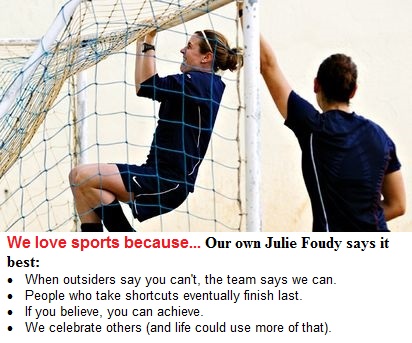
VIDEO: espnW at the 2012 Olympic Games – http://youtu.be/z7vGVQAatig Published on Aug 14, 2012 Alex Morgan sits down with Julie Foudy to talk about what it feels like to have her first Olympic gold
The Caribbean does not currently have an eco-system for sports business … for men nor women. There is no viable sporting enterprises, other than baseball development/winter leagues in Puerto Rico, Dominican Republic and Communist Cuba. There is absolutely no intercollegiate athletics arrangements. Only Amateur athletics abound in the region.
While so much of the sports business infrastructure is missing, the Caribbean is awash in the underlying assets: the athletes. The Caribbean supplies the world with the best-of-the-best in the sports genres of baseball, basketball, track-and-field, soccer-FIFA-football and other endeavors. This athletic supply applies equally to men and women.
The book Go Lean…Caribbean book serves as a roadmap for the introduction and implementation of the Caribbean Union Trade Federation (CU), a technocratic federal government to administer and optimize the economic/security/governing engines of the region’s 30 member-states. The roadmap recognizes and fosters the genius qualifiers of many Caribbean men and women. The goal now is to foster the local eco-system in the homeland so that those with talent would not have to flee the region to garner the business returns on their athletic investments.
This Go Lean economic empowerment roadmap strategizes to create a Single Media Market to leverage the value of broadcast rights for the entire region, utilizing all the advantages of cutting edge ICT offerings. The result: an audience of 42 million residents (plus 10 million Diaspora) across 30 member-states and 4 languages. ESPN and espnW provides a great role model for this execution, see Appendix below, facilitating television, cable, satellite and internet streaming wherever economically viable.
At the outset, the roadmap recognizes the value of sports, for all genders, in the roadmap with these statements in the Declaration of Interdependence (Page 13 & 14):
xxvi. Whereas the preparation of our labor force can foster opportunities and dictate economic progress for current and future generations, the Federation must ensure that educational and job training opportunities are fully optimized for all residents of all member-states, with no partiality towards any gender or ethnic group. The Federation must recognize and facilitate excellence in many different fields of endeavor, including sciences, languages, arts, music and sports. This responsibility should be executed without incurring the risks of further human flight, as has been the past history.
xxvii. Whereas the region has endured a spectator status during the Industrial Revolution, we cannot stand on the sidelines of this new economy, the Information Revolution. Rather, the Federation must embrace all the tenets of Internet Communications Technology (ICT) to serve as an equalizing element in competition with the rest of the world. The Federation must bridge the digital divide and promote the community ethos that research/development is valuable and must be promoted and incentivized for adoption.
xxviii. Whereas intellectual property can easily traverse national borders, the rights and privileges of intellectual property must be respected at home and abroad. The Federation must install protections to ensure that no abuse of these rights go with impunity, and to ensure that foreign authorities enforce the rights of the intellectual property registered in our region.
xxxi. Whereas sports have been a source of great pride for the Caribbean region, the economic returns from these ventures have not been evenly distributed as in other societies. The Federation must therefore facilitate the eco-systems and vertical industries of sports as a business, recreation, national pastime and even sports tourism – modeling the Olympics.
The Go Lean roadmap calls for the market organizations and community investments to garner economic benefits of sports and talented athletes, men and women. One of the biggest contribution the CU will make is the facilitation of sports venues: arenas and stadia. Sports can be big business (and great educational opportunities) for the athletes, promoters, vendors and landlords. Still, even fans get great benefits: image, national pride, and entertainment. (The E in ESPN means Entertainment). The eco-system of sports is therefore inclusive in the roadmap’s quest to make the Caribbean region a better place to live, work and play.
Now is the time for all of the Caribbean to lean-in to the following community ethos, strategies, tactics, implementations and advocacies detailed in the book Go Lean…Caribbean to deliver the solutions to elevate the Caribbean region through sports:
Community Ethos – People Respond to Incentives in Predictable Ways
Page 21
Community Ethos – Return on Investments
Page 24
Community Ethos – Ways to Foster Genius
Page 27
Community Ethos – Promote Intellectual Property
Page 29
Community Ethos – Ways to Promote Happiness
Page 36
Community Ethos – Ways to Impact the Greater Good
Page 37
Strategic – Vision – Consolidating the Region in to a Single Market
Page 45
Strategic – Staffing – Sporting Events at Fairgrounds
Page 55
Tactical – Fostering a Technocracy
Page 64
Tactical – Separation of Powers – Sports & Culture Administration
Page 81
Tactical – Separation of Powers – Fairgrounds Administration
Page 83
Implementation – Steps to Implement Self-Governing Entities (Fairgrounds)
Page 105
Implementation – Ways to Deliver
Page 109
Planning – 10 Big Ideas – #5 Four Languages in Unison / #8 Cyber Caribbean
Page 127
Planning – Ways to Make the Caribbean Better
Page 131
Advocacy – Ways to Grow the Economy
Page 151
Advocacy – Ways to Create Jobs
Page 152
Advocacy – Ways to Improve Education – Reduce Brain Drain
Page 159
Advocacy – Ways to Improve Local Government – Parks & Recreation
Page 169
Advocacy – Ways to Impact Events
Page 191
Advocacy – Ways to Promote Fairgrounds
Page 192
Advocacy – Ways to Foster Technology – Intellectual Property Protections
Page 197
Advocacy – Ways to Empower Women
Page 226
Advocacy – Ways to Impact Youth
Page 227
Advocacy – Ways to Improve Sports
Page 229
Advocacy – Ways to Impact Urban Living – Sports Leagues
Page 234
The book Go Lean…Caribbean, and aligning blog commentaries (highlighted throughout this page in bold), asserts that the region can be a better place to live, work and play; that the economy can be grown methodically by embracing progressive strategies in sports and sports broadcasting/streaming at all levels: professional, amateur and intercollegiate.
The Go Lean…Caribbean roadmap is bigger than just sports, its a concerted effort to elevate all of Caribbean society, for all genders: men and women. The CU is the vehicle for this goal, this is detailed by the following 3 prime directives:
Optimization of the economic engines in order to grow the regional economy to $800 Billion & create 2.2 million new jobs (21,000 direct jobs at fairgrounds and sport venues).
Establishment of a security apparatus to protect the resultant economic engines.
Improve Caribbean governance to support these engines.
This roadmap adheres to economic principles of supply-and-demand. Similar to the foregoing website on espnW, the roadmap looks for the opportunities to foster interest that may exist in specific endeavors, in this case women’s sports, and then explore the business opportunities around servicing that demand. This is not limited to the domestic Caribbean, but rather can refer to local interest in sports abroad and foreign interest in Caribbean sports and athletes.
This is heavy-lifting. This is the quest of Go Lean/CU, to do the heavy-lifting to make the Caribbean homeland a better place to live, work and play. 🙂
ESPN is a U.S.-based global cable and satellite television channel that is owned by ESPN Inc., a joint venture between The Walt Disney Company (which operates the network, through its 80% controlling ownership interest) and Hearst Corporation (which holds the remaining 20% interest). The channel focuses on sports-related programming including live and recorded event telecasts, sports news and talk shows, and other original programming.
ESPN broadcasts primarily from studio facilities located in Bristol, Connecticut. The network also operates offices in Miami, New York City, Seattle, Charlotte, and Los Angeles. While ESPN is one of the most successful sports networks, it has been subject to criticism, which includes accusations of biased coverage[1] (not showing enough hockey or Women’s athletics), conflict of interest, and controversies with individual broadcasters and analysts.
As of August 2013, ESPN is available to approximately 97,736,000 pay television households (85.58% of households with at least one television set) in the United States.[2] In addition to the flagship channel and its seven related channels in the United States, ESPN broadcasts in more than 200 countries,[3] operating regional channels in Australia, Brazil, Latin America and the United Kingdom, and owning a 20% interest in The Sports Network (TSN) as well as its five sister networks and NHL Network in Canada.
This is one of the year’s biggest economic stories; Gas Prices have dropped below $2.
The OnCue Drive Thru in Oklahoma sold gas for $1.99 a gallon Wednesday, a trend that many U.S. drivers are hoping will spread. – Published December 3rd 2014, 6:52 pm
It’s worth appreciating what’s going on here. The Power Player in this story is the Organization of the Petroleum Exporting Countries (better known as OPEC):
OPEC – a cartel of [12] oil producers that include Saudi Arabia, Iran, Iraq, and Venezuela – had a big meeting in Vienna on November 27. Before the gathering, there was speculation that OPEC countries might cut back on their own oil production in order to prop up prices. But in the end, the cartel couldn’t agree on how to respond and did nothing.
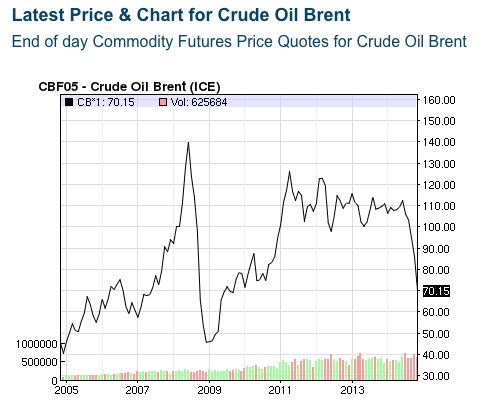
Oil prices promptly nosedived, with the price of Brent crude now hovering around $70 per barrel.
As recently as the summer, that price was over $100 per barrel.
…
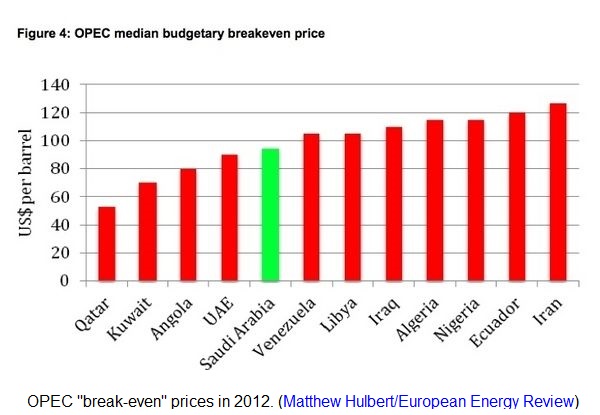
At this big meeting in Vienna, there was a lot of heated debate among OPEC members about how best to respond to this current drop in oil prices. Some countries, like Venezuela and Iran, wanted the cartel (mainly Saudi Arabia) to cut back on production in order to prop up the price of oil. The reason is that these countries need high prices in order to “break even” on their budgets and pay for all the government spending they’ve racked up:
OPEC is an international intergovernmental organization and economic cartel whose mission is to coordinate the policies of the oil-producing countries. This structure aligns with the book Go Lean… Caribbean, a roadmap for the introduction and implementation of the Caribbean Union Trade Federation (CU). This calls for the confederation, collaboration and convention of 30 member-states into one intergovernmental organization. The same as OPEC does for its 12 oil-producing nations – a proxy agency to represent all members – the CU seeks for the Caribbean region. But instead of elevating oil prices, the CU coalition has these 3 prime directives:
Optimization of the economic engines in order to grow the regional economy to $800 Billion & create 2.2 million new jobs.
Establishment of a security apparatus, including energy security, to protect the resultant economic engines.
Improve Caribbean governance to support these engines.
The goal of the CU is to optimize Caribbean society, allowing us to better compete globally and hopefully present more favorable options for our youth here in the homeland. (Previous generations sought refuge abroad).
The goal of OPEC is to secure a steady income to the member states and to collaborate in influencing world oil prices through economic means. Though this charter seems fairly benign, the reality of OPEC is vastly different; they have emerged as a monstrous entity! Autocratic leaders of OPEC countries – think Saddam Hussein – would constantly urge pushing world oil prices up; their claims were to help all OPEC members financially, but their motivation were purely nationalistic. The public view of OPEC now coincides with this dialogue from a movie, “art imitating life”:
“It can’t be bargained with, it can’t feel pain or mercy, and it will stop at absolutely nothing until you are dead!” – Movie dialogue from The Terminator (1984)
OPEC is not a monster, just protective of its own self-interest; many of their member-states feature a mono-industrial economy; it’s oil or bust! Plus, with 40 percent of global oil production, they do wield some power, influence and control of the eco-system of crude-oil pricing. But their power-influence-control is not absolute; there are always the laws of Economics!
Back to the foregoing article, the fact remains that oil prices were falling well before OPEC’s Friday announcement; this change was driven in large part by factors from Economics 101: less demand + higher supply = lower prices. In this case, economic slowdowns in much of the world have dampened demand, as supply has expanded considerably, especially within the U.S.
This premise directs the Energy Policy as communicated in the Go Lean book: the Caribbean region must lower crude oil demand.
This Go Lean/CU roadmap recognizes that modern life has expanded the definition of basic needs to now include food, clothing, shelter and energy. And thusly the book proposes many solutions for the region to optimize energy generation, distribution and consumption. No “stone is left unturned”. Go Lean posits that the average costs of energy can be decreased from an average of US$0.35/kWh to US$0.088/kWh in the course of the 5-year term of this roadmap. (Page 100).
Primary to this strategy of lowering the demand for crude oil is increasing options with alternative energy sources: natural gas, solar, wind and tidal. This will translate to more electric, hybrids, and fuel-efficient vehicles. The CU is a strong proponent of compressed-natural-gas vehicles (buses, trucks and passenger vehicles).
Lowering demand for energy works in lowering the costs.
In the US, the Obama administration’s improved fuel-efficiency standards have ultimately affected consumers, in that they are using less gas: “The sales-weighted fuel economy of vehicles in the U.S. increased from 20.8 miles per gallon in 2008 to 25.3 miles per gallon in 2014.” Other countries share the same experiences.
The Go Lean roadmap details a series of community ethos, strategies, tactics, implementations and advocacies to foster the progress in the wide fields of energy generation, distribution and consumption. The following list applies:
Community Ethos – Lean Operations
Page 24
Community Ethos – Return on Investments
Page 24
Community Ethos – Cooperatives
Page 25
Community Ethos – Regional Taxi Commissions
Page 25
Community Ethos – Non-Government Organizations
Page 25
Community Ethos – Ways to Impact the Future
Page 26
Community Ethos – Ways to Improve Negotiations
Page 32
Anecdote – Pipeline Transport – Strategies, Tactics & Implementations
Page 43
Strategy – Harness the power of the sun/winds
Page 46
Tactical – Fostering a Technocracy
Page 82
Tactical – Separation of Powers – Energy Commission
Page 82
Anecdote – “Lean” in Government – Energy Permits
Page 93
Anecdote – Caribbean Energy Grid Implementation
Page 100
Implementation – Ways to Develop Pipeline Industry
Page 107
Implementation – Ways to Improve Energy Usage
Page 113
Advocacy – Ways to Impact Public Works
Page 175
Advocacy – Ways to Foster Cooperatives
Page 176
Advocacy – Ways to Impact Monopolies
Page 202
Advocacy – Ways to Improve Transportation
Page 205
Advocacy – Ways to Develop the Auto Industry
Page 206
Appendix – North Dakota Oil Boom Economic-Societal Effects
Page 334
This commentary asserts that energy needs are undeniable; and that OPEC may or may not be classified as a “monster”. The main take-away though is that monitoring and mitigating the realities of the global energy eco-system is a necessary role, a heavy-lifting task for the lean, agile operations of the CU technocracy.
So the message to the Caribbean region is clear: Help is on the way – the Terminator can be defeated – “life imitating art”!
Now is the time for all of the Caribbean, the people, business, institutions and governments, to lean-in for the optimizations and opportunities described in the book Go Lean … Caribbean. 🙂
Caribbean stakeholders hereby comment on US President Barack Obama’s planned unilateral immigration reforms, and it’s not what you might naturally think:
We are hereby opposed!
Wait, wouldn’t a more liberal policy for Caribbean immigrants help our cause to improve the condition of many Caribbean families? “Yes” for the micro (individual), but “No” for the macro (community/country/region)!
Liberal US immigration practices are bad; they accentuate the “brain drain” for the Caribbean.
The focus in this discussion is on the STEM (Science, Technology, Engineering, and Mathematics) labor force. There is a demand for more workers with these qualifications; this demand is in the US and in the Caribbean. The US economy, and society, is more mature than all Caribbean countries; this makes it hard for Caribbean member-states to compete. And now…
… President Obama wants to extend invitations to STEM college students in the US to stay on in the US and NOT return to their home countries.
Say it ain’t so!
The publishers of the book Go Lean…Caribbean, which serves as a roadmap for elevating all 30 member-states of Caribbean society, calls for the need to fight the policy change that is depicted in this news article:
By: Noel Randewich and Roberta Rampton
SAN FRANCISCO/WASHINGTON (Reuters) – President Barack Obama plans to make life a little easier for some foreign tech workers, but Silicon Valley representatives are disappointed his immigration rule changes will not satisfy longstanding demands for more visas and faster green cards.
In a speech on Thursday, Obama outlined plans to use executive authority to help millions of undocumented people. He also announced minor adjustments to cut red tape for visa holders and their families, including letting spouses of certain H-1B visa holders get work permits.
“I will make it easier and faster for high-skilled immigrants, graduates and entrepreneurs to stay and contribute to our economy, as so many business leaders have proposed,” Obama said.
The president’s moves will make it easier for entrepreneurs to work in the United States and extend a program letting foreign students who graduate with advanced degrees from U.S. universities to work temporarily in the United States.
But tech industry insiders said the changes, while positive, were limited.
“This holiday season, the undocumented advocacy community got the equivalent of a new car, and the business community got a wine and cheese basket,” complained one lobbyist, speaking on condition of anonymity.
Instead of more temporary H-1B visas, which allow non-U.S. citizens with advanced skills and degrees in “specialty occupations” to work in the country for up to six years, the 200,000-member U.S. chapter of the Institute of Electrical and Electronics Engineers (see VIDEO below) was hoping for measures to reduce the backlog of H-1B holders awaiting green cards.
“If this is all there is, then the president has missed a real opportunity,” said Russ Harrison, a senior legislative representative at the IEEE. “He could have taken steps to make it easier for skilled immigrants to become Americans through the green card system, protecting foreign workers and Americans in the process.”
For instance, IEEE and technology companies want spouses and children to be excluded from employment-based green-card allotments, thereby increasing availability for other foreign tech workers seeking green cards.
Tech companies from Microsoft Corp to Intel have complained about being unable to find enough highly skilled employees and want Washington to increase the availability of visas for programmers, engineers and other specialized foreign professionals.
“Our focus really is on H-1B visas and trying to expand the number of talented technical professionals that can come to the U.S.,” Qualcomm CFO George Davis said ahead of Obama’s announcement. “The way the regulations are drafted today there’s a lot of room for improvement.”
Major changes would require Congressional action, however, and tech industry executives are worried that partisan rancor over Obama’s unilateral action could set back chances for legislation.
“I don’t view this as a long-term solution, and I hope it doesn’t get in the way of a long-term solution,” said Dave Goldberg, chief executive of SurveyMonkey, a Palo Alto based company.
The AFL-CIO said in a statement it would seek to ensure visa workers are afforded rights and protections.
“We are concerned by the President’s concession to corporate demands for even greater access to temporary visas that will allow the continued suppression of wages in the tech sector,” the labor giant said.
While limited, Obama’s policy changes, such as letting more spouses work, will help some tech workers and their families.
Gayathri Kumar, 29, moved a year ago from India to Phoenix, Arizona, where her husband works at Intel. She has a masters degree in communications and wants to work in television, but Kumar spends much of her day at home, chatting with friends over social media.
“I really want to work. I came here with a passion to work, not to sit at home,” Kumar said. “I’m bored, I’m becoming depressed.”
(Reporting by Noel Randewich in San Francisco and Roberta Rampton in Washington. Additional reporting by Sarah McBride in San Francisco.; Editing by Eric Effron, Tom Brown and Ken Wills)
For this issue, “the enemy of my enemy is my friend”.
Caribbean stakeholders need to align with the opposition of Obama’s immigration policy, the Republicans. (The publishers of the Go Lean book, SFE Foundation, represent an apolitical, religiously-neutral, economic-focused movement, initiated at the grass-root
level to bring permanent change back to the Caribbean homeland – no one Caribbean member-state is favored over another). We need to pursue our own self-interest.
The book Go Lean…Caribbean posits that the Caribbean brain drain is already acute, (reported at exceeding 70%), due to “push and pull” factors. Many Caribbean STEM students matriculate in American universities, so allowing more liberal recruiting of our students to remain in the US would increase the “pull” factor. We cannot compete against this added pressure.
Why would the students want to concede to this pressure? Unfortunately, we have a variety of “push” conditions working against the Caribbean counter-defense; we have deficiencies. We have economic, security and governing deficiencies that “push” the native Caribbean student/worker to consider expatriating to the US, or to Canada and many EU countries.
But the Caribbean has its own needs for the STEM work force, and our needs cannot be ignored. This is war; (a Trade War).
The Caribbean is losing … every battle. We must not help our enemy. The book Go Lean…Caribbean serves as a roadmap for the introduction and implementation of the technocratic Caribbean Union Trade Federation (CU). The roadmap contains our battle plans, strategies and tactics for this Trade War. The roadmap’s states the prime directives of the CU as the following 3 statements:
Optimization of the economic engines in order to grow the regional economy to $800 Billion & create 2.2 million new jobs.
Establishment of a security apparatus to protect the resultant economic engines.
Improve Caribbean governance to support these engines.
The book posits that all of the Caribbean is in crisis with this brain drain problem, and so there is an urgent need to retain our existing STEM talent, and recruit even more. This point is stressed early in the book (Page 13) in the following pronouncements in the Declaration of Interdependence:
xix. Whereas our legacy in recent times is one of societal abandonment, it is imperative that incentives and encouragement be put in place to first dissuade the human flight, and then entice and welcome the return of our Diaspora back to our shores. This repatriation should be effected with the appropriate guards so as not to imperil the lives and securities of the repatriated citizens or the communities they inhabit. The right of repatriation is to be extended to any natural born citizens despite any previous naturalization to foreign sovereignties.
xxi. Whereas the preparation of our labor force can foster opportunities and dictate economic progress for current and future generations, the Federation must ensure that educational and job training opportunities are fully optimized for all residents of all member-states, with no partiality towards any gender or ethnic group. The Federation must recognize and facilitate excellence in many different fields of endeavor, including sciences, languages, arts, music and sports. This responsibility should be executed without incurring the risks of further human flight, as has been the past history.
This subject of mitigating the brain drain and adopting empowering immigration policies have been frequent topics for these Go Lean blogs, highlighted here in the following sample:
Ailing Puerto Rico open to radical economic fixes – Need for Retention
As a counter-defense to the losing dispositions in the Caribbean Trade War with the US, the Go Lean book details a series of community ethos, strategies, tactics, implementations and advocacies to foster the best practices to incentivize STEM careers and mitigate further brain drain for the Caribbean region:
Community Ethos – Deferred Gratification
Page 21
Community Ethos – Economic Systems Influence Choices & Incentives
Page 21
Community Ethos – Job Multiplier
Page 22
Community Ethos – Anti-Bullying and Mitigation – neutralizing STEM as Nerds
Page 23
Community Ethos – Minority Equalization
Page 24
Community Ethos – Return on Investments
Page 24
Community Ethos – Ways to Impact the Future
Page 27
Community Ethos – Ways to Foster Genius
Page 26
Community Ethos – Ways to Help Entrepreneurship
Page 28
Community Ethos – Promote Intellectual Property
Page 29
Community Ethos – Ways to Impact Research & Development
Page 30
Community Ethos – Ways to Close the Digital Divide
Page 31
Community Ethos – Ways to Impact the Greater Good
Page 37
Anecdote – Valedictorian and Caribbean Diaspora Member
Page 38
Strategy – Customers – Citizens, Business Community & Diaspora
Page 47
Strategy – Meeting Region’s Needs Today, Preparing For Future
Page 58
Tactical – Separation of Powers – Patent, Standards, & Copyrights
Page 78
Tactical – Separation of Powers – Education Department
Page 85
Implementation – Assemble all Super-Regional Governing Entities
Page 96
Implementation – Trends in Implementing Data Centers
Advocacy – Ways to Impact Student Loans – Forgivable Provisions
Page 160
Advocacy – Ways to Foster Empowering Immigration – STEM Professionals
Page 174
Advocacy – Ways to Foster Technology
Page 197
Advocacy – Ways to Impact the Diaspora
Page 217
Appendix – Alternative Remittance Modes
Page 270
Now is the time for all of the Caribbean, the people and institutions, to lean-in for the elevations described in the book Go Lean … Caribbean. This means heavy-lifting to enhance the economic-security-governing engines to attract and retain our STEM graduates. We especially call on the Caribbean/Latin American chapters of the IEEE organization – depicted in the foregoing article and the VIDEO below – to join-in this empowerment effort. A CU mission aligns with this organization’s charter to promote STEM careers and developments in their members’ home regions. The Caribbean needs the regional delivery of this charter, and their lobbying efforts.
We must try and stop Obama’s unilateral policy reform; a liberal US immigration policy would accentuate the Caribbean brain drain.
The region needs the deliveries, described in the Go Lean roadmap. Otherwise, we have no hope to incite and retain our young people, especially those with STEM skill-sets. As a region, we would simply be condemned to a worsened future, simply “fattening frogs for snakes”. This Go Lean roadmap therefore is vital in the quest to make the Caribbean a better place to live, work and play. 🙂
Appendix – VIDEO: What is IEEE? – http://youtu.be/fcmCpEpg0lQ
This is a short video presenting the overall organization of IEEE. This video was developed and published during the celebrations of IEEE Day 2012.
The quest to elevate Caribbean society is a three-prong approach: economics, security and governance.
Economic optimizations are easiest to introduce; show up with investments (money) and jobs and almost any community will acquiesce. But to introduce empowerments for security and/or governing engines is more complicated, as changes in these categories normally require a political process; implying consensus-building and compromise. (Think: Iraq – “A military solution to a political problem?”; see Footnote 1)
This is what the book Go Lean…Caribbean calls “heavy-lifting”.
This Go Lean book posits that “bad actors” will always emerge in times of economic optimizations to exploit opportunities, with bad or evil intent. In support of this argument, the book relates a number of law-and-order episodes from world history: Pirates of the Caribbean (Page 181) and the Old American West (Page 142). In addition to the direct book references, there are a number previously published blogs/commentaries that covered subjects and dimensions for Caribbean justice institutions:
It is evident that justice is very important to this roadmap for societal elevation. We do not want to only react (after the fact) to episodes undermining public security or the integrity of law-and-order in the homeland. We want to have a constant sentinel. This will be accomplished with two regional agencies (defined later): Justice Department and Homeland Security Department.
The Caribbean governance structures were developed under the tutelage of 4 European legacies (British, Dutch, French, Spanish) and the United States of America (territories of Puerto Rico & US Virgin Islands and the dominant cultural influence in the region). We now have fitting role models of their societies for the management of justice institutions. This commentary urges their best-practices.
The Go Lean book serves as a roadmap for the introduction and implementation of the technocratic Caribbean Union Trade Federation (CU). Normally, when there are questions of integrity in the due-process in executive, legislative or judicial branches of government, the curative measure is a Special Prosecutor (American) or a Commission of Inquiry (European and United Nations).
As defined in the following encyclopedia source reference, these measures are normally reactive, but for the CU, the strategy is proactive…from Day One:
1. UNITED STATES
A Special Prosecutor generally is a lawyer from outside the government appointed by an Attorney General or, in the United States, by Congress to investigate a government official for misconduct while in office. A reasoning for such an appointment is that the governmental branch or agency may have political connections to those it might be asked to investigate. Inherently, this creates a conflict of interest and a solution is to have someone from outside the department lead the investigation. The term “Special Prosecutor” may have a variety of meanings from one country to the next, from one government branch to the next within the same country, and within different agencies within each government branch. Critics of the use of Special Prosecutors argue that these investigators act as a “fourth branch” to the government because they are not subject to limitations in spending or have deadlines to meet.
Federal government Attorneys in the United States may be appointed/hired particularly or employed generally by different branches of the government to investigate. When appointed/hired particularly by the judicial branch to investigate and, if justified, seek indictments in a particular judicial branch case, the attorney is called Special Prosecutor. When appointed/hired particularly by a governmental branch or agency to investigate alleged misconduct within that branch or agency, the attorney is called Independent Counsel.
State government Special Prosecutors may also be used in a state prosecution case when the prosecutor for the local jurisdiction has a conflict of interest in a case or otherwise may desire another attorney handle a case. Source: Wikipedia Online Encyclopedia (Retrieved November 17, 2014) – http://en.wikipedia.org/wiki/Special_prosecutor
2. BRITISH DOMINION
A Royal Commission is a major ad-hoc formal public inquiry into a defined issue in some monarchies. They have been held in the United Kingdom, Australia, Canada, New Zealand, Bahrain, Malaysia, Hong Kong and Saudi Arabia. A Royal Commission is similar in function to a Commission of Enquiry (or Inquiry) found in other countries such as Ireland, South Africa, and Hong Kong; (all examples here are from the British Dominion).
A Royal Commissioner has considerable powers, generally greater even than those of a judge but restricted to the Terms of Reference of the Commission. The Commission is created by the Head of State (the Sovereign, or his/her representative in the form of a Governor-General or Governor) on the advice of the Government and formally appointed by Letters Patent. In practice—unlike lesser forms of inquiry—once a Commission has started the government cannot stop it. Consequently governments are usually very careful about framing the Terms of Reference and generally include in them a date by which the commission must finish.
Royal Commissions are called to look into matters of great importance and usually controversy. These can be matters such as government structure, the treatment of minorities, events of considerable public concern or economic questions.
Many Royal Commissions last many years and, often, a different government is left to respond to the findings. In Australia—and particularly New South Wales—Royal Commissions have been investigations into police and government corruption and organised crime using the very broad coercive powers of the Royal Commissioner to defeat the protective systems that powerful, but corrupt, public officials had used to shield themselves from conventional investigation.
Royal Commissions usually involve research into an issue, consultations with experts both within and outside of government and public consultations as well. The Warrant may grant immense investigatory powers, including summoning witnesses under oath, offering of indemnities, seizing of documents and other evidence (sometimes including those normally protected, such as classified information), holding hearings in camera if necessary and—in a few cases—compelling all government officials to aid in the execution of the Commission.
The results of Royal Commissions are published in reports, often massive, of findings containing policy recommendations. These reports are often quite influential, with the government enacting some or all recommendations into law. Source: Wikipedia Online Encyclopedia (Retrieved November 17, 2014) – http://en.wikipedia.org/wiki/Royal_Commission
3. NETHERLANDS
Though never a member of British Dominion, the Kingdom of the Netherlands has a similar process. An example of a Commission of Inquiry in the Netherlands include this case study:
From mid-2010 to December 2011 the Commission of Inquiry carried out an independent study of the sexual abuse of minors in the Roman Catholic Church from 1945 to 2010.
The UN Security Council has established a wide-variety of Commissions to handle a variety of tasks related to the maintenance of international peace and security. Commissions have been created with different structures and a wide variety of mandates including investigation, mediation, or administering compensation. Below is a list of all commissions established by the Security Council, with a short description prepared on the basis of the Repertoire, as well as links to the sections covering them in the Repertoire (Public Relations Publication). They are organized by region, and then under relevant areas or sub-regions, placed chronologically starting with those established most recently:
For more information on the investigative and fact-finding powers of the Security Council, see this section on Article 34:
Article 34 – Investigation of disputes & fact-finding.
Article 34 of the UN Charter empowers the Security Council to investigate any dispute, or any situation that is likely to endanger international peace and security. The provision covers investigations and fact-finding missions mandated by the Security Council or by the Secretary-General to which the Council expressed its support or of which it took note. Furthermore, this section has also looked at instances in which Member-States demanded or suggested to the Council that an investigation be carried out or a fact-finding mission be dispatched.
b. UN Commission for Conventional Armaments
The Commission for Conventional Armaments was established on 13 February 1947 to formulate proposals for carrying out General Assembly resolution 41 (I) of 14 December 1946 concerning the general regulation and reduction of armaments. This was a standing Commission, but it was formally dissolved on 30 January 1952.
Normally a Special Prosecutor assignment has a limited time expiration. Also a Commission of Inquiry refers to individuals employed, during conciliation (Footnote 2), to investigate the facts of a particular dispute and to submit a report stating the facts and proposing terms for the resolution of the differences. Such a commission is one of many bodies available to governments to inquire/investigate into various issues. The commissions may report findings, give advice and make recommendations; and while their findings may not be legally binding, they can be highly influential.
The declared assignment documents for Special Prosecutors and/or Commissions of Inquiries are called “Warrants”.
The foregoing encyclopedic source explains that “Warrants” may grant immense investigatory powers, including summoning witnesses under oath, offering of indemnities, seizing of documents and other evidence, holding hearings, and compelling aid from government officials. This description provides the role-model for the CU‘s effort in justice and security. The Trade Federation will feature a federal Justice Department, with a separation-of-powers, a ‘Divide’, with the regional member-states. On the CU side of the ‘Divide’ is the jurisdiction for economic crimes, systemic threats, regional escalations and marshaling of any offenses on the federally-regulated grounds, Self-Governing Entities.
This separation-of-powers mandate also dictates that the CU‘s Homeland Security apparatus is the local manifestation of the United Nations Security (Peacekeeping) Forces , except for a regional scope only. This specific federal department will handle a variety of tasks related to the maintenance of regional peace and security.
The book Go Lean…Caribbean posits that the region must prepare its own security apparatus for its own security needs. So the vision is that all Caribbean member-states will authorize the CU as Special Prosecutors and Commissions of Inquiries. These warrants would legally authorize the regional “Justice Institutions”, covering law enforcement and regional defense, all encompassed in the book’s Homeland Security roadmap.
The CU would thusly be set to optimize Caribbean society through economic empowerment, and the aligning security dynamics. In fact, the Go Lean roadmap has 3 prime directives:
Optimization of the economic engines in order to grow the regional economy to $800 Billion & create 2.2 million new jobs.
Establishment of a security apparatus to protect the resultant economic engines.
Improve Caribbean governance to support these engines.
There is the need to ensure the economic engines in all 30 Caribbean member-states; plus extractions (mining, drilling) in the Exclusive Economic Zone (EEZ) of the Caribbean Sea. This point is pronounced early in the book with the Declaration of Interdependence (Page 12) that claims:
x. Whereas we are surrounded and allied to nations of larger proportions in land mass, populations, and treasuries, elements in their societies may have ill-intent in their pursuits, at the expense of the safety and security of our citizens. We must therefore appoint “new guards” to ensure our public safety and threats against our society, both domestic and foreign. The Federation must employ the latest advances and best practices … to assuage continuous threats against public safety.
xi. Whereas all men are entitled to the benefits of good governance in a free society, “new guards” must be enacted to dissuade the emergence of incompetence, corruption, nepotism and cronyism at the peril of the people’s best interest. The Federation must guarantee the executions of a social contract between government and the governed.
xii. Whereas the legacy in recent times in individual states may be that of ineffectual governance with no redress to higher authority, the accedence of this Federation will ensure accountability and escalation of the human and civil rights of the people for good governance, justice assurances, due process and the rule of law. As such, any threats of a “failed state” status for any member-state must enact emergency measures on behalf of the Federation to protect the human, civil and property rights of the citizens, residents, allies, trading partners, and visitors of the affected member-state and the Federation as a whole.
xvi. Whereas security of our homeland is inextricably linked to prosperity of the homeland, the economic and security interest of the region needs to be aligned under the same governance. Since economic crimes, including piracy and other forms of terrorism, can imperil the functioning of the wheels of commerce for all the citizenry, the accedence of this Federation must equip the security apparatus with the tools and techniques for predictive and proactive interdictions.
The treaty to establish the “new guards”, the Homeland Security Force and Federal Justice Department within the Caribbean Union Trade Federation gets legal authorization from the provisions of Special Prosecutors and Commissions of Inquiries, therefore enacting a Status of Forces Agreement with the initiation of the confederation. This elaborate process would be “Step One, Day One” in the Go Lean roadmap. The Go Lean book also details a series of community ethos, strategies, tactics, implementations and advocacies to provide increased public accountability and security in the Caribbean region:
Community Ethos – Economic Principle – Consequences of Choices Lie in Future
Page 21
Community Ethos – Security Principle – Privacy –vs- Public Protection
Page 23
Community Ethos – Security Principle – Whistleblower Protection
Page 23
Community Ethos – Security Principle – Witness Security & Protection
Page 23
Community Ethos – Security Principle – Anti-Bullying and Mitigation
Page 23
Community Ethos – Security Principle – Intelligence Gathering
Page 23
Community Ethos – Governing Principle – Minority Equalization
Page 24
Community Ethos – Governing Principle – Lean Operations
Page 24
Community Ethos – Governing Principle – Cooperatives
Page 25
Community Ethos – Ways to Manage Reconciliations
Page 34
Community Ethos – Ways to Improve Sharing
Page 35
Community Ethos – Ways to Impact the Greater Good
Page 37
Strategy – Vision – Trade Federation with Proxy Powers of a Confederacy
Page 45
Strategy – Mission – Defense Pact to Defend against Systemic Threats
Page 45
Strategy – Mission – Protect Stakeholders with Vigorous Law-and-Order measures
Page 45
Tactical – Confederating a Non-Sovereign Union
Page 63
Tactical – Fostering a Technocracy
Page 64
Tactical – Separation of Powers – Homeland Security
Page 75
Tactical – Separation of Powers – Justice Department – District Attorneys as Special Prosecutors
Page 77
Tactical – Separation of Powers – Justice Department – CariPol: Marshals & Investigations
Page 77
Tactical – Separation of Powers – Justice Department – Witness Protection
Page 77
Tactical – Separation of Powers – Trade Anti-Trust Regulatory Commission
Page 77
Implementation – Foreign Policy Initiatives at Start-up
Page 102
Implementation – Start-up Security Initiatives
Page 103
Implementation – Start-up Benefits from the EEZ – Security – Interdictions & Piracy
Page 104
Implementation – Steps to Implement Self-Governing Entities – Security and Justice
Page 105
Implementation – Ways to Foster International Aid – Military Aid
Page 115
Planning – Ways to Make the Caribbean Better – Safety Measures for the Rich and Poor
Page 131
Planning – Ways to Improve Failed-State Indices – Law Enforcement Oversight
Page 134
Planning – Lessons Learned from the West Indies (WI) Federation – Regiment on the Ready
Page 135
Planning – Lessons from the American West – Law & Order Needed Enforcements
Page 142
Advocacy – Ways to Grow the Economy
Page 151
Advocacy – Ways to Create Jobs
Page 152
Advocacy – Ways to Improve Governance
Page 168
Advocacy – Ways to Better Manage the Social Contract
Page 170
Advocacy – Ways to Improve Leadership
Page 171
Advocacy – Ways to Impact Justice
Page 177
Advocacy – Ways to Reduce Crime
Page 178
Advocacy – Ways to Improve Homeland Security
Page 180
Advocacy – Ways to Mitigate Terrorism
Page 181
Advocacy – Ways to Improve Intelligence Gathering & Analysis
Page 182
Advocacy – Ways to Protect Human Rights
Page 220
Appendix – Art of War Chapters – Chapter 7 – Engaging The Security Force
Page 327
Everyone in the Caribbean, the people and institutions, are hereby urged to lean-in to this Go Lean roadmap for elevation of Caribbean society. The roadmap calls for the heavy-lifting so that the justice institutions (permanent Special Prosecutors/Commissions of Inquiries) of the CU can execute their role in a just manner, thus impacting the Greater Good; see VIDEO below of South Africa’s example. This produces the output of a technocratic system bent on efficiency and effectiveness. In practice, this would mean accountability, transparency, and checks-and-balances in the execution of the rule-of-law.
This is the change for the Caribbean: elevated Public Safety, Law Enforcement and Homeland Security, all necessary to make the Caribbean a better place to live, work and play.
The Marikana Commission of Inquiry in South Africa has concluded its hearings after two years of attempting to establish what happened during the violent Wage Strike at Lonmin Platinum Mine in August 2012. 34 people were shot and killed in a confrontation with the police. 10 others including 2 police officers and 2 Mine Guards were also killed in the days preceding the August 16th tragedy.
The Washington, DC-based World Bank believes that Caribbean entrepreneurs can be funded by networking with the Caribbean Diaspora. This objective aligns with the book Go Lean… Caribbean which serves as a roadmap for the introduction and implementation of the technocratic Caribbean Union Trade Federation (CU) with the charter to facilitate entrepreneurship and job-creation in the region.
Early in the Go Lean book, the responsibility to attract investors and create jobs was identified as an important function for the CU with these pronouncements in the opening Declaration of Interdependence (Pages 13, 14):
xxiv. Whereas a free market economy can be induced and spurred for continuous progress, the Federation must install the controls to better manage aspects of the economy: jobs, inflation, savings rate, investments and other economic principles. Thereby attracting direct foreign investment because of the stability and vibrancy of our economy.
xxvi. Whereas the Caribbean region must have new jobs to empower the engines of the economy and create the income sources for prosperity, and encourage the next generation to forge their dreams right at home, the Federation must therefore foster the development of new industries… In addition, the Federation must invigorate the enterprises related to existing industries … – impacting the region with more jobs.
Before stating an opinion on the plausibility of the World Bank’s proposal, first consider the article, as follows:
Title: Caribbean entrepreneurs need to look to Diaspora for funding – World Bank Group Exec
BRIDGETOWN, Barbados — Caribbean entrepreneurs who are looking for funding to develop new or existing businesses are being encouraged to look to their own nationals living abroad.
“Diaspora financing should be explored as a source of funding for entrepreneurs”, said Aun Rahman, head of the infoDev Access to Finance Programme, at the World Bank Group.
Rahman was speaking on the topic “Access to Finance: Examining Non-Traditional Platforms for Funding”, during the final day of the Caribbean Exporters’ Colloquium 2014 in BridgetownBarbados today.
About 85 per cent of Caribbean people in the Diaspora have said they would “be interested in investing in business back home,” Rahman said adding that they are not only interested in their own countries – but those across the region.
But despite the high interest, Rahman said only a “very few” — about 13 per cent — have actually invested in the Caribbean. The Diaspora investors need a “trusted local partner,” he said.
Project co-ordinator for the Jamaica Venture Capital Programme at the Development Bank of Jamaica, Audrey Richards, also spoke on non-traditional investment sources.
“If we want to attract non-traditional finance, we need to start thinking in a non-traditional way,” she said.
“Say it ain’t so”. This assertion seems so out-of-touch. This plays into the fallacy that life is so much better outside the Caribbean, so that when a Caribbean resident emigrates and now lives in the US, Canada, or Europe that they thrive financially to the point that they have disposable income (beyond funding their own basic food-clothing-housing needs, plus support for their families left-behind) so as to be able to invest in entrepreneurs back in their ancestral homelands.
This is a distorted “view” from afar … as in Washington. This is not the true experience “on the ground”. (While a picture is worth a thousand words, it is no substitute to actually being “there”. A picture only describes the visual sense; there is so much more, there are the sounds, smells, touch and taste. All of that experience cannot be easily captured in words or pictures).
The book Go Lean…Caribbean, authored by Diaspora members, posits that while the Caribbean region is the greatest address in the world, (the tropical flora-fauna, islands landscapes-waterscapes, and Caribbean culture cannot be topped any where else on the planet), life “at home” is much harder than picturesque postcards depict. This is why residents leave in the first place, “push and pull factors”, and join the Diaspora.
The Caribbean does need help from the Diaspora to fulfill the Go Lean vision; we need their Time, Talent and Treasuries. But in truth, the Caribbean Diaspora does not thrive financially in their foreign abodes; not with the first generation. Economic studies indicate that only at the 2nd generation, do the immigrant’s legacies (next generation) start to prosper financially[a]. At that point, these are no longer Diaspora (Nationals of the Caribbean member-states); and may not feel any attachment to their ancestral homelands. This is not just a Caribbean issue; it has been proven with other Diaspora groups: Irish, Italian, Chinese, etc. Added to the reality is the fact that Diaspora/legacy members can easily participate in Wall Street; with such an investment/economic engine, local Caribbean options cannot compete. The foregoing article concedes as much:
“only a ‘very few’ – about 13 per cent — have actually invested in the Caribbean”
The Go Lean roadmap is therefore realistic! We are not expecting the Diaspora to be some panacea of Caribbean societal ills. Rather, as a region, we must do the heavy-lifting ourselves. This roadmap proffers a unified, consolidated Caribbean effort, engaging all stakeholders: residents, Diaspora, Direct Foreign Investors, passive investors, NGOs and even governmental agencies, domestic and foreign. “All hands on deck”!
The foregoing article also states that “if we want to attract non-traditional finance, we need to start thinking in a non-traditional way”. This is the siren call of the Go Lean book, to effectuate change in the region, allowing for the following 3 prime directives:
Optimization of the economic engines in order to grow the regional economy to $800 Billion GDP and create 2.2 million new jobs.
Establishment of a security apparatus to protect the resultant economic engines.
Improve Caribbean governance/administration/oversight to support these engines.
The Go Lean book/roadmap reflects the recommended “non-traditional thinking” to attract non-traditional funding for Caribbean empowerment and entrepreneurial endeavors:
The book advocates for incubators… helping/coaching entrepreneurs to put together proper business plans and structures…
The book advocates for cooperatives…
The book advocates for the full exploration and exploitation of social media, identifying www.myCarribbean.gov …
All these strategies allow for non-traditional funding methods such as crowdfunding[b] (already essentially practiced in the region as no-tech offerings: Asue, Partner, Asociacion); this is the practice of funding a project or venture by raising monetary contributions from a large number of people, typically via the internet.[1] One early-stage equity expert described crowdfunding as “the practice of raising funds from two or more people over the internet towards a common Service, Project, Product, Investment, Cause, and Experience or SPPICE.”[2]
(See crowdfunding definition/explanation in the below VIDEO in the Appendix).
The crowdfunding model is fueled by three types of actors:
the project initiator who proposes the idea and/or project to be funded;
individuals or groups who support the idea (inclusive of the Diaspora);
and a moderating organization (the “platform”, envisioned for the CU‘s www.myCarribbean.gov) that brings the parties together to launch the idea.[3]
This strategy has proven successful for many other endeavors. In 2013, the crowdfunding industry grew to over $5.1 billion worldwide;[4] (see Kickstarter Appendix below):
There are three primary types of crowdfunding:
Reward-based crowdfunding – entrepreneurs pre-sell a product or service to launch a business concept without incurring debt or sacrificing equity/shares. Reward-based crowdfunding has been used for a wide range of purposes, including motion picture promotion,[16] free software development, inventions development, scientific research,[17] and civic projects.[18] For a joint study between Toronto, Canada’s York University and Universite Lille Nord de France, in Lille, France, published on June 2, 2014, two types of reward-based crowdfunding were identified: “‘Keep-it-All’ (KIA) where the entrepreneurial firm sets a fundraising goal and keeps the entire amount raised regardless of whether or not they meet their goal, and ‘All-or-Nothing’ (AON) where the entrepreneurial firm sets a fundraising goal and keeps nothing unless the goal is achieved.”[19] The study’s researchers analyzed 22,875 crowdfunding campaigns, with targets of between US$5,000 and US$200,000, and concluded: “Overall, [all-or-nothing] fundraising campaigns involved substantially larger capital goals, and were much more likely to be successful at achieving their goals.” In its review of the study outcomes, the Inc.com publication explained that potential investors are more inclined to support “all-or-nothing strategy” initiatives, whereby a substandard product will not be released if the funding goal is not achieved. The Inc.com review concluded that “AON” campaign typically provide more detailed information on the campaign.[20]
Equity-based crowdfunding – the backer receives unlisted shares of a company, usually in its early stages, in exchange for the money pledged. The company’s success is determined by how successfully it can demonstrate its viability.[15] Equity-based crowdfunding is the collective effort of individuals to support efforts initiated by other people or organizations through the provision of finance in the form of equity.[21][22] In the United States, legislation that is mentioned in the 2012 JOBS Act will allow for a wider pool of small investors with fewer restrictions following the implementation of the act.[22]
Credit-based crowdfunding – In the U.S., credit-based crowdfunding from non-banks became more prominent as a form of crowdfunding in 2012, with the launch of the Lending Club, which had advanced more than US$500 million in loans via its website by April 2012. Prospective borrowers of the Lending Club first submit their requirements, and are then matched with pools of investors who are willing to accept the credit terms. Platforms such as the Lending Club gained popularity, as banks increased interest rates or reduced their level of lending activity. Another credit-based platform, Prosper.com, was established in 2006 and had funded nearly US$325 million in personal loans by April 2012.[23]
There are many dynamics of this nascent industry that must be considered and mastered if the Caribbean is to benefit from crowdfunding. Consider the following:
Crowdfunding applications – Crowdfunding is being experimented with as a funding mechanism for creative work such as blogging and journalism,[51] music, independent film,[52][53] (See KickStarter Appendix below) and for funding startup companies.[54][55][56][57] Community music labels are usually for-profit organizations where “fans assume the traditional financier role of a record label for artists they believe in by funding the recording process”.[58] A Financialist article published in mid-September 2013 stated that “the niche for crowdfunding exists in financing films with budgets in the [US]$1 to $10 million range” and crowdfunding campaigns are “much more likely to be successful if they tap into a significant pre-existing fan base and fulfill an existing gap in the market.”[60]
Philanthropy and civic projects – A variety of crowdfunding platforms have emerged to allow ordinary web users to support specific philanthropic projects without the need for large amounts of money.[18]
Real estate crowdfunding (and REITs) – Real estate crowdfunding is the online pooling of capital from investors to fund mortgages secured by real estate, such as “fix and flip” redevelopment of distressed or abandoned properties, and equity for commercial and residential projects, acquisition of pools of distressed mortgages, home buyer down payments and similar real estate related outlets. Investment, via specialized online platforms, is generally completed under Title II of the JOBS Act and is limited to accredited investors. The platforms offer low minimum investments, often $100 – $10,000.[63][64]
Intellectual property exposure – One of the challenges of posting new ideas on crowdfunding sites is there may be little or no intellectual property (IP) protection provided by the sites themselves. Once an idea is posted, it can be copied. As Slava Rubin, founder of IndieGoGo said: “We get asked that all the time, ‘How do you protect me from someone stealing my idea?’ We’re not liable for any of that stuff.”[65] Inventor advocates, such as Simon Brown, founder of the UK-based United Innovation Association, counsel that ideas can be protected on crowdfunding sites through early filing of patent applications, use of copyright and trademark protection as well as a new form of idea protection supported by the World Intellectual Property Organization called Creative Barcode.[66]
Innovative new platforms, such as RocketHub, have emerged that combine traditional funding for creative work with branded crowdsourcing – helping artists and entrepreneurs unite with brands “without the need for a middle man.”[61]
Global Giving allows individuals to browse through a selection of small projects proposed by nonprofit organizations worldwide, donating funds to projects of their choice.
Microcredit crowdfunding platforms such as Kiva (organization) and Wokai facilitate crowdfunding of loans managed by microcredit organizations in developing countries.
The US-based nonprofit Zidisha offers a new twist on these themes, applying a direct person-to-person lending model to microcredit lending for low-income small business owners in developing countries. Zidisha borrowers who pass a background check may post microloan applications directly on the Zidisha website, specifying proposed credit terms and interest rates. Individual web users in the US and Europe can lend as little as one US dollar, and Zidisha’s crowdfunding platform allows lenders and borrowers to engage in direct dialogue. Repaid principal and interest is returned to the lenders, who may withdraw the cash or use it to fund new loans.[62]
DonorsChoose.org, founded in 2000, allows public school teachers in the United States to request materials for their classrooms. Individuals can lend money to teacher-proposed projects, and the organization fulfills and delivers supplies to schools.
There are also a number of own-branded university crowdfunding websites, which enable students and staff to create projects and receive funding from alumni of the university or the general public. Several dedicated civic crowdfunding platforms have emerged in the US and the UK, some of which have led to the first direct involvement of governments in crowdfunding.
The Go Lean…Caribbean roadmap asserts that the adoption of new community ethos, plus the executions of the following strategies, tactics, implementations and advocacies will foster the “crowdfunding”/investment industry in the region:
Community Ethos – Deferred Gratification
Page 21
Economic Principles – People Choose because Resources are Limited
Page 21
Economic Principles – People Respond to Incentives
Page 21
Economic Principles – Economic Systems Influence Choices & Incentives
Page 21
Economic Principles – Consequences of Choices Lie in the Future
Page 21
Community Ethos – Job Multiplier
Page 22
Community Ethos – Lean Operations
Page 24
Community Ethos – Return on Investments (ROI)
Page 24
Community Ethos – Cooperatives
Page 25
Community Ethos – Ways to Impact the Future
Page 26
Community Ethos – Ways to Help Entrepreneurship
Page 28
Community Ethos – Ways to Promote Intellectual Property
Page 29
Community Ethos – Ways to Impact Research & Development (R&D)
Page 30
Community Ethos – Ways to Bridge the Digital Divide
Page 31
Community Ethos – Ways to Improve Sharing
Page 35
Community Ethos – Ways to Impact the Greater Good
Page 37
Strategy – Mission – Foster Local Economic Engines.
Page 45
Strategy – Customers of the CU – Diaspora – Incentivize Investments
Page 47
Tactical – Fostering a Technocracy
Page 64
Tactical – Tactics to Forge an $800 Billion Economy – High Multiplier Industries
Page 70
Tactical – Separation of Powers – Self-Governing Entities
Page 80
Implementation – Ways to Pay for Change – SGE Licenses
Page 101
Implementation – Steps to Implement Self-Governing Entities
Advocacy – Ways to Impact Wall Street – Adopt Advanced Products like REITs
Page 200
Advocacy – Ways to Impact Main Street
Page 201
Advocacy – Ways to Impact the Diaspora
Page 217
Appendix – Job Multipliers
Page 259
Under the Go Lean roadmap, there will be plenty of opportunities for entrepreneurial funding. The CU will solicit investors and foster entrepreneurism by featuring the structures of Self-Governing Entities (SGE); these are bordered grounds like high-tech R&D campuses, medical parks, and technology bases; but they will also include low-tech blue-collar activities like salvage yards and ship-breaking. The subjects of SGE’s, self-employment opportunities and entrepreneurial hustle has been directly addressed and further elaborated upon in these previous blog/commentaries:
No More! Change has come to the Caribbean. Starting first with the CU leadership – “thinking in a non-traditional way”.
The roadmap anticipates 150 million unique subscribers on www.myCarribbean.gov. This technocratic approach is more viable, more engaging than simply throwing our hopes over some wall to the far-flung Diaspora.
We must stop the floodgates of the debilitating brain-drain now and encourage our youth to seek a future in their homeland. While, we are at it, we must also encourage the far-flung Diaspora to repatriate back to the Caribbean.
This plan identified in the Go Lean book and blog/commentaries is a good start to create the missing opportunities for the region. The end result of this roadmap is a clearly defined destination: a better place to live, work and play. 🙂
What is Crowdfunding? Crowdfunding planning? What, How, Why and When? One platform’s view:
Appendix B – Kickstarter Campaigns
On April 17, 2014, the UK-based Guardian media outlet published a list of “20 of the most significant projects” launched on the Kickstarter platform prior to the date of publication:
Musician Amanda Palmer raised US$1.2 million from 24,883 backers in June 2012 to make a new album and art book.[40]
American Hans Fex raised US$1,226,811 from 5,030 backers in March 2014 for his “MiniMuseum” project that he describes on his Kickstarter page: “For the past 35 years I have collected amazing specimens … I then carefully break those specimens down into smaller pieces, embed them in acrylic … Each mini museum is a handcrafted, individually numbered limited edition … The majority of these specimens were acquired directly from contacting specialists recommended to me by museum curators, research scientists and university historians”.[41]
Writer Rob Thomas raised $5.7 million from 91,585 backers in April 2013 to create a feature film version of the defunct television series Veronica Mars. The nine award levels were initially available to backers in 21 countries, including Brazil, Canada, Finland and Germany. Lead actress Kristen Bell explained on the launch date of the project: “I promise if we hit our goal, we will make the sleuthiest, snarkiest, it’s-all-fun-and-games-‘til-one-of-you-gets-my-foot-up-your-ass movie we possibly can.”[42]
Actor, writer and director Zach Braff raised US$3.1 million from 46,520 backers in May 2013 to create the feature film Wish I Was Here, which premiered at the Sundance Film Festival. Braff’s campaign was financially complemented by Worldview Entertainment.
Filmmaker Spike Lee raised US$1.4 million from 6,421 backers in August 2013 to make a feature film that, as of April 2014, is not titled. The film will feature actors Stephen Tyrone Williams, Zaraah Abrahams and Michael K. Williams.
YouTube celebrity Freddie Wong, who owns the company RocketJump, raised US$808,000 to produce the second series of the Web-based series Video Game High School. In February 2013, 10,613 backers committed funds to the project following the series’ first season, which was also funded on Kickstarter.
Performance artist Marina Abramovic raised US$661,000 from 4,765 backers in August 2013 after paying US$950,000 to buy a building that would house the “Marina Abramovic Institute”. The building, as well as a corresponding organization, was foremost to the campaign, as Abramovic seeks to feature and maintain “long durational work, including that of performance art, dance, theatre, film, music, opera, and other forms that may develop in the future”.
The Kano technology company raised US$1.5 million from 13,387 backers in December 2013 to create a “computer and coding kit for all ages.” In June 2014, Kano will ship a case, a keyboard, a speaker, a wireless server, and software that encourages children to learn the “Kano Blocks” coding language, a set of computer programming skills.
The Flint and Tinder company raised US$1.1 million from 9,226 backers in April 2013 for its “10-Year Hoodie” hooded sweatshirt that consists of 100%cotton and is made in the U.S. The company explains on its website: “Companies have systematically lowered your expectations to the point where it’s hard to know what to expect anymore. But while they’re busy off-shoring, out-sourcing and generally making things as cheaply and quickly as possible. It ends here.” According to Flint and Tinder, one million units of the product have been sold.[43][44]
Caribbean Rum, a product from island sugar cane, is among the best in the world.
This is a familiar focus of the Go Lean…Caribbean, movement, the book and accompanying blogs feature this and another Caribbean specialty agriculture: the best cigars in the world. The book posits that specialty agriculture is a core competence of the region (Page 58). This is part-and-parcel of the introduction and implementation of the technocratic Caribbean Union Trade Federation (CU).
With that branding of “Trade Federation”, obviously there is an emphasis on Trade activities.
With that branding of “Union”, obviously there is an emphasis on collective bargaining.
Mastery of these activities is what the following news article calls for:
THERE has been yet another call for rum-producing nations in the Caribbean to come together and confront the issues of subsidies which are affecting rum exports from this region to the United States.
Douglas Henderson, Executive Manager, Regional Sales and Marketing for Angostura, a leading rum producer in Trinidad and Tobago, said there has to be a collaborative effort to deal with the situation.
“Therefore, the challenge that we have is that in a lot of cases the Caribbean producers are having difficulties coming together to fight,” he told The Barbados Advocate.
The official pointed out that he is aware that some efforts were made to have the matter dealt with at the World Trade Organisation (WTO), in addition to the fact that both Barbados and Trinidad and Tobago are both trying to make inroads in having the subsidies removed.
“But until that happens, no company can stand still and wait. So we have to look to develop our business and do what we can,” he remarked.
Henderson was recently in Barbados where he participated in the launch of a range of Angostura Rums to the Barbados market. The launch was a co-operative effort between Angostura and Massy Distribution.
The USA is providing the subsidies to multinational spirits companies operating in the United States Virgin Islands and in Puerto Rico. Caribbean governments and producers who are members of the West Indies Rum and Spirit Producers Association (WIRSPA) have dubbed the subsidies inconsistent with trade rules of the WTO.
Just recently, the Barbados Ambassador to the United States, John Beale, issued a similar call for Barbados and the Caribbean producers to mount a campaign against the subsidies. He said that as a result of them, Barbados’ rum exports to the USA had declined by more than 20 per cent so far in 2014. Rum accounted for over $80 million in foreign exchange inflows into Barbados last year.
“Every Caribbean rum producer is affected by the subsidy and it is going to place those countries – US territories – at an advantage over us,” Henderson said.
He explained, “The USA market remains a huge market for any Caribbean producer of rum. Rums are growing in the USA and again when you come into the market and your price point is at a level that the majority of the market would choose not to try it, what you have to invest in advertising is so significant.”
The Angostura official further noted that every rum producer in the world is happy to compete on a level playing field. However, according to him, “a subsidy does not provide a level playing field, that’s where the concern is”, he added. The Barbados Advocate – Daily Newspaper Online Site – (Posted 8/20/2014;retrieved 11/10/2014) – http://www.barbadosadvocate.com/newsitem.asp?more=business&NewsID=38272
The Go Lean book explained that the proper management of trade can increase wealth. The book relates the following on Page 21:
Voluntary Trade Creates Wealth: People specialize in the production of certain goods and services because they expect to gain from it. People trade what they produce with other people when they think they can gain something from the exchange. Some benefits of voluntary trade include higher standards of living and broader choices of goods and services.
The foregoing article alludes that the Caribbean member-states can do better in managing their trade negotiations (with the US regarding subsidies) with more efficient collective bargaining. This commentary asserts that it is a preferred option for the member-states to delegate this negotiation responsibility to the CU rather than going at it alone. The Go Lean book serves as a roadmap to empower the region’s trade engines. This effort is dubbed Trade SHIELD and defined in great details in the book. The acronym refers to:
All in all, this roadmap calls for more than just negotiations (inclusive under the Strategic functionality). The Go Lean roadmap calls for confederating 30 member-states of the Caribbean (including the US territories of Puerto Rico and the Virgin Islands – also rum-producing economies – think Bacardi*), despite their language and legacy, into an integrated Single Market. The resulting entity will increase trade with the US and with the rest of the world, increasing the economy (GDP) from $378 Billion (2010) to $800 Billion. This growth is based on new jobs, industrial output and lean operational efficiency.
Size does matter! The traditional rum-producing countries (Barbados, Guyana, Jamaica, Martinique, Trinidad, etc.) are considered Small Island Developing States. The CU on the other hand represents the Single Market of 42 million people, in which “the whole is worth more than the sum of its parts“. In addition, the SHIELD principles specify Logistics and Delivery functions in facilitating the Trade objectives. This is a microcosm of how the CU roadmap will impact all of Caribbean society. The 3 prime directives of the CU are listed as:
Optimization of the economic engines so as to grow the regional economy to $800 Billion and create 2.2 million new jobs.
Establishment of a security apparatus (with persecutory powers for economic crimes) so as to mitigate the eventual emergence of “bad actors”.
Improve Caribbean governance.
The roadmap creates some new Delivery options for Caribbean specialty agriculture (i.e. rum and cigars), namely electronic commerce and social media. Imagine subscribers on the myCaribbean.gov Marketplace or Facebook easily ordering auto-fill monthly shipments of the best products the Caribbean have to offer. The CU intends to trade with the 80 million annual visitors and 10 million Diaspora.
This export trade allows for the preservation of Caribbean heritage.
Facilitating Caribbean trade is a strong theme for the Go Lean… Caribbean book and a frequent topic for these Go Lean blogs. These points of trade against the back-drop of Caribbean economy, security and governance were detailed in these previous blogs/commentaries:
eMerge Conference Aims to Jump-start Miami Tech Hub in Exploiting Latin America Trade
The foregoing news article relates that the US is the culprit for the unlevel “playing field” for rum import-export trade activities in the region. The Go Lean movement posits that despite the reassuring words, the US is not assuming exemplary leadership for Caribbean empowerment – due to its own self-interest – that instead the region must “stand up” for its own self-determination.
This is not independence, this is interdependence! This point was echoed in the following blog commentaries:
10 Things We Don’t Want from the US – American Self-Interest Policies
The CU roadmap works to drive the needed change among the economic, security and governing engines to guide the Caribbean member-states to the destination of elevated societies. This change is based on new community ethos, strategies, tactics, implementations and advocates; sampled as follows:
Declaration of Interdependence
Page 10
Community Ethos – Deferred Gratification
Page 21
Community Ethos – Economic Principles – Voluntary Trade Creates Wealth
Page 21
Community Ethos – Job Multiplier
Page 22
Community Ethos – Security Principles
Page 22
Community Ethos – Governing Principles
Page 24
Community Ethos – Lean Operations – GPO’s
Page 24
Community Ethos – Cooperatives
Page 25
Community Ethos – Ways to Improve Negotiations
Page 32
Strategy – Vision – Integrating Region in to a Single Market
Implementation – Ways to Optimize Mail Service & myCaribbean.gov Marketplace
Page 108
Implementation – Ways to Impact Social Media
Page 111
Implementation – Ways to Benefit from Globalization
Page 119
Planning – Ways to Improve Trade – GPO’s
Page 128
Planning – Ways to Improve Interstate Commerce
Page 129
Advocacy – Ways to Grow the Economy
Page 151
Advocacy – Ways to Create Jobs
Page 152
Advocacy – Ways to Better Manage Foreign Exchange – Caribbean Dollar realities
Page 154
Advocacy – Ways to Improve Governance
Page 168
Advocacy – Ways to Foster Cooperatives
Page 176
Advocacy – Ways to Foster e-Commerce
Page 198
Advocacy – Ways to Preserve Caribbean Heritage
Page 218
Advocacy – Ways to Impact US Territories
Page 244
Appendix – Trade SHIELD Principles
Page 264
Trade is very much critical to the strategies to grow the regional economy. Increased trade will undoubtedly mean increased job opportunities. The CU/Go Lean plan is to foster and incubate key industries, such as rum industry, for this goal. One of the biggest rum producers in the Caribbean, Bacardi, originated in Cuba but have since located distillery plants in Puerto Rico, Bahamas and Mexico. They have endured and persevered despite much opposition. They are proud of their survival, depicting it in TV advertisements; see the following:
Discover how the Bacardí family had the irrepressible spirit to overcome fire, earthquakes, prohibition, revolution and exile — none of which could defeat their spirit, because True Passion Can’t Be Tamed. Find out more about the Bacardí family story at www.bacardi.com
The rest of the Caribbean’s rum producers must also endure dire obstacles, and can now do so because there is help. This Go Lean roadmap proposes a new model, that of the Trade Federation, an entity to do the heavy-lifting of elevating the Caribbean economy, security and governing engines.
For the Caribbean, the status quo cannot continue – the region is already mature as a great place to “play”: tourism, carnivals/fiestas/parties, great rum and great cigars – “all play and no work”. But now, it is time for the region, the people and institutions, to lean-in to this roadmap for change, to make the Caribbean a better place to live, work and play.
 “I write the songs that make the whole world sing; I write the songs of love and special things; I write the songs that make the young girls cry; … I am music and I write the songs”. – Barry Manilow (see Appendix A below).