This blog from July 15, 2014 – Lebronomy – Economic Impact of the Return of the NBA Great – is hereby re-distributed in honor of … the Championship; Cleveland Cavaliers won over Golden State Warriors 93 to 89 in the decisive Game 7 of the 2016 NBA Finals. See here:
It took 52 years and enough heartbreak to fill an encyclopedia, and Finals MVP LeBron James has given his hometown a championship with the most improbable comeback in NBA Finals history. – ESPN’s SportsCenter – June 19, 2016
Go Lean Commentary
The commentaries of the Go Lean…Caribbean blogs have often addressed sports issues. But mostly from the point-of-view as the business of sports, and its impact on the communities’ economic engines.
This commentary continues that pattern, plus it couples one more assignment: Mea Culpa.
We were wrong! The publishers of the Go Lean book (dated November 2013) included an anecdote on the Miami Heat (Page 42), stressing the “Not one, not two, not three, not four…” quotation from superstar free agent LeBron James when he joined the team in 2010. The Mea Culpa, (Latin verbiage for “My Bad”), obviously applies in that, there would only be 2 championships. Everything else of that anecdote applies, but a technocratic approach, different than previous Caribbean administrations, requires that we learn lessons from successes and failures. Already this commentary has congratulated the 2014 winner of the NBA Finals, San Antonio Spurs, who went on to beat the Miami Heat; as follows:
St Croix’s Tim Duncan to Return to Spurs For Another Season
What are the lessons that we learn from our failure to prognosticate the winning basketball team? Number one: Don’t bet!
The Bible words are correct: “Time and unforeseen occurrences befall us all” (Ecclesiastes 9:11). That’s what we got wrong, but what we got right is so much more impactful, the economic impact of sports on the local community:
By: ABC News
Title: Lebronomy: Economic Impact of the Return of NBA Great LeBron James
A ticket to the Cleveland Cavalier’s season opener used to go for $40, now goes for as much as $600.
This discussion of sports and the basketball team in Cleveland is not just academic. Community pride, jobs, and the growth of the regional economy is involved; the foregoing VIDEO summarized that LeBron James’ absence was worth $50 million a season for this metropolitan area. This point aligns with the objections of the book Go Lean…Caribbean. This book serves as a roadmap for the introduction and implementation of the technocratic Caribbean Union Trade Federation (CU). This effort harnessed the individual abilities so as to elevate the athletes (micro) and also economic impact for their related communities (macros). Modern sports cannot be analyzed without considering the impact on “dollars and cents” for the community. In his essay to the people of Cleveland, announcing his return, after taking his talents to South Beach, this was the exact point LeBron James made:
“My relationship with Northeast Ohio is bigger than basketball. I didn’t realize that four years ago. I do now.”
“Before anyone ever cared where I would play basketball, I was a kid from Northeast Ohio. It’s where I walked,” James told SI (Sports Illustrated). “It’s where I ran. It’s where I cried. It’s where I bled. It holds a special place in my heart. People there have seen me grow up. I sometimes feel like I’m their son. Their passion can be overwhelming. But it drives me.
“I want to give them hope when I can. I want to inspire them when I can.”
(http://www.journalgazette.net/article/20140711/SPORTS20/140719891/-1/sports12)
These words in this eloquently written essay could have been concurred by so many of the Caribbean Diaspora that had taken their talents to “South Beach, South Toronto or South London”. The economic impact of their absence has been duly noted in research and analysis and the conclusion is bad:
Caribbean loses over 70% of tertiary educated citizens to the brain drain
The Go Lean roadmap attempts to impact change in the region, by elevating Caribbean society. The CU, using all the economic benefit that can be derived from sports in the region, will pursue a charter that is bigger than basketball, football, baseball or any other sport. Rather the CU will employ strategies, tactics and implementations to impact its prime directives; identified with the following 3 statements:
Optimization of the economic engines in order to grow the regional economy to $800 Billion & create 2.2 million new jobs.
Establishment of a security apparatus to protect the resultant economic engines.
Improve Caribbean governance to support these engines.
The Go Lean book identified this vision early in the book (Page 13 & 14) in the following pronouncements in the Declaration of Interdependence:
xix. Whereas our legacy in recent times is one of societal abandonment, it is imperative that incentives and encouragement be put in place to first dissuade the human flight, and then entice and welcome the return of our Diaspora back to our shores…
xxi. Whereas the preparation of our labor force can foster opportunities and dictate economic progress for current and future generations, the Federation must ensure that educational and job training opportunities are fully optimized for all residents of all member-states, with no partiality towards any gender or ethnic group. The Federation must recognize and facilitate excellence in many different fields of endeavor, including sciences, languages, arts, music and sports. This responsibility should be executed without incurring the risks of further human flight, as has been the past history.
xxxi. Whereas sports have been a source of great pride for the Caribbean region, the economic returns from these ventures have not been evenly distributed as in other societies. The Federation must therefore facilitate the eco-systems and vertical industries of sports as a business, recreation, national pastime and even sports tourism – modeling the Olympics.
Now is the time for all of the Caribbean to lean-in to the following community ethos, strategies, tactics, implementations and advocacies detailed in the book Go Lean … Caribbean to foster the elevation and industrialization of sports in the Caribbean region:
Community Ethos – People Respond to Incentives in Predictable Ways
Page 21
Community Ethos – Return on Investments
Page 24
Community Ethos – Ways to Foster Genius
Page 27
Community Ethos – Ways to Promote Happiness
Page 36
Community Ethos – Ways to Impact the Greater Good
Page 37
Strategic – Vision – Integrating Region in to a Single Market
Page 45
Strategic – Staffing – Sporting Events at Fairgrounds
Page 55
Tactical – Fostering a Technocracy
Page 64
Tactical – Separation of Powers – Sports & Culture Administration
Page 81
Tactical – Separation of Powers – Fairgrounds Administration
Page 83
Implementation – Steps to Implement Self-Governing Entities (Fairgrounds)
Page 105
Implementation – Ways to Deliver
Page 109
Planning – 10 Big Ideas for the Caribbean Region
Page 127
Planning – Ways to Make the Caribbean Better
Page 131
Advocacy – Ways to Grow the Economy
Page 151
Advocacy – Ways to Create Jobs
Page 152
Advocacy – Ways to Improve Local Government – Parks & Recreation
Page 169
Advocacy – Ways to Impact Events
Page 191
Advocacy – Ways to Promote Fairgrounds
Page 192
Advocacy – Ways to Foster Technology Expositions
Page 197
Advocacy – Ways to Improve Sports
Page 229
Advocacy – Ways to Impact Urban Living – Sports Leagues
Page 234
Now is the time for all of the Caribbean, the people and governing institutions, to lean-in for the empowerments described in the book Go Lean…Caribbean. This is a big deal for regional sports. This book provides the turn-by-turn directions for how to get from Point A, where we can only hope and dream about foreign sports stars, to Point B, where we can finally celebrate our own sports stars.
UPDATED August 29, 2020 – Uber Technologies Inc. continues to change the Old World [economy] to a new world [economy]. This car-sharing service has already rankled taxi-limo companies and cabbies across the world, and now they are setting their sights on other industries.
They have dubbed this advance into diverse businesses as UberEverything. See the detailed news story / product announcement here of this launch in Africa, published by Quartz Africa – see Appendix:
Title: Uber Africa will diversify beyond car rides this year with its ‘Everything’ service By: Yomi Kazeem
Having nearly perfected the business of moving people around on the continent, Uber is set to diversify the core of its business in sub Saharan Africa with the introduction of UberEverything, a division of the company with ambitious plans to plug its existing drivers network into the on-demand economy and provide services such as product and food delivery and courier services.
“The first market will probably be South Africa and we are pushing to make that happen before the end of the year,” said Alon Lits, Uber’s general manager for sub-Saharan Africa.
‘Everything’ is Uber’s strategy to build on its logistics infrastructure in the cities it operates. Once the company is at scale in a city with ride passengers it can develop other services such as UberRush, a personal courier service or food delivery with UberEats,(available in San Francisco, Los Angeles, Chicago and New York) . “Everything we’re building is on top of a platform that already exists,” Jason Droege, head of the UberEverything division, told the Los Angeles Times last month.
With the rising popularity and adoption of e-commerce shopping and on-demand services among a growing African middle-class who live on-the-go and increasingly value convenience, UberEverything could be a hit.
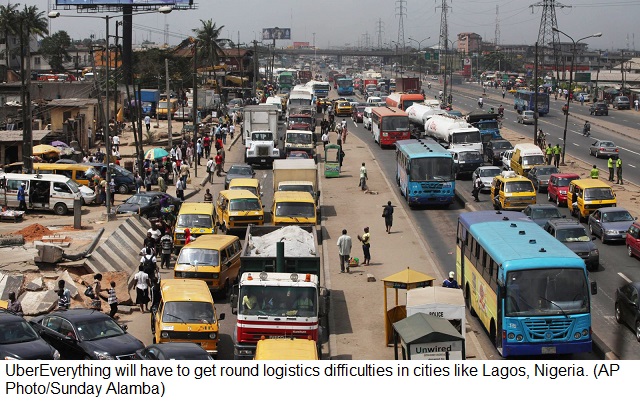
Logistics have been a big challenge for e-commerce companies in African larger cities, some of which have poor road networks and other infrastructure challenges. Major local players like Konga in Nigeria and African Internet Group’s Jumia and sister company Hellofood have had to invest heavily in developing their own logistics platform to get round the weak local infrastructure.
“If things go well in South Africa, there’s no reason why we won’t bring UberEverything to more markets.” One of such markets will likely be Lagos, which Lits says Uber remains “bullish” about despite Nigeria’s struggling economy. Home to 20 million people, Lagos’ infamous traffic jams and haphazard address system make it difficult—and expensive—for delivery services to operate but could represent a big opportunity for UberEverything’s goal of providing efficient logistics using its existing drivers network.
Aided by its recent $3.5 billion funding—its single biggest investment ever— from Saudi Arabia’s Public Investment Fund, Uber expanded to Kampala and Accra in the last week and Lits says a launch in Dar es Salaam is imminent. This follows plans to spend $250 million on growing its market across North Africa and the Middle East.
But Uber’s operations in Africa have not been without hitches. In Cairo and Nairobi, Uber drivers have been targets of protests and, in some cases, violent attacks. In South Africa, the company was forced to provide drivers with emergency numbers and also partner with a local private security firm.
In a previous blog on Uber, the Go Lean commentary identified how evolutionary changes in technology and modernization affects Old World taxi businesses. Now we see how evolution is changing all businesses … everywhere.
The challenge with technology, for the taxi cab industry and many other areas of life, is one-step forward-two steps-backwards. This point aligns with the book Go Lean…Caribbean which anticipates the compelling issues associated with Internet & Communications Technologies (ICT) and their effect on traditional commerce. The book prepares the Caribbean region to move to the intersection of opportunity and preparation. The book serves asa roadmap for the introduction and implementation of the technocratic Caribbean Union Trade Federation (CU). This roadmap accepts the tenets of ICT, that it can serve as an equalizer between big countries and small countries, or big companies and small companies. So opportunities will come to the Caribbean region as a result of the advances in technology. How will the region prepare?
First, the book asserts that before the strategies, tactics and implementations of the Go Lean roadmap can be deployed, the affected communities must first embrace a progressive community ethos. The book defines this “community ethos” as the fundamental character or spirit of a culture; the underlying sentiment that informs the beliefs, customs, or practices of society; dominant assumptions of a people or period.
The Go Lean book stresses that the current community ethos must change and the best way to motivate people to adapt their values and priorities is in response to a crisis. The roadmap recognizes this fact with the pronouncement that the Caribbean is in crisis, and that “a crisis is a terrible thing to waste”. This ethos corresponds with the UberEverything motives. In a lot of urban communities around the world, Caribbean included, traffic is crisis-worthy. According to the foregoing article, this reality is creating business opportunities around the logistics of Uber.
The Go Lean roadmap avails these opportunities, by strategizing logistics with a regional focus. The roadmap for Caribbean logistics is also our means for delivering the mail; this is the vision for the Caribbean Postal Union (CPU). The focus of the CPU is not just postal mail, but rather all the lean technocratic activities that make up logistics. Mail requires logistics, but logistics means so much more than just mail. So we would want to model successful enterprises in this industry space, like Uber. (The Go Lean book considers the postal operation of the US Postal Service – Page 99 – and rules it null-and-void for transforming e-Commerce). Other successful enterprises that provide good examples of lean technocratic efficiency include Amazon and Alibaba.
Modeling UberEverything, the Go Lean/CU roadmap will directly employ technologically innovative products and services to impact its own prime directives, identified with the following 3 statements:
Optimization of the economic engines in order to grow the regional economy to $800 Billion & create 2.2 million new jobs.
Establishment of a security apparatus to protect the resultant economic engines.
Improve Caribbean governance to support these engines.
The Uber model helps the CPU impact the economic, security and governing engines, like job creation. In the previous 2014 blog relating Uber, it was disclosed that Uber is responsible for 20,000 new jobs per month. The median income for drivers using the UberX platform, Uber’s low-cost service, is $90,000 per year in New York and more than $74,000 in San Francisco, the company said. How is this possible to make so much more money than traditional driving professionals? Uber is a sophisticated business model; one thing is Uber fully applies the laws of economics – supply and demand. Note the explanation in the VIDEO here:
Professor Wolters Published on Nov 20, 2019 – Ever wonder how Uber and other ride sharing firms calculate their prices? Or maybe how prices are made for airlines? Well to understand the pricing you need to understand what is called Dynamic Pricing, which is constantly moving prices.
This model is a good starting point for elevating the Caribbean. But this is heavy-lifting; notice in the foregoing article regarding the complex issues associated with Uber in terms of security and taxi-limo licensing (governance). The Go Lean roadmap conveys that heavy-lifting of logistical details are more of an investment. The community will enjoy the returns, with the optimized commerce deliveries.
The Go Lean roadmap seeks to change the entire eco-system of Caribbean logistics and resulting commerce – the interaction with postal operations. This vision is defined early in the book (Page 12 & 14) in the following pronouncements in the opening Declaration of Interdependence:
xv. Whereas the business of the Federation and the commercial interest in the region cannot prosper without an efficient facilitation of postal services, the Caribbean Union must allow for the integration of the existing mail operations of the governments of the member-states into a consolidated Caribbean Postal Union, allowing for the adoption of best practices and technical advances to deliver foreign/domestic mail in the region.
xxvii. Whereas the region has endured a spectator status during the Industrial Revolution, we cannot stand on the sidelines of this new economy, the Information Revolution. Rather, the Federation must embrace all the tenets of Internet Communications Technology (ICT) to serve as an equalizing element in competition with the rest of the world. The Federation must bridge the digital divide and promote the community ethos that research/development is valuable and must be promoted and incentivized for adoption.
The Go Lean book details a series of community ethos, strategies, tactics, implementations and advocacies to foster the best practices for the logistics of the CPU and trade marketplaces in the Caribbean region:
Community Ethos – Deferred Gratification
Page 21
Community Ethos – Economic Principles – All Choices Involve Costs
Page 21
Community Ethos – Economic Principles – People Respond to Incentives
Page 21
Community Ethos – Economic Principles – Economic Systems Influence Choices
Page 21
Community Ethos – Economic Principles – Voluntary Trade Creates Wealth
Page 21
Community Ethos – Economic Principles – The Consequence of Choice Lie in Future
Page 21
Community Ethos – Job Multiplier
Page 22
Community Ethos – Lean Operations
Page 24
Community Ethos – Return on Investments – ROI
Page 24
Community Ethos – Cooperatives
Page 25
Community Ethos – Ways to Impact the Future
Page 26
Community Ethos – Ways to Help Entrepreneurship
Page 28
Community Ethos – Promote Intellectual Property
Page 29
Community Ethos – Ways to Bridge the Digital Divide
Page 31
Strategy – Customers – Citizens and Member-states Governmental
Page 47
Tactical – Fostering a Technocracy
Page 64
Tactical – How to Grow the Economy to $800 Billion – Trade and Globalization
Page 70
Tactical – Separation of Powers – Postal Services
Page 78
Tactical – Separation of Powers – Interstate Commerce Administration
Page 79
Implementation – Year 1 / Assemble Phase – Establish CPU
Page 96
Implementation – Anecdote – Mail Services – USPS Dilemma
Page 99
Implementation – Ways to Pay for Change – Group Purchase Organizations (GPO)
Page 101
Implementation – Ways to Optimize Mail Service & myCaribbean.gov Marketplace
Page 108
Implementation – Ways to Deliver
Page 109
Implementation – Ways to Impact Social Media
Page 111
Implementation – Ways to Benefit from Globalization
Page 119
Planning – 10 Big Ideas for the Caribbean – # 8 Cyber-Caribbean
Page 127
Planning – Ways to Improve Trade – GPO’s
Page 128
Planning – Ways to Improve Interstate Commerce
Page 129
Advocacy – Ways to Grow the Economy
Page 151
Advocacy – Ways to Create Jobs
Page 152
Advocacy – Ways to Mitigate Black Markets
Page 165
Advocacy – Ways to Manage the Federal Civil Service
Page 173
Advocacy – Ways to Foster Cooperatives
Page 176
Advocacy – Ways to Foster Technology
Page 197
Advocacy – Ways to Foster e-Commerce
Page 198
Advocacy – Reforms for Banking Regulations
Page 199
Advocacy – Ways to Impact Main Street
Page 201
Advocacy – Ways to Improve Transportation – Union Atlantic Turnpike
Page 205
Appendix – Network of Ferries – Model of Marine Highway System
Page 280
Issues related to the CPU business model have previously been detailed in these Go Lean commentaries, listed here:
The foregoing article describes Uber’s activities in Africa. The Caribbean is now ready, willing and able …
The Go Lean roadmap posits that the CU will incubate the e-Commerce industry, forge entrepreneurial incentives and facilitate the regional logistics so that innovations can thrive. As related in the foregoing article about impact in other regions, these efforts can elevate the economy, security and governing engines of a community.
The world is continuing to change; and ‘change’ is bringing great new opportunities.
We need to be prepared. This is the intersection – change and opportunity – that we need to position ourselves at. Then, only then will success is within reach. We can make the Caribbean, a better place to live, work and play. 🙂
Quartz is a digitally native news outlet, born in 2012, for business people in the new global economy. We publish bracingly creative and intelligent journalism with a broad worldview …
Quartz is owned by Atlantic Media Co., the publisher of The Atlantic, National Journal, and Government Executive.
This is an ENCORE presentation of a previous blog-commentary from June 15, 2014, commemorating the College World Series in Omaha, Nebraska USA. This commentary is being re-distributed for the 2016 tournament (June 18 – 28/29). The following 8 teams were successful and rewarded for their achievement to this pinnacle of their sport:
The original blog is re-presented here as follows:
============
Go Lean Commentary
The sports world is all abuzz this weekend: World Cup in Brazil, NBA Finals, US Open Golf tournament, and the NCAA College World Series (CWS) baseball championship tournament.
History happens here!
This last event, CWS, is the subject of this blog, a milestone, the 100th in the series promoting the book Go Lean…Caribbean. This book serves as a roadmap for the introduction and implementation of the technocratic Caribbean Union Trade Federation (CU). While the CU is NOT a sports promotion entity, it does present an important role for sports in the vision to make the Caribbean a better place to live, work and play. As an expression of this vision Page 81 states:
“a mission of the CU is to forge industries and economic drivers around the individual and group activities of sports and culture”.
The Go Lean vision is a confederation of the 30 member-states of the Caribbean forming a proxy organization to do the heavy-lighting of building, funding and maintaining sports venues. The strategy is for the CU to be the landlord, and super-regional regulatory agency, for sports leagues, federations and associations (amateur, collegiate, and professional). This strategy relates to the College World Series model. The CWS tournament opened this weekend (June 14/15) in Omaha, Nebraska USA; this is the 65th straight tournament in the same city. This is an anomaly for American sports, as every year most big sporting events (Super Bowl, US Open Golf, NCAA Final Four, BCS Football Championship) rotate/move to different cities. Consider 2014 thus far:
Sport
2014 Host
2013 Host
2012 Host
Super Bowl
New York City
New Orleans, Louisiana
Indianapolis, Indiana
US Open Golf
Pinehurst, North Carolina
Ardmore (Philadelphia), Pennsylvania
San Francisco, California
NCAA Basketball Final Four
Dallas, Texas
Atlanta, Georgia
New Orleans, Louisiana
BCS College Football
Pasadena, California
Miami, Florida
New Orleans, Louisiana
But since 1950, the 12-day College World Series, college baseball championship, has been held in the City of Omaha. It was held at Rosenblatt Stadium from 1950 through 2010; starting in 2011, it has been moved to the new ultra-modern TD Ameritrade Park downtown. The 2013 attendance of 341,483 belies the economic benefits.
These facts reinforce the marketing tag line of CWS Omaha, Inc., (a Nebraska technocracy):
History Happens Here.
The prime directives of the CU/Go Lean roadmap are described with these 3 statements:
Optimization of the economic engines in order to grow the regional economy to $800 Billion & create 2.2 million new jobs.
Establishment of a security apparatus to protect the resultant economic engines.
Improve Caribbean governance to support these engines.
This roadmap commences with the recognition that genius qualifiers can be found in many fields of endeavor, including sports. The roadmap pronounces the need for the region to confederate in order to invest in the facilitations for the Caribbean sports genius to soar. These pronouncements are made in the Declaration of Interdependence, (Pages 13 & 14) as follows:
xxi. Whereas the preparation of our labor force can foster opportunities and dictate economic progress for current and future generations, the Federation must ensure that educational and job training opportunities are fully optimized for all residents of all member-states, with no partiality towards any gender or ethnic group. The Federation must recognize and facilitate excellence in many different fields of endeavor, including … sports. This responsibility should be executed without incurring the risks of further human flight, as has been the past history.
xxii. Whereas sports have been a source of great pride for the Caribbean region, the economic returns from these ventures have not been evenly distributed as in other societies. The Federation must therefore facilitate the eco-systems and vertical industries of sports as a business, recreation, national pastime and even sports tourism – modeling the Olympics.
All in all, the Go Lean book and accompanying blogs declare that the Caribbean needs to learn lessons from CWS-Omaha and other sporting venues/administrations. And thus this subject of the “business of sports” is a familiar topic for Go Lean blogs. The previous blogs as follows, and this one, constitutes 8 of the first 100 entries:
This Go Lean roadmap is committed to availing the economic opportunities of all the Caribbean athletic abilities. The book details these series of community ethos, strategies, tactics, implementations and advocacies designed to deliver regional solutions:
Community Ethos – Return on Investments
Page 24
Community Ethos – Ways to Foster Genius
Page 27
Community Ethos – Ways to Impact the Greater Good
Page 37
Strategic – Staffing – Sporting Events at Fairgrounds
Page 55
Tactical – Fostering a Technocracy
Page 64
Tactical – Separation of Powers – Sports & Culture Administration
Page 81
Tactical – Separation of Powers – Fairgrounds Administration
Page 83
Implementation – Steps to Implement Self-Governing Entities
Page 105
Implementation – Ways to Deliver
Page 109
Planning – Ways to Make the Caribbean Better
Page 131
Advocacy – Ways to Grow the Economy
Page 151
Advocacy – Ways to Improve Local Government – Parks & Recreation
Page 169
Advocacy – Ways to Impact Events
Page 191
Advocacy – Ways to Promote Fairgrounds
Page 192
Advocacy – Ways to Improve Sports
Page 229
Advocacy – Ways to Impact Urban Living – Sports Leagues
Page 234
The Go Lean roadmap encourages solid business plans to develop sports stadia and arenas at CU-owned fairgrounds. Where appropriate, there should be the deployment of temporary bleacher seats/grandstands and structures (think: golf tournaments and Beach Volleyball). There is an obvious economic impact from deployments of Sports Tourism in areas like jobs, ticket sales, hotel bookings and other community spin-off spending.
The following 8 teams in this year’s tournament are indicative of the need for hospitality as they are from cities all around the country:
UC Irvine
Texas Tech
Texas
TCU
Louisville
Ole Miss
Vanderbilt
Virginia
There are obvious community benefits from this business model. In fact, the Go Lean roadmap anticipates 21,000 direct jobs at fairgrounds and sports enterprises throughout the region. This is not bad for lessons learned from the College World Series in Omaha.
Now is the time for all of the Caribbean, the people and governing institutions, to lean-in for the empowerments of the Caribbean Union Trade Federation, as prescribed by the Go Lean…Caribbean roadmap.
Small and medium-sized firms constitute the economic landscape of Caribbean life. They must be cuddled; it is what it is!
The purpose of the book Go Lean … Caribbean is to elevate the economic engines in the region, to make the Caribbean a better place to live, work and play. The book serves as a 5 year roadmap to foster new empowerments and economic opportunities for the region, with the goal of creating 2.2 million new jobs. To be successful, we must focus on the landscape – and realities – of small businesses, considering that they may constitute 95 percent of the business community.
In previous blogs-commentaries, the reality of BIG businesses are fully explored: the good, the bad and the ugly:
This commentary stresses jobs and entrepreneurship, features of the prime directives described in the Go Lean book. The book serves as a roadmap for the introduction and implementation of the technocratic Caribbean Union Trade Federation (CU) with the charter to facilitate jobs. These prime directives are defined by these 3 statements:
Optimization of the economic engines in order to grow the regional economy to $800 Billion in GDP and create 2.2 million new jobs.
Establishment of a security apparatus to protect the resultant economic engines.
Improvement of Caribbean governance to support these engines.
How can small businesses fit in this mission? How can small enterprises succeed and compete against BIG multi-national corporations? Can they succeed? Yes, they can!
So says one of the largest banks in the US, Bank of America. They have provided a proven formula for small businesses to succeed … in competition with the rest of the world. Consider their details here:
Title:How Local Economies Benefit From Small Businesses Posted by: Touchpoint in General Business on May 5, 2016
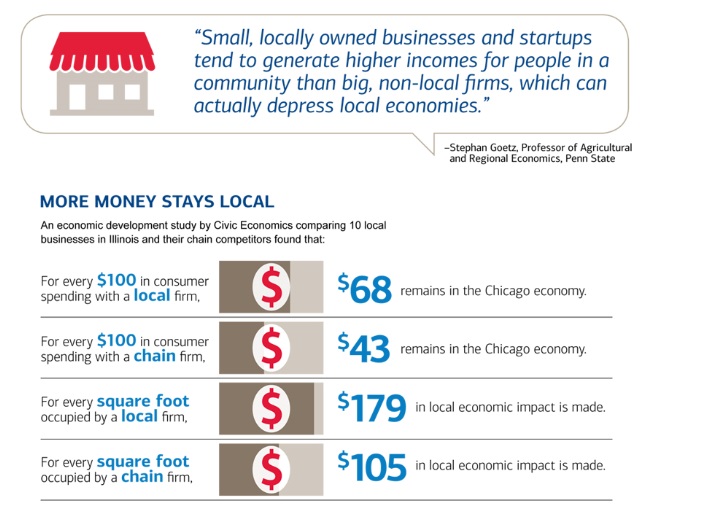
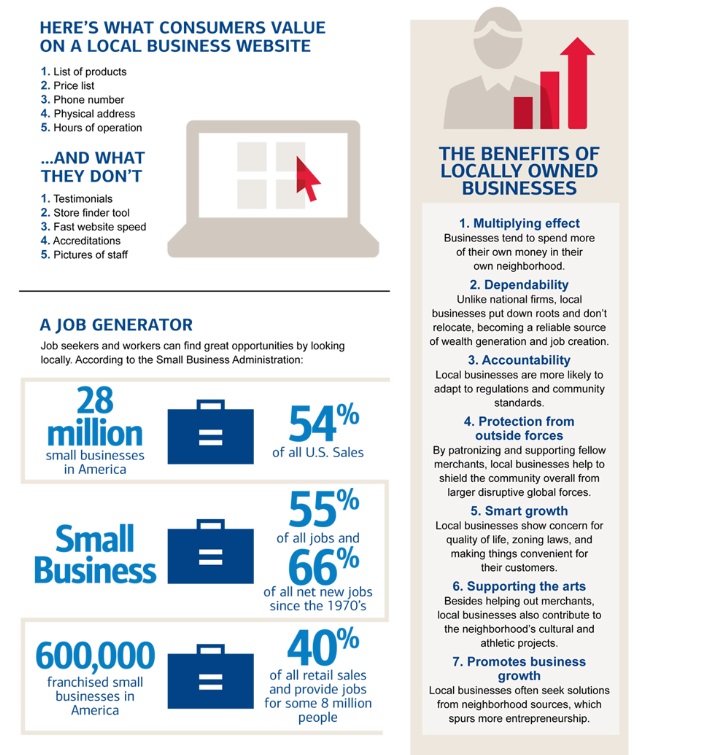
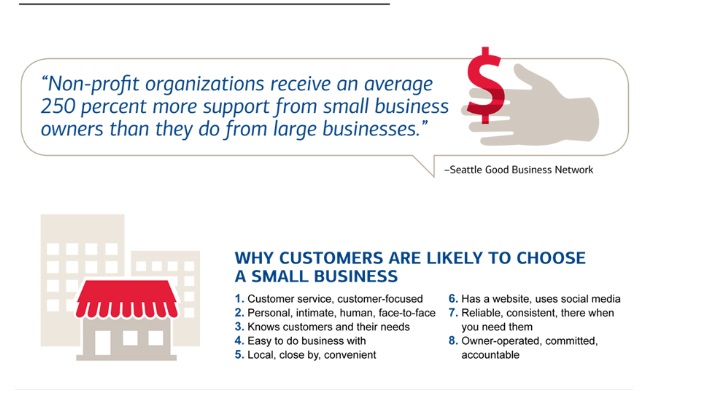
Studies show that when consumers spend money at a small business, their purchases have a ripple effect that spreads through the local economy. Big box or national chain stores might appear to make a bigger impact, but downtown merchants anchored in the community often provide more benefits overall. From keeping more money in the community to providing competitive deals, local economies thrive when neighborhood businesses are supported.
It is important to note that the quest to “cuddle” small businesses likely do not involve Crony-Capitalism, as small enterprises do not wield much power. (Collectively, as in the Chamber of Commerce, the influence peddling may be more impactful).
So how can small businesses fit in with the prime directives to elevate Caribbean society?
The Go Lean roadmap anticipates the job multiplier effect. It is necessary to confederate the 30 member-states of the Caribbean region to optimize the local economic engines. This means enhancing existing industries like tourism, offshore banking, specialty agriculture; plus also creating new industries for the region like Automotive manufacturing, Ship-building, “Pre-Fab” Housing and Frozen Foods. These activities are designed to create 461,900 new jobs. The remaining of the 2.2 million jobs – 1,732,125 – are created as a result the job multiplier effect; (in which every direct job can indirectly impact multiple jobs in the economy). This is where the reality of small businesses fit into the mission to elevate the Caribbean.
According to the opening quote, 95% of the new companies will be small or medium-sized firms – with 50 or fewer employees. This is the source for the majority of new jobs.
But with the reality of the BIG multi-national corporations, how can small enterprises compete and succeed against them?
Efficiency and effectiveness is the key to “leveling the playing-field”. One leveling strategy is the use of technology. This does not mean that small businesses must buy-own the technology. No, not, in this year of 2016! It is only necessary to use the technology, other people’s technology. See this VIDEO from the same Bank of America for their offering of Account Management services, in conjunction with specialized software from Intuit’s QuickBooks®; (who partners with over 18,000 banks):
Published on Dec 15, 2015 – With Account Management from Bank of America you’ll get more control over your small business banking accounts plus seamless integration with QuickBooks®.
According to this VIDEO from Bank of America, there are obvious back-office enhancements for online banking systems; (other banks provide similar solutions). It is the full expectation that local Caribbean banks will launch similar products. This is a mission of the Go Lean roadmap; to provide greater stewardship (“new guards”) – setting the bar higher – for the regional banks and business communities. The roadmap commences with a Declaration of Interdependence, pronouncing the need for regional integration (Page 11 – 14) and a new technology eco-system to foster a better economic future. The declarative statements are as follows:
xi. Whereas all men are entitled to the benefits of good governance in a free society, “new guards” must be enacted to dissuade the emergence of incompetence, corruption, nepotism and cronyism at the peril of the people’s best interest. The Federation must guarantee the executions of a social contract between government and the governed.
xxi. Whereas the preparation of our labor force can foster opportunities and dictate economic progress for current and future generations, the Federation must ensure that educational and job training opportunities are fully optimized for all residents of all member-states, with no partiality towards any gender or ethnic group. The Federation must recognize and facilitate excellence in many different fields of endeavor, including sciences, languages, arts, music and sports. This responsibility should be executed without incurring the risks of further human flight, as has been the past history.
xxiv. Whereas a free market economy can be induced and spurred for continuous progress, the Federation must install the controls to better manage aspects of the economy: jobs, inflation, savings rate, investments and other economic principles. Thereby attracting direct foreign investment because of the stability and vibrancy of our economy.
xxv. Whereas the legacy of international democracies had been imperiled due to a global financial crisis, the structure of the Federation must allow for financial stability and assurance of the Federation’s institutions. …
xxvi. Whereas the Caribbean region must have new jobs to empower the engines of the economy and create the income sources for prosperity, and encourage the next generation to forge their dreams right at home, the Federation must therefore foster the development of new industries… In addition, the Federation must invigorate the enterprises related to existing industries … – impacting the region with more jobs.
xxvii. Whereas the region has endured a spectator status during the Industrial Revolution, we cannot stand on the sidelines of this new economy, the Information Revolution. Rather, the Federation must embrace all the tenets of Internet Communications Technology (ICT) to serve as an equalizing element in competition with the rest of the world. The Federation must bridge the digital divide and promote the community ethos that research/development is valuable and must be promoted and incentivized for adoption.
Change has now come to the Caribbean. In a previous blog-commentary it was explained that the driver of this change is technology and globalization. The Caribbean region cannot only consume the innovations being developed around the world to support small businesses; we must develop and innovate ourselves. The bottom-line for our development must be the “bottom-line” for the community, the Greater Good. The Go Lean roadmap identifies an example of the ICT advancement: the emergence of cloud computing, as similarly depicted in the foregoing VIDEO. This is the strategy of forging a Cyber Caribbean with many outsourcing/in-sourcing deployments for regional governments, institutions, businesses and consumers.
The Go Lean/CU roadmap is designed to foster ICT developments in the Caribbean region, with the motives of job-creation. This requires a full-vertical strategy: identifying the human resources / skill-set development, incentivizing high-tech start-ups and incubating viable companies. These points have been detailed in many previous Go Lean blog-commentaries; consider this sample:
The primary ingredient for a Caribbean ICT strategy is Caribbean people. There is no need to create new computers, just new computer programs. There is no need to create banks, just deploy online banking. There is no need to create new accounting software, just configure existing software like Intuit’s QuickBooks with Caribbean “particulars”. This is the conceivable, believable and achievable goal for Caribbean stewards to help foster local small businesses, to include them in this regional elevation plan – see VIDEO in the Appendix below. The Go Lean roadmap describes the need to reform and transform the community “will” as a community ethos – national spirit – to promote entrepreneurship.
The Go Lean book envisions the CU – a confederation of the 30 member-states of the Caribbean chartered to do the heavy-lifting of elevating the Caribbean economy – to empower (and cuddle) small and medium-sized businesses. The book details the economic principles and community ethos to adopt, plus the executions of strategies, tactics, implementations and advocacies to foster a dynamic business environment in the Caribbean. See sample list here:
Economic Principles – Deferred Gratification
Page 21
Economic Principles – People Respond to Incentives in Predictable Ways
Page 21
Economic Principles – Consequences of Choices Lie in the Future
Page 21
Economic Principles – Money Multiplier
Page 22
Economic Principles – Job Multiplier
Page 22
Community Ethos – Lean Operations
Page 24
Community Ethos – Return on Investments (ROI)
Page 24
Community Ethos – Ways to Impact the Future
Page 26
Community Ethos – Ways to Foster Genius
Page 27
Community Ethos – Ways to Help Entrepreneurship
Page 28
Community Ethos – Ways to Impact Research & Development
Page 30
Community Ethos – Ways to Close the Digital Divide
Page 31
Community Ethos – Ways to Impact the Greater Good
Page 37
Strategy – Agents of Change – Technology
Page 48
Strategic – Core Competence – Getting better at what we do best
Page 58
Tactical – Fostering a Technocracy
Page 64
Tactical – Growing Economy – New High Multiplier Industries
Page 68
Tactical – Separation of Powers – Caribbean Postal Union (CPU) – Facilitating local business
Page 78
Tactical – Separation of Powers – State Department – Shepherding NGO’s and Cooperatives
Page 80
Tactical – Separation of Powers – Education Department – e-Learning Promoter
Page 85
Tactical – Separation of Powers – Labor – Promoting excellence and On-Job-Training
Page 89
Implementation – Assemble CPU and www.myCaribbean.gov
Page 96
Implementation – Steps to Improve Mail Services – Logistics for local commerce
Page 108
Implementation – Ways to Deliver – Embrace of Project Management Arts & Sciences
Page 109
Planning – 10 Big Ideas – Cyber Caribbean
Page 127
Advocacy – Ways to Grow the Economy
Page 151
Advocacy – Ways to Create Jobs
Page 152
Advocacy – Ways to Improve Governance
Page 168
Advocacy – Ways to Impact Cooperatives
Page 169
Advocacy – Ways to Promote Events – Example of multiple small businesses
Page 191
Advocacy – Ways to Foster Technology
Page 197
Advocacy – Ways to Impact Main Street
Page 201
Advocacy – Ways to Impact Urban Living – Transportation to jobs
Page 234
The Go Lean book and accompanying blogs declare that the Caribbean needs to learn lessons from organizations in other communities, especially banking entities that promote small businesses. The foregoing VIDEO provides a sample/example.
Now is the time for all of the Caribbean, the people, businesses, institutions (i.e. banking) and governmental entities, to lean-in for the empowerments described in the book Go Lean … Caribbean. This roadmap will result in economic opportunities throughout the region, for small, medium-sized and large businesses and trading partners – domestic and foreign direct investors.
Overall, with these executions, the Caribbean region can be a better place to live, work and play. As demonstrated by this discussion on banking systems supporting small businesses, there is a lot of economic activity – 95 percent of all new companies – in the small business arena. The practice of incentivizing, “cuddling” and incubating small businesses must be earnestly engaged by stakeholders in the Caribbean region, especially those taking the lead. This is not easy; this is heavy-lifting, part of the process to elevate Caribbean society. But the heavy-lifting is an investment, for immediate returns, to benefit the Greater Good. 🙂
Published on Jun 1, 2015 – Bill Gross has founded a lot of startups, and incubated many others — and he got curious about why some succeeded and others failed. So he gathered data from hundreds of companies, his own and other people’s, and ranked each company on five key factors. He found one factor that stands out from the others — and surprised even him.
TEDTalks is a daily video podcast of the best talks and performances from the TED Conference, where the world’s leading thinkers and doers give the talk of their lives in 18 minutes (or less). Look for talks on Technology, Entertainment and Design — plus science, business, global issues, the arts and much more.
Find closed captions and translated subtitles in many languages at http://www.ted.com/talks/bill_gross_t…
“The stone the builders reject has become the chief cornerstone” – The Bible; Luke 20:17
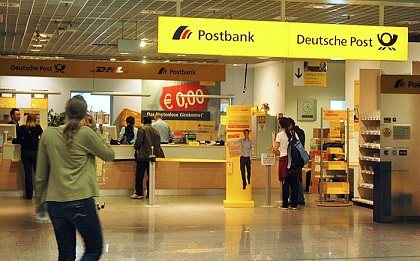
Now in the days of email, postal mail has become inconsequential; affectionately called “snail mail”. Governments around the world provide the overhead of postal operations, though they are mostly unprofitable and sneered upon. There are some exceptions however …
Germany’s Deutsche Post
SwedenPostenAB
Finland’s Netpost
… these feature some of the business models in postal services that have become impactful to their local communities. From the best-practices gleaned from these above countries, the model of the Caribbean Postal Union (CPU) was forged. The CPU is a subset of the roadmap defined in the book Go Lean…Caribbean; this is the mission for physically and figuratively delivering the future. This roadmap, for the introduction and implementation of the technocratic Caribbean Union Trade Federation (CU), focuses on the political transformations and the practical transformations to elevate the Caribbean region, individually and collectively.
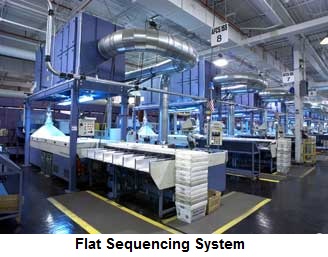
The Go Lean book details the Germany, Sweden and Finland experiences (Page 99) in contrast to the US Postal Service (USPS). The USPS is not the model for the Caribbean to emulate. The Go Lean book describes the USPS as a failing enterprise. Previous Go Lean commentaries have identified better role models for the CPU: logistics/e-Commerce giant Amazon in the US, and Alibaba in China. These companies provide logistical solutions to their marketplaces; the same as the CPU can deliver the logistical solution for the Caribbean’s modern commerce. This model can transform Caribbean society: its people and institutions. The USPS is an old-dying model; the CPU, on the other hand, is a new, transformative model. See the VIDEO here that relates the disposition of the USPS as an enterprise.
VIDEO 1 – US Postal Service Faces Big Changes Amid Struggle to Deliver on Profitability – https://youtu.be/Lnjfua5wY5U
Uploaded on Dec 5, 2011 – The likelihood that a stamped letter could reach its destination by the next day will be virtually eliminated due to billions in U.S. Postal Service cuts announced Monday. Postmaster General Patrick Donahoe joins Gwen Ifill to discuss the cuts and what’s next for the postal service and its customers.
This is commentary 3 of 4 – from the movement behind the Go Lean book – on the subject of transformations: how to move our region from the deficient-defective status quo to a new status, the undisputed title of “greatest address on the planet”. All these commentaries detail these issues, considering:
The Go Lean book details this quest to transform the Caribbean; it features a how-to guide, a roadmap for elevating the region’s societal engines of economics, security and governance. It leads with economic issues, not political ones! But as established previously, there must be political transformations before practical transformations can take place. In order to explore the benefits of the CPU practical transformations – a consolidation of all existing postal entities – must take place in the region. This is a heavy-lifting task. Imagine the management and staff of those agencies in the member-state governments; they now become a part of the CU Federal Civil Service.
See Appendix below for the list of the National Postal entities – all members of the Universal Postal Union – that constitute the 30 Caribbean member-states.
The Go Lean/CU plan calls for this consolidation on Day One/Step One of the implementation of the roadmap, during the Assembly phase. This requires the type of political transformation that involves every stakeholder in the community: residents, businesses and institutions. But this effort can be communicated as a “labor of love”, with very little down-side. What is at risk? The rejected, ignored, expensive postal operations that is currently a drag on member-states resources. It is time now for these rejected entities to be the cornerstone of the Caribbean transformation.
To the everyday man on the street, he will see changes … on the street. There is the need for formal street names and house numbers. For all the regional member-states, except the US territories of Puerto Rico and the Virgin Islands, there is no mail door-to-door delivery. With the CPU business model, the streets will be structured as a marketplace with grid numbers and postal/ZIP codes, and with pick-up and delivery.
The focus of the CPU is not just to deliver postal mail, but rather to deliver logistics … and the future. Just like Amazon and Alibaba do so much more than just sell merchandise online, the CPU will facilitate a complete eco-system for Small-Medium-Enterprises (SME’s) to thrive in the region: finding customers for their wares and collecting payments. This is key to growing the regional economy to $800 Billion.
The CPU is designed to deliver the Caribbean’s future for Global Trade and Electronic Commerce. These activities have greatly impacted many societies around the world – think China – elevating their economic engines. The CU/CPU will employ technologically innovative products and services to impact its prime directives; identified with the following 3 statements:
Optimization of the economic engines in order to grow the regional economy to $800 Billion & create 2.2 million new jobs.
Establishment of a security apparatus to protect the resultant economic engines.
Improve Caribbean governance to support these engines, including the consolidation of the state-ran postal operations.
The VIDEO here demonstrates the theme from the Go Lean book, that one organization-institution – like the CPU – that facilitates e-Commerce can optimize the societal engines in the region and impact the transformation of the homeland. The facilitation role will include the attendant functions of order entry, payment settlement, inventory fulfillment, marketplace hosting, customer service contact center and mail pick-up/delivery.
Uploaded on Nov 19, 2011 – What is E-Commerce?
This video provides an explanation of e-commerce, trends in online business, and how the internet has revolutionized the modern marketplace. It also identifies key factors responsible for e-commerce’s continued success.
The Go Lean roadmap seeks to change the entire eco-system of Caribbean commerce and the interaction with postal operations. This vision is defined early in the book (Page 12 & 14) in the following pronouncements in the Declaration of Interdependence:
xv. Whereas the business of the Federation and the commercial interest in the region cannot prosper without an efficient facilitation of postal services, the Caribbean Union must allow for the integration of the existing mail operations of the governments of the member-states into a consolidated Caribbean Postal Union, allowing for the adoption of best practices and technical advances to deliver foreign/domestic mail in the region.
xxvii. Whereas the region has endured a spectator status during the Industrial Revolution, we cannot stand on the sidelines of this new economy, the Information Revolution. Rather, the Federation must embrace all the tenets of Internet Communications Technology (ICT) to serve as an equalizing element in competition with the rest of the world. The Federation must bridge the digital divide and promote the community ethos that research/development is valuable and must be promoted and incentivized for adoption.
In a previousGo Lean blog, this commentary described how …
“… email and text messages have replaced “snail” mail in advanced economy countries for personal written communications. Electronic Bill Presentation & Payments (EBP&P) schemes are transforming business-to-consumer interactions, and electronic funds transfer/electronic commerce is the norm. So [Internet & Communications Technology] (ICT) must be a prominent feature of any Caribbean empowerment plan. This is why creating the CPU and the Caribbean Cloud (www.myCaribbean.gov) is “Step One / Day One” in the Go Lean roadmap. This is the by-product of assembling regional organs with multilateral cooperation and a separation-of-powers. The roadmap also includes establishment of the Caribbean Central Bank (CCB), as a cooperative among existing Central Banks, and its facilitation of electronic payment schemes so as to enable the region’s foray into electronic commerce and trade marketplaces.
The Go Lean book details a series of community ethos, strategies, tactics, implementations and advocacies to foster the best practices for the delivery of the CPU and trade marketplaces in the Caribbean region:
Community Ethos – Deferred Gratification
Page 21
Community Ethos – Economic Principles – All Choices Involve Costs
Page 21
Community Ethos – Economic Principles – People Respond to Incentives
Page 21
Community Ethos – Economic Principles – Economic Systems Influence Choices
Page 21
Community Ethos – Economic Principles – Voluntary Trade Creates Wealth
Page 21
Community Ethos – Economic Principles – The Consequence of Choice Lie in Future
Page 21
Community Ethos – Job Multiplier
Page 22
Community Ethos – Lean Operations
Page 24
Community Ethos – Cooperatives
Page 25
Community Ethos – Ways to Impact the Future
Page 26
Community Ethos – Ways to Help Entrepreneurship
Page 28
Community Ethos – Promote Intellectual Property
Page 29
Community Ethos – Ways to Bridge the Digital Divide
Page 31
Strategy – Customers – Citizens and Member-states Governmental
Page 47
Tactical – Fostering a Technocracy
Page 64
Tactical – How to Grow the Economy to $800 Billion – Trade and Globalization
Page 70
Tactical – Separation of Powers – Postal Services
Page 78
Tactical – Separation of Powers – Interstate Commerce Administration
Page 79
Implementation – Year 1 / Assemble Phase – Establish CPU
Page 96
Implementation – Anecdote – Mail Services – USPS Dilemma
Page 99
Implementation – Ways to Pay for Change – Group Purchase Organizations (GPO)
Page 101
Implementation – Ways to Optimize Mail Service & myCaribbean.gov Marketplace
Page 108
Implementation – Ways to Deliver
Page 109
Implementation – Ways to Impact Social Media
Page 111
Implementation – Ways to Benefit from Globalization
Page 119
Planning – 10 Big Ideas for the Caribbean – # 8 Cyber-Caribbean
Page 127
Planning – Ways to Improve Trade – GPO’s
Page 128
Planning – Ways to Improve Interstate Commerce
Page 129
Advocacy – Ways to Grow the Economy
Page 151
Advocacy – Ways to Create Jobs
Page 152
Advocacy – Ways to Mitigate Black Markets
Page 165
Advocacy – Ways to Manage the Federal Civil Service
Page 173
Advocacy – Ways to Foster Cooperatives
Page 176
Advocacy – Ways to Foster Technology
Page 197
Advocacy – Ways to Foster e-Commerce
Page 198
Advocacy – Reforms for Banking Regulations
Page 199
Advocacy – Ways to Impact Main Street
Page 201
Issues related to the CPU business model have previously been detailed in these Go Lean commentaries, listed here:
Increasing trade is a successful strategy for growing the regional economy; this will undoubtedly mean increases in jobs and entrepreneurial opportunities. The CU/CPU/Go Lean plan is designed to foster and incubate key industries for the goal of transforming and elevating the regional economy.
But any transformation to the Caribbean societal engines must be permanent! The Go Lean book declares that for permanent change to take place, there must first be an adoption of new community ethos, the national spirit that drives the character and identity of its people. The roadmap was constructed with the primary community ethos of the Greater Good, not a profit motive and not a nationalistic motive; but rather a commitment for the “greatest good for the greatest number of people”.
Now is the time for all of the Caribbean, the people and governing institutions (like Postal Operations), to lean-in for the changes in the book Go Lean … Caribbean. This is a Big Idea for the region, that of a Cyber Caribbean effort (Page 127), in which trade marketplaces play a major role. This roadmap is not just a plan for delivering the mail; it is also the delivery of the hopes and dreams of generations of Caribbean stakeholders; it is about delivering the future: a better place to live, work and play. 🙂
What is required for the world to believe that the Caribbean is the greatest address on the planet?
Terrain and Weather
Check
Culture and Hospitality
Check
Food and Spirits
Check
Music and Festivals
Check
Economy and Jobs
Danger! Fail!
This point aligns with the book Go Lean…Caribbean, which asserts that the societal engines in the Caribbean (economy, security, and governance) are deficient and defective; in some cases we even feature Failed-States (think: Haiti, Cuba, Puerto Rico and others). But alas, we can improve and make our homeland a better place to live, work and play.
How?
The Go Lean book details the quest to make the Caribbean better; it features a how-to guide, a roadmap for elevating the region’s societal engines of economics, security and governance. Despite the 370 pages, it boils down to doing a few things and doing them well!
This is commentary 1 of 4 on the subject of transformations: how to move our region from this status quo to the undisputed title of “greatest address on the planet”. All these commentaries detail these issues, starting with:
What are the focus activities that we do, as a region, that by improving we would pronounce to the world that we are truly the greatest address on the planet?
The Go Lean book identifies 144 advocacies to improve life in the region. But we cannot “master all trades”; we must do better than anywhere else in the world in a few activities; these ones here are deemed our core competence:
Economic
Tourism / Events / Cruises
Specialty Agriculture
Energy
Security
Public Safety
Governance
Senior Health Care
The assertion is that the Caribbean region must at least do the above activities better than anywhere else in the world. Why?
Because we are competing with the world … and losing.
But if we do better, perfect our core competence – see VIDEO here of Transformations and Core Competence in the corporate setting – then our hard work will be recognized and rewarded by others wanting to share in our passions and profits. Or maybe even just to retain our citizens here at home. A previous blog stated this eloquently by quoting a Chinese proverb: “Make happy those who are near, and those who are far will come”.
VIDEO:An Introduction to Prahalad & Hamel’s Core Competence of the Corporation – A Macat Business Video – https://youtu.be/KSUbSEvJ1Cs
Published on Nov 16, 2015 – Success in business comes from combining technological ability with organizational skills to gain a competitive edge. It is called “core competence.” Watch Macat’s short video for a great introduction to C. K. Prahalad and Gary Hamel’s “The Core Competence of the Corporation,” one of the most important business articles ever written.
The book Go Lean … Caribbean sets to optimize the societal engines (economics, security and governance) in the Caribbean. The book serves as a roadmap for the introduction and implementation for the technocratic Caribbean Union Trade Federation (CU). As a federation or federal government representing all 30 member-states, the prime directives of this roadmap is to elevate society by addressing these 3 focus areas:
Optimization of the economic engines in order to grow the regional economy to $800 Billion & create 2.2 million new jobs.
Establishment of a security apparatus to protect the resultant economic engines.
Improve Caribbean governance to support these engines.
The benefits of core competence feature a “snowball” effect. The better we optimize one functional area, the better the rest of the environment becomes. For example, the 2.2 million jobs that the roadmap sets to create. There is no need to actuate the economic processes for each job. No, we focus on our core competence, and the job multiplier effect processes the remaining new jobs. To reach the required transformations, this commentary identifies these core competencies for our economic engines:
Tourism / Events / Cruises
This activity is the Number 1 economic driver in the Caribbean region. But each member-state can only do “so much more” so as to generate marginal increases in their output. An old adage states that “one cannot get blood from a stone”; this is so true for the region: there are only so many beaches and coastal areas to explore for touristic opportunities. The Go Lean roadmap (Page 190) therefore takes a different, more elevated, approach to increase tourism: regionalism.
The book – and previous blogs – features empowerments that are not possible for any member-state alone, leveraging the full force of a bigger Single Market of 42 million people, across the 30 member states. The following are some regional highlights:
New Transportation Options – Ferries to transport people and cars, including RV/Campers for Snowbirds for the Winters
New Fairgrounds – New landlords for structures and amenities to allow for events/conventions not possible otherwise
Medical Tourism – Self-Governing Entities for medical research campuses generate new demand for a Caribbean supply
Specialty Agriculture
There are farming expressions, like “bread basket” of America, or Europe. But, these no not apply to the Caribbean, as we are not known for our agricultural productions … except for cigar and rum. Yes, these specialty agricultural products are deemed the “best in the world”. Following the strategies, tactics and implementations from the Go Lean book (Page 88), we can continue the greatness and exploit the reputation for even more profit; (jobs and entrepreneurial opportunities).
Cuba, the source of much of the heightened reputation for Caribbean cigars, has suffered with a 55-year trade embargo. Efforts are now being made to normalize trade with Cuba and the rest of the western world. There is therefore a lot of upside and growth for improved trade and production for this world-renown product. There will undoubtedly be a return on any investment in this core competence.
Energy
The Caribbean is the best-in-the world in certain pursuits; energy is not one of them, but it needs to be. At this juncture, the region is reported as having one of the highest energy costs on the planet. So we need to apply best-practices – detailed in the Go Lean book (Page 113) – to optimize our energy eco-system to go from the worst to the first – energy needs to become a core competence. Considering the successful models we have to emulate, we have all the resources we need to succeed ourselves:
We simply need better stewardship and administration of the region’s energy policies to optimize the supply-and-demand metrics. The Go Lean book specifically states (Page 46) the mission as follows:
Harness the power of the sun, the winds, and the tides to power our home and the institutions of our industry and government. This embrace of alternative energy can supplement our traditional power sources and usher in energy independence. Independence in general means that we are finally ready to stand-up and be counted worldwide.
Security – Public Safety
To reach the required transformations, this commentary also identifies one core competence for our security engine: Public Safety.
If we are able to raise the delivery level of protections to these groups, then our society will be recognized world-wide as a great place to live, work and play. This does not mean that we ignore the safety of the general citizenry; no, we simply accept that there will always be crime – bad actors – in every society, everywhere. So our remediation and mitigations for crime – need, greed and honor – must be omnipresent.
The following sample from the Go Lean book details the strategies, tactics, implementation and advocacies of the Go Lean roadmap related to the core competence of Public Safety:
Community Ethos – Economic Principles – Economic Systems Influence Individual Choices
Page 21
Community Ethos – Security Principles
Page 22
Community Ethos – Governing Principles – Lean Operations
Page 24
Community Ethos – Ways to Impact the Greater Good
Page 37
Strategy – Mission – Protect our stakeholders with anti-crime and law enforcement measures
Page 45
Tactical – Confederating a Permanent Union
Page 63
Tactical – Separation of Powers – Homeland Security
Page 75
Tactical – Separation of Powers – CariPol
Page 77
Implementation – Reasons to Repatriate to the Caribbean
Page 118
Advocacy – Ways to Better Manage the Social Contract
Page 170
Advocacy – Ways to Improve Leadership
Page 171
Advocacy – Ways to Impact Justice
Page 177
Advocacy – Ways to Remediate and Mitigate Crime
Page 178
Advocacy – Ways to Improve Gun Control
Page 179
Advocacy – Ways to Improve Homeland Security
Page 180
Advocacy – Ways to Mitigate Terrorism
Page 181
Advocacy – Ways to Improve Intelligence Gathering & Analysis
Page 182
Advocacy – Ways to Improve for Natural Disasters
Page 183
Advocacy – Ways to Protect Human Rights
Page 220
Advocacy – Ways to Improve Elder-Care
Page 225
Advocacy – Ways to Empower Women
Page 226
Advocacy – Ways to Impact Youth
Page 227
Advocacy – Ways to Impact Persons with Disabilities
Page 228
Governance – Senior Healthcare
To reach the required transformations, this commentary lastly identifies one core competence for our regional governance: Senior / Elder Healthcare.
Most Caribbean member-states feature Democratic Socialism as the official form of government; (Cuba practices Communism, and the US Territories feature the American brand of Capitalism, though the majority of the population receive some government assistance). This means that the 30 member-states have a government entitlement program for healthcare, and it is self-evident that senior citizens in every society consume more healthcare services than any other population group.
The Go Lean movement (book and blogs) details how the governing engines in the region can elevate their healthcare deliveries, and how the elderly populations can benefit. The successful executions of the strategies, tactics, implementation and advocacies of the Go Lean roadmap, (see the following sample of these specific details from the book related to the core competence of senior healthcare), would allow the world to see how great a society the Caribbean would be. This lingering affects will reverberate in other aspects of society, like the repatriation of our aging Diaspora, medical tourists and other economic spin-offs – the book details 70,000 direct jobs created in the region as a result of these empowerments.
Community Ethos – Economic Principles – Economic Systems Influence Individual Choices
Page 21
Community Ethos – Economic Principles – The Consequences of Choices Lie in the Future
Page 21
Community Ethos – Governing Principles – Lean Operations
Page 24
Community Ethos – Ways to Help Entrepreneurship – STEM Incubators
Page 28
Community Ethos – Ways to Impact Research & Development – Including Medical Research
Page 30
Community Ethos – Ways to Impact the Greater Good
Page 37
Strategy – Mission – Reform our Health Care industries for the reality of our needs
Page 46
Tactical – Separation of Powers: Department of Health – Self-Governing Entities
Page 80
Tactical – Separation of Powers: Department of Health – MediCare Administration
Page 86
Implementation – Reasons to Repatriate to the Caribbean
Page 118
Planning – Ways to Make the Caribbean Better – Support/Social Services
Page 131
Advocacy – Ways to Improve Healthcare
Page 156
Advocacy – Ways to Impact Cancer
Page 157
Advocacy – Ways to Impact Entitlements
Page 158
Advocacy – Ways to Better Manage the Social Contract
Page 170
Advocacy – Ways to Improve Elder-Care
Page 225
Advocacy – Ways to Empower Women
Page 226
Advocacy – Ways to Impact Persons with Disabilities
Page 228
Appendix – Growing 2.2 Million Jobs in 5 years – Medical R&D, Gerontology & Healthcare
Page 257
The Caribbean can truly be a great place to live, work, heal and play.
Previously, Go Lean blogs commented on transformations, showing the success of aspirations to be better and do better. Consider this sample:
The effort to elevate the Caribbean is defined as heavy-lifting, a lot of strenuous actions that are very complicated. But despite the complexity, a successful completion of some of the basic or core functionality can aid the region – these limited actions are considered “core competencies”. The successful execution of these core competencies would start the “snowball” and transform the Caribbean … to a better homeland.
Any transformation for the Caribbean must be permanent! The Go Lean book declares that for permanent change to take place, there must first be an adoption of new community ethos, the national spirit that drives the character and identity of its people. The roadmap was constructed with the primary community ethos in mind, the Greater Good. This is a big deal; notice it is not a profit motive, nor a nationalistic motive, but rather a commitment to the “greatest good for the greatest number of people”.
Now is the time for all Caribbean stakeholders to lean-in to this regional solution – the Go Lean roadmap – for the Caribbean to transform to a better society, a better place to live, work and play. 🙂
We normally do not think much about Chambers of Commerce, but they are important in the normal eco-systems that businesses operate in. Despite the community, a representative of a Chamber of Commerce – see Appendix A below – can almost always get an audience with the Mayor or other governmental executives. See this news reference here:
Mention the Chamber of Commerce, and most people think of a benign organization comprised mostly of small business owners who meet for networking and mutual support in local chapters across the U.S. But today’s Chamber is anything but that, according to Alyssa Katz’s extensive research, recently published as “The Influence Machine.”
Founded in 1912, the U.S. Chamber of Commerce has been shaped by its CEO Tom Donohue into a powerful lobbying and campaigning machine that pursues a fairly narrow special-interest agenda. It’s now the largest lobbying organization in the U.S. (ranked by budget). It mostly represents the interests of a handful of so-called “legacy industries” – industries like tobacco, banking and fossil fuels which have been around for generations and learned how to parley their earnings into political influence. The Chamber seeks favorable treatment for them, for example, through trade negotiations, tax treatment, regulations and judicial rulings. Source: Retrieved April 30, 2016 from: http://www.usnews.com/opinion/economic-intelligence/2015/10/22/who-does-the-us-chamber-of-commerce-really-represent
The book Go Lean … Caribbean, a how-to guide for elevating the societal engines in the Caribbean homeland, owes its origin-motivation to the US Chamber of Commerce. On August 1, 2011 the US Chamber published a recommendation to American power brokers on how to recover from the recession and create jobs in the US. They provided a 10-Step advocacy for creating jobs in the US; in response, the Go Lean publishers created its own 10-Step advocacy for the Caribbean; this proved to be the first of 144 advocacies that constituted the 370-page book. See the side-by-side comparison in Appendix B below.
The Go Lean book was composed with many of the same strategies as pro-business Chambers of Commerce in the US. We therefore look to these organizations as a role model in our roadmap to transform – remediate and mitigate – the engines of regional economics, security and governance. Rather than just any Chamber in the US, this commentary considers the example of the 2 Chambers in South Florida (Greater Miami Chamber in Miami-Dade County and the Fort Lauderdale Chamber in Broward County). These entities are now embarking on a strategy that the Caribbean stewards should examine and apply in our region. See VIDEO in Appendix C below on the Greater Miami Chamber; the City of Miami is pictured here.
The publishers of the Go Lean book are now here in Greater Miami, (in from Detroit), to observe-and-report on the developments and progress of this neo-Caribbean community. Miami is notorious for its penetration of Caribbean people, culture and causes. It has a full scope of business and civic activities that traverse the breadth-and-depth of Caribbean interest. Miami’s success, with its potpourri of Caribbean Diaspora, comes as a consequence of many Caribbean failures; consider the experiences of Cubans, Haitians, Dominicans, Puerto Ricans, Jamaicans, Bahamian and other nationalities from the region.
Therefore the strategies, tactics and implementations of the Miami-Dade-Broward Chambers of Commerce definitely apply to the Caribbean region. See related news article here:
Title: Greater Miami, Fort Lauderdale chambers may merge By: Nancy Dahlberg and Jane Wooldridge ndahlberg@miamiherald.com
South Florida’s two largest chambers of commerce, the Greater Miami Chamber of Commerce and the Greater Fort Lauderdale Chamber of Commerce, are exploring a merger.
A memorandum of understanding was signed by the executive committees of each group, the chambers announced on Monday. A task force is being created to explore the structure and operational issues required for the combination to move ahead, and the chambers will decide by the end of the year whether to proceed, the chambers said.
“It’s a great opportunity for our business communities to evaluate this as many of the things we do discuss are very regionalized. … such as transportation, sea level rise and beach erosion,” said Heiko Dobrikow, chairman of the Greater Fort Lauderdale Chamber of Commerce and General Manager of the Riverside Hotel. “And when you have a larger, more regional representation, it gives our members certainly more growth potential for their businesses.”
Christine Barney, chairwoman of the Greater Miami Chamber of Commerce and CEO of Miami’s rbb Communications, concurred. “The potential combination gives more clout to the business community in shaping the future of South Florida,” she said.
“In the past we’ve done a lot of strategic alliances and that can only do so much,” Barney said. “We thought a more-aggressive approach was needed.”
Though membership in both Greater Miami and Greater Fort Lauderdale chambers has remained strong, nationwide, chambers of commerce have suffered declining membership and revenues.
“Even though we are acquiring new members it is probably not at the same rate as we wish, and there is probably a great opportunity that we have,” Dobrikow said.
The Greater Miami Chamber was founded in 1907 and now boasts about 4,100 members representing about 400,000 employees. The Greater Fort Lauderdale Chamber, founded in 1910, has 1,311 company-members that employ more than 500,000.
Both counties are also home to myriad smaller chambers focusing on specific geography or demographics. The idea rose from regular meetings between the president and CEOs of the two organizations, said Miami’s Barry Johnson, who announced recently he will retire at the end of this year.
Said Dan Lindblade, leader of the Greater Fort Lauderdale Chamber, “Barry Johnson and I have been talking over the years and we thought now would be a good time to begin these discussions to see if they lead us into the direction that we both feel is inevitable — a regional chamber with the size and scope of the two largest chambers in Broward and Miami-Dade.”
The Greater Miami chamber will continue the search for Johnson’s replacement during the evaluation period, Barney said.
As more small smartups emerge throughout South Florida, the traditional model of fee-based memberships has become less attractive to some members, who may have specific needs such as international introductions or skills training but not the full range of services now offered, said Barney. The ultimate goal, said both chamber chairs, is to bring more value to members.
Said Barney, “Miami is unique, Broward unique, Palm Beach is unique. … Whatever we do, we want to keep the strength of the local representation as front and center as possible.” Source: Posted April 26, 2016; retrieved April 30, 2016 from: http://www.miamiherald.com/news/business/article73800622.html
So the Greater Miami Chamber of Commerce and the Greater Fort Lauderdale Chamber of Commerce are considering merging, consolidating and integrating their efforts to elevate the business environment for the entire South Florida region. If successfully executed, this effort could be a role model for the Caribbean region to emulate. This discussion aligns with the book Go Lean … Caribbean, in its effort to serve as a roadmap for the introduction and implementation of the Caribbean Union Trade Federation (CU); the purpose of which is to elevate Caribbean society, for all 30 member-states. The book stresses the need to optimize the societal engines of economics, security and governance. Jobs is a very important goal of the Go Lean roadmap, with a prime directive to create 2.2 million new jobs in the Caribbean.
The stance of Chambers of Commerce is normally pro-business, anti-labor. So they are not always universally loved in their communities; they do and will “ruffle feathers”; sometimes they are even accused of promoting Crony-Capitalism. But the Go Lean focus here is “jobs” more so than Chambers of Commerce. The Go Lean book opens with pronouncements relating to the jobs-creating directive. Consider these statements early in the book in the Declaration of Interdependence (Page 12 – 14):
xxi. Whereas the preparation of our labor force can foster opportunities and dictate economic progress for current and future generations, the Federation must ensure that educational and job training opportunities are fully optimized for all residents of all member-states, with no partiality towards any gender or ethnic group. The Federation must recognize and facilitate excellence in many different fields of endeavor, including sciences, languages, arts, music and sports. This responsibility should be executed without incurring the risks of further human flight, as has been the past history.
xxiv. Whereas a free market economy can be induced and spurred for continuous progress, the Federation must install the controls to better manage aspects of the economy: jobs, inflation, savings rate, investments and other economic principles. Thereby attracting direct foreign investment because of the stability and vibrancy of our economy.
xxv. Whereas the legacy of international democracies had been imperiled due to a global financial crisis, the structure of the Federation must allow for financial stability and assurance of the Federation’s institutions. To mandate the economic vibrancy of the region, monetary and fiscal controls and policies must be incorporated as proactive and reactive measures. These measures must address threats against the financial integrity of the Federation and of the member-states.
xxvi. Whereas the Caribbean region must have new jobs to empower the engines of the economy and create the income sources for prosperity, and encourage the next generation to forge their dreams right at home, the Federation must therefore foster the development of new industries… In addition, the Federation must invigorate the enterprises related to existing industries like tourism … impacting the region with more jobs.
The subject of job creation has been directly addressed and further elaborated upon in these previous blog/commentaries:
The Go Lean book itself details the economic principles and community ethos to adopt, plus the executions of strategies, tactics, implementations and advocacies to create new jobs in Caribbean communities. See a sample list here:
Economic Principles – People Choose because Resources are Limited
Page 21
Economic Principles – All Choices Involve Costs
Page 21
Economic Principles – People Respond to Incentives
Page 21
Economic Principles – Economic Systems Influence Individual Choices
Economic Principles – Consequences of Choices Lie in the Future
Page 21
Community Ethos – Job Multiplier
Page 22
Community Ethos – Lean Operations
Page 24
Community Ethos – Return on Investments
Page 24
Community Ethos – Ways to Impact the Future
Page 26
Community Ethos – Ways to Help Entrepreneurship
Page 28
Community Ethos – Ways to Impact Research & Development – Create Local; Stay Local
Page 30
Strategy – Vision – Integrate 30 member-states to a Single Market Economy
Page 45
Strategy – Mission – Foster local economic engines
Page 45
Tactical – Tactics to Forge an $800 Billion Economy – High Multiplier Industries
Page 70
Tactical – Separation of Powers – Commerce Department – Promotions Role
Page 78
Implementation – Ways to Deliver
Page 109
Planning – Ways to Improve Trade
Page 128
Advocacy – Ways to Create Jobs
Page 152
Advocacy – Ways to Improve Education
Page 159
Advocacy – Ways to Impact Labor Markets and Unions
Page 164
Advocacy – Ways to Foster Technology
Page 197
Advocacy – Ways to Foster e-Commerce
Page 198
Advocacy – Ways to Help the Middle Class – Promote Entrepreneurship
Page 223
Advocacy – Ways to Impact Youth – Early Start for STEM
Page 227
Appendix – Growing 2.2 Million Jobs in 5 Years
Page 257
Appendix – Job Multipliers
Page 259
The Go Lean … Caribbean roadmap needs the effective modeling of South Florida’s business promotion, as in the regional Chambers of Commerce. Considering the 5 L‘s, (Look, Listen, Learn, Lend-a-hand & Lead), there will be much for us to look, listen and learn in the South Florida area. Eventually we may even be able to lend-a-hand to the South Florida cause – especially in regards to the Diaspora – but our focus is on the Caribbean. We do not look to lead in Florida; we are preparing to lead in the Caribbean.
Today, the Greater Miami / South Florida region is a better place to live, work and play … due in many ways to the contributions of the Caribbean Diaspora. These ones are active in the participation of the work-force, business promotion and culture of South Florida, resulting in a distinctive character that has made the Greater Miami region unique, and appealing.
We invite all of the Caribbean Diaspora in the Greater Miami / South Florida region to lean-in to this roadmap to make the Caribbean a better place to live, work and play. We also urge all stakeholders in the Caribbean to lean-in to this roadmap. 🙂
Download the book Go Lean … Caribbean – now!
———–
Appendix – Encyclopedic Reference:Chamber of Commerce
A chamber of commerce (or board of trade) is a form of business network, for example, a local organization of businesses whose goal is to further the interests of businesses. Business owners in towns and cities form these local societies to advocate on behalf of the business community. Local businesses are members, and they elect a board of directors or executive council to set policy for the chamber. The board or council then hires a President, CEO or Executive Director, plus staffing appropriate to size, to run the organization.
The first chamber of commerce was founded in 1599 in Marseille, France.[1][2][3][4] Another official chamber of commerce would follow 65 years later, probably in Bruges, then part of the Spanish Netherlands.[5]
The world’s oldest English-speaking chamber of commerce, in New York City, dates from 1768.[6] The oldest known existing chamber in the English-speaking world with continuous records, the Glasgow Chamber of Commerce,[7] was founded in 1783. However, Hull Chamber of Commerce[8] is the UK’s oldest, followed by those of Leeds and of Belfast in Northern Ireland.
As a non-governmental institution, a chamber of commerce has no direct role in the writing and passage of laws and regulations that affect businesses. It may however, lobby in an attempt to get laws passed that are favorable to businesses. They also work closely with a number of other youth organizations in the country about the value and role of business in our Source: Retrieved April 30, 2016 from: https://en.wikipedia.org/wiki/Chamber_of_commerce
———–
Appendix B – Creating Jobs: How?
US Chamber of Commerce – 2011
Go Lean … Caribbean (Page 152)
1
Steer more students into technical schools
Lean-in for the Caribbean Single Market & Economy
2
Enhance the payoff of a college degree
Feed Ourselves
3
Help small businesses find foreign customers
Clothe Ourselves
4
Welcome more immigrants
House Ourselves
5
Create a national jobs database
Update Our Own Infrastructure and the Industries They Spun
6
Create “lean” regulatory agencies
Steer More People to S.T.E.M. Education and Careers
This commentary is being re-distributed on the occasion of eMerge TechWeek 2016. The event just ended … April 18 – 19.
In the commentary in 2014, previewing the inaugural event, the expectation was for 3,000 visitors. This time, just 2 years later, the attendance was 13,000 visitors. Congratulations to the organizers on this successful event. Now let’s plan on another successful one for June 12 – 13, 2017.
The original blog – still relevant – is as follows: —————
Go Lean Commentary
Positive Change!
It doesn’t just happen. It takes people forging it, guiding it and fostering it. The below news article speaks of the effort in South Florida (from Miami north to West Palm Beach) to establish an economic engine of a “tech hub”.
This is a noble, yet strategic undertaking. Success in this “industry space” would mean more jobs, investment capital, and more technology students remaining in South Florida after matriculating in the area’s colleges. These 3 objectives align this story with the advocacies of the book Go Lean … Caribbean.
The book serves as a roadmap for the introduction and implementation of the Caribbean Union Trade Federation (CU). The prime directive of this organization is to optimize the economic engines of the Caribbean region. We also want to increase jobs and investment capital, plus retain more of our young people aspiring for careers in high technology fields. But the CU wants to harvest these activities in the Caribbean, for the Caribbean and by the people of the Caribbean.
South Florida is germane to the Caribbean conscience. It is the Number One destination for the Caribbean Diaspora, featuring large populations of Cubans, Jamaicans, Dominicans (DR), Puerto Ricans, Bahamians, and Haitians. The book relates this association by declaring the NBA basketball team, Miami Heat, as the “home team” of the Caribbean; (Page 42).
Right time, right place!
The eMerge Americas Techweek is this week. Also, the Miami Heat has just started the playoffs in defense of their consecutive World Championships.
By: Marcia Heroux Pounds and Doreen Hemlock
A movement to make South Florida a technology hub for the Americas kicks off its first conference this week, aiming to draw more than 3,000 people from entrepreneurs to investors to students — from Broward and Palm Beach counties and from around the world.
Organizers want to build on South Florida’s success as a gateway to Latin America for trade, banking and services, extending that prowess into technology, entrepreneurship and capital for startups. They hope the event — eMerge Americas Techweek — can do for tech what the annual Art Basel event in Miami Beach has done for art: put South Florida on the world map.
It’s an exciting chance for entrepreneurs like Boca Raton’s Dan Cane, chief executive of Boca Raton-based Modernizing Medicine, which developed an iPad application for specialty physicians. He’s among influencers named to the event’s “Techweek100” — South Florida leaders who have had a significant impact on business and technology. He will speak at the conference.
“We jumped at the opportunity,” said Cane, whose 3-year-old company had $17.5 million in sales last year. “We hope to find contacts and connections and begin to develop the right ecosystem in the Latin American market” to export south starting next year.
The eMerge push doesn’t strive to make South Florida into Silicon Valley. It aims instead for a tech center specialized in multinationals looking south, Latin American companies moving north, local startup companies, as well as universities and investors.
That’s why Citi Latin America, the regional headquarters for financial giant Citi, is taking part in what is planned as an annual event. The division employs about 750 people in Miami-Dade and Broward counties and is sponsoring the event, sending speakers and bringing clients, said Jorge Ruiz, who heads digital banking.
“This event is a great example of the things we should do more of,” Ruiz said. It showcases the importance of technology to a range of industries, promotes what South Florida already offers and highlights South Florida’s ability to unite from across the Americas for tech business, he said.
“As people come together, they’re going to realize this is the space to invest in,” Ruiz said.
Universities that train talent for tech jobs are eager to participate too.
“We’re going to bring as many students as possible,” said Eric Ackerman, dean and associate professor of the Graduate School of Computer and Information Sciences at Nova Southeastern University, who also is on the Techweek100 list. Nova has more than 500 students studying information technology.
Ackerman said tech graduates often leave South Florida, figuring they will have better job opportunities in larger hubs known for innovation.
“That’s one of the things we are trying to change — to become an innovation zone for new technology, new products and new services,” Ackerman said. “An event like this says, ‘Look what’s here in our own back yard. Why should I go somewhere else?’ ”
Kimberly Gramm, assistant dean and director of FAU’s Adams Center for Entrepreneurship, is taking winners of FAU’s recent business plan competition to eMerge’s Startup Village.
Some of South Florida’s largest tech companies also will exhibit at eMerge. Those include Citrix Systems of Fort Lauderdale, C3 Cloud Computing Concepts of Delray Beach and TriNet Group of Boca Raton, said Lonnie Maier, president of the South Florida Technology Alliance, a group that promotes local tech.
Investors and consultants to startups also are heading to eMerge to network and build business.
New World Angels, a Boca Raton-based group of investors, will share a booth with the Miami Innovation Fund to offer entrepreneurs advice on launching or growing their ventures, said Rhys Williams, executive director of New World Angels and a Techweek 100 leader.
“Technology investing is a contact sport. There are few textbooks or classes of relevance, so this conference is a timely way to keep current on your knowledge base and pick up new knowledge, skills and contacts,” said Williams, who also is a judge in the eMerge Launch competition where more than 200 companies will compete for $150,000 in prizes.
Of course, South Florida faces hurdles in its quest, tech leaders said.
The area needs to overcome a long-time image based on sun and fun. And it needs to show critical mass in tech, especially success stories of entrepreneurs that grew startups to global players — much as conference organizer Manny Medina did, starting Miami-based Terremark and selling it for more than $1.4 billion to Verizon.
Enterprise Development Corp. President Rob Strandberg, whose group works with startups from Boca Raton to Miami, will be busy making introductions between entrepreneurs and potential investors at the conference. He’s also a judge in the Launch competition.
EDC executive director Linda Gove will participate with the Boca Raton incubator’s startup companies.
“Investors are taking notice of South Florida companies to a far greater extent than they were,” Strandberg said.
Joe Levy, CEO of Fort Lauderdale-based startup ClearCi and also named to the Techweek 100, said the perception of the area as a tech hub is changing.
“Folks used to ask me, ‘Why aren’t you in Silicon Valley?’ ” Levy said. “We don’t get that anymore.”
The Go Lean roadmap calls for agencies within the CU to champion technological start-up endeavors, much like this week’s eMerge initiative.
There is much for the CU’s planners to glean by the observation of the planned events this week. The Go Lean/CU approach, in the absence of the actual establishment of the Trade Federation is simply to:
1. Look 2. Listen 3. Learn 4. Lend-a-hand 5. Lead
This approach is codified in the book, with details of community ethos, strategies, tactics, implementations and advocates; as follows:
Community Ethos – Impact the Future
Page 26
Community Ethos – Foster Genius
Page 27
Community Ethos – Help Entrepreneurship
Page 28
Community Ethos – Promote Intellectual Property
Page 29
Community Ethos – Impact R & D
Page 30
Community Ethos – Bridge the Digital Divide
Page 31
Strategy – Agents of Change: Technology
Page 57
Separation of Powers – Patents & Copyrights
Page 78
Implementation – Self-Governing Entities
Page 105
Implementation – Impact Social Media
Page 111
Ways to Better Manage Image
Page 133
Industries – Ways to Foster Technology
Page 197
Industries – Foster e-Commerce
Page 198
We hope for success for eMerge Americas Techweek. We hope our Caribbean brothers living and working in South Florida participate, engage in and benefit from this initiative. Then we hope that they would repatriate some of this passion, knowledge, and experience back to their Caribbean homelands.
Lastly, we cheer for further basketball dominance. Go Heat!
These words – The Decision – proved to be among the most dramatic quotations in American Sports for the new 21st Century. These words were spoken by basketball superstar LeBron James in July 2010. He had been frustrated with the team management inefficiency in his hometown of Cleveland, Ohio where he played for the NBA’s Cleveland Cavaliers from 2003 to 2010. At the time of this utterance, he had elected to “opt-out” of his contract with the Cavaliers and become a free agent. After being aggressively recruited by a number of teams – including the incumbent club in Cleveland – he decided to join the NBA franchise in South Florida (South Beach), the Miami Heat.
For the fans in Cleveland, this was a betrayal! They asserted that he switched allegiances in taking his talents to South Beach.
This perceived act of betrayal is considered a “stab in the heart” for a community that loves its local athletes. While this foregoing anecdote is an American drama, the Caribbean island of Jamaica can relate and empathize with Cleveland. Or better stated, the community of Cleveland can empathize with Jamaica as the same anecdotes are being related there, again and again with their World-Class Track-and-Field athletes.
Consider these related news articles of events transpiring in the last year:
Title: Switching Allegiances: One More Jamaican Sprinter Moves On To Represent Another Country By: Blogger – StephanieK Winston Barnes – in focus in the photo here – a former sprinter from Jamaica College, will now be representing Turkey in athletic competitions. Barnes, who will be known as Emre Zafer Barnes, joined three other Jamaican sprinters who decided to switch their allegiance to compete for various Arab countries. Former Wolmer’s Boys’ sprinter Jacques Harvey made the switch to Turkey earlier and is now known as Jak Ali Harvey. Following Jamaica’s Olympic Games, Shericka Williams, silver medalist, Andrew Fisher and Kemarley Brown all asked to move on to Bahrain, planning to represent that country at the 2016 Olympics in Brazil.
According to Commonwealth Games 100-metre champion Kemar Bailey-Cole, Jamaica could lose even more of its top athletes to countries who are willing to provide the financial support lacking from the Jamaica Athletics Administrative Association (JAAA), corporate Jamaica, and the government. Source: Jamaicans.com – Online Community – Retrieved 04-25-2016 from: http://jamaicans.com/one-more-jamaican-sprinter-moves-on/
——————————-
Title:Three Jamaican Athletes Plan to Represent Bahrain July 22, 2015 – Three of Jamaica’s top athletes will be switching their allegiance from the island to the country of Bahrain, announced Dr. Warren Blake, the president of the Jamaica Athletics Administrative Association (JAAA). Shericka “Wire” Williams, 2008 Olympic 400-meter silver medallist, and sprinters Kemarley Brown and Andrew Fisher, submitted applications to the JAAA with the intention of competing for Bahrain.
The athletes said it has become difficult to represent Jamaica and want the chance to represent Bahrain as they consider moving to that country and becoming citizens. Williams received a silver medal for Jamaica at the Berlin world Championships in 2009, while Fisher is the latest Jamaican to run under the 10-second barrier. Brown also clocked below that mark with a personal best on July 20 of 9.93 seconds. Source: Retrieved 04-25-2016 from: http://jamaicans.com/top-7-jamaican-caribbean-news-stories-for-the-week-ending-july-24th-2015/#ixzz46n7Z3doE
The decisions of these Jamaican athletes relate to the drama of Cleveland-Miami in 2010. The book Go Lean … Caribbean reported on these 2010 events, as follows (Page 42):
The National Basketball Association (NBA) franchise: Miami Heat is the league champion for the last 2 consecutive seasons; (composed November 2013). This is their 3rd championship, having won, in 2006, 2012, and 2013, to date. It is felt that this team can win many more. In fact, brewing some controversy when the team was assembled by the General Manager in 2010, one of the superstar players, LeBron James, pronounced that this team was built for multiple championships; the actual number: “not one, not, two, not three, not four, not five …”
Those words incited disgust from everyone…other than Miami Heat fans. But the team has lived up to its bragging and boasting, by succeeding to reach the Championship series (NBA Finals) all three years [to date] since the group was assembled.
The recent history of this Miami Heat drama does relate to the Caribbean and this roadmap for economic integration. First, with its base in Miami, Florida, it possesses the largest pocket of Caribbean Diaspora. So in many ways, the Miami Heat is the “home team” of the Caribbean.
This foregoing news articles also align with the Go Lean book in that it serves as a roadmap for the introduction and implementation of the Caribbean Union Trade Federation (CU). The Go Lean roadmap only has one interest in this subject of sports, fostering the economic opportunities that can be forged by professionalizing a regional sports eco-system. Dysfunction in this regards is exactly the issue in Jamaica today and why these athletes are “taking their talents to …” foreign shores.
This Go Lean roadmap assesses that not just Jamaica, but all of the Caribbean is in crisis. This is why athletes with any ability must seek refuge and opportunities in foreign lands. So this roadmap provides solutions to optimize the region’s economic, security and governing engines. The roadmap provides the facilitation to grow a professional, collegiate and amateur sports eco-system. Many times, the missing ingredients for organized sports are the facilities: stadia, arenas and playing fields. A previous blog-commentary reported that the sports eco-system void maybe considered as bigger than just sports, it is “life and death”. But the roadmap posits that sports, even though it is just “extra-curricular”, does bring benefits. In fact, Go Lean book (Page 229) quotes the Bible scripture at 1 Timothy 4:8 “For bodily exercise is profitable for a little …”.
Caribbean people are identified with excellence in sports; maybe even defined as geniuses. See the VIDEO here of a talented 10-year-old Jamaican football (soccer) sensation; his aspiration is to play professionally … in Europe in the future.
Published on December 30, 2014 – Brian Burkett is a self motivated boy who has a dream to play football at the highest level in the world. His talent is immaculate for his age along with his love for the game. Brian started playing at age 3 and have grown in passion and discipline to learn more about the game.
While Caribbean athletic talent is recognized around the world, there is not enough economic rewards at home for these ones with genius abilities. These ones must leave their beloved homelands to maximize their talents and earn a living from them. (This also applies to matriculating college student-athletes).
Previous blogs established that sports genius alone will never yield the sought-after result of World-Class excellence, there is the need for skilled training, coaching with best-practices and an internal drive. In so many ways, this parallels the current effort to reboot the Caribbean economic engines: nature (birth-right) is critical, but training, experience, coaching and the technocratic application of best-practices are also needed to forge change. The most important though is the internal drive; first and foremost, this is identified in the roadmap as “community ethos”.
The Go Lean roadmap recognizes many different kinds of athletics, team sports and individual event. The unique “genius” qualifier is highlighted at the outset of the Go Lean book, in the Declaration of Interdependence (Pages 12 & 14), as follows:
xxi. Whereas the preparation of our labor force can foster opportunities and dictate economic progress for current and future generations, the Federation must ensure that educational and job training opportunities are fully optimized for all residents of all member-states, with no partiality towards any gender or ethnic group. The Federation must recognize and facilitate excellence in many different fields of endeavor, including sciences, languages, arts, music and sports. This responsibility should be executed without incurring the risks of further human flight, as has been the past history.
xxxi. Whereas sports have been a source of great pride for the Caribbean region, the economic returns from these ventures have not been evenly distributed as in other societies. The Federation must therefore facilitate the eco-systems and vertical industries of sports as a business, recreation, national pastime and even sports tourism – modeling the Olympics.
The book Go Lean … Caribbean highlights the community ethos, plus the strategies, tactics, implementation and advocacies to optimize the sports eco-system in the region; it posits that success is to be found at the intersection between opportunity and preparation. The following list shows samples from the book that detailed these points:
Community Ethos – People Respond to Incentives in Predictable Ways
Page 21
Community Ethos – Consequences of Choices Lie in the Future
Page 21
Community Ethos – Lean Operations
Page 24
Community Ethos – Return on Investments
Page 25
Community Ethos – Ways to Foster Genius
Page 27
Community Ethos – Ways to Impact the Greater Good
Page 37
Strategic – Staffing – Sporting Events at Fairgrounds
Page 55
Tactical – Fostering a Technocracy
Page 64
Tactical – Separation of Powers – Sports & Culture Administration
Page 81
Tactical – Separation of Powers – Fairgrounds Administration
Page 83
Implementation – Steps to Implement Self-Governing Entities (SGE)
Page 105
Implementation – Ways to Deliver
Page 109
Planning – Ways to Make the Caribbean Better
Page 131
Advocacy – Ways to Grow the Economy
Page 151
Advocacy – Ways to Create Jobs
Page 152
Advocacy – Ways to Improve Local Government – Parks & Recreation
Page 169
Advocacy – Ways to Impact Public Works
Page 175
Advocacy – Ways to Impact Events
Page 191
Advocacy – Ways to Promote Fairgrounds as Sporting Venues
Page 192
Advocacy – Ways to Preserve Caribbean Heritage
Page 218
Advocacy – Ways to Improve Sports
Page 229
Advocacy – Ways to Impact Urban Living – Sports Leagues
Page 234
The Go Lean book and accompanying blogs declare that the Caribbean needs to learn lessons from these Track-and-Field athletes taking their talents to other markets … elsewhere. This commentary is about the business of sports; and this subject is a familiar topic for the Go Lean movement, as was detailed in these previous blogs:
The end result for the Go Lean roadmap’s venture into regional sport professionalization is economic growth and “jobs” here at home. The Go Lean roadmap anticipates 21,000 direct jobs at sports enterprises throughout the region, not including the athletes.
The benefits of the Go Lean roadmap are too alluring to ignore: emergence of an $800 Billion economy, 2.2. million new regional jobs, new industries, services and finally opportunities for the sports-playing youth of the Caribbean . The roadmap even extends an invitation to the Diaspora (and their legacies) to repatriate from North American, European and Middle-Eastern/Arab countries. This will help to preserve Caribbean culture here … in the Caribbean.
As for the latest developments of the opening anecdote of LeBron James and the Cleveland-Miami drama: after 4 years in Miami and 2 championships, he repatriated to Cleveland; (see photo above) … with a new resolve to bring a championship to Cleveland. In this vein, his quest – now fulfilled – serves as a role model for Caribbean athletes: excelling at home is “so much sweeter” than on the road. This is the precept to prosper where planted. 🙂
“Live by the sword, die by the sword” – Matthew 26:52; The Bible
The history of the Personal Computer (PC) industry is synonymous with change. The product and industry came along and force change everywhere on everything; not just on businesses, but for families and households as well. Just consider this photo here. All of these transformations happened because of the ubiquity of personal computers … and the internet.
The trend of upward mobility in the PC industry started 35 years ago. The IBM PC, running Microsoft’s MS-DOS operating system – was introduced in 1981. In fact, due to the impact of the PC, Time Magazine named the computer as Man of the Year in 1982.
Like most trends, this product has had an arc, a bell-curve per se; but now the curve is trending downward. The PC is being out-maneuvered in transforming society by alternate concepts transforming PC’s. The truth is, businesses and consumers want solutions, more so than technology. So whatever new function or application can perform better than the old function or application will get traction. This aligns with an old business adage:
Build a better mousetrap and the world will beat a path to your door.
This adage has been a “battle cry” since the Industrial Revolution; even more so now in the Information Revolution. The battle is …
Man versus machine: Man loses!
Old machine versus new machine: Old machine loses.
For the jobs of the men (and women) associated with the old machines and old technologies, they continue to lose.
This point also aligns with the book Go Lean…Caribbean which prepares the Caribbean economic, security and governing engines to better anticipate and respond to transformational changes in Internet & Communications Technologies (ICT). The book asserts that the Caribbean region has been losing the battle of globalization and technology. The consequences of our defeat is the abandonment of our people. The assessment of all 30 Caribbean member-states is that every community has lost human capital to emigration; people are moving to where the jobs are; many times the new jobs are tied to innovative companies in the technology industries. This is why so many of our region’s college-educated citizens (more than 70 percent) have fled their homelands for foreign shores.
The below news article asserts that change in the ICT industries goes both ways for the industry players: trends come and go; markets will be up and down. The PC, which has been a great trendsetter is now getting trumped by other trendsetters: mobile devices, tablets and cloud computing. See related stories here:
Title #1: Intel to cut up to 12,000 jobs as PC industry swoons By: Narottam Medhora (Reuters) – Intel Corp said on Tuesday it would cut up to 12,000 jobs globally, or 11 percent of its workforce, as it refocuses its business towards making microchips that power data centers and Internet connected devices and away from the declining personal computer industry it helped found.
Tech companies including the former Hewlett Packard Co and Microsoft Corp have reorganized in the face of the PC industry decline. Many new tech users around the world turn to mobile phones for their computing needs, and corporations increasingly rely on big machines rather than desktop models to run their businesses. Global personal computer shipments fell 11.5 percent in the first quarter, tech research company IDC said on Monday.
Intel, the world’s largest chipmaker, lowered its revenue forecast for the year. It now expects revenue to rise in mid-single digits, down from its previous forecast of mid- to high-single digits.
Intel’s shares were down 2.2 percent at $30.90 in extended trading.
Most of Intel’s factories are in the United States, although it did not identify where cuts would be focused geographically. It said it would record a pretax restructuring charge of $1.2 billion in the second quarter and expected annual savings of $1.4 billion per year starting mid-2017. (http://bit.ly/1WDPfBm)
The company also said Chief Financial Officer Stacy Smith will move to a new role leading sales, manufacturing and operations. Intel said it would begin a formal search process for a new CFO.
Smith said that Intel now expects the PC market to decline by a percentage in the high single digits in 2016 versus a prior forecast of a mid single-digit decline. Declines in China and other emerging markets are also leading to greater than anticipated reductions in worldwide PC supply chain inventory, Intel Chief Executive Brian Krzanich said on a conference call.
“PC demand, at least in the eyes of Intel, is expected to be weaker than the industry originally anticipated,” said Angelo Zino, an equity analyst at S&P Capital Global Market Intelligence.
He added that although the industry has already seen some of the weakness experienced by Intel, the company’s comments dashed any hope of recovery.
The Santa Clara, California-based company has been focusing on its higher-margin data center business as it looks to reduce its dependence on the slowing PC market. Intel has also made inroads into the mobile devices market, although competitors Qualcomm Inc and Samsung Electronics Co dominate there.
Intel said in a statement the job cuts would be carried out by mid-2017 and the restructuring would “accelerate its evolution from a PC company to one that powers the cloud and billions of smart, connected computing devices.”
Sales of products for the data center and the Internet of things accounted for 40 percent of revenue and the majority of operating profit, it added.
Raymond James analyst Hans Mosesmann, who rates Intel “under perform” said the problems leading to the job cuts were likely more about Intel than the broader tech industry.
“The bigger issue is the restructuring and will it be enough for the company to properly adapt to a changing environment where cloud and IoT competitive dynamics are quite different,” Mosesmann added.
On a per share basis, the company earned 42 cents per share, in the first quarter, up from 41 cents a year earlier.
Net revenue rose to $13.70 billion from $12.78 billion.
Non-GAAP net revenue came in at $13.80 billion, compared with analysts’ average estimate of $13.83 billion, according to Thomson Reuters I/B/E/S. Adjusted earnings of 54 cents per share topped Wall Street forecasts of 48 cents.
Up to Tuesday’s close, Intel’s shares had fallen 8.4 percent this year, compared with a slight gain in the broader semiconductor index <.SOX>.
Title #2: Intel and Microsoft face different challenges in shifts to cloud By: Sarah McBride SAN FRANCISCO (Reuters) – Financial results from Microsoft Corp and Intel Corp this week brought into sharp relief the challenges the onetime PC partners face as they shift more of their emphasis to cloud computing.
Microsoft has seen strong long-term growth in parts of its cloud business, a combination of services and software catering to corporations moving computing functions to remote data centers run by outside providers.
While revenue for its flagship cloud services business Azure more than doubled last quarter, the company said in Thursday’s earning report, the “intelligent cloud” division that includes it saw just 3 percent revenue growth in the period. And operating profits for the division dropped by 14 percent, in part reflecting non-cloud products included under its umbrella, such as traditional server software.
Chipmaker Intel has a less clear path to growth for its cloud operations, and investors have remained skeptical.
The company’s share price is down about 1 percent over the last year, as software maker Microsoft’s stock rose about 30 percent. Microsoft’s market capitalization of around $440 billion is almost three times Intel’s at $151 billion, compared to about double five years ago.
“Wintel” computers running Windows on Intel chips dominated the personal-computing era, which is slowly ending as more people turn to mobile phones for computing needs and corporations deemphasize desktops. Both Intel and Microsoft, run by relatively new CEOs Brian Krzanich and Satya Nadella, are betting their businesses on the cloud.
At Intel, in a quarter where the company announced plans to cut 12,000 jobs as it shifts away from the PC, data-center business revenue rose 9 percent to $4 billion. That segment includes the chips powering cloud data centers, where the company says it is doing well.
“There’s this perception that Microsoft is more on the cusp and benefiting from this (cloud) trend,” said Dan Morgan, a fund manager at Synovus Trust Co who holds both companies in his portfolio. “Intel is still more drowned out,” meaning not as high-profile.
Microsoft’s best-known play in the cloud is Azure, a set of services for computing and storage as well as tools for software developers.
Azure is gaining ground on Amazon’s AWS unit, the industry heavyweight in cloud computing services. Azure commands about 10 percent of the $23 billion market, estimates Synergy Research, compared with AWS’ 31 percent.
Intel has done well in its category, dominating the market for processor chips that are the brains of data center computers, but the business faces major pressures.
Much of the difference in the companies’ fortunes boils down to Microsoft’s fundamental business as a software company versus Intel’s as a hardware company, said Nick Sturiale, a venture capitalist at Ignition Partners.
Clients are spending an ever-larger part of their technology budget on software, according to research firm Gartner. And Intel’s customer base for data-center chips is consolidating into a few big companies, including Facebook, Google, Amazon and Microsoft itself, from a much wider group.
“The cloud vendors are brutal price negotiators and have more power over Intel,” said Sturiale. Average prices of data center chips fell 3 percent in the last quarter, although Intel said that reflected the fact that cheaper chips were gaining ground the fastest.
Intel could suffer as big data-center builders like Facebook increasingly design their own data-center hardware. So far, Intel has held its own, but one day its customers could extend their cost-cutting to chips.
In a call this week with analysts, Krzanich said Intel’s “top to bottom” understanding of the cloud-based data center and keen eye on competitors would help it stay ahead.
“Always paranoid about the competition, always driving,” he said.
“And you know that we live or die by the performance of our product.”
Intel makes other promising products, including chips for Internet-connected devices known as the Internet of Things. If a blockbuster consumer or business product in that market comes along, those chips could take off.
And Microsoft may be overemphasizing how far it has come. Much of its “intelligent cloud” business comprises software for traditional on-premises servers and other businesses with little to do with the cloud. A spokeswoman said the segment’s name “is to align to the ambition” of building the cloud.
Microsoft also is good at playing up its cloud business. In its January earnings call with investors, the term “cloud” came up 59 times. In Intel’s call this week, it came up 11 times.
See VIDEO‘s of both Intel and Microsoft’s “Cloud” offering in the Appendices below.
Considering the trends in the foregoing articles – tablets, mobile and web-enabled virtual devices (cloud computing) – the Go Lean book posits that there is a need for the Caribbean to be agile or lean to optimize to benefits from the ever-changing technology industry-space. This requires the stakeholders in the region to re-focus and re-boot the regional engines of commerce so as to benefit from these innovations – keep pace – and to create jobs. These two assignments are among the missions of the Go Lean book, blogs and movement.
The book Go Lean… Caribbean, serves as a roadmap for the introduction and implementation of the technocratic Caribbean Union Trade Federation (CU) with the charter to facilitate jobs in the region. The book posits that ICT (Internet & Communications Technology) can be a great equalizer for the Caribbean to better compete with the rest of the world. The book thereafter details the prime directives (3) of the roadmap:
Optimization of economic engines in order to grow the regional economy to $800 Billion and create 2.2 million new jobs.
Establishment of a security apparatus to protect the resultant economic engines.
Improve Caribbean governance to support all these engines.
Early in the Go Lean book, the mission to create jobs and keep pace with technology was identified as important functions for the CU with these pronouncements in the Declaration of Interdependence (Pages 14):
xxvi. Whereas the Caribbean region must have new jobs to empower the engines of the economy and create the income sources for prosperity, and encourage the next generation to forge their dreams right at home, the Federation must therefore foster the development of new industries, like that of ship-building, automobile manufacturing, prefabricated housing, frozen foods, pipelines, call centers, and the prison industrial complex. In addition, the Federation must invigorate the enterprises related to existing industries tourism, fisheries and lotteries – impacting the region with more jobs.
xxvii. Whereas the region has endured a spectator status during the Industrial Revolution, we cannot stand on the sidelines of this new economy, the Information Revolution. Rather, the Federation must embrace all the tenets of Internet Communications Technology (ICT) to serve as an equalizing element in competition with the rest of the world. The Federation must bridge the digital divide and promote the community ethos that research/development is valuable and must be promoted and incentivized for adoption.
xxviii. Whereas intellectual property can easily traverse national borders, the rights and privileges of intellectual property must be respected at home and abroad. The Federation must install protections to ensure that no abuse of these rights go with impunity, and to ensure that foreign authorities enforce the rights of the intellectual property registered in our region.
xxx. Whereas the effects of globalization can be felt in every aspect of Caribbean life, from the acquisition of food and clothing, to the ubiquity of ICT, the region cannot only consume, it is imperative that our lands also produce and add to the international community, even if doing so requires some sacrifice and subsidy.
According to the foregoing articles, changes in computing trends are reshaping the global ICT industry; and the job market is being affected, for better and for worse. The Go Lean book identified that tablet devices must be part-and-parcel to any technology empowerment plan, it detailed the possibilities of deploying low-cost tablets ($35) throughout the Caribbean region.
The Aakash UbiSlate 7Ci is a super-cheap tablet that will attempt to connect every student in India to the Internet. Educators have long hoped that cheap computing devices could bridge the global information divide, but previous attempts have been dogged by disappointing performance, lack of Internet access, and financial barriers. The latest version of India’s $35 tablet comes equipped with WiFi and has an optional upgrade ($64) of a cellular Internet package of $2/month for 2 GB of data… – Go Lean … Caribbean (Page 296).
Likewise, the Go Lean book identified the emergence of cloud computing. The roadmap detailed a strategy of forging a Cyber Caribbean with many outsourcing/in-sourcing deployments, plus the assembly of the Caribbean Postal Union (CPU) to consolidate and integrate the region’s postal operations into a 21st Century model, including all the tenets of ICT: email, social media (www.myCaribbean.com), e-Government, etc.. The roadmap there-in describes the role of Virtual Desktop Infrastructure (VDI) as an alternative to expensive Personal Computer installations for corporate and institutional (government and NGO) applications. See a specific reference from the book here:
Virtual Desktop Infrastructure (VDI) is a desktop-centric service that hosts user desktop environments on remote servers and/or blade PCs, which are accessed over a network using a remote display protocol. A connection brokering service is used to connect users to their assigned desktop sessions. For users, this means they can access their desktop from any location, without being tied to a single client device. Since the resources are centralized, users moving between work locations can still access the same desktop environment with their applications and data. For IT administrators, this means a more centralized, efficient client environment that is easier to maintain and able to respond more quickly to the changing needs of the user and business… – Go Lean … Caribbean (Page 295).
The Go Lean book details how jobs are to be created in this new world of cyclical technology trends and in the new Caribbean. The book asserts that certain industries are better than others for generating multiple indirect jobs down the line for each direct job on a company’s payroll. Industries relating to STEM (Science, Technology, Engineering and Mathematics) fields have demonstrated high job-multiplier rates of 3.0 to 4.1 factors (Page 260). In total, the book details the creation of 2.2 million new jobs for the Caribbean region, many embracing ICT skill-sets, by adopting certain community ethos, plus the executions of key strategies, tactics, implementations and advocacies. The following is a sample from the book:
Community Ethos – Deferred Gratification
Page 21
Community Ethos – Economic Principle – Economic Systems Influence Choices & Incentives
Page 21
Community Ethos – Economic Principle – Voluntary Trade Creates Wealth
Page 21
Community Ethos – Consequences of Choices Lie in the Future
Page 21
Community Ethos – Job Multiplier
Page 22
Community Ethos – Lean Operations
Page 24
Community Ethos – Ways to Impact the Future
Page 26
Community Ethos – Ways to Foster Genius
Page 27
Community Ethos – Ways to Help Entrepreneurship
Page 28
Community Ethos – Ways to Promote Intellectual Property
Page 29
Community Ethos – Ways to Impact Research & Development
Page 30
Community Ethos – Ways to Bridge the Digital Divide
Page 31
Strategy – Mission – Education Without Further Brain Drain
Page 46
Tactical – Fostering a Technocracy
Page 64
Tactical – Tactics to Forge an $800 Billion Economy – High Multiplier Industries
Page 70
Tactical – Separation of Powers – Commerce Department – Postal Services/CPU
Page 78
Implementation – Trends in Implementing Data Centers
Page 106
Implementation – Ways to Improve Mail Service – Caribbean Postal Union
Page 108
Implementation – Ways to Impact ICT and Social Media
Page 111
Planning – Ways to Improve Trade – e-Commerce to Streamline a Bigger Regional Market
Page 128
Advocacy – Ways to Grow the Economy
Page 151
Advocacy – Ways to Create Jobs
Page 152
Advocacy – Ways to Improve Education – e-Learning Options
Page 159
Advocacy – Ways to Foster Technology
Page 197
Advocacy – Ways to Foster e-Commerce
Page 198
Appendix – Growing 2.2 Million Jobs in 5 Years
Page 257
Appendix – Job Multipliers
Page 259
Appendix – Virtual Desktop Infrastructure
Page 295
Appendix – India’s $35 Tablet
Page 296
As depicted in the foregoing news articles, the current trending with ICT innovation nullifies location. The innovations need not come from Silicon Valley – a region just south of San Francisco, California, they can easily come from any beach in the Caribbean.
The Caribbean is arguably the best address on the planet – definitely the best beaches – but jobs are missing. We can fill the void the same way other communities are jockeying to fill the void: innovations for ICT. The Go Lean roadmap posits that we can get the needed innovation from our own people, rather that watching our prospective innovators “take their talents to South Beach”, or South Toronto, or South London or South of San Francisco (Silicon Valley).
The Go Lean/CU roadmap is designed to foster job-creating developments in the Caribbean region. This requires a full-vertical strategy: identifying human resources, developing the skill-sets, incentivizing high-tech start-ups and incubating viable companies. These points have been detailed in many previous Go Lean blog-commentaries; consider this sample:
The primary ingredient for a Caribbean ICT strategy need only be Caribbean people, and the community “will” to engage. This is conceivable, believable and achievable. The Go Lean roadmap describes the need to reform and transform this community “will” as community ethos – national spirit – to spur achievement in this ICT industry space.
We can do this – here at home.
The roadmap goes further and provides the turn-by-turn directions to get “us” to the desired location: a better place to live, work and play. 🙂
Published on Jan 10, 2014 – Customers want to know what is inside their cloud. This animation provides an overview of the Intel Cloud Technology program, which provides users assurances that their cloud service provider is running on the latest Intel Xeon Processor-based servers, which means taking advantage of technologies including Intel Turbo Boost Technology, Intel TXT, Intel AVX, and Intel AES-NI. Intel Cloud Technology helps increase performance, reduce completion time, and enhance security. Learn more at http://intel.ly/1gpFL5PSubscribe now to Intel on YouTube: http://bit.ly/1BZDtpf About Intel:
Intel, the world leader in silicon innovation, develops technologies, products and initiatives to continually advance how people work and live. Founded in 1968 to build semiconductor memory products, Intel introduced the world’s first microprocessor in 1971. This decade, our mission is to create and extend computing technology to connect and enrich the lives of every person on earth. Connect with Intel:

 We were wrong! The publishers of the Go Lean book (dated November 2013) included an anecdote on the Miami Heat (Page 42), stressing the “Not one, not two, not three, not four…” quotation from superstar free agent LeBron James when he joined the team in 2010. The Mea Culpa, (Latin verbiage for “My Bad”), obviously applies in that, there would only be 2 championships. Everything else of that anecdote applies, but a technocratic approach, different than previous Caribbean administrations, requires that we learn lessons from successes and failures. Already this commentary has congratulated the 2014 winner of the NBA Finals, San Antonio Spurs, who went on to beat the Miami Heat; as follows: