Tag: Security

A Lesson in History – Book Review of the ‘Exigency of 2008’

Go Lean Commentary

“Exigent circumstances” call for extraordinary measures.

The textbook definition is a situation that demands prompt action or remedy; an emergency. On the other hand, the actual legal definition:

An exigent circumstance, in the criminal procedure law of the United States, allows law enforcement, under certain circumstances, to enter a structure without a search warrant or, if they have a “knock and announce” warrant, without knocking and waiting for refusal. It must be a situation where people are in imminent danger, evidence faces imminent destruction, or a suspect’s imminent escape.  (Source: https://en.wikipedia.org/wiki/Exigent_circumstance)

What would constitute an “exigent circumstance” requiring national attention?

War (or any threat to national defense), of course …
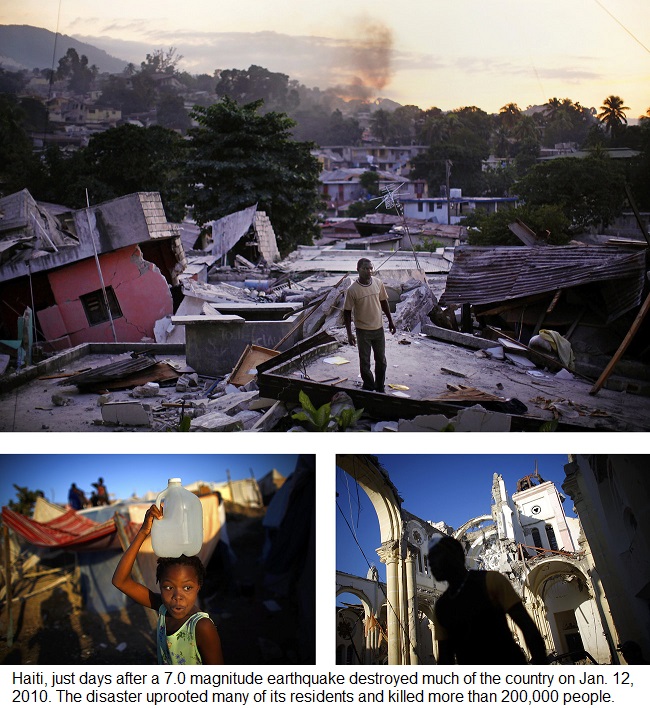
… high-crime incidents and natural disasters.
CU Blog - Exigency of 2008 - Photo 2These are all physicals circumstances. In American jurisprudence, physical threats are categorized as a ‘Clear and Present Danger’ where a potential danger must be assuaged otherwise it will likely cause a catastrophe. (This point was detailed in a previous blog-commentary).

But as for economic exigent circumstances, these can also be catastrophic!

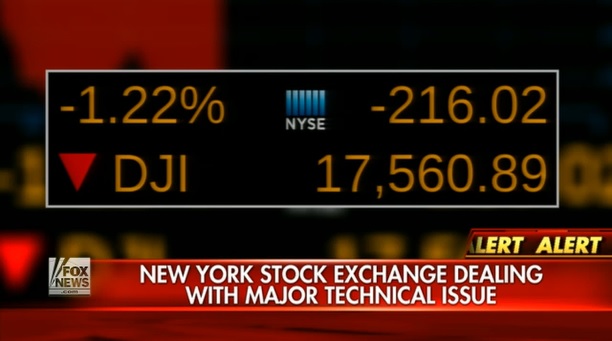
The prominent economic exigent circumstance of recent history is the Great Recession of 2008 – see VIDEO here. (The whole world has been shaped by the events of 2008).

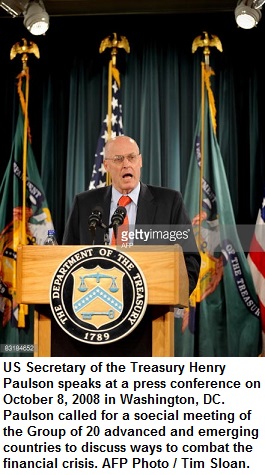
The US Secretary of the Treasury at that time, Henry Paulson, recognized the urgency and emergency of the financial crisis early in 2008 and asked the President (George W. Bush) for a War Powers Declaration; (Appendix A). This refers to the federal law intended to allow the US Congress to declare war, while the President executes the war as Commander-in-Chief.

In 2008 historicity, Congress did approve legislation to declare and fund a defense against the financial crisis; and the President did command a Bail-out strategy to restore the integrity of the economy.

This was economic war! Not just some normal market correction.

But were the actions legal?

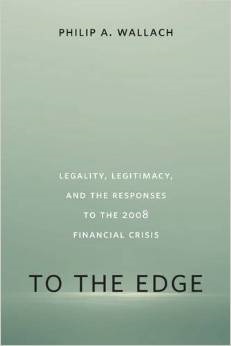
This was the premise for the new book by Philip Wallach “To the Edge: Legality, Legitimacy, and the Responses to the 2008 Financial Crisis“. The Amazon summary follows:

CU Blog - Exigency of 2008 - Photo 1Were the radical steps taken by the Treasury Department and Federal Reserve to avert the financial crisis legal? When and why did political elites and the general public question the legitimacy of the government’s responses to the crisis?

In [the book] To The Edge: Legality, Legitimacy, and the Responses to the 2008 Financial Crisis, Philip Wallach chronicles and examines the legal and political controversies surrounding the government’s responses to the recent financial crisis. The economic devastation left behind is well-known, but some allege that even more lasting harm was inflicted on America’s rule of law tradition and government legitimacy by the ambitious attempts to limit the fallout. In probing these claims, Wallach offers a searching inquiry into the meaning of the rule of law during crises.

The book provides a detailed analysis of the policies undertaken – from the rescue of Bear Stearns in March 2008 through the tumultuous events of September 2008, the passage of the TARP and its broad usage, the alphabet soup of emergency Federal Reserve programs, the bankruptcies of Chrysler and GM, and the extended public ownership of AIG, Fannie Mae, and Freddie Mac. Throughout, Wallach probes the legal bases of the government’s actions and explores why concerns about the legitimacy of government actions were only sporadically grounded in concerns about legality – and sometimes ran directly against them.

The public’s sense that government officials operated through ad hoc responses that favored powerful interests has helped bring the legitimacy of American governmental institutions to historic lows. Wallach’s book recommends constructive and sensible reforms policymakers should take to ensure accountability and legitimacy before the government faces another crisis.

Product Details

  • Paperback: 319 pages
  • Publisher: Brookings Institution Press (April 21, 2015)
  • Language: English
  • ISBN-10: 0815726236
  • ISBN-13: 978-0815726234

Source: http://www.amazon.com/dp/0815726236/ref=rdr_ext_tmb

The book Go Lean…Caribbean was written in the wake of this same 2008 Financial Crisis, but for the limited perspective for the Caribbean. Many lessons-learned from 2008 are considered and applied in appropriate strategies, tactics and implementations to re-boot the Caribbean region from the catastrophe of this crisis; many member-states of the region are still suffering; i.e. Puerto Rico. The foregoing Book Review highlights a publication that is a study of the depth-and-width of the legal maneuvering for the 2008 crisis; now the same writer, Philip Wallach, has composed a supplemental essay asserting a new label to the crisis “lawfare”; see Appendix B for definition and the essay in Appendix C below.

This lawfare consideration is presented in conjunction to mitigations and remediation for protecting the Caribbean homeland. The assertion in the book Go Lean … Caribbean (Page 23) is that with the emergence of new economic engines, “bad actors” will also emerge thereafter to exploit the opportunities, with good, bad and evil intent. But the book warns against more than just people, rather “bad or exigent circumstances”; thusly referring to corporate entities, natural disasters and other cross-border threats; 2008 would have fit this definition. The book relates that “bad actors” is a historical fact that will be repeated again and again.

This point is pronounced early in the book with the Declaration of Interdependence (Page 12) that claims:

i.       Whereas the earth’s climate has undeniably changed resulting in more severe tropical weather storms, it is necessary to prepare to insure the safety and security of life, property and systems of commerce in our geographical region. As nature recognizes no borders in the target of its destruction, we also must set aside border considerations in the preparation and response to these weather challenges.

ii.      Whereas the natural formation of the landmass for our lands constitutes some extreme seismic activity, it is our responsibility and ours alone to provide, protect and promote our society to coexist, prepare and recover from the realities of nature’s occurrences.

x.      Whereas we are surrounded and allied to nations of larger proportions in land mass, populations, and treasuries, elements in their societies may have ill-intent in their pursuits, at the expense of the safety and security of our citizens. We must therefore appoint new guards to ensure our public safety and threats against our society, both domestic and foreign. The Federation must employ the latest advances and best practices … to assuage continuous threats against public safety.

xii.    Whereas the legacy in recent times in individual states may be that of ineffectual governance with no redress to higher authority, the accedence of this Federation will ensure accountability and escalation of the human and civil rights of the people for good governance, justice assurances, due process and the rule of law…

xxv.  Whereas the legacy of international democracies had been imperiled due to a global financial crisis, the structure of the Federation must allow for financial stability and assurance of the Federation’s institutions. To mandate the economic vibrancy of the region, monetary and fiscal controls and policies must be incorporated as proactive and reactive measures. These measures must address threats against the financial integrity of the Federation and of the member-states.

The Caribbean appointing new guards (security pact) to ensure public safety must include many strategies, tactics and implementations considered “best-practices” for economic crimes and systemic threats. We must be on a constant vigil against “exigence”, man-made, natural and economic. This indicates being pro-active in monitoring, mitigating and managing risks. Then when “crap” happens – economic crises – the new guards will be prepared for “exigent circumstances”.

The Go Lean book is a petition for change, serving as a roadmap for the introduction and implementation of the technocratic Caribbean Union Trade Federation (CU). The CU is set to optimize Caribbean society through economic empowerment, and also homeland security in the region, since these are inextricably linked to this same endeavor.

Therefore the Go Lean roadmap has 3 prime directives:

  • Optimization of the economic engines in order to grow the regional economy to $800 Billion & create 2.2 million new jobs.
  • Establishment of a security apparatus to protect the resultant economic engines and the Caribbean homeland.
  • Improvement of Caribbean governance to support these engines.

This is not just academic, as in the case of the foregoing Book Review and supplemental essay in Appendix C. Principals among Go Lean planners were there in 2008, engaged with major stakeholders of the Global Financial crisis: Lehman Brothers, BearStearns, JPMorganChase, CitiGroup, etc. This is real experience from the real crisis; see documentary VIDEO here:

VIDEO – Meltdown – The Men Who Crashed the World – Part 1 – https://youtu.be/JYTyluv4Gws  

This 1st of 4 parts documentary elapses 2 and half hours in total. It is recommended that this be consumed at some point as extra-credit to this discussion.
Uploaded on Oct 13, 2011- In the first episode of Meltdown, we hear about four men who brought down the global economy: a billionaire mortgage-seller who fooled millions; a high-rolling banker with a fatal weakness; a ferocious Wall Street predator; and the power behind the throne.
The crash of September 2008 brought the largest bankruptcies in world history, pushing more than 30 million people into unemployment and bringing many countries to the edge of insolvency. Wall Street turned back the clock to 1929. But how did it all go so wrong?
Lack of government regulation; easy lending in the US housing market meant anyone could qualify for a home loan with no government regulations in place.
Also, London was competing with New York as the banking capital of the world. Gordon Brown, the British finance minister at the time, introduced ‘light touch regulation’ – giving bankers a free hand in the marketplace.
All this, and with key players making the wrong financial decisions, saw the world’s biggest financial collapse.

Part 2: https://youtu.be/Bp7c2Wo9YDc
Part 3: https://youtu.be/L20DhfgPugE
Part 4: https://youtu.be/osAYMnqZyZc

Planners of the Go Lean movement were there, on the inside looking out, not the outside looking in. They were among the movers-and-shakers of the macro economy, not just armchair “Monday-morning” quarterbacks.

Thusly the CU Trade Federation is set to be “on guard”, on alert for real or perceived economic threats. The legal concept is one of being deputized by the sovereign authority for a role/responsibility in the member-state. As a security apparatus, the CU must always be a sentinel to monitor known threats; this includes man-made, natural and economic threats. Many of these exigent circumstances would be designated as primarily assigned to the CU to assuage. And then the related CU agencies will be expected to aid, assist, and support local resources in the member-states.

This is more and better than the region’s prior response in 2008. “Step One, Day One” in the Go Lean roadmap is to assume this stewardship of the regional economy. The CU organizational structure must be empowered for proactive and reactive management of economic threats and exigent circumstances. The Go Lean book details this series of community ethos, strategies, tactics, implementations and advocacies to provide this better stewardship of the economic engines of the Caribbean region:

Who We Are – SFE Foundation – 2008 History Page 8
Assessment – Puerto Rico – ‘The Greece of the Caribbean’ Page 18
Community Ethos – Economic Principles – People Respond to Incentives Page 21
Community Ethos – Economic Principles – Economic Systems Influence Individual Choices Page 21
Community Ethos – Economic Principles – Voluntary Trade Creates Wealth Page 21
Community Ethos – Economic Principles – Consequences of Choices Lie in the Future Page 21
Community Ethos – Economic Principles – Money Multiplier Page 23
Community Ethos – Governing Principles – Lean Operations Page 24
Community Ethos – Ways to Impact Turn-arounds Page 33
Community Ethos – Ways to Improve Sharing Page 35
Community Ethos – Ways to Impact the Greater Good Page 37
Strategy – Mission – Fortify the Stability of the Banking Institutions Page 45
Strategy – Provide Proper Oversight and Support for the Depository Institutions Page 46
Strategy – Agents of Change – Globalization Page 57
Tactical – Confederating a permanent union Page 63
Tactical – Ways to Foster a Technocracy Page 64
Tactical – Growing the Economy – Minimizing Bubbles Page 69
Tactical – Separation-of-Powers – Caribbean Central Bank Page 73
Tactical – Separation-of-Powers – Depository Institutions Regulatory Agency Page 73
Anecdote – Turning Around CARICOM – Effects of 2008 Financial Crisis Page 92
Implementation – Assemble Caribbean Central Bank as a Cooperative Page 96
Implementation – Ways to Pay for Change Page 101
Implementation – Ways to Better Manage Debt Page 114
Implementation – Ways to Benefit from Globalization Page 119
Planning – 10 Big Ideas – #1: Single Market / Currency Union Page 127
Planning – Ways to Improve Trade Page 128
Planning – Lessons Learned from 2008 Page 136
Advocacy – Ways to Grow the Economy Page 151
Advocacy – Ways to Create Jobs Page 152
Advocacy – Ways to Control Inflation Page 153
Advocacy – Ways to Better Manage ForEx Page 154
Advocacy – Reforms for Banking Regulations Page 199
Advocacy – Ways to Impact Wall Street Page 200
Advocacy – Ways to Impact Main Street Page 201
Advocacy – Battles in the War on Poverty Page 222
Advocacy – Ways to Help the Middle Class Page 223
Advocacy – Ways to Impact the One Percent Page 224

This commentary has frequently focused on the lessons-learned from 2008. Some other blogs related to the challenge to Caribbean economic security and governance as a result of 2008 are listed here:

https://goleancaribbean.com/blog/?p=6399 Book Review on ‘Mitigating Income Inequality’
https://goleancaribbean.com/blog/?p=6260 Puerto Rico Bondholders Coalition Launches Ad Campaign
https://goleancaribbean.com/blog/?p=5482 For-Profit Education rise Post-2008: Plenty of Profit; Little Education
https://goleancaribbean.com/blog/?p=3858 ECB unveils 1 trillion Euro stimulus program
https://goleancaribbean.com/blog/?p=3582 For Canadian Banks: Caribbean has become a ‘Bad Bet’ Post-2008
https://goleancaribbean.com/blog/?p=3397 A Christmas Present for the Banks to Return to Pre-2008 Standards
https://goleancaribbean.com/blog/?p=3311 Detroit to exit historic bankruptcy – Finally recovering from 2008
https://goleancaribbean.com/blog/?p=3164 Michigan Unemployment – Then (2008) and Now
https://goleancaribbean.com/blog/?p=2930 ‘Too Big To Fail’ – Caribbean Version
https://goleancaribbean.com/blog/?p=2090 Why So Long? Can’t We Just… – Lesson from 2008
https://goleancaribbean.com/blog/?p=1309 5 Steps of the 2008 Mortgage-Bubble-Crisis
https://goleancaribbean.com/blog/?p=1296 Remittances to Caribbean Increasing since 2008
https://goleancaribbean.com/blog/?p=798 Lessons Learned from the American Airlines 2008 Recession Debacle
https://goleancaribbean.com/blog/?p=782 Open the Time Capsule: The Great Recession of 2008
https://goleancaribbean.com/blog/?p=623 ‘Only at the precipice, do they change’
https://goleancaribbean.com/blog/?p=599 Ailing Puerto Rico – from 2008 crisis – open to radical economic fixes
https://goleancaribbean.com/blog/?p=518 What Usain Bolt can teach banks about 2008 financial risk
https://goleancaribbean.com/blog/?p=378 Fed Releases Transcripts from 2008 Meetings
https://goleancaribbean.com/blog/?p=353 Book Review: ‘Wrong – Nine Economic Policy Disasters and What We Can Learn…’
https://goleancaribbean.com/blog/?p=273 10 Things We Don’t Want from the US – #3: Americanized World Economy

According to the foregoing blog references, the Caribbean parasitic regional economy has not being gracious to its citizens, and other stakeholders (visitors, lenders, Direct Foreign Investors). We need the empowerments of the Go Lean roadmap for so many reasons; one strong motivation is to turn-around this status quo; another reason is to diversify our economy. All of this will fortify our economic security and improve our governance. Considering the history of these North American and Western European powers, we do not want to be their parasites, rather their protégé.

This is the purpose of the Go Lean roadmap, to provide a turn-by-turn direction to move the region to that destination. The advocacy here is to adopt the structure of an economic technocracy. The term technocracy is used to designate the application of the scientific method to solving social and economic problems. The CU must start off as such a technocracy, not grow into being a technocracy – too much is at stake.

All of the Caribbean is hereby urged to lean-in to this roadmap for a technocracy, to make the Caribbean a better place to live, work and play. 🙂

Download the book Go Lean…Caribbean now!

———

Appendix A: War Powers Declaration

Article I, Section 8, Clause 11 of the United States Constitution, sometimes referred to as the War Powers Clause, vests in the Congress the power to declare war, in the following wording:

[The Congress shall have Power…] To declare War, grant Letters of Marque and Reprisal, and make Rules concerning Captures on Land and Water;

A number of wars have been declared under the United States Constitution, although there is some controversy as to the exact number, as the Constitution does not specify the form of such a declaration.
(Source: https://en.wikipedia.org/wiki/War_Powers_Clause; retrieved September 22, 2015)

———

Appendix B: Lawfareblog.com

Law + Warfae = Lawfare

This name Lawfare refers both to the use of law as a weapon of conflict and, perhaps more importantly, to the depressing reality that America remains at war with itself over the law governing its warfare with others. (It could apply equally to any other country). This blog by Benjamin Wittes, Robert Chesney, and Jack Goldsmith is devoted to that nebulous zone in which actions taken or contemplated to protect a nation interact with the nation’s laws and legal institutions. In addition, this term refers to a nation’s use of legalized international institutions to achieve strategic ends, so in effect the “use of law as a weapon of war”. – Source: https://www.lawfareblog.com/about-lawfare-brief-history-term-and-site

According to Wikipedia, Lawfare is asserted by some to be the illegitimate use of domestic or international law with the intention of damaging an opponent, winning a public relations victory, financially crippling an opponent, or tying up the opponent’s time so that they cannot pursue other ventures such as running for public office,[1][2] similar to a SLAPP (strategic lawsuit against public participation) lawsuit.

———

Appendix C – Essay Title: Hard Financial Crisis Choices    

By: Philip Wallach

Providing physical security to its citizens is undoubtedly the core function of the state. As readers of Lawfare well know, it is hard work to figure out how that security function should be reconciled with sometimes-conflicting imperatives of legal process, constitutional separation of powers, and transparent and accountable government. Especially challenging is the question of how much, and for how long, exigent circumstances should expand the sphere of legitimate government activities.

Not far behind physical security as a core function of the state is providing some baseline of financial stability and economic security, especially through the protection of a functional banking system and financial markets. Once again, it is hard to discern the appropriate relationship between this financial stability function and other mission-critical governmental activities. Because financial stability in a dynamic market economy includes the expectation that downturns are a healthy part of the process, it is often difficult to distinguish between a developing crisis and normal market corrections, making the balancing act between expedient action and a commitment to act through deliberate processes all the more difficult.

But while there are volumes enough on the question of why economies experience financial crises, and torrid debates on which responses are most effective, there is a striking absence of commentary about “hard financial crisis choices,” and especially their legal aspects. Applicable judicial precedents are few and far between, the Federal Reserve’s emergency decision-making processes are shrouded in mystery (in contrast to its monetary policy decisions), and the Treasury Department is accustomed to extraordinary deference. This vacuum has had some very unfortunate practical consequences for those who fashioned the responses to our financial crisis response, which I explain in my new book, To the Edge: Legality, Legitimacy, and the Responses to the 2008 Financial Crisis (Brookings Institution Press, 2015).

Why on earth should Lawfare readers care?

Treating national security as sui generis, while obviously appropriate in some contexts, unhelpfully narrows thinking in many others. If the question is how emergencies change the scope for government action, how legitimacy is achieved by crisis responders, or what the rule of law means in times of crisis, then adding financial crises to national security crises expands the material available for analysis. Doing so may also help clarify exactly what makes national security distinctive.

Some of my book’s analysis was directly inspired by Jack Goldsmith’s Power and Constraint. The latter explains how the government is actually empowered by various watchdogs and legal requirements that seem to constrain it, because they give it credibility and validation in a way that it could not otherwise produce. In the language of my book, such things provide legitimacy, which is often a necessary precondition for effective government action. If citizens had profound trust in their government (or a quasi-religious reverence for their leaders), legitimation might require very little other than some modicum of competence. But in the world of Snowden and Enron, Abu Ghraib and revolving doors, that trust is missing. Like Jack, I argue that accountability mechanisms provide at least a partial substitute by making citizens feel confident that leaders will be held to standards of reasonableness and propriety, if not immediately in the heat of a crisis response then at least afterwards, once the dust has settled.

American leaders once took this principle to its logical conclusion by openly acting extralegally and then seeking retroactive validation, either through a congressional indemnity or by appealing to a jury. The classic examples are antiques: Thomas Jefferson’s spending without appropriations in response to the HMS Leopard naval incident; General Andrew Jackson’s maintenance of martial law in New Orleans (vividly described in a classic article all Lawfare readers would enjoy); or Abraham Lincoln’s famous resort to constitutional dictatorship from March to July of 1861.

From the beginning of the twentieth century onward, Presidents and other crisis responders have unfailingly offered legal hooks for their emergency actions. Some academic theorists’ ambitions notwithstanding, openly extralegal declarations of prerogatives seem to have no place in our thoroughly legalized modern world (as Jack argues in a rather trenchant essay in this edited volume).

Instead of asking whether law will be the tool of legitimation, the question now becomes: just how reliable a check and a legitimator is the now-universally-obligatory exercise of legal justification? If justification is based on law that itself possesses no legitimacy, or if it misuses existing law, then it cannot provide much legitimacy. On the other hand, even in the era of ubiquitous legal justification, actions with poor legal pedigrees can be accepted as legitimate if they are acceptable to the public on other grounds. We can draw some useful analogies between national security and financial crises for both of these situations in which legality and legitimacy diverge.

Woodrow Wilson’s leadership during World War I provides an interesting instance in which poor legal justifications led to legitimacy problems. Congress gave Wilson’s administration unprecedented delegated powers through a number of enabling acts (the National Defense Act, Army Appropriations Act, Lever Act, and Overman Act), thus furnishing an easy way to legally justify most of his policies. But even in that context Wilson managed to push the envelope quite aggressively, both by using the vaguely defined powers as justifications for decisions that Congress refused to support (e.g., arming merchantmen, creating the Committee on Public Information—which was effectively a propaganda ministry—and censoring telegraphs) and by sustaining his wartime institutions past the end of the war against the desires of Congress. This willingness to aggressively wield emergency powers contributed to the public’s desire for a “return to normalcy” and Democrats’ resounding defeat in 1920.

Similarly, having the backing of an expansive enabling act—namely the Emergency Economic Stabilization Act of 2008, better known as TARP—proved no guarantee of legitimacy in recent years. The Act itself was bitterly contested, with bipartisan congressional leaders failing to persuade populist backbenchers of either party.  (This made TARP different from most enabling acts; the September 2001 AUMF, passed nearly unanimously, is far more typical.) There was also a sense that TARP was dangerously free of actual guidance for the executive branch, providing only a panicked sanction for whatever the Treasury Department found necessary. Such criticisms were well-founded: TARP was used in ways that wildly diverged from its original stated purpose of purchasing troubled assets, eventually including loans to GM and Chrysler when Congress failed to provide a separate pot of money for them in December 2008. Of course bank bailouts will tend to be unpopular in ways that defending the homeland will not, but even so the sense that the executive branch was doing as it pleased—even after Congress had belatedly acted—contributed to the crisis responses’ legitimacy problems. Neither in Wilson’s case nor in TARP’s were qualms about improper legal justifications the driving force behind dissatisfaction, but they served to intensify existing concerns. (Coincidentally, TARP’s most fervent opponents also yearned for a return to the normalcy of federal government circa 1921…)

Conversely, legal flaws don’t always entail legitimacy problems. Franklin Roosevelt’s Destroyer Deal in 1940 was supported by an at-best tendentious memorandum from Attorney General Robert Jackson, but it was widely popular and never caused Roosevelt any real political problems. In the boldest maneuver of the 2008 Financial Crisis, the Treasury Department used the Exchange Stabilization Fund to guarantee money market funds in September of that year—with only a paper-thin legal justification and absolutely no precedent to support such a strange use of an authority nominally dedicated to stabilizing international currency markets. But it was a striking success, so much so that the program it supported actually brought fees into the Treasury without ever paying any money out. The weakness of its legal justification is already nearly forgotten, of interest only to the very small handful of people interested Lawfare-like subjects.

A similarity between the Destroyer Deal and the money market rescue is worth noting: both involved the federal government giving rather than taking, which limits popular opposition and also the pool of potential litigants who might have standing to challenge the action. Acting so as to only cost taxpayers generally, rather than rights-holders specifically, offers a way to avoid the determined pryings of lawyers and the unpredictable rulings of judges—harder to pull off in the national security realm, but not impossible. It is worth considering how this desire to push policymaking into less heavily lawyered areas might shape the evolution of security policy in years to come.

One last musing here (if you’re eager for more, please get yourself the book!) in the form of a question, which I’d be eager to get the Lawfare community’s thoughts on. Early on during the crisis, the well-known economist and blogger Mark Thoma suggested that economists thinking about the balance between facilitating timely responses to emergencies and the need to honor the democratic process should learn from the compromise embedded in the War Powers Resolution, in which expedient action is allowed but time-limited. Sounds like a good idea…except for the whole history of the War Powers Resolution, which as I understand it is none too encouraging.

Financial crisis responders also sometimes figured out ways to circumvent rather clear time limits. Support for Fannie Mae and Freddie Mac under the Housing and Economic Recovery Act of 2008 was supposed to be cut off at the end of 2009, but the Treasury interpreted that to mean nothing more than that its maximum level of support had to be specified by that time. As they understood them, the commitments put in place by then were effectively unlimited and indefinite guarantees of the two firms.

What is it that makes putting hard time limits on executive branch unilateral actions so difficult? The obvious generic answer is enforceability. An enforcer must be both willing and able to meet violations with serious consequences, and it is hard to find institutional actors who are both. Courts may sometimes be willing—their tendency to defer to the executive in troubled times has limits, as Lawfare’s contributors have explored many times—but with neither purse nor sword judges’ ability to stand in the way of a determined executive branch is quite modest. With its power to withdraw funding, Congress is potent enough to enforce the limits put in force by its previous incarnations, but it seems generally unwilling to exercise that power, as doing so offers no political gain and considerable political risks. Are there other possible enforcers for time limits built into grants of extraordinary executive power? Are there ways to make limits genuinely self-enforcing, such that inaction will not render the limits nugatory? Thoughts about the War Powers Resolution or about the problem more generally would be greatly appreciated, as these questions are not rhetorical.
Phil Wallach is a Fellow in the Brookings Institution’s Governance Studies Program.
Source: LawFare Legal Analysis Online Community; posted May 21, 2015; retrieved September 22, 2015  from: https://www.lawfareblog.com/hard-financial-crisis-choices
Share this post:
, , , , ,

Wi-Fi Hot Spots Run By Hackers Are Targeting Tourists

Go Lean Commentary

CU Blog - Wi-Fi Hot Spots Run By Hackers Are Targeting Tourists - Photo 1BFor all the good that the internet brings to the world, there is a lot of bad too. The W.W.W in a web address does not mean Wild Wild West. But it feels like that; the bad old days of outlaws and gunslingers. (The actual WWW initials mean World Wide Web). Let the buyer beware!

The need for a Sentinel in Caribbean electronic commerce has been fully established by this commentary. Someone needs to be “watching the store in the Caribbean”. Electronic commerce now means internet and mobile transactions, encompassing smartphones, tablets and other mobile devices.

While the Caribbean member-states are not as advanced as other North American locations (US & Canada) or many Western European countries, we have fully embraced the internet via broadband, Wi-Fi and mobile communication utilities. The assertion in the book Go Lean…Caribbean, is that any plan to reboot Caribbean economics, security and governance must include promotion and regulation of technological initiatives as well. This Go Lean book serves as a roadmap for the introduction and implementation of the technocratic Caribbean Union Trade Federation (CU) to facilitate the growth, stewardship and oversight of electronic commerce in a regional Single Market.

There is therefore the need to be “on guard” for “bad actors” that will surely emerge to exploit Caribbean stakeholders, including residents, businesses and visitors – possibly up to 150 million people, including 80 million tourists. This news VIDEO here reports on a new threat:

VIDEO: Caution: Wi-Fi hot spots run by hackers are targeting tourists – http://www.today.com/video/caution-wi-fi-hot-spots-run-by-hackers-are-targeting-tourists-526433347646

September 16, 2015 – The “Hacking of America” series continues with a new warning: Before you log on to free public Wi-Fi hot spots at popular tourist destinations like New York City’s Times Square, be aware that they could be traps for hackers to steal your identity. One warning sign: The word “free.” NBC’s Tom Costello shares tips to protect your online security with TODAY.

CU Blog - Wi-Fi Hot Spots Run By Hackers Are Targeting Tourists - Photo 1AImagine a Caribbean tourist, disembarking a cruise ship, turning on a smartphone and being enticed with “FREE Wi-Fi”.

The Go Lean book relates regional oversight for the Caribbean Single Market – a lean technocracy – for cross-border electronic media, governance of the Information Technology Arts and Sciences and Grievance mediation. These activities are part –and-parcel of the missions of Go Lean roadmap, whose prime directives are identified with the following 3 statements:

  • Optimization of the economic engines in order to grow the regional economy to $800 Billion & create 2.2 million new jobs.
  • Establishment of a security apparatus to protect the people and processes (economic engines) of the region from threats and attacks (physical and electronic) that may originate from foreign or domestic sources.
  • Improvement of Caribbean governance to support these engines, including consolidation of all Postal operations. The Caribbean Postal Union will deploy a Caribbean Cloud, a Social Media / Electronic Commerce offering for all Caribbean member-states, branded www.myCaribbean.gov.

These prime directives will elevate Caribbean society. With this success comes the emergence of “bad actors”. The foregoing VIDEO relates one such instance. The goal of preparing the appropriate security apparatus – to protect the people and processes – was envisioned in the Go Lean roadmap from the beginning; this was defined early in the book (Page 12 & 14) in the following pronouncements in the Declaration of Interdependence:

x.  Whereas we are surrounded and allied to nations of larger proportions in land mass, populations, and treasuries, elements in their societies may have ill-intent in their pursuits, at the expense of the safety and security of our citizens. We must therefore appoint “new guards” to ensure our public safety and threats against our society, both domestic and foreign. The Federation must employ the latest advances and best practices … to assuage continuous threats against public safety.

xv. Whereas the business of the Federation and the commercial interest in the region cannot prosper without an efficient facilitation of postal services, the Caribbean Union must allow for the integration of the existing mail operations of the governments of the member-states into a consolidated Caribbean Postal Union, allowing for the adoption of best practices and technical advances to deliver foreign/domestic mail in the region.

xvi. Whereas security of our homeland is inextricably linked to prosperity of the homeland, the economic and security interest of the region needs to be aligned under the same governance. Since economic crimes, including piracy and other forms of terrorism, can imperil the functioning of the wheels of commerce for all the citizenry, the accedence of this Federation must equip the security apparatus with the tools and techniques for predictive and proactive interdictions.

xxvii. Whereas the region has endured a spectator status during the Industrial Revolution, we cannot stand on the sidelines of this new economy, the Information Revolution. Rather, the Federation must embrace all the tenets of Internet Communications Technology (ICT) to serve as an equalizing element in competition with the rest of the world. The Federation must bridge the digital divide and promote the community ethos that research/development is valuable and must be promoted and incentivized for adoption.

According to the foregoing VIDEO, the threat for cyber-crimes is now exposed to mobile users and those innocently partaking of FREE Wi-Fi services. This should not be so endangering. Wi-Fi communications should be a benign utility. There is the natural expectation that the governmental authorities would protect the innocent and interdict all villainous parties. This “natural expectation” is part-and-parcel of the Social Contract between citizens and their governments. For the 80 million visitors enjoying Caribbean hospitality, this presumed protection should automatically extend to them.

This is the assumption. The region must therefore anticipate these “bad actors” and deploy the counter-measures to monitor, mitigate and manage all identified risks associated with this cyber-threat. All cyber-crimes and threats to electronic commerce must be a constant focus for the “new guards” being proposed for implementation in the Caribbean with this Go Lean/CU roadmap.

CU Blog - Wi-Fi Hot Spots Run By Hackers Are Targeting Tourists - Photo 2

The book posits that these are among the issues that are too big for any one Caribbean member-state to manage alone; that there are times when there must be a cross-border, multilateral coordination. So confederating all 30 Caribbean member-states and appointing the CU as a deputized agency to oversee this cyber activity is a wise course of action. In addition, the technical competence for the “guardians” of this new Caribbean economy must be “cutting edge”. Can we truly expect this from the current bureaucratic structures of these small member-states? Hardly.

In a previous blog, the “cutting-edge” readiness of one member-state (Bahamas) was likened to 1985, as opposed to 2015; the blog stated that “they are not reaching for the stars but rather reaching for the lamp-post”. Other blog-commentaries on this subject have detailed the full width-and-breath of preparing Caribbean society for the diverse economic, security and governing issues of managing ICT in this new century. See sample blogs here:

https://goleancaribbean.com/blog/?p=6341 The Need for Online Tourism Marketing Stewardship
https://goleancaribbean.com/blog/?p=5435 China Internet Policing – Model for Caribbean
https://goleancaribbean.com/blog/?p=5353 US Presidential Politics and the Internet
https://goleancaribbean.com/blog/?p=4793 Online reviews – like Yelp and Angie’s List – can wield great power for services marketed, solicited and contracted online.
https://goleancaribbean.com/blog/?p=4381 Net Neutrality – The need for Caribbean Administration of the Issue.
https://goleancaribbean.com/blog/?p=4337 Crony-Capitalism Among the Online Real Estate Markets
https://goleancaribbean.com/blog/?p=3881 European and North American Intelligence Agencies to Ramp-up Cyber Security Cooperation
https://goleancaribbean.com/blog/?p=906 Bitcoin e-Payments needs regulatory framework to manage ‘risky’ image
https://goleancaribbean.com/blog/?p=308 Caribbean Communications Infrastructure Program (CARCIP) and the Caribbean Telecommunications Union (CTU) urges greater innovation and protection.

These commentaries demonstrate that there is the need for a technocratic governing body to better oversee and police Caribbean electronic commerce. This structure will assuage cyber-crimes and illicit activities for the Caribbean neighborhood in the online world.

We have so much more than Wi-Fi decoys to consider – as conveyed in the foregoing VIDEO. Successful execution of the Go Lean roadmap can expect a surge in internet/online activity and transactions; as there is the plan to deploy schemes to facilitate more e-Commerce: Central Bank adoption of Electronic Payment schemes and Postal Integration/Optimization, the Caribbean Cloud portal for www.myCaribbean.gov. So many more challenges – and lawlessness – will emerge.

The Go Lean book therefore presents the series of community ethos, strategies, tactics, implementations and advocacies that must be adopted and executed to elevate this region to be competent with the Worldwide Web. See the following sample here:

Community Ethos – Deferred Gratification Page 21
Community Ethos – People Choose Page 21
Community Ethos – People Respond to Incentives Page 21
Community Ethos – Economic Systems Influence Individual Choices Page 21
Community Ethos – Job Multiplier Page 22
Community Ethos – Privacy versus Public Protection Page 23
Community Ethos – Whistleblower Protection Page 23
Community Ethos – Lean Operations Page 24
Community Ethos – Ways to Help Entrepreneurship Page 28
Community Ethos – Promote Intellectual Property Page 29
Community Ethos – Ways to Bridge the Digital Divide – Allow for FREE Wi-Fi Page 31
Community Ethos – Ways to Improve Sharing Page 35
Community Ethos – Ways to Impact the Greater Good Page 37
Strategy – Vision – Integrate a Single Market of entire region Page 45
Tactical – Fostering a Technocracy Page 64
Tactical – Separation of Powers – Caribbean Postal Union Page 78
Tactical – Separation of Powers – Interstate Commerce Administration Page 79
Tactical – Separation of Powers – Communications and Media Authority Page 79
Implementation – Year 1 / Assemble Phase – Establish CPU Page 96
Anecdote – Implementation Plan – Mail Services – US Dilemma Page 99
Implementation – Improve Mail Services – Electronic Supplements Page 108
Implementation – Ways to Deliver Page 109
Implementation – Ways to Impact Social   Media – For Residents, Visitors & Diaspora Page 111
Planning – 10 Big Ideas for the Caribbean Region – Cyber Caribbean Page 127
Advocacy – Ways to Improve Interstate Commerce Page 129
Advocacy – Ways to Grow the Economy Page 151
Advocacy – Ways to Create Jobs Page 152
Advocacy –Ways to Improve Governance Page 168
Advocacy –Ways to Better Manage the Social Contract Page 170
Advocacy – Ways to Improve Libraries – Hi-Density Wi-Fi Page 187
Advocacy – Ways to Impact Events – Hi-Density Wi-Fi & Mobile Apps Page 191
Advocacy – Ways to Foster Technology – Public Access Wi-Fi Page 197
Advocacy – Ways to Foster e-Commerce – Mobile Apps & Hi-Density Wi-Fi Page 198
Advocacy – Ways to Impact Main Street – Downtown Wi-Fi Page 201
Advocacy – Ways to Impact Urban Living Page 234

The Go Lean book creates some Great Expectations for the internet. It posits that online facilitations can serve as an equalizing element for the Caribbean to better compete with the rest of the world. So we must elevate the region’s core competence with all-things-cyber, including the security dynamics.

“Bad actors will always emerge to exploit economic opportunities” – Go Lean (Page 23).

So to keep pace with the latest and greatest cyber-criminals, we must do the heavy-lifting of “serving and protecting” the Caribbean online populations.  The region needs this technocracy of the CU Trade Federation. Everyone is therefore encouraged to lean-in to this Go Lean roadmap.  🙂

Download the free e-Book of Go Lean … Caribbean – now!

Share this post:
, , , ,
[Top]

Tragic images show refugee crisis at a tipping point in Europe

Go Lean Commentary

You break it, you buy it!

Though this policy is not codified in law, this seems to be the de facto standard for handling other people’s property.

But the issue in this commentary is not property, it is people.

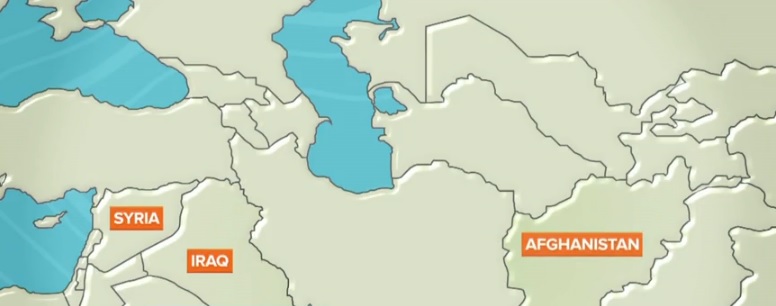
CU Blog - Tragic images show refugee crisis at a tipping point in Europe - Photo 3The people of the Failed-State countries of Syria, Iraq and Afghanistan are desperate and fleeing for their lives to get out of those war-torn countries to find relief. These ones risk their lives, and the lives of their children, to turn “sure defeat” into a fighting chance for life. It’s a bet – a gamble – and many times, these ones lose.

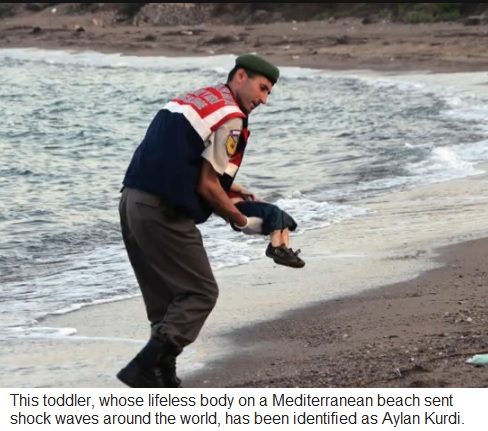
The name of a young toddler is now surfacing to give a name (and face) to his tragedy. Young Aylan Kurdi, a Syrian refugee, drowned in the waters of the Mediterranean Sea, trying to make it to shore with his parents. See the images here:

VIDEO: Tragic images show refugee crisis at a tipping point in Europe – http://www.today.com/video/tragic-images-show-refugee-crisis-at-a-tipping-point-in-europe-518578243727

Posted September 3, 2015 – Hundreds of thousands of refugees are risking their lives to reach Europe this year, 20,000 overwhelming a small Greek island in just the last week, with thousands drowning and dying in what’s become the biggest mass migration since WWII. NBC’s Bill Neely reports for TODAY.
CU Blog - Tragic images show refugee crisis at a tipping point in Europe - Photo 1

“There but for the Grace of God go I” – Old Expression

From the Caribbean perspective, we have seen this tragedy before, again and again. Just recently – in January – this commentary related the same tragedies in Caribbean member-states with refugees endangering their lives to leave places like Cuba, Haiti, Jamaica and the Dominican Republic. We understand the full breadth-and-width of Failed-States.

The toddler – Aylan Kurdi – in the foregoing photo deserves better. It is hoped that these images that were published Wednesday with his soaked red shirt, blue bottoms and tiny velcro-strap shoes that washed up on the beach in the Turkish resort of Bodrum, would ricochet across traditional and social media and be hailed as emblematic of the desperate and deadly refugee struggle to reach Europe.

These were plastered on international front pages on Thursday. This boy’s tragic life and death will not be in vain. CU Blog - Tragic images show refugee crisis at a tipping point in Europe - Photo 2The situation in these Failed-State countries (Syria, Iraq and Afghanistan) must be addressed. See Appendix below.
The book Go Lean…Caribbean serves as a roadmap for elevating the 30 member-states of the Caribbean, a few near Failed-State status. The book does not target Middle-East countries in its mitigation and remediation plans – Caribbean only – but we seek to learn lessons from the handling of this crisis.

The 5-Step leading-learning curve is normally:

1. Look, 2. Listen, 3. Learn, 4. Lend-a-hand and then 5. Lead.

We cannot lead in this case, but we can lend-a-hand, (contribute to any international relief campaign). We can also learn how to minimize Failed-State risks within our region.

So who should take the lead for fixing the Middle East Failed-State dysfunctions or the refugee crisis into Europe?

According to the opening quotation of this commentary: those who broke it. (Notice, in the foregoing VIDEO, that the refugees are targeting NATO countries).

The US and Western Europe are perhaps more directly responsible. They are the ones, in multi-national coalitions, that toppled the strong governments of Afghanistan and Iraq, then sat aside and allowed ISIS (Islamic State in Iraq and Syria) to form with the hope of overthrowing the oppressive regime of Bashar al-Assad in Syria. (So far, ISIS, has become its own “Frankenstein Monster”, to say the least, creating more distress and becoming its own threat). See Appendix below.
The Middle East is not easy!

In 2008 the newly elected US President, Barack Obama, vowed to exit US forces from Afghanistan and Iraq. He succeeded. The “laws of unintended consequences” may now have taken reign.

As for the Caribbean, we are on the periphery of this issue. Yes, we are allied to the United States and their enemies do tend to lash out at American allies. So we do have the “Sum of All Fears” that Al-Qaeda, ISIS or some other terrorist group would secure a “dirty bomb” nuclear device and detonate it in the Caribbean. But the biggest concern must be the slow creep of Failed-State status. This point was pronounced early in the Go Lean book as a motivation and a basis for confederation among Caribbean neighbors; there are the applicable statements in the opening Declaration of Interdependence (Page 12):

x.   Whereas we are surrounded and allied to nations of larger proportions in land mass, populations, and treasuries, elements in their societies may have ill-intent in their pursuits, at the expense of the safety and security of our citizens. We must therefore appoint “new guards” to ensure our public safety and threats against our society, both domestic and foreign. The Federation must employ the latest advances and best practices … to assuage continuous threats against public safety.

xi. Whereas all men are entitled to the benefits of good governance in a free society, “new guards” must be enacted to dissuade the emergence of incompetence, corruption, nepotism and cronyism at the peril of the people’s best interest. The Federation must guarantee the executions of a social contract between government and the governed.

xii. Whereas the legacy in recent times in individual states may be that of ineffectual governance with no redress to higher authority, the accedence of this Federation will ensure accountability and escalation of the human and civil rights of the people for good governance, justice assurances, due process and the rule of law. As such, any threats of a “failed-state” status for any member state must enact emergency measures on behalf of the Federation to protect the human, civil and property rights of the citizens, residents, allies, trading partners, and visitors of the affected member state and the Federation as a whole.

xiii. Whereas the legacy of dissensions in many member-states (for example: Haiti and Cuba) will require a concerted effort to integrate the exile community’s repatriation, the Federation must arrange for Reconciliation Commissions to satiate a demand for justice.

xvi. Whereas security of our homeland is inextricably linked to prosperity of the homeland, the economic and security interest of the region needs to be aligned under the same governance. Since economic crimes, including piracy and other forms of terrorism, can imperil the functioning of the wheels of commerce for all the citizenry, the accedence of this Federation must equip the security apparatus with the tools and techniques for predictive and proactive interdictions.

This Go Lean book serves as a roadmap for the introduction and implementation of the technocratic Caribbean Union Trade Federation (CU). With a branding name like Trade Federation, obviously the scope of elevating Caribbean society starts with economics. But the CU must seek to optimize the security dynamics in addition to economic empowerments. Therefore the Go Lean roadmap has these 3 prime directives:

  • Optimization of the economic engines in order to grow the regional economy and create 2.2 million new jobs.
  • Establishment of a security apparatus to protect the resultant economic engines and mitigate challenges/threats to ensure public safety for the region’s stakeholders.
  • Improvement of Caribbean governance to support these engines.

The book contends that though terrorism may not be a scourge on Caribbean life presently, new “bad actors” will eventually emerge to exploit the new economic successes envisioned in the Go Lean roadmap. The CU/Go Lean Strategy statement is quoted as follows (Page 46):

Fix the broken systems of governance in our region and deter against movements towards Failed-States, and any preying upon our people. We must protect the most vulnerable among us and guarantee the human/civil rights of our women and minorities.

The Go Lean book details a series of community ethos, strategies, tactics, implementations and advocacies to optimize the societal engines of the region, to stop any downward spiral into Failed-State status. See the lists here:

Community Ethos – Economic Systems Influence Choices & Incentives Page 21
Community Ethos – Consequences of Choices Lie in the Future Page 21
Community Ethos – Anti-Bullying and Mitigation Page 23
Community Ethos – Minority Equalization Page 24
Community Ethos – Ways to Impact the Future – Focus on Youth & Progress Page 26
Community Ethos – Ways to Manage Reconciliations Page 34
Community Ethos – Ways to Impact the Greater Good Page 37
Strategy – Vision –  Integrate region into a Single Market Economy Page 45
Strategy – Agents of Change – Globalization Page 57
Strategy – Agents of Change – Climate Change – Increase in Droughts and Floods Page 57
Tactical – Separation of Powers – Department of Homeland Security Page 75
Tactical – Separation of Powers – Federal Courts – Truth & Reconciliation Commissions Page 75
Implementation – Ways to Foster International Aid Page 115
Planning – 10 Big Ideas … in the Caribbean Region – Haiti & Cuba Page 127
Planning – Ways to Model the EU – From Worst to First Page 130
Planning – Reasons Why the CU Will Succeed – Germany Reconciliation Model Page 132
Planning – Ways to Improve Failed-State Indices – Cuba & Haiti on the List Page 134
Planning – Lessons from East Germany – European post-war rebuilding Page 139
Planning – Lessons from Egypt – Arab Spring Page 143
Planning – Lessons from the US Constitution – Gradual Optimization Page 145
Planning – Lessons from Canada’s History – Reconciliations with Indigenous Peoples Page 146
Advocacy – Ways to Grow the Economy Page 151
Advocacy – Ways to Create Jobs Page 152
Advocacy – Ways to Impact Justice Page 178
Advocacy – Ways to Impact the Diaspora Page 217
Advocacy – Ways to Protect Human Rights Page 220
Advocacy – Ways to Help Women Page 226
Advocacy – Ways to Impact Youth Page 227
Advocacy – Ways to Impact the Dominican Republic – Need for Reconciliations Page 237
Advocacy – Ways to Re-boot Haiti Page 238
Advocacy – Ways to Re-boot Jamaica – Mitigate Migrations & Brain Drain Page 239

In previous blog commentaries, the related issues of Caribbean migration and refugee-seeking were fully explored. See sample list here:

https://goleancaribbean.com/blog/?p=5759 Pressed by Debt Crisis, Doctors Leave Greece in Droves
https://goleancaribbean.com/blog/?p=4809 Americans arrested for aiding ISIS
https://goleancaribbean.com/blog/?p=3662 Migrant flow into US from Caribbean spikes
https://goleancaribbean.com/blog/?p=2907 Local Miami Haitian leaders protest Bahamian immigration policy
https://goleancaribbean.com/blog/?p=2809 A Lesson in History: Economics of East Germany
https://goleancaribbean.com/blog/?p=1531 A Lesson in History: World War I Ethnic Cleansing
https://goleancaribbean.com/blog/?p=1433 Caribbean loses over 70% of tertiary educated citizens to the   brain drain
https://goleancaribbean.com/blog/?p=623 Only at the precipice, do they change

All of the Caribbean needs to pay more-than-the-usual attention to the crisis with these Middle East Failed-States and the resultant refugee influx into Europe.

“There but for the Grace of God go I”

The remediation and mitigations in the Go Lean book are best-practices to minimize the push-pull factors for our own societal abandonment, and downward spirals into Failed-States. Now is the time for all of the Caribbean to lean-in this roadmap. Let’s show the world how to re-boot Failed-States and how to forge better conditions in a homeland. Let’s truly make the Caribbean better places to live, work, and play.  🙂

… and R.I.P. little Aylan Kurdi. We will not soon forget you. 🙁

Download the free e-Book of Go Lean … Caribbean – now!

——–

Appendix – Middle East Failed States

Afghanistan

A landlocked country, with a population of approximately 32 million people; it is located within South Asia and Central Asia between Iran and Pakistan. The recent history features a series of coups in the 1970s and was followed by a Soviet invasion and a series of civil wars that devastated much of Afghanistan.

The September 11 attacks on the United States were perpetrated by known terrorist Osama bin Laden and his al-Qaeda movement. The US demanded that the then-Taliban government hand him over.[122] After refusing to comply, the October 2001 Operation Enduring Freedom was launched by the US to topple the Taliban government. During the initial invasion, US and UK forces bombed al-Qaeda training camps. The United States began working with the Northern Alliance to remove the Taliban from power.[123] American forces remained until the official end of the war on December 28, 2014. However, thousands of US-led NATO troops have remained in the country to train and advise Afghan government forces.[138] The 2001-present war has resulted in between 185,000 and 249,000 deaths, which includes civilians, insurgents and government forces. A Taliban insurgency remains, to this day.

Iraq

This country is situated near the Arabian Peninsula and sits in between Saudi Arabia, Iran, Turkey, Jordan and Kuwait. The largest ethnic groups in Iraq are Arabs and Kurds. Other ethnic groups include Assyrians, Turkmen, Shabakis, Yazidis, Armenians, Mandeans, Circassians and Kawliya.[6] Around 95% of the country’s 36 million citizens are Shia or Sunni Muslims, with Christianity, Yarsan, Yezidism and Mandeanism also present.

Iraq was controlled by the Arab Socialist Ba’ath Party from 1968 until 2003. After an invasion by the United States and its allies in 2003, Saddam Hussein‘s Ba’ath Party was removed from power and multi-party parliamentary elections were held in 2005. The American presence in Iraq ended in 2011,[9] but the Iraqi insurgency continued and intensified as fighters from the Syrian Civil War spilled into the country. Civil strife continues to this day with conflicts among the ethnic and religious sects.

Syria

A country of 18 million people, on the coast of the Mediterranean; it is made up of fertile plains, high mountains, and deserts, it is home to diverse ethnic and religious groups, including Arabs, Greeks, Armenians, Assyrians, Kurds, Circassians,[8] Mandeans[9] and Turks. Religious groups include Sunnis, Christians, Alawites, Druze, Mandeans and Yazidis. Sunni Arabs make up the largest population group in Syria. Since March 2011, Syria has been embroiled in an uprising against Assad and the Ba’athist government as part of the Arab Spring, a crackdown which contributed to the Syrian Civil War and Syria becoming among the least peaceful countries in the world.[16]

Share this post:
, , , , ,
[Top]

A Lesson in History – ‘Katrina’ is helping today’s crises

Go Lean Commentary

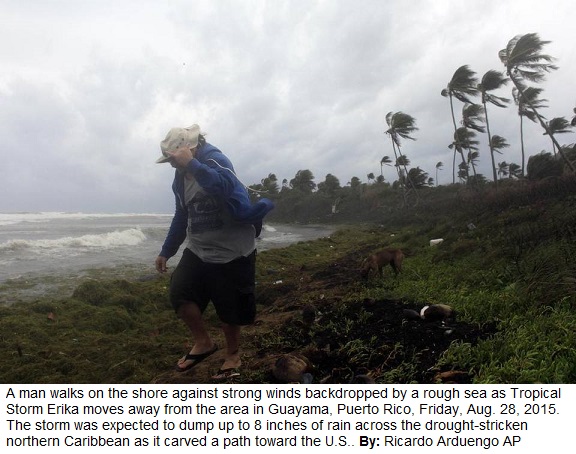
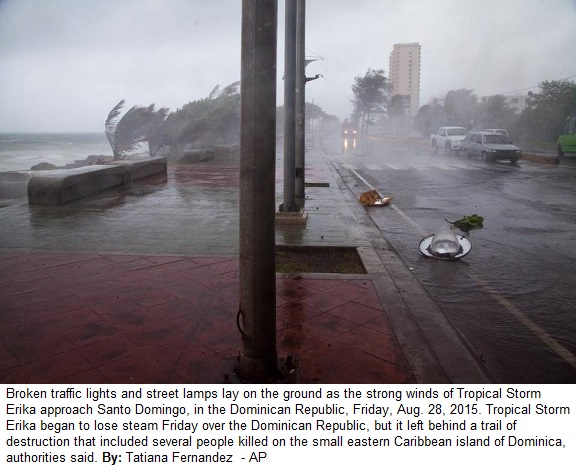
As of this moment (August 28 – 29, 2015), there is a Tropical Storm – Erika – barreling through the Caribbean. So far, it has been deadly, with reports of fatalities in the islands of Dominica and Puerto Rico. See story/VIDEO here:

VIDEO 1: Tropical storm Erika nears US, destruction in its wake

Posted Friday Aug 28, 2015 from: http://www.today.com/video/tropical-storm-erika-nears-us-destruction-in-its-wake-514916419548

The effects of tropical storm Erika are already being felt in Puerto Rico, after the storm left four people dead and more missing on the Caribbean island of Dominica. Janet Shamlian reports and TODAY’s Al Roker takes us through the storm’s projected path.

s crisis - Photo 1

s crisis - Photo 2

This storm is not done yet, more damage to persons and property is expected – it is expected to elevate to hurricane status by Sunday.

Welcome to the Caribbean 2015 …
… the greatest address on the planet?!?!

Why would anyone campaign to assume the stewardship of this archipelago of islands?

This is the “siren song” of the book Go Lean … Caribbean. The publishers and underlying Foundation are petitioning for a leadership role in the economic, security and governing engines of the region. Why?

There is no insanity! This is an expression of love for the homeland. The 30 member-states of the Caribbean are home to 42 million people, and a Diaspora of 10 million; plus 80 million visitors annually.

This is the greatest address on the planet!

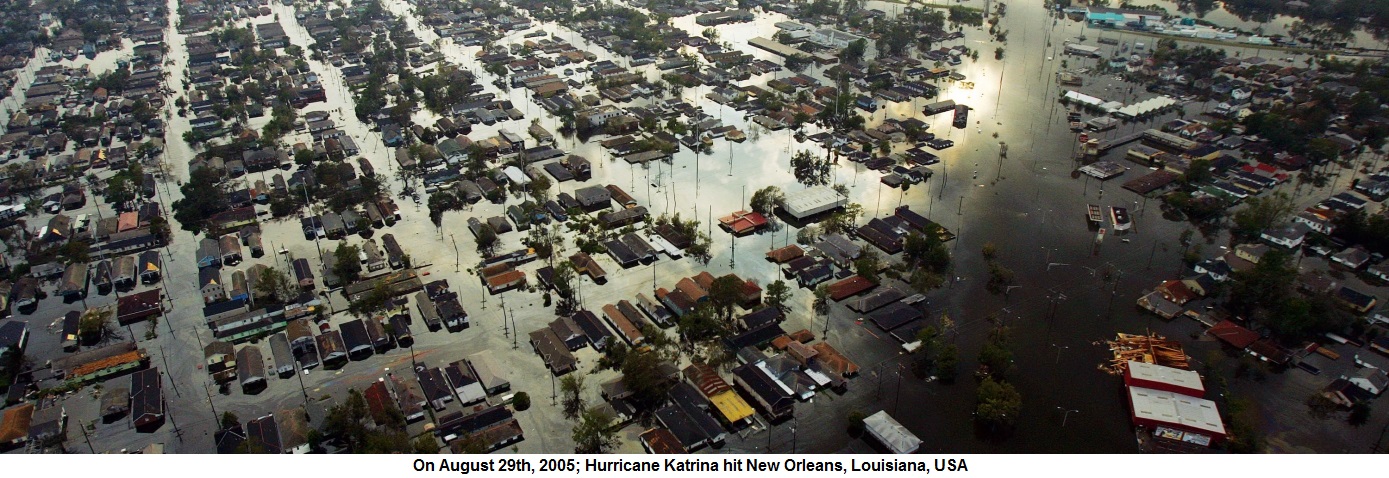
Plus, everywhere has natural disasters to contend with. This fact relates to rich countries and poor alike. For example, take the United States; they are the richest Single Market economy in the world and yet their coastal city of New Orleans Louisiana (NOLA) was devastated by Hurricane Katrina 10 years ago … to the day (August 29, 2005). Their riches did not spare their devastation, nor did the riches facilitate best-practices in terms of response, relief and rebuilding. New Orleans is marking the anniversary of Katrina’s devastation and the lessons learned from the aftermath. See story/VIDEO here:

VIDEO 2: Both Progress and Stumbling Blocks Linger a Decade After Katrina

Posted Friday, Aug 28, 2015 from: http://www.nbcnews.com/nightly-news/video/both-progress-and-stumbling-blocks-linger-a-decade-after-katrina-515371587753

Ten years later, after Hurricane Katrina many of those who left have returned and while tourist sections of the city have been rebuilt, recovery in areas like the Lower Ninth ward is slow.

There is a lesson for the Caribbean in considering the history of ‘Katrina’: There is a parallel cause-and-effect to Tropical Storm Erika and all subsequent storms: Climate Change.

In the last few decades, major devastating storms have proliferated every year … somewhere … in the Northern Hemisphere. This commentary has detailed other cases; see sample here:

https://goleancaribbean.com/blog/?p=4741 Vanuatu and Tuvalu – Inadequate response to post-storm suffering
https://goleancaribbean.com/blog/?p=2465 Book Review: ‘This Changes Everything: Capitalism vs. the Climate’
https://goleancaribbean.com/blog/?p=1817 Caribbean grapples with intense new cycles of flooding & drought

These commentaries, and the Go Lean book, all assert that Climate Change cannot be ignored. Even though there be deniers of any man-made causes, the reality of these storms challenge the realities of Caribbean life.

It is what it is!

The region has been warned: Prepare!

The book Go Lean … Caribbean delved into details of the Katrina lessons in application to the Caribbean. This is an excerpt from Page 184:

The Bottom Line on Hurricane Katrina
Katrina was the deadliest and most destructive hurricane of the 2005 Atlantic hurricane season. It was the costliest natural disaster, as well as one of the five deadliest hurricanes, in the history of the US. At least 1,833 people died in the hurricane and subsequent floods; total property damage was estimated at $81 billion. The hurricane strengthened to a Category 5 hurricane over the warm Gulf water, but weakened before making its landfall as a Category 3 hurricane on the morning of Monday, August 29 in southeast Louisiana. It caused severe destruction along the Gulf coast from central Florida to Texas, much of it due to the storm surge. The most significant number of deaths occurred in New Orleans, Louisiana, which flooded as the levee system catastrophically failed, 53 different breaches, in the hours after the storm had moved inland. Eventually 80% of the city and large tracts of neighboring parishes became flooded, and the floodwaters lingered for weeks.

The economic effects of the storm were far-reaching. The Administration of President George W. Bush sought $105 billion for repairs and reconstruction in the region, which did not account for damage to the economy caused by interruption of the oil & natural gas supply, destruction of the GulfCoast’s highway infrastructure, and exports of commodities such as forestry and grain. Plus, hundreds of thousands of local residents were left unemployed, Before the hurricane, the region supported over one million non-farm jobs, with 600,000 of them in New Orleans. It is estimated that the total economic impact in Louisiana and Mississippi exceeded $150 billion, as Katrina redistributed over one million people from the central Gulf coast elsewhere across the United States, which became the largest Diaspora in the history of the US.

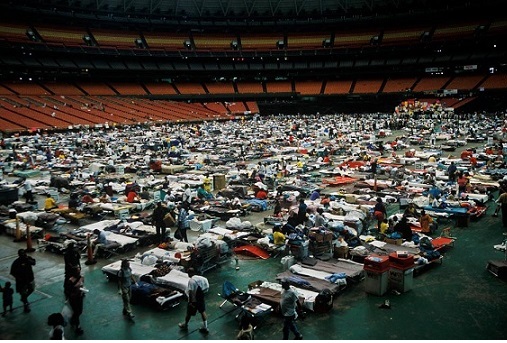
Within days of Katrina’s August 29, 2005 landfall, public debate arose about the local, state and federal governments’ role in the preparations for and response to the hurricane. Criticism was initially prompted by televised images of visibly shaken and frustrated political leaders, and of residents who remained stranded by flood waters without water, food or shelter. Deaths from thirst, exhaustion, and violence, days after the storm had passed, fueled the criticism, as did the dilemma of the evacuees at ill-prepared shelter facilities (i.e. the Super Dome, LouisArmstrongInternationalAirport). Some alleged that race, class, and other factors could have contributed to delays in response. President Bush later called the criticism, directed towards him, (particularly by Hip-Hop recording artist Kanye West), the worst moment in his presidency, being unjustly accused of racism.

s crisis - Photo 3

 Katrina Photo 4

The Super Dome in New Orleans – The aftermath of Hurricane Katrina

s crisis - Photo 5

This is the purpose of the Go Lean roadmap. It introduces the technocratic Caribbean Union Trade Federation (CU) to prepare Caribbean society for the eventual devastation of these Climate-Change-induced weather systems, such as Katrina was for New Orleans, Louisiana. We do not have the luxury of “sticking our head in the sand” and pretending that these problems will simply go away – the conclusion of many observers of the Katrina Crisis on NOLA. This point is pronounced early in the book with this Declaration of Interdependence (Page 11), with this opening statement:

i.  Whereas the earth’s climate has undeniably changed resulting in more severe tropical weather storms, it is necessary to prepare to insure the safety and security of life, property and systems of commerce in our geographical region. As nature recognizes no borders in the target of its destruction, we also must set aside border considerations in the preparation and response to these weather challenges.

The CU will implement optimized Emergency Management schemes to provide better stewardship for the region’s preparation and response to natural disasters; (in addition to hurricanes, there is the need to monitor earthquakes, volcanoes, floods and droughts in the regions).  In addition, the CU will assume jurisdiction for the Caribbean Sea, the 1,063,000 square-mile international waters, as an Exclusive Economic Zone. These preparations and mitigations will allow for better cooperation, collaboration and equalization in the region. The CU/Go Lean roadmap has these 3 prime directives:

  • Optimization of the economic engines in order to grow the regional economy to $800 Billion and create 2.2 million new jobs.
  • Establishment of a security apparatus to protect the resultant economic engines, including the Emergency Management apparatus.
  • Improvement of Caribbean governance to support these engines.

The Go Lean book details the community ethos, strategies, tactics, implementations and advocacies necessary to impact the homeland in this age of Climate Change. Consider the list as follows:

Profile – Who We Are: SFE Foundation Page 8
Economic Principles – People Choose because Resources are Limited Page 21
Economic Principles – All Choices Involve Costs Page 21
Economic Principles – People Respond to Incentives Page 21
Economic Principles – Economic Systems Influence Individual Choices Page 21
Economic Principles – Consequences of Choices Lie in the Future Page 21
Community Ethos – Job Multiplier Page 22
Community Ethos – “Crap” Happens Page 23
Community Ethos – Lean Operations Page 24
Community Ethos – Return on Investments (ROI) Page 24
Community Ethos – Ways to Impact the Future Page 26
Community Ethos – Ways to Improve Sharing Page 35
Community Ethos – Impact the Greater Good Page 37
Anecdote – Pipeline Transport – Strategies, Tactics & Implementations Page 43
Strategy – Vision – Confederating 30 Member-states in a Union Page 45
Strategy – Agents of Change – Technology Page 57
Strategy – Agents of Change – Globalization Page 57
Strategy – Agents of Change – Climate Change Page 57
Tactical – Fostering a Technocracy Page 64
Tactical – Growing Economy – Quicker Recoveries; Less Economic Bubbles Page 69
Separation of Powers – Homeland Security Department – Emergency Management Agency Page 76
Separation of Powers – Interior Department – Exclusive Economic Zone Page 82
Assemble – Consolidating Disaster Preparation & Response Page 96
Implementation – Ways to Pay for Change – Homeland Security – Hurricane Insurance Fund Page 101
Implementation – Benefits from the Exclusive Economic Zone Page 104
Implementation – Ways to Develop a Pipeline Industry – To Mitigate Natural Disaster Effects Page 107
Implementation – Ways to Deliver Page 109
Planning – 10 Big Ideas – Integrated Homeland Security efforts Page 127
Advocacy – Ways to Grow the Economy – Quick Recovery from Natural Disasters Page 151
Advocacy – Ways to Create Jobs Page 152
Advocacy – Ways to Better Manage the Social Contract – Infrastructure Page 170
Advocacy – Ways to Ways to Impact Public Works – Inter-State Pipelines Page 175
Advocacy – Ways to Foster Cooperatives Page 176
Advocacy – Ways to Improve for Natural Disasters – Hurricane Katrina Case Study Page 184
Advocacy – Ways to Impact Extractions – Inter-State Pipeline Strategy Alignment Page 195
Advocacy – Ways to Improve Emergency Management Page 196
Advocacy – Ways to Foster Technology Page 197
Advocacy – Ways to Ways to Improve Monopolies – Foster Cooperatives for Better Recoveries Page 202
Advocacy – Ways to Improve Transportation – Pipeline Options Page 205

It is time for change in the Caribbean! It is time to change our preparations and our responses to these natural disasters. The strategies, tactics and implementations proposed in the book Go Lean…Caribbean are conceivable, believable and achievable. We must do these! We must do better.

Everyone in the Caribbean are hereby urged to lean-in for this Go Lean roadmap.  🙂

Download the free e-Book of Go Lean … Caribbean – now!

Share this post:
, , , ,
[Top]

Sum of All Fears – ‘On Guard’ Against Deadly Threats

Go Lean Commentary

It’s time for some serious talk:

There are people out there that would like to kill us, and destroy our way of life.

Doubtful? Consider ISIS, Al Qaeda or Boko Haram!

These groups are Terrorist organizations, and they are committed, even at the risk of their own lives to carry out what they consider “a sacred service to their God”. (This aligns with the Bible at John 16:2  – “the time cometh that whosoever killeth you will think that he doeth God service” – KJV).

From the Caribbean perspective, this is a scary proposition. This also considers that the people, institutions of the Caribbean may not be the Terrorists’ target; they are really at enmity with the United States, not the Caribbean.

The US has a massive security apparatus, with huge budgets, systems, hardware (ships, submarines, fighter jets, satellites, etc.) and military personnel; the largest in the world. These enemies may not be able to get to their ideal target, the American homeland, but will settle with successful attacks against its bordering neighbors, allies and defenseless island territories (Puerto Rico, and/or the US Virgin Islands).

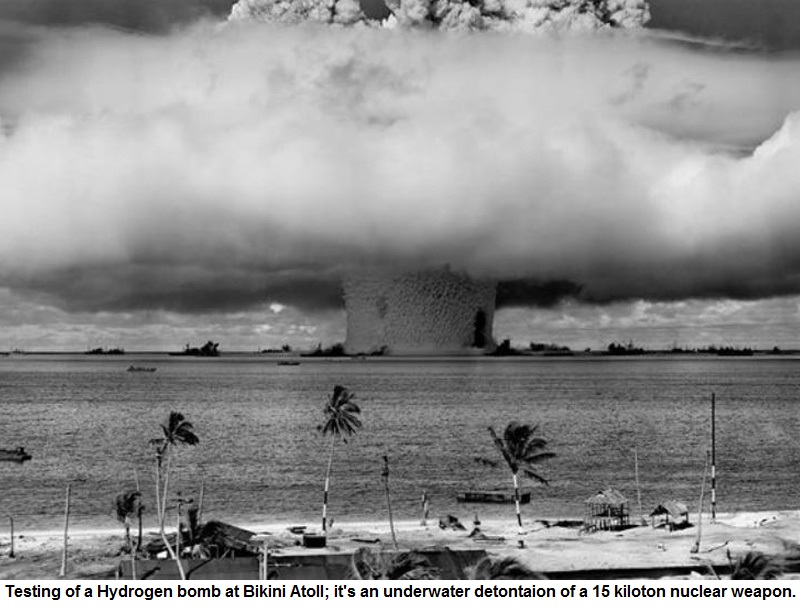
God forbid, they may get their hands on nuclear materials and detonate a “dirty bomb” on our Caribbean homeland.

This is the sum of all our fears!

CU Blog - Sum of All Fears - Photo 2

This title, “Sum of All Fears”, comes from a quote by the late British Prime Minister Winston Churchill, quoted as follows:

Why, you may take the most gallant sailor, the most intrepid airman or the most audacious soldier, put them at a table together – what do you get? The sum of their fears.

In the modern lexicon however, the title draws reference to the movie based on the novel of the same name. These works of fiction portray a scenario where a nuclear bomb is exploded on US soil at a celebrated American football game. The movie truly depicted an ominous scenario. See the movie trailer here:

VIDEO – Sum of All Fears (2002) – Movie Trailer  – https://youtu.be/p4Y-0Pun2Eg

Published on Feb 22, 2013 – CIA analyst Jack Ryan must thwart the plans of a terrorist faction that threatens to induce a catastrophic conflict between the United States and Russia’s newly elected president by detonating a nuclear weapon at a football game in Baltimore.
Alternate Synopsis: When the president of Russia suddenly dies, a man whose politics are virtually unknown succeeds him. The change in political leaders sparks paranoia among American CIA officials, so CIA director Bill Cabot recruits a young analyst to supply insight and advice on the situation. Then the unthinkable happens: a nuclear bomb explodes in a U.S. city, and America is quick to blame the Russians.

Life imitating art; art imitating life.

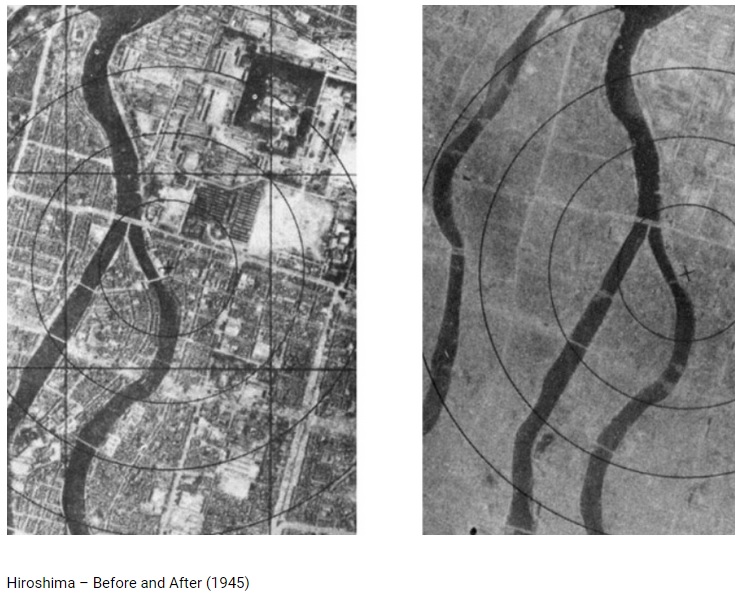
Atomic bombs have been detonated before … twice, in World War II against Japan on the cities of  Hiroshima and Nagasaki. (Today, August 6, is the exact 70th Anniversary of the Hiroshima detonation).

CU Blog - Sum of All Fears - Photo 1

No one can therefore claim that this fear of an atomic, hydrogen or nuclear bomb is far-fetched.

This consideration is presented in conjunction to mitigations and remediation for protecting the Caribbean homeland. The assertion in the book Go Lean … Caribbean (Page 23) is that with the emergence of new economic engines, “bad actors” will also emerge thereafter to exploit the opportunities, with good, bad and evil intent. The book warns that this “bad actor” emergence is a historical fact; it is not inconceivable that it can be repeated, even on the Caribbean homeland.

This is the sum of our fears!

This point is pronounced early in the book with the Declaration of Interdependence (Page 12) that claims:

x.   Whereas we are surrounded and allied to nations of larger proportions in land mass, populations, and treasuries, elements in their societies may have ill-intent in their pursuits, at the expense of the safety and security of our citizens. We must therefore appoint “new guards” to ensure our public safety and threats against our society, both domestic and foreign. The Federation must employ the latest advances and best practices … to assuage continuous threats against public safety.

xii. Whereas the legacy in recent times in individual states may be that of ineffectual governance with no redress to higher authority, the accedence of this Federation will ensure accountability and escalation of the human and civil rights of the people for good governance, justice assurances, due process and the rule of law. As such, any threats of a “failed state” status for any member state must enact emergency measures on behalf of the Federation to protect the human, civil and property rights of the citizens, residents, allies, trading partners, and visitors of the affected member state and the Federation as a whole.

xvi. Whereas security of our homeland is inextricably linked to prosperity of the homeland, the economic and security interest of the region needs to be aligned under the same governance. Since economic crimes, including piracy and other forms of terrorism, can imperil the functioning of the wheels of commerce for all the citizenry, the accedence of this Federation must equip the security apparatus with the tools and techniques for predictive and proactive interdictions.

The Go Lean book serves as a roadmap for the introduction and implementation of the technocratic Caribbean Union Trade Federation (CU). The branding Trade connotes economics, but the roadmap also addresses Homeland Security. Thusly, ascending the CU treaty would also enact a Defense Pact for the region’s security interest. Therefore the Go Lean roadmap has these 3 prime directives:

  • Optimization of the economic engines in order to grow the regional economy and create new jobs.
  • Establishment of a security apparatus to protect the resultant economic engines and the Caribbean homeland.
  • Improvement of Caribbean governance to support these engines.

This structure heeds the pleas of the foregoing Declaration of Interdependence. The Caribbean appointing “new guards”, or a security pact to ensure public safety includes many strategies, tactics and implementations considered “best-practices”. We must be on a constant vigil against the eventual emergence of a “bad actor” that would be the “sum of our fears”. This indicates being pro-active in monitoring, mitigating and managing risks. The Go Lean book describes an organization structure with Intelligence Gathering and Analysis, a robust Emergency Management functionality, plus the Unified Command and Control for Caribbean Disaster Response, anti-crime and military preparedness.

This type of initiative was attempted before. Some Caribbean region member-states came together, starting in 1982, to establish the Regional Security System (RSS); it is an international accord for the defense and security of the eastern Caribbean region. The CU/Go Lean roadmap “stands on the shoulders” of that nascent beginning and extends the vision further with a Status of Forces Agreement (SOFA) embedded in the treaty to create the CU Trade Federation. It is past time now for some real assurances. The world has become a scarier place. The threat of an unknown, non-state-sponsored enemy, terrorism is real. The World Trade Center/Pentagon attack on September 11, 2001 was an undeniable game-changer. But in a recent blog/commentary, it was reported that 17 recent terrorist attacks against the American homeland was cited for this decade alone, since 2010.

The CU Homeland Security Pact would roll the charters of the RSS and other regional efforts, such as:

… into one consolidated apparatus, the SOFA, thusly creating one entity, under a Commander-in-Chief would be “on guard” 24-7-365 for real or perceived threats.

The CU‘s requirement for the SOFA is “Step One, Day One” in the Go Lean roadmap. The Go Lean book details the series of community ethos, strategies, tactics, implementations and advocacies to provide the proactive and reactive public safety/security in the Caribbean region:

Community Ethos – Economic Systems Influence Individual Choices Page 21
Community Ethos – Consequences of Choices Lie in Future Page 21
Community Ethos – Privacy –vs- Public Protection Page 23
Community Ethos – Intelligence Gathering Page 23
Community Ethos – Whistleblower Protection Page 23
Community Ethos – “Crap” Happens Page 23
Community Ethos – Cooperatives Page 25
Community Ethos – Ways to Manage Reconciliations Page 34
Community Ethos – Ways to Improve Sharing Page 35
Community Ethos – Ways to Promote Happiness Page 36
Community Ethos – Ways to Impact the Greater Good Page 37
Strategy – Vision – Confederating a non-sovereign permanent union Page 45
Tactical – Fostering a Technocracy Page 64
Tactical – Separation of Powers – Coast Guard & Naval Authorities Page 75
Tactical – Separation of Powers – Ground Militia Forces Page 75
Tactical – Separation of Powers – Emergency Management Agency Page 76
Tactical – Separation of Powers – CariPol: Marshals & Investigations Page 75
Implementation – Assemble Regional Organs into the CU Page 96
Implementation – Ways to Pay for Change Page 101
Implementation – Start-up Foreign Policy Initiatives Page 102
Implementation – Start-up Security Initiatives Page 103
Implementation – Ways to Foster International Aid – Military Aid Page 115
Planning – 10 Big Ideas – #3: Consolidated Homeland Security Pact Page 130
Planning – Ways to Make the Caribbean Better – Improved Public Safety Page 131
Planning – Ways to Improve Failed-State Indices – Escalation Role Page 134
Planning – Lessons from the American West – Needed Law & Order Page 142
Planning – Lessons from Egypt – Law & Order to not undermine Tourism Page 143
Advocacy – Ways to Grow the Economy – Quick Disaster Recovery Page 151
Advocacy – Ways to Improve Governance Page 168
Advocacy – Ways to Better Manage the Social Contract Page 170
Advocacy – Ways to Impact Justice – Policing the Security Forces Page 177
Advocacy – Ways to Reduce Crime – Regional Security Intelligence Page 178
Advocacy – Ways to Improve Gun Control Page 179
Advocacy – Ways to Improve Homeland Security Page 180
Advocacy – Ways to Mitigate Terrorism Page 181
Advocacy – Ways to Improve Intelligence Gathering & Analysis Page 182
Advocacy – Ways to Improve for Emergency Management Page 196
Advocacy – Ways to Protect Human Rights Page 220

Other subjects related to security and governing empowerments for the region’s defense have been blogged in other Go Lean…Caribbean commentaries, as sampled here:

https://goleancaribbean.com/blog/?p=5840 Computer Glitches – Cyber Attacks Maybe – Disrupt Business As Usual
https://goleancaribbean.com/blog/?p=5183 A Lesson in History – Cinco De Mayo and Mexico’s Security Lapses
https://goleancaribbean.com/blog/?p=5002 Managing a ‘Clear and Present Danger’
https://goleancaribbean.com/blog/?p=4809 Americans arrest 2 would-be terrorists – Mitigating threats
https://goleancaribbean.com/blog/?p=4360 Dreading the ‘Caribbean Basin Security Initiative’
https://goleancaribbean.com/blog/?p=3881 Intelligence Agencies to Up Cyber Security Cooperation
https://goleancaribbean.com/blog/?p=1965 America’s Navy – 100 Percent – Model for Caribbean
https://goleancaribbean.com/blog/?p=1554 Status of Forces Agreement = Security Pact
https://goleancaribbean.com/blog/?p=1531 A Lesson in History: 100 Years Ago – Root Causes of World War I
https://goleancaribbean.com/blog/?p=1076 Trinidad Muslims travel to Venezuela for Jihadist training
https://goleancaribbean.com/blog/?p=960 Lessons from NSA recording all phone calls in Bahamas
https://goleancaribbean.com/blog/?p=809 Muslim officials condemn abductions of Nigerian girls
https://goleancaribbean.com/blog/?p=535 Remembering and learning from Boston
https://goleancaribbean.com/blog/?p=273 10 Things We Want from the US – #4: Pax Americana

The Caribbean is arguably the best address of the planet. The people are kind, and hospitable. History shows that kindness is often disregarded as weakness. So we must project strength, underlying the regional smiles and touristic “welcome mat”.

Unfortunately, there are those out in the “mad-mad” world that will kill … with no qualms. What’s worst, they will overkill.

Overkill? See this Photo here:

CU Blog - Sum of All Fears - Photo 3

Nuclear/Hydrogen/Atomic weapons are overkill.

This is the formation of human society; any opening for exploitation will be explored. Someone must be “on guard” for these risks, threats and abuses.

Help is on the way; here comes the Caribbean Union Trade Federation, to help make the region a better, safer homeland to live, work and play.

Everyone in the Caribbean – citizens, institutions and governments – are hereby urged to lean-in to this Go Lean roadmap. 🙂

Download the free e-Book of Go Lean … Caribbean – now!

Share this post:
, , , ,
[Top]

Computer Glitches Disrupt Business As Usual

Go Lean Commentary

“Anything that can go wrong, will go wrong” – Classic Murphy’s Law!

The age of technology has overcome us; computerized systems are impacting every aspect of modern life.

This is good!

This is bad!

The famous criminal Willie Sutton was once asked why he robbed banks, and his response was simple, eloquent, and humorous:

Because that’s where the money is.

CU Blog - Computer Glitches Disrupt Business As Usual - Photo 3

The book Go Lean…Caribbean posits that wherever and whenever there is economic prosperity, “bad actors” will always emerge. This fact should be no surprise; it should be expected forthright. The book serves as a roadmap for the introduction and implementation of the technocratic Caribbean Union Trade Federation (CU). This CU would function as a facilitator for the 30 member-states of the Caribbean, charged to elevate the economic, security and governing engines of the region. There will be the need to facilitate the full breadth and depth of Information & Communications Technologies (ICT).

The “bad actors” or threats to societal engines could be intentional or accidental, man-made or natural. This is duly documented in the current news story of heightened computer glitches that have disrupted major players in the American business eco-system … on the same day.

This has disrupted the business as usual. Is it chance or is it choice?

This is yet to be ascertained; see the news article here:

Title: NYSE re-opens after trading stopped amid United Airlines, WSJ.com tech issues
Reporting by: Kylie MacLellan; Editing by: Dominic Evans

CU Blog - Computer Glitches Disrupt Business As Usual - Photo 1Trading was halted for more than two hours on the New York Stock Exchange floor Wednesday after an internal technical issue was detected – which then set off speculation that a cyber-glitch at United Airlines and a temporary online outage at the Wall Street Journal newspaper were connected.

White House spokesman Josh Earnest said President Obama had been briefed on the glitch that took out trading on the floor of the NYSE by White House counterterrorism and homeland security adviser Lisa Monaco and chief of staff Denis McDonough.

He also said despite indications that it was not a cyber-breach, the administration was “keenly aware of the risk that exists in cyber space right now.”

CU Blog - Computer Glitches Disrupt Business As Usual - Photo 2Department of Homeland Security Secretary Jeh Johnson tried to allay fears, saying, “It appears from what we know at this stage that the malfunctions at United and at the stock exchange were not the result of any nefarious actor.”

He added, “We know less about the Wall Street Journal at this point except that their system is back up again as is the United Airline system.”

Trading at the NYSE stopped around 11:30 a.m. ET though NYSE – listed shares continued to trade on other exchanges such as the Nasdaq.

Read the rest of the article here: http://www.foxnews.com/us/2015/07/08/nyse-united-airlines-wsjcom-hit-with-computer-issues/

The CU/Go Lean roadmap provides for comprehensive oversight in this arena of ICT; to protect against bad actors and bad happenstance.

The overriding theme of the foregoing news article is that cyber-security is not automatic, and not easy; it takes heavy-lifting on behalf of skilled stakeholders to ensure the appropriate protections are in place. The Go Lean roadmap asserts that some empowerments for the Caribbean may be too big for any one member-state alone; that there will be the need for a deputized technocracy like the CU to provide the remediation and mitigations for regional progress. The roadmap calls for vesting the CU with the authority to establish and execute a comprehensive security apparatus that also covers cyber-threats and computer glitches.

The Go Lean book relates (Page 127) how ICT can be a great equalizer in competition with the rest of the world. This embrace of ICT must include e-Government (outsourcing and in-sourcing for member-states systems) and e-Delivery, Mobile, Social Media, Postal/Electronic Mail, e-Learning and wireline/wireless/satellite initiatives.

In fact, this  the Go Lean book posits that mastery of these technology endeavors are necessary to fulfill the CU prime directives, defined by these 3 statements:

  • Optimization of the economic engines in order to grow the regional economy to $800 Billion & create 2.2 million new jobs.
  • Establishment of a security apparatus, authorized by a Status of Forces Agreement (SOFA), to protect the resultant economic engines.
  • Improvement of Caribbean governance, including a separation-of-powers between CU federal agencies and member-states governments, to support these engines.

The book contends, and this foregoing news report confirms, that bad actors and/or bad happenstance will always emerge to disrupt business as usual in the region. This point is pronounced early in the book with the Declaration of Interdependence (Page 12) that claims:

x.   Whereas we are surrounded and allied to nations of larger proportions in land mass, populations, and treasuries, elements in their societies may have ill-intent in their pursuits, at the expense of the safety and security of our citizens. We must therefore appoint “new guards” to ensure our public safety and threats against our society, both domestic and foreign. The Federation must employ the latest advances and best practices … to assuage continuous threats against public safety.

xii. Whereas the legacy in recent times in individual states may be that of ineffectual governance with no redress to higher authority, the accedence of this Federation will ensure accountability and escalation of the human and civil rights of the people for good governance, justice assurances, due process and the rule of law. As such, any threats of a “failed state” status for any member state must enact emergency measures on behalf of the Federation to protect the human, civil and property rights of the citizens, residents, allies, trading partners, and visitors of the affected member state and the Federation as a whole.

xvi.  Whereas security of our homeland is inextricably linked to prosperity of the homeland, the economic and security interest of the region needs to be aligned under the same governance. Since economic crimes, including piracy and other forms of terrorism, can imperil the functioning of the wheels of commerce for all the citizenry, the accedence of this Federation must equip the security apparatus with the tools and techniques for predictive and proactive interdictions.

So while the CU is set to optimize Caribbean society through economic empowerment, with a heavy emphasis of technology, the Go Lean roadmap posits that the security dynamics (and cyber-security) of the region must also be embedded with federal oversight.

The Go Lean strategy of confederating a unified entity made up of the Caribbean to provide homeland security and intelligence gathering-and-analysis for the Caribbean, allows for a one-stop solution for regional assurances. Homeland Security for our Caribbean homeland has a different scope than for our American counterparts. Though we must be on defense against military intrusions like terrorism & piracy, we mostly have had to contend with natural and man-made concerns like hurricanes, earthquakes, oil/chemical spills and narco-terrorism. But now we must also add these cyber-threats that may imperil the region’s economic engines, like tourism. These cyber-attacks and breaches can undermine the integrity of our institutions and establishments, as previously reported in this prior blog/commentary:

… imagine a “hack” that harvests credit card account numbers used at area hotels; if those fall into the wrong hands, the experience could tarnish the goodwill of the Caribbean brand.

Considering this threatening “what if” scenario described here or the actual incidences in the foregoing news article, there is the need to be on alert against this ‘Clear and Present Danger’.

The Caribbean appointing “new guards” – a security pact or Homeland Security Department –  to ensure public safety includes many strategies, tactics and implementations considered “best-practices”. The Homeland Security Department must be on a constant vigil against “bad actors”, man-made or natural. This necessitate being pro-active in monitoring, mitigating and managing risks. Then when “crap” does happen, the “new guards” will be prepared for any “Clear and Present Danger“. The Go Lean book describes an organization structure with Emergency Management functionality, including Unified Command-and-Control for Caribbean Disaster Response, Anti-crime, enterprise corruption, corporate governance and military preparedness.

These incidences create the need for intelligence gathering and analysis to manage the right resource for the right time and right place. (The same as buildings with elevators must get and maintain appropriate “permits”, the Go Lean‘s corporate governance vision calls for IT and Data Center Best-Practice compliance). The Go Lean roadmap thusly calls for a permanent professional security force plus a robust intelligence (including cyber-security) agency. The CU Trade Federation will lead, fund and facilitate this security effort from “Step One, Day One” in the Go Lean roadmap, with the full facilitation and accountability.

This security effort is defined in the Go Lean book and blog commentaries as Unified Command-and-Control (UCC). The book details a series of community ethos, strategies, tactics, implementations and advocacies necessary to establish and succeed with Unified Command-and-Control in the Caribbean region:

Economic   Principle – Economic Systems Influence Individual Choices and Incentives Page 21
Community   Ethos – Privacy –vs- Public Protection Page 23
Community   Ethos – Intelligence Gathering Page 23
Community Ethos – “Crap” Happens Page 23
Community Ethos – Cooperatives Page 25
Community Ethos – Ways to Foster Genius Page 27
Community Ethos – Ways to Improve Sharing Page 35
Community Ethos – Ways to Impact the Greater Good Page 37
Tactical – Confederating a Non-Sovereign Union Page 63
Tactical – Fostering a Technocracy Page 64
Tactical – Separation of Powers – Treasury Department – Publicly Traded Corporate Governance Page 75
Tactical – Separation of Powers – Homeland Security – Unified Command & Control Page 75
Tactical – Separation of Powers – Emergency Management Page 76
Implementation – Ways to Pay for Change Page 101
Implementation – Start-up Foreign Policy Initiatives Page 102
Implementation – Start-up Security Initiatives Page 103
Implementation – 10 Trends in Implementing Data Centers Page 106
Implementation – Ways to Impact Social Media – www.myCaribbean.gov Page 111
Implementation – Ways to Foster International Aid – Aid   to Security Apparatus Page 115
Implementation – Ways to Benefit from Globalization Page 119
Planning – 10 Big Ideas – #3: Homeland Security Pact Page 127
Planning – 10 Big Ideas – #8: Cyber Caribbean Equalization Page 127
Planning – Ways to Model the EU – Sharing Page 130
Planning – Ways to Make the Caribbean Better Page 131
Planning – Ways to Improve Failed-State Indices – Intelligence Page 134
Planning – Lessons from East Germany – Regional Security Page 139
Planning – Lessons from the American West – Law   & Order Mitigated Wild-West Page 142
Advocacy – Ways to Grow the Economy – Better Corporate Governance Page 151
Advocacy – Ways to Improve Governance Page 168
Advocacy – Ways to Better Manage the Social Contract Page 170
Advocacy – Ways to Improve Leadership Page 171
Advocacy – Ways to Impact   Justice Page 177
Advocacy – Ways to Reduce Crime Page 178
Advocacy – Ways to Improve for Gun Control Page 179
Advocacy – Ways to Improve Homeland Security Page 180
Advocacy – Ways to Mitigate Terrorism Page 181
Advocacy – Ways to Improve Intelligence Gathering/Analysis Page 182
Advocacy – Ways to Improve for Natural Disasters Page 184
Advocacy – Ways to Impact Wall Street – Ensure Better Corporate Governance Page 200
Appendix – Model of Cutting-edge Data Center Page 285
Appendix – Emergency Management for Information Technology Continuity Page 338

Other subjects related to ICT, security empowerments and UCC for the region have been blogged in other Go Lean…Caribbean commentaries, as sampled here:

https://goleancaribbean.com/blog/?p=5435 China Internet Policing – Model for Caribbean IT Oversight
https://goleancaribbean.com/blog/?p=5002 Managing a ‘Clear and Present’ Danger
https://goleancaribbean.com/blog/?p=4308 911 – Emergency Response: System in Crisis
https://goleancaribbean.com/blog/?p=3881 Intelligence Agencies to Up Cyber Security Cooperation
https://goleancaribbean.com/blog/?p=2684 Role Model for Justice-Intelligence-Security: The Pinkertons
https://goleancaribbean.com/blog/?p=1554 Caribbean Security Pact vested from a Status of Forces Agreement
https://goleancaribbean.com/blog/?p=960 Cyber-Security Model: NSA records all phone calls in Bahamas
https://goleancaribbean.com/blog/?p=535 Remembering and learning from Boston
https://goleancaribbean.com/blog/?p=308 CARCIP Urges Greater Innovation
https://goleancaribbean.com/blog/?p=273 10 Things We Want from the US: #5 – Intelligence Gathering

Cyber-security is now a constant threat globally – see Appendix* below – with headlines emerging almost daily. There are also film and TV shows with plot-lines that parallel this commentary; “art is now imitating life”.

Since the threat of computer glitches can disrupt everyday life, this subject area must now be assumed in the Social Contract between Caribbean citizens and their governments. Cyber-security is too big for any one Caribbean member-state to tackle alone, so rather, shifting the responsibility to the region-wide, professionally-managed, deputized technocracy of the CU will result in greater production and greater accountability. This mission aligns with the quest to make the Caribbean homeland, a better place to live, work and play.

The Caribbean region cannot allow a few “bad actors”, high-tech or low-tech, to disrupt the peace and integrity of Caribbean institutions. Everyone – residents, Diaspora, visitors, businesses and governments – are hereby urged to lean-in to this plan for confederacy, collaboration and convention, the Go Lean roadmap.  🙂

Download the book Go Lean … Caribbean – now!

——

APPENDIX – *Source Reference: http://www.telos.com/news-and-events/cybersecurity-news/

——

APPENDIX – VIDEO: Computer glitches disrupt stock exchange, United Airlines – http://www.today.com/video/computer-glitches-disrupt-stock-exchange-united-airlines-480883267766

The New York Stock Exchange came to a standstill for nearly four hours Wednesday and hours earlier, the computer system for United Airlines also froze. NBC’s Gabe Gutierrez reports.

Share this post:
, , ,
[Top]

Role Model: Edward Snowden – One Person Making a Difference

Go Lean Commentary

Edward Snowden: Friend or Foe?

Snowden Photo 1This will be a subject of debate for the weeks, months, years and decades to come.

What is not debatable is the fact that he has been impactful. Yes, one man has made a difference.

The publishers of the book Go Lean…Caribbean recognize the contributions that Edward Snowden has made to the discussions of democratic principles: privacy versus security. The book serves as a roadmap for the introduction and implementation of the Caribbean Union Trade Federation (CU). The CU seeks to empower a security apparatus for the Caribbean region. The issues of data monitoring and eavesdropping will be a big consideration here as well. We thank Mr. Snowden for bringing many of these issues to the fore; as the Go Lean roadmap also seeks to employ leading edge technologies to interdict domestic and foreign threats that may imperil Caribbean societal engines – without an “abuse of power”. We therefore want to study the dramatic events of this episode so as to apply best-practices in the formation of our own administration.

See the following news article (and VIDEO in the Appendix below) that summarizes the Snowden drama into 8 lessons:

Title: The Snowden Effect: 8 Things That Happened Only Because Of The NSA Leaks
One year ago Thursday, one of the most consequential leaks of classified U.S. government documents in history exploded onto the world scene: The first story based on documents from former National Security Agency (NSA) contractor Edward Snowden was published. Americans finally knew the spy agency was sucking up virtually all of the data about who they called and when.

What followed was a torrent of articles based on the Snowden documents, as well as political and diplomatic reaction. Public debate was transformed by a new level of knowledge about the NSA — which Snowden himself said was mission accomplished. And in some modest ways Congress, companies and other countries also took concrete action. Here are the most consequential reactions to Snowden’s leaks.

1. Director of National Intelligence James Clapper had to admit he lied to Congress.
Three months before the Snowden leaks began, Sen. Ron Wyden (D-Ore.) asked the nation’s top intelligence official if the NSA collected data on millions, or hundreds of millions, of Americans.

“No, sir,” Clapper replied. “Not wittingly.”

By that point, of course, the NSA had quite wittingly been running a massive bulk telephone metadata collection program for years. The government had repeatedly asked a secret surveillance court for permission to do so, and it deemed every American’s phone record “relevant” to terrorism in the process.

Wyden fumed in secret about Clapper’s lie — but felt he could not reveal it because the metadata collection program was classified. That all changed after the publication of the first story on June 5, 2013, based off a Snowden leak.

Days later, Clapper gave the most halfhearted, or perhaps least forthcoming, admission that he had lied: “I responded in what I thought was the most truthful, or least untruthful manner by saying no.”

2. The House passed a bill (ostensibly) meant to stop bulk collection of phone metadata.
Americans were furious about the NSA’s sweeping phone metadata collection program. Even the man who wrote the original Patriot Act, Wisconsin Republican Rep. James Sensenbrenner, said the program went too far.

So last month the House passed a bill that its sponsors said would end bulk collection. Whether it actually does is a matter of dispute, since the White House and the spy agencies appear to have stripped out many of its toughest provisions. But its passage is nonetheless a clear signal that nobody in Congress wants to look like they’re doing nothing about the NSA.

3. A federal judge said the NSA phone surveillance program is unconstitutional.
In December, U.S. District Court Judge Richard Leon issued a ruling in a lawsuit against the NSA program that said its technology was “almost-Orwellian” and that James Madison “would be aghast.”

Because other judges in other districts have found differently — one in Manhattan dismissed an American Civil Liberties Union lawsuit citing the threat of terrorists’ “bold jujitsu” — the program still stands. And it had previously been approved, though behind closed doors, by the special Foreign   Intelligence Surveillance Court. But with Leon’s ruling on the books, the program could eventually wind up before the Supreme Court.

4. Tech companies finally got serious about privacy.
Big tech players had been paying lip service for years to the idea that they protect their customers’ privacy. But after the Snowden revelation that the NSA was accessing company servers via its PRISM program, privacy suddenly became a very tangible good. Cloud providers stand to lose $35 billion over the next three years in business with foreign customers afraid of storing their data with U.S. companies.

So the companies are responding by adding encryption measures such as Transport Layer Security. Google even announced on Tuesday that it is testing a new extension for the Chrome browser that could make encrypting email easier.

5. Britain held its first-ever open intelligence hearing.
If you thought intelligence oversight was weak in the United States, you won’t believe how it works with our closest ally. The powerful British spy agencies MI5 and GCHQ had never faced a public hearing in front of Parliament until Snowden’s stories dropped.

The November hearing was hardly confrontational. But it was a step forward for a country that has generally reacted to the Snowden leaks with little more than a shrug. And that step matters for Americans as well: In April, The Intercept revealed that the GCHQ had secretly asked for “unsupervised access” to the NSA’s data pools.

6. Germany opened an investigation into the tapping of Chancellor Angela Merkel’s cell phone.
The revelation that the NSA was monitoring the German chancellor’s cell phone came as a surprise to her — and to Senate Intelligence Chairwoman Dianne Feinstein (D-Calif.). Merkel was so outraged that she reportedly compared the surveillance to that of the Stasi, the former East German spy agency. (And she would know, having grown up in East Germany.)

On Wednesday, GermanFederalProsecutorHaraldRangeannounced that he is opening an investigation into the monitoring of Merkel’s phone calls. The investigation is proof positive that the Snowden leaks have frayed some U.S. diplomatic relations, but also that people the world over are starting to take surveillance seriously.

7. Brazil scotched a $4 billion defense contract with Boeing.
In another example of soured relations abroad, Brazil gave a massive fighter jet contract to Saab instead of the American company Boeing. Opinions varied as to how much that had to do with Snowden’s leaks, with one government source telling Reuters that he “ruined it for the Americans.” One analyst believed, however, that the Boeing jet simply cost too much.

The jet aside, Brazilian President Dilma Rousseff was clearly steamed, taking to the podium at the U.N. General Assembly to denounce the surveillance on her. Snowden’s leaks also helped propel the passage of an Internet bill of rights meant to protect privacy in the South American nation.

8. President Barack Obama admitted there would be no surveillance debate without Snowden.
In a major speech in January, Obama said he was “not going to dwell on Mr. Snowden’s actions or his motivations.” But he essentially acknowledged that the roiling, yearlong debate over surveillance would not have happened without him.

“We have to make some important decisions about how to protect ourselves and sustain our leadership in the world, while upholding the civil liberties and privacy protections that our ideals — and our Constitution — require,” Obama said.

The secretive Foreign Intelligence Surveillance Court also nodded toward the “considerable public interest and debate” that Snowden’s leaks created. And even Clapper acknowledged, “It’s clear that some of the conversations this has generated, some of the debate, actually needed to happen.”

The surveillance court finally started publicly posting some filings from its major cases. And in further acknowledgement of the need for a debate, the NSA and other agencies have posted declassified files to a new intelligence Tumblr — revealing for the first time aside from Snowden’s leaks documentary evidence of the inner workings of mass surveillance.
Source: Huffington Post Online News Source; posted June 5, 2015; retrieved June 7, 2015 from: http://www.huffingtonpost.com/2014/06/05/edward-snowden-nsa-effect_n_5447431.html

s Difference - Photo 2An important consideration related to Mr. Snowden is the priority on human/civil rights. The motive for mass surveillance from the US Patriot Act was national security, but in its execution, it became abusive to human and civil rights. That is the formula for tyranny! Yet the authorities refused to “stop, drop and roll”; there was no remediation.

The Patriot Act went into effect in 2001 (effective for 4 years), then re-authorized in 2005 and 2011 (for 4 years only) with little debate. But thanks to one man, Edward Snowden, the 2015 renewal was stalled, debated, re-visited, re-considered and eventually defeated. People asked questions, challenged disclosures, protested and resolved … to do better.

One man … made a difference!

This one man impacted his country … and the whole world.

“The only thing necessary for the triumph of evil is for good men to do nothing” – Edmund Burke; 1729 – 1797; an Irish statesman, member of the British Parliament and supporter of the American Revolution.

Edmund Burke! Edward Snowden! These two men – one from history and another of contemporary times – have more in common than what may have been obvious. Another expression Edmund Burke is credited for, is perhaps more apropos:

“People crushed by laws, have no hope but to evade power. If the laws are their enemies, they will be enemies to the law; and those who have most to hope and nothing to lose will always be dangerous”.

There is now a new security monitoring legislative provision!  Credit or not, this is a direct impact of the actions of Edward Snowden! This law allows for security monitoring, without the privacy violations. (The USA Freedom Act was passed on June 2, 2015 with a new expiration of 2019;[5] however, Section 215 of the law was amended to stop the NSA from continuing its mass phone data collection program.[6]). This end-product is better all around. In fact, “a White House investigation found that the prior NSA program may have never stopped a single terrorist attack”. This new provision is an elevation for society.

Like Edward Snowden’s advocacy, the prime directive of the book Go Lean…Caribbean is to elevate society, but instead of impacting America, the roadmap focus is the Caribbean. In fact, the declarative statements are as follows:

  • Optimization of the economic engines in order to grow the regional economy.
  • Establishment of a security apparatus to protect the resultant societal engines again foreign and domestic threats.
  • Improvement Caribbean governance – with appropriate checks-and-balances – to support these engines.

Edward Snowden is hereby recognized as a role model that the Caribbean can emulate. (He disclosed that telephone data for one Caribbean member-state, the Bahamas, was also being collected and analyzed by the NSA). He has provided a successful track record of forging change, resisting the “abuse of power”, managing crises to successful conclusions and paying forward the benefits for a tyranny-free society to all peoples; see his letter in the Appendix. The Go Lean book relates that Caribbean member-states do have a tyrannical past, considering examples of Cuba (236), Haiti (238), and the Dominican Republic (306).

The book posits that one person, despite their field of endeavor, can make a difference in the Caribbean, and its impact on the world; that there are many opportunities where one champion, one advocate, can elevate society. In this light, the book features 144 different advocacies, so there is inspiration for the “next” Edward Snowden or Edmund Burke to emerge and excel right here at home in the Caribbean. We need vanguards and sentinels against the dreaded “abuse of power”.

The roadmap specifically encourages the region, to lean-in to open advocacy with these specific community ethos, strategies, tactics, and implementations:

Community Ethos – Security Principles – Privacy vs Public Protection Page 23
Community Ethos – Security Principles – Whistleblower Protection Page 23
Community Ethos – Security Principles – Anti-Bullying and Mitigation Page 23
Community Ethos – Security Principles – Intelligence Gathering Page 23
Community Ethos – Governing Principles – Minority Equalization Page 24
Community Ethos – Governing Principles – Lean Operations Page 24
Community Ethos – Ways to Promote Intellectual Property Page 31
Community Ethos – Ways to Impact the Greater Good Page 37
Strategy – Vision – Confederate all 30 Member-states Page 45
Strategy – Mission – Enact a Security Apparatus Against Threats Page 45
Strategy – Mission – Protect Homeland with Anti-crime   Measures Page 45
Anatomy of Advocacies – Examples of Individuals Who Made Impact Page 122
Planning – 10 Big Ideas – Defense / Homeland Security Pact Page 127
Planning – Ways to Improve Failed-State Indices Page 134
Planning – Lessons from East Germany – Bad Checks-and-Balances Page 139
Advocacy – Ways to Improve Governance Page 168
Advocacy – Ways to Better Manage the Social Contract Page 170
Advocacy – Ways to Improve Leadership Page 171
Advocacy – Ways to Impact Justice Page 177
Advocacy – Ways to Remediate and Mitigate Crime Page 178
Advocacy – Ways to Impact Homeland Security Page 180
Advocacy – Ways to Mitigate Terrorism Page 181
Advocacy – Ways to Improve Intelligence Gathering & Analysis Page 182
Advocacy – Ways to Foster Technology Page 197
Advocacy – Ways to Protect Human Rights Page 220

The Caribbean region wants a more optimized security apparatus.

The region wants to mitigate human rights and civil rights abuses; in general all “abuse of power”.

This book posits that “bad actors” – even tyrants – will emerge to exploit inefficient economic, security and governing models.  Early in the book, the pressing need to streamline protections – for citizens and institutions – was pronounced in the Declaration of Interdependence (Page 12), with these opening statements:

x. Whereas we are surrounded and allied to nations of larger proportions in land mass, populations, and treasuries, elements in their societies may have ill-intent in their pursuits, at the expense of the safety and security of our citizens. We must therefore appoint “new guards” to ensure our public safety and threats against our society, both domestic and foreign.

xvi. Whereas security of our homeland is inextricably linked to prosperity of the homeland, the economic and security interest of the region needs to be aligned under the same governance. Since economic crimes, including … forms of terrorism, can imperil the functioning of the wheels of commerce for all the citizenry, the accedence of this Federation must equip the security apparatus with the tools and techniques for predictive and proactive interdictions.

The Go Lean book explicitly acknowledges that optimizing the needs for security, justice and privacy are not easy; they require strenuous effort; heavy-lifting. There needs to be a better balance of public protection versus privacy concerns. Balance? That is the quest of the CU/Go Lean roadmap: an optimized society with better checks-and-balances.

Other subjects related to civil/human rights checks-and-balances for the region have been blogged in other Go Lean…Caribbean commentary, as sampled here:

https://goleancaribbean.com/blog/?p=5304 Mitigating the Eventual ‘Abuse of Power’
https://goleancaribbean.com/blog/?p=4809 Using Surveillance to Interdict Americans Who Aided ISIS
https://goleancaribbean.com/blog/?p=4447 Abuse of Power Example: Ferguson-Missouri biased cops & courts
https://goleancaribbean.com/blog/?p=4360 Dreading the American ‘Caribbean Basin Security Initiative’
https://goleancaribbean.com/blog/?p=3881 Intelligence Agencies to Up Cyber Security Cooperation
https://goleancaribbean.com/blog/?p=1554 Status of Forces Agreement = Security Pact
https://goleancaribbean.com/blog/?p=960 NSA records all phone calls in Bahamas, according to Snowden
https://goleancaribbean.com/blog/?p=535 Remembering and learning from Boston
https://goleancaribbean.com/blog/?p=341 American Human Rights Leaders Slams Caribbean Poor Record

With a heightened focus on balanced justice institutions and the participation of many advocates on many different paths for progress, the Caribbean can truly become a better place to live, work and play.  🙂

Download the book Go Lean … Caribbean – now!

———-

Appendix – Edward Snowden Letter – June 5, 2015 – “This is the power of an informed public

Dear XXXXXXX,

Simple truths can change the world.

Two years ago today, in a Hong Kong hotel room, three journalists and I waited nervously to see how the world would react to the revelation that the National Security Agency had been collecting records of nearly every phone call in the United States.

Though we have come a long way, the right to privacy remains under attack. Join me in standing up for our rights: Tell President Obama to log off.

Last month, the NSA’s invasive call-tracking program was declared unlawful by the courts, and it was disowned by Congress. And, after a White House investigation found that the program never stopped a single terrorist attack, even President Obama ordered it terminated.

This is because of you. This is the power of an informed public.

Ending mass surveillance of private phone calls under the Patriot Act is a historic victory for the rights of every citizen. Yet while we have reformed this one program, many others remain.

We need to push back and challenge the lawmakers who defend these programs. We need to make it clear that a vote in favor of mass surveillance is a vote in favor of illegal and ineffective violations of the right to privacy for all Americans. Take action to ban mass surveillance today.

As I said at an Amnesty event in London this week, arguing that you don’t care about the right to privacy because you have nothing to hide is no different than saying you don’t care about free speech because you have nothing to say.

We can’t take the right to privacy for granted, just like we can’t take the right to free speech for granted. We can’t let these invasions of our rights stand.

While we worked away in that hotel room in Hong Kong, there were moments when we worried we might have put our lives at risk for nothing — that the public would react with apathy to the publication of evidence that revealed that democratic governments had been collecting and storing billions of intimate records of innocent people.

Never have I been so grateful to have been so wrong.

In solidarity,

Edward Snowden, for Amnesty International

———-

APPENDIX VIDEO – HuffingtonPost Analysis Video – http://www.huffingtonpost.com/2014/06/05/edward-snowden-nsa-effect_n_5447431.html

Share this post:
, , ,
[Top]

In Search Of The Red Cross’ $500 Million In Haiti Relief

Go Lean Commentary

“A crisis is a terrible thing to waste” – familiar expression coined by American Economist Paul Romer.

This expression is prominent in the introduction of the book Go Lean…Caribbean. The motives of the book publishers are to exploit the post-2008 economic crises to forge change in the Caribbean region. But in this case, it appears that another party has utilized a Caribbean crisis to exploit the public for monies for their own coffers; that party is the American Red Cross.

Immediately after the earthquake in Haiti on January 12, 2010 many Non-Government Organizations (NGO), including the American Red Cross, embarked on fundraising campaigns to raise money for the response, relief and rebuilding of Haiti. The Red Cross held a Telethon, complete with text message fundraising:

Text [the word] Haiti to 90999

… and boom, $10 would be billed to the respondent’s mobile phone account and encumbered for the American Red Cross’s Aid to Haiti. (Note: this writer contributed via text message in 2010).

$500 Million In Haiti Relief - Photo 1

How successful was this fundraising campaign? US$500 million! How successful was the relief and rebuilding of Haiti campaign? Still waiting…

VIDEO – Report highlights Red Cross aid failures in Haiti  https://youtu.be/cSAZ8cScwro

Published on Jun 3, 2015 – Following the devastating 2010 earthquake in Haiti, the American Red Cross raised close to 500 million dollars and promised to help rebuild the country’s communities. A new report by ProPublica and NPR unearth a number of confidential memos and insider accounts that stand in sharp contrast to the public picture painted by the organization. CBSN spoke to co-author of the report, Justin Elliott.

This consideration aligns with the strategies, tactics, implementations and advocacies of the book Go Lean…Caribbean. The declaration is that the Caribbean must be front-and-center in providing for our own solutions. The alternative, someone else taking the lead for our solution seems to be lacking…every time!

For us in the Caribbean, we need to grow up and more responsible ourselves! We need to stand up and be counted!

The Go Lean book declares (Page 115):

“Haiti should not be a perennial beggar; the Caribbean should not be perennial beggars, but we do need capital/money, especially to get started”.

There was the opportunity to raise $500 million to get started. We lost out!

Instead the American Red Cross provided the “adult supervision” and what do we have to show for it? According to the following AUDIO Podcast, next to nothing; (6 houses):

Appendix AUDIO Podcast: NPR’s ‘All Things Considered’ –  http://www.npr.org/player/v2/mediaPlayer.html?action=1&t=1&islist=false&id=411524156&m=411812821

By Laura Sullivan – When a devastating earthquake leveled Haiti in 2010, millions of people donated to the American Red Cross. The charity raised almost half a billion dollars. It was one of its most successful fundraising efforts ever.
The American Red Cross vowed to help Haitians rebuild, but after five years the Red Cross’ legacy in Haiti is not new roads, or schools, or hundreds of new homes. It’s difficult to know where all the money went.
Source: National Public Radio (NPR) – Radio Podcast for Fresh Air; posted 06/03/2015; retrieved from: http://www.npr.org/2015/06/03/411524156/in-search-of-the-red-cross-500-million-in-haiti-relief

This is just another example of Crony-Capitalism.

This is not only the Go Lean commentary, but rather many of the general public voiced this same concern on the cited NPR website; see sample here:

Public Comment by “TheUnPossible” on June 3, 2015: Perhaps they should do what they do best. Serve coffee, give-out blankets and draw blood. This reminds me of a lot of the other high-profile charities like Susan G. Komen and United Way that just become a black-hole for donations. They’re like a church. They get people to give them tons of cash and promise salvation if people just believe in them.

Public Comment by “Unpartisan” on June 3, 2015: They’re like a church. They get people to give them tons of cash and promise salvation if people just believe in them.” Sounds like many politicians and government agencies as well, good analogy.

Public Comment by “James Hulsey” on June 3, 2015: I haven’t trusted the American Red Cross since 9/11, when they were fundraising for 9/11 relief efforts and then shunted the extra money into their general fund.

Public Comment by “TravelingOne” on June 4, 2015: No – the Red Cross: http://www.huffingtonpost.com/… And one of the reasons they no longer get any money from me; nor does United Way (UW) however.

Public Comment by “DCRich” on June 4, 2015: Local UW chapters often are worse. They coerce poorly paid employees of agencies they support to contribute with the implication that support to the agency is influenced by this. They try to engage new agencies with the same kind of appeal. Most of their money goes to orgs that have no trouble fundraising on their own like the Y and Scouts. Basically, they’re a middleman that allows the business community to interfere with and take credit or the work of “charity”. Giving money directly to some org[anization] you actually know something about is better than giving a cut to UW or CFC [(Combined Federal Campaign) for federal government employees].

The book and subsequent blogs posit that the Caribbean must not be vulnerable to American Crony-Capitalistic forces.

“We can do bad all by ourselves”.

The dread of Crony-Capitalism was highlighted and detailed in many previous blog commentaries; see Appendix below. Now we have to add the reality of Big Charity to the landscape; referring to the big organizations that fleece the public under the guise of charities but retain vast majorities of the funding as administrative costs, thusly benefiting mostly the charities’ executives and staff rather than the intended benefactors.

The Caribbean must do better! We need a Truth & Reconciliation Commission (TRC) on this issue.

The book Go Lean…Caribbean pursues the quest to elevate the Caribbean region through economic, security and governance empowerments. This includes oversight and guidance for NGO’s in the region. The book serves as a roadmap for the introduction and implementation of the technocratic Caribbean Union Trade Federation (CU) to provide better stewardship for the Caribbean homeland. The book describes that NGO’s are Caribbean stakeholders. Even though many of the 30 member-states may be considered independent nations, the premise of the book is that there must be an ethos of interdependence, rather than just independence. This all relates to governance, the need for technocratic – and better – stewardship of regional Caribbean society. This point was also pronounced in the opening Declaration of Interdependence (Pages 11 & 14) with these acknowledgements and statements:

xi. Whereas all men are entitled to the benefits of good governance in a free society, “new guards” must be enacted to dissuade the emergence of incompetence, corruption, nepotism and cronyism at the peril of the people’s best interest. The Federation must guarantee the executions of a social contract between government and the governed.

xii. Whereas the legacy in recent times in individual states may be that of ineffectual governance with no redress to higher authority, the accedence of this Federation will ensure accountability and escalation of the human and civil rights of the people for good governance, justice assurances, due process and the rule of law. As such, any threats of a “failed state” status for any member state must enact emergency measures on behalf of the Federation to protect the human, civil and property rights of the citizens, residents, allies, trading partners, and visitors of the affected member state and the Federation as a whole.

xxxiii. Whereas lessons can be learned and applied from the study of the recent history of other societies, the Federation must formalize statutes and organizational dimensions to avoid the pitfalls of [other] communities.

$500 Million In Haiti Relief - Photo 2This is the quest of CU/Go Lean roadmap: to provide new guards for a more competent Caribbean administration … by governmental organizations and non-governmental organizations. (NGO would be promoted, audited and overseen by CU administrators).

This crisis should not be wasted!

In general, the CU will employ better strategies, tactics and implementations to impact its prime directives; identified with the following 3 statements:

  • Optimization of the economic engines in order to grow the regional economy to $800 Billion & create 2.2 million new jobs.
  • Establishment of a security apparatus to protect the resultant engines and mitigate internal and external “bad actors”.
  • Improvement of Caribbean governance to support these engines.

The Go Lean book stresses key community ethos, strategies, tactics, implementations and advocacies necessary to turn-around the eco-systems of Caribbean governance. These points are detailed in the book as follows:

Community Ethos – Deferred Gratification Page 21
Community Ethos – Economic Principles – Respond to Incentives in   Predictable Ways Page 21
Community Ethos – Economic Principles – Economic Systems Influence   Individual Choices Page 21
Community Ethos – Economic Principles – Consequences of Choices Lie in   the Future Page 21
Community Ethos – Security Principles – Whistleblower Protection Page 23
Community Ethos – Security Principles – Intelligence Gathering Page 23
Community Ethos – Security Principles – “Crap” Happens Page 23
Community Ethos – Governing Principles – Lean Operations Page 24
Community Ethos – Governing Principles – Return on Investments Page 24
Community Ethos – Governing Principles – Cooperatives Page 25
Community Ethos – Ways to Impact the Future Page 26
Community Ethos – Ways to Impact Turn-Arounds Page 33
Community Ethos – Ways to Manage Reconciliations – South Africa TRC Model Page 34
Community Ethos – Ways to Improve Sharing – Emergency Response Page 35
Community Ethos – Ways to Impact the Greater Good Page 37
Strategy – Vision – Confederate all 30 member-states/ 4 languages into a Single Market Page 45
Strategy – Mission – Prepare for the eventuality of natural disasters Page 45
Strategy – Agents of Change – Climate Change Page 57
Tactical – Ways to Foster a Technocracy Page 64
Tactical – Growing the Economy – Post WW II European Marshall Plan/Recovery Model Page 68
Tactical – Separation-of-Powers – CU Federal Government versus Member-State Governance Page 71
Tactical – Separation-of-Powers – Treasury Department – Shared Property Recording Systems Page 74
Tactical – Separation-of-Powers – State Department – Liaison/Oversight for NGO’s Page 80
Tactical – Separation-of-Powers – Interior Department – Housing & Urban Authority Page 83
Tactical – Separation-of-Powers – Federal Courts – Truth & Reconciliation Commissions Page 90
Implementation – Assemble All Regionally-focus Organizations of All Caribbean Communities Page 96
Implementation – Ways to Pay for Change Page 101
Implementation – Ways to Foster International Aid Page 115
Planning – 10 Big Ideas – Homeland   Security Pact Page 127
Planning – Ways to Make the Caribbean Better Page 131
Planning – Ways to Improve Failed-State Indices – Governance and the Social Contract Page 134
Advocacy – Ways to Grow the Economy Page 151
Advocacy – Ways to Create Jobs Page 152
Advocacy – Ways to Improve Housing – Optimizing Property Registration Process Page 152
Advocacy – Ways to Improve Governance Page 168
Advocacy – Ways to Better Manage the Social Contract Page 170
Advocacy – Ways to Improve Homeland Security Page 180
Advocacy – Ways to Improve for Natural Disasters Page 184
Advocacy – Ways to Improve Technology Page 197
Advocacy – Ways to Develop a Pre-Fab Housing Industry – One solution ideal for Haiti Page 207
Advocacy – Ways to Impact Foundations – NGO’s can help deliver Social Contract Page 219
Advocacy – Ways to Re-boot Haiti Page 238
Appendix – Philanthropy Pledge Signatories – Billionaires willing to “give” to an optimized  technocracy Page 292

The Go Lean roadmap seeks to empower and elevate Caribbean societal engines. While it is out-of-scope to impact America, we do not want American institutions (or European or Asian for that matter) exploiting our crisis for their gain.

Charity begins at home. (And should be managed at home). Online crowd-sourcing may be a better tool.

The Go Lean book calls on the Caribbean region to be collectively self-reliant, both proactively and reactively. Natural disasters (i.e. earthquakes and hurricanes) will occur again. Considering our efforts in our disaster response, relief and rebuilding – there will be many opportunities to get it right. Once we do … get it right – with an optimized technocracy – there will be more philanthropic funds and charitable donations to help our Caribbean causes. NGO’s, billionaires and their well-funded foundations are attracted to efficiently managed entities:

Take care of the pennies and the dollars will take care of themselves – Old Adage.

Our quest is simple, a regional effort to make the Caribbean homeland a better place to live, work and play. 🙂

Download the book Go Lean … Caribbean – now!

————

Appendix – Models of American Crony-Capitalism

Big Defense Many theorists indicate that the “follow the money” approach reveals the Military Industrial Complex work to undermine peace, so as to increase defense spending for military equipment, systems and weapons.
Big Media Cable companies conspire to keep rates high; kill net neutrality; textbook publishers practice price gouging; Hollywood insists on big tax breaks/ subsidies for on-location shooting.
Big Oil While lobbying for continuous tax subsidies, the industry have colluded to artificially keep prices high and garner rocket profits ($38+ Billion every quarter).
Big Box Retail chains impoverish small merchants on Main Street with Antitrust-like tactics, thusly impacting community jobs. e-Commerce, an area of many future prospects, is the best hope of countering these bad business tactics.
Big Pharma Chemo-therapy cost $20,000+/month; and the War against Cancer is imperiled due to industry profit insistence.
Big Tobacco Cigarettes are not natural tobacco but rather latent with chemicals to spruce addiction.
Big Agra Agribusiness concerns bully family farmers and crowd out the market; plus fight common sense food labeling efforts.
Big Data Brokers for internet and demographic data clearly have no regards to privacy concerns.
Big Banks Wall Street’s damage to housing and student loans are incontrovertible.
Big Weather Overblown hype of “Weather Forecasts” to dictate commercial transactions.
Big Real Estate Preserving MLS for Real Estate brokers only, forcing 6% commission rates, when the buyers and sellers can meet without them.
Big Salt Despite the corrosiveness of salt on roads and the environment, it is the only tactic   used to de-ice roads. Immediately after the weather warms, the roads must be re-constructed, thus ensuring a continuous economic cycle.
Big Energy The For-Profit utility companies always lobby against regulations to “clean-up” fossil-fuel (coal) power plants or block small “Green” start-ups from sending excess power to the National Grid. Their motive is to preserve their century-long monopoly and their profits.
Big Legal Even though it is evident that the promotion of Intellectual Property can help   grow economies, the emergence of Patent Trolling parties (mostly lawyers) is squashing innovation. These ones are not focused on future innovations, rather just litigation. They go out and buy patents, then look for anyone that may consume any concepts close to those patents, then sue for settlements, quick gains.
Big Cruise Cruise ships are the last bastion of segregation with descriptors like “modern-day-slavery” and “sweat-ships”. Working conditions are poor and wages are far below anyone’s standards of minimum. Many ship-domestic staff are “tip earners”, paid only about US$50 a month and expected to survive on the generosity of the passengers’ gratuity. The industry staff with personnel from Third World countries, exploiting those with desperate demands. Nowhere else in the modern world is this kind of job discrimination encouraged, accepted or tolerated.
Big Jails The private prison industry seem motivated more by profit than by public safety. They attempt to sue state governments when their occupancy levels go too low; a reduction in crime is bad for business.
Big Housing The American legacy is one of the institutional segregation in American cities. The practice was administered by real estate agents and housing officials executing policies to elevate property values and generational wealth for White families at the expense of a life of squalor for Non-Whites.
Share this post:
, , , ,
[Top]

China Internet Policing – Model for Caribbean

Go Lean Commentary

Is anyone watching the store in the Caribbean? The e-Store that is! Are there open sales for illegal narcotics, weapons and paraphernalia on Caribbean-area web domains? How about stolen credit cards, or movies, or music?

China Internet Policing 2Just because these commercial transactions are on the internet, and may be electronically advanced, these facts do not make them benevolent. Rather, there is a lot of malevolence on the world-wide-web (WWW). Sometimes the moniker WWW is derisively dubbed the Wild-Wild-West; thusly referring to the olden days of the American West – in the 19th century – when law-and-order was many times absent from society; outlaws, duels and revenge-seeking were prevalent. The theme of the marketplace then was: “Let the buyer beware”.

The thinking is that we have now advanced a long way from those bad old days.

But yet, have you ever gotten an email from some Nigerian Tribal Chief … or Nigerian widow (or a Nigerian job; see Appendix VIDEO), who needs you to facilitate some financial transaction, using your money in the process but boasting how you will profit big in the end? Have you gotten one of these…lately? No; just check your Spam e-Mail folder; there are probably a few there now.

There is a Murphy’s Law on Technology that is apropos to this discussion:

A computer can make as many mistakes in 2 seconds as 20 men in 20 years.

A need therefore exists to regulate man and machine when it comes to technology-driven commerce:

o  There is the need for someone to watch the e-Store.

o  There is also the other extreme: freedom of speech
… it should not be curtailed by web censors.

But can the freedoms go too far; and conversely, can censorship go too far?

Can companies protect their reputation online from defamation? Or how about cyber-bullying by irate customers or some competitive agent? These are all real concerns and real threats. This following news article conveys that China recognizes the need for some policing in the internet marketplace:

Title: China’s ‘Internet police’ open a window on Web censorship

BEIJING (Reuters) – The branch of China’s police in charge of censoring “illegal and harmful” online information will make its efforts more visible to the public from Monday with the launch of their own social media accounts, the Ministry of Public Security said.

China Internet Policing – Model for Caribbean - Photo 1The Chinese government aggressively censors the Internet, blocking many sites it deems could challenge the rule of the Communist Party or threaten stability, including popular Western sites like YouTube, Instagram and Facebook, as well as Google Inc.’s main search engine and Gmail service.

Police in some 50 areas, from metropolises like Beijing and Shanghai to more obscure cities like Xuzhou in Jiangsu province, will open accounts on sites including Weibo, China’s answer to Twitter, the ministry said late on Sunday.

The move is a response to public concern about problems like online gambling and pornography and is aimed at increasing the visibility of the police presence online to “create a harmonious, cultured, clear and bright Internet”, it said.

“The Internet police are coming out to the front stage from behind the curtains, beginning regular open inspection and law enforcement efforts, raising the visibility of the police online, working hard to increase a joint feeling of public safety for the online community and satisfy the public,” the ministry said.

The cyber police are working to root out “illegal and harmful information on the Internet, deter and prevent cyber-crimes and improper words and deeds online, publish case reports and handle public tip-offs”, it said.

Problems such as fraud, defamation, gambling, the sale of drugs and guns, and “picking quarrels and provoking trouble” – a charge often used to lock up dissidents – have angered people and created a serious challenge to an orderly Internet, it said.

The police would issue warnings to those involved in minor offences and go after more serious cases.

“Just like in the real world, law violations in cyberspace will not go unaccounted for,” it said.

The government has already deleted some 758,000 pieces of “illegal and criminal information” from the Internet and investigated more than 70,000 cyber-crime cases since the start of this year, the ministry said.

(Reporting by Ben Blanchard; Editing by Paul Tait)
Reuters News Wire – Published May 31, 2015; retrieved June 2, 2015 from:
http://news.yahoo.com/chinas-internet-police-open-window-censorship-023422128–finance.html

Where do we stand in the Caribbean?

For starters, there is no call for censorship. But there is a need for responsible internet messaging.

China Internet Policing 3Electronic Commerce is now all the rage in North America, Europe and certain key Asian markets (i.e. China, Japan, Indonesia, etc.). While the Caribbean has not fully embraced the world of e-Commerce, the internet via broadband, Wi-Fi and mobile has been fully assimilated – most adults have a mobile phone. So planners for Caribbean economic empowerments have contemplated the infrastructural deficiencies and proposed the remediation to better govern e-Commerce in this region. This is the assertion in the book Go Lean…Caribbean; it is the contemplation, proposal and remediation plan to reboot Caribbean economics, security and governance. This Go Lean book serves as a roadmap for the introduction and implementation of the technocratic Caribbean Union Trade Federation (CU) to facilitate the growth, promotion and regulatory oversight of electronic commerce in a regional Single Market.

The book posits that some issues are too big for any one Caribbean member-state to manage alone, that there are times when there must be a cross-border, multilateral coordination. The strategy is to confederate all 30 Caribbean member-states and appoint the CU as a deputized agency to oversee this important activity. In addition, attendant functions are included in the roadmap to facilitate e-Commerce: Central Bank adoption of Electronic Payment schemes and Postal Integration/Optimization. Without these functionalities, internet commerce would remain stagnant!

On the other hand, with the expected surge in this sphere of activity, many other challenges will come. In previous blogs, the following issues were detailed:

https://goleancaribbean.com/blog/?p=5353 US Presidential Politics and the Internet
https://goleancaribbean.com/blog/?p=4793 Online reviews – like Yelp and Angie’s List – can wield great power for services marketed, solicited and contracted online.
https://goleancaribbean.com/blog/?p=4381 Net Neutrality – The need for Caribbean Administration of the Issue.
https://goleancaribbean.com/blog/?p=4337 Crony-Capitalism Among the Online Real Estate Markets
https://goleancaribbean.com/blog/?p=3881 European and North American Intelligence Agencies to Ramp-up Cyber Security Cooperation
https://goleancaribbean.com/blog/?p=906 Bitcoin e-Payments needs regulatory framework to manage ‘risky’ image
https://goleancaribbean.com/blog/?p=308 Caribbean Communications Infrastructure Program (CARCIP) and the Caribbean Telecommunications Union (CTU) urges greater innovation and protection.

These commentaries demonstrate that there is the need for a governing body to better oversee and police Caribbean society to mitigate cyber-crimes and illicit activities initiated and/or continued in the online world. Policing the internet is too big for any one Caribbean member-state to manage alone. Too much is at stake.

Providing regional oversight for the Caribbean Single Market – a lean technocracy – for cross-border electronic media, governance of the Information Technology Arts and Sciences and Grievance Officiating are among the missions of Go Lean roadmap. The CU’s prime directives are identified with the following 3 statements:

  • Optimization of the economic engines in order to grow the regional economy to $800 Billion & create 2.2 million new jobs.
  • Establishment of a security apparatus to protect the people and processes (economic engines) of the region from threats and attacks (physical and electronic) that may originate from foreign or domestic sources.
  • Improvement of Caribbean governance to support these engines.

These prime directives will elevate Caribbean society. With this success comes the emergence of bad actors – foreign and domestic. The goal of preparing the appropriate security apparatus was envision in the Go Lean roadmap from the beginning; this was defined early in the book (Page 12 & 14) in the following pronouncements in the Declaration of Interdependence:

x.  Whereas we are surrounded and allied to nations of larger proportions in land mass, populations, and treasuries, elements in their societies may have ill-intent in their pursuits, at the expense of the safety and security of our citizens. We must therefore appoint “new guards” to ensure our public safety and threats against our society, both domestic and foreign. The Federation must employ the latest advances and best practices … to assuage continuous threats against public safety.

xv. Whereas the business of the Federation and the commercial interest in the region cannot prosper without an efficient facilitation of postal services, the Caribbean Union must allow for the integration of the existing mail operations of the governments of the member-states into a consolidated Caribbean Postal Union, allowing for the adoption of best practices and technical advances to deliver foreign/domestic mail in the region.

xvi. Whereas security of our homeland is inextricably linked to prosperity of the homeland, the economic and security interest of the region needs to be aligned under the same governance. Since economic crimes, including piracy and other forms of terrorism, can imperil the functioning of the wheels of commerce for all the citizenry, the accedence of this Federation must equip the security apparatus with the tools and techniques for predictive and proactive interdictions.

xxvii. Whereas the region has endured a spectator status during the Industrial Revolution, we cannot stand on the sidelines of this new economy, the Information Revolution. Rather, the Federation must embrace all the tenets of Internet Communications Technology (ICT) to serve as an equalizing element in competition with the rest of the world. The Federation must bridge the digital divide and promote the community ethos that research/development is valuable and must be promoted and incentivized for adoption.

The subjects of cyber-crimes and electronic commerce integrity feature economic, security and governing concerns. These fields will escalate in importance with the Go Lean roadmap as there is the call for deployment of a Social Media / Electronic Commerce offering for all Caribbean member-states, branded www.myCaribbean.gov. This Caribbean Cloud initiative is projected in the Go Lean book as a subset of the integrated postal operations, the Caribbean Postal Union.

China Internet Policing 4China is an emerging economy. Their economic growth has been impressive in the last 30 years. Despite their official Communism adherence, they model technocratic governmental administrations. There is much for the Caribbean region to learn from their model.

Of course the Caribbean will not boast the 1.3 Billion-population that China holds, but the same as we’re able to model the American example, there is much to consider from our Asian (Chinese) trading partners. The wisdom the Go Lean book gleans from these models is presented as a series of community ethos, strategies, tactics, implementations and advocacies; as highlighted in the following sample:

Community Ethos – Deferred Gratification Page 21
Community Ethos – People Choose Page 21
Community Ethos – People Respond to Incentives Page 21
Community Ethos – Economic Systems Influence Individual Choices Page 21
Community Ethos – Job Multiplier Page 22
Community Ethos – Privacy versus Public Protection Page 23
Community Ethos – Whistleblower Protection Page 23
Community Ethos – Lean Operations Page 24
Community Ethos – Ways to Help Entrepreneurship Page 28
Community Ethos – Promote Intellectual Property Page 29
Community Ethos – Ways to Bridge the Digital Divide Page 31
Community Ethos – Ways to Improve Sharing Page 35
Community Ethos – Ways to Impact the Greater Good Page 37
Strategy – Vision – Integrate a Single Market of entire region Page 45
Tactical – Fostering a Technocracy Page 64
Tactical – Separation of Powers – Caribbean Postal Union (CPU) Page 78
Tactical – Separation of Powers – Interstate Commerce Administration Page 79
Tactical – Separation of Powers – Communications and Media Authority Page 79
Implementation – Year 1 / Assemble Phase – Establish CPU Page 96
Anecdote – Implementation Plan – Mail Services – US Dilemma Page 99
Implementation – Improve Mail Services – Electronic Supplements Page 108
Implementation – Ways to Deliver Page 109
Implementation – Ways to Impact Social Media – Weibo Volumes Page 111
Planning – 10 Big Ideas for the Caribbean Region – Cyber Caribbean Page 127
Advocacy – Ways to Improve Interstate Commerce Page 129
Advocacy – Ways to Grow the Economy Page 151
Advocacy – Ways to Create Jobs Page 152
Advocacy –Ways to Improve Governance Page 168
Advocacy – Ways to Foster Technology Page 197
Advocacy – Ways to Foster e-Commerce Page 198
Advocacy – Ways to Impact Main Street – Wifi & Mobile Apps Page 201
Advocacy – Ways to Impact Urban Living Page 234

This commentary is not intended to make disparaging remarks about Nigeria. Also, this commentary is not intended to make disparaging remarks about Communist China. Rather, the Go Lean book asserts (Page 23) that there is good and bad in every country; no matter the time or place, bad actors will always emerge to exploit economic successes.

That place is now extended to cyber-space.

We, the Caribbean collectively and individually, must police cyber-space as well.

To keep pace with the latest and greatest cyber-criminals will require an advanced level of interdiction and technical competence. It is the assertion here that this is heavy-lifting and too much for any one Caribbean member-state alone. No, the Caribbean needs the effectiveness and efficiencies proposed in Go Lean…Caribbean. The Caribbean needs this technocracy!

This is a lesson we can learn … and apply from China, in our application and pursuit of the Greater Good.

🙂

Download the book Go Lean … Caribbean – now!

————–

Appendix – VIDEO: Nigerian Scammers Impersonate FBI Agent in Work-from-Home Scam – https://youtu.be/D82MzqwyK8A

Published on Mar 13, 2012 – The FBI’s Special Agent Tom Simon is warning about a new scam targeting Hawaii residents, which offers them a work-from-home position, but the company they reportedly will work for, and the financial transactions they are asked to perform, are fake.


Share this post:
, , , ,
[Top]

Drones to be used for Insurance Damage Claims

Go Lean Commentary

CU Blog - Drones to be used for Insurance Damage Claims - Photo 1What have you done for “me” lately?

So now that we’ve been awed and entertained with drones, frankly we need something more. We need to put them to work. What can drones do for us … in our quest to elevate Caribbean societal engines?

The answer is “Plenty”!

For starters, an insurance company had sought and is now approved to use drones for disaster claims processing.

This is BIG!

In a few days, the annual hurricane season will begin … in earnest; (this year was an aberration with the first Tropical Depression – Ana – making landfall early on May 10 in South Carolina, USA).

“Ana” is the first of what is forecasted to be a busy season. The names for the 2015 season are already pre-determined as:

Ana, Bill, Claudette, Danny, Erika, Fred, Grace, Henri, Ida, Joaquin, Kate, Larry, Mindy, Nicholas, Odette, Peter, Rose, Sam, Teresa, Victor and Wanda.

The source news article follows:

Title: FAA Gives USAA The A-OKAY To Test Damage Claims Drones
By:
Kelsey D. Atherton

Source: Popular Science Magazine posted April 7, 2015; retrieved 05-21-2015 from:
http://www.popsci.com/faa-gives-usaa-okay-drone

After the disaster come the accountants. Major tornadoes, earthquakes, tsunamis, and the like do dollar amounts of damage, sometimes in the billions. That number comes from the nitty-gritty of insurance valuations and payouts, a wholly human assessment of the ruins from natural forces. Now, thanks to FAA approval, robots may start to get in on the action.

Yesterday, insurance giant USAA announced, as follows, that the FAA approved their request to test drones as a way to more quickly process insurance claims after disasters:

FAA Approves USAA Request for Drone Research

April 6, 2015 –The Federal Aviation Administration has approved USAA’s request to test how unmanned aircraft systems, also known as drones, could help speed review of insurance claims from its members following natural disasters. USAA is one of the first insurers to be granted the approval for such testing.

“Our members have grown accustomed to seeing us pave the way for innovative solutions that streamline the claims process,” said Alan Krapf, president, USAA Property and Casualty Insurance Group.

In October 2014, USAA filed for an exemption under Section 333 of the FAA Modernization and Reform Act of 2012 to enable more efficient testing of small drones. Exempt from select FAA regulations, USAA can now fly drones, made by U.S.-based PrecisionHawk, during the day within line-of-sight of a trained pilot and air crew. Prior to the approval, USAA test flights could only take place at FAA-approved sites. No aircraft will exceed an altitude of 400 feet, and all flights will continue to be reported to the FAA prior to takeoff.

With FAA approval, USAA will work with PrecisionHawk [(see VIDEO here)] to efficiently research and develop best practices, safety and privacy protocols and procedures as it further develops plans for operational use.

USAA also filed for an additional FAA exemption in November that will enhance USAA’s ability to use drones in catastrophes. That exemption petition is pending approval, and a decision is expected soon.

“We’re proud to be among the first insurers approved to test this technology,” Krapf said. “It’s our responsibility to explore every option to improve our members’ experience.”

About USAA
The USAA family of companies provides insurance, banking, investments, retirement products and advice to 10.7 million current and former members of the U.S. military and their families. Known for its legendary commitment to its members, USAA is consistently recognized for outstanding service, employee well-being and financial strength. USAA membership is open to all who are serving our nation in the U.S. military or have received a discharge type of Honorable – and their eligible family members. Founded in 1922, USAA is headquartered in San Antonio. For more information about USAA, follow us on Facebook or Twitter (@USAA), or visit usaa.com.
(Source: https://communities.usaa.com/t5/Press-Releases/FAA-Approves-USAA-Request-for-Drone-Research/ba-p/62019)

USAA applied for the exemption in October. In their application, they noted that USAA employees were invited to Oso, Washington, after a mudslide to assist local officials with aerial surveys.

Drones are a great tool for examining natural disasters, because they can safely fly over areas where the ground may still be hazardous for humans. Visual assessment and mapping tools give rescue workers a way to understand the newly-changed terrain, and they can also let insurance agents see which claims are justified.

In the best case scenario, using drones to evaluate claims means that victims of disasters will get the resources they need to get back on their feet faster. All told, that’s pretty great. There are certainly far worse things that could happen when a robot shows up after a disaster.

CU Blog - Drones to be used for Insurance Damage Claims - Photo 4

CU Blog - Drones to be used for Insurance Damage Claims - Photo 5

The subject of unmanned aircrafts are just another area of autonomous vehicles that the Go Lean … Caribbean movement (book and aligning blogs) has highlighted as being a focused subject for the region. This subject will impact jobs and security measures. Consider these previous blog/commentaries:

https://goleancaribbean.com/blog/?p=1487 Here come the Drones … and the Concerns
https://goleancaribbean.com/blog/?p=1277 The need for highway safety innovations – here comes Google
https://goleancaribbean.com/blog/?p=673 Ghost ships – Autonomous cargo vessels without a crew

A lot of activity with autonomous aircrafts have been the product of Radio Controlled craft hobbyists; see Appendix C VIDEO. But now, practical applications are being promoted, especially for commercial photographers. This is science, not science fiction; see VIDEO in Appendix B. There is the need for high-end photography solutions to process claims after natural disasters. According to the foregoing news article, the US regulators are now allowing the testing of drones for post-hurricane (and other natural disasters) claims processing. This aligns with the Go Lean book, to optimize natural disaster response AND to provide oversight for the regional aviation space. This book serves as a roadmap for the introduction and implementation of the technocratic Caribbean Union Trade Federation (CU). The CU/Go Lean roadmap describes CU agencies in the role of the Federal Aviation Administration (FAA) performs for the US in the foregoing article. So the parallel is strong, as there is the need to plan for natural disasters in the Caribbean – more and more – in partnership with the CU‘s Emergency Management agencies.

CU Blog - Drones to be used for Insurance Damage Claims - Photo 3

CU Blog - Drones to be used for Insurance Damage Claims - Photo 2

The Go Lean book purports that this type of industrial revolutions emerging with drones are more and more critical for Caribbean society. The risks and threats from storms will only intensify. In the previous blog about the rise of drones, this commentary asserted that “our region must participate in these developments, not just spectate on them”. These points are  also pronounced early in the book in the opening Declaration of Interdependence (Page 14), with these statements:

i.   Whereas the earth’s climate has undeniably changed resulting in more severe tropical weather storms, it is necessary to prepare to insure the safety and security of life, property and systems of commerce in our geographical region. As nature recognizes no borders in the target of its destruction, we also must set aside border considerations in the preparation and response to these weather challenges.

xxvi.  Whereas theCaribbean region must have new jobs to empower the engines of the economy and create the income sources for prosperity, and encourage the next generation to forge their dreams right at home, the Federation must therefore foster the development of new industries… In addition, the Federation must invigorate the enterprises related to existing industries like tourism…– impacting the region with more jobs.

xxvii.  Whereas the region has endured a spectator status during the Industrial Revolution, we cannot stand on the sidelines of this new economy, the Information Revolution. Rather, the Federation must embrace all the tenets of Internet Communications Technology (ICT) to serve as an equalizing element in competition with the rest of the world. The Federation must bridge the digital divide and promote the community ethos that research/development is valuable and must be promoted and incentivized for adoption.

This Go Lean book and accompanying blogs champion the cause of deploying technology to make the Caribbean a better homeland to live, work and play. The assertion is that innovative developments like camera-mounted unmanned aerial vehicles (drones) should be readily deployed after emergencies and disasters – from hurricanes to industrial accidents – to quickly assess the damage: life and property; see Appendix A VIDEO. There is the need to gather intelligence for where to direct First Responders (as in 911 emergencies); and even before people in the affected areas may call out for help.

While the focus of the Go Lean movement is primarily towards economics, it is the premise of this roadmap that security efforts must be coupled with the region’s economic empowerments. The premise is simple! The economic engines must be protected and preserved; this subject of “Insurance Company Disaster-Claim Assessing Drones” is therefore within scope for the Trade Federation. In fact, the CU/Go Lean roadmap has defined these 3 prime directives:

  • Optimization of the economic engines in order to grow the regional economy to $800 Billion and create 2.2 million jobs.
  • Establishment of a security apparatus to protect the resultant economic engines.
  • Improvement of Caribbean governance to support these engines.

While there may be proponents and opponents (privacy advocates) of unmanned aviation, no one would object to aggressive efforts to locate people in danger or quickly restore communities to normal operations after a storm. There is an overriding need, as many times tourist-based industries need to project the confidence to the watching world that Caribbean winter destinations will be ready, willing and able to extend hospitality to visitors … in short order.

The message and image must be consistent for the region’s primary economic driver, even after a natural disaster: Be our guest!

The Go Lean strategy is to confederate the 30 member-states of the Caribbean region to form the technocratic CU Trade Federation. Tactically, the roadmap calls for a separation-of-powers, allowing the Caribbean member-states to deputize authority of the Caribbean airspace to the one unified CU agency. Operationally, there is the need for these drones in critical times and also for everyday scenarios. (Many times, watercrafts become imperiled in the region’s waters; the scanning & diagnostic capabilities on drones would far-exceed human-eye capability for search-and-rescue).

The book details community ethos to adopt, plus the executions of the following strategies, tactics, implementations and advocacies to foster innovative solutions in Caribbean communities, so as to positively impact the societal economic, security and governing engines:

Community Ethos – Deferred Gratification Page 21
Community Ethos – All Choices Involve Costs Page 21
Community Ethos – Job   Multiplier Page 22
Community Ethos – Public Protection Over Privacy Concerns Page 23
Community Ethos – “Crap” Happens Page 23
Community Ethos – Lean Operations Page 24
Community Ethos – Return on Investments (ROI) Page 24
Community Ethos – Ways to Impact the Future Page 26
Community Ethos – Ways to Help Entrepreneurship Page 28
Community Ethos – Ways to Impact Research & Development Page 30
Community Ethos – Impact the Greater Good Page 37
Strategy – Vision – Confederating 30 Member-states in a Union Page 45
Strategy – Agents of Change – Technology Page 57
Strategy – Agents of Change – Aging Diaspora Page 57
Strategy – Agents of Change – Globalization Page 57
Strategy – Agents of Change – Climate Change Page 57
Tactical – Fostering a Technocracy Page 64
Tactical – Growing Economy – New High Multiplier Industries Page 68
Separation of Powers – Self Governing Entities Page 80
Separation of Powers – Aviation Administration and Promotion Page 84
Implementation – Ways to Pay for Change – Hurricane Reinsurance Funds Page 101
Implementation – Benefits from the Exclusive Economic Zone Page 104
Implementation – Steps to Implement Self-Governing Entities Page 105
Implementation – Ways to Deliver Page 109
Planning – 10 Big Ideas – Homeland Security Innovations Page 127
Advocacy – Ways to Grow the Economy Page 151
Advocacy – Ways to Create Jobs Page 152
Advocacy – Ways to Improve Housing – Hurricane Risk Reinsurance Funds Page 161
Advocacy – Revenues Sources for Caribbean Administration – Reinsurance Funds Page 172
Advocacy – Ways to Improve Homeland Security Page 180
Advocacy – Ways to Improve Intelligence Gathering & Analysis Page 182
Advocacy – Ways to Improve for Natural Disasters Page 184
Advocacy – Ways to Improve Emergency Management Page 196
Advocacy – Ways to Foster Technology Page 197
Advocacy – Ways to Impact Wall Street – Adopt Advanced Products: “Reinsurance” Page 197
Advocacy – Ways to Improve Transportation – Aviation Oversight Page 205
Advocacy – Ways to Improve Fisheries – Search & Rescue Page 210
Advocacy – Ways to Impact Urban Living Page 238
Advocacy – Ways to Impact Rural Living Page 239

The foregoing news story relates to threats and consequences of hurricanes. While hurricanes present a Clear and Present Danger to “life and limb”, the focus of this commentary is on property. While the sense of urgency may appear to be lower, there is still the need to impact the region’s Greater Good. The advocacy in this case is to be an early adopter of technology to optimize the administration of Caribbean economic engines.

This is heavy-lifting. The buy-in from community stakeholders will not be easy; there will be the need for collaboration, compromise and consensus-building for the full adoption of unmanned aviation.

The insights from the foregoing articles and embedded videos help us to appreciate that the future for unmanned aviation is now! We must therefore lean-in for these empowerments now.

In fact the region is urged to lean-in for the entire roadmap of Go Lean … Caribbean. The benefits are too alluring. Protection of people, properties and processes. This is the Greater Good. This roadmap allows for that quest: to make the Caribbean a better homeland to live, work and play. 🙂

Download the book Go Lean…Caribbean now!

————

Appendix A VIDEODrone Footage from Inside Corvette Museum Sinkholehttps://youtu.be/vkEDwOidW_Q


Published on Feb 12, 2014 – University of Western Kentucky’s Engineering Department sent a drone helicopter into the sinkhole at the National Corvette Museum that swallowed eight vintage Corvettes.

————

Appendix B VIDEO – Sprite Unmanned Aerial Vehicle –  https://youtu.be/-w9YTJjGaEg


Published on May 13, 2015 – Meet Sprite, the most portable, most durable small unmanned aerial vehicle in the world. Powerful, yet simple to fly. Visit us at www.ascentaerosystems.com for more information! Pre-order at https://www.kickstarter.com/projects/…

————

Appendix C VIDEO – Top 10 Drones 2015 – https://youtu.be/sq2n4TMC1XU


Published on Nov 14, 2014 – More Info & Pics: https://ezvid.com/top-ten-drones


Share this post:
, , , , ,
[Top]