Tag: Diaspora

Puerto Rico Governor Signs Bill on SME’s

PR SME - Photo 1Go Lean Commentary

This sentence in the news article below about small & medium-sized enterprises (SME’s) speaks volumes for Puerto Rico’s economy and all the Caribbean:

According to government data, 95 percent of companies in Puerto Rico are SMEs with 50 or fewer employees, and they employ around 25 percent of the jobs on the island.

So if there is a plan to grow jobs in Puerto Rico and the Caribbean, that plan must look to impact small businesses or SME’s.

By: The Caribbean Journal staff

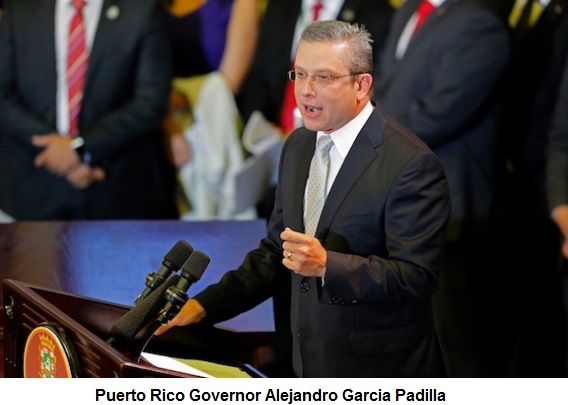
Puerto Rico Governor Alejandro Garcia Padilla has signed a bill aiming to boost small and medium-sized enterprises on the island.

The new law has several provisions: it reserves part of government purchases for local businesses, encourages the integration of professional and new entrepreneurs and gives priority to SMEs “in discretionary public funds to subsidize payroll for new jobs or existing ones,” Garcia Padilla’s office said in a statement.

The bill, called the “Support for Microenterprise, Small and Medium Merchant Act” amends the island’s Procurement Reserve Act to 20 percent, and establishes a reserve of 60 percent for SMEs when granting subsidies under the Law of Security in Employment.

“This bill is for SMEs what the Law of Incentives for Economic Development and previous industrial incentive laws were for manufacturing in Puerto Rico. That’s how important it is,” the Governor said in a statement. “The country is undergoing the biggest transformation in its recent history.”

According to government data, 95 percent of companies in Puerto Rico are SMEs with 50 or fewer employees, and they employ around 25 percent of the jobs on the island.

“The path to sustainable economic development will necessarily have to include SMEs,” he said. “Encouraging SMEs is to boost local production and wealth creation that circulates and remains in the country.”

The government said the law also creates a board to support small retailers, among other aspects, and amends the country’s permitting act to grant permits for conditional or temporary activities that “pose no risk to health, the environment or security and conforms to the zoning requirements.”
Caribbean Journal– Caribbean Online News Source (Retrieved 06/13/2014) –
http://www.caribjournal.com/2014/06/12/puerto-rico-governor-signs-bill-on-small-medium-sized-enterprises/

The book Go Lean … Caribbean fulfills that requirement. The book serves as a roadmap to implement the Caribbean Union Trade Federation (CU), and with this effort, create 2.2 million new jobs over a 5 year period. Major consideration is given to entrepreneurship, small businesses (Main Street) and even optimizing existing industries. But Go Lean differs from government efforts, such as Puerto Rico’s as described in the foregoing article, in that it looks to provide complete incubation for SME’s. This includes fund development, technical assistance, coaching, management training and introductions to new global markets; a true public-private partnership.

This directive is embedded in the opening Declaration of Interdependence at the start of the book (Page 13/14), with these statements:

xxi.  Whereas the preparation of our labor force can foster opportunities and dictate economic progress for current and future generations, the Federation must ensure that educational and job training opportunities are fully optimized for all residents of all member-states, with no partiality towards any gender or ethnic group. The Federation must recognize and facilitate excellence in many different fields of endeavor, including sciences, languages, arts, music and sports. This responsibility should be executed without incurring the risks of further human flight, as has been the past history.

xxiv.   Whereas a free market economy can be induced and spurred for continuous progress, the Federation must install the controls to better manage aspects of the economy: jobs, inflation, savings rate, investments and other economic principles. Thereby attracting direct foreign investment because of the stability and vibrancy of our economy.

Whereas the Caribbean region must have new jobs to empower the engines of the economy and create the income sources for prosperity, and encourage the next generation to forge their dreams right at home, the Federation must therefore foster the development of new industries… In addition, the Federation must invigorate the enterprises related to existing industries … – impacting the region with more jobs.

This subject of entrepreneurship has been previously covered in these Go Lean blogs, highlighted here in the following samples:

a.   https://goleancaribbean.com/blog/?p=486 – Incubator firm backs Southeast Asia cab booking app

b.   https://goleancaribbean.com/blog/?p=398 – Self-employment on the rise in the Caribbean – World Bank

c.   https://goleancaribbean.com/blog/?p=214  – LCD versus an Entrepreneurial Ethos

As also depicted in the foregoing article, governments have employed strategies to promote small businesses like set-aside programs. While this is a good start, more is needed for true success. Go Lean relates that progress in entrepreneurship requires a new community ethos, an acceptance that intellectual property is just as essential as any real property requiring protection by government authorities and respect by the general public. This is key, as the book posits that new information-centric economy activities can be equally exploited from an address in the Caribbean or any address in North America or Europe. ICT (Internet & Communication Technologies) has emerged as the great equalizer!

PR SME - Photo 2The vision of the CU is a confederation of the 30 member-states of the Caribbean, including all 4 language groups, into an integrated “single market”, thereby fostering economic growth to raise the regional economy to $800 Billion GDP (from the 2010 base of $378 Billion). This growth would be the cause-and-effect of 2.2 million new jobs projected in the Go Lean roadmap. The following list details the series of community ethos, strategies, tactics, implementations and advocacies necessary to effectuate the change in the region to foster the small business environment:

Community Ethos – Job Multiplier Page 22
Community Ethos – Lean Operations Page 24
Community Ethos – Return on Investments Page 24
Community Ethos – Ways to Impact the Future Page 26
Community Ethos – Ways to Help Entrepreneurship Page 28
Community Ethos – Ways to Promote Intellectual Property Page 29
Strategic – Vision – Integrated Region in a   Single Market Page 45
Strategic – Vision – Agents of Change – Globalization Page 57
Tactical – Fostering a Technocracy Page 64
Tactical – Growing to $800 Billion Regional Economy Page 67
Tactical – Separation of Powers – Homeland Security Page 75
Tactical – Separation of Powers – Interstate Commerce Page 79
Tactical – Separation of Powers – Department of Labor Page 89
Implementation – Ways to Pay for Change Page 101
Implementation – Steps for Self-Governing   Entities Page 105
Implementation – Ways to Deliver Page 109
Implementation – Ways to Benefit from   Globalization Page 119
Planning – Big Ideas for the Caribbean Region Page 127
Planning – Ways to Improve Trade Page 128
Planning – Ways to Improve Interstate Commerce Page 129
Advocacy – Ways to Grow the Economy Page 151
Advocacy – Ways to Create Jobs Page 152
Advocacy – Ways to Foster Technology Page 197
Advocacy – Ways to Impact Main Street Page 201
Appendix – Job Multipliers Page 259

While the Go Lean roadmap is focused on small and medium-sized businesses, it also stresses the importance of protecting the economic engines against crime and emergency scenarios. The roadmap asserts that the economy of the region must be aligned with the security of the region; otherwise “bad actors” will emerge. The CU/Go Lean roadmap calls for “new guards for their future security”, so as to ensure that the regions hard-fought investments are not easily undermined. We must have return on our investments; we must have forward progress.

We do not want “to sow and have someone else reap” – The Bible.

All in all, the Go Lean … Caribbean roadmap posits that the problems of the Caribbean homeland are too big for any one member-state to solve, empowerments in Puerto Rico alone is too-little-too-late, but rather a regional solution is needed. The street-wise expression is so valid at this time: “You don’t bring a knife to a gun fight”. The Caribbean Union Trade Federation is a regional answer – the scope is bigger than just entrepreneurship, small businesses or jobs. While the effort will be fully exerted to promote and optimize SME’s, create jobs and forge every opportunity for success at home, a lot more is riding on these efforts. In addition to economic progress, we also have the whole future “hanging in the balance”, that of the Caribbean youth and their presence in the Caribbean. For this reason, the roadmap considers even more, that of making the Caribbean a better place to live, work and play.

Download the book Go Lean…Caribbean – now!
Share this post:
, , ,

Remittances to Caribbean Increased By 3 Percent in 2013

Go Lean Commentary

Participation in Caribbean national elections seems to have an additional candidate to vote for: None of the Above.

This is the assertion of the book Go Lean…Caribbean, and many aligned blog submissions, that Caribbean citizens are voting with their “feet and wallet” and leaving their tropical homelands for life in foreign countries. In fact, the book posits that the Caribbean Diaspora amount to 10 million people, compared to 42 million residents in the homeland. A great measurement of the economic activity of this diasporic population is their remittance activity. (Though not all migrants remit back to their homelands).

This book Go Lean…Caribbean serves as a roadmap for the introduction and implementation of the technocratic Caribbean Union Trade Federation (CU). The CU will assume the role and responsibility of empowering the regional economy and measuring trade/financial/remittance activity. The following 3 prime directives are explored in full details in the roadmap:

  • Optimization of the economic engines in order to grow the regional economy to $800 Billion & create 2.2 million new jobs.
  • Establishment of a security apparatus to protect the resultant economic engines.
  • Improve Caribbean governance to support these engines.

A mission of the CU is to minimize the need for Caribbean labor force to migrate to foreign lands for work; and also to invite the Diaspora to repatriate. We need to expand the labor pool at home. But the reality of the Go Lean roadmap is the methodical implementation over a 5 year period, so in the interim, there may still be more prosperous opportunities abroad.

It is what it is! The CU/Go Lean plan then is to optimize the remittance process where possible: lowering the costs of transfers and managing the accompanying foreign currency and economic crime risks.

The reference source for the foregoing article came from the MIF (Multilateral Investment Fund), a member of the Inter-American Development Bank (IDB) Group; the MIF is funded by 39 donors and supports private sector-led development benefitting low-income populations and the poor –-their businesses, their farms, and their households. A core MIF mission is to act as a development laboratory in order to build and support successful micro and SME (Small-Medium-sized Enterprises) business models. [a]

By the Caribbean Journal staff

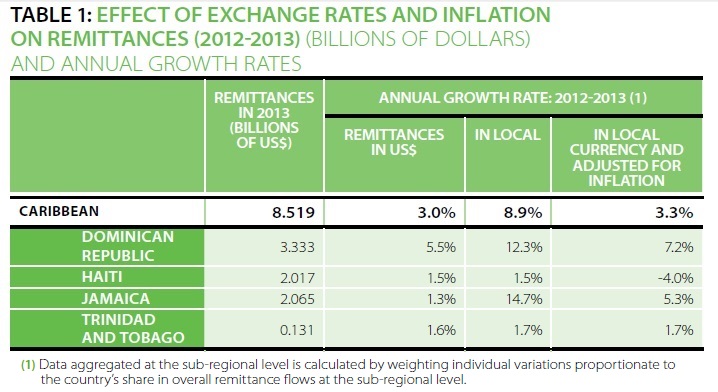
Table 1Remittances to the Caribbean region increased by 3 percent in 2013, according to a new report from the Inter-American Development Bank’s Multilateral Investment Fund.

Remittances to the region totaled $8.519 billion, a 3 percent improvement in US dollar terms, an 8.9 percent increase in local currency and a 3.3 percent improvement in local currency and adjusted for inflation.

“Remittance flows to Latin America and the Caribbean (LAC) remain an important source of income for millions of poor and vulnerable families,” said MIF General Manager Nancy Lee. “Remittance recipients need more access to financial tools that will help them use remittances to save and make investments for their future in areas like education, housing, and starting and growing businesses.”

The Dominican Republic received $3.333 billion USD in 2013, a 5.5 percent improvement, followed by Jamaica, which received $2.065 billion and Haiti, which received $2.017 billion.

Trinidad and Tobago was next with $131 million in remittances.

Of the group, the Dominican Republic saw the largest increase.

The Latin America and Caribbean region received a total of $61.251 billion last year, with the United States the source of about 75 percent of remittances to the region.

See the Table 1 (photo on this page) from the IDB for full details.

Caribbean Journal – Regional News Source (Retrieved 06/11/2014) –http://www.caribjournal.com/2014/06/10/remittances-to-caribbean-increased-by-3-percent-in-2013-report/

The reference source for the foregoing article came from the MIF (Multilateral Investment Fund), a member of the Inter-American Development Bank (IDB) Group; the MIF is funded by 39 donors and supports private sector-led development benefitting low-income populations and the poor –-their businesses, their farms, and their households. A core MIF mission is to act as a development laboratory in order to build and support successful micro and SME (Small-Medium-sized Enterprises) business models. [a]

Another mission of the CU/Go Lean roadmap is to apply lessons from the 2008 Great Recession financial crisis.

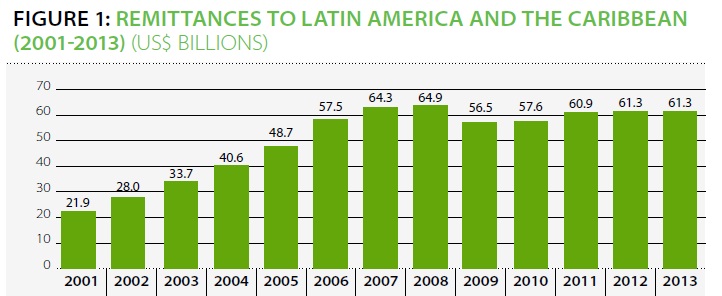
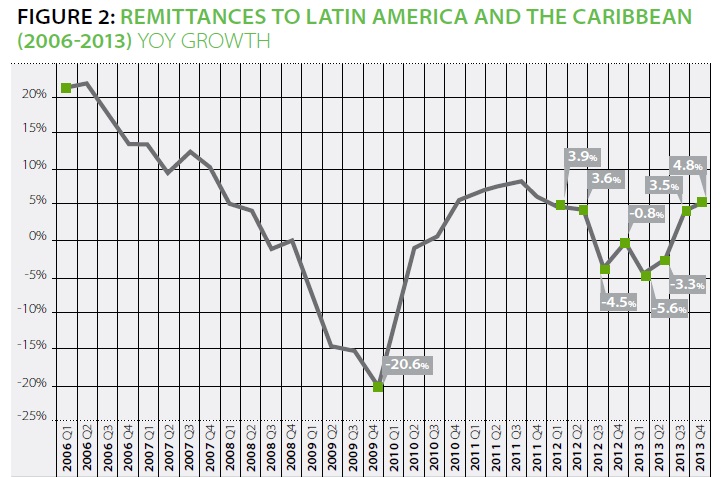
The MIF reports that in the years before the financial crisis of 2008-2009, remittances to the region as a whole experienced average annual growth of 17 percent. After a record high in 2008 of $64.9 billion, there was a sharp drop in 2009 of over 10 percent, followed by an increase in 2011 of 6 percent, and subsequent stagnation that continued up to 2013.

Figure 1

Figure 2

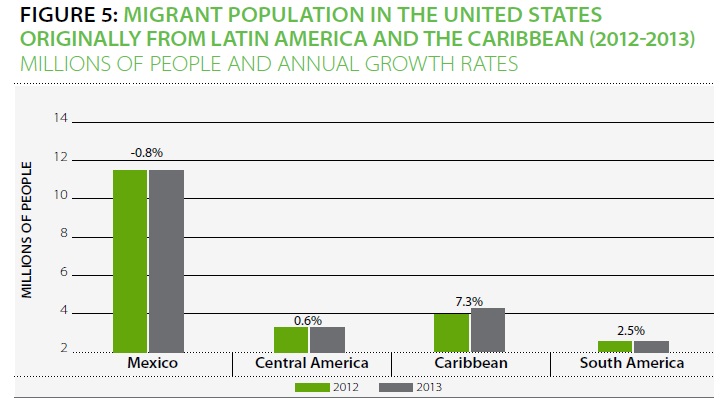
Figure 5

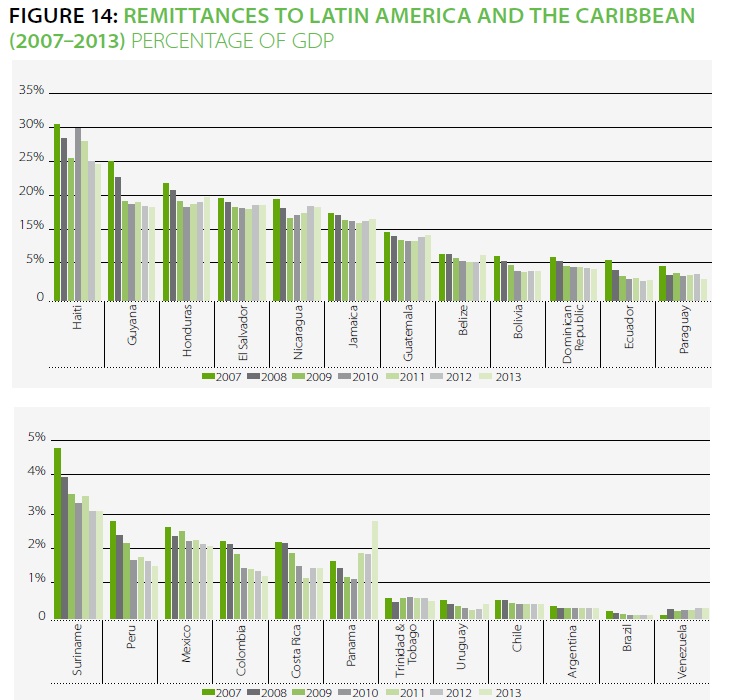
Figure 14

For 2014, macroeconomic projections show an encouraging landscape at the global level; it is predicted that the US economy will continue its path to recovery, as will EU countries, although at a slower pace. Employment data on LAC migrants, in both the United States and Spain, also show a recovery process enabling the prediction of growth in remittances sent from both countries. (See the accompanying charts, figures and tables on this page; sourced from the MIF/IDB report [b]).

This issue of continued fallout from the Great Recession has been a consistent theme of the Go Lean blogs entries as sampled here:

a. https://goleancaribbean.com/blog/?p=841 – Post 2008: Having Less Babies is Bad for the Economy

b. https://goleancaribbean.com/blog/?p=782 – Open the Time Capsule: The Great Recession of 2008

c. https://goleancaribbean.com/blog/?p=709 – Post 2008 Student Debt Holds Back Many Would-be Home Buyers

d. https://goleancaribbean.com/blog/?p=528 – Facebook plans to provide mobile payment services and remittances

e. https://goleancaribbean.com/blog/?p=378 – US Federal Reserve Releases Transcripts from 2008 Meetings

f. https://goleancaribbean.com/blog/?p=353 – Book Review: ‘Wrong – Nine Economic Policy Disasters and What We Can Learn…’

g. https://goleancaribbean.com/blog/?p=235 – Post 2008 Tourism’s changing profile

All in all, the roadmap commences with the recognition that all the Caribbean is in crisis, exacerbated after 2008, with defective business models, underemployment, globalization, and aging demographics. These acknowledgements are pronounced in the Declaration of Interdependence, (Page 13 & 14). The statements are included as follows:

xix.   Whereas our legacy in recent times is one of societal abandonment, it is imperative that incentives and encouragement be put in place to first dissuade the human flight, and then entice and welcome the return of our Diaspora back to our shores. This repatriation should be effected with the appropriate guards so as not to imperil the lives and securities of the repatriated citizens or the communities they inhabit. The right of repatriation is to be extended to any natural born citizens despite any previous naturalization to foreign sovereignties.  

xx.   Whereas the results of our decades of migration created a vibrant Diaspora in foreign lands, the Federation must organize interactions with this population into structured markets. Thus allowing foreign consumption of domestic products, services and media, which is a positive trade impact. These economic activities must not be exploited by others’ profiteering but rather harnessed by Federation resources for efficient repatriations.

xxi.   Whereas the preparation of our labor force can foster opportunities and dictate economic progress for current and future generations, the Federation must ensure that educational and job training opportunities are fully optimized for all residents of all member-states, with no partiality towards any gender or ethnic group. The Federation must recognize and facilitate excellence in many different fields of endeavor, including sciences, languages, arts, music and sports. This responsibility should be executed without incurring the risks of further human flight, as has been the past history.

 xxiv.   Whereas a free market economy can be induced and spurred for continuous progress, the Federation must install the controls to better manage aspects of the economy: jobs, inflation, savings rate, investments and other economic principles. Thereby attracting direct foreign investment because of the stability and vibrancy of our economy.

xxv.   Whereas the legacy of international democracies had been imperiled due to a global financial crisis, the structure of the Federation must allow for financial stability and assurance of the Federation’s institutions. To mandate the economic vibrancy of the region, monetary and fiscal controls and policies must be incorporated as proactive and reactive measures. These measures must address threats against the financial integrity of the Federation and of the member-states.

xxvi.   Whereas the Caribbean region must have new jobs to empower the engines of the economy and create the income sources for prosperity, and encourage the next generation to forge their dreams right at home, the Federation must therefore foster the development of new industries… In addition, the Federation must invigorate the enterprises related to existing … – impacting the region with more jobs.

The vision of the CU is a confederation of the 30 member-states of the Caribbean into an integrated “single market”, thereby fostering economic growth to grow the regional economy to $800 Billion (from the 2010 base of $378 Billion). This growth would be the cause-and-effect of 2.2 million new jobs. No more migrant culture! Tactically, the CU allows for a separation-of-powers between the member-state governments and the new federal agencies, so as to allow a technocratic management approach to simply “deliver” on the Go Lean roadmap, devoid of partisan politics! The following list details the series of community ethos, strategies, tactics, implementations and advocacies necessary to effectuate the change in the region to graduate from this migrant culture, described in the foregoing article and accompanying charts:

Community Ethos – Economic Systems Influence Individual Choices Page 21
Community Ethos – Job Multiplier Page 22
Community Ethos – Lean Operations Page 24
Community Ethos – Return on Investments Page 24
Community Ethos – Ways to Impact the Future Page 26
Community Ethos – Ways to Help Entrepreneurship Page 28
Strategic – Vision – Integrated Region in a Single Market Page 45
Strategic – Vision – Agents of Change Page 57
Tactical – Fostering a Technocracy Page 64
Tactical – Growing to $800 Billion Regional Economy Page 67
Tactical – Separation of Powers Page 71
Tactical – Interstate Commerce Admin – Econometrics Data Analysis Page 79
Implementation – Ways to Pay for Change Page 101
Implementation – Ways to Deliver Page 109
Planning – Big Ideas for the Caribbean Region Page 127
Planning – Lessons Learned from 2008 Page 136
Planning – Ways to Measure Progress Page 147
Advocacy – Ways to Grow the Economy Page 151
Advocacy – Ways to Create Jobs Page 152
Advocacy – Ways to Better Manage Foreign Exchange Page 154
Advocacy – Ways to Impact the Diaspora Page 217
Appendix – Job Multipliers Page 259
Appendix – Trade SHIELD – “Harvest“ Comprehensive Data Analysis Page 264
Appendix – Alternate (Cheaper & More Efficient) Remittance Modes Page 270

The Go Lean roadmap for the CU stresses the importance of a solid data foundation to analyze and measure progress. Since this is a 5-year roadmap, there must be milestones along the way, opportunities to plan-do-review. This approach allows for the proper adjustments to strategies, tactics and operations. The people of the Caribbean deserve every opportunity to deliver success. We need to be able to capture the traffic/data of remittances to all CU countries – only the large member-states were measured in these accompanying charts – and glean intelligence from the analysis. This approach reflects a true technocracy; this reflects the change that is coming to the region. Figure 15

Now is the time for all of the Caribbean, the people and governing institutions, to lean-in for the change that is the Caribbean Union Trade Federation. Now is the time for a viable plan for the millions abroad, and the next generation of young people, to work here at home … to make this region a better place to live, work and play.

Referenced Citations:

a. http://www.iadb.org/en/news/news-releases/2014-06-10/mif-2013-remittances-report,10838.html

b. http://idbdocs.iadb.org/wsdocs/getDocument.aspx?DOCNUM=38842219

Download the Book- Go Lean…Caribbean Now!!!


Share this post:
, ,
[Top]

Is a Traditional 4-year Degree a Terrible Investment?

Go Lean Commentary

This respected resource, Howard Tullman[a], asserts that 4-year Liberal Arts college degrees are bad investments for students. (Play VIDEO here).

VIDEO – Why a Traditional 4-Year Degree is a Terrible Investment | Inc. Magazine – https://youtu.be/ch4D5-9jdbk


Published on Jun 6, 2014 – Howard Tullman, CEO of 1871, explains exactly how over valued, and ripe for disruption, traditional higher education has become.

The book Go Lean…Caribbean stakes the claim even deeper, that traditional college education abroad have been an even more disastrous policy for the Caribbean in whole, and each specific country in particular.

This assertion requires a differentiation of the macro, versus the micro.

From a strictly micro perspective, college education is great for the individual; research by Economists have established the dogma that each additional year of schooling increase an individual’s earnings by about 10%. (Go Lean quotes these economic studies at Page 270). This should be viewed as a very impressive rate of return on an education investment (ROI). But from the macro perspective, (for the community), the ROI is different for the Caribbean; its not a gain, but rather a loss due to the incontrovertible brain drain.

Previous blog-commentaries on this same subject matter have quoted the Jamaican proverb of “fattening frogs for snake” – (see https://goleancaribbean.com/blog/?p=459). This is because more and more of the Caribbean college educated citizens abandon their tropical homes for foreign shores in the US, Canada and Europe. What’s worst, they take their Caribbean-funded education and skill-sets with them – sometimes taking any hope for collectability for student loans as well, thereby imperiling future generation of scholars from the benefits of a college education.

This broken system has many challenges and must be addressed.

Change has now come. The driver of this change is technology and globalization. Under the tenants of globalization, the Caribbean labor pool is a commodity; their talents are subject to the economic realities of supply-and-demand. So if there is greater reward for these Caribbean citizens to “take their talents to South Beach … or South Toronto, or South London”, it is hard to argue a contrarian stance. The Go Lean book posits therefore that the governmental administrations of the region should invest in higher education options with as much technological advances (e-Learning) as possible, for its citizens. The bottom-line motive should be the Greater Good.

The Go Lean roadmap provides turn-by-turn directions on how to reform the Caribbean tertiary education systems, economy, governance and Caribbean society as a whole. This roadmap asserts that the Caribbean is in crisis, and that this “crisis would be a terrible thing to waste”. As a planning tool, the roadmap commences with a Declaration of Interdependence, pronouncing the approach of regional integration (Page 12 & 14) as a viable solution to elevate the region’s educational opportunities.

xix. Whereas our legacy in recent times is one of societal abandonment, it is imperative that incentives and encouragement be put in place to first dissuade the human flight, and then entice and welcome the return of our Diaspora back to our shores

xxi. Whereas the preparation of our labor force can foster opportunities and dictate economic progress for current and future generations, the Federation must ensure that educational and job training opportunities are fully optimized for all residents of all member-states, with no partiality towards any gender or ethnic group. The Federation must recognize and facilitate excellence in many different fields of endeavor, including sciences, languages, arts, music and sports. This responsibility should be executed without incurring the risks of further human flight, as has been the past history.

xxvii. Whereas the region has endured a spectator status during the Industrial Revolution, we cannot stand on the sidelines of this new economy, the Information Revolution. Rather, the Federation must embrace all the tenets of Internet Communications Technology (ICT) to serve as an equalizing element in competition with the rest of the world. The Federation must bridge the digital divide and promote the community ethos that research/development is valuable and must be promoted and incentivized for adoption.

This book Go Lean… Caribbean, serves as a roadmap for the introduction and implementation of the Caribbean Union Trade Federation (CU). This represents change for the region. The CU/Go Lean roadmap has 3 prime directives:

  • Optimization of the economic engines in order to grow the regional economy.
  • Establishment of a security apparatus to protect the resultant economic engines.
  • Improve Caribbean governance to support these engines.

The Go Lean book posits that education is a vital consideration for Caribbean economic empowerment, but there have been a lot of flawed decision-making in the past, both individually and community-wise. The vision of the CU is a confederation of the 30 member-states of the Caribbean to do the heavy-lifting of championing better educational policies. The book details those policies; and other ethos to adopt, plus the executions of the following strategies, tactics, implementations and advocacies to impact the tertiary education in the region:

Community Ethos – Deferred Gratification Page 21
Community Ethos – People Respond to Incentives Page 21
Community Ethos – Job Multiplier Page 22
Community Ethos – Lean Operations Page 24
Community Ethos – Return on Investments (ROI) Page 24
Community Ethos – Ways to Impact the Future Page 26
Community Ethos – Ways to Foster Genius Page 27
Community Ethos – Ways to Help Entrepreneurship Page 28
Tactical – Separation of Powers – Education Department Page 85
Tactical – Separation of Powers – Labor Department Page 89
Advocacy – Ways to Grow the Economy Page 151
Advocacy – Ways to Create Jobs Page 152
Advocacy – Ways to Improve Education Page 159
Advocacy – Ways to Improve Governance Page 169
Advocacy – Ways to Improve Libraries Page 187
Appendix – Education and Economic Growth Page 258
Appendix – Measuring Education Page 266

Now is the time for all of the Caribbean, the people and governing institutions, to lean-in for the changes described in the book Go Lean … Caribbean. We welcome the efforts of entrepreneur Howard Tullman, and his desire to empower other entrepreneurs. This is due to another fact certified by Economists, that the majority of new jobs come from small-medium-sized enterprises (SMEs). So when there is the need for specific job training or business development skills, prudence dictates some facilitation for these skills. Education reform for the Caribbean should therefore be in vogue. This need for reform synchronizes with the CU/Go Lean effort.

The Go Lean roadmap is a complete solution for Caribbean elevation, thus helping the region to be a better place to live, work, learn and play.

🙂

Download the book Go Lean … Caribbean – now!

***************
a.   Appendix – Howard A. Tullman:

Howard A. TullmanAn American serial entrepreneur, venture capitalist, educator, writer, lecturer, and art collector. He currently serves as Chairman of Tribeca Flashpoint Media Arts Academy and of HYDR>BOX, LLC., CEO of 1871[e] (Chicago’s entrepreneurial hub for digital startups), and the Managing Partner of Chicago High Tech Investment Partners, LLC.

Entrepreneurial career
Tullman’s entrepreneurial career spans four decades and a broad swath of industries. As of May 2011, Tullman has started 12 companies, including Tribeca Flashpoint Media Arts Academy, CCC Information Services, Tunes.com, the Rolling Stone Network, Imagination Pilots, Experiencia, and others.[b] Tullman has also been tapped for senior executive positions at established companies such as Kendall College, where his expertise in turn-arounds saved the school from going into bankruptcy in 2003.[b]

Disruptive Innovation in education
Throughout his career in higher education, Tullman has been a proponent of revolutionizing the industry through disruptive innovation which is Clayton M. Christensen’s term to describe new, rapidly-iterated innovations that start from the bottom of traditional industries by providing small-scale and relatively inexpensive solutions (which quickly expand and improve) and which disrupt those existing marketplaces by displacing earlier, out-of-date programs with less expensive, faster and more effective solutions typically based on emerging new technologies.

As an early adopter of this philosophy, Tullman was among the first to bring disruptive innovation to for-profit education as evidenced in his work at Kendall College, Experiencia, and Tribeca Flashpoint Media Arts Academy.[c] In each of these education ventures, Tullman sought to create educational environments that fed creativity while providing skill sets for future successful employment in the new digital world:

At Kendall College, Tullman transformed a 75 year old failing college into a new entity and moved the campus from its home in Evanston to Chicago in a brand-new, purpose-built facility in order to put students closer to the real-world opportunities available in their fields (especially culinary and hospitality) and to provide them with the newest tools, technologies and equipment available.

At Experiencia (the parent of ExchangeCity and Earth Works), Tullman developed hands-on, learning experiences for children that reinforced the lessons learned in the classroom in a simulated city environment. Innovative partnerships with dozens of major businesses provided resources and access for the students to experience the real world of work.

At Tribeca Flashpoint Academy, Tullman and his partners designed and developed a hands-on, team-based, cross-disciplinary, fast-track approach to digital media arts training, allowing students to learn digital technologies faster and more economically than at traditional four-year competitors.

Tullman is also an outspoken opponent of tenure in education and the turf wars and lack of interdepartmental collaboration among faculty.[d]

Tullman’s innovations in education have been consistent with the high-end vocational education visions shared by Sir Ken Robinson, David Brooks, and Thomas Friedman, but have the additional benefit of being actually implemented and in use today.

Citations:
b.   Black, Johnathan (May 2011). “Howard Tullman’s Flashpoint Academy: A Digital-Arts Alternative to the Four-Year College Degree”. Chicago Magazine. Retrieved November 27, 2012
c.    Meyer, Ann (January 14, 2008). “Howard Tullman provides business lesson in running for-profit schools”. Chicago Tribune
d.   Tullman, Howard. “Why the Chicago Teachers’ Strike Will Help Education Entrepreneurs”. Inc.com. Inc. Retrieved April 22, 2013.
e.    1871 = Year of the Great Chicago Fire


Share this post:
, , ,
[Top]

Having Less Babies is Bad for the Economy

Go Lean Commentary

Little GirlsMore fallout from the year 2008…

This is a consistent theme in the book Go Lean…Caribbean. The book posits that the events of that year were a crisis for the Caribbean, North America and the world economy as a whole. What’s worst is the Caribbean is still reeling from those events.

“A crisis is a terrible thing to waste”

… so states the book quoting noted Economist Paul Romer. The opportunity therefore exists to forge change in the economic, security and governing engines of the Caribbean, in response to this crisis.

The below news-story (or click on VIDEO icon below) shows that the rest of the world, those with astute eyes/ears to look, listen and learn, will be using this crisis to prepare for change. This is the advocacy of the Go Lean book, to position the region at the corner of preparation and opportunity, so as to benefit from change. The issue from the article is more pressing for the Caribbean than the rest of North America; this is because the region has a very high emigration rate (brain drain). This point is crystalized with this quotation:

We tend to think economic growth comes from working harder and smarter. But economists attribute up to a third of it to more people joining the workforce each year than leaving it. The result is more producing, earning and spending.

The book Go Lean…Caribbean serves as a roadmap for the introduction and implementation of the Caribbean Union Trade Federation (CU), a super-national institution with federal powers to forge change in the Caribbean community. One mission is incentivizing the return of the far-flung Caribbean Diaspora. Another mission is to dissuade further human flight/brain drain. The numbers don’t lie: we need population growth not population contraction.

NEW YORK (AP) — Nancy Strumwasser, a high school teacher from Mountain Lakes, New Jersey, always thought she’d have two children. But the layoffs that swept over the U.S. economy around the time her son was born six years ago helped change her mind. Though she and her husband, a market researcher, managed to keep their jobs, she fears they won’t be so fortunate next time.

“After we had a kid in 2009, I thought, ‘This is not happening again,'” says Strumwasser, 41, adding, “I never really felt comfortable about jobs, how solid they can be.”

The 2008 financial crisis did more than wipe out billions in wealth and millions of jobs. It also sent birth rates tumbling around the world as couples found themselves too short of money or too fearful about their finances to have children. Six years later, birth rates haven’t bounced back.

For those who fear an overcrowded planet, this is good news. For the economy, not so good.

We tend to think economic growth comes from working harder and smarter. But economists attribute up to a third of it to more people joining the workforce each year than leaving it. The result is more producing, earning and spending.

Now this secret fuel of the economy, rarely missing and little noticed, is running out.

“For the first time since World War II, we’re no longer getting a tailwind,” says Russ Koesterich, chief investment strategist at BlackRock, the world’s largest money manager. “You’re going to create fewer jobs. … All else equal, wage growth will be slower.”

Births are falling in China, Japan, the United States, Germany, Italy and nearly all other European countries. Studies have shown that births drop when unemployment rises, such as during the Great Depression of the 1930s. Birth rates have fallen the most in some regions that were hardest hit by the financial crisis.

In the United States, three-quarters of people surveyed by Gallup last year said the main reason couples weren’t having more children was a lack of money or fear of the economy.

The trend emerges as a gauge of future economic health — the growth in the pool of potential workers, ages 20-64 — is signaling trouble ahead. This labor pool had expanded for decades, thanks to the vast generation of baby boomers. Now the boomers are retiring, and there are barely enough new workers to replace them, let alone add to their numbers.

Growth in the working-age population has halted in developed countries overall. Even in France and the United Kingdom, with relatively healthy birth rates, growth in the labor pool has slowed dramatically. In Japan, Germany and Italy, the labor pool is shrinking.

“It’s like health — you only realize it exists until you don’t have it,” says Alejandro Macarron Larumbe of Demographic Renaissance, a think tank in Madrid.

The drop in birth rates is rooted in the 1960s, when many women entered the workforce for the first time and couples decided to have smaller families. Births did begin rising in many countries in the new millennium. But then the financial crisis struck. Stocks and home values plummeted, blowing a hole in household finances, and tens of millions of people lost jobs. Many couples delayed having children or decided to have none at all.

Couples in the world’s five biggest developed economies — the United States, Japan, Germany, France and the United Kingdom — had 350,000 fewer babies in 2012 than in 2008, a drop of nearly 5 percent. The United Nations forecasts that women in those countries will have an average 1.7 children in their lifetimes. Demographers say the fertility rate needs to reach 2.1 just to replace people dying and keep populations constant.

The effects on economies, personal wealth and living standards are far reaching:

— A return to “normal” growth is unlikely: Economic growth of 3 percent a year in developed countries, the average over four decades, had been considered a natural rate of expansion, sure to return once damage from the global downturn faded. But many economists argue that that pace can’t be sustained without a surge of new workers. The Congressional Budget Office has estimated that the U.S. economy will grow 3 percent or so in each of the next three years, then slow to an average 2.3 percent for next eight years. The main reason: Not enough new workers.

— Reduced pay and lifestyles: Slower economic growth will limit wage gains and make it difficult for middle-class families to raise their living standards, and for those in poverty to escape it. One measure of living standards is already signaling trouble: Gross domestic product per capita — the value of goods and services a country produces per person — fell 1 percent in the five biggest developed countries from the start of 2008 through 2012, according to the World Bank.

— A drag on household wealth: Slower economic growth means companies will generate lower profits, thereby weighing down stock prices. And the share of people in the population at the age when they tend to invest in stocks and homes is set to fall, too. All else equal, that implies stagnant or lower values. Homes are the biggest source of wealth for most middle-class families.

___

AP researcher Fu Ting in Shanghai and AP writers Frank Jordans in Berlin, Colleen Barry in Milan and Youkyung Lee in Seoul, South Korea, contributed to this report.

Huffington Post – Online News – May 8, 2014 http://www.huffingtonpost.com/2014/05/07/birth-rate-economy_n_5281597.html

The CU recognizes that the numbers must work in favor of societal progress. The next steps after Look-Listen-Learn is to Lend-a-hand and then Lead. (This is referred to as the 5 L Progression). So to lend-a-hand, the Go Lean roadmap advocates that population leveling can be accomplished with a regional integration. There are many social safety nets that depend of this actuarial exercise. Consider unemployment and pensions: for unemployment, workers pay into a fund and the temporarily unemployed file claims against that fund. Likewise with pensions: young workers pay into a fund, and the older-retired workers draw claims against that fund.

The CU is structured to lead … for the economic elevation of the region of 42 million people in the 30 member-states. The Go Lean roadmap provides the details for the creation of 2.2 million new jobs and GDP growth to accumulate to $800 Billion. This commission to lead is at the root of the Go Lean effort, embedded in the opening Declaration of Interdependence (Page 13):

xxiv. Whereas a free market economy can be induced and spurred for continuous progress, the Federation must install the controls to better manage aspects of the economy: jobs, inflation, savings rate, investments and other economic principles. Thereby attracting direct foreign investment because of the stability and vibrancy of our economy.

xxv. Whereas the legacy of international democracies had been imperiled due to a global financial crisis, the structure of the Federation must allow for financial stability and assurance of the Federation’s institutions. To mandate the economic vibrancy of the region, monetary and fiscal controls and policies must be incorporated as proactive and reactive measures. These measures must address threats against the financial integrity of the Federation and of the member-states.

Currency 2According to the foregoing article, America needs to have more babies. While this disposition varies from country to country, the Caribbean needs to furnish the environment for families to make their own family-planning decisions based on their own personal motivations, not economic realities. Broken economies can (and will) be fixed! Love for the Caribbean homeland should therefore be the primary motivation for the CU effort. From the cradle-to-the-grave, we need love to be the principal motivation, not fear or economic metrics, for making the Caribbean a better place to live, work and play.

Taking the lead for this goal takes real work, heavy-lifting on the part of the stewards of the Caribbean economy. This is the charter for the CU, as started in the Declaration of Interdependence (Page 13), a direct quotation from the US Declaration of Independence, as follows:

… that to secure these rights (life, liberty and the pursuit of happiness), governments are instituted among men, deriving their just powers from the consent of the governed. … [It] is the right of the people to … institute new government, laying its foundation on such principles and organizing its powers in such form, as to them shall seem most likely to effect their safety and happiness.

The following details from the book Go Lean … Caribbean are the community ethos, strategies, tactics, implementations and advocacies prescribed to manifest the elevation of Caribbean economy, society and life:

Who We Are – SFE Foundation Page 8
Community Ethos – Deferred Gratification Page 21
Community Ethos – new Economic Principles Page 21
Community Ethos – new Security Principles Page 22
Community Ethos – new Governing Principles Page 24
Community Ethos – Ways to Impact the Future Page 26
Community Ethos – Ways to Impact Turn-Arounds Page 33
Community Ethos – Ways to Promote Happiness Page 36
Community Ethos – Ways to Impact the Greater Good Page 37
Strategy – Repatriating Caribbean Diaspora Page 47
Strategy – Non-Government Organizations Page 48
Strategy – Agents of Change – Aging Diaspora Page 57
Tactical – Confederating a Permanent Union Page 63
Tactical – Fostering a Technocracy Page 64
Implementation – Assemble all Member-States Page 96
Implementation – Ways to Pay for Change Page 101
Implementation – Reasons to Repatriate Page 118
Planning – Lessons Learned from 2008 Page 136
Advocacy – Ways to Grow the Economy Page 151
Advocacy – Ways to Create Jobs Page 152
Advocacy – Better Manage the Social Contract Page 170
Advocacy – Ways to Foster Empowering Immigration Page 174
Advocacy – Impact the Diaspora Page 217
Advocacy – Ways to Preserve Caribbean Heritage Page 218
Advocacy – Ways to Impact Retirement Page 221
Advocacy – Ways to Help the Middle Class Page 223
Advocacy – Ways to Improve Elder-Care Page 225

The Go Lean roadmap is a product of 2008. From this fallout, this plan was composed, by individuals intimate with the details of the crisis … and its causes.

The goal is to learn from the Year 2008 and spread new benefits across the Caribbean region. This roadmap identifies where we are as a region currently, where we want to go, and most importantly, how we plan to get there (turn-by-turn directions). It is time for us to move now to that place, that corner of opportunity and preparation.

playbutton-300x300

Download the book Go Lean … Caribbean – now!

Share this post:
, , ,
[Top]

Real Estate Investment Trusts explained

Real Estate Investment Trusts (REITs) are one way you can invest in real estate while enjoying a level of liquidity synonymous with the stock market[a]. Learn more here, from this VIDEO:

VIDEO – Real Estate Investment Trust REIT Definition Investopedia – https://youtu.be/UnKqUKZ1K1A

The book Go Lean … Caribbean serves as a roadmap for the introduction and implementation of the Caribbean Union Trade Federation (CU) and the Caribbean Central Bank (CCB). One prime directive of the roadmap is facilitating the return of the far-flung Diaspora to their Caribbean homelands. This does not mean returning to the same houses they may have abandoned decades ago. Thusly, there is the need for new housing solutions; and new housing financing schemes. The CU is proffered to provide economic optimizations to better manage the region’s basic needs: food, clothing, energy and shelter.

REITREITs are prominent in the Go Lean roadmap to satisfy the shelter mandate for Caribbean repatriates; (Page 217).

This mandate is detailed early on in the book’s Declaration of Interdependence (DOI), as follows (Page 13):

xxiv. Whereas a free market economy can be induced and spurred for continuous progress, the Federation must install the controls to better manage aspects of the economy: jobs, inflation, savings rate, investments and other economic principles. Thereby attracting direct foreign investment because of the stability and vibrancy of our economy.

The roadmap posits that there are no capital/security markets in the Caribbean that offer the liquidity options of Wall Street – Page 200. (Wall Street is #1 globally). However the book describes an optimization of the existing financial markets that can still take place with the introduction of the Caribbean Dollar – managed by a technocratic Caribbean Central Bank – and elevation of the current 9 Stock Exchanges.

The “dominoes” thusly begin to fall. So with the liquidity of a vibrant capitals market, comes funding, with funding comes housing “starts”, followed by construction activity. All of this creates market kinetics.

So facilitating this eco-system of the CU/CCB will ultimately create … jobs. This is the rallying cry in the US for the National Association of Realtors®. They estimate that one job is generated for every two home sales. Using that ratio, 1,000 home sales generate 500 jobs [b]. So after the basic need of food, clothing, energy and shelter, the next mandate is … jobs, (DOI – Page 14).

xxvi. Whereas the Caribbean region must have new jobs to empower the engines of the economy and create the income sources for prosperity, and encourage the next generation to forge their dreams right at home, the Federation must therefore foster the development of new industries, like that of ship-building, automobile manufacturing, pre-fabricated housing, frozen foods, pipelines, call centers, and the prison industrial complex. In addition, the Federation must invigorate the enterprises related to existing industries like tourism, fisheries and lotteries – impacting the region with more jobs.

The Go Lean roadmap portrays the community ethos to encourage savings/investments. The roadmap also calls for stronger oversight from an institutional perspective, with economic principles in place to increase the money multiplier; (Page 21 & 22).

This constitutes change for the Caribbean: a new plan, new products, services, opportunities oversight. In truth, a new future!

Download the book Go Lean … Caribbean – now!

————

References

a. Investopedia – http://www.investopedia.com/video/play/real-estate-investment-trust/

b. National Association of Realtors: http://www.realtor.org/topics/home-ownership-matters/jobs-impact-of-an-existing-home-purchase


Share this post:
, , , ,
[Top]

Antigua Completes Construction of New National Library

Go Lean Commentary

Antigua ConstructionThis below article is an indictment of Caribbean governments and the Caribbean Diaspora: 40 years without a library.

The charge against the past governmental administrations is obvious. For this reason, the current administration of the Government of Antigua and Barbuda is to be applauded for this accomplishment announced in the foregoing news article; they have finally restored a basic requirement of modern societies: building/supplying/maintaining a national/community library.

“Man cannot live on bread alone – Bible quotation.

But why also indict the Diaspora?

Simple, they should have known better. They abandoned their homeland and turned a “blind eye” to even the basic needs of these previously-beloved community’s education. A library does not help the government, it helps the people; it guides the youth, infusing them with a love for knowledge, learning and imagination. We all have a responsibility, a duty even, to pass that “love” onto the next generation. For this, the Diaspora had failed, for 40 years!

So to you members of the Caribbean Diaspora who claim to love your heritage, but do not even look back to ensure that your former communities at least have access to books and information. Shame on you!

See the full news story here:

By the Caribbean Journal staff:
Antigua and Barbuda has completed construction on the country’s new national public library.

The completion of the project comes four decades after the country’s public library was damaged by an earthquake.

The 20,000-square-foot project on Hails Prominard Road succeeds a temporary library which had been operating on Market Street.

“Whenever we lament the weakness in literacy over the last four decades we should look back at how culpable we are as a nation in not providing the appreciation for books, for intellectual stimulation, which is a symbol in a national public library,” said Education Minister Dr. Jacqui Quinn-Leandro. “Any Antiguan and Barbudan forty years or younger would not have known or had the benefit of a properly, well run, well-resourced national public library. And I say without equivocation this is a burning shame, a disgrace and a national travesty. However, today is a historic day”.

The government said the library would become fully operational after completing finishing touches like custom-made shelving and special furniture.

“It is a key component of our drive to develop a pluralistic participatory and inclusive knowledge based society. Libraries are key institution in the context of achieving this goal. At the core of libraries are their missions to provide information, literacy education and culture,” said Antigua and Barbuda Prime Minister Dr. Baldwin Spencer. “This structure which we dedicate and which forms part of our mandate to the people to provide the greatest good to the greatest number of people will be the watering hole for individuals which hunger for free and equitable access to information be it in written, electronic and in audio visual form.”

Caribbean Journal Online News Source (Retrieved 04/10/2014) from: http://www.caribjournal.com/2014/04/10/antigua-completes-construction-of-new-national-library/

School kidThe book Go Lean … Caribbean is published by the SFE Foundation, a community development foundation chartered to bring change back to the Caribbean. The book serves as a roadmap for the introduction and implementation for the Caribbean Union Trade Federation (CU). The foundation is comprised of Diaspora members of different Caribbean countries, who now seek penance. We have sinned in our abandonment. To those in the Caribbean homeland, we ask for your forgiveness, and consideration for the solutions now being proffered.

The Go Lean book identifies, qualifies and proposes the establishment of community libraries throughout the region (Page 187). The roadmap posits that these libraries can be a portal to the New World of Internet Communication Technologies (Page 197); a means to bridge the “Digital Divide” (Page 31) and a delivery outlet for many e-Government services (Page 168).

There are practical reasons why there was no national library in Antigua for 40 years. Primarily, the reasons are economic. So the Go Lean roadmap leads first with an optimization of the region’s economic engines. The book details how to pay for these changes (Page 101), then how to maintain a consistent well-funded governing engine (Page 172).

Now is the time for all Caribbean stakeholders (residents, Diaspora, government officials, educators, and book lovers alike) to lean-in to this regional solution for Caribbean empowerment.

We now urged everyone to lean-in to the Go Lean roadmap for the Caribbean Union Trade Federation. Let’s make the Caribbean a better place to live, work, learn and play. 🙂

Download the free e-Book of Go Lean … Caribbean – now!

Share this post:
,
[Top]

Ailing Puerto Rico open to radical economic fixes

Go Lean Commentary

The Caribbean is in crisis!

Puerto Rican FlagPuerto Rico is in crisis! According to this quote, they have lots of issues, all stemming primarily from economic dysfunctions:

Puerto Rico, in dire straits following eight years of recession, has remained receptive as it debates hundreds of ideas: ‘‘We are studying all alternatives and all possibilities.

The publishers of the book Go Lean … Caribbean humbly submit this publication as a complete roadmap to re-boot the island’s economy, security and governing engines. This roadmap differs from all the other 369 suggestions submitted to the territorial government’s committee highlighted in the foregoing news article, in that it presents a regional option, rather than just a territorial solution. The book asserts that the problems of Puerto Rico (by extension, the entire Caribbean) are too big for any one member-state to solve alone. Rather, the focus of the roadmap is the region-wide professionally-managed, deputized technocracy of the Caribbean Union Trade Federation (CU).

Puerto Rico needs the strategies, tactics, implementations and advocacies of the CU.

The CU needs Puerto Rico!

The CU requires the full participation of all 30 member-states in the region, including all 4 language group (Dutch, English, French and Spanish). With this approach, the CU benefits from the economies-of-scale of 42 million people.

The CU expects NO MONEY from Puerto Rico. This is good as the island is running a $820 million deficit. To cure a deficit a government needs more revenues and/or fewer expenses. The Go Lean roadmap features both. The roadmap is a complete re-boot: new revenue streams and a separation-of-powers, thereby delegating governing overhead to the CU.

Go Lean … Caribbean introduces the CU to take oversight of’ much of the Caribbean economic, security and governing functionality. In summary, this plan’s execution makes Puerto Rico, and the Caribbean, a better place to live, work and play.

This Go Lean roadmap first assesses the Puerto Rican human flight/brain drain crisis, where more than half of the island’s populations have fled to American shores. This plight makes the task of building a functioning society difficult, as often the brightest and best talents are the ones that leave; plus entitlement programs simply need populace retention.

By DANICA COTO – Associated Press

SAN JUAN, Puerto Rico (AP) — Slash the number of public holidays by two-thirds. Eliminate dozens of government agencies. Legalize marijuana and prostitution.

From the intriguing to the impossible, there is no shortage of ideas for fixing Puerto Rico’s ailing economy as the government tries to dig out from a whopping $70 billion in public debt and bring back economic growth.

The ideas have come from legislators, entrepreneurs and even members of the public, who have submitted ideas via a government-sponsored website. Of the 369 ideas sent in by the public, 156 have been accepted by a government committee for consideration, including the suggestions to legalize marijuana and prostitution, and to limit how long people can live in subsidized housing.

But all the ideas require further government approval, either with a legislative vote, or an administrative nod from the governor, agency or department. More dramatic ideas, such as legalization of marijuana or prostitution, would require public hearings, legislative approval and the governor’s signature.

And prospects for approval of the various suggestions are decidedly mixed.

The governor, for example, is expected to sign a bill approved by lawmakers to release certain elderly prisoners, but not a suggestion floated by a member of the public to charge inmates for their room and board.

Puerto Rico, in dire straits following eight years of recession, has remained receptive as it debates hundreds of ideas: ‘‘We are studying all alternatives and all possibilities,’’ said Sen. Maria Teresa Gonzalez, a member of the governor’s party who has come under fire for submitting a bill that would reduce the number of holidays for public employees to six.

Puerto Rico FlagThe island currently celebrates 20 holidays a year, double those observed in the U.S. Many people have bristled at the proposal to scrap some of the additional extra days off, some of which commemorate various historic Puerto Rican leaders. But Gonzalez said the excessive number of holidays costs the government about $500 million a year in lost productivity and interruptions in service, among other things.

‘‘Change always brings about inconveniences,’’ she said. ‘‘I’m convinced that before we talk about something as dramatic and disastrous as layoffs, we have to consider other ideas.’’

Many suggestions have come as Gov. Alejandro Garcia Padilla prepares to submit the first balanced budget in decades, having promised U.S. investors and credit agencies that he will eliminate an $820 million deficit. The governor has not detailed his cutbacks, prompting fears of layoffs, tax increases and cuts to public service.

Opposition legislator Rep. Ricardo Llerandi Cruz has proposed eliminating 41 government agencies, saying it would save $160 million alone in administrative costs. He said the government has many agencies performing the same functions, noting that there’s a Department of Natural Resources, which protects, develops and manages the island’s environmental resources, and an Administration of Natural Resources, a division within the department with responsibilities that include overseeing projects such as cleanup efforts.

‘‘Puerto Rico is facing the worst fiscal crisis in all of its history,’’ Cruz said. ‘‘We need to refocus or revisit governmental priorities to face these problems.’’

A bill in the legislature also would cap the salaries of mayors, but legislators have been debating the issue for a year as mayors continue to give themselves raises. The full-time mayor of the western town of Maricao, for example, oversees the island’s second-least populated municipality with some 6,200 people and currently earns $78,000 a year, nearly double of what he earned the previous year. If the bill is approved, the mayor would earn a base salary of roughly $54,000 a year.

Manuel Lugo, an attorney who lives in the coastal town of Aguadilla, is among those who submitted the highest number of ideas on the government’s website. But despite having nine of 17 ideas approved, he doesn’t believe the government will take action on any of them.

‘‘It is very difficult to change the inertia of this island,’’ said Lugo, 43, who recently closed his office because of economic problems and is contemplating a move to Texas. ‘‘There has been no economic plan for decades. What they do here is repair and patch holes. That’s not how you run a country.’’

Yanira Hernandez, a governor spokeswoman, said Garcia will detail how he plans to balance the budget in a special televised address in late April. The budget must be approved before June 30.

While many are concerned about what cuts will be made to balance the budget, economist Gustavo Velez said extreme measures won’t be necessary if the government increases revenues and consolidates state agencies. Puerto Rico could generate $300 million more a year if it increases its capture rate on tax revenues from 56 to 75 percent, he said. The government also could suspend salary increases, Velez added.

‘‘Puerto Rico cannot keep operating on recurring deficits,’’ he said, noting it is unconstitutional. ‘‘We have to return to balanced budgets as the norm. Politicians have to embrace that reality.’’

The government also has considered tapping into the island’s underground economy, estimated by some experts at $20 billion a year, representing roughly 40 percent of overall consumption.

Puerto Ricans are increasingly seeking new ways to generate money, with some opening food trucks or hunting caimans to sell the meat as shish kebabs or fried snacks.

But an estimated 450,000 people have moved to the U.S. mainland in search of new jobs and a more affordable cost of living in the past decade.

Brunilda Cintron, 56, left the island in 2001 and now lives in Kissimmee, Florida. But her daughter and mother still live in Puerto Rico, and she worries about their future.

‘‘The government has to make some drastic decisions that will adversely affect people,’’ Cintron said, adding that she thinks her family will soon join her in the U.S. mainland. ‘‘I don’t think they’re going to have a choice.’’

Boston Globe – AP Newswire – Retrieved 04-11 2014 http://www.boston.com/news/world/caribbean/2014/04/10/ailing-puerto-rico-open-radical-economic-fixes/siVW5wfiml78bERu5MuJlM/story.html

The CU will fix Puerto Rico! Look here at the solutions; (sorted by Economic/Security/Governance). The book Go Lean … Caribbean details these specific curative measures (advocacies, strategies, tactics, and implementations):

Economic:

Community Ethos – Money Multiplier Page 22
Help Entrepreneurship Page 28
Impact Turn-Around Strategies/Tactics Page 33
Tactics to Forge an $800 Billion Economy Page 67
New Ways to Pay for Change Page 101
Start-up Benefits from an EEZ Page 104
Develop/Expand a Pipeline Industry Page 107
Improve Energy Usage Page 113
Better Manage Debt Page 114
Foster International Aid Page 115
Improve Trade Page 128
Improve Interstate Commerce Page 129
New Ways to Grow the Economy Page 151
Create Jobs Page 152
Control Inflation Page 153
Improve Credit Ratings Page 155
Mitigate Black Markets Page 165
Enhance Tourism Page 190
Impact Wall Street Page 200

Security:

Separation of Powers – Homeland Security Page 75
Security Initiatives [stemming from the Start-up] Page 103
Impact Justice Page 177
Mitigate & Reduce Crime Page 178
Improve Intelligence [Gathering & Analysis] Page 182
Impact the Prison-Industrial Complex Page 211

Governance:

Community Ethos – Deferred Gratification Page 21
Improve Negotiations Page 32
Impact the Greater Good Page 37
Tactics to Foster a Technocracy Page 64
Implement Self-Governing Entities Page 105
Improve Mail Service Page 108
Strong Reasons to Repatriate Page 118
Promote Independence Page 120
Improve Healthcare Page 156
Impact Entitlements Page 158
Improve Education Page 159
New [Governmental] Revenue Sources Page 172
Impact Public Works Page 175
Better Manage Natural Resources Page 183
Improve for Natural Disasters Page 184
Improve Emergency Management Page 196
Impact Urban Living Page 234
Impact US Territories Page 244

The roadmap alerts the Caribbean stakeholders of the obstacles that this plan will encounter, and then provides guidance, turn-by-turn directions, so as to reach the destination … promptly.

Change has come to the Caribbean. The people, institutions and governance of Puerto Rico are all urged to lean-in.”

In fact, now is the time for the whole Caribbean region to lean-in for this change, described in the book Go Lean … Caribbean. The benefits of this roadmap are too alluring to ignore: emergence of an $800 Billion regional economy, 2.2 million new jobs and an end to the dysfunction. This will result in Puerto Ricans repatriating from the US, not fleeing there.

Download the free e-Book of Go Lean … Caribbean – now!

Share this post:
, , , , ,
[Top]

Facebook plans to provide mobile payment services

Facebook PicGo Lean Commentary

The jockeying for position has begun!

The foregoing article highlights the planning, development and deployment activities around the issue of mobile payments. This is germane for the Caribbean, as the World Bank reports that this region is #1 for homeland remittances from expatriated citizens.

This is a matter of supply and demand. The Caribbean Diaspora demands to send money; tools like Western Union, MoneyGram and these new solutions, identified here, supply the services.

But change is coming!

Reuters: Soham Chatterjee & Abhirup Roy (Bangalore)

Facebook Inc. is preparing to join the mobile-payments race with remittances and electronic-money services on the social network, the Financial Times reported on Sunday, citing several people involved in the process.

The company is close to obtaining approval from the Central Bank of Ireland to start a service that would allow users to store money on Facebook and use it to pay and exchange with others, the people told the FT. See: http://link.reuters.com/dag58v

The Irish Central Bank declined to comment.

Facebook was not immediately available for comment.

The company has also had partnership talks with at least three London start-ups — TransferWise, Moni Technologies and Azimo — that offer online and mobile international money transfer services, three people involved in the discussions told FT.

Telecom groups, retailers and banks are all trying to secure a [slice of the pie] of global mobile payments, which is predicted to grow rapidly in the next few years.

Vodafone brought its mobile money transfer service M-Pesa to Romania last month, following its success in Africa, and is likely to expand the service in eastern and central Europe.

Facebook’s rival Google Inc.’s head of payments recently reiterated commitment to the struggling Google Wallet and mobile payments service. The company had allowed users to send money last year as an email attachment.

Related Articles:

Google Wallet now lets you send money as an attachment in Gmail: http://link.reuters.com/wyf58v

Google exec reiterates commitment to mobile payments: http://link.reuters.com/xyf58v

Apple Chief Executive Tim Cook said in January the company’s interest in mobile payments was a reason for creating the Touch ID fingerprint sensor in its iPhone 5S smartphone – http://link.reuters.com/sag58v

Piggie Bank PicGlobal mobile transactions are expected to grow at an average 35 percent per year between 2012 and 2017, according to a report by research firm Gartner. The June 2013 report forecast a $721 billion market with more than 450 million users by 2017 – http://link.reuters.com/nyf58v.

Yahoo Online News Source (Retrieved 04/14/2014) –http://news.yahoo.com/facebook-plans-mobile-payment-services-ft-133451646–sector.html

The book, Go Lean…Caribbean, serving as a roadmap for the introduction and implementation of the Caribbean Union Trade Federation (CU), identified that new methods are needed to facilitate remittances. A lot of money is remitted back to the Caribbean (over $9 Billion dollars in 2010; sometimes 10% of GDP), and too many foreign entities are profiting on the backs of hard-working Caribbean people. The book lists a series of new alternatives that will be pursued in the Go Lean roadmap, some of which are identified in the foregoing news article.

This article also raises other issues, such as globalization, ICT, Social Media and Mobile Application development. All of these are covered in exhaustive details in the Go Lean book.

The premise is that the CU is chartered so that the Caribbean can have a hand in its own self-determination. There should be home-grown (Caribbean-based) solutions for Caribbean problems.

This point is pronounced early in the book, in the opening Declaration of Interdependence – (Page 14):

xxvii. Whereas the region has endured a spectator status during the Industrial Revolution, we cannot stand on the sidelines of this new economy, the Information Revolution. Rather, the Federation must embrace all the tenets of Internet Communications Technology (ICT) to serve as an equalizing element in competition with the rest of the world. The Federation must bridge the digital divide and promote the community ethos that research/development is valuable and must be promoted and incentivized for adoption.

In line with the foregoing article, the Go Lean book advocates some infrastructural enhancements so that the region can play a role in the development/deployment of this important industry. The book references are as follows:

• Research & Development (Page 30)

• Caribbean Central Bank (Page 73)

• Impact Social Media (Page 111)

• Benefit from Globalization (Page 119)

• Fostering e-Commerce (Page 198)

• Banking Reforms (Page 199)

• Impacting the Diaspora (Page 217)

• Alternative Remittance Modes (Page 270)

Who will win the “space race” between all the big Information Technology providers (Facebook, Google, Apple or Vodafone as depicted in the foregoing articles)? It is not known yet! But for the Caribbean, we must not be spectators only. Not this time!

With the CU / Go Lean roadmap in place, we can declare: Change has come to the Caribbean.

Download the book – Go Lean…Caribbean Now!!!


Share this post:
, , , ,
[Top]

CXC and UK publisher hosting CCSLC workshops in Barbados

Go Lean Commentary

images“Fattening frogs for snakes” – Jamaican expression.

As a region the Caribbean have invested much time, talents and treasuries for the education of our youth. Hooray for our efforts! This is an honorable commitment and those laboring in this profession, as depicted in the foregoing news article, should be duly recognized and applauded.

But…

… “do what we’ve always done, and we get what we always got” – Old Adage.

For far too often, the Caribbean has been grooming and preparing their young people to contribute and enhance the society… of other countries. And thus the intersection of the two expressions above, and this imagery: “sacrificing our babies on the altar of global trade”. See a related news story here:

BRIDGETOWN, Barbados — Over 50 secondary school teachers in Barbados stand to benefit from a series of workshops to be hosted by the Caribbean Examinations Council (CXC) and UK-based publisher Nelson Thornes on 7 and 8 April 2014 in Barbados.

The four workshops will be hosted over the two days and will focus on English and mathematics for the Caribbean Certificate of Secondary Level Competence (CCSLC).

The workshops will be facilitated by Novelette McLean-Francis, senior education officer responsible for linguistics in the ministry of education, Jamaica, and a published author; and Grace Smith, a Barbadian educator and one of the authors of the CCSLC mathematics text.

Two workshops will be hosted each day and teachers from the 22 public secondary schools in Barbados are expected to attend.

Registrar Dr. Didacus Jules stated, “These CCSLC workshops are very timely as over the next four weeks CXC is working with the United Kingdom National Academic Recognition Information Centre (UK NARIC) to benchmark CCSLC with similar qualifications internationally.”

“Ensuring that teachers are well equipped to deliver the CCSLC programme effectively will impact positively on students’ performance and on the benchmarking exercise,” Jules noted.

“Nelson Thornes, part of Oxford University Press, is delighted to be running the workshops for teachers across Barbados for the CCSLC qualification,” Sarah Townsend, Caribbean marketing campaign manager with Oxford University Press Education Division said. “Our aim is to provide a full understanding of the syllabus and what is expected in classrooms. Alongside this, teachers will gain valuable knowledge of how the texts came together and the authors’ experience of being involved in the teaching of CCSLC.”

“Working in conjunction with CXC and the ministry of education, we have invited teachers to attend one of the sessions for either mathematics or English, and we hope to be able to fully support them in their on-going quest of teaching CCSLC English and mathematics,” Townsend explained.

The Caribbean Certificate of Secondary Level Competence was introduced to schools in Barbados in September 2013.
Source: Caribbean News Now Online News Site; posted April 3, 2014; retrieved April 4, 2014 from: http://www.caribbeannewsnow.com/barbados.php?news_id=20558&start=0&category_id=26

CU Blog - CXC and UK publisher hosting CCSLC workshops in Barbados - Photo 2This subject matter aligns with the prime directive of the book Go Lean … Caribbean to re-boot the economic engines of the Caribbean to assuage the human flight problem that has afflicted so many Caribbean communities, for more than 50 years. The book, serving as a roadmap for the introduction and implementation of the Caribbean Union Trade Federation (CU) posits that education has been a failure for this region. Almost everywhere else education dynamics elevate a society, raising GDP by 1 percent for every additional (aggregate) year of schooling. But this is not true for the Caribbean; even though the educated population have fostered their abilities there, they have “taken their talents to South Beach”; and South Bronx; and South Toronto; and South London; and the South Paris, etc.

So education and economics must be intertwined. This is explored in full details in the book. This roadmap provides turn-by-turn directions for escalating educational resources (and results) in the region. As a planning tool, the roadmap commences with a Declaration of Interdependence, pronouncing regional integration (Page 12) as the approach to elevate educational opportunities:

xxi. Whereas the preparation of our labor force can foster opportunities and dictate economic progress for current and future generations, the Federation must ensure that educational and job training opportunities are fully optimized for all residents of all member-states, with no partiality towards any gender or ethnic group. The Federation must recognize and facilitate excellence in many different fields of endeavor, including sciences, languages, arts, music and sports. This responsibility should be executed without incurring the risks of further human flight, as has been the past history.

This optimization will apply to all levels of instructions: primary, secondary and tertiary.

The strategy is to confederate all the 30 member-states of the Caribbean, despite their language and legacy, into an integrated “single market”. Tactically, this will allow a separation-of-powers between the member-states governments (including their education proxies) and federal agencies, allowing the type of third party regional oversight as identified in the foregoing article, with entities like the United Kingdom National Academic Recognition Information Centre and Oxford University Press. Notice the leanings of those organizations: British. Instead, the Go Lean roadmap advocates the multi-lingual educational guidance for English, Dutch, French and Spanish all under CU federal administration.

Under this roadmap, the CariCom-backed Caribbean Examinations Council (CXC) would be integrated into a CU Cabinet Department of Education; this is detailed in the book (Page 85). Most importantly the roadmap recognizes that there are the costs dynamics for education, so the funding mechanisms are fully explored in 10 Ways to Pay for Change (Page 101).

Why is the expectation for education success so different in Go Lean…Caribbean compared to the status quo? Why haven’t the strategies and tactics described in this roadmap been employed by the member-states already?

Quite simply, the book posits that the problems for the Caribbean are too big for any one member-state to solve alone; there must be a regional solution! The problem of human flight/brain drain is described as resulting from “push-and-pull” factors. So the required solution is more than just a few bright ideas, taught in a workshop; there is the need for a new eco-system.

Go Lean … Caribbean introduces that eco-system, as a roadmap to make the Caribbean a better place to live, work, learn and play.

No more “fattening frogs for snakes”!

🙂

Download the book Go Lean … Caribbean – now!

Share this post:
, , , ,
[Top]