Tag: Transform

Enjoy Carnival and Be Safe!

Go Lean Commentary

It’s Carnival time … in Trinidad and Tobago (T&T). The streets of Port-of-Spain will be jumping, jiving, jamming, bumping, grinding and all the other festive adjectives.
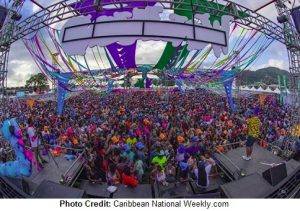
Enjoy you people … and be safe too!

As the planners for a new Caribbean, we do not have to tell you how to enjoy – that is your legacy – but we do need to guide you on security and safety – it turns out that there are active foreign threats and domestic inadequacies.

Yes, the  Caribbean legacy is one of “being lax”. So we need T&T to pay more than the usual attention; and we need to convey to the whole world that Caribbean events can be safe and secure.

“Active foreign threats” …

… that is industry-speak for terrorism warnings.

Indeed, the “War on Terror” is real; there has been countless attacks since the World Trade Center Terrorist Attack in New York City on September 11, 2001. This war is still waging, though its some 17 years later, and it is not limited to the United States alone. Canada, France, Germany, the UK, the Netherlands, Spain and others have all reported terrorist attacks. The Caribbean has been spared thus far …

… but according to some reports, that streak is about to end.

Let’s hope this story here in the British tabloid The Sun – see Appendix below – is more hype than news, but can we truly ignore it?

Title # 1: Terror threat raised for Trinidad and Tobago Carnival

(The Sun) – British tourists in the Caribbean have been warned an ISIS terror attack is “very likely” during carnival celebrations in Trinidad and Tobago.

The Foreign Office warned to avoid crowded places after cops discovered a suspected plot to target the Mardi Gras festivities on Monday and Tuesday.

In a dramatic late-night announcement, the Foreign Office said: “The Trinidad and Tobago authorities have arrested some individuals who planned to carry out attacks against Carnival on February 12 and 13.”

Officials added: “An attack is still possible. The Trinidad and Tobago government is increasing security measures for the Carnival.

“Terrorists are very likely to try to carry out attacks in Trinidad and Tobago.

“Attacks could be indiscriminate, including in crowded spaces and places visited by foreigners. You should remain vigilant and avoid crowded places and large gatherings.”

Around 30,000 Britons a year visit the country. Some have family links to Trinidad but most are tourists heading to Tobago, which has direct flights from London on BA and Virgin.

Surprisingly, the island nation of just 1.3million has the highest ISIS recruitment rate of any country in the Western hemisphere.

Around 125 people are feared to have travelled to fight in Syria and Iraq, and they pose a severe threat when they return home. Authorities are also wary of home-grown terrorists radicalised in the country.

The Foreign Office travel advice update warned: “There’s a threat from individuals who may have been inspired by terrorist groups, including Daesh and al Qaeda, to carry out so-called ‘lone actor’ attacks targeting public events or places.”

The crowded streets during carnival would be a soft target for an ISIS-inspired bomb or truck attack.

Last year Trinidad jihadi Shane Crawford, who goes by the nom-de guerre Abu Sa’d at-Trinidadi, featured in the group’s propaganda magazine.

The sniper called on ISIS supporters back home to “attack the interests of the Crusader coalition”, including embassies, businesses and civilians.

He said: “Follow the example of the lions in France and Belgium, the example of the blessed couple in California, and the examples of the knights in Orlando and Nice.

“You have the ability to terrify the disbelievers in their own homes and make their streets run with their blood.”

Trinidad and Tobago, the southernmost nation in the Caribbean, is ethnically diverse with many people of African and Indian heritage as well as Chinese, European and Arab minorities.

Around 5 per cent of the population are Muslim, according to the 2011 census.

A small radical group known as Jamaat al-Muslimeen (“Community of Muslims”) launched a coup attempt in 1990, led by a convert named Yasin Abu Bakr who is now an imam on Trinidad and hosts a weekly radio show.

Last night it emerged the remaining two Brit members of the “Beatles” beheading gang led by Jihadi John had been captured in Syria.

Last month we revealed the world’s tourist terror hot spots at “high risk” of attacks.

Source: St. Lucia Times quoting the UK’s The SUN; posted February 9, 2018; retrieved February 10, 2018 from: https://stluciatimes.com/2018/02/09/terror-threat-raised-trinidad-tobago-carnival/

Related Story:
https://www.caribbeannationalweekly.com/caribbean-breaking-news-featured/terrorist-threats-tt-carnival/

Carnival is a BIG Deal in Trinidad and other Caribbean countries. Just the thought of active threats can discourage travel to and consumption of related events. Our regional tourism would be in jeopardy!

So we – the Caribbean member-states individually and collectively – must not disregard any security threats or risks. Any news headline that features the words “ISIS” and “Caribbean” is a scandalous combination! This thesis was elaborated on by the promoters of the book Go Lean … Caribbean, in a previous blog-commentary describing an ISIS terrorism-threat in the region.

No one wants to be accused of ignoring terrorism. Yet, as reported in another previous blog-commentary, the US and many other advanced democracy countries, are very alarmed of the Caribbean member-states and their bad practices for regional security. The troubling evidence include these inadequacies:

The foregoing all draw reference to the book Go Lean…Caribbean – available for free download – as it details the quest to reform and transform Caribbean society, The book is a how-to guide and roadmap for elevating the region’s societal engines for (1.) economics, (2.) security and (3.) governance. Strategies, tactics and implementations for a successful ‘War on Terrorism’ have been a consistent theme of this book and subsequent blog-commentaries.

But people can be terrorized by domestic or local bad actors as well. Carnival has had the bad practice of people – mostly men – being too jovial, solicitous and harassing to women participants on the streets of Port-of-Spain. This too can be terrifying …

This issue is finally being addressed this year by the T&T Police. See one news story here, reported by a Miami, Florida newspaper:

Title # 2: This Caribbean Carnival won’t allow you to twerk —unless you ask permission first
By:
Jacqueline Charles

Attention all Carnival revelers and masqueraders attending the Caribbean’s biggest bacchanal: Non-consensual grinding, the provocative hip-gyrating, free-for-all that’s known in Caribbean parlance as “wining,” can get you slapped with an assault charge.

Trinidad and Tobago, the two-island country that’s considered the birthplace of the modern-day Pre-Lenten Caribbean Carnival, is telling all attendees that before you back it up on someone, ask permission. And the same goes for twerking, when the street party kicks off Monday and Tuesday in Port-of-Spain.

The ask-permission edict from the police comes after years of protests by Trinidadian women who want to be free to dance without having to worry at Carnival, the annual cultural event that draws everyone from tourists to costumed diplomats two days before Ash Wednesday.

Last year, one of the biggest hits in the lead-up to Carnival was the song “Leave Me Alone” by Calypso Rose, about a woman trying to dance in the streets free of harassment. The lyrics — “Boy, don’t touch me” — made the song a feminist anthem and inspired hundreds of gyrating women to wear “Leave Me Alone” and “Leave She Alone” T-shirts during last year’s Carnival.

Like the song, the new consent rule is part of a Caribbean-wide push by women to have more say over their bodies, said Gabrielle Hosein, the head of the Institute for Gender and Development Studies at the University of the West Indies in Trinidad.

“What you’re getting is an argument that has been made by tens of thousands of women over three or more decades in the Caribbean, long before the me-too movement addressing sexual harassment,” Hosein said. “Women have a right to be sexual and feminine in public without that happening on terms set by male aggression.”

And what’s happening in Trinidad is more radical than the me-too movement, she said. It’s women, who often dress in racy costumes during the revelry, saying they have a right to express sexual freedom without fear of sexual violence.

The concern over sexual harassment during Carnival isn’t only in Trinidad. In 2016, 22-year-old college student Tiarah Poyau was fatally shot in Brooklyn during the J’Ouvert street party before the West Indian Day Parade after telling a man to stop rubbing against her and dancing provocatively close. Police later arrested 20-year-old Reginald Moise. [See VIDEO below of Carnival in Greater Miami.]

Hosein commended the Trinidad and Tobago Police Service for warning last month that those who “thief a wine” — or hip-grind on a person without consent — during the raucous street party can be charged with assault, based on a law prohibiting physical touching without consent.

“This is a struggle that is finally recognized not only in law, which it was before, but explicitly in the language of the police in what is an extremely progressive position and statement the police service has taken,” she said.

Soca artists, whose performances are designed to provoke hip-grinding and gyrating, are divided about the controversial rule.

But when one well-known singer, soca king Machel Montano, objected and told fans at a concert that no consent was needed to wine, the public backlash forced a quick turnaround.

“Once you get consent, take a wine and have a time,” Montano told the Trinidad Express in a written statement.

Source: Miami Herald’s America Column – Posted Februay 8, 2018; retrieved February 11, 2018 from: http://www.miamiherald.com/news/nation-world/world/americas/article199040889.html

——–

VIDEO – Carnival color: Miami-Dade and Broward celebrate – http://www.miamiherald.com/entertainment/article38770695.html

Carnival lovers and revelers geared up for one of the most anticipated cultural Caribbean traditions, Miami Broward Carnival on Sunday, Oct. 11, 2015 at the Miami-Dade County Fairgrounds. VIDEO Credit: Carl Juste
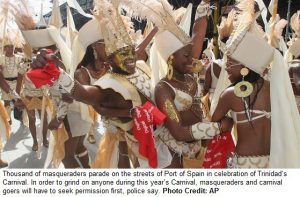
Say it ain’t so?

Only now in 2018, will the T&T Police start to treat an assault like an assault.

This – lax security – is why there is the need for a new Caribbean stewardship. This recognition is part-and-parcel to the Go Lean movement’s effort to optimize the societal engines – including homeland security – of the 30 member-states of the Caribbean region. This priority on homeland security was pronounced early in the Go Lean book with the opening Declaration of Interdependence (Page 12) that claims:

x. Whereas we are surrounded and allied to nations of larger proportions in land mass, populations, and treasuries, elements in their societies may have ill-intent in their pursuits, at the expense of the safety and security of our citizens. We must therefore appoint “new guards” to ensure our public safety and threats against our society, both domestic and foreign. The Federation must employ the latest advances and best practices … to assuage continuous threats against public safety.

xi. Whereas all men are entitled to the benefits of good governance in a free society, “new guards” must be enacted to dissuade the emergence of incompetence, corruption, nepotism and cronyism at the peril of the people’s best interest. The Federation must guarantee the executions of a social contract between government and the governed.

xii. Whereas the legacy in recent times in individual states may be that of ineffectual governance with no redress to higher authority, the accedence of this Federation will ensure accountability and escalation of the human and civil rights of the people for good governance, justice assurances, due process and the rule of law. As such, any threats of a “failed state” status for any member state must enact emergency measures on behalf of the Federation to protect the human, civil and property rights of the citizens, residents, allies, trading partners, and visitors of the affected member state and the Federation as a whole.

xvi. Whereas security of our homeland is inextricably linked to prosperity of the homeland, the economic and security interest of the region needs to be aligned under the same governance. Since economic crimes, including … forms of terrorism, can imperil the functioning of the wheels of commerce for all the citizenry, the accedence of this Federation must equip the security apparatus with the tools and techniques for predictive and proactive interdictions.

The Caribbean appointing these “new guards” will include many strategies, tactics and implementations considered “best-practices” for improved public safety and the ‘War Against Terror’. The book Go Lean … Caribbean presents its 370 pages as a roadmap for the introduction and implementation of the Caribbean Union Trade Federation (CU) to elevate the region’s societal engines of economics, security and governance. With a brand name like Trade Federation, obviously the primary focus is on economics – so promoting the image of safe Caribbean festivals is paramount – but the book also asserts (Page 23) that peace, security and public safety must be coupled with an economic empowerments. The book continues that “bad things will [always] happen to good people” and so the community needs to be prepared to contend with the risks that can imperil the homeland. The Go Lean book therefore promotes these 3 prime directives:

  • Optimization of the economic engines in order to grow the regional economy to $800 Billion GDP and create 2.2 million new jobs.
  • Establishment of a homeland security apparatus to ensure public safety and to protect the resultant economic engines of the Caribbean
  • Improvement of Caribbean governance to support these above engines.

The Go Lean book details the series of community ethos, strategies, tactics, implementations and advocacies to improve public protections: interpersonal violence, crime mitigation efforts, and even wage a successful ‘War on Terrorism’. This charter includes all proactive and reactive public safety/security measures in the Caribbean region. There have been many previous blog-commentaries that have elaborated on policing and governing empowerments for the region’s homeland security needs. Consider this sample here:

https://goleancaribbean.com/blog/?p=13746 Failure to Launch – Security: Caribbean Basin Security Dreams
https://goleancaribbean.com/blog/?p=13126 The Requirement for Better Security: Must Love Dogs
https://goleancaribbean.com/blog/?p=11054 Managing the ‘Strong versus the Weak’ – Mitigating Bullying
https://goleancaribbean.com/blog/?p=10566 Funding the Caribbean Security Pact
https://goleancaribbean.com/blog/?p=9974 Lessons Learned from Pearl Harbor
https://goleancaribbean.com/blog/?p=9072 Securing the Homeland – On the Ground
https://goleancaribbean.com/blog/?p=9070 Securing the Homeland – From the Seas
https://goleancaribbean.com/blog/?p=9068 Securing the Homeland – From the Air
https://goleancaribbean.com/blog/?p=7345 ISIS in the Caribbean?
https://goleancaribbean.com/blog/?p=6720 A Lesson in History – During the Civil War: Fighting for Our Own Cause
https://goleancaribbean.com/blog/?p=6103 Sum of All Fears – ‘On Guard’ Against Deadly Threats
https://goleancaribbean.com/blog/?p=5002 Managing a ‘Clear and Present Danger’
https://goleancaribbean.com/blog/?p=4809 America’s Model of Monitoring for Terroristic Activities
https://goleancaribbean.com/blog/?p=4360 Dreading the ‘Caribbean  Basin Security Initiative’
https://goleancaribbean.com/blog/?p=1554 Status of Forces Agreement = Security Pact
https://goleancaribbean.com/blog/?p=1076 Trinidad Muslims travel to Venezuela for Jihadist training
https://goleancaribbean.com/blog/?p=809 Muslim officials condemn abductions of Nigerian girls
https://goleancaribbean.com/blog/?p=535 Remembering and learning from Boston for Festival Security

An effort to provide better public safety and homeland security solutions in the Caribbean should be welcomed by all stakeholders. The effort to project the image of Safe Caribbean is a pressing need. We do not need to undermine our economic engines with lax security measures or attitudes.

It is past time to do better!

It is past time for a new Caribbean stewardship. One that must foster good security habits … and ‘war against a lax attitude’ – the world is watching!

Now is the time to lean-in to this Go Lean roadmap. Now is the time to better secure our homeland: monitor for threats, gather intelligence, investigate incidences, police communities, arm a defense apparatus and prepare for the worst. Now is time now to grow up and secure our economic engines.

All Caribbean stakeholders are therefore urged to lean-in to this roadmap, to this conceivable, believable and achievable plan to make the Caribbean a better, safer place to live, work and play. 🙂

Download the free e-book of Go Lean … Caribbean – now!

Sign the petition to lean-in for the roadmap for the Caribbean Union Trade Federation.

———-

Appendix – The Sun Tabloid Newspaper

The Sun is a tabloid newspaper published in the United Kingdom and the Republic of Ireland. Since The Sun on Sunday was launched in February 2012, the paper has been a seven-day operation. As a broadsheet, it was founded in 1964 as a successor to the Daily Herald; it became a tabloid in 1969 after it was purchased by its current owners.[6] It is published by the News Group Newspapers division of News UK, itself a wholly owned subsidiary of Rupert Murdoch‘s News Corp.[7][8]

The Sun has the largest circulation of any daily newspaper in the United Kingdom,[7] but in late 2013 slipped to second largest Saturday newspaper behind the Daily Mail.[9] It had an average daily circulation of 2.2 million copies in March 2014.[7] Between July and December 2013 the paper had an average daily readership of approximately 5.5 million, with approximately 31% of those falling into the ABC1 demographic and 68% in the C2DE demographic. Approximately 41% of readers are women and 59% are men.[7] The Sun has been involved in many controversies in its history …

Source: Retrieved February 10, 2018 from: https://en.wikipedia.org/wiki/The_Sun_(United_Kingdom)

Share this post:
, ,

Scheduling in the ‘Gig Economy’

Go Lean Commentary

“There’s work at the Post Office Too” – Grandmother character in 1987 Movie Hollywood Shuffle; see Appendix.

That iconic line from this 30-year movie is mindful of the transformation taking place in the modern American economy. Despite all the changes in technologies and habits, there is always “honorable” work available in the service industry. Any reference to the Post Office of 1987 can be replaced today with the Gig Economy.

Gig Economy?

Oh yes, this is all the rage! This is the future! This is now! The Gig Economy refers to …

… an environment in which temporary positions are common and organizations contract with independent workers for short-term engagements. The trend toward a Gig Economy has begun. A study by [financial software company] Intuit predicted that by 2020, 40 percent of American workers would be independent contractors. – Source

This trend now needs to come to the Caribbean as we need jobs …

  • Full-time jobs
  • Part-time jobs
  • Gigs

See the Press Release here of the planning and organization dynamics needed to manage the Gig Economy. This Press Release is from the American company Aspect Software; they are the world’s leading enterprise cloud contact center & workforce optimization solution. See an excerpt here:

Title: Scheduling in the Gig Economy
By: Mike Bourke, Aspect Software SVP & General Manager for Workforce Optimization

In 50 cities across the U.S., Amazon is supplementing their USPS deliveries at times of peak demand using drivers contracting directly with Amazon in a program called Amazon Flex. Tapping for-hire drivers, each batch of deliveries is essentially a “gig” in the quickly growing trend of the Gig Economy. Popularized by Uber and Lyft, the Gig Economy pairs independent, on-demand contractors with organizations for short-term engagements. With Amazon Flex, the company uses a mobile app for drivers to post their personal preferred schedules, which can include very short availability windows. Amazon then displays available “blocks” of time for making deliveries. The driver selects a block, and at the designated time, goes to the local pickup location to start deliveries.

Other industries are quickly catching on for services such as furniture moving, dog walking and at-home makeup styling and the contact center isn’t far behind.

In the contact center, you can think of customer contacts as representing the work to be done (or the packages to be delivered in the case of Amazon). The times when customer contacts arrive and are completed create the opportunities when Gigs are available for contact center employees. Historically, most contact center agents have been employed as regular 40 hour/week full-time employees, even though their schedules might be erratic as call volumes rise and fall throughout the week. However, that history is yielding to pressures from many different directions that point to a very different future for a sizeable percentage of the agent population. Consider the following factors that make the Gig Economy attractive for agents and businesses.

Mutual Benefits of the Gig Economy

  • Businesses Reduce Expenses – Using independent contractors in the contact center or any other type of business, can reduce the cost of employees by 30% because the employer is not required to pay benefits such as payroll taxes, worker’s comp insurance, unemployment insurance, vacation time or health benefits.
  • Employees Can Work-at-Home – The Gig Economy is already in full swing in some segments of the contact center industry. The 25% annual growth of work-at-home (WAH) agents is nothing short of spectacular and is a bellwether for the future of the contact center industry.  Offering both the ability to work remotely and part-time, WAH could be the future of the contact center industry.  With the growing adoption of telecommuting in many businesses, why not for agents?  WAH also creates part-time work for a whole segment of the population with physical disabilities, childcare issues or poor commuting options.  With more part-time workers, contact centers also have a more agile workforce that can ramp up and down quickly, matching contact center staffing to call volumes   WAH has huge momentum, and its growth will help make part-time contact center work commonplace.
  • Businesses Can Access Specialized Skills – In the past few years, technology has finally advanced to the point where it is a good substitute for a human conversation. And since 81% of customers prefer self-service to agent assisted service, the simpler work will eventually go to automated self-service, and only the more complex tasks will go to agents. Studies show that 95% of agents are only willing to drive up to 30 minutes to work.  For more specialized skills, contact centers may need to reach out beyond that current geographic boundary, further stimulating the need for part-time work-at-home agents.
  • Employees Get Flexible Schedules – Millennials have surpassed Baby Boomers as the nation’s largest living generation, and contact centers are rife with them. It’s well known that Millennials dearly value their work-life balance, and that means that they want to easily flex their work schedules around their personal lives.  Many value complete control over their work schedule above a higher income and/or benefits, and that’s the perfect profile of an Uber driver or part-time contact center agent.
  • Businesses Can Manage Volume Spikes – Millennials are also, “always on”. They literally sleep with their cell phones, and their need to be always connected makes them perfectly accessible for notifications about unpredictable contact center “gigs” when volumes spike.  The contact center can reach out to them anytime concerning a few hours of potential work with a good chance that the receiving Millennial got the message on his or her cell phone and read it.

Implications for Workforce Management Software
To empower agents with this flexibility and control while still meeting the needs of the business, the contact center needs to adopt new WFO tools, training, infrastructure, recruiting and management practices.  This new model for labor participation especially requires a new set of contact center workforce management processes and associated technologies optimized for the quality of the service you want to deliver to customers.

The forecasting portion of WFM remains essentially the same in the Gig Economy.  We still need to accurately predict the level of demand for staff for each type of work.  But scheduling of individuals for the work predicted is quite different.  We need new work rules such as:

  • What is the minimum length of a work session? It takes a few minutes to connect to contact control and CRM and other necessary systems, and some amount of time to successfully resolve a customer’s contact as well as do any wrap up work. For example, if your average contact handling time is 14 minutes, you won’t want to allow employees to end up with a work session that is only 10 minutes long.
  • How much time-off must be allowed between work sessions? There is a cost to disconnecting from systems and connecting again and mentally getting up to speed to successfully work with customers.
  • What is the maximum allowable time that can be worked per day and week? In the Gig Economy, we must manage this issue as well based on regional employment limitations.

These rules then determine the inventory of blocks of time (or gigs) that can be offered to each agent.

In the traditional world of agent scheduling, agents have wanted predictable schedules with fixed shifts.  Schedules would remain the same every day for a known period of time.  Usually, customer volumes would change faster than the ability of these inflexible blocks to adapt, so contact centers would often need to overstaff to preserve SLAs.  In the Gig Economy world, the workforce management system makes available shorter schedule blocks with a wider range of start times from which agents can choose.  An agent can likely find some blocks that work well for his or her desired flexible schedule.  On the flip side, if an agent wants a full 40 hour week, he or she will likely have to pick schedules from some unpopular times.  Likewise, if the business allows agents to work shifts that are irregular and unconventional, there are likely to be gaps in coverage that will need to be filled by requiring inconvenient shifts to be worked by some agents.  Of course, these unpopular times could be more highly compensated if labor laws allow, or they can be gamified, awarding tokens that can be traded in for vacation days or other awards.  Also, peak times may be a target for incentives, and some companies may even require some selection of peak times before selecting other more flexible gig times.

See the remainder of the article here:

http://blogs.aspect.com/scheduling-in-the-gig-economy/ posted January 12, 2018; retrieved February 7, 2018.
——–
About the Author
Mike Bourke is Aspect’s Senior Vice President and General Manager of Workforce Optimization. Mike is responsible for charting the strategic direction, and continuing the momentum of Aspect’s global workforce optimization suite and continuing the solution’s availability in the Aspect Cloud.

This Press Release identified Amazon … again. They are one of the “early adopters”, movers-and-shakers of the art-and-science of the Gig Economy. Amazon is also a mover-and-shaker in many other areas of job creation. As related in a previous Go Lean commentary, the Amazon model should really be studied by the economic stewards for a new Caribbean. That blog related:

Amazon is not just a giant on the internet, in the areas of electronic commerce. No they are emerging as a giant in the real world as well. The company has over 380,000 employees worldwide and 40,000+ at their Seattle, Washington USA headquarters. That is a BIG corporate presence. In fact, economic analysts had tabulated the Gross Domestic Product (GDP) contribution to Seattle at $US 38 Billion. Wow!
There is always work at the Post Office (USPS) and now Amazon is supplementing their USPS deliveries at times of peak demand by using drivers who contract directly with their Amazon Flex program.

We now have a “clear path” of what we need to do to optimize the Caribbean economic and job-creation engines. “Clear paths” are important ingredients for roadmaps. The book Go Lean…Caribbean serves as a roadmap for the introduction and implementation of the technocratic Caribbean Union Trade Federation (CU) and also the Caribbean Postal Union (CPU), which is modeled after Amazon.

The Go Lean/CU roadmap is designed to elevate the Caribbean’s societal engines starting first with economics (jobs, industrial development and entrepreneurial opportunities). In fact, the following 3 statements are identified as the prime directives of the CU:

  • Optimization of the economic engines in order to grow the regional economy to $800 Billion & create 2.2 million new jobs.
  • Establishment of a security apparatus to protect the resultant economic engines.
  • Improve Caribbean governance to support these other engines.

As related in the foregoing Press Release, to embrace the Gig Economy there is the need to keep an eye on Technology. In the Go Lean book, this dynamic is identified as an “Agent of Change“ in modern society. The Go Lean roadmap also seeks to introduce the tactical use of incubators. This is explained in the book (Page 28) as the process and engagement of programs to support the successful development of entrepreneurial companies through an array of business support resources and services. We need more expressions of the Gig Economy in our Caribbean region.

Amazon is embracing the Gig Economy. The Caribbean needs to embrace the Gig Economy. The Caribbean needs to follow Amazon’s model and incubate these arts-and-sciences. While Amazon’s modus operandi is not to be an incubator, they have invested heavily in many other tech-related companies and technical concepts, including the Workforce Management products from Aspect Software (highlighted in the foregoing Press Release). While Aspect is not the only provider, following their lead means assimilating advanced concepts, strategies, tactics and implementations. This assimilation means adopting a new “community ethos”. This is what is defined in the Go Lean book as “community ethos”:

  1. The fundamental character or spirit of a culture; the underlying sentiment that informs the beliefs, customs, or practices of a group or society; dominant assumptions of a people or period.
  2. The character or disposition of a community, group, person, etc.

We need this community ethos – and the accompanying technocratic stewardship – in the Caribbean so that we can incubate more and more jobs, especially in the Gig Economy! In total, we can create 2.2 million new jobs.

The 370-pages of the Go Lean book stresses some specific community ethos that the region needs to adopt, plus the strategies, tactics, implementations and advocacies to reform and transform the economic engines of Caribbean society. The required technocratic stewardship for the region’s economic engines was presented early in the book with these opening pronouncements in the Declaration of Interdependence (Page 13 and 14):

xxiv. Whereas a free market economy can be induced and spurred for continuous progress, the Federation must install the controls to better manage aspects of the economy: jobs, inflation, savings rate, investments and other economic principles. Thereby attracting direct foreign investment because of the stability and vibrancy of our economy.

xxvii. Whereas the region has endured a spectator status during the Industrial Revolution, we cannot stand on the sidelines of this new economy, the Information Revolution. Rather, the Federation must embrace all the tenets of Internet Communications Technology (ICT) to serve as an equalizing element in competition with the rest of the world. The Federation must bridge the digital divide and promote the community ethos that research/development is valuable and must be promoted and incentivized for adoption.

The points of effective, technocratic stewardship were further elaborated upon in previous blog-commentaries. Consider this sample of submissions that stressed the eco-systems of job-creation, gigs and incubation:

https://goleancaribbean.com/blog/?p=13916 Model of ‘Gig Economy’ – Mother’s Love in Haiti
https://goleancaribbean.com/blog/?p=13420 A Lesson in History – Community Incubation for Whaling
https://goleancaribbean.com/blog/?p=8262 UberEverything in Africa – Model of ‘Gigs’
https://goleancaribbean.com/blog/?p=7991 Transformations: Caribbean Postal Union – Delivering the Future
https://goleancaribbean.com/blog/?p=2857 Model of ‘Gig Economy’ – Entrepreneurism in Junk
https://goleancaribbean.com/blog/?p=2571 AirBnB ‘Gig Economy’ Options Materializing
https://goleancaribbean.com/blog/?p=528 Facebook’s advances for e-Commerce payments

In addition, previous blog-commentaries also elaborated on the business model of Amazon. See these samples as follows:

https://goleancaribbean.com/blog/?p=13627 Amazon: Then and Now
https://goleancaribbean.com/blog/?p=13091 Amazon Opens Search for HQ2
https://goleancaribbean.com/blog/?p=12291 Big Tech’s Amazon – The Retailers’ Enemy
https://goleancaribbean.com/blog/?p=11358 Retail Apocalypse – Preparing for the Inevitable
https://goleancaribbean.com/blog/?p=7297 Death of the ‘Department Store’: Exaggerated or Eventual
https://goleancaribbean.com/blog/?p=7023 Thanksgiving & American Commerce – Past, Present and Amazon
https://goleancaribbean.com/blog/?p=1416 Model of an E-Commerce Fulfillment Company: Amazon

For the Caribbean, let’s pay attention to Amazon, and the development of the Gig Economy. Let’s do the Gig Economy. Let’s incubate!

Let’s lean-in and learn how incubator programs are structured by community stewards to create jobs and entrepreneurial opportunities. We need them … here at home! We need them now!

The lessons we learned will help us elevate from our past dysfunctions and build a better future. We must learn, if we want to make our homelands better places to live, work and play. This is our quest! 🙂

Download the free e-book of Go Lean … Caribbean – now!

Sign the petition to lean-in for the roadmap for the Caribbean Union Trade Federation.

———-

Appendix VIDEO – Movie: Hollywood Shuffle (1987) Clip – https://youtu.be/XXaZQ5tlY40

Published July 24, 2015 – About the movie

An actor limited to stereotypical roles because of his ethnicity, dreams of making it big as a highly respected performer. As he makes his rounds, the film takes a satiric look at African American actors in Hollywood. Written, produced, directed and starring Robert Townsend, – Source: IMDB.com

Share this post:
, , , , ,
[Top]

Wait, ‘We Are The World’

Go Lean Commentary

33 is an important number for music. This is the speed that a record-album spins on a record-player.

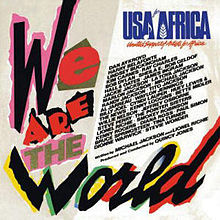
33 years ago, today – January 28th, 1985 – the record industry spun a new thread. The industry spun its biggest world charity endeavor, to date, to mitigate famine in Africa, in response to a drought in Ethiopia. This was the collaborative effort – by more than 40 artists – to record the song: We Are The World.

See the story in the Almanac entry here:

Almanac: “We Are the World”

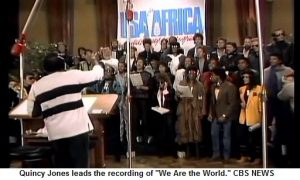
… From our “Sunday Morning” Almanac: January 28th, 1985, 33 years ago today … the day more than 40 of the music world’s greatest stars gathered in a Los Angeles studio to record the song “We Are the World.”

Written by Lionel Richie and Michael Jackson, and produced by Quincy Jones, the song was a fundraiser for the relief group USA for Africa.

The artists were told, “Check your egos at the door.” And did they ever.

Twenty-one of them each got a turn singing a solo line, while more than 20 others made up the chorus.

More than nine million copies of the song have been sold or downloaded. It won four Grammys, including Song of the Year and Record of the Year.

And most important: USA for Africa says the song has generated more than $65 million for humanitarian relief.

For more info:

Source: CBS Sunday Morning – Almanac: This Day In History – Posted & Retrieved January 28, 2018 from: https://www.cbsnews.com/news/almanac-we-are-the-world/

———–

VIDEO – U.S.A. For Africa – We Are the World – https://youtu.be/9AjkUyX0rVw

USAforAfricaVEVO

Published on Apr 12, 2010 – Music video by U.S.A. For Africa performing ‘We Are the World’. USA For Africa

This moment, movement, momentum and music changed the world!

This super-group United Support of Artists (USA) for Africa played on the brand “USA”, but truthfully, they could have called themselves United States of America, as all the participants – see Appendix below –  were Americans … except for the Irish vocalist-producer Bob Geldof in the chorus, plus percussionist Phil Collins (England) and percussionist  Paulinho da Costa (Brazil).


Yet still, this collaborative effort made a difference!

They raised money and ensured the distribution of food stuffs to the ravaged areas of Africa. They used music to change the world!

Can we use music to change the world again? How about changing the Caribbean? How about shaping the culture?

Yes, we can! Why? ‘We Are The World‘.

Its ironic that despite all the available talent, there was no Caribbean representation in that assembly of artists that day, none except for Harry Belafonte. He boasts a legacy of a Caribbean parentage from a Jamaican mother and Martiniquan father; (though he himself was born in Harlem, New York). For ‘We Are The World‘, he sang in the chorus.

This consideration is in line with the 2013 book Go Lean … Caribbean. The book relates that music and a movement can change the world again. It serves as a roadmap for the introduction and implementation of the technocratic Caribbean Union Trade Federation (CU). This CU strives to advance Caribbean culture using the application of societal best-practices – and music – to engage these 3 prime directives:

  • Optimization of the economic engines in order to grow the regional economy to $800 Billion and create 2.2 million jobs.
  • Establishment of a security apparatus to protect the resultant economic engines.
  • Improvement of Caribbean governance to support these engines.

The Go Lean book – available for download now – prescribes a plan for each Caribbean country to grow their musical influence. The book further identifies 169 different musical/national combinations of genres throughout the region. So the complex music landscape in the region does not stand still; it evolves. So too their musical artists.

Music can indeed wield a great influence and impact on the world. (Previously, this blog-commentary detailed the influence of music icon Bob Marley). Natural disasters continue to happen, as ‘We Are The World‘ was in response to a natural disaster – a drought – in Africa 33 years ago. We continue to have natural disasters … today. Just recently, late September 2017, Hurricane Maria devastated several Caribbean member-states; Puerto Rico was gravely impacted. In the mode of ‘We Are The World‘, many artists – led by Lin-Manuel Miranda of Hamilton fame – assembled and recorded a song to aid Puerto Rico, entitled ‘Almost Like Praying‘ by Artists for Puerto Rico.

Lesson learned! The same as ‘We Are The World‘ was mostly an American art form, Puerto Rico was able to convey its brand.

See the VIDEO of the song ‘Almost Like Praying‘ by Artists for Puerto Rico here:

VIDEO – Like Praying feat Artists for Puerto Rico [Music Video] – https://youtu.be/D1IBXE2G6zw

Atlantic Records

Published on Oct 6, 2017 – Lin-Manuel Miranda’s “Almost Like Praying” was written and recorded to benefit hurricane relief efforts in Puerto Rico with proceeds benefiting The Hispanic Federation’s Unidos Disaster Relief Fund

Proceeds go to https://hispanicfederation.org/unidos/

For more information, please visit http://www.hispanicfederation.org and http://www.almostlikepraying.com

“Almost Like Praying” Lin-Manuel Miranda feat Artists for Puerto Rico Music and Lyrics by Lin-Manuel Miranda © 2017
“Contains elements of “Maria” Music by Leonard Bernstein, Lyrics by Stephen Sondheim ©1957, Renewed.

Vocals Performed by (listed alphabetically):

Marc Anthony Ruben Blades Camila Cabello
Pedro Capo Dessa Gloria Estefan
Fat Joe Luis Fonsi Juan Luis Guerra
Alex Lacamoire John Leguizamo Jennifer Lopez
Lin-Manuel Miranda Rita Moreno Ednita Nazario
Joell Ortiz Anthony Ramos Gina Rodriguez
Gilberto Santa Rosa PJ Sin Suela Tommy Torres
Ana Villafañe

Percussion by: Eric Bobo Correa

Executive Producer: Lin-Manuel Miranda

Proceeds to the Hispanic Federation UNIDOS Fund for Puerto Rico

  • Category: Music
  • License: Standard YouTube License

The movement behind the Go Lean book asserts that “one person can make a difference“, and that music can shape culture. So just like Bob Marley, Lin-Manuel Miranda should be recognized for his contributions to music, culture and Puerto Rican (Caribbean) identity. This one character has made a difference, he has shaped American culture and forged an example and a sample of how other Caribbean stakeholders can do more in the arts to impact the world – ‘We Are The World‘.

Yes, as related in a previous blog-commentary, we – in the Caribbean – can build a city on “rock-and-roll”.

Early in the Go Lean book (Page 15) in the Declaration of Interdependence, the contributions that music can make is pronounced as an community ethos for the entire region to embrace, with these statements:

  • Whereas the cultural arts and music of the region are germane to the quality of Caribbean life, and the international appreciation of Caribbean life, the Federation must implement the support systems to teach, encourage, incentivize, monetize and promote the related industries for arts and music in domestic and foreign markets. These endeavors will make the Caribbean a better place to live, work and play.

The Go Lean book, within its 370 pages, details the community ethos, strategies, tactics, implementations and advocacies to foster the next generation of artists. This roadmap recognizes that a prerequisite for advancing society is a change in the community ethos, defined as “the fundamental spirit of a culture that drives the beliefs, customs and practices” in society. Music should be appreciated for its ability to shape the culture of a community, country or even the whole world.

Thank you Quincy Jones and all the 40-plus United Support of Artists for the model for ‘We Are The World‘ 33 years ago; you set the pathway for success for new collaborations of talented, inspirational and influential artists who are sure to follow, even here in the Caribbean. We used that pattern for Puerto Rico; hopefully more Caribbean communities to follow.

We want “a change to come” to the Caribbean. So we need to accept the premise that was echoed musically 33 years ago, that ‘We Are The World‘. We hereby urge the people, institutions and governance of Caribbean region to “lean-in” to this Go Lean roadmap for change and empowerment. ‘We Are The World‘ and we want to make our part of the world – the Caribbean – a better place to live, work and play. 🙂

—————

Appendix – USA for Africa Artists-Musicians

Conductor: Quincy Jones 

Soloist – Order of Appearance Chorus – Alphabetically Instrument Players
Lionel Richie Dan Aykroyd David Paich – synthesizers
Stevie Wonder Harry Belafonte Michael Boddicker – synthesizers
Paul Simon Lindsey Buckingham Paulinho da Costa – percussion
Kenny Rogers Mario Cipollina Phil Collins – percussion
James Ingram Johnny Colla Louis Johnson – synth bass
Tina Turner Sheila E. Michael Omartian – keyboards
Billy Joel Bob Geldof Greg Phillinganes – keyboards
Michael Jackson Bill Gibson John Robinson – drums
Diana Ross Chris Hayes
Dionne Warwick Sean Hopper
Willie Nelson Jackie Jackson
Al Jarreau La Toya Jackson
Bruce Springsteen Marlon Jackson
Kenny Loggins Randy Jackson
Steve Perry Tito Jackson
Daryl Hall Waylon Jennings
Huey Lewis Bette Midler
Cyndi Lauper John Oates
Kim Carnes Jeffrey Osborne
Bob Dylan Pointer Sisters (June, Ruth, and Anita)
Ray Charles Smokey Robinson

Source: Wikipedia Online Encyclopedia Retrieved January 28, 2018 from: https://en.wikipedia.org/wiki/We_Are_the_World

Share this post:
, , , ,
[Top]

First Steps – A Powerful C.P.U.

The movement behind the book Go Lean … Caribbean wants to deploy an “apolitical technocracy” in the Caribbean. What is an apolitical technocracy?

Quite simply, an organizational structure designed to just deliver.

Sounds familiar? Frankly, the Post Office is a powerful example of an apolitical technocracy:

They just deliver the mail …

… “Neither snow nor rain nor heat nor gloom of night stays these couriers from the swift completion of their appointed rounds”.

(While the Postal Service has no official motto, the popular belief is that these words are tribute to America’s postal workers).

Technocracies are supposed to be automatons, a machine that just chugs-and-chugs. Think computers; think C.P.U.. But in the case of this Go Lean scheme, C.P.U. does not mean Central Processing Unit, no, it means Caribbean Postal Union.

The book Go Lean book – available to download for free – serves as a roadmap for the introduction and implementation of the technocratic Caribbean Union Trade Federation (CU) and the Caribbean Postal Union, for the elevation of Caribbean society – for all member-states. This CU/Go Lean roadmap has these 3 prime directives:

  • Optimization of the economic engines in order to grow the regional economy and create new jobs.
  • Establishment of a security apparatus to ensure public safety and protect the resultant economic engines.
  • Improve Caribbean governance to support these engines, including a separation-of-powers between the member-states and CU federal agencies.

This commentary is Part 6 of 6-parts; it completes the series from the movement behind the book Go Lean … Caribbean in consideration of the First Steps for instituting a new regime in governance for the Caribbean homeland. The other commentaries in the series are cataloged as follows:

  1. First Steps: EU: Free European Money – To Start at Top
  2. First Steps: UK: Dignified and Efficient
  3. First Steps: US: Congressional Interstate Compact – No Vote; No Voice
  4. First Steps: CariCom: One Man One Vote Defects 
  5. First Steps: Deputize ‘Me’! 
  6. First Steps: A Powerful C.P.U.

All of these commentaries relate to “how” the Caribbean can finally get started with adapting the organizational structures to optimize the region’s societal engines. Whereas all the previous submissions addressed the need for reform at the Top. This commentary addressed the automation, the technocratic C.P.U.. This is designed to affect every man-woman-child in the Caribbean region, to just deliver. This simple functionality will do wonders for the quest of this roadmap: make the Caribbean member-states better places to live, work and play.

The Go Lean book stresses that reforming and transforming the Caribbean societal and postal engines must be a regional pursuit. This was an early motivation for the roadmap, as pronounced in the opening Declaration of Interdependence (Pages 12 – 13):

xi. Whereas all men are entitled to the benefits of good governance in a free society, “new guards” must be enacted to dissuade the emergence of incompetence, corruption, nepotism and cronyism at the peril of the people’s best interest. The Federation must guarantee the executions of a social contract between government and the governed.

xv. Whereas the business of the Federation and the commercial interest in the region cannot prosper without an efficient facilitation of postal services, the Caribbean Union must allow for the integration of the existing mail operations of the governments of the member-states into a consolidated Caribbean Postal Union, allowing for the adoption of best practices and technical advances to deliver foreign/domestic mail in the region.

xvi. Whereas security of our homeland is inextricably linked to prosperity of the homeland, the economic and security interest of the region needs to be aligned under the same governance. Since economic crimes … can imperil the functioning of the wheels of commerce for all the citizenry, the accedence of this Federation must equip the security apparatus with the tools and techniques for predictive and proactive interdictions.

xxiv. Whereas a free market economy can be induced and spurred for continuous progress, the Federation must install the controls to better manage aspects of the economy: jobs, inflation, savings rate, investments and other economic principles. Thereby attracting direct foreign investment because of the stability and vibrancy of our economy.

The Go Lean book provides 370-pages of turn-by-turn instructions on “how” to adopt new community ethos, plus the strategies, tactics, implementations and advocacies to execute so as to reboot, reform and transform the societal engines of Caribbean society. One advocacy in the book is entitled “10 Ways to Improve Mail Service … in the Caribbean Region“; this detailed the best practices for postal mail and logistics; (Page 108). See this Bottom Line introduction:

The Bottom Line for the Caribbean Postal Union
Without a regional hub-and-spoke system, mail from one island to another can take weeks – such a business climate cannot breathe success with this lack of efficiency. The purpose of the CU is to facilitate the economic engines of the region. Therefore postal communications between individuals, households, businesses and governmental institutions must be efficient and effective – establishments must be able to connect with their customers and governments to its constituents. The Caribbean Postal Union (CPU) will operate as a private business, a multi-national corporation, owned by CU member-states, chartered to employ best practices and world class methods in the execution of the fulfillment side of the e-Delivery model. A mark of success: delivery of first-class mail in 3 – 5 days.

Improving the postal mail eco-system in the Caribbean can have a transformative effect on regional society. CPU is mostly an e-Logistics enterprise. Imagine the following (global) trends that wait in the balance:

Imagine a Caribbean reality with flat-rate envelopes and flat-rate boxes. Imagine the automation, the robotic technologies, the scanning and sorting. The brand CPU would really be apropos – more software, e-Commerce and Internet Communications Technology – as opposed to the neighborhood mail-carrier. See this industrial shift in the related news article in the Appendix below. In fact, the company www.Stamps.com provides a model for the CPU to emulate. See this Introductory VIDEO here:
VIDEO – Welcome to Stamps.com, USPS Postage Software Overview – https://youtu.be/wCCAkRkUWE0

Stamps.com

Published on Apr 23, 2013 – Welcome to Stamps.com, USPS Postage Software Overview This video shows new customers how Stamps.com software works. Highlights include how to buy and print postage stamps and shipping labels, e-commerce shipping features, postage spending reports plus many more features.

In addition, previous Go Lean blog-commentaries detailed the width-and-breadth of the mail-logistics business model for the Caribbean; see these prior submissions here:

https://goleancaribbean.com/blog/?p=13627 Amazon as a Role Mode: Then and Now
https://goleancaribbean.com/blog/?p=9839 Alibaba Cloud stretches global reach with four new facilities
https://goleancaribbean.com/blog/?p=7991 Transformations: Caribbean Postal Union – Delivering the Future
https://goleancaribbean.com/blog/?p=3187 Amazon Role Model – Robots helping tackle Cyber Monday
https://goleancaribbean.com/blog/?p=2488 Alibaba – A Chinese Role Model for the C.P.U.
https://goleancaribbean.com/blog/?p=1416 Amazon – An American Role Model for the C.P.U.

Forging change is heavy-lifting for the CU/Go Lean roadmap, but conceivable, believable and achievable? Why because so many other entities have executed these action plans before. We do not need to “re-invent the wheel”; we only need to conform to the published best-practices. This applies to the Caribbean Postal Union and all other societal engines.

Yes, we can succeed in forging change and assuaging the crises in the Caribbean. We have the existing organizations constructs of the CariCom, British Overseas Territories, US Territories and the EU. We can use these to “touch” every country-establishment-person in the region. This will lead to the success of our goals, to make the Caribbean a better place to live, work and play. 🙂

Download the free e-Book of Go Lean … Caribbean – now!

Sign the petition to lean-in for this roadmap for the Caribbean Union Trade Federation.

———–

Appendix Title: Important: USPS making changes to First-Class Mail International Flats

January 21, 2018 Update: Stamps.com has launched a new International Flat service.  Get more info on how to ship merchandise with International Flats.

Merchandise No Longer Allowed in First Class Mail International Flats
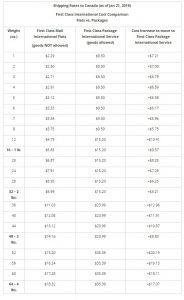
If you ship merchandise abroad using USPS First Class Mail International Flats, there’s a new rule going into effect soon that you need to know about. Effective Sunday, January 21, 2018, First Class Mail International Large Envelope/Flat service for merchandise will NO LONGER be available from the USPS. First Class Mail International Flats will only be approved for use when sending documents. This change is occurring to comply with Universal Postal Union requirements.

Here are some examples of what USPS considers a document (still OK to ship using First Class Mail International Flats):

  • Audit and business records
  • Personal correspondence
  • Circulars
  • Pamphlets
  • Advertisements
  • Written instruments not intended to be resold
  • Money orders, checks, and similar items that cannot be negotiated or converted into cash without forgery.

Here are examples of items that will NO LONGER be allowed to be shipped as First Class Mail International Flats, effective Jan. 21, 2018:

  • CDs, DVDs, flash drives, video and cassette tapes, and other digital and electronic storage media (regardless of whether they are blank or contain electronic documents or other prerecorded media)
  • Artwork
  • Collector or antique document items
  • Books
  • Periodicals
  • Printed music
  • Printed educational or test material
  • Player piano rolls
  • Commercial photographs, blueprints and engineering drawings
  • Film and negatives
  • X-rays
  • Separation negatives

These goods are dutiable and must be must be shipped using First Class Package International Service. Once this change goes into effect, shippers will need to include Customs Forms and the recipient could pay a duty or tax to receive the product.

Cost Savings Using First Class Mail International Flats
Moving from First Class Mail International Flats to First Class Package International Service will have a big impact on shippers.

Source: Posted December 26th, 2017; retrieved January 21, 2018 from: http://blog.stamps.com/2017/12/26/important-usps-making-changes-first-class-mail-international-flats/ 

Share this post:
, ,
[Top]

First Steps – Deputize ‘Me’!

Go Lean Commentary

If we want to effect change in the Caribbean region, we could “touch” every Caribbean member-state by going through CariCom, British Overseas Territories, US Territories and the EU. Yes, we would “touch” every country … except Cuba.

Of the 30 member-states that constitute the Caribbean region, Cuba does not align with any of these previously identified structures, but still the book Go Lean … Caribbean declares that they are not alone. There is the offer of collaboration, confederacy and comradery with the rest of the neighborhood in the Caribbean region. The book declares (Page 5) … to Cuba and the rest of the region (based on the 1972 song “Lean On Me” by Bill Withers):

If there is a load you have to bear
That you can’t carry
I’m right up the road
I’ll share your load
If you just call me

The “load” being referred here is what the Go Lean book – and other leadership experts – refers to as the Social Contract, this is the assumption that citizens surrender some of their freedoms and submit to the authority of the State in exchange for protection of remaining natural and legal rights. One way of sharing the load is to deputize others to execute. So this movement behind the Go Lean book declares: Deputize me!

This commentary about leadership is Part 5 of a 6-part series from the movement behind the book Go Lean … Caribbean in consideration of the First Steps for instituting a new regime in governance for the Caribbean homeland. The other commentaries in the series are cataloged as follows:

  1. First Steps: EU: Free European Money – To Start at Top
  2. First Steps: UK: Dignified and Efficient
  3. First Steps: US: Congressional Interstate Compact – No Vote; No Voice 
  4. First Steps: CariCom: One Man One Vote Defects 
  5. First Steps: Deputize ‘Me’! 
  6. First Steps: A Powerful C.P.U.

All of these commentaries relate to “how” the Caribbean can finally get started with adapting the organizational structures to optimize the region’s societal engines. This is the consideration of leading from the Top. This would apply to the all member-states in the geographical area. We do not want to ignore Cuba and do not want the Cubans to ignore us. They are the biggest country in the middle of the region and must be included. Most importantly, the leverage of all 42 million people in the region extends greater benefits to everyone in the region. The quest of the Go Lean movement is to implement an economic Single Market and then let the benefits flow: a better region to live, work and play.

A better economic landscape is what the Caribbean region needs to assuage a lot of its problems. The book opens (Page 3) with this sad assessment:

Many people love their homelands and yet still begrudgingly leave; this is due mainly to the lack of economic opportunities. The Caribbean has tried, strenuously, over the decades, to diversify their economy …. The requisite investment of the resources (time, talent, treasuries) for this goal may be too big for any one Caribbean member-state. Rather, shifting the responsibility to a region-wide, professionally-managed, deputized technocracy will result in greater production and greater accountability. This deputized agency is the Caribbean Union Trade Federation.

The book Go Lean…Caribbean – available to download for free – serves as a roadmap for the introduction and implementation of the technocratic Caribbean Union Trade Federation (CU), to do the heavy-lifting for the elevation of Caribbean society – for all 30 member-states. This CU/Go Lean roadmap has these 3 prime directives:

  • Optimization of the economic engines in order to grow the regional economy to $800 Billion and create 2.2 million new jobs.
  • Establishment of a security apparatus to ensure public safety and protect the resultant economic engines.
  • Improve Caribbean governance to support these engines, including a separation-of-powers between the member-states and CU federal agencies. The plan is for the CU to be deputized by member-states to execute certain governing functions.

The book stresses that reforming and transforming the Caribbean societal engines must be a regional pursuit. This was an early motivation for the roadmap, as pronounced in the opening Declaration of Interdependence (Pages 12 – 13):

xi. Whereas all men are entitled to the benefits of good governance in a free society, “new guards” must be enacted to dissuade the emergence of incompetence, corruption, nepotism and cronyism at the peril of the people’s best interest. The Federation must guarantee the executions of a social contract between government and the governed.

xvi. Whereas security of our homeland is inextricably linked to prosperity of the homeland, the economic and security interest of the region needs to be aligned under the same governance. Since economic crimes … can imperil the functioning of the wheels of commerce for all the citizenry, the accedence of this Federation must equip the security apparatus with the tools and techniques for predictive and proactive interdictions.

xxiv. Whereas a free market economy can be induced and spurred for continuous progress, the Federation must install the controls to better manage aspects of the economy: jobs, inflation, savings rate, investments and other economic principles. Thereby attracting direct foreign investment because of the stability and vibrancy of our economy.

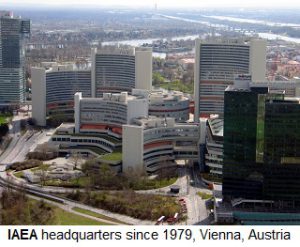
Deputize me!these are the words of the CU Trade Federation to the Caribbean member-states governments. Deputizing an external agency is pretty standard in our modern day. In addition, there are many treaties that create an organizational structure to administer the tenants of a multilateral agreement. Let’s consider one example that has a lot of relevance within the Caribbean region, the International Atomic Energy Agency (IAEA). While the impression of nuclear-atomic energy may not be Caribbean tropical, there are in fact 4 member-states that have ratified the IAEA treaty (Cuba, Haiti, Jamaica and the Dominican Republic; plus 2 more pending: St Lucia & Grenada).
See IAEA details in the Appendix below. As related there, the United States functions as the depositary government for the IAEA Statute; they are the deputized agent. This is the model for the CU/Go Lean roadmap, as the Caribbean Union is a Treaty, and the Trade Federation is the deputized administrator.

The Go Lean book provides 370-pages of turn-by-turn instructions on “how” to adopt new community ethos, plus the strategies, tactics, implementations and advocacies to execute so as to reboot, reform and transform the societal engines of Caribbean society. One advocacy in the book is entitled “10 Ways to Foster a Technocracy“; this allows for the delivery of best practices in the introduction of the new CU regime. As a deputized administrator, the CU is expected to function with higher accountability compared to traditional governmental agencies. See how this advocacy related this further on Page 64:

# 9 – Service Level Agreements
The CU is a proxy organization, chartered to execute deputized functions on behalf of member-states; this means a task-oriented philosophy with “Service Level Agreements” in place; i.e. 80% of all phone calls answered within 20 seconds.

Another example of the CU/Go Lean deputized functionality is the embrace of the Group Purchasing Organization concept – see VIDEO here. The book explains (Page 24):

d-2. Lean Operations
This roadmap posits that a lean technocratic organization should be felt, more so than seen. The focus should not be on edifices or “fat” bureaucratic structures, but rather the region should feel the presence of their federal government more so than seeing it.

A bureaucratic model requires comprehensive funding formulas to cover the expenses of the bureaucracy. A lean structure, on the other hand, can subsist mostly from the new revenues it creates. The CU must therefore generate its own income sources from new revenue streams, or from costs savings it affords it stakeholders (member-states). For example, as a Group Purchasing Organization (GPO), the CU entity can garner fee-based revenue for facilitating shipping-handling, or as a Performance Rights Organization (PRO), the CU entity can assess an administrative fee for petitioning/managing royalties from content users. A last example of lean operations would be deploying shared computer systems. This extends the operating costs across a wider user base than individual systems alone. This is the experience followed in the US, with 80% of the Fortune 500 firms using payroll processor ADP to perform this necessary back-office function. (A subset of the cost savings are used as CU income in this model).

So “sharing” is the governing principle that will be pursued for this community ethos to minimize the governing overhead burden on the governed. This principle will be felt in the region through the deployment of shared data centers, multi-purpose Post Office buildings, multi-functional libraries, mobile applications and the www.myCaribbean.gov portal.

———-

VIDEO – Everything You Wanted to Know About Group Purchasing but were afraid to ask! – https://youtu.be/WSq8LiscHOg

NatServAll

Published on Jul 17, 2014 – Let the National Service Alliance (NSA) leverage your purchasing power to tackle stiff competition, squeezed margins and rising prices. NSA works for companies at $3mil and over, to do just that. .. and no need to change your current distributor/supplier.

  • Category: Education
  • License: Standard YouTube License

Yes, a strategy where member-state governments can deputize a more efficient and effective administrator allows the stewards of the Caribbean (political leaders) to better lead with a lean technocracy. This has been a familiar theme to this Go Lean movement. Consider this sample of previous blog-commentaries that have expanded on this concept:

https://goleancaribbean.com/blog/?p=13749 New Caribbean Regime: Assembling the Region’s Organizations
https://goleancaribbean.com/blog/?p=13524 e-Government Portals 101
https://goleancaribbean.com/blog/?p=13365 A Model for Launching a Single Market Currency
https://goleancaribbean.com/blog/?p=13251 A Better Way to Manage Hurricane Risks
https://goleancaribbean.com/blog/?p=12949 Being Mature to Handle Charity Management
https://goleancaribbean.com/blog/?p=12930 Managing Dangers, Disasters and Emergencies
https://goleancaribbean.com/blog/?p=12400 A Better Way to Administer a Caribbean Arrest Treaty

We urge all member-states to lean-in to this Go Lean roadmap to deputize the Caribbean Union Trade Federation to better deliver on their Social Contract responsibilities. Despite the fact that the CU creates another layer of government, the roadmap makes delivering stewardship over the societal engines cheaper, faster and smarter. Yes, this is how the Caribbean member-state governments can make our homelands better places to live, work and play. 🙂

Download the free e-book of Go Lean … Caribbean – now!

Sign the petition to lean-in for this roadmap for the Caribbean Union Trade Federation.

———-

Appendix Reference: International Atomic Energy Agency

The International Atomic Energy Agency (IAEA) is an international organization that seeks to promote the peaceful use of nuclear energy, and to inhibit its use for any military purpose, including nuclear weapons. The IAEA was established as an autonomous organisation on 29 July 1957. Though established independently of the United Nations through its own international treaty, the IAEA Statute,[1] the IAEA reports to both the United Nations General Assembly and Security Council.

The IAEA has its headquarters in Vienna. The IAEA has two “Regional Safeguards Offices” which are located in Toronto, Canada, and in Tokyo, Japan. The IAEA also has two liaison offices which are located in New York City, United States, and in Geneva, Switzerland. In addition, the IAEA has three laboratories located in Vienna and Seibersdorf, Austria, and in Monaco.

The IAEA serves as an intergovernmental forum for scientific and technical co-operation in the peaceful use of nuclear technology and nuclear powerworldwide. The programs of the IAEA encourage the development of the peaceful applications of nuclear energy, science and technology, provide international safeguards against misuse of nuclear technology and nuclear materials, and promote nuclear safety (including radiation protection) and nuclear security standards and their implementation.

The IAEA and its former Director General, Mohamed El Baradei, were jointly awarded the Nobel Peace Prize on 7 October 2005. The IAEA’s current Director General is Yukiya Amano.

Membership

The process of joining the IAEA is fairly simple.[32] Normally, a State would notify the Director General of its desire to join, and the Director would submit the application to the Board for consideration. If the Board recommends approval, and the General Conference approves the application for membership, the State must then submit its instrument of acceptance of the IAEA Statute to the United States, which functions as the depositary Government for the IAEA Statute. The State is considered a member when its acceptance letter is deposited. The United States then informs the IAEA, which notifies other IAEA Member States. Signature and ratification of the Nuclear Non-Proliferation Treaty (NPT) are not preconditions for membership in the IAEA.

The IAEA has 169 member states.[33] Most UN members and the Holy See are Member States of the IAEA. Non-member states Cape Verde (2007), Tonga (2011), Comoros (2014), Gambia (2016), Saint Lucia (2016) and Grenada (2017) have been approved for membership and will become a Member State if they deposit the necessary legal instruments.[33]

Regional Cooperative Agreements

There are four regional cooperative areas within IAEA, that share information, and organize conferences within their regions:

  1. AFRA – The African Regional Cooperative Agreement for Research, Development and Training Related to Nuclear Science and Technology
  2. ARASIA – Cooperative Agreement for Arab States in Asia for Research, Development and Training related to Nuclear Science and Technology
  3. RCA – Regional Cooperative Agreement for Research, Development and Training Related to Nuclear Science and Technology for Asia and the Pacific
  4. ARCAL – Cooperation Agreement for the Promotion of Nuclear Science and Technology in Latin America and the Caribbean (ARCAL):[44]
    • Cuba
    • Haiti
    • Jamaica
    • Dominican Republic

See the full reference article here, retrieved January 21, 2018:

https://en.wikipedia.org/wiki/International_Atomic_Energy_Agency

Share this post:
, , , ,
[Top]

First Steps – CariCom: One-Man-One-Vote Defects

Go Lean Commentary

Despite all the legal jargon, the concept of precedence* simply means that someone else has already dealt with an issue.

Think of big issues:

There is no need to open a new debate on these; there is already a well-documented, well-established precedence. Wrong is wrong!

There is need to re-establish precedence once again, in terms of government representation.

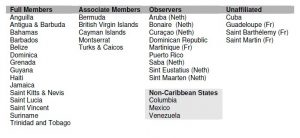
There is also a proposed new regime for the 30 member-states that constitute the Caribbean; 15 of these member are Full Members of the Caribbean Community (CariCom). While 5 states are Associate Members and 9 are Observers. The CariCom construct is therefore the best starting point for any regional integration.
This is the best First Step

… but there is a defect with this structure in terms of government representation, CariCom is structured for One-Man/State-One-Vote. In the past such a structure has been found wanting! We need to learn from those experiences, discussions, debates, disagreements and resolutions; we need to consider the precedence. This precedent consideration comes from the early days of the United States of America.

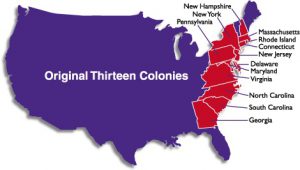
After the Declaration of Independence in 1776 and until the enactment of the Constitution in 1789, there was a temporary period of 13 years under the Articles of Confederacy. During that structure, each state (former colony) was afforded 1 vote in Congress. So the BIG state of Virginia yielded the same political power as the small state of Delaware. This was a defect! The correction came with the adoption of the Connecticut Compromise into the Constitution; this called for the adoption of a bicameral legislature (2 chambers): Upper House & Lower House. See the full details in the Appendix Reference below.
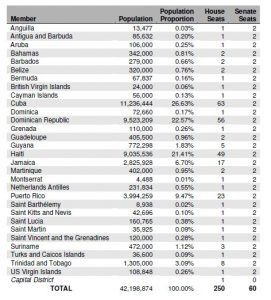
There are lessons from this precedence for the Caribbean to learn and apply today. There are BIG population states – think Cuba or Haiti with more that 10 million people – and small member-states, think St Barthélemy, St Kitts and St Martin, all with less than 45,000 people. There is no way that all 30 member states can be expected to wield the same political power with One-Man-One-Vote suffrage. This is a clear-and-present defect!

This commentary is Part 4 of a 6-part series from the movement behind the book Go Lean … Caribbean in consideration of the First Steps for instituting a new regime in governance for the Caribbean homeland. The other commentaries in the series are cataloged as follows:

  1. First Steps: EU – Free European Money – To Start at Top
  2. First Steps: UK – Dignified and Efficient
  3. First Steps: US – Congressional Interstate Compacts – No Vote; No Voice 
  4. First Steps: CariCom – One-Man-One-Vote Defects
  5. First Steps: Deputize ‘Me’! 
  6. First Steps: A Powerful C.P.U.

All of these commentaries relate to “how” the Caribbean can finally get started with adapting the organizational structures to optimize the region’s societal engines. The Caribbean has the 30 member-states, 4 languages and 5 different colonial legacies; there are many different systems of governance. Any consideration for leadership in the region must weigh the different schemes in the balance and choose an optimal structure. Forging change involves starting from the Top (leaders) and starting from the Bottom (citizens) to assimilate Caribbean society. This is how to make the region better places to live, work and play.

The book Go Lean…Caribbean – available to download for free – serves as a roadmap for the introduction and implementation of the technocratic Caribbean Union Trade Federation (CU), for the elevation of Caribbean society – for all 30 member-states. This CU/Go Lean roadmap has these 3 prime directives:

  • Optimization of the economic engines in order to grow the regional economy and create new jobs; (planning 2.2 million).
  • Establishment of a security apparatus to ensure public safety and protect the resultant economic engines.
  • Improve Caribbean governance to support these engines, including a separation-of-powers between the member-states and CU federal agencies.

The book stresses that reforming and transforming the Caribbean societal engines must be a regional pursuit. This was an early motivation for the roadmap, as pronounced in the opening Declaration of Interdependence (Pages 12 – 13):

xi. Whereas all men are entitled to the benefits of good governance in a free society, “new guards” must be enacted to dissuade the emergence of incompetence, corruption, nepotism and cronyism at the peril of the people’s best interest. The Federation must guarantee the executions of a social contract between government and the governed.

xvi. Whereas security of our homeland is inextricably linked to prosperity of the homeland, the economic and security interest of the region needs to be aligned under the same governance. Since economic crimes … can imperil the functioning of the wheels of commerce for all the citizenry, the accedence of this Federation must equip the security apparatus with the tools and techniques for predictive and proactive interdictions.

xxiv. Whereas a free market economy can be induced and spurred for continuous progress, the Federation must install the controls to better manage aspects of the economy: jobs, inflation, savings rate, investments and other economic principles. Thereby attracting direct foreign investment because of the stability and vibrancy of our economy.

The Go Lean book provides 370-pages of turn-by-turn instructions for a Way Forward, a guide on “how” to adopt new community ethos, plus the strategies, tactics, implementations and advocacies to execute so as to reboot, reform and transform the societal engines of Caribbean society. One implementation of the roadmap is the CU Legislature, with a design to neutralize the defects of a suffrage scheme. See this point here from the book Page 91:

The CU Legislative Branch represents the Caribbean Parliament; it is divided between two chambers: Upper House (Senate) and Lower House (House of Assembly). Despite their title, both houses have equal power.

Why is there the need for 2 houses? Simple; this mitigates the reasons for failure from previous Caribbean integration efforts. The West Indies Federation of 1958 – 1962 was criticized for imbalanced representation: the larger states had just as much representation in the Federation as the smaller state. For the CU, size does matter. But minority rights must be protected as well. The Senate allows for a 1-man-1-vote structure (actually 2 seats per state), while the House is represented proportionally by population. This model follows the best practices of many other successful democracies.

There will undoubtedly be differences in legislation originated from both chambers. So the constitution should allow for differences to be settled in a Compromise Conference; then the final law re-validated by the respective chambers.

In addition, there is the advocacy in the book (Page 135) entitled “10 Lessons Learned from the West Indies Federation“, where it details the many defects of the before-CariCom regional construct. Yes, the Caribbean has its own precedence to consider … and learn from. See this chart here of the bicameral distribution:

Forging change in the Caribbean territories means starting at the Top (leaders) and starting at the Bottom (citizens). But there must be an equitable distribution among the leaders from the member-state – size does matter.

The Action Plan in this new Caribbean regime, the Way Forward, is that Caribbean people would determine the Caribbean destiny. See how this governance theme has been detailed in other blog-commentaries over the years; see sample here:

https://goleancaribbean.com/blog/?p=13749 New Caribbean Regime: Assembling the Region’s Organizations
https://goleancaribbean.com/blog/?p=13736 Past Failures for Caribbean Governing Integration
https://goleancaribbean.com/blog/?p=13251 Funding Caribbean Risk
https://goleancaribbean.com/blog/?p=10309 Not Satisfied with Representation? Then Consider Secession!
https://goleancaribbean.com/blog/?p=10043 Integration Plan for Greater Caribbean Prosperity
https://goleancaribbean.com/blog/?p=8813 Lessons from China – Size Does Matter
https://goleancaribbean.com/blog/?p=8351 A Lesson in Economic Fallacies – Independence: Hype or Hope
https://goleancaribbean.com/blog/?p=326 Model of Scottish Independence Pursuit – Self-Determination

The current regional construct – CariCom – has this suffrage defect of One-Man/State-One-Vote; this is not a design for governing efficiency or popular acceptance. The opening of the Go Lean book stressed that the plan is to avoid the defects of the Caribbean past and be better, do better:

This [Go Lean] movement is not an attempt to re-boot the CariCom, but rather a plan to re-boot the Caribbean. – Page 8

We cannot ignore the past, as it defines who we are, but we do not wish to be shackled to the past either, for then, we miss the future. So we must learn from the past, our experiences and that of other states in similar situations, mount our feet solidly to the ground and then lean-in, to reach for new heights; forward, upward and onward. – Page 3

We urge all member-states – large and small – to lean-in to this Go Lean roadmap – in fact all Caribbean stakeholders should lean-in – in order to be better, here in the Caribbean, to make our homeland better places to live, work and play. 🙂

Download the free e-book of Go Lean … Caribbean – now!

Sign the petition to lean-in for this roadmap for the Caribbean Union Trade Federation.

———–

Footnote * – Precedent

In legal systems based on common law, a precedent, or authority, is a principle or rule established in a previous legal case that is either binding on or persuasive for a court or other tribunal when deciding subsequent cases with similar issues or facts.

———–

Appendix Reference – Connecticut Compromise

The Connecticut Compromise (also known as the Great Compromise of 1787 or Sherman Compromise) was an agreement that large and small states reached during the Constitutional Convention of 1787 that in part defined the legislative structure and representation that each state would have under the United States Constitution. It retained the bicameral legislature as proposed by Roger Sherman, along with proportional representation of the states in the lower house, but required the upper house to be weighted equally between the states. Each state would have two representatives in the Upper House.

Context
On May 29, 1787, Edmund Randolph of the Virginia delegation proposed the creation of a bicameral legislature. Under his proposal, membership in both houses would be allocated to each state proportional to its population; however, candidates for the lower house would be nominated and elected by the people of each state. This proposal allowed fairness and equality to the people. Candidates for the upper house would be nominated by the state legislatures of each state and then elected by the members of the lower house. This proposal was known as the Virginia Plan.

Less populous states like Delaware were afraid that such an arrangement would result in their voices and interests being drowned out by the larger states. Many delegates also felt that the Convention did not have the authority to completely scrap the Articles of Confederation,[1] as the Virginia Plan would have.[2] In response, on June 15, 1787, William Paterson of the New Jersey delegation proposed a legislature consisting of a single house. Each state was to have equal representation in this body, regardless of population. The New Jersey Plan, as it was called, would have left the Articles of Confederation in place, but would have amended them to somewhat increase Congress’s powers.[3]

At the time of the convention, the South was growing more quickly than the North, and Southern states had the most extensive Western claims. South Carolina, North Carolina, and the State of Georgia were small in the 1780s, but they expected growth, and thus favored proportional representation. New York State was one of the largest states at the time, but two of its three representatives (Alexander Hamilton being the exception) supported an equal representation per state, as part of their desire to see maximum autonomy for the states. (The two representatives other than Hamilton had left the convention before the representation issue was resolved, leaving Hamilton, and New York State, without a vote.)

James Madison and Hamilton were two of the leaders of the proportional representation group. Madison argued that a conspiracy of large states against the small states was unrealistic as the large states were so different from each other. Hamilton argued that the states were artificial entities made up of individuals, and accused small state representatives of wanting power, not liberty (see History of the United States Senate).

For their part, the small state representatives argued that the states were, in fact, of a legally equal status, and that proportional representation would be unfair to their states. Gunning Bedford, Jr. of Delaware notoriously threatened on behalf of the small states, “the small ones w[ould] find some foreign ally of more honor and good faith, who will take them by the hand and do them justice.”

Elbridge Gerry ridiculed the small states’ claim of sovereignty, saying “that we never were independent States, were not such now, & never could be even on the principles of the Confederation. The States & the advocates for them were intoxicated with the idea of their sovereignty.”[4]

The Compromise
On June 14, when the Convention was ready to consider the report on the Virginia plan, William Paterson of New Jersey requested an adjournment to allow certain delegations more time to prepare a substitute plan. The request was granted, and, on the next day, Paterson submitted nine resolutions embodying necessary amendments to the Articles of Confederation, which was followed by a vigorous debate. On June 19, the delegates rejected the New Jersey Plan and voted to proceed with a discussion of the Virginia Plan. The small States became increasingly discontented, and some threatened to withdraw. On July 2, the Convention was deadlocked over giving each State an equal vote in the upper house, with five States in the affirmative, five in the negative, and one divided.

The problem was referred to a committee consisting of one delegate from each State to reach a compromise. On July 5, the committee submitted its report, which became the basis for the “Great Compromise” of the Convention. The report recommended that in the upper house each State should have an equal vote and in the lower house, each State should have one representative for every 40,000 inhabitants,[5] counting slaves as three-fifths of an inhabitant,[5] and that money bills should originate in the lower house (not subject to amendment by the upper chamber).

After six weeks of turmoil, North Carolina switched its vote to equal representation per state and Massachusetts abstained, and a compromise was reached, being called the “Great Compromise.” In the “Great Compromise,” every state was given equal representation, previously known as the New Jersey Plan, in one house of Congress, and proportional representation, known before as the Virginia Plan, in the other. Because it was considered more responsive to majority sentiment, the House of Representatives was given the power to originate all legislation dealing with the federal budget and revenues/taxation, per the Origination Clause.

Roger Sherman and Oliver Ellsworth, both of the Connecticut delegation, created a compromise that, in a sense, blended the Virginia (large-state) and New Jersey (small-state) proposals regarding congressional apportionment. Ultimately, however, its main contribution was in determining the apportionment of the Senate. Sherman sided with the two-house national legislature of the Virginia Plan but proposed “That the proportion of suffrage in the 1st. Branch [house] should be according to the respective numbers of free inhabitants; and that in the second branch or Senate, each State should have one vote and no more.”[6] Although Sherman was well liked and respected among the delegates, his plan failed at first. It was not until July 23 that representation was finally settled.[6]

What was ultimately included in the constitution was a modified form of this plan, partly because the larger states disliked it. In committee, Benjamin Franklin modified Sherman’s proposal to make it more acceptable to the larger states. He added the requirement that revenue bills originate in the house.

The final vote on the Connecticut Compromise on July 16th left the Senate looking to the Confederation Congress. In the preceding weeks of debate, James Madison of Virginia, Rufus King of New York, and Gouverneur Morris of New York each vigorously opposed the compromise for this reason.[7] For the nationalists, the Convention’s vote for the compromise was a stunning defeat. However, on July 23, they found a way to salvage their vision of an elite, independent Senate. Just before most of the convention’s work was referred to the Committee of Detail, Gouverneur Morris and Rufus King moved that state’s members in the Senate be given individual votes, rather than voting en bloc, as they had in the Confederation Congress. Then Oliver Ellsworth, a leading proponent of the Connecticut Compromise, supported their motion, and the Convention adopted the Compromise.[8]Since the Convention had early acquiesced in the Virginia Plan’s proposal that senators have long terms, restoring that Plan’s vision of individually powerful senators stopped the Senate from becoming a strong safeguard of federalism. State governments lost their direct say in Congress’s decisions to make national laws. As the personally influential senators received terms much longer than the state legislators who elected them, they became substantially independent. The compromise continued to serve the self-interests of small-state political leaders, who were assured of access to more seats in the Senate than they might otherwise have obtained.[9]

Aftermath
Senate representation was explicitly protected in Article Five of the United States Constitution:

…no state, without its consent, shall be deprived of its equal suffrage in the Senate.[10]

Source: Wikipedia Online Encyclopedia – retrieved January 21, 2018 from: https://en.wikipedia.org/wiki/Connecticut_Compromise

Share this post:
, ,
[Top]

First Steps – Congressional Interstate Compacts – No Vote; No Voice

Go Lean Commentary

The United States of America is the richest, most powerful nation on the planet and yet …

… [for] the US Territories of Puerto Rico and the Virgin Islands, … American economic prosperity does not always extend to the islands. The emigration (brain & capital drain) for these islands has been acute for over 100 years and continues, unchecked today. The pattern of the US Territories is what the rest of the [Caribbean] region does not want: half abandoned; where the emigrated population exceeds the on-island population. These islands are paradise – there should be no reason to leave. – Book Go Lean…Caribbean Page 244

Of the 30 member-states that constitute the Caribbean, only these two – Puerto Rico (PR) and the US Virgin Islands (USVI) – gets American culture, commerce and systems of governance. So any plan to elevate the Caribbean region must also consider the legal and constitutional mandates of the US. The First Steps for these US Territories would be an Interstate Compact.

This is not good; these lands find themselves between a rock and a hard place! See VIDEO here:

AM JOY Posted 10/14/17 – Puerto Rico and U.S. Virgin Islands: Part of U.S.
As Puerto Rico and the U.S. Virgin Islands struggle to recover, Joy Reid speaks with residents and political leaders about why hurricane relief has been slower in these American territories.

What is really sad is that these territories have no vote and therefore no voice in the process to find solutions. (Territories have no vote in Congress, only formal States).

This commentary is Part 3 of a 6-part series from the movement behind the book Go Lean … Caribbean in consideration of the First Steps for instituting a new regime in governance for the Caribbean homeland. The other commentaries in the series are cataloged as follows:

  1. First Steps: EU – Free European Money – To Start at Top
  2. First Steps: UK – Dignified and Efficient
  3. First Steps: US – Congressional Interstate Compacts – No Vote; No Voice
  4. First Steps: CariCom – One-Man-One-Vote Defects
  5. First Steps: Deputize ‘Me’! 
  6. First Steps: A Powerful C.P.U.

All of these commentaries relate to “how” the Caribbean can finally get started with adapting the organizational structures to optimize the region’s societal engines. The Caribbean is in North America and the US is the Big Dog of the region. So any consideration for leading from the Top must partner with American stakeholders. Though these considerations only apply to the 2 US territories, there are lessons for all the Caribbean, as we can glean wisdom and insight on how a roadmap can reform and transform the Caribbean member-states so that they can be better places to live, work and play.

The book Go Lean…Caribbean – available to download for free – serves as a roadmap for the introduction and implementation of the technocratic Caribbean Union Trade Federation (CU), for the elevation of Caribbean society – for all 30 member-states, including the US Territories. This CU/Go Lean roadmap has these 3 prime directives:

  • Optimization of the economic engines in order to grow the regional economy and create new jobs; (how about 2.2 million).
  • Establishment of a security apparatus to ensure public safety and protect the resultant economic engines.
  • Improve Caribbean governance to support these engines, including a separation-of-powers between the member-states and CU federal agencies. (CU federal is not to be confused with US federal; these are different entities).

The book stresses that reforming and transforming the Caribbean societal engines must be a regional pursuit. This was an early motivation for the roadmap, as pronounced in the opening Declaration of Interdependence (Pages 12 – 13):

xi. Whereas all men are entitled to the benefits of good governance in a free society, “new guards” must be enacted to dissuade the emergence of incompetence, corruption, nepotism and cronyism at the peril of the people’s best interest. The Federation must guarantee the executions of a social contract between government and the governed.

xvi. Whereas security of our homeland is inextricably linked to prosperity of the homeland, the economic and security interest of the region needs to be aligned under the same governance. Since economic crimes … can imperil the functioning of the wheels of commerce for all the citizenry, the accedence of this Federation must equip the security apparatus with the tools and techniques for predictive and proactive interdictions.

xxiii.  Whereas many countries in our region are dependent Overseas Territory of imperial powers, the systems of governance can be instituted on a regional and local basis, rather than requiring oversight or accountability from distant masters far removed from their subjects of administration. The Federation must facilitate success in autonomous rule by sharing tools, systems and teamwork within the geographical region.

xxiv. Whereas a free market economy can be induced and spurred for continuous progress, the Federation must install the controls to better manage aspects of the economy: jobs, inflation, savings rate, investments and other economic principles. Thereby attracting direct foreign investment because of the stability and vibrancy of our economy.

The Go Lean book provides 370-pages of turn-by-turn instructions for a Way Forward, a guide on “how” to adopt new community ethos, plus the strategies, tactics, implementations and advocacies to execute so as to reboot, reform and transform the societal engines of Caribbean society. One advocacy in the book (Page 244) is entitled “10 Ways to Impact US Territories“; this allows for the delivery of best practices to introduce the new CU regime. Washington would be considered an “overseas master” for Caribbean stewardship. Though they do not need the CU to impact the US – notwithstanding the Diaspora living there – there is the need for this CU treaty to impact the efficiency of these American territories.

St Johns, US Virgin Islands

Forging change in the American Caribbean territories means starting at the Top (leaders) and starting at the Bottom (citizens). But the leaders in Puerto Rico and the USVI cannot engage any cross-border initiatives without the US Congress; this is the premise of Interstate Compacts; these are necessary to partner with American stakeholders across borders and State-lines. See the full details on these Compacts in the Appendix Reference below.

Imagine the irony …
The people of the American Caribbean cannot even vote on the empowerments necessary to assuage their own crises; they have no self-determination. Yes, each territories have a non-voting member in House of Representatives of the US Congress, but because the representative is non-voting makes him/her inconsequential to other voting representatives; their voice is muted. In addition, there is no representation at all in the US Senate; truly no voice.

The Action Plan in this new Caribbean regime, this Way Forward, wants to put the Caribbean destiny in the hands of Caribbean stakeholders. This is only fair … and just. This is not our opinion alone; none other than the United Nations have made this declaration. In a previous Go Lean blog-commentary, this fact was revealed, as follows:

Many others – including the United Nations, who have declared PR technically “a colony” – feel that the Puerto Rico-Washington relationship is dysfunctional, that there should be a friendly divorce.

Other blog-commentaries detailed the challenges and crises of life in Puerto Rico and the US Virgin Islands; see sample here:

https://goleancaribbean.com/blog/?p=13391 After Maria, Destruction and Defection for Puerto Rico
https://goleancaribbean.com/blog/?p=12959 After Irma, America Should Scrap the ‘Jones Act’
https://goleancaribbean.com/blog/?p=12274 State of the Union – Spanish Caribbean
https://goleancaribbean.com/blog/?p=12126 Commerce of the Seas – Stupidity of the Jones Act
https://goleancaribbean.com/blog/?p=11963 Oscar López Rivera: The ‘Nelson Mandela’ of the Caribbean? Not!
https://goleancaribbean.com/blog/?p=11647 Righting a Wrong: Puerto Rico’s Bankruptcy
https://goleancaribbean.com/blog/?p=10771 Logical Addresses – ‘Life or Death’ Consequences
https://goleancaribbean.com/blog/?p=6867 How to address high consumer prices
https://goleancaribbean.com/blog/?p=6693 Ten Puerto Rico Police Accused of Criminal Network
https://goleancaribbean.com/blog/?p=4551 US Territories – Between a ‘rock and a hard place’
https://goleancaribbean.com/blog/?p=599 Ailing Puerto Rico open to radical economic fixes

The US Territories of PR and the USVI should lean-in to this Go Lean roadmap – in fact all Caribbean stakeholders should lean-in – in order to be better, here in the Caribbean, to make our homeland better places to live, work and play. 🙂

Download the free e-book of Go Lean … Caribbean – now!

Sign the petition to lean-in for this roadmap for the Caribbean Union Trade Federation.

============

Appendix: Congressional Consent and the Permission for States to Enter into Interstate Compacts
By: Steven Blevins

When our Founding Fathers wrote the Constitution, they included language that grants states the authority to enter into interstate agreements to achieve a common purpose. This directive, found in Article I, Section 10, Clause 3 of the Constitution, is known as the Compacts Clause. In it, the founders asserted, in part, that “no state shall, without the consent of Congress enter into any agreement or compact with another state, or with a foreign power.”1 This often-overlooked clause of the Constitution also grants Congress the power to approve or deny the validity of a compact—a concept called congressional consent.

The founders included the compact clause in the Constitution to protect the dual-sovereign nature of the democratic government structure, while also promoting the ability of the states to cooperatively solve problems. While the Founding Fathers believed interstate cooperation was an important and necessary feature of American democracy, they feared states would use this authority to enter into agreements that would alter the federal balance of power. To avoid such an event, the compact clause instructs states entering into interstate compacts to obtain congressional consent for the agreement to be valid.

Types of Compacts Requiring Congressional Approval
A literal interpretation of the compact clause would conclude all interstate agreements must obtain the approval of Congress before they take effect and carry the weight of law. The Supreme Court, however, has ruled that “any” does not mean “all” in the context of interstate compacts and congressional consent. To clear up the ambiguity of the compact clause, the U.S. Supreme Court in Virginia v. Tennessee held that Congress must approve only two types of compacts:

  • Those compacts that alter the balance of political power between the state and federal government; or
  • Those compacts that intrude on a power reserved to Congress.

Thus, when a compact does not touch on either of those two items, the courts have ruled the federal government does not have a direct interest in the compact and congressional consent is not technically required.2 Essentially, if federal supremacy is threatened, then congressional consent is required for the compact to be valid. On the other hand, if federal supremacy is not threatened, then an absence of congressional consent will not render the compact invalid.

Categories of Congressional Consent
Noticeably absent from the compact clause are specific procedures the states must follow to obtain consent and Congress must follow when granting it. Although the text of the Constitution is void of any specific direction, it is generally understood that Congress specifies consent in one of three ways:

  1. Explicitly
    Most frequently seen in compacts that resolve boundary disputes, this type of consent is granted after the compact has been adopted by the requisite number of state legislatures and is submitted by the member states to Congress for approval. In these instances, Congress is able to review, amend and/or revise the agreement and, as a result, is able to provide a clear determination of approval or disapproval. Therefore, explicit congressional consent is sometimes considered desirable, even if it is not strictly required at the time the compact is created.
  2. Implicitly
    Most notably seen in the form of border compacts, which establish or alter the boundaries of a state as result of conflicting territorial claims, congressional consent may be implied when actions by the states and federal government demonstrate approval of the compact.3Such actions usually include federal legislation supporting the terms of a compact or legislation that strengthens the objective of a specific compact. Given its uncertain nature, implied consent should not be assumed by compacting states.
  3. Pre-emptively
    Congress may give its approval in advance by adopting legislation encouraging states to enter into an interstate compact for a specific purpose.4In these instances, Congress grants consent before the compact reaches critical mass, meaning that once the required number of states adopts the compact, it becomes enforceable. While pre-emptive consent deprives Congress the opportunity to review the compact and its objectives once it is drafted, it often encourages states to cooperatively resolve a policy challenge they otherwise might not have addressed.
    There are also several recent examples of Congress pre-emptively granting states consent to explore the use of interstate compacts. Notable examples include the Environmental Protection Act of 2005, which granted three or more contiguous states the right to enter into an electric transmission line siting compact, and the Nonadmitted Insurance and Reinsurance Act contained in the Dodd-Frank Wall Street Reform and Consumer Protection Act of 2010, which encouraged states to explore the use of interstate compacts to create uniformity in the surplus lines insurance industry. The Council of State Governments, through its National Center for Interstate Compacts, has assisted states in exploring the appropriateness of an interstate compact to address each of the challenges highlighted above.

The process of congressional approval mirrors that of the legislative approval process of any other federal statute. The House or Senate introduces compact bills, but both congressional bodies must approve it, and the president must sign the compact into law.

Withholding Consent
Congressional consent is a political judgment rather than a legal judgment —essentially a gratuitous action by Congress.5 With this notion in mind, Congress may withhold consent when it feels approval may lead to “imprudent combinations, dangerous joint action or intrusion on traditional federal matters” or “has the potential to alter the balance of power between the states and federal government.”6 Congress faces essentially no limitations in its authority to grant or withhold consent.

When presented with a compact seeking adoption, Congress has the authority to either deny approval or alter the compact as presented by the states by imposing various limitations and conditions on the compact or the member states. If Congress does amend the compact, however, member states are not required to adopt the revised compact. If the member states choose to adopt the amended legislation, they concede to Congress’ changes to the compact.7

Congress’ Ability to Amend, Withdraw or Repeal Congressional Consent
If Congress so chooses, it may amend or “change the landscape” of a compact via legislation.8 In fact, “the granting of congressional consent in no way limits Congress’s right to exercise its legislative prerogatives, even to the extent that such an exercise significantly impacts or impairs the workings of an interstate compact.”9 Additionally, the binding authority of interstate compacts approved by Congress is important. Once Congress grants consent, all compacting states are bound to the terms of the agreement. “While congressional consent may transform an interstate compact into federal law, consent does not transform a compact into a binding agreement between the states and Congress.”10

Two federal court decisions provide guidance about whether Congress may withdraw consent. In Tobin v. United States11 and Mineo v. Port Authority of New York-New Jersey,12 the court held that once congressional consent was given, Congress could not withdraw consent nor place additional stipulations on the compact. Congress can, however, work around this legal requirement by amending the proposed compact in a way that specifically enables it to withdraw consent at a future date. The judiciary has not made any declaration on whether such a maneuver is legal.13 The courts have, however, noted that withdrawing consent after the fact “would be damaging to the very concept of interstate compacts.”14

Federalization of Interstate Compacts
Once Congress grants consent, a compact then becomes federal law. In the case of Cuyler v. Adams,15 the court articulated congressional consent “transforms the States’ agreement into federal law under the Compact Clause.”16 Thus, “once Congress gives consent, the compact is presumptively transformed into the law of the United States absent compelling evidence that consent was not required.”17

This transformation from state-created agreement into federal law is unique. In no other context does a state law become “federalized” with such miniscule influence by the federal government than in the congressional approval of interstate compacts. This “transformation” effect also places the compact within the scope of federal jurisdiction while insulating the compact from constitutional attack.18

———–

For more information about congressional consent of interstate compacts, when it is appropriate and how to go about seeking it, please visit NCIC’s website at www.csg.org/compacts.

References:

1 U.S. Constitution, Art. I, Sec. 10, Cl. 3.

U.S. Steel Corp. v. Multistate Tax Commission, 434 U.S. 452 (1978).

3 See , e.g., Georgia v. South Carolina, 4 97 U.S. 376 (1990), wherein Georgia brought suit against South Carolina over the location of their boundary along the Savannah River; Michigan v. Wisconsin, 270 U.S. 295, 308 (1926), wherein suit was brought to determine the boundary between Michigan and Wisconsin from the mouth of the Montreal river at Lake Superior to this ship channel entrance from Lake Michigan into Green Bay; Vermont v. New Hampshire, 289 U.S. 593 (1933), wherein Vermont brought suit against New Hampshire over the determination of the boundary line with involving the Connecticut River.

Petty v. Tennessee-Missouri Bridge Commission, 359 U.S. 275, 281-82 (1959).

College Savings Bank v. Florida Prepaid Postsecondary Education Expense Board, 527 U.S. 666 (1999) “Granting of consent is a gratuity on the part of Congress not a right that the states possess under the Constitution.”

6 Broun, Caroline N., Buenger, Michael L., McCabe, Michael H., & Masters, Richard L. (2006) p. 41. “The Evolving Use and the Changing Role of Interstate Compacts: A Practitioner’s Guide.” Chicago: American Bar Association.

7 Broun, et al. p. 43-7. Also see Arizona v. California, 373 U.S. 546 (1963).

8 Broun, et al. p. 43. Also see Arizona v. California, 373 U.S. 546 (1963). Also see Merrion v. Jicarilla Apache Tribe, 455 U.S. 130, 148 (1982) “Contractual arrangements remain subject to subsequent legislation by the presiding sovereign.”

9 Broun, et al. p. 43. Also see, Arizona v. California, 373 U.S. 546 (1963) wherein the Supreme Court held Congress acted within its realm of authority when it created a plan to manage and operate the Colorado River even though it had previously granted consent to the Colorado River Compact whose purpose was to assist in the management and operation of the body of water.

10 Broun, et al. p. 44.

11 Tobin v. United States, 306 F.2d 270, 273 (D.C. Cir. 1962).

12 Mineo v. Port Authority of New York-New Jersey, 779 F.2d 939 (3d Cir. 1985).

13 Broun, et al. p. 43.

14 Tobin v. United States, 306 F.2d 270, 273 (D.C. Cir. 1962).

15 Cuyler v. Adams, 449 U.S. 433 (1981).

16 Ibid.

17 Broun, et al. p. 43. Also see Old Town Trolley Tours of Wash. V. Wash. Metro. Area Transit Commission,129 F.3d 201, 204 (D.C. Cir.1997); Reed v. Farley, 512 U.S. 339 (1994).

18 Broun, et al. p. 56.

Source: The Council of State Governments; posted July 5, 2011; retrieved January 20, 2018 from: http://knowledgecenter.csg.org/kc/content/congressional-consent-and-permission-states-enter-interstate-compacts

Share this post:
, , ,
[Top]

First Steps – Following the ‘Dignified and Efficient’ British Model

Go Lean Commentary

Of the 30 member-states that constitute the Caribbean, the highest count of the 4 language groups is English – 18 territories. The British eco-system assimilated these 18 lands with the English language, culture, commerce and systems of governance.

This commentary is Part 2 of a 6-part series from the movement behind the book Go Lean … Caribbean in consideration of the First Steps for instituting a new regime in governance for the Caribbean homeland. The other commentaries in the series are cataloged as follows:

  1.  First Steps: EU – Free European Money – To Start at Top
  2.  First Steps: UK – Dignified and Efficient
  3.  First Steps: US – Congressional Interstate Compacts – No Vote; No Voice 
  4.  First Steps: CariCom – One-Man-One-Vote Defects 
  5.  First Steps: Deputize ‘Me’! 
  6.  First Steps: A Powerful C.P.U.

All of these commentaries relate to “how” the Caribbean can finally get started with adapting the organizational structures to optimize the region’s societal engines. This is the consideration of leading from the Top. This would apply to the Anglophone Caribbean, who all operate on constitutional structures based on the English Constitution or Westminster. But there are lessons for all the Caribbean, as we can glean how the Go Lean roadmap can reform and transform the Caribbean member-states so that they can be better places to live, work and play.

So looking at the British model for governance – where Queen Elizabeth II is the Head of State – means considering the concepts of “the Dignified and the Efficient”, as defined in the book The English Constitution by Walter Bagehot:

What was crucial, he [(Bagehot)] insisted, was to understand the difference between the ‘dignified parts’ of the constitution and the ‘efficient parts’ (admitting that they were not ‘separable with microscopic accuracy’). The former ‘excite and preserve the reverence of the population’, the latter are ‘those by which it, in fact, works and rules’.

England had a ‘double set’ of institutions – the dignified ones ‘impress the many’ while the efficient ones ‘govern the many’. The dignified or ‘theatrical’ parts of the system played the essential role of winning and sustaining the loyalty and confidence of the mass of ordinary people whose political capacities were minimal or non-existent they helped the state to gain authority and legitimacy, which the efficient institutions could then use. Bagehot was an unashamed elitist who believed bleakly that the ‘lower orders’ and the ‘middle orders’ were ‘narrow-minded, unintelligent, incurious’. Throughout The English Constitution, there are references to ‘the coarse, dull, contracted multitude’, ‘the poor and stupid’, ‘the vacant many’, ‘the clownish mass’.
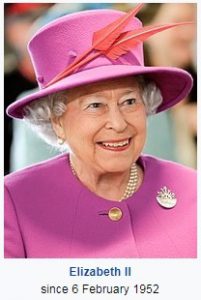
The dignified parts of the constitution were complicated, imposing, old and venerable; but the efficient parts were simple and modern. The ‘efficient secret’ at the heart of it all was ‘the close union’ and ‘nearly complete fusion’ of executive and legislative powers in the Cabinet – the ‘board of control’ which rules the nation. ‘The use of the Queen, in a dignified capacity, is incalculable’, opened the chapters of the book dealing with the monarchy. It acted as a ‘disguise’ and strengthened the government through its combination of mystique and pageantry. He famously summed up the monarch’s role as involving ‘the right to be consulted, the right to encourage, the right to warn’. – Source.

Under the British system, there is a lot of pomp-and-pageantry – theatrics. This is the sphere of the monarchy, as the Royal Family performs all the ceremonial functionality – think: launching ships, grand openings, receiving ambassadors, etc.. The government – Cabinet, Prime Minister’s Office, etc. – on the other hand perform the governing efficiency – there is a separation-of-powers between “the Dignified and the Efficient”. There is advantage to a structure of delivery specialization; it allows for laser-focus and minimal distractions. This is the beauty of a technocracy.

The book Go Lean…Caribbean – available to download for free – serves as a roadmap for the introduction and implementation of the technocratic Caribbean Union Trade Federation (CU), for the elevation of Caribbean society – for all member-states. The book (Page 64) cited the model of monarchies in the design of this Trade Federation:

Model of Constitutional Monarchy
Despite hundreds of years of government evolutions with the Republic system, there are still many modern democracies that maintain constitutional monarchies (i.e. UK, Netherlands, Spain & Canada). Their preference is justified in the logic where a President may only be respected by his party. Rather, a technocratic monarch (King or Queen) must transcend party politics and rule for the betterment of all subjects. (Queen Elizabeth II has ruled for 60 years out of a sense of duty).

A political climate is simply inescapable, with classic democracies – see the VIDEO on the Queen wielding apolitical power in the Appendix below. The goal of the Go Lean/CU roadmap is simply to govern better, to be …

Apolitical – Loved by All
Partisan politics can lead to scenarios where politicians refuse to execute their constitutional mandates; just out of spite of each other …. Even worst, when political sides are so polarized, dreaded consequences can ensue, like civil wars (think: US conflict over slavery in 1860). A technocracy seeks a better governing system, one in which the administration is apolitical and therefore the potential to be loved by all; or equally despised by all (think: Greek Austerity in 2012). Thus, technocracies are more patriotic than political.

Considering “Dignified” versus “Efficient”, there is no “dignified” role with the CU structure, just apolitical efficiency. The pomp-and-pageantry remains with the member-states. Overall, this Go Lean/CU roadmap seeks to deliver on just one efficient charter, to elevate Caribbean society; this is expressed as a prime directives, with these 3 statements:

  • Optimization of the economic engines in order to grow the regional economy to $800 Billion and create 2.2 million new jobs.
  • Establishment of a security apparatus to ensure public safety and protect the resultant economic engines.
  • Improvement of Caribbean governance to support these engines, including our own separation-of-powers between the member-states and CU federal agencies. Any existence of Dignified would be found at member-states; the CU is only efficient.

The book stresses that reforming and transforming the Caribbean societal engines must be a regional pursuit. This was an early motivation for the roadmap, as pronounced in the opening Declaration of Interdependence (Pages 12 – 13):

xi. Whereas all men are entitled to the benefits of good governance in a free society, “new guards” must be enacted to dissuade the emergence of incompetence, corruption, nepotism and cronyism at the peril of the people’s best interest. The Federation must guarantee the executions of a social contract between government and the governed.

xvi. Whereas security of our homeland is inextricably linked to prosperity of the homeland, the economic and security interest of the region needs to be aligned under the same governance. Since economic crimes … can imperil the functioning of the wheels of commerce for all the citizenry, the accedence of this Federation must equip the security apparatus with the tools and techniques for predictive and proactive interdictions.

xxiii.  Whereas many countries in our region are dependent Overseas Territory of imperial powers, the systems of governance can be instituted on a regional and local basis, rather than requiring oversight or accountability from distant masters far removed from their subjects of administration. The Federation must facilitate success in autonomous rule by sharing tools, systems and teamwork within the geographical region.

xxiv.  Whereas a free market economy can be induced and spurred for continuous progress, the Federation must install the controls to better manage aspects of the economy: jobs, inflation, savings rate, investments and other economic principles. Thereby attracting direct foreign investment because of the stability and vibrancy of our economy.

Reforming and transforming the Caribbean member-states means including the governing stakeholders for all Anglophone territories. Of the 18, 17 require some interaction with the UK Foreign & Commonwealth Office – see Appendix below – to enact new laws; (Trinidad & Tobago is now a Republic). Imagine the challenge of this UK Commonwealth Office … now … and over the last 5 decades. They have had to manage both the “Dignified” and the “Efficient” for all the British territories in the Caribbean and watch one territory after another pursue independence.

Note: Governor Generals in the independent countries, despite the official job descriptions of representing the Head of State – The Queen – do not actually report directly to the Queen, but rather to this UK Commonwealth Office. See this functionality of the UK Commonwealth outreach in this Press Release here:

Press Release: PM to call for revitalised Commonwealth at reception ahead of 2018 Heads of Government Meeting

Posted 19 September 2017 – From: Prime Minister’s Office, 10 Downing Street and The Rt Hon Theresa May MP

The Prime Minister will co-host a reception for Commonwealth leaders tonight in the margins of the UN General Assembly in New York where she will set out the need for a wholesale revitalisation of the Commonwealth if it is to thrive and serve its 2.4 billion citizens into the 21st century.

She will also launch the theme for the 2018 Commonwealth Heads of Government Meeting – Towards a Common Future – and set out the four main goals for the summit, due to be held in the UK next spring:

  • prosperity: boosting intra-Commonwealth trade and investment
  • security: increasing cooperation across security challenges including global terrorism, organised crime and cyber attacks
  • fairness: promoting democracy, fundamental freedoms and good governance across the Commonwealth
  • sustainability: building the resilience of small and vulnerable states to deal with the effects of climate change and other global crises

The biggest meeting of Heads of Government the UK has ever hosted, the summit will take place in iconic venues in London and Windsor including Buckingham Palace, St James’s Palace and Windsor Castle from 16-20 April 2018. It will bring together up to 52 Commonwealth leaders, up to 52 Foreign Ministers and thousands of people from across business and civil society, representing the Commonwealth’s vibrant and diverse global network.

Also speaking at the reception will be co-host Prime Minister Muscat of Malta as the current Commonwealth chair, the Commonwealth Secretary-General, and youth representatives drawn from across the Commonwealth who will help to deliver the Commonwealth Youth Forum at next year’s summit.

In her speech, the Prime Minister will outline the need for the Commonwealth to have a clearer purpose, and be better able to address the global challenges we face. With 60% of its population under 30, she will also talk about the need for the Commonwealth to respond to the concerns and priorities of its young people.

Speaking ahead of the reception, the Prime Minister said:

    As the world changes, so must the Commonwealth if it is to rise to the new challenges that the 21st century presents. It is the responsibility of all members to ensure we are working together towards a common future that will meet the needs of all our peoples, particularly our youth. I look forward to this unique organisation coming together at next year’s Heads of Government Meeting to pursue an ambitious agenda for a more prosperous, secure, fair and sustainable future for everyone.

Source: Retrieved January 18, 2018 from: https://www.gov.uk/government/news/pm-to-call-for-revitalised-commonwealth-at-reception-ahead-of-2018-heads-of-government-meeting

While we appreciate London’s efforts, the Caribbean is proposing its own Way Forward with the CU as part of a new regime.

The Go Lean book provides 370-pages of turn-by-turn instructions for a Way Forward, a guide on “how” to adopt new community ethos, plus the strategies, tactics, implementations and advocacies to execute so as to reboot, reform and transform the societal engines of Caribbean society. One advocacy in the book is entitled “10 Ways to Impact British Territories“; this allows for the delivery of best practices to introduce the new CU regime. London would be considered an “overseas master” for Caribbean stewardship. While the UK is one of the biggest (richest) economies in the world, British economic prosperity has not always extended to these islands. Though they do not need the CU to impact the United Kingdom – notwithstanding the Diaspora living there – there is the need for this CU treaty to impact efficiency of all the Anglophone nations and Overseas Territories.

The Go Lean/CU roadmap does not override the sovereignty of the 30 member-states. So this foregoing Dignified role continues. The CU is simply a deputized agency for delivering the apolitical efficiency of the Social Contract.

According to the Go Lean book (Page 96), the roadmap calls for the functionality of “assembling” all the regional stakeholders in the Caribbean into the Trade Federation, including the “overseas masters” during the first year of the confederation plan. We cannot just consider Europe as a singularity. No, for the United Kingdom has voted to divorce themselves from the European Union construct.

So we want to make our homeland a better place to live, work and play, and our “overseas masters” want our Caribbean nations to be elevated, all we need now is the “will and the way”. We urge all to lean-in to this roadmap for change and empowerment. 🙂

Download the free e-Book of Go Lean … Caribbean – now!

Sign the petition to lean-in for this roadmap for the Caribbean Union Trade Federation.

————

Appendix – UK Foreign and Commonwealth Office

The Foreign and Commonwealth Office (FCO), commonly called the Foreign Office, is a department – [agency to exercise executive authority] – of the Government of the United Kingdom. It is responsible for protecting and promoting British interests worldwide. It was created in 1968 by merging the Foreign Office and the Commonwealth Office.

The head of the FCO is the Secretary of State for Foreign and Commonwealth Affairs, commonly abbreviated to “Foreign Secretary” (currently Boris Johnson, who took office on 13 July 2016). This is regarded as one of the four most prestigious positions in the Cabinet– the Great Offices of State – alongside those of Prime MinisterChancellor of the Exchequer and Home Secretary.

The FCO is managed from day to day by a civil servant, the Permanent Under-Secretary of State for Foreign Affairs, who also acts as the Head of Her Majesty’s Diplomatic Service. This position is held by Sir Simon McDonald, who took office on 1 September 2015.

Source: Wikipedia Online Reference retrieved January 18, 2018 from: https://en.wikipedia.org/wiki/British_government_departments


————

Appendix VIDEO – What Powers Does the Queen of England Actually Have? – https://youtu.be/wiDCwqpupj8

Today I Found Out

Published on Jul 21, 2017 – A short while ago we wrote about the fact Queen Elizabeth II needs neither a passport nor driving license thanks to a quirk of British law. But what other powers does the Queen of many titles have and what could she theoretically do if she decided to flex the full might of the authority she wields? As it turns out, thanks to the Royal Prerogative, a terrifying amount if she really felt like it, or, at least, assuming parliament went by the letter of the law and they and the people didn’t decide to stage a little revolt.

  • Category: Education
  • License: Standard YouTube License
Share this post:
, ,
[Top]

First Steps – Free European Money – To Start at Top

Go Lean Commentary

Do I look like I have a plan? – Sarcasm by ‘The Joker’, the villain advocating for anarchy in the 2008 movie Batman: The Dark Knight

Most definitely, yes we do!

Despite the reality of a regional crisis, there is a plan to stop the bad trend of Caribbean people abandoning their homeland and emigrating away to North American and European destinations. Consider these thoughts:

  1. Do you know the Golden Rule; it’s he who has the gold that makes the rules.
  2. In the best control conditions of time, temperature and pressure, people will do … as they damn well please.

This is the conundrum of forging change in Caribbean society; where do we start, the Top (leaders) or the Bottom (people)?

The book Go Lean…Caribbean – available to download for free – declares: Both!

The fact that both approaches must be engaged at the same time depicts both a Top-Down plan plus a Bottoms-Up plan. The quest is that Caribbean society must change – if it is to survive – so either and both approaches are pursued.

Yes, we can …

The book serves as a roadmap for the introduction and implementation of the technocratic Caribbean Union Trade Federation (CU), for the elevation of Caribbean society – for all member-states. This CU/Go Lean roadmap has these 3 prime directives:

  • Optimization of the economic engines in order to grow the regional economy to $800 Billion and create 2.2 million new jobs.
  • Establishment of a security apparatus to ensure public safety and protect the resultant economic engines.
  • Improve Caribbean governance to support these engines, including a separation-of-powers between the member-states and CU federal agencies.

This commentary is the first of a 6-part series from the movement behind the book Go Lean … Caribbean in consideration of the First Steps for instituting this new regime for the Caribbean homeland. The other commentaries in the series are cataloged as follows:

  1.     First Steps: EU – Free European Money – To Start at Top
  2.     First Steps: UK – Dignified and Efficient
  3.     First Steps: US – Congressional Interstate Compacts – No Vote; No Voice
  4.     First Steps: CariCom – One-Man-One-Vote Defects
  5.     First Steps: Deputize ‘Me’!
  6.     First Steps: A Powerful C.P.U.

All of these commentaries relate to “how” the Caribbean can finally get started with adapting the organizational structures to optimize the region’s societal engines. This is the consideration of leading from the Top. This conforms with the Go Lean quest to reform and transform the Caribbean member-states so that they can be better places to live, work and play. Then, only then, can we stop the bad trend of our people emigrating away to North American and European destinations.

Where there is no vision, the people perish. – The Bible Proverbs 29:18.

In a previous Go Lean commentary, it related:

Yes, the societal defects of the Caribbean can be fixed – remediated and mitigated – but “if it is going to be, it starts with me”; it is necessary for all stakeholders to engage in the effort to turn-around the Caribbean. To forge change, the region must consider top-down and bottoms-up approaches, so we need the multitude of Caribbean people (bottoms-up) and politicians and community leaders (top-down) to lean-in to this quest to turn-around the community. Yes, it starts with “me”, as in everyone.

The people of the Caribbean are more ordinary than they are extraordinary, they just want what everyone else wants: opportunities, peace & security, good stewardship, and the fulfillment of the Social Contract (implication that people will surrender their natural rights to the State in exchange for protection of other human and civil rights).

People deserve this and demand this – they will petition their leaders, cry-and-complain, and even take to streets if necessary. But once these Social Contract deliverables are delivered, Caribbean people will do what people everywhere do: comply with any new regime. This is the plan to lead from the Bottom – demand change – this is the easy part, leading from the Top on the other hand is the mystery.
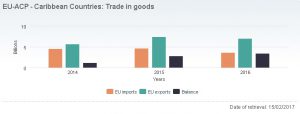
This is easier said than done…

The Go Lean book stresses that reforming and transforming the Caribbean societal engines must be a regional pursuit. This was an early motivation for the roadmap, as pronounced in the opening Declaration of Interdependence (Pages 12 – 13):

xi. Whereas all men are entitled to the benefits of good governance in a free society, “new guards” must be enacted to dissuade the emergence of incompetence, corruption, nepotism and cronyism at the peril of the people’s best interest. The Federation must guarantee the executions of a social contract between government and the governed.

xvi. Whereas security of our homeland is inextricably linked to prosperity of the homeland, the economic and security interest of the region needs to be aligned under the same governance. Since economic crimes … can imperil the functioning of the wheels of commerce for all the citizenry, the accedence of this Federation must equip the security apparatus with the tools and techniques for predictive and proactive interdictions.

xxiv. Whereas a free market economy can be induced and spurred for continuous progress, the Federation must install the controls to better manage aspects of the economy: jobs, inflation, savings rate, investments and other economic principles. Thereby attracting direct foreign investment because of the stability and vibrancy of our economy.

The Go Lean book provides 370-pages of turn-by-turn instructions on “how” to adopt new community ethos, plus the strategies, tactics, implementations and advocacies to execute so as to reboot, reform and transform the societal engines of Caribbean society. (One implementation is the assembly of all regional organizations and “overseas masters”: French, Dutch and British authorities, separately and in concert with the European Union).

This all sounds good, but what do “we” do next … or first, since the CU Trade Federation is not currently in force?

Accordingly, the strong urging here is to “follow the money”! There are available grants from organizations like the EU to conform, comply and “confederate as a regional entity to bring about change”. Yes, the EU provides Aid for Trade between the Caribbean and the EU. To strengthen the competitiveness of economic operators as well as the integration process of our countries in the global economy, the EU provides development cooperation in the region.

Note: The Caribbean region following the EU’s lead automatically includes the EU’s Caribbean jurisdictions: Dutch and French sovereign territories (17 lands). CARIFORUM – see below – includes 15 other nations. So these efforts are intended to be Caribbean-universal.

See a sample reference here, with excerpts from the European Union Commission website – and a related Pro-Con discussion VIDEO:

Title: European Commission Trade Policy for the Caribbean
The EU’s trade and development partnership with the Caribbean stretches back over more than 30 years. In October 2008 Antigua and Barbuda, The Bahamas, Barbados, Belize, Dominica, Grenada, Guyana, Jamaica, Saint Lucia, Saint Vincent and the Grenadines, Saint Kitts and Nevis, Surinam, Trinidad, Tobago, and the Dominican Republic signed with the EU the CARIFORUM-EU Economic Partnership Agreement. Haiti signed the agreement in December 2009, but is not yet applying it pending ratification.

The agreement also comes with substantial EU aid for trade.

The purpose of the agreement is to make it easier for people and businesses from the two regions to invest in and trade with each other and thus to help Caribbean countries grow their economies and create jobs.

The EU-CARIFORUM Economic Partnership in Practice

Trade picture
The EU is CARIFORUM’s second largest trading partner, after the US. CARIFORUM runs a trade deficit with the EU. In other words, CARIFORUM countries export less in goods and services to the EU than they import from the EU.

The main exports from the Caribbean to the EU are in:

  • fuel and mining products, notably petroleum gas and oils;
  • bananas, sugar and rum;
  • minerals, notably gold, corundum, aluminium oxide and hydroxide, and iron ore products;
  • fertilisers.

The main imports into the Caribbean from the EU are in:

  • boats and ships, cars, constructions vehicles and engine parts;
  • phone equipment;
  • milk and cream;
  • spirit drinks.

EU and Caribbean
Economic Partnership Agreements set out to help African Caribbean and Pacific (ACP) countries to improve their trade. The Economic Partnership Agreement between the EU and the 15 Caribbean countries provides predictability in the market access into the EU for these countries. The agreement will lead to a general opening of the EU market beyond WTO commitments in the services sectors, including creative and entertainment industries. It ensures duty-free-quota-free market access into the EU for all products. With regard to EU exports to the region, EU exports of sensitive products will gradually be liberalised over a period of 25 years. The Economic Partnership Agreement with the EU will make it possible for CARIFORUM companies to set up a commercial presence in the EU.

The Economic Partnership Agreement between the EU and the 15 Caribbean countries  is in part a free trade agreement, or FTA. And like any FTA, it opens up trade in goods between the two regions. But unlike other FTAs, the EU-Caribbean Economic Partnership Agreement goes further. In fact, it’s a wide-ranging partnership putting trade at the service of development.

That is because the agreement:

  • also opens up trade in services and investment;
  • makes it easier to do business in the Caribbean – governments there have made commitments in many areas directly affecting trade, like rules to ensure fair competition;
  • comes with financial support from the EU to help Caribbean:
    • governments implement the accord; and
    • businesses to use the EPA to export more and attract more outside investment.

In recent years CARIFORUM countries have been integrating more closely with each other. This is part of their strategy to play a fuller role in global trade, and to offer the economies of scale and simpler rules which are vital to attract more foreign investment.

The EU-Caribbean Economic Partnership Agreement helps to consolidate this process, by making it easier to export goods and services between:

  • the fourteen countries of the Caribbean Community, or CARICOM, and the Dominican Republic, which together make up CARIFORUM;
  • these fifteen CARIFORUM countries (CARICOM plus the Dominican Republic) and seventeen territories in the Caribbean with direct links to EU countries (four French ‘outermost regions’ and thirteen ‘overseas territories’ – six British, six Dutch and one French)


Trading with Caribbean

This can include support for building new transport, energy or telecommunications infrastructure, investments in agriculture, fisheries and services.

  • Help for exporters from developing countries
    • The EU’s Trade Helpdesk supports small traders in developing countries by helping them access the EU market, and provides information on EU rules and regulations.
    • The International Trade Center (ITC) supports several development projects across the world.
    • The ITC’s Standards Map provides information on standards, codes of conduct and audit protocols for international trade.
    • The Small Traders Capacity Building program supports developing countries in administration, training, and information on tariffs, trade flows, standards, etc.

Source: Retrieved January 16, 2018 from: http://ec.europa.eu/trade/policy/countries-and-regions/regions/caribbean/</a

——–

VIDEO – DISCUSSION | E.U – A.C.P Economic Partnership Agreement – https://youtu.be/la-ZQRfnUrY

Strong Body and Mind

Published on Jun 7, 2016 – E.U – A.C.P Economic Partnership Agreement Economic Partnership Agreements (EPAs) are trade and development agreements negotiated between the EU and African, Caribbean and Pacific (ACP) partners engaged in regional economic integration processes. Take a look at the various arguments, do some research then let me know your thoughts on the subject. European Commission – Economic partnerships: http://ec.europa.eu/trade/policy/coun…

This foregoing reference is not just a document of talking points; it is an actual Action Plan. In fact, the Actions have already manifested in the region, as related in this previous Go Lean blog-commentary describing the EU’s sponsor of Green Energy initiatives in the country of Barbados; they gave 1.12 million Euros (US$1.37 million) towards the advancement of energy self-sufficiency from renewable resources. This is the first payment of a total contribution of 3 million Euros.

Needless to say, EU money comes with strings attached – see the foregoing VIDEO. They are leading the leaders of the Caribbean. This constitutes a Top-Down approach for forging change in society.

Top-Down and Bottoms-Up – this is the First Step! The Go Lean roadmap (Page 96) calls for this functionality – “assembling” all the regional stakeholders in the Caribbean, including the “overseas masters” – for the first year of the confederacy plan. (Since this book was published in 2013, the United Kingdom has divorced themselves from the EU).

Forging change is a common theme by this Go Lean movement. Consider these previous 10 blog-commentaries that detailed approaches for forging change, in reverse chronological order:

  1. Forging Change – Collective Bargaining (April 28, 2017)
  2. Forging Change – Addicted to Home (April 14, 2017)
  3. Forging Change – Arts & Artists (December 1, 2016)
  4. Forging Change – Panem et Circenses (November 15, 2016)
  5. Forging Change – Herd Mentality (October 11, 2016)
  6. Forging Change – ‘Something To Lose’ (November 18, 2015)
  7. Forging Change – ‘Food’ for Thought (April 29, 2015)
  8. Forging Change – Music Moves People (December 30, 2014)
  9. Forging Change – The Sales Process (December 22, 2014)
  10. Forging Change – The Fun Theory (September 9, 2014)

As related in these commentaries, forging change is how the Go Lean roadmap will make our Caribbean homeland a better place to live, work and play. We urge every Caribbean stakeholder to lean-in to this roadmap to elevate the societal engines of the region. 🙂

Download the free e-book of Go Lean … Caribbean – now!

Sign the petition to lean-in for this roadmap for the Caribbean Union Trade Federation.

Share this post:
,
[Top]

EU Assists Barbados in Renewable Energy Self-Sufficiency

Go Lean Commentary

The dream of transforming to 100% renewable energy in the Caribbean can be realized. There is hope for this reality.

If only we can get the people behind it.

Our people …

So far other people are doing it for us. Thank you, European Union (EU), for talking the talk for us, and opening your wallets and walking the walk.

If only now we can step-in, step-up and step out ourselves … to do a better job of delivering basic needs, including energy.

This is the actuality of the latest developments taking place in the Caribbean. See this story here of a Green Energy initiative in Barbados:

Title: EU Assists Barbados in renewable Energy Self-Sufficiency

PRESS RELEASE – Barbados has received 1.12 million Euros (BBD$2.7M) from the European Union towards the advancement of energy self-sufficiency from renewable resources. This is the first payment of a total contribution of 3 million Euros. This activity is in line with the country’s commitment to the United Nations Framework Convention on Climate Change of reducing its total and per capita greenhouse gas emissions.

A major objective of the EU’s support is the engagement of the private sector in renewable energy power generation and should result in consumers making increasing use of energy efficiency measures during the 36 month duration of the programme and after.

Some of the guidelines which will be used for performance assessment of the programme include the introduction of a favourable licence regime for independent power producers with generation systems larger than 1 megawatt, by March 2019. Another requirement is that by 2019 at least 30 megawatt of renewable energy will be installed by public and private entities. In addition, it is expected that there will be the establishment and implementation of a renewable energy roadmap according to defined milestones.

EU Ambassador Daniela Tramacere said: “This is another effort by the EU to assist Barbados in transforming its economy which is heavily dependent on fossil fuels, which result in annual drain on its foreign reserves.”

The Barbados government is also expected to adopt and implement energy sector reform measures that are expected to prepare the country for the transition towards renewable energy and energy efficiency on the basis of the national energy policy.
Source: St Lucia Times Daily Newspaper; posted 01/05/2018; retrieved 01/12/2018 from:
https://stluciatimes.com/2018/01/05/eu-assists-barbados-renewable-energy-self-sufficiency/

This is the reality of Caribbean life. We have deliverables that must be delivered and yet we do not. We wait for other people to deliver for us. Time to Grow Up, you people of the Caribbean! It’s time to put on your “Big Boy pants and walk like a man”!

This is the call of the movement behind the book Go Lean…Caribbean – available to download for free. The book serves as a roadmap for the introduction and implementation of the technocratic Caribbean Union Trade Federation (CU), for the elevation of all Caribbean society – for all 30 member-. The book explains that the Caribbean is in crisis, people are fleeing day-in and day-out. Their people are “pushed and pulled” to other lands that do a better job of managing basic needs. Energy costs in the Caribbean are among the highest in the world. Therefore the CU/Go Lean roadmap has these 3 prime directives:

  • Optimization of the economic engines in order to grow the regional economy to $800 Billion and create 2.2 million jobs.
  • Establishment of a security apparatus to ensure public safety and protect the resultant economic engines.
  • Improve Caribbean governance to support these engines, including a separation-of-powers between the member-states and CU federal agencies.

Notwithstanding, Barbados is doing more for regional integration and problem-solving …

… the [CARICOM] Secretary-General lauded the significant role Barbados continues to play in the Community with its Prime Minister having responsibility for the regional flagship initiative, the CARICOM Single Market and Economy (CSME). – Report

The technology, systems and processes are available right now for Caribbean communities to fulfill the dream of a society consuming renewable energy sources 100%.

We must work harder ourselves to fulfill this dream here in our region. Doing so is win-win as it accomplishes 2 important objectives: environmental (no fossil fuels) and economic (affording conveniences of modern life):

  • Solar – The sun always shines in the Caribbean and its free.
  • Wind – The wind always blows in the Caribbean – i.e. Trade Winds – and its free.
  • Tidal – The tides always rise and fall in the Caribbean and its free – see Appendix VIDEO below.

No doubt, these renewable options bring many benefits in arresting “Climate Change” – there is no scientific doubt that burning fossil fuels contribute to greenhouse houses. (The only doubt is political , not scientific). The Caribbean is in peril because of the actuality of greenhouse gases, think hurricane activities. Consider these recent blog-commentaries:

https://goleancaribbean.com/blog/?p=13391 After Maria: Destruction and Defection for Puerto Rico
https://goleancaribbean.com/blog/?p=12996 After Irma, Failed State Indicators: Destruction and Defection
https://goleancaribbean.com/blog/?p=12977 After Irma, Barbuda Becomes a ‘Ghost Town’
https://goleancaribbean.com/blog/?p=12879 Remembering Harvey, Disaster Preparation: ‘Rinse and Repeat’
https://goleancaribbean.com/blog/?p=12856 Remembering Harvey, Hurricane Flooding – ‘Who Knew?’
https://goleancaribbean.com/blog/?p=9334 Hurricane Categories – The Science
https://goleancaribbean.com/blog/?p=6189 A Lesson in History – ‘Katrina’ is helping today’s crises
https://goleancaribbean.com/blog/?p=2119 Cooling Effect – Oceans and the Climate
https://goleancaribbean.com/blog/?p=1817 Caribbean grapples with intense new cycles of flooding & drought

In addition to science (meteorology), there are economic benefits as well. These too cannot be ignored. There is the example of the US City of Burlington, Vermont where they saved over $20 million in a few years by migrating to renewable energy sources. This meant their local households have not experienced energy costs increases since before the year 2009.

With economics, comes the consideration of “standard of care”. There is a reality to living in the Caribbean heat where air-conditioning is essential otherwise life is unbearable – think: Hotter than July’ – yet most people are not able to afford the excessive costs of this modern comfort.

So the environmental and economic issues must be the primary focus for any Green Energy consideration! The Go Lean book initiates with the pronouncement that our region is in crisis and struggling with these issues. The pressing needs are pronounced early in the book in the Declaration of Interdependence (Page 11), with these opening statements:

i. Whereas the earth’s climate has undeniably changed resulting in more severe tropical weather storms, it is necessary to prepare to insure the safety and security of life, property and systems of commerce in our geographical region. As nature recognizes no borders in the target of its destruction, we also must set aside border considerations in the preparation and response to these weather challenges.

xi. Whereas all men are entitled to the benefits of good governance in a free society, “new guards” must be enacted to dissuade the emergence of incompetence, corruption, nepotism and cronyism at the peril of the people’s best interest. The Federation must guarantee the executions of a social contract between government and the governed.

xii. Whereas the legacy in recent times in individual states may be that of ineffectual governance with no redress to higher authority, the accedence of this Federation will ensure accountability and escalation of the human and civil rights of the people for good governance, justice assurances, due process and the rule of law. …

xxiv. Whereas a free market economy can be induced and spurred for continuous progress, the Federation must install the controls to better manage aspects of the economy: jobs, inflation, savings rate, investments and other economic principles. Thereby attracting direct foreign investment because of the stability and vibrancy of our economy.

Combating Climate Change should be important for Caribbean stakeholders. Deploying more efficient and cost-effective power generation options should also be of paramount importance in this region. But the motivation behind the Go Lean book is even bigger still; it is to elevate all of Caribbean society – above and beyond just combating Climate Change or just lowering costs.

With the unmistakable benefits of Green Energy systems, it should not matter who leads, Caribbean stakeholders or the EU, as long as the Caribbean region proceeds down this path. Well, according to the foregoing news article, the EU has stepped up. We now need all Caribbean stakeholders to lean-in to this focused effort.

The Caribbean is struggling with the costs and reality of energy. The Go Lean book related (Page 100) in 2013 that this region pays one of the highest rates in the world; averaging US$0.35 /kWh. The book, in presenting more optimized solutions, posits that the average energy costs can come down to US$0.088/kWh with just a better mix of fossil-fuels and renewables.

Other communities are doing this – lower energy costs due to 100% renewable energy – now, as the model of City of Burlington, Vermont referred to previously. If this city can get to 100% renewables, despite harsh winters for 3 months every year, imagine how much more so the Caribbean communities with their near-365 days of sunshine. Even some European communities are successful at this quest. This is en vogue right now, despite the different geographies and climates.

The Go Lean book provides 370-pages of turn-by-turn instructions on “how” to adopt new community ethos, plus the strategies, tactics, implementations and advocacies to execute so as to reboot, reform and transform the societal engines of Caribbean society and to foster the progress in the pursuits of green energy generation.

The Caribbean energy needs are undeniable. The effects of fossil-fueled-driven Climate Change are also undeniable. The need to lower the costs of living in the Caribbean is therefore undeniable as well. The Caribbean region must therefore move forward – we do not have the luxury of standing still – alternative energy options are now vast and available. There is simply the need for the commitment. The Go Lean roadmap portrays that we must engage these alternatives if we want to make this region a better homeland to live, work and play.

The Go Lean book opened (Page 3) with the job description for the CU technocracy to make better provisions for the region’s basic needs: food, clothing, shelter and energy. There is the need now to fully embrace renewable energy options, maybe even for 100%. There are even grants – i.e. from the EU – to pursue this course of action.

We have no further excuse!

Now is the time for all of the Caribbean – the people, businesses, institutions and governments – to lean-in for the optimizations and opportunities of Green Energy options; and to lean-in to this Go Lean roadmap.

The vision of 100% renewable energy is now more than just a dream. 🙂

Download the free e-Book of Go Lean … Caribbean – now!

Sign the petition to lean-in for this roadmap for the Caribbean Union Trade Federation.

———–

Appendix VIDEO – Tidal Power 101 – https://youtu.be/VkTRcTyDSyk

Student Energy

Published on May 17, 2015 – Tidal power converts the energy from the natural rise and fall of the tides into electricity. Learn more about Tidal Power and all types of energy at www.studentenergy.org

  • Category: Education
  •  License: Standard YouTube License
Share this post:
, , ,
[Top]