Tag: Disaster

Keep the Change: Hope for the Environment

Go Lean Commentary

Change is unavoidable; the world will change, whether we want to or not.

Some changes will be good; some bad. Some change will be a reaction in response to other actions or events. When good reactionary change emerge to protect from an existential threat, then that is a good change.
We need to Keep that Change.

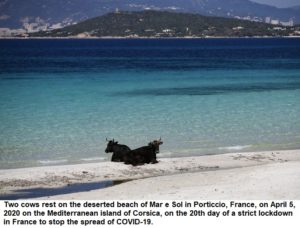
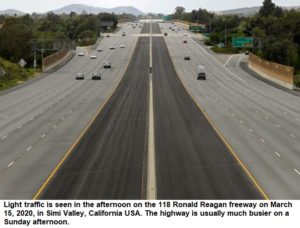
There is an existential threat today; there is a crisis: Coronavirus – COVID-19; we have reacted accordingly. Our reactions have been positive and beneficial for our environment. Though we needed to make these changes proactively; we should just be happy that the changes have happened anyway.

This highlights a problem we have had all the while with mankind; the problem is … man.

And God said, Let us make man in our image, after our likeness: and let them have dominion over the fish of the sea, and over the fowl of the air, and over the cattle, and over all the earth, and over every creeping thing that creepeth upon the earth. – The Bible; Genesis 1:26 King James Version (KJV)

Unfortunately, we have not done a good job in exercising this dominion over the earth.

Until 2 months ago, the great existential threat to human existence was Climate Change. Now the greatest threat is Coronavirus – COVID-19.

Hooray for the planet, as COVID-19 is only a threat to mammals (mankind, mostly) and not the fauna nor flora nor any “creeping thing that creepeth upon the earth”. While mankind has been dealing with this pandemic, we have done very little damage to the environment – Yippee!!

In fact, we have gotten a chance to see how to abate the existential threat of Climate Change. It is simple:

Less fossil fuel consumption.

While this had previously been theorized, today it is proven valid!

Hooray for science.

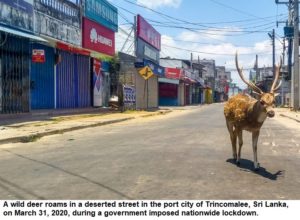
See this article-VIDEO here depicting the positive cleaning effect that has manifested as a result of the 2-month reduction in fossil fuel consumption:

Title: Wildlife in streets, less pollution in big cities: Earth looks different on Earth Day 2020
By: Jay Cannon
As we commemorate the 50th anniversary of Earth Day, this year’s event is unlike any other we’ve experienced.

While much of the globe hunkers down at home or in quarantine during the coronavirus pandemic, society looks quite different than it did on April 22, 1970 – or even April 22 of last year, for that matter.

Amid closed restaurants, quiet office buildings and canceled sporting events, the new normal has had its fair share of environmental effects, with some areas in the U.S. reporting significant improvements in air quality.

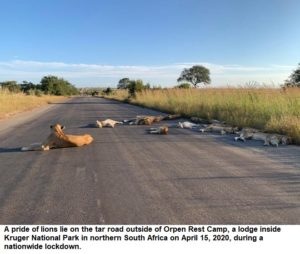
Animals have taken advantage of the absence of humans in some areas, too. Several lions were caught sunbathing on the road of a closed national park in South Africa. Meanwhile, penguins and dogs roamed through a nearly empty aquarium, leading to some incredible cross-animal interactions.

Here’s a look at some of the unique effects that coronavirus has had on our environment.


Source: Retrieved April 22, 2020 from: https://www.usatoday.com/story/news/world/2020/04/22/earth-day-2020-pollution-down-empty-highways-animals-major-cities/3002480001/

—————

VIDEO – Coronavirus: Wild animals wander through empty, lockdown towns – https://www.usatoday.com/videos/news/have-you-seen/2020/04/01/coronavirus-wild-animals-wander-through-empty-lockdown-towns/5102987002/

Posted April 22, 2020 – Wild Animals around the world have been spotted checking out urban spaces as humans lock down to prevent the spread of coronavirus.
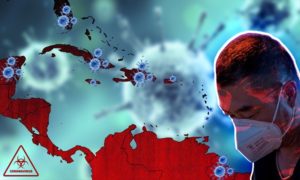
What does the Caribbean need to do to Keep the Change:

Promote a greener economy, with jobs in renewable energy.

That’s it; let’s get started, as we reflect on this monumental Earth Day 2020 – the 50th iteration of this recognized and celebrated day.

See how this directive was urged by António Guterres, the Secretary-General of the United Nations. See the story here:

Title: UN Secretary-General urges Climate Action in Coronavirus Recovery
APRIL 22, 2020 –
On the 50th anniversary of Earth Day, António Guterres, the secretary-general of the United Nations, had a message for the world: We face not one, but two global threats.

“We must act decisively to protect our planet from both the coronavirus and the existential threat of climate disruption,” said Guterres …

in a Video message.

The message, however, wasn’t that of hopelessness — the world has a chance to come together and fight both crises.

“We need to turn the recovery into a real opportunity to do things right for the future,” he said.

Restrictions aimed at reducing the spread of the novel coronavirus have drastically changed our lives and economies, creating a unique opportunity for us to invest in more sustainable societies.

The secretary-general offered some “climate-related actions to shape the recovery and work ahead.”

Guterres suggested directing coronavirus relief money into a greener economy, with jobs in renewable energy. Since taxpayer money helps businesses stay afloat in the economic downturn, the money should go toward more resilient and eco-conscious businesses.

“Public funds should be used to invest in the future, not the past,” said Guterres.

In the U.S., experts predict that the recent stimulus bills will only be temporary fixes, and we’ll need more policy changes by September to help us climb out of this recession. But as Guterres explains, since we’re already in the recession, we must take this opportunity to make our economy and energy systems more sustainable, reduce emissions and slow global warming.

Climate change will have economic consequences. We can expect billions of dollars in natural disaster damages, healthcare for pollution-related illnesses and unstable access to affordable food. But a lot of that cost can be prevented.

If we shift to renewable energy now, we can mitigate climate change and protect jobs in the energy industry when the oil runs out. Renewable energy is even cheaper once the infrastructure is in place.

To kick off a greener economy, Guterres recommends ending fossil fuel subsidies and taxing polluters to hold them accountable for their damage. He also recommends that climate risks be incorporated into economic systems like the stock market.

Above all else, the U.N. asks us to put aside our national affiliations and come together as people of Earth.

“Greenhouse gases, just like viruses, do not respect national boundaries,” said Guterres. “On this Earth Day, please join me in demanding a healthy and resilient future for people and planet alike.”

As the U.N. encourages us to invest in a healthy, resilient and sustainable economy, we can individually speed up the process by voting for leaders who prioritize the planet. Learn more at Earth Day Network’s Vote Earth campaign.

Source: https://www.earthday.org/un-secretary-general-urges-climate-action-in-coronavirus-recovery/ 

The foregoing refers to the reality and actuality of this Coronavirus crisis. Every month, the movement behind the 2013 book Go Lean…Caribbean presents a Teaching Series on a subject germane to Caribbean life. For this April 2020, our focus is on the actuality of the Coronavirus crisis and how some changes have been forced on our society. But being forced to change is not always bad; some good can come from it. This is entry 1-of-5 for this series, which details the kind of changes that we want to keep, not just for the global society but specifically here in the homeland.

Yes, we can … Keep the Change.

All the entries in this month’s series are cataloged as follows:

  1. Keep the Change – Lower Carbon Consumption abating Climate Change
  2. Keep the Change – Working From Home & the Call Center Model
  3. Keep the Change Schools – Primary to Tertiary – making e-Learning work
  4. Keep the Change – Basic Needs: Cannot just consume; we must produce as well
  5. Keep the Change – Mono-Industrial Economy: ‘All eggs in 1 basket’

There are no Ands, Ifs or Buts

… we need to do a better job of protecting our environment and optimizing our Carbon Footprint with Greenhouse gases. We needed to do this anyway but involuntarily we have been forced to comply these past months.

Once this crisis has past, is it possible to still consume less carbon? Indeed …

… this was the mandate of 2015 Paris Accord, – to lower global carbon output so as to abate Climate Change. There is now new hope. (Previously, in the 1990’s, the world came together, instituted and effectively complied with an accord to abate “Acid Rain”).

Our plan – strategies, tactics and implementations – must be ready for the Caribbean region … for Green Energy!

The points of reforming and transforming the Caribbean societal engines for Green Energy have been further elaborated upon in many previous blog-commentaries; consider this sample:

https://goleancaribbean.com/blog/?p=19351 ‘Missing Solar’ – Moral Authority to “Name, blame & shame” big polluters
https://goleancaribbean.com/blog/?p=18228 The Science of Power Restoration after catastrophic natural disasters
https://goleancaribbean.com/blog/?p=17280 Way Forward – For Energy: ‘Trade’ Winds
https://goleancaribbean.com/blog/?p=16361 5 Years Later – Climate Change: Coming so fast, so furious
https://goleancaribbean.com/blog/?p=14832 Counter-culture: Manifesting Change – Environmentalism
https://goleancaribbean.com/blog/?p=14174 Canada: “Follow Me” for Model on ‘Climate Change’ Action
https://goleancaribbean.com/blog/?p=13985 EU Assists Barbados in Renewable Energy Self-Sufficiency
https://goleancaribbean.com/blog/?p=12724 Lessons from Colorado: Water Management Arts & Sciences
https://goleancaribbean.com/blog/?p=10367 Science of Sustenance – Green Batteries
https://goleancaribbean.com/blog/?p=9455 Fix ‘Climate Change’ – Yes, We Can
https://goleancaribbean.com/blog/?p=7056 Electric Cars: ‘Necessity is the Mother of Invention’
https://goleancaribbean.com/blog/?p=5155 Tesla unveils super-battery to power homes with Green Energy options
https://goleancaribbean.com/blog/?p=4897 US Backs LNG Distribution Base in Jamaica for cleaner energy options
https://goleancaribbean.com/blog/?p=4587 Burlington, Vermont: Model city to be powered 100% by renewables
https://goleancaribbean.com/blog/?p=915 Go Green … Caribbean

Change … proactive or reactive – we will take it.

No one wanted the COVID-19 crisis – people have died and economies are wreaked – but if we are forced to change our carbon-consumption bad habits because of these external factors then we must “take the win”; our environment is a beneficiary.

A crisis is a terrible thing to waste!

This is serendipity – a good consequence from a bad incident. See these textbook definitions here:

Noun – Dictionary.com

  1. an aptitude for making desirable discoveries by accident.
  2. good fortune; luck

Noun – Merriam-Webster

  1. the faculty or phenomenonof finding valuable or agreeable things not sought for

This is also true for the advocacy of this Go Lean movement; we have always asserted that only at the precipice will people change; this pandemic is definitely a precipice – so let’s cement these changes. Let’s get the returns on our investments; and recovery from our sacrifices. This is how we can make progress and make our homeland a better place to live, work and play. 🙂

About the Book
The book Go Lean…Caribbean serves as a roadmap for the introduction and implementation of the technocratic Caribbean Union Trade Federation (CU), for the elevation of Caribbean society – for all member-states. This CU/Go Lean roadmap has these 3 prime directives:

  • Optimization of the economic engines in order to grow the regional economy to $800 Billion & create 2.2 million new jobs.
  • Establishment of a security apparatus to ensure public safety and protect the resultant economic engines.
  • Improve Caribbean governance to support these engines, including a separation-of-powers between the member-states and CU federal agencies.

The Go Lean book provides 370-pages of turn-by-turn instructions on “how” to adopt new community ethos, plus the strategies, tactics, implementations and advocacies to execute so as to reboot, reform and transform the societal engines of Caribbean society.

Download the free e-Book of Go Lean … Caribbean – now!

Who We Are
The movement behind the Go Lean book – a non-partisan, apolitical, religiously-neutral Community Development Foundation chartered for the purpose of empowering and re-booting economic engines – stresses that reforming and transforming the Caribbean societal engines must be a regional pursuit. This was an early motivation for the roadmap, as pronounced in the opening Declaration of Interdependence (Pages 11 – 14):

i. Whereas the earth’s climate has undeniably changed resulting in more severe tropical weather storms, it is necessary to prepare to insure the safety and security of life, property and systems of commerce in our geographical region. As nature recognizes no borders in the target of its destruction, we also must set aside border considerations in the preparation and response to these weather challenges.

xi. Whereas all men are entitled to the benefits of good governance in a free society, “new guards” must be enacted to dissuade the emergence of incompetence, corruption, nepotism and cronyism at the peril of the people’s best interest. The Federation must guarantee the executions of a social contract between government and the governed.

xvi. Whereas security of our homeland is inextricably linked to prosperity of the homeland, the economic and security interest of the region needs to be aligned under the same governance. Since economic crimes … can imperil the functioning of the wheels of commerce for all the citizenry, the accedence of this Federation must equip the security apparatus with the tools and techniques for predictive and proactive interdictions.

xxiv.  Whereas a free market economy can be induced and spurred for continuous progress, the Federation must install the controls to better manage aspects of the economy: jobs, inflation, savings rate, investments and other economic principles. Thereby attracting direct foreign investment because of the stability and vibrancy of our economy.

Sign the petition to lean-in for this roadmap for the Caribbean Union Trade Federation.
Share this post:
, , ,

Blog # 1000 – MasterClass: Economics and Society

Go Lean Commentary

Here’s an urgent inquiry to the 30 member-states that comprise the political Caribbean:

What do you need right now?

With the “pangs of distress” of the Coronavirus (COVID-19) pandemic devastating the world today, it may be obvious what the communities’ needs are:

  • Universal Testing
  • Treatment Protocols for anyone affected
  • A Flu-Shot / Vaccine
  • Rebooting of the Economy

This is right for the Caribbean member-states … and the whole world actually. This last item – Rebooting of the Economy – was an acute need even before this pandemic. This was truly what was needed; and what is needed now even more urgently.

The publishers behind the 2013 book Go Lean…Caribbean – with no foresight of 2020’s Coronavirus threat – detailed the sad state of affairs for the Caribbean economy and societal life in general. The book stated in its opening words (Page 3):

There is something wrong in the Caribbean. It is the greatest address in the world for its 4 language groups, but instead of the world “beating a path” to these doors, the people of the Caribbean have “beat down their doors” to get out. …

Many people love their homelands and yet still begrudgingly leave; this is due mainly to the lack of economic opportunities. The Caribbean has tried, strenuously, over the decades, to diversify their economy …

So how now …? How do we reboot the Caribbean economy now, even though we needed to do it all the while in the past? The answer is found in a previous blog-commentary that was published early in the history of this movement (April 21, 2014), at the start of the practice of publishing these commentaries:

‘Only at the precipice, do they change’
We’re on the brink of destruction and you’re right. But it’s only on the brink that people find the will to change. Only at the precipice do we evolve. This is our moment. Don’t take it from us. We are close to an answer.

April 21, 2014 – exactly 6 years to the day – was only the 2nd month of this publishing practice; that was the 51st blog in our history. Today, we are publishing this one, the 1000th. This 1000th submission is truly a monumental milestone; and ideal for these monumental times.

The reality of the Coronavirus-COVID-19 here in April 2020 means that we are truly “at the brink of destruction”; this is the State of our Caribbean Union; we must now “find the will to change”, to reform and transform our society.

How do we go about this change? What is the answer?

Now, is the time for a class, a MasterClass … a MasterClass on Economics in Society.

Huh?! What?! Why?!

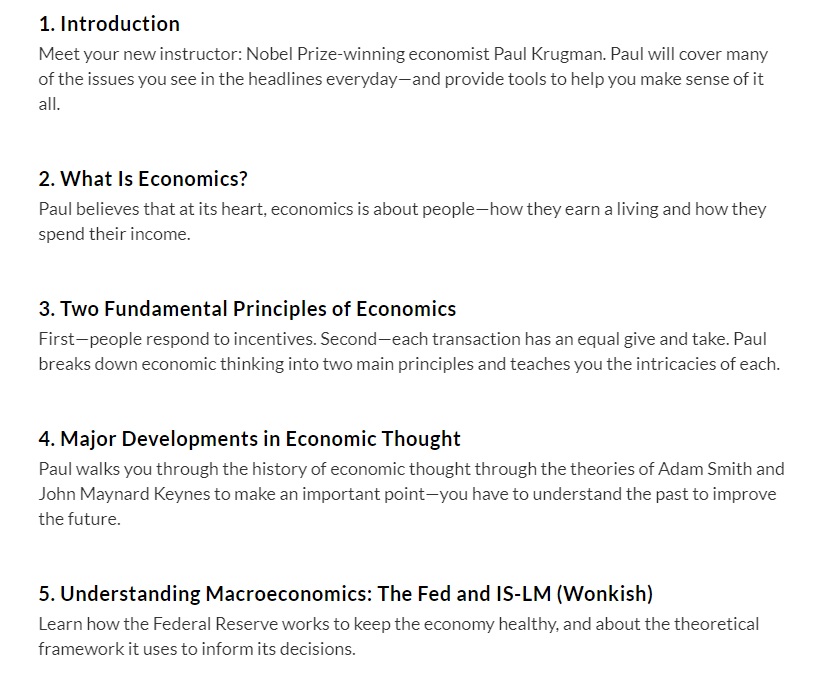
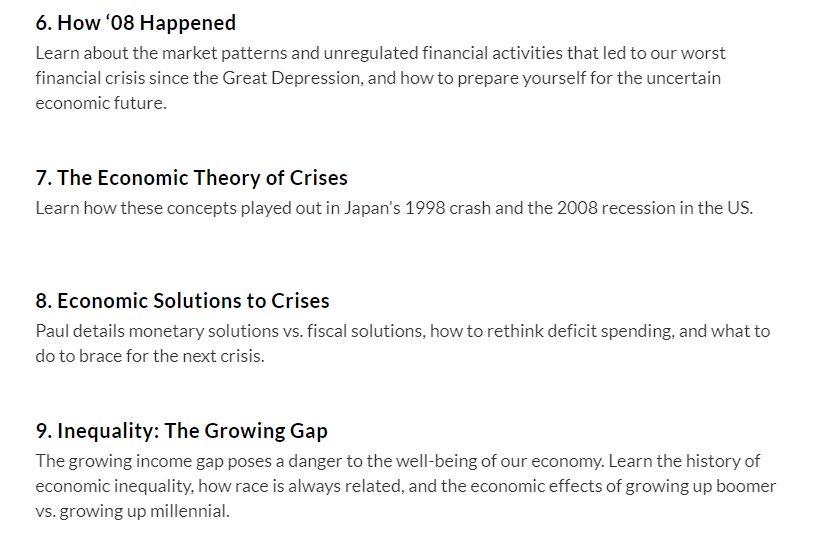
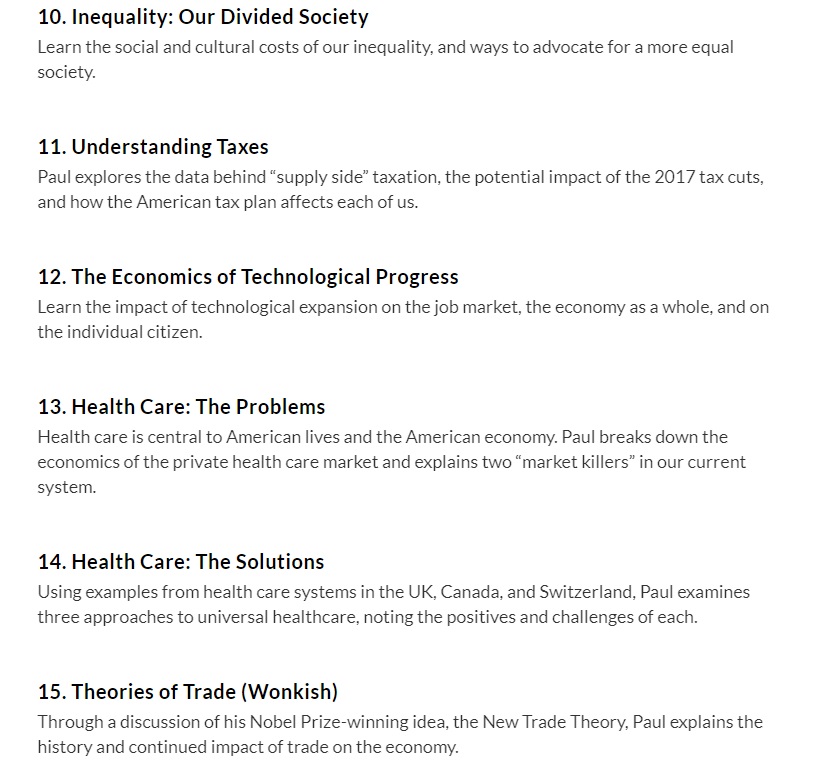
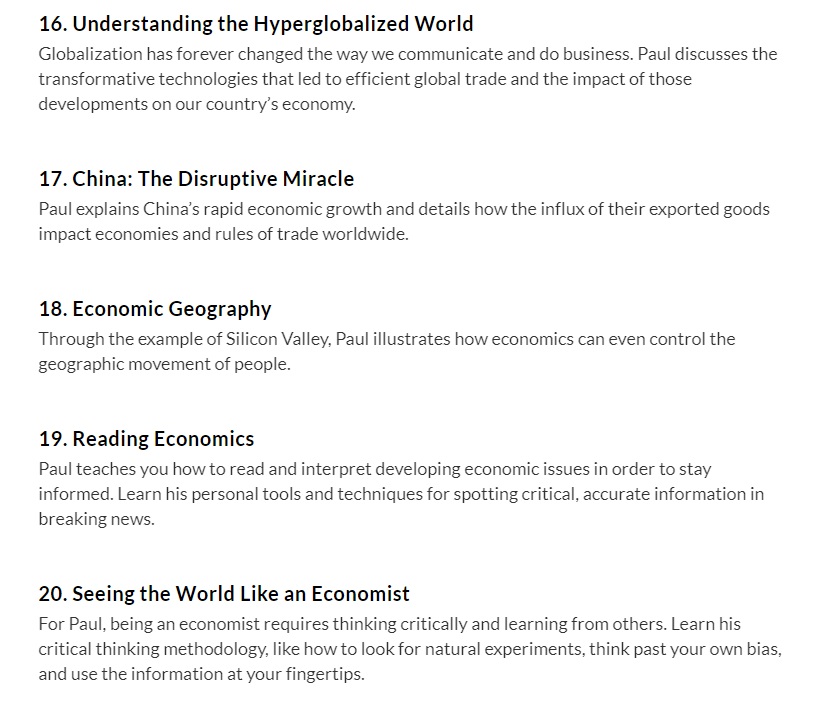
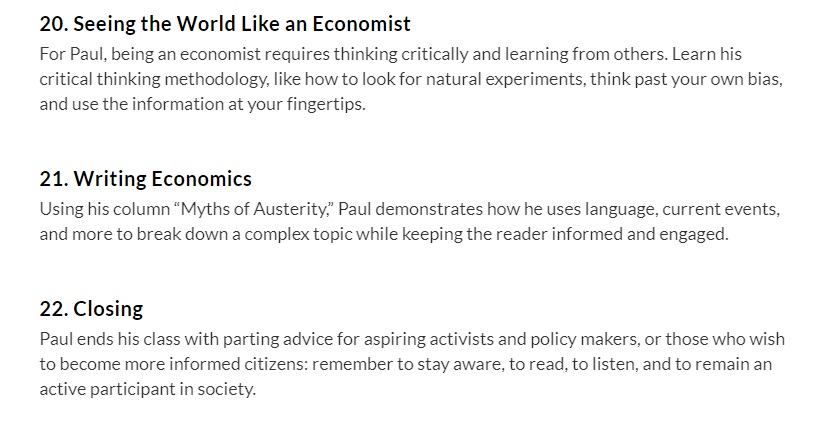
This MasterClass was taught by this Nobel Laureate Economist Paul Krugman – see his profile in Appendix A below – and see the Topic Highlights of the MasterClass here:

See this introduction to this MasterClass in this VIDEO here:

VIDEO – Paul Krugman Teaches Economics and Society | Official Trailer | MasterClass – https://youtu.be/JRhvnlQHKc0

MasterClass
Paul Krugman’s work is defined by his belief in the power of economic thought to open minds and change history.

Learn more about Paul Krugman Teaches Economics and Society: https://www.masterclass.com/pk

In his economics class, Paul says that “economics covers 70% of life.” Not the passions and deep meanings, but everything that keeps clothes on our backs, food on our plates, and the trains running on time. The economic lens can help tell us how income inequality happens, it can predict how tariffs on Chinese steel will play out, and it can steer us toward more effective policies to get us out of a recession.

Over the course of his 40+ year career, Paul Krugman has become one of the most influential economists of our time. He is a New York Times columnist, lecturer, best-selling author, and won a Nobel for his theories on international trade and economies of scale. Through it all, he’s made it his mission to translate complex and abstract economic concepts into plain English.

Paul Krugman’s MasterClass on economics and society will teach you the core economic concepts that drive our world, how those concepts impact current issues, and how to develop strategies to become a better informed and empowered citizen. His online economics course includes case studies of his works, his process for writing a column, his resources for reliable news and data, and more. Through 22 video lessons and a customized workbook tailored to each chapter Paul teaches you:

  • The principles of economic thought
  • How to think beyond bias, slogans, and partisanship
  • The basics of international trade • Debunking myths about taxes
  • What’s wrong with the health care market and how to fix it
  • How the Fed works and its role in recessions and crises
  • What happened in the ‘08 crash
  • The impact of China’s rise on the US job market
  • How to be an informed and skeptical reader of economics
  • His process for writing a column

More from MasterClass:

About MasterClass:
MasterClass makes it possible for anyone to learn from the best. Get inspired with classes from 75+ world-renowned instructors on cooking, photography, writing, performance, and much more. Watch video lessons anytime, anywhere on mobile, desktop, Apple TV, and Amazon Fire TV.

Category: Education

Seriously, we urge all Caribbean stakeholders to consume this MasterClass. See the thorough review of the MasterClass in Appendix B below. (Connect to the actual link for the paid class here: https://www.masterclass.com/pk)

One definition of insanity is to do the same things again and again expecting a different result.

The movement behind the Go Lean book has consistently messaged against the Zombie Economic Ideas operating in the Caribbean region. It is inconceivable how one Caribbean member-state after another repeat the same economic mistakes – suicide actually. Let’s revisit some examples here-now, and see how this theme had been highlighted in these previous Go Lean blog-commentaries; see this sample list here:

A MasterClass on Zombie Economic Ideas

Yeah! Bring it on.

This is the latest milestone, a nice round figure of 1000. But this is also a nice juncture to look back at the previous milestones. See these previous Go Lean blog-commentary milestones here (in reverse chronological order):

Date Description
June 7, 2019 Blog # 900 – 2020: Where Vision is Perfected
September 14, 2018 Blog # 800 – An Inconvenient Truth – Caribbean Version
May 17, 2017 Blog # 700 – We Need to Talk!
March 4, 2017 Blog # 600 – State of Caribbean Union: Hope and Change
November 2, 2016 Blog # 500 – Vision and Values for a ‘New’ Caribbean
February 20, 2016 Blog # 400 – A Vision of Freeport (Bahamas 2nd City) as a Self-Governing Entity
May 18, 2015 Blog # 300 – Legacies: Cause and Effect
November 28, 2014 Blog # 200 – Ignorance is no excuse – Milestone in Enlightenment
August 26, 2014 Blog # 150 – Why So Long? Can’t We Just…
June 15, 2014 Blog # 100 – College World Series Time

The movement behind the Go Lean book has consistently monitored and messaged about the need to reform and transform the Caribbean societal engines. This need is heightened all the more so during this current fight against the Coronavirus threat.

The ordinary times are no more; these are extraordinary times.

We have no excuse now not to change, adapt, transform, improve, optimize, thrive … finally. Let’s get started. Let’s lean-in to this Go Lean roadmap to make our regional homeland a better place to live, work and play.  🙂

About the Book
The book Go Lean…Caribbean serves as a roadmap for the introduction and implementation of the technocratic Caribbean Union Trade Federation (CU), for the elevation of Caribbean society – for all member-states. This CU/Go Lean roadmap has these 3 prime directives:

  • Optimization of the economic engines in order to grow the regional economy to $800 Billion & create 2.2 million new jobs.
  • Establishment of a security apparatus to ensure public safety and protect the resultant economic engines.
  • Improve Caribbean governance to support these engines, including a separation-of-powers between the member-states and CU federal agencies.

The Go Lean book provides 370-pages of turn-by-turn instructions on “how” to adopt new community ethos, plus the strategies, tactics, implementations and advocacies to execute so as to reboot, reform and transform the societal engines of Caribbean society.

Download the free e-Book of Go Lean … Caribbean – now!

Who We Are
The movement behind the Go Lean book – a non-partisan, apolitical, religiously-neutral Community Development Foundation chartered for the purpose of empowering and re-booting economic engines – stresses that reforming and transforming the Caribbean societal engines must be a regional pursuit. This was an early motivation for the roadmap, as pronounced in the opening Declaration of Interdependence (Pages 12 – 13):

xi. Whereas all men are entitled to the benefits of good governance in a free society, “new guards” must be enacted to dissuade the emergence of incompetence, corruption, nepotism and cronyism at the peril of the people’s best interest. The Federation must guarantee the executions of a social contract between government and the governed.

xvi. Whereas security of our homeland is inextricably linked to prosperity of the homeland, the economic and security interest of the region needs to be aligned under the same governance. Since economic crimes … can imperil the functioning of the wheels of commerce for all the citizenry, the accedence of this Federation must equip the security apparatus with the tools and techniques for predictive and proactive interdictions.

xxiv. Whereas a free market economy can be induced and spurred for continuous progress, the Federation must install the controls to better manage aspects of the economy: jobs, inflation, savings rate, investments and other economic principles. Thereby attracting direct foreign investment because of the stability and vibrancy of our economy.

Sign the petition to lean-in for this roadmap for the Caribbean Union Trade Federation.

———————

Appendix A – Nobel Laureate Economist Paul Krugman

Paul Robin Krugman (born February 28, 1953)[3] is an American economist who is the Distinguished Professor of Economics at the Graduate Center of the City University of New York, and a columnist for The New York Times.[4] In 2008, Krugman was awarded the Nobel Memorial Prize in Economic Sciences for his contributions to New Trade Theory and New Economic Geography.[5] The Prize Committee cited Krugman’s work explaining the patterns of international trade and the geographic distribution of economic activity, by examining the effects of economies of scale and of consumer preferences for diverse goods and services.[6]

Krugman was previously a professor of economics at MIT, and later at Princeton University. He retired from Princeton in June 2015, and holds the title of professor emeritus there. He also holds the title of Centenary Professor at the London School of Economics.[7] Krugman was President of the Eastern Economic Association in 2010,[8] and is among the most influential economists in the world.[9] He is known in academia for his work on international economics (including trade theory and international finance),[10][11] economic geography, liquidity traps, and currency crises.

Krugman is the author or editor of 27 books, including scholarly works, textbooks, and books for a more general audience, and has published over 200 scholarly articles in professional journals and edited volumes.[12] He has also written several hundred columns on economic and political issues for The New York TimesFortune and Slate. A 2011 survey of economics professors named him their favorite living economist under the age of 60.[13] As a commentator, Krugman has written on a wide range of economic issues including income distributiontaxationmacroeconomics, and international economics. Krugman considers himself a modern liberal, referring to his books, his blog on The New York Times, and his 2007 book The Conscience of a Liberal.[14] His popular commentary has attracted widespread attention and comments, both positive and negative.[15] According to the Open Syllabus Project, Krugman is the second most frequently cited author on college syllabi for economics courses.[16]

Source: Retrieved April 19, 2020 from: https://en.wikipedia.org/wiki/Paul_Krugman

———————

Appendix B VIDEO – Paul Krugman Masterclass Review – Is It Worth the money? – https://youtu.be/efel_G9C_XI

LouisPee
Posted Dec 19, 2018 – Grab Paul Krugman’s economics Masterclass here: http://bit.ly/2Qt4tyf

Today we complete a review of Paul Krugman’s Masterclass course on economics and society. We discuss each component of the Masterclass from the workbook to the lesson plan and go into the curriculum as though you purchased it. We then consider if it’s worth it for you based on your interest and existing knowledge in economics and society.

If you’re a fan of Paul Krugman’s writings from the New York Times, or blog. You may want to support him by getting his [official] Masterclass here: http://bit.ly/2Qt4tyf

I personally purchased the all-access Masterclass which gives me access to all the present and future classes. http://bit.ly/MasterclassAll

#PaulKrugman #Masterclass #Review #Economics #Society #NYTimes #Krugman #Economy #Crash #PropertyMarket

Share this post:
, , , ,
[Top]

European Role Model: Not when ‘Push’ comes to ‘Shove’

Go Lean Commentary

There are ordinary times … and there are extraordinary times.

When ’push comes to shove’, the ordinary becomes extraordinary. (The world enduring the pangs of distress of this Coronavirus crisis is definitely an extraordinary time).

The ordinary times of the Caribbean was forged by the long history of European colonialism; (the indigenous population is now mostly all extinct). The populations of the Caribbean member-states only emerged as a product of the imperial expansion and colonization from the Old World of Europe. The reference to Old World is in contrast to the New World of the Americas (North America, Central America, South America and the Caribbean islands in between). The Old World of Europe, went through a lot of reformations, revisions and revolutions (even world wars); then a new disposition of cooperation, collaboration and confederation commenced. A better Europe emerged.

This reality had allowed Europe to emerge as a role model for the Caribbean …

… the Old Country has a new lesson for the New World: economic, security and governing integration of the European Union (EU). This structure is such an advancement in democracy that it is now presented as a model for the Caribbean region to explore.

This is the quest of the book Go Lean…Caribbean, to get the Caribbean region to model their society to incorporate the best practices of the EU. The book urges the introduction and implementation of the Caribbean Union Trade Federation (CU). The book therefore serves as a roadmap for this goal, with turn-by-turn directions to integrate the 30 member-states of the region, forge an $800 Billion economy and create 2.2 million new jobs.

The continent of Europe has now “grown up”, organizationally. In fact, because of the success of this integration, the EU was awarded the coveted Nobel Peace Prize for 2012. This fact was detailed in the Go Lean book (Page 130).

The biggest lesson for the Caribbean to glean from a consideration of the EU is the need for compromise in consensus-building. – Blog-commentary: Introduction to Europe – All Grown Up posted November 27, 2014.

The EU, on paper, is the epitome of 28 parties – European member-states – “playing well in the sandbox”, or nations behaving mannerly. They boasted Free Movement of people and universal protections of civil rights in every jurisdiction. But, now something has broken that European tranquility …

Now that the COVID-19 crisis is imperiling the world in general and Europe in particular, that once proud EU interdependence is now reverting to the dreaded state-only independent thinking and nationalism. Ouch! Be afraid; be very afraid!
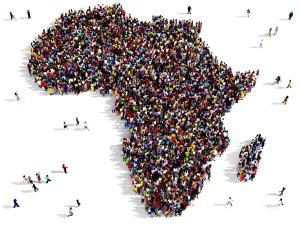
Did the Coronavirus break Europe’s good manners … or was that appearance of societal maturity just a false façade covering over the true European character?

Remember this is the continent that forge the 1884 Berlin Conference and subsequently spawned World War I, World War II, the Nazi Holocaust, Balkan Ethnic Cleansing, and many more atrocities right up to the present day … almost – see the dissenting commentary below where it is asserted that European “beauty is really only skin deep, but their ugly goes to the bone”.

See the bad happenstance occurring in today’s Europe due to this COVID-19 threat as portrayed in this news article here:

Title: Coronavirus: The European Union Unravels
By: Soeren Kern

  • Faced with an existential threat, EU member states, far from joining together to confront the pandemic as a unified bloc, instinctively are returning to pursuing the national interest. After years of criticizing U.S. President Donald J. Trump for pushing an “America First” policy, European leaders are reverting to the very nationalism they have publicly claimed to despise.
  • Ever since the threat posed by coronavirus came into focus, Europeans have displayed precious little of the high-minded multilateral solidarity that for decades has been sold to the rest of the world as a bedrock of European unity. The EU’s unique brand of soft power, said to be a model for a post-national world order, has been shown to be an empty fiction.
  • In recent weeks, EU member states have closed their borders, banned exports of critical supplies and withheld humanitarian aid. The European Central Bank, the guarantor of the European single currency, has treated with unparalleled disdain the eurozone’s third-largest economy, Italy, in its singular hour of need. The member states worst affected by the pandemic — Italy and Spain — have been left by the other member states to fend for themselves.
  • The European Union, seven decades in the making, is now unravelling in real time — in weeks.

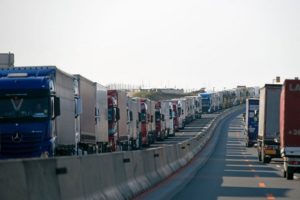
NICKELSDORF, AUSTRIA – MARCH 18: Trucks are parked on the motorway leading to the Austrian-Hungarian border crossing near Nickelsdorf on March 18, 2020 in Nickelsdorf, Austria. After negotiations between Austrian and Hungarian authorities, Hungary opened the border for Rumanian, Serbian and Bulgarian citizens. Prior to the measures the queues on Austrian side were up to 60kms long. (Photo by Thomas Kronsteiner/Getty Images)

As the coronavirus pandemic rages through Europe — where more than 250,000 people have now been diagnosed with Coronavirus Disease 2019 (COVID-19) and 15,000 have died — the foundational pillars of the European Union are crumbling one by one.

Faced with an existential threat, EU member states, far from joining together to confront the pandemic as a unified bloc, instinctively are returning to pursuing the national interest. After years of criticizing U.S. President Donald J. Trump for pushing an “America First” policy, European leaders are reverting to the very nationalism they have publicly claimed to despise.

Ever since the threat posed by coronavirus came into focus, Europeans have displayed precious little of the high-minded multilateral solidarity that for decades has been sold to the rest of the world as a bedrock of European unity. The EU’s unique brand of soft power, said to be a model for a post-national world order, has been shown to be an empty fiction.

In recent weeks, EU member states have closed their borders, banned exports of critical supplies and withheld humanitarian aid. The European Central Bank, the guarantor of the European single currency, has treated with unparalleled disdain the eurozone’s third-largest economy, Italy, in its singular hour of need. The member states worst affected by the pandemic — Italy and Spain — have been left by the other member states to fend for themselves.

The seeds of the European Union were planted in the ashes of the Second World War. In May 1949, Robert Schuman, one of the EU’s founding fathers, boldly announced the creation of new world system:

“We are carrying out a great experiment, the fulfillment of the same recurrent dream that for ten centuries has revisited the peoples of Europe: creating between them an organization putting an end to war and guaranteeing an eternal peace.”

The European Union, seven decades in the making, is now unravelling in real time — in weeks. After the dust of the coronavirus pandemic settles, the EU’s institutions will almost certainly continue to operate as before. Too much political and economic capital has been invested in the European project for European elites to do otherwise. However, the EU’s attraction as a post-national model for its own citizens, much less for the rest of the world, will have passed.

Recent examples of the unilateral pursuit of the national interest by European leaders, many of whom publicly espouse globalism but in times of desperation embrace nationalism, include:

  • France. On March 3, France confiscated all protective masks made in the country. “We will distribute them to healthcare professionals and to French people affected by the coronavirus,” French President Emmanuel Macron wrote on Twitter. On March 6, the French government forced Valmy SAS, a face mask manufacturer near Lyon, to cancel an order for millions of masks placed by the UK’s National Health Service.
  • Germany, March 4. Germany banned the export of medical protective equipment such as safety glasses, respiratory masks, protective coats, protective suits and gloves. On March 7, the Swiss newspaper Neue Zürcher Zeitung reported that German customs authorities were preventing a Swiss truck carrying 240,000 protective masks from returning to Switzerland, which is not a member of the EU. The Swiss government summoned the German ambassador to protest against the export ban. “In these contacts, the German authorities were urged immediately to release the blocked products,” a Swiss government spokesperson was quoted as saying. After facing a backlash from other EU member states, Germany on March 19 reversed course and lifted the export ban.
  • Austria, March 10. Austria became the first EU country to close its borders to another EU country. Chancellor Sebastian Kurz announced controls along the border with Italy and a ban on the entry of most travelers from there. “The utmost priority,” Kurz said, “is to prevent the spread and thus importing the illness into our society. There is therefore a ban on entry for people from Italy into Austria, with the exception of people who have a doctor’s note certifying that they are healthy.” The government also announced a ban on all air or rail travel to Italy. Austria’s decision threatened to undo the so-called Schengen Area, which entered into effect in 1995 and abolishes the need for passports and other types of control at the mutual borders of 26 European countries.
  • Slovenia, March 11. The government closed some border crossings with Italy and at those remaining open, had started making health checks to combat the spread of the virus.
  • Czech Republic, March 12. Prime Minister Andrej Babiš closed the country’s borders with Germany and Austria and also banned the entry of foreigners coming from other risky countries. On March 22, the government said that the border restrictions may last for up to two years.
  • Switzerland, March 13. The Swiss government imposed border controls with other European countries. Switzerland, although not a member of the European Union, is part of the Schengen zone.
  • Italy, March 13. European Central Bank President Christine Lagarde dismissed calls by Italy for financial assistance to help it cope with the pandemic. After her comments rattled financial markets, Lagarde said that the ECB was “fully committed to avoid any fragmentation in a difficult moment for the euro area.” Italian President Sergio Mattarella replied that Italy had a right to expect solidarity rather than obstacles from beyond its borders.
  • Denmark, March 14. Prime Minister Mette Frederiksen imposed border controls on all traffic by land, sea and air until at least April 13.
  • Poland, March 15. The government closed the country’s borders to everyone except Polish citizens or people with a Polish residence permit.
  • Germany, March 16. Germany, the largest and most powerful country in the European Union, introduced controls on its borders with Austria, Denmark, France, Luxembourg and Switzerland. The move came after Germany registered 1,000 new cases of COVID-19 in just one day.
  • Hungary, March 16. Prime Minister Viktor Orbán halted all passenger traffic into Hungary would be halted and only Hungarian citizens allowed to enter the country.
  • Spain, March 16. Interior Minister Fernando Grande-Marlaska decreed the establishment of controls at all land borders.
  • Serbia, March 16. President Aleksandar Vučić declared a state of emergency due to coronavirus. He condemned the EU for restricting exports of medical equipment and appealed for help from his “friend and brother,” Chinese leader Xi Jinping. “European solidarity does not exist,” Vučić said. “That was a fairy tale on paper. I have sent a special letter to the only ones who can help, and that is China.” Serbia applied to become a member of the EU in 2009. Accession talks began in January 2014.
  • Czech Republic, March 17. Czech authorities seized 110,000 face masks that China had sent to Italy. On March 23, the Czech Republic delivered the confiscated material to Italy. “There are 110,000 masks on board the bus as a gift to Italy, which is supposed to replace the material that was probably a Chinese gift for Italian compatriots,” said Foreign Ministry spokeswoman Zuzana Stichova.
  • Germany, March 18. Chancellor Angela Merkel, in a rare televised speech, urged all Germans to obey rules aimed at reducing direct social contact and avoiding as many new infections as possible. “It is serious,” she said. “Take it seriously. Since German reunification, actually, since World War Two, there has never been a challenge for our country in which acting in solidarity was so very crucial.” Merkel’s address to the nation was the first time in nearly 15 years in office that she had spoken to the country other than in her annual New Year’s address. She did not mention the European Union or other EU member states.
  • Belgium, March 22. The coronavirus has fueled tensions between Belgium, which is on lockdown, and the Netherlands, which is not. “In the Netherlands, shops are still open and meetings of 100 people are still allowed — these are breeding grounds for the virus,” said Marino Keulen, mayor of the Belgian border town Lanaken. Belgian authorities have set up barricades along the border and are ordering cars with Dutch license plates to turn around and return home. Keulen called the border checks a “signal to The Hague” to “quickly scale-up” its response and align with neighboring countries. “The Dutch government is incompetent and ridiculous in its response to the coronavirus crisis,” said Leopold Lippens, the mayor of Belgian seacoast town Knokke-Heist. “The Netherlands is doing nothing, so we have to protect ourselves.”
  • Spain, March 25. After failing to obtain assistance from the European Union, the Spanish government asked NATO for help in acquiring 1.5 million face masks and 450,000 respirators. NATO lacks this material and is limited to passing the Spanish request on to the remaining 29 allies, many of which are also members of the EU.
  • Poland, March 25. Polish authorities prevented hundreds of thousands of bottles of hand sanitizer from being exported to Norway, which is not a member of the EU. The Norwegian company Norenco manufactures and packages hand sanitizer for the Scandinavian market at a factory it owns in Poland. Norenco’s chief executive, Arne Haukland, said that after he applied for an export license, five men arrived at the factory, and demanded to be shown its stock of hand sanitizer. He said the company then received a letter ordering it to sell any hand sanitizer it had produced to the local city authorities in Lubin at a fixed price, under emergency coronavirus laws passed in Poland at the start of March. The seizure will exacerbate the supply problem faced by Norwegian hospitals.
  • France, March 25. President Emmanuel Macron, in an address to the nation at a military hospital in the eastern city of Mulhouse, which has been especially hard hit by the coronavirus, called for national, as opposed to European, unity: “When we engage in war, we engage fully, we mobilize united. I see in our country factors of division, doubts, all those who want to fracture the country when it is necessary to have only one obsession: to be united to fight against the virus. I call for this unity and this commitment.”

Meanwhile, in Italy, a nationwide survey published on March 18 found that 88% of Italians believe that the EU is not helping their country. Only 4% thought the opposite while 8% did not have an opinion. More than two-thirds (67%) of Italians said that they believe that being part of the European Union is a disadvantage for their country.

In an article titled, “Coronavirus Threatens European Unity,” Bill Wirtz, a political commentator based in Luxembourg, observed:

“As the coronavirus unfolds, Schengen countries are shutting their own borders. Whether or not they do so because they believe that a coordinated European response would be inefficient, or whether they believe that their own voters wouldn’t buy it — at this stage it’s irrelevant. The mere fact that borders have resurfaced in Europe is a failure for the integrity of the Schengen open borders agreement….

“A coordinated EU response to this crisis does not exist, and as the recommendations fall on deaf ears, Brussels is dealing with a crisis of confidence. There is no union-wide crisis response, coordinated testing or research. Worse than that, the EU institutions are bystanders to a war between countries, which are trying to limit exports of medical supplies in order to keep them for themselves. In times of crisis, the true influence and capacity of the EU has shown, and it is very little.

“As it stands, countries are dealing with a crisis of missing hospital beds, medical equipment, and overall resources. If the virus ever happens to lay lower than it does now, and the conclusion is drawn that the European Union was a powerless bystander in the eye of the storm (which it is), then the Schengen Agreement and open borders in Europe could be dealing with a difficult recovery.”

Darren McCaffrey, the political editor of the France-based news channel Euronewswrote:

“In the past couple of weeks, solidarity has collapsed in the bloc. Countries have started imposing border controls on neighboring EU countries, and even Germany has taken steps to manage the flow of people entering and leaving its territory.

“On Tuesday, a 35-kilometer-long queue formed at the Polish-German border, where hundreds of Europeans — Latvians, Estonians and Lithuanians — were stuck in trucks, cars and buses.

“As the EU must take measures to prevent the spread of the disease, many are worrying about the essence of the European Union and its four freedoms [the free movement of goods, services, capital and people].

“What is the EU if its own citizens can’t move freely? What is the single market if goods can’t cross Europe’s borders without hindrance?”

In an article titled, “Nations First: The EU Struggles for Relevance in the Fight against Coronavirus,” the German newsmagazine Der Spiegel noted:

“As the pandemic takes hold in Europe, the decades-old union is showing its weaknesses. While the EU managed to survive Brexit and the euro crisis, the corona crisis may yet prove to be an insurmountable challenge.

“Instead of trying to come up with joint solutions, the Continent is becoming balkanized and is reverting to national solutions. Instead of helping each other out, EU countries are hoarding face masks like panicked Europeans are hoarding toilet paper. The early decisions made by some EU member states to refrain from exporting medical equipment to Italy — the EU country that has thus far been hit hardest by the pandemic — has even overshadowed the lack of European solidarity displayed by Hungarian Prime Minister Viktor Orbán in the refugee crisis.

“Europeans are even divided on the question as to how to combat the virus. Whereas Germany is eager to prevent as many people as possible from encountering the virus and becoming infected, the Netherlands wants to see as many healthy people as possible fight off COVID-19, thus becoming immune. The signal is clear: When things get serious, every member state still looks out for itself first — even 60 years after the founding of the community.”
Soeren Kern is a Senior Fellow at the New York-based Gatestone Institute.
Source:
Posted March 27, 2020; retrieved March 31, 2020 from: https://www.gatestoneinstitute.org/15803/coronavirus-european-union-unravels


VIDEO – Coronavirus outbreak: What is the European Union’s coordinated response to the pandemic? – https://youtu.be/O3_BIRicB-0

Posted Mar 16, 2020 – FRANCE 24 English

Subscribe to France 24 now: http://f24.my/youtubeEN FRANCE 24 live news stream: all the latest news 24/7 http://f24.my/YTliveEN

Visit our website: http://www.france24.com

Subscribe to our YouTube channel: http://f24.my/youtubeEN

Like us on Facebook: https://www.facebook.com/FRANCE24.Eng…

Follow us on Twitter: https://twitter.com/France24_en


No homeland is perfect.

The European continent has made great progress; but is still plagued with many societal defects. Yet still, the Caribbean member-states, though modeled and structured from their European legacy, have even more defects. These tropical territories lose many of its young people to abandonment and defection to the homelands of their European masters. In truth, in the Dutch Antillean islands (Aruba, Bonaire, Curaçao, Saba, Sint Eustatius, Sint Martin) and in the French Antillean islands (Guadeloupe, Martinique, Saint Barthélemy and Saint Martin) all share the same experience of raising children, just to watch them leave after high school graduation; (same for the UK and American territories). See how this was reported in a previous Go Lean commentary:

All of the Caribbean, despite the languages, have had societal failures. Large swaths of the population has fled to foreign shores for refuge. In the French (and Dutch) Caribbean, it is not uncommon for high school graduates to leave soon after graduation. No society can thrive with this disposition. Communities need its people, young and old. But the people need opportunities for prosperity. – Blog-commentary: Welcoming the French posted February 20, 2017.

What is the experience for those emigrants, mostly Black-and-Brown, when they arrive to live, work and play in their new European lands of refuge? This question was answered in another previous Go Lean commentary:

Latent Racism – For societies to promote the exploitation of slaves, there must have been an underlying creed of racism, or racial supremacy. This emerges from time to time, as reflected recently with the Middle East Refugee crisis.  People with this mindset may not have a problem with coming to a Black majority Caribbean destination for leisure travel; it may be fun for them to be pampered by “servants”, but not so much for those facilitating the service. – Blog-commentary: 10 Things We Want from Europe and 10 Things We Do Not Want posted from October 19, 2019.

So is it advisable for Caribbean people to live, work and play in Europe? Nah! While no homeland is perfect – there is the need for societies everywhere to reform and transform – but it is easier for the Black-and-Brown of the Caribbean to succeed right here in the Caribbean, rather than in some foreign location; (with appropriate mitigations that is).

See how this assertion is made by this one political commentator – Mike Larry, a Social Justice Advocate and Pro-African Pundit – in the Caribbean member-state of the Bahamas:

 I look at MSM (Mainstream Media) as a propaganda tool where those that control it announce their next move or provide enough disinformation to set those not in their clique running in the wrong direction. On the first reading Europe has long practiced socialism and nationalism especially with respect to any natural resource they find at home and abroad; Norway and its sovereign wealth fund being a perfect example.

The U.S. is another example where she practices socialism and nationalism in the most egregious ways as she stomps about the earth imposing her brutish brand of imperialism on other sovereign states so that her citizens can maintain a certain standard of living at the expense of others. Isn’t that what the Berlin Conference of 1884 was really about with consensus among those of Eurocentric descent to collaborate rather than fight over non-Eurocentric nations and resources.

(In case you missed it, this has always been about resources to the detriment of resource-rich Afrocentric lands in particular).

On a deeper reading of the article, I see this as disinformation that Europe has put out into the mainstream to neutralize any effort or bright ideas that Africa and the African Diaspora might have regarding a United Africa and by extension CSME or any other non-Eurocentric trading bloc. Yet while this might cause non-Eurocentric states to abandon unity, this doesn’t mean that Europe has abandoned her common objective, as laid out in the Berlin Conference, such policies that remain alive and well. Even though Africans in the continent and the Diaspora are only now waking up to history of this barbaric treaty to which Africans were not seated at the table in Berlin. Again this has always been about resources and who gets to share in them in pursuance of their Eurocentric social and national agendas.

In summary, the push to open borders to neoliberal agendas was designed to destabilize sovereign states economically, gain control of their resources and economic arteries, in pursuit of a global system of socialism and nationalism with multiple layers of underclasses and white supremacy representing the capstone of the pyramid. I also believe the US and Europe will use the “engineered coronavirus” scare to gain better control over immigration issues, which too is based in racism and discrimination; this is what we do here in the Bahamas, not understanding that even in a so-called Black-led nation, such as ours, our immigration laws and policies criminalize primarily people of African descent.

When the smoke clears, we will appreciate that Europe, and its allies, have abided by the obligations of that horrible Berlin Treaty from over a century ago. [The goals and practices remain]. It doesn’t need a European Union for there to be business-as-usual in the exploitation of African people. That colonial spirit is embedded in their DNA [still], as evidenced by their avoidance of any Reparation Discourse, aside from empty apologies.

I don’t buy their story, as presented, as they will always be united against us in furthering their nationalistic and socialistic agendas which they have taught us to condemn in Africa and the Diaspora.
Posted: March 31, 2020.

The European Union had emerged as a role model for the Caribbean, but as portrayed in the foregoing news reports, they reverted to independent-minded “me first” nationalism, instead of the best-practice of interdependence, now that ‘push has come to shove’. We want to do better than this in the Caribbean; we do not want to structure our regional society just for the sunshine; no we want to prepare for the rain as well. We want the same rights, responsibilities and deliveries during “push” as during “shove”.

“Can’t we all just get along”?!

This is not just our question-opinion alone.

“When we grow up, we want to be like the European Union” – the Go Lean book proclaimed back in 2013; see this excerpt:

The EU region has quite an ignoble history of contending with differences, spurning 2 World Wars in the last century. Yet they came together to unite and integrate to make Europe a better place to live, work and play. Just like the EU, the CU will not possess sovereignty; this feature remains with each member-state. – 10 Ways to Model the EU (Page 130).

Yes, we want our Caribbean Community (CariCom) to become the Caribbean Union (CU). Except that the EU has NOT provided us with a good role model as of late. Rather than collaborating and confederating for solutions for this COVID-19 threat, they have reverted to their bad roots of nationalism and self-interest.

Europe is not all good.
Europe is not all bad.

Their duplicity gives lessons for us here in the Caribbean to look, listen and learn. But we must not stop there; we must also lend-a-hand and lead. Any society can come back from the brink; then reform and transform; then actuate a great community to live, work, heal and play. We have seen this done, even in Europe – therefore, we are convinced it can happen here. This theme has been highlighted in many previous Go Lean blog/commentaries; see this sample list here:

https://goleancaribbean.com/blog/?p=19217 Reducing Brain Drain: Introducing Localism to ‘Live and Let Live’
https://goleancaribbean.com/blog/?p=17915 What Went Wrong in the Caribbean? ‘We’ never had our own war!
https://goleancaribbean.com/blog/?p=17284 Way Forward – ‘Whatever it takes’: Life Imitating Art
https://goleancaribbean.com/blog/?p=16153 100 Years of Armistice Day – Lessons Learned from World War I
https://goleancaribbean.com/blog/?p=15796 Lessons Learned from 2008 Financial Crisis: Righting The Wrong
https://goleancaribbean.com/blog/?p=15521 Caribbean Unity from one European Legacy to Another? What a Joke!
https://goleancaribbean.com/blog/?p=8943 Lessons from Zika’s Drug Breakthrough – Solutions at the precipice
https://goleancaribbean.com/blog/?p=8132 Venezuela: Watching a ‘Train Wreck in Slow Motion’
https://goleancaribbean.com/blog/?p=6563 Lessons from Iceland’s Model of Recovery: Burn it down; Build it up
https://goleancaribbean.com/blog/?p=5964 ‘Feed the right wolf’ in a crisis – Lessons from Movie ‘Tomorrowland’
https://goleancaribbean.com/blog/?p=3780 National Sacrifice – The Missing Ingredient for Caribbean Recovery
https://goleancaribbean.com/blog/?p=623 Harsh Reality: ‘Only at the precipice, do they change’

The movement behind the Go Lean book has consistently monitored and messaged about this fight against the Coronavirus threat; we have even presented a musical accompaniment with the 1970 song “Lean On Me” by Singer-Songwriter Bill Withers. There is a lyrical line in the song that is spot-on for today:

If there is a load you have to bear
That you can’t carry
I’m right up the road
I’ll share your load
If you just call me

For the 30 member-states of the political Caribbean, take these words to heart: “I’m right up the road” This is literally true, as some Caribbean member-states share the same island (think: St. Martin, Haiti, Dominican Republic), and other member-states are only 7 to 60 miles apart; (think USVI and BVI).

As related previously, today’s reality is the manifestation of this song (lyrics); it is time for the Caribbean neighborhood to “lean on” each other, rather than look to foreign masters thousands of miles away – who are otherwise occupied and disinterested.

Due to this Coronavirus reality, the ordinary times are no more; they may never return; this is the new normal, or a new abnormal. By all of us working together – a first time manifestation – we can have a fighting chance to make our regional homeland a better place to live, work, heal and play in good times and bad.  🙂

About the Book
The book Go Lean…Caribbean serves as a roadmap for the introduction and implementation of the technocratic Caribbean Union Trade Federation (CU), for the elevation of Caribbean society – for all member-states. This CU/Go Lean roadmap has these 3 prime directives:

  • Optimization of the economic engines in order to grow the regional economy to $800 Billion & create 2.2 million new jobs.
  • Establishment of a security apparatus to ensure public safety and protect the resultant economic engines.
  • Improve Caribbean governance to support these engines, including a separation-of-powers between the member-states and CU federal agencies.

The Go Lean book provides 370-pages of turn-by-turn instructions on “how” to adopt new community ethos, plus the strategies, tactics, implementations and advocacies to execute so as to reboot, reform and transform the societal engines of Caribbean society.

Download the free e-Book of Go Lean … Caribbean – now!

Who We Are
The movement behind the Go Lean book – a non-partisan, apolitical, religiously-neutral Community Development Foundation chartered for the purpose of empowering and re-booting economic engines – stresses that reforming and transforming the Caribbean societal engines must be a regional pursuit. This was an early motivation for the roadmap, as pronounced in the opening Declaration of Interdependence (Pages 12 – 13):

xi. Whereas all men are entitled to the benefits of good governance in a free society, “new guards” must be enacted to dissuade the emergence of incompetence, corruption, nepotism and cronyism at the peril of the people’s best interest. The Federation must guarantee the executions of a social contract between government and the governed.

xvi. Whereas security of our homeland is inextricably linked to prosperity of the homeland, the economic and security interest of the region needs to be aligned under the same governance. Since economic crimes … can imperil the functioning of the wheels of commerce for all the citizenry, the accedence of this Federation must equip the security apparatus with the tools and techniques for predictive and proactive interdictions.

xxii. Whereas the heritage of our lands share the distinction of cultural tutelage from European and American imperialists that forged their tongues upon our consciousness, it is imperative to form a society that is neutral and tolerant of the mother tongue influences of our people to foster efficient and effective communications among our citizens.

 xxiii. Whereas many countries in our region are dependent Overseas Territory of imperial powers, the systems of governance can be instituted on a regional and local basis, rather than requiring oversight or accountability from distant masters far removed from their subjects of administration. The Federation must facilitate success in autonomous rule by sharing tools, systems and teamwork within the geographical region.

xxiv. Whereas a free market economy can be induced and spurred for continuous progress, the Federation must install the controls to better manage aspects of the economy: jobs, inflation, savings rate, investments and other economic principles. Thereby attracting direct foreign investment because of the stability and vibrancy of our economy.

Sign the petition to lean-in for this roadmap for the Caribbean Union Trade Federation.

Share this post:
, , ,
[Top]

BHAG – Need ‘Big Brother’ for Pandemics

Go Lean Commentary

The whole world must act now to remediate this crisis – flatten the curve – of this Coronavirus danger. There are no “ands, ifs or buts”. This is a systemic threat!
If one Caribbean member-state does not comply with the best practices for mitigating this disease, they will have to answer to …

Wait, there is no one to answer to!

This is the problem; there is no accountability entity for the Caribbean to turn to in times of distress.

If only there was …

… this is a Big Hairy Audacious Goal for the Caribbean. We need someone – a Big Brother – to run to for help with our security threats. This was the clarion call for the 2013 book Go Lean … Caribbean. It opened with this acknowledgement and declaration (Page 3):

There is something wrong in the Caribbean. It is the greatest address on the planet, but instead of the world “beating a path” to our doors, the people of the Caribbean have “beat down their doors” to get out. Our societal defects are so acute that our culture is in peril for future prospects.

The requisite investment of the resources (time, talent, treasuries) for this goal may be too big for any one Caribbean member-state [alone]. Rather, shifting the responsibility to a region-wide, professionally-managed, deputized technocracy will result in greater production and greater accountability. This deputized agency is the Caribbean Union Trade Federation (CU).

The economy of the Caribbean is inextricably linked to the security of the region. Therefore the CU treaty includes a security pact to implement the mechanisms to ensure greater homeland security. These efforts will monitor and mitigate against economic crimes, systemic threats and also facilitate natural disaster planning and response agencies.

But can’t we just …

… run to the big Super Power in our region, the United States of America, for answers, solutions and refuge.

The simple answer is No!

The US has gone on record to declare and demonstrate that they are not to be considered the Big Brother for anyone else, other than their people; (many conclude that they even fail in their domestic deliveries). “Blood is thicker than water” and the Caribbean member-states must accept that frankly, we are “not blood” – even true for US Territories like Puerto Rico. Consider the support for this assertion in these examples of news articles here:

VIDEO – Trump address allegations about US blocking multiple Caribbean states from receiving shipments of vital medical supplies – https://www.miamiherald.com/news/nation-world/world/americas/article241951191.html

———–

Title # 1: Caribbean nations can’t get U.S. masks, ventilators for COVID-19 under Trump policy
By: Jacqueline Charles and Alex Harris
Caribbean nations struggling to save lives and prevent the deadly spread of the coronavirus in their vulnerable territories should not look to the United States as they seek to acquire scarce but much-needed protective gear to fight the global pandemic

A spokesperson from U.S. Customs and Border Protection confirmed to the Miami Herald that the agency is working with the Federal Emergency Management Agency to prevent distributors from diverting personal protective equipment, or PPE, such as face masks and gloves, overseas. Ventilators also are on the prohibited list.

“To accomplish this, CBP will detain shipments of the PPE specified in the President’s Memorandum while FEMA determines whether to return the PPE for use within the United States; to purchase the PPE on behalf of the United States; or, allow it to be exported,” the statement read.

In the past week, three Caribbean nations —the Bahamas, Cayman Islands and Barbados —have all had container loads of personal protective equipment purchased from U.S. vendors blocked from entering their territories by U.S. Customs and Border Protection.

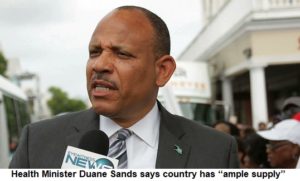
“We are talking about personal protective equipment; we’re talking about durable medical devices and gloves, gowns, ventilators as well,” Bahamas Health Minister Dr. Duane Sands told the Miami Herald.

On Tuesday, U.S. Customs and Border Protection informed a shipping company that its Nassau-bound shipment of medical supplies could not be offloaded in the Bahamas and the containers had to be returned to Miami “for inspection.” But even before that, Sands said the Bahamian government had already been fielding multiple “complaints from freight forwarders and shipping companies that they were having challenges clearing certain items.”

“Over time, that grew to a crescendo with certain persons having the same experience,” he said.

The blockade experienced by Caribbean nations followed President Donald Trump’s April 3 signing of the little-known Defense Production Act. While the order gave the federal government more control over the procurement of coronavirus-related supplies, it also allowed the administration to ban certain exports. Trump invoked the act following a Twitter attack against U.S. manufacturer 3M over the export of its highly sought N95 respiratory face masks.

In a release, the Minnesota-based company said the Trump administration wanted it to cease exports of the masks to Latin America and Caribbean nations. Pushing back on the request, 3M said such a move carried “humanitarian consequences.”

Soon after the president’s order, Caribbean governments and shippers started hearing from Customs and Border Protection, learning that shipments of vital supplies had been blocked.

In the case of Barbados, it was a shipment of 20 ventilators purchased by a philanthropist that were barred, Health Minister Lt. Col Jeffrey Bostic told his nation in a live broadcast on April 5. After accusing the U.S. of seizing the shipment, Bostic walked back the allegation and told a local newspaper the hold up had “to do with export restrictions being placed on certain items.”

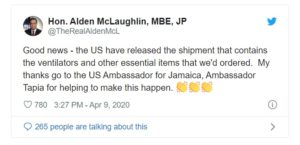
For the Cayman Islands, it was eight ventilators and 50,000 masks that were produced and purchased in the U.S. and removed from a Grand Cayman-bound ship in Miami — also on Tuesday. In a Friday afternoon tweet, the British overseas territory’s premier, Alden McLaughlin, said the U.S. had released the shipment with help from the U.S. Ambassador to Jamaica Donald Tapia.

Like Cayman, the Bahamas was also forced to turn to diplomatic channels for help. Following the intervention of the U.S. Embassy in Nassau, Sands said, it appeared they “were fairly close to a resolution.” But on Friday, the shipments were still being held by Customs and Border Protection, said a source familiar with the situation.

Betty K Agencies, a shipping company, was informed about the Trump policy after its ship had left Miami with three containers of medical supplies on Tuesday, hours ahead of its Wednesday arrival in Nassau.

The CBP note sent to Betty K Agencies regarding its Bahamas medical shipment was obtained by the Herald. It reads, “Due to a April 3rd, 2020 Presidential Memorandum regarding the allocation of certain scarce or threatened health and medical resources for domestic use, the items below cannot be exported until further notice.” The list went on to mention various types of single-use, disposable surgical masks, including N95 respirators and medical gloves.

Earlier in the week, the State Department suggested to the Miami Herald that media reports about seized medical exports might not be accurate. Late Friday, the White House issued a different statement after the ministers went public.

“The United States, like many other nations, is currently experiencing a high demand for ventilators, masks, gloves, and respirators that is straining available supplies and production capacity,” a senior administration official told the Herald. “President Trump has made clear that this Administration will prioritize the well-being of American citizens as we continue to take bold, decisive action to help slow the spread of the virus and save lives.”

The official went on to say that the administration “is working to limit the impacts of PPE domestic allocation on other nations. The United States will continue to send equipment and supplies not needed domestically to other countries, and we will do more as we are able.”

During Friday’s Coronavirus Task Force press briefing at the White House, President Trump acknowledged the high demand for the United States’ ventilators and testing kits, which Caribbean health officials have said are also banned from export.

“We’re the envy of the world in terms of ventilators. Germany would like some, France would like some; we’re going to help countries out. Spain needs them desperately. Italy needs them desperately,” he said.

But when asked by a McClatchy reporter about the Caribbean and the accusation that the U.S. was blocking personal protective equipment in certain cases, Trump implied that the shipments were being caught up in drug trafficking and seizures.

“Well, what we’re doing, we have a tremendous force out there, a Naval force, and we’re blocking the shipment of drugs,” he said. “So maybe what they’re doing is stopping ships that they want to look at. We’re not blocking. What we’re doing is we’re making sure; we don’t want drugs in our country, and especially with the over 160 miles of wall, it’s getting very hard to get through the border. They used to drive right through the border like they owned it, and in a certain way, they did.”

The president also invoked the U.S.’s effort to stop human trafficking.

“What we’re doing is we’re being very tough and we’re being tough because of drugs and also human trafficking,” he added. “We have a big Naval force that’s stopping, so maybe when you mentioned that, maybe their ships are getting caught. But we are stopping a lot of ships and we’re finding a lot of drugs.”

The LA Times reported earlier this week that seven states have seen the federal government seize shipments of necessary medical supplies, including thermometers and masks, without saying where or how they planned to reallocate them.

Caribbean health ministers, who have been warned by the Pan American Health Organization to expect a spike in COVID-19 infections in the coming weeks, have tried to assure their citizens that they are not relying solely on vendors in the United States to help their response to the respiratory disease.

They have also placed orders with suppliers in China and South Korea, they have said. McLaughlin, the Cayman premier, recently announced that the territory recently sold thousands of extra coronavirus test kits it had purchased, at cost, to Bermuda and Barbados.

It has been slightly more than 100 days since the World Health Organization declared the coronavirus to be a global pandemic, and just over a month since the first cases were registered on March 1 in the Caribbean, beginning with the Dominican Republic and the French overseas territories of St. Martin and St. Barthélemy. The first confirmations of COVID-19 in the English-speaking Caribbean came on March 10 when Jamaica recorded its first case, followed by St. Vincent and the Grenadines and Guyana the next day.

Since then, the number of cases has grown to more than 4,000 across 33 Caribbean countries and territories, with over 185 deaths, according to the latest available statistics compiled by the Caribbean Public Health Agency.

The Bahamas currently has 41 confirmed cases and eight deaths. Sands said the island nation, which is still recovering from last year’s deadly Hurricane Dorian, is “in the middle of our surge.” As a result, he’s trying to build the country’s capacity to handle COVID-19 infections by ensuring that healthcare workers, police and defense force officers are armed with masks, gowns, booties and hazmat suits for the pandemic.

“While we do not have a problem at this point, we do not want to get into a problem,” Sands said. “We have modeled what our burn rate is likely to be so we are just trying to build out our anticipated need to make sure that we stay ahead of the demand. So these shipments, while important, would have been for future needs.”

Sands acknowledges that the United States, which on Saturday surpassed more than half a million coronavirus cases and 20,000 deaths, is in a very difficult position as it becomes the world’s worst coronavirus hot spot and hospitals experience shortages.

“It’s very challenging when you don’t have enough supplies to meet the needs of your own institutions. I am in no way condoning or endorsing anything. I am simply saying as we watch the challenge it is also very, very difficult,” he said. “For all intensive purposes, borders are now shut, and without wanting to be flippant or dismissive, it’s every man for himself and God for us all.”

McClatchy Washington Bureau reporter Michael Wilner contributed to this report.

Source: Posted April 13, 2020; retrieved April 17, 2020 from: https://www.miamiherald.com/news/nation-world/world/americas/haiti/article241922071.html

—————-

Title #2 : U.S. blocks export of ‘tens of thousands’ of COVID-19 medical supplies
By:  Ava Turnquest
NASSAU, BAHAMAS — Health minister Dr Duane Sands confirmed the country has been significantly hit by U.S. restrictions banning the export of COVID-19 protective gear, noting the procurement of “many, many thousands” of critical supplies has been blocked.

However, Sands told Eyewitness News the government did not put all of its “eggs in one basket” as the country has sourced supplies from various countries.

He added: “This was a big deal, this wasn’t no little problem, this is a big deal.”

See the full article here: https://ewnews.com/u-s-blocks-export-of-tens-of-thousands-of-covid-19-medical-supplies posted April 9, 2020; retrieved April 17, 2020.

—————

Title #3: U.S. will send supplies that are ‘not needed domestically’, embassy says
By: Jasper Ward
While defending the United States’ decision to block the export of critical medical supplies, a U.S. embassy official said today that America will continue to send equipment and supplies that are “not needed” domestically to countries like The Bahamas amid the COVID-19 pandemic.

“The COVID-19 pandemic and the necessary response measures are challenging governments globally,” the official told The Nassau Guardian.

“The United States is taking action to maintain the commitment of the president to the American people. The United States is continuing to send equipment and supplies not needed domestically to many other countries, including The Bahamas, and we will continue to do more as we are able.”

See the full article here: https://thenassauguardian.com/2020/04/09/u-s-will-send-supplies-that-are-not-needed-domestically-embassy-says/ posted April 9, 2020; retrieved April 17, 2020

***************

We just completed a 6-part series on Big Hairy Audacious Goals (BHAG) where we considered these goals, these entries:

  1. BHAG – The Audacity of Hope – Yes, we can!
  2. BHAG Regional Currency – In God We Trust
  3. BHAG – Infrastructure Spending … finally funding Toll Roads
  4. BHAG – One Voice – Foreign Policy and Diplomatic Stance
  5. BHAG – Outreach to the World – Why Not a Profit Center
  6. BHAG – Netflix, Hulu, CBS, Peacock è Caribbean Media

Now for this continuation, a 7th entry, we consider the goal of a “region-wide, professionally-managed, deputized technocracy for greater production and greater accountability” – our own Caribbean Big Brother.

We obviously cannot rely on the US to be our Big Brother for pandemics – we must do it ourselves. This has been the theme of a number of previous Go Lean commentaries that elaborated on the goal of elevating the Caribbean societal engines for better Homeland Security; consider this sample list here:

https://goleancaribbean.com/blog/?p=19409 Coronavirus: ‘Clear and Present’ Threat to Economic Security
https://goleancaribbean.com/blog/?p=19025 Cursed in Paradise – Disasters upon Disasters
https://goleancaribbean.com/blog/?p=15996 Good Governance: Stepping Up in an Emergency
https://goleancaribbean.com/blog/?p=13999 First Steps for Caribbean Security – Deputize ‘Me’, says the CU
https://goleancaribbean.com/blog/?p=12996 After Disasters, Failed State Indicators: Destruction and Defection
https://goleancaribbean.com/blog/?p=10566 Funding the Caribbean Security Pact – Yes, we can!
https://goleancaribbean.com/blog/?p=9038 Caribbean Charity Management: Grow Up Already & Be Responsible
https://goleancaribbean.com/blog/?p=7896 The Logistics of Disaster Relief
https://goleancaribbean.com/blog/?p=5002 Managing a ‘Clear and Present Danger’

Yes, a new guard, the CU Homeland Security apparatus has always been the quest of the movement behind the Go Lean book (Page 10), and these previous blog-commentaries. The book presented a Declaration of Interdependence, with these words:

When a long train of abuses and usurpations, pursuing invariably the same object evinces a design to reduce them under absolute despotism, it is their right, it is their duty, to throw off such government, and to provide new guards for their future security.

This movement studied previous pandemics and presented the lessons learned to the Caribbean region in a post on March 24, 2015:

A Lesson in History – SARS in Hong Kong
How can a community – the Caribbean region in this case – manage such an epidemiological crisis?

For this, we have a well-documented lesson from Hong Kong in 2003. There is much for us to learn from this lesson in history.

The people, institutions and governance of the Caribbean need to pay more than the usual attention to the lessons of SARS in Hong Kong, not just from the medical perspective (see Appendix B), but also from an economic viewpoint.

During the “heyday” of the SARS crisis, travel and transport to Hong Kong virtually came to a grinding halt! Hong Kong had previously enjoyed up to 14 million visitors annually; they were a gateway to the world. The SARS epidemic became a pandemic because of this status. Within weeks of the outbreak, SARS had spread from Hong Kong to infect individuals in 37 countries in early 2003.[3]

Can we afford this disposition in any Caribbean community?

Consider how this history may impact the Caribbean region. SARS in Hong Kong was 12 17 years ago. But last year [2014] the world was rocked with an Ebola crisis originating from West Africa. An additional example local to the Caribbean is the Chikungunya virus that emerged in Spring 2014. The presentation of these facts evinces that we cannot allow mis-management of any public health crisis; this disposition would not extend the welcoming hospitality that the tourism product depends on. Our domestic engines cannot sustain an outbreak of a virus like SARS (nor Ebola nor Chikungunya). Less than an outbreak, our tourism economic engines, on the other hand, cannot even withstand a rumor. We must act fast, with inter-state efficiency, against any virus.

This is the goal as detailed in the book Go Lean … Caribbean as it serves as a roadmap for the introduction of the technocratic Caribbean Union Trade Federation (CU). The vision of the CU is to ensure that the Caribbean is a protégé of communities like the US and EU states, not a parasite.

The Go Lean book reports that previous Caribbean administrations have failed miserably in managing regional crises. There is no structure for cooperation, collaboration and coordination across borders. This is the charge of the Go Lean/CU roadmap. To effectuate change in the region by convening all 30 Caribbean member-states, despite their historical legacies or governmental hierarchy.
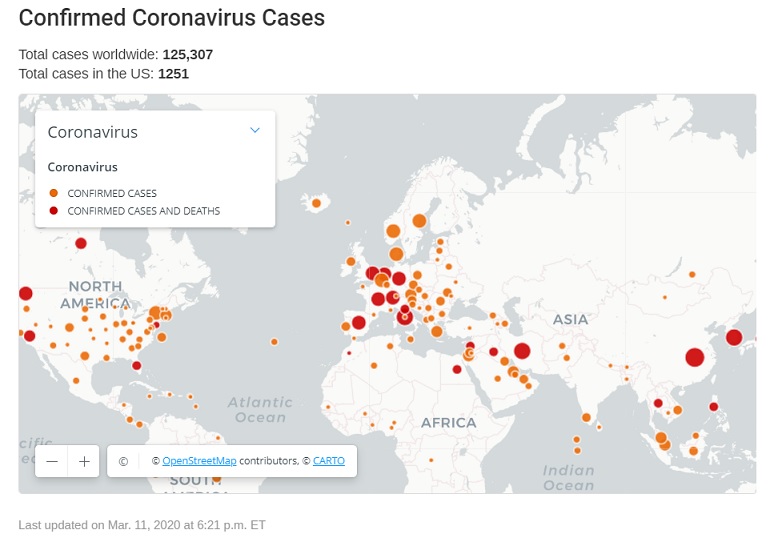
The CU is not designed to just be in some advisory role when it comes to pandemic crises, but rather to possess the authority to act as a Security Apparatus for the region’s Greater Good.

Legally, each Caribbean member-state would ratify a Status of Forces Agreement that would authorize this role for the CU agencies (Emergency Management and Disease Control & Management) to serve as a proxy and deputy of the Public Health administrations for each member-state. This would thusly empower these CU agencies to quarantine and detain citizens with probable cause of an infectious disease. The transparency, accountability and chain-of-command would be intact with the appropriate checks-and-balances of the CU’s legislative and judicial oversight. This is a lesson learned from Hong Kong 2003 with China’s belligerence.

SARS was eradicated by January 2004 and no cases have been reported since. [4] We must have this “happy-ending”, but from the beginning. This is the lesson we can learn and apply in the Caribbean. …

This vision is the BHAG for today’s Caribbean. Yes, we can …

… execute the strategies, tactics and implementations to fulfill this vision.

COVID-19 was not the worst pandemic and may not be the last. So we must put the proper mitigation in place.

This vision, this BHAG, is conceivable, believable and achievable. We urged all Caribbean stakeholders to lean-in to this Go Lean roadmap. This is how we make our homeland a better place to live, work and play. 🙂

About the Book

The book Go Lean…Caribbean serves as a roadmap for the introduction and implementation of the technocratic Caribbean Union Trade Federation (CU), for the elevation of Caribbean society – for all member-states. This CU/Go Lean roadmap has these 3 prime directives:

  • Optimization of the economic engines in order to grow the regional economy to $800 Billion & create 2.2 million new jobs.
  • Establishment of a security apparatus to ensure public safety and protect the resultant economic engines.
  • Improve Caribbean governance to support these engines, including a separation-of-powers between the member-states and CU federal agencies.

The Go Lean book provides 370-pages of turn-by-turn instructions on “how” to adopt new community ethos, plus the strategies, tactics, implementations and advocacies to execute so as to reboot, reform and transform the societal engines of Caribbean society.

Download the free e-Book of Go Lean … Caribbean – now!

Who We Are

The movement behind the Go Lean book – a non-partisan, apolitical, religiously-neutral Community Development Foundation chartered for the purpose of empowering and re-booting economic engines – stresses that reforming and transforming the Caribbean societal engines must be a regional pursuit. This was an early motivation for the roadmap, as pronounced in the opening Declaration of Interdependence (Pages 12 – 14):

ix. Whereas the realities of healthcare and an aging population cannot be ignored and cannot be afforded without some advanced mitigation, the Federation must arrange for health plans to consolidate premiums of both healthy and sickly people across the wider base of the entire Caribbean population. The mitigation should extend further to disease management, wellness, mental health, obesity and smoking cessation programs. The Federation must proactively anticipate the demand and supply … as developing countries are often exploited by richer neighbors for illicit organ [medical equipment and provisional] trade.

x. Whereas we are surrounded and allied to nations of larger proportions in land mass, populations, and treasuries, elements in their societies may have ill-intent in their pursuits, at the expense of the safety and security of our citizens. We must therefore appoint “new guards” to ensure our public safety and threats against our society, both domestic and foreign. …. 

xi. Whereas all men are entitled to the benefits of good governance in a free society, “new guards” must be enacted to dissuade the emergence of incompetence, corruption, nepotism and cronyism at the peril of the people’s best interest. The Federation must guarantee the executions of a social contract between government and the governed.

xvi. Whereas security of our homeland is inextricably linked to prosperity of the homeland, the economic and security interest of the region needs to be aligned under the same governance. Since economic crimes … can imperil the functioning of the wheels of commerce for all the citizenry, the accedence of this Federation must equip the security apparatus with the tools and techniques for predictive and proactive interdictions.

Sign the petition to lean-in for this roadmap for the Caribbean Union Trade Federation.

Share this post:
, , ,
[Top]

Coronavirus: ‘Clear and Present’ Threat to Economic Security

Go Lean Commentary

There is a Clear and Present Danger threatening the world’s economic establishments – Coronavirus. Everyone will be affected! If you catch this flu, you are affected. If you do not catch this flu, you are still affected!

Travel, transport and systems of commerce are preparing for the worst-case scenario. This is the …

Sum of All Our Fears.

Things will get worse before it gets worst. Expect a global recession!

For the 30 Caribbean member-states, the dangers are starting to materialize in this region and among the Diaspora:

All in all, there is impact on the Caribbean region, and the whole world for that matter. These are not our words alone; these are the words of the cover story of this week’s edition of the globally iconic journal The Economist Magazine (March 7, 2020). This story looked at how governments should prepare for the spread of this virus, COVID-19. In truth, the pandemic threatens an economic crisis as well as a health crisis and both will need fixing. So far, as of this publication date, the disease is in 85 countries and territories, up from 50 a week earlier. More than 95,000 cases and 3,200 deaths have been recorded. See the full “The Economist” article here and a related VIDEO:

Title: COVID-19 – The right medicine for the world economy
Sub-Title: Coping with the pandemic involves all of government, not just the health system

It is not a fair fight, but it is a fight that many countries will face all the same. Left to itself, the COVID-19 pandemic doubles every five to six days. When you get your next issue of The Economist the outbreak could in theory have infected twice as many people as today. Governments can slow that ferocious pace, but bureaucratic time is not the same as virus time. And at the moment governments across the world are being left flat-footed.
The disease is in 85 countries and territories, up from 50 a week earlier. Over 95,000 cases and 3,200 deaths have been recorded. Yet our own analysis, based on patterns of travel to and from China, suggests that many countries which have spotted tens of cases have hundreds more circulating undetected (see Graphic detail). Iran, South Korea and Italy are exporting the virus. America has registered 159 cases in 14 states but as of March 1st it had, indefensibly, tested just 472 people when South Korea was testing 10,000 a day. Now that America is looking, it is sure to find scores of infections—and possibly unearth a runaway epidemic.

Wherever the virus takes hold, containing it and mitigating its effects will involve more than doctors and paramedics. The World Health Organisation has distilled lessons from China for how health-care systems should cope (see Briefing). The same thinking is needed across the government, especially over how to protect people and companies as supply chains fracture and the worried and the ill shut themselves away.

The first task is to get manpower and money to hospitals. China drafted in 40,000 health workers to Hubei province. Britain may bring medics out of retirement. This week the World Bank made $12bn and the IMF $50bn available for COVID-19. The Global Fund, which fights diseases like malaria and tb, said countries can switch grants. In America Congress is allocating $8.3bn of funding. The country has some of the world’s most advanced hospitals, but its fragmented health system has little spare capacity. Much more money will be needed.

Just as important is to slow the spread of the disease by getting patients to come forward for testing when outbreaks are small and possible to contain. They may be deterred in many countries, including much of America, where 28 [million] people are without health coverage and many more have to pay for a large slug of their own treatment. People also need to isolate themselves if they have mild symptoms, as about 80% of them will. Here sick pay matters, because many people cannot afford to miss work. In America a quarter of employees have no access to paid sick leave and only scattered states and cities offer sickness benefits. Often the self-employed, a fifth of Italy’s workforce, do not qualify. One study found that, in epidemics, guaranteed sick pay cuts the spread of flu in America by 40%.

Sick pay also helps soften the blow to demand which, along with a supply shock and a general panic, is hitting economies. These three factors, as China shows, can have a dramatic effect on output. Manufacturing activity there sank in February to its lowest level since managers were first surveyed in 2004. In the quarter to March the economy as a whole could shrink for the first time since the death of Mao Zedong. The OECD expects global growth this year to be its slowest since 2009. Modelling by academics at the Australian National University suggests that GDP in America and Europe would be 2% lower than it would have been in the absence of a pandemic and perhaps as much as 8% lower if the rate of deaths is many times higher than expected. Financial markets are pricing in fear. The S&P 500 has fallen by 8% from its peak on February 19th. Issuance of corporate debt on Wall Street has more or less stopped. The yield on ten-year Treasuries dipped below 1% for the first time ever.
In rich countries, most of the economic effort has been directed towards calming financial markets. On March 3rd America’s Federal Reserve cut rates a fortnight before its monetary-policy meeting, and by an unusually large half-a-percentage point (see article). The central banks of Australia, Canada and Indonesia have also acted. The Bank of England and the European Central Bank are both expected to loosen policy, too.

Yet this slowdown is not a textbook downturn. Lower rates will ease borrowing costs and shore up sentiment, but no amount of cheap credit can stop people falling ill. Monetary policy cannot repair broken supply chains or tempt anxious people into venturing out. These obvious limitations help explain why stockmarkets failed to revive after the Fed’s cut.

Better to support the economy directly, by helping affected people and firms pay bills and borrow money if they need it. For individuals, the priority should be paying for health care and providing paid sick leave. The Trump administration is considering paying some hospital bills for those with the virus. Japan’s government will cover the wages of parents who stay at home to care for children or sick relatives; Singapore’s will help cab drivers and bosses whose employees are struck down. More such ideas will be needed.

For companies the big challenge will be liquidity. And although this shock is unlike the financial crisis, when the poison spread from within, that period did show how to cope with a liquidity crunch. Firms that lose revenues will still face tax, wage and interest bills. Easing that burden, for as long as the epidemic lasts, can avoid needless bankruptcies and lay-offs. Temporary relief on tax and wage costs can help. Employers can be encouraged to choose shorter hours for all their staff over lay-offs for some of them. Authorities could fund banks to lend to firms that are suffering, as they did during the financial crisis and as China is doing today. China is also ordering banks to go easy on delinquent borrowers. Western governments cannot do that, but it is in the interest of lenders everywhere to show forbearance towards borrowers facing a cash squeeze, much as banks did to public-sector employees during America’s government shutdown in 2018-19.

There is a tension. Health policy aims to spare hospitals by lowering the epidemic’s peak so that it is less intense, if longer-lasting. Economic policy, by contrast, aims to minimise how long factories are shut and staff absent. Eventually governments will have to strike a balance. Today, however, they are so far behind the epidemic that the priority must be to slow its spread. ■

This article appeared in the Leaders section of the print edition under the headline “The right medicine for the world economy”

Source: Retrieved March 5, 2020 from: https://www.economist.com/leaders/2020/03/05/the-right-medicine-for-the-world-economy?cid1=cust/ednew/n/bl/n/2020/03/5n/owned/n/n/nwl/n/n/NA/420030/n

————–

VIDEO – Coronavirus | Plunging stocks on Wall Street over COVID-19 outbreak anxiety –  https://youtu.be/Boof8NfPQRI

SABC Digital News
Mar 10, 2020 – A chaotic trading day on Wall Street ended with plunging stocks coupled with collapsing crude oil prices as the global anxiety from the Coronavirus continues to take hold. The Dow Jones industrial average ended over 2000 points lower while other indexes also followed suit. The stock deluge was intensified after a dispute between OPEC members and Saudi Arabia’s decision to slash its oil prices while boosting output in an angry response to Russia’s refusal to reduce production due to a fall in Chinese demand. For more news, visit sabcnews.com and also #SABCNews on Social Media.

The present Caribbean region is short-handed for the kind of cross-border coordination that is needed to manage this pandemic – and others like it. This is truly the Sum of All Our Fears. This is a crisis …

… alas, according to the noted Nobel-prized winning Economist Paul Romer, a crisis is a terrible thing to waste.

Now, more than ever, we need a super-national organizational structure, a technocracy, to shepherd the protection for the people and trading partners in the region.

Economists …
Economist Magazine

You see the trend, right? The Coronavirus is appearing on the radar screens for the world’s community of Economists. The world in general, and the Caribbean in particular, is about to “get hammered with the surge and tides of an economic tsunami”. Be afraid; be very afraid. (See the related experiences in the Appendix VIDEO below).

We have been here before …

This is very similar to the events of 2008, the exigency of the Great Recession and International Financial Crisis. This actuality inspired the composition of the 2013 book Go Lean…Caribbean. The book traced that crisis, and availed the opportunity to propose strategies, tactics and implementations to mitigate against future crises. The premise was that the Caribbean status quo was not equipped to contend with trans-border crises alone; that not one of the 30 member-states that constituted the political Caribbean is fortified for any serious economic upheavals or threats to homeland security.

This is our actuality today!

We need those mitigations, those strategies, tactics and implementations. We need “them” now!

The book presents a roadmap to introduce the Caribbean Union Trade Federation (CU), to empower the economic, security and governing engines of the region for when there is a “Clear and Present Danger”. We are there now!

We must not delay in confederating this regional technocracy.

This will not be the last. We must prepare for global, regional and national crises as the New Normal.

This was the assertion in many previous Go Lean blog/commentaries, that highlighted the theme of a “Clear and Present Danger”; see this sample list here:

https://goleancaribbean.com/blog/?p=18195 Disaster Planning – Rinse and Repeat
https://goleancaribbean.com/blog/?p=16836 Crypto-currency: Here comes ‘Trouble’ – Clear and Present Danger?
https://goleancaribbean.com/blog/?p=15796 Lessons Learned from 2008: Righting The Wrong
https://goleancaribbean.com/blog/?p=12348 Caribbean Economists: ‘Region is in Trauma’
https://goleancaribbean.com/blog/?p=8132 Venezuela: Watching a ‘Train Wreck in Slow Motion’
https://goleancaribbean.com/blog/?p=7345 The Urgency of ISIS reached the Caribbean Region
https://goleancaribbean.com/blog/?p=7327 The Exigency of Zika – Lessons Learned on Threat Management
https://goleancaribbean.com/blog/?p=7119 The Need for a Standby Force for Threats to the Homeland
https://goleancaribbean.com/blog/?p=6531 A Lesson in History – ‘Exigency of 2008’
https://goleancaribbean.com/blog/?p=5002 Managing a ‘Clear and Present Danger’
https://goleancaribbean.com/blog/?p=2397 Stopping the Clear and Present Danger from ‘Ebola’
https://goleancaribbean.com/blog/?p=1003 Painful and rapid spread of Chikungunya virus in the Caribbean
https://goleancaribbean.com/blog/?p=623 Harsh Reality: ‘Only at the precipice, do they change’

This Coronavirus threat will not subside anytime soon. We must prepare!

We are not the only entities around the world with this concern; States and governments everywhere have the same urgency. This is the whole premise of the standard Social Contract:

Citizens surrender some of their freedoms and submit to the authority of the State in exchange for protection of remaining natural and legal rights.

The Caribbean member-states are not equipped on the national level; they need a super-national solution. The CU ascension creates another layer of government hierarchy for the region. This is the long awaited Way Forward for Caribbean survival.

Let’s get to work.

This is very much so the theme of the 1970 song “Lean On Me” by Singer-Songwriter Bill Withers; this became the clarion call for the Go Lean moment. Be reminded of these lyrics, as quoted in the Go Lean book (Page 5):

Sometimes in our lives
We all have pain
We all have sorrow
But if we are wise
We know that there’s always tomorrow

Lean on me, when you’re not strong
And I’ll be your friend
I’ll help you carry on
For it won’t be long
‘Til I’m gonna need
Somebody to lean on

Please swallow your pride
If I have things you need to borrow
For no one can fill those of your needs
That you won’t let show
You just call on me brother, when you need a hand

(Chorus)

We all need somebody to lean on
I just might have a problem that you’d understand
We all need somebody to lean on

Second Verse

If there is a load you have to bear
That you can’t carry
I’m right up the road
I’ll share your load
If you just call me

Today’s reality is the manifestation of this song (lyrics). It is time for the Caribbean neighborhood to “lean on” each other, for the mitigation of this Coronavirus. This is how we make our regional homeland a better place to live, work, heal and play. 🙂

About the Book
The book Go Lean…Caribbean serves as a roadmap for the introduction and implementation of the technocratic Caribbean Union Trade Federation (CU), for the elevation of Caribbean society – for all member-states. This CU/Go Lean roadmap has these 3 prime directives:

  • Optimization of the economic engines in order to grow the regional economy to $800 Billion & create 2.2 million new jobs.
  • Establishment of a security apparatus to ensure public safety and protect the resultant economic engines.
  • Improve Caribbean governance to support these engines, including a separation-of-powers between the member-states and CU federal agencies.

The Go Lean book provides 370-pages of turn-by-turn instructions on “how” to adopt new community ethos, plus the strategies, tactics, implementations and advocacies to execute so as to reboot, reform and transform the societal engines of Caribbean society.

Download the free e-Book of Go Lean … Caribbean – now!

Who We Are
The movement behind the Go Lean book – a non-partisan, apolitical, religiously-neutral Community Development Foundation chartered for the purpose of empowering and re-booting economic engines – stresses that reforming and transforming the Caribbean societal engines must be a regional pursuit. This was an early motivation for the roadmap, as pronounced in the opening Declaration of Interdependence (Pages 12 – 13):

ix. Whereas the realities of healthcare and an aging population cannot be ignored and cannot be afforded without some advanced mitigation, the Federation must arrange for health plans to consolidate premiums of both healthy and sickly people across the wider base of the entire Caribbean population. The mitigation should extend further to disease management, wellness, mental health, obesity and smoking cessation programs. …

x. Whereas we are surrounded and allied to nations of larger proportions in land mass, populations, and treasuries, elements in their societies may have ill-intent in their pursuits, at the expense of the safety and security of our citizens. We must therefore appoint “new guards” to ensure our public safety and threats against our society, both domestic and foreign. The Federation must employ the latest advances and best practices of criminology and penology to assuage continuous threats against public safety. …

xi. Whereas all men are entitled to the benefits of good governance in a free society, “new guards” must be enacted to dissuade the emergence of incompetence, corruption, nepotism and cronyism at the peril of the people’s best interest. The Federation must guarantee the executions of a social contract between government and the governed.

xvi. Whereas security of our homeland is inextricably linked to prosperity of the homeland, the economic and security interest of the region needs to be aligned under the same governance. Since economic crimes … can imperil the functioning of the wheels of commerce for all the citizenry, the accedence of this Federation must equip the security apparatus with the tools and techniques for predictive and proactive interdictions.

xxiv.  Whereas a free market economy can be induced and spurred for continuous progress, the Federation must install the controls to better manage aspects of the economy: jobs, inflation, savings rate, investments and other economic principles. Thereby attracting direct foreign investment because of the stability and vibrancy of our economy.

Sign the petition to lean-in for this roadmap for the Caribbean Union Trade Federation.

———————-

Appendix VIDEO – The Impact of Coronavirus on Tourism Industry – https://www.nbcmiami.com/on-air/as-seen-on/coronavirus-impact-on-the-tourism-industry/2202976/

March 10, 2020 – NBC 6 Investigator Tony Pipitone reports on the Coronavirus’ impact on the cruise industry.

Share this post:
, ,
[Top]

Chef Jose Andres – A Hero … Not Just for the Caribbean Alone – Encore

We would like to keep this international hero – Chef José Andrés – just for ourselves, but his whole character, is being an “Angel of Mercy” for all people suffering from natural disasters.

🙂

He is at it again, coordinating feedings for the poor victims of this Coronavirus-affected Cruise Ship – The Grand Princess – in Oakland, California. See the full story and Twitter-VIDEO here:

Title: Chef José Andrés serving Grand Princess cruise ship guests
By: Sandra Gonzalez, CNN

Celebrity chef José Andrés has mobilized his charity World Central Kitchen and set up camp near the Grand Princess cruise ship.
The ship is carrying at least 21 people who have tested positive for the novel coronavirus and is currently at an Oakland port. Some passengers began to disembark on Monday while thousands remain on the ship.

  • “@WCKitchen team is ready with lunch for guests leaving today & we will be loading meals for dinner onto the ship….Wishing the best for everyone on board! #ChefsForCalifornia,” Andrés tweeted.

The charity shared photos of some salads the team prepared in San Francisco that were due to be dispersed to passengers.

World Central Kitchen also fed those aboard the Diamond Princess cruise ship in Japan.
  • “If you are in a place, a hotel, a cruise ship, where everybody may be infected, it’s logical to say that you want to make sure, in this case, food is prepared outside,” Andrés told CNN last week.
The nonprofit is known for being on the front lines of all sorts of emergency scenarios. The team has served meals to people affected by hurricanes, wildfires and even furloughed workers during a government shutdown.

Source: Retrieved March 10, 2020 from: https://www.cnn.com/2020/03/09/entertainment/jose-andres-world-central-kitchen/index.html?utm_content=2020-03-10T07%3A31%3A02&utm_term=link&utm_medium=social&utm_source=fbCNN&fbclid=IwAR1YsAQcEUjJK3e1COr_iow2Era5tVBD_85L3v_shqS7otz3Q-17yVVq5uk


Twitter Message:

Chef José Andrés is truly an international hero, and role model for the type of person we’d like to foster in the new Caribbean. Thank you Chef.

This is also a good time to Encore a previous blog-commentary on Chef José Andrés from September 4, 2019. See that submission here-now:

——————–

Go Lean CommentaryChef Jose Andres – Role Model for Hurricane Relief – “One Meal at a Time”

We gotta eat!

Even when a devastating Category 5 Hurricane impacts your homeland, that natural law applies: We gotta eat!

Thank you Chef José Andrés for pulling out all the stops to feed the people of the Bahamas during this, their most desperate hour.

Why does he help? Why does he do “this”? Just because: People gotta eat!

Even though he has help – he brings a team – it is with the full might of his will, reputation and connections that he is able to have this impact. He is proof-positive that one man – or woman – can make a difference in society. See this VIDEO news story here-now:

VIDEO – Chef José Andrés in the Bahamas, helping save lives “one meal at a time”  https://youtu.be/woeweQTXZRg

Posted September 4, 2019 – The renowned chef’s non-profit World Central Kitchen is one of the aid groups spearheading relief efforts in the stricken island nation. CBS Reports.

Chef José Andrés did the same thing in Puerto Rico, after Hurricane Maria; and in Haiti after the 2010 Earthquake. He has been a great benefactor for all of the Caribbean – and he does not even have a Caribbean heritage.

He is from Spain; see his profile in the Appendix below.

Yes, one man can make a difference! The 2013 book Go Lean…Caribbean posits that one person – an advocate – can change the world (Page 122). It relates:

An advocacy is an act of pleading for, supporting, or recommending a cause or subject. For this book, it’s a situational analysis, strategy or tactic for dealing with a narrowly defined subject.

Advocacies are not uncommon in modern history. There are many that have defined generations and personalities. Consider these notable examples from the last two centuries in different locales around the world:

  • Frederick Douglas
  • Mohandas Gandhi
  • Martin Luther King
  • Nelson Mandela
  • Cesar Chavez
  • Candice Lightner – (Mothers Against Drunk Driving)

This is a consistent theme from the movement behind the Go Lean book– available to download for free. We have repeatedly presented profiles of “1” persons who have made lasting impacts on their community and the whole world. Consider this sample list, of previous blog-commentaries where advocates and role models have been elaborated upon:

https://goleancaribbean.com/blog/?p=17871 ‘Ross Perot’, Political Role Model – He was right on Trade – RIP
https://goleancaribbean.com/blog/?p=16942 Sallie Krawcheck – Role Model for Women Economic Empowerment
https://goleancaribbean.com/blog/?p=16926 Viola Desmond – Canadian Role Model for Blacks and Women
https://goleancaribbean.com/blog/?p=16702 W.E.B. Du Bois – Role Model in Pan-Africana
https://goleancaribbean.com/blog/?p=16696 Marcus Garvey – An Ancient Role Model Still Relevant Today
https://goleancaribbean.com/blog/?p=14558 Being the Change in ‘Brown vs Board of Education’ – Role Model Linda Brown, RIP
https://goleancaribbean.com/blog/?p=14556 “March for Our Lives” Kids – Observing the Change … with Guns
https://goleancaribbean.com/blog/?p=14139 Carter Woodson – One Man Made a Difference … for Black History
https://goleancaribbean.com/blog/?p=8165 Role Models Muhammad Ali and Kevin Connolly – Their Greatest Fight
https://goleancaribbean.com/blog/?p=7682 Frederick Douglass: Role Model for Single Cause – Death or Diaspora
https://goleancaribbean.com/blog/?p=866 Bob Marley: The legend of this Role Model lives on!

The Go Lean roadmap seeks to reform and transform Caribbean life and culture. But first we have to make sure our people’s basic needs are covered.

We gotta eat!

So thank you Chef José Andrés for pitching in and feeding our Bahamian and Caribbean people.

The Go Lean roadmap calls on every man, woman and child in the Caribbean to be an advocate, and/or appreciate the efforts of other advocates. Their examples can truly help us today with our passions and purpose.

In summary, we conclude about Chef José Andrés the same as we do about all the other Caribbean advocates; we say (Go Lean book conclusion Page 252):

Thank you for your service, love and commitment to all Caribbean people. We will take it from here.

The movement behind Go Lean book – the planners of a new Caribbean – stresses that a ‘change is going to come’, one way or another. As depicted in the foregoing VIDEO, Chef José Andrés facilitated all the logistics himself for our post-Hurricane Dorian Rescue/Relief – i.e. boats, helicopters and the food – but the new Caribbean should really be matured enough to handle our own Hurricane Response:

  • Rescue 
  • Relief
  • Recovery
  • Rebuild

We must Grow Up, Already!

Haiti, Puerto Rico and now the Bahamas – these were the natural disasters of the past; but there will be more … in the future.

Climate Change guarantees it.

We must copy the patterns and good examples of our role models; Chef José Andrés has provided us a perfect example of how to make the Caribbean a better homeland to live, work and play. 🙂

About the Book
The book Go Lean…Caribbean serves as a roadmap for the introduction and implementation of the technocratic Caribbean Union Trade Federation (CU), for the elevation of Caribbean society – for all member-states. This CU/Go Lean roadmap has these 3 prime directives:

  • Optimization of the economic engines in order to grow the regional economy to $800 Billion and create 2.2 million new jobs.
  • Establishment of a security apparatus to ensure public safety and protect the resultant economic engines.
  • Improve Caribbean governance to support these engines, including a separation-of-powers between the member-states and CU federal agencies.

The Go Lean book provides 370-pages of turn-by-turn instructions on “how” to adopt new community ethos, plus the strategies, tactics, implementations and advocacies to execute so as to reboot, reform and transform the societal engines of Caribbean society.

Download the free e-Book of Go Lean … Caribbean – now!

Who We Are
The movement behind the Go Lean book – a non-partisan, apolitical, religiously-neutral Community Development Foundation chartered for the purpose of empowering and re-booting economic engines – stresses that reforming and transforming the Caribbean societal engines must be a regional pursuit. This was an early motivation for the roadmap, as pronounced in the opening Declaration of Interdependence (Pages 12 – 14):

i. Whereas the earth’s climate has undeniably changed resulting in more severe tropical weather storms, it is necessary to prepare to insure the safety and security of life, property and systems of commerce in our geographical region. As nature recognizes no borders in the target of its destruction, we also must set aside border considerations in the preparation and response to these weather challenges.

xi. Whereas all men are entitled to the benefits of good governance in a free society, “new guards” must be enacted to dissuade the emergence of incompetence, corruption, nepotism and cronyism at the peril of the people’s best interest. The Federation must guarantee the executions of a social contract between government and the governed.

xii. Whereas the legacy in recent times in individual states may be that of ineffectual governance with no redress to higher authority, the accedence of this Federation will ensure accountability and escalation of the human and civil rights of the people for good governance, justice assurances, due process and the rule of law. As such, any threats of a “failed state” status for any member state must enact emergency measures on behalf of the Federation to protect the human, civil and property rights of the citizens, residents, allies, trading partners, and visitors of the affected member state and the Federation as a whole.

xvi. Whereas security of our homeland is inextricably linked to prosperity of the homeland, the economic and security interest of the region needs to be aligned under the same governance. Since economic crimes … can imperil the functioning of the wheels of commerce for all the citizenry, the accedence of this Federation must equip the security apparatus with the tools and techniques for predictive and proactive interdictions.

xxiv. Whereas a free market economy can be induced and spurred for continuous progress, the Federation must install the controls to better manage aspects of the economy: jobs, inflation, savings rate, investments and other economic principles. Thereby attracting direct foreign investment because of the stability and vibrancy of our economy.

xxxiii. Whereas lessons can be learned and applied from the study of the recent history of other societies, the Federation must formalize statutes and organizational dimensions to avoid the pitfalls …. On the other hand, the Federation must also implement the good examples learned from [successful] developments/communities.

Sign the petition to lean-in for this roadmap for the Caribbean Union Trade Federation.

—————

Appendix Reference Title: José Andrés
José Ramón Andrés Puerta
 (born 13 July 1969) is a Spanish-American[1] chef often credited with bringing the small plates dining concept to America.[2] He owns restaurants in Washington, D.C.Los AngelesLas VegasSouth Beach, FloridaOrlandoNew York City, and Frisco, Texas. Andrés is the founder of World Central Kitchen, a non-profit devoted to providing meals in the wake of natural disasters.[3] He was awarded a 2015 National Humanities Medal at a 2016 White House ceremony.[4]

Trump Hotel restaurant and lawsuit
Andrés planned to open a restaurant in the Trump International Hotel in Washington, DC, in 2016. After Donald Trump made disparaging comments about Mexicans in June 2015, Andrés withdrew from the contract with the Trump Organization, which then sued him.[13] Andrés counter-sued, and the parties reached a settlement in April 2017.[14] Andrés remains an outspoken critic of Trump.[15][16]

World Central Kitchen
In response to the 2010 Haiti earthquake, Andrés formed World Central Kitchen which provides healthy food to families and individuals touched by disasters.[17] Since its founding, the NGO has organized meals in the Dominican RepublicNicaraguaZambiaPeruCubaUganda, and in Cambodia.[3]

In January 2019 Andrés opened a World Central Kitchen on Pennsylvania Ave, Washington DC to feed federal workers that were furloughed during the government shutdown.[18]

Puerto Rico Hurricane Maria response
Andrés emerged as a leader of the disaster relief efforts in Puerto Rico in the wake of Hurricane Maria in 2017. His efforts to provide assistance encountered obstacles from FEMAand government bureaucrats, so instead, “we just started cooking.”[19] He organized a grass-roots movement of chefs and volunteers to establish communications, food supplies, and other resources and started serving meals. Andrés and his organization World Central Kitchen (WCK)[20] served more than two million meals in the first month after the hurricane.[21][22][23] WCK received two short term FEMA contracts and served more meals than the Salvation Army or the Red Cross, but its application for longer term support was denied.[24][25]

For his efforts in Puerto Rico, Andrés was named the 2018 Humanitarian of the Year by the James Beard Foundation.[26] He wrote a book about the experience called We Fed an Island: The True Story of Rebuilding Puerto Rico, One Meal at a Time.[27]

Source: Retrieved September 4, 2019 from: https://en.wikipedia.org/wiki/Jos%C3%A9_Andr%C3%A9s

Share this post:
, ,
[Top]

‘Missing Solar’ – Moral Authority to “Name, Blame and Shame” the Big Polluters – Encore

The Bahamas, finally installing solar arrays, wants to send a message to the world – Big Polluters in particular – that societies can transform to alternative energy sources, use less fossil fuels and abate Climate Change.
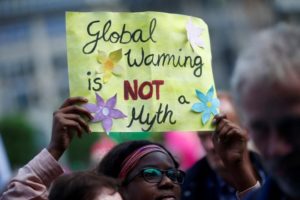
Go on and preach …

It is good that the Bahamas is making this pursuit, as a formal government initiative – it’s about time! Actually it’s past time; (see the Alternate VIDEO below).

Unfortunately, the Bahamas is so tiny – 400,000 people compared to the 7,700,000,000 global population (.0052%) – that they are not even a “pimple on the back-side of the beast” that is the world’s large population centers.

But, as related in a previous blog-commentary on December 19, 2018 by the movement behind the 2013 book Go Lean…Caribbean, small countries have “No Moral Authority” to preach to these Bigger Nations unless they themselves comply with the best-practice of using renewable energy.

“Welcome to the fight Bahamas”; now that you are taking serious the need to deploy “Solar Micro-grids”, you can stand on the soapbox and point at others. Only with these installations can you “name, blame and shame” the Big Polluters – think China, India and the USA. This was alluded by the the US-based media-television-network CBS , in their titular news magazine show 60 Minutes, in this story this week. See the VIDEO here of the 60 Minutes report:

VIDEO – Bahamas installing solar power after storms – https://www.cbsnews.com/video/bahamas-hurricanes-power-grid-solar-60-minutes-2020-03-01/

60 Minutes
Posted March 1, 2020 – A tiny country in “Hurricane Alley” is trying to be an example to the world after Category 5 storms demolished parts of its electrical grid. Bill Whitaker reports on the Bahamas’ adoption of solar energy.
Click on PLAY Button to watch; expect commercial advertising before and during.

——————-
Alternate VIDEO
60 Minutes’ first report on solar energy, in 1979
More than four decades ago, 60 Minutes reported, “Solar energy may be an idea whose time has come for all of us.” Today, the Bahamas is turning to solar arrays to restore power after Hurricane Dorian
Click here to see that 1979 VIDEO: https://www.cbsnews.com/news/60-minutes-1979-solar-energy-report-2020-03-01/

That Sunday March 1, 2020 report revealed that:

The solar systems are now cheaper than diesel power options.
The Bahamas goal is to produce 30 percent of its energy from renewable sources by 2030.

How about more … in less time.

Yes, we can …

We must “fight like our lives depend on it”. The technology is here now to produce all the energy from renewable sources for households, or businesses, or government buildings, or schools.

Do you see the trending here? We must all do something … now. What are we waiting for? The will? Well, the Bahamas seems to now have the will

… and the way.

… and the motivation – Category 5 hurricanes are a “clear and present danger”.

This is an appropriate time to Encore that previous blog-commentary from December 19, 2018 – 9 months before that devastating Category 5 Hurricane Dorian made landfall in the Northern Bahamas. Now that this is March 2020, there is the opportunity to look back at the previous submission and echo an encore appeal “we must fight like our lives depend on it”. This desperation was depicted in this 60 Minutes story. This entry is 3-of-3 in that “Look Back“. The other entries are cataloged as follows:

  1. 60 Minutes StoryBahamas Self-Made Energy Crisis
  2. 60 Minutes Story – Go Green … finally
  3. 60 Minutes Story – Moral Authority to “Name, Blame & Shame” the Big Polluters

See the Encore of that December 19, 2018 blog-commentary here-now:

———————

Go Lean Commentary5 Years Later – Climate Change: Coming so fast, so furious

A little less conversation, a little more action – Elvis Presley song

3 years ago – Paris COP21 – the world came together and devised a plan to tackle the global threat of Climate Change. This year, many of the same players came back together to implement the actions.

So we went from “planning the plan” to now “planning the action”.

This is a slow-motion response to a fast-moving threat.

This commentary is the second of a 4-part series – 2 of 4 – from the movement behind the Go Lean book in consideration of the 5 year anniversary of the book’s publication. The theme on these 4 submissions is “5 Years Later and what is the condition now“. The focus here is on the Agents of Change that the book identified: Globalization, Climate Change, Technology and the Aging Diaspora.

The first entry in this series asked the question: “Have the problems lessened, or have they intensified?

The answer is so emphatic! Climate Change has been all the rage in these 5 short years. The fast-and-furious threat is more than just academic; this is real-life and real-bad; especially for us in the Caribbean.

The other commentaries in the series are cataloged as follows:

  1. 5 Years Later: New Post Office Eco-system – Globalization issues ‘loud and clear’ now.
  2. 5 Years Later: Climate Change – Coming so fast, so furious.
  3. 5 Years Later: Technology – Caribbean fully on board.
  4. 5 Years Later: Aging Diaspora – Finding Home … anywhere.

The Go Lean book was written 5 years ago as a 5 Year Plan to reform and transform the Caribbean region. Had the plan been adopted by the regional stakeholders, then the Agents of Change would have been better addressed. The plan, or roadmap, to introduce and implement the Caribbean Union Trade Federation is still rearing to start; and while we cannot single-handedly solve Climate Change, we can better prepare the region for the heavy-lifting involved. The book describes the community ethos to adopt plus the many strategies, tactics and implementation that need to be executed.
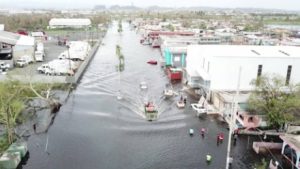
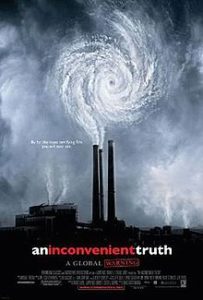
After the 2013 publication of the Go Lean book, many countries came together for COP21 (December 2015), also known as the Paris Accords. As alluded to above, this year’s follow-up, Katowice (Poland) 2018 had a few less participants for this “put speech into action” plan. See the news article about COP24 here:

News Title: Nations agree on rules for implementing Paris climate agreement
Sub-title: Nations dragged a deal over the line Saturday to implement the landmark 2015 Paris climate treaty after marathon UN talks that failed to match the ambition the world’s most vulnerable countries need to avert dangerous global warming.

Katowice, Poland – Delegates from nearly 200 states finalised a common rule book designed to deliver the Paris goals of limiting global temperature rises to well below two degrees Celsius (3.6 Fahrenheit).

“Putting together the Paris agreement work programme is a big responsibility,” said COP24 president Michal Kurtyka as he gavelled through the manual following the talks in Poland that ran deep into overtime.

“It has been a long road. We did our best to leave no-one behind.”

But environmental groups said the package agreed in the Polish mining city of Katowice lacked the bold ambition needed to protect states already dealing with devastating floods, droughts and extreme weather made worse by climate change.

“We continue to witness an irresponsible divide between the vulnerable island states and impoverished countries pitted against those who would block climate action or who are immorally failing to act fast enough,” executive director of Greenpeace Jennifer Morgan said.

The final decision text was repeatedly delayed as negotiators sought guidelines that are effective in warding off the worst threats posed by our heating planet while protecting the economies of rich and poor nations alike.

“Without a clear rulebook, we won’t see how countries are tracking, whether they are actually doing what they say they are doing,” Canada’s Environment Minister Catherine McKenna told AFP.

At their heart, negotiations were about how each nation funds action to mitigate and adapt to climate change, as well as how those actions are reported.

Developing nations wanted more clarity from richer ones over how the future climate fight will be funded and pushed for so-called “loss and damage” measures.

This would see richer countries giving money now to help deal with the effects of climate change many vulnerable states are already experiencing.

Another contentious issue was the integrity of carbon markets, looking ahead to the day when the patchwork of distinct exchanges — in China, the Europe Union, parts of the United States — may be joined up in a global system.

“To tap that potential, you have to get the rules right,” said Alex Hanafi, lead counsel for the Environmental Defense Fund in the United States.

“One of those key rules — which is the bedrock of carbon markets — is no double counting of emissions reductions.”

The Paris Agreement calls for setting up a mechanism to guard against practices that could undermine such a market, but finding a solution has proved so problematic that the debate has been kicked down the road to next year.

‘System needs to change’

One veteran observer told AFP Poland’s presidency at COP24 had left many countries out of the process and presented at-risk nations with a “take it or leave it” deal.

Progress had “been held up by Brazil, when it should have been held up by the small islands. It’s tragic.”

One of the largest disappointments for countries of all wealths and sizes was the lack of ambition to reduce emissions shown in the final COP24 text.

Most nations wanted the findings of the Intergovernmental Panel on Climate Change (IPCC) to form a key part of future planning.

It highlighted the need for carbon pollution to be slashed to nearly half by 2030 in order to hit the 1.5C target.

But the US, Saudi Arabia, Russia and Kuwait objected, leading to watered-down wording.

The final statement from the Polish COP24 presidency welcomed “the timely conclusion” of the report and invited “parties to make use of it” — hardly the ringing endorsement many nations had called for.

“There’s been a shocking lack of response to the 1.5 report,” Morgan told AFP. “You can’t come together and say you can’t do more!”

With UN talks well into their third decade sputtering on as emissions rise remorselessly, activists have stepped up grassroots campaigns of civil disobedience to speed up action on climate.

“We are not a one-off protest, we are a rebellion,” a spokesman for the Extinction Rebellion movement, which disrupted at least one ministerial event at the COP, told AFP.

“We are organising for repeated disruption, and we are targeting our governments, calling for the system change needed to deal with the crisis that we are facing.”

Source: AFP – France24 News Service – Posted December 16, 2018; retrieved December 18, 2018 from: https://www.france24.com/en/20181215-cop24-poland-climate-summit-deal-paris-climate-agreement-negotiations-un-environment

—————-

VIDEO # 1 – Nations agree on rules for implementing Paris climate agreement – https://youtu.be/SBUZS3cl2X0

FRANCE 24 English
Published on Dec 17, 2018 – Nations dragged a deal over the line Saturday to implement the landmark 2015 Paris climate treaty after marathon UN talks that failed to match the ambition the world’s most vulnerable countries need to avert dangerous global warming.

Visit our website: http://www.france24.com

FRANCE 24 live news stream: all the latest news 24/7 http://f24.my/YTliveEN

———————

VIDEO # 2 – UN climate talks: ‘A transition to a greener economy is possible’ – https://youtu.be/qqbQ1hyWc_Y

FRANCE 24 English
Uploaded on Dec 15, 2018

Subscribe to France 24 now: http://f24.my/youtubeEN

FRANCE 24 live news stream: all the latest news 24/7 http://f24.my/YTliveEN

Visit our website: http://www.france24.com

One notable absentee from Katowice has been the United States of America. This is due to the sad fact that the “Leader of the Free World” – a moniker assigned to the US President – is a Climate Change denier. Donald Trump campaigned on his denial and has manifested his dismay with subsequent actions. His blatant disregard was previously detailed in a prior Go Lean commentary from June 1, 2017, as follows:

Its June 1st, the start of the Hurricane season. According to Weather Authorities, it is going to be a tumultuous season, maybe even more destructive than last year….

Thanks Climate Change.

What hope is there to abate the threats from Climate Change?

Thanks to the Paris Accord, there is now hope; (we remember the effectiveness of the accord to abate “Acid Rain”).

But wait! The American President – Donald Trump – announces that he is withdrawing the United States from the Paris Accord. WTH?!?!

The Caribbean status quo is unsustainable under the real threats of Climate Change. The region must reboot, reform and transform. We must do the heavy-lifting ourselves; we cannot expect relief and refuge from others, like the American Super-Power. We must find and “sail” under our own power. 🙂

The Caribbean is more on the frontlines of Climate Change distress than the US – think hurricanes. We do not have the luxury to deny, defer and dispute. We must “batten down the hatches” and prepare for the worst. (Many claim this is also the disposition of many American destinations, think California forest fires). So we must take the lead ourselves for our own relief!

The Caribbean frontlines have been depicted in many previous Go Lean blog-commentaries. Consider the sample – as follows – highlighting some of the many Climate Change-infused storms that have impacted our region and others over the short timeframe – 5 years – since the publication of the Go Lean book:

https://goleancaribbean.com/blog/?p=15996 Good Governance: Stepping Up in an Emergency
October 2018 Trinidad heavy rains – not associated with a hurricane.
https://goleancaribbean.com/blog/?p=14925 ‘Climate Change’ Reality!? Numbers Don’t Lie
There is no longer any doubt, the Numbers don’t lie: the earth has had 400 straight warmer-than-average months.
https://goleancaribbean.com/blog/?p=13391 After Maria, Failed-State Indicators: Destruction and Defection
Hurricane Maria devastated Puerto Rico and other Caribbean islands. 1 year and a half later, recovery is still slow and frustrating. Islands like Dominica, are still struggling to recover; Ross University fled there to go to Barbados.
https://goleancaribbean.com/blog/?p=12996 After Irma, Failed-State Indicators: Destruction and Defection 
Hurricane Irma devastated Caribbean islands, like Saint Martin.
https://goleancaribbean.com/blog/?p=12977 After Irma, Barbuda Becomes a ‘Ghost Town’
Climate Change threats are real for the twin-island nation of Antigua and Barbuda. Barbuda is no more, after Hurricane Irma.
https://goleancaribbean.com/blog/?p=12924 Hurricane Categories – The Science
Category 5 Hurricanes – Once rare; now normal and common.
https://goleancaribbean.com/blog/?p=12879 Disaster Preparation: ‘Rinse and Repeat’
Hurricane Harvey proved that even the advanced democracy of the USA is not ready.
https://goleancaribbean.com/blog/?p=12834 Hurricane Andrew – 25 Years of Hoopla
Climate Change disasters are not new; 1992 storm was an eye-opener.
https://goleancaribbean.com/blog/?p=7896 The Logistics of Disaster Relief
Preparing for the worst” means being more efficient and technocratic.
https://goleancaribbean.com/blog/?p=7449 ‘Crap Happens’ – So What Now?
Hurricane Wilma brought chaos to this city’s economic engines in 2004.
https://goleancaribbean.com/blog/?p=6189 A Lesson in History – ‘Katrina’ is helping today’s crises
There are many lessons learned from this 2005 American disaster.
https://goleancaribbean.com/blog/?p=4741 Vanuatu and TuvaluInadequate response to human suffering
Lessons learned from these small Pacific Islands climate failures.

So it has been 5 years since the publication of the Go Lean book. Climate Change was identified as an Agent of Change that the region was struggling with and losing. Since then, conditions have worsened. The book asserts that the entire region must unite in order to “hope for the best and prepare for the worst”. The “hope” is really a call to action, that the regional neighbors would confederate and join in to the global campaign of mitigating and abating Climate Change. This aligns with the first pronouncement (Page 11) of the opening Declaration of Interdependence:

i. Whereas the earth’s climate has undeniably changed resulting in more severe tropical weather storms, it is necessary to prepare to insure the safety and security of life, property and systems of commerce in our geographical region. As nature recognizes no borders in the target of its destruction, we also must set aside border considerations in the preparation and response to these weather challenges.

The Go Lean book – a roadmap for the introduction and implementation of the technocratic Caribbean Union Trade Federation (CU) – presents a 370-page roadmap for re-booting the economic, security and governmental institutions of the 30 member-states in the Caribbean region, especially in light of the realities of Climate Change. While this is a global battle, we, the Caribbean member-states, are on the frontlines, so we must be doubly prepared for the surety of destruction from this threat. We must do our share and “Go Green” to arrest our own carbon footprint. We must not be hypocritical as we call on the Big Polluting nations to reform – we must reform ourselves, so as to have moral authority.

As detailed in a previous blog-commentary, the dire effects of Climate Change may be irreversible after the next 12 years, if we do not work to abate this disaster. So we must fight!

This is an inconvenient truth: We must fight like our lives depend on it. A product of these COP24 Katowice Accords, is now definitive plans and rules for implementing abatements around the world; carbon footprints must be reduced … globally, now!

A change has now come to the Caribbean region. This is Climate Change and it is not a good thing. Now is the time for a permanent union to provide efficient stewardship for our economic, security and governing engines. All regional stakeholders – the people and governing institutions – are hereby urged to lean-in to the empowerments described in the book Go Lean … Caribbean. Yes, we can … make our region, these islands and coastal states, better places to live, work and play.

There is the successful track record of abating environment pollution: remember Acid Rain in the 1990’s. So despite the doom and gloom, mitigation and abatement of Climate Change is conceivable, believable and achievable. 🙂

Sign the petition to lean-in for this roadmap for the Caribbean Union Trade Federation. 

Download the free e-book of Go Lean … Caribbean – now!

Share this post:
, ,
[Top]

‘Missing Solar’ – Inadequacies Exposed to the World – Encore

The Bahamas has inadequate infrastructure to contend with the realities of modern life. This is all too familiar to the people in the Bahamas.

This is also familiar to the movement behind the 2013 book Go Lean…Caribbean. On August 15, 2019, this commentary scolded the stakeholders in the Bahamas for their inexcusable inefficiency and ineffectiveness with their infrastructure and Public Works. Now last night, the US-based media-television-network company CBS exposed these inadequacies for all the world to see in their titular news magazine show 60 Minutes.

Eat Crow Bahamas!

What’s more, the actuality of Hurricane Dorian came along and made the bad Bahamas energy delivery even worse. See the VIDEO here of the 60 Minutes report:

VIDEO – Bahamas installing solar power after storms – https://www.cbsnews.com/video/bahamas-hurricanes-power-grid-solar-60-minutes-2020-03-01/

60 Minutes
Posted March 1, 2020 – A tiny country in “Hurricane Alley” is trying to be an example to the world after Category 5 storms demolished parts of its electrical grid. Bill Whitaker reports on the Bahamas’ adoption of solar energy.
Click on PLAY Button to watch; expect commercial advertising before and during.

That report revealed that:

The Bahamian Government pays $400 million dollars on diesel fuel to keep its power plants operating and pass that cost on to the consumers.
“They pay 3 to 4 times the rate that people pay in the mainland US”.

In addition, in another Go Lean commentary, it was reported that the World Bank revealed that 61 percent of college-educated citizens of the Bahamas have fled this homeland for foreign destinations. Is there any surprise? This failure to deliver basic services in an efficient and effective manner is a contributing Push factor why people leave.

There is no mystery! Now the Bahamas is trying to “play catch-up” and deploy Solar Micro-Grids. Yippee!!

This is an appropriate time to Encore that previous blog-commentary from August 15, 2019 – during the ‘Dog Days of Summer‘; (remember this was 2 weeks before Category 5 Hurricane Dorian made landfall). Now that this is March 2020, there is the opportunity to look back with 20/20 Perfect Hindsight Vision at the issues raised by the 60 Minutes story – there are many. This entry is 1-of-3 in that “Look Back“. The other entries are cataloged as follows:

  1. 60 Minutes Story – Bahamas Self-Made Energy Crisis
  2. 60 Minutes Story – Go Green … finally
  3. 60 Minutes Story – Moral Authority to “Name, Blame & Shame” the Big Polluters

See the first Encore here-now:

———————

Go Lean CommentaryNassau’s 2019 Self-Made Energy Crisis

It is seriously Hot-Hot-Hot out there …

So there is no intent here to be “cold and callous” … (callous = ‘feeling no emotion’).

But the Bahamas’s capital city – Nassau – is having an energy crisis right now:
The local power generation utility (Bahamas Power & Light or BPL) is not producing enough electricity to meet the needs of the community, so they have to load-share and force black-outs/brown-outs around the island to try and facilitate some delivery some time to all their customer base. They do not want to show favoritism to one group over another, so they are leveraging the load-sharing tactic on everybody. So now instead of some people being happy and some being angry, they have obtained universality …

… everybody is angry!

———-

VIDEO – B.P.L. Load Shedding Update – https://youtu.be/fW8JGGnlvzQ

ZNSNetwork
Published on May 15, 2019

Additionally, see this portrayal in this news article here (and the Appendix VIDEO below):

Title: BPL causing ‘chaos’
By: Jasper Ward, The Nassau Guardian Staff Reporter

Super Value food stores are taking a significant hit as a result of protracted power cuts, according to its owner Rupert Roberts.

Roberts said about six Super Value locations are impacted by outages daily and the company has spent around $100,000 recently on replacing equipment damaged by the outages.
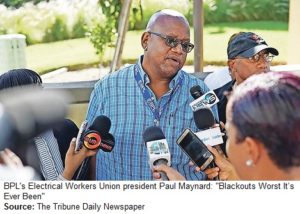
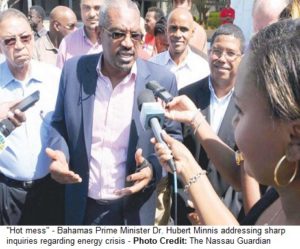
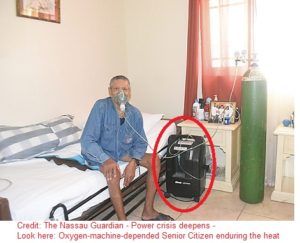
He described the outages as “a nuisance” and said they create “chaos”.

“This BEC (Bahamas Electricity Corporation) crisis is more than a crisis, it’s chaos,” Roberts said at the Nassau Street store.

“It’s costing us $250,000 a year from burning up our equipment.”

He said, “I suppose our biggest concern is burning up equipment.

“…[We] burn up a $10,000 or $20,000 air conditioning [unit and] we’re always burning up compressors. We’re using up spares so fast and we’re doing emergency imports.

“Fortunately, we’re able to get them in within three or four days without flying them in. But I noticed on Saturday we had a diary case down because we’re waiting on the compressor that burned out. That’s the biggest problem.”

Roberts said it will cost about $10,000 to replace a compressor in the dairy case at the Nassau Street location. He said it is unlikely that case will be operational before Saturday.

Roberts said dairy sales were up 14 percent before the case was damaged.

Since it was damaged, sales have gone down 17 percent, he said.

Roberts said the company has twice the amount of equipment needed “because of the serious problem” of the outages.

Although the food store chain is facing challenges with the outages, Roberts said the company is “managing quite well”.

“We’ve been in this business over 50 years and we’ve had power problems for the last 50 years,” he said.

“So, we learned how to cope. We don’t run out of fuel. Years ago, when I first started in the industry, we had generators because of hurricanes but for the past 25 years we’ve had to have generators because of power outages.”

For nearly two months, communities on New Providence have experienced hours-long blackouts as part of Bahamas Power and Light’s (BPL) load shedding exercise.

Over the last few weeks, BPL has conducted nearly four-hour-long load shedding.

On Sunday, BPL Chief Executive Officer Whitney Heastie said he could not guarantee an end to load shedding exercises in the immediate future, describing BPL as being “on a cliff”.

Heastie said BPL needs 250 megawatts of generation in order to meet the summer demand.

However, it is currently running on 210 megawatts, including 105 megawatts of rental generation.

Heastie said the 40-megawatt shortfall has led to load shedding across New Providence.

Source: Posted by The Nassau Guardian daily newspaper on August 13, 2019; retrieved August 14, 2019 from: https://thenassauguardian.com/2019/08/13/bpl-causing-chaos/

The need to explain that our statement is not “cold and callous” is due to the fact that the appearance is that “we” are ‘kicking the people when they are down’ when we make this assertion:

This energy crisis for Nassau is Self-Made!!

Wait, what?!

This is a matter of infrastructure and Nassau has had an inadequate infrastructure for a while. In fact, since the 1970’s residents on this island of New Providence (NP) have been encouraged to buy bottled-water and not consume the ‘tap’ water.

All of this is evident of the lacking municipal infrastructure. In fact, this is reminiscent of the US City of Flint, Michigan. Their infrastructure has become defective and the people there has to resort to bottled water. In Flint, that problem has now persisted for 4 years. In Nassau, it has been 40 years. (See an excerpt of our 2016 blog-commentary on the Flint crisis in the Appendix below).

Yep, self-made!

This is a BIGGER issue than water or electricity; this is an issue of the Social Contract.

The 2013 book Go Lean…Caribbean (Page 170) defines the Social Contract as the informal arrangement where citizens surrender some of their freedoms and submit to the authority of the State in exchange for protection of remaining natural and legal rights. This is why the State, in this case, the Commonwealth of the Bahamas, is allowed to operate monopolies for the water and power utilities. But any failures in these Social Contract deliveries causes repercussions and consequences. For example people leave and abandon their homeland. This relevance was detailed in a previous Go Lean commentary from July 28, 2015:

The issue of Caribbean citizens abandoning their homelands is one of the more dire threats to societal life in the region. Why do they do it?

“Push and Pull” reasons!

Push
Conditions at home drive Caribbean citizens to take flight and find refuge elsewhere. Many times these conditions are economic (jobs and entrepreneurial opportunities), security and governance related, but there are other reasons too; consider discriminations due to ethnic diversity or other lifestyle choices.

Lastly, there is the new threat of Climate Change. While this is a threat for the whole world, the Caribbean is on the frontline. Though there is some debate as to the causes of climate change, there is no question as to its outcome: temperatures are rising, droughts prevail, and most devastating, hurricanes are now more threatening. A Caribbean elevation plan must address the causes of climate change and most assuredly its consequences. …

Now, the anecdotal experience is that there is a need to mitigate excessive heat in the region for an even longer season. How do we mitigate excessive heat?

Air conditioning!

But this cure may at times be worse than the disease.

Air conditioning requires even greater energy consumption, (the Caribbean has among the highest energy costs in the Western Hemisphere); the Go Lean book posits that the average costs of energy can be decreased from an average of US$0.35/kWh to US$0.088/kWh in the course of the 5-year term of this roadmap; (Page 100).

In addition, the release of Chlorofluorocarbons (CFC’s) in the air-conditioning process is a contributor of greenhouse gases into the atmosphere.

The status quo needs remediation!

The Bahamas should have remediated these infrastructural problems years ago – the price is too high to allow it to linger. In addition to the societal abandonment threat; there are life-and-death issues associated with convalescing citizens needing continuous power supply – see photo here:

That’s the problem, now what is the solution?

In addition to the voluminous number of blog-commentaries on infrastructure – see this recent submission from July 26, 2019 – the Go Lean book presented strategies, tactics and implementations that must be pursued, not just for the Bahamas, but for the whole Caribbean region – all 30 member-states. In fact, the book presents one advocacy (Page 176) specifically focused on Public Works, entitled: “10 Ways to Impact Public Works“. These “10 Ways” include the following highlights, headlines and excerpts:

1 Lean-in for the Caribbean Union Trade Federation (CU).

The CU is chartered to unify the Caribbean region into one Single Market of 42 million people across 30 member-states, thereby re-engineering the economic engines in and on behalf of the region, including a currency & monetary union. This new eco-system allows for the design, funding and construction of Public Works and Infrastructural projects. The federal agency within the CU’s Department of the Interior has the scope for the Caribbean much like the Corps of Engineers has for the US. (Plus the CU will collaborate with the US Corps for projects related to Puerto Rico and the Virgin Islands).

There are a number of inter-state projects that must be coordinated on the federal level. There will also be projects that are “Too Big for One State” that will be facilitated by the CU. In addition, all CU efforts must comply with the Art in Public Places mandate, so sculptures and statutes will be embedded in projects or the project itself can be a work of art (bridges, water towers, building architecture). For existing projects that fail due to financial shortfalls, the CU will accommodate dissolution or reorganization in the federal courts, bringing balance to the process to all stakeholders.

2 Union Atlantic Turnpike
3 Pipelines and PCP (Pneumatic Capsule Pipeline)
4 Regional Power Grid

The CU will facilitate the installation of a regional power grid, and power sharing between member-states, with underwater and above-ground high-intensity wiring to alternate energy plants: wind/tidal turbines, solar panel & natural gas.

5 Self-Governing Entities (SGE)
6 Enterprise Zones
7 Empowerment Zones
8 Monopolies

The UN grants the CU the monopoly rights for an Exclusive Economic Zone, so the focus must be on quality delivery.

The CU plan is to liberalize management of monopolies, with tools like ratings/rankings against best practices. Plus

technological accommodations for ICT allows for cross-competition from different modes (satellite, cable, phone).

9 Cooperatives

The CU will task utility cooperatives with the delivery of some public utilities such as Air Chillers; Refrigerated Warehouses to its members. This strategy shares the cost of the “Works” installation across the full co-op membership.

10 Capital Markets

A single market and currency union will allow for the emergence of viable capital markets for stocks and bonds (public and private), thereby creating the economic engine to fuel growth and development. This forges financial products for “pre” disaster project funding (drainage, levies, dykes, sea walls) and post disaster recovery (reinsurance sidecars).

The Go Lean book doubles-down on the concept of leveraging across a larger population base so that BIGGER infrastructure projects can be facilitated in the region – on land or in the waters – see Photo here. Imagine large arrays of solar panels, wind turbines, tidal generators, geo-thermal energy captured at the volcanic hot zones, and even Natural Gas as a cleaner-cheaper fossil fuel. These energy options are realistic and should be available to us now in the Caribbean, so they should be explored and deployed. This, a regional power grid, is the energy prime directive for this Go Lean movement.

This theme – exploiting alternative options for the economic, security and governing empowerments in the region – aligns with many previous Go Lean commentaries; see a sample list here:

https://goleancaribbean.com/blog/?p=17925 ‘We’ have repeatedly failed the lessons from ‘Infrastructure 101’
https://goleancaribbean.com/blog/?p=17280 Way Forward – For Energy: ‘Trade’ Winds
https://goleancaribbean.com/blog/?p=13985 EU Assists Barbados in Renewable Energy Self-Sufficiency
https://goleancaribbean.com/blog/?p=12994 The Science of ‘Power Restoration’
https://goleancaribbean.com/blog/?p=12466 12 Caribbean Member-states have ‘Volcanic Energy’ to Exploit
https://goleancaribbean.com/blog/?p=10367 The Science of Sustenance – Green Batteries
https://goleancaribbean.com/blog/?p=5155 Green Energy Solution: Tesla unveils super-battery to power homes
https://goleancaribbean.com/blog/?p=4897 US Backs LNG Distribution for Caribbean Energy Solutions
https://goleancaribbean.com/blog/?p=915 Go ‘Green’ … Caribbean

Make no mistake, energy is a basic need!

The failure for a community to have continuous supply of energy is an energy crisis. (This means you Bahamas).

Enough already!

Now is the time for all Caribbean stakeholders to prepare for the empowerments of Green-Energy solutions. It is past-time for a regional power grid:

  • generation – Green options (solar, wind turbines, tidal, geo-thermal and natural gas)
  • distribution – Underwater cables to connect individual islands
  • consumption – efficient battery back-ups for home deployments.

These changes are coming … one way or another.

For you government revenue institutions who may be overly dependent of fuel taxes and surcharges – you are hereby put on notice:

Changes are afoot. We will succeed; we will make our Caribbean homeland a better place to live, work and play.

🙂

About the Book

The book Go Lean…Caribbean serves as a roadmap for the introduction and implementation of the technocratic Caribbean Union Trade Federation (CU), for the elevation of Caribbean society – for all member-states. This CU/Go Lean roadmap has these 3 prime directives:

  • Optimization of the economic engines in order to grow the regional economy to $800 Billion and create 2.2 million new jobs.
  • Establishment of a security apparatus to ensure public safety and protect the resultant economic engines.
  • Improve Caribbean governance to support these engines, including a separation-of-powers between the member-states and CU federal agencies.

The Go Lean book provides 370-pages of turn-by-turn instructions on “how” to adopt new community ethos, plus the strategies, tactics, implementations and advocacies to execute so as to reboot, reform and transform the societal engines of Caribbean society.

Download the free e-Book of Go Lean … Caribbean – now!

Who We Are
The movement behind the Go Lean book – a non-partisan, apolitical, religiously-neutral Community Development Foundation chartered for the purpose of empowering and re-booting economic engines – stresses that reforming and transforming the Caribbean societal engines must be a regional pursuit. This was an early motivation for the roadmap, as pronounced in the opening Declaration of Interdependence (Pages 12 – 13):

xi. Whereas all men are entitled to the benefits of good governance in a free society, “new guards” must be enacted to dissuade the emergence of incompetence, corruption, nepotism and cronyism at the peril of the people’s best interest. The Federation must guarantee the executions of a social contract between government and the governed.

xvi. Whereas security of our homeland is inextricably linked to prosperity of the homeland, the economic and security interest of the region needs to be aligned under the same governance. Since economic crimes … can imperil the functioning of the wheels of commerce for all the citizenry, the accedence of this Federation must equip the security apparatus with the tools and techniques for predictive and proactive interdictions.

xxiv. Whereas a free market economy can be induced and spurred for continuous progress, the Federation must install the controls to better manage aspects of the economy: jobs, inflation, savings rate, investments and other economic principles. Thereby attracting direct foreign investment because of the stability and vibrancy of our economy.

Sign the petition to lean-in for this roadmap for the Caribbean Union Trade Federation.

——————–

Appendix VIDEOAnother B.P.L. Blackouthttps://youtu.be/fOT0gfvSchM

ZNSNetwork
Published on Jul 2, 2019

——————–

Appendix – Excerpts from previous Commentary: Flint, Michigan – A Cautionary Tale – January 19, 2016

[The City of] Flint serves as a “cautionary tale” for other communities near “Failed City/Failed State” status. From this perspective, this community may be a valuable asset to the rest of the world and especially to the Caribbean.

CU Blog - Flint, Michigan - A cautionary tale - Photo 3The publishers of the book Go Lean…Caribbean are here in Detroit to “observe and report” the turn-around and rebirth of the once-great-but-now-distressed City of Detroit and its metropolitan areas, including Flint. (Previous commentaries featured the positive role model of the City of Ann Arbor).

What happened here?

According to the Timeline in the Appendix, Flint, MI suffered this fate as a chain reaction to its Failed-State status. Outside stakeholders – Emergency Managers – came into the equation to execute a recovery plan with focus only on the Bottom-Line. The consideration for people – the Greater Good – came second, if at all. They switched water sources, unwisely!

The assertion of the Go Lean book is that the Caribbean region can benefit from lessons learned from Good, Bad and Ugly governance. The book serves as a roadmap for the introduction and implementation of the technocratic Caribbean Union Trade Federation (CU). The Go Lean book and related commentaries call on citizens of the Caribbean member-states to lean-in to the empowerments described in the roadmap for elevation. This will require a constant vigil to ensure the Greater Good as opposed to personal gains.

See VIDEO here of the story in the national media …

VIDEO – Citizens’ Anger Continues Over Toxic Water in Flint, Michigan – http://abcnews.go.com/WNT/video/citizens-anger-continues-toxic-water-flint-michigan-36348795

This tragic story – cautionary tale of Flint – is an analysis of failure in the societal engines of economics, security and governance. These 3 facets are presented in the book Go Lean … Caribbean as the three-fold cord for societal harmony; for any society anywhere. The Caribbean wants societal harmony; we must therefore work to optimize all these three engines. As exhibited by Flint, this is easier said than done. This heavy-lifting is described in the book as both an art and a science.

The focus in this commentary is a continuation in the study of the societal engine of governance; previously, there was a series on economics and one on security. This commentary though, focuses on the bad eventually of Social Contract failures. The Social Contract refers to the unspoken expectations between citizens and the State. In many cases, State laws limit ownership of all mineral rights to the State; so citizens will be dependent on State systems to supply water. In the case of Flint, the City’s Water and Sewage Department has a monopoly; this supply is the only option for residents!

The Go Lean book describes “bad actors” wreaking havoc on the peace and security of the community. The book relates though that “bad actors” are not always human; they include bad events like natural disasters and industrial spills. Plus, actual “bad actors” may have started out with altruistic motives, good intentions. This is why the book and accompanying blogs design the organization structures for the new Caribbean with checks-and-balances, mandating a collaborative process, because sometimes even a well-intentioned individual may not have all the insight, hindsight and foresight necessary to pursue the Greater Good. This the defect of the Michigan Emergency Manager structure; it assigns too much power to just one person, bypassing the benefits of a collaborative process. This is one reason why this review is important: power corrupts…everyone … everywhere.

We must do better, than Flint! (Flint must do better; too many lives are involved).

We know that “bad actors and bad incidences” will always occur, even in government institutions, so we must be “on guard” against abusive influences and encroachments to Failed-State status. The Go Lean roadmap calls for engagement and participation from everyone, the people (citizens), institutions and government officials alike. We encouraged all with benevolent motives to lean-in to this roadmap, to get involved to effect a turnaround for the Caribbean Failed-States.
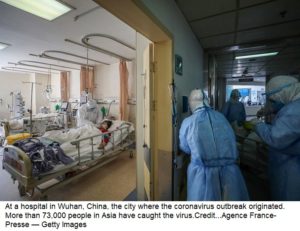
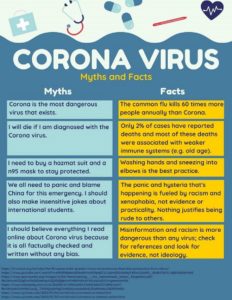
Our Caribbean stakeholders deserve the best … from their leaders.  🙂

Share this post:
, , , ,
[Top]

Coronavirus – Facts and Fictions

Go Lean Commentary

There is a serious threat in the world … one that is imperiling life and systems of commerce: Coronavirus; see this news story-highlights, and related VIDEO here:

Title: Coronavirus is deadlier than flu, study finds
The fatality rate of the new coronavirus is far higher than that of the seasonal flu, according to a new analysis from the Chinese Center for Disease Control and Prevention.

The study found a fatality rate of 2.3 percent in China as of last week, though later figures suggest the rate has increased. In the U.S., flu fatality rates hover around 0.1 percent. Here are the latest updates and maps of where the virus has spread.

Yesterday: Americans flown home from a contaminated cruise ship in Japan said they were unaware until late that some evacuees were infected. “I didn’t know until we were in the air,” said Carol Montgomery. “I saw an area of plastic sheeting and tape.”

Closer look: Cambodia’s decision to let hundreds of passengers leave another cruise ship on which a person was infected could dramatically complicate the effort to contain the virus.

Another angle: HSBC, one of Hong Kong’s most important banks, said today that it would cut 35,000 jobs over the next three years, in part because of disruptions caused by the outbreak. On Monday, Apple cut its quarterly sales expectations and warned that the virus threatened global supply chains.

Related: The Tokyo Marathon, which planned to accept about 38,000 runners, will be restricted to about 200 elite participants. The race is scheduled for March 1.

Source: New York Times – Retrieved February 18, 2020 from: https://www.nytimes.com/2020/02/18/briefing/coronavirus-michael-bloomberg-boy-scouts.html

———–

VIDEO – China Coronavirus Death Toll Rises to 2,118 –  https://youtu.be/a_WeUpwJNVA

Bloomberg Markets and Finance
Feb.19 — China is saying the death toll from the coronavirus has climbed to 2,118, with the total amount of cases reaching 74,576. Bloomberg’s Tom Mackenzie and Yvonne Man report on “Bloomberg Markets: Asia.”

As with many threats in society, there abounds a lot of misinformation, half-truths and outright lies. Consider:

  • This new Coronavirus started in Wuhan Province, China. But not all Chinese are affected. In fact with a population of 1.4 billion, the near 75,000 afflicted people worldwide is less than 1/10 of 1 percent.
  • There have been previous Coronavirus strains. (Older cans of Lysol spray declare that they kill “coronavirus”; see photo below).
  • The disease is not automatically fatal – only 2,118 people have died so far – mostly those advanced in age and/or with depressed immune systems. Many more die every year with the “normal” seasonal flu.
  • Not all Chinese people are from China – Sinophone people amount to 1.5 Billion. Few Chinese Diaspora have had any exposure to the ailment.
  • The disease does not live away from mammals. Chinese made products pose no threats.
  • Communist China does not allow people to freely leave China, even under normal circumstances, unless there is some special reason to do so. Hong Kong is a Special Administrative region, governed like a separate country. The freedoms of movement there are not equated on the mainland.
  • Flu Season has a limited shelf-life; it is expected to naturally end in the northern hemisphere by late Spring 2020.
  • No Caribbean area cruise ships or passengers have been affected – the potential risk is not abated.

This disease poses a danger; there is the need for remediation and mitigation. There is the need for a hero … we need a hero. This sounds so much like a song from my formative years.

I’m holding out for a hero ’til the end of the night
He’s gotta be strong
And he’s gotta be fast
And he’s gotta be fresh from the fight
I need a hero
I’m holding out for a hero ’til the morning light
He’s gotta be sure
And it’s gotta be soon
And he’s gotta be larger than life
(Song by Bonnie Tyler 1984; see VIDEO & Lyrics at 
https://youtu.be/OBwS66EBUcY; see Appendix)

Alas, there is no hero … for this peril. There is no Superman, no Wonder Woman, no Avengers nor Captain Marvel. The remediation and mitigation that we need will not be miraculous; it must simply come from … us. Yes, we can … do the heavy-lifting ourselves to protect our society.

This was the quest as related in the 2013 book Go Lean…Caribbean. The book surveyed the world scene and saw the need for the 30 member-states of the Caribbean region to confederate, collaborate, consolidate its efforts to be able to deal with an actuality like this Coronavirus Epidemic.

We need that vision now!

The book related that a roadmap must be put in place to introduce and implement a deputized agency, a federal technocracy to act on behalf of all these countries and to do the heavy-lifting of Homeland Security, to remediate and mitigate all threats, foreign and domestic; this would naturally include Disease Control and Management. That roadmap called for the Caribbean Union Trade Federation (CU), with a Cabinet-level Department of Health. The functionalities of this “Security Apparatus” is described as follows:

  • Strategies – Comparing Strategies – Healthcare –vs- Bush Medicine (Page 50)
    The CU plans calls for some health care reform, under the guise of homeland and economic security, emergency management and cross border initiatives (disease management and organ transplantation).
  • Tactical – Separation of Powers –  I2: Department of Health – Disease Control & Management (Page 86)
    Due to the systemic threat, epidemic response and disease control will be coordinated at the CU level. This agency will manage the detailed inventory needs of pharmaceuticals (vaccinations, etc.) so that the Group Purchasing Organization can negotiate for volume-wholesale pricing/discounts and delivery schedules on the regional level.
    The data associated with Flu Shots, Vaccinations, STDs should be mined and published by the CU.
    This agency will also sponsor Disease Management schemes to identify, educate, treat patients with chronic diseases like diabetes, asthma, heart, COPD, and other ailments that tend to have no cure, but the affected could prosper with proper management.
  • Advocacy – 10 Ways to Improve Healthcare – Public Health Extension (Page 156)
    Due to the systemic threat, epidemic response and disease control will be coordinated at the federal level. Also, the acquisition of public-bound pharmaceuticals (vaccinations, etc.) can be negotiated at the regional level, using the Group Purchasing Organizations (GPO) envisioned in this roadmap. This will lead to a better supply and pricing dynamics. …
  • Advocacy – 10 Ways to Impact Cancer – Public Health Administration (Page 157)
    Not all [disease] cancer is hereditary or tied to lifestyle (smoking, obesity, diet), sometimes there are environmental agents. The CU treaty grants jurisdiction for systemic threats, epidemic response and/or disease control. Despite the pro-business ethos, the CU will assuage any threat of new/existing industrial endeavors with thorough environmental impact studies.

We have been here before …

This is turning out to be a very dangerous disease outbreak – an epidemic. However, this is not the first one … for the world or even to originate from China. In fact, Coronavirus is being compared sharply to the 2003 crisis with the SARS epidemic that imperiled Hong Kong. See  this excerpt from a previous blog-commentary on SARS:

A Lesson in History – SARS in Hong Kong
Sadly, we report – though it is only a reminder – that there is no cure for the common cold; nor its more debilitating “Big Brother”, influenza or “the flu”.

Sometimes the flu is just the flu. Symptoms may include cough, sore throat, fever, myalgia (muscle pain), and lethargy (fatigue or drowsiness, or prolonged sleep patterns). Unfortunately this normal start for influenza may morph into more serious concerns. For example, consider the SARS epidemic of 2003; see Appendix A.  The same symptoms, above, were the applicable descriptors at the start of the SARS outbreak.

Why would anyone think of anything more than the common/annual flu? How can a community – the Caribbean region in this case – manage such an epidemiological crisis?

For this, we have a well-documented lesson from Hong Kong in 2003. There is much for us to learn from this lesson in history.

The people, institutions and governance of the Caribbean need to pay more than the usual attention to the lessons of SARS in Hong Kong, not just from the medical perspective (see Appendix B), but also from an economic viewpoint.

During the “heyday” of the SARS crisis, travel and transport to Hong Kong virtually came to a grinding halt! Hong Kong had previously enjoyed up to 14 million visitors annually; they were a gateway to the world. The SARS epidemic became a pandemic because of this status. Within weeks of the outbreak, SARS had spread from Hong Kong to infect individuals in 37 countries in early 2003.

Prior to this SARS outbreak, the WHO [(World Health Organization)] had developed a Pandemic War Plan, reserved for the worst situations; see this link here, [which was presented then as Appendix C].  This features strategies and tasks to identify, isolate and eradicate a major virus outbreak … at the start. But the War Plan presents a cautionary warning: should the disease ever escape the isolation attempts, the result could be socio-economic disaster, with millions dead.

The possibility of this warning is the motivation of this commentary and the Go Lean movement.

In general, the CU will employ its own “War Plan”; its strategies, tactics and implementations to impact its prime directives. …

The issue in this commentary relates to economics, security and economic security; in effect this is a governance issue. This is an issue of business continuity for the region. …

The Go Lean movement posits that wisdom, prudence and best practices can be adopted by careful study of complex matters. This is defined … as a hallmark of a technocracy.

The Coronavirus is a serious threat; this is not the first and may not be the last! This is why the Go Lean movement urges the Caribbean to prepare now, with the implementation of the technocratic CU Trade Federation and its related agencies. How? Well, the book Go Lean…Caribbean – available to download for free – provides 370 pages of step-by step directions.

The points of effective, technocratic medical stewardship, gleaned from facts in medical and economic history, were further elaborated upon in these previous blog/commentaries:

https://goleancaribbean.com/blog/?p=15310 Industrial Reboot – Trauma 101
https://goleancaribbean.com/blog/?p=8943 Zika’s Drug Breakthrough
https://goleancaribbean.com/blog/?p=7822 Doing More in the Fight Against Cancer
https://goleancaribbean.com/blog/?p=7430 Brazilian Shrunken Head Babies: Zika or Tdap?
https://goleancaribbean.com/blog/?p=7327 Zika – A 4-Letter Word
https://goleancaribbean.com/blog/?p=5002 Managing a ‘Clear and Present Danger’
https://goleancaribbean.com/blog/?p=2397 Stopping Ebola
https://goleancaribbean.com/blog/?p=1003 Painful and rapid spread of Chikungunya virus in the Caribbean

Let’s hope this new Coronavirus threat subsides … soon.

The Go Lean movement (book and subsequent blog-commentaries) stresses that reforming and transforming the Caribbean societal engines must be a regional pursuit; no one member-states has the prowess to tackle these potential pandemics – like Coronavirus – alone. Therefore, we must heed the warnings in advance and prepare our economic, security and governing eco-system.

Tongue-in-cheek reference to Caribbean Cruises amidst the Coronavirus Outbreak

We must learn from China.

“There but for the Grace of God go I” – Old Expression

The Caribbean is very dependent on tourism. Our way of life would not endure so well if we were at the epicenter of Coronavirus, or some similar pandemic; so we empathize and sympathize with China.

Heavy-lifting indeed …

This is why the Go Lean book (Page 10) advocates for the people and governing entities of the Caribbean member-states …

… “to provide new guards for their future security” …

… by deputizing the authority and responsibility to the CU Trade Federation to do the heavy-lifting of protecting the member-states during pandemics. As related in a previous blog-commentary:

If there is a load you have to bear
That you can’t carry
I’m right up the road
I’ll share your load
If you just call me

This is how we make our homeland a better place to live, work and play. 🙂

About the Book
The book Go Lean…Caribbean serves as a roadmap for the introduction and implementation of the technocratic Caribbean Union Trade Federation (CU), for the elevation of Caribbean society – for all member-states. This CU/Go Lean roadmap has these 3 prime directives:

  • Optimization of the economic engines in order to grow the regional economy to $800 Billion & create 2.2 million new jobs.
  • Establishment of a security apparatus to ensure public safety and protect the resultant economic engines.
  • Improve Caribbean governance to support these engines, including a separation-of-powers between the member-states and CU federal agencies.

The Go Lean book provides 370-pages of turn-by-turn instructions on “how” to adopt new community ethos, plus the strategies, tactics, implementations and advocacies to execute so as to reboot, reform and transform the societal engines of Caribbean society.

Download the free e-Book of Go Lean … Caribbean – now!

Who We Are
The movement behind the Go Lean book – a non-partisan, apolitical, religiously-neutral Community Development Foundation chartered for the purpose of empowering and re-booting economic engines – stresses that reforming and transforming the Caribbean societal engines must be a regional pursuit. This was an early motivation for the roadmap, as pronounced in the opening Declaration of Interdependence (Pages 11 – 13):

ix. Whereas the realities of healthcare and an aging population cannot be ignored and cannot be afforded without some advanced mitigation, the Federation must arrange for health plans to consolidate premiums of both healthy and sickly people across the wider base of the entire Caribbean population. The mitigation should extend further to disease management, wellness, mental health, obesity and smoking cessation programs. …

x. Whereas we are surrounded and allied to nations of larger proportions in land mass, populations, and treasuries, elements in their societies may have ill-intent in their pursuits, at the expense of the safety and security of our citizens. We must therefore appoint “new guards” to ensure our public safety and threats against our society, both domestic and foreign. The Federation must employ the latest advances and best practices of criminology and penology to assuage continuous threats against public safety. …

xi. Whereas all men are entitled to the benefits of good governance in a free society, “new guards” must be enacted to dissuade the emergence of incompetence, corruption, nepotism and cronyism at the peril of the people’s best interest. The Federation must guarantee the executions of a social contract between government and the governed.

xvi. Whereas security of our homeland is inextricably linked to prosperity of the homeland, the economic and security interest of the region needs to be aligned under the same governance. Since economic crimes … can imperil the functioning of the wheels of commerce for all the citizenry, the accedence of this Federation must equip the security apparatus with the tools and techniques for predictive and proactive interdictions.

xxiv.  Whereas a free market economy can be induced and spurred for continuous progress, the Federation must install the controls to better manage aspects of the economy: jobs, inflation, savings rate, investments and other economic principles. Thereby attracting direct foreign investment because of the stability and vibrancy of our economy.

Sign the petition to lean-in for this roadmap for the Caribbean Union Trade Federation.

Share this post:
, ,
[Top]

Cursed in Paradise – ‘Enriquillo’ Fault-line

Go Lean Commentary

The Caribbean is the “greatest address on the planet … “

We have said this repeatedly; the Creator has blessed this region with such beauty.

Yet, we must confess, considering a religious argument: “The Gods must be crazy” … putting such a beautiful place in the middle of a dangerous Earthquake Fault-line. This refers to the Enriquillo Fault-line across the Greater Antilles in the Caribbean archipelago – see Photo here:

This is not just a theory; this is actuality. We have this news headline now: “7.7 Earthquake north of Jamaica”. So, crediting Godly devotion again, maybe the earthquake activity is some kind of Divine Retribution?

Retribution of what?

Well, just like the Curse of Montezuma or Curse of the Bambino, there were some egregious atrocities that maybe had to be prosecuted-reconciled-remediated for justice from some higher authority (God). Therefore, the thesis is that there is a “curse on this landmass for retribution against the ‘powers that be’ for the inflictions against the indigenous people and their leader Enriquillo”. See those details here on the Enriquillo namesake and the encyclopedic reference of the Fault-line in the Appendix below:

Reference: Enriquillo
Good relations between Christopher Columbus and the indigenous Taíno of the large island Columbus called Hispaniola did not last more than a few days. The Taínos were forced into terrible conditions as laborers in gold mining operations, badly housed in the mountains, poorly fed, extremely overworked, and forced to live in close quarters with the Spaniards.[5] Additionally, due to taking men away from the villages, the cycle of food production was disrupted, causing widespread malnutrition.[5] This malnutrition further aided the Taínos’ vulnerability to deadly new types of diseases introduced by the foreigners.[5] After Columbus tortured and killed many in his quest for gold, he turned to slavery and sugar cane plantations as a way to profit from his voyages.

Several revolts followed in the first half of the 16th century, the most famous began in 1519. Enriquillo, one of the few remaining caciques, or indigenous chiefs, started the revolt with a large number of Taínos from the mountain range of Bahoruco. The Tainos were able to continue the rebellion because of their better knowledge of the region.[6] As the Spaniards were not able to control the rebellion, a treaty was signed granting to the Native population among others the right of Freedom and of Possession. It had little consequences, however, as by this time the Native population was rapidly declining due to European diseases.

Enriquillo, also known as “Enrique” by the Spaniards, was a Taíno cacique [(Tribal Chief)] who rebelled against the Spaniards between 1519 and 1533. Enriquillo’s rebellion is the best known rebellion of the early Caribbean period. He is also considered a hero in the modern day Dominican Republic and Haiti for his resistance in favor of the indigenous peoples.[1] Dominican friar Bartolome de Las Casas, who documented and rallied against Spanish abuse of the indigenous, wrote sympathetically of Enriquillo.[2]

His father, his aunt Anacaona, and eighty other regional chieftains were killed by Nicolás de Ovando while attending supposed “peace talks” with the Spanish in Jaragua. During the talks, Spanish soldiers ambushed the chieftains, also known as caciques, set the meeting house on fire, and then proceeded to kill anyone who fled the flames (causing his father’s death). Enriquillo, an orphan, was later raised in a Santo Domingo monastery and given the name of “Enrico” [3]. One of his mentors was Bartolomé de Las Casas. De Las Casas was a Spanish Roman Catholic Priest focused on the rights of Native Americans. [4]

Enriquillo also had a wife, called Mencía, later with the noble title Doña due to Enriquillo’s high standing and relations with the Spaniards. She was raped by a Spaniard named Valenzuela. When Enriquillo tried to take the issue to the Spanish courts, nothing could be done, since it was Doña Mencia’s word against the Spaniard’s word. This, according to some writers, was the tipping point for Enriquillo which led to his revolt in the Bahoruco mountains.
Source: Retrieved January 29, 2020 from: https://en.wikipedia.org/wiki/Enriquillo

Theory, thesis, religious inference – Yada Yada!

It is what it is – these earthquakes are real! We must simply prepare. This is quest of the movement behind the 2013 book Go Lean…Caribbean; the book stated (Page 23):

c-7. “Crap” Happens
Economic security is tied to the community quest to reboot the Caribbean region to ensure a better place to live, work and play. To ensure economic security, the economic engines must be protected to ensure their continuous operations despite natural or man-made deterrents. Bad things do happen to good people, so we cannot be caught unprepared. We must institute the process and provisions to respond, react, restore and recover. Any and everyone may need to dial “911”.

The Caribbean community ethos is to consider the facts and realities:

  1. climate change cannot be dismissed – tropical storms are now more common and more ferocious;
  2. there are two geologic fault-lines that run through the Caribbean region;
  3. there is an active volcano on Montserrat.

It is not a matter of “if” but “when” emergencies will strike. The security principle therefore is to be prepared for all incidents, big and small, that involve all aspects of society: islands, institutions, companies, families and individuals.

As related in the foregoing headline – 7.7 Earthquake north of Jamaica – this is of serious concern. This seismic activity had its epicenter in the middle of the Caribbean Sea, away from land, but spurring the threat of a tsunami in one place after another. Everyone is On Alert. See this actuality depicted in this news story here:

Title: Mag 7.7 quake hits between Cuba and Jamaica, but no injuries
Sub-title:
A powerful magnitude 7.7 earthquake has struck in the Caribbean Sea between Jamaica and eastern Cuba
By: Michael Weissenstein, Associated Press
HAVANA – A powerful magnitude 7.7 earthquake struck in the Caribbean Sea between Jamaica and eastern Cuba on Tuesday, shaking a vast area from Mexico to Florida and beyond, but there were no reports of casualties or heavy damage.

The quake was centered 139 kilometers (86 miles) northwest of Montego Bay, Jamaica, and 140 kilometers (87 miles) west-southwest of Niquero, Cuba, according to the U.S. Geological Survey. It hit at 2:10 p.m. (1910 GMT) and the epicenter was a relatively shallow 10 kilometers (6 miles) beneath the surface.

Dr. Enrique Arango Arias, head of Cuba’s National Seismological Service, told state media that there had been no serious damage or injuries reported.

Gov. Carlos Joaquín González of Mexico’s Quintana Roo, which is home to Cancun, Tulum and other popular beach resorts, said the earthquake was felt in multiple parts of the low-lying Caribbean state but there were no early reports of damage or injuries.

The Pacific Tsunami Warning Center initially warned that the quake could generate waves 1 to 3 feet above normal in Cuba, Jamaica, the Cayman Islands, Honduras, Mexico and Belize, but issued a later message saying the danger had passed.

The initial tremor was followed by a series of strong aftershocks, including one measured at magnitude 6.1.

The quake was felt strongly in Santiago, the largest city in eastern Cuba, said Belkis Guerrero, who works in a Roman Catholic cultural center in the center of Santiago

“We were all sitting and we felt the chairs move,” she said. “We heard the noise of everything moving around.”

She said there was no apparent damage in the heart of the colonial city.

“It felt very strong but it doesn’t look like anything happened,’’ she told The Associated Press.

It was also felt a little farther east at the U.S. Navy base at Guantanamo Bay, Cuba, on the southeastern coast of the island. There were no immediate reports of injuries or damages, said J. Overton, a spokesman for the installation, which has a total population of about 6,000 people.

Several South Florida buildings were evacuated as a precaution, according to city of Miami and Miami-Dade County officials. No injuries or road closures were reported. No shaking was felt at the Hard Rock stadium in Miami Gardens, which will host the Super Bowl on Sunday.

The quake also hit the Cayman Islands, leaving cracked roads and what appeared to be sewage spilling from cracked mains. There were no immediate reports of deaths, injuries or more severe damage, said Kevin Morales, editor-in-chief of the Cayman Compass newspaper.

The islands experience so few earthquakes that newsroom staff were puzzled when it hit, he said.

“It was just like a big dump truck was rolling past,” Morales said. “Then it continued and got more intense.”

Dr. Stenette Davis, a psychiatrist at a Cayman Islands hospital, said she saw manhole covers blown off by the force of the quake, and sewage exploding into the street, but no more serious damage.

Claude Diedrick, 71, who owns a fencing business in Montego Bay, said he was sitting in his vehicle reading when the earth began to sway.

“It felt to me like I was on a bridge and like there were two or three heavy trucks and the bridge was rocking but there were no trucks,” he said.

He said he had seen no damage around his home in northern Jamaica.

Mexico’s National Seismological Service reported that the quake was felt in five states including as far away as Veracruz, on the country’s Gulf Coast.

————— Associated Press writer Kate Chappell in Kingston, Jamaica, contributed to this report.

Source: Posted & Retrieved January 28, 2020 from: https://abcnews.go.com/International/wireStory/powerful-earthquake-hits-cuba-jamaica-68592066

Considering the geological science of earthquakes, we know there are main shocks and after-shocks. Some geologists also credit pre-shocks, where minor seismic activities come as a prelude to main shocks. See more on the “Science of Earthquakes” in this VIDEO here:

VIDEOWhat is an earthquake? https://abcn.ws/2M4FtKM

An earthquake is caused when two blocks of earth slip past each other on a fault plane, according to the US Geological Survey.

The Richter Scale is exponential between the numbers 3 and 8, so 7.7 is very strong … and dangerous.

There truly have been pre-shocks leading up to this “7.7 Earthquake north of Jamaica”; consider this related story:

2020 Puerto Rico Earthquakes
At the end of December 2019 and in early January 2020, the southwestern part of the island of Puerto Rico was struck by an earthquake swarm,[1] including six that were of magnitude 5 or greater.[2] The largest and most damaging of this sequence occurred on January 7 at 04:24 AST (08:24 UTC) and had a magnitude of 6.4 Mw and a maximum felt intensity of VII (Very strong) on the Modified Mercalli intensity scale.[3] At least one person was killed and several others were injured.[4][5]

A 5.8 Mw  earthquake the previous day caused the destruction of a natural arch, a tourist attraction at Punta Ventana in Guayanilla.[6] A 5.9 Mw  aftershock on Saturday, January 11, damaged many structures, including several historical buildings as well as modern high-rises in the city of Ponce.[7]

Power was lost Island-wide immediately after the quake, and was increasingly restored over a period of a week. Damage to homes was extensive and, by 14 January, more than 8,000 people were homeless and camping outdoors in various types of shelters, with 40,000 others camping outside their homes, just in the city of Ponce alone.[8]

Needless to say, the Enriquillo Fault-line has been very active in these recent days. To all Caribbean stakeholders, we urge:

Be afraid; be very afraid.

This is the same fault-line that devastated Haiti in January 2010 – almost 10 years exactly – plus many other times in the past. The Go Lean movement and organization originated in response to that unmitigated disaster. See this salient reference to it in the Go Lean book (Page 115):

The Bottom Line on the Haiti’s Earthquakes

As of 2010, the following major earthquakes have been recorded in Haiti, along the Enriquillo or Septentrional-Oriente faults:

  • 1564: Quake destroyed Concepción de la Vega and Santiago de los Caballeros.
  • 1701: On November 9, severe destruction occurred and “part of the area along the north shore of the Tiburon Peninsula from Logane to Petit Goave sank into the sea”.
  • 1751 Port-au-Prince earthquake (18 October): According to French historian Moreau de Saint-Méry, “only one masonry building had not collapsed” in Port-au-Prince, Haiti’s capital city.
  • 1770 Port-au-Prince earthquake (3 June): The city was leveled in this magnitude 7.5 quake, killing over 200 people.
  • 1783: A strong quake partially destroyed the church in Santiago.
  • 1842 Cap-Haitien earthquake (7 May): An earthquake destroyed the city of Cap-Haïtien and other towns in the north of Haiti and the Dominican Republic; this earthquake also destroyed the Sans-Souci Palace. 10,000 people were killed. It has been estimated that its magnitude was 8.1.
  • 1946 Dominican Republic earthquake (4 August): This 8.0-magnitude quake in Samaná also shook Haiti horrifically, producing a tsunami that killed 1,600 people.
  • 2010 Haiti earthquake (12 January):. The epicenter of this magnitude 7.0 Mw earthquake was near Léogâne, approximately 16 miles west of Port-au-Prince at a depth of 8.1 miles. The United States Geological Survey recorded a series of at least 33 aftershocks, 14 of which were between magnitudes 5.0 and 5.9. The International Red Cross estimated that about three million people were affected by the quake; the Haitian Government reports that over 316,000 people had been identified as dead, an estimated 300,000 injured, and an estimated 1,000,000 homeless.

Based on this observation, one can hypothesize the theory of: “An accursed land, indeed”!

Yet still, the Go Lean promoters assert – in a previous blog-commentary – that we do not want our people abandoning home, seeking refuge elsewhere. We can reform and transform the homeland to better prepare for the eventualities of Mother Nature. See that message here:

The movement behind the book Go Lean…Caribbean is standing up, stepping up and speaking up:

  • “… Here I am, send me” – The Bible; Isaiah 6:8 (New International Version: Then I heard the voice of the Lord saying, “Whom shall I send? And who will go for us?” And I said, “Here am I. Send me!”)

The basic premise of the economic analysis in the Go Lean book is that we need our population to stay, remain and return to the Caribbean; the more people we have in the market the better.

What is it that we can do to reform and transform for earthquakes? The Go Lean book relates (Page 76), in introducing the Caribbean Union Trade Federation (CU) as a technocracy to plan and respond to natural disasters. See this excerpt here:

B4 – Emergency Management
This area is perhaps one of the most important functions of the CU. The Emergency Management Department will coordinate the planning, response, rebuilding and recovery before, during and after natural disasters and other emergency events. This is the risk management arm of the CU Trade Federation. As such, the scope of Emergency Management will also include education, mentoring, monitoring, mitigation, licensing and coordination of all volunteer activities.

The scope of this department also includes a number of proactive initiatives: (1). establishing and administering volunteer fire/rescue departments for sparsely populated areas; and (2). installing/maintaining emergency notification systems. In ancient cultures there is the practice of ringing a bell, a church bell or one at the town square, to alert the community of an imminent threat. A lot of western democracies embrace the same tactic with more modern technologies, such as audible alarms/sirens.

The imminent threat includes tornado landfall warning, tsunami, mudslide, volcano eruption, etc. The CU will extend this practice further by installing a standard audible siren system for any/all emergency events. A great lesson learned from the US Midwestern city of Omaha-Nebraska is the schedule for siren testing, the first Wednesday every month at 11:00am.
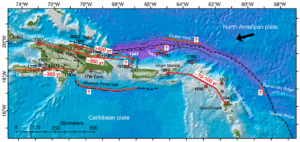
A best practice for Emergency Management is electronic notification. This includes an Emergency Broadcasting/Alert system for TV and radio. Plus now the latest advance is the use of telephone/internet and contact center technologies, allowing features like Reverse 911 – automated/robo calls to every active phone in a location – and text message blasting to every cell phone. With the embrace of www.myCaribbean.gov, the CU can target an alert message to any & every email address, social media screen names, or provide Pop-up Screens for internet browsing sessions for all IP addresses in the strike area.

As such, the scope of natural emergencies covered by this agency will cover more than hurricanes. As such, earthquakes, tsunamis, volcanoes, flooding, forest fires, and droughts will also be monitored, managed and responded to. (These have all been experienced recently in the Caribbean).

Emergencies also include the man-made variety as in industrial (oil spills, factory accidents, chemical spills), explosions, terroristic attacks and prison riots. The purpose of the Trade Federation is to enhance the economic engines of the region. While the #1 economic driver in the region is tourism, any poorly managed episode of “man-made” emergencies will have devastating effects on tourist bookings. Therefore, the CU must respond quickly, forcefully and professionally to contain the physical and image damage that can occur from these incidents.

Though not exclusive, this agency will coordinate its specialized services, skill-sets and occupations like Paramedic, EMT, Search-and-Rescue, Canine (K-9) with other governing (law enforcement) entities. Regional training will therefore be coordinated, licensed, and certified by this CU Emergency Management Department.

This Emergency Management agency will also coordinate the training and management of animal responders, in conjunction with the other federal agencies of Justice, Agriculture, Interior (Parks). The animals will include bomb sniffing dogs, cadaver dogs, drug dogs and mounted police horses.

There is also an economic/financial scope for this department. As the effort for a comprehensive property-casualty fund to cover the entire Caribbean region will also be coordinated by this agency. The classic solution is a large pool of premium payers and claims filed by the affected area. Beyond this model, there are also advanced products like re-issuance side-cars for market assimilation. The public can then invest and profit from the threat/realization of regional risks. This derivative product is a bet, a gamble, but in the end, the result is an insurance fund of last resort, much like the Joint Underwriters Agency (JUA) in Florida.

The Go Lean movement has addressed the subject of Earthquakes and Emergency Management on many occasions. See this sample of the many previous blog-commentaries here:

https://goleancaribbean.com/blog/?p=18182 Disaster Relief: Helping, Not Hurting
https://goleancaribbean.com/blog/?p=17373 A Marshall Plan for Haiti – Finally
https://goleancaribbean.com/blog/?p=15996 Good Governance: Stepping Up in an Emergency
https://goleancaribbean.com/blog/?p=15267 Industrial Reboot – Prefab (Earthquake Tolerant) Housing 101
https://goleancaribbean.com/blog/?p=13974 The Spoken and Unspoken on Haiti
https://goleancaribbean.com/blog/?p=2614 Modeling the ‘Great ShakeOut’ Earthquake Drill
https://goleancaribbean.com/blog/?p=87 6.5M Earthquake Shakes Eastern Caribbean

“Here I am send me”? That sounds similar to the mantra “To Change the World, Start With Me”!

While not subscribing to any religious dogma, “it is what it is”, the End of Days Prophecies in the Bible seem to have validity – Matthew 24: 3, 7:

3 What will be the sign … of the Last Days?
7 Nation will rise against nation, and kingdom against kingdom. There will be famines and earthquakes in various places.

So we must simply be more resilient and responsive to earthquakes – and tsunamis. There is no reason to expect any less activity.

So let’s get busy …  let’s prepare our homes, families, communities, nations and region for the eventuality of this Enriquillo Fault-line (and other geologic weak-points that are undeniable in our homeland).

Most importantly, let’s lean-in to this Go Lean roadmap – this is the Way Forward for Caribbean Disaster Preparation and Response – and finally make our region, each of the 30 Caribbean member-states, a better place to live, work and play. 🙂

About the Book
The book Go Lean…Caribbean serves as a roadmap for the introduction and implementation of the technocratic Caribbean Union Trade Federation (CU), for the elevation of Caribbean society – for all member-states. This CU/Go Lean roadmap has these 3 prime directives:

  • Optimization of the economic engines in order to grow the regional economy to $800 Billion & create 2.2 million new jobs.
  • Establishment of a security apparatus to ensure public safety and protect the resultant economic engines.
  • Improve Caribbean governance to support these engines, including a separation-of-powers between the member-states and CU federal agencies.

The Go Lean book provides 370-pages of turn-by-turn instructions on “how” to adopt new community ethos, plus the strategies, tactics, implementations and advocacies to execute so as to reboot, reform and transform the societal engines of Caribbean society.

Download the free e-Book of Go Lean … Caribbean – now!

Who We Are
The movement behind the Go Lean book – a non-partisan, apolitical, religiously-neutral Community Development Foundation chartered for the purpose of empowering and re-booting economic engines – stresses that reforming and transforming the Caribbean societal engines must be a regional pursuit. This was an early motivation for the roadmap, as pronounced in the opening Declaration of Interdependence (Pages 11 – 13):

ii. Whereas the natural formation of the landmass for our lands constitutes some extreme seismic activity, it is our responsibility and ours alone to provide, protect and promote our society to coexist, prepare and recover from the realities of nature’s occurrences.

xi. Whereas all men are entitled to the benefits of good governance in a free society, “new guards” must be enacted to dissuade the emergence of incompetence, corruption, nepotism and cronyism at the peril of the people’s best interest. The Federation must guarantee the executions of a social contract between government and the governed.

xvi. Whereas security of our homeland is inextricably linked to prosperity of the homeland, the economic and security interest of the region needs to be aligned under the same governance. Since economic crimes … can imperil the functioning of the wheels of commerce for all the citizenry, the ccidence of this Federation must equip the security apparatus with the tools and techniques for predictive and proactive interdictions.

xix. Whereas our legacy in recent times is one of societal abandonment, it is imperative that incentives and encouragement be put in place to first dissuade the human flight, and then entice and welcome the return of our Diaspora back to our shores. This repatriation should be effected with the appropriate guards so as not to imperil the lives and securities of the repatriated citizens or the communities they inhabit. …

xxiv. Whereas a free market economy can be induced and spurred for continuous progress, the Federation must install the controls to better manage aspects of the economy: jobs, inflation, savings rate, investments and other economic principles. Thereby attracting direct foreign investment because of the stability and vibrancy of our economy.

Sign the petition to lean-in for this roadmap for the Caribbean Union Trade Federation. 

——————

Appendix – Enriquillo–Plantain Garden Fault Zone

The Enriquillo–Plantain Garden fault zone (EPGFZ or EPGZ) is a system of active coaxial left lateral-moving strike slip faults which runs along the southern side of the island of Hispaniola, where Haiti and the Dominican Republic are located.[1] The EPGFZ is named for Lake Enriquillo in the Dominican Republic where the fault zone emerges, and extends across the southern portion of Hispaniola through the Caribbean to the region of the Plantain Garden River in Jamaica.

Geology
The EPGFZ shares approximately half of the relative motion between the North American and Caribbean tectonic plates with the Septentrional-Oriente fault zone which runs along the northern side of Hispaniola. Both faults merge into the Cayman Trench to the west. The fault accommodates about 20.6±1.66 millimeters of lateral motion per year (mm/yr).[2] Additionally, a component of compression is present as the North American Plate pushes toward the southwest. This results in vertical deformation manifest in the mountainous terrain of Hispaniola. Some researchers believe that the EPGFZ and the Septentrional-Orient fault zone bound a microplate, dubbed the Gonâve Microplate, a 190,000 km2 (73,000 sq mi) area of the northern Caribbean Plate that is in the process of shearing off the Caribbean Plate and accreting to the North America Plate.[3]

[Prominent] Earthquakes

Other historical large earthquakes in 1860, 1761, 1684, 1673, and 1618 are also likely attributed to the EPGFZ, though none of these have been confirmed in the field as associated with this fault.[7]

Source: Retrieved January 29, 2020 from: https://en.wikipedia.org/wiki/Enriquillo%E2%80%93Plantain_Garden_fault_zone

Share this post:
, , , ,
[Top]