Tag: Jobs

Scheduling in the ‘Gig Economy’

Go Lean Commentary

“There’s work at the Post Office Too” – Grandmother character in 1987 Movie Hollywood Shuffle; see Appendix.

That iconic line from this 30-year movie is mindful of the transformation taking place in the modern American economy. Despite all the changes in technologies and habits, there is always “honorable” work available in the service industry. Any reference to the Post Office of 1987 can be replaced today with the Gig Economy.

Gig Economy?

Oh yes, this is all the rage! This is the future! This is now! The Gig Economy refers to …

… an environment in which temporary positions are common and organizations contract with independent workers for short-term engagements. The trend toward a Gig Economy has begun. A study by [financial software company] Intuit predicted that by 2020, 40 percent of American workers would be independent contractors. – Source

This trend now needs to come to the Caribbean as we need jobs …

  • Full-time jobs
  • Part-time jobs
  • Gigs

See the Press Release here of the planning and organization dynamics needed to manage the Gig Economy. This Press Release is from the American company Aspect Software; they are the world’s leading enterprise cloud contact center & workforce optimization solution. See an excerpt here:

Title: Scheduling in the Gig Economy
By: Mike Bourke, Aspect Software SVP & General Manager for Workforce Optimization

In 50 cities across the U.S., Amazon is supplementing their USPS deliveries at times of peak demand using drivers contracting directly with Amazon in a program called Amazon Flex. Tapping for-hire drivers, each batch of deliveries is essentially a “gig” in the quickly growing trend of the Gig Economy. Popularized by Uber and Lyft, the Gig Economy pairs independent, on-demand contractors with organizations for short-term engagements. With Amazon Flex, the company uses a mobile app for drivers to post their personal preferred schedules, which can include very short availability windows. Amazon then displays available “blocks” of time for making deliveries. The driver selects a block, and at the designated time, goes to the local pickup location to start deliveries.

Other industries are quickly catching on for services such as furniture moving, dog walking and at-home makeup styling and the contact center isn’t far behind.

In the contact center, you can think of customer contacts as representing the work to be done (or the packages to be delivered in the case of Amazon). The times when customer contacts arrive and are completed create the opportunities when Gigs are available for contact center employees. Historically, most contact center agents have been employed as regular 40 hour/week full-time employees, even though their schedules might be erratic as call volumes rise and fall throughout the week. However, that history is yielding to pressures from many different directions that point to a very different future for a sizeable percentage of the agent population. Consider the following factors that make the Gig Economy attractive for agents and businesses.

Mutual Benefits of the Gig Economy

  • Businesses Reduce Expenses – Using independent contractors in the contact center or any other type of business, can reduce the cost of employees by 30% because the employer is not required to pay benefits such as payroll taxes, worker’s comp insurance, unemployment insurance, vacation time or health benefits.
  • Employees Can Work-at-Home – The Gig Economy is already in full swing in some segments of the contact center industry. The 25% annual growth of work-at-home (WAH) agents is nothing short of spectacular and is a bellwether for the future of the contact center industry.  Offering both the ability to work remotely and part-time, WAH could be the future of the contact center industry.  With the growing adoption of telecommuting in many businesses, why not for agents?  WAH also creates part-time work for a whole segment of the population with physical disabilities, childcare issues or poor commuting options.  With more part-time workers, contact centers also have a more agile workforce that can ramp up and down quickly, matching contact center staffing to call volumes   WAH has huge momentum, and its growth will help make part-time contact center work commonplace.
  • Businesses Can Access Specialized Skills – In the past few years, technology has finally advanced to the point where it is a good substitute for a human conversation. And since 81% of customers prefer self-service to agent assisted service, the simpler work will eventually go to automated self-service, and only the more complex tasks will go to agents. Studies show that 95% of agents are only willing to drive up to 30 minutes to work.  For more specialized skills, contact centers may need to reach out beyond that current geographic boundary, further stimulating the need for part-time work-at-home agents.
  • Employees Get Flexible Schedules – Millennials have surpassed Baby Boomers as the nation’s largest living generation, and contact centers are rife with them. It’s well known that Millennials dearly value their work-life balance, and that means that they want to easily flex their work schedules around their personal lives.  Many value complete control over their work schedule above a higher income and/or benefits, and that’s the perfect profile of an Uber driver or part-time contact center agent.
  • Businesses Can Manage Volume Spikes – Millennials are also, “always on”. They literally sleep with their cell phones, and their need to be always connected makes them perfectly accessible for notifications about unpredictable contact center “gigs” when volumes spike.  The contact center can reach out to them anytime concerning a few hours of potential work with a good chance that the receiving Millennial got the message on his or her cell phone and read it.

Implications for Workforce Management Software
To empower agents with this flexibility and control while still meeting the needs of the business, the contact center needs to adopt new WFO tools, training, infrastructure, recruiting and management practices.  This new model for labor participation especially requires a new set of contact center workforce management processes and associated technologies optimized for the quality of the service you want to deliver to customers.

The forecasting portion of WFM remains essentially the same in the Gig Economy.  We still need to accurately predict the level of demand for staff for each type of work.  But scheduling of individuals for the work predicted is quite different.  We need new work rules such as:

  • What is the minimum length of a work session? It takes a few minutes to connect to contact control and CRM and other necessary systems, and some amount of time to successfully resolve a customer’s contact as well as do any wrap up work. For example, if your average contact handling time is 14 minutes, you won’t want to allow employees to end up with a work session that is only 10 minutes long.
  • How much time-off must be allowed between work sessions? There is a cost to disconnecting from systems and connecting again and mentally getting up to speed to successfully work with customers.
  • What is the maximum allowable time that can be worked per day and week? In the Gig Economy, we must manage this issue as well based on regional employment limitations.

These rules then determine the inventory of blocks of time (or gigs) that can be offered to each agent.

In the traditional world of agent scheduling, agents have wanted predictable schedules with fixed shifts.  Schedules would remain the same every day for a known period of time.  Usually, customer volumes would change faster than the ability of these inflexible blocks to adapt, so contact centers would often need to overstaff to preserve SLAs.  In the Gig Economy world, the workforce management system makes available shorter schedule blocks with a wider range of start times from which agents can choose.  An agent can likely find some blocks that work well for his or her desired flexible schedule.  On the flip side, if an agent wants a full 40 hour week, he or she will likely have to pick schedules from some unpopular times.  Likewise, if the business allows agents to work shifts that are irregular and unconventional, there are likely to be gaps in coverage that will need to be filled by requiring inconvenient shifts to be worked by some agents.  Of course, these unpopular times could be more highly compensated if labor laws allow, or they can be gamified, awarding tokens that can be traded in for vacation days or other awards.  Also, peak times may be a target for incentives, and some companies may even require some selection of peak times before selecting other more flexible gig times.

See the remainder of the article here:

http://blogs.aspect.com/scheduling-in-the-gig-economy/ posted January 12, 2018; retrieved February 7, 2018.
——–
About the Author
Mike Bourke is Aspect’s Senior Vice President and General Manager of Workforce Optimization. Mike is responsible for charting the strategic direction, and continuing the momentum of Aspect’s global workforce optimization suite and continuing the solution’s availability in the Aspect Cloud.

This Press Release identified Amazon … again. They are one of the “early adopters”, movers-and-shakers of the art-and-science of the Gig Economy. Amazon is also a mover-and-shaker in many other areas of job creation. As related in a previous Go Lean commentary, the Amazon model should really be studied by the economic stewards for a new Caribbean. That blog related:

Amazon is not just a giant on the internet, in the areas of electronic commerce. No they are emerging as a giant in the real world as well. The company has over 380,000 employees worldwide and 40,000+ at their Seattle, Washington USA headquarters. That is a BIG corporate presence. In fact, economic analysts had tabulated the Gross Domestic Product (GDP) contribution to Seattle at $US 38 Billion. Wow!

There is always work at the Post Office (USPS) and now Amazon is supplementing their USPS deliveries at times of peak demand by using drivers who contract directly with their Amazon Flex program.

We now have a “clear path” of what we need to do to optimize the Caribbean economic and job-creation engines. “Clear paths” are important ingredients for roadmaps. The book Go Lean…Caribbean serves as a roadmap for the introduction and implementation of the technocratic Caribbean Union Trade Federation (CU) and also the Caribbean Postal Union (CPU), which is modeled after Amazon.

The Go Lean/CU roadmap is designed to elevate the Caribbean’s societal engines starting first with economics (jobs, industrial development and entrepreneurial opportunities). In fact, the following 3 statements are identified as the prime directives of the CU:

  • Optimization of the economic engines in order to grow the regional economy to $800 Billion & create 2.2 million new jobs.
  • Establishment of a security apparatus to protect the resultant economic engines.
  • Improve Caribbean governance to support these other engines.

As related in the foregoing Press Release, to embrace the Gig Economy there is the need to keep an eye on Technology. In the Go Lean book, this dynamic is identified as an “Agent of Change“ in modern society. The Go Lean roadmap also seeks to introduce the tactical use of incubators. This is explained in the book (Page 28) as the process and engagement of programs to support the successful development of entrepreneurial companies through an array of business support resources and services. We need more expressions of the Gig Economy in our Caribbean region.

Amazon is embracing the Gig Economy. The Caribbean needs to embrace the Gig Economy. The Caribbean needs to follow Amazon’s model and incubate these arts-and-sciences. While Amazon’s modus operandi is not to be an incubator, they have invested heavily in many other tech-related companies and technical concepts, including the Workforce Management products from Aspect Software (highlighted in the foregoing Press Release). While Aspect is not the only provider, following their lead means assimilating advanced concepts, strategies, tactics and implementations. This assimilation means adopting a new “community ethos”. This is what is defined in the Go Lean book as “community ethos”:

  1. The fundamental character or spirit of a culture; the underlying sentiment that informs the beliefs, customs, or practices of a group or society; dominant assumptions of a people or period.
  2. The character or disposition of a community, group, person, etc.

We need this community ethos – and the accompanying technocratic stewardship – in the Caribbean so that we can incubate more and more jobs, especially in the Gig Economy! In total, we can create 2.2 million new jobs.

The 370-pages of the Go Lean book stresses some specific community ethos that the region needs to adopt, plus the strategies, tactics, implementations and advocacies to reform and transform the economic engines of Caribbean society. The required technocratic stewardship for the region’s economic engines was presented early in the book with these opening pronouncements in the Declaration of Interdependence (Page 13 and 14):

xxiv. Whereas a free market economy can be induced and spurred for continuous progress, the Federation must install the controls to better manage aspects of the economy: jobs, inflation, savings rate, investments and other economic principles. Thereby attracting direct foreign investment because of the stability and vibrancy of our economy.

xxvii. Whereas the region has endured a spectator status during the Industrial Revolution, we cannot stand on the sidelines of this new economy, the Information Revolution. Rather, the Federation must embrace all the tenets of Internet Communications Technology (ICT) to serve as an equalizing element in competition with the rest of the world. The Federation must bridge the digital divide and promote the community ethos that research/development is valuable and must be promoted and incentivized for adoption.

The points of effective, technocratic stewardship were further elaborated upon in previous blog-commentaries. Consider this sample of submissions that stressed the eco-systems of job-creation, gigs and incubation:

https://goleancaribbean.com/blog/?p=13916 Model of ‘Gig Economy’ – Mother’s Love in Haiti
https://goleancaribbean.com/blog/?p=13420 A Lesson in History – Community Incubation for Whaling
https://goleancaribbean.com/blog/?p=8262 UberEverything in Africa – Model of ‘Gigs’
https://goleancaribbean.com/blog/?p=7991 Transformations: Caribbean Postal Union – Delivering the Future
https://goleancaribbean.com/blog/?p=2857 Model of ‘Gig Economy’ – Entrepreneurism in Junk
https://goleancaribbean.com/blog/?p=2571 AirBnB ‘Gig Economy’ Options Materializing
https://goleancaribbean.com/blog/?p=528 Facebook’s advances for e-Commerce payments

In addition, previous blog-commentaries also elaborated on the business model of Amazon. See these samples as follows:

https://goleancaribbean.com/blog/?p=13627 Amazon: Then and Now
https://goleancaribbean.com/blog/?p=13091 Amazon Opens Search for HQ2
https://goleancaribbean.com/blog/?p=12291 Big Tech’s Amazon – The Retailers’ Enemy
https://goleancaribbean.com/blog/?p=11358 Retail Apocalypse – Preparing for the Inevitable
https://goleancaribbean.com/blog/?p=7297 Death of the ‘Department Store’: Exaggerated or Eventual
https://goleancaribbean.com/blog/?p=7023 Thanksgiving & American Commerce – Past, Present and Amazon
https://goleancaribbean.com/blog/?p=1416 Model of an E-Commerce Fulfillment Company: Amazon

For the Caribbean, let’s pay attention to Amazon, and the development of the Gig Economy. Let’s do the Gig Economy. Let’s incubate!

Let’s lean-in and learn how incubator programs are structured by community stewards to create jobs and entrepreneurial opportunities. We need them … here at home! We need them now!

The lessons we learned will help us elevate from our past dysfunctions and build a better future. We must learn, if we want to make our homelands better places to live, work and play. This is our quest! 🙂

Download the free e-book of Go Lean … Caribbean – now!

Sign the petition to lean-in for the roadmap for the Caribbean Union Trade Federation.

———-

Appendix VIDEO – Movie: Hollywood Shuffle (1987) Clip – https://youtu.be/XXaZQ5tlY40

Published July 24, 2015 – About the movie

An actor limited to stereotypical roles because of his ethnicity, dreams of making it big as a highly respected performer. As he makes his rounds, the film takes a satiric look at African American actors in Hollywood. Written, produced, directed and starring Robert Townsend, – Source: IMDB.com
Share this post:
, , , , ,

Haiti – Beauty ‘Only a Mother Can Love’

Go Lean Commentary

The Caribbean is among the most beautiful addresses on the planet.

Consider the tropical islands, coastal beaches, waterscapes, flora, fauna, etc.

This is true among most of the Caribbean member-states in the region …

… Haiti, not included! (Just yet! Stay tuned!)

While this country has some beautiful terrain, poverty and mis-management has sullied a lot of its natural beauty. In some places, Haiti is a land where “only a mother can love”.

Yet still, many mothers have stepped in, stepped up and are showing love to this land!

May we all be inspired by their examples. Consider the news story in this article here:

Title: These Haitian women were doing great in U.S. — and then returned to aid quake-hit nation

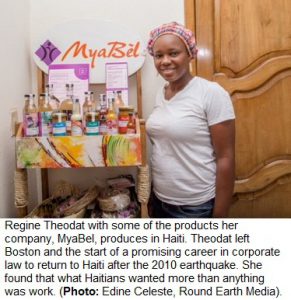
Croix-Des-Bouquets, Haiti — Regine Theodat had just passed the bar exam and at 25 years old was beginning a promising, if predictable, career in U.S. corporate law. She went to work, to spin class, home and to bed.

“Wake up and repeat,” she recalled. “I was very much a corporate lawyer — very strait-laced; not very adventurous.”

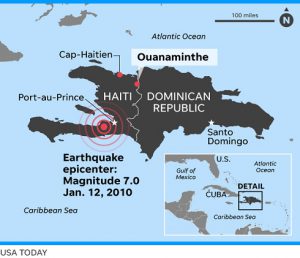
Then on Jan. 12, 2010, a magnitude-7.0 earthquake struck Haiti, killing hundreds of thousands of people. And the child of immigrants who left Haiti for greater opportunities did something shocking. She traded her comfortable life in Boston for the chaos of the poorest country in the Americas.

Aid groups and volunteers from around the world also poured into Haiti. Most have left. But eight years later, Theodat is still here.

She is among a small army, most of them women, who returned to Haiti and started businesses. Theodat makes food and cocktails. Another woman supplies castor oil beauty products to North American stores, including Whole Foods. Some of the others sell fruit smoothies, jewelry and chocolate.
More Haitians may soon be returning from the U.S., but not voluntarily. The Trump administration announced in November that “temporary protected status” for 59,000 Haitians will end in 2019. Many will have limited opportunities back home. VIDEO

What’s more, remittances make up almost a third of Haiti’s GDP, so for each person deported, several local people suffer. For those with education, drive and money, however, moving back is a chance to create jobs and help change practices that many believe perpetuate poverty.

Family members thought Theodat was insane for going back to a country they’d left in the 1980s.

“They said, ‘She’ll be back. The first demonstration that happens, she’ll be back. The first rocks she sees thrown, she’ll be back,’” she said. She has indeed seen a lot, but she has stayed.

Theodat spent her first year running a human rights clinic, until she found out that Haitians really wanted something else. “People kept asking me for jobs,” she said.

So she teamed up with two collaborators from her human right work, including a man she later married. They launched MyaBèl, a restaurant and cocktail bar in Croix-des-Bouquets, the hometown of Theodat’s family located northeast of Port-au-Prince.

Then they started bottling drinks and sauces in a middle-class house on a dirt side street and began a farm to supply fresh ingredients.

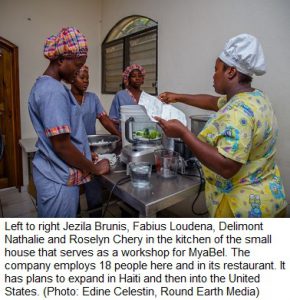
MyaBèl now sells products at more than a dozen Haitian supermarkets and boutiques. It employs 18 people and works with 65 farmers. This year, Theodat was nominated for an entrepreneur of the year award.

Jezila Brunis, 37, a single mother of three, makes minimum wage, about $5.50 a day, in the workshop. She’s able to send her children to school, and she likes the process of washing and chopping ingredients, feeding them into mixers and cooking them on a stove-top. “I’m always learning new things,” she said.
Even paying the minimum is a challenge because other costs — generators, fuel, imports and wear-and-tear on vehicles — are extremely high, Theodat said. Hiring and managing people is difficult because so few held jobs before, and they often fail to do basics, such as keeping kitchen doors closed, getting to work on time and finishing tasks quickly. Five out of the restaurant’s original six employees lost their jobs.

Most Haitians subsist in part on farms or work informally, so unemployment is hard to measure. But the World Bank says almost 60% of Haiti’s 11 million people live in poverty. In May, the insurance company FM Global rated Haiti the worst place to do business among 130 countries it studied.

Theodat came face-to-face with endemic corruption the first time she went to pay taxes. She was told she needed to pay someone to speed up the process. “I refused,” she said. “And then I just sat there until I was able to do it the way I was supposed to do it.” She did the same with immigration and customs.

Some of the émigrés couldn’t cut it. “They came, they tried, Haiti pummeled them, and they left,” said Isabelle Clérié, who came home to work with local entrepreneurs after studying anthropology in the U.S. “Some were able to stick it out, and through some truly big challenges.”

“One of the most valuable exports from Haiti is our brains,” she said. “It’s been really great to see these people come back.”

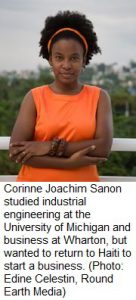
Unlike Theodat, Corinne Joachim Sanon long planned to start a business in Haiti. She grew up in Port-au-Prince, graduated from high school at 16 and headed to the University of Michigan to study industrial engineering. She was in Wharton’s business program when the earthquake struck, destroying her family home and killing her grandmother.

She launched Askanya, Haiti’s first bean-to-bar chocolate company, in her grandmother’s childhood home in Ouanaminthe, a town on the border with the Dominican Republic. The company works with cacao and sugar cooperatives representing more than 3,000 growers and employs 10 people full time.

One of them is Jocelyne Diomètre, 34, who had been a maid in the Dominican Republic and hated the hassle of crossing the border every day. At Askanya, she is working in her own country for the first time.

Askanya sells bars at scores of locations across Haiti and the U.S. Boosted by recognition at festivals in Seattle and Paris, Joachim Sanon is looking to expand production and double its number of growers.

MyaBèl is also growing, clearing and planting more than 30 acres of idle land. It is planning to hire local people to make machines for the workshop. Theodat said the company must increase production to meet local demand and then start exporting to the U.S., creating more jobs.

Theodat and Joachim Sanon know that returning émigrés can’t end poverty in Haiti. “I don’t think I’m going to go to bed and wake up and Haiti is going to be totally different,” Theodat said.

Refusing to take part in corruption might result in incremental change. Theodat also believes the more collaborative style of émigrés has been rubbing off on their local counterparts.

Joachim Sanon is encouraged that a Haitian company is now competing with Askanya by selling high-end chocolate bars. “Sometimes you want to see someone else succeed first before you try to put your toe in the water,” she said.

“It’s definitely changing the image of Haiti,” she said. “It creates a momentum.”

—–
Contributing: Michel Joseph. 

This story was produced in association with Round Earth Media, which trains and supports young journalists around the world.

Source: USA Today – Posted December 22, 2017; retrieved January 9, 2017 from:

https://www.usatoday.com/story/news/world/2017/12/22/these-haitian-women-were-doing-great-u-s-and-then-returned-aid-quake-hit-nation/938639001/ 

Related: Trump administration to send Haiti earthquake victims home in 2019 – See Appendix VIDEO below.

This commentary is about Haiti’s community re-development, jobs, image and pride. Plus the “Sheroes” who are transforming the country!

This foregoing article aligns with the movement behind the book Go Lean…Caribbean – available to download for free. The movement double-downs on the homeland; it advocates for the Caribbean Diaspora – like the above “Sheroes” – to return to their communities and for in-country residents to not leave in the first place. While no society is perfect anywhere in the world, the Go Lean book posits that the Caribbean is easier to reform and transform. Plus the inherent beauty of the islands, coastal states, cultures and hospitality makes the heavy-lifting to transform our community worth all the effort and sacrifice.

There is no doubt that Haiti has seen a lot of dysfunction; the country flirts with Failed-State status. But change is afoot – see A Supplication for Haiti in the Appendix below – here comes that change: “New Guards”. The Go Lean book serves as a roadmap for the introduction and implementation of the technocratic Caribbean Union Trade Federation (CU), for the elevation of Caribbean society – New Guards for all member-states. This CU/Go Lean roadmap has these 3 prime directives:

  • Optimization of the economic engines in order to grow the regional economy to $800 Billion and create 2.2 million new jobs. One strategy is to deploy industrial campuses, work-yards and job-sites as Self-Governing Entities (SGE’s).
  • Establishment of a security apparatus to protect the resultant economic engines, especially on the SGE’s.
  • Improve Caribbean governance to support these engines, including a separation-of-powers between the member-states and CU federal agencies. This allows for Self-Governing Entities independent of Haiti’s local government. Yippee!!!

The book stresses that reforming and transforming the Caribbean societal engines must be a regional pursuit. This was an early motivation for the roadmap, as pronounced in the opening Declaration of Interdependence (Pages 12 – 13):

xi. Whereas all men are entitled to the benefits of good governance in a free society, “new guards” must be enacted to dissuade the emergence of incompetence, corruption, nepotism and cronyism at the peril of the people’s best interest. The Federation must guarantee the executions of a social contract between government and the governed.

xii.  Whereas the legacy in recent times in individual states may be that of ineffectual governance with no redress to higher authority, the accedence of this Federation will ensure accountability and escalation of the human and civil rights of the people for good governance, justice assurances, due process and the rule of law. As such, any threats of a “failed state” status for any member state must enact emergency measures on behalf of the Federation to protect the human, civil and property rights of the citizens, residents, allies, trading partners, and visitors of the affected member state and the Federation as a whole.

xiii. Whereas the legacy of dissensions in many member-states (for example: Haiti and Cuba) will require a concerted effort to integrate the exile community’s repatriation, the Federation must arrange for Reconciliation Commissions to satiate a demand for justice.

xix. Whereas our legacy in recent times is one of societal abandonment, it is imperative that incentives and encouragement be put in place to first dissuade the human flight, and then entice and welcome the return of our Diaspora back to our shores. This repatriation should be effected with the appropriate guards so as not to imperil the lives and securities of the repatriated citizens or the communities they inhabit. The right of repatriation is to be extended to any natural born citizens despite any previous naturalization to foreign sovereignties.

xxiv. Whereas a free market economy can be induced and spurred for continuous progress, the Federation must install the controls to better manage aspects of the economy: jobs, inflation, savings rate, investments and other economic principles. Thereby attracting direct foreign investment because of the stability and vibrancy of our economy.

The Go Lean book provides 370-pages of turn-by-turn instructions on “how” to adopt new community ethos, plus the strategies, tactics, implementations and advocacies to execute so as to reboot, reform and transform the societal engines of Caribbean society. One advocacy is the deployment of Self-Governing Entities – industrial sites though physically located in a member-state, like Haiti, actually administered by agencies of the CU Federation (Page 105). Another advocacy is the Reboot of Haiti. The book posits that solutions for the Caribbean must first come from the Caribbean. Therefore, the roadmap calls for a Caribbean-styled Marshall Plan. (A similar advocacy is provided for Cuba). See this definition here, from Page 238:

The Bottom Line on the Marshall Plan

By the end of World War II much of Europe was devastated. The Marshall Plan, (officially the European Recovery Program, ERP), named after the then Secretary of State and retired general George Marshall, was the American program to aid Europe where the United States gave monetary support to help rebuild European economies after the end of the war. During the four years (1948 – 1952) that the plan was operational, US $13 billion in economic and technical assistance was given to help the recovery of the European countries. The plan looked to the future, and did not focus on the destruction caused by the war.

Much more important were efforts to modernize European industrial and business practices using high-efficiency American models, reduce artificial trade barriers, and instill a sense of hope and self-reliance. By 1952 as the funding ended, the economy of every participant state had surpassed pre-war levels; for all Marshall Plan recipients, output in 1951 was at least 35% higher than in 1938. Over the next two decades, Western Europe enjoyed unprecedented growth and prosperity. Generally, economists agree that the Marshall Plan was one of the first elements of European integration, as it erased trade barriers and set up institutions to coordinate the economy on a continental level—that is, it stimulated the total political reconstruction of Western Europe.

Today, the European Union, the latest successor of the integration effort, is the world largest integrated economy.

Consider too some specific plans, excerpts and headlines for the objective of engaging the Marshall Plan concept for Haiti; this too is found in the book on Page 238, entitled:

10 Ways to Reboot Haiti

1 Lean-in for the Caribbean Single Market
This regional re-boot will allow for the unification of the region into one market, thereby creating a single economy of 30 member-states, 42 million people and a GDP of over $800 Billion. Following the model of European integration, the CU will be the representative and negotiating body for Haiti and the entire region for all trade and security issues.
2 Marshall Plan for Haiti

Haiti is the poorest nation in the Western Hemisphere. But what they have is impassioned human capital as opposed to financial capital or valuable minerals. The CU is a total economic reboot for this country, one that involves developing internally and not thru emigration. To reboot Haiti will require a mini-Marshall Plan. The infrastructure, for the most part, is archaic compared to modern societies. The engines of the CU will enable a rapid upgrade of the infra-structure and some “low hanging fruit” for returns on the investment.

3 Leap Frog Philosophy

There is no need to move Haiti’s technology infrastructure baseline from the 1960’s, then to the 1970’s, and so on. Rather, the CU’s vision is to move Haiti to where technology is going, not coming from. This includes advanced urban planning concepts like electrified light-rail, prefab house constructions, alternative energies and e-delivery of governmental services and payment systems.

4 Repatriation and Reconciliation of the Haitian Diaspora
5 Access to Capital Markets
6 National Historic Places
7 World Heritage Sites
8 Labor, Immigration and Movement of People
The recovery plan for Haiti would discourage the emigration of the population. Haiti has a population base (10 million) that can imperil other islands if too many Haitians relocate within the Caribbean. As a result, the CU will expend the resources and facilitate the campaign to dissuade relocation for the first 10 years of the ascension of the CU [Treaty]. During these first 10 years, Haitians visiting other CU member states, with Visa’s, with careful monitoring to ensure compliance.
9 Educational Mandates

Whereas the CU educational facilitation is satisfied at the secondary level, there will be a greater need for Adult Education in Haiti. Because of the decades of poverty, illiteracy is more dire in Haiti than in other CU state. There will be no age limitation for the educational opportunities. The macro-economic principle is “every year of education raises a country’s GDP”; this will allow for easy pickings of the economic “low hanging fruit”.

10 Language Neutrality of the Union … French and Creole

According to the foregoing news article, a big concern for Haiti is the lack of jobs – the article cited a 60 percent poverty/unemployment rate. The Go Lean roadmap seeks to assuage this economic challenge by the facilitation of formal jobs and informal gigs, especially on the Self-Governing Entity job sites. Welcome to the Gig Economy

A gig economy is an environment in which temporary positions are common and organizations contract with independent workers for short-term engagements. The trend toward a gig economy has begun. A study by financial systems company, Intuit, predicted that by 2020, 40 percent of American workers would be independent contractors. – Source

We can ride this trend in the Caribbean as well. Haiti would be perfectly suited. Consider here, how the Go Lean movement identified many opportunities and expressions of the Gig Economy in these previous blog-commentaries:

https://goleancaribbean.com/blog/?p=13420 Lessons on Gigs from the History of Whaling Expedition
https://goleancaribbean.com/blog/?p=8262 UberEverything in Africa – Model of Gigs
https://goleancaribbean.com/blog/?p=6129 Lessons Learned from US Migrant Farm Workers on Seasonal Gigs
https://goleancaribbean.com/blog/?p=4145 Gigs for Eco-Tourism and World Heritage Sites
https://goleancaribbean.com/blog/?p=2857 Gig Economy Model – Entrepreneurism in Junk
https://goleancaribbean.com/blog/?p=2571 AirBnB Gig Economy Options Materializing
https://goleancaribbean.com/blog/?p=2003 Ship-breaking – One Job/Gig Scenario
https://goleancaribbean.com/blog/?p=1364 Uber Gigs Backlash Shows the Community Impact

Jobs in the Gig Economy are counted in the Go Lean roadmap as these are direct jobs; there is also the reality of indirect jobs – unrelated service and attendant functions – at a 3.75 multiplier rate would add even more to the job-creation effort.

According to the foregoing news article, there are many women in Haiti that have given a full measure to impact their communities and foster new jobs and economic activities. Such good news! How blessed they are:

The Lord gives the word; the women who announce the good news are a great host – English Standard Version

We urge all Caribbean stakeholders to lean-in to this roadmap to make the homeland a better place to live, work and play. 🙂

Download the free e-Book of Go Lean … Caribbean – now!

Sign the petition to lean-in for this roadmap for the Caribbean Union Trade Federation.

————

Appendix – Poem: A Supplication for Haiti!

Here’s my supplication for my brothers and sisters of Haiti:

Do not beg people to love you.
If you are successful in your begging,
it will not be love that you get, it will be pity!

Do you want to be pitied … as an individual?

Do you want to be pitied as a community; do you want to be pitied as a country?

This is most apropos on the heels of America ending her charity towards you – below. Yet, do not beg!

You do not want to be pitied by the world. You want to be honored by the world … for showing your proud heritage, as the progenitor of freedom for the New World.

Show them your pride. Show them your dignity.

————

Appendix VIDEO – US Ending Temporary Permits for Haitians – https://www.usatoday.com/videos/news/nation/2017/11/21/u.s.-ending-temporary-permits-haitians/107896498/

AP Nov. 21, 2017 – The Trump administration said Monday it is ending a temporary residency permit program that has allowed almost 60,000 citizens from Haiti to live and work in the United States since a 2010. Haitian advocates quickly criticized the decision.

Share this post:
, , ,
[Top]

Baha Mar: Doubling-down on Failure

Go Lean Commentary

“We told you it wouldn’t work.” – Previous Go Lean commentary.

Update: It hasn’t worked!

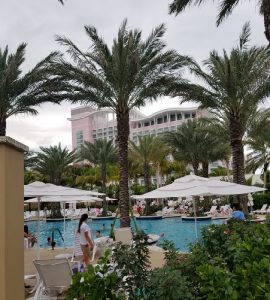
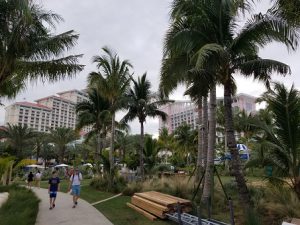
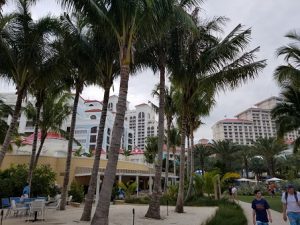
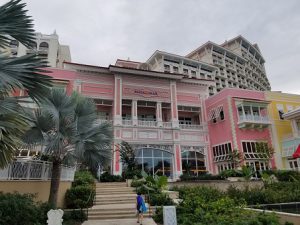
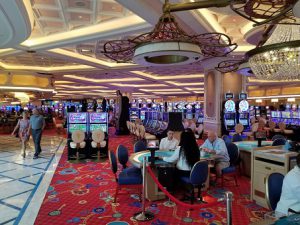
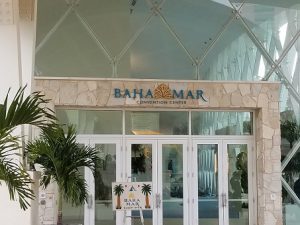
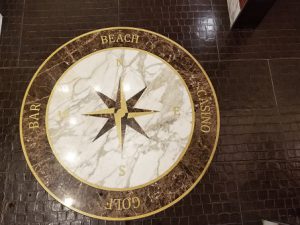
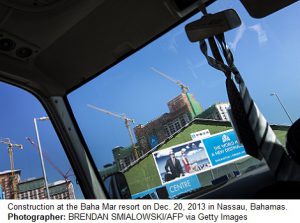
The Baha Mar Resort, Casino and Convention Center in Cable Beach, Nassau, Bahamas is now fully open – see Appendix VIDEO – and frankly empty! (See Photos below). This is the peak winter tourism season. This weather reality creates a seasonal demand for tropical resorts. Plus the excitement of a new property always generates a “buzz” … normally.

And yet, Baha Marthus far has been underwhelming! (There is hope for a better disposition in the future).

The Baha Mar project has been a source of contention for many years; one drama after another: dispute during construction, missed opening, bankruptcy filing, official wine-down, changed ownership, eventual opening, litigation among the originators.

See the latest breaking news in this Baha Mar drama in the news article here:


Title:
Bahamas Developer Claims Huge Chinese Fraud at $3.9 Billion Resort
By: Bob Van Voris

China Construction America Inc. was accused in a lawsuit of ripping off the original developer of the long-delayed $3.9 billion Baha Mar resort in the Bahamas by submitting fraudulent bills and collecting undeserved fees.

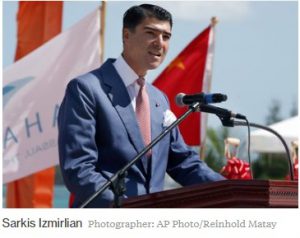
BML Properties Ltd., led by wealthy Bahamas businessman Sarkis Izmirlian, sued CCA Tuesday claiming the state-owned Chinese contractor pulled off a “massive fraud” to enrich itself at BML’s expense, leading to the collapse of the project in 2015. Delays in the construction of the biggest and most expensive resort to be built in the Caribbean have been a drag on the Bahamian economy in recent years.

BML claims that CCA submitted hundreds of millions of dollars in fake bills, understaffed the project and used it as a training ground for inexperienced workers. CCA knew it wouldn’t be able to meet the planned December 2014 deadline to open the resort but created the appearance that it would, in order to remain on the project and collect undeserved fees, BML claims. BML is seeking at least $2.25 billion in damages.

CCA didn’t respond to phone messages and an email seeking comment on the suit.

BML filed for Chapter 11 bankruptcy protection in Delaware in 2015. A U.S. bankruptcy judge dismissed the case in favor of a Bahamian court.

Baha Mar, which opened in April, is now owned by Hong Kong-based, Chow Tai Fook Enterprises Ltd. The development features more than 2,300 rooms, 40 restaurants and lounges, a convention center, a Jack Nicklaus-designed golf course, shopping and the biggest casino in the Caribbean, according to Baha Mar’s website.

BML outlined its claims in a 259-page complaint filed in state court in Manhattan.

The case is BML Properties Ltd. v. China Construction America Inc., 657550/2017, New York State Supreme Court, New York County (Manhattan).

Source: Bloomberg Business News Source – Posted December 26, 2017; retrieved December 30, 2017 from: https://www.bloomberg.com/news/articles/2017-12-26/baha-mar-developer-claims-to-be-victim-of-massive-china-fraud

All of this drama for a business model designed for … failure.

The Baha Mar Resort on Cable Beach features casino gambling and golf, two amenities that are failing more and more.

Casino
In a previous commentary, the business disposition of casino gambling was explored:

Increasingly in the casino/gaming industries, the money is not there. …

Despite the fact that the “house” always wins, the number of gamblers have declined! It is what it is!

  • 87% of Baby-Boomers gamble when visiting Las Vegas
  • 78% of Generation X-ers gamble when visiting Las Vegas
  • 63% of Millenials gamble when visiting Las Vegas

Golf
In a previous commentary, the business disposition of the sport of golf was explored:

“The games people play” … have relevance for our consideration. Golf is one of those games. But golf is more than just a game, it is an eco-system; but this eco-system is in peril.

    “The financial bubble burst and the Tiger bubble burst as well”.
    “Even as the economy recovered, golf is still in a nose dive”.
    “Your house is on fire”.

These (above) are among the key phrases from the narration of … [an] HBO Real Sports documentary story

This topic of the Baha Mar Resort is very important in the consideration of Caribbean economics, as casino gambling and golf has often been associated with Caribbean tourism.

The foregoing news article about Baha Mar aligns with the book Go Lean…Caribbean, which calls for the elevation of Caribbean economics. This book serves as a roadmap for the introduction and implementation of the technocratic Caribbean Union Trade Federation (CU) to better manage economic opportunities in the full Caribbean region. This is a Big Deal for the Go Lean roadmap to foster the diversification of the regional economy. Frankly, a $3.9 Billion investment should be able to generate better returns (job creation) than the Baha Mar fiasco has demonstrated. This hope for better tourism and economic diversification was identified early in the Go Lean book (Pages 11 – 14) in the following pronouncements in the Declaration of Interdependence:

iv. Whereas the natural formation of the landmass is in a tropical region, the flora and fauna allows for an inherent beauty that is enviable to peoples near and far, the structures must be strenuously guarded to protect and promote sustainable systems of commerce paramount to this reality.

vi. Whereas the finite nature of the landmass of our lands limits the populations and markets of commerce, by extending the bonds of brotherhood to our geographic neighbors allows for extended opportunities and better execution of the kinetics of our economies through trade. This regional focus must foster and promote diverse economic stimuli.

xxiv. Whereas a free market economy can be induced and spurred for continuous progress, the Federation must install the controls to better manage aspects of the economy: jobs, inflation, savings rate, investments and other economic principles. Thereby attracting direct foreign investment because of the stability and vibrancy of our economy.

xxvi. Whereas the Caribbean region must have new jobs to empower the engines of the economy and create the income sources for prosperity, and encourage the next generation to forge their dreams right at home, the Federation must therefore foster the development of new industries, like that of ship-building, automobile manufacturing, prefabricated housing, frozen foods, pipelines, call centers, and the prison industrial complex. In addition, the Federation must invigorate the enterprises related to existing industries like tourism, fisheries and lotteries – impacting the region with more jobs.

The Go Lean book posits that there is a need to re-boot and optimize the engines of commerce so as to make the Caribbean a better place to live, work and play. The tourism product, the mainstay of Caribbean economy, used to depend on certain amenities (i.e. Casinos and Golf) that have now come under attack by the social and demographic changes. It so appears that the future for Caribbean economics cannot lazily depend on factors like “sun, sand, surf and smiles”, no, there must be intelligent business models.

This is a changed world and changed marketplace. Likewise, our economic engines must change to keep pace … and get ahead!

The Go Lean book presents a Way Forward.

Way Forward
The Go Lean/CU roadmap seeks to elevate all of Caribbean society to remain competitive and consequential in the future. This is the heavy-lifting of shepherding a progressive region of 42 million people, 10 million Diaspora, 80 million tourists, and 4 language groups across 30 member-states. The CU’s charter is to effectuate progress in this region with these 3 prime directives:

  • Optimization of the economic engines in order to grow the regional economy to $800 Billion and create 2.2 million new jobs.
  • Establishment of a security apparatus to protect the resultant economic engines and marshal against economic crimes.
  • Improvement of Caribbean governance to support these above engines, including a separation-of-powers between CU federal administrations and local member-states.

The Way Forward / Go Lean roadmap includes the quest to create the jobs for the near-future. There is the plan to monitor, manage, and plan for new jobs. The roadmap provides 370-pages of turn-by-turn instructions on “how” to adopt new community ethos, plus strategies, tactics, implementations and advocacies to execute so as to reboot, reform and transform the societal engines of Caribbean society.

As a region, we have failed to keep pace of change. As related in that previous blog-commentary

… our society is now in desperate need of reform and to reboot to insulate from many demographic changes. On the one hand, we must diversify our economy and avail other high job-multiplier industries, away from tourism, but on the other hand, we must double-down in the tourism product, as the economic principles of “supply and demand” just cannot be ignored. (During the winter months, our Caribbean destinations are the “best addresses on the planet”.)

The Go Lean/CU roadmap calls for fostering industrial developments to aid economic diversification and to aid tourism. This includes incorporating best practices and quality assurances to deliver the “best experience in the world” for our visitors and trading partners.

This commentary has previously related details of the changing macro-economic factors in the world and how despite the dynamic conditions, jobs can be created. The following are samples of previous Go Lean blog-commentaries:

https://goleancaribbean.com/blog/?p=13700 Increasing Tourism Market Share
https://goleancaribbean.com/blog/?p=13420 A Lesson in Whaling History – Expeditions for Shipyard Jobs
https://goleancaribbean.com/blog/?p=13184 A Series on Industrial Reboots
https://goleancaribbean.com/blog/?p=12668 Common Sense of Eco-Tourism
https://goleancaribbean.com/blog/?p=8590 Build It and They Will Come – Politics of Infrastructure
https://goleancaribbean.com/blog/?p=7977 Transformations: Perfecting Our Core Competence – i.e. Tourism
https://goleancaribbean.com/blog/?p=6341 Doing Better with Tourism Stewardship
https://goleancaribbean.com/blog/?p=6089 Need Better Jobs Than ‘Minimum Wage’
https://goleancaribbean.com/blog/?p=4037 How to Train Your ‘Dragons’ or Direct Foreign Investors
https://goleancaribbean.com/blog/?p=2857 Where the Jobs Are – Example: Entrepreneurism in Junk
https://goleancaribbean.com/blog/?p=2126 Where the Jobs Are – Computers Reshaping Global Job Market
https://goleancaribbean.com/blog/?p=2003 Where the Jobs Are – One Scenario (Ship-breaking)

So this commentary advocates not doubling-down on bad trends that just “soak up” investments and produce very little return. We must be better and do better. We need to double-down on improving our tourism products and diversifying our economy away from tourism.

Yes, we can! We can do the heavy-lifting (hard-work and smart-work) to make our homeland a better place to live, work and play. 🙂

Download the free e-book of Go Lean … Caribbean – now!

Sign the petition to lean-in for this roadmap for the Caribbean Union Trade Federation.

———–

Appendix VIDEO – Baha Mar: The Las Vegas of the Caribbean – https://youtu.be/T7lGljlr01M

Caribbean Journal

Published on Aug 6, 2017 – The long-awaited Baha Mar resort project is finally here, and Caribbean Journal got an exclusive first look. So what’s it like? Well, it’s a unique, impressive project: a Las Vegas in the heart of the Caribbean.

Music: “Consortium of Cold Cool” by Craig Riley Listen ad-free with YouTube Red

Share this post:
, , ,
[Top]

Increasing Tourism Market Share

Go Lean Commentary

It’s December … this is peak winter travel season.

It’s time to take inventory of Caribbean tourism:

It has been weighed in the balance; it has been measured …
It has been found wanting!

Our peaks … are not enough. There is the need to Increase Caribbean Tourism Market Share. See this magazine article here with this title:

Title: Increasing Tourism Market Share
By Tony Fraser

For the Caribbean tourism industry to take a larger chunk out of world tourism arrivals (a necessity for continued survival and growth), there are a few innovative options lapping at the shores of tourism economies in the Caribbean.

To achieve the objective in an industry which provides hundreds of thousands of jobs in the Caribbean and US$30bn in revenue in 2014, wide-ranging options were presented to governments, hoteliers, tour operators and others in the business at the State of the Industry Conference (SOTIC) of the Caribbean Tourism Organisation in Curacao.

Eastern focus

Among the options, officials looked at the following:

  • how to attract more visitors from the fast-growing Chinese market;
  • how to cast aside traditional and moral restrictions that could pose barriers to the US$100bn US market of lesbians, gays, bisexuals and transsexuals (LGBT);
  • how to engage the Millennial generation (those born between 1980-1998) in exciting weekend package tours around the Caribbean;
  • how to tackle the issue of damaging high tax rates on the airline industry while looking to expand the Open Skies policy;
  • and the need to sweep away the layers of travel restrictions on passengers (including Caribbean nationals) wanting to move around and into the region with one-stop visa and security checks.

Increasing but…
An examination of the figures on visitor arrivals shows that the number of tourists coming to the Caribbean in the first six months of 2015 increased by 5.8% compared with the same period in 2014.

That percentage increase was larger than the 4.1% average increase in global tourism arrivals.

Significantly too, the Caribbean region (which encompasses the English, Dutch, French and Spanish-speaking areas of the Caribbean) in 2014 earned US$30bn, a 10% increase over the previous year.

However, Caribbean tourism’s share of the international market, as calculated by the United Nations World Tourism Organisation, was a mere 2.8% of the 1.1 billion people who travelled to destinations all over the globe.

“The Caribbean has a relatively low global market share compared to the importance it places on its tourism economy,” the UN World Tourism Council’s director/executive secretary of member relations, Carlos Vogeler, told the SOTIC in Curacao.

Asia focus
But while the Caribbean’s share of the international tourism market is quite small, South East Asia (SEA) has experienced the largest growth as a region.

The reason is not too difficult to assess.

“Those countries have access to a nearby source market, China, whose outbound travel market grew by 30% last year, and by 48% during the first six months of this year,” Mr Vogeler told Caribbean Intelligence©.

At the same time that the SEA countries have the emerging Chinese market from which to source tourists, Mr Vogeler says the source markets of the Caribbean for tourists are mature.

He said that the Caribbean tourism industry had to take up the challenge of attracting tourists from the Far East.

Cut taxes
Another challenge is for governments and airports in the Caribbean to reduce taxes on airline tickets.

It is a call that has been made for many years.

It was made even while the Caribbean tourism industry was petitioning the United Kingdom to reduce the Air Passenger Duty for passengers flying to Caribbean destinations.

In the Caribbean, airlines and tourism experts have continuously pointed to the negative impact that continued high taxes on airline tickets and airport taxes have had on travel into and around the region.

However, governments have contended with equal vigour that since they have a narrow tax base to raise revenue for development, and with airline travel being a captive source of revenue, reducing taxes on airline travel and airport duties is a difficult proposition.

The Premier of the Turks and Caicos Islands, Dr Rufus Ewing, told the CTO conference that “If you want governments to remove and or reduce those taxes, then we have to know how we are going to get alternative revenues; how do we take care of our security responsibility when there is one visa system and security check at airports. And those are real concerns for us in these countries.”

The proof of the pudding is in the eating for Robin Hayes, JetBlue’s president and chief executive.

“Where we have been able to reduce fares by 30%, we have doubled the travel market,” he says.

And Mr Hayes commended the government of Barbados, which has “one of the lowest tax rates in the region”.

“The idea is that we can collectively look at ministers of finance and ask them to relook the tax argument; but we do need government revenue to run countries,” Barbados Tourism and International Transport Minister Richard Sealey told Caribbean Intelligence©.

New ways of working
JetBlue sealed a deal with Barbados at the conference announcing an additional daily roundtrip flight between Fort Lauderdale in the US and Grantley Adams Airport in Barbados.

What’s more, the JetBlue boss is encouraging the Caribbean tourism industry to tap into JetBlue Getaways, which packages hotels, tours, restaurants and other experiences into the flight package, an arrangement that he says has done wonders for Grenada.

“Thanks to strong bookings through Getaways and greats friendships with local properties like Sandals and Spice Island, we were able to add a third weekly service in September, after only three months in the market,” Mr Hayes said.

Another option for attracting more tourists to Caribbean shores and into hotel rooms is to give seat guarantees to airlines.

Under such agreements, the host government pays for seats not occupied by passengers when they fly into those destinations.

Barbados’s Mr Sealey, who is also CTO chairman, told Caribbean Intelligence©: “It is a fact that we do subsidise airlines to the region, but we prefer to have a commercial relationship with the airlines, ones like that with we have with JetBlue, which works with us to market the destination.”

Potential earners
On the intra-Caribbean travel routes there was 5.5% growth, with 400,000 travellers moving around the region during the first six months of 2015.

Liat’s chief executive, David Evans, told Caribbean Intelligence© “It’s a market with quite an amount of potential.”

He said that Liat had upgraded its fleet over the last two years. But as he explained, taxes can cost the traveller up to 40% to 50% of the airline ticket.

Partnerships with other regionally-based airlines to achieve greater efficiency and coverage of the Caribbean are coming, Mr Evans told Caribbean Intelligence©.

“While we cannot talk about those alliances right now, they are coming soon,” he said.

He said that, at the moment, Liat has strategic alliances with international carriers such as British Airways and Virgin and others to move passengers around the region from their international arrivals but the internal partnerships are long overdue.

The LGBT market
Facilitating travel into the region by members of the lesbian, gay, bisexual and transsexual (LGBT) community is an option for the Caribbean to increase its international market share.

However, it is an option that poses challenges to the church-going, Bible-believing Caribbean community.

The market is a lucrative one, says David Paisley, senior research director of the San Francisco-based travel agency Community Marketing Insights.

“The Caribbean is a perfect fit for LBGT travel; but our clients must be assured of safety and not be discriminated against, and not only by laws but by social practices,” Mr Paisley said.
His research shows that the LGBT community travels more than the general population; they spend more on hotels, restaurants and shopping than other tourists.

“We have heard of homophobic societies in the Caribbean and I don’t want to call names, but where we see those tendencies and feel threatened, our travellers will not be coming,” Paisley told Caribbean Intelligence©.

There have been a few incidents in the past with members of the LGBT community that have caused a measure of concern in one or two Caribbean countries.

CTO Secretary General Hugh Riley told Caribbean Intelligence© that “no business can afford to ignore a significant market segment”.

He added: “Our [the CTO’s] responsibility is always to source the expertise, present the facts and provide enough information on which our members can make an informed decision.”

Weekend packages
Short breaks packed with entertainment, aimed at the generation born between 1980 and 1998, are seen by Leah Marville of My Destination Arrivals as yet another option to land more tourists around the region.

The weekends consist of a blur of entertainment and experiences which can be captured on camera and become talking points for the travellers, who travel at weekends and head back to their jobs on Monday.

“There is something absolutely captivating about us… My Destination Weekends seeks to capture and immortalise experiences for those who take the trip,” says Ms Marville, a model and businesswoman.

But increasing numbers of arrivals is not the be all and end all.

Mr Sealey says the benefits of tourism must be counted in jobs, in the development of communities, the protection of the environment and the retention of a large chunk of what the tourists spend in getting to the Caribbean and having memorable vacations in the region.
Source: Caribbean Intelligence Magazine – Posted November 2015; retrieved December 6, 2017 from: http://www.caribbeanintelligence.com/content/increasing-tourism-market-share

The movement behind the book Go Lean … Caribbean seeks to reboot the economic engines of the Caribbean member-states. Tourism is the region’s primary economic driver, but it is inadequate for providing the needs of the people in the region. We must do better. This foregoing magazine article about the Caribbean Tourist Organization (CTO) identified some defects … and solutions in 2015. It is now 2017; unfortunately, the identified defects are still defective; the hoped-for solutions, never materialized. See the introductory VIDEO about the CTO State of the Industry Conference in the Appendix below.

These same issues have also been addressed in other Go Lean commentaries:

Can the CTO be counted on to provide the need empowerments to elevate the Caribbean economic engines?

No! It is the assessment in the Go Lean book that the current stewards for regional tourism is inadequate. The book quotes (Page 3):

Many people love their homelands and yet still begrudgingly leave; this is due mainly to the lack of economic opportunities. The Caribbean has tried, strenuously, over the decades, to diversify their economy away from the mono-industrial trappings of tourism, and yet tourism is still the primary driver of the economy. Prudence dictates that the Caribbean nations expand and optimize their tourism products, but also look for other opportunities for economic expansion. The requisite investment of the resources (time, talent, treasuries) for this goal may be too big for any one Caribbean member-state. Rather, shifting the responsibility to a region-wide, professionally-managed, deputized technocracy will result in greater production and greater accountability. This deputized agency is the Caribbean Union Trade Federation (CU).

The CTO represents for-profit hotels and resorts. The needed solutions for the Caribbean cannot be profit-driven. It must pursue features like collective bargaining and the Greater Goodthe greatest good to the greatest number of people which is the measure of right and wrong” (by philosopher Jeremy Bentham; 1748 – 1832). So the Go Lean book presents an alternative; it serves as a roadmap for the introduction and implementation of the Caribbean Union Trade Federation (CU). The CU is designed to be a technocratic intergovernmental entity that shepherds economic growth for the Caribbean region; in other words, Increase Tourism Market Share. The goal is to reboot and optimize the region’s economic, security and governing engines. There are ways for individual member-states to improve their tourism product, but there needs to be a regional focus to accomplish this goal.

The Go Lean motivation is the Greater Good (Page 37).

In total, the Go Lean/CU roadmap will employ strategies, tactics and implementations to impact its prime directives; identified with the following 3 statements:

The Go Lean book provides 370-pages of turn-by-turn instructions on “how” to adopt new community ethos, plus the strategies, tactics, implementations and advocacies to execute so as to reboot, reform and transform the societal engines of Caribbean society. One advocacy in optimizing the tourism landscape is to foster infrastructure that is too big for any one member-state alone; consider some specific plans, excerpts and headlines from the book on Page 190 entitled:

10 Ways to Enhance Tourism in the Caribbean Region

1 Lean-in for the Caribbean Single Market
The economic engine associated with the CU will provide the infrastructural needs to improve the tourism product for all member-states. The plan is to expand trade treaties with other countries and regional blocs to target markets and languages outside of North America. One goal is to expand “snowbirds” traffic, as these have been a consistent revenue source. The CU will provide the support services like translations, medical and transport (ferries for RV’s) to augment this special market.
2 Special Festival Events
Promote multi-day events in the style of Sturgis (see Appendix J on Page 288), Coachella, and Milwaukee’s Summer-Fest. The CU will liberalize the loitering laws, allow for camping & car/van sleeping, public showers, food trucks, open canister for alcohol, etc. (Jamaica’s SunFest is a start). To facilitate traffic, jurisdictional governments should grant temporary motorcycle licenses and arranged for optimal shipping logistics.
3 Fairgrounds/Amusement Parks Empowerment Zones
Encourage the establishment and promotion of Fairgrounds/Amusement Parks (Disney, Sea World, Busch Gardens-like attractions) that can bring in vast number of visitors. The empowerment zones get special tax incentives and building code variances, or managed as Self Governing Entities (SGE) in which they are beholden only to the CU jurisdiction. Many US and European theme parks are only open during the warm seasons, the opposite can be advocated in the Caribbean region, where theme parks may only be open during the “high season”, or only when cruise ships are in port.
4 Dynamic Sea-lifts / Air lifts
Grant temporary licenses to shipping (ferries) and air charters to facilitate the transport of Festival participants. The goal is to move huge number of guests in and out readily. The US Passport Card (used for travel to Mexico and Canada) should suffice the travel documents for these events. These logistics can be modeled after Ramadan travel to Mecca.
5 Excess Inventory Auction
The CU buys from the Hotels (with warrants) and sells the Excess Inventory of Hotels rooms to the highest Bidder to combine with Air, Sea, Car and Tour Packages. (Much like Priceline.com). The CU uses e-commerce strategies and tactics (web, phone and text messaging) in their campaigns. The hospitality sources should drill down, beyond hotels, to also include bed-and-breakfast and other certified (CU ranked & rated) home-sharing arrangements.
6 Medical Tourism
Hospitals and medical clinics will be installed on SGE campuses, designed for alternative and experimental treatments. These will attract medical tourists to come for extended stays, many outfitted with monitoring and medical alert devices to engage designated medical personnel in case of emergencies; thus minimizing stress on domestic facilities.
7 Eco-Tourism Promotions Board
8 Sports Tourism
9 Cruise Line Passenger Smart Card Currency
The CU will collectively bargain with the cruise lines to deploy electronic “purses” and allow the Caribbean Central Bank to settle the transactions. This incites more spending at the ports-of-call. Smart cards feature more functionality like physical access, locator service & photo ID. The cards can also offer contactless transactions, like “tap and go”.
10 Tourist Hate Crime Sentence Extender

The Go Lean book details that the Caribbean can create …

30,000 direct jobs from opening new markets, creating new opportunities and new traffic; starting new sharing options
9,000 direct jobs from Event staff and Festivals at CU Fairgrounds
1,000 direct jobs from managing, promoting UNESCO World Heritage Sites

These are direct jobs; there is also the reality of indirect jobs – unrelated service and attendant functions – at a 3.75 multiplier rate would add another 150,000 jobs. That makes a total of 190,000 jobs.

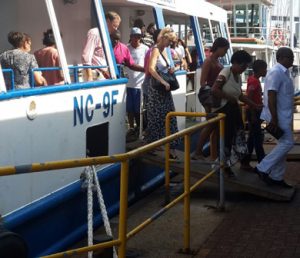
This is how the roadmap works: it identifies industries, dissects the inherent deficiencies, and proposes solution to reboot and optimize it, then it harvests the multiples of jobs resulting from the plan. Tourism is the current dominant industry; the goal is to “stand on the shoulders” of previous accomplishments, add infrastructure not possible by just one member-state alone and then reap the benefits. Imagine this manifestation in just this one new strategy: inter-island ferries that connect all islands for people, cars and goods.
There have been a number of blog-commentaries by the Go Lean movement that highlighted economic opportunities embedded in regional tourism initiatives. See a sample list here:

https://goleancaribbean.com/blog/?p=13126 “Must Love Dogs”  – Providing K9 Solutions for Better Tourism Security
https://goleancaribbean.com/blog/?p=12668 Lessons from Colorado – Common Sense of Eco-Tourism
https://goleancaribbean.com/blog/?p=11287 Sports Tourism and Pro-Surfing
https://goleancaribbean.com/blog/?p=11033 Medical Tourism and Plastic Surgeries
https://goleancaribbean.com/blog/?p=9897 Art Tourism and Community-sanctioned Murals
https://goleancaribbean.com/blog/?p=9179 Snowbird Tourism and RV Ferries
https://goleancaribbean.com/blog/?p=4425 Deploying regional currency and e-Payment solutions
https://goleancaribbean.com/blog/?p=4145 Eco-Tourism and World Heritage Sites

In summary, the Caribbean need jobs; our job creation dysfunction is so acute that our people are fleeing the homeland to find job opportunities abroad. Tourism-related jobs, while not the highest paying, could be stable, reliable and providential. More options and deliveries would help us to make our homeland a better place to live, work and play.

This is a Big Deal; this is how to grow the economy: create jobs; create businesses; retain people; foster new opportunities; learn from past mistakes and accomplishments. Tourism is just one industry in the Go Lean roadmap. While this one can result in 190,000 new jobs, the other industries (16) show even more promise: shipbuilding, pipelines, frozen foods, etc. The net result: 2.2 million new jobs.

Let’s do this … for the Greater Good.

All Caribbean stakeholders – residents and visitors – are urged to lean-in to this roadmap for change … and empowerment. This plan is conceivable, believable and achievable. 🙂

Sign the petition to lean-in for this roadmap for the Caribbean Union Trade Federation.

Download the book Go Lean … Caribbean – now!

———–

Appendix VIDEO – CTO STATE OF THE INDUSTRY CONFERENCE – https://youtu.be/8AraGc3VGpI

Curacao Tourist Board

Published on Jul 7, 2015 – State of the Industry Conference 2015 Curaçao will host SOTIC from 21- 23 October 2015 at the World Trade Center in Willemstad. CTO Business meetings will be held October 20 -21, 2015.

Share this post:
, ,
[Top]

Amazon: Then and Now

Go Lean Commentary

Time flies when you are …

Time just flies … PERIOD!

18 years can go by real fast.

It was only 18 years ago (1999) that Amazon was this small budding company in Seattle, Washington USA. Now today, they are huge … and transforming how America shops … for Christmas and beyond!

Notice the graphic here:

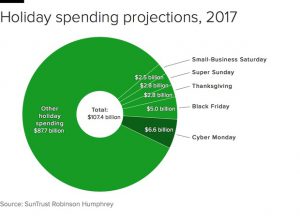
In a previous blog-commentary by the movement behind the book Go Lean … Caribbean, it was asserted that the retail industry – the greatest benefactor of the Christmas holiday shopping tradition with the estimate $107.4 Billion for 2017 – is being threatened by the Retail Apocalypse of e-Commerce in general and the internet-based mover-shaker company of Amazon in particular.

See the story here on Cyber Monday 2017 in the related VIDEO here:

Title Cyber Monday: Who won online shopping’s biggest day?

VIDEO – CNET Surveys Holiday Shopping Trends – https://www.cbsnews.com/videos/cnet-surveys-holiday-shopping-trends/


Published November 28, 2017 – Monday [(November 27)] broke shopping records, becoming America’s largest-ever online shopping day. Some $6.6 billion in sales were generated, according to Adobe Analytics, which tracks 80 percent of online shopping activity. By 10 a.m. Monday, $840 million had already been spent online, Adobe said — a jump of 17 percent from the year before.

Spending on Cyber Monday typically peaks in the evening, between 8 and 11 p.m., and shopping activity during that time on Monday exceeded that of a typical 24-hour day, according to Adobe Analytics.

So where are we spending all that money? In a word: Amazon (AMZN). The e-commerce giant accounts for somewhere between 45 percent and 50 percent of all sales by volume, according to separate estimates from SunTrust Robinson Humphrey and GBH Insights.
….
See the rest of the news article in the Appendix below.

How did they – Amazon – get here … so quickly?

Amazon: Then and Now

See here the width-and-breath of Amazon.com in 1999 in this 60 minutes Interview/Story:

VIDEO – What they said in 1999 about Amazon.com – https://youtu.be/6cTjhzSgdwE

Startup Cat

Published on Nov 20, 2017 – Interview look the year when the internet dotcom bubble burst dramatically. What they were saying about Amazon.com and Jeff Bezos?

Now see the width-and-breath of Amazon today … with this CNBC Feature/Story:

VIDEO – Inside Amazon Empire Documentary 2017 – https://youtu.be/_JnRzt8_YQc

Interesting Facts

Published on Sep 28, 2017 – Inside Amazon Empire Documentary 2017

———-

The Go Lean movement pays more than the usual attention to this “Amazon” business enterprise. We want to copy their good examples … and avoid their bad examples.

This company is a model for the Caribbean’s own venture into e-Commerce. The Go Lean book describes the design for the Caribbean Postal Union and the www.myCaribbean.gov web-portal so as to perform a lot of the same functionality that Amazon does in the USA.

The book Go Lean…Caribbean serves as a roadmap for the introduction and implementation of the technocratic Caribbean Union Trade Federation (CU) and the Caribbean Postal Union (CPU). These entities are designed to address the “Agents of Change“ in modern society, but for a Caribbean scope only.  The “Agents of Change” at play in the foregoing news sources, according to the book (Page 57), are defined as follows:

  • Technology
  • Globalization

Amazon and its CEO Jeff Bezos are role models that we can copy in the Caribbean. It is our assessment that one person can make a difference in society. Look at the impact of this one man – Jeff Bezos – in the fast-time of 18 years, since 1999. These above Agents-of-Change have disrupted Caribbean life in the past; now we need to be our own Change Agents. We need to forge our own change in our society so that we can survive as a culture on the world stage.
The future is not assured if we do not take a hold of our societal engines. We must reboot our industrial landscape to foster new opportunities (jobs, entrepreneurism and industrial development). This is the charter of the CU. In fact, the following 3 statements are identified as the prime directives of this CU charter:

  • Optimization of the economic engines in order to grow the regional economy to $800 Billion & create 2.2 million new jobs.
  • Establishment of a security apparatus to protect the resultant economic engines.
  • Improve Caribbean governance – as e-Commerce alters sales & border taxes – to support these engines.

What Amazon did and does, is the epitome of what the Caribbean Union Trade Federation needs to do to reboot Caribbean society. Amazon disrupted the status quo in so many industries – think: book retailers & movie rentals – and transformed markets to exploit opportunities and derive profits. This is the “Sum of All Caribbean Dreams“.

This reference to Caribbean Dreams is presented early in the Go Lean book with these opening pronouncements in the Declaration of Interdependence (Page 12 – 14):

xv. Whereas the business of the Federation and the commercial interest in the region cannot prosper without an efficient facilitation of postal services, the Caribbean Union must allow for the integration of the existing mail operations of the governments of the member-states into a consolidated Caribbean Postal Union, allowing for the adoption of best practices and technical advances to deliver foreign/domestic mail in the region.

xxiv. Whereas a free market economy can be induced and spurred for continuous progress, the Federation must install the controls to better manage aspects of the economy: jobs, inflation, savings rate, investments and other economic principles. Thereby attracting direct foreign investment because of the stability and vibrancy of our economy.

xxvii. Whereas the region has endured a spectator status during the Industrial Revolution, we cannot stand on the sidelines of this new economy, the Information Revolution. Rather, the Federation must embrace all the tenets of Internet Communications Technology (ICT) to serve as an equalizing element in competition with the rest of the world. The Federation must bridge the digital divide and promote the community ethos that research/development is valuable and must be promoted and incentivized for adoption.

The business models of Amazon have been further elaborated upon in previous blog-commentaries, as follows:

https://goleancaribbean.com/blog/?p=13091 Amazon Opens Search for HQ2
Amazon is accepting bids for a 2nd headquarters in North America. The city that lands HQ2 will have a lot to celebrate, as this enterprise can create many high-paying direct jobs – 50,000 – and have an indirect stimulus on the rest of the economy. This is a feature of Amazon that “we” want to model in the Caribbean.
https://goleancaribbean.com/blog/?p=12291 Big Tech’s Amazon – The Retailers’ Enemy
Big Tech companies like Amazon have the treasuries, talent and temperament (culture, values and commitment) to change the world, for good and for bad. The Amazon threat had been “all things internet”, but now they are attempting to dominate the physical retail space as well, with their acquisition of Whole Foods grocery stores.
https://goleancaribbean.com/blog/?p=11358 Retail Apocalypse – Preparing for the Inevitable
There is feast and famine “in the cards” for the retail eco-system. On one end of the spectrum , there will be prosperity for electronic commerce stakeholders, but on the other end, for brick-and-mortar establishments, there will be a Retail Apocalypse. This is not just a future problem as the, the threat has already manifested!
https://goleancaribbean.com/blog/?p=9839 Amazon and Alibaba’s Cloud allows for global reach
This model, with cutting-edge data centers, is the new colonialism. Amazon and Alibaba are people-intensive companies – lots of employment – but Information Technology (I.T.) companies too.
https://goleancaribbean.com/blog/?p=7297 Death of the ‘Department Store’: Exaggerated or Eventual
Modern technology and electronic commerce has transformed many aspects of society; much has been added and much taken away. Just consider: cameras, watches, pagers, maps, calculators, calendars, payphones, books, music and more. The related industries have also been affected: travel agencies, music retailers, book retailers, newspapers, travel agencies and Big Box retailers. Amazon is to blame for many of the transformations.
https://goleancaribbean.com/blog/?p=7023 Thanksgiving & American Commerce – Past, Present and Amazon
To better understand American commerce, one must understand Cyber Monday and its dominant player Amazon. This company demonstrates how to be lean and technocratic as it employs cutting-edge automation  and robotics. They are a great model for a new Caribbean.
https://goleancaribbean.com/blog/?p=1416 Model of an E-Commerce Fulfillment Company: Amazon
Amazon is the model for the Caribbean Postal Union (CPU): our means for delivering the mail. Considering the US, one might think that the American model would be the US Postal Service (USPS). No, the Go Lean book relates how the USPS is a failing enterprise, while Amazon flourishes with growth, capital and profits.

Understanding the Amazon business model is very important for the Caribbean’s effort to reform and transform the region. Creating the CPU and the Caribbean Cloud is “Step One, Day One” in the Go Lean roadmap. This will be a direct result of assembling and integrating the governmental agencies for postal mail for all 30 Caribbean member-states. The strategy calls for a separation-of-powers between the CU entities, like the CPU and the entities of the Caribbean member-states.

This is a win-win approach. Imagine the jobs! (See the indirect jobs production in the Appendix VIDEO below).

These postal agencies, under the current models, are inefficient, ineffective and unprofitable. But following the Amazon model can be transformative. We can do this; we can impact our communities and retail eco-systems in such positive ways.

We urge everyone in the Caribbean – citizens, businesses and governments – to lean-in to the empowerments in the CU/Go Lean roadmap. We can make our region better places to live, work and play. 🙂

Download the free e-book of Go Lean … Caribbean – now!

Sign the petition to lean-in for the roadmap for the Caribbean Union Trade Federation.

———-

AppendixCyber Monday: Who won online shopping’s biggest day? – Cont’d

By: Irina Ivanova, MoneyWatch

Amazon’s revenue take is somewhat smaller, thanks to the large number of third-party sellers on its platform. Amazon will have about 24 percent of the online shopping share this holiday season, STRH estimated, up from 20 percent last year.

eBay (EBAY), the online auction site, is the second-largest online shopping site, but its share of sales is in the “high single digits,” said Youssef Squali, managing director and senior analyst at STRH. Walmart (WMT) is No. 3.

Other factors feed into making this an exceptionally strong season for Amazon, not least of which is the availability of the Echo speaker and other “smart home” devices, which funnel shopping through the giant cybermerchant.

“Given a record breaking Prime Day in 2Q, continued momentum in 3Q, and the fact that this is just the second holiday season offering monthly Prime memberships (a service we view as most compelling during the holidays), we expect a record breaking holiday season for the company,” STRH analysts wrote in a note. Amazon’s market share typically peaks in the fourth quarter, they added.

The breakneck pace of Cyber Monday shopping comes on the heels of a strong retail showing over Thanksgiving day and Black Friday, the latter of which set an online sales record. Macy’s (M), JCPenney (JCP) and Kohl’s (KSS) each reported strong or record-setting sales over the weekend. Foot traffic in stores on Black Friday fell only about 1 percent from last year, according to ShopperTrak — less than many had feared.

Shoppers are bolstered by record stock market highs and soaring home values, analysts said.

“The economy is doing well, and when consumers feel confident, they’re going to spend,” said Aaron Shapiro, CEO of Huge, a digital marketing company.

“So far it’s been a really strong holiday season. The biggest winner has been the internet,” said Shapiro. “Combined with the fact that people tend to shop at the last minute, that portends a really strong holiday shopping season.”

Big as it may get, Cyber Monday is no match for the world’s largest shopping holiday. That would be China’s Singles’ Day, on Nov. 11, which this year generated a whopping $25 billion in sales (not to mention some 300,000 tons of carbon dioxide). Not bad for a holiday that’s less than a decade old.

Source: © 2017 CBS Interactive Inc. – Posted November 28; retrieved November 28, 2017 from: https://www.cbsnews.com/news/cyber-monday-who-won-the-biggest-day-in-online-shopping/

———-

Appendix VIDEO – Amazon Last Mile – https://www.cbsnews.com/videos/amazon-program-hires-self-employed-couriers/

Amazon’s FLEX, a little-known program to get your package to your doorstep.

Share this post:
, , , ,
[Top]

Jerk Festival Time – GraceKennedy’s Outreach to the Diaspora – ENCORE

The word “Jerk” has a number of definitions; its is a noun, a verb, an adjective and an adverb. But it is more commonly accepted as …

… Jamaican.

So there is no doubt that a reference to a “Jerk” Festival is a Jamaican cultural festival. This is definitely the case this weekend – November 12, 2017 – as this event takes place in the heart of the Jamaican Diaspora in Broward County, Florida.

This event is sponsored by the Jamaican transnational company GraceKennedy. This is a BIG Deal for this BIG Jamaican enterprise. See the profile of GraceKennedy in the ENCORE below (from September 7, 2016) … and the VIDEO of the 2017 Jerk Festival here:

VIDEO – NBC6: Taste the Caribbean at the Jamaican Jerk Festival – https://www.nbcmiami.com/on-air/as-seen-on/Taste-the-Caribbean-at-the-Jamaican-Jerk-Festival_Miami-455626233.html

——–

Go Lean CommentaryGraceKennedy: Profile of a Caribbean Transnational Corporation

CU Blog - GraceKennedy - Caribbean Transnational Corporation - Photo 1A

The accusation is that the Caribbean – as a region, a people, and a culture – features a parasite status rather than the preferred protégé status. This would mean we only glean the economic activity left over from the other “host” countries; we would also consume the offerings and trends of these more advanced economy countries, rather than dictate our own trends.

This accusation … is mostly true!

But alas, there is a spark of hope in our Caribbean region. There are a number of corporate entities that do dictate trends in the region and throughout the world. The book Go Lean…Caribbean addressed this trend and identified one such company, Jamaica-based ATL Group, the owners of Sandals/Beaches Resorts, an Office Equipment business, Honda automobile dealerships and the media company behind The Jamaica Observer newspaper. But now, we consider another one, this time we focus on the transnational corporation, GraceKennedy Group of Companies who operate in the food and financial sectors.

But first, we must consider the definition of transnationalism:

Transnationalism as an economic process involves the global reorganization of the production process, in which various stages of the production of any product can occur in various countries, typically with the aim of minimizing costs. Economic transnationalism, commonly known as Globalization, was spurred in the latter half of the 20th century by the development of the internet and wireless communication, as well as the reduction in global transportation costs caused by containerization. Multinational corporations could be seen as a form of transnationalism, in that they seek to minimize costs, and hence maximize profits, by organizing their operations in the most efficient means possible irrespective of political boundaries.

multinational corporation is an organization that owns or controls production of goods or services in one or more countries other than their home country.[2]

What Drives Transnationalism?
Some argue that the main driver of transnationalism has been the development of technologies that have made transportation and communication more accessible and affordable, thus dramatically changing the relationship between people and places. It is now possible for immigrants to maintain closer and more frequent contact with their home societies than ever before. However, the integration of international migrations to the demographic future of many developed countries is another important driver for transnationalism. Beyond simply filling a demand for low-wage workers, migration also fills the demographic gaps created by declining natural populations in most industrialized countries. Today, migration accounts for 3/5 of population growth on western countries as a whole. And this trend shows no sign of slowing down. Moreover, global political transformations and new international legal regimes have weakened the state as the only legitimate source of rights. Decolonization, coupled with the fall of communism and the ascendance of human rights, have forced states to take account of persons qua persons, rather than persons qua citizens.

Immigrant Transnational Activities – When immigrants engage in transnational activities, they create “social fields” that link their original country with their new country or countries of residence. These social fields are the product of a series of interconnected and overlapping economic, political, and socio-cultural activities. As for economic transnational activities, these include business investments in home countries and monetary remittances from source countries. The Inter-American Development Bank (IDB) estimates that in 2006 immigrants living in developed countries sent home the equivalent of $300 billion in remittances, an amount more than double the level of international aid. This intense influx of resources may mean that for some nations development prospects become inextricably linked- if not dependent upon – the economic activities of their respective Diasporas.
Source: Retrieved September 5, 2016 from: https://en.wikipedia.org/wiki/Transnationalism

CU Blog - GraceKennedy - Caribbean Transnational Corporation - Photo 1

The GraceKennedy Group of Companies, started in 1922, is based in Kingston, Jamaica, but they are one of the Caribbean “largest and most dynamic corporate entities” in the region. Though they are based in Jamaica, they generate a lot of their global revenue – from food services and financial services – from the rest of the globe. They depend on globalization – economic transnationalism – in order to be an ongoing concern. Their marketing slogan is “Jamaican born; global bound”. They own 60 subsidiaries – see partial list in the Appendix below – and affiliated companies across the Caribbean, Africa, UK, North and Central America; they are a model of a transnational corporation. See VIDEO here:

VIDEO – GraceKennedy at 90 – https://youtu.be/okDBEAdC6LY

Published on Feb 10, 2012 – Jamaican conglomerate Grace Kennedy is celebrating 90 years of existence. The Gleaner recently toured its Harbour Street corporate office and learnt what drives the company’s success.

The history of this company traces a parallel arch of change in the Caribbean region for the 20th Century:

Regional Change Dynamics Year Company Dynamic Changes
European Colonialism 1922 Company formed to facilitate importation / local distribution
Decolonization 1952 Nation-building rather than mother-country dependence
Emigration from Homeland / Diaspora 1959 Export Caribbean home products to the world
Embrace of regionalism 1962 Incorporating in other Caribbean member-states
Shift to Service Economy 1990 Financial Services focus on Remittance

GraceKennedy has expanded and diversified over the years,[2] changing from a privately owned enterprise to a public company listed on the stock exchanges of Jamaica, Trinidad, Barbados and the Eastern Caribbean.

CU Blog - GraceKennedy - Caribbean Transnational Corporation - Photo 2

CU Blog - GraceKennedy - Caribbean Transnational Corporation - Photo 4

CU Blog - GraceKennedy - Caribbean Transnational Corporation - Photo 5

The company does not only appeal to the Jamaican community (domestic or Diaspora) or not only to the Anglo-speaking Caribbean; they also strategize for the Hispanic communities. In that vein, as reported in the foregoing VIDEO, in 2014 CU Blog - GraceKennedy - Caribbean Transnational Corporation - Photo 6GraceKennedy acquired La Fe Foods Inc., a top Hispanic consumer foods company – especially dominant in the frozen food category – in the US.

This transnational corporation aligns with the vision for societal elevation in the book Go Lean … Caribbean. These two visions actually parallel:

  • GraceKennedy – To be a Global Consumer Group delivering long term consumer and shareholder value, through brand building and innovative solutions in food and financial services, provided by highly skilled and motivated people.
  • Go Lean – To integrate and unify the Caribbean region into a Single Market Economy, enabling the homeland to be the best address on the planet, inviting our young people to participate in the effort to make our home the best place to live, work and play in the future. – Page 45.

The Go Lean book serves as a roadmap for the introduction and implementation of the technocratic Caribbean Union Trade Federation (CU). This is a call for confederating, collaborating and convening the 30 member-states of the region – despite the language or colonial legacy – into a Single Market; and for one federal governmental entity to optimize the economic, security and governing endeavors. This would also mean optimization of the food supply and financial services landscape. The Go Lean/CU roadmap creates the atmosphere for many more transnational corporations – homegrown and foreign – to emerge and thrive. This is part-and-parcel of the prime directives (3) of the CU/Go Lean roadmap:

  • Optimization of the economic engines – facilitating the growth in corporate citizens – in order to grow the regional economy to $800 Billion & create 2.2 million new jobs.
  • Establishment of a security apparatus to protect the resultant economic engines.
  • Improvement of Caribbean governance to support these economic engines, reflecting a separation-of-powers between CU agencies and member-state governments.

The CU seeks to facilitate better mastery of the advanced fields of economics by incentivizing, incubating and fostering entrepreneurial efforts, small-to-medium-businesses (SMB) and large multi-national corporations. This is how to create new jobs; jobs are not created by governments, but yet, the governmental administrations can implement the right climate to spur industrial and corporate growth. The job-creation solutions for the Caribbean, are not so much dependent on a specific government, but rather good corporate guidance.

A goal of the Go Lean/CU roadmap is to attract more transnational corporations, to establish a footprint in the Caribbean. How? Why? Why will they come to the Caribbean under the Go Lean/CU regime when they will not come now under the status quo? One answer is the structure of Self-Governing Entities (SGE), and Exclusive Economic Zones (EEZ). SGE refers to dedicated, bordered grounds that are ideal for corporate campuses, research laboratories, industrial bases (like shipyards, factory plants). The SGE structure will require a hybrid governance involving the CU federal agencies and local administrators influence– at the start-up.

The book Go Lean … Caribbean asserts that SGE’s and the EEZ can be strategic, tactical and operationally efficient for elevating Caribbean society – creating jobs. These points are pronounced early in the book with this Declaration of Interdependence (Pages 11 thru 14), with these statements:

v. Whereas the natural formation of our landmass and coastlines entail a large portion of waterscapes, the reality of management of our interior calls for extended oversight of the waterways between the islands. The internationally accepted 12-mile limits for national borders must be extended by International Tribunals to encompass the areas in between islands. The individual states must maintain their 12-mile borders while the sovereignty of this expanded area, the Exclusive Economic Zone, must be vested in the accedence of this Federation.

xxiv.  Whereas a free market economy can be induced and spurred for continuous progress, the Federation must install the controls to better manage aspects of the economy: jobs, inflation, savings rate, investments and other economic principles. Thereby attracting direct foreign investment because of the stability and vibrancy of our economy.

xxv.   Whereas the legacy of international democracies had been imperiled due to a global financial crisis, the structure of the Federation must allow for financial stability and assurance of the Federation’s institutions. To mandate the economic vibrancy of the region, monetary and fiscal controls and policies must be incorporated as proactive and reactive measures. These measures must address threats against the financial integrity of the Federation and of the member-states.

xxvi.  Whereas the Caribbean region must have new jobs to empower the engines of the economy and create the income sources for prosperity, and encourage the next generation to forge their dreams right at home, the Federation must therefore foster the development of new industries, like that of ship-building, automobile manufacturing, prefabricated housing, frozen foods, pipelines, call centers, and the prison industrial complex. In addition, the Federation must invigorate the enterprises related to existing industries tourism, fisheries and lotteries – impacting the region with more jobs.

xxx. Whereas the effects of globalization can be felt in every aspect of Caribbean life, from the acquisition of food and clothing, to the ubiquity of ICT, the region cannot only consume, it is imperative that our lands also produce and add to the international community, even if doing so requires some sacrifice and subsidy.

Though there is a need for more jobs, there is a legitimate fear to inviting more corporations. There are real-life experiences and stories of abuse in mono-industrial communities – Company Towns. Abuse by the “super-rich” is implied in the old adage: “golden rule is he who has the gold makes the rule”. But the Go Lean roadmap is designed to mitigate abuses of plutocracies. This is the advantage of the SGE structure; it allows for better promotion, oversight, and governance for transnational corporate expressions. These SGE’s would be regulated solely by the technocratic CU; there would be features like advanced monitoring (intelligence gathering) and embedded protections for whistleblowers.

CU Blog - GraceKennedy - Caribbean Transnational Corporation - Photo 3The Go Lean roadmap identifies 40,000 new direct jobs tied to SGE’s; plus more tied to industrial activities directly related to the business activities that aligns with GraceKennedy business model, such as 30,000 new direct jobs in the food supply industries and 2,000 direct jobs in the frozen foods industry. These job-creation empowerments will impact every aspect of Caribbean life throughout the Caribbean.

The Go Lean book details a series of community ethos, strategies, tactics, implementations and advocacies to foster industrial developments and SGE’s. The following list applies:

Community Ethos – Economic Principles – Economic Systems Influence Individual Choices Page 21
Community Ethos – Economic Principles – Voluntary Trade Creates Wealth Page 21
Community Ethos – Lean Operations Page 24
Community Ethos – Return on Investments Page 24
Community Ethos – Cooperatives Page 25
Community Ethos – Ways to Impact the Future Page 26
Community Ethos – Ways to Impact the Greater Good Page 32
Strategy – Vision – Confederate to form a Single Market Page 45
Strategy – Mission –  Build and foster local economic engines Page 45
Strategy – Mission –  Exploit the benefits and opportunities of globalization Page 46
Strategy – Mission –  Keep the next generation at home Page 46
Tactical – Fostering a Technocracy Page 64
Tactical – Separation of Powers – Commerce Department – Interstate Commerce Administration Page 79
Tactical – Separation of Powers – Department of Agriculture Page 88
Anecdote – “Lean” in Government Page 93
Implementation – Foreign Policy Initiatives at Start-up Page 102
Implementation – Start-up Benefits from the EEZ Page 104
Implementation – Steps to Implement Self-Governing Entities Page 105
Advocacy – 10 Big Ideas – Single Market Leverage Page 127
Advocacy – Ways to Improve Interstate Commerce Page 129
Advocacy – Ways to Better Manage Food Consumption – Export: Help Find Foreign Markets Page 156
Advocacy – Ways to Better Manage the Social Contract Page 170
Advocacy – Ways to Foster Cooperatives – Common for Agricultural Structures Page 176
Advocacy – Ways to Better Manage Natural Resources – Optimization of Pastoral Lands Page 183
Anecdote # 18 – Caribbean Industrialist: Sandals’ Butch Stewart Page 189
Advocacy – Reforms for Banking Regulations Page 199
Advocacy – Ways to Impact Wall Street – Expansion of local Securities markets Page 200
Advocacy – Ways to Impact Main Street Page 201
Advocacy – Ways to Develop a Frozen Foods Industry Page 208
Advocacy – Ways to Improve Fisheries – Canaries & Refrigerated Warehouse Cooperatives Page 210
Advocacy – Ways to Impact the Diaspora Page 217
Advocacy – Ways to Impact Rural Living – SGE Strategic Locations Page 235
Advocacy – Ways to Re-boot Jamaica Page 239

This commentary asserts that industrial development is hard-work. It is difficult now to get Direct Foreign Investors to consider individual Caribbean member-states, but with this new approach of a regional Single Market, a leveraged Caribbean – 42 million people – can be more attractive, appealing and inviting. Despite the appeal, executing this Go Lean/CU roadmap will still be hard; the book describes the effort as heavy-lifting.

Many of these heavy-lifting issues have been previously identified and detailed in prior Go Lean blog-commentaries. See this sample list:

https://goleancaribbean.com/blog/?p=8379 The Need for Technocratic Regulation of the SGE’s
https://goleancaribbean.com/blog/?p=5921 Socio-Economic Change: Impact Analysis of SGE’s
https://goleancaribbean.com/blog/?p=4037 How to Train Your ‘Dragon’ – Direct Foreign Investors
https://goleancaribbean.com/blog/?p=3473 Haiti’s Example of Success with an SGE: CaracolIndustrial Park
https://goleancaribbean.com/blog/?p=2750 Disney World – Role Model for Self-Governing Entities

This Go Lean movement, fostering a new Caribbean business climate, hereby applauds the corporate stakeholders at the GraceKennedy Group of Companies. We invite them to partner with us to make the Caribbean region a better place to live, work and play. But there is the need for a cautionary warning to them: the change that is coming has “plus & minus” ramifications for their business model.

There are aspects of the Go Lean roadmap that will not be good for some of GraceKennedy’s business model, remittances in particular. (While a GraceKennedy subsidiary is the regional partner representing Western Union in the Caribbean, the Go Lean book – Page 270 – introduces new electronic payment schemes that will lessen the need to pay for money transfers). It is clearly apparent in the Go Lean book, that change is not always good; sometimes it brings unintentional consequences. So if we know change is happening, it is best to get ahead of it. This point was stated poignantly at Page 252:

Opportunities abound; even if there is only little commerce to exploit now, there is opportunity enough in the preparation for the coming change. So act now! Get moving to that place, the “corner” of preparation and opportunity.

With the execution of this Go Lean roadmap, the Caribbean region sends a message to the business world: Change is afoot. There will be new partnerships and collaborations for corporate stakeholders. A message is sent to the Caribbean people as well: there are solutions to these complex problems befalling our society. Whereas the Caribbean may have been a parasite before, now we can function in the role of a protégé.

Like all parasites, their healthy disposition depends on a healthy disposition of the hosts. The Caribbean has been in crisis; therefore the parasitic people have fled – the Caribbean’s “brain drain” and Diaspora has grown as a result – not good. The successful execution of this roadmap will affect this disposition as well. We will and must do better! Optimizing the economic, security and governing engines in the region will lower the abandonment rate. This will also constitute change – good change – for the region.

The Caribbean homeland will then be a better place to compete globally and present more favorable options for our youth to stay home in the region.

Now is the time for all Caribbean stakeholders – corporate citizens included – to lean-in for the optimizations and empowerments described in the book Go Lean … Caribbean. This roadmap is conceivable, believable and achievable. 🙂

Download the free e-Book of Go Lean … Caribbean – now!

—————–

Appendix – List of Subsidiaries: GraceKennedy Group of Companies

  • Banking and Financial services
    • First Global Bank Limited
    • First Global Financial Services Limited
    • FG Funds Management (Cayman) Limited
    • First Global Trinidad & Tobago Limited (formerly One1 Financial Limited)
    • Signia Financial Group Incorporated
  • Remittances
    • GraceKennedy Remittance Services Limited
    • GraceKennedy Remittance Services (United States) Incorporated
    • GraceKennedy Remittance Services (Trinidad & Tobago) Limited
    • GraceKennedy Remittance Services (Guyana) Limited
  • Insurance Life and General
    • Allied Insurance Brokers Limited
    • EC Global Insurance Company Limited
    • First Global Insurance Brokers Limited
    • Jamaica International Insurance Company Limited
    • Trident Insurance Company Limited
  • Manufacturing, retail and distribution
    • Dairy Industries (Jamaica) Limited
    • Grace Foods and Services Company
    • GraceKennedy (Belize) Limited
    • Grace Food Processors Limited
    • Grace Food Processors (Canning) Limited
    • GraceKennedy (United States) Incorporated
    • Grace Foods International Limited
    • National Processors Division
    • World Brands Services Limited
    • Hi-Lo Food Stores (Jamaica) Limited
    • GK Foods (United Kingdom) Limited
    • GraceKennedy (Ontario) Incorporated
    • Hardware & Lumber Limited


Share this post:
, , , ,
[Top]

A Lesson in History – Whaling Expeditions

Go Lean Commentary

There are “high-risk, high-return” industries and then there are “low-risk, low-return” industries.
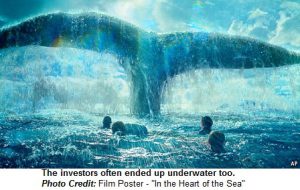
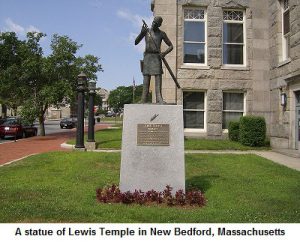
There is much for the Caribbean to learn about hedging and mitigating risks from the high-risk industries. The lessons learned should be considered for forging the best-practices for gleaning those high-returns. In this case, we have the opportunity to reach back in the annals of time and learn-apply lessons from the history of the commercial whaling industry – see History of Whaling in the Appendix.

The high-risks in these enterprises were the whales – intelligent mammals of the sea that defied and defended against predators. See this dramatized in the movie “In the Heart of The Sea“; the trailer is embedded in the Appendix VIDEO below. Yet still, the whaling industry was so effective that the “cash crop” (whales) were almost rendered extinct. In this day, however, whaling is considered inhumane. This is an appropriate judgement for this foul practice!

If only … we can learn the best-practices of risk management from this industry and apply it in other humane industries and endeavors to derive high-returns. This is the point of the article here from this “Fin-Tech” column in the world-renowned Economist Magazine:

Title: The First Venture Capitalists – Before there were tech startups, there was whaling

NEW BEDFORD – Few industries involve as much drama and risk as whaling did. The last voyage of the Essex, which inspired Herman Melville’s classic, “Moby Dick”, and is the subject of a new film, “In the Heart of The Sea”, gives a sense of the horrors involved. The ship left Nantucket in 1819 and sailed for over a year before being destroyed by a whale it was hunting. The 20 crew members survived the sinking, but found themselves adrift in the Pacific in three longboats, with little food and no water. Three opted to stay on a desert island, from which they were rescued three months later, on the verge of starvation. The others sailed on, hoping to reach South America but dying one by one. At first the survivors buried the dead at sea; then they resorted to eating the corpses of their crewmates. When they ran out of bodies, they drew lots to decide whom to shoot and eat. Only five of the 17 were eventually rescued. By then, they were so delirious that they did not understand what was happening.

The only reason that anyone could be induced to take part in such a dangerous business was the fabulous profit that could be made. Gideon Allen & Sons, a whaling syndicate based in New Bedford, Massachusetts, made returns of 60% a year during much of the 19th century by financing whaling voyages—perhaps the best performance of any firm in American history. It was the most successful of a very successful bunch. Overall returns in the whaling business in New Bedford between 1817 and 1892 averaged 14% a year—an impressive record by any standard.

New Bedford was not the only whaling port in America; nor was America the only whaling nation. Yet according to a study published in 1859, of the 900-odd active whaling ships around the world in 1850, 700 were American, and 70% of those came from New Bedford. The town’s whalers came to dominate the industry, and reap immense profits, thanks to a novel technology that remains relevant to this day. They did not invent a new type of ship, or a new means of tracking whales; instead, they developed a new business model that was extremely effective at marshalling capital and skilled workers despite the immense risks involved for both. Whaling all but disappeared as an industry after mineral oil supplanted whale oil as a fuel. But the business structures pioneered in New Bedford remain as relevant as they ever were. Without them, the tech booms of the 1990s and today would not have been possible.

Most historians trace the origins of the modern company back to outfits like the Dutch East India Company and its British equivalent. These were given national monopolies on trade in certain goods or with certain places. This legally buttressed status allowed them to fund themselves by selling shares to the public, helping to get stock markets off the ground. The managers of these multinational enterprises were professionals with only small ownership stakes. Lower-level employees generally had no shareholding at all.

By eliminating dependence on individual owners or managers, these entities became self-perpetuating. But their monopolies also embroiled them in politics and led inevitably to corruption. Both the British and Dutch versions ended up requiring government bail-outs—a habit giant firms have not yet kicked.

The whaling industry involved a radically different approach. It was one of the first to grapple with the difficulty of aligning incentives among owners, managers and employees, according to Tom Nicholas and Jonas Peter Akins of Harvard Business School. In this model, there was no state backing. Managers held big stakes in the business, giving them every reason to attend to the interests of the handful of outside investors. Their stakes were held through carefully constructed syndicates and rarely traded; everyone was, financially at least, on board for the entire voyage. Payment for the crew came from a cut of the profits, giving them a pressing interest in the success of the voyage as well. As a consequence, decision-making could be delegated down to the point where it really mattered, to the captain and crew in the throes of the hunt, when risk and return were palpable.

At the top of the New Bedford hierarchy was an agent or firm of agents like Gideon Allen, responsible for the purchase and outfitting of the ship, the hiring of the crew and the sale of the catch. To give them an incentive to cut the best deals possible, the agents put up a big share of the investment. Those with the best reputation received better terms from the other investors. Captains, who ran the show while the ship was at sea, often put up capital as well. A similar system of incentives is used in the riskier reaches of the investment-management business today, notes Mr Nicholas.

Investors received half to two-thirds of the profits. The rest was divided among the crew in what was known as the “lay” system. A captain might get a 12th lay (one-twelfth of the remaining profit). In Melville’s novel, Ishmael, who was new to the business, was originally offered a 777th lay but managed to haggle a 300th. Although that would probably have proved a paltry amount, it was a stake nonetheless, and set a benchmark for future pay. Ishmael’s friend Queequeg, a cannibal from the South Sea islands, got a 90th lay because he had experience with a harpoon. Demand for experienced crewmembers was so high that the Essex’s ill-fated captain, George Pollard, was immediately given a second command on the ship that rescued him (which sank as well).

Every participant wanted to bring in returns quickly, but there were no artificial deadlines—nothing resembling what is now called “quarterly capitalism”. When whales became rare in accessible places, the crews from New Bedford extended their search to every corner of every ocean, however many years that took.

Safety in numbers
To ensure that they were not ruined by a few disastrous voyages, the whaling firms invested in multiple expeditions at the same time, much as the venture capitalists of today “spray and pray”. A study published in 1997 concluded that, of the 787 boats launched from New Bedford during the 18th century, 272 sank or were destroyed. The firm that belonged to George Howland was not atypical: of its 15 ships, between four and nine were at sea at any given moment. One was sunk by a whale, three lost at sea, two burned by their crews, one destroyed by a Confederate gunboat during America’s civil war and five abandoned in Arctic ice. Yet Howland died a millionaire in 1852.

It helped that most of the whalers of New Bedford were strict Quakers, who prized frugality and shunned ostentation. This helped them not only husband their own capital, which was needed to finance voyages, but also to win over other investors. Hetty Howland Green, one of the richest agents, was said to have made her own shoes and to have owned only one dress.

It also helped that they were open-minded: they readily employed anyone who could contribute to their ventures. Perhaps the single most important technological innovation used by New Bedford’s whaling fleet was the “Temple Toggle”, a harpoon tip devised by Lewis Temple, a former slave from Virginia.


But the whalers’ main asset was their business model. In the 1830s, the legislatures of six American states approved charters for whaling corporations giving them the right to raise capital by selling shares to the public—much the same corporate structure as the Dutch and British East India Companies. None of the six survived the 1840s. “The diffuse ownership structure of the corporations, and the reduced stakes held by their managers, likely diminished the incentives for the managers to perform their role diligently,” concludes Eric Hilt of Wellesley College. Given the expense of buying, outfitting and launching a boat into the perilous ocean, the link between risk and reward needed, it seems, to be tighter.

The lay system could work to the crew’s disadvantage, however. In an effort to reduce claims on the crew’s share of the profits, ruthless captains were said to abandon men on the trip home. (Similar shedding of employees is not unheard of at contemporary tech startups before a big payout.) Other schemes existed to cheat crew members, such as forcing them to buy clothing at inflated prices or to pay usurious interest on advances on their pay. And open-mindedness went only so far: although black sailors were not discriminated against in terms of pay, they were treated less well in other respects, receiving less food and worse quarters.

Yet the New Bedford system was undeniably effective. It soon emptied the oceans of whales, even as other lucrative opportunities emerged for daredevils determined to strike it rich, such as the California gold rush. “The same industrial growth that initially supplied markets and profits for whaling activity ultimately yielded opportunities more attractive than whaling to local capital,” wrote David Moment, a student at Harvard Business School, in 1957. In short, with returns dwindling, the crews and the capitalists turned to other ventures. But the business practices they developed are used in high-risk, high-return industries to this day.

Source: The Economist Magazine – posted Dec 30, 2015; retrieved November 1, 2017 from: https://www.economist.com/news/finance-and-economics/21684805-there-were-tech-startups-there-was-whaling-fin-tech

A key lesson from the history in this foregoing article is to arrange expeditions – one time ventures:

… a “business model that was extremely effective at marshalling capital and skilled workers despite the immense risks involved for both. Whaling all but disappeared as an industry after mineral oil supplanted whale oil as a fuel. But the business structures pioneered in New Bedford remain as relevant as they ever were.”

The movement behind the book Go Lean … Caribbean asserts that the region can enjoy high-risk returns from the industry of Shipbuilding and Ship-breaking. These industries are among the best for fostering new labor intensive jobs. There is no, to little,  industrial developments for these industries in the Caribbean now. It is the proposition here for the Caribbean member-states to engage in some high-risk investments and to incubate a Shipbuilding and Ship-breaking industry.

Shipbuilding?!

A classic form of maritime commerce. Imagine each ship – to be built/assembled – as a one-time venture, an expedition.

Ship-breaking?!

Disassembling ships for scrap metal and recycling. This, too, is a form of maritime commerce.
Imagine each ship – to be dismantled “cleanly” – as a one-time venture, an expedition.

These truly reflect the Industrial Reboot that the Caribbean region needs.

Shipbuilding and Ship-breaking have been a familiar theme for this Go Lean movement. We have detailed the historicity and economic prospects of these industry in these previous blog-commentaries:

https://goleancaribbean.com/blog/?p=12148 Commerce of the Seas – Lessons on Ship-breaking from Alang (India)
https://goleancaribbean.com/blog/?p=12146 Commerce of the Seas – Shipbuilding Model of Ingalls
https://goleancaribbean.com/blog/?p=2003 Where the Jobs Are in Maritime Commerce? Consider Ship-breaking done right!

As related in these commentaries, “all Caribbean members are islands or coastal territories – they can all be candidates for shipbuilding and ship-breaking. There is a need to reform maritime commerce for the Caribbean region; we can get more economic activity from this sector; the Go Lean book projects 15,000 new direct jobs in the shipbuilding and/or ship-breaking activities. The possibility of these new jobs is hope-inspiring. At last we can arrest the societal abandonment where men and women leave the community looking for any kind of work.”

The book Go Lean…Caribbean – available to download for free – serves as a roadmap for the introduction and implementation of the technocratic Caribbean Union Trade Federation (CU), for the elevation of Caribbean society – for all member-states. This CU/Go Lean roadmap has these 3 prime directives:

  • Optimization of the economic engines in order to grow the regional economy to $800 Billion and create 2.2 million new jobs; this would include entrepreneurial ventures and Industrial Reboots. In addition to direct job creation, there is the factor of indirect job-multipliers, in this case a 3.75 multiplier rate.
  • Establishment of a security apparatus to ensure public safety and protect the resultant economic engines.
  • Improve Caribbean governance to support these engines, including a separation-of-powers between the member-states and CU federal agencies.

The book stresses that reforming and transforming the Caribbean societal engines must be a regional pursuit. This was an early motivation for the roadmap, as pronounced in the opening Declaration of Interdependence (Pages 12 – 13):

xi. Whereas all men are entitled to the benefits of good governance in a free society, “new guards” must be enacted to dissuade the emergence of incompetence, corruption, nepotism and cronyism at the peril of the people’s best interest. The Federation must guarantee the executions of a social contract between government and the governed.

xvi. Whereas security of our homeland is inextricably linked to prosperity of the homeland, the economic and security interest of the region needs to be aligned under the same governance. Since economic crimes … can imperil the functioning of the wheels of commerce for all the citizenry, the accedence of this Federation must equip the security apparatus with the tools and techniques for predictive and proactive interdictions.

xxiv. Whereas a free market economy can be induced and spurred for continuous progress, the Federation must install the controls to better manage aspects of the economy: jobs, inflation, savings rate, investments and other economic principles. Thereby attracting direct foreign investment because of the stability and vibrancy of our economy.

The Go Lean book provides 370-pages of turn-by-turn instructions on “how” to adopt new community ethos, plus the strategies, tactics, implementations and advocacies to execute so as to reboot, reform and transform maritime commerce to benefit Caribbean society.

Tourism – and the current economic landscape – is not enough!

There is the need to deploy some new business models to accomplish this goal; we need “all hands on deck”: governments, citizens (including skilled labor groups – unions – and individuals), and financial institutions (banks and capital markets). The foregoing article related that whaling expeditions were propelled by creative financing models:

… allowed them to fund themselves by selling shares to the public …

The Go Lean roadmap seeks to optimize capital markets so as to facilitate industrial and entrepreneurial ventures. Consider these excerpts from the book detailing this strategy:

  • 10 Ways to Impact Wall Street – Page 200
    # 4 – Adopt Advanced Products
    The regional securities markets will be encouraged to adopt advanced financial products like mutual funds, ETF, REITs, commodities futures and options. These products attract more people to avail themselves of investment opportunities.
  • 10 Ways to Develop Ship-Building – Page 209
    # 1 – Lean-in for the Caribbean Single Market & Economy (CSME) Initiative

    The CU will allow for the unification of the region into one market, creating an economy of 30 member-states, 42 million people and 2010 GDP over $800 Billion. All of the member-states are either islands or coastal, therefore there are lots of coastline and harbors. Boats, yachts and ships are therefore plentiful in the region. Consistent with the CU’s mission for globalization, the region cannot just consume these vessels; we must create and build as well. There is a history of boatbuilding in the islands (slopes, schooners, clippers), but what had been missing to forge a formidable industry is the capital and the community “will”. The CU will now fill those gaps. The CU will tap the capital markets to secure long-term funding (stocks/bonds), prepare the labor force for advanced skill-sets, and negotiate treaties with “mature” EU states (i.e. Holland, Ireland) for master-apprentice labor-coaching. …

This commentary is a Lesson from History and also a study in “community ethos”. The Go Lean book defines (Page 20) this as the “fundamental character or spirit of a culture; the underlying sentiment that informs the beliefs, customs, or practices of a group or society; dominant assumptions of a people or period”. There may be good and bad community ethos.

Lessons from History are important to apply in modern society. Can we repeat the good habits that up-build society? Can we avoid the bad habits that tear-down communities?

Yes, we can …

Hunting, killing and harvesting whales were inhumane and reflective of a bad community ethos that man can dominate nature for his own profit.

Expeditions, on the other hand, reflected a good community ethos; “marshalling capital and skilled workers despite the immense risks” where good examples for investing in the future, to positively impact society. We can and should foster this ethos; we should pursue industrial reboots and incubate entrepreneurial endeavors for-and-in our Caribbean communities.

We can do this … and make our homeland a better place to live, work and play. 🙂

Download the free e-Book of Go Lean … Caribbean – now!

Sign the petition to lean-in for this roadmap for the Caribbean Union Trade Federation.

———-

Appendix: The History of Whaling

This article discusses the history of whaling from prehistoric times up to the commencement of the International Whaling Commission (IWC) moratorium on commercial whaling in 1986.

Modern whaling

At first slow whales were caught by men hurling harpoons from small open boats. Early harpoon guns were unsuccessful until Norwegian Svend Foyn invented a new, improved version in 1863 that used a harpoon with a flexible joint between the head and shaft. Norway invented many new techniques and disseminated them worldwide. Cannon-fired harpoons, strong cables, and steam winches were mounted on maneuverable, steam-powered catcher boats. They made possible the targeting of large and fast-swimming whale species that were taken to shore-based stations for processing. Breech-loading cannons were introduced in 1925; pistons were introduced in 1947 to reduce recoil. These highly efficient devices were too successful, for they reduced whale populations to the point where large-scale commercial whaling became unsustainable.

Source: Retrieved November 1, 2017 from: https://en.wikipedia.org/wiki/History_of_whaling

———–

Appendix VIDEO – In the Heart of the Sea – Final Trailer – https://youtu.be/K-H35Mpj4uk

Published on Nov 1, 2015 – Chris Hemsworth stars in Ron Howard’s IN THE HEART OF THE SEA, in theaters December 2015. http://intheheartoftheseamovie.com https://www.facebook.com/IntheHeartof…

Oscar winner Ron Howard (“A Beautiful Mind”) directs the action adventure “In the Heart of the Sea,” based on Nathaniel Philbrick’s best-selling book about the dramatic true journey of the Essex.

In the winter of 1820, the New England whaling ship Essex was assaulted by something no one could believe: a whale of mammoth size and will, and an almost human sense of vengeance.  The real-life maritime disaster would inspire Herman Melville’s Moby-Dick.  But that told only half the story.

“In the Heart of the Sea” reveals the encounter’s harrowing aftermath, as the ship’s surviving crew is pushed to their limits and forced to do the unthinkable to stay alive.


Share this post:
, , ,
[Top]

Making a ‘Pluralistic Democracy’ – Freedom of Movement

Go Lean Commentary

I have a personal confession!

At one point, recently, I had a California address, Michigan Drivers License and Florida car registration; all at the same time. This is demonstrative of a country – United States of America – where stakeholders have ‘Freedom of Movement’. This is a feature of a Single Market.
Live here … work there … play everywhere …

There are planners for a new Caribbean that wants a Single Market economy, where citizens have ‘Freedom of Movement’ from one member-state to another. This would be part-and-parcel of a “Pluralistic Democracy”, which means a society where the many different ethnic groups (or national origins) have respect, equal rights, equal privileges and equal protections under the law; where there are no superior rights to any majority and no special deprivations to any minority, despite the border or language consideration. This is pure Pluralism, whose legal definition of the political philosophy is as follows:

… the recognition and affirmation of diversity within a political body, which permits the peaceful coexistence of different interests, convictions and lifestyles.[1] While not all political pluralists advocate for a pluralist democracy, this is most common as democracy is often viewed as the most fair and effective way to moderate between the discrete values.[2]Wikipedia

This vision of a Caribbean “Pluralistic Democracy” should be more than words, but action too. This need has manifested in recent days with the devastation of two Category 5 Hurricanes in the region: Irma and Maria. Consider the news article here depicting the post-hurricane ‘Freedom of Movement’ among the 6 OECS countries (Organization of Eastern Caribbean States: Antigua and Barbuda, Dominica, Grenada, St Kitts and Nevis, St Lucia, and St Vincent and the Grenadines):

Title – Antigua prepares for influx of Dominicans
Barbados Today – Antigua says it is anticipating an influx of Dominicans in the wake of catastrophic Hurricane Maria which has decimated that country.

Acting Prime Minister, Attorney General Steadroy Benjamin, on Saturday convened a meeting of the sub-committee of Cabinet responsible for managing the planning for natural disasters and their aftermath.

Government Chief of Staff Lionel Hurst described the meeting as “a proactive drive, intended to manage efficiently the anticipated flow of people from Dominica”.

Also in attendance where Ministers Molwyn Joseph, Asot Michael, Minister Melford Nicholas, Arthur Nibbs, the chief immigration officer and her deputy, law enforcement authorities, representative of the airlines association including LIAT, the head of the Red Cross, and officials from the ministry of social transformation.

The Acting Prime Minister directed the group to present a fixed set of policies that would apply to all those who are leaving Dominica for Antigua, and to plan the reception of those OECS/Dominican citizens who may choose Antigua.

It was agreed that there will be only two legitimate ports of entry – the V.C. Bird International Airport and the Montserrat Ferry Dock at Heritage Quay.

“The Coast Guard is to ensure that no vessel entering Antigua’s waters discharges its passengers at any other dock. Since no vegetables or other food items will be shipped from Dominica in the foreseeable future, all vessels must proceed to Heritage Quay,” Hurst said.

Citizens of Dominica have a right of entry into Antigua and other OECS countries and an automatic six-month stay and must present their passport, driver’s license or voter’s identification card to allow entry.

“A database of the Dominicans entering will be developed. Those citizens of Dominica who do not have any of the agreed identification will be permitted to enter Antigua, after completing a form which the Antigua and Barbuda Immigration Department has constructed specifically to meet the needs of those who have lost their documents in the hurricane. Those persons leaving Dominica who are not Dominican citizens must have onward tickets, or be prepared to purchase tickets for onward travel to their own countries,” Hurst said.

He added that the police and the ONDCP are to work closely to determine if any of the persons leaving Dominica are law-breakers. In this regard, the Dominica Police Force will also be asked to assist.

All Dominican citizens who enter Antigua will also be asked to provide certain health information so that continuing services can be provided or secured, in order to protect their health and the population’s.

“It is anticipated that women and children, the elderly of both genders and the infirm, are likely to be among the first wave of Dominican citizens to arrive [in] Antigua. It is also believed that many will choose to stay with family and friends, especially since a supportive group has already been formed. The entrants will be asked to provide names, addresses, telephone numbers and other contact information to the immigration authorities at both ports,” Hurst said.
He said consideration has been given to preparing shelters at various sites should the flow exceed the provision of housing by family and friends of the Dominicans who live on Antigua.

Hurst noted that the other four OECS countries – St Kitts and Nevis, St Lucia, St Vincent and the Grenadines and Grenada – are also likely to welcome Dominican citizens to their shores during this crisis.

Source: Posted September 24, 2017; retrieved October 22, 2017 from: https://stluciatimes.com/2017/09/24/antigua-prepares-influx-dominicans 

Normality is disrupted in Dominica  – due to Hurricane Maria – so the people, societal engines and systems of commerce have to transfer over to Antigua. While this is not good for Dominica’s economy, it is better than losing the population permanently to some foreign location – the Diaspora. The Dominican people going to Antigua for hurricane recovery is not the “One Way” societal abandonment, it is just ‘Freedom of Movement’.

The movement behind the book Go Lean…Caribbean has repeatedly related that there is a need for new stewardship of the Caribbean societal engines (economics, security and governance). The world has changed; the “World is Flat“! The Go Lean book considers these Agents of Change (Page 57) that have dynamically affected the Caribbean economic eco-systems:

  • Technology
  • Globalization
  • Aging Diaspora
  • Climate Change

The Agent of Change of Globalization implies that people can easily move from place-to-place to live, work or play; everywhere is “virtually” next door. Ours, in the Caribbean, is not the first region to contend with this ‘Freedom of Movement’ option. In fact, this practice for the OECS is modeled after the European Schengen Area – ‘Freedom of Movement’ of people, goods, services and capital across 26 European borders, not the USA. See more in the VIDEO here:

VIDEO – Schengen Area: History, Facts and Benefits – https://youtu.be/xffvPWmoWsQ

Europe Guide

Published on Apr 13, 2016 – Today, Schengen Area signifies a zone where the free movement of people, goods, services and capital between 26 European countries is not just a concept any longer. Watch this very interesting video about the chronological history of Schengen Area to learn about how the dream for a borderless Europe came true, leaving the opportunity for more than 400 million citizens to travel freely inside the Europe without any border check control.

Website: http://www.schengenvisainfo.com

Follow us on Facebook: http://smarturl.it/SchengenVisaInfoFCB

Subscribe to our YouTube channel: http://smarturl.it/EuropeGuideChannel

Imagine this Caribbean-wide version of the Schengen Area, for all 30 member-states, not just the 6 OECS countries. Imagine a Caribbean-wide Single Market. Imagine how beneficial before, during and after a natural disaster … like Maria.

The book Go Lean…Caribbean – available to download for free – serves as a roadmap for the introduction and implementation of the technocratic Caribbean Union Trade Federation (CU), for the elevation of Caribbean society in good times and bad – for all 30 member-states. This CU/Go Lean roadmap has these 3 prime directives:

  • Optimization of the economic engines in order to grow the regional economy to $800 Billion and create 2.2 million new jobs.
  • Establishment of a security apparatus to ensure public safety and protect the resultant economic engines.
  • Improve Caribbean governance to support these engines, including a separation-of-powers between the member-states and CU federal agencies.

The book stresses that reforming and transforming the Caribbean societal engines must be a regional pursuit, “all for one and one for all” member-state-wise. This was an early motivation for the roadmap, as pronounced in the opening Declaration of Interdependence (Pages 12 – 13):

xi. Whereas all men are entitled to the benefits of good governance in a free society, “new guards” must be enacted to dissuade the emergence of incompetence, corruption, nepotism and cronyism at the peril of the people’s best interest. The Federation must guarantee the executions of a social contract between government and the governed.

xvi. Whereas security of our homeland is inextricably linked to prosperity of the homeland, the economic and security interest of the region needs to be aligned under the same governance. Since economic crimes … can imperil the functioning of the wheels of commerce for all the citizenry, the accedence of this Federation must equip the security apparatus with the tools and techniques for predictive and proactive interdictions.

xxi. Whereas the preparation of our labor force can foster opportunities and dictate economic progress for current and future generations, the Federation must ensure that educational and job training opportunities are fully optimized for all residents of all member-states, with no partiality towards any gender or ethnic group. The Federation must recognize and facilitate excellence in many different fields of endeavor, including sciences, languages, arts, music and sports. This responsibility should be executed without incurring the risks of further human flight, as has been the past history.

xxiv. Whereas a free market economy can be induced and spurred for continuous progress, the Federation must install the controls to better manage aspects of the economy: jobs, inflation, savings rate, investments and other economic principles. Thereby attracting direct foreign investment because of the stability and vibrancy of our economy.

The Go Lean book provides 370-pages of turn-by-turn instructions on “how” to adopt new community ethos, plus the strategies, tactics, implementations and advocacies to execute so as to reboot, reform and transform the societal engines of Caribbean society. There is a lot of consideration in the book for the free movement of people, goods, services and capital in the Caribbean region. In fact, the organizational structure of the CU includes a “federal” Department of Labor with the charter to coordinate regional labor dimensions. Since one of the prime directives of the CU is the economic empowerment of the member-states – jobs – there are a lot of angles and views about delivering jobs that needs to be coordinated on a regional level. As such, there are proactive and reactive measures that this department will shepherd.

As related in the book (Page 89), this federal department also coordinates the activities for Labor Certifications in the region. This effort will be collaborated and in cooperation with the many member-state Labor Relations agencies. The CU‘s focus will be towards interstate activities and enterprises, as opposed to an intra-state focus. This Labor Certification is an important role for this agency as it requires monitoring the labor needs of the region to ascertain where skills are needed and where and who can supply the skills. The certification role involves rating the level of expertise needed for job and rating workers skill sets. (Consider a 10-point grading system for positions and personnel, where “apprentice” level ranges from 1 – 3, “journeyman” level ranges from 4 – 6, and “master” ranges from 7 – 10).

This certification role is vital to the strategy of preserving Caribbean human capital in the region, even if this involves some movement among the member-states. Notice these treatments from the book:

  • 10 Ways to Improve Interstate Commerce (Page 129)
    #8 – Labor Markets – Freedom of Movement
    The CU seeks to improve the transparency and mobility in the Caribbean labor markets to contend with the challenges of scarcity of skilled labor (openings can be staffed by any CU resident), innovation deficits (solutions come from a large educated market), and financial risks in social pension systems (need more young workers). The CU strives to offer an alternative Caribbean state to residents looking for a new address/dream. This will assuage risks of brain/capital drains.
  • 10 Ways to Model the EU (Page 130)
    #9 – Labor Issues
    The EU seeks to improve the transparency and mobility in European labor markets to contend with the challenges of an aging population, scarcity of skilled labor, innovation deficits, and financial risks in social security systems. The CU will have to contend with many of the same challenges plus the goal of repatriation. The EU model provides great lessons [for the Caribbean].
  • 10 Ways to Mitigate Black Markets (Page 165)
    #4 – Caribbean Dollar Realities
    The [CU] Federation plan … allows for mobility of labor from one Caribbean state to another. The CU will ensure protections for the work force (unemployment and health insurance benefits) thereby nullifying “black markets” for labor.
  • 10 Ways to Foster Empowering Immigration (Page 174)
    #1 – Lean-in for the Caribbean Single Market & Economy Initiative
    The Single Market structure allows for the controlled movement of labor from state to state, and the opportunity to correct actuarial imbalances. … The skills needed for today’s global economy may not be plentiful in the Caribbean and thus the need to invite empowering immigrants.
  • 10 Ways to Promote Contact Centers (Page 212)
    #6 – Capitalize on Multi-lingual Society
    With Dutch, English, French and Spanish speakers proliferating in the region, the CU will catalog bilingual (or multilingual) skills as an asset in the labor market. This will create more of a demand for this talent base as supply systems are implemented to showcase their skills. In macro-economics, the readiness of the labor market is called “capital”, and an offer (or fulfillment) of tele-services to foreign markets like Holland, France, Quebec (Canada), (Border States) and other former Dutch/French colonies will lead to growth of the industry and the CU’s GDP.
  • 10 Ways to Re-boot Haiti (Page 238)
    #8 – Labor, Immigration and Movement of People
    The recovery plan for Haiti would discourage the emigration of the population. Haiti has a population base (10 million) that can imperil other islands if too many Haitians relocate within the Caribbean. As a result, the CU will expend the resources and facilitate the campaign to dissuade relocation for the first 10 years of the ascension of the CU. During these first 10 years, Haitians visiting other CU member states, with Visa’s, with careful monitoring to ensure compliance.
  • 10 Ways to Impact The Guianas (Page 241)
    # 6 – Emigration Circuit Breaker
    Some chronic problems related to economic progress has been the shortage of skilled labor and a deficient infrastructure. The CU seeks to offer an alternative to citizens abandoning the region for EU or US shores. A diverse, well-managed economy of 42 million people, rather than the minimal 200,000 of Guyana alone and 160,000 of Suriname, offer more options to assuage pressures for Guianian talent fleeing. The whole CU can provide solutions to contend with the scarcity of skilled labor, innovation deficits, and financial risks in social pension systems.

The Go Lean…Caribbean roadmap presents the advocacy for Benefiting from Globalization (Page 119). Globalization has been exacerbated thanks to Free Trade Agreements – the CU Trade Federation is a Free Trade Agreement – so the goal is to master the art-and-science of Free Trade and the Free Movement of people, goods and capital. So these subjects are part-and-parcel of this comprehensive roadmap to elevate Caribbean society to be a better place to live, work and play..

Yes, this Go Lean roadmap considers the heavy-lifting of structuring Caribbean society to benefit more from Globalization. As individual member-states, there is no chance for success, but together, as a unified region, there is so much to leverage. The Go Lean roadmap seeks to unite the people of the entire Caribbean region (leveraging all 42 million people), diversify the regional economy (to create new 2.2 million jobs) and reverse the trend for our people to seek refuge in foreign lands. Let’s do better here at home. Let’s allow our citizens to prosper where planted here in the Caribbean.

Live here … work there … play everywhere …

Now is the time for all stakeholders in the Caribbean – governments and citizens – to lean-in to this Go Lean roadmap. We can do better and be better. This is part of our quest for a ‘Pluralistic Democracy’; this is Part 2 of a 3-Part series. The full collection is as follows:

  1. Making a ‘Pluralistic Democracy’ – Respect for Diwali
  2. Making a ‘Pluralistic Democracy’ – Freedom of Movement
  3. Making a ‘Pluralistic Democracy’ – Multilingual Realities

This ‘Pluralistic Democracy’ vision is a BIG deal, yet this is conceivable, believable and achievable. 🙂

Download the free e-book of Go Lean … Caribbean – now!

Sign the petition to lean-in for the roadmap for the Caribbean Union Trade Federation.

Share this post:
, , , ,
[Top]

ENCORE: It’s a FAMUly Affair

It’s Homecoming 2017 at Florida Agriculture & Mechanical University (FAMU). Time to reflect …

CU Blog - It's a FAMUly Affair - Photo 1

There have been many considerations of the FAMU eco-system, the FAMU Family or FAMUly. The university is a fine model for what the Caribbean needs to do to elevate our society, to facilitate social mobility. This is an ENCORE of a previous blog-commentary from March 6, 2015 highlighting the school’s contribution to American society.

FAMU was established as an educational institution in 1887, so this Homecoming is the 130th anniversary for the school. Over the years, there have been some excellent individual contributors; consider the following 2 obituaries of impactful influencers:

https://goleancaribbean.com/blog/?p=12542 Dr. Thomas W. Mason – FAMU Professor & STEM Influencer – RIPA computer scientist, who happened to be Black, he worked on the networking efforts that became today’s Internet. He passed on this vision and his passion to his students and the whole FAMUly.
https://goleancaribbean.com/blog/?p=6593 Dr. Sybil Mobley – FAMU’s Business School Dean – RIPThis Dean’s impact was that societal elevation with her mission to embed Black Americans in the conference rooms and board rooms of major corporations. She molded, prepared, energized and guided the best-of-the-best of Black America (many of Caribbean heritage as well; this writer included) and sent them off to impact the corporate world.

CU Blog - Its a FAMUly Affair - Photo 2

With the participation of these FAMU advocates – and others – the university has assumed it position at the pinnacle of Historically Black Colleges & Universities (HBCU). But the university  considers itself more than just an educational institution, but rather a family, the FAMUly. Keep in mind that the FAMU life is not only hard work, it is fun too. See the VIDEO here depicting the commitment, dedication, love and joyality of the FAMUly:

VIDEO – A FAMUly Reunion – Homecoming 2017 – https://youtu.be/J32plKqmqK8

Published on October 3, 2017


The FAMU experience is demonstrative to the Caribbean on how to optimize the effort to live, work, learn and play. Our Caribbean needs this role model example. See this portrayed in the ENCORE of the original blog-commentary here:

———–

Go Lean Commentary – FAMU is No. 3 for Facilitating Economic Opportunity

This commentary is a big proponent of a college education for Caribbean citizens.

This commentary is a big opponent of a college education for Caribbean citizens in American colleges and universities. The reason for the ambivalence on college education is consistent: the benefit of social mobility; facilitating new economic opportunities. We need this upward mobility for Caribbean citizens but in the Caribbean.

CU Blog - FAMU is No. 3 for Facilitating Economic Opportunity - Photo 1Some institutions are better at facilitating social mobility than others. On the National List of institutions, Florida Agriculture and Mechanical University (FAMU) stands out. It is #3 on the list.

In the interest of full disclosure, this writer is a Rattler, an alumnus of FAMU. (The mascot for FAMU athletics is ‘Rattlers’).

The chief goal of the Social Mobility Index (SMI), according to their website, is to stimulate policy changes within US higher education to help arrest the dangerous and growing economic divergence between rich and poor in the country. The gap in the US between rich and poor grew since the Great Recession, reaching proportions not seen since the period leading to and contributing to the onset of the Great Depression and two world wars. The common attributes include crumbling infrastructure, destroying asset values, and forcing high taxation to pay for war efforts.

If we learned anything from the global fallout of the Great Recession (in 2008 and beyond), it was that getting economic policy right in the US may be necessary for long-term world stability. So while the much publicized student debt overhang, now in excess of $1 trillion, imposes distress and financial burden on millions of students and families, it is a symptom of the much greater problem of economic and social divergence in the country. The good news is that colleges and universities carry great potential to powerfully address this problem.

Economist Thomas Piketty stated: “the principal force for convergence [reduction of inequality] – the diffusion of knowledge – …depends in large part on educational policies, access to training and to the acquisition of appropriate skills, and associated institutions.” – Capital in the 21st Century, pp. 21-2. The SMI asserts that if colleges can begin aggressively shifting policy towards increasing access to higher education, particularly for economically disadvantaged students and families, they will establish themselves as a key force for economic and social convergence.

FAMU has accomplished this feat; placing #3 on a ranking of universities pursuing this endeavor.

The full article of the recognition of FAMU’s SMI  is provided here:

Title: Social Mobility Index Ranks FAMU as No. 3 Institution in the Nation for Facilitating Economic Opportunity for Underserved Students
(Source: FAMU News and Events Site – Official Communications – Posted 11-01-2014; retrieved 03-05-2015 from http://www.famunews.com/?p=2153)
CU Blog - FAMU is No. 3 for Facilitating Economic Opportunity - Photo 3TALLAHASSEE, Fla. – The Social Mobility Index (SMI) has ranked Florida Agricultural and Mechanical University (FAMU) the No. 3 institution in the nation for facilitating economic opportunity for underserved students. The University outpaced the nation’s leading Ivy League institutions such as Princeton, Harvard and Yale, which placed 360th, 438th and 440th, respectively, on the rankings list.

The SMI is a new, data-driven ranking system, focused on the problem of economic mobility in the United   States. Rankings are based upon an institution’s tuition rate, student economic profile, graduation rate, average early career salary, and endowment.

According to SMI data analyses, FAMU ranks high in its contributions toward narrowing  socio-economic gaps by admitting and graduating more low-income students at lower tuition rates, yet with better economic outcomes following graduation. The University is noted on the SMI as having one of the lowest annual tuition rates in the nation.

“We are excited about the SMI recognition,” said President Elmira Mangum, Ph.D. “This new ranking speaks to FAMU’s 127-year legacy of providing access and opportunity to low-wealth citizens across the nation.”

“This ranking also speaks to our strong and unwavering commitment to economic empowerment. Many of our students come to FAMU with the odds stacked against them; however, they leave our institution with a high-quality education, a promising future, and the ability to be effective contributors to society, and, more specifically, to their families,” Dr. Mangum added.

Nearly 92 percent of FAMU students are considered low-income, according to SMI data. However, graduates are leaving the University earning an average salary of nearly $45,000 a year.

CU Blog - FAMU is No. 3 for Facilitating Economic Opportunity - Photo 2

For more information on the SMI ranking, visit: www.socialmobilityindex.org.

The book Go Lean…Caribbean posits, along with most economists, that education elevates individuals and entire communities. The book quotes that every year of additional community education raises GDP by 1 percent. Go Lean stakes the claim further that traditional college educated career paths have been disastrous policies for the Caribbean in whole, and for each specific country in particular, for the primary reason that so many students do not return home; or expatriate after returning for a short period. In fact, the World Bank has reported that the Caribbean has a 70% abandonment rate.

In line with the SMI ranking, the Go Lean book promotes education among the strategies to elevate Caribbean society. But this commentary previously asserted that college education has been a bad investment for the Caribbean.

From a strictly micro perspective, college education is great for the individual. The Go Lean book quotes proven economic studies showing the impact that every year of college education improves an individual’s earning power (Page 258). But from the macro perspective – the community – is different for the Caribbean; the region loses out because of an incontrovertible brain drain. Previously, the proverb was introduced of “fattening frogs for snake” referring to the preponderance for Caribbean college educated citizens to abandon their tropical homelands for foreign shores in the US, Canada and Europe, and take their Caribbean-funded education and skill-sets with them.

Change has now come. The driver of this change is technology and globalization. Under the tenants of globalization, institutions like FAMU are competing globally, and can rightly provide e-Learning and Distant Learning schemes. This ties to the other agent of change of technology. The internet allows for deliveries of education services anywhere around the world. The Go Lean book posits that small institutions and big institutions can complete equally on a global basis. If the regional education administrations could invest in more technological deliveries, it would be a win-win for all stakeholders. This type of impact would be more for the Greater Good.

The Go Lean roadmap provides turn-by-turn directions on how to reform the Caribbean tertiary education systems, economy, governance and Caribbean society as a whole. The roadmap commences with a Declaration of Interdependence, pronouncing the approach of regional integration (Page 12 & 14) as a viable solution to elevate the region’s educational opportunities:

xix. Whereas our legacy in recent times is one of societal abandonment, it is imperative that incentives and encouragement be put in place to first dissuade the human flight, and then entice and welcome the return of our Diaspora back to our shores

xxi. Whereas the preparation of our labor force can foster opportunities and dictate economic progress for current and future generations, the Federation must ensure that educational and job training opportunities are fully optimized for all residents of all member-states, with no partiality towards any gender or ethnic group. The Federation must recognize and facilitate excellence in many different fields of endeavor, including sciences, languages, arts, music and sports. This responsibility should be executed without incurring the risks of further human flight, as has been the past history.

xxvii. Whereas the region has endured a spectator status during the Industrial Revolution, we cannot stand on the sidelines of this new economy, the Information Revolution. Rather, the Federation must embrace all the tenets of Internet Communications Technology (ICT) to serve as an equalizing element in competition with the rest of the world. The Federation must bridge the digital divide and promote the community ethos that research/development is valuable and must be promoted and incentivized for adoption.

This book Go Lean… Caribbean, serves as a roadmap for the introduction and implementation of the Caribbean Union Trade Federation (CU). This represents change for the region. The CU/Go Lean roadmap has 3 prime directives:

  • Optimization of the economic engines in order to grow the regional economy.
  • Establishment of a security apparatus to protect the resultant economic engines.
  • Improve Caribbean governance to support these engines.

The Go Lean book details how education is a vital consideration for Caribbean economic empowerment, but with lessons-learned from all the flawed decision-making in the past, both individually and community-wise. The vision of the CU is a confederation of the 30 member-states of the Caribbean to do the heavy-lifting of championing better educational policies. No more government scholarships; forgive-able loans only from now on. The book details the policies; and other ethos to adopt, plus the executions of the following strategies, tactics, implementations and advocacies to deploy online education in the region:

Community Ethos – Deferred Gratification Page 21
Community Ethos – People Respond to Incentives Page 21
Community Ethos – Job Multiplier Page 22
Community Ethos – Lean Operations Page 24
Community Ethos – Return on Investments (ROI) Page 24
Community Ethos – Ways to Impact the Future Page 26
Community Ethos – Ways to Foster Genius Page 27
Community Ethos – Ways to Help Entrepreneurship Page 28
Strategy – Mission –   Facilitate Education without Risk of Abandonment Page 45
Tactical – Separation of Powers – Education Department Page 85
Tactical – Separation of Powers – Labor Department – Job   Training Page 89
Planning – Lessons Learned from 2008 Page 136
Advocacy – Ways to Grow the Economy Page 151
Advocacy – Ways to Create Jobs Page 152
Advocacy – Ways to Improve Education Page 159
Advocacy – Ways to Impact Student Loans Page 160
Advocacy – Ways to Improve Governance Page 168
Advocacy – Ways to Better Managed the Social Contract – Education Optimizations Page 170
Advocacy – Ways to Improve Libraries Page 187
Appendix – Education and Economic Growth Page 258
Appendix – Measuring Education Page 266
Appendix – Student Loan Crisis – Ripping Off America Page 286

FAMU is a model for the Caribbean tertiary educational endeavors.

FAMU has quite a reputation for other accomplishments as well – they are a great destination to live, work, learn and play. Their world famous band, the Marching 100 has been recognized as the “playingest band in the land”. They even shared the field with Prince as the Halftime performance for Super Bowl XLI in 2007 in Miami, Florida. See NewsVIDEO of their renown here; and also their 2011 Florida Classic Football Game Halftime Show in Orlando, Florida in the Appendix below.

VIDEOFAMU 2008 Segment on “CBS Evening News” – https://youtu.be/XqGvUg_rLNs


Posted November 27, 2008 – 2008 edition of the Marching 100… interview on Thanksgiving Night 2008 on CBS News… 11/27/08

Now is the time for all of the Caribbean, the people and governing institutions, to lean-in for the changes described in the book Go Lean … Caribbean. We welcome universities like FAMU in their desire to empower minorities in society; we only want that to be done in the Caribbean so as to mitigate societal abandonment. Suggestion: FAMU should develop a global campus presence, with satellite campuses and online matriculations.

Go Rattlers!!!

With the tune set by the Marching 100 band: “I’m so glad, I’m from FAMU”.

This is the win-win the Go Lean roadmap campaigns for. But it’s more than just talk; this is action too. The body part to focus on is not just the mouth; it is the heart – the seat of motivation. Without a doubt, the complete delivery for the Caribbean educational options would help to make the homeland a better place to live, work, learn and play. 🙂

Download the book Go Lean … Caribbean – now!

Appendix VIDEO – FAMU Marching 100 Halftime Show @ Florida Classic 2011 – http://youtu.be/FrviGJ1Dvvk

Uploaded on Nov 21, 2011 – The FAMU Marching 100 Halftime Performance at The 2011 Florida Classic. Definitely the best band in the land.

Share this post:
, , ,
[Top]

Industrial Reboot – Frozen Foods 101

Go Lean Commentary

We gotta eat!

In that fact lies a key business model for growing the Caribbean industrial landscape: Jobs and entrepreneurial opportunities can be created by fostering peripheral industries for food distribution that is under-represented currently.

What kind of new jobs? What kind of new industries? Try:

Frozen Foods

CU Blog - Industrial Reboot - Frozen Food 101 - Photo 2c

CU Blog - Industrial Reboot - Frozen Food 101 - Photo 2d

CU Blog - Industrial Reboot - Frozen Food 101 - Photo 2a

CU Blog - Industrial Reboot - Frozen Food 101 - Photo 2b

The Bottom Line on Flash Freezing
Flash freezing (blast freezing) is used in the food industry to quickly freeze perishable food items. In this case, food items are subjected to temperatures well below water’s melting/freezing point (cryogenic temperatures), causing the water inside the foods to freeze in a very short period without forming large crystals, thus avoiding damage to cell membranes. Freezing food preserves it from the time it is prepared to the time it is eaten. CU Blog - Industrial Reboot - Frozen Food 101 - Photo 1This process slows down decomposition by turning residual moisture into ice, inhibiting the growth of most bacterial species. Frozen products do not require any added preservatives because microorganisms do not grow when the temperature of the food is below -9.5°C (14.9ºF); this is sufficient to prevent food spoilage. But Carboxymethyl-cellulose (CMC) or cellulose gum (a cellulose derivative) is often used as a viscosity modifier or thickener, and to stabilize emulsions in various products, including ice cream. It is often used as its sodium salt. CMC is a tasteless/odorless stabilizer, typically added to frozen food as it does not adulterate the quality.

American inventor Clarence Birdseye developed the quick freezing process of food preservation in the early 20th century. This process was further developed by American inventor Daniel Tippmann by producing a vacuum and drawing the cold air through palletized food. His process has been sold and installed under the trade name “Quick-Freeze” and enables blast freezing of palletized food in 35% less time than conventional blast freezing.
Source: Book Go Lean…Caribbean Page 208

A venture into Frozen Foods is about more than just food, it is about culture. Consider the proliferation of Frozen Foods in these cultures:

  • Italian
  • Mexican
  • Chinese

It is the assessment of this commentary that the Caribbean is the greatest destination on the planet; this applies to the terrain, fauna and flora; just think of our paradasaic beaches. Culturally, we have the best cuisinerumscigars and festivals. We also have the best in hospitality, just think of our luxurious hotel-resorts and cruise ships. Now to mix all of this greatness into a frozen entree and export it to the rest of the world. See here this VIDEO on the basics of Frozen Foods versus Fresh Food.

VIDEO – Fresh vs Frozen Food – https://youtu.be/zjsOOT347cA

AsapSCIENCE

Published on Nov 7, 2013 – Which is more nutritious – Fresh or Frozen?

Written and created by Mitchell Moffit (twitter @mitchellmoffit) and Gregory Brown (twitter @whalewatchmeplz).

Further Reading — Overview on Fresh vs Frozen: http://www.livestrong.com/article/710…

Comparing Multiple Nutrional Factors: http://onlinelibrary.wiley.com/doi/10…http://onlinelibrary.wiley.com/doi/10… Vitamin C Comparison: http://www.sciencedirect.com/science/… Antioxidant Content: http://www.sciencedirect.com/science/…

How do we go about doing this, developing a Frozen Foods industry so as to reboot the Caribbean industrial landscape and create the new jobs our region needs for future growth?

The movement behind the book Go Lean … Caribbean asserts that it is possible to reboot the business eco-system of the region so as to create jobs and has presented a roadmap for the goal of 2.2 million new jobs. But the book warns that this task is heavy-lifting to be successful. The entire industrial landscape must be rebooted. There is now a catalog for this Industrial Reboot 101. This commentary is 4 of 4 in the occasional series considering the Industrial Reboots. The full series is as follows:

  1. Industrial Reboot – Ferries 101 – Published June 27, 2017
  2. Industrial Reboot – Prisons 101 – Published October 4, 2017
  3. Industrial Reboot – Pipeline 101 – Published October 6, 2017
  4. Industrial Reboot – Frozen Foods 101

In a previous blog-commentary, it detailed how diverse food delivery systems can contribute to the economy of a new Caribbean; many new jobs are to be created. The summarized quotation states:

This roadmap projected these jobs for food-related industries: 30,000 in direct agriculture; 4,000 in direct Fisheries; and 2,000 related to Frozen Foods.

Yes, fostering an industry for Frozen Foods can allow Caribbean stewards to reboot the industrial landscape. Imagine a network of self-regulated, resilient refrigerated warehouses.

But refrigeration requires steady-reliable power, right? Hurricanes are now more prevalent and more disruptive, right?

Since landfalls of hurricanes in a Caribbean island can easily wipe out electricity distribution systems – the 2 recent hurricanes of Irma and Maria in September 2017 caused total devastation in some member-states, i.e. Barbuda – it seems vain to introduce a Frozen Foods business eco-system …

… unless remediation and mitigation is first put in place to optimize power-energy solutions.

The Go Lean book presents a complex plan for energy optimizations. Many solutions were presented in these Go Lean blog-commentaries:

We need an inter-island power grid The Go Lean roadmap proposes many solutions for a regional grid to optimize energy:

  • generation – Green options (solar, wind turbines, hydro, tidal and natural gas)
  • distribution – Underwater cables to connect individual islands
We need alternative energy Rather than just limiting power to come from the grid, the Caribbean industrial landscape needs to embrace “Green” alternative on-site options (solar, wind and tidal), efficient battery back-ups, fuel cells and generators.
We need collective refrigeration This refers to the leveraging of a cooling/heating scheme that provides the needed refrigeration for a limited district, not just one building.
We need pipelines Over-ground, underground and underwater pipelines can help sustained refrigerated warehouses during natural disasters … and can help to quickly restore power and the systems of commerce.
We need cheaper energy costs The roadmap promotes natural gas as the preferred fuel for power generation; it is much cheaper than petroleum or coal options.
We need Self-Governing Entities SGE’s are bordered campuses that designates the exclusivity of the commercial, security and administration to federal governance, above-and-beyond the member-states.

The book Go Lean … Caribbean purports that a new technology-enhanced industrial revolution is emerging, in which there is more efficiency for power generation, distribution and storm recovery. This is a vision of economic resiliency. This vision was pronounced early in the book with this Declaration of Interdependence (Pages 11 – 14), with these statements:

i. Whereas the earth’s climate has undeniably changed resulting in more severe tropical weather storms, it is necessary to prepare to insure the safety and security of life, property and systems of commerce in our geographical region. As nature recognizes no borders in the target of its destruction, we also must set aside border considerations in the preparation and response to these weather challenges.

xxvi. Whereas the Caribbean region must have new jobs to empower the engines of the economy and create the income sources for prosperity, and encourage the next generation to forge their dreams right at home, the Federation must therefore foster the development of new industries, like that of … frozen foods … impacting the region with more jobs.

xxx. Whereas the effects of globalization can be felt in every aspect of Caribbean life, from the acquisition of food and clothing, to the ubiquity of ICT, the region cannot only consume, it is imperative that our lands also produce and add to the international community, even if doing so requires some sacrifice and subsidy.

xxxii. Whereas the cultural arts … of the region are germane to the quality of Caribbean life, and the international appreciation of Caribbean life, the Federation must implement the support systems to teach, encourage, incentivize, monetize and promote the related industries … These endeavors will make the Caribbean a better place to live, work and play.

This Go Lean book serves as a roadmap for the introduction and implementation of the technocratic Caribbean Union Trade Federation (CU) to elevate the 30 Caribbean member-states. This Federation will assume jurisdiction for the Exclusive Economic Zone (EEZ) and all Self-Governing Entities (SGE’s). This approach allows for effective and efficient management of bordered campuses where facilities can be deployed for refrigerated warehouses – with their own power-energy eco-systems. This CU/Go Lean roadmap has these 3 prime directives:

  • Optimization of the economic engines in order to grow the regional economy to $800 Billion and create 2.2 million new jobs.
  • Establishment of a security apparatus to ensure public safety and protect the resultant economic engines, even for emergencies.
  • Improvement of Caribbean governance to support these engines, including a separation-of-powers between the member-states and CU federal agencies.

The facilitations for Caribbean food can lead to a reboot of the industrial landscape. The above referenced 36,000 new jobs can lead to additional indirect jobs: 135,000. That makes for a total of 171,000 new jobs. We should all welcome this Industrial Reboot.

Bad Model: There is one Jamaican transnational company that distributes Frozen Foods, but all of their processes is done in their US home, in New Jersey. 🙁

The subject of Caribbean Food has also been addressed and further elaborated upon in these previous blog/commentaries:

https://goleancaribbean.com/blog/?p=10369 Science of Sustenance – Temperate Foods
https://goleancaribbean.com/blog/?p=8982 GraceKennedy: A Caribbean Transnational “Food” Company
https://goleancaribbean.com/blog/?p=5098 Forging Change: ‘Food’ for Thought
https://goleancaribbean.com/blog/?p=3594 Lessons Learned from Queen Conch – A Caribbean Delicacy

The Go Lean book provides 370 pages of details on the economic principles and community ethos to adopt, plus the executions of strategies, tactics, implementations and advocacies to develop this industry and product offering in the Caribbean. The economic principles of the Frozen Foods pipelines are sound.

How” would the Caribbean region reboot, reform and transform their societal engines to develop a Frozen Foods industry. This is the actual title of one advocacy in the Go Lean book. Consider the specific plans, excerpts and headlines here from Page 208, entitled:

10 Ways to Develop a Frozen Foods Industry

1

Lean-in for the Caribbean Single Market The CU will allow for the unification of the region into one market, thereby creating a single economy of 30 member-states, 42 million people (plus a Diaspora of 8 million) and a GDP of over $800 Billion. The CU will take the lead in facilitating the food supply and distribution systems to ensure the region can feed itself, more from local production and less from trade. Modeling Omaha-based ConAgra Foods, the CU will work to shift the Balance of Trade to where more food supplies are exported and less imported. Where as many North American and EU countries place restrictions on Caribbean fresh produce (for example, no citrus), if foods are already prepared and frozen (or canned), those restrictions no longer apply.

2

Adopt Co-ops for Freezer WarehousesThe CU will sponsor cooperatives and condominium associations to construct and maintain refrigerated warehouses, with power alternatives, to facilitate the logistics of frozen products – for trading partners in agriculture and fisheries.

3

Ensure Energy SecurityThe CU will deploy a regional power grid, which would not have been feasible without the unified market. This advance configuration will supply supplemental power to each member state, on demand as the need arises. This proliferation of energy will foster the business environment to promote and develop freezer warehouses, thereby mitigating risks.

4

Supply Needs for Fisheries

5

Encourage Incubators & EntrepreneurshipA lot of the infrastructure to supply the demand for Caribbean-flavored frozen foods does not currently exist. The CU will incentivize private enterprises to develop this industry. Business incubators, and entrepreneur development programs are sure-fire ways to build this industry, support their development through an array of support resources and services. The CU will spur interest with an appropriate tax policy, rebates, loans, and access to credit.

6

Capital Markets & IPOs

7

Nouvelle Caribbean CuisineThe Caribbean Cuisine is part of the charm of island life, but there is the need for reform to promote a healthier lifestyle and foster local economies. Frozen foods are effective for this strategy. There is minimal lost of freshness for the produce that is unique to the Caribbean (i.e. Ackee, Sugar-Apple). These foods, with lower fat/salt – from frozen sources – will be promoted in the local media for their benefits and adherence to Caribbean style, so as to grow the demand.

8

Food Shows – Creating Demand Locally and in the Diaspora

9

Diaspora Exports – Caribbean Fruits & VegetablesMany fruits and vegetables in the Caribbean are tropical and unique to the region. The far flung Diaspora maintains their taste and demand for Caribbean food products. By preparing and freezing foods it will bypass many of the agricultural restrictions that foreign governments impose. Exporting to the Diaspora market adds a sizeable volume.

10

Optimizing Imports – Labeling – RepackagingThe Frozen Foods strategy also has bearing on food imports. The CU labeling requirement may be different than the host country – the CU will mandate food labeling regulation to identify all active ingredients and their nutritional content. (The US plays “games”). The practice of blast freezing palletized foods may have to be used, for local re-packaging.

In summary, we need jobs; our Caribbean job creation dysfunction is acute. New jobs in the Frozen Foods industry can be stable, reliable and providential to facilitate growth in the economy. The infrastructural enhancements for refrigerated warehouses through out the Caribbean region would help us to expand our food exports and help us to expand our industrial landscape for other industries and other job-creating initiatives.

There is a viable export market for our Caribbean Frozen Food providers: 10 to 25 million Caribbean people in the Diaspora.

Yes, we can … reboot our industrial landscape and expand our food productions and exports. We can create new jobs – and other economic opportunities – that the Caribbean region needs. We urge all Caribbean stakeholders – governments, companies and consumers – to lean-in to this roadmap for economic empowerment. We can make all of the Caribbean homeland better places to live, work and play. 🙂

Download the free e-Book of Go Lean … Caribbean – now!

Sign the petition to lean-in for this roadmap for the Caribbean Union Trade Federation.

Share this post:
, , , ,
[Top]