Category: Ethos

Remembering the Moment – 1968’s Proudest Protest – ENCORE

October 16, 2018 – Today marks the 50th Anniversary of a moment in history when two American athletes stood-up in protest at the 1968 Olympic Games, during the Medal-Award ceremony. Their “human rights salute” is regarded as one of the most overtly political statements ever in the history of the modern Olympic Games.

Protesting athletes? This sounds so familiar, considering the recent exploits of Colin Kaepernick et al.

This one episode – this moment – was actually a forerunner for conducting protests and forging change today. It was part-and-parcel of the tumultuous year that 1968 proved to be.

This was not just an American issue. This affected the whole world. After all, this was the Olympics. In addition, one of the protesting athletes, John Carlos, was of Caribbean (Cuban) Roots.

Today, we are presenting an Encore of the profile of John Carlos, depicting his role in this episode in history. See this previous blog-commentary from March 10, 2017 here-now:

===========================

Go Lean CommentaryCaribbean Roots: John Carlos – The Man. The Moment. The Movement

The title: “The Man. The Moment. The Movement” is more than just a catch-phrase, its a recipe for successfully transforming society.

Do you remember this Sports Moment That Changed the World?
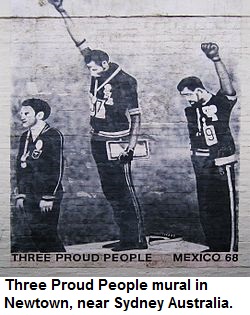
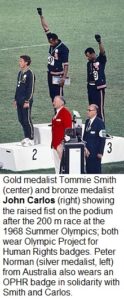
CU Blog - Caribbean Roots - John Carlos among 'Three Proud People' - Photo 1It was at the 1968 Olympics in Mexico City. Despite all the attempts by the organizers to keep the Games apolitical and free-of-conflict, the Moment got political and conflicted … and impactful. This was when the Man, John Carlos, the bronze-medal winner in the 200 meters at the 1968 Summer Olympics gave his Black Power salute on the podium with gold-medalist Tommie Smith; this galvanized the Movement – the Civil Rights Movement in general and the Olympic Project for Human Rights in particular. The Movement caused a lot of controversy.

What is not known about this moment is that this Man, John Carlos, has Caribbean roots.

We are so proud!

Consider his biography reference here:

Title: John Carlos
John Wesley Carlos (born June 5, 1945) is an American former track and field athlete and professional football player. He was the bronze-medal winner in the 200 meters at the 1968 Summer Olympics and his Black Power salute on the podium with Tommie Smith caused much political controversy. He went on to tie the world record in the 100 yard dash and beat the 200 meters world record (although the latter achievement was never certified). After his track career, he enjoyed a brief stint in the Canadian Football League but retired due to injury.[1]

He became involved with the United States Olympic Committee and helped to organize the 1984 Summer Olympics. Following this he became a track coach at Palm SpringsHigh School. He was inducted into the USA Track & Field Hall of Fame in 2003.

He is the author, with sportswriter Dave Zirin, of The John Carlos Story: The Sports Moment That Changed the World, published in 2011 by Haymarket Books.

Early life and education
Born in Harlem, New York, to Cuban[2] parents, John Carlos was a gifted high school athlete and outstanding student who went on to study at East Texas State University on a full track-and-field scholarship. His victories in the 100- and 200-meter dash and as a member of the 4×400-meter relay helped lead ETSU to the 1967 Lone Star Conference Championship. After his first year, Carlos enrolled at San Jose State University where he was trained by future National Track & Field Hall of Fame coach, Lloyd (Bud) Winter.

Carlos was awarded an honorary doctorate from CaliforniaStateUniversity in 2008. In 2012, he was awarded honorary doctorates from his alma maters Texas A&M University-Commerce (formerly EastTexasStateUniversity) and San Jose State University.

Career
At the 1968 Olympic Trials, Carlos won the 200-meter dash in 19.92 seconds, beating world-record holder Tommie Smith and surpassing his record by 0.3 seconds. Though the record was never ratified because the spike formation on Carlos’ shoes (“brush spikes”) was not accepted at the time, the race reinforced his status as a world-class sprinter.

Carlos became a founding member of the Olympic Project for Human Rights (OPHR), and originally advocated a boycott of the 1968 Mexico City Olympic Games unless four conditions were met: withdrawal of South Africa and Rhodesia from the games, restoration of Muhammad Ali’s world heavyweight boxing title, Avery Brundage to step down as president of the IOC, and the hiring of more African-American assistant coaches. As the boycott failed to achieve support after the IOC withdrew invitations for South Africa and Rhodesia, he decided, together with Smith, to participate but to stage a protest in case he received a medal.[3] Following his third-place finish behind fellow American Smith and Australian Peter Norman in the 200 at the Mexico Olympics, Carlos and Smith made headlines around the world by raising their black-gloved fists at the medal award ceremony. Both athletes wore black socks and no shoes on the podium to represent African-American poverty in the United States. In support, Peter Norman, the silver medalist who was a white athlete from Australia, participated in the protest by wearing an OPHR badge.

IOC president Avery Brundage deemed a political statement unfit for the apolitical, international forum the Olympic Games was supposed to be. In an immediate response to their actions, he ordered Smith and Carlos suspended from the U.S. team and banned from the Olympic Village. Many supporters, however, praised the men for their bravery. The men’s gesture had lingering effects for all three athletes, the most serious of which were death threats against Carlos, Smith, and their families. Although it has been reported that Carlos and Smith were stripped of their medals, Carlos has indicated this is not true and his medal is with his mother.[4]

Carlos had his greatest year in track and field in 1969, equaling the world 100-yard record of 9.1, winning the AAU 220-yard run, and leading San JoseState to its first NCAA championship with victories in the 100 and 220 and as a member of the 4×110-yard relay. He was featured on the cover of Track and Field News May 1969 issue.[5]

CU Blog - Caribbean Roots - John Carlos among 'Three Proud People' - Photo 3

Source: Wikipedia Online Encyclopedia – Retrieved March 8, 2017 from: https://en.wikipedia.org/wiki/John_Carlos
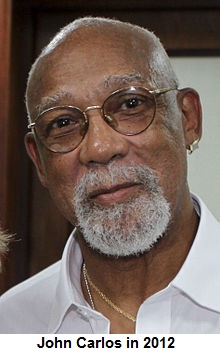
This biography should go back further to include John Carlos’s Cuban-Caribbean heritage, that of his father:

John Carlos is of Cuban descent and can understand Spanish. His father, Earl Carlos Sr., was a businessman (a cobbler or shoe repair) and World War I Veteran [fighting for the US]. He was a man proud of his appearance in all circumstances and carried himself in a dignified way. He had to work hard from an early age (like most African-American children of his era, especially in the South of the country) and his parents were born as slaves; [(slavery ended in Cuba in 1886 and he was born in 1895)]. When he participated in World War I, he got wounded and received the Medal of Citation Award for his stoicism on the battlefield. When he returned back home, he had to face racial hatred, economic discrimination, the Roaring Twenties, the Stock Market Crash in 1929, the Dust Bowl in the mid-thirties and World War II. Despite the difficulties, he never became bitter. He met his future wife, Vioris Lawrence (an African-American woman), in 1941, who was later John Carlos’ mother. – MegaDiversities.

This was quite a legacy to absorb. John Carlos had the molding from his proud Cuban father, who left a segregated Cuba and emigrated for a better life in the metropolitan area of New York. Harlem – think Harlem Renaissance – was a better place to be a Black Man than the Jim Crow South or the minority-ruled Cuba. When he stood in defiance in that Moment in 1968, John Carlos was protesting the blatant racism that he experienced and his father before him – Earl Carlos died later, in May 1969. The Movement to uplift oppressed people had began on the global stage, but the Black Power salute was a local action in solidarity with all those oppressed before and after this Moment. He understood that ‘Sport and Politics’ are intrinsically linked, whether right or wrong.

The movement behind the book Go Lean … Caribbean recognizes the significance of that Moment and the stage for its execution, the celebrated Olympic Games. The Go Lean book applauds the struggle for Civil Rights and the dynamics of sports. It posits that sports can foster a great influence – and even wealth – in modern society. See this in Appendix B VIDEO.

The sportsman can “rule in people’s hearts”. People marvel at their athletic prowess – billions may be watching on live or tape-delayed TV broadcasts – the participants can forge a positive image and wield power and influence; think:

We can add John Carlos and Tommie Smith to that list.

This Moment was in 1968; that was a pivotal year, so many things happened, mostly bad; consider this sample:

  • Martin Luther King was assassinated, April 4
  • Robert Kennedy was assassinated, June 6
  • Vietnam War Protests – Summer
  • Chicano (Hispanic) Movement and Red Power (Native Americans) Movement Summer Protests
  • Mexico City Olympics – October 12 – 27
  • James Brown song: Say it loud: “I’m Black and I’m Proud”
    CU Blog - Caribbean Roots - John Carlos among 'Three Proud People' - Photo 2

According to John Carlos, in a recent interview describing the disposition on the ground there in Mexico City: “it was high tension, drama, a powder keg … prior to the Olympics there was a massacre that killed hundreds of young activists”.

That was 1968 … all around; consider the experience of one Californian “back in that day”:

1968 was an exciting time for me. I think it was when my activism was born. Before that time things were pretty rosy. Even though I knew about the [Black] Panthers and had seen Dr. [Martin Luther] King, living in LA you were kind of removed. I do remember expressing a desire to join the Freedom Rides, but my Pastor said ‘No’.

1968 was [when] my friends were coming home from Vietnam or refusing to go.

I remember loaning my boyfriend $$ to go to Philly to go before the Draft Board to argue as a Conscientious Objector. He won and we were so happy.

I remember the day Dr. King was killed and going that night to a service with friends. I remember being so sad and being glued to the TV.

I remember the horror of Bobby Kennedy being killed. I was at work and heard the news.

I remember being so proud of Tommy Smith and John Carlos at the Olympics.

My living room had two posters. One of them on the stand with the black gloved fists held high and the other was [Black Panther Party co-founder] Huey Newton sitting in that Peacock Chair.

Those were the days when I was very active in the Watts Summer Festival. Tommy Jacquette, the founder, was a friend, and we all gathered together to make the event a success. …

I would say that 1968 was the year that I became the person I am today. – Bunny Withers, Los Angeles.

The reality of human rights abuses in America in 1968 was bad, worse or dire – those were the only options. The Black community was far from being treated as equal citizens in that society. But truth be told, other minority groups in the country also experienced oppression, repression and suppression. America was the greatest country on the planet for those that qualified; those that were:

White, Anglo-Saxon, Rich, Male and Straight

Anyone else – everyone else – needed civil rights empowerments.

Fortunately, this is not the conditions of the America of today. It is now a better place to live, work and play. How did this society go from “there to here”?

It took the strenuous efforts of advocates: individuals – Men and Women – and organizations, exploiting Moments and Movements for maximum exposure. They appealed to the public, appealed to their better nature. John Carlos was one such individual.

The third person on the dais, silver medalist Peter Norman of Australia, can also be classified as an advocate fighting to assuage human rights abuses – he also wore a badge of the Olympic Project for Human Rights – he was in solidarity with Smith and Carlos. See the profile VIDEO on his activities in Appendix A below.

The Caribbean has a problem today that we did not have back in 1968. The majority populations of the Caribbean region is/was Black-and-Brown. America was not inviting to this demographic, so our people rarely immigrated to the US. Now with the above-referenced civil rights empowerments, America is now a more fair society for all people. Our Caribbean people now “beat down their doors” to flee to America, and other places – Go Lean book Page 3.

The US is now a “frienemy” for us! We are trading partners; we are aligned; we are allies; many of our students studied there; many of our Diaspora live there. We now have to compete to dissuade our young people from setting their sights on American shores as a refuge and destination of their hopes and dreams. No society can survive with a high abandonment rate – the book Go Lean … Caribbean reports that 70% brain drain rate among our professional populations.

We are failing and need advocates of our own.

We need new role models, with the courage of John Carlos, to help us “battle” against the “push-and-pull” factors that draw many Caribbean citizens away from home to the US. We need Men to seize the Moment and advance this Movement.

The Go Lean movement pursues the quest to elevate the Caribbean region through empowerments in economics, security and governance. Since 29 of the 30 Caribbean member-states (“St. Barths” is the only exception) have majority Black populations, the book pushes further on this subject of racism, positing that it is easier for Caribbean citizens to stay home and effect change in their homelands than to go to America and try to remediate that society. The book therefore asserts that the region can turn-around from failing assessments by applying best-practices, and forging new societal institutions to impact the Greater Good for all the Caribbean.

The Go Lean book posits that sports – individual achievements and the business of sports – can greatly impact society; in addition to the entertainment value, there is also national pride, image and impression. People can override many false precepts with sporting excellence by great role models.

The book Go Lean…Caribbean serves as a roadmap for the introduction and implementation of the Caribbean Union Trade Federation (CU), a technocratic federal government designed to administer and optimize the economic-security-governing engines of the region’s 30 member-states. This is highlighted by these 3 prime directives:

  • Optimization of the economic engines in order to grow the regional economy; creating 2.2 million new jobs and expanding the regional GDP to $800 Billion.
  • Establishment of a security apparatus to protect the resultant economic engines.
  • Improve Caribbean governance to support these engines.

At the outset, the roadmap recognizes our crisis and the value of sports in the roadmap, with these statements in the Declaration of Interdependence (Page 13 & 14):

xix. Whereas our legacy in recent times is one of societal abandonment, it is imperative that incentives and encouragement be put in place to first dissuade the human flight, and then entice and welcome the return of our Diaspora back to our shores. This repatriation should be effected with the appropriate guards so as not to imperil the lives and securities of the repatriated citizens or the communities they inhabit. The right of repatriation is to be extended to any natural born citizens despite any previous naturalization to foreign sovereignties.

xxvi. Whereas the preparation of our labor force can foster opportunities and dictate economic progress for current and future generations, the Federation must ensure that educational and job training opportunities are fully optimized for all residents of all member-states, with no partiality towards any gender or ethnic group. The Federation must recognize and facilitate excellence in many different fields of endeavor, including sciences, languages, arts, music and sports. This responsibility should be executed without incurring the risks of further human flight, as has been the past history.

xxxi. Whereas sports have been a source of great pride for the Caribbean region, the economic returns from these ventures have not been evenly distributed as in other societies. The Federation must therefore facilitate the eco-systems and vertical industries of sports as a business, recreation, national pastime and even sports tourism – modeling the Olympics.

The Go Lean roadmap calls for the market organizations to better garner the economic benefits of sports. One of the biggest contributions the CU will make is the facilitation of sports venues: arenas and stadia. As described in a previous blog-commentary, sports can be big business! And even when money is not involved, other benefits abound: educational scholarships, fitness/wellness, disciplined activities for the youth, image, and pride. No doubt an intangible yet important benefits is depicted in this Go Lean roadmap, that of less societal abandonment.

The movement behind the Go Lean book salute those ones from our past who left their Caribbean homelands for better opportunities abroad; we salute their legacies (foreign-born children) as well. We know that there are “new” athletes who are just waiting to be discovered and fostered throughout the Caribbean member-states. We salute these ones as our future, and pledge to do better to keep them here at home. The book details the community ethos, strategies, tactics, implementations and advocacies to allow Caribbean people to prosper where they are planted.

In terms of salute, it is appropriate to salute Vioris Louise Lawrence Carlos – the mother of John Carlos. She just recently passed-away, on December 12, 2016, at age 97. This blessed woman’s contributions and life course help to mold the life and legacy of 5 children – including John Carlos – and a whole community.

Previous Go Lean blog-commentaries that identified other sports role models for our consideration:

https://goleancaribbean.com/blog/?p=8495 NBA Greatness and Caribbean Roots: Tim Duncan Retires
https://goleancaribbean.com/blog/?p=2222 Sports Role Model – Playing For Pride … And More
https://goleancaribbean.com/blog/?p=1020 Sports Revolutionary: Advocate Jeffrey Webb
https://goleancaribbean.com/blog/?p=498 Caribbean Sport Excellence due to ‘The Sports Gene’

In addition, these other Go Lean blog-commentaries have identified other role models with Caribbean roots:

https://goleancaribbean.com/blog/?p=10609 Caribbean Roots: Cast of ‘The Fresh Prince of Bel-Air’
https://goleancaribbean.com/blog/?p=10114 Esther Rolle – Caribbean Roots
https://goleancaribbean.com/blog/?p=9948 Sammy Davis, Jr. – Caribbean Roots
https://goleancaribbean.com/blog/?p=8724 Remembering Marcus Garvey: A Role Model; Still Relevant Today
https://goleancaribbean.com/blog/?p=8619 Clive Campbell – Jamaican Innovation for Hip Hop
https://goleancaribbean.com/blog/?p=8328 YouTube Role Model with Caribbean Roots: ‘Tipsy Bartender’
https://goleancaribbean.com/blog/?p=2726 Caribbean Role Model – Oscar De La Renta – RIP
https://goleancaribbean.com/blog/?p=866 Caribbean Musical Icon and Role Model: Bob Marley

The world is a better place, sports-wise and arts-wise, because of Caribbean contributions. Thank you to all past, present and future athletes and contributors.

Not to be overlooked, but the same as the US had a Climate of Hate in 1968, we have our own societal defects in the Caribbean region today. We cannot claim enlightenment to the achievements of advocates like John Carlos and have a blind eye” to our own “ills”. So let’s stand-up as a Proud People and force our own communities to change. Let’s make our Caribbean homeland a better place to live, work and play. 🙂

Download the book Go Lean … Caribbean – now!

Sign the petition to lean-in for the roadmap for the Caribbean Union Trade Federation.

————-

APPENDIX A VIDEO – The Story Behind The White Guy In This Historic Photo – https://youtu.be/t4LvwXYmt3Q

Published on Oct 31, 2015 – In 1968 there was a powerful moment of protest at the Olympic games when two winners put on black gloves to protest what was happening in the country during the civil rights era. Most people don’t know the story of the silver medalist, Peter Norman. Cenk Uygur, host of the The Young Turks, breaks it down. Tell us what you think in the comment section below.

“In an act as appropriate as it is overdue, the Australian House of Parliament is issuing an official state apology Monday to the country’s late, great sprinter Peter Norman. Norman won the 200-meter silver medal at the 1968 Olympics, but that’s not why he’s either remembered or owed apologies. After the race, gold and bronze medalists Tommie Smith and John Carlos bowed their heads and raised their fists on the medal stand and started an international firestorm. Many see the iconic image and assume Norman was just a bystander to history, or as he would joke, “the white guy.” But he was standing in full solidarity with Smith and Carlos, wearing a patch on his chest that reads, “Olympic Project for Human Rights.”

Read more here: https://www.thenation.com/article/aus…

Disclaimer: The Young Turks is an online video talk show that provides commentary on news and opinion articles. Often times these articles come from sources outside of our organization. Where possible, we do our best to research and verify various sources before reporting. Content created by third parties is the sole responsibility of the third parties and its accuracy and completeness are not endorsed or guaranteed.

UPDATE to story: http://www.filmsforaction.org/watch/j…

————-

APPENDIX B VIDEO – THREE PROUD PEOPLE (Mural project) Tommy Smith, Peter Norman, John Carlos – https://youtu.be/xHcasP4HOo0

Uploaded on May 17, 2009 – This mural was put up about 6 weeks prior to the opening ceremony of the Sydney 2000 Olympic games. It could be viewed from the McDonaldtown train station platform and from trains travelling past. Trains travel from central Sydney to the Homebush Olympic venue past this mural. As of a few years ago, the mural can no longer be seen from the tracks due to a city rail concrete sound barrier that has been installed.
Peter Norman was repremanded for his part in the action. Peter, in solidarity, wore the Olympic project for human rights badge, which defied the code of conduct. He also came up with the idea of Smith and Carlos each wearing one black glove from the same pair. All three of these guys were very couragous.

  • Category: Education
  • License: Standard YouTube License


Share this post:
, , ,

Climate Change Catastrophe: 12 Year Countdown

Go Lean Commentary

So do not make any plans beyond 12 years …

… that is the warning …

… from the UN Intergovernmental Panel on Climate Change (IPCC). The report from this respected body asserts that if there are no mitigations, then the catastrophic future that we all dread will be unavoidable. Life may continue on the planet, but the status quo would be no more. See the news story on the UN Report here and the continuation in the Appendix below:

Title: We have 12 years to limit climate change catastrophe, warns UN
Sub-title: Urgent changes needed to cut risk of extreme heat, drought, floods and poverty, says IPCC

The world’s leading climate scientists have warned there is only a dozen years for global warming to be kept to a maximum of 1.5C, beyond which even half a degree will significantly worsen the risks of drought, floods, extreme heat and poverty for hundreds of millions of people.
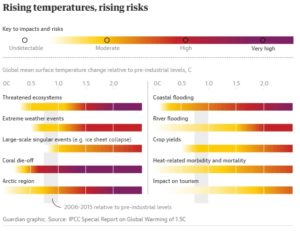
The authors of the landmark report by the UN Intergovernmental Panel on Climate Change (IPCC) released on Monday say urgent and unprecedented changes are needed to reach the target, which they say is affordable and feasible although it lies at the most ambitious end of the Paris agreementpledge to keep temperatures between 1.5C and 2C.

The half-degree difference could also prevent corals from being completely eradicated and ease pressure on the Arctic, according to the 1.5C study, which was launched after approval at a final plenary of all 195 countries in Incheon in South Korea that saw delegates hugging one another, with some in tears.

“It’s a line in the sand and what it says to our species is that this is the moment and we must act now,” said Debra Roberts, a co-chair of the working group on impacts. “This is the largest clarion bell from the science community and I hope it mobilises people and dents the mood of complacency.”

Policymakers commissioned the report at the Paris climate talks in 2016, but since then the gap between science and politics has widened. Donald Trump has promised to withdraw the US – the world’s biggest source of historical emissions – from the accord. The first round of Brazil’s presidential election on Sunday put Jair Bolsonaro into a strong position to carry out his threat to do the same and also open the Amazon rainforest to agribusiness.

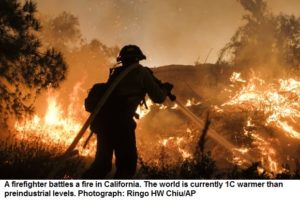
The world is currently 1C warmer than preindustrial levels. Following devastating hurricanes in the US, record droughts in Cape Town and forest fires in the Arctic, the IPCC makes clear that climate change is already happening, upgraded its risk warning from previous reports, and warned that every fraction of additional warming would worsen the impact.


See the remaining article in the Appendix below.

Source: Posted The Guardian – London Daily Newspaper October 8, 2018;retrieved October 15, 2018 from: https://www.theguardian.com/environment/2018/oct/08/global-warming-must-not-exceed-15c-warns-landmark-un-report

This is not Armageddon … yet. But the Bible does provide a justification that redeeming mankind will only happen at the precipice, just as man’s perilous rule reaches the point of unavoidable destruction of the planet. That scripture reads:

18  But the nations became wrathful, and your own wrath came, and the appointed time came for the dead to be judged and to reward+ your slaves the prophets+ and the holy ones and those fearing your name, the small and the great, and to bring to ruin those ruining* the earth.”+ – Revelation 11:18 New World Translation

Yes, truly, “we” are ruining the earth. Some people (countries) more so than others. But despite whether we are the guilty culprits or not, we still only have one planet … and it needs some attention. Or else …

… after 12 years, no more earth, the way we know it.

All the evidence is in front of us. To ignore it, we do so at our own peril. As related previously, the Numbers don’t lie: as of this past May, the earth has had 400 straight warmer-than-average months. See other aligned blog-commentaries that echoed this assessment:

https://goleancaribbean.com/blog/?p=14925 Climate Change Doubt?! Numbers Don’t Lie
https://goleancaribbean.com/blog/?p=14832 Manifesting Environmental Change
https://goleancaribbean.com/blog/?p=11858 Islands are Disappearing – The Cautionary Tale of Kiribati
https://goleancaribbean.com/blog/?p=9455 Fix ‘Climate Change’ – Yes, We Can
https://goleancaribbean.com/blog/?p=7103 COP21 – ‘Climate Change’ Acknowledged
https://goleancaribbean.com/blog/?p=6893 A Meteorologist’s View On Climate Change
https://goleancaribbean.com/blog/?p=4673 Climate Change‘ Merchants of Doubt … to Preserve Profits!!
https://goleancaribbean.com/blog/?p=2465 Book: ‘This Changes Everything: Capitalism vs. the Climate’
https://goleancaribbean.com/blog/?p=2276 Climate Change May Affect Food Supply Within a Decade
https://goleancaribbean.com/blog/?p=1883 Climate Change May Bring More Kidney Stones
https://goleancaribbean.com/blog/?p=1817 Caribbean grapples with intense cycles of flooding & drought

Are we saying that the earth will be destroyed in 12 years?

No!

But the mitigations that are feasible to assuage this problem, only have a limited shelf-life. After 12 years, there may not be any turning back from a Greenhouse planet. Once we accept this fact – the eventuality of the Climate Change Catastrophe – only then can we start to make effort to address the truth: our “house is on fire”.

There should be no doubt, we must act now.

What are we going to do about it?

Yes, we can … make a difference … still. But now we cannot hit or miss; we are at the precipice.

Perhaps this reality now is why one of the world’s most notorious Climate Change Denier is finally, begrudgingly, owning up to the fact that … “there might be something to this Climate Change” thing.

We’re talking about US President Donald Trump. See  the VIDEO here:

VIDEO – President Donald Trump’s ’60 Minutes’ Interview: Climate Change, etc. –  https://youtu.be/_D8OfRiEff4

TODAY
Published on Oct 15, 2018 – In an interview with “60 Minutes,” President Trump backed off earlier statements that climate change is a hoax, and also said that he doesn’t “trust everybody” in the White House. He also commented on Supreme Court Justice Brett Kavanaugh’s confirmation and the ongoing Russia investigation.

This is how destiny works. We can run from it, deny it or hide. But it will still catch up with us.

The earth is destined to suffer great catastrophes due to Climate Change … in 12 years!

Let’s do our share, everyone, everywhere to see if we can abate this reality.

The book Go Lean…Caribbean – available to download for free – serves as a roadmap for the introduction and implementation of the technocratic Caribbean Union Trade Federation (CU), to reform and transform all of Caribbean society – all 30 member-states. There is the need to shepherd our own communities to do our share to abate Climate Change. While the problem is too big for us alone in our region, we must still act … nonetheless. We cannot sit back, fold our arms and expect everyone else to do the heavy-lifting. No, we must even lead, since we are on the frontlines of over-heated hurricanes.

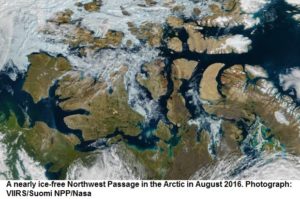
This is a lesson learned from Canada; they are on the frontline of melting ice-caps – think icy Northwest Passage – so they are stepping-up to act and show the world how to act. They are not waiting for “deniers to wake up and stop denying”; they are putting in their mitigation now … anyway. Then they are telling and showing the world what to do in following their example. This was detailed in a previous Go Lean commentary as follows:

Canada … has the longest total coastline among all of the countries of the world, at 125,567 miles. …

If Climate Change is to continue unabated, this country has a lot to lose – catastrophic storms, melting ice caps, thawing permafrost and rising sea level. …

Canada is prepared to take the lead, to put the Western Hemisphere on its shoulders and carry the load for arresting Climate Change. …

Thank you Canada for this model. Now, we – the Caribbean – need to step up to carry our own load for better mitigation of Climate Change threats; we need to do our part in lowering our own carbon footprint. We can make a difference. Canada can make a difference. As related in a previous blog-commentary, the same as the threat of Acid Rain was subjugated, so too, curative measures can be put in place to lower the greenhouse gases in the environment. This is why Canada has a Champion for the Environment – Catherine McKenna – at the Cabinet level.

Good model …

The Go Lean roadmap addresses all aspects of Caribbean society – economics, security and governance – and then declares: “Do this; Do that; Do Something; Do Everything”. The roadmap presents these prime directives in this regards:

Fixing Climate Change in the US or Canada is out-of-scope for this Go Lean movement; but we still need them to act. We also need Europe, China, India – all Big Polluters – and all countries of the world to act. We must stand on soap boxes, podiums and stages and tell the world – everyone must listen; we must make them listen. This is now everyone’s job, everyone’s responsibility.

We only have 12 years!

Make no plans for Year 13 and beyond. 🙁

There is hope! The Go Lean book and roadmap stresses that reforming and transforming the Caribbean’s societal engines to abate Climate Change is possible; it is conceivable, believable and achievable. But this is heavy-lifting.

The Go Lean book provides 370-pages of turn-by-turn instructions on “how” to prepare and respond for Climate Change catastrophes. See this sample of strategies, tactics, implementations and advocacies from the book:

Community Ethos – Deferred Gratification Page 21
Community Ethos – Economic Systems Influence Individual Choices / Incentives Page 21
Community Ethos – The Consequences of Choices Lie in the Future Page 21
Community Ethos – “Crap” Happens Page 23
Strategy – Mission – Prepare for Natural Disasters Page 45
Strategy – Agents of Change – Climate Change Page 57
Tactical – Confederating a Permanent Union Page 63
Tactical – Fostering a Technocracy Page 64
Separation of Powers – Emergency Management Page 76
Separation of Powers – Meteorological & Geological Service Page 79
Anecdote – “Lean” in Government Page 93
Implementation – Security Initiatives at Start-up – Unified Command & Control Page 103
Implementation – Industrial Policy for CU Self Governing Entities Page 103
Implementation – Ways to Deliver Page 109
Implementation – Ways to Foster International Aid Page 115
Implementation – Ways to Benefit from Globalization – Produce, Not Just Consume Page 119
Advocacy – Ways to Better Manage the Social Contract Page 170
Advocacy – Ways to Foster Cooperatives Page 176
Advocacy – Ways to Improve for Natural Disasters Page 184
Advocacy – Ways to Improve Emergency Management Page 196
Advocacy – Ways to Improve Transportation – CNG Buses and Electric Street Cars Page 205
Advocacy – Ways to Develop the Auto Industry – Embrace Alternative Energy Page 206

Are we up to this challenge?

We must work at it … as if our life depends on it.

It does!

We need all hands on deck! This is an Inconvenient Truth but its the truth nonetheless. We urge all Caribbean stakeholders to lean-in to this Go Lean roadmap for change, to get our homeland more active in the solution and abatement of Climate Change. Let’s get going. 🙂

Download the free e-Book of Go Lean … Caribbean – now!

Sign the petition to lean-in for this roadmap for the Caribbean Union Trade Federation.

—————-

Appendix – We have 12 years to limit climate change catastrophe, warns UN (Cont’d)

This is the continuation of the news article from the Guardian Newspaper …

Scientists who reviewed the 6,000 works referenced in the report, said the change caused by just half a degree came as a revelation. “We can see there is a difference and it’s substantial,” Roberts said.

At 1.5C the proportion of the global population exposed to water stress could be 50% lower than at 2C, it notes. Food scarcity would be less of a problem and hundreds of millions fewer people, particularly in poor countries, would be at risk of climate-related poverty.

At 2C extremely hot days, such as those experienced in the northern hemisphere this summer, would become more severe and common, increasing heat-related deaths and causing more forest fires.

But the greatest difference would be to nature. Insects, which are vital for pollination of crops, and plants are almost twice as likely to lose half their habitat at 2C compared with 1.5C. Corals would be 99% lost at the higher of the two temperatures, but more than 10% have a chance of surviving if the lower target is reached.

Sea-level rise would affect 10 million more people by 2100 if the half-degree extra warming brought a forecast 10cm additional pressure on coastlines. The number affected would increase substantially in the following centuries due to locked-in ice melt.

Oceans are already suffering from elevated acidity and lower levels of oxygen as a result of climate change. One model shows marine fisheries would lose 3m tonnes at 2C, twice the decline at 1.5C.

Sea ice-free summers in the Arctic, which is warming two to three times faster than the world average, would come once every 100 years at 1.5C, but every 10 years with half a degree more of global warming.

Time and carbon budgets are running out. By mid-century, a shift to the lower goal would require a supercharged roll-back of emissions sources that have built up over the past 250 years.

The IPCC maps out four pathways to achieve 1.5C, with different combinations of land use and technological change. Reforestation is essential to all of them as are shifts to electric transport systems and greater adoption of carbon capture technology.

Carbon pollution would have to be cut by 45% by 2030 – compared with a 20% cut under the 2C pathway – and come down to zero by 2050, compared with 2075 for 2C. This would require carbon prices that are three to four times higher than for a 2C target. But the costs of doing nothing would be far higher.

“We have presented governments with pretty hard choices. We have pointed out the enormous benefits of keeping to 1.5C, and also the unprecedented shift in energy systems and transport that would be needed to achieve that,” said Jim Skea, a co-chair of the working group on mitigation. “We show it can be done within laws of physics and chemistry. Then the final tick box is political will. We cannot answer that. Only our audience can – and that is the governments that receive it.”

He said the main finding of his group was the need for urgency. Although unexpectedly good progress has been made in the adoption of renewable energy, deforestation for agriculture was turning a natural carbon sink into a source of emissions. Carbon capture and storage projects, which are essential for reducing emissions in the concrete and waste disposal industries, have also ground to a halt.

Reversing these trends is essential if the world has any chance of reaching 1.5C without relying on the untried technology of solar radiation modification and other forms of geo-engineering, which could have negative consequences.

In the run-up to the final week of negotiations, there were fears the text of the report would be watered down by the US, Saudi Arabia and other oil-rich countries that are reluctant to consider more ambitious cuts. The authors said nothing of substance was cut from a text.

Bob Ward, of the Grantham Research Institute on Climate Change, said the final document was “incredibly conservative” because it did not mention the likely rise in climate-driven refugees or the danger of tipping points that could push the world on to an irreversible path of extreme warming.

The report will be presented to governments at the UN climate conference in Poland at the end of this year. But analysts say there is much work to be done, with even pro-Paris deal nations involved in fossil fuel extraction that runs against the spirit of their commitments. Britain is pushing ahead with gas fracking, Norway with oil exploration in the Arctic, and the German government wants to tear down Hambach forest to dig for coal.

At the current level of commitments, the world is on course for a disastrous 3C of warming. The report authors are refusing to accept defeat, believing the increasingly visible damage caused by climate change will shift opinion their way.

“I hope this can change the world,” said Jiang Kejun of China’s semi-governmental Energy Research Institute, who is one of the authors. “Two years ago, even I didn’t believe 1.5C was possible but when I look at the options I have confidence it can be done. I want to use this report to do something big in China.”
The timing was good, he said, because the Chinese government was drawing up a long-term plan for 2050 and there was more awareness among the population about the problem of rising temperatures. “People in Beijing have never experienced so many hot days as this summer. It’s made them talk more about climate change.”

Regardless of the US and Brazil, he said, China, Europe and major cities could push ahead. “We can set an example and show what can be done. This is more about technology than politics.”

James Hansen, the former Nasa scientist who helped raised the alarm about climate change, said both 1.5C and 2C would take humanity into uncharted and dangerous territory because they were both well above the Holocene-era range in which human civilisation developed. But he said there was a huge difference between the two: “1.5C gives young people and the next generation a fighting chance of getting back to the Holocene or close to it. That is probably necessary if we want to keep shorelines where they are and preserve our coastal cities.”

Johan Rockström, a co-author of the recent Hothouse Earth report, said scientists never previously discussed 1.5C, which was initially seen as a political concession to small island states. But he said opinion had shifted in the past few years along with growing evidence of climate instability and the approach of tipping points that might push the world off a course that could be controlled by emissions reductions.

“Climate change is occurring earlier and more rapidly than expected. Even at the current level of 1C warming, it is painful,” he told the Guardian. “This report is really important. It has a scientific robustness that shows 1.5C is not just a political concession. There is a growing recognition that 2C is dangerous.”

Source: Posted The Guardian – London Daily Newspaper October 8, 2018;retrieved October 15, 2018 from: https://www.theguardian.com/environment/2018/oct/08/global-warming-must-not-exceed-15c-warns-landmark-un-report

Related: Overwhelmed by climate change? Here’s what you can do

Share this post:
, , , ,
[Top]

Paul Romer – Congrats to the New Nobel Laureate

Go Lean Commentary

Some people make great accomplishments, to the point that they are recognized … globally.

Sometimes, a person greatest accomplishment is that they inspire others.

Every now and then, one person does both.

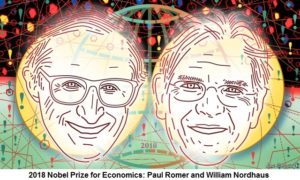
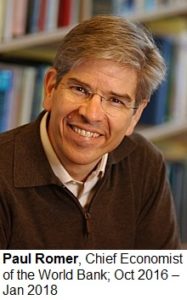
The world is celebrating the accomplishment of American Economist and University Professor Dr. Paul Romer; he has just been awarded the Nobel Prize for Economics.

Congratulations!

This is a Big Deal for him … and for us in the Caribbean.

Wait, what?

Dr. Romer gets this award today in 2018, but back in 2013, he inspired an important movement in the Caribbean. His writings inspired the book Go Lean…Caribbean. He coined the following phrases, as recorded in the Go Lean book (Page 8):

“A crisis is a terrible thing to waste”

Economic growth occurs whenever people take resources and re-arrange them in ways that are more valuable

Before examining this inspiration and motivation, we must first give Dr. Romer his “props”. See the aligning news article here from the Economist Magazine:

Title: Paul Romer and William Nordhaus win the economics Nobel
Sub-title:
Both have studied the causes and consequences of growth
October 11, 2018 – WHY do economies grow, and why might growth outstrip the natural world’s capacity to sustain it? There are few more important questions in economics. The answers require a working grasp of the mechanisms underlying growth. For the progress that the profession has made towards that understanding, it owes a particular debt to Paul Romer and William Nordhaus, this year’s winners of the Nobel prize in economic sciences.

Although both scholars have long been talked of as potential winners, they are not an obvious pairing for the prize. Mr Romer tends to be described as a growth theorist; Mr Nordhaus’s work is in the field of environmental economics. The Sveriges Riksbank, which awards the economics Nobel, found a common thread in their work incorporating two crucial processes—knowledge creation and climate change, respectively—into models of economic growth. But what most links their work is that they have improved the way the profession thinks about impossibly complex systems, while also revealing the extent of its ignorance.

The influence of both men extends beyond their most noted scholarly achievements. Mr Romer’s career has been especially varied. He left academia in the early 2000s to found an educational-software company. More recently he served as the World Bank’s chief economist (his tenure ended abruptly when staffers bridled at his management style, which included an insistence on more crisply written reports). But it is his analysis of economic growth that has had the greatest impact.

Economists used to think that sustained long-run growth depended on technological progress, which in turn relied on the creation of new ideas. They struggled, however, to explain convincingly how markets generated and propagated those ideas. When Mr Romer came into economics, most prominent models of growth relied on “exogenous” technological progress: it was simply assumed, rather than generated by the models’ equations.

Dissatisfied by this state of affairs, he sought answers by probing the non-rivalrous nature of knowledge: the fact that ideas, once created, can be endlessly exploited. The firms or individuals that come up with new ideas can only ever capture a small share of the benefits arising from them; before long, competitors copy the original brainwave and whittle away innovators’ profits. In Mr Romer’s work, markets are capable of generating new ideas. But the pace at which they are generated, and the way in which they are translated into growth, depends on other factors—such as state support for research and development, or the protection of intellectual property.

The “endogenous” growth models produced by Mr Romer, and by others influenced by him, were once hailed as a critical step towards understanding patterns of economic growth across the globe. They have not quite fulfilled that promise: knowledge may be necessary for growth, but it is clearly not sufficient. But their shortcomings have themselves raised important questions about the stubborn disparities in growth rates. Why are some countries able to exploit existing ideas and grow, while others are not? Should policymakers who want to boost growth focus on policies that support the creation of knowledge or on those that break down barriers to the exploitation of existing knowledge? Or does it make most sense to shift people and resources from the parts of the world that struggle to grow to those that do not? By provoking such questions, Mr Romer’s work identified a rich vein for other researchers to mine.

Mr Nordhaus, for his part, has been a towering figure in the debate about how to respond to one of the biggest challenges that humanity faces. When he was beginning his career in the early 1970s, awareness of the dangers of environmental damage and the threat posed by climate change was just starting to grow. Understanding the economic costs such damage imposes is essential to answering the question of how much society should be willing to pay to avert it.

Mr Nordhaus applied himself to solving this problem. That meant working out the complex interactions between carbon emissions, global temperature and economic growth. He combined mathematical descriptions of both climate and economic activity into “integrated assessment models”. This allowed him to project how different trajectories for the world’s carbon emissions would produce different global temperatures. That, in turn, allowed him to estimate the likely costs of these different scenarios—and thus what level of reduction in emissions would be economically optimal. He was the first to suggest that warming should be limited to no more than 2°C higher than the world’s pre-industrial temperature. Models like his have become the linchpin of most analysis of the cost of climate change.

The known world
As with Mr Romer’s work, Mr Nordhaus’s contributions are also notable for the lessons imparted by their shortcomings. Four decades after he began publishing research on climate change, the limits to scholars’ predictive abilities have become abundantly clear. Indeed, his work has prompted vigorous debate about how best to think through the huge uncertainties associated with global warming—from how emissions translate into higher temperatures to how well society can adapt to rapid changes in climate.

Policymakers prefer the comfort of hard numbers. But the often-unfathomable complexity of human society and natural processes may mean that other guides are sometimes needed to set policy, from the precautionary principle to moral reasoning. Ironically, Mr Nordhaus’s computations, like those of Mr Romer, made that awareness possible.

Above all, both of this year’s prize-winners tackled problems that the field both could not understand and could not afford not to understand. They blazed trails that scholars continue to follow—to the benefit of economics and humanity.

This article appeared in the Finance and economics section of the print edition under the headline “Greener pastures”

Source: Retrieved October 12, 2018 from https://www.economist.com/finance-and-economics/2018/10/13/paul-romer-and-william-nordhaus-win-the-economics-nobel

As for Dr. Romer’s sphere of influence:

Romer was named one of America’s 25 most influential people by Time magazine in 1997.[10]

According to this encyclopedic source, his trademark quotation was stated in 2004…

Romer is credited with the quote “A crisis is a terrible thing to waste,” which he said during a November 2004 venture-capitalist meeting in California. Although he was referring to the rapidly rising education levels in other countries compared to the United States, the quote became a rallying concept for economists and consultants looking for constructive opportunities amid the Great Recession.[17]

So when the movement behind the Go Lean book, came “under his spell”, he had a long and noble track record. Now he is a Nobel Laureate.

So this one man had made a difference in the world, and even in our Caribbean world. The movement behind the book Go Lean…Caribbean – available to download for free – has consistently asserted that one man or one woman can make a difference in society. Though Dr. Romer is not in the Caribbean, nor from the Caribbean, we can still look, listen and learn from his contributions. His pioneering principle of Endogenous growth theory is spot-on for the economic policy that we need to adopt for the Caribbean reboot. See the definition here:

Endogenous growth theory holds that economic growth is primarily the result of endogenous and not external forces [or exogenous].[1] Endogenous growth theory holds that investment in human capital, innovation, and knowledge are significant contributors to economic growth.

Now to learn and apply this lesson. In plain-speak, education directly elevates economics. The Go Lean book quotes this accepted fact on Page 258:

… both public and private returns to investment in education are positive—at both the individual and economy-wide levels

The Go Lean book developed the argument of one person making a difference (Page 122). It specifically relates:

An advocacy is an act of pleading for, supporting, or recommending a cause or subject. For this book, it’s a situational analysis, strategy or tactic for dealing with a narrowly defined subject.

Advocacies are not uncommon in modern history. There are many that have defined generations and personalities. Consider these notable examples from the last two centuries in different locales around the world:

  • Frederick Douglas
  • Mohandas Gandhi
  • Martin Luther King
  • Nelson Mandela
  • Cesar Chavez
  • Candice Lightner

The Go Lean book seeks to advocate and elevate the Caribbean, and the people who love our homeland. Yet still, we can learn lessons from the Nobel-prize-winning Economist and direct our regional stakeholders to a Way Forward based on best-practices of home-grown and home-targeted education. The book serves as a roadmap for the introduction and implementation of the technocratic Caribbean Union Trade Federation (CU), to move our society to a brighter future, by elevating our societal engines – for all member-states. This CU/Go Lean roadmap has these 3 prime directives:

  • Optimization of the economic engines in order to grow the regional economy to $800 Billion and create 2.2 million new jobs.
  • Establishment of a security apparatus to ensure public safety and protect the resultant economic engines.
  • Improve Caribbean governance to support these engines, including a separation-of-powers between the member-states and CU federal agencies.

The book stresses that reforming and transforming the Caribbean societal engines must be a regional pursuit – we must ensure that we have the best education option available to our people, but in a way that does not jeopardize their remaining in their Caribbean homeland. This challenge to guarantee our “brain does not drain” is too big for any one Caribbean member-state to contend with alone. This was an early motivation for the roadmap, as pronounced in the opening Declaration of Interdependence (Pages 12 – 14):

xi. Whereas all men are entitled to the benefits of good governance in a free society, “new guards” must be enacted to dissuade the emergence of incompetence, corruption, nepotism and cronyism at the peril of the people’s best interest. The Federation must guarantee the executions of a social contract between government and the governed.

xxi. Whereas the preparation of our labor force can foster opportunities and dictate economic progress for current and future generations, the Federation must ensure that educational and job training opportunities are fully optimized for all residents of all member-states, with no partiality towards any gender or ethnic group. The Federation must recognize and facilitate excellence in many different fields of endeavor, including sciences, languages, arts, music and sports. This responsibility should be executed without incurring the risks of further human flight, as has been the past history.

xxxiii. Whereas lessons can be learned and applied from the study of the recent history of other societies, the Federation must formalize statutes and organizational dimensions to avoid the pitfalls of communities like East Germany, Detroit, Indian (Native American) Reservations, Egypt and the previous West Indies Federation. On the other hand, the Federation must also implement the good examples learned from developments/ communities …

The Go Lean book provides 370-pages of turn-by-turn instructions on “how” to adopt new community ethos, plus the strategies, tactics, implementations and advocacies to execute so as to reboot, reform and transform the societal engines of Caribbean society.

The Go Lean movement calls on every man, woman and child in the Caribbean to be an advocate and a champion, or at least appreciate the championing efforts of previous advocates. Their examples can truly help us today with our passions and purpose. Consider this sample of prior blog/commentaries where advocates and role models have been elaborated upon:

https://goleancaribbean.com/blog/?p=14541 Viola Desmond – One Woman Made a Difference
https://goleancaribbean.com/blog/?p=14139 Carter Woodson – One Man Made a Difference … for Black History
https://goleancaribbean.com/blog/?p=11963 Oscar López Rivera – The ‘Nelson Mandela’ of the Caribbean?
https://goleancaribbean.com/blog/?p=11442 Caribbean Roots: Al Roker – ‘Climate Change’ Defender
https://goleancaribbean.com/blog/?p=10801 Caribbean Roots: John Carlos – The Man. The Moment. The Movement
https://goleancaribbean.com/blog/?p=10114 Caribbean Roots: Esther Rolle of ‘Good Times’
https://goleancaribbean.com/blog/?p=9948 Caribbean Roots: Sammy Davis, Jr.
https://goleancaribbean.com/blog/?p=9300 Edward Snowden – One Person Making a Difference
https://goleancaribbean.com/blog/?p=8724 Remembering Marcus Garvey: Still Relevant Today
https://goleancaribbean.com/blog/?p=8495 The NBA’s Tim Duncan – Champion On and Off the Court
https://goleancaribbean.com/blog/?p=8328 YouTube Millionaire: ‘Tipsy Bartender’
https://goleancaribbean.com/blog/?p=7682 Frederick Douglass: Role Model for Single Cause – Death or Diaspora
https://goleancaribbean.com/blog/?p=866 Bob Marley: The legend lives on!

Thank you Dr. Paul Romer, for your good role model. Congratulations on your Nobel Prize award. You deserve the recognition. (See the explanation VIDEO in the Appendix below).

In your role as a professor, you have not just taught your classes, but rather the whole world. We say to you as we do to all of our own Caribbean teachers; we say (Go Lean book Valedictions on Page 252):

Thank you for your service, for molding young minds.

The movement behind Go Lean book, the planners of a new Caribbean stresses that a ‘change is going to come’. We have endured failure for far too long; we have seen what works and what does not. We want to learn from Nobel Laureates and apply their lessons as mitigations, though it may be heavy-lifting.

Yes, our Caribbean society is in crisis right now, but as Dr. Romer enunciated:

A crisis is a terrible thing to waste.

We urged every Caribbean stakeholder to lean-in to this Go Lean roadmap to make the homeland a better place to live, work and play. 🙂

Sign the petition to lean-in for this roadmap for the Caribbean Union Trade Federation.

—————–

Appendix VIDEO – The Nobel Prize to Paul Romer – https://youtu.be/JSQSei9XoaI

UniBocconi
Published on Oct 8, 2018 – Guido Tabellini, economist at Bocconi, explains why Romer has won the Nobel Prize for Economics.

Share this post:
,
[Top]

Network Mandates for a New Caribbean

Go Lean Commentary

Golden Rule: “He who has the gold, makes the rules” …

When it comes to media industry (movies, film, fashion modeling), there are some other relevant idioms; consider this list:

  • Dress for the job you want, not the job you have.
  • Fake it until you can make it.
  • A face out of “Central Casting”.

All of these idioms help us to appreciate that in the media industry you must look the part. So if you have facial or grooming features that are different – zag while everyone else zig – you may not be selected for promotion and production. (Think: Dreadlocks, Afros and Braids).

This is sad! “Look the part”? What part, as determined by who? Obviously, there is an adjudicator as to Good/Bad, Yes/No. Who is that? That’s the opening idiom, the Golden Rule. In the media industry that adjudicator is the producer, director, promoter or media company executive. (See Appendix VIDEO for background on one big Broadcast & Media company).

So at times, even though “you are home”, you may have to act foreign. This is definitely the sad narrative taking place in this story below, when a Caribbean model/beauty queen had been scolded for looking too … “Caribbean”. See the full story here:

Title: Caribbean Next Top Model contestant wants apology from Wendy

ASPIRING international model Gabriella Bernard feels she deserves an apology from former Miss Universe and executive producer of the Caribbean Next Top Model competition, Wendy Fitzwilliam, after she was given an ultimatum on the television show- relax her natural hair or go home.


The particular episode was filmed in Jamaica last year and aired on television in February.

An excerpt featuring Bernard’s experience was posted to Facebook yesterday.

The majority of persons who commented on the video criticised Fitzwilliam for her response to the model’s stance.

Bernard, 24, told the Express via telephone on Thursday that she and other contestants had to undergo a makeover for the segment.

She said Fitzwilliam had the final say in what each girl’s look should be.

“For my look they wanted my hair relaxed,” she said.

In the video, Bernard was seen pleading with a hairdresser not to chemically process her curly tresses as she had spent the last three years growing it.

“I’m ok with texturizing my hair once my curls stay intact. You need to understand my hair is my identity,” she begged.

Bernard told the Express that the show’s producers, judges and hairdresser were nonchalant about how she felt.

“A lot more happened which you didn’t see in the video. But basically I was trying to reason with them but they were like it was no big deal, it’s just hair,” she said, adding that she was told that she could either relax her hair or leave the show.

Bernard’s hair was relaxed and she remained in the competition.

Towards the end of the video she appeared before Fitzwilliam and two other judges- international photographer Pedro Virgil and Caribbean fashion expert Socrates McKinney.

Before critiquing the model’s makeover photograph, Fitzwilliam scolded her for her “naughty” and “unprofessional” behaviour.

Bernard apologised, but explained that she previously had her hair relaxed for 15 years. She said when she transitioned to again wearing her hair natural she began loving herself more.

“We live in a world where the media tells us that we need to have straight hair to be accepted,” Bernard emphasised.

Fitzwilliam said she understood the young lady’s point, as she too had made the transition.

“However, as a young and upcoming model, as a young and upcoming attorney facing the judges and senior counsel, you have to be professional.

Shutting down my salon, creating that mayhem, when there were so many other young women to get done and to look fabulous as well, it’s a loud non-starter,” Fitzwilliam said.

Why didn’t she leave?

Asked why she did not stand her ground and bow out of the competition instead of having her hair relaxed, Bernard explained that she weighed her options and felt that she had reached too far in the competition to turn back.

“I had a conversation with myself and I said if I go home what am I going home to? Because I left my job to go on the show. I put in my application the Thursday and by the following Thursday I was flying out. I told myself that I had already reached this far and this was something that I wanted so much,” she said.

Bernard placed third in the competition.

She said she had always looked up to the former beauty queen and was disappointed by her approach and response.

Bernard has turned her experience on the show into a 20-minute documentary called Black Hair.

The documentary will be shown at the 2018 Trinidad and Tobago Film Festival, from today until Tuesday.

She said she was also lined up for several modelling jobs and competitions.

As for her hair: “Monday actually marks the one year anniversary that I cut my hair and to me it’s growing beautifully.”

Fitzwilliam did not respond to calls from the Express, but she told the Newsday that she had no comment on the issue.

Source: The Daily Express – posted September 20, 2018; retrieved September 25, 2018 from: https://www.trinidadexpress.com/news/caribbean-next-top-model-contestant-wants-apology-from-wendy/article_48563808-bd29-11e8-8047-577ec8f9d0e1.html

While this is an issue of image, the movement behind the book Go Lean…Caribbean asserts that Caribbean people can prosper where they are planted in the Caribbean homeland. At home, they do not have to adapt or comply with any foreign standards. They are home! At a bare minimum, Caribbean beauty should be recognized in the eyes of Caribbean beholders.

At a bare minimum! (For the record, the model in the foregoing article is undeniably beautiful, with her natural hair grooming).

But truth be told, if the media networks in the region are owned by foreign entities, then foreign standards are still “the rule”.

No more!

Change has come to the world and to the Caribbean region. The advent of Internet Communications Technologies (ICT) now has voluminous options for media to be delivered without the large footprint … or investment. Now anyone can easily publish VIDEO’s and Music files to the internet and sell them to the public – models abounds: i.e. pay-per-play, or subscription.

The book Go Lean…Caribbean serves as a roadmap for the introduction and implementation of the Caribbean Union Trade Federation (CU), a technocratic federal government to administer and optimize the economic-security-governing engines of the region’s 30 member-states. Embedded in this roadmap is the plan for the Caribbean Postal Union (CPU) whose focus is  to coordinate the regional mail eco-system plus the www.myCaribbean.gov portal to offer email and social media functionality for all Caribbean stakeholders: 42 million residents, visitors (up to 80 million), trading partners and the 10 million people in the Diaspora.

All of these numbers constitute a media market. Therefore …

… “ICT is the great equalizer” – Go Lean book (Page 198).

The book explains that the CU treaty will forge electronic commerce industries to allow Internet Communications Technology (ICT) to be the great equalizer in economic battles with the rest of the world; this model holds the promise of “leveling the playing field” between small … and large … .

Imagine the deployment of a new Caribbean Network! Not like ABC or NBC (in the US) nor the BBC in England, but rather like the WWE. In a previous blog-commentary it was related that:

This is better! (Every mobile/smart-phone owner walks around with an advanced digital video camera in their pocket). We are now able to have a network without the “network”. Many models abound on the world-wide-web. Previously, this commentary identified one such network (ESPN-W); now the focus is on another, the WWE Network, associated with the World Wrestling Entertainment, Inc. This network is delivered via the internet-streaming only (and On-Demand with limited Cable TV systems).

We have so many examples-business models; think: WWE, ESPN-W, YouTube and Netflix …

… surely, we can deploy our own digital, streaming network as well, one just for the Caribbean region … so that we can better exploit the Agents of Change affecting the world – and reset image standards The Go Lean book specifically identifies technology and globalization among the transformations affecting our world (Page 57); it then declares that our region cannot only consume – we must produce – so we need to move to the corner of preparation and opportunity.

We need Caribbean stakeholders to own Caribbean media! We can then impose our own standards and remove restrictions that denigrate our lifestyles. So this issue is bigger than just image; this is having the means by which to control our destiny. Despite all the benefits for our image, this is an economic issue first and foremost. With the Agent of Change of globalization, we now have a product that the rest of the world wants to consume: our culture. Digital media allows us to disseminate that culture electronically, with a small investment footprint.

This is about supply and demand – a basic precept in the study of Economics. The transformation to new media has taken hold. More and more people are consuming electronic media; so much so that it is becoming the mainstay for communications and entertainment. This reference to electronic media does not only convey the visual images of television; there is also the ubiquity of the internet, with its many video streaming services.

Even TV networks are perplexed as to what video streaming will do to their medium. See this summary of a New York Times Business News article here and a related VIDEO:

General Electric wants to sell NBC because of rising losses … [as] a testament to the uncertain future of mainstream media, as the Internet has fractured audiences and few viable business models have emerged for the distribution of content online.

Source: Posted November 30, 2009; retrieved September 26, 2018 from: https://www.nytimes.com/2009/12/01/business/media/01deal.html
————-

VIDEO – The Future Of TV On The Internet, Streaming Services, Subscribership | Squawk Box | CNBC – https://youtu.be/VcKBwSzZArk

CNBC
Published on Dec 1, 2016 – Larry Haverty, Gabelli Multimedia Trust, and Porter Bibb, Mediatech Capital Partners, discuss the changing media landscape as well as the fight for viewers and subscribers. » Subscribe to CNBC: http://cnb.cx/SubscribeCNBC

About CNBC: From ‘Wall Street’ to ‘Main Street’ to award winning original documentaries and Reality TV series, CNBC has you covered. Experience special sneak peeks of your favorite shows, exclusive video and more.

Connect with CNBC News Online Get the latest news: http://www.cnbc.com/

Find CNBC News on Facebook: http://cnb.cx/LikeCNBC

Follow CNBC News on Twitter: http://cnb.cx/FollowCNBC

Follow CNBC News on Google+: http://cnb.cx/PlusCNBC

Follow CNBC News on Instagram: http://cnb.cx/InstagramCNBC

The Future Of TV On The Internet, Streaming Services, Subscribership | Squawk Box | CNBC

This is the change that has come to the world … and the Caribbean.

The book Go Lean … Caribbean advocates for the Caribbean region to better prepare for this changing world and to better exploit the Agents of Change affecting us. With ICT, we are now able to have a network without the “network”. Many of the aforementioned online models have shown us that any platform that is nimble and focused can succeed with only a moderate level of investment. So a Caribbean homegrown network-portal, www.myCaribbean.gov, can be impactful and help to elevate our regional eco-systems for ICT, entertainment and television.

While this effort to forge a new Caribbean network is heavy-lifting, it is only the politics that is hard – consensus-building, consolidation and confederation – the technology is easy. This politics, to create a regional Single Media Market, is the purpose of the Go Lean roadmap.

At the outset, the roadmap recognizes the need to develop the homegrown ICT eco-system … with these statements in the opening Declaration of Interdependence (Pages 12 – 14):

xv. Whereas the business of the Federation and the commercial interest in the region cannot prosper without an efficient facilitation of postal services, the Caribbean Union must allow for the integration of the existing mail operations of the governments of the member-states into a consolidated Caribbean Postal Union, allowing for the adoption of best practices and technical advances to deliver foreign/domestic mail in the region.

xx. Whereas the results of our decades of migration created a vibrant Diaspora in foreign lands, the Federation must organize interactions with this population into structured markets. Thus allowing foreign consumption of domestic products, services and media, which is a positive trade impact. These economic activities must not be exploited by others’ profiteering but rather harnessed by Federation resources for efficient repatriations.

xxvii. Whereas the region has endured a spectator status during the Industrial Revolution, we cannot stand on the sidelines of this new economy, the Information Revolution. Rather, the Federation must embrace all the tenets of Internet Communications Technology (ICT) to serve as an equalizing element in competition with the rest of the world. The Federation must bridge the digital divide and promote the community ethos that research/development is valuable and must be promoted and incentivized for adoption.

xxviii. Whereas intellectual property can easily traverse national borders, the rights and privileges of intellectual property must be respected at home and abroad. The Federation must install protections to ensure that no abuse of these rights go with impunity, and to ensure that foreign authorities enforce the rights of the intellectual property registered in our region.

xxx. Whereas the effects of globalization can be felt in every aspect of Caribbean life, from the acquisition of food and clothing, to the ubiquity of ICT, the region cannot only consume, it is imperative that our lands also produce and add to the international community, even if doing so requires some sacrifice and subsidy.

xxxii. Whereas the cultural arts and music of the region are germane to the quality of Caribbean life, and the international appreciation of Caribbean life, the Federation must implement the support systems to teach, encourage, incentivize, monetize and promote the related industries for arts and music in domestic and foreign markets. These endeavors will make the Caribbean a better place to live, work and play.

In the Go Lean book and previous blogs, the Go Lean movement asserted that the market organizations and community investments to garner economic benefits of ICT is within reach, with the proper technocracy. As related in a previous blog-commentary, the eco-system for streaming videos – i.e. YouTube, Netflix, Hulu, WWE, ESPN-W, Amazon Prime, etc. – is inclusive of the roadmap’s quest to make the Caribbean region a better place to live, work and play.

Now is the time for all of the Caribbean to lean-in to this Go Lean roadmap. There in are the details of the community ethos, strategies, tactics, implementations and advocacies that are to be adopted and executed to deliver the ICT solutions for the Caribbean region. Within its 370-pages, the Go Lean book re-affirms the mantra that ICT can be the great equalizer so that small nation-states can compete against large nation-states.

Once we – Caribbean stakeholders – control our network, then we control the standard – what is acceptable, what is NOT. Our declaration: Natural hair, for African-descended people, is Good!

The Go Lean roadmap conveys that we can deploy our own media enterprises to satisfy our own media demands – and maybe even satisfy some of the world’s demand. Yes, Hollywood could be virtual, not just in Hollywood, California, but anywhere; think: iHollywood. Consider how the book related the advocacy for improving the Hollywood-like landscape – the term “Hollywood” is a metonym referring to the overall American Motion Picture (film and television) industry – in the Caribbean; see these summaries, excerpts and headlines from this one page in the book on Page 203 entitled:

10 Ways to Impact Hollywood

1 Lean-in for the Caribbean Single Market
This treaty allows for the unification of the region into one market, thereby creating a single economy of 30 member-states, 42 million people and a GDP of over $800 Billion, (circa 2010). With its Los Angeles Trade Mission Office, the CU will empower the economic engines of the region to impact the movie/TV/media industries. One CU mission is to impact globalization by not just consuming media products, but creating it as well. As such, the eco-systems are to be fostered, starting with promoting Hollywood movie studios to film/spend more in the CU region – a function of the CU Department of Commerce. Then the CU will incentivize a local industry by building/supporting facilities, guiding artists, brokering funding and distribution. The CU must assume the role of rating movies for the region.
2 Image Management
Many times Hollywood portrays a “negative” depiction of Caribbean life, culture and people. The CU will have the scale and “muscle” (diplomatic and economic) to effectuate negotiations to better manage the region’s image. When movies are banned that have negative community portrayal, it is normally considered suppressing free speech; but when movies are labeled Rated R or NC-17, then such designations suppresses sales with violating freedoms. Thus ratings have clout.
3 Bollywood
Bollywood is the term popularly used for the Hindi-language film industry based in Mumbai (Bombay), India. The term is often used to refer to the whole of Indian cinema industry, a metonym. Bollywood is the largest film producer in India and one of the largest centers of film production in the world – (See Appendix ZR on Page 346). Bollywood is a good example of developing and fostering a nascent film industry – the CU can use this as a model.
4 Underwater Filming
5 Respect for Intellectual Property
6 Caribbean Music Soundtracks
7 Movie/TV Studios Production and Sharing
The CU will promote cooperatives for many industrial endeavors, including movie and TV studios. The physical buildings can be jointly owned and time-shared. Many times in Hollywood (California), the same studio is used to produce shows for one network or another. For example, the Bob Barker Studio is used to film the TV Game Show The Price Is Right (for CBS), Real Time with Bill Maher (for HBO), a Soap Opera (for ABC) and sound stages for independent movies.
8 Digital Broadcast (Spectrum) Regulations
The CU will regulate and oversee services that cross national borders of the member-states. This includes broadcast rights (spectrum auctions). While each state have previously regulated TV and radio rights inside their borders, the unification of the single market will require a regional perspective. The value of broadcast rights will also be heightened because of the enlarged market (see Appendix IB), once the multi-language SAP feature is mandated.
9 e-Payments
10 Internet Streaming
The Caribbean Central Bank settlement of electronic payments will provide the payment mechanisms for domestic and foreign media to be downloaded legally. This is not the case now, as each Caribbean nation is too small to negotiate individual-independent solutions. But with a unified population base of 42 million, the CU brings a huge economic clout.

The Go Lean book asserts that the region can be a better place to live, work and play; that the economy can be grown methodically by embracing progressive strategies in ICT and video streaming. This point was further detailed in these previous blogs:

How the Youth are Consuming Media Today – Digitally
YouTube Millionaire: ‘Tipsy Bartender’
UberEverything in Africa – Model for ICT and Logistics
Transformations: Caribbean Postal Union – Delivering the Future
The Future of Money – Necessary for Media Purchases
Truth in Commerce – Learning from Yelp for managing e-Commerce
Net Neutrality: It matters here … in the Caribbean
Amazon’s new FIRE Smartphone – Doubling down on ICT
Grenada PM Urges CARICOM on ICT

This Go Lean roadmap is committed to availing the economic opportunities of ICT but the roadmap is bigger than just media; it’s a concerted effort to elevate all of Caribbean society. The CU is the vehicle for this goal, this is detailed by the following 3 prime directives:

  • Optimization of the economic engines in order to grow the regional economy to $800 Billion & create 2.2 million new jobs.
  • Establishment of a security apparatus to protect the resultant economic engines.
  • Improve Caribbean governance to support these engines, including a separation-of-powers between the member-states and CU federal agencies.

This Go Lean roadmap looks for the opportunities to foster economic growth in the Caribbean and foster good image of our Caribbean people. A Caribbean beauty reflecting her Caribbean heritage is good! While the rest of the world may not grant us that recognition, it will be up to them to change their perceptions. We cannot change the world – yet, but in time – but we can change our Caribbean society; we can reform and transform.

It is heavy-lifting, but we are up to the task. Let’s get started! In time, the rest of the world will conform and embrace this undeniable truth, that the Caribbean is the greatest address on the planet … and that Caribbean people are not Less Than.

This quest is conceivable, believable and achievable. This is the quest of Go Lean/CU roadmap, to do the heavy-lifting to make the Caribbean a better place to live, work and play. 🙂

Download the free e-Book of Go Lean … Caribbean – now!

Sign the petition to lean-in for this roadmap for the Caribbean Union Trade Federation.

———————

Appendix VIDEO – The History of Comcast NBCUniversal – https://youtu.be/aXmTwvLTWRE

Cow Missing
Published on Jul 24, 2017 –
In the early years of the twentieth century, NBC and Universal began creating their extraordinary legacies in the exciting new worlds of motion picture production and distribution, location-based entertainment, and radio and television production and broadcasting. Today, as one company under the ownership of Comcast, NBCUniversal continues to build on this legacy of quality and innovation. …


Share this post:
, , ,
[Top]

Lessons Learned from 2008: Still Recovering

Go Lean Commentary

“Count on the Greedy to be Greedy” – Book: Go Lean…Caribbean Page 26

When policies are put in place that allow greedy people – bad actors – to continue unabated, bad things happen … to the bad actors and to society in general. This reality is something that stewards of every society must contend with. Every community is required to implement public safety provisions – at great expense. But the lesson is undisputed: whatever law enforcement costs, pales in comparison to lawlessness.

This actuality applies all the more so to economic crimes and misdeeds; this was definitely true with all the economic crimes leading up to the Great Recession of 2008 – lost of net worth estimated at $11 Trillion. And yet, the US is throwing out much of the wisdom gleaned after 2008. There is the trend now to undo a lot of the reforms that were implemented after the Financial Crisis – to de-fang the Dodd-Frank regulations. This is unwise! The regulations that were imposed are designed to mitigate the risk of subsequent economic meltdowns.

History does repeat itself.

Before the Great Recession of 2007 – 2009, there was the Great Depression of 1929 – 1933. A lot of lessons were learned in its aftermath and new regulations instituted; these protected the American economy – from Bad Actors – for more than 60 years. One regulation was Glass-Steagall. The Go Lean book relates this summary:

The Bottom Line on Glass-Steagall
Glass–Steagall legislation is four provisions of the US Banking Act of 1933 that limited commercial bank securities activities & affiliations between commercial banks and securities firms. The entire Banking Act of 1933 is often referred to as the Glass–Steagall Act.Starting in the early 1960s, federal banking regulators interpreted provisions of the Glass–Steagall Act to permit commercial banks and especially commercial bank affiliates to engage in an expanding list and volume of securities activities. [Slowly over the decades, more provisions were chipped away]. By the time Glass–Steagall was repealed officially through the Gramm–Leach–Bliley Act of 1999 (GLBA), many commentators argued Glass– Steagall was already “dead”. These commentators have stated that the GLBA’s repeal of the affiliation restrictions of the Glass–Steagall Act was an important cause of the 2008 financial crisis. Some critics of that repeal argue it permitted Wall Street investment banking firms to gamble with their depositors’ money that was held in affiliated commercial banks.

It is now 10 years after the peak day of the 2008 Financial Crisis. We all now have an expanded vocabulary with phrases like “Too Big to Fail”. This theory in economics – that asserts that certain corporations, particularly financial institutions, are so large and so interconnected that their failure would be disastrous to the greater economic system [1] – transcends to other aspects of society, like government. The contention is that “Too Big to Fail” institutions must be supported by the people – their government – when these institutions face potential failure. Otherwise, things go from bad to worse.

For the Great Recession of 2008, the Caribbean did experience the “worse”.

Even now, many of our economies are still recovering. (Many aspects of modern life is still reeling – see Appendix A).

This is because our primary economic driver is tourism; and the primary source of Caribbean tourists had been the countries at the epicenter of the Financial Crisis (North America and Western Europe).

This commentary completes the series relating the Lessons Learned from 2008.  This entry – 4 of 4 from the movement behind the book Go Lean … Caribbean – is in consideration of the post-2008 recovery and reconciliation since that Financial Crisis. Our parasitic condition was exposed during this crisis; we now want to do better, and be better.

The commentaries in the series are cataloged as follows:

  1. Lessons Learned from 2008 – The Long View – ENCORE
  2. Lessons Learned from 2008 – Too Big to Fail –vs- Too Small to Thrive
  3. Lessons Learned from 2008 – Righting The Wrong – ENCORE
  4. Lessons Learned from 2008 – Still Recovering

All of these commentaries relate to “how” the stewards for a new Caribbean can shepherd the economic engines of the region to apply the economic best-practices to finally make progress, think: diversification. The book quotes the convenient timing:

A crisis is a terrible thing to waste – Page 8

The book Go Lean…Caribbean serves as a roadmap to implement the technocratic Caribbean Union Trade Federation (CU) and aligning institutions, like the Caribbean Central Bank (CCB). These are designed to provide better economic stewardship, to ensure that failures of the past do not re-occur. There is the need for a regional sentinel (watch dog and attack dog); we do not want to just sound the alarm; we also want to effect change by employing strategies, tactics and implementations.
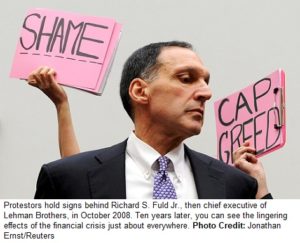
This is an example of a Watch Dog, the group FocusEconomics – see Appendix B VIDEO; they monitor the economic activity in the Latin America & Caribbean region and report to their clients accordingly. This is their summary of the full Caribbean region:

Strong fixed investment and spillovers from the expansion in the U.S. economy.

FocusEconomics do not rate each of the 30 Caribbean member-states, just a select few. This group of professional economists recognize that the Caribbean region has been burdened with repercussions from the Great Recession, and declare that only now is the recovery starting to take hold. See here, a sample of their projections for 2018 and beyond:

Belize FocusEconomics panelists expect GDP to expand 1.9% in 2018; continuing the recovery trend in the last 5 years: 2013: 1.6; 2014: 1.7; 2015: 1.8; 2016: 1.8; 2017: 1.9
Source: https://www.focus-economics.com/countries/belize
Dominican Republic FocusEconomics panelists expect GDP growth of 5.2% in 2018; continuing the recovery trend in the last 5 years: 2013: 4.9; 2014: 7.6; 2015: 7.0; 2016: 6.6; 2017: 4.6
Source: https://www.focus-economics.com/countries/dominican-republic
Haiti Reconstruction efforts should continue to drive growth rates, but political instability risks derailing the outlook. Haiti is vulnerable to the ending of the Temporary Protected Status for Haitians in the U.S. starting in July 2019, which will hit remittance inflows. FocusEconomics panelists foresee growth of 2.1% in 2018, which is down 0.1 percentage points from last month’s forecast. The panel expects the economy to expand 2.8% in 2019. The last five years recorded these growth rates: 2013: 4.2; 2014: 2.8; 2015: 1.2; 2016: 1.5; 2017: 1.2
Source: https://www.focus-economics.com/countries/haiti
Jamaica Moderating growth but still robust global economic activity and a pickup in mining output are expected to drive growth this year and the next. Panelists expect GDP growth of 1.9% in 2018, up 0.3 percentage points from last month’s forecast, and 2.2% in 2019. The last five years recorded these growth rates: 2013: 0.5; 2014: -0.7; 2015: 0.9; 2016: 1.4; 2017: 0.5
Source: https://www.focus-economics.com/countries/jamaica
Puerto Rico Due to a low base effect from last year’s dismal economic performance (i.e. Hurricane Maria) and the stimulus received from federal disaster relief funding, the economy is likely to grow in FY 2019. Our panelists forecast that GNP will expand 4.3% in FY 2019, and 2.9% in FY 2020. The last five years recorded these growth rates: 2013: -0.1; 2014: -1.8; 2015: -0.8; 2016: -1.3; 2017: -2.4
Source: https://www.focus-economics.com/countries/puerto-rico
Trinidad and Tobago Growth should accelerate in 2018 and over the following few years as new gas projects come online; these which should also support recovery in the non-oil economy. FocusEconomics panelists expect growth of 1.4% this year, and 2.0% in 2019. The last five years recorded these growth rates: 2013: 2.7; 2014: -0.6; 2015: -0.6; 2016: -2.3; 2017: NA
Source: https://www.focus-economics.com/countries/trinidad-tobago

Considering these assessments, there is no doubt about the Caribbean’s economic disposition: we are parasites of the US economy, not protégés. Our primary activity for our service based economy is tourism – catering to North American snowbirds; those escaping harsh winters during the peak months. Their leisure is our business; our business is their leisure.

The prime directive of the CU/CCB roadmap is to optimize the economic engines of the region to elevate the economies from the parasite status to starting the journey to become protégés. This need was pronounced early in the Go Lean book, in the opening Declaration of Interdependence – (Page 13) – with these statements:

xxiv. Whereas a free market economy can be induced and spurred for continuous progress, the Federation must install the controls to better manage aspects of the economy: jobs, inflation, savings rate, investments and other economic principles. Thereby attracting direct foreign investment because of the stability and vibrancy of our economy.

xxv.   Whereas the legacy of international democracies had been imperiled due to a global financial crisis, the structure of the Federation must allow for financial stability and assurance of the Federation’s institutions. To mandate the economic vibrancy of the region, monetary and fiscal controls and policies must be incorporated as proactive and reactive measures. These measures must address threats against the financial integrity of the CU and of the member-states.

The Go Lean book – available to download for free – provides 370-pages of turn-by-turn instructions on “how” to adopt new community ethos, plus the strategies, tactics, implementations and advocacies to execute so as to reboot, reform and transform the societal engines of Caribbean society. We never want to be in such a vulnerable position again, as we were in 2008, and the years thereafter. We must have technocratic oversight of the systems of commerce so that we can finally enjoy some diversification. This is perhaps the biggest-best lesson to glean from the 2008 crisis. But there are more lessons too; in fact, there is an advocacy in the book that relates specifically to lessons from that crisis. Consider the specific summaries, excerpts and headlines from the book on Page 136 entitled:

10 Lessons Learned from 2008

1 Lean-in for the Caribbean Single Market
This treaty unifies the region into a single economy of 30 countries, for 42 million people and a GDP of over $800 Billion. The neighbor to the northwest of the Caribbean, the US, is a unified economy of 50 states & 300 million people; they are the best example of economic prosperity in history. But the US suffered an economic “blood-bath” in the 2008 Great Recession; they lost $11 Trillion in net worth, mostly due to mortgage-based securities (MBS). Many lessons abound. The danger stemmed from banks initiating bad mortgages, then packaging them on the capital market for sale (globally) as bonds with no outsiders discerning the strength, or weakness, of the underlying mortgage assets.
2 Wall between Commercial and Investment Banking
3 Lax Oversight – NINJA Loans
In the aftermath of the Great Recession, there were many “autopsies” and post-mortem analysis on the root-causes and systemic risks. Most blamed the lax oversight in the housing and mortgage industries, where there were sub-prime mortgages jokingly described as NINJA loans (No-Income-No-Job-no-Assets). Many legislators attempted to return to some of the common sense provisions that protected the economy for the 65 years of “Glass-Steagall”; there were all these failed bills: the “Banking Integrity Act of 2009”, “SAFE Banking Act of 2010”, and the Return to Prudent Banking Act of 2011. A softer banking reform did pass, Dodd–Frank Wall Street Reform and Consumer Protection Act (2010).
4 Volcker Rules
The Dodd-Frank Act included the Volcker Rule, which among other things limited proprietary trading by banks and their affiliates. This proprietary trading ban prevents commercial banks and their affiliates from acquiring non-governmental securities with the intention of selling those securities for a profit in the near term. Some have described the Volcker Rule, particularly its proprietary trading ban, as a return to some prudence of “Glass-Steagall”, as “Glass–Steagall Lite”.
5 Credit Rating Reporting – Institutional and Individual
6 Opinions: Disclosure Requirement
7 Derivatives: As Insurance Product, Should Have Reserves
8 Leverage – Common Sense Restraints
Banking risk is managed by controlling leverage, the magnifying factor compared to equity that borrowing money allows for a bank. Banking regulations best practices keeps leverage amount near 12-to-1. In 2008, Lehman Brothers leverage rate was pegged at 31-to-1; the more they borrowed the less capital equity they featured, so profits, and losses, were magnified. The mortgage crisis led to Lehman Brothers massive losses, then bankruptcy; the US largest at $691 Billion.
9 Consumer Protections
10 Systemic Risk – Economic Security
The CU will monitor and mitigate systemic risks in the financial systems because failure can be cascading. This area, financial markets oversight, is where laissez-fare government oversight should end – economic security is too vital.

2008 was a giant mess for the US. We want to learn and apply lessons from their experiences. But truthfully, we have no power there. We have no vote and no voice to change them. We can only protect ourselves from their abusive activities; (the abuse to the American-self and the interconnected world). The bad trend of America stripping the new financial protections has begun – already after less than 10 years. This has been addressed in prior Go Lean commentaries; see a sample here:

https://goleancaribbean.com/blog/?p=8379 Fallacy of Going back to Self-Regulation of Economic Centers
https://goleancaribbean.com/blog/?p=7601 Returning to the Abusive Policies of Debt
https://goleancaribbean.com/blog/?p=3397 Christmas Present for the Banks – Rolling back some of Dodd-Frank
https://goleancaribbean.com/blog/?p=2259 Lax Regulation and Prosecutors again ,,, for American Business

So if we cannot change America, all we can do to prepare for the worst. We must first diversify our economy away from America First; we must no longer be parasites. The related subjects of rebooting the Caribbean economy – starting first by diversifying away from tourism – has been a frequent topic for Go Lean blog-commentaries; see a sample here:

https://goleancaribbean.com/blog/?p=15346 Industrial Reboot – A Series on Diversified Jobs
https://goleancaribbean.com/blog/?p=14242 Leading with Money Matters – Follow the Jobs
https://goleancaribbean.com/blog/?p=10585 Two Pies: Economic Plan for a New Caribbean
https://goleancaribbean.com/blog/?p=833 One currency, divergent economies

This is the quest of the Go Lean/CU roadmap, to reboot the societal engines of the region, the member-states individually and the region as a whole – in a Single Market. The roadmap details these 3 prime directives:

This is the quest for the Caribbean region, it is not unrealistic. It is conceivable, believable and achievable. Now is the time to lean-in to this roadmap for the CU. This is how we can make the the Caribbean homeland a better place to live, work and play. 🙂

Download the free e-Book of Go Lean … Caribbean – now!

Sign the petition to lean-in for this roadmap for the Caribbean Union Trade Federation.

—————

Appendix A – Opinion: We’re Measuring the Economy All Wrong
Sub-title: The official statistics say that the financial crisis is behind us. It’s not.
By: David Leonhardt

Ten years after the collapse of Lehman Brothers, the official economic statistics — the ones that fill news stories, television shows and presidential tweets — say that the American economy is fully recovered.
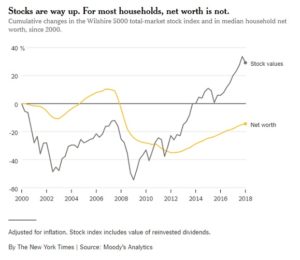
The unemployment rate is lower than it was before the financial crisis began. The stock market has soared. The total combined output of the American economy, also known as gross domestic product, has risen 20 percent since Lehman collapsed. The crisis is over.

But, of course, it isn’t over. The financial crisis remains the most influential event of the 21st century. It left millions of people — many of whom were already anxious about the economy — feeling much more anxious, if not downright angry. Their frustration has helped create a threat to Western liberal democracy that would have been hard to imagine a decade ago. Far-right political parties are on the rise across Europe, and Britain is leaving the European Union. The United States elected a racist reality-television star who has thrown the presidency into chaos.

Look around, and you can see the lingering effects of the financial crisis just about everywhere — everywhere, that is, except in the most commonly cited economic statistics. So who are you going to believe: those statistics, or your own eyes?

Over the course of history, financial crises — and the long downturns that follow — have reordered American society in all sorts of ways. One of those ways happens to involve the statistics that the government collects. Crises have often highlighted the need for new measures of human well-being.

The unemployment rate was invented in the 1870s in response to concerns about mass joblessness after the Panic of 1873. The government’s measure of national output, now called G.D.P., began during the Great Depression. Senator Robert La Follette, the progressive hero from Wisconsin, introduced the resolution that later led to the measurement of G.D.P., and the great economist Simon Kuznets, later a Nobel laureate, oversaw the first version.

Almost a century later, it is time for a new set of statistics. It’s time for measures that do a better job of capturing the realities of modern American life.

As a technical matter, the current batch of official numbers are perfectly accurate. They also describe some real and important aspects of the American economy. The trouble is that a handful of statistics dominate the public conversation about the economy despite the fact that they provide a misleading portrait of people’s lives. Even worse, the statistics have become more misleading over time.

The main reason is inequality. A small, affluent segment of the population receives a large and growing share of the economy’s bounty. It was true before Lehman Brothers collapsed on Sept. 15, 2008, and it has become even more so since. As a result, statistics that sound as if they describe the broad American economy — like G.D.P. and the Dow Jones industrial average — end up mostly describing the experiences of the affluent.

The stock market, for example, has completely recovered from the financial crisis, and then some. Stocks are now worth almost 60 percent more than when the crisis began in 2007, according to a inflation-adjusted measure from Moody’s Analytics. But wealthy households own the bulk of stocks. Most Americans are much more dependent on their houses. That’s why the net worth of the median household is still about 20 percent lower than it was in early 2007. When television commentators drone on about the Dow, they’re not talking about a good measure of most people’s wealth.

The unemployment rate has also become less meaningful than it once was. In recent decades, the number of idle working-age adults has surged. They are not working, not looking for work, not going to school and not taking care of children. Many of them would like to work, but they can’t find a decent-paying job and have given up looking. They are not counted in the official unemployment rate.

All the while, the federal government and much of the news media continue to act as if the same economic measures that made sense decades ago still make sense today. Habit comes before accuracy.

Fortunately, there is a nascent movement to change that. A team of academic economists — Gabriel Zucman, Emmanuel Saez and Thomas Piketty (the best-selling author on inequality) — has begun publishing a version of G.D.P. that separates out the share of national income flowing to rich, middle class and poor. For now, its data is published with a lag; the most recent available year is 2014. But the work is starting to receive attention from other academics and policy experts.

In the Senate, two Democratic senators, including Chuck Schumer, the party leader, have introduced a bill that would direct the federal government to publish a version of the same data series. Heather Boushey, who runs the Washington Center for Equitable Growth, told me that it could be the most important change in economic data collection in decades.

Source: New York Times – Posted September 15, 2018; retrieved September 20, 2018 from: https://www.nytimes.com/2018/09/14/opinion/columnists/great-recession-economy-gdp.html

—————-

Appendix B VIDEO – About FocusEconomics – https://youtu.be/L2Ys5GH_tmw

Published on Aug 2, 2018 – FocusEconomics is a leading provider of economic analysis and forecasts for 127 countries in Africa, Asia, Europe and the Americas, as well as price forecasts for 30 key commodities. The company is supported by an extensive global network of analysts.

Since its launch in 1999, FocusEconomics has established a solid reputation as a reliable source for timely and accurate business intelligence among Clients from a variety of industries, including the world’s major financial institutions, multinational companies and government agencies.

Source: Retrieved September 19, 2018 from: https://www.focus-economics.com/about-us

Share this post:
, ,
[Top]

Lessons Learned from 2008: The Long View – ENCORE

10 years ago today (September 15, 2008) …

Lehman Brothers filed for bankruptcy … and brought the global financial system to its knees.

The whole world was watching, as global markets immediately plummeted.
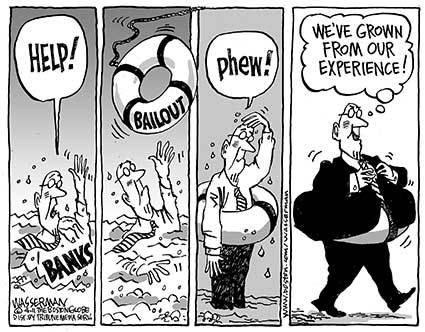
But this writer was there, on the inside of Lehman Brothers. This fact was related in the opening of the 2003 book Go Lean … Caribbean (Page 8), as follows:

2008
The peak day of the recent global financial crisis was September 15, 2008. On this day, Wall Street giant Lehman Brothers filed for bankruptcy protection, and eventual dissolution, after succumbing to the weight of over-leverage in mortgage-backed securities. There is an old observation/expression that states that “there are 3 kinds of people in the world, those who make things happen, those who watch things happen and those who wonder ‘what happened?’“ Principals of SFE Foundation were there in 2008 … engaged with Lehman Brothers; on the inside looking out, not the outside looking in. Understanding the anatomy of the modern macro economy, allows the dissection of the processes and the creation of viable solutions.

This is the first of a series of commentaries relating the Lessons Learned from 2008.  This first one – entry 1 of 4 in this series from the movement behind the book Go Lean … Caribbean – is in consideration of the “economic chaos” that led-up to the Great Recession and why it is necessary for these commentaries to be so long and comprehensive. The Caribbean problems are complex and complicated – there are no short and simple solutions. It will take a thorough roadmap to effect the necessary changes for the region to reform and transform. If we do not learn the applicable lessons from 2008, we will only repeat the mistakes of 2008.

The commentaries in the series are cataloged as follows:

  1. Lessons Learned from 2008 – The Long View – ENCORE
  2. Lessons Learned from 2008 – Too Big to Fail -vs- Too Small to Thrive
  3. Lessons Learned from 2008 – Righting The Wrong – ENCORE
  4. Lessons Learned from 2008 – Still Recovering

All of these commentaries relate to “how” the stewards for a new Caribbean can shepherd the economic engines of the region to apply the economic best-practices to make progress. As a Caribbean region, we need those lessons, and progress.

Some of these commentaries are Encores, as is this one. So as follows is the original submission from August 26, 2014. See that entry here:

—————–

Go Lean CommentaryWhy So Long? Can’t We Just…

CU Blog - Why so long - Can't we just - Photo 1We have now reached a milestone in the publishing of the (sometimes) daily blogs from the publishers of Go Lean…Caribbean, 150 submissions. This is a good time to address a consistent question we’ve gotten from some readers:

Why are the blog commentaries so long?
Can’t you accomplish the same objective with shorter blogs?

This submission here is meant to be a practice in active listening: We hear you! Consider this attribute of  one blog published on August 20, 2014:

3742 words: NYC’s MetroCard – A Model for the Caribbean Dollar – https://goleancaribbean.com/blog/?p=2074

So can we accomplish the same objectives with shorter commentaries? The answer: No!

The question is interpreted by us as “Can’t we just…?”

There is a serious reason why this is the answer: These are serious issues. We cannot, must not skim on the consideration of the solutions.

Our experience has taught us that serious problems require thorough and thoughtful consideration. There is no place for abbreviation in this exercise.

Our experience?

Consider these events from 2008, (a frequent topic of discussion in Go Lean…Caribbean blogs):

Video: Too Big To Fail – 2011 Movie (Pardon the adult language):
YouTube Video Sharing Site (Retrieved 08/20/2014) –
https://www.youtube.com/watch?v=Aqf97p1Rdm0

As the events of September 2008 unfolded where the financial system (Wall Street) was on the brink of collapse, stakeholders from the US Treasury Department assembled a representative body to conceive a remedy.

The resultant plan/proposal was introduced on September 20, by Treasury Secretary Henry Paulson and was later named the Troubled Asset Relief Program (TARP)[a].

The plan/proposal was only three pages long, intentionally short on details to facilitate quick passage by Congress.[b]

The plan called for the U.S. Treasury to acquire up to $700 billion worth of mortgage-backed securities…

… in the end, in an analysis by Bloomberg Business News Source, it was disclosed that the Federal Reserve had, by March 2009, committed $7.77 trillion to rescuing the financial system. This amount is more than half the value of everything produced in the U.S. that year.[c]
Wikipedia Online Encyclopedia Source (Retrieved 08/20/2014) –
http://en.wikipedia.org/wiki/Emergency_Economic_Stabilization_Act_of_2008

So can’t we just…?

The book Go Lean…Caribbean serves as a roadmap for the introduction and implementation of the Caribbean Union Trade Federation (CU) and the Caribbean Central Bank (CCB). This Caribbean empowerment roadmap has 3 prime directives:

  • Optimization of the economic engines in order to grow the regional economy to $800 Billion & create 2.2 million new jobs.
  • Establishment of a security apparatus to protect the resultant economic engines.
  • Improve Caribbean governance to support these engines.

The book described both the CU and CCB as hallmarks of technocracy, a commitment to efficiency and effectiveness. The book itself is 370 pages and covers 144 different missions.

As alluded above, principals in the Go Lean…Caribbean movement were front-and-center in the events that unfurled in 2008.

CU Blog - Why so long - Can't we just - Photo 2

The roadmap was constructed with the ethos to be thorough in the assessment, strategies, tactics, implementation and advocacies to understand the complexities of our time and forge permanent change in the Caribbean region. The following is a sample of these specific details from the book:

Community Ethos – Deferred Gratification Page 21
Community Ethos – Consequences of Choices Lie in the Future Page 21
Community Ethos – Intelligence Gathering Page 23
Community Ethos – “Crap” Happens Page 23
Community Ethos – Lean Operations Page 24
Community Ethos – Ways to Impact the Future Page 26
Strategy – Vision – Confederate 30 Member-States Page 45
Strategy – Missions – 144 Advocacies Page 457
Tactical – Confederating a Permanent Union Page 63
Tactical – Fostering a Technocracy Page 64
Implementation – Ways to Pay for Change Page 101
Implementation – Ways to Deliver Page 109
Planning – 10 Big Ideas for the Caribbean Region Page 127
Planning – Lessons Learned from 2008 Page 136
Planning – Lessons Learned from New York City Page 137
Advocacy – Ways to Grow the Economy Page 151
Advocacy – Ways to Create Jobs Page 152
Advocacy – Reforms for Banking Regulations Page 199
Advocacy – Ways to Impact Wall Street Page 200
Advocacy – Ways to Impact Main Street Page 201
Advocacy – Ways to Impact Hollywood Page 202
Appendix – Credit Ratings Agencies in 2008 Page 276

Imagine following a long complex and detailed recipe for baking a cake. To get the best results, it is important to include all the ingredients and follow the exacting instructions, the more detailed the better.

The quest for Go Lean…Caribbean is not as simple as baking a cake, rather a goal that is so much more important, to make the Caribbean region a better place to live, work and play.

We cannot skim on this effort – too much is at stake!

Download the free e-Book of Go Lean … Caribbean – now!

———————

Appendices:
a.  http://www.nytimes.com/2008/09/21/business/21draftcnd.html?_r=0; retrieved August 20, 2014.
b.  http://content.time.com/time/politics/article/0,8599,1843642,00.html; retrieved August 20, 2014.
c.  Ivry, Bob; Keoun, Bradley; Kuntz, Phil (November 28, 2011). “Secret Fed Loans Gave Banks $13 Billion Undisclosed to Congress”. Bloomberg Markets Magazine. Bloomberg L.P. Retrieved May 14, 2012 from: http://www.bloomberg.com/news/2011-11-28/secret-fed-loans-undisclosed-to-congress-gave-banks-13-billion-in-income.html.

Share this post:
,
[Top]

Blog # 800 – An Inconvenient Truth – Caribbean Version

Go Lean Commentary

There was a film released in 2006 entitled An Inconvenient Truth. This capped the campaign by former US Vice-President Al Gore (1993-2001) to educate citizens about global warming; this was a comprehensive slide show that he estimated to have given more than a thousand times.  This film was part documentary and part prophecy. When asked of the need for a sequel, Co-Producer Laurie David responded:
“God, do we need one, everything in that movie has come to pass. At the time we did the movie, there was Hurricane Katrina; now we have extreme weather events every other week. The update has to be incredible and shocking.”[149]

Incredible and shocking is also our Inconvenient Truth for the Caribbean. The prophecy highlighted in that 2006 documentary manifested in the Caribbean in the years since. There was a sequel to that original film, the 2017 An Inconvenient Sequel: Truth to Power. The tagline for the movie was:

Fight like your world depends on it.

See a Trailer of the sequel in Appendix B below.

Here is where we are in the Caribbean – our world depends on our fighting to assuage the great threats to our society. These are defined in the book Go Lean…Caribbean – available to download for free. The book serves as a roadmap for the introduction and implementation of the technocratic Caribbean Union Trade Federation (CU), for the elevation and protection of Caribbean society – for all member-states.

In the book, the threats are described as Agents of Change (Page 57), none more challenging than Climate Change for us:

  • Climate Change – This issue is a major concern for the whole world, but particularly impactful on the Caribbean. There is some debate as to the causes of Climate Change, but no question as to its outcome: temperatures are rising, droughts prevail, and most devastating, hurricanes are more threatening. The CU roadmap must address the causes of Climate Change and most assuredly its consequences. The CU federal government must therefore advocate systems and schemes for a lower carbon footprint. Notwithstanding, the CU must implement recovery measures to respond, react and rebuild from the ever-more-devastating hurricanes.
  • Technology – Internet & Communications Technologies (ICT) is dynamically shifting the world. There are also industrial changes taking place, as in more efficient manufacturing methods, automation/robotics, and transportation options … in response to Climate Change, i.e. Green Energy options.
  • Aging Diaspora – Those that expatriated in the 1950’s and 1960’s now comprise an aging Diaspora – with the desire to return to the “town of their boyhood”. With inadequacies to prepare and respond to natural disasters, the repatriations may not happen.
  • Globalization – We are competing against a “flat” world. Any one country can provide a competitive delivery of the needs and wants of any other society, no matter where they are located physically.

*************

Inconvenient Truth 1

What is inconvenient is that we do not have a partner in the United States of America. We must raise the mantle ourselves and fight for our own cause. President Trump has wiped out all Global Climate Change initiatives by the US federal government. So this government is headed by someone that does not even believe the scientific certainty of Climate Change.

This actuality was boldly lamented in the book, in the opening Declaration of Interdependence (Page 11):

i. Whereas the earth’s climate has undeniably changed resulting in more severe tropical weather storms, it is necessary to prepare to insure the safety and security of life, property and systems of commerce in our geographical region. As nature recognizes no borders in the target of its destruction, we also must set aside border considerations in the preparation and response to these weather challenges.

Inconvenient Truth 2

Natural Disaster preparation and response is reflective of our priorities. Hurricane Maria exposed the deficiency among the American stakeholders. Puerto Rico got no love from Washington; even in death the misery was understated, under-valued and undercounted. Despite this bad report, President Trump continues to defend his administration actions, despite irrefutable evidence to the contrary; see article in Appendix A.

Our other colonial legacies were equally unprepared:

The Go Lean book asserts that the full region of 30 member-states must come together – ourselves – to optimize the societal engines of economics, security and governance. We have delivered a “day late and a dollar short” on so many mitigations – consider our Catastrophic Risk Insurance Funds.

Inconvenient Truth 3

Rising Sea Levels may cover the coral islands.

The geology of the Caribbean has resulted inn 2 kinds of islands: Volcanic versus Coral (Reef). The volcanic islands tend to be mountainous, while coral islands tend to be flat. Climate Change have a real devastating effects on coral islands. Already the Pacific island-nation of Kiribati is facing extinction from high sea-level rise. This same fate awaits many Caribbean member-states. This is why many Caribbean states are members of the formal SIDS (Small Islands Development States).

Inconvenient Truth 4

Seaweed is not so innocent. The beautiful beaches are no longer “so beautiful” without strenuous re-engineering, This is a direct result of Climate Changehttps://stluciatimes.com/2018/03/04/fisheries-department-supports-sargassum-cleanup/

Inconvenient Truth 5

Our Diaspora is not returning. The original implied contract was for Caribbean citizens to emigrate abroad then come back home for retirement. Due to societal defects, many of the Diaspora are not returning; even to support their elderly parents; rather, they have been bringing their elderly to the foreign destinations. There is also a Climate Change angle, winters in northern locations – think: Canada – is milder due to global warming.

Inconvenient Truth 6

We are doubling-down on economic failure.

The primary economic engine in the Caribbean region is based on tourism. There is the need to diversify; yet the member-states have been doubling-down on the failing business models in tourism rather than investing in better models. Consider the example of resort-casino gambling.

Inconvenient Truth 7

We are doubling-down on our societal defects and hate.

Our people leave their Caribbean homes for “Push” and “Pull” reasons. “Pull” refers to the lure that life is better abroad, but “push” refers to the societal defects that drive people away to seek refuge. The Caribbean region does not embrace the “live and let live” ethos, so minority groups have experienced a Climate of Hate.

This is inconvenient and sad!

***********

These Inconvenient Truths are consistent for the movement behind the Go Lean book. The original book, and subsequent blog-commentaries, detailed the assessment in current Caribbean society, and then advocated for a new Caribbean – with new community ethos, strategies, tactics and implementations.

This submission is a new milestone; this is blog-commentary # 800.

These prior entries posit that the Caribbean status quo is truly in crisis. Alas, this crisis is a terrible thing to waste. Let’s reform and transform now! Yes, we can!

This is the quest of the Go Lean movement, to forge a Single Market and a technocratic government for the 30 Caribbean member-states. But the Go Lean book asserts that this effort is too big a task for just for Caribbean member-state alone, so the book urges all 30 member-states to convene, confederate and collaborate in order to effect change. This CU/Go Lean roadmap has these 3 prime directives:

  • Optimization of the economic engines in order to grow the regional economy to $800 Billion and create 2.2 million new jobs. (The issue of jobs alone is paramount to any Hope and Change movement in the region).
  • Establishment of a security apparatus to ensure public safety and protect the resultant economic engines.
  • Improve Caribbean governance to support these engines, including a separation-of-powers between the member-states and CU federal agencies.

The book stresses that reforming and transforming Caribbean communities must be a regional pursuit. This was an early motivation for the roadmap, as pronounced in the opening Declaration of Interdependence (Pages 11 – 14):

xi. Whereas all men are entitled to the benefits of good governance in a free society, “new guards” must be enacted to dissuade the emergence of incompetence, corruption, nepotism and cronyism at the peril of the people’s best interest. The Federation must guarantee the executions of a social contract between government and the governed.

xii. Whereas the legacy in recent times in individual states may be that of ineffectual governance with no redress to higher authority, the accedence of this Federation will ensure accountability and escalation of the human and civil rights of the people for good governance, justice assurances, due process and the rule of law. As such, any threats of a “failed state” status for any member state must enact emergency measures on behalf of the Federation to protect the human, civil and property rights of the citizens, residents, allies, trading partners, and visitors of the affected member state and the Federation as a whole.

xvi. Whereas security of our homeland is inextricably linked to prosperity of the homeland, the economic and security interest of the region needs to be aligned under the same governance. Since economic crimes … can imperil the functioning of the wheels of commerce for all the citizenry, the accedence of this Federation must equip the security apparatus with the tools and techniques for predictive and proactive interdictions.

xxiv. Whereas a free market economy can be induced and spurred for continuous progress, the Federation must install the controls to better manage aspects of the economy: jobs, inflation, savings rate, investments and other economic principles. Thereby attracting direct foreign investment because of the stability and vibrancy of our economy.

The Go Lean book accepts that the Caribbean region – all 30 member-states – is currently at a Failing disposition. But we can do better and be better. First, we must acknowledged our Inconvenient Truths.

And then work or fight towards reforming and transforming our society. Our world depends on it!

This is hard, heavy-lifting, but this roadmap is conceivable, believable and achievable. Let’s get started. Let’s make our homeland a better place to live, work and play. 🙂

Download the free e-book of Go Lean … Caribbean – now!

Sign the petition to lean-in for this roadmap for the Caribbean Union Trade Federation.

—————–

Appendix A – Trump questions Puerto Rico death toll, prompting San Juan mayor to call him ‘delusional’ and ‘paranoid’

WASHINGTON – President Donald Trump on Thursday questioned a report putting the death toll from last year’s catastrophic hurricane in Puerto Rico at nearly 3,000. He also called the new estimate an effort by Democrats to discredit him.

San Juan’s mayor described the president’s claim as “delusional” and even prominent Republicans such as House Speaker Paul Ryan distanced themselves from Trump’s tweets about Puerto Rico.

“This was done by the Democrats in order to make me look as bad as possible when I was successfully raising Billions of Dollars to help rebuild Puerto Rico,” Trump wrote on Twitter. “If a person died for any reason, like old age, just add them onto the list. Bad politics. I love Puerto Rico!”

Trump’s comments, which come as his administration prepares for Hurricane Florence to hit the East Coast, led both Democratic and Republican lawmakers to weigh in countering his claim. When Hurricane Maria hit Puerto Rico last year, it devastated homes and infrastructure and left large swaths of the territory without power for months.

Ryan, pressed by reporters on Trump’s tweet, said he disagreed with the president but would not comment on whether he thought Trump should apologize.

Ryan said he had  “no reason to dispute” the findings of a study commissioned by Puerto Rico’s government that put its death toll at nearly 3,000 people.

“Those are just the facts of what happens when a horrible hurricane hits an isolated place like an island,” Ryan said when asked about Trump’s tweet.

Sen. Marco Rubio, a Florida Republican who has been outspoken on the government’s response to the storm, lamented in a tweet that the deaths had become political. He repeated the study’s findings that 3,000 more people died on the island after the hurricane than during comparable periods.

“Both Fed & local gov made mistakes,” Rubio wrote. “We all need to stop the blame game & focus on recovery, helping those still hurting & fixing the mistakes.”

Florida Gov. Rick Scott, a Republican and early Trump supporter, said he disagreed with the president.

“I’ve been to Puerto Rico 7 times & saw devastation firsthand,” Scott, now a candidate for Senate, posted on Twitter. “The loss of any life is tragic; the extent of lives lost as a result of Maria is heart wrenching. I’ll continue to help PR.”

Ron DeSantis, a former Republican congressman running for governor in Florida, also disputed Trump’s assertion. “He doesn’t believe any loss of life has been inflated,” spokesman Stephen Lawson said in an emailed statement.

As his team braces for Hurricane Florence, Trump has praised his administration’s responses to deadly storms – including in Puerto Rico.

San Juan mayor Cruz responded, …

“Simply put: delusional, paranoid, and unhinged from any sense of reality.”

“Trump is so vain he thinks this is about him. NO IT IS NOT,” Cruz wrote on Twitter.

Puerto Rico Gov. Ricardo Rosselló said he “strongly denounced” what he described as questioning the impact of the storm for political purposes.

“The victims and the people of Puerto Rico do not deserve to have their pain questioned,” he said in a statement. “It is not time to deny what happened, it is time to make sure that it does not happen again.”

Democrats on Capitol Hill blasted Trump.

“Only Donald Trump could see the tragedy in Puerto Rico and conclude that he is the victim,” said Sen. Ed Markey, D-Mass. “May God bless the souls of the nearly 3,000 Americans that died in Puerto Rico and may he take pity on your soul Mr. President.”

Without mentioning Trump by name, Rep. Sheila Jackson Lee, D-Texas, a member of the House Committee on Homeland Security, slammed the “cavalier” tweeting about the number of deaths in Puerto Rico.

“You have lost compassion for people who are diverse,” she said.

Trump’s Thursday morning tweets focused on a George Washington University study released last month that examined the toll from Hurricane Maria. From September 2017 to February 2018, 2,975 people died, according to that study, which was commissioned by Puerto Rico’s government.

Late Thursday, deputy press secretary Hogan Gidley pushed back on criticism of the Trump’s response to Maria in a statement, saying the administration provided “unprecedented support to Puerto Rico.” Gidley said Cruz and the “liberal media” have tried to “exploit the devastation by pushing out a constant stream of misinformation and false accusations.”

In addition to force of the hurricane itself, many people in Puerto Rico died because disease and infection due to the lack of electricity and drinkable water on the island. The storm destroyed homes and and crippled roads, bridges, and hospitals.

George Washington University said Thursday it stands by the methodology used in the report and said the work was conducted with “complete independence and freedom from any kind of interference.”

“We are confident that the number – 2,975 – is the most accurate and unbiased estimate of excess mortality to date,” the school said in a statement.

Trump also took heat after he visited Puerto Rico in the aftermath of the Sept. 20, 2017, storm. The president tossed paper towels to Puerto Rican residents at a local relief center, angering storm victims and others who saw his actions as insensitive.

After his tweets Thursday, Democrats accused Trump of minimizing the death toll for callous political reasons.

Andrew Gillum, the Democratic candidate for governor in Florida, slammed Trump’s tweet.

“No death is partisan and our brothers and sisters in Puerto Rico deserved better from @realDonaldTrump before, during, and after the hurricane.”

The House Democratic Caucus tweeted that Trump “won’t acknowledge the thousands of Americans who died on his watch,” and added, “Even worse, Republicans have no interest in holding this administration accountable and ensuring that Congress is prepared to respond to these disasters.”

A report released this summer by the Federal Emergency Management Agency identified deficiencies in the administration’s response, including that the agency was not adequately staffed heading into the hurricane season. In the months leading up to Maria’s approach, FEMA had 10,683 people on hand, about 86 percent of the agency’s target, the report found.

The report found that the island itself was not prepared for such a storm, which contributed to widespread loss of power and communications – hampering the response.

A Government Accountability Office report last week confirmed many of those findings, and also noted that 54 percent of the FEMA workers deployed last year were serving in a role they were not qualified to perform. Staffing shortfalls complicated many aspects of the response, including the effort to move people into temporary housing in the mainland, the GAO found.

“The 2017 hurricanes and wildfires highlighted some longstanding issues and revealed other emerging response and recovery challenges,” the report said.

Source: USA Today newspaper – Posted September 13, 2018; retrieved September 14, 2018 from: https://www.usatoday.com/story/news/politics/2018/09/13/donald-trump-without-evidence-questions-puerto-rico-death-toll/1288118002/

—————–

Appendix B VIDEO – An Inconvenient Sequel: Truth To Power (2017) – Official Trailer – https://youtu.be/huX1bmfdkyA

Published on Mar 28, 2017 – Watch the new trailer for An Inconvenient Sequel: Truth to Power, the sequel to An Inconvenient Truth. In theatres July 28, 2017. #BeInconvenient

Climate Changes, Truth Does Not.

A decade after AN INCONVENIENT TRUTH brought Climate Change into the heart of popular culture, comes the riveting and rousing follow-up that shows just how close we are to a real energy revolution. Vice President Al Gore continues his tireless fight traveling around the world training an army of climate champions and influencing international climate policy. Cameras follow him behind the scenes – in moments both private and public, funny and poignant — as he pursues the inspirational idea that while the stakes have never been higher, the perils of Climate Change can be overcome with human ingenuity and passion.

Official Movie Site: http://www.inconvenientsequel.com/

Facebook: https://www.facebook.com/AnInconvenie…

Twitter: https://twitter.com/aitruthfilm

Instagram: https://www.instagram.com/aninconveni…

Share this post:
, , ,
[Top]

Mortimer Candies … Thriving at 90

Go Lean Commentary

Candy is good … for you!

At least here at Mortimer’s Candy Kitchen in Nassau, Bahamas*.

This establishment is now celebrating 90 years of continuous operations; that’s 90 years of smiles. These sweet confections are more than just hard manifestation of sugar; no, this is manifestation of Bahamian excellence.

That’s right. This is bigger than candy. This is the manifestation of the unique Bahamian culture and identity.

This is the focus of this movement behind the book Go Lean…Caribbean – available to download for free. We examine and exclaim dimensions of Caribbean society and culture – good and bad! Mortimer Candies – despite the underlying presence of sugar – is all good! One can taste the 90 years of love and pride in every concoction.

Here’s to 90 more years!

————

VIDEO –  Behind the sweets at Mortimer’s Candy – https://youtu.be/9kZRMOVbwRA 

BahamasLocal
Published on Jul 29, 2010 –
Bahamas Local got to watch the pros at Mortimer’s Candy mix a batch of hard candy at their shop at the top of East Street. Check out our video to see how they get all those colors in your favorite candies.

The Go Lean book serves as a roadmap for the introduction and implementation of the technocratic Caribbean Union Trade Federation (CU), for the elevation of Caribbean society – for all member-states. The purpose of the book is not culture, it is economics, security and governance. But the book clearly supports the notion that the Caribbean is the greatest address on the planet – not because of the terrain, fauna and flora –  but because of culture, festivals, food, music, dance, rum, cigars and our unique history. We have a fusion of African, Amer-Indian, European and Asian influences that cannot be found anywhere else on the planet.

Yes, candy is food! So Bahamian candy is part of the unique Bahamian culture.

The importance of our culture is why we work so strenuously to improve our societal engines. In fact, these 3 prime directives is the focus of this CU/Go Lean roadmap, though on a regional basis:

The Go Lean book stresses that preserving Caribbean culture is a heavy-lift task; there are global forces trying to assimilate Caribbean people to conform to foreign cultural influences (think: American & European), instead of promoting our local cultures. We must not be molded by these global influences; rather we must project a positive image to the world and declare that we are not ‘Less Than‘.

This quest requires that we firstly, “fix what is broken”, that is reform and transform our societal engines. So this is a quest to defend our specific Bahamian image and the overall Caribbean image. This effort is a Big Deal that requires regional collaboration. This regionalism effort was an early motivation for the roadmap, as pronounced in the opening Declaration of Interdependence (Pages 12 – 14):

xi. Whereas all men are entitled to the benefits of good governance in a free society, “new guards” must be enacted to dissuade the emergence of incompetence, corruption … and cronyism at the peril of the people’s best interest. The Federation must guarantee the executions of a social contract between government and the governed.

xvi. Whereas security of our homeland is inextricably linked to prosperity of the homeland, the economic and security interest of the region needs to be aligned under the same governance. Since economic crimes … can imperil the functioning of the wheels of commerce for all the citizenry, the accedence of this Federation must equip the security apparatus with the tools and techniques for predictive and proactive interdictions.

xxiv. Whereas a free market economy can be induced and spurred for continuous progress, the Federation must install the controls to better manage aspects of the economy: jobs, inflation, savings rate, investments and other economic principles. Thereby attracting direct foreign investment because of the stability and vibrancy of our economy.

xxxii. Whereas the cultural arts … of the region are germane to the quality of Caribbean life, and the international appreciation of Caribbean life, the Federation must implement the support systems to teach, encourage, incentivize, monetize and promote the related industries for arts and music in domestic and foreign markets. These endeavors will make the Caribbean a better place to live, work and play.

The Go Lean book provides 370-pages of turn-by-turn instructions on “how” to adopt new community ethos, plus the strategies, tactics, implementations and advocacies to execute so as to reboot, reform and transform the societal engines of Caribbean society. While we want to change our communities, we do want to preserve our treasured culture.

Cultural preservation is a familiar subject for this Go Lean roadmap; there have been a number of previous blog-commentaries by the Go Lean movement that explored dimensions of Caribbean culture. As follows is a sample of those previous blog-commentaries:

https://goleancaribbean.com/blog/?p=15376 Preserving and Monetizing Caribbean Culture
https://goleancaribbean.com/blog/?p=12304 Caribbean Festival of the Arts – Past, Present and Future
https://goleancaribbean.com/blog/?p=9860 Forging Change Thru Arts & Artists
https://goleancaribbean.com/blog/?p=9712 Forging Change Thru Panem et Circenses (Food & Festivals)
https://goleancaribbean.com/blog/?p=5098 Forging Change Through Food and Culture

In summary, on a national basis, our Bahamian culture is important to our Bahamian identity. As we meld with the rest of the world, our unique culture must shines through. But we are part of a bigger family – our Caribbean region. On the regional basis, our Caribbean culture is important to the Caribbean identity.

Our quest is simple: to promote and preserve our culture. The success of this effort allows us to make our homeland a better place to live, work and play. 🙂

Download the free e-Book of Go Lean … Caribbean – now!

Sign the petition to lean-in for this roadmap for the Caribbean Union Trade Federation.

————–

References: * This author is from the Bahamas.

Get more info at this link: http://mortimercandies.com/


Share this post:
, ,
[Top]

Naomi Osaka’s recipe for success: Caribbean Meld

Go Lean Commentary

There is actually a recipe for success on the world stage, one that has just been applied by tennis superstar Naomi Osaka in winning the 2018 US Open over fan-favorite Serena Williams. The recipe:

Meld Caribbean distinctiveness with that of other cultures.

Wait what?!

This sounds so familiar, even fictionalized! Those who are fans of the science fiction franchise Star Trek will remember the mantra of the cybernetic life form “The Borg”. Their announcement when attacking potential victims were as follows:

”We are the Borg. Lower your shields and surrender your ships. We will add your biological and technological distinctiveness to our own. Your culture will adapt to service us. Resistance is futile.” – Source

This is “Art imitating Life”! We see this recipe at work with this new sports champion and beneficiary of this international melding: Naomi Osaka.

She is a professional tennis player who represents Japan internationally. She is the first Japanese citizen to winGrand Slam singles tournament, defeating Serena Williams in the final of the 2018 US Open.[6] Osaka has reached a career-high world ranking of No. 7.[4] She was born to a Haitian father, Leonard “San” François, and a Japanese mother, Tamaki Osaka .[7]

This story, beyond its relevance to sports, has a Caribbean relevance because of Osaka’s parentage. The meld – noun/verb: blend – had produced an end-product that has accomplished more than any one component has accomplished on its own. Osaka is the first Japanese citizen to win a Grand Slam event, and needless-to-say, the first Haitian.  It has not been easy:

In racially homogeneous Japan, Osaka is considered hāfu, which is Japanese for biracial.[10] Her Japanese grandfather was furious when he found out that her mother was romantically involved with a black man. As a result of the interracial relationship, her mother did not have contact with her family for over ten years.[8] In a 2016 interview, Osaka said: “When I go to Japan, people are confused. From my name, they don’t expect to see a black girl.”[11]Wikipedia

This biography provides a lesson-learned for the rest of the Caribbean, and the world for that matter:

  • To our Caribbean brothers and sisters, we entreat you to embrace pluralism; good things come from the embrace of our differences.
  • To the rest of world, we declare that the Caribbean identity is not “Less Than”. We bring a strength of character and ethos that adds value and elevates any community where we meld.

If we can successfully meld and conquer a challenge on the world stage, how much more so can we meld our distinctiveness here at home or in our regional neighborhood to accomplish greater feats. This is the message of the movement behind the book Go Lean…Caribbean, which asserts that great Caribbean progress is in store when we meld – integrate, collaborate and confederate. The book – available to download for free – serves as a roadmap for the introduction and implementation of the technocratic Caribbean Union Trade Federation (CU), for the elevation of Caribbean society – for all member-states.

This CU/Go Lean roadmap has these 3 prime directives:

  • Optimization of the economic engines in order to grow the regional economy to $800 Billion and create 2.2 million new jobs. There are many industrial expressions that we will have to make in order to reach these goals, including the facilitation of the Art & Science of Sports.
  • Establishment of a security apparatus to ensure public safety and protect the resultant economic engines.
  • Improve Caribbean governance to support these engines, including a separation-of-powers between the member-states and CU federal agencies.

The book stresses that reforming and transforming the Caribbean societal engines must be a regional pursuit. This was an early motivation for the roadmap, as pronounced in the opening Declaration of Interdependence (Pages 12 – 14):

xi. Whereas all men are entitled to the benefits of good governance in a free society, “new guards” must be enacted to dissuade the emergence of incompetence, corruption, nepotism and cronyism at the peril of the people’s best interest. The Federation must guarantee the executions of a social contract between government and the governed.

xvi. Whereas security of our homeland is inextricably linked to prosperity of the homeland, the economic and security interest of the region needs to be aligned under the same governance. Since economic crimes … can imperil the functioning of the wheels of commerce for all the citizenry, the accedence of this Federation must equip the security apparatus with the tools and techniques for predictive and proactive interdictions.

xxiv. Whereas a free market economy can be induced and spurred for continuous progress, the Federation must install the controls to better manage aspects of the economy: jobs, inflation, savings rate, investments and other economic principles. Thereby attracting direct foreign investment because of the stability and vibrancy of our economy.

xxxi. Whereas sports have been a source of great pride for the Caribbean region, the economic returns from these ventures have not been evenly distributed as in other societies. The Federation must therefore facilitate the eco-systems and vertical industries of sports as a business, recreation, national pastime and even sports tourism …

The Go Lean book provides 370-pages of turn-by-turn instructions on “how” to adopt new community ethos, plus the strategies, tactics, implementations and advocacies to execute so as to reboot, reform and transform the societal engines for all member-states in the Caribbean region.

The story of Naomi Osaka is about more than just her heritage. She is an excellent athlete of her own making. It takes blood, sweat and tears to excel at the highest level of her sport. For Osaka to beat Serena Williams – earning $3.8 million – that was no fluke; that was the full measure of her athletic prowess; that was heavy-lifting. Even now, all the attention is on Serena losing, rather than Osaka winning; see the VIDEO here and the related story in the Appendix below:

VIDEO – US Open Highlights – https://nyp.st/2CM60t5

Published September 8, 2018 – Serena has mother of all meltdowns in US Open final loss.

Heavy-lifting in sports is a familiar theme for this Go Lean movement; we recognize that there could be more economic rewards if the regional stewards do a better job of facilitating a viable sports eco-system – we have few expressions of professional sports and no intercollegiate system in the region. We have previously elaborated on how the Art & Science of sports can be used to help elevate our societal engines. Re-consider these previous blog-commentaries:

https://goleancaribbean.com/blog/?p=11287 Creating a legacy in pro-Surfing
https://goleancaribbean.com/blog/?p=8495 Basketball Great and Caribbean Role Model: Tim Duncan
https://goleancaribbean.com/blog/?p=7866 Caribbean Track & Field Athletes monetize their talents “elsewhere”
https://goleancaribbean.com/blog/?p=1446 Caribbean Players in the World Cup
https://goleancaribbean.com/blog/?p=1020 Advocates and Revolutionaries for Caribbean Sports

So how can we foster more people in our Caribbean region to be like Naomi Osaka, people who can help to elevate our society and the global image of Caribbean contributions to the world? The Go Lean book addressed this question; within its 370-pages of instructions for impacting society, in the specific details for fostering more world-class athletes. Consider the summaries, excerpts and headlines from this one advocacy in the book on Page 229 entitled:

10 Ways to Improve Sports

1 Lean-in for the Caribbean Single Market
This will allow for the unification of the region of 30 member-states into a single market of 42 million people and a GDP exceeding $800 Billion (per 2010). This market size and multi-lingual realities allows for broadcasting rights with SAP-style language options for English, Spanish, French and Dutch. This makes the region attractive for media contracts for broadcast rights, spectrum auctions and sports marketing. The Olympics have demonstrated that sports can be profitable “big business”, and a great source of jobs and economic activity. The CU will copy the Olympic model, and harness the potential in many other sporting endeavors, so as to make the region a better place to live, work and play.
2 CU Games
Promote the CU Games, every 2 years, as the ascension of the CARIFTA Games for Amateur and now Professional Athletes. The CU Games Administration will also partner with all National Olympic Committees. This administration applies to feeder games, trials and qualification events. The ultimate goal is to field a world-class competitive Olympic Team representing the entire Caribbean. While the CARIFTA Games are for track-and-field events only, the CU Games will resemble a mini-Olympics with multi-sports (boxing, football/soccer, tennis, volleyball, sailing, baseball/softball, etc.)
3 Fairgrounds as Sport Venues
The CU Fairgrounds (managed by the Interior Department) will have the infrastructure to fund, build and maintain sports arenas and “stadiums” (stadia) in local markets. The mantra is “build it and they will come”, so the CU building and managing world-class sport facilities will result in a more organized industry and the emergence of vertical markets.
4 Regulate Amateur, Professional & Academically-Aligned Leagues
5 Establish Sports Academies
6 “Super” Amateur Sport Association
7 Regulator/Registrar of Scholar-Athletes – Assuage Abandonment
8 Sports Tourism
9 Professional Agents and Player Management Oversight (a la Bar/Lawyer Associations).
10 Impanel the CU Anti-Doping Agency

Congratulation Naomi Osaka!

… and thank you … for making it easier for us to impress on the world that Caribbean-anything is not “Less Than”. That argument is now easier to make.

It is now also easier to convey the message that “Yes, we can” forge a “pluralistic” democracy and make our homeland a better place to live, work and play. 🙂

Download the free e-Book of Go Lean … Caribbean – now!

Sign the petition to lean-in for this roadmap for the Caribbean Union Trade Federation.

—————–

Appendix – It’s shameful what US Open did to Naomi Osaka
Opinion by: Maureen Callahan

Naomi Osaka, 20 years old, just became the first player from Japan to win a Grand Slam.

Yet rather than cheer Osaka, the crowd, the commentators and US Open officials all expressed shock and grief that Serena Williams lost.
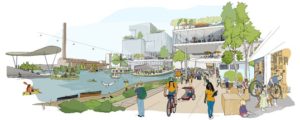
Osaka spent what should have been her victory lap in tears. It had been her childhood dream to make it to the US Open and possibly play against Williams, her idol, in the final.

It’s hard to recall a more unsportsmanlike event.

Here was a young girl who pulled off one of the greatest upsets ever, who fought for every point she earned, ashamed.

At the awards ceremony, Osaka covered her face with her black visor and cried. The crowd booed her. Katrina Adams, chairman and president of the USTA, opened the awards ceremony by denigrating the winner and lionizing Williams — whose ego, if anything, needs piercing.

“Perhaps it’s not the finish we were looking for today,” Adams said, “but Serena, you are a champion of all champions.” Addressing the crowd, Adams added, “This mama is a role model and respected by all.”

That’s not likely the case now, not after the world watched as Serena Williams had a series of epic meltdowns on the court, all sparked when the umpire warned her: No coaching from the side. Her coach was making visible hand signals.

“I don’t cheat to win,” Williams told him. “I’d rather lose.”

She couldn’t let it go, going back multiple times to berate the umpire. At one point she called him a thief.

“You stole a point from me!” she yelled.

After her loss, Williams’s coach admitted to ESPN that he had, in fact, been coaching from the stands, a code violation. The warning was fair.

Everything that followed is on Williams, who is no stranger to tantrums. Most famously, she was tossed from the US Open in 2009 after telling the line judge, “I swear to God I’ll take the f—king ball and shove it down your f—king throat.” John McEnroe was taken aback. Even Williams’s mother, Oracene Price, couldn’t defend her daughter’s outburst.

“She could have kept her cool,” Price said.

On Saturday, she also could have tried to be gracious in defeat. No matter how her fans try to spin this, Williams was anything but. Upon accepting her finalist award, she gave parsimonious praise to her competitor while telling the crowd she felt their pain.

“Let’s try to make this the best moment we can,” she said in part, “and we’ll get through it . . . let’s not boo anymore. We’re gonna get through this and let’s be positive, so congratulations, Naomi.”

Osaka accepted her trophy while choking back tears. She never smiled. When asked if her childhood dream of playing against Williams matched the reality, she politely sidestepped the question.

“I’m sorry,” Osaka said. “I know that everyone was cheering for her and I’m sorry it had to end like this.”

She turned to Williams. “I’m really grateful I was able to play with you,” Osaka said. “Thank you.” She bowed her head to Williams, and Williams just took it — no reciprocation, no emotion.

Osaka, a young player at the beginning of her career, showed grit, determination and maturity on that court and off.

She earned that trophy. Let’s recall that this wasn’t Osaka’s first victory over Williams — she beat Williams back in March, causing a hiccup in that great comeback narrative.

Osaka earned her moment as victor at the US Open, one that should have been pure joy. If anything was stolen during this match, it was that.

Source: New York Post Newspaper – Posted September 8, 2018; retrieved September 12, 2018 from: https://nypost.com/2018/09/08/its-shameful-what-us-open-did-to-naomi-osaka/

Share this post:
, , ,
[Top]

Manifesting High-Tech Neighborhoods

Go Lean Commentary

Previously … we said:

“Build it and they will come”.

Now … we are saying:

Get out of the way and ‘they’ will come and build it.

It could be that simple – there are players who want the opportunity to test their theories, manifest their visions and explore their ideas. They will come to you and build High-Tech neighborhoods, but only if you let them, not trample on their sensibilities and not block their progress.

Are you willing to cooperate in a climate like that? Can you “live and let live”?

The answer is not so obvious. A lot of people treasure their independence. They are willing to endure whatever disposition in life as long as they “do it their way”. This is why Self-Governing Entities are so critical in this plan for a new Caribbean.

Self-Governing Entities (SGE), as defined in the book Go Lean … Caribbean, allows communities to apply changes to a limited geographic area. (Truth be told, it is hard to change whole countries; it is easier to change just a small area at a time).

The Go Lean book serves as a roadmap for the introduction and implementation of the technocratic Caribbean Union Trade Federation (CU), for the elevation of Caribbean society – for all member-states, bottoms-up neighborhood by neighborhood. The book defines SGE’s as follows (Page 30):

Self-Governing Entities
The CU will promote and administer all Self-Governing Entities (SGE) throughout the region. This refers to scientific labs, industrial parks, commercial campuses, experimental hospitals, and even foreign bases. These facilities will not be subject to the laws of the local states of their address, rather CU, international, foreign sovereignty, or maritime laws, thus spurring [Research & Development or] R&D.

Who will be the owners/investors of the Self-Governing Entities that embark in the new Caribbean?

Many candidates abound! Here is one example. Here is Google – and their subsidiary Sidewalk Labs – as they engage their test-plan and manifest their vision for a limited urban area … in Toronto, Canada. See the full story here:

Title: Google’s parent company just reached an agreement with Toronto to plan a $50 million high-tech neighborhood
By: Leanna Garfield

  • On Tuesday (07/31/2018) morning, Waterfront Toronto’s board unanimously agreed to work with Sidewalk Labs to develop a 12-acre swath of the city into a high-tech neighborhood.
  • Sidewalk Labs, the urban-innovation arm of Google’s parent company, Alphabet, had committed $10 million for the planning process, and an additional $40 million in investment has now been unlocked. The entire development is expected to cost at least $1 billion.
  • The company has been quiet about the exact plans for the neighborhood, but its CEO, Dan Doctoroff, has spoken about how urban environments could be improved through self-driving cars, machine learning, high-speed internet, and embedded sensors that track energy usage.

——————

Sidewalk Labs — the urban-innovation arm of Google’s parent company, Alphabet — just got the green light to plan a high-tech neighborhood on Toronto’s waterfront.

On Tuesday morning, the board of Waterfront Toronto, the organization administering revitalization projects along the Canadian city’s waterfront, unanimously agreed to work with the company to design the neighborhood. Final approval to physically develop the plans is likely to happen next year.

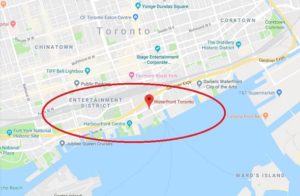
Called Quayside, the neighborhood will be designed to prioritize “sustainability, affordability, mobility, and economic opportunity,” according to Sidewalk Labs. The city of Toronto and Sidewalk Labs call the larger project “Sidewalk Toronto.”

Sidewalk had already committed $10 million for the planning process, and an additional $40 million in investment was unlocked with the board’s approval. The entire 12-acre development, however, is expected to cost at least $1 billion, The Wall Street Journal estimated.

The agreement “lays out a path towards a transparent, collaborative partnership with Waterfront Toronto and the people of Toronto,” Josh Sirefman, Sidewalk Labs’ head of development, told Business Insider in a statement. “We look forward to working together to develop a groundbreaking plan to improve the lives of people living in Toronto and cities like it around the world.”

The company has been quiet about the exact plans for the neighborhood, but Sidewalk Labs’ CEO, Dan Doctoroff, has spoken about how urban environments could be improved through self-driving cars, machine learning, high-speed internet, and embedded sensors that track energy usage.

“We are excited to take this next step with Sidewalk Labs to set the stage for a transformational project on the waterfront that addresses many critical urban issues faced by Toronto and other cities around the world,” Waterfront Toronto tweeted Tuesday.

Based on 2017 renderings, it looks as if Sidewalk Labs wants Quayside to be a mixed-use, pedestrian-friendly neighborhood. The preliminary illustrations include bike-share systems, apartment housing, bus lines, and parks.

The project has been in the works for more than a year. In March 2017, Sidewalk Labs responded to Toronto’s request for proposals to redevelop the waterfront parcel. The planning process kicked off with a community town-hall meeting in November where residents discussed their thoughts and concerns about the project.

Business Insider previously reported that locals had expressed worries that Quayside could become a “new Silicon Valley,” bringing issues like gentrification, higher housing prices, and income inequality.

The plan-development agreement became public on Tuesday afternoon after Waterfront Toronto and Sidewalk Labs signed the deal.
Source: Business Insider Magazine – posted July 31, 2018; retrieved September 6, 2018 from: https://www.businessinsider.com/google-sidewalk-labs-toronto-neighborhood-2018-7?utm_content=buffer2ecae

From the Caribbean to Google: “We want some of that!

It is our hope that with the appropriate governmental structure in place, Google (Alphabet) may bring some of those investment dollars – see related Appendix VIDEO – to our Caribbean shores. This type of investor was an early motivation for this roadmap for regional cooperation and confederation, as pronounced in the opening Declaration of Interdependence (Pages 13):

xxiv. Whereas a free market economy can be induced and spurred for continuous progress, the Federation must install the controls to better manage aspects of the economy: jobs, inflation, savings rate, investments and other economic principles. Thereby attracting direct foreign investment because of the stability and vibrancy of our economy.

Following and studying the machinations of the Google company/enterprise is a good idea. This company “puts its money where its mouth is”. We have previously identified these Research & Development efforts that have manifested over the years:

https://goleancaribbean.com/blog/?p=3974 Google and Mobile Phones – Here comes change
https://goleancaribbean.com/blog/?p=1743 Google and Novartis to develop ‘smart’ contact lens
https://goleancaribbean.com/blog/?p=1277 The need for highway safety innovations – here comes Google

In a previous Go Lean blog-commentary, it was related how it is much easier to reform and transform a country by focusing on families, neighborhoods and cities. Do this again and again, and the whole nation, even the region is transformed.

Imagine Caribbean islands and coastal states with SGE’s peppered throughout the region. This is the new Caribbean that is being presented: reforming and transforming the full region, one neighborhood at a time. Imagine too, if the transformations are technological: electric street cars, self-driving vehicles, high-speed internet, and smart energy systems.

The Art & Science of cities is very important for this Go Lean roadmap to elevate Caribbean society. The Go Lean book applied detailed analyses of a number of cities (Caribbean city: Freeport, Bahamas; American cities: New York City; Omaha, Nebraska; Detroit, Michigan; Los Angeles City-County), then proceeded to detail the needed strategies, tactics and implementation to reform Caribbean urban areas. In fact, the CU/Go Lean roadmap has these 3 prime directives:

  • Optimization of the economic engines in order to grow the regional economy to $800 Billion and create 2.2 million new jobs. This roadmap calls for Self-Governing Entities, even in urban area, so as to optimize industrial policy.
  • Establishment of a security apparatus to ensure public safety and protect the resultant economic engines. Urban areas always have additional protections compared to rural areas.
  • Improve Caribbean governance to support these engines, including a separation-of-powers between the member-states and CU federal agencies. SGE’s are managed only at the federal level, but there must be negotiations with local/municipal governments.

The Go Lean book provides 370-pages of turn-by-turn instructions on “how” to adopt new community ethos, plus the strategies, tactics, implementations and advocacies to execute so as to reboot, reform and transform the societal engines of Caribbean society … including the urban communities. There is even one advocacy that relates specifically to urban optimization; consider the specific plans, excerpts and headlines from the book on Page 234 entitled:

10 Ways to Impact Urban Living

1 Lean-in for the Caribbean Single Market
This treaty allows for the unification of the region into one market, thereby expanding to an economy of 30 countries, 42 million people and a GDP of over $800 Billion (according to 2010 metrics). The mission of the CU is to enhance the economic engines of the region, fostering institutions like capital markets, secondary mortgage funds and consumer credit reporting. These initiatives will facilitate local governments and town-planning efforts by providing the financing vehicles, and eco-system, for the real estate developers and municipal governments to predict the supply-and-demand..
2 Self-Governing Entities

The CU will promote and administer all self-governing entities (SGE) throughout the region. This refers to scientific labs, industrial parks, commercial campuses, experimental hospitals, and even foreign bases. These facilities will not be subject of the laws of the local states of their address, rather CU, international, foreign sovereignty, or maritime laws; but depend on the local infrastructure to provide basic needs. Thereby creating jobs and economic activity.

3 Proximity to Healthcare
4 Online Education Facilitation
5 Optimizing Transportation Options

The CU will spearhead transportation solutions for intra-city transit, so as to assuage urban traffic congestion. This will include rail options such as above-ground light-rail and street cars on the major arterial roads. The development of toll roads, with price-traffic elasticity, is a basic CU strategy for urban transportation infrastructure. So too, is bicycle options; the CU will foster local deployments of bicycle paths, dedicated lanes and on-demand bike sharing/rental programs; (see Appendix ZU). Bike Sharing is a synergistic solution for health/wellness and transportation. A lot of urban areas in the Caribbean region are old cities, designed centuries ago; therefore they have small quaint streets – perfect for bicycling.

6 In-sourcing
7 Service Continuity – ITIL
8 Financial Guarantees
9 Big Data Analysis

The CU’s embrace of e-Government and e-Delivery models allows for a lot of data to be collected and analyzed so as to measure many aspects of Caribbean life, including: trade, economic, consumption, societal values and macro-performance, and media consumption. This way, “course adjustments” can be made to strategic and tactical pursuits.

10 Legislative Oversight

In addition to the book, previous Go Lean commentaries related details of urban life and how best-practices can be applied so as to make the Caribbean homeland a better place to live, work and play. Here is a sample of previous blogs:

https://goleancaribbean.com/blog/?p=11386 Making Better Cities
https://goleancaribbean.com/blog/?p=8573 Build a Street Car System and Harvesting the Growth
https://goleancaribbean.com/blog/?p=6016 Model of Urban Solutions – Cooperative Refrigeration
https://goleancaribbean.com/blog/?p=4587 Burlington, Vermont: First city to be powered 100% by renewables
https://goleancaribbean.com/blog/?p=3641 ‘We Built This City …’
https://goleancaribbean.com/blog/?p=3326 M-1 Rail: Alternative Motion in the Motor City
https://goleancaribbean.com/blog/?p=1731 Ode to Omaha, a Model City
https://goleancaribbean.com/blog/?p=1596 Book Review: ‘Prosper Where You Are Planted’

The Go Lean book and these accompanying blogs posit that economic success can be forged by doubling-down on R&D in Caribbean cities. We can improve one urban neighborhood at a time. Before we know it, we have changed the whole region.

We can do better, than our Status Quo.

There are many role models to follow.

The foregoing example – Google-Sidewalk Labs in Toronto, Canada – is a manifestation that the change we seek is conceivable, believable and achievable. Yes, we can … make our homelands better places to live, work and play. 🙂

Download the free e-book of Go Lean … Caribbean – now!

Sign the petition to lean-in for this roadmap for the Caribbean Union Trade Federation.

—————–

Appendix VIDEO – Inside the construction project promising to transform Toronto’s waterfront – https://youtu.be/PAgTA6tQdZs

CityNews Toronto
Published on Jun 27, 2018 – It’s a $1.25 billion multi-year project that promises to transform how Torontonians live, work and play along the waterfront. Tina Yazdani checks in on the creation of a new shoreline and flood protection system in the Portlands.

Share this post:
, ,
[Top]