Category: Ethos

Wait, ‘We Are The World’

Go Lean Commentary

33 is an important number for music. This is the speed that a record-album spins on a record-player.

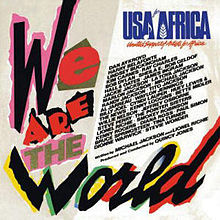
33 years ago, today – January 28th, 1985 – the record industry spun a new thread. The industry spun its biggest world charity endeavor, to date, to mitigate famine in Africa, in response to a drought in Ethiopia. This was the collaborative effort – by more than 40 artists – to record the song: We Are The World.

See the story in the Almanac entry here:

Almanac: “We Are the World”

… From our “Sunday Morning” Almanac: January 28th, 1985, 33 years ago today … the day more than 40 of the music world’s greatest stars gathered in a Los Angeles studio to record the song “We Are the World.”

Written by Lionel Richie and Michael Jackson, and produced by Quincy Jones, the song was a fundraiser for the relief group USA for Africa.

The artists were told, “Check your egos at the door.” And did they ever.

Twenty-one of them each got a turn singing a solo line, while more than 20 others made up the chorus.

More than nine million copies of the song have been sold or downloaded. It won four Grammys, including Song of the Year and Record of the Year.

And most important: USA for Africa says the song has generated more than $65 million for humanitarian relief.

For more info:

Source: CBS Sunday Morning – Almanac: This Day In History – Posted & Retrieved January 28, 2018 from: https://www.cbsnews.com/news/almanac-we-are-the-world/

———–

VIDEO – U.S.A. For Africa – We Are the World – https://youtu.be/9AjkUyX0rVw

USAforAfricaVEVO

Published on Apr 12, 2010 – Music video by U.S.A. For Africa performing ‘We Are the World’. USA For Africa

This moment, movement, momentum and music changed the world!
This super-group United Support of Artists (USA) for Africa played on the brand “USA”, but truthfully, they could have called themselves United States of America, as all the participants – see Appendix below –  were Americans … except for the Irish vocalist-producer Bob Geldof in the chorus, plus percussionist Phil Collins (England) and percussionist  Paulinho da Costa (Brazil).

Yet still, this collaborative effort made a difference!

They raised money and ensured the distribution of food stuffs to the ravaged areas of Africa. They used music to change the world!

Can we use music to change the world again? How about changing the Caribbean? How about shaping the culture?

Yes, we can! Why? ‘We Are The World‘.

Its ironic that despite all the available talent, there was no Caribbean representation in that assembly of artists that day, none except for Harry Belafonte. He boasts a legacy of a Caribbean parentage from a Jamaican mother and Martiniquan father; (though he himself was born in Harlem, New York). For ‘We Are The World‘, he sang in the chorus.

This consideration is in line with the 2013 book Go Lean … Caribbean. The book relates that music and a movement can change the world again. It serves as a roadmap for the introduction and implementation of the technocratic Caribbean Union Trade Federation (CU). This CU strives to advance Caribbean culture using the application of societal best-practices – and music – to engage these 3 prime directives:

  • Optimization of the economic engines in order to grow the regional economy to $800 Billion and create 2.2 million jobs.
  • Establishment of a security apparatus to protect the resultant economic engines.
  • Improvement of Caribbean governance to support these engines.

The Go Lean book – available for download now – prescribes a plan for each Caribbean country to grow their musical influence. The book further identifies 169 different musical/national combinations of genres throughout the region. So the complex music landscape in the region does not stand still; it evolves. So too their musical artists.

Music can indeed wield a great influence and impact on the world. (Previously, this blog-commentary detailed the influence of music icon Bob Marley). Natural disasters continue to happen, as ‘We Are The World‘ was in response to a natural disaster – a drought – in Africa 33 years ago. We continue to have natural disasters … today. Just recently, late September 2017, Hurricane Maria devastated several Caribbean member-states; Puerto Rico was gravely impacted. In the mode of ‘We Are The World‘, many artists – led by Lin-Manuel Miranda of Hamilton fame – assembled and recorded a song to aid Puerto Rico, entitled ‘Almost Like Praying‘ by Artists for Puerto Rico.

Lesson learned! The same as ‘We Are The World‘ was mostly an American art form, Puerto Rico was able to convey its brand.

See the VIDEO of the song ‘Almost Like Praying‘ by Artists for Puerto Rico here:

VIDEO – Like Praying feat Artists for Puerto Rico [Music Video] – https://youtu.be/D1IBXE2G6zw

Atlantic Records

Published on Oct 6, 2017 – Lin-Manuel Miranda’s “Almost Like Praying” was written and recorded to benefit hurricane relief efforts in Puerto Rico with proceeds benefiting The Hispanic Federation’s Unidos Disaster Relief Fund

Proceeds go to https://hispanicfederation.org/unidos/

For more information, please visit http://www.hispanicfederation.org and http://www.almostlikepraying.com

“Almost Like Praying” Lin-Manuel Miranda feat Artists for Puerto Rico Music and Lyrics by Lin-Manuel Miranda © 2017
“Contains elements of “Maria” Music by Leonard Bernstein, Lyrics by Stephen Sondheim ©1957, Renewed.

Vocals Performed by (listed alphabetically):

Marc Anthony Ruben Blades Camila Cabello
Pedro Capo Dessa Gloria Estefan
Fat Joe Luis Fonsi Juan Luis Guerra
Alex Lacamoire John Leguizamo Jennifer Lopez
Lin-Manuel Miranda Rita Moreno Ednita Nazario
Joell Ortiz Anthony Ramos Gina Rodriguez
Gilberto Santa Rosa PJ Sin Suela Tommy Torres
Ana Villafañe

Percussion by: Eric Bobo Correa

Executive Producer: Lin-Manuel Miranda

Proceeds to the Hispanic Federation UNIDOS Fund for Puerto Rico

  • Category: Music
  • License: Standard YouTube License

The movement behind the Go Lean book asserts that “one person can make a difference“, and that music can shape culture. So just like Bob Marley, Lin-Manuel Miranda should be recognized for his contributions to music, culture and Puerto Rican (Caribbean) identity. This one character has made a difference, he has shaped American culture and forged an example and a sample of how other Caribbean stakeholders can do more in the arts to impact the world – ‘We Are The World‘.

Yes, as related in a previous blog-commentary, we – in the Caribbean – can build a city on “rock-and-roll”.

Early in the Go Lean book (Page 15) in the Declaration of Interdependence, the contributions that music can make is pronounced as an community ethos for the entire region to embrace, with these statements:

  • Whereas the cultural arts and music of the region are germane to the quality of Caribbean life, and the international appreciation of Caribbean life, the Federation must implement the support systems to teach, encourage, incentivize, monetize and promote the related industries for arts and music in domestic and foreign markets. These endeavors will make the Caribbean a better place to live, work and play.

The Go Lean book, within its 370 pages, details the community ethos, strategies, tactics, implementations and advocacies to foster the next generation of artists. This roadmap recognizes that a prerequisite for advancing society is a change in the community ethos, defined as “the fundamental spirit of a culture that drives the beliefs, customs and practices” in society. Music should be appreciated for its ability to shape the culture of a community, country or even the whole world.

Thank you Quincy Jones and all the 40-plus United Support of Artists for the model for ‘We Are The World‘ 33 years ago; you set the pathway for success for new collaborations of talented, inspirational and influential artists who are sure to follow, even here in the Caribbean. We used that pattern for Puerto Rico; hopefully more Caribbean communities to follow.

We want “a change to come” to the Caribbean. So we need to accept the premise that was echoed musically 33 years ago, that ‘We Are The World‘. We hereby urge the people, institutions and governance of Caribbean region to “lean-in” to this Go Lean roadmap for change and empowerment. ‘We Are The World‘ and we want to make our part of the world – the Caribbean – a better place to live, work and play. 🙂

—————

Appendix – USA for Africa Artists-Musicians

Conductor: Quincy Jones 

Soloist – Order of Appearance Chorus – Alphabetically Instrument Players
Lionel Richie Dan Aykroyd David Paich – synthesizers
Stevie Wonder Harry Belafonte Michael Boddicker – synthesizers
Paul Simon Lindsey Buckingham Paulinho da Costa – percussion
Kenny Rogers Mario Cipollina Phil Collins – percussion
James Ingram Johnny Colla Louis Johnson – synth bass
Tina Turner Sheila E. Michael Omartian – keyboards
Billy Joel Bob Geldof Greg Phillinganes – keyboards
Michael Jackson Bill Gibson John Robinson – drums
Diana Ross Chris Hayes
Dionne Warwick Sean Hopper
Willie Nelson Jackie Jackson
Al Jarreau La Toya Jackson
Bruce Springsteen Marlon Jackson
Kenny Loggins Randy Jackson
Steve Perry Tito Jackson
Daryl Hall Waylon Jennings
Huey Lewis Bette Midler
Cyndi Lauper John Oates
Kim Carnes Jeffrey Osborne
Bob Dylan Pointer Sisters (June, Ruth, and Anita)
Ray Charles Smokey Robinson

Source: Wikipedia Online Encyclopedia Retrieved January 28, 2018 from: https://en.wikipedia.org/wiki/We_Are_the_World


Share this post:
, , , ,

Opioids and the FDA – ‘Fox guarding the Henhouse’

Go Lean Commentary

“Absolutely criminal…” – US Senator reviewing the FDA handling of America’s Opioid crisis.

Saying “the grass is not greener on the other side” is just too simplistic a criticism of the American eco-system for pharmaceutical use … and abuse. Pain is real and need to be mitigated, but the American experience is one of dysfunction.

Yet, this is to be expected, when one places the ‘fox to guard the henhouse’.

This is not just our opinion alone. This aligns with the criticism of the FDA’s Former Head; they are supposed to be the Watch-Dog. (While the Watch-Dog for them is supposed to be the US Congress, providing checks-and-balances over the Executive Branch, FDA included). See this related story-criticism here:

VIDEO: Former FDA Head weighs in on Opioid epidemic – https://youtu.be/QEzSJRBQ9RU


CBS Evening News
Posted May 9, 2016 – Each day in America, 78 people die from overdosing on painkillers. Doctor David Kessler, former head of the FDA from 1990 to 1997, called the rise of America’s Opioid crisis “one of the great mistakes of modern medicine.” Jim Axelrod has more.

Yet, still we continue to say, despite the simplicity of the criticism:  the grass is not greener on the American side. Mature communities address the problems that they face; they monitor, manage and mitigate them. To allow a problem to persist, to take lives and then do nothing or little about it makes stakeholders blood-guilty. This is a direct indictment from the Judeo-Christian moral code, the Bible; see the justice standard here:

29 But if a bull was in the habit of goring and its owner had been warned but he would not keep it under guard and it killed a man or a woman, the bull is to be stoned and its owner is also to be put to death. 30 If a ransom* is imposed on him, he must give as the redemption price for his life* all that may be imposed on him. – Exodus 21: 29, 30

Analysis
[In Bible times], certain deliberate acts that indirectly caused or could have resulted in the death of another person were considered tantamount to deliberate murder. For example, the owner of a goring bull who disregarded previous warnings to keep the animal under guard could be put to death if his bull killed someone. In some cases, however, a ransom could be accepted in place of the life of the owner. Undoubtedly the judges would take circumstances into consideration in such a case. (Ex 21:29, 30) Also, an individual scheming to have another person killed by presenting false testimony was himself to be put to death.—Deuteronomy 19:18-21.

But this standard is not the reality of America, where the original 2 societal defects America was built on still persists:

Shockingly, this indictment of the FDA – who is supposed to protect American people – raises a Caribbean debate:
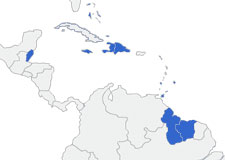
Is it better to emigrate to America or any other foreign destination for economic success, or prosper where planted in the Caribbean homeland?

The movement behind the book Go Lean … Caribbean campaigns to inform the people of the Caribbean that life is not idyllic in America, that death is more readily because of a greater disregard of life, especially of those of minority (non-white) ethnicities.

Some might argue that “this” charge is not fair, nor accurate!

And yet … as reported in a previous blog-commentary (and highlighted in the foregoing VIDEO), millions suffer from Opioid addictions – 33,000 die every year.  This is not new, as the evidence suggest this is decades old, and yet the FDA “slept”; truly, the ‘fox guarding the henhouse’.

🙁

The Go Lean book serves as a roadmap to introduce the technocratic Caribbean Union Trade Federation (CU) to elevate the region’s societal engines – economics, homeland security and governance – of the 30 Caribbean member-states. In fact, the prime directives of the roadmap includes the following 3 statements:

  • Optimization of the economic engines in order to grow the regional economy to $800 Billion & create 2.2 million new jobs.
  • Establishment of a security apparatus to ensure public safety and protect the resultant economic.
  • Improve Caribbean governance for all people, even minority groups, to support these engines.

The quest of the Go Lean book and movement is to minimize the lure for America to Caribbean citizens. We need our people to Stay Home, and so we want to make the Caribbean region better places to live, work and play. People only leave because they believe that life abroad will be better. So facts to the contrary should go far in quelling such misconceptions.

In this movement for a new Caribbean, we do not want to be like America, we want to be Better! While this is heavy-lifting, it is not impossible, just start without the two known societal defects: Institutional Racism, and Crony-Capitalism.

No one is being fooled, the Opioid crisis in the US has persisted because Big Pharma is profiting. This is what a previous Go Lean commentary lamented, “stupidity persists in society when ‘someone’ is getting rich and want to preserve their profits, even at the expense of human life. This is so familiar, as in the same playbook of Big Tobacco for the entire 20th Century; see/listen to the Podcast in the Appendix below.

When it comes to chronic pain relief, the CDC is asking doctors and patients to think about alternatives to opioids.

We do not want our people to die ignominiously in America due to some opioid overdose. And so, we do not want our citizens to have to leave … in the first place. But the truth is a two-sided coin…

… on the flipside, life in America is more prosperous than in any Caribbean member-state.

(Recently, the American President Donald J. Trump, even referred to the Caribbean member-state of Haiti as a “shit-hole” country).

As related previously, the Go Lean book, in its 370 pages, introduces the Caribbean Union Trade Federation as an inter-governmental agency for the 30 member-states, to provide a better – technocratic – stewardship for Caribbean life, to make it more prosperous … at home. The book identifies that we have a crisis – our failing societal engines – but asserts that this crisis would be a terrible thing to waste. We can use the urgency – we do not want to be bloodguilty –  to introduce and implement effective community ethos, strategies, tactics, implementations and advocacies to reboot, reform and transform the economic engines of Caribbean society.

The Go Lean book contends that as a people, we must be prepared for accidents and illnesses – pain is normal. It asserts that bad actors – and bad incidences – will emerge just as a result of economic successes in the region. This point is pronounced early in the book with the Declaration of Interdependence (Page 12) that claims:

xi. Whereas we are surrounded and allied to nations of larger proportions in land mass, populations, and treasuries, elements in their societies may have ill-intent in their pursuits, at the expense of the safety and security of our citizens. We must therefore appoint “new guards” to ensure our public safety and threats against our society, both domestic and foreign. The Federation must employ the latest advances and best practices … to assuage continuous threats against public safety.

xvi. Whereas security of our homeland is inextricably linked to prosperity of the homeland, the economic and security interest of the region needs to be aligned under the same governance. Since economic crimes, including piracy and other forms of terrorism, can imperil the functioning of the wheels of commerce for all the citizenry, the accedence of this Federation must equip the security apparatus with the tools and techniques for predictive and proactive interdictions.

As related above, for us to become a mature society, we must address the risks and problems that we face; we must monitor, manage and mitigate them. The Go Lean book describes the need for the Caribbean to appoint “new guards” to protect the people, not exploit them, this should be a lesson learned from the US. The purpose of the CU security pact will be to ensure public safety as a comprehensive endeavor, encapsulating the needs of all Caribbean stakeholders: residents and visitors alike.

Consider this sample of previous blog-commentaries that have expanded on this theme:

https://goleancaribbean.com/blog/?p=13746 Security Dreams for the Caribbean Basin
https://goleancaribbean.com/blog/?p=13251 A Better Way to Manage Hurricane Risks
https://goleancaribbean.com/blog/?p=12949 Being Mature to Handle Charity Management
https://goleancaribbean.com/blog/?p=12930 Managing Dangers, Disasters and Emergencies
https://goleancaribbean.com/blog/?p=11808 Not Ignoring the Public Health Risks of ‘Concussions’
https://goleancaribbean.com/blog/?p=11654 Righting A Wrong – A Series on Ensuring Public Safety: Air Bags
https://goleancaribbean.com/blog/?p=10959 See Something; Say Something; Do Something
https://goleancaribbean.com/blog/?p=10771 Logical Addresses – It Could Mean ‘Life or Death’
https://goleancaribbean.com/blog/?p=2105 Monitoring the Risks of Economics on Public Health

We want to “live long and prosper”. We want to prosper right here in the Caribbean. How sad it would be for a family to move to the US (and other countries) and fall victim to a voluntary opioid addiction … and overdose … and death.

So we urge all Caribbean stakeholders to lean-in for the empowerments of this Go Lean roadmap. It is conceivable, believable and achievable to plant here and prosper here in our Caribbean region.

Yes, we can make our homelands better places to live, work and play. 🙂

Download the free e-book of Go Lean … Caribbean – now!

Sign the petition to lean-in for the roadmap for the Caribbean Union Trade Federation.

———–

Appendix AUDIO – Opioids As The New Big Tobacco – https://www.npr.org/2017/06/30/534969884/opioids-as-the-new-big-tobacco

Posted June 30, 2017 – A wave of litigation by state attorneys general against the biggest opioid manufacturers and distributors feels reminiscent of lawsuits brought by states in the 1990s against the tobacco industry.


Share this post:
, ,
[Top]

First Steps – Free European Money – To Start at Top

Go Lean Commentary

Do I look like I have a plan? – Sarcasm by ‘The Joker’, the villain advocating for anarchy in the 2008 movie Batman: The Dark Knight

Most definitely, yes we do!

Despite the reality of a regional crisis, there is a plan to stop the bad trend of Caribbean people abandoning their homeland and emigrating away to North American and European destinations. Consider these thoughts:

  1. Do you know the Golden Rule; it’s he who has the gold that makes the rules.
  2. In the best control conditions of time, temperature and pressure, people will do … as they damn well please.

This is the conundrum of forging change in Caribbean society; where do we start, the Top (leaders) or the Bottom (people)?

The book Go Lean…Caribbean – available to download for free – declares: Both!

The fact that both approaches must be engaged at the same time depicts both a Top-Down plan plus a Bottoms-Up plan. The quest is that Caribbean society must change – if it is to survive – so either and both approaches are pursued.

Yes, we can …

The book serves as a roadmap for the introduction and implementation of the technocratic Caribbean Union Trade Federation (CU), for the elevation of Caribbean society – for all member-states. This CU/Go Lean roadmap has these 3 prime directives:

  • Optimization of the economic engines in order to grow the regional economy to $800 Billion and create 2.2 million new jobs.
  • Establishment of a security apparatus to ensure public safety and protect the resultant economic engines.
  • Improve Caribbean governance to support these engines, including a separation-of-powers between the member-states and CU federal agencies.

This commentary is the first of a 6-part series from the movement behind the book Go Lean … Caribbean in consideration of the First Steps for instituting this new regime for the Caribbean homeland. The other commentaries in the series are cataloged as follows:

  1.     First Steps: EU – Free European Money – To Start at Top
  2.     First Steps: UK – Dignified and Efficient
  3.     First Steps: US – Congressional Interstate Compacts – No Vote; No Voice
  4.     First Steps: CariCom – One-Man-One-Vote Defects
  5.     First Steps: Deputize ‘Me’!
  6.     First Steps: A Powerful C.P.U.

All of these commentaries relate to “how” the Caribbean can finally get started with adapting the organizational structures to optimize the region’s societal engines. This is the consideration of leading from the Top. This conforms with the Go Lean quest to reform and transform the Caribbean member-states so that they can be better places to live, work and play. Then, only then, can we stop the bad trend of our people emigrating away to North American and European destinations.

Where there is no vision, the people perish. – The Bible Proverbs 29:18.

In a previous Go Lean commentary, it related:

Yes, the societal defects of the Caribbean can be fixed – remediated and mitigated – but “if it is going to be, it starts with me”; it is necessary for all stakeholders to engage in the effort to turn-around the Caribbean. To forge change, the region must consider top-down and bottoms-up approaches, so we need the multitude of Caribbean people (bottoms-up) and politicians and community leaders (top-down) to lean-in to this quest to turn-around the community. Yes, it starts with “me”, as in everyone.

The people of the Caribbean are more ordinary than they are extraordinary, they just want what everyone else wants: opportunities, peace & security, good stewardship, and the fulfillment of the Social Contract (implication that people will surrender their natural rights to the State in exchange for protection of other human and civil rights).

People deserve this and demand this – they will petition their leaders, cry-and-complain, and even take to streets if necessary. But once these Social Contract deliverables are delivered, Caribbean people will do what people everywhere do: comply with any new regime. This is the plan to lead from the Bottom – demand change – this is the easy part, leading from the Top on the other hand is the mystery.
This is easier said than done…

The Go Lean book stresses that reforming and transforming the Caribbean societal engines must be a regional pursuit. This was an early motivation for the roadmap, as pronounced in the opening Declaration of Interdependence (Pages 12 – 13):

xi. Whereas all men are entitled to the benefits of good governance in a free society, “new guards” must be enacted to dissuade the emergence of incompetence, corruption, nepotism and cronyism at the peril of the people’s best interest. The Federation must guarantee the executions of a social contract between government and the governed.

xvi. Whereas security of our homeland is inextricably linked to prosperity of the homeland, the economic and security interest of the region needs to be aligned under the same governance. Since economic crimes … can imperil the functioning of the wheels of commerce for all the citizenry, the accedence of this Federation must equip the security apparatus with the tools and techniques for predictive and proactive interdictions.

xxiv. Whereas a free market economy can be induced and spurred for continuous progress, the Federation must install the controls to better manage aspects of the economy: jobs, inflation, savings rate, investments and other economic principles. Thereby attracting direct foreign investment because of the stability and vibrancy of our economy.

The Go Lean book provides 370-pages of turn-by-turn instructions on “how” to adopt new community ethos, plus the strategies, tactics, implementations and advocacies to execute so as to reboot, reform and transform the societal engines of Caribbean society. (One implementation is the assembly of all regional organizations and “overseas masters”: French, Dutch and British authorities, separately and in concert with the European Union).

This all sounds good, but what do “we” do next … or first, since the CU Trade Federation is not currently in force?

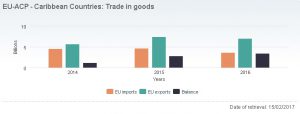
Accordingly, the strong urging here is to “follow the money”! There are available grants from organizations like the EU to conform, comply and “confederate as a regional entity to bring about change”. Yes, the EU provides Aid for Trade between the Caribbean and the EU. To strengthen the competitiveness of economic operators as well as the integration process of our countries in the global economy, the EU provides development cooperation in the region.

Note: The Caribbean region following the EU’s lead automatically includes the EU’s Caribbean jurisdictions: Dutch and French sovereign territories (17 lands). CARIFORUM – see below – includes 15 other nations. So these efforts are intended to be Caribbean-universal.

See a sample reference here, with excerpts from the European Union Commission website – and a related Pro-Con discussion VIDEO:

Title: European Commission Trade Policy for the Caribbean
The EU’s trade and development partnership with the Caribbean stretches back over more than 30 years. In October 2008 Antigua and Barbuda, The Bahamas, Barbados, Belize, Dominica, Grenada, Guyana, Jamaica, Saint Lucia, Saint Vincent and the Grenadines, Saint Kitts and Nevis, Surinam, Trinidad, Tobago, and the Dominican Republic signed with the EU the CARIFORUM-EU Economic Partnership Agreement. Haiti signed the agreement in December 2009, but is not yet applying it pending ratification.

The agreement also comes with substantial EU aid for trade.

The purpose of the agreement is to make it easier for people and businesses from the two regions to invest in and trade with each other and thus to help Caribbean countries grow their economies and create jobs.

The EU-CARIFORUM Economic Partnership in Practice

Trade picture
The EU is CARIFORUM’s second largest trading partner, after the US. CARIFORUM runs a trade deficit with the EU. In other words, CARIFORUM countries export less in goods and services to the EU than they import from the EU.

The main exports from the Caribbean to the EU are in:

  • fuel and mining products, notably petroleum gas and oils;
  • bananas, sugar and rum;
  • minerals, notably gold, corundum, aluminium oxide and hydroxide, and iron ore products;
  • fertilisers.

The main imports into the Caribbean from the EU are in:

  • boats and ships, cars, constructions vehicles and engine parts;
  • phone equipment;
  • milk and cream;
  • spirit drinks.

EU and Caribbean
Economic Partnership Agreements set out to help African Caribbean and Pacific (ACP) countries to improve their trade. The Economic Partnership Agreement between the EU and the 15 Caribbean countries provides predictability in the market access into the EU for these countries. The agreement will lead to a general opening of the EU market beyond WTO commitments in the services sectors, including creative and entertainment industries. It ensures duty-free-quota-free market access into the EU for all products. With regard to EU exports to the region, EU exports of sensitive products will gradually be liberalised over a period of 25 years. The Economic Partnership Agreement with the EU will make it possible for CARIFORUM companies to set up a commercial presence in the EU.

The Economic Partnership Agreement between the EU and the 15 Caribbean countries  is in part a free trade agreement, or FTA. And like any FTA, it opens up trade in goods between the two regions. But unlike other FTAs, the EU-Caribbean Economic Partnership Agreement goes further. In fact, it’s a wide-ranging partnership putting trade at the service of development.

That is because the agreement:

  • also opens up trade in services and investment;
  • makes it easier to do business in the Caribbean – governments there have made commitments in many areas directly affecting trade, like rules to ensure fair competition;
  • comes with financial support from the EU to help Caribbean:
    • governments implement the accord; and
    • businesses to use the EPA to export more and attract more outside investment.

In recent years CARIFORUM countries have been integrating more closely with each other. This is part of their strategy to play a fuller role in global trade, and to offer the economies of scale and simpler rules which are vital to attract more foreign investment.

The EU-Caribbean Economic Partnership Agreement helps to consolidate this process, by making it easier to export goods and services between:

  • the fourteen countries of the Caribbean Community, or CARICOM, and the Dominican Republic, which together make up CARIFORUM;
  • these fifteen CARIFORUM countries (CARICOM plus the Dominican Republic) and seventeen territories in the Caribbean with direct links to EU countries (four French ‘outermost regions’ and thirteen ‘overseas territories’ – six British, six Dutch and one French)


Trading with Caribbean

This can include support for building new transport, energy or telecommunications infrastructure, investments in agriculture, fisheries and services.

  • Help for exporters from developing countries
    • The EU’s Trade Helpdesk supports small traders in developing countries by helping them access the EU market, and provides information on EU rules and regulations.
    • The International Trade Center (ITC) supports several development projects across the world.
    • The ITC’s Standards Map provides information on standards, codes of conduct and audit protocols for international trade.
    • The Small Traders Capacity Building program supports developing countries in administration, training, and information on tariffs, trade flows, standards, etc.

Source: Retrieved January 16, 2018 from: http://ec.europa.eu/trade/policy/countries-and-regions/regions/caribbean/</a

——–

VIDEO – DISCUSSION | E.U – A.C.P Economic Partnership Agreement – https://youtu.be/la-ZQRfnUrY

Strong Body and Mind

Published on Jun 7, 2016 – E.U – A.C.P Economic Partnership Agreement Economic Partnership Agreements (EPAs) are trade and development agreements negotiated between the EU and African, Caribbean and Pacific (ACP) partners engaged in regional economic integration processes. Take a look at the various arguments, do some research then let me know your thoughts on the subject. European Commission – Economic partnerships: http://ec.europa.eu/trade/policy/coun…

This foregoing reference is not just a document of talking points; it is an actual Action Plan. In fact, the Actions have already manifested in the region, as related in this previous Go Lean blog-commentary describing the EU’s sponsor of Green Energy initiatives in the country of Barbados; they gave 1.12 million Euros (US$1.37 million) towards the advancement of energy self-sufficiency from renewable resources. This is the first payment of a total contribution of 3 million Euros.

Needless to say, EU money comes with strings attached – see the foregoing VIDEO. They are leading the leaders of the Caribbean. This constitutes a Top-Down approach for forging change in society.

Top-Down and Bottoms-Up – this is the First Step! The Go Lean roadmap (Page 96) calls for this functionality – “assembling” all the regional stakeholders in the Caribbean, including the “overseas masters” – for the first year of the confederacy plan. (Since this book was published in 2013, the United Kingdom has divorced themselves from the EU).

Forging change is a common theme by this Go Lean movement. Consider these previous 10 blog-commentaries that detailed approaches for forging change, in reverse chronological order:

  1. Forging Change – Collective Bargaining (April 28, 2017)
  2. Forging Change – Addicted to Home (April 14, 2017)
  3. Forging Change – Arts & Artists (December 1, 2016)
  4. Forging Change – Panem et Circenses (November 15, 2016)
  5. Forging Change – Herd Mentality (October 11, 2016)
  6. Forging Change – ‘Something To Lose’ (November 18, 2015)
  7. Forging Change – ‘Food’ for Thought (April 29, 2015)
  8. Forging Change – Music Moves People (December 30, 2014)
  9. Forging Change – The Sales Process (December 22, 2014)
  10. Forging Change – The Fun Theory (September 9, 2014)

As related in these commentaries, forging change is how the Go Lean roadmap will make our Caribbean homeland a better place to live, work and play. We urge every Caribbean stakeholder to lean-in to this roadmap to elevate the societal engines of the region. 🙂

Download the free e-book of Go Lean … Caribbean – now!

Sign the petition to lean-in for this roadmap for the Caribbean Union Trade Federation.

Share this post:
,
[Top]

The Spoken and Unspoken on Haiti

Go Lean Commentary

The US President said what?! 

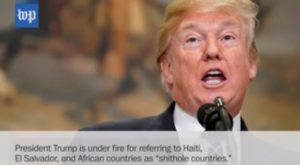
He – Donald J. Trump – called Haiti a “shit-hole” country while negotiating the details for an immigration reform bill with his political opponents.

This declaration spewed controversy and disgust in the US … and abroad; even here in the Caribbean. See VIDEO’s here:

VIDEO 1 – The U.S.’s complicated relationship with a country Trump called a ‘shitholehttp://wapo.st/2ATEOSZ

According to the Washington Post, this is how ignorant you have to be to call Haiti a ‘shithole’.

President Trump’s defenders don’t know anything about Haiti’s history — or the United States’s. See the full article here: https://www.washingtonpost.com/news/posteverything/wp/2018/01/12/this-is-how-ignorant-you-have-to-be-to-call-haiti-a-shithole/?utm_term=.f82e10bad3d8

———-

VIDEO 2 – CNN and Fox News hosts react to Trump’s ‘shithole’ remark – https://youtu.be/NrynNeqx48I

Published on Jan 12, 2018 – President Trump referred to African nations and Haiti as “shithole” countries on Jan. 11. Here’s how hosts on CNN and Fox News reacted. Subscribe to The Washington Post on YouTube: http://bit.ly/2qiJ4dy

Follow us:
Twitter: https://twitter.com/washingtonpost
Instagram: https://www.instagram.com/washingtonp…
Facebook: https://www.facebook.com/washingtonpost/

See commentary from the Caribbean Intelligentsia here posted on the regional site Caribbean News Now:

Commentary: President Trump’s ‘shithole’ comments unfortunately deserve follow up

By: Youri A Kemp

In a bi-partisan meeting with Democrat and Republican lawmakers on immigration and particularly on the Deferred Action for Childhood Arrivals (DACA) portion of the immigration reform package, in an unprecedented show of extreme ignorance and crassness, the president of the USA, Donald Trump, referred to Haiti, El Salvador and African countries as “shitholes”.

No further comment [is] necessary, but I will comment anyway. I will because the overt stupidity of such a statement, particularly a statement made in the presence of Democrat and Republican lawmakers, shows how “off the rails” and “loose with his mouth” President Trump is.

For me personally, I cry foul on such comments. As everyone should. The president, or any world leader, should not be using such language in the open and especially not disparaging other countries, no matter how he or the grouping may feel about the issue.

See the full commentary here: http://wp.caribbeannewsnow.com/2018/01/12/commentary-president-trumps-shithole-comments-unfortunately-deserve-follow/#comment-1747 

Source: Caribbean New Noe e-Zine; posted January 12, 2018; retrieved January 16, 2018

No wait, it wasn’t “shit-hole” that he said, it was “shit-house”.

No wait, maybe he didn’t say these at all!

Just what is spoken and what is unspoken about the disposition of Haiti in the minds of American leaders?

The Bible says:

“From the abundance of the heart, the mouth speaks” – Luke 6:45

For people to say something like the above about a Caribbean country shows that truly, they have no regard for that country. Take away their words and study their actions (i.e. policies) and we see a consistent trend – spoken or unspoken – that there is really no regard for Haiti – and other Caribbean member-states.

The movement behind the book Go Lean…Caribbean – available to download for free – have said a lot about Haiti. We have told the truth, and the truth is not pretty.

Haiti is effectively a Failed-State.

Yet, still we make this statements in love – not hate; not bias; not prejudice nor blatant racism. We have also followed-up from “talking this talk” to “walking the walk” and have presented an Action Plan, a Way Forward for reforming and transforming Haiti. We have been doing this all along – since the start of these commentaries. See the previous submissions here:

https://goleancaribbean.com/blog/?p=13916 Haiti – Beauty ‘Only a Mother Can Love’
Many women sacrifice to help Haiti create jobs and elevate their society. The Go Lean roadmap presents a model for Self-Governing Entities as a job-creating engine.
https://goleancaribbean.com/blog/?p=13105 Fixing Haiti – Can the Diaspora be the Answer?
Any plan that encourages people to leave their homeland and try to remember it later when they find success, double-downs on failure. We need solutions that encourage our people to prosper where planted in the homeland, like Haiti.
https://goleancaribbean.com/blog/?p=10336 A Lesson in History: Haiti’s Reasonable Doubt
There is the little-known history of an American occupation in Haiti in 1915. This suppressed, oppressed and repressed this island-nation further. Haiti needs to accept that America is not always its friend.
https://goleancaribbean.com/blog/?p=8767 A Lesson in History: Haiti 1804
Haiti has the proud legacy of being the first successful Slave Rebellion to liberate its people and start the effort of nation-building. Though Haiti became a Republic, they paid a steep price for the brazen acts of 1804.
https://goleancaribbean.com/blog/?p=8508 Support sought for kids left behind by UN troops in Haiti.
The UN’s efforts to help Haiti was a good intention, but there were many bad consequences. Rather than the UN, Haiti needs its neighbors to help.
https://goleancaribbean.com/blog/?p=7896 The Logistics of Disaster Relief
When Caribbean communities suffer from disasters – earthquakes and hurricanes – we need technocratic efficiency to manage the relief and response. The past track record is truly sad.
https://goleancaribbean.com/blog/?p=5695 Repenting, Forgiving and Reconciling the Past
Haiti has been on the “wrong-side” of so many atrocities, there must be a reconciliation focus to have peace with neighbors, going forward.
https://goleancaribbean.com/blog/?p=5462 In Search Of The Red Cross’ $500 Million In Haiti Relief.
The 2010 earthquake devastation brought-in a lot of money that somehow never made it to Haiti. This proves that Caribbean people need the maturity to manage charities ourselves.
https://goleancaribbean.com/blog/?p=5333 France – Haiti Legacy: Cause and Effect – Still matters today.
As finally the President of France made a proclamation of acknowledgement that the Republic of Haiti has endured a long legacy of paying a debt (in blood and finances) for the natural right of freedom.
https://goleancaribbean.com/blog/?p=3662 Migrant flow into US from Caribbean spikes. Haitians take to the dangerous seas in desperation to flee their homeland.
https://goleancaribbean.com/blog/?p=3473 Haiti to Receive $70 Million Grant to Expand Caracol Industrial Park. This is a model for Self-Governing Entities that the Go Lean roadmap stresses.
https://goleancaribbean.com/blog/?p=2907 Local Miami Haitian leaders protest Bahamian immigration policy.
Bad treatment of Haitians is not just limited to Americans; other Caribbean countries (the Bahamas in this case) are guilty of unfair treatment. The Go Lean strategy is to elevate the entire region, not one country over another.
https://goleancaribbean.com/blog/?p=2547 Miami’s Success versus Caribbean Failure
Miami is thriving now, mostly due to the contributions of the Caribbean Diaspora.
https://goleancaribbean.com/blog/?p=1773 Miami’s Caribbean Marketplace Re-opens. The City of Miami now celebrates their Haitian community as opposed to the initial ridicule and rejection. This appears to be standard arc – rejection => toleration => acceptance => celebration – for all new immigrants.

All of this messaging comprise the Way Forward as prescribed in the book Go Lean…Caribbean. The book serves as a roadmap for the introduction and implementation of the technocratic Caribbean Union Trade Federation (CU), for the elevation of Caribbean society – for all member-states. This CU/Go Lean roadmap has these 3 prime directives:

  • Optimization of the economic engines in order to grow the regional economy to $800 Billion and create 2.2 million new jobs.
  • Establishment of a security apparatus to ensure public safety and protect the resultant economic engines.
  • Improve Caribbean governance to support these engines, including a separation-of-powers between the member-states and CU federal agencies.

The book stresses that reforming and transforming the Caribbean societal engines must be a regional pursuit of Caribbean people doing the work themselves for the Caribbean. This Way Forward was an early motivation for the roadmap, as pronounced in the opening Declaration of Interdependence (Pages 12 – 13):

x. Whereas we are surrounded and allied to nations of larger proportions in land mass, populations, and treasuries, elements in their societies may have ill-intent in their pursuits, at the expense of the safety and security of our citizens. We must therefore appoint “new guards” to ensure our [own] public safety and threats against our society, both domestic and foreign. …

xii. Whereas all men are entitled to the benefits of good governance in a free society, “new guards” must be enacted to dissuade the emergence of incompetence, corruption, nepotism and cronyism at the peril of the people’s best interest. The Federation must guarantee the executions of a social contract between government and the governed.

xvi. Whereas security of our homeland is inextricably linked to prosperity of the homeland, the economic and security interest of the region needs to be aligned under the same governance. Since economic crimes … can imperil the functioning of the wheels of commerce for all the citizenry, the accedence of this Federation must equip the security apparatus with the tools and techniques for predictive and proactive interdictions.

xxiv. Whereas a free market economy can be induced and spurred for continuous progress, the Federation must install the controls to better manage aspects of the economy: jobs, inflation, savings rate, investments and other economic principles. Thereby attracting direct foreign investment because of the stability and vibrancy of our economy.

The Go Lean book provides 370-pages of turn-by-turn instructions on “how” to adopt new community ethos, plus the strategies, tactics, implementations and advocacies to execute so as to reboot, reform and transform the societal engines of Caribbean society, including Haiti. We urge every Caribbean stakeholder to lean-in to this roadmap.

We must do this ourselves – as a confederation, a brotherhood – rather than waiting for other people to lead us or love us. Because frankly …

They don’t!

So let’s get busy in the hard-work and heavy-lifting to make our Caribbean homeland a better place to live, work and play. 🙂

Download the free e-book of Go Lean … Caribbean – now!

Sign the petition to lean-in for this roadmap for the Caribbean Union Trade Federation.

Share this post:
, ,
[Top]

Welcoming the Caribbean Intelligentsia

Go Lean Commentary

Who knew?

    … the Caribbean has an Intelligentsia?

Well blow me away with a whisper! This fact is surprising new information for this movement behind the book Go Lean … Caribbean

    … and we should know as we “wrote the book” on the Caribbean.

So there are college degree programs at universities in North America that cover the subject matter of “Caribbean Studies”. This would normally include the sociology, anthropology and historicity of the region; its people, traditions, culture, institutions and industries.

    Big question mark on that last one!

It’s hard to think that there may be intelligent people studying the Caribbean industrial and economic eco-system and their credentials are not scorned in academic circles.

The truth is, the Caribbean is devoid of so much smart out-workings – there are many societal defects – that it’s hard to think there is an intelligentsia for this region:

in·tel·li·gent·si·a
noun

  1. Google: intellectuals or highly educated people as a group, especially when regarded as possessing culture and political influence.
  2. Merriam-Webster: intellectuals who form an artistic, social, or political vanguard or elite.

The opening assessment in the Go Lean book explained that there is undoubtedly a Caribbean geographical region; but there is no unified Caribbean society or culture. Rather there is crisis; there are 30 disjointed, unorganized member-states rimming the Caribbean Sea that has no universal leverage, comradery nor brotherhood. Even the Bible says:

Two are better than one because they have a good return for their labor. 10 For if either of them falls, the one will lift up his companion. But woe to the one who falls when there is not another to lift him up. 11 Furthermore, if two lie down together they keep warm, but how can one be warm alone? 12 And if one can overpower him who is alone, two can resist him. A cord of three strands is not quickly torn apart. – Ecclesiastes 4: 9-12

So for any existing Caribbean intelligentsia in the status quo, it must be for English-speaking territories alone, or Dutch-speaking alone (minus Suriname), or French-speaking alone (minus Haiti), or Spanish-speaking (though there is no unity even among those 3 countries: Cuba, Dominican Republic and Puerto Rico).

It is time now for a change; for the emergence of a Caribbean intelligentsia for all of the Caribbean, for all 30 member-states.

The book Go Lean…Caribbean – available to download for free – serves as a roadmap for the introduction and implementation of the technocratic Caribbean Union Trade Federation (CU), for the elevation of all Caribbean society – for all 30 member-states in all 4 language groups. This CU/Go Lean roadmap has these 3 prime directives:

  • Optimization of the economic engines in order to grow the regional economy to $800 Billion and create 2.2 million jobs.
  • Establishment of a security apparatus to ensure public safety and protect the resultant economic engines.
  • Improve Caribbean governance to support these engines, including a separation-of-powers between the member-states and CU federal agencies.

The book stresses that Caribbean societal engines must be reformed and transformed at a regional level. This shows the need for an intelligentsia influence on Caribbean society. This was an early motivation for the roadmap, as pronounced in the opening Declaration of Interdependence (Pages 12 – 13):

xi. Whereas all men are entitled to the benefits of good governance in a free society, “new guards” must be enacted to dissuade the emergence of incompetence, corruption, nepotism and cronyism at the peril of the people’s best interest. The Federation must guarantee the executions of a social contract between government and the governed.

xii. Whereas the legacy in recent times in individual states may be that of ineffectual governance with no redress to higher authority, the accedence of this Federation will ensure accountability and escalation of the human and civil rights of the people for good governance, justice assurances, due process and the rule of law. As such, any threats of a “failed state” status for any member state must enact emergency measures on behalf of the Federation to protect the human, civil and property rights of the citizens, residents, allies, trading partners, and visitors of the affected member state and the Federation as a whole.

xvi. Whereas security of our homeland is inextricably linked to prosperity of the homeland, the economic and security interest of the region needs to be aligned under the same governance. Since economic crimes … can imperil the functioning of the wheels of commerce for all the citizenry, the accedence of this Federation must equip the security apparatus with the tools and techniques for predictive and proactive interdictions.

xxiv. Whereas a free market economy can be induced and spurred for continuous progress, the Federation must install the controls to better manage aspects of the economy: jobs, inflation, savings rate, investments and other economic principles. Thereby attracting direct foreign investment because of the stability and vibrancy of our economy.

There is the need for a Caribbean Intelligentsia. This normally includes:

  • Think Tanks
  • Advisory Councils
  • Standards Organizations
  • Community Development Foundations
  • Organized Philanthropists
  • Non-Government social agencies

There have been so many expressions of intelligence-lacking practices (Stupidity, Orthodoxy and even Rent-Seeking) in Caribbean society that influence and guidance from well-educated, intelligent stakeholders need to be encouraged.

The Go Lean book provides 370-pages of turn-by-turn instructions on “how” to adopt new community ethos, plus the strategies, tactics, implementations and advocacies to execute so as to reboot, reform and transform the societal engines of Caribbean society: economics, security and governance. Intelligence-lacking practices can be found in all these three spheres of society.

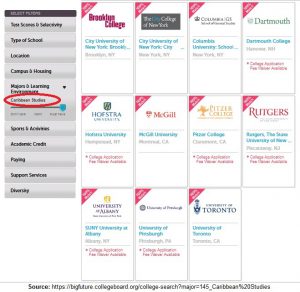
So teach away, all you colleges and universities, identified here from the online resource website CollegeBoard.org; (and learn more about the College Board in the Appendix VIDEO below):

College Search: Caribbean Studies

11 results

City University of New York: Brooklyn College

Brooklyn, NY

City University of New York: City College

New York, NY

Columbia University: School of General Studies

New York, NY

Dartmouth College

Hanover, NH

College Application Fee Waiver Available

Hofstra University

Hempstead, NY

College Application Fee Waiver Available

McGill University

Montreal, CA

Pitzer College

Claremont, CA

College Application Fee Waiver Available

Rutgers, The State University of New Jersey: New Brunswick/Piscataway Campus

Piscataway, NJ

College Application Fee Waiver Available

SUNY University at Albany

Albany, NY

College Application Fee Waiver Available

University of Pittsburgh

Pittsburgh, PA

College Application Fee Waiver Available

University of Toronto

Toronto, CA

Source: Retrieved January 11, 2018 from: https://bigfuture.collegeboard.org/college-search?major=145_Caribbean%20Studies

So we entreat you universities … to teach your ‘Caribbean Studies’; and then lets apply the teachings – the arts and the sciences – the scientific methods and technocratic best practices.

See how the Go Lean book considers specific plans, excerpts and headlines for the objective of Fostering a Technocracy; this is found in the book on Page 64:

Fostering a Technocracy

1 Lean-in for the Caribbean Single Market
This CU treaty calls for a technocratic confederation of the Caribbean region into a Single Market of 30 member-states and 42 million people. The term technocracy was originally used to designate the application of the scientific method to solving social & economic problems, in counter distinction to the traditional political or philosophic approaches. The CU must start as a technocratic confederation – a Trade Federation – rather than evolving to this eventuality due to some Failed-State status or insolvency.
2 Economists & Engineers – not Lawyers nor Politicians

The concept of a technocracy remains mostly hypothetical, though some nations have been considered as such in the sense of being governed primarily by technical experts in various fields of governmental decision-making. A technocrat has come to mean either ‘a member of a powerful technical elite’, or ‘someone who advocates the supremacy of technical experts’. Scientists, engineers, economists, and technologists, who have knowledge, expertise, or skills, would compose the governing body, instead of politicians and businesspeople. In a technocracy, decision makers would be selected based upon how knowledgeable and skillful they are in their fields. Even the leaders of the Communist Party of China are mostly professional engineers. The Five-Year plans of the People’s Republic of China have enabled them to plan ahead in a technocratic fashion to build projects such as the National Trunk Highway System, the High-speed rail system, and the Three Gorges Dam.

3 Professional Emergency Managers

The CU treaty calls for a collective security agreement for the Caribbean member-states to prepare-respond to natural disasters, emergency incidents and assuage against systemic threats against the homeland. The CU employs the professional arts and sciences of Emergency Management to spread the costs and risks across the entire region. Outside of hurricanes or earthquakes, the emergency scope includes medical trauma, pandemic incidents and   industrial accidents (i.e. oil or chemical spills) – any scenario that can impact the continuity of the economic engines and/or community.

4 Apolitical – Loved by All
5 Model of Constitutional Monarchy
6 Constitutional Mandates – Supporting Democracy

The Nobel Prize winning Public Choice Theory posits that public stakeholders (politicians & bureaucrats), tend to act in their own self-interest. The CU, in true technocratic fashion, will codify constitutional mandates (ie. lottery/school funding).

7 Balance Budget Constraints
8 Federal Civil Service – Guarantee Fair Treatment
9 Service Level Agreements

The CU is a proxy organization, chartered to execute deputized functions on behalf of member-states; this means a task-oriented philosophy with “Service Level Agreements” in place; i.e. 80% of all phone calls answered within 20 seconds.

10 ITIL – Systematic Assurances

The formal ITIL (Information Technology Infrastructure Library) discipline is the art/science that describes processes, procedures, tasks, and checklists for managing risks associated with information technology deployments, to ensure the optimal uptime. This includes the CU’s Continuity & Availability Management, Change Control & Release Management.

The Go Lean roadmap seeks to assuage the societal defects in the Caribbean region. This means identifying, qualifying and engaging curative strategies and tactics. This is a familiar theme for this Go Lean movement; the charter of the organization is to function as an Intelligentsia Group unto itself. Consider here, some previous blog-commentaries that have highlighted organizations, best-practices and new community attitudes, all under a consistent theme of the “Role of the Intelligentsia“. See the sample of prior submissions here:

https://goleancaribbean.com/blog/?p=13890 Role of Intelligentsia: We Need to Talk and Collaborate on Solutions
https://goleancaribbean.com/blog/?p=13524 Role of Intelligentsia: Future Focused – e-Government Portal 101
https://goleancaribbean.com/blog/?p=13321 Role of Intelligentsia: Making a Pluralistic Multilingual Democracy
https://goleancaribbean.com/blog/?p=12949 Role of Intelligentsia: Grow Up Already for Charity Management:
https://goleancaribbean.com/blog/?p=12621 Role of Intelligentsia: ‘If it is going to be, it starts with me’
https://goleancaribbean.com/blog/?p=11812 Role of Intelligentsia: Planning for Hope and Change
https://goleancaribbean.com/blog/?p=11759 Role of Intelligentsia: Understand the Market, Plan the …
https://goleancaribbean.com/blog/?p=11598 Role of Intelligentsia: Give us your Time, Talent and Treasuries
https://goleancaribbean.com/blog/?p=11358 Role of Intelligentsia: Preparing for the Inevitable Retail Apocalypse
https://goleancaribbean.com/blog/?p=10351 Role of Intelligentsia: ‘Culture Eats Strategy For Breakfast’
https://goleancaribbean.com/blog/?p=10166 Role of Intelligentsia: Looking Back at the Obama Years
https://goleancaribbean.com/blog/?p=9428 Role of Intelligentsia: Forging Change with a Herd Mentality
https://goleancaribbean.com/blog/?p=7769 Role of Intelligentsia: Being Lean – Asking the Question ‘Why’ 5 Times
https://goleancaribbean.com/blog/?p=7646 Role of Intelligentsia: Going from ‘Good to Great’
https://goleancaribbean.com/blog/?p=6341 Role of Intelligentsia: Tourism Stewardship
https://goleancaribbean.com/blog/?p=2709 Role of Intelligentsia: Caribbean Academic Study: Boy-Girl ‘Discipline’

Having educated individuals in society is good for society … and good for the individuals – see Appendix VIDEO below. These ones eventually make up the intelligentsia. If put to use this intelligentsia can be a source for good.

It was shocking and unbelievable that there is supposed to be a Caribbean Intelligentsia, individuals or groups studying the Caribbean’s past and planning the future. This can easily become the role-responsibilities of today’s students matriculating in the field of ‘Caribbean Studies’. They are out there! So let’s be shocked no more. The message to the people of the Caribbean region henceforth is that the Caribbean’s past is not necessarily condemned to be the Caribbean’s future.

Change has come! The CU will do the “heavy-lifting” to effect change, to implement agile/lean methodologies in the region, in the member-states and in the new federal agencies. Welcome to a  technocracy!

Now is the time for all Caribbean stakeholders – residents, Diaspora, businesses and institutions – to lean-in for the optimizations and empowerments described in the book Go Lean … Caribbean. Yes, we can make the region a better homeland to live, work and play. 🙂

Download the free e-Book of Go Lean … Caribbean – now!

Sign the petition to lean-in for this roadmap for the Caribbean Union Trade Federation. 

———–

Appendix VIDEO – Five Ways Education Pays: Having a college degree means a richer life in every way!https://youtu.be/spNDLD2KRuA

The College Board
Published on Nov 28, 2011 – For most students who go to college, the increase in their lifetime earnings far outweighs the costs of their education. That’s a powerful argument for college. But more income is by no means the only positive outcome students can expect. Learn about all the ways that a college degree can transform your life and lifestyle for the better!

  • Category: Education 
  • License: Standard YouTube License


Share this post:
,
[Top]

Blog # 700 – We Need to Talk!

Go Lean Commentary

Hello, to those of you who live in and/or love the Caribbean, we have to make this urgent plea:

We need to talk …

This is a familiar advocacy from the movement behind the book Go Lean…Caribbean – available to download for free. The book declares that the Caribbean is in crisis, and opens with this sad disposition (Page 3):
There is something wrong in the Caribbean. It is the greatest address in the world for its 4 language groups, but instead of the world “beating a path” to these doors, the people of the Caribbean have “beat down their doors” to get out. For some Caribbean countries, their population has declined or been flat for the last 3 decades. This is only possible if despite new births and the absence of war, people are fleeing. This scenario, human flight, is a constant threat to prosperity for all the Caribbean despite their colonial legacies. Our youth, the next generation, may not be inspired to participate in the future workings of their country; they may measure success only by their exodus from their Caribbean homeland.

Today is January 5, 2018, as the rest of North America dips into a deep freeze – Winter Storm Grayson – the expectation should have been that the Caribbean would be a refuge. But sadly, we have to conclude that “all is not well in the sunny Caribbean“.

No, our dire situation depicts our wonderful Caribbean cultures flirting with failure, abandonment and extinction. Consider these highlights of island communities that have had to contend with failure and extinction:

  • Sad Puerto Rico, despite American power and prosperity, this US Territory is between a “rock and a hard-place” after Hurricane Maria this past season. More and more residents are now fleeing the island on a daily basis, justifiably so.
  • There are no guarantees that communities, countries and nations will survive. Just this past year, the twin-island nation of Antigua and Barbuda evacuated Barbuda – it is a twin-island nation no more.
  • The Pacific island nation of Kiribati has engaged a plan to evacuate the whole country and relocate to a foreign land – in a few generations Kiribati citizenship will cease to exist.
  • A few years ago, a volcano eruption in Montserrat led to the near-evacuation – a ghost-town – of the whole island.

Once again, no guarantees exist for the future. We reap what we sow.

In order to secure a future, communities must do the heavy-lifting to reform and transform their societal engines. So to you Caribbean people, the entreaty is:

We need to talk …

We need to consider some solutions that can bring us from the precipice of extinction to forge a new future. We need to talk about the workable strategies, tactics and implementations to reach this goal.

There had been some plans in the past, that failed to launch viable solutions:

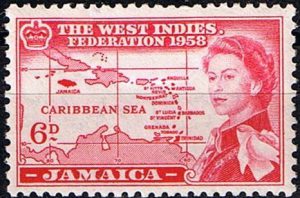
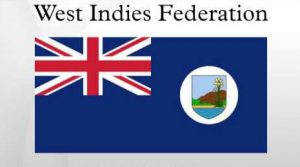
  • There was the West Indies Federation among the Anglophone Caribbean. It failed after 4 years. (At one point there was talk of integrating the British Caribbean possessions into Canada as overseas territories, much like Hawaii is to the United States).
  • There was the renewed attempt for integration with the formal Caribbean Community organization, but its failures are so evident that now there is even talk of the EU funding a study to consider CariCom’s dissolution.

No, we need to talk about a newer, better plan, a roadmap to finally elevate Caribbean communities, all Caribbean communities – all 30 member-states in the geographic region. This is the thrust of the Go Lean book …

The Go Lean book therefore serves as a roadmap for the introduction and implementation of the technocratic Caribbean Union Trade Federation (CU), for the elevation of Caribbean society; this is a Way Forward for all member-states. This CU/Go Lean roadmap has these 3 prime directives:

  • Optimization of the economic engines in order to grow the regional economy to $800 Billion and create 2.2 million new jobs.
  • Establishment of a security apparatus to ensure public safety and protect the resultant economic engines.
  • Improve Caribbean governance to support these engines, with one stewardship among all Caribbean member-states despite the colonial heritage of American, British, Dutch, French or Spanish.

The book stresses that reforming and transforming the Caribbean societal engines must be a regional pursuit. This was an early motivation for the roadmap, as pronounced in the opening Declaration of Interdependence (Pages 12 – 13):

xi. Whereas all men are entitled to the benefits of good governance in a free society, “new guards” must be enacted to dissuade the emergence of incompetence, corruption, nepotism and cronyism at the peril of the people’s best interest. The Federation must guarantee the executions of a social contract between government and the governed.

xvi. Whereas security of our homeland is inextricably linked to prosperity of the homeland, the economic and security interest of the region needs to be aligned under the same governance. Since economic crimes … can imperil the functioning of the wheels of commerce for all the citizenry, the accedence of this Federation must equip the security apparatus with the tools and techniques for predictive and proactive interdictions.

xxiv. Whereas a free market economy can be induced and spurred for continuous progress, the Federation must install the controls to better manage aspects of the economy: jobs, inflation, savings rate, investments and other economic principles. Thereby attracting direct foreign investment because of the stability and vibrancy of our economy.

So the Caribbean needs to talk … about our current assessments and how we can move forward. The “talk” we need to have is really collaborative problem-solving. Just how do we conduct this “talk”?

A new book by radio-journalist Celeste Headlee gives us some suggestions. See the Book Review here and an accompanying Ted Talk VIDEO that follows:

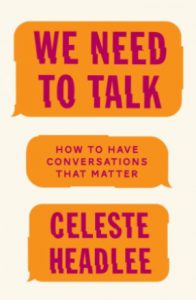
Book Title: “WE NEED TO TALK” by Celeste Headlee
Sub-title: How to Have Conversations That Matter

In this urgent and insightful book, public radio journalist Celeste Headlee shows us how to bridge what divides us–by having real conversations. (BASED ON THE TED TALK WITH OVER 10 MILLION VIEWS)

NPR’s Best Books of 2017

“We Need to Talk is an important read for a conversationally-challenged, disconnected age. Headlee is a talented, honest storyteller, and her advice has helped me become a better spouse, friend, and mother.”  (Jessica Lahey, author of New York Times bestseller The Gift of Failure)

Today most of us communicate from behind electronic screens, and studies show that Americans feel less connected and more divided than ever before. The blame for some of this disconnect can be attributed to our political landscape, but the erosion of our conversational skills as a society lies with us as individuals.

And the only way forward, says Headlee, is to start talking to each other. In We Need to Talk, she outlines the strategies that have made her a better conversationalist—and offers simple tools that can improve anyone’s communication. For example:

  • BE THERE OR GO ELSEWHERE. Human beings are incapable of multitasking, and this is especially true of tasks that involve language. Think you can type up a few emails while on a business call, or hold a conversation with your child while texting your spouse? Think again.
  • CHECK YOUR BIAS. The belief that your intelligence protects you from erroneous assumptions can end up making you more vulnerable to them. We all have blind spots that affect the way we view others. Check your bias before you judge someone else.
  • HIDE YOUR PHONE. Don’t just put down your phone, put it away. New research suggests that the mere presence of a cell phone can negatively impact the quality of a conversation.

Whether you’re struggling to communicate with your kid’s teacher at school, an employee at work, or the people you love the most — Headlee offers smart strategies that can help us all have conversations that matter.

Source: Retrieved January 4, 2018 from: https://www.amazon.com/We-Need-Talk-Conversations-Matter/dp/0062669001/ref=sr_1_1?s=books&ie=UTF8&qid=1515111400&sr=1-1&keywords=we+need+to+talk

Biography
Celeste Headlee is the host of the daily news show On Second Thought on Georgia Public Broadcasting. She has spent more than a decade with National Public Radio and has been a host for Public Radio International since 2008. Celeste has appeared on CNN, the BBC, PBS, and MSNBC. She’s also a classically trained soprano who doesn’t get enough time to sing anymore. She has one son and one rescue dog, and lives in Atlanta, Georgia. <<< Photo 2 >>>
Source: Retrieved January 4, 2018 from: https://www.harpercollins.com/9780062669001/we-need-to-talk

———–

VIDEO – 10 ways to have a better conversation | Celeste Headlee – https://youtu.be/R1vskiVDwl4

TED
Published on Mar 8, 2016 – When your job hinges on how well you talk to people, you learn a lot about how to have conversations — and that most of us don’t converse very well. Celeste Headlee has worked as a radio host for decades, and she knows the ingredients of a great conversation: Honesty, brevity, clarity and a healthy amount of listening. In this insightful talk, she shares 10 useful rules for having better conversations. “Go out, talk to people, listen to people,” she says. “And, most importantly, be prepared to be amazed.”
TEDTalks is a daily video podcast of the best talks and performances from the TED Conference, where the world’s leading thinkers and doers give the talk of their lives in 18 minutes (or less). Look for talks on Technology, Entertainment and Design — plus science, business, global issues, the arts and much more.

Find closed captions and translated subtitles in many languages at http://www.ted.com/translate

Follow TED news on Twitter: http://www.twitter.com/tednews

Like TED on Facebook: https://www.facebook.com/TED

Subscribe to our channel: http://www.youtube.com/user/TEDtalksD…

This foregoing Book Review describes this global deficiency of talking-and-listening from an American perspective. But the need for collaborative problem-solving is really location agnostic. This is because America has problems; the Caribbean has problems; the whole world has problems. We need to come together and work towards assuaging our problems, yet the only way forward, says Headlee, is to start talking to each other.

The Go Lean book provides a Way Forward, 370-pages of turn-by-turn instructions on “how” to adopt new community ethos, plus the strategies, tactics, implementations and advocacies to execute so as to reboot, reform and transform the societal engines of Caribbean society.

This is Blog # 700, a major milestone within this Go Lean movement for the Caribbean Union Trade Federation. Over the years, the concept of a Way Forward for the universal Caribbean has been explored in other previous Go Lean blog-commentaries; see sample here:

https://goleancaribbean.com/blog/?p=12416 Conscientizing – Talking about Solutions – on the Radio
https://goleancaribbean.com/blog/?p=12274 State of the Union – Spanish Caribbean
https://goleancaribbean.com/blog/?p=11812 State of the Union – Hope and Change
https://goleancaribbean.com/blog/?p=11544 State of the Union – Need for Collective Bargaining
https://goleancaribbean.com/blog/?p=10554 State of the Union – French Caribbean Seeking Integration
https://goleancaribbean.com/blog/?p=4551 State of the Union – US Territories
https://goleancaribbean.com/blog/?p=4263 State of the Union – Aruba and Dutch Territories
https://goleancaribbean.com/blog/?p=3956 Art and Science of Collaboration

Now is the time for all of the Caribbean – the people in all the islands and coastal states and those in the Diaspora – to lean-in for this collaborative effort, the integrated Caribbean Union Trade Federation.

We can do this. We can all talk … and collaborate and conceive solutions to our regional problems. We can make our Caribbean homeland a better place to live, work and play. 🙂

Download the free e-book of Go Lean … Caribbean – now!

Sign the petition to lean-in for this roadmap for the Caribbean Union Trade Federation.

Share this post:
, , ,
[Top]

Managing ‘Change’ in California

Go Lean Commentary

This is a Big Deal

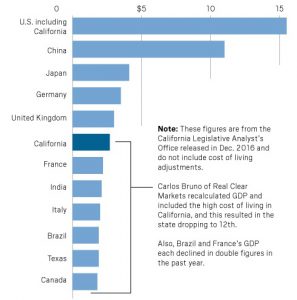
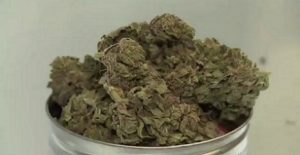
California, the biggest state in the Union (USA) – #6 GDP if ranked as an independent country – has enacted legislation to legitimize recreational marijuana use. Wow, what a ‘change’ to manage! That’s 37 million people, millions of cars and billions of dollars. The implementation of this New Order will surely be heavy-lifting.

For the Caribbean, let’s pay more than the usual attention for lessons learned for our own Big Deal implementation. See the VIDEO on California’s challenge here:

VIDEO – California residents line up to buy recreational marijuana – https://www.today.com/video/california-residents-line-up-to-buy-recreational-marijuana-1127548995762


Posted January 2, 2018 – Vendors in The Golden State began selling recreational marijuana legally on Monday, a milestone moment in the push to legalize marijuana across the country. NBC’s Jacob Soboroff has the report for TODAY from Los Angeles.

Again, California is managing the ‘change’ of implementing the legalization of recreational marijuana use, while the Caribbean needs to implement a roadmap to forge change in its societal engines (economics, security and governance) for the 30 member-states of our region.

The book Go Lean…Caribbean – available to download for free – serves as a roadmap for the introduction and implementation of the technocratic Caribbean Union Trade Federation (CU), for the elevation of Caribbean society – for all member-states. This CU/Go Lean roadmap has these 3 prime directives:

  • Optimization of the economic engines in order to grow the regional economy to $800 Billion and create 2.2 million new jobs.
  • Establishment of a security apparatus to ensure public safety and protect the resultant economic engines.
  • Improve Caribbean governance to support these engines, including a separation-of-powers between the member-states and CU federal agencies.

The State of California is taking on the heavy-lifting of this marijuana legalization while the US federal government continues to consider the drug as illegal. But California is NOT the first state; that distinction belongs to Colorado. The movement behind the Go Lean book has explored Colorado and observed-and-reported on the societal developments there. Notice these main points from a previous blog-commentary entitled – Lessons from Colorado: Legalized Marijuana: Heavy-lifting! – from August 17, 2017:

… in 2017, the phrase “Rocky Mountain High” has a total different meaning, because the State of Colorado has since legalized recreational use of marijuana.

This is not an easy topic; this is heavy …

There are so many lessons we can learn from the debate, legalization, implementation and regulation of this product in this State. All in all, it is heavy-lifting. This is the theme of this series of commentaries of lessons that have been learned by Caribbean stakeholders visiting, observing and reporting on the US State of Colorado.

We have so much in common and so much in contrast. One commonality to consider is how Colorado is now associated with marijuana consumption. …

“Welcome to our club”! This has always been the image of Caribbean people and culture – think: Rasta Man smoking Ganja.

California … Colorado … other states to follow, according to another previous blog-commentary after the last American General Election on November 8, 2016. That submission was entitled – Time to Go: American Vices; Don’t Follow and quoted:

Marijuana legalization is now the norm for 40 percent of the American population. …
Voter measures [passed] in Massachusetts and Nevada. Maine’s referendum was still being counted early Wednesday morning, and Arizona’s was poised to lose. Three other states passed medical marijuana reforms, and a fourth appeared likely to do so. This means that in eight states (plus Washington, D.C.) weed will be legal for recreational purposes, and in sum, 28 will have some kind of legalization on the books.

There will be a lot of security and governing dynamics that these states – like California – will now have to manage, since the process will decriminalize marijuana use, after a long history of criminalization. This is a BIG DEAL considering that many people may be in a penal status – active or parole – for marijuana use or trafficking. Wow, indeed; this is a BIG transformation!

This point too, was addressed in a previous blog-commentary entitled – Marijuana in Jamaica – ‘Puff Peace’:

There are moral, religious, legal and psychological (treatment) issues associated with this topic; and there is history – good and bad. Any jurisdiction decriminalizing the use of marijuana has to contend with the previous messaging to the community of: “Just say no to drugs”.

The [Go Lean] book asserts that before the strategies, tactics, implementations and advocacies of a roadmap to elevate a society can be deployed, the affected society must first embrace a progressive community ethos. The book defines this “community ethos” as the fundamental character or spirit of a culture; the underlying sentiment that informs the beliefs, customs, or practices of society; dominant assumptions of a people or period. Think of the derivative term: “work ethic”.

Marijuana is a mood-altering drug; it has negative effects, one being preponderance for apathy, to tune out of any active engagement. In the US, even in the states where marijuana is legal, most firms/governments still screen staffers (new hires and veterans) and ban consumption of the drug. The reason is simple: Apathy does not make for industriousness.

The Go Lean book provides 370-pages of turn-by-turn instructions on “how” to adopt new community ethos, plus the strategies, tactics, implementations and advocacies to execute so as to transform the societal engines of Caribbean society, regarding the whole drug eco-system. The Go Lean book asserts that every community has bad actors, and with a more liberal-progressive attitude towards a once-illegal drug, community attitudes must be paramount. There must be “new guards” to assuage any threats from this practice on society. This point is pronounced early in the book with the Declaration of Interdependence (Pages 12 – 13) that claims:

x. Whereas we are surrounded and allied to nations of larger proportions in land mass, populations, and treasuries, elements in their societies may have ill-intent in their pursuits, at the expense of the safety and security of our citizens. We must therefore appoint new guards to ensure our public safety and threats against our society, both domestic and foreign. The Federation must employ the latest advances and best practices of criminology and penology to assuage continuous threats against public safety. The Federation must allow for facilitations of detention for [domestic and foreign] convicted felons of federal crimes, and should over-build prisons to house trustees from other jurisdictions.

xi. Whereas all men are entitled to the benefits of good governance in a free society, “new guards” must be enacted to dissuade the emergence of incompetence, corruption, nepotism and cronyism at the peril of the people’s best interest. The Federation must guarantee the executions of a social contract between government and the governed.

xvi. Whereas security of our homeland is inextricably linked to prosperity of the homeland, the economic and security interest of the region needs to be aligned under the same governance. Since economic crimes, including piracy and other forms of terrorism, can imperil the functioning of the wheels of commerce for all the citizenry, the accedence of this Federation must equip the security apparatus with the tools and techniques for predictive and proactive interdictions.

So legalizing marijuana in the BIG market of California will be about more than just managing change, it will also be about managing risks. The Go Lean book relates that managing risk is more than just “One Act”, there is lengthy, engaged process (Page 76):

  • Education
  • Mentoring
  • Monitoring
  • Mitigation
  • Licensing
  • Coordination

Let’s see how this process goes for California. While this state’s independent streak has made it a “maverick” among the other American states – see Independence Movement detailed in this previous blog – this effort with marijuana may be “biting off more than they can chew”. This is truly a BIG DEAL!

We need to pay attention, as there are parallels for California compared to the full Caribbean:

This writer, having lived in California for 10 years, can conclude that California wants the same thing that the Caribbean wants (or should want): to be an elevated society; to be a better homeland, a better place to live, work and play. 🙂

Let’s observe-and-report on these California’s developments and manifestations, their successes and failures.

Download the free e-Book of Go Lean … Caribbean – now!

Sign the petition to lean-in for this roadmap for the Caribbean Union Trade Federation.

Share this post:
, ,
[Top]

A Lesson from Star Wars Movie: ‘We Need Heroes’ – ENCORE

This is the BIG news for the weekend of December 15, 2017:

Star Wars: The Last Jedi” was a box office force this weekend.

“The Last Jedi,” the eighth installment in the “Star Wars” saga, premiered this [past] weekend to the second-biggest opening ever in North America. It brought in an estimated $220 million, according to Disney. – CNN posted December 18, 2017 from: http://money.cnn.com/2017/12/17/media/star-wars-last-jedi-opening-weekend-box-office/index.html 

The lure of Star Wars was also embraced by the movement behind the book Go Lean … Caribbean. In a previous blog-commentary from December 22, 2015 when the movie Star Wars Episode 7 “The Force Awakens” was released, a parallel was shown between the standard Hero’s Journey dramatic path and what the Caribbean region needs:

Our heroes to return … to the homeland.

Here is an ENCORE of that previous Episode 7 blog-commentary on this occasion of Episode 8.

————-

Go Lean CommentaryThe Caribbean is Looking For Heroes … to Return

In the Caribbean, we need a hero, we need lots of heroes …

… need a hero
I’m holding out for a hero ’til the end of the night
He’s gotta be strong
And he’s gotta be fast
And he’s gotta be fresh from the fight
I need a hero
I’m holding out for a hero ’til the morning light
He’s gotta be sure
And it’s gotta be soon
And he’s gotta be larger than life
(Song by Bonnie Tyler 1984; see VIDEO & Lyrics at https://youtu.be/OBwS66EBUcY; see Appendix)

We must reform and transform our Caribbean society. We know that one person – a hero – can make a difference, and we need to encourage those contributions.

Heroes are not born, they are forged. According to noted Mythologist Joseph Campbell, hero candidates go through a consistent pattern of a journey to become bona-fide heroes.

CU Blog - The Caribbean is Looking for Heroes to Return - Photo 1Who is Joseph Campbell and why does his opinion matter? He is the inspiration behind the big hit movie franchise Star Wars. All things Star Wars are en vogue right now. According to IMDB.com, this movie which opened just days ago – Star Wars Episode 7 “The Force Awakens”; (see Appendix) – had the biggest US box office opening of any movie … ever. See the box office results here in the photo, retrieved December 22, 2015.

This is an amazing feat, considering that Joseph Campbell has been dead since 1987. But Star Wars creator, George Lucas drew his story-line from Joseph Campbell’s inspirations in the cataloging of the “Hero’s Journey” in his writings. See article here:

Title: Role Model Joseph Campbell
In 1949 Joseph Campbell (1904-1987) made a big splash in the field of mythology with his book The Hero With a Thousand Faces. This book built on the pioneering work of German anthropologist Adolph Bastian (1826-1905), who first proposed the idea that myths from all over the world seem to be built from the same “elementary ideas.” Swiss psychiatrist Carl Jung (1875-1961) named these elementary ideas “archetypes,” which he believed to be the building blocks not only of the unconscious mind, but of a collective unconscious. In other words, Jung believed that everyone in the world is born with the same basic subconscious model of what a “hero” is, or a “mentor” or a “quest,” and that’s why people who don’t even speak the same language can enjoy the same stories.

Jung developed his idea of archetypes mostly as a way of finding meaning within the dreams and visions of the mentally ill: if a person believes they are being followed by a giant apple pie, it’s difficult to make sense of how to help them. But if the giant apple pie can be understood to represent that person’s shadow, the embodiment of all their fears, then the psychotherapist can help guide them through that fear, just as Yoda guided Luke on Dagoba. If you think of a person as a computer and our bodies as “hardware,” language and culture seem to be the “software.” Deeper still, and apparently common to all homo sapians, is a sort of built-in “operating system” which interprets the world by sorting people, places, things and experiences into archetypes.

CU Blog - The Caribbean is Looking for Heroes to Return - Photo 2Campbell’s contribution was to take this idea of archetypes and use it to map out the common underlying structure behind religion and myth. He proposed this idea in The Hero With a Thousand Faces, which provides examples from cultures throughout history and all over the world. Campbell eloquently demonstrates that all stories are expressions of the same story-pattern, which he named the “Hero’s Journey,” or the “monomyth.” This sounds like a simple idea, but it suggests an incredible ramification, which Campbell summed up with his adage “All religions are true, but none are literal.” That is, he concluded that all religions are really containers for the same essential truth, and the trick is to avoid mistaking the wrappings for the diamond.

[Star Wars Creator George] Lucas had already written two drafts of Star Wars when he rediscovered Joseph Campbell’s The Hero With a Thousand Faces in 1975 (having read it years before in college). This blueprint for “The Hero’s Journey” gave Lucas the focus he needed to draw his sprawling imaginary universe into a single story.

Note that the Wachowski Brothers’ wonderful film The Matrix is carefully built on the same blueprint:

Campbell

Star Wars

The Matrix

I: Departure
The call to adventure Princess Leia’s message “Follow the white rabbit”
Refusal of the call Must help with the harvest Neo won’t climb out window
Supernatural aid Obi-wan rescues Luke from sandpeople Trinity extracts the “bug” from Neo
Crossing the first threshold Escaping Tatooine Neo is taken out of the Matrix for the first time
The belly of the whale Trash compactor Torture room
II: Initiation
The road of trials Lightsaber practice Sparring with Morpheus
The meeting with the goddess Princess Leia (wears white, in earlier     scripts was a “sister” of a mystic order) The Oracle
Temptation away from the true path1 Luke is tempted by the Dark Side Cypher (the failed messiah) is tempted by the world of comfortable illusions
Atonement with the Father Darth and Luke reconcile Neo rescues and comes to agree (that he’s The One) with his father-figure, Morpheus
Apotheosis (becoming god-like) Luke becomes a Jedi Neo becomes The One
The ultimate boon Death Star destroyed Humanity’s salvation now within reach
III: Return
Refusal of the return “Luke, come on!” Luke wants to     stay to avenge Obi-Wan Neo fights agent instead of running
The magic flight Millennium Falcon “Jacking in”
Rescue from without Han saves Luke from Darth Trinity saves Neo from agents
Crossing the return threshold Millennium Falcon destroys pursuing TIE fighters Neo fights Agent Smith
Master of the two worlds Victory ceremony Neo’s declares victory over machines in final phone call
Freedom to live Rebellion is victorious over Empire Humans are victorious over machines

Source: Fan Site for Obscure Star Wars Inspirations; retrieved December 20, 2015 from: http://www.moongadget.com/origins/myth.html

But one can argue, these are just movies, “make believe”; these are not real people nor real life. That would be a true statement of facts (there is no “Luke Skywalker” nor “Neo” as historical characters), but the principles of a “Hero’s Journey” is real, and present in real life. This is just another example of “life imitating art”. In a previous blog-commentary regarding Caribbean Diaspora member and Hollywood great, Sidney Poitier, it was declared that …

“Movies are an amazing business model. People give money to spend a couple of hours watching someone else’s creation and then leave the theater with nothing to show for the investment; except perhaps a different perspective”.

 CU Blog - The Caribbean is Looking for Heroes to Return - Photo 3
 CU Blog - The Caribbean is Looking for Heroes to Return - Photo 4

These movies do bring a different perspective. According to the foregoing, there are Three Acts to the “Hero’s Journey”:

I.   Departure
II.  Initiation
III. Return

The publishers of the book Go Lean…Caribbean recognize the one person can make positive, heroic contributions to his community; and that this role must be forged in society. The book serves as a roadmap for the introduction and implementation of the Caribbean Union Trade Federation (CU). The CU seeks to foster the genius qualifiers in Caribbean citizens. Not everyone can be heroes, but society must be structured to allow heroes to soar. Because …

… one man (or woman) can make a difference! Such a person can impact their community, country … and the whole world.

“The only thing necessary for the triumph of evil is for good men to do nothing” – Edmund Burke; 1729 – 1797; an Irish statesman, member of British Parliament and supporter of the American Revolution.

The Caribbean has fostered the hero process, but according to the Three Acts established by Joseph Campbell, our heroes stopped at Act II, they do not “Return”.

CU Blog - The Caribbean is Looking for Heroes to Return - Photo 5

They make their heroic contributions to other communities and not their homeland. The Caribbean, thusly “fattens frogs for snakes”. Consider the bad consequences of this reality, as in our brain drain among the college-educated population, which is up to a 70% rate within the entire region.

A quest of the Go Lean/CU roadmap is to lower the “Push and Pull” factors that causes so many Caribbean citizens to flee their beloved homeland. In addition, another quest is to incentivize the far-flung Diaspora to return to the Caribbean. Success in these quests will take a “Hero’s Journey”.

The villain in this real-life story is the poor performing Caribbean economy. So the prime directive of the Go Lean book is to elevate Caribbean society, and its societal engines … defined in these declarative statements, as follows:

  • Optimization of the economic engines in order to grow the regional economy and create 2.2 million new jobs.
  • Establishment of a security apparatus to protect the resultant societal engines again foreign and domestic threats.
  • Improvement Caribbean governance to support these engines.

The Go Lean book posits that one person, despite their field of endeavor, can make a difference in the Caribbean, and its impact on the world; that there are many opportunities where one advocate, one champion, one “hero” can elevate society. In this light, the book features 144 different advocacies, so there is inspiration for the “next hero” to emerge and excel right here at home in the Caribbean.

The roadmap specifically encourages the region to lean-in, to foster heroes and champions with these specific community ethos, strategies, tactics, implementations and advocacies:

Community Ethos – Forging Change Page 20
Community Ethos – People Respond to Incentives in Predictable Ways Page 21
Community Ethos – Economic Systems Influence Individual Choices Page 21
Community Ethos – Whistleblower Protection Page 23
Community Ethos – Anti-Bullying and Mitigation Page 23
Community Ethos – Minority Equalization Page 24
Community Ethos – Ways to Foster Genius Page 27
Community Ethos – Ways to Impact the Greater Good Page 37
Strategy – Mission – Dissuade Societal Abandonment Page 45
Strategy – Mission – Incentivize Repatriation Page 45
Strategy – Mission – Protect Repatriates with heightened   Public Safety Page 45
Anatomy of Advocacies – Examples of Individuals Who Made Impact Page 122
Planning – Ways to Make the Caribbean Better Page 131
Advocacy – Ways to Improve Governance Page 168
Advocacy – Ways to Better Manage the Social Contract Page 170
Advocacy – Ways to Improve Leadership Page 171
Advocacy – Ways to Impact Justice Page 177
Advocacy – Ways to Remediate and Mitigate Crime Page 178
Advocacy – Ways to Impact Hollywood – Global Box Office – Imitating Life Page 203
Advocacy – Ways to Preserve Caribbean Heritage Page 218
Advocacy – Ways to Improve the Arts Page 230

The Caribbean region wants a more optimized society.

This book posits that “bad actors” – even villains: the “Dark Side of the Force” – will emerge to exploit inefficient economic, security and governing models.  Early in the book, the pressing need to streamline protections – for citizens and institutions – was pronounced in the Declaration of Interdependence (Page 12), with these opening statements:

x. Whereas we are surrounded and allied to nations of larger proportions in land mass, populations, and treasuries, elements in their societies may have ill-intent in their pursuits, at the expense of the safety and security of our citizens. We must therefore appoint “new guards” to ensure our public safety and threats against our society, both domestic and foreign.

xi. Whereas all men are entitled to the benefits of good governance in a free society, “new guards” must be enacted to dissuade the emergence of incompetence, corruption, nepotism and cronyism at the peril of the people’s best interest. The Federation must guarantee the executions of a social contract between government and the governed.

xii. Whereas the legacy in recent times in individual states may be that of ineffectual governance with no redress to higher authority, the accedence of this Federation will ensure accountability and escalation of the human and civil rights of the people for good governance, justice assurances, due process and the rule of law. As such, any threats of a “failed state” status for any member state must enact emergency measures on behalf of the Federation to protect the human, civil and property rights of the citizens, residents, allies, trading partners, and visitors of the affected member state and the Federation as a whole.

xvi. Whereas security of our homeland is inextricably linked to prosperity of the homeland, the economic and security interest of the region needs to be aligned under the same governance. Since economic crimes, including … forms of terrorism, can imperil the functioning of the wheels of commerce for all the citizenry, the accedence of this Federation must equip the security apparatus with the tools and techniques for predictive and proactive interdictions.

The Go Lean book explicitly acknowledges that optimizing society is not easy; it requires strenuous, heroic efforts; heavy-lifting. That is the quest of the CU/Go Lean roadmap. Other subjects related to heroic efforts of role models have been blogged in other Go Lean…Caribbean commentaries, as sampled here:

https://goleancaribbean.com/blog/?p=5964 Movie Review: ‘Tomorrowland’ – ‘Feed the right wolf’ in Society
https://goleancaribbean.com/blog/?p=5648 Music Role Model Taylor Swift withholds Album from Apple Music
https://goleancaribbean.com/blog/?p=5506 Role Model: Edward Snowden – One Person Making a Difference
https://goleancaribbean.com/blog/?p=3490 How One Entrepreneur Can Rally a Whole Community
https://goleancaribbean.com/blog/?p=2726 Caribbean Role Model – Oscar De La Renta – RIP
https://goleancaribbean.com/blog/?p=1731 Role Model Warren Buffet – An Ode to Omaha
https://goleancaribbean.com/blog/?p=1596 Book Review: ‘Prosper Where You Are Planted’
https://goleancaribbean.com/blog/?p=866 Role Model Bob Marley: The Legend Lives On!
https://goleancaribbean.com/blog/?p=209 Role Model: Advocate Kevin Connolly

The Go Lean roadmap posits that the CU should foster the genius potential in Caribbean citizens and incubate their potential to maximum production. We should let “heroes be heroes” in their fields of endeavor here at home, no matter how diverse. Many Caribbean Diaspora has done this exactly, abroad in benefiting other communities, while their homelands languish.

They have departed – Act I.
They have initiated as heroes – Act II.
But, they have NOT returned – no Act III.

Enough already!

The roadmap pronounces that we need the participation of many advocates on many different paths for progress. By facilitating, fostering and furthering these initiative, we can have our heroes return to be heroic at home. Only then, will the Caribbean truly become a better place to live, work and play. 🙂

Download the free e-Book of Go Lean … Caribbean – now!

Sign the petition to lean-in for the roadmap for the Caribbean Union Trade Federation.

————

Appendix VIDEO – Bonnie Tyler – I Need a Hero (Lyrics) – https://youtu.be/OBwS66EBUcY

————

Appendix VIDEO – Star Wars: The Force Awakens Trailer (Official) – https://youtu.be/sGbxmsDFVnE

Published on Oct 19, 2015 – Watch the official trailer for Star Wars: The Force Awakens, [opened] in theaters December 18, 2015.

Share this post:
, ,
[Top]

Failure to Launch: Past Failures for Integration

Go Lean Commentary

“3 Generations of imbeciles are enough” – Justice of US Supreme Court Oliver Wendell Holmes (1927)

“3 Generations of imbecilic governance is enough” – Summary from 2013 Go Lean…Caribbean Book (Page 3)

It has been that long!

According to Dictionary.com, a generation is “the term of years, roughly 30 among human beings, accepted as the average period between the birth of parents and the birth of their offspring”. Integration is so important, yet there have been 3 generations of failure for integration-optimization efforts – explored herewith – in the Caribbean region:

  1. West Indies Federation / Netherlands Antilles – 1950’s – Failed
  2. CariCom – 1970’s – Failing
  3. Caribbean Single Market & Economy – 2000’s – Failed

Enough failing already! Though no efforts have been made to integrate the Spanish-speaking nor French-speaking territories; historically these lands were governed as “overseas” territories with foreign masters (for planning and control).

The book Go Lean…Caribbean – available to download for free – serves as a roadmap for a Single Market, the introduction and implementation of a technocratic inter-government agency to shepherd the elevation of the region’s societal engines: economics, security and governance. This agency is the Caribbean Union Trade Federation (CU), and is designed to benefit all 30 member-states for all 4 language groups. This Go Lean/CU roadmap is intended to be a deviation from the past record of failures. The book states (Page 3):

There have been some efforts at regional integration, but only for [2] individual language groups.

The Caribbean Union is the next evolution from the structured economic integration that became the Caribbean Community [(CariCom)], but now for all neighbors. The globally accepted 7 degrees of economic integration, which spurned CariCom, are defined as:

  1. Preferential trading area
  2. Free trade area, Monetary union
  3. Customs union, Common market
  4. Economic union, Customs and monetary union
  5. Economic and monetary union
  6. Fiscal union
  7. Complete economic integration

CariCom was enacted in 1973 as Stage 3; but Stage 4 was ratified in 2001 and branded the Caribbean Single Market & Economy. This effort sputtered – see Anecdote # 1 [on Page 15]. The CU is a new manifestation of Stage 4; a graduation for CariCom.

This Go Lean/CU roadmap seeks to end the pattern of failure from these integration mis-steps of the past. This commentary opens a series on the Caribbean’s Failure to Launch workable solutions for the defects and deficiencies in our regional society; this is Part 1 of 4 on this subject. The full series is catalogued as follows:

  1. Failure to Launch – Past Failures for Integration
  2. Failure to Launch Economics: Caribbean Central Bank and the Quest for a Single Currency
  3. Failure to Launch Security: Caribbean Basin Security Dreams
  4. Failure to Launch Governance: Assembling the Regional Alphabet Organizations

The Go Lean book defines failure in many different dimensions of relativity. It identifies the extreme of Failing-States, all the way down to the simple assessment: “All is not well”. But in general, there is the consensus that the Caribbean region is in crisis (Page 8) and declares that this “crisis would be a terrible thing to waste”.

The roadmap therefore has these 3 prime directives to assuage this crisis status:

The Go Lean book provides 370-pages of turn-by-turn instructions on “how” to adopt new community ethos, plus the strategies, tactics, implementations and advocacies to execute so as to forge a better future by learning lessons from past failures in regional integration movements. One advocacy embedded in the book is the specific lessons-learned from the previous Anglophone West Indies Federation. Consider the Appendix VIDEO below and these excerpts-headlines from Page 135 with this title, (which gleans analysis based on the history in the Appendix S and Appendix S1, starting on Page 301):

10 Lessons Learned from the West Indies Federation

1 WI Federation Quest for Independence replaced with CU Quest for Interdependence

After 50 years of reflection (see Appendix S1 #1 thru #10), it is conclusive that the West Indies (WI) Federation strived more for independence than for governmental efficiency. It is also obvious that the instincts of the British Federation planners were right, that the common territories needed to integrate to deploy common solutions (Appendix S). As such, the CU advocates for “interdependence” for the Caribbean countries – the challenges of the region transcends any alignment to the European legacies, so the CU advocates that the former British colonies need to confederate with Dutch, French and Spanish former colonies and current American Territories. The CU will represent a population base of 42 million, with the largest population centers concentrated in the Spanish and French states, not Jamaica and Trinidad. However, the CU aggregation of $800 Billion in GDP (based on 2010 figures) represents a larger contribution (GDP per capita) from the English speaking countries.

2 Federal Government versus Provincial Governments

The CU advocates a separation of powers between Federal Departments and the member-states administrations. The CU will avail itself of the “economies of scale” by deploying systems across the entire region designed for efficient and effective governance. Consider for example, implementing revenue systems for property assessments/collections. The CU will in-source the costs for the systems & people, while maximizing the return to State treasuries – Appendix S1 #2. The CU will also generate its own revenue streams, from regional-wide deployments (broadcast rights, lotteries, etc).

3 Jamaican Dynamic

Among the Caribbean nations, Haiti is highest on the 2012 Failed State Index (#7), Jamaica is among the next set of Caribbean countries at #119, just slightly behind South Africa (#115) and Albania (#118). Obviously, the nation-building

needs of Jamaica has been truncated, plus the country’s brain drain is worst in the region with almost a matching population living abroad in a Diaspora as opposed to residing in and contributing to the local economy. The CU will ensure better representation of larger populated states by employing a bicameral legislative branch: while the Senate is “one-man-one-vote” (2 Senators per state), the lower house has balanced representation based on population. Geographically, Jamaica is not the furthest west (Belize), nor south (Aruba) in the region. The Capitol for the CU is slated for a Federal District on the border of Haiti and the Dominican Republic – See Appendix S1 # 3.

4 Trinidad Dynamic

Trinidad and Tobago has thrived, somewhat, as an independent nation, they have one of the highest per-capita GDP in the region and have just recently been upgraded from “developing” status. (They are the only oil-producing country in the region; but their oil reserves are due to be depleted in the next decade). Yet, the country has a huge gulf between the “haves-and-have-nots”, to the point that emigration continues to be a major deterrent to their nation-building efforts. Trinidad is #122 on the Failed State Index – See Appendix S1 # 4.

5 Lack of Local Popular Support (See Parallel at Appendix S1 #5)

The CU empowers the economic engines, societal institutions and cultural provisions of the region to promote growth and development in the member-states. These efforts will be complemented with the invitation to repatriate for the Caribbean Diaspora. So the local markets will be the target of promotional campaigns and public media outreach.

6 Smaller Countries

The smaller countries get the greatest benefit of the CU initiative as they get to leverage the size of the Caribbean Single Market to their advantage. They will enjoy the strength of the currency union, access to capital markets and the deployment of economic engines in the local market. The CU will assimilate the Eastern Caribbean Federation and Monetary Union into the governmental delivery structure – See Appendix S1 # 6.

7 Location of the Capitol

Even though the CU will embrace e-Government delivery methods (data centers, call centers and web sites), the Trade Federation will still institute physical edifices (Post Offices, Administrative Centers, Libraries, Museums). There will be an actual Capitol. The CU capital is slated for a Federal District on the border of Haiti and the Dominican Republic. This is a center-“ish” site considering north: Bermuda & Bahamas; west: Belize & Cuba; south: Guyana & Suriname).

8 University of the West Indies
9 West Indies Regiment

The CU is also a security pact that will empower a Homeland Security Department. The State Militia and Naval Operations, derivatives of the West Indies Regiment, will enter a new phase of existence with the facilitation of an  ultra-modern defense unit with drones, attack helicopters, underwater submersibles and intelligence gathering and analysis.

10 Relationship with Canada

The West Indies Federation was an Anglophone effort only! Though it sought the goal of “Step 7 – Complete Economic Integration“, as specified in the foregoing introduction, it failed miserably here. (This is the disposition of the United States of America, but unfortunately, due to societal defects of territorial status, this is not the disposition of Puerto Rico and the US Virgin Islands.)

So these developments refer to the English and American territories; this is not the full Caribbean. There are other legacies …

The Go Lean book also details effort in the Dutch Caribbean, or the Netherland Antilles. This excerpt – on Integration and Secessions – is derived from Page 16 of the book:

Anecdote # 2: Dutch Caribbean – Integration & Secessions 

This Dutch Caribbean has had a varied history of integration and secession events. The Netherlands Antilles also referred to informally as the Dutch Antilles, was an autonomous Caribbean country within the Kingdom of the Netherlands.

Although the country has now been dissolved, all of its constituent islands remain part of the kingdom under a different legal status and the term is still used to refer to these Dutch Caribbean islands [a].

The Netherlands Antilles consisted of two island groups. The ABC Islands of Aruba, Bonaire, and Curaçao are located just off the Venezuelan coast. The SSS islands of Sint Maarten, Saba, and Sint Eustatius are in the Leeward Islands southeast of the Virgin Islands near the northern end of the Lesser Antilles. The Dutch colonized these islands in the 17th century, (at one point, Anguilla, Tobago, the British Virgin Islands, and St. Croix of the US Virgin Islands had also been Dutch), and united them in the new constituent state of the Netherlands Antilles in December 1954. Wanting to shed the appearance of any colonial shackles, the Netherlands Antilles, Suriname, and the Netherlands acceded as equal member-countries of the Kingdom of the Netherlands. With this move, the United Nations deemed decolonization of the Dutch Caribbean territory complete and removed it from the UN’s official List of Non-Self-Governing Territories.

Suriname sought and was granted independence in 1975, but continued their quest for regional integration. Today, they are a member of CariCom and are considered a Caribbean country with their trade and cultural links with the Caribbean nations.

The arrangement of the integrated Netherlands Antilles proved to be an unhappy one. The idea never enjoyed the full support of all islands, and political relations between islands were often strained. Geographically, the ABC Islands and the Leeward (SSS) Islands lie almost 1,000 kilometers apart. Culturally, the ABC Islands have deep connections with the South American mainland, especially Venezuela, and its population speaks a Portuguese-Dutch Creole language called Papiamento; the Leeward SSS islands, on the other hand, are part of the English-speaking Caribbean.

When the new constitutional relationship between the Netherlands and its Caribbean colonies was enshrined in the Kingdom Charter of 1954, the colonial administrative division of the Netherlands Antilles grouped all six Caribbean islands together under one administration. Despite the fact that Aruba calls for secession from the Netherlands Antilles originated as far back as the 1930s [b], the governments of the Netherlands and the Netherlands Antilles did everything in their power to keep the six islands together.

First, Aruba became a separate state within the Kingdom of the Netherlands in 1986. Then between June 2000 and April 2005, each remaining island of the Netherlands Antilles had a new referendum on its future status. The four options that could be voted on were the following:

• closer ties with the Netherlands

• remaining within the Netherlands Antilles

• autonomy as a country within the Kingdom of the Netherlands (status aparte)

• independence

Of the five islands, Sint Maarten and Curaçao voted for status aparte, Saba and Bonaire voted for closer ties to the Netherlands, and Sint Eustatius voted to stay within the Netherlands Antilles.

In November 2005, a negotiation began between the governments of the Netherlands, Aruba, the Netherlands Antilles, and each island in the Netherlands Antilles. The end results were autonomy status for Curaçao and Sint Maarten, as previously enacted by Aruba, plus a new status for Bonaire, Sint Eustatius, and Saba (BES) making these islands special municipalities.

In November 2006, Curaçao and Sint Maarten were granted an agreement for the autonomy they sought. After some political maneuvering and a subsequent referendum, the acts of parliament integrating the “BES” islands into the Kingdom of the Netherlands were given royal assent in May 2010. After ratification by the Netherlands, the Netherlands Antilles, and Aruba, this Kingdom act amending the Charter for the Kingdom of the Netherlands with regard to the dissolution of the Netherlands Antilles was signed off by the three countries (Netherlands, Aruba, the Netherlands Antilles) in September 2010.

The book stresses that reforming and transforming the Caribbean societal engines must be a regional pursuit for interdependence, not autonomy – some problems are just too big for any one member-state to tackle alone. This was an early motivation for the roadmap, as pronounced in the opening Declaration of Interdependence (Pages 12 – 13):

xi. Whereas all men are entitled to the benefits of good governance in a free society, “new guards” must be enacted to dissuade the emergence of incompetence, corruption, nepotism and cronyism at the peril of the people’s best interest. The Federation must guarantee the executions of a social contract between government and the governed.

xvi. Whereas security of our homeland is inextricably linked to prosperity of the homeland, the economic and security interest of the region needs to be aligned under the same governance. Since economic crimes … can imperil the functioning of the wheels of commerce for all the citizenry, the accedence of this Federation must equip the security apparatus with the tools and techniques for predictive and proactive interdictions.

xxiii.  Whereas many countries in our region are dependent Overseas Territory of imperial powers, the systems of governance can be instituted on a regional and local basis, rather than requiring oversight or accountability from distant masters far removed from their subjects of administration. The Federation must facilitate success in autonomous rule by sharing tools, systems and teamwork within the geographical region.

xxiv. Whereas a free market economy can be induced and spurred for continuous progress, the Federation must install the controls to better manage aspects of the economy: jobs, inflation, savings rate, investments and other economic principles. Thereby attracting direct foreign investment because of the stability and vibrancy of our economy.

In the past, the optimization of regional integration has been so elusive for Caribbean people. Our Failure to Launch has been a sad reality, despite the accepted wisdom that …

only when a people come together to address issues that affect them collectively can they ever hope to resolve their problems. – Go Lean book Page 135.

Too bad … all our past efforts – despite limited to just one language – have failed. Integration is still a good idea, a Big Idea!

The CU is a big idea for the Caribbean … allowing for the unification of the region into one [a Single] Market of 42 million people [from all 30 countries & territories]. This creates the world’s 29th largest economy, based on 2010 figures. … After 10 years the CU’s GDP should double and rank among the Top 20 or G20 nations. – Page 127.

Let’s do this! The benefits from this Go Lean roadmap are too alluring to ignore. We can learn from failure; we can forge success. We can make our homeland a better place to live, work and play. 🙂

Sign the petition to lean-in for this roadmap for the Caribbean Union Trade Federation.

————-

Appendix VIDEO – West Indies Federation – https://youtu.be/wfoWBqUMAls


Audiopedia
Published on Jan 6, 2016 – The West Indies Federation, also known as the Federation of the West Indies, was a short-lived political union that existed from 3 January 1958 to 31 May 1962. Various islands in the Caribbean that were colonies of the United Kingdom, including Trinidad and Tobago, Barbados, Jamaica, and those on the Leeward and Windward Islands, came together to form the Federation, with its capital in Port of Spain, Trinidad and Tobago. The expressed intention of the Federation was to create a political unit that would become independent from Britain as a single state—possibly similar to the Canadian Confederation, Australian Commonwealth, or Central African Federation; however, before that could happen, the Federation collapsed due to internal political conflicts.

The territories of the federation eventually became the nine contemporary sovereign states of Antigua and Barbuda, Barbados, Dominica, Grenada, Jamaica, Saint Kitts and Nevis, Saint Lucia, Saint Vincent and the Grenadines, and Trinidad and Tobago; with Anguilla, Montserrat, the Cayman Islands, and Turks and Caicos Islands becoming British overseas territories. British Guiana and British Honduras held observer status within the West Indies Federation.

This video is targeted to blind users.

  • Category: Education 
  • License: Standard YouTube License
Share this post:
,
[Top]

Economics of ‘South Beach’

Go Lean Commentary

The US has an economy; the 30 Caribbean member-states have economies. The US does it better!

For example, the entire Caribbean region enjoys 80 million visitors a year; (though this figure includes 12 million cruise passengers visiting multiple Caribbean destinations on one cruise); just the US city of Orlando has one destination – Walt Disney World – that enjoys 57 million visitors-a-year alone. Further down the list of high traffic resort cities is the destination of Miami Beach, Florida; each year Miami Beach hotels host over 35% of the ten (10) million tourists who visit Greater Miami.
Yes, the US cities do tourism better than our Caribbean counterparts; and their economies are more diversified.

If only we, in the Caribbean, could be more like … the American city of Miami (Beach).

It is a fitting comparison:

  • Global City in the tropical zone – a snowbird haven-refuge from cold northern cities.
  • Home away from home for many Caribbean people.
  • Primary economic engine of tourism (leisure and medical), travel (air and cruises), financial services and trade. See Miami’s largest employers in the Appendix below.

The movement behind the book Go Lean … Caribbean seeks to reboot the economic engines of the Caribbean member-states – so we can perform better. The book studies models and lessons from other communities (cities and countries): i.e. New York City (Page 137), Detroit (Page 140) and Omaha (Page 138). In fact, this movement had previously detailed how the Greater Miami metropolitan area has become so successful a community mainly because of the failures of Caribbean communities. Rather than the entire metropolitan area of Greater Miami, we are hereby exploring just the economic landscape of Miami Beach, and more exactly the neighborhood of South Beach. This commentary, however, relates that there are lessons from ‘South Beach’ and all of Greater Miami that we can apply in the Caribbean.

Miami Beach is a coastal resort city in Miami-Dade County…. It was incorporated on March 26, 1915.[7] The municipality is located on natural and man-made barrier islands between the Atlantic Ocean and Biscayne Bay, the latter of which separates “the Beach” from the City of Miami. The neighborhood of South Beach, comprising the southernmost 2.5 square miles of Miami Beach, along with downtown Miami and the Port of Miami, collectively form the commercial center of South Florida[8] [(Miami-Fort Lauderdale-West Palm Beach metropolitan statistical area)]. As of the [latest] 2010 census, Miami Beach had a total population of 87,779.[9] It has been one of America’s pre-eminent beach resorts since the early 20th century. – Wikipedia.
 

South Beach is a classic beach resort town – see the Wikipedia definition here – except that there are two de facto seasons: good (Summer and Early Autumn) and great (Late Autumn, Winter and Spring):

resort town, often called a resort city or resort destination, is an urban area where tourism or vacationing is the primary component of the local culture and economy. A typical resort town has one or more actual resorts in the surrounding area. Sometimes the term resort town is used simply for a locale popular among tourists. The term can also refer to either an incorporated or unincorporated contiguous area where the ratio of transient rooms, measured in bed units, is greater than 60% of the permanent population.[1]

Generally, tourism is the main export in a resort town economy, with most residents of the area working in the tourism or resort industry. Shops and luxury boutiques selling locally themed souvenirs, motels, and unique restaurants often proliferate the downtown areas of a resort town.

Resort Town Economy
If the resorts or tourist attractions are seasonal in nature, resort towns typically experience an on-season where the town is bustling with tourists and workers, and an off-season where the town is populated only by a small amount of local year-round residents.

In addition, resort towns are often popular with wealthy retirees and people wishing to purchase vacation homes, which typically drives up property values and the cost of living in the region. Sometimes, resort towns can become boomtowns due to the quick development of retirement and vacation-based residences.[3]

However, most of the employment available in resort towns is typically low paying and it can be difficult for workers to afford to live the area in which they are employed.[4] Many resort towns have spawned nearby bedroom communities where the majority of the resort workforce lives.

Resorts towns sometimes struggle with problems regarding sustainable growth, due to the seasonal nature of the economy, the dependence on a single industry, and the difficulties in retaining a stable workforce.[5]

Economic impact of tourism
Local residents are generally receptive of the economic impacts of tourism. Resort towns tend to enjoy lower unemployment rates, improved infrastructure, more advanced telecommunication and transportation capabilities, and higher standards of living and greater income in relation to those who live outside this area.[6] Increased economic activity in resort towns can also have positive effects on the country’s overall economic growth and development. In addition, business generated by resort towns have been credited with supporting the local economy through times of national market failure and depression, as in the case of San Marcos, California during the cotton market bust in the early 1920s and Great Depression of 1929.[2]

Click Photo to Expand – Lots of communities charge supplemental taxes for community revenues

Tourism, more exactly Resort Tourism, is the Number One economic driver in the Caribbean. Yet, our region has so many societal defects. We must do a better job at our primary job. What can we learn from Greater Miami, Miami Beach and South Beach?

This small peninsula of South Beach is Hot, Hot, Hot … as a party and tourist destination, thereby creating a scarcity of real estate. The dining, night-clubbing, shopping and entertainment options in this District are in high demand, all year long. Not all patrons to this District stay at area hotels, as many are locals in addition to the constant flow of visitors. Most night clubs, and even some restaurant-bars, apply a Cover Charge, typically $20 per person. These patrons should also expect to pay $40 just for valet parking, and similarly above-average prices for self-parking. Hotel rates are consistently above average, even during the off-season (consider $300 per night). During the peak-season, rates are traditionally in excess of $500. Hotel guests with rental cars face the same $40 per night parking charges.

The party continues every night until 5am; (one of the latest alcohol-serving policies in the nation).  Just like any other community, Miami Beach has to contend with Agents of Change. There is a conservative movement to dampen the hot nightlife in South Beach. These proponents raised the issue as a public referendum on November 7, 2017 with a measure, to limit liquor sales to 2am. This direct democratic action failed at a 64% to 35% ratio. The economic forces of South Beach won again!

These economic realities transcend many dimensions of Miami Beach life; consider governance. The City collects an add-on to the state’s usual Sales Tax revenues. What add-ons?

Transient Lodging Rental Taxes for Short Term Rentals Summary Chart
3% Convention Development Tax 2% Tourist Development Tax 1% Sports Franchise Tax
Food & Beverage Tax Summary Chart
2% Tourist Development Surtax 1% Homeless and Spouse Abuse Tax

Source: Retrieved December 5, 2017 from: http://www.miamidade.gov/taxcollector/tourist-taxes.asp

See this sample/example here of a typical night out at a local South Beach restaurant recently:

This movement, behind the Go Lean book, seeks to reform and transform the economic engines of Caribbean society by being technocratic in applying best practices from the field of Economics. South Beach and Miami Beach offers a lot of lessons: good, bad and ugly.

One bad lesson is the practice of guaranteed gratuity. In a previous blog-commentary, this policy was ridiculed as unbecoming as a community ethos; it fosters a spirit of entitlement. In fact, the practice is well-chronicled in the field of Economics as “rent-seeking”; consider this sample:

This is distinguished in economic theory as separate from profit-seeking, in which entities seek to extract value by engaging in mutually beneficial transactions.[6] While profit-seeking fosters the creation of wealth, rent-seeking is the use of social institutions such as the power of government to redistribute wealth among different groups without creating any new wealth.[7]

Note: For the restaurant receipt in the above-photo, the credit card bill, still contained a line item for additional tip, even though 20-percent was already added as a gratuity-service charge.

There it is: rent-seeking.

(Rent-seeking practices are quite common in the Caribbean; even codified as law in some places).

The Go Lean book serves as a roadmap for the introduction and implementation of the Caribbean Union Trade Federation (CU). The CU is designed to be a technocratic intergovernmental entity that shepherds economic growth for the Caribbean region. The goal is to reboot and optimize the region’s economic, security and governing engines. The Go Lean/CU roadmap employs wise strategies, like the “Separation-of-Powers between CU federal agencies and Caribbean member-state governments”; so the limitations of national laws in a member-state would not override the CU. The CU‘s technocratic practices would directly apply to the installation of Exclusive Economic Zones (EEZ) and Self-Governing Entities (SGE); these operate in controlled bordered territories like campuses, industrial parks, research labs, industrial plants and Entertainment Zones.

Notice the presence here of one such zone, already existing in Jamaica.

Title: Jamaica’s first entertainment zone named

Jamaica’s Entertainment Minister Olivia “Babsy” Grange, has named Fort Rocky in Port Royal as Jamaica’s first entertainment zone.

The minister made the announcement at the recent launch of Carnival in Jamaica 2018.

Drives cultural and economic value
Minister Grange said the new entertainment zone has been endorsed by the National Environment and Planning Agency (NEPA), along with the Town and Country Planning Authority.

“We are working with (NEPA) and the Ministry’s agencies, including the National Heritage Trust, to ensure that our cultural sites are preserved and utilized in a manner that drives cultural and economic value to us as a nation,” she noted.

Historical value
Entertainment zones like Fort Rocky are areas in which any legal entertainment and sports activity can be staged any time of day or night unhindered, as long as the organizers are mindful of the historical value of such sites.

While fueling the entertainment industry, these entertainment zones are expected to neutralize the problem of noise nuisance.

The Entertainment and Culture Minister has also called on private business operators to take advantage of the opportunity to use these zones. She provided information that two other entertainment zones will be declared outside of the Corporate Area in the near future.

Source: Retrieved December 6, 2017 from: https://www.caribbeannationalweekly.com/news/caribbean-news/jamaica-entertainment-zone/

The Go Lean/CU roadmap will optimize this strategy for deployment of Self-Governing Entities throughout the region.

Imagine restaurant-bars-nightclubs open until 5am.

This is the Economics of ‘South Beach’ … and a good learned-lesson.

Miami’s South Beach is a hot night-spot right now. What emboldens its success is the embrace of Caribbean culture. Think:

The concept of Miami Sound … is Caribbean musical fusion.

The name Miami Sound Machine also refers to the Grammy Award winning musical group led by Cuban-Americans Gloria and Emelio Estefan. They are also proprietors of one of the biggest night clubs on South Beach: Mango’s. See the VIDEO here:

VIDEO – Mangos Tropical Cafe in South Beach, Miami [4K] – https://youtu.be/D1TcBkaRyL4

Published on Nov 30, 2016 – A glimpse inside Mango’s Tropical Café in South Beach, Miami. Watch in 4K resolution.

Miami is Hot, Hot, Hot ordinarily.

Then in the winter peak-season, it is Hotter still …

… and then for Art Basel – the annual Arts in Miami pageant peaking this year December 6 to 11 – it is the Hottest destination in the country. See more here:

Title: It’s not only rich people who should care about Art Basel. Here’s why.

When flocks of serious — and seriously loaded — art gatherers descend on South Florida for the annual Art Basel in Miami Beach pageant, they’re coming to snag some of the best contemporary work money can buy from the 268 galleries from across the globe conveniently gathered at the city’s convention center.

But that’s not the sole reason they make their way to Miami Beach and Miami.

Many also come to see art they cannot buy — the increasingly rich side feast served up by the cities’ expanding range of museums and private art collections that are open to all.

Yes, there’s the warm weather, the nice hotels and restaurants (staffed by local workers) — not to mention the two dozen satellite fairs and myriad events that make up the annual December frenzy known as Miami Art Week. …

See the full story here:  http://www.miamiherald.com/news/local/community/miami-dade/article187161868.html

Source: Miami Herald posted December 2, 2017; retrieved December 6, 2017.

Caribbean people have done it in Miami; we can also do it in the Caribbean. This is the vision of a new Caribbean; a better place to live, work and play right here at home, without having to flee the region.

In total, the Go Lean/CU roadmap will employ strategies, tactics and implementations to impact its prime directives; identified with the following 3 statements:

  • Optimization of the economic engines in order to grow the regional economy to $800 Billion & create 2.2 million new jobs.
  • Establishment of a security apparatus to ensure public safety assurances and protect the region’s economic engines.
  • Improvement of Caribbean governance to support these engines.

The Go Lean book presents a 370-page roadmap on how to optimize the economic engines … and how to avoid bad practices, like rent-seeking. The book stresses key community ethos, strategies, tactics, implementations and advocacies necessary to transform and turn-around the eco-systems of Caribbean society. These points are detailed in the book as follows:

Community Ethos – Deferred Gratification Page 21
Community Ethos – Return on Investments Page 24
Community Ethos – Ways to Impact the Future Page 26
Community Ethos – Ways to Impact the Greater Good Page 37
Strategy – Vision – Confederate all 30 member-states/ 4 languages into a Single Market Page 45
Tactical – Separation-of-Powers – CU Federal Government versus Member-State Governance Page 71
Implementation – Ways to Pay for Change – Award exploratory rights in exclusive territories Page 101
Implementation – Start-up Benefits from the Exclusive Economic Zone (EEZ) Page 104
Implementation – Steps to Implement Self-Governing Entities (SGE) Page 105
Planning – 10 Big Ideas – #3: Proactive Anti-crime Measures Page 127
Planning – Ways to Improve Trade Page 128
Advocacy – Ways to Grow the Economy – Protect Property Rights Page 151
Advocacy – Ways to Create Jobs Page 152
Advocacy – Ways to Improve Governance Page 168
Advocacy – Ways to Better Manage the Social Contract Page 170
Advocacy – Ways to Enhance Tourism Page 190
Advocacy – Ways to Impact Events Page 191
Advocacy – Ways to Promote Fairgrounds Page 192
Advocacy – Ways to Impact Main Street Page 201

To accomplish this goal of elevating Caribbean society, we must learn lessons from far-away places and nearby lands (like Miami), foster good economic habits … and abandon bad ones. This is how to grow the economy: create jobs; create businesses; retain people; foster new opportunities, learn from past mistakes and accomplishments.

All Caribbean stakeholders – residents, Diaspora and visitors – are urged to lean-in to this Go Lean roadmap for change … and empowerment. This plan, though a Big Idea, is conceivable, believable and achievable. 🙂

Download the book Go Lean … Caribbean – now!

Sign the petition to lean-in for this roadmap for the Caribbean Union Trade Federation.

—————–

Appendix – Miami Top Employers

According to Miami’s Beacon Council – the local Economic Development agency – the top private employers in 2014 in Miami-Dade were:[64]

# Employer # of employees
1 University of Miami and Health System 12,818
2 Baptist Health South Florida 11,353
3 American Airlines 11,031
4 Carnival Cruise Lines 3,500
5 Miami Children’s Hospital 3,500
6 Mount Sinai Medical Center 3,321
7 Florida Power and Light Co. 3,011
8 Royal Caribbean International 2,989
9 Wells Fargo 2,050
10 Bank of America 2,000

According to Miami’s Beacon Council, the top Government employers in 2014 in Miami-Dade were:[64]

# Employer # of employees
1 Miami-Dade County Public Schools 33,477
2 Miami-Dade County 25,502
3 Federal Government 19,200
4 Florida State Government 17,100
5 Jackson Health System 9,800

Source: Retrieved December 5, 2017 from: https://en.wikipedia.org/wiki/Miami-Dade_County,_Florida#Economy

Share this post:
, , , ,
[Top]