Category: Social

Financial Crisis Jokes

SmileThe book, Go Lean…Caribbean, serves as a roadmap for the implementation of the Caribbean Union Trade Federation (CU). This is a very sober and serious quest.

But it should be fun too!

This is embedded in the tagline for the CU: to make the Caribbean a better place to live, work and play.

In this vein, we present these Financial Crisis Jokes:

Q: How do you define optimism?

A: A banker who irons five shirts on a Sunday.

Q: What’s the difference between a banker and a large pizza?

A: The pizza can still feed a family of four.

As a surprise, a chief exec’s wife pops by his office. She finds him in an unorthodox position, with his secretary sitting in his lap. Without hesitation, he starts dictating: ‘. . . and in conclusion, gentlemen, credit crunch or no credit crunch, I cannot continue to operate this office with just one chair.’

Q: Why have real estate agents stopped looking out of the window in the morning?

A: Because otherwise they’d have nothing to do in the afternoon.

Q: What do you call five hedge fund managers at the bottom of the ocean?

A: A good start.

Q: What’s the difference between an investment banker and a pigeon?

A: The pigeon is still capable of putting down a deposit on a new Ferrari.

The credit crunch has helped me get back on my feet. The car’s been repossessed.

Q: What do you say to a hedge fund manager who can’t sell anything?

A: Quarter-pounder with fries, please.

Overheard in a NYC bar: ‘This credit crunch is worse than a divorce. I’ve lost half my net worth and I still have a wife.’

The bank returned a check to me this morning, stamped: ‘insufficient funds.’ Is it them or me?

A director decided to award a prize of $100 for the best idea of saving the company money during the credit crunch. It was won by a young executive who suggested reducing the prize money to $50.

Q: What’s the capital of Iceland?

A: About $3.50.

A man went to his bank manager and said: ‘I’d like to start a small business. How do I go about it?’ ‘Simple,’ said the bank manager. ‘Buy a big one and wait.’

Money talks. Trouble is, mine knows only one word: ‘Goodbye.’

A young man asked an elderly rich man how he made his money. ‘Well, son, it was 1932. The depth of the Great Depression. I was down to my last penny, so I invested that penny in an apple. I spent the entire day polishing the apple and, at the end of the day, I sold that apple for ten pennies. ‘The next morning I bought two apples, spent the day polishing them and sold them for 20 pennies. I continued this for a month, by which time I’d accumulated a fortune of $1.37. ‘Then my wife’s father died and left us $2 million.’

Q: What have an Icelandic bank and an Icelandic streaker got in common?

A: They both have frozen assets.

A reporter asked President Bush about his thoughts on the credit crunch. “Credit Crunch is ok”, he retorted, “but I really like Coco Puffs”.

If you don’t eat out as often as you used to it’s a recession. If you find yourself eating out more often, only it’s out of dumpsters, it’s a depression.

 Now Back to Work!!

Download the Book- Go Lean…Caribbean Now!!!

Share this post:
,

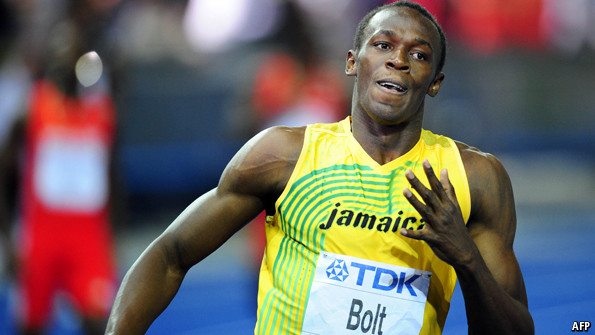
What Usain Bolt can teach banks about financial risk

Go Lean Commentary

Runner GuyThere were 465 US bank failures between 2008 and 2012.[a]

Joke: “The bank returned a check to me this morning, stamped: ‘insufficient funds.’ Is it them or me?”

The foregoing article shows the type of functions that technocrats do: evaluating risk. Any risk that can imperil the complete financial system must be monitored and mitigated. The “extreme value theory” is a model for evaluating risk and predicting future performance; and while not perfect, it is better than doing nothing.

There was no one performing this role in the Caribbean in 2008.

The foregoing article and its reliance on calculus, quantitative methods and econometric modeling is an example of the required technocratic oversight in managing an economy. Usain Bolt is used here as an allegory, a fable. The Economist magazine thusly explains how complex issues can be taught with simplified analogies and illustrations. Banking is more complex than track-and-field; but the pursuit of excellence is similar. Just like any world-class athletic pursuit, this goal is hard to master.

The Economist explains…

THE banking industry did a bad job in the run-up to the financial crisis of assessing “tail risks”, extreme events that represent the least likely of a range of probable outcomes. The Basel Committee on Banking Supervision, which is the international standard-setter for bank capital, has proposed changes in the internal risk models that financial institutions use. In particular, it wants banks to shift from a technique called “value-at-risk” (VaR) to one called “expected shortfall” (ES).

VaR is a way of measuring a firm’s risk of suffering really big losses over a certain period (a day, a week, a month) to a certain level of “confidence”. A daily VaR of $1m at 1% probability means that there is a 99% chance that you will not lose more than $1 [million] on any one day. The problem is that if you have that one bad day in 100, the potential losses could go much higher than $1 [million]. VaR doesn’t have much to say about what those losses might be. The expected-shortfall approach is meant to provide an answer to that question. Instead of asking, “What are the chances that things get so bad that we lose $1 [million]?” it asks, “If things do get that bad, how much would we actually lose?”

To do this, it uses a statistical method called “extreme value theory”, which looks specifically at what happens in the tail of distributions. To take a more trivial example of where extreme-value theory has been used, a 2011 paper by two researchers at Tilburg University collected data on the personal bests of elite athletes between 1991 and 2008, in order to try and calculate the “ultimate world record” for 100m sprints—the absolute edge of human performance given the times, equipment and drugs-policies that then prevailed. For the 100[meter] for men, the boffins (British slang for technical expert) put the ultimate world record at 9.51 seconds, compared with the record that then prevailed of 9.72, and a current world best of 9.58, set by Usain Bolt in 2009. That looks pretty good: the model came up with a number that was well inside the mark that then prevailed, and is still a hefty improvement on the current record. If extreme-value theory is meant to help banks think through the extremes, this is encouraging.

But like every model in history, expected shortfall cannot predict the future. In an earlier 2006 paper, researchers from the same university tried to calculate ultimate world records for a wider range of events, including the men’s marathon. The researchers reckoned back in 2006 that the best possible running of that distance would yield a time of two hours, four minutes and six seconds. Yet the world record today stands at two hours, three minutes and 23 seconds (Wilson Kipsang in 2013). To be fair to the researchers, they did not claim that their ultimate record could not be broken. But whether bankers will remember that reality can be worse than expected is a different question. Expected shortfall is an improvement on VaR; it is not a crystal ball.
The Economist (Retrieved 04/09/2014) – http://www.economist.com/blogs/economist-explains/2014/04/economist-explains-4

EquasionThe book, Go Lean…Caribbean, serves as a roadmap for the implementation of the Caribbean Union Trade Federation (CU). The book presents the CU as a technocracy, to ensure economic failures of the past do not re-occur. From the outset, the book identified that the Caribbean is in crisis, with the pronouncement that a “crisis is a terrible thing to waste”. The prime directive of the CU is to optimize economic, security and governing engines to impact the Caribbean’s Greater Good, for residents … and bank depositors. This was pronounced in the Declaration of Interdependence – (Page 13):

xxv. Whereas the legacy of international democracies had been imperiled due to a global financial crisis, the structure of the Federation must allow for financial stability and assurance of the Federation’s institutions. To mandate the economic vibrancy of the region, monetary and fiscal controls and policies must be incorporated as proactive and reactive measures. These measures must address threats against the financial integrity of the CU and of the member-states.

In line with the foregoing article, the Go Lean book details some infrastructural enhancements/advocacies to the region’s financial eco-system; to facilitate efficient management of the economy:

  • Fostering a Technocracy (Page 64)
  • Caribbean Central Bank (Page 73)
  • Deposit Insurance Regulations (Page 73)
  • Securities Regulatory Authority (Page 74)
  • Modeling the European Union / Central Bank (Page 130)
  • Lessons from 2008 (Page 136)
  • Banking Reforms (Page 199)

The mis-management of the economy has led to many episodes of “fight-or-flight” among Caribbean society. For many member-states, their Diaspora is more than half their population; i.e. Jamaica and Puerto Rico.

While there is no crystal ball, according to the foregoing article, there is much that can be done. Now is the time for the CU!

The purpose of this roadmap is to make the Caribbean, a better place to live, work and play. No more flight! Now we stand and fight with these technocratic weapons of modern economics.

Download the book Go Lean … Caribbean – now!

———-

Appendix Reference:
[a]. https://news.yahoo.com/facts-numbers-us-bank-failures-183852568.html

Share this post:
, , , , ,
[Top]

Book Review: ‘The Sports Gene’

Go Lean Commentary

Evolution AthleteSuccess is found at the intersection between talent and practice. Or so it seems…

These words are appropriate in reviewing the new book by David Epstein, The Sports Gene. He asserts that certain ethnicities have advantages for excelling in certain sports, but they must still put in the work to excel. These words are equally appropriate for assessing Caribbean life, prospects and cultures.

The forgoing news article in the Washington Times is a Review of the above-cited book; it takes a physiological, cultural and sociological look at the subject of sports and the athletes more inclined to excel at it. In fact the back cover photo features Jamaican Sprinter Usain Bolt, and the book prominently features an anecdote about Bahamian High Jumper Donald Thomas. So this author recognizes that Caribbean people are identified with excellence in sports; maybe even defined as geniuses[a].

The world recognizes that the Caribbean has gifted athletes, but unfortunately these participants must leave their beloved homeland to maximize their talents and earn a living from them. (Even to matriculate as student-athletes)

Book Review: By Robert VerBruggen – Special to the Washington Times, August 26, 2013

Subject: ‘The Sports Gene’ by David Epstein
Why are some people more athletic than others? Why is it that many sports are dominated by players of specific ethnicities?

These are questions that occur to many of us, sports fans and non-fans alike. Unfortunately, academia and the media have stubbornly refused to deal with them in an honest manner, keeping to simple, feel-good answers.

David Epstein’s “The Sports Gene” is a welcome exception. While the book’s title is unfortunate — no single gene could explain something so complex as athleticism — Mr. Epstein provides a careful and nuanced discussion of how nature, nurture and sports interact.

Mr. Epstein proves that genes exert a powerful influence on athleticism, and that ethnic physical differences can affect performance in many sports. Yet he does not shortchange the effects of practice and culture. This is a significant accomplishment.

There’s been much discussion in the popular press about the “10,000-hour rule” — the argument, formulated by journalist Malcolm Gladwell, that one masters a task not by having the right genes, but simply by practicing it for a total of 10,000 hours. This theory does not survive a close inspection by Mr. Epstein.

For starters, the drive needed to practice something for 10,000 hours might itself be genetic. For example, it’s possible to breed dogs and mice that have an insatiable desire to run, and twin studies suggest that genes contribute to the amount of physical activity that people get.

More to the point, the “rule” is based on flawed statistical reasoning. Yes, on average, a person who achieves elite status in a field does so after practicing for about 10,000 hours — but an average is not a rule for individuals to follow. Some people achieve elite status in as little as 3,000 hours, while others take more than twice the average. Every one of these studies has found an immense amount of variation.

Mr. Epstein illustrates this concept by comparing two high jumpers. Stefan Holm of Sweden has had a lifelong love of the sport, and through training, he very gradually improved his performance. Donald Thomas of the Bahamas, meanwhile, managed to clear a seven-foot bar on his first day. At the 2007 World Championships, just a year-and-a-half after his first high jump, Mr. Thomas beat Mr. Holm.

Mr. Epstein details many of the physical differences that give some athletes an advantage. Mr. Thomas benefited from unusually spring-like Achilles tendons. Basketball players are tall and have wide wingspans. Baseball players, who must look at a ball leaving a pitcher’s hand at 90 mph and instantly know whether and how to swing, have amazing vision. And so on.

None of this means that training doesn’t matter. For example, in addition to having great vision, baseball players must build an elaborate mental database of how different pitches look. They’re useless without this database. In one anecdote, Mr. Epstein tells of a professional softball pitcher who easily struck out some of Major League Baseball’s finest hitters. All the time they’d spent watching overhand fastballs had not prepared them for an underhand pitch.

What this does mean is that genetic qualities matter in sports. Which raises a question: Are some of these qualities more common in some ethnic groups than in others?

Much of academia swears that the phenomenon we refer to as “race” is merely a “social construct” with no biological significance whatsoever, but actual genetic research reveals otherwise: As humans spread out across the globe and encountered widely varying environment, each population evolved a little differently.

One difference that emerged is body structure. For example, the Kalenjin — a Kenyan ethnic group that is dramatically over represented in long-distance running accomplishments — tend to have thin lower legs, which is an advantage because weight there dramatically reduces running efficiency.

Further, in general, Africans of a given height have longer limbs than Europeans, and also have a higher center of mass. There are differences in average height among ethnic groups as well.

As with Mr. Epstein’s arguments regarding individual athletic achievement, his arguments about racial differences don’t imply that environment and culture are irrelevant. As Mr. Epstein notes, sometimes an ethnic group can dominate simply because they care about the sport more than their competitors — see the (now fading) pre-eminence of Japanese sumo wrestlers, or the stellar German record in dressage. The Kalenjin, in addition to their physical advantages, are raised in an environment where constant running is the norm.

That is what makes “The Sports Gene” such a worthy read: While the book’s purpose is to push back against the widespread denial that genes matter, Mr. Epstein avoids taking too strident a stance in the opposite direction. Human reality, he explains, isn’t the result of nature or nurture. It’s the result of both.

Washington Times Online –Book Review – Retrieved 04-09-2014 –http://www.washingtontimes.com/news/2013/aug/26/book-review-the-sports-gene/#ixzz2yRDgikdC

Horseback ridingThis subject matter aligns with the publication Go Lean … Caribbean, which serves as a roadmap for the introduction and implementation of the Caribbean Union Trade Federation (CU). The Go Lean roadmap only has one interest in this subject of sports, fostering the economic opportunities that can be forged from it[b].

This Go Lean roadmap first assesses that the Caribbean is in crisis; among the issues: athletes with any ability must seek refuge and opportunities in foreign lands. So this roadmap provides solutions to optimize the region’s economic, security and governing engines. The roadmap provides the facilitation to grow a professional, collegiate and amateur sports eco-system. Many times, the missing ingredients for organized sports are the facilities: stadia, arenas and playing fields. A study of this void, is bigger than just sports, it is “life and death”. But the roadmap posits that sports, even though it is just “extra-curricular”, does bring benefits. In fact, Go Lean quotes the Bible scripture at 1 Timothy 4:8 “For bodily exercise is profitable for a little …”[c]

The source book by David Epstein asserts that the rule that anyone can excel at any sport endeavor with 10,000 hours of practice and nurturing is a fallacy. Consider sports like Sumo wrestling and jockeying a horse; there’s no doubt that nature or physiology plays a role for success in these activities, despite the amount of practice. (There’s no way, a jockey will beat a Sumo Wrestler or vice-versa). But most importantly, the source book empathetically establishes that genes alone will never yield the sought-after result, there is the need for skilled training, coaching with best-practices and an internal drive. In so many ways, this parallels the current effort to reboot the Caribbean economic engines: nature (birth-right) is critical, but training, experience, coaching and the technocratic application of best-practices are also needed to forge change. The most important ingredient though is the internal drive; first and foremost, this is identified in the roadmap as “community ethos”.

The Go Lean roadmap recognizes many different kinds of athletics, team sports and individual events. The unique “genius” qualifier is highlighted at the outset of the Go Lean book, in the Declaration of Interdependence (Page 13 – 14), as follows:

xxi. Whereas the preparation of our labor force can foster opportunities and dictate economic progress for current and future generations, the Federation must ensure that educational and job training opportunities are fully optimized for all residents of all member-states, with no partiality towards any gender or ethnic group. The Federation must recognize and facilitate excellence in many different fields of endeavor, including sciences, languages, arts, music and sports. This responsibility should be executed without incurring the risks of further human flight, as has been the past history.

xxxi. Whereas sports have been a source of great pride for the Caribbean region, the economic returns from these ventures have not been evenly distributed as in other societies. The Federation must therefore facilitate the eco-systems and vertical industries of sports as a business, recreation, national pastime and even sports tourism – modeling the Olympics.

Similar to the publication by David Epstein, Go Lean … Caribbean highlights lessons that are learned from flawed ideologies, as in the case that education (abroad) elevates a society. (The Caribbean experience is that of a brain drain). While Epstein’s book prescribed strategies, tactics and implementation to optimize sport performance, Go Lean performs the same exercise for Caribbean economic empowerment.

Now is the time for the Caribbean region to lean-in for the changes described in the book Go Lean … Caribbean. Success is to be found at the intersection between opportunity and preparation.

The benefits of this roadmap are too alluring to ignore: emergence of an $800 Billion economy, 2.2. million new jobs, new industries, services and opportunities for the sports-playing youth of the Caribbean and even an invitation to the Diaspora (and their legacies) to repatriate from North American and European countries so as to preserve Caribbean culture in the Caribbean[d].

Download the book Go Lean … Caribbean – now!

—————–

Appendix – ‘Go Lean’ Book References

a. 10 Ways to Foster Genius – Page 27
b. Separations of Powers – Sports & Culture – Page 81
c. 10 Ways to Improve Sports – Page 229
d. 10 Ways to Preserve Caribbean Heritage – Page 218

Share this post:
, , , ,
[Top]

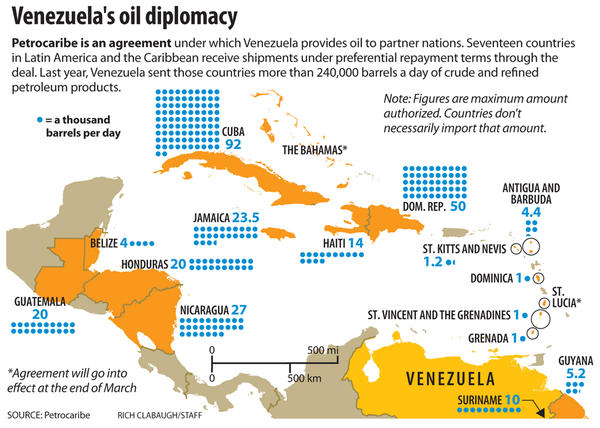
PetroCaribe press ahead with plan to eradicate hunger & poverty

Go Lean Commentary

Venezuela Oil“He who has the gold makes the rules”; this is considered the golden rule. Today, oil is considered Black Gold. This succinctly describes the status of PetroCaribe and its regional campaign.

The foregoing news article speaks of PetroCaribe and ALBA, two economic integration initiatives by Hugo Chavez (1954-2013), the late President of Venezuela. He proved to be impactful, yet polarizing. His advocacy of socialism often brought him at odds with other western democracies, especially the US. But still, Chavez and Venezuela as a whole wield great power in Latin America and the Caribbean due to their abundance of resources and oil reserves.

The publisher of the book Go Lean…Caribbean, SFE Foundation, is a Community Development Foundation, constituted with members of the Caribbean Diaspora. The book’s first chapter defines the character and objective:

The SFE Foundation is not a person; it’s an apolitical, religiously-neutral, economic-focused movement, initiated at the grass-root level to bring change back to the Caribbean homeland – no one Caribbean State is favored over another. The SFE Foundation is not affiliated with the CariCom or any of its agencies or institutions. This movement is not an attempt to re-boot the CariCom, but rather a plan to re-boot the Caribbean

The same as is said about CariCom, in the above text, can be applied to PetroCaribe and ALBA.

CARACAS, Venezuela — The action plan for the eradication of hunger and poverty in the economic zone of PetroCaribe is showing significant progress. In order to define the specific intervention initiatives for each country, representatives from 17 Caribbean and Central American nations met in Caracas, Venezuela on 3 and 4 April 2014.

The meeting was opened by the vice-president for social areas of Venezuela, Hector Rodriguez, who emphasized on the importance of PetroCaribe for the region, noting that “this is a proposal that seeks equality based on diversity”.

Referring to the results of the action plan for the eradication of hunger and poverty, he stated, “We have the strategic goal of making the Caribbean a hunger free region.”

On this occasion, countries presented their concrete initiatives to eradicate hunger and poverty locally. The Executive Secretariat of PetroCaribe, with technical assistance from Food and Agriculture Organization (FAO) of the United Nations, will evaluate the proposals based on the guidelines set out in the action plan, which were approved by all the countries in the region. Selected projects will receive implementation funding from PetroCaribe.

At the meeting, the president of PDV Caribe and ALBA executive secretary, Bernardo Alvarez, emphasized the efficient implementation of the action plan: “We must congratulate ourselves on the important progress we have made in implementing the action plan for the eradication of hunger and poverty.”

Alvarez highlighted the leadership of FAO director general, José Graziano da Silva, in the creation of this regional initiative to end hunger: “This would not be possible without the inspiration of the director general of FAO, who was the creator of the Zero Hunger program in Brazil during the government of President Lula.”

The FAO regional representative for Latin America and the Caribbean, Raúl Benítez, noted, “The action plan to eradicate hunger and poverty is an example for everyone. This initiative is a concrete response to the 47 million people who still suffer hunger in Latin America and the Caribbean.”

Benitez acknowledged the commitment of the countries of the region, and Venezuela in particular, in the fight against hunger: “Venezuela is not only an example of a country that managed to defeat undernourishment in its territory, but it is an example of solidarity with an entire region.”

Meanwhile, executive secretary of PetroCaribe, Asdrubal Chavez, expressed optimism about the results of the action plan. “We could even reach our goals sooner than planned,” Chavez said.

The action plan is part of the priorities of the Community of Latin American and Caribbean States (CELAC), and the Hunger-Free Latin America and the Caribbean Initiative, a commitment of 33 countries of the region to eradicate malnutrition by 2025. Its aim is to strengthen food and nutrition security of member states of the PetroCaribe and ALBA economic zone through national and regional hunger eradication projects.

The book Go Lean…Caribbean, serves as a roadmap for the introduction and implementation of the Caribbean Union Trade Federation (CU). This will serve as an integrated entity among Caribbean member-states; many of which are also members of PetroCaribe and ALBA; see Appendices below. So the advantageous characteristics of the SFE Foundation and the Caribbean Union as apolitical entities are manifested in this Go Lean effort.

According to the foregoing article, hunger and poverty are still major concerns in the Caribbean. The underlying motivation of the Go Lean book is brotherly love. Therefore who so ever, brings a solution to feed our hungry, poor brothers and sisters should be welcomed and embraced, despite their political affiliation. The roadmap is not “pro” or “con” American, but rather pro solutions; in fact the CU is described as a technocracy with a focus on delivery and merit, rather than ideologue or politics.

The Go Lean roadmap does align with many of the objectives of PetroCaribe as detailed in the foregoing article. The CU’s goal is to integrate the Caribbean member-states for permanent economic empowerment. As a result, many social benefits will flow. For example, the roadmap defines 10 [successful] Battles in the War Against Poverty (Page 222) and 10 Ways to Help the Middle Class (Page 223).

A basic economic principle is that education lifts people out of poverty. So the roadmap prioritizes education along with food, clothing, shelter, healthcare and energy as basic needs. The CU is to foster the eco-system to better deliver these basic needs of life for Caribbean people. In all, to make the Caribbean a better place to live work and play.

Download the book – Go Lean … Caribbean now!!!

———–

Appendix – PetroCaribe
PetroCaribe is an oil alliance with Venezuela which allows the purchase of oil on conditions of preferential payment. The alliance was launched on 29 June 2005 in Puerto La Cruz, Venezuela. In 2013 PetroCaribe agreed to links with the Bolivarian Alliance for the Americas (ALBA), and to go beyond oil and promote economic cooperation. It is now considered an “economic zone”.

The PetroCaribe agreement was initiated with the aim of having solidarity with other countries in accordance with ALBA. The payment system allows for purchase of oil on market value for 5%-50% up front with a grace period of one to two years; the remainder can be paid through a 17-25 year financing agreement with 1% interest if oil prices are above US$40 per barrel. The agreement builds on payment terms from the San Jose Agreement and the Caracas Energy Accord. Energy and Petroleum Minister and President of PDVSA Rafael Ramírez said of the deal that it seeks to cut out the middleman in such transactions: “We’re not talking about discounts…We’re talking about financial facilities, direct deliveries of products, [and] infrastructure.”

There are a total of 17 members, plus Venezuela; 12 of the members are from the 15 member CariCom (excluding, Barbados, Montserrat and Trinidad and Tobago). At the first summit, 14 countries joined the alliance. These were: Antigua and Barbuda, the Bahamas, Belize, Cuba, Dominica, Dominican Republic, Grenada, Guyana, Jamaica, St Lucia, St Kitts and Nevis, Saint Vincent and the Grenadines, Suriname and Venezuela. At the third summit, Haití and Nicaragua joined the union. Guatemala joined in July 2008 but left the organization in November 2013 stating that Venezuela had not provided them with the ultra-low financing rates that they had been promised.

Haiti finally joined the alliance in April 2006. Honduras became the 17th member of the alliance in December 2007, under President Manuel Zelaya. Belize set up the Belize Petroleum Energy Company to coordinate for the project.

Appendix – ALBA
The Bolivarian Alliance for the Americas (Spanish – ALBA: Alianza Bolivariana para los Pueblos de Nuestra América) is an intergovernmental organization based on the idea of the social, political and economic integration of the countries of Latin America and the Caribbean. The name “Bolivarian” refers to the ideology of Simón Bolívar, the 19th-century South American independence leader born in Caracas who wanted the continent to unite as a single “Great Nation.”

ALBA is associated with socialist and social democratic governments wishing to consolidate regional economic integration based on a vision of social welfare, bartering and mutual economic aid. ALBA nations may conduct trade using a virtual regional currency known as the SUCRE. Venezuela and Ecuador made the first bilateral trade deal using the Sucre, instead of the US dollar, on July 6, 2010.

ALBA members include Antigua & Barbuda, Bolivia, Cuba, Dominica, Ecuador, Nicaragua, Saint Vincent & the Grenadines, Venezuela, Saint Lucia, and Suriname.

Appendix – SUCRE
A regional currency to be used in commercial exchanges between members of the regional ALBA trade bloc, which was created as an alternative to the [proposed-but-never-ratified] Free Trade Agreement of the Americas (FTAA). The SUCRE is intended to replace the US dollar as a medium of exchange in order to decrease US control of Latin American economies and to increase stability of regional markets.

The acronym is in Spanish, as: Sistema Único de Compensación Regional. In English, this means: Unified System for Regional Compensation

International trade between member states in SUCRE exceeded $850 million in 2013.

Eventually, the plan is for the SUCRE to become a hard currency.

Appendix – Referenced Sources:

• “PetroCaribe Meets in Venezuela, Links with ALBA”. Retrieved 6 April 2013 from: http://venezuelanalysis.com/news/9087.

• “ALBA Summit Ratifies Regional Currency, Prepares for Trinidad”. Michael Fox, Venezuela Analysis. Retrieved 17 April 2009 from: http://venezuelanalysis.com/news/4373

• Wikipedia treatment for subject PetroCaribe. Retrieved April 7, 2014 from: http://en.wikipedia.org/wiki/Petrocaribe

• Wikipedia treatment for subject ALBA. Retrieved April 7, 2014 from: http://en.wikipedia.org/wiki/ALBA

• Wikipedia treatment for subject SUCRE. Retrieved April 7, 2014 from: http://en.wikipedia.org/wiki/SUCRE

Share this post:
, , , , , ,
[Top]

CARICOM Chairman to deliver address on reparations

Go Lean Commentary

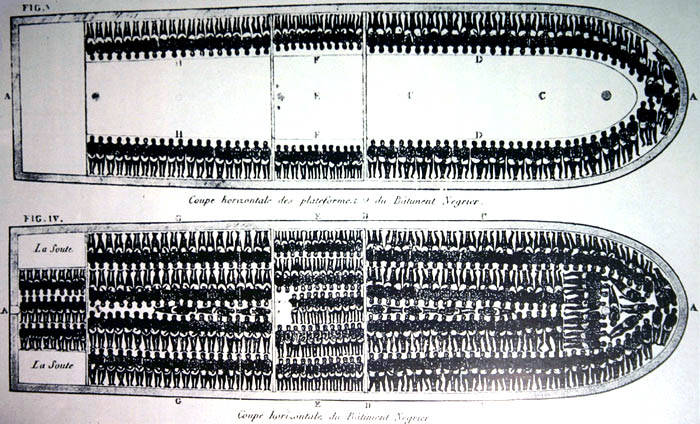
Slave ShipThe book Go Lean … Caribbean aligns with one objective depicted in the below news article: to reconcile the flawed economic policies of the past and lean-in for the optimization of the Caribbean future. Beyond this stance, the book deviates from these advocates calling for reparations from the colonial powers that participated in the slave trade, slavery or colonial suppression of the indigenous people.

Reparations stress at its root, a sense of entitlement to other people’s resources. The book, on the other hand, serves as a roadmap for the regional integration of the 42 million people and 30 member states of the Caribbean with the implementation of the Caribbean Union Trade Federation (CU). This roadmap advocates the reconciliation of the economic and security engines to grow the region’s economy from $378 Billion (2010) to $800 Billion in a 5 year time span.

NEW YORK, United States, Friday March 28, 2014, CMC – Chairman of the Caribbean Community (CARICOM) grouping, Prime Minister Dr. Ralph Gonsalves of St. Vincent and the Grenadines will address an international forum in reparations in the United States next month.

Gonsalves will deliver the feature address at the April 19 forum titled “Revitalizing the Reparations Movement,” organized by the New York-based Institute of the Black World 21st Century (IBW).

IBW described Gonsalves as “one of the leading voices in the Americas demanding that the former European colonial powers pay reparations to Caribbean and South American countries for centuries of African enslavement, native genocide and colonial exploitation”.

The forum will be held in collaboration with the Center for Inner City Studies and the Samuel DeWitt Proctor Conference.

IBW said among the specially invited guests will be Detroit’s congressman John Conyers, Sr., dean of the US Congressional Black Caucus, and sponsor of HR-40, the Reparations Study Bill and Louis Farrakhan, leader of the Nation of Islam.

“A primary goal of the forum is to revitalize the reparations movement in the USA by revisiting the Durban Resolution on the Trans-Atlantic Slave Trade, presenting an update on HR-40 and examining the status of CARICOM’s reparations initiative,” IBW said.

“We are delighted and honored to have Prime Minister Gonsalves keynote this critical forum on reparations, a subject of fundamental historical justice that is near and dear to the hearts of Black people around the world,” said IBW’s president Dr. Ron Daniels.

Director of Chicago’s Inner City Studies, Dr. Conrad Worrill, said “our ancestors will be pleased that the reparations movement is being re-energized from the Caribbean islands”.

“In demanding reparations, CARICOM is vindicating the vestiges of the Trans-Atlantic slave trade,” he added.

CARICOM leaders at their inter-sessional summit in St, Vincent and the Grenadines earlier this month discussed the reparation issue and hope to have a meeting with European leaders in June.

The leaders unanimously adopted a 10-point plan that would seek a formal apology for slavery; debt cancellation from former colonizers, such as Britain,

France, Spain and the Netherlands; and reparation payments to repair the persisting “psychological trauma” from the days of plantation slavery.

The Go Lean roadmap commences with this ideal embedded in the Declaration of Interdependence, pronouncing as follows, (Page 10):

As the colonial history of our region was initiated to create economic expansion opportunities for our previous imperial masters, the structures of government instituted in their wake have not fostered the best systems for prosperity of the indigenous people. Despite this past, we thrust our energies only to the future, in adapting the best practices and successes of the societies of these previous imperial masters and recognizing the positive spirit of their intent and vow to learn from their past accomplishments and mistakes so as to optimize the opportunities for our own citizenry to create a more perfect bond of union.

The subject matter of reparation is polarizing, based on assumptions that the Caribbean is comprised of mostly African or Ameri-Indian peoples. While many CARICOM states do possess a majority Black population, this is not so within the larger Caribbean, of whom the CU confederates. There are also large populations of European (White) ethnicities, Indian, and Chinese descendants that should also unite.

— UPDATE (Sep 30, 2015) – See VIDEO in the Appendix regarding the UK Prime Minister’s recent visit to Jamaica

There is a benefit, however, that can be garnered from compensatory talks with European nations, that of making “Aid” more empowering. The roadmap details an advocacy on the roles and responsibilities of fostering International Aid (Page 115). So while the political leaders of the CARICOM may be exerting energies to “guilt” these Europeans leaders to “pay up”, the CU Trade Federation will instead work to improve trade and re-boot the economic engines of the region.

It is a known fact that most of the resources of the European powers are tied to the strength of their economies, not the reserves gathered up from centuries of exploiting African slaves and their descendants. The country with the largest reserves is the USA; but their gold in Fort Knox is only estimated at $800 Billion, while their economy is $16 Trillion of GDP output … annually. So reparation is not a winning formula; it assumes some abundant stockpile of savings. This is a flawed logic and strategy. On the other hand, the Caribbean needs to create 2.2 million new jobs; this is only possible with the turn-around strategies as detailed in the roadmap of Go Lean … Caribbean.

So as a policy decision for the economic strategies of the region, the Go Lean book and movement recommends:

    Re-boot – Yes!
    Reparations – No!

Download the free e-Book of Go Lean … Caribbean – now!

———

Appendix VIDEO – Slavery Reparations Dominate David Cameron’s Jamaica Visit – https://youtu.be/al453a8rLy8

Published on Sep 30, 2015 – UK Prime Minister David Cameron’s visit to Jamaica was overshadowed by slavery reparation calls, which he rejected. The legacy of slavery is still ever-present for 14 Caribbean countries calling on their former colonial masters to pay billions in reparations.
Share this post:
, ,
[Top]

Jamaica to receive World Bank funds to help in crime fight

Go Lean Commentary

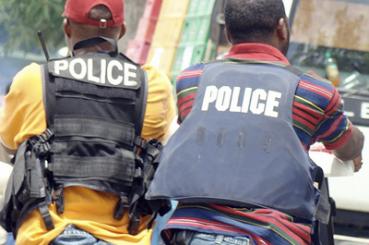
images-Caribbean-jamaica_police_498560223The publisher of the book Go Lean … Caribbean commends the Government of Jamaica and the Washington DC-based World Bank institution for their diligent effort to forge solutions to some of the crucial challenges of Jamaica. Crime has proceeded to cast such a “dark cloud” on Jamaica that the country is near the assessment of a “Failed-State”. The societal problems in Jamaica are so bad that many different advocacies from the Go Lean book can be applied to bring much needed improvements to the island. The book thusly serves as a roadmap for the implementation of the Caribbean Union Trade Federation (CU), a regional entity projected to also forge solutions for the Caribbean region as a whole and Jamaica in particular.

WASHINGTON D.C. – The World Bank says more than 80,000 Jamaican citizens will benefit from improved services, basic infrastructure and targeted crime and violence interventions in 18 vulnerable inner-city communities as a result of a US$42 million project for integrated community development.

The Washington-based financial institution said the new project is a continuation of the partnership between the Jamaica government and the World Bank on upgrading some of the country’s most vulnerable and volatile communities.

It said the project builds on the success of the “Inner City Basic Services for the Poor Project” to address accelerating urban decay and declining citizen security.

“The project aims to foster a more inclusive society in Jamaica by improving the quality of life of marginalized city dwellers,” said Sophie Sirtaine, World Bank country director for the Caribbean.

“It also aims to prevent crime and violence by engaging youth in public safety initiatives and providing them with job skills training,” she added.

As a result of the funding, Sirtaine said more than 50,000 people will benefit from improved solid waste management services, street lighting, paved roads and drainage.

She said residents in the 18 communities would “feel safer” and that 1200 families will have their piped water connection repaired and 4,500 residents receiving educational and skills training.

“As we strive to advance the targets of the Vision 2030, where access to reliable services and adequate infrastructure is the norm, enhancing community safety and security is a priority,” said Scarlette Gillings, managing director of the Jamaica Social Investment Fund.

“And these communities are places of choice to live, work, raise families and do business,” she added.

In the Kingston Metropolitan Area, the World Bank said poverty has doubled in two years from seven per cent in 2008 to more than 14 per cent in 2010.

It also said youth unemployment is on the rise, with more than 50 per cent of young people unemployed, adding that homicides and other violent crimes rates are among “the highest in the Latin America and Caribbean region”.

Source: Caribbean360.com – Caribbean Online Magazine (Retrieved 03/20/2014) http://www.caribbean360.com/index.php/business/1107320.html#ixzz2wvpxCnMA

While the foregoing article identifies these 3 objectives of the announced project: improved services, basic infrastructure and targeted crime & violence interventions, the Go Lean roadmap depicts 144 missions for the CU to engage, and provides the turn-by-turn directions on how to implement and ensure their success. At the outset of the book (Page 12), public safeguards are identified as prime directives in the Declaration of Interdependence:

x. Whereas we are surrounded and allied to nations of larger proportions in land mass, populations, and treasuries, elements in their societies may have ill-intent in their pursuits, at the expense of the safety and security of our citizens. We must therefore appoint “new guards” to ensure our public safety and threats against our society, both domestic and foreign. The Federation must employ the latest advances and best practices of criminology and penology to assuage continuous threats against public safety.

xvi. Whereas security of our homeland is inextricably linked to prosperity of the homeland, the economic and security interest of the region needs to be aligned under the same governance. Since economic crimes … can imperil the functioning of the wheels of commerce for all the citizenry, the antecedence of this Federation must equip the security apparatus with the tools and techniques for predictive and proactive interdiction.

In addition to crime, the roadmap targets delivery of government services, identifying best practices in agile methodologies to guarantee fewer defects and more efficiency; (Pages 109 & 147). In fact, the name Go Lean refers to the commitment to lean project management methodologies in the structure of the CU; this is defined in the book’s Preface (Page 4).

Lastly, the book also details investments and the impact of pipelines in the region, recognizing that this field is an “art and a science”. These investments are identified as strategic, tactical and operational in their Caribbean deliveries (Page 43). This synchronizes with the World Bank and Jamaica’s initiatives to help the municipalities to better provide quality services with their Vision 2030 plan.

The book Go Lean … Caribbean is an economic empowerment plan for the Caribbean first and foremost. This means addressing the underlying issues that mitigate poverty: jobs, education and economic growth; (Page 222). The CU projects the creation of 2.2 million new jobs regionally while growing the economy to $800 Billion. This roadmap, once executed, should help Jamaica (and equally all 30 Caribbean member-states) shed this “Failed-State” eventuality.

Download the book Go Lean … Caribbean – now!

Share this post:
, ,
[Top]

US slams Caribbean human rights practices

Go Lean Commentary

shame-on-youThe below news article synchronizes with the book Go Lean … Caribbean in that it depicts the “hot topic” of human rights monitoring in the Caribbean region. The book declares that the people of the Caribbean have the right to good governance and the fulfillment of a presumed social contract to ensure due process, and the rule of law.

This book serves as a roadmap for the implementation of the Caribbean Union Trade Federation (CU), a technocratic federal government to administer and optimize the economic, security, and governing engines of the region’s 30 member-states. At the outset, the roadmap identified this urgent need for human rights protection, stating this clause in the Declaration of Interdependence (Page 12):

xxi. Whereas the legacy in recent times in individual states may be that of ineffectual governance with no redress to higher authority, the accedence of this Federation will ensure accountability and escalation of the human and civil rights of the people for good governance, justice assurances, due process and the rule of law. As such, any threats of a “failed state” status for any member state must enact emergency measures on behalf of the Federation to protect the human, civil and property rights of the citizens, residents, allies, trading partners, and visitors of the affected member state and the Federation as a whole.

The Go Lean roadmap projects that the CU will facilitate monitoring and accountability of the justice institutions to ensure compliance and mitigate abuses – all Police Internal Affairs and Military Justice institutions will have a federal up-line reporting – Pages 117 & 220. Consider this related article:

By: Nelson A. King
WASHINGTON DC, March 3, 2014 – While noting that governments that protect human rights and are accountable to their citizens are more secure, bolster international peace and security, and enjoy shared prosperity with stable democratic countries around the world, the United States continues to assail human rights practices in the Caribbean.

In its “Country Reports on Human Rights Practices for 2013,” released here earlier this week, Washington was particularly scathing in its criticism of Haiti, Jamaica, Guyana, Suriname, Trinidad and Tobago, and the Bahamas.

The US Department of State said the most serious impediments to human rights in Haiti involved weak democratic governance in the earthquake-ravaged, French-speaking Caribbean country; “insufficient respect for the rule of law, exacerbated by a deficient judicial system; and chronic corruption in all branches of government.”

It said basic human rights problems included “isolated allegations of arbitrary and unlawful killings by government officials; allegations of use of force against suspects and protesters; overcrowding and poor sanitation in prisons; prolonged pre-trial detention; an inefficient, unreliable, and inconsistent judiciary; rape, other violence, and societal discrimination against women; child abuse; allegations of social marginalization of vulnerable populations, including persons with disabilities and lesbian, gay, bisexual, and transgender (LGBT) persons; and trafficking in persons.”

The report also said that allegations “persisted of sexual exploitation and abuse by members of the UN Peacekeeping Force in Haiti (MINUSTAH).”

In addition, it said violence, crime and forced evictions within the remaining internally displaced persons (IDP) camps in Haiti, which contained about 172,000 IDPs as of November, “remained a problem.”

Although the Michel Martelly administration took some steps to prosecute or punish government and law enforcement officials accused of committing abuses, the State Department said “credible reports persisted of officials engaging in corrupt practices,” and that civil society groups allege that impunity was a problem.

The report said there were isolated allegations of police and other government officials’ involvement in arbitrary or unlawful killings, some of which resulted in arrests. However, none resulted in convictions, it said.

Washington said prisoners at times were subject to “degrading treatment, in large part due to overcrowded facilities”, adding that correction officers used physical punishment and psychological abuse to mistreat prisoners.

The State Department said prisons and detention centres throughout Haiti remained overcrowded, poorly maintained and unsanitary.

In Jamaica, the most serious human rights issues were alleged unlawful security force killings; cases involving the violation of rights that were not resolved in a timely way; and poor prison and jail conditions, including abuse of detainees and prisoners and severe overcrowding. The report said other human rights issues included an “overburdened, under resourced, and ineffective judicial system, and frequent lengthy delays in trials, violence against and sexual abuse of children, violence and discrimination against women, trafficking in persons, violence against persons based on their suspected sexual orientation or gender identity, and mob violence.

“The government took steps to investigate and punish members of the security forces who committed abuses, but in many instances a lack of witnesses and insufficient forensics equipment precluded arrests or prosecutions, thus providing the appearance of impunity for police who committed crimes.

“While the government or its agents did not commit politically motivated killings, there were numerous occurrences where citizens accused the government’s security forces or its agents of committing arbitrary or unlawful killings,” the State Department said.

The report said there were 211 killings involving Jamaican police through October, and that six police officers also were killed in the line of duty during that time.

It said human rights monitors indicated that some killings by police went unreported, with police allegedly meting out the justice they believed was unavailable through the judicial system.

The State Department said violent crime remained a “serious concern” in Jamaica, adding that, on many occasions, the Jamaica Constabulary Force (JCF) “employed lethal force in apprehending criminal suspects”.

Prisons and detention centres were also “severely overcrowded and presented serious threats to life and health,” the report said.

In Guyana, it said the most serious human rights abuses involved suspects and detainees’ complaints of mistreatment by security forces, unlawful killings by police, and poor prison and jail conditions.

Other human rights problems included lengthy pre-trial detention; allegations of government corruption, including among police officials; excessive government influence over the content of the national television network and continued restrictions on radio licensing; sexual and domestic violence against women; abuse of minors; and laws that discriminate against LGBT persons.

The report said there were no independent and transparent procedures for handling allegations of killings and other abuses by security force members.

“Prosecutions when pursued were extremely lengthy, and convictions were rare, leading to a widespread perception that security force members and government officials enjoyed impunity,” it said.

The State Department said there were alleged mistreatment of inmates by prison officials, as well as allegations of police abuse of suspects and detainees.

It said prison and jail conditions were “poor and deteriorating, particularly in police holding cells,” and that overcrowding was a “severe problem”.

The report said lengthy pre-trial detention, “due primarily to judicial inefficiency, staff shortages, and cumbersome legal procedures, remained a problem,” adding that “delays and inefficiencies undermined judicial due process.”

While the law provides for criminal penalties for corruption by officials, the State Department said the Guyana government did not implement the law effectively.

“There remained a widespread public perception of corruption involving officials at all levels, including the police and the judiciary,” it said, pointing to the World Bank’s Worldwide Governance Indicators that assessed that government corruption was “a serious problem”.

The most serious human rights problems in Suriname, according to the State Department, were “widespread government corruption, reports of press intimidation, and lengthy pre-trial detention”.

Other human rights problems, it said, included self-censorship by some media organizations and journalists; societal discrimination against women, Maroons, descendants of escaped slaves who fled to the interior of the country to avoid recapture, Amerindians, and other minorities; domestic violence against women; trafficking in persons; and child labour in the informal sector.

The report said while the government continued to take steps to prosecute abusers in the security forces, in certain cases, “there was a perception of impunity among the public”.

It said human rights groups, defence attorneys and the media continued to report various instances of mistreatment by police including unnecessary use of gun violence at time of arrest and beatings while in detention, as well as isolated incidents of abuse of prisoners by prison officials.The report said prisoners continued to express concern over conditions in Santo Boma Prison, where they complained of inadequate food provisions, mistreatment by prison guards, and limited ventilation?

The State Department identified police killings during apprehension or while in custody, and poor treatment of suspects, detainees and prisoners as the most serious human rights problems in Trinidad and Tobago.

It said other human rights problems involved inmate illnesses and injuries due to poor prison conditions, a slow judicial system, high-profile cases of alleged bribery, violence and discrimination against women, and inadequate services for vulnerable children.

The report noted that, while the Kamla Persad-Bissessar administration took some steps to punish security force members and other officials charged with killings or other abuse, “there continued to be a perception of impunity based on the open-ended nature of many investigations and the generally slow pace of criminal judicial proceedings”.

It said the People’s Partnership government or its agents did not commit any politically-motivated killings; but, according to official figures, police shot and killed 21 persons through November 1, compared with 21 in all of 2012.

The State Department said there were “credible reports” that police officers and prison guards mistreated individuals under arrest or in detention, stating that, from 2005 through 2012, “the government paid or was found liable to pay more than 10 million Trinidad and Tobago dollars (One TT dollar = US$0.16 cents) in compensation to prisoners on claims of excessive use of force by prison officers”.

The report said conditions in some of the prison system’s eight facilities continued to be harsh.

Police abuse, detainee abuse, compounded by problems in processing them, a poorly functioning judicial system leading to delays in trial, and witness intimidation, were the most serious human rights problems in the Bahamas, according to the report.

It said other human rights problems included poor detention conditions; corruption; violence and discrimination against women; sexual abuse of children; and discrimination based on ethnic descent, sexual orientation, or HIV status.

The State Department said prison and detention centre conditions “generally failed to meet international standards,” noting that conditions at the Fox Hill Prison, the country’s only prison, “remained harsh and unsanitary for many prisoners”.

The report said Bahamian authorities detained irregular immigrants, primarily Haitians, until arrangements could be made for them to leave the country or they obtained legal status.

It said the average length of detention varied significantly by nationality, willingness of governments to accept their nationals back in a timely manner, and availability of funds to pay for repatriation.

The report said authorities usually repatriated Haitians within one to two weeks, while they held Cubans for much longer periods.

It said the Bahamian government has “not effectively implemented laws and policies to provide certain habitual residents the opportunity to gain nationality in a timely manner and on a non-discriminatory basis,” adding that some commentators believed that these restrictions particularly targeted Haitians resident in the country.

In an immediate response, Nassau said that the report was now being reviewed by the Ministry of Foreign Affairs.

“From what has been seen so far, there is no need for any alarm or undue concern. In a free and open society like ours, anyone is free to comment and investigate the human rights record of our country and we do not fear such an examination,” the government said in a statement.

It said it would “take note of any errors or overreaches in the report and it will have to be determined to what extent we address those issues”.

In St Lucia, the State Department said the most serious human rights problems included long delays in investigating reports of unlawful police killings, abuse of suspects and prisoners by the police, and continued postponements of trials and sentencing.

Other human rights problems included violence against women, child abuse, and discrimination against persons based on their real or perceived sexual orientation or gender identity.

“Although the government took some steps to prosecute officials and employees who committed abuses, the procedure for investigating police officers was lengthy, cumbersome, and often inconclusive,” the State Department said.

“When the rare cases reached trial years later, juries often acquitted, leaving an appearance of de facto impunity,” it added.

The State Department said the Dean Barrow administration in Belize “failed at times to maintain effective control over the security forces,” stating that security forces allegedly committed human rights abuses.

It said the most important human rights abuses included the use of excessive force by security forces, lengthy pre-trial detention, and harassment and threats based on sexual orientation or gender identity.

Other human rights problems comprised domestic violence, discrimination against women, sexual abuse of children, trafficking in persons, and child labour.

In Antigua and Barbuda, the State Department said the most serious human rights problems involved poor prison conditions and violence against women.

Other human rights problems included trial delays resulting from court backlogs and reports of mental, physical, and sexual abuse of children. There were also laws that discriminate against LGBT persons.

The report said the Baldwin Spencer administration took steps to prosecute and punish those who committed human rights abuses, and that impunity was not a widespread problem.

Poor prison conditions, politicization of the police force, discrimination and violence against women, and child abuse topped the list for human rights abuses in St. Kitts and Nevis, according to the report.

Discrimination against the LGBT community was the other human rights problem, it claimed.

Occasional police use of excessive force and gender- based violence were the most serious human rights problems in St Vincent and the Grenadines, according to the State Department.

It said other human rights problems included official corruption, lack of government transparency, discrimination, and child abuse.

“The government took steps to punish officials who committed abuses, and there was not a widespread perception of impunity for security force members,” the report said.

The most serious human rights problems in Barbados were “unprofessional conduct” by police, violence against women, and discrimination against LGBT individuals, according to the report, adding that other human rights problems included child abuse.

The State Department said domestic violence against women and children were the most serious human rights problem in Dominica.

It said other human rights problems included adverse conditions experienced by the indigenous Kalinago (Carib) population and laws that discriminate against LGBT persons.

Human rights problems in Grenada included poor prison conditions, violence against women, instances of child abuse, and laws that discriminate against LGBT persons, the report said.
Source: Caribbean360.com – Caribbean Online Magazine (Retrieved 03/10/2014) – http://www.caribbean360.com/index.php/news/1107173.html#axzz2vZjwuO

The foregoing article highlights another example of the United States meddling/voicing opinions about issues in other countries, while they themselves have less than a stellar human rights record on this subject. Consider that the State Department’s report many times cited prison conditions in the Caribbean states. This is classic “pot calling kettle black” – the US has the highest incarceration rate in the world[a]. What’s worse is the fact that 60% of the US prison population is Black or Hispanic[b]; even though non-whites only committed 30.7% of the crimes[c]. Obviously justice in the US is dependent on the access to money. Where is the Human Rights outcries there?!

But it is what it is! Despite the hyprocrisy of the messenger, the message still has legitimacy; we do have issues in the Caribbean that need addressing. Basic Human Rights are being violated in the region, arbitrary and unlawful killings by government officials, poor sanitation in prisons and prolonged pre-trial detention. The Go Lean roadmap posits that any economic optimization effort must be accompanied by a strenuous security agenda, or “bad actors” will emerge. As such, the book presents the CU solution of marshaling economic crimes, and deploying a Prison Industrial complex to build over-sized facilities to house the region’s inmates and capitalize on opportunities to service shortcomings of foreign countries, like the US.

The CU solutions are designed to make the Caribbean a better place to live, work and play. Though the roadmap starts with an economic focus, it also facilitates the Human Rights protections for all members of our society: good or bad; as pilloried in the nursery rhyme: “rich man, poor man, beggar man, thief; doctor, lawyer, Indian Chief”.

Download the book Go Lean … Caribbean – now!

———-

Appendix – References:

a. International Centre for Prison Studies (18 Mar 2010). “Prison Brief – Highest to Lowest Rates”. World Prison Brief. London: King’s College London School of Law. Archived from (http://www.kcl.ac.uk/depsta/law/research/icps/worldbrief/wpb_stats.php?area=all&category=wb_poprate) on 25 March 2011. Retrieved 25 March 2011.

b. Office of Justice Programs – US Department of Justice – Prison Inmates at Midyear 2009 – Statistical Tables – Retrieved on March 11, 2013 from: http://www.bjs.gov/content/pub/pdf/pim09st.pdf

c. US Federal Bureau of Investigations – Crime in the United States, 2012 Arrests by Race”. Table 43– Retrieved on March 11, 2014 from: http://www.fbi.gov/about-us/cjis/ucr/crime-in-the-u.s/2012/crime-in-the-u.s.-2012/tables/43tabledatadecoverviewpdf

 

Share this post:
, , ,
[Top]

Bahamians Make Presence Felt In Libyan League

Go Lean Commentary

Basketball_HoopsThe news story in the following news article synchronizes with the book Go Lean … Caribbean in that it depicts the realities of how sports can impact the economics of a community.

Go Lean serves as a roadmap for the implementation of the Caribbean Union Trade Federation (CU), a technocratic federal government to administer and optimize the economic/security/ governing engines of the region’s 30 member-states. At the outset, the roadmap features these statements in the Declaration of Interdependence (Page 13 & 14):

xxi. Whereas the preparation of our labor force can foster opportunities and dictate economic progress for current and future generations, the Federation must ensure that educational and job training opportunities are fully optimized for all residents of all member-states, with no partiality towards any gender or ethnic group. The Federation must recognize and facilitate excellence in many different fields of endeavor, including sciences, languages, arts, music and sports. This responsibility should be executed without incurring the risks of further human flight, as has been the past history.

xxxi. Whereas sports have been a source of great pride for the Caribbean region, the economic returns from these ventures have not been evenly distributed as in other societies. The Federation must therefore facilitate the eco-systems and vertical industries of sports as a business, recreation, national pastime and even sports tourism – modeling the Olympics.

The actual news article was posted as follows:

By RENALDO DORSETT, Sports Reporter (rdorsett@tribunemedia.net)
You can find Bahamians playing basketball on just about every continent but it’s rare to find former high school teammates reunited on the same roster at the professional level.

In the Libyan D1 basketball league, Scottie Farrington and Tehran Cox are two of the top players with the Al Madina Tripoli club.

They are two of three Bahamians competing in the Libya-D1 league along with Torrington Cox who plays with Al Ahly Benghazi.

Farrington, a 6’8” forward and University of Louisiana Lafayette graduate, is currently averaging 21 points, 14 rebounds and four blocks per game while Cox, formerly of High Point University, is averaging a team high 24 points, six assists and four rebounds per game.

The duo first teamed up in 2002 to win the Government Secondary School Sports Association junior boys basketball championship at SC McPherson Junior High under coach Ulric Sands and Chevy Simmons.

They also represented The Bahamas together in 2005 at the Caribbean Basketball Championships in Trinidad and Tobago where they helped lead the Bahamas to an upset over regional powerhouse Puerto Rico en route to the gold medal.

Both players are in their first season with Madina. However, Farrington has previously played in Saudi Arabia, Dubai and Thailand, while Cox, in his first professional stint, began the year in Kuwait.

Farrington said having a familiar face in the starting lineup far away from home has been a benefit both on and off the court, particularly since the country continues to rebuild following the 2011 revolution which ousted Muammar al-Gaddafi.

“It’s an experience of a lifetime. Especially being here with these people who are trying to rebuild

their country after the revolution. Playing here with Tehran and knowing makes this a more comfortable situation,” he said. “We talked about it because we have the same agent but we didn’t think it was going to actually happen.”

The club is currently ranked fifth in the East Group at 3-5, however their individual play has already garnered opportunities for the next possible step in their professional careers.

“I wouldn’t say it’s the best fit but the competition here is better than I expected. A few guys here have played or attended training camp for NBA teams so that means a lot to compete against these guys,” Farrington said. “This is just our first season here with Madina. We signed here in November and after our performance here we have already been contacted by clubs in Spain and in Serbia for next season, but we will save that for later and focus on finishing off this season strong.”

Farrington played under Godfrey McQuay with the St Anne’s Blue Waves before completing his high school career at the Christian Life Centre in Houston, Texas.

He spent his freshman year at Rogers State and his sophomore year at Odessa before he played at the NCAA D1 level with Louisiana Lafayette.

In his senior year at Louisiana, he also teammed with Bahamians Kentwan Smith and Kadeem Coleby.

Cox, a 6’1” point guard, was dominant in the backcourt for the CI Gibson Rattlers before he finished his high school career at Fayetteville Christian School in Fayetteville, Arkansas.

He spent two seasons at Arkansas Fort-Smith before he transferred to High Point for his junior and senior seasons.

Cox has helped Al Ahly Benghazi to second place in the West Group at 5-2, on a roster that also features former Boston Celtics draft pick Orien Greene.

Torrington Cox, a 6’7” forward, is in his seventh professional season and is currently averaging 25 points, 12 rebounds and two blocks per game. He previously played in Mexico, Chile, Saudi Arabia , Egypt, Kuwait, Dubai and was also selected by the Utah Flash in the 2008 NBA D-League draft.

Source:  The Tribune – Bahamas Daily Newspaper Online Site (Retrieved 03/04/2014) –http://www.tribune242.com/news/2014/mar/03/bahamians-make-presence-felt-in-libyan-league/

The Go Lean roadmap posits that genius qualifiers are found through out Caribbean society, and that this may be identified with excellence in sports. With the proper market organizations, sporting events can be lucrative for a community and participants. But that market organization does not currently exist in the Caribbean. An objective of this roadmap is to develop the organized markets.

This objective aligns with the CU’s prime directives to elevate the region’s economy, create future prospects for the Caribbean’s youth and invite the far-flung Diaspora to return to their island homelands. Consider the experiences of the 3 Bahamian athletes in Libya (a country in the North Africa’s Sahara desert region), would they rather be in Libya or the Bahamas, or any other Caribbean destination? The tagline in the Go Lean book is that the Caribbean is the world’s greatest address; there are not too many claims of Libya competing for that title.

Now is the time for all of the Caribbean to forge permanent change by implementing the Five Year roadmap advocated in Go Lean … Caribbean. The benefits of this plan as it relates to sports is the optimization of local opportunities at all levels, youth all-stars & regional tournaments, an intercollegiate eco-system and professional leagues. The CU will facilitate the applicable venues (stadia, arenas, fields, temporary structures and broadcast/streaming capabilities). The roadmap calls for the creation of 2,000 new direct jobs within the region.

Now finally, with the Go Lean implementations, the Caribbean can become a better place for all citizens to live, work and play.

Share this post:
, ,
[Top]

Collegiate Sports in the Caribbean

Go Lean Commentary

CampionExcelsiorK20120911IASports play a big role in Caribbean culture. Education plays a big role in the empowerment of communities. There is a junction between sports and academics; this is the sphere of college athletics.

Cuba has 37 universities…alone. In total, the Caribbean has 42 million people (2010 figures) in all 30 member-states. So surely there is enough of a student population to field sports teams.

More so, there is a fan base in the communities to complete the eco-system of sports spectators and community pride. Yet, there is very little college sports being facilitated in the region right now. Despite the breadth and talent base to form leagues and rivalries among the established universities within the Caribbean. Any system for college athletics is noticeably lacking.

This is the mission of the Caribbean Union Trade Federation (CU); to function as a Caribbean version of the National Collegiate Athletic Association (NCAA) in the US. We have much to learn from this organization’s history, successes & failures.

“The NCAA was founded in 1906 to protect young people from the dangerous and exploitive athletics practices of the time,” so states the NCAA on its official website.[a]

According to Dan Treadway, Associate Blog Editor for the Huffington Post online news magazine[b]:

The NCAA often likes to harp on tradition and the sanctity of the term “student-athlete,” but it fails to recognize its true roots.

The association in fact got its start because, at the time of its creation, football was in danger of being abolished as a result of being deemed too dangerous a sport. During the 1905 season alone, 18 college and amateur players died during games. In response to public outcry, Theodore Roosevelt, an unabashed fan of the sport, gathered 13 football representatives at the White House for two meetings at which those in attendance agreed on reforms to improve safety. What would later become known as the NCAA was formed shortly after on the heels of this unifying safety agreement.

Collegiate Sports is now big money; an economic eco-system onto itself. How much money does the NCAA make?

For the 2010-11 fiscal year, the NCAA revenue was $845.9 million, (not including College Football). Total rights (broadcast & licensing) payment for 2010-11 was $687 million, of all NCAA revenue. The remaining revenues are mostly event ticket sales.

How did the NCAA go from being an agreement to promote safety standards so as to prevent death on the playing field, to a multi-million dollar enterprise? Chalk that up to 100 years of social evolution.

The book Go Lean … Caribbean serves as a roadmap to advance to the end of the evolutionary process and establish the economic engines to empower the Caribbean region, even in areas like sports and culture.

So how to build sports franchises anew? How will colleges & universities create success from collegiate athletics? It’s a complex “art and science”, but first, it starts with facilities – the CU’s Fairground administration will fund, build and manage sports venues. The CU will be the landlord; the academic institutions, the tenants.

The Go Lean roadmap navigates the changed landscape of globalization and pronounces that change has come to the Caribbean but the region is not prepared. Despite the great appreciation for sports, and the excellent talent of its athletes, there is no business model for the consumption of Caribbean collegiate athletics.

Now, for much of the Caribbean, the population tunes in and pays for cable/satellite TV service to consume American collegiate athletic programming. But how many people in the region are watching Caribbean college sporting activities? None. Though there is a demand, undoubtedly, there is no supply process in place.

In the adjoining table in the Appendix, 36 schools are identified that are capable of fielding credible sports teams, if the appropriate facilitations were in place.

There is the demand. What’s missing is the organized market for consumption. The implementation of this Go Lean roadmap fills this void. This completes the supply!

Applying the model of the NCAA, much can be learned. We can copy their success, and learn from their pitfalls. The NCAA credits tremendous revenues for itself, but not necessarily for all of their members. Under NCAA supervision, the majority of athletic programs, in fact, lose money and are subsidized by funds from their respective university. While the NCAA is needed for academic integrity in college sports, many times, it fails at this responsibility. They lack the CU’s lean execution ethos.

After 100 years later, does the world still need the NCAA? Absolutely! For more than the collective bargaining/negotiations role for the business side of college athletics. They are also the governing body for college athletics, ensuring fairness and good sportsmanship. For the Caribbean Union, this role is to be assumed by the CU Sports Administration, to provide technocratic efficiencies. The resultant eco-system facilitates the CU mandate, to make the region a better place to live, work and play.

Download the book Go Lean … Caribbean – now!

———————-

APPENDIX A – References:
ahttp://www.ncaa.org/wps/wcm/connect/public/NCAA/About+the+NCAA/History
b – http://www.huffingtonpost.com/ daniel-treadway/johnny-manziel-ncaa-eligibility_b_3020985.html

———————-

APPENDIX B – Caribbean Regional Colleges & Universities

Member-state

Legacy

Name

Antigua and Barbuda

British

Antigua State College
Aruba

Dutch

University of Aruba
Bahamas

British

College of the Bahamas
Barbados

British

University of the West Indies – Cave Hill, American University
Belize

British

University of Belize
Galen University
Bermuda

British

Bermuda College (Community College)
Cuba

Spanish

University of Havana Universidad de Oriente, Polytechnic University José Antonio Echeverría
Dominican Republic

Spanish

Universidad Autónoma de Santo Domingo (UASD) – (English: Autonomous University of Santo Domingo)
French Caribbean

French

University of the French West Indies and Guiana Guadeloupe Campus, Martinique Campus, French Guiana Campus
Guyana

British

University of Guyana
Haiti

French

Caribbean University / Université Caraïbe, Université d’Haiti
Jamaica

British

University of the West Indies – Mona, University of Technology (U-Tech), Mico University College, Northern Caribbean University (NCU), University College of the Caribbean (UCC), International University of the Caribbean (IUC)
Netherlands Antilles

Dutch

University of Curaçao
Curaçao
Sint Maarten University of St. Martin
Puerto Rico

USA/

Spanish

Caribbean University, Metropolitan University, University of Puerto Rico, University of Turabo
Suriname

Dutch

University of Suriname Anton de Kom Universiteit van Suriname
Trinidad and Tobago

British

University of the West Indies – Saint Augustine University of Southern Caribbean (USC) University of Trinidad and Tobago (UTT)
US Virgin Islands

USA

University of the Virgin Islands

Share this post:
, ,
[Top]

What’s Holding Back Jamaica’s Reforms

Go Lean Commentary

IMF_4“The issues and solutions in the book Go Lean … Caribbean are spot on!” This can easily be the conclusion after considering the subsequent news article and contribution from local Jamaica-based blogger Dennis Chung. Go Lean serves as a roadmap for the implementation of the Caribbean Union Trade Federation (CU), a technocratic federal government to administer and optimize the economic/security/ governing engines of the region’s 30 member-states. Mr. Chung’s blog screams: “Now is the time to reboot!”

Jamaica had always been “on the radar scene” for this roadmap, as the country has always sought solutions from super-national schemes. The country was prominent in the now defunct West Indies Federation (1958 – 1962), Caribbean Free Trade Associations (CARIFTA) and its many subsequent iterations (CariCom and CSME – Caribbean Single Market & Economy), Organization of American States (OAS), Association of Caribbean States (ACS) and other multi-lateral agencies and entities. Jamaica has always depended on the “kindness of strangers”, conjuring images of a Depression-era “soup kitchen” scene; in fact, the “soup (agency) du jour” is the International Monetary Fund (IMF) and their reform agenda (of funding and technical consultancy).

Gathering research from a Jamaica Gleaner newspaper article (“IMF says Yes – US$1.27B loan for Jamaica approved – US$950M fund for financial sector” – Jamaica-gleaner.com – 5 February 2010), this is proof that for some time, rebooting the economic engines has been high on the agenda for Jamaica’s government and business leaders. That news article, and the Go Lean roadmap (10 Ways to Re-boot Jamaica – Page 239) reports that the global economic downturn has had a significant impact on the Jamaican economy for the years 2007 to 2009, resulting in negative economic growth. “The government implemented a new Debt Management Initiative, the Jamaica Debt Exchange (JDX) on 14 January 2010. The initiative saw holders of Government of Jamaica (GOJ) bonds returning the high interest earning instruments for bonds with lower yields and longer maturities. The offer was taken up by over 95% of local financial institutions and was deemed a success by the government. Owing to the success of the JDX program, the Government was successful in entering into a borrowing arrangement with the IMF in February 2010 for US$1.27 billion.”

See the actual news article here:

By Dennis Chung, CJ Contributor
Anyone who has been reading or listening to my recent commentaries would realize that I am fully in support of the reform agenda otherwise known as the IMF programme in Jamaica.

Similarly, anyone who has been listening to my commentaries in the past will also realize that I was not in favour of the prior IMF programmes, because I never thought they would have worked.

The reason why I think this current programme stands a better chance than the prior ones, is that I think that the approach this time is a fundamental shift.

The previous programmes focused on providing funding support to prop up the balance of payments and fiscal accounts, without undertaking any structural changes to the economic and social order.

In fact, the main theory under those programmes is that if we just devalued the dollar then everything would be OK after that. What occurred in those cases is that one had significant knee damage and got some steroid injections to keep running.

Under this current programme, before we get the steroid injections, we have done the corrective knee surgery to address the damaged ligaments and put a graft in to ensure that the damage is fixed.

The IMF has said after you surgically fix the knee, then we will provide you with the steroid shots you need (funding), so that you can not only run but outperform the competition.

So I think we stand a very good chance at recovery, but there are some significant risks we face.

So while we are better prepared to face the competition and finish the race, the fact is that our productivity is low because our muscles have been at rest for too long, and the shoes that we have are way past their useful life, so unless we change the shoes (support structures) we will only start the process of damaging our knee again, and maybe not finishing the programme successfully.

I have mentioned before that the significant risks to not realizing our goals are no longer with the fiscal side, but rest outside of the Ministry of Finance (the only other monetary situation that was causing significant challenge is the liquidity problem which the BOJ has sought to address). The main challenges we face today rest in three main areas.

These are:

(1) Energy costs. Here, a lot rests on the 360 MW project, and therefore, the management of it by the OUR [(Office of Utility Regulations)]. Energy is a significant challenge for manufacturers, and is certainly one of the reasons why we have seen growth in agriculture, construction, mining, and tourism and a decline in manufacturing in the last quarter. High energy costs inhibit Jamaica from moving from a producer of primary to secondary products.

(2) Crime. Indiscipline is the major contributor to our fundamental problem and hinders productivity. Crime and indiscipline lead to low productivity of labour and capital, otherwise called total factor productivity (TFP). Jamaica’s TFP has declined at a rate of approximately 1.5 percent annually on average since 1972. An example of indiscipline can be seen in an article I wrote about a few weeks ago concerning Jamaican timekeeping and meetings, road indiscipline and night noise. Unless we get serious about this, then productivity will not be positively affected. Our current attitude sees us unable to successfully compete and everyone grows at a faster rate than Jamaica. I want to also mention in particular the demise of societal values and the failure to protect our children from abuse. This all leads to an even more unproductive work force.

(3) Bureaucracy. This is probably the biggest challenge facing businesses and results in low productivity. I recently had an example, which illustrates that while the Government is trying to pull in one direction (to move the economy forward) its functionaries of government are pulling in the other direction. In the past week I have had two instances that remind me of this. The first is being stopped by a policeman to say he was carrying out a spot check (no reason other than that) and then proceeding to seek to extract something from me, which I refused to do because I told him it was not right.

The second instance, however, is a situation where I had to go to the rent board to resolve a matter, even though the tedious process already set me back two months as that is the time period they gave to me to deal with the matter. So if you are unable to afford to be without the income for two months, then you will lose your property before the rent board deals with it.

After waiting for the two months, though (trying to follow the rules) I get a call the day before the matter is to be dealt with, saying it has to be delayed because the person handling the matter was unavailable, and I would be advised to select another date. After a few days I called to complain about the situation and eventually had to report it to the parent ministry (Transport). I then received a call the day after for a hearing to be set, which date was inconvenient, but then again I had to seek a remedy outside of the rent board, as I might have grown too old waiting on them.

The question, therefore, is what is the purpose of the rent board, as they were supposed to have made the process easier, but only succeeded in supporting the violation of the rights of a property owner, ensured that the Government loses tax revenue because no income is collected during the period, and maybe their delay has caused others to lose their property, and has caused rental costs to be more expensive for future renters as one will now have to demand enough security deposit to compensate for the delay of the rent board.

So, while the government is pressing ahead with the reform agenda in many respects, there are other forces pulling in the other direction.

Caribbean Journal Online News Site (Retrieved 02/28/2014) –
http://www.caribjournal.com/2014/02/28/whats-holding-back-jamaicas-reforms/

The Go Lean roadmap posits that the Great Recession crisis lingers to this day and trumpets that “a crisis is a terrible thing to waste”. Now is the time for Jamaica and all of the Caribbean to forge permanent change by implementing the Five Year roadmap advocated in Go Lean … Caribbean. The book directly addresses the economic engines, security concerns and the governing optimizations needed to assuage these inadequacies identified so vividly in the foregoing blog:

Energy – Implementation of a Regional Power Grid to lower cost

Crime – CU jurisdiction for economic and cross-border racketeering

Bureaucracy – Deployment of lean processes/systems for efficiency

Plus, the book advocates to lean-in on the community ethos that would address the deficiency in societal progress/growth. Now finally, with the Go Lean implementations, the Caribbean region in general, and Jamaica in particular, can emerge and finally become a better place for all citizens to live, work and play.

Dennis Chung is a chartered accountant and is currently Vice President of the Institute of Chartered Accountants of Jamaica. He has written two books: Charting Jamaica’s Economic and Social Development – 2009; and Achieving Life’s Equilibrium – balancing health, wealth, and happiness for optimal living – 2012. Both books are available at Amazon in both digital and paperback format. His blog is dcjottings.blogspot.com. He can be reached at drachung@gmail.com.

Download the Book – Go Lean … Caribbean now!!!

Share this post:
, , ,
[Top]