Category: Implementation

Transformations: Perfecting Our Core Competence

Go Lean Commentary

What is required for the world to believe that the Caribbean is the greatest address on the planet?

Terrain and Weather Check
Culture and Hospitality Check
Food and Spirits Check
Music and Festivals Check
Economy and Jobs Danger! Fail!

This point aligns with the book Go Lean…Caribbean, which asserts that the societal engines in the Caribbean (economy, security, and governance) are deficient and defective; in some cases we even feature Failed-States (think: Haiti, Cuba, Puerto Rico and others). But alas, we can improve and make our homeland a better place to live, work and play.

How?

The Go Lean book details the quest to make the Caribbean better; it features a how-to guide, a roadmap for elevating the region’s societal engines of economics, security and governance. Despite the 370 pages, it boils down to doing a few things and doing them well!

This is commentary 1 of 4 on the subject of transformations: how to move our region from this status quo to the undisputed title of “greatest address on the planet”. All these commentaries detail these issues, starting with:

  1. Core Competence
  2. Money Matters – “Getting Over” with “free money”
  3. Caribbean Postal Union (CPU) – Delivering the Future
  4. Civil Disobedience – Still Effective

CU Blog - Transformations - Perfecting Our Core Competence - Photo 1

What are the focus activities that we do, as a region, that by improving we would pronounce to the world that we are truly the greatest address on the planet?

The Go Lean book identifies 144 advocacies to improve life in the region. But we cannot “master all trades”; we must do better than anywhere else in the world in a few activities; these ones here are deemed our core competence:

Economic Tourism / Events / Cruises
Specialty Agriculture
Energy
Security Public Safety
Governance Senior Health Care

The assertion is that the Caribbean region must at least do the above activities better than anywhere else in the world. Why?

Because we are competing with the world … and losing.

But if we do better, perfect our core competence – see VIDEO here of Transformations and Core Competence in the corporate setting – then our hard work will be recognized and rewarded by others wanting to share in our passions and profits. Or maybe even just to retain our citizens here at home. A previous blog stated this eloquently by quoting a Chinese proverb: “Make happy those who are near, and those who are far will come”.

VIDEO:An Introduction to Prahalad & Hamel’s Core Competence of the Corporation – A Macat Business Videohttps://youtu.be/KSUbSEvJ1Cs

Published on Nov 16, 2015 – Success in business comes from combining technological ability with organizational skills to gain a competitive edge. It is called “core competence.” Watch Macat’s short video for a great introduction to C. K. Prahalad and Gary Hamel’s “The Core Competence of the Corporation,” one of the most important business articles ever written. 

CU Blog - Transformations - Perfecting Our Core Competence - Photo 2

The book Go Lean … Caribbean sets to optimize the societal engines (economics, security and governance) in the Caribbean. The book serves as a roadmap for the introduction and implementation for the technocratic Caribbean Union Trade Federation (CU). As a federation or federal government representing all 30 member-states, the prime directives of this roadmap is to elevate society by addressing these 3 focus areas:

  • Optimization of the economic engines in order to grow the regional economy to $800 Billion & create 2.2 million new jobs.
  • Establishment of a security apparatus to protect the resultant economic engines.
  • Improve Caribbean governance to support these engines.

The benefits of core competence feature a “snowball” effect. The better we optimize one functional area, the better the rest of the environment becomes. For example, the 2.2 million jobs that the roadmap sets to create. There is no need to actuate the economic processes for each job. No, we focus on our core competence, and the job multiplier effect processes the remaining new jobs. To reach the required transformations, this commentary identifies these core competencies for our economic engines:

Tourism / Events / Cruises

CU Blog - Transformations - Perfecting Our Core Competence - Photo 3This activity is the Number 1 economic driver in the Caribbean region. But each member-state can only do “so much more” so as to generate marginal increases in their output. An old adage states that “one cannot get blood from a stone”; this is so true for the region: there are only so many beaches and coastal areas to explore for touristic opportunities. The Go Lean roadmap (Page 190) therefore takes a different, more elevated, approach to increase tourism: regionalism.

The book – and previous blogs – features empowerments that are not possible for any member-state alone, leveraging the full force of a bigger Single Market of 42 million people, across the 30 member states. The following are some regional highlights:

Specialty Agriculture

There are farming expressions, like “bread basket” of America, or Europe. But, these no not apply to the Caribbean, as we are not known for our agricultural productions … except for cigar and rum. Yes, these specialty agricultural products are deemed the “best in the world”. Following the strategies, tactics and implementations from the Go Lean book (Page 88), we can continue the greatness and exploit the reputation for even more profit; (jobs and entrepreneurial opportunities).

Cuba, the source of much of the heightened reputation for Caribbean cigars, has suffered with a 55-year trade embargo. Efforts are now being made to normalize trade with Cuba and the rest of the western world. There is therefore a lot of upside and growth for improved trade and production for this world-renown product. There will undoubtedly be a return on any investment in this core competence.

Energy

The Caribbean is the best-in-the world in certain pursuits; energy is not one of them, but it needs to be. At this juncture, the region is reported as having one of the highest energy costs on the planet. So we need to apply best-practices – detailed in the Go Lean book (Page 113) – to optimize our energy eco-system to go from the worst to the first – energy needs to become a core competence. Considering the successful models we have to emulate, we have all the resources we need to succeed ourselves:

We simply need better stewardship and administration of the region’s energy policies to optimize the supply-and-demand metrics. The Go Lean book specifically states (Page 46) the mission as follows:

Harness the power of the sun, the winds, and the tides to power our home and the institutions of our industry and government. This embrace of alternative energy can supplement our traditional power sources and usher in energy independence. Independence in general means that we are finally ready to stand-up and be counted worldwide.

Security – Public Safety

To reach the required transformations, this commentary also identifies one core competence for our security engine: Public Safety.

The art and science of Homeland Security covers vast areas, including warfare, community policing, terrorism, domestic violence, penology & criminology, organized crime, trans-national drug and human trafficking and other activities. While progress in all of these areas in the Caribbean would be nice, these are not prerequisites for the societal transformation sought in this commentary – we are not at war. No, we simply need to optimize our Public Safety apparatus. We need to be able to assure safe conditions for our stakeholders:

If we are able to raise the delivery level of protections to these groups, then our society will be recognized world-wide as a great place to live, work and play. This does not mean that we ignore the safety of the general citizenry; no, we simply accept that there will always be crime – bad actors – in every society, everywhere. So our remediation and mitigations for crime – need, greed and honor – must be omnipresent.

The following sample from the Go Lean book details the strategies, tactics, implementation and advocacies of the Go Lean roadmap related to the core competence of Public Safety:

Community Ethos – Economic Principles – Economic Systems Influence Individual Choices Page 21
Community Ethos – Security Principles Page 22
Community Ethos – Governing Principles – Lean Operations Page 24
Community Ethos – Ways to Impact the Greater Good Page 37
Strategy – Mission – Protect our stakeholders with anti-crime and law enforcement measures Page 45
Tactical – Confederating a Permanent Union Page 63
Tactical –  Separation of Powers – Homeland Security Page 75
Tactical –  Separation of Powers – CariPol Page 77
Implementation – Reasons to Repatriate to the Caribbean Page 118
Advocacy – Ways to Better Manage the Social Contract Page 170
Advocacy – Ways to Improve Leadership Page 171
Advocacy – Ways to Impact Justice Page 177
Advocacy – Ways to Remediate and Mitigate Crime Page 178
Advocacy – Ways to Improve Gun Control Page 179
Advocacy – Ways to Improve Homeland Security Page 180
Advocacy – Ways to Mitigate Terrorism Page 181
Advocacy – Ways to Improve Intelligence Gathering & Analysis Page 182
Advocacy – Ways to Improve for Natural Disasters Page 183
Advocacy – Ways to Protect Human Rights Page 220
Advocacy – Ways to Improve Elder-Care Page 225
Advocacy – Ways to Empower Women Page 226
Advocacy – Ways to Impact Youth Page 227
Advocacy – Ways to Impact Persons with Disabilities Page 228

Governance – Senior Healthcare

To reach the required transformations, this commentary lastly identifies one core competence for our regional governance: Senior / Elder Healthcare.

Most Caribbean member-states feature Democratic Socialism as the official form of government; (Cuba practices Communism, and the US Territories feature the American brand of Capitalism, though the majority of the population receive some government assistance). This means that the 30 member-states have a government entitlement program for healthcare, and it is self-evident that senior citizens in every society consume more healthcare services than any other population group.

The Go Lean movement (book and blogs) details how the governing engines in the region can elevate their healthcare deliveries, and how the elderly populations can benefit. The successful executions of the strategies, tactics, implementation and advocacies of the Go Lean roadmap, (see the following sample of these specific details from the book related to the core competence of senior healthcare), would allow the world to see how great a society the Caribbean would be. This lingering affects will reverberate in other aspects of society, like the repatriation of our aging Diaspora, medical tourists and other economic spin-offs – the book details 70,000 direct jobs created in the region as a result of these empowerments.

Community Ethos – Economic Principles – Economic Systems Influence Individual Choices Page 21
Community Ethos – Economic Principles – The Consequences of Choices Lie in the Future Page 21
Community Ethos – Governing Principles – Lean Operations Page 24
Community Ethos – Ways to Help Entrepreneurship – STEM Incubators Page 28
Community Ethos – Ways to Impact Research & Development – Including Medical Research Page 30
Community Ethos – Ways to Impact the Greater Good Page 37
Strategy – Mission – Reform our Health Care industries for the reality of our needs Page 46
Tactical –  Separation of Powers: Department of Health – Self-Governing Entities Page 80
Tactical –  Separation of Powers: Department of Health – MediCare Administration Page 86
Implementation – Reasons to Repatriate to the Caribbean Page 118
Planning – Ways to Make the Caribbean Better – Support/Social Services Page 131
Advocacy – Ways to Improve Healthcare Page 156
Advocacy – Ways to Impact Cancer Page 157
Advocacy – Ways to Impact Entitlements Page 158
Advocacy – Ways to Better Manage the Social Contract Page 170
Advocacy – Ways to Improve Elder-Care Page 225
Advocacy – Ways to Empower Women Page 226
Advocacy – Ways to Impact Persons with Disabilities Page 228
Appendix – Growing 2.2 Million Jobs in 5 years – Medical R&D, Gerontology & Healthcare Page 257

The Caribbean can truly be a great place to live, work, heal and play.

Previously, Go Lean blogs commented on transformations, showing the success of aspirations to be better and do better. Consider this sample:

Being Lean: Asking the Question ‘Why’ 5 Times
Going from ‘Good to Great’
‘A Change Is Gonna Come’
Forging Change: ‘Something to Lose’
Movie Lessons from the movie: ‘Tomorrowland’ – ‘Feed the right wolf’ in Society
Better than America? Yes, We Can!
‘Change the way you see the world; you change the world you see’
Making a Great Place to Work®
Book Review: ‘Citizenville – Take the Town Square Digital and Reinvent Government’

The effort to elevate the Caribbean is defined as heavy-lifting, a lot of strenuous actions that are very complicated. But despite the complexity, a successful completion of some of the basic or core functionality can aid the region – these limited actions are considered “core competencies”. The successful execution of these core competencies would start the “snowball” and transform the Caribbean … to a better homeland.

Any transformation for the Caribbean must be permanent! The Go Lean book declares that for permanent change to take place, there must first be an adoption of new community ethos, the national spirit that drives the character and identity of its people. The roadmap was constructed with the primary community ethos in mind, the Greater Good. This is a big deal; notice it is not a profit motive, nor a nationalistic motive, but rather a commitment to the “greatest good for the greatest number of people”.

Now is the time for all Caribbean stakeholders to lean-in to this regional solution – the Go Lean roadmap – for the Caribbean to transform to a better society, a better place to live, work and play. 🙂
Download the book Go Lean … Caribbean – now!

Share this post:
, , , ,

The Logistics of Disaster Relief

Go Lean Commentary

It is during the worst of times that we see the best in people.

This statement needs to be coupled with the age old proverb: “The Road to Hell is Paved with Good Intentions“…

… especially when it comes to disaster relief.

In previous blog-commentaries promoting the book Go Lean…Caribbean, it was established that “bad things happen to good people”; (i.e. ‘Crap Happens’ – So What Now?, Managing a ‘Clear and Present Danger’). Yes, disasters are a reality for modern life. The Go Lean book posits that with the emergence of Climate Change  that natural disasters are more common place.

In addition there are earthquakes …

… these natural phenomena may not be associated with Climate Change, but alas, they too are more common and more destructive nowadays. (People with a Christian religious leanings assert that “an increase of earthquakes is a tell-tale sign that we are living in what the Bible calls the “Last Days” – Matthew 24: 7).

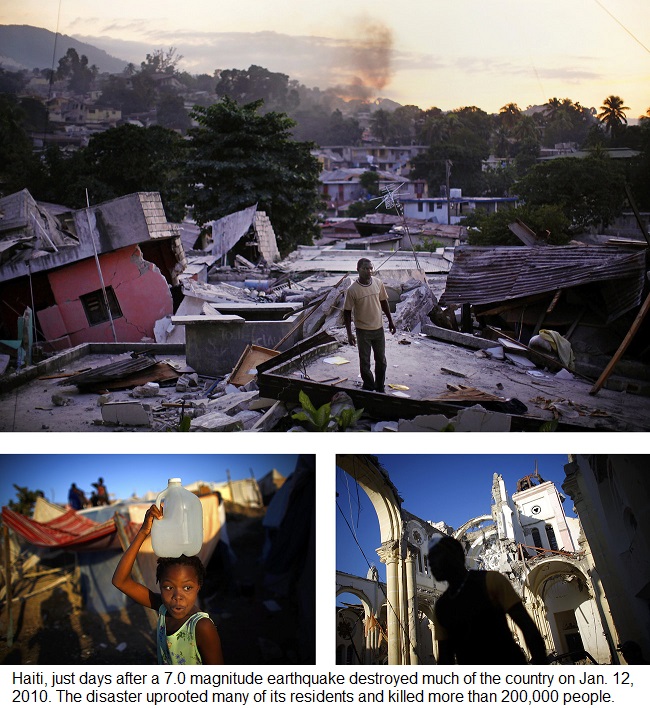
$500 Million In Haiti Relief - Photo 1The motives of the Go Lean book, and accompanying blogs is not to proselytize, but rather to prepare the Caribbean region for “bad actors”, natural or man-made. The book was written in response to the aftermath and deficient regional response following the great earthquake in Haiti on January 12, 2010. Many Non-Government Organizations (NGO) embarked on campaigns to shoulder a response, a relief and rebuilding of Haiti. Many people hold the view that those efforts did a lot of harm, along with some good.

In a previous blog-commentary, it was reported how the fundraising campaign by one group, the American Red Cross, raised almost US$500 million and yet only a “piddling” was spent on the victims and communities themselves.

Now we learn too that many good-intentioned people donated tons of relief supplies that many times turned out to be “more harm than help”. See the story here in this news VIDEO; (and/or the Narration Transcript/photos in the Appendix below):

VIDEO – When disaster relief brings anything but relief – http://www.cbsnews.com/videos/disaster-relief-donations-that-dont-bring-relief

Posted April 24, 2016 – Many of the well-meaning articles Americans donate in times of disaster turn out to be of no use to those in need. Sometimes, they even get in the way. That’s a message relief organizations very much want “us” to heed. This story is reported by Scott Simon, [on loan from] NPR. (VIDEO plays best in Internet Explorer).

This commentary asserts that more is needed in the Caribbean to facilitate good disaster relief, in particular a technocratic administration. This consideration is the focus of the strategies, tactics, implementations and advocacies of the Go Lean…Caribbean book. The declaration is that the Caribbean itself must be agile, lean, and optimized in providing its own solutions for disaster recovery. The alternative, from past experiences like in this foregoing VIDEO, is that others taking the lead for our solution seem to fall short in some way … almost every time!

The Caribbean must now stand up and be counted!

The Go Lean book declares (Page 115) that the “Caribbean should not be perennial beggars, [even though] we do need capital/money to get started”, we need technocratic executions even more.

What is a technocracy?

This is the quest of the Go Lean movement. The movement calls for a treaty to form a technocratic confederation of all the 30 member-states in the Caribbean region. This will form a Single Market of 42 million. The consolidation and integration allows for economies-of-scale and leverage that would not be possible otherwise. “Many hands make a big job … small”. But it is not just size that will define the Caribbean technocracy but quality, efficiency and optimization as well.

According to the Go Lean book (Page 64), the …

“… term technocracy was originally used to designate the application of the scientific method to solving social and economic problems, in counter distinction to the traditional political or philosophic approaches. The CU must start as a technocratic confederation – a Trade Federation – rather than evolving to this eventuality due to some failed-state status or insolvency.”

The book Go Lean…Caribbean serves as a roadmap for the introduction and implementation of the technocratic Caribbean Union Trade Federation (CU) to provide better stewardship for the Caribbean homeland. The foregoing VIDEO describes the efforts of non-governmental organizations (NGO) in shepherding disaster reliefs. These NGO’s are stakeholders in this Caribbean elevation roadmap. Even though many of the 30 member-states are independent nations, the premise of the Go Lean book is that there must be a resolve for interdependence among the governmental and non-governmental entities. This all relates to governance, the need for this new technocratic stewardship of regional Caribbean society. The need for this resolve was pronounced in the opening Declaration of Interdependence (Pages 11 & 14) with these acknowledgements and statements:

i.    Whereas the earth’s climate has undeniably changed resulting in more severe tropical weather storms, it is necessary to prepare to insure the safety and security of life, property and systems of commerce in our geographical region. As nature recognizes no borders in the target of its destruction, we also must set aside border considerations in the preparation and response to these weather challenges.

ii.    Whereas the natural formation of the landmass for our lands constitutes some extreme seismic activity, it is our responsibility and ours alone to provide, protect and promote our society to coexist, prepare and recover from the realities of nature’s occurrences.

x.   Whereas we are surrounded and allied to nations of larger proportions in land mass, populations, and treasuries, elements in their societies may have ill-intent in their pursuits, at the expense of the safety and security of our citizens. We must therefore appoint “new guards” to ensure our public safety and threats against our society, both domestic and foreign. The Federation must employ the latest advances and best practices … to assuage continuous threats against public safety.

xi.   Whereas all men are entitled to the benefits of good governance in a free society, “new guards” must be enacted to dissuade the emergence of incompetence, corruption, nepotism and cronyism at the peril of the people’s best interest. The Federation must guarantee the executions of a social contract between government and the governed.

xii. Whereas the legacy in recent times in individual states may be that of ineffectual governance with no redress to higher authority, the accedence of this Federation will ensure accountability and escalation of the human and civil rights of the people for good governance, justice assurances, due process and the rule of law. As such, any threats of a “failed state” status for any member state must enact emergency measures on behalf of the Federation to protect the human, civil and property rights of the citizens, residents, allies, trading partners, and visitors of the affected member state and the Federation as a whole.

xxxiii.   Whereas lessons can be learned and applied from the study of the recent history of other societies, the Federation must formalize statutes and organizational dimensions to avoid the pitfalls of [other] communities.

This is the quest of CU/Go Lean roadmap: to provide new guards for a more competent Caribbean administration … by governmental organizations and non-governmental organizations. (NGO would also be promoted, audited and overseen by CU administrators). The Caribbean must do better!

Our quest must start “in the calm”, before any storm (or earthquake). We must elevate the societal engines the Caribbean region through economic, security and governance empowerments. In general, the CU will employ better strategies, tactics and implementations to impact its prime directives; identified with the following 3 statements:

  • Optimization of the economic engines in order to grow the regional economy to $800 Billion & create 2.2 million new jobs.
  • Establishment of a security apparatus to protect the resultant economic engines and the Caribbean homeland.
  • Improvement of Caribbean governance to support these engines.

Former US President George W. Bush shares this advocacy!

He narrated this VIDEO here describing the efficiencies of the American logistics company, UPS, in delivering disaster relief:

VIDEO – Report Logistics and Haiti: Points of Light and President Bush – https://youtu.be/8-gmh1QyWTU

Uploaded on Mar 30, 2011 – [In 2009], Transportation Manager Chip Chappelle volunteered to help The UPS Foundation coordinate an ocean shipment of emergency tents from Indiana to Honduras. Since then, he has managed the logistics of humanitarian aid from every corner of the world to help the victims of floods, tsunamis, earthquakes, hurricanes and cyclones.

The Go Lean book stresses our own community ethos, strategies, tactics, implementations and advocacies necessary for the Caribbean to deliver, to provide the proactive and reactive public safety/security provisions in the region. See sample list here:

Community Ethos – Deferred Gratification Page 21
Community Ethos – Economic Principles – Respond to Incentives in Predictable Ways Page 21
Community Ethos – Economic Principles – Economic Systems Influence Individual Choices Page 21
Community Ethos – Economic Principles – Consequences of Choices Lie in the Future Page 21
Community Ethos – Security Principles – Whistleblower Protection Page 23
Community Ethos – Security Principles – Intelligence Gathering Page 23
Community Ethos – Security Principles – “Crap” Happens Page 23
Community Ethos – Governing Principles – Lean Operations Page 24
Community Ethos – Governing Principles – Return on Investments Page 24
Community Ethos – Governing Principles – Cooperatives Page 25
Community Ethos – Ways to Impact the Future Page 26
Community Ethos – Ways to Impact Turn-Arounds Page 33
Community Ethos – Ways to Improve Sharing – Emergency Response Page 35
Community Ethos – Ways to Impact the Greater Good Page 37
Strategy – Vision – Confederate all 30 member-states/ 4 languages into a Single Market Page 45
Strategy – Mission – Prepare for the eventuality of natural disasters Page 45
Strategy – Agents of Change – Climate Change Page 57
Tactical – Ways to Foster a Technocracy Page 64
Tactical – Growing the Economy – Post WW II European Marshall Plan/Recovery Model Page 68
Tactical – Separation-of-Powers – CU Federal Government versus Member-State Governance Page 71
Tactical – Separation-of-Powers – Homeland Security – Emergency Management Page 76
Tactical – Separation-of-Powers – State Department – Liaison/Oversight for NGO’s Page 80
Implementation – Assemble All Regionally-focus Organizations of All Caribbean Communities Page 96
Implementation – Ways to Pay for Change Page 101
Implementation – Ways to Foster International Aid Page 115
Planning – 10 Big Ideas – Homeland Security Pact Page 127
Planning – Ways to Make the Caribbean Better Page 131
Planning – Ways to Improve Failed-State Indices – Governance and the Social Contract Page 134
Advocacy – Ways to Grow the Economy Page 151
Advocacy – Ways to Create Jobs Page 152
Advocacy – Ways to Improve Housing – Hurricane Risk Reinsurance Fund Page 161
Advocacy – Ways to Improve Governance Page 168
Advocacy – Ways to Better Manage the Social Contract Page 170
Advocacy – Ways to Improve Homeland Security Page 180
Advocacy – Ways to Improve for Natural Disasters Page 184
Advocacy – Ways to Develop a Pre-Fab Housing Industry – One solution ideal for Haiti Page 207
Advocacy – Ways to Re-boot Haiti Page 238

The Go Lean roadmap seeks to empower and elevate Caribbean societal engines to be better prepared for the eventual natural disasters. The good intentions of Americans, as depicted in the foregoing VIDEO, is encouraging … but good intentions alone is not enough. We need good management! We need a technocracy! While it is out-of-scope for this roadmap to impact America, we can – and must – exercise good management in our Caribbean region. So what do we want from Americans in our time of need? See VIDEO here:

VIDEO – Donate Responsibly – https://youtu.be/14h9_9sopRA

Published on Nov 2, 2012 – A series of PSAs released by the Ad Council explain why cash is the best way to help. The campaign was launched on November 5, 2012 by the Ad Council and supported by the coalition — which includes CIDI, the U.S. Agency for International Development, InterAction, the UPS Foundation and National Voluntary Organizations Active in Disaster.

The Go Lean book calls on the Caribbean region to be more technocratic: collectively self-reliant, both proactively and reactively. Because of Climate Change or the Last Days, natural disasters (i.e. hurricanes and earthquakes) will occur again and again. Considering that our American neighbors may Pave our Road to Hell with Good Intentions, we need to prepare the right strategies, tactics and implementations ourselves, to make our region a better homeland to live, work and play. 🙂

Download the free e-Book of Go Lean … Caribbean – now!

——————

Appendix Transcript – When disaster relief brings anything but relief

When Nature grows savage and angry, Americans get generous and kind. That’s admirable. It might also be a problem.

“Generally after a disaster, people with loving intentions donate things that cannot be used in a disaster response, and in fact may actually be harmful,” said Juanita Rilling, director of the Center for International Disaster Information in Washington, D.C. “And they have no idea that they’re doing it.”

Rilling has spent more than a decade trying to tell well-meaning people to think before they give.

In 1998 Hurricane Mitch struck Honduras. More than 11,000 people died. More than a million and a half were left homeless.

And Rilling got a wake-up call: “Got a call from one of our logistics experts who said that a plane full of supplies could not land, because there was clothing on the runway. It’s in boxes and bales. It takes up yards of space. It can’t be moved.’ ‘Whose clothing is it?’ He said, ‘Well, I don’t know whose it is, but there’s a high-heeled shoe, just one, and a bale of winter coats.’ And I thought, winter coats? It’s summer in Honduras.”

Humanitarian workers call the crush of useless, often incomprehensible contributions “the second disaster.”

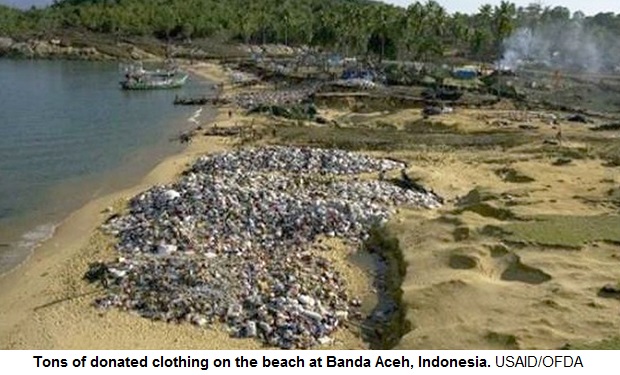
In 2004, following the Indian Ocean tsunami, a beach in Indonesia was piled with used clothing.

There was no time for disaster workers to sort and clean old clothes. So the contributions just sat and rotted.

CU Blog - Logistics of Disaster Relief - Photo 1“This very quickly went toxic and had to be destroyed,” said Rilling. “And local officials poured gasoline on it and set it on fire. And then it was out to sea.”

“So, rather than clothing somebody, it went up in flames?” asked Simon.

“Correct. The thinking is that these people have lost everything, so they must NEED everything. So people SEND everything. You know, any donation is crazy if it’s not needed. People have donated prom gowns and wigs and tiger costumes and pumpkins, and frostbite cream to Rwanda, and used teabags, ’cause you can always get another cup of tea.”

You may not think that sending bottles of water to devastated people seems crazy. But Rilling points out, “This water, it’s about 100,000 liters, will provide drinking water for 40,000 people for one day. This amount of water to send from the United States, say, to West Africa — and people did this — costs about $300,000. But relief organizations with portable water purification units can produce the same amount, a 100,000 liters of water, for about $300.”

And then there were warm-hearted American women who wanted to send their breast milk to nursing mothers in Haiti after the 2010 earthquake.

“It sounds wonderful, but in the midst of a crisis it’s actually one of the most challenging things,” said Rebecca Gustafson, a humanitarian aid expert who has worked on the ground after many disasters.

“Breast milk doesn’t stay fresh for very long. And the challenge is, what happens if you do give it to an infant who then gets sick?”

CU Blog - Logistics of Disaster Relief - Photo 2December 2012, Newtown, Connecticut: A gunman killed 20 children and six adults at Sandy Hook Elementary School. Almost instantaneously, stuff start arriving.

Chris Kelsey, who worked for Newtown at the time, said they had to get a warehouse to hold all the teddy bears.

Simon asked, “Was there a need for teddy bears?”

“I think it was a nice gesture,” Kelsey replied. “There was a need to do something for the kids. There was a need to make people feel better. I think the wave of stuff we got was a little overwhelming in the end.”

And how many teddy bear came to Newtown? “I think it was about 67,000,” Kelsey said. “Wasn’t limited to teddy bears. There was also thousands of boxes of school supplies, and thousands of boxes of toys, bicycles, sleds, clothes.”

Newtown had been struck by mass murder, not a tsunami. As Kelsey said, “I think a lot of the stuff that came into the warehouse was more for the people that sent it, than it was for the people in Newtown. At least, that’s the way it felt at the end.”

Every child in Newtown got a few bears. The rest had to be sent away, along with the bikes and blankets.

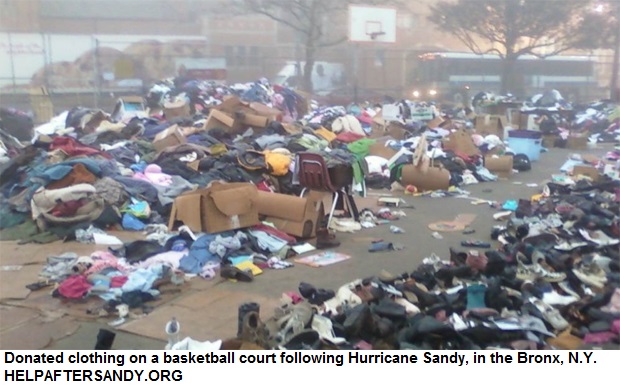
CU Blog - Logistics of Disaster Relief - Photo 3There are times when giving things works. More than 650,000 homes were destroyed or damaged in Hurricane Sandy in 2012. Thousands of people lost everything.

Tammy Shapiro is one of the organizers of Occupy Sandy, which grew out of the Occupy Wall Street movement.

“We were able to respond in a way that the big, bureaucratic agencies can’t,” Shapiro said.

When the hurricane struck, they had a network of activists, connected and waiting.

“Very quickly, we just stopped taking clothes,” Shapiro said. Instead, they created a “relief supply wedding registry.”

“We put the items that we needed donated on that registry,” said Shapiro. “And then people who wanted to donate could buy the items that were needed. I mean, a lot of what we had on the wedding registry was diapers. They needed flashlights.”

Simon asked, “How transportable is your experience here, following Hurricane Sandy?”

“For me, the network is key. Who has the knowledge? Where are spaces that goods can live if there’s a disaster? Who’s really well-connected on their blocks?”

Juanita Rilling’s album of disaster images shows shot after shot of good intentions just spoiling in warehouses, or rotting on the landscape.

“It is heartbreaking,” Rilling said. “It’s heartbreaking for the donor, it’s heartbreaking for the relief organizations, and it’s heartbreaking for survivors. This is why cash donations are so much more effective. They buy exactly what people need, when they need it.

“And cash donations enable relief organizations to purchase supplies locally, which ensures that they’re fresh and familiar to survivors, purchased in just the right quantities, and delivered quickly. And those local purchases support the local merchants, which strengthens the local economy for the long run.”

Disaster response worker Rebecca Gustafson says that most people want to donate something that is theirs: “Money sometimes doesn’t feel personal enough for people. They don’t feel enough of their heart and soul is in that donation, that check that they would send.

“The reality is, it’s one of the most compassionate things that people can do.”

Share this post:
, , , ,
[Top]

Cancer: Doing More

Go Lean Commentary:

If you had a lot of money and wanted to do good in the world, what causes would you pursue?

  • World hunger
  • Education of girls
  • Childhood vaccinations
  • Cancer

That last one is BIG. And noble. And maybe, just maybe viable.

CU Blog - Cancer - Doing More - Photo 1This is the hope of philanthropist-billionaire Sean Parker; (founder of Napster and onetime CEO of Facebook). He is investing his time, talent (business & entrepreneurship) and treasuries in this quest to impact the world of cancer research and treatment.

Kudos, Mr. Parker!

The book Go Lean…Caribbean relates (Page 157) the statement that:

“1-in-3 Americans are due to be diagnosed with cancer … at some point. If 1-in-3 Americans are at risk, then surely Caribbean citizens cannot be far behind”.

This book does not assert to be a roadmap for treating cancer, but rather a roadmap for elevating Caribbean society by optimizing the economic, security and governing engines in the region. Yet, within this roadmap is the strategy to incentivize cancer research and facilitate treatment centers and workable solutions. In fact this roadmap invites role models like this philanthropist-billionaire Sean Parker – featured here in the following VIDEO and article:

VIDEO: Napster Co-Founder Sean Parker Pledges $250M to Fight Cancer
http://www.nbcnews.com/nightly-news/video/napster-co-founder-sean-parker-pledges-250m-to-fight-cancer-665463363805

NBC Nightly News – Posted 04-13-2016 – The Silicon Valley billionaire and Napster co-founder is putting his money behind a new cancer institute focusing on the emerging field of cancer immunotherapy.

News Article Title: Sean Parker Donates $250 Million to Launch Cancer Immunotherapy Institute
By: Reuters
Silicon Valley billionaire Sean Parker – see photo here – will donate $250 million to launch a new institute aimed at developing more effective cancer treatments by fostering collaboration among leading researchers in the field.

“Any breakthrough made at one center is immediately available to another center without any kind of IP (intellectual property) entanglements or bureaucracy,” Parker, the co-founder of music-sharing website Napster and the first president of Facebook, told Reuters in an interview.

The new Parker Institute for Cancer Immunotherapy will focus on the emerging field of cancer immunotherapy, which harnesses the body’s immune system to fight cancer cells.

It will include over 40 laboratories and more than 300 researchers from six key cancer centers: New York’s Memorial Sloan Kettering, Stanford Medicine, the University of California, Los Angeles, the University of California, San Francisco, Houston’s University of Texas MD Anderson and the University of Pennsylvania in Philadelphia.

Recently approved drugs have helped some patients sustain remission. But those first-generation therapies do not work for everyone, and scientists are trying to understand how to make them more effective.

“Very little progress has been made over the last several decades,” Parker said, referring to cancer drug research. “Average life expectancy has only increased three to six months with some of these drugs that cost billions to develop.”

Parker said the current system of cancer drug development discouraged the kinds of risk-taking that could lead to a major breakthrough.

The new institute “is paradigm shifting,” said Dr. Jedd Wolchok, chief of the melanoma and immunotherapeutics unit at Memorial Sloan Kettering Cancer Center.

He said it would alleviate the need for scientists to secure grants, which he said took up at least 30 percent of his time, foster collaboration among accomplished scientists and provide access to the newest information processing and data technology.

“I have no doubt this will allow us to make progress, and to make it much more quickly,” Wolchok said.
Source: NBC Nightly News – Retrieved 04-13-2016 from: http://www.nbcnews.com/health/cancer/sean-parker-donates-250-million-launch-cancer-immunotherapy-institute-n555196 

Related: Mark Zuckerberg’s ‘Initiative’ Adds New Wrinkle to Tech Philanthropy

The Go Lean book serves as a roadmap for the implementation and introduction of the technocratic Caribbean Union Trade Federation (CU). The CU‘s prime directives are identified with the following 3 statements:

  • Optimization of the economic engines in order to grow the regional economy to $800 Billion & create 2.2 million new jobs.
  • Establishment of a security apparatus to protect the resultant economic engines.
  • Improve Caribbean governance to support these engines.

The Go Lean book asserts that healthcare covers all the above 3 facets of the prime directives. Healthcare costs can easily bankrupt a family, community or a nation; economic security, public safety and government entitlements are therefore embedded in any discussion about cancer and its community impact.

The book also posits that one person can make a difference and maybe even change the world. The efforts of Sean Parker may very well fit this advocacy. He is therefore a role model for Caribbean philanthropists; he is doing more! We invite this type of impact in the Caribbean.

The Go Lean roadmap calls for more medical R&D initiatives like what Mr. Parker is pursuing. The roadmap strategizes the adoption of Self-Governing Entities (SGE) to employ medical research and treatment campuses. These dedicated, bordered grounds are ideal for immuno-therapy research and treatment. We hereby extend the invitation to all innovators and facilitators who want to do more in cancer research to come to the Caribbean. These ones will find cooperative and supportive governing structures to facilitate their impact on the world. They can do more … against cancer.

The Go Lean book strategizes economic empowerment in the region, clearly relating that healthcare and pharmaceuticals research/developments are important in the quest to make the Caribbean a better place to live, work, heal and play. At the outset of the Go Lean book, in the Declaration of Interdependence (Page 11), these points are pronounced:

viii.  Whereas the population size is too small to foster good negotiations for products and commodities from international vendors, the Federation must allow the unification of the region as one purchasing agent, thereby garnering better terms and discounts.

ix.  Whereas the realities of healthcare and an aging population cannot be ignored and cannot be afforded without some advanced mitigation, the Federation must arrange for health plans to consolidate premiums of both healthy and sickly people across the wider base of the entire Caribbean population. The mitigation should extend further to disease management, wellness, obesity and smoking cessation programs.

xxviii.  Whereas intellectual property can easily traverse national borders, the rights and privileges of intellectual property must be respected at home and abroad. The Federation must install protections to ensure that no abuse of these rights go with impunity, and to ensure that foreign authorities enforce the rights of the intellectual property registered in our region.

Previous blog/commentaries addressed issues of cancer and other medical research and practices, sampled here:

Using Group Purchasing Organizations to lower HealthCare costs
Role Model Shaking Up the World of Cancer
The Cost of Cancer Drugs
Antibiotics Misuse Linked to Obesity in the US
CHOP Research: Climate Change May Bring More Kidney Stones
Welcoming Innovators and Entrepreneurs under an SGE Structure
Big Pharma & Criminalization of American Business
Medical Research Associates Kidney Stones and Climate Change – Innovative!
New Research and New Hope in the Fight against Alzheimer’s Disease
Research in Diabetes Detection – Novartis and Google develop ‘smart’ contact lens
Health-care fraud in America; criminals take $272 billion a year
New Cuban Cancer medication registered in 28 countries
Puerto Rico’s Comprehensive Cancer Center Project Breaks Ground – Model of Medical SGE

Cancer is a crisis! The Go Lean book declares that a “crisis is a terrible thing to waste”. This premise is loud-and-clear from the foregoing VIDEO, that there is money to be made in this industry-space. But most importantly, there are lives to be saved.

The Go Lean roadmap posits that more innovations will emerge in the region as a direct result of the CU prioritization on science, technology, engineering and medical (STEM) activities on Caribbean R&D campuses and educational institutions. This is based on the assumption that intellectual properties (IP) registered in the Caribbean region will be duly respected around the world.

This IP protection mandate is a heavy-lifting task for the Caribbean Union Trade Federation. This is an example of the issues related to economic, security and governance that need to be managed in a technocracy.

The CU has the prime directive of optimizing these economic, security and governing engines of the Caribbean region. The foregoing article and VIDEO depicts that R&D is very important to medical innovations. So the roadmap thusly focuses on the community ethos to promote R&D as valuable for the region. The following list details this and other community ethos, plus the strategies, tactics, implementations and advocacies to optimize the region’s healthcare deliveries and R&D investments:

Community Ethos – Deferred Gratification Page 21
Community Ethos – Economic Systems Influence Individual Choices and Incentives Page 21
Community Ethos – The Consequences of Choices Lie in the Future Page 21
Community Ethos – Governing Principles – Return on Investments Page 24
Community Ethos – Governing Principles – Cooperatives Page 25
Community Ethos – Non-Government Organizations Page 25
Community Ethos – Ways to Impact Research & Development (R&D) Page 30
Community Ethos – 10 Ways to Promote Happiness Page 36
Community Ethos – Ways to Impact the Greater Good Page 37
Strategy – Integrate and unify region in a Single Market Page 45
Strategy – Agents of Change – Globalization Page 57
Tactical – Fostering a Technocracy Page 64
Tactical – Separation of Powers – Health Department Page 86
Tactical – Separation of Powers – Drug Administration Page 87
Implementation – Ways to Pay for Change Page 101
Implementation – Ways to Implement Self-Government Entities – R&D Campuses Page 105
Implementation – Ways to Deliver Page 109
Planning – Big Ideas for the Caribbean Region Page 127
Planning – Ways to Make the Caribbean Better Page 131
Advocacy – Ways to Improve Healthcare Page 156
Advocacy – Ways to Better Manage the Social Contract Page 170
Advocacy – Ways Foster Cooperatives Page 176
Advocacy – Ways to Improve Emergency Management Page 196
Advocacy – Ways to Impact Foundations Page 219
Advocacy – Ways to Impact Persons with Disabilities Page 228
Appendix – Emergency Management – Medical Trauma Centers Page 336

The Go Lean book or movement does not purport to be an authority on cancer research or any medical best practices. No economic-security-governance empowerment plan should ever dictate the course of direction for cancer research and/or treatment. But the war on cancer has been stagnant for far too long; more needs be done. The solutions must be incentivized for private enterprises and private individuals – role models. The SGE structure invites innovations like that of Sean Parker and many others with this same passion … and some degree of genius.

Now is the time for all of the Caribbean, the people and governing institutions, to lean-in for the empowerments in the book Go Lean … Caribbean. This concept of Self-Government Entities (Page 127) is a Big Idea for the region. Change can really take hold, and thrive. We can do more … for cancer.  We can make the Caribbean a better place to live, work, heal and play. 🙂

Download the free e-book of Go Lean … Caribbean – now!

Share this post:
, , , ,
[Top]

Being Lean: Asking the Question ‘Why’ 5 Times

Go Lean Commentary

“The Caribbean is arguably the greatest address on the planet”, as declared in the book Go Lean…Caribbean. (This “greatest” attribute is defined for terrain, culture and hospitality). Yet the region has an unconscious-able brain drain rate, where 70 percent of the tertiary-educated population has fled.

Why!?

This question has been asked repeatedly! Many times the published answers are really describing the symptoms and not the root-causes. In the end, the answer is not so easy! The Go Lean book defines it as heavy-lifting. The Go Lean approach is an examination of the word “Lean”. In the book the word is presented as a noun, a verb and an adjective; all inclusive of the agile concept. The lean/agile concept is an understanding that value is a derived-result from a continuously optimizing key process, that repeats as a cycle .. again and again.

The Go Lean book (Page 4) relates that …

… lean thinking changes the focus of management from optimizing separate technologies, assets, and vertical departments to optimizing the flow of products and services through entire value streams that flow horizontally across technologies, assets, and departments to customers.

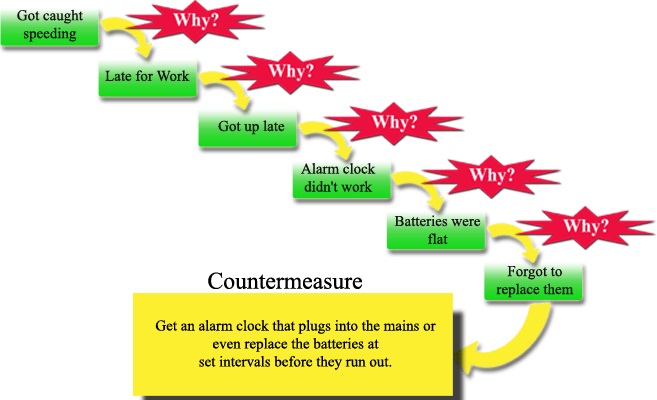
One expression of the lean methodology that can be used to dissect/”add value” to the key question (” Why such a high brain drain rate”) in this commentary is the iterative interrogative technique: 5 Why’s. See details of this agile-lean technique below. Using this technique, the 5 Why’s needs to be extended to 7 actual Why questions, as follows:

Problem: Why do Caribbean citizens abandon their homelands?

  1. “Push and Pull” reasons. “Push”, as in people fleeing to find refuge and “pull” in the perception (though false) that life is better on foreign shores. Why?
  2. Societal defects – in the region – are so acute. Why?
  3. Societal engines (responsible for economics, security & governance) not optimized. Why?
  4. Colonial Masters did not engage best-practices. Why?
  5. Foreign Policy in the colonies was to just keep them dependent. Why?
  6. Colonizers promoted home country commerceMercantilism; slavery in the colonies, but not at home (i.e. Serfism, French Revolution). Why?
  7. European Community Ethos: OK to exploit African Race as declared by Pope Innocent VIII.

s - Photo 1

s - Photo 2

See the encyclopedic details and a related VIDEO here:

Reference Title: 5 Whys
Source: 
Wikipedia Online Encyclopedia – Retrieved 04/07/2016 from: https://en.wikipedia.org/wiki/5_Whys

5 Whys is an iterative interrogative technique used to explore the cause-and-effect relationships underlying a particular problem.[1] The primary goal of the technique is to determine the root cause of a defect or problem by repeating the question “Why?” Each question forms the basis of the next question. The “5” in the name derives from an empirical observation on the number of iterations typically required to resolve the problem.

The technique was formally developed by Sakichi Toyoda and was used within the Toyota Motor Corporation during the evolution of its manufacturing methodologies. In other companies, it appears in other forms. Under Ricardo Semler, Semco practices “three whys” and broadens the practice to cover goal setting and decision making.[2]

Not all problems have a single root cause. If one wishes to uncover multiple root causes, the method must be repeated asking a different sequence of questions each time.

The method provides no hard and fast rules about what lines of questions to explore, or how long to continue the search for additional root causes. Thus, even when the method is closely followed, the outcome still depends upon the knowledge and persistence of the people involved.

—–

The questioning for this example could be taken further to a sixth, seventh, or higher level, but five iterations of asking why is generally sufficient to get to a root cause. The key is to encourage the trouble-shooter to avoid assumptions and logic traps and instead trace the chain of causality in direct increments from the effect through any layers of abstraction to a root cause that still has some connection to the original problem. Note that, in this example, the fifth why suggests a broken process or an alterable behaviour, which is indicative of reaching the root-cause level.

It is interesting to note that the last answer points to a process. This is one of the most important aspects in the 5 Why approach – the real root cause should point toward a process that is not working well or does not exist.[3] Untrained facilitators will often observe that answers seem to point towards classical answers such as not enough time, not enough investments, or not enough manpower. These answers may be true, but they are out of our control. Therefore, instead of asking the question why?, ask why did the process fail?

A key phrase to keep in mind in any 5 Why exercise is “people do not fail, processes do”.

Rules of performing “5 Whys”

In order to carry out the 5-Why analysis properly, following advices should be kept:

  1. It is necessary to engage the management in 5 Whys standard in the company. For the analysis itself, remember about right working group. Also consider facilitator presence for more difficult topics.
  2. Use paper or whiteboard instead of computers.
  3. Write down the problem and make sure that all people understand it.
  4. Distinguish causes from symptoms.
  5. Take care of the logic of cause-and-effect relationship.
  6. Make sure that root causes certainly lead to the mistake by reversing the sentences created as a result of the analysis with the use of expression “and therefore”.
  7. Try to make our answers more precise.
  8. Look for the cause step by step. Don’t jump to conclusions.
  9. Base on facts and knowledge.
  10. Assess the process, not people.
  11. Never leave “human error”, “worker’s inattention”, etc. as the root cause.
  12. Take care of the atmosphere of trust and sincerity.
  13. Ask the question “why” until the root cause is determined, i.e. such cause the elimination of which will cause that the error will not occur again.[7]

Criticism

While the 5 Whys is a powerful tool for engineers or technically savvy individuals to help get to the true causes of problems, it has been criticized … as being too basic a tool to analyze root causes to the depth that is needed to ensure that they are fixed.[8] Reasons for this criticism include:

  • Tendency for investigators to stop at symptoms rather than going on to lower-level root causes.
  • Inability to go beyond the investigator’s current knowledge – cannot find causes that they do not already know.
  • Lack of support to help the investigator ask the right “why” questions.
  • Results are not repeatable – different people using 5 Whys come up with different causes for the same problem.
  • Tendency to isolate a single root cause, whereas each question could elicit many different root causes.

These can be significant problems when the method is applied through deduction only. On-the-spot verification of the answer to the current “why” question before proceeding to the next is recommended to avoid these issues. In addition, performing logical tests for necessity and sufficiency at each level can help avoid the selection of spurious causes and promote the consideration of multiple root causes.[9]

s - Photo 3

————————

VIDEO – 5 Whys Root Cause Analysis Problem Solving Tool–Video Training – https://youtu.be/zvkYFZUsBnw

Uploaded on Jul 23, 2009 – The 5 Whys (Free 6-Page PDF at http://www.velaction.com/5-whys/ ) is one of the simplest problem solving tools used in Lean manufacturing and Lean offices. This presentation shows how to use the 5 Whys, and what to watch out for. Created and presented by Jeff Hajek of Velaction Continuous Improvement.
Category: How to & Style
License: Standard YouTube License

Wow, the root cause “Why Caribbean citizens abandon their homelands” is tied to the community ethos and embedded racial inequalities in the ancient European world. Now that we know – thanks to the iterative interrogative technique – we can deploy new community ethos plus new strategies, tactics, implementations and advocacies to turn-around Caribbean failings into opportunities for success.

The Go Lean book identifies Toyota Motor Company as a role model for deploying agile/lean methodologies in delivering quality. Quality delivery is a mission of the Go Lean movement. The book serves as a roadmap for the introduction and implementation for the technocratic Caribbean Union Trade Federation (CU). As a federal government, there will be the need to employ agile/lean methodologies to ensure that a small organizational footprint can provide the facilitations to enhance the region’s economic, security and governing engines. For a regional population of 42 million, the plan is to only engage 30,000 federal civil servants, but with a lot of systems and agile methodologies. That is lean!

By being lean, the stewards of this new Caribbean can fulfill the Go Lean vision: a better region to live, work and play. In the end, we would dissuade the brain drain, and then eventually invite the Diaspora to return, to repatriate to their ancestral homelands.

The Go Lean book was constructed with community ethos – national spirit that drives the character and identity of its people – in mind, plus the execution of strategies, tactics, implementation and advocacies to keep the regional government lean. The following is a sample of these specific details from the book:

Preface – Use of “Lean” in the Public Sphere Page 4
Community Ethos – Deferred Gratification Page 21
Community Ethos – Economic Principles – Economic Systems Influence Individual Choices Page 21
Community Ethos – Economic Principles – The Consequences of Choices Lie in the Future Page 21
Community Ethos – Governing Principles – Lean Operations Page 24
Community Ethos – Ways to Impact the Future Page 26
Community Ethos – Ways to Help Entrepreneurship – Incubators Page 28
Community Ethos – Ways to Impact Research & Development Page 30
Community Ethos – Ways to Improve Sharing Page 35
Community Ethos – Ways to Promote Happiness Page 36
Community Ethos – Ways to Impact the Greater Good Page 37
Strategy – Mission – Build and foster local economic engines Page 45
Tactical –  Separation of Powers: Federal Administration versus Member-States Governance Page 71
Implementation – Ways to Pay for Change Page 101
Implementation – Reasons to Repatriate to the Caribbean Page 118
Planning – Ways to Make the Caribbean Better Page 131
Advocacy – Ways to Grow the Economy Page 151
Advocacy – Ways to Create Jobs Page 152
Advocacy – Ways to Improve Governance in the Caribbean Region Page 168
Advocacy – Ways to Better Manage the Social Contract Page 170
Advocacy – Ways to Improve Leadership Page 171
Advocacy – Ways to Manage Federal Civil Service Page 173
Advocacy – Ways to Impact the Diaspora Page 217
Advocacy – Ways to Preserve Caribbean Heritage Page 218

The Go Lean roadmap presents the CU as a real organizational structure. So all the references in the foregoing encyclopedic reference regarding agile-lean organizations, enterprises, companies and/or firms could apply directly and indirectly to the CU Trade Federation. Yet, the federal agencies and civil servants are not the only focus of the Go Lean/CU roadmap. The prime directives of this roadmap is to reach out into the community and impact the societal engines in these ways:

  • Optimization of the economic engines in order to grow the regional economy to $800 Billion & create 2.2 million new jobs.
  • Establishment of a security apparatus to protect the resultant economic engines.
  • Improve Caribbean governance to support these engines.

Previously, Go Lean blogs detailed other opportunities to deploy agile methodologies. Consider this sample:

https://goleancaribbean.com/blog/?p=7646 Methodology for going from ‘Good to Great
https://goleancaribbean.com/blog/?p=6921 “Live. Work. Play. Repeat” – Need for Agile Rewards program
https://goleancaribbean.com/blog/?p=6016 Case Study of a Lean Utility to Assuage Excessively Hot Weather
https://goleancaribbean.com/blog/?p=3956 Art and Science of Collaboration
https://goleancaribbean.com/blog/?p=3152 The formal process of Making a Great Place to Work®
https://goleancaribbean.com/blog/?p=915 Go Green Caribbean – Pursuits for Lean energy in the region

The message to the people of the Caribbean region is that the Caribbean’s past is not to be the Caribbean’s future. The catalyst for change in the Caribbean is the CU. This “heavy-lifting” task to implement agile/lean methodologies in the Caribbean is the charter of the CU technocracy.

Now is the time for all Caribbean stakeholders – residents, Diaspora, businesses and institutions – to lean-in for the optimizations and empowerments described in the book Go Lean … Caribbean. Yes, we can make the region a better homeland to live, work and play. 🙂
Download the book Go Lean … Caribbean – now!

Share this post:
,
[Top]

Lessons from Regional Elections

Go Lean Commentary

Imagine spending $5.3 Billion dollars to buy a “service” and then the logistics fail in the final delivery.

Unfortunately, this can describe the election process in the United States. In 2008, according to the book Go Lean…Caribbean, that amount of money was spent on the Presidential campaign. Surely those spending that money, wanted to have their candidates win. It would be so unfortunate that when Election Day finally comes around that the delivery – balloting – is flawed:

  • hanging chads
  • long lines
  • computer glitches
  • incorrect registration
  • wrong polling stations
  • absentee ballots
  • provisional ballots
  • photo ID

These and many other issues persist…

… the biggest problem being voter apathy, especially among the young.

With this greatest threat – voter apathy – that $5.3 Billion investment (for 2008, even though more have been spent in 2012 and the current 2016 campaign) maybe in jeopardy. “Say it ain’t so”…

Here come the solutions. Perhaps technology offers some mitigation to these risks. Consider this:

Question: Will US citizens be able to cast their vote online during the 2016 presidential election?

Answer: Probably not on a mass scale. Currently, Alaska is the only state that allows any eligible voter to vote electronically.

It is unlikely that this will become commonplace across the country in the next two years.

However, perhaps this will change over time if online security measures improve and as popular opinion changes. Among all age groups, Millennials tend to be more interested in online voting.

By: Steve Johnston, (Worked on Political Campaigns and in Congress) Written 11 Feb 2015 ; retrieved April 4, 2016 from: https://www.quora.com/Will-US-citizens-be-able-to-cast-their-vote-online-during-the-2016-presidential-election

Online voting seems so logical. What are the obstacles? Why not now? Who is doing it? When will the US (as the world’s leading democracy) see this utility?

What?
Why?
Who?
When?

These are powerful questions; appropriate ones considering that “power” is the commodity at stake.

Consider this article here based on 2012, that answers a lot of these questions:

Article #1 Title: Why you can’t vote online yet
By: Julianne Pepitone

CNNMoney (New York) – Online voting is taking off in local elections, particularly overseas. But Americans shouldn’t expect to vote for the president on their laptop or iPad anytime soon.

The battle over whether to digitize the voting process has become a full-blown war in the United States, even as countries like Canada, Norway and Australia have increasingly adopted online systems. Proponents say going digital will boost voter turnout, while naysayers cite hacking and other security threats as risks too great to overcome in the near future.

“It’s such a different world than it was 20 years ago, and yet very little has changed in our voting process,” says Rob Weber, a former IT professional at IBM (IBM), who started the blog Cyber the Vote in 2010.

Like many supporters of online voting, Weber points out that many young Americans don’t vote. Bringing the voting process to a format they’re familiar with — a website on a PC, tablet, or even a mobile phone — would overcome the “enthusiasm gap,” he believes.

But that argument hasn’t been enough to bring online voting into the mainstream. For that, Weber places the blame squarely on election officials whom he says aren’t interested in changing the status quo.

“They find online voting culturally distasteful,” Weber says. “They bring up theoretical hacking situations in order to make people afraid of the concept of change. And unfortunately it works.”

Security researchers don’t think those concerns are merely theoretical. Michael Coates, chair of the Open Web Application Security Project (OWASP) and director of security assurance at Firefox maker Mozilla, says hackers will attack anything worth hacking.

“It’s guaranteed that such a system [online voting] would be attacked, for sure,” Coates says. “All important systems, from financial to government, face skilled hackers. There are security flaws in every system; it’s a matter of how you detect and respond to them.”

Home PCs, in particular, are susceptible to a myriad of cyberattacks that could be used to alter a user’s vote.

“Until we can reliably foil malware and viruses — and who knows when that will be — it’s hard to consider a system in which we vote from our home computers,” Coates says.

Such issues have felled some past attempts at online voting in the United States.

In 2004, the military began testing the Secure Electronic Registration and Voting Experiment (SERVE), which would have let service members stationed overseas vote online in the general election. But Deputy Defense Secretary Paul Wolfowitz scrapped the plan after government-commissioned studies warned of extensive security flaws.

Another oft-cited failure came in 2010, when Washington, D.C., conducted a pilot project to allow overseas or military voters to download and return absentee ballots over the Internet. Before opening the system to real voters, D.C. invited the public to evaluate whether the system could be hacked.

It was. Within 36 hours of going live.

A University of Michigan team “found and exploited a vulnerability that gave us almost total control of the server software, including the ability to change votes and reveal voters’ secret ballots,” professor J. Alex Halderman later wrote in a blog post about the hack.

Halderman termed the system “brittle” and proclaimed online voting too dangerous to implement anytime soon.

“It may someday be possible to build a secure method for submitting ballots over the Internet, but in the meantime, such systems should be presumed to be vulnerable based on the limitations of today’s security technology,” he wrote.

Such high-profile debacles are a difficult obstacle for online voting companies like Everyone Counts, says CEO Lori Steele.

“The problem with the D.C. hacking is that it was a less-than-mediocre system run by people who had no experience,” Steele says. “When people use it as an example, it’s like, c’mon — those issues were all security 101.”

Bad PR for any online voting attempt undermines the entire cause, Steele says. Still, California-based Everyone Counts has run online elections for local and municipal contests in U.S. locations including West Virginia, Honolulu, El Paso, Chicago and Washington state, in addition to the United Kingdom and Australia.

CU Blog - Lessons from Regional Elections - Photo 4Everyone Counts uses “military-grade encryption” for its ballots, and can also provide a paper trail for clients who want it, Steele says. A “transparent code” policy allows any client to inspect the company’s source code.

While Steele admits that online voting, like any system, is susceptible to attacks, she thinks the sheer number of devices in the wild would make it difficult for would-be hackers to hit their targets.

“They don’t know which PCs or tablets or phones will be used for voting,” Steele says. “Plus, people talk about paper being the Holy Grail of security, but that is so far from reality.”

The biggest limitation of paper ballots was on display last week, when Hurricane Sandy decimated parts of the northeastern United States. The storm’s destruction cut many voters off from their scheduled polling station.

On Saturday, New Jersey announced that displaced storm victims will qualify as “overseas voters,” meaning they are eligible to vote via e-mail or fax.

“The storm was awful, but it could serve as a wider reminder that we need to reform the system,” says Michelle Shafer, director of communications at Scytl USA.

Scytl’s Spanish parent company has conducted online voting in over 30 countries worldwide. In the U.S., it’s slowly gaining steam. The company has completed online “ballot delivery” — digitally delivering a paper-ballot-like form that voters can fill out and submit — in six U.S. states. Those digital ballots are typically used by military members and overseas residents. It has also run direct online voting for local elections in West Virginia, Florida and Alaska.

“I don’t think we’ll be voting online by [2016’s general election], but my hope is that we’ll continue to take slow and measured steps toward that eventuality,” she adds.

While the United States takes it slow, countries like Canada and Norway continue to expand online voting.

Dean Smith, president and founder of Canada’s leading online-voting firm, Intelivote, says the divide between his home country and the United States is vast. Popular Canadian labor unions have used online voting for years — which means users have grown accustomed to the process — and the country’s ballots tend to be far less complex than those in the United States.

“In general, people here see the benefits of online voting and there’s an acceptance,” Smith says of Canada. “The U.S. would be a great coup, but there are so many academics who made their name by being naysayers. There’s so much fighting about it. Right now, we don’t need the additional problems.”

Source: http://money.cnn.com/2012/11/06/technology/innovation/online-voting-election/ Posted November 6, 2012; retrieved April 4, 2016

VIDEO – How Your Vote Can Be Hacked – http://money.cnn.com/video/technology/2012/10/31/ts-voting-machine-hack.cnnmoney/

The experience in the US is that the politicians do not always represent the majority of the people, but rather the majority of the passionate. This country thusly provides good, bad and ugly examples as lessons for us in the Caribbean, where we do have our own challenges. Many times for Caribbean elections, there is the need for international monitors to observe and report on the fairness of our balloting. In the last few months, there have been elections in numerous Caribbean member-states, i.e. Jamaica and Haiti; (in fact every country must re-vote in 4 – 5 years). These have been fraught with contention and controversy.

We need to be better and do better. Facilitating an efficient election need not be “rocket science”.

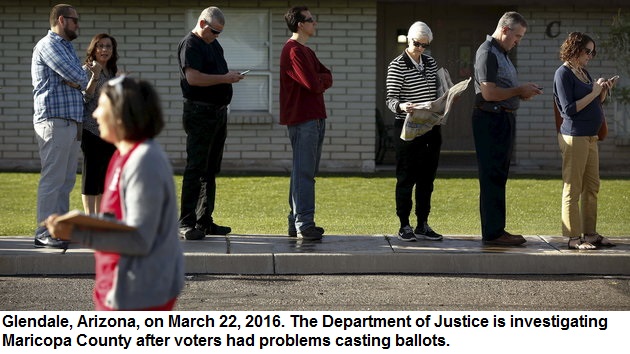
The book Go Lean … Caribbean asserts that the current system for Federal campaigns and elections in the US is not the model that the Caribbean would want to emulate – we must do even better than our American counterparts.  This book relates that $5.3 Billion was spent for the 2008 US Federal Elections (Page 116), a lot of it contributed by corporations and Political Action Committees (PACs) so as to peddle influence. Then when the voter turn-out is discouraged or suppressed because of any lack of efficiency, this results in even more influence, as now only the passionate will participate in the election process, as most other people cannot tolerate the dysfunction. Consider the example in the Appendix below of long voting lines in Arizona, suppressing the vote – people cannot wait around for 5 hours – especially in the minority communities.

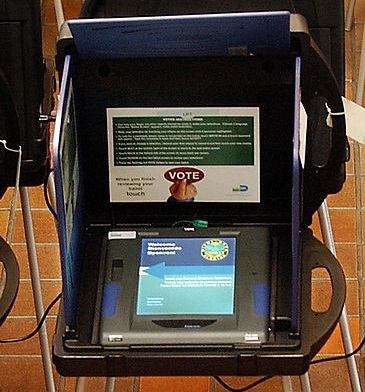
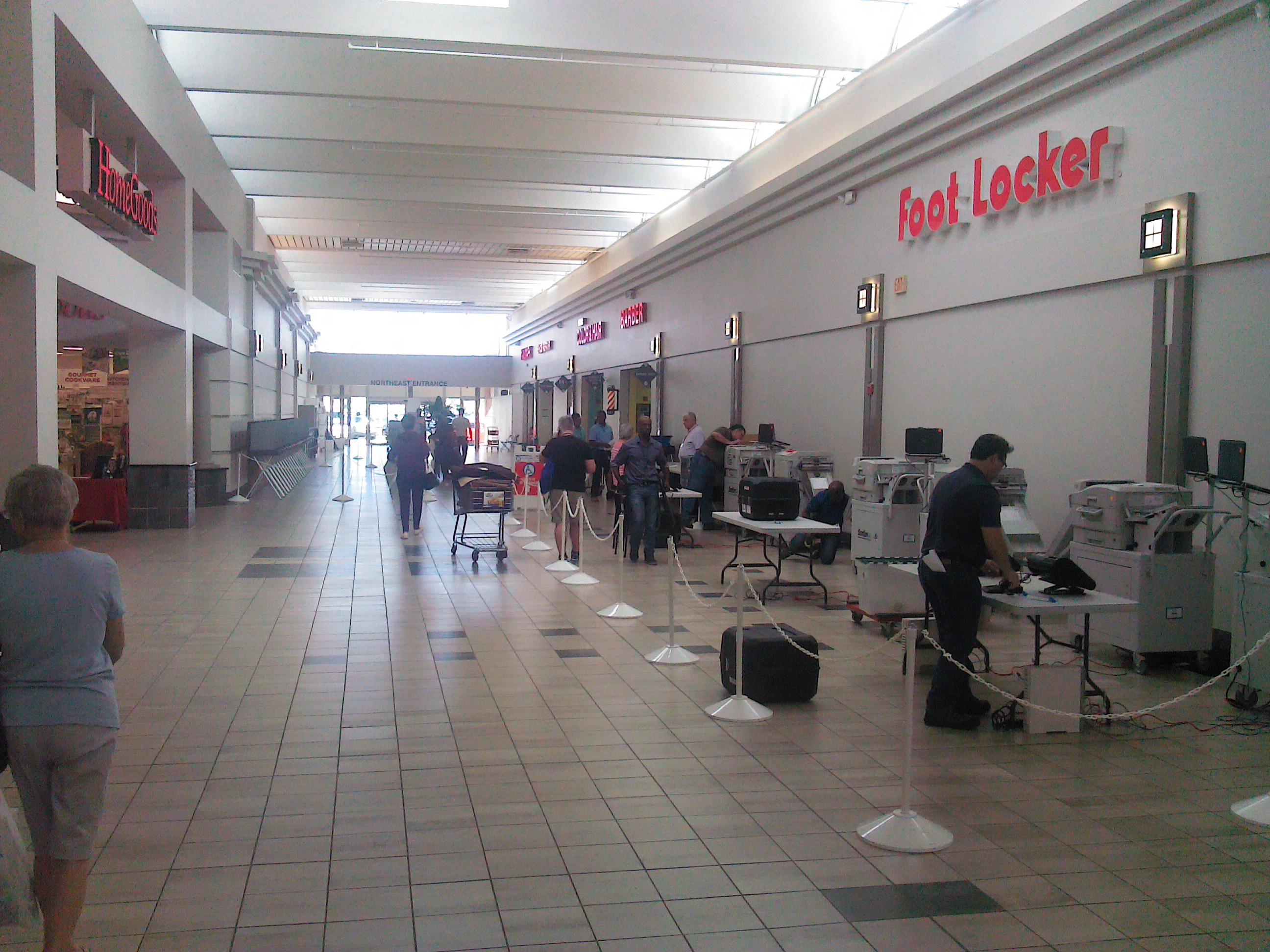
The model sought for the Caribbean is to facilitate the polling of every vote for everyone wanting to participate in the political process, no matter who they are, where they are, what they are voting for or when they vote. Yes, this means local polling stations in convenient places (private/public) – like the shopping mall example in these photos.

CU Blog - Lessons from Regional Elections - Photo 1 CU Blog - Lessons from Regional Elections - Photo 2 CU Blog - Lessons from Regional Elections - Photo 3

The Go Lean book serves as a roadmap for the introduction and implementation of the technocratic Caribbean Union Trade Federation (CU). It advocates learning lessons from other societies so as to optimize the societal engines of economics, security and governance. Elections are an expression of all three of these branches of society. It should be about the people and their will, not about the power and retaining it. This book, roadmap and movement therefore advocates the CU being deputized/in-sourced to facilitate elections, including online, electronic systems in physical polling and absentee balloting – i.e. Diaspora.

The lesson from regional elections, like Arizona in the Appendix and Florida in the photos, is that the election process must submit to a higher oversight. For the member-states in the US, that oversight is wielded by the US federal government (Executive Branch – Department of Justice – and the Courts). We need similar oversight in the Caribbean; this is embedded in the roadmap for the CU Federation, our regional federal government. Despite our region’s size (only 42 million people in 30 member-states), we can do better than our American neighbors in the election-campaign process. We can be a protégé, not just an American parasite.

The CU’s prime directive, elevating the Caribbean’s economic-security-governing engines, recognizes that the changes the region needs must start first with the adoption of new community ethos and controls: the people need to feel empowered, that  their voice and votes count, no matter their ethnicity, language or minority status. Early in the book, this need was pronounced in the opening Declaration of Interdependence  (Page 12) with these statements:

xi.  Whereas all men are entitled to the benefits of good governance in a free society, “new guards” must be enacted to dissuade the emergence of incompetence, corruption, nepotism and cronyism at the peril of the people’s best interest. The Federation must guarantee the executions of a social contract between government and the governed.

xii. Whereas the legacy in recent times in individual states may be that of ineffectual governance with no redress to higher authority, the accedence of this Federation will ensure accountability and escalation of the human and civil rights of the people for good governance, justice assurances, due process and the rule of law. As such, any threats of a “failed state” status for any member state must enact emergency measures on behalf of the Federation to protect the human, civil and property rights of the citizens, residents, allies, trading partners, and visitors of the affected member state and the Federation as a whole.

The Go Lean book, and previous blog/commentaries, stressed the key community ethos, strategies, tactics, implementation and advocacies necessary to effect change in the region, to improve the oversight of the governing process. They are detailed as follows:

Community Ethos – Economic Principles Page 21
Community Ethos – Security Principles – Private Interest –vs- Public Protection Page 23
Community Ethos – Security Principles – “Light Up Dark Place” Page 23
Community Ethos – Governing Principles – Lean Operations Page 24
Community Ethos – Ways to Impact the Future – Give the Youth a Voice & Vote Page 26
Community Ethos – Impact Research and Development – Develop Technology Page 30
Community Ethos – Ways to Impact Turn-around Page 33
Community Ethos – Ways to Impact the Greater Good Page 37
Strategy – Mission – Embrace the advances of technology Page 47
Strategy – CU Stakeholders to Protect – Diaspora Page 47
Tactical – Separation-of-Powers – Secretary of State – Elections Bureau Page 80
Anecdote – Turning Around CARICOM – Deputized for election oversight Page 92
Implementation – Assemble Caribbean Election Oversight as Cooperative Page 96
Implementation – Assemble Constitutional Convention – Start of federal elections Page 97
Implementation – Ways to Impact Elections Page 116
Planning – 10 Big Ideas – Cyber Caribbean Page 127
Planning – Ways to Improve Failed-State Indices – Election Outsourcing Page 134
Planning – Lessons Learned from US Constitution Page 145
Planning – Ways to Measure Progress Page 147
Advocacy – Ways to Grow the Economy Page 151
Advocacy – Ways to Foster Technology – Heavy focus on systems Page 197
Advocacy – Ways to Foster e-Commerce Page 198
Advocacy – Ways to Promote Contact Centers – Big Data Analysis Page 212

The points of effective, technocratic regional oversight and stewardship were further elaborated upon in these previous blog/commentaries:

https://goleancaribbean.com/blog/?p=7646 Going from ‘Good to Great’
https://goleancaribbean.com/blog/?p=7528 Sample Vision of 1 City, Freeport, as a Self-Governing Entity
https://goleancaribbean.com/blog/?p=7204 ‘The Covenant with Black America’ – Ten Years Later
https://goleancaribbean.com/blog/?p=6965 Secrecy, corruption and conflicts of interest pervade state governments
https://goleancaribbean.com/blog/?p=6937 Women in Politics – Yes, They Can!
https://goleancaribbean.com/blog/?p=5353 POTUS and the Internet
https://goleancaribbean.com/blog/?p=4935 A Lesson in History – the ‘Grand Old Party’
https://goleancaribbean.com/blog/?p=3397 Bankers Campaign Contributions-Lobbying End Game
https://goleancaribbean.com/blog/?p=356 The Use & Abuse of Statistics in Politics

If we want to make our homeland a better place to live, work and play then we must learn/apply lessons from other communities and societies. We can protect the right to vote and give all people a voice by implementing technologically advanced electoral solutions. We can learn from Arizona and do better. Let’s not be blinded to the truth:

Opinion: “In the US, there are 2 main political parties: one with the population (Democrats), and one with the passion (Republicans)”. The Republicans depend on vote suppression tactics (i.e. Voter ID requirements) to win elections – it is not how much support one have, it is how many turn up to vote. Online voting would scare these stakeholders. So the other lesson we can learn and apply from places like Canada, Norway and Australia, is to deploy the online voting, and let the “chips fall where they may”; parties will simply adjust, the people’s voices will be heard and the leaders – survival of the fittest – will respond in kind.

We must look beyond the US for protégé models. We must do better; we must be better!

The Go Lean movement advocates being a protégé, not parasite, of our North American and European trading partners. These places are “frienemies” of the Caribbean now; we get our tourism from these source countries, yes, but we also lose our emigrants to them as well – the Caribbean brain drain is estimated at 70 percent. We must now seek out solutions that encourage participation in the nation-building process. We have no other choice, the alternative is more abandonment of our society.

This is the purpose of the Go Lean roadmap, to provide a turn-by-turn direction to accomplish the needed turn-round. The Go Lean roadmap does not seek to change America and their voting strategies and systems; our only focus is to change the Caribbean. Yes, we can! 🙂

Download the free e-Book of Go Lean … Caribbean – now!

————-

Appendix -Article (#2): The DOJ Is Investigating Arizona’s Election Mess
By: Samantha Lachman, Staff Reporter and Ryan J Reilly, Senior Justice Reporter

People wait to vote in U.S. presidential primary election outside polling site in ArizonaWASHINGTON — The federal government is investigating Arizona’s most populous county after its dramatic decrease in voting sites led to long lines during the state’s primary last month.

Elizabeth Bartholomew, communications manager for the the Recorder’s Office in MaricopaCounty, said the office received a letter from the Justice Department’s Civil Rights Division on Friday. Bartholomew said the feds want specific data about the office’s reason for cutting the number of polling places. She said the office “absolutely” plans to cooperate with the investigation and to provide federal officials with the requested information in the coming weeks.

“We have no problem cooperating with them, so we should have that over to them over the next couple of weeks,” she told The Huffington Post on Monday.

The county cut its voting sites from 200 during the 2012 presidential primary to just 60 for this year’s March 22 primary. Some Arizona voters reported waiting in line for five hours to cast their ballot, long after the GOP race was called for reality television star Donald Trump and the Democratic primary was called for former Secretary of State Hillary Clinton.

Maricopa County Recorder Helen Purcell (R), who is in charge of the county’s elections, partially blamed “the voters, for getting in line,” but later admitted that the county made “bad decisions” and “miscalculated” how many voting sites it would need.

County officials argued earlier this year that having fewer sites would save money. Purcell recommended that the county’s Board of Supervisors reduce the number of polling sites because her office suspected more people would vote early by mail. However, fewer people voted by mail than the office had predicted.

The county probably wouldn’t have been able to cut as many polling places as it did if the full force of the Voting Rights Act was still in effect; the Supreme Court gutted the landmark civil rights legislation in a controversial 5-4 decision in 2013. Before that ruling, states with a long history of racial discrimination, such as Arizona, were required to get permission from the DOJ or in federal court to change their election procedures or laws. States asking for approval of their proposed election changes had to show that such measures wouldn’t leave voters of color worse off.

But, as Phoenix Mayor Greg Stanton (D) pointed out in a letter asking the DOJ to investigate the county, Maricopa “distributed fewer polling locations to parts of the county with higher minority populations.”

Stanton wrote that Phoenix, a majority-minority city, had one polling place for every 108,000 residents, while predominantly white communities hosted more polling sites for significantly smaller populations.

Arizona Gov. Doug Ducey (R) said in a statement after the primary that he wanted election officials to investigate why lines outside polling places were so long. He called for making the state’s primaries open, rather than closed, so independent voters could participate, without mentioning that the state should allocate more funds to open more polling sites.

Lines weren’t the only problem in Maricopa, however. Some voters reported that the county had switched their party registration, possibly due to a computer glitch. Thousands of voters were forced to cast provisional ballots as a result.
Source: Huffington Post Online News; posted and retrieved 04/04/2016 from: http://www.huffingtonpost.com/entry/justice-department-arizona_us_5702b720e4b083f5c6085933
Aligning VIDEO: https://youtu.be/y_6kaWYjwCk

Share this post:
, , ,
[Top]

Beware of Vulture Capitalists

Go Lean Commentary

We repeat the strong caution …

… just say “No” to debt!

CU Blog - Beware of Vulture Capitalists - Photo 5Many bad things happen when people, institutions and countries depend on debt. A “slippery slope” can emerge … from dependence, to reliance, to requirement, to a “vital” status, to … debt slavery. Emancipation from debt slavery is not so easy, as many times its a voluntary slavery. The ransom to redeem from slavery is all about money, finance and/or economics. This is why the sage advice from a Subject Matter Expert in Economics is: The further one stays away from debt, the better!

It’s a lesson learned, as chronicled in the book Go Lean … Caribbean, from Detroit; not only does debt impact the past, but the future as well. Debt can be so bad that at times the providers … and collectors of debt may be derisively called “vultures”, as follows:

The term “vulture fund” is a metaphor, which can be considered a pejorative term,[9] used to compare hedge funds to the behavior of vulture birds “preying” on debtors in financial distress by purchasing the now-cheap credit on a secondary market to make a large monetary gain, in many cases leaving the debtor in a worse state. The term is often used to criticize the fund for strategically profiting off of debtors that are in financial distress, and thus is frequently considered derogatory.[10][11][12] However financiers dealing with vulture funds argue that “their lawsuits force accountability for national borrowing, without which credit markets would shrivel, and that their pursuit of unpaid commercial debt uncovers public corruption.”[13] A related term is “vulture investing”, where certain stocks in near bankrupt companies are purchased upon anticipation of asset divestiture or successful reorganization.[14]

The term has gained wide acceptance from governments, newspapers, academics and international organizations such as the World Bank, Group of 77, Organization of American States and Council on Foreign Relations, among others.[15][16][17][18][19]
Source: https://en.wikipedia.org/wiki/Vulture_fund retrieved February 24, 2016.

This dire disposition of debt is not exclusive nor limited to Detroit. This applies to many other communities, in North America, Europe (think Greece), Latin America and even in the Caribbean.

See the news article here – plus the accompany encyclopedic reference and VIDEO regarding Vulture Capitalists – conveying the harsh economic and governing realities in Argentina:

News Article: New Argentine govt resumes talks with ‘vulture’ creditors

By: Mariano Andrade, AFP

New York (AFP) – The new Argentine government reopened talks with bondholders in New York that for years have blocked the struggling country’s access to global capital markets.

CU Blog - Beware of Vulture Capitalists - Photo 2Officials said they plan to submit a proposal later this month, which they hope will finally provide a resolution to the long-running financial crisis.

Talks between bondholders and representatives of the new government of President Mauricio Macri, who has pledged to reform and revitalize the Argentine economy, opened in Manhattan under the guidance of the court-appointed mediator Daniel Pollack.

“We’ll be presenting Argentina’s proposal during the week of Monday, January 25 to Pollack and to the holdout firms” Luis Caputo, an official representing Buenos Aires said at the close of five hours of negotiations on the first day of talks.

The previous administration of Cristina Kirchner had refused to compromise with the creditors, mainly hedge funds it branded “vultures,” after a US court ordered the country to pay the full value of bonds that Buenos Aires defaulted on some 15 years ago.

The leaders of the so-called “holdout” group, the hedge funds NML Capital and Aurelius Capital Management, bought up Argentine debt cheaply around the time of the default and over the next decade refused to join 93 percent of bondholders in restructuring the debt.

Speaking in Buenos Aires on Wednesday, Argentine Economy Minister Alfonso Prat-Gay said the South American country would negotiate “with toughness” but was committed to finding an agreement.

On Tuesday, Macri said he hoped for a “reasonable agreement” with the creditors, who have demanded 100 percent payment of their bonds even though most of the creditors in the country’s $100 billion default in 2001 accepted sharp losses in a negotiated debt restructuring.

“We will tell the mediator that there has been a change, another vision for our debts and how to stop being a defaulter and to resolve the pending issues,” Macri said.

CU Blog - Beware of Vulture Capitalists - Photo 1To the great dismay of Argentina and its restructured bondholders, NML and Aurelius won a New York court judgment in 2012 that ordered Argentina to repay the full value of their bonds.

The decision roiled the sovereign bond world.

The court said, moreover, that Buenos Aires could not make payments on the restructured bonds without first paying off in full the two hedge funds. And it forbade banks from handling any other bond payments before the hedge funds were paid.

Kirchner’s government refused, and talks on an ostensible compromise went nowhere.

– Heavy price tag –
The two hedge funds hold about $1.3 billion worth of bonds, whose accrued value is now about $1.7 billion.

Last October, the New York court further ruled that 49 other holdouts were covered by the 2012 ruling and also had to be paid first, adding another $6.1 billion to the sum Argentina is ordered to pay. Pollack has said the total amount owed to holdouts is around $10 billion.

The Argentine economy minister said the US court ruling gave the creditors lavish interest payments — up to 95 cents out of every dollar Buenos Aires has been ordered to pay, in the case of certain bonds.

“That is what we want to discuss quickly and resolve the problem,” he said.

CU Blog - Beware of Vulture Capitalists - Photo 3But he blamed the Kirchner administration for the heavy price tag.

“This is the cost of washing our hands of the problem for more than 10 years,” he said.

With foreign reserves believed to be at less than $30 billion, Kirchner’s government said it could not afford to pay, and Macri’s government will face the same challenge.

The conservative new president has launched into a program of difficult structural reforms for the economy that includes a more than 30 percent devaluation of the peso.

He has indicated he wants to resolve the problem with the bond holdouts quickly, as it impedes the country’s access to global capital markets.

Within days of assuming office on December 10, Macri sent representatives to let Pollack know the country was ready to negotiate in earnest.
(Source: http://news.yahoo.com/argentine-govt-resumes-talks-vulture-creditors-180051669.html posted January 13, 2016; posted February 23, 2016).

Related Stories

  1. Argentina resolves a bond debt claim for over $110 million – Associated Press
  2. US judge tentatively backs Argentina on debt payments – AFP

———-

Reference Title: Vulture Capitalists

Vulture capitalists are investors that acquire distressed firms in the hopes of making them more profitable and selling them for a profit.[1] Due to how vulture capitalist make firms more profitable, and their aggressive investing nature, vulture capitalists are often criticized.[2]

Venture vs. vulture capitalist

A venture capitalist is an investor who provides funding for start-ups, early stage firms and companies with growth potential.[1] These types of firms seek out venture capitalists, as they are too small or too new to have credit profiles, making them ineligible for bank loans and other forms of raising capital.[3]

Although risky, venture capitalists invest in firms as there are very lucrative returns on their investments when the company they are investing in is successful.[1][4] Furthermore, venture capitalists will often invest in a range of firms rather than just one or two, in order to mitigate risks if the investments are unsuccessful.[5]

On the other hand, vulture capitalists are a type of venture capitalist, which provide a final attempt at gaining funding.[4] Whereas venture capitalists seek firms with growth potential,[1] vulture capitalists seek firms where costs can be cut in order to increase profits. Most often, these firms are distressed and on the brink of bankruptcy.[4] Due to this reason, vulture capitalists are able to buy these firms for very low prices.[4]

Once the firm is acquired, vulture capitalists cut-down costs wherever possible, which often means firing workers and cutting benefits. With reduced costs, the firm becomes more profitable, raising share price, giving investors profit. Lastly, the vulture capitalists sell any equity they own, allowing for more profit to be made.[6]

Criticism

Vulture capitalists receive a lot of criticism as they often go for firms that are in very poor shape,[4] meaning these firms are unable to secure capital from banks or even venture capitalists as they are too risky of an investment.[3] Due to this, vulture capitalists are able to acquire the firms for prices that are way below the actual market value price.[4]

Once vulture capitalists acquire a firm, they often fire workers to reduce costs,[6] in order to raise profitability for their own gain. Vulture capitalists are criticized for this as the newly unemployed people put pressure on the social system through needing unemployment benefits, which comes from taxpayers’ money.[6] Meanwhile, vulture capitalists pay only 15% tax[6] on their profits. In other words, while vulture capitalists reap in the rewards, they put more pressure on the social system.

Due to these reasons, venture capitalists can be accused of being a vulture capitalist, or vulture for short, depending on how they conduct their business.[7] In this sense, vulture capitalist is used as a derogatory word for venture capitalists, as the vulture capitalists are considered to be preying on firms in distress for their own profit.[2]
———-

VIDEO – Argentina – Vulture Capitalism Takes Another Step – https://youtu.be/NhGhrRZ8NJg

Published on Aug 14, 2015 – Greg Palast, Billionaires & Ballot Bandits/Vultures and Vote Rustlers, joins Thom. A dispute between the country of Argentina and a block of New York hedge funds led by Paul Singer’s “Elliot Management” just entered a new chapter.

Argentina, according to the foregoing article, definitely has a crisis. But according to the book Go Lean … Caribbean, “a crisis is a terrible thing to waste”. Argentina – and all of Latin America and the Caribbean – needs to use crises to re-boot their debt-finance-economic eco-system. Though Argentina and Latin America is out-of-scope for the focus of the Go Lean book.

The focus is strictly on the Caribbean. The Go Lean book – with the simple pretext that only at the precipice do people change – serves as a roadmap for the introduction and implementation of the technocratic Caribbean Union Trade Federation (CU) to provide new oversight for the Caribbean region’s economic, security and governing engines. The book was conceived in the wake the 2008 Global Recession, heightened with the collapse of Investment Bank Lehman Brothers, by stakeholders intimate with the anatomy of that crisis – worked for Lehman – and composed a prescription for a Caribbean turn-around from all crises.

The publishers of the Go Lean book, used the insights and experiences of good, bad and ugly examples of debt servitude in the modern world. The book considered Egypt (1800s), Greece and Detroit to forge the roadmap for effecting change in the Caribbean without “Vulture” debt.  The book also stresses the art and science of better Credit Ratings.

CU Blog - Beware of Vulture Capitalists - Photo 4

The better the Credit Rating – see Jamaica’s example in the Photo here; an Appendix from the Go Lean book (Page 274) – the less of a chance to be limited to Vulture Capitalists. Many lessons on debt (sovereign, municipal and personal), finance and economics have been detailed in previous blogs/commentaries. Consider this sample here:

https://goleancaribbean.com/blog/?p=7268 Detroit’s ‘debt reality’ giving schools their ‘Worst Shot’
https://goleancaribbean.com/blog/?p=7235 Flint, Michigan – A Cautionary Tale for bad debt management
https://goleancaribbean.com/blog/?p=7140 Azerbaijan sets its currency on free float
https://goleancaribbean.com/blog/?p=6800 Venezuela sues Black Market currency website in US
https://goleancaribbean.com/blog/?p=6563 Lessons from Iceland – Model of Recovery
https://goleancaribbean.com/blog/?p=6531 A Lesson in History – Book Review on the 2008 Crisis
https://goleancaribbean.com/blog/?p=5818 Greece: From Bad to Worse
https://goleancaribbean.com/blog/?p=5759 Pressed by Debt Crisis, Doctors Leave Greece in Droves
https://goleancaribbean.com/blog/?p=5183 A Lesson in History – Troubles from Mexico’s Unpaid Debt
https://goleancaribbean.com/blog/?p=3814 Lessons from the Swiss un-pegging the franc
https://goleancaribbean.com/blog/?p=3582 For Canadian Banks: Caribbean is a ‘Bad Bet’
https://goleancaribbean.com/blog/?p=3311 Detroit to exit historic bankruptcy
https://goleancaribbean.com/blog/?p=709 Student debt holds back many would-be home buyers
https://goleancaribbean.com/blog/?p=372 Dominica raises EC$20 million on regional securities market
https://goleancaribbean.com/blog/?p=273 10 Things We Want from the US – # 3 American Capital

The Go Lean/CU roadmap proposes debt, finance and economic solutions designed to avoid the tragedy of Argentina, Greece, Detroit and other communities that have succumbed to debt slavery. In summary, the strategy is to model the American capital markets, not with the same liquidity (initially on a per capita basis), but with similar accessibility and universal participation. With the success of this roadmap, Caribbean member-states and municipalities will be able to tap regional capital markets for bond financing in Caribbean Dollars (C$). This means repaying in C$, not US Dollars as related in the foregoing news article about Argentina. This means no foreign currency risks for repayment, and no foreign oversight on sovereignty.

The CU is designed to do the heavy-lifting of organizing Caribbean society to benefit from the lessons from sovereign, municipal and personal debt crises from other communities. The Go Lean book details the community ethos to adopt, plus the executions of the following strategies, tactics, implementations and advocacies to impact the economic turn-around of Caribbean communities:

Community Ethos – Economic Principles – Economic Systems Influence Individual Choices Page 21
Community Ethos – Economic Principles – Voluntary Trade Creates Wealth Page 21
Community Ethos – Economic Principles – Consequences of   Choices Lie in the Future Page 21
Community Ethos – Economic Principles – Money Multiplier Page 23
Community Ethos – Governing Principles – Lean Operations Page 24
Community Ethos – Governing Principles – Return on Investments Page 24
Community Ethos – Ways to Impact the Future – Count on the Greedy to be Greedy Page 26
Community Ethos – Ways to Impact the Greater Good Page 37
Strategy – Mission – Fortify the Stability of the Securities Markets Page 45
Strategy – Provide Proper Oversight and Support for the Depository Institutions Page 46
Tactical – Growing the Economy – Minimizing Bubbles Page 69
Tactical – Separation-of-Powers – Depository Insurance & Regulatory Agency Page 73
Implementation – Assemble Caribbean Central Bank as a Cooperative Page 96
Implementation – Ways to Better Manage Debt – Optimizing Wall Street Role Page 114
Implementation – Ways to Foster International Aid – Technical Assistance Page 115
Planning – 10 Big Ideas – Single Market / Currency Union Page 127
Planning – Lessons Learned from 2008 Page 136
Planning – Lessons Learned from New York City – Wall Street Page 137
Planning – Lessons Learned from Detroit Page 140
Planning – Ways to Measure Progress – Allow strategy of Plan, Do & Review Page 147
Anecdote – Caribbean Currencies Page 149
Advocacy – Ways to Grow the Economy Page 151
Advocacy – Ways to Create Jobs Page 152
Advocacy – Ways to Control Inflation Page 153
Advocacy – Ways to Better Manage Foreign Exchange (fx) – Strong regional currency Page 154
Advocacy – Reforms for Banking Regulations Page 199
Advocacy – Ways to Impact Wall Street Page 200
Advocacy – Ways to Impact Main Street Page 201
Appendix GA – Caribbean Member-States Credit Ratings – December 2012 Page 274
Appendix – Tool-kits for Capital Controls Page 315
Appendix – Lessons Learned from Floating the Trinidad & Tobago Dollar Page 316
Appendix – Controlling Inflation – Technical Details Page 318

The Go Lean roadmap posits that change is coming to the Caribbean so that we can divorce ourselves from the dependence of Vulture Capitalists; see sample Vulture Capitalist in this commentary. Many Go Lean blog-commentaries have reported that change is now afoot to reboot public finances. Though Argentina is out-of-scope for the Go Lean roadmap, we can observe-and-report on the progress and regression of that country and other  Latin America’s economies.

The Go Lean book declares: “A crisis is a terrible thing to waste” – quoting noted Economist Paul Romer. The opportunity exists now to forge change in the economic, security and governing engines of the Caribbean. The region’s economic engines can be better optimized with the Single Market integration of the 42 million people in the 30 member-states; together we can do much more – and effect more turn-around – than anyone member-state can accomplish alone.

The roadmap calls for a confederation of the 30 Caribbean member-states; thereby creating the larger Single Market that can absorb economic shocks and downward trends. The Go Lean book provides the details of this vision; in fact the following pronouncements are embedded in the opening Declaration of Interdependence (Page 13 & 14):

xxiv. Whereas a free market economy can be induced and spurred for continuous progress, the Federation must install the controls to better manage aspects of the economy: jobs, inflation, savings rate, investments and other economic principles. Thereby attracting direct foreign investment because of the stability and vibrancy of our economy.

xxv.  Whereas the legacy of international democracies had been imperiled due to a global financial crisis, the structure of the Federation must allow for financial stability and assurance of the Federation’s institutions. To mandate the economic vibrancy of the region, monetary and fiscal controls and policies must be incorporated as proactive and reactive measures. These measures must address threats against the financial integrity of the Federation and of the member-states.

xxxiii. Whereas lessons can be learned and applied from the study of the recent history of other societies, the Federation must formalize statutes and organizational dimensions to avoid the pitfalls of communities like East Germany, Detroit, Indian (Native American) Reservations, [and] Egypt …

According to the foregoing news article, Argentina is trying to recover from faulty decisions regarding debt repayment. They are attempting to turn the corner and turn-around to a better community ethos: other people’s money is important to them and needs to be repaid. Other communities have successfully applied a turn-around strategy, consider Iceland.

The Caribbean must also reboot and “bounce back”; to “step back from the precipice”. The effort is not easy; the Go Lean book describes it as heavy-lifting. We need to burn-off old debris and build new eco-systems. The returns – new Caribbean structures – will be worth the investment and sacrifice. This is true for Detroit … and the Caribbean.

The quest of the Go Lean roadmap is to elevate Caribbean society and economic engines from the parasite role we currently assume, where we were dependent on Vulture Capitalists (Wall Street Hedge Funds) for funding, to a new world where we garner funding from our own regional sources: the people and institutions of the Caribbean. We want to be a protégé of Wall Street, not a parasite! We want to master the credit rating metrics so that our member-states are considered safe investments, not prone to default. Despite the previous realities of credit unworthiness, the roadmap seeks to optimize the regional economics with advanced empowerments, “Economics 901”. Yes, we can!

All the stakeholders in the Caribbean – people, governments and institutions – are urged to lean-in to this Go Lean roadmap for the CU and the C$. We have so many lessons to learn from this case study from Argentina – past, present and future. We mostly learn that concept of a successful “Turnaround” is conceivable, believable and achievable.  🙂

Download the book Go Lean … Caribbean – now!


Share this post:
, , ,
[Top]

Death of the ‘Department Store’: Exaggerated or Eventual

Go Lean Commentary

The acceptance of modern technology has transformed so many aspects of Western society. Today’s technology adds a lot to our lives … and takes a lot away, (makes obsolete). Just consider:

Appliances: camera, watch, pager, map, address book, calculator, planning-calendar, payphones, books and more.

Industries: travel agencies, music producers/retailers, book retailers, newspapers, travel agencies, Big Box retailers, etc..

CU Blog - Aereo Founder and CEO Chet Kanojia on the future of TV - Photo 1

Take note – This, transformative change, is perhaps happening again, this time with Department Stores. They are on a death kneel, fighting for survival.

What went wrong? What hope for survival? Can this industry be saved: reformed and transformed?

VIDEO – Are we witnessing the death of the department store? – NBC News (Retrieved 01-21-2016) – http://www.today.com/video/are-we-witnessing-the-death-of-the-department-store-605812291802 – If you loathe a trip to the mall, you might not be alone. With the rise of online shopping, many experts are now suggesting that we’re witnessing the death of department stores. TODAY’s Sheinelle Jones reports:

Department Stores are not uniquely American, (for example, London, England has the renowned Harrods’s Department Store). But the focus of this commentary is a review of the American eco-system, past, present and future. The hypothesis is simple, the lessons learned and strategies developed for application in the US can be applied elsewhere, throughout the world, and even in the Caribbean.

CU Blog - Death of the Department Store - Photo 1

CU Blog - Death of the Department Store - Photo 1b

CU Blog - Death of the Department Store - Photo 5

This industry is confronted with a lot of modern challenges. But this commentary is not an obituary of the industry, but rather a prescription on how to correct (mitigate and remediate) the inherent defects. Defects?

  • Technology – Online retailers are able to better compete on price, brand and quality, as long as there is deferred gratification. This is the entire business model of electronic commerce – companies (and websites) like Amazon, eBay and Alibaba – where their market capitalization (value on Wall Street) is greater than traditional companies like Coca Cola.
  • Competition – Factory Outlets have become “all the rage”; these ones have bred new life to older-dying malls in the inter-city. Even the manufacturers can sell directly to consumers, bypassing Department Stores.
  • Changing social values – Americans have become increasingly casual in its fashion-taste. Few people dress-up for work, leisure activities or even Church these days. Blue Jeans are “standard uniform attire” for young and old, men and women, even celebrities; in addition, many men – “millennials” especially – do not even know how to tie a neck-tie.

CU Blog - Death of the Department Store - Photo 3 CU Blog - Death of the Department Store - Photo 2

CU Blog - Death of the Department Store - Photo 4b

CU Blog - Death of the Department Store - Photo 4

These are the agents-of-change that comprise the “present” of this Department Store industry. But if abated, the industry can boast a bright “future”. Take technology for example, the prospects of technology-aids for the retail industry are exciting. Imagine:

  • The “One-Two Punch” of cutting-edge e-Commerce – in the mode of Amazon – but with local store fulfillment; (i.e. order online, pick-up at the store).
  • Smart-phone Apps that find and reserve parking spots at the Department Store or the Shopping Mall in general.

The book Go Lean…Caribbean also focuses heavily on the future, and how to manage, monitor, and mitigate the changes that the future will bring. The acute industry transformations caused by technology, competition and “changing social values” do not have to be a death stroke for Department Stores. Change can be embraced, anticipated and cajoled.

Department Stores can easily be early adopters of innovation. (Though their prior stance was one of orthodoxy).

The Go Lean book posits that the Caribbean region must also be early adopters of innovation; that we cannot wait until our industries are at death’s door, before seeking change. This is the reality of technology; a community cannot only consume technology, but rather must create, develop and contribute to the world of innovation.

Being an early adopter of innovation can also mean jobs.

This point was pronounced early in the book with these visionary statements in the opening Declaration of Interdependence (Page 12 & 14):

xiii.   Whereas the preparation of our labor force can foster opportunities and dictate economic progress for current and future generations, the Federation must ensure that educational and job training opportunities are fully optimized for all residents of all member-states, with no partiality towards any gender or ethnic group. The Federation must recognize and facilitate excellence in many different fields of endeavor, including sciences, languages, arts, music and sports. This responsibility should be executed without incurring the risks of further human flight, as has been the past history.

xxvi.  Whereas the Caribbean region must have new jobs to empower the engines of the economy and create the income sources for prosperity, and encourage the next generation to forge their dreams right at home, the Federation must therefore foster the development of new industries, like that of ship-building, automobile manufacturing, prefabricated housing, frozen foods, pipelines, call centers, and the prison industrial complex. In addition, the Federation must invigorate the enterprises related to existing industries like tourism, fisheries and lotteries – impacting the region with more jobs.

xxvii. Whereas the region has endured a spectator status during the Industrial Revolution, we cannot stand on the sidelines of this new economy, the Information Revolution. Rather, the Federation must embrace all the tenets of Internet Communications Technology (ICT) to serve as an equalizing element in competition with the rest of the world. The Federation must bridge the digital divide and promote the community ethos that research/development is valuable and must be promoted and incentivized for adoption.

xxviii. Whereas intellectual property can easily traverse national borders, the rights and privileges of intellectual property must be respected at home and abroad. The Federation must install protections to ensure that no abuse of these rights go with impunity, and to ensure that foreign authorities enforce the rights of the intellectual property registered in our region.

xxx.   Whereas the effects of globalization can be felt in every aspect of Caribbean life, from the acquisition of food and clothing, to the ubiquity of ICT, the region cannot only consume, it is imperative that our lands also produce and add to the international community, even if doing so requires some sacrifice and subsidy.

The Go Lean book serves as a roadmap for the introduction and implementation of the Caribbean Union Trade Federation (CU), a technocratic federal government to administer and optimize the region’s eco-systems. In fact the book identifies the prime directives of the CU with these statements:

  • Optimization of the economic engines in order to grow the regional economy to $800 Billion & create 2.2 million new jobs.
  • Establishment of a security apparatus to protect the resultant economic engines.
  • Improvement of Caribbean governance to support these engines.

A technocratic framework is what is needed for Department Stores, and what is needed for the Caribbean. Consider how the exercise of technocratic efficiencies have been proven to help the Department Stores industry, in this research project, presented here:

Title: Can department stores compete again?
Research Project Name: Resurgence of the Department Store

WHAT WE DID
We undertook an investigation into the future of the department store under the premise that although we keep hearing about the imminent “death of department stores,” it hasn’t happened. To learn more, we spoke with industry leaders, visited successful stores around the world, and conducted research by scanning business and trade publications. What we concluded is that there are distinct advantages for department stores in today’s business and retail climate, but bold strategies are needed to regain the competitive advantages these businesses once held.

THE CONTEXT
Many department stores currently sit on a precipice: Sales are languishing, malls are struggling, and their future existence is in question. But it doesn’t have to be this way. Exciting new strategies are emerging that capitalize on changing shopping habits and advances in technology. Department stores are uniquely positioned to lead this paradigm shift in the retail experience, a shift that consumers are already demanding. By moving forward with a bold, no-holds-barred approach, and by leveraging what made them successful to begin with, department stores not only can survive, but can thrive— and rise to the top of the retail sector once again.

THE RESULTS
On closer examination, the deck is stacked in favor of department stores. At both the regional and the national levels, department stores have tremendous access to merchandise based on their buying power. They can utilize this power to demand exclusives from designers as limited-run collaborations, exclusive product offerings, or special events.

Department stores are also major stakeholders in malls, and they have the anchor clout to push the daily, weekly, and yearly programming that is vital to driving foot traffic. The specialty stores that are their mall neighbors offer opportunities to develop corporate relationships and forge strategic alliances that result in mutually beneficial synergies.

The fact that department stores often have a significant space advantage, plus they frequently own the buildings in which they sit, provides a real opportunity. Strategic planning of the available space—combined with technology-enhanced product displays, leveraging of websites, and stocking efficiencies enables by RFID (radio frequency identification)—can reduce the amount of physical area required to showcase pure product without reducing offerings. That surplus space can then be used to provide unique guest experiences. Enormous marketing budgets can also be better leveraged.

Budget and space allocations can be shifted from pure commercial advertising to training and community outreach, strengthening department stores’ connections to their local communities and investing in employees to enhance customer service.

And in the end, the one thing shoppers can’t buy is time, which they seem to have less and less of every day. The department store can look to its roots and provide a wide selection of relevant offerings to create one-stop shopping that has a curatorial edge.

WHAT THIS MEANS
Curate products and pursue synergies to deliver the unexpected. Department stores have the power to select and curate their selection of products, to demand exclusives from designers, and to drive the creation of new products. Use this power to develop new and unexpected product synergies. Get feedback by asking customers what they want and delivering what they ask for. And consider platforms that put the customers even more in control, allowing them to “create” their own collections or online stores.

Elevate the guest experience. Department stores need to unify the virtual and physical shopping experience and truly deliver something better. STEP 1: Consistent pricing. STEP 2: Go beyond that by connecting with local communities to deliver something unique and to better understand customers. STEP 3: Remember that the shopping experience always comes first. Technology is a powerful tool, but not an end in itself.

Create a culture of customer service. To get the guest experience right, a culture in which the customer comes first is key. Again, department stores have the advantage: They can use their scale to train staff, share best practices, and deliver service and experiences smaller specialty stores couldn’t dream of. This may require a rethinking of staffing priorities. Consider dropping commissions in favor of training as a long-term investment.

Be socially responsible. Customers want to give their money to companies whose culture they respect, companies they believe share their values, and companies they feel are positive contributors to the community. This sentiment seems to be even stronger in the BRIC countries (Brazil, Russia, India, and China) and in developing nations, where often cash-strapped consumers are making decisions based on what they think a company stands for. Partner with local communities to deliver value and invest in contributions to the community.

WHAT’S NEXT?
The opportunities for department stores to deliver differentiated products and experiences are plenty. The key is to think beyond the ordinary, to make the bold investment, and to gauge the results. But the true challenge will be to continually pursue daring innovations. A one-dimensional strategy isn’t going to cut it. A far-reaching, persistent, unexpected—even risky—strategy for success is what will push stores ahead of the pack. Making that push means daring to be great, and understanding that change must be constant.

The Go Lean book projects a technocratic solution for the Caribbean region: the CU Trade Federation. This CU/Go Lean roadmap estimates that the technology job-creating effect of innovative retail solutions  can amount to thousands of new direct and indirect technology/logistics jobs in the region. This is just one ethos. The Go Lean roadmap was constructed with more community ethos in mind to forge change and build anticipation and excitement for technological transformative changes. The book lists samples of the community ethos, plus the execution of related strategies, tactics, implementations and advocacies:

Community Ethos – Deferred Gratification Page 21
Community Ethos – Economic Principles – People Choose Page 21
Community Ethos – Economic Principles – People Respond to Incentives in Predictable Ways Page 21
Community Ethos – Economic Principles – The Consequences of Choices Lie in the Future Page 21
Community Ethos – Economic Principles – Job Multiplier Page 22
Community Ethos – Governing Principles – Lean Operations Page 24
Community Ethos – Ways to Impact the Future Page 26
Community Ethos – Ways to Foster Genius – Fashion and Art Page 27
Community Ethos – Ways to Promote Intellectual Property Page 29
Community Ethos – Ways to Impact Research & Development Page 30
Community Ethos – Ways to Bridge the Digital Divide Page 31
Community Ethos – Ways to Promote Happiness Page 36
Community Ethos – Ways to Impact the Greater Good Page 37
Strategy – Vision – Confederate 30 Member-States to Create Single Market Page 45
Strategy – Mission – Build and foster local economic engines Page 46
Strategy – Mission – Exploit the benefits and opportunities of globalization Page 46
Tactical – Confederating a Permanent Union Page 63
Tactical – Fostering a Technocracy Page 64
Implementation – Ways to Pay for Change Page 101
Implementation – Steps to Implement Self-Governing Entities Page 105
Implementation – Ways to Improve Mail Service – Caribbean Postal Union Page 108
Implementation – Trends in Implementing Data Centers – Creating the ‘Cloud’ Page 106
Implementation – Ways to Deliver Page 109
Implementation – Ways to Impact Social Media – Caribbean Cloud Page 111
Planning – 10 Big Ideas for the Caribbean Region – Cyber-Caribbean Page 127
Advocacy – Ways to Grow the Economy Page 151
Advocacy – Ways to Create Jobs Page 152
Advocacy – Ways to Better Provide Clothing – Improve Fashion Merchandising Page 163
Advocacy – Ways to Improve Governance – e-Government & e-Delivery Page 168
Advocacy – Ways to Foster Technology Page 197
Advocacy – Ways to Foster e-Commerce Page 198
Advocacy – Ways to Impact Main Street Page 201
Advocacy – Ways to Impact Urban Living Page 234
Appendix – CU Job Creations Page 257

This Go Lean roadmap calls for the heavy-lifting to transform Caribbean society. Technological change is coming … anyway; rather than fight or resist change, we all need to embrace it. The roadmap advocates getting ahead of the change, to shepherd and navigate important aspects of Caribbean life through the “seas of change”. These goals were previously featured in Go Lean blogs/commentaries, as sampled here:

https://goleancaribbean.com/blog/?p=6341 Tourism Stewardship — What’s Next? The need to Master e-Commerce
https://goleancaribbean.com/blog/?p=6151 3D Printing: Here Comes Change
https://goleancaribbean.com/blog/?p=5668 Move over   Mastercard/Visa – The emergence of Caribbean e-Payments
https://goleancaribbean.com/blog/?p=5435 China Internet Policing – Model for Transforming the Caribbean
https://goleancaribbean.com/blog/?p=5155 Transformative Tesla unveils super-battery to power homes
https://goleancaribbean.com/blog/?p=5034 Patents: The Guardians of Innovation
https://goleancaribbean.com/blog/?p=4425 Cash, Credit or iPhone – New Trends in Retail payments
https://goleancaribbean.com/blog/?p=4381 Net Neutrality – This Matters … For Transformation & Innovation
https://goleancaribbean.com/blog/?p=4793 Truth in Commerce – Learning from Yelp
https://goleancaribbean.com/blog/?p=3915 Change the way you see the world; you change the world you see
https://goleancaribbean.com/blog/?p=3490 How One Internet   Entrepreneur Can Rally a Whole Community
https://goleancaribbean.com/blog/?p=3187 Robots help Amazon tackle Cyber Monday
https://goleancaribbean.com/blog/?p=2488 Role Model Jack Ma brings Alibaba to America
https://goleancaribbean.com/blog/?p=1416 Amazon’s new FIRE Smartphone
https://goleancaribbean.com/blog/?p=1350 PayPal expands payment services to 10 markets
https://goleancaribbean.com/blog/?p=308 CARCIP Urges Greater Innovation

The Go Lean book focuses primarily on economic issues;  retail sales fit that distinction. As portrayed in the foregoing VIDEO, the future is bleak for Department Stores if they continue business-as-usual. They must reform and transform.

This analysis is a good study for the Caribbean. We, too, must reform and transform. Change has come; our business models are no longer as assured.

Who moved my cheese?
CU Blog - Death of the Department Store - Photo 6

The Go Lean book offers the turn-by-turn directions of strategies, tactics and implementations so that our communities may keep pace with the agents-of-change. This is not easy; this is heavy-lifting, but this is worth the effort. Everyone in the Caribbean, institutions and individuals alike, are urged to lean-in to this roadmap for empowerment of the region’s societal engines. 🙂

Download the book Go Lean…Caribbean now!

Share this post:
, , , , ,
[Top]

Electric Cars: ‘Necessity is the Mother of Invention’

Go Lean Commentary

Today, gas prices have remained consistently low in the US for the past year; even dropping below $2 per gallon in many places.

This was not always the case. Just recently, in 2008, many of these same places – like California – featured gas prices near $5 per gallon. How amazing? What a change! How did the prices drop so low and what effect did those prior high prices have on the American, or more specifically, the Californian psyche?

“A crisis is a terrible thing to waste” …

… so says the book Go Lean… Caribbean quoting noted Economist Paul Romer (Page 8). A crisis brings an opportunity to forge change in the economic, security and governing engines of communities. An industry did this in the US, in response to the 2008 crisis. This is the industry of Electric Cars (Vehicles) or EV.

EV = No Gas … at all.

Overall, gas prices dropped due to macro-economic factors in both supply and demand. But on the micro-level, the need to mitigate the acute rise in gas prices truly proved to be the ‘mother of invention’. This is well documented in the historicity of one company NRG Energy and their eVgo® electric car charging initiative – see here the encyclopedic information on this enterprise:

NRG Energy and eVgo®

CU Blog - Electric Cars - Necessity is the Mother of Invention - Photo 1

NRG Energy, Inc. is a large American energy company – focusing primarily on power generation. They are dually headquartered in West Windsor Township, New Jersey,[3][4] and Houston, Texas.[1][5][6] It was formerly the wholesale arm of Xcel Energy, and was spun off in bankruptcy in 2004.[7]

Beginning in 2009, NRG began a major initiative to become the leading green energy producer in the United States and started investing very large amounts of money in clean energy projects.[18][19] They include onshore and offshore wind power, solar thermal energy, photovoltaic, and distributed solar power facilities, and repowering of some of their traditional coal plants with biomass.[18]

In late 2010, NRG made news by launching the “eVgo” network, the first completely private public car charging station network for electric power vehicles.[20]Source: https://en.wikipedia.org/wiki/NRG_Energy

… and now in 2015 …

eVgo® leads America’s electric vehicle (EV) revolution.

eVgo® provides charging solutions and stations directly to electric car owners as well as businesses looking to serve the EV charging needs of their residents, tenants, employees, or customers.

Combining desired tier of service with home, multi-family, and workplace charging solutions in conjunction with the largest number of DC fast charging stations across the nation, EVgo provides EV drivers a truly unique level of freedom—and a whole new world of possible destinations.

The eVgo® network is the largest public DC fast charging network in the nation. From April 2014 to October 2015 their chargers provided enough kWh of electricity to power 12,323,090 EV miles. EVgo’s forward-looking infrastructure is invested across the country right now in more than 25 markets with a target of 40 by the end of 2016. EVgo drivers can access more than 1,000 fast charging locations, along with individual charging stations at homes, schools, offices, multi-family communities and hospitals across our growing network. – Source: https://www.nrgevgo.com/about/

NRG Energy and their eVgo® subsidiary is therefore a role model for the Caribbean to emulate. This enterprise has proven to be a technocratic organization that has championed the cause of providing the societal structures for EV’s. They do not manufacture the cars – that is the sphere of the giant car makers like General Motors, Ford, Nissan, BMW, Tesla, SMART and others – but they facilitate all the attendant functions to charge the vehicles and keep them powered. This structure aligns with the book Go Lean… Caribbean, a roadmap for the introduction and implementation of the Caribbean Union Trade Federation (CU). This calls for the confederation, collaboration and convention of 30 member-states into one intergovernmental organization. The same as NRG Energy/eVgo® facilitates EV’s in the US, the CU seeks to facilitate EV’s in the Caribbean region. This is part-and-parcel of the prime directives (3) of the CU/Go Lean roadmap:

  • Optimization of the economic engines – accepting that energy is as basic a need as food, clothing and shelter – in order to grow the regional economy to $800 Billion & create 2.2 million new jobs.
  • Establishment of a security apparatus, including energy security, to protect the resultant economic engines.
  • Improve Caribbean governance to support these engines.

This writer lived in California in 2008 … and paid $5 prices for gas. But now just visited the old residential neighborhoods of Tustin in Orange County – see Appendix B – and noticed something different:

CU Blog - Electric Cars - Necessity is the Mother of Invention - Photo 2

Wow, change, innovation, necessity = the ‘mother of invention’.

 CU Blog - Electric Cars - Necessity is the Mother of Invention - Photo 4

CU Blog - Electric Cars - Necessity is the Mother of Invention - Photo 5

CU Blog - Electric Cars - Necessity is the Mother of Invention - Photo 6

See Appendix A for Charging locations/options in Tustin California today.

The goal of the CU is to optimize Caribbean society in kind. We need to foster innovation at home as well. We need to change in response to our own crises and not waste them. In many Caribbean locales, gas is still priced near $5.00 per gallon.

See the VIDEO here relating the story of an Uber driver and glean the comment of the Jamaican visitor longing for this solution in his Caribbean homeland:

VIDEO:  EVs and Uber- Sasha’s Story of Charging and Driving his Electric Car –  https://youtu.be/dj6NyUv_WkQ

Published on Nov 12, 2015 – Category: Autos & Vehicles; License: Standard YouTube License

This is also a matter of competition. The Caribbean homeland must better compete globally and hopefully present more favorable options for our youth to want to stay here in the homeland, and not copy the model of their previous generations who sought refuge abroad. We are failing miserably at this now!

We are also failing to create innovative energy options. There is the need to optimize our energy policies – from top to bottom. The Go Lean book directs this energy policy directive: the Caribbean region must lower crude oil demands. Success in this area will result in lower fuel and retail gasoline prices. The economic principles are sound: lower the demand, as the supply increases and prices will drop.

Thusly the book proposes many solutions for the region to optimize energy generation, distribution and consumption. No “stone is left unturned”. Go Lean posits that the average costs of energy can be decreased from an average of US$0.35/kWh to US$0.088/kWh in the course of the 5-year term of this roadmap. (Page 100).

Primarily in this strategy in lowering the demand for crude oil is increasing options with alternative energy sources: natural gas, solar, wind and tidal. Thereby lowering the demand on crude oil. As for the supply, the roadmap advocates for Electric Vehicles (EV’s) – just like in Tustin California – and hybrids and other energy mixes like natural gas and hydrogen. In fact, the roadmap calls for the development of a homegrown Automotive Industry in the Caribbean (Page 206). The overriding need for cheaper energy options would be the ‘Mother of Invention’ for these solutions.

The Go Lean book details a series of community ethos, strategies, tactics, implementations and advocacies to foster the progress in the wide fields of energy generation, distribution, consumption and automobile efficiencies. The following list applies:

Community Ethos – Lean Operations Page 24
Community Ethos – Return on Investments Page 24
Community Ethos – Cooperatives Page 25
Community Ethos – Regional Taxi Commissions Page 25
Community Ethos – Non-Government Organizations Page 25
Community Ethos – Ways to Impact the Future Page 26
Community Ethos – Ways to Improve Negotiations Page 32
Anecdote – Pipeline Transport – Strategies, Tactics & Implementations Page 43
Strategy – Harness the power of the sun/winds Page 46
Tactical – Fostering a Technocracy Page 82
Tactical – Separation of Powers – Energy Commission Page 82
Anecdote – “Lean” in Government – Energy Permits Page 93
Anecdote – Caribbean Energy Grid Implementation Page 100
Implementation – Ways to Develop Pipeline   Industry Page 107
Implementation – Ways to Improve Energy Usage Page 113
Planning – Lessons Learned from 2008 Page 136
Advocacy – Ways to Impact Public Works Page 175
Advocacy – Ways to Foster Cooperatives Page 176
Advocacy – Ways to Impact Monopolies Page 202
Advocacy – Ways to Improve Transportation Page 205
Advocacy – Ways to Develop the Auto Industry Page 206

This commentary asserts that energy needs are undeniable. Options abound; the biggest ingredient is the “community will”. Here comes the “will”! If the old adage is true: “where there’s a will, there’s a way”, then the CU/Go Lean roadmap is the way. This is the “heavy-lifting” for the lean, agile operations of the CU technocracy.

There are many Go Lean blog commentaries that have echoed this point, addressing the need to mitigate high prices in energy and the overall cost-of-living in the Caribbean. See sample here:

https://goleancaribbean.com/blog/?p=6867 How to address high consumer prices
https://goleancaribbean.com/blog/?p=5396 ‘Significant’ oil deposit found offshore Guyana
https://goleancaribbean.com/blog/?p=5155 Tesla unveils super-battery to power homes
https://goleancaribbean.com/blog/?p=4587 Burlington, Vermont: First city to be powered 100% by renewables
https://goleancaribbean.com/blog/?p=3743 Trinidad cuts 2015 budget as oil prices tumble
https://goleancaribbean.com/blog/?p=3213 Gas Prices Drop Below $2; due to “Supply and Demand” Factors
https://goleancaribbean.com/blog/?p=915 Go Green Caribbean – Renewable energy pursuits in the region
https://goleancaribbean.com/blog/?p=273 10 Things We Want from the US – American Innovation

So the message to the people of the Caribbean region is straight-forward: Help is on the way!

Now is the time for all of the Caribbean, the people and governments, to lean-in for the optimizations and opportunities described in the book Go Lean … Caribbean.  🙂

Download the book Go Lean … Caribbean – now!

———

Appendix A – EV Charging Locations

The Ultimate Guide to Electric Car Charging Networks In Tustin California

Source: http://evcharging.xyz/free-electric-car-charging-stations-in-tustin-ca-looking-for-a-free-ev-charge-station-in-california.html

When it comes to refueling a car, drivers of gas- and diesel-powered vehicles have it easy. They roll up to any one of about 100,000-plus gas stations in CA, pump in liquid fuel in a matter of minutes, and pay either in cash or with a credit card. Unfortunately, it is a little more complicated with public charging for electric vehicles although remember that almost all EV charging takes place at home, which usually requires about 30 seconds to plug in each night.

For EV drivers who want to regularly charge in public, it is important to know about the handful of charging networks offering access to electric fuel on the go. Each network works a little differently. It is a good idea for EV owners to have a basic understanding of how they compare with one another. That is why we put together this basic guide on EV charging networks.

Cost Considerations

The three primary approaches are:

(1) pay-as-you-go,

(2) monthly subscriptions

(3) free.

Obviously, if given the opportunity, it makes sense to grab a free charge, even for a relatively short period of time. But the pay models, depending on the cost for a charge, need to be studied to determine which network makes the most sense for you; if it is best to collect a wallet-full of membership cards; or if proper planning will allow you to avoid public charging unless you are running very low on charge.

There are a few gotchas. Keep in mind that the amount of range you add per hour depends on the power capabilities of your cars onboard charger. As Marc Geller, a director at Plug In America, an EV advocacy organization, told me: If the car comes with a smaller charger, the cost is relatively higher than if you have a faster charger. It is a weird fact. Other oddities include credit card transactions and costs associated with leaving a car plugged in, even if the battery if fully charged and the electrons have stopped flowing.

Networks, such as eVgo, operated by NRG Energy, avoid some of these issues by using an all-encompassing all-you-can-charge subscription service. That brings clarity, but usually at a higher overall cost. As of July 2014, the majority of public chargers are still available for free (although not every system makes it absolutely clear how much EV drivers are paying to charge).

High-Level Recommendations

  • First, think about your regular routes and favorite destinations in Tustin CA. Then use PlugShare or another station finding tool to see which charging networks are along the way. Be prepared to use any of them.
  • ChargePoint is the biggest charging network, so it is a must for nearly all EV drivers.
  • If you live in Pacific Northwest, get a key fob from Aerovironment for its AV Subscription Network.
  • In Texas, it’s generally better to pay as you go with ChargePoint and Blink, rather than opting for multi-year expensive contracts with eVgo unless you want to splurge for the convenience of an all-you-can-charge plan and, at this time, the ability to access DC fast charging.
  • On the east coast, SemaConnect is the best backup to ChargePoint.
  • Who doesn’t like free? There are about 2,000 stations, mostly free, not associated with any of the networks listed below. Use PlugShare or other tools to find these stations.

One last caveat: The terminology of ”station” can be confusing and misleading. Some services call each individual charger a station, when the term station usually refers to a single public site with the capability to charge more than one car at a time.

List of Top EV Charging Networks In Tustin 92780

AEROVIRONMENT

Background: Aerovironment, known as AV, is a pioneer in the development of electric vehicle charging technologies. The company sells a range of Level 2 and Quick Charge equipment, but also operates its own network of chargers.

Approximate Number of Sites: 60

Coverage: AV chargers, many of which are DC Quick Chargers, are primarily located in Oregon, and to a lesser extent, in Washington State as part of the West Coast Electric Highway. AV also has a handful of charging locations in California.

Access: Unlimited monthly access is provided for $19.99 per month. Subscribing to the AV network starts with calling 888-833-2148 or filling out a form on the AV website. The company will send a key fob that activates the chargers. If you are a current subscriber there is no activation fee. If you are a new subscriber, there will be a one-time activation fee of $15.

Cost per charge: As an alternative to the flat monthly access fee, there is the option of paying per session: $7.50/session for DC Fast Charger; and $4.00/session for a Level 2 charging station.

Website: http://evsolutions.avinc.com/services/subscriber_network

——-

BLINK NETWORK

Background: The assets of Blink Network were purchased by CarCharging Group in October 2013. Ecotality had received a $114.8 million federal stimulus grant to oversee The EV Project. The goal of The EV Project is to deploy 8,300 private and public chargers. There have been several reported problems associated with Blink chargers, and the Blink Network, such as insufficient customer support, and incompatibility of the equipment with certain vehicles.

Approximate Number of Sites: 1,680

Coverage: Blink Network chargers are located in approximately 25 states, with the largest concentration in California, California, Arizona, Oregon, Texas, Tennessee and Washington.

Access: Start by registering a credit card with a Blink account. There are no required annual or monthly membership fees, or minimum credit card balance. Members who register will receive an InCard and can initiate a charge using the card. Guests can initiate a charge with Blinks mobile application.

Cost Per Charge: In the states that permit kilowatt-hour pricing, fees for Level 2 EV charging stations owned by Blink and operated on the Blink Network range from $0.39 to $0.79 per kWh, depending on the state and individuals membership status. Blink is a proponent of kWh pricing because it is usage-based and EV drivers pay fees based on the actual amount of power consumed during the charging session rather than the amount of time that the car is plugged into the station.Fees for DCFC chargers owned by Blink and operated on the Blink Network in kWh eligible state range from $0.49 to $0.69 per kWh, depending on the state and individuals membership status.

These states currently permit fees by the kilowatt-hour: California, Colorado, Florida, Hawaii, Illinois, Maryland, Minnesota, New York, Oregon, Utah, Virginia, and Washington, as well as the District of Columbia.

In states where pricing by kWh is not permitted, time-based charging fees for Level 2 charging stations owned by Blink and operated on the Blink Network range from $0.04 to $0.06 per minute, depending on membership status. Time-based charging fees are rounded up to the nearest 30-second interval. Fees for DCFC chargers owned by Blink and operated on the Blink Network in non-kWh eligible states will range from $6.99 – $9.99 per session, depending on membership status.

Website: http://www.blinknetwork.com .

——-

CHARGEPOINT

Background: Chargepoint, previously Coulomb Technologies, describes itself as the largest online network of independently owned EV charging stations operating in 14 countries. The company provides a turnkey EV charging solutions for property owners who can determine the terms for offering charging to EV drivers.

Approximate Number of Sites: 3,084

Coverage: While one-quarter of ChargePoint stations are in California, the network is the most widely distributed with at least one station in California.

Access: There is no cost to sign up and receive a ChargePoint card. After submitting your credit card information as part of the sign-up, you will be charged an initial deposit of $25 only when you first visit a charging station that requires a fee. (Many stations on the network are free.) Your account provides access to all public stations on ChargePoint. Charging stations are activated with the ChargePoint card, or a contactless credit card. The stations can also be activated by calling a toll-free customer service number on the ChargePoint station, or by using the associated mobile app. Account balances automatically replenish when the balance gets low. Cost Per Charge: Prices are determined by the property owner. Many ChargePoint stations are currently free.

Website: http://www.chargepoint.com.

——-

EVGO

Background: eVgo is subsidiary of NRG, a Fortune 300 and S&P 500 company. It Is one of the countrys largest power generation and retail electricity businesses, with power plants producing about 47,000 megawatts of generation capacity. eVgo is part of NRGs clean energy portfolio, which includes solar, thermal, and carbon capture technology.

Approximate Number of Stations: Approximately 150, each with Level 2 and DC quick charging options.

Coverage: Currently, eVgo operates stations in Tustin CA, Texas, in the Houston and Dallas-Fort Worth markets, as well as Tennessee, California and the greater Washington, DC area.

Access: NRG network is only available to its monthly subscribers using an eVgo card, but as its website states, the company will always take care of an EV driver in need of a charge.

Cost Per Charge: eVgo offers various plans based on the needs of an EV driver and the electric vehicle they have chosen. This is an overview of their three most popular all-you-can-charge plans. Starting at $30 a month, with a one-year service agreement, EV drivers have access to unlimited charging at the companys so-called Freedom Station sites, which includes Level 2 and DC fast charging. The $40 a month Home plan, with a three-year service agreement, adds installation of your own home charging equipment but not the cost of electricity that is separately metered. The Workplace plan is $30 a month. See the pricing structure, which is unique to each region.

Website: http://www.evgonetwork.com/

——-

GE WATTSTATIONS

Approximate Number of Sites: 270

Coverage: 32 states, California, DC and Puerto Rico.

Access: WattStations require an RFID card, even when non-networked and free.

Cost Per Charge: Prices vary, as established by owners.

——-

GREENLOTS

Background: Greenlots is not formally a network, but rather a provider of open standards-based technology solutions for various stations and other networks. Designed to answer the needs of site hosts offering workplace, utility and public charging applications, Greenlots SKY platform utilizes Open Charge Point Protocol (OCPP), the largest open standard for charger-to-network communications.

Access: Users have many access options, including: (1) Download the free Greenlots app from iTunes or Google Play. Next, enter your credit card information. Once your information is saved, select “Charge” from the menu and enter the Station ID or scan the QR code displayed on the front of the station; (2) Swipe your Greenlots RFID card; (3) Call the customer care number listed on the station to have the charge session started remotely; and (4) Some stations have a credit card swiper. Users can also create a driver account at www.charge.greenlots.com to track electricity usage, update information, or order an RFID card.

Coverage: No specific region. Charging stations in Midwest, Northeast, Northwest, South, and Southwest, as well as Hawaii, Canada and Singapore.

Cost Per Charge: Site hosts determine the fee for use. Greenlots does not charge a membership fee.

Website: http://greenlots.com/

——-

SEMACONNECT

Background: Maryland-based SemaConnect offers Level 2 commercial grade EV charging station equipment and management software called SemaCharge. Their focus is on making charging as easy as possible for EV drivers and station owners. The company says it is the fastest growing network on the east coast. SemaConnect is the third largest supplier of commercial grade Level 2 charging stations based on number of stations deployed.

Approximate Number of Sites: 450

Coverage: SemaConnect stations are located in about 20 states, with the greatest concentration in California, Maryland, Virginia, Washington, DC, Georgia, California and the Pacific Northwest. It also has a presence in Puerto Rico.

Access: To sign up, log on to the SemaConnect website, and open a new account with a $20 balance charged to a major credit card. You will receive a SemaCharge RFID card that can be used to initiate charging at any SemaConnect location. If the balance drops below $0.00, the associated credit card will add another $20 to your account. SemaConnect also offers mobile payments via its smartphone application, toll-free number, or via a QR code scan.

Cost per charge: The cost varies, as determined by the property owner.

Website: http://www.semaconnect.com

——-

SHOREPOWER CONNECT

Background: Shorepower Technologies manufactures, sells and operates equipment for truck stop electricity services, as well as electric vehicle charging equipment. Most of the truck stop sites have standard charging outlets (e.g., NEMA 5-20, NEMA 14-30 and NEMA TT-30), accessible to EV drivers with the appropriated adapter cords. Relatively few of the locations also have charging stations with standard J1772 connectors.

Approximate Number of Sites: Shorepower has about 425 locations, with more than 2,000 individual connection points.

Coverage: Charging locations, mostly at truck stops, are spread widely across the U.S. in approximately 30 states and can be found in Tustin CA.

Access: Use the toll-free hotline, kiosk or web browser to activate service via a credit card. There is a $1 activation fee. Cost per charge: For paid stations at Level and Level 2, the fee is $1 per hour. Locations with J1772 equipment, mostly on west coast, are free.

Website: www.shorepowerconnect.com

——-

TESLA SUPERCHARGERS

Background: In fall 2012, Tesla Motors, the makers of the Model S sedan, rolled out its first so-called Superchargers, in order to make road trips available for free to owners of its sporty luxury sedan.

Approximate Number of Sites: As of August 2015, there are 502 Supercharger stations with 2,832 Superchargers.

Coverage: Supercharger stations are situated throughout the United States and can be found in Tustin 92780.

Access: Tesla Superchargers do not require a card to initiate. Model S owners simply drive up and plug in. The chargers are available to owners of Model S models with the 85 kWh battery pack, or cars with the 60 kWh pack that have been configured to use Superchargers.

Cost Per Charge: Free. No sign up and no cost for electricity.

Website: http://www.teslamotors.com/supercharger

——-

Appendix B – Tustin Information

CU Blog - Electric Cars - Necessity is the Mother of Invention - Photo 7

Share this post:
, , , ,
[Top]

Forging Change: ‘Something to Lose’

Go Lean Commentary

“You cannot miss something you never had” – Wise expression.

Not only is this expression thought-provoking, but also prophetic. The motives of the movement behind the book Go Lean…Caribbean is to forge change in the Caribbean. Plain and simple! The people, policies and processes from the book wants to elevate Caribbean life to a level that the people may not now appreciate, because they cannot “miss something that they never had”.

The book presents a plan to …

  • reboot economic engines (create 2.2 million new jobs, improved healthcare, facilitate new educational and entrepreneurial opportunities, stabilize a regional currency),
  • optimize the security apparatus (anti-crime and public safety), and
  • facilitate accountable governance for all citizens (including minority factions).

CU Blog - Forging Change - Something to Lose - Photo 5

CU Blog - Forging Change - Something to Lose - Photo 4

CU Blog - Forging Change - Something to Lose - Photo 1

CU Blog - Forging Change - Something to Lose - Photo 2

The region has never had this before, not even in the days of colonialism. With this acknowledgement, it is understandable that many may not “buy-in” to these Go Lean empowerments – they may not know what they are missing. But they do know what a better life would look like. They get such a view from these sources:

  • There is the media penetration in the Caribbean, portraying life in optimized societies abroad.
  • There are students matriculating abroad, who then may NOT want to return to our shores after their studies.
  • There are the tourists/visitors who interact with our citizens and describe their lives in their homelands.
  • There is the Diaspora that have left, many times as the only hope for work, and then repatriate monies to support their family.

Caribbean residents may not have had certain features, like the advanced societies in the US, Canada and Western Europe, but they do know how other people thrive in those other lands. They want that for themselves. This constitutes the “pull” factors that contribute to the high abandonment rate (drawn from “push-and-pull” references): life abroad on foreign shores may appeal to them more so than their homeland.

The book serves as a roadmap for the introduction and implementation of the technocratic Caribbean Union Trade Federation (CU) as a vehicle to make the region a better place to live, work and play. The vision is that of a Single Market of the 30 member-states, 4 language groups and 42 million people; this scope and leverage from this integration is such as has never actuated in the Caribbean before – the people cannot miss this vision because they have never seen it here.

So just how do we get the required buy-in? How do we get the populations to embrace, accept, commit and engage this vision of an elevated society that they may not have ever seen in their homeland before? How do we forge this change?

One approach to forging this change is to give the people something to lose.

This point was vocalized dramatically in the movie The Fast and the Furious Part Five with this dialogue:

VIDEO – Fast Five Joaquim de Almeida Speech – https://youtu.be/OucccI1pcFw

Uploaded on Jan 15, 2012 – Joaquim de Almeida talks about the Portuguese discoveries in Brazil …
This is art imitating life and life imitating art.

There is nothing nefarious or malevolent about the Go Lean roadmap. The efforts to forge change in the region are not intended for any one person or organization to wrestle power or the elevation of any one leader. The roadmap features only one objective: the Greater Good. This is defined in the book (Page 37) by Jeremy Bentham (1748 – 1832) a British philosopher, jurist, and social reformer as …

… “the greatest good to the greatest number of people which is the measure of right and wrong”.

This vision sounds good! What is there to lose?

The fact is that this vision is only on paper. The reality in the region is far different; the member-states are in crisis. In addition to the constant lure of foreign “pulls”, there is the definitive societal “push”. So many deficiencies in the Caribbean are driving people to abandon their beloved homeland and live in the Diaspora; one report asserts 70% for the college-educated classes have already left. The opportunity costs of NOT engaging the Go Lean roadmap is too great!

If we leave well enough alone, we will not be well enough!

The book describes the CU as a hallmark of a technocracy. This relates to “doing the right things and getting things done”. The term technocracy was originally used to designate the application of the scientific method to solving social and economic problems. The CU will start as a technocratic confederation – a Trade Federation – rather than evolving to this eventuality.

CU Blog - Forging Change - Something to Lose - Photo 3The roadmap must bring benefits to the region … quickly: improved economics, improved healthcare, improved education, introduction of a stable currency, improved security, improved governance, etc.. This is a Big Deal. The book likens this quest to the American effort in the 1960’s to “put a man on the man” (Page 127). As explained by the then-President of the United States, John F. Kennedy:

“I believe that this nation should commit itself to achieving the goal, before this decade is out, of landing a man on the moon and returning him safely to the earth”. His justification for the Moon Race was both that it was vital to national security and that it would focus the nation’s energies in other scientific and social fields.

As depicted in the foregoing VIDEO, there must be something for the people of the Caribbean to lose; their hope must be on the continuation of the benefits flowing from the CU. The Go Lean book declares that before any permanent change can take root in the Caribbean that there must be an adoption of new community ethos, the national spirit that drives the character and identity of its people. We must therefore use effective and efficient drivers to forge this change.

The Go Lean book – published in November 2013 – presented a two-prong approach: Top-Down and Bottoms-Up. The Top-Down plan called for engaging the politicians and community leaders to capitulate to this roadmap; while the Bottoms-Up plan called for engaging the full universe of Caribbean people: residents (42 million), Diaspora (10 million), trading-partners and visitors (80 million) to demand the empowerments of the CU/Go Lean roadmap. The verb for all these stakeholders is to “lean-in”, that is to embrace the values, hopes and dreams of this optimization plan.

Over the years, the Go Lean blog-commentaries have previously identified a number of alternate strategies to effectively forge change in the region. These were presented as follows:

The book and accompanying blogs all accept that forging this change will be an up-hill battle. But this heavy-lifting will be worth it in the end, as the Caribbean empowerment roadmap has these 3 prime directives:

  • Optimization of the economic engines in order to grow the regional economy to $800 Billion & create 2.2 million new jobs.
  • Establishment of a security apparatus to protect the resultant economic engines and ensure better public safety for stakeholders of the Caribbean.
  • Improvement of Caribbean governance to support these engines.

The roadmap was constructed with these motivations in mind: the community ethos to foster, plus the execution of strategies, tactics, implementation and advocacies to forge the identified permanent change in the region. The following is a sample of these specific details from the book:

Community Ethos – Deferred Gratification Page 21
Community Ethos – Economic Principles – People Choose Page 21
Community Ethos – Economic Principles – People Respond to Incentives in Predictable Ways Page 21
Community Ethos – Economic Principles – Economic Systems Influence Individual Choices Page 21
Community Ethos – Economic Principles – The Consequences of Choices Lie in the Future Page 21
Community Ethos – Governing Principles – Minority Equalization Page 23
Community Ethos – Governing Principles – Lean Operations Page 24
Community Ethos – Governing Principles – Cooperatives Page 25
Community Ethos – Ways to Impact the Future Page 26
Community Ethos – Ways to Help Entrepreneurship Page 28
Community Ethos – Ways to Promote Intellectual Property Page 29
Community Ethos – Ways to Impact Research & Development Page 30
Community Ethos – Ways to Bridge the Digital Divide Page 31
Community Ethos – Ways to Impact Turn-Arounds Page 33
Community Ethos – Ways to Improve Sharing Page 35
Community Ethos – Ways to Promote Happiness Page 36
Community Ethos – Ways to Impact the Greater Good Page 37
Strategy – Vision – Confederate 30 Member-States Page 45
Strategy – Mission – Stabilize and Fortify the Currency of the Region Page 46
Tactical – Confederating a Permanent Union Page 63
Tactical – Fostering a Technocracy Page 64
Implementation – Ways to Pay for Change Page 101
Implementation – Ways to Deliver Page 109
Planning – 10 Big Ideas for the Caribbean Region Page 127
Planning – Ways to Make the Caribbean Better Page 136
Planning – Reasons Why the CU Will Succeed Page 137
Advocacy – Ways to Grow the Economy Page 151
Advocacy – Ways to Create Jobs Page 152
Advocacy – Ways to Improve Healthcare Page 156
Advocacy – Ways to Improve Education Page 159
Advocacy – Ways to Improve Governance Page 168
Advocacy – Ways to Remediate and Mitigate Crime Page 178
Advocacy – Improve Homeland Security Page 180
Advocacy – Ways to Improve Communications – Community Messaging Page 186
Advocacy – Ways to Preserve Caribbean Heritage Page 218

The quest to change the Caribbean will require convincing people; they must get the message: there is much to lose for not enacting this roadmap, and even more to lose to discontinuing, once started. The empowerments in this commentary and in the Go Lean book, must be permanent changes.

This is heavy-lifting, but worth all the effort. The end-result should be a better homeland to live, work and play. 🙂

We encourage all of the Caribbean to lean-in now, to Go Lean.   🙂

Download the book Go Lean … Caribbean – now!


Share this post:
, , , ,
[Top]

A Meteorologist’s View On Climate Change

Go Lean Commentary

s View On Climate Change - Photo 1The Americans “got it bad!” They appear to be willing to ignore facts and deny science to continue their environmental unsound way of life, their eco-system. While Americans may have the right to their own opinions, they do not have the right to their own facts.

This is the summary from the below AUDIO PODCAST, that even the weather scientists, the meteorologists, are pressured to ignore the science or not sound the warning. This is their rationale for their non-stance:

  • The political climate is too heated.
  • Corporate ownership of TV stations don’t want to deal with Climate Change.

This is a bad model … for the rest of the world. According to the PODCAST, other countries – i.e. France – are not yielding to this American pressure; they recognize the need to sound a more accurate alarm. Listen to the PODCAST here/now (or read the transcript in the Appendix below):

Share this post:
, , , ,
[Top]