Category: Implementation

Build It and They Will Come – India’s $90 Billion Investment

Go Lean Commentary

Here are some interesting rankings about India:

World largest population: # 2 – 1.2 Billion people (Only behind China)

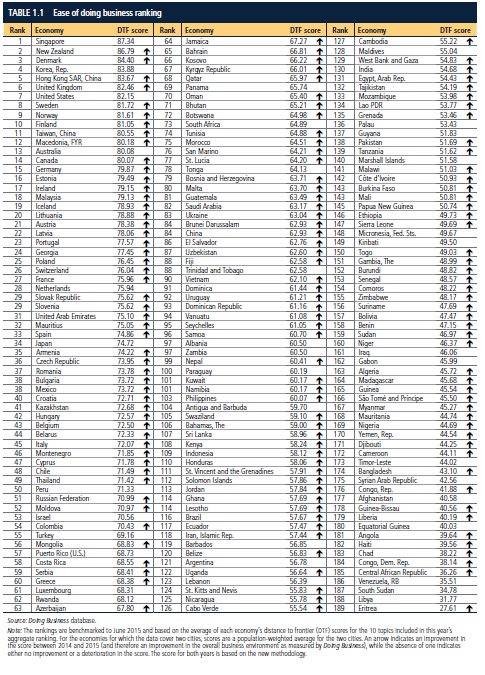
Ease of doing business? # 132 (2015; 130 for 2016; see Appendix B)

That gap, between 2 and 132, is a wide chasm for India to bridge.

What is this country to do? And what lessons can we learn from them, here in the Caribbean?

(Though our population is so small, our Ease of Doing Business rating is equally depressing; the best Caribbean option is Jamaica at 64).

The answer is investment!

Working for a Return on Investments is one of the driving forces of the book (and movement) Go Lean … Caribbean. The book asserts that in order to get the optimal return on any investment a community must adopt the appropriate “community ethos”, the fundamental spirit of a culture that drives the beliefs, customs and practices of its society. In this case, the identifying ethos is: Deferred Gratification.
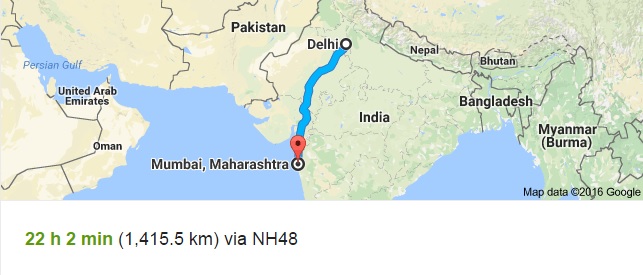
CU Blog - Build It and They Will Come - India's $90 Billion Investment - Photo 1India is embarking on the Delhi-Mumbai Industrial Corridor. This is a ribbon of development along a route from Delhi to Mumbai, that traverses 6 (internal) states in India; see Appendix A. (India is a Federal Republic, with a President over the federal government, while states are led by governors). This plan so resembles the roadmap for the Caribbean Union Trade Federation (CU). The Go Lean book serves as a roadmap for the introduction and implementation of the CU.

This commentary is the 3 of 3 from the Go Lean movement on the subject of Infrastructure Policy. As related in previous submissions in this series, the assertion is that “if we build it, they will come”. This is a movie metaphor, yes, but it accurately depicts the surety of investing in capital infrastructure projects; or perhaps even more poignant, it conveys the surety of failure of not investing. The other commentaries detailed in this series are as follows:

  1. Before & After – Washington DC’s Streetcars Model
  2. Clinton vs Trump Campaigns – Politics of Infrastructure
  3. India’s Model – $90 billion infrastructure projects.

All of these commentaries are economic in nature, stressing the community investments required for nation-building. As depicted in this VIDEO here, India is playing catch-up in this regards with an aggressive plan – a “quantum leap”:

VIDEO – Amitabh Kant at TEDxDelhi on India’s Infrastructure Development – https://youtu.be/8BvMybtJ1-E

TEDx Talks
Published on Dec 17, 2012 –
 
Presently posted as CEO & MD of the Delhi Mumbai Industrial Corridor Development Corporation.Delhi-Mumbai Industrial Corridor is a mega infra-structure project of $90 billion covering an overall length of 1483 KMs between the political capital and the business capital of India.

A dynamic personality, Amitabh Kant has conceptualized and executed the positioning and branding of Kerala as “God’s Own Country” and later the “Incredible !ndia” campaign. Both these campaigns have won several International awards and embraced a host of activities — Infrastructure development, product enhancement, changes in organizational culture and promotional partnerships based on intensive market research. He has structured large infrastructure projects for diversification of India’s tourism product and sourced international funding through the Asian Development Bank (ADB), Japanese Bank for International Cooperation (JBIC) and UNDP.
During his tenure as Chairman and Managing Director, India Tourism Development Corporation (ITDC) he radically restructured the organization and turned it around into a highly profitable commercial enterprise. He also has wide ranging experience in innovative technical and financial structuring of Private — Public — Partnership in infrastructure projects and implemented the Calicut Airport project based on User’s fee, the BSES Kerala Power project and the Mattanchary Bridge project.

As demonstrated here in India, big infrastructure projects are necessary community investments – a “quantum leap” with a $90 Billion industrial corridor along 1500 kilometers. Is it possible for the Caribbean to consider such deployments?

Yes! The book Go Lean … Caribbean details exactly how the Big Infrastructure Projects for our region are to be conceived and achieved, (Page 127), with Self-Governing Entities and Exclusive Economic Zones. Most importantly, the roadmap details a plan to fund the projects.

The Go Lean/CU movement champions the cause of building and optimizing the overall Caribbean infrastructure. According to the foregoing VIDEO, it is important to identify and qualify funding sources for such ventures. There is the need for “new guards” for the Caribbean in this perspective. So there is the expectation that integrating and consolidating to a Single Market will contribute to the fulfillment of the Go Lean prime directives, defined here as follows:

  • Optimization of the economic engines in order to grow the regional economy to $800 Billion & create 2.2 million new jobs.
  • Establishment of a security apparatus to protect the resultant economic engines.
  • Improve Caribbean governance – including the funding of capital projects – to support these engines.

The Go Lean roadmap anticipates the opportunities of major infrastructure investments. However, the roadmap recognizes that many of the projects envisioned for the region may be too big for just one member-state alone; that it will take regional – super-national coordination. This point is highlighted in the opening Declaration of Interdependence, (Pages 12 & 14):

xiv.    Whereas government services cannot be delivered without the appropriate funding mechanisms, “new guards” must be incorporated to assess, accrue, calculate and collect revenues, fees and other income sources for the Federation and member-states. The Federation can spur government revenues directly through cross-border services and indirectly by fostering industries and economic activities not possible without this Union.

xxvi.  Whereas the Caribbean region must have new jobs to empower the engines of the economy and create the income sources for prosperity, and encourage the next generation to forge their dreams right at home, the Federation must therefore foster the development of new industries … impacting the region with more jobs.

xxix.  Whereas all Caribbean democracies depend of the free flow of capital for municipal, public and private financing, the institutions of capital markets can be better organized around a regional monetary union. The Federation must institute the controls to insure transparency, accounting integrity and analysis independence of the securities markets, thereby shifting the primary source of capital away from foreign lenders to domestic investors, comprising institutions and individuals.

The CU mission is to plan, fund, deploy and maintain infrastructure projects that are too big for any one member-state alone. Crossing borders will mean including member-states of various legalities: some independent member-states and some dependent overseas territories. This brings to the fore an array of issues, like legislative authority and currency. The Go Lean/CU regional roadmap undoubtedly calls for a common currency strategy; thusly, it calls for the establishment of the allied Caribbean Central Bank (CCB) to manage the monetary and currency affairs of each member-state in the region, independent or dependent territory. The Go Lean book describes the breath-and-width of the CCB as a technocratic institution with better stewardship, than in the recent past. From the outset, this stewardship was envisioned and pronounced in the same Declaration of Interdependence (Page 13):

xxiii. Whereas many countries in our region are dependent OverseasTerritory of imperial powers, the systems of governance can be instituted on a regional and local basis, rather than requiring oversight or accountability from distant masters far removed from their subjects of administration. The Federation must facilitate success in autonomous rule by sharing tools, systems and teamwork within the geographical region.

xxiv.  Whereas a free market economy can be induced and spurred for continuous progress, the Federation must install the controls to better manage aspects of the economy: jobs, inflation, savings rate, investments and other economic principles. Thereby attracting direct foreign investment because of the stability and vibrancy of our economy.

xxv.   Whereas the legacy of international democracies had been imperiled due to a global financial crisis, the structure of the Federation must allow for financial stability and assurance of the Federation’s institutions. To mandate the economic vibrancy of the region, monetary and fiscal controls and policies must be incorporated as proactive and reactive measures. These measures must address threats against the financial integrity of the Federation and of the member-states.

The CU roadmap drives change among the economic, security and governing engines. These solutions are as new community ethos, strategies, tactics, implementations and advocates; sampled as follows:

Community Ethos – Deferred Gratification Page 21
Community Ethos – Economic Principles: People Choose because Resources are Limited Page 21
Community Ethos – Economic Principles: All Choices Involve Costs Page 21
Community Ethos – Economic Principles: Voluntary Trade Creates Wealth Page 21
Community Ethos – Economic Principles: Consequences of Choices Lie in the Future Page 21
Community Ethos – Money Multiplier Page 22
Community Ethos – Job Multiplier Page 22
Community Ethos – Lean Operations Page 24
Community Ethos – Return on Investments Page 24
Community Ethos – Cooperatives Page 25
Community Ethos – Ways to Impact the Future Page 26
Community Ethos – Impact the Greater Good Page 37
Strategy – Vision – Integrate and Consolidate into a Single Market Page 45
Strategy – Mission – Facilitating Currency Union, Caribbean Dollar Page 45
Strategy – Mission – Collaborate for the Caribbean Central Bank Page 45
Anecdote – Caribbean Currencies Page 64
Tactical – Fostering a Technocracy Page 64
Tactical – $800 Billion Economy – How and When – Trade Page 67
Tactical – Recovering from Economic Bubbles Page 69
Tactical – Separation-of-Powers – Caribbean Central Bank Page 73
Implementation – Assemble Caribbean Central Bank Page 96
Implementation – Ways to Pay for Change Page 101
Implementation – Start-up Benefits from the EEZ Page 104
Implementation – Steps to Implement Self-Governing Entities Page 105
Implementation – Trade Mission Objectives Page 117
Implementation – Ways to Benefit Globalization Page 119
Planning – Ways to Improve Trade Page 128
Advocacy – Ways to Grow the Economy Page 151
Advocacy – Ways to Create Jobs Page 152
Advocacy – Ways to Improve Governance Page 168
Advocacy – Ways to Foster Cooperatives Page 176
Advocacy – Reforms for Banking Regulations Page 199
Advocacy – Ways to Impact Wall Street – Better Liquidity from Regional Capital Markets Page 200
Advocacy – Ways to Improve Transportation Page 205
Advocacy – Ways to Impact Urban Living – Optimize Transportation Options Page 234
Advocacy – Ways to Impact Rural Living – Optimize Transportation Options Page 235

The Caribbean region must learn this important lesson from the country of India: infrastructure is not optional. Put in the infrastructure in advance and it brings growth; it becomes an investment. But play catch-up afterwards and it bears a heavy cost burden.

Previous Go Lean commentaries highlighted other countries and communities that did the hard-work, the heavy-lifting, to facilitate their infrastructural needs so as to better compete in the world’s markets. This is the world that we in the Caribbean competes in – with trade and culture – so it is important to consider all lessons learned. Here is a sample of issues addressed and elaborated upon in previous blog/commentaries:

https://goleancaribbean.com/blog/?p=8549 Enhancing Sports Infrastructure for an Olympic dream – Some Day Maybe
https://goleancaribbean.com/blog/?p=7989 Transforming Infrastructure with ‘Free Money’
https://goleancaribbean.com/blog/?p=7384 Infrastructure for Oil Refineries – Strategy for Advanced Economics
https://goleancaribbean.com/blog/?p=6231 China’s Caribbean Playbook: Helping Transform the region
https://goleancaribbean.com/blog/?p=6016 The Need for Infrastructure to abate Climate Change’s excessive heat
https://goleancaribbean.com/blog/?p=5921 The Art & Science of Impact Analyses for Big infrastructure projects
https://goleancaribbean.com/blog/?p=3028 India is doing better than many Emerging Market countries. Why?
https://goleancaribbean.com/blog/?p=2953 Funding Caribbean Entrepreneurs – The ‘Crowdfunding’ Way
https://goleancaribbean.com/blog/?p=2750 Good Model: Disney World as a Self-Governing Entity
https://goleancaribbean.com/blog/?p=2670 A Lesson in History of Infrastructure Projects: Rockefeller’s Pipeline
https://goleancaribbean.com/blog/?p=2435 Latin America’s Dream and Trade Role-model: Korea
https://goleancaribbean.com/blog/?p=2090 Elaborating on the CU and CCB as Hallmarks of a Technocracy

The Caribbean is arguably the best address on the planet, but for modern life and conveniences, and to better compete with the rest of the world regarding trade and culture, we need to upgrade our infrastructure, and then keep pace with industrial best-practices. We need to make these investments. The returns on these investments are jobs and economic empowerments; (think entrepreneurship).

There is no choice to “opt-out”. If we do not invest, our people will “opt-out” instead, as has been the past experience, especially evident with our societal abandonment rate (brain drain) of 70%.

This past – our status quo – cannot continue as our future.

We must do better!

India did … so can we.

Ease of doing business is a real metric. We can “inch up” the chart and elevate our business eco-system accordingly; India increased from 132 to 130 in 2016.

The governments, institutions and businesses are hereby urged to “lean-in” for the deployments/empowerments as described in the book Go Lean … Caribbean. This is our “quantum leap”; the solutions herein are conceivable, believable & achievable. Yes, we can, “build it and they – progress – will come” to make the Caribbean a better place to live, work and play. 🙂

Download the book Go Lean … Caribbean – now!

———–

Appendix A – Delhi-Mumbai Industrial Corridor Project

The Delhi-Mumbai Industrial Corridor Project is a planned State-Sponsored Industrial Development Project of the Government of India. It is one of the world’s biggest infrastructure projects with an estimated investment of US$90 billion and is planned as a hi-tech industrial zone spread across seven states along the 1,500 km long Western Dedicated Freight Corridor which serves as its backbone.[1]

It includes 24 industrial regions, eight smart cities, two airports, five power projects, two mass rapid transit systems and two logistical hubs.[1] The eight investment regions proposed to be developed in Phase I of DMIC are Dadri-Noida-Ghaziabad (in UP); Manesar- Bawal (in Haryana); Khushkhera-Bhiwadi-Neemrana and Jodhpur- Pali-Marwar (in Rajasthan); Pithampur-Dhar-Mhow (in MP); Ahmedabad-Dholera Special Investment Region (SIR) in Gujarat; the Shendra-Bidkin Industrial Park and Dighi Port Industrial Area in Maharashtra.[1]

India needs to employ over 100 million people within the next decade and so this project assumes vital importance to develop manufacturing centres that could employ millions.

The ambitious Delhi Mumbai Industrial Corridor (DMIC) has received major boost with India and Japan inking an agreement to set up a project development fund. The initial size of the Fund will be ₹10 billion (US$148.6 million). Both the Japanese and Indian governments are likely to contribute equally. The work is already underway and progressing at a rapid pace, with the Dedicated Freight Corridor expected to be completed by 2017.[2]

Source: Retrieved August 10, 2016 from: https://en.wikipedia.org/wiki/Delhi_Mumbai_Industrial_Corridor_Project

———–

Appendix B – World Bank 2016 Ease of Doing Business Ranking
CU Blog - Build It and They Will Come - India's $90 Billion Investment - Photo 2

Share this post:
, , ,

Build It and They Will Come – Politics of Infrastructure

Go Lean Commentary

How to grow the economy?

CU Blog - Build It and They Will Come - Politics of Infrastructure - Photo 1This was an original question that launched the book Go Lean … Caribbean. In August 2011 the US Chamber published a recommendation to American power brokers on how to recover from the Great Recession and create jobs in the US. They detailed a plan that included doubling down on infrastructure spending in the US. In response, the Go Lean publishers created its own roadmap for the Caribbean; assuredly, infrastructure activities was also prominent for the regional plan. The 10-point plan – as published in the Go Lean book on Page 152 – included:

  • Lean-in for the Caribbean Single Market & Economy
  • Feed Ourselves
  • Clothe Ourselves
  • House Ourselves
  • Update Our Own Infrastructure and the industries they spun
  • Steer More People to S.T.E.M. Education and Careers
  • Help Regional Businesses Find Foreign Markets
  • Welcome Home Emigrants
  • Welcome “Empowering” Immigrants
  • Draw More Tourists

This commentary is the 2 of 3 from the Go Lean movement on the subject of Infrastructure Policy. As related in the previous submission in this series, “if we build it, they will come”. This movie metaphor conveys the surety of investing in capital infrastructure projects; or worse yet, the surety of failure by not investing. The other commentaries detailed in this series are as follows:

  1. Before & After – Washington DC’s Streetcars Model
  2. Clinton vs Trump Campaigns – Politics of Infrastructure
  3. India’s Model – $90 billion in infrastructure projects

All of these commentaries are economic in nature, not political. As depicted in this news article, regardless of the candidate elected President of the United States in the impending November 2016 election, infrastructure activities must be pursued. See the article here:

Title: Clinton, Trump both would build infrastructure, likely pay for it the same way
By: Patti Domm, CNBC Executive News Editor

No matter who wins the White House, there is likely to be a big jump in infrastructure spending — and both Republican Donald Trump and Democrat Hillary Clinton may ultimately look to the same pot of gold to fund their spending, according to Strategas.

Trump made it clear when he unveiled his economic plan Monday that he’s going to be a big spender on the nation’s highways and bridges, though voters have heard him discuss it before. He also says he wants U.S. companies to repatriate their foreign cash, proposing a one-time tax holiday that would allow them to pay just 10 percent to bring their cash home. That money would be used to pay for infrastructure.

Democrat Hillary Clinton also proposes an infrastructure plan, and both candidates will have to get their proposals approved by Congress. The Democrats propose an infrastructure bank as part of their plan.

But both candidates could look to the repatriation tax holiday for the $2 trillion stashed overseas to cover some of the costs of their proposed infrastructure spending, according to Dan Clifton, head of policy research at Strategas.

Clifton said it’s likely the House of Representatives remains Republican, and House Republicans are going to challenge either candidate on spending.

“You could even say that she’ll be forced to do repatriation to get her infrastructure. She also wants to do renewable energy and broadband, and that’s all negotiable,” said Clifton.

Strategas put together a basket of infrastructure stocks, and that index is up 23 percent year to date. It includes 21 names such as Jacobs Engineering, KBR, Lennox International, Martin MariettaVulcan Materials, Granite Construction, Apogee Enterprises, Fluor Corp, Eagle Materials and Simpson Manufacturing.

Other names in the index are Dycom Industries,Gibraltor Industries,Masco CorpQuanex Building ProductsHeadwaters IncGriffon Corp,NCI Building SystemsUniversal Forest ProductsQuanta Services and EMCOR

Clifton said despite the fact that both candidates had been strong proponents of infrastructure spending, the stocks have been more correlated to Clinton. “There’s 92 percent correlation between their outperformance and her probability of winning,” he said.

But Trump has been pushing a tax holiday, and stocks that would benefit from that are also gaining.

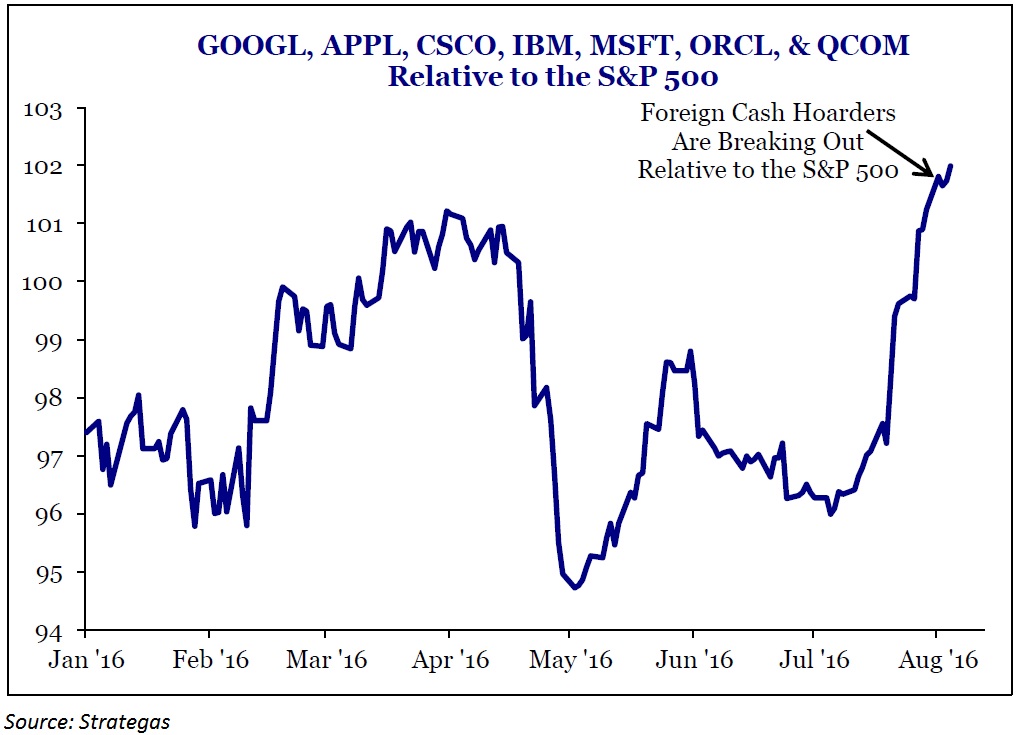
Strategas used seven companies with the most aggregate cash overseas as a proxy for the possibility of a repatriation deal. Those companies have been rising since mid-July and they are all tech, a sector that started performing better during earnings season.

They include Alphabet, Apple, IBM, Microsoft, Qualcomm, Cisco and Oracle.

The repatriation idea is not new. A voluntary repatriation was approved by Congress in 2004, and $300 billion of $600 billion stashed overseas returned to the U.S., according to Strategas.

In 2005, the companies that repatriated the most cash had no outperformance when compared to the S&P 500. But those that repatriated the most as a percentage of market cap doubled the S&P 500, according to Strategas.
Source: CNBC Consumer & Business Channel – Market Insider –  Posted & Retrieved August 8, 2016 from: http://www.cnbc.com/2016/08/08/trump-clinton-tax-plans-may-need-same-pot-of-gold.html

CU Blog - Build It and They Will Come - Politics of Infrastructure - Photo 2


Source for charts: Strategas

CU Blog - Build It and They Will Come - Politics of Infrastructure - Photo 3

Rising above the politics, are big infrastructure projects being considered for Caribbean deployment?

Yes! The book Go Lean … Caribbean asserts that infrastructure investment is necessary to grow the regional economy and asserts a plan to fund them (Page 152). It conveys the same thought of doubling down on infrastructure spending.

The book extols the principle that infrastructure activities are necessary to leverage the region for future growth. This is a mandate for the technocratic Caribbean Union Trade Federation (CU). This book serves as a roadmap for the introduction and implementation of the CU. This technocracy must rise above the politics and oversee the regional optimization in these areas:

  • economics
  • security
  • lean government

The foregoing news article focuses on more than just politics, but considers the capital markets and related companies to invest in to profit from America’s imminent infrastructure Big Spend. Rather than just 1 company, the article is advocating investing in an “Index” (see Appendix) that tracks the performance of the infrastructure construction and maintenance industry as a whole.

Ditto for the Caribbean!

Any hope for success here will depend on adequate funding. The Go Lean book therefore advocates for Caribbean people (and Direct Foreign Investors) to take stock – invest their time, talents and treasuries – in Caribbean infrastructure projects and Caribbean capital markets.

What projects are considered for the Caribbean? The book identifies this sample lists:

Virtual “Turnpike” Operations – Page 127:
Ferries, Causeways/Bridges, Pipelines, Tunnels, Railways and limited access highways will function as “blood vessels to connect all the organs” within the region, thus allowing easier transport of goods and people among the islands and the mainland states (Belize, Guyana or Suriname) – See Appendix IC (Page 280) Alaska Marine Highway.

Capital Markets as Economic Engine  – Page 151:
A single market and currency union will allow for the emergence of viable capital markets for stocks and bonds (public and private), thereby creating the economic engine needed to fuel growth, expansion and development.

Update Our Own Infrastructure Operations – Page 152:
Roads, bridges, ports, ship-building dry-docks, utilities and media outlets create companies and jobs for implementation and maintenance. Many of the infrastructure projects will cover the transportation sector; with improvements here, the result will be more traffic (passenger & cargo). This opens new modes for travelers/visitors/tourists to come to their favorite resort destination. (Consider Fast Ferries boats and Spring Break).

The Go Lean/CU movement champions the cause of building and optimizing the overall Caribbean infrastructure. According to the foregoing article, it is important to identify and qualify funding sources for such ventures. There is the need for “new guards” for the Caribbean in this perspective. So there is the expectation that integrating and consolidating to a Single Market will contribute to the fulfillment of the Go Lean prime directives, defined here as follows:

  • Optimization of the economic engines in order to grow the regional economy to $800 Billion & create 2.2 million new jobs.
  • Establishment of a security apparatus to protect the resultant economic engines.
  • Improve Caribbean governance – including the funding of capital projects – to support these engines.

The Go Lean roadmap anticipates the opportunities of major infrastructure investments. However, the roadmap recognizes that many of the projects envisioned for the region may be too big for just one member-state alone; that it will take regional – super-national coordination. This point is highlighted in the opening Declaration of Interdependence, (Pages 12 & 14):

xiv. Whereas government services cannot be delivered without the appropriate funding mechanisms, “new guards” must be incorporated to assess, accrue, calculate and collect revenues, fees and other income sources for the Federation and member-states. The Federation can spur government revenues directly through cross-border services and indirectly by fostering industries and economic activities not possible without this Union.

xxiv. Whereas a free market economy can be induced and spurred for continuous progress, the Federation must install the controls to better manage aspects of the economy: jobs, inflation, savings rate, investments and other economic principles. Thereby attracting direct foreign investment because of the stability and vibrancy of our economy.

xxvi. Whereas the Caribbean region must have new jobs to empower the engines of the economy and create the income sources for prosperity, and encourage the next generation to forge their dreams right at home, the Federation must therefore foster the development of new industries … impacting the region with more jobs.

xxix. Whereas all Caribbean democracies depend of the free flow of capital for municipal, public and private financing, the institutions of capital markets can be better organized around a regional monetary union. The Federation must institute the controls to insure transparency, accounting integrity and analysis independence of the securities markets, thereby shifting the primary source of capital away from foreign lenders to domestic investors, comprising institutions and individuals.

The CU mission is to plan, fund, deploy and maintain many infrastructure projects that are too big for any one member-state alone. A regional eco-system will deliver on new market opportunities of improved infrastructure for the Caribbean, as depicted in the foregoing news article for the US. The Go Lean book therefore details many strategies, tactics, implementations and advocacies that will facilitate this readiness; a sample is detailed here:

Economic Principles – Economic Systems Influence Individual Choices Page 21
Economic Principles – People Choose because Resources are Limited Page 21
Economic Principles – All Choices Involve Costs Page 21
Economic Principles – People Respond to Incentives Page 21
Economic Principles – Economic Systems Influence Individual Choices Page 21
Community Ethos – Money Multiplier Page 22
Community Ethos – Job Multiplier Page 22
Community Ethos – Lean Operations Page 24
Community Ethos – Return on Investments Page 24
Community Ethos – Ways to Impact the Future Page 26
Community Ethos – Ways to Impact Research and Development Page 30
Tactical – Separation of Powers – Emergency Management – Response Page 76
Tactical – Separation of Powers – Department of State – Self Governing Entities Page 80
Implementation – Start-up Benefits from the EEZ Page 104
Implementation – Steps to Implement Self-Governing Entities Page 105
Implementation – Ways to Improve Energy Usage – Electrified Buses/Trains Page 113
Implementation – Ways to Benefit from Globalization Page 119
Advocacy – Ways to Improve Trade Page 128
Advocacy – Ways to Create Jobs Page 152
Advocacy – Ways to Improve Governance Page 168
Advocacy – Ways to Foster Cooperatives Page 176
Advocacy – Ways to Improve Homeland Security – Disaster Response Page 180
Advocacy – Ways to Better Manage Natural Resources Page 183
Advocacy – Ways to Impact Wall Street – Regional Capital Markets Page 200
Advocacy – Ways to Impact Main Street – Development Authorities Page 201
Advocacy – Ways to Improve Monopolies – Maximize Liquidity with Capital Markets Page 202
Advocacy – Ways to Improve Transportation Page 205
Advocacy – Ways to Develop the Auto Industry – Support New Infrastructure Page 206
Advocacy – Ways to Impact Urban Living – Transit Options Page 234

Previous blog-commentaries touched on many related issues and subjects that affect the politics and planning of Caribbean infrastructure projects. Consider this sample:

https://goleancaribbean.com/blog/?p=8549 Enhancing Sporting Infrastructure for an Olympic dream – One Day
https://goleancaribbean.com/blog/?p=7384 Infrastructure for Oil Refineries – Strategy for Advanced Economics
https://goleancaribbean.com/blog/?p=7268 Bad Model: Detroit’s lacking infrastructure for schools
https://goleancaribbean.com/blog/?p=7056 Infrastructure for Electric Cars: ‘Necessity is the Mother of Invention’
https://goleancaribbean.com/blog/?p=6231 China’s Caribbean Playbook: America’s Script for Infrastructure
https://goleancaribbean.com/blog/?p=6016 The Need for Infrastructure To Abate Excessive Summers
https://goleancaribbean.com/blog/?p=5921 The Art & Science of Impact Analyses of Big Infrastructure Projects
https://goleancaribbean.com/blog/?p=2670 A Lesson in History of Infrastructure Projects: Rockefeller’s Pipeline
https://goleancaribbean.com/blog/?p=2041 Good Model: The New York / New Jersey Port Authority
https://goleancaribbean.com/blog/?p=1214 Good Model: The Art & Science of Temporary Stadiums

The Caribbean needs help…with transportation, jobs, and overall economic activities. Infrastructure projects are a great place to start: bridges, tunnels, causeways, highways, government building, etc. These do not just bring construction jobs, but they also improve the eco-system for a better business climate. This is bigger than just politics; this is survival.

This is also how to grow our economy.

The people of the region are urged to “lean-in” for the deployments/empowerments as described in the book Go Lean … Caribbean. The benefits of this roadmap are too alluring to miss out: emergence of an $800 Billion single market economy, 2.2 million new jobs and a hopeful prospect for our Caribbean youth. 🙂

Download the book Go Lean … Caribbean – now!

———–

Appendix VIDEO – Common Sense Investing: Use index funds when possible – https://youtu.be/GF5vThMkF-U

Uploaded on Jun 27, 2011 – http://www.financinglife.org
What is an index fund? And why do they outperform in the long run? Plus, learn how to tell a good mutual fund from a bad one.

Share this post:
, ,
[Top]

Build It and They Will Come – Streetcars Model – ENCORE

Go Lean Commentary

“Build it and they will come” – Movie quotation from A Field of Dreams – See VIDEO Appendix below.

This phrase has been echoed many times … especially in the effort to justify big capital infrastructure projects. Think sports stadia, highways, shopping malls, airports (i.e. the new Denver International). This is tied to the “Law of Attraction”; see details here:

If You Build it, Will They Come?

What is the relationship between intent and outcome? Does the Field of Dreams quote, “if you build it, they will come” have truth to it? Not exactly, but it does allude to an important and true concept (which is likely why we still quote, and mis-quote, it today).

The truth is: If you build it, you increase the odds of them coming. In other words, if you put thought and energy you put into a project you increase the likelihood of success.

Field of Dreams as a Metaphor for the Law of Attraction

Metaphorically speaking, attention plants a seed, while effort, time, and action give the seed the best opportunity to grow and thrive. However, there is no certainty the seed will grow, what the plant will look like, or whether it will produce fruit (that’s all up to nature and luck). Planting the seed and tending to it increases the odds that it’ll grow something, but it doesn’t ensure it.

The inverse, however, has more certainty. If you pay no attention to an idea and make no effort to manifest it, you decrease the odds of it materializing. If it does materialize it will almost certainly come from someone else who dedicated attention and effort over time. The more time, attention, effort, and thought you apply to an idea the more likely it is that something will come of it. If we build a baseball diamond and never go there again there is less chance of people coming. If we put effort into tending to the field and we are more likely to attract an audience.
Source: Retrieved August 9, 2016 from: http://factmyth.com/factoids/if-you-build-it-they-will-come/

CU Blog - Build It and They Will Come - Streetcars Model - Photo 7Previously, this commentary identified the streetcar project in the US capital city of Washington D.C.. The effort was designed to be an anchor for re-development of a blighted urban area.

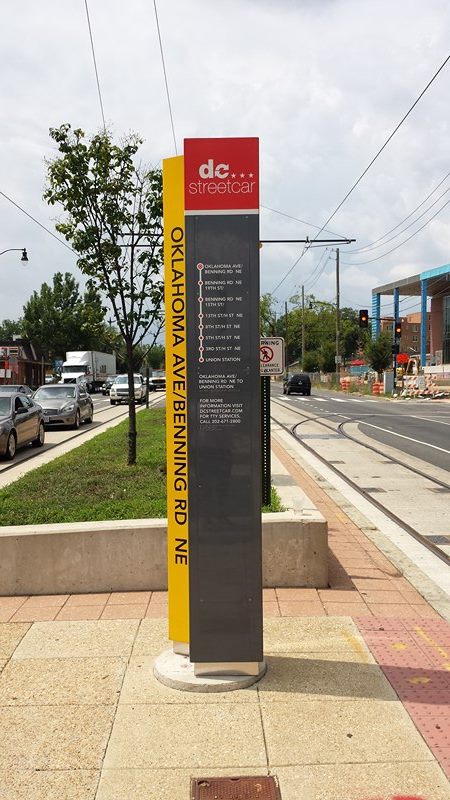
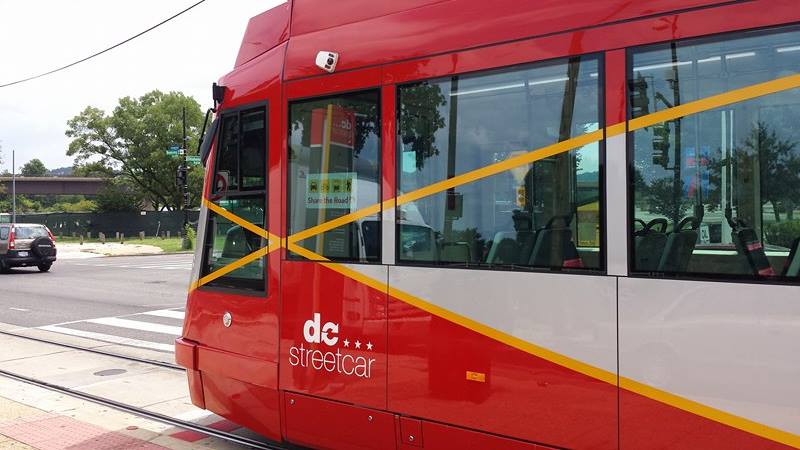
How did it turn out? See photos in the Appendix below.

The project is now live for the 2.4 mile stretch of H Street.

There is a lot of construction ongoing, and more planned.

People, business activity and hope is coming!

This commentary is the 1 of 3 from the Go Lean movement on the subject of Infrastructure Policy. All of these commentaries are economic in nature; the other blogs detailed in this series are as follows:

  1. Before & After – Washington DC’s Streetcars Model
  2. Clinton vs Trump Campaigns – Politics of Infrastructure
  3. India’s Model – $90 billion infrastructure projects

The original blog-commentary from November 1, 2014 on the Washington, DC Streetcar is ENCORED here; followed by new, yet related Appendices:

—————-

Go Lean Commentary

CU Blog - DC Streetcars - Model For Caribbean Re-development - Photo 1

The US capital city of Washington D.C. is now embarking on the deployment of a streetcar system … again. Between 1862 and 1962, streetcars in Washington, D.C., were a common mode of transportation, but the system was dismantled in the early 1960s as part of a switch to bus service.

One step forward, two steps backwards!

The District now embarks on a re-deployment, pivotal to a re-development of blighted urban areas. See story here:

August 4, 2014 – The Washington D.C. Department of Transportation will begin training streetcar operators in traffic for the first time this week along H Street and Benning Road in Northeast Washington. [The full system implementation is planned for late 2014].

The DC Streetcar is a surface light rail and streetcar network under construction in Washington, D.C. The streetcars will be the first to run in the District of   Columbia since the dismantling of the previous streetcar system in 1962. The District   of Columbia began laying track in 2009 for two lines whose locations in Anacostia and Benning were chosen to revitalize blighted commercial corridors. Initially, the system will be funded and owned by the District’s Department of Transportation (DDOT).

The D.C. government owns three Czech-built Inekon streetcars (destined for the Anacostia Line) that will serve the system; as of December 2009, they were in storage at Metro’s Greenbelt Rail Yard; [but now fully engaged in test runs]. Each car is eight ft (2.438 meters) wide and 66 feet (20.12 m) long, and each train consists of three car connected sections.

The City’s hope is that now with all the new bars and restaurants opening on H Street, this streetcar line will encourage people (residents, business commuters and tourists) to visit here. Mayor Vincent Gray states “what we’re trying to do is encourage people as a part of our sustainability plan to find other ways of moving around. Eventually, this will be a 37-mile system that will get people to every ward in the District of Columbia.”
WJLA Local ABC 7 TV News
http://www.wjla.com/articles/2014/08/d-c-streetcar-operator-training-begins-this-week-105726.html
Wikipedia
Online Encyclopedia  (Retrieved November 3, 2014) –
http://en.wikipedia.org/wiki/DC_Streetcar

WJLA TV News Video: http://youtu.be/EY0d8E3304M

Why is there a need to re-start the streetcar system? Why did the streetcars end? Conspiracy theories abound. The following VIDEO portrays the story, and admittedly, there is a ring of truth:

In this excerpt from Stephen Talbot’s “Heartbeat of America” (1993), Christopher Snell explains how GM conspired with oil & tire companies to kill streetcars in cities all across America in order to create an inferior bus system that would guarantee the sale of tires, gas, and bus parts for an eternity.
VIDEO – Who Killed The Electric Street Car? – http://youtu.be/wFhsrbtQObI

The fact that Washington DC, and other cities (see VIDEO below of Portland’s effort), are re-deploying streetcars is proof-positive of the economic and logistical benefits of streetcars. Instead of gasoline or diesel vehicles, streetcars use energy-efficient electrified lines to power the vehicle up-and-down city streets. This is a win-win for all stakeholders!

Are streetcars being considered for Caribbean deployment, especially as these member-states report very high fuel costs and feature old-narrow streets?

Absolutely, yes! The book Go Lean … Caribbean asserts transportation solutions that include streetcars, light-rail, natural-gas powered vehicles and toll roads to empower the region through mass transit (Page 205).

Why not autonomous (driver-less) streetcars? This vision is one of intensive remote monitoring, plus unified command-and-control to mitigate security/safety concerns. (Think Disney World’s Mono-Rail). This is the future that is being planned, developed and tested now. The experience of the last 100 years is that those doing the planning, developing and testing for futuristic technologies are the ones that profit most from the economic gains.

The book, Go Lean … Caribbean, therefore extols the principle that R&D (research and development) activities are necessary to profit from advantages in technology. We want to do R&D here in the Caribbean. This is a mandate for the Caribbean Union Trade Federation (CU). This book serves as a roadmap for the introduction and implementation of the CU. This technocracy will assume oversight to optimize the region in the areas of:

(1) economics
(2) security
(3) lean government

This vision of an autonomous streetcar aligns with the scope of Self-Governing Entities (SGEs) throughout the Caribbean region. On these bordered grounds (technology bases, industrial parks, research campuses, theater districts, medical centers, etc), only CU federal regulation and jurisdiction apply. This allows for the nimble environment to develop, test and deploy autonomous vehicles. This is the benefit of lean governmental coordination, so that a launch of these initiatives becomes possible and probable.

Though not written with this particular initiative in mind, the Go Lean roadmap anticipates such opportunities, as pronounced in the Declaration of Interdependence, (Pages 12 & 14):

xvi.    Whereas security of our homeland is inextricably linked to prosperity of the homeland, the economic and security interest of the region needs to be aligned under the same governance. Since economic crimes … can imperil the functioning of the wheels of commerce for all the citizenry, the accedence of this Federation must equip the security apparatus with the tools and techniques for predictive and proactive interdictions.

xxvii. Whereas the region has endured a spectator status during the Industrial Revolution, we cannot stand on the sidelines of this new economy, the Information Revolution. Rather, the Federation must embrace all the tenets of Internet Communications Technology (ICT) to serve as an equalizing element in competition with the rest of the world. The Federation must bridge the digital divide and promote the community ethos that research/development is valuable and must be promoted and incentivized for adoption.

xxx.   Whereas the effects of globalization can be felt in every aspect of Caribbean life, from the acquisition of food and clothing, to the ubiquity of ICT, the region cannot only consume, it is imperative that our lands also produce and add to the international community, even if doing so requires some sacrifice and subsidy.

The CU mission is to implement the complete eco-system to deliver on market opportunities of streetcars, autonomous or driver- operated as sampled in the foregoing article. There are many strategies, tactics, implementations and advocacies that will facilitate this readiness; a sample is detailed here:

Economic Principles – Economic Systems Influence Individual Choices Page 21
Economic Principles – People Choose because Resources are Limited Page 21
Economic Principles – All Choices Involve Costs Page 21
Economic Principles – People Respond to Incentives Page 21
Economic Principles – Economic Systems Influence Individual Choices Page 21
Community Ethos – Money Multiplier Page 22
Community Ethos – Job Multiplier Page 22
Community Ethos – Lean Operations Page 24
Community Ethos – Return on Investments Page 24
Community Ethos – Ways to Impact the Future Page 26
Community Ethos – Ways to Help Entrepreneurship Page 28
Community Ethos – Ways to Promote Intellectual Property Page 29
Community Ethos – Ways to Impact Research and Development Page 30
Community Ethos – Ways to Ways to Improve Negotiations Page 32
Tactical – Separation of Powers – Emergency Management Page 76
Tactical – Separation of Powers – Department of State – SGE’s Page 80
Implementation – Security Initiatives at Start-up – Command-and-Control Page 103
Implementation – Start-up Benefits from the EEZ Page 104
Implementation – Steps to Implement Self-Governing Entities Page 105
Implementation – Ways to Improve Energy Usage – Electrified Buses/Trains Page 113
Implementation – Ways to Benefit from Globalization Page 119
Advocacy – Ways to Improve Trade Page 128
Advocacy – Ways to Create Jobs Page 152
Advocacy – Ways to Improve Governance Page 168
Advocacy – Ways to Foster Cooperatives Page 176
Advocacy – Ways to Improve Homeland Security Page 180
Advocacy – Ways to Improve Intelligence Gathering & Analysis Page 182
Advocacy – Ways to Better Manage Natural Resources Page 183
Advocacy – Ways to Foster Technology Page 197
Advocacy – Ways to Improve Transportation Page 205
Advocacy – Ways to Develop the Auto Industry Page 206
Advocacy – Ways to Impact Urban Living – Transit Options Page 234

The world is preparing for the change for more efficient mass transit options and also to deploy more autonomous systems to do the heavy-lifting of industrial engagements. A new ethos to prepare for this change has now come to the Caribbean.

This blog/commentary touches on many related issues and subjects that affect planning for Caribbean empowerment in this transportation industry-space. Many of these issues were also elaborated upon in these previous blog/commentaries:

https://goleancaribbean.com/blog/?p=2750 Walt Disney World’s example of an SGE – Their Florida Resort features autonomous “monorails”
https://goleancaribbean.com/blog/?p=2338 Mitigating the Dreaded ‘Plutocracy’, as GM practiced in the US in the past to quash the thriving Streetcar enterprises throughout the country
https://goleancaribbean.com/blog/?p=2259 The Criminalization/Abuses of American Business – Applying the many Lessons Learned
https://goleancaribbean.com/blog/?p=2126 Where the Jobs Are – Computers Reshaping the Global Job Market
https://goleancaribbean.com/blog/?p=1487 Here come the Autonomous Aircrafts/Drones … and the Concerns
https://goleancaribbean.com/blog/?p=1277 Google Self-Driving cars to mitigate highway safety concerns
https://goleancaribbean.com/blog/?p=1214 Fairgrounds as SGEs and the CU as Landlord for Sports Leagues – Great need to move masses (thousands) to stadia/arenas in short time
https://goleancaribbean.com/blog/?p=915 Go Green Caribbean – Streetcars are electric, less carbon footprint
https://goleancaribbean.com/blog/?p=829 Trains and Trucks play well together
https://goleancaribbean.com/blog/?p=673 Ghost ships – Autonomous cargo vessels without a crew

Re-deploy, re-develop, and re-boot…

All of these verbs are germane for this Go Lean roadmap. The Caribbean needs help…with transportation solutions, jobs, growing the economy, and motivating our youth to impact their future here at home… in the Caribbean.

Therefore the people of the region are urged to “lean-in” for the changes/empowerments as described in the book Go Lean … Caribbean. The benefits of this roadmap are too alluring to miss out: emergence of an $800 Billion single market economy, 2.2 million new jobs and relevance on the world scene for R&D. 🙂

Let’s all Go Lean!

Download the e-Book of Go Lean … Caribbean – free … now!

———–

VIDEO – Portland’s Streetcar revival – Federal aid has helped spur the construction of modern U.S. streetcars for the first time in 58 years. http://youtu.be/BIcVlCB0er0

—————-

 Appendix – Family Photo Album – Caribbean Visitor to the DC Streetcar – Summer 2016

CU Blog - Build It and They Will Come - Streetcars Model - Photo 1

CU Blog - Build It and They Will Come - Streetcars Model - Photo 5

CU Blog - Build It and They Will Come - Streetcars Model - Photo 3

CU Blog - Build It and They Will Come - Streetcars Model - Photo 2

CU Blog - Build It and They Will Come - Streetcars Model - Photo 4

—————-

Appendix VIDEO – If You Build It, He Will Come – Field of Dreams (1989) – https://youtu.be/5Ay5GqJwHF8

Uploaded on May 30, 2011 –
Field of Dreams movie clips: http://j.mp/1Ja20Lz
BUY THE MOVIE: http://amzn.to/rPcyVp

Share this post:
, ,
[Top]

Tired Waiting? Download the e-Book NOW!

Go Lean Commentary

“Now I tired waiting”.

Book CoverThe book Go Lean … Caribbean is now available to download as an e-Book … for free.

Get the e-Book here NOW!

What is the big deal?

Well, this book purports to be the answer … for what ails the Caribbean.

The book asserts that the Caribbean is in crisis; that the region of 42 million people in the 30 member-states is dysfunctional … to the point of flirting with Failed-State status. It is that serious!

The book posits that one identifying symptom is the high societal abandonment rate. The countries of the Caribbean region are experiencing a brain drain where 70 percent – on the average – of the tertiary-educated have fled for foreign shores.

70% …
… this is no way to nation-build.

Brain Drain 70 percent ChartThese alarming abandonment rates have been communicated to the governments and leaders of the region and yet still, the problem persists. They have not taken action to curb the problem.

Comes now the book Go Lean…Caribbean. This serves as a roadmap for the introduction and implementation of the technocratic Caribbean Union Trade Federation (CU). This 370-page publication presents the solutions for all the region, all the 4 language groups (Dutch, English, French and Spanish) by describing 144 different missions to elevate the economic, security and governing engines of the region. This is a serious answer to a serious crisis.

This book is published by a community development foundation made up of mostly Caribbean Diaspora. These ones have grown tired of waiting.

“Now I tired waiting”?
I’ve come to fix the …

This familiar refrain in the Caribbean has been repeated time and again, even sang in melody and rhyme. See/listen here, the classic Calypso song from the legendary Mighty Sparrow (and the lyrics in the Appendix below):

VIDEOMighty Sparrow – Mr. Walker – https://youtu.be/i5d9WzncTew

Published on Oct 22, 2012 – This song describes a frustrated man who was promised to marry a  “not so beautiful” woman, but who was more prosperous economically than himself. This is presented here as a metaphor, of the frustration of waiting for change and finally taking positive action to effect the change oneself.
Album : Party Classics. 1986
All ownership belong to the copyright holder. There is no assumption of infringement here.

The Caribbean Diaspora – living abroad in the US, Canada and Western Europe – were always taught to believe that the Caribbean is the greatest address on the planet, and yet it was essential that they leave to forge an existence elsewhere. They have endured in these foreign lands, but they are still only alien residents.  It is not home!

If only there were some solutions for their homeland?

Solutions for the Caribbean are the prime directives of the Go Lean/CU roadmap; just consider these:

  • Optimization of the economic engines in order to grow the regional economy to $800 Billion & create 2.2 million new jobs.
  • Establishment of a security apparatus to ensure public safety and protect the resultant economic engines.
  • Improve Caribbean governance to support these engines.

Puerto Rico Flag

The quest of the Go Lean/CU roadmap is direct: to make the Caribbean a better place to live, work and play. The book presents how this quest is conceivable, believable and achievable. It posits that the foundation is now in place, and we only need some technocratic deliveries to move the Caribbean member-states from the current status quo to the new destination: a better homeland. This presents a solution where our youth will no longer have to leave, and our older generations can relish a return back home.

“Now I tired waiting”, I come to fix … “the situation”. We now present you the “fix”!

🙂

Download the e-Book of Go Lean … Caribbean – free … now!

———–

Appendix – Lyrics: Mighty Sparrow – Mr. Walker

She ugly yes, but she wearing them expensive dress
The People say she ugly, but she father full a money
Oh Lord Mamma, woy woy

Good morning Mister Walker
I come to see your daughter
Oh, Mister Walker!
I come to see your daughter
Sweet Rosemarie, she promise she gone marry me
And now I tired waiting!
I come to fix the wedding

After the wedding day, I don’t care what nobody say
Everytime I take a good look at she face I see a bankbook
Oh Lord Mamma, woy woy

Good morning Mister Walker
I come to see your daughter
Hmm, Mister Walker!
I come to see your daughter
Sweet Rosemarie, she promise she gone marry me
And now I tired waiting!
I come to fix the wedding, woy

Apart from that, they say how she so big and fat
When she dress they tantalize she, saying monkey wearing mini
Oh Lord Mamma, woy woy

Good morning Mister Walker
I come to see your daughter
Oy, Mister Walker!
I come to see your daughter
Sweet Rosemarie, she promise she gone marry me
And now I tired waiting!
I come to fix the wedding, Hmm

All I know, is I don’t intend to let she go
Cause if she was a beauty, nothing like me could get she
Oh Lord Mamma, woy woy

Good morning Mister Walker
I come to see your daughter
Oy, Mister Walker!
I come to see your daughter
Sweet Rosemarie, she promise she gone marry me
And now I tired waiting!
I come to fix the wedding, oh

Source: Retrieved July 27, 2016 from: http://www.lyricsmode.com/lyrics/m/mighty_sparrow/mr_walker.html

Share this post:
, , , ,
[Top]

Support sought for kids left behind by UN troops in Haiti

Go Lean Commentary

The United Nations – bless their heart – they mean well, but they are a complete failure.

You see, there is intent …

… and then there is delivery. The UN is a failure in delivery. In addition to failures of the UN to provide peace and security in the world – the prime directive of their charter – there is also direct, immediate repercussions of the presence of their Peacekeepers. These are human beings who bring human frailties with them – think love and romance.

So a word to the wise in the Caribbean: “Do not count on the UN nor their Peacekeeping Forces to provide positive solutions for the Caribbean region”.

Who are the Peacekeepers and what do they do? See VIDEO here:

VIDEO – What Exactly Do UN Peacekeepers Do?  – https://youtu.be/Ns37jHVUilE

Published on Feb 3, 2016 – How Does The UN Work? http://testu.be/1QUyy2f
Subscribe! http://bitly.com/1iLOHml

So rather than depend on the UN or any foreign Peacekeepers, we need our own local and/or regional solution.

The book Go Lean…Caribbean posits that the region needs to prepare its own security apparatus for its own security needs. We need to not depend on UN peacekeeping nor foreign peacekeeping. The request is that all Caribbean member-states confederate and empower a security force to execute a limited scope on our sovereign territories.

This will help us to avoid some peripheral problems like this one here in the following news report:

By: David McFadden
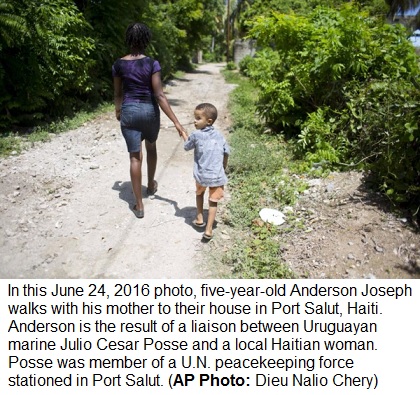
PORT SALUT, Haiti (AP) — The first time Rosa Mina Joseph met Julio Cesar Posse he was hanging out in civilian clothes on the beach in her hometown in southern Haiti, where he was stationed as a member of a U.N. peacekeeping force.

CU Blog - Support sought for kids left behind by UN troops in Haiti - Photo 1

Within weeks, she says, the Uruguayan marine was showing up every weekend at her family’s shack, pledging his love in Spanish and broken Haitian Creole.

But about a year later when his rotation ended, Posse quietly returned home. He left behind Joseph, a broken-hearted 17-year-old with an infant and no way to support the child without depending on struggling relatives.

“He promised me he’d marry me and would take care of me,” Joseph, now 22, tearfully said in a recent interview at her mother’s house in Port Salut, a town along the southwestern tip of Haiti.

After years of mounting frustration, she and several other women with children fathered by peacekeepers say they will now pursue claims for child support against the absentee fathers and the U.N.

Haitian human rights attorney Mario Joseph said he will file civil suits in Haiti this month. Joseph’s law firm also is involved in a high-profile claim on behalf of 5,000 cholera victims who blame the U.N. for introducing the disease. A U.S. federal appeals panel in New York is weighing whether the lawsuit can proceed or if the United Nations is entitled to immunity.

The peacekeeping force was sent to Haiti in 2004 to keep order following a violent rebellion that toppled President Jean-Bertrand Aristide.

Since then, some peacekeepers have been accused of rape and other abuse, of using excessive force and of inadvertently introducing cholera because of inadequate sanitation at a base used by troops from Nepal.

U.N. troops have been accused of sexual exploitation elsewhere as well, most recently in the Central African Republic, and “peacekeeper babies,” have long been a legacy of their deployments, as they have for other military forces throughout history.

Rosa Mina Joseph, whose son was born in 2011, said she received an envelope with $300 in cash from the U.N. two years ago when it established paternity. She had to drop out of school to care for the son and her dreams of becoming a nurse have all but vanished.

Posse sent her $100 once from Uruguay, she said, but has not sent anything more.

While Joseph was a minor at the time she gave birth, potential criminal charges against the marine would confront a difficult legal challenge: U.N. peacekeepers can’t be prosecuted in the countries in which they serve under international agreements.

The Associated Press does not typically identify sexual assault victims, but Joseph gave permission as long as a photo of her face was not published.

“I want him to take responsibility to care for his son because I don’t have the means by myself,” she said in the yard where she spends her days doing laundry and cooking.

The U.N. force in Haiti currently includes 4,899 uniformed personnel, a combination of military and civilian police, from more than a dozen countries. That’s down from over 13,000 peacekeepers following Haiti’s devastating 2010 earthquake.

Ghandi Shukry, head of a Conduct and Discipline Unit in the U.N. mission, which is known by its French acronym MINUSTAH, said 29 claims for paternity have been submitted to the U.N. in Haiti. He said 18 of the claimants have been classified as “victims” by the world body because they were receiving some kind of support.

“We are not facing a current wave of paternity claims. They are all kind of old cases,” said Shukry, stressing that any kind of sexual relations by peacekeepers and locals is prohibited.

The U.N. official confirmed that Joseph and three other Port Salut women represented by the attorney did have paternity established in 2014 after DNA swabs from the mothers, children and peacekeepers were analyzed. He declined to discuss any of the cases in detail.

He said that two members of his unit maintain regular contact with the Port Salut women. MINUSTAH also put the women in touch with a Uruguayan military representative, he said, since the U.N. allows troop-contributing countries to investigate allegations and decide how to pursue paternity claims.

The Port Salut women, however, say contact with U.N. staffers or Uruguay’s military representative is rare and generally bewildering.

A 2015 U.N. report by Secretary-General Ban Ki-moon acknowledged that there were “numerous obstacles to having paternity recognized and to obtaining support for children of United Nations personnel, whether they were born as a result of sexual exploitation and abuse or not.”

MINUSTAH’s uniformed personnel are now barred from leaving bases alone or when wearing civilian clothing and mission rules have changed in recent years to prohibit any fraternization. “Not only sexual relations are prohibited; even having normal relations with the local population is prohibited,” Shukry said.

Uruguay’s Navy spokesman, Capt. Gaston Jaunsolo, acknowledged there have been a small number of paternity cases and said service members found guilty are sanctioned and barred from peacekeeping missions.

He confirmed that Posse continued in the Navy and said service members are forbidden to speak the press without permission. A listed phone number for Posse was out of service. His profile on a social networking site says he’s looking for a young woman between 18 and 25 to start a family with.

The Uruguayan Army issued a statement to AP saying it’s sent roughly 3,000 troops to Haiti since 2011 and four paternity allegations were made against that military branch. There’s been one positive DNA test, the statement said, and no complaints have been made since 2014. It said the soldier who tested positive was punished but not discharged.

Meanwhile, the women struggling to raise their kids in Port Salut are eking out a living with the help of their families. Their children are sometimes teased by other kids who call them “MINUSTAH babies” or mockingly ask where their daddies are.

“When he’s older I’ll find a way to explain things. For now, the only thing I can say is that his father’s not here,” Joseph said as she held a snapshot showing her and Posse together at her 17th birthday party, a heart drawn on the back of it reading “Osemina y Julio.”

___

AP writer Leonardo Haberkorn contributed from Montevideo, Uruguay.

Source: https://www.yahoo.com/news/support-sought-kids-left-behind-un-troops-haiti-040556442.html?ref=gs Posted July 14, 2016; retrieved July 20, 2016.

There is a need for a local Caribbean security solution. The book Go Lean … Caribbean promotes the plan to confederate under a unified entity made up of the Caribbean to provide homeland security to the Caribbean. But homeland security for the Caribbean has a different meaning than some other regions and countries. Though we must be on defense against military intrusions like terrorism & piracy, we mostly have to contend with threats that may imperil the region’s economic engines, and crime remediation and mitigation. The CU security goal is for public safety! This goal is detailed in the book as it serves as a roadmap for the introduction of the technocratic Caribbean Union Trade Federation (CU). The CU is set to optimize Caribbean society through economic empowerment and also security implementations. The book describes that these two dynamics are inextricably linked in the same societal elevation endeavor. In fact, the Go Lean roadmap presents the following 3 prime directives:

  • Optimization of the economic engines in order to grow the regional economy to $800 Billion & create 2.2 million new jobs.
  • Establishment of a security apparatus to protect the resultant economic engines.
  • Improve Caribbean governance to support these engines.

The Go Lean book contends that bad actors will emerge just as a result of economic successes in the region. This point is pronounced early in the book with the Declaration of Interdependence (Page 12) that claims:

x.   Whereas we are surrounded and allied to nations of larger proportions in land mass, populations, and treasuries, elements in their societies may have ill-intent in their pursuits, at the expense of the safety and security of our citizens. We must therefore appoint “new guards” to ensure our public safety and threats against our society, both domestic and foreign. The Federation must employ the latest advances and best practices … to assuage continuous threats against public safety.

xvi. Whereas security of our homeland is inextricably linked to prosperity of the homeland, the economic and security interest of the region needs to be aligned under the same governance. Since economic crimes, including piracy and other forms of terrorism, can imperil the functioning of the wheels of commerce for all the citizenry, the accedence of this Federation must equip the security apparatus with the tools and techniques for predictive and proactive interdictions.

The Caribbean appointing “new guards”, or a security pact to ensure public safety is not so new an endeavor on the world scene; security threats have been a constant in the modern world. Since World War II, the UN, by means of its Security Council have tried to be the “new guard” for mitigating threats around the world. And yet, skirmishes, revolts and uprisings are a constant on the world scene. Yes, the UN has failed on the delivery execution of this charter.

There continues to be the need for intervention around the world. The decisioning of UN Peacekeeping Forces comes from this Security Council. The Council, following a mandate for the maintenance of international peace and security, assigns the Peacekeepers for a wide-variety of engagements. Consider the details of these current engagements in Appendix B below.

During the entire existence of the UN, there has not been a need for Peacekeepers in North America (US, Canada or Mexico) among these NAFTA members. There also has not been a need for Peacekeepers in the 27 member-states that now constitute the European Union – once they joined the EU. The truth is that integrated communities can more effectively provide their own security solutions, as an extension of the economic cooperation. This, an integrated community, is the quest of the CU/Go Lean roadmap, and to model the EU structure in our economic and security implementations.

So the Caribbean appointing “new guards”, or a security pact to ensure justice institutions and public safety in this region is not so revolutionary as a concept on the world scene. It is just what the mature democracies do. The Go Lean roadmap calls for a permanent professional security apparatus with naval and ground (Marine) forces, plus its own Military Justice establishment. This security pact would be sanctioned by all 30 CU member-states. The CU Trade Federation will lead, fund and facilitate this security force, encapsulating all the (full-time or part-time) existing armed forces in the region. This CU Homeland Security Force would get its legal authorization from a legal Status of Forces Agreement signed with the CU treaty enhancements.

This implementation will result in lesser social repercussions, because it will be Caribbean people protecting the Caribbean. So the ramifications as depicted in the foregoing news article, and in the Appendix A below, will be lessened.

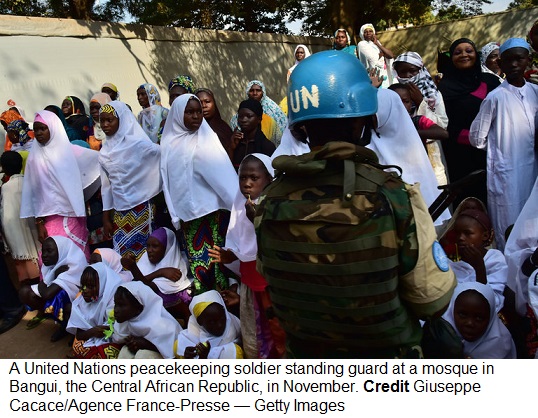
CU Blog - Support sought for kids left behind by UN troops in Haiti - Photo 2This problem detailed in the foregoing news article, has not only been a problem for Haiti and the Caribbean. In recent months, revelations have come forth of inappropriate and unprofessional actions of UN Peacekeeping forces in Africa. There had been accusations and convictions of soldiers abusing women and girls in that and other regions.

The truth is: Power abuses; and absolute power abuses absolutely. So this is not just a Pan-African problem, this is a human rights problem, for even those entities bringing relief, as was the intention in Haiti, can cause distress. Accountability and transparency must therefore be present and evident in all justice initiatives. This is the Go Lean plan for the military establishment; as detailed in the book (Page 177):

Military Justice – The CU will carefully monitor the activities of all military units (Marines, Navy & Coast Guard) – this accountability will be the by-product of increased CU funding. The CU will assume Judge Advocate General (JAG) role for military justice affairs.

This CU Security Apparatus is “Step One, Day One” in the Go Lean roadmap, covering the approach for adequate accountability and control. The Go Lean book details a series of community ethos, strategies, tactics, implementations and advocacies to provide increased public safety & security in the Caribbean region:

Economic Principle – Consequences of Choices Lie in Future Page 21
Community Ethos – Privacy –vs- Public Protection Page 23
Community Ethos – Anti-Bullying and Mitigation Page 23
Community Ethos – “Crap” Happens Page 23
Community Ethos – Minority Equalization Page 24
Community Ethos – Cooperatives Page 25
Community Ethos – Ways to Impact the Greater Good Page 37
Tactical – Confederating a non-sovereign union Page 63
Tactical – Fostering a Technocracy Page 64
Tactical – Separation of Powers – Homeland Security Page 75
Implementation – Start-up Security Initiatives Page 103
Implementation – Ways to Foster International Aid Page 115
Implementation – Reasons to Repatriate Page 118
Planning – Ways to Model the EU Page 130
Planning – Ways to Make the Caribbean Better Page 131
Planning – Ways to Improve Failed-State Indices Page 134
Planning – Lessons Learned from the West Indies Federation Page 135
Planning – Lessons from East Germany Page 139
Planning – Lessons from the American West Page 142
Planning – Lessons from Egypt Page 143
Advocacy – Ways to Grow the Economy Page 151
Advocacy – Ways to Improve Governance Page 168
Advocacy – Ways to Better Manage the Social Contract Page 170
Advocacy – Ways to Improve Leadership Page 171
Advocacy – Ways to Impact Justice – Military Prosecutions Page 177
Advocacy – Ways to Reduce Crime Page 178
Advocacy – Ways to Improve Homeland Security Page 180
Advocacy – Ways to Mitigate Terrorism Page 181
Advocacy – Ways to Improve for Natural Disasters Page 184
Advocacy – Ways to Impact Extractions Page 196
Advocacy – Ways to Improve Fisheries Page 210
Advocacy – Ways to Protect Human Rights Page 220
Advocacy – Ways to Re-boot Haiti Page 238

Other subjects related to security and justice empowerments for the region have been blogged in previous Go Lean…Caribbean commentaries, as sampled here:

https://goleancaribbean.com/blog/?p=7896 The Need for Local Administration: The Logistics of Disaster Relief
https://goleancaribbean.com/blog/?p=7345 ISIS reaches the Caribbean Region
https://goleancaribbean.com/blog/?p=7119 Role Model for the Caribbean: African Standby Force
https://goleancaribbean.com/blog/?p=6247 Tragic images show refugee crisis at a tipping point in Europe
https://goleancaribbean.com/blog/?p=6103 Sum of All Fears – ‘On Guard’ Against Deadly Threats
https://goleancaribbean.com/blog/?p=5462 The Need for Local Administration: The Red Cross’ Missing $500 Million In Haiti Relief
https://goleancaribbean.com/blog/?p=5304 Mitigating the Eventual ‘Abuse of Power’
https://goleancaribbean.com/blog/?p=5183 A Lesson in History – Cinco De Mayo and Mexico’s Security Lapses
https://goleancaribbean.com/blog/?p=5002 Managing a ‘Clear and Present Danger’
https://goleancaribbean.com/blog/?p=4360 Dreading the ‘CaribbeanBasin Security Initiative’
https://goleancaribbean.com/blog/?p=1965 America’s Navy – 100 Percent – Model for Caribbean
https://goleancaribbean.com/blog/?p=1554 Status of Forces Agreement = Security Pact
https://goleancaribbean.com/blog/?p=1531 A Lesson in History: 100 Years Ago – Root Causes of World War I
https://goleancaribbean.com/blog/?p=1076 Trinidad Muslims travel to Venezuela for Jihadist training
https://goleancaribbean.com/blog/?p=809 Muslim officials condemn abductions of Nigerian girls
https://goleancaribbean.com/blog/?p=535 Remembering and learning from Boston
https://goleancaribbean.com/blog/?p=273 10 Things We Want from the US – #4: Pax Americana

The narrative in the foregoing news article is a “tale as old as time”:

Boy meets girl…
Boy protects girl.
Girl likes boy.
Boy seduces girl and leaves her with a baby … with no regard for future support.

This narrative, though sad, is not uniquely Caribbean nor United Nations. It is just a human (rights) story.

Better command of human rights and security in the Caribbean will lead to mitigation of these sad scenarios.

Charity … (and security) begins at home.

We know that “bad actors” will always emerge; we do not want a few “bad actors” – as in the violent rebellion that toppled Haiti’s President Jean-Bertrand Aristide in 2004 – disrupting the peace of our 42 million Caribbean residents, or the 80 million visitors.

We know too that “wolves, sometimes dressed in “sheep’s clothing”, will always come to prey on the sheep”. This means you: UN Peacekeeper Julio Cesar Posse, who deflowered the innocent 17 year-old girl; and this means you of the UN Peacekeepers who were agitators – though not intentional – of the cholera disease resulting in 5,000 victims in Haiti.

The quest of the CU/Go Lean roadmap is better security and better justice executions for the people of the Caribbean region. Underlying to the prime directive of elevating the Caribbean societal engines – economics, security and governing – is the desire to simply make the Caribbean homeland, a better place to live, work and play.

Let’s do “this” … ourselves. 🙂

Download the book Go Lean … Caribbean – now!

————–

Appendix A Peacekeeping, human trafficking, and forced prostitution

Reporters witnessed a rapid increase in prostitution in Cambodia and Mozambique after UN peacekeeping forces moved in. In the 1996 U.N. study “The Impact of Armed Conflict on Children”, former first lady of Mozambique Graça Machel documented: “In 6 out of 12 country studies on sexual exploitation of children in situations of armed conflict prepared for the present report, the arrival of peacekeeping troops has been associated with a rapid rise in child prostitution.”[17]

Gita Sahgal spoke out in 2004 with regard to the fact that prostitution and sex abuse crops up wherever humanitarian intervention efforts are set up. She observed: “The issue with the UN is that peacekeeping operations unfortunately seem to be doing the same thing that other militaries do. Even the guardians have to be guarded.”[18]

Source: Retrieved July 14, 2016 from: https://en.wikipedia.org/wiki/Child_sexual_abuse_by_UN_peacekeepers

—————

Appendix B – Current Deployment (16)

Source: https://en.wikipedia.org/wiki/List_of_United_Nations_peacekeeping_missions

Africa

Start of operation Name of Operation Location Conflict Website
1991 United Nations Mission for the Referendum in Western Sahara (MINURSO) Western Sahara Western Sahara conflict [56]
2003 United Nations Mission in Liberia (UNMIL) Liberia Second Liberian Civil War [57]
2004 United Nations Operation in Côte d’Ivoire (UNOCI) Côte d’Ivoire Civil war in Côte d’Ivoire [58]
2007 United Nations/African Union Mission in Darfur (UNAMID) Sudan War in Darfur [59]
2010 United Nations Organisation Stabilisation Mission in the Democratic Republic of the Congo (MONUSCO) Congo Kivu conflict [60]
2011 United Nations Interim Security Force for Abyei (UNISFA) Sudan Abyei conflict [61]
2011 United Nations Mission in the Republic of South Sudan (UNMISS) South Sudan Ethnic violence in South Sudan
South Sudanese Civil War
[62]
1 July 2013 Multidimensional Integrated Stabilisation Mission in Mali (MINUSMA) Mali Northern Mali conflict [63]
2014 United Nations Multidimensional Integrated Stabilisation Mission in the Central African Republic (MINUSCA) Central African Republic Central African Republic conflict [64]

Americas

Start of operation Name of Operation Location Conflict Website
2004 United Nations Stabilisation Mission in Haiti (MINUSTAH) Haiti 2004 Haiti rebellion [65]

Asia

Start of operation Name of Operation Location Conflict Website
1949 United Nations Military Observer Group in India and Pakistan (UNMOGIP) Kashmir Kashmir conflict [66]

Europe

Start of operation Name of Operation Location Conflict Website
1964 United Nations Peacekeeping Force in Cyprus (UNFICYP) Cyprus1 Cyprus dispute [67]
1999 United Nations Interim Administration Mission in Kosovo (UNMIK) Kosovo2 Kosovo War [68]

Middle East

Start of operation Name of Operation Location Conflict Website
1948 United Nations Truce Supervision Organisation (UNTSO) Middle East (Monitors the various ceasefires and assists UNDOF and UNIFIL) [69]
1974 United Nations Disengagement Observer Force (UNDOF) Golan Heights Agreed withdrawal by Syrian and Israeliforces following the Yom Kippur War. [70]
1978 United Nations Interim Force in Lebanon (UNIFIL) Lebanon Israeli invasion of Lebanon and 2006 Israel-Lebanon conflict [71]


Share this post:
, ,
[Top]

YouTube Millionaire: ‘Tipsy Bartender’

Go Lean Commentary

“Out with the old; in with the new” …

… media that is.

The transformation to new media has taken hold. More and more people are consuming electronic media; so much so that it is becoming the mainstay for communications and entertainment.

This reference to electronic media conveys visual images; that means television, yes  …

CU Blog - YouTube Millionaires - TipsyBartender - Photo 2… but today, there is also the ubiquity of the internet, with its many video streaming services. The “new” in new media refers more to this medium than it does TV.

This is the change that has come to the world … and the Caribbean.

The book Go Lean … Caribbean advocates for the Caribbean region to better prepare to exploit the agents of change affecting the world. The book specifically identified technology and globalization among those agents (Page 57). It then declares that the region needs to move to the corner of preparation and opportunity.

Here – this commentary – is an example of the full manifestation of this “corner”. Identifying how – and why – networks can emerge without the need for investment into network infrastructure. The old adage is “where there’s a will, there’s a way”; but now there is only the need for the “will”, as the “way” is already in place, ubiquitous and fully accepted.

The Go Lean book relates how we are now able to have a network without the “network”. Many models abound on the world-wide-web. Previously, this commentary identified the World Wrestling Entertainment (WWE) and ESPN-W; now the focus is the platform of YouTube, and the millionaires that have emerged. The YouTube network is delivered via the internet-streaming only.

This platform allows for nimble individuals and enterprises, the “fast and the furious”, to exploit the tenets of Internet Communications Technologies (ICT). So this platform – or even a homegrown duplicate as in the www.myCaribbean.gov portal defined in the Go Lean book – demonstrates how we in the Caribbean can elevate our eco-systems of ICT, entertainment, television, and economics.

This commentary presents the profile of one member of the Caribbean Diaspora – Bahamas – who serves as a role model for his exploitation of YouTube videos: Skyy John.

CU Blog - YouTube Millionaires - TipsyBartender - Photo 1

DATE OF BIRTH: January 2, 1978

BIRTHPLACE: Nassau, Bahamas

AGE: 38 years old

ABOUT
Host and creator of the YouTube channel Tipsy Bartender, the number one bartending show in the world. On the show, he makes crazy, colorful drinks.

BEFORE FAME
Before moving to America, he was a bank teller by day, a Dominos pizza delivery guy by night, and a fisherman on weekends. He is also a former member of the Bahamian military (Defence Force).

TRIVIA
He has acted in co-starring roles on television series, including The New Adventures of Old Christine, Cold Case, The Shield, The Young & Restless. He has also appeared in movies: Dorm Daze 2 (2006), Street Eyes (2015) and Whitey Goes to Compton (2011).
Source: Retrieved June 29, 2016 from http://www.famousbirthdays.com/people/skyy-john.html

See a full interview from Tubefilter in the following article. Tubefilter is a curator of online videos from industry news, web series reviews, events, and an Awards Show. They published a web series on YouTube Millionaires. See the full article here:

Title: YouTube Millionaires: TipsyBartender Is “Here To Have Fun And Make Cocktails”
By: Sam Gutelle

Welcome to YouTube Millionaires, where we profile channels that have recently crossed the one million subscriber mark. There are channels crossing this threshold every week, and each has a story to tell about YouTube success. Read previous installments of YouTube Millionaires here.

Skyy John has successfully brought the party to YouTube. The 37-year-old Bahamian has found online success thanks to TipsyBartender, a channel on which he teaches viewers how to craft a variety of mixed drinks. John’s videos tend to have several elements in common: They feature colorful beverages, feature attractive women as John’s assistants, and convey a fun-loving atmosphere. This formula has proven to be a hit with the online audience. TipsyBartender, which is partnered with the Tastemade network, now has more than 1.4 million subscribers. Here’s what John had to say about that:

Tubefilter: How does it feel to have one million subscribers? What do you have to say to your fans?

Skyy John: It feels amazing, humbling and empowering when you think of that many people supporting what you do.

I would like to tell each one of them that I love you, and you’re all very special to me. To celebrate hitting one million subscribers, I set up a meet and greet at a local bar. I bought everyone drinks and shots all night because it’s the least I could do to show my appreciation.

TF: How did you get started on YouTube?

SJ: In the early days of YouTube I had an idea for a talk show – I shot a really low budget pilot of it and posted it online. The response was good, so I kept making videos where I’d go around and interview people. As a means of diversifying my content, since I was a bartender, I’d show people how to make one or two cocktails. A friend of mine, Monroe, said “Hey, why don’t you start a bartending channel?” I said, “That’s a good idea,” and TipsyBartender was born.

TF: What made you decide to include women in all your videos?

SJ: When you come to the TipsyBartender channel and you watch an episode, yes I always have an attractive female cohost, and to the new viewer who thinks they’re there for looks, it’s much deeper than that. Behind the scenes, the show has been primarily powered by women, in terms of working out the format, designing the style of thumbnails, choosing the drinks that we make – it’s all been women. Without that very important female touch, the TipsyBartender show that you see today would not exist. I’d like to give a special thanks to Marjane and Emma, the two that really helped me create what you see today. TipsyBartender will always be home to women from all over the world who don’t get a chance in any other medium.

TF: When you create your videos, how do you balance entertaining your audience with conveying your recipes?

SJ: We maintain a very delicate balance between entertainment and education. We keep our recipes simple, which allows us to focus on the entertainment more. Our goal is to learn and have fun while doing it. We are, after all, a party channel.

TF: What in your mind is the most important component of a good cocktail?

SJ: The most important component of a good cocktail is you – the person that I’m serving. You have to like what I’m giving you. The easiest way to accomplish that is to build a cocktail using some ingredients that you already enjoy. You like Kool Aid? I’ll build around that. If you like ice cream, I’ll build around ice cream. You like Gatorade? I’ll build around that. Whatever you like, I’ll use – and that mentality is what makes me a pariah in the world of mixology because most mixologists feel that they know better than you what you should be drinking. They’ll give you a cocktail with aged whiskey, organic basil, handcrafted bitters, ice from the Alps, and tell you that “Hey, this is the most perfect best greatest drink ever!” What if that person you’re serving it to doesn’t like any of that s**t? Only you know what you like. You’re drinking the drink, I’m just working with you – i’m not a mixologist. I’m here to have fun and make cocktails. Drinking is supposed to be enjoyable, not feel like a damn chemistry exam.

TF: There don’t seem to be a ton of drinks channels on YouTube. Why do you think it’s not a more common category?

SJ: Because it’s very difficult to do. Drink-making is not that exciting because it’s very difficult to present it in an interesting format. Luckily, we’ve been able to get it right and to keep people interested, and every day we strive to continue doing what we’re doing and make our audience grow.

TF: What is your favorite cocktail you’ve made on your channel?

SJ: There are too many to list. Some of the favorite drinks I made were the rainbow shots, because that was difficult to learn how to do. Definitely some of the jungle juices because they’re pretty crazy, and believe it or not it requires a lot of math and planning to make the appropriate amounts in large quantities. Some of the jello shots we’ve made for sure. My favorites would probably have to be ice cream drinks or drinks based around rum, especially coconut rum.

TF: When you’re out bartending, do you ever get recognized as “that guy from the Internet”?

SJ: All the time – but I don’t bartend in a bar anymore. I actually got fired because of TipsyBartender. I was spending so much time on the show, so much time editing that I needed to get my shifts covered. Working in L.A. you got people covering shifts all the time, so it wasn’t really a problem at first. I was called into work for a meeting and they said I hadn’t been there in a few months – I said “I’ll get back to work, don’t worry I got you,” –  but I didn’t realize that they were monitoring me. They discovered that in four months following our meeting, I only worked once. So I got the call saying “Go mix drinks man, we’ll handle the bar.”

TF: What’s next for your channel? Any fun plans?

SJ: TipsyBartender morphed into a truly global brand where we have tons of fans all over the world, primarily because we focused on Facebook, where videos are very easily shared. We’re now approaching 7 million fans that are highly engaged in what we do. Our Facebook engagement is higher than that of all the biggest liquor brands around the world combined! Our next step for us is to take our cocktails and products around the world. We’re also in the developing stages of creating a Kickstarter to fund our first bar in L.A.
Source: Tube Filter Online Magazine – Posted February 5, 2015; retrieved June 28, 2016 from: http://www.tubefilter.com/2015/02/05/tipsy-bartender-skyy-john-drinks-youtube-millionaires/

—————–

Alternative Interview: http://affairstoday.co.uk/interview-tipsy-bartender/

—————–

VIDEO – How to make Rainbow Shots! – Tipsy Bartender – http://youtu.be/MoVZoCmkdjY

Published on Nov 17, 2011 – Subscribe to Tipsy Bartender: http://bit.ly/1krKA4R
The prettiest shots ever…RAINBOW SHOTS! These are the best looking rainbow shots ever!
OUR VLOG CHANNEL: http://www.youtube.com/TipsyVlogs

Is YouTube a successful business model for Skyy John? Yes indeed. See here as to the estimate of how much money he was making in 2011, long before he crossed the million-subscriber threshold; (1.4 million as of February 2015):

“How much money does Tipsy Bartender make?”
Skyy John is the Bahamian guy who runs the YouTube channel called Tipsy Bartender. He has an estimated net worth of $500,000. …

See the full article here: https://naibuzz.com/much-money-tipsy-bartender-makes-youtube/

The actuality of YouTube and the role model of Skyy John is a lesson for the Caribbean; there is heavy-lifting required to transform society. The book Go Lean…Caribbean serves as a roadmap for the introduction and implementation of the Caribbean Union Trade Federation (CU), a technocratic federal government to administer and optimize the economic/security/governing engines of the region’s 30 member-states. In addition, there is the vision for the Caribbean Postal Union (CPU), the focus of which is to coordinate regional mail plus the www.myCaribbean.gov portal to offer email and social media functionality for all Caribbean stakeholders: 42 million residents, 10 million in the Diaspora and even the 80 million tourists-visitors.

The Go Lean roadmap accepts the precept that one person can make a difference in society. What’s more, that one person does not have to be a genius – in the way society measures genius – they only need to be committed and disciplined. That is the example of Skyy John, committed and disciplined in the occupation of bartending, not exactly a STEM field (Science, Technology, Engineering and Mathematics), but impactful nonetheless.

Bartending is more art than science.

This Go Lean economic empowerment roadmap strategizes to create a Single Media Market to leverage the population of the entire region, an audience of 42 million people across 30 member-states and 4 languages consuming cutting-edge ICT offerings. YouTube provides a great role model for the CU‘s executions; making the regional implementation of social media and internet streaming, www.myCaribbean.gov, economically viable. This means jobs and entrepreneurial opportunities.

At the outset, the roadmap recognizes the need for ICT development and job creation with these statements in the opening Declaration of Interdependence (Page 13 & 14):

xxi. Whereas the preparation of our labor force can foster opportunities and dictate economic progress for current and future generations, the Federation must ensure that educational and job training opportunities are fully optimized for all residents of all member-states, with no partiality towards any gender or ethnic group. The Federation must recognize and facilitate excellence in many different fields of endeavor, including sciences, languages, arts, music and sports. This responsibility should be executed without incurring the risks of further human flight, as has been the past history.

xxvi. Whereas the Caribbean region must have new jobs to empower the engines of the economy and create the income sources for prosperity, and encourage the next generation to forge their dreams right at home, the Federation must therefore foster the development of new industries… . In addition, the Federation must invigorate the enterprises related to existing industries like tourism, fisheries and lotteries – impacting the region with more jobs.

xxvii. Whereas the region has endured a spectator status during the Industrial Revolution, we cannot stand on the sidelines of this new economy, the Information Revolution. Rather, the Federation must embrace all the tenets of Internet Communications Technology (ICT) to serve as an equalizing element in competition with the rest of the world. The Federation must bridge the digital divide and promote the community ethos that research/development is valuable and must be promoted and incentivized for adoption.

xxviii. Whereas intellectual property can easily traverse national borders, the rights and privileges of intellectual property must be respected at home and abroad. The Federation must install protections to ensure that no abuse of these rights go with impunity, and to ensure that foreign authorities enforce the rights of the intellectual property registered in our region.

In the Go Lean book and previous blogs, the Go Lean movement asserted that the market organizations and community investments to garner economic benefits of ICT are within reach, with the proper technocracy. The eco-system for streaming videos is inclusive of the roadmap’s quest to make the Caribbean region a better place to live, work and play.

Now is the time for all of the Caribbean to lean-in to the following community ethos, strategies, tactics, implementations and advocacies detailed in the book Go Lean…Caribbean to deliver the solutions to elevate the Caribbean region through ICT:

Community Ethos – Deferred Gratification Page 21
Community Ethos – Economic Principles – All Choices Involve Costs Page 21
Community Ethos – Economic Principles – People Respond to Incentives Page 21
Community Ethos – Economic Principles – Economic Systems Influence Choices Page 21
Community Ethos – Economic Principles – Voluntary Trade Creates Wealth Page 21
Community Ethos – Economic Principles – The Consequence of Choice Lie in Future Page 21
Community Ethos – Job Multiplier Page 22
Community Ethos – Lean Operations Page 24
Community Ethos – Return on Investments – ROI Page 24
Community Ethos – Cooperatives Page 25
Community Ethos – Ways to Impact the Future Page 26
Community Ethos – Ways to Foster Genius Page 27
Community Ethos – Ways to Help Entrepreneurship Page 28
Community Ethos – Promote Intellectual Property Page 29
Community Ethos – Ways to Bridge the Digital Divide Page 31
Community Ethos – Ways to Impact the Greater Good Page 37
Strategy – Agents of Change – Technology Page 57
Strategy – Agents of Change – Globalization Page 57
Tactical – Fostering a Technocracy Page 64
Tactical – How to Grow the Economy to $800 Billion – Trade and Globalization Page 70
Tactical – Separation of Powers – Postal Services Page 78
Tactical – Separation of Powers – Interstate Commerce Administration Page 79
Implementation – Year 1 / Assemble Phase – Establish CPU Page 96
Implementation – Ways to Pay for Change – Group Purchase Organizations (GPO) Page 101
Implementation – Ways to Optimize Mail Service & the myCaribbean.gov Marketplace Page 108
Implementation – Ways to Deliver Page 109
Implementation – Ways to Impact Social Media Page 111
Implementation – Ways to Benefit from Globalization Page 119
Planning – 10 Big Ideas for the Caribbean – # 8 Cyber-Caribbean Page 127
Advocacy – Ways to Grow the Economy Page 151
Advocacy – Ways to Create Jobs Page 152
Advocacy – Ways to Foster Technology Page 197
Advocacy – Ways to Foster e-Commerce Page 198
Advocacy – Ways to Impact Main Street Page 201
Advocacy – Ways to Impact Hollywood Page 203
Advocacy – Ways to Preserve Caribbean Heritage Page 218

The Go Lean book asserts that the region can be a better place to live, work and play; that the economy can be grown methodically by embracing progressive strategies in ICT and video streaming. This point was further detailed in these previous blogs:

UberEverything in Africa – Model for ICT and Logistics
Zuckerberg’s Philanthropy Project Makes Investment for ICT Education
Transformations: Caribbean Postal Union – Delivering the Future
The Future of Money
How to address high consumer prices
Truth in Commerce – Learning from Yelp
Net Neutrality: It matters here … in the Caribbean
Role Model Jack Ma brings Alibaba Social Media Portal to America
Where the Jobs Are – Computers Reshaping Global Job Market
Amazon’s new FIRE Smartphone
Grenada PM Urges CARICOM on ICT

This Go Lean roadmap is committed to availing the economic opportunities of ICT but the roadmap is bigger than just videos; its a concerted effort to elevate all of Caribbean society. The CU is the vehicle for this goal, this is detailed by the following 3 prime directives:

  • Optimization of the economic engines in order to grow the regional economy to $800 Billion & create 2.2 million new jobs.
  • Establishment of a security apparatus to protect the resultant economic engines.
  • Improve Caribbean governance to support these engines.

This Go Lean roadmap looks for the opportunities to foster interest that may exists in specific endeavors, and then explore the business opportunities around servicing that demand. This is the example that the ‘Tipsy Bartender’ (Skyy John) provides for his Caribbean neighbors – though he now lives in Los Angeles, California. Oh, how much better to foster these passions right here at home in the Caribbean region.

This quest is conceivable, believable and achievable, but it is not easy; it is heavy-lifting. This is the quest of Go Lean/CU roadmap, to do the heavy-lifting to make the Caribbean a better place to live, work and play. 🙂

Download the book Go Lean … Caribbean – now!

Share this post:
, , ,
[Top]

‘Olli’ – The Self-Driving Public Transit Vehicle

Go Lean Commentary

Freedom can be dangerous.

  • Having the freedom of speech, one can say inappropriate, even hateful things.
  • Having the freedom of choice, one can choose wrong.
  • Having a car that can drive anywhere, one can cause an accident or even a fatality.

A bit extreme? Yes, but also true.

The ideal would be to have freedom but also constraints to force us to use our freedom only for good.

- The Self-Driving Public Transit Vehicle - Photo 1

While this is intelligent, we must all accept, that this is not human; this is describing an algorithm; something mechanical and artificial. Yes, we are hereby writing a bid request for Artificial Intelligence.

This is the theme of the introduction for an autonomous/self-driving vehicle Olli; see VIDEO and Press Release here:

VIDEO – Olli: Local Motors’ First Self-Driving Vehicle – https://youtu.be/Ymz4SYVr_EE

Published on Jun 15, 2016 – Olli is a self-driving vehicle from Local Motors that holds up to 12 people and uses the latest technology to offer riders a pleasant experience. Olli was designed by Local Motors’ community member, Edgar Sarmiento, and is proudly built by Local Motors. Coming soon to a neighborhood near you. #MeetOlli

——————-

Title: Local Motors debuts “Olli”, the first self-driving vehicle to tap the power of IBM Watson
By: Adam Kress

Local Motors transforms the passenger experience with IBM Watson Internet of Things technology; On roads now in Washington, DC and soon in Miami-Dade County and Las Vegas

National Harbor, Md., June 16, 2016 – Local Motors, the leading vehicle technology integrator and creator of the world’s first 3D-printed cars, today introduced the first self-driving vehicle to integrate the advanced cognitive computing capabilities of IBM Watson.

- The Self-Driving Public Transit Vehicle - Photo 2The vehicle, dubbed ‘Olli,’ was unveiled during the Grand Opening of a new Local Motors facility in National Harbor, MD this morning, and transported Local Motors CEO and co-founder John B. Rogers, Jr. along with vehicle designer Edgar Sarmiento from the Local Motors co-creation community into the new facility. The electric vehicle, which can carry up to 12 people, is equipped with some of the world’s most advanced vehicle technology, including IBM Watson Internet of Things (IoT) for Automotive, to improve the passenger experience and allow natural interaction with the vehicle.

Starting today, Olli will be used on public roads locally in DC, and late in 2016 in Miami-Dade County and Las Vegas.

“Olli offers a smart, safe and sustainable transportation solution that is long overdue,” Rogers said. “Olli with Watson acts as our entry into the world of self-driving vehicles, something we’ve been quietly working on with our co-creative community for the past year. We are now ready to accelerate the adoption of this technology and apply it to nearly every vehicle in our current portfolio and those in the very near future. I’m thrilled to see what our open community will do with the latest in advanced vehicle technology.”

Olli is the first vehicle to utilize the cloud-based cognitive computing capability of IBM Watson Internet of Things (IoT) to analyze and learn from high volumes of transportation data, produced by more than 30 sensors embedded throughout the vehicle. Using the Local Motors open vehicle development process, sensors will be added and adjusted continuously as passenger needs and local preferences are identified. Furthermore, the platform leverages four Watson developer APIs — Speech to Text, Natural Language Classifier, Entity Extraction and Text to Speech — to enable seamless interactions between the vehicle and passengers.

Passengers will be able to interact conversationally with Olli while traveling from point A to point B, discussing topics about how the vehicle works, where they are going, and why Olli is making specific driving decisions. Watson empowers Olli to understand and respond to passengers’ questions as they enter the vehicle, including about destinations (“Olli, can you take me downtown?”) or specific vehicle functions (“how does this feature work?” or even “are we there yet?”). Passengers can also ask for recommendations on local destinations such as popular restaurants or historical sites based on analysis of personal preferences. These interactions with Olli are designed to create more pleasant, comfortable, intuitive and interactive experiences for riders as they journey in autonomous vehicles.

“Cognitive computing provides incredible opportunities to create unparalleled, customized experiences for customers, taking advantage of the massive amounts of streaming data from all devices connected to the Internet of Things, including an automobile’s myriad sensors and systems,” said Harriet Green, General Manager, IBM Watson Internet of Things, Commerce & Education. “IBM is excited to work with Local Motors to infuse IBM Watson IoT cognitive computing capabilities into Olli, exploring the art of what’s possible in a world of self-driving vehicles and providing a unique, personalized experience for every passenger while helping to revolutionize the future of transportation for years to come.”

Though officially introduced today, there is already immediate interest in putting Olli to use on public roads. Miami-DadeCounty is exploring a pilot program in which several autonomous vehicles would be used to transport people around Miami.

“Improving the sustainability of local transportation networks as part of a wider goal to create more vibrant, livable, sustainable cities within Miami-Dade County, and improve the quality of life for residents is our top priority,” said Miami-Dade County Mayor Carlos Gimenez. “We must do more to improve transit and mobility in our community and the deployment of autonomous vehicles is a big step in the right direction.”

As part of Olli’s debut, Local Motors officially opened its new NationalHarbor facility in Maryland today to serve as a public place where co-creation can flourish and vehicle technologies can rapidly advance. The company’s 3D-printed cars are on display, along with a large-scale 3D printer and an interactive co-creative experience that showcases what the future of the nation’s capital might look like. STEM-centered programming is also being developed for the facility so that the public can learn more about 3D printing, sustainability, autonomous technology and get involved with Local Motors engineers and the company’s co-creation community.

“NationalHarbor has a history of attracting unique and experiential shopping, dining and entertainment destinations, so we are an ideal launch pad for Local Motors,” said Jon Peterson, Principal of Peterson Companies, the developer of NationalHarbor. “We are excited to welcome Local Motors and play a part in the revolution of the transportation industry.”

The very first Olli will remain in NationalHarbor this summer, and the public will be able to interact with it during select times over the next several months. The development of the cognitive rider experience in Olli is a collaboration between Local Motors and IBM Watson IoT’s AutoLAB, an industry-specific incubation engine for co-creation of cognitive mobility applications. Production of additional Ollies is taking place at Local Motors headquarters near Phoenix.

To learn more about Olli and the new NationalHarbor facility, click here.

About Local Motors

Local Motors is a technology company that designs, builds and sells vehicles. The Local Motors platform combines global co-creation with local micro-manufacturing to bring hardware innovations, like the world’s first 3D-printed cars, to market at unprecedented speeds. To learn more, visit, www.localmotors.com.

About IBM

For more information about IBM Watson IoT, please visit www.ibm.com/iot or follow @IBMIoT on Twitter.

These self-driving vehicles are now here in Washington, DC – and coming to test cities, like Miami by year-end 2016. They are “ready for their close-up”.

Close-up? A movie reference? This is life imitating art; remember the scenes with the Johnny Cab in the 1990 movie Total Recall – see Appendix.

That was science fiction; this is real. Real life and real problems. It will take a technocratic administration to shepherd this advance through society. As for the Caribbean’s deployment, the plan is promoted by the movement behind the book Go Lean … Caribbean. This book serves as a roadmap for the introduction and implementation of the Caribbean Union Trade Federation (CU). This book Go Lean…Caribbean identifies that the region needs its own innovations, to spun economic activity, i.e. jobs. This book purports that a new industrial revolution is emerging and the Caribbean people and society must engage. This is pronounced in the opening Declaration of Interdependence (Pages 13 & 14), with these statements:

xxi.  Whereas the preparation of our labor force can foster opportunities and dictate economic progress for current and future generations, the Federation must ensure that educational and job training opportunities are fully optimized for all residents of all member-states, with no partiality towards any gender or ethnic group. The Federation must recognize and facilitate excellence in many different fields of endeavor, including sciences, languages, arts, music and sports. This responsibility should be executed without incurring the risks of further human flight, as has been the past history.

xxvii. Whereas the region has endured a spectator status during the Industrial Revolution, we cannot stand on the sidelines of this new economy, the Information Revolution. Rather, the Federation must embrace all the tenets of Internet Communications Technology (ICT) to serve as an equalizing element in competition with the rest of the world. The Federation must bridge the digital divide and promote the community ethos that research/development is valuable and must be promoted and incentivized for adoption.

This Go Lean/CU roadmap will marshal the region to avail the opportunities associated with technology and automobiles, as there is an advocacy to foster a local automotive industry. In fact the CU/Go Lean roadmap has these 3 prime directives:

  • Optimization of the economic engines in order to grow the regional economy and create jobs.
  • Establishment of a security apparatus to protect the resultant economic engines.
  • Improve Caribbean governance to support these engines.

A previous blog identified the imminence of self-driving cars as a mandate to optimize highway safety in the US. The goal then was to provide automation to do more of the driving and neutralize dangerous “humans”: drunk drivers, texting-&-driving, drowsy driving and distracted driving. Too many lives have been lost!

This innovation in the foregoing article features an additional benefit: public transport of tourists and stakeholders on college campuses and other Self-Governing Entities.

Since tourism is the largest economic driver in the Caribbean, we need to pay more than the usual attention to these developments: direct and indirect jobs are at stake. This is why the Go Lean book presents Research-and-Development (R&D) as a community ethos – the fundamental spirit of a culture that drives the practices of society – that needs to be adopted. There is the need for similar solutions in the Caribbean. The book also details other ethos to adopt, plus the executions of the following strategies, tactics, implementations and advocacies to forge research-and-development in Caribbean communities:

Community Ethos – Deferred Gratification Page 21
Community Ethos – People Respond to Incentives Page 21
Community Ethos – Job Multiplier Page 22
Community Ethos – “Crap” Happens Page 23
Community Ethos – Lean Operations Page 24
Community Ethos – Return on Investments Page 24
Community Ethos – Ways to Impact the Future Page 26
Community Ethos – Ways to Help Entrepreneurship Page 28
Community Ethos – Ways to Impact R&D Page 30
Community Ethos – Impact the Greater Good Page 37
Strategy – Agents of Change – Technology Page 48
Tactical – Fostering a Technocracy Page 64
Tactical – Growing Economy – High Multiplier Industries Page 68
Separation of Powers – Public Works & Infrastructure Page 82
Separation of Powers – Department of Transportation Page 84
Implementation – Ways to Pay for Change Page 101
Implementation – Steps to Implement Self-Governing Entities Page 105
Implementation – Ways to Deliver Page 109
Planning – 10 Big Ideas Page 127
Planning – Lessons from Detroit Page 140
Advocacy – Ways to Grow the Economy Page 151
Advocacy – Ways to Create Jobs Page 152
Advocacy – Ways to Foster Technology Page 197
Advocacy – Ways to Foster e-Commerce Page 198
Advocacy – Ways to Improve Transportation Page 205
Advocacy – Ways to Develop the Auto Industry Page 206

Issues related to autonomous (self-drive) vehicles have been detailed in these Go Lean commentaries, listed here:

Drones to be used for Insurance Damage Claims
Pleas to Detroit on Technology in Cars
Here come the Drones … and the Concerns
The need for Google’s highway safety innovations
Autonomous Ghost Ships

This subject of autonomous vehicles will impact jobs and also security measures. Notice the references to live monitoring operators in the foregoing article. Autonomous vehicles can easily become a serious local government concern. So a Caribbean deployment of “Olli” will require the type of technocratic coordination that the CU is designed for.

The foregoing article and VIDEO describe Olli’s deployment in the US. The Caribbean must be ready, willing and able to embrace these types of innovations. This will mean one-step-forward-two-steps-backwards. Imagine the impact on taxi cabs! Already this population will have to contend with ride-sharing services like Uber.

The world is continuing to change; and ‘change’ is bringing great new opportunities … if we are prepared.

Managing change for the region is something the CU will spearhead.

What was science fiction is now reality. The future is now! Autonomous vehicles, elevating the experience and safety of public transit is for the Greater Good. It’s win-win for the people and the community. We must engage, empower and equip the people of the Caribbean if we want to make our homeland a better place to live, work and play. 🙂

Download the book Go Lean … Caribbean – now!

——————–

Appendix VIDEO – Total Recall’s Johnny Cab – https://youtu.be/IjRXyWFLkEY

Uploaded on Oct 29, 2006 – Johnny cab clips from the movie Total Recall (1990).

Share this post:
, , , ,
[Top]

Transformations: Civil Disobedience … Still Effective

Go Lean Commentary

This commentary has previously identified African-American Abolitionist Frederick Douglass as a role model for the Caribbean, despite the fact that his advocacy was 150 years ago. His is quite the legacy:

“Those who profess to favor freedom, yet deprecate agitation, are men who want crops without plowing up the ground. They want rain without thunder and lightening. They want the ocean without the awful roar of its many waters. This struggle may be a moral one; or it may be a physical one; or it may be both moral and physical; but it must be a struggle. Power concedes nothing without a demand. It never did and it never will.” – Frederick Douglass

CU Blog - American Defects - Racism - Is It Over - Photo 1

The publishers of the book Go Lean…Caribbean recognize the contributions of role models who used civil disobedience to reform and transform their societies, Frederick Douglass included. The book specifically details (Page 122) these other advocates:

Mohandas Gandhi Indian Independence
Dr. Martin Luther King African-American Civil Rights Movement
Nelson Mandela South Africa’s Anti-Apartheid
Cesar Chavez Migrant Farm Workers in the US
Candice Lightner Mothers Against Drunk Driving (MADD)

The quest to transform society, as accomplished by these foregoing named advocates, is familiar to the movement behind the book Go Lean…Caribbean. This book asserts that the societal engines in the Caribbean (economy, security, and governance) are deficient and defective and need to be reformed and transformed to make our homeland a better place to live, work and play. This is commentary 4 of 4 from this movement on the subject of transformations: how to move our region from the deficient-defective status quo to the undisputed title of “greatest address on the planet”. All these commentaries detailed transformation issues, as follows:

  1. Perfecting our Core Competence
  2. Money Matters – “Getting over” with “free money”
  3. Caribbean Postal Union (CPU) – Delivering the Future
  4. Civil Disobedience … Still Effective

The Go Lean book details the quest to transform the Caribbean; it features a how-to guide, a roadmap for elevating the region’s societal engines using effective tactics like civil disobedience.

Civil disobedience has been effective in the past … see a related history here:

Title: History of Mass Nonviolent Action

Source: ACT UPAIDS Coalition To Unleash Power – Civil Disobedience Training – Retrieved 05-22-2016 from: http://www.actupny.org/documents/CDdocuments/HistoryNV.html

The use of nonviolence runs throughout history. There have been numerous instances of people courageously and nonviolently refusing cooperation with injustice. However, the fusion of organized mass struggle and nonviolence is relatively new. It originated largely with Mohandas Gandhi in 1906 at the onset of the South African campaign for Indian rights. Later, the Indian struggle for complete independence from the British Empire included a number of spectacular nonviolent campaigns. Perhaps the most notable was the year-long Salt campaign in which 100,000 Indians were jailed for deliberately violating the Salt Laws.

The refusal to counter the violence of the repressive social system with more violence is a tactic that has also been used by other movements. The militant campaign for women’s suffrage in Britain included a variety of nonviolent tactics such as boycotts, noncooperation, limited property destruction, civil disobedience, mass marches and demonstrations, filling the jails, and disruption of public ceremonies.

The Salvadoran people have used nonviolence as one powerful and necessary element of their struggle. Particularly during the 1960s and 70s, Christian based communities, labor unions, campesino organizations, and student groups held occupations and sit-ins at universities, government offices, and places of work such as factories and haciendas.

There is rich tradition of nonviolent protest in this country as well, including Harriet Tubman’s underground railroad during the civil war and Henry David Thoreau’s refusal to pay war taxes. Nonviolent civil disobedience was a critical factor in gaining women the right to vote in the United States, as well.

The U.S. labor movement has also used nonviolence with striking effectiveness in a number of instances, such as the Industrial Workers of the World (IWW) free speech confrontations, the Congress of Industrial Organizations (CIO) sitdown strikes from 1935-1937 in auto plants, and the UFW grape and lettuce boycotts.

Using mass nonviolent action, the civil rights movement changed the face of the South. The Congress of Racial Equality (CORE) initiated modern nonviolent action for civil rights with sit-ins and a freedom ride in the 1940s. The successful Montgomery bus boycott electrified the nation. Then, the early 1960s exploded with nonviolent actions: sit-ins at lunch counters and other facilities, organized by the Student Nonviolent Coordinating Committee (SNCC); Freedom Rides to the South organized by CORE; the nonviolent battles against segregation in Birmingham, Alabama, by the Southern Christian Leadership Conference (SCLC); and the 1963 March on Washington, which drew 250,000 participants.

Opponents of the Vietnam War employed the use of draft card burnings, draft file destruction, mass demonstrations (such as the 500,000 who turned out in 1969 in Washington, D.C.), sit-ins, blocking induction centers, draft and tax resistance, and the historic 1971 May Day traffic blocking in Washington, D.C. in which 13,000 people were arrested.

Since the mid-70s, we have seen increasing nonviolent activity against the nuclear arms race and nuclear power industry. Nonviolent civil disobedience actions have taken place at dozens of nuclear weapons research installations, storage areas, missile silos, test sites, military bases, corporate and government offices and nuclear power plants. In the late 1970s mass civil disobedience actions took place at nuclear power plants from Seabrook, New Hampshire to the DiabloCanyon reactor in California and most states in between in this country and in other countries around the world. In 1982, 1750 people were arrested at the U.N. missions of the five major nuclear powers. Mass actions took place at the Livermore Laboratories in California and SAC bases in the midwest. In the late 80s a series of actions took place at the Nevada test site. International disarmament actions changed world opinion about nuclear weapons.

In 1980 women who were concerned with the destruction of the Earth and who were interested in exploring the connections between feminism and nonviolence were coming together. In November of 1980 and 1981 the Women’s Pentagon Actions, where hundreds of women came together to challenge patriarchy and militarism, took place. A movement grew that found ways to use direct action to put pressure on the military establishment and to show positive examples of life-affirming ways to live together. This movement spawned women’s peace camps at military bases around the world from Greenham Common, England to Puget Sound Peace Camp in Washington state, with camps in Japan and Italy among others.

The anti-apartheid movement in the 80s has built upon the powerful and empowering use of civil disobedience by the civil rights movement in the 60s. In November of 1984, a campaign began that involved daily civil disobedience in front of the South African Embassy. People, including members of Congress, national labor and religious leaders, celebrities, students, community leaders, teachers, and others, risked arrest every weekday for over a year. In the end over 3,100 people were arrested protesting apartheid and U.S. corporate and government support. At the same time, support actions for this campaign were held in 26 major Cities, resulting in an additional 5,000 arrests.

We also saw civil disobedience being incorporated as a key tactic in the movement against intervention in Central America. Beginning in 1983, national actions at the White House and State Department as well as local actions began to spread. In November 1984, the Pledge of Resistance was formed. Since then, over 5,000 people have been arrested at military installations, congressional offices, federal buildings, and CIA offices. Many people have also broken the law by providing sanctuary for Central American refugees and through the Lenten Witness, major denomination representatives have participated in weekly nonviolent civil disobedience actions at the Capitol.

Student activists have incorporated civil disobedience in both their anti-apartheid and Central America work. Divestment became the campus slogan of the 80s. Students built shantytowns and staged sit-ins at Administrator’s offices. Hundreds have been arrested resulting in the divestment of over 130 campuses and the subsequent withdrawal of over $4 billion from the South African economy. Central America student activists have carried out campaigns to protest CIA recruitment on campuses. Again, hundreds of students across the country have been arrested in this effort.

Nonviolent direct action has been an integral part of the renewed activism in the lesbian and gay community since 1987, when ACT UP (AIDS Coalition to Unleash Power) was formed. ACT UP and other groups have organized hundreds of civil disobedience actions across the country, focusing not only on AIDS but on the increasing climate of homophobia and attacks on lesbians and gay men. On October 13, 1987, the Supreme Court was the site of the first national lesbian and gay civil disobedience action, where nearly 600 people were arrested protesting the decision in Hardwick vs. Bowers, which upheld sodomy laws. This was the largest mass arrest in D.C. since 1971.

Political Analysis
Power itself is not derived through violence, though in governmental form it is usually violent in nature. Governmental power is often maintained through oppression and the tacit compliance of the majority of the governed. Any significant withdrawal of that compliance will restrict or dissolve governmental control. Apathy in the face of injustice is a form of violence. Struggle and conflict are often necessary to correct injustice.

Our struggle is not easy, and we must not think of nonviolence as a “safe” way to fight oppression. The strength of nonviolence comes from our willingness to take personal risk without threatening other people.

It is essential that we separate the individual from the role she/he plays. The “enemy” is the system that casts people in oppressive roles.

Civil disobedience is still effective today!

The Go Lean book serves as a roadmap for the introduction and implementation of the Caribbean Union Trade Federation (CU) to empower societal elevation (economics, security and governing engines) for the Caribbean region. This roadmap focuses on the political transformations and the practical transformations to elevate the Caribbean region, individually and collectively. But as identified in the foregoing quotation from Frederick Douglass, power is never ceded … without demand. It takes agitation, plowing up the ground, “thunder & lightening” and struggle. Those in power in the status quo will do what all “men” in power try to do: keep it!

The required transformation for the Caribbean may very well take some acts of civil disobedience, challenging the dysfunctional economic status, perhaps even with economic boycotts, sit-ins, general strikes, picket lines, marches and messaging campaigns.

There are effective role models for this as well. Consider here the very recent experience of the University of Missouri Football team:

Amid escalating protests over complaints of racial bigotry at the University of Missouri, the school’s football team said it won’t play until the University President resigns or was replaced. These football players threatened to go on strike. At least 30 players with the support of their coach made the demand. They wanted University President Tim Wolfe to resign for allegedly failing to confront racial tensions at the school.
Commentary: Mizzou Football And The Power Of The Players

Posted November 18, 2015; retrieved May 22, 2016

CU Blog - Transformations - Civil Disobedience...Still Effective - Photo  1

Members of the University of Missouri Tigers football team – after threatening civil disobedience – returned to practice Nov. 10, 2015 at Memorial Stadium in Columbia, Mo. – Michael B. Thomas/Getty Images

AUDIO Podcast – Commentary heard on NPR’s Morning Edition – http://www.npr.org/2015/11/18/456360331/commentary-mizzou-football-and-the-power-of-the-players


It’s accepted that thePresident of the University of Missouri stepped down in a racial dispute only when the football team threatened not to play a game. The players showed us again — surprise, surprise — how powerful is football, and let’s throw in basketball, too, throughout our bastions of higher education.

It would have cost old Mizzou a million-dollar penalty had it forfeited. It would have cost the players next to nothing, because the NCAA rules they must be amateurs and risk serious injury for the love of the game. Ironically, for once, having nothing to gain actually strengthened the players’ hand.

The particular racially insensitive issues at Missouri and those that’ve produced protests at other colleges have nothing to do with sport, but, on the other hand, it’s worth noting well over half of the football players who bring in the big money in the big-time conferences are African-American. The percentage of minority basketball players is even higher.

The Go Lean book relates that the experience of Frederick Douglass and other advocates assert that one man or one woman can make a difference and impact his/her community, country and the whole world. Now we must add the student-athletes of the University of Missouri to that podium of role models for us to emulate.

The Go Lean/CU roadmap is designed to motivate the people, institutions and governmental leaders of the Caribbean, regional stakeholders, to make an impact – by the use of civil disobedience if necessary – on the region’s societal engines corresponding with these prime directives:

  • Optimization of the economic engines in order to grow the regional economy to $800 Billion & create 2.2 million new jobs.
  • Establishment of a security apparatus to protect the resultant economic engines.
  • Improve Caribbean governance to support these engines.

The focus of the previous commentary, Frederick Douglass’ legacy, is relevant for our life and times and the Go Lean prime directives. Notice the parallels: The institution of slavery was initiated for economic purposes; it took civil disobedience in the form of a civil war to assuage. In addition, there was no consideration to security principles for the enslaved population. But for the consideration of the Go Lean book, the subject of consideration is one of governance, the need for technocratic stewardship of the regional Caribbean society; how to reform and transform it. This point of governance against the backdrop of civil disobedience was pronounced early in the book, in the opening Declaration of Interdependence (Pages 10 – 14) with these declarations:

Preamble:  As the history of our region and the oppression, suppression and repression of its indigenous people is duly documented, there is no one alive who can be held accountable for the prior actions, and so we must put aside the shackles of systems of repression to instead formulate efficient and effective systems to steer our own destiny. … whenever any form of government becomes destructive to these ends, it is the right of the people to alter or to abolish it, and to institute new government, laying its foundation on such principles and organizing its powers in such form, as to them shall seem most likely to effect their safety and happiness.

xi. Whereas all men are entitled to the benefits of good governance in a free society, “new guards” must be enacted to dissuade the emergence of incompetence, corruption, nepotism and cronyism at the peril of the people’s best interest. The Federation must guarantee the executions of a social contract between government and the governed.

xii. Whereas the legacy in recent times in individual states may be that of ineffectual governance with no redress to higher authority, the accedence of this Federation will ensure accountability and escalation of the human and civil rights of the people for good governance, justice assurances, due process and the rule of law. As such, any threats of a “failed state” status for any member state must enact emergency measures on behalf of the Federation to protect the human, civil and property rights of the citizens, residents, allies, trading partners, and visitors of the affected member state and the Federation as a whole.

xxxiii. Whereas lessons can be learned and applied from the study of the recent history of other societies, the Federation must formalize statutes and organizational dimensions to avoid the pitfalls of [other] communities.

The Go Lean book stresses key community ethos, strategies, tactics, implementations and advocacies necessary to reform and transform the eco-systems of Caribbean society and apply the lessons learned from other advocates. The book details the following:

Community Ethos – Economic Principles – Economic Systems Influence Individual Choices Page 21
Community Ethos – Economic Principles – Consequences of Choices Lie in the Future Page 21
Community Ethos – Ways to Impact the Future Page 26
Community Ethos – Ways to Foster Genius – Developing genius in many endeavors, i.e. Sports Page 27
Community Ethos – Ways to Impact Turn-Arounds Page 33
Community Ethos – Ways to Manage Reconciliations Page 34
Community Ethos – Ways to Impact the Greater Good Page 37
Strategy – Vision – Confederate all 30 member-states / 4 languages into a Single Market Page 45
Strategy – Mission – Build and foster local economic engines Page 45
Tactical – Ways to Foster a Technocracy Page 64
Tactical – Separation-of-Powers – CU Federal Government versus Member-State Governance Page 71
Planning – 10 Big Ideas – Failed States Marshall Plan Page 127
Planning – Ways to Make the Caribbean Better Page 131
Planning – Ways to Improve Failed-State Indices – Advocate for Human Rights Page 134
Advocacy – Ways to Grow the Economy Page 151
Advocacy – Ways to Improve Governance Page 168
Advocacy – Ways to Better Manage the Social Contract Page 170
Advocacy – Ways to Impact Wall Street – Lessons Learned from Occupy Wall Street Protests Page 200
Advocacy – Ways to Preserve Caribbean Heritage Page 218
Advocacy – Ways to Protect Human Rights Page 220

Civil disobedience lead to political transformation and practical transformation. Protest movements, with civil disobedience activities, have effectively reformed and transformed societies in the past, present and no doubt, the future. Scattered through the pages of history, many times protest leaders have become political leaders. Consider Nelson Mandela of South Africa and Lech Walesa of Poland.

Previous Go Lean blogs presented other lessons for the Caribbean to learn from considering protest movements from history; the following previous blog/commentaries apply:

https://goleancaribbean.com/blog/?p=7682 Frederick Douglass: Role Model for a Single Cause
https://goleancaribbean.com/blog/?p=7221 ‘Street naming for Martin Luther King’ protests unveils the real America
https://goleancaribbean.com/blog/?p=7204 ‘The Covenant with Black America’ – Ten Years Later
https://goleancaribbean.com/blog/?p=7103 COP21 Protest – ‘Climate Change’ Acknowledged
https://goleancaribbean.com/blog/?p=6720 A Lesson in Protest History – Principle over Principal During War
https://goleancaribbean.com/blog/?p=2907 Local Miami Haitian leaders protest Bahamian immigration policy
https://goleancaribbean.com/blog/?p=2633 Book Review: ‘The Protest Psychosis’
https://goleancaribbean.com/blog/?p=1918 Philadelphia Freedom – Successful Protest and Fight for Change
https://goleancaribbean.com/blog/?p=1683 British public sector workers strike over ‘poverty pay’

The words of Frederick Douglass echo loudly through the ages (19th, 20th and 21st centuries). Reform and transformation only comes with a struggle. This is because “power concedes nothing without a demand. It never did and it never will.”

This reality applies doubly for the Caribbean!

The Caribbean region is in crisis – all 30 member-states! But this crisis would be a terrible thing to waste. We must use this crisis as a motivation to transform the region. Motivation alone will not bring change – the powerful ones in the status quo will not give up power willingly; they will not accept change willingly. There must be struggle, employing tactics like civil disobedience! As conveyed by Frederick Douglass, we “cannot get the rain without thunder and lightening”. The Go Lean movement – books and blogs – call for rain, and calls for “thunder and lightening”. The movement calls for forging change – transformations – through approaches like the Fun Theory, Sales Process, Power of Music, Food Therapy, and Risking Too Much to Lose.

Once we succeed in transforming the Caribbean societal engines, we must then ensure the changes are permanent! The Go Lean book declares that for permanent change to take place, there must first be an adoption of new community ethos, the national spirit that drives the character and identity of its people. The roadmap was constructed with the primary community ethos of the Greater Good, not a political nor profit motive; but rather a commitment for the “greatest good for the greatest number of people”.

Now is the time for all Caribbean stakeholders to lean-in to this Go Lean regional solution. With this roadmap, the Caribbean can transform to a better society; a better place to live, work and play. 🙂

Download the book Go Lean … Caribbean – now!


Share this post:
, , ,
[Top]

Transformations: Caribbean Postal Union – Delivering the Future

Go Lean Commentary

“The stone the builders reject has become the chief cornerstone” – The Bible; Luke 20:17

CU Blog - Transformations - Delivering the Future - Photo 1Now in the days of email, postal mail has become inconsequential;  affectionately called “snail mail”. Governments around the world provide the overhead of postal operations, though they are mostly unprofitable and sneered upon. There are some exceptions however …

  • Germany’s Deutsche Post
  • SwedenPostenAB
  • Finland’s Netpost

… these feature some of the business models in postal services that have become impactful to their local communities. From the best-practices gleaned from these above countries, the model of the Caribbean Postal Union (CPU) was forged. The CPU is a subset of the roadmap defined in the book Go Lean…Caribbean; this is the mission for physically and figuratively delivering the future. This roadmap, for the introduction and implementation of the technocratic Caribbean Union Trade Federation (CU), focuses on the political transformations and the practical transformations to elevate the Caribbean region, individually and collectively.

The Go Lean book details the Germany, Sweden and Finland experiences (Page 99) in contrast to the US Postal Service (USPS). The USPS is not the model for the Caribbean to emulate. The Go Lean book describes the USPS as a failing enterprise. Previous Go Lean commentaries have identified better role models for the CPU: logistics/e-Commerce giant Amazon in the US, and Alibaba in China. These companies provide logistical solutions to their marketplaces; the same as the CPU can deliver the logistical solution for the Caribbean’s modern commerce. This model can transform Caribbean society: its people and institutions. The USPS is an old-dying model; the CPU, on the other hand, is a new, transformative model. See the VIDEO here that relates the disposition of the USPS as an enterprise.

VIDEO 1 – US Postal Service Faces Big Changes Amid Struggle to Deliver on Profitability – https://youtu.be/Lnjfua5wY5U

Uploaded on Dec 5, 2011 – The likelihood that a stamped letter could reach its destination by the next day will be virtually eliminated due to billions in U.S. Postal Service cuts announced Monday. Postmaster General Patrick Donahoe joins Gwen Ifill to discuss the cuts and what’s next for the postal service and its customers.

This is commentary 3 of 4 – from the movement behind the Go Lean book – on the subject of transformations: how to move our region from the deficient-defective status quo to a new status, the undisputed title of “greatest address on the planet”. All these commentaries detail these issues, considering:

  1. Perfecting our Core Competence
  2. Money Matters – “Getting over” with “free money”
  3. Caribbean Postal Union (CPU) – Delivering the Future
  4. Civil Disobedience – Still Effective

The Go Lean book details this quest to transform the Caribbean; it features a how-to guide, a roadmap for elevating the region’s societal engines of economics, security and governance. It leads with economic issues, not political ones! But as established previously, there must be political transformations before practical transformations can take place. In order to explore the benefits of the CPU practical transformations – a consolidation of all existing postal entities – must take place in the region. This is a heavy-lifting task. Imagine the management and staff of those agencies in the member-state governments; they now become a part of the CU Federal Civil Service.

See Appendix below for the list of the National Postal entities – all members of the Universal Postal Union – that constitute the 30 Caribbean member-states.

The Go Lean/CU plan calls for this consolidation on Day One/Step One of the implementation of the roadmap, during the Assembly phase. This requires the type of political transformation that involves every stakeholder in the community: residents, businesses and institutions. But this effort can be communicated as a “labor of love”, with very little down-side. What is at risk? The rejected, ignored, expensive postal operations that is currently a drag on member-states resources. It is time now for these rejected entities to be the cornerstone of the Caribbean transformation.

To the everyday man on the street, he will see changes … on the street. There is the need for formal street names and house numbers. For all the regional member-states, except the US territories of Puerto Rico and the Virgin Islands, there is no mail door-to-door delivery. With the CPU business model, the streets will be structured as a marketplace with grid numbers and postal/ZIP codes, and with pick-up and delivery.

CU Blog - Transformations - Delivering the Future - Photo 3The focus of the CPU is not just to deliver postal mail, but rather to deliver logistics … and the future. Just like Amazon and Alibaba do so much more than just sell merchandise online, the CPU will facilitate a complete eco-system for Small-Medium-Enterprises (SME’s) to thrive in the region: finding customers for their wares and collecting payments. This is key to growing the regional economy to $800 Billion.

The CPU is designed to deliver the Caribbean’s future for Global Trade and Electronic Commerce. These activities have greatly impacted many societies around the world – think China – elevating their economic engines. The CU/CPU will employ technologically innovative products and services to impact its prime directives; identified with the following 3 statements:

  • Optimization of the economic engines in order to grow the regional economy to $800 Billion & create 2.2 million new jobs.
  • Establishment of a security apparatus to protect the resultant economic engines.
  • Improve Caribbean governance to support these engines, including the consolidation of the state-ran postal operations.

The VIDEO here demonstrates the theme from the Go Lean book, that one organization-institution – like the CPU – that facilitates e-Commerce can optimize the societal engines in the region and impact the transformation of the homeland. The facilitation role will include the attendant functions of order entry, payment settlement, inventory fulfillment, marketplace hosting, customer service contact center and mail pick-up/delivery.

VIDEO 2 – What is E-Commerce? – https://youtu.be/nxSDHBdsWqA

Uploaded on Nov 19, 2011 – What is E-Commerce?
This video provides an explanation of e-commerce, trends in online business, and how the internet has revolutionized the modern marketplace. It also identifies key factors responsible for e-commerce’s continued success.

The Go Lean roadmap seeks to change the entire eco-system of Caribbean commerce and the interaction with postal operations. This vision is defined early in the book (Page 12 & 14) in the following pronouncements in the Declaration of Interdependence:

xv. Whereas the business of the Federation and the commercial interest in the region cannot prosper without an efficient facilitation of postal services, the Caribbean Union must allow for the integration of the existing mail operations of the governments of the member-states into a consolidated Caribbean Postal Union, allowing for the adoption of best practices and technical advances to deliver foreign/domestic mail in the region.

xxvii. Whereas the region has endured a spectator status during the Industrial Revolution, we cannot stand on the sidelines of this new economy, the Information Revolution. Rather, the Federation must embrace all the tenets of Internet Communications Technology (ICT) to serve as an equalizing element in competition with the rest of the world. The Federation must bridge the digital divide and promote the community ethos that research/development is valuable and must be promoted and incentivized for adoption.

CU Blog - Transformations - Delivering the Future - Photo 2In a previous Go Lean blog, this commentary described how …

“… email and text messages have replaced “snail” mail in advanced economy countries for personal written communications. Electronic Bill Presentation & Payments (EBP&P) schemes are transforming business-to-consumer interactions, and electronic funds transfer/electronic commerce is the norm. So [Internet & Communications Technology] (ICT) must be a prominent feature of any Caribbean empowerment plan. This is why creating the CPU and the Caribbean Cloud (www.myCaribbean.gov) is “Step One / Day One” in the Go Lean roadmap. This is the by-product of assembling regional organs with multilateral cooperation and a separation-of-powers. The roadmap also includes establishment of the Caribbean Central Bank (CCB), as a cooperative among existing Central Banks, and its facilitation of electronic payment schemes so as to enable the region’s foray into electronic commerce and trade marketplaces.

The Go Lean book details a series of community ethos, strategies, tactics, implementations and advocacies to foster the best practices for the delivery of the CPU and trade marketplaces in the Caribbean region:

Community Ethos – Deferred Gratification Page 21
Community Ethos – Economic Principles – All Choices Involve Costs Page 21
Community Ethos – Economic Principles – People Respond to Incentives Page 21
Community Ethos – Economic Principles – Economic Systems Influence Choices Page 21
Community Ethos – Economic Principles – Voluntary Trade Creates Wealth Page 21
Community Ethos – Economic Principles – The Consequence of Choice Lie in Future Page 21
Community Ethos – Job Multiplier Page 22
Community Ethos – Lean Operations Page 24
Community Ethos – Cooperatives Page 25
Community Ethos – Ways to Impact the Future Page 26
Community Ethos – Ways to Help Entrepreneurship Page 28
Community Ethos – Promote Intellectual Property Page 29
Community Ethos – Ways to Bridge the Digital Divide Page 31
Strategy – Customers – Citizens and Member-states Governmental Page 47
Tactical – Fostering a Technocracy Page 64
Tactical – How to Grow the Economy to $800 Billion – Trade and Globalization Page 70
Tactical – Separation of Powers – Postal Services Page 78
Tactical – Separation of Powers – Interstate Commerce Administration Page 79
Implementation – Year 1 / Assemble Phase – Establish CPU Page 96
Implementation – Anecdote – Mail Services – USPS Dilemma Page 99
Implementation – Ways to Pay for Change – Group Purchase Organizations (GPO) Page 101
Implementation – Ways to Optimize Mail Service & myCaribbean.gov Marketplace Page 108
Implementation – Ways to Deliver Page 109
Implementation – Ways to Impact Social Media Page 111
Implementation – Ways to Benefit from Globalization Page 119
Planning – 10 Big Ideas for the Caribbean – # 8 Cyber-Caribbean Page 127
Planning – Ways to Improve Trade – GPO’s Page 128
Planning – Ways to Improve Interstate Commerce Page 129
Advocacy – Ways to Grow the Economy Page 151
Advocacy – Ways to Create Jobs Page 152
Advocacy – Ways to Mitigate Black Markets Page 165
Advocacy – Ways to Manage the Federal Civil Service Page 173
Advocacy – Ways to Foster Cooperatives Page 176
Advocacy – Ways to Foster Technology Page 197
Advocacy – Ways to Foster e-Commerce Page 198
Advocacy – Reforms for Banking Regulations Page 199
Advocacy – Ways to Impact Main Street Page 201

Issues related to the CPU business model have previously been detailed in these Go Lean commentaries, listed here:

Skipping School to become Tech Giants
The Future of Money
How to address high consumer prices
Truth in Commerce – Learning from Yelp
Net Neutrality: It matters here … in the Caribbean
Robots help Amazon tackle Cyber Monday
Role Model Jack Ma brings Alibaba to America
Where the Jobs Are – Computers Reshaping Global Job Market
Amazon’s new FIRE Smartphone
Grenada PM Urges CARICOM on ICT

Increasing trade is a successful strategy for growing the regional economy; this will undoubtedly mean increases in jobs and entrepreneurial opportunities. The CU/CPU/Go Lean plan is designed to foster and incubate key industries for the goal of transforming and elevating the regional economy.

But any transformation to the Caribbean societal engines must be permanent! The Go Lean book declares that for permanent change to take place, there must first be an adoption of new community ethos, the national spirit that drives the character and identity of its people. The roadmap was constructed with the primary community ethos of the Greater Good, not a profit motive and not a nationalistic motive; but rather a commitment for the “greatest good for the greatest number of people”.

Now is the time for all of the Caribbean, the people and governing institutions (like Postal Operations), to lean-in for the changes in the book Go Lean … Caribbean. This is a Big Idea for the region, that of a Cyber Caribbean effort (Page 127), in which trade marketplaces play a major role. This roadmap is not just a plan for delivering the mail; it is also the delivery of the hopes and dreams of generations of Caribbean stakeholders; it is about delivering the future: a better place to live, work and play. 🙂

Download the book Go Lean … Caribbean – now!

—————–

Appendix – Universal Postal Union (UPU) Members, as of 2009

Country

Governmental authority

Regulatory authority

Designated operator

 Antigua and Barbuda Antigua Post Office
 Aruba[N 1] Post Aruba – for Aruba, Bonaire, Curaçao and Sint Maarten and the Dutch SSS Islands.
 Bahamas[2009] Ministry of Public Works and Transport None Bahamas Postal Service
 Barbados[2009] Ministry of Home Affairs None Barbados Postal Service
 Belize Ministry of Public Utilities, Transport, Communications[2] Belize Postal Service[N 2]
 Cuba[2009] Ministry of Informatics and Communications None Empresa de Correos de Cuba
 Dominica Ministry of Public Works, Energy and Ports[4] General Post Office (GPO)[4][N 2]
 Dominican Republic[2009] Ministry of Public Works and Communications None Instituto Postal Dominicano (INPOSDOM) (Dominican Postal Institute)
 France[2009] Minister for the Economy, Industry and Employment Electronic Communications and Postal Regulation Authority (ARCEP) La Poste for Guadeloupe, Martinique, St Barts and St Martin
British Overseas Territories
 Grenada Grenada Postal Corporation[2]
 Guyana Guyana Post Office Corporation
 Haiti Office des Postes d’Haiti
 Jamaica Postal Corporation of Jamaica
 Netherlands Ministry of Economic Affairs OPTA/Authority for Consumers & Markets (ACM) PostNL for some of the Dutch SSS Islands (Saba, Sint Eustatius and Sint Maarten)
 Saint Christopher-Nevis-Anguilla St. Kitts & Nevis Postal Services
 Saint Lucia Saint Lucia Postal Service
 Saint Vincent & the Grenadines SVG Postal Corporation
 Suriname Surpost
 Trinidad and Tobago TTPost
 United States United States Postal Service[N 5] Postal Regulatory Commission United States Postal Service for Puerto Rico and US Virgin Islands

Source: Retrieved March 12, 2016 from: https://en.wikipedia.org/wiki/List_of_postal_entities

Share this post:
, , ,
[Top]

Transformations: Money Matters – ‘Getting over’ with ‘free money’

Go Lean Commentary

Here is a fact we have learned about transformations: there must be political transformations and practical transformations.

The Go Lean quest is to transform the 30 member-states in the Caribbean region. We are not the first …

    … and we guarantee that we will not be the last.

CU Blog - Transformations - Getting Over with Free Money - Photo 2So there are good, bad and ugly lessons for us to consider from other societies at other times. Take the recent example of Iraq. This is one of the lessons we have learned from that society: the practical transformation is easier than the political transformation. After the regime change by the United States in 2003 – a practical transformation – the country had a very tough time forging a stable society … because they could not succeed with the required political transformations. This is heavy-lifting, requiring collaboration, compromise and consensus-building. Iraq is not so homogeneous; they have sectarian discord, multiple ethnic groups that compose the country: Shiite, Sunni, Kurds, Yazidis  and others; different religions, races, ethnicities, languages, values and goals.

The dysfunctions created voids in leadership, administration and security. Enter ISIS!

This experience relates that one benefit of getting the political transformation right is some assurance of peace and security.

Another benefit: Money!

Once political transformations transpire, the opportunity emerges to acquire free money. Again, consider Iraq:

On November 20, 2004, the Paris Club of creditor nations agreed to write off 80% ($33 billion) of Iraq’s $42 billion debt to Club members. Iraq’s total external debt was around $120 billion at the time of the 2003 invasion, and had grown another $5 billion by 2004. The debt relief will be implemented in three stages: two of 30% each and one of 20%.[133]
Source: Retrieved May 11, 2016 from: https://en.wikipedia.org/wiki/Iraq#Economy

This point aligns with the book Go Lean…Caribbean, which asserts that the societal engines in the Caribbean (economy, security, and governance) are deficient and defective; in some cases we even feature Failed-States (think: Haiti, Cuba, Puerto Rico and others). The book posits that the region can improve and make our homelands a better place to live, work and play.

How? One way we can “get over the hump” of transformation is to acquire Free Money… as much as possible.

This is commentary 2 of 4, from the movement behind the Go Lean book, on the subject of transformations: how to move our region from the deficient-defective status quo to the undisputed title of “greatest address on the planet”. All these commentaries detail these issues, considering:

  1. Perfecting our Core Competence
  2. Money Matters – “Getting over” with “free money”
  3. Caribbean Postal Union (CPU) – Delivering the Future
  4. Civil Disobedience – Still Effective

The Go Lean book details the quest to transform the Caribbean; it features a how-to guide, a roadmap for elevating the region’s societal engines of economics, security and governance. It leads with economic issues, not political ones!

It recognizes that while political transformation is heavy-lifting – requiring collaboration, compromise and consensus-building – economic ones are a little easier. Show up in any community with a boatload of jobs and people will line-up around the corner to transform and accept the jobs … and any dependent conditions. (Free Money always comes with conditions!)

This is the Go Lean quest … but first, we acquire all the “free money” possible. (There should be no entitlement attitude to Foreign Aid).

A previous blog related how the community of Haiti was granted $500 million in grants-aid for the 2010 Earthquake; the money was collected and administered by the American Red Cross … but very little of it reached it’s target destination in Haiti. The assertion is that we must take the lead for our own administration and stewardship.

Build it, and they will come. – Movie Quotation

The Go Lean position is that if we put the technocratic processes in place, we will benefit from a lot of available grant-aid monies. These “free” monies can help us to “get over the hump”, to succeed with the needed transformations in our society; see VIDEO here:

VIDEO: Foreign Aid 101https://youtu.be/s0Ps0UIY2Xc


Published on Mar 4, 2014 – Everything you need to know about U.S. foreign aid in 3 minutes, i.e. foreign aid is only less than 1 percent of the US federal government’s budget.

The book Go Lean … Caribbean serves as a roadmap for the introduction and implementation for the technocratic Caribbean Union Trade Federation (CU). As a federation or federal government representing all 30 member-states, the prime directives of this roadmap is the cause of elevating society by addressing these 3 focus areas:

  • Optimization of the economic engines in order to grow the regional economy to $800 Billion & create 2.2 million new jobs.
  • Establishment of a security apparatus to protect the resultant economic engines.
  • Improve Caribbean governance, including efforts with non-governmental agencies, to support these engines.

The samples and examples of so many other societies provide us with role models for how to procure grant/aid for our cause; see photo here.

CU Blog - Transformations - Getting Over with Free Money - Photo 1

Source: “Foreign Aid Explorer website”Foreign Aid Explorer. USAID. Posted July 27, 2015.

Continuing with Iraq, that country was able to procure a lot of grant/aid/loans from different international sources; see here:

Foreign aid to Iraq has increased to handle reconstruction efforts.
In 2004 the U.S. Agency for International Development was responsible for awarding contracts totaling US$900 million for capital construction, seaport renovation, personnel support, public educationpublic health, government administration, and airport management. The World Bank committed US$3 billion to US$5 billion for reconstruction over a five-year period, and smaller commitments came from Japan, the European UnionBritain, and SpainRussia canceled 65 percent of Iraq’s debt of US$8 billion, and Saudi Arabia offered an aid package totaling US$1 billion. Also, Iran has been accused of giving some monetary support to individual political parties. Some US$20 billion of US 2004 appropriations for Iraq were earmarked for reconstruction. Effective application of such funds, however, depends on substantial improvement in infrastructural and institutional resources. Because Iraq’s international debt situation had not been elaborated in 2005, for the foreseeable future US funds are expected to pay for capital investments in rebuilding.
Source: Retrieved May 11, 2016 from: https://en.wikipedia.org/wiki/Foreign_aid_to_Iraq

We can, and must, do better in the Caribbean, compared to Iraq, a country still in disarray. We are able to be more accountable, transparent and productive with grants/aid that we receive. The Go Lean book fully anticipated this strategy, as Page 115 cited:

The Go Lean/CU roadmap provides the scale and the means by which to plan and act for our Caribbean emergencies and natural disasters… But … the Caribbean must not be perennial beggars; we do need capital/money, especially to get started.

CariCom -vs- the Caribbean Union
The conclusion of consultants hired to advise the CariCom [(Caribbean Community Secretariat)] confessed that the Pact’s tacit strategy is to exploit the international donor community. The CU represents a break from this “Rich Man-Poor Man-Beggar Man-Thief” stance, and leans in to the alternate ethos of “Butcher-Baker-Candlestick Maker”. The CU vision is a Trade Federation that earns its keep thru trade and industriousness. In the Federation roadmap, the CariCom is re-constituted to the CU in Year 3.

In the Caribbean, we need grants/aid … to get started, to “get over the hump”; then we want to be able to stand-alone as a mature democracy – a regional Single Market. We need the initial help to optimize all 3 societal engines: economics, security and governance:

  • The economic help we seek should be viewed as seed money, so that we can sow in the fields of our marketplace, and later reap bountiful harvests. See Appendix VIDEO below.
  • The security help will allow us to foster a regional homeland security apparatus of our own; there is the specific need for military “hardware”; (think watercrafts, helicopters, and unmanned aerial drones).
  • For governance, we need technical assistance; the focus here is more on “software” or intellectual property, to provide better shepherding to the federal government, member-state governments and non-governmental organization (NGO) so as to execute the roadmap.

The following list from the Go Lean book is a sample of the strategies, tactics, implementation and advocacies of the Go Lean/CU roadmap related to the quest to foster more international aid:

Community Ethos – Lean Operations Page 24
Community Ethos – Ways to Improve Sharing Page 35
Community Ethos – Ways to Impact the Greater Good Page 37
Strategy – Customers – Member-State Governments Page 51
Strategy – Agents of Change – Globalization Page 57
Tactical – Confederating a Permanent Union Page 63
Tactical – Fostering a Technocracy Page 64
Tactical – Separation of Powers Page 71
Anecdote – Turning Around the CARICOM construct Page 92
Anecdote – “Lean” in Government Page 93
Implementation – Ways to Pay for Change Page 101
Implementation – Foreign Policy Initiatives at Start-up Page 102
Implementation – Ways to Deliver Page 109
Implementation – Ways to Better Manage Debt Page 114
Implementation – Ways to Foster International Aid Page 115
Planning – Ways to Make the Caribbean Better Page 131
Planning – Reasons Why the CU Will Succeed Page 132
Planning – Lessons Learned from the West Indies Federation Page 134
Advocacy – Ways to Grow the Economy Page 151
Advocacy – Ways to Create Jobs Page 152
Advocacy – Ways to Improve Credit Reporting – Improve Debt Management Page 155
Advocacy – Ways to Improve Governance Page 168
Advocacy – Better Manage the Social Contract Page 170
Advocacy – Revenue Sources … for Administration Page 172
Advocacy – Ways to Foster Cooperatives Page 176

The Caribbean can truly be a great place to live, work and play. With the proper structures, we can qualify for a lot of ‘free money’, but free always comes with conditions and strings. That makes us dependent, not independent; we maintain a status of a parasite, not a protégé. This is why the strategy in the roadmap is not to depend on Foreign Aid for the long term, but rather to tease and tempt the people and institutions in the region to conform and acquiesce to behavioral changes needed in the community. Consider this as a “carrot and stick” motivation:

  • Comply and get the money
  • Non-compliance and future money is taken away

Remember, political transformations versus practical transformations…

… many politicians are arrogant, dogmatic and defiant; but when the budgets do not add up, they begrudgingly become willing to be practical and pragmatic. Math rules … over mania. Consider this:

There is a current issue in some Caribbean member-states where there is the need to correct constitutional deficiencies for gender equality; (the Bahamas in particular has a public referendum slated for June 7, 2016). One strong motivation is the compliance with the United Nation’s Convention on the Elimination of All Forms of Discrimination Against Women. Future foreign aid and grants are tied to the successful execution of these constitutional reforms.

Previously, Go Lean blogs commented on transformations, identifying the status in Caribbean member-states; as sampled here:

https://goleancaribbean.com/blog/?p=7963 Being a ‘Good Neighbor’ – Like Puerto Rico needs right now
https://goleancaribbean.com/blog/?p=7198 State of the Caribbean Union
https://goleancaribbean.com/blog/?p=6231 China’s Caribbean Playbook: Helping Transform the region
https://goleancaribbean.com/blog/?p=4360 Dreading the ‘Caribbean Basin Security Initiative’ and planning for better
https://goleancaribbean.com/blog/?p=2953 Funding Caribbean Entrepreneurs – The ‘Crowdfunding’ Way
https://goleancaribbean.com/blog/?p=2887 Caribbean must work together to address rum subsidies
https://goleancaribbean.com/blog/?p=2435 Latin America’s Korean dream – A Model of a Rebuilt Economy
https://goleancaribbean.com/blog/?p=2359 CARICOM calls for innovative ideas to finance SmallIsland development
https://goleancaribbean.com/blog/?p=1965 America’s Naval Security – Model for Caribbean Security
https://goleancaribbean.com/blog/?p=1554 Status of Forces Agreement = Security Pact
https://goleancaribbean.com/blog/?p=1193 EU willing to fund study on cost of not having CARICOM
https://goleancaribbean.com/blog/?p=1014 Canada’s assessment: All is not well in the Caribbean – willing to help
https://goleancaribbean.com/blog/?p=816 The Future of CariCom
https://goleancaribbean.com/blog/?p=451 CARICOM deliver address on reparations – Looking for Free Money

There is a community ethos that fosters the building of effective economic engines, deploying an efficient security apparatus and organizing governing stewardship. It is called the Greater Good! The Go Lean roadmap describes any continuation of a dependent attitude, or expectation of entitlement to foreign aid, as “parasite” but the mature, independent attitude as “protégé”. So this roadmap calls on the Caribbean region to be collectively self-reliant – interdependent – both proactively and reactively.

Transformations …

… any transformation to the Caribbean societal engines must be permanent! The Go Lean book declares that for permanent change to take place, there must first be an adoption of new community ethos, the national spirit that drives the character and identity of its people. The roadmap was constructed with the primary community ethos of the Greater Good, not a profit motive, not a perennial-beggar motive nor a nationalistic motive; but rather a commitment for the “greatest good for the greatest number of people”.

Now is the time for all Caribbean stakeholders to lean-in to this Go Lean regional solution. With this roadmap, the Caribbean can transform to a better society; a better place to live, work and play. 🙂

Download the book Go Lean … Caribbean – now!

——————–

Appendix VIDEO – What’s Wrong With International Aid? – https://youtu.be/xNfOnqf5g6Y

Published on Oct 15, 2012 – Bran Dougherty-Johnson and Jennifer Holt designed the animated clip for Building Markets. Hatfarm produced the sound design.
Category: Nonprofits & Activism


Share this post:
, , ,
[Top]