Category: Economics

ENCORE: A reflection on ‘Labor’ on Labor Day

In the US and Canada, it is the Labor Day holiday weekend.

Many countries have an equivalent of Labor Day, a date set aside to honor and celebrate workers, or the movement to empower workers in society. Many of the historicity of these movements were tied to labor unions.

More than 80 countries celebrate International Workers’ Day on May 1 – the ancient European holiday of May Day.

Consider this Encore of the blog-commentary from June 18, 2015, discussing the trends in the labor markets, which depict a decline of collective bargaining:

==================

Title: Economic Principle: Wage-Seeking – Market Forces -vs- Collective Bargaining

Go Lean Commentary

The field of Economics is unique! We all practice it every day, no matter the level of skill or competence. There is even the subject area in basic education branded Home Economics, teaching the students the fundamentals of maintaining, supporting and optimizing a home environment. Most assuredly, economics is an art and a science, albeit a social science.

In a previous blog/commentary, Scotman’s Adam Smith was identified as the father of modern macro-economics. Though he lived from 1723 to 1790, his writings defined advanced economic concepts even in this 21st Century. His landmark book An Inquiry into the Nature and Causes of the Wealth of Nations qualified the divisions of income into these following categories: profit, wage, and rent.[4] We have previously explored profit-seeking (a positive ethos that needs to be fostered in the Caribbean region) and rent-seeking (a negative effort that proliferates in the Caribbean but needs to be mitigated), so now the focus of this commentary is on the activity of wage-seeking, and the concepts of governance and public choice theory to allow for maximum employment.

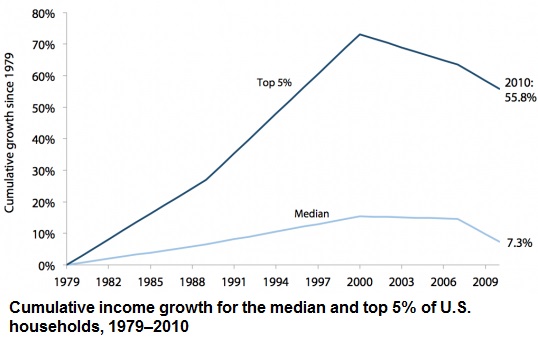
This is hard! Change has come to the world of wage-seekers – the middle classes are under attack; the labor-pool of most industrialized nations have endured decline, not in the numbers, but rather in prosperity. While wage-earners have not kept pace with inflation, top-earners (bonuses, commissions and business profits) have soared; (see Photo).
CU Blog - Economic Principles - Wage-Seeking - Market forces -vs- Collective Bargaining - Photo 2As a direct result, every Caribbean member-state struggles with employment issues in their homeland. In fact, this was an initial motivation for the book Go Lean…Caribbean, stemming from the fall-out of the 2008 Great Recession, this publication was presented as a roadmap for the introduction and implementation of the Caribbean Union Trade Federation (CU) to elevate the economic, security and governing engines of the Caribbean region to create 2.2 million new jobs, despite global challenges.

Needless to say, the global challenge is far more complex than Home Economics. The Go Lean book describes the effort as heavy-lifting; then proceeds to detail the turn-by-turn directions of a roadmap to remediate and mitigate wage-seeking.

The roadmap channels the Economic Principles and best-practices of technocrats like Adam Smith and 11 other named economists, many of them Nobel Laureates. A review of the work of these great men and woman constitute “Lessons in Economic Principles”. Why would these lessons matter in the oversight of Caribbean administration? Cause-and-effect!
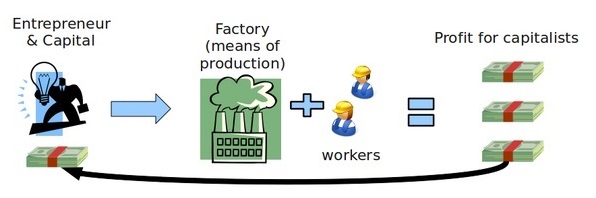
Profit 4The root of the current challenge for wage-seekers is income equality; and this is bigger than just the Caribbean. It is tied to the global adoption of globalization and technology/ automation – a product of global Market Forces as opposed to previous Collective Bargaining factors. This relates back to the fundamental Economic Principle of “supply-and-demand”; but now the “supply” is global. This photo/”process flow” here depicts the ingredients of Market Forces. When there is the need for labor, the principle of comparative analysis is employed, and most times the conclusion is to “off-shore” the labor efforts, and then import the finished products. This is reversed of the colonialism that was advocated by Adam Smith; instead of the developed country providing factory labor for Third World consumption, the developed nation (i.e. United States) is now in the consumer-only role, with less and less production activities, for products fabricated in the Third World. This reality is not sustainable for providing prosperity to the middle classes, to the wage-seekers.

As a community, we may not like the laws of Economics, but we cannot ignore them. The Go Lean book explains the roles and significance of Economic Principles … with this excerpt (Page 21):

While money is not the most important factor in society, the lack of money and the struggle to acquire money creates challenges that cannot be ignored. The primary reason why the Caribbean has suffered so much human flight in the recent decades is the performance of the Caribbean economy. Though this book is not a study in economics, it recommends, applies and embraces these 6 core Economic Principles as sound and relevant to this roadmap:

  1. People Choose: We always want more than we can get and productive resources (human, natural, capital) are always limited. Therefore, because of this major economic problem of scarcity, we usually choose the alternative that provides the most benefits with the least cost.
  2. All Choices Involve Costs: The opportunity cost is the next best alternative you give up when you make a choice. When we choose one thing, we refuse something else at the same time.
  3. People Respond to Incentives in Predictable   Ways: Incentives are actions, awards, or rewards that determine the choices people make. Incentives can be positive or negative. When incentives change, people change their behaviors in predictable ways.
  4. Economic Systems Influence Individual Choices and Incentives: People cooperate and govern their actions through both written and unwritten rules that determine methods of allocating scarce resources. These rules determine what is produced, how it is produced, and for whom it is produced. As the rules change, so do individual choices, incentives, and behavior.
  5. Voluntary Trade Creates Wealth: People specialize in the production of certain goods and services because they expect to gain from it. People trade what they produce with other people when they think they can gain something from the exchange. Some benefits of voluntary trade include higher standards of living and broader choices of goods and services.
  6. The Consequences of Choices Lie in the Future: Economists believe that the cost and benefits of decision making appear in the future, since it is only the future that we can influence. Sometimes our choices can lead to unintended consequences.

Source: Handy Dandy Guide (HDC) by the National Council on Economic Education (2000)

The Go Lean book describes the end result of the application of best-practices in this field of economics over the course of a 5-year roadmap: the CU … as a hallmark of technocracy. But the purpose is not the edification of the region’s economists, rather to make the Caribbean homeland “better places to live, work and play” for its citizens. This branding therefore puts emphasis on the verb “work”; the nouns “jobs” and “wages” must thusly be a constant focus of the roadmap.

Brain Drain 70 percent ChartThis Go Lean book declares that the Caribbean eco-system for job-creation is in crisis … due to the same global dilemma. The roadmap describes the crisis as losing a war, the battle of globalization and technology. The consequence of the defeat is 2 undesirable conditions: income inequality and societal abandonment, citizens driven away to a life in the Diaspora. This assessment currently applies in all 30 Caribbean member-states, as every community has lost human capital to emigration. Some communities, like Puerto Rico and the US Virgin Islands have suffered with an abandonment rate of more than 50% and others have watched more than 70% of college-educated citizens flee their community for foreign shores. Even education is presented as failed investments as those educated in the region and leave to find work do not even return remittances in proportion to their costs of development. (See Table 4.1 in the Photo)

The Go Lean book therefore posits that there is a need to re-focus, re-boot, and optimize the labor/wage-seeking engines so as to create more jobs with livable wages. Alas, this is not just a Caribbean issue, but a global (i.e. American) one as well. See the following encyclopedic references for wage-seeking and Collective Bargaining to fully understand the complexities of these global issues:

Encyclopedia Reference #1: Wage-Seeking
(Source: https://en.wikipedia.org/wiki/Wage)

A wage is monetary compensation paid by an employer to an employee in exchange for work done. Payment may be calculated as a fixed amount for each task completed (a task wage or piece rate), or at an hourly or daily rate, or based on an easily measured quantity of work done.

Wages are an example of expenses that are involved in running a business.

Payment by wage contrasts with salaried work, in which the employer pays an arranged amount at steady intervals (such as a week or month) regardless of hours worked, with commission which conditions pay on individual performance, and with compensation based on the performance of the company as a whole. Waged employees may also receive tips or gratuity paid directly by clients and employee benefits which are non-monetary forms of compensation. Since wage labour is the predominant form of work, the term “wage” sometimes refers to all forms (or all monetary forms) of employee compensation.

Determinants of wage rates
Depending on the structure and traditions of different economies around the world, wage rates will be influenced by market forces (supply and demand), legislation, and tradition. Market forces are perhaps more dominant in the United States, while tradition, social structure and seniority, perhaps play a greater role in Japan.[6]

Wage Differences
Even in countries where market forces primarily set wage rates, studies show that there are still differences in remuneration for work based on sex and race. For example, according to the U.S. Bureau of Labor Statistics, in 2007 women of all races made approximately 80% of the median wage of their male counterparts. This is likely due to the supply and demand for women in the market because of family obligations. [7] Similarly, white men made about 84% the wage of Asian men, and black men 64%.[8] These are overall averages and are not adjusted for the type, amount, and quality of work done.

Real Wage
The term real wages refers to wages that have been adjusted for inflation, or, equivalently, wages in terms of the amount of goods and services that can be bought. This term is used in contrast to nominal wages or unadjusted wages. Because it has been adjusted to account for changes in the prices of goods and services, real wages provide a clearer representation of an individual’s wages in terms of what they can afford to buy with those wages – specifically, in terms of the amount of goods and services that can be bought.

See Table of European Model in the Appendix below. (The European Union is the model for the Caribbean Union).

———-

Encyclopedia Reference #2: Collective Bargaining
(Source: https://en.wikipedia.org/wiki/Collective_bargaining)

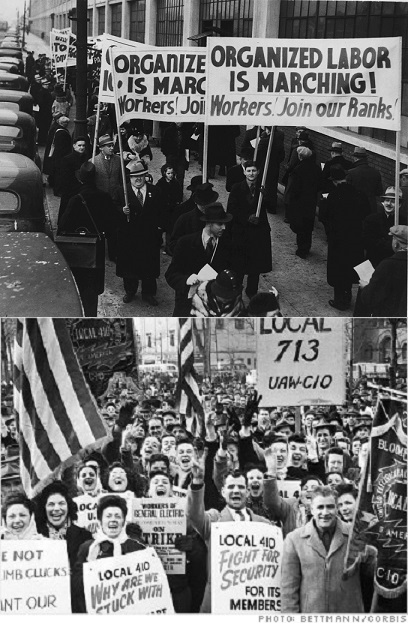
WPR: Marches & PicketsCollective Bargaining is a process of negotiation between employers and a group of employees aimed at reaching agreements to regulate working conditions. The interests of the employees are commonly presented by representatives of a trade union to which the employees belong. The collective agreements reached by these negotiations usually set out wage scales, working hours, training, health and safety, overtime, grievance mechanisms, and rights to participate in workplace or company affairs.[1]

The union may negotiate with a single employer (who is typically representing a company’s shareholders) or may negotiate with a group of businesses, depending on the country, to reach an industry wide agreement. A collective agreement functions as a labor contract between an employer and one or more unions.

The industrial revolution brought a swell of labor-organizing in [to many industrialized countries, like] the US. The American Federation of Labor (AFL) was formed in 1886, providing unprecedented bargaining powers for a variety of workers.[11] The Railway Labor Act (1926) required employers to bargain collectively with unions. While globally, International Labour Organization Conventions (ILO) were ratified in parallel to the United Nations efforts (i.e. Declaration of Human Rights, etc.). There were a total of eight ILO fundamental conventions [3] all ascending between 1930 and 1973, i.e. the Freedom of Association and Protection of the Right to Organise Convention (1949).
The Go Lean book presents a roadmap on how to benefit from the above Economic Principles – and how to empower communities anew – in the midst of tumultuous global challenges. This roadmap addresses more than economics, as there are other areas of societal concern. This is expressed in the CU charter; as defined by these 3 prime directives:

  • Optimization of economic engines in order to grow the regional economy to $800 Billion and create 2.2 million new jobs.
  • Establishment of a security apparatus to protect the resultant economic.
  • Improvement of Caribbean governance to support these engines.

Early in the Go Lean book, the responsibility to create jobs was identified as an important function for the CU with these pronouncements in the Declaration of Interdependence (Pages 14):

xix.  Whereas our legacy in recent times is one of societal abandonment, it is imperative that incentives and encouragement be put in place to first dissuade the human flight, and then entice and welcome the return of our Diaspora back to our shores.

xxi.  Whereas the preparation of our labor force can foster opportunities and dictate economic progress for current and future generations, the Federation must ensure that educational and job training opportunities are fully optimized for all residents of all member-states, with no partiality towards any gender or ethnic group. The Federation must recognize and facilitate excellence in many different fields of endeavor, including sciences, languages, arts, music and sports. This responsibility should be executed without incurring the risks of further human flight, as has been the past history.

xxiv. Whereas a free market economy can be induced and spurred for continuous progress, the Federation must install the controls to better manage aspects of the economy: jobs, inflation, savings rate, investments and other economic principles. Thereby attracting direct foreign investment because of the stability and vibrancy of our economy.

xxvi.  Whereas the Caribbean region must have new jobs to empower the engines of the economy and create the income sources for prosperity, and encourage the next generation to forge their dreams right at home, the Federation must therefore foster the development of new industries, like that of ship-building, automobile manufacturing, prefabricated housing, frozen foods, pipelines, call centers, and the prison industrial complex. In addition, the Federation must invigorate the enterprises related to existing industries tourism, fisheries and lotteries – impacting the region with more jobs.

According to an article from the Economic Policy Institute, entitled The Decline of Collective Bargaining and the Erosion of Middle-class Incomes in Michigan by Lawrence Mishel (September 25, 2012), the challenges to middle class income are indisputable, and the previous solution – Collective Bargaining – is no longer as effective as in the past. (The industrial landscape of Michigan had previously been identified as a model for the Caribbean to consider). See a summary of the article here (italics added) and VIDEO in the Appendix:

In Michigan between 1979 and 2007, the last year before the Great Recession, the state’s economy experienced substantial growth and incomes rose for high-income households. But middle-class incomes did not grow. The Michigan experience is slightly worse than but parallels that of the United States as a whole, where middle-class income gains were modest but still far less than the income gains at the top. What the experience of Michiganders and other Americans makes clear is that income inequality is rising, and it has prevented middle-class incomes from growing adequately in either Michigan or the nation.

The key dynamic driving this income disparity has been the divergence between the growth of productivity—the improvement in the output of goods and services produced per hour worked—and the growth of wages and benefits (compensation) for the typical worker. It has been amply documented that productivity and hourly compensation grew in tandem between the late 1940s and the late 1970s, but split apart radically after 1979. Nationwide, productivity grew by 69.1 percent between 1979 and 2011, but the hourly compensation of the median worker (who makes more than half the workforce but less than the other half) grew by just 9.6 percent (Mishel and Gee 2012; Mishel et al. 2012). In other words, since 1979 the typical worker has hardly benefited from improvements in the economy’s ability to raise living standards and, consequently, middle-class families’ living standards have barely budged since then. This phenomenon has occurred across the nation, including in Michigan.

This divergence between pay and productivity and the corresponding failure of middle-class incomes to grow is strongly related to the erosion of collective bargaining. And collective bargaining has eroded more in Michigan than in the rest of the nation, helping to explain Michigan’s more disappointing outcomes.

Research three decades ago by economist Richard Freeman (1980) showed that collective bargaining reduces wage inequality, and all the research since then (see Freeman 2005) has confirmed his finding. Collective bargaining reduces wage inequality for three reasons. The first is that wage setting in collective bargaining focuses on establishing “standard rates” for comparable work across business establishments and for particular occupations within establishments. The outcome is less differentiation of wages among workers and, correspondingly, less discrimination against women and minorities. A second reason is that wage gaps between occupations tend to be lower where there is collective bargaining, and so the wages in occupations that are typically low-paid tend to be higher under collective bargaining. A third reason is that collective bargaining has been most prevalent among middle-class workers, so it reduces the wage gaps between middle-class workers and high earners (who have tended not to benefit from collective bargaining).

Collective bargaining also reduces wage inequality in a less-direct way. Wage and benefit standards set by collective bargaining are often followed in workplaces not covered by collective bargaining, at least where there is extensive coverage by collective bargaining in particular occupations and industries. This spillover effect means that the impact of collective bargaining on the wages and benefits of middle-class workers extends far beyond those workers directly covered by an agreement.

Source: http://www.epi.org/publication/bp347-collective-bargaining/

The siren call went out 20 years ago, of the emergence of an “Apartheid” economy, a distinct separation between the classes: labor and management. Former US Secretary of Labor Robert Reich (1993 – 1997 during the Clinton Administration’s First Term) identified vividly, in this 1996 Harvard Business Review paper, that something was wrong with the U.S. economy then; (it is worst now):

CU Blog - Economic Principles - Wage-Seeking - Market forces -vs- Collective Bargaining - Photo 3That something is not the country’s productivity, technological leadership, or rate of economic growth, though there is room for improvement in all those areas. That something is an issue normally on the back burner in U.S. public discourse: the distribution of the fruits of economic progress. For many, the rise in AT&T’s stock after it announced plans [on January 3, 1996] to lay off 40,000 employees crystallized the picture of an economy gone haywire, with shareholders gaining and employees losing as a result of innovation and advances in productivity.

Has the distribution of the benefits of economic growth in the United States in fact gone awry? Is the nation heading toward an apartheid economy—one in which the wealthy and powerful prosper while the less well-off struggle? What are the facts? What do they mean? Are there real problems—and can they be solved?

Deploying solutions for the problem of income equality in the Caribbean is the quest of the Go Lean/CU roadmap. The book identified Agents of Change (Page 57) that is confronting the region, (America as well); they include: Globalization and Technology. A lot of the jobs that paid a “living wage” are now being shipped overseas to countries with lower wage levels, or neutralized by the advancement of technology. Yes, computers are reshaping the global job market, so even Collective Bargaining may fail to counter any eventual obsolescence of wage-earners, their valuation and appreciation; (see Encyclopedic Article # 2). The Go Lean book, and previous blog/commentaries, therefore detailed the campaign to not just consume technology, but to also innovate, produce and distribute the computer-enabled end-products. Therefore industries relating to STEM (Science, Technology, Engineering and Mathematics/Medicine) are critical in the roadmap. Not only do these careers yield good-paying direct jobs, but also factor in the indirect job market, and the job-multiplier rate (3.0 to 4.1) for down-the-line employment (Page 260) opportunities.

The Go Lean… Caribbean book details the creation of 2.2 million new jobs for the Caribbean region, many embracing ICT/STEM skill-sets. This is easier said than done, so how does Go Lean purpose to deliver on this quest? By the adoption of certain community ethos, plus the executions of key strategies, tactics, implementations and advocacies. The following is a sample from the book:

Assessment – Puerto Rico – Extreme Unemployment – The Greece of the Caribbean Page 18
Community Ethos – Deferred Gratification Page 21
Community Ethos – Job Multiplier Page 22
Community Ethos – Anti-Bullying and Mitigation Page 23
Community Ethos – Lean Operations Page 24
Community Ethos – Return on Investments Page 24
Community Ethos – Ways to Impact the Future Page 26
Community Ethos – Ways to Foster Genius Page 27
Community Ethos – Ways to Help Entrepreneurship Page 28
Community Ethos – Ways to Promote Intellectual Property – Key to ICT Careers Page 29
Community Ethos – Ways to Impact Research and Development – Germaine for STEM jobs Page 30
Community Ethos – Ways to Close the Digital Divide – Vital for fostering ICT careers Page 31
Strategy – Mission – Education Without Further Brain Drain Page 46
Strategy – Agents of Change – Technology Page 57
Strategy – Agents of Change – Globalization Page 57
Tactical – Fostering a Technocracy Page 64
Tactical – Tactics to Forge an $800 Billion Economy – East Asian Tigers Model Page 69
Tactical – Tactics to Forge an $800 Billion Economy – High Multiplier Industries Page 70
Tactical – Tactics to Forge an $800 Billion Economy – Trade and Globalization Page 70
Tactical – Separation of Powers – Commerce Department – Patents & Copyrights Page 78
Implementation – Steps to Implement Self-Governing Entities – As Job-creating Engines Page 105
Implementation – Ways to Benefit from Globalization – Technology: The Great Equalizer Page 119
Planning – Ways to Improve Trade Page 128
Planning – Ways to Model the EU Page 130
Planning – Lessons Learned from 2008 – Income Equality Now More Pronounced Page 136
Advocacy – Ways to Grow the Economy Page 151
Advocacy – Ways to Create Jobs Page 152
Advocacy – Ways to Improve Education – e-Learning Options Page 159
Advocacy – Ways to Impact Labor Markets and Unions – Collective Bargaining Best-Practices Page 164
Advocacy – Ways to Foster Empowering Immigration – STEM Resources Page 174
Advocacy – Ways to Foster Technology – Credits, Incentives and Investments Page 197
Advocacy – Ways to Foster e-Commerce – Optimize Remittance Methods Page 198
Advocacy – Ways to Help the Middle Class – Exploit Globalization Page 223
Appendix – Growing 2.2 Million Jobs in 5 Years Page 257
Appendix – Job Multipliers – Direct & Indirect Job Correlations Page 259
Appendix – Emigration Bad Example – Puerto Rican Population in the US Mainland Page 304

The CU will foster job-creating developments, incentivizing many high-tech start-ups and incubating viable companies. The primary ingredient for CU success will be Caribbean people, so we must foster and incite participation of many young people into fields currently sharing higher job demands, like ICT and STEM, so as to better impact their communities. A second ingredient will be the support of the community – the Go Lean movement recognizes the limitation that not everyone in the community can embrace the opportunity to lead in these endeavors. An apathetic disposition is fine-and-well; we simply must not allow that to be a hindrance to those wanting to progress – there are both direct jobs and indirect jobs connected with the embrace of ICT/STEM disciplines. The community ethos or national spirit, must encourage and spur “achievers” into roles where “they can be all they can be”. Go Lean asserts that one person can make a difference … to a community (Page 122).

Other subjects related to job empowerments for wage-seekers in the region have been blogged in other Go Lean…Caribbean commentaries, as sampled here:

https://goleancaribbean.com/blog/?p=4240 Immigration Policy Exacerbates Worker Productivity Crisis
https://goleancaribbean.com/blog/?p=3694 Jamaica-Canada employment programme pumps millions into local economy
https://goleancaribbean.com/blog/?p=3473 Haiti to Receive $70 Million Grant to Expand Caracol Industrial Park to Create Jobs and Benefit from Globalization
https://goleancaribbean.com/blog/?p=3446 Forecast for higher unemployment in Caribbean in 2015
https://goleancaribbean.com/blog/?p=3164 Michigan Unemployment Model – Then and Now
https://goleancaribbean.com/blog/?p=2857 Where the Jobs Are – Entrepreneurism in Junk
https://goleancaribbean.com/blog/?p=2800 The Geography of Joblessness
https://goleancaribbean.com/blog/?p=2750 Disney World’s example of Self Governing Entities and Economic Impacts of 70,000 jobs; 847,000+ Puerto Ricans now live in the vicinity.
https://goleancaribbean.com/blog/?p=2126 Where the Jobs Are – Computers Reshaping Global Job Market
https://goleancaribbean.com/blog/?p=2025 Where the Jobs Are – Attitudes & Images of the Caribbean Diaspora in US
https://goleancaribbean.com/blog/?p=2003 Where the Jobs Are – Ship-breaking under the SGE Structure
https://goleancaribbean.com/blog/?p=1698 Where the Jobs Are – STEM Jobs Are Filling Slowly
https://goleancaribbean.com/blog/?p=1683 Where the Jobs Were – British public sector now strike over ‘poverty pay’
https://goleancaribbean.com/blog/?p=1214 Where the Jobs Are – Fairgrounds as SGE & Landlords for Sports Leagues
https://goleancaribbean.com/blog/?p=273 10 Things We Don’t Want from the US – Job Discrimination of Immigrations

The Caribbean is arguably the best address on the planet, but “man cannot live on beauty alone”, there is the need for a livelihood as well. This is the challenge, considering the reality of unemployment in the region; the jobless rate among the youth is even higher.

The crisis of income inequality for the US is a direct result of free trade agreements, like NAFTA, and China’s Preferential Trading Status. Despite this status, we can benefit from the realities of globalization; jobs are being moved to conducive locations with lower labor costs.  We should invite these investors to look for cheaper labor options, here in the Caribbean region (Haiti, Dominican Republic, Jamaica, etc.). This is the same reality as in Europe with different wage levels for the different countries (see Appendix below); the Caribbean also has these wage differences.

The Go Lean roadmap seeks to foster higher-paying job options: Call Centers, Offshore Software Development Centers, R&D Medical campuses, light-manufacturing and assembly plants for “basic needs” products (food, clothing shelter, energy, and transportation) for Caribbean consumption. This is the successful model of Japan, China and the “East Asia Tigers” economies; these are manifestations of effective Economic Principles.

The Go Lean book therefore digs deeper, providing turn-by-turn directions to get to the desired Caribbean results: a better place to live, work and play. 🙂

Download the free e-Book of Go Lean … Caribbean – now!

————-

Appendix – List of European countries by average wage (USA & Japan added for comparison)

(Source: https://en.wikipedia.org/wiki/List_of_European_countries_by_average_wage)

2014 Annual values (in national currency) for a family with two children with one average salary, including tax credits and allowances.[1] Net amount is computed after Taxes, Social Security and Family Allowances; the result is provided in both the National Currency and the Euro, if different. The table, sorted from highest Net amount to the lowest, is presented as follows:

State Gross Net (Natl. Curr) Net (Euro)
Switzerland 90,521.98 86,731.20 71,407.21
Luxembourg 54,560.39 52,041.36 52,041.36
Norway 542,385.96 415,557.87 49.,741.20
Denmark 397,483.78 289,292.48 38,806.20
Iceland 6,856,099.69 5,872.114.66 37,865.07
UNITED STATES 56,067 45,582 37,671
Sweden 407,974.45 335,501.45 36,874.37
Netherlands 48,855.70 36,648.71 36,648.71
United Kingdom 35,632.64 28,960.38 35,925.65
Belgium 46,464.41 35,810.55 35,810.55
Italy 41,462.67 24,539.93 35,539.93
Germany 45,952.05 36,269.23 35,269.23
France 38,427.35 30,776.75 34,776.75
Ireland 34,465.85 34,382.63 34,382.63
Austria 42,573.25 33,666.04 33,666.04
Finland 42,909.72 32,386.59 32,386.59
JAPAN 4,881,994.24 4,132.432.02 29,452.16
Spain 26,161.81 22,129.78 22,129.78
Greece 24,201.50 17,250.24 17,250.24
Slovenia 17,851.28 15,882.53 15,882.53
Portugal 17,435.71 15,140.25 15,140.25
Estonia 12,435.95 11,176.87 11,176.87
Czech Republic 312,083.83 306,153.76 11,118.31
Slovakia 10,342.10 9,778.16 9,778.16
Poland 42,360.01 34,638.77 8,278.27
Hungary 3,009,283.93 2,530.280.97 8,196.30
Turkey 28,370.00 21,072.12 7,250.00

————-

Appendix VideoCollective Bargaining and Shared Prosperity: Michigan, 1979 – 2009 http://youtu.be/PcT4jK89JmE

Published on September 27, 2012 – This VIDEO depicts the positive effects of Collective Bargaining on the quest for income equality in the US State of Michigan; and the sad consequence of the widening income inequality when Collective Bargaining is less pervasive.
This reflect the “Observe and Report” functionality of the Go Lean…Caribbean promoters in the Greater Detroit-Michigan area.

Share this post:
, , , ,

Lessons from China – Size Does Matter … for Hollywood

Go Lean Commentary

In a previous commentary, the assertion was made that “movies are an amazing business model; people give money to spend a couple of hours watching someone else’s creation and then leave the theater with nothing to show for the investment; perhaps only a different perspective”. There is no consumption of resources or exchange for chattel goods; the consumer is simply buying an intangible.

There are other industries based on intangibles; consider telecommunications for example. For deliveries in this industry, mass consumption could be a detriment, as quality is degraded with more and more consumption.

CU Blog - Lessons from China - Size Does Matter ... for Hollywood - Photo 1But the movie industry is different; this is one where larger audiences are preferred. This is due to the delivery dynamics: quality is not degraded with frequent delivery of the end product; the quality considerations are embedded in the production, not the delivery. After the production of a movie, all the costs becomes historic; (there is only marginal costs associated with marketing and distribution). The hope is that enough people will buy tickets to see the movie and recoup the investment. After the break-even, all additional revenue is “gravy”; the “more the merrier”.

For Hollywood – a metonym for the film-television-video industry – any access to large markets is a win-win.

Enter China…

… this country has 1.3 billion people. That’s a lot of “eye-balls”. This country, considering its history, used to be closed to western commerce and movie distributions. Now, its open … and advancing. Those 1.3 billion pairs of eye-balls are presenting a lot of opportunities and now starting to wield power. Consider the details of this news article here:

TitleWhy China will soon be Hollywood’s largest market
For the hundred years that the movie industry has been around, the United States has been the largest market for films. But as early as next year, a new country may hold that distinction.

Indeed, some analysts expect China’s yearly box office revenue to exceed that of the U.S. by the end of 2017. And even if that’s an optimistic estimate, China will almost certainly have overtaken the United States by the end of 2018.

For proof, just take a look at the growth rate in the China film market over the past few years. In 2014, China’s box office grew 27% from the previous year to $4.55 billion. In 2015, it grew 41% to $6.78 billion.

Due to a weak crop of films and a slowdown in China’s GDP growth, 2016 may not see such a remarkable uptick. However, even with the speed bump, by the end of 2018 China’s film market should surpass the $10.7 billion in yearly box office revenue that the United States has averaged over the past five years.

“North America will probably play second fiddle to China within the next two years,” said Paul Dergarabedian, senior analyst at Comscore . “And by the end of the next decade (2030), China’s film market could generate double the revenue of North America’s.”

That’s an incredible result, considering that China was barely a box office factor not too long ago. “The only reason you would talk about China 20 years ago would be to learn about piracy,” said James Schamus, a veteran film producer in the industry. “It is night and day, the difference between China then and now.”

Source: The Street – Finance & Economy Journal; posted August 12, 2016; retrieved August 26, 2016 from:
http://www.msn.com/en-us/money/savingandinvesting/why-china-will-soon-be-hollywoods-largest-market/ar-BBvyTtL

See the remainder of the news article in the Appendix below.

The US domestic market is 320 million people. The Chinese domestic market is 1,300 million or 1.3 billion. Size does matter!

China is a lot of people for Hollywood to cater to; the amazing business model becomes even more amazing. The reality of that market size is starting to manifest in production planning and distribution; (think language translation). This is being recognized finally as the Chinese conglomerate Wanda Group bought into Hollywood “royalty” by acquiring movie studio Legendary Entertainment this past April – see VIDEO in the Appendix below. This scenario furnishes a lot of lessons, good and bad, for onlookers to glean.

The promoters of the book Go Lean…Caribbean is looking, listening and learning the lessons from China. We are seeking to apply these lessons in the development of the Caribbean region. Though our population is no way near 1.3 billion, there is still the enlightenment that “size does matter“. As an integrated Single Market, the Caribbean is 42 million people; much more significant a market than any one Caribbean member-state alone.

This is the lesson learned.

This commentary is 2 of 6 from the Go Lean movement, in consideration the good and bad lessons from China. The other commentaries detailed in this series are as follows:

  1. History of China Trade: Too Big to Ignore
  2. Why China will soon be Hollywood’s largest market
  3. Organ Transplantation: Facts and Fiction
  4. Mobile Games Apps: The new Playground
  5. South China Seas: Exclusive Economic Zones
  6. WeChat: Model for Caribbean Social Media – www.MyCaribbean.gov

All of these commentaries relate to nation-building, stressing the community investments required to facilitate the short-term, mid-term and long-term needs of our communities. This blog entry however relates more to the art and science of movies.

Imagine a time – only recently – when Chinese people did not have access to Hollywood’s movies. That is not a world that the Caribbean wants to contemplate. We want to consume this art-form, yes, but we want to produce and distribute as well. We want to have access to our full Caribbean market, the North American market and to China as well.

We know that a few hours at the movies can entertain, engage and transform. Sometimes even, movies can change the world. This art-form can wield great power.

The book Go Lean…Caribbean presents an empowerment plan for the Caribbean region, stressing the arts as equally as it does the sciences. It may be easier for us to excel in the arts than the sciences. Think: we have no Nobel Prize winning scientist in the Caribbean, but we do have (or had) Grammy Award-winning musical artists and Academy Award winning actors. We can still impact the Greater Good in the Caribbean and the rest of the world – including China.

This point was pronounced in the Go Lean book, in the opening Declaration of Interdependence (Page 14) with these statements:

xxviii. Whereas intellectual property can easily traverse national borders, the rights and privileges of intellectual property must be respected at home and abroad. The Federation must install protections to ensure that no abuse of these rights go with impunity, and to ensure that foreign authorities enforce the rights of the intellectual property registered in our region.

xxxii. Whereas the cultural arts and music of the region are germane to the quality of Caribbean life, and the international appreciation of Caribbean life, the Federation must implement the support systems to teach, encourage, incentivize, monetize and promote the related industries for arts and music in domestic and foreign markets. These endeavors will make the Caribbean a better place to live, work and play.

The Go Lean book serves as a roadmap for the introduction and implementation of the technocratic Caribbean Union Trade Federation (CU) to help the region become a better place to live, work and play. There is a role for the arts (including film-making) in this empowerment roadmap. The book posits that a unified Caribbean Single Market of 42 million people and a GDP of $800 Billion can foster a “domestic” film industry, must like the formations of Bollywood in India (Page 346) and Nollywood in Nigeria. While this is no Hollywood, nor China for that matter, there could still be positive returns on movie industry investments within the Caribbean market. Jobs may be involved, as this amazing business model (movies) can create jobs and garner local returns from the necessary investments.

The quest is to elevate Caribbean society with many industrial developments, including the arts. This was stated in the same Declaration of Interdependence (Page 13) with this statement:

xxi. Whereas the preparation of our labor force can foster opportunities and dictate economic progress for current and future generations, the Federation must ensure that educational and job training opportunities are fully optimized for all residents of all member-states, with no partiality towards any gender or ethnic group. The Federation must recognize and facilitate excellence in many different fields of endeavor, including sciences, languages, arts, music and sports. This responsibility should be executed without incurring the risks of further human flight, as has been the past history.

This impact and overall benefit of this roadmap is pronounced in the Go Lean/CU‘s prime directives, identified with these 3 statements:

  • Optimization of the economic engines in order to grow the regional economy to $800 Billion & create 2.2 million new jobs.
  • Establishment of a security apparatus to protect the resultant economic engines.
  • Improvement of Caribbean governance to support these engines.

These previous blog/commentaries drilled deeper on this quest to better foster the arts-show-business with these examples:

https://goleancaribbean.com/blog/?p=7950 Bahamas Junkanoo Carnival – Long road to Legacy
https://goleancaribbean.com/blog/?p=7685 Music – songs & concerts – have and do change the world
https://goleancaribbean.com/blog/?p=7082 The Art and Science of ‘Play’
https://goleancaribbean.com/blog/?p=3999 Role Model Sidney Poitier – The Power of Film
https://goleancaribbean.com/blog/?p=3641 ‘We Built This City …’ on Music and Show-business
https://goleancaribbean.com/blog/?p=3568 Forging Change: Music Moves People
https://goleancaribbean.com/blog/?p=2726 Caribbean Role Model for the Arts/Fashion – Oscar De La Renta: RIP
https://goleancaribbean.com/blog/?p=866 Caribbean Music Man: Bob Marley – The legend lives on!

The roadmap specifically encourages the region, to lean-in and foster the industrial eco-systems for the arts with these specific community ethos, strategies, tactics, implementations and advocacies:

Community Ethos – Consequences of Choices Lie in the Future Page 24
Community Ethos – Minority Equalization Page 24
Community Ethos – Cooperatives Page 25
Community Ethos – Ways to Foster Genius Page 27
Community Ethos – Ways to Promote Intellectual Property Page 31
Community Ethos – Ways to Improve Sharing Page 35
Community Ethos – Ways to Promote Happiness Page 36
Community Ethos – Ways to Impact the Greater Good Page 37
Strategy – Celebrate the arts, people and culture of the Caribbean Page 46
Tactical – Separation-of-Powers – Tourism and Film Promotion & Administration Page 78
Implementation – Integration of Region in Single Market of 42 million people Page 95
Anatomy of Advocacies Page 122
Planning – 10 Big Ideas – Caribbean Single Market Page 127
Planning – Ways to Better Manage Image Page 129
Advocacy – Ways to Improve Education – Foster Performing Arts Page 159
Advocacy – Ways to Foster Cooperatives Page 176
Advocacy – Ways to Impact Justice Page 177
Advocacy – Ways to Improve Communications – Simultaneous Languages Page 186
Advocacy – Ways to Impact Hollywood Page 203
Advocacy – Ways to Preserve Caribbean Heritage Page 222
Advocacy – Ways to Impact Youth Page 225
Advocacy – Ways to Improve the Arts Page 230
Appendix  –  A Summary of Bollywood Movies Page 346

The Go Lean book posits that the CU should foster the genius potential in Caribbean artists and incubate the movie industry in the Caribbean; and related show-businesses. The roadmap pronounces that with the participation of many advocates on many different paths for progress, the Caribbean can truly become a better place to live, work and play.

The business axiom is “build a better mousetrap and the world will beat a path to your door”. The lesson from China is that larger markets are available … for quality products – “better mousetraps”. If we build a better mousetrap of a film, the world – China included – will beat a path to our door.

Hollywood is seeking out opportunities in China. The Caribbean must also seeks out opportunity in the movie industry. While China is out-of-scope for this roadmap, the lessons learned are very much in scope. The Caribbean must look, listen and learn; then we must change and empower, and foster  … and adapt to this changing world. 🙂

Download the book Go Lean … Caribbean – now!

————-

Appendix VIDEO – China’s Wanda Buys Into Hollywood – https://youtu.be/dsJjkp2I-MY

Published on Jan 12, 2016 – Chinese conglomerate Dalian Wanda snapped up U.S. film firm Legendary for $3.5 billion and now owns the rights to popular blockbuster hits such as The Dark Knight, Inception and Straight Outta Compton. (Photo: AP)

————-

Appendix TitleWhy China will soon be Hollywood’s largest market … CONT’D

The increased importance of revenues from China is in keeping with the globalization of the film market over the past few decades. For instance, the highest-grossing film of 1989, Tim Burton’s “Batman,” saw 61.1% of its worldwide box office total come from North American theaters, with the other 38.9% coming from foreign territories.

The latest film starring the Caped Crusader, however, shows how the tides have turned. “Batman v. Superman” grossed only 37.9% from North America and saw 62.1% of its total revenue from international markets–almost an exact reversal of the 1989 “Batman.”

What’s behind the spike in international grosses in recent years? According to Daniel Loria, editorial director at Box Office Media, the trend can be attributed to technological innovation within the film industry.

“Exhibition didn’t start to boom overseas until digital cinema took over analog,” he says, referring to the fact that movies are now largely delivered to theaters via digital files rather than physical reels of 35-millimeter film. “At that point, it became significantly more affordable to deliver prints of movies, and so distribution became democratized.”

Ever since that important shift to digital cinema, exhibitors and studios have capitalized on the facility with which they can now show films to global audiences. Movie theaters are being constructed at a historically quick rate across the world. For example, 8,035 screens were erected in China in 2014 alone, which is more than 20% of the 39,000 screens that the United States currently has. And audiences are attending the newly constructed theaters in large numbers, propelling films such as “Batman v. Superman” to international grosses that are competitive with those from North America.

And “Batman v. Superman” is just the tip of the iceberg when it comes to films making the majority of their money overseas. In recent memory, 2013’s “Pacific Rim” made 75.2% of its total gross overseas, with its revenue from China ($111.9 million) outstripping revenue from North America ($101.8 million). “[Fast and] Furious 7” was even more impressive last spring, making 76.7% of its whopping $1.5 billion worldwide gross from international territories. Again, China box office ($390.9 million) surpassed North American box office ($353 million).

CU Blog - Lessons from China - Size Does Matter ... for Hollywood - Photo 3The recent release of “Warcraft” perhaps best exemplifies how international revenues are now able to determine a film’s overall success. “Warcraft,” which cost a hefty $160 million to make, was a domestic bomb, grossing only $47.2 million in the United States. Twenty years ago, that result probably would have meant game over for distributor Universal. However, that $47.2 million was only 10.9% of the film’s worldwide total gross. “Warcraft” made a whopping $385.8 million, or 89.1% of its total box office, from international territories. That figure includes a stunning $220.8 million from–you guessed it–the People’s Republic of China.

It is important to note, however, that “Warcraft” did have a bit of help over its massive run in China. The film was partly produced by Legendary Entertainment, which was bought by the Chinese conglomerate Wanda Group in April of this year. According to Jonathan Papish, film industry analyst at China Film Insider, Wanda Group is perhaps best known in China for its real-estate development. “They’re known for their shopping complexes, their Wanda Malls,” says Papish. However, the conglomerate also owns a theater chain, Wanda Cinema Line. Wanda has also expressed interest in buying stakes in both Lionsgate and Paramount Pictures. The corporation was founded and is owned by Wang Jialin, now one of the richest men in the country.

In order to ensure the success of “Warcraft,” Wanda took steps to make sure the film was well-positioned to do well among Chinese audiences. The corporation rolled out a major promotional campaign for the film, supplying moviegoers with promotional seat covers that allowed them to choose the side of either the Horde or the Alliance, the two rival groups in “Warcraft.” And it’s likely that the film’s ties to Wanda allowed it to secure a release date that lined up with the rest of the film’s international rollout.

And China is not the only country where Wanda holds sway. Indeed, the conglomerate has deep ties to U.S. movie-going, through its majority stake in AMC Entertainment Holdings, Inc. . That means that Wanda owns all AMC Theaters and will soon own Carmike Theaters if the proposed deal goes through. AMC’s recent deal to acquire the European cinema chain Odeon & UCI Cinema Group gives Wanda a true global footprint.

However, an arsenal of movie theaters across the globe does not mean uniform movie-going habits at all of those theaters. For example, in the U.S., it is more difficult to get younger audiences to come to the movies than older. The opposite is true in China.

“China now has the youngest average age of moviegoers out there,” says Schamus. “And it’s getting younger all the time.”

Another difference between the two markets is evidenced in ticket-purchasing trends. In North America, audiences rarely buy tickets before arriving at the movie theater, although exceptions are often made for movies with high anticipation (such as the latest “Star Wars”). It’s estimated that about 20% of the tickets sold in North America are sold online.

In China, however, 57.5% of all tickets are purchased online, mostly through ticketing apps–financed by companies such as Alibaba –that often give discounts to those who use their services (compare that to Fandango, which charges a convenience fee). A price discount will usually be subsidized by the company that is bankrolling the ticketing app, in order to gain a leg-up on the ticketing competition and collect information on what kinds of audiences are drawn to a particular movie. The company will often then partner with a distributor to gain information about the demographic that is buying tickets.

Usually, these discounts will be for domestic films, which is one of many advantages that homegrown content enjoys in China’s film market. Chinese regulators maintain control over when foreign films get screened, and often stack the release calendar to give domestic films a leg-up over Hollywood blockbusters. For example, in 2012 Chinese regulators scheduled superhero movies “The Amazing Spider-Man” and “The Dark Knight Rises” for release on the same day in China. Both ultimately put up decent numbers, but it was a clear attempt to cross-cannibalize Hollywood productions so that domestic films could thrive. Censors also reserve the right to block a film’s release because they object to content, as was the case with “Ghostbusters” recently (because the film promoted superstition!).

Another way that the Chinese government ensures that homegrown movies do well is by maintaining a quota of foreign films that are allowed to release in China. Only 34 films that aren’t released by a Chinese distributor can screen in the Middle Kingdom per year, and 14 of those films have to have a premium format release (3D, IMAX, etc.). These movies are released under a revenue-sharing model where the studio retains the rights to the movie in China (as well as 25% of the box office) but concedes scheduling rights to Chinese censors.

China has shown a willingness to accommodate more Hollywood content in the future, however. This year, the country shortened its annual blackout period, wherein foreign films are barred from showing in theaters in the interest of promoting local content. That period, which typically lasts from late June to early August, was cut off early this year when “The Legend of Tarzan” received a July 19 release date. Additionally, the foreign film quota is expected to expand next year, as the Motion Picture Association of America (MPAA) is going to re-negotiate its deal with the Chinese government.

There is another, seldom-discussed way that foreign content can get through Chinese regulators outside of the 34-film quota. Studios can sell their film to a Chinese distributor that collects all revenue that the movie makes in the country. For example, Lionsgate sold last year’s “The Last Witch Hunter” to China Film Group, which released the film in China in January to solid box office results.

Currently, the number of foreign films in China that are allowed to be sold into release is limited to 50. However, that quota could expand even sooner than the revenue-sharing one. “I predict that the number will change very soon,” says Papish. “When that happens, you’ll see smaller movies from Hollywood coming over.”

Currently, Chinese audiences usually only get to see big-budget Hollywood productions that are dependent on revenue from China to succeed. Sure, margins are smaller for these studios in China — they get 50% of ticket sale revenue in North America compared to the 25% they receive in China — but that 25% is often integral to a movie’s success. Lionsgate’s recent film “Now You See Me 2” made a huge $97.1 million in China, meaning that the studio will likely see about $24 million in revenue. That’s not a far cry from the $32.5 million that the studio is likely to receive from North American ticket sales, which are petering out at about a $65 million total take.

In fact, “Now You See Me 2” proved so popular in China that Lionsgate is working on a Chinese-language spinoff of the film that will be co-produced with Beijing-based film company Leonus Pictures. What’s more, Leonus Pictures reportedly advised Lionsgate on how best to produce content for the Chinese market when in pre-production on “Now You See Me 2.”

Such partnerships will increasingly become the norm as the Chinese film market grows into the world’s largest. “Kung Fu Panda 3,” released earlier this year, was a co-production between Dreamworks Animation and Oriental Dreamworks, a Shanghai-based production company founded by Dreamworks and Chinese investors. A third of the movie was made in China, and the lip movements of the characters were animated twice, once to synchronize to English voice-acting, and again to synchronize to Mandarin voice-acting. The film, perhaps unsurprisingly, grossed more in China than it did in the U.S., $154.3 million to $143.5 million.

CU Blog - Lessons from China - Size Does Matter ... for Hollywood - Photo 2The financiers of the upcoming film “The Great Wall” will hope for the same kind of success between North America and China. The film, which was filmed entirely in China, was funded by a mixture of American and Chinese financing companies, and it features an ensemble of American stars (Matt Damon, Willem Dafoe) and Chinese stars (Andy Lau, Wang Junkai). The film will be released in the People’s Republic in December and in the United States in February of next year.

“The Great Wall,” which cost $135 million to make, could be the first blockbuster to target both North American audiences and Chinese audiences in such an intentional fashion. The director, Zhang Yimou, recently told Entertainment Weekly that the film is using “Hollywood filmmaking to introduce Chinese culture.” The film will be a healthy dose of diversity for American audiences that rarely see Asian actors in anything but small roles on the big screen. If the movie is successful, more Chinese-American co-productions could be on the horizon.

Though pirated films in China primed audiences there for wide exposure to Hollywood blockbusters, the booming economy and surging population in the People’s Republic have left American studios with an attractive market to target with their movies. The theater infrastructure growth in China and advanced technology facilitated distribution in China, and studios are tapping into that opportunity by gearing their productions toward audiences in Shanghai or Beijing instead of New York or L.A.

That’s left some disgruntled. Richard Berman, the executive director of the Center for American Security, fears that China is wielding its box office power to control the film industry in America.

“I’m worried that the people of China are implicitly or overtly controlling our content,” says Berman. “The government might be forcing studios to inject pro-Chinese messages into films.”

Berman’s Center for American Security recently staged a protest outside of an AMC theater in Times Square, citing the belief that Wanda’s “true desire” was to sell “Communist propaganda as well as popcorn.”

Though this paranoia may be a minority opinion, the Chinese influence on Hollywood is something that studios are going to have to get wise to in order to boast big numbers at the box office. And as some fear flagging box office revenue in North America — amid the popularity of streaming services that has dropped theater attendance — China can be the shot in the arm studios need to keep their profits robust, if only they can tailor content to attract the movie-going public there. A country that was barely given a second thought in Hollywood 20 years ago is now, perhaps, the most significant market in the world. Although China’s expansion may be the most meteoric, every foreign market has grown in significance, which means only one thing.

“You’re going to see more co-productions, strategic partnerships, and a shift towards utilizing the resources of China,” says Dergarabedian. “Ultimately, it’s all about creating movies that resonate not only with the China culture, but also with a global audience.”

Share this post:
, , ,
[Top]

Lessons from China – Too Big To Ignore

Go Lean Commentary

The Caribbean has a serious problem with societal abandonment. Far too many of our citizens flee their Caribbean homelands for life in foreign countries. Most assuredly, the destination country is rarely, if ever, China.

CU Blog - Lessons from China - Too Big To Ignore - Photo 3

They have 1.3 billion people inside their borders; we have 42 million in our entire region. China wouldn’t even notice us, our people and our impact. This is not the case in the United States, where 1 in 11 Black residents may be from the Caribbean.

Still our goal is not to make China notice. Our goal is to mitigate the reasons why our people may want/need to leave in the first place. We want our citizens to prosper where they are planted here at home, and not set their sights on migrating to China, or any other country. But still, we can get a lot of benefits from China, as in trade and … lessons learned from their nation-building. They are too big to ignore.

There are a lot of lessons, good and bad, for us to glean and apply here at home. This commentary is 1 of 6 from the movement behind the book Go Lean … Caribbean, in consideration of lessons from China. The other commentaries detailed in this series are as follows:

  1. History of China Trade: Too Big to Ignore
  2. Why China will soon be Hollywood’s largest market
  3. Organ Transplantation: Facts and Fiction
  4. Mobile Games Apps: The new Playground
  5. South China Seas: Exclusive Economic Zones
  6. WeChat: Model for Caribbean Social Media – www.MyCaribbean.gov

All of these commentaries relate to nation-building, stressing the community investments required to facilitate the short-term, mid-term and long-term needs of our communities.

There used to be a time when we thought of the “closed” country of China only as a country on the other side of the planet…

“I’ve got a whole in my heart that goes all the way to China…” – song by pop singer Cyndi Lauper from movie soundtrack for the 1988 film Vibes. – See Appendix VIDEO.

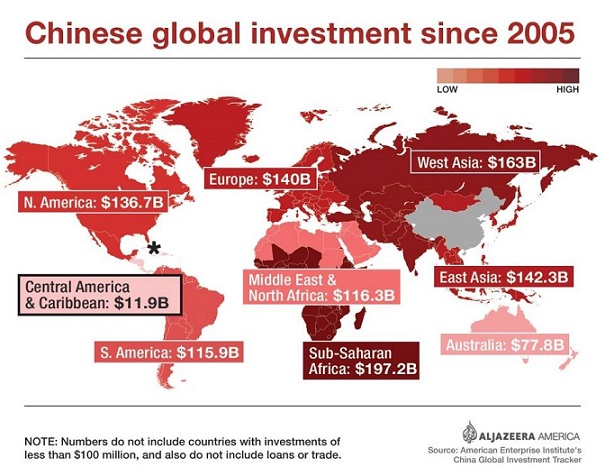
CU Blog - Lessons from China - Too Big To Ignore - Photo 1… but now, we must recognize China as a Super Power; one with a large domestic market and a huge international reach; see this Photo/Chart here.

How did this come about, apparently so quickly? In a word … Trade.

China has grown in the past few decades tremendously by “opening up” and adopting the tenants of this one economic principle, one that is also detailed and recommended for adoption for the Caribbean in the book Go Lean … Caribbean:

Voluntary Trade Creates Wealth: People specialize in the production of certain goods and services because they expect to gain from it. People trade what they produce with other people when they think they can gain something from the exchange. Some benefits of voluntary trade include higher standards of living and broader choices of goods and services.

This analysis of China’s trade development history is part of the technocratic activities needed in the Caribbean, to ensure our region becomes competitive. This effort is inclusive of the Go Lean book as it serves as a roadmap for the introduction and implementation of the technocratic Caribbean Union Trade Federation (CU). The branding “Trade” Federation “gives light” to this economic objective:

Optimize Trade in products and services.

Look at this news article here for a detail discussion on China’s recent history in world trade, their successes and some failures:

Title: How China’s trade concessions made it stronger

It’s still a mystery why.

In negotiations with the U.S. over WTO membership, China made nearly all the concessions. It agreed to cut tariffs, reduce subsidies, lessen the role of state-owned firms and eliminate barriers investment — in other words, to become more like the U.S. economy. All the U.S. did was end an annual renewal of China’s access to the U.S. market, which China’s allies in Congress won every summer, anyway. “Economically, this agreement is the equivalent of a one-way street,” President Bill Clinton said in 2000.

But freer trade with China had outcomes few predicted — especially a surge in imports to the U.S. and a huge U.S. trade deficit. Industries and workers around the U.S. were upended.

To understand what happened, look back to the 1990s. China’s opening to the world was progressing, but suspicion of Beijing ran high in Washington. The 1989 Tiananmen Square massacre made China’s human rights practices a big issue with lawmakers. Congress’s annual review of China’s trading status with the U.S.—what was then called “most favored nation”—became a way to pressure Beijing. While grand-sounding, most-favored status simply meant that China received the same tariffs as nearly every other U.S. trading partner.

From 1990 through 2001, Washington went through an annual theater. The president—whether Republican George H.W. Bush or Democrat Bill Clinton—renewed China’s favored status, and Congress had 90 days to disapprove the measure. Despite frequent threats issued by lawmakers, Congress never came close to overturning the president’s decision.

By the late 1990s, China wanted to join the WTO. To do so, it had to negotiate a deal with every WTO member. None was more important than the U.S., which in 1999, won concession after concession from China to remake its economy in the Western mold. What China wanted in return was an end to the annual most-favored status review. After lobbying by the Clinton administration, Congress agreed to lift the requirement.

“This is a great day for this country and I think it’s a good day for the world because we have opened the doors of trade” to China, said the Republican Speaker of the House Dennis Hastert at the bill signing ceremony at the White House in October 2000.

With lower Chinese tariffs, U.S. exports to China increased more than five-fold from $16 billion in 2000 to $92 billion in 2010. But U.S. imports from China soared far higher, from $100 billion in 2000 to $365 billion a decade later. The trade deficit ballooned.

Why?

Yale economist Peter Schott says that eliminating the most-favored status review gave a huge shot of confidence to Western and Chinese firms that the U.S. market would remain open to China. Investment in China soared from $47 billion in 2001 to $115 billion in 2010 as the country became an ever-larger export platform. Foreign firms also saw China’s vast population as a huge market to be served. “Policy uncertainty can inhibit investment,” Mr. Schott said.

A paper he wrote with Federal Reserve economist Justin Pierce cites a Mattel executive who explained that the toy company wouldn’t invest heavily in China if there was a chance the country could lose its favored trade status. While the risk was small, “the consequences would be catastrophic,” the executive said, because Mattel’s toy imports from China would have been hit with 70% tariffs.

But perhaps even more important than being considered a most-favored nation were the trade “concessions” that China made to get into the WTO. In the I-win, you-lose world of trade negotiating, a tariff reduction is considered a loss because it encourages imports and can endanger jobs. Cutting subsidies is also seen as a loss because it weakens the domestic firms being subsidized.

CU Blog - Lessons from China - Too Big To Ignore - Photo 2But the reality can be very different. China’s “concessions” made it a more attractive place to do business. Reducing tariffs made it much easier for Chinese and Western firms to set up factories in China, import parts, assemble them into final goods, and export them to the U.S. Reducing the role of lumbering, subsidized state-owned enterprises encouraged more competitive private firms to take their place in apparel, furniture and other industries. That made China a far more aggressive exporter.

“In hindsight, we missed the unintended consequences” of China’s trade concessions, says University of California at San Diego economist Gordon Hanson. “These were provisions we were pushing for. China wound up providing cheaper goods for the rest of the world. But we didn’t see the increase in U.S. exports to China” that the U.S. expected.
Source: Wall Street Journal – Columnist Bob Davis – August 13, 2016; retrieved August 25, 2016 from: http://www.msn.com/en-us/money/markets/how-chinas-trade-concessions-made-it-stronger/ar-BBvye3o

Considering lessons that we can learn from China, is it possible that the Caribbean, with a much smaller 42 million population base, can model some of China’s successes – and avoid their failures – to grow our economy further?

Yes, we can.

The Go Lean book explains how; it provides turn-by-turn directions on how to integrate the 30 member-states of the Caribbean region to forge an $800 Billion Single Market economy. In fact, this is inclusive of the prime directives of the Go Lean/CU roadmap:

  • Optimization of the economic engines in order to grow the regional economy and create 2.2 million new jobs.
  • Establishment of a security apparatus to protect the resultant economic engines.
  • Improve Caribbean governance/administration/oversight to support these engines.

At the outset of the book, the roadmap presents the urgent need to enlarge our neighborhood and engage some economies-of-scale benefits to extend our market, economy and population. This was pronounced in this clause in the opening Declaration of Interdependence (Page 11):

viii.   Whereas the population size is too small to foster good negotiations for products and commodities from international vendors, the Federation must allow the unification of the region as one purchasing agent, thereby garnering better terms and discounts.

xxiv.  Whereas a free market economy can be induced and spurred for continuous progress, the Federation must install the controls to better manage aspects of the economy: jobs, inflation, savings rate, investments and other economic principles. Thereby attracting direct foreign investment because of the stability and vibrancy of our economy.

The Go Lean roadmap signals change and empowerment for the Caribbean region. It introduces new measures, new opportunities and new strategies to grow our region. The goal is to reform and transform the economic-security-governing engines of the 30 member-states, collectively and individually so as to lower the “push-pull” reasons why our citizens emigrate. We simply want them to prosper where they are planted here at home.

We do not need 1.3 billion people to succeed; we just need best-practices.

The Go Lean book describes the best-practices as new community ethos, strategies, tactics, implementations and advocates. See a sample list here, as follows:

Community Ethos – Voluntary Trade Creates Wealth Page 21
Community Ethos – Consequences of Choices Lie in the Future Page 21
Community Ethos – Money Multiplier Page 22
Community Ethos – Job Multiplier Page 22
Community Ethos – Cooperatives Page 25
Community Ethos – Impact the Greater Good Page 37
Strategy – CU Vision and Mission Page 45
Strategy – Customers – Foreign Direct Investors Page 48
Strategy – Agents of Change – Globalization Page 57
Tactical – Confederating a Permanent Union Page 63
Tactical – Fostering a Technocracy Page 64
Tactical – $800 Billion Economy – How and When – Trade Page 67
Tactical – Growth Approach – Trade and Globalization Page 70
Tactical – Separation of Powers – Interstate Commerce Admin Page 79
Tactical – Separation of Powers – Office of Trade Negotiations Page 80
Implementation – Ways to Pay for Change Page 101
Implementation – Ways to Deliver Page 109
Implementation – Trade Mission Objectives Page 117
Implementation – Ways to Benefit Globalization Page 119
Planning – Ways to Improve Trade Page 128
Planning – Ways to Improve Interstate Commerce Page 129
Advocacy – Ways to Grow the Economy Page 151
Advocacy – Ways to Create Jobs Page 152
Advocacy – Ways to Improve Governance Page 168
Advocacy – Ways to Better Manage the Social Contract Page 170

The Caribbean region needs to learn from the lessons from China; then we need to do the work, the heavy-lifting, to be able to better compete with them, and the rest of the world in trade and culture. This subject of China and our Caribbean trade empowerment has been directly addressed and further elaborated upon in these previous blog/commentaries:

https://goleancaribbean.com/blog/?p=6231 China’s Caribbean Playbook: America’s Script
https://goleancaribbean.com/blog/?p=5435 China Internet Policing – Model for Caribbean
https://goleancaribbean.com/blog/?p=4767 Welcoming WTO? Say Goodbye to Nationalism
https://goleancaribbean.com/blog/?p=2887 Caribbean must work together to address rum subsidies
https://goleancaribbean.com/blog/?p=2488 Role Model Jack Ma brings Trade Marketplace Alibaba to America
https://goleancaribbean.com/blog/?p=2435 Latin America’s Dream and Trade Role-model: Korea
https://goleancaribbean.com/blog/?p=294 Bahamas and China’s New Visa Agreement

China went from “zero to hero”, in terms of emergence as an economic Super Power.

This fast-paced growth brought growing pains with it – good, bad and ugly – these descriptors are also too big to ignore. Consider the experience in the VIDEO here which depicts the harsh reality of over-crowding in Beijing and the quest to de-populate: http://a.msn.com/00/en-us/BBvye3o?ocid=se

The Caribbean is arguably better, the best address on the planet in terms of terrain, weather, hospitality and culture. But, make no mistakes, our Caribbean region has many deficiencies, as in jobs and economic opportunities.

The end result of our deficiencies has been abandonment. The causes of “push and pull” is greatly related to economics. “Pull”, as in the perception that life is more prosperous abroad; “push” in that the remnant in the region experiences deprivations that causes further societal dysfunctions, blame-gaming and a “climate of hate”. The end-results of our deficiencies has been a loss to the brain drain, one estimate of 70%. Our societal abandonment rate is too big to ignore.

No More! It’s time for the Caribbean to go from “zero to hero”. Everyone is urged to lean-in to this roadmap, to make the Caribbean a better place to live, work and play. 🙂

Download the free e-Book of Go Lean … Caribbean – now!

——————-

Appendix VIDEO – Cyndi Lauper – Hole In My Heart (Vibes Version) – https://youtu.be/8QWXH89U6Jc

Published on Oct 11, 2013 – One of her best songs ever, a top ten hit in NZ, Australia and Japan…
Composer Richard Orange. Copyright Dick James Music Ltd./Universal Music.
No copyright infringement intended. All rights to (C) 1988 Sony BMG Music Entertainment.

  • Category: Music
  • License : Standard YouTube License
Share this post:
, ,
[Top]

ENCORE: Lesson from MetroCard

They got me … too!

This is not a warning; this is an applause!

Even after describing the MetroCard program’s propensity for retaining unused balances – in the ENCORE below – this writer ends up stuck with 2 active MetroCards with outstanding balances.

Rather than feeling suckered, I feel impressed. (It means “free” cash from the idle balances).

See the story from August 20, 2014 again here, how the MetroCard program always ends up divesting leftover balances. (Note: The all-electronic payment scheme does allow for refunds, using an Old World, snail-mail process with self-addressed-pre-stamped envelopes). Also see the VIDEO in the new Appendix below on how to purchase a MetroCard.

================

Go Lean Commentary: MetroCard – Model for the Caribbean Dollar

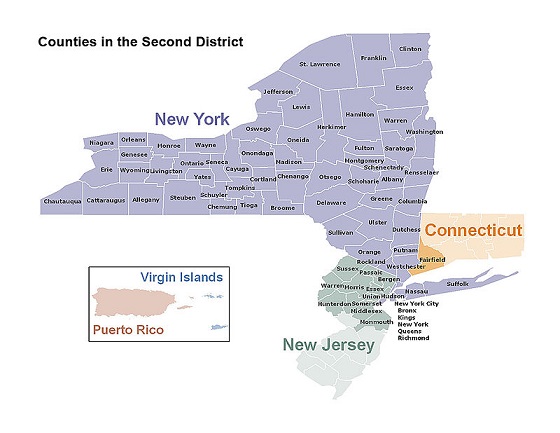
CU Blog - MetroCard - Model for CCB - Photo 1The MetroCard, the New York City Metropolitan Transportation Authority’s (MTA) payment system is the subject of the referenced source appendix below. But this subject is about more than just simple bus/subway tokens, instead this subject refers to a whole eco-system that constitutes an electronic payment scheme. This system generates $4 billion (2012) and services the transit needs of 15.1 million people. The MTA drives the NYC regional economy, the largest in the US, facilitating the connection for many to traverse from home to work; then after work, the MTA network enables the NYC metropolitan area (New York, New Jersey, and Connecticut) to get to a host of leisure activities: music, theater, cultural events, sports, and shopping. MetroCard is therefore a de facto currency for this region to live, work and play.

MetroCard is a digital currency and not “hard money”, so there are not paper stock or coinage issues to be managed with this approach. (MetroCard replaced the previous ubiquitous tokens in 2003). This attribute relates to the effort to re-boot and optimize the Caribbean regional economy and society. The book Go Lean…Caribbean points to NYC as a model and source of many lessons that the Caribbean can learn and apply, especially related to the adoption of the regional currency, the Caribbean Dollar (C$).

The book Go Lean…Caribbean serves as a roadmap for the introduction and implementation of the Caribbean Union Trade Federation (CU) and the Caribbean Central Bank (CCB). This Go Lean roadmap has 3 prime directives:

  • Optimization of the economic engines in order to grow the regional economy to $800 Billion & create 2.2 million new jobs.
  • Establishment of a security apparatus to protect the resultant economic engines.
  • Improve Caribbean governance to support these engines.

The Caribbean Central Bank has the role of heavy-lifting in the facilitation of the electronic payments modes of the Caribbean Dollar. While the traditional central banking role of currency/coinage distribution do not come into play, with the e-Payment schemes, there are still many responsibilities and benefits for central bank command-and-control. This refers to the subject of M1 monetary supply. M1 refers to the measurement of the total of currency/money in circulation (M0) plus overnight bank deposits (like demand deposits, travelers’ checks & other checkable deposits). So when digit currencies, as MetroCard, are factored in, there is no M0, but an increase in M1. As M1 values increase, there is a dynamic in the regional banking system that creates money “from thin-air”; this is referred to as the money multiplier. The more M1 money in the system, the more liquidity for investment and development opportunities.

The Caribbean needs this increase in development capital/liquidity.

This subject of electronic payment systems has been previously covered in Go Lean blogs, highlighted here in the following samples:

https://goleancaribbean.com/blog/?p=1350 PayPal expands payment services to 10 markets
https://goleancaribbean.com/blog/?p=906 Bitcoin needs regulatory framework to change ‘risky’ image
https://goleancaribbean.com/blog/?p=528 Facebook plans to provide mobile payment services
https://goleancaribbean.com/blog/?p=360 How to Create Money from Thin Air

This Go Lean/CU/CCB roadmap looks to employ electronic payments / virtual money schemes to impact the growth of the regional economy. There are two CU schemes that relate to this MetroCard structure:

  • Cruise Passenger Smartcards – The Go Lean roadmap posits that the cruise industry needs the Caribbean more than the Caribbean needs the industry. But the cruise lines have embedded rules/regulations designed to maximize their revenues at the expense of the port-side establishments. The CU solution is to deploy a scheme for smartcards that function on the ships and at the port cities (Page 193).
  • e-Commerce Facilitation – The Go Lean roadmap defines that the Caribbean Dollar (C$) will be mostly cashless, an accounting currency. So the Caribbean Central Bank (CCB) will settle all C$ electronic transactions (MasterCard-Visa style or ACH style) and charge interchange/clearance fees (Page 198). This scheme allows for the emergence of full-throttle e-Commerce activities.

Overall, stewardship of the single market economy and single regional currency was envisioned and pronounced early in the Go Lean roadmap with this Verse XXIV (Page 13) of the Declaration of Interdependence, with these words:

Whereas a free market economy can be induced and spurred for continuous progress, the Federation must install the controls to better manage aspects of the economy: jobs, inflation, savings rate, investments and other economic principles…

New York City is a great model for this Caribbean empowerment effort to look, listen, and learn. The same as tourism is the primary economic driver in the Caribbean (80 million visitors), NYC also plays host to 25 million visitors annually. Many NYC tourists ride the MTA public transportation modes and have to acquire a MetroCard – many times, they leave unspent balances  to just sit there. What becomes of those monies? See this news article here:

Unspent MetroCard Money Means Millions for M.T.A.

(http://www.nyctransitforums.com/forums/topic/43954-unspent-metrocard-money-means-millions-for-mta/)

Think of it as New York’s biggest sock drawer, except that instead of nickels, dimes and quarters, what is squirreled away in its dark recesses are millions of lapsed yellow-and-blue MetroCards with digital loose change still dangling from their magnetic strips.

In the decade ending in 2010, nearly $500 million worth of unspent balances on expired bus and subway MetroCards accumulated, and that money can no longer be redeemed.

Cards that are bought, never used but still valid are counted for bookkeeping purposes as a liability, because they might eventually be used. Outdated cards with pending balances become an asset after they expire, about two years from the date of sale. The balances are listed as revenue under the category of “fare media liability.”

Tens of millions of dollars a year may not seem like much out of $4 billion in annual MetroCard revenue for New York City Transit, but there is no stream of cash that the agency scoffs at.

Kevin Ortiz, a spokesman for the Metropolitan Transportation Authority, which includes the transit agency, said: “Expired card value does benefit the M.T.A. It gets counted as fare box revenue.”

The peak year for replenishing New York City Transit’s fare media liability account was 2012, when $95 million was credited. That followed a surge in purchases in 2010, before a fare increase. Those cards, many presumably with outstanding balances, have expired.

Considering the governance for the MetroCard, the MTA has been described with some adjectives of efficiency and effectiveness. Their website described their charter as follows:

While nearly 85 percent of the nation’s workers need automobiles to get to their jobs, four of every five rush-hour commuters to New York City’s central business districts avoid traffic congestion by taking transit service – most of it operated by the MTA. MTA customers travel on America’s largest bus fleet and on more subway and rail cars than all the rest of the country’s subways and commuter railroads combined.

This mobility helps ensure New York’s place as a world center of finance, commerce, culture, and entertainment, and New York ranks near the top among the nation’s best cities for business, Fortune magazine has written, because it has “what every city desires. A workable mass transit system.”

MTA mass transit helps New Yorkers avoid about 17 million metric tons of pollutants while emitting only 2 million metric tons, making it perhaps the single biggest source of greenhouse gas (GHG) avoidance in the United   States. The people living in our service area lead carbon-efficient lives, making New   York the most carbon-efficient state in the nation.

Over the past two decades, the MTA has committed some $72 billion to restore and improve the network so that today it runs at unprecedented levels of efficiency. Our employees at all of our agencies work diligently to maintain high service and safety standards.

(Source: Retrieved August 19, 2014 from: http://web.mta.info//mta/network.htm)

The governance for the MetroCard may be in good hands, a technocratic reflection. Creating a technocratic CU/CCB governance is “Step One, Day One” in the Go Lean roadmap. Implementing this allows for rock-solid monetary integrity for local financial systems, providing the foundation so the regional society can be elevated, economically and governmentally. In this vein, we examine specific lessons & applications in consideration of the MetroCard business model in the Appendix below:

MetroCard Facts Go Lean book considerations/reflections (actual Page Numbers)
MetroCard History Roadmap with Project Delivery Obligations (Page 109); Fostering a Technocracy (Page 64)
Multiple Jurisdictions Confederation of 30 Member-States (Page 45); Fostering Interstate Commerce (Page 129)
Pricing/Cost Increases Unified Command & Control on Inflation (Page 153)
Technology Foster Technology (Page 197); e-Commerce (Page 198); Bridging Digital Divide (Page 31)
Transfers People respond to economic incentives (Page 21)
Card type consideration –   Pay-Per-Ride cards Improve M1 by encouraging stored balances (Page 198)
Card type consideration – Student cards Facilitation Education (Page 159) and Transportation (Page 205)
Card type consideration –   Disabled/Senior Citizens Improve Elder-Care (Page 225) and Impact Persons with Disabilities (Page 228)
Purchase Options – Subway Station   Booths Manage Federal Civil Servants (Page 173)
Purchase Options – Vending   Machines Foster Technology (Page 197); e-Commerce (Page 198); Bridging Digital Divide (Page 31)
Purchase Options – Neighborhood   Merchants Help Entrepreneurship (Page 28); Impact Main Street (Page 201);
Future Impact the Future (Page 26)
Bad Actors: Fraud/Scams Bad Actors Emerge – Reduce Crime (Page 178); Impact the Greater Good (Page 37)

The Go Lean book details additional community ethos, strategies, tactics, implementations and advocacies to foster electronic payment systems, and the unified command & control necessary for its success:

Community Ethos – Money Multiplier Principle Page 22
Community Ethos – Lean Operations Page 24
Community Ethos – Cooperatives Page 25
Tactical – Separation of Powers – Central Banking Page 73
Implementation – Assemble Central Bank Cooperative Page 96
Planning – Lessons Learned from New York City Page 137
Anecdote – Caribbean Currencies Page 149
Advocacy – Ways to Mitigate Black Markets Page 165
Advocacy – Ways to Impact Public Works Page 175
Advocacy – Ways to Foster Cooperatives Page 176
Advocacy – Reforms for Banking Regulations Page 199
Advocacy – Ways to Impact Urban Living Page 234
Appendix – New York City Economy Details Page 277

Now is the time for all of the Caribbean, the people and governing institutions, to lean-in for the empowerments described in the book Go Lean … Caribbean. We can all benefit by studying and modeling the successes of New York City!

Any visitor to the city quickly realizes how unique this jurisdiction is compared to other urban areas in the US, or the world for that matter. Millions of people (31,483,000 according to 2010 census) live in a limited congested area that is the Greater Tri-State area, yet there is a recognizable level of efficiency – some technocratic deliveries. For example, NYC does not have the proliferation of yellow school buses that dot the landscape of most American communities. Most students in the city rely on the MTA, funded by their MetroCard, to get back and forth for school. So in effect, MetroCard services the full community needs to live, work, learn and play.

MetroCard is truly a model for the Caribbean … Dollar.

Download the book Go Lean … Caribbean – now!

——————————————-

Appendix – Reference Source:

MetroCard – New York Metropolitan Transportation Authority’s Payment System

The MetroCard is the payment method for the New York City Subway rapid transit system; New York City Transit buses, including routes operated by Atlantic Express under contract to the Metropolitan Transportation Authority (MTA); MTA Bus, and Nassau Inter-County Express systems; the PATH subway system (an entity of the Port Authority of New York & New Jersey); the Roosevelt Island Tram; AirTrain JFK; and Westchester County’s Bee-Line Bus System.

The MetroCard is a thin, plastic card on which the customer electronically loads fares. It was introduced to enhance the technology of the transit system and eliminate the burden of carrying and collecting tokens. The MTA discontinued the use of tokens in the subway on May 3, 2003, and on buses on December 31, 2003. The MetroCard is managed by a division of the MTA known as MetroCard Operations and manufactured by Cubic Transportation Systems, Inc.

History

01Jun1993 MTA distributes 3,000 MetroCards in the first major test of the technology for the entire subway system and the entire bus system.
06Jan1994 MetroCard live testing with compatible turnstiles at select lines and stations.
15May1997 The last MetroCard turnstiles were installed by this date, and the entire bus and subway system accepted MetroCards
04Jul1997 First free transfers available between bus and subway at any location with MetroCard.
01Jan1998 Bonus free rides (10% of the purchase amount) were given for purchases of $15 or more.
04Jul1998 Unlimited Ride MetroCards introduced, at $17 for 7 days, $63 for 30 days, Express Bus Plus for $120.
01Jan1999 1-Day Fun Pass was introduced: unlimited use for one day for $4.
25Jan1999 The first MetroCard Vending Machines installed.
13Apr2003 Tokens/coins no longer sold.
04May2003 Tokens only accepted as a $1.50 credit towards the $2 MetroCard ride.
02Mar2008 A new 14-day unlimited-ride was introduced for $47
30Dec2010 1-Day Fun Pass and the 14-Day Unlimited Ride MetroCards discontinued.
20Feb2013 Cards can now be refilled with both time and value.
03Mar2013 A $1 fee is imposed on new card purchases in-system

Pricing/Cost increases – since the complete cut-over in 2003

Date

Daily

Weekly

Monthly

04May2003

$2

$21

$70

27Feb2005

$2

$24

$76

02Mar2008

$2

$25

$81

28Jun2009

$2.25

$27

$89

30Dec2010

$2.25

$29

$104

19Dec2012

$2.50

$30

$104

Technology

During a swipe, the MetroCard is read, re-written to, then check-read to verify correct encoding.

Each MetroCard stored value card is assigned a unique, permanent ten-digit serial number when it is manufactured. The value is stored magnetically on the card itself, while the card’s transaction history is held centrally in the Automated Fare Collection (AFC) Database.

When a card is purchased and fares are loaded onto it, the MetroCard Vending Machine or station agent’s computer stores the amount of the purchase onto the card and updates the database, identifying the card by its serial number. Whenever the card is swiped at a turnstile, the value of the card is read, the new value is written, the customer is let through, and then the central database is updated with the new transaction as soon as possible. Cards are not validated in real time against the database when swiped to pay the fare. The AFC Database is necessary to maintain transaction records to track a card if needed. It has actually been used to acquit criminal suspects by placing them away from the scene of a crime. The database also stores a list of MetroCards that have been invalidated for various reasons (such as lost or stolen student or unlimited monthly cards), and it distributes the list to turnstiles in order to deny access to a revoked card.

MetroCard keeps track of the number of swipes at a location in order to allow those same number of people to transfer at a subsequent location, if applicable. The MetroCard system was designed to ensure backward compatibility, which allowed a smooth transition from the old (blue) format to the (gold) format.

Cubic later on used the proprietary MetroCard platform to create the Chicago Card, which is physically identical to the MetroCard except for the labeling.

Transfers

MetroCards allows for transfers (within two hours of initial entry) among the many transportation modes – incentivizing a preferred behavior. (Pricing rules are built into the system for upgrades like Express Buses, PATH, and JFK Airport AirTrain).

One free transfer from:

  • subway to local bus
  • bus to subway
  • bus to local bus
  • express bus to express bus
  • bus or subway to Staten Island Railway
  • subway to subway

Card type – consideration – Pay-Per-Ride MetroCards

  • $5 – $80 initial value in any increment (though vending machines only  sell values in multiples of 5 cents).
  • Card purchases or refills equal to or greater than $5 receive a 5% bonus (ex. $50 buys 21 rides).
  • Cards can be refilled up to $80 in one transaction and up to a total value of $100.
  • Though cards expire, the balance may be transferred to a new cards.

Card type – consideration – Student MetroCards: NYC does not have the propensity of yellow school business as other communities, therefore a partnership is forged between school districts and MTA.

  • MetroCards are issued to some New York City public and private school students allowing discounted access to the NYC Transit buses and trains, depending on the distance traveled between their school and their home. The card program is managed by the NYC-DOE Office of Pupil Transportation.
  • In Nassau County, Student MetroCards are issued by individual schools which have pre-paid for the cards.

Card type – consideration – Disabled/Senior Citizen Reduced-Fare MetroCards

  • Given to senior citizens and the disabled as a combination photo ID and MetroCard.
  • Allows half-fare within the MTA system. (Express Bus during off-peak hours only)
  • Half fare is also available on the 7-day and 30-day Unlimited MetroCards.
  • Card back is color-coded to match gender of card holder.
  • Card face is marked as “Photo ID Pass”

Purchase options

All new MetroCard purchases are charged a $1 fee, except reduced fare customers and those exchanging damaged / expired cards.

Subway Station Booths

Booths are located in all subway stations and are staffed by station agents. Every type of MetroCard can be purchased at a booth with the exception of the SingleRide ticket, and MetroCards specific to other transit systems (PATH, JFK Airtrain). All transactions must be in cash.

MetroCard Vending Machines

CU Blog - MetroCard - Model for CCB - Photo 2MetroCard Vending Machines (MVMs) are machines located in all subway stations and transit centers. They debuted on January 25, 1999 and are now found in two models. Standard MVMs are large vending machines that accept cash, credit cards, and debit cards and are in every subway station. Cash transactions are required for purchases of less than $1, and they can return up to $8 in coin change. There are also smaller versions of these machines that only accept credit and ATM/debit cards. Both machines allow a customer to purchase any type of MetroCard through a touch screen. The MVM can also refill to previously issued cards. PATH fare vending machines can also dispense MetroCards.

The machines are compliant with the Americans with Disabilities Act of 1990 through use of braille and a headset jack.

Neighborhood MetroCard Merchants

MetroCards can be sold by retail merchants not affiliated with MTA. Vendors can apply to sell MTA fare media at their businesses. Only presealed, prevalued cards are available, and no fee is charged.

Future

In 2006 the MTA and Port Authority of NY/NJ announced plans to replace the magnetic strip with smart cards.

On July 1, 2006, MTA launched a six-month pilot program to test the new “contact-less” smart card fare collection system, initially ending on December 31, 2006 but extended until May 31, 2007. This program was tested at all stations on the IRT Lexington Avenue Line and at four stations in the Bronx, Brooklyn and Queens. The testing system utilized Citibank MasterCard’s PayPass keytags. This smart card system is intended to ease congestion near the fare control area by reducing time spent at paying for fare. MTA and other transportation authorities in the region say they will eventually implement system-wide.

Beginning October 7, 2012, MetroCard vending machines scattered throughout Manhattan dispensed something other than the classic blue and gold MetroCard. The MTA has begun to sell advertisement space on the front and back of the card to raise additional revenue. The 2012 ad appearing on the cards was purchased by The Gap [retail stores] and reads: “Be Bright NYC” with multicolored letters on a navy blue background. It encourages New Yorkers to visit Gap’s newly remodeled flagship store at 34th   Street and Broadway starting October 10, 2012. Customers who present the MetroCard at any Gap store were entitled to a 20% discount on merchandise purchases through November 18, 2012. The MTA has been running advertisements on the back of MetroCards since its inception, earning advertiser fees along with expired card value (accruing when purchased fares wind up not being used on a card deemed a collectible by fans). Deals were arranged as early as 1997. However, this Gap deal is the first time the front of the cards have changed in over 10 years. Approximately 10% of the MetroCards sold throughout the system in a typical month will carry the Gap advertising. Future MetroCard advertising campaigns will include the word “MetroCard” on the back of the card, flush right in the white space above the zone available for advertising.

Bad Actors: Fraud and Scams

The MetroCard system is susceptible to various types of frauds, perpetrated by con artists. Usually these frauds involve the con artist preventing or dissuading the commuter from using his or her own MetroCard, and then charging the commuter for entry to the system (entry is gained by a method that costs the con artist nothing).

Also, MetroCard Vending Machines are programmed to disable the bill or coin acceptor after a series of rejected bills or coins, which can result in a row of MVMs all saying “No Bills” or “No Coins”.

CU Blog - MetroCard - Model for CCB - Photo 3If a con artist is not using a stolen or broken card, he or she can use an array of unlimited cards. Multiple cards are needed because of the 18-minute delay between each swipe at the same station. Using unlimited cards, a con artist is able to sell rides for $1 instead of $2.

A report from New York State Senator Martin J. Golden claims this scam is costing the MTA $260,000 a year, and some con artists are making up to $800 a day executing it. All aspects of this scam have been recently prohibited by MTA policy and a New York State law.

The introduction of MetroCards did eliminate one class of criminals. When the NYC subway still used tokens, token suckers would steal tokens by jamming turnstile coin slots, waiting for unsuspecting passengers to deposit tokens (only to discover that the turnstile did not work), then returning to suck out the token. The retirement of tokens in 2003 put the token suckers out of commission.

The MetroCard does have a magnetic stripe, but both the track offsets and the encoding differ from standard Magstripe cards. It is a proprietary format developed by the contractor Cubic. Off-the-shelf reader/writers for the standard cards are useless, and even hypothetically could work only with both physical and software modification. Some have had partial success decoding it using audio tape recorder heads, laptop sound cards, and custom Linux software.
Source: Wikipedia Online – encyclopedic source; retrieved 08/18/2014 from: http://en.wikipedia.org/wiki/MetroCard_(New_York_City)

——————————————-

Appendix VIDEO – Which New York City Subway MetroCard to Buy – https://youtu.be/dB05rRU0qVE

Published on Jan 23, 2015 – Should you buy a pay-per-ride or an unlimited New York City Subway MetroCard? Watch this video for tips on which to buy and how to buy them at the vending machines. Check out the full article on Free Tours by Foot’s website at http://www.freetoursbyfoot.com/how-to…


Share this post:
, , ,
[Top]

Detroit makes Community College free

#GoLeanCommentary

Its back to school time again – college students in Detroit have to report to classes on August 22.

CU Blog - Detroit makes Community College free - Photo 2

And now, if they enroll in a Detroit area community college, the tuition could be free.

Now that’s what I’m talking about!

This too, is a lesson learned from Detroit. The publishers of the book Go Lean…Caribbean have been in Detroit to “observe and report” the turn-around and rebirth of the once-great-but-now-distressed City of Detroit and its metropolitan area. The following article relates a strategy that is apropos for remediating and mitigating a failing community – education:

Title: Detroit makes community college free
Sub-title: Detroit high schoolers just got a free ticket to community college.
By: Katie Lobosco

Starting this year, any graduating high school senior who is accepted to one of Detroit’s five community colleges won’t have to pay a dime for tuition.

CU Blog - Detroit makes Community College free - Photo 1The Detroit Promise Zone program, officially launched on Tuesday, will make it possible. At first the funds will come from a private scholarship foundation. But starting in 2018, some of the money will come from property taxes already earmarked for the program.

“It doesn’t matter whether you’re a high school senior preparing for college now or a second-grader whose college career is years away. The Detroit Promise will be there to help make a college education a reality,” said Mayor Mike Duggan.

He hopes that the program will eventually expand to cover the cost of four years of college tuition at a state school for each Detroit student.

To be eligible, a student must have completed their junior and senior years at a public, private or charter high school in Detroit. It doesn’t matter how much their family earns, but the student must fill out the federal financial aid form called the FAFSA. The Detroit program will pick up the difference after any other federal and state grants and scholarships have been used.

About 500 students are expected to take advantage of the program and enroll at a community college each fall, according to a spokesman for the Detroit Regional Chamber, which helps administer the scholarship.

It will cost an average of $680 per person, annually, though each scholarship amount will vary depending on how much in other awards the student received.

The privately funded Detroit Scholarship program is already in place and has granted 2,000 students free tuition over the past three years. The Michigan Education Excellence Foundation raised the funds from a mix of companies, charitable foundations, and individuals.

CU Blog - Detroit makes Community College free - Photo 3But now that the Detroit Promise Zone has officially launched, scholarship funding will eventually move away from private donations toward earmarked tax funds. There isn’t an exact timeline for that transition, a spokesman said.

Detroit is one of 10 “promise zones” the state created in 2009 as a way to send more Michigan residents to college. The programs designate a share of state property taxes within the zone to pay for the scholarships.

“We are confident that Detroit’s future will be even brighter now that our city’s future leaders will be able to go to college at no cost,” said Detroit Promise Zone Authority Board Chairwoman Penny Bailer.

Tuition-free college is an idea that’s gaining traction. While President Obama has pushed for it nationally, Tennessee made community college tuition-free for graduating seniors last fall, and Oregon is set to launch a similar program next year.

High school seniors must register for the Detroit Scholarship Fund online by June 30 to be eligible.
Source: CNN Money (Cable News Network) – Posted 03-22-2016; retrieved 08-14-2016 from: http://money.cnn.com/2016/03/22/pf/college/detroit-tuition-free-college/index.html

As related, other communities are launching similar endeavors to this Detroit initiative:

Tennessee is picking up the tab for community college students.

How New York City would make community college free.

Oregon is set to launch a similar program next year.

This Go Lean movement has always been a big proponent of college education for Caribbean citizens. Our one caveat is that the education takes place in the Caribbean.

So yes, this movement (book and blog-commentaries) is a big opponent of a college education for Caribbean citizens in foreign colleges and universities. The reason for this reticence, is the incontrovertible brain drain among the Caribbean college-educated population. Previous Go Lean commentaries related the proverb of “fattening frogs for snake” referring to the preponderance for Caribbean college educated citizens to abandon their tropical homes for foreign shores in the US, Canada and Europe, and take their Caribbean-funded education and skill-sets with them.

On the other hand, if the region is able to offer college education locally, then it is win-win for the Caribbean, as a college education brings social mobility, facilitating new economic opportunities. Yes, college education is great for the individual. The Go Lean book quotes proven economic studies showing the impact that every year of college education improves an individual’s earning power by 1 percent (Page 258). See related VIDEO here:

VIDEOUnderemployment rate for college grads dropshttp://money.cnn.com/video/news/economy/2015/12/01/romans-numeral-underemployment-college-graduates.cnnmoney/

We need this upward mobility for Caribbean citizens in the Caribbean.

Since the Great Recession of 2008, the world – including the Caribbean – has seen a preponderance for income inequality: the rich has gotten richer and the middle class has shrunk.

The book Go Lean…Caribbean posits, along with most economists, that education elevate individuals and entire communities. The book states the Caribbean experience has been sour only for the reasons that so many students do not return home after matriculation; or expatriate shortly after returning for a short period. This has been measured by the World Bank; they reported that the Caribbean has a 70% abandonment rate among their college graduates.

This Go Lean book serves as a roadmap for the introduction and implementation of the Caribbean Union Trade Federation (CU). This represents the change that the region badly needs. The CU/Go Lean roadmap has 3 prime directives:

  • Optimization of the economic engines in order to grow the regional economy and create 2.2 million new jobs.
  • Establishment of a security apparatus to protect the resultant economic engines.
  • Improve Caribbean governance to support these engines.

Indeed, change has now come to the Caribbean. The driver of this change is technology and globalization. Under these tenants, many college institutions can provide e-Learning and Distant Learning schemes through internet deliveries. If the Caribbean regional education administrations could invest in more technological deliveries, they may be able to offer free (or reduced) tertiary education to worthy students. As related in the foregoing article, once private, charitable and non-governmental organizations (NGOs) are factored in, more and more students would be able to enjoy the benefits of a college education.

As for governing administrations, the vision of the CU is a confederation of the 30 member-states of the Caribbean into a Single Market – a federal government – to do the heavy-lifting of championing better educational policies. Confederation would bring better leverage across the population of 42 million people, adopting more best-practices for education in all 4 regional languages (Dutch, English, French and Spanish). So we should cease-desist bad education policies, like government scholarships for foreign matriculation – as is the usual practice. The Go Lean/CU plan is for forgive-able loans only.

This would be a winning strategy for Caribbean communities; and appears to be the election for Detroit as well. This is a full reflection of the community ethos of the Greater Good.

The Go Lean roadmap provides turn-by-turn directions on how to reform the Caribbean tertiary education systems, economy, governance and Caribbean society as a whole. The roadmap opens with a Declaration of Interdependence, pronouncing the approach of regional integration (Page 12 & 14) as a viable solution to elevate the region’s educational opportunities:

xix.  Whereas our legacy in recent times is one of societal abandonment, it is imperative that incentives and encouragement be put in place to first dissuade the human flight, and then entice and welcome the return of our Diaspora back to our shores

xxi.  Whereas the preparation of our labor force can foster opportunities and dictate economic progress for current and future generations, the Federation must ensure that educational and job training opportunities are fully optimized for all residents of all member-states, with no partiality towards any gender or ethnic group. The Federation must recognize and facilitate excellence in many different fields of endeavor, including sciences, languages, arts, music and sports. This responsibility should be executed without incurring the risks of further human flight, as has been the past history.

xxvii. Whereas the region has endured a spectator status during the Industrial Revolution, we cannot stand on the sidelines of this new economy, the Information Revolution. Rather, the Federation must embrace all the tenets of Internet Communications Technology (ICT) to serve as an equalizing element in competition with the rest of the world. The Federation must bridge the digital divide and promote the community ethos that research/development is valuable and must be promoted and incentivized for adoption.

The Go Lean book details how education is a vital consideration for Caribbean economic empowerment, but with lessons-learned from all the flawed decision-making in the past, both individually and community-wise. The book details those policies; and other ethos to adopt, plus the executions of the following strategies, tactics, implementations and advocacies to deploy better education options in the region:

Community Ethos – Deferred Gratification Page 21
Community Ethos – People Respond to Incentives Page 21
Community Ethos – Job Multiplier Page 22
Community Ethos – Lean Operations Page 24
Community Ethos – Return on Investments (ROI) Page 24
Community Ethos – Ways to Impact the Future Page 26
Community Ethos – Ways to Foster Genius Page 27
Community Ethos – Ways to Help Entrepreneurship Page 28
Community Ethos – Ways to Impact the Greater Good Page 28
Strategy – Mission – Facilitate Education without Risk of Abandonment Page 45
Tactical – Separation of Powers – Education Department Page 85
Tactical – Separation of Powers – Labor Department – Job Training Page 89
Implementation – Ways to Pay for Change Page 101
Planning – Lessons Learned from 2008 Page 136
Planning – Lessons Learned from Detroit Page 140
Advocacy – Ways to Grow the Economy Page 151
Advocacy – Ways to Create Jobs Page 152
Advocacy – Ways to Improve Education Page 159
Advocacy – Ways to Impact Student Loans Page 160
Advocacy – Ways to Improve Governance Page 169
Advocacy – Ways to Better Managed the Social Contract – Education Optimizations Page 169
Advocacy – Ways to Improve Libraries – Anchors for e-Learning Page 187
Appendix – Education and Economic Growth Page 258
Appendix – Measuring Education Page 266

Detroit is presented in the Go Lean book as a cautionary tale for the Caribbean.. Previous blogs had detailed so many lessons from the City of Detroit, and other metropolitan Michigan communities. Consider this sample:

https://goleancaribbean.com/blog/?p=7789 An Ode to Detroit – Good Luck on Trade!
https://goleancaribbean.com/blog/?p=7601 Beware of Vulture Capitalists
https://goleancaribbean.com/blog/?p=7268 Detroit giving schools their ‘Worst Shot’
https://goleancaribbean.com/blog/?p=7235 Flint, Michigan – A Cautionary Tale
https://goleancaribbean.com/blog/?p=6609 Before and After Photos Showing Detroit’s Riverfront Transformation
https://goleancaribbean.com/blog/?p=6269 Education & Economics: Welcome to Detroit, Mr. President
https://goleancaribbean.com/blog/?p=6022 Caribbean Diaspora in Detroit … Celebrating Heritage
https://goleancaribbean.com/blog/?p=5597 The Dire Strait of Unions and Collective Bargaining
https://goleancaribbean.com/blog/?p=5055 A Lesson from an Empowering Family in Detroit
https://goleancaribbean.com/blog/?p=4913 Ann Arbor: Model for ‘Start-up’ Cities
https://goleancaribbean.com/blog/?p=4476 De-icing Detroit’s Winter Roads: Impetuous & Short Term
https://goleancaribbean.com/blog/?p=3713 NEXUS: Facilitating Detroit-Windsor Cross-Border Commerce
https://goleancaribbean.com/blog/?p=3326 M-1 Rail: Alternative Motion in the MotorCity
https://goleancaribbean.com/blog/?p=3311 Detroit to exit historic bankruptcy
https://goleancaribbean.com/blog/?p=3164 Michigan Unemployment – Then and Now
https://goleancaribbean.com/blog/?p=2480 A Lesson in History: Community Ethos of WW II
https://goleancaribbean.com/blog/?p=1656 Blue is the New Green – Managing Michigan’s Water Resources
https://goleancaribbean.com/blog/?p=970 JP Morgan Chase’s $100 million Detroit investment

The above list features a lot of examples of Detroit’s bad behavior, but this commentary here is highlighting something positive, investing in community college education for young people. This is good, and for the Greater Good.

Now is the time for all of the Caribbean, the people and governing institutions, to lean-in for the changes described in the book Go Lean … Caribbean. This presents a win-win for the Caribbean. This is conceivable, believable and achievable. Educational options can help to make our homeland a place to live, work, learn and play. 🙂

Download the book Go Lean … Caribbean – now!

Share this post:
, , ,
[Top]

Now it’s Detroit’s turn to rescue Silicon Valley

Go Lean Commentary

“I see dead people.” – Movie quote from The Sixth Sense (1999); see Appendix VIDEO below.

This is what Detroit is saying to Silicon Valley: “they see dead people” along the road of development for the autonomous vehicle (AV). Automobile accidents are one of the leading causes of death in most countries, therefore developing cars that drive themselves and interact with real world conditions on real streets is bound to have some mishaps/fatalities along the way.

CU Blog - Now it's Detroit's turn to rescue Silicon Valley - Photo 2

CU Blog - Now it's Detroit's turn to rescue Silicon Valley - Photo 4

Detroit: “Been there, done that!”

This consideration is in line with the book Go Lean… Caribbean; it serves as a roadmap for the introduction and implementation of the Caribbean Union Trade Federation (CU). One of the features of the Go Lean/CU roadmap is the development of an automotive industry for the Caribbean region. Of course the reference here to Detroit is a metonym; so too the reference to Silicon Valley. Other metonym references were defined in a previous Go Lean blog-commentary, which detailed these ones in the book:

  • Detroit – Page 206 – American Automakers Planning/Design
  • Silicon Valley – Page 30 – AmericanHighTechCenter
  • Wall Street – Page 155 – Big Banks/Financial Center
  • Hollywood – Page 203 – US Movie/TV/Media Producers

The issue now is the risk associated with road traffic. Detroit has been there before. They were the Silicon Valley of the early 20th Century, as regards innovation for the automotive industry. Detroit has competence for this industry. Today, Silicon Valley wants inroads in the automotive industry. They need to tap Detroit’s legacy and insights. See the related article here:

Title: Now it’s Detroit’s turn to rescue Silicon Valley

CU Blog - Now it's Detroit's turn to rescue Silicon Valley - Photo 1
Five years ago, when the U.S. auto industry was just beginning to recover from the Great Recession, there was widespread speculation that the old model of the car business was broken, and that only the new economy could come to the rescue.

And with good reason. The U.S. auto market had cratered, plunging from a peak of over 17 million to a devastated 10 million in yearly sales.

Both General Motors and Chrysler had been bailed out by the federal government and gone bankrupt. Ford saw its stock price fall to less than $2 a share. Gas had spiked to over $4 a gallon in some parts of country. Credit, the lifeblood of the car business, had been wiped out.

Meanwhile, Apple was on a path to become the world’s most valuable company. Facebook was tasking over the media landscape. And Tesla, after suffering a brush with financial death in 2009, looked like the most innovative company of four wheels.

Silicon Valley and California in general was suddenly filled with new and futuristic ideas about transportation, from Google driverless cars to numerous electric-car startups. Detroit, by contrast, was lurching toward the largest municipal bankruptcy in U.S. history (it would come in 2013), and its great automakers looked to be crippled dinosaurs, completely out of step with the times.

The U.S. auto industry was a problem to be solved, and Silicon Valley specialized in solutions.

A doomed industry?
“The automobile industry is in the middle of a fundamental transformation,” wrote in 2009. “There is a lot of information available on how companies have dealt with major changes in their business environments, but little is known about the transformation of entire industries.”

“History shows that most companies do not deal well with transformation.” he continued. “One reason has to do with senior managers. They usually ‘don’t get it.’ They have a difficult time accepting that the future will be vastly different from the present because they rose to power in the old business environment. They excelled in the old environment and didn’t acquire skills necessary to operate in the new.”

Fast forward to 2016 and the senior mangers in Detroit that Grove worried about have deepened their engagement with Silicon Valley and the technology industry to an unprecedented degree. General Motors already had a venture-capital arm before it invested $500 million in Lyft and bought Cruise Automation for its innovative self-driving tech.

Ford had such a solid connection with Microsoft that outgoing CEO Alan Mulally was discussed as a successor to Steve Ballmer, earlier this year. Fiat Chrysler Automobiles has teamed up with Google to create driverless minivans. And all the automakers have a Silicon Valley presence, which enables them to scout emerging technologies and act on them quickly.

An auto sales boom in the U.S. that started in 2013 and set a record in 2016 with 17.5 million new cars and trucks delivered has fueled Detroit’s engagement, as has the broad realization among the car maker’s executive teams that this is their opportunity to disrupt themselves and profit from the experience. Cheap gas, an improving employment picture, and ample credit means that Detroit is selling pickups and SUVs and raking in cash. The game plan is to take some of those winnings and send them in search of rapid innovations that Motown can’t create on its own.

Not-so-smooth sailing
At the same time, Silicon Valley has started to encounter some investor turbulence. Startups with hefty valuations don’t see IPOs as a way to pay back their investors. That leaves getting acquired as an option, but a level of saturation with social networking and apps might have set in.

The Detroit automakers aren’t in the market for messaging apps, but they are looking for technologies that can future-proof them, or advance the process of making cars smarter. In conversations with people in the auto industry, there’s a sense that the tech sector has begun to figure out that Motown has money and wants to spend it.

The signals from the top are also strong. “We’re going to disrupt ourselves, and we are disrupting ourselves, so we’re not trying to preserve a model of yesterday,” . “And when you think of the assets the company has — the scale, the control of the vehicle platform, the ability with embedded connectivity, the knowledge we have of just every aspect of the vehicle and how we’re putting it together now — I think there’s a lot of plus signs, and we can lead.”

That attitude was echoed by Ford CEO Mark Fields, who BI also interviewed. “It’s a very exciting time at Ford, because we are transitioning from an auto company to an auto and a mobility company,” he said. “Mobility for us, at the very simplest level, is to allow people to live, play, and work where they want. How do we help enable them to get around to do that? And there’s a lot of talk around technology companies disrupting the auto industry. Our approach is very simple: We’re disrupting ourselves.”

Birds of a feather
So how did this reversal come about? Even if Detroit isn’t really in a position to rescue Silicon Valley — Silicon valley doesn’t really need to be rescued — then why is the dinosaur now so enthusiastic about participating in its own disruption?

Simple: Detroit was the Silicon Valley of the early 20th century, a hotbed of entrepreneurship, fascinated with the most high-tech contraption of the time — the automobile. True, over the decades the culture of the auto industry has become stratified and bureaucratic, but despite that, the car itself has been steadily improved. Detroit has never backed off from technology, and the engineers and executives who have chosen to work for Ford or GM are still excited about new stuff.

When they look at Silicon Valley, they see a place ruled by engineers, a contemporary version of Detroit’s own origin story.  And that’s why Silicon Valley and Detroit’s newfound mutual admiration could be the beginning of a long and beautiful friendship that stretches from the Bay Area to the banks of the Detroit River.
Source: Microsoft Network (MSN) Technology Column – Retrieved 08-14-2016 from: http://www.msn.com/en-us/money/companies/now-its-detroits-turn-to-rescue-silicon-valley/ar-BBvrK0K?li=BBnbfcN&ocid=1PRCMSE

VIDEO – Inside Silicon Valley’s secretive test track for self-driving cars – https://youtu.be/xILioJ7ZfQU

Published on Jun 2, 2016 – A former military weapons depot is now a track where companies can test their autonomous cars in private​. The media has never set foot in the guarded GoMentum Station, until now. The track is not only attracting the attention of automakers like Mercedes and Honda, but also tech companies like Google and Apple. CNET’s Brian Cooley shows us how Honda is testing its latest self-driving car there.

See a more detailed VIDEO on GoMentum Station and a competing Michigan site in this VIDEO here:
“Inside the self-driving car facilities of Silicon Valley and Detroit” – http://a.msn.com/00/en-us/BBvrK0K?ocid=se

For the Caribbean effort, it will be important to observe-and-report on the developments of the Detroit-SiliconValley synergy. Both industries are being transformed. What can we learn about cooperation, collaboration and coordination among aligning stakeholders? There are jobs, public safety and public administration at stake. This relates to the CU/Go Lean roadmap, which also has a focus on the same 3 areas. This is communicated as the prime directive of the roadmap, pronounced as follows:

  • Optimization of the economic engines in order to grow the regional economy, and create jobs (2.2 million new ones).
  • Establishment of a security apparatus to ensure public safety and protect the resultant economic engines.
  • Improve Caribbean governance to support these above engines, considering the separation-of-powers between Caribbean member states and the CU federal government.

The Go Lean roadmap recognizes the benefits of Research & Development (R&D). The book presents R&D as a community ethos, the fundamental spirit of a culture that drives the beliefs, customs and practices of a society.

Caribbean society must embrace the R&D of autonomous vehicles, automobile advances, safety innovation, and transformative technologies. We cannot ignore the formations of industrial advances. We must not just consume; we must produce as well. This is where the next generation of jobs are to be found.

The automotive industry have always been a source of high-paying jobs, that in previous generations, have transformed society. Today, Silicon Valley is a source of high-paying jobs. The transformations are continuing.

This aligns with the opening Declaration of Interdependence (Page 14) in the Go Lean book, as conveyed by these statements:

xxvii. Whereas the Caribbean region must have new jobs to empower the engines of the economy and create the income sources for prosperity, and encourage the next generation to forge their dreams right at home, the Federation must therefore foster the development of new industries, like … automobile manufacturing. In addition, the Federation must invigorate the enterprises related to existing industries … impacting the region with more jobs.

xxviii. Whereas the region has endured a spectator status during the Industrial Revolution, we cannot stand on the sidelines of this new economy, the Information Revolution. Rather, the Federation must embrace all the tenets of Internet Communications Technology (ICT) to serve as an equalizing element in competition with the rest of the world. The Federation must bridge the digital divide and promote the community ethos that research/development is valuable and must be promoted and incentivized for adoption.

Producing and not only consuming – especially related to autonomous vehicles and robotic technologies – has been a consistent theme in prior Go Lean blog/commentaries; see this sample here:

Building the Infrastructure for Streetcars
‘Olli’ – The Self-Driving Public Transit Vehicle
3D Printing: Here Comes Change
Drones to be used for Insurance Damage Claims
Robots help Amazon tackle Cyber Monday
Here come the Drones … and the Concerns
Where the Jobs Are – Computers Reshaping Global Job Market
Google conducting research for highway safety innovations
Ghost ships – Autonomous cargo vessels without a crew

The Go Lean book provides a roadmap for developing and fostering a domestic automotive industry, and for fostering R&D. The process starts with the spirit to want to improve the status quo, to innovate and make things better and safer. This spirit is described in the book as a community ethos for Research-and-Development. The book details other ethos to adopt, plus the executions of the following strategies, tactics, implementations and advocacies to forge innovation in Caribbean communities:

Community Ethos – Deferred Gratification Page 21
Community Ethos – Job Multiplier Page 22
Community Ethos – “Crap” Happens – Like Car Accidents Page 23
Community Ethos – Lean Operations Page 24
Community Ethos – Return on Investments (ROI) Page 24
Community Ethos – Ways to Impact the Future Page 26
Community Ethos – Ways to Help Entrepreneurship Page 28
Community Ethos – Ways to Impact Research & Development Page 30
Community Ethos – Impact the Greater Good Page 37
Strategy – Vision – Caribbean Integrated Single Market Page 45
Strategy – Agents of Change – Technology Page 48
Tactical – Fostering a Technocracy Page 64
Tactical – Growing Economy – New High Multiplier Industries Page 68
Separation of Powers – Public Works & Infrastructure Page 82
Separation of Powers – Department of Transportation Page 84
Implementation – Ways to Pay for Change Page 101
Implementation – Ways to Implement Self-Governing Entities Page 105
Planning – 10 Big Ideas – Cyber Caribbean Page 127
Planning – Lessons from Detroit Page 140
Advocacy – Ways to Create Jobs Page 152
Advocacy – Ways to Foster Technology Page 197
Advocacy – Ways to Improve Transportation Page 205
Advocacy – Ways to Develop the Auto Industry Page 206
Appendix – Job Multipliers – Detroit’s 11.0 Rate #1 of all industries Page 260

There is a business axiom:

Build a better mousetrap and the world will beat a path to your door.

This is the goal – autonomous vehicles not mousetraps – of so many stakeholders in the technology and automotive industry space, in Silicon Valley and in Detroit; see Appendix VIDEO 2. A self-driving car is not the future, it is now; well soon. (According to the foregoing VIDEO, one automaker projects an AV for the 2020 Model Year).

Mideast Dubai Driverless CarsThis is the type of innovation now being urged for the Caribbean. Yes, we can … make an impact in this industry. We do not have to be the inventor, but at least an “early adopter”. The controlled environment of a Self-Government Entity – campus or corridor – is ideal for AVs. Imagine a toll-road across a Caribbean member-state (island or mainland) that traverses 70 miles that encourages self-driving cars, buses and trucks.

This vision is being fostered … elsewhere. Why not here?

The Caribbean region has historically been slow at adopting technological innovation. This roadmap presents a change to the Caribbean status quo. We urge all stakeholders – governments, businesses, and drivers – to lean-in to the innovations detailed in the Go Lean book. With the proper planning, preparation and participation, yes we can, we make our homeland a better place to live, work and play.:-)

Download the book Go Lean … Caribbean – now!

————–

Appendix VIDEO 1: Next Big Thing – Self-driving cars: Why? – https://youtu.be/QUYKSWQmkrg

Published on Oct 9, 2013 – http://cnet.co/1bfQkWn – Why self-driving cars make a whole lot of sense, how gesture control will augment — but probably not replace — a lot of technology, and is there even a third seat left at the mobile platform table?

————–

Appendix VIDEO 2: The Sixth Sense ….. I See Dead People …scene – https://youtu.be/QUYKSWQmkrg

Published on Sep 9, 2012 – In Your Dreams ? ….No. While You’re Awake? …Yes. All The Time, They’re Everywhere.


Share this post:
, , , ,
[Top]

A Lesson in Economic Fallacies – Casino Currency – US Dollars?

Go Lean Commentary

CU Blog - Casino Currency - US Dollars Not The Only Option - Photo 1If you go to a casino and win in their games of chance, what do you win?

If you go to a casino and lose in their games of chance, what do you lose?

In both cases the answer is money.

This is still true even though the gamer may cash-in the common currency of a country at the start of the session for tokens, chips or e-Cards. The tokens or chips become a nominal or fiat currency themselves; their value is set by the issuer to be any denomination they want – they may choose to make $100 chips Blue, $1000 chips Green and $10,000 chips Red or any combination. The only thing that matters is the cash-out process: when the gamers wants to receive real world currency value for any chips in hand.

Yes, this is the business model of casinos, but it is based on the principles of economics. The quest to reform and transform Caribbean economy could be based on this model; this is the case with the book Go Lean … Caribbean. The book details the mission to elevate the Caribbean societal engines starting with economics, or more simply: money. This brings so many questions to the fore:

What is money and how do we define it? Why must we define it? Aren’t we all familiar with the dynamics of the money or currency in our wallets and purses? How does the common currency fit into this discussion?

First the definition is important so as to dispel the concern about currency as opposed to money; money is not just currency and currency is not just money. Currency relates to a national designation (US dollar, British pounds, Chinese Yuan) or a regional designation like the Euro or the Eastern Caribbean/EC dollar. Money, on the other hand is a matter of four (4) functions [22]:

A Medium – When money is used to intermediate the exchange of goods and services, it is performing a function as a medium of exchange. Money’s most important usage is as a method for comparing the values of dissimilar objects.

A Measure – A unit of account is a standard numerical monetary unit of measurement of the market value of goods, services, and other transactions. Also known as a “measure” or “standard” of relative worth and deferred payment, a unit of account is a necessary prerequisite for the formulation of commercial agreements that involve debt. Money acts as a standard measure and common denomination of trade. It is thus a basis for quoting and bargaining of prices.

A Standard – A “standard of deferred payment” is an accepted way to settle a debt – a unit in which debts are denominated, and the status of money as legal tender, that may function for the discharge of debts. When debts are denominated in money, the real value of debts may change due to inflation and deflation.

A Store – Money acts as a store of value; it must be able to be reliably saved, stored, and retrieved – and be predictably usable as a medium of exchange when it is retrieved. The value of the money must also remain stable over time. Some have argued that inflation, by reducing the value of money, diminishes the ability of money to function as a store of value.
Source: Retrieved July 10 from: https://en.wikipedia.org/wiki/Money#Functions

CU Blog - Casino Currency - US Dollars Not The Only Option - Photo 1bCasino currencies (tokens, chips and e-Cards) perform all these 4 functions; and more – see the Appendix VIDEO below. The common currency for casino operations can be any currency the operators designate; so why do Caribbean operators always designate US dollars?

This question exposes an Economic Fallacy in the Caribbean region, that significant financial transactions must be in US dollars ($), even in Caribbean casinos. While this must be addressed and remediated, obviously the issues at hand are bigger than just Casino gaming. No, the issues in this commentary address technocratic management for currencies in general.

This commentary is the 6 of 6 from the Go Lean movement on the subject of Economic Fallacies. As related in the previous submissions in this series, the situation in the Caribbean region is likened to the imagery of an animal foraging for food, but then gets distracted and “chases a squirrel up a tree”. The squirrel in the tree will never be a meal; it is just a waste of time and energy for the animal. This analogy conveys the waste of time associated with a frivolous and fallacious pursuit. The other commentaries detailed in this series are as follows:

  1. Independence – Hype of Hope
  2. Austerity – Book Review: Mark Blyth’s “History of a Dangerous Idea”
  3. Education & Student Loans – Not a good Return on Investment
  4. Phillips Curve – Fallacy of Minimum Wage
  5. Self-regulation of the Centers of Economic Activity
  6. Casino Currency – US Dollars?

All of these commentaries are economic in nature. They refer to rules for managing the valuable resources of time, talents and treasuries. There are rules for winning and common mistakes that results in losing. Normally these fallacies are easily discernible after the fact, more so than before hand. So history and good-bad lessons on currency management can be extremely helpful to our Caribbean quest. This is a mission of the Go Lean book, to fortify a strong monetary foundation to ensure forward progress in currency matters in the region.

This book Go Lean…Caribbean serves as a roadmap to introduce and implement the technocratic Caribbean Union Trade Federation (CU) and the Caribbean Central Bank or CCB (a cooperative of central banks), to serve as a regional/super-national entity to shepherd the economic, security and governing engines of the 30 Caribbean member-states. Being technocratic includes studying and applying best-practices, while avoiding fallacies in government oversight. This mission was pronounced in the Go Lean book with this quotation (Page 45):

Fortify the stability of our mediums of exchange, by facilitating our monetary needs through a Currency Union, the Caribbean Dollar (C$), and establishing a Caribbean Central Bank.

There are economic challenges facing the Caribbean, including within the banking community. There is the need for some comprehensive solutions for all of the 30 member-states in the Caribbean. Many of the countries are independent states (16); the remainder are overseas territories of major powers: 6 British, 3 Dutch/Netherlands, 3 French and the 2 American: US Virgin Islands (USVI) and Puerto Rico (PR).

According to the Go Lean book (Page 150), many non-American Caribbean territories – British overseas Territory of the Turks & Caicos Islands, plus the Dutch territories of Bonaire, Sint Eustatius, Saba – use the US dollar as their primary currency.

The historicity of central banking in Puerto Rico helps us to understand how the concepts of fiat currencies can be structured to elevate the regional economy. See the encyclopedic reference here regarding this subject:

Title: Puerto Rico and Central Banking
Central Banking was established in Puerto Rico during its Spanish colonial days. The island began producing banknotes in 1766,  becoming the first colony in the Spanish Empire to print 8-real banknotes with the Spanish government’s approval. After the dissolution of Spain’s New World Empire with the independence of the mainland countries (Mexico, Central and South America, etc), the colonial government in Puerto Rico ordered the issue of provincial banknotes, creating the Puerto Rican peso. However, printing of these banknotes ceased after 1815. During the following decades, foreign coins became the widespread currency. In the 1860s and 1870s, banknotes re-emerged. On February 1, 1890, the Spanish Bank of Puerto Rico (Banco Español de Puerto Rico) was inaugurated and began issuing banknotes, followed 5 year later with peso coins.

On August 13, 1898, the Spanish–American War ended with Spain ceding Puerto Rico to the United States. The Banco Español de Puerto Rico was renamed Bank of Porto Rico and issued bills equivalent to the United States dollar, creating the Puerto Rican dollar. In 1902, the First National Bank of Porto Rico issued banknotes in a parallel manner. Two more series were issued until 1913. After Puerto Rico’s economy and monetary system was fully integrated into the United States’ economic and monetary system, the Puerto Rican dollars were redeemed for those issued by the United States Treasury.

Today, Central Banking in the Commonwealth of Puerto Rico is expressed through 2 governmental entities, one local and one at the US Federal level. The local entity is the Government Development Bank (GDB) of Puerto Rico. The GDB, established in 1942, is the government bond issuer, intragovernmental bankfiscal agent, and financial advisor of the government of Puerto Rico.[1][2] The bank, along with its subsidiaries and affiliates, serves as the principal entity through which Puerto Rico channels its issuance of bonds. As an overview from Wikipedia.com, the different executive agencies of the government of Puerto Rico and its government-owned corporations either issue bonds with the bank as a proxy, or owe debt to the bank itself (as the bank is a government-owned corporation as well).

CU Blog - Casino Currency - US Dollars Not The Only Option - Photo 2On the US federal basis, Puerto Rico is part of the Second District, Federal Reserve Bank of New York (popularly known as the New York Fed), in its representation before the US Federal Reserve System.

The Federal Reserve Bank of New York is one of the 12 Federal Reserve Banks of the United States. It is located at 33 Liberty Street, New York, NY. It is responsible for the Second District of the Federal Reserve System, which encompasses New York State, the 12 northern counties of New Jersey, Fairfield County in Connecticut, Puerto Rico, and the U.S. Virgin Islands. Working within the Federal Reserve System, the New York Federal Reserve Bank implements monetary policy, supervises and regulates financial institutions[1] and helps maintain the nation’s payment systems.[2] See Appendix below for more details on the “New York Fed”.
Source: Retrieved July 10, 2016 from: https://en.wikipedia.org/wiki/Currencies_of_Puerto_Rico

Puerto Rico is indicative of the dysfunction in the Caribbean region – this Commonwealth is in crisis – despite almost 4 million people on the island, monetary decisions are made in New York City. The Go Lean movement (book and blogs) has consistently maintained that Caribbean problems need Caribbean solutions. The monetary policies for Puerto Rico are being made by the same stakeholders making monetary decisions for the United States. The New York Fed handles 65% of the total Federal Reserve Fedwire transactions; neither PR nor USVI register high on their priorities.

As previously related, the US Territories may have a voice in Washington, but they have no vote. Considering the downward spiral of PR’s economy  in recent years, they should not look to others for their long-term solutions. It is a fallacy to think that Caribbean people will be prioritized by foreign masters, thousands of miles away.

Caribbean people – all 30 member-states – need to come to our own aid. The Go Lean book quotes the lyrics from this song:

If there is a load you have to bear
That you can’t carry
I’m right up the road
I’ll share your load
If you just call me
—- Song: Lean On Me; Songwriters: Bill Withers

With the Go Lean roadmap, change will come to the island of Puerto Rico and all the Caribbean. The changes will include a single currency for a Caribbean Single Market, the Caribbean Dollar (C$). There are economic benefits galore. One such benefit is the money multiplier; the Go Lean book (Page 22) defines it as:

In monetary macroeconomics and banking, the money multiplier measures how much the money supply increases in response to a change in the monetary base…. there is a multiplier associated with the currency in the money supply. Therefore it goes without saying that if the Caribbean member-states trade in US dollars, then the multiplier effect is extended to the United States of America. By contrast, if the Caribbean member-states trade in Euros, then the multiplier effect goes to the stakeholders of the European Central Bank – no Caribbean state. Therefore the communities of the Caribbean must embrace, as an ethos, its own currency, the Caribbean Dollar (managed by a technocratic Caribbean Central Bank), thereby bringing local benefits from local multipliers.

Desisting from economic fallacies, there is a dose of reality in the Go Lean roadmap: the US will not allow its territories to wean off the US dollar as the currency base. But there is no controversy if the Caribbean dollar is an electronic currency for PR and USVI.

This is the plan!

The CCB, a cooperative of the existing central banks, will consolidate all reserves for the member central banks. The reserves will be a basket of currencies from the world’s most impactful currencies. Yes, that includes the US, but other currencies too. The roadmap calls for the following basket currencies to constitute Caribbean reserves:

  • US dollar
  • British pounds
  • Euros
  • Japanese Yen or Chinese Yuans

CU Blog - Casino Currency - US Dollars Not The Only Option - Photo 4There is the opportunity for the C$ deployed by the CCB to be an all electronic card/payment system; see photo here. Just like in the foregoing casino scenario, there is only the need to deliver the reserve currency, at cash-out time when an individual or company has to remit the funds in any basket currency outside the Caribbean region.

An all-electronic card would mean local transactions conducted electronically. With the onset of credit cards, debit cards and payment cards in the region as the preferred payment method, this scheme becomes more viable. Electronic settlements also allow for the easy calculation and collection of State Sale Taxes and VAT. Other benefits include:

  • Free Foreign Exchange to convert back to basket currencies – then cardholders will be more inclined to leave stored value balance on the card.
  • Free Foreign North-South Remittances: Free for these basket currencies transactions, so as to accumulate balances in the CCB “our” account.

Since casino operations can transact in any fiat currency, the Go Lean roadmap calls for modeling casinos and launching the C$ as a fiat, accounting-value-only currency at first and then eventually to graduate to banknotes and coins. This is the exact model of the Euro currency during its launch.  The EU/Euro case study provide lessons – foreign currency, inflation, sovereign defaults – that must be applied in the technocratic administration of the CU/CCB/C$. Since the Go Lean roadmap calls for the CCB to be a cooperative entity of the existing central banks in the region, this will foster interdependence among the Caribbean neighboring member-states. This need for regional stewardship of Caribbean currencies was pronounced early in the book, in the opening Declaration of Interdependence (Page 13) with these statements:

xxiv. Whereas a free market economy can be induced and spurred for continuous progress, the Federation must install the controls to better manage aspects of the economy: jobs, inflation, savings rate, investments and other economic principles. Thereby attracting direct foreign investment because of the stability and vibrancy of our economy.

xxv. Whereas the legacy of international democracies had been imperiled due to a global financial crisis, the structure of the Federation must allow for financial stability and assurance of the Federation’s institutions. To mandate the economic vibrancy of the region, monetary and fiscal controls and policies must be incorporated as proactive and reactive measures. These measures must address threats against the financial integrity of the Federation and member-states.

The planners of this new Caribbean monetary regime has documented hard-learned lessons on the issue of currency in the Caribbean region and elsewhere; (many CU member-states endured painful currency fluctuations over the past decades – on more than one occasion). So we accept that any attempt to reboot the Caribbean economic landscape must first start with a strenuous oversight of the proposed regional C$ currency.

The Go Lean book, and previous blog/commentaries, stressed the key community ethos, strategies, tactics, implementations and advocacies necessary to establish a strong Caribbean financial eco-systems and a strong currency. These points are detailed in the book; see this sample from the book as follows:

Community Ethos – Economic Principles – Economic Systems Influence Individual Choices Page 21
Community Ethos – Economic Principles – Voluntary Trade Creates Wealth Page 21
Community Ethos – Economic Principles – Consequences of Choices Lie in the Future Page 21
Community Ethos – Economic Principles – Money Multiplier Page 22
Community Ethos – Governing Principles – Lean Operations Page 24
Community Ethos – Governing Principles – Return on Investments Page 24
Community Ethos – Ways to Impact the Future – Count on the Greedy to be Greedy Page 26
Community Ethos – Ways to Impact the Greater Good Page 37
Strategy – Mission – Fortify the Stability of the Securities Markets Page 45
Strategy – Provide Proper Oversight and Support for the Depository Institutions Page 46
Strategy – e-Payments and Card-based Transactions Page 49
Tactical – Growing the Economy – Minimizing Bubbles Page 69
Tactical – Separation-of-Powers – Depository Insurance & Regulatory Agency Page 73
Anecdote – Turning Around CARICOM – Effects of 2008 Financial Crisis Page 92
Implementation – Assemble Caribbean Central Bank as a Cooperative Page 96
Implementation – Ways to Better Manage Debt – Optimizing Wall Street Role Page 114
Planning – 10 Big Ideas – Single Market / Currency Union Page 127
Planning – Lessons Learned from 2008 – Managing Economic Crises Page 136
Planning – Lessons Learned from New York City – Metro Card Payment Regime Page 137
Planning – Ways to Measure Progress Page 147
Anecdote – Caribbean Currencies Page 149
Advocacy – Ways to Grow the Economy Page 151
Advocacy – Ways to Control Inflation Page 153
Advocacy – Ways to Better Manage Foreign Exchange (fx) Page 154
Advocacy – Reforms for Banking Regulations Page 199
Advocacy – Ways to Impact Wall Street Page 200
Appendix – New York City Economy Details Page 277
Appendix – Tool-kits for Capital Controls Page 315
Appendix – Lessons Learned from Floating the Trinidad & Tobago Dollar Page 316
Appendix – Controlling Inflation – Technical Details Page 318
Appendix – e-Government and e-Payments Example: EBT Page 353

The points of effective, technocratic currency/monetary stewardship, were further elaborated upon in these previous blog/commentaries:

https://goleancaribbean.com/blog/?p=7140 Azerbaijan sets its currency on free float
https://goleancaribbean.com/blog/?p=7034 The Future of Money
https://goleancaribbean.com/blog/?p=6800 Venezuela sues black market currency website in US
https://goleancaribbean.com/blog/?p=5668 Move over Mastercard/Visa
https://goleancaribbean.com/blog/?p=4166 A Lesson in History – Panamanian Balboa
https://goleancaribbean.com/blog/?p=3858 European Central Banks unveils 1 trillion stimulus program
https://goleancaribbean.com/blog/?p=3814 Lessons from the Swiss unpegging the franc
https://goleancaribbean.com/blog/?p=2074 MetroCard – Model for the Caribbean Dollar
https://goleancaribbean.com/blog/?p=833 One currency, divergent economies
https://goleancaribbean.com/blog/?p=518 Analyzing the Data – What Banks learn about financial risks
https://goleancaribbean.com/blog/?p=360 How to Create Money from Thin Air

The quest of the Go Lean roadmap is to elevate Caribbean society and economic engines from the dysfunctional past. Reliance on the US dollar is a fallacy if we want to grow our economy; transacting in their currency will only expand their economy. We want to be a protégé of the technocratic New York Fed (see the Appendix) – for efficient monetary management – not a parasite! We want to master the process of currency management … and maximize our money supply and available credit. This is heavy-lifting, but “Yes, we can!” We can conceive, believe and achieve workable solutions.

This is the end of the series on Economic Fallacies; this case study of casino currencies is only the latest submission. There have been so many lessons to glean wisdom from in the previous submissions: independence hype, austerity, student loans, minimum wage, centers of economic activities. Let’s pay more than the usual attention to debunking these fallacies in this study of “Advanced Economics”.

All the stakeholders in the Caribbean – people, governments and institutions – are urged to lean-in to this Go Lean roadmap for the CU, CCB and the C$. The roadmap serves as turn-by-turn directions to move the region to its new destination: a better homeland to live, work and play. 🙂

Download the book Go Lean … Caribbean – now!

———–

Appendix – Federal Reserve Bank of New York

Since the founding of the Federal Reserve banking system [in 1913], the Federal Reserve Bank of New York in Manhattan’s Financial District has been the place where monetary policy in the United States is implemented, although policy is decided in Washington, D.C. by the Federal Reserve Board of Governors. The New York Fed is the largest in terms of assets of the twelve regional banks. Operating in the financial capital of the U.S., the New York Fed is responsible for conducting open market operations, the buying and selling of outstanding U.S. Treasury securities.

CU Blog - Casino Currency - US Dollars Not The Only Option - Photo 3

The Trading Desk is the office at the Federal Reserve Bank of New York that manages the FOMC Directive to sell or buy bonds.[6] Note that the responsibility for issuing new U.S. Treasury securities lies with the Bureau of the Public Debt. In 2003, Fedwire, the Federal Reserve’s system for transferring balances between it and other banks, transferred $1.8 trillion a day in funds, of which about $1.1 trillion originated in the Second District. It transferred an additional $1.3 trillion a day in securities, of which $1.2 trillion originated in the Second District. The New York Fed is also responsible for carrying out exchange rate policy by buying and selling dollars at the discretion of the United States Treasury Department. The New York Federal Reserve is the only regional bank with a permanent vote on the Federal Open Market Committee and its president is traditionally selected as the Committee’s vice chairman.

Source: Retrieved July 10, 2016 from: https://en.wikipedia.org/wiki/Federal_Reserve_Bank_of_New_York.

———–

Appendix VIDEO – The Grid from Ladbrokes – https://youtu.be/tCQ0fWV4gpg

Published on Apr 14, 2015

Australian Online Gaming Payment Card

Category – Entertainment


Share this post:
, , , ,
[Top]

A Lesson in Economic Fallacies – Self-regulation of the Centers of Economic Activity

Go Lean Commentary

A lot of communities have one spot – a center of economic activity – that must be protected, promoted and regulated. Though they could, these centers do not normally refer to “downtown”. They refer to alternate destinations, like an industrial site (factory, quarry, mine, harbor, etc.), designated district, education campus, medical establishment (hospital or clinic), corporate park and most common in countries with tourism-based economies, a hotel resort property.

That one geographic spot would be the economic engine for the community.

CU Blog - Self-regulation of the Centers of Economic Activity - Photo 2This is an ancient model, dating to times of city walls to protect the inherent commerce. In the modern world, this reality can apply in either urban or rural settings; some small towns are designated “Company Towns” – see the model of Hershey, Pennsylvania in the VIDEO in Appendix A – where the entire community revolves around the one center of economic activity. (For Hershey, first the Chocolate Factory and then the Amusement Park). These centers of economic activities must be protected; but rather than the walls of ancient cities, today the protections are regulations.

A series of fallacies have emerged in regards to protecting economic engines.

We have all heard these one-liners:

1. “I’m from the Federal Government and I’m here to help” – Ronald Reagan tongue-in-cheek Campaign Attack against excessive government regulation; 1980.

CU Blog - Self-regulation of the Centers of Economic Activity - Photo 5

2. “Cut taxes on the rich and they will always do the right thing” – Mantra for Trickle Down Economics.

CU Blog - Self-regulation of the Centers of Economic Activity - Photo 6

Both of these ‘ultra free market’ principles have been adequately debunked by the actuality of market performance. They are among the economic fallacies that we must now acknowledge … along with this most notable mantra:

3. Industry stakeholders will always observe best-practices and desist from bad practices because damage to their industry will only damage their own bottom-line.

CU Blog - Self-regulation of the Centers of Economic Activity - Photo 4

But we all know the truth, the historicity of the events leading up to the 2008 Housing Bubble and Great Recession; these same stakeholders could not resist the temptation for easy profits from the securitization trend.

No doubt, self-regulation is one of the biggest fallacies.

CU Blog - Self-regulation of the Centers of Economic Activity - Photo 1

We are able to accurately conclude that self-regulation does not work in banking … because of the way the governments underwrite risk in the banking system. Leading up to 2008, when the Wall Street banks took risks, they gained (profit) from the upside but the taxpayers were the ones left with the costs of bail-outs when things went wrong – Too Big to Fail.

The purpose of the book Go Lean … Caribbean is the elevation of the economic engines in the region. The book serves as a 5 year roadmap to foster new developments and empowerments in the region. To be successful in the execution, there must be some degree of oversight and shepherding. The book refers to an agile regulatory framework structured with technocratic efficiency and effectiveness; and then dubs the strenuous effort as heavy-lifting.

This commentary is the 5 of 6 from the Go Lean movement on the subject of Economic Fallacies. As related in the first submission on this series, the situation in the Caribbean region is likened to the imagery of an animal foraging for food, but then gets distracted and “chases a squirrel up a tree”. The squirrel in the tree will never be a meal; it is just a waste of time and energy for the animal. This analogy conveys the waste of time associated with a frivolous and fallacious pursuit. The other commentaries detailed in this series are as follows:

  1. Independence – Hype of Hope
  2. Austerity – Book Review: Mark Blyth’s “History of a Dangerous Idea”
  3. Education & Student Loans – Not a good Return on Investment
  4. Phillips Curve – Fallacy of Minimum Wage
  5. Self-regulation of the Centers of Economic Activity
  6. Casino Currency – US Dollars?

All of these commentaries are economic in nature.

They refer to rules for managing the valuable resources of time, talents and treasuries. There are rules for winning and rules for losing. Normally these fallacies are discernible after the fact, not before hand. So examining the experience of other communities can be extremely helpful to our Caribbean quest. This is a mission of the Go Lean book, to teach lessons from how other communities have handled economic crises and apply the best-practices in the Caribbean.

This book Go Lean…Caribbean serves as a roadmap to introduce and implement the technocratic Caribbean Union Trade Federation (CU) and Caribbean Central Bank or CCB (a cooperative of central banks), to serve as a regional super-national entity to shepherd the economic, security and governing engines of the 30 member Caribbean states. Being technocratic includes studying and applying best-practices, while avoiding fallacies in governing oversight. There is a lot to learn from the study of self-regulation in the banking industry, especially before, during and after the catastrophic events of 2008 . Now is a good time for this review of crisis as the economy has recovered in some places, though it still lingers in the Caribbean.

CU Blog - Self-regulation of the Centers of Economic Activity - Photo 3Wisdom comes from experience. Experience comes from making mistakes. There was a lot of mistakes leading up to 2008 – especially in the banking and financial sectors – so there is a lot of wisdom to glean. Among the flawed practices, was the fallacy that the banking industry would self-regulate.

It seems so laughable now. This is why it is important to apply lessons learned from this experience. So in the Go Lean roadmap, self-regulation is replaced with CU/CCB oversight of banking and these controlled centers of economic activity.

In additional to regional banking, the roadmap calls for the installation of centers of economic activity or Self-Governing Entities (SGE) as job-creating engines in many communities; these sites are ideal for technology laboratories, medical campuses, corporate parks, industrial sites, educational facilities and other forms of establishments situated inside bordered facilitates. These types of installations will thrive under the strategies and tactics of the Go Lean roadmap. They allow for an efficient process to launch and manage projects and physical installations in the region, but the SGE concept does require governmental concurrence and maybe even public approvals – referendums – at the launch of these initiatives.

There is a lot of jurisprudence for the management of these centers of economic activity. For example, in the US, company-towns, though private, are still required to fulfill constitutional obligations. The legal concept is termed “state actors”. See the encyclopedic reference on state actors here:

Reference Title: State Actor

In United States law, a state actor is a person [or company] who is acting on behalf of a governmental body, and is therefore subject to regulation under the United States Bill of Rights, including the FirstFifth and Fourteenth Amendments, which prohibit the federal and state governments from violating certain rights and freedoms.

Although at first blush the term would seem to include only persons who are directly employed by the state, the United States Supreme Court has interpreted these amendments and laws passed pursuant to them to cover many persons who have only an indirect relationship with the government. Controversies have arisen, for example, over whether private companies that run towns (the “company-town”) and prisons (traditionally a state function) can be held liable as state actors when they violate fundamental civil rights. This question remains unresolved, but the Supreme Court has held private citizens to be liable as state actors when they conspire with government officials to deprive people of their rights.

Conversely, in National Collegiate Athletic Association v. Smith, the Supreme Court has found that the National Collegiate Athletic Association is not a state actor for the purposes of 28 U.S.C. 1983 because it was national, rather than acting on behalf of one state actor. For the purposes of a Bivens action, however, it might still be a state actor.[1]

The 1989 case of DeShaney v. Winnebago County was decided on the basis of the state action doctrine. Social workers separated a young son Joshua from his abusive father Randy, but concluded there was not enough evidence for a permanent separation, and later reunited son with father; later, the father beat his son into a persistent vegetative state. The Supreme Court ruled that despite involvement by state social workers, the state of Wisconsin was not a state actor and was therefore not responsible. Accordingly, theFourteenth Amendment protections did not apply, according to constitutional scholar John E. Finn.[1]

Unlike state actors, private actors are generally not required to afford individuals the constitutional rights mentioned above. In nearly all U.S. states, private shopping center owners can eject protesters from their land for trespassing, and private associations can eject members or deny admission to applicants, with no warning and for no reason. But in a handful of states, notably California, state constitutional protections and certain common law rights have been extended to limit private actors. California allows the peaceful exercise of free speech in private shopping centers (see Pruneyard Shopping Center v. Robins (1980)) and requires certain types of private actors to afford current or potential members a rudimentary version of procedural due process called fair procedure.

There are a number of situations where the United States Supreme Court has recognized the conduct of individuals or private organizations to be “state action,” and therefore subject to provisions of the Constitution such as Equal Protection, Due Process, or the First Amendment. The Supreme Court has held the following:

1. Merely opening up a business to the public is not state action, but the performance of a “public function” (a function that has been traditionally and exclusively performed by the state) is state action (Marsh v. Alabama, 326 U.S. 501 (1946));

2. If an individual or organization merely enters into a contract or asserts a contractual right outside of court it is not state action, but if an individual or organization sues to judicially enforce a contractual right it is state action (Shelley v. Kraemer, 334 U.S. 1 (1948));

3. If the government merely acquiesces in the performance of an act by a private individual or organization it is not state action, but if the government coerces, influences, or encourages the performance of the act, it is state action (Rendell-Baker v. Kohn, 457 U.S. 830 (1982));

4. If the government merely enters into a contract with an individual or organization for the goods or services, the actions of the private party are not state action, but if the government and the private party enter into a “joint enterprise” or a “symbiotic relationship” with each other it is state action (Burton v. Wilmington Parking Authority, 365 U.S. 715 (1961));

5. If government agencies are simply members of a private organization, the actions of the organization are not state action, but if the government is “pervasively entwined” with the leadership of the private organization, the acts of the organization are state action (Brentwood Academy v. Tennessee Secondary School Athletic Association, 535 U.S. 971 (2002)).
Source: Wikipedia Online Encyclopedia. Retrieved 07-10-2016 from: https://en.wikipedia.org/wiki/State_actor

Self-Governing Entities are part-and parcel of the prime directives of the Go Lean roadmap, defined by these 3 statements:

  • Optimization of the economic engines – including SGE’s – in order to grow the regional economy to $800 Billion in GDP and create 2.2 million new jobs.
  • Establishment of a security apparatus – with regulations and oversight – to protect the resultant economic engines.
  • Improvement of Caribbean governance to support these engines and centers of economic activity; this reflects the separation-of-powers between CU agencies and member-state governments.

The issue of banking/financial regulation is important for this roadmap. Overseeing the financial elements SGE’s or “centers of economic activity” is also apropos for this Go Lean roadmap.

There is the need to protect SGE’s.

There is the need for (member-state) hands-off oversight for SGE.

How to reconcile these polar opposite positions? See the model here of the European Central Bank response to the dilemma of self-regulation in the Appendix below.

The Go Lean roadmap embraces the practice of technocratic oversight for the region’s economic engines, especially within the borders of SGE’s. As a planning tool, the roadmap commences with a Declaration of Interdependence, pronouncing the need for regional integration (Page 11 & 14) to foster the foundation to forge a better future. The declarative statements are as follows:

xi.  Whereas all men are entitled to the benefits of good governance in a free society, “new guards” must be enacted to dissuade the emergence of incompetence, corruption, nepotism and cronyism at the peril of the people’s best interest. The Federation must guarantee the executions of a social contract between government and the governed.

xxi. Whereas the preparation of our labor force can foster opportunities and dictate economic progress for current and future generations, the Federation must ensure that educational and job training opportunities are fully optimized for all residents of all member-states, with no partiality towards any gender or ethnic group. The Federation must recognize and facilitate excellence in many different fields of endeavor, including sciences, languages, arts, music and sports. This responsibility should be executed without incurring the risks of further human flight, as has been the past history.

xxvi.  Whereas the Caribbean region must have new jobs to empower the engines of the economy and create the income sources for prosperity, and encourage the next generation to forge their dreams right at home, the Federation must therefore foster the development of new industries… In addition, the Federation must invigorate the enterprises related to existing industries … – impacting the region with more jobs.

The new banking regime has also been detailed in the Go Lean book. The same Declaration of Interdependence, pronounced the need for the consolidated oversight with these statements (Page 13):

xxiv.  Whereas a free market economy can be induced and spurred for continuous progress, the Federation must install the controls to better manage aspects of the economy: jobs, inflation, savings rate, investments and other economic principles. Thereby attracting direct foreign investment because of the stability and vibrancy of our economy.

xxv.   Whereas the legacy of international democracies had been imperiled due to a global financial crisis, the structure of the Federation must allow for financial stability and assurance of the Federation’s institutions. To mandate the economic vibrancy of the region, monetary and fiscal controls and policies must be incorporated as proactive and reactive measures. These measures must address threats against the financial integrity of the Federation and of the member-states.

Change has now come to the Caribbean. The driver of this change is technology and globalization. As a region, the Caribbean cannot only consume the tradable products of the world’s markets; we must innovate and develop some products too. The structure of SGE’s are perfectly designed for this endeavor, where innovators and developers can maintain their “own world” so as to foster the best practices for Research & Development (R&D) with no intrusion from municipal or member-state authorities.

These SGE’s will be centers of economic activities for the region. This subject of the promotion of SGE’s has been directly addressed and further elaborated upon in these previous blog/commentaries:

https://goleancaribbean.com/blog/?p=7822 The Model for SGE’s for Medical R&D
https://goleancaribbean.com/blog/?p=5921 Socio-Economic Change: Impact Analysis of SGE’s
https://goleancaribbean.com/blog/?p=4037 How to Train Your ‘Dragon’ – Case Study for Foreign Investments
https://goleancaribbean.com/blog/?p=3473 SGE Model: Haiti’s Caracol Industrial Park
https://goleancaribbean.com/blog/?p=3276 A Role Model – Ideal for SGE’s – Shaking Up the World of Cancer
https://goleancaribbean.com/blog/?p=2750 Disney World – Role Model for Self Governing Entities
https://goleancaribbean.com/blog/?p=2338 SGE Lessons how to mitigate any plutocratic abuses
https://goleancaribbean.com/blog/?p=2003 Where the Jobs Are – Ship-breaking under SGE Structure
https://goleancaribbean.com/blog/?p=1214 Fairgrounds as SGE and Landlords for Sports Leagues
https://goleancaribbean.com/blog/?p=286 SGE Model: Puerto Rico’s Comprehensive CancerCenter

The Go Lean book envisions the CU/CCB – a confederation of the 30 governments and central banks of the Caribbean member-states – as a charter to do the heavy-lifting of empowering and elevating the Caribbean economy – as the regulator – administrator – overseer of many centers of economic activity within the SGE design.
 The book details the economic principles and community ethos to adopt, plus the executions of strategies, tactics, implementations and advocacies to streamline bank regulations and to forge Self-Governing Entities in the Caribbean:

Economic Principles – Deferred Gratification Page 21
Economic Principles – People Respond to Incentives in Predictable Ways Page 21
Economic Principles – Consequences of Choices Lie in the Future Page 21
Economic Principles – Job Multiplier Page 22
Community Ethos – Lean Operations Page 24
Community Ethos – Return on Investments (ROI) Page 24
Community Ethos – Ways to Impact the Future Page 26
Community Ethos – Ways to Foster Genius Page 27
Community Ethos – Ways to Impact Research & Development Page 30
Community Ethos – Ways to Impact the Greater Good Page 37
Strategy – Agents of Change – Technology Page 48
Strategic – Staffing – Sporting Events at Fairgrounds Page 55
Tactical – Confederating a Non-Sovereign Union Page 63
Tactical – Fostering a Technocracy Page 64
Tactical – Growing Economy – New High Multiplier Industries Page 68
Tactical – Separation of Powers – CCB: Bank Regulatory & Supervision Page 73
Tactical – Separation of Powers – Self-Governing Entities – Example of a Space Agency Page 80
Tactical – Separation of Powers – Fairgrounds Administration – SGE for Sports Page 83
Implementation – Annexation of French Guiana – Embed the Space Agency as an SGE Page 98
Implementation – Steps to Implement Self-Governing Entities Page 105
Implementation – Ways to Deliver – Embrace of Project Management Arts & Sciences Page 109
Implementation – Ways to Better Manage Debt Page 114
Planning – 10 Big Ideas – # 6: Self-Governing Entities Page 127
Advocacy – Ways to Grow the Economy Page 151
Advocacy – Ways to Create Jobs Page 152
Advocacy – Ways to Improve Government Page 168
Advocacy – Ways to Impact Public Works Page 169
Advocacy – Ways to Promote Fairgrounds Page 192
Advocacy – Ways to Foster Technology Page 197
Advocacy – Reforms for Banking Regulations Page 199
Advocacy – Ways to Impact “Wall Street” – And the Regional Capital Markets Page 200

The Go Lean book and accompanying blogs declare that the Caribbean needs to learn lessons from other communities, especially when it comes to common sense regulations. See the Bank Supervision model portrayed in Appendix B – VIDEO.

In retrospect of 2008, the conclusion is that the fallacious self-regulation practice during the build-up of the housing crisis was not common sense. But self-regulation can work in a controlled environment. Now we see that for banking, the controlled environment is assured by keeping the focus on making sure banks bear the costs of the risks they underwrite. This corresponds with the quest of many intra-industry Self-Regulation Organizations.

These Self-regulation Organizations (SROs) can be highly effective enforcers and complement the role of governments, especially in environments where traditional regulators are underfunded; (this is the case with the current Caribbean member-state governments). However, the experts argue, this is only true if the following conditions are met:

  • The SROs are well-funded;
  • They are technologically advanced;
  • There is government oversight of the SRO and the end company;
  • They are held accountable;
  • They act within their authority; and
  • They are structured to avoid conflicts of interest.

As a result of globalization, the tools being used today to coordinate global financial markets regulation are very different than what most professionals learned about in school. In addition, there are ad hoc, informal agreements, rulemaking and codes of ethics that are more commonly being relied upon as opposed to arduously negotiated international treaties. This is why the oversight of the region’s banks is designated for the CCB and the regulation of SGE’s are designed for the lean technocratic CU Trade Federation. These moves will assuredly bring the benefits of SGE’s (jobs) to the Caribbean.

Now is the time for all of the Caribbean, the people, institutions and governments to lean-in for the empowerments described in the book Go Lean … Caribbean. We need to dissuade the economic fallacies, and engage the best-practices throughout the region. These executions will make the Caribbean region a better place to live, work and play. 🙂

Download the book Go Lean … Caribbean – now!

—————-

Appendix A – VIDEO – Company Town: Hershey, Pa. – https://youtu.be/K-YRevHegL8

Uploaded on Aug 31, 2007 – Company towns have often been depicted as locations of worker exploitation. The 1950s song, Sixteen Tons, popularized by Tennessee Ernie Ford (and easily found on the web) reinforces that idea. Hershey, Pennsylvania had a different reputation, however. But it did not escape the labor unrest that swept the U.S. in the 1930s.

—————-

Appendix B – VIDEO – The Fed Explains Bank Supervision and Regulation – https://youtu.be/psahnlcr-C0

Published on Jan 8, 2015 – Healthy banks and healthy economies go hand in hand. The latest in the Atlanta Fed’s animated video series explains how the Federal Reserve ensures banks are doing business safely and providing fair and equitable services to their communities.

—————-

Appendix C – Monitoring, regulation and self-regulation in the European banking sector

Speech by Sabine Lautenschläger, Member of the Executive Board of the ECB and Vice-Chair of the Supervisory Board of the Single Supervisory Mechanism, at the evening reception at the Deutsche Aktieninstitut in Frankfurt am Main, 21 April 2015; retrieved July 10, 2016 from: https://www.ecb.europa.eu/press/key/date/2015/html/sp150421.en.html

Do we need to do more to make sure that we never have to experience another financial market and banking crisis like that in 2008-09, or have we done too much and thus prevented the European banking industry from being able to offer financial services to the real economy?

After a long phase of deregulation, a comprehensive re-regulation has been in vogue since 2009. At the global, European and national level, we have tackled almost everything that can limit, reduce or prevent risks to and risks caused by banks. The general public, politicians, academics, supervisors and even bankers – simply everyone – called for comprehensive and tough rules for banks and for their close supervision. But the mood seems to have changed over the past year. In Germany and Europe, more and more people are complaining of overregulation. In the rest of Europe, a connection is being made between the words “credit crunch” and “regulation”.

Many people yearn for a pause in regulation, would perhaps rather leave the market to regulate itself – rely on self-regulation.

Conclusions

I don’t think that you were much surprised by my saying that I don’t think much of lax regulation. Given the obvious tendency towards exaggeration and erroneous developments in financial markets, and the potential damage for the economy and society, good regulations are an indispensable prerequisite for ensuring that the financial sector is able to function properly in the long term. … 


Share this post:
, , ,
[Top]

A Lesson in Economic Fallacies – Phillips Curve: Fallacy of Minimum Wage

Go Lean Commentary

Ring the bell: School’s in!

There are lessons that the Caribbean need to learn about minimum wages:

In the long run, it makes no difference in buying power.

If wages are increased – as in an universal minimum wage increase – then inflationary forces would kick in and consumer prices will also adjust upwards. So as a government policy, raising the minimum wage is an economic fallacy.

This relates to the topic in the field of Economics related to the Phillips Curve. This empirical model establishes that there is a ‘short run’ trade-off between unemployment and inflation but this is not been observed in the long run. The textbook definition of the Phillips Curve is as follows:

Reference Title: Phillips Curve

Source: Retrieved July 9, 2016 from https://en.wikipedia.org/wiki/Phillips_curve

The Phillips curve is a single-equation empirical model, named after A. W. Phillips, describing a historical inverse relationship between rates of unemployment and corresponding rates of inflation that result within an economy. Stated simply, decreased unemployment, (i.e., increased levels of employment) in an economy will correlate with higher rates of inflation.

While there is a short run trade-off between unemployment and inflation, it has not been observed in the long run.[1] In 1968, Milton Friedman asserted that the Phillips curve was only applicable in the short-run and that in the long-run, inflationary policies will not decrease unemployment.[2][3] Friedman then correctly predicted that, in the 1973–75 recession, both inflation and unemployment would increase.[3] The long-run Phillips Curve is now seen as a vertical line at the natural rate of unemployment, where the rate of inflation has no effect on unemployment.[4] Accordingly, the Phillips curve is now seen as too simplistic, with the unemployment rate supplanted by more accurate predictors of inflation based on velocity of money supply measures such as the MZM (“money zero maturity”) velocity,[5] which is affected by unemployment in the short but not the long term.[6]

CU Blog - Phillips Curve - Fallacy of Minimum Wage - Photo 2

Key: NAIRU = Non-Accelerating Inflation Rate of Unemployment

This subject matter synchronizes with the book Go Lean…Caribbean, which calls for the elevation of Caribbean economics. The book asserts that the Caribbean has to pursue a quest for job creation, but to set the sights on a higher target, high-paying jobs, because minimum wage jobs are no elevation at all; it is only a fallacy. As conveyed in a previous blog-commentary, the Go Lean book examined the anatomy of minimum wages (Page 152) and its effect on a community’s eco-system. It defined minimum wage as:

the lowest hourly, daily or monthly remuneration that employers may legally pay to workers

The minimum wage is generally acknowledged to increase the standard of living of workers, reduces poverty, reduces inequality, boosts morale and forces businesses to be more efficient. Critics of the minimum wage, predominantly followers of neo-classical economic theory, contend that a minimum wage increases unemployment, particularly among workers with very low productivity due to inexperience or handicap, thereby harming less skilled workers and possibly excluding some groups from the labor market

This fallacy of minimum wage is commentary 4 of 6 in this series on Economic Fallacies from the movement behind the Go Lean book. As related in the first submission on this series, the situation in the Caribbean region is likened to the imagery of an animal foraging for food, but then gets distracted and “chases a squirrel up a tree”. The squirrel in the tree will never be a meal; it is just a waste of time and energy for the animal. This analogy conveys the waste of time associated with a frivolous and fallacious pursuit. The other commentaries detailed in this series are as follows:

  1. Independence – Hype of Hope
  2. Austerity – Book Review: Mark Blyth’s “History of a Dangerous Idea”
  3. Education & Student Loans – Not a good Return on Investment
  4. Phillips Curve – Fallacy of Minimum Wage
  5. Self-regulation of the Centers of Economic Activity
  6. Casino Currency – US Dollars?

All of the commentaries in this series are economic in nature. They refer to rules for managing the valuable resources of time, talents and treasuries. The creation of jobs require a measure of all three of these resources. A mission of the Go Lean roadmap is to create jobs in the region. The roadmap – for a total of 370 pages – presents a comprehensive plan to create 2.2 million new jobs, with a heavy focus on high paying jobs, exhausting the Science, Technology, Engineering and Mathematics / Medical (STEM) fields.

This subject is no childs-play; this is heavy-lifting. There are supplemental teaching points that align with this subject.This is gleaned from a Khan Academy’s online/e-Learning teaching course:

CU Blog - Phillips Curve - Fallacy of Minimum Wage - Photo 1What is the relationship between the aggregate demand curve and the Phillips curve?

At first, unemployment will go down, shifting aggregate demand (AD) from AD1 to AD2, which increases Y (output) by Y2 – Y1. This increase in demand means more workers are needed, and then AD will be shifted from AD2 to AD3. However, this time, much less is produced than in the previous shift, but the price level has risen from P2 to P3, which is a much higher increase in price than in the previous shift. The increase in price is called inflation. – Khan Academy Lesson

Question: As much as the increase in demand would affect inflation wouldn’t another and maybe more obvious explanation be that as wages raise the costs of producing increase (since labor most often is a very important production factor) and thus forcing companies to increase prices as to offset the increase in wages?

Answer: Increase in price won’t always lead to increase in profit, because it entails decrease in demand in a highly competitive market. It will do so when there is so much money in the economy that demand becomes insensitive to price, or when profit is marginal. The former factor takes place first, the later – second.

VIDEO – Phillips curve – Inflation – measuring the cost of living – Macroeconomics – Khan Academy – https://youtu.be/v7ZWTZ9NgU4

Uploaded on Feb 15, 2012 – The observation that inflation and unemployment tend to be inversely correlated.

The book Go Lean … Caribbean calls for the elevation of Caribbean economics using sound economic principles and best-practices, not the pursuits of economic fallacies. The book serves as a roadmap for the introduction and implementation of the technocratic Caribbean Union Trade Federation (CU) with the charter to facilitate jobs in the region. The book posits that STEM industries and careers can be a great equalizer for the Caribbean to better compete with the rest of the world. These jobs are not location dependent. There is only the need for the “community will”. This job-creation mantra is among these 3 prime directives of the CU/Go Lean roadmap:

  • Optimization of economic engines in order to grow the regional economy to a GDP of $800 Billion.
  • Establishment of a security apparatus to protect the resultant economic.
  • Improvement of Caribbean governance to support these engines.

Early in the Go Lean book, the responsibility to create jobs was identified as an important function for the CU with these pronouncements in the Declaration of Interdependence (Pages 14):

xxvi.     Whereas the Caribbean region must have new jobs to empower the engines of the economy and create the income sources for prosperity, and encourage the next generation to forge their dreams right at home, the Federation must therefore foster the development of new industries, like that of ship-building, automobile manufacturing, prefabricated housing, frozen foods, pipelines, call centers, and the prison industrial complex. In addition, the Federation must invigorate the enterprises related to existing industries tourism, fisheries and lotteries – impacting the region with more jobs.

xxvii.    Whereas the region has endured a spectator status during the Industrial Revolution, we cannot stand on the sidelines of this new economy, the Information Revolution. Rather, the Federation must embrace all the tenets of Internet Communications Technology (ICT) to serve as an equalizing element in competition with the rest of the world. The Federation must bridge the digital divide and promote the community ethos that research/development is valuable and must be promoted and incentivized for adoption.

xxviii.   Whereas intellectual property can easily traverse national borders, the rights and privileges of intellectual property must be respected at home and abroad. The Federation must install protections to ensure that no abuse of these rights go with impunity, and to ensure that foreign authorities enforce the rights of the intellectual property registered in our region.

Job creation has been a frequent topic for blog/commentaries. Consider this sample list:

https://goleancaribbean.com/blog/?p=8262 Where the Jobs Are – One Company’s Model: Uber
https://goleancaribbean.com/blog/?p=8045 Where the Jobs Are – How Small Businesses Can Help
https://goleancaribbean.com/blog/?p=6089 Where the Jobs Are – Futility of Minimum Wage
https://goleancaribbean.com/blog/?p=5034 Where the Jobs Are – Patents: The Start of Innovative Jobs
https://goleancaribbean.com/blog/?p=4240 Where the Jobs Are – The Effects of Immigration Policy
https://goleancaribbean.com/blog/?p=2857 Where the Jobs Are – Entrepreneur-ism in Junk
https://goleancaribbean.com/blog/?p=2750 Where the Jobs Are – Role Model for Jobs by Self-Governing Entities
https://goleancaribbean.com/blog/?p=2025 Where the Jobs Are – Attitudes & Images of the Diaspora
https://goleancaribbean.com/blog/?p=2003 Where the Jobs Are – One Scenario: Ship-breaking
https://goleancaribbean.com/blog/?p=1698 Where the Jobs Are – STEM Jobs Are Filling Slowly

The book Go Lean…Caribbean details the creation of 2.2 million new jobs for the Caribbean region, many embracing STEM skill-sets. How? By adoption of certain community ethos – that “community will” – plus the executions of key strategies, tactics, implementations and advocacies. The following is a sample from the book:

Community Ethos – Deferred Gratification Page 21
Community Ethos – Economic Principle – Economic Systems Influence Choices & Incentives Page 21
Community Ethos – Consequences of Choices Lie in the Future Page 21
Community Ethos – Job Multiplier Page 22
Community Ethos – Lean Operations Page 24
Community Ethos – Return on Investments Page 24
Community Ethos – Ways to Impact the Future Page 26
Community Ethos – Ways to Help Entrepreneurship Page 28
Community Ethos – Ways to Promote Intellectual Property Page 29
Community Ethos – Ways to Impact Research & Development Page 30
Community Ethos – Ways to Bridge the Digital Divide Page 31
Strategy – Mission – Education Without Further Brain Drain Page 46
Tactical – Fostering a Technocracy Page 64
Tactical – Tactics to Forge an $800 Billion Economy – High Multiplier Industries Page 70
Tactical – Separation of Powers – Commerce Department – Patents & Copyrights Page 78
Implementation – Ways to Pay for Change Page 101
Implementation – Ways to Deliver Page 109
Implementation – Ways to Impact ICT and Social Media Page 111
Planning – Ways to Improve Trade Page 128
Advocacy – Ways to Create Jobs Page 152
Advocacy – Ways to Improve Education Page 159
Advocacy – Ways to Impact Labor Markets and Unions Page 164
Advocacy – Ways to Foster Technology Page 197
Advocacy – Ways to Impact Main Street Page 201
Advocacy – Ways to Battle Poverty – Third World Realities Page 222
Advocacy – Ways to Help the Middle Class Page 223
Appendix – Growing 2.2 Million Jobs in 5 Years Page 257
Appendix – Job Multipliers Page 259

The CU will foster job-creating developments for above minimum-wage jobs, by incentivizing many “innovation sector” jobs: high-tech start-ups, incubating viable companies, and implementing Self-Governing Entities. The primary ingredient for CU success will be Caribbean people, so we must foster and incite participation of many young people into innovation sectors or STEM fields. This quest is the opposite of the minimum wage fallacious pursuit observed in many Caribbean countries who prioritize tourism and tourism-related service jobs.

Of the 2.2 million new jobs in the Go Lean roadmap, there is no expectation that all jobs will be in the innovation sector and above the minimum wage. No, service industries will always persists, and these frequently feature a minimum wage scale. But these jobs will not be the focus nor the target of the Go Lean heavy-lifting. They will simply be the derivatives of the innovation sector jobs. This derivative enjoys a job multiplier effect; for every direct job, additional ones are fostered “down stream”. The Go Lean book details this dynamic; consider this sample from Page 259:

With only a fraction of the jobs, the innovation sector generates a disproportionate number of additional local jobs and therefore profoundly shapes the local economy. A healthy traded sector benefits the local economy directly, as it generates well-paid jobs, and indirectly as it creates additional jobs in the non-traded sector. What is truly remarkable is that this indirect effect to the local economy is much larger than the direct effect. My research, based on an analysis of 11 million American workers in 320 metropolitan areas, shows that for each new high-tech job in a metropolitan area, five additional local jobs are created outside of high tech in the long run. – Enrico Moretti’s.

The roadmap anticipates only a 3.75 job multiplier factor in the estimation of the 2.2 million new jobs.

Everyone is hereby urged to lean-in to this Go Lean roadmap, so that we can create the high-paying, community-impacting jobs, and not consume ourselves with a focus on minimum-wage jobs. How to accomplish this heavy-lifting tasks? This roadmap provides the turn-by-turn directions. This is an action plan to not just improve the Caribbean workplace, but the entire homeland. To make this, our homeland, a better place to live, work and play. 🙂

Download the book Go Lean … Caribbean – now!


Share this post:
, ,
[Top]

A Lesson in Economic Fallacies – Student Loans As Investments

Go Lean Commentary

“Give me my money!”

This is not so unfamiliar a phrase in pop culture. It refers to the everyday scenario of repaying a debt. People want to be re-paid what is owed them. Many times, the motivation for street crimes is the defaulting of a debt – legitimate or illicit. Even more so, countries have gone to war over debt defaults; consider the experience of the Mexican – French Drama, better known as “Cinco De Mayo”. (The book Go Lean … Caribbean also relates the bad experiences of the Egyptian Default in the 1870’s – Page 143).

There are standards of quality that we all accept when it comes to debt collection; it is like a yardstick of success. That figure is 10 percent. Any lending institution with a default rate higher than 10% is automatically considered a failure. Many times, the institution – like banks – would come under external supervision for sporting such a default rate.

For the American student loans eco-system, the default rate has remained consistently below 10 percent, (now after the implementation of collections best practices in the 1990’s), even during dire economic conditions. Though there have been complaints of upward creeping, that argument is all relative; see chart here:

Student Loans 3

According to the following news article, the Caribbean experience is “bad” for gleaning returns from their student loans, even as a straight banking product: principal & interest dynamics. How bad? 10 percent? That would be a dream; the experience in one country, the Bahamas is 75 percent for student loans. See the news article to this effect here:

Title: Bahamas government warns student loan defaulters of legal action

Posted: March 1, 2016; retrieved July 8, 2016 from http://www.caribbean360.com/news/bahamas-government-warns-student-loan-defaulters-of-legal-action

Student Loans 1NASSAU, The Bahamas – Minister of Education, Science and Technology Jerome Fitzgerald has put recipients of the Education Loan Programme (ELP) on notice that if they fail to repay their loans they will face court action.

Despite the many “success” stories coming out of the ELP, he maintained that there were also a number of failings which have “derailed” the programme.

Since passage of the Act in 2002, a total of 4,733 people have benefited from the programme. But the initiative was suspended in August 2009 because of a 75 per cent delinquency rate in loan repayments.

“This was and is clearly unsustainable. The people of the Bahamas financed this programme to assist with the education of persons pursuing tertiary education. The loan portfolio is intended to be a revolving fund; and as the borrower pays, the monies are repaid to assist other qualified students,” Fitzgerald said at a press conference yesterday.

“I must emphasize that many loan recipients have satisfied and are satisfying their commitments. There are many more, however, for a plurality of reasons, who have not. We are aware that many persons who received loans have returned home and are not working. We are also equally aware that there is a possibility that a number of persons who received funds between 2000 and 2002 may not have ever attended school. However, we are cognizant of our fiduciary responsibility to the country and that we had to formulate a plan that would sensibly facilitate our pursuit to collect delinquent funds, one way or the other.”

Fitzgerald explained that, with a view of jumpstarting the programme, the ELA was mandated to review the suspended it with the intention of making recommendations to restarting to give an opportunity to qualified persons interested in pursuing tertiary education.

He said that after three years of reviewing and reconciling records, the Education Loan Authority now has a formula to address and correct the deficiencies of the ELP.

“I can assure that the Directors and Management of the Education Loan Authority (ELA) were instructed to work fastidiously, to come up with a solution to . . . not only restore the programme, but to restore the programme with the necessary control provisions to ensure its ongoing sustainability and viability,” the minister said.

Fitzgerald re-emphasized government’s position that “one of the prerequisites for successfully delivering our commitment to the creation of an effective transition path from high school into higher education had to be the restoration of the Scholarship Loan Programme.”

On October 21, 2015 the Education Loan (Amendment) Act 2015 came into force. In addition to collecting funds, the new Act addresses delinquencies, rewards borrowers who are paying and/or genuinely want to honour their obligations, and empowers the ELA to collect funds.

In summary, the Bahamas Education Loan Authority (ELA) is owed over $155 million in outstanding loan payments for its student loan scheme, with a default rate of 75 percent.

This Caribbean community should now be saying: “Give me my money!”

However, this commentary extends the criticism further: The money being demanded is the principal and maybe even some interest amounts due. But student loans are supposed to be investments in the young people of the community. This commentary trumpets the reality of Caribbean student loans as a fallacy: Where is the return on these investments?

This commentary asserts that those who advocate to remediate Caribbean economics needs to avoid a series of Economic Fallacies. This is commentary 3 of 6 from the movement behind the Go Lean book on the subject of Economic Fallacies. As related in the first submission on this series, the situation in the Caribbean region is likened to the imagery of an animal foraging for food, but then gets distracted and “chases a squirrel up a tree”. The squirrel in the tree will never be a meal; it is just a waste of time and energy for the animal. This analogy conveys the waste of time associated with a frivolous and fallacious pursuit. The other commentaries detailed in this series are as follows:

  1. Independence – Hype of Hope
  2. Austerity – Book Review: Mark Blyth’s “History of a Dangerous Idea”
  3. Education & Student Loans – Not a good Return on Investment
  4. Phillips Curve – Fallacy of Minimum Wage
  5. Self-regulation of the Centers of Economic Activity
  6. Casino Currency – US Dollars?

All of the commentaries in this series are economic in nature. They refer to rules for managing the valuable resources of time, talents and treasuries. Student loan investments are extending all three of these resources. Despite the direct reference to this one Caribbean member-states – the Bahamas – the experience is similar through out the entire region: Student loans have been a bad investment; lose-lose for the community. A mission of the roadmap gleaned from the Go Lean book, is to remediate the economic chaos in the region.

Back to the Bahamas, in addition to a terrible loan default rate where they report only 16 percent of borrowers are up to date on their loan payments; the problem is exacerbated by an atrocious brain drain rate. Some studies present that 70 percent of college educated ones in the Caribbean in general have fled the region for residency abroad. (The Bahamas rate was 61 percent in that report). Surely investments in student loans as a nation-building policy is an economic fallacy … for  the Bahamas in particular and the Caribbean region in general.

The problem is not just a Caribbean one. Other communities also experience dysfunction in their student loan eco-system. For example, in the US, the average student loan debt for recent college graduates is close to $30,000; any loans guaranteed by the US Federal government is non-dischargeable, so even after death or bankruptcy, the indebtedness remains. This type of debt impedes the individual from making methodical progress, and the experience on community economics have been imperiled. In a previous blog-commentary, it was reported how the student loan crisis has impacted the home-buying practice.

So the best practice for students, who have partaken in a loan program, is to strategize a repayment; see related article in the Appendix. There are economic consequences for the individual and the community.

Education is good!

Student loans are bad!

The entire college education eco-system has had mixed results for the Caribbean.

Part of the Caribbean’s dismal record with college education is tied to the reality of college graduates abandoning the homeland, or never returning after their matriculation. This consideration aligns with the book Go Lean…Caribbean, a roadmap to elevate the economic, security and governing engines of the Caribbean. The Caribbean wants to model many of the good examples of the United States, and learn from the many bad cautionary tales. Education is a good model; (every additional year of schooling – in the aggregate – raises a community’s economic output by 3% to 6%). On the other hand, the eco-system for student loans is one bad American model we do not want to emulate. The Go Lean book detailed the new debt crisis America is contending with because of the excessive debt loads, young ones are being burden with (Page 114). Here is an excerpt:

The Bottom line on a New Student Loan Scandal
Matt Taibbi, the Rolling Stone magazine contributing editor, had previously exposed the 2008 Wall Street Crisis in his critically acclaimed book Too Big To Fail. Now he exposes as scandalous how American colleges exploit young students with outrageous tuition increases (3 X the inflation rate), since all are approved for federal student loans. Where there is demand, a supply system steps in to deliver … and profit. But this industry creates its own demand with slick marketing campaigns. See Appendix IH of Go Lean … Caribbean – Page 286.

Already too, the Caribbean has its own bad experiences within its own student loan eco-system. The Caribbean experience has been more negative than positive. Too many of our students have left … to study abroad; then refused to return home, taking with them the return on community investments and repayment of their student loans. We must do better! A Go Lean/CU mission is to dissuade our citizens from emigrating to foreign shores.

This Go Lean book serves as a roadmap for the introduction and implementation of the technocratic Caribbean Union Trade Federation (CU). The CU has a complete education agenda, applying lessons learned from the consideration of other communities, like the US. This roadmap presents the following 3 prime directives:

  • Optimization of the economic engines in order to grow the regional economy to $800 Billion & create 2.2 million new jobs..
  • Establishment of a security apparatus to protect the resultant economic engines.
  • Improvement of Caribbean governance to support these engines.

Again, education is good. So the Go Lean roadmap provides turn-by-turn directions on how to reform the Caribbean tertiary education systems, economy, governance and Caribbean society as a whole. There is a plan for a regional student loan pool, where we mitigate the dangers that are so evident in the American eco-system.

As for the primary threat of constant societal abandonment – of crisis proportions – the Go Lean roadmap has missions to remediate this crisis. So as a planning tool, the roadmap commences with a Declaration of Interdependence, pronouncing the dread of threats and Caribbean brain drain (Page 12):

xvi.    Whereas security of our homeland is inextricably linked to prosperity of the homeland, the economic and security interest of the region needs to be aligned under the same governance. Since economic crimes … can imperil the functioning of the wheels of commerce for all the citizenry, the accedence of this Federation must equip the security apparatus with the tools and techniques for predictive and proactive interdictions.

xix. Whereas our legacy in recent times is one of societal abandonment, it is imperative that incentives and encouragement be put in place to first dissuade the human flight, and then entice and welcome the return of our Diaspora back to our shores

xxi. Whereas the preparation of our labor force can foster opportunities and dictate economic progress for current and future generations, the Federation must ensure that educational and job training opportunities are fully optimized for all residents of all member-states, with no partiality towards any gender or ethnic group This responsibility should be executed without incurring the risks of further human flight, as has been the past history.

So a tertiary education plan, without addressing the preponderance of brain drain is another economic fallacy. We, as a community, would be spending good money, but getting bad returns.

Make no mistake, the Go Lean movement (book and accompanying blog-commentaries) posits that education is a vital consideration for Caribbean economic empowerment. Imagine better regional institutions with conditional loans with cross-border enforcement and collections. The vision of the CU is a confederation of the 30 member-states of the Caribbean to do this type of heavy-lifting to champion better educational policies for our region.

The book details the policies; the community ethos to adopt, plus the executions of the following strategies, tactics, implementations and advocacies to impact the tertiary education in the region:

Community Ethos – Deferred Gratification Page 21
Community Ethos – Economic Systems Influence Choice Page 21
Community Ethos – Job Multiplier Page 22
Community Ethos – Lean Operations Page 24
Community Ethos – Return on Investments (ROI) Page 24
Community Ethos – Ways to Impact the Future Page 26
Community Ethos – Ways to Foster Genius Page 27
Community Ethos – Ways to Help Entrepreneurship – Training & Mentoring Page 28
Community Ethos – Ways to Impact Research and Development – STEM Education Page 30
Strategy – Competition Analysis – Study: At home –vs- Abroad Page 50
Tactical – Separation of Powers – Education Department Page 85
Tactical – Separation of Powers – Labor Department – On-the-Job-Training Regulator Page 89
Implementation – Ways to Better Manage Debt Page 114
Planning – Lessons Learned from Egypt Page 151
Advocacy – Ways to Grow the Economy Page 151
Advocacy – Ways to Create Jobs Page 152
Advocacy – Ways to Improve Education Page 159
Advocacy – Ways to Impact Student Loans – How to Reboot Page 160
Advocacy – Ways to Improve Governance Page 169
Appendix – Education and Economic Growth Page 258
Appendix – New American Student Loan Debt Crisis – Now Over $ 1 Trillion in Debt Page 286

The American Tertiary Education Student Loan eco-system is a broken model. This constitutes a fallacy for the Caribbean to emulate it. This point, and other fallacies related to education, have been repeatedly addressed and further elaborated upon by this Go Lean movement, as in these previous blog/commentaries:

https://goleancaribbean.com/blog/?p=7806 Skipping School to become Tech Giants
https://goleancaribbean.com/blog/?p=6269 Education & Economics: Welcome Mr. President
https://goleancaribbean.com/blog/?p=5482 For-Profit Education: Plenty of Profit; Little Education
https://goleancaribbean.com/blog/?p=4487 FAMU – Finally, A Model for Facilitating Economic Opportunity
https://goleancaribbean.com/blog/?p=1470 College of the Bahamas Deficient Master Plan for 2025
https://goleancaribbean.com/blog/?p=1256 Is a Traditional 4-year Degree a Terrible Investment?

Let’s do better here in the Caribbean. Better than our American model – see the VIDEO in the Appendix – and better than our own status quo. Let’s own up to the hurtful fact that tertiary education – and the student loans to finance them – has been an economic fallacy! We have been chasing “the squirrel up the tree and then waiting with futility for it to come down”. The Caribbean expression is so apropos here:

Fattening frog for snake.

There is a better way!

The people, educational and governing institutions in the region are urged to lean-in for the empowerments described in the book Go Lean … Caribbean. Education reform – weeding out the fallacies – can succeed in elevating Caribbean society; we can make the homeland better places to live, work, learn and play. 🙂

Download the book Go Lean … Caribbean – now!

================

Appendix VIDEO – 5 Reasons Student Loans are Bulls**t | Decoded | MTV News – https://youtu.be/q0j0xnwEQug

Published on Oct 28, 2015 – Student Loans! Whether you hate them or hate them, you’re probably going to have to deal with them in one way or another. Why? Because over 40 Million young(ish) Americans owe over 1.2 Trillion dollars in student loan debt and millions of others have this spectre of debt loom over crucial life decisions. And while there are no easy answers about what to do about it, there are a lot of good questions like: Why has tuition across the United States skyrocketed over the past 30 years? What are your student loans really paying for? Is there anything you can do? And perhaps most importantly, is this all just a bunch of Bullshit? 

Franchesca Ramsey: https://twitter.com/chescaleigh
Brought to you with love by: http://mtvother.com
Produced by: http://www.kornhaberbrown.com

With Special Guest:
Ben O’Keefe (@benjaminokeefe)

Watch Ben’s Show: The O’Keefe Brief
http://front.moveon.org/tag/the-okeef…

To learn more, visit: http://studentdebtcrisis.org/

—————————–

Appendix – Tips for repaying student loans

By: Andrew Housser
Source: Retrieved July 8, 2016 from: http://www.newson6.com/story/25551775/tips-for-repaying-student-loans

Student Loans 2The average student loan debt for recent college graduates is close to $30,000. During the first five years after college, four out of 10 borrowers become delinquent in repaying their student loans. This can lead to extra fees and interest costs, as well as a major hit to one’s credit rating. If you are a college graduate who is struggling to keep up with payments, these tips can help.

Understand the terms of your loan(s). Chances are, you have more than one loan with different lenders. As a result, your options for loan repayment will vary. The U.S. Department of Education’s National Student Loan Data Systemprovides loan amounts, lender information and repayment status for all government-funded federal student loans. Private student loans are financed through a bank, credit union or other nongovernmental lender. Private lenders set their own interest rates, loan limits and other conditions. You will need to contact your private lender directly to obtain full details on the terms of your loan.

Consider consolidation. It is challenging to keep track of multiple loan payments. Consolidating your student loans will create a more convenient single monthly payment. Consolidation does increase the term of the loan and the amount of interest paid over the life of the loan. However, by extending the repayment term, it can reduce your monthly payments by almost half.
Figure out your repayment plan. Some loans have a grace period of six to nine months before the first payment is due. Depending on the loan type, interest may or may not accrue during this period. Having a little bit of breathing room after graduation can be helpful as you find and start a job. However, it also makes it easy to forget that a payment is due. Up to a third of borrowers miss their first student loan payment. Your credit rating can take a hit with just one missed payment. Automatic payments set up through your bank checking account can ensure you meet your financial obligation each month. Some lenders offer discounts for these automatic debits, too.

Do not default. Should you find yourself unable to make loan payments due to a job loss or other circumstances, it is always better to work with your lender to find a repayment solution than to default. Penalties for defaulting on student loans can be severe. They can include garnished wages and Social Security benefits, and government retention of tax refunds. In addition, you may incur late fees and collection charges. Instead of defaulting, consider these other options:

Deferment. If you qualify, you can temporarily halt payments on the loan principal by applying for a loan deferment with your lender. During this time, the federal government will pay the interest on subsidized federal student loans, but not unsubsidized loans.

Forbearance. A forbearance allows you to temporarily modify your loan terms by stopping or reducing monthly payments, or extending the repayment time period. Depending on your situation, you may or may not have to pay interest on the loan during a period of forbearance.

Forgiveness. Loan forgiveness programs eliminate loan balances (and payments) for people who meet certain criteria. These include working in eligible public service positions, such as in law enforcement or public health; military service; volunteer work; and teaching or practicing medicine in a low-income, rural area.

Cancellation. In extreme cases, such as disability, you may be able to get your loans discharged.

If you are still in school, make sure you complete an exit counseling session with a financial aid officer at your school before your graduate. This representative will review the terms and conditions of your loans, including repayment options and your rights and responsibilities. This is the time to ask questions and map out a plan for repayment. Then you can focus on the really important tasks like landing that dream job and starting your bright future.

About the Author
Andrew Housser is a co-founder and CEO of Bills.com, a free one-stop online portal where consumers can educate themselves about personal finance issues and compare financial products and services. He also is co-CEO of Freedom Financial Network, LLC providing comprehensive consumer credit advocacy and debt relief services. Housser holds a Master of Business Administration degree from Stanford University and Bachelor of Arts degree from Dartmouth College.

Share this post:
, ,
[Top]