Category: Industries

How One Entrepreneur Can Rally a Whole Community

Go Lean Commentary

We introduce the individual Brandi Temple… and declare that one person can make a difference.

This is a consistent theme in the book Go Lean…Caribbean in stressing the economic impact of artistic and entrepreneurial endeavors. The book pledges that Caribbean society can be elevated by improving the eco-system to live, work and play. The subsequent news article (Appendix) and VIDEOs address electronic commerce (e-Commerce) and the fashion/apparel industry; this covers “live” and “work”.

The book Go Lean…Caribbean stress an economic empowerment mandate for a community, that of supplying its own basic needs: food, clothing, shelter and energy. The book is a 370-page roadmap detailing how the Caribbean can elevate its community by leaning-in to these principles. The book therefore serves as a roadmap for the introduction and implementation of the Caribbean Union Trade Federation (CU). This technocratic agency will do the heavy-lifting of executing this roadmap; the prime directives are stated as follows:

  • Optimization of the economic engines in order to grow the regional economy to $800 Billion & create 2.2 million new jobs.
  • Establishment of a security apparatus to protect the resultant economic engines.
  • Improve Caribbean governance to support these engines.

Electronic Commerce is not the future. It is now … in North America and Europe; (even China, with Alibaba, has shown a lot of advances in this industry). Many innovators have exploited the opportunities associated with the expression “early bird gets the worm”. But now everyone has arrived to this marketplace. We now need our own version of “early bird” innovators to stand-up in the Caribbean.

The message that one person, a role model, can make a difference in transforming a community is echoed loud-and-clear in previous blogs/commentaries, the underlying Go Lean book and this news VIDEO here:

VIDEO 1: Published on Aug 31, 2014 – Stay-at-home mom Brandi Temple turns her sewing machine into a million dollar business, Lolly Wolly Doodle. – http://youtu.be/KSf8MvfQHw8

The Go Lean roadmap declares that the region needs “all hands on deck”, stressing the mission of creating jobs in the areas of Science, Technology, Engineering and Medicine (STEM), and also the less-“geeky” areas – like clothing/apparel – that are essential for life. The book relates that many people show genius qualifiers in areas unrelated to STEM, like fashion, music, arts, sports and media endeavors. This point is pronounced early in the following statements in the book’s Declaration of Interdependence (Pages 13 & 14):

xxi. Whereas the preparation of our labor force can foster opportunities and dictate economic progress for current and future generations, the Federation must ensure that educational and job training opportunities are fully optimized for all residents of all member-states, with no partiality towards any gender or ethnic group. The Federation must recognize and facilitate excellence in many different fields of endeavor, including sciences, languages, arts, music and sports. This responsibility should be executed without incurring the risks of further human flight, as has been the past history.

xxx. Whereas the effects of globalization can be felt in every aspect of Caribbean life, from the acquisition of food and clothing, to the ubiquity of ICT, the region cannot only consume, it is imperative that our lands also produce and add to the international community, even if doing so requires some sacrifice and subsidy.

xxxii. Whereas the cultural arts and music of the region are germane to the quality of Caribbean life, and the international appreciation of Caribbean life, the Federation must implement the support systems to teach, encourage, incentivize, monetize and promote the related industries for the arts [i.e. fashion] … in domestic and foreign markets. These endeavors will make the Caribbean a better place to live, work and play.

There are economic and change considerations with this subject and news article (Appendix). This is also a lesson in e-Commerce. How, what, why, when can a company market their wares via electronic and social media portals? This role model of Brandi Temple also provides detail guidance for fostering this market approach. See VIDEO here:

VIDEO 2: 7 Secrets to Growing Your Business on Social Media | Inc. Magazine – http://youtu.be/jOI1pyMHgMM

Published on May 30, 2014 Brandi Temple, founder of Lolly Wolly Doodle, explains exactly how she achieved massive success selling kids clothes on social media.

The Go Lean roadmap accepts that change has come to the marketplace. This is due mostly to the convergence of Internet & Communications Technology (ICT) and electronic payment options. The book posits that size no longer matters, that from any location, innovative design and creations can be promoted to an appreciative audience. The first requirement is the community ethos of valuing intellectual property. This ethos would be new for the Caribbean market; it is therefore a mission of the CU to forge.

The Go Lean/CU roadmap details the empowerments needed for progress in this industry. With these efforts and investments by the people and institutions of the region, the returns will be undeniable. The book posits that the technocratic facilitations may be too big for any one Caribbean member-state to invest alone, rather the collaboration efforts of the CU is necessary, as the strategy is to confederate all the 30 member-states of the Caribbean despite their language and legacy, into an integrated “single market”, allowing better leverage of supply and demand.

The CU is designed to do the heavy-lifting of organizing and optimizing Caribbean delivery systems; we need clothiers, like Lolly Wolly Doodle… to provide for all citizens: babies, toddlers, children, teenagers (school uniforms), and adults (work uniforms). The following list details the ethos, strategies, tactics, implementations and advocacies to foster this industry:

Community   Ethos – Forging Change Page 20
Community Ethos – Lean Operations Page 24
Community Ethos – Return on Investments Page 24
Community Ethos – Ways to Foster Genius Page 27
Community Ethos – Help Entrepreneurship Page 28
Community Ethos – Promote Intellectual Property Page 29
Anecdote – Valedictorian Experience Page 38
Strategy – Strategy – Caribbean Vision Page 45
Strategy – Agents of Change – Globalization Page 57
Tactical – Separation of Powers – Central Bank – e-Payment Deployments Page 73
Tactical – Separation of Powers – Patent, Standards, and Copyrights Page 78
Tactical – Separation of Powers – Interstate Trade Page 79
Implementation – Ways to Impact Social Media Page 111
Planning – Ways to Make the Caribbean Better Page 131
Planning – Lessons from New York City: Fashion Page 137
Advocacy – Ways to Measure Progress Page 147
Advocacy – Ways to Grow the Economy Page 151
Advocacy – Ways to Create Jobs Page 152
Advocacy – Education – Online Job Training Page 159
Advocacy – Ways to Better Provide Clothing Page 163
Advocacy – Better Manage the Social Contract Page 170
Anecdote – Caribbean Industrialist: Butch Stewart Page 187
Advocacy – Reforms for Banking: e-Payments Page 199
Advocacy – Impact Main Street: Big Box Stores Page 201
Advocacy – Ways to Foster Technology Page 203
Advocacy – Ways to Foster Electronic Commerce Page 204
Advocacy – Anti-Poverty – Entrepreneurial Values Page 222
Advocacy – Empower Women Seamstress Jobs Page 226
Advocacy – Ways to Impact the Arts and Fashion Page 230
Appendix – New York Model Fashion-related Jobs Page 277
Appendix – Job Multipliers Page 259

Considering the experience of Brandi Temple in the appending news article and foregoing VIDEOs, the Go Lean roadmap asserts that one man, or woman, can make a difference in the quest to elevate Caribbean society. We want to foster any genius qualifiers found within the region. This refers to the “apparel design” of Brandi Temple’s firm or their website design genius or their marketing prowess. There is a need for many contributors.

The point of one person, role models, making a difference in transforming a community has been frequently conveyed in previous blogs/commentaries. Consider this sample here:

Role Model Shaking Up the World of Cancer
Caribbean Fashion Role Model – Oscar De La Renta – RIP
e-Commerce Role Model Jack Ma brings Alibaba to America
The Lion King’s Julie Taymor – Role Model for the Arts
Role Model Berry Gordy – No Town Like Motown
Bob Marley: The Role Model’s legend lives on!

The Go Lean/CU roadmap represents the change that has come to the Caribbean. The people, institutions and governance of the region are all urged to “lean-in” to this roadmap for empowerment. We know there are “new Brandi Temples” in our region, throughout the Caribbean member-states. They are waiting to be fostered; we are waiting to nurture them – all for the Greater Good.  🙂

Download Go Lean … Caribbean – now!

Appendix: Inc Magazine Profile of Lolly Wolly Doodle

(Though not the norm, due to it’s length, this news article here reporting on Brandi Temple’s entrepreneurism is presented as an Appendix to this blog/commentary.)

Inc. Magazine – Small Business & Entrepreneur Monthly (Posted June 2014; retrieved 12-21-2014) –
http://www.inc.com/magazine/201406/tom-foster/lolly-wolly-doodle-explosive-growth-from-facebook-sales.html
By: Tom Foster, Editor-at-Large
Title: The Startup That Conquered Facebook Sales
Sub-title: How a small-town manufacturer became the hottest seller on social media.

CU Blog - How One Entrepreneur Can Rally a Whole Community - Photo 2In a squat little structure overlooking a highway access road in Lexington, North Carolina, smack in the hilly, pork-loving Piedmont region, a revolution is brewing. There’s no sign on the building but a piece of paper taped to the door: LOLLY WOLLY DOODLE, it says, as if in some Southern code. Lolly Wolly Doodle. That’s the name of an unassuming online children’s clothing company started by Brandi Temple, a likable local mom who had never held a corporate job when she started posting her homemade dresses on the Web five years ago–then managed to seize one of the Holy Grails of online sales.

Over the past year or so, Lolly Wolly Doodle has become the envy of the e-commerce establishment, and the story of this nice lady in Lexington has become something of a viral legend. At a time when big brands are trying (and mostly failing) to harness social media to goose business, the story goes, an unheard-of startup out in the sticks has cracked the code on social commerce. Behind that little piece of paper on the door, it turns out, is a company that says it does more sales on Facebook than any other brand in the world. And outsiders seem to agree.

“I have an e-commerce crush on Lolly Wolly Doodle,” says Will Young, the director of Zappos Labs. Young does a lot of public speaking, and he tells the Lolly story every chance he gets. He first heard it at a retail conference in Germany, from an analyst who herself heard it from a venture capitalist in New York. As a rough benchmark for Lolly Wolly Doodle’s social success, Young points out that the company has about 900,000 fans on Facebook, whereas Zappos has 1.5 million. “But their business is a tiny fraction of our size,” he adds. More important, Temple’s fans are delivering: “Lolly,” says Young, “has been able to do something that no big brand has been able to do, which is to convince people to actually buy on Facebook.”

Lolly Wolly Doodle brought in about $11 million in 2013, and it has roughly doubled its revenue every year since its inception in 2009. It expects revenue to double again this year. Last June, Revolution Growth, a fund started by AOL co-founder Steve Case, invested $20 million in the company, and (of course) aims to make it a multibillion-dollar brand. The size of Case’s investment–and a look at how Temple’s business will probably evolve–suggests that Lolly has done more than solve the social-commerce conundrum. Along the way, Temple has created an innovative U.S.-based manufacturing process and supply chain that feed off the brand’s social-media cues to maximize efficiency. That mechanism seems likely to be adaptable to any number of products and services. Unlikely as it may seem, Temple’s company may just represent the beginning of the next e-commerce revolution.

Temple didn’t plan on becoming a CEO. “Really, I wanted to be a trophy wife,” she says, laughing at her former self. “I wanted to support a great husband and look cute.” This strategy led her to marry and have a son in her 20’s (the marriage ended in divorce), then to move to Orlando, where she got engaged again and had a daughter with Fran Papasedero, the coach of the Orlando Predators arena football team.

One night, on his way home from a team dinner, Papasedero crashed his car and died, apparently as a result of driving drunk. Temple moved back to Lexington, where her family has lived for generations. Within a few months, she met Will Temple, her current husband, and they combined their two families, Brady Bunch-style (he had a son from a previous relationship). Brandi and Will had a daughter, and life settled into a nice groove, with her as a stay-at-home mom while he made a good living selling bulldozers and other heavy equipment for the construction business.

The company Will worked for thrived during the housing boom of the mid-2000s, but over the course of 2009, the construction business stalled, and the couple watched Will’s earnings drop by half. Brandi, meanwhile, had started sewing clothes for her two daughters, who were five years apart, much as her mom and grandmother had done for her. The clothes had a certain ruffled, matchy Southern charm: “I wanted something that was cute for church that didn’t cost an arm and a leg, and I wanted to be able to monogram it,” she says. “I wanted the kids to look wholesome and look their age.” Not the mini-sexpot styles offered by many major brands, in other words. She also refused to pay the $80 charged by specialty boutiques that did stock the right styles.

Temple’s parents had never had much money and raised her to be thrifty (“I was born with a silver-plated spoon,” as she puts it), so she quickly grew frustrated with the fabric left over after making her daughters’ dresses. She figured she could post her finished garments on eBay as samples and offer to make more, on demand, in a size range that would use up all her remnants. The idea worked, and within a few months she found that she couldn’t keep up with demand, so she enlisted her family members and friends from church to help with cutting and sewing. She started to show her garments at Junior League events and began to establish a small following for Lolly Wolly Doodle. (About that name: It’s a nickname Temple once gave her niece, a twist on the old children’s song.)

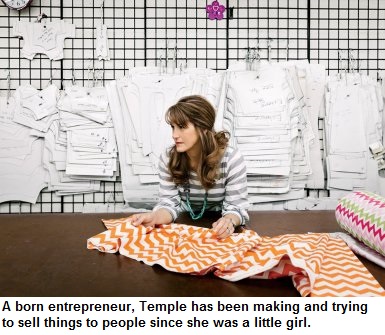
But Temple isn’t one to dabble. “Anything I’ve ever done, I go over the top,” she says. “I can’t just pick up a book and start reading it, because I’ll stay up all night and keep reading.” Despite her best efforts at being a full-time homemaker, she’s also a born entrepreneur who had been trying to make and sell things to people since she was a little girl–friendship bracelets, pages from her coloring books. Now, as Will’s business dwindled, she started taking Lolly Wolly Doodle seriously.

One day, looking to scale her fledgling business, Temple tried having a company in China that she had found through the website Alibaba make a few dresses based on one of her patterns. When they came in, the dresses weren’t perfect–the smocked zebras looked more like cows, and the sewing wasn’t up to her standards. Wary of getting bad feedback on eBay, she posted the pieces on Lolly’s Facebook page and asked people to comment and leave their email address if they wanted to buy them cheap; she would just send them a PayPal invoice. She had 153 Facebook fans, mostly Junior League contacts.

“I walked away from the computer and came back in like 30 seconds, and all the dresses were gone!” she remembers. That afternoon, she tested a few other designs on Facebook, offering to make them to order, just as she had been doing on eBay. She had never seen anyone sell anything this way (no one had), and didn’t really understand how Facebook worked. She never used the social network, personally. But she sold more that first day on the site than she had in the previous month on eBay.

Temple closed her eBay store a few weeks later, and over the next six months, she says, she slept two hours a night and made as many dresses as she could to keep up with the demand. She filled her garage with friends-and-family seamstresses. By day, they would sew dresses and boys’ rompers and post them on Facebook and take orders. At night, they would send out invoices and ship product. Everybody pitched in. Will learned to monogram. Brandi’s dad would cook a family meal, and everybody would sit around the kitchen working late into the night.

Late in 2010, JCPenney opened the world’s first Facebook store from a major retailer–a separate, shoppable tab on its Facebook page–and many other retailers followed suit. So-called F-commerce was hailed as a potential Amazon killer in the press, but nothing happened. Within a year, all those social stores started to quietly shut down. “It was like trying to sell stuff to people while they’re hanging out with their friends at the bar,” Forrester online retail analyst Sucharita Mulpuru said at the time.

Temple’s Facebook business, on the other hand, was thriving. The reason was simple. Because her sales appeared in people’s regular News Feeds, alongside posts from their friends, and because buying an item required nothing more than entering a quick comment (with an email address, size, quantity, and customization request) then paying an invoice later, people were able to make impulse purchases. (See, “How a Small-Town Manufacturer Predicts Hits With Facebook”.) It was actually the opposite of what Mulpuru said: JCPenney’s store wasn’t asking people to shop at the bar; it was asking people to leave the bar and go to another tab, whereas Temple was essentially setting up trunk shows in the bar. And thanks to Facebook’s network effect, she didn’t have to spend a dime on marketing; her customers’ comments on the Facebook News Feed showed up on their friends’ News Feeds, and the community grew organically.

It wasn’t just Facebook that made it a good business. Temple was making each dress to order, so she had virtually no inventory risk. She could also react quickly to customer preferences, tailoring her designs accordingly. And because she was selling her goods directly to consumers, she was able to cut out layers of markups and offer great prices. If a particular dress sold well one day, she would post a similar one the next. This kept the sewing process simple–she didn’t have to reinvent her patterns, just riff on them–and eliminated much of the guesswork of merchandising. “When something went crazy, I would go really deep into that style and those colors,” she says. “And if it didn’t, then forget it. I didn’t make it again. We would fill whatever orders we got and move on to something else.” Those same dynamics power the business today.

Around mid-2010, though, everything almost ended. Will came home from work one day and said he was about to be laid off. Brandi, meanwhile, says she “hit a wall. I couldn’t do another thing. I knew this was a great business, but it was way beyond what I could keep doing in my garage.” Her first instinct was to sell the company. She plucked a number out of thin air–a million dollars–because it sounded like a lot of money and would buy the family enough time to get them through Will’s unemployment. She called a friend of a friend who was a banker in Charlotte and asked him if he could help line up buyers, and he called back a few days later suggesting she call an investor named Shana Fisher.

Fisher, a New Yorker, had become known for her knack as a deal hunter when she ran mergers and acquisitions for Barry Diller’s IAC. She had recently started her own venture capital firm, High Line Venture Partners, and has since been among the earliest investors in MakerBot, Vine, and Pinterest, and other star startups.

“Don’t you dare sell this company,” Fisher said over the phone, as Temple sat on the floor in the bathroom, trying to shut out the noise of her kids from the next room. “Let me invest, and let’s grow this business. You don’t realize what you’ve done.”

Temple had never run a business, aside from running a short-lived day spa she had opened in Lexington a few years earlier. Despite having built Lolly from scratch, she had no idea how to place a value on the company. “I was like, ‘If you’re telling me this is not worth $1 million but maybe $5 million, that’s interesting,’ ” Temple said.

Fisher laughed. “We wouldn’t be having this conversation if I thought this company were worth $5 million.” If they could keep expanding Lolly’s community, it could become a $50 million or $100 million business, she explained (let alone the much larger number Revolution Growth would love to see). Fisher invested $100,000 in the young company, and a few months later helped Temple line up a $1.4 million seed round of financing. Temple moved the operation out of the garage into a 4,000-square-foot former tire warehouse in Lexington and started hiring.

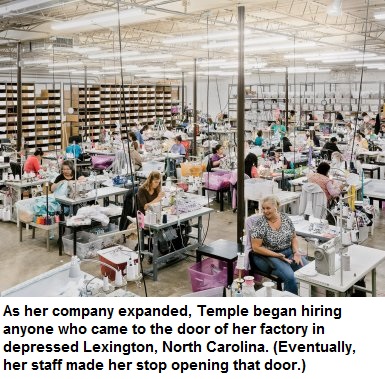
A town of antique stores and decaying red-brick factories, Lexington is a former textile and manufacturing hub, and it had fallen on hard times. Over the previous 10 years, many of the area’s manufacturing jobs had moved to China, and the recession had made things all the worse. Local unemployment hit 14 percent in early 2010.

That fall, Temple answered a knock on the unmarked office door and found an elderly woman standing there. “I don’t know what you do in there, but are you hiring?” the woman asked. She was 72 years old, and her name was–almost inevitably–Miss Daisy. Through tears, she explained that her husband had a heart condition and they could no longer afford his medication. “We’ve lost everything, and I just need a job really bad,” she said.

Miss Daisy had never worked as a seamstress and had little or no experience cutting and sewing, but Temple agreed to hire and train her because she needed as many hands as she could get. Word got around Lexington that a new company had jobs, and one after another, people started showing up at the door asking for work. “Person after person, they’d tell the same story,” Temple remembers. “I’ve lost my house, I’ve lost my car; what can I do?” She hired them all.

CU Blog - How One Entrepreneur Can Rally a Whole Community - Photo 1Temple tells this story in her bright, pastel-green office in one of the four buildings that now house the company. A 20,000-square-foot former medical-equipment warehouse, the headquarters facility opened in early 2012 after the state of North Carolina agreed to pay for half of the cost of buying and renovating it, to help boost job creation in the region. Manufacturing and design happen here, and next door a smaller building houses the company’s photo studio. Across town sits an 80,000-square-foot warehouse and shipping hub. With about 250 employees, Lolly Wolly Doodle is now one of the largest employers in Lexington. At the rate it’s growing, it could soon be the largest.

Increasingly, however, Lolly is not a local operation: The fourth location is in New York City, and a cadre of experienced retail and technology hands have climbed aboard, many recruited with the help of Shana Fisher. The COO, Emily Hickey, was a co-founder of the business-networking service Hashable and, earlier, a VP at HotJobs. The former e-commerce chief at Quidsi, the parent company of Diapers.com, now heads up Lolly’s New York tech team. Recently, John Singleton, a former JCPenney and Abercrombie & Fitch executive, came on to build better supply chain and manufacturing processes. “Brandi is recruiting some of the very best people in the world,” says Donn Davis, the co-founder of Revolution Growth and a member of Lolly’s board since his firm’s $20 million investment last year. “Most of the time, those people’s first reactions are like mine when I heard about the company. It’s called what? It’s where? It sells what? Then they see what the company is doing, and they say, ‘Wait, everybody is talking about trying to figure this out, but you’re already doing it.’ ”

What Temple is really doing, says Davis, is “reinventing apparel much as Dell reinvented the PC industry. It’s affordable custom [manufacturing] in real time with little inventory risk.” Davis sees Lolly’s Facebook commerce as an important tactic that kick-started the company, but it’s just that: a tactic. The real innovation is using social media as the starting point for a new e-commerce model that’s powered by a social feedback loop.

The cycle works like this: First, the company makes a sample product and puts it up on Facebook or another social platform for sale (the company is expanding to Instagram and will leverage Pinterest and other platforms soon). Then it makes only the sizes that people order, so there’s no overstock. The company compares sales of that product with past styles and decides if it’s a winner. If it is, two things happen: One, Lolly can mass-produce it and keep some of it on hand for sale on its own site, LollyWollyDoodle.com (even those garments are customizable with monograms and other touches, so customers are always getting something unique). Two, a winning design can become the basis for a new product “pod,” an ever-expanding collection built on that template; new iterations might be tweaked with different fabrics or necklines or ruffles, but there’s a limited palette of tweaks for any given pod, keeping manufacturing complexity to a minimum.

As the company cycles through this feedback loop, it amasses ever more data about what works, so that it can make smart design decisions and configure its operations accordingly. Social commerce, in other words, is not just about virality but also about predictive analytics. The company introduces about 15 new product SKUs every day, and one of the biggest priorities this year is to finish building custom software that better structures the design and sales data and allows the supply chain, cutting and sewing operations, and warehouse to be reorganized so that each piece of fabric moves through production as efficiently as possible.

If traditional garment manufacturing is a pretty straightforward assembly-line affair, the seamstresses at Lolly work more like short-order cooks in a diner where the menu changes daily. In one room, a dozen people cut fabric according to order tickets that flow through in real time–15 size-2 aqua chevron Charlotte dresses here, a single size-6 salmon Ruffle dress there. On the sewing floor, efficiency comes from how the orders are bundled (not necessarily by garment or size but, because many items share attributes, by the type of sewing required) and minimizing how many people or machines have to touch a garment. That information then informs the design process for new garments. A made-to-order dress now takes two weeks to land on a customer’s doorstep; Temple hopes to shave that down to a week.

Hickey, the COO, calls Lolly Wolly Doodle a “fast-fashion” company, referring to the category of retailers, epitomized by the Spanish chain Zara, that constantly refresh their product lines according to trends and sell at low prices, with low margins. Fast fashion is largely immune to the slow seasonal cycles that drive traditional fashion companies–which inevitably have to rely on deep discounts to move unsold inventory–but it requires nimble manufacturing that can take on small product runs and constantly adapt to demand signals. When companies rely on remote mega-factories, they have much less control. “It’s no small coincidence that Zara is not made in China,” says Forrester’s Mulpuru. “It’s no coincidence that Lolly Wolly Doodle is made in the U.S.

Well, partly. Lolly Wolly Doodle these days outsources about 30 percent of its manufacturing to China and Latin America, but those garments are all the proven winners that emerge from the U.S.-made small runs that first appear on Facebook and the Lolly site. The Lexington warehouse has racks of premade blanks that were made overseas and await monogramming or other customization before being shipped.

“There’s still going to be a level of imprecision in that system,” Mulpuru cautions. “There are all kinds of early demand indicators that could be wrong. But your chances of picking a hit are going to be better, and you will have fewer markdowns.” She finds it “truly baffling” that more companies haven’t “got their heads out of their asses” and adopted a similar model to predict and make hits.

Larger companies may not have caught on yet, but there are certainly Lolly imitators. In early 2012, a San Francisco entrepreneur named Chris Bennett heard Temple’s story right around the time he was looking to start a new company. Called Soldsie, Bennett’s new technology platform helps other entrepreneurs start businesses based on the Lolly Wolly Doodle model by handling all the order processing for them. “Lolly was really the light bulb moment,” for him he admits. “I read an old news story [from a local paper in North Carolina] that said they had generated something like $2 million in revenue based on 30,000 fans, and it was just far more volume than I’d seen anyone do with Facebook.” Today, Soldsie has more than 1,000 mostly tiny client companies, but it processes over $1 million in transactions every month, and Bennett says he’ll announce partnerships with several “huge” brands this summer.

Lolly, meanwhile, hopes to become a huge brand using the model. Davis, of Revolution Growth, thinks the company has created a template that it can ultimately apply far beyond children’s clothes. “Kids’ apparel, age 0 to 8, is a $10 billion market,” he says. “So the first step is to become the leading company there. And the second step is…to add new brands on top of it that go into other segments.” That means men’s and women’s clothes, home goods, and beyond.

Temple still marvels at how she has arrived at this point. She has “been blessed,” she likes to say, and at one point I ask her how much her faith has been a part of Lolly’s success story. “It is the story,” she says. “That moment I had the idea to put something on Facebook….” She chokes up and has to collect herself. “That idea didn’t come from me. God had a purpose in reaching out to build this business. From our missions in Africa to our Moms in a Jam”–two of the company’s recent philanthropic efforts–“to the people we employ, it’s not about me creating a business. It was about what we could all do together, the pay-it-forward mentality.”

The moment hangs there for a second, and she makes a self-deprecating joke about God’s sense of humor: Why would He choose her? Then she sits up straight and starts talking about the virtues of a vertically integrated supply chain, how to create authentic interaction on social media, the importance of Hickey, her COO (“She can never leave. I will hunt her down; I’m Southern enough”), quality control in China, her insistence on approving every design before it posts…. “We don’t even think about competition,” she says. “We are our only competition.”
Share this post:
, ,

A Christmas Present for the Banks from the Omnibus Bill

Go Lean Commentary

What do you get for $5.3 Billion? There must be some return on that investment.

The book Go Lean … Caribbean asserts that the US Federal Election-Campaign system is not the model that the Caribbean should want to emulate.  This book relates that $5.3 Billion was spent for the 2008 Federal Elections (Page 116), a lot of it contributed by corporations, resulting in a lot of influence peddling. This drama was vividly demonstrated this Saturday evening when the “lame-duck” Congress (the Senate in particular), delayed the required Omnibus Spending Bill – just in time – to extort favorable legislation that would roll back some of the federal regulations enacted after the Great Recession of 2008 to protect against banking systemic risks.

Senate Minority Leader Mitch McConnell speaks to reporters on upcoming budget battle in Washington

The Shadow Influences spearheading these changes are known to adhere to the principle that “a crisis is a terrible thing to waste” – a quotation credited to famed American Economist Paul Romer. While others will think that this drama was just politics as usual, the following article depicts the more strategic nature of the new legislation, to foster the environment and industry for financial derivative trading – this is too specific for any life-long politician (the US Senate) to advocate on the sly. No, this has the fingerprints of Wall Street Shadow Influences all over it. (See Appendix below for encyclopedic references on derivatives and swaps). See the news article here:

Title: A Christmas Present For The Banks From The Omnibus Bill
Forbes Magazine Investing Online Blog (Posted 12/13/2014; retrieved 12/15/2014) –
http://www.forbes.com/sites/robertlenzner/2014/12/13/wall-street-reverses-ban-on-trading-derivatives-backed-by-uncle-sam/
By: Robert Lenzner, Contributor

Wall Street banks like Citigroup and JP Morgan Chase have flexed the power of their influence to pressure Congress and the White House into a key change in the law that will allow the trading of risky financial derivatives in bank operations that are insured by the Federal Deposit Insurance Corp. This means the nation’s largest banks used the deadline for passing the Omnibus spending bill as pressure to reverse a key section of the Dodd-Frank bill of 2010 that was meant to prohibit a federal government bailout of swaps entities.

It was the existence of over $500 billion of Credit Default Swaps on the balance sheet of AIG in 2008 that threatened to bankrupt the largest insurance company in the world. So, in effect, six years later, the same Wall Street banks that were bailed out by federal largesse, are being given a legislative gift that will enable them to freely trade the securities that brought Lehman Bros down in 2008 — and obtain access to the benefit of insurance and loans from the federal government.

Behind the scenes, unbenownst to the media or the public, the nation’s Too Big To Fail banks used the Omnibus spending bill that is necessary to finance federal spending in 2015 to undo this little-known Dodd Frank provision that might have restricted the volume of trading in financial derivatives that have been a major source of profits as well as controversy since the 2008 financial crisis. Most financial derivatives will be able to be traded in entities holding deposits guaranteed by the Federal Deposit Insurance Corp. and subject to borrowing at the Federal Reserve’s discount window. This is a key advantage for the banks that will enable them to increase their activity in these securities.

Former Rep. Barney Frank, who was a key sponsor of the Wall Street reform legislation, attacked the change in Dodd-Frank as “a road map for further attacks on our protection against financial instability.” Frank was incensed that the last-minute procedure was “inserted with no hearings, no chance for further modification, and no chance for debate into a mammoth bill in the last days of a lame-duck Congress.”

If President Obama signs the Omnibus spending bill, he will have effectively rewarded Wall Street by reversing a provision that prohibits any federal assistance from being provided to “swaps entities,” including registered swaps dealers, security-based swap dealers, major swap participants and major security-based swap participants, according to information obtained by Forbes. This measure required banks to remove their swaps dealing from the bank itself and do its trading in non-bank affiliates not eligible for deposit insurance. Access to the Fed’s discount window would also be denied in case of a financial crisis in the markets.

The net effect of the changes in the Omnibus spending bill would be to expand permissible swaps activities within a bank and to only exclude swaps based on asset-backed securities that are unregulated and not of a credit quality.

All very technical, but the net result is to allow Citigroup, JP Morgan Chase and others to use the Fed’s discount window to borrow money in case of a crisis that roiled the derivative market for credit swaps again as took place in September 2008. In effect, it means the major banks need not limit their trading of financial derivatives to non-bank operations that the market will never be fooled into thinking some future risk of danger has just been avoided. It is a complex holiday present for Wall Street. And it is a warning sign that other sections of the Dodd-Frank Wall Street reform may also be vulnerable to political rollback.

An additionally relevant blog by Robert Lenzer: http://www.forbes.com/sites/robertlenzner/2014/12/08/the-ten-reasons-why-there-will-be-another-systemic-financial-crisis/

The crisis of the 2008 Great Recession was the lynchpin for the Go Lean movement, (book and blogs). This book, serving as a roadmap for the introduction and implementation of the Caribbean Union Trade Federation (CU), posits that the effects of the 2008 Great Recession continue to linger in the Caribbean. Therefore the book advocates learning lessons from 2008 and to turn-around, reform, and reboot the region’s economic, security and governing engines to ensure that “never again” will our society be so vulnerable to the financial misgivings of our American neighbors; or the “plutocratic” elements there-in.

The field of economics is not always solutions-oriented; sometimes, they have been responsible for the problem. Consider this VIDEO snippet here:

Documentary Film “Inside Job” – http://youtu.be/CaXNqGgIc-g

Published on Apr 19, 2012 – Since the repeal of Glass-Steagall in 1999, the total notional value of derivatives has grown by over 700% for holdings companies and 674% for commercial banks. Even more alarming, since the third quarter of 2008 when the cracks in the financial system were clearly evident, derivatives at the commercial banks have grown from $175 TRILLION to $234 TRILLION ” a $59 TRILLION increase. To put this in perspective, the cumulative Gross Domestic Product in the United States over that same time frame (Q3 2008 through Q3 2010) was approximately $32 TRILLION.

Despite our region’s small size (42 million people in 30 member-states), we do have some control over our own destiny. We want to be a protégé, not a parasite.

The CU’s prime directives, elevating the Caribbean’s economic-security-governing engines, recognize that the changes the region needs must start first with the adoption of new community ethos and controls. Early in the book, the need for this shift is pronounced (Declaration of Interdependence – Page 13) with these statements:

xxiv.      Whereas a free market economy can be induced and spurred for continuous progress, the Federation must install the controls to better manage aspects of the economy: jobs, inflation, savings rate, investments and other economic principles. Thereby attracting direct foreign investment because of the stability and vibrancy of our economy.

xxv.      Whereas the legacy of international democracies had been imperiled due to a global financial crisis, the structure of the Federation must allow for financial stability and assurance of the Federation’s institutions. To mandate the economic vibrancy of the region, monetary and fiscal controls and policies must be incorporated as proactive and reactive measures. These measures must address threats against the financial integrity of the Federation and of the member-states.

The Go Lean book, and previous blog/commentaries, stressed the key community ethos, strategies, tactics, implementation and advocacies necessary to effect change in the region ourselves, to improve the stewardship over the economy. They are detailed as follows:

Who We Are – 2008 Internal Experiences Page 8
Community Ethos – Economic Principles Page 21
Community Ethos – Security Principles – Private Interest –vs- Public Protection Page 23
Community Ethos – Security Principles – “Light Up Dark Place” Page 23
Community Ethos – Governing Principles – Lean Operations Page 24
Community Ethos – Ways to Impact the Future Page 26
Community Ethos – Impact Research and Development Page 30
Community Ethos – Ways to Improve Negotiations Page 32
Community Ethos – Ways to Impact Turn-around – 2008 Crisis Page 33
Community Ethos – Ways to Impact the Greater Good Page 37
Strategy – Mission – Fortify   the Stability of the Securities Markets Page 47
Strategy – CU Stakeholders to Protect – Banks & Depositors Page 47
Tactical – Growing the Economy – Minimizing Bubbles Page 69
Tactical – Separation-of-Powers – Depository Insurance & Regulatory Agency Page 73
Anecdote – Turning Around CARICOM – Effects of 2008 Financial Crisis Page 92
Implementation – Assemble Caribbean Central Bank as Cooperative Page 96
Implementation – Assemble Constitutional Convention Page 97
Implementation – Ways to Better Manage Debt – Optimizing Wall Street Role Page 114
Implementation – Ways to Impact Elections Page 116
Planning – 10 Big Ideas – Single Market / Currency Union Page 127
Planning – Lessons Learned from 2008 Page 136
Planning – Ways to Measure Progress Page 147
Advocacy – Ways to Grow the Economy – Case Study of $5.3 Billion Influence Page 151
Advocacy – Ways to Improve Credit Ratings – 2008 Lessons Page 155
Advocacy – Ways to Improve Housing – 2008 Mortgage Crisis Lessons Page 161
Advocacy – Ways to Impact Labor Unions – 2008 Effects on Main Street Jobs Page 164
Anecdote – Caribbean Industrialist – Growing without Shadow Influence Page 189
Advocacy – Reforms for Banking Regulations Page 199
Advocacy – Ways to Impact Wall Street Page 200
Appendix – Whitepaper: The 2008 Financial Crisis and Its Aftermath Page 276
Appendix – Currency Capital Controls Page 325

The points of effective, technocratic regional stewardship, especially in response to the 2008 Great Recession / Financial Crisis, were further elaborated upon in these previous blog/commentaries:

https://goleancaribbean.com/blog/?p=3311 Detroit to exit historic bankruptcy – Finally recovering from 2008
https://goleancaribbean.com/blog/?p=3164 Michigan Unemployment – Then (2008/2009) and Now
https://goleancaribbean.com/blog/?p=3090 Lessons Learned – Europe Sovereign Debt Crisis of 2009
https://goleancaribbean.com/blog/?p=3028 Why India is doing better than most emerging markets since the crisis
https://goleancaribbean.com/blog/?p=2930 ‘Too Big To Fail’ – Caribbean Version
https://goleancaribbean.com/blog/?p=2448 ‘Consumer Reports’ Survey Finds the American Consumer is Back
https://goleancaribbean.com/blog/?p=2435 Korea’s Protégé Model – A Dream for Latin America / Caribbean
https://goleancaribbean.com/blog/?p=2338 Lesson Learned – How Best to Welcome the Dreaded ‘Plutocracy’
https://goleancaribbean.com/blog/?p=2259 The Criminalization of American Business – Big Banks Let Loose
https://goleancaribbean.com/blog/?p=2105 Recessions and Public Health – Lessons from the 2008 Crisis
https://goleancaribbean.com/blog/?p=2090 The Depth & Breadth of Remediating 2008
https://goleancaribbean.com/blog/?p=1896 The Crisis in Black Homeownership since 2008
https://goleancaribbean.com/blog/?p=1309 5 Steps of a Bubble
https://goleancaribbean.com/blog/?p=841 Post 2008 – Having Less Babies is Bad for the Economy?
https://goleancaribbean.com/blog/?p=782 Open/Review the Time Capsule: The Great Recession of 2008
https://goleancaribbean.com/blog/?p=709 Post 2008 – Student debt holds back home buyers
https://goleancaribbean.com/blog/?p=522 Financial Crisis Jokes – Reflecting the cultural impact on society
https://goleancaribbean.com/blog/?p=518 Post 2008 – What Banks learn about financial risks
https://goleancaribbean.com/blog/?p=378 Fed Releases Transcripts from 2008 Meetings
https://goleancaribbean.com/blog/?p=242 Post 2008 – The Erosion of the Middle Class

The 2008 Great Recession brought major upheaval to American and Caribbean societies, plus the rest of the world. Much of the world is interconnected; this is even more acute in our region. Our economy is structured as parasites on the US economy. According to the foregoing news article, our parasitic host is not worthy of our devotion. What qualifies the Go Lean promoters to make these assessments? Principals of this publishing foundation were also there in 2008, engaged with major stakeholders of the Global Financial crisis: Lehman Brothers, JPMorganChase, Citigroup, etc. They were on the inside looking out, not the outside looking in. They were equipped to discern the Shadow Influence.

The Go Lean movement advocates the role of protégé, not parasite. We must diversify our economy and additionally cater to other markets, other countries and other industries. This is the purpose of the Go Lean roadmap, to provide a turn-by-turn direction to accomplish this diversification.

If we want to make our homeland a better place to live, work and play then we cannot depend on the stewards of the US economy to shepherd the Caribbean. Look! Despite the cruel and harsh lessons from 2008, it appears – from the foregoing article and the Appendix below – that the Wall Street Shadow Influence wants to repeat the “Bubble” that lead up to 2008. When they succeed, they profit; but when they fail, the “low man” on Main Street – and parasite economies like the Caribbean – has to endure the pain, not Wall Street.

The Go Lean roadmap does not seek to change America, (though we lobby against these arbitrary “Derivative” rule changes in the Omnibus Budget Bill); only teach the lessons to the Caribbean. We can do so much better.

Download the free e-Book of Go Lean … Caribbean – now!

——————–

Appendix – Derivatives:
(Source: http://en.wikipedia.org/wiki/Derivative_(finance) )

In finance, a derivative is a contract that derives its value from the performance of an underlying entity. This underlying entity can be an asset, index, or interest rate, and is often called the “underlying”.[1][2] Derivatives can be used for a number of purposes – including insuring against price movements (hedging), increasing exposure to price movements for speculation or getting access to otherwise hard to trade assets or markets.[3]

Some of the more common derivatives include forwards, futures, options, swaps, and variations of these such as collateralized debt obligations, credit default swaps, and mortgage backed securities. Most derivatives are traded over-the-counter (off-exchange) or on an exchange such as the Chicago Mercantile Exchange, while most insurance contracts have developed into a separate industry. Derivatives are one of the three main categories of financial instruments, the other two being equities (i.e. stocks or shares) and debt (i.e. bonds and mortgages).

Speculation
Derivatives can be used to acquire risk, rather than to hedge against risk. Thus, some individuals and institutions will enter into a derivative contract to speculate on the value of the underlying asset, betting that the party seeking insurance will be wrong about the future value of the underlying asset. Speculators look to buy an asset in the future at a low price according to a derivative contract when the future market price is high, or to sell an asset in the future at a high price according to a derivative contract when the future market price is less.

Risks
The use of derivatives can result in large losses because of the use of leverage, or borrowing; (see VIDEO below). Derivatives allow investors to earn large returns from small movements in the underlying asset’s price. However, investors could lose large amounts if the price of the underlying moves against them significantly. There have been several instances of massive losses in derivative markets, such as the following:

  • American International Group (AIG) lost more than US$18 billion through a subsidiary over the preceding three quarters on credit default swaps (CDSs).[42] The United States Federal Reserve Bank announced the creation of a secured credit facility of up to US$85 billion, to prevent the company’s collapse by enabling AIG to meet its obligations to deliver additional collateral to its credit default swap trading partners.[43]
  • The loss of US$7.2 Billion by Société Générale in January 2008 through mis-use of futures contracts.
  • The loss of US$6.4 billion in the failed fund Amaranth Advisors, which was long natural gas in September 2006 when the price plummeted.
  • The loss of US$4.6 billion in the failed fund Long-Term Capital Management in 1998.
  • The loss of US$1.3 billion equivalent in oil derivatives in 1993 and 1994 by Metallgesellschaft AG.[44]
  • The loss of US$1.2 billion equivalent in equity derivatives in 1995 by Barings Bank.[45]
  • UBS AG, Switzerland’s biggest bank, suffered a $2 billion loss through unauthorized trading discovered in September 2011.[46]

This comes to a staggering $39.5 billion; the majority in the last decade after the Commodity Futures Modernization Act of 2000 was passed.

Financial Reform and Government Regulation
Under US law and the laws of most other developed countries, derivatives have special legal exemptions that make them a particularly attractive legal form to extend credit.[47] The strong creditor protections afforded to derivatives counterparties, in combination with their complexity and lack of transparency however, can cause capital markets to underprice credit risk. This can contribute to credit booms, and increase systemic risks.[47] Indeed, the use of derivatives to conceal credit risk from third parties while protecting derivative counterparties contributed to the financial crisis of 2008 in the United States.[47][48]

CU Blog - A Christmas Present for The Banks From The Omnibus Bill - Photo 2

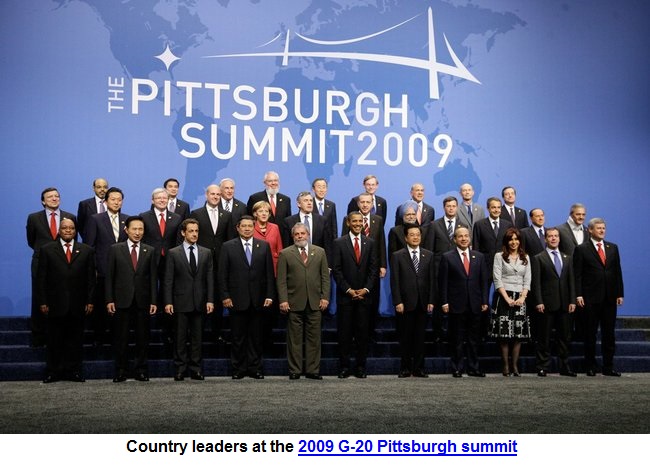
In November 2012, the SEC and regulators from Australia, Brazil, the European Union, Hong Kong, Japan, Ontario, Quebec, Singapore, and Switzerland met to discuss reforming the OTC derivatives market, as had been agreed by leaders at the 2009 G-20 Pittsburgh summit (see Photo) in September 2009.[54] In December 2012, they released a joint statement to the effect that they recognized that the market is a global one and “firmly support the adoption and enforcement of robust and consistent standards in and across jurisdictions”, with the goals of mitigating risk, improving transparency, protecting against market abuse, preventing regulatory gaps, reducing the potential for arbitrage opportunities, and fostering a level playing field for market participants.[54] They also agreed on the need to reduce regulatory uncertainty and provide market participants with sufficient clarity on laws and regulations by avoiding, to the extent possible, the application of conflicting rules to the same entities and transactions, and minimizing the application of inconsistent and duplicative rules.[54] At the same time, they noted that “complete harmonization – perfect alignment of rules across jurisdictions” would be difficult, because of jurisdictions’ differences in law, policy, markets, implementation timing, and legislative and regulatory processes.[54]

VIDEO: Leverage Explained – https://youtu.be/GESzfA9odgE
When things turn out good, big risk means big return; but if it turns out bad, you lose everything and left with a debt.

Source References:
1.       Derivatives (Report). Office of the Comptroller of the Currency, U.S. Department of Treasury. http://www.occ.gov/topics/capital-markets/financial-markets/trading/derivatives/index-derivatives.html. Retrieved February 2013. “A derivative is a financial contract whose value is derived from the performance of some underlying market factors, such as interest rates, currency exchange rates, and commodity, credit, or equity prices. Derivative transactions include an assortment of financial contracts, including structured debt obligations and deposits, swaps, futures, options, caps, floors, collars, forwards, and various combinations thereof.”
2.       Derivative Definition Investopedia
3.       Koehler, Christian. “The Relationship between the Complexity of Financial Derivatives and Systemic Risk”. Working Paper: 10–11.
——
42.   Kelleher, James B. (September 18, 2008). “”Buffett’s Time Bomb Goes Off on Wall Street” by James B. Kelleher of Reuters”. Reuters.com. Retrieved August 29, 2010.
43.   “Fed’s $85 billion Loan Rescues Insurer”
44.   Edwards, Franklin (1995). “Derivatives Can Be Hazardous To Your Health: The Case of Metallgesellschaft”. Derivatives Quarterly (Spring 1995): 8–17
45.   Whaley, Robert (2006). Derivatives: markets, valuation, and risk management. John Wiley and Sons. p. 506. ISBN 0-471-78632-2.
46.   “UBS Loss Shows Banks Fail to Learn From Kerviel, Leeson”. Businessweek. September 15, 2011. Retrieved March 5, 2013.
47.   “Michael Simkovic, Secret Liens and the Financial Crisis of 2008.”. American Bankruptcy Law Journal, Vol. 83, p. 253. 2009. Retrieved March 5, 2013.
48.   Michael Simkovic (January 11, 2011). “Bankruptcy Immunities, Transparency, and Capital Structure, Presentation at the World Bank”. Ssrn.com. doi:10.2139/ssrn.1738539. Retrieved March 5, 2013.
——
54.   “Joint Press Statement of Leaders on Operating Principles and Areas of Exploration in the Regulation of the Cross-Border OTC Derivatives Market; 2012-251”. Sec.gov. December 4, 2012. Retrieved March 5, 2013.

Share this post:
, , ,
[Top]

Plea to Detroit: Less Tech, Please

 Go Lean Commentary

It’s competition time for the cockpits of today’s automobiles.CU Blog - Plea to Detroit - Less Tech, Please - Photo 1

The appeal here is being made to Detroit. In this case the city is referenced as a metonym for the Automaker Planners and Decision-makers. Metonyms are frequent references in the book Go Lean…Caribbean, with the following considerations:

Silicon Valley – Page 30 – American High Tech Center
Wall Street – Page 155 – Big Banks/Financial Centers
Hollywood – Page 203 – US Movie/TV/Media Producers

This book Go Lean… Caribbean, serves as a roadmap for the introduction and implementation of the Caribbean Union Trade Federation (CU). This effort will marshal the region to avail the opportunities associated with technology and automobiles – there is a plan to foster a local automotive industry. In fact The CU/Go Lean roadmap has these 3 prime directives:

  • Optimization of the economic engines in order to grow the regional economy.
  • Establishment of a security apparatus to protect the resultant economic engines.
  • Improve Caribbean governance to support these engines.

Automakers are competing in a “space race” for more and more technology in the cockpits (Car decks and Heads-Up Display) of cars. This is not always good; as related by the following news/opinion writer:

By: John C. Abell, Senior Editor
Title: My Plea to Detroit: Less Tech, Please

CU Blog - Plea to Detroit - Less Tech, Please - Photo 2I once ranted that the only thing I wanted in a “smart” TV was Bluetooth. I was only half kidding. But car-markers are going down the same road as some TV set manufacturers by bloating their products with too much of the wrong tech, adding expense and complexity that we do not need. “We took a look from the ground up of what a self-driving car would look like,” Brin said.

“Smart” has become an overused modifier for devices that are better off dumb. Do you really need a connected refrigerator that tells you to buy milk and streams music?

You aren’t going to be forced to buy a smart fridge. There are too many other choices. But if automakers aren’t stopped they will install useless, redundant technology as standard equipment for you will have to buy, maintain and even keep paying subscription fees to justify the existence of something you didn’t need in the first place.

Consider today’s news of Ford’s latest attempt to market an in-dash tech system. Let’s leave aside the safety discussion about whether the driver should be messing around with pinch-to-zoom multitouch screens and looking for entertainment while operating a massive vehicle at highway speeds. Let’s also concede that voice control addresses much of the safety concern and that the quiet, serene environment that is a car interior is made for that kind of interface.

I’m still stuck on a basic question: What cabin technology can an automaker build into a car that I can’t bring myself, more cheaply? What I need, still, only, is Bluetooth and a comfortable seat for my smartphone, which is as smart as can be and always with me.

There’s ample history to push back against so-called tech advancement in cars.

In the year 2000 President Clinton opened up the satellite GPS tracking system to anybody at a resolution of down to 10 meters. That 10-fold improvement suddenly made military-grade tech practical for your family car. Companies like Garmin and Magellan, which had been catering to sporting folk, found a new market. And newcomers like TomTom and Dash got into the game.

As a chronic early adopter I have owned several stand-alone GPS units and have always resisted buying $2,000 in-dash GPS because I could always get $200 on-dash equivalents. And then smartphones became the only GPS device you needed, reducing the cost to about zero while also making the device infinitely portable. Goodbye Garmin.

Carmakers merely co-opted a good idea, charging us a stiff premium for what it presented as essentially style choice. Remember that theme …

Several automakers tout that their cars are “Pandora ready.” Who cares? Pandora is only one of more than 100 streaming music services, has fewer than half the subscribers of Spotify and about a million fewer songs than major rivals. And — oh yeah — Apple recently got into the game with a native iPhone service that oddly enough looks and feels exactly like its more established predecessors.

Detroit has also discovered hotspots and thinks it’s doing you a favor building that into your next car. GM and Ford, the Wall Street Journal reports, are convinced “technology offerings are increasingly important to new car buyers. A total of 38% of those buying domestic vehicles cite the latest technology features as a reason for their purchase, according to a recent survey by automotive consultants J.D. Power and Associates.”

Sigh. Here’s an opportunity for you to pay for yet another data plan, in addition to the one you use at home and the one you use on your phone. Or, instead, you can remember that your phone is a 4G hotspot, and that some plans don’t charge you more to use it. Want something even more robust? Get a MiFi for a hotspot that you also don’t have to leave in your car and has excellent battery life.

I’m a little less sure that OnStar has outlived its usefulness. This service — which pre-dates the GPS and mobile phone revolution — is a uniquely human-powered concierge service that many will find valuable for that kind of piece of mind. But if a panic button is all you need, it’s probably overkill. Plus, they are serious boosters of Bluetooth, so good for them.

Instead of adding to sticker shock with shiny things Detroit should take a look at what appliance companies like GE and Whirlpool are doing. Connected appliances leverage the smartphone their designers very safely assume you already have. So your smart oven won’t remind you that it’s your anniversary, but it will respond to a command to pre-heat that you might send as you leave the supermarket.

Like appliance makers, automaker need to realize that the smartphone has become the ultimate universal remote and gateway that they cannot and should not try to improve upon. Save the innovation for under the hood — and for making the cabin as smartphone friendly as possible.
——-
Are you among the 38% J.D. Powers say are enticed by “technology offerings” or does your car still have roll-up windows? Are you in the auto industry and convinced that in-cabin tech is the future?
Linked-In Blogger: John C Abell  (Posted 12-12-2014) –
https://www.linkedin.com/pulse/my-plea-detroit-less-tech-john-c-abell?trk=hp-feed-article-title

This assessment on Detroit is being made from … Detroit. In addition to the automotive industry, there is a lot of economic lessons to learn from the city itself. This once great industrial center has endured a failed-city status – 18 months under Bankruptcy Court oversight – and is now strategizing a turn-around. There is a lot of parallel with Caribbean communities, except for the lack of core competence in the automotive industry space. (The Go Lean book describes other core competencies related to the Caribbean – Page 58).

The Caribbean region cannot ignore technological advances and industrial developments. This means jobs; for today and tomorrow. The automotive industry have always been a source of high-paying jobs that transformed society. The Go Lean book relates the factor of high-job multipliers, where each direct job in a community creates multiple indirect jobs – the automotive industry is #1 for job multipliers. The roadmap’s quest to increase the regional economy and create 2.2 million new jobs, must consider all dimensions of this industry. We can  learn so much about job creation from Detroit.

This is the declaration of the book Go Lean…Caribbean. This purports that a new industrial revolution is emerging and Caribbean society must engage. This is  pronounced in the Declaration of Interdependence (Page 14), with these opening statements:

xxvii. Whereas the Caribbean region must have new jobs to empower the engines of the economy and create the income sources for prosperity, and encourage the next generation to forge their dreams right at home, the Federation must therefore foster the development of new industries, like that of ship-building, automobile manufacturing, pre-fabricated housing, frozen foods, pipelines, call centers, and the prison industrial complex. In addition, the Federation must invigorate the enterprises related to existing industries like tourism, fisheries and lotteries – impacting the region with more jobs.

xxviii. Whereas the region has endured a spectator status during the Industrial Revolution, we cannot stand on the sidelines of this new economy, the Information Revolution. Rather, the Federation must embrace all the tenets of Internet Communications Technology (ICT) to serve as an equalizing element in competition with the rest of the world. The Federation must bridge the digital divide and promote the community ethos that research/development is valuable and must be promoted and incentivized for adoption.

There is a lot at stake for the Caribbean in considering this subject area. One Caribbean icon/artist, Bob Marley, wrote not to be a “stock on the shelf” (“Pimpers Paradise” Uprising Album 1980). The region’s 42 million people demand a supply of innovative automobiles – real innovation, not just fluff to increase the sticker price as reported in the foregoing article. We do not only want to consume, we want to supply!

Producing and not only consuming has been a consistent theme in prior Go Lean blog/commentaries, sampled here:

Role Model Shaking Up the World of Cancer Research & Innovation
Where the Jobs Are – Computers Reshaping Global Job Market
Where the Jobs Are – One Scenario: Ship-breaking
STEM Jobs Are Filling Slowly; Despite High Demand
Google conducting research for highway safety innovations
Ghost ships – Autonomous cargo vessels without a crew

The Go Lean book provides a roadmap for developing and fostering a domestic automotive industry. The process starts with a spirit/attitude to not tolerate the status quo. This spirit is described in the book as a community ethos for research-and-development. The book details other ethos to adopt, plus the executions of the following strategies, tactics, implementations and advocacies to forge innovation and industrial growth in Caribbean communities:

Community Ethos – Deferred Gratification Page 21
Community Ethos – People Respond to Incentives Page 21
Community Ethos – Job Multiplier Page 22
Community Ethos – “Crap” Happens Page 23
Community Ethos – Lean Operations Page 24
Community Ethos – Return on Investments (ROI) Page 24
Community Ethos – Ways to Impact the Future Page 26
Community Ethos – Ways to Help Entrepreneurship Page 28
Community Ethos – Ways to Impact Research & Development Page 30
Community Ethos – Impact the Greater Good Page 37
Strategy – Agents of Change – Technology Page 48
Tactical – Fostering a Technocracy Page 64
Tactical – How to Calculate GDP Page 67
Tactical – Growing Economy – New High Multiplier Industries Page 68
Separation of Powers – Public Works & Infrastructure Page 82
Separation of Powers – Department of Transportation Page 84
Implementation – Ways to Pay for Change Page 101
Implementation – Ways to Deliver Page 109
Planning – 10 Big Ideas Page 127
Planning – Lessons from Detroit Page 140
Advocacy – Ways to Grow the Economy Page 151
Advocacy – Ways to Create Jobs Page 152
Advocacy – Ways to Foster Technology Page 197
Advocacy – Ways to Improve Transportation Page 205
Advocacy – Ways to Develop the Auto Industry Page 206
Appendix – Job Multipliers – Detroit 11.0 Rate #1 of all industries Page 260

The laws of supply and demand is the bedrock of economics. This roadmap to elevate Caribbean society must lead first with a strong economic plan. The goal is to increase the Gross Domestic Product (GDP), so this means more domestic consumption and less imports. This is possible in the automotive industry space if the new domestic automotive product offerings are appealing and innovative. The Caribbean region has historically been slow at adopting technological innovation. But change has now come to the Caribbean! This is bigger than just being the first to adopt new innovation; we want to be the innovators.

The focus is automotive and yet the topic featured in the foregoing article include phrases like Internet Wi-Fi, Bluetooth, GPS, music streaming (Pandora & Spotify) and satellite concierge. This is not your “grandfather’s Chevrolet”; yet this is not even the future; this is the present state of “Detroit”!

The insights from the foregoing article and the embedded VIDEO below, help us to appreciate that the future is now! We, the Caribbean region, want to be consequential in that future, not just “a stock on the shelf”. With the proper planning, preparation and participation, we help to make our homeland a better place to live, work and play. 🙂

Download the book Go Lean … Caribbean – now!

————–

Appendix VIDEO: CNET On Cars – Car Tech 101: The future of head-up displays – http://youtu.be/KWs9ucwO4Vo

Published on Nov 24, 2014 – Head-up displays are starting to show up everywhere. Brian Cooley tells you why HUDs may be the next revolution in car tech.


Share this post:
, , , ,
[Top]

Caribbean less competitive due to increasing aviation taxes

Go Lean Commentary

The book Go Lean … Caribbean relates the significance of supporting the airline industry so as to facilitate the region’s primary economic driver: Tourism.

Tourism is a leisure activity; many times participants in leisure are in no hurry to get to their destinations, they often drive. This relates to countries on a continental mainland; but for islands, not so much. For 27 of the 30 Caribbean member-states, island life is the reality. (Belize is in Central America; Guyana and Suriname are in South America).

If speed is not the requirement then boating should be an option. But the only boating/transport options for Caribbean tourists are cruise lines.

This following article relates the biggest threat to Caribbean tourism is Caribbean governments. These ones are authorized to assess taxes, but for far too often they have targeted airline tickets to generate needed revenues. This is such a flawed strategy, a betrayal of the public trust. They “cut off their nose to spite their face”, as the article here relates:

By: Ernie Seon, Caribbean-360 Contributor

CU Blog - Caribbean less competitive due to increasing aviation taxes - Photo 1ST. THOMAS, US Virgin Islands – The International Air Transportation Association (IATA) Tuesday urged regional aviation authorities to adhere to the key principles set out by International Civil Aviation Organization.

IATA’s regional vice president for the Americas, Peter Cerda said it is unfortunate that many governments had chosen to ignore the principles, a global issue that was particularly acute in the Caribbean.

Addressing tourism and industry officials gathered here on the occasion of World Aviation Day, Cerda noted that aviation taxes continue to increase the cost of travelling to the Caribbean. He said this made the region less competitive to other destinations.

“Taking the islands as a whole, each dollar of ticket tax could lead to over 40,000 fewer foreign passengers,” he said, adding that US$20 million of reduced tourist expenditure meant 1,200 fewer jobs across the region.

“Caribbean countries must therefore consider the aviation industry as a key element for tourism development,” he advised.

The IATA official noted that in terms of charges, two airports in the region, Montego Bay and Kingston, both in Jamaica, recently proposed airport tariff increases of over 100 per cent so as to attain a return of capital of around 20 per cent a year in US dollars.

He said that measures such as these do not encourage or support the development of the industry in the region.

“The regulators must act strongly and swiftly against such big increases. Governments have to foster positive business environments through consultation with the industry and transparency in order to ensure win-win situations for all,” he warned.

Cerda said the issue of taxes and charges in the region transcends the formal breaches of global standards and recommended practices and that the simple truth is that this region is a very expensive place for airlines to do business.

In the Caribbean, tourism and the aviation sector facilitate and support some 140,000 jobs and contribute US$3.12 billion, roughly 7.2 per cent of the Caribbean’s gross domestic product (GDP).

The airline industry is celebrating its 100th anniversary year in the black, according to industry figures released here. Globally, airlines are expected to earn a net profit of US$18 billion in 2014.

Cerda noted that while that might sound impressive, on revenues of US$746 billion, this is equivalent to a net profit margin of 2.4 per cent or US$5.42 per passenger carried.

“Looking only at Latin America and the Caribbean, the airlines in this region are expected to earn $1.1 billion.”This is a profit of US$4.21 per passenger and a net margin of three per cent. We are in a tough and very competitive business,” he added.

The aviation official said fuel expense across the Caribbean is estimated at 14 per cent higher than the world average, adding that this represents about a third of an airline’s operating costs.

He noted that in the case of the Dominican Republic, although fuel charges were recently reduced, tax on international jet fuel still remains high at 6.5 per cent.

“Another example is the Bahamas applying a seven per cent import duty on Jet fuel. Jet fuel supply is an issue in the region, the complexity of the fuel supply and the seasonal demand is costly and difficult, making fuel costs in the region a challenge for airlines.”

In addition, Cerda noted that airports are using the fuel concession fees as a source of revenue and they are still waiting to see any of these monies re-invested in improving fuel facilities.

On the issue of safety, he said that this has been in the spotlight in recent months, with July being an especially sad month for all involved with aviation.

However, Cerda said despite the recent tragedies, flying remains by far the safest mode of transportation.

“Every day, approximately 100,000 flights take to the sky and land without incident. Nonetheless, accidents do happen. Every life lost recommits us to improve on our safety performance.

“It is no secret that safety has been an issue in this region. Even though it is still under performing the global average, performance is improving,” he said.

The IATA official said that the aviation industry has come a long way since the very first flight from St. Petersburg to Tampa 100 years ago, turning this large planet into one small world.

He said through it all, one thing has remained constant: when governments support the conditions for a thriving industry the economic benefits are felt by all.

However Cerda cautioned that for the industry to deliver the most benefits to the citizens in the Caribbean and spur additional tourism and trade, “we need to be able to compete on a level playing field and have the infrastructure capacity needed to grow.”

He said he remains confident that if the Caribbean governments continue to strengthen their partnership with the aviation industry, “we will deliver the unique transformative economic growth only our industry can deliver, making the second century of aviation in this region even more beneficial than the first”.
Caribbean-360 Online News (Posted 09/17/2014; retrieved 12/06/2014) –
http://www.caribbean360.com/news/caribbean-less-competitive-due-to-increasing-aviation-taxes-iata-warns

This foregoing article highlights a defective premise, predatory taxing, and so thusly depicts the need for improved regional oversight of economic and governing engines.

CU Blog - Caribbean less competitive due to increasing aviation taxes - Photo 2See this photo of a recent airline ticket (price breakdown), for one of the stakeholders in the Go Lean movement, who was travelling from a Caribbean island. The reality of these aviation taxes defies logic!

Yes, the governments need their revenues, but this should not be pursued at the expense of undermining viable economic engines; this is self-defeating. Likewise there was a recent conflict with British Aviation Authorities and their unilateral tax on Caribbean air transport. The solution there/then is the same as now: regional coordination and a heightened advocacy; see AppendixVIDEO.

Change has now come to the Caribbean. The book Go Lean … Caribbean serves as a roadmap for the introduction and implementation of the Caribbean Union Trade Federation (CU), an alliance of the 30 Caribbean member-states. This Go Lean roadmap has 3 prime directives:

  • Optimization of the economic engines in order to grow the regional economy to $800 Billion and create 2.2 million new jobs..
  • Establishment of a security apparatus to protect the resultant economic engines.
  • Improve Caribbean governance to support these engines.

The roadmap calls for the CU to navigate the changed landscape of the globalized air transport industry. There is the need for regional integration, administration, and promotion for Caribbean air travel among local and foreign carriers. The book posits that transportation and logistics empower the economic engines of a community. There must be air carrier solutions to service the transportation and tourism needs of the Caribbean islands. This point is fully appreciated by Caribbean tourism stakeholders; the book relates that the region’s Hotel and Tourism Association channel the vision of Robert Crandall, former Chairman of American Airlines, who remarked at a Caribbean Hotel and Tourism Investment Conference in May 2010 that the region is uniquely dependent on tourism:

“Everyone involved in travel and tourism knows that our [airline] industry is immensely important to the world economy, generating and supporting – either directly or indirectly – about one in eleven jobs worldwide. Here in the Caribbean, it is even more important. On a number of islands, travel and tourism accounts for more than 50% of all employment, and on some islands for more than 75%. Overall, about 20% of Caribbean employment is travel and tourism dependent – something on the order of 2.5 million jobs.” – Go Lean … Caribbean Page 60.

Go Lean asserts that air travel options must be optimized to impact Caribbean society – thus the need for more regional coordination, regulation and promotion of the Caribbean’s aviation industry. New models are detailed in the book in which tourism can be enhanced with “air lifts” to facilitate Caribbean events, and “Air Bridges” to allow for targeting High Net Worth markets. This roadmap also introduces the Union Atlantic Turnpike to offer more transportation solutions (ferries, toll roads, railways, and pipelines) to better facilitate the efficient movement of people and cargo.

This is one way the CU will empower the region’s economic engines. This is an example of the change that the CU technocracy will bring!

The Go Lean book presents a series of community ethos that must be adapted to forge this change. In addition, there are these specific strategies, tactics, implementation and advocacies to apply:

Community Ethos – Job Multiplier Page 22
Community Ethos – Lean Operations Page 24
Community Ethos – Cooperatives Page 25
Community Ethos – Ways to Improve Sharing Page 35
Community Ethos – Impacting the Greater Good Page 37
Strategy – Customers – Visitors Page 47
Strategy – Competitive Analysis – Event Patrons Page 55
Strategy – Core Competence – Tourism Page 58
Anecdote – Caribbean Hotel & Tourism Assoc. focus on Air Transport Page 60
Tactical – Fostering a Technocracy Page 64
Tactical – Commerce – Tourism Promotion Page 78
Tactical – Aviation Administration & Promotion Page 84
Implementation – Ways to Deliver Page 109
Implementation – Trade Mission Objectives Page 116
Planning – 10 Big Ideas for the Caribbean Region – #7: Virtual Turnpike Page 127
Planning – Ways to Improve Trade Page 128
Advocacy – Ways to Improve Governance Page 168
Advocacy – Ways to Optimize Government Revenue Sources Page 172
Advocacy – Ways to Enhance Tourism Page 190
Advocacy – Ways to Impact Events Page 191
Advocacy – Ways to Market Southern California – Air Bridge Page 194
Advocacy – Ways to Improve Transportation – Aviation Promotion Page 205
Appendix – Airport Cities – New Approach for Optimizing Business Model Page 287

This commentary posits that the status quo of Caribbean aviation taxes reflect a flawed economic policy, reflective of the dysfunction in the region. This commentary also relates to other lessons of economic optimizations and dysfunctions previously detailed in Go Lean blogs, as sampled here:

Caribbean must work together to address regional industry threats – Example of Rum Subsidies
A Lesson in Aviation History: Concorde SST and the Caribbean
New York-New Jersey Port Authority – Lessons from an Airport Landlord
Bahamas Re-organizing Government Revenues in 2015 with VAT Implementation
Lessons Learned from the American Airlines Merger
Book Review: ‘Wrong – Nine Economic Policy Disasters and What We Can Learn…’
Caribbean Changes – Air Antilles Launches St. Maarten Service
Tourism’s changing profile – Need for Competition and Comparative Analysis

The world loves the Caribbean; people want to come visit and enjoy our hospitality. It is better for them, and for us in the region that they come by air transport. But cruises are viable options, though the Caribbean communities get less benefits from cruise lines (Pages 61 & 193). We simply “fatten our frogs for snake”. The more dysfunction we create with air transport – like these excessive  aviation taxes – the more we push visitors to the cruise option; meaning less direct-indirect spending: hotels, taxis, restaurants, casinos, etc.

Now is the time to lean-in to this roadmap for Caribbean change, as depicted in the book Go Lean…Caribbean. We cannot afford to undermine our economic strengths with disabling tax policies. This is a public trust, betrayed. The Caribbean can – and must – do better.  🙂

Download the free e-Book of Go Lean … Caribbean – now!

APPENDIX Video: A Tax Too Far…? – http://youtu.be/Jbh8DJxUNC8

Uploaded on Oct 30, 2011 – A documentary on how the Air Passenger Duty instituted by the UK is affecting Caribbean Tourism, and the lobbying efforts of the Caribbean Tourism Organization to have it reduced, removed, or the Caribbean re-banded. Get more information about the APD on the CTO website: http://www.onecaribbean.org/our-work/advocacy/

Share this post:
, , , ,
[Top]

Robots help Amazon tackle Cyber Monday

Go Lean Commentary

To understand American commerce, one must learn the BIG shopping “days of the week” – Friday, Saturday, Monday, Tuesday, as follows:

    • Black Friday – This is the Friday following the Thanksgiving Day holiday in the US (the fourth Thursday of November). Since the early 2000’s, it has been regarded as the beginning of the Christmas shopping season, and most major retailers open very early and offer promotional sales. Black Friday is not a public holiday, but some states observe “The Day After Thanksgiving” as a holiday for state government employees, sometimes in lieu of another federal holiday such as Columbus Day.[5] Many non-retail employees and schools have both Thanksgiving and the day after off, followed by a weekend, thereby increasing the number of potential shoppers. In 2014, $50.9 billion was spent during the 4-day Black Friday weekend. While approximately 133 million U.S. consumers shopped during the same period.[6]
    • Small Business Saturday – This refers to the Saturday after Thanksgiving during one of the busiest shopping periods of the year. First observed in 2010, it is a counterpart to Black Friday and Cyber Monday, which feature big box retail and e-commerce stores respectively. By contrast, Small Business Saturday encourages holiday shoppers to patronize brick-and-mortar businesses that are small and local. Small Business Saturday is a registered trademark of American Express Corporation. Small Business Saturday UK began in the UK in 2013 after the success of Small Business Saturday in America.[7]
    • Cyber Monday – This is a marketing term for the Monday after the Thanksgiving holiday. The term was created by marketing companies to persuade people to shop online. The term made its debut on November 28, 2005, in a Shop.org press release entitled “‘Cyber Monday Quickly Becoming One of the Biggest Online Shopping Days of the Year”.[2] According to the Shop.org/Bizrate Research 2005 eHoliday Mood Study, “77 percent of online retailers said that their sales increased substantially on the Monday after Thanksgiving, a trend that is driving serious online discounts and promotions on Cyber Monday this year (2005)”. In 2014, Cyber Monday online sales grew to a record $2.68 billion, compared with last year’s $2.29 billion. However, the average order value was $124, down slightly from 2013’s $128.[3] The deals on Cyber Monday are online-only and generally offered by smaller retailers that cannot compete with the big retailers. Black Friday generally offers better deals on technology; with nearly 85% more data storage deals than Cyber Monday. The past Black Fridays saw far more deals for small appliances, cutlery, and kitchen gadgets on average than Cyber Monday. Cyber Monday is larger for fashion retail. On the past two Cyber Mondays, there was an average of 45% more clothing deals than on Black Friday. There were also 50% more shoe deals on Cyber Monday than on Black Friday.[4] Cyber Monday has become an international marketing term used by online retailers in Argentina, Canada, Chile, China, Colombia, Denmark, Germany, Ireland, Uganda, Japan, Portugal, Sweden and the United Kingdom.
    • Giving Tuesday – refers to the Tuesday after Thanksgiving. It is a movement to create a national day of giving at the beginning of the Christmas and holiday season. Giving Tuesday was started in 2012 by the “92nd Street Y” (Young Men’s and Young Women’s Hebrew Association in New York, NY) and the United Nations Foundation as a response to commercialization and consumerism in the post-Thanksgiving season (Black Friday and Cyber Monday).[8][9] This occasion is often stylized as #GivingTuesday for purposes of hashtag activism.

That’s a lot of commerce … and philanthropy too!

This encyclopedic discussion is necessary for the Caribbean to model the best-practices of American commerce. The focus of this commentary is the role of one company in the pantheon of Cyber Monday, Amazon. This firm has previously been featured in a Go Lean blog, and is identified as a model for Caribbean logistics, our means for delivering the mail; this is the vision for the Caribbean Postal Union (CPU).

The focus of the book Go Lean…Caribbean and the CPU is not just postal mail, but rather logistics. Mail requires logistics, but logistics encompasses so much more than just mail. So we would want to model a successful enterprise in this industry space, like Amazon, not just another postal operation, like the US Postal Service (Page 99).

Amazon provides a good example of lean technocratic efficiency. So Amazon is a good model, not just for the CPU but the entire Caribbean Union Trade Federation (CU). The Go Lean book, serves as a roadmap for the introduction and implementation of the technocratic CU.

One reason why Amazon is modeled for their lean stature is their use of automation. This following VIDEO depicts the creative solution of using robots to facilitate logistics in a warehouse environment:

VIDEO: Robots help Amazon tackle Cyber Monday – http://www.cbsnews.com/videos/robots-help-amazon-tackle-cyber-monday/

December 1, 2014 – Cyber Monday is the biggest sales day of the year for online retail giant, Amazon. Last year, Amazon customers ordered 426 items every second on Cyber Monday, and this year that number is expected to grow. In addition to the 80-thousand seasonal workers they employ to fulfill orders, thousands of robots also crawl the warehouse floors. CNET.com’s KaraTsuboi takes us inside an Amazon fulfillment center to watch the robots in action. (VIDEO plays best in Internet Explorer).

Lean, automation, robotics, technocratic …

… welcome to the new Caribbean.

This is the mission of Go Lean roadmap, to elevate the economic engines of Caribbean society; industrial policy plays a key role in this roadmap. The region needs the jobs, so we need job creators: companies. These companies, or better stated, Direct Foreign Investors, need a pro-innovation environment to deploy their automated solutions. The Go Lean roadmap allows the structure of Self-Governing Entities (SGE) to incentivize industrial developments in the region. It is the expectation that robots and automated systems will flourish. The independence of the SGE structure neutralizes conflicts with “labor”.

Related issues have previously been detailed in these Go Lean commentaries listed here:

Disney World – Successful Role Model of a SGE
Using SGE’s to Welcome the Dreaded ‘Plutocracy’
Where the Jobs Are – Ship-breaking under SGE Structure
Fairgrounds as SGE and Landlords for Sports Leagues
Puerto Rico’s Comprehensive Cancer Center Project Breaks Ground – Model of Medical SGE

In addition to the roadmap encouraging robotic automation, the CU will directly employ such technologically innovative products and services to impact its own prime directives; the CPU is such a reflection; more automation and less labor. The CU’s prime directives are identified with the following 3 statements:

  • Optimization of the economic engines in order to grow the regional economy to $800 Billion & create 2.2 million new jobs.
  • Establishment of a security apparatus to protect the resultant economic engines.
  • Improve Caribbean governance to support these engines.

The CPU features economic, security and governing concerns.

The Go Lean roadmap seeks to change the entire eco-system of Caribbean logistics and resulting commerce  – the interaction with postal operations. This vision is defined early in the book (Page 12 & 14) in the following pronouncements in the Declaration of Interdependence:

xv. Whereas the business of the Federation and the commercial interest in the region cannot prosper without an efficient facilitation of postal services, the Caribbean Union must allow for the integration of the existing mail operations of the governments of the member-states into a consolidated Caribbean Postal Union, allowing for the adoption of best practices and technical advances to deliver foreign/domestic mail in the region.

xxvii. Whereas the region has endured a spectator status during the Industrial Revolution, we cannot stand on the sidelines of this new economy, the Information Revolution. Rather, the Federation must embrace all the tenets of Internet Communications Technology (ICT) to serve as an equalizing element in competition with the rest of the world. The Federation must bridge the digital divide and promote the community ethos that research/development is valuable and must be promoted and incentivized for adoption.

Amazon is not our only example. A previous blog/commentary identified Chinese company Alibaba as a fitting role model for Caribbean consideration. There are so many best-practices around the world for the region to study and glean insights and wisdom from. The successful application of this roadmap will foster such best-practices for the delivery of the CPU logistics in the Caribbean. The wisdom the Go Lean book gleans are presented as a series of community ethos, strategies, tactics, implementations and advocacies; a detailed sample is listed as follows:

Community Ethos – Deferred Gratification Page 21
Community Ethos – People Respond to Incentives Page 21
Community Ethos – Job Multiplier Page 22
Community Ethos – Intelligence Gathering Page 23
Community Ethos – Lean Operations Page 24
Community Ethos – Ways to Impact the Future Page 26
Community Ethos – Ways to Foster Genius Page 27
Community Ethos – Ways to Help Entrepreneurship Page 28
Community Ethos – Promote Intellectual Property Page 29
Community Ethos – Ways to Bridge the Digital Divide Page 31
Community Ethos – Ways to Improve Sharing Page 35
Strategy – Customers – Citizens and Member-states Governmental Page 47
Tactical – Separation of Powers – Postal Services Page 78
Tactical – Separation of Powers – Interstate Commerce Administration Page 79
Implementation – Year 1 / Assemble Phase – Establish   CPU Page 96
Anecdote – Implementation Plan – Mail Services – US Dilemma Page 99
Implementation – Steps to Implement   Self-Governing Entities Page 105
Implementation – Improve Mail Services – Electronic Supplements Page 108
Implementation – Ways to Deliver Page 109
Planning – 10 Big Ideas for the Caribbean Region Page 127
Advocacy – Ways to Improve Interstate Commerce Page 129
Advocacy – Ways to Grow the Economy Page 151
Advocacy – Ways to Create Jobs Page 152
Advocacy –Ways to Improve Governance Page 168
Advocacy – Ways to Foster Technology Page 197
Advocacy – Ways to Foster e-Commerce Page 198
Advocacy – Ways to Promote Call Centers Page 212
Advocacy – Ways to Impact Urban Living Page 234

Following the Amazon’s example (and Alibaba’s example) will spur the Caribbean to embrace more robotic technologies. This field is new, fresh and ready for innovation. There is a level-playing-field for any innovator to earn market share. The underlying company in the foregoing VIDEO is Kiva Systems – a Massachusetts based company that manufactures mobile robotic fulfillment systems.[10][11] They rolled out a great product, then “Lo-and-behold”, they were acquired by a major e-Commerce company. Today, they are a subsidiary of Amazon, yet their material-handling systems are currently used by many other retailers including: The Gap, Walgreens, Staples, Gilt Groupe, Office Depot, Crate & Barrel, Saks 5th Avenue, and more.[12]

CU Blog - Robots help Amazon tackle Cyber Monday - Photo 3

CU Blog - Robots help Amazon tackle Cyber Monday - Photo 2

CU Blog - Robots help Amazon tackle Cyber Monday - Photo 1

CU Blog - Robots help Amazon tackle Cyber Monday - Photo 4

This commentary therefore features the subjects of commerce, logistics and entrepreneurship. The Caribbean can emulate this model from Amazon. The biggest ingredient missing in the region is the ‘will’. But the ‘will’ can be fostered anew in the Caribbean. This is the heavy-lifting for the CU, instituting such new community ethos.

Now is the time for all of the Caribbean, the people and governing institutions, to lean-in for the empowerments in the book Go Lean … Caribbean. This is a Big Idea for the region; that of a Cyber Caribbean, in which Cyber Mondays may become a big deal for our region – not only as consumers, but producers as well. Therefore, this roadmap is not just a plan for delivering the mail/packages, but rather a plan for delivering the future.

We must employ whatever tools and techniques, robotics included, to make the region a better homeland to live, work and play.

Does “play“include Robots? Yes, indeed. Consider this fun VIDEO here.  🙂

Supplemental VIDEO – The Nutcracker performed by Dancing Kiva Order Fulfillment Robots: http://youtu.be/Vdmtya8emMw

Download the book Go Lean … Caribbean – now!

————–

AppendixSource References:

2.    “‘Cyber Monday’ Quickly Becoming One of the Biggest Online Shopping Days of the Year”. Shop.org.
3.    “Fundivo – Cyber Monday Statistics”. Fundivo.
4.    “What’s the difference between Black Friday and Cyber Monday?”. Mirror.co.uk. Mirror.co.uk. Nov 28, 2013. Retrieved 2014-11-25.
5.    “Pima County in Arizona Replaces Columbus Day with Black Friday”. BestBlackFriday.com. 2013-08-07.
6.    “”Fundivo – Black Friday Statistics””. Fundivo.
7.    Small Business Saturday Hailed as Success. The Telegraph. 8 December 2013″. Telegraph.co.uk. 8 December 2013. Retrieved 2 December 2014.
8.   Fox, Zoe (October 23, 2012). “6 Inspiring Organizations Joining in #GivingTuesday”. Retrieved February 15, 2014.
9.    “#GivingTuesday: About”. Giving Tuesday. Retrieved February 15, 2014.
10.  http://www.kivasystems.com/about-us-the-kiva-approach/
11.   http://www.boston.com/business/technology/innoeco/2012/03/amazon_buys_warehouse_robotics.html
12.  http://www.kivasystems.com/about-us-the-kiva-approach/history/

Share this post:
, , , , ,
[Top]

Making a Great Place to Work®

Go Lean Commentary

The book Go Lean…Caribbean represents a quest to make the Caribbean a better place to live, work and play. The focus on this commentary is on work. There is actually a formula to making an organization a Great Place to Work®; that formula is so regimented that it is copyrighted and patented, and thus the ® symbol. This effort is pursued by the Great Place to Work® Institute. Below is their corporate information and accompanying VIDEO:

Video: The Great Place to Work Institute Model – http://youtu.be/IneDx950xRA

Great Place to Work Institute co-founder Robert Levering discusses the history of the Institute and how after 25 years of researching the best companies to work for around the world, that high levels of trust between employees and managers is the main element found in great workplaces. – Uploaded on Nov 7, 2011

————————

CU Blog - Making a Great Place To Work - Photo 1For over 25 years we’ve studied and identified great workplaces around the world.

Your company can be a great workplace, and you have the power to make it happen. It begins with an investment in building trust throughout your organization. The return will be a more vibrant enterprise, more innovative products and more satisfying relationships. Employees who trust their managers give their best work freely, and their extra effort goes right to the company’s bottom line. Managers who trust their employees allow innovative ideas to bubble up from all levels of the company. Employees who trust each other report a sense of camaraderie and even the feeling of being part of a family. Together they deliver far more than the sum of their individual efforts.

We’ve built the Great Place to Work® Model on 25 years of research and surveys of millions of employees.

Many of the best performing companies have followed this insight and seen tremendous results. At the Great Place to Work® Institute, we’ve spent 25 years tracking these leaders and learning from their successes. By surveying millions of employees and studying thousands of businesses, we’ve created a model for building performance based on trust. It’s our contribution to a global shift in businesses that is changing the way the world works.

We know that trust is the single most important ingredient in making a workplace great.

Our data show that building workplace trust is the best investment your company can make, leading to better recruitment, lower turnover, greater innovation, higher productivity, more loyal customers and higher profits. Our model provides specific, actionable steps to get you there. While you’ll be the one to lead your company on this journey, we can provide steady guidance from one of our 40 offices around the world.

We know that great workplaces are better financial performers.

Companies of all sizes look to us for our assessment tools, trainings, advisory services, conferences and workshops. The world looks to us to identify the best workplaces through our renowned lists. It’s all part of our passion to create a better world by helping you create a great workplace. Wherever you are on your journey, we invite you to join us and create yours.

Our clients are those companies and organizations that wish to maintain Best Company environments, those that are ready to dramatically improve the culture within their workplaces, and those in between the two. We know that organizations that build trust and create a rewarding cycle of personal contribution and appreciation create workplace cultures that deliver outstanding business performance.
Great Place to Work® – Corporate Website (Retrieved 12/01/2014)http://www.greatplacetowork.com/about-us

CU Blog - Making a Great Place To Work - Photo 2

The Go Lean book stresses the need to create great work places. It serves as a roadmap for the introduction and implementation for the technocratic Caribbean Union Trade Federation (CU). As a federation or federal government, there will be the need to employ (and empower) a Civil Service workforce; this labor pool is projected to be only 30,000 people, thusly embracing lean (or agile) delivery methodologies.

Lean relates to management, the Great Place to Work® concept, on the other hand, relates more to character and organizational culture. In fact the foregoing source material highlights one attribute more so than any other: Trust. They relate that from the employee’s perspective, a great workplace is one where they:

  • TRUST the people they work for;
  • Have PRIDE in what they do; and
  • ENJOY the people they work with.

So “Trust” is the defining principle of great workplaces. Consider the example of one company, in the Detroit Metro area, Credit Acceptance Corporation in the Appendix below.

While federal employees, civil servants, are among the stakeholders for Caribbean empowerment, they are not the only stakeholders the CU must cater to; there are other stakeholders that cover other aspects of Caribbean life. In fact, the prime directives of the CU covers these 3 focus areas:

  • Optimization of the economic engines in order to grow the regional economy to $800 Billion & create 2.2 million new jobs.
  • Establishment of a security apparatus to protect the resultant economic engines.
  • Improve Caribbean governance to support these engines.

The roadmap identifies, qualifies and proposes the establishment of a technocratic civil service throughout the region (Page 173). The book posits that an empowered, effective labor force, coupled with advanced technology tools and processes can adequately meet the needs of the region’s super-national government. Imagine kiosks, websites, call centers and mobile applications (Page 197) as opposed to big-bulky edifices with bureaucratic staffers working a queue (think “permits/licensing” in any typical US state – see Page 93 for the example of Nebraska’s “lean” conversion with the Department of Environmental Quality). This technology-led vision is fully detailed in the book (Page 168), encompassing the tactical approach of a “separation-of-powers” with the member-states for specific governmental functionality that will be assumed under CU jurisdiction (Page 71).

In addition to these public sector employees, the Go Lean roadmap also focuses on private enterprises. While there is no plan to micro-manage private companies in the free market, there is the plan to rate/rank companies that are effective and efficient. Imagine: 10 Great Places to Work – Bahamas, 10 Great Places to Work – Dominican Republic, 10 Great Places to Work – Jamaica, so on and so on.

Previously, Go Lean blogs commented on job developments, in the public sector and also with industrial and entrepreneurial endeavors. These points were depicted in the following sample:

Funding Caribbean Entrepreneurs – The ‘Crowdfunding’ Way
Where the Jobs Are – Entrepreneurial Jobs
Jamaica’s Public Pension Under-funded
The Criminalization of American Business – Bad Examples
STEM Jobs Are Filling Slowly
British public sector workers strike over ‘poverty pay’
Puerto Rico Governor Signs Bill on Small-Medium-Enterprises
Self-employment on the rise in the Caribbean – World Bank

Now is the time for all Caribbean stakeholders, employees in the public and private sectors, to lean-in to this regional solution for Caribbean empowerment. The end result, a better workplace and a better homeland; in total, a better place to live, work and play.

Download the book Go Lean … Caribbean – now!

————

APPENDIX: Culture Without Compromise – One Case / One Company:

http://www.greatplacetowork.com/publications-and-events/blogs-and-news/2435-culture-without-compromise

This year, Credit Acceptance, a Michigan-based indirect finance company, secured one of the coveted spots on the FORTUNE 100 Best Companies to Work For list for the first time—a goal the company has actively been working toward since 2001 under the leadership of CEO Brett Roberts. While related efforts were numerous and spanned a 13-year period, there are 3 key takeaways to be learned from Credit Acceptance’s journey to greatness from our case study: Culture Without Compromise.

CU Blog - Making a Great Place To Work - Photo 3

Share this post:
, , ,
[Top]

Caribbean must work together to address rum subsidies

Go Lean Commentary

CU Blog - Caribbean must work together to address rum subsidies - Photo 1

Caribbean Rum, a product from island sugar cane, is among the best in the world.

This is a familiar focus of the Go Lean…Caribbean, movement, the book and accompanying blogs feature this and another Caribbean specialty agriculture: the best cigars in the world. The book posits that specialty agriculture is a core competence of the region (Page 58). This is part-and-parcel of the introduction and implementation of the technocratic Caribbean Union Trade Federation (CU).

With that branding of “Trade Federation”, obviously there is an emphasis on Trade activities.

With that branding of “Union”, obviously there is an emphasis on collective bargaining.

Mastery of these activities is what the following news article calls for:

CU Blog - Caribbean must work together to address rum subsidies - Photo 2THERE has been yet another call for rum-producing nations in the Caribbean to come together and confront the issues of subsidies which are affecting rum exports from this region to the United States.

Douglas Henderson, Executive Manager, Regional Sales and Marketing for Angostura, a leading rum producer in Trinidad and Tobago, said there has to be a collaborative effort to deal with the situation.

“Therefore, the challenge that we have is that in a lot of cases the Caribbean producers are having difficulties coming together to fight,” he told The Barbados Advocate.

The official pointed out that he is aware that some efforts were made to have the matter dealt with at the World Trade Organisation (WTO), in addition to the fact that both Barbados and Trinidad and Tobago are both trying to make inroads in having the subsidies removed.

“But until that happens, no company can stand still and wait. So we have to look to develop our business and do what we can,” he remarked.

CU Blog - Caribbean must work together to address rum subsidies - Photo 3Henderson was recently in Barbados where he participated in the launch of a range of Angostura Rums to the Barbados market. The launch was a co-operative effort between Angostura and Massy Distribution.

The USA is providing the subsidies to multinational spirits companies operating in the United States Virgin Islands and in Puerto Rico. Caribbean governments and producers who are members of the West Indies Rum and Spirit Producers Association (WIRSPA) have dubbed the subsidies inconsistent with trade rules of the WTO.

Just recently, the Barbados Ambassador to the United States, John Beale, issued a similar call for Barbados and the Caribbean producers to mount a campaign against the subsidies. He said that as a result of them, Barbados’ rum exports to the USA had declined by more than 20 per cent so far in 2014. Rum accounted for over $80 million in foreign exchange inflows into Barbados last year.

“Every Caribbean rum producer is affected by the subsidy and it is going to place those countries – US territories – at an advantage over us,” Henderson said.

He explained, “The USA market remains a huge market for any Caribbean producer of rum. Rums are growing in the USA and again when you come into the market and your price point is at a level that the majority of the market would choose not to try it, what you have to invest in advertising is so significant.”

The Angostura official further noted that every rum producer in the world is happy to compete on a level playing field. However, according to him, “a subsidy does not provide a level playing field, that’s where the concern is”, he added.
The Barbados Advocate – Daily Newspaper Online Site – (Posted 8/20/2014; retrieved 11/10/2014) – http://www.barbadosadvocate.com/newsitem.asp?more=business&NewsID=38272

The Go Lean book explained that the proper management of trade can increase wealth. The book relates the following on Page 21:

Voluntary Trade Creates Wealth: People specialize in the production of certain goods and services because they expect to gain from it. People trade what they produce with other people when they think they can gain something from the exchange. Some benefits of voluntary trade include higher standards of living and broader choices of goods and services.

The foregoing article alludes that the Caribbean member-states can do better in managing their trade negotiations (with the US regarding subsidies) with more efficient collective bargaining. This commentary asserts that it is a preferred option for the member-states to delegate this negotiation responsibility to the CU rather than going at it alone. The Go Lean book serves as a roadmap to empower the region’s trade engines. This effort is dubbed Trade SHIELD and defined in great details in the book. The acronym refers to:

Strategic
Harvest
Interdiction
Enforcement
Logistics
Delivery

All in all, this roadmap calls for more than just negotiations (inclusive under the Strategic functionality). The Go Lean roadmap calls for confederating 30 member-states of the Caribbean (including the US territories of Puerto Rico and the Virgin Islands – also rum-producing economies – think Bacardi*), despite their language and legacy, into an integrated Single Market. The resulting entity will increase trade with the US and with the rest of the world, increasing the economy (GDP) from $378 Billion (2010) to $800 Billion. This growth is based on new jobs, industrial output and lean operational efficiency.

Size does matter! The traditional rum-producing countries (Barbados, Guyana, Jamaica, Martinique, Trinidad, etc.) are considered Small Island Developing States. The CU on the other hand represents the Single Market of 42 million people, in which “the whole is worth more than the sum of its parts“. In addition, the SHIELD principles specify Logistics and Delivery functions in facilitating the Trade objectives. This is a microcosm of how the CU roadmap will impact all of Caribbean society. The 3 prime directives of the CU are listed as:

  • Optimization of the economic engines so as to grow the regional economy to $800 Billion and create 2.2 million new jobs.
  • Establishment of a security apparatus (with persecutory powers for economic crimes) so as to mitigate the eventual emergence of “bad actors”.
  • Improve Caribbean governance.

CU Blog - Caribbean must work together to address rum subsidies - Photo 4The roadmap creates some new Delivery options for Caribbean specialty agriculture (i.e. rum and cigars), namely electronic commerce and social media. Imagine subscribers on the myCaribbean.gov Marketplace or Facebook easily ordering auto-fill monthly shipments of the best products the Caribbean have to offer. The CU intends to trade with the 80 million annual visitors and 10 million Diaspora.

This export trade allows for the preservation of Caribbean heritage.

Facilitating Caribbean trade is a strong theme for the Go Lean… Caribbean book and a frequent topic for these Go Lean blogs. These points of trade against the back-drop of Caribbean economy, security and governance were detailed in these previous blogs/commentaries:

https://goleancaribbean.com/blog/?p=2435 Korean Model – Latin America’s Trade dreams
https://goleancaribbean.com/blog/?p=1965 America’s Navy – Model for protecting Caribbean trade routes
https://goleancaribbean.com/blog/?p=1847 Cuban Cigars – Declared “Among the best in the world”
https://goleancaribbean.com/blog/?p=1869 US Senate bill targets companies that move overseas for unfair trade
https://goleancaribbean.com/blog/?p=1609 Cuba mulls economy and trade in Parliament session
https://goleancaribbean.com/blog/?p=1416 Amazon, a model of a Trade Marketplace, and its new FIRE Smartphone
https://goleancaribbean.com/blog/?p=833 CU Strategy: One currency, divergent economies
https://goleancaribbean.com/blog/?p=689 eMerge Conference Aims to Jump-start Miami Tech Hub in Exploiting Latin America Trade

The foregoing news article relates that the US is the culprit for the unlevel “playing field” for rum import-export trade activities in the region. The Go Lean movement posits that despite the reassuring words, the US is not assuming exemplary leadership for Caribbean empowerment – due to its own self-interest – that instead the region must “stand up” for its own self-determination.

This is not independence, this is interdependence! This point was echoed in the following blog commentaries:

https://goleancaribbean.com/blog/?p=2259 The Criminalization of American Business – Big Agra
https://goleancaribbean.com/blog/?p=789 America’s War on the Caribbean
https://goleancaribbean.com/blog/?p=353 Book Review: ‘Wrong – Nine Economic Policy Disasters and What We Can Learn…’
https://goleancaribbean.com/blog/?p=273 10 Things We Don’t Want from the US – American Self-Interest Policies

The CU roadmap works to drive the needed change among the economic, security and governing engines to guide the Caribbean member-states to the destination of elevated societies. This change is based on new community ethos, strategies, tactics, implementations and advocates; sampled as follows:

Declaration of Interdependence Page 10
Community Ethos – Deferred Gratification Page 21
Community Ethos – Economic Principles – Voluntary Trade Creates Wealth Page 21
Community Ethos – Job Multiplier Page 22
Community Ethos – Security Principles Page 22
Community Ethos – Governing Principles Page 24
Community Ethos – Lean Operations – GPO’s Page 24
Community Ethos – Cooperatives Page 25
Community Ethos – Ways to Improve Negotiations Page 32
Strategy – Vision – Integrating Region in to a Single Market Page 45
Strategy – Agents of Change – Globalization Page 57
Strategy – Core Competence – Specialty Agriculture Page 58
Tactical – Confederating a Permanent Union Page 63
Tactical – Fostering a Technocracy Page 64
Tactical – Growing the Economy to $800 Billion – Convergence of East Asian Tigers Page 67
Tactical – Separation of Powers – Agriculture Department – Licensing/ Inspections Page 88
Implementation – Assemble & Create Super-Regional Organs to represent commerce Page 96
Implementation – CPU: Consolidate / Integrate the Member-states Postal Services Page 96
Implementation – Ways to Pay for Change – GPO’s Page 101
Implementation – Foreign Policy Start-up Initiatives Page 102
Implementation – Security Initiatives at Start-up Page 103
Implementation – Ways to Optimize Mail Service & myCaribbean.gov Marketplace Page 108
Implementation – Ways to Impact Social Media Page 111
Implementation – Ways to Benefit from Globalization Page 119
Planning – Ways to Improve Trade – GPO’s Page 128
Planning – Ways to Improve Interstate Commerce Page 129
Advocacy – Ways to Grow the Economy Page 151
Advocacy – Ways to Create Jobs Page 152
Advocacy – Ways to Better Manage Foreign Exchange – Caribbean Dollar realities Page 154
Advocacy – Ways to Improve Governance Page 168
Advocacy – Ways to Foster Cooperatives Page 176
Advocacy – Ways to Foster e-Commerce Page 198
Advocacy – Ways to Preserve Caribbean Heritage Page 218
Advocacy – Ways to Impact US Territories Page 244
Appendix – Trade SHIELD Principles Page 264

Trade is very much critical to the strategies to grow the regional economy. Increased trade will undoubtedly mean increased job opportunities. The CU/Go Lean plan is to foster and incubate key industries, such as rum industry, for this goal. One of the biggest rum producers in the Caribbean, Bacardi, originated in Cuba but have since located distillery plants in Puerto Rico, Bahamas and Mexico. They have endured and persevered despite much opposition. They are proud of their survival, depicting it in TV advertisements; see the following:

*VIDEO: Bacardi – Untamable since 1862 – Procession TV Ad: https://youtu.be/lXQcbS-TH7g

Discover how the Bacardí family had the irrepressible spirit to overcome fire, earthquakes, prohibition, revolution and exile — none of which could defeat their spirit, because True Passion Can’t Be Tamed. Find out more about the Bacardí family story at www.bacardi.com

The rest of the Caribbean’s rum producers must also endure dire obstacles, and can now do so because there is help. This Go Lean roadmap proposes a new model, that of the Trade Federation, an entity to do the heavy-lifting of elevating the Caribbean economy, security and governing engines.

For the Caribbean, the status quo cannot continue – the region is already mature as a great place to “play”: tourism, carnivals/fiestas/parties, great rum and great cigars – “all play and no work”. But now, it is time for the region, the people and institutions, to lean-in to this roadmap for change, to make the Caribbean a better place to live, work and play.

Download the free e-Book of Go Lean … Caribbean – now!

Share this post:
, , , ,
[Top]

Where the Jobs Are – Entrepreneurism in Junk

Go Lean Commentary

The dominant employment engine for the Caribbean involves tourism, but the regional tourism business models are being strained. The primary target market, American middle class have suffered crises and now harsh realities have come to fruition. The book Go Lean…Caribbean posits that there is a need to re-focus, re-boot, and optimize the engines of commerce so as to make the Caribbean a better place to live, work and play for all.

Where are the jobs … that the Caribbean people need today and will need even more so in the future?

A key answer is in the quotation: “One man’s trash is another man’s treasure”.

This is the underlying principle of the recycling-scrap-metal industry. This industry is a “destruction services” business model, a subset of the “turn-around” community ethos. Jobs can be created in the art and science of destruction (demolition, recycling and junkyards). But this industry does not “play well with others”, it makes a bad neighbor. It is dirty, wet, Blue-Collar and noisy. But, if done right, this model could be successful, and can impact a “turn-around” for many stakeholders.

This new focus on the “turn-around” community ethos, and the accompanying jobs, appears on the surface to be a win-win for all involved, but a more careful examination highlights some serious economic, security and governing obstacles/issues.

The Go Lean book calls for the optimization of these economic, security and governing engines for the Caribbean region:

  • Economics – Jobs, business models, industrial neighborhoods constitute the economic dimensions of this industry. Overall the roadmap calls for the optimization of the economic engines in order to grow the regional economy to $800 Billion GDP and create 2.2 million new jobs. There is another economic element to this recycling-scrap-metal industry sphere of activity, that of an entrepreneurial hustle – Scrapping. A person can generate self-employment income by gathering scrap-metal, recycled commodities, re-manufactured raw materials and transport them to junkyards. While this may be an occasional chore for some people, for others, this can be a daily hustle, their source of steady income. See photo examples here and VIDEO below:
  • CU Blog - Where the Jobs Are - Entrepreneurism in Junk - Photo 1-3
  • Security – The above trash-versus-treasure quotation introduces the security dimension of the commentary. The entire eco-system of recycling assumes that the “trash” holder of a commodity surrenders possession. If/when the commodity changes hands prematurely, the events are often associated with a crime: burglary, robbery, theft, vandalism, house-stripping, etc. For this reason, the Go Lean roadmap commandeers jurisdiction of salvage/recycling/scrap-metal functions for federal regulation/promotion. This stipulates that activities within the “turn-around” sphere will be marshaled by regional police authorities, with the application of best-practices: Verified Identification, Closed Circuit Surveillance Camera, Serial Number registration/tracking, etc.
  • Governance – In line with the Go Lean roadmap, many junkyards are identified as ideal for the structure of Self-Governing Entities (SGE), the bordered/fenced controlled campuses/compounds. This approach allows for initiation, cooperation and coordination of SGE’s to effectuate change in the region.

The alignment of strained economic-security-governance engines against the recycling-scrap-metal “turn-around” community ethos have been successfully championed before, particularly in the US during World War II. There is much to learn from this example and lesson in history.

Consider a modern example of this Los Angeles company, and imagine similar installations throughout the Caribbean region:

C & M Metals is a provider of Scrap-Metal Recycling and Metal Trading Services

1709 E. 24th St., Los Angeles, CA90058  |  Phone: 323-234-4662  |  Fax: 323-234-5844  |  sales@cmmetals.net

C&M Metals Inc. is a corporation dedicated to the, “Green Movement.” We have showed this by being one of the pioneers in the recycling of secondary metals and scrap metal waste for over 50 years. Our experience comes second to none and our long history speaks for itself. Call us today to inquire about how we could be of service to you.

Industries Served:

Metal Fabricators Demolitions Electricians
Machine Shops Networking Contractors
Electronic Manufactures Auto Repair Centers   Auto Wrecking
Plumbers Contractors Yards
Maintenance Contractors Radiator Repair Shops
Medical Industries Wheel and Tire Centers
Installers Auto Dealerships

CU Blog - Where the Jobs Are - Entrepreneurism in Junk - Photo 2
C & M Metals, Inc. – Los Angeles Premier Salvage Services – Retrieved
11-09-2014 –
http://www.cmmetals.net/index.html

The book Go Lean… Caribbean, serves as a roadmap for the introduction and implementation of the technocratic Caribbean Union Trade Federation (CU) with the charter to facilitate jobs in the region. Early in the Go Lean book, the responsibility to create jobs was identified as an important function for the CU with this pronouncement in the Declaration of Interdependence (Pages 14):

xxvi.  Whereas the Caribbean region must have new jobs to empower the engines of the economy and create the income sources for prosperity, and encourage the next generation to forge their dreams right at home, the Federation must therefore foster the development of new industries… In addition, the Federation must invigorate the enterprises related to existing industries … impacting the region with more jobs.

The Go Lean book also details the principle of job multipliers, how certain industries are better than others for generating multiple indirect jobs down-the-line for each direct job on a company’s payroll. The recycling-scrap-metal “turn-around” industries have impressive indirect job multiplier rates, hereby estimated at 5.0. This is important, as the Go Lean… Caribbean book details the creation of 2.2 million direct/indirect jobs in the region during the 5-year roadmap, including income-generation from entrepreneurial hustles.

The subject of SGE’s has been directly addressed and further elaborated upon in these previous blog/commentaries:

https://goleancaribbean.com/blog/?p=2750 Disney World – Example of SGE
https://goleancaribbean.com/blog/?p=2338 Using SGE’s to Welcome the Dreaded ‘Plutocracy’
https://goleancaribbean.com/blog/?p=2003 Where the Jobs Are – Ship-breaking under SGE Structure
https://goleancaribbean.com/blog/?p=1214 Fairgrounds as SGE and Landlords for Sports Leagues
https://goleancaribbean.com/blog/?p=286 Puerto Rico’s Comprehensive Cancer Center Project Breaks Ground – Model of Medical SGE

In addition, the subjects of self-employment opportunities and entrepreneurial hustle have been explored in previous blog/commentaries:

https://goleancaribbean.com/blog/?p=1325 Puerto Rico Governor Signs Bill on Small-Medium-Enterprises
https://goleancaribbean.com/blog/?p=599 Ailing Puerto Rico open to radical economic fixes – with focus on Informal Economy
https://goleancaribbean.com/blog/?p=398 Self-employment on the rise in the Caribbean – World Bank
https://goleancaribbean.com/blog/?p=214 LCD versus an Entrepreneurial Ethos

The adoption of new community ethos, plus the executions of the following strategies, tactics, implementations and advocacies will foster the returns on the “turn-around” investments:

Community Ethos – Deferred Gratification Page 21
Economic Principles – People Choose because Resources are Limited Page 21
Economic Principles – All Choices Involve Costs Page 21
Economic Principles – People Respond to Incentives Page 21
Economic Principles – Economic Systems Influence Choices & Incentives Page 21
Economic Principles – Voluntary Trade Creates Wealth Page 21
Community Ethos – Job Multiplier Page 22
Community Ethos – Lean Operations Page 24
Community Ethos – Return on Investments (ROI) Page 24
Community Ethos – Cooperatives Page 25
Community Ethos – Ways to Impact the Future Page 26
Community Ethos – Ways to Help Entrepreneurship Page 28
Community Ethos – Ways to Impact Research & Development (R&D) Page 30
Community Ethos – Ways to Impact Turn-Around: Recycling and Demolition Industries Page 33
Community Ethos – Ways to Impact the Greater Good Page 37
Strategy – Mission – Foster Local Economic Engines. Page 45
Tactical – Fostering a Technocracy Page 64
Tactical – Tactics to Forge an $800 Billion Economy – High Multiplier Industries Page 70
Tactical – Separation of Powers – Self-Governing Entities Page 80
Implementation – Ways to Pay for Change – SGE Licenses Page 101
Implementation – Steps to Implement Self-Governing Entities Page 105
Implementation – Ways to Deliver Page 109
Planning – 10 Big Ideas – Self-Governing Entities Page 127
Planning – Ways to Improve Trade Page 128
Planning – Ways to Make the Caribbean Better Page 131
Advocacy – Ways to Grow the Economy Page 151
Advocacy – Ways to Create Jobs Page 152
Advocacy – Ways to Foster Cooperatives Page 176
Advocacy – Ways to Improve Emergency Management Processes and Systems Page 196
Advocacy – Ways to Impact Main Street Page 201
Appendix – Job Multipliers Page 259

The CU will foster industrial developments in support of turn-around industries. While these industrial developments may feature physical-grounds like high-tech R&D campuses, medical parks, and technology bases, they will also include low-tech scrap-metal junkyards. So the Go Lean roadmap covers clean-and-dirty, wet-and-dry activities.

While STEM (Science, Technology, Engineering and Mathematics) attributes maybe the target activity for future-focused genius qualifiers, not all Caribbean stakeholders will be included among this grouping. In fact, STEM candidates are projected to only be a small minority in any community. Not everyone can be in the “Geek Squad”, or White Collar classes for that matter. So the Blue Collar classes must be accommodated as well in the Go Lean roadmap. This entrepreneurial hustle is an example of that total inclusion. As such, community investments must be made to facilitate the needs of Blue Collar workers. See below for Appendix – Cooperatives in Salvage.

The Caribbean is arguably the best address on the planet, but there are a lot of missing ingredients so as to be the best address for everyone. Some of the missing ingredients are jobs. The plan identified in the Go Lean book and blog/ commentaries is a good start to create employment opportunities for the region. This, the Go Lean roadmap, is where the jobs are! There are other benefits too; in general, the end result of this roadmap is a clearly defined destination: a better place to live, work and play. 🙂

Download the book Go Lean … Caribbean – now!

———-

Appendix – VIDEO: How to make money scrapping – http://youtu.be/6eggQxy4Tdk

Mike the Scrapper Introduction to Scrapping: “We all have to live and make money so this is for my new fellow scrappers and the one’s that have been already scrapping”.

———-

Appendix – Cooperatives in Salvage:

The CU will structure cooperative endeavors to marshal the economic and homeland security interest of the region. As such, the creation of “Worker” cooperatives will be incentivized for enterprises to assist the population to find gainful employment, even through entrepreneurial “hustles”.

Recycling-Scrap-Metal Industries are ideal for Worker cooperatives. But to facilitate these endeavors, large investments are needed to be made for industrial equipment, sampled as follows (from http://grindercrusherscreen.com/):

CU Blog - Where the Jobs Are - Entrepreneurism in Junk - Photo 4-6

Share this post:
, , , ,
[Top]

DC Streetcars – Model For Caribbean Re-development

Go Lean Commentary

CU Blog - DC Streetcars - Model For Caribbean Re-development - Photo 1

The US capital city of Washington D.C. is now embarking on the deployment of a streetcar system … again. Between 1862 and 1962, streetcars in Washington, D.C., were a common mode of transportation, but the system was dismantled in the early 1960s as part of a switch to bus service.

One step forward, two steps backwards!

The District now embarks on a re-deployment, pivotal to a re-development of blighted urban areas. See story here:

August 4, 2014 – The Washington D.C. Department of Transportation will begin training streetcar operators in traffic for the first time this week along H Street and Benning Road in Northeast Washington. [The full system implementation is planned for late 2014].

The DC Streetcar is a surface light rail and streetcar network under construction in Washington, D.C. The streetcars will be the first to run in the District of   Columbia since the dismantling of the previous streetcar system in 1962. The District   of Columbia began laying track in 2009 for two lines whose locations in Anacostia and Benning were chosen to revitalize blighted commercial corridors. Initially, the system will be funded and owned by the District’s Department of Transportation (DDOT).

The D.C. government owns three Czech-built Inekon streetcars (destined for the Anacostia Line) that will serve the system; as of December 2009, they were in storage at Metro’s Greenbelt Rail Yard; [but now fully engaged in test runs]. Each car is eight ft (2.438 meters) wide and 66 feet (20.12 m) long, and each train consists of three car connected sections.

The City’s hope is that now with all the new bars and restaurants opening on H Street, this streetcar line will encourage people (residents, business commuters and tourists) to visit here. Mayor Vincent Gray states “what we’re trying to do is encourage people as a part of our sustainability plan to find other ways of moving around. Eventually, this will be a 37-mile system that will get people to every ward in the District of Columbia.”
WJLA Local ABC 7 TV News
http://www.wjla.com/articles/2014/08/d-c-streetcar-operator-training-begins-this-week-105726.html
Wikipedia
Online Encyclopedia  (Retrieved November 3, 2014) –
http://en.wikipedia.org/wiki/DC_Streetcar

WJLA TV News Video: http://youtu.be/EY0d8E3304M

Why is there a need to re-start the streetcar system? Why did the streetcars end? Conspiracy theories abound. The following VIDEO portrays the story, and admittedly, there is a ring of truth:

In this excerpt from Stephen Talbot’s “Heartbeat of America” (1993), Christopher Snell explains how GM conspired with oil & tire companies to kill streetcars in cities all across America in order to create an inferior bus system that would guarantee the sale of tires, gas, and bus parts for an eternity.
VIDEO – Who Killed The Electric Street Car? – http://youtu.be/wFhsrbtQObI

The fact that Washington DC, and other cities (see VIDEO below of Portland’s effort), are re-deploying streetcars is proof-positive of the economic and logistical benefits of streetcars. Instead of gasoline or diesel vehicles, streetcars use energy-efficient electrified lines to power the vehicle up-and-down city streets. This is a win-win for all stakeholders!

Are streetcars being considered for Caribbean deployment, especially as these member-states report very high fuel costs and feature old-narrow streets?

Absolutely, yes! The book Go Lean … Caribbean asserts transportation solutions that include streetcars, light-rail, natural-gas powered vehicles and toll roads to empower the region through mass transit (Page 205).

Why not autonomous (driver-less) streetcars? This vision is one of intensive remote monitoring, plus unified command-and-control to mitigate security/safety concerns. (Think Disney World’s Mono-Rail). This is the future that is being planned, developed and tested now. The experience of the last 100 years is that those doing the planning, developing and testing for futuristic technologies are the ones that profit most from the economic gains.

The book, Go Lean … Caribbean, therefore extols the principle that R&D (research and development) activities are necessary to profit from advantages in technology. We want to do R&D here in the Caribbean. This is a mandate for the Caribbean Union Trade Federation (CU). This book serves as a roadmap for the introduction and implementation of the CU. This technocracy will assume oversight to optimize the region in the areas of:

(1) economics
(2) security
(3) lean government

This vision of an autonomous streetcar aligns with the scope of Self-Governing Entities (SGEs) throughout the Caribbean region. On these bordered grounds (technology bases, industrial parks, research campuses, theater districts, medical centers, etc), only CU federal regulation and jurisdiction apply. This allows for the nimble environment to develop, test and deploy autonomous vehicles. This is the benefit of lean governmental coordination, so that a launch of these initiatives becomes possible and probable.

Though not written with this particular initiative in mind, the Go Lean roadmap anticipates such opportunities, as pronounced in the Declaration of Interdependence, (Pages 12 & 14):

xvi.    Whereas security of our homeland is inextricably linked to prosperity of the homeland, the economic and security interest of the region needs to be aligned under the same governance. Since economic crimes … can imperil the functioning of the wheels of commerce for all the citizenry, the accedence of this Federation must equip the security apparatus with the tools and techniques for predictive and proactive interdictions.

xxvii. Whereas the region has endured a spectator status during the Industrial Revolution, we cannot stand on the sidelines of this new economy, the Information Revolution. Rather, the Federation must embrace all the tenets of Internet Communications Technology (ICT) to serve as an equalizing element in competition with the rest of the world. The Federation must bridge the digital divide and promote the community ethos that research/development is valuable and must be promoted and incentivized for adoption.

xxx.   Whereas the effects of globalization can be felt in every aspect of Caribbean life, from the acquisition of food and clothing, to the ubiquity of ICT, the region cannot only consume, it is imperative that our lands also produce and add to the international community, even if doing so requires some sacrifice and subsidy.

The CU mission is to implement the complete eco-system to deliver on market opportunities of streetcars, autonomous or driver- operated as sampled in the foregoing article. There are many strategies, tactics, implementations and advocacies that will facilitate this readiness; a sample is detailed here:

Economic Principles – Economic Systems Influence Individual Choices Page 21
Economic Principles – People Choose because Resources are Limited Page 21
Economic Principles – All Choices Involve Costs Page 21
Economic Principles – People Respond to Incentives Page 21
Economic Principles – Economic Systems Influence Individual Choices Page 21
Community Ethos – Money Multiplier Page 22
Community Ethos – Job Multiplier Page 22
Community Ethos – Lean Operations Page 24
Community Ethos – Return on Investments Page 24
Community Ethos – Ways to Impact the Future Page 26
Community Ethos – Ways to Help Entrepreneurship Page 28
Community Ethos – Ways to Promote Intellectual Property Page 29
Community Ethos – Ways to Impact Research and Development Page 30
Community Ethos – Ways to Ways to Improve Negotiations Page 32
Tactical – Separation of Powers – Emergency Management Page 76
Tactical – Separation of Powers – Department of State – SGE’s Page 80
Implementation – Security Initiatives at Start-up – Command-and-Control Page 103
Implementation – Start-up Benefits from the EEZ Page 104
Implementation – Steps to Implement Self-Governing Entities Page 105
Implementation – Ways to Improve Energy Usage – Electrified Buses/Trains Page 113
Implementation – Ways to Benefit from Globalization Page 119
Advocacy – Ways to Improve Trade Page 128
Advocacy – Ways to Create Jobs Page 152
Advocacy – Ways to Improve Governance Page 168
Advocacy – Ways to Foster Cooperatives Page 176
Advocacy – Ways to Improve Homeland Security Page 180
Advocacy – Ways to Improve Intelligence Gathering & Analysis Page 182
Advocacy – Ways to Better Manage Natural Resources Page 183
Advocacy – Ways to Foster Technology Page 197
Advocacy – Ways to Improve Transportation Page 205
Advocacy – Ways to Develop the Auto Industry Page 206
Advocacy – Ways to Impact Urban Living – Transit Options Page 234

The world is preparing for the change for more efficient mass transit options and also to deploy more autonomous systems to do the heavy-lifting of industrial engagements. A new ethos to prepare for this change has now come to the Caribbean.

This blog/commentary touches on many related issues and subjects that affect planning for Caribbean empowerment in this transportation industry-space. Many of these issues were also elaborated upon in these previous blog/commentaries:

https://goleancaribbean.com/blog/?p=2750 Walt Disney World’s example of an SGE – Their Florida Resort features autonomous “monorails”
https://goleancaribbean.com/blog/?p=2338 Mitigating the Dreaded ‘Plutocracy’, as GM practiced in the US in the past to quash the thriving Streetcar enterprises throughout the country
https://goleancaribbean.com/blog/?p=2259 The Criminalization/Abuses of American Business – Applying the many Lessons Learned
https://goleancaribbean.com/blog/?p=2126 Where the Jobs Are – Computers Reshaping the Global Job Market
https://goleancaribbean.com/blog/?p=1487 Here come the Autonomous Aircrafts/Drones … and the Concerns
https://goleancaribbean.com/blog/?p=1277 Google Self-Driving cars to mitigate highway safety concerns
https://goleancaribbean.com/blog/?p=1214 Fairgrounds as SGEs and the CU as Landlord for Sports Leagues – Great need to move masses (thousands) to stadia/arenas in short time
https://goleancaribbean.com/blog/?p=915 Go Green Caribbean – Streetcars are electric, less carbon footprint
https://goleancaribbean.com/blog/?p=829 Trains and Trucks play well together
https://goleancaribbean.com/blog/?p=673 Ghost ships – Autonomous cargo vessels without a crew

Re-deploy, re-develop, and re-boot…

All of these verbs are germane for this Go Lean roadmap. The Caribbean needs help…with transportation solutions, jobs, growing the economy, and motivating our youth to impact their future here at home… in the Caribbean.

Therefore the people of the region are urged to “lean-in” for the changes/empowerments as described in the book Go Lean … Caribbean. The benefits of this roadmap are too alluring to miss out: emergence of an $800 Billion single market economy, 2.2 million new jobs and relevance on the world scene for R&D. 🙂

Let’s all Go Lean!

Download the e-Book of Go Lean … Caribbean – free … now!

———–

VIDEO – Portland’s Streetcar revival – Federal aid has helped spur the construction of modern U.S. streetcars for the first time in 58 years. http://youtu.be/BIcVlCB0er0


Share this post:
, ,
[Top]

Caribbean Role Model – Oscar De La Renta – RIP

Go Lean Commentary

The world mourns the passing of Oscar De La Renta (1932 – 2014; age 82), the Dominican American fashion designer that became internationally known in the 1960s as one of the couturiers who dressed First Lady Jacqueline Kennedy. He was an award-winning designer who worked for Paris fashion houses Lanvin and Balmain; but is better known for his eponymous fashion house as he continued to dress leading figures, from film stars and world leaders to royalty [19], right up to weeks before his death – he dressed Amal Alamuddin for her September 27th wedding to George Clooney.

De La Renta was born in the Dominican Republic’s capital city of Santo Domingo; he remained committed and impassioned to assist his homeland, despite his permanence in the New York metropolitan area. He was a stalwart of the NYC fashion scene.

The world’s media duly recognized his passing yesterday (Monday October 20) and the contribution of his life. The following productions feature a news story and a newscast of his passing and obituary of his legacy:

1. Title: Oscar De la Renta, legendary designer, dead at 82
CU Blog - Caribbean Role Model - Oscar De La Renta - RIP - Photo 1NEW YORK (AP) — At his Fashion Week runway show in September, Oscar De La Renta sat in his usual spot: in a chair right inside the wings, where he could carefully inspect each model just as she was about to emerge in one of his sumptuous, impeccably constructed designs.

At the end of the show, the legendary designer himself emerged, supported by two of his models. He didn’t walk on his own, and didn’t go far, but he was beaming from ear to ear. He gave each model a peck on the cheek, and then returned to the wings, where models and staff could be heard cheering him enthusiastically.

De La Renta, who dressed first ladies, socialites and Hollywood stars for more than four decades, died Monday evening at his Connecticut home at age 82, only six weeks after that runway show. But not before another high-profile honor was bestowed on him: The most famous bride in the world, Amal Alamuddin, wore a custom, off-the-shoulder De La Renta gown to wed George Clooney in Venice. Photos of the smiling designer perched on a table at the dress fitting appeared in Vogue.

De La Renta died surrounded by family, friends and “more than a few dogs,” according to a handwritten statement signed by his stepdaughter Eliza Reed Bolen and her husband, Alex Bolen. The statement did not specify a cause of death, but De La Renta had spoken in the past of having cancer.

“He died exactly as he lived: with tremendous grace, great dignity and very much on his own terms,” the statement said. “While our hearts are broken by the idea of life without Oscar, he is still very much with us. … All that we have done, and all that we will do, is informed by his values and his spirit.”

The late ’60s and early ’70s were a defining moment in U.S. fashion as New York-based designers carved out a look of their own that was finally taken seriously by Europeans. De La Renta and his peers, including the late Bill Blass, Halston and Geoffrey Beene, defined American style then and now.

De La Renta’s specialty was eveningwear, though he also was known for chic daytime suits favored by the women who would gather at the Four Seasons or Le Cirque at lunchtime. His signature looks were voluminous skirts, exquisite embroideries and rich colors.

Earlier this month, first lady Michelle Obama notably wore a De La Renta dress for the first time. De La Renta had criticized her several years earlier for not wearing an American label to a state dinner in 2011.

Among Obama’s predecessors favoring De La Renta were Laura Bush, who wore an icy blue gown by De La Renta to the 2005 inaugural ball, and Hillary Rodham Clinton, who wore a gold De La Renta in 1997.

“We will miss Oscar’s generous and warm personality, his charm, and his wonderful talents.” Bush said in a statement. ” We will always remember him as the man who made women look and feel beautiful.”

A statement from former President Bill Clinton, Hillary Clinton, and Chelsea Clinton and Marc Mezvinsky, said: “Oscar’s remarkable eye was matched only by his generous heart. His legacy of philanthropy extended from children in his home country who now have access to education and health care, to some of New   York’s finest artists whose creativity has been sustained through his support.”

De La Renta made just as big a name for himself on the Hollywood red carpet — with actresses of all ages. Penelope Cruz and Sandra Bullock were among the celebrities to don his feminine and opulent gowns. His clothes even were woven into episodes of “Sex and the City,” with its style icon, Carrie Bradshaw, comparing his designs to poetry.

One actress who wore a De La Renta gown to this year’s Oscars was Jennifer Garner.

“Mr. De La Renta loved women,” she said on Monday evening, wiping away tears. “And you saw it in every design that he did. He honored women’s features, he honored our bodies. He wasn’t afraid to pull back and let the woman be the star of the look.”

De La Renta was also deeply admired by his fellow designers. “He set the bar,” designer Dennis Basso said on Instagram Monday night. “But most of all he was a refined elegant gentleman.”

The designer’s path to New York’s Seventh Avenue took an unlikely route: He left his native Dominican Republic at 18 to study painting in Spain, but soon became sidetracked by fashion. The wife of the U.S. ambassador saw some of his sketches and asked him to make a dress for her daughter — a dress that landed on the cover of Life magazine.

That led to an apprenticeship with Cristobal Balenciaga, and then De La Renta moved to France to work for Lanvin. By 1963, he was working for Elizabeth Arden couture in New York, and in 1965 he launched his own label.

He told The Associated Press in 2004 that his Hispanic roots had worked their way into his designs.

“I like light, color, luminosity. I like things full of color and vibrant,” he said.

While De La Renta made Manhattan his primary home, he often visited the Dominican Republic and kept a home there. Vogue Editor-in-Chief Anna Wintour was a frequent visitor.

CU Blog - Caribbean Role Model - Oscar De La Renta - RIP - Photo 2“His designs reflected his extraordinary personality: optimistic, fun, sunny, romantic,” Wintour wrote in a remembrance on Tuesday. “He always said accept your friends for who they are, not for who you want them to be. Oscar was everything you could want a friend to be. ”

He also had a country home in Kent, Connecticut, where he died Monday. Gardening and dancing were among his favorite diversions from work. “I’m a very restless person. I’m always doing something. The creative process never stops,” he said.

As a designer, De La Renta catered to his socialite friends and neighbors — he and his wife, Annette, were fixtures on the black-tie charity circuit — but he did make occasional efforts to reach the masses, including launching a mid-priced line in 2004 and developing a dozen or so perfumes.

He was an avid patron of the arts, serving as a board member of The Metropolitan Opera and Carnegie Hall, among others, and he devoted considerable time to children’s charities, including New Yorkers for Children. He also helped fund schools and day-care centers in La Romana and Punta Cana in his native country.

The Dominican Republic honored de la Renta with the Order of Merit of Juan Pablo Duarte and the order of Cristobol Colon. In the United States, he received the Coty American Fashion Critics Award twice, was named womens-wear designer of the year by the Council of Fashion Designers of America in 2000 and also received a lifetime achievement award from the CFDA — an organization for which he served as president in the 1980s.

Besides his own label, De La Renta spearheaded the Pierre Balmain collection from 1993-2002, marking the first time an American designed for a French couture house, and he was awarded the French Legion of Honor with the rank of commander. He also received the Gold Medal Award from the King and Queen of Spain.

De La Renta gave up the title of chief executive of his company in 2004, handing over business duties to the Bolens, but he remained active and continued to show his collections during New York Fashion Week.

De La Renta also is survived by his son, Moises, a designer at the company.

De La Renta’s first wife, French Vogue editor Francoise de Langlade, died in 1983.

Associated Press Entertainment Writer Ryan Pearson in Los Angeles also contributed to this report.
AP News Source (Retrieved October 21, 2014) –
http://news.yahoo.com/oscar-la-renta-legendary-designer-dead-82-063208260.html

——-

2. Video: NBC News Video – http://www.nbcnews.com/video/nightly-news/56275679/#56275679:

Oscar De La Renta impacted the fashion world with his contributions. He was awarded numerous honors and awards from around the world. This man of Caribbean heritage impacted the whole world.

In 1977, De La Renta launched his fragrance, OSCAR,[20] followed by an accessories line in 2001[21] and a home-wares line in 2002.[22] The new business venture included 100 home furnishings for Century Furniture featuring dining tables, upholstered chairs, and couches. In 2004, he added a less expensive line of clothing called O Oscar. De la Renta said he wanted to attract new customers whom he could not reach before.[23]

In 2006, De La Renta designed Tortuga Bay, a boutique hotel at Punta Cana Resort and Club. Tortuga Bay is a Leading Small Hotel of the World.[24] and a member of Virtuoso.[25]

The publishers of the book Go Lean…Caribbean recognize the life contributions of Oscar De La Renta as an artist, entrepreneur, industrialist and advocate for many causes that align with our quest for empowerment and elevation of Caribbean life and culture. The book serves as a roadmap for the introduction and implementation of the Caribbean Union Trade Federation (CU). The CU seeks to also empower the people of the Caribbean to lead more impactful lives in which they are better able to meet their needs and plan for a productive future. The Go Lean roadmap seeks to put Caribbean people in a place of better command-and-control of their circumstances, to develop the community ethos of assisting each other to advance in our own lives, in our individual communities and in the Caribbean as a whole.

Like Oscar De La Renta, the prime directive of the Go Lean book is also to elevate society, but instead of impacting America, the roadmap focus is the Caribbean first. In fact, the declarative statements are as follows:

  • Optimization of the economic engines in order to grow the regional economy to $800 Billion & create 2.2 million new jobs.
  • Establishment of a security apparatus to protect the resultant economic engines.
  • Improve Caribbean governance to support these engines.

Oscar De La Renta is hereby recognized as a role model that the rest of the Caribbean can emulate. He has provided a successful track record of forging change, overcoming incredible odds, managing crises to successful conclusions and paying forward to benefit the next generation. The Go Lean book posits that while economics, security and governance are all important for the sustenance of Caribbean life, pursuits like fashion, poetry, art, and beauty are the reasons we want to live. Oscar De La Renta stood as a vanguard for many of these pursuits.

The book posits that one person, despite his/her field of endeavor, can make a difference in the Caribbean, and its impact on the world; that there are many opportunities where one champion, one advocate, can elevate society. In this light, the book features 144 different advocacies, so there is inspiration for the “next” Oscar De La Renta to emerge, establish and excel right here at home in the Caribbean.

The roadmap specifically encourages the region, to lean-in and foster this “next” generation of Oscar De La Renta’s with these specific community ethos, strategies, tactics, implementations and advocacies:

Community Ethos – Minority Equalization Page 24
Community Ethos – Ways to Foster Genius Page 27
Community Ethos – Ways to Promote Intellectual Property Page 31
Community Ethos – Ways to Promote Happiness – Cultural Promotion Page 36
Community Ethos – Ways to Impact the Greater Good Page 37
Anatomy of Advocacies Page 122
Planning – Ways to Improve Trade Page 128
Planning – Ways to Better Manage Caribbean Image Page 129
Planning – Lessons from New York City – Fashion Industry Impact Page 137
Advocacy – Ways to Better Provide Clothing Page 163
Advocacy – Ways to Impact Hollywood – Image Management Page 203
Advocacy – Ways to Impact Beauty Pageants – Fashion & Economic Output Page 204
Advocacy – Ways to Preserve Caribbean Heritage Page 218
Advocacy – Ways to Improve the Arts Page 230
Appendix – New York City Economy – Fashion Economic Impact/Jobs Page 277

Fashion and clothing are priorities in the Go Lean roadmap. While food, clothing, shelter and energy are vital essentials of life, finding efficient solutions for home-spun delivery of these needs is a basis for generating wealth. The change stemming from this roadmap constitute a commitment and facilitation to provide many of our basic needs ourselves. This vision creates a lot of opportunities for contributions from a lot of different people. This quest is pronounced early in the Declaration of Interdependence at the outset of the book, pronouncing this need for regional solutions (Pages 13 & 14) with these statements:

xxi. Whereas the preparation of our labor force can foster opportunities and dictate economic progress for current and future generations, the Federation must ensure that educational and job training opportunities are fully optimized for all residents of all member-states, with no partiality towards any gender or ethnic group. The Federation must recognize and facilitate excellence in many different fields of endeavor, including sciences, languages, arts, music and sports. This responsibility should be executed without incurring the risks of further human flight, as has been the past history.

xxx. Whereas the effects of globalization can be felt in every aspect of Caribbean life, from the acquisition of food and clothing, to the ubiquity of ICT, the region cannot only consume, it is imperative that our lands also produce and add to the international community, even if doing so requires some sacrifice and subsidy.

With the participation of many advocates on many different paths for progress, the Caribbean can truly become a better place to live, work and play.

Rest in Peace Oscar De La Renta. Thank you for making “us” look good.

Download the book Go Lean … Caribbean – now!

————

Referenced Sources:

19. Wikipedia Online Encyclopedia on Oscar De La Renta. Retrieved October 21, 2014 from: http://en.wikipedia.org/wiki/Oscar_de_la_Renta
20. “Óscar de la Renta 1977”. Retrieved 10 July 2012.
21. “Óscar de la Renta 2001”. Retrieved 10 July 2012.
22. “Óscar de la Renta 2002”. Retrieved 10 July 2012.
23. Biography.com Feature. Retrieved 26 Sep 2013.  from http://www.biography.com/people/oscar-de-la-renta-9270239
24. “Luxury Hotels of the World at The Leading Hotels of the World”. Lhw.com. 29 December 2010. Retrieved 13 August 2012.
25. “Specialists in the Art of Travel, Luxury Travel Advisors”. Virtuoso (Luxury Travel Advisory). Retrieved 13 August 2012.

Share this post:
, , , ,
[Top]