Category: Industries

Role Models in Pan-Africana: Bob Marley’s Legend and Legacy – ENCORE

Today – February 6 – is the 74th Birthday for Caribbean Music legend Bob Marley. Despite his passing 38 years ago (1981), his life and productions continue to impact our society – even the whole world.

Despite the 42 million people alive in the Caribbean region right now, Bob Marley stands first among the All-time Lists of the Caribbean’s Most Impactful People. (This #1 status even considers the different languages and ethnic groups of our region: Dutch, English, French & Spanish).

Bob Marley was not a legend – tall tales of dubious accuracy – he was a legacy.

Starting tomorrow, we start to enjoy the 75th year of his legacy.

In a previous blog-commentary, these titles were awarded to him:

  • Artist – Musician
  • Caribbean Ambassador
  • Inspirational Leader
  • Saintly, though not a saint.
  • Role Model for the Future
    The world may never see another “star as bright” as Bob Marley; but we can still learn from his Role Model.

Since it has been 37 – 38 years since his passing, we must now count Bob Marley as an historic character – what a character he was. He provides so much content for us to look, listen and learn from. This is one of the many purposes of designating February as Black History Month: education, entertainment, remembrance and inspiration.

Bob Marley’s music is loved by all races of people. What’s more, his appeal for the Caribbean, Africa and Reggae Music continues to inspire. What a legacy! This entry is 3 of 5 in this series from the movement behind the book Go Lean … Caribbean in consideration of the impact that Black people have had on the recent history of modern society.

The other commentaries in the series are cataloged as follows:

  1. Black History Month 2019: Dr. Bennet Omalu – Definer of Gladiator Sports
  2. Black History Month 2019: Marcus Garvey’s World View
  3. Black History Month 2019: Starting 75 years of Bob Marley’s legacy
  4. Black History Month 2019: Angela Davis – Hero or Villian?
  5. Black History Month 2019: WEB DuBois – Moved to Africa for Later Life

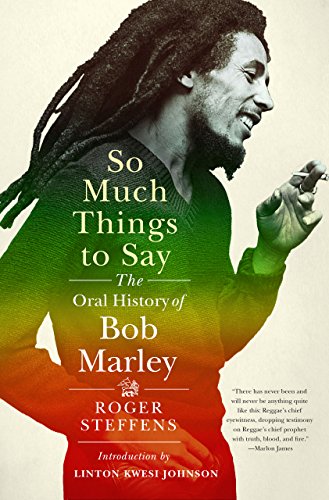
Bob Marley, as a legacy is paramount among Caribbean artists for any discussion on Black History. It is only appropriate to Encore this July 14, 2017 landmark blog-commentary on Marley. This submission was published on the occasion of the release of the new book: “So Much Things to Say: The Oral History of Bob Marley” by Roger Steffens. See this Encore of that previous blog-commentary here-now:

—————

Go Lean Commentary – Book Review: ‘Oral History of Bob Marley

Bob Marley was not a saint; but he was saintly. – Author Roger Steffens

Marley SmilingBob Marley was perhaps the most influential person of Caribbean heritage; arguably so. He died 36 years ago, after living only to the age of 36. We have doubled the years of his life …

36 years here … 36 years gone!

… but it seems as if he lived a life of achievement equaling two or 3 lifetimes.

He was more than just a musician or an entertainer, he was a revolutionary icon. Many of the advocacies that he championed have now come full circle; come to fruition and come to regret:

In fact, references to Bob Marley have been consistent for the movement behind the book Go Lean… Caribbean – a guide to confederate, collaborate and convene the 30 member-states of the Caribbean region into a Single Market – he is mentioned in the book (Pages 119, 133 & 218) and featured in multiple blog-commentaries:

https://goleancaribbean.com/blog/?p=7738 A Lesson in History from Bob Marley – Buffalo Soldiers
https://goleancaribbean.com/blog/?p=866 Bob Marley: The legend lives on!

We now learn even more about Bob Marley in the new book by Reggae Archivist Roger Steffens, entitled: So Much Things to Say: The Oral History of Bob Marley. See a summary-review of that book here and listen to an AUDIO-Podcast interview with the Author:

Book Review for Book: So Much Things to Say: The Oral History of Bob Marley
By Roger Steffens 

Oral History of Marley 1

A revelatory, myth-shattering history of one of the most influential musicians of all time, told in the words of those who knew him best.

Roger Steffens is one of the world’s leading Bob Marley experts. He toured with the Wailers in the 1970s and was closely acquainted with Bunny Wailer, Peter Tosh and the rest of the band members. Over several decades he has interviewed more than seventy-five friends, business managers, relatives and confidants—many speaking publicly for the first time. Forty years in the making, So Much Things to Say weaves this rich testimony into a definitive telling of the life of the reggae king—the full, inside account of how a boy from the slums of Kingston, Jamaica, became a cultural icon and inspiration to millions around the world.

The intimacy of the voices and the frankness of their revelations will astonish even longtime Marley fans. Readers see the intense bonds of teenage friendship among Peter, Bunny and Bob, the vibrant early sessions with the original Wailers (as witnessed by members Junior Braithwaite, Beverley Kelso and Cherry Green) and the tumultuous relationships with Rita Marley and Cindy Breakspeare.

With unprecedented candor, these interviews tell dramatic, little-known stories, from the writing of some of Marley’s most beloved songs to the Wailers’ violent confrontation involving producer Lee “Scratch” Perry, Bob’s intensive musical training with star singer Johnny Nash and the harrowing assassination attempt at 56 Hope Road in Kingston, which led to Marley’s defiant performance two nights later with a bullet lodged in his arm.

Readers witness Marley’s rise to international fame in London, his triumphant visit to Zimbabwe to sing for freedom fighters inspired by his anthems and the devastating moment of his collapse while jogging in New York’s Central Park. Steffens masterfully conducts the story of Marley’s last months, as Marley poignantly sings “Another One Bites the Dust” during the sound check before his final concert in Pittsburgh, followed by his tragic death at the age of thirty-six.

So Much Things to Say explores major controversies, examining who actually ordered the shooting attack on Hope Road, scrutinizing claims of CIA involvement and investigating why Marley’s fatal cancer wasn’t diagnosed sooner. Featuring Steffens’s own candid photographs of Marley and his circle, this magisterial work preserves an invaluable, transformative slice of music history: the life of the legendary performer who brought reggae to the international stage.

Source: Amazon Online Bookstore-Portal; retrieved July 13, 2017 from: https://www.amazon.com/So-Much-Things-Say-History-ebook/dp/B01M68LN7U 

———-

AUDIO-PodcastBob Marley: Versions Of The Truth http://the1a.org/audio/#/shows/2017-07-10/oral-history-of-bob-marley/111467/@00:00

Bob Marley: Versions Of The Truth

Published July 10, 2017 – Reggae historian Roger Steffens has written that “there are no facts in Jamaica, just versions” of the truth. That’s certainly the case with the star of Steffens’ latest book: Bob Marley.

Marley lived a life of art, inspiration and hard and fast adherence to his principles and spirituality. While he only lived to the age of 36, Marley and his music inspired a wave of devotees who fought for freedom, as well as a few enemies who wanted him dead.

But even though he was a global superstar, there are many mysteries and misconceptions about Marley.

Steffens new book, “So Much Things to Say: The Oral History of Bob Marley” gathers 40 years of interviews with those closest to Marley to separate truth from the various versions.

Host Joshua Johnson interviews guest Roger Steffens, reggae archivist and author of the book “So Much Things to Say: The Oral History of Bob Marley“.
We learn so much more about Bob Marley and Caribbean culture from these foregoing media productions. Marley was truly a musical genius who overcame obstacles and the challenge of a dysfunctional Jamaican society to soar and shine as a star in the world of music. This corresponds with a theme in the book Go Lean…Caribbean which relates that genius – in its many forms, be it music, arts, sciences, sports, etc. – can flourish in the Caribbean … with the proper fostering. The Go Lean book serves as a roadmap for the introduction and implementation of the Caribbean Union Trade Federation (CU). This would be an inter-governmental entity to promote a regional Single Market that covers the homelands of all 30 Caribbean member-states. This effort strives to advance Caribbean culture. The Go Lean/CU roadmap features this prime directive, as defined by these 3 statements:

  • Optimization of the economic engines to grow the regional economy to $800 Billion & create 2.2 million new jobs.
  • Establishment of a security apparatus to protect public safety and ensure the economic engines of the region, including the seas.
  • Improvement of Caribbean governance to support these engines, including a separation-of-powers between the member-states and CU federal agencies.

The Go Lean roadmap recognizes that a prerequisite for advancing society is a change in the Caribbean “community ethos”. This book opens early with the declaration that music can contribute to the fabric of society, but that society must contribute to the fostering of musicians. The book relates that such an attitude – community ethos or national spirit – can be forged in the entire region; see these statements in the Declaration of Interdependence (Pages 13 – 14):

xxi. Whereas the preparation of our labor force can foster opportunities and dictate economic progress for current and future generations, the Federation must ensure that educational and job training opportunities are fully optimized for all residents of all member-states, with no partiality towards any gender or ethnic group. The Federation must recognize and facilitate excellence in many different fields of endeavor, including sciences, languages, arts, music and sports. This responsibility should be executed without incurring the risks of further human flight, as has been the past history.

xxxii. Whereas the cultural arts and music of the region are germane to the quality of Caribbean life, and the international appreciation of Caribbean life, the Federation must implement the support systems to teach, encourage, incentivize, monetize and promote the related industries for arts and music in domestic and foreign markets. These endeavors will make the Caribbean a better place to live, work and play.

As related in a previous blog-commentary regarding Bob Marley …

“… he was the embodiment of all of these above values. He impacted the music, culture and economics of the region. He set a pathway for success for other generations of talented, inspirational and influential artists – musical geniuses – to follow. Other artists of Caribbean heritage are sure to emerge and “rock the world”; we are hereby “banking” on it, with these CU preparations.”

The CU presents that change has come to the Caribbean; with this Go Lean movement, there is a plan for new stewardship so that the Caribbean can better avail themselves of the benefits of music. So when we consider Bob Marley – as gleaned from the foregoing book by author Roger Steffens – we can assign all these descriptors and attributes to him:

  • Artist – Musician
  • Caribbean Ambassador
  • Inspirational Leader
  • Saintly, though not a saint.
  • Role Model for the Future

The world may never see another “star as bright” as Bob Marley; but we can still learn from his Role Model. The Go Lean book provides 370-pages of turn-by-turn instructions on “how” to adopt new community ethos, plus the strategies, tactics, implementations and advocacies to execute so as to reboot, reform and transform the societal engines of Caribbean society. Consider the sample from this list detailing this “how” for the Caribbean region to foster more musical geniuses:

Community Ethos – Ways to Foster Genius Page 27
Community Ethos –Promote Intellectual Property Page 29
Community Ethos – Ways to Promote Happiness Page 36
Community Ethos – Impact the Greater Good Page 37
Strategy – Vision – Celebrate the music, people and culture of the Caribbean Page 46
Tactical – Separation of Powers – Patents & Copyrights Page 78
Tactical – Separation of Powers – Culture Administration Page 81
Implementation – Ways to Benefit from Globalization Page 118
Advocacy – Ways to Make the Caribbean Better Page 131
Advocacy – Ways to Better Manage Image Page 133
Advocacy – Ways to Preserve Caribbean Heritage Page 218
Advocacy – Ways to Promote Music Page 231
Advocacy – Ways to Re-boot Jamaica – To make it less dysfunctional Page 239

Bob Marley – 36 years here … 36 years gone!

We urge all Caribbean stakeholders – governments and citizens alike – to learn the lessons from the life and legacy of Bob Marley, and then lean-in to this Go Lean roadmap to make the Caribbean homeland a better place to live, work and play. 🙂

Sign the petition to lean-in for this roadmap for the Caribbean Union Trade Federation.

Download the free e-Book of Go Lean … Caribbean – now!

Share this post:
, ,

Bad Partners – Cruise Lines Interactions

Go Lean Commentary

So you got a partner …

… he/she should be working towards maximizing the returns for your partnership. Each one should be pursuing what’s best for “us”, not “me”. This is a basic premise for any partnership: think marriage, business, musical band …

partnership is an arrangement where parties, known as partners, agree to cooperate to advance their mutual interests. The partners in a partnership may be individuals, businesses, interest-based organizations, schools, governments or combinations. Organizations may partner to increase the likelihood of each achieving their mission and to amplify their reach. A partnership may result in issuing and holding equity or may be only governed by a contract. – Source: Wikipedia

Here is the partnership objectives that should be operating in our Caribbean marketplace:

Caribbean Port-of-Call: We need travelers to visit our shores and spend money to spur economic activity.

Cruise Line: We need passengers to book our cruises to consume Caribbean hospitality from onboard ships.

But a basic fault seem to be present in this partnership between the Cruise Line industry and their Caribbean ports-of-call:

The relationship appears to be one of détente – easing of strained relations – rather than a true partnership.

“I won’t destroy you if you don’t destroy me”.

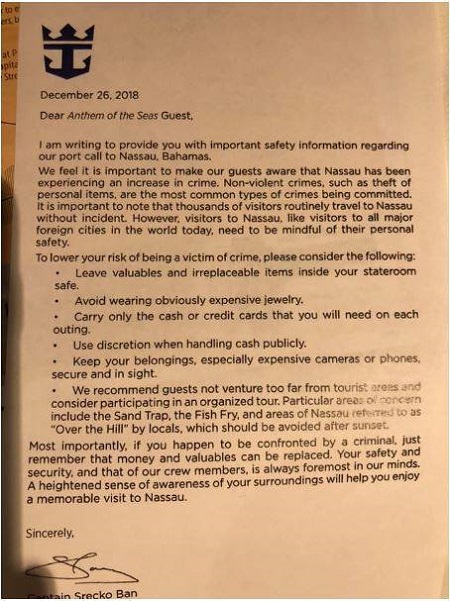
While the partnership model may mean hoping that all parties profit, the détente model assumes a posture of mitigating mutual destruction. Yet, destroying the image of a port city is exactly what this cruise ship Captain has appeared to have accomplished in Nassau, Bahamas in December (2018) with the release of this personal Crime-Warning letter:

Discouraging his passengers from consuming a port-city?! That seems counter-productive! That seems counter-partnering!

See this related news article here, depicting the complaint and rebuke of the Bahamas Tourism officials towards this cruise line:

Title: Bahamas persuades Royal Caribbean to tone down warnings about crime in Nassau

Royal Caribbean Cruise Line has agreed to stop warning its cruise passengers about increased crime in Nassau and identifying parts of the city to avoid.

Dionisio D’Aguilar, minister of tourism and aviation for the island nation, told the Nassau Tribune this week that he employed “gentle nudging” to persuade Royal Caribbean to drop an “unwarranted” passenger advisory being distributed to disembarking passengers of the cruise line’s Anthem of the Seas.

D’Aguilar reached out to Miami-based Royal Caribbean after several cruise industry websites reported on the letter, signed by Anthem of the Seas’ captain Srecko Ban.

“We feel it is important to make our guests aware that Nassau has been experiencing an increase in crime,” the letter said.

A copy of Ban’s letter posted on various websites, dated Dec. 26, pointed out that the most common types of crimes are nonviolent, “such as theft of personal items,” and noted that “thousands of visitors routinely travel to Nassau without incident.”
It went on to provide safety tips and urged visitors to Nassau to be mindful of their personal safety “like visitors to all major foreign cities in the world today.”

Among the tips:

— Leave valuables and irreplaceable items inside your stateroom safe.

— Avoid wearing obviously expensive jewelry

— Carry only cash and credit cards needed on each outing.

— Use discretion when handling cash publicly.

— Keep belongings, especially expensive cameras and phones, secure and in sight.

The letter also recommended guests “not venture too far from tourist areas,” and identified as “particular areas of concern” the Sand Trap, the Fish Fry at Arawak Cay, “and areas of Nassau referred to as ‘Over the Hill’ by locals, which should be avoided after sunset.”

After stories about the letter were posted by such sites as cruiseradio.net and travelpulse.com, D’Aguilar on Dec. 27 told a Bahamas newspaper, the Nassau Tribune, that he felt “blindsided.”

But the Tribune story noted that the Anthem captain’s warning mirrored a January 2018 travel advisory by the U.S. State Department, telling tourists to “exercise increased caution in the Bahamas because of crime” and avoid the Over the Hill and Fish Fry areas at night.

The Canadian government warned tourists to avoid the same two areas in its own advisory on Dec. 20. Both countries’ advisories listed armed robberies, burglaries, purse snatchings, theft, fraud and sexual assaults as the most common crimes against travelers.

The Tribune story quoted D’Aguilar saying he had never heard complaints about the Fish Fry in numerous meetings with cruise line executives.

“I don’t know of any major or significant crime happening to a cruise passenger in quite some time,” he said. “I don’t know about petty crime, but in my humble opinion Nassau is as safe as any other city.”

Despite the warnings, the State Department advisory also reported statistics from Royal Bahamas Police Force Commissioner Anthony Ferguson showing a 14 percent drop in overall crime and a 22 percent drop in violent crime. “The one exception was a 10 percent increased in murders,” the advisory said, adding most reported violent crimes took place in areas not frequented by tourists.

On Monday, the Nassau Tribune posted a follow-up story quoting D’Aguilar saying he convinced Royal Caribbean through “gentle nudging” to withdraw its crime warning and replace it with “a more generalized warning … that does not mention Nassau by name and could be taken as referring to any of its ports of call.”

A story posted Wednesday on BahamasLocal.com, a search engine site, quoted a statement by Royal Caribbean pledging to replace the letters with a generic statement in its daily newsletter urging travelers to “use the same common sense you would in any major city” and consult the U.S. State Department for specific information about any country on the cruise line’s itinerary.

Reached by email Wednesday, Royal Caribbean spokeswoman Tracy Quan verified that the story in BahamasLocal “is accurate.”

The story further quotes Michael Bayley, president and CEO of Royal Caribbean International, as saying Nassau remains the cruise line’s most popular port of call among more than 300 destinations.

Source:The Sun-Sentinel – South Florida Daily Newspaper – Posted January 2, 2019; retrieved January 24, 2019 from: https://www.sun-sentinel.com/business/fl-bz-royal-caribbean-bahamas-crime-warning-20190102-story.html

———–

VIDEO – ANTHEM OF THE SEAS – Highlights of Royal Caribbean’s amazing second Quantum-Class-Cruiseship – https://youtu.be/nwsS9PaF94w


Cruiseclips

Published on Nov 14, 2015 – A video produced by: Tobias Bruns in cooperation with: Oceanliner Pictures.com Schiffsjournal.de Special thanks to Royal Caribbean International! Want to book a cruise with the “Anthem of the Seas”? check out www.kreuzfahrten-mehr.de Informations about the ship (german langauge) ausfürhrliches Schiffsportrait auf Schiffsjournal.de: http://www.schiffsjournal.de/schiffsp…

Category: Travel & Events

———–

Related:

Bahamas unhappy with cruise passenger spending: no longer paying incentives to cruise lines.

It’s time to reboot the entire Cruise-Port-City eco-system. This is a familiar advocacy for the movement behind the 2013 book Go Lean … Caribbean, a roadmap for the Caribbean Union Trade Federation (CU). “Stop competing“, the book urges, and start working together – collaborate, cooperate, confederate – as true partners.

Are there problems? Let’s collaborate to solve them.

You’re not making any profit? Then what changes can we make so that everyone wins.

There are no Bad Guys here; just the need to reboot. The first step is this rebooting must be the strategy of Collective Bargaining. The Go Lean book detailed this strategy (Page 32) early, as follows:

Cruise Line Collective Bargaining – Setting Matters Straight
The CU will collectively bargain with operators to garner more benefits and protections. In general, port cities are not gleaning much income from ship visits. In order to reboot the industry’s economic impact, changes need to be made, rescinding some exploitive rules the ships implemented and adding some new products, like smartcard e-purse options.

In addition, here are some suggestions, as summarized and excerpted from this advocacy in the Go Lean book (Page 193) entitled – 10 Ways to Impact Cruise Tourism:

1 Lean-in for the Caribbean Single Market – Negotiate-Bargain as a Collective agent for the region.
2 Quality Assurance Programs
The CU will regulate and enforce high standards among the port-side establishments, therefore eliminating the need for cruise lines to “curry favor” with merchants. A Charge-back eco-system and quality assurance programs like surveys for passenger feedback will be used and the results published extensively.
3 e-Purse Settlement with Central Bank in Caribbean Dollars
4 Port-side Risk Mitigations
Economic crimes against tourists are the jurisdiction of the CU. Therefore crime prevention responsibility rest primarily with the CU for monitoring, investigations and interdictions of systemic and racketeering threats. As such the ship ID cards can feature NFC features for location tagging.
5 Disabled Passengers Accommodations
6 Emergency Management Proactive and Reactive Services

The cruise lines will not go at it alone for emergencies in the region. The CU Emergency Managers will collaborate with cruise line managers for best practices/tactics during hurricane threats. As of late, (2013), Carnival Cruise Lines had a number of bad incidents impacting their cruise operations and generating bad publicity. The CU will deploy emergency support barges on demand, for Cruise lines to quickly respond and return ships to normal services.

7 Medical Escalated Response
8 Co-Marketing with National Tourism Departments, Excess Inventory and One-Way Travel

The Cruise industry should not be considered a competitor of Caribbean tourism, but rather a cooperative partner and even a transportation mode, ship lines could help with sea-lifts. Travel planners should be able to plan one-way cruise travel coupled with air-hotel packages. This option could extend to excess inventory during the slow season.

9 Domestic Market

The CU market of 42 million people also has vacation needs. Cruises should be able to start/end locally in the region, for example a passenger should be able to join a cruise in the Bahamas and complete the circuit back in the Bahamas. The Caribbean represents different cultures, languages, urban and rural destinations, therefore many taste can be accommodated. An alignment with tender boats can also accommodate eco-tourism hand-off to/from cruise ships. These are among the service offerings for collective bargaining negotiations.

10 Shipbuilding Support Services

The CU roadmap calls for fostering a shipbuilding/maintenance industry, so transfer prices and rebates could be offered to cruise lines for in-sourcing shipyard and dry-dock engagements in the CU region. The travel time to CU area shipyards can minimize the downtime for active cruise ships, positively affecting cruise lines cash flows.

More and more cruise ships are equipped with amenities once only available at on-shore facilities; think: ice-skating rink, zip line, go-cart racing, etc. – see foregoing VIDEO. This sends the message to on-island resorts that cruise lines will do Caribbean hospitality without them. This undermines any precept of a partnership.

This theme – trouble in the Cruise-Port-City eco-system – aligns with previous Go Lean commentaries; see a sample list here:

https://goleancaribbean.com/blog/?p=15380 Industrial Reboot – Cruise Tourism 2.0
https://goleancaribbean.com/blog/?p=11544 Forging Change in Cruises: Collective Bargaining
https://goleancaribbean.com/blog/?p=6635 New Security Chip in Credit Cards Unveiled
https://goleancaribbean.com/blog/?p=5307 8th Violent Crime Warning to Bahamas Tourists
https://goleancaribbean.com/blog/?p=5210 Cruise Ship Commerce – Getting Ready for Change
https://goleancaribbean.com/blog/?p=4639 Tobago: A Model for Cruise Tourism
https://goleancaribbean.com/blog/?p=2207 Hotels undermining Cruise Competition with Resort-fees

The problems in cruise tourism are not just in the Bahamas alone; rather all Caribbean port-cities are affected; think Montego Bay, Jamaica; Saint Martin, Grand Cayman, etc.. In summary, the assumed partnership between cruise lines and port-cities needs to be rebooted. In fact, all the societal engines of the Caribbean – economics, security and governance – need to be rebooted. The defects are glaring! But a regional approach, rather than a national focus, allows us the opportunity to finally pursue better strategies, tactics and implementations to improve the tourism product for all.

The effort to improve the Cruise-Port-City eco-system is Day One/Step One in the Go Lean roadmap. These pursuits need to succeed sooner, rather than later.

Let’s do this! Let’s make our homeland a better place to live, work and play. 🙂

About the Book
The book Go Lean…Caribbean serves as a roadmap for the introduction and implementation of the technocratic Caribbean Union Trade Federation (CU), for the elevation of Caribbean society – for all member-states. This CU/Go Lean roadmap has these 3 prime directives:

  • Optimization of the economic engines in order to grow the regional economy to $800 Billion and create 2.2 million new jobs.
  • Establishment of a security apparatus to ensure public safety and protect the resultant economic engines.
  • Improve Caribbean governance to support these engines, including a separation-of-powers between the member-states and CU federal agencies.

The Go Lean book provides 370-pages of turn-by-turn instructions on “how” to adopt new community ethos, plus the strategies, tactics, implementations and advocacies to execute so as to reboot, reform and transform the societal engines of Caribbean society.

Download the free e-Book of Go Lean … Caribbean – now!

Who We Are
The movement behind the Go Lean book – a non-partisan, apolitical, religiously-neutral Community Development Foundation chartered for the purpose of empowering and re-booting economic engines – stresses that reforming and transforming the Caribbean societal engines must be a regional pursuit. This was an early motivation for the roadmap, as pronounced in the opening Declaration of Interdependence (Pages 12 – 13):

xi. Whereas all men are entitled to the benefits of good governance in a free society, “new guards” must be enacted to dissuade the emergence of incompetence, corruption, nepotism and cronyism at the peril of the people’s best interest. The Federation must guarantee the executions of a social contract between government and the governed.

xvi. Whereas security of our homeland is inextricably linked to prosperity of the homeland, the economic and security interest of the region needs to be aligned under the same governance. Since economic crimes … can imperil the functioning of the wheels of commerce for all the citizenry, the accedence of this Federation must equip the security apparatus with the tools and techniques for predictive and proactive interdictions.

xxiv. Whereas a free market economy can be induced and spurred for continuous progress, the Federation must install the controls to better manage aspects of the economy: jobs, inflation, savings rate, investments and other economic principles. Thereby attracting direct foreign investment because of the stability and vibrancy of our economy.

Sign the petition to lean-in for this roadmap for the Caribbean Union Trade Federation.


Share this post:
, ,
[Top]

European Reckoning – China seeks to de-Americanize the world’s economy

Go Lean Commentary

How did the world measure money and wealth in the past? Simple: Gold.

Then in 1971, the US changed from the Gold Standard … to a Non-Gold Standard or Fiat money. (The Gold Standard refers to the monetary system in which the standard economic unit of account is based on a fixed quantity of gold. Most nations abandoned the gold standard as the basis of their monetary systems at some point in the 20th century). Now the value of American money is measured by “American money” (declared value). But wait, wait: the rest of the world’s money is also now measured by American money – the world measures money and wealth by US Dollars! (See the Appendix VIDEO below).

Even in Europe; when the Euro currency was launched in 1999, it was pegged close to the US dollar 1-to-1.17. Today, the world’s economy is measured by US Dollars (USD) and the Euro, which continue to be the primary reserve currency of most commercial and central banks[54]. The Dollar is first and the Euro is the second most widely held international reserve currency. As of August 2018, with more than €1.2 trillion in circulation, the Euro has one of the highest combined values of banknotes and coins in circulation in the world, having surpassed the U.S. dollar.[13]
Now the rest of the world – China most definitely – wants to de-Americanize the world’s economy. The world’s population is nearly 7 billion people, while the combined populations of the US and the EU is a little less than 1 billion; (340 million + 508 million respectively). There are some Big countries and Big economies at stake: think China with their 1.3 Billion people or India with their 1.2 Billion.  It is therefore logical to contemplate de-Americanizing the world’s economy – it makes so much sense. In addition, at the time of this writing, the US is in the midst of a federal government shutdown … again.

It is therefore plausible, viable and prudent for non-American stakeholders to want to be shielded from American chaos. See this reasoning in this White Paper here; published by the Government of Canada:

Title: Chimerica – The Beginnings of a New Regional Reserve

What is it?
Chinese concerns over the ability of the U.S. to manage its debt have led to recent calls by China to “de-Americanize” the world economy and seek an alternative to the U.S. dollar as the international reserve currency.1 As far back as 2008, China proposed the need for a new international currency reserve which would limit the importance of any one national currency.2

In recent times, the U.S. economy has avoided a debt crisis by raising the debt ceiling level. Any adjustment has the potential to impact the Chinese economy, given the level of exposure to U.S. securities. The People’s Bank of China (PBOC) has amassed US$3.5 trillion in foreign reserves – largely U.S. Treasury securities. The fact that a single institution wields so much influence over global macroeconomic stability has caused considerable anxiety, with doomsayers predicting that doubts about U.S. debt sustainability will force China to sell off its holdings of U.S. debt. This would drive up interest rates in the U.S. and ultimately could trigger the dollar’s downfall.

However, selling off U.S. Treasury securities may not be in China’s interest, as it would drive up the renminbi’s (RMB) exchange rate against the U.S. dollar, diminishing the domestic value of China’s reserves and undermining the export sector’s competitiveness. Indeed, a U.S. Defense Department report last year on the national security implications of China’s holdings of U.S. debt concluded that “attempting to use U.S. Treasury securities as a coercive tool would have limited effect and likely would do more harm to China than to the [U.S.].”3

U.S. debt is only one side of the coin. Economist Robert Shiller believes that the real estate bubble is a serious problem in China.4 According to Shiller, people are buying apartments in the expectation that house prices will continue to rise. This gambling mentality is leading them to make completely irrational buying decisions. Slowing economic growth and exports has the potential to expose a serious financial bubble in the Chinese housing sector. The banking sector in China would need to be recapitalized should the Chinese housing bubble burst.

Why is it important?
The symbiotic relationship between Chinese export-led growth and U.S. consumption is such that should one economy falter the other will follow. Both of these disruptors exist against a backdrop of rising bilateral trade using national currencies and a call by the International Monetary Fund for a new global currency to replace the U.S. dollar.5

Research by AMRO-Asia, the chief economists of ASEAN+3, finds that while the U.S. remains the anchor currency in the Asian region, the U.S. dollar has “seemingly lost its dominating status.”6 At the same time, the weight of the RMB in regional currency baskets has been increasing since 2005.7  8 The rise of the RMB as the Asian regional reserve has implications for regional trade and global growth. In the long run, the success of the U.S. economic pivot to Asia is likely to be slowed by the rise of the RMB and the corresponding decline in U.S. economic power. Over the last decade, U.S. growth has been facilitated by Chinese holdings of U.S. securities. Questions remain as to whether a decoupling in the long run will have a positive outcome for China and the U.S. as well as global growth.

References

  1. Puzzanghera, J. “Upset over U.S. Fiscal Crisis, China Urges a ‘de-Americanized World’.” Los Angeles Times. October 2013. http://www.latimes.com/business/money/la-fi-mo-china-debt-limit-shutdown-de-americanized-economy-20131014,0,1990632.story#ixzz2mwhEb6II(link is external)
  2. Landler, M. “Seeing its Own Money at Risk, China Rails at U.S.” The New York Times. October 2013. http://www.nytimes.com/2013/10/16/us/politics/china-rails-over-us-fiscal-crisis-seeing-its-own-money-at-risk.html?_r=0(link is external)
  3. Morrison, W. and M. Labonte. “China’s Holdings of U.S. Securities: Implications for the U.S. Economy.” (CRS Report for Congress.) Congressional Research Service. August 2013. http://www.fas.org/sgp/crs/row/RL34314.pdf(link is external)
  4. “2013 Nobel Prize winner: China’s real estate bubble is serious.” People’s Daily Online. October 2013. http://english.people.com.cn/business/8427784.html(link is external)
  5. Snyder, M. “Shift From U.S. Dollar As World Reserve Currency Underway – What Will This Mean For America?” munKnee. http://www.munknee.com/shift-from-u-s-dollar-as-world-reserve-currency-underway-what-will-this-mean-for-america/(link is external)
  6. Chen, C., R. Siregar and M Yiu. “RMB as an Anchor Currency in ASEAN, China, Japan and Korea Region.” ASEAN+3 Macroeconomic Research Office. April 2013. https://www.cb.cityu.edu.hk/ef/doc/Conference%20on%20Renminbi%20and%20the%20Global%20Economy/papers/Chuling%20Chen.pdf(link is external)
  7. Chong, F. “Is RMB Approaching Safe Haven Status?” Asia Today International. June 2013. http://asiatoday.com.au/content/rmb-approaching-safe-haven-status(link is external)
  8. Irwin, N. “This one number explains how China is taking over the world.” Washington Post. December 2013. http://www.washingtonpost.com/blogs/wonkblog/wp/2013/12/03/this-one-number-explains-how-china-is-taking-over-the-world/

Source: Government of Canada – Posted September 28, 2018; retrieved January 17, 2019 from: http://www.horizons.gc.ca/en/content/chimerica-%E2%80%93-beginnings-new-regional-reserve

This commentary continues a 5-part series on European Reckoning. This entry is 2 of 5 in this series from the movement behind the book Go Lean … Caribbean in consideration of the past, present and future of European interactions. While the Caribbean were all settled and organized by European powers, the lack of organizational efficiency for our benefit is a glaring concern. We have 30 member-states in the Caribbean region and yet, there is no coordinated regional stewardship of the economic, fiscal and monetary affairs of our communities. The other commentaries in the series are cataloged as follows:

  1. European Reckoning: IMF Apologies
  2. European Reckoning: China seeks to de-Americanize the world’s economy
  3. European Reckoning: Settlers -vs- Immigrants
  4. European Reckoning: Christianity’s Indictment
  5. European Reckoning: Black “Greco-Roman” Wrestler victimized for his hair

In the first submission of this series, the European Great Powers were also identified as the Western Alliance. It’s comprised of only White/Christian European nations and North America (US & Canada). It is understandable therefore if Asian, African or Latin American people do not feel adequately represented in the governance of the world’s economy. Yes this status quo is flawed. The US, being the dominant currency in global trade has proven fraught with deficiencies. The aft-mentioned “shutdown” – when Congress fails to pass sufficient appropriation bills or continuing resolutions to fund federal government operations and agencies, or when the President refuses to sign such bills or resolutions into law – is not the first one. In fact, there have been these previous shutdowns in the last 40+ years:

Since 1976, when the current budget and appropriations process was enacted, there have been 22 gaps in budget funding, 10 of which led to federal employees being furloughed. – Source: Wikipedia

The world must not wait for the US to get their political house in order before we can do business. China is a strong advocate for this de-Americanizing effort. Does this mean they want to supplant the US Dollar for their own Renminbi? (This is the currency of the People’s Republic of China, the basic unit of which is the yuan). If the answer to this question is Yes, then that would be China’s prerogative to address the needs of their economy.

Our focus in the Caribbean, must be first and foremost the Caribbean.

The advocacy of the movement behind the Go Lean book is to implement the institutional solutions to do the heavy-lifting ourselves to manage our own economic, fiscal and monetary affairs.

  • Not to be a parasite of the United States of America or Europe.
  • Not to be a parasite of China.

The proposed solution is the Caribbean Central Bank (CCB); this is structured as a formal “cooperative” among the region’s existing Central Banks. The CCB is modeled upon the European Central Bank (ECB), the same as the Caribbean Union is modeled upon the European Union. This CCB institutional strategy also calls for the introduction of a regional currency, the Caribbean Dollar (C$). The CCB will therefore be the sole controlling agent of the monetary policies of this regional C$ currency.

Introducing and implementing a new currency is a Big Deal. But yes, we can succeed! We have a proven track record – the Euro – to model and learn from. This theme of technocratic monetary and currency stewardship has been detailed in many previous Go Lean commentaries; see a sample list here:

https://goleancaribbean.com/blog/?p=15923 Industrial Reboot – Payment Cards 101
https://goleancaribbean.com/blog/?p=14248 Leading with Money Matters – Almighty Dollar
https://goleancaribbean.com/blog/?p=13744 Failure to Launch – Economics: The Quest for a ‘Single Currency’
https://goleancaribbean.com/blog/?p=13365 West African Case Study: ECOWAS to Launch ‘Single Currency’
https://goleancaribbean.com/blog/?p=10585 Two Pies: Economic Plan for a New Caribbean
https://goleancaribbean.com/blog/?p=10513 Transforming ‘Money’ Countrywide – Lessons Learned from India
https://goleancaribbean.com/blog/?p=8704 Lessons Learned from NYC’s Transit Currency: MetroCard
https://goleancaribbean.com/blog/?p=8381 Caribbean Economic Fallacy: Casino Currency US Dollars Only
https://goleancaribbean.com/blog/?p=7034 The Future of our Money – C$ Currency & Mobile Payment Systems
https://goleancaribbean.com/blog/?p=4425 Caribbean Dollar Reality: Cash/Coin, Payment Cards and iPhone
https://goleancaribbean.com/blog/?p=3814 Lesson Learned from the Swiss Currency Management
https://goleancaribbean.com/blog/?p=906 Implementing a Regulatory framework to dissuade ‘risky’ currecy
https://goleancaribbean.com/blog/?p=833 One currency, divergent economies
https://goleancaribbean.com/blog/?p=360 Why need local/regional currency? To Create Money from Thin Air

Having the American Dollar regulate the world economy has not been good … for anyone but America, when “they” are operating in a Situation Normal. But today, and 22 times in the last 43 years that they have had government shutdowns, it is Situation Normal All Foul Up (SNAFU). Moving that currency functionality to the Euro may be more of the same: there is also discord in the Euro lands – think Brexit and the Greece Sovereign Debt crisis.

What about moving the “world currency” functionality to China, or India, or Japan? Again, while these moves may be good for those countries, they may not necessarily be as good for the rest of the world, or our world in the Caribbean. This is what independence should mean to us: taking care of our own economic, fiscal and monetary needs. Even better than independence would be a regional interdependence among just our Caribbean neighbors.

Now is the time for the Caribbean region to lean-in for this roadmap for the Caribbean Union Trade Federation and the Caribbean Central Bank, as described in the book Go Lean … Caribbean. The benefits of this roadmap are vast and varied, but first we stop being a parasite of these European-North American (White) World Powers; not parasites, we become protégés instead.

Yes, we can … make the Caribbean, our homeland, a better place to live, work and play. 🙂

About the Book
The book Go Lean…Caribbean serves as a roadmap for the introduction and implementation of the technocratic Caribbean Union Trade Federation (CU), for the elevation of Caribbean society – for all member-states. This CU/Go Lean roadmap has these 3 prime directives:

  • Optimization of the economic engines in order to grow the regional economy to $800 Billion and create 2.2 million new jobs.
  • Establishment of a security apparatus to ensure public safety and protect the resultant economic engines.
  • Improve Caribbean governance to support these engines, including a separation-of-powers between the member-states and CU federal agencies.

The Go Lean book provides 370-pages of turn-by-turn instructions on “how” to adopt new community ethos, plus the strategies, tactics, implementations and advocacies to execute so as to reboot, reform and transform the societal engines of Caribbean society.

Download the free e-Book of Go Lean … Caribbean – now!

Who We Are
The movement behind the Go Lean book – a non-partisan, apolitical, religiously-neutral Community Development Foundation chartered for the purpose of empowering and re-booting economic engines – stresses that reforming and transforming the Caribbean societal engines must be a regional pursuit. This was an early motivation for the roadmap, as pronounced in the opening Declaration of Interdependence (Pages 12 – 13):

xi. Whereas all men are entitled to the benefits of good governance in a free society, “new guards” must be enacted to dissuade the emergence of incompetence, corruption, nepotism and cronyism at the peril of the people’s best interest. The Federation must guarantee the executions of a social contract between government and the governed.

xii. Whereas the legacy in recent times in individual states may be that of ineffectual governance with no redress to higher authority, the accedence of this Federation will ensure accountability and escalation … for good governance, justice assurances, due process and the rule of law. As such, any threats of a “failed state” status for any member state must enact emergency measures on behalf of the Federation to protect the … member states and the Federation as a whole.

xxiii. Whereas many countries in our region are dependent Overseas Territory of imperial powers, the systems of governance can be instituted on a regional and local basis, rather than requiring oversight or accountability from distant masters far removed from their subjects of administration. The Federation must facilitate success in autonomous rule …

xxiv. Whereas a free market economy can be induced and spurred for continuous progress, the Federation must install the controls to better manage aspects of the economy: jobs, inflation, savings rate, investments and other economic principles. Thereby attracting direct foreign investment because of the stability and vibrancy of our economy.

xxv. Whereas the legacy of international democracies had been imperiled due to a global financial crisis, the structure of the Federation must allow for financial stability and assurance of the Federation’s institutions. To mandate the economic vibrancy of the region, monetary and fiscal controls and policies must be incorporated as proactive and reactive measures. These measures must address threats against the financial integrity of the Federation and member-states.

Sign the petition to lean-in for this roadmap for the Caribbean Union Trade Federation.

—————–

Appendix VIDEO – How The U.S. Dollar Shaped The World Economy – https://youtu.be/EbJk1za74kE

NBC News
Published on Dec 21, 2014 – The official currency of the United States, the Federal Reserve Note, marks 100 years since it was first printed. Matt Rivera tracks the rise of the world’s reserve currency.

» Subscribe to NBC News: http://nbcnews.to/SubscribeToNBC

» Watch more NBC video: http://bit.ly/MoreNBCNews

NBC News is a leading source of global news and information. Here you will find clips from NBC Nightly News, Meet The Press, and our original series Debunker, Flashback, Nerdwatch, and Show Me. Subscribe to our channel for news stories, technology, politics, health, entertainment, science, business, and exclusive NBC investigations.

Connect with NBC News Online! Visit NBCNews.Com: http://nbcnews.to/ReadNBC

Find NBC News on Facebook: http://nbcnews.to/LikeNBC

Follow NBC News on Twitter: http://nbcnews.to/FollowNBC

Follow NBC News on Google+: http://nbcnews.to/PlusNBC

Follow NBC News on Instagram: http://nbcnews.to/InstaNBC

Follow NBC News on Pinterest: http://nbcnews.to/PinNBC

How The U.S. Dollar Shaped The World Economy | Long Story Short | NBC News

—————–
See an alternative yet relevant VIDEO here: https://youtu.be/CQMiNu6FI4M

Share this post:
, , ,
[Top]

Hamilton – “History has its eyes on you”

Go Lean Commentary

This is a memorable line from the hot Broadway play Hamilton:

Immigrants, we get things done!

This is what all the rave is about with this fascinating play; it tells the story of America’s founding fathers through the eyes of the immigrant experience. (This writer saw Hamilton on December 28, 2018 at the Broward Performing Arts Center in Ft Lauderdale, FL).

As was true with all these founding fathers, Alexander Hamilton was White; (“Bastard son of a Scotsman”); Aaron Burr was White; so too George Washington, Thomas Jefferson, James Madison and others portrayed in this song-and-dance production. But all the participating actors – in the Broadway edition, plus all the other touring companies – are Black-and-Brown minorities – many of them immigrants themselves.

The theme of Hamilton – historic immigrants thriving in America – aligns with the 2013 book Go Lean…Caribbean. The book was written and published by members of the Caribbean Diaspora living and thriving in America. There is a full acceptance that Caribbean immigrants can thrive in the US, as did Hamilton in his historical context. But many more immigrants arrive everyday, and there is now less tolerance for them, especially for those of the Black-and-Brown populations from the Caribbean. In fact, the current President of the US, Donald Trump, even derisively referred to Haitians as coming from a “shit-hole” country.

So while we can thrive, the question – by the movement behind the Go Lean book – is whether we should. The Hamilton play makes this point, as was related in a previous Go Lean blog-commentary:

When the word got around, they said “this kid is insane, man”
Took up a collection just to send “him” to the mainland
“Get your education, don’t forget from whence you came”
And the world gonna know your name …

It is an established fact that any difficult topic can be more easily communicated if backed-up by a catchy melody and rhyming words. An underlying theme of Hamilton is that nobody does it alone, there must always be community help and support; its like a community investment. There should also be a return on the investment. This point was communicated brilliantly in this news-commentary by a Social Justice Advocate; she stated that “self-made men are never independent of others’ help”. See the full article here:

Title: History Has Its Eyes On Us: Lessons from Hamilton the Musical
By: Courtney Kidd LCSW
Obsession. That’s the only way to describe the feelings of Hamilton followers, and once you’ve seen the show you’d understand why. Hamilton is a punch in the face, spellbinding transport through the life of one of the least well-known founding fathers, but by far one of the most interesting. And the best part? It’s done through the lens of hip-hop music and a cast of almost exclusively non-white actors-including our own dear Alexander Hamilton. While this caused confusion for some, who began to question their 8th grade history memory, it stands as one of the most powerful examples of today’s racial divide and the movements to correct it.

I’ll admit, I was skeptical going into the play. My friend and I had gotten tickets when they first went on sale almost 9 months before opening night. We saw it in its first month on Broadway after the success off-Broadway. I remember sitting in my chair prior to the curtain rise, uncertain of whether I’d like a modern take on a history. Could it reach across the aisle of race? Could it hold attention of a subject most forget about? Would I get it? Did I really wait 9 months and spend hundreds of dollars for something that might just be weird? It took exactly 1 minute until those questions left my mind and instead I was entrapped, enamored, enthralled with this play that lives up to one of the numbers “non-stop.” It was a non-stop journey, filled with humor, and anguish, and longing. I was converted. I was in love.

I went to see it a second time a few months, later, unable to wait until the soundtrack was finally released, I bought a resale ticket at far too high of an amount for my poor social work status. But I had to go, the play had brought about a plague within me; this wasn’t just a good show, it was something far beyond. Much like its creator Lin-Manuel Miranda, I began what has still been obsessive task of reading book after book on Hamilton, and the rest of those influential individuals who shaped the country. I wake up with the music in my head, and despite my best efforts, can’t stop listening to the songs. And then it hit me. This isn’t just a great musical and it’s not just because it is new and different, it’s because despite almost 300 hundred years since this man stood with the revolution, its relevant. And not in the way you think.


Over the past few years we have seen a second wave of the civil rights movement in America. Sadly, Despite the year, minorities, immigrants, and even women are still seen and treated differently than the white male counterpoint. Feelings and reactions peak and overspill in areas like Ferguson and Baltimore. Huge movements such as Black Lives Matter rise up demanding justice in the country that fought and promised a land of freedom and equality. Hamilton isn’t just play to see, it’s a needed reminder. Alexander Hamilton was an immigrant who fought for the revolution, becoming one of Washington’s most trusted aides, rising to one of the highest positions in our military and later our government. From a remarkably young age, he was an abolitionist in a time when that word would be as shocking as to claim you’re an alien. He never allowed his birth and his circumstances to define him, and instead fought his entire life for the beliefs he had, including a strong central government and financial plan that allowed America to be self-sufficient and play with the “big boys” for trade and commerce. Hamilton saw first-hand the potential risks of weak governments while dealing with the military forces. He understood even then that we had to be the United States in order to succeed in this revolutionary experiment. And he wanted those rights for every individual who was here.

Hamilton was a true American Dream hero, but despite what a lot of modern people claim, self-made men are never independent of others’ help. Many wish to believe that they rose to where they are because only due to their remarkable abilities, and for some that is true, but much more often than not there was help along the way. Our founding father is no exception. Although known as a uniquely bright youth on the island of Nevis where he was orphaned at a young age, Hamilton might never have risen to the station he once held without the help of many. Yes, he showed himself to be a studious and adept learner when put in charge of the local trading company-and may have stayed on as a success employee had the Hurricane not hit Nevis with a colossal force. Hamilton, always a writer, penned a poem of what he witnessed, and a local man who believed Hamilton had the capacity for more forwarded it to the influential of the island. Despite the devastation they made an investment in one of their own, raising enough to send our future Secretary of Treasury and war hero to the colonies(America) to pursue a real education. To sum up, if those with means didn’t decide to put forward an investment for an orphan with potential Alexander Hamilton would have mostly likely lived his life and died having never left a small, impoverished island. For a poor, orphan of questionable birth and heritage, that would not have left many surprised, and yet the island rose together to support him.

We’re looking at a similar issue in today’s world. Do we invest in the future, on education, on sustainability for those who can go on to do greatness despite the circumstances of their birth, or do we claim that we got to where we were without assistance from anyone? Hundreds of years after Hamilton discussed the need for equality we are still in the midst of revolutions to save the ideals of our nation. Each person is shaped by those around them, and it is of no surprise that the haves are able to gain a lot more opportunity than the have-nots. For this reason, many assume it is laziness that prevent people from working their way up. Hamilton was the antithesis of lazy, but if it wasn’t for one influential patronage who connected him to the elite, our country may never have gained the footing it needed to be a competitive economy.

We have a responsibility to those around us and who come next to shape the world into a better place for us all, not just for ourselves. We saw yesterday what happens if we don’t stand against those who would spread hatred, and instead hold onto love. As Mr. Manuel so eloquently put:

“…We chase the melodies that seem to find us until they’re finished songs and start to play when senseless acts of tragedy remind us that nothing here is promised, not one day. This show is proof that history remembers. We live through times when hate and fear seem stronger. We rise and fall, and light from dying embers, remembrances that hope and love last longer and love is love is love is love is love is love is love is love cannot be killed or swept aside…”

And if you need more convincing, join me in line for some tickets to Hamilton, you won’t be disappointed(seriously if you know how to get reasonable tickets you know how to contact me).

“I consider civil liberty, in a genuine unadulterated sense, as the greatest of terrestrial blessings. I am convinced, that the whole human race is intitled(entitled) to it; and, that it can be wrested from no part of them, without the blackest and most aggravated guilt.”- Alexander Hamilton

*Authors note*- Should Mr. Miranda see this, congrats on the Grammy, call me for unlimited praise and begging for interviews. Your PR man is too good at polite declines.

**Update- And your UNREAL number of Tony nominations and wins!! [See Appendix below].

Source: Social Justice Solution Online Site – posted February 23, 2016; retrieved December 30, 2018 from: http://www.socialjusticesolutions.org/2016/02/23/history-has-its-eyes-on-us-lessons-from-hamilton-the-musical/

————

VIDEO – 70th Annual Tony Awards ‘Hamilton’ History has its eyes and Yorktown – https://youtu.be/5upLudfimso


Undercover Celebs

Published on Nov 4, 2016 – 70th Annual Tony Awards ‘Hamilton’ History has its eyes and Yorktown by the cast of Hamilton at the 2016 Tony Awards where the musical won 11 awards.

The prime directive of the Go Lean book is to empower, elevate and facilitate a better Caribbean society. We want to be able to thrive right here at home – to prosper where planted – thus lowering the motivations to emigrate. In fact, the declarative statements of the prime directive are as follows:

Puerto Rican descendant Lin-Manuel Miranda, the creator, writer and original cast member as Alexander Hamilton is well-known for his advocacy for the Caribbean region in general and Puerto Rico in particular. He accomplishes his mission to effect change in the American eco-system through music/song and entertainment. The book Go Lean…Caribbean strives to accomplish its mission with the introduction and implementation of the technocratic Caribbean Union Trade Federation (CU). Lin-Manuel Miranda is hereby recognized as a role model that the Caribbean can emulate. He has provided a successful track record of forging change, overcoming incredible odds, managing crises to successful conclusions and rebooting failing institutions. See these previous blog-commentaries that detailed his accomplishments:

https://goleancaribbean.com/blog/?p=14101 Wait, ‘We Are The World’
In September 2017, Hurricane Maria devastated several Caribbean member-states; Puerto Rico was gravely impacted. In the mode of ‘We Are The World‘, many artists – led by Lin-Manuel Miranda – assembled and recorded a song to aid Puerto Rico, entitled ‘Almost Like Praying‘ by Artists for Puerto Rico.
https://goleancaribbean.com/blog/?p=7963 ‘Like a Good Neighbor’ – Being there for Puerto Rico
T
he US Territory of Puerto Rico needs a Good Neighbor right now. They do not need State Farm; they need the US Government to change the laws to allow them to re-structure their heavy debt “load”. In effect, this community is in crisis, facing financial disaster and needs a helping hand. Lin-Manuel Miranda was on a mission to help Puerto Rico by getting Congress to change Bankruptcy Laws to apply to PR again.

Mr. Miranda has now retired from performing in Hamilton

… but atlas, he will reprise his role for the highly acclaimed Puerto Rico run in January 2019. See more on that story here:

Title: Puerto Rico Engagement of HamiltonStarring Lin-Manuel Miranda, Will Sell $10 Tickets Through Lottery and Rush

Sub-title: Over 10,000 tickets will be released through the popular #Ham4Ham initiative, exclusively to island residents.

The upcoming Puerto Rico premiere of Hamilton, in which Tony- and Pulitzer-winning creator Lin-Manuel Miranda will reprise his performance in the title role, will offer island residents a chance to purchase tickets priced at ten dollars.

As previously reported, the blockbuster musical will play San Juan’s Teatro UPR at the University of Puerto Rico (Río Piedras Campus) January 8 through January 27, 2019, before the company (sans Miranda) embarks on a third national tour. Additional casting will be announced at a later date.

A total of 10,000 tickets will be sold at the low price in Puerto Rico as an extension of the blockbuster musical’s popular #Ham4Ham initiative, with 1,000 going to college students (with valid ID) for the January 9 matinee. All remaining tickets for that performance and two subsequent Wednesday matinees will be sold for $10 via digital lottery. Over 200 tickets will be sold to residents via lotto for all other performances.

“Bringing [Hamilton] to Puerto Rico is a dream that I’ve had since we first opened at The Public Theater in 2015,” Miranda said at the time of the initial announcement. “When I last visited the island, a few weeks before Hurricane Maria, I had made a commitment to not only bring the show to Puerto Rico, but also return again to the title role. In the aftermath of Maria we decided to expedite the announcement of the project to send a bold message that Puerto Rico will recover and be back in business, stronger than ever.”

Source: PlayBill Magazine – Posted August 28, 2018; retrieved January 2, 2018 from http://www.playbill.com/article/puerto-rico-engagement-of-hamilton-starring-lin-manuel-miranda-will-sell-10-tickets-through-lottery-and-rush

In the CU/Go Lean roadmap to change the Caribbean, music and theater gets it’s due respect. This point is detailed in the  Declaration of Interdependence at the outset of the book, pronouncing this need for regional solutions (Page 14):

xxxii. Whereas the cultural arts and music of the region are germane to the quality of Caribbean life, and the international appreciation of Caribbean life, the Federation must implement the support systems to teach, encourage, incentivize, monetize and promote the related industries for arts and music in domestic and foreign markets. These endeavors will make the Caribbean a better place to live, work and play.

We are looking forward to more art-based accomplishments: the arts can truly empower the community – “the community rallies around art creating a unique energy; and art ‘dynamises’ the community, in a very unique way”. What more can the stewards of the Caribbean do to effect change in the region using the arts and music? The Go Lean book provides a lot more details on Page 230 under the title “10 Ways to Improve the Arts“; see one detail here:

#1: Lean-in for the Emergence of the Caribbean Union
Embrace the advent of the CariCom Single Market Initiative and the Caribbean Union Trade Federation. This will allow for the unification of the region into a Single Market of 42 million people. This size supports the proliferation of ‘art’ (visual/fine, music, performance & film) as an industry. The CU will promote the art exhibition eco-system – allowing marketplaces for artists to congregate and monetize their talents. Structures will also be deployed for media companies to monetize film & performance art. The CU will facilitate the marketing of travelling exhibitions, and touring companies of stage productions. For the region, art can be a business enabler, and expressions for civic pride and national identity.

“History Has Its Eyes On Us” is the title of a song in the Hamilton Play – see Appendix VIDEO – and also a truism. There are lessons we must learn from the history of Alexander Hamilton. We must, like he did, fight for change and progress; as conveyed in the foregoing article:

From a remarkably young age, he was an abolitionist in a time when that word would be as shocking as to claim you’re an alien. He never allowed his birth and his circumstances to define him, and instead fought his entire life for the beliefs he had, including a strong central government and financial plan that allowed America to be self-sufficient and play with the “big boys” for trade and commerce. Hamilton saw first-hand the potential risks of weak governments …

The Go Lean roadmap accepts that the burden is too big for any one Caribbean member-state alone to effect change, thusly it advocates for a collaboration among all member-states. The strategy is to confederate all the 30 member-states of the Caribbean despite their language and legacy, into an integrated Single Market. The Go Lean/CU roadmap details all the strategies, tactics and implementation to forge the Single Market solutions. With these efforts and investments, the returns will be undeniable. We can dissuade our people from leaving in the first place – Alexander Hamilton never returned to British-controlled Nevis after leaving for college. (He did revolt against the British).

We want change in the Caribbean without a revolt. This was proclaimed from the outset of the Go Lean book:

This movement was bred from the frustrations of the Diaspora, longing to go home, to lands of opportunities. But this is not a call for a revolt against the governments, agencies or institutions of the Caribbean region, but rather a petition for a peaceful transition and optimization of the economic, security and governing engines in the region. – Go Lean book Page 8.

The Go Lean roadmap has a simple quest: make the Caribbean a better place to live, work and play. One man, or woman, can make a difference in this quest. Thank you for that model Hamilton. Thank you for that model Lin-Manuel Miranda. Now to foster the next generation of movers-and-shakers, whether it is politically, economically or in “song-and-dance”. We can impact our homeland with many fields of endeavor.

We urge all Caribbean stakeholders – artists and patrons alike – to lean-in to this roadmap to elevate Caribbean society. Yes, we can! Our quest is conceivable, believable and achievable. 🙂

Download the free e-Book of Go Lean … Caribbean – now!

Sign the petition to lean-in for this roadmap for the Caribbean Union Trade Federation.

————–

Appendix VIDEO – Why History Has Its Eyes On Hamilton’s Diversity | TIME – https://youtu.be/xWrRP6vRGhQ

TIME
Published on Dec 15, 2015 – In 2015, Lin-Manuel Miranda, a man once not known to many outside his circle of Broadway legions, shed light on another man once not known to many outside a circle of knowledgeable historians. But Miranda took one of America’s founding fathers and turned him “and thus, himself” into a star. The Broadway show Hamilton uses rap and hip-hop to tell the story of Alexander Hamilton’s rise to power during the American Revolution. The show broke multiple records for its cast recording and notched record-breaking sales of $32 million before it even hit Broadway. But the cast makes history in different ways, too, with men and women of color playing characters who were all white. There’s an African-American Vice President Aaron Burr, a biracial George Washington and a Chinese-American Mrs. Alexander Hamilton. Subscribe to TIME ►► http://po.st/SubscribeTIME

Category: News & Politics

————–

Appendix – 70th Tony Awards

The 70th Annual Tony Awards were held on June 12, 2016, to recognize achievement in Broadway productions during the 2015–16 season. The ceremony temporarily returned to the Beacon Theatre in New York City after three years at Radio City Music Hall and was broadcast live by CBS.[1] James Corden served as host.[2]

Hamilton received a record-setting 16 nominations in 13 categories, ultimately winning 11 total.[3] The revival of The Color Purple won two awards. The Humans won four awards, and the revival productions of plays Long Day’s Journey into Night and A View from the Bridge each won two awards.

Source: Retrieved December 31, 2018 from: https://en.wikipedia.org/wiki/70th_Tony_Awards

Share this post:
, ,
[Top]

5 Years Later – Aging Diaspora: Finding Home … anywhere

Go Lean Commentary

Which would you rather do:

Move your aging parents in with you … or move in with them?

This is a perplexing question that face most families … eventually; see the aligning VIDEO in the Appendix below.

This is especially true in the Caribbean as it is our practice to care for our elderly ourselves, not warehouse them in a Senior Care facility; cared for by strangers and professionals.

This Elder-Care preponderance was detailed in a previous Go Lean blog-commentary on March 24, 2014 – one of the first ones – entitled: 10 Things We Want from the US and 10 Things We Don’t Want from the US. That blog, and the hundreds since, all draw attention to the 2013 book Go Lean…Caribbean – available to download for free. The book serves as a roadmap for the introduction and implementation of the technocratic Caribbean Union Trade Federation (CU), for the elevation of Caribbean society – for all member-states. That previous blog actually stated:

Family Abandonment
Senior Living Facilities are a big industry in the US. This is due to the family habit of abandoning elderly parents to the care of professional strangers. The Caribbean way traditionally is to house their Senior Citizens with families, whether the economics apply or not.

The CU has a prime directive to encourage repatriation back to the Caribbean homeland and assuage societal abandonment. Frankly, senior citizens should avoid the cold climates of North American and EU Diaspora cities.

The care of our seniors is presented in the Go Lean book as paramount – supreme importance. In fact, the book relates the challenges befalling Caribbean society and identifies the needs of our Aging Diaspora as one of the 4 impossible-to-deal-with-alone Agents of Change – Globalization, Climate Change, Technology and the Aging Diaspora. The book declared that we were failing miserably in our societal engines, but the opportunity now exists for re-approachment to the Diaspora that left their homeland 50, 40, 30 and 20-plus years ago. This should have been a economic boon for our communities!

But worse has happened: since the 2013 publication; our societal engines have failed even more. Rather than returning to the Caribbean homeland for retirement, families are now more prone to expatriate their elderly, rather than repatriate. 🙁

Our people are simply securing their seniors in a home … anywhere!

Such a declining trend is not true of all the Agents of Change, like Technology; we have actually improved there. In fact, the catalog of other Agents of Change commentaries in this series, cataloged here:

  1. 5 Years Later: New Post Office Eco-system – Globalization issues ‘loud and clear’ now.
  2. 5 Years Later: Climate Change – Coming so fast, so furious.
  3. 5 Years Later: Technology – Caribbean fully on board.
  4. 5 Years Later: Aging Diaspora – Finding Home … anywhere.

So now, Caribbean families have been finding homes abroad for their elderly loved one; in contrast to the past, now they have started to bring these aged ones to their Diasporic destinations.

Ouch!

The cold! And the abandonment of their beloved homeland and culture. Surely there must be home-sickness.

We must do better … going forward.

This dreadful trend has been depicted in previous Go Lean commentaries, most notably a submission from September 28, 2016:

‘Time to Go’ – Logic of Senior Emigration
It is a shame-and-a-disgrace – 70 percent of out tertiary-educated – gone! Now we have the report of a 104-year old woman [Jamaica-born May Garcia] who [had] just naturalized to become a US citizen. Just as much as this is a good story for her and America, this is an indictment for us – the Caribbean – and our failures as individual states. …

Ms. Garcia is an inspiration. She plainly demonstrates to the planners of a new Caribbean how acute our failures are. This [104 birthday] celebration should have been in her Caribbean homeland, Jamaica. This is our quest!

She should have been like a tree …

… planted by streams of water, which yields its fruit in season and whose leaf does not wither – whatever they do prospers. – The Bible; Psalms 1:3 – New International Version

A “planted tree” analogy relates that she would be firmly established … and others – her children and grandchildren – would come to her.

The theme of this current blog series is “5 Years Later and what is the condition now?“. That theme is to be supplemented with subsequent questions:

  • “Have the problems lessened, or have they intensified?”
  • “What can we do to mitigate the problems going forward?”

During this 5 year tenure, a blog-commentary was presented in March 4, 2016 highlighting an Elder-Care solution for the region. A summary of that submission follows:

Pre-Fab Housing and Elder-Care Conjunction
Every community needs housing … for their seniors. This is just a basic fact of life: old age and illness … befall us all.

Just because an abled-bodied person has a house, it does not make it ideal when the circumstances change to “less than able”, or disabled, or differently-abled. Yet, disabilities are a reality … everyday: Just keep living.

This consideration is very appropriate for the Caribbean. We have some societal defects: consider our abandonment rate, especially among the younger generation, due mainly to a lack of economic opportunities, at home. Assuredly, they emigrate for refuge abroad, and then remit funds back to their Caribbean homelands, often to support their aging parents. These ones have the need for Elder-Care; but Elder-Care consists of more than remittances; many times, it includes nursing.

Providing housing, Elder-Care and nursing can be an economic conjunction, an activity at an intersection. The book Go Lean … Caribbean asserts that “luck” is the intersection of preparation and opportunity; that economic growth can be gained simply by positioning at that intersection and exploiting the opportunities.

Pre-fab housing solutions are conceivable, believable and achievable. … The Caribbean can and must foster our own solutions. But we have the constant threats of hurricanes, so our pre-fab structures must feature mitigations for storm resistance. The plausible options are depicted in great details in the Go Lean book (Page 207).

The Go Lean book does provide an advocacy for prefab housing (Page 207) and one for Elder-Care (Page 225). In fact, the book/roadmap presents the 3 prime directives to address all Caribbean societal engines:

  • Optimization of the economic engines in order to grow the regional economy to $800 Billion and create 2.2 million new jobs.
  • Establishment of a security apparatus to ensure public safety and protect the resultant economic engines.
  • Improve Caribbean governance to support these engines, including a separation-of-powers between the member-states and CU federal agencies.

The book stresses that reforming and transforming the Caribbean societal engines must be a regional pursuit. This was an early motivation for the roadmap, as pronounced in the opening Declaration of Interdependence (Pages 11 – 13):

ix. Whereas the realities of healthcare and an aging population cannot be ignored and cannot be afforded without some advanced mitigation, the Federation must arrange for health plans to consolidate premiums of both healthy and sickly people across the wider base of the entire Caribbean population. The mitigation should extend further to disease management, wellness, mental health, obesity … programs.

xi. Whereas all men are entitled to the benefits of good governance in a free society, “new guards” must be enacted to dissuade the emergence of incompetence, corruption, nepotism and cronyism at the peril of the people’s best interest. The Federation must guarantee the executions of a social contract between government and the governed.

xvi. Whereas security of our homeland is inextricably linked to prosperity of the homeland, the economic and security interest of the region needs to be aligned under the same governance. Since economic crimes … can imperil the functioning of the wheels of commerce for all the citizenry, the accedence of this Federation must equip the security apparatus with the tools and techniques for predictive and proactive interdictions.

xxiv. Whereas a free market economy can be induced and spurred for continuous progress, the Federation must install the controls to better manage aspects of the economy: jobs, inflation, savings rate, investments and other economic principles. Thereby attracting direct foreign investment because of the stability and vibrancy of our economy.

The Go Lean book provides 370-pages of turn-by-turn instructions on “how” to adopt new community ethos, plus the strategies, tactics, implementations and advocacies to execute so as to reboot, reform and transform the societal engines of Caribbean society. These empowerments include the basic needs for our Aging Diaspora to seriously consider a return home; the book quote (Page 226):

Aging Population
The CU will facilitate the Caribbean region to be the world’s best address for senior citizens. (The presumed security protection being in place first). This will send the invite to retirees (Caribbean Diaspora and foreign) to welcome their participation and contributions to CU society. This follows the model of Florida and Arizona – a “welcome mat” …

In the last 5 years, the Caribbean has missed out on the great economic and social opportunities to better cater to the Aging Diaspora. We must do better going forward. Yes, we can make our homeland a better place to live, work and play. 🙂

Download the free e-book of Go Lean … Caribbean – now!

Sign the petition to lean-in for this roadmap for the Caribbean Union Trade Federation.

—————-

Appendix VIDEO – Moving In Your Elderly Parents | This Morning – https://youtu.be/U4iHQMDZDuk

This Morning

Published on Oct 14, 2016 – Tessa Cunningham shares her story of moving in her 95 year old father to live with her.
Share this post:
, ,
[Top]

5 Years Later – Technology: Caribbean countries fully on board

Go Lean Commentary

You will be assimilated! Strength is irrelevant. Resistance is futile. …
We will add your biological and technological distinctiveness to our own.– Movie Quote: Star Trek – The Next Generation (TV Series).

Change happens … ready or not here it comes. Agents of Change will overrun you and transform you into its mold.

In a previous Go Lean commentary from May 12, 2018, this commentary confessed this actuality:

Today, it is clear that mainstream society has been assimilated by the counter-culture revolution with previously debated New Morals. Some people even claim that this New Morality is the same Old Immorality. For instance, consider recreational drugs, marijuana in particular; counter-culturists have always “pushed” for the freedom of marijuana use; … Despite all the efforts to outlaw it, authority figures are now starting to just accept, tolerate and legitimize its usage.

Technology has also pounced on the modern world, the Caribbean included; what started as a counter-culture revolution – nerds, geeks and techies – has become mainstream and normal. People today are walking around with a computer in their pockets (smart-phones) that far exceeds Big Mainframe systems (Big Iron) from 30 years ago; think 1 terabyte of memory-storage; 3.5 GigaHertz processor chips; global communication networks with interconnected devices around the world.
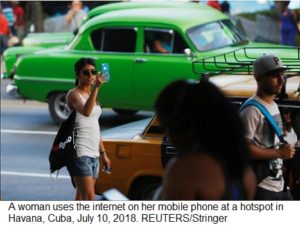
This change is not all bad! The whole world – the people, media and information – is now accessible at our finger tips!

There are only a few small groupings of people even attempting to “live off the grid”. Everyone else has fully embraced the grid and is living their life in kind – waiting for the next technological advances – they have been assimilated.

There used to be a Caribbean exception, Cuba! Due to the 1959 Revolution, Cuba had previously rejected Western technology advances; choosing to freeze their technological consumption at 1959.

But based of the summary of this news article, that actuality is no more:

Title: Communist-run Cuba starts rolling out internet on mobile phones
By:
Sarah Marsh

HAVANA (Reuters) – Communist-run Cuba has started providing internet on the mobile phones of select users as it aims to roll out the service nationwide by year-end, in a further step toward opening one of the Western Hemisphere’s least connected countries.

Journalists at state-run news outlets were among the first this year to get mobile internet, provided by Cuba’s telecoms monopoly, as part of a wider campaign for greater internet access that new President Miguel Diaz-Canel has said should boost the economy and help Cubans defend their revolution.

Analysts said broader web access will also ultimately weaken the government’s control of what information reaches people in the one-party island state that has a monopoly on the media. Cuba frowns on public dissent and blocks access to dissident websites.

“It’s been a radical change,” said Yuris Norido, 39, who reports for several state-run news websites and the television. “I can now update on the news from wherever I am, including where the news is taking place.”

Certain customers, including companies and embassies, have also been able to buy mobile data plans since December, according to the website of Cuban telecoms monopoly ETECSA, which has not broadly publicized the move.

ETECSA has said it will expand mobile internet to all its 5 million mobile phone customers, nearly half of Cuba’s population, by the end of this year. ETECSA did not reply to a request for more details for this story.

Whether because of a lack of cash, a long-running U.S. trade embargo or concerns about the flow of information, Cuba has lagged behind in web access. Until 2013, internet was largely only available to the public at tourist hotels in Cuba.

But the government has since then made increasing connectivity a priority, introducing cybercafes and outdoor Wi-Fi hotspots and slowly starting to hook up homes to the web.

Long before he took office from Raul Castro in April, 58-year-old Diaz-Canel championed the cause.

“We need to be able to put the content of the revolution online,” he told parliament last July as vice president, adding that Cubans could thus “counter the avalanche of pseudo-cultural, banal and vulgar content.”

Cuba could use subsidies to encourage the use of government-sponsored applications, analysts said. Last month, ETECSA launched a free Cuba-only messaging application, Todus, while Cuba’s own intranet with a handful of government-approved sites and email is much cheaper to access than the wider internet.

In a 2015 document about its internet strategy that leaked, the Cuban government said it aimed to connect at least half of homes by 2020 and 60 percent of phones.

But many Cubans are skeptical. ETECSA President Mayra Arevich told state-run media in December it had connected just 11,000 homes last year.

“I’ve been many times to the ETECSA shop to ask if they can give us home access,” said Yuneisy Galindo, 28, at a Wi-Fi hotspot on one of Havana’s thoroughfares. “But they tell us they still aren’t ready and will call us.”

Most mobile phone owners have smartphones, although Cuba is only now installing 3G technology, even as most of Latin America has moved onto 4G, with 5G in its final testing phase.

“This rollout will expand slowly at first and then more quickly, if the government is increasingly confident that it can control any political fallout,” said Cuba expert Ted Henken at Baruch College in the United States.

The price could prove the biggest restriction for many, though. Hotspots currently charge $1 an hour, compared with an average state monthly wage of $30.

It was not clear what most Cubans will pay for mobile internet, but ETECSA is charging companies and embassies $45 a month for four gigabytes.

Additional reporting by Nelson Acosta, Editing by Rosalba O’Brien

Source: Reuters News Service – Posted July 16, 2018; retrieved December 20, 2018 from: https://www.reuters.com/article/us-cuba-internet/communist-run-cuba-starts-rolling-out-internet-on-mobile-phones-idUSKBN1K62U7

The conclusion from this commentary is that the Caribbean member-states are now all ready to embrace this Technology Agent of Change confronting our world. The 2013 book Go Lean…Caribbean – available to download for free – prepared the region for this eventuality. The book serves as a roadmap for the introduction and implementation of the technocratic Caribbean Union Trade Federation (CU), for the elevation of Caribbean society – for all member-states. The book identified these 4 Agents of Change – Globalization, Climate Change, Technology and the Aging Diaspora – and declared that we were failing to compete because of our inability to adopt and thrive in this changed environment.

Adopt, compete and thrive …

While it has been 5 years since the publication of the Go Lean book, the pronouncements are more important now than before. It was asserted that the entire Caribbean region – all 30 member-states, Cuba included – must unite in order to adopt, compete and thrive in this new technological world. In the book’s opening, and early motivation, there was this Declaration of Interdependence that, among other things, proclaimed (Page 14) the following:

xxx. Whereas the effects of globalization can be felt in every aspect of Caribbean life, from the acquisition of food and clothing, to the ubiquity of ICT, the region cannot only consume, it is imperative that our lands also produce and add to the international community, even if doing so requires some sacrifice and subsidy.

The Go Lean book declares that our lives and livelihoods are at stake. Our societal engines – jobs, education, healthcare, governance, etc. – all depend on how well we adopt, compete and thrive with today’s technology. So the Go Lean/CU roadmap presents these 3 prime directives:

  • Optimization of the economic engines in order to grow the regional economy to $800 Billion & create 2.2 million new jobs.
  • Establishment of a security apparatus to ensure public safety and protect the resultant economic engines.
  • Improve Caribbean governance to support these engines, including a separation-of-powers between the member-states and CU federal agencies.

The Go Lean book provides 370-pages of turn-by-turn instructions on “how” to adopt new community ethos, plus the strategies, tactics, implementations and advocacies to execute so as to reboot, reform and transform the societal engines of Caribbean society.

Community ethos; what is community ethos? The book defines it as “the fundamental character or spirit of a culture; the underlying sentiment that informs the beliefs, customs, or practices of a group or society”.

The Go Lean book presents new community ethos that must be adopted in order to compete and thrive with the world with regards to technology:

  • Lean Operations
  • Return on Investments
  • A quest to respect and Promote Intellectual Property
  • A quest to Impact Research & Development
  • A quest to Bridge the Digital Divide

In addition to the ethos, one notable advocacy that is presented, on Page 197, is entitled: 10 Ways to Foster Technology. Notice the summaries, plans, excerpts and headlines from the book here:

1 Lean-in for the Treaty for a Caribbean Single Market
This treaty allows for the unification of the region into one market of 42 million people, across 30 member-states and an economic impact for a GDP of over $800 Billion (circa 2010). The CU will lead the industry efforts to create economies-of-scale to deploy technological investments, (such as Libraries and other Community Technology Centers), and generate justifiable benefits. The CU governance also provides the intellectual property protections such as patents and copyrights, and ensures their enforcement both locally and abroad. The technology initiatives are designed to include everyone in the region: the technically-savvy and the technically-ignorant. In addition to the CU providing community education services like the CTC’s, the CU incentivizes Not-For-Profit agencies, NGOs and Foundations to help the community efforts.
2 e-Learning Facilities and Industries
3 STEM Charter Schools and STEM Teacher Recognitions
4 e-Government Services
The CU Trade Federation will provide government services. Where ever possible, these services will be delivered with the embrace of Internet and Communications Technologies (ICT). Therefore, Caribbean citizens can request and interact with CU government services via web & phone portals (contact centers), and when personal visits are mandated, service level agreements (SLA) will be implemented to set expectations for quality and timely response.
5 Public Access Wi-Fi
Regional ISP’s will be regulated at the federal level, and encourage to provided free Wi-Fi to the public. Successful business models can be facilitated thru ads-supported browsers and videos.
6 Incubators, Venture Capitalists Funds and IPO’s
7 Tax Credits for Technological Investments
8 Technology Expositions
9 Centers of Excellence
10 Whistleblower Protections

The Go Lean book was written 5 years ago as a 5 Year Plan to reform and transform the Caribbean region. Had the plan been adopted by the regional stakeholders then, the Agents of Change would have been better addressed all the while. But instead, this plan, or roadmap, to introduce and implement the Caribbean Union Trade Federation is still reeling; still not even started.

The embrace of technology must not be optional. This technology factor is analogous to a vessel/ship that can take “us” to a better destination.

Adopting, thriving and competing with technology advances is the answer for reforming and transforming the Caribbean. In these 5 short years since the publication of the Go Lean book, technology has escalated the region further and now all the member-states are fully “on board” this vessel for change, empowerment and improvement.

While the other Agents of Change are equally import, this Technology cause is perhaps the one Agent of Change that we have made the most progress with. This disposition is presented in the other commentaries in this series, cataloged here:

  1. 5 Years Later: New Post Office Eco-system – Globalization issues ‘loud and clear’ now.
  2. 5 Years Later: Climate Change – Coming so fast, so furious.
  3. 5 Years Later: Technology – Caribbean fully on board.
  4. 5 Years Later: Aging Diaspora – Finding Home … anywhere.

At least now we have a more receptive environment for the embrace of the Go Lean roadmap in Cuba, than we did 5 years ago. Back then, Fidel Castro, though retired as President, still ruled as the Chairman of the Communist Party; his brother Raul ruled as President. Today, Fidel is dead; and Raul is retired – though now the Chairman of the Party. Cuba is now ready for change. The foregoing news article has conveyed that Cuba is ready for mobile Internet and Communications Technologies.

This is the start that we need. This allow us the opportunity to adopt, compete and thrive. Let’s lean-in to the Go Lean/CU roadmap now. We have more to do; more to accomplish; more people to impact; more jobs to create; and more lives to improve.

At 5 years in, though its a late start, it is still not too late to succeed in making our homeland a better place to live, work and play.  🙂

Download the free e-book of Go Lean … Caribbean – now!

Sign the petition to lean-in for this roadmap for the Caribbean Union Trade Federation.

Share this post:
, , ,
[Top]

5 Years Later – They can hear you now about the Post Office – ENCORE

5 years ago, the book Go Lean … Caribbean was introduced; the publication date was November 2013.

The book scanned the landscape in the Caribbean and found a lot of deficiencies in the economics, security and governance in the region. For example, for those 5 years the movement behind the Go Lean book have been telling people that there is an overriding need for a technocratic postal solution in the Caribbean region. This is how to keep up with the demands of globalization.

People – the audience – have only yawned.

Now the Caribbean member-state of The Bahamas has a crisis with their postal facility. The people there should now be ready, willing and able to consider alternatives and improvements to their regional governance.

Title: Wells confirms “undeliverable” mail was shredded
NASSAU, BAHAMAS – Addressing allegations that mail at the General Post Office had been shredded, Minister responsible for the post office, Renward Wells, confirmed on Thursday that the most recent and deliberate destruction of “undeliverable” mail was on November 1 and 2, upon the authorization of the Postmaster General.

The Bahamas has membership in the United Postal Union (UPU) and it is therefore required to ensure that delivery of mail among countries follows consistent rules and standards.

The General Post Office is in the process of being relocated to the Town Centre Mall in early 2019.

Wells outlined in his statement that the standards of the Post Office will be restored to one that will regain the respect of international partners.

“Postal workers and the Bahamian public have been in excess of three years without an adequate means for providing this essential service,” he said.

Source: Posted December 14, 2018; retrieved December 15, 2018 from: https://ewnews.com/wells-confirms-undeliverable-mail-was-shredded

This commentary is the first of a 4-part series from the movement behind the Go Lean book in consideration of the 5 year anniversary of the book’s publication. The theme on these 4 submissions is “5 Years Later and what is the condition now“. The focus here is on the Agents of Change that the book identified: Globalization, Climate Change, Technology and the Aging Diaspora.

Have the problems lessened, or have they intensified? The other commentaries in the series are cataloged as follows:

  1. 5 Years Later: New Post Office Eco-system – Globalization issues ‘loud and clear’ now.
  2. 5 Years Later: Climate Change – Coming so fast, so furious.
  3. 5 Years Later: Technology – Caribbean fully on board.
  4. 5 Years Later: Aging Diaspora – Finding Home … anywhere.

The Go Lean book was written 5 years ago as a 5 Year Plan to reform and transform the Caribbean region. Had the plan been adopted by the regional stakeholders, then the Agents of Change would have been mostly assuaged. The plan, or roadmap, to introduce and implement the Caribbean Union Trade Federation is still outstanding to even start. We now need to push the leaders – Top Down – and the subjects – Bottoms’s Up – to execute the strategies, tactics and implementation prescribed in this book.

This approach – rebooting the postal eco-system – had been relayed in a previous blog-commentary from January 23, 2018; it  is appropriate to Encore that blog-commentary here-now:

——————–

Go Lean CommentaryFirst Steps – A Powerful C.P.U.

The movement behind the book Go Lean … Caribbean wants to deploy an “apolitical technocracy” in the Caribbean. What is an apolitical technocracy?

Quite simply, an organizational structure designed to just deliver.

Sounds familiar? Frankly, the Post Office is a powerful example of an apolitical technocracy:

They just deliver the mail …

… “Neither snow nor rain nor heat nor gloom of night stays these couriers from the swift completion of their appointed rounds”.

(While the Postal Service has no official motto, the popular belief is that these words are tribute to America’s postal workers).

Technocracies are supposed to be automatons, a machine that just chugs-and-chugs. Think computers; think C.P.U.. But in the case of this Go Lean scheme, C.P.U. does not mean Central Processing Unit, no, it means Caribbean Postal Union.

The book Go Lean book – available to download for free – serves as a roadmap for the introduction and implementation of the technocratic Caribbean Union Trade Federation (CU) and the Caribbean Postal Union, for the elevation of Caribbean society – for all member-states. This CU/Go Lean roadmap has these 3 prime directives:

  • Optimization of the economic engines in order to grow the regional economy and create new jobs.
  • Establishment of a security apparatus to ensure public safety and protect the resultant economic engines.
  • Improve Caribbean governance to support these engines, including a separation-of-powers between the member-states and CU federal agencies.

This commentary is Part 6 of 6-parts; it completes the series from the movement behind the book Go Lean … Caribbean in consideration of the First Steps for instituting a new regime in governance for the Caribbean homeland. The other commentaries in the series are cataloged as follows:

  1. First Steps: EU: Free European Money – To Start at Top
  2. First Steps: UK: Dignified and Efficient
  3. First Steps: US: Congressional Interstate Compact – No Vote; No Voice
  4. First Steps: CariCom: One Man One Vote Defects 
  5. First Steps: Deputize ‘Me’! 
  6. First Steps: A Powerful C.P.U.

All of these commentaries relate to “how” the Caribbean can finally get started with adapting the organizational structures to optimize the region’s societal engines. Whereas all the previous submissions addressed the need for reform at the Top. This commentary addressed the automation, the technocratic C.P.U.. This is designed to affect every man-woman-child in the Caribbean region, to just deliver. This simple functionality will do wonders for the quest of this roadmap: make the Caribbean member-states better places to live, work and play.

The Go Lean book stresses that reforming and transforming the Caribbean societal and postal engines must be a regional pursuit. This was an early motivation for the roadmap, as pronounced in the opening Declaration of Interdependence (Pages 12 – 13):

xi. Whereas all men are entitled to the benefits of good governance in a free society, “new guards” must be enacted to dissuade the emergence of incompetence, corruption, nepotism and cronyism at the peril of the people’s best interest. The Federation must guarantee the executions of a social contract between government and the governed.

xv. Whereas the business of the Federation and the commercial interest in the region cannot prosper without an efficient facilitation of postal services, the Caribbean Union must allow for the integration of the existing mail operations of the governments of the member-states into a consolidated Caribbean Postal Union, allowing for the adoption of best practices and technical advances to deliver foreign/domestic mail in the region.

xvi. Whereas security of our homeland is inextricably linked to prosperity of the homeland, the economic and security interest of the region needs to be aligned under the same governance. Since economic crimes … can imperil the functioning of the wheels of commerce for all the citizenry, the accedence of this Federation must equip the security apparatus with the tools and techniques for predictive and proactive interdictions.

xxiv. Whereas a free market economy can be induced and spurred for continuous progress, the Federation must install the controls to better manage aspects of the economy: jobs, inflation, savings rate, investments and other economic principles. Thereby attracting direct foreign investment because of the stability and vibrancy of our economy.

The Go Lean book provides 370-pages of turn-by-turn instructions on “how” to adopt new community ethos, plus the strategies, tactics, implementations and advocacies to execute so as to reboot, reform and transform the societal engines of Caribbean society. One advocacy in the book is entitled “10 Ways to Improve Mail Service … in the Caribbean Region“; this detailed the best practices for postal mail and logistics; (Page 108). See this Bottom Line introduction:

The Bottom Line for the Caribbean Postal Union
Without a regional hub-and-spoke system, mail from one island to another can take weeks – such a business climate cannot breathe success with this lack of efficiency. The purpose of the CU is to facilitate the economic engines of the region. Therefore postal communications between individuals, households, businesses and governmental institutions must be efficient and effective – establishments must be able to connect with their customers and governments to its constituents. The Caribbean Postal Union (CPU) will operate as a private business, a multi-national corporation, owned by CU member-states, chartered to employ best practices and world class methods in the execution of the fulfillment side of the e-Delivery model. A mark of success: delivery of first-class mail in 3 – 5 days.

Improving the postal mail eco-system in the Caribbean can have a transformative effect on regional society. CPU is mostly an e-Logistics enterprise. Imagine the following (global) trends that wait in the balance:

Imagine a Caribbean reality with flat-rate envelopes and flat-rate boxes. Imagine the automation, the robotic technologies, the scanning and sorting. The brand CPU would really be apropos – more software, e-Commerce and Internet Communications Technology – as opposed to the neighborhood mail-carrier. See this industrial shift in the related news article in the Appendix below. In fact, the company www.Stamps.com provides a model for the CPU to emulate. See this Introductory VIDEO here:
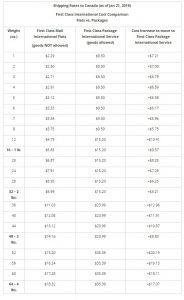
VIDEO – Welcome to Stamps.com, USPS Postage Software Overview – https://youtu.be/wCCAkRkUWE0

Stamps.com

Published on Apr 23, 2013 – Welcome to Stamps.com, USPS Postage Software Overview This video shows new customers how Stamps.com software works. Highlights include how to buy and print postage stamps and shipping labels, e-commerce shipping features, postage spending reports plus many more features.

In addition, previous Go Lean blog-commentaries detailed the width-and-breadth of the mail-logistics business model for the Caribbean; see these prior submissions here:

https://goleancaribbean.com/blog/?p=13627 Amazon as a Role Mode: Then and Now
https://goleancaribbean.com/blog/?p=9839 Alibaba Cloud stretches global reach with four new facilities
https://goleancaribbean.com/blog/?p=7991 Transformations: Caribbean Postal Union – Delivering the Future
https://goleancaribbean.com/blog/?p=3187 Amazon Role Model – Robots helping tackle Cyber Monday
https://goleancaribbean.com/blog/?p=2488 Alibaba – A Chinese Role Model for the C.P.U.
https://goleancaribbean.com/blog/?p=1416 Amazon – An American Role Model for the C.P.U.

Forging change is heavy-lifting for the CU/Go Lean roadmap, but conceivable, believable and achievable? Why because so many other entities have executed these action plans before. We do not need to “re-invent the wheel”; we only need to conform to the published best-practices. This applies to the Caribbean Postal Union and all other societal engines.

Yes, we can succeed in forging change and assuaging the crises in the Caribbean. We have the existing organizations constructs of the CariCom, British Overseas Territories, US Territories and the EU. We can use these to “touch” every country-establishment-person in the region. This will lead to the success of our goals, to make the Caribbean a better place to live, work and play. 🙂

Download the free e-Book of Go Lean … Caribbean – now!

Sign the petition to lean-in for this roadmap for the Caribbean Union Trade Federation.

———–

Appendix Title: Important: USPS making changes to First-Class Mail International Flats

January 21, 2018 Update: Stamps.com has launched a new International Flat service.  Get more info on how to ship merchandise with International Flats.

Merchandise No Longer Allowed in First Class Mail International Flats
If you ship merchandise abroad using USPS First Class Mail International Flats, there’s a new rule going into effect soon that you need to know about. Effective Sunday, January 21, 2018, First Class Mail International Large Envelope/Flat service for merchandise will NO LONGER be available from the USPS. First Class Mail International Flats will only be approved for use when sending documents. This change is occurring to comply with Universal Postal Union requirements.

Here are some examples of what USPS considers a document (still OK to ship using First Class Mail International Flats):

  • Audit and business records
  • Personal correspondence
  • Circulars
  • Pamphlets
  • Advertisements
  • Written instruments not intended to be resold
  • Money orders, checks, and similar items that cannot be negotiated or converted into cash without forgery.

Here are examples of items that will NO LONGER be allowed to be shipped as First Class Mail International Flats, effective Jan. 21, 2018:

  • CDs, DVDs, flash drives, video and cassette tapes, and other digital and electronic storage media (regardless of whether they are blank or contain electronic documents or other prerecorded media)
  • Artwork
  • Collector or antique document items
  • Books
  • Periodicals
  • Printed music
  • Printed educational or test material
  • Player piano rolls
  • Commercial photographs, blueprints and engineering drawings
  • Film and negatives
  • X-rays
  • Separation negatives

These goods are dutiable and must be must be shipped using First Class Package International Service. Once this change goes into effect, shippers will need to include Customs Forms and the recipient could pay a duty or tax to receive the product.

Cost Savings Using First Class Mail International Flats
Moving from First Class Mail International Flats to First Class Package International Service will have a big impact on shippers.

Source: Posted December 26th, 2017; retrieved January 21, 2018 from: http://blog.stamps.com/2017/12/26/important-usps-making-changes-first-class-mail-international-flats/ 

Share this post:
, ,
[Top]

In Defense of Trade – India’s Business Process Outsourcing

Go Lean Commentary

Pay more than the usual attention to Trade

… this is the urging of this series of commentaries. Why?

Trade may be the panacea (cure all) for the ills of the Caribbean. Let’s consider one example, BPO.
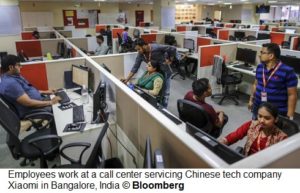
BPO = Business Process Outsourcing

Individually, these 3 words are very common in our daily life: Business, Process and Outsourcing. Put together and most people … have no clue.

BPO is not just an informal association of these 3 letters. Rather it’s a formal business model; see this encyclopedic reference:

Business process outsourcing (BPO) is a subset of outsourcing that involves the contracting of the operations and responsibilities of a specific business process to a third-party service provider. Originally, this was associated with manufacturing firms, such as Coca-Cola that outsourced large segments of its supply chain.[1]

BPO is typically categorized into back office outsourcing, which includes internal business functions such as human resources or finance and accounting, and front office outsourcing, which includes customer-related services such as contact center (customer care) services.[2]

BPO that is contracted outside a company’s country is called offshore outsourcing. BPO that is contracted to a company’s neighbouring (or nearby) country is called nearshore outsourcing.

Often the business processes are information technology-based, and are referred to as ITES-BPO, where ITES stands for Information Technology Enabled Service.[3] Knowledge process outsourcing (KPO) and legal process outsourcing (LPO) are some of the sub-segments of business process outsourcing industry.

Benefits
The main advantage of any BPO is the way in which it helps increase a company’s flexibility. However, several sources have different ways in which they perceive organizational flexibility. In early 2000s BPO was all about cost efficiency, which allowed a certain level of flexibility at the time. Due to technological advances and changes in the industry (specifically the move to more service-based rather than product-based contracts), companies who choose to outsource their back-office increasingly look for time flexibility and direct quality control.[4] Business process outsourcing enhances the flexibility of an organization in different ways:

  • … transforming fixed into variable costs.[7]
  • … focus on its core competencies, without being burdened by the demands of bureaucratic restraints.[9]
  • … increasing the speed of business processes.
  • … allows firms to retain their entrepreneurial speed and agility, which they would otherwise sacrifice in order to become efficient as they expanded.

Source: Retrieved November 23, 2018 from: https://en.wikipedia.org/wiki/Business_process_outsourcing

The most common BPO in the US is payroll-processing. Most companies have specific missions, they are not in the payroll business, but payroll – every week, bi-week, fortnight, or monthly – is a necessary evil for operations. BPO for this HR-Accounting functionality allows the firm to concentrate on its mission and enjoy greater functionality and sometimes better cost savings.

Here’s another: have you gotten a Passport lately? Then chances are you are familiar with the subject. You show up with a completed application and a photo; a clerk receives you and inspects your form for completeness; they package your submissions into a bundled folder and send it off for processing (Black-box). 2 weeks, 3 weeks or 5 weeks later (according to the Service Level Agreement or SLA), a finished passport is ready for pick-up. That Black-box is classic BPO.
Worldwide, the BPO market is estimated at about US$140 billion for 2016 – from the BPO Services Global Industry Almanac 2017.[27]  One country has double-down on this strategy that they can provide jobs, entrepreneurial opportunities and economic growth to their citizens by pursuing more and more BPO.

This is India. See the related VIDEO in Appendix B below.

The foregoing encyclopedic reference continues:

India, China and the Philippines are major powerhouses in the industry. In 2017, in India the BPO industry generated US$30 billion in revenue according to the national industry association.[28] The BPO industry is a small segment of the total outsourcing industry in India. The BPO industry and IT services industry in combination are worth a total of US$154 billion in revenue in 2017.[29] The BPO industry in the Philippines generated $22.9 billion in revenues in 2016.[30] In 2015, official statistics put the size of the total outsourcing industry in China, including not only the BPO industry but also IT outsourcing services, at $130.9 billion.[31]

Lessons learned from India is not unfamiliar to this movement behind the book Go Lean…Caribbean. Here we go again!

We can benefit from the consideration of trade with other countries; we previously considered China and now we are looking at India. This commentary is the 3rd of the 5-part series (3 of 5) from the movement behind the book Go Lean…Caribbean in consideration of the subject “In Defense of Trade“. The focus here is that Trade must be prioritized in the Caribbean region if we want a new economic regime. The other commentaries in the series are cataloged as follows:

  1. In Defense of Trade: China Realities
  2. In Defense of Trade: Macy’s Thanksgiving Parade Model – ENCORE
  3. In Defense of Trade: India BPO’s
  4. In Defense of Trade: Bilateral Tariffs – No one wins
  5. In Defense of Trade: Currency Assassins – Real Threat

The Go Lean movement asserts that Trade is pivotal for Caribbean growth. It does not only affect the region’s economics, but the security and governing engines as well. In the case of BPO, the trade product is intellectual: human services. India has benefited greatly from Wall Street’s BPO jobs; this Asia region now boasts 10 percent of all the jobs servicing Wall Street banks; see Appendix A below for a full article of how Wall Street firm Goldman Sachs employ professional functions in their Bangalore BPO facility, including Quantitative Analysts. We need to pay more than the usual attention to this model. We can copy some of the BPO functionality and bring jobs here to the Caribbean.

The Go Lean book serves as a roadmap for the introduction and implementation of the technocratic Caribbean Union Trade Federation (CU). The CU seeks to optimize the region’s economic systems to better deliver on the prime directives of the Go Lean roadmap. The prime directives are pronounced as the following statements:

  • Optimization of the economic engines in order to grow the regional economy to $800 Billion & create 2.2 million new jobs.
  • Establishment of a security apparatus to protect the resultant economic engines and mitigate challenges/threats to ensure public safety for the region’s stakeholders.
  • Improvement of Caribbean governance to support these economic/security engines, including a separation-of-powers between member-states and CU federal agencies.

So the CU Trade Federation vision is to provide the stewardship for the region’s economic engines, to optimize trade so as to succeed in the goals of the roadmap.

The Go Lean/CU roadmap details how to drive change for the 30 member-states and their economic, security and governing engines. The Go Lean book – within its 370 pages – describes the new community ethos, strategies, tactics, implementations and advocates that must be executed to manifest this roadmap.

BPO’s are affiliated with Contact Centers …

… this commentary had previously identified the economic benefits that can come to a community that invest in BPO’s:

With modern Internet Communications Technology (ICT) – think Voice-over-IP – a phone call can originate or terminate around the globe, but feel/sound like it is next door. The premise of this business model for the Caribbean is simple: Why not make those calls / answer the phone here in the Caribbean?

Jobs are at stake.

Direct and indirect jobs at physical and virtual call centers: 12,000.

In addition to these industry jobs; there is also the reality of indirect jobs – unrelated service and attendant functions – at a 3.75 multiplier rate would add another 45,000 jobs.

The subject of banking jobs have been thoroughly elaborated upon in these previous Go Lean blog-commentaries:

https://goleancaribbean.com/blog/?p=15923 Industrial Reboot – Payment Cards 101
https://goleancaribbean.com/blog/?p=15479 ‘Lean Is’ as ‘Lean Does’ – Good Bank Project Management
https://goleancaribbean.com/blog/?p=14242 Leading with Money Matters – Follow the Jobs
https://goleancaribbean.com/blog/?p=11184 JPMorganChase spent $10 billion on ‘Fintech’ for 1 year

In summary, while the Caribbean is arguably the best address on the planet, we have a deficiency in job creation. We need more trade. There is the opportunity to double-down on trade … in services – BPO’s await us – this will create more jobs.

India did this – mastering trade and globalization – so can we.

This is the Go Lean roadmap. This plan is conceivable, believable and achievable.

We urge everyone in the Caribbean – bankers et al – to lean-in to this roadmap to make the Caribbean a better place to live, work and play. 🙂

Download the free e-Book of Go Lean … Caribbean – now!

Sign the petition to lean-in for this roadmap for the Caribbean Union Trade Federation.

———————-

Appendix A – Title: The new back office: inside Goldman Sachs’ Bangalore hub 
Sub-title:
Quants are hired in India as economics, politics and tech shape the banking industry
By: Andrew Hill

When Goldman Sachs opened its wholly owned Bangalore operation in 2004, it was a typical back office. Just under 300 full-time staff supported a front line of revenue-generating bankers worldwide. They worked in limited areas such as information technology, finance and accounting.

The group put no cap on Bangalore’s ambitions, says Bunty Bohra, who heads the office, but “we didn’t envisage anything like the scale and complexity” of the current operation — let alone what is now planned for the group.

Goldman now employs about 5,000 staff in Bangalore, 4,000 of them full-time, across almost every division of the bank, including revenue-generating “front office” roles. In 2019, it expects to open a $250m campus on Bangalore’s traffic-clogged outer ring road that will be able to accommodate 9,000 people in two buildings, across 1m sq ft.

The evolution of Goldman’s presence in Bangalore is one example of how economics, technology and politics have shaped the back office over the past 15 years. Companies have started to look at back offices not just as low-cost support centres, but sources of skills for the rest of the organisation. At the same time, they have learnt to flex the mixture and location of their own staff, and of outsourced teams, to meet customer needs.

In the mid-1990s, multinationals strove to cut the cost of support functions such as handling payroll, or dealing with customer queries. Moving them to cheaper countries such as India was the obvious solution. Since then, however, the response to the question of how, where and with whom to carry out back-office functions has become more complex, and more strategic.

Goldman is a case in point. Its Bangalore-based staff now represent 14 activities — from compliance and legal services to investment banking, though the most senior client-handling vice-presidents still operate out of Mumbai. “It really is a talent story, not ‘Where are there people and office space that’s inexpensive?’” says Mr Bohra. Last year, for instance, the bank hired 150 “quants” in Bangalore. These mathematicians and scientists work on the bank’s quantitative investment strategies, but also analyse big data in areas such as risk management or human resources.

The bank’s plans for its new campus would allow it to expand to become the biggest office outside New York. But at the same time, the bank does not have to take up the option to lease the second of two buildings. At the moment, it expects headcount to remain flat. Mr Bohra uses an analogy with a potentially uncontrollable family pet: “We don’t want to have a ‘golden retriever’ problem. We want the intellect, maturity and seasoning to exist at the same time.”

This is only one way in which companies are reviewing their back-office strategy. For instance, growth in the use of “captive” centres, serving the whole company, has accelerated. Ilan Oshri of Loughborough University found that between 1990 and 2009, the world’s largest 250 companies established 367 captive centres worldwide. There are now an estimated 2,000 such hubs.

Outsourcing companies have also become more agile. Susir Kumar, chairman of Intelenet Global Services, says outsourcers have moved from carrying out processes to making more judgments for clients. Intelenet’s agents have long had the responsibility for deciding, say, whether to grant a loan or approve an insurance claim. “The ability to manage change in a fast-changing environment is the key,” he says. Often, contract workers are used in a blend with in-house back-office staff.

Even Goldman’s Bangalore operation, which prides itself on propagating a “Goldman culture”, now outsources certain functions — such as accounting — to multiple contractors.

Prof Oshri says the trend of companies moving their offshored back offices to the next cheapest location as labour costs increase has also changed.

One factor for large companies that have expanded overseas is political pressure to “bring jobs home”. That could be a particular issue for US retail banks. They are potentially in president Donald Trump’s line of fire, although they argue they need to support front offices round the clock, and therefore round the world.

Other sectors have, over the past five years, also started to trim earlier policies to offshore customer service operations. In the UK, Santander, the bank, United Utilities, the water company, and BT all “reshored” call-centre work from India in 2011. Vodafone UK recently announced it would create 2,100 jobs across the UK, essentially by relocating customer service roles currently carried out, via an external agency, in South Africa. Last year’s Brexit vote could accelerate the trend, as outsourcers and insourcers adapt to a more nationalistic popular tone.

In the case of call centres, location is highly dependent on customers’ perception of quality — bluntly, whether they can understand the call-centre staff. But there are other advantages to having support staff closer to headquarters, including control over recruitment, rewards and training. Strategic support functions, like risk management, may be better handled by a “middle office”, based closer to the main revenue-generating activities.

The cost and skills combination needed for back offices still tilts the choices heavily towards emerging markets, though. Vodafone UK’s IT shared services are still in Bangalore and Pune in India, where it uses a blend of captive operations and third parties, often dealing with enterprise customers.

Campbell Harvey of Duke University’s Fuqua School of Business says cost is still companies’ main motivation and technology will be a more important influence than politics on future back-office decisions. “People traditionally doing back-office functions in New York and London were disrupted by offshoring and that’s a sideshow compared with what’s coming,” he says.

That said, while the rise of machine learning sounds like a threat to back-office jobs, when Prof Oshri asked 150 corporate buyers of outsourced services how much they had spent on cognitive computing, the answer averaged out at £350,000 per enterprise over the past five years — barely enough to cover a pilot project.

Leslie Willcocks of London School of Economics says he is “staggered how slow” big organisations are to introduce basic automation, let alone artificial intelligence.

Intelenet’s Mr Kumar is equally sanguine, both about the US political pressure, to which he thinks the industry will adapt, and the rise of the robots. He believes the same number of employees will work with machines to do more sophisticated jobs for clients. But Prof Harvey has a warning for institutions that do not plan ahead. “It’s a race to the bottom and the bottom is not a human, it’s a machine.”

Source: The Financial Times – Posted April 13, 2017; retrieved November 23, 2018 from: https://www.ft.com/content/6c1481ea-185d-11e7-9c35-0dd2cb31823a

———————-

Appendix B VIDEO – The Transformation Of India’s BPO Industry – https://youtu.be/44RlATt7S2w


NDTV

Published on Nov 19, 2017 –
India’s BPO industry first caught our imagination over a decade ago with its world-class offices and relatively high starting salaries. But with the downsides of strange shift timings and stranger accents. How has it changed since then? As it lost its novelty value, the BPO world fell out of the headlines. Is the industry still flourishing in India or have protectionism, automation and competition from other countries hurt the famous Indian outsourcing industry?

NDTV is one of the leaders in the production and broadcasting of un-biased and comprehensive news and entertainment programmes in India and abroad. NDTV delivers reliable information across all platforms: TV, Internet and Mobile.

Share this post:
, , ,
[Top]

In Defense of Trade – Macy’s Thanksgiving Parade Model – ENCORE

Today is the Thanksgiving Holiday in the US. It’s a Public Holiday, that the government has set-aside for the population to Give Thanks … to whomever …


This is a civic holiday more so than it is a religious holiday.

It is also a commercial holiday – lots of Trade activities; lots of Trade Inspirations.

The Trade Inspiration applies to us in the Caribbean. There is one event associated with the American Thanksgiving tradition that gives us pause – as observers and reporters of the America eco-system – that is the Macy’s Thanksgiving Parade. This subject has been detailed in a previous Go Lean Commentary from November 25, 2016; it is appropriate to Encore that now; see below.

This commentary is the 2nd of the 5-part series (2 of 5) from the movement behind the book Go Lean…Caribbean in consideration of the subject “In Defense of Trade“. The focus here is that Trade must be prioritized in the Caribbean region if we want a new economic regime. The other commentaries in the series are cataloged as follows:

  1. In Defense of Trade: China Realities
  2. In Defense of Trade: Macy’s Thanksgiving Parade Model – ENCORE
  3. In Defense of Trade: India BPO’s
  4. In Defense of Trade: Bilateral Tariffs – No one wins
  5. In Defense of Trade: Currency Assassins – Real Threat

No doubt, there is the need to grow the Caribbean economy; we need jobs, entrepreneurial opportunities, better educational and healthcare options, a safer homeland and more efficient governmental services. Since trade policies (chattel goods and intellectual property) affect all of these deliveries, we need to pay more than the usual attention to these discussions. Truthfully, we do NOT have a lot of chattel goods in our region; we do not manufacture much; but we can thrive in the intellectual property arena. This is where we need successful role models to show us how we can better exploit the opportunities with trade.

Let’s look-listen-learn from the Macy’s model. See the Encore here:

—————————————

Go Lean CommentaryModel of the Macy’s Thanksgiving Day Parade – By The Numbers

“We are giving this for free as a gift to America” – CNBC Newscast: Amy Kule, Executive Producer, 2014 Macy’s Thanksgiving Parade*.

Free?

Hardly! There is nothing free about American Thanksgiving. This is just another example of American Crony-Capitalism. Consider the facts in this VIDEO here of the Macy’s Thanksgiving Day Parade, by the numbers:

VIDEOMacy’s Thanksgiving Day Parade by the Numbers – http://www.aol.com/video/channel/news/582e4599134aa15f420ded1a/

playbutton-300x300

Click on the Photo to Play VIDEO 

This discussion is promoting the idea of the Caribbean modeling the best-practices of American commerce – there are a lot of economic returns from events. The Macy’s Thanksgiving Day Parade, in the foregoing, is an event – one of the biggest on the calendar for New York City. So the focus of this commentary is the impact that one event can have on the societal engines of a community: economics, security and governance.

One person – or company – can make a difference.

Notice how this parade is mostly administered by one private company: Macy’s Department Stores.

Reference Title: Macy’s Department Store
Macy’s, originally R. H. Macy & Co., is a department store owned by Macy’s, Inc. It is one of two divisions owned by the company, with the other being Bloomingdale’s. As of January 2014, the Macy’s division operates 789 department store locations in the continental United States, Hawaii, Puerto Rico, and Guam, including the prominent Herald Square flagship location in Midtown Manhattan, New York City.[2]:35

cu-blog-macys-thanksgiving-day-parade-by-the-numbers-photo-2Macy’s has conducted the annual Macy’s Thanksgiving Day Parade in New York City since 1924 and has sponsored the city’s annual Fourth of July fireworks display since 1976. Macy’s Herald Square is the largest department store in the world. The flagship store covers almost an entire New York City block, features about 1.1 million square feet of retail space, includes additional space for offices and storage, and serves as the endpoint for Macy’s annual Thanksgiving Day parade. It is estimated that the value of Herald Square is under $3 billion to more than $4 billion.[3]

As of 2015, Macy’s is the largest U.S. department store company by retail sales and is the 15th-largest retailer in the United States for 2014 in terms of revenue.[4][5]
Source: Retrieved November 25, 2016 from: https://en.wikipedia.org/wiki/Macy%27s

The focus of the book Go Lean…Caribbean is to elevate the Caribbean economic disposition, based on the existing infrastructure and new implementations. So we would want to look-listen-learn from this American model and then apply the lessons here in the Caribbean. Events are integral to the touristic experience; this is why the Go Lean book, serving as a roadmap for the introduction and implementation of the technocratic Caribbean Union Trade Federation (CU), details so many dimensions of eco-system for events. The book prominently highlights that even small towns can get in on the economic buoyancy of events by detailing the role model of the City of Sturgis (population 6,600) in the US State of South Dakota – Page 191. Their annual event – Sturgis Motorcycle Rally in August – generates about $800 million in community revenues.

Successful management of events is a mission of Go Lean roadmap. The region needs the jobs. These events – think Carnival or Junkanoo in the Bahamas – create permanent and temporary jobs. This is part-and-parcel of the Go Lean/CU prime directives, as identified with the following 3 statements:

  • Optimization of the economic engines in order to grow the regional economy to $800 Billion & create 2.2 million overall new jobs; 9,000 jobs are attributed to Events.
  • Establishment of a security apparatus to protect the resultant economic engines.
  • Improve Caribbean governance to support these engines.

The Go Lean book presented the roadmap to imbrue the Caribbean region with new community ethos, plus new strategies, tactics, implementation and advocacies to improve event-job creation in the region. The following is a sample of these specific details from the book:

Community Ethos – Deferred Gratification Page 21
Community Ethos – Economic Principles – People Choose Page 21
Community Ethos – Economic Principles – People Respond to Incentives in Predictable Ways Page 21
Community Ethos – Economic Principles – Economic Systems Influence Individual Choices Page 21
Community Ethos – Economic Principles – The Consequences of Choices Lie in the Future Page 21
Community Ethos – Governing Principles – Lean Operations Page 24
Community Ethos – Governing Principles – Cooperatives Page 25
Community Ethos – Ways to Impact the Future Page 26
Community Ethos – Ways to Foster Genius – Consider Artists, Musicians and Performers Page 27
Community Ethos – Ways to Help Entrepreneurship Page 28
Community Ethos – Ways to Promote Happiness Page 36
Community Ethos – Ways to Impact the Greater Good Page 37
Strategy – Vision – Confederate 30 Member-States Page 45
Strategy – Mission – Celebrate the Music, Sports, Art and Culture of the Caribbean Page 46
Tactical – Confederating a Permanent Union Page 63
Tactical – Fostering a Technocracy Page 64
Tactical – Separation-of-Powers – CU Federal Agencies versus Member-State Governments Page 71
Implementation – Ways to Pay for Change Page 101
Implementation – Ways to Deliver Page 109
Planning – 10 Big Ideas for the Caribbean Region Page 127
Planning – Ways to Make the Caribbean Better Page 131
Planning – Lessons from New York City Page 137
Planning – Lessons from Omaha – College World Series Model Page 138
Advocacy – Ways to Grow the Economy Page 151
Advocacy – Ways to Create Jobs Page 152
Advocacy – Ways to Enhance Tourism Page 190
Advocacy – Ways to Impact Events Page 191
Advocacy – Ways to Promote Fairgrounds Page 192
Advocacy – Ways to Preserve Caribbean Heritage Page 218
Advocacy – Ways to Improve Sports – Fairgrounds as Sport Venues Page 229
Advocacy – Ways to Improve the Arts Page 230
Advocacy – Ways to Promote Music Page 231

The empowerments in the Go Lean book calls for permanent change to ensure that Caribbean people have opportunities; they only want to be able to provide for their families and preserve their unique Caribbean culture.

The Go Lean roadmap offers the technocratic execution of these deliverables. Imagine the expansion of the existing events in the region. Plus, imagine the artistic expressions and entertainment (singers, dancers, musicians, performers, etc.). Just like for the Macy’s Parade in the foregoing, economic gains await. This is the business model of “events”. From the outset, the Go Lean book recognized the significance of events and festivities in the roadmap with these statements in the opening Declaration of Interdependence (Page 12 & 14):

xxi.  Whereas the preparation of our labor force can foster opportunities and dictate economic progress for current and future generations, the Federation must … recognize and facilitate excellence in many different fields of endeavor, including sciences, languages, arts, music and sports. This responsibility should be executed without incurring the risks of further human flight, as has been the past history.

xxxii. Whereas the cultural arts and music of the region are germane to the quality of Caribbean life, and the international appreciation of Caribbean life, the Federation must implement the support systems to teach, encourage, incentivize, monetize and promote the related industries for arts and music in domestic and foreign markets. These endeavors will make the Caribbean a better place to live, work and play.

There are many other communities that have flourished in this strategy – business model of fun and festivities – as depicted with the example of the Macy’s Thanksgiving Parade. Success is possible; we need only to look, listen and learn.

Many previous Go Lean blog-commentaries have focused on the business of events. See samples-examples detailed in these previous blogs:

https://goleancaribbean.com/blog/?p=9712 Forging Change: Panem et Circenses
https://goleancaribbean.com/blog/?p=5251 Post-Mortem of Inaugural Junkanoo Carnival
https://goleancaribbean.com/blog/?p=4879 Model of a Sports Event: Martinique Surfing
https://goleancaribbean.com/blog/?p=3292 Model of an Artistic Event: Art Basel Miami
https://goleancaribbean.com/blog/?p=2152 Model of a Sports Event: Little League World Series
https://goleancaribbean.com/blog/?p=1341 College World Series Time – Lessons from Omaha
https://goleancaribbean.com/blog/?p=1214 Landlord of Temporary Stadiums
https://goleancaribbean.com/blog/?p=535 Event Security: Remembering and learning from Boston
https://goleancaribbean.com/blog/?p=318 Collegiate Sports in the Caribbean

Now is the time for all of the Caribbean, the people and governing institutions, to lean-in for the empowerments in the book Go Lean … Caribbean. This is a Big Idea for the region; that of expanding Caribbean events for greater economic throughput. We have the foundations in place already, the many artistic, cultural and sporting events for locals and visitors.

We can employ the strategies, tactics and implementations from models like the Macy’s Thanksgiving Parade to make our Caribbean region a better place to live, work and play. 🙂

Download the book Go Lean … Caribbean – now!

———

Appendix * – Source References:

https://youtu.be/61kyIsEBuUA posted Published on Nov 26, 2014; (retrieved November 25, 2016).

Executive producer of the Macy’s Thanksgiving Day Parade, Amy Kule, provides insight to the numbers behind tomorrow’s big parade and reveals some new characters.

———

Appendix VIDEO7 Macy’s Thanksgiving Day Parade Facts You Never Knew!https://youtu.be/zOtWeyh1aRs


Share this post:
, ,
[Top]

Good Governance: Good Corporate Compliance

Go Lean Commentary

(Photo by Chris Hondros/Getty Images)

Private business versus public government …

Business is to the East, while government is to the West. … East is East and West is West – never the twain shall meet.

Not quite!

Governments many times place restrictions and regulations on private businesses; think:

  • Workers Compensation
  • Child Labor Restrictions
  • Occupational Hazards
  • Social Security / National Security
  • Family Leave / Pregnancy Job Guarantees

So we accept that in a modern society, corporate entities may be required to comply with intrusive government mandates that go above and beyond basic consumer protections; and we call it Good Governance

… then in 2002, considering an American example, along came an even more intrusive government mandate on corporate enterprises (publicly-traded corporations) and the repercussion has been:

Crickets!

… no one complains; in fact, all the qualifying companies comply and buy into the notion that these sets of intrusive laws are good for the overall society. Whew! How did this happen?

This is the drama of the Sarbanes-Oxley law in the US. See the encyclopedic details here:

Title: Sarbanes–Oxley Act
The Sarbanes–Oxley Act of 2002, also known as the “Public Company Accounting Reform and Investor Protection Act” (in the Senate) and “Corporate and Auditing Accountability, Responsibility, and Transparency Act” (in the House) and more commonly called Sarbanes–Oxley, Sarbox or SOX, is a United States federal law that set new or expanded requirements for all U.S. public company boards, management and public accounting firms. A number of provisions of the Act also apply to privately held companies, such as the willful destruction of evidence to impede a federal investigation.

The bill, which contains eleven sections, was enacted as a reaction to a number of major corporate and accounting scandals, including Enron and WorldCom. The sections of the bill cover responsibilities of a public corporation’s board of directors, adds criminal penalties for certain misconduct, and requires the Securities and Exchange Commission to create regulations to define how public corporations are to comply with the law.

5.0 Implementation of key provisions

Source: Retrieved October 30, 2018 from: https://en.wikipedia.org/wiki/Sarbanes%E2%80%93Oxley_Act

—————-

VIDEO 1 – Enron Scandal Explained in One Minute: Corporate Recklessness, Lies and Bankruptcy – https://youtu.be/jrEf8uabe7E

One Minute Economics

Published on Aug 9, 2016 – Enron represents perhaps the most popular example of how a corporation can go from hero to zero or in their case, from a stock price of $90.75 and a market capitalization which made it the 7th largest US corporation to bankruptcy. Enron’s bankruptcy made it clear just how far corporate recklesness can go and represented a warning signal that should have been taken a lot more seriously, as the Great Recession has proven.

—————–

VIDEO 2 – WorldCom – What Went Wrong – https://youtu.be/7g_d-phoUrU

Published on Nov 28, 2008 – A brief documentary dealing with the largest corporate scandal in history. Created for a second year college accounting class.

The historicity of those events that spurred the Sarbanes-Oxley Act is most incredible. Those two companies – Enron and WorldCom – flouted the presumption of integrity in American business; even the external auditors – Arthur Anderson – was complicit in the wrong-doing. Reform became inevitable. Something had to be done to ensure Good Corporate Governance.

Sarbanes-Oxley became the Good Governance solution. It details roles and responsibilities for firms and auditors alike!

The book Go Lean…Caribbean – available to download for free – serves as a roadmap for the introduction and implementation of the Caribbean Union Trade Federation (CU), as a technocratic federal government among the 30 member-states in the region. The goal is for expressions of Good Governance in all of Caribbean life; two role models are presented for the Caribbean to emulate: Sarbanes-Oxley (SOX) for Corporate Compliance and the Information Technology Infrastructure Library (ITIL) for computer-based data processing. These assert Good Corporate Governance models. The Go Lean book specifically quotes these references “10 Ways to Grow the Economy” (Page 151) and “Appendix ZN – ITIL Supplement” (Page 338) respectively:

  1. Better Corporate Governance and Financial Markets Oversight
    Learning from the experiences of the US and Europe, provisions embedded in legislation like Sarbanes-Oxley Act and Dodd-Frank Act would be in place from the beginning. The CU will apply the lessons-learned proactively, rather than wait for the economies to implode before instituting reform, like common sense lending standards, transparency, full disclosure, “sunshine” laws. The CU will also implement controls on automated trading systems, ensuring the proper safety valves, monitoring and metering oversight. These measures equal security, a secondary mandate for the CU.
  2. Information Technology Infrastructure Library (ITIL)
    A set of practices for IT Service Management (ITSM) that focuses on aligning IT services with the needs of business. …
    History
    Responding to growing dependence on IT, the UK Government’s Central Computer and Telecommunications Agency (CCTA) in the 1980s developed a set of recommendations. It recognized that without standard practices, government agencies and private sector contracts had started independently creating their own IT management practices.
    The IT Infrastructure Library originated as a collection of books, each covering a specific practice within IT service management. ITIL was built around a process-model based view of controlling and managing operations. [From among the many, the Go Lean book details these 2 practices:]
    o  IT Service Continuity Management
    o  Availability Management

Good Governance is important in the government realms – member-states, federal and non-governmental organization (NGO’s) – but also in the private-corporate sector. Implementing these practices and compliance may be Too Big for Any One Caribbean country alone to introduce and implement; but together – with some interdependence – a leveraged roll-out is viable. Notice this theme, as pronounced in these statements in the opening Declaration of Interdependence (Pages 10 – 12):

Preamble: … while our rights to exercise good governance and promote a more perfect society are the natural assumptions among the powers of the earth, no one other than ourselves can be held accountable for our failure to succeed if we do not try to promote the opportunities that a democratic society fosters.

xi. Whereas all men are entitled to the benefits of good governance in a free society, “new guards” must be enacted to dissuade the emergence of incompetence, corruption, nepotism and cronyism at the peril of the people’s best interest. The Federation must guarantee the executions of a social contract between government and the governed.

xvi. Whereas security of our homeland is inextricably linked to prosperity of the homeland, the economic and security interest of the region needs to be aligned under the same governance. Since economic crimes … can imperil the functioning of the wheels of commerce for all the citizenry, the accedence of this Federation must equip the security apparatus with the tools and techniques for predictive and proactive interdictions.

xxv. Whereas the legacy of international democracies had been imperiled due to a global financial crisis, the structure of the Federation must allow for financial stability and assurance of the Federation’s institutions. To mandate the economic vibrancy of the region, monetary & fiscal controls and policies must be incorporated as proactive and reactive measures. These measures must address threats against the financial integrity of the Federation and of the member-states.

While the Sarbanes-Oxley Act is an American law, that is not the only country that needs to ensure Good Corporate Governance. As related in a recent blog-commentary, the Caribbean specifically, and the whole world in general, is still reeling from the dire effects of the Great Recession of 2008. This crisis was spurned by bad corporate governance: over-leveraged banks, mis-stated credit ratings, and NINJA home mortgage-holders.  We cannot afford a repeat of these mistakes … ever.

This commentary concludes a 5-part series from the movement behind the Go Lean book in consideration of the Good Governance needs for a new Caribbean regime. The other commentaries in the series are cataloged as follows:

  1. Good Governance: … Versus Partisan Politics
  2. Good Governance: Stepping Up in an Emergency
  3. Good Governance: The Kind of Society We Want
  4. Good Governance: Getting ‘Out of the Way’ of Local Economic Empowerment
  5. Good Governance: Good Corporate Compliance

The Go Lean book was written in the wake of the Great Recession of 2008, reflecting all of the lessons learned from the earlier 2002 crises of Enron and WorldCom referenced in the foregoing encyclopedic reference.

Fool me once, shame on you.
Fool me twice, shame on me.

The book featured Good Corporate Governance practices; this is best described in this one chapter entitled “10 Ways to Impact Wall Street“. The goal of this chapter was to look, listen and learn about best-practices by studying the American eco-system of Wall Street. We do not want to be America; we want to be better! See the specific plans, excerpts and headlines from the book on Page 200 entitled:

10 Ways to Impact Wall Street

1 Lean-in for the Caribbean Single Market
This treaty allows for the unification of the region into one market, thereby expanding to an economy of 30 countries, 42 million people and a GDP of over $800 Billion. The CU’s single market and currency union will allow for the emergence of viable capital markets for stocks, public/private bonds, and securities to create the economic engines needed to fuel growth, expansion and development. The CU will fill in the missing piece of the equation for successful international financial centers by providing the “whole institutional infrastructure of laws, regulations, contracts, trust and disclosure”.
2 Ensure Corporate Governance
The CU adoption of a “Good Governance” principle in its charter extends to its oversight of corporations and other publicly-held institutions. The CU regulatory agencies will oversee under a laissez-faire policy (minimum governmental interference in the economic affairs of individuals and society), yet be vigilant against systemic risks to the monetary and economic engines. So provisions like full disclosure, certifiable accounting integrity and risk-best-practices will maintain public confidence. The CU’s initiatives allows for more separating of duties versus the state regulators.
3 Protect Public Financing Vehicles
4 Adopt Advanced Products
5 Apply Common Sense – Derivatives – Lessons Learned

The use of derivatives helped cause the 2008 Financial Crisis in the US. Though these have the potential of being beneficial products, the compliance, leverage limits, and reserve requirements will not be abandoned as in the US.

6 Ensure Quality and Limits on Electronic Trading systems
These computer programs will have to be certified by CU Independent Auditors before coming online. The process for Quality Assurance (QA) will be assumed by the CU for maintenance of these systems. Before program changes can be implemented the CU will conduct the Test Plan to certify compliance and rollback strategies are in place.
7 Downplay Lawless Impressions – Offshore Banking
8 Protect Against Foreign Currency Manipulators
9 Protect Against Insider Trading and Securities Fraud

Economic crimes involving the securities industry can have far reaching consequences beyond normal felonies. As such, the CU will maintain jurisdiction and marshal the investigations, prosecutions and sentencing of these crimes.

10 Learn from Occupy Wall Street Protest Movement

This Go Lean book presents that the expansion of the 9 stock exchanges in the Caribbean region …

Bahamas (BISX), Barbados (BSE), Bermuda (BSX), Cayman Islands (CSX), Eastern Caribbean (ECSE), Guyana (GASCI), Haiti (HSE), Jamaica (JSE) and Trinidad (TTSE).

… will provide many opportunities to implement Good Corporate Governance standards and practices. But it is conceivable, believable and achievable that we can provide good stewardship to this financial eco-system, for the betterment of all Caribbean society.

The roll-out of these Financial-Watchdog duties for CU agencies will be Day One / Step One of the Go Lean/CU roadmap.

There have been many glimpses of economic governance for a new Caribbean in previous blog-commentaries; consider:

https://goleancaribbean.com/blog/?p=15923 Industrial Reboot – Payment Cards 101
https://goleancaribbean.com/blog/?p=15787 Lessons Learned from 2008: Too Big to Fail –vs- Too Small to Thrive
https://goleancaribbean.com/blog/?p=14834 Counter-culture: Monetizing the Change
https://goleancaribbean.com/blog/?p=14596 Change! Forging Change – Corporate Vigilantism
https://goleancaribbean.com/blog/?p=13677 Model: Economics of ‘South Beach’
https://goleancaribbean.com/blog/?p=11184 JPMorganChase spent $10 billion on ‘Fintech’ for 1 year
https://goleancaribbean.com/blog/?p=10585 Two Pies: Economic Plan for a New Caribbean
https://goleancaribbean.com/blog/?p=9839 Alibaba Cloud stretches global reach with four new Data Center facilities

It is the assertion of the Go Lean book and the many previous blog-commentaries that Good Governance is a requirement to reform and transform Caribbean society. Reforming and transforming the homeland is our quest, our prime directive. This intent has been proclaimed with the following statements:

  • Optimization of the economic engines in order to grow the regional economy to $800 Billion & create 2.2 million new jobs.
  • Establishment of a security apparatus to ensure public safety and protect the resultant economic engines.
  • Improvement of Caribbean governance to support these engines, including a separation-of-powers between the member-states and CU federal agencies.

This is the vision of a new regime for governments and corporate institutions. We want and need Good Governance. We must have this future. While it may be heavy-lifting, it is worth every effort. This is how we make our society a better place to live, work and play. 🙂

Download the free e-Book of Go Lean … Caribbean – now!

Sign the petition to lean-in for this roadmap for the Caribbean Union Trade Federation.

Share this post:
,
[Top]