Tag: Jobs

NEXUS: Facilitating Detroit-Windsor Commerce

Go Lean Commentary

Trade and location go hand in hand. Until globalization took root, the quest was always to do business in a nearby marketplace. Even now there is a Green Conservation movement to return to those principles, to minimize energy usage by growing most foods locally and consuming locally. This move uses the tagline: Think Global, Buy Local!

In Marketing 101, a basic tenet is “location, location, location”.

But what if that location is at the cross-roads of countries, borders and independent states?

The same precepts should apply, only with more coordination.

This is a lesson learned from the Detroit-Windsor metropolitan area; but this lesson is fitting for application throughout the Caribbean.

This consideration by the publishers of the book Go Lean … Caribbean, a roadmap for the Caribbean Union Trade Federation (CU), is a continuation of the effort to “observe and report” on the turn-around of the once great City of Detroit. Previous commentaries alluded that transportation options are critical to this metropolitan’s area’s revitalization. Now that consideration extends across the international border for the US and Canada. Detroit aligns the west-side of the Detroit River (see Appendix below); the east-side is the City of Windsor in the Canadian Province of Ontario. Despite the two cities and two countries, this area is actually just one “single market”.

The vision of the Go Lean roadmap is a “single market” out of all the Caribbean 30 member-states of independent countries and overseas territories. Since so many individual states are in close-proximity with other states, many times of different jurisdiction and even language, cross border coordination is fitting for deployment within this region. Consider these examples:

  • Haiti – Dominican Republic: Shared island with a border
  • St. Martin – Saint Maarten: Shared island with a border
  • Lesser Antilles: Neighboring islands, 30 to 40 miles apart
  • Trinidad – Venezuela: 7 mile strait
  • US – British Virgin Islands: 6 Major Islands 30 to 40 miles apart

The Go Lean roadmap calls for the deployment of ferries, railroads, tunnels, bridges, causeways, light-rail streetcars, natural-gas powered vehicles/buses and toll roads, all part of the effort to empower the region through transit (Page 205).

In order to facilitate commerce between the Caribbean member-states, there is the need to efficiently and effectively process Customs and Border Inspections. The Detroit-Windsor model furnishes a great example of pre-registering stakeholders as “Known Travelers” and then allowing this efficient border crossing system branded as NEXUS. See details here of the program and aligned products/features (NEXPRESS Toll Cards/Transponders and DWT Mobile App):

NEXUS
The NEXUS alternative inspection program has been completely harmonized and integrated into a single program. NEXUS members now have crossing privileges at air, land, and marine ports of entry. Under the Western Hemisphere Travel Initiative, the NEXUS card has been approved as an alternative to the passport for air, land, and sea travel into the United States for US and Canadian citizens.

The NEXUS program allows pre-screened travelers expedited processing by United   States and Canadian officials at dedicated processing lanes at designated northern border ports of entry, at NEXUS (CA Entry) and Global Entry (US Entry) kiosks at Canadian Preclearance airports, and at marine reporting locations. Approved applicants are issued a photo-identification, proximity Radio Frequency Identification (RFID) card. Participants use the three modes of passage where they will present their NEXUS card, have their iris scanned, or present a WHTI (Western Hemisphere Travel Initiative) and make a declaration.

U.S. Customs and Border Protection (CBP) and Canada Border Services Agency (CBSA) are cooperating in this venture to simplify passage for pre-approved travelers.

What are the Benefits of NEXUS?
Individuals approved to participate in NEXUS receive an identification card that allows them to:

  • Receive expedited passage at NEXUS-dedicated lanes, airport kiosks, and by calling a marine telephone reporting center to report their arrival into the United States and Canada; and
  • Cross the border with a minimum of customs and immigration questioning

NEXUS applicants only need to submit one application and one fee. Applicants may apply on-line via the CBP Global On-Line Enrollment System (GOES) Web site. Qualified applicants are required to travel to a NEXUSEnrollmentCenter for an interview. If they are approved for the program at that time, a photo identification card will be mailed to them in 7-10 business days. NEXUS allows United States and Canadian border agencies to concentrate their efforts on potentially higher-risk travelers and goods, which helps to ensure the security and integrity of our borders.

How Do I Apply?

Applications can be submitted using the CBP on-line application system, Global On-Line Enrollment System (GOES), or to one of the Canadian Processing Centers (CPC), along with photocopies of their supporting documentation and the US $50 or CN $50 application-processing fee.

(Source: http://www.cbp.gov/travel/trusted-traveler-programs/nexus)

————
NEXPRESS
As a NEXPRESS TOLL card holder you can take advantage of dedicated lanes, express toll lanes and expedited crossing-service to get to your destination faster.

o Travel to Caesars Windsor, Detroit Tigers baseball, Red Wings hockey, and other attractions… fast.

Are you commuting to work, visiting top restaurants, gaming in the Detroit Casinos and/or Caesars Windsor [Casino], attending your favorite sporting events and attractions, or just visiting family and friends?

No matter the destination, we’ll try to get you there as fast as possible.

Located between Detroit, Michigan and Windsor, Ontario, our tunnel connects the U.S. interstates to Ontario’s Highway 401. In fact, the Detroit Windsor Tunnel provides one of the fastest links between Canada and the United States.

o Use our expanded inspections facilities that ease the Customs and Immigration process.

As part of the U.S.Western Hemisphere Travel Initiative (WHTI), the United States requires that all travelers, including U.S. and Canadian citizens, present a specific document to enter the United States by air, land or water:

  • A valid Passport, a Passport Card, a Nexus card, or
  • An Enhanced Michigan Driver’s License, a FAST Card
  • Commercial Carriers

Have you replaced your larger vehicles with vans for environmental and economic reasons? You may enjoy a savings of up to 25% on toll and volume discounts!

And with our commercial credit system, you can take advantage of faster processing at the toll booths, automatic fare calculation by vehicle weight, easier record-keeping, and top-notch customer service.

o Tunnel Bus

Check out The Tunnel Bus, operated by Transit Windsor. With this exclusive feature of the Detroit-Windsor tunnel, you can leave the driving to us and enjoy quick, cost-effective trips between downtown Windsor and Detroit.

—————–

VIDEO:  http://youtu.be/igdqylbm8yI – American Roads – “Innovating Mobile, Transit, Tolling and Parking technologies”


DWT Mobile
 CU Blog - NEXUS - Facilitating Detroit-Windsor Commerce - Photo 1

DWT Mobile is a free app now available for Apple and Android devices!

Cross the border faster and pay only $4.25 per trip with your smartphone! Pre-purchase your trips, show the barcode at the gate, and be on your way. You will save time, save gas, AND save money!
(Source: Detroit – Windsor Tunnel Authority – Retrieved December 11, 2014
http://www.dwtunnel.com/Default.aspx )

As the once great City of Detroit attempts to re-boot, remake and revive its metropolitan area, cross-border regionalism is very important to foster commerce in the wider metropolitan area. There is the need to efficiently move people between these “states” to facilitate live, work and play options.

There are security issues as well. The Appendix (Outlaw History/Prohibition) relate past challenges on the Detroit River. (The Caribbean was also complicit in Prohibition-era security breaches).

Customs and Border operations facilitates security as well as commerce. The NEXUS model demonstrate how technology can be employed to foster efficiency in this process. “Known Traveler” processing can be used to filter daily/occasional commuters, so that security officials can focus more attention on high-risk/high-threat cargo and passengers.

The Go Lean book asserts the economic principle that “voluntary trade creates wealth” (Page 21); the more trade the more wealth. The roadmap anticipates the challenges that port cities and border towns, (like the role of Detroit for the US), would have to endure and changes they must foster to help grow the regional economy. These points were pronounced early in the book, in the opening Declaration of Interdependence (Pages 12 – 14), with these statements:

vi.     Whereas the finite nature of the landmass of our lands limits the populations and markets of commerce, by extending the bonds of brotherhood to our geographic neighbors allows for extended opportunities and better execution of the kinetics of our economies through trade. This regional focus must foster and promote diverse economic stimuli.

xvi.   Whereas security of our homeland is inextricably linked to prosperity of the homeland, the economic and security interest of the region needs to be aligned under the same governance. Since economic crimes, including piracy and other forms of terrorism, can imperil the functioning of the wheels of commerce for all the citizenry, the accedence of this Federation must equip the security apparatus with the tools and techniques for predictive and proactive interdictions.

xxiii.  Whereas many countries in our region are dependent OverseasTerritory of imperial powers, the systems of governance can be instituted on a regional and local basis, rather than requiring oversight or accountability from distant masters far removed from their subjects of administration. The Federation must facilitate success in autonomous rule by sharing tools, systems and teamwork within the geographical region.

xxvi.  Whereas the Caribbean region must have new jobs to empower the engines of the economy and create the income sources for prosperity, and encourage the next generation to forge their dreams right at home, the Federation must therefore foster the development of new industries… In addition, the Federation must invigorate the enterprises related to existing industries … impacting the region with more jobs.

xxx.   Whereas the effects of globalization can be felt in every aspect of Caribbean life, from the acquisition of food and clothing, to the ubiquity of ICT, the region cannot only consume, it is imperative that our lands also produce and add to the international community, even if doing so requires some sacrifice and subsidy.

The CU mission is to implement the complete eco-system to expand interstate trade in the region. There are many strategies, tactics, implementations and advocacies that will facilitate this mission; a sample is detailed here:

Economic Principles – Economic Systems Influence Individual Choices Page 21
Economic Principles – People Choose because Resources are Limited Page 21
Economic Principles – All Choices Involve Costs Page 21
Economic Principles – People Respond to Incentives Page 21
Economic Principles – Voluntary Trade Creates Wealth Page 21
Community Ethos – Job Multiplier Page 22
Community Ethos – Lean Operations Page 24
Community Ethos – Return on Investments Page 24
Community Ethos – Cooperatives Page 25
Community Ethos – Ways to Impact the Future Page 26
Community Ethos – Ways to Improve Sharing Page 35
Community Ethos – Ways to Impact the Greater Good Page 37
Tactical – Separation of Powers – Homeland Security Page 75
Tactical – Separation of Powers – Department of Commerce – Interstate Commerce Page 79
Tactical – Separation of Powers – Department of Transportation – Turnpike Operations Page 84
Implementation – Security Initiatives at Start-up – Command-and-Control Page 103
Implementation – Ways to Benefit from Globalization Page 119
Planning – 10 Big Ideas for the Caribbean – Union Atlantic Turnpike Page 127
Planning – Ways to Improve Trade Page 128
Planning – Ways to Improve Interstate Commerce Page 129
Advocacy – Ways to Grow the Economy Page 151
Advocacy – Ways to Create Jobs Page 152
Advocacy – Ways to Improve Governance Page 168
Advocacy – Ways to Improve Local Government Page 169
Advocacy – Ways to Foster Cooperatives Page 176
Advocacy – Ways to Improve Homeland Security Page 180
Advocacy – Ways to Improve Intelligence Gathering & Analysis Page 182
Advocacy – Ways to Better Manage Natural Resources Page 183
Advocacy – Ways to Foster Technology Page 197
Advocacy – Ways to Impact Main Street Page 201
Advocacy – Ways to Improve Transportation Page 205
Advocacy – Ways to Develop the Auto Industry Page 206
Advocacy – Ways to Impact Urban Living – Transit Options Page 234
Appendix – Alaska Marine Highway System Page 280

The world is preparing for changes to more efficient border crossing and customs operations, as demonstrated in Detroit. This is a tenet of globalization: less Customs duties-less barriers, plus easier access to foreign markets, customers and patrons. The Caribbean must compete better in this global marketplace by first optimizing interstate trade in the regional market. This blog commentary touches on many related issues and subjects that affect planning for Caribbean empowerment in this trade and transportation industry-space. Many of these issues were elaborated upon in these previous blog/commentaries:

M-1 Rail: Detroit’s Alternative Transit to Expand Commerce
Caribbean must work together to address rum subsidies and improve this trade
DC Streetcars – Model For Caribbean Re-development
Growing Trade and Transport – The NYNJ Port Authority Model
Trains and Trucks play well together

The Go Lean book introduces the “Union Atlantic” Turnpike as a big initiative of the CU to logistically connect all CU member-states for easier transport of goods and passengers. Crossing borders means there must be “Customs” operations embedded in this Turnpike structure; Known Traveler processing, as modeled by the NEXUS program, allows for the empowerments described here in this blog commentary and in the 370 pages of the Go Lean book. This plan refers to multiple transportation arteries envisioned for the Turnpike: Tunnels, Pipelines, Ferries, Tolled Highways, and Railroads.

The Caribbean needs help with transportation options, jobs, security and growing the economy; plus the heavy-lifting tasks of motivating our youth to impact their future here at home… in the Caribbean; as opposed to the recent history of societal abandonment. Detroit as a model, teaches many lessons: good, bad and ugly.

Let’s pay more than the usual attention to these lessons, examining how the Detroit metropolitan area has managed the agents of change; much is dependent on our applying lessons learned.

The people of the region are urged to “lean-in” for the Caribbean empowerments as described in the book Go Lean … Caribbean. The benefits of this roadmap are very alluring: emergence of an $800 Billion single market economy and 2.2 million new jobs.

Download the book Go Lean … Caribbean – now!

————–

Appendix – Outlaw History / Prohibition (http://en.wikipedia.org/wiki/Detroit_River):

CU Blog - NEXUS - Facilitating Detroit-Windsor Commerce - PhotoThe Detroit River is a 24-nautical-mile-long[1] river that is a strait in the Great Lakes system.[2] The name comes from the French Rivière du Détroit, which translates literally as River of the Strait. The Detroit River has served an important role in the history of Detroit and is one of the busiest waterways in the world.[3] The river travels west and south from Lake St. Clair to Lake Erie, and the whole river carries the international border between Canada and the United States. The river divides the major metropolitan areas of Detroit, Michigan and Windsor, Ontario — an area referred to as Detroit–Windsor. The two are connected by the Ambassador Bridge and the Detroit–Windsor Tunnel.

On January 16, 1919, the Eighteenth Amendment of the US Constitution was ratified, ushering in Prohibition in the country of the United States, which lasted from 1920 to 1933. To go into effect one year after its ratification, the sale, manufacture, and transportation of alcohol for consumption were nationally banned. Detroit was (and still is) the largest city bordering Canada, where alcohol remained legal during Prohibition.

Detroit became the center of a new industry known as rum-running, which was the illegal smuggling or transporting of alcoholic beverages or any other illegal drinks during Prohibition. There were no bridges in the area connecting Canada and the United States until the Ambassador Bridge was finished in 1929 and the Detroit–Windsor Tunnel in 1930. Since ferry services were inoperable during the winter months, “rum-runners” traveled across the frozen Detroit River by car to Canada and back with trunk loads of alcohol. Rum-running in Windsor became a very common practice. This led to the rise of mobsters such as the Purple Gang, who regularly traveled across the frozen river and used violence as a means to control the route known as the “Detroit-Windsor Funnel” — parodying the newly built tunnel.[12] The river typically freezes over during much of the winter. Detroit became the leader in the illegal importation of alcohol, which found its way all over the country.

CU Blog - NEXUS - Facilitating Detroit-Windsor Commerce - Photo 3The Detroit River, Lake St. Clair, and the St. Clair River (another strait connecting Lake St. Clair with Lake Superior) carried 75% of all liquor smuggled into the United States during Prohibition. During warmer months, specialized boats were used to haul alcohol across the river. There was no limit on the methods used by rum-runners to import alcohol across the river. Government officials were unable or unwilling to deter the flow of alcohol coming across the Detroit River. In some cases, overloaded cars fell through the ice, and today, car parts from this illegal era can still be seen on the bottom of the river. When Prohibition was repealed in 1933 by the Twenty-first Amendment to the Constitution, the rum-running industry ended.[3][13][14]
 

Share this post:
, , ,

Jamaica-Canada employment programme pumps millions into local economy

Go Lean Commentary

“Where there is no vision the people perish” – Bible Quotation (Proverbs 29:18) posted in the book Go Lean … Caribbean (Page 125).

It is the assessment of this commentary that Jamaica’s Minister of Agriculture, Labour and Social Security, Derrick Kellier in the subsequent news article, is probably a man of goodwill. He only hopes to help his country and his people; he simply wants to fight for any opportunity. But this man is bringing “a knife to a gun fight”. As a result, his constituents suffer.

This is the assertion of the book Go Lean…Caribbean, and many aligned blog submissions, that the problems facing the Caribbean are too big for one member-state alone to address; there needs to be a regional solution. This book Go Lean…Caribbean serves as a roadmap for the introduction and implementation of the technocratic Caribbean Union Trade Federation (CU).

The Good Minister, in the following news article, is not advocating for a regional solution, only trying to facilitate another 7,952 low-skill, low-wage jobs for Jamaicans in 2015. The Go Lean roadmap on the other hand, strives to create 2.2 million new jobs, many in the highly paid, highly coveted STEM (Science, Technology, Engineering, Mathematics) category. The news article is listed here:

By: Alecia Smith-Edwards

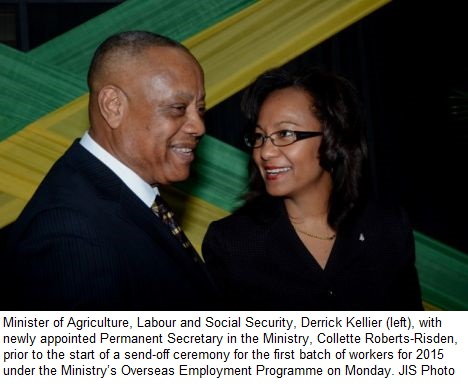
CU Blog - Jamaica-Canada employment programme pumps millions into local economy - Photo 1KINGSTON, Jamaica (JIS) — Remittance inflows from the Jamaica-Canada employment programme contributed Cdn$15.5 million (approximately JA$1.7 billion) to the Jamaican economy during 2014.

This was disclosed by Minister of Agriculture, Labour and Social Security, Derrick Kellier, who noted that the programme, which is a vital source of foreign exchange remittances, “continues to be a beacon of hope and opportunity for thousands of Jamaicans.”

The minister was speaking at a send-off ceremony for the first batch of farm workers for 2015 under the ministry’s overseas employment programme in Kingston on Monday.

Kellier further noted that, during 2014, approximately 7,952 Jamaicans benefitted from employment opportunities in Canada.

“The farm work component accounted for 90 percent (7,156) of this number, while the others travelled under the low skill and skilled worker programmes,” he said.
A total of 340 workers, selected under the Canadian seasonal agricultural workers programme, were due to depart the island on Monday to take up employment opportunities on various farms in Ontario, Canada.
This batch of all males, most of whom will do eight-month stints, will be employed in greenhouse crop production, food processing, tobacco plants as well as nurseries which are involved in the cultivation of various vegetables. They will also be engaged in packaging tobacco and fruits for shipment.

The minister noted that 20 percent of the workers are new employees, while the remaining 80 percent are ‘returnees’ or requested workers, noting that “this is a testament to the hard and dedicated work provided by Jamaican workers abroad.”

He implored the new cohort to continue being professional while on the job, so that the programme can be expanded to provide opportunities for more unemployed Jamaicans.

“I am urging you too, to observe regulations as much as possible for your safety and health. I advise you all not to breach rules (such as absence without leave), which will disqualify you and other Jamaicans in the future,” he said.

The minister reminded the workers that the Overseas Employment Family Services Unit will continue to focus on the welfare of their families through a range of social interventions, including household visits, referrals for assistance, care for the sick and injured, care of children and self-empowerment programmes.
Caribbean News Now – Regional News Source (Retrieved 01/08/2015) –
http://www.caribbeannewsnow.com/topstory-Jamaica-Canada-employment-programme-pumps-millions-into-local-economy-24290.html

Jamaica has one of the highest rates of societal abandonment in the Caribbean. In a previous blog commentary, it was revealed that the Caribbean loses more than 70 percent of the tertiary educated to brain drain, but Jamaica’s rate is at 85%; (plus 35% of the secondary educated population leaves). This Foreign Guest Worker program, in the foregoing article, seems to be a “double down” on the itinerant Jamaican strategy. Imagine the analogy of a teenage runaway leaving his family behind; then when the parents finally discover that prodigal’s son’s whereabouts, they send another child to join them, rather than encourage a return home and a plea to prosper and be planted at home. The people of Jamaica deserves better.

As revealed in the foregoing article, the Government of Jamaica is counting on the short-term benefits, the remittances of these guest workers back to the homeland; they seem unaware and unconcerned for the mid-term and long-term well-being of Jamaica and Jamaicans. The fears and threats is that Guest Workers will mix-and-mingle with people in the host countries, establish new personal-family ties and relocate permanently, as legal migrants. In addition, there should be the concern that pregnant spouses left behind would travel to visit their husbands, just in time to give birthin Canada, availing the birth-right privileges of that country. Just that easily, one family’s next generation would not be Jamaica-based, but pursue a life in the Diaspora community instead, “fattening frogs for snake”.

The Caribbean Diaspora amounts to 10 million people, compared to 42 million residents in the region; Jamaica population is listed at 2,825,928 people (2010), but their Diaspora is estimated at follows (http://en.wikipedia.org/wiki/Jamaican_diaspora):

US:          740,000
Canada: 257,000
UK:         800,000
Total:    1,797,000

In addition, there is a report that there are 100,000 illegal Jamaicans in the US alone.

Legal or not legal, a great measurement of the economic activity of this diasporic population is their remittance activity. A previous blog reported that Jamaica has been experiencing 5.3% annual growth rate in the amount of remittances transferred to the island.

Change has come to the region! The forgoing article describes a negative ethos that the new Caribbean planners want to break from.

The Go Lean book describes that the CU will assume the role and responsibility to empower the regional economy and facilitate trade, not just “count the money” in remittance activity. The following 3 prime directives are explored in full details in the roadmap:

  • Optimization of the economic engines in order to grow the regional economy to $800 Billion & create 2.2 million new jobs.
  • Establishment of a security apparatus to protect the resultant economic engines.
  • Improve Caribbean governance to support these engines.

A mission of the CU is to minimize the need for the Caribbean labor force to migrate to foreign lands for work; and also to invite those that have left, the Diaspora, to repatriate. The Go Lean roadmap features a methodical implementation over a 5 year period, to create more and more local jobs.

Consider the employers described in the foregoing article. They need Guest Workers to facilitate their winter agricultural expressions: greenhouses and incubators. The Go Lean roadmap calls for expanding agricultural production in the Caribbean region – winter crops are opportunistic in their marketability – then exporting the produce to markets like Canada, utilizing strategic concepts for frozen food industries like refrigerated warehouses and refrigerated containers (reefers). Those Canadian stakeholders can be Direct Foreign Investors in the region rather than employers. This approach is better! We still profit more from trade, but keep our human capital at home. This is a win-win.

This sample business model reflects the technocratic approaches being advocated in the roadmap, from top to bottom. This commences with the recognition that all the Caribbean has defective business models, underemployment, and suffering on the wrong side of the globalization divide (producers versus consumers). These acknowledgements are pronounced in the Declaration of Interdependence, (Page 13 & 14). The statements are included as follows:

xix.  Whereas our legacy in recent times is one of societal abandonment, it is imperative that incentives and encouragement be put in place to first dissuade the human flight, and then entice and welcome the return of our Diaspora back to our shores. This repatriation should be effected with the appropriate guards so as not to imperil the lives and securities of the repatriated citizens or the communities they inhabit. The right of repatriation is to be extended to any natural born citizens despite any previous naturalization to foreign sovereignties.

xx.  Whereas the results of our decades of migration created a vibrant Diaspora in foreign lands, the Federation must organize interactions with this population into structured markets. Thus allowing foreign consumption of domestic products, services and media, which is a positive trade impact. These economic activities must not be exploited by others’ profiteering but rather harnessed by Federation resources for efficient repatriations.

xxi.  Whereas the preparation of our labor force can foster opportunities and dictate economic progress for current and future generations, the Federation must ensure that educational and job training opportunities are fully optimized for all residents of all member-states, with no partiality towards any gender or ethnic group. The Federation must recognize and facilitate excellence in many different fields of endeavor, including sciences, languages, arts, music and sports. This responsibility should be executed without incurring the risks of further human flight, as has been the past history.

xxiv.  Whereas a free market economy can be induced and spurred for continuous progress, the Federation must install the controls to better manage aspects of the economy: jobs, inflation, savings rate, investments and other economic principles. Thereby attracting direct foreign investment because of the stability and vibrancy of our economy.

xxv.  Whereas the Caribbean region must have new jobs to empower the engines of the economy and create the income sources for prosperity, and encourage the next generation to forge their dreams right at home, the Federation must therefore foster the development of new industries, like … frozen foods…  In addition, the Federation must invigorate the enterprises related to existing … – impacting the region with more jobs.

xxx.  Whereas the effects of globalization can be felt in every aspect of Caribbean life, from the acquisition of food and clothing, to the ubiquity of ICT, the region cannot only consume, it is imperative that our lands also produce and add to the international community, even if doing so requires some sacrifice and subsidy.

The message now being trumpeted to the Cabinet Member in the foregoing article: No more migrant culture! Already, a new Jamaican – American sub-culture has emerged and is now thriving; see Appendix for a sample of “Jamerican” music. (Once the “genie leaves the bottle”, there is no returning; the “Jamerican” legacies, though appreciative of their Jamaican influences, will perhaps never take up residence in Jamaica).

We want solutions built around staying home, not “renting” our young men to foreign shores. This is a vision for all the Caribbean to embrace, not just Jamaica; it entails confederating the 30 member-states into an integrated “single market”, thereby fostering economic growth to grow the regional economy to $800 Billion (from the 2010 base of $378 Billion). This growth would be the cause-and-effect of 2.2 million new jobs. The following list details the series of community ethos, strategies, tactics, implementations and advocacies necessary to effectuate these empowerments for the region to graduate from this migrant culture, described in the foregoing article:

Community Ethos – Economic Systems Influence Individual Choices Page 21
Community Ethos – Voluntary Trade Creates Local Wealth Page 21
Community Ethos – Consequences of Choices Lie in the Future Page 21
Community Ethos – Job Multiplier Page 22
Community Ethos – Lean Operations Page 24
Community Ethos – Return on Investments Page 24
Community Ethos – Ways to Impact the Future Page 26
Community Ethos – Ways to Help Entrepreneurship Page 28
Strategic – Vision – Integrated Region in a   Single Market Page 45
Strategic – Vision – Encourage Repatriation of   the Diaspora Page 46
Strategic – Vision – Agents of Change Page 57
Tactical – Fostering a Technocracy Page 64
Tactical – Growing to $800 Billion Regional Economy Page 67
Tactical – Separation of Powers Page 71
Tactical – Interstate Commerce Admin – Econometrics Data Analysis Page 79
Implementation – Ways to Pay for Change Page 101
Implementation – Ways to Deliver Page 109
Planning – Big Ideas for the Caribbean Region Page 127
Planning – Lessons Learned from 2008 Page 136
Planning – Ways to Measure Progress Page 147
Advocacy – Ways to Grow the Economy Page 151
Advocacy – Ways to Create Jobs – Feed Ourselves Page 152
Advocacy – Ways to Better Manage Foreign Exchange Page 154
Advocacy – Ways to Better Manage Food Consumption – Agri-Business Page 162
Advocacy – Ways to Improve Governance Page 168
Advocacy – Ways to Improve Leadership Page 171
Advocacy – Ways to Develop a Frozen Food Industry Page 208
Advocacy – Ways to Impact the Diaspora Page 217
Appendix – Job Multipliers Page 259
Appendix – Trade SHIELD – “Strategic“ planning & “Logistical” solutions Page 264

The people of the Caribbean deserve every opportunity to prosper where they are planted. If this is to be the quest, then the region’s leadership should lean-in to this roadmap. One person can make a difference; this fact has been demonstrated time and again. The Go Lean book provides the step-by-step instructions on how to move Caribbean society from the status quo to the desired destination: a better place to live, work and play.

The Go Lean roadmap calls for both “Top-Down” (leadership) and “Bottoms-Up” (popular) movements to effectuate this change. We need better leadership, yes. We also want the people, the common men and women on the streets to demand this change. They do not have to sit and watch their loved one leave their beloved homeland to make a living abroad. We can all prosper right here at home.

No more! Let’s change this culture. This means you Jamaica, and the rest of the Caribbean region.

Now is the time for all of the region, the people and governing institutions, to lean-in for the empowerments of the Caribbean Union Trade Federation. Now is the time for this viable plan to make our homeland the best address in the world.  🙂

Download the book Go Lean … Caribbean – now!

———–

Appendix: Reflection of the New Jamaican Diaspora Culture –  http://youtu.be/t4iRnETnmtw – Born Jamericans – Wherever We Go


Share this post:
, , ,
[Top]

How One Entrepreneur Can Rally a Whole Community

Go Lean Commentary

We introduce the individual Brandi Temple… and declare that one person can make a difference.

This is a consistent theme in the book Go Lean…Caribbean in stressing the economic impact of artistic and entrepreneurial endeavors. The book pledges that Caribbean society can be elevated by improving the eco-system to live, work and play. The subsequent news article (Appendix) and VIDEOs address electronic commerce (e-Commerce) and the fashion/apparel industry; this covers “live” and “work”.

The book Go Lean…Caribbean stress an economic empowerment mandate for a community, that of supplying its own basic needs: food, clothing, shelter and energy. The book is a 370-page roadmap detailing how the Caribbean can elevate its community by leaning-in to these principles. The book therefore serves as a roadmap for the introduction and implementation of the Caribbean Union Trade Federation (CU). This technocratic agency will do the heavy-lifting of executing this roadmap; the prime directives are stated as follows:

  • Optimization of the economic engines in order to grow the regional economy to $800 Billion & create 2.2 million new jobs.
  • Establishment of a security apparatus to protect the resultant economic engines.
  • Improve Caribbean governance to support these engines.

Electronic Commerce is not the future. It is now … in North America and Europe; (even China, with Alibaba, has shown a lot of advances in this industry). Many innovators have exploited the opportunities associated with the expression “early bird gets the worm”. But now everyone has arrived to this marketplace. We now need our own version of “early bird” innovators to stand-up in the Caribbean.

The message that one person, a role model, can make a difference in transforming a community is echoed loud-and-clear in previous blogs/commentaries, the underlying Go Lean book and this news VIDEO here:

VIDEO 1: Published on Aug 31, 2014 – Stay-at-home mom Brandi Temple turns her sewing machine into a million dollar business, Lolly Wolly Doodle. – http://youtu.be/KSf8MvfQHw8

The Go Lean roadmap declares that the region needs “all hands on deck”, stressing the mission of creating jobs in the areas of Science, Technology, Engineering and Medicine (STEM), and also the less-“geeky” areas – like clothing/apparel – that are essential for life. The book relates that many people show genius qualifiers in areas unrelated to STEM, like fashion, music, arts, sports and media endeavors. This point is pronounced early in the following statements in the book’s Declaration of Interdependence (Pages 13 & 14):

xxi. Whereas the preparation of our labor force can foster opportunities and dictate economic progress for current and future generations, the Federation must ensure that educational and job training opportunities are fully optimized for all residents of all member-states, with no partiality towards any gender or ethnic group. The Federation must recognize and facilitate excellence in many different fields of endeavor, including sciences, languages, arts, music and sports. This responsibility should be executed without incurring the risks of further human flight, as has been the past history.

xxx. Whereas the effects of globalization can be felt in every aspect of Caribbean life, from the acquisition of food and clothing, to the ubiquity of ICT, the region cannot only consume, it is imperative that our lands also produce and add to the international community, even if doing so requires some sacrifice and subsidy.

xxxii. Whereas the cultural arts and music of the region are germane to the quality of Caribbean life, and the international appreciation of Caribbean life, the Federation must implement the support systems to teach, encourage, incentivize, monetize and promote the related industries for the arts [i.e. fashion] … in domestic and foreign markets. These endeavors will make the Caribbean a better place to live, work and play.

There are economic and change considerations with this subject and news article (Appendix). This is also a lesson in e-Commerce. How, what, why, when can a company market their wares via electronic and social media portals? This role model of Brandi Temple also provides detail guidance for fostering this market approach. See VIDEO here:

VIDEO 2: 7 Secrets to Growing Your Business on Social Media | Inc. Magazine – http://youtu.be/jOI1pyMHgMM

Published on May 30, 2014 Brandi Temple, founder of Lolly Wolly Doodle, explains exactly how she achieved massive success selling kids clothes on social media.

The Go Lean roadmap accepts that change has come to the marketplace. This is due mostly to the convergence of Internet & Communications Technology (ICT) and electronic payment options. The book posits that size no longer matters, that from any location, innovative design and creations can be promoted to an appreciative audience. The first requirement is the community ethos of valuing intellectual property. This ethos would be new for the Caribbean market; it is therefore a mission of the CU to forge.

The Go Lean/CU roadmap details the empowerments needed for progress in this industry. With these efforts and investments by the people and institutions of the region, the returns will be undeniable. The book posits that the technocratic facilitations may be too big for any one Caribbean member-state to invest alone, rather the collaboration efforts of the CU is necessary, as the strategy is to confederate all the 30 member-states of the Caribbean despite their language and legacy, into an integrated “single market”, allowing better leverage of supply and demand.

The CU is designed to do the heavy-lifting of organizing and optimizing Caribbean delivery systems; we need clothiers, like Lolly Wolly Doodle… to provide for all citizens: babies, toddlers, children, teenagers (school uniforms), and adults (work uniforms). The following list details the ethos, strategies, tactics, implementations and advocacies to foster this industry:

Community   Ethos – Forging Change Page 20
Community Ethos – Lean Operations Page 24
Community Ethos – Return on Investments Page 24
Community Ethos – Ways to Foster Genius Page 27
Community Ethos – Help Entrepreneurship Page 28
Community Ethos – Promote Intellectual Property Page 29
Anecdote – Valedictorian Experience Page 38
Strategy – Strategy – Caribbean Vision Page 45
Strategy – Agents of Change – Globalization Page 57
Tactical – Separation of Powers – Central Bank – e-Payment Deployments Page 73
Tactical – Separation of Powers – Patent, Standards, and Copyrights Page 78
Tactical – Separation of Powers – Interstate Trade Page 79
Implementation – Ways to Impact Social Media Page 111
Planning – Ways to Make the Caribbean Better Page 131
Planning – Lessons from New York City: Fashion Page 137
Advocacy – Ways to Measure Progress Page 147
Advocacy – Ways to Grow the Economy Page 151
Advocacy – Ways to Create Jobs Page 152
Advocacy – Education – Online Job Training Page 159
Advocacy – Ways to Better Provide Clothing Page 163
Advocacy – Better Manage the Social Contract Page 170
Anecdote – Caribbean Industrialist: Butch Stewart Page 187
Advocacy – Reforms for Banking: e-Payments Page 199
Advocacy – Impact Main Street: Big Box Stores Page 201
Advocacy – Ways to Foster Technology Page 203
Advocacy – Ways to Foster Electronic Commerce Page 204
Advocacy – Anti-Poverty – Entrepreneurial Values Page 222
Advocacy – Empower Women Seamstress Jobs Page 226
Advocacy – Ways to Impact the Arts and Fashion Page 230
Appendix – New York Model Fashion-related Jobs Page 277
Appendix – Job Multipliers Page 259

Considering the experience of Brandi Temple in the appending news article and foregoing VIDEOs, the Go Lean roadmap asserts that one man, or woman, can make a difference in the quest to elevate Caribbean society. We want to foster any genius qualifiers found within the region. This refers to the “apparel design” of Brandi Temple’s firm or their website design genius or their marketing prowess. There is a need for many contributors.

The point of one person, role models, making a difference in transforming a community has been frequently conveyed in previous blogs/commentaries. Consider this sample here:

Role Model Shaking Up the World of Cancer
Caribbean Fashion Role Model – Oscar De La Renta – RIP
e-Commerce Role Model Jack Ma brings Alibaba to America
The Lion King’s Julie Taymor – Role Model for the Arts
Role Model Berry Gordy – No Town Like Motown
Bob Marley: The Role Model’s legend lives on!

The Go Lean/CU roadmap represents the change that has come to the Caribbean. The people, institutions and governance of the region are all urged to “lean-in” to this roadmap for empowerment. We know there are “new Brandi Temples” in our region, throughout the Caribbean member-states. They are waiting to be fostered; we are waiting to nurture them – all for the Greater Good.  🙂

Download Go Lean … Caribbean – now!

Appendix: Inc Magazine Profile of Lolly Wolly Doodle

(Though not the norm, due to it’s length, this news article here reporting on Brandi Temple’s entrepreneurism is presented as an Appendix to this blog/commentary.)

Inc. Magazine – Small Business & Entrepreneur Monthly (Posted June 2014; retrieved 12-21-2014) –
http://www.inc.com/magazine/201406/tom-foster/lolly-wolly-doodle-explosive-growth-from-facebook-sales.html
By: Tom Foster, Editor-at-Large
Title: The Startup That Conquered Facebook Sales
Sub-title: How a small-town manufacturer became the hottest seller on social media.

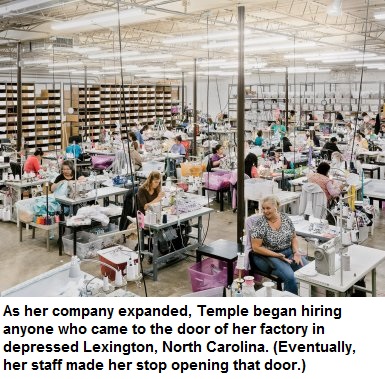
CU Blog - How One Entrepreneur Can Rally a Whole Community - Photo 2In a squat little structure overlooking a highway access road in Lexington, North Carolina, smack in the hilly, pork-loving Piedmont region, a revolution is brewing. There’s no sign on the building but a piece of paper taped to the door: LOLLY WOLLY DOODLE, it says, as if in some Southern code. Lolly Wolly Doodle. That’s the name of an unassuming online children’s clothing company started by Brandi Temple, a likable local mom who had never held a corporate job when she started posting her homemade dresses on the Web five years ago–then managed to seize one of the Holy Grails of online sales.

Over the past year or so, Lolly Wolly Doodle has become the envy of the e-commerce establishment, and the story of this nice lady in Lexington has become something of a viral legend. At a time when big brands are trying (and mostly failing) to harness social media to goose business, the story goes, an unheard-of startup out in the sticks has cracked the code on social commerce. Behind that little piece of paper on the door, it turns out, is a company that says it does more sales on Facebook than any other brand in the world. And outsiders seem to agree.

“I have an e-commerce crush on Lolly Wolly Doodle,” says Will Young, the director of Zappos Labs. Young does a lot of public speaking, and he tells the Lolly story every chance he gets. He first heard it at a retail conference in Germany, from an analyst who herself heard it from a venture capitalist in New York. As a rough benchmark for Lolly Wolly Doodle’s social success, Young points out that the company has about 900,000 fans on Facebook, whereas Zappos has 1.5 million. “But their business is a tiny fraction of our size,” he adds. More important, Temple’s fans are delivering: “Lolly,” says Young, “has been able to do something that no big brand has been able to do, which is to convince people to actually buy on Facebook.”

Lolly Wolly Doodle brought in about $11 million in 2013, and it has roughly doubled its revenue every year since its inception in 2009. It expects revenue to double again this year. Last June, Revolution Growth, a fund started by AOL co-founder Steve Case, invested $20 million in the company, and (of course) aims to make it a multibillion-dollar brand. The size of Case’s investment–and a look at how Temple’s business will probably evolve–suggests that Lolly has done more than solve the social-commerce conundrum. Along the way, Temple has created an innovative U.S.-based manufacturing process and supply chain that feed off the brand’s social-media cues to maximize efficiency. That mechanism seems likely to be adaptable to any number of products and services. Unlikely as it may seem, Temple’s company may just represent the beginning of the next e-commerce revolution.

Temple didn’t plan on becoming a CEO. “Really, I wanted to be a trophy wife,” she says, laughing at her former self. “I wanted to support a great husband and look cute.” This strategy led her to marry and have a son in her 20’s (the marriage ended in divorce), then to move to Orlando, where she got engaged again and had a daughter with Fran Papasedero, the coach of the Orlando Predators arena football team.

One night, on his way home from a team dinner, Papasedero crashed his car and died, apparently as a result of driving drunk. Temple moved back to Lexington, where her family has lived for generations. Within a few months, she met Will Temple, her current husband, and they combined their two families, Brady Bunch-style (he had a son from a previous relationship). Brandi and Will had a daughter, and life settled into a nice groove, with her as a stay-at-home mom while he made a good living selling bulldozers and other heavy equipment for the construction business.

The company Will worked for thrived during the housing boom of the mid-2000s, but over the course of 2009, the construction business stalled, and the couple watched Will’s earnings drop by half. Brandi, meanwhile, had started sewing clothes for her two daughters, who were five years apart, much as her mom and grandmother had done for her. The clothes had a certain ruffled, matchy Southern charm: “I wanted something that was cute for church that didn’t cost an arm and a leg, and I wanted to be able to monogram it,” she says. “I wanted the kids to look wholesome and look their age.” Not the mini-sexpot styles offered by many major brands, in other words. She also refused to pay the $80 charged by specialty boutiques that did stock the right styles.

Temple’s parents had never had much money and raised her to be thrifty (“I was born with a silver-plated spoon,” as she puts it), so she quickly grew frustrated with the fabric left over after making her daughters’ dresses. She figured she could post her finished garments on eBay as samples and offer to make more, on demand, in a size range that would use up all her remnants. The idea worked, and within a few months she found that she couldn’t keep up with demand, so she enlisted her family members and friends from church to help with cutting and sewing. She started to show her garments at Junior League events and began to establish a small following for Lolly Wolly Doodle. (About that name: It’s a nickname Temple once gave her niece, a twist on the old children’s song.)

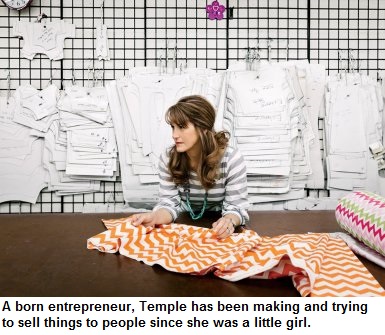
But Temple isn’t one to dabble. “Anything I’ve ever done, I go over the top,” she says. “I can’t just pick up a book and start reading it, because I’ll stay up all night and keep reading.” Despite her best efforts at being a full-time homemaker, she’s also a born entrepreneur who had been trying to make and sell things to people since she was a little girl–friendship bracelets, pages from her coloring books. Now, as Will’s business dwindled, she started taking Lolly Wolly Doodle seriously.

One day, looking to scale her fledgling business, Temple tried having a company in China that she had found through the website Alibaba make a few dresses based on one of her patterns. When they came in, the dresses weren’t perfect–the smocked zebras looked more like cows, and the sewing wasn’t up to her standards. Wary of getting bad feedback on eBay, she posted the pieces on Lolly’s Facebook page and asked people to comment and leave their email address if they wanted to buy them cheap; she would just send them a PayPal invoice. She had 153 Facebook fans, mostly Junior League contacts.

“I walked away from the computer and came back in like 30 seconds, and all the dresses were gone!” she remembers. That afternoon, she tested a few other designs on Facebook, offering to make them to order, just as she had been doing on eBay. She had never seen anyone sell anything this way (no one had), and didn’t really understand how Facebook worked. She never used the social network, personally. But she sold more that first day on the site than she had in the previous month on eBay.

Temple closed her eBay store a few weeks later, and over the next six months, she says, she slept two hours a night and made as many dresses as she could to keep up with the demand. She filled her garage with friends-and-family seamstresses. By day, they would sew dresses and boys’ rompers and post them on Facebook and take orders. At night, they would send out invoices and ship product. Everybody pitched in. Will learned to monogram. Brandi’s dad would cook a family meal, and everybody would sit around the kitchen working late into the night.

Late in 2010, JCPenney opened the world’s first Facebook store from a major retailer–a separate, shoppable tab on its Facebook page–and many other retailers followed suit. So-called F-commerce was hailed as a potential Amazon killer in the press, but nothing happened. Within a year, all those social stores started to quietly shut down. “It was like trying to sell stuff to people while they’re hanging out with their friends at the bar,” Forrester online retail analyst Sucharita Mulpuru said at the time.

Temple’s Facebook business, on the other hand, was thriving. The reason was simple. Because her sales appeared in people’s regular News Feeds, alongside posts from their friends, and because buying an item required nothing more than entering a quick comment (with an email address, size, quantity, and customization request) then paying an invoice later, people were able to make impulse purchases. (See, “How a Small-Town Manufacturer Predicts Hits With Facebook”.) It was actually the opposite of what Mulpuru said: JCPenney’s store wasn’t asking people to shop at the bar; it was asking people to leave the bar and go to another tab, whereas Temple was essentially setting up trunk shows in the bar. And thanks to Facebook’s network effect, she didn’t have to spend a dime on marketing; her customers’ comments on the Facebook News Feed showed up on their friends’ News Feeds, and the community grew organically.

It wasn’t just Facebook that made it a good business. Temple was making each dress to order, so she had virtually no inventory risk. She could also react quickly to customer preferences, tailoring her designs accordingly. And because she was selling her goods directly to consumers, she was able to cut out layers of markups and offer great prices. If a particular dress sold well one day, she would post a similar one the next. This kept the sewing process simple–she didn’t have to reinvent her patterns, just riff on them–and eliminated much of the guesswork of merchandising. “When something went crazy, I would go really deep into that style and those colors,” she says. “And if it didn’t, then forget it. I didn’t make it again. We would fill whatever orders we got and move on to something else.” Those same dynamics power the business today.

Around mid-2010, though, everything almost ended. Will came home from work one day and said he was about to be laid off. Brandi, meanwhile, says she “hit a wall. I couldn’t do another thing. I knew this was a great business, but it was way beyond what I could keep doing in my garage.” Her first instinct was to sell the company. She plucked a number out of thin air–a million dollars–because it sounded like a lot of money and would buy the family enough time to get them through Will’s unemployment. She called a friend of a friend who was a banker in Charlotte and asked him if he could help line up buyers, and he called back a few days later suggesting she call an investor named Shana Fisher.

Fisher, a New Yorker, had become known for her knack as a deal hunter when she ran mergers and acquisitions for Barry Diller’s IAC. She had recently started her own venture capital firm, High Line Venture Partners, and has since been among the earliest investors in MakerBot, Vine, and Pinterest, and other star startups.

“Don’t you dare sell this company,” Fisher said over the phone, as Temple sat on the floor in the bathroom, trying to shut out the noise of her kids from the next room. “Let me invest, and let’s grow this business. You don’t realize what you’ve done.”

Temple had never run a business, aside from running a short-lived day spa she had opened in Lexington a few years earlier. Despite having built Lolly from scratch, she had no idea how to place a value on the company. “I was like, ‘If you’re telling me this is not worth $1 million but maybe $5 million, that’s interesting,’ ” Temple said.

Fisher laughed. “We wouldn’t be having this conversation if I thought this company were worth $5 million.” If they could keep expanding Lolly’s community, it could become a $50 million or $100 million business, she explained (let alone the much larger number Revolution Growth would love to see). Fisher invested $100,000 in the young company, and a few months later helped Temple line up a $1.4 million seed round of financing. Temple moved the operation out of the garage into a 4,000-square-foot former tire warehouse in Lexington and started hiring.

A town of antique stores and decaying red-brick factories, Lexington is a former textile and manufacturing hub, and it had fallen on hard times. Over the previous 10 years, many of the area’s manufacturing jobs had moved to China, and the recession had made things all the worse. Local unemployment hit 14 percent in early 2010.

That fall, Temple answered a knock on the unmarked office door and found an elderly woman standing there. “I don’t know what you do in there, but are you hiring?” the woman asked. She was 72 years old, and her name was–almost inevitably–Miss Daisy. Through tears, she explained that her husband had a heart condition and they could no longer afford his medication. “We’ve lost everything, and I just need a job really bad,” she said.

Miss Daisy had never worked as a seamstress and had little or no experience cutting and sewing, but Temple agreed to hire and train her because she needed as many hands as she could get. Word got around Lexington that a new company had jobs, and one after another, people started showing up at the door asking for work. “Person after person, they’d tell the same story,” Temple remembers. “I’ve lost my house, I’ve lost my car; what can I do?” She hired them all.

CU Blog - How One Entrepreneur Can Rally a Whole Community - Photo 1Temple tells this story in her bright, pastel-green office in one of the four buildings that now house the company. A 20,000-square-foot former medical-equipment warehouse, the headquarters facility opened in early 2012 after the state of North Carolina agreed to pay for half of the cost of buying and renovating it, to help boost job creation in the region. Manufacturing and design happen here, and next door a smaller building houses the company’s photo studio. Across town sits an 80,000-square-foot warehouse and shipping hub. With about 250 employees, Lolly Wolly Doodle is now one of the largest employers in Lexington. At the rate it’s growing, it could soon be the largest.

Increasingly, however, Lolly is not a local operation: The fourth location is in New York City, and a cadre of experienced retail and technology hands have climbed aboard, many recruited with the help of Shana Fisher. The COO, Emily Hickey, was a co-founder of the business-networking service Hashable and, earlier, a VP at HotJobs. The former e-commerce chief at Quidsi, the parent company of Diapers.com, now heads up Lolly’s New York tech team. Recently, John Singleton, a former JCPenney and Abercrombie & Fitch executive, came on to build better supply chain and manufacturing processes. “Brandi is recruiting some of the very best people in the world,” says Donn Davis, the co-founder of Revolution Growth and a member of Lolly’s board since his firm’s $20 million investment last year. “Most of the time, those people’s first reactions are like mine when I heard about the company. It’s called what? It’s where? It sells what? Then they see what the company is doing, and they say, ‘Wait, everybody is talking about trying to figure this out, but you’re already doing it.’ ”

What Temple is really doing, says Davis, is “reinventing apparel much as Dell reinvented the PC industry. It’s affordable custom [manufacturing] in real time with little inventory risk.” Davis sees Lolly’s Facebook commerce as an important tactic that kick-started the company, but it’s just that: a tactic. The real innovation is using social media as the starting point for a new e-commerce model that’s powered by a social feedback loop.

The cycle works like this: First, the company makes a sample product and puts it up on Facebook or another social platform for sale (the company is expanding to Instagram and will leverage Pinterest and other platforms soon). Then it makes only the sizes that people order, so there’s no overstock. The company compares sales of that product with past styles and decides if it’s a winner. If it is, two things happen: One, Lolly can mass-produce it and keep some of it on hand for sale on its own site, LollyWollyDoodle.com (even those garments are customizable with monograms and other touches, so customers are always getting something unique). Two, a winning design can become the basis for a new product “pod,” an ever-expanding collection built on that template; new iterations might be tweaked with different fabrics or necklines or ruffles, but there’s a limited palette of tweaks for any given pod, keeping manufacturing complexity to a minimum.

As the company cycles through this feedback loop, it amasses ever more data about what works, so that it can make smart design decisions and configure its operations accordingly. Social commerce, in other words, is not just about virality but also about predictive analytics. The company introduces about 15 new product SKUs every day, and one of the biggest priorities this year is to finish building custom software that better structures the design and sales data and allows the supply chain, cutting and sewing operations, and warehouse to be reorganized so that each piece of fabric moves through production as efficiently as possible.

If traditional garment manufacturing is a pretty straightforward assembly-line affair, the seamstresses at Lolly work more like short-order cooks in a diner where the menu changes daily. In one room, a dozen people cut fabric according to order tickets that flow through in real time–15 size-2 aqua chevron Charlotte dresses here, a single size-6 salmon Ruffle dress there. On the sewing floor, efficiency comes from how the orders are bundled (not necessarily by garment or size but, because many items share attributes, by the type of sewing required) and minimizing how many people or machines have to touch a garment. That information then informs the design process for new garments. A made-to-order dress now takes two weeks to land on a customer’s doorstep; Temple hopes to shave that down to a week.

Hickey, the COO, calls Lolly Wolly Doodle a “fast-fashion” company, referring to the category of retailers, epitomized by the Spanish chain Zara, that constantly refresh their product lines according to trends and sell at low prices, with low margins. Fast fashion is largely immune to the slow seasonal cycles that drive traditional fashion companies–which inevitably have to rely on deep discounts to move unsold inventory–but it requires nimble manufacturing that can take on small product runs and constantly adapt to demand signals. When companies rely on remote mega-factories, they have much less control. “It’s no small coincidence that Zara is not made in China,” says Forrester’s Mulpuru. “It’s no coincidence that Lolly Wolly Doodle is made in the U.S.

Well, partly. Lolly Wolly Doodle these days outsources about 30 percent of its manufacturing to China and Latin America, but those garments are all the proven winners that emerge from the U.S.-made small runs that first appear on Facebook and the Lolly site. The Lexington warehouse has racks of premade blanks that were made overseas and await monogramming or other customization before being shipped.

“There’s still going to be a level of imprecision in that system,” Mulpuru cautions. “There are all kinds of early demand indicators that could be wrong. But your chances of picking a hit are going to be better, and you will have fewer markdowns.” She finds it “truly baffling” that more companies haven’t “got their heads out of their asses” and adopted a similar model to predict and make hits.

Larger companies may not have caught on yet, but there are certainly Lolly imitators. In early 2012, a San Francisco entrepreneur named Chris Bennett heard Temple’s story right around the time he was looking to start a new company. Called Soldsie, Bennett’s new technology platform helps other entrepreneurs start businesses based on the Lolly Wolly Doodle model by handling all the order processing for them. “Lolly was really the light bulb moment,” for him he admits. “I read an old news story [from a local paper in North Carolina] that said they had generated something like $2 million in revenue based on 30,000 fans, and it was just far more volume than I’d seen anyone do with Facebook.” Today, Soldsie has more than 1,000 mostly tiny client companies, but it processes over $1 million in transactions every month, and Bennett says he’ll announce partnerships with several “huge” brands this summer.

Lolly, meanwhile, hopes to become a huge brand using the model. Davis, of Revolution Growth, thinks the company has created a template that it can ultimately apply far beyond children’s clothes. “Kids’ apparel, age 0 to 8, is a $10 billion market,” he says. “So the first step is to become the leading company there. And the second step is…to add new brands on top of it that go into other segments.” That means men’s and women’s clothes, home goods, and beyond.

Temple still marvels at how she has arrived at this point. She has “been blessed,” she likes to say, and at one point I ask her how much her faith has been a part of Lolly’s success story. “It is the story,” she says. “That moment I had the idea to put something on Facebook….” She chokes up and has to collect herself. “That idea didn’t come from me. God had a purpose in reaching out to build this business. From our missions in Africa to our Moms in a Jam”–two of the company’s recent philanthropic efforts–“to the people we employ, it’s not about me creating a business. It was about what we could all do together, the pay-it-forward mentality.”

The moment hangs there for a second, and she makes a self-deprecating joke about God’s sense of humor: Why would He choose her? Then she sits up straight and starts talking about the virtues of a vertically integrated supply chain, how to create authentic interaction on social media, the importance of Hickey, her COO (“She can never leave. I will hunt her down; I’m Southern enough”), quality control in China, her insistence on approving every design before it posts…. “We don’t even think about competition,” she says. “We are our only competition.”

Share this post:
, ,
[Top]

Haiti to Receive $70 Million Grant to Expand Caracol Industrial Park

Go Lean Commentary

The book Go Lean … Caribbean introduces the terminology of Self-Governing Entities (SGE), but the concept already exists within the Caribbean. According to the following news article, these sites can be very impactful. In this case it is an industrial park in Haiti, but other versions exists:

Free Trade Zones
Technology Bases
Education and Research Campuses
Foreign Military Bases – i.e. Guantanamo Bay in Cuba; AUTEC in Andros, Bahamas
Aerotropolis
– Airport Cities – like the ones with US Pre-Clearance Facilities in Aruba, Bahamas and Bermuda

The book Go Lean…Caribbean serves as a roadmap for the introduction and implementation of the Caribbean Union Trade Federation (CU) to provide a structure for multiple versions of SGE’s throughout the region. The book describes how these bordered site-zone-park-base-campus locales can function as economic engines for their host communities by transcending local limitations and administration.

This approach (strategy, tactic and implementation) represents the basis for change in the region, similar to how the Caracol Industrial Park has impacted change in Cap Haitien (Northern Haiti). The story here speaks to expansions of the Caracol site:

By: The Caribbean Journal staff

CU Blog - Haiti to Expand Caracol Industrial Park - Photo 1Haiti will be receiving $70 million in grant funding to expand its business facilities at the Caracol Industrial Park in the north of the country.

The funding is coming in the amount of $55 million from the Inter-American Development Bank, co-financed by the US government to the tune of $15 million.

The aim of the funding is to expand facilities and “create above-board jobs” in northern Haiti.

The programme aims to create 6,800 jobs by 2018 in companies operating out of the industrial park, according to the IDB, with 65 percent held by women.

The focus of the financing will be on the construction of buildings and factories for industrial activities, the IDB said, along with the expansion of roads and public services.
Caribbean Journal Regional News Service  (Posted 12-12-2014; retrieved 12-18-2014) –
http://www.caribjournal.com/2014/12/12/haiti-to-receive-70-million-grant-to-expand-caracol-industrial-park/#

This Caracol project initiated with no help from the CU/Go Lean promoters, but the actuality of this project provided a lot of lessons learned … and a new commitment for best practices in these types of endeavors in the future; see “Highs and Lows of Caracol”  experiences in the Appendix below.

The economic impacts of SGE’s are undeniable. A previous Go Lean blog related how one SGE in Orlando Florida contributes $18.2 billion in annual economic activity to that State. The Go Lean roadmap seeks to now emulate the strategic, tacticals and implementation successes of SGE’s of other countries in the 30 Caribbean member-states. (The CU may have no jurisdictions of existing SGE-like facilities except for marshalling economic crimes for the region). The roadmap seeks to elevate the region with economic engines (direct and indirect spin-off activities), by assuming jurisdiction for new Self-Governing Entities in the region and the Exclusive Economic Zone (EEZ) of the 1,063,000 square miles of the Caribbean Sea. This approach allows for initiation, cooperation and coordination of SGE’s and the EEZ to effectuate change in the region, allowing these 3 prime directives:

  • Optimization of the economic engines in order to grow the regional economy to $800 Billion GDP and create 2.2 million new jobs.
  • Establishment of a security apparatus to protect the resultant economic engines, specifically in SGE’s and the EEZ.
  • Improve Caribbean governance to support these engines, with a separation-of-powers and SGE exclusivity.

Since the Go Lean book posits that one person can make a difference and positively impact society, the book advocates for a community ethos of investment in the “gifts” that individuals (domestic and foreign) “bring to the table”. The book identifies the quality of geniuses and relates worthwhile returns from their investments. This mode of study allows us to consider this example of contributions from many artists, scientists, industrialists and philanthropists around the world and their corporate/artistic creations. Re-consider this point from these previous Go Lean blog/commentaries:

https://goleancaribbean.com/blog/?p=3276 Role Model Shaking Up the World of Cancer; Perfect for SGE Application
https://goleancaribbean.com/blog/?p=2750 Disney World – Role Model for Self Governing Entities
https://goleancaribbean.com/blog/?p=2670 A Lesson in History: Rockefeller’s Pipeline – A Glimpse for SGEs
https://goleancaribbean.com/blog/?p=2338 Using SGE’s to Welcome the Dreaded ‘Plutocracy’
https://goleancaribbean.com/blog/?p=2003 Where the Jobs Are – Ship-breaking under SGE Structure
https://goleancaribbean.com/blog/?p=1214 Fairgrounds as SGEs and Landlords for Sports Leagues
https://goleancaribbean.com/blog/?p=286 Puerto Rico’s Comprehensive Cancer Center Project Breaks Ground – Model of Medical SGEs

The book Go Lean … Caribbean asserts that SGE’s and the EEZ can be strategic, tactical and operationally efficient for elevating Caribbean society. These points are pronounced early in the book with this Declaration of Interdependence (Pages 11 and 14), with these statements:

v.      Whereas the natural formation of our landmass and coastlines entail a large portion of waterscapes, the reality of management of our interior calls for extended oversight of the waterways between the islands. The internationally accepted 12-mile limits for national borders must be extended by International Tribunals to encompass the areas in between islands. The individual states must maintain their 12-mile borders while the sovereignty of this expanded area, the Exclusive Economic Zone, must be vested in the accedence of this Federation.

xxvi.    Whereas the Caribbean region must have new jobs to empower the engines of the economy and create the income sources for prosperity, and encourage the next generation to forge their dreams right at home, the Federation must therefore foster the development of new industries… In addition, the Federation must invigorate the enterprises related to existing industries like tourism … impacting the region with more jobs.

The Go Lean book itself details the economic principles and community ethos to adopt, plus the executions of strategies, tactics, implementations and advocacies to forge Self-Governing Entities and industrial growth in the Caribbean:

Economic Principles – People Choose because Resources are Limited Page 21
Economic Principles – All Choices Involve Costs Page 21
Economic Principles – People Respond to Incentives Page 21
Economic Principles – Economic Systems Influence Individual Choices Page 21
Economic Principles – Voluntary Trade Creates Wealth Page 21
Economic Principles – Consequences of Choices Lie in the Future Page 21
Community Ethos – Job Multiplier Page 22
Community Ethos – “Crap” Happens Page 23
Community Ethos – Lean Operations Page 24
Community Ethos – Return on Investments (ROI) Page 24
Community Ethos – Cooperatives Page 25
Community Ethos – Ways to Impact the Future Page 26
Community Ethos – Ways to Foster Genius Page 27
Community Ethos – Ways to Help Entrepreneurship Page 28
Community Ethos – Ways to Impact Research & Development Page 30
Community Ethos – Ways to Improve Negotiations Page 32
Community Ethos – Impact the Greater Good Page 37
Strategy – Vision – Confederating 30 Member-states in a Union Page 45
Strategy – Mission – Build and Foster Local Economic Engines Page 45
Tactical – Fostering a Technocracy Page 64
Tactical – Growing Economy – New High Multiplier Industries Page 68
Separation of Powers – Department of State – Self-Governing   Entities Page 80
Separation of Powers – Interior Department – Exclusive Economic Zone Page 82
Implementation – Ways to Pay for Change – SGE Licenses Page 101
Implementation – Steps to Implement Self-Governing Entities Page 103
Anecdote – French Guiana Space Agency – Example of a SGE Page 103
Implementation – Benefits from the Exclusive Economic Zone Page 104
Planning – 10 Big Ideas – Self-Governing Entities Page 127
Planning – Ways to Improve Trade Page 128
Advocacy – Ways to Grow the Economy Page 151
Advocacy – Ways to Create Jobs Page 152
Advocacy – Ways to Better Manage Natural Resources – EEZ and SGE’s Page 183
Anecdote – Caribbean Industrialist & Entrepreneur Role Model Page 189
Advocacy – Ways to Promote Fairgrounds Page 192
Advocacy – Ways to Develop Ship-Building as SGE’s Page 209
Advocacy – Ways to Impact the Prison Industrial Complex as SGE’s Page 211
Advocacy – Ways to Impact the One Percent – Job Creators Inducements Page 224
Advocacy – Ways to Impact Urban Living – Self-Governing Entities Page 234
Advocacy – Ways to Impact Rural Living – Self-Governing Entities Page 235
Advocacy – Ways to Promote World-Heritage-Sites as SGE’s Page 248
Appendix – Airport Cities – Models for Self Governing Entities Page 287

The Go Lean roadmap requires new SGE projects to be negotiated with local and national governments in the affected geographic areas. A project may, or may not, align with community values from one place to another. Does a community cling to egalitarian values or allow individual achiever to rise-and-shine? The Go Lean messaging is important in this regard. The quest of the roadmap is to elevate the entire Caribbean, but reality and history shows that some climb the social-economic ladder faster, and some slower, than others. One size does not fit all!

So the Go Lean ethos is clear: there is a role for the contributions of one impactful person, institution or company, in this vision for the elevation and empowerment of the Caribbean homeland. The Go Lean … Caribbean roadmap invites these contributions. See Appendix below of the historic details of the Caracol project; the “good, bad and ugly”; this experience shows how SGE’s can easily impact a community, economically – bring in a lot of jobs; but the experience also shows how there are security and governing issues associated with these projects as well. This is why the Go Lean roadmap posits that there is the need for technocratic oversight for SGE’s.

Will the CU approach eliminate all risks and problems with these type of SGE projects? Of course not; but the CU will facilitate the accountability factors to ensure best practices. Considering the experiences in the Appendix below, will the CU mitigate minimum wage job placements? Again, of course not; wages are a representation of market forces: supply and demand. Citizens in Caribbean communities will have a choice: step into SGE grounds and accept their employment conditions or decline. The demand may be for higher wages to attract a ready work force; or the SGE operator/facilitator may enable its own supply of direct workers; then the community is limited to only indirect/spin-off economic benefits. This is reality of shepherding the Caribbean in a globalized economy. This heavy-lifting is the role of the CU.

Change has come to the Caribbean. All Caribbean stakeholders are hereby urged to lean-in to this win-win roadmap to make the Caribbean a better place to live, work and play.  🙂

Download the book Go Lean…Caribbean now!

———-

Appendix – Caracol Industrial Park – Highs and Lows

Background: In 2012 the Caracol Industrial Park was built on a square mile, 600 acre, 246 hectare, site near Caracol. The $300 million project, which includes a 10-megawatt power plant, road, a water-treatment plant, worker housing in neighboring communities, and development of a port in nearby Fort-Liberté, was built with hurricane relief funds, a loan from the Inter-American Development Bank,[1] contributions by the United States government, and The Clinton Foundation. Bill Clinton and Hillary Clinton, United States Secretary of State, played central roles in supporting and promoting the project. The anchor tenant is SNH Global, S.A, a subsidiary of Sae-A Trading Co. Ltd, Sae-A, a global clothing manufacturer headquartered in South Korea.[2][3] It began operations in the fall of 2012 with an expected work force of 20,000[4]. The eventual workforce is projected to increase to near 65,000 and result in a expansion of population in the area. Social and environmental disruption is anticipated as the result of this hastily-planned project.[3][4]

Source References

  1. “Haiti and its partners lay the foundation stone for the Caracol Industrial Park” (Press release). Inter-American Development Bank. November 28, 2011. Retrieved July 6, 2012.
  2. “New industrial park in Haiti” (Slide 4 of slideshow). The Miami Herald. Retrieved July 6, 2012.
  3. Jacqueline Charles (June 4, 2012). “New industrial park in northern Haiti sparks controversy”. The Miami Herald. Retrieved July 6, 2012.
  4. Deborah Sontag (July 5, 2012). “Earthquake Relief Where Haiti Wasn’t Broken”. The New York Times. Retrieved July 6, 2012.

Highs: Secretary Clinton Delivers Remarks at the Caracol Industrial Park Opening Ceremony – http://youtu.be/lAeMKmo4NEs

Published on Oct 24, 2012 – U.S. Secretary of State Hillary Rodham Clinton delivers remarks at the Caracol Industrial Park Opening Ceremony in Cap Haitien, Haiti on October 22, 2012. [Go to http://video.state.gov for more video and text transcript.]

Lows: The Bill and Hillary Clinton Haiti Debacle: Growing anger over reconstruction efforts – http://youtu.be/_Y53HPzCCtE

Published on May 25, 2014 – The news website Tout Haiti reported last month that two prominent lawyers have petitioned Haiti’s Superior Court of Auditors and Administrative Disputes, demanding an audit of Bill Clinton’s management of the Interim Haiti Recovery Commission (IHRC). There are powerful interests that won’t want to see the petition succeed and it may go nowhere. But the sentiment it expresses is spreading fast. In the immortal words of Charlie Brown, Mr. Clinton has gone from hero to goat.

Four years after a magnitude 7.0 earthquake toppled the capital city of Port-au-Prince and heavily damaged other parts of the country, hundreds of millions of dollars from the State Department’s U.S. Agency for International Development (USAID), allocated to the IHRC, are gone. Hundreds of millions more to the IHRC from international donors have also been spent. Left behind is a mishmash of low quality, poorly thought-out development experiments and half-finished projects

A June 2013 Government Accountability Office report gave a barely passing grade to USAID’s Haiti reconstruction effort. It said $170 million was allocated to build a power plant and a port near the Caracol Industrial Park, not far from Cap-Haïtien. The two projects “are interdependent; each must be completed and remain viable for the other to succeed,” the GAO explained. The first phase of the power plant was completed on time and under budget. But the port construction was delayed by two years “due in part to a lack of USAID expertise in port planning in Haiti.” Projected costs, according to the report, say the estimated shortfall of $117 million to $189 million is larger than originally estimated. “It is unclear whether the Haitian government will be able to find a private sector company willing to finance the remainder of the project.”

(Consider the source: This video/commentary is from Fox News Channel, a notorious right-wing-leaning media source in the US; they have historically reported with an anti-Clinton slant).

Lows: Caracol: Haiti’s miracle of development turns into nightmare of exploitation – http://youtu.be/qg_DSVwmX6s

Published on Oct 22, 2012 – WORKERS AT NEW CARACOL INDUSTRIAL PARK NOT BEING PAID MINIMUM WAGE

Despite the inauguration for the Caracol industrial park happening today, October 22, 2012, the first factory at the new Caracol industrial park in northern Haiti, Sae-A, began operations months ago. The new workers are being paid only 150 gourdes, or $3.75 US (less than $.50 an hour) for nine hours of work.

For months now, several hundered people have been working in the industrial park before the official launch. The employees, the majority of whom are young women, come from all over the region to work. While Secretary of State Hillary Clinton, Haitian government officials and others come together to celebrate the opening of the industrial park, the women who have been working there are calling for just wages and better working conditions.

Share this post:
, , ,
[Top]

Forecast for higher unemployment in Caribbean in 2015

Go Lean Commentary

The quest for jobs is going to get harder. This is the point of the following news article; the regional forecast for the Latin American & Caribbean region is that economic conditions will be distressed even more in 2015.

All hands on deck!

The book Go Lean…Caribbean anticipates creating 2.2 million new jobs … despite those projected distressful conditions; see VIDEO below. The goal is to make the region “a better place to live, work and play”. So all the empowerments and remediation need to be applied now.

The quest to create these jobs will take 60% inspiration – new ideas – and 80% perspiration – hard-work and heavy-lifting. The math of this addition exceeds 100 percent. This is the key: winners give more than 100%. See story here:

Title: ILO report forecasts higher unemployment in Latin America, Caribbean in 2015
unemployment rate lose job loss of social security being joblessBRIDGETOWN, Barbados – A new report by the International Labour Organization (ILO) has found an “unusual pattern” in this year’s urban employment rate in Latin America and the Caribbean, which continued to fall despite warning signs of economic slowdown.

The ILO report titled “Labour Overview for Latin America and the Caribbean 2014,” noted that the region’s urban unemployment rate may reach 6.3 per cent in 2015, which means that there will be some 500,000 more without jobs.

“There are warning signs,” said Elizabeth Tinoco, the ILO’s regional director. “The concern is that we are creating fewer jobs despite unemployment remaining at a low level,” she added.

Although unemployment has not risen due to this slowdown in growth, there has been a sharp reduction of new jobs reflected in the employment rate, which fell by 0.4 percentage points to 55.7 per cent in the third quarter of 2014.

“This means that at least one million (fewer) jobs have been created,” Tinoco said.

The ILO said that this “scenario of uncertainty” comes after a decade in which the region enjoyed significant economic growth. The unemployment rate dipped to record lows and allowed for a higher quality of jobs.

The urban unemployment rate of young people dropped from 14.5 per cent to 14 per cent but still remains between 2 and 4 times higher than that for adults. What’s more, the unemployment rate for women is 30 per cent higher than that for men, and 47 per cent of urban workers work in the informal economy.

“Many people who temporarily left the workforce in 2014 will return to search for a job next year, together with young people entering the labour market. The region will have to create nearly 50 million jobs over the coming decade, just to offset demographic growth,” Tinoco said, adding “we are talking about almost 15 million people unemployed.

“So we have to face the huge challenge of rethinking strategies to push growth and a productive transformation of the economy to foster economic and social inclusion through the labour market,” Tinoco said.

The ILO is calling on countries in the region to prepare for the possibility of a labour market which has to take specific measures to stimulate employment and protect individual incomes.
Caribbean 360 – Online Regional News Source (Posted 12-15-2014; retrieved 12-16-2014) –
http://www.caribbean360.com/news/ilo-report-forecasts-higher-unemployment-latin-america-caribbean-2015

The book Go Lean…Caribbean serves as a roadmap for the introduction and implementation of the technocratic Caribbean Union Trade Federation (CU). The CU is set to optimize Caribbean society, starting with economic empowerment. In fact, the Go Lean roadmap has 3 prime directives:

  • Optimization of the economic engines in order to grow the regional economy to $800 Billion & create 2.2 million new jobs.
  • Establishment of a security apparatus to protect the resultant economic engines.
  • Improve Caribbean governance to support these engines.

The Go Lean roadmap calls for many empowerments, such as the infrastructure of Self-Governing Entities (SGE), to allow for industrial developments in a controlled (bordered) environment. This creates the right climate, entrepreneurial spirit, and access to capital for job-creators to soar. The book starts with a focus on the community ethos of job-creators: protecting property (in this case intellectual property), bridging the digital divide, fostering genius and better managing negotiations.

This strategy is valid for urban areas, as SGE’s can avail the close proximity of a willing work force, and quickly deploy transportation options like electrified streetcars, light-rail, natural gas buses and other transit options.

In response to the dire predictions in the foregoing news article, the fear is that despite the love the Caribbean populations may have for their homeland and culture, they will leave to find work, when none is available locally. This is factual from the past. This actuality has been the “siren call” for this Go Lean book. The foreword of the book thusly states (Page 3):

Many people love their homelands and yet still begrudgingly leave; this is due mainly to the lack of economic opportunities. The Caribbean has tried, strenuously, over the decades, to diversify their economy away from the mono-industrial trappings of tourism, and yet tourism is still the primary driver of the economy. Prudence dictates that the Caribbean nations expand and optimize their tourism products, but also look for other opportunities for economic expansion. The requisite investment of the resources (time, talent, treasuries) for this goal may be too big for any one Caribbean member-state. Rather, shifting the responsibility to a region-wide, professionally-managed, deputized technocracy will result in greater production and greater accountability. This deputized agency is the Caribbean Union Trade Federation (CU). This book advocates that all Caribbean member-states (independent & dependent) lean-in to this plan for confederacy, collaboration and convention.

Populations leaving the islands create a whole new set of problems, for those leaving and those left behind. “The grass is not greener on the other side”; see the VIDEO below of European dire forecast for 2015. The Go Lean roadmap posits that it takes less effort to remediate Caribbean life than to thrive as an alien in some foreign land. This point has been frequently addressed in blog/commentaries, as sampled here:

https://goleancaribbean.com/blog/?p=2547 Miami’s Successful Now after first discriminating against immigrants
https://goleancaribbean.com/blog/?p=2251 What’s In A Name? Discrimination of Hispanics in the US.
https://goleancaribbean.com/blog/?p=2222 Sports Role Model – Playing For Pride … And More
https://goleancaribbean.com/blog/?p=2025 Negative Attitudes & Images of the Caribbean Diaspora in US
https://goleancaribbean.com/blog/?p=1683 British public sector (Afro-Caribbean) workers strike over ‘poverty pay’
https://goleancaribbean.com/blog/?p=1596 Book Review: ‘Prosper Where You Are Planted’
https://goleancaribbean.com/blog/?p=1433 Caribbean loses more than 70 percent of tertiary educated to brain drain
https://goleancaribbean.com/blog/?p=1350 PayPal expands payment services to 10 markets – More Latin Transfers
https://goleancaribbean.com/blog/?p=1296 Remittances to Caribbean Increased By 3 Percent in 2013
https://goleancaribbean.com/blog/?p=857 Caribbean Image: Dreadlocks
https://goleancaribbean.com/blog/?p=273 10 Things We Don’t Want from the US – Job Discrimination of Immigrations

Also consider what happens after the societal abandonment. There are less of the educated classes remaining in the region to execute effective and efficient administration of the economic, security and governing engines. The disposition goes from bad to worst. (Even the flight of non-educated classes has a devastating effect: less people to support the marketplaces). Alas, classic Anthropology provides a key assessment. This science maintains that when a community comes under assault the responding options are “fight or flight”. For the past 50 years, “flight” has been the default reaction. The Go Lean roadmap now proposes the alternative: “fight”. But this is not a “call to arms” or for a revolt against the governments, agencies or institutions of the Caribbean region, but rather a petition for a peaceful transition and optimization of the economic, security and governing engines in the region.

The fighting spirit being advocated here is the community ethos to protest against the status quo:

“I’m mad as hell and I’m not going to take it anymore”.

We need jobs in the region and we need them now! The Go Lean roadmap provides job-creating solutions; so now that the forecast is for more economic distress in 2015, the urging is to double-down on this roadmap.

The points of the arts and sciences of job creations were foremost in the consideration of this book. Early, this intent was pronounced in the Declaration of Interdependence (Pages 12 – 14) with these statements of the need to remediate Caribbean communities:

xix.        Whereas our legacy in recent times is one of societal abandonment, it is imperative that incentives and encouragement be put in place to first dissuade the human flight, and then entice and welcome the return of our Diaspora back to our shores. This repatriation should be effected with the appropriate guards so as not to imperil the lives and securities of the repatriated citizens or the communities they inhabit. The right of repatriation is to be extended to any natural born citizens despite any previous naturalization to foreign sovereignties.

xx.        Whereas the preparation of our labor force can foster opportunities and dictate economic progress for current and future generations, the Federation must ensure that educational and job training opportunities are fully optimized for all residents of all member-states, with no partiality towards any gender or ethnic group. The Federation must recognize and facilitate excellence in many different fields of endeavor, including sciences, languages, arts, music and sports. This responsibility should be executed without incurring the risks of further human flight, as has been the past history.

xxiv.        Whereas a free market economy can be induced and spurred for continuous progress, the Federation must install the controls to better manage aspects of the economy: jobs, inflation, savings rate, investments and other economic principles. Thereby attracting direct foreign investment because of the stability and vibrancy of our economy.

xxv.        Whereas the legacy of international democracies had been imperiled due to a global financial crisis, the structure of the Federation must allow for financial stability and assurance of the Federation’s institutions. To mandate the economic vibrancy of the region, monetary and fiscal controls and policies must be incorporated as proactive and reactive measures. These measures must address threats against the financial integrity of the Federation and of the member-states.

xxvi.        Whereas the Caribbean region must have new jobs to empower the engines of the economy and create the income sources for prosperity, and encourage the next generation to forge their dreams right at home, the Federation must therefore foster the development of new industries, like that of ship-building, automobile manufacturing, pre-fabricated housing, frozen foods, pipelines, call centers, and the prison industrial complex. In addition, the Federation must invigorate the enterprises related to existing industries like tourism, fisheries and lotteries – impacting the region with more jobs.

The purpose of the Go Lean…Caribbean roadmap is to compose, communicate and compel economic, security and governing solutions for the Caribbean homeland. We want a better society than the past; and perhaps even better than the countries so many of our citizens flee to. (We also want our Diaspora to repatriate; to come back home).

How, what, when for the Go Lean roadmap to effect the region with the harvesting of new jobs? The book details a series of community ethos, strategies, tactics, implementations and advocacies to impact job empowerment in the region, member-states, cities and communities. Below is a sample:

Community Ethos – Deferred Gratification Page 21
Community Ethos – Economic Principle – Economic Systems Influence Choices & Incentives Page 21
Community Ethos – Economic Principle – Voluntary Trade Creates Wealth Page 21
Community Ethos – Economic Principle – Consequences of Choices Lie in the Future Page 21
Community Ethos – Job Multiplier Page 22
Community Ethos – Minority Equalization Page 24
Community Ethos – Lean Operations Page 24
Community Ethos – Ways to Impact the Future Page 26
Community Ethos – Ways to Foster Genius Page 27
Community Ethos – Ways to Help Entrepreneurship Page 28
Community Ethos – Ways to Promote Intellectual Property Page 29
Community Ethos – Ways to Close the Digital Divide Page 31
Community Ethos – Ways to Promote Happiness Page 36
Community Ethos – Ways to Impact the Greater Good Page 37
Strategy – Mission – Facilitate Job-Creating Industries Page 46
Tactical – Fostering a Technocracy Page 64
Tactical – Tactics to Forge an $800 Billion Economy – High Multiplier Industries Page 70
Tactical – Separation of Powers – Self-Governing Entities Page 80
Tactical – Separation of Powers – Transportation Enhancements Page 84
Implementation – Ways to Pay for Change Page 101
Implementation – Steps to Implement Self-Governing Entities Page 105
Implementation – Ways to Deliver Page 109
Implementation – Reasons to Repatriate to the Caribbean Page 118
Planning – 10 Big Ideas – Self Governing Entities as Job   Creating Engines Page 128
Planning – Ways to Make the Caribbean Better Page 131
Planning – Ways to Improve Failed-State Indices – OECD-style Big Data   Analysis Page 133
Advocacy – Ways to Grow the Economy Page 151
Advocacy – Ways to Create Jobs Page 152
Advocacy – Ways to Improve Transportation Page 205
Advocacy – Ways to Impact the Diaspora Page 217
Advocacy – Battles in the War on Poverty Page 222
Advocacy – Ways to Impact Urban Living Page 234
Appendix – Job Multipliers (new indirect jobs from created direct jobs) Page 259

Other subjects related to job empowerments have been blogged in other Go Lean…Caribbean commentaries, as sampled here:

https://goleancaribbean.com/blog/?p=3164 Michigan Unemployment – Then and Now – Lessons Learned
https://goleancaribbean.com/blog/?p=3152 Making a Great Place to Work®
https://goleancaribbean.com/blog/?p=3050 Obama’s Immigration Reforms to take more Caribbean STEM workers
https://goleancaribbean.com/blog/?p=2953 Funding Caribbean Entrepreneurs – The ‘Crowdfunding’ Way
https://goleancaribbean.com/blog/?p=2857 Where the Jobs Are – Entrepreneurism in Junk
https://goleancaribbean.com/blog/?p=2800 The Geography of Joblessness
https://goleancaribbean.com/blog/?p=2750 Disney World’s example of Self Governing Entities and Economic Impacts
https://goleancaribbean.com/blog/?p=2126 Where the Jobs Are – Computers Reshaping Global Job Market
https://goleancaribbean.com/blog/?p=2003 Where the Jobs Are – Ship-breaking under the SGE Structure
https://goleancaribbean.com/blog/?p=1698 Where the Jobs Are – STEM Jobs Are Filling Slowly
https://goleancaribbean.com/blog/?p=1214 Where the Jobs Are – Fairgrounds as SGE & Landlords for Sports Leagues
https://goleancaribbean.com/blog/?p=398 Self-employment on the rise in the Caribbean – World Bank

The purpose of this roadmap is to elevate Caribbean society, and create 2.2 million new jobs.

The Go Lean roadmap provides the turn-by-turn directions for accomplishing this goal for new jobs. Based on the foregoing article, we need to lean-in now, more than ever if we want to “prosper where we are planted” here in the Caribbean. While the future always has an amount of uncertainty, there are preparations that must always be made for seasonal change; a “winter” season is coming to the Caribbean; ignorance is no excuse.

A Bible proverb says to look to the “ants” (insect) for a lesson. They do not know exactly when the weather will change, so they forage in the summer to prepare food storehouses for the winter. These lowly creatures teach us so much:

Holman Christian Standard Bible – Proverbs 6:6
Go to the ant, you slacker! Observe its ways and become wise.

Now is not the time to be a slacker nor to flee. We must stand up and be counted, fight the good fight and elevate our community.  We too can make the Caribbean a better place to live, work and play. 🙂

Download Go Lean … Caribbean – now!

————

AppendixVIDEO: Commission revises down economic forecast  – http://youtu.be/JJimIOHy2C0

The European Commission has projected weak economic growth for the rest of this year in the Eurozone.

Unveiling its autumn economic forecast on Tuesday, the EU’s executive said that the 18-nation bloc will only grow 0.8%, a forecast below what was estimated earlier in the year. Growth is expected to rise slowly in 2015

“There is no single, and no simple answer. The economic recovery is clearly struggling to gather momentum in much of Europe. We believe that it is essential that all levels of government assume their responsibility and mobilise both demand- and supply-side policies to boost growth and employment,” EU Commissioner for Economic and Financial Affairs, Taxation and Customs Pierre Moscovici said.

“Country-specific factors are contributing to the weakness of economic activity in the EU, and the euro area in particular. Such factors include the deep-seated structural problems that were already well-known before the crisis, the public and private debt overhang; ongoing financial fragmentation related to the sovereign debt crisis and unfinished and uncertain reform agenda in some of our member states,” Commission Vice-President for Jobs, Growth, Investment and Competitiveness Jyrki Katainen stated.

According to the newly appointed commissioner, the EU sanctions imposed on Russia over the Ukrainian conflict, and a weaker global economy, are damaging business confidence.

Eurozone leaders are relying on a 300 billion euro investment fund to kick-start economic recovery, after newly elected Commission President Jean-Claude Juncker promised to unveil the plan in December.

“Our first priority now is to boost investment, to kick-start growth, and sustain it over time. We will be working at full speed, under the coordination by Vice-President Katainen, to put in place the 300bn investment plan announced by President Juncker,” Moscovici said.

The EU’s unemployment rate is likely to fall to 10%, the Commission said. But as for the eurozone, it will be significantly higher.

Share this post:
, ,
[Top]

OECS diplomat has dire warning for Caribbean countries

Go Lean Commentary

CU Blog - OECS diplomat has dire warning for Caribbean countries - Photo 3There goes the begging again…

The below news article is indicative of the past 50 years of  Caribbean integration movements (West Indies Federation, OECS or Organization of Eastern Caribbean States and CariCom); their prime directive appears to be to solicit aid from the richer North American and European nations. This is sad!

When are “we” expected to grow up?

This theme is weaved throughout the book Go Lean…Caribbean. The book serves as a roadmap for the introduction and implementation of the technocratic Caribbean Union Trade Federation (CU) with the prime directive to elevate Caribbean society by optimizing the economic engines, establishing a security apparatus to protect the resultant economic engines, and improving Caribbean governance to support these engines.

50 years ago, most of the Caribbean member-states were petitioning for independence (Page 134). This status is naturally associated with some degree of maturity. Begging for money under the guise of international aid, does not reflect a readiness for  independence. As reported in the following article, “development funds” have been very important to the sub-region having been used as budgetary support at both the national and sub-regional levels.

By: Ernie Seon, Contributor

CU Blog - OECS diplomat has dire warning for Caribbean countries - Photo 1BRUSSELS, Belgium – The former director general of the Organisation of Eastern Caribbean States (OECS), Dr. Len Ishmael, says the Caribbean will never achieve the status of economic resilience, as long as the international community insist on graduating it to middle income status at the level of the European Partnership Agreement (EPA) negotiations.

Ishmael, who is now the OECS Ambassador to Belgium and the European Union, told the Caribbean Media Corporation (CMC) that European Development Funds (EDF) have been very important to the sub-region having been used as budgetary support at both the national and sub-regional levels.

“In the case of St. Kitts Nevis these funds have been vital through trade windows accompanying measures that seek to cushion the shock with the loss of the sugar market, and in the case of the Windwards, the banana market,” she told CMC on the sidelines of the just completed 100th African Caribbean and Pacific (ACP) Ministerial Summit.

But she said that over time, the islands have been graduated to middle income countries, given the fact the European Union has been using gross domestic product (GDP) per capital to undertake fresh comparative analysis with the rest of the world.

Ishmael told CMC that with that middle income status comes the loss of several privileges, and access to concessionary financing which inevitably makes capital more and more expensive.

As a result, she contends the islands are required to engage in commercial ventures so as to attract capital and loans which have been critical to support their development.

“We argue strenuously in this theatre that GDP as a means of speaking to the health and wealth of our countries is a bit of an artifice when you are dealing with islands that are naturally small.

“The fact that we are small mean that there are systemic vulnerabilities that come with our size, the fact that we have been able to emerge from cycles of real poverty, does not mean that the vulnerabilities associated with small size, are no longer there,” she noted.

The OECS diplomat said on one hand there is the European Union very much in favour of supporting vulnerability and providing finance to ensure sustainable development while on the other it is graduating the Caribbean out of the access to the very funds that it would use in pursuit of a life of sustainable development.

“So the issue of graduating is a very vital one in this theatre because GDP per capita is used not only in the EU but by the IMF (International Monetary Fund), the World Bank, multi-laterals, the WTO (World Trade Organization) and everywhere else to determine those countries which are graduated out of their ability to attract any new concessions for financing,” she said.

“In fact we have received word that St. Kitts Nevis will soon be graduated out entirely, you and I both know that as Small Islands Development States (SIDS) we are acutely vulnerable not just economically but environmentally and we don’t need to indulge in a conversation to know exactly what that means.

“Now we are not even safe from a wet weather event associated with last December’s tropical low pressure that wrecked St. Lucia and St. Vincent, not even a hurricane as a consequence of climate change, wrecked such havoc on our physical infrastructure including our livestock and crop supplies.

“The problem therefore for SIDS, is if we have no economic resilience, there is no way we can become economically resilient,” Ishmael noted.

She said that the paradox of all of this is that these small states are not saying that anyone else should be paying their way, but they argue that there should be across all theatres an understanding of the unique criteria that makes SIDS as vulnerable as they are.

“So it’s not all well and good to have a discussion on our vulnerability only when it comes to talking once every 10 years through Mauritius or the Barbados Plan of Action.

“These discussions should result in policy prescriptions that cut across all theatres, at the WTO, the UN General Assembly, post 2015 agenda for development or all of the global issues that directly impact us uniquely because of our small size.

“We will continue to ask that SIDS issues should be cross cutting and SIDS sensitivity is one that should be inherent to all national discussion on sustainable development,” she added.

The issue of graduating the Caribbean to middle income designation has been identified by the new ACP Secretary General Dr. P.I. Gomes as one of more challenging tasks of his five year term.

“We will need to resolve the principle of differentiation in the Cotonou agreement where Caribbean countries are being unjustly graduated to a middle income designation, and thereby excluded from grant assistance,” he told reporters.

“We need to fight graduation because of how it is calculated, it should not be on the basis of capital income alone, we are vulnerable because of the environment where we are located. One natural disaster and your GDP can be reduced to 60 per cent as happened in more recently in Grenada,” he added.

Gomes, Guyana’s Ambassador to Brussels and Europe, replaced Alhaji Muhammad Mumuni as Secretary General of the ACP group. He previously served as Chair of the Committee of Ambassadors a decision making body of the ACP group. He will serve as Secretary General for a five year period starting in 2015.

He said the Caribbean being considered largely middle income countries, with the exception of Haiti, which is the only lesser developed country (LDC) in the grouping, is a serious situation that needs to be addressed urgently.

“The Caribbean would also need to move very effectively in making optimal use of the development aid it receives in terms of ensuring that it has an impact, in addition to diversifying its sources of development assistance,” he said.

However Gomes said he did not share the view that aid is a big contributor to the GDP as the Cuban economy has shown.

“What I think is more important are the terms and conditions under which investments comes into your country and how they are able to help structural transformation of your economy,” he stated.
Caribbean 360 – Online Regional News Source (Retrieved 12-16-2014) –
http://www.caribbean360.com/news/oecs-diplomat-dire-warning-caribbean-countries

Make no mistake, all these references to development funds, concessions, support, privileges, grants and assistance, are just synonyms for the money the islands in the region want to continue to receive.

CU Blog - OECS diplomat has dire warning for Caribbean countries - Photo 2This is begging…plain and simple.

The book Go Lean … Caribbean describes that change has come to the region. There are stakeholders for the Caribbean that do not want to beg. These stakeholders do not consider success is leaving the homeland and obtaining prosperity in some foreign residence. No, the hope is to “prosper where planted” in the Caribbean.

This is possible. We believe we can fly – see VIDEO below.

Yet, the Caribbean member-states need monies. The Go Lean book delves into innovative ideas for funding member-states treasuries. The book describes the roles and responsibilities of the CU oversight and stewardship. Where as federal governments normally bring a new level of governmental overhead and tax on public finances, this one is different. The CU pledges to increase the Caribbean “pie not split the slices”. This is “give, not take”. This pledge is embedded in the Declaration of Interdependence, pronouncing as follows, (Page 12):

xiii. Whereas all men are entitled to the benefits of good governance in a free society, “new guards” must be enacted to dissuade the emergence of incompetence, corruption, nepotism and cronyism at the peril of the people’s best interest. The Federation must guarantee the executions of a social contract between government and the governed.

xiv. Whereas government services cannot be delivered without the appropriate funding mechanisms, “new guards” must be incorporated to assess, accrue, calculate and collect revenues, fees and other income sources for the Federation and member-states. The Federation can spur government revenues directly through cross-border services and indirectly by fostering industries and economic activities not possible without this Union.

The Go Lean book posits, within its 370 pages, that the “whole is worth more than the sum of its parts”, that from this roadmap Caribbean economies will grow individually and even more collectively as a Single Market. This roadmap calls for growing  the region’s economy from $378 Billion (2010) to $800 Billion in a 5 year time span. This growth will naturally result in increases in government revenues as well.

The following details from the Go Lean book relate the community ethos, strategies, tactics, implementation and advocacies to deploy efficient and effective government revenue options:

Community Ethos – Lean Operations Page 24
Community Ethos – Ways to Improve Sharing Page 35
Strategy – Customers – Member-State Governments Page 51
Strategy – Agents of Change – Globalization Page 57
Strategy – Agents of Change – Climate Change Page 57
Tactical – Fostering a Technocracy Page 64
Tactical – Separation of Powers Page 71
Anecdote – Turning Around the CARICOM construct Page 92
Anecdote – “Lean” in Government Page 93
Implementation – Ways to Pay for Change Page 101
Implementation – Foreign Policy Initiatives at Start-up Page 102
Implementation – Ways to Deliver Page 109
Implementation – Ways to Better Manage Debt Page 114
Implementation – Ways to Foster International Aid Page 115
Planning – Ways to Model the EU Page 130
Planning – Ways to Make the Caribbean Better Page 131
Planning – Reasons Why the CU Will Succeed Page 132
Planning – Lessons Learned from the W.I. Federation Page 134
Advocacy – Ways to Grow the Economy Page 151
Advocacy – Ways to Create Jobs Page 152
Advocacy – Ways to Improve Credit Reporting Page 155
Advocacy – Ways to Improve Governance Page 168
Advocacy – Better Manage the Social Contract Page 170
Advocacy – Revenue Sources … for Administration Page 172
Advocacy – Ways to Manage Federal Civil Service Page 173
Advocacy – Ways to Improve for Natural Disasters Page 184
Advocacies – Re-organize Industries & Stakeholders Page 188

The ‘shambled’ state of treasuries for Caribbean member-states and sub-regional organs has frequently been featured in previous Go Lean blog/commentaries. As sampled here:

https://goleancaribbean.com/blog/?p=3354 CARICOM Chair calls for Unity and an end to US embargo on Cuba
https://goleancaribbean.com/blog/?p=3225 Caribbean Tourism less competitive due to increasing aviation taxes
https://goleancaribbean.com/blog/?p=3090 Europe All Grown Up – Model for Caribbean Maturity
https://goleancaribbean.com/blog/?p=2887 Caribbean must work together to address rum subsidies
https://goleancaribbean.com/blog/?p=2359 CARICOM calls for innovative ideas to finance SIDS development
https://goleancaribbean.com/blog/?p=2041 NY/NJ Port Authority – Model for Caribbean Union Governance
https://goleancaribbean.com/blog/?p=1965 America’s Naval Security – Model for Caribbean Security
https://goleancaribbean.com/blog/?p=1193 EU willing to fund study on cost of not having CARICOM
https://goleancaribbean.com/blog/?p=1184 Bahamas Introducing 7.5 Percent VAT in 2015 to reboot treasuries
https://goleancaribbean.com/blog/?p=1014 Canadian assessment: All is not well in the sunny Caribbean
https://goleancaribbean.com/blog/?p=833 Model of One currency, versus divergent economies
https://goleancaribbean.com/blog/?p=816 The Future of CariCom
https://goleancaribbean.com/blog/?p=789 America’s War on the Caribbean; Not the Leadership role for region
https://goleancaribbean.com/blog/?p=467 Barbados Central Bank records $3.7m loss in 2013; need for C$ and CCB
https://goleancaribbean.com/blog/?p=451 CARICOM deliver address on reparations – Looking for $$$

CU Blog - OECS diplomat has dire warning for Caribbean countries - Photo 4Looking at the foregoing news article, there is too much attention on receiving international aid; it seems to be a fixation of the regional organs to “have their hands out” – a sense of entitlement. This is unbecoming; it reflects a negative ethos. The adoption of appropriate ethos is a strong focus of the Go Lean book.

All in all, we are not entitled to any foreign aid.

“Whoever does not work, neither shall he eat.” – Page 144 – this reflects a better, more mature ethos. This is a community ethos that fosters building effective economic engines, deploying an efficient security apparatus and organizing governing stewardship. The Go Lean roadmap describes the dependent (“hands out”) attitude as “parasite” but the mature, independent attitude as “protégé”.

The Go Lean book calls on the Caribbean region to be collectively self-reliant, both proactively and reactively, in the case of natural disaster events. The excuse related in the foregoing article: “one natural disaster and your GDP can be reduced” is a “tool of incompetence”.

Now is the time for all of the Caribbean, the people, governing institutions and regional organs, to lean-in for the empowerments described in the book Go Lean … Caribbean. We can make a Caribbean homeland a better place to live, work and play. 🙂

Download the book Go Lean … Caribbean – now!
————–
Appendix VIDEO I Believe I Can Flyhttp://youtu.be/43KirCJgrK0

For educational purposes only; no copyright infringement intended.


Share this post:
, ,
[Top]

Levi’s® Stadium: A Team Effort

Go Lean Commentary

Sports business is big business. But still, even small communities can play in this game.

This is the experience of small Santa Clara, California, the new landlord of the San Francisco Forty-Niners (49-ers) of the National Football League (NFL). The city itself is home to only 116,468 residents, located 45 miles southeast of San Francisco, and yet they are able to leverage the sports entertainment needs for a metropolitan area of 7.44 million people in the San Francisco Bay statistical area[1].

s Stadium - A Team Effort - Photo 2

Where does such a small community get the clout to build a $1.2 Billion stadium? Wall Street. Or better stated one of the biggest, most influential power-brokers on Wall Street: Goldman Sachs Investment Bank. See their promotion VIDEO here of the stadium project.

VIDEO – Levi’s® Stadium: A Team Effort – http://youtu.be/WT5aaKcDlf4

When the San Francisco 49ers wanted to build a new stadium in Santa Clara, California, Goldman Sachs helped structure an innovative financing plan to make it happen. Levi’s® Stadium, one of the country’s most technologically advanced stadiums, opened in August 2014 and is helping to bring further economic development to the local economy in Santa Clara.

Goldman Sachs, in many quarters, has been portrayed as an “evil empire”. They are reflective of the Big Banks and Wall Street plutocracy. They have even been credited for being one of the “bad actors” causing the 2008 Great Recession financial crisis. And yet, they persist! Good, bad or ugly, Goldman Sachs provides a necessary function in modern society; in the case of the foregoing VIDEO, they facilitate municipal financing. They can contribute to the Greater Good.

This commentary promotes the book Go Lean…Caribbean. This publication serves as a roadmap for the introduction and implementation of the technocratic Caribbean Union Trade Federation (CU). While the CU is NOT a sports promotion entity, it does promote the important role of sports in the vision to make the Caribbean a better place to live, work and play. As an expression of this vision, “a mission of the CU is to forge industries and economic drivers around the individual and group activities of sports and culture” (Page 81).

“Build it and they will come” – The Go Lean roadmap encourages solid business plans to develop permanent sports stadia and arenas at CU-owned fairgrounds. This aligns with the Levi’s Stadium in the foregoing VIDEO, where they are now due to host many other events, in addition to being the landlord of the NFL team. This was not automatic; this was a journey (a roadmap), one that started with a solid business plan and community buy-in. This “community ethos” from Santa Clara teaches us so much.

In 2011, Santa Clara voters approved a plan to build the 68,500 seat stadium for the nearby San Francisco 49ers. The groundbreaking for the stadium occurred on April 19, 2012.[2] The official ribbon cutting took place on Thursday July 17, 2014. The first professional sporting event hosted at the stadium was a Major League Soccer (MLS) match between the San Jose Earthquakes and the Seattle Sounders on August 2, 2014. The first professional football event hosted at the stadium was a pre-season game between the 49ers and the Denver Broncos, played on August 17, 2014.

s Stadium - A Team Effort - Photo 1

Now the stage is set. The following is a sample of other events (source: http://en.wikipedia.org/wiki/Levi_Stadium) that are scheduled to start the return on Santa Clara’s community investment:

Super Bowl 50
On October 16, 2012, it was announced that Levi’s Stadium was one of two finalists to host Super Bowl 50 on February 7, 2016 (the other stadium finalist being Sun Life Stadium in Miami Gardens, Florida). On May 21, 2013, it was announced that the San Francisco Bay Area had defeated South Florida in a vote of NFL owners in its bid to host Super Bowl L (50).

College Football Post Season Bowl Game
The stadium will host its first Foster Farms Bowl Game on December 30, 2014 featuring the nearby Stanford University Cardinals and the Maryland Terrapins from the Big Ten Conference.

WrestleMania XXXI
Levi’s Stadium will host WWE’s WrestleMania XXXI on March 29, 2015. This will mark the first time WrestleMania is hosted in Northern California. The area will also host activities throughout the region for the week-long celebration leading up to WrestleMania itself.

Hockey
Levi’s Stadium will host the 2015 NHL Stadium Series’ February 21 game between the Los Angeles Kings and San Jose Sharks.

Soccer
On July 31, 2014, the San Jose Earthquakes agreed to play one match per year for five years at Levi’s Stadium. On September 6, 2014, an international friendly between Mexico and Chile was held.

Concerts

  • On October 23, 2014, it was announced that international pop group “One Direction” would bring their 2015 “On The Road Again” tour to Levi’s Stadium on July 11, 2015.
  • On October 30, 2014 Kenny Chesney announced that he would bring his “The Big Revival Tour” to Levi’s Stadium on May 2, 2015 with Jason Aldean co-headlining with Chesney. Jake Owen and Cole Swindell will open for the duo. It’s the first concert announced at the new home of the 49ers.
  • Taylor Swift set to perform on her fourth upcoming tour, “The 1989 World Tour” in the Levi’s Stadium on 14 & 15 August 2015.

Not every market, especially in the Caribbean, can support these types of high profile events/bookings. So the Go Lean roadmap invites an alternative landlord approach for the occasional or one-time events, that of temporary stadiums; this point was detailed in a previous blog submission.

Whether permanent stadiums or temporary stadiums, the point is echoed that sports entertainment is big business and the Caribbean region must not miss out on the community-building opportunities. This is heavy-lifting; the communities need the technocratic support of a business-mined landlord and creative financing options. This is the role the CU will execute.

The Go Lean vision is a confederation of the 30 member-states of the Caribbean forming the CU as a proxy organization to do the heavy-lighting of building, funding and maintaining sports venues. The strategy is for the CU to be the landlord, and super-regional regulatory agency, for sports leagues, federations and associations (amateur, collegiate, and professional). The foregoing VIDEO depicts how this strategy relates to a community.

The prime directives of the CU/Go Lean roadmap are described with these 3 statements:

  • Optimization of the economic engines in order to grow the regional economy to $800 Billion & create 2.2 million new jobs.
  • Establishment of a security apparatus to protect the resultant economic engines.
  • Improve Caribbean governance to support these  engines.

This roadmap commences with the recognition that genius qualifiers can be found in many fields of endeavor, including sports. The roadmap pronounces the need for the region to confederate in order to invest in the facilitations for the Caribbean sports genius to soar. These pronouncements are made in the opening Declaration of Interdependence, (Pages 13 & 14) as follows:

xxi. Whereas the preparation of our labor force can foster opportunities and dictate economic progress for current and future generations, the Federation must ensure that educational and job training opportunities are fully optimized for all residents of all member-states, with no partiality towards any gender or ethnic group. The Federation must recognize and facilitate excellence in many different fields of endeavor, including … sports. This responsibility should be executed without incurring the risks of further human flight, as has been the past history.

xxii. Whereas sports have been a source of great pride for the Caribbean region, the economic returns from these ventures have not been evenly distributed as in other societies. The Federation must therefore facilitate the eco-systems and vertical industries of sports as a business, recreation, national pastime and even sports tourism…

The Go Lean book and accompanying blogs declare that the Caribbean needs to learn lessons from communities like Santa Clara and other sporting venues/administrations. So thusly this subject of the “business of sports” is a familiar topic for Go Lean blogs. The previous blogs were detailed:

https://goleancaribbean.com/blog/?p=3244 Sports Role Model – espnW.
https://goleancaribbean.com/blog/?p=2222 Sports Role Model – Playing For Pride … And More
https://goleancaribbean.com/blog/?p=2171 Sports Role Model – Turn On the SEC Network
https://goleancaribbean.com/blog/?p=2152 Sports Role Model – US versus the World
https://goleancaribbean.com/blog/?p=1715 Lebronomy – Economic Impact of the Return of the NBA Great
https://goleancaribbean.com/blog/?p=1446 Caribbean Players in the 2014 World Cup
https://goleancaribbean.com/blog/?p=1341 College World Series Time – Lessons from Omaha
https://goleancaribbean.com/blog/?p=1148 Sports Bubble – Franchise values in basketball
https://goleancaribbean.com/blog/?p=1020 Sports Revolutionary: Advocate Jeffrey Webb
https://goleancaribbean.com/blog/?p=498 Book Review: ‘The Sports Gene’
https://goleancaribbean.com/blog/?p=334 Bahamians Make Presence Felt In Libyan League
https://goleancaribbean.com/blog/?p=318 Collegiate Sports in the Caribbean
https://goleancaribbean.com/blog/?p=60 Could the Caribbean Host the Olympic Games?

This Go Lean roadmap is committed to availing the economic opportunities of all the Caribbean athletic abilities and the world’s thirst for this entertainment. The book details these series of community ethos, strategies, tactics, implementations and advocacies designed to deliver regional solutions:

Community Ethos – People Respond to Incentives in Predictable Ways Page 21
Community Ethos – Consequences of Choices Lie in the Future Page 21
Community Ethos – Lean Operations Page 24
Community Ethos – Return on Investments Page 25
Community Ethos – Ways to Foster Genius Page 27
Community Ethos – Ways to Impact the Greater Good Page 37
Strategic – Staffing – Sporting Events at Fairgrounds Page 55
Tactical – Fostering a Technocracy Page 64
Tactical – Separation of Powers – Sports & Culture Administration Page 81
Tactical – Separation of Powers – Fairgrounds Administration Page 83
Implementation – Steps to Implement Self-Governing   Entities Page 105
Implementation – Ways to Deliver Page 109
Planning – Ways to Make the Caribbean   Better Page 131
Advocacy – Ways to Grow the Economy Page 151
Advocacy – Ways to Improve Local Government – Parks & Recreation Page 169
Advocacy – Ways to Impact Public Works Page 175
Advocacy – Ways to Impact Events Page 191
Advocacy – Ways to Promote Fairgrounds Page 192
Advocacy – Ways to Improve Sports Page 229
Advocacy – Ways to Impact Urban Living – Sports Leagues Page 234

What is the end result for the Go Lean roadmap’s venture into the business of sports? For one … “jobs”; the Go Lean roadmap anticipates 21,000 direct jobs at fairgrounds and sports enterprises throughout the region. In addition there are leisure activities, event marketing, community pride, promotion of Caribbean athletes and cultural activities.

Overall, with these executions, the Caribbean region can be a better place to live, work and play. There is a lot of economic activity in the “play” element. Everyone, the athletes, promoters and spectators, are hereby urged to lean-in to this Go Lean roadmap.

Download the book Go Lean … Caribbean – now!

———-

Appendix – Source References:

s Stadium - A Team Effort - Photo 31. Home to approximately 7.44 million people, the nine-county Bay Area – Alameda, Contra Costa, Marin, Napa, San Francisco, San Mateo, Santa Clara, Solano, and Sonoma – contains many cities, towns, airports, and associated regional, state, and national parks, connected by a network of roads, highways, railroads, bridges, tunnels and commuter rail. Retrieved 12-16-2014 from: http://en.wikipedia.org/wiki/Portal:San_Francisco_Bay_Area

2. Video: 49ers’ groundbreaking ceremony for Santa Clara stadium – San Jose Mercury News. Mercurynews.com. Retrieved on 2013-07-29.

Share this post:
, , ,
[Top]

Detroit to exit historic bankruptcy

Go Lean Commentary

The publishers of the book Go Lean…Caribbean are here to “observe and report” the turn-around and rebirth of the once-great but now distressed City of Detroit. The book posits that the Caribbean can learn a lot from the strategies, tactics and implementations to mitigate this community’s “failed-state” status.

The quest starts now, as Detroit is now emerging from the Bankruptcy Court’s oversight, according to the following article and VIDEO:

By: Serena Maria Daniels
CU Blog - Detroit to exit historic bankruptcy - Photo 1DETROIT (Reuters) – Detroit will officially exit the biggest-ever U.S. municipal bankruptcy later on Wednesday, officials said, allowing Michigan’s largest city to start a new chapter with a lighter debt load.

The city, which filed for bankruptcy in July 2013, will shed about $7 billion of its $18 billion of debt and obligations.

“We’re going to start fresh tomorrow and do the best we can to deliver the kind of services people deserve,” said Mayor Mike Duggan.

Once a symbol of U.S. industrial might, Detroit fell on hard times after decades of population loss, rampant debt and financial mismanagement left it struggling to provide basic services to residents.

Later on Wednesday, payments to city creditors will be triggered under a debt adjustment plan confirmed by a U.S. Bankruptcy Court judge last month.

Most of the settlements with major creditors, including Detroit’s pension funds and bondholders, will be paid with a distribution of about $720 million of bonds. The city will also reissue $287 million of existing bonds and borrow about $275 million from Barclays Capital to finance its exit from bankruptcy.

Along with the debt, the exit plan relies heavily on the “Grand Bargain,” where foundations, the state and the Detroit Institute of Art will contribute $816 million over time to ease pension cuts and protect city-owned art work from sale. The plan also aims to provide Detroit with $1.7 billion through June 30, 2023, to improve city services and infrastructure.

Wednesday also marks the end of Kevyn Orr’s 21-month term as Detroit’s state-appointed emergency manager. He told reporters that the city was wrapping up wire transfers, disbursements and other matters to end the historic bankruptcy.

“There may be some other administrative things the court may have to handle but the city will have emerged from bankruptcy,” Orr said. “12:01 a.m. tomorrow morning the city will be out of bankruptcy. I will no longer be the emergency manager. I will be unemployed.”

Orr’s departure returns complete control of Detroit to Duggan and the nine-member city council. However, the city will have a nine-member, state-created oversight board in place to approve financial matters.

In confirming the bankruptcy plan, Judge Steven Rhodes raised questions about possible conflicts of interest from having Duggan and a city council member sit on the board.

“The city is running the city, with some financial oversight on budgetary matters,” said Michigan Governor Rick Snyder about the financial review commission. “My goal is probably to have (the commission) be as least active as possible.”

The Republican governor told Reuters in an interview that the commission will help ensure Detroit does not slip back into bankruptcy. He also ruled out direct financial aid to the city in the future.

“We’re not really aiming to be there as a backup to the city in terms of financial resources,” Snyder said. “We’re there to be a supportive partner.”

He added that many of the other 16 local governments and school districts under state oversight in Michigan are “transitioning out of their problems” without the aid of bankruptcy.

“People should not be aspiring to go into bankruptcy to solve your problems. It’s tough process and it’s a last resort.”

Orr said court-ordered mediation on fees paid to consultants during the bankruptcy process was continuing on Wednesday. Outside lawyers and consultants charged the city more than $140 million, sparking protests from Duggan. Orr said some of the issues were “resolved last week.”

With the exit, “all of the consultants are being phased out pretty quickly,” Duggan said.

(Writing and additional reporting by Karen Pierog in Chicago and Lisa Lambert in Washington; editing by Matthew Lewis)
Reuters News Service (Posted and retrieved 12-10-2014) –
http://news.yahoo.com/detroit-exit-historic-bankruptcy-later-wednesday-162728907.html;_ylt=AwrBEiEC54hUwgYAliTQtDMD

The Go Lean book relates that economic empowerment can be heightened to alleviate distressed communities by exercising mastery of destruction arts and sciences – salvage, removal, recycle, redevelopment, rebirth and reboot – activities that can greatly benefit a city by “right-sizing” the infrastructure to the population.

This impacts the Greater Good.

The Go Lean book serves as a roadmap for the introduction and implementation of the Caribbean Union Trade Federation (CU) to elevate Caribbean society. While Detroit is not in scope for this effort, an examination of the details of Detroit – fall and rebound – can be productive for the Caribbean effort. The CU/Go Lean roadmap therefore has these 3 prime directives:

  • Optimization of the economic engines in order to grow the regional economy to $800 Billion GDP and create 2.2 million new jobs.
  • Establishment of a security apparatus to protect the resultant economic engines.
  • Improve Caribbean governance to support these engines.

Early in the Go Lean book, the point of lessons from Detroit is pronounced in the opening Declaration of Interdependence (Page 14), with this opening statement:

xxxiii.   Whereas lessons can be learned and applied from the study of the recent history of other societies, the Federation must formalize statutes and organizational dimensions to avoid the pitfalls of communities like … Detroit…

According to the foregoing article and VIDEO below, the City of Detroit is now emerging from the Bankruptcy (BK) protection commenced in July 2013. Though the BK proceedings are over, the crisis continues. The city still has to create opportunities for their citizens, present and future, or risk further abandonment by its population. The possibility is very real that Detroit will invest heavily in the education of their youth, only to watch them leave and prosper in other communities. This is a disposition (brain drain, unemployment, urban blight and acute hopelessness) that is too familiar for Caribbean communities. This is why the study of Detroit is such an ideal model for the Caribbean region.

The foregoing article relates that the financial crisis was not just a problem for the one City of Detroit but also “16 local governments and school districts[1] under state oversight in Michigan”. This was a Michigan/regional challenge; all exacerbated by the 2008 Great Recession financial crisis.

Previous Go Lean blogs highlighted Michigan, Detroit and other failed-state-city dynamics; as detailed here:

Michigan Unemployment – Then and Now
Making a Great Place to Work® – Model of a Michigan Company
Where the Jobs Are – Entrepreneurism in Turn-around
A Lesson in History: Lessons of the Failed East Berlin
Urban Crisis – The Geography of Joblessness
A Lesson in History: Community Ethos of Once Great Detroit During WW II
JP Morgan Chase $100 million Detroit investment not just for Public Relations

The foregoing news article also relates the financing options for Detroit’s recovery, which are heavy focused on municipal bonds in the securities market. The Go Lean roadmap likewise presents a plan, beyond banking, to generate funding to Pay for Change (Page 101). This CU/Go Lean effort is focused on forging change in the region; this does not start with BK proceedings (which are not available in the Caribbean), rather it must start with attitudes and motivations to reject the status quo. This positive attitude is defined in the book as a community ethos. One such ethos is “turn-around”, defined as having a collective vision, demand for change and appropriate steps and actions.

The book details other ethos to adopt, plus the executions of the following strategies, tactics, implementations and advocacies to impact the rebirths, reboots and turn-around of Caribbean communities:

Community Ethos – Deferred Gratification Page 21
Community Ethos – People Respond to Incentives Page 21
Community Ethos – Job Multiplier Page 22
Community Ethos – Light Up the Dark Places Page 23
Community Ethos – “Crap” Happens Page 23
Community Ethos – Lean Operations Page 24
Community Ethos – Return on Investments (ROI) Page 24
Community Ethos – Ways to Impact the Future Page 26
Community Ethos – Ways to Help Entrepreneurship Page 28
Community Ethos – Ways to Impact a Turn-Around Page 33
Community Ethos – Impact the Greater Good Page 37
Strategy – Customers – Foreign Direct Investors Page 48
Tactical – Fostering a Technocracy Page 64
Tactical – Modeling Post WW II Germany – Marshall Plan Page 68
Tactical – Modeling Post WW II Japan – with no Marshall Plan Page 69
Separation of Powers – Public Works & Infrastructure Page 82
Separation of Powers – Housing and Urban Authority Page 83
Separation of Powers – Exclusive Federal   Bankruptcy Courts Page 90
Implementation – Ways to Pay for Change Page 101
Implementation – Ways to Re-boot Freeport – Sample Failed City Page 112
Planning – Ways to Improve Failed-State Indices Page 132
Planning – Lessons Learned from 2008 Page 136
Planning – Lessons from Detroit Page 140
Advocacy – Ways to Grow the Economy Page 151
Advocacy – Ways to Create Jobs Page 152
Advocacy – Ways to Improve Local Government Page 169
Advocacy – Ways to Better Manage the Social Contract Page 170
Advocacy – Ways to Improve Leadership Page 171
Advocacy – Ways to Preserve Caribbean Heritage Page 218

The foregoing news article aligns with the publishers of the Go Lean book, the SFE Foundation, a community development foundation chartered for the purpose of empowering and re-booting economic engines. The foundation does the heavy-lifting of working with individuals, families, communities and nation-states to turn-around financial viability.

Bankruptcy is not an option for the failing Caribbean member-states, yet the region can still explore formal reboots. The Go Lean roadmap provides a complete plan to reboot Caribbean economic-security-governing engines. The region is hereby urged to lean-in to this roadmap, to make the homeland a better place to live, work and play. 🙂

Download the book Go Lean…Caribbean now!

————

APPENDICES:
1
. Source References
Michigan municipalities under Emergency Management oversight: Allen Park, Benton Harbor, Detroit, Ecorse, Flint, Hamtramck City, Highland Park, Pontiac, Three Oaks Village, Detroit Public School District, Muskegon Heights Public School District, and Highland Park School District. Retrieved December 10, 2014 from: http://en.wikipedia.org/wiki/Financial_emergency_in_Michigan.

2. VIDEO Detroit emerges from bankruptcyhttp://www.clickondetroit.com/consumer/detroit-exits-historic-bankruptcy/30165290

The City of Detroit will officially emerge from bankruptcy on Wednesday. Emergency Manager Kevyn Orr said the city no longer will be in a financial emergency when it officially exits bankruptcy. The governor, emergency manager and Mayor Mike Duggan joined to make the official announcement Wednesday morning.

Share this post:
, , , ,
[Top]

Role Model Shaking Up the World of Cancer

Go Lean Commentary:

The book Go Lean…Caribbean relates the statement that “if 1-in-3 Americans are at risk for cancer, Caribbean citizens cannot be far behind”. (Page 157). Though well qualified, this statement does not need to be verified; everyone knows people that have battled or is battling cancer; (more frequently that we would care to admit). The disease often wins.

The book does not posit to be a roadmap for curing cancer, but rather a roadmap for elevating Caribbean society by optimizing the economic, security and governing engines in the region. Yet, within this roadmap is the strategy to incentivize cancer research and facilitate treatment centers and workable solutions. In fact this roadmap invites role models like medical researcher, bio-technology entrepreneur and billionaire Dr. Patrick Soon-Shiong, featured here in the following VIDEO and article:

VIDEO Title: Disrupting Cancer
Sub-Title: Billionaire Dr. Patrick Soon-Shiong is turning heads with unconventional ways of treating the deadly disease

CBS News Magazine 60 MinutesPosted 12-07-2014 –
http://www.cbsnews.com/videos/disrupting-cancer

In this week’s 60 Minutes story, CNN’s Dr. Sanjay Gupta — on assignment for 60 Minutes — profiles Dr. Patrick Soon-Shiong, who has invested nearly a billion dollars of his own money to help find a better way to treat cancer. (VIDEO).


———————————–

Article Title: The Billionaire shaking up the world of cancer
Sub-title: Patrick Soon-Shiong: An owner of the L.A. Lakers, friend of Kobe Bryant, and a doctor who’s shaking up the world of cancer

CU Blog - Disrupting Cancer - Photo 1

60 Minutes producer Draggan Mihailovich tells 60 Minutes Overtime that the most challenging aspect of this profile was to give viewers a sense of what goes on in Dr. Pat’s brain.

The following is a script of the video produced for 60 Minutes Overtime by Magalie Laguerre-Wilkinson and Lisa Orlando.

[Dr. Patrick Soon-Shiong: We now have patients with pancreatic cancer that are free of metatheses for five years. How many people know of that?]

That’s Dr. Patrick Soon-Shiong. This week on 60 Minutes Dr. Sanjay Gupta profiles the renowned doctor and entrepreneur who is shaking up the cancer world with a revolutionary approach to treatment. Dr. Soon-Shiong, also known as Dr. Pat, is not just the wealthiest man in Los Angeles; he’s a partial owner of the Lakers. And a familiar face [at court-side and] in the team’s training room.

Draggan Mihailovich: You’re talking about a city that thrives on celebrity and status.

Magalie Laguerre-Wilkinson: He’s neither.

Draggan Mihailovich: He’s neither. You know, most people have no idea. They think it’s somebody involved in the entertainment industry. Or, you know, a movie producer or, you know, even an actor. And it’s Dr. Patrick Soon-Shiong.
Sanjay Gupta: I think Dr. Soon-Shiong is one of these guys who is probably used to having been the smartest guy in the room probably from a very young age.

One of the biggest challenges for Gupta and Mihailovich was how to give viewers a sense of what goes on in the mind of a medical genius.

They began by asking him about his ground-breaking cancer drug Abraxane.

Draggan Mihailovich: There was a white board there. He takes a marker and he starts, you know, as you saw at the beginning of the piece, and off he went. And this goes on for 45 minutes. I mean, it was as if your kid took, like, a bowl of spaghetti and threw it up against a white wall.

Sanjay Gupta: It was this idea that cancer patients lose weight. But why do they lose weight? Even if they eat the same number of calories or even double the calories that they used to eat, they could still be losing weight. Why? What Dr. Patrick Soon-Shiong was sort of thinking about was it’s the protein in the blood that is just sucked up by these cancers. So if the cancers love proteins so much, here’s an idea. Let’s stick the chemotherapy in the protein, and the protein’s now a Trojan horse around the chemo. So the cancer is happy. It’s being fed. It’s getting all this protein. Boom. Chemo goes off on the tumor. And all of a sudden, you got a very, very effective, potentially, therapy.

[Dr. Patrick Soon-Shiong: We have it approved in breast cancer, we have it approved in lung cancer and were talking about patients in pancreatic cancer, and melanoma.]

Sanjay Gupta: That’s Dr. Patrick’s mind.

Dr. Soon-Shiong believes that the conventional approach to classifying cancer according to its location in the body is short-sighted. He says it’s the mutation of the gene, what made it go haywire, that matters.

[Dr. Patrick Soon-Shiong: We need to reclassify cancers now to its molecular fingerprints.]

Magalie Laguerre-Wilkinson: He’s not just thinking out of the box. I mean, he’s creating a revolution.

Sanjay Gupta: He’s absolutely creating a revolution, and it involves so many different facets that are not just medicine. Quick example, when you’re talking about sequencing genomes of many, many patients — around the United States and around the world, that is a lot of data, you’re talking about 6 billion pieces of information for each patient. Right now, we move things through the Information Superhighway at about megabytes per second. He’s talking about wanting to do that in petabytes per second.

Magalie Laguerre-Wilkinson: Never heard of that.

Sanjay Gupta: You got megabytes. 1,000 megabytes is a gigabyte. 1,000 gigabytes is a terabyte. 1,000 terabytes is a petabyte. So you’re talking, you know, exponentially, more data per second. And he’s basically figured out ways and funded ways to make that happen. That’s part of what a revolution looks like.

[Dr. Patrick Soon-Shiong: Here we have the world’s fastest video camera, what we’ve done is to take the power of optics or the sun and created a rainbow from laser light.]

Draggan Mihailovich: He’s involved in the technology. He’s involved in immunotherapy.

[Sanjay Gupta: So you’re literally watching cancer cells die here?]

[Dr. Patrick Soon-Shiong: Correct.]

Draggan Mihailovich: He’s involved in circulating tumor cells. You know, he’s involved in metastatic cancers. He’s still involved in some respect with his original drug, Abraxane, and how that’s used in combination therapies. And the brain is always working with Patrick.

[Sanjay Gupta: Is there anything like this right now? I mean, is anyone doing this sort of.]

[Dr. Patrick Soon-Shiong: No, it’s in our lab. This is what you call the clinical translation world where 21st century exists today.]

Magalie Laguerre-Wilkinson: He comes across as incredibly confident and, if one has cancer, is he the only game in town?

Sanjay Gupta: I don’t think Doctor Pat is the only game in town, by any means. I think he’s someone who’s looking at trying to disrupt the whole system. I think there are a lot of great oncologists out there, and frankly, there are a lot of oncologists who not only believe what he’s doing is the right thing to do, but they’re doing it themselves. They’re doing it; it’s just its smaller scales. Patrick’s, sort of, belief is, “Look, I already think that this is what’s going to work.”

Magalie Laguerre-Wilkinson: He’s screaming it from the rooftops.

Sanjay Gupta: Screaming it from the rooftops, spending his own money.

[Dr. Patrick Soon-Shiong: Well, I haven’t really counted, but it’s close to a billion dollars.]

[Sanjay Gupta: A billion dollars?]

[Dr. Patrick Soon-Shiong: Billion dollars.]

[Sanjay Gupta: Where’s the government in all of this?]

[Dr. Patrick Soon-Shiong: Trust me, we tried. You know, since 2008, 2009, 2010, 2011, I was in Washington, I was at the White House, I was at Congress, I was everywhere. We have not received one penny of funding.]

Magalie Laguerre-Wilkinson: Is he an easily accessible physician?

Sanjay Gupta: There were times when I’d be riding along with him, his phone would ring and, it would be somebody who had been, sort of, referred to him by somebody, you know, one of those situations. And he’d be on the phone with them for 15-20 minutes. “Here’s what I think you need to do.”

Magalie Laguerre-Wilkinson: For the hundreds of thousands of people on chemotherapy, Dr. Soon-Shiong is not saying, “Stop what you’re doing.” But he’s pretty much on the edge of that.

Draggan Mihailovich: What he’s saying is, “Ask questions.” You know, is this the right thing to do. Because more and more what scientists and oncologists will tell you is that perhaps in some cancers, and I’m gonna qualify this. In some cancers, a heavy blast of chemotherapy may not necessarily be, you know, the long-term answer.
Source: http://www.cbsnews.com/news/the-billionaire-shaking-up-the-world-of-cancer/

The Go Lean book serves as a roadmap for the implementation and introduction of the technocratic Caribbean Union Trade Federation (CU). The CU‘s prime directives are identified with the following 3 statements:

  • Optimization of the economic engines in order to grow the regional economy to $800 Billion & create 2.2 million new jobs.
  • Establishment of a security apparatus to protect the resultant economic engines.
  • Improve Caribbean governance to support these engines.

The Go Lean book asserts that one person can make a difference and maybe even change the world. The innovations and passions of Dr. Patrick Soon-Shiong may very well fit this advocacy. He is a role model for Caribbean innovators and scientists. We invite him; and others of his ilk, to impact the world from a Caribbean domicile. How?

One feature of the Go Lean roadmap is the adoption of Self-Governing Entities (SGE). These dedicated, bordered grounds are ideal for medical research and treatment campuses for resources like Dr. Soon-Shiong. We hereby extend the invitation to him … and all like-minded individuals looking for cooperative and supportive governing structures to facilitate their impact on the world.

The Go Lean book strategizes a roadmap for economic empowerment in the region, clearly relating that healthcare, and pharmaceuticals/cancer drugs research are important in the quest to make the Caribbean a better place to live, work, heal and play. At the outset of the Go Lean book, in the Declaration of Interdependence (Pages 11 & 14), these points are pronounced:

 ix.  Whereas the realities of healthcare and an aging population cannot be ignored and cannot be afforded without some advanced mitigation, the Federation must arrange for health plans to consolidate premiums of both healthy and sickly people across the wider base of the entire Caribbean population. The mitigation should extend further to disease management, wellness, obesity and smoking cessation programs.

xxvii.  Whereas the region has endured a spectator status during the Industrial Revolution, we cannot stand on the sidelines of this new economy, the Information Revolution. Rather, the Federation must embrace all the tenets of Internet Communications Technology (ICT) to serve as an equalizing element in competition with the rest of the world. The Federation must bridge the digital divide and promote the community ethos that research/development is valuable and must be promoted and incentivized for adoption.

xxviii.  Whereas intellectual property can easily traverse national borders, the rights and privileges of intellectual property must be respected at home and abroad. The Federation must install protections to ensure that no abuse of these rights go with impunity, and to ensure that foreign authorities enforce the rights of the intellectual property registered in our region.

Previous blog/commentaries addressed issues of cancer and other medical research and practices, sampled here:

The Cost of Cancer Drugs
Antibiotics Misuse Linked to Obesity in the US
CHOP Research: Climate Change May Bring More Kidney Stones
Welcoming Innovators and Entrepreneurs under an SGE Structure
Big Pharma & Criminalization of American Business
Medical Research Associates Kidney Stones and Climate Change – Innovative!
New Research and New Hope in the Fight against Alzheimer’s Disease
Research in Diabetes Detection – Novartis and Google develop ‘smart’ contact lens
Health-care fraud in America; criminals take $272 billion a year
New Cuban Cancer medication registered in 28 countries
Puerto Rico’s Comprehensive Cancer Center Project Breaks Ground – Model of Medical SGE

Cancer is a crisis, and a “crisis would be a terrible thing to waste”.

This premise is loud-and-clear from the foregoing VIDEO. Dr. Soon-Shiong is already a billionaire from his development (and returns) of other cancer drugs (like Abraxane). This demonstrates that there is money to be made in this industry-space. Most importantly, however, there are lives to be saved.

The foregoing news article and VIDEO provides an inside glimpse into the cancer research discipline. Obviously, the innovators and developers of drugs have the right to glean the economic returns of their research. The Go Lean roadmap posits that more innovations will emerge in the region as a direct result of the CU prioritization on science, technology, engineering and medical (STEM) activities on Caribbean R&D campuses and educational institutions. This is based on the assumption that intellectual properties (IP) registered in the Caribbean region will be duly respected around the world.

This IP protection mandate, on behalf of all 30 member-states, is a heavy-lifting task for the Caribbean Union Trade Federation. (Cuban cancer drugs do enjoy this recognition at this time, despite the country’s irrelevance in American commerce).

This is an issue of economic, security and governance.

The CU has the prime directive of optimizing the economic, security and governing engines of the Caribbean region. The foregoing article and VIDEO depicts that research is very important to new medical innovations and break-throughs. This is the manifestation and benefits of Research & Development (R&D). The roadmap describes this focus as a community ethos and promotes R&D as valuable for the region. The following list details additional ethos, strategies, tactics, implementations and advocacies to optimize the region’s health deliveries and R&D investments:

Community Ethos – Deferred Gratification Page 21
Community Ethos – Economic Systems Influence Individual Choices and Incentives Page 21
Community Ethos – The Consequences of Choices Lie in the Future Page 21
Community Ethos – Governing Principles – Return on Investments Page 24
Community Ethos – Governing Principles – Cooperatives Page 25
Community Ethos – Non-Government Organizations Page 25
Community Ethos – Ways to Impact the Future Page 26
Community Ethos – Ways to Foster Genius Page 27
Community Ethos – Ways to Help Entrepreneurship Page 28
Community Ethos – Ways to Promote Intellectual Property Page 29
Community Ethos – Ways to Impact Research & Development (R&D) Page 30
Community Ethos – Ways to Promote Happiness Page 36
Community Ethos – Ways to Impact the Greater Good Page 37
Strategy – Integrate and unify region in a Single Market Page 45
Strategy – Agents of Change – Globalization Page 57
Tactical – Fostering a Technocracy Page 64
Tactical – Separation of Powers – Health Department Page 86
Tactical – Separation of Powers – Drug Administration Page 87
Implementation – Ways to Pay for Change Page 101
Implementation – Ways to Implement Self-Government Entities – R&D Campuses Page 105
Implementation – Ways to Deliver Page 109
Planning – Ways to Improve Trade Page 128
Planning – Ways to Make the Caribbean Better Page 131
Advocacy – Ways to Improve Healthcare Page 156
Advocacy – Ways to Impact Cancer Page 157
Advocacy – Ways to Better Manage the Social Contract Page 170
Advocacy – Ways Foster Cooperatives Page 176
Advocacy – Ways to Improve Emergency Management – Trauma Medicine Page 196
Advocacy – Ways to Impact Foundations Page 219
Advocacy – Ways to Impact Persons with Disabilities Page 228
Appendix – Emergency Management – Medical Trauma Centers Page 336

The Go Lean roadmap does not purport to be an authority on medical or cancer research best practices. The economic-security-governance empowerment plan should not direct the course of direction for cancer research and/or treatment. But the war on cancer has been stagnant for far too long; yet more can be done. As depicted in the foregoing article, the solutions are not coming from the governments, so the needed innovation must be incentivized from private enterprises. The SGE structure invites innovations like that of Dr. Soon-Shiong and many others with his passion…and genius.

Now is the time for all of the Caribbean, the people and governing institutions, to lean-in for the empowerments in the book Go Lean … Caribbean. This is a Big Idea for the region, that of Self-Government Entities (Page 127), in which R&D and Genius can take hold, and thrive. We can make the Caribbean a better place to live, work, heal and play. 🙂

Download the book Go Lean … Caribbean – now!

Share this post:
, , , , ,
[Top]

Michigan Unemployment – Then and Now

Go Lean Commentary

The tagline “a better place to live, work and play” is the focus for empowering the Caribbean, placing equal emphasis on all 3 spheres of activity. But the focus of work is easier said than done. Without work, the Caribbean will continue to suffer societal abandonment – our good people would simply leave to go elsewhere to find the missing work element. They will do this despite how pleasant the “live” and “play” elements may be in our society.

This is a lesson learned from Detroit, Michigan USA.

The book Go Lean…Caribbean serves as a roadmap to elevate the Caribbean “work” environment. It analyses the regional disposition and then seeks solutions by studying the performances of other global cities, especially in the US.

The following chart highlights 50 cities, 2 of which were studied for the Go Lean book, a good example, Number 1 on the chart: Omaha, Nebraska and Number 50 on the chart: Detroit, Michigan, the once great industrial city.

CU Blog - Michigan Unemployment - Then and Now - Photo 2

The lessons from Omaha have already been a subject of this commentary. Now we focus on the other end of the chart, Detroit; this city specifically and the overall State of Michigan in general.

The entire eco-system of jobs was crippled in Michigan during the recent Great Recession (2007 – 2009). In response to the crisis throughout the country, the US federal government began extending unemployment benefits as a safety-net. There was a federal program to provide additional weeks of unemployment benefits to people starting in 2008.[2] The program was then extended again and again; the most recent extension was provided by the American Taxpayer Relief Act of 2012, which continued the supplemental unemployment benefits until the end of 2013.[2] Only then was the comfort level established that the “recession was over”, and the recovery was well enough in hand.

The United States Department of Labor’s Bureau of Labor Statistics reports that in November 2013 the average (mean) duration of unemployment was 37.2 weeks. [3] The median duration was 17.0 weeks. 22.6% of people who were unemployed found a new job in less than 5 weeks, while 37.3% had been unemployed for 27 weeks or more.[3]

These numbers were very bad during the throes of the Great Recession. In line with the following article, which quotes statistics, the impact on the streets of Michigan were 1 million unemployed. See article here:

Michigan unemployment tops 15% – July 2009
Sub-title: Government says jobless rate is the highest for a state since 1984. Rate tops 10% in 15 states and District of Columbia.
By: Ben Rooney, CNNMoney.com staff writer
CU Blog - Michigan Unemployment - Then and Now - Photo 1NEW YORK (CNNMoney.com) — Michigan became the first state in 25 years to suffer an unemployment rate exceeding 15%, according to a report released Friday by the Labor Department.

The state’s unemployment rate rose to 15.2% in June (2009). It was the highest of any state since March 1984, when West Virginia’s unemployment rate exceeded 15%.

Michigan, which has been battered by the collapse of the auto industry and the housing crisis, has had the highest unemployment rate in the nation for 12 months in a row.

Rhode Island had the second highest unemployment rate at 12.4%, followed by Oregon at 12.2%.

A total of 15 states and the District of Columbia had unemployment rates of at least 10%.

Friday’s report from the U.S. Labor Department also showed that six states recorded record-high unemployment rates in June.

Over the month, jobless rates increased in 38 states and the District   of Columbia. Michigan’s 1.1 percentage point increase from May to June was the highest in the nation, followed by Wyoming’s 0.9 point increase.

On an annual basis, jobless rates where higher in all 50 states and the District of Columbia. Michigan also recorded the highest yearly increase at 7.1 percentage points. Oregon came in second with a year-over-year increase of 6.3 percentage points in its unemployment rate.

The national unemployment rate rose for the ninth straight month in June, climbing to 9.5% from 9.4%, and hitting another 26-year high. Nearly 3.4 million jobs have been lost during the first half of 2009, more than the 3.1 million lost in all of 2008.

Unemployment rates decreased in five states, and seven states had no rate change.

North Dakota’s 4.2% jobless rate was the lowest in the nation, followed by Nebraska at 5%.

The Midwest and West both had jobless rates of 10.2%. The jobless rate in the Northeast rose to 8.6% from 8.3% but was the lowest of any U.S. region. In the South, unemployment rose to 9.2%.

Non-farm payroll employment fell in 39 states and the District of   Columbia in June. California had the largest month-over-month decrease in jobs.

Payrolls increased in 10 states and were unchanged in one state. The largest over-the-month increase occurred in North Carolina.

Source: CNN Money Online Financial News Site (Posted July 17, 2009; retrieved 12-02-2014)http://money.cnn.com/2009/07/17/news/economy/state_unemployment_report/

The Great Recession was truly a crisis. That was then; this is now.

Detroit still has the highest unemployment rate of the 50 largest cities in the U.S., at more than three times the national average for May, which was 6.3%. The unemployment rate for Detroit hovered at 23%, six percentage points ahead of the nearest on the list — Oakland City, Calif., at 16.9%, according to the Bureau of Labor Statistics in June 24, 2014.[4]

Once the metrics fall so low, there is no place to go but up.

In the past year Michigan is starting to finally feel the beneficial effects of the recovery. From those ghastly numbers of 1 million in 2009, the numbers petitioning for the Extended Unemployment Compensation (EUC) at December 19, 2013 were slightly “over 43,000 people in Michigan”. (The extension measure failed in the US Congress – the economy was a victim of its own success).

The Go Lean publishers are here to observe and report. Detroit in specific and Michigan is general is starting now to experience a turn-around. While there may be an ongoing hardship for those 43,000 people, the overall economy of Michigan has greatly improved since 2009, as the foregoing article relates, when the state “recorded the highest yearly unemployment increase of 7.1 percentage points”.

Michigan unemployment rate edges toward pre-recession numbers
Sub-title: …but employment hasn’t recovered
By: Emily Lawler – elawler@mlive.com MLive.com

LANSING, MI – Michigan’s seasonally unadjusted unemployment rate dropped to 7.1 percent in October, according to data released by the state Department of Technology, Management and Budget.

October’s 7.1 number is a .1 percent decline from September and the third monthly decline in a row. A year ago, in October 2013, unemployment was more than a point higher at 8.6 percent.

That’s the lowest rate this year and in fact the lowest since January through March of 2008.

“October’s 7.1 percent jobless rate was the lowest in Michigan since the January thorugh March 2008 period, and close matched pre-recession rates from 2003 to 2007. However, Michigan employment remains far below pre-recession levels,” noted the Department in a press release.

In October 2007, total employment in the state was 4.6 million. In October 2014, total employment in the state was 4.4 million.

Gov. Rick Snyder issued a statement on the unemployment:

“There is optimism and opportunity in Michigan as our state’s economy continues to move forward. More people are working and our labor force is growing as companies create more and better jobs. Our reinvention is helping working families and we are seeing results.

“But while we can recognize this accomplishment, there is more to do to fulfill our goal of the brightest possible future. We need to continue creating an environment for success, and that includes building a workforce with in-demand skills – and making sure a pathway to those skills is available for Michigan students and adults.”

Emily Lawler is a Capitol/Lansing business reporter for MLive Media Group.
Source: http://www.mlive.com/lansing-news/index.ssf/2014/11/michigan_unemployment_rate_edg.html

The book Go Lean…Caribbean serves as a roadmap for the introduction and implementation of the technocratic Caribbean Union Trade Federation (CU). The CU is set to optimize Caribbean society, not Detroit, starting with economic empowerment. In fact, the Go Lean roadmap has 3 prime directives:

  • Optimization of the economic engines in order to grow the regional economy to $800 Billion & create 2.2 million new jobs.
  • Establishment of a security apparatus to protect the resultant economic engines.
  • Improve Caribbean governance to support these engines.

The CU will foster the right climate for Direct Foreign Investments, entrepreneurial initiatives, industrial development, and preparation for a ready, willing and able work force.

These points are pronounced early in the Go Lean book with the Declaration of Interdependence (Pages 12 – 14) with many statements that demonstrate the need to empower the Caribbean labor force:

xx. Whereas the preparation of our labor force can foster opportunities and dictate economic progress for current and future generations, the Federation must ensure that educational and job training opportunities are fully optimized for all residents of all member-states, with no partiality towards any gender or ethnic group. The Federation must recognize and facilitate excellence in many different fields of endeavor, including sciences, languages, arts, music and sports. This responsibility should be executed without incurring the risks of further human flight, as has been the past history.

xxiv. Whereas a free market economy can be induced and spurred for continuous progress, the Federation must install the controls to better manage aspects of the economy: jobs, inflation, savings rate, investments and other economic principles. Thereby attracting direct foreign investment because of the stability and vibrancy of our economy.

xxv. Whereas the legacy of international democracies had been imperiled due to a global financial crisis, the structure of the Federation must allow for financial stability and assurance of the Federation’s institutions. To mandate the economic vibrancy of the region, monetary and fiscal controls and policies must be incorporated as proactive and reactive measures. These measures must address threats against the financial integrity of the Federation and of the member-states.

xxvi. Whereas the Caribbean region must have new jobs to empower the engines of the economy and create the income sources for prosperity, and encourage the next generation to forge their dreams right at home, the Federation must therefore foster the development of new industries, like that of ship-building, automobile manufacturing, pre-fabricated housing, frozen foods, pipelines, call centers, and the prison industrial complex. In addition, the Federation must invigorate the enterprises related to existing industries like tourism, fisheries and lotteries – impacting the region with more jobs.

Despite the weaknesses of its current dilemma, Detroit does have strengths. The city is working hard to turn-around. See VIDEO here of a Job Fair for STEM (Science, Technology, Engineering, Math) jobs peculiar to the Motor City:

Engineering Society of Detroit job fair on Monday – Posted November 9, 2014

Video – http://www.wxyz.com/money/job-finder/engineering-society-of-detroit-job-fair-on-monday#Job%20fair%20today:

We must learn from Detroit. The Go Lean book details a series of community ethos, strategies, tactics, implementations and advocacies to impact jobs in the Caribbean region, member-states, cities and communities. Below is a sample:

Assessment – Anecdote – Caribbean Single Market & Economy Page 15
Assessment – Anecdote – Dutch Caribbean – Integration & Secessions Page 16
Assessment – Anecdote – French Caribbean – Organization & Discord Page 17
Assessment – Anecdote – Puerto Rico – The Greece of the Caribbean Page 18
Community Ethos – Economic Systems Influence Individual Choices & Incentives Page 21
Community Ethos – Voluntary Trade Creates Wealth Page 21
Community Ethos – Consequences of Choices Lie in the Future Page 21
Community Ethos – Minority Equalization Page 24
Community Ethos – Lean Operations Page 24
Community Ethos – Return on Investments Page 24
Community Ethos   – Ways to Foster Genius Page 27
Community Ethos – Ways to Help Entrepreneurship Page 28
Community Ethos – Ways to Impact Turn-Around Page 33
Community Ethos – Ways to Manage Reconciliations Page 34
Community Ethos – Ways to Impact the Greater Good Page 37
Strategic – Vision – Integrating Region in to a Single Market Page 45
Strategy – Mission –   Facilitate Job-Creating Industries Page 46
Strategic – Agents of Change – Globalization Page 57
Tactical – $800 Billion Economy – How and When – High Multiplier Industries Page 70
Tactical – Separation of Powers – State Department – Self-Governing Entities Page 80
Implementation – Ways to Pay for Change Page 101
Implementation – Foreign Policy Initiatives at Start-up Page 102
Implementation – Ways to Deliver Page 109
Implementation – Ways to Benefit from Globalization Page 119
Planning – 10 Big Ideas – Cuba/Haiti Page 127
Planning – Ways to Make the Caribbean Better Page 131
Planning – Lessons Learned from 2008 Page 136
Planning – Lessons from Omaha Page 138
Planning – Lessons from Detroit Page 140
Advocacy – Ways to Grow the Economy Page 151
Advocacy – Ways to Create Jobs Page 152
Advocacy – Battles in the War Against Poverty Page 222
Advocacy – Ways to Impact the Middle Class Page 223
Advocacy – Ways to Impact Urban Living Page 234

Other subjects related to the pros-and-cons of job empowerments for the region have been blogged in other Go Lean…Caribbean commentaries, as sampled here::

Making a Great Place to Work® – Detroit Employer Example
Where the Jobs Are – Entrepreneurism in Junk
The Geography of Joblessness
Continued Discriminationor Latins/Caribbeans in Job Markets
Where the Jobs Are – Computers Reshaping Global Job Market
Where the Jobs Are – One Scenario: Shipbreaking
Casino   Jobs – Changing/Failing Business Model
The Future of Golf; Vital for Tourism Jobs
STEM Jobs Are Filling   Slowly – High Demand, Low Supply
Where the Jobs Were – British public sector now strike over ‘poverty pay’
Where the Jobs Are – Fairgrounds as SGE & Landlords for Sports Leagues
Self-employment jobs on the rise in the Caribbean – World Bank

The purpose of this roadmap is to elevate Caribbean society. To succeed we must apply lessons from advanced economy countries like the US, and the cities there in; lessons from their good, bad and ugly experiences of the past.

The Go Lean movement (book and blog commentaries) posits that there is less effort to remediate the Caribbean homeland, than to flee to a city like Detroit and try to thrive as an alien in that land. So the book thusly advocates to “prosper where planted”. With the appropriate effort, as defined in the Go Lean book, the Caribbean can truly become a better place to live, work and play.

Download the book Go Lean…Caribbean now!

—————–

Source References:

  1. http://www.michigan.gov/uia/0,4680,7-118–318402–s,00.html
  2. Ayres, Sarah (20 November 2013). “Why Congress Must Extend Emergency Unemployment Benefits”. Center for American Progress. Retrieved 9 January 2014.
  3. “Economic News Release: Table A-12 Unemployed person by duration of unemployment”. Bureau of Labor Statistics. 6 December 2013. Retrieved 9 January 2014.
  4. http://www.marketwatch.com/story/should-you-move-to-detroit-2014-06-24. Retrieved December 2, 2014.
Share this post:
, , ,
[Top]