Tag: Power

A Lesson in History – After the Civil War: Birthright Mandates

Go Lean Commentary

The subject of nationality is dominant in the news right now. This is due to many illegal migrants fleeing their homelands seeking a better life abroad, for themselves and/or their children, many times at great risk to their lives. The issue of “children of illegal immigrants” is where this simple desire becomes complicated politics, and draws on a complicated history.

Do children of illegal immigrants have the right to stay in their new country of birth or be deported back to the homelands of their parents? What if one parent is a citizen of the host country, should gender of the parent matter?

These questions so strongly parallel a different time and place: the Antebellum times (before the Civil War) of the United States of America.
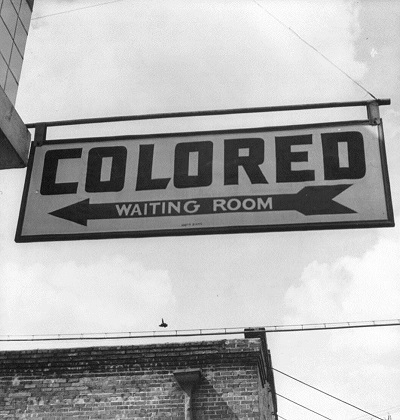
CU Blog - A Lesson in History - After the Civil War - Birthrights - Photo 2The US confronted these issues in a comprehensive way, giving a full measure, and a complete lesson to a watching world. The country had a bad legacy with the issues of racism, racial supremacy and discrimination. Even the Supreme Court’s decision in Dred Scott v. Sandford (1857), asserted that Americans descended from African slaves could not be citizens of the United States. American society never accepted a common definition of human rights. As a result, African-Americans suffered in this country, first slavery, then even after the abolition of slavery the oppression, suppression and repression continued with a Peonage system, Jim Crow and blatant discrimination practices. This dread was manifested in the impassioned chant:

Injustice anywhere is injustice everywhere!

Since the early colonial period in America, slavery had been a part of the socio-economic system of British North America and was recognized in the Thirteen Colonies at the time of the United StatesDeclaration of Independence (1776). Since then, events and statements by politicians and others brought forth differences, tensions and divisions between the people of the slave states of the Southern United States and the people of the free states of the Northern United States (including Western states) over the topics of slavery. The issue and divisions of slavery became so irreconcilable and contentious [1] that only a violent clash – a war – would resolve. The war was a “Come to Jesus!” A Big Day of Reckoning!

Without a doubt, the Civil War was conclusive! The conflict transpired between 1861 and 1865; 625,000[5] Americans died…on both sides (365,000 total dead [4] on the Union side; 260,000 total dead on the Confederacy side). This blood should not be forgotten.

The LORD said, “What have you done? Listen! Your brother’s blood cries out to me from the ground. – Genesis 4:10 New International Version

This backdrop was the basis for the 14th Amendment of the Constitution. Consider the encyclopedic details here:

Title: Fourteenth Amendment to the United States Constitution
Source: Wikipedia – Online Encyclopedia (Retrieved 10/14/2015) retrieved from: https://en.wikipedia.org/wiki/Fourteenth_Amendment_to_the_United_States_Constitution

CU Blog - A Lesson in History - After the Civil War - Birthrights - Photo 1The Fourteenth Amendment (Amendment XIV) to the United States Constitution was adopted on July 9, 1868, as one of the Reconstruction Amendments. The amendment addresses citizenship rights and equal protection of the laws, and was proposed in response to issues related to former slaves following the American Civil War. The amendment was bitterly contested, particularly by Southern states, which were forced to ratify it in order for them to regain representation in Congress. The Fourteenth Amendment, particularly its first section, is one of the most litigated parts of the Constitution, forming the basis for landmark decisions such as Roe v. Wade (1973) regarding abortion, Bush v. Gore (2000) regarding the 2000 presidential election, and Obergefell v. Hodges (2015) regarding same-sex marriage. The amendment limits the actions of all state and local officials, including those acting on behalf of such an official.

The amendment’s first section includes several clauses: the Citizenship Clause, Privileges or Immunities Clause, Due Process Clause, and Equal Protection Clause. The Citizenship Clause provides a broad definition of citizenship, overruling the Supreme Court’s decision in Dred Scott v. Sandford (1857), which had held that Americans descended from African slaves could not be citizens of the United States. The Privileges or Immunities Clause has been interpreted in such a way that it does very little.

The Due Process Clause prohibits state and local government officials from depriving persons of life, liberty, or property without legislative authorization. This clause has also been used by the federal judiciary to make most of the Bill of Rights applicable to the states, as well as to recognize substantive and procedural requirements that state laws must satisfy.

The Equal Protection Clause requires each state to provide equal protection under the law to all people within its jurisdiction. This clause was the basis for Brown v. Board of Education (1954), the Supreme Court decision that precipitated the dismantling of racial segregation, and for many other decisions rejecting irrational or unnecessary discrimination against people belonging to various groups.

The second, third, and fourth sections of the amendment are seldom litigated. However, the second section’s reference to “rebellion and other crime” has been invoked as a constitutional ground for felony disenfranchisement. The fifth section gives Congress the power to enforce the amendment’s provisions by “appropriate legislation”. However, under City of Boerne v. Flores (1997), Congress’s enforcement power may not be used to contradict a Supreme Court interpretation of the amendment.

There are lessons from this history to be learned and applied in the Caribbean relating to nationality and immigration.

This commentary is 3 of 3 considering lessons that are especially apropos for application in the Caribbean region of 2015. The lessons are cataloged as follows:

  1. Before the War: Human Rights Cannot Be Compromised
  2. During the War: Principle over Principal – Boycott Over a Difference in Pay
  3. After the War: Birth Right – Assigning Same Value to All Life

The Civil War is being commemorated now, at the 150th Anniversary of its conclusion. But there is no need for “pomp and circumstance” in acknowledging these events in the “rear view” mirror – this was an American crisis. There is only the need to look and learn, as there is such an important lesson for Caribbean nationality consideration.

The book Go Lean…Caribbean serves as a roadmap for elevating Caribbean society, for all 30 member-states, with the introduction and implementation of the Caribbean Union Trade Federation (CU). The book does not ignore the subject of citizenship and nationality. In fact the roadmap provides perhaps the ultimate resolution to this perplexing problem, that of a regional entity providing a regional solution.

According to the foregoing encyclopedic reference, the Fourteenth Amendment changed the American standard of citizenship and nationality. The US “Super Power” status now influences the “normalized” view for many people in the Caribbean neighborhood for what is right and what is wrong with nationality recognition. The 14th Amendment to the United States Constitution addressed citizenship rights and equal protection of the laws, and was proposed in response to issues related to former slaves following the Civil War. This lesson was harvested from the sowing in blood.

Can other communities benefit from this now simple definition of citizenship?

“all persons born or naturalized in the United States, and subject to the jurisdiction thereof, are citizens of the United States and of the State wherein they reside”[24]

This is in effect, a citizenship rendition of the acclaimed Declaration of Independence (1776):

“All men are created equal”.

Early in the Go Lean book, this need for careful review of history was acknowledged and then placed into perspective with this pronouncement in a similar Declaration of Interdependence (Page 10):

As the history of our region and the oppression, suppression and repression of its indigenous people is duly documented, there is no one alive who can be held accountable for the prior actions, and so we must put aside the shackles of systems of repression to instead formulate efficient and effective systems to steer our own destiny.

As the colonial history of our region was initiated to create economic expansion opportunities for our previous imperial masters, the structures of government instituted in their wake have not fostered the best systems for prosperity of the indigenous people.

The sensitivities of the issue of migration is so heightened now because countries in the Caribbean neighborhood have been harsh in their treatment of Cuban and Haitian refugees, many even considering changes to their constitutions in an effort to tighten immigration policies so as to end the automatic birthright citizenship for children of illegal immigrants.[12]

The Latin phrases, jus soli (‘right of the soil’) and jus sanguinis (‘right of blood’), explain the applicable legal concepts in our region. But Latin does not describe the pain and suffering the African Diaspora experienced over the centuries in the Americas. We need more than language.

To apply lessons from the painful Civil War, this commentary urges the jus soli standard for the Caribbean Union Trade Federation.

Caribbean member-states are badly in need of remediation, to lower the “push and pull” factors that drive so many to risk their ‘life and limb’, and those of their children, to take flight under dangerous circumstances to seek a better life.

This is not a problem just for Cuba, Haiti and the countries in the migrants’ path (Bahamas, Dominican Republic, Puerto Rico) to get to better living conditions. This is a problem for all the Caribbean. There is always someone doing better and someone doing worse.

The Go Lean book – and blogs – posits that the effort is less to cure the Caribbean homeland than to thrive as an alien in a foreign land. This is easier said than done! But this is the quest of the Go Lean roadmap, to make the Caribbean homeland a better place to live, work and play for its 42 million residents and 80 visitors, across the 30 member-states. The CU, applying best-practices for community empowerment has these 3 prime directives, proclaimed as follows:

  • Optimization of the economic engines in order to grow the regional economy to $800 Billion & create 2.2 million new jobs.
  • Establishment of a security apparatus to protect the resultant economic engines and ensure the respect of human rights and public safety.
  • Improve Caribbean governance to support these engines.

How exactly can the CU impact the most troubled countries that are the source of so many illegal migrants: Cuba and Haiti? The book relates the history of post-war Europe, where the Marshall Plan was instrumental in rebooting that continent, and also the Reconstruction Years for rebuilding the Southern US after the Civil War. The book Go Lean…Caribbean details a Marshall Plan-like / Reconstruction-like roadmap for Cuba and Haiti, and other failing Caribbean institutions.

The related subjects of economic, security and governing dysfunction among American, European and Caribbean communities have been a frequent topic for Go Lean blogs, as sampled below. These represent other lessons for the Caribbean to learn from considering history:

https://goleancaribbean.com/blog/?p=6531 A Lesson in History – Book Review of the ‘Exigency of 2008’
https://goleancaribbean.com/blog/?p=6189 A Lesson in History – ‘Katrina’ is helping today’s crises
https://goleancaribbean.com/blog/?p=5183 A Lesson in History – Cinco De Mayo
https://goleancaribbean.com/blog/?p=5123 A Lesson in History – Royal Charter: Zimbabwe -vs- South Africa
https://goleancaribbean.com/blog/?p=5055 A Lesson in History – Empowering Families
https://goleancaribbean.com/blog/?p=4971 A Lesson in History – Royal Charter: Truth & Consequence
https://goleancaribbean.com/blog/?p=4935 A Lesson in History – The ‘Grand Old Party’ of American Politics
https://goleancaribbean.com/blog/?p=4720 A Lesson in History – SARS in Hong Kong
https://goleancaribbean.com/blog/?p=4166 A Lesson in History – Panamanian Balboa
https://goleancaribbean.com/blog/?p=2809 A Lesson in History – Economics of East Berlin
https://goleancaribbean.com/blog/?p=2670 A Lesson in History – Rockefeller’s Pipeline
https://goleancaribbean.com/blog/?p=2585 A Lesson in History – Concorde SST
https://goleancaribbean.com/blog/?p=2480 A Lesson in History – Community Ethos of WW II Detroit
https://goleancaribbean.com/blog/?p=2297 A Lesson in History – Booker T versus Du Bois
https://goleancaribbean.com/blog/?p=1531 A Lesson in History – 100 Years Ago Today – World War I
https://goleancaribbean.com/blog/?p=789 A Lesson in History – America’s War on the Caribbean

The Go Lean book details a series of community ethos, strategies, tactics, implementations and advocacies to elevate Caribbean society so as to optimize the “push/pull” factors that currently send Caribbean citizens to the High Seas to flee their homeland. See this sample list of details from the book:

Community Ethos – Economic Systems Influence Choices & Incentives Page 21
Community Ethos – Consequences of Choices Lie in the Future Page 21
Community Ethos – Anti-Bullying and Mitigation Page 23
Community Ethos – Minority Equalization Page 24
Community Ethos – Ways to Impact the Future Page 26
Community Ethos – Ways to Manage Reconciliations Page 34
Community Ethos – Ways to Impact the Greater Good Page 37
Strategy – Vision – Integrate region into a Single Market Economy Page 45
Strategy – Agents of Change – Globalization Page 57
Tactical – Separation of Powers – Department of Homeland Security Page 75
Implementation – Security Initiatives at Start-up – Border, Immigration & Emigration Page 103
Planning – 10 Big Ideas … in the Caribbean Region – # 10 Cuba & Haiti Page 127
Planning – Ways to Ways to Model the EU – From Worst to First Page 130
Planning – Reasons Why the CU Will Succeed – Germany Reconciliation Model Page 132
Planning – Ways to Improve Failed-State Indices – Cuba & Haiti on the List Page 134
Planning – Lessons from East Germany – European post-war rebuilding Page 139
Planning – Lessons from the Detroit – Best Practices for Turn-Around Page 140
Planning – Lessons from the Bible Page 144
Planning – Lessons from the US Constitution Page 145
Advocacy – Ways to Grow the Economy Page 151
Advocacy – Ways to Create Jobs Page 152
Advocacy – Ways to Foster Empowering Immigration – Case Study of Indian Migrants Page 174
Advocacy – Ways to Impact Justice Page 178
Advocacy – Ways to Impact the Diaspora Page 217
Advocacy – Ways to Protect Human Rights Page 220
Advocacy – Ways to Impact Youth – Citizenship Clarity Page 227
Advocacy – Ways to Re-boot Cuba Page 236
Advocacy – Ways to Impact the Dominican Republic Page 237
Advocacy – Ways to Re-boot Haiti Page 238
Advocacy – Ways to Impact Trinidad & Tobago – Indo versus Afro Page 240
Advocacy – Ways to Impact Guyana – Indo versus Afro Page 241
Advocacy – Ways to Impact US Territories – All is not well Page 244
Appendix – Puerto Rico Migrations to New York Page 303

All of the Caribbean needs to learn from the experiences of our neighbor, the United States during the Civil War. Too much blood – brother on brother – has been shed to ignore. As depicted in the Go Lean book, there is the need to minimize the push-pull factors that lead to our societal abandonment. Our citizens are dying in the waters trying to flee our homelands. The US learned its lessons from a Civil War (Page 145). As depicted in the foregoing encyclopedic reference, Reconstruction provisions can help to forge a New Society; see Appendix-VIDEO below.

Birth rights clarification is crucial for future progress.

If all in a community sacrifice, then all in the community should have the same rights and privileges. That is the very definition of birthrights.

When will we (in the Caribbean) learn? When is enough, enough?

The Go Lean/CU roadmap has proposed solutions: CU citizenship; and facilitating the Lex soli process at the CU level – thereby removing the subjectivity and bias to the nationality process. As depicting in a previous blog, fragments of this proposed system is already in place with the issuance of CariCom passports. The Go Lean roadmap calls for the assembling of CariCom organs into the CU Trade Federation, the Caribbean passport practice would therefore continue.

Now is the time for all of the Caribbean to learn the lessons from history of the American Civil War. Though not directly our homeland, we can still benefit from their bloodshed. We can hear the blood crying out to God for reckoning and reconciliation.

The Go Lean book posits that the Caribbean is in a serious crisis of its own, but asserts that this crisis would be a terrible thing to waste. The same as the blood of 625,000 Americans (Civil War dead) would have been a terrible thing to waste, we too can harvest progress from sacrifice. The people and governing institutions of the Caribbean region are hereby urged to lean-in for the empowerments described in this Go Lean roadmap.

This quest is conceivable, believable and achievable … without a war, nor bloodshed!

🙂

Download the book Go Lean … Caribbean – now!

————-

Appendix – VIDEO: US 13th,14th, and 15th Amendments – https://youtu.be/89fU1HvZLfA

Published on Sep 9, 2013 – Category: People & Blogs
Share this post:
, , , ,

A Lesson in History – During the Civil War: Principle over Principal

Go Lean Commentary

Where do you consider to be home? How far are you willing to go to protect/defend that home?

Dating back to the Magna Carta, a concept emerged in jurisprudence in which a man’s home was considered his castle, and should thusly be vigorously defended – Stand Your Ground. For this reason foreign occupying armies have always encountered vicious insurgencies from citizens of a homeland.

The movement and underlying book Go Lean … Caribbean posits that it is better to “prosper where planted“, that natives of a land are willing to shed blood, sweat and tears to sustain their homelands. This is one additional reason to discourage emigration, brain drain and societal abandonment.

Even the Bible speaks of this paradigm in the Gospel account by John in Chapter 10, verses 11 – 13 as follows:

11“I am the good shepherd; the good shepherd lays down His life for the sheep. 12“He who is a hired hand, and not a shepherd, who is not the owner of the sheep, sees the wolf coming, and leaves the sheep and flees, and the wolf snatches them and scatters them. 13“He flees because he is a hired hand and is not concerned about the sheep.…

There is an important lesson to learn in considering the history of the American Civil War. The war was fought over the issue of slavery. This was an ugly institution for those condemned as slaves. In the United States, that ugly disposition extended beyond the slaves themselves to the entire Black race. Though individuals could be set free, laws in the country could push them back into slavery without any due process. This was the case with the “Fugitive Slave Act of 1850”. Any Black person could be detained as a runaway slave and returned to any alleged Slave Master in the South; no matter any proof or the truth, or lack there of. In many jurisdictions, a Black man could not even testify against white people. (This was the basis for the autobiographical book – by Solomon Northup – and movie “12 Years A Slave” – see trailer in the Appendix-VIDEO A below).

To be Black in the America of those days, one “could not win, could not break-even and could not get out of the game”. There was no neutral destination in America. The optimal option was the only option, to work towards the end of slavery.

For this reason many Blacks joined the war effort, at great sacrifice to themselves and their community. This was a matter of principle! There is an important lesson for the Caribbean from this history:

CU Blog - A Lesson in History - During the Civil War - Principle not Principal - Photo 2The 54th Regiment Massachusetts Volunteer Infantry was an infantry regiment that saw extensive service in the Union Army during the American Civil War. The regiment was one of the first official African-American units in the United States during the Civil War.[1] The regiment was authorized in March 1863 by the Governor of Massachusetts, John A. Andrew. Commanded by Colonel Robert Gould Shaw, it was commissioned after the passage of the Emancipation Proclamation.[2] Secretary of War Edwin M. Stanton decided white officers would be in charge of all “colored” units.[3] Andrew selected Robert Gould Shaw to be the regiment’s colonel and Norwood Penrose Hallowell to be its lieutenant colonel.[2] https://en.wikipedia.org/wiki/54th_Massachusetts_Infantry_Regiment retrieved October 14, 2015.

The Civil War was fought between 1861 and 1865; 625,000[5] Americans died…on both sides (365,000 total dead [4] on the Union side; 260,000 total dead on the Confederacy side). This spilled blood was a great sacrifice and should not be forgotten or undervalued. The vast majority of the deaths were White people. As many died, their surviving family members assigned blame to those of the Black community, as depicted here:

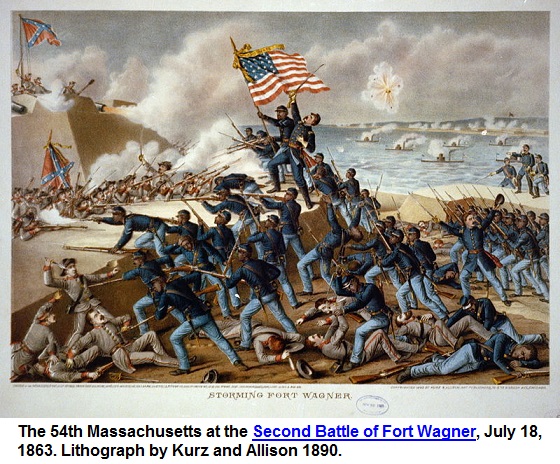
In July 13 – 16, 1863, African Americans on the New York City’s waterfront and Lower East Side were beaten, tortured, and lynched by white mobs angered over conscription for the Union war effort. [20] These mobs directed their animosity toward blacks because they felt the Civil War was caused by them. However, the bravery of the 54th would help to assuage anger of this kind…

CU Blog - A Lesson in History - During the Civil War - Principle not Principal - Photo 1The regiment gained recognition on July 18, 1863, when it spearheaded an assault on Fort Wagner near Charleston, South Carolina. 272 of the 600 men who charged Fort Wagner were “killed, wounded or captured.”[18] At this battle Colonel Shaw was killed, along with 29 of his men; 24 more later died of wounds, 15 were captured, 52 were missing in action and never accounted for, and 149 were wounded. The total regimental casualties of 272 would be the highest total for the 54th in a single engagement during the war. Although Union forces were not able to take and hold the fort (despite taking a portion of the walls in the initial assault), the 54th was widely acclaimed for its valor during the battle, and the event helped encourage the further enlistment and mobilization of African-American troops, a key development that President Abraham Lincoln once noted as helping to secure the final victory. This drama was portrayed in the 1989 Motion Picture “Glory“; see 2-minute clip in the VIDEO B below.

The Civil War is being commemorated now, at the 150th Anniversary of its conclusion. But there is no need for “pomp and circumstance” in acknowledging these events in the “rear view” mirror of history. There is only the need to look and learn, as there are lessons for the Caribbean to consider in its application of daily life. This commentary is 2 of 3 considering lessons that are especially apropos for application in the Caribbean region of 2015. The lessons are cataloged as follows:

  1. Before the War: Human Rights Cannot Be Compromised
  2. During the War: Principle over Principal – Boycott Over a Difference in Pay
  3. After the War: Birth Right – Assigning Same Value to All Life

During the Civil War, as in any war, soldiers get paid. But the societal defects of racism was so acute in the US that even this administrative action was fraught with dysfunction; the encyclopedic reference continues:

The enlisted men of the 54th were recruited on the promise of pay and allowances equal to their white counterparts. This was supposed to amount to subsistence and $14 a month.[22] Instead, they were informed upon arriving in South Carolina, the Department of the South would pay them only $7 per month ($10 with $3 withheld for clothing, while white soldiers did not pay for clothing at all).[23] Colonel Shaw and many others immediately began protesting the measure.[24] Although the state of Massachusetts offered to make up the difference in pay, on principle, a regiment-wide boycott of the pay tables on paydays became the norm.[25]

CU Blog - A Lesson in History - During the Civil War - Principle not Principal - Photo 3After Shaw’s death at Fort Wagner, Colonel Edward Needles Hallowell – his lieutenant and brother of the first Lieutenant Colonel Hallowell – took up the fight to get back full pay for the troops.[26]

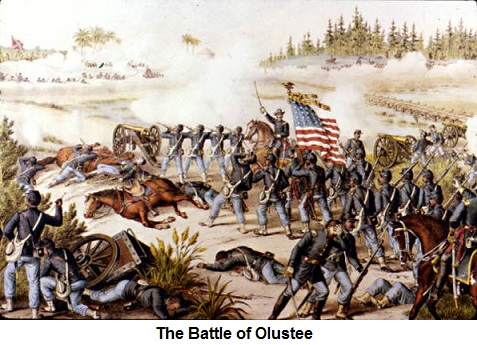
Refusing their reduced pay became a point of honor [(principle)] for the men of the 54th. In fact, at the Battle of Olustee, when ordered forward to protect the retreat of the Union forces, the men moved forward shouting, “Massachusetts and Seven Dollars a Month!”[2]

The Congressional bill, enacted on June 16, 1864, authorized equal and full pay to those enlisted troops who had been free men as of April 19, 1861. Of course not all the troops qualified. Colonel Hallowell, a Quaker, rationalized that because he did not believe in slavery he could therefore have all the troops swear that they were free men on April 19, 1861. Before being given their back pay the entire regiment was administered what became known as “the Quaker oath.”[26] Colonel Hallowell skillfully crafted the oath to say: “You do solemnly swear that you owed no man unrequited labor on or before the 19th day of April 1861. So help you God.”[26][28]

The book Go Lean…Caribbean and accompanying blogs provide lessons from history in considering the American Civil War. The Caribbean region has a debilitating societal abandonment rate; (70 percent of college educated had fled for foreign shores). The region needs a National Sacrifice ethos, where their own citizens sacrifice blood, sweat and tears on behalf of their homelands. Only then will people be less prone to abandon their homes; they will stake claim to principle over principal (money).

Early in the Go Lean book, this need for careful review of the history of slavery was acknowledged and then placed into perspective with this pronouncement (Declaration of Interdependence – Page 10):

As the history of our region and the oppression, suppression and repression of its indigenous people is duly documented, there is no one alive who can be held accountable for the prior actions, and so we must put aside the shackles of systems of repression to instead formulate efficient and effective systems to steer our own destiny.

As the colonial history of our region was initiated to create economic expansion opportunities for our previous imperial masters, the structures of government instituted in their wake have not fostered the best systems for prosperity of the indigenous people.

So the consideration of the Go Lean book, is to identify and correct any bad community ethos (fundamental spirit of our culture) and to foster positive community ethos (such as National Sacrifice and “Principle over Principal”). This point was also pronounced in the opening Declaration of Interdependence (Page 12 – 13) with these statements:

xvi. Whereas security of our homeland is inextricably linked to prosperity of the homeland, the economic and security interest of the region needs to be aligned under the same governance. Since economic crimes, including piracy and other forms of terrorism, can imperil the functioning of the wheels of commerce for all the citizenry, the accedence of this Federation must equip the security apparatus with the tools and techniques for predictive and proactive interdictions.

xix. Whereas our legacy in recent times is one of societal abandonment, it is imperative that incentives and encouragement be put in place to first dissuade the human flight, and then entice and welcome the return of our Diaspora back to our shores. This repatriation should be effected with the appropriate guards so as not to imperil the lives and securities of the repatriated citizens or the communities they inhabit. The right of repatriation is to be extended to any natural born citizens despite any previous naturalization to foreign sovereignties.

This Declaration of Interdependence opens the Go Lean…Caribbean book. The book serves as a roadmap for the introduction and implementation of the technocratic Caribbean Union Trade Federation (CU) to spearhead the elevation of Caribbean society. The book advocates learning lessons from many events and concepts in history, from as far back as the patriarchal Bible times, to as recent as the Great Recession of 2008. The roadmap seeks to reboot the region’s economic, security and governing engines to ensure that all Caribbean stakeholders have the opportunity for life, liberty and the pursuit of happiness with no abusive exploitation of any ethnic group. There is room for all people in the region to elevate and be elevated.

In this vein, the Go Lean roadmap seeks to employ “best-practices” with entitlements, labor, human rights and social safety nets to impact the CU prime directives; identified with the following 3 statements:

  • Optimization of the economic engines in order to grow the regional economy to $800 Billion & create 2.2 million new jobs.
  • Establishment of a security apparatus to protect the resultant economic engines and ensure the respect of human rights and public safety.
  • Improve Caribbean governance to support these engines.

The Caribbean is in crisis!

Alas, the Go Lean book asserts that a “crisis is a terrible thing to waste” and thereafter stresses the community ethos, strategies, tactics, implementations and advocacies to reboot, transform and turn-around the eco-systems of Caribbean society. These points are detailed in the book as follows:

Community Ethos – Deferred Gratification Page 21
Community Ethos – Economic Principles – People Choose Page 21
Community Ethos – Economic Principles – People Respond to Incentives in Predictable Ways Page 21
Community Ethos – Economic Principles – The Consequences of Choices Lie in the Future Page 21
Community Ethos – Governing Principles – Lean Operations Page 24
Community Ethos – Governing Principles – Cooperatives Page 25
Community Ethos – Ways to Impact the Future Page 26
Community Ethos – Ways to Impact a Turn-Around Page 33
Community Ethos – Ways to Improve Sharing Page 35
Community Ethos – Ways to Promote Happiness Page 36
Community Ethos – Ways to Impact the Greater Good Page 37
Strategy – Vision – Confederate 30 Member-States Page 45
Strategy – Mission – Enact a Defense Pact to Defend the Homeland Page 45
Strategy – Mission – Keep the next generation at home Page 46
Tactical – Confederating a Permanent Union Page 63
Tactical – Fostering a Technocracy Page 64
Implementation – Assemble – Incorporating all the existing regional organizations Page 96
Implementation – Ways to Pay for Change Page 101
Implementation – Security Initiatives at Start-up Page 103
Implementation – Ways to Deliver Page 109
Implementation – Reasons to Repatriate to the Caribbean Page 118
Planning – 10 Big   Ideas for the Caribbean – Confederation Without Sovereignty Page 127
Planning – Ways to Make the Caribbean Better Page 131
Advocacy – Ways to Grow the Economy Page 151
Advocacy – Ways to Create Jobs Page 152
Advocacy – Ways to Better Manage the Social Contract Page 170
Advocacy – Ways to Manage Federal Civil Service – Guaranteed Fair Treatment Page 173
Advocacy – Ways to Improve Homeland Security Page 181
Advocacy – Ways to Impact the Diaspora Page 217
Advocacy – Ways to Preserve Caribbean Heritage Page 218
Advocacy – Ways to Protect Human Rights Page 220
Advocacy – Ways to Impact Youth – Incentivize Prosperity at Home Page 227

There are other lessons for the Caribbean to learn from considering history; the following previous blog/commentaries have been detailed and considered:

https://goleancaribbean.com/blog/?p=6531 A Lesson in History – Book Review of the ‘Exigency of 2008’
https://goleancaribbean.com/blog/?p=6189 A Lesson in History – ‘Katrina’ is helping today’s crises
https://goleancaribbean.com/blog/?p=5183 A Lesson in History – Cinco De Mayo
https://goleancaribbean.com/blog/?p=5123 A Lesson in History – Royal Charter: Zimbabwe -vs- South Africa
https://goleancaribbean.com/blog/?p=5055 A Lesson in History – Empowering Families
https://goleancaribbean.com/blog/?p=4971 A Lesson in History – Royal Charter: Truth & Consequence
https://goleancaribbean.com/blog/?p=4935 A Lesson in History – The ‘Grand Old Party’ of American Politics
https://goleancaribbean.com/blog/?p=4720 A Lesson in History – SARS in Hong Kong
https://goleancaribbean.com/blog/?p=4166 A Lesson in History – Panamanian Balboa
https://goleancaribbean.com/blog/?p=2809 A Lesson in History – Economics of East Berlin
https://goleancaribbean.com/blog/?p=2670 A Lesson in History – Rockefeller’s Pipeline
https://goleancaribbean.com/blog/?p=2585 A Lesson in History – Concorde SST
https://goleancaribbean.com/blog/?p=2480 A Lesson in History – Community Ethos of WW II Detroit
https://goleancaribbean.com/blog/?p=2297 A Lesson in History – Booker T versus Du Bois
https://goleancaribbean.com/blog/?p=1531 A Lesson in History – 100 Years Ago Today – World War I
https://goleancaribbean.com/blog/?p=789 A Lesson in History – America’s War on the Caribbean

The Go Lean roadmap seeks to empower and elevate Caribbean societal engines, identifying the required community ethos. The ethos associated with populations that have endured change – National Sacrifice – is an expression of deferred gratification, choosing to focus more on the future than on the present, or the past. We should show proper application for the sacrifices these ones have endured. Such gratitude makes our community better, more resilient and more long-suffering.

We need more of this Principle over Principal!

No appreciation, no sacrifice; no sacrifice, no victory. It is that simple!

Now is the time to lean-in to this roadmap for Caribbean change, as depicted in the book Go Lean…Caribbean. All the mitigations and empowerments in this roadmap require people to fight for their homeland. This ethos will help forge change for the Greater Good. We need sacrifice; we need victories!

(This commentary is not advocating sacrificing the  Caribbean’s young men – and women – on the altar of some God of War. Nor is this a call for a revolt against the governments, agencies or institutions of the Caribbean region, but rather a petition to fight for change through the peaceful optimization of the economic, security and governing engines in the region).

Our quest is simple, learn from history and work to make the Caribbean region a better place to live, work and play. 🙂

Download the book Go Lean … Caribbean – now!

———–

Appendix VIDEO A – Movie Trailer: 12 Years A Slavehttp://www.imdb.com/video/imdb/vi302032921/

Retrieved October 14, 2015 – In the antebellum United States, Solomon Northup, a free black man from upstate New York, is abducted and sold into slavery.

———–

Appendix VIDEO B – Movie Clip Gloryhttps://youtu.be/q7qwqVbZSqE

Retrieved October 14, 2015 – Robert Gould Shaw leads the US Civil War’s first all-black volunteer company, fighting prejudices of both his own Union army and the Confederates.

Share this post:
, , , ,
[Top]

A Lesson in History – Before the Civil War: Compromising Human Rights

Go Lean Commentary

Despite the fact that there are historic events, many times “deniers” of the facts emerge. For example, the Nazi Holocaust: deniers exist even today of the actuality of the events or the 6 million Jews slaughtered in German Concentration Camps. Another major event before this was the American Civil War. Deniers abounded to the point that in many schools in the Jim Crow South, that event was taught as the “War of Northern Aggression” and the cause of “slavery” was supplanted for States’ Rights.

The pain of this academic dishonesty is not just the de-valuing of all the human sacrifices, but most importantly, the failure to learn and apply good lessons.

When someone denies an event, they cannot learn from the experiences.

Without a doubt, a Civil War was fought in the United States of America between 1861 and 1865; 625,000[5] Americans died…on both sides (365,000 total dead [4] on the Union side; 260,000 total dead on the Confederacy side). This blood should not be forgotten. There are lessons to learn from this history. This commentary is 1 of 3 considering lessons that are especially apropos for application in the Caribbean region of 2015. The lessons are cataloged as follows:

  1. Before the War: Human Rights Cannot Be Compromised
  2. During the War: Principle over Principal – Boycott Over a Difference in Pay
  3. After the War: Birth Right – Assigning Same Value to All Life

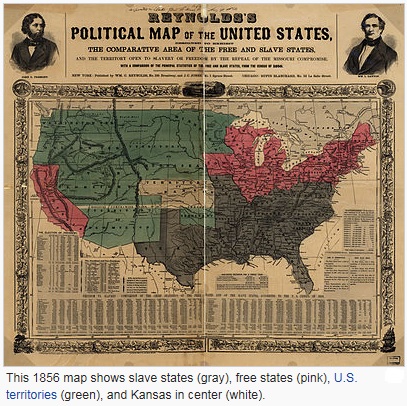
Since the early colonial period in America, slavery had been a part of the socio-economic system of British North America and was recognized in the Thirteen Colonies at the time of the United StatesDeclaration of Independence (1776). Since then, events and statements by politicians and others brought forth differences, tensions and divisions between the people of the slave states of the Southern United States and the people of the free states of the Northern United States (including Western states) over the topics of slavery. The large underlying issue from which other issues developed was whether slavery should be retained and even expanded to other areas or whether it should be contained and eventually abolished. Over many decades, these issues and divisions became increasingly irreconcilable and contentious.[1] But that last decade was pivotal; see encyclopedia reference here and VIDEO below:

CU Blog - A Lesson in History - Before the Civil War - Human Right Not Compromise - Photo 3Events in the 1850s culminated with the election of the anti-slavery-expansion Republican Abraham Lincoln as President on November 6, 1860. This provoked the first round of state secessions as leaders of the Deep South cotton states were unwilling to remain in a second class political status with their way of life threatened by the President himself. Initially, the seven Deep South states seceded, with economies based on cotton (then in heavy European demand with rising prices). They were Alabama, Florida, Georgia, Louisiana, Mississippi, South Carolina and Texas. After the Confederates attacked and captured Fort Sumter, President Lincoln called for volunteers to march south and suppress the rebellion. This pushed the four other Upper South States (Virginia, North Carolina, Tennessee, and Arkansas) also to secede. These states completed the formation of the Confederate States of America. Their addition to the Confederacy insured a war would be prolonged and bloody because they contributed territory and soldiers. – https://en.wikipedia.org/wiki/Timeline_of_events_leading_to_the_American_Civil_War retrieved October 14, 2015.

The Civil War is being commemorated now, at the 150th Anniversary of its conclusion. But there is no need for “pomp and circumstance” in acknowledging these events in the “rear view” mirror; as this was an American crisis. There is only the need to look and learn, as there is this one poignant lesson for Caribbean consideration:

    With a roaring institution of slavery, there was no premise for a concept of human rights. Without a commonality on the understanding and acceptance of human rights, differences will always be irreconcilable and contentious.

Before the Civil War, both sides continued to propagate one compromise after another. While neither side wanted the bloodshed of war, the compromises were just exercises in futility because at the root, there was no commonality on human rights. Notice this application in considering this one episode of Pre-War deliberation:

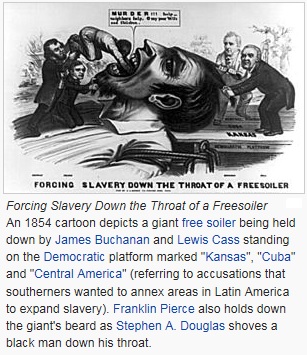
The Kansas–Nebraska Act of 1854 created the territories of Kansas and Nebraska, opening new lands for settlement, and had the effect of repealing the Missouri Compromise of 1820 by allowing white male settlers in those territories to determine through popular sovereignty whether they would allow slavery within each territory. The act was designed by Democratic Senator Stephen A. Douglas of Illinois. The initial purpose of the Kansas–Nebraska Act was to open up many thousands of new farms and make feasible a Midwestern Transcontinental Railroad. The popular sovereignty clause of the law led pro- and anti-slavery elements to flood into Kansas with the goal of voting slavery up or down, leading to Bloody Kansas[1]; (a series of violent political confrontations involving anti-slavery Free-Staters and pro-slavery “Border Ruffians”, taking place in the Kansas Territory and neighboring towns in the state of Missouri between 1854 and 1861). This Kansas–Nebraska Act used popular sovereignty so as to ignore the failures of the previous compromises. The Kansas–Nebraska Act divided the nation and pointed it toward civil war.[41] The turmoil over the act split both the Democratic and Whig parties and gave rise to the Republican Party, which split the United States into two major political camps, North (Republican) and South (Democratic). – Source: https://en.wikipedia.org/wiki/Kansas%E2%80%93Nebraska_Act retrieved October 14, 2015.
CU Blog - A Lesson in History - Before the Civil War - Human Right Not Compromise - Photo 2

The book Go Lean…Caribbean and accompanying blogs provide lessons from history in considering the American Civil War. The Caribbean has had Civil Wars and Revolutions; (think Haitian Revolution of 1791 and the Cuban Revolution of 1959). The book assessed the economic disposition of the region and then strategized how to elevate the societal engines. Among its many missions, the book advocates one simple way to grow the economy: concentrate on the basic needs of food, clothing and shelter. When analyzing clothing options, the book leans on the lessons from the pre-Civil War American South, where Cotton was King. This point was detailed in the book on Page 163:

The Bottom Line on King Cotton
The Southern United States had ideal conditions to grow cotton; the prospects where so successful, 60% of US exports, that they sought to have a world monopoly. They devoted the most valuable land and slave labor to this cause, even in place of necessities like food. They had the supply system optimized and they were willing to go to war to preserve the status quo. On the demand side, the Industrial Revolution brought innovations like mechanized spinning/weaving to Europe. This forged a vibrant apparel industry and revolutionized the world economy. Cotton was King. The term King Cotton was a slogan around 1860–61 to support secession from the United States, arguing that cotton exports would make an independent Confederate States of America economically prosperous, and – more importantly – force Great Britain and France to support the Confederacy in a Civil War. But the Union blockaded the South’s ports and harbors and shut down over 95% of cotton exports. Since the Europeans had hoarded large stockpiles of cotton, they were not injured by the boycott — the value of their stockpiles went up. So cotton production shifted to other locations in the world, like India (up 700%), Egypt and Argentina. King Cotton failed to save the South, their economy nor Confederacy.
CU Blog - A Lesson in History - Before the Civil War - Human Right Not Compromise - Photo 1

Early in the Go Lean book, this need for careful review of history was acknowledged and then placed into perspective with this pronouncement (Declaration of Interdependence – Page 10):

As the history of our region and the oppression, suppression and repression of its indigenous people is duly documented, there is no one alive who can be held accountable for the prior actions, and so we must put aside the shackles of systems of repression to instead formulate efficient and effective systems to steer our own destiny.

As the colonial history of our region was initiated to create economic expansion opportunities for our previous imperial masters, the structures of government instituted in their wake have not fostered the best systems for prosperity of the indigenous people.

So the consideration of the Go Lean book, as related to this subject is one of community ethos, defined in the book (Page 20) as the fundamental character or spirit of our culture; our underlying sentiment that informs our beliefs, customs, or practices; dominant assumptions of us, the Caribbean as a people.

    Do we now have a common premise, a concept of human rights?

This commentary, and the underlying Go Lean book asserts the answer is “No“! As a region, the Caribbean is doing particularly bad.

This point was pronounced in the opening Declaration of Interdependence (Page 12) with these acknowledgements and statements:

xii. Whereas the legacy in recent times in individual states may be that of ineffectual governance with no redress to higher authority, the accedence of this Federation will ensure accountability and escalation of the human and civil rights of the people for good governance, justice assurances, due process and the rule of law. As such, any threats of a “failed state” status for any member state must enact emergency measures on behalf of the Federation to protect the human, civil and property rights of the citizens, residents, allies, trading partners, and visitors of the affected member state and the Federation as a whole.

xiii. Whereas the legacy of dissensions in many member-states (for example: Haiti and Cuba) will require a concerted effort to integrate the exile community’s repatriation, the Federation must arrange for Reconciliation Commissions to satiate a demand for justice.

Continuing with the lessons from the American Civil War, we see that the US never accepted a common definition of human rights until … the United Nations was established (1945) and eventually codified a Human Rights Declaration for them … and the rest of the world in 1948. In the meanwhile, Blacks in the US continued to suffer – despite the abolition of slavery – with pains associated with a Peonage system, Jim Crow and blatant discriminatory practices. The oppression, suppression and oppression of Blacks (and other minorities) in the US meant that America was not a welcoming land for people of color.

Considering the Caribbean homeland, to apply lessons learned from the build-up of the American Civil War we must first accept as common: the basics of human rights.

The Go Lean book asserts the UN Declaration of Human Rights (Page 220) which provides this definition:

… standards of human behavior that are protected as legal rights in municipal and international law.[2] They are commonly understood as inalienable[3] fundamental rights “to which a person is inherently entitled simply because she or he is a human being.”[4]

This declaration aligns with the quest of the Go Lean…Caribbean book. The book serves as a roadmap for the introduction and implementation of the technocratic Caribbean Union Trade Federation (CU) to spearhead the elevation of Caribbean society. The book advocates learning lessons from many events and concepts in history, from as far back as the patriarchal Bible times, to as recent as the Great Recession of 2008. The roadmap simply seeks to reboot the region’s economic, security and governing engines to ensure that Caribbean stakeholders (citizens, guest-workers and visitors) have the opportunity for life, liberty and the pursuit of happiness. As gleaned from this lesson in history, without that common acceptance of human rights, this quest is easier said than done.

The planners of the new Caribbean, the promoters of the Go Lean book, hereby urge all in the Caribbean to make this declaration.

Just say it!

In general, the Go Lean roadmap posits that the hope for any permanent change in the Caribbean must start with this declaration and the underlying community ethos that promotes it: the Greater Good. With that in place, other progress – the needed societal elevation – can begin. The Go Lean roadmap seeks to employ “best-practices” with better strategies, tactics and implementations to impact the CU prime directives; identified with the following 3 statements:

  • Optimization of the economic engines in order to grow the regional economy to $800 Billion & create 2.2 million new jobs.
  • Establishment of a security apparatus to protect the resultant economic engines and ensure the respect of human rights and public safety in all member-states.
  • Improve Caribbean governance to support these engines.

The Go Lean book stresses key community ethos, strategies, tactics, implementations and advocacies necessary to transform and turn-around the eco-systems of Caribbean society. These points are detailed in the book as follows:

Community Ethos – Economic Principles – Economic Systems Influence   Individual Choices Page 21
Community Ethos – Economic Principles – Consequences of Choices Lie in   the Future Page 21
Community Ethos – Governing Principles – Lean Operations Page 24
Community Ethos – Ways to Impact the Future Page 26
Community Ethos – Ways to Manage   Reconciliations Page 34
Community Ethos – Ways to Impact the Greater Good Page 37
Strategy – Vision – Confederate all 30   member-states/ 4 languages into a Single   Market Page 45
Strategy – Mission – Build and foster local economic engines Page 45
Tactical – Ways to Foster a Technocracy Page 64
Tactical – Growing the Economy – Post   WW II European Marshall Plan Model Page 68
Tactical – Separation-of-Powers – CU Federal Government versus Member-State Governance Page 71
Implementation – Assemble All Regionally-focus Organizations of All Caribbean Communities Page 96
Implementation – Ways to Better Manage Debt Page 114
Planning – 10 Big Ideas – Single Market / Currency Union Page 127
Planning – Ways to Model the new European Union Page 130
Planning – Ways to Make the Caribbean Better Page 131
Planning – Ways to Improve Failed-State Indices – Minority and Human Rights Page 134
Planning – Lessons Learned from the previousWest Indies Federation Page 135
Planning – Lessons Learned from 2008 – Optimizing Economic-Financial-Monetary Engines Page 136
Planning – Lessons Learned New York City – Managing   as a “Frienemy” Page 137
Planning – Lessons Learned from Omaha – Human Flight Mitigations Page 138
Planning – Lessons Learned from East Germany – Bad Examples for Trade & Security Page 139
Planning – Lessons Learned from Detroit – Turn-around from Failure Page 140
Planning – Lessons Learned from Indian Reservations – See Photo Page 141
Planning – Lessons Learned from the American West – How to Win the Peace Page 142
Advocacy – Ways to Grow the Economy Page 151
Advocacy – Ways to Create Jobs Page 152
Advocacy – Ways to Improve Governance Page 168
Advocacy – Ways to Better Manage the Social Contract Page 170
Advocacy – Ways to Improve Homeland Security Page 180
Advocacy – Ways to Better Manage Natural Resources Page 183
Advocacy – Ways to Preserve Caribbean   Heritage Page 218
Appendix – Failed-State Index for Uneven Economic Development Page 272
Appendix – European Shuffling in the Guianas – Historic Timeline Page 307

There are other lessons for the Caribbean to learn from considering history; the following previous blog/commentaries have been detailed and considered:

https://goleancaribbean.com/blog/?p=6531 A Lesson in History – Book Review of the ‘Exigency of 2008’
https://goleancaribbean.com/blog/?p=6189 A Lesson in History – ‘Katrina’ is helping today’s crises
https://goleancaribbean.com/blog/?p=5183 A Lesson in History – Cinco De Mayo
https://goleancaribbean.com/blog/?p=5123 A Lesson in History – Royal Charter: Zimbabwe -vs- South Africa
https://goleancaribbean.com/blog/?p=5055 A Lesson in History – Empowering Families
https://goleancaribbean.com/blog/?p=4971 A Lesson in History – Royal Charter: Truth & Consequence
https://goleancaribbean.com/blog/?p=4935 A Lesson in History – The ‘Grand Old Party’ of American Politics
https://goleancaribbean.com/blog/?p=4720 A Lesson in History – SARS in Hong Kong
https://goleancaribbean.com/blog/?p=4166 A Lesson in History – Panamanian Balboa
https://goleancaribbean.com/blog/?p=2809 A Lesson in History – Economics of East Berlin
https://goleancaribbean.com/blog/?p=2670 A Lesson in History – Rockefeller’s Pipeline
https://goleancaribbean.com/blog/?p=2585 A Lesson in History – Concorde SST
https://goleancaribbean.com/blog/?p=2480 A Lesson in History – Community Ethos of WW II in Detroit
https://goleancaribbean.com/blog/?p=2297 A Lesson in History – Booker T versus Du Bois
https://goleancaribbean.com/blog/?p=1531 A Lesson in History – 100 Years Ago Today – World War I
https://goleancaribbean.com/blog/?p=789 A Lesson in History – America’s War on the Caribbean

The Go Lean roadmap seeks to empower and elevate Caribbean societal engines. It is out-of-scope to impact America (beyond the Diaspora living there); our focus is only here at home.

A lot of the pain related in this history stem from the flawed structure of colonialism. Though there is a movement to extract reparations from former colonizers, that effort is not supported by the Go Lean movement for the Caribbean.

It is NOT for the Greater Good.

It is what it is! The current assessment of the Caribbean region is dire, but yet remediation, reboot and turn-around is possible.

Our quest is simple, learn from history and work to make the Caribbean region a better place to live, work and play.  🙂

Download the book Go Lean … Caribbean – now!

———–

Appendix VIDEO – The Path to Civil War – http://www.history.com/topics/american-civil-war/american-civil-war-history/videos/us-inches-closer-to-war

The election of Abraham Lincoln was a tipping point on the path to Civil War. In the wake of Southern secession, would the new president defend the U.S. forts in rebel territory?

Share this post:
, , , ,
[Top]

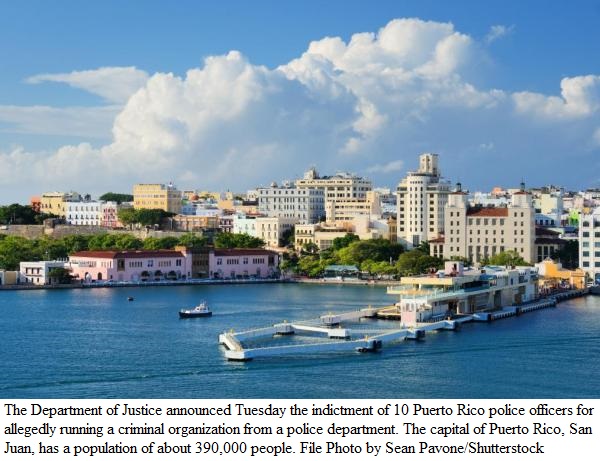
Ten Puerto Rico Police Accused of Criminal Network

Go Lean Commentary

“Indeed, everyone to whom much was given, much will be demanded of him” – The Bible (Luke 12:48 – New World Translation)

When it comes to police officers, we (the community) do give them a lot (guns, authority to detain and punish), and we demand much in return (“serve and protect”). When that formula gets distorted, it is bad for the community and difficult to make progress.

The book Go Lean … Caribbean asserts that to elevate Caribbean society – to make progress – there must be a focus on the region’s economic, security and governing engines. While the book primarily targets strategies, tactics and implementations for economic empowerment (jobs, investments, education, entrepreneurship, etc.), it posits that security remediation must be front-and-center along with these other empowerment efforts.

The book directly relates (Page 23) that with the emergence of new economic drivers that “bad actors” – even within law enforcement – will also emerge thereafter to exploit the opportunities, with good, bad and evil intent. This is a historical fact, and is bound to repeat again and again. The below news article and VIDEO concurs this point.

The following news article reports on corruption by police officials that have undermined Puerto Rico’s justice institutions; a surprising discovery as Puerto Rico is expected to already be an elevated society due to their US territorial status. This is far from the reality, as the stories here relate:

CU Blog - Ten Puerto Rico Police Accused of Criminal Network - Photo 2

Title: Ten Puerto Rico police accused of criminal network activity
Retrieved October 13, 2015 from: http://news.yahoo.com/ten-puerto-rico-police-accused-criminal-network-activity-193240325.html

Miami (AFP) September 29, 2015 – Ten Puerto Rico officers have been charged with belonging to a criminal network within the police force, abusing their power to commit a long list of crimes, authorities said Tuesday.

The police used “their affiliation with law enforcement to make money through robbery, extortion, manipulating court records and selling illegal narcotics,” Rosa Emilia Rodriguez-Velez, a US attorney for the American territory, said in a statement.

CU Blog - Ten Puerto Rico Police Accused of Criminal Network - Photo 1The agents collaborated to conduct traffic stops and enter the homes of suspected criminals to steal money, property and drugs, according to the statement.

The officers also allegedly planted evidence and extorted weapons and drugs from individuals in exchange for their release.

In addition, they are accused of having manipulated court records and selling drugs outright.

“The criminal action today dismantles a network of officers who, we allege, used their badges and their guns not to uphold the law, but to break it,” said Rodriguez-Velez.

———-

This story represents a perennial threat in Puerto Rico. This has happened before, again and again; see here:

VIDEO1,700 Cops arrested in Puerto Rico!https://youtu.be/aOVF8oy9PZ0

Published on Jul 11, 2012 – Read the New York Times article in the link below. Be sure to pay extra attention to paragraphs 3, 4 and 5. I urge all police officers to ask yourselves if you really believe Raymond Kelly and Michael Bloomberg are going to defend you when the FBI comes to arrest you for Constitutional rights violations and discrimination.

This Puerto Rico experience is not an exception to American historicity, but rather this is “par for the course”. There have always been threats to US law-and-order (homeland security) from foreign and domestic “actors”; think the Old West. This is the reality in the United States mainland and in the Caribbean territories (Puerto Rico and US Virgin Islands). These threats are also expected to materialize more in the Caribbean, as a direct product of success in elevating the region’s societal engines.

The book Go Lean…Caribbean serves as a roadmap for the introduction and implementation of the technocratic Caribbean Union Trade Federation (CU) to elevate the region’s economic, securing and governing engines. The roadmap expects to raise the region to a $800 Billion Single Market economy after a 5 year period; (from $278 Billion according to 2010 assessments). This roadmap fully expects the eventual corruption activities from those in power. The roadmap thusly embeds checks-and-balances from the outset of the plan.

This point is pronounced early in the book with the Declaration of Interdependence (Page 12) that claims:

x.   Whereas we are surrounded and allied to nations of larger proportions in land mass, populations, and treasuries, elements in their societies may have ill-intent in their pursuits, at the expense of the safety and security of our citizens. We must therefore appoint “new guards” to ensure our public safety and threats against our society, both domestic and foreign. The Federation must employ the latest advances and best practices … to assuage continuous threats against public safety.

xii.  Whereas the legacy in recent times in individual states may be that of ineffectual governance with no redress to higher authority, the accedence of this Federation will ensure accountability and escalation of the human and civil rights of the people for good governance, justice assurances, due process and the rule of law. As such, any threats of a “failed state” status for any member state must enact emergency measures on behalf of the Federation to protect the human, civil and property rights of the citizens, residents, allies, trading partners, and visitors of the affected member state and the Federation as a whole.

xvi. Whereas security of our homeland is inextricably linked to prosperity of the homeland, the economic and security interest of the region needs to be aligned under the same governance. Since economic crimes, including piracy and other forms of terrorism, can imperil the functioning of the wheels of commerce for all the citizenry, the accedence of this Federation must equip the security apparatus with the tools and techniques for predictive and proactive interdictions.

Why is the report of police corruption in Puerto Rico such a concern for the CU/Go Lean planners? The book asserts that with the close proximity of the islands, a security threat in any one island will be a threat to all islands.

But the US is the most powerful and richest Single Market economy in the world, surely they have the means by which to mitigate these threats on their own? This is true! And yet, the US does cooperate with other multilateral law enforcement agencies; think Interpol.

Despite the access to American justice institutions, this Go Lean book posits that Puerto Rico and the Caribbean region must prepare its own security apparatus for its own security needs. So the request is that all Caribbean member-states form and empower a security force and related justice institutions – CariPol – to execute a limited scope on these sovereign territories. Under US law, this arrangement will be instituted with an Interstate Compact, enacted in Congress. These compacts require an administering agency. This allows for the employment of the CU Trade Federation with  scope for Puerto Rico (and the US Virgin Islands).

Puerto Rico needs a societal turn-around. They are even open to radical economic fixes.

The goal of the CU/Go Lean roadmap is to confederate all of the Caribbean – all 30 member-states – under a unified entity to provide homeland security to the local region. But Homeland Security for the Caribbean has a different meaning than for our American counterparts. Yes, we must be on defense against military intrusions like terrorism and piracy, we mostly have to contend with threats that may imperil the region’s economic engines, and crime remediation and mitigation; this includes organized crime. The CU security goal is for public safety! The goal of the CU is set to optimize Caribbean society through economic empowerment, and also the security dynamics of the region, since these are inextricably linked to this same endeavor. Therefore the Go Lean roadmap has 3 prime directives:

  • Optimization of the economic engines in order to grow the regional economy to $800 Billion & create 2.2 million new jobs.
  • Establishment of a Security Apparatus to protect the resultant economic engines from economic crimes and cross-border threats.
  • Improvement of Caribbean governance to support these engines, including a separation-of-powers with member-states to mitigate regional threats and allowing for anti-corruption measures.

The Caribbean appointing “new guards”, or a security pact to ensure justice and public safety will include many strategies, tactics and implementations deemed “best-practice” over the years, including an advanced Intelligence Gathering & Analysis effort to draw out and interdict corruption that might emerge in the region. This Security Apparatus is “Step One, Day One” in the Go Lean roadmap, covering the approach for adequate funding, accountability and control. The Go Lean book details the series of community ethos, strategies, tactics, implementations and advocacies to provide increased public safety & security in the Caribbean region:

Assessment – Puerto Rico – The Greece of the Caribbean Page 18
Community Ethos – Economic Systems Influence Individual Choices Page 21
Community Ethos – Consequences of Choices Lie in Future Page 21
Community Ethos – Privacy –vs- Public Protection Page 23
Community Ethos – Intelligence Gathering Page 23
Community Ethos – “Crap” Happens Page 23
Community Ethos – Minority Equalization Page 24
Community Ethos – Cooperatives Page 25
Community Ethos – Ways to Manage Reconciliations Page 34
Community Ethos – Ways to Improve Sharing Page 35
Community Ethos – Ways to Impact the Greater Good Page 37
Tactical – Vision – Forge a Single Market   economy Page 45
Tactical – Confederating a non-sovereign union Page 63
Tactical – Fostering a Technocracy Page 64
Tactical – Separation of Powers – Homeland Security Page 75
Tactical – Separation of Powers – CariPol: Marshals & Investigations Page 77
Implementation – Ways to Pay for Change Page 101
Implementation – Start-up Foreign Policy Initiatives – With   the US Page 102
Implementation – Start-up Security Initiatives Page 103
Implementation – Ways to Foster International Aid Page 115
Implementation – Reasons to Repatriate Page 118
Planning – Ways to Make the Caribbean Better Page 131
Planning – Ways to Improve Failed-State Indices – Mitigate Organized Crime Page 134
Planning – Lessons from the American West – Law & Order Page 142
Planning – Lessons from Egypt – Lackluster Law & Order affects   Economy Page 143
Advocacy – Ways to Grow the Economy Page 151
Advocacy – Ways to Improve Governance Page 168
Advocacy – Ways to Better Manage the Social Contract Page 170
Advocacy – Ways to Improve Leadership Page 171
Advocacy – Ways to Impact Justice – Military Police Role Page 177
Advocacy – Ways to Reduce Crime – Case Study on Organized Crime Page 178
Advocacy – Ways to Improve for Gun Control Page 179
Advocacy – Ways to Improve Homeland Security Page 180
Advocacy – Ways to Mitigate Terrorism Page 181
Advocacy – Ways to Improve Intelligence Gathering and Analysis Page 182
Advocacy – Ways to Protect Human Rights Page 220
Appendix – Trade SHIELD – E = Enforcement: Modeling Interpol Page 264
Appendix – Interstate Compacts Page 278

Other subjects related to justice and security empowerments for the region have been blogged in other Go Lean…Caribbean commentaries, as sampled here:

https://goleancaribbean.com/blog/?p=6103 Sum of All Fears – ‘On Guard’ Against Regional Deadly Threats
https://goleancaribbean.com/blog/?p=5307 8th Violent Crime Warning to Bahamas Tourists – A concern for the whole region
https://goleancaribbean.com/blog/?p=5304 Mitigating the Eventual ‘Abuse of Power’
https://goleancaribbean.com/blog/?p=4863 A Picture is worth a thousand words; a video … a million to expose corruption
https://goleancaribbean.com/blog/?p=4809 Americans arrested for aiding ISIS
https://goleancaribbean.com/blog/?p=4447 Probe of Ferguson-Missouri finds bias and corruption from cops, courts
https://goleancaribbean.com/blog/?p=4360 Dreading the ‘Caribbean Basin Security Initiative’
https://goleancaribbean.com/blog/?p=2994 Justice Strategy: Special Prosecutors and Commissions of Inquiry
https://goleancaribbean.com/blog/?p=2684 Role Model for Justice, Anti-Crime & Security: The ancient Pinkertons
https://goleancaribbean.com/blog/?p=1143 White Collar fraud in America; criminals take $272 billion a year in healthcare
https://goleancaribbean.com/blog/?p=960 NSA records all phone calls in Bahamas, according to Snowden
https://goleancaribbean.com/blog/?p=392 Jamaica to receive World Bank funds to help in crime fight
https://goleancaribbean.com/blog/?p=341 US slams Caribbean human rights practices
https://goleancaribbean.com/blog/?p=273 10 Things We Don’t Want from the US – #6: Criminal Organizations

The vision of the Go Lean roadmap is to make the Caribbean homeland, a better place to live, work and play. One of many missions, is to lower the “push” factors (from “push-and-pull” reference) so that our citizens are not led to flee their homeland for foreign (North American and European) shores. Among the many reasons people emigrate, are fear of corruption from police and political authority figures; these ones may be able to abuse power with impunity. There may be no sense of justice; “No Justice”, so “No Peace”.

Puerto Rico is an American tragedy, as it is near-Failed State status.

We must provide a roadmap to do better!

We know that “bad actors” will emerge, from internal and external origins. We must be prepared and on-guard to defend our homeland against all threats, foreign and domestic. Yet we must maintain transparency, accountability, and constant commitment to due-process and the rule-of-law.

Everyone in the Caribbean, the people and institutions, are hereby urged to lean-in to this Go Lean roadmap for elevation of Caribbean society. The roadmap calls for the heavy-lifting so that the justice institutions of the CU can execute their role in a just manner, thus impacting the Greater Good. This produces the output of a technocratic system bent on efficiency and effectiveness. In practice, this would mean accountability, transparency, and checks-and-balances in the execution of the rule-of-law.

This roadmap allows us to truly do better. 🙂

Download the book Go Lean … Caribbean – now!

Share this post:
, ,
[Top]

Capitalism of Drug Patents

Go Lean Commentary:

While “Greed maybe good” for incentivizing innovation, it “sucks” to apply massive increases to existing products because … well just because.

This appears to be the scenario in the following news article and VIDEO; a former Hedge Fund Manager buys the rights (patents) to an older drug and then increases the price … 5500 percent. See the story here:

Title: Ex-hedge funder buys rights to AIDS drug and raises price from $13.50 to $750 per pill
By: Tom Boggioni

A former hedge fund manager turned pharmaceutical businessman has purchased the rights to a 62-year-old drug used for treating life-threatening parasitic infections and raised the price overnight from $13.50 per tablet to $750.

CU Blog - Capitalism of Drug Patents - Photo 1According to the New York Times, Martin Shkreli, 32, the founder and chief executive of Turing Pharmaceuticals, purchased the rights to Daraprim for $55 million on the same day that Turing announced it had raised $90 million from Shkreli and other investors in its first round of financing.

Daraprim is used for treating toxoplasmosis — an opportunistic parasitic infection that can cause serious or even life-threatening problems in babies and for people with compromised immune systems like AIDS patients and certain cancer patients — that sold for slightly over $1 a tablet several years ago.  Prices have increased as the rights to the drug have been passed from one pharmaceutical company to the next, but nothing like the almost 5,500 percent increase since Shkreli acquired it.

Worrying that the cost of treatment could devastate some patients, Dr. Judith Aberg, the chief of the division of infectious diseases at the Icahn School of Medicine at Mount Sinai asked, “What is it that they are doing differently that has led to this dramatic increase?”

According to Shkreli, Turing will use the money it earns to develop better treatments for toxoplasmosis, with fewer side effects.

“This isn’t the greedy drug company trying to gouge patients, it is us trying to stay in business,” Shkreli explained, saying that many patients use the drug for far less than a year and that the new price is similar to other drugs used for rare diseases.

Shrkeli also defended his small pharmaceutical company saying, “It really doesn’t make sense to get any criticism for this.”

This is not the first time the fledgling pharmaceutical executive has come under scrutiny.

He started the hedge fund MSMB Capital while in his 20’s and was accused of urging the FDA to not approve certain drugs made by companies whose stock he was shorting.

In 2011, Shkreli helped form Retrophin, which also acquired old drugs and immediately raised their prices. Retrophin’s board fired Shkreli a year ago and has filed a complaint in Federal District Court, accusing him of using Retrophin as a personal fund to pay back angry investors in his hedge fund.

As for Shrkeli’s claim that he will put the excess profits back into research, doctors say that isn’t needed in this case.

“I certainly don’t think this is one of those diseases where we have been clamoring for better therapies,” said Dr. Wendy Armstrong, professor of infectious diseases at EmoryUniversity in Atlanta.

——-

VIDEO Title: Ex-hedge funder who hiked AIDS pill cost by 5,500 percent says drug ‘still underpriced’ https://youtu.be/bCIMUn_WNz0

UPDATE: ‘Pharma Bro’ backs down: Martin Shkreli will roll back outrageous Daraprim price gouge

According to the Person of Interest in the foregoing article and VIDEO, 32 year-old ex-Hedge Fund Manager Martin Shkreli, “Drugs need a profit motive to sponsor innovation”. He posits that the process of research and development for new drugs require the appeal of capitalism, where people invest hoping to get a BIG return later.

To argue with this business logic is to argue with the tenets of capitalism.

So be it! Let the argument begin!

“This is what happens when you turn over healthcare to the capitalist” – says one patient and sufferer of Multiple Sclerosis, Dionne Sarden, of Greater Detroit.

Drugs and healthcare should pursue the motives of the Greater Good, not the “greater profit”. If you do not agree with this statement, just re-visit the Hippocratic Oath, here,  that every doctor is required to vow at the start of their medical career:

I swear to fulfill, to the best of my ability and judgment, this covenant:

I will respect the hard-won scientific gains of those physicians in whose steps I walk, and gladly share such knowledge as is mine with those who are to follow.

I will apply, for the benefit of the sick, all measures which are required, avoiding those twin traps of overtreatment and therapeutic nihilism.

I will remember that there is art to medicine as well as science, and that warmth, sympathy, and understanding may outweigh the surgeon’s knife or the chemist’s drug.

I will not be ashamed to say “I know not,” nor will I fail to call in my colleagues when the skills of another are needed for a patient’s recovery.

I will respect the privacy of my patients, for their problems are not disclosed to me that the world may know. Most especially must I tread with care in matters of life and death. If it is given me to save a life, all thanks. But it may also be within my power to take a life; this awesome responsibility must be faced with great humbleness and awareness of my own frailty. Above all, I must not play at God.

I will remember that I do not treat a fever chart, a cancerous growth, but a sick human being, whose illness may affect the person’s family and economic stability. My responsibility includes these related problems, if I am to care adequately for the sick.

I will prevent disease whenever I can, for prevention is preferable to cure.

I will remember that I remain a member of society, with special obligations to all my fellow human beings, those sound of mind and body as well as the infirm.

If I do not violate this oath, may I enjoy life and art, respected while I live and remembered with affection thereafter. May I always act so as to preserve the finest traditions of my calling and may I long experience the joy of healing those who seek my help.

Written in 1964 by Louis Lasagna, Academic Dean of the School of Medicine at Tufts University, and used in many medical schools today. Source: https://en.wikipedia.org/wiki/Hippocratic_Oath retrieved September 23, 2015.

Alas, the Person of Interest in this consideration is not a medical doctor, he is a Hedge Fund Manager. Some would consider his actions to be just “par for the course” … for a Crony-Capitalist. (Consider this sample of his “immature” Twitter messages).

This consideration is in conjunction with the book Go Lean…Caribbean which asserts that Crony-Capitalism is the scorn of American life that reaches into every fabric of society; in this case the life-and-death decisions for healthcare. The book urges the Caribbean region not to follow the American example in this regard. (Previously Go Lean blogs have cited the good non-profit-motive example of Cuba. While Cuba is a Failed-State in so many other areas, in this one case, drug-pricing, they get it right; “even a broken clock is right twice a day”).

The Go Lean book is focused on economics primarily, but also considers the realities of security and governance. For the background on economics, the book relates the historicity of the father of modern macro-economics Adam Smith.

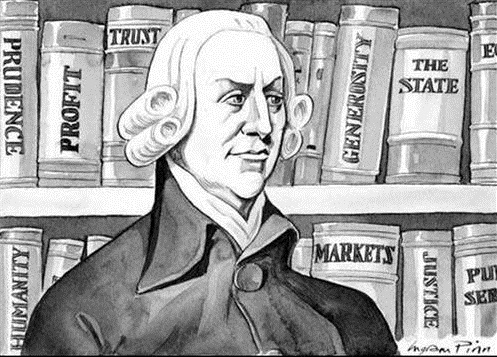
Adam Smith, the 18th century Scottish political economics pioneer, is best known for his classic work: “An Inquiry into the Nature and Causes of the Wealth of Nations (1776)“. Through reflection over the economics at the beginning of the Industrial Revolution the book touches upon broad topics as the division of labor, productivity, free markets and the division of incomes into profit, wage, and rent [4]. While Smith attacked most forms of government interference in the economic process, he advocated that government should remain active in certain sectors of society not suited for profit-seekers. These sectors included public education, mitigations for poor adults, the judiciary, a standing army, and healthcare. He posited that these institutional systems may/should never be directly profitable for private industries.

Hedge Funds and Crony-Capitalist obviously hold a dissenting view.

Beyond Adam Smith, the field of Economics features public choice theory – the application of economic thinking to political issues. This field asserts that “rent-seeking” is the more appropriate labeling for certain activities. This “rent” refers to seeking to increase one’s share of existing wealth without creating new wealth. The demonstrated  effects of these efforts are reduced economic efficiency [in the community] through poor allocation of resources, reduced actual wealth creation, lost government revenue, and increased income inequality,[1] and, potentially, national decline. (The word “rent” does not refer here to payment on a lease but refers to gaining control of land or other natural resources).

So why is the cost of drugs so high in the US? Based on these experiences, it is not just the motivation for profit, but for rent!

This theory was detailed further in a recent Go Lean blog that related that Big Pharma, the Pharmaceutical industry, dictates standards of care in the field of medicine, more so than may be a best-practice. The blog painted a picture of a familiar scene where Pharmaceutical Sales “Reps” slip in the backdoor to visit doctors to showcase their latest product lines; but relates that there are commission kick-backs, rebates and “spiffs” in these arrangements, to incentivize the doctors to order these drugs for their patients. The Go Lean book posits that the Caribbean must take its own lead in the battle for health, wellness and pharmaceuticals because this US eco-system is motivated by such a bad ethos: profit and even worst, rent.

The Go Lean book strategizes a roadmap for economic empowerment in the Caribbean region, even including the indisputable need for healthcare and pharmaceutical drugs. Clearly any quest to elevate the region must detail a comprehensive plan for healthcare. The Go Lean book proves this; it goes beyond a plan and provides a roadmap … to make the Caribbean a better place to live, work, heal and play. At the outset of the Go Lean book, in the Declaration of Interdependence (Page 11), these points are pronounced:

viii. Whereas the population size is too small to foster good negotiations for products and commodities from international vendors, the Federation must allow the unification of the region as one purchasing agent, thereby garnering better terms and discounts.

ix.  Whereas the realities of healthcare and an aging population cannot be ignored and cannot be afforded without some advanced mitigation, the Federation must arrange for health plans to consolidate premiums of both healthy and sickly people across the wider base of the entire Caribbean population. The mitigation should extend further to disease management, wellness, mental health, obesity and smoking cessation programs.

The Go Lean serves as a roadmap for the implementation and introduction of the technocratic Caribbean Union Trade Federation (CU). The CU‘s prime directives are identified with the following 3 statements:

  • Optimization of the economic engines in order to grow the regional economy to $800 Billion & create 2.2 million new jobs.
  • Establishment of a security apparatus to protect the resultant economic engines.
  • Improve Caribbean governance to support these engines.

Previous blog/commentaries addressed issues of capitalistic conflicts in American medical practices, compared to other countries, and the Caribbean. The following sample applies:

Book Review – ‘Thimerosal: Let The Science Speak’
Detroit-area Judge to Decide if Kids Need Vaccines
Good American Model – Shaking Up the World of Cancer With a Good ROI
Bad American Model – The Cost of Cancer Drugs
Racism in Medicine? Look at Ebola’s Historicity
Antibiotics Misuse Linked to Obesity in the US
CHOP Research: Climate Change May Bring More Kidney Stones
Big Pharma & Criminalization of American Business
New Research and New Hope in the Fight against Alzheimer’s Disease
Health-care fraud in America; criminals take $272 billion a year
New Cuban Cancer medication registered in 28 countries

The foregoing news article and VIDEO provides an inside glimpse of American Crony-Capitalism as it touches on vital areas like healthcare. Obviously, the innovators and developers of drugs have the right to glean the economic returns of their research. The Go Lean roadmap posits that there is a better way, a scheme in which more innovations can emerge and investors can get their Return on Investment (ROI).

The Caribbean Union Trade Federation has the prime directive of optimizing the economic, security and governing engines of the region. The foregoing VIDEO depicts that research is very important to identify and qualify best practices in health management for the public. This is the manifestation and benefits of Research & Development (R&D). The roadmap describes this focus as a community ethos to promote R&D in the areas of science, technology, engineering and medicine (STEM).

The following list details additional ethos, strategies, tactics, implementations and advocacies to optimize the region’s health deliveries and R&D investments, especially on Caribbean campuses and educational institutions:

Community Ethos – Deferred Gratification Page 21
Community Ethos – Economic Systems Influence Individual Choices and Incentives Page 21
Community Ethos – The Consequences of Choices Lie in the Future Page 21
Community Ethos – Governing Principles – Lean Operations – GPO’s; Ideal for Healthcare Page 24
Community Ethos – Governing Principles – Return on Investments (ROI) Page 24
Community Ethos – Governing Principles – Cooperatives Page 25
Community Ethos – Non-Government Organizations Page 25
Community Ethos – Ways to Impact Research & Development (R&D) Page 30
Community Ethos – 10 Ways to Promote Happiness Page 36
Community Ethos – Ways to Impact the Greater Good Page 37
Strategy – Integrate and unify region in a Single Market Page 45
Strategy – Agents of Change – Globalization Page 57
Tactical – Fostering a Technocracy Page 64
Tactical – Growing to a $800 Billion Economy – Case Study of Adam Smith Page 67
Tactical – Separation of Powers – Health Department Page 86
Tactical – Separation of Powers – Drug Administration Page 87
Implementation – Ways to Pay for Change Page 101
Implementation – Ways to Implement Self-Government Entities – R&D Campuses Page 105
Implementation – Ways to Deliver Page 109
Planning –  Ways to Improve Trade Page 128
Planning –  Ways to Make the Caribbean Better Page 131
Advocacy – Ways to Improve Healthcare Page 156
Advocacy – Ways to Better Manage the Social Contract Page 170
Advocacy – Ways Foster Cooperatives Page 176
Advocacy – Ways to Improve Emergency Management Page 196
Advocacy – Ways to Impact Foundations Page 219
Advocacy – Ways to Impact Persons with Disabilities Page 228
Appendix – Emergency Management – Medical Trauma Centers Page 336

The Go Lean roadmap does not purport to be an authority on medical or pharmaceutical research best practices. This economic-security-governance empowerment plan should not direct the course of direction for medical research and/or treatment. But something is wrong here, as portrayed in the foregoing article and VIDEO. The pharmaceutical industry cannot claim any adherence to any “better nature” in their practices.

This is not economics, which extols principles like the “law of diminishing returns”, or “competition breathes lower prices and higher quality”. No, the American pharmaceutical industry, at this juncture, is just a pure evil version of Crony Capitalism. Just … rent!

This is not the role model we want to build Caribbean society on.

Capitalism versus Socialism …
Many people feel this type of discussion in this commentary is really a clear indictment of the premise of the American Healthcare system, based on capitalism (right-leaning). Opponents of this status quo advocate for a more socialistic approach (left-leaning). Socialized medicine is the premise for Canada, the UK, and all the 27 EU countries. So the alternative to the American system is not so radical. Alas, even America’s capitalized healthcare schemes are not as far-right as in times past; with the implementation MediCare (in the 1960’s), VA hospitals, and Affordable Care Act (ObamaCare) Health Insurance mandates; these are now reflections of socialism in the US system.

CU Blog - Capitalism of Drug Patents - Photo 2How do we measure the effectiveness of success of left-leaning versus right-leaning healthcare schemes? While most “Well-being” measurements are obviously subjective, there is one exception: life expectancy. Life expectancy calculation is all binary, 1 versus 0, On versus Off, Life versus Death. The Organization of Economic Cooperation and Development maintains a Better Life Index that measures “Well-being” in the 34 OECD Countries. The following details apply:

There is more to life than the cold numbers of GDP and economic statistics – This Index allows you to compare well-being across countries, based on 11 topics the OECD has identified as essential, in the areas of material living conditions and quality of life.

One of the 11 topics measure “Health”, with considerations to the binary Life Expectancy and the subjective Self-Reported Health. On this chart related to Life Expectancy (based on when the average age for non-trauma deaths), the US appears on the list in position 27. See chart here.

The Go Lean movement asserts that the US should not be our model for healthcare. We can do better in the Caribbean; we have done better (Cuba), and must do better throughout the region. We can impact the Greater Good and still preserve economic realities. This means life-or-death. 🙂

Download the book Go Lean … Caribbean – now!

———-

Related: When blacks get equal medical care, they don’t just live longer — they live longer than whites

Share this post:
, , , ,
[Top]

A Lesson in History – Book Review of the ‘Exigency of 2008’

Go Lean Commentary

“Exigent circumstances” call for extraordinary measures.

The textbook definition is a situation that demands prompt action or remedy; an emergency. On the other hand, the actual legal definition:

An exigent circumstance, in the criminal procedure law of the United States, allows law enforcement, under certain circumstances, to enter a structure without a search warrant or, if they have a “knock and announce” warrant, without knocking and waiting for refusal. It must be a situation where people are in imminent danger, evidence faces imminent destruction, or a suspect’s imminent escape.  (Source: https://en.wikipedia.org/wiki/Exigent_circumstance)

What would constitute an “exigent circumstance” requiring national attention?

War (or any threat to national defense), of course …
… high-crime incidents and natural disasters.

CU Blog - Exigency of 2008 - Photo 2These are all physicals circumstances. In American jurisprudence, physical threats are categorized as a ‘Clear and Present Danger’ where a potential danger must be assuaged otherwise it will likely cause a catastrophe. (This point was detailed in a previous blog-commentary).

But as for economic exigent circumstances, these can also be catastrophic!

The prominent economic exigent circumstance of recent history is the Great Recession of 2008 – see VIDEO here. (The whole world has been shaped by the events of 2008).

The US Secretary of the Treasury at that time, Henry Paulson, recognized the urgency and emergency of the financial crisis early in 2008 and asked the President (George W. Bush) for a War Powers Declaration; (Appendix A). This refers to the federal law intended to allow the US Congress to declare war, while the President executes the war as Commander-in-Chief.

In 2008 historicity, Congress did approve legislation to declare and fund a defense against the financial crisis; and the President did command a Bail-out strategy to restore the integrity of the economy.

This was economic war! Not just some normal market correction.

But were the actions legal?

This was the premise for the new book by Philip Wallach “To the Edge: Legality, Legitimacy, and the Responses to the 2008 Financial Crisis“. The Amazon summary follows:

CU Blog - Exigency of 2008 - Photo 1Were the radical steps taken by the Treasury Department and Federal Reserve to avert the financial crisis legal? When and why did political elites and the general public question the legitimacy of the government’s responses to the crisis?

In [the book] To The Edge: Legality, Legitimacy, and the Responses to the 2008 Financial Crisis, Philip Wallach chronicles and examines the legal and political controversies surrounding the government’s responses to the recent financial crisis. The economic devastation left behind is well-known, but some allege that even more lasting harm was inflicted on America’s rule of law tradition and government legitimacy by the ambitious attempts to limit the fallout. In probing these claims, Wallach offers a searching inquiry into the meaning of the rule of law during crises.

The book provides a detailed analysis of the policies undertaken – from the rescue of Bear Stearns in March 2008 through the tumultuous events of September 2008, the passage of the TARP and its broad usage, the alphabet soup of emergency Federal Reserve programs, the bankruptcies of Chrysler and GM, and the extended public ownership of AIG, Fannie Mae, and Freddie Mac. Throughout, Wallach probes the legal bases of the government’s actions and explores why concerns about the legitimacy of government actions were only sporadically grounded in concerns about legality – and sometimes ran directly against them.

The public’s sense that government officials operated through ad hoc responses that favored powerful interests has helped bring the legitimacy of American governmental institutions to historic lows. Wallach’s book recommends constructive and sensible reforms policymakers should take to ensure accountability and legitimacy before the government faces another crisis.

Product Details

  • Paperback: 319 pages
  • Publisher: Brookings Institution Press (April 21, 2015)
  • Language: English
  • ISBN-10: 0815726236
  • ISBN-13: 978-0815726234

Source: http://www.amazon.com/dp/0815726236/ref=rdr_ext_tmb

The book Go Lean…Caribbean was written in the wake of this same 2008 Financial Crisis, but for the limited perspective for the Caribbean. Many lessons-learned from 2008 are considered and applied in appropriate strategies, tactics and implementations to re-boot the Caribbean region from the catastrophe of this crisis; many member-states of the region are still suffering; i.e. Puerto Rico. The foregoing Book Review highlights a publication that is a study of the depth-and-width of the legal maneuvering for the 2008 crisis; now the same writer, Philip Wallach, has composed a supplemental essay asserting a new label to the crisis “lawfare”; see Appendix B for definition and the essay in Appendix C below.

This lawfare consideration is presented in conjunction to mitigations and remediation for protecting the Caribbean homeland. The assertion in the book Go Lean … Caribbean (Page 23) is that with the emergence of new economic engines, “bad actors” will also emerge thereafter to exploit the opportunities, with good, bad and evil intent. But the book warns against more than just people, rather “bad or exigent circumstances”; thusly referring to corporate entities, natural disasters and other cross-border threats; 2008 would have fit this definition. The book relates that “bad actors” is a historical fact that will be repeated again and again.

This point is pronounced early in the book with the Declaration of Interdependence (Page 12) that claims:

i.       Whereas the earth’s climate has undeniably changed resulting in more severe tropical weather storms, it is necessary to prepare to insure the safety and security of life, property and systems of commerce in our geographical region. As nature recognizes no borders in the target of its destruction, we also must set aside border considerations in the preparation and response to these weather challenges.

ii.      Whereas the natural formation of the landmass for our lands constitutes some extreme seismic activity, it is our responsibility and ours alone to provide, protect and promote our society to coexist, prepare and recover from the realities of nature’s occurrences.

x.      Whereas we are surrounded and allied to nations of larger proportions in land mass, populations, and treasuries, elements in their societies may have ill-intent in their pursuits, at the expense of the safety and security of our citizens. We must therefore appoint new guards to ensure our public safety and threats against our society, both domestic and foreign. The Federation must employ the latest advances and best practices … to assuage continuous threats against public safety.

xii.    Whereas the legacy in recent times in individual states may be that of ineffectual governance with no redress to higher authority, the accedence of this Federation will ensure accountability and escalation of the human and civil rights of the people for good governance, justice assurances, due process and the rule of law…

xxv.  Whereas the legacy of international democracies had been imperiled due to a global financial crisis, the structure of the Federation must allow for financial stability and assurance of the Federation’s institutions. To mandate the economic vibrancy of the region, monetary and fiscal controls and policies must be incorporated as proactive and reactive measures. These measures must address threats against the financial integrity of the Federation and of the member-states.

The Caribbean appointing new guards (security pact) to ensure public safety must include many strategies, tactics and implementations considered “best-practices” for economic crimes and systemic threats. We must be on a constant vigil against “exigence”, man-made, natural and economic. This indicates being pro-active in monitoring, mitigating and managing risks. Then when “crap” happens – economic crises – the new guards will be prepared for “exigent circumstances”.

The Go Lean book is a petition for change, serving as a roadmap for the introduction and implementation of the technocratic Caribbean Union Trade Federation (CU). The CU is set to optimize Caribbean society through economic empowerment, and also homeland security in the region, since these are inextricably linked to this same endeavor.

Therefore the Go Lean roadmap has 3 prime directives:

  • Optimization of the economic engines in order to grow the regional economy to $800 Billion & create 2.2 million new jobs.
  • Establishment of a security apparatus to protect the resultant economic engines and the Caribbean homeland.
  • Improvement of Caribbean governance to support these engines.

This is not just academic, as in the case of the foregoing Book Review and supplemental essay in Appendix C. Principals among Go Lean planners were there in 2008, engaged with major stakeholders of the Global Financial crisis: Lehman Brothers, BearStearns, JPMorganChase, CitiGroup, etc. This is real experience from the real crisis; see documentary VIDEO here:

VIDEO – Meltdown – The Men Who Crashed the World – Part 1 – https://youtu.be/JYTyluv4Gws  

This 1st of 4 parts documentary elapses 2 and half hours in total. It is recommended that this be consumed at some point as extra-credit to this discussion.
Uploaded on Oct 13, 2011- In the first episode of Meltdown, we hear about four men who brought down the global economy: a billionaire mortgage-seller who fooled millions; a high-rolling banker with a fatal weakness; a ferocious Wall Street predator; and the power behind the throne.
The crash of September 2008 brought the largest bankruptcies in world history, pushing more than 30 million people into unemployment and bringing many countries to the edge of insolvency. Wall Street turned back the clock to 1929. But how did it all go so wrong?
Lack of government regulation; easy lending in the US housing market meant anyone could qualify for a home loan with no government regulations in place.
Also, London was competing with New York as the banking capital of the world. Gordon Brown, the British finance minister at the time, introduced ‘light touch regulation’ – giving bankers a free hand in the marketplace.
All this, and with key players making the wrong financial decisions, saw the world’s biggest financial collapse.

Part 2: https://youtu.be/Bp7c2Wo9YDc
Part 3: https://youtu.be/L20DhfgPugE
Part 4: https://youtu.be/osAYMnqZyZc

Planners of the Go Lean movement were there, on the inside looking out, not the outside looking in. They were among the movers-and-shakers of the macro economy, not just armchair “Monday-morning” quarterbacks.

Thusly the CU Trade Federation is set to be “on guard”, on alert for real or perceived economic threats. The legal concept is one of being deputized by the sovereign authority for a role/responsibility in the member-state. As a security apparatus, the CU must always be a sentinel to monitor known threats; this includes man-made, natural and economic threats. Many of these exigent circumstances would be designated as primarily assigned to the CU to assuage. And then the related CU agencies will be expected to aid, assist, and support local resources in the member-states.

This is more and better than the region’s prior response in 2008. “Step One, Day One” in the Go Lean roadmap is to assume this stewardship of the regional economy. The CU organizational structure must be empowered for proactive and reactive management of economic threats and exigent circumstances. The Go Lean book details this series of community ethos, strategies, tactics, implementations and advocacies to provide this better stewardship of the economic engines of the Caribbean region:

Who We Are – SFE Foundation – 2008 History Page 8
Assessment – Puerto Rico – ‘The Greece of the Caribbean’ Page 18
Community Ethos – Economic Principles – People Respond to Incentives Page 21
Community Ethos – Economic Principles – Economic Systems Influence Individual Choices Page 21
Community Ethos – Economic Principles – Voluntary Trade Creates Wealth Page 21
Community Ethos – Economic Principles – Consequences of Choices Lie in the Future Page 21
Community Ethos – Economic Principles – Money Multiplier Page 23
Community Ethos – Governing Principles – Lean Operations Page 24
Community Ethos – Ways to Impact Turn-arounds Page 33
Community Ethos – Ways to Improve Sharing Page 35
Community Ethos – Ways to Impact the Greater Good Page 37
Strategy – Mission – Fortify the Stability of the Banking Institutions Page 45
Strategy – Provide Proper Oversight and Support for the Depository Institutions Page 46
Strategy – Agents of Change – Globalization Page 57
Tactical – Confederating a permanent union Page 63
Tactical – Ways to Foster a Technocracy Page 64
Tactical – Growing the Economy – Minimizing Bubbles Page 69
Tactical – Separation-of-Powers – Caribbean Central Bank Page 73
Tactical – Separation-of-Powers – Depository Institutions Regulatory Agency Page 73
Anecdote – Turning Around CARICOM – Effects of 2008 Financial Crisis Page 92
Implementation – Assemble Caribbean Central Bank as a Cooperative Page 96
Implementation – Ways to Pay for Change Page 101
Implementation – Ways to Better Manage Debt Page 114
Implementation – Ways to Benefit from Globalization Page 119
Planning – 10 Big Ideas – #1: Single Market / Currency Union Page 127
Planning – Ways to Improve Trade Page 128
Planning – Lessons Learned from 2008 Page 136
Advocacy – Ways to Grow the Economy Page 151
Advocacy – Ways to Create Jobs Page 152
Advocacy – Ways to Control Inflation Page 153
Advocacy – Ways to Better Manage ForEx Page 154
Advocacy – Reforms for Banking Regulations Page 199
Advocacy – Ways to Impact Wall Street Page 200
Advocacy – Ways to Impact Main Street Page 201
Advocacy – Battles in the War on Poverty Page 222
Advocacy – Ways to Help the Middle Class Page 223
Advocacy – Ways to Impact the One Percent Page 224

This commentary has frequently focused on the lessons-learned from 2008. Some other blogs related to the challenge to Caribbean economic security and governance as a result of 2008 are listed here:

https://goleancaribbean.com/blog/?p=6399 Book Review on ‘Mitigating Income Inequality’
https://goleancaribbean.com/blog/?p=6260 Puerto Rico Bondholders Coalition Launches Ad Campaign
https://goleancaribbean.com/blog/?p=5482 For-Profit Education rise Post-2008: Plenty of Profit; Little Education
https://goleancaribbean.com/blog/?p=3858 ECB unveils 1 trillion Euro stimulus program
https://goleancaribbean.com/blog/?p=3582 For Canadian Banks: Caribbean has become a ‘Bad Bet’ Post-2008
https://goleancaribbean.com/blog/?p=3397 A Christmas Present for the Banks to Return to Pre-2008 Standards
https://goleancaribbean.com/blog/?p=3311 Detroit to exit historic bankruptcy – Finally recovering from 2008
https://goleancaribbean.com/blog/?p=3164 Michigan Unemployment – Then (2008) and Now
https://goleancaribbean.com/blog/?p=2930 ‘Too Big To Fail’ – Caribbean Version
https://goleancaribbean.com/blog/?p=2090 Why So Long? Can’t We Just… – Lesson from 2008
https://goleancaribbean.com/blog/?p=1309 5 Steps of the 2008 Mortgage-Bubble-Crisis
https://goleancaribbean.com/blog/?p=1296 Remittances to Caribbean Increasing since 2008
https://goleancaribbean.com/blog/?p=798 Lessons Learned from the American Airlines 2008 Recession Debacle
https://goleancaribbean.com/blog/?p=782 Open the Time Capsule: The Great Recession of 2008
https://goleancaribbean.com/blog/?p=623 ‘Only at the precipice, do they change’
https://goleancaribbean.com/blog/?p=599 Ailing Puerto Rico – from 2008 crisis – open to radical economic fixes
https://goleancaribbean.com/blog/?p=518 What Usain Bolt can teach banks about 2008 financial risk
https://goleancaribbean.com/blog/?p=378 Fed Releases Transcripts from 2008 Meetings
https://goleancaribbean.com/blog/?p=353 Book Review: ‘Wrong – Nine Economic Policy Disasters and What We Can Learn…’
https://goleancaribbean.com/blog/?p=273 10 Things We Don’t Want from the US – #3: Americanized World Economy

According to the foregoing blog references, the Caribbean parasitic regional economy has not being gracious to its citizens, and other stakeholders (visitors, lenders, Direct Foreign Investors). We need the empowerments of the Go Lean roadmap for so many reasons; one strong motivation is to turn-around this status quo; another reason is to diversify our economy. All of this will fortify our economic security and improve our governance. Considering the history of these North American and Western European powers, we do not want to be their parasites, rather their protégé.

This is the purpose of the Go Lean roadmap, to provide a turn-by-turn direction to move the region to that destination. The advocacy here is to adopt the structure of an economic technocracy. The term technocracy is used to designate the application of the scientific method to solving social and economic problems. The CU must start off as such a technocracy, not grow into being a technocracy – too much is at stake.

All of the Caribbean is hereby urged to lean-in to this roadmap for a technocracy, to make the Caribbean a better place to live, work and play. 🙂

Download the book Go Lean…Caribbean now!

———

Appendix A: War Powers Declaration

Article I, Section 8, Clause 11 of the United States Constitution, sometimes referred to as the War Powers Clause, vests in the Congress the power to declare war, in the following wording:

[The Congress shall have Power…] To declare War, grant Letters of Marque and Reprisal, and make Rules concerning Captures on Land and Water;

A number of wars have been declared under the United States Constitution, although there is some controversy as to the exact number, as the Constitution does not specify the form of such a declaration.
(Source: https://en.wikipedia.org/wiki/War_Powers_Clause; retrieved September 22, 2015)

———

Appendix B: Lawfareblog.com

Law + Warfae = Lawfare

This name Lawfare refers both to the use of law as a weapon of conflict and, perhaps more importantly, to the depressing reality that America remains at war with itself over the law governing its warfare with others. (It could apply equally to any other country). This blog by Benjamin Wittes, Robert Chesney, and Jack Goldsmith is devoted to that nebulous zone in which actions taken or contemplated to protect a nation interact with the nation’s laws and legal institutions. In addition, this term refers to a nation’s use of legalized international institutions to achieve strategic ends, so in effect the “use of law as a weapon of war”. – Source: https://www.lawfareblog.com/about-lawfare-brief-history-term-and-site

According to Wikipedia, Lawfare is asserted by some to be the illegitimate use of domestic or international law with the intention of damaging an opponent, winning a public relations victory, financially crippling an opponent, or tying up the opponent’s time so that they cannot pursue other ventures such as running for public office,[1][2] similar to a SLAPP (strategic lawsuit against public participation) lawsuit.

———

Appendix C – Essay Title: Hard Financial Crisis Choices    

By: Philip Wallach

Providing physical security to its citizens is undoubtedly the core function of the state. As readers of Lawfare well know, it is hard work to figure out how that security function should be reconciled with sometimes-conflicting imperatives of legal process, constitutional separation of powers, and transparent and accountable government. Especially challenging is the question of how much, and for how long, exigent circumstances should expand the sphere of legitimate government activities.

Not far behind physical security as a core function of the state is providing some baseline of financial stability and economic security, especially through the protection of a functional banking system and financial markets. Once again, it is hard to discern the appropriate relationship between this financial stability function and other mission-critical governmental activities. Because financial stability in a dynamic market economy includes the expectation that downturns are a healthy part of the process, it is often difficult to distinguish between a developing crisis and normal market corrections, making the balancing act between expedient action and a commitment to act through deliberate processes all the more difficult.

But while there are volumes enough on the question of why economies experience financial crises, and torrid debates on which responses are most effective, there is a striking absence of commentary about “hard financial crisis choices,” and especially their legal aspects. Applicable judicial precedents are few and far between, the Federal Reserve’s emergency decision-making processes are shrouded in mystery (in contrast to its monetary policy decisions), and the Treasury Department is accustomed to extraordinary deference. This vacuum has had some very unfortunate practical consequences for those who fashioned the responses to our financial crisis response, which I explain in my new book, To the Edge: Legality, Legitimacy, and the Responses to the 2008 Financial Crisis (Brookings Institution Press, 2015).

Why on earth should Lawfare readers care?

Treating national security as sui generis, while obviously appropriate in some contexts, unhelpfully narrows thinking in many others. If the question is how emergencies change the scope for government action, how legitimacy is achieved by crisis responders, or what the rule of law means in times of crisis, then adding financial crises to national security crises expands the material available for analysis. Doing so may also help clarify exactly what makes national security distinctive.

Some of my book’s analysis was directly inspired by Jack Goldsmith’s Power and Constraint. The latter explains how the government is actually empowered by various watchdogs and legal requirements that seem to constrain it, because they give it credibility and validation in a way that it could not otherwise produce. In the language of my book, such things provide legitimacy, which is often a necessary precondition for effective government action. If citizens had profound trust in their government (or a quasi-religious reverence for their leaders), legitimation might require very little other than some modicum of competence. But in the world of Snowden and Enron, Abu Ghraib and revolving doors, that trust is missing. Like Jack, I argue that accountability mechanisms provide at least a partial substitute by making citizens feel confident that leaders will be held to standards of reasonableness and propriety, if not immediately in the heat of a crisis response then at least afterwards, once the dust has settled.

American leaders once took this principle to its logical conclusion by openly acting extralegally and then seeking retroactive validation, either through a congressional indemnity or by appealing to a jury. The classic examples are antiques: Thomas Jefferson’s spending without appropriations in response to the HMS Leopard naval incident; General Andrew Jackson’s maintenance of martial law in New Orleans (vividly described in a classic article all Lawfare readers would enjoy); or Abraham Lincoln’s famous resort to constitutional dictatorship from March to July of 1861.

From the beginning of the twentieth century onward, Presidents and other crisis responders have unfailingly offered legal hooks for their emergency actions. Some academic theorists’ ambitions notwithstanding, openly extralegal declarations of prerogatives seem to have no place in our thoroughly legalized modern world (as Jack argues in a rather trenchant essay in this edited volume).

Instead of asking whether law will be the tool of legitimation, the question now becomes: just how reliable a check and a legitimator is the now-universally-obligatory exercise of legal justification? If justification is based on law that itself possesses no legitimacy, or if it misuses existing law, then it cannot provide much legitimacy. On the other hand, even in the era of ubiquitous legal justification, actions with poor legal pedigrees can be accepted as legitimate if they are acceptable to the public on other grounds. We can draw some useful analogies between national security and financial crises for both of these situations in which legality and legitimacy diverge.

Woodrow Wilson’s leadership during World War I provides an interesting instance in which poor legal justifications led to legitimacy problems. Congress gave Wilson’s administration unprecedented delegated powers through a number of enabling acts (the National Defense Act, Army Appropriations Act, Lever Act, and Overman Act), thus furnishing an easy way to legally justify most of his policies. But even in that context Wilson managed to push the envelope quite aggressively, both by using the vaguely defined powers as justifications for decisions that Congress refused to support (e.g., arming merchantmen, creating the Committee on Public Information—which was effectively a propaganda ministry—and censoring telegraphs) and by sustaining his wartime institutions past the end of the war against the desires of Congress. This willingness to aggressively wield emergency powers contributed to the public’s desire for a “return to normalcy” and Democrats’ resounding defeat in 1920.

Similarly, having the backing of an expansive enabling act—namely the Emergency Economic Stabilization Act of 2008, better known as TARP—proved no guarantee of legitimacy in recent years. The Act itself was bitterly contested, with bipartisan congressional leaders failing to persuade populist backbenchers of either party.  (This made TARP different from most enabling acts; the September 2001 AUMF, passed nearly unanimously, is far more typical.) There was also a sense that TARP was dangerously free of actual guidance for the executive branch, providing only a panicked sanction for whatever the Treasury Department found necessary. Such criticisms were well-founded: TARP was used in ways that wildly diverged from its original stated purpose of purchasing troubled assets, eventually including loans to GM and Chrysler when Congress failed to provide a separate pot of money for them in December 2008. Of course bank bailouts will tend to be unpopular in ways that defending the homeland will not, but even so the sense that the executive branch was doing as it pleased—even after Congress had belatedly acted—contributed to the crisis responses’ legitimacy problems. Neither in Wilson’s case nor in TARP’s were qualms about improper legal justifications the driving force behind dissatisfaction, but they served to intensify existing concerns. (Coincidentally, TARP’s most fervent opponents also yearned for a return to the normalcy of federal government circa 1921…)

Conversely, legal flaws don’t always entail legitimacy problems. Franklin Roosevelt’s Destroyer Deal in 1940 was supported by an at-best tendentious memorandum from Attorney General Robert Jackson, but it was widely popular and never caused Roosevelt any real political problems. In the boldest maneuver of the 2008 Financial Crisis, the Treasury Department used the Exchange Stabilization Fund to guarantee money market funds in September of that year—with only a paper-thin legal justification and absolutely no precedent to support such a strange use of an authority nominally dedicated to stabilizing international currency markets. But it was a striking success, so much so that the program it supported actually brought fees into the Treasury without ever paying any money out. The weakness of its legal justification is already nearly forgotten, of interest only to the very small handful of people interested Lawfare-like subjects.

A similarity between the Destroyer Deal and the money market rescue is worth noting: both involved the federal government giving rather than taking, which limits popular opposition and also the pool of potential litigants who might have standing to challenge the action. Acting so as to only cost taxpayers generally, rather than rights-holders specifically, offers a way to avoid the determined pryings of lawyers and the unpredictable rulings of judges—harder to pull off in the national security realm, but not impossible. It is worth considering how this desire to push policymaking into less heavily lawyered areas might shape the evolution of security policy in years to come.

One last musing here (if you’re eager for more, please get yourself the book!) in the form of a question, which I’d be eager to get the Lawfare community’s thoughts on. Early on during the crisis, the well-known economist and blogger Mark Thoma suggested that economists thinking about the balance between facilitating timely responses to emergencies and the need to honor the democratic process should learn from the compromise embedded in the War Powers Resolution, in which expedient action is allowed but time-limited. Sounds like a good idea…except for the whole history of the War Powers Resolution, which as I understand it is none too encouraging.

Financial crisis responders also sometimes figured out ways to circumvent rather clear time limits. Support for Fannie Mae and Freddie Mac under the Housing and Economic Recovery Act of 2008 was supposed to be cut off at the end of 2009, but the Treasury interpreted that to mean nothing more than that its maximum level of support had to be specified by that time. As they understood them, the commitments put in place by then were effectively unlimited and indefinite guarantees of the two firms.

What is it that makes putting hard time limits on executive branch unilateral actions so difficult? The obvious generic answer is enforceability. An enforcer must be both willing and able to meet violations with serious consequences, and it is hard to find institutional actors who are both. Courts may sometimes be willing—their tendency to defer to the executive in troubled times has limits, as Lawfare’s contributors have explored many times—but with neither purse nor sword judges’ ability to stand in the way of a determined executive branch is quite modest. With its power to withdraw funding, Congress is potent enough to enforce the limits put in force by its previous incarnations, but it seems generally unwilling to exercise that power, as doing so offers no political gain and considerable political risks. Are there other possible enforcers for time limits built into grants of extraordinary executive power? Are there ways to make limits genuinely self-enforcing, such that inaction will not render the limits nugatory? Thoughts about the War Powers Resolution or about the problem more generally would be greatly appreciated, as these questions are not rhetorical.
Phil Wallach is a Fellow in the Brookings Institution’s Governance Studies Program.
Source: LawFare Legal Analysis Online Community; posted May 21, 2015; retrieved September 22, 2015  from: https://www.lawfareblog.com/hard-financial-crisis-choices

Share this post:
, , , , ,
[Top]

Wi-Fi Hot Spots Run By Hackers Are Targeting Tourists

Go Lean Commentary

CU Blog - Wi-Fi Hot Spots Run By Hackers Are Targeting Tourists - Photo 1BFor all the good that the internet brings to the world, there is a lot of bad too. The W.W.W in a web address does not mean Wild Wild West. But it feels like that; the bad old days of outlaws and gunslingers. (The actual WWW initials mean World Wide Web). Let the buyer beware!

The need for a Sentinel in Caribbean electronic commerce has been fully established by this commentary. Someone needs to be “watching the store in the Caribbean”. Electronic commerce now means internet and mobile transactions, encompassing smartphones, tablets and other mobile devices.

While the Caribbean member-states are not as advanced as other North American locations (US & Canada) or many Western European countries, we have fully embraced the internet via broadband, Wi-Fi and mobile communication utilities. The assertion in the book Go Lean…Caribbean, is that any plan to reboot Caribbean economics, security and governance must include promotion and regulation of technological initiatives as well. This Go Lean book serves as a roadmap for the introduction and implementation of the technocratic Caribbean Union Trade Federation (CU) to facilitate the growth, stewardship and oversight of electronic commerce in a regional Single Market.

There is therefore the need to be “on guard” for “bad actors” that will surely emerge to exploit Caribbean stakeholders, including residents, businesses and visitors – possibly up to 150 million people, including 80 million tourists. This news VIDEO here reports on a new threat:

VIDEO: Caution: Wi-Fi hot spots run by hackers are targeting tourists – http://www.today.com/video/caution-wi-fi-hot-spots-run-by-hackers-are-targeting-tourists-526433347646

September 16, 2015 – The “Hacking of America” series continues with a new warning: Before you log on to free public Wi-Fi hot spots at popular tourist destinations like New York City’s Times Square, be aware that they could be traps for hackers to steal your identity. One warning sign: The word “free.” NBC’s Tom Costello shares tips to protect your online security with TODAY.

CU Blog - Wi-Fi Hot Spots Run By Hackers Are Targeting Tourists - Photo 1AImagine a Caribbean tourist, disembarking a cruise ship, turning on a smartphone and being enticed with “FREE Wi-Fi”.

The Go Lean book relates regional oversight for the Caribbean Single Market – a lean technocracy – for cross-border electronic media, governance of the Information Technology Arts and Sciences and Grievance mediation. These activities are part –and-parcel of the missions of Go Lean roadmap, whose prime directives are identified with the following 3 statements:

  • Optimization of the economic engines in order to grow the regional economy to $800 Billion & create 2.2 million new jobs.
  • Establishment of a security apparatus to protect the people and processes (economic engines) of the region from threats and attacks (physical and electronic) that may originate from foreign or domestic sources.
  • Improvement of Caribbean governance to support these engines, including consolidation of all Postal operations. The Caribbean Postal Union will deploy a Caribbean Cloud, a Social Media / Electronic Commerce offering for all Caribbean member-states, branded www.myCaribbean.gov.

These prime directives will elevate Caribbean society. With this success comes the emergence of “bad actors”. The foregoing VIDEO relates one such instance. The goal of preparing the appropriate security apparatus – to protect the people and processes – was envisioned in the Go Lean roadmap from the beginning; this was defined early in the book (Page 12 & 14) in the following pronouncements in the Declaration of Interdependence:

x.  Whereas we are surrounded and allied to nations of larger proportions in land mass, populations, and treasuries, elements in their societies may have ill-intent in their pursuits, at the expense of the safety and security of our citizens. We must therefore appoint “new guards” to ensure our public safety and threats against our society, both domestic and foreign. The Federation must employ the latest advances and best practices … to assuage continuous threats against public safety.

xv. Whereas the business of the Federation and the commercial interest in the region cannot prosper without an efficient facilitation of postal services, the Caribbean Union must allow for the integration of the existing mail operations of the governments of the member-states into a consolidated Caribbean Postal Union, allowing for the adoption of best practices and technical advances to deliver foreign/domestic mail in the region.

xvi. Whereas security of our homeland is inextricably linked to prosperity of the homeland, the economic and security interest of the region needs to be aligned under the same governance. Since economic crimes, including piracy and other forms of terrorism, can imperil the functioning of the wheels of commerce for all the citizenry, the accedence of this Federation must equip the security apparatus with the tools and techniques for predictive and proactive interdictions.

xxvii. Whereas the region has endured a spectator status during the Industrial Revolution, we cannot stand on the sidelines of this new economy, the Information Revolution. Rather, the Federation must embrace all the tenets of Internet Communications Technology (ICT) to serve as an equalizing element in competition with the rest of the world. The Federation must bridge the digital divide and promote the community ethos that research/development is valuable and must be promoted and incentivized for adoption.

According to the foregoing VIDEO, the threat for cyber-crimes is now exposed to mobile users and those innocently partaking of FREE Wi-Fi services. This should not be so endangering. Wi-Fi communications should be a benign utility. There is the natural expectation that the governmental authorities would protect the innocent and interdict all villainous parties. This “natural expectation” is part-and-parcel of the Social Contract between citizens and their governments. For the 80 million visitors enjoying Caribbean hospitality, this presumed protection should automatically extend to them.

This is the assumption. The region must therefore anticipate these “bad actors” and deploy the counter-measures to monitor, mitigate and manage all identified risks associated with this cyber-threat. All cyber-crimes and threats to electronic commerce must be a constant focus for the “new guards” being proposed for implementation in the Caribbean with this Go Lean/CU roadmap.

CU Blog - Wi-Fi Hot Spots Run By Hackers Are Targeting Tourists - Photo 2

The book posits that these are among the issues that are too big for any one Caribbean member-state to manage alone; that there are times when there must be a cross-border, multilateral coordination. So confederating all 30 Caribbean member-states and appointing the CU as a deputized agency to oversee this cyber activity is a wise course of action. In addition, the technical competence for the “guardians” of this new Caribbean economy must be “cutting edge”. Can we truly expect this from the current bureaucratic structures of these small member-states? Hardly.

In a previous blog, the “cutting-edge” readiness of one member-state (Bahamas) was likened to 1985, as opposed to 2015; the blog stated that “they are not reaching for the stars but rather reaching for the lamp-post”. Other blog-commentaries on this subject have detailed the full width-and-breath of preparing Caribbean society for the diverse economic, security and governing issues of managing ICT in this new century. See sample blogs here:

https://goleancaribbean.com/blog/?p=6341 The Need for Online Tourism Marketing Stewardship
https://goleancaribbean.com/blog/?p=5435 China Internet Policing – Model for Caribbean
https://goleancaribbean.com/blog/?p=5353 US Presidential Politics and the Internet
https://goleancaribbean.com/blog/?p=4793 Online reviews – like Yelp and Angie’s List – can wield great power for services marketed, solicited and contracted online.
https://goleancaribbean.com/blog/?p=4381 Net Neutrality – The need for Caribbean Administration of the Issue.
https://goleancaribbean.com/blog/?p=4337 Crony-Capitalism Among the Online Real Estate Markets
https://goleancaribbean.com/blog/?p=3881 European and North American Intelligence Agencies to Ramp-up Cyber Security Cooperation
https://goleancaribbean.com/blog/?p=906 Bitcoin e-Payments needs regulatory framework to manage ‘risky’ image
https://goleancaribbean.com/blog/?p=308 Caribbean Communications Infrastructure Program (CARCIP) and the Caribbean Telecommunications Union (CTU) urges greater innovation and protection.

These commentaries demonstrate that there is the need for a technocratic governing body to better oversee and police Caribbean electronic commerce. This structure will assuage cyber-crimes and illicit activities for the Caribbean neighborhood in the online world.

We have so much more than Wi-Fi decoys to consider – as conveyed in the foregoing VIDEO. Successful execution of the Go Lean roadmap can expect a surge in internet/online activity and transactions; as there is the plan to deploy schemes to facilitate more e-Commerce: Central Bank adoption of Electronic Payment schemes and Postal Integration/Optimization, the Caribbean Cloud portal for www.myCaribbean.gov. So many more challenges – and lawlessness – will emerge.

The Go Lean book therefore presents the series of community ethos, strategies, tactics, implementations and advocacies that must be adopted and executed to elevate this region to be competent with the Worldwide Web. See the following sample here:

Community Ethos – Deferred Gratification Page 21
Community Ethos – People Choose Page 21
Community Ethos – People Respond to Incentives Page 21
Community Ethos – Economic Systems Influence Individual Choices Page 21
Community Ethos – Job Multiplier Page 22
Community Ethos – Privacy versus Public Protection Page 23
Community Ethos – Whistleblower Protection Page 23
Community Ethos – Lean Operations Page 24
Community Ethos – Ways to Help Entrepreneurship Page 28
Community Ethos – Promote Intellectual Property Page 29
Community Ethos – Ways to Bridge the Digital Divide – Allow for FREE Wi-Fi Page 31
Community Ethos – Ways to Improve Sharing Page 35
Community Ethos – Ways to Impact the Greater Good Page 37
Strategy – Vision – Integrate a Single Market of entire region Page 45
Tactical – Fostering a Technocracy Page 64
Tactical – Separation of Powers – Caribbean Postal Union Page 78
Tactical – Separation of Powers – Interstate Commerce Administration Page 79
Tactical – Separation of Powers – Communications and Media Authority Page 79
Implementation – Year 1 / Assemble Phase – Establish CPU Page 96
Anecdote – Implementation Plan – Mail Services – US Dilemma Page 99
Implementation – Improve Mail Services – Electronic Supplements Page 108
Implementation – Ways to Deliver Page 109
Implementation – Ways to Impact Social   Media – For Residents, Visitors & Diaspora Page 111
Planning – 10 Big Ideas for the Caribbean Region – Cyber Caribbean Page 127
Advocacy – Ways to Improve Interstate Commerce Page 129
Advocacy – Ways to Grow the Economy Page 151
Advocacy – Ways to Create Jobs Page 152
Advocacy –Ways to Improve Governance Page 168
Advocacy –Ways to Better Manage the Social Contract Page 170
Advocacy – Ways to Improve Libraries – Hi-Density Wi-Fi Page 187
Advocacy – Ways to Impact Events – Hi-Density Wi-Fi & Mobile Apps Page 191
Advocacy – Ways to Foster Technology – Public Access Wi-Fi Page 197
Advocacy – Ways to Foster e-Commerce – Mobile Apps & Hi-Density Wi-Fi Page 198
Advocacy – Ways to Impact Main Street – Downtown Wi-Fi Page 201
Advocacy – Ways to Impact Urban Living Page 234

The Go Lean book creates some Great Expectations for the internet. It posits that online facilitations can serve as an equalizing element for the Caribbean to better compete with the rest of the world. So we must elevate the region’s core competence with all-things-cyber, including the security dynamics.

“Bad actors will always emerge to exploit economic opportunities” – Go Lean (Page 23).

So to keep pace with the latest and greatest cyber-criminals, we must do the heavy-lifting of “serving and protecting” the Caribbean online populations.  The region needs this technocracy of the CU Trade Federation. Everyone is therefore encouraged to lean-in to this Go Lean roadmap.  🙂

Download the free e-Book of Go Lean … Caribbean – now!

Share this post:
, , , ,
[Top]

Managing the ‘Invisible Hand of the Market’

Go Lean Commentary

So “who” does control the world? Or more exactly, who controls the world’s economy; how about the Caribbean economy? Are there entities trying to regulate and dictate the financial affairs of society?

The simple answer is Yes. Planners, forecasters, profit-seekers abound.

But, is there an all-benevolent power? Or worse, a malevolent one; a secret society trying to mold the world’s thoughts, feelings and actions into “its designs”. Conspiracy theories also abound, even for the limited Caribbean region. There is the historic fact that there are Special Interest Groups and Crony-Capitalists looking to exploit public resources for private gains; these “bad actors” are always there, always present. In addition, there are also bad government policies of rent-seeking, which are frequently manifested in the Caribbean region. (See recent news article here: http://freeport.nassauguardian.net/News/CCC–Lower-global-oil-costs-should-lower-power-bills).

It is the assertion of this commentary that the Caribbean market economy has often fallen prey to controlling forces – governments, industries, Direct Foreign Investors – looking to control the environment for their advantage. Many times though, these controlling forces have good intentions and altruistic motives seeking the Greater Good, but they may not have been equipped with the proper tools and techniques for effective oversight.

The book Go Lean…Caribbean and the underlying movement seeks to bring the proper tools and techniques to the Caribbean region to optimize the stewardship of the economic, security and governing engines.  The book posits that the economy can be induced and spurred for continuous progress, with technocratic management – stewardship – better than the status quo.

Will these new economic stewards then become some secret society that fosters the power and control of Caribbean economy and society? While this is not the design, there is the need to examine the full width-and-breath of controlling institutions. There is a contrast in theories; on the one hand there is the theory of the unknown, as in the benign Invisible Hand of the Market, on the other hand, there is the reality of secret societies controlling the market, as in the historic Illuminati.

Brace yourself for the details.

Invisible Hand
Profit 2This consideration stems back to the Father of Macro-Economics, Adam Smith, the 18th century Scottish political economics pioneer, and his landmark book, An Inquiry into the Nature and Causes of the Wealth of Nations (1776). This publication is cited as a reference source in the book Go Lean…Caribbean – a roadmap for the introduction and implementation of Caribbean Union Trade Federation (CU) to elevate the economic, security and governing engines of the Caribbean region. A relevant quote from the Go Lean book follows (Page 67):

… The “Invisible Hand” is a frequently referenced theme from Smith’s book. He refers to “the support of domestic industry” and contrasts that support with the importation of goods. Neoclassical economic theory has expanded the metaphor beyond the domestic/foreign manufacture argument to encompass nearly all aspects of economics. The “invisible hand” of the market is a metaphor now to describe the self-regulating behavior of the marketplace. …

Consider this VIDEO on the Invisible Hand:

VIDEO 1: The Invisible Hand – 60 Second Adventures in Economics – https://youtu.be/ulyVXa-u4wE

Published on Sep 5, 2012 – Economist, Adam Smith, used the term the Invisible Hand to describe the self-regulating nature of the market place – a core concept for so-called free-marketeers.

Illuminati
The actual definition of the Illuminati is more vague and non-specific. Though it is rooted in history and fact, there is more fiction and fantasy associated with this concept. Consider the encyclopedic reference here:

Encyclopedic Reference: Illuminati
- Photo 1The Illuminati (plural of Latin illuminatus, “enlightened”) is a name given to several groups, both real and fictitious. Historically, the name usually refers to the Bavarian Illuminati, an Enlightenment-era secret society founded on May 1, 1776. The society’s goals were to oppose superstition, obscurantism, religious influence over public life and abuses of state power. “The order of the day,” they wrote in their general statutes, “is to put an end to the machinations of the purveyors of injustice, to control them without dominating them.”[1] The Illuminati—along with Freemasonry and other secret societies—were outlawed through edict, by the Bavarian ruler, Charles Theodore, with the encouragement of the Roman Catholic Church, in 1784, 1785, 1787 and 1790.[2] In the several years following, the group was vilified by conservative and religious critics who claimed that they continued underground and were responsible for the French Revolution.

In subsequent use, “Illuminati” refers to various organizations which claim or are purported to have links to the original Bavarian Illuminati or similar secret societies, though these links are unsubstantiated. They are often alleged to conspire to control world affairs, by masterminding events and planting agents in government and corporations, in order to gain political power and influence and to establish a New World Order. Central to some of the most widely known and elaborate conspiracy theories, the Illuminati have been depicted as lurking in the shadows and pulling the strings and levers of power in dozens of novels, movies, television shows, comics, video games, and music videos.

Modern Illuminati
Several recent and present-day fraternal organisations claim to be descended from the original Bavarian Illuminati and openly use the name “Illuminati”. Some of these groups use a variation on the name “The Illuminati Order” in the name of their own organizations,[27][28] while others, such as the Ordo Templi Orientis, have “Illuminati” as a level within their organization’s hierarchy. However, there is no evidence that these present-day groups have amassed significant political power or influence, and rather than trying to remain secret, they promote unsubstantiated links to the Bavarian Illuminati as a means of attracting membership.[19]

Popular culture – Modern conspiracy theory
The Illuminati did not long survive their suppression in Bavaria, and their further mischief and plottings in the work of Barruel and Robison must be considered as the invention of the writers.[3] However, writers such as Mark Dice,[29] David Icke, Texe Marrs, Jüri Lina and Morgan Gricar have argued that the Bavarian Illuminati have survived, possibly to this day.

Many modern conspiracy theories propose that world events are being controlled and manipulated by a secret society calling itself the Illuminati.[30][31] Conspiracy theorists have claimed that many notable people were or are members of the Illuminati. Presidents of the United States are a common target for such claims.[32][33]

Other theorists contend that a variety of historical events were orchestrated by the Illuminati, from the Battle of Waterloo, the French Revolution and President John F. Kennedy’s assassination to an alleged communist plot to hasten the New World Order by infiltrating the Hollywood film industry.[34][35]

Some conspiracy theorists claim that the Illuminati observe Satanic rituals.[36][37] [See Samples & Examples in the Appendix-VIDEOs below.]

Criticism and satire of this theory has became so common that it is now a minor internet meme, with users identifying triangles in pieces of media, superimposing the Annuit cœptis over the triangle and then (usually in the form of an image macro) proclaiming that said work is a work of the Iluminati.[citation needed]

Novels
The Illuminati, or fictitious modern groups called the Illuminati, play a central role in the plots of many novels, for example The Illuminatus! Trilogy by Robert Shea and Robert Anton Wilson. They also make an appearance in Foucault’s Pendulum by Umberto Eco and Angels and Demons by Dan Brown. A mixture of historical fact and established conspiracy theory, or pure fiction, is used to portray them.
Source: Wikipedia – Online Encyclopedia (Retrieved 09/10/2015) – https://en.wikipedia.org/wiki/Illuminati

There is serious discussions around the subject of “controlling institutions”, from “pundits and peons” alike. A poignant reference for this consideration is the acclaimed Professor, Author, Scientist, and Social Justice Activist Noam Chomsky. See his VIDEO interview on this subject here:

VIDEO 2: “Who does control the world?” – Noam Chomsky – BBC interview 2003 – https://youtu.be/rqznqIpkZz0

Published on Feb 21, 2015 – Noam Chomsky BBC interview 2003 , http://www.betterworldlinks.org/
Also very important information about capitalism you will find here: Prof. Richard Wolff https://www.youtube.com/channel/UCB-5…, Ecosocialism, climate justice, degrowth – Joanna Cabello [Carbontradewatch] – Daniel Tanuro [Ecosocialist International Network] https://www.youtube.com/watch?v=csuHt…

The book Go Lean…Caribbean and the accompanying movement does not dwell in conspiracy theories, but it does identify and relate the damaging affects of Special Interest and Crony-Capitalists. This does not surmise that the whole world is being controlled by some secret society, but rather certain industries and government policies. (See reference to Wall Street’s Shadow Influences in this prior blog/commentary here: https://goleancaribbean.com/blog/?p=3397).

The Go Lean roadmap therefore seeks to neutralize all Crony-Capitalistic and plutocratic influence in Caribbean’s economic, security and governing engines. Further one previous blog/commentary, related how many entitlements were legacies stemming from Royal Charters and the resultant effects on powerful families, though not secret-based. This blog concluded with the remediation to assuage this bad legacy.

This book and subsequent 340+ blogs (as of this date) posit that the Caribbean can even do better than our American counterparts, that rather than being parasites, we can be protégés and maybe even provide American communities our model on how to build a progressive society to live, work and play.

The Go Lean book and accompanying blogs stress that the region can re-boot and turn-around by forging new societal institutions to empower the region with transparency. This point was vividly pronounced early in the book, in the opening Declaration of Interdependence (Pages 10 – 14) with these pronouncements:

Preamble:  As the history of our region and the oppression, suppression and repression of its indigenous people is duly documented, there is no one alive who can be held accountable for the prior actions, and so we must put aside the shackles of systems of repression to instead formulate efficient and effective systems to steer our own destiny.

xi.   Whereas all men are entitled to the benefits of good governance in a free society, “new guards” must be enacted to dissuade the emergence of incompetence, corruption, nepotism and cronyism at the peril of the people’s best interest. The Federation must guarantee the executions of a social contract between government and the governed.

xii. Whereas the legacy in recent times in individual states may be that of ineffectual governance with no redress to higher authority, the accedence of this Federation will ensure accountability and escalation of the human and civil rights of the people for good governance, justice assurances, due process and the rule of law. As such, any threats of a “failed state” status for any member state must enact emergency measures on behalf of the Federation to protect the human, civil and property rights of the citizens, residents, allies, trading partners, and visitors of the affected member state and the Federation as a whole.

xxiv.  Whereas a free market economy can be induced and spurred for continuous progress, the Federation must install the controls to better manage aspects of the economy: jobs, inflation, savings rate, investments and other economic principles. Thereby attracting direct foreign investment because of the stability and vibrancy of our economy.

xxxiii. Whereas lessons can be learned and applied from the study of the recent history of other societies, the Federation must formalize statutes and organizational dimensions to avoid the pitfalls of [other] communities.

This is the quest of Go Lean…Caribbean, to impact the Caribbean, and make the homeland a better place in which to live, work and play. In general, the CU will employ better strategies, tactics and implementations to impact these 3 prime directives:

  • Optimization of the economic engines in order to grow the regional economy to $800 Billion & create 2.2 million new jobs.
  • Establishment of a security apparatus to protect the resultant economic engines and mitigate internal and external threats.
  • Improvement of Caribbean governance to support these engines.

The Go Lean book stresses key community ethos, strategies, tactics, implementations and advocacies necessary to transform and turn-around the eco-systems of Caribbean society. These points are detailed in the book as follows:

Community Ethos – Economic Principles – Economic Systems Influence   Individual Choices Page 21
Community Ethos – Economic Principles – Consequences of Choices Lie in   the Future Page 21
Community Ethos – Ways to Impact the Future Page 26
Community Ethos – Ways to Manage Reconciliations Page 34
Community Ethos – Ways to Impact the Greater Good Page 37
Strategy – Vision – Confederate all 30 member-states / 4 languages into a Single Market Page 45
Strategy – Mission – Build and foster local economic engines Page 45
Strategy – Mission – Fortify the stability of our mediums of exchange (Currency) Page 45
Tactical – Ways to Foster a Technocracy Page 64
Tactical – Growing the Economy – Post WW II European Marshall Plan Model Page 68
Tactical – Separation-of-Powers – CU Federal Government versus Member-State Governance Page 71
Implementation – Assemble All Regionally-focus Organizations of All Caribbean Communities Page 96
Implementation – Ways to Better Manage Debt Page 114
Planning – 10 Big Ideas – Haiti Marshall Plan Page 127
Planning – Ways to Make the Caribbean Better Page 131
Planning – Ways to Improve Failed-State Indices – Local Government and the Social Contract Page 134
Planning – Lessons Learned from the previousWest Indies Federation Page 135
Planning – Lessons Learned from 2008 – Optimizing Economic-Financial-Monetary Engines Page 136
Planning – Lessons Learned from Omaha – Human Flight Mitigations Page 138
Planning – Lessons Learned from Detroit – Turn-around from Failure Page 140
Advocacy – Ways to Grow the Economy Page 151
Advocacy – Ways to Improve Governance Page 168
Advocacy – Ways to Better Manage the Social Contract Page 170
Advocacy – Ways to Improve Homeland Security Page 180
Advocacy – Ways to Preserve Caribbean Heritage Page 218
Advocacy – Ways to Re-boot Haiti Page 238
Appendix – Failed-State Index for Uneven Economic Development Page 272
Appendix – European Shuffling in the Guianas – Historic Timeline Page 307

This Go Lean movement represents the effort to remediate Caribbean societies now. We need to focus on reality, not be overwhelmed with conspiracy theories – see Appendix-VIDEOs below. Yes, there are “controlling institutions”; there is the World Bank, the World Trade Organization (WTO), Money Center Banks (Wall Street) with global outreach; there are Special Interest Groups; there are Crony-Capitalists; there are profit-seekers and rent-seeking (especially in the Caribbean region). These constitute bad community ethos that need to be identified, qualified and remediated.

It is the assertion of this roadmap that the Caribbean market economy can be induced and spurred for continuous progress.

The Go Lean roadmap focuses on fostering good community ethos.

Our quest is simple, to positive impact the future, with open and transparent policies intended for the Greater Good. Yes, we can!

Download the book Go Lean … Caribbean – now!

——

Appendix VIDEOs: Illuminati Conspiracy Theories Samples & Examples

https://youtu.be/g4hJwucOrwI  – Illuminati Slip on CNBC

https://youtu.be/Eet307SQv7o  – Exposing The Darkness: Music Artists Expose Satan’s NWO & Industry.

https://youtu.be/ct0StLPZI7Q  – Illuminati compilation clips 100% real

https://youtu.be/m29wwgzyaJI – Madonna SuperBowl Half Time Show – Filled with Imagery?

Share this post:
, ,
[Top]

Tragic images show refugee crisis at a tipping point in Europe

Go Lean Commentary

You break it, you buy it!

Though this policy is not codified in law, this seems to be the de facto standard for handling other people’s property.

But the issue in this commentary is not property, it is people.

CU Blog - Tragic images show refugee crisis at a tipping point in Europe - Photo 3The people of the Failed-State countries of Syria, Iraq and Afghanistan are desperate and fleeing for their lives to get out of those war-torn countries to find relief. These ones risk their lives, and the lives of their children, to turn “sure defeat” into a fighting chance for life. It’s a bet – a gamble – and many times, these ones lose.

The name of a young toddler is now surfacing to give a name (and face) to his tragedy. Young Aylan Kurdi, a Syrian refugee, drowned in the waters of the Mediterranean Sea, trying to make it to shore with his parents. See the images here:

VIDEO: Tragic images show refugee crisis at a tipping point in Europe – http://www.today.com/video/tragic-images-show-refugee-crisis-at-a-tipping-point-in-europe-518578243727

Posted September 3, 2015 – Hundreds of thousands of refugees are risking their lives to reach Europe this year, 20,000 overwhelming a small Greek island in just the last week, with thousands drowning and dying in what’s become the biggest mass migration since WWII. NBC’s Bill Neely reports for TODAY.
CU Blog - Tragic images show refugee crisis at a tipping point in Europe - Photo 1

“There but for the Grace of God go I” – Old Expression

From the Caribbean perspective, we have seen this tragedy before, again and again. Just recently – in January – this commentary related the same tragedies in Caribbean member-states with refugees endangering their lives to leave places like Cuba, Haiti, Jamaica and the Dominican Republic. We understand the full breadth-and-width of Failed-States.

The toddler – Aylan Kurdi – in the foregoing photo deserves better. It is hoped that these images that were published Wednesday with his soaked red shirt, blue bottoms and tiny velcro-strap shoes that washed up on the beach in the Turkish resort of Bodrum, would ricochet across traditional and social media and be hailed as emblematic of the desperate and deadly refugee struggle to reach Europe.

These were plastered on international front pages on Thursday. This boy’s tragic life and death will not be in vain. CU Blog - Tragic images show refugee crisis at a tipping point in Europe - Photo 2The situation in these Failed-State countries (Syria, Iraq and Afghanistan) must be addressed. See Appendix below.

The book Go Lean…Caribbean serves as a roadmap for elevating the 30 member-states of the Caribbean, a few near Failed-State status. The book does not target Middle-East countries in its mitigation and remediation plans – Caribbean only – but we seek to learn lessons from the handling of this crisis.

The 5-Step leading-learning curve is normally:

1. Look, 2. Listen, 3. Learn, 4. Lend-a-hand and then 5. Lead.

We cannot lead in this case, but we can lend-a-hand, (contribute to any international relief campaign). We can also learn how to minimize Failed-State risks within our region.

So who should take the lead for fixing the Middle East Failed-State dysfunctions or the refugee crisis into Europe?

According to the opening quotation of this commentary: those who broke it. (Notice, in the foregoing VIDEO, that the refugees are targeting NATO countries).

The US and Western Europe are perhaps more directly responsible. They are the ones, in multi-national coalitions, that toppled the strong governments of Afghanistan and Iraq, then sat aside and allowed ISIS (Islamic State in Iraq and Syria) to form with the hope of overthrowing the oppressive regime of Bashar al-Assad in Syria. (So far, ISIS, has become its own “Frankenstein Monster”, to say the least, creating more distress and becoming its own threat). See Appendix below.

The Middle East is not easy!

In 2008 the newly elected US President, Barack Obama, vowed to exit US forces from Afghanistan and Iraq. He succeeded. The “laws of unintended consequences” may now have taken reign.

As for the Caribbean, we are on the periphery of this issue. Yes, we are allied to the United States and their enemies do tend to lash out at American allies. So we do have the “Sum of All Fears” that Al-Qaeda, ISIS or some other terrorist group would secure a “dirty bomb” nuclear device and detonate it in the Caribbean. But the biggest concern must be the slow creep of Failed-State status. This point was pronounced early in the Go Lean book as a motivation and a basis for confederation among Caribbean neighbors; there are the applicable statements in the opening Declaration of Interdependence (Page 12):

x.   Whereas we are surrounded and allied to nations of larger proportions in land mass, populations, and treasuries, elements in their societies may have ill-intent in their pursuits, at the expense of the safety and security of our citizens. We must therefore appoint “new guards” to ensure our public safety and threats against our society, both domestic and foreign. The Federation must employ the latest advances and best practices … to assuage continuous threats against public safety.

xi. Whereas all men are entitled to the benefits of good governance in a free society, “new guards” must be enacted to dissuade the emergence of incompetence, corruption, nepotism and cronyism at the peril of the people’s best interest. The Federation must guarantee the executions of a social contract between government and the governed.

xii. Whereas the legacy in recent times in individual states may be that of ineffectual governance with no redress to higher authority, the accedence of this Federation will ensure accountability and escalation of the human and civil rights of the people for good governance, justice assurances, due process and the rule of law. As such, any threats of a “failed-state” status for any member state must enact emergency measures on behalf of the Federation to protect the human, civil and property rights of the citizens, residents, allies, trading partners, and visitors of the affected member state and the Federation as a whole.

xiii. Whereas the legacy of dissensions in many member-states (for example: Haiti and Cuba) will require a concerted effort to integrate the exile community’s repatriation, the Federation must arrange for Reconciliation Commissions to satiate a demand for justice.

xvi. Whereas security of our homeland is inextricably linked to prosperity of the homeland, the economic and security interest of the region needs to be aligned under the same governance. Since economic crimes, including piracy and other forms of terrorism, can imperil the functioning of the wheels of commerce for all the citizenry, the accedence of this Federation must equip the security apparatus with the tools and techniques for predictive and proactive interdictions.

This Go Lean book serves as a roadmap for the introduction and implementation of the technocratic Caribbean Union Trade Federation (CU). With a branding name like Trade Federation, obviously the scope of elevating Caribbean society starts with economics. But the CU must seek to optimize the security dynamics in addition to economic empowerments. Therefore the Go Lean roadmap has these 3 prime directives:

  • Optimization of the economic engines in order to grow the regional economy and create 2.2 million new jobs.
  • Establishment of a security apparatus to protect the resultant economic engines and mitigate challenges/threats to ensure public safety for the region’s stakeholders.
  • Improvement of Caribbean governance to support these engines.

The book contends that though terrorism may not be a scourge on Caribbean life presently, new “bad actors” will eventually emerge to exploit the new economic successes envisioned in the Go Lean roadmap. The CU/Go Lean Strategy statement is quoted as follows (Page 46):

Fix the broken systems of governance in our region and deter against movements towards Failed-States, and any preying upon our people. We must protect the most vulnerable among us and guarantee the human/civil rights of our women and minorities.

The Go Lean book details a series of community ethos, strategies, tactics, implementations and advocacies to optimize the societal engines of the region, to stop any downward spiral into Failed-State status. See the lists here:

Community Ethos – Economic Systems Influence Choices & Incentives Page 21
Community Ethos – Consequences of Choices Lie in the Future Page 21
Community Ethos – Anti-Bullying and Mitigation Page 23
Community Ethos – Minority Equalization Page 24
Community Ethos – Ways to Impact the Future – Focus on Youth & Progress Page 26
Community Ethos – Ways to Manage Reconciliations Page 34
Community Ethos – Ways to Impact the Greater Good Page 37
Strategy – Vision –  Integrate region into a Single Market Economy Page 45
Strategy – Agents of Change – Globalization Page 57
Strategy – Agents of Change – Climate Change – Increase in Droughts and Floods Page 57
Tactical – Separation of Powers – Department of Homeland Security Page 75
Tactical – Separation of Powers – Federal Courts – Truth & Reconciliation Commissions Page 75
Implementation – Ways to Foster International Aid Page 115
Planning – 10 Big Ideas … in the Caribbean Region – Haiti & Cuba Page 127
Planning – Ways to Model the EU – From Worst to First Page 130
Planning – Reasons Why the CU Will Succeed – Germany Reconciliation Model Page 132
Planning – Ways to Improve Failed-State Indices – Cuba & Haiti on the List Page 134
Planning – Lessons from East Germany – European post-war rebuilding Page 139
Planning – Lessons from Egypt – Arab Spring Page 143
Planning – Lessons from the US Constitution – Gradual Optimization Page 145
Planning – Lessons from Canada’s History – Reconciliations with Indigenous Peoples Page 146
Advocacy – Ways to Grow the Economy Page 151
Advocacy – Ways to Create Jobs Page 152
Advocacy – Ways to Impact Justice Page 178
Advocacy – Ways to Impact the Diaspora Page 217
Advocacy – Ways to Protect Human Rights Page 220
Advocacy – Ways to Help Women Page 226
Advocacy – Ways to Impact Youth Page 227
Advocacy – Ways to Impact the Dominican Republic – Need for Reconciliations Page 237
Advocacy – Ways to Re-boot Haiti Page 238
Advocacy – Ways to Re-boot Jamaica – Mitigate Migrations & Brain Drain Page 239

In previous blog commentaries, the related issues of Caribbean migration and refugee-seeking were fully explored. See sample list here:

https://goleancaribbean.com/blog/?p=5759 Pressed by Debt Crisis, Doctors Leave Greece in Droves
https://goleancaribbean.com/blog/?p=4809 Americans arrested for aiding ISIS
https://goleancaribbean.com/blog/?p=3662 Migrant flow into US from Caribbean spikes
https://goleancaribbean.com/blog/?p=2907 Local Miami Haitian leaders protest Bahamian immigration policy
https://goleancaribbean.com/blog/?p=2809 A Lesson in History: Economics of East Germany
https://goleancaribbean.com/blog/?p=1531 A Lesson in History: World War I Ethnic Cleansing
https://goleancaribbean.com/blog/?p=1433 Caribbean loses over 70% of tertiary educated citizens to the   brain drain
https://goleancaribbean.com/blog/?p=623 Only at the precipice, do they change

All of the Caribbean needs to pay more-than-the-usual attention to the crisis with these Middle East Failed-States and the resultant refugee influx into Europe.

“There but for the Grace of God go I”

The remediation and mitigations in the Go Lean book are best-practices to minimize the push-pull factors for our own societal abandonment, and downward spirals into Failed-States. Now is the time for all of the Caribbean to lean-in this roadmap. Let’s show the world how to re-boot Failed-States and how to forge better conditions in a homeland. Let’s truly make the Caribbean better places to live, work, and play.  🙂

… and R.I.P. little Aylan Kurdi. We will not soon forget you. 🙁

Download the free e-Book of Go Lean … Caribbean – now!

——–

Appendix – Middle East Failed States

Afghanistan

A landlocked country, with a population of approximately 32 million people; it is located within South Asia and Central Asia between Iran and Pakistan. The recent history features a series of coups in the 1970s and was followed by a Soviet invasion and a series of civil wars that devastated much of Afghanistan.

The September 11 attacks on the United States were perpetrated by known terrorist Osama bin Laden and his al-Qaeda movement. The US demanded that the then-Taliban government hand him over.[122] After refusing to comply, the October 2001 Operation Enduring Freedom was launched by the US to topple the Taliban government. During the initial invasion, US and UK forces bombed al-Qaeda training camps. The United States began working with the Northern Alliance to remove the Taliban from power.[123] American forces remained until the official end of the war on December 28, 2014. However, thousands of US-led NATO troops have remained in the country to train and advise Afghan government forces.[138] The 2001-present war has resulted in between 185,000 and 249,000 deaths, which includes civilians, insurgents and government forces. A Taliban insurgency remains, to this day.

Iraq

This country is situated near the Arabian Peninsula and sits in between Saudi Arabia, Iran, Turkey, Jordan and Kuwait. The largest ethnic groups in Iraq are Arabs and Kurds. Other ethnic groups include Assyrians, Turkmen, Shabakis, Yazidis, Armenians, Mandeans, Circassians and Kawliya.[6] Around 95% of the country’s 36 million citizens are Shia or Sunni Muslims, with Christianity, Yarsan, Yezidism and Mandeanism also present.

Iraq was controlled by the Arab Socialist Ba’ath Party from 1968 until 2003. After an invasion by the United States and its allies in 2003, Saddam Hussein‘s Ba’ath Party was removed from power and multi-party parliamentary elections were held in 2005. The American presence in Iraq ended in 2011,[9] but the Iraqi insurgency continued and intensified as fighters from the Syrian Civil War spilled into the country. Civil strife continues to this day with conflicts among the ethnic and religious sects.

Syria

A country of 18 million people, on the coast of the Mediterranean; it is made up of fertile plains, high mountains, and deserts, it is home to diverse ethnic and religious groups, including Arabs, Greeks, Armenians, Assyrians, Kurds, Circassians,[8] Mandeans[9] and Turks. Religious groups include Sunnis, Christians, Alawites, Druze, Mandeans and Yazidis. Sunni Arabs make up the largest population group in Syria. Since March 2011, Syria has been embroiled in an uprising against Assad and the Ba’athist government as part of the Arab Spring, a crackdown which contributed to the Syrian Civil War and Syria becoming among the least peaceful countries in the world.[16]

Share this post:
, , , , ,
[Top]

‘Concussions’ – The Movie; The Cause

Go Lean Commentary

“Are you ready for some football?” – Promotional song by Hank Williams, Jr. for Monday Night Football on ABC & ESPN networks for 22 years (1989 – 2011). See Appendix below.

This iconic song (see Appendix) and catch-phrase is reflective of exactly how popular the National Football League (NFL) is in the US:

“They own an entire day of the week”.

- The Movie; The Cause - Photo 2So says the new movie ‘Concussions’, starring Will Smith, referring to the media domination of NFL Football on Sundays during the Autumn season. The movie’s script is along a line that resonates well in Hollywood’s Academy Award balloting: “David versus Goliath”; “a small man speaking truth to power”.

In the case of the NFL, it is not just about power, it is about money, prestige and protecting the status quo; the NFL is responsible for the livelihood of so many people. The book Go Lean … Caribbean recognized the importance of the NFL in the American lexicon of “live, work and play”; it featured a case study (Page 32) of the NFL and it’s collective bargaining successes (and failures) in 2011. An excerpt from the book is quoted as follows:

Football is big business in the US, $9 billion in revenue, and more than a business; emotions – civic pride, rivalries, and fanaticism – run high on both sides.

Previous Go Lean commentaries presents the socio-economic realities of much of the American football eco-system. Consider a sample here:

Socio-Economic Impact Analysis of [Football] Sports Stadiums
Watch the Super Bowl … Commercials
Levi’s® NFL Stadium: A Team Effort
Sports Role Model – College Football – Playing For Pride … And More
Sports Role Model – Turn On the SEC Network
Collegiate Sports in the Caribbean – Model of NCAA
10 Things We Want from the US: #10 – Sports Professionalism
10 Things We Don’t Want from the US: #10 – ‘Win At All Costs’ Ethos

While football plays a big role in American life, so do movies. Their role is more unique; they are able to change society. In a previous blog / commentary regarding Caribbean Diaspora member and Hollywood great, Sidney Poitier, it was declared that …

“Movies are an amazing business model. People give money to spend a couple of hours watching someone else’s creation and then leave the theater with nothing to show for the investment; except perhaps a different perspective”.

Yes, movies help us to glean a better view of ourselves … and our failings; and many times, show us a way-forward.

These descriptors actually describe the latest production from Hollywood icon Will Smith (the former Fresh Prince of Bel-Air). This movie, the film “Concussion”, in the following news article, relates the real life drama of one man, Dr. Bennet Omalu, a Nigerian-born medical doctor – a pathologist – who prepared autopsies of former players that suffered from football-related concussions. He did not buckle under the acute pressure to maintain the status quo, and now, he is celebrated for forging change in his adopted homeland. This one man made a difference. (The NFL is now credited for a Concussion awareness and prevention protocol so advanced that other levels of the sport – college, high schools and Youth – are being urged to emulate).

See news article here on the release of the movie:

Title: ‘Concussion’: 5 Take-a-ways From Will Smith’s New Film

Will Smith, 46, is definitely going to get a ton of Oscar buzz portraying Dr. Bennet Omalu in the new film “Concussion.” NFL columnist Peter King of Sports Illustrated got an exclusive first peek at the trailer and it has been widely shared on social media since. And it’s very chilling.

- The Movie; The Cause - Photo 1

Here are five take-aways and background you need to know before checking out the clip:

1 – It’s Based on a True Story

Omalu is the forensic pathologist and neuropathologist who discovered chronic traumatic encephalopathy in football players who got hit in the head over and over again, according to the Washington Post.

In the clip, he says repetitive “head trauma chokes the brain.”

Omalu was one of the founding members of the Brain Injury Research Institute in 2002. He conducted the autopsy of Pittsburgh Steelers center Mike Webster, played by David Morse in the film, which led to this discovery.

2 – Smith’s Version of Omalu’s Accent Is Spot On

Omalu is from Nigeria and Smith has been known to transform completely for a role. He was nominated for an Oscar for 2011’s “Ali,” playing the legendary Muhammad Ali.

For comparison, here’s Omalu’s PBS interview from 2013.

3 – Smith Is a Reluctant Hero

“If you don’t speak for them, who will,” Gugu Mbatha-Raw, who plays Prema Mutiso in the film, tells Smith’s character.

He admits he idolized America growing up and “was the wrong person to have discovered this.”

4 – Alec Baldwin and Luke Wilson

“Concussion” brought in some heavyweights for this movie. Baldwin plays Dr. Julian Bailes, who advises Omalu, and Wilson, who will reportedly play NFL Commissioner Roger Goodell, according to IMDB. There’s no official word on this. He’s seen at a podium in the trailer, but doesn’t speak.

5 – “Tell the Truth”

Smith captures Omalu’s passion to have the truth told about this injury and disease.

“I was afraid of letting Mike [Webster] down. I was afraid. I don’t know. I was afraid I was going to fail,” Omalu told PBS a couple years back.

———-

VIDEO Link: http://www.imdb.com/title/tt3322364/?ref_=nv_sr_1


Will Smith stars in the incredible true David vs. Goliath story of Dr. Bennet Omalu, the brilliant forensic neuropathologist who made the first discovery of CTE, a football-related brain trauma, in a pro player.

The subject of concussions is serious – life and death. Just a few weeks ago (August 8), an NFL Hall-of-Fame inductee was honored for his play on the field during his 20-year professional career, but his family, his daughter in particular, is the one that made his acceptance / induction speech. He had died, in 2012; he committed suicide after apparently suffering from a brain disorder – chronic traumatic encephalopathy (CTE), a type of chronic brain damage that has also been found in other deceased former NFL players[4] – sustained from his years of brutal head contacts in organized football in high school, college and in his NFL career. This player was Junior Seau.

- The Movie; The Cause - Photo 3a

- The Movie; The Cause - Photo 3b

Why would there be a need for “David versus Goliath”; “a small man speaking truth to power”? Is not the actuality of an acclaimed football player committing suicide in this manner – he shot himself in the chest so as to preserve his brain for research – telling enough to drive home the message for reform?

No. Hardly. As previously discussed, there is too much money at stake.

These stakes bring out the Crony-capitalism in American society.

The book Go Lean…Caribbean (and subsequent blog/commentaries) relates many examples of cronyism in the American eco-system. There is a lot of money at stake. Those who want to preserve the status quo or not invest in the required mitigations to remediate concussions will fight back against any Advocate promoting the Greater Good. The profit motive is powerful. There are doubters and those who want to spurn doubt. “Concussions in Football” is not the first issue these “actors” have promoted doubt on. The efforts to downplay concussion alarmists are from a familiar playbook, used previously by Climate Change deniers, Big Tobacco, Toxic Waste, Acid Rain, and other dangerous chemicals.

This Go Lean book serves as a roadmap for the introduction and implementation of the technocratic Caribbean Union Trade Federation (CU). Sports are integral to the Go Lean/CU roadmap. While sports can be good and promote positives in society, even economically, the safety issues must be addressed upfront. This is a matter of community security. Thusly, the prime directives of the CU are described as:

  • Optimize the economic engines of the Caribbean to elevate the regional economy to grow to $800 Billion and create 2.2 million new jobs, including sports-related industries with a projection of 21,000 direct jobs at Fairgrounds and sports enterprises.
  • Establish a security apparatus to protect the people and economic engines.
  • Improvement of Caribbean governance to support these economic and security engines.

The CU/Go Lean sports mission is to harness the individual abilities of athletes to not just elevate their performance, but also to harness the economic impact for their communities. So modern sports endeavors cannot be analyzed without considering the impact on “dollars and cents” for stakeholders. This is a fact and should never be ignored. There is therefore the need to carefully assess and be on guard for crony-capitalistic influences entering the decision-making of sports stakeholders. The Go Lean book posits that with the emergence of new economic engines, “bad actors” will also emerge thereafter to exploit the opportunities, with good, bad and evil intent”. These points were pronounced early in the opening Declaration of Interdependence (Page 12 &14):

x. Whereas we are surrounded and allied to nations of larger proportions in land mass, populations, and treasuries, elements in their societies may have ill-intent in their pursuits, at the expense of the safety and security of our citizens. We must therefore appoint “new guards” to ensure our public safety and threats against our society, both domestic and foreign. The Federation must employ the latest advances and best practices of criminology and penology to assuage continuous threats against public safety.

xi. Whereas all men are entitled to the benefits of good governance in a free society, “new guards” must be enacted to dissuade the emergence of incompetence, corruption, nepotism and cronyism at the peril of the people’s best interest. The Federation must guarantee the executions of a social contract between government and the governed.

xvi. Whereas security of our homeland is inextricably linked to prosperity of the homeland, the economic and security interests of the region needs to be aligned under the same governance. Since economic crimes … can imperil the functioning of the wheels of commerce for all the citizenry, the accedence of this Federation must equip the security apparatus with the tools and techniques for predictive and proactive interdictions.

xxxi. Whereas sports have been a source of great pride for the Caribbean region, the economic returns from these ventures have not been evenly distributed as in other societies. The Federation must therefore facilitate the eco-systems and vertical industries of sports as a business, recreation, national pastime and even sports tourism …

The Go Lean book envisions the CU – a confederation of the 30 member-states of the Caribbean chartered to do the heavy-lifting of empowering and elevating the Caribbean economy – as the landlord of many sports facilities (within the Self-Governing Entities design), and the regulator for inter-state sport federations. The book details the economic principles and community ethos to adopt, plus the executions of strategies, tactics, implementations and advocacies to optimize sports enterprises in the Caribbean:

Community Ethos – Deferred Gratification Page 21
Economic Principles – People Respond to Incentives in Predictable Ways Page 21
Economic Principles – Economic Systems Influence Individual Choices / Incentives Page 21
Economic Principles – The Consequences of Choices Lie in the Future Page 21
Economic Principles – Job Multiplier Page 22
Community Ethos – Security Principles – Whistleblower Protection Page 23
Community Ethos – Security Principles – Light-Up the Dark Places Page 23
Community Ethos – Security Principles – “Crap” Happens Page 23
Community Ethos – Governing Principles – Lean Operations Page 24
Community Ethos – Ways to Impact the Future Page 26
Community Ethos – Ways to Promote Happiness – Mitigate Suicide Threats Page 36
Community Ethos – Impact the Greater Good Page 37
Strategy – Vision – Confederating 30 Member-States into a Single Market Page 45
Strategy – Vision – Foster Local Economic Engines for Basic Needs Page 45
Strategy – Mission – Prepare for Natural Disasters Page 45
Strategic – Staffing – Sporting Events at Fairgrounds Page 55
Strategy – Agents of Change – Climate Change Page 57
Strategy – Agents of Change – Globalization Page 57
Tactical – Confederating a Permanent Union Page 63
Tactical – Fostering a Technocracy Page 64
Tactical – Separation of Powers – Sports & Culture Administration Page 81
Tactical – Separation of Powers – Fairgrounds Administration Page 83
Tactical – Separation of Powers – Health Department – Disease Management Page 86
Implementation – Assemble Regional Organs into a Single Market Economy Page 96
Implementation – Steps to Implement Self-Governing Entities – Sports Stadia Page 105
Implementation – Security Initiatives at Start-up – Unified Command & Control Page 103
Implementation – Industrial Policy for CU Self Governing Entities Page 103
Implementation – Ways to Deliver – Project Management/Accountabilities Page 109
Anatomy of Advocacies – Examples of Individuals Who Made Impact Page 122
Planning – Ways to Make the Caribbean Better Page 131
Advocacy – Ways to Grow the Economy Page 151
Advocacy – Ways to Create Jobs Page 152
Advocacy – Ways to Improve Governance Page 168
Advocacy – Ways to Better Manage the Social Contract Page 170
Advocacy – Ways to Promote Fairgrounds Page 192
Advocacy – Ways to Improve Emergency Management – Trauma Arts & Sciences Page 196
Advocacy – Ways to Improve Sports Page 229
Advocacy – Ways to Impact Urban Living – Sports Leagues Page 234

The Go Lean book and accompanying blogs declare that the Caribbean needs to learn lessons from other communities, especially when big money is involved in pursuits like sports. These activities should be beneficial to health, not detrimental. So the admonition is to be “on guard” against the “cronies”; they will always try to sacrifice public policy – the Greater Good – for private gain: profit.

Let’s do better. Yes, the Caribbean can be better than the American experiences.

The design of Self-Governing Entities allow for greater protections from Crony-Capitalistic abuses. While this roadmap is committed to availing the economic opportunities of sports and accompanying infrastructure, as demonstrated in the foregoing movie trailer, sport teams and owners can be plutocratic “animals” in their greed. We must learn to mitigate plutocratic abuses. While an optimized eco-system is good, there is always the need for an Advocate, one person to step up, blow the whistle and transform society. The Go Lean roadmap encourages these role models.

Bravo Dr. Bennet Omalu. Thank you for this example … and for being a role model for all of the Caribbean.

RIP Junior Seau.

Now is the time for all of the Caribbean, the people and governing institutions, to lean-in for the empowerments described in the book Go Lean … Caribbean. This roadmap will result in more positive socio-economic changes throughout the region; it will make the Caribbean a better place to live, work and play.   🙂

Download the free e-Book of Go Lean … Caribbean – now!

——-

Appendix VIDEO: Hank Williams Jr. – Are You Ready for Some Footballhttps://youtu.be/dKPZEMu7Mno

Uploaded on Jan 28, 2019 – Official Music Video

Share this post:
, , , , , ,
[Top]