Tag: History

A Lesson in History – Royal Charters: Truth & Consequence

Go Lean Commentary

“This is my island in the sun, willed to me by my Father’s hand” – Iconic Calypso song: Island in the Sun

No one doubts the historicity of this expression. Even the Bible lays the premise for the granting of an inheritance by the Declaration of a Father; consider this verse: “A good person leaves an inheritance for their children’s children”. – Proverbs 13:22 – New International Version

So without a doubt a “Last Will & Testament” is a decree/charter that grants property to a beneficiary, just by words; no exchange of capital or valuables. This is perhaps the simplest form of a charter or decree.

CU Blog - A Lesson in History - Royal Charter - Truth and Consequence - Photo 2They get more complex, like with Papal Bulls, Royal Charters and/or Royal Decrees. See Photo here.

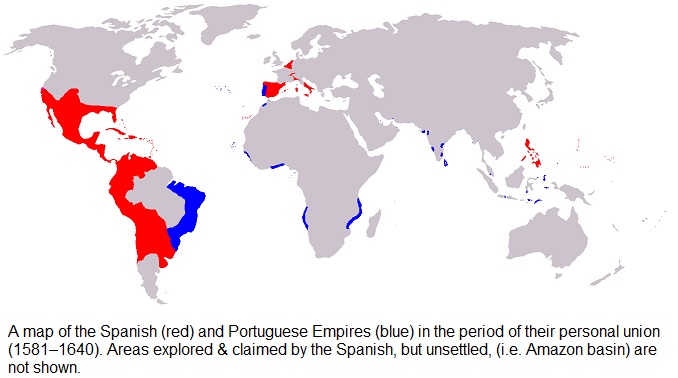
Consider first the Papal Bull – “letters patent” or charter issued by a Pope, the Head of the Roman Catholic Church; see Appendix A below. The most iconic of all the Papal Bulls was the Inter caetera (Latin for “Among other [works]”) a Papal Bull  by Pope Alexander VI on 4 May 1493, which set a demarcation between the New Lands to Portugal and Spain; this granted to Spain (the Crowns of Castile and Aragon) all lands to the “west and south” of a pole-to-pole line 100 leagues west and south of any of the islands of the Azores or the Cape Verde islands.[1] All new lands to the East of this pole remained assigned to Portugal. CU Blog - A Lesson in History - Royal Charter - Truth and Consequence - Photo 3
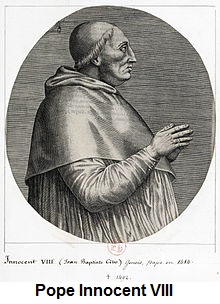
Just before this world-changing decree, there was an earlier Papal Bull that sealed the fate and would prejudice the African Diaspora for 500 years. The African Slave Trade and institution of “Slavery” was legally predicated on a Papal Bull from Pope Innocent VIII (Giovanni Battista Cybo) in 1491; just months before Christopher Columbus’s historic first voyage. Consider this encyclopedic reference:

In his book “Black Africans in Renaissance Europe”, principal author N. H Minnich* described how the position of Renaissance popes towards slavery, a common institution in contemporary cultures, varied. The book states that those who allowed the slave trade did so in the hope of gaining converts to Christianity.[11] But in the case of Pope Innocent VIII, he permitted trade with Barbary # merchants, in which foodstuffs would be given in exchange for slaves who could then be converted to Christianity.[11]
CU Blog - A Lesson in History - Royal Charter - Truth and Consequence - Photo 1

This was the de jure authorization of the Slave Trade.

One early adopter of this new commerce was King Ferdinand of Aragon (co-sponsor along with Castile’s Queen Isabella of the initial voyage of Christopher Columbus); he gave Pope Innocent VIII 100 Moorish slaves who shared them out with favored Cardinals.[12]

From this origin, the foundation of the New World was established … with the stroke of a pen.

Any monarchy, democracy, aristocracy, stratocracy, timocracy or theocracy that emerged subsequently in the New World stemmed from this genesis of Papal or Royal Charters. All of these forms of rulership are analyzed in the book and accompanying blogs for Go Lean…Caribbean. This book provides an assessment of the Caribbean today, drawing reference to its historic past. From the origins of slavery, the region traversed the historic curves of social revolution and evolution. In the 1500, the Protestant movement took hold. As other European powers deviated from Catholicism, Papal Bulls carried no significance to them and compliance was ignored. England and Holland established their own Protestant Churches with their own monarchs as head of Church and State; Papal decrees were replaced with Royal Decrees and Charters; see Appendix B below. The intent and end-result was still the same: territories and lands awarded (colonized) with the stroke of a pen by one European power after another. The Royal Decrees and Charters were then reinforced with a strong military presence and many battles. This point was detailed in the Go Lean book on Page 241:

The Bottom Line on European Colonialism
The European colonial period was the era from the 1500s to the mid-1900s when several European powers (Spain, Britain, the Netherlands, France and Portugal) established colonies in the Americas, in a Space Race to dominate the New World. The Northern Coast of South America became a typical New World battleground for conflict and pushing between these powers, and many military campaigns and diplomatic initiatives (treaties) ensued. Through the contact period following the 1498 discovery by Christopher Columbus, the term “Guiana” was used to refer to all this area, between the Orinoco, the Rio Negro, and the Amazon rivers; it was seen as a unified, isolated entity that it was often referred to as the “Island of Guiana”. The real interest in the exploration and colonization of the Guianas did not begin until the end of the sixteenth century when the other European powers developed interest in the Guianas. When did this European Colonial “push-shove-match” end? Not until almost 500 years later, after World War II, after the effects of that war left all these European powers drained – of finances and the will to continue.

Early in the Go Lean book, this need for careful review of the history of European domination on the Caribbean was acknowledged and then placed into perspective with this pronouncement (Declaration of Interdependence – Page 10):

As the history of our region and the oppression, suppression and repression of its indigenous people is duly documented, there is no one alive who can be held accountable for the prior actions, and so we must put aside the shackles of systems of repression to instead formulate efficient and effective systems to steer our own destiny.

As the colonial history of our region was initiated to create economic expansion opportunities for our previous imperial masters, the structures of government instituted in their wake have not fostered the best systems for prosperity of the indigenous people.

So the consideration of the Go Lean book, as related to this subject is one of governance, the need for technocratic stewardship of the regional Caribbean society. This point was also pronounced in the opening Declaration of Interdependence (Page 12) with these acknowledgements and statements:

xi.   Whereas all men are entitled to the benefits of good governance in a free society, “new guards” must be enacted to dissuade the emergence of incompetence, corruption, nepotism and cronyism at the peril of the people’s best interest. The Federation must guarantee the executions of a social contract between government and the governed.

xii. Whereas the legacy in recent times in individual states may be that of ineffectual governance with no redress to higher authority, the accedence of this Federation will ensure accountability and escalation of the human and civil rights of the people for good governance, justice assurances, due process and the rule of law. As such, any threats of a “failed state” status for any member state must enact emergency measures on behalf of the Federation to protect the human, civil and property rights of the citizens, residents, allies, trading partners, and visitors of the affected member state and the Federation as a whole.

xiii. Whereas the legacy of dissensions in many member-states (for example: Haiti and Cuba) will require a concerted effort to integrate the exile community’s repatriation, the Federation must arrange for Reconciliation Commissions to satiate a demand for justice.

Let’s add one more option to the forms of rulership that prevailed in the Caribbean: Oligarchy!

The use of the term oligarchy is a synonym for rule by the rich,[4] for which another term commonly used today is plutocracy. (This commentary had previously detailed the dynamics of plutocracies in the corporate arena).

The etymology of the word “oligarchy” (from Greek olígos, meaning “few”, and arkho, meaning “to rule or to command”)[1][2][3] is a form of power structure in a state where power effectively rests with a small number of people. These people could be distinguished by royalty, wealth, family ties, education, corporate, religious or military control.

In this discussion of oligarchy, focus is given to powerful families. There are encyclopedic references that relate that oligarchy structures are often controlled by a few prominent families, who typically pass their influence/wealth from one generation to the next, even though inheritance alone is not a necessary condition for oligarchies to prevail.

The islands of the Caribbean fit the story-line in the opening song lyrics: “Islands in the sun; willed to me by my father’s hand”.

This is the challenge that belies Caribbean society. Most of the property and indigenous wealth of the Caribbean region is concentrated amongst the rich, powerful and yet small elite; an oligarchy. Many times these families received their property, corporate rights and/or monopolies by Royal Charter from the European monarchs of ancient times. These charters thus lingered in legacy from one generation to another … until …

World War II.

According to the initial quotation above (Bottom Line on European Colonialism) from the Go Lean book, World War II was the “watershed event” that led to revolutionary change among the European powers. The “Decolonization” movement thusly proceeded to eradicate the “colonialism disease”. Most Caribbean member-states that now feature an independent status obtained this disposition during this time period since WW II; (i.e. Jamaica in 1962, Bahamas in 1973). The European direct rule was gone, but the oligarchs remained; many times negotiated in initial constitutions as a compromise for peace assurances.

The subject of oligarchs is very familiar on the African continent. This has been a real issue there. In many countries after colonialism, like Zimbabwe (1980), the cure for the oligarch disease was nationalization – forfeiting and seizing commercial farms and mines. This turned out disastrously for this country; the cure was worse than the disease. But, next door in South Africa, the strategy, tactics and implementation was different. This country did not ascend to majority rule until 1994; the first President there, Nelson Mandela saw the futility of this nationalization strategy amongst the precedent African nations that sought independence, so he pursued an alternate approach to assuage White Flight and keep the capital and skilled labor in the country. But the continuation of the oligarchs’ ill-gained, and public-perceived-stolen assets forged problems in the reality of economic/wealth inequality. Majority rule therefore brought no revolutionary change for the average man.

Considering these case studies, we see a lesson in this history, an obvious appreciation for best-practices … to apply in the Caribbean. We derive best-practices and prudence by applying these lessons from history, as reflected in the Go Lean book.

This is the quest of the Go Lean…Caribbean book; to serve as a roadmap for the introduction and implementation of the technocratic Caribbean Union Trade Federation (CU); to spearhead the elevation of Caribbean society. The book advocates learning lessons from many events and concepts in history, from as far back as the patriarchal Bible times, to as recent as the Great Recession of 2008. The roadmap simply seeks to reboot the region’s economic, security and governing engines, hypothesizing that the European colonial stewards did not have societal efficiency in mind when they structured administrations of the individual countries/island-states in this region; (they didn’t even apply the best practices that they employed in Europe).

In general, the CU will employ better strategies, tactics and implementations to impact its prime directives; identified with the following 3 statements:

  • Optimization of the economic engines in order to grow the regional economy to $800 Billion & create 2.2 million new jobs.
  • Establishment of a security apparatus to protect the resultant economic engines and mitigate internal and external threats.
  • Improve Caribbean governance to support these engines.

The Go Lean book stresses key community ethos, strategies, tactics, implementations and advocacies necessary to transform and turn-around the eco-systems of Caribbean society. These points are detailed in the book as follows:

Community Ethos – Economic Principles – Economic Systems Influence Individual Choices Page 21
Community Ethos – Economic Principles – Consequences of Choices Lie in the Future Page 21
Community Ethos – Governing Principles – Lean Operations Page 24
Community Ethos – Ways to Impact the Future Page 26
Community Ethos – Ways to Manage Reconciliations Page 34
Community Ethos – Ways to Impact the Greater Good Page 37
Strategy – Vision – Confederate all 30 member-states/ 4 languages into a Single Market Page 45
Strategy – Mission – Build and foster local economic engines Page 45
Tactical – Ways to Foster a Technocracy Page 64
Tactical – Growing the Economy – Post WW II European Marshall Plan Model Page 68
Tactical – Separation-of-Powers – CU Federal Government versus Member-State Governance Page 71
Implementation – Assemble All Regionally-focus Organizations of All Caribbean Communities Page 96
Implementation – Ways to Better Manage Debt Page 114
Planning – 10 Big Ideas – Single Market / Currency Union Page 127
Planning – Ways to Model the new European Union Page 130
Planning – Ways to Make the Caribbean Better Page 131
Planning – Ways to Improve Failed-State Indices – Minority and Human Rights Page 134
Planning – Lessons Learned from the previous West Indies Federation Page 135
Planning – Lessons Learned from 2008 – Optimizing Economic-Financial-Monetary Engines Page 136
Planning – Lessons Learned New York City – Managing as a “Frienemy” Page 137
Planning – Lessons Learned from Omaha – Human Flight Mitigations Page 138
Planning – Lessons Learned from East Germany – Bad Examples for Trade & Security Page 139
Planning – Lessons Learned from Detroit – Turn-around from Failure Page 140
Planning – Lessons Learned from Indian Reservations – See Photo here Page 141
Planning – Lessons Learned from the American West – How to Win the Peace Page 142
Advocacy – Ways to Grow the Economy Page 151
Advocacy – Ways to Create Jobs Page 152
Advocacy – Ways to Improve Governance Page 168
Advocacy – Ways to Better Manage the Social Contract Page 170
Advocacy – Ways to Improve Homeland Security Page 180
Advocacy – Ways to Better Manage Natural Resources Page 183
Advocacy – Ways to Preserve Caribbean Heritage Page 218
Appendix – Failed-State Index for Uneven Economic Development Page 272
Appendix – European Shuffling in the Guianas – Historic Timeline Page 307

Henry Ford Quote - Vanity of Government Entitlements

There are other lessons for the Caribbean to learn from considering history; the following previous blog/commentaries apply:

https://goleancaribbean.com/blog/?p=4935 A Lesson in History: the ‘Grand Old Party’ of American Politics
https://goleancaribbean.com/blog/?p=4720 A Lesson in History: SARS in Hong Kong
https://goleancaribbean.com/blog/?p=4166 A Lesson in History: Panamanian Balboa
https://goleancaribbean.com/blog/?p=2809 A Lesson in History: Economics of East Berlin
https://goleancaribbean.com/blog/?p=2670 A Lesson in History: Rockefeller’s Pipeline
https://goleancaribbean.com/blog/?p=2585 A Lesson in History: Concorde SST
https://goleancaribbean.com/blog/?p=2480 A Lesson in History: Community Ethos of WW II
https://goleancaribbean.com/blog/?p=2297 A Lesson in History: Booker T versus Du Bois
https://goleancaribbean.com/blog/?p=1531 A Lesson in History: 100 Years Ago Today – World War I
https://goleancaribbean.com/blog/?p=789 A Lesson in History: America’s War on the Caribbean

The Go Lean roadmap seeks to empower and elevate Caribbean societal engines. It is out-of-scope to impact Europe; our focus is only here at home. Besides, the former European colonial masters all realize the futility of the actions of their ancestors and predecessors. They are now battling to try and weed-out the last vestiges of racism and ethnic supremacy in their society. Though there is a movement to extract reparations from these former colonizers, that effort is not supported by the Go Lean movement.

Our quest is simple, a 21st century effort to make the Caribbean region a better place to live, work and play. 🙂

Download the e-Book of Go Lean … Caribbean – free … now!

———–

Appendix A – Letters Patent

Letters patent are a type of legal instrument in the form of a published written order issued by a monarch or president, generally granting an office, right, monopoly, title, or status to a person or corporation. They are so named from the Latin verb pateo, to lie open, exposed, accessible.[1] The originator’s seal was attached pendent from the document, so that it did not have to be broken in order for the document to be read.

They are called “letters” (plural) from their Latin name litterae patentes, used by medieval and later scribes when the documents were written in Latin, in the ancient sense of a collection of letters of the alphabet arranged to be read rather than in the modern sense of an “epistle” or item of correspondence: thus no singular form exists.[2]

Letters patent can be used for the creation of corporations or government offices, or for the granting of city status or a “coat of arms”. A particular form of letters patent has evolved into the modern patent (referred to as a utility patent or design patent in United States patent law) granting exclusive rights in an invention (or a design in the case of a design patent). Clearly in this case it is essential that the written grant should be in the form of a public document so other inventors can consult it to avoid infringement.

Source: http://en.wikipedia.org/wiki/Letters_patent

———–

Appendix B – Royal Charter

A royal charter is a formal document issued by a monarch as letters patent, granting a right or power to an individual or a corporate entity.

The British monarchy has issued over 980 royal charters.[1] Of these about 750 remain in existence.

The Royal Decree is the equivalent in Belgium of a Royal Charter.

Consider some examples:

Source: http://en.wikipedia.org/wiki/Royal_charter

———–

Appendix * – Book Reference: Black Africans in Renaissance Europe”, N. H Minnich, Thomas Foster Earle, K. J. P. Lowe, Cambridge University Press, 2005, ISBN 0-521-81582-7

———–

Appendix # – Reference: Barbary Pirates

These are the “pirates” referred to in the Bob Marley’s Redemption Song with these lyrics:

Old pirates, yes, they rob I;
Sold I to the merchant ships,
Minutes after they took I
From the bottomless pit.
But my hand was made strong
By the ‘and of the Almighty.
We forward in this generation
Triumphantly.
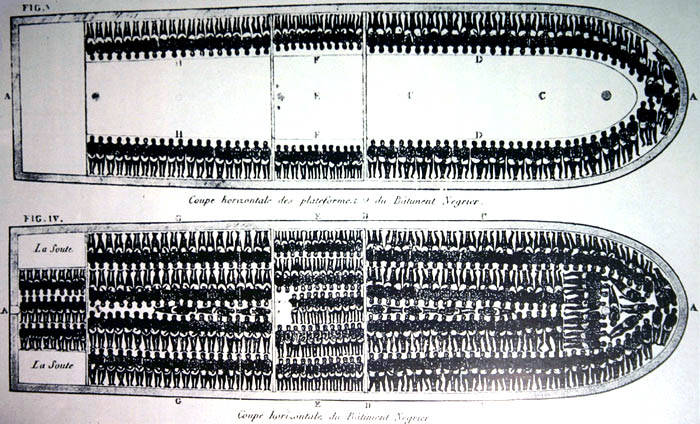
Slave Ship

Bob Marley - Uprising

VIDEO – Bob Marley – Redemption Song (from the Legend album, with lyrics) –  https://youtu.be/QrY9eHkXTa4

No copyright infringement intended; this is a “fan” video that assembled together public-domain photo-stills.

Music: “Redemption Song” by Bob Marley & The Wailers (Google Play • iTunes • AmazonMP3)
Share this post:
, , , ,

A Lesson in History – the ‘Grand Old Party’

Go Lean Commentary

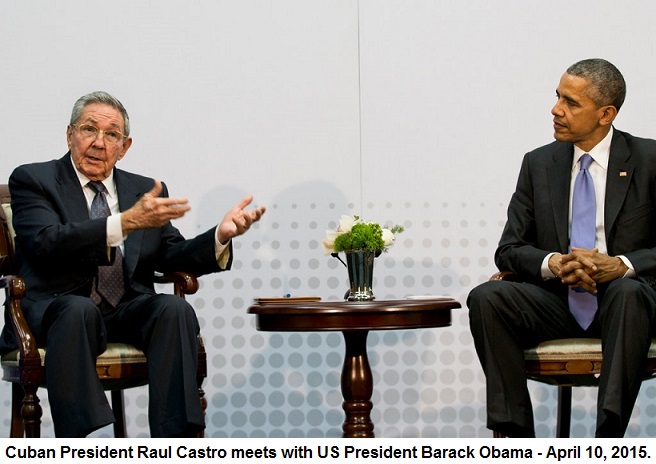
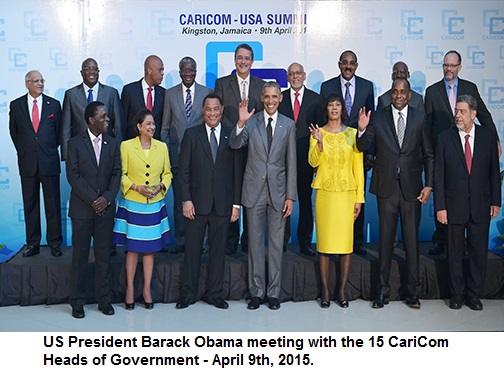
The Caribbean Community (CariCom) in general and Jamaica in particular had the great privilege of hosting the United States President Barack Obama. He is the first Black Man to hold that esteemed office. In his visit, he was hailed as a conquering hero for agreeing to attend a regional meeting on Caribbean soil, thereby facilitating consultation and collaboration on regional issues between Caribbean government officials and the Chief Executive of the American Republic. Though the Caribbean member-states have no vote in the US Capitol of Washington DC, including the US Territories of Puerto Rico and the Virgin Island, we do have a voice. The Jamaica meeting allowed more audiences for those voices.

JAMAICA-US-OBAMA-CARICOM

The US is the world’s largest, and richest, single market economy – an economic and military Super Power – plus the largest trading partner for most Caribbean member-states. We are directly affected by the economic, security and governing policies emanating from the shores  of America. This focus aligns with the book Go Lean…Caribbean which seeks to elevate the Caribbean economic, security and governing engines. Begrudgingly, the book admits that the Caribbean is only a parasite of the American eco-system but presents a roadmap to elevate the region to a better status: protégé instead of parasite.

CU Blog - A Lesson in History - Grand Old Party - Photo 2Due to constitutionally mandated term limits, President Obama only has less than 2 years left in his administration. The focus now moves to his possible successor. The next presidential election in the US is set for November 2016. Despite being 18 months away, the jockeying has begun. Will the next president be a Democrat or a Republican? Will their policies be Pro-Caribbean, Anti-Caribbean or completely agnostic; indifferent to the Caribbean’s needs and issues? Agnosticism is not far-fetch as this is the observation given by President Obama. He concluded that 55 years of indifference towards Cuba was long-enough and he has “set the machinery in motion” to normalize relations with Cuba. Will this initiative continue with the new president? The world will have to wait-and-see.

As of this writing, 4 people have already officially declared and launched their campaigns, 1 Democrat (Hillary Clinton) and 3 Republicans (Ted Cruz, Rand Paul, and Marco Rubio). Most stakeholders in the Caribbean may think that the Democratic Party may be more conducive to Caribbean elevation. But still, the decision of American leadership is not ours to make nor influence. We must simply convene, consult and collaborate with whomever the elected official is, Democrat or Republican.

This commentary therefore asserts that we need to work to influence both sides of the American political divide; perhaps even more on the Republican side, since as of late, their policies are less empowering for African-American, and less empowering for the Caribbean. Therefore, there is the need for more mitigation and remediation for the Republican party … as of late.

As of late…
… because the Republican Party, commonly referred to as the GOP (abbreviation for Grand Old Party), was founded by anti-slavery activists in 1854. (The Caribbean and the United States share the same historic legacy of slavery and the slow drag throughout history to remediate the experiences and injustices for this Black-and-Brown population). The GOP dominated politics nationally and in most of the northern U.S. for most of the period between 1860 and 1932. There have been 18 Republican U.S. presidents, the first being Abraham Lincoln, who served from 1861 until his assassination in 1865, and the most recent being George W. Bush, who served two full four-year terms 2001 to 2009. The most recent Republican presidential nominee was former Massachusetts governor Mitt Romney who lost in 2012 to the incumbent president, Democrat Barack Obama. See the full 19th and 20th Century history of the GOP in the Appendix below.

Today, the party’s platform is generally based on American conservatism,[8][9][10] in contrast to the contemporary American liberalism of the rival Democratic Party. The Republican Party’s conservatism involves supporting free market capitalism, limited government, strong national defense, opposing regulation and labor unions, and supporting socially conservative policies.[2] Civil rights, or issues related to empowering minorities, are not identified with the Republican Party. What a change compared to the historic beginnings of this party.

In the current 114th U.S. Congress, the Republicans have their largest majority in the U.S. House of Representatives since the 1928 election; the GOP also holds a majority of seats in the Senate.[12] The party also holds a majority of governorships and state legislatures.[13]

It is what it is!

We must seek to engage Republicans. It is only the US Presidency that is missing in their echelon of American power.

There is expected to be a full corps of Republican presidential candidates for 2016. Some of the names that have expressed interest in running include the following, but these ones have not officially launched their federal campaigns … yet:

  • Jeb Bush – former 2-term Florida Governor
  • Mike Huckabee – former Arkansas Governor and 2008 presidential candidate
  • Chris Christie – Current Governor of New Jersey
  • Donald Trump – Popular Billionaire businessman and media personality
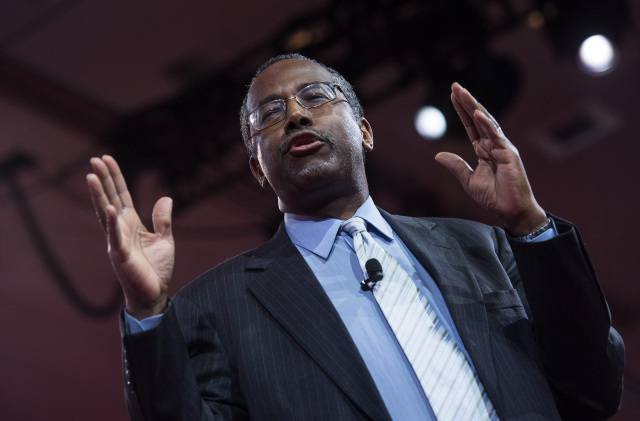
  • Ben Carson – Retired neurosurgeon and businessman; he happens to be an African-American; see article here:

Title: Will He Run? Ben Carson Set To Address Presidential Plans In May 4 Announcement

CU Blog - A Lesson in History - Grand Old Party - Photo 3He may announce his bid to run for president in 2016. He may not.

But whatever Ben Carson’s political aspirations are, we’ll all know when he makes them public in a May 4 announcement in Detroit, his team tells [news outlet] CNN.

The announcement, set to take place at the Detroit Music Hall Center for Performing Arts, is expected to be the launch for his presidential bid. Details, including ticketing and the subject of the announcement, however, have “yet to be hammered out,” Carson spokeswoman Deana Bass said.

“He will make an announcement. But he’s still very much in the exploratory phase, so he hasn’t made a decision yet,” she said.

From CNN:
The retired neurosurgeon has been traveling the nation over the past six months, giving paid speeches and meeting with supporters to gauge interest in a bid. He recently traveled to Iowa and New Hampshire, and spoke last weekend at the National Rifle Association’s meeting in Tennessee.  Carson’s relative political inexperience, however, hasn’t turned him away from the campaign — if he runs, he’ll look to make it an asset, framing himself as a common-sense alternative to the broken policies of Washington politicians.

So far, the presidential race has gained three GOP senators — Rand Paul of Kentucky, Ted Cruz of Texas, and Marco Rubio of Florida — but Carson’s green political experience (and the already full pot of GOP candidates) doesn’t seem to be a deterrent. And according to the Real Clear Politics average of polls, he may have a real shot.

From CNN:
Carson surveys right in the middle of the potential GOP field, ahead of more seasoned or better-known GOP contenders like former Arkansas Gov. Mike Huckabee or Rubio, and he took fifth place with 9% support in the last CNN/ORC survey, conducted in March.

Still, that’s a marked decline from late February, when he was polling in the top three of the pack, indicating he still has some work to do in proving his credibility with voters.

We’ll wait to see if Carson will join the Election 2016 club, but if May 4 turns out to be his bid announcement, will you vote for him?
Source: News One – Media Suite Targeting African-Americans – Posted 04/14/2015 from: http://newsone.com/3107603/ben-carson-set-to-address-presidential-plans-may-4-announcement/

Ben Carson is a retired neurosurgeon from Detroit. The publishers of the book Go Lean…Caribbean has come to this city to observe-and-report on the turn-around of this once great industrial city that is a national icon of urban dysfunction; (Page 140). There have been countless blog/commentaries that have described the Detroit (and surrounding Michigan) dynamics.

Is the United States ready for a second Black Man to assume the highest office in the land? Is Ben Carson ready? Is Black America ready for this Black Republican?

These are all appropriate questions. From the Caribbean perspective, we will observe-and-report on these developments.

The focus of the Go Lean book is not American politics, but rather the economic, security and governing engines of the Caribbean. Yet still, we need to have a productive relationship with the American federal government and whichever administration is in the White House. The book serves as a roadmap for the introduction and implementation of the Caribbean Union Trade Federation (CU); an initiative to bring “Hope and Change” to the Caribbean region; to make the region a better place to live, work and play. This Go Lean roadmap also has these 3 prime directives:

  • Optimization of the economic engines in order to grow the regional economy to $800 Billion & create 2.2 million new jobs.
  • Establishment of a security apparatus to protect the resultant economic engines.
  • Improvement of Caribbean governance to support these engines.

The book describes the CU as a technocratic administration with 144 different missions to elevate the Caribbean homeland. The underlying goal is stated early in the book with this pronouncement in the opening Declaration of Interdependence (Page 12):

xii. Whereas the legacy in recent times in individual states may be that of ineffectual governance with no redress to higher authority, the accedence of this Federation will ensure accountability and escalation of the human and civil rights of the people for good governance, justice assurances, due process and the rule of law…

The Go Lean roadmap represents “Hope and Change” for the Caribbean. In 2008, Barack Obama propelled forward into American conscience with that theme “Hope and Change“, now the effort is to propel an initiative for the Caribbean. We have some serious crises to contend with. We need hope and we need change…now.

This fact was enunciated by Obama in his visit to Jamaica. He explained how we have to better manage our interactions with Super Powers to ensure we are getting the sought-after benefits, and not being exploited for their self-interest. The President prescribed a formula for the Caribbean’s dealing with China … and also America itself.

VIDEO: President Barack Obama’s response on China’s involvement in Jamaica’s Development – https://youtu.be/rRaQjukEPOo

Published on 

Apr 22, 2015 — We are a movement of Jamaicans both at Home and Abroad who are willing to fight for real and lasting change. This isn’t for everyone — we’re Changing Jamaica Through Leadership, and we’re proud of it. If you’re someone who’d rather get involved than sit back, if you refuse to be cynical about what we can get done together, then you should be part of this at www.ourjamaicavote.org

The Go Lean roadmap was constructed with the following community ethos in mind, plus the execution of strategies, tactics, implementation and advocacies to elevate the Caribbean eco-system. The following is a sample of these specific details from the book:

Assessment – Caribbean Community’s stalled Single Market Initiative Page 15
Community Ethos – Economic Principles – People Choose Page 21
Community Ethos – Economic Principles – All Choices Involve Costs Page 21
Community Ethos – Economic Principles – People Respond to Incentives in Predictable Ways Page 21
Community Ethos – Economic Principles – Economic Systems Influence Individual Choices Page 21
Community Ethos – Economic Principles – The Consequences of Choices Lie in the Future Page 21
Community Ethos – Security Principles – “Crap” Happens Page 23
Community Ethos – Governing Principles – Minority Equalization Page 24
Community Ethos – Governing Principles – Lean Operations Page 24
Community Ethos – Ways to Impact the Future Page 26
Community Ethos – Ways to Foster Genius – Leadership Skills/Development Page 27
Community Ethos – Ways to Manage Reconciliations Page 34
Community Ethos – Ways to Impact the Greater Good Page 37
Strategy – Vision – Confederation of the 30 Caribbean Member-States into a Single Market Page 45
Strategy – Mission – Celebrate the Music, Sports, Art, People and Culture of the Caribbean Page 46
Tactical – Confederating a Permanent Union Page 63
Tactical – Fostering a Technocracy Page 64
Tactical – Separation of Powers: Federal Administration versus Member-States Governance Page 71
Implementation – Ways to Pay for Change Page 101
Implementation – Ways to Deliver Page 109
Planning – 10 Big Ideas for the Caribbean Region Page 127
Planning – Ways to Improve Trade Page 128
Planning – Ways to Make the Caribbean Better Page 131
Planning – Ways to Better Manage Image Page 133
Planning – Lessons Learned from Detroit Page 140
Advocacy – Ways to Grow the Economy Page 151
Advocacy – Ways to Create Jobs Page 152
Advocacy – Ways   to Improve Governance in the Caribbean Region Page 168
Advocacy – Ways to Better Manage the Social Contract Page 170
Advocacy – Ways to Improve Leadership Page 171
Advocacy – Ways to Improve Homeland Security Page 180
Advocacy – Ways to Improve Communications Page 186
Advocacy – Ways to Preserve Caribbean Heritage Page 218
Advocacy – Ways to Reboot Cuba Page 236

There is a consistency with this Go Lean commentary, applying lessons from a consideration of historic events and people. The premise is simple:

Those who refuse to learn from history are forced to repeat it.

The Go Lean book posits that the Caribbean has a dysfunctional history. Despite having the greatest address on the planet, the region suffers from an alarmingly high abandonment rate. We can… and must do better. By applying this lesson from history we should be able to better prosper where we’re planted here in the Caribbean.

There are other lessons for the Caribbean to learn from considering history; the following previous blog/commentaries apply:

https://goleancaribbean.com/blog/?p=4720 A Lesson in History: SARS in Hong Kong
https://goleancaribbean.com/blog/?p=4166 A Lesson in History: Panamanian Balboa
https://goleancaribbean.com/blog/?p=2809 A Lesson in History: Economics of East Berlin
https://goleancaribbean.com/blog/?p=2670 A Lesson in History: Rockefeller’s Pipeline
https://goleancaribbean.com/blog/?p=2585 A Lesson in History: Concorde SST
https://goleancaribbean.com/blog/?p=2480 A Lesson in History: Community Ethos of WW II
https://goleancaribbean.com/blog/?p=2297 A Lesson in History: Booker T versus Du Bois
https://goleancaribbean.com/blog/?p=1531 A Lesson in History: 100 Years Ago Today – World War I
https://goleancaribbean.com/blog/?p=789 A Lesson in History: America’s War on the Caribbean

The Go Lean roadmap seeks to empower and elevate Caribbean engines. It is out-of-scope to impact the US. That will be the campaign of the presidential candidates, perhaps also including Ben Carson. He would not be the first Black Republican presidential candidate; in fact in 2012 Herman Cain ran a substantial campaign for much of that “season” – a one-time front-runner. Further, in 2000, former ambassador Alan Keyes sought the Republican nomination for President.

Will “Ben Carson” campaign change the Republican party, making it more amiable to the Black Community? Did the previous candidates (Herman Cain & Alan Keyes) impact the party? It is only logical to conclude that each attempt by serious Black candidates will “crack the glass ceiling”; then eventually a substantial Black candidate will “break through”.

Will “Ben Carson” be that candidate? Let’s observe-and-report.

🙂

Download the free e-Book of Go Lean … Caribbean – now!

———-

APPENDIX – History of the Grand Old Party
(Source: Wikipedia Online Encyclopedia – Retrieved 04/19/2015 from: http://en.wikipedia.org/wiki/Republican_Party_(United_States) )

Founding and 19th century

CU Blog - A Lesson in History - Grand Old Party - Photo 4Founded in the Northern states in 1854 by anti-slavery activists, modernizers, ex-Whigs, and ex-Free Soilers, the Republican Party quickly became the principal opposition to the dominant Democratic Party and the briefly popular Know Nothing Party. The main cause was opposition to the Kansas–Nebraska Act, which repealed the Missouri Compromise by which slavery was kept out of Kansas. The Northern Republicans saw the expansion of slavery as a great evil. The first public meeting where the name “Republican” was suggested for a new anti-slavery party was held on March 20, 1854 in a schoolhouse in Ripon, Wisconsin.[14] The name was partly chosen to pay homage to Thomas Jefferson’s Republican Party.

The first official party convention was held on July 6, 1854, in Jackson, Michigan.[15] By 1858, the Republicans dominated nearly all Northern states. The Republican Party first came to power in 1860 with the election of Abraham Lincoln to the Presidency and Republicans in control of Congress and again, the Northern states. It oversaw the preserving of the union, the end of slavery, and the provision of equal rights to all men in the American Civil War and Reconstruction, 1861–1877.[16]

The Republicans’ initial base was in the Northeast and the upper Midwest [States].

Early Republican ideology was reflected in the 1856 slogan “free labor, free land, free men”, which had been coined by Salmon P. Chase, a Senator from Ohio (and future Secretary of the Treasury and Chief Justice of the United States).[17] “Free labor” referred to the Republican opposition to slave labor and belief in independent artisans and businessmen. “Free land” referred to Republican opposition to plantation system whereby slave-owners could buy up all the good farm land, leaving the yeoman independent farmers the leftovers. The Party strived to contain the expansion of slavery, which would cause the collapse of the slave power (“slaveocracy”) and the expansion of freedom.[18]

Lincoln, representing the fast-growing western states, won the Republican nomination in 1860 and subsequently won the presidency. The party took on the mission of preserving the Union and destroying slavery during the American Civil War and over Reconstruction. In the election of 1864, it united with War Democrats to nominate Lincoln on the National Union Party ticket.

The party’s success created factionalism within the party in the 1870s. Those who felt that Reconstruction had been accomplished and was continued mostly to promote the large-scale corruption tolerated by President Ulysses S. Grant ran Horace Greeley for the presidency. The Stalwarts defended Grant and the spoils system; the Half-Breeds pushed for reform of the civil service.

The GOP supported business generally, hard money (i.e., the gold standard), high tariffs to promote economic growth, high wages and high profits, generous pensions for Union veterans, and (after 1893) the annexation of Hawaii. The Republicans supported the pietistic Protestants who demanded Prohibition. As the northern post-bellum economy boomed with heavy and light industry, railroads, mines, fast-growing cities and prosperous agriculture, the Republicans took credit and promoted policies to sustain the fast growth.

Nevertheless, by 1890 the Republicans had agreed to the Sherman Antitrust Act and the Interstate Commerce Commission in response to complaints from owners of small businesses and farmers. The high McKinley Tariff of 1890 hurt the party and the Democrats swept to a landslide in the off-year elections, even defeating McKinley himself.

After the two terms of Democrat Grover Cleveland, the election of William McKinley in 1896 is widely seen as a resurgence of Republican dominance and is sometimes cited as a realigning election. McKinley promised that high tariffs would end the severe hardship caused by the [Economic] Panic of 1893, and that the GOP would guarantee a sort of pluralism in which all groups would benefit.

20th century

CU Blog - A Lesson in History - Grand Old Party - Photo 5The 1896 realignment cemented the GOP as the party of big business, while Theodore Roosevelt added more small business support by his embrace of trust busting. He handpicked his successor William Howard Taft in 1908, but they became enemies on economic issues. Defeated by Taft for the 1912 nomination, Roosevelt bolted the party and led the third party ticket of the Progressive Party. The party returned to the White House throughout the 1920s, running on platforms of normalcy, business-oriented efficiency, and high tariffs. The national party avoided the prohibition issue after it became law in 1920.

Warren G. Harding, Calvin Coolidge and Herbert Hoover were resoundingly elected in 1920, 1924, and 1928 respectively. The pro-business policies of the decade seemed to produce an unprecedented prosperity until the Wall Street Crash of 1929 heralded the Great Depression.

New Deal Era

CU Blog - A Lesson in History - Grand Old Party - Photo 6The New Deal coalition of Democrat Franklin D. Roosevelt controlled American politics for most of the next three decades, excepting the two-term presidency of Republican Dwight D. Eisenhower. Blacks moved into the Democratic Party during the New Deal era; they could vote in the North but not in the South. After Roosevelt took office in 1933, New Deal legislation sailed through Congress and the economy moved sharply upward from the nadir in early 1933. However long-term unemployment remained a drag until 1940. In the 1934 midterm elections, 10 Republican senators went down to defeat, leaving them with only 25 against 71 Democrats. The House of Representatives likewise had overwhelming Democratic majorities.

The GOP split into a majority “Old Right” (based in the Midwest) and a liberal wing based in the Northeast that supported much of the New Deal. The Old Right sharply attacked the “Second New Deal” and said it represented class warfare and socialism. Roosevelt was reelected in a landslide in 1936 but everything went awry in his second term, as the economy plunged, strikes soared, and FDR failed to take control of the Supreme Court or to purge the Southern conservatives in the Democratic party. The GOP made a major comeback in the 1938 elections, and had new rising stars such as Robert A. Taft of Ohio on the right and Thomas E. Dewey of New York on the left.[19] Southern conservatives joined with most Republicans to form the conservative coalition, which dominated domestic issues in Congress until 1964. Both parties split on foreign policy issues, with the anti-war isolationists dominant in the GOP and the interventionists who wanted to stop Hitler dominant in the Democratic party. Roosevelt won a third and fourth term in 1940 and 1944. Conservatives abolished most of the New Deal during the war, but did not attempt to reverse Social Security or the agencies that regulated business.

Historian George H. Nash argues:

Unlike the “moderate”, internationalist, largely eastern bloc of Republicans who accepted (or at least acquiesced in) some of the “Roosevelt Revolution” and the essential premises of President Truman’s foreign policy, the Republican Right at heart was counter-revolutionary, anti-collectivist, anti-Communist, anti-New Deal, passionately committed to limited government, free market economics, and congressional (as opposed to executive) prerogatives, the G.O.P. conservatives were obliged from the start to wage a constant two-front war: against liberal Democrats from without and “me-too” Republicans from within.[20]

The Democrats elected majorities to Congress almost continuously after 1932 (the GOP won only in 1946 and 1952), but the Conservative Coalition blocked practically all major liberal proposals in domestic policy. After 1945, the internationalist wing of the GOP cooperated with Harry Truman’s Cold War foreign policy, funded the Marshall Plan, and supported NATO, despite the continued isolationism of the Old Right.

CU Blog - A Lesson in History - Grand Old Party - Photo 7CU Blog - A Lesson in History - Grand Old Party - Photo 8The second half of the 20th century saw election or succession of Republican presidents Dwight D. Eisenhower, Richard Nixon, Gerald Ford, Ronald Reagan, George H. W. Bush and George W. Bush. Eisenhower had defeated conservative leader Senator Robert A. Taft for the 1952 nomination, but conservatives dominated the domestic policies of the Eisenhower Administration. Voters liked Ike much more than they liked the GOP, and he proved unable to shift the party to a more moderate position. After 1970, the liberal wing faded away.[21]

Ever since he left office in 1989, Reagan has been the iconic Republican; and Republican presidential candidates frequently claim to share his views and aim to establish themselves and their policies as the more appropriate heir to his legacy.[22] In 1994, the Party, led by House Minority Whip Newt Gingrich campaigning on the Contract with America, was elected to majorities to both houses of Congress in the Republican Revolution. However Gingrich was unable to deliver on most of its promises, and after the impeachment of President Bill Clinton in 1998 and subsequent Republican losses in the House, he resigned. Since Reagan’s day, presidential elections have been close. However, the Republican presidential candidate won a majority of the popular vote only in 2004, while coming in second in 1992, 1996, 2000, 2008 and 2012.

Share this post:
, , , ,
[Top]

Jamaican Poll: ‘Bring back the British!’

Go Lean Commentary

“When a man longs for the town of his boyhood, it is not the town that he longs for, but rather his boyhood” – Old Adage.

There’s something about nostalgia; we always seem to only remember just the good times –  the “Good Old Days”.

Grammy-award winning singer-songwriter Billy Joel asserted this truth in his song “Keeping the Faith” with this stanza:

You can get just so much
From a good thing
You can linger too long
In your dreams
Say goodbye to the
Oldies but goodies
Cause the good ole days weren’t
Always good
And tomorrow ain’t as bad as it seems

(See VIDEO below in the Appendix)

The island-nation of Jamaica requested and was granted independence from the United Kingdom (UK) in 1962. According to the subsequent news article, the time before 1962, like the 1950’s, seems now to be nostalgic for many older Jamaicans. But this commentary posits that these ones are really just longing for a simpler time: with more economic prosperity, more jobs, more security (less crime), and more governing efficiency.

The book Go Lean … Caribbean aligns with the need for these same nostalgic benefits, to elevate the economic-security-governing engines of the Caribbean region, Jamaica included.

Like Billy Joel sang, the “good old days weren’t always good”. Colonialism was not all positive. The Jamaican masses were suppressed, oppressed and repressed. The majority Black population was marginalized in their own homeland, at the hand of a White minority. History teaches that this type of oppression only has one end-result: revolution. The UK had just participated in the Second World War – within the same generation – they had learned the bitter lessons of imperialism and could not – or would not – submit to the same failed course of action. Colonialism had failed … the planet, as evidenced by the two World Wars.

History is a great teacher; but failure, hunger, crime and despair are better teachers. There was a need for a better delivery of the implied Social Contract between Jamaica’s government and the governed; (where citizens surrender some of their freedoms and submit to the authority of the State in exchange for protection of remaining natural and legal rights). But as assessed by the polling responders in the following article: the new (50+ years) independent nation has simply failed … to deliver on the Social Contract obligations for their citizens:

Title: Bring back the British! Most Jamaicans say they would be better off ruled from London
By: The Daily Mail – British Daily Newspaper; posted June 29, 2011; retrieved April 2, 2015 from:
http://www.dailymail.co.uk/news/article-2009487/We-stayed-Britain-Shock-poll-reveals-60-Jamaicans-think-theyd-better-colony.html

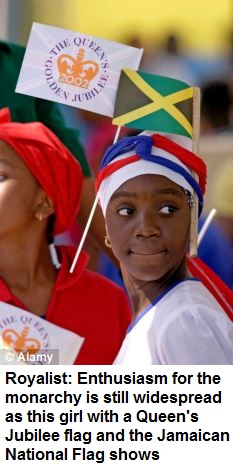
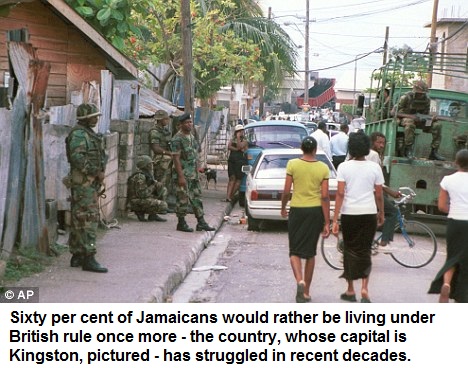
CU Blog - Jamaicans - Bring back the British - Photo 1Kingston – Most Jamaicans believe they would be better off if they were still ruled by Britain, a poll shows.

In a harsh indictment of nearly 50 years of independence, 60 per cent of those surveyed hanker for the days when the country was Britain’s biggest Caribbean colony.

Only 17 per cent said the crime-ridden, poverty-stricken nation would be worse off under British rule.

The depth of feeling is particularly astonishing as generations of Jamaican leaders have portrayed the British as oppressors who subjected the Caribbean to slavery.

The Queen is still Jamaica’s Head of State. Under the headline ‘Give Us The Queen!’, the Gleaner – Jamaica’s biggest newspaper – said its poll showed how much people had become ‘disillusioned’ with the violent and corrupt political gangs running the island

‘As painful, and some will claim insulting, as these statistics may be to Jamaican nationalists, they are quite understandable – and even logical,’ the paper said in an editorial. ‘The attitudes are formed by people’s existing realities and their expectations for the future.’
These realities, it added, include living in a country ‘where, for  more than a generation, economic growth has averaged below 2 per cent per annum and its homicide rate is among the highest in  the world’.

The newspaper also highlighted Jamaica’s ‘creaky’ justice system, ‘patchy’ law and order, ‘indifferent’ education system and the widespread public perception of ‘overwhelming’ corruption.

CU Blog - Jamaicans - Bring back the British - Photo 2The survey of more than 1,000 Jamaicans is embarrassing for Prime Minister Bruce Golding. He wants to mark next year’s 50th anniversary of independence by removing the Queen as Head of State and making the island a Republic.

Among older Jamaicans, nostalgia for what the Gleaner called the ‘good old days’ under Britain may have been sharpened by the island’s disastrous experiment with socialism in the 1970s. Left-wing prime minister Michael Manley introduced economically disastrous policies while publicly courting Cuba and scaring off tourists.

In recent years, violence by drug gangs has made the island  one of the most dangerous places in the world.

About 25,000 Britons live in Jamaica, including 23,275 pensioners. An estimated 1.3 million tourists visit the island each year, including about 185,000 Britons.

This foregoing article was composed and posted in 2011. What of the 4 years since?

The Go Lean book – published November 2013 – and subsequent blog-commentaries have concurred most emphatically: “Yes, Jamaica is in crisis; along with the rest of the Caribbean”. The Go Lean book posits that the entire English-speaking Caribbean is in crisis, along with the French and Dutch Caribbean; plus the US Territories of Puerto Rico and the Virgin Island suffer the same fate. But instead of campaigning for the “good old days”, the book (Page 8) asserts that this crisis is a terrible thing to waste”; that now is the time to finally employ best-practices in the structures of colonial society that the British (and other European powers) left behind.

This longing  for the “good old days” is similarly being echoed in the Dutch Caribbean. According to the book (Page 16), outcries for change in the Netherland Antilles resulted in the Kingdom of the Netherlands (Holland) polling the general population to choose among four options: independence, closer ties with Amsterdam, autonomous status within the Kingdom of the Netherlands or the Confederation Status Quo among the Dutch Caribbean member-states (6 islands). After a series of Referendums (2000 – 2005), the Status Quo was abandoned for closer-Amsterdam options.

Also in the French Caribbean, the book relates (Page 17) how discord and dissension has resulted in governmental structure changes that led the French territories to demand more direct rule from Paris. The acute need for reform has been openly acknowledged and these islands are even considering more regional solidarity with their wider Caribbean neighbors.

The independent Caribbean member-states (consider Cuba, Haiti, the Dominican Republic and Suriname) are not spared from these crises as these countries have near-Failed State status and many of their populations have fled their homeland to a “Diasporic” life in some foreign location. Now it can be concluded that when these ones are called on to participate in “local democratic elections”, they are really voting: “None of the Above”.

On the other hand, the objective of the Go Lean movement is to reconcile the flawed economic-security-governing policies of the past and lean-in for the optimizations of the Caribbean future. The book serves as a roadmap for the regional integration of all the 42 million people and confederation of all 30 member-states of the Caribbean with the implementation of the Caribbean Union Trade Federation (CU). This roadmap advocates the elevation of Caribbean society, with the following prime directives:

  • Optimization of the economic engines in order to grow the regional economy from $378 Billion to $800 Billion & create 2.2 million new jobs.
  • Establishment of a security apparatus to protect the resultant economic engines and mitigate internal and external threats.
  • Improvement of Caribbean governance to support these engines.

The Go Lean roadmap commences with this ideal embedded in the opening Declaration of Interdependence, pronounced as follows; (Page 10):

As the colonial history of our region was initiated to create economic expansion opportunities for our previous imperial masters, the structures of government instituted in their wake have not fostered the best systems for prosperity of the indigenous people. Despite this past, we thrust our energies only to the future, in adapting the best practices and successes of the societies of these previous imperial masters and recognizing the positive spirit of their intent and vow to learn from their past accomplishments and mistakes so as to optimize the opportunities for our own citizenry to create a more perfect bond of union.

The structure of colonialism has always been defective for colonies. As practiced in the past, all natural resources were extracted and sent to the host country as raw materials. Then finished products were returned to the colonies. The added-value and profit margins of such a eco-system were never realized in the colonies; it was always a win-win for the host country. There is no need to go back to that! There is something better here; its time to Go Lean … Caribbean.

Even the European imperial masters have abandoned such a colonial eco-system. Yes, Europe has now grown up to be a more technocratic society. This is the model we – in the Caribbean – must follow. The CU is modeled from the EU – see Page 130 in the Go Lean book – so as to provide good stewardship and shepherding of the Caribbean economic, security and governing engines. This theme has been elaborated on in these previous blog/commentaries:

Introduction to Europe – All Grown Up
A Lesson in European Dysfunctional History: 100 Years Ago – World War I
EU willing to fund study on cost of not having CARICOM
Europe Model: One currency, divergent economies
Book Review: ‘Wrong – Nine Economic Policy Disasters and What We Can Learn…’

The issues involved in this commentary are bigger than just for Jamaica. The CU roadmap drives change among the economic, security and governing engines for all the Caribbean region. One perplexing problem for Jamaica is the management of their previous debt. The Go Lean book therefore provides solutions to assuage this dilemma, but the solutions are tuned to a regional approach. This is a lesson learned from the EU’s model for assuaging the sovereign debt crisis of member-states there, like Greece, Portugal, Italy and Ireland. This roadmap therefore envisions elevating Caribbean society by means of new community ethos, strategies, tactics, implementations and advocates; as sampled here in this list:

Community Assessment – English Countries: Failed Integration of CSME Page 15
Community Assessment – Dutch Caribbean – Integration & Secessions Page 16
Community Assessment – French Caribbean – Organization & Discord Page 17
Community Assessment – Puerto Rico – The Greece of the Caribbean Page 18
Community Ethos – Forging Change Page 20
Community Ethos – Economic Principles Page 21
Community Ethos – Security Principles Page 22
Community Ethos – Governing Principles Page 24
Community Ethos – Impact the Future Page 26
Community Ethos – Impact the Greater   Good Page 37
Strategy – CU Vision – Integrate Caribbean member-states modeling the EU Page 45
Strategy – Facilitate a Currency Union, the Caribbean Dollar (C$) Page 48
Tactical – Fostering a Technocracy Page 64
Tactical – $800 Billion Economy – How and When Page 67
Tactical – Separation-of-Powers Page 73
Implementation – Assemble Caribbean Central Bank Page 96
Implementation – Ways to Better Manage Debt Page 114
Implementation – Ways to Promote Independence Page 120
Planning – Ways to Model the EU Page 119
Anecdote – Caribbean Currencies Page 149
Advocacy – Ways to Grow the Economy Page 151
Advocacy – Ways to Create Jobs Page 152
Advocacy – Ways to Better Manage the Social Contract Page 170
Advocacy – Reforms for Banking Regulations Page 199
Advocacy – Ways to Re-boot Cuba Page 236
Advocacy – Ways to Impact the Dominican Republic Page 237
Advocacy – Ways to Re-boot Haiti Page 238
Advocacy – Ways to Impact US Territories Page 244
Advocacy – Ways to Impact British Territories Page 245
Advocacy – Ways to Impact Dutch Territories Page 246
Advocacy – Ways to Impact French Territories Page 247

The Go Lean roadmap posits that modeling European society does not mean subjecting anew to colonial status for them. No, that is a parasite disposition. The roadmap calls for the region to assume the stance of a protégé of our European (and North American) trading partners. Yes, we can prosper where we are planted … in the Caribbean.

The book declares that the Caribbean is the greatest address on the planet. So we have the potential to do more, go further and rise higher than our previous colonial masters. But this requires heavy-lifting!

While this is easy to say (and write), it is harder to do. But there are some best-practices that would optimize our endeavors. For starters, economic empowerment is easy; just show up with investments (money) and jobs and the Caribbean communities will acquiesce – they will form long lines to solicit those jobs. On the other hand, the attempts to introduce empowerments for security and/or governing engines are a lot more complicated, requiring a political process, with a lot of consensus-building, collaboration and compromise.

Who should do this heavy-lifting? London, Amsterdam, Paris, or Washington? No. This effort needs to be done by us, for us. This is what independence is all about, standing up and finding solutions to our own problems, not crying out to “Mama or Papa” as in London, Amsterdam, Paris…

“Cause the good ole days weren’t always good
And tomorrow ain’t as bad as it seems”.

Now, we must “step-up our game” all the more so and tackle our problems; we must forge viable solutions. How? When? Why? Who? Good questions. There are no quick answers; there is a roadmap instead. For example, the Go Lean roadmap details that the answer to the dilemma of “defects of independence” is interdependence … with our Caribbean neighbors. This is part-and-parcel of the remediation and mitigations in the 370-page turn-by-turn guide.

Yes, we can … all work together and be successful. “Many hands make a big job small”.

🙂

Download the free e-Book of Go Lean … Caribbean – now!

—————

Appendix – VIDEO: Billy Joel’s Keeping the Faithhttps://youtu.be/ph7oZnBH05s

Uploaded on Oct 2, 2009 – Music video by Billy Joel performing Keeping The Faith. (C) 1983 SONY BMG MUSIC ENTERTAINMENT


Share this post:
, , ,
[Top]

Welcoming WTO? Say Goodbye to Nationalism

Go Lean Commentary

Trade 1

The catch-phrase “Think Global, Act Local” does not only apply to “green” conservational objectives, it also applies to trade promotion. Though not officially adopted as a mantra for the World Trade Organization (WTO), this catch-phrase is the ethos by which they administer their policies.

CU Blog - Welcoming WTO - Say Goodbye to Nationalism - Photo 2The words “World” and “Trade”, combined together should signal the spirit of doing commerce as global citizens, not reserving a market for some special interest group, even if the special qualifier is just citizenship.

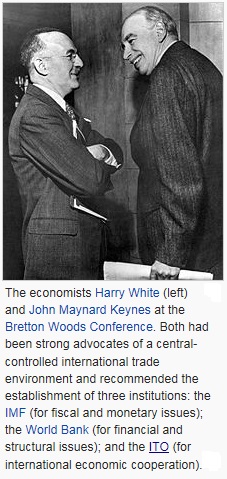
World Trade coordination is a new creation, a product of 20th century post-WW II reconstruction. The prevailing ethos beforehand was that “all men were created equal, but some were more equal than others”. This status quo, with features like colonialism, was fraught with societal defects that would just continue to spurn uprisings. A better eco-system was needed. From this planning – Photo here – came the structure for the World Bank, International Monetary Fund (IMF) and the International Trade Organization (ITO). The ITO was proposed in 1948, but never fully ratified. In its place, a weaker framework was enacted branded GATT for General Agreement on Tariffs and Trade. The goal was to tear down all the inequities with inter-country interactions that caused so much dissension. (The planet could not risk another global war). GATT remained the standard for almost 50 years, until finally the formation of the newly-branded WTO, which ascended on January 1, 1995.

The goal of the ITO/WTO was to be a United Nations’ specialized agency that would address not only trade barriers but other issues indirectly related to trade, including employment, investment, restrictive business practices, and commodity agreements. But the original ITO treaty was not approved by the U.S. and a few other signatories and never went into effect.[17][18][19] The WTO has all of these countries’ full participation and all these attributes. It’s a New World Order.

The WTO is not mandatory; it’s a club and membership has its privileges…and responsibilities. The book Go Lean…Caribbean had always encouraged participation in this club (Page 119); urging joining and conforming to the international standards. Why? The region depends on the global market – imports of all commodities and exports of services like tourism. So we are already participating in these “club activities” whether we want to or not. We had better get the full benefits. For starters we would get voting rights par-for-par with the big trading countries like the US and Canada, and EU member-states. We would get a voice and a vote; something missing in our current US interaction, where foreign, trade and security policies often times do not align with the priorities of the Caribbean. Even more, no Caribbean member-states, even US Territories, have voting powers in the US Capitol where those policies are codified. It is what it is!

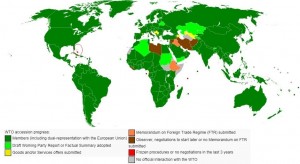
Click on photo to Enlarge

The World Map Photo here depicts the Commonwealth of the Bahamas in a Red Circle, indicating that the WTO status is still pending. There are a number of provisos that must first be put in place. This article relates one such requirement:

Title: WTO To End Property Tax Advantages For Bahamians
By: Neil Hartnell, Business Editor

NASSAU, Bahamas — The Bahamas will have to eliminate its nationality-based real property tax exemptions that discriminate in favour of locals before it becomes a full World Trade Organisation (WTO) member, a report warning the current system is “not in accordance with international practice”.

The ‘Conditions for improving real property tax in the Bahamas’ report, never before revealed to the Bahamian people, thus warns that the exemptions enjoyed by Bahamian ‘vacant land’ owners in New Providence, and in every Family Island [(Bahamas Out Islands)], will either have to be completely changed or abandoned.

The report’s authors, Dr Roy Kelly, Dr Graham Glenday and Wayne Forde, said: “Exempting property based on the nationality of the property tax owner is not in accordance with international practice.

“This nationality-based exemption will need to be changed when the Bahamas joins the WTO, since the Bahamas will not be allowed to differentially tax based on nationality.”

The Government, via the Ministry of Financial Services, has already given notice of its intention to continue with the WTO accession process, with new minister, Hope Strachan, effectively saying she has picked up where her predecessor, Ryan Pinder, left off.

Messrs Kelly, Glenday and Forde thus called for the Government to review all property tax exemptions extended to Bahamians only, reiterating that these would need to be eliminated upon WTO accession.

“This means that the current exemption on unimproved land owned by Bahamians on New Providence will need to be adjusted. In addition, the current exemptions given to Bahamians on all property on the Family Islands will need to be restructured,” they warned bluntly.

This provides further evidence of how the ‘rules of the game’ for the conduct of business in the Bahamas will change suddenly, and dramatically, once this nation accedes to full WTO membership.

It is unclear how many in the private sector, and wider Bahamian society, have been paying attention to this, given that Value-Added Tax (VAT) and possibly now National Health Insurance (NHI), have dominated the policy agenda.

The ‘Conditions for improving real property tax in the Bahamas’ report, meanwhile, went further in calling for the Government to review what it described as “several unique and generous tax exemptions and relief schemes” when it came to real property tax.

In particular, it called for the $250,000 ‘exemption threshold’ for owner-occupied real property tax to be reduced back to $100,000.

Explaining the rationale for this recommendation, it said: “First, the current owner-occupied exemption of $250,000 is substantially higher than those in the neighbouring United States.

“Second, the exemption is not means-tested, meaning that the exemption is given to rich and poor alike, perpetuating inequity. Third, the level of exemption was increased without a systematic updating of property tax roll values. Fourth, the exemption is difficult to administer to ensure that second homes are not also receiving a second exemption.”

Messrs Kelly, Glenday and Forde said the $250,000 Bahamian exemption was more than 2.5 times’ higher than the largest equivalent in the US, where exemptions ranged from $7,500 to $100,000.

“Increasing the exemption levels, while not systematically adjusting the property assessed values to be closer to market values, means that many properties drop off the property tax roll through reverse ‘bracket creep’,” the report said,

“It is reported that the increase in the exemption level from $100,000 to $250,000 reduced the number of taxpayers substantially, eliminating many properties from the tax roll. Due to the lack of an effective reassessment process, many of the owner-occupied houses have not been revalued in many years. “Thus, increasing the exemption by 150 per cent, while not reassessing the properties to keep up with real market value, meant that many houses fell below the valuation threshold.”

Messrs Kelly, Glenday and Forde also described the exemption Bahamians enjoy from paying real property tax on any Family Island as “overly generous”, because it made no distinction between rich and poor persons, plus high value and low value properties.

“Both rich and low income Bahamians are tax exempt from the property tax, thus not directly contributing to the payment for government services on the Family Islands,” the report said.

“There is no good reason why richer Bahamians (owning expensive properties) on the Family Islands should not be contributing to the payment for government services.”

And, significantly in the current context, Messrs Kelly, Glenday and Forde recommended that real property tax be imposed in Freeport from August 2015 onwards.

“As with the exemption granted to hotels, the Hawksbill Creek Agreement provisions on property taxation should also be reviewed, with property brought into the tax net upon expiration of the current agreement,” they argued.

Many Bahamas-based resorts are exempt from paying real property tax for up to 20 years under their Hotels Encouragement Act agreements, thus ensuring they enjoy a substantial concession, while the Government suffers “quite large” revenue losses.

“The property tax exemption for hotels, rental pooling, and time shares should be reviewed and reduced,” the report recommended.

“Although perhaps well intentioned, the generous property tax exemption on hotels and other tourist-related investments may be extravagant and unwarranted, potentially allowing hotel investments to be property tax exempt for up to 20 years.

“This exemption provides a major subsidy to the hotel investors, and to users of those hotels who receive government services without paying the property tax and the true costs of government-funded services.”

Calling for the Government to conduct cost/benefit analysis of all its tax exemptions, the report said: “Countries do provide a number of tax exemptions to stimulate economic development.

“These tax exemptions should be costed and monitored to evaluate the impact from the exemption, and to ensure that the property is brought on to the tax roll at the conclusion of the exemption. In accordance with international best practice, all property tax exemptions should be included in the property tax act to encourage greater transparency.”

Messrs Kelly, Glenday and Forde concluded: “To mobilise increased property taxes in an equitable and efficient manner, the Government must review existing tax base exemptions, potentially leading to a broadening of the tax base.

“As identified above, the tax base currently has very generous and perhaps unnecessarily generous exemptions, which dramatically reduces the potential property tax revenues and introduces possible, un-intentional impacts on the equity and efficiency of the tax system.”

No property tax advantage for Bahamians over foreigners?!?! That is a big change for the Bahamas. They have a Bahamian-ization policy that prioritizes citizens over foreigners in so many societal endeavors. See VIDEO in the Appendix below.

The whole policy is flawed. (Bahamian-ization calls for all Bahamian businesses to at least be owned 51% by a Bahamian citizen).

This policy was communicated previously in a blog/commentary where the business community there was complaining about the lack of skilled labor in the marketplace and the impediment that the Bahamian-ization policy has forced on the local market. Job creation is affected.

There are also similar complaints related to investments, property ownership, gambling, immigration-citizenship, education and other facets of society.

“All animals are equal, but some animals are more equal than others”. – Book: Animal Farm by George Orwell (1945)

The tongue-in-check allusion in this expression is more apropos, (and stands in contrast):

The Golden Rule: He who has the gold makes the rules.

The motivation of Bahamian-ization was always to neutralize corporate abuses.

The book Go Lean… Caribbean posits that the Bahamas cannot succeed in a world of globalization leading with this Bahamian-ization policy. Foreign Direct Investors will be less inclined to “plant” in a country with little chance of prospering. They will be inviting a second class existence for themselves, spouses and children. That policy “acts locally” with no consideration for global ramifications. (Mostly, the only qualifying Bahamian for new business endeavors is the government). On the other hand, the book urges regional federalism, asserting that the best solution is a regional integration with all Caribbean member-states, despite the colonial or language legacies. The book therefore serves as a roadmap for the introduction and implementation of the Caribbean Union Trade Federation (CU). This represents a confederation, a brotherhood, of the 30 member-states of the Caribbean region, including the US Territories (2): Puerto Rico and the US Virgin Islands); the French Territories (5); 6 Dutch Territories constituted as 1 member; British Overseas Territories (5) and independent states and Republics (17).

This would mirror the European Union (EU) participation in the WTO where there is a dual membership. The  Caribbean Union Trade Federation is modeled after the EU, with the regional focus on Trade for the Caribbean.

The words “Caribbean” and “Trade”, combined together should signal the spirit of doing commerce as regional citizens. This CU/Go Lean roadmap therefore extolls the priority of trade, not nationalism, in the execution of its prime directives; defined by these 3 statements:

  • Optimize the economic engines of the region to grow the GDP of the economy to $800 billion and create 2.2 million new jobs.
  • Establish a security apparatus to protect the resultant economic engines.
  • Improve Caribbean governance – including tax collection and Self-Governing Entities – to support these engines.

The Go Lean roadmap opens with the call for the consolidation of trade negotiation for the Bahamas, and the rest of the Caribbean – treating everyone as equals. This point is echoed early, and often, in the book, commencing with these opening pronouncements in the Declaration of Interdependence (Pages 11 – 14), as follows:

viii.  Whereas the population size is too small to foster good negotiations for products and commodities from international vendors, the Federation must allow the unification of the region as one purchasing agent, thereby garnering better terms and discounts.

xi.   Whereas all men are entitled to the benefits of good governance in a free society, “new guards” must be enacted to dissuade the emergence of incompetence, corruption, nepotism and cronyism at the peril of the people’s best interest. The Federation must guarantee the executions of a social contract between government and the governed.

xiv.  Whereas government services cannot be delivered without the appropriate funding mechanisms, “new guards” must be incorporated to assess, accrue, calculate and collect revenues, fees and other income sources for the Federation and member-states. The Federation can spur government revenues directly through cross-border services and indirectly by fostering industries and economic activities not possible without this Union.

xxiv. Whereas a free market economy can be induced and spurred for continuous progress, the Federation must install the controls to better manage aspects of the economy: jobs, inflation, savings rate, investments and other economic principles. Thereby attracting direct foreign investment because of the stability and vibrancy of our economy.

xxx. Whereas the effects of globalization can be felt in every aspect of Caribbean life, from the acquisition of food and clothing, to the ubiquity of ICT, the region cannot only consume, it is imperative that our lands also produce and add to the international community, even if doing so requires some sacrifice and subsidy.

The Go Lean roadmap specifically details steps to optimize property taxes for the region’s member-states. The plan is to deploy advanced government systems for property assessments, registration and tax collections. The CU will deploy these systems and share the utilization with the member-states. This is classic e-Government in-sourcing and out sourcing. The financial eco-system will even provide predictive funding for the member-states based on these new efficiencies.

The Bahamas needs help with their “property tax” eco-system.

The Bahamas is currently operating only at 40 per cent of its tax capacity, according to a Government-engaged consultancy. They have warned the country, ranking this nation at near-bottom of a list of 98 countries… “The IMF has estimated that The Bahamas collects only 40 per cent of its maximum attainable tax-to-GDP ratio as determined by the economic structure of the country, a metric on which it ranks 92nd out of 98 nations,” [Consultancy] Compass Lexecon said. “In comparison, Sweden and Denmark collect 98 percent of their tax capacity.”

The Bahamas, and other Caribbean member-states for that matter, can do better.

For example, if the Bahamas Ministry of Finance should be collecting $160 million in property taxes for 1 year, then the CU (Union Revenue Administration) can issue a discounted check – or a warrant – for $140 million and engage the collections directly, to recoup $160 million. This is classic Agent-Principal servicing, with the exception of no profit motives for the agents. The CU is the agent! (This example relates only to property taxes, not the newly enacted VAT regime launched in country on January 1).

This is the hallmark of a technocracy.

Go Lean … Caribbean therefore constitutes a change for the Caribbean. This is roadmap provides the tools/techniques (but without sovereignty) to bring immediate elevation to the region to benefit one and all member-states.

How?

The book details the community ethos to forge such change; plus the executions of the following strategies, tactics, implementations and advocacies to empower the governing engines to better deliver on the Social Contract for Caribbean stakeholders:

Community Ethos – Deferred Gratification Page 21
Community Ethos – Minority Equalization Page 24
Community Ethos – Lean Operations Page 24
Community Ethos – Return on Investments Page 24
Community Ethos – Cooperatives Page 24
Community Ethos – Ways to Improve Negotiations Page 30
Community Ethos – Impact the Greater Good Page 37
Strategy – Unified Region in a Single Market Economy Page 45
Strategy – Customers – Foreign Direct Investors Page 48
Strategy – Agents of Change – Globalization Page 57
Tactical – Confederating a Permanent Union Page 63
Tactical – Fostering a Technocracy Page 64
Tactical – Growth Approach – Trade and Globalization Page 70
Tactical – Separation of Powers – Union Revenue Admin Page 74
Tactical – Separation of Powers – Securities Regulatory Agency Page 74
Tactical – Separation of Powers – Interstate Commerce Admin Page 79
Tactical – Separation of Powers – Office of Trade Negotiations Page 80
Implementation – Ways to Pay for Change – Warrants Page 101
Implementation – Foreign Policy Initiatives at Start-up Page 102
Implementation – Steps for Implementing Self-Governing Entities Page 104
Implementation – Ways to Deliver Page 109
Implementation – Trade Mission Office Objectives Page 116
Implementation – Ways to Benefit from Globalization Page 119
Implementation – Ways to Promote Independence – Interdependence Preferred Page 120
Planning – Ways to Improve Trade Page 128
Planning – Ways to Improve Interstate Commerce Page 129
Planning – Ways to Model the EU Page 130
Advocacy – Ways to Grow the Economy Page 151
Advocacy – Ways to Create Job Page 152
Advocacy – Ways to Improve Housing – Government Property Registration Page 161
Advocacy – Ways to Improve Governance Page 168
Advocacy – Ways to Better Manage the Social Contract – Non-Profitable Endeavors Page 170
Advocacy – Ways to Improve Government Revenue Page 172
Advocacy – Ways to Foster Cooperatives Page 176
Advocacy – Ways to Impact Main Street Page 201

The issues in this commentary are important for the development of the Bahamas and the rest of the Caribbean. There is the need to fully participate in the WTO; it is the only way to fully compete in a globalized marketplace. This is the new regulatory regime for the free market. Free market dynamics are normally based on supply-and-demand. The Caribbean, with its small population and market-size cannot compete with the voluminous demand nor voluminous supply of some of the bigger countries (i.e. China, India, EU, the US, etc). With the one-man-one-vote (one-state-one-vote) structure of the WTO, we will truly be able to compete with the bigger states.

WTO calls for level playing fields. A member-state cannot give preferential treatment to one group within the population over another group within the population. For the WTO, “all men are treated equal, period!”

There is no place for Bahamian-ization; no place for nationalism from any Caribbean country. Say Goodbye to the past. Say Hello to the future, the new landscape for world trade.

The Go Lean book is a detailed turn-by-turn step-by-step roadmap for how to lean-in for this new regime, and how to pay for it. We now urged everyone in the region, all stakeholders (citizens, Foreign Direct Investors, trading-partners, business establishments) to lean-in to this roadmap. Let’s fulfill this vision: let’s make the Caribbean region a better place to live, work and play. 🙂

Download the book Go Lean … Caribbean – now!

——-

Appendix – VIDEO: Bahamas Minister of State for Investments Khaalis Rolle on foreign direct investment in The Bahamas – https://youtu.be/THD7Yejp1fs

Published on Nov 8, 2013 – Khaalis Rolle, the Minister of State for Investments of The Bahamas, speaks with The Prospect Group about the government’s investment plans and priorities, attracting foreign direct investment, and where investments can be made today.


Share this post:
, , , , ,
[Top]

A Lesson in History – SARS in Hong Kong

Go Lean Commentary

Sadly, we report – though it is only a reminder – that there is no cure for the common cold; nor its more debilitating “Big Brother”, influenza or “the flu”.

Sometimes the flu is just the flu. Symptoms may include cough, sore throat, fever, myalgia (muscle pain), and lethargy (fatigue or drowsiness, or prolonged sleep patterns). Unfortunately this normal start for influenza may morph into more serious concerns. For example, consider the SARS epidemic of 2003; see Appendix A.  The same symptoms, above, were the applicable descriptors at the start of the SARS outbreak.

Why would anyone think of anything more than the common/annual flu? How can a community – the Caribbean region in this case – manage such an epidemiological crisis?

For this, we have a well-documented lesson from Hong Kong in 2003. There is much for us to learn from this lesson in history.

The people, institutions and governance of the Caribbean need to pay more than the usual attention to the lessons of SARS in Hong Kong, not just from the medical perspective (see Appendix B), but also from an economic viewpoint.

During the “heyday” of the SARS crisis, travel and transport to Hong Kong virtually came to a grinding halt! Hong Kong had previously enjoyed up to 14 million visitors annually; they were a gateway to the world. The SARS epidemic became a pandemic because of this status. Within weeks of the outbreak, SARS had spread from Hong Kong to infect individuals in 37 countries in early 2003.[3]

Can we afford this disposition in any Caribbean community? Consider this VIDEO:

VIDEO: SARS on Hong Kong’s Economy – BiA Fall 2013 – https://youtu.be/l0rSJhUaCU8

Published on Dec 5, 2013 – Documentary of the impact of the 2003 SARS period in Hong Kong and on its economy. (Business in Asia presentation clip)

Consider how this history may impact the Caribbean region. SARS in Hong Kong was 12 years ago. But last year the world was rocked with an Ebola crisis originating from West Africa. An additional example local to the Caribbean is the Chikungunya virus that emerged in Spring 2014. The presentation of these facts evinces that we cannot allow mis-management of any public health crisis; this disposition would not extend the welcoming hospitality that the tourism product depends on. Our domestic engines cannot sustain an outbreak of a virus like SARS (nor Ebola nor Chikungunya). Less than an outbreak, our tourism economic engines, on the other hand, cannot even withstand a rumor. We must act fast, with inter-state efficiency, against any virus.

This is the goal as detailed in the book Go Lean … Caribbean as it serves as a roadmap for the introduction of the technocratic Caribbean Union Trade Federation (CU). The vision of the CU is to ensure that the Caribbean is a protégé of communities like the US and EU states, not a parasite. This roadmap is an anti-parasite campaign. A virus, like SARS, is a parasite! This commentary is the factual lesson:

Medically, there are effective remedies for SARS; (thank you Hong Kong for teaching this lesson); see Appendix B.

Antibiotics are ineffective, as SARS is a viral disease. Treatment of SARS is largely supportive with antipyretics (fever reducers), supplemental oxygen and mechanical ventilation as needed.

Suspected cases of SARS must be isolated, preferably in negative pressure rooms, with complete “barrier nursing” precautions taken for any necessary contact with these patients; (protective gear: masks, gloves, etc).

The full details of the Hong Kong experience is provided here:

Title: SARS legacy still felt in Hong Kong, 10 years on
By Katie Hunt, BBC News; posted 20 March 2013

Hong Kong – Bathed in low evening light, Amoy Gardens is a hive of activity. People duck in and out of noodle joints, fast food chains and convenience stores before heading home to the warren of apartments nestled in the estate’s nineteen tower blocks.

But 10 years ago, this densely populated Hong Kong apartment complex, home to 19,000 people, was an eerie ghost town.

Two hundred residents had contracted a deadly respiratory disease, now known as SARS, within a week and no-one knew how it was spreading.

Rats and cockroaches were touted by the press as possible culprits.

“Taxi drivers refused to come here,” Yip Hing Kwok, a long-time resident and now a local councillor, recalls of the deadly 2003 outbreak.

Alarm turned to panic on March 31 when residents of block E, which experienced the densest concentration of cases, woke up to find that they were unable to leave their building as police and medical staff clad in protective suits enforced an emergency quarantine order.

Police were ordered to chase down those who had already left and residents were later moved to two holiday camps.

“We tried to improve the cleaning of the estate but the number of cases kept increasing,” says Mr Yip, who did not live in the blighted block. “The situation was uncontrollable.”

Starring role
Amoy Gardens played an unwanted starring role in the 2003 SARS epidemic that infected 8,096 worldwide, and killed 744. The disease, from the same family of viruses as the common cold, emerged in southern China at the end of 2002. CU Blog - A Lesson in History - SARS in Hong Kong - Photo 2

It was carried to Hong Kong by a doctor, whose one-night stay in the Metropole Hotel resulted in seven other guests being infected. These guests then jumped on planes, spreading SARS around the world.

While the disease appeared to spread fast, the number of people killed by the virus was relatively small, especially compared with the half a million people who died of influenza in the same year.

But these facts were not known until the disease had come under control in the summer. In March and early April of 2003, as the epidemic seemed to spiral out of control, Hong Kong was a city gripped by fear.

CU Blog - A Lesson in History - SARS in Hong Kong - Photo 1Surgical masks became hot commodities and the city’s usually crowded shopping malls, restaurants and mass transport emptied. Expats fled, schools closed and those who could worked from home.

Back then, working as a reporter in the city, I recall being urged by a contact to head straight for the airport as Hong Kong was to be declared an infectious port and sealed from the outside world. A teenager was later arrested in what turned out to be an April Fool’s Day stunt.

On the same day, a hugely popular singer and actor, Leslie Cheung, committed suicide by jumping from the 24th floor of the Mandarin Oriental hotel in the middle of the financial district, plunging an already anxious Hong Kong into mourning.

Of course, Hong Kong was not the only place to suffer during the epidemic.

Singapore, Taipei, Beijing and Toronto were hard hit and China’s citizens were kept in the dark about the outbreak as the country’s leaders initially refused to acknowledge the extent and severity of the disease.

But it is perhaps in Hong Kong, the city that suffered the greatest number of casualties, that its legacy is felt most keenly.

Praise and criticism
Hong Kong earned praise for its transparency in reporting the spread of the disease, in sharp contrast to the cover-up in China.

Like the rest of the city, I was glued to the daily 4.30pm televised press conference during the outbreak that detailed the latest death toll and new cases.

However, the government was criticised for its early handling of the outbreak, particularly at Amoy Gardens, where 42 died and 329 were infected.

Hong Kong has taken the lessons to heart, both in its approach to managing new diseases and maintaining hygiene.

Ten years after the outbreak, apartment and office blocks still boast of how many times daily they sanitise lift buttons, hand rails, door knobs and almost all public surfaces. Masks are de rigueur if you have a cold, and a sneezing or coughing fit on public transport meets with disapproving glances.

Kindergartens, like the one my daughter attends, require parents to record their child’s body temperature in a special notebook each morning. If we forget, a note comes back admonishing us.

The threat of a new outbreak is taken extremely seriously and measures are taken that might seem excessive elsewhere. In 2009, the city quarantined 286 guests staying at a downtown hotel for seven days after a Mexican traveller was confirmed as contracting swine flu.

And the city is closely monitoring the emergence of a new SARS-like illness after rumours, later proved unfounded, of a case in Hong Kong in February. The disease has infected 12 and killed six people worldwide.

Bounced back?
Amoy Gardens, like the rest of Hong Kong, has recovered from the SARS outbreak and the economic downturn it triggered with the panache typical of this fast-paced city.

The apartment complex and shopping plaza has since had a HK$60 million (5.1m; $7.7m) facelift, including changes to the drainage and sewage system that was ultimately found to have played a role in the quick spread of the disease at the estate.

Two-bedroom apartments that once struggled to find buyers in the outbreak’s aftermath now fetch HK$3.9m (0.33m; $0.5m) – beneficiaries of a recent property boom.

On a tour of the infamous block E, Mr Yip proudly points out the air purifiers in the marbled lobby, where a cleaning lady stands with detergent and a grey cloth poised to wipe away any germs left by visitors.

But the memories are harder to erase.

Mr Yip said many residents, fed up with the stigma attached to their address, left after the outbreak, and those that remained have asked him to deflect the media attention the 10-year anniversary has attracted.

In the residents’ committee office, Mr Yip flips through a binder of old newspaper clippings and stops on a picture of a young quarantined boy peering from a window at the armed policemen encircling the entrance to his home – a photograph he says made a particular impression on him at the time.

“l felt so helpless,” he tells me. “We want to forget our unhappy image.”
BBC News Website (Posted 20 March 2013; Retrieved 24 March 2015) –
http://www.bbc.com/news/world-asia-china-21680682

Prior to this SARS outbreak, the WHO had developed a Pandemic War Plan, reserved for the worst situations; see Appendix C. This features strategies and tasks to identify, isolate and eradicate a major virus outbreak … at the start. But the War Plan presents a cautionary warning: should the disease ever escape the isolation attempts, the result could be socio-economic disaster, with millions dead.

The possibility of this warning is the motivation of this commentary and the Go Lean movement.

In general, the CU will employ its own “War Plan”; its strategies, tactics and implementations to impact its prime directives. These prime directives are defined with the following 3 statements:

  • Optimization of the economic engines in order to grow the regional economy to $800 Billion & create 2.2 million new jobs.
  • Establishment of a security apparatus to protect the resultant economic engines and mitigate internal and external threats.
  • Improve Caribbean governance to support these engines.

The issue in this commentary relates to economics, security and economic security; in effect this is a governance issue. This is an issue of business continuity for the region. Early in the Go Lean book, this need for careful technocratic stewardship of the regional Caribbean economy was pronounced (Declaration of Interdependence; Page 12 – 13) with these acknowledgements and statements:

xi.   Whereas all men are entitled to the benefits of good governance in a free society, “new guards” must be enacted to dissuade the emergence of incompetence, corruption, nepotism and cronyism at the peril of the people’s best interest. The Federation must guarantee the executions of a social contract between government and the governed.

xii.   Whereas the legacy in recent times in individual states may be that of ineffectual governance with no redress to higher authority, the accedence of this Federation will ensure accountability and escalation of the human and civil rights of the people for good governance, justice assurances, due process and the rule of law. As such, any threats of a “failed state” status for any member state must enact emergency measures on behalf of the Federation to protect the human, civil and property rights of the citizens, residents, allies, trading partners, and visitors of the affected member state and the Federation as a whole.

xvi.  Whereas security of our homeland is inextricably linked to prosperity of the homeland, the economic and security interest of the region needs to be aligned under the same governance. Since economic crimes, including piracy and other forms of terrorism, can imperil the functioning of the wheels of commerce for all the citizenry, the accedence of this Federation must equip the security apparatus with the tools and techniques for predictive and proactive interdictions.

xxiv.  Whereas the legacy of international democracies had been imperiled due to a global financial crisis, the structure of the Federation must allow for financial stability and assurance of the Federation’s institutions. To mandate the economic vibrancy of the region, monetary and fiscal controls and policies must be incorporated as proactive and reactive measures. These measures must address threats against the financial integrity of the Federation and of the member-states.

The Go Lean book, and previous blog/commentaries, stressed the key community ethos, strategies, tactics, implementations and advocacies necessary to regulate and manage regional threats and emergencies. These points are detailed in the book as follows:

Community Ethos – Privacy versus Public Protection Page 23
Community Ethos – “Crap” Happens Page 23
Community Ethos – Lean Operations Page 24
Community Ethos – Cooperatives Page 24
Community Ethos – Non-Government Organizations Page 25
Community Ethos – Ways to Improve Sharing Page 35
Community Ethos – Impact the Greater Good Page 37
Strategy – Vision – Non-Sovereign “Unified” Proxy Entity Page 45
Strategy – Customers – Residents & Visitors Page 47
Strategy – Agents of Change – Globalization Page 57
Tactical – Confederating a Permanent Union Page 63
Tactical – Fostering a Technocracy Page 64
Separation of Powers – Emergency Management Page 76
Separation of Powers – Disease Control & Management Page 86
Implementation – Ways to Pay for Change Page 101
Implementation – Security Initiatives at Start-up Page 103
Implementation – Ways to Deliver Page 109
Implementation – Ways to Foster International Aid Page 115
Implementation – Ways to Benefit from Globalization Page 119
Planning – Ways to Improve Failed-State Indices Page 134
Planning – Ways to Measure Progress Page 148
Advocacy – Ways to Grow the Economy Page 151
Advocacy – Ways to Improve Healthcare Page 156
Advocacy – Ways to Improve Governance Page 168
Advocacy – Ways to Better Manage the Social Contract Page 170
Advocacy – Ways to Foster Cooperatives Page 176
Advocacy – Ways to Impact Justice Page 177
Advocacy – Ways to Improve Homeland Security Page 180
Advocacy – Ways to Mitigate Terrorism Page 181
Advocacy – Ways to Improve for Natural Disasters Page 184
Advocacy – Ways to Improve Emergency Management Page 196

The Go Lean movement posits that wisdom, prudence and best practices can be adopted by careful study of complex matters. This is defined in the Go Lean book and subsequent blogs as a hallmark of a technocracy. The points of effective, technocratic stewardship gleaned from facts in history were further elaborated upon in these previous blog/commentaries:

https://goleancaribbean.com/blog/?p=4166 A Lesson in History: Panamanian Balboa
https://goleancaribbean.com/blog/?p=2809 A Lesson in History: Economics of East    Berlin
https://goleancaribbean.com/blog/?p=2670 A Lesson in History: Rockefeller’s Pipeline
https://goleancaribbean.com/blog/?p=2585 A Lesson in History: Concorde SST
https://goleancaribbean.com/blog/?p=2480 A Lesson in History: Community Ethos of WW II
https://goleancaribbean.com/blog/?p=2297 A Lesson in History: Booker T versus Du Bois
https://goleancaribbean.com/blog/?p=1531 A Lesson in History: 100 Years Ago – World War I
https://goleancaribbean.com/blog/?p=798 Lessons Learned from the American Airlines merger

The Go Lean book reports that previous Caribbean administrations have failed miserably in managing regional crises. There is no structure for cooperation, collaboration and coordination across borders. This is the charge of the Go Lean/CU roadmap. To effectuate change in the region by convening all 30 Caribbean member-states, despite their historical legacies or governmental hierarchy.

The CU is not designed to just be in some advisory role when it comes to pandemic crises, but rather to possess the authority to act as a Security Apparatus for the region’s Greater Good. This is the mandate as pronounced in the opening Declaration of Interdependence (Page 11) related to climate change, but it applies equally to pandemics, to …

“protect the entire region it is necessary to prepare to insure the safety and security of life, property and systems of commerce in our geographical region. As nature recognizes no borders in the target of its destruction, we also must set aside border considerations in the preparation and response to these … challenges”.

Legally, each Caribbean member-state would ratify a Status of Forces Agreement that would authorize this role for the CU agencies (Emergency Management and Disease Control & Management) to serve as a proxy and deputy of the Public Health administrations for each member-state. This would thusly empower these CU agencies to quarantine and detain citizens with probable cause of an infectious disease. The transparency, accountability and chain-of-command would be intact with the appropriate checks-and-balances of the CU’s legislative and judicial oversight. This is a lesson learned from Hong Kong 2003 with China’s belligerence.

SARS was eradicated by January 2004 and no cases have been reported since. [4] We must have this “happy-ending”, but from the beginning. This is the lesson we can learn and apply in the Caribbean. This exercise makes our Caribbean elevation quest conceivable, believable and achievable.

Yes, we can make our homeland a better place to live, work and play.  🙂

Download the free e-Book of Go Lean … Caribbean – now!

———

Appendix A – SARS Definition / Timeline

CU Blog - A Lesson in History - SARS in Hong Kong - Photo 3What is SARS? SARS stands for Severe Acute Respiratory Syndrome and was the name given to the respiratory disease by the World Health Organization on March 15, 2003. Like the common cold, it belongs to the coronavirus family.

Scientists think the disease jumped from civet cats, a delicacy in southern China, to humans. It has also been linked to bats.

Timeline – SARS Outbreak 2003:

  • January 23 – Health authorities in China’s Guangdong province produce a report on cases of atypical pneumonia occurring in the province. The report is not shared with the WHO or Hong Kong government
  • Feb 21 – A medical professor from Guangzhou checks into the Metropole Hotel in Hong Kong for one night, bringing the virus to Hong Kong. He infects other guests, who spread the virus to Vietnam, Singapore and Toronto
  • March 12 – Hong Kong reports 23 cases of the disease at one hospital.
  • March 15 – WHO names the new disease as Severe Acute Respiratory Syndrome (SARS) and says cases have been found in China, Hong Kong, Indonesia, Philippines, Singapore, Thailand, and Vietnam
  • March 31 – Amoy Gardens Block E isolated and residents quarantined
  • April 5 – China apologises for its slow response to the SARS outbreak amid allegations that officials have covered up the true extent of the spread of the disease
  • April 16 – WHO announces that a new pathogen, a member of the coronavirus family never before seen in humans, is the cause of SARS
  • May 23 – Research teams in Hong Kong and Shenzhen, China detect several coronaviruses closely related to SARS in masked palm civet and raccoon-dog at a market in southern China selling wild animals for human consumption
  • June 4- WHO says the outbreak is in decline
  • June 11 – Hong Kong’s last SARS case reported

——–

Appendix B – Referenced Citation

The SARS epidemic in Hong Kong: what lessons have we learned [medically]? Journal of the Royal Society of Medicine; August 2003; retrieved March 24, 2015 from: http://www.ncbi.nlm.nih.gov/pmc/articles/PMC539564/

———

Appendix C – VIDEO: Additional homework – BBC Horizon: SARS, The True Story (2003)

Link: https://youtu.be/MXPaee0uEQM

(This VIDEO length is 45 minutes)

Share this post:
, , , ,
[Top]

Review: ‘Merchants of Doubt’ Documentary

Go Lean Commentary

“You can fool all the people some of the time; some of the people all of the time; but you cannot fool all the people all the time”. – Old Adage

Doubt Photo 1This adage is apropos considering that there are actual professionals who are engaged by vested business interests to provide scientific denials regarding the effects of Climate Change.

How is it possible that anyone would deny this? In a previous blog-commentary it was asserted that many who deny the realities of Climate Change, do so because of self-interest; they are only concerned with the lower levels of Maslow’s hierarchy of needs; only concerned about basic or social needs. But now we highlight the public relations/messaging professionals who craft the message, and support it with scientific testimonies to reinforce the status quo. These ones’ motives are more sinister than just supporting a dissenting opinion; they want to promote “doubt”.

The book Go Lean…Caribbean collects statistical data and anecdotes on the dire effects of Climate Change in the Caribbean. Some communities have been affected by Climate Change-driven hurricanes, and after many years, have still not recovered (Page 112). So, we must now take our own lead for our own solutions. The region cannot fall prey to the shenanigans of the Merchants of Doubt.

This commentary highlights the film, “Merchants of Doubt“, a big hit at the Toronto Film Festival for 2014. The documentary though is based on the 2010 book: Merchants of Doubt: How a Handful of Scientists Obscured the Truth on Issues from Tobacco Smoke to Global Warming; by Naomi Oreskes and Erik M. Conway.  See a clip from the film here:

VIDEO: ” Hard Pill To Swallow” – Merchants of Doubt (2014) Documentary Clip- http://www.imdb.com/video/imdb/vi524725785?ref_=tt_pv_vi_aiv_1

This documentary looks at pundits-for-hire who present themselves as scientific authorities as they speak about topics like toxic chemicals, pharmaceuticals and climate change. (Director: Robert Kenner; Writers: Robert Kenner, Kim Roberts).

What is the motivation of the Merchants of Doubt?

Profit.

There is a lot of money at stake, especially for those who want to preserve the status quo and not invest in the required mitigations to arrest Climate Change. No doubt, this Merchants of Doubt “role play” is just another glimpse of Crony Capitalism.

The profit motive is powerful. Climate Change is not the first issue in which they have manufactured “doubt”. In truth, their efforts are from a familiar playbook, used previously to delay actions by Big Tobacco, Toxic Waste, Acid Rain, and other dangerous chemicals. They have a successful track record.

Doubt Photo 2

This was the point a few days ago by the film’s director Robert Kenner in an interview on the show All Things Considered for National Public Radio (NPR). Listen to the podcast here:

Audio:Merchants Of Doubt‘ Explores Work of Climate Change Deniers – http://www.npr.org/2015/03/06/391269315/merchants-of-doubt-explores-work-of-climate-change-deniers

March 06, 2015 – NPR’s Melissa Block speaks to director Robert Kenner about his documentary, “Merchants of Doubt“, which examines the work of climate change skeptics and their campaign to sway public opinion.

The Go Lean book details the impending crisis of Climate Change and then calls for the establishment of a regional administration to monitor, mitigate and manage the threats of Climate Change. We must pursue the Greater Good, for the Caribbean region is at the frontline of the battleground of Climate Change; the region is experiencing devastating hurricanes, flooding, forest fires, droughts, rising sea levels, and alterations in fish stock.

This Go Lean book serves as a roadmap for the introduction and implementation of the technocratic Caribbean Union Trade Federation (CU). The prime directives of this agency are described as:

  • Optimize the economic engines of the Caribbean to elevate the regional economy to grow to $800 Billion and create 2.2 million new jobs.
  • Establish a security apparatus to protect the resultant economic engines.
  • Improve Caribbean governance and industrial policies to support these engines.

The Go Lean roadmap calls for the CU to serve as the regional administration to optimize economy, homeland security and governance engines for the Caribbean, especially in light of Climate Change battleground frontline status. The needs of the economy and Climate Change mitigations do not have to clash; they can co-exist. There is no need for the campaign of doubt.

This is the first pronouncement (Page 11) of the opening Declaration of Interdependence that bears a direct reference to this foregoing article and source book:

i. Whereas the earth’s climate has undeniably changed resulting in more severe tropical weather storms, it is necessary to prepare to insure the safety and security of life, property and systems of commerce in our geographical region. As nature recognizes no borders in the target of its destruction, we also must set aside border considerations in the preparation and response to these weather challenges.

The Go Lean roadmap is designed to deliver many empowerment activities to elevate Caribbean society. These activities will carefully balance the needs of the Caribbean and the needs of the planet: we need jobs, yes, but we do not need to increase our carbon footprint. This seems logical; who could dispute? Unfortunately, there are many doubters, dissenters and disputers. Many times these motives are strictly capitalistic; strictly for profit. The issues of Climate Change have been repeatedly addressed and further elaborated upon in these previous blog/commentaries:

First US city to be powered 100% by renewables
Book Review: ‘This Changes Everything: Capitalism vs. the Climate’
Climate Change May Affect Food Supply Within a Decade
Cooling Effect – Oceans and the Climate
Climate Change May Bring More Kidney Stones
Caribbean grapples with intense new cycles of flooding & drought
Floods in Minnesota, Drought in California – Why Not Share?
Conservative heavyweights have solar industry in their sights
Go ‘Green’ … Caribbean

The subject of Climate Change doubters-dissenters-disputers is just another example of the well-documented bad corporate behavior by Big Business. Many other cases have been considered in this commentary; see the relevant list here:

Big Defense Many theorists indicate that the “follow the money” approach reveals the Military Industrial Complex work to undermine peace, so as to increase defense spending for military equipment, systems and weapons.
Big Media Cable companies conspire to keep rates high; kill net neutrality; textbook publishers practice price gouging; Hollywood insists on big tax breaks/ subsidies for on-location shooting.
Big Oil While lobbying for continuous tax subsidies, the industry have colluded to artificially keep prices high and garner rocket profits ($38+ Billion every quarter).
Big Box Retail chains impoverish small merchants on Main Street with Antitrust-like tactics, thusly impacting community jobs. e-Commerce, an area of many future prospects, is the best hope of countering these bad business tactics.
Big Pharma Chemo-therapy cost $20,000+/month; and the War against Cancer is imperiled due to industry profit insistence.
Big Tobacco Cigarettes are not natural tobacco but rather latent with chemicals to spruce addiction. Caribbean cigars are all natural.
Big Agra Agribusiness concerns continue to greenhouse gases, bully family farmers and crowd out the market; plus they fight common sense food labeling efforts.
Big Data Brokers for internet and demographic data clearly have no regards to privacy concerns. They open that doors for hackers and data breaches.
Big Banks Wall Street’s damage to housing and student loans are incontrovertible. Their only motive: more profits.
Big Weather Overblown hype of “Weather Forecasts” to dictate commercial transactions.
Big Real Estate Preserving MLS for Real Estate brokers only, forcing 6% commission rates, when the buyers and sellers can easily meet online without them.
Big Salt Despite the corrosiveness of salt on roads and the environment, it is the only tactic used to de-ice roads during the winter. Immediately after the weather warms, the roads must be re-constructed, thus ensuring a continuous economic cycle.

The Go Lean book, and accompanying blog commentaries, go even deeper and hypothesize that American economic models are considered dysfunctional when viewed from the Caribbean perspective. While the US generates the largest carbon footprint per-capita on the planet, most of the Climate Change doubters-dissenters-disputers originate there. Yet, we in the Caribbean are on the frontlines, especially considering the devastating realities of modern hurricanes.  In general, the American wheels of commerce stage the Caribbean in a “parasite” role. The American policy for the Caribbean is to incentivize consumption of American products, and serve as a playground for their leisure.

There is more to our reality. We also care about the planet, and our children’s future. We want to effect the required changes for our region and encourage the rest of the world to capitulate to good science in aid of the planet.

The Go Lean book declares that we must adopt a community ethos, the appropriate attitude/spirit, to forge change in our region; then details the executions of the following strategies, tactics, implementations and advocacies to better impact the region’s resources and eco-systems, especially in considering the preparations and consequences of Climate Change:

Community Ethos – Deferred Gratification Page 21
Community Ethos – Economic Systems Influence Individual Choices / Incentives Page 21
Community Ethos – The Consequences of Choices Lie in the Future Page 21
Community Ethos – “Crap” Happens Page 23
Community Ethos – Lean Operations Page 24
Community Ethos – Cooperatives Page 24
Community Ethos – Non-Government Organizations Page 25
Community Ethos – Ways to Impact the Future Page 26
Community Ethos – Ways to Improve Sharing Page 35
Community Ethos – Impact the Greater Good Page 37
Strategy – Vision – Confederating 30 Member-States into a Single Market Page 45
Strategy – Vision – Foster Local Economic Engines for Basic Needs Page 45
Strategy – Mission – Prepare for Natural Disasters Page 45
Strategy – Agents of Change – Climate Change Page 57
Strategy – Agents of Change – Globalization Page 57
Tactical – Confederating a Permanent Union Page 63
Tactical – Fostering a Technocracy Page 64
Separation of Powers – Emergency Management Page 76
Separation of Powers – Interstate Commerce Administration Page 79
Separation of Powers – Meteorological & Geological Service Page 79
Separation of Powers – Fisheries and Agriculture Department Page 88
Implementation – Assemble Regional Organs into a Single Market Economy Page 96
Implementation – Ways to Pay for Change Page 101
Implementation – Security Initiatives at Start-up – Unified Command & Control Page 103
Implementation – Industrial Policy for CU Self Governing Entities Page 103
Implementation – Ways to Deliver Page 109
Implementation – Ways to Benefit from Globalization Page 119
Planning – Big Ideas for the Caribbean Region Page 127
Planning – Ways to Make the Caribbean Better Page 131
Advocacy – Ways to Grow the Economy Page 151
Advocacy – Ways to Create Jobs Page 152
Advocacy – Ways to Improve Governance Page 168
Advocacy – Ways to Better Manage the Social Contract Page 170
Advocacy – Ways to Impact Public Works Page 175
Advocacy – Ways to Foster Cooperatives Page 176
Advocacy – Ways to Improve for Natural Disasters Page 184
Advocacy – Ways to Improve Emergency Management Page 196
Advocacy – Ways to Impact Main Street Page 201
Advocacy – Ways to Improve Fisheries Page 210
Appendix – History of Puerto Rican Migration to US & Effects of Hurricanes Page 303
Appendix – US Virgin Islands Economic Timeline with Hurricane Impacts Page 305

The foregoing Audio podcast and VIDEO discuss the effectiveness of Merchants of Doubt in delaying public policy in combating Climate Change. In the Caribbean, we have no option to exit from these debates. We are involved whether we want to be or not – we are on the frontlines of this battle.

This is not our opinion alone. There have been many comments from viewers of the documentary film. The following User Reviews support the thesis from the film:

— Typical of proponents —

User Review 1: The art of deception, applied to scientific consensus
Author: Douglas Allchin from St Paul, MN; 13 March 2015

This is not a film about the science of climate change, second-hand smoke, or risks of flame-retardants. It is about the tactics used (repeatedly) to mislead the public about that science. Most notably, the “Merchants of Doubt” foster unwarranted images of uncertainty and obscure scientific consensus, and even threaten the scientists themselves (and then joke about it). All the while they hide their sources of funding and conflicts of interest that might lead a reasonable person to measure their claims. The documentary evidence and testimony presented is compelling–including, ironically, the voices of the con-artists themselves (Marc Morano, Fred Singer, Tim Phillips). Especially noteworthy is testimony by those who discovered the deceptions despite prior sympathetic beliefs: Matthew Crawford, Michael Shermer, Congr. Bob Inglis.

Striking imagery. Amusing moments. But also chilling when one reflects how these voices obscure harms to our health and environment. Worse, they appeal to the banner of free speech and other “freedoms” (to do harm, in the name of unregulated business, I suppose), and imagine that sheer will or personal belief can trump sound scientific conclusions.

Other naysaying reviews one finds of this film will surely be further evidence of what the film itself exposes so well. Once revealed, never again concealed.

User Review 2: Engaging look at the politics of climate change… from one perspective
Author:
rm_777 from United States 10 September 2014

I saw “Merchants of Doubt” recently at the TIFF festival, and would recommend watching it, as it an engaging, well-structured and well-paced look at the politics of climate change… from one perspective.

Robert Kenner, of Food, Inc. fame, focuses “Merchants of Doubt” on the politics of climate change, and the individuals and corporations responsible for helping shape public opinion. The film integrates recent history, similar industries and interviews with a wide-range of members, exceptionally-well. Kenner, I believe, would make an excellent teacher on how to produce documentaries.

The major – and I mean major – downside of this film is that it is incredibly one-sided. One review from We Got This Covered put it exceptionally-well, which is that “As he tries to side his audience against the skeptics, Kenner ends up using the same tactics that they do.” Kenner is “content to regurgitate the same facts again and again, hoping his audience will be convinced enough to not want to hear the other side.”

If you are familiar with how politics works, then much of this is not new. This is why it is surprising that someone of Kenner’s pedigree would not challenge the “tribal” system of climate change, instead, taking a stance.

Likewise, there are doubters-dissenters-disputers even of the film. In the interest of full disclosure, notice here an opposing review of the same film:

— Typical of opponents —

User Review 3: But what about the science and economics of climate?
Author:
Viscount Monckton of Brenchley from UK; 5 Feb 2015

Merchants of Doubt is a prejudiced and relentlessly one-sided attempt to divert attention away from the failure of global temperatures to respond as the models had so confidently but so misguidedly predicted.

So far, any honest and independent inquirer would conclude that the unfolding evidence of global warming at half the central rate predicted with “substantial” (but misplaced) “confidence” in IPCC (1990) has cast more than a little legitimate doubt on the “settled” science.

However, this and other inconvenient truths – no global warming at all for up to 18 years 3 months (RSS satellite dataset); no increase in hurricane frequency or strength (Accumulated Cyclone Energy Index), or in flooding (IPCC, 2013), or in droughts (Hao et al., 2014); greening of the Sahara (Nicholson, 1981); global sea-ice extent recently at a satellite-era maximum (University of Illinois Cryosphere Today project, December 2014) – are entirely overlooked in the movie, which also ignores the well-established fact that the sceptical side of the debate receives 1/5000 of the lavish funding poured by governments and “green” profiteers of doom into promoting Thermageddon.

The movie will please climate Communists, but it is a fine illustration of the depths of despair into which the true-believers in the Thermageddon cult have been reduced as the “science” behind the scare visibly collapses before them. The movie is predicated on the assumption that there is a “97% consensus” that recent global warming was mostly man-made. The peer-reviewed result demonstrating that the “consensus” on this issue is actually 0.5% is conveniently ignored, along with all the other facts which – however much the Marxstream media may deny them or decline to report them – will slowly, inexorably consign the climate scare to the rubbish-heap to which all mere superstitions are ultimately, ineluctably consigned.

Don’t bother to watch it.

Change has come to the Caribbean region; more devastating change is imminent. There is the need for a permanent union to provide efficient stewardship for Caribbean economy, security and governing engines. The Go Lean…Caribbean book posits that these problems, these agents of change, are too big for just any one member-state to tackle alone, there must be a regional solution. This multi-state technocratic administration of the CU may be our best option.

The people and institutions of the region are hereby urged to lean-in to this Go Lean roadmap, to embrace the mitigations to arrest Climate Change. and respond to the Merchants of Doubt. Despite their objects, we can still make the Caribbean a better homeland to live, work and play. 🙂

Download the free e-Book of Go Lean … Caribbean – now!


Share this post:
, , , , , , ,
[Top]

The ‘Luck of the Irish’ – Past, Present and Future

Go Lean Commentary

Today (March 17) is Saint Patrick’s Day. Why do people wear green?

It’s a move of solidarity for Irish people and culture.

This is a big deal considering the real history.

This subject also has relevance for the Caribbean as Saint Patrick’s Day is a public holiday in the British Caribbean Territory of Montserrat, in addition to the Republic of Ireland,[10] Northern Ireland,[11] and the Canadian province of Newfoundland and Labrador. While not a holiday elsewhere, this day is venerated by the Irish Diaspora around the world, especially in Great Britain, Canada, Argentina, Australia, New Zealand and the United States. See a tribute here from an American job site:

Title: Happy St. Patrick’s Day!
Southfield, Michigan – We hope you are showing your Irish spirit by wearing green!

Here are 5 fun facts about St. Patrick’s Day:

CU Blog - The Luck of the Irish - Past, Present and Future - Photo 2

1. Of course with St. Patrick’s Day comes the massive appearance of shamrocks. Shamrocks have definitely become a central symbol for this day. In the olden days in Ireland, the shamrock was seen as sacred. The four leaves of the clover represent faith, love, hope, and of course, luck.

2. Good luck finding a four-leaf clover. The odds of finding a four-leafer on your first try are 1 in 10,000.

3. St. Patrick’s Day was traditionally a dry holiday. Irish law between 1903 and 1970 made St. Patrick’s Day a religious holiday for the entire country, which meant pubs were closed for the day. Today, St. Patrick’s Day is arguably one of the largest drinking holidays with an estimated $245 million spent on beer for March 17.

4. Green or Blue? Though green is a very popular color on St. Patrick’s Day, the original color that was very popular and often related back to St. Patrick was not green, but blue. In Irish folklore, green is known as being worn by immortals, and often signified new life and crop growth.

5. The Irish flag. The flag representing Ireland is green, white and orange. The green symbolizes the people of the south, and orange, the people of the north. White represents the peace that brings them together as a nation.

CU Blog - The Luck of the Irish - Past, Present and Future - Photo 5

Source: Credit Acceptance Internal Staff Intranet site; retrieved March 17, 2015.

This subject also provides a case study for the Caribbean, as the Irish Diaspora is one of the most pronounced in the world. This is the model of what we, in the Caribbean, do not want to become.

According to information retrieved from Wikipedia, since 1700 between 9 and 10 million people born in Ireland have emigrated, including those that went to Great Britain. This is more than the population of Ireland at its historical peak in the 1830s of 8.5 million. From 1830 to 1914, almost 5 million went to the United States alone.

After 1840, emigration from Ireland became a massive, relentless, and efficiently managed national enterprise.[1] In 1890 40% of Irish-born people were living abroad. By the 21st century, an estimated 80 million people worldwide claimed some Irish descent; which includes more than 36 million Americans who claim Irish as their primary ethnicity. [2]

CU Blog - The Luck of the Irish - Past, Present and Future - Photo 1

The city of Chicago, Illinois dyes the river green in tribute for St. Patrick’s Day

CU Blog - The Luck of the Irish - Past, Present and Future - Photo 4

The White House in full St. Patrick Day tribute mode

CU Blog - The Luck of the Irish - Past, Present and Future - Photo 3

London; on the Thames River

The Diaspora, broadly interpreted, contains all those known to have Irish ancestors, i.e., over 100 million people, which is more than fifteen times the population of the island of Ireland, which was about 6.4 million in 2011.

In July 2014, the Irish Government appointed Jimmy Deenihan as Minister of State for the Diaspora.[3]

Why this history?

In 1801 Ireland acceded to the United Kingdom (UK).

The Irish Parliament, charged with the heavy burden of directing Ireland’s destiny, was abolished in 1801 in the wake of the Republican United Irishmen Rebellion and Ireland became an integral part of a new United Kingdom of Great Britain and Ireland under the Act of Union. Without the power to direct their own affairs, the island found itself victimized by fate and bad fortune.

The Great Famine of Ireland during the 1840s saw a significant number of people flee from the island to all over the world. Between 1841 and 1851 as a result of death and mass emigration (mainly to Great Britain and North America) Ireland’s population fell by over 2 million. In the western province of Connacht alone, the population fell by almost 30%.

The Go Lean … Caribbean book relates that this is also the current disposition of so many of the Caribbean Diaspora; (10 million abroad compared to 42 million in the region). These ones love their country and culture, but live abroad; they want conditions to be different (better) in their homelands to consider any repatriation. The book details where in Puerto Rico, their on-island population in 2010 was 3,725,789, but Puerto Ricans living abroad in the US mainland was 4,623,716; (Page 303).

In a previous blog/commentary, a review of a book highlighted some strong lessons from Ireland’s past that are illustrative for the Caribbean’s future. The book is by Professor Richard S. Grossman entitled: Wrong: Nine Economic Policy Disasters and What We Can Learn from Them. The following excerpt is extracted from the book review by the London School of Economics:

As an example, we can take a closer look at the chapter on the Irish Famine, (1 of the 9 lessons), which took place from 1845-1852. Grossman not only describes what happened, but puts it into the perspective of  other famines, starting from the BCE period. In terms of absolute numbers, the Great Hunger in Ireland was not the worst famine recorded but it did tragically lead to the death of twelve per cent of Irish population, forcing many others to emigrate. The author details how the potato – which originated in the Americas – arrived to a fertile Ireland, and that the poorest third of the Irish population consumed up to twelve pounds of potatoes per day (per capita). Only after this introduction the economic policy is mentioned. Grossman compares the responses of two Prime Ministers of the United Kingdom to the famine: Sir Robert Peel and Lord John Russell. Russell was so committed to the limited government intervention that he refused to buy food for the starving masses in order not to disturb the free formation of prices in the market. Similarly, he refused to increase the scale of public works that would give jobs to Irish workers so as not to disturb the free labour market. The paradox is that when the Great Famine occurred, Ireland was not a poor country. The Famine would not have been so ‘great’ if it were not for the free market ideology followed by the policymakers at that time. As it turns out, leaving things to the invisible hand of market is not always an optimal solution.

The Go Lean book serves as a roadmap for the introduction and implementation of the Caribbean Union Trade Federation (CU), a technocratic federal government to administer and optimize the economic/security/governing engines of the 30 member Caribbean states. The quest is to provide a better direct stewardship, applying lessons-learned from case studies like Ireland in the 1800’s.

Ireland has fared better since those dire days of the potato famine, but still its people, the Diaspora, endured a lot of misery, resistance and discrimination in their foreign homes. As reported in this previous commentary, the usual path for new immigrants is one of eventual celebration, but only after a “long train of abuses”: rejection, anger, protest, bargaining, toleration and eventual acceptance. Wearing green today – or any other March 17th’s – is a statement of acceptance and celebration of the Irish; as a proud heritage for what they have endured and accomplished.

The island of Ireland today is comprised of 2 countries: the independent Republic of Ireland and the territory of Northern Ireland, a member-state in the United Kingdom, with England, Wales and Scotland; (last year Scotland conducted a referendum in consideration of seceding from the UK; the referendum failed).

The Republic of Ireland ranks among the wealthiest countries in the world in terms of GDP per capita.[11] After joining the European Union, Ireland enacted a series of liberal economic policies that resulted in rapid economic growth. The country achieved considerable prosperity from 1995 to 2007, during which it became known as the Celtic Tiger. This was halted by an unprecedented financial crisis that began in 2008, in conjunction with the concurrent global economic crash.[12][13] Today, the primary source of tourism to Ireland – a primary economic driver – is from their Diaspora; see VIDEO in the Appendix below.

There are a lot of lessons in this issue for the Caribbean. Ireland did need better societal engines, economic-security-governance; this was accomplished with their assimilation into the EU. If only that option was available in the past.

This is the exact option being proposed now by the Go Lean roadmap, to emulate and model the successes of the European Union with the establishment of the Caribbean Union. It was not independence that brought success to Ireland, but rather interdependence with their neighboring countries “in the same boat”. This is the underlying theme behind the Go Lean movement, to “appoint new guards” to make the Caribbean homeland a better place to live, work and play. This Declaration of Interdependence is pronounced at the outset of the Go Lean book (Pages 11 & 13):

xi.  Whereas all men are entitled to the benefits of good governance in a free society, “new guards” must be enacted to dissuade the emergence of incompetence, corruption, nepotism and cronyism at the peril of the people’s best interest. The Federation must guarantee the executions of a social contract between government and the governed.

xix. Whereas our legacy in recent times is one of societal abandonment, it is imperative that incentives and encouragement be put in place to first dissuade the human flight, and then entice and welcome the return of our Diaspora back to our shores. This repatriation should be effected with the appropriate guards so as not to imperil the lives and securities of the repatriated citizens or the communities they inhabit. The right of repatriation is to be extended to any natural born citizens despite any previous naturalization to foreign sovereignties.

xx. Whereas the results of our decades of migration created a vibrant Diaspora in foreign lands, the Federation must organize interactions with this population into structured markets. Thus allowing foreign consumption of domestic products, services and media, which is a positive trade impact. These economic activities must not be exploited by others’ profiteering but rather harnessed by Federation resources for efficient repatriations.

xxv. Whereas the legacy of international democracies had been imperiled due to a global financial crisis, the structure of the Federation must allow for financial stability and assurance of the Federation’s institutions. To mandate the economic vibrancy of the region, monetary and fiscal controls and policies must be incorporated as proactive and reactive measures. These measures must address threats against the financial integrity of the Federation and of the member-states.

The Go Lean movement declares solidarity with the culture and the people of Ireland.

We too have endured a lot of misery in our foreign abodes. We would rather prosper where we were planted at home in our homeland, but due to economic, security and governing dysfunctions have had to emigrate.

The Go Lean book details a roadmap with turn-by-turn directions for transforming our homeland. The following is a sample of the community ethos, strategies, tactics, implementations and advocacies to impact the Caribbean region for this turnaround:

Community Ethos – Economic Principle – Economic Systems Influence Choices & Incentives Page 21
Community Ethos – Economic Principle – Consequences of Choices Lie in the Future Page 21
Community Ethos – Job Multiplier Page 22
Community Ethos – Lean Operations Page 24
Community Ethos – Ways to Promote Happiness Page 36
Community Ethos – Ways to Impact the Greater Good Page 37
Strategy – Vision – Confederating a Non-Sovereign Union Page 45
Strategy – Mission – Keep the next generation at home Page 46
Tactical – Fostering a Technocracy Page 64
Tactical – Tactics to Forge an $800 Billion Economy Page 67
Tactical – Separation of Powers Page 71
Implementation – Ways to Pay for Change Page 101
Implementation – Ways to Deliver Page 109
Implementation – Reasons to Repatriate to the Caribbean Page 118
Implementation – Ways to Promote Independence – Interdependence Page 120
Planning – 10 Big Ideas – A Single Market in the G-20 Page 127
Planning – Ways to Make the Caribbean Better Page 131
Planning – Ways to Better Manage Image – Not as Unwanted Aliens Page 133
Advocacy – Ways to Grow the Economy Page 151
Advocacy – Ways to Create Jobs Page 152
Advocacy – Ways to Improve Governance Page 168
Advocacy – Ways to Enhance Tourism Page 190
Advocacy – Ways to Impact the Diaspora Page 217
Advocacy – Ways to Impact the British Territories Page 245

The Go Lean book posits (Page 3) that the Caribbean islands are among the greatest addresses in the world. But instead of the world “beating a path” to these doors, the people of the Caribbean have “beat down their doors” to get out; despite the absence of any famine, or war for that matter. This abandonment must stop … now!

May we learned from the history of Ireland in our quest to make our homeland a better place to live, work and play. And may we have the luck of the Irish, as conveyed in this Classic Irish Blessing:

May you always have…
Walls for the winds
A roof for the rain
Tea beside the fire
Laughter to cheer you
Those you love near you
And all your heart might desire.

Download the book Go Lean … Caribbean – now!

——–

Appendix- VIDEO: Happy St Patrick’s Day from Discover Ireland – https://youtu.be/J680_aKF5zc

Uploaded on Mar 8, 2011 – This short film is an ode to Ireland on St. Patrick’s Day (which means we used a little bit of poetic licence!). Hope you all enjoy it. Happy St Patrick’s day!
http://www.discoverireland.com/


Share this post:
, , , ,
[Top]

US Territories – Between a ‘rock and a hard place’

Go Lean Commentary

The recipe seems so perfect for success. The US is the world’s largest Single Market economy, has the largest military establishment, and you are its sovereign territory. What could go wrong?!

Everything…

Starting first with the foundation. The premise for the acceptance of US Territories is that the people are “alien and inferior”; 98.4% are racial and ethnic minorities. With that defective reasoning how can anything turn out well?!

And thus…the US Territories find themselves between a “rock and a hard place”.

The below VIDEO/TV show is a production by Comedian-Commentator John Oliver for the HBO show Last Week Tonight. He usually comments on a lot of news events in a satirical manner. But in that satire there is a lot of truth.

VIDEO: Last Week Tonight with John Oliver (HBO): U.S. Territories – https://youtu.be/CesHr99ezWE

Published on Mar 8, 2015 – A set of Supreme Court decisions made over 100 years ago has left U.S. territories without meaningful representation. That’s weird, right?
Content warning: Some profanity!

- Photo 1This VIDEO relates to the discussions in the book Go Lean…Caribbean and accompanying blog/commentaries primarily because there are 2 US Territories (Puerto Rico and the US Virgin Islands) in the center of the Caribbean. These cannot be ignored in the movement to unite and elevate the entire Caribbean region.

As depicted in the VIDEO, these territories are in crisis.

This is the purpose of the Go Lean book, as quoted from Economist Paul Romer (Page 8): “a crisis is a terrible thing to waste”. The truth is that American society stages all of the Caribbean in a “parasite” role; to serve as a playground for their leisure, consumers of their products and staffing for their Armed Forces. There is no advantage to being American, except to leave; and this is what people do, time and again. (Emigration is one of the major causes for the crisis in the Caribbean US Territories).

- Photo 2On the other hand, the goal of the Go Lean book is to serve as a roadmap for the introduction and implementation of the technocratic Caribbean Union Trade Federation (CU). So the CU would be set to optimize Caribbean society, starting with economic empowerment. In fact, the Go Lean roadmap has 3 prime directives:

  • Optimization of the economic engines in order to grow the regional economy to $800 Billion & create 2.2 million new jobs.
  • Establishment of a security apparatus to protect the resultant economic engines.
  • Improvement of Caribbean governance to support these engines.

The Go Lean movement asserts that the Caribbean region can do better; we must do better; we must not allow the US to take the lead for our own nation-building, for American self-interest (racism and capitalism) tend to hijack policies intended for the Greater Good. America thought their territories were populated with aliens, who could not be viewed as equals. Despite the 100 year old expiration of these prejudices, the policy remains. The mitigation and remediation to make territorial life successful must therefore come from another source. This is the siren call of the Go Lean movement.

(The scope of the Go Lean roadmap is limited to just the Caribbean territories, not the Pacific ones of Guam, Northern Marianas, and Samoa. Further, this commentary nor the Go Lean book advocates any political change of legal status of the territories to Statehood or Independence; rather this CU confederation alone is being promoted.)

There are more issues in consideration of this book. A compelling mission of the Go Lean book is to lower the “push and pull” factors that lead many to abandon the Caribbean homeland for American shores. The book posits that the region must create jobs so that its citizens do not have to leave to become aliens in a foreign land looking for a better life. The better life can be obtained right at home; Caribbean citizens can prosper where they are planted.

There are many Go Lean blog commentaries that have echoed this point. Here are a sample of related commentaries:

https://goleancaribbean.com/blog/?p=4531 Big Defense: Exploiting US Territories to fill the Armed Forces for their profit.
https://goleancaribbean.com/blog/?p=4360 Dreading the ‘Caribbean Basin Security Initiative’ as inadequate for PR/VI
https://goleancaribbean.com/blog/?p=2887 Caribbean must work together to address rum subsidies and promote this vital industry
https://goleancaribbean.com/blog/?p=2809 A Lesson in History: Economics of East Berlin; Failed-states can go from bad to worse.
https://goleancaribbean.com/blog/?p=2251 What’s In A Name? Latin & Caribbean people in the US still disenfranchised in American society.
https://goleancaribbean.com/blog/?p=2025 Caribbean Jobs – Attitudes & Images of the Diaspora
https://goleancaribbean.com/blog/?p=1433 Caribbean loses more than 70 percent of tertiary educated to brain drain
https://goleancaribbean.com/blog/?p=1325 Puerto Rico Governor Signs Bill on Small-Medium-Enterprises, attempts to re-boot commerce as 95% of businesses have 50 employees or less.
https://goleancaribbean.com/blog/?p=841 Having less babies (and people) is bad for the Caribbean economy
https://goleancaribbean.com/blog/?p=599 Ailing Puerto Rico open to radical economic fixes
https://goleancaribbean.com/blog/?p=286 Puerto Rico’s Comprehensive Cancer Center project breaks ground; model for future empowerment efforts.
https://goleancaribbean.com/blog/?p=273 10 Things We Don’t Want from the US – Discrimination of Immigrations

The foregoing VIDEO conveys that there is little respect in Washington, DC for the needs of the Territories. The islands having a voice, but no vote, really mean no voice at all, as they are inconsequential to all other legislators and power-brokers in Congress. Since the effort to elevate and empower the total Caribbean region cannot be pursued without these US Territories, there must be some engagement there. This effort is Day One/Step One in the Go Lean roadmap (Page 96). This approach is detailed under the American legal concept of an “Interstate Compact”; which allows the US Territories to confederate with their “foreign” Caribbean neighbors in this non-sovereign endeavor; thereby making these two island groups separate member-states of the CU.

Puerto Rico and the US Virgin Islands would have full benefits and voting privileges in the CU Trade Federation; the same for all British, Dutch and French “Overseas” Caribbean territories.

This vision is vital. The book Go Lean…Caribbean clearly hypothesizes that many problems of the region are too big for any one member-state to solve alone; that there is the need for the technocracy of the Caribbean Union Trade Federation. The Go Lean roadmap therefore calls for this strategy of confederation with a tactic of separation-of-powers between CU federal agencies and member-states’ governments. This allows for a lot of autonomy from Washington, DC for Puerto Rico and the USVI.

This change is essential for progress and growth. Despite all the advantages of American affiliation, these US Territories suffer from monumental dysfunction. As a result, these “American citizens” there are on the move, abandoning their homeland and forging near-Failed-States in their wake.

The Go Lean book posits that we need more than jokes and satire to arrest the downward spiral for PR/VI and the rest of the Caribbean; we need action too. We need this roadmap.

We do not want to be the “laughing stock” of the developed world. We want to be recognized as protégés, not parasites! This point is pronounced early in the book with the Declaration of Interdependence (Pages 12 & 14) with many statements that demonstrate the need to remediate Caribbean communities – including PR & VI – and make the homelands better places to live, work and play:

xix.    Whereas our legacy in recent times is one of societal abandonment, it is imperative that incentives and encouragement be put in place to first dissuade the human flight, and then entice and welcome the return of our Diaspora back to our shores. This repatriation should be effected with the appropriate guards so as not to imperil the lives and securities of the repatriated citizens or the communities they inhabit. The right of repatriation is to be extended to any natural born citizens despite any previous naturalization to foreign sovereignties.

xx.  Whereas the preparation of our labor force can foster opportunities and dictate economic progress for current and future generations, the Federation must ensure that educational and job training opportunities are fully optimized for all residents of all member-states, with no partiality towards any gender or ethnic group. The Federation must recognize and facilitate excellence in many different fields of endeavor, including sciences, languages, arts, music and sports. This responsibility should be executed without incurring the risks of further human flight, as has been the past history.

xxiii.  Whereas many countries in our region are dependent Overseas Territory of imperial powers, the systems of governance can be instituted on a regional and local basis, rather than requiring oversight or accountability from distant masters far removed from their subjects of administration. The Federation must facilitate success in autonomous rule by sharing tools, systems and teamwork within the geographical region.

xxiv.  Whereas a free market economy can be induced and spurred for continuous progress, the Federation must install the controls to better manage aspects of the economy: jobs, inflation, savings rate, investments and other economic principles. Thereby attracting direct foreign investment because of the stability and vibrancy of our economy.

xxv.  Whereas the Caribbean region must have new jobs to empower the engines of the economy and create the income sources for prosperity, and encourage the next generation to forge their dreams right at home, the Federation must therefore foster the development of new industries, like that of ship-building, automobile manufacturing, pre-fabricated housing, frozen foods, pipelines, call centers, and the prison industrial complex. In addition, the Federation must invigorate the enterprises related to existing industries like tourism, fisheries and lotteries – impacting the region with more jobs.

The Go Lean book also details a series of community ethos, strategies, tactics, implementations and advocacies to impact the full region, and US Territories. The following samples are excepted from the book: economic prospects:

Community Ethos – Economic Principle – Economic Systems Influence Choices   & Incentives Page 21
Community Ethos – Economic Principle – Consequences of Choices Lie in   the Future Page 21
Community Ethos – Job Multiplier Page 22
Community Ethos – Lean Operations Page 24
Community Ethos – Ways to Promote Happiness Page 36
Community Ethos – Ways to Impact the Greater Good Page 37
Strategy – Vision – Confederating a Non-Sovereign Union Page 45
Strategy – Mission – Keep the next generation at home Page 46
Tactical – Fostering a Technocracy Page 64
Tactical – Tactics to Forge an $800 Billion Economy Page 67
Tactical – Separation of Powers Page 71
Implementation – Ways to Pay for Change Page 101
Implementation – Ways to Deliver Page 109
Implementation – Trade Mission Office – Washington, DC Page 117
Implementation – Reasons to Repatriate to the Caribbean Page 118
Implementation – Ways to Promote Independence – Interdependence Page 120
Planning – 10 Big Ideas – A Single Market in the G-20 Page 127
Planning – Ways to Make the Caribbean Better Page 131
Planning – Ways to Better Manage Image – Not Inferior Aliens Page 133
Advocacy – Ways to Grow the Economy Page 151
Advocacy – Ways to Create Jobs Page 152
Advocacy – Ways to Improve Governance Page 168
Advocacy – Ways to Enhance Tourism – The world should enjoy our hospitality Page 190
Advocacy – Ways to Impact the Diaspora Page 217
Advocacy – Ways to Impact the US Territories Page 244
Appendix – Interstate Compacts Page 278
Appendix – Puerto Rican Migration to New York Page 303
Appendix – Puerto Rican Population in the US – Census 2010 Page 304
Appendix – US Virgin Islands: Economy Past, Present & Future Page 305
Appendix – Electronic Benefits Transfers – e-Government & e-Payments for PR & VI too Page 353

The Go Lean book posits (Page 3) that the Caribbean islands, including the American Territories of Puerto Rico and the US Virgin Islands, are among the greatest addresses in the world. But instead of the world “beating a path” to these doors, the people of the Caribbean have “beat down their doors” to get out; responding to “push and pull” factors. This abandonment must stop now!

While we want the rest of the world – the people of North America, Europe and beyond – enjoying our hospitality, culture, music, cuisine and produce, we most especially want to enjoy these for ourselves. We do not want to admire them from afar. We instead want to be planted and to prosper here in the Caribbean.

Considering the foregoing VIDEO, our birthright should be a privilege and the envy of the world, not the joke for the rest of the world. We want the world laughing with us, not at us!

A better future. This is our simple quest. This is easy to say, but hard to do. The heavy-lifting tasks must come from us in the Caribbean. This is the charge of the CU. We cannot expect solutions from Washington. They have no respect for any territories.

The people and governing institutions of all the Caribbean are hereby urged to lean-in to this Go Lean roadmap for Caribbean empowerment. With the successful execution of this roadmap, we can make all of the Caribbean homeland, a better place to live, work and play. 🙂

Download the book Go Lean … Caribbean – now!

Share this post:
, , , , ,
[Top]

Colorism in Cuba … and Beyond

Go Lean Commentary

Image is a problem for Cuba. Most people in the Western Hemisphere may only know of one Cuban, perhaps Fidel Castro. What’s more, most people only knew of one Cuban before the Castro era, that was “Rickie Ricardo” of I Love Lucy fame. Unfortunately this demographic is not fully representative of Cuba’s population. Cuba has always had a large Black population; (though as a minority group during the Rickie Ricardo era). After the Cuban Communist Revolution, and the wholesale abandonment of most of the White community, today, Cuba is a majority Black nation … by far.

… and yet Majority Rule has eluded them.
… economic power has also eluded this population.

Change is now afoot!

This subject of managing change has been a familiar theme in the book Go Lean…Caribbean. Also the theme of preparing for and rebooting Cuba has been frequently detailed in previous blog commentaries. Now, the consideration is the unavoidable clashes regarding race that will surely take place in a post-Castro Cuba.

Many other societies have had these clashes. Whether violent or just political; change in the area of race has been hard-fought. Consider the upheavals for the US during the 1960’s. (See Photo below). Cuba did not benefit from this American civil rights movement; they did not sow, so they have not reaped. They were fresh into their own political revolution with the embrace of communism, alienation of American society and mass exodus of so many citizens.

This is the assertion of a prominent Cuban-American politician in Miami, Florida – a strong-bed for the Cuban Diaspora and Cuban-American communities. See his editorial here:

Title: Blacks in Cuba are poised to make gains
By: Ricardo Gonzalez

CU Blog - Colorism in Cuba ... and Beyond - Photo 1For the first time in more than a century, black Cubans might have a real opportunity to gain the enfranchisement and equality for which our ancestors fought so hard — and were on the verge of winning — only to see their hopes and aspirations frustrated when a U.S. naval ship was blown to pieces in the port of Havana in 1898.

The blood and sweat of our forefathers in the overwhelmingly Black Mambi army was shed for naught as our nation and the 20th century were born. Since Cuba’s inception in 1902, its black citizens never truly gained equal footing in that troubled country. Despite their decisive role in the struggle for independence from colonialism, blacks were almost totally excluded from all levels of power and denied full participation in the everyday life in the fledgling nation.

Unhappy with their exclusion and seeking a better compact, black Cubans were once again prevented from gaining the equality they thought they had earned in the battlefield when their nascent racial movement seeking social justice was violently decapitated — literally, in some cases — a decade later. What followed was a long, hard procession of years of drudgery — sprinkled with a few, incremental gains — under the suffocating hardships of Cuba’s tropical version of Jim Crow.

In 1959, the Cuban Revolution artfully gained control of every aspect of Cuban life and promised to eradicate all vestiges of racial injustice in the island. Shortly thereafter, la Revolución, loudly, proudly and unilaterally, proclaimed victory in its self-declared fight against racism and promptly proceeded to label anyone who dared bring up the topic of racial inequality as a counter-revolutionary and applied “revolutionary” punishment and penalties to those who dared to transgress.

More than half a century later, however, whether by government intent or simply as a result of misguided policies, black Cuba is immersed in its most difficult juncture; at a disadvantage economically (reduced access to foreign currencies), politically (little to no representation in government) and sociologically (i.e., marginalized, racially profiled, disproportionally incarcerated, etc.).

Truth be told, throughout its history, Cuba has never been kind to its darker citizens, regardless of who has been in power or his political ideology. It is time for that elephant in the room to be both acknowledged and dealt with.

Now the catastrophic dynasty that has afflicted our nation for almost 60 years finally appears to be near its end — Father Time and biology proving to be our only true and reliable friends. Add the surprising announcement of an attempt to normalize relations between Cuba and United States, and Cubans — black, mulatto and white — might soon have the opportunity to “reboot,” to recreate a new, more inclusive nation; a nation “with all and for the wellbeing of all,” as dreamed by Jose Marti.

Skeptics will say that nothing will change, that the Castro clan will never relinquish power, or that the generals and/or other parasites will cling to their perquisites by any means necessary. But the fact is that in the not-too-distant future, we can envision both brothers leaving the scene, either in a pine box or to convalesce at a well-appointed home for retired dictators.

With those two out of the picture, and with whatever new relationship that evolves from the recent rapprochement with the United   States, there is little doubt that our nation is headed to a new dawn, a different way of doing business.

Black Cubans, who by all measurable accounts have borne the brunt of the damage wreaked by the regime, are well positioned to finally savor their rightful — and so far elusive — share. By essentially heaping misery and squalor on the entire population and thus somewhat “leveling the playing field,” the Cuban Revolution has given Cubans of color, for the first time, the ability to compete academically, culturally and socially with their white compatriots. It is not an accident that a good percentage of the most prominent dissidents in the island are people of color.

And let us not forget that, contrary to the Cuban government’s official numbers, Afro-Cubans are no longer the minority. Malcolm X once said: “The future belongs to those who prepare for it today.” I will simply follow the advice of an old wise man who once said to me; “Stick always with the optimists, because life is hard even if they are right.”
Miami Herald Editorial – South Florida Daily Newspaper – Posted 03/07/2015; retrieved 03/10/2015:
http://www.miamiherald.com/opinion/op-ed/article12875840.html

We march with Selma!The Cuban revolution occurred in 1959 and the political intrigue (Cold War, Missile Crisis, Bay of Pigs, Embargo, Pedro Pan Exodus, etc.) was heightened all during the 1960’s. While the US and many other Western countries confronted their racial past and effected change accordingly, Cuba was on the sidelines. So now that Cuba may soon be graduating from alienation to participation in the world’s economic order, a lot of the changes that their society would have to assimilate are really questions at this time:

  • Did Cuban society formally end their pre-revolution segregation policies voluntarily or were they forced into compliance by the Communists Military Might?
  • Will Cuba immediately accept the new human/civil rights standards for race and gender equality that is the best-practice in Western society (North America and Europe)?
  • Will the Cuban Diaspora still long for the days of a Cuba segregated by the races or has the transformation of Western society really taken root?
  • Will the still-present US practice of colorism (see below) in the Black community – very much prominent in the Latin world – be even more heightened in a new Cuba?

These are valid and appropriate questions. Everywhere else when Communism fell, sectarian divisions and violence erupted; many times fueled by the same prejudices that predated the Communist revolutions; (think ethnic cleansing in the former Yugoslavia: Slovenia, Serbia, Croatia, Kosovo, Bosnia-Herzegovina, and Macedonia). There will truly be a need for earnest reconciliation in Cuba.

CU Blog - Colorism in Cuba ... and Beyond - Photo 3

The issues of race reconciliation and Cuban reconciliation collide in this commentary. These have been frequently detailed in these Go Lean blogs. Consider these previous entries:

https://goleancaribbean.com/blog/?p=4487 Historical Black College most effective with Social Mobility
https://goleancaribbean.com/blog/?p=4447 Probe of Ferguson-Missouri finds bias from cops, courts
https://goleancaribbean.com/blog/?p=3662 Migrant flow into US from Caribbean (i.e. Cuba) spikes
https://goleancaribbean.com/blog/?p=3455 Restoration of Diplomatic Relations with Cuba
https://goleancaribbean.com/blog/?p=3354 CARICOM Chair calls for an end to US embargo on Cuba
https://goleancaribbean.com/blog/?p=2547 Miami’s Success versus Caribbean Failure
https://goleancaribbean.com/blog/?p=1609 Cuba mulls economy in Parliament session
https://goleancaribbean.com/blog/?p=2222 Sports Role Model – Playing For Racial Pride … And More
https://goleancaribbean.com/blog/?p=1918 Philadelphia Freedom – Community Model for Forging Change
https://goleancaribbean.com/blog/?p=1773 Miami’s Caribbean Marketplace Re-opens as a Welcome Mat
https://goleancaribbean.com/blog/?p=1531 A Lesson in History: 100 Years Ago Today – World War I
https://goleancaribbean.com/blog/?p=1020 Sports Revolutionary Issues Re: Racism against Black Athletes
https://goleancaribbean.com/blog/?p=789 America’s War on the Caribbean

The book Go Lean…Caribbean serves as a roadmap for the introduction and implementation of the Caribbean Union Trade Federation (CU); an initiative to bring change and empowerment to the Caribbean region, including Cuba. Since Cuba is the largest country – land-wide and population – in the Caribbean region, any changes there will have an impact on the rest of the region. The goal of this roadmap is to anticipate the change, forge the change and guide the changes in our society for positive outcomes. We want to make the Caribbean region a better homeland to live, work and play for every island, every language group; just everyone. There is some degree of urgency and imminence to this cause as Cuba’s current President, Raul Castro has announced that he will retire in 2017. At that point, there will be no more “Castros” at the helm of Cuba.

To accomplish this audacious goal, this Go Lean roadmap has the following 3 prime directives:

  • Optimization of the economic engines in order to grow the regional economy to $800 Billion & create 2.2 million new jobs.
  • Establishment of a security apparatus to protect the resultant economic engines.
  • Improve Caribbean governance to support these engines.

The book describes the CU as a technocratic administration with many missions to elevate the Caribbean homeland. The underlying goal is stated early in the book with this pronouncement in the opening Declaration of Interdependence (Page 12):

xii. Whereas the legacy in recent times in individual states may be that of ineffectual governance with no redress to higher authority, the accedence of this Federation will ensure accountability and escalation of the human and civil rights of the people for good governance, justice assurances, due process and the rule of law…

xiii.  Whereas the legacy of dissensions in many member-states (for example: Haiti and Cuba) will require a concerted effort to integrate the exile community’s repatriation, the Federation must arrange for Reconciliation Commissions to satiate a demand for justice.

Change has come to the Caribbean. But as depicted in the subsequent VIDEO, this same change came to the US, and yet strong feelings about skin color persist. The Go Lean book declares that permanent change is possible, but to foster success, a community must first adopt new ethos, the national spirit that drives the character and identity of its people. The community ethos of sharing, tolerance, equality and the Greater Good were missing from pre-revolution Cuba. It is a mission of the Go Lean movement to ensure these inclusions for the new Cuba. The Go Lean roadmap was constructed with these community ethos in mind, plus the execution of strategies, tactics, implementation and advocacies to forge the identified permanent change in the region. The following is a sample of these specific details from the book:

Community Ethos – Deferred Gratification Page 21
Community Ethos – Economic Principles – People Choose Page 21
Community Ethos – Economic Principles – All Choices Involve Costs Page 21
Community Ethos – Economic Principles – People Respond to Incentives in Predictable Ways Page 21
Community Ethos – Economic Principles – Economic Systems Influence Individual Choices Page 21
Community Ethos – Economic Principles – The Consequences of Choices Lie in the Future Page 21
Community Ethos – Security Principles – Anti-Bullying and Mitigation Page 23
Community Ethos – Governing   Principles – Minority Equalization Page 24
Community Ethos – Governing   Principles – Lean Operations Page 24
Community Ethos –   Ways to Impact the Future Page 26
Community Ethos – Ways to Manage Reconciliations Page 34
Community Ethos – Ways to Improve Sharing Page 35
Community Ethos – Ways to Promote Happiness Page 36
Community Ethos – Ways to Impact the Greater Good Page 37
Anecdote – LCD versus an Entrepreneurial Ethos Page 39
Strategy – Vision – Confederation of the 30 Caribbean   Member-States into a Single Market Page 45
Strategy – Mission – Celebrate the Music, Sports, Art, People and Culture of the Caribbean Page 46
Tactical –   Confederating a Permanent Union Page 63
Tactical – Fostering a Technocracy Page 64
Tactical –  Separation of Powers: Federal Administration versus Member-States Governance Page 71
Implementation – Ways to Pay for Change Page 101
Implementation – Ways to Deliver Page 109
Planning – 10 Big Ideas for the Caribbean Region Page 127
Planning – Ways to Make the Caribbean Better Page 131
Planning – Ways to Better Manage Image – On guard against defamations Page 133
Advocacy – Ways to Grow the Economy Page 151
Advocacy – Ways to Create Jobs Page 152
Advocacy – Ways to Improve Education Page 159
Advocacy – Ways to Improve Governance in the Caribbean Region Page 168
Advocacy – Ways to Better Manage the Social Contract Page 170
Advocacy – Ways to Mitigate Terrorism Page 181
Advocacy – Ways to Improve Communications – To message for change Page 186
Advocacy – Ways Impact the Diaspora Page 217
Advocacy – Ways to Preserve Caribbean Heritage Page 218
Advocacy – Ways to Re-boot Cuba Page 236

The lessons in race relations and colorism are not perfected in the rest of the Caribbean. In fact, there are many human rights and civil rights abuses in the region. There is not one regional sentinel to be on guard against bad developments in race relations and work towards mitigating the effects. This is the charge of the CU. Nor, can the Caribbean region expect the US to lead in words or action for this serious issue. This VIDEO demonstrates many negative traits that still exist in the American homeland, and by extension, the rest of the Western Hemisphere:

VIDEO: Colorism – https://youtu.be/xD2WYJTG8ig


BlkGrlOnline
December 11, 2011 – I know you all have heard of the whole “Light Skin vs. Dark Skin” debate. Tyra Banks has discussed this and associated topics on her talk show, The Tyra Show. What do you think about this subject? And more importantly, why is this still an issue TODAY?
Note: I do not own or claim rights to the featured material.

There is still clash-and-conflict in the African-American communities, dating back to the days of Booker T Washington versus the W.E.B. Du Bois. Some modern labeling may be “Old-School versus Nu School”, “Hip-Hop versus Bourgeois”, even “Thugs versus ‘Acting White'”; the underlying conflict often times is a reflection of colorism in the Black Community. While these are all informal divisions, the formal (legal) institutions in America also have hardened lines involving Black-White race relations. Despite the presence of the country’s first Black President, Barack Obama, there is hardened opposition of any efforts he tries to make; consider the reality of the Tea Party opposition to Obama’s initiatives (like his signature ObamaCare Universal Health Program) just because they are his originations. Many times, this opposition is willing to sacrifice the Greater Good with the Federal Budget and Foreign Policy just to be contrarian.

Many question whether in the deep trenches of their hearts if many Americans have not really matured from the racial mindsets of the America of 1908, or 1958 (the era before Cuba’s revolution). We have our own problems in the Caribbean to contend with, many which we are failing at. But our biggest crisis stem from the fact that so many of our citizens have fled their Caribbean homelands for foreign (including American) shores. Therefore the quest for change must come from us in the Caribbean, by us and for us. We are inconsequential to the American decision-makers, so the US should not be the panacea of Caribbean hopes and dreams.

The Go Lean movement seeks to be better than even our American counterparts. We must be vigilant. We have seen post-Communist evolution before. It’s a “familiar movie”, we know how it ends.

We welcome the imminent change in Cuba, but we are on guard for emergence of new negative community ethos … or a return to old ones. 🙂

Download the book Go Lean … Caribbean – now!

Share this post:
, , ,
[Top]

The State of Aruba’s Economy

Go Lean Commentary

The Caribbean is comprised of 4 different language groups. We hear mostly of the English, French and Spanish speaking islands, but the Dutch speaking islands are far from inconsequential. They are integral to the Caribbean landscape and integral to the plan for regional confederation, consolidation and elevation.

The book Go Lean…Caribbean addresses the needs of all the Caribbean, including the Dutch territories. In the book, the islands are referred to as the formal name of the Netherlands Antilles (Page 16). This consists of two island groups; the ABC Islands of Aruba, Bonaire and Curaçao, located just off the Venezuelan coast. Plus also the SSS islands of Sint Maarten, Saba and Sint Eustatius, located in the Leeward Islands southeast of the Virgin Islands near the northern end of the Lesser Antilles. The Dutch colonized these islands in the 17th century, (at one point, Anguilla, Tobago, the British Virgin Islands, and St. Croix of the US Virgin Islands had also been Dutch), and united them in the new constituent state of the Netherlands Antilles in December 1954.

s Economy - Photo 2The largest of the Dutch Caribbean is Aruba.

Aruba called for secession from the Netherlands Antilles from as early as the 1930s, becoming a separate state within the Kingdom of the Netherlands in 1986. After many other organizational developments, by 2010, Aruba is dispositioned as one of the four constituent countries that form the Kingdom of the Netherlands, along with the Netherlands (European homeland), Curaçao and Sint Maarten.

What is the status of Aruba today?

How has it fared as an autonomous state?

The Go Lean book posits that Aruba is in crisis; (along with the rest of the Caribbean). This is also the assessment by the International Monetary Fund, as related in this news article:

By: By the Caribbean Journal staff
Aruba’s economy is “recovering gradually” from a “severe double-dip recession,” according to the International Monetary Fund, which recently concluded its 2015 Article IV Mission to the Dutch Caribbean island.

The recession was [exacerbated] by a pair of factors: the global financial crisis and the shutdown of the oil refinery in Aruba.

“These shocks have substantially increased public debt—over 80 percent of GDP in 2014—and eroded fiscal space,” the IMF said in a statement. “To address these fiscal challenges, the authorities have undertaken major entitlement reforms and are aiming to reach a small fiscal surplus in 2018.”

Without similar measures, however, the IMF warned that the pace of fiscal consolidation in the island could slow and public debt would continue to rise in the medium term.

s Economy - Photo 1Growth in Aruba is projected to rise by about 2.5 percent in 2015, which would put the island in favorable territory with the rest of the region, though.

The closure of the refinery, however, puts even more pressure on the island’s tourism sector, the IMF said.

That could compound the island’s risk, though, given its large dependence on tourists from the US and from Venezuela, with the latter’s economic crisis adding to the risk.

But the IMF said that Aruba had maintained its competitiveness in tourism, with its share of the Caribbean’s tourism market share continuing to grow.

“In addition, the authorities’ marketing efforts, access to new US hubs, and additional airlift capacity from South America have improved resilience,” the IMF said. “Increasing labor market flexibility and reducing the costs of doing business would not only further improve Aruba’s competitiveness, but would also help its adjustment to external shocks and facilitate diversification.”
Caribbean Journal Regional News Site – Posted February 16, 2015 –
http://www.caribjournal.com/2015/02/16/the-state-of-arubas-economy/

The Caribbean country of Aruba needs to focus on growing its economy and creating jobs. The Go Lean book asserts that this effort is too big a task for just one Caribbean member-state alone, that Aruba needs to convene, confederate and collaborate with the other regional member-states. As such, the Go Lean book serves as a roadmap for the introduction and implementation of the technocratic Caribbean Union Trade Federation (CU), for the elevation of Caribbean society – for all member-states. This CU/Go Lean roadmap has these 3 prime directives:

  • Optimization of the economic engines in order to grow the regional economy to $800 Billion and create 2.2 million new jobs.
  • Establishment of a security apparatus to protect the resultant economic engines.
  • Improvement of Caribbean governance to support these engines.

The Go Lean book (Page 3) makes this simple assertion regarding the state of Aruba and all the Caribbean economy: the region is in crisis. There is something wrong in these island and coastal states, that  despite the greatest address in the world, instead of the world “beating a path” to these doors, the people of the Caribbean have “beat down their doors” to get out. Aruba fails to keep its young people at home. In fact, the anecdotal experience (one story after another) is that young people abandon this island as soon as they finish high school; many never to return again, except for occasional visits. (Aruban natives – plus all Netherland Antilles states – have Dutch citizenship, sharing the same Dutch passport as the Kingdom of the Netherlands).

A mission of the Go Lean roadmap is to minimize the “push-and-pull” factors that contribute to this alarmingly high rate of societal abandonment – one report reflects a 70% brain drain rate for the overall Caribbean. The book stresses (early at Page 13 & 14) the need to be on-guard for these “push-and-pull” factors in these pronouncements in the Declaration of Interdependence:

xix.      Whereas our legacy in recent times is one of societal abandonment, it is imperative that incentives and encouragement be put in place to first dissuade the human flight, and then entice and welcome the return of our Diaspora back to our shores. This repatriation should be effected with the appropriate guards so as not to imperil the lives and securities of the repatriated citizens or the communities they inhabit. The right of repatriation is to be extended to any natural born citizens despite any previous naturalization to foreign sovereignties.

xxi.      Whereas the preparation of our labor force can foster opportunities and dictate economic progress for current and future generations, the Federation must ensure that educational and job training opportunities are fully optimized for all residents of all member-states, with no partiality towards any gender or ethnic group. The Federation must recognize and facilitate excellence in many different fields of endeavor, including sciences, languages, arts, music and sports. This responsibility should be executed without incurring the risks of further human flight, as has been the past history.

xxv.      Whereas the legacy of international democracies had been imperiled due to a global financial crisis, the structure of the Federation must allow for financial stability and assurance of the Federation’s institutions. To mandate the economic vibrancy of the region, monetary and fiscal controls and policies must be incorporated as proactive and reactive measures. These measures must address threats against the financial integrity of the Federation and of the member-states.

xxvi.      Whereas the Caribbean region must have new jobs to empower the engines of the economy and create the income sources for prosperity, and encourage the next generation to forge their dreams right at home, the Federation must therefore foster the development of new industries, like that of ship-building, automobile manufacturing, prefabricated housing, frozen foods, pipelines, call centers, and the prison industrial complex. In addition, the Federation must invigorate the enterprises related to existing industries like tourism… – impacting the region with more jobs.

This commentary previously related details of the “push-and-pull” factors for Caribbean emigration to North America and Europe, and the region’s own job-creation efforts. Here is a sample of earlier blogs:

https://goleancaribbean.com/blog/?p=3834 State of the Caribbean Union
https://goleancaribbean.com/blog/?p=3780 National Sacrifice: The Missing Ingredient – Caribbean people not willing to die or live in sacrifice to their homeland
https://goleancaribbean.com/blog/?p=3446 Forecast for higher unemployment in Caribbean in 2015
https://goleancaribbean.com/blog/?p=3050 Obama’s immigration tweaks leave Big Tech wanting more
https://goleancaribbean.com/blog/?p=1698 American “Pull” Factors – STEM Jobs Are Filling Slowly
https://goleancaribbean.com/blog/?p=1683 British public sector workers strike over ‘poverty pay’
https://goleancaribbean.com/blog/?p=1596 Book Review: ‘Prosper Where You Are Planted’
https://goleancaribbean.com/blog/?p=1433 Caribbean loses more than 70 percent of tertiary educated to brain drain
https://goleancaribbean.com/blog/?p=1296 Remittances to Caribbean Increased By 3 Percent in 2013
https://goleancaribbean.com/blog/?p=1256 Traditional 4-year College Degree are Terrible Investments for the Caribbean Region
https://goleancaribbean.com/blog/?p=841 Having Less Babies (Population) is Bad for the Economy

The Go Lean book and these accompanying blogs posit that the economic failures in the Caribbean in general and Aruba in particular is the direct result of the lack of diversity in industrial development. The region depends too heavily on tourism. Aruba though, made some diversification attempts with oil refinery installations; according to Wikipedia:

With its location near Venezuela, the island became an attractive spot for oil refineries. The Lago Oil and Transport Company, owned by Standard Oil of New Jersey (now Exxon), opened in 1929 near the transshipping port of San Nicolaas. Following in their footsteps, the Eagle Oil Refinery opened soon after. Over the next few decades, the oil industry took over as Aruba’s primary economic force.

During World War II, considerable expansion was done to the Lago Refinery, becoming one of the largest refineries in the world – only bested by Royal Dutch Shell Isla refinery on nearby Curaçao – and a major producer of petroleum products for the Allied war efforts.

The Eagle Oil Refinery shut down and was dismantled in the late 1950s. But the Lago refinery kept going until 1985, when the demand for oil fell and Exxon closed it. In 1991, the Coastal Corporation bought it, scaled down operations, and reopened it. Coastal Corporation later sold the refinery to Valero Energy Corporation in 2004. Its reopening didn’t raise Aruba’s oil industry to its previous heights although it did revive that sector and continued to be a key contributor to the country’s economy until 2009 when it was closed.

Aruba is now applying a strategy to “double-down” on tourism; see Appendix-VIDEO below. The Go Lean roadmap asserts that this strategy is flawed; that while prudence dictates that the Caribbean nations expand and optimize their tourism products, the Caribbean must also look for other opportunities for economic expansion. The requisite investment of the resources (time, talent, treasuries) for this goal may be too big for any one Caribbean member-state like Aruba. Rather, shifting the responsibility to a region-wide, professionally-managed, deputized technocracy will result in greater production and greater accountability. The roadmap will facilitate economic growth and job creation.

This is the charge of the Go Lean…Caribbean roadmap, to do the heavy-lifting, to implement the organization dynamics to impact Caribbean society here and now with economic growth and jobs. The following are the community ethos, strategies, tactics and operational advocacies to effectuate this goal:

Community Ethos – People Respond to Incentives Page 21
Community Ethos – Economic Systems Influences Choices & Incentives Page 21
Community Ethos – The Consequences of Choice Lie in the Future Page 21
Community Ethos – Job Multiplier Page 22
Community Ethos – Minority Equalization Page 24
Community Ethos – Lean Operations Page 24
Community Ethos – Ways to Impact the Greater Good Page 37
Strategy – Vision – Make the Caribbean the Best Address   on Planet Page 45
Strategy – Mission – Repatriate Diaspora Page 46
Strategy – Mission – Dissuade Human Flight/“Brain Drain” Page 46
Tactical – Separation of Powers – Union versus Member-States Page 71
Implementation – Assemble CariCom, Dutch, French, Cuba and US   Territories Page 95
Implementation – Enact Territorial Compacts for PR & the Virgin Islands Page 96
Implementation – Foreign Policy Initiatives at Start-up Page 102
Implementation – Ways to Deliver Page 109
Implementation – Ways to Better Manage Debt Page 114
Implementation – Reasons to Repatriate Page 118
Implementation – Ways to Benefit from Globalization Page 119
Implementation – Ways to Promote Independence Page 120
Planning – 10 Big Ideas for the Caribbean Page 127
Planning – Ways to Make the Caribbean Better Page 131
Advocacy – Ways to Grow the Economy Page 151
Advocacy – Ways to Create Jobs Page 152
Advocacy – Ways to Improve Governance Page 168
Advocacy – Ways to Enhance Tourism Page 190
Advocacy – Ways to Market Southern California – New Markets Page 194
Advocacy – Ways to Impact Extractions Page 195
Advocacy – Ways to Impact the Diaspora Page 217
Advocacy – Ways to Impact DutchTerritories Page 246

This Go Lean book accepts that the current State of Aruba’s Economy does not have to be a permanent disposition. The roadmap presents a plan for greater energy independence, energy security and energy generation in the region – there will be the need to capitalize on Aruba’s core-competence with oil refineries. So under the Go Lean roadmap, Aruba’s economy will do better; the same as all of the Caribbean will do better. This roadmap is a 5-year plan to effect change, to make our homeland a better place to live, work and play.

As for the Dutch Caribbean territories, even though they are no longer considered colonies, but rather constituent countries of the Kingdom of the Netherlands, they are effectively just welfare states dependent on Amsterdam; and a feeder for low-cost labor in Holland. They are inconsequential within the Dutch sphere of influence. There are parasites not protégés!

We must do better!

Now is the time for Aruba, the Dutch Caribbean and all of the Caribbean, the people and institutions, to lean-in to this Go Lean … Caribbean roadmap. 🙂

Download the book Go Lean … Caribbean – now!

———-

Appendix – VIDEO: Aruba – One Happy Island – http://youtu.be/p7NdI0jmvXA

Published on Mar 28, 2012 – Our white-sand beaches, cooling trade winds and warm, friendly people are just a few reasons why so many people return to Aruba year after year. Discover everything that makes this One Happy Island…


Share this post:
, , , , , ,
[Top]