Tag: Power

Probe of Ferguson-Missouri finds bias from cops, courts

Go Lean Commentary

“What you’re looking for, you gonna get!” – Bahamian idiom.

Yet, the thoughts conveyed by this expression are universal. Even the Bible says: “If errors was what you watch, who could stand” – Psalm 130:3 (New World Translation)

The subsequent news article is insidious. The law enforcement officials in the City of Ferguson, Missouri seem to have targeted the African-American community, more so than any other ethnic group; this classic racial profiling has only one outcome: chaos. This was their (negative) community ethos. What’s worst? They got away with it; because the justice institutions, the courts, clerks and the like, backed up these immoral police activities.
CU Blog - Probe of Ferguson-Missouri finds bias from cops, courts - Photo 1Too harsh a criticism?

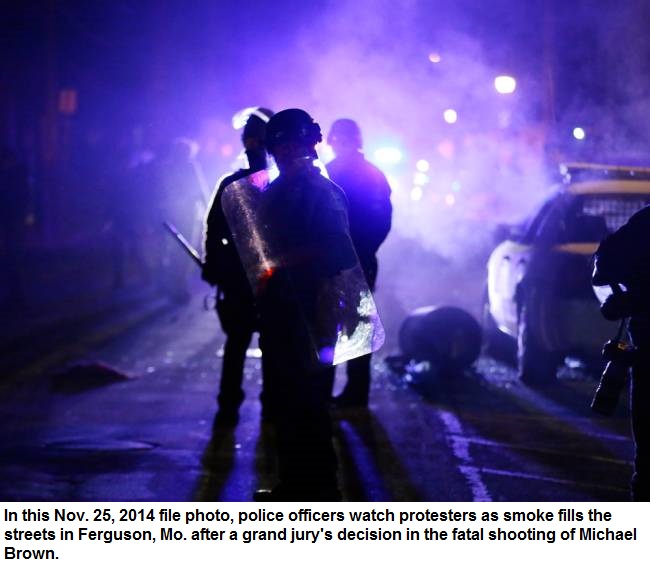
Yet, the injustice was so blatant that the town burst into protest – (literally burst into flames) – when one of their citizens – an unarmed, surrendering Michael Brown – was killed by a police officer. Then the whole country burst into protest when the subsequent Grand Jury decided not to indict in that situation. The protesters decried: “No Justice; No Peace”.

(In a related story, today the US authorities decided not to pursue a federal case against the police officer in the Michael Brown killing in Ferguson).

It is one thing to study this from afar; it is another to live it every day. This was the constant complaint of residents of Ferguson, especially those of the Black-and-Brown persuasion. See news article here and VIDEOs below:

By: Eric Tucker, AP
WASHINGTON — A Justice Department investigation found sweeping patterns of racial bias within the Ferguson, Mo., police department, with officers routinely discriminating against blacks by using excessive force, issuing petty citations and making baseless traffic stops, according to law enforcement officials familiar with its findings.

The report, to be released as soon as today, marks the culmination of a months-long investigation into a police department that federal officials have described as troubled and that commanded national attention after one of its officers shot and killed an unarmed black man, 18-year-old Michael Brown, last summer.

It chronicles discriminatory practices across the city’s criminal justice system, detailing problems from initial encounters with patrol officers to treatment in the municipal court and jail. Federal law enforcement officials described its contents on condition of anonymity because they were not authorized to speak publicly before the report is released.

The full report could serve as a road map for significant changes by the department, if city officials accept its findings. Past federal investigations of local police departments have encouraged overhauls of fundamental police procedures such as traffic stops and the use of service weapons. The Justice Department maintains the right to sue police departments that resist making changes.

The City of Ferguson released a statement acknowledging that Justice Department officials supplied a copy of the report to the mayor, city manager, police chief and city attorney during a private meeting Tuesday in downtown St. Louis. The statement offered no details about the report, which the city said it was reviewing and would discuss today after the Justice Department makes it public.

The investigation, which began weeks after Brown’s killing last August, is being released as Attorney General Eric Holder prepares to leave his job following a six-year tenure that focused largely on civil rights. The findings are based on interviews with police leaders and residents, a review of more than 35,000 pages of police records and analysis of data on stops, searches and arrests.

Federal officials found that black motorists from 2012 to 2014 were more than twice as likely as whites to be searched during traffic stops, even though they were 26 percent less likely to be found carrying contraband, according to a summary of the findings.

The review also found that blacks were 68 percent less likely than others to have their cases dismissed by a municipal court judge. And from April to September of last year, 95 percent of people kept at the city jail for more than two days were black, it found.

Of the cases in which the police department documented the use of force, 88 percent involved blacks, and of the 14 dog bites for which racial information is available, all 14 victims were black.

Overall, African-Americans make up 67 percent of the population of Ferguson, about 10 miles north of downtown St. Louis. The police department has been criticized as racially imbalanced and not reflective of the community’s demographic makeup. At the time of the shooting, just three of 53 officers were black, though the mayor has said he’s trying to create a more diverse police force.

Brown’s killing set off weeks of protests and initiated a national dialogue about police officers’ use of force and their relations with minority communities. A separate report to be issued soon is expected to clear Darren Wilson, the officer who shot Brown, of federal civil rights charges. A state grand jury declined to indict Wilson in November, and he resigned from the department.

Benjamin Crump, the attorney for the Brown family, said that if the reports about the findings are true, they “confirm what Michael Brown’s family has believed all along — and that is that the tragic killing of an unarmed 18-year-old black teenager was part of a systemic pattern of inappropriate policing of African-American citizens in the Ferguson community.”

The report says there is direct evidence of racial bias among police officers and court workers, and details a criminal justice system that issues citations for petty infractions such as walking in the middle of the street, putting the raising of revenue from fines ahead of public safety. The physical tussle that led to Brown’s death began after Wilson told him and a friend to move from the street to the sidewalk.

The practice hits poor people especially hard, sometimes leading to jail time when they can’t pay, the report says, and has contributed to a cynicism about the police on the part of citizens.

Among the report’s findings was a racially tinged 2008 message in a municipal email account stating that President Obama would not be president for very long because “what black man holds a steady job for four years.”

The department has conducted roughly 20 broad civil rights investigations of police departments during Holder’s tenure, including Newark, Cleveland and Albuquerque. Most such investigations end with police departments agreeing to change their practices.

Justice Department officials were meeting with Ferguson leaders on Tuesday about the findings, a city official said.

Several messages seeking comment from Ferguson Police Chief Tom Jackson and Mayor James Knowles III were not returned. A secretary for Jackson said he is not doing media interviews. Knowles has previously said the city is attracting a large pool of applicants to police jobs, including minority candidates seeking the position left vacant by Wilson’s resignation.

John Gaskin III, a St. Louis community activist, praised the findings, saying, “Ferguson police have to see the light in how they deal with people of color.

“It’s quite evident that change is coming down the pike. This is encouraging,” he said. “It’s so unfortunate that Michael Brown had to be killed. But in spite of that, I feel justice is coming.”
Associate Press – News Wire Service – Posted March 4, 2015
http://www.northjersey.com/news/probe-of-ferguson-mo-finds-bias-from-cops-courts-1.1281621

The events of this small Midwest American town, a suburb of St. Louis – see Appendix-Demographics below – have a huge bearing on the efforts to elevate Caribbean society. There is a direct impact: many in the Caribbean Diaspora living in the US face the same dynamics, daily. Yet, our Caribbean citizens – mostly Black-and-Brown – beat down the doors to try and expatriate to the US; then they have to contend with these same attitudes and prejudices. There are also indirect lessons for the Caribbean to learn and apply: our region struggles with a lot of the same challenges, especially with discriminations and prejudices towards immigrant “minority” groups.

The book Go Lean…Caribbean identifies these issues as among “push-and-pull” factors contributing to our excessive societal abandonment rate. While the purpose of the book is to serve as a roadmap for the introduction and implementation of the technocratic Caribbean Union Trade Federation (CU) to elevate the region’s economic engines, the security (public safety) issues are not ignored. Even more so, governance in the Caribbean member-states is a prime focus. In fact, the Go Lean roadmap has these 3 prime directives:

  • Optimization of the economic engines in order to grow the regional economy to $800 Billion & create 2.2 million new jobs.
  • Establishment of a security apparatus to protect the resultant economic engines.
  • Improvement of Caribbean governance to support these engines.

The assertion of the Go Lean book is that the Caribbean region must prepare its own security apparatus for its own security needs; we must proactively and reactively address crime. But we must do it judiciously and with proper regard for human and civil rights. For this reason, we should dread any American leadership in this regards. Considering Ferguson, they (America) have their own issues to contend with. According to the book’s opening Declaration of Interdependence (Page 12), we must take our own lead for our own solutions; we must appoint our own “guardians” with our self-interest in mind; prioritizing the community ethos for the Greater Good. The actual declaration statements are pronounced as follows:

x.   Whereas we are surrounded and allied to nations of larger proportions in land mass, populations, and treasuries, elements in their societies may have ill-intent in their pursuits, at the expense of the safety and security of our citizens. We must therefore appoint “new guards” to ensure our public safety and threats against our society, both domestic and foreign. The Federation must employ the latest advances and best practices … to assuage continuous threats against public safety.

xvi. Whereas security of our homeland is inextricably linked to prosperity of the homeland, the economic and security interest of the region needs to be aligned under the same governance. Since economic crimes, including piracy and other forms of terrorism, can imperil the functioning of the wheels of commerce for all the citizenry, the accedence of this Federation must equip the security apparatus with the tools and techniques for predictive and proactive interdictions.

The Caribbean appointing “new guards” or a security pact to ensure public safety calls for permanent justice institutions sanctioned by all 30 CU member-states. The CU Federation or federal justice’s institutions must operate differently than the US Department of Justice. While the separation-of-powers edict is the same – between the US and the CU – the Go Lean roadmap calls for more “strings attached” to security funding for community policing in the member-states. These strings include fair and equitable treatment of all citizens.
CU Blog - Probe of Ferguson-Missouri finds bias from cops, courts - Photo 2There are so many economic considerations from these issues. Consider the experience in Ferguson. The economic data reports that for White Americans there, the unemployment rate was just 6.2%; but the best figures available for the Black community shows 26% (for the entire St. Louis County in 2012). Overall, this Fortune magazine article reports: “while the Ferguson and St. Louis regional economies have been on the upswing, the gains have not been equally shared among White and African Americans. The St. Louis County 20 percentage point gap between the unemployment rate of African Americans and White Americans is the largest of any city in America, according to the Census. So, the fact that protests against the treatment of Black Americans have erupted there is not a coincidence”. [And maybe not a surprise].

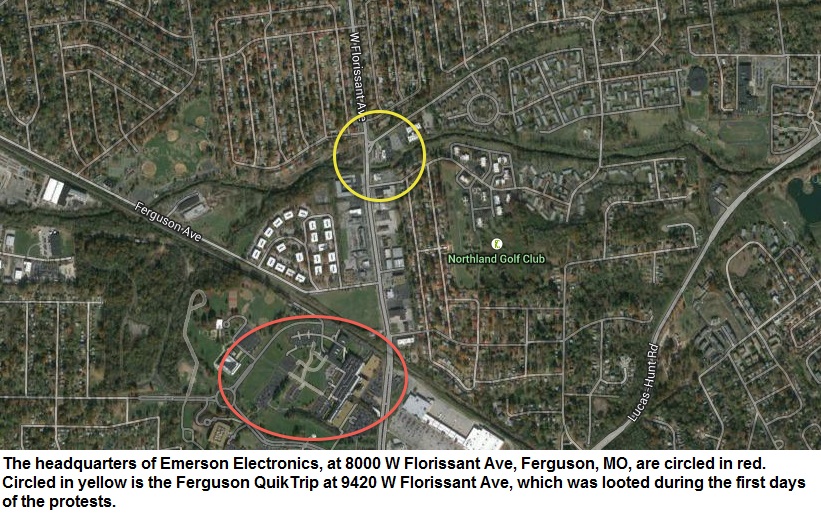
The primary economic engine in Ferguson, Missouri is the company Emerson Electric. How have they fared in the midst of all this social turmoil?

As the conflict in Ferguson, Missouri intensified, this one Fortune 500 company (ranked 121) headquartered there stayed out of harm’s way. Despite the ongoing protests, the curfew implemented by Missouri Governor Jay Nixon, and the arrival of the Missouri National Guard to quell acts of violence, the company said “it was business as usual”.

This is a powerful lesson for Caribbean consideration, the need for continuity in economic engines. About 1,300 Emerson employees work at the Ferguson headquarters; there is the perception of a “disconnect” between its status as a Fortune 500 corporation and the city’s dysfunctional urban realities. The company has established a Charitable Trust for its outreach into the local community, funding campaigns through local ($2.5 million) and national ($33 million) philanthropic endeavors. The local NAACP chapter has lauded Emerson’s contributions and involvement.

This type of success in Caribbean communities will require a heightened level of economic-security-government engagement. This is the prime directive of the CU. The Homeland Security requirements are mostly related to threats that may imperil the region’s economic engines, and crime remediation and mitigation: Public Safety! While there is some community responsibility for corporate stakeholders, the full burden – heavy-lifting – is not the obligation of local corporations, like Emerson in Ferguson. The Go Lean roadmap invites philanthropic participation but assumes the heavy-lifting itself to transform Caribbean society. The CU is an expression of that transformation, an entity to serve as a deputy for law enforcement agencies for each Caribbean member-state. (This is the theme of the treaty to empower the CU). The treaty – a Status of Forces Agreement in International Legal circles – calls for all Caribbean member-states to confederate – unite and empower – a security force to execute a limited scope on their sovereign territories. (This effort also includes the US Territories as well, under the legal guise of an Interstate Compact).

The Go Lean roadmap calls for a lot of proactive activities to remediate and mitigate crime. Like the data analyses, performed by the US Department of Justice in the foregoing article, trends of racial profiling and violations of civil rights become obvious from a macro computation of arrest and prosecution records. It is very important to have the intra-regional review of Caribbean justice institutions. This point was strongly urged in the same opening Declaration of Interdependence (Page 12), as follows:

xii. Whereas the legacy in recent times in individual states may be that of ineffectual governance with no redress to higher authority, the accedence of this Federation will ensure accountability and escalation of the human and civil rights of the people for good governance, justice assurances, due process and the rule of law. As such, any threats of a “failed state” status for any member state must enact emergency measures on behalf of the Federation to protect the human, civil and property rights of the citizens, residents, allies, trading partners, and visitors of the affected member state and the Federation as a whole.

The Go Lean roadmap identifies gang and organized crime-related activities – including drug trafficking accompanied by epidemic levels of gun violence – as threats to the law-and-order fabric of Caribbean society. (Between 2005 and 2008, the Caribbean Community registered 9,733 homicides, the highest rates in the world). Had Ferguson been in some Caribbean member-state during this new Caribbean regime, the CU would be active and involved. If not for the marshaling against economic crimes, then at least the oversight of the existing Justice institutions in the member-states. It is therefore apropos that we apply careful review of these troubling events from our northern neighbors (US in general and Missouri in particular); and also to be on guard against any such dysfunctions in our region. But the community ethos for the Caribbean must be based on the Greater Good. This covers both the letter and the spirit of laws to serve-and-protect the community.

The Go Lean book details additional community ethos to ensure the right attitudes to serve-and-protect Caribbean communities; plus strategies, tactics, implementations and advocacies to provide increased public safety & security in the Caribbean region:

Economic Principle – Economic Systems Influence Individual Choices Page 21
Economic Principle – Consequences of Choices Lie in Future Page 21
Community Ethos – Privacy –vs- Public Protection Page 23
Community Ethos – Witness Security & Protection Page 23
Community Ethos – Intelligence Gathering Page 23
Community Ethos – Anti-Bullying and Mitigation Page 23
Community Ethos – Minority Equalization Page 24
Community Ethos – Cooperatives Page 25
Community Ethos – Ways to Improve Sharing Page 35
Community Ethos – Ways to Impact the Greater Good Page 37
Tactical – Confederating a non-sovereign union Page 63
Tactical – Fostering a Technocracy Page 64
Tactical – Separation of Powers – Homeland Security Page 75
Tactical – Separation of Powers – Justice Department – CariPol Page 77
Tactical – Separation of Powers – Federal Courts – Court of Justice Page 90
Implementation – Assemble “Organs” into a Security Apparatus Page 96
Implementation – Start-up Security Initiatives Page 103
Planning – 10 Big Ideas – # 10: Haiti and Cuba Page 127
Planning – Ways to Make the Caribbean Better Page 131
Planning – Ways to Improve Failed-State Indices Page 134
Planning – Lessons from the American West Page 142
Advocacy – Ways to Grow the Economy Page 151
Advocacy – Ways to Improve Governance Page 168
Advocacy – Ways to Better Manage the Social Contract Page 170
Advocacy – Ways to Impact Justice – No Justice; No Peace Page 177
Advocacy – Ways to Reduce Crime Page 178
Advocacy – Ways to Improve for Gun Control Page 179
Advocacy – Ways to Improve Homeland Security Page 180
Advocacy – Ways to Mitigate Terrorism Page 181
Advocacy – Ways to Improve Intelligence Gathering/Analysis Page 182
Advocacy – Ways to Impact the Prison Industrial Complex Page 211
Advocacy – Ways to Protect Human Rights Page 220
Advocacy – Ways to Impact the One Percent – Philanthropic Causes Page 224
Appendix – CariCom Organs: IMPACS & Court of Justice Page 244
Appendix – Interstate Compacts Page 278
Appendix – Philanthropic Giving Pledge Signatories Page 292

Other subjects related to crime remediation and empowerments for the region have been blogged in other Go Lean commentaries, as sampled here:

https://goleancaribbean.com/blog/?p=4360 Dreading the American ‘Caribbean Basin Security Initiative’
https://goleancaribbean.com/blog/?p=4308 911 – Emergency Response: System for First Responders in Crisis
https://goleancaribbean.com/blog/?p=3881 Intelligence Agencies to Up Cyber Security Cooperation
https://goleancaribbean.com/blog/?p=3662 Migrant flow / Border incursions / Threats from Caribbean into US spikes
https://goleancaribbean.com/blog/?p=2782 Red Light Traffic Cameras, other CCTV Deployments can Impact Crime
https://goleancaribbean.com/blog/?p=2684 Role Model for Justice, Anti-Crime & Security: The Pinkertons
https://goleancaribbean.com/blog/?p=1674 Obama’s $3.7 Billion Immigration Crisis Funds – A Homeland Security Fix
https://goleancaribbean.com/blog/?p=1554 Status of Forces Agreement = Security Pact
https://goleancaribbean.com/blog/?p=1487 Here come the Drones … and the Concerns
https://goleancaribbean.com/blog/?p=960 NSA records all phone calls in Bahamas, according to Snowden
https://goleancaribbean.com/blog/?p=535 Remembering and learning from Boston
https://goleancaribbean.com/blog/?p=392 Jamaica to receive World Bank funds to help in crime fight
https://goleancaribbean.com/blog/?p=341 American Hypocritical Human Rights Leadership Slams the Caribbean

An underlying goal of the Go Lean movement is to make the Caribbean homeland, a better place to live, work and play so that our citizens are not lured to abandon their homeland for American (or Canadian or European) shores. There are many reasons people emigrate! Many times, the reasons are economic in nature. Sometimes though, security failings spur expatriation. We must address both issues with the efforts of this Go Lean movement.

America should not be considered the land of destination for the Caribbean population. Income inequality and racial inequality persists, though they don’t always go hand in hand. The fact that members of different races in America continue to receive different, unequal economic and security treatments has contributed to the rise in inequality overall in the US. We can do better in the Caribbean homeland. The issue of being Black-and-Brown is neutralized by the fact that the majority of the population is Black-and-Brown.

However, we still have minority issues to contend with.

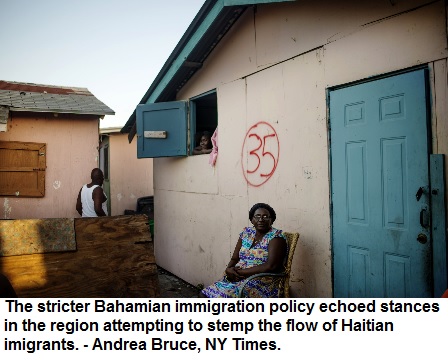
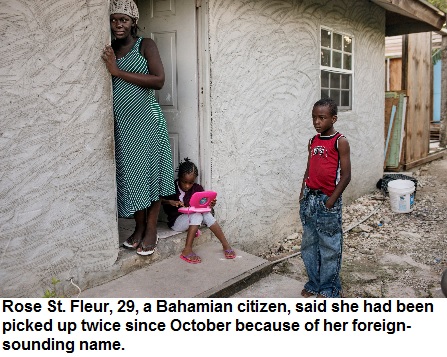
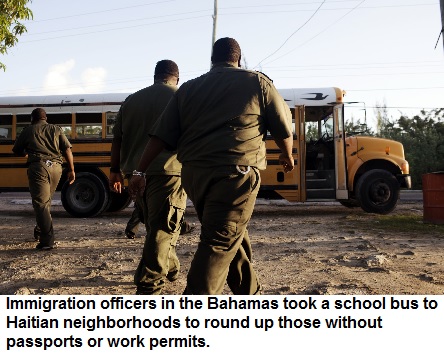
There is a consistent problem for much of the Caribbean in contending with its illegal immigration problems, particularly from near-failed states like Haiti, Cuba and Jamaica. Their nationals tend to be unwelcomed and scorned upon in host countries; (see the experience of Haitian living in the Bahamas). In these scenarios are the best opportunities to apply the lessons learned from Ferguson and other case studies in dysfunction; (the Go Lean book details lessons from Detroit, East Germany, Egypt and Indian Reservations). We must ensure that our security personnel are just in their dealings with a minority-immigrant population. Otherwise, this undermines all the positives being pursued by this roadmap; onlookers and bystanders will simply label us as hypocrites.

“See how the world, marks the manner of your bearing” – verse from the Bahamas National Anthem.

Under this dreaded scenario, many people make plans to abandon their homelands further because of their perception of unchecked injustice.

We must do better!

We know that “bad actors” will emerge in all situations: good, bad and ugly. We must be prepared and on guard. Yet we must maintain transparency, accountability, and constant commitment to due-process and the rule-of-law. Everyone, the people, institutions and government officials are encouraged to lean-in to this roadmap; to Go Lean.

🙂

Download Go Lean … Caribbean – now!

——

Appendix – Demographics:

CU Blog - Probe of Ferguson-Missouri finds bias from cops, courts - Photo 3The racial composition of Ferguson has shifted over the decades. In 1970, 99% of the population of Ferguson was White and 1% African American. In 1980, the proportion of White residents went down to 85%, whereas the proportion of African American rose to 14%. In 1990, residents of Ferguson who were identified in the U.S. Census as White comprised 73.8% of the total, while those identified as Black made up 25.1%.[23] (The remainder, 1.1%, identified with other racial categories.) In the 2000 census, 44.7% were White and 52.4% were African American.

As of the 2010 census, [3] there were 21,203 people, 8,192 households, and 5,500 families residing in the city. The population density was 3,425.4 inhabitants per square mile (1,322.6/km2). There were 9,105 housing units at an average density of 1,470.9 per square mile (567.9/km2). The racial makeup of the city was 67.4% African American, 29.3% White, 0.5% Asian, 0.4% Native American, 0.4% from other races, and 2.0% from two or more races. Hispanic and Latino of any race were 1.2% of the population.

There were 8,192 households of which 39.1% had children under the age of 18 living with them, 29.6% were married couples living together, 31.5% had a female householder with no husband present, 6.1% had a male householder with no wife present, and 32.9% were non-families. 28.2% of all households were made up of individuals and 7.4% had someone living alone who was 65 years of age or older. The average household size was 2.56 and the average family size was 3.12.

The median age in the city was 33.1 years. 28.7% of residents were under the age of 18; 10.4% were between the ages of 18 and 24; 25.2% were from 25 to 44; 25.3% were from 45 to 64; and 10.3% were 65 years of age or older. The gender makeup of the city was 44.8% male and 55.2% female.

——

Appendix – VIDEOs:

VIDEO 1: Attorney  General Eric Holder on the Ferguson Racial Bias –
http://www.nbcnews.com/news/us-news/holder-overwhelming-majority-force-ferguson-police-aimed-blacks-n317501

March 4, 2015 – Ferguson, Missouri. Police fostered a “highly toxic environment” of racism and misconduct that turned the city into a “powder keg” that was ready to explode after the fatal shooting of unarmed teenager Michael Brown last year, Attorney General Eric Holder said Wednesday — even though the officer who shot Brown was determined to have committed no crime.

VIDEO 2: DOJ Finds Pattern of Racial Discrimination in Ferguson Police –
http://www.nbcnews.com/nightly-news/doj-finds-pattern-racial-discrimination-ferguson-police-n316736

March 3, 2015 – Report on Ferguson Exposes Broader Effort to Reform Municipal Courts – Ferguson officers routinely charge multiple violations for the same conduct, competing to see who can issue the most citations during a single stop. In one particularly egregious example, he cited the case of a woman For example, who received two parking tickets in 20078 that totaled $152. But so far, she has paid $550 in fines and fees, has been arrested twice for having unpaid tickets and has spent six days in jail — and “yet she still inexplicably owes Ferguson $541,” he said.
 

Share this post:
, ,

Dreading the ‘Caribbean Basin Security Initiative’

Go Lean Commentary

The United States of America is proud of its security commitment to their Caribbean neighbors, but the amount they devote is such a piddling – they prioritize 0.1968% of the total security budget towards the region – that the Caribbean should not be lulled into complacency. We need our own security solutions!

The US is the only remaining super power; it devotes massive amounts of finances to defense and homeland security. The ratio of Defense budget versus the total budget of $3.8 trillion (2014), far exceeds all other countries. The US also asserts that it will provide frontline protection for its neighboring countries, in this case the Caribbean Basin. Just how do we quantify that commitment? Budget percentage.

CU Blog - Caribbean Basin Security Initiative - Photo 1

According to the subsequent news article, the US is proud of the security commitment to their Caribbean neighbors. But their efforts are a far cry from what is truly needed in the Caribbean! Yet, even these measly efforts have lulled the region into complacency. This commentary asserts that this is bad!

See an excerpt of the source article here:

By: Alexander Britell

It’s been six years since United States President Barack Obama made his first visit to the Caribbean, on the occasion of the Summit of the Americas in Port of Spain, [Trinidad]. And it’s been four years since he visited Puerto Rico, his last visit to the region.

While Obama hasn’t made many visits to the nearby region, his administration has not been inactive, however, promoting plans like the wide-ranging Caribbean Basin Security Initiative and, more recently, his potentially transformative rapprochement with Cuba.

Now, with two years left in his term, it seems the Obama Administration is looking to ramp up its engagement with the region.

The story is found in its entirety at: Caribbean Journal Regional News Site; posted January 26, 2015; retrieved 02/25/2015 from: http://www.caribjournal.com/2015/01/26/barack-obama-new-caribbean-push/#

The US has committed $263 million in funding since 2010; see Appendix below; that’s 5 years combined. For easy arithmetic, divide that figure by 5 to yield $52.6 million a year in commitment. This is $52.6 million of someone else’s money being dedicated to us in the Caribbean. Showing the proper appreciation: “Thank you very much Washington”.

But this is just a “drop in the bucket” compared to the general American defense/security spending:

That makes a total of $586.5 billion for 1 year. Truly, “blood is thicker than water”; the US spends massively for its own and a piddling on its neighbors. Percentage-wise, the Caribbean Basin commitment is 0.0448% of the US Defense / Homeland Security budget (2014).

0.0448% – “Our thimble runneth over”!

The overriding theme of this commentary is the commitment of American society in providing for their own security; and how the Caribbean can emulate the US example; we want to be a protégé of American society, not a parasite.

This American experience is relevant for the Caribbean to consider; not only for the fact that two Caribbean member-states are American territories: Puerto Rico and the US Virgin Islands. There are military bases in Puerto Rico, so obviously there is some Defense spending there. That figure amounts to $285 million in Defense contracts and $584 million in procurements and salaries (2004). There are no permanent military bases in the US Virgin Islands, but yet there are some spending for Defense contracts ($4.6 million), procurements and salaries ($17.5 million).

Assuming the same level for spending for 2014, the new calculation of Caribbean percentage of American Defense spending now totals: $1,154.1 million or 0.1968%

0.1968% – The cause-and-effect is still the same; a piddling!

The region is in crisis; at the precipice of Failed-State status. No doubt, there is an overriding need for the Caribbean to create its own regional security solution. This is the assertion of the book Go Lean…Caribbean, that the region must prepare its own security apparatus for its own security needs. For this reason, we should be dreading the formal Caribbean Basin Security Initiative as currently formulated. Obviously the heartfelt commitment, the devotion to the Caribbean homeland is not there for Washington, the White House or the Pentagon; see VIDEOs below. We must appoint our own “guardians” with our self-interest in mind; starting a new community ethos of National Sacrifice.

The news reports abound in the Caribbean: Gang and organized crime-related activities, including drug trafficking accompanied by epidemic levels of gun violence, threatens the democratic fabric of the Caribbean sub-region. Between 2005 and 2008, the Caribbean Community (CariCom) registered 9,733 homicides, the highest rates -per capita – in the world.

So the request is that all Caribbean member-states confederate – unite and empower – a security force to execute a limited scope on their sovereign territories. Yes, there is a need for a regional Caribbean security solution; which will include the US Territories as well; (Puerto Rico reports runaway crime statistics as well).

Homeland Security for the Caribbean has a different meaning than for our American counterparts. Though we must be on guard against military intrusions like terrorism and piracy, we mostly have to contend with crime – remediation, mitigation and threats that may imperil the region’s economic engines. The CU security goal is for public safety! This goal is detailed in the Go Lean book as it serves as a roadmap for the introduction and implementation of the technocratic Caribbean Union Trade Federation (CU). So while the CU is set to optimize Caribbean society through economic empowerment, the security dynamics will be inextricably linked to this same endeavor. Therefore the Go Lean roadmap has these 3 prime directives:

  • Optimization of the economic engines in order to grow the regional economy to $800 Billion & create 2.2 million new jobs.
  • Establishment of a security apparatus to protect the resultant economic engines.
  • Improvement of Caribbean governance to support these engines.

The book contends that “bad actors” will emerge as a result of economic successes. This point is pronounced early in the book with the Declaration of Interdependence (Page 12) that claims:

x.   Whereas we are surrounded and allied to nations of larger proportions in land mass, populations, and treasuries, elements in their societies may have ill-intent in their pursuits, at the expense of the safety and security of our citizens. We must therefore appoint “new guards” to ensure our public safety and threats against our society, both domestic and foreign. The Federation must employ the latest advances and best practices … to assuage continuous threats against public safety.

xvi. Whereas security of our homeland is inextricably linked to prosperity of the homeland, the economic and security interest of the region needs to be aligned under the same governance. Since economic crimes, including piracy and other forms of terrorism, can imperil the functioning of the wheels of commerce for all the citizenry, the accedence of this Federation must equip the security apparatus with the tools and techniques for predictive and proactive interdictions.

The Caribbean appointing “new guards”, or a security pact to ensure public safety is not so new an endeavor. There is currently a security pact; shared by 5 Eastern Caribbean member-states dubbed the Regional Security System. The Go Lean roadmap however calls for a permanent professional force with naval and ground (Marine) forces, plus an Intelligence agency. This security apparatus would be sanctioned by all 30 CU member-states, not just the current 5 and including the US Territories. The CU Trade Federation will lead, fund and facilitate the security force, encapsulating all the existing (full-time or part-time) armed forces in the region. This CU Homeland Security Force would get its legal authorization from a Status of Forces Agreement signed as a complement to the CU treaty. The Go Lean roadmap also calls for a greater commitment to Justice institutions: law enforcement and regional policing. In fact, the book’s 370-page turn-by-turn instructions present a plan with a lot of time, talent and treasuries focused on the comprehensive security vision.

This commentary posits that the Caribbean Basin Security Initiative, from the foregoing article, should be coupled with these CU security initiatives; see VIDEOs below. This required security apparatus is “Step One, Day One” in the Go Lean roadmap, covering the approach for adequate funding, accountability and control.

The Go Lean book details a series of community ethos, strategies, tactics, implementations and advocacies to provide increased public safety & security in the Caribbean region:

Economic Principle – Economic Systems Influence Individual Choices Page 21
Economic Principle – Consequences of Choices Lie in Future Page 21
Community Ethos – Privacy –vs- Public Protection Page 23
Community Ethos – Witness Security & Protection Page 23
Community Ethos – Intelligence Gathering Page 23
Community Ethos – Anti-Bullying and Mitigation Page 23
Community Ethos – Minority Equalization Page 24
Community Ethos – Cooperatives Page 25
Community Ethos – Ways to Improve Sharing Page 35
Community Ethos – Ways to Impact the Greater Good Page 37
Strategy – Vision – Caribbean an integrated and unified region Page 45
Strategy – Mission – Enact a Defense Pact against systemic threats Page 45
Tactical – Confederating a non-sovereign union Page 63
Tactical – Fostering a Technocracy Page 64
Tactical – Separation of Powers – Homeland Security Page 75
Implementation – Ways to Pay for Change Page 101
Implementation – Start-up Foreign Policy Initiatives Page 102
Implementation – Start-up Security Initiatives Page 103
Implementation – Ways to Foster International Aid Page 115
Planning – Ways to Model the EU Page 130
Planning – Ways to Make the Caribbean Better Page 131
Planning – Ways to Improve Failed-State Indices Page 134
Planning – Lessons Learned from the West Indies Federation Page 135
Planning – Lessons from the American West Page 142
Planning – Lessons from Egypt Page 143
Advocacy – Ways to Grow the Economy Page 151
Advocacy – Ways to Improve Governance Page 168
Advocacy – Ways to Better Manage the Social Contract Page 170
Advocacy – Ways to Improve Leadership Page 171
Advocacy – Ways   to Impact Justice Page 177
Advocacy – Ways   to Reduce Crime Page 178
Advocacy – Ways to Improve for Gun Control Page 179
Advocacy – Ways to Improve Homeland Security Page 180
Advocacy – Ways to Mitigate Terrorism Page 181
Advocacy – Ways to Improve Intelligence Gathering/Analysis Page 182
Advocacy – Ways to Impact the Prison Industrial Complex Page 211
Advocacy – Ways to Protect Human Rights Page 220
Advocacy – Ways to Impact US Territories Page 244

Other subjects related to Homeland Security and crime remediation empowerments for the region have been blogged in other Go Lean…Caribbean commentary, as sampled here:

https://goleancaribbean.com/blog/?p=4308 911 – Emergency Response: System for First Responders in Crisis
https://goleancaribbean.com/blog/?p=3881 Intelligence Agencies to Up Cyber Security Cooperation
https://goleancaribbean.com/blog/?p=3662 Migrant flow / Border Incursions / Threats spike for Caribbean into US
https://goleancaribbean.com/blog/?p=3432 OECS diplomat has dire warning for Caribbean “Begging”
https://goleancaribbean.com/blog/?p=2782 Red Light Traffic Cameras, other CCTV Deployments Can Impact Crime
https://goleancaribbean.com/blog/?p=2684 Role Model for Justice, Anti-Crime & Security: The Pinkertons
https://goleancaribbean.com/blog/?p=2259 The Criminalization of American Business – White Collar Interdictions
https://goleancaribbean.com/blog/?p=1965 America’s Navy – 100 Percent – Model for Caribbean
https://goleancaribbean.com/blog/?p=1674 Obama’s $3.7 Billion Immigration Crisis Funds – A Homeland Security Fix
https://goleancaribbean.com/blog/?p=1554 Status of Forces Agreement = Security Pact
https://goleancaribbean.com/blog/?p=1531 A Lesson in History: 100 Years Ago – World War I
https://goleancaribbean.com/blog/?p=1487 Here come the Drones … and the Concerns
https://goleancaribbean.com/blog/?p=1143 White Collar-Health-care fraud in US; criminals take $272 billion a year
https://goleancaribbean.com/blog/?p=1076 Trinidad Muslims travel to Venezuela for jihadist training
https://goleancaribbean.com/blog/?p=960 NSA records all phone calls in Bahamas, according to Snowden
https://goleancaribbean.com/blog/?p=809 Muslim officials condemn abductions of Nigerian girls
https://goleancaribbean.com/blog/?p=789 America’s War on the Caribbean
https://goleancaribbean.com/blog/?p=535 Remembering and learning from Boston
https://goleancaribbean.com/blog/?p=392 Jamaica to receive World Bank funds to help in crime fight
https://goleancaribbean.com/blog/?p=273 10 Things We Want from the US – #4: Pax Americana

The planners of the new Caribbean, those in this Go Lean movement, are not ungrateful for the contributions of the US. We appreciate their support and invite even more assistance, cooperation and facilitation. After all, a leading factor in the regional threats the Caribbean contends with is derived from the US demand for illicit drugs. Many times, our small island states are just in the way of narco-terrorists trans-shipment plans. Plus a number of American states have now adopted new community ethos when it comes to drugs, legalizing or decriminalizing marijuana; sometimes declaring a “faux-medical” subterfuge. If the State says “OK”, it is very hard for parents, teachers and religious leaders to counter the arguments. So American vices are breaking Caribbean societal structures.

It is what it is!

An underlying goal of the Go Lean movement is to make the Caribbean homeland, a better place to live, work and play. (It is out-of-scope of Go Lean … Caribbean to fix America). While this roadmap includes a heavy focus on economics, the other areas of Caribbean society must get equal attention, like security and governance. A 0.1968% commitment is not the community ethos we advocate; in fact, at those piddling numbers, it is no commitment at all, it only constitutes a slight involvement – just sticking a “toe in the waters” when a wholesale bath is needed. In an illustrative depiction, it is just “milk or eggs to a recipe that requires bacon”. So we cannot expect Caribbean leadership to come from American sources.

Accepting the premise of “bad actors” inevitability means preparing counter-measures in earnest. There is nothing earnest about a 0.1968% commitment. Rather, a technocratic security apparatus for public safety is necessary to elevate the Caribbean homeland. This prime directive is front-and-center with the Go Lean effort. Now is the time for all of the Caribbean, the people, institutions and governance, to lean-in to this roadmap.

🙂

Download the book Go Lean … Caribbean – now!

——

APPENDIX A – VIDEOs: The Caribbean Basin Security Initiative Commission; 3rd meeting in St. Kitts; Oct 3, 2012.

1. Caribbean Basin Security Initiative – Francis Forbes – http://youtu.be/wUyOpOVT1ss

Francis Forbes, Executive Director – CariCom Implementation Agency for Crime and Security (IMPACS)

2. VIDEO: Caribbean Basin Security Initiative – Liliana Ayalde – http://youtu.be/_uf5gEHkKac

At the time of this posting, Ms. Ayalde was the Deputy Assistant Secretary (DAS) for the United States State Department with responsibility for the Offices of Caribbean Affairs, Central American Affairs and Cuban Affairs. Today, she serves as the United States Ambassador to Brazil.

APPENDIX B – Official Communique: Caribbean Basin Security Initiative
(Source retrieved 02/26/2015 from: http://www.state.gov/p/wha/rt/cbsi/)

The Caribbean Basin Security Initiative (CBSI) is one pillar of a U.S. security strategy focused on citizen safety throughout the hemisphere. CBSI brings all members of the Caribbean Community (CARICOM) and the Dominican Republic together to jointly collaborate on regional security with the United States as a partner. The United States is making a significant contribution to CBSI, committing $263 million in funding since 2010.

The United States and Caribbean countries have identified three core objectives to deal with the threats facing the Caribbean:

  • Substantially Reduce Illicit Trafficking: through programs ranging from counter-narcotics to reducing the flow of illegal arms/light weapons.
  • Increase Public Safety and Security: through programs ranging from reducing crime and violence to improving border security.
  • Promote Social Justice: through programs designed to promote justice sector reform, combat government corruption, and assist vulnerable populations at risk of recruitment into criminal organizations.

These objectives are not just about drug interdiction. CBSI is a whole of government approach to citizen safety. Citizen Safety Focuses on:

  • Partnerships: A defining purpose of U.S.  policy in the Western Hemisphere is to build effective partnerships to advance our common strategic interests—partnerships that can better develop, mobilize and apply the capacity of the region toward accomplishing shared objectives.
  • The Personal Element: Our commitment to broad partnerships that advance citizen safety signals that the U.S. understands that while security is a key priority throughout the region, people often understand security in a personal way on their street corners, on a bus to and from work, or in their markets.
  • Crime Linkages: Forging effective partnerships requires an understanding of and an ability to address fundamental links between local, transnational and “white collar” crime (e.g., corruption), and the nexus between these threats and the big social and economic challenges the region faces.  We seek to improve public safety, improving security for each and every citizen through these partnerships.

Related Documents
-12/05/13   The Caribbean Basin Security Initiative [PDF version]
-12/05/13   The Caribbean Basin Security Initiative (Spanish)  [689 Kb]
-12/05/13   The Caribbean Basin Security Initiative: Antigua and Barbuda [PDF version]
-12/05/13   The Caribbean Basin Security Initiative: Barbados [PDF version]
-12/05/13   The Caribbean Basin Security Initiative: Dominica [PDF version]
-12/05/13   The Caribbean Basin Security Initiative: Dominican Republic [PDF version]
-12/05/13   The Caribbean Basin Security Initiative: Dominican Republic (Spanish)  [690 Kb]
-12/05/13   The Caribbean Basin Security Initiative: Grenada [PDF version]
-12/05/13   The Caribbean Basin Security Initiative: Guyana [PDF version]
-12/05/13   The Caribbean Basin Security Initiative: Jamaica [PDF version]
-12/05/13   The Caribbean Basin Security Initiative: St. Kitts and Nevis [PDF version]
-12/05/13   The Caribbean Basin Security Initiative: St. Lucia  [PDF version]
-12/05/13   The Caribbean Basin Security Initiative: St. Vincent and the Grenadines [PDF version]
-12/05/13   The Caribbean Basin Security Initiative: Suriname [PDF version]
-12/05/13   The Caribbean Basin Security Initiative: The Bahamas [PDF version]
-12/05/13   The Caribbean Basin Security Initiative: Trinidad and Tobago [PDF version]
-01/17/13   Spanish Version: The Caribbean Basin Security Initiative: A Shared Regional Security Partnership  [1324 Kb]
-01/17/13   Spanish Version: The Caribbean Basin Security Initiative: A Shared Regional Security Partnership (Dominican Republic)  [1057 Kb]


Share this post:
, ,
[Top]

Ambassadors to Caribbean discuss PetroCaribe-Energy, Security

Go Lean Commentary

The problem with different independent nations coming together to build consensus is that each party may have its own self-interest. Independence and consensus-building are inherently opposed to each other.

The subsequent news article highlights this point, as it relates how 5 US ambassadors to Caribbean member-states had convened stakeholders to promote an agenda of American leadership in energy security.

Something about this initiative seems conflicting!

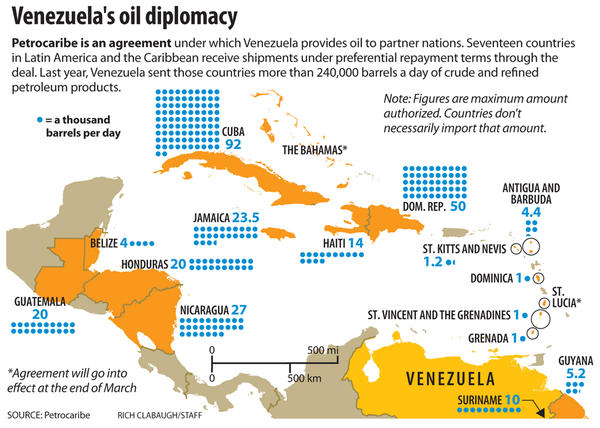
A lack of American leadership in the past has resulted in solutions originating elsewhere, from one neighbor in particular: Venezuela. That country’s PetroCaribe initiative had been valued by many Caribbean member-states as it was a vital lifeline throughout the global financial crisis, which had combined with cripplingly high oil and gas prices in 2008. But Venezuela-PetroCaribe is in enmity with US policy.

This brings to the fore a previous lesson in American foreign-policy history, from 25 years ago: Nelson Mandela’s unconditional support of enemies of the US that were unconditional supporters of the anti-Apartheid movement. Mr. Mandela’s direct comment was as follows:

“One mistake that some political analysts make is to think that their enemies should be our enemies. That [is something] we cannot and should never do. We have our own struggle that we are conducting. We are grateful to the world for supporting our struggle…but independence means we get to choose our friends and choose our enemies” – Nelson Mandela; June 21, 1990. (See Appendix A below).

The foregoing article speaks of the US Caribbean foreign policy initiative in campaigning against PetroCaribe et al:

Title: Ambassadors to Caribbean countries discuss energy, security
By: Jennifer Kay
MIAMI (AP) — Five U.S. ambassadors to the Caribbean on Thursday reinforced the U.S. government’s commitment to helping the cash-strapped region to reduce its dependence on Venezuelan oil while addressing multiple security issues.

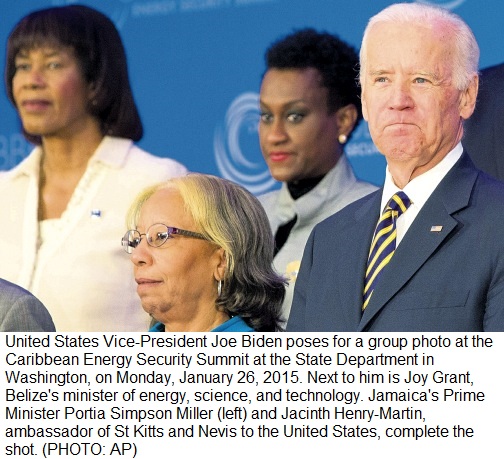
The panel at Florida International University followed last month’s Caribbean Energy Security Summit in Washington, where Vice President Joe Biden said the U.S. was poised to help Caribbean countries that could address corruption and make needed regulatory changes.

CU Blog - Ambassadors to Caribbean Discuss PetroCaribe-Energy and Security - Photo 1

The U.S. ambassadors to Haiti, the Dominican Republic, Jamaica, Suriname and Barbados and the eastern Caribbean participated in the panel hosted by FIU’s Latin American and CaribbeanCenter.

The U.S. wants to encourage more American investment in Caribbean energy projects, such as a new wind farm in Jamaica, “but we need to have and provide a safe and secure environment,” said Luis Moreno, the ambassador to Jamaica.

With falling oil prices shaking Venezuela’s economy, the Caribbean is interested in finding alternatives to Petrocaribe, a decade-old trade program created by the late President Hugo Chavez that requires member countries to pay only a small portion of the up-front costs for oil, allowing them to finance the rest under long-term debt agreements.

The ambassadors derided the program, though they acknowledged it wasn’t likely to end soon even as they push Caribbean countries to consider shifting to natural gas or other energy alternatives.

“We want to encourage individuality. We want to get these countries to sit up for themselves,” said Moreno, who called Petrocaribe “a blunt political instrument.”

Aside from Venezuela’s influence, the Caribbean faces a number of challenges that concern the U.S, such as border security, rising Chinese influence in the region, human rights, weak infrastructure, a lack of regional coordination and vulnerability to climate change and natural disasters.

There’s also been a rise in drug, arms and human trafficking in some eastern Caribbean islands as authorities put pressure on traffickers in South America, and some countries have begun essentially offering citizenship and easing travel for people who buy land or make other investments in the islands, said Larry Palmer, ambassador to Barbados and the eastern Caribbean.

Another problem is political instability in Haiti, in spite of strides the country has made in recovering from a 2010 earthquake. Long-delayed elections are scheduled later this year, but “it’s always rocky in Haiti,” said Pamela White, ambassador to Haiti.

“Let’s just pray we can get through those two days (of scheduled voting) this year so the Haitian people have the right, the democratic right, to vote in people they think will represent them,” she said.
Source: Associated Press News Wire Service (Retrieved 02/18/2015) – http://www.washingtontimes.com/news/2015/feb/12/ambassadors-to-caribbean-countries-discuss-energy-/ 

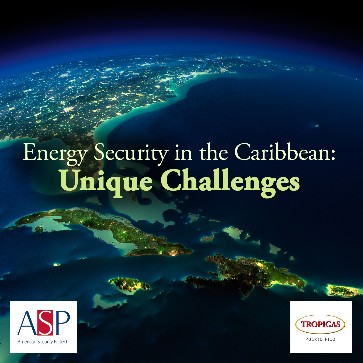
Night Earth. Bermuda Triangle Area

VIDEO – St Lucia Clip from Caribbean Energy Security Summit – http://youtu.be/0Ho_PmQThTQ

Published on Jan 29, 2015 – Dr. James Fletcher – Minister of Public Service & Energy – who attended the US Summit on Energy Security says the meeting was a precursor to the energy and climate partnership of the America’s meeting which will take place in March 2015.

What is PetroCaribe and how does it relate to the Caribbean economic empowerment effort? (See Appendix B below). Previously, this commentary detailed a discussion on PetroCaribe-ALBA-SUCRE, identifying these economic integration initiatives started by the late Venezuelan President Hugo Chavez (1954-2013). His advocacy of socialism often brought him at odds with the US. But still, there were benefits and benevolence in his actions.

The book Go Lean…Caribbean pursues an apolitical agenda; the only motive is the elevation of Caribbean society by optimizing the economic, security and governance engines. This serves as a roadmap for the introduction and implementation of the Caribbean Union Trade Federation (CU). Further, the book, and accompanying blog commentaries, posit that American leadership may not always have the Caribbean best interest in mind, even for US Territories. Societies do better in their American interactions when they relate as protégés, not parasites. This is a reality that we must accept. The Go Lean roadmap features 144 missions to accomplish this feat of elevating Caribbean society to protégé status.

The Go Lean roadmap does align with many of the objectives of these US ambassadors; it is important for the Caribbean to pursue energy independence. As such there is a focus on alternative energy options that can be easily deployed in the region: solar, wind turbines, tidal and yes, the natural gas option as the US advocates. The cause to combat climate change and mitigate natural disasters is welcomed from the US, as our Caribbean islands are on the front lines of this battle. But the Go Lean roadmap is not 100% concurring with the US policy; we also align with some objectives of PetroCaribe, especially negotiating group discounts and delivery terms for the Caribbean member-states. Early in the book, these pressing needs were pronounced in the Declaration of Interdependence (Page 11), with these statements:

i.      Whereas the earth’s climate has undeniably changed resulting in more severe tropical weather storms, it is necessary to prepare to insure the safety and security of life, property and systems of commerce in our geographical region. As nature recognizes no borders in the target of its destruction, we also must set aside border considerations in the preparation and response to these weather challenges.

vi.      Whereas the finite nature of the landmass of our lands limits the populations and markets of commerce, by extending the bonds of brotherhood to our geographic neighbors allows for extended opportunities and better execution of the kinetics of our economies through trade. This regional focus must foster and promote diverse economic stimuli.

viii.      Whereas the population size is too small to foster good negotiations for products and commodities from international vendors, the Federation must allow the unification of the region as one purchasing agent, thereby garnering better terms and discounts.

The Go Lean roadmap details a series of community ethos, strategies, tactics, implementations and advocacies to foster the progress in the wide fields of energy alternatives and group purchasing. The following list applies:

Community Ethos – Economic Systems Influence Individual Choices Page 21
Community Ethos – Lean Operations – Group Purchase Organizations Page 24
Community Ethos – Cooperatives Page 25
Community Ethos – Regional Taxi Commissions Page 25
Community Ethos – Ways to Improve Negotiations Page 32
Community Ethos – Ways to Impact the Greater Good Page 37
Strategy – Harness alternative power: Sun, Wind, and Natural Gas Page 46
Tactical – Fostering a Technocracy Page 82
Tactical – Separation of Powers – Energy Commission Page 82
Anecdote – “Lean” in Government – Energy Permits Page 93
Anecdote – Caribbean Energy Grid Implementation Page 100
Implementation – Foreign Policy Initiatives at Start-up Page 102
Implementation – Ways to Develop Pipeline Industry – Underwater Power Lines Page 107
Implementation – Ways to Improve Energy Usage Page 113
Implementation – Ways to Promote Independence Page 120
Planning – Lessons Learned from 2008 Page 136
Advocacy – Ways to Impact Public Works Page 175
Advocacy – Ways to Foster Cooperatives Page 176
Advocacy – Ways to Impact Monopolies Page 202
Advocacy – Ways to Impact US Territories Page 244

The planners of a new elevated Caribbean hereby thank the US foreign policy-makers for their dedication towards the Caribbean. This is friendly! But as matured independent nations, we accept the responsibility to “choose our own friends and our own enemies”.

We accept that in this case, the US may have altruistic motives, especially with declining oil prices possibly affecting Venezuela. But for far too often, American leadership has been motivated by crony-capitalistic intentions. The points of mitigating the risks of American Big Business were further elaborated upon in these previous blog/commentaries:

https://goleancaribbean.com/blog/?p=4076 US Big Media Fantasies versus Weather Realities
https://goleancaribbean.com/blog/?p=3397 A Christmas Present for the Banks from the Omnibus Bill
https://goleancaribbean.com/blog/?p=3326 Detroit’s M-1 Rail – Finally avoiding Plutocratic Auto Industry influence
https://goleancaribbean.com/blog/?p=2887 Caribbean must work together to address rum subsidies
https://goleancaribbean.com/blog/?p=2522 The Cost of Cancer Drugs
https://goleancaribbean.com/blog/?p=2465 Book Review: ‘This Changes Everything: Capitalism vs. the Climate’
https://goleancaribbean.com/blog/?p=2435 Korea’s Protégé Model – A Dream for Latin America / Caribbean
https://goleancaribbean.com/blog/?p=2338 Lesson Learned – How Best to Welcome the Dreaded ‘Plutocracy’
https://goleancaribbean.com/blog/?p=2259 The Criminalization of American Business – Big Banks Let Loose
https://goleancaribbean.com/blog/?p=2251 US Black-and-Brown populations are still institutionally disadvantaged
https://goleancaribbean.com/blog/?p=2183 A Textbook Case of Industry Price-gouging
https://goleancaribbean.com/blog/?p=1143 Health-care fraud in America; Criminals take $272 billion a year
https://goleancaribbean.com/blog/?p=789 America’s War on the Caribbean
https://goleancaribbean.com/blog/?p=709 Post 2008 Great Recession – Student debt holds back home buyers
https://goleancaribbean.com/blog/?p=242 Post 2008 Great Recession – The Erosion of the Middle Class
https://goleancaribbean.com/blog/?p=273 10 Things We Don’t Want from the US – #1: American Self-Interest

The Go Lean roadmap calls for integration of the regional member-states, a strategy of confederation with a tactic of separating powers between CU federal agencies and member-states’ governments. The roadmap calls for the regional integration of energy generation and energy distribution services – a regional grid. The separation-of-powers tactic also calls for assumption of Emergency Management agencies for the member-states. This allows for the regional mitigation and remediation of the affects of climate change. The roadmap posits that to succeed as a society, the Caribbean region must integrate and consolidate into a Single Market of 42 million people, so as to be able to compete with the rest of the world, and to facilitate better negotiations.

It is time to choose our own friends … and enemies.

Now is the time for all of the Caribbean, the people, business, institutions and governments, to lean-in for the optimizations and opportunities described in the book Go Lean … Caribbean. 🙂

————

Appendix A: Nelson Mandela’s Friends

The relationship between the United States and the anti-apartheid movement Mandela led was duplicitous. Some of his most fervent international supporters were leaders of countries sharply at odds with America.

The US Government criticized Nelson Mandela for going to Libya to visit Muammar Gaddafi, and in a speech that he gave Nelson Mandela said that “they could go and jump into a pool”. He said that he was not going to turn his back on the people that was there for him in his darkest hour.

Nelson Mandela was 100% man; he didn’t allow other people to tell him what to do, and he didn’t allow people to pick his friends [or his enemies]. [Many times,] America’s enemies were Mandela’s friends.
(Source: http://s1.zetaboards.com/Express_Yourself/topic/5312294/1/).

These “friends” referred to:

  • Fidel Castro of Cuba
  • Minister Louis Farrakhan of the Nation of Islam
  • Yasser Arafat of the Palestine Liberation Organization (PLO)
  • Ayatollah Khomeini of Iran

—–

Additional research: Mandela Town Hall Meeting, New   York City, June 21, 1990:
http://youtu.be/q6eE9BIUfBg  – 1990 video of Town Hall meeting with Nelson Mandela of South Africa anchored by Ted Koppel on ABC Nightline in New York.

————

Appendix B: PetroCaribe / ALBA / SUCRE

PetroCaribe is an oil alliance with Venezuela which allows the purchase of oil on conditions of preferential payment. The alliance was launched on 29 June 2005 in Puerto La Cruz, Venezuela. In 2013 PetroCaribe agreed to links with the Bolivarian Alliance for the Americas (ALBA), and to go beyond oil and promote economic cooperation. It is now considered an “economic zone”.

There are a total of 17 members, plus Venezuela; 12 of the members are from the 15 member CariCom (excluding, Barbados, Montserrat and Trinidad and Tobago). At the first summit, 14 countries joined the alliance. These were: Antigua and Barbuda, the Bahamas, Belize, Cuba, Dominica, Dominican Republic, Grenada, Guyana, Haití, Honduras, Jamaica, Nicaragua, St Lucia, St Kitts and Nevis, Saint Vincent and the Grenadines, Suriname and Venezuela.

ALBA – The Bolivarian Alliance for the Americas is an intergovernmental organization associated with socialist and social democratic governments wishing to consolidate regional economic integration based on a vision of social welfare, bartering and mutual economic aid. ALBA nations may conduct trade using a virtual regional currency known as the SUCRE.

SUCRE – A regional currency to be used in commercial exchanges between members of the regional ALBA trade bloc. It is intended to replace the US dollar as a medium of exchange in order to decrease US control of Latin American economies. The acronym is in Spanish, as: Sistema Único de Compensación Regional. In English, this means: Unified System for Regional Compensation. The plan is for the SUCRE to become a hard currency.

Venezuela Oil

Share this post:
, , , ,
[Top]

A Lesson in History – Panamanian Balboa

Go Lean Commentary

America has surely changed over the past century!

The people, institutions and governance of the US are now more tolerant of minorities and their communities. As such, there are no more American complexities in overthrowing Latin American & Caribbean governments.

Wink-wink

This hypothesis is validated with the lesson in history from 1941 in the Republic of Panama. This Central American country is a young nation; they were formed in 1903 after seceding from the Republic of Colombia, with US backing. The new country immediately signed a treaty with the US to allow the construction of the Panama Canal, by the US Army Corps of Engineers, and a perpetual lease* for its operations. The country’s separation from Colombia also included changing from the Colombian Peso currency. So in 1904 the Panamanian Balboa currency was launched, but as coins only; the country used the US Dollar as banknotes.

A basic tenant of macro-economics is that countries should issue their own currency and banknotes so as to better influence the economic engines in their communities. By manipulating the banknote quantity and the “Discount Rate” in a Fractional Central Banking System, monetary supply can be regulated, interest rates controlled; credit markets tamed; and yes, money can be created from “thin air”. Panama had none of this control, due to its lack of banknotes.

In 1941, the then-President Dr. Arnulfo Arias pushed the government to create the Central Bank and to issue paper currency. [2] The bank was authorized, constitutionally, to issue up to 6 million Balboas worth of paper notes, but only 2.7 million Balboas were issued on 2 October 1941. Seven days later, Arias was deposed in a military coup – supported by the United States – and replaced by Dr. Ricardo Adolfo de la Guardia Arango as President. The new government immediately closed the bank, withdrew the issued notes, and burned all unissued money stock. In the 74 years since then, the country has never re-attempted to issue its own paper money currency; they continue to use US Dollars, even today.

A bit extreme?

This lesson in history is presented in a consideration of the book Go Lean…Caribbean; it serves as a roadmap for the introduction and implementation of the technocratic Caribbean Union Trade Federation (CU) and Caribbean Central Bank (CCB) to provide better stewardship in ensuring that the currency and economic failures of the past, in the Caribbean and other regions, do not re-occur here in the homeland. The book posits that we must NOT fashion ourselves as an American parasite economy, but rather pursue a status as a protégé.

The full details of the Panamanian Balboa history is provided here:

Title: Panamanian Balboa
(Source: Wikipedia Online Encyclopedia (Retrieved 02/09/2015) – http://en.wikipedia.org/wiki/Panamanian_balboa)

The Balboa (sign: B/.; ISO 4217: PAB) is, along with the United States dollar, one of the official currencies of Panama. It is named in honor of the Spanish explorer / conquistador Vasco Núñez de Balboa. The Balboa is subdivided into 100 centésimos.

The history of the Panamanian Balboa

The Balboa replaced the Colombian Peso in 1904 following the country’s independence. The Balboa has been tied to the United States dollar (which is legal tender in Panama) at an exchange rate of 1:1 since its introduction and has always circulated alongside dollars.

Coins

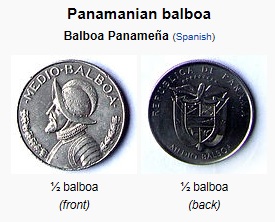
In 1904, silver coins in denominations of 2½, 5, 10, 25, and 50 centésimos were introduced. These coins were weight-related to the 25 gram 50 centésimos, making the 2½ centésimos coin 1¼ grams. Its small size led to it being known as the “Panama pill” or the “Panama pearl”. In 1907, copper-nickel ½ and 2½ centésimos coins were introduced, followed by copper-nickel 5 centésimos in 1929. In 1930, coins for 110, ¼, and ½ Balboa were introduced, followed by 1 balboa in 1931, which were identical in size and composition to the corresponding U.S. coins. In 1935, bronze 1 centésimo coins were introduced, with 1¼ centésimo pieces minted in 1940.

CU Blog - A Lesson in History - Panamanian Balboa - Photo 1

In 1966, Panama followed the U.S. in changing the composition of their silver coins, with copper-nickel clad 110 and ¼ Balboa, and .400 fineness ½ Balboa. 1 balboa coins, at .900 fineness silver, were issued that year for the first time since 1947. In 1973, copper-nickel clad ½ Balboa coins were introduced. 1973 also saw the revival of the 2½ centésimos coin, which had a size similar to that of the U.S. half dime, but these were discontinued two years later due to lack of popular demand. In 1983, 1 centésimo coins followed their U.S. counterpart by switching from copper to copper plated zinc. Further issues of the 1 Balboa coins have been made since 1982 in copper-nickel without reducing the size.

Modern 1 and 5 centésimos and 110, ¼, and ½ balboa coins are the same weight, dimensions, and composition as the U.S. cent, nickel, dime, quarter, and half-dollar, respectively. In 2011, new 1 and 2 balboa bi-metal coins were issued.[1]

In addition to the circulating issues, commemorative coins with denominations of 5, 10, 20, 50, 75, 100, 150, 200, and 500 Balboas have been issued.

Banknotes

In 1941, President Dr. Arnulfo Arias pushed the government to enact Article 156 to the constitution, authorizing official and private banks to issue paper money. As a result, on 30 September 1941, El Banco Central de Emission de la Republica de Panama was established.[2]

CU Blog - A Lesson in History - Panamanian Balboa - Photo 2

The bank was authorized to issue up to 6,000,000 Balboas worth of paper notes, but only 2,700,000 balboas were issued on 2 October 1941. A week later, Dr. Ricardo Adolfo de la Guardia Arango replaced Arias as president in a coup supported by the United States. The new government immediately closed the bank, withdrew the issued notes, and burned all unissued stocks of same. Very few of these so-called “Arias Seven Day” notes escaped incineration.

Reference Notes:
1. http://worldcoinnews.blogspot.com/search/label/panama
2. Linzmayer, Owen (2012). “Panama”. The Banknote Book. San Francisco, CA: www.BanknoteNews.com.

Panama is out-of-scope of this Go Lean empowerment roadmap. They are not a member-state that caucuses with the Caribbean Community (CariCom), and they do not even have an “Observer” representation/status within the trade bloc. But since a part of their territory-coastline is on the Caribbean Sea, their dealings should generate review and monitoring from Caribbean planners. There are many issues for the Caribbean to consider  – from an academic point-of-view – about this history of Panama: an obvious failed-state as recent as the 1980’s.

Is the American manipulations in Panama’s past reflective of the same America today? The assumption is No! The US no longer draws such “hard lines” in their interactions with peoples of different ethnicity. The country has endured deep soul-searching and reconciliation of its racial past, (Civil Rights Movement, Affirmative Action, etc.), and now even the President of the United States is a Black Man. On the surface today, America is a color-blind society.

On the surface!

Behind the scenes, under the covers, there is another reality. The current American experience is that Black-and-Brown is still institutionally disadvantaged and Wall Street, and by extension “Big American Business”, wields uncanny power over the socio-economic-political affairs of the country. For this and other reasons, the Go Lean movement advocates for Caribbean people and institutions to take their own lead for their own determination. We want to be a protégé of the US, not a parasite.

The roadmap calls for a cooperative entity of the existing regional Central Banks to foster interdependence for the regional Greater Good. We must issue Caribbean banknotes, branded Caribbean Dollars (C$). The totality of the regional market, 42 million people in 30 member-states, is large enough to allow for streamlining of the marketplace, creating the right climate for viable currency/financial/securities markets. While there might be some reticence for liberal currency operations, considering that so many Caribbean member-states had to learn hard lessons on currency over the decades – painful devaluations – the CU is to be structured as a technocracy, with the right mix of skilled talent, gifted genius and independent oversight to allow regional C$ currency markets to soar.

The strategy is not a pro-American stance, no pegging to the US Dollar, therefore no losses will be experienced when the US dollar drops value compared to other international currencies, a far too frequent an occurrence in the last 50 years. The US Dollar planners (Federal Reserve) do not have the Caribbean best-interest in mind for their technocratic decisions regarding their currency management; they have American self-interest in mind. Therefore the Caribbean region must overcome any “fear of math” because the C$ may become stronger, (see VIDEO below), in comparison to the US$. This is why e-Commerce and e-Payments schemes are strongly urged within the CU/Go Lean roadmap.

In general, the CU will employ strategies, tactics and implementations to impact its prime directives; identified with the following 3 statements:

  • Optimization of the economic engines in order to grow the regional economy to $800 Billion & create 2.2 million new jobs.
  • Establishment of a security apparatus to protect the resultant economic engines and mitigate internal and external threats.
  • Improve Caribbean governance to support these engines.

Early in the Go Lean book, this need for careful technocratic stewardship of the regional Caribbean economy was pronounced (Declaration of Interdependence – Page 12 – 13) with these acknowledgements and statements:

xi.   Whereas all men are entitled to the benefits of good governance in a free society, “new guards” must be enacted to dissuade the emergence of incompetence, corruption, nepotism and cronyism at the peril of the people’s best interest. The Federation must guarantee the executions of a social contract between government and the governed.

xii.   Whereas the legacy in recent times in individual states may be that of ineffectual governance with no redress to higher authority, the accedence of this Federation will ensure accountability and escalation of the human and civil rights of the people for good governance, justice assurances, due process and the rule of law. As such, any threats of a “failed state” status for any member state must enact emergency measures on behalf of the Federation to protect the human, civil and property rights of the citizens, residents, allies, trading partners, and visitors of the affected member state and the Federation as a whole.

xxiv.   Whereas a free market economy can be induced and spurred for continuous progress, the Federation must install the controls to better manage aspects of the economy: jobs, inflation, savings rate, investments and other economic principles. Thereby attracting direct foreign investment because of the stability and vibrancy of our economy.

xxv.   Whereas the legacy of international democracies had been imperiled due to a global financial crisis, the structure of the Federation must allow for financial stability and assurance of the Federation’s institutions. To mandate the economic vibrancy of the region, monetary and fiscal controls and policies must be incorporated as proactive and reactive measures. These measures must address threats against the financial integrity of the Federation and of the member-states.

The Go Lean book, and previous blog/commentaries, stressed the key community ethos, strategies, tactics, implementations and advocacies necessary to regulate and manage the regional financial eco-system for the Caribbean currency. These points are detailed in the book as follows:

Community Ethos – Economic Principles – Economic Systems Influence Individual Choices Page 21
Community Ethos – Economic Principles – Consequences of Choices Lie in the Future Page 21
Community Ethos – Economic Principles – Money Multiplier Page 23
Community Ethos – Governing Principles – Lean Operations Page 24
Community Ethos – Ways to Impact the Future Page 26
Community Ethos – Ways to Impact the Greater Good Page 37
Strategy – Mission – Fortify the Stability of the Banking Institutions Page 45
Strategy – Provide Proper Oversight and Support for the Depository Institutions Page 46
Tactical – Ways to Foster a Technocracy Page 64
Tactical – Growing the Economy – Minimizing Bubbles Page 69
Tactical – Separation-of-Powers – Caribbean Central Bank Page 73
Tactical – Separation-of-Powers – Depository Institutions Regulatory Agency Page 73
Anecdote – Turning Around CARICOM – Effects of 2008 Financial Crisis Page 92
Implementation – Assemble Caribbean Central Bank as a Cooperative Page 96
Implementation – Ways to Better Manage Debt Page 114
Planning –10 Big Ideas – Single Market / Currency Union Page 127
Planning – Ways to Improve Failed-State Indices Page 134
Planning – Lessons Learned from 2008 Page 136
Planning – Ways to Measure Progress Page 147
Anecdote – Caribbean Currencies Page 149
Advocacy – Ways to Grow the Economy Page 151
Advocacy – Ways to Control Inflation Page 153
Advocacy – Reforms for Banking Regulations Page 199
Advocacy – Ways to Impact Wall Street Page 200
Advocacy – Ways to Impact Main Street Page 201
Appendix – Controlling Inflation – Technical Details Page 318
Appendix – Jamaica’s International Perception – “High inflation and currency dysfunction” Page 297

The points of effective, technocratic banking/economic stewardship of regional currencies, were further elaborated upon in these previous blog/commentaries:

https://goleancaribbean.com/blog/?p=3889 RBC EZPay – Ready for Change
https://goleancaribbean.com/blog/?p=3858 ECB unveils 1 trillion Euro stimulus program
https://goleancaribbean.com/blog/?p=3814 Lessons from the Swiss unpegging the franc
https://goleancaribbean.com/blog/?p=3743 Trinidad cuts 2015 budget as oil prices tumble
https://goleancaribbean.com/blog/?p=3582 For Canadian Banks: Caribbean is a ‘Bad Bet’
https://goleancaribbean.com/blog/?p=3090 Lessons Learned – Europe Sovereign Debt Crisis of 2009
https://goleancaribbean.com/blog/?p=2930 ‘Too Big To Fail’ – Caribbean Version
https://goleancaribbean.com/blog/?p=949 Inflation Matters
https://goleancaribbean.com/blog/?p=833 One currency, divergent economies
https://goleancaribbean.com/blog/?p=518 Analyzing the Data – What Banks learn about financial risks
https://goleancaribbean.com/blog/?p=378 US Federal Reserve Releases Transcripts from 2008 Meetings/Stimulus
https://goleancaribbean.com/blog/?p=273 10 Things We Don’t Want from the US – #3: Quantitative Easing

Similar to Panama, there are a number of Caribbean member-states that use the US dollar as their sole paper currency:

  • British Virgin Island
  • Turks & Caicos Islands
  • Dutch Caribbean Territories: Bonaire, Sint Eustatius and Saba
  • US Territories of Puerto Rico & US Virgin Islands

The Go Lean book reports that previous Caribbean administrations have failed miserably in managing regional currencies. Consider Jamaica for example, despite being pegged 1-to-1 with the US dollar in 1960’s, the J$ was trading at 87-to-1 with the US$ at press time for the book (November 2013). Other countries (like Trinidad, Dominican Republic, and the Eastern Caribbean Currency Union states) experienced similar turmoil, though at lesser rates of devaluation. The book opens with the declaration that the Caribbean is in crisis because of episodes like these currency failings. In every case, the direct after-effect was increased societal abandonment, and now the reported brain-drain rate is estimated at 70%, with some countries even reporting up to 81%. This disposition is symptomatic of a Failed-State status.

Currency management includes details of more than just the paper-money people carry in their wallets. The book describes the 4 basic functions of money:

  • a medium of exchange
  • a unit of account
  • a store of value
  • a standard of deferred payment

These dynamics have an effect on inflation/deflation and trade facilitation with other countries. So Central Banks must strenuously manage currency issues to ensure economic progress and avoid financial dysfunction. This point is conveyed in the following VIDEO, as regards the Central Bank management of the Chinese Yuan.

VIDEO: Pegging the Yuan – http://youtu.be/S-9iY1OgbDE

Uploaded on Oct 25, 2010 – How the Chinese Central Bank could peg the Yuan to the dollar by printing Yuan and buying dollars (building up a dollar reserve). This lesson in macro-economics can be applied to any Central Bank, any other currency.

There are so many currency issues that have to be coordinated that the Go Lean book describes the effort as heavy-lifting. The roadmap (Page 5) declares that change has come to the Caribbean, and that new technocrats are ready to assume oversight of regional currency issues:

Please swallow your pride
If I have things you need to borrow
For no one can fill those of your needs
That you won’t let show
You just call on me brother, when you need a hand

(Chorus)
We all need somebody to lean on
I just might have a problem that you’d understand
We all need somebody to lean on

(Lyrics of song: Lean On Me, by Singer/Songwriter: Bill Withers)

This is not the same world as 1941 Panama, but still there are many lessons to learn and apply in the Caribbean. The goal is simple, to move the region to a new destination: a better homeland to live, work and play. Now is the time for all of the Caribbean, the people, banking establishments and the governing institutions, to lean-in for the changes described in the book Go Lean … Caribbean.

🙂

Download the free e-Book of Go Lean … Caribbean – now!

———

* Appendix Footnote: Subsequent treaties added an expiration date for 1999; the Canal is now fully Panamanian.

Share this post:
, , , ,
[Top]

Detroit-area Judge to Decide if Kids Need Vaccines

Go Lean Commentary

“What a tangled web we weave when first we practice to deceive” – Novelist and Poet Sir Walter Scott.

The viral debate regarding some parents refusal to vaccinate their children is not one that can be simply reduced to bad parenting; there are some heavy issues surrounding this topic. This is not 1950, where there were only 3 vaccines; the number has now grown voluminously. Consider the US standards:

Vaccination of 14 diseases by two years of age…
U.S. children receive as many as 24 vaccine injections …

Then in the 1990’s, a new deterrent arose, the sudden rise in the cases of Autism among children; 1 in every 160.

No wonder a growing number of parents apply for exemptions from vaccinating their kids; (see Forbes Magazine article below). It almost seems logical.

Though there is no conclusive evidence that Autism may be linked to vaccinations, the occurrence rate is ungodly, 1 in 160. This alarming Autism rate seemed to exceed any risk of exposure to “wild” pathogens targeted by vaccinations – until the Disneyland outbreak recently. It was hard to ignore these numbers, thusly parents were trying to protect their children from the cure, not the disease, and refusing to vaccinate their children. Consider this story from Metropolitan Detroit:

VIDEO – Oakland County judge to decide if 4 kids need vaccines – http://www.clickondetroit.com/news/oakland-county-judge-to-decide-if-4-kids-need-vaccines/31099632

While this may appear to be an issue of Public Health policy, it can be argued that actually this is an issue of capitalism.

The vaccine, the medicine comes from Pharmaceutical companies. When new drugs are introduced and then compelled for the entire population, it is a boon for the drug company. This is the kinetics of capitalism at full hilt. The below encyclopedic reference (Appendix #1) help us to appreciate the background of the economic dynamics of this issue.

This consideration aligns with the book Go Lean…Caribbean; this book serves as a roadmap for the introduction and implementation of the technocratic Caribbean Union Trade Federation (CU). This empowerment effort represents a change for the region, calling on all 30 member-state governments in the region to confederate and provide their own solutions – together – in the areas of economics, security and governance. The book directly advocates for a Group Purchasing Organization to facilitate better pricing and delivery options for Public Health medications – the vaccines that must be administered. This issue therefore relates to all three areas (economics, security and governance). The CU/Go Lean roadmap defines these 3 prime directives as follows:

  • Optimization of the economic engines in order to grow the regional economy.
  • Establishment of a security apparatus to protect the resultant economic engines against “bad actors”.
  • Improve Caribbean governance to support these engines.

The purpose of this commentary is to draw reference to the different governing bodies regulating these policies around the world, or at least in countries within scope of a Caribbean focus. The Center for Disease Control (CDC) in the US, European Medicines Agency (EMA) in Europe and the UN’s World Health Organization (WHO) hold sway over this issue.

Just what influence does the Pharmaceutical industry have in lobbying these agencies to steadily increase the vaccination requirements? This industry is pejoratively referred as Big Pharma. Why the negative reference?

More and more parents have not trusted Big Pharma’s assertions, motives and sponsored research into side-effects and repercussions of vaccinations. There is no doubt that this industry would have a profit motive to protect and deflect any criticism of their Public Health policies. The charges of Autism fit this mode. See Autism Reference in the Appendix #2 below.

Is there a conspiracy? While it would only be honorable to give Big Pharma the benefit of any doubt, odds like 1-in-160 is very hard to ignore. Besides, many sources, including this Go Lean book and accompanying blogs have reported on the “bad intent” in the American eco-system associated with crony-capitalism.

But vaccination is an honorable cause. Many of these “now” preventable diseases wreaked havoc on human society until the vaccines were developed and distributed. The sustainability of modern life has actually improved due to immunizations. This fact was re-affirmed with the recent Disneyland measles outbreak. See article here:

Title: Is The Disneyland Measles Outbreak A Turning Point In The Vaccine Wars?
By: Matthew Herper, Forbes Staff – February 4, 2015 Retrieved from: http://www.forbes.com/sites/matthewherper/2015/02/04/the-disneyland-measles-outbreak-is-a-turning-point-in-the-vaccine-wars/

“In an hour, she was unconscious. In twelve hours she was dead. The measles had turned into a terrible thing called measles encephalitis and there was nothing the doctors could do to save her.”

Those words were written by Roald Dahl, the author of Charlie and The Chocolate Factory and James the Giant Peach, about his seven-year-old daughter who died in 1962. In 1986, when he wrote them in an entreaty to his fellow Britons to vaccinate their children so that his little girl would not have died in vain, Dahl followed up with a taunt that played on his readers’ sense of national pride. “In America,” he wrote, “where measles immunization is compulsory, measles like smallpox, has been virtually wiped out.”

I saw Dahl’s 621-word pamphlet shared dozens of times this weekend, on sites like Io9 and DailyKos and by friends on Facebook who are frustrated and upset that Dahl’s statement is no longer true – that America, which led the eradication of smallpox, has snatched defeat from the jaws of victory. As a result of the growing number of parents who are applying for exemptions from vaccinating their kids, an outbreak that started in Disneyland in California has now spread. There have been 102 cases of measles reported in 14 states since January 1, more than in all of 2012.

What’s different now – and this is a reason for hope, even celebration – is that people are angry. This was clear Monday when Chris Christie, the New Jersey governor and likely Republican presidential candidate, when he told an MSNBC reporter that he vaccinates his own kids, but that “I also understand that parents need to have some measure of choice in things as well, so that’s the balance that the government has to decide.” The backlash was so fast and fierce that an hour-and-a-half later Christie’s office was walking the statement back, saying that “with a disease like measles there is no question kids should be vaccinated.”

CU Blog - Detroit-area Judge to Decide if Kids Need Vaccines - Photo 4Turning Walt Disney’s Happiest Place on Earth into the measles kingdom flipped a switch in our collective brain. The thought that thousands of people could have been exposed to a virus that was declared eliminated in the U.S. a decade-and-a-half-ago is scary. And it drives home the reality that vaccines only fully protect us if almost everyone uses them.

Between CNN’s tale of an infant quarantined due to measles and NPR’s profile of a little boy named Rhett who’d battled leukemia and whose father was angrily campaigning to require schoolmates to be vaccinated, we remembered that even amazingly powerful vaccines aren’t perfect, and that people with measles can spread the disease for four days before symptoms occur, and that at least 5 out of 100 vaccinated people will still catch measles if exposed to it.

Up until now, politicians frequently at least gave lip service to the very small but very vocal group of parents who believe that vaccines are harmful and that they should be able to opt-out. California Governor Jerry Brown, a Democrat, did more than that in 2012, signing a law that loosened vaccine exemptions, allowing parents who claim a religious reason for not vaccinating to leave a doctor’s office without even mandatory counseling. The reaction was subdued.

Now a few Republicans, including Kentucky Senator Rand Paul and Wisconsin Representative Sean Duffy, are arguing that vaccines should be voluntary. The nine out of ten of American parents who vaccinate their children should let their elected officials know that this isn’t acceptable – that we want the rules about vaccine exemptions tightened. We don’t need draconian measures (I’ve seen arguments that parents who don’t vaccinate should be jailed or sued, which is impractical and harsh) just the same fair rules we’ve had for years. Want to send your kid to school? Make sure he gets his shots, or have a very, very, very good reason not to have.

Measles is still a small problem. Even if there are 1,000 cases this year, it remains so. The high vaccination rates through most of the country mean it will burn out. But we’re also likely to face 28,000 cases of whooping cough, another vaccine-preventable illness that has been on the rise not so much because of patients who don’t get vaccinated but also because the new vaccine adopted in the 1990s is less effective than the old one. And every year there are between 3,000 to 49,000 deaths due to influenza; even though the flu vaccine is one of the least effective we have, if everyone got it each year it would reduce that number.

In a Roald Dahl story, a big friendly giant could visit people who choose not to vaccinate and give them nightmares of measles encephalitis. But this is the real world. The way for people to keep vaccine rates up is to write their elected representatives, and to be very public about the benefits of vaccines. Mention in conversations the way that vaccines have changed the world. Or get your flu shot, and brag about it as if you just shaved a ten seconds off the time it takes you to run a mile. That’s the way to turn the anger that’s been produced by the news about Disneyland into a happier world for everyone.

The book Go Lean…Caribbean asserts that the Caribbean Public Health must be strenuously protected. Like Disneyland, the Caribbean economic engines are based on extending hospitality to visitors; so (preventable) infectious diseases undermine the attractiveness of the destination.

So all stakeholders need to employ best-practices. Citizens need to embrace immunizations and Pharmaceutical companies need to “play nice” and not excessively pile on the vaccination formulas. The region must do better; we must not allow the US, or Big Pharma, to take the lead for our own nation-building. In America, capitalistic interest tends to hijack policies intended for the Greater Good. This assessment is logical considering the realities of so many of these Big Corporate Bullies, as follows, where public policy is set to benefit private parties:

Big Oil While lobbying for continuous tax subsidies, the industry have colluded to artificially keep prices high and garner rocket profits ($38+ Billion every quarter).
Big Box Retail chains impoverish small merchants on Main Street   with Antitrust-like tactics, thusly impacting community jobs.
Big Pharma Chemo-therapy cost $20,000+/month; and the War against Cancer is imperiled due to industry profit insistence.
Big Tobacco Cigarettes are not natural tobacco but rather latent with chemicals to spruce addiction.
Big Agra Agribusiness concerns bully family farmers and crowd out the market; plus fight common sense food labeling efforts.
Big Data Brokers for internet and demographic data clearly have no regards to privacy confines
Big Media Hollywood insists on big tax breaks/subsidies for on-location shooting; cable companies conspire to keep rates high; textbook publishers practice price gouging.
Big Banks Wall Street’s damage to housing and student loans in 2008 are incontrovertible.
Big Weather Overblown hype of “Weather Forecasts” to dictate commercial transactions.

The Go Lean book, and accompanying blog commentaries, go even deeper and hypothesize that American economic models are not always suitable for long-term Caribbean benefits. The American wheels of commerce stages the Caribbean in a “parasite” role; imperiling regional industrialization even further. The US foreign policy for the Caribbean is to incentivize consumption of American products, and serve as a playground for their leisure.

The book and blogs assert that this disposition of a “parasite” is not the only choice. Other communities have demonstrated how to forge a protégé relationship with the US.  Japan and South Korea, despite American pressure and having a small population-size, are examples of countries having trade surpluses for the US. They are protégés, not parasites, and thusly provide a role model for the Caribbean to emulate.

The broken Pharma eco-system in the US does not have to be modeled in the Caribbean. Parents should not have to demand exemptions from mandatory immunizations, nor should corporations be allowed to bully Public Health demands. Change has now come to the region. The Go Lean book posits that the governmental administrations must be open to full disclosure and accountability. Any encroachment into bullying should be easily detected and censured. Plus the ubiquity of the internet allows whistleblowers to expose “shady” practices to the general public; (WikiLeaks and Edward Snowden provide great examples).

The Go Lean roadmap provides turn-by-turn directions for forging change to reboot Caribbean societal engines. This roadmap is thusly viewed as more than just planning; this is pronounced early in the Declaration of Interdependence (Page 11 – 12):

viii.   Whereas the population size is too small to foster good negotiations for products and commodities from international vendors, the Federation must allow the unification of the region as one purchasing agent, thereby garnering better terms and discounts.

xvi.   Whereas security of our homeland is inextricably linked to prosperity of the homeland, the economic and security interest of the region needs to be aligned under the same governance. Since economic crimes…can imperil the functioning of the wheels of commerce for all the citizenry, the accedence of this Federation must equip the security apparatus with the tools and techniques for predictive and proactive interdictions.

The Go Lean book purports that the Caribbean can – and must – do better. The vision of the CU is a confederation of the 30 member-states of the Caribbean doing the heavy-lifting of optimizing economic-security-governing engines. We can weld more power and influence collaborating and consolidating Public Health acquisitions. The Go Lean book details the policies and other community ethos to adopt, plus the executions of the following strategies, tactics, implementations and advocacies to elevate Caribbean society, and make it a better place to live, work, play and heal:

Community Ethos – Deferred Gratification Page 21
Community Ethos – Economic Principles – People Choose Page 21
Community Ethos – Economic Principles – Choices Involve Costs: Page 21
Community Ethos – Economic Principles – People Respond to Incentives Page 21
Community Ethos – Economic Principles – Economic Systems Influence Individual Choices Page 21
Community Ethos – Economic Principles – Consequences of Choices Lie in the Future Page 21
Community Ethos – Privacy versus Public   Protection Page 23
Community Ethos – Whistleblower Protection Page 23
Community Ethos – Witness Security & Protection Page 23
Community Ethos – Anti-Bullying and Mitigation Page 23
Community Ethos – Intelligence Gathering Page 23
Community Ethos – Lean Operations – Group Purchasing Organization Page 24
Community Ethos – Ways to Manage Reconciliations Page 34
Community Ethos – Ways to Improve Sharing Page 35
Community Ethos – Ways to Impact the Greater Good Page 37
Strategy – Agents of Change – Technology Page 57
Strategy – Agents of Change – Globalization Page 57
Tactical – Separation of Powers – Emergency Management Page 76
Tactical – Separation of Powers – Justice Department – Trade/Antitrust Page 77
Tactical – Separation of Powers – Health Department – Disease Control Page 86
Tactical – Separation of Powers – Health Department – Drug Administration Page 86
Implementation – Ways to Pay for Change – GPO Logistic   Fees Page 101
Implementation – Security Initiatives at Start-up – Big Data Analysis Page 103
Implementation – Ways to Benefit from Globalization Page 119
Planning – Ways to Improve Failed-State Indices Page 134
Planning – Lessons Learned from 2008 Page 136
Advocacy – Ways to Measure Progress Page 147
Advocacy – Ways to Grow the Economy Page 151
Advocacy – Ways to Create Jobs Page 152
Advocacy – Ways to Improve Healthcare – Public Health Extension Page 156
Advocacy – Ways to Improve Governance Page 169
Advocacy – Ways to Better Manage the Social Contract Page 171
Advocacy – Ways to Impact Justice – Truth & Reconciliation Commissions Page 177
Advocacy – Ways to Improve Homeland Security Page 180
Advocacy – Ways to Improve Intelligence Gathering & Analysis Page 182
Advocacy – Ways to Ways to Protect Human Rights Page 220

The foregoing article/VIDEO relates to topics that are of serious concern, even for Caribbean communities. While the US is the world’s largest Single Market economy, we want to only model some of the American example. Instead we would rather foster a business climate to benefit the Greater Good, not just some special interest group.

There are many Go Lean blog commentaries that have echoed this point, addressing the subject of the Caribbean avoiding American crony-capitalism consequences. See sample here:

https://goleancaribbean.com/blog/?p=3760 Concerns about ‘Citizenship By Investment Programs’
https://goleancaribbean.com/blog/?p=3397 A Christmas Present for the Banks from the Omnibus Bill
https://goleancaribbean.com/blog/?p=3326 Detroit’s M-1 Rail – Finally avoiding Plutocratic Auto Industry Solutions
https://goleancaribbean.com/blog/?p=2887 Caribbean must work together to address rum subsidies
https://goleancaribbean.com/blog/?p=2522 The Cost of Cancer Drugs
https://goleancaribbean.com/blog/?p=2465 Book Review: ‘This Changes Everything: Capitalism vs. the Climate’
https://goleancaribbean.com/blog/?p=2435 Korea’s   Model – A dream for Latin America and the Caribbean
https://goleancaribbean.com/blog/?p=2338 How Caribbean can Mitigate the Dreaded ‘Plutocracy’
https://goleancaribbean.com/blog/?p=2259 The Criminalization of American Business
https://goleancaribbean.com/blog/?p=2183 A Textbook Case of Industry Price-gouging
https://goleancaribbean.com/blog/?p=1309 5 Steps to a Bubble
https://goleancaribbean.com/blog/?p=1256 Traditional 4-year Colleges – Terrible Investment for Region and Jobs
https://goleancaribbean.com/blog/?p=1143 Health-care fraud in America; Criminals take $272 billion a year
https://goleancaribbean.com/blog/?p=798 Lessons Learned from the American Airlines merger
https://goleancaribbean.com/blog/?p=709 Student debt holds back many would-be home buyers
https://goleancaribbean.com/blog/?p=658 Indian Reservation Advocates Push for Junk-Food Tax
https://goleancaribbean.com/blog/?p=353 Book Review: ‘Wrong – Nine Economic Policy Disasters and What We Can Learn…’
https://goleancaribbean.com/blog/?p=273 10 Things We Don’t Want from the US – American Self-Interest Policies

“Measles” is a serious, painful disease; death can result as well. This disease does not make an inviting call for our guests to visit the Caribbean destination for vacations and festivals. Not just the manifestation of measles but also any unsubstantiated rumors can curtail economic activity in the CU regional area.

What is the connection with vaccinations and Autism? Currently, a connection is not definitive; more research is needed. Autism must be monitored, tracked and catalogued. There is no cure; but the conditions can be managed as an chronic ailment…

The book Go Lean…Caribbean posits that many problems of the region are too big for any one member-state to solve alone; there is the need for the technocracy of the Caribbean Union Trade Federation. The purpose of this Go Lean/CU roadmap is to elevate the Caribbean homeland; and improve the lives for Caribbean citizens. We want our people to prosper where they are planted in the Caribbean.

The Go Lean roadmap calls for integration of the regional member-states drug acquisition and regulatory oversight. Further, the roadmap posits that to succeed as a society, the Caribbean region must not only consume, but also create, produce, and distribute intellectual property products (like medical innovations) to the rest of the world. We need our own Caribbean solutions.

Now is the time for all of the Caribbean, the people and governing institutions, to lean-in for the changes/empowerments described in the book Go Lean … Caribbean.

🙂

Download the free e-book of Go Lean … Caribbean – now!

———–

1. Appendix – Vaccination Schedule (http://en.wikipedia.org/wiki/Vaccination_schedule)

CU Blog - Detroit-area Judge to Decide if Kids Need Vaccines - Photo 1

(Click Photo to Enlarge)

A vaccination schedule is a series of vaccinations, including the timing of all doses, which may be either recommended or compulsory, depending on the country of residence.

A vaccine is an antigenic preparation used to produce active immunity to a disease, in order to prevent or reduce the effects of infection by any natural or “wild” pathogen.[1] Many vaccines require multiple doses for maximum effectiveness, either to produce sufficient initial immune response or to boost response that fades over time. For example, tetanus vaccine boosters are often recommended every 10 years.[2] Vaccine schedules are developed by governmental agencies or physicians groups to achieve maximum effectiveness using required and recommended vaccines for a locality while minimizing the number of health care system interactions. Over the past two decades, the recommended vaccination schedule has grown rapidly and become more complicated as many new vaccines have been developed.[3]

CU Blog - Detroit-area Judge to Decide if Kids Need Vaccines - Photo 2Some vaccines are recommended only in certain areas (countries, subnational areas, or at-risk populations) where a disease is common. For instance, yellow fever vaccination is on the routine vaccine schedule of French Guiana, is recommended in certain regions of Brazil but in the United States is only given to travelers heading to countries with a history of the disease.[4] In developing countries, vaccine recommendations also take into account the level of health care access, the cost of vaccines and issues with vaccine availability and storage. Sample vaccinations schedules discussed by the World Health Organization show a developed country using a schedule which extends over the first five years of a child’s life and uses vaccines which cost over $700 including administration costs while a developing country uses a schedule providing vaccines in the first 9 months of life and costing only $25.[5] This difference is due to the lower cost of health care, the lower cost of many vaccines provided to developing nations, and that more expensive vaccines, often for less common diseases, are not utilized.

In 1900, the smallpox vaccine was the only one administered to children. By the early 1950s, children routinely received three vaccines, for protection against (diphtheria, pertussis, tetanus and smallpox), and as many as five shots by two years of age.[3] Since the mid-1980s, many vaccines have been added to the schedule. As of 2009[update], the US Centers for Disease Control and Prevention (CDC) now recommends vaccination against at least fourteen diseases. By two years of age, U.S. children receive as many as 24 vaccine injections, and might receive up to five shots during one visit to the doctor.[3] The use of combination vaccine products means that, as of 2013[update], the United Kingdom’s immunization program consists of 10 injections by the age of two, rather than 25 if vaccination for each disease was given as a separate injection.[6]

2. Appendix – Autism Causes (http://en.wikipedia.org/wiki/Autism)

CU Blog - Detroit-area Judge to Decide if Kids Need Vaccines - Photo 3Autism is a neurodevelopmental disorder characterized by impaired social interaction, verbal and non-verbal communication, and restricted and repetitive behavior. Parents usually notice signs in the first two years of their child’s life.[2] The signs typically develop gradually, but some children with autism will reach their developmental milestones at a normal pace and then regress.[3]

It has long been presumed that the cause of Autism is genetic. But now environmental factors that have been claimed to contribute to or exacerbate autism, or may be important in future research, include certain foods, air pollution, infectious diseases, solvents, diesel exhaust, PCBs, phthalates and phenols used in plastic products, pesticides, brominated flame retardants, alcohol, smoking, illicit drugs, and … vaccines [19].

Controversies surround many of these environmental causes;[6] for example, medical stakeholders posit that the vaccine hypotheses are biologically implausible and have been disproven in scientific studies.


Share this post:
, , , ,
[Top]

Media Fantasies versus Weather Realities

Go Lean Commentary

Dateline Monday, February 2: It’s Groundhog Day again…and again…and again…*

CU Blog - Media Fantasies Versus Weather Realities - Photo 3

The media swarms around this hibernating animal for prognosticating signs of what to expect for the rest of the winter weather season. This is a fantasy; an American media fantasy. On the other hand, there are many effective meteorological models that do an effective job of forecasting the weather, but many people think these are ignored in place of media hype; case in point: a Groundhog.

VIDEO – Punxsutawney Phil See His Shadow and Predicts 6 More Weeks of Winter – http://wapo.st/1BU7s23

A Groundhog?

Groundhogs, whistlepigs, woodchucks, all names for the same animal. Depending on where you live, you might have heard all three of these names; however, woodchuck is the scientifically accepted common name for the species, Marmota monax. As the first word suggests, the woodchuck is a marmot, a genus comprised of 15 species of medium-sized, ground-dwelling squirrels. Although woodchucks are generally solitary and live in lowland areas, most marmot species live in social groups in mountainous parts of Europe, Asia, and North America. (Source: http://blog.oup.com/2015/02/groundhog-day-urban-wildlife-institute/#sthash.c41AKDvb.dpuf)

The concept of weather forecasting requires hardware and software, not rodent animals. The Europeans have provided a good example for the Caribbean to model. Their hardware: satellites, are collaborative efforts to deploy, maintain and support, referred to as the European Organization for the Exploitation of Meteorological Satellites or EUMETSAT; see Appendix below.

The software for weather forecasting is the application of science and technology to predict the state of the atmosphere for a given location. These forecasts are made by collecting quantitative data about the current state of the atmosphere at a given place and using scientific understanding of atmospheric processes to project how the atmosphere will change. The chaotic nature of the atmosphere, the massive computational power required to solve the equations that describe the atmosphere, error involved in measuring the initial conditions, and an incomplete understanding of atmospheric processes mean that forecasts become less accurate as the time range of the forecast increases. The use of ensembles and model consensus help narrow the error and pick the most likely outcome.

A major part of modern weather forecasting is the severe weather alerts and advisories which a governmental weather service may issue when severe or hazardous weather is expected. This is done to protect life and property.[75] Some of the most commonly known severe weather advisories are the severe thunderstorm, tornado warnings, as well as the severe tornado watches. Other forms of these advisories include those for winter weather, high wind, flood, tropical hurricanes, and fog.[76] Severe weather advisories and alerts are broadcasted through the media, including radio, using emergency systems as the Emergency Alert System which break into regular TV and radio programming.[77]

Among the notable models for Caribbean consideration are:

  1. American Model: National Oceanic and Atmospheric Administration (NOAA)
  2. European Model: European Centre for Medium-Range Weather Forecasts (ECMRWF).

The scope of the American Model is weather affecting the American mainland and aligned territories. The European Model, on the other hand, has a similar scope for Europe, but starts their focus earlier with weather patterns in the Americas and Caribbean. (The “Jet Stream” brings weather from West to East across the US and then continues across the Atlantic on to the European continent).

The American and European models assume different strategies. The American model runs a short, mid and long range forecast. The European model considers mid-range only, running out only 10 to 15 days into the future.

This consideration aligns with the book Go Lean…Caribbean; this book serves as a roadmap for the introduction and implementation of the technocratic Caribbean Union Trade Federation (CU). This empowerment effort represents a change for the region, calling on all 30 member-states in the region to confederate and provide their own solutions in the areas of economics, security and governance. Weather, as depicted in the foregoing VIDEOS, relates to all three areas. The CU/Go Lean roadmap has these prime directives:

  • Optimization of the economic engines in order to grow the regional economy.
  • Establishment of a security apparatus to protect the resultant economic engines against “bad actors” and natural disasters.
  • Improve Caribbean governance to support these engines, with a separation-of-powers between federal and state agencies.

The purpose of this commentary is to draw reference to the European Model, ECMWF, at a time when the American eco-system appears to be dysfunctional and filled with bad intent.

ECMRWF is renowned worldwide as providing the most accurate medium-range global weather forecasts to 15 days and seasonal forecasts to 12 months.[2] Its products are provided to the European National Weather Services, as a complement to the national short-range and climatological activities. The National Meteorological Services of member-states use ECMWF’s products for their own national duties, in particular to give early warning of potentially damaging severe weather.

While many things the US do are good, there is also “bad intent” in the American eco-system, often associated with crony-capitalism. Many believe that media hype over weather forecasts spurs retail spending (surplus food, gasoline, generators, and firewood) to benefit the same companies that contract media purchases (advertising) with the media outlets. Consider the “blown out of proportion” sense in the following article:

About Juno: The how and why of a blown forecast http://www.mcall.com/news/breaking/mc-juno-snow-dud-lehigh-valley-20150127-story.html

January 27, 2015 – Those Lehigh Valley commuters dusting the powder off their windshields Tuesday morning undoubtedly cast their thoughts back a day and concluded something had gone amiss in all the weather laboratories.

Wasn’t it supposed to snow 14 inches? Or was it six? Or two to four? They said something about a European model…

Well, off to work.

The storm that might have been is now the storm that wasn’t and no one will mention it again, at least until the next big miss by the weather services.

CU Blog - Media Fantasies Versus Weather Realities - Photo 2“Mother nature humbled us,” the Eastern PA Weather Authority wrote in a mea culpa Facebook post after its final call of 9 to 14 inches fell roughly 9 to 14 inches short.

What happened? As always, forecasters looked at a variety of models — the European model, famed for its precise forecasting of Superstorm Sandy, and many domestic models — and made predictions based on the data.

Mitchell Gaines, a meteorologist with the National Weather Service in Mount Holly, N.J., said there are about 10 commonly used models that make use of weather observations gathered around the world from satellites, balloons, ground stations and ships.

“We blew the call, and everyone blew it,” the Eastern PA Weather Authority post said. “(A)mending or lowering your original call is not nailing it either. No one got this right, plain and simple.”

Not quite no one. Adam Joseph, a meteorologist at the ABC station in Philadelphia, had predicted an underwhelming storm for the Philadelphia# region from early on, saying on Sunday it had “high bust potential.”

New York Mayor Bill DeBlasio spent a couple of days making pronouncements so foreboding that he was parodied as an end-times prophet by [humor magazine] The Onion.

But instead of three feet of snow and blizzard winds, the city got about 8 inches of snow in Central Park. “Snore-easter,” the Daily News called it.

“This is an imprecise science,” New York# Governor Andrew Cuomo said at a news briefing early Tuesday when asked about the forecast. He noted that last November, a storm that officials had not expected to be severe dropped seven feet of snow on Buffalo, in the western part of the state.

In New Jersey#, Governor Chris Christie said it was better to err on the side of caution: “I was being told as late as 9 o’clock (Monday) night that we were looking at 20-inch accumulations in parts of New Jersey,” he said. “We were acting based on what we were being told.”
There was, too, something of a New York-centric slant in the media coverage. The storm was declared a “dud” because it largely spared Manhattan. But it slammed New England as advertised, with wind gusts approaching hurricane strength and smothering snow.

VIDEO MONSTER BLIZZARD OF 2015 | New York Snow Storm Juno Forecast was an EPIC FAILhttps://youtu.be/Je6zr_K966A

Published on Jan 28, 2015 – Jan. 27, 2015 will go down in the annals of history as the day New Jersey came to a standstill for a blizzard in another state. Blizzard warnings have been lifted in the Garden State, projected snow totals more than cut in half and forecasters have apologized for what they’re describing as “big forecast miss.”

Conspiracy, anyone?

The book Go Lean…Caribbean asserts that the Caribbean region must not allow the US to take the lead for our own nation-building, that American Crony-Capitalistic interest tends to hijack policies intended for the Greater Good. This assessment is logical considering that despite the reality of the 2008 Great Recession and the Wall Street complexity, no one has gone to jail! This despite the blatant “lying, cheating and stealing”, the millions of victims and $11 Trillion in economic setbacks.

Be kind, rewind …

In the fall of 2012, Super Storm Sandy devastated the Northeast American coast despite warnings and accurate forecasts from the European Model.

US vs. European hurricane model: Which is better?
By:
Tamara Lush; posted May 29, 2013; retrieved February 3, 2015 from:
http://news.yahoo.com/us-vs-european-hurricane-model-better-164750199.html

When forecasters from the National Weather Service track a hurricane, they use models from several different supercomputers located around the world to create their predictions.

Some of those models are more accurate than others. During Hurricane Sandy last October, for instance, the model from the EuropeanCenter for Medium-range Weather Forecasting in the United Kingdom predicted eight days before landfall that the large storm would hit the East Coast, while the American supercomputer model showed Sandy drifting out to sea.

The American model eventually predicted Sandy’s landfall four days before the storm hit — plenty of time for preparation — but revealed a potential weakness in the American computer compared to the European system. It left some meteorologists fuming.

“Let me be blunt: the state of operational U.S. numerical weather prediction is an embarrassment to the nation and it does not have to be this way,” wrote Cliff Maas, a professor of atmospheric sciences at the University of Washington.

Experts also say the quality of a nation’s computer capability [for modeling] is emblematic of its underlying commitment to research, science and innovation.

Many felt that “the powers that be” did not want to overly alarm American citizens and affect the turnout for the Presidential Elections days later.

The foregoing articles/VIDEOs look at the repetition of Weather Forecast Dysfunction in 2012 with Super Storm Sandy and again, just last week with Winter Storm Juno. Compare this to the over-blown media hype of a Groundhog in Punxsutawney, Pennsylvania…for weather prognostication.

Something is wrong with this portrayal. This is American crony-capitalism all over again. Like the Groundhog Day movie, the same patterns are repeating again, and again …

The Caribbean must do better!

This issue on weather is not the first instance of a “Big Bad American Bully” in the business world. This is just another reflection of American Crony Capitalism – where public policy is set to benefit private parties. Consider this chart from a previous blog:

Big Oil While lobbying for continuous tax subsidies, the industry have colluded to artificially keep prices high and garner rocket profits ($38+ Billion every quarter).
Big Box Retail chains impoverish small merchants on Main Street with Antitrust-like tactics, thusly impacting community jobs.
Big Pharma Chemo-therapy cost $20,000+/month; and the War against Cancer is imperiled due to industry profit insistence.
Big Tobacco Cigarettes are not natural tobacco but rather latent with chemicals to spruce addiction.
Big Agra Agribusiness concerns bully family farmers and crowd out the market; plus fight common sense food labeling efforts.
Big Data Brokers for internet and demographic data clearly have no regards to privacy confines
Big Media Hollywood insists on big tax breaks/ subsidies for on-location shooting; cable companies conspire to keep rates high; textbook publishers practice price gouging.
Big Banks Wall Street’s damage to housing and student loans are incontrovertible.
NEW ENTRY
Big Weather Overblown hype of “Weather Forecasts” to dictate commercial transactions.

The Go Lean book, and accompanying blog commentaries, go even deeper and hypothesize that beyond weather alerts, the American economic models are dysfunctional for the Caribbean perspective. The American wheels of commerce portray the Caribbean in a “parasite” role; imperiling regional industrialization even further. The US foreign policy for the Caribbean is to incentivize consumption of American products and media, and to ensure that no other European powers exert undue influence in the region – Monroe Doctrine and Pax Americana (Page 180).

The disposition of a “parasite” is not the only choice, for despite American pressure, countries like Japan and South Korea, despite being small population-size, have trade surpluses with the US. They are protégés, not parasites, and thusly provide a model for the Caribbean to emulate.

This broken system in America does not have to be modeled in the Caribbean. Change has now come. The driver of this change is technology and globalization. The Go Lean book posits that the governmental administrations must be open to full disclosure and accountability. The ubiquity of the internet has allowed whistleblowers to expose “shady” practices to the general public; think WikiLeaks.

The Go Lean roadmap provides turn-by-turn directions on how to forge this change in the region for a reboot of these Caribbean societal systems, including justice institutions. This roadmap is thusly viewed as more than just a planning tool, pronouncing this point early in the Declaration of Interdependence (Page 13) with these statements:

xvi.    Whereas security [(Emergency/Disaster Management)] of our homeland is inextricably linked to prosperity of the homeland, the economic and security interest of the region needs to be aligned under the same governance. Since economic crimes…can imperil the functioning of the wheels of commerce for all the citizenry, the accedence of this Federation must equip the security apparatus with the tools and techniques for predictive and proactive interdictions.

The Go Lean book purports that the Caribbean can – and must – do better than our American counterparts. The vision of the CU is a confederation of the 30 member-states of the Caribbean to do the heavy-lifting of optimizing economic-security-governing engines. The book thusly details the policies and other community ethos to adopt, plus the executions of the following strategies, tactics, implementations and advocacies to protect Caribbean society with prudent weather forecasting:

Community Ethos – Deferred Gratification Page 21
Community Ethos – Consequences of Choices Lie in the Future Page 21
Community Ethos – Privacy versus Public Protection Page 23
Community Ethos – Whistleblower Protection Page 23
Community Ethos – Anti-Bullying and Mitigation Page 23
Community Ethos – Intelligence Gathering Page 23
Community Ethos – Lean Operations Page 24
Community Ethos – Ways to Impact the Greater Good Page 37
Strategy – Agents of Change – Technology Page 57
Strategy – Agents of Change – Globalization Page 57
Tactical – Separation of Powers – Emergency Management Page 76
Tactical – Separation of Powers – Meteorological and Geological Services Page 79
Implementation – Security Initiatives at Start-up Page 103
Implementation – Ways to Benefit from Globalization Page 119
Planning – Big Ideas – Integrating to a Single Market Page 127
Planning – Lessons Learned from 2008 Page 136
Advocacy – Ways to Grow the Economy Page 151
Advocacy – Ways to Create Jobs Page 152
Advocacy – Ways to Improve Governance Page 169
Advocacy – Ways to Better Manage the Social Contract Page 171
Advocacy – Ways to Improve Homeland Security Page 180
Advocacy – Ways to Improve Intelligence Gathering & Analysis Page 182
Advocacy – Ways to Improve for Natural Disasters Page 184
Advocacy – Ways to Improve Emergency Management Page 196

The foregoing article/VIDEO relates to topics that are of serious concern for Caribbean planners. While the US is the world’s largest Single Market economy, we want to only model some of the American example. We would rather foster a business climate to benefit the Greater Good, not just some special interest group.

The world is not fooled! “Tamarind, Sour Sap and Green Dilly, you musse think we silly” – Bahamian Folk Song

There are many Go Lean blog commentaries that have echoed this point, addressing the subject of the Caribbean avoiding American consequences. See sample here:

https://goleancaribbean.com/blog/?p=3397 A Christmas Present for the Banks from the Omnibus Bill
https://goleancaribbean.com/blog/?p=3326 Detroit’s M-1 Rail – Finally avoiding Plutocratic Auto Industry Solutions
https://goleancaribbean.com/blog/?p=2887 Caribbean must work together to address rum subsidies
https://goleancaribbean.com/blog/?p=2522 The Cost of Cancer Drugs
https://goleancaribbean.com/blog/?p=2465 Book Review: ‘This Changes Everything: Capitalism vs. the Climate’
https://goleancaribbean.com/blog/?p=2435 Korea’s Model – A dream for Latin America and the Caribbean
https://goleancaribbean.com/blog/?p=2338 How Caribbean can Mitigate the Dreaded ‘Plutocracy’
https://goleancaribbean.com/blog/?p=2259 The Criminalization of American Business
https://goleancaribbean.com/blog/?p=2183 A Textbook Case of Industry Price-gouging
https://goleancaribbean.com/blog/?p=1309 5 Steps to a Bubble
https://goleancaribbean.com/blog/?p=1256 Traditional 4-year Colleges – Terrible Investment for Region and Jobs
https://goleancaribbean.com/blog/?p=1143 Health-care fraud in America; Criminals take $272 billion a year
https://goleancaribbean.com/blog/?p=798 Lessons Learned from the American Airlines merger
https://goleancaribbean.com/blog/?p=789 America’s War on the Caribbean
https://goleancaribbean.com/blog/?p=782 Open the Time Capsule: The Great Recession of 2008
https://goleancaribbean.com/blog/?p=709 Student debt holds back many would-be home buyers
https://goleancaribbean.com/blog/?p=658 Indian Reservation Advocates Push for Junk-Food Tax
https://goleancaribbean.com/blog/?p=623 Book Review: “The Divide – American Injustice in the Age of the Wealth Gap”
https://goleancaribbean.com/blog/?p=353 Book Review: ‘Wrong – Nine Economic Policy Disasters and What We Can Learn…’
https://goleancaribbean.com/blog/?p=273 10 Things We Don’t Want from the US – #1: American Self-Interest Policies

The book Go Lean…Caribbean posits that many problems of the region are too big for any one member-state to solve alone, that there is the need for the technocracy of the Caribbean Union Trade Federation. The purpose of this Go Lean/CU roadmap is to make the Caribbean homeland, a better place to live, work, learn and play. This effort is more than academic; this involves many practical mitigations and heavy-lifting. While this charter is not easy, it is worth all effort.

Climate change is a reality … for the Caribbean; (despite many in denial, especially in the US).

In the Caribbean we need accurate weather forecasting and alerts. We need the public to respect these alerts and not question some commercial-profit ulterior motive. We need the European Model more so than the American one.

The Go Lean roadmap calls for some integration of the regional member-states, a strategy of confederation with a tactic of separating powers between CU federal agencies and member-states’ governments. The roadmap calls for the regional integration of all meteorological and geological professional services. The separation-of-powers tactic also calls for assumption of Emergency Management Agencies for the member-states. There is the need for weather and disaster preparation/response under the same umbrella, with a direct line of reporting. The roadmap posits that to succeed as a society, the Caribbean region must not only consume, (in this case weather forecasts), but also create, produce, and distribute intellectual products and services (property) to the rest of the world. We need our own Caribbean weather/forecast models, algorithms, calculations and formulas!

Now is the time for all of the Caribbean, the people and governing institutions, to lean-in for the changes and empowerments described in the book Go Lean … Caribbean.

🙂

Download the book Go Lean … Caribbean – now!

—————-

AppendixEUMETSAT: European Organization for the Exploitation of Meteorological Satellites

CU Blog - Media Fantasies versus Weather Realities - Photo 1EUMETSAT is an intergovernmental organization created through an international convention agreed by a current total of 30 European Member States: Austria, Belgium, Bulgaria, Croatia, the Czech Republic, Denmark, Estonia, Finland, France, Germany, Greece, Hungary, Ireland, Iceland, Italy, Latvia, Lithuania, Luxembourg, the Netherlands, Norway, Poland, Portugal, Romania, Slovakia, Slovenia, Spain, Serbia, Sweden, Switzerland, Turkey, and the United Kingdom. These States fund the EUMETSAT programs and are the principal users of the systems. The convention establishing EUMETSAT was opened for signature in 1983 and entered into force in 19 June 1986.

EUMETSAT’s primary objective is to establish, maintain and exploit European systems of operational meteorological satellites. EUMETSAT is responsible for the launch and operation of the satellites and for delivering satellite data to end-users as well as contributing to the operational monitoring of climate and the detection of global climate changes.

The activities of EUMETSAT contribute to a global meteorological satellite observing system coordinated with other space-faring nations.

Satellite observations are an essential input to numerical weather prediction systems and also assist the human forecaster in the diagnosis of potentially hazardous weather developments. Of growing importance is the capacity of weather satellites to gather long-term measurements from space in support of climate change studies.

EUMETSAT is not part of the European Union, but became a signatory to the International Charter on Space and Major Disasters in 2012, thus providing for the global charitable use of its space assets.[1]
Source Reference: 1. http://www.disasterscharter.org/c/document_library/get_file?p_l_id=23109&folderId=172718&name=DLFE-4704.pdf

—————-

Appendix – # Winter Storm Juno Overblown Preparationshttp://youtu.be/ivK6jtWfX-U

Blizzard 2015 !!! Winter Storm Juno Forecast “Northeast Snowstorm Ramping Up ” !!! Amazing Video

Published on Jan 27, 2015 – More than 35 million people along the Philadelphia-to-Boston corridor rushed to get home and settle in Monday as a fearsome storm swirled in with the potential for hurricane-force winds and 1 to 3 feet of snow that could paralyze the Northeast for days.

—————-

Appendix – * Movie Reference: 1993 Movie Groundhog Day

http://www.imdb.com/title/tt0107048/?ref_=nv_sr_2

A weatherman finds himself living the same day over and over again.

Trailer: http://www.imdb.com/title/tt0107048/?ref_=ext_shr_eml_vi#lb-vi1319829785

Share this post:
, , , ,
[Top]

New York Times Maledictions on The Bahamas

Go Lean Commentary

In this context, the word malediction simply means “bad” or “damning” words. It is not calling down a curse on a subject, but rather the reporting of an unbecoming characteristic. The Bahamas has done “bad” and the New York Times is telling the world.

But this is New York, not the Bahamas; why should this matter?

The New York Times is more than just the newspaper for the Tri-State metropolitan area surrounding New York City (35 million people); nicknamed for years as “The Gray Lady“, the New York Times is long regarded within the industry as a national “newspaper of record“.[6] The paper’s print version remains the largest metropolitan newspaper in the United States. Its motto is “All the News That’s Fit to Print”, which appears in the upper left-hand corner of the front page.CU Blog - NY Times Malecdiction on The Bahamas - Photo 7

If a student wants to do research on the 1892 American Recession for instance, (the paper has printed continuously since September 18, 1851), this one only has to retrieve the archives of the New York Times for that period.

Over its history, the New York Times has been awarded 114 different Pulitzer Prizes for Excellence in Journalism. Pulitzer Prizes have previously been awarded to journalists reporting on human trafficking and illegal migrations – See VIDEO below – it is an ignoble accomplishment to be put into this focus.

A front-page story, above the fold, about a small 320,000 populated nation in this paper is by all means an earth-shattering occurrence. Bahamas, you have done “bad” to garner this type of coverage, right in the middle of your #1 tourist market during the peak tourist season.

The article print date is Saturday January 31, only a few days after vicious Winter Storm Juno pelted the Northeast United States, (shutting down all of Manhattan), now to be followed by another (Artic Blast) storm currently lambasting the Mid-West (Chicago, Detroit, Cleveland, etc.) but heading eastward towards NYC. Drawing attention to a tropical resort destination like the Bahamas in the middle of such uninviting winter weather should be a bonus of free publicity. But alas, the New York Times article is a malediction!

This is also “on the heel” of a demand to “boycott Bahamas tourism” by certain fractions in Miami, Florida.

The purpose of this commentary is more than just newspapers and maledictions, but rather the acknowledgement that perhaps, the boycott-cause is gaining traction. Anyone from this Caribbean country, as is the case of this writer, may be timid with the characterization of supporting a cruel, inhumane – though legal – regime in his homeland. The constitution in the Bahamas do not award citizenship to babies born in the Bahamas to non-national parents. This is the standard – jus solis – in the US and in Canada. This standard obviously shades the American newspaper’s view of the Bahamas domestic policies.

There are so many issues with this New York Times story that aligns with the book Go Lean…Caribbean. The book serves as a roadmap for elevating Caribbean society and the economic, security and governing engines. The roadmap introduces the technocratic Caribbean Union Trade Federation (CU), asserting that the problems besetting the region are too big for any one Caribbean member-state to tackle alone. That rather, there is a need for a super-national solution. Considering the details of the following article, a number of countries have been struggling with this same issue: Bahamas, Turks & Caicos Island, Dominican Republic, etc. The actual New York Times story about Haitian immigrants is as follows:

Title 1: Immigration Rules in Bahamas Sweep Up Haitians
http://www.nytimes.com/2015/01/31/world/haitians-are-swept-up-as-bahamas-tightens-immigration-rules.html?mwrsm=Facebook&fb_ref=Default&_r=0
By: Frances Robles – January 30, 2015

NASSAU, BahamasKenson Timothee was walking down the street when a uniformed officer asked him a question that sends Bahamians of Haitian descent like him into a panic these days: Do you have a passport?

Mr. Timothee, who was born in the Bahamas to illegal Haitian immigrants, wound up jailed in immigration detention for six weeks. He is one of hundreds of people swept up in a fiercely debated new immigration policy in the Bahamas requiring everyone to hold a passport, a rule that human rights groups say unfairly targets people of Haitian descent.

CU Blog - NY Times Malecdiction on The Bahamas - Photo 2Mr. Timothee had proof that he was born in the Bahamas, but because he had trouble obtaining his absentee father’s birth certificate, his application for Bahamian citizenship was never completed.

“I showed them that I had applied for citizenship, but they said that wasn’t good enough; as far as they are concerned, you are not Bahamian, you are Haitian, and you need to get deported,” Mr. Timothee said. “I don’t know anything about Haiti.”

On Thursday, the Bahamian government announced that the new policy would go a step further: By next Fall, schools will be asked to ensure that every child has a student permit. The annual $125 permit and a passport with a residency stamp will be required even of children born in the Bahamas who do not hold Bahamian citizenship.

The tough new policy echoes similar stances around the region, where new citizenship policies and anti-immigration measures have overwhelmingly affected Haitians, who are fleeing the hemisphere’s poorest country and are the most likely group to migrate illegally in great numbers. The top court in the Dominican Republic ruled in 2013 that the children of illegal immigrants, even if they are born in the country, did not have the right to citizenship.

Facing an international backlash, the Dominican government came up with a plan to prevent tens of thousands of people from becoming stateless, but months later, few people had managed to complete the process. With few successes to tout, in October the Dominican government extended the application period for another three months.

In Turks and Caicos, a top immigration official vowed early in 2013 to hunt down and capture Haitians illegally in the country, promising to make their lives “unbearable.” The country had already changed its immigration policies in 2012, making it harder for children of immigrants to obtain residency. Last year, Turks and Caicos said it would deploy drones to stop Haitian migration.

In Brazil, politicians considered closing a border with Peru last year to stem the tide of Haitians, and last month, Canada announced that it would resume deporting Haitians.

Here in the Bahamas, Mr. Timothee’s arrest coincided with stepped-up immigration raids in predominantly Haitian shantytowns, where people who lacked passports or work permits were apprehended. When illegal immigrants ran from officers, the agents knocked down doors and took their children, and the photos of toddlers being carried away circulated widely on social media.

Since the policy took effect November 1, children born in the Bahamas have been deported with their parents, and others with Haitian-sounding names have been pulled from school classrooms, human rights observers said. The government acknowledges that even Bahamian citizens with French surnames are frequently arrested by mistake. In September alone, 241 Haitians were deported, according to government figures.

Though 85 percent of Bahamians support the new policy according to one poll, it has set off a round of international condemnation. A Florida legislator called for a tourism boycott of the Bahamas and organized a protest at the nation’s Miami consulate. Citing some of the more alarming cases, including that of a pregnant Haitian woman who gave birth on an immigration detention center floor aided only by other detainees, several international groups have asked the Inter-American Commission on Human Rights to intervene.

Immigration officials in the Bahamas say their policies do not target any particular group, provide a better sense of who is living in their country, and could deter thousands of Haitian migrants from taking to the high seas each year in boats that often sink.

“We had situations where 100 people were showing up every day; that’s unsustainable,” said Frederick A. Mitchell, the Bahamian foreign minister. “That situation had spiraled out of control.”

Annette M. Martínez Orabona, director of the Caribbean Institute for Human Rights, said she recently visited the Bahamas to investigate the new policy, arguing that it fit into a broad context of immigration crackdowns in the region.

“It’s all guided by discriminatory practices toward persons of Haitian origin,” she said.

Children like Mr. Timothee’s 5-year-old daughter are in a particularly precarious legal situation, she said. If nationality is passed down by blood and Mr. Timothee has no citizenship, then what passport would his daughter get?

“The third generation is in a black hole,” Ms. Martínez said.

In the Bahamas, the Constitution says that people born there to parents who were not citizens have the right to apply for citizenship between their 18th and 19th birthdays. In a country where one in 10 Bahamians is of Haitian descent, many people never apply, and others face years of administrative delays, leaving an untold number of people in the country without documentation.CU Blog - NY Times Malecdiction on The Bahamas - Photo 5

The new policy forces them to apply for a passport from their parents’ country of origin. Americans who have children in the Bahamas regularly get United States passports for them, and this is no different, Mr. Mitchell said.

“There’s nothing wrong with being Haitian,” Mr. Mitchell said.

But the people affected by the new policy are leery of obtaining citizenship from Haiti, a country most of them have never visited.

“It’s a trick,” said Fred R. Smith, a civil rights lawyer in the Bahamas who has become the policy’s most vocal critic. “Once you apply for a Haitian passport, you’re already a citizen of another country, and you no longer fit into a category where the Bahamas is under an obligation to give you citizenship. You are no longer stateless.”

He said the government had routinely descended on an area, apprehended a few hundred people, and “hauled off” anyone who could not produce papers on the spot. The majority of detainees are released when their relatives or employers come to the detention center with their paperwork.

CU Blog - NY Times Malecdiction on The Bahamas - Photo 3Some people have been deported even though they were born in the Bahamas. People like Mr. Timothee, whose citizenship status is pending, wind up in limbo. Others, like Rose St. Fleur, have been sent home with an admonishment to carry their paperwork.

Ms. St. Fleur, a 29-year-old Bahamian citizen, said she had been picked up twice since October. She was 32 weeks pregnant when neighbors watched agents drag her down the street onto a bus, she and her neighbors said.

“When they asked me my name and I told them, they said, ‘That’s a foreign last name,’ ” Ms. St. Fleur said. “I told them, ‘Yes, but I am a Bahamian citizen.’ ” She said they replied, “You still have to come with us.”

Many people have not been able to obtain documents because the paperwork required, including certified copies of both parents’ birth certificates, is difficult to obtain. The Haitian government, itself crippled by political infighting and a halting recovery from the earthquake five years ago, has been unable to speedily produce records for the hundreds of thousands of people in the Dominican Republic and the Bahamas who are suddenly in need of decades-old birth records.

Because of delays in obtaining Haitian passports, thousands of Bahamians are now at risk of having no nationality at all.

“The person who may have a delay in getting papers is not stateless,” Dwight L. Beneby, the Bahamas’ assistant director of immigration. “It’s not that we’re trying to get rid of people or trying to get out of giving them citizenship. If you are here, let’s know who you are.”

Francois Guillaume II, who was Haiti’s minister of Haitians living abroad when the policy was announced, said the new policy came without warning.

CU Blog - NY Times Malecdiction on The Bahamas - Photo 6“It’s troubling when we have cases of people who have never lived in Haiti and are sent to a country that is completely foreign to them,” said Mr. Guillaume, who lost his position in a recent ministerial shuffle. “It must be traumatizing for them.”

Most of the Bahamian-born deportees were children, but one was 18 years old, and it was unclear why she was not given the opportunity to seek legal residency, he said.
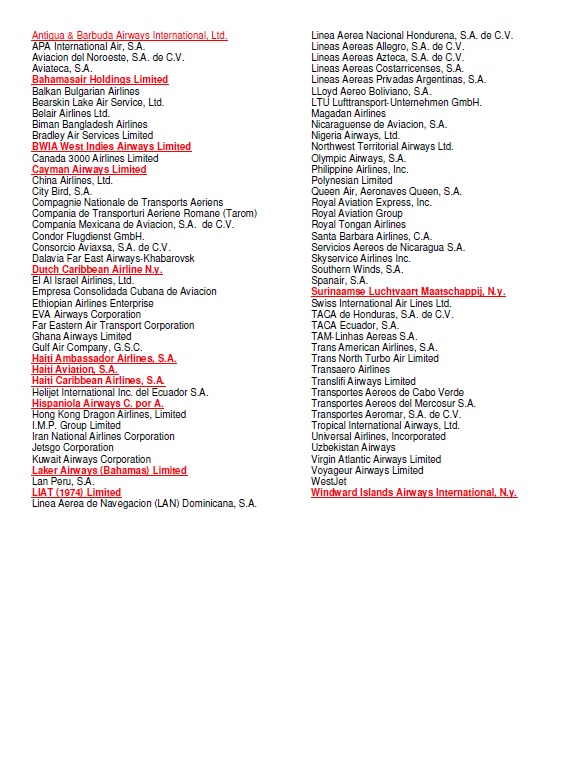
“I don’t think there is an anti-Haitian sentiment in the area; I believe there are countries experiencing social pressure and are trying to look for solutions,” Mr. Guillaume said. “Some solutions are rash. Sometimes they are politically motivated. Nonetheless, we hope the solutions respect international norms.”

Though the Bahamas immigration/nationality enforcement is “legal” per the country’s constitution, not everyone in the homeland approves of this policy. Note to the  New York Times: “The round-up of Bahamian-born Haitians is not universally concurred in the country”. This is a policy of the current government administration. There are non-government organizations (NGOs) and elected opposition officials that are vocal in their disagreements of this enforcement. (This Go Lean commentary remains apolitical). See a news article (snippet) here in that vein:

Title 2: Call To Bring Immigration Legislation to Parliament –
(Retrieved 01/30/2015 from: http://www.tribune242.com/news/2015/jan/30/call-bring-immigration-legislation/)

ST ANNE’S MP Hubert Chipman yesterday renewed calls for legislation to be brought to Parliament to support the government’s new immigration policy.

Mr. Chipman, shadow minister for foreign affairs and immigration, said the only person who had a clear understanding of the policy was Immigration Minister Fred Mitchell, and questioned how the new policy has affected the department’s backlog of citizenship applications.

He said officials have put the “cart before the horse” by targeting migrant communities before modernizing infrastructure to process individuals.

These articles reflect the heavy-lifting burdens that the Caribbean member-states must address regarding nationality and immigration. Underlying to this issue among all the affected Caribbean member-states is the failing disposition of Haiti. The Go Lean…Caribbean book presents a Marshall Plan to re-boot Haiti. The consequence: a better Haiti to live, work and play. Only then will the citizens of Haiti, and the Caribbean as a whole, be less inclined to flee the homeland.

The Go Lean roadmap provides perhaps the ultimate resolution to this perplexing nationality processing problem, that of a regional entity, the CU, to streamline application processing. This would be an extension of the current CariCom passport process.

A key problem with this nationality issue is the current sensitivities of Jus soli (Latin: right of the soil) versus Jus sanguinis (Latin: right of blood). These points were detailed in a previous blog.

In the middle of the winter, the New York Times should be inciting its readers to flee the bitter cold and enjoy the hospitality of the Bahamas, Turks & Caicos and the Dominican Republic, yet instead the front page article is exposing the human rights shortcomings of these states’ nationality policies.

The Go Lean book and blogs addresses ways to better protect human rights. While this subject is not tried-and-true economics – the usual focus of this roadmap –  there is a correlation of satisfactory human rights records and American trade. The roadmap seeks to elevate all the engines of Caribbean society for a better homeland for the 42 million residents and 80 million visitors, across the 30 member-states. The CU, applying best-practices for community empowerment and human rights, has the following 3 prime directives:

  • Optimization of the economic engines in order to grow the regional economy to $800 Billion & create 2.2 million new jobs.
  • Establishment of a security apparatus to protect the resultant economic engines.
  • Improve Caribbean governance, with consideration for minority equalization, to support these engines.

The Go Lean book details a series of community ethos, strategies, tactics, implementations and advocacies to optimize the region’s economic landscape:

Community Ethos – Economic Systems Influence Choices & Incentives Page 21
Community Ethos – Consequences of Choices Lie in the Future Page 21
Community Ethos – Anti-Bullying and Mitigation Page 23
Community Ethos – Minority Equalization Page 24
Community Ethos – Ways to Impact the Future Page 26
Community Ethos – Ways to Manage Reconciliations Page 34
Community Ethos – Ways to Impact the Greater Good Page 37
Strategy – Vision –  Integrate region into a Single Market Economy Page 45
Strategy – Agents of Change – Globalization Page 57
Tactical – Separation of Powers – Department of   Homeland Security Page 75
Implementation – Ways to Foster   International Aid Page 115
Planning – 10 Big Ideas … in the Caribbean Region – Haiti & Cuba Page 127
Planning – Ways to Ways to Model the EU – From Worst to First Page 130
Planning – Reasons Why the CU Will Succeed – Germany Reconciliation Model Page 132
Planning – Ways to Improve Failed-State Indices – Cuba & Haiti on the List Page 134
Planning – Lessons from East Germany – European post-war rebuilding Page 139
Planning – Lessons from the US Constitution Page 145
Planning – Lessons from Canada’s History Page 146
Advocacy – Ways to Grow the Economy Page 151
Advocacy – Ways to Create Jobs Page 152
Advocacy – Ways to Foster Empowering Immigration – Case Study of Indian Migrants Page 174
Advocacy – Ways to Impact Justice Page 178
Advocacy – Ways to Impact the Diaspora Page 217
Advocacy – Ways to Protect Human Rights Page 220
Advocacy – Ways to Re-boot Cuba Page 237
Advocacy – Ways to Impact the Dominican Republic Page 237
Advocacy – Ways to Re-boot Haiti Page 238

The message to the Caribbean leaders and planners is straight-forward: The US, New York Times and all American media, are watching and judging, based on their own standards. The goal of the Go Lean roadmap is to formulate the Caribbean region to be better American neighbors, a protégé status rather than the current parasite status. There is the need to re-focus on our populations in general – majority, minority, Black, White, French, English, etc.. Countries like the Bahamas, and Haiti for that matter, need “all hands on deck”, not less hands. Economic growth requires a growing population; (a previous report disclosed 70,000 Bahamians living illegally in the US).

We do not want to encourage migration nor facilitate it. Just the opposite, we simply want to encourage and facilitate citizens staying and contributing to their native homelands. We do not want to “fatten frogs for snake”, we want to elevate our own communities to be better places to live, work and play.

Now is the time for all the Caribbean to lean-in to this Go Lean roadmap for Caribbean economic, security and governance elevation. Now is the time for all of the Caribbean to learn the lessons from other communities, (think Apartheid in South Africa). It is guaranteed: once the human rights issues are resolved, your society/community will soar.

🙂

Download the book Go Lean … Caribbean – now!

———

APPENDIX – VIDEO: Pulitzer Prizes on Human Trafficking

Direct Link: http://www.nytimes.com/video/multimedia/100000002825879/reuters-journalist-jason-szep-celebrates-pulitzer-prize.html


Share this post:
, , ,
[Top]

Art and Science of Collaboration

Go Lean Commentary

CU Blog - Art and Science of Collaboration - Photo 1The book Go Lean…Caribbean opens with the thesis (Page 3) that the problems of the Caribbean are too big for any one member-state. So rather, solutions should be sought by accepting interdependence; shifting the responsibility to a region-wide, professionally-managed, deputized technocracy that can result in greater production and greater accountability. This deputized agency is the Caribbean Union Trade Federation (CU). The book therefore advocates that all Caribbean member-states (independent & dependent-territory) lean-in to this plan for confederacy, convention and collaboration.

Confederacy  refers to the federation, the legal structure that will represent/include all 30 Caribbean member-states in an integrated entity to forge the required solutions.

Convention is easy! Convening … means “showing up”.

On the other hand, collaboration is hard! For the purpose of this commentary, collaboration is defined as “a group of people who represent different aspects of an issue, working together to explore their differences and come up with solutions that couldn’t be achieved on their own”. This effort is definitely heavy-lifting, especially in this age of complexity where it is difficult to build consensus and compromise. This effort is hard, but not impossible! To succeed, the required hard-work or heavy-lifting must be guided by prudence and best practices.

It is hereby acknowledged that collaboration is an art and a science. The following summary applies:

Art

Consider the perspective of a constitutive communication approach:

  • Everyone involved in a collaborative effort has a different perspective…
  • How we see ourselves and others, and how others see us…
  • What we say is less important than how we say it…

Science

  • Collaborative Advantage – Good things that come from the success of the effort
  • Collaborative Inertia – Bad things that can come from a lack of this effort, the natural state of affairs
  • Collaboration Design
    • Structure – Get the right people in the right setting
    • Process – How people interact

This Art and Science of Collaboration is gleaned from this featured VIDEO here:

VIDEOThe Collaborative Challenge: Making Quality Decisions Together in the Age of Complexityhttp://youtu.be/iN_A7keXtVg

Published on Dec 13, 2012 – This video was developed by Matt Koschmann, a professor in the Department of Communication at the University of Colorado Boulder. The purpose is to explore the topic of collaboration and explain a constitutive communication approach to enhance our understanding of collaboration.

This and many other blog/commentaries drill deeper, double-down, on this quest for collaboration as necessary for long-term Caribbean solutions. The book and blogs posit that collaboration in spirit equals sharing in action. As a result, a lot of focus has been concentrated on sharing schemes, the Sharing Economy, that would be apropos for Caribbean implementation.

The quest to elevate Caribbean society includes embracing collaboration and sharing tools. If we are able to marry the efforts of all member-states in unison, a lot can be accomplished and the impact can be profound. This impact is pronounced in the CU‘s prime directives, identified with the following 3 statements:

  • Optimization of the economic engines in order to grow the regional economy to $800 Billion & create 2.2 million new jobs.
  • Establishment of a security apparatus to protect the resultant economic engines.
  • Improve Caribbean governance to support these engines.

The Go Lean book promotes “sharing” and collaboration as a community ethos, so as to mitigate the perils of “going at it alone”. This alludes to the emergence of the Sharing Economy that now proliferates due to advances in technology. These previous blog/commentaries detailed some examples:

https://goleancaribbean.com/blog/?p=2571 More Business Travelers Flock to Airbnb
https://goleancaribbean.com/blog/?p=1364 Car-Sharing Uber Demonstrations Snarl Traffic from London to Berlin
https://goleancaribbean.com/blog/?p=486 Incubator firm (Temasek) backs Southeast Asia cab booking app GrabTaxi

CU Blog - Art and Science of Collaboration - Photo 3

The book serves as a roadmap for the introduction and implementation of the technocratic CU. This roadmap posits that many issues and challenges for a Sharing Economy can only be managed with feasible economies-of-scale; thusly there is the need to master the art and science of collaboration. While the stakeholders, 30 member-states and 42 million people, should be able to unify and resolve many common problems, it is not the general public that is expected to lean-in to these principles, but rather their leaders: politicians and civil servants. This is part of the Go Lean effort to improve leadership and foster better leaders.

This is the theme of another book, a Bible-like publication on collaboration, The Collaborative Organization by Jacob Morgan. This author is the principal and co-founder of Chess Media Group, a management consulting and strategic advisory firm on collaboration. This 2012 publication serves as a strategic guide for executives and decision makers seeking to deploy emerging technologies and strategies in the workplace.

The About the Book summary from the Author is published as follows:

I believe that Collaborative Organizations can make the world a better place. We keep talking about and hearing about the value of collaboration for businesses but that’s selling it short. Collaboration can positively impact the lives of people inside and outside of the workplace. If we can create greater engagement among employees, make their lives easier at work, connect them to people and information from anywhere, and provide a place of growth and learning then we go far beyond just business benefit. Employees will feel less stressed out at work and at home, argue less with their spouses, feel a greater sense of purpose and belonging at work, and have more time to spend with their loved ones and families.

I realized that while this idea was unique and powerful it was not enough to drive action within the enterprise. I knew that in order to go from idea to action that business leaders needed something more. This is why I wrote The Collaborative Organization which is the first comprehensive strategy guide to emergent collaboration in the workplace. This book was written not just to benefit the organizations but the employees as well.

The book is supported by data from a research project that Chess Media Group (my firm) conducted and includes dozens of case studies as well as mini guest contribution pieces from executives and leaders who are leading collaboration at their organizations. Inside this strategy guide you will learn:

  • How to map uses cases to feature requirements
  • How to evaluate and select the right collaboration tools for your organization
  • How to structure collaboration teams to lead this initiative
  • How to deploy tools and prioritize features
  • How to gain and sustain employee adoption
  • Measuring success
  • How to evaluate your organization’s maturity in collaboration
  • How to structure governance
  • How to market and roll out this initiative to your company
  • How to evaluate and mitigate risks
  • and much more

(Source: http://www.thecollaborativeorganization.com/about-the-book/)
CU Blog - Art and Science of Collaboration - Photo 2

In line with the foregoing VIDEO, the Go Lean book details the applicable community ethos, strategies, tactics, implementation and advocacies as a roadmap to foster this empowerment among the business and governmental leaders in the region to fully explore collaboration and the Sharing Economy:

Community Ethos – People Respond to Incentives in Predictable Ways Page 21
Community Ethos – Economic Systems Influence Individual Choices &   Incentives Page 21
Community Ethos – Consequences of Choices Lie in the Future Page 21
Community Ethos – Governing Principles – Lean Operations Page 24
Community Ethos – Governing Principles – Return on Investments (ROI) Page 24
Community Ethos – Governing Principles – Cooperatives Page 25
Community Ethos – Ways to Foster Genius – Nurturing Leaders Page 27
Community Ethos – Ways to Help Entrepreneurship – Incubator Support Page 28
Community Ethos – Ways to Improve Negotiations Page 32
Community Ethos – Ways to Improve Sharing Page 35
Community Ethos – Ways to Impact the Greater Good Page 37
Strategy – Confederate 30 Caribbean Member-States Page 45
Strategy – Customers / Stakeholders – Governments, Businesses, and Citizens Page 47
Strategy – Competition – Shared Systems –vs- Premise based Page 51
Strategy – Agents of Change – Technology Page 57
Strategy – Agents of Change – Globalization Page 57
Tactical – Foster a Technocracy Page 64
Tactical – Separation of Powers – Shared Portal: www.myCaribbean.gov Page 74
Tactical – Separation of Powers – Caribbean Postal Union (CPU) Page 78
Tactical – Separation of Powers – Bicameral Legislature – Compromise Conferences Page 91
Implementation – Year 1 / Assemble Phase – Consolidate Organs into CU Page 96
Implementation – Trends in Implementing Data Centers – CoLocation Operations Page 106
Implementation – Assume Mail Operations – Collaborate/Share for all Caribbean Page 108
Implementation – Ways to Impact Social Media Page 111
Implementation – Ways to Benefit from Globalization – Level Playing Field with ICT Page 129
Planning – 10 Big Ideas – Shared/Single   Currency – Cooperative Central Bank Page 127
Planning – Lessons Learned from the West Indies Federation – Collaboration Quest Page 135
Advocacy – Ways to Grow the Economy Page 151
Advocacy – Ways to Create Jobs Page 152
Advocacy – Ways to Improve Governance Page 168
Advocacy – Ways to Better Manage the Social Contract – Share e-Government   systems Page 170
Advocacy – Ways to Improve Leadership Page 171
Advocacy – Ways to Manage Federal Civil Service Page 173
Advocacy – Ways to Foster Cooperatives Page 176
Advocacy – Improve Homeland Security – Shared-Collaborative Defenses Page 180
Advocacy – Ways to Foster Technology Page 197
Advocacy – Ways to Foster e-Commerce Page 198
Advocacy – Ways to Reform Banking – Cooperative/Collaborative Central Bank Page 199
Advocacy – Ways to Impact Foundations – NGOs to Share Delivery of Social Agenda Page 219

The roadmap posits that the CU should foster and incubate features of the Sharing Economy and other expressions of collaboration. The Go Lean book quotes the assessment of a scholar (Kent State University Professor Emeritus Dr. Kwame Nantambu) on Caribbean affairs and the need for collaboration (Page 135): “History has shown that only when a people come together to address issues that affect them collectively can they ever hope to resolve their problems. Caribbean people have common problems so that common sense should dictate that the only way to solve those problems is to come together collectively to address them. There is no other option.”

The Caribbean must change … to adapt to a changing world. We cannot compete alone, but together, collaboratively, we stand a fighting-chance to “snatch victory out of the jaws of defeat”. Failure is not an option; our Caribbean children are counting on us. Otherwise, more and more of them will be Canadian children, and American children, and British children, and so on…

The trends are already there. The Go Lean book opens with the declaration (Page 3) that the Caribbean is already in crisis. For some member-states, their population has declined or been flat for the last 3 decades. This is only possible if despite new births and the absence of war, people are fleeing. This scenario, human flight, is a constant threat to prosperity for all the Caribbean despite their colonial legacies. Our youth, the next generation, may not be inspired to participate in the future workings of their country; they may measure success only by their exodus from their Caribbean homeland.

As echoed in the foregoing VIDEO: “if there was ever a time to think differently about how we do things, this is it!

A collaborative approach to forging solutions to this common problem is perhaps our best hope. We can do the heavy-lifting; we can make the Caribbean, a better place to live, work and play. 🙂

Download the book Go Lean … Caribbean – now!

Share this post:
, ,
[Top]

Concerns about ‘Citizenship By Investment Programs’

Go Lean Commentary

People come to the Caribbean for so many reasons. The book Go Lean…Caribbean cataloged 3 primary reasons: 1. Live, 2. Work, and 3. Play.

This last category is so vast that it covers the full scope of tourism: sun, sand, sea, surf, savor, salsa and smoke; (savor as in foods; salsa as in dance and smoke as in cigars). This is the region’s primary economic activity.  But now there are reports of a new attraction starting to emerge in certain Caribbean member-states:

Citizenship.

“Say it ain’t so?!?!”

There are reports that many newcomers are relocating to Caribbean member-states for other, sometimes nefarious, reasons: proximity (to other North American markets), legacy status (Overseas territory of European powers), favorable tax status, and lax governmental oversight. These occurrences have raised the ire of many developed nations (United States, Canada and the EU). There are concerns too for the planners of a new elevated Caribbean, the promoters of the book Go Lean … Caribbean. This book serves as a roadmap for the introduction and implementation of the technocratic Caribbean Union Trade Federation (CU); the purpose of which is to elevate Caribbean society, for all 30 member-states. The book does not ignore the subject of nationality and immigration, so reports of newcomers relocating to member-states just for citizenship purposes must be fully vetted.

Consider this article on this issue in St. Kitts & Nevis:

Title #1: US, Canada and EU monitoring St Kitts-Nevis citizenship programme, says opposition
By: Ken Richards, West Indies News Network; Posted: January 6 2015  – http://www.caribbeannewsnow.com/headline-US%2C-Canada-and-EU-monitoring-St-Kitts-Nevis-citizenship-programme%2C-says-opposition-24268.html

BASSETERRE, St Kitts (WINN) — There is fresh criticism of the St Kitts and Nevis citizenship by investment programme (CIP), following reports that the US Department of Treasury is closely monitoring the activities of a former Iranian national who now holds a St Kitts and Nevis passport.

According to the Treasury Department, 49-year-old Hossein Zeidi was responsible for converting foreign currency into US bank notes for delivery to the Iranian government.

Zeidi is reported to be among nine individuals and entities under surveillance pursuant to various Iran-related regulations.
They are accused by the US of supporting Iranian government sanctions evasion efforts.

The US Treasury Department says that Zeidi holds a St Kitts and Nevis passport, number RE0003553.

- Photo 1Team Unity leader Timothy Harris is reiterating the opposition group’s concern about such developments, and the impact they are having on the CIP.

He recalled that the Americans had issued an advisory last May against the federation’s citizenship programme.

“It is therefore reasonable that that department will continue to pursue the activities of the citizenship by investment programme and of the government officials in particular,” Harris told WINN FM.

“We know for sure that the US Treasury Department continues to be interested in the CIP programme, continues to be interested in the cavalier manner in which our passports are being sold like black pudding on a Saturday,” the MP who heads the opposition alliance said.

According to Harris, Canada and the European Union are also monitoring the St Kitts and Nevis programme.

The US Treasury Department gave no details as to how Zeidi had in his possession a St Kitts-Nevis passport, but the twin island Federation provides citizenship to foreigners who make significant investments in the country.

Treasury Department officials claim that the Iranian government contracted with Zeidi and Seyed Kamal Yasini to convert Iranian funds denominated in non-Iranian local currency into US dollars.

According to the Americans, these individuals and their network have to date effected the delivery of hundreds of millions of dollars in US dollar bank notes to the Iranian government in violation of existing sanctions.

Republished with permission of West Indies News Network

Consider too, this older article of this issue in the Turks & Caicos Islands:

Title #2: British government refutes Turks and Caicos economic citizenship claim
By: Caribbean News Now contributor Published on April 18, 2014; retrieved January 13, 2015 from: http://www.caribbeannewsnow.com/topstory-British-government-refutes-Turks-and-Caicos-economic-citizenship-claim-20771.html

- Photo 3PROVIDENCIALES, Turks and Caicos Islands — Britain’s Home Office has refuted a claim by promoters of a resort in the Turks and Caicos Islands (TCI) that investors are eligible to apply for a British Overseas Territory Citizen passport, thereby enabling the holder to reside in the UK.

In a press release on Monday entitled “Eligibility for British Overseas Territory Citizen passport … with Turks and Caicos resort project”, Asia Pacific Investment House claimed that “Investors in Caicos Beach Club Resort and Marina are eligible to apply for a permanent residency certificate and British Overseas Territory Citizen passport, enabling the holder to reside in the UK, making this a highly coveted investment opportunity.”

However, according to Tom Lawrence, at the Home Office Communications Directorate in London:

  • Eligibility for British Overseas Territory Citizenship ((BOTC) is governed by the British Nationality Act 1981. Citizenship is granted by the governor of the territory and OverseasTerritories are not able to grant BOTC status other than in accordance with that Act.
  • Residency and other requirements for BOTC status apply, so anyone who has not lived lawfully in the territory for a number of years is unlikely to qualify.
  • Criteria for the grant of BOT Citizenship include residence requirements, a good character requirement and an intention to make the principal home within the relevant territory.
  • Generally, the residency requirements are for a minimum of five years residence immediately preceding the application, during which total absences must not exceed 450 days with a maximum of 90 days absence in the last year. The applicant must not have been in breach of immigration rules at any time during those five years and the last year of residence must have been free of any immigration control.
  • BOTCs do not have the right of abode in the UK unless they later become British citizens.

“There is no direct route to BOTC and the investor will have to meet the eligibility requirements as noted,” Neil Smith, the TCI governor’s spokesman, confirmed.

Asia Pacific Investment House, which describes itself as “a leading venture capital company, registered in the offshore regime of the British Virgin Islands, with its operating HQ in Singapore’s financial district”, did not respond to requests for comment.

It is not known at this time if the British and/or TCI authorities will take action in relation to these apparently false claims targeting uninformed investors.

There is a consistent pattern here, in order to attract Foreign Direct Investments (FDI), Caribbean politicians, administrators or business/investment development specialists make promises related to easy citizenship. This is definitely a wrong community ethos!

There are other Caribbean member-states that have Citizenship by Investment Programs established (or proposed):

* The first persons to attain Antigua & Barbuda citizenship under the Citizenship by Investment Programme was George Georges and his family of four, Syrian nationals.

- Photo 2

“Other countries (Australia, Belgium, Portugal, Singapore, Spain the UK and the US) provide an alternate approach, temporary residence permits or “golden visas” to wealthy individuals in return for investment. Applicants can often receive permanent residency through such schemes by sustaining their investment through a period of two to five years, but the aforementioned Caribbean nations typically offer cheaper and almost immediate routes to full citizenship in exchange for a one-off investment. In St. Kitts & Nevis, for example, the entire process, including background checks, takes as little as 90 days”. (Source: Nearshores Americas). “Most countries withhold official data regarding the number of people who have become citizens through CIPs or the amount of FDI recouped, but Henley and Partners$  [(Professional Residency & Citizenship Advisors with offices in 25 countries)] estimate that such schemes generate US$2 billion a year worldwide. Unsurprisingly, cash-strapped Caribbean countries that are often overly reliant on tourism have been quick to take notice”.

When factoring in the recent publicity of the harsh treatments to boat-bound refugees, these lax CIPs give the impression that citizenship in the Caribbean is For Sale; that there is no concern for human rights for certain refugees (Haitian, Cubans, Jamaicans, etc.); but let someone show up with some money then the nationality doors are wide open. This too is wrong!

In a previous blog commentary, the increased migrant flow of Caribbean refugees were detailed.  Also, the current conflict in the Bahamas, with the accusations of human rights abuses from the Haitian-American Diaspora in Miami was also thoroughly addressed.

The One Percent versus the 99 Percent; the “Have’s versus the Have-Not’s”! So many Failed-State images# come to mind. The Go Lean book qualifies the characteristics of Failed-States (Page 272-273); these 2 attributes here are most prominent:

  • Uneven Economic Development Along Group Lines (UED)
  • Rise of Factionalized  Elites (FE)

The Go Lean roadmap seeks to elevate the Caribbean, in its entirety. The impressions of some “Banana Republic” – Failed-State – are unbecoming! It undermines legitimate investment in the region and the worthiness of natives from these Caribbean islands when they travel abroad. The occurrence of some “Citizenship for Hire” practice for some Caribbean state automatically draws scorn for other nearby states. Truthfully, the rest of the world does not know the difference of St. Kitts versus St. Vincent, or the Turks/Caicos Islands versus the Bahama Islands. All of these Caribbean member-states are in the “same boat”, and are judged by the same yardstick.

Change has now come to the Caribbean! This is the call for greater accountability/transparency on a regional basis.

Why should the CU be charged with responsibility in this area? Does this not relate to individual sovereignty? “Mind your own business” – may be a logical retort from member-states criticized for their citizenship/nationality practices.

The Go Lean book relates an opening declaration that the Caribbean is in crisis and that these geographic neighbors must band together – confederate – to mitigate these common problems with superlative solutions, on the regional basis. This need was pronounced early in the book in the Declaration of Interdependence (Page 10 – 14) with these statements:

Preamble: While the laws of nature and of nature’s God entitle us to form a society and a brotherhood to foster manifestations of our hopes and aspirations and to forge solutions to the challenges that imperil us, … our rights to exercise good governance and promote a more perfect society are the natural assumptions among the powers of the earth, no one other than ourselves can be held accountable for our failure to succeed if we do not try to promote the opportunities that a democratic society fosters.

xi.  Whereas all men are entitled to the benefits of good governance in a free society, “new guards” must be enacted to dissuade the emergence of incompetence, corruption, nepotism and cronyism at the peril of the people’s best interest. The Federation must guarantee the executions of a social contract between government and the governed.

xii. Whereas the legacy in recent times in individual states may be that of ineffectual governance with no redress to higher authority, the accedence of this Federation will ensure accountability and escalation of the human and civil rights of the people for good governance, justice assurances, due process and the rule of law. As such, any threats of a “failed state” status for any member state must enact emergency measures on behalf of the Federation to protect the human, civil and property rights of the citizens, residents, allies, trading partners, and visitors of the affected member state and the Federation as a whole.

xxiii.    Whereas many countries in our region are dependent Overseas Territory of imperial powers, the systems of governance can be instituted on a regional and local basis, rather than requiring oversight or accountability from distant masters far removed from their subjects of administration. The Federation must facilitate success in autonomous rule by sharing tools, systems and teamwork within the geographical region.

xxiv.    Whereas a free market economy can be induced and spurred for continuous progress, the Federation must install the controls to better manage aspects of the economy: jobs, inflation, savings rate, investments and other economic principles. Thereby attracting direct foreign investment because of the stability and vibrancy of our economy.

The Go Lean book and blogs posit that the problems of the Caribbean are too big for any one member-state to tackle alone; rather there is the need for a regional technocratic solution; thus the CU. Only then can all 30 Caribbean member-states in the homeland be a better place to live, work and play for all of its stakeholders: 42 million residents; 80 million visitors; 10 million Diaspora; countless Foreign Direct Investors.

The CU, applying best-practices for advanced governance and agile deliveries would facilitate these 3 prime directives:

  • Optimization of the economic engines in order to grow the regional economy to $800 Billion & create 2.2 million new jobs.
  • Establishment of a security apparatus to protect the resultant economic engines.
  • Improve Caribbean governance, with consideration for minority equalization, to support these engines.

How exactly can the CU impact the citizenship/nationality practices in the region?

The Go Lean book, and previous blog/commentaries, stressed key community ethos, strategies, tactics, implementation and advocacies necessary to effect change in the region, to improve the regional stewardship over Caribbean society. They are detailed as follows:

Community Ethos – Economic Systems Influence Choices & Incentives Page 21
Community Ethos – Consequences of Choices Lie in the Future Page 21
Community Ethos – Minority Equalization Page 24
Community Ethos – Ways to Impact the Future Page 26
Community Ethos – Ways to Foster Genius Page 27
Community Ethos – Ways to Help Entrepreneurship Page 28
Community Ethos – Ways to Impact Research & Development – Invited SGE’s Page 30
Community Ethos – Ways to Impact the Greater Good Page 37
Strategy – Vision –  Integrate region into a Single Market Economy Page 45
Strategy – Mission –  Invite empowering immigrants for economic benefits Page 46
Strategy – Customers – Foreign Direct Investors Page 48
Strategy – Agents of Change – Globalization Page 57
Tactical – Fostering a Technocracy Page 64
Tactical – Separation of Powers – Department of Justice Page 77
Tactical – Separation of Powers – Department of State – SGE’s & One Percent Liaison Page 80
Implementation – Steps to Implement Self-Governing Entities – Ideal for FDI Page 105
Implementation – Ways to Foster International Aid – CariCom versus CU Page 115
Planning – 10 Big Ideas … in the Caribbean Region – Confederation without Sovereignty Page 127
Planning – Ways to Better Manage Image Page 133
Planning – Ways to Improve Failed-State Indices – Guard against Encroachments Page 134
Planning – Ways to Measure Progress Page 147
Advocacy – Ways to Grow the Economy Page 151
Advocacy – Ways to Create Jobs Page 152
Advocacy – Ways to Better Manage the Social Contract – Failed-State Indices Movements Page 170
Advocacy – Ways to Foster Empowering Immigration – FDI Time, Talent & Treasuries Page 174
Advocacy – Ways to Impact Justice – Federal Accountability Page 178
Advocacy – Ways to Protect Human Rights Page 220
Advocacy – Ways to Impact the One Percent Page 224
Appendix – Failed State Indicators and Definitions for the CU Page 271

All of the Caribbean needs to deal with these domestic issues … now! But some issues, due to image, public relations or quest for justice, should be managed with special care.

In the legal arena – juris prudence – there is an arrangement referred to as a Special Prosecutor. This allows for a detached, objective view of issues of Justice. (In the US for many decades, Naturalization and Citizenship processing was managed by the federal Department of Justice).

The Go Lean/CU roadmap has a similar proposed solution: facilitating the Proxy and e-Government processing at the CU level on behalf of member-states – thereby removing the subjectivity and bias to the citizenship/nationality process. Each state sets their criteria and the CU technocracy simply provides the processing, with full accountability and transparency; no appearance of bribery, corruption and creating eligible voters just in time for elections.  Already there is an eco-system with the issuance of CariCom passports. Step One/Day One of the Go Lean roadmap is the assembly of CariCom organs into the CU Trade Federation. Any one passport issued by a CariCom country is automatically respected by other CariCom countries.  So “mind your own business” cannot be considered a valid response.

If Caribbean people want change, progress, empowerment, growth, jobs, justice, security and equality, then this move of deputizing “nationality process” to the federal level is simply the “price that must be paid”.

Now is the time for all of the Caribbean to lean-in for the empowerments described in the book Go Lean … Caribbean. This is Big Deal for the region as real solutions can finally be realized. Then we can present to the world that while the Caribbean homeland is Not For Sale, it is truly a better place to live, work, and play. 🙂

Download the free e-Book of Go Lean … Caribbean – now!

————

# Appendix: Failed-State Indicators & Definitions

a. UED – Uneven Economic Development Along Group Lines

When there are ethnic, religious, or regional disparities or inequalities, governments tend to be uneven in their commitment to the social contract. There may be group-based inequality, or perceived inequality, in areas like education and economic opportunities. Uneven economic empowerments are manifest in group-based impoverishments as measured by poverty levels, infant mortality rates, educational levels, etc. The end result may be the rise of communal nationalism, based on real or perceived group inequalities.

This indicator include pressures and measures related to:

Income Share of Highest 10%; Income Share of Lowest 10%; Urban-Rural Service Distribution; Slum Population

b. FE – Rise of Factionalized Elites

When local and national leaders engage in deadlock and brinksmanship for political gain, this undermines the social contract. The brinkmanship may be expressed with nationalistic political rhetoric by ruling elites, often in terms of communal irredentism (e.g., a “greater Serbia” to annex neighboring lands with Serbian ethnics) or of communal solidarity (e.g., “ethnic cleansing” or “defending the faith”). With the absence of legitimate leadership widely accepted as representing the entire citizenry, the result may be fragmentation of ruling elites and state institutions along ethnic, class, clan, racial or religious lines.

This indicator include pressures and measures related to:

Power Struggles; Defectors; Flawed Elections; Political Competition.

$ Appendix VIDEO: Henley & Partners – The Firm of Global Citizens – http://youtu.be/XoBcb4qLn1s

Published on May 7, 2014 – Henley & Partners is the global leader in residence and citizenship planning … The firm also runs an industry-leading government advisory practice.


Share this post:
, , ,
[Top]

No Fear of Failure – Case Study: Bahamasair

Go Lean Commentary

CU Blog - No Fear of Failure - Photo 3The book Go Lean … Caribbean stresses the need to adopt best practices in the regional airline industry so as to better facilitate the region’s primary economic driver of tourism. The tagline for the book is “a better place to live, work and play”.

The reference to “better” and “best practices” in this case refers to “quality” – a missing ingredient in much of the Caribbean air transport industry. The bad example being cited in this case is Bahamasair, the National Flag Carrier of the Bahamas.

Bahamasair Holdings Limited, operating as Bahamasair, is an airline based in Nassau. It is the national airline and operates domestic scheduled services to 14 destinations and regional scheduled services to destinations in the Caribbean and the United States. Its main base is Lynden Pindling International Airport. It has the same logo as the current Bahamas national tourism marketing logo, but with the tagline: “We don’t just fly there, we live there”.

CU Blog - No Fear of Failure - Photo 2

The story being related in the following article is a far cry from a pursuit of quality, in fact the overriding theme is “no fear of failure” on the part of the airline’s stakeholders; “if we succeed or fail, it doesn’t really matter”:

Title: Bahamasair Flights Cancelled as Pilots Strike
Local South Florida TV Newscasts (Posted 12/23/2014; retrieved 12/29/2014) –
http://www.nbcmiami.com/news/local/Bahamasair–286735471.html

CU Blog - No Fear of Failure - Photo 1Hundreds of air travelers hoping to get to the Bahamas continue to wait for answers as their flights on Bahamasair have been cancelled.

The cancelled flights have left some passengers at South Florida airports for more than 10 hours.

All flights out of Miami International Airport and Fort Lauderdale International Airport on board Bahamasair that were scheduled for Tuesday have been cancelled. That includes two scheduled arrivals in Fort   Lauderdale, along with one departure from FLL. MIA has seen two departures cancelled along with one arrival.

Miami International Airport has one Bahamasair flight scheduled to arrive at 7:40 a.m. on Christmas Eve that is still on the board as of 8:30 p.m.

NBC 6 has reached out to Bahamasair about the cancellations, but has not received a response.

According to the website tribune242.com, the airline has seen their flights grounded due to a protest from pilots over salary negotiations. The Nassau Guardian reported that the pilots’ union denied it instructed its pilots to go on strike over the negotiations.

The airline told the Nassau Guardian, “Bahamasair is cognizant that this is the height of our peak travel period and we will do the best we can to mitigate any further disruption to your holiday travel plans.”

VIDEO: http://youtu.be/mPM0mDg4-5E  – CBS4 Miami Reporting on the Christmas-time Bahamasair Pilots Strike

This airline has an eclectic history, one bred out of the need to optimize economic engines, and yet they have failed so often in their delivery of this charter. Bahamasair was born out of the oil crisis of the 1970s. In 1970, British Airways stopped flying to The Bahamas, and the Bahamian Government accurately predicted that some of the other major airlines flying to the country would follow British Airways’ lead. Bahamasair was therefore established by the government and started operations on 7 June 1973, by acquiring the operations of Flamingo Airlines and Out Island Airways. [1]

Bahamasair initially encountered operating difficulties, including poor maintenance facilities, economic conditions and company structure. Those factors brought public distrust as a consequence. However, jet airliners started to arrive in the shape of British Aircraft Corporation BAC One-Elevens followed by brand new Boeing 737s, and in 1972, it opened its first international service, from Nassau to Tampa, Florida. In 1973, the government’s vision of many airlines leaving the island became a reality, when Pan Am and some other major companies decided to stop operating to the Bahamas. This enabled Bahamasair to capture a substantial part of the Bahamas scheduled air transport market. Through the rest of the 1970s, Bahamasair kept adding flights to other cities in Florida and, domestically, the presence of the airline also grew rapidly.

During the early 1980s, Bahamasair unsuccessfully tried to expand to the Northeast United States [so as to influence market prices for this vital tourism source territory], opening flights to Philadelphia, Washington-DC and Newark, New Jersey. But in 1989, the airline’s directors decided that those routes were not profitable and eliminated them from the airline’s route map – an exercise in futility. In 1991, the airline streamlined it fleet operations, with the acquisition of de Havilland Canada DHC-8 Dash 8 turbine propeller aircrafts, purchased to substitute for the whole jet fleet; the Boeing 737-200s were taken out of service. In 1997 however, Boeing 737-200’s were returned to service because key routes warranted the cargo and passenger carrying capabilities offered by these jetliners. The 737-200 was deployed to Fort Lauderdale, Miami and Orlando as well as one domestic route, being Nassau-Freeport. Today, Bahamasair operates efficient late model Boeing 737-500 jetliners, in addition to the stretched Dash 8 series 300 turboprop. But, the culture of dysfunction persists…

This foregoing news article, VIDEO and encyclopedic details are just echoes of the negative community ethos of failure with this airline for this country. While most Bahamians may not know the intricate details of the airline industry, they do know that the Bahamasair’s model is the epitome of failure, as the performance history has been consistently poor. This sad culture has resulted in the local community concocting phrases like:

1. BahamaScare
2. A religious airline: only God knows when they are arriving and only God knows when they are taking off.

This negative community ethos is even enshrined in the regulatory filing for the airline as an international carrier. Appendix B highlights the accepted quality standard in aviation known as the Warsaw Convention. Appendix C on the other hand, demonstrates how Bahamasair, and other Caribbean carriers, have petitioned for waivers so as not to abide by these high standards. Imagine the impressions and messaging this plea relates to the world:

No, hold us to a lower standard.
We are not afraid to fail.
We will not try to satisfy our customers.

This message aligns with the news report above. The Pilot Union in this case gained a bargaining edge in salary negotiations with the airline’s management, but at the expense of any goodwill with the flying public… or the affected tourist industry “partners” in the island-nation’s homeland.

This is sad … and embarrassing!

Change must come to the airline industry for the Bahamas … and the entire region. The book Go Lean … Caribbean serves as a roadmap for the introduction and implementation of the Caribbean Union Trade Federation (CU), an alliance of the 30 Caribbean member-states. This Go Lean roadmap has 3 prime directives:

  • Optimization of the economic engines in order to grow the regional economy to $800 Billion and create 2.2 million new jobs.
  • Establishment of a security apparatus to protect the resultant economic engines.
  • Improve Caribbean governance to support these engines.

This Go Lean roadmap portrays the need for regional integration, administration, and promotion for Caribbean air carriers. The book posits that transportation and logistics empowers the economic engines of a community, in this case tourism. The forgoing news articles definitely assert this economic leaning. There must be efficient air carrier solutions, to service the transportation and tourism needs of the Caribbean islands with optimized deliveries and best practices.

Efficiency, optimization, best practices …
… a new standard for a national character, reputation, image, and brand!

For the region as a whole, Bahamas included, it is the expectation that air travel will continue to grow and impact Caribbean society – thus the need for more regional coordination. New models are detailed in the book in which tourism will be enhanced with features like “air lifts” and “air bridges” to partner with Caribbean events and properties.

For much of the Caribbean, air service is the only transportation option for land-based visitations (stop-overs), so this Go Lean roadmap introduces the Union Atlantic Turnpike to offer more transportation solutions (ferries, toll roads, railways, and pipelines) to better facilitate the efficient movement of people and cargo.

The roadmap also calls for regulating and promoting the Caribbean’s aviation industry. We need Bahamasair and other regional carriers to better deliver on their charters to facilitate air passengers to and within the Caribbean.

This is how the CU will optimize the region’s economic engines. This is change!

The Go Lean book presents a series of positive community ethos, in place of the negative ethos that permeates the Caribbean air transport industry; these positive ethos must first be adopted to forge the desired change. In addition, there are these specific strategies, tactics, implementations and advocacies to apply, that would contribute to better deliveries:

Introduction to Lean – Quality in Production and Delivery Page 4
Who We Are – Experts in Lean, Agile and Quality Delivery Page 8
Anecdote – Learning from the French Caribbean’s Peak Season Strike Page 17
Community Ethos – Deferred Gratification Page 21
Community Ethos – People Choose Due to Scarcity of Resources Page 21
Community Ethos – All Choice Involve Costs Page 21
Community Ethos – People Respond to Incentives Page 21
Community Ethos – Economic Systems Influence Individual Choices Page 21
Community Ethos – Consequences of Choices Lie in the Future Page 21
Community Ethos – Lean Operations Page 24
Community Ethos – Cooperatives Page 25
Community Ethos – Ways to Foster Genius – Promote Excellence Page 27
Community Ethos – Ways to Improve on the Art of Negotiations Page 32
Community Ethos – Ways to Improve Sharing Page 35
Community Ethos – Impacting the Greater Good Page 37
Strategy – Customers – Visitors Page 47
Strategy – Competitive Analysis –  Event Patrons Page 55
Strategy – Core Competence – Tourism Page 58
Anecdote – Caribbean Hotel & Tourism Assoc. focus on Air Transport Page 60
Tactical – Fostering a Technocracy Page 64
Tactical – Separation of Powers: Commerce – Tourism Promotion Page 78
Tactical – Separation of Powers: Aviation Administration & Promotion Page 84
Anecdote – “Lean” in Government – Extracting Quality from Best Practices Page 93
Implementation – Ways to Deliver Page 109
Implementation – Ways to Impact Social Media – Outreach to CU Stakeholders Page 111
Implementation – Trade Mission Objectives – Elevate Image Page 116
Planning – Ways to Improve Trade Page 128
Planning – Ways to Better Manage Image – Public Relations Page 133
Planning – Negative Lessons Learned from Egypt’s Tourism Mis-steps Page 143
Planning – Ways to Measure Quality and Progress – Six Sigma Page 147
Advocacy – Ways to Impact Labor Unions – Quality Adoptions Page 162
Advocacy – Ways to Improve Leadership – Inspire Excellence Page 171
Advocacy – Ways to Enhance Tourism Page 190
Advocacy – Ways to Impact Events Page 191
Advocacy – Ways to Market Southern California – Air Bridge Page 194
Advocacy – Ways to Impact Main Street – Tourism Spin-offs Page 201
Advocacy – Ways to Improve Transportation – Aviation Promotion Page 205

Previous Go Lean blogs also detailed the dynamics of the air transport industry in the region; see sample here:

Caribbean less competitive due to increasing aviation taxes
Lessons Learned from the American Airlines Merger
Caribbean Changes – Air Antilles Launches St. Maarten Service

What exactly can be done to immediately turn-around the delivery practices for Bahamasair, and other regional carriers? The Go Lean book provides specific details within its 370 pages, serving as a roadmap for forging change in Caribbean society. Here is a list of products/services that would have elevated the experiences of the travelling public in the foregoing news article/VIDEO:

  • Cooperative among Regional Carriers – Sharing the burden of industrial crises
  • Service Level Agreements – Guaranteeing performance of service providers and accepting liability for failures (Appendix B)
  • www.myCaribbean.gov – Social Media / Online Account Interactions – Awarding e-Credits for performance failures
  • Labor Union Escalation of Grievances – Providing recourse for the Pilots’ Petition – Mitigating the need for peak season strikes

Now is the time to lean-in to this roadmap for Caribbean change, as depicted in the book Go Lean…Caribbean. We cannot afford more news headlines like in the foregoing news article/VIDEO. Flying as a National Flag Carrier is a public trust. The Caribbean can – and must – do better.

Download the book Go Lean … Caribbean – now!

———-

Appendix A – Source Reference:

http://en.wikipedia.org/wiki/Bahamasair retrieved December 29, 2014

———————–

Appendix B – Hotwire/Industry Quality Standards: Warsaw Convention

See Photo 1 & 2 of Fare Rules/Details:

CU Blog - No Fear of Failure - Photo 4

CU Blog - No Fear of Failure - Photo 5

————————

Appendix C – Warsaw Convention Exemptions for International Carriers in the US.

See Photo 1 & 2 of Detailed List of Exempted Airlines – Highlighting Caribbean regional carriers:

CU Blog - No Fear of Failure - Photo 6

CU Blog - No Fear of Failure - Photo 7

Share this post:
, , , , ,
[Top]