Tag: Transform

Welcoming the Caribbean Intelligentsia

Go Lean Commentary

Who knew?

    … the Caribbean has an Intelligentsia?

Well blow me away with a whisper! This fact is surprising new information for this movement behind the book Go Lean … Caribbean

    … and we should know as we “wrote the book” on the Caribbean.

So there are college degree programs at universities in North America that cover the subject matter of “Caribbean Studies”. This would normally include the sociology, anthropology and historicity of the region; its people, traditions, culture, institutions and industries.

    Big question mark on that last one!

It’s hard to think that there may be intelligent people studying the Caribbean industrial and economic eco-system and their credentials are not scorned in academic circles.

The truth is, the Caribbean is devoid of so much smart out-workings – there are many societal defects – that it’s hard to think there is an intelligentsia for this region:

in·tel·li·gent·si·a
noun

  1. Google: intellectuals or highly educated people as a group, especially when regarded as possessing culture and political influence.
  2. Merriam-Webster: intellectuals who form an artistic, social, or political vanguard or elite.

The opening assessment in the Go Lean book explained that there is undoubtedly a Caribbean geographical region; but there is no unified Caribbean society or culture. Rather there is crisis; there are 30 disjointed, unorganized member-states rimming the Caribbean Sea that has no universal leverage, comradery nor brotherhood. Even the Bible says:

Two are better than one because they have a good return for their labor. 10 For if either of them falls, the one will lift up his companion. But woe to the one who falls when there is not another to lift him up. 11 Furthermore, if two lie down together they keep warm, but how can one be warm alone? 12 And if one can overpower him who is alone, two can resist him. A cord of three strands is not quickly torn apart. – Ecclesiastes 4: 9-12

So for any existing Caribbean intelligentsia in the status quo, it must be for English-speaking territories alone, or Dutch-speaking alone (minus Suriname), or French-speaking alone (minus Haiti), or Spanish-speaking (though there is no unity even among those 3 countries: Cuba, Dominican Republic and Puerto Rico).

It is time now for a change; for the emergence of a Caribbean intelligentsia for all of the Caribbean, for all 30 member-states.

The book Go Lean…Caribbean – available to download for free – serves as a roadmap for the introduction and implementation of the technocratic Caribbean Union Trade Federation (CU), for the elevation of all Caribbean society – for all 30 member-states in all 4 language groups. This CU/Go Lean roadmap has these 3 prime directives:

  • Optimization of the economic engines in order to grow the regional economy to $800 Billion and create 2.2 million jobs.
  • Establishment of a security apparatus to ensure public safety and protect the resultant economic engines.
  • Improve Caribbean governance to support these engines, including a separation-of-powers between the member-states and CU federal agencies.

The book stresses that Caribbean societal engines must be reformed and transformed at a regional level. This shows the need for an intelligentsia influence on Caribbean society. This was an early motivation for the roadmap, as pronounced in the opening Declaration of Interdependence (Pages 12 – 13):

xi. Whereas all men are entitled to the benefits of good governance in a free society, “new guards” must be enacted to dissuade the emergence of incompetence, corruption, nepotism and cronyism at the peril of the people’s best interest. The Federation must guarantee the executions of a social contract between government and the governed.

xii. Whereas the legacy in recent times in individual states may be that of ineffectual governance with no redress to higher authority, the accedence of this Federation will ensure accountability and escalation of the human and civil rights of the people for good governance, justice assurances, due process and the rule of law. As such, any threats of a “failed state” status for any member state must enact emergency measures on behalf of the Federation to protect the human, civil and property rights of the citizens, residents, allies, trading partners, and visitors of the affected member state and the Federation as a whole.

xvi. Whereas security of our homeland is inextricably linked to prosperity of the homeland, the economic and security interest of the region needs to be aligned under the same governance. Since economic crimes … can imperil the functioning of the wheels of commerce for all the citizenry, the accedence of this Federation must equip the security apparatus with the tools and techniques for predictive and proactive interdictions.

xxiv. Whereas a free market economy can be induced and spurred for continuous progress, the Federation must install the controls to better manage aspects of the economy: jobs, inflation, savings rate, investments and other economic principles. Thereby attracting direct foreign investment because of the stability and vibrancy of our economy.

There is the need for a Caribbean Intelligentsia. This normally includes:

  • Think Tanks
  • Advisory Councils
  • Standards Organizations
  • Community Development Foundations
  • Organized Philanthropists
  • Non-Government social agencies

There have been so many expressions of intelligence-lacking practices (Stupidity, Orthodoxy and even Rent-Seeking) in Caribbean society that influence and guidance from well-educated, intelligent stakeholders need to be encouraged.

The Go Lean book provides 370-pages of turn-by-turn instructions on “how” to adopt new community ethos, plus the strategies, tactics, implementations and advocacies to execute so as to reboot, reform and transform the societal engines of Caribbean society: economics, security and governance. Intelligence-lacking practices can be found in all these three spheres of society.

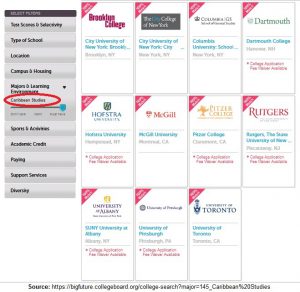
So teach away, all you colleges and universities, identified here from the online resource website CollegeBoard.org; (and learn more about the College Board in the Appendix VIDEO below):

College Search: Caribbean Studies

11 results

City University of New York: Brooklyn College

Brooklyn, NY

City University of New York: City College

New York, NY

Columbia University: School of General Studies

New York, NY

Dartmouth College

Hanover, NH

College Application Fee Waiver Available

Hofstra University

Hempstead, NY

College Application Fee Waiver Available

McGill University

Montreal, CA

Pitzer College

Claremont, CA

College Application Fee Waiver Available

Rutgers, The State University of New Jersey: New Brunswick/Piscataway Campus

Piscataway, NJ

College Application Fee Waiver Available

SUNY University at Albany

Albany, NY

College Application Fee Waiver Available

University of Pittsburgh

Pittsburgh, PA

College Application Fee Waiver Available

University of Toronto

Toronto, CA

Source: Retrieved January 11, 2018 from: https://bigfuture.collegeboard.org/college-search?major=145_Caribbean%20Studies

So we entreat you universities … to teach your ‘Caribbean Studies’; and then lets apply the teachings – the arts and the sciences – the scientific methods and technocratic best practices.

See how the Go Lean book considers specific plans, excerpts and headlines for the objective of Fostering a Technocracy; this is found in the book on Page 64:

Fostering a Technocracy

1 Lean-in for the Caribbean Single Market
This CU treaty calls for a technocratic confederation of the Caribbean region into a Single Market of 30 member-states and 42 million people. The term technocracy was originally used to designate the application of the scientific method to solving social & economic problems, in counter distinction to the traditional political or philosophic approaches. The CU must start as a technocratic confederation – a Trade Federation – rather than evolving to this eventuality due to some Failed-State status or insolvency.
2 Economists & Engineers – not Lawyers nor Politicians

The concept of a technocracy remains mostly hypothetical, though some nations have been considered as such in the sense of being governed primarily by technical experts in various fields of governmental decision-making. A technocrat has come to mean either ‘a member of a powerful technical elite’, or ‘someone who advocates the supremacy of technical experts’. Scientists, engineers, economists, and technologists, who have knowledge, expertise, or skills, would compose the governing body, instead of politicians and businesspeople. In a technocracy, decision makers would be selected based upon how knowledgeable and skillful they are in their fields. Even the leaders of the Communist Party of China are mostly professional engineers. The Five-Year plans of the People’s Republic of China have enabled them to plan ahead in a technocratic fashion to build projects such as the National Trunk Highway System, the High-speed rail system, and the Three Gorges Dam.

3 Professional Emergency Managers

The CU treaty calls for a collective security agreement for the Caribbean member-states to prepare-respond to natural disasters, emergency incidents and assuage against systemic threats against the homeland. The CU employs the professional arts and sciences of Emergency Management to spread the costs and risks across the entire region. Outside of hurricanes or earthquakes, the emergency scope includes medical trauma, pandemic incidents and   industrial accidents (i.e. oil or chemical spills) – any scenario that can impact the continuity of the economic engines and/or community.

4 Apolitical – Loved by All
5 Model of Constitutional Monarchy
6 Constitutional Mandates – Supporting Democracy

The Nobel Prize winning Public Choice Theory posits that public stakeholders (politicians & bureaucrats), tend to act in their own self-interest. The CU, in true technocratic fashion, will codify constitutional mandates (ie. lottery/school funding).

7 Balance Budget Constraints
8 Federal Civil Service – Guarantee Fair Treatment
9 Service Level Agreements

The CU is a proxy organization, chartered to execute deputized functions on behalf of member-states; this means a task-oriented philosophy with “Service Level Agreements” in place; i.e. 80% of all phone calls answered within 20 seconds.

10 ITIL – Systematic Assurances

The formal ITIL (Information Technology Infrastructure Library) discipline is the art/science that describes processes, procedures, tasks, and checklists for managing risks associated with information technology deployments, to ensure the optimal uptime. This includes the CU’s Continuity & Availability Management, Change Control & Release Management.

The Go Lean roadmap seeks to assuage the societal defects in the Caribbean region. This means identifying, qualifying and engaging curative strategies and tactics. This is a familiar theme for this Go Lean movement; the charter of the organization is to function as an Intelligentsia Group unto itself. Consider here, some previous blog-commentaries that have highlighted organizations, best-practices and new community attitudes, all under a consistent theme of the “Role of the Intelligentsia“. See the sample of prior submissions here:

https://goleancaribbean.com/blog/?p=13890 Role of Intelligentsia: We Need to Talk and Collaborate on Solutions
https://goleancaribbean.com/blog/?p=13524 Role of Intelligentsia: Future Focused – e-Government Portal 101
https://goleancaribbean.com/blog/?p=13321 Role of Intelligentsia: Making a Pluralistic Multilingual Democracy
https://goleancaribbean.com/blog/?p=12949 Role of Intelligentsia: Grow Up Already for Charity Management:
https://goleancaribbean.com/blog/?p=12621 Role of Intelligentsia: ‘If it is going to be, it starts with me’
https://goleancaribbean.com/blog/?p=11812 Role of Intelligentsia: Planning for Hope and Change
https://goleancaribbean.com/blog/?p=11759 Role of Intelligentsia: Understand the Market, Plan the …
https://goleancaribbean.com/blog/?p=11598 Role of Intelligentsia: Give us your Time, Talent and Treasuries
https://goleancaribbean.com/blog/?p=11358 Role of Intelligentsia: Preparing for the Inevitable Retail Apocalypse
https://goleancaribbean.com/blog/?p=10351 Role of Intelligentsia: ‘Culture Eats Strategy For Breakfast’
https://goleancaribbean.com/blog/?p=10166 Role of Intelligentsia: Looking Back at the Obama Years
https://goleancaribbean.com/blog/?p=9428 Role of Intelligentsia: Forging Change with a Herd Mentality
https://goleancaribbean.com/blog/?p=7769 Role of Intelligentsia: Being Lean – Asking the Question ‘Why’ 5 Times
https://goleancaribbean.com/blog/?p=7646 Role of Intelligentsia: Going from ‘Good to Great’
https://goleancaribbean.com/blog/?p=6341 Role of Intelligentsia: Tourism Stewardship
https://goleancaribbean.com/blog/?p=2709 Role of Intelligentsia: Caribbean Academic Study: Boy-Girl ‘Discipline’

Having educated individuals in society is good for society … and good for the individuals – see Appendix VIDEO below. These ones eventually make up the intelligentsia. If put to use this intelligentsia can be a source for good.

It was shocking and unbelievable that there is supposed to be a Caribbean Intelligentsia, individuals or groups studying the Caribbean’s past and planning the future. This can easily become the role-responsibilities of today’s students matriculating in the field of ‘Caribbean Studies’. They are out there! So let’s be shocked no more. The message to the people of the Caribbean region henceforth is that the Caribbean’s past is not necessarily condemned to be the Caribbean’s future.

Change has come! The CU will do the “heavy-lifting” to effect change, to implement agile/lean methodologies in the region, in the member-states and in the new federal agencies. Welcome to a  technocracy!

Now is the time for all Caribbean stakeholders – residents, Diaspora, businesses and institutions – to lean-in for the optimizations and empowerments described in the book Go Lean … Caribbean. Yes, we can make the region a better homeland to live, work and play. 🙂

Download the free e-Book of Go Lean … Caribbean – now!

Sign the petition to lean-in for this roadmap for the Caribbean Union Trade Federation. 

———–

Appendix VIDEO – Five Ways Education Pays: Having a college degree means a richer life in every way!https://youtu.be/spNDLD2KRuA

The College Board
Published on Nov 28, 2011 – For most students who go to college, the increase in their lifetime earnings far outweighs the costs of their education. That’s a powerful argument for college. But more income is by no means the only positive outcome students can expect. Learn about all the ways that a college degree can transform your life and lifestyle for the better!

  • Category: Education 
  • License: Standard YouTube License


Share this post:
,

Haiti – Beauty ‘Only a Mother Can Love’

Go Lean Commentary

The Caribbean is among the most beautiful addresses on the planet.

Consider the tropical islands, coastal beaches, waterscapes, flora, fauna, etc.

This is true among most of the Caribbean member-states in the region …

… Haiti, not included! (Just yet! Stay tuned!)

While this country has some beautiful terrain, poverty and mis-management has sullied a lot of its natural beauty. In some places, Haiti is a land where “only a mother can love”.

Yet still, many mothers have stepped in, stepped up and are showing love to this land!

May we all be inspired by their examples. Consider the news story in this article here:

Title: These Haitian women were doing great in U.S. — and then returned to aid quake-hit nation

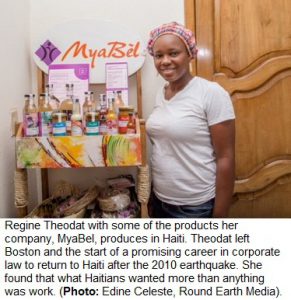
Croix-Des-Bouquets, Haiti — Regine Theodat had just passed the bar exam and at 25 years old was beginning a promising, if predictable, career in U.S. corporate law. She went to work, to spin class, home and to bed.

“Wake up and repeat,” she recalled. “I was very much a corporate lawyer — very strait-laced; not very adventurous.”

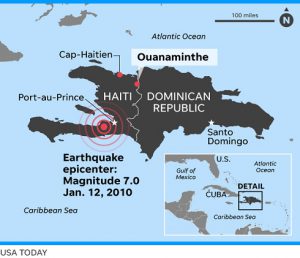
Then on Jan. 12, 2010, a magnitude-7.0 earthquake struck Haiti, killing hundreds of thousands of people. And the child of immigrants who left Haiti for greater opportunities did something shocking. She traded her comfortable life in Boston for the chaos of the poorest country in the Americas.

Aid groups and volunteers from around the world also poured into Haiti. Most have left. But eight years later, Theodat is still here.

She is among a small army, most of them women, who returned to Haiti and started businesses. Theodat makes food and cocktails. Another woman supplies castor oil beauty products to North American stores, including Whole Foods. Some of the others sell fruit smoothies, jewelry and chocolate.
More Haitians may soon be returning from the U.S., but not voluntarily. The Trump administration announced in November that “temporary protected status” for 59,000 Haitians will end in 2019. Many will have limited opportunities back home. VIDEO

What’s more, remittances make up almost a third of Haiti’s GDP, so for each person deported, several local people suffer. For those with education, drive and money, however, moving back is a chance to create jobs and help change practices that many believe perpetuate poverty.

Family members thought Theodat was insane for going back to a country they’d left in the 1980s.

“They said, ‘She’ll be back. The first demonstration that happens, she’ll be back. The first rocks she sees thrown, she’ll be back,’” she said. She has indeed seen a lot, but she has stayed.

Theodat spent her first year running a human rights clinic, until she found out that Haitians really wanted something else. “People kept asking me for jobs,” she said.

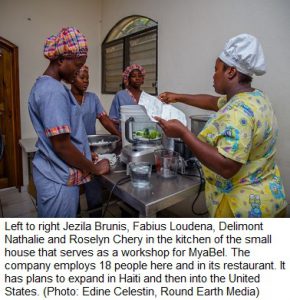
So she teamed up with two collaborators from her human right work, including a man she later married. They launched MyaBèl, a restaurant and cocktail bar in Croix-des-Bouquets, the hometown of Theodat’s family located northeast of Port-au-Prince.

Then they started bottling drinks and sauces in a middle-class house on a dirt side street and began a farm to supply fresh ingredients.

MyaBèl now sells products at more than a dozen Haitian supermarkets and boutiques. It employs 18 people and works with 65 farmers. This year, Theodat was nominated for an entrepreneur of the year award.

Jezila Brunis, 37, a single mother of three, makes minimum wage, about $5.50 a day, in the workshop. She’s able to send her children to school, and she likes the process of washing and chopping ingredients, feeding them into mixers and cooking them on a stove-top. “I’m always learning new things,” she said.
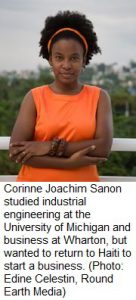
Even paying the minimum is a challenge because other costs — generators, fuel, imports and wear-and-tear on vehicles — are extremely high, Theodat said. Hiring and managing people is difficult because so few held jobs before, and they often fail to do basics, such as keeping kitchen doors closed, getting to work on time and finishing tasks quickly. Five out of the restaurant’s original six employees lost their jobs.

Most Haitians subsist in part on farms or work informally, so unemployment is hard to measure. But the World Bank says almost 60% of Haiti’s 11 million people live in poverty. In May, the insurance company FM Global rated Haiti the worst place to do business among 130 countries it studied.

Theodat came face-to-face with endemic corruption the first time she went to pay taxes. She was told she needed to pay someone to speed up the process. “I refused,” she said. “And then I just sat there until I was able to do it the way I was supposed to do it.” She did the same with immigration and customs.

Some of the émigrés couldn’t cut it. “They came, they tried, Haiti pummeled them, and they left,” said Isabelle Clérié, who came home to work with local entrepreneurs after studying anthropology in the U.S. “Some were able to stick it out, and through some truly big challenges.”

“One of the most valuable exports from Haiti is our brains,” she said. “It’s been really great to see these people come back.”

Unlike Theodat, Corinne Joachim Sanon long planned to start a business in Haiti. She grew up in Port-au-Prince, graduated from high school at 16 and headed to the University of Michigan to study industrial engineering. She was in Wharton’s business program when the earthquake struck, destroying her family home and killing her grandmother.

She launched Askanya, Haiti’s first bean-to-bar chocolate company, in her grandmother’s childhood home in Ouanaminthe, a town on the border with the Dominican Republic. The company works with cacao and sugar cooperatives representing more than 3,000 growers and employs 10 people full time.

One of them is Jocelyne Diomètre, 34, who had been a maid in the Dominican Republic and hated the hassle of crossing the border every day. At Askanya, she is working in her own country for the first time.

Askanya sells bars at scores of locations across Haiti and the U.S. Boosted by recognition at festivals in Seattle and Paris, Joachim Sanon is looking to expand production and double its number of growers.


MyaBèl is also growing, clearing and planting more than 30 acres of idle land. It is planning to hire local people to make machines for the workshop. Theodat said the company must increase production to meet local demand and then start exporting to the U.S., creating more jobs.

Theodat and Joachim Sanon know that returning émigrés can’t end poverty in Haiti. “I don’t think I’m going to go to bed and wake up and Haiti is going to be totally different,” Theodat said.

Refusing to take part in corruption might result in incremental change. Theodat also believes the more collaborative style of émigrés has been rubbing off on their local counterparts.

Joachim Sanon is encouraged that a Haitian company is now competing with Askanya by selling high-end chocolate bars. “Sometimes you want to see someone else succeed first before you try to put your toe in the water,” she said.

“It’s definitely changing the image of Haiti,” she said. “It creates a momentum.”

—–
Contributing: Michel Joseph. 

This story was produced in association with Round Earth Media, which trains and supports young journalists around the world.

Source: USA Today – Posted December 22, 2017; retrieved January 9, 2017 from:

https://www.usatoday.com/story/news/world/2017/12/22/these-haitian-women-were-doing-great-u-s-and-then-returned-aid-quake-hit-nation/938639001/ 

Related: Trump administration to send Haiti earthquake victims home in 2019 – See Appendix VIDEO below.

This commentary is about Haiti’s community re-development, jobs, image and pride. Plus the “Sheroes” who are transforming the country!

This foregoing article aligns with the movement behind the book Go Lean…Caribbean – available to download for free. The movement double-downs on the homeland; it advocates for the Caribbean Diaspora – like the above “Sheroes” – to return to their communities and for in-country residents to not leave in the first place. While no society is perfect anywhere in the world, the Go Lean book posits that the Caribbean is easier to reform and transform. Plus the inherent beauty of the islands, coastal states, cultures and hospitality makes the heavy-lifting to transform our community worth all the effort and sacrifice.

There is no doubt that Haiti has seen a lot of dysfunction; the country flirts with Failed-State status. But change is afoot – see A Supplication for Haiti in the Appendix below – here comes that change: “New Guards”. The Go Lean book serves as a roadmap for the introduction and implementation of the technocratic Caribbean Union Trade Federation (CU), for the elevation of Caribbean society – New Guards for all member-states. This CU/Go Lean roadmap has these 3 prime directives:

  • Optimization of the economic engines in order to grow the regional economy to $800 Billion and create 2.2 million new jobs. One strategy is to deploy industrial campuses, work-yards and job-sites as Self-Governing Entities (SGE’s).
  • Establishment of a security apparatus to protect the resultant economic engines, especially on the SGE’s.
  • Improve Caribbean governance to support these engines, including a separation-of-powers between the member-states and CU federal agencies. This allows for Self-Governing Entities independent of Haiti’s local government. Yippee!!!

The book stresses that reforming and transforming the Caribbean societal engines must be a regional pursuit. This was an early motivation for the roadmap, as pronounced in the opening Declaration of Interdependence (Pages 12 – 13):

xi. Whereas all men are entitled to the benefits of good governance in a free society, “new guards” must be enacted to dissuade the emergence of incompetence, corruption, nepotism and cronyism at the peril of the people’s best interest. The Federation must guarantee the executions of a social contract between government and the governed.

xii.  Whereas the legacy in recent times in individual states may be that of ineffectual governance with no redress to higher authority, the accedence of this Federation will ensure accountability and escalation of the human and civil rights of the people for good governance, justice assurances, due process and the rule of law. As such, any threats of a “failed state” status for any member state must enact emergency measures on behalf of the Federation to protect the human, civil and property rights of the citizens, residents, allies, trading partners, and visitors of the affected member state and the Federation as a whole.

xiii. Whereas the legacy of dissensions in many member-states (for example: Haiti and Cuba) will require a concerted effort to integrate the exile community’s repatriation, the Federation must arrange for Reconciliation Commissions to satiate a demand for justice.

xix. Whereas our legacy in recent times is one of societal abandonment, it is imperative that incentives and encouragement be put in place to first dissuade the human flight, and then entice and welcome the return of our Diaspora back to our shores. This repatriation should be effected with the appropriate guards so as not to imperil the lives and securities of the repatriated citizens or the communities they inhabit. The right of repatriation is to be extended to any natural born citizens despite any previous naturalization to foreign sovereignties.

xxiv. Whereas a free market economy can be induced and spurred for continuous progress, the Federation must install the controls to better manage aspects of the economy: jobs, inflation, savings rate, investments and other economic principles. Thereby attracting direct foreign investment because of the stability and vibrancy of our economy.

The Go Lean book provides 370-pages of turn-by-turn instructions on “how” to adopt new community ethos, plus the strategies, tactics, implementations and advocacies to execute so as to reboot, reform and transform the societal engines of Caribbean society. One advocacy is the deployment of Self-Governing Entities – industrial sites though physically located in a member-state, like Haiti, actually administered by agencies of the CU Federation (Page 105). Another advocacy is the Reboot of Haiti. The book posits that solutions for the Caribbean must first come from the Caribbean. Therefore, the roadmap calls for a Caribbean-styled Marshall Plan. (A similar advocacy is provided for Cuba). See this definition here, from Page 238:

The Bottom Line on the Marshall Plan

By the end of World War II much of Europe was devastated. The Marshall Plan, (officially the European Recovery Program, ERP), named after the then Secretary of State and retired general George Marshall, was the American program to aid Europe where the United States gave monetary support to help rebuild European economies after the end of the war. During the four years (1948 – 1952) that the plan was operational, US $13 billion in economic and technical assistance was given to help the recovery of the European countries. The plan looked to the future, and did not focus on the destruction caused by the war.

Much more important were efforts to modernize European industrial and business practices using high-efficiency American models, reduce artificial trade barriers, and instill a sense of hope and self-reliance. By 1952 as the funding ended, the economy of every participant state had surpassed pre-war levels; for all Marshall Plan recipients, output in 1951 was at least 35% higher than in 1938. Over the next two decades, Western Europe enjoyed unprecedented growth and prosperity. Generally, economists agree that the Marshall Plan was one of the first elements of European integration, as it erased trade barriers and set up institutions to coordinate the economy on a continental level—that is, it stimulated the total political reconstruction of Western Europe.

Today, the European Union, the latest successor of the integration effort, is the world largest integrated economy.

Consider too some specific plans, excerpts and headlines for the objective of engaging the Marshall Plan concept for Haiti; this too is found in the book on Page 238, entitled:

10 Ways to Reboot Haiti

1 Lean-in for the Caribbean Single Market
This regional re-boot will allow for the unification of the region into one market, thereby creating a single economy of 30 member-states, 42 million people and a GDP of over $800 Billion. Following the model of European integration, the CU will be the representative and negotiating body for Haiti and the entire region for all trade and security issues.
2 Marshall Plan for Haiti

Haiti is the poorest nation in the Western Hemisphere. But what they have is impassioned human capital as opposed to financial capital or valuable minerals. The CU is a total economic reboot for this country, one that involves developing internally and not thru emigration. To reboot Haiti will require a mini-Marshall Plan. The infrastructure, for the most part, is archaic compared to modern societies. The engines of the CU will enable a rapid upgrade of the infra-structure and some “low hanging fruit” for returns on the investment.

3 Leap Frog Philosophy

There is no need to move Haiti’s technology infrastructure baseline from the 1960’s, then to the 1970’s, and so on. Rather, the CU’s vision is to move Haiti to where technology is going, not coming from. This includes advanced urban planning concepts like electrified light-rail, prefab house constructions, alternative energies and e-delivery of governmental services and payment systems.

4 Repatriation and Reconciliation of the Haitian Diaspora
5 Access to Capital Markets
6 National Historic Places
7 World Heritage Sites
8 Labor, Immigration and Movement of People
The recovery plan for Haiti would discourage the emigration of the population. Haiti has a population base (10 million) that can imperil other islands if too many Haitians relocate within the Caribbean. As a result, the CU will expend the resources and facilitate the campaign to dissuade relocation for the first 10 years of the ascension of the CU [Treaty]. During these first 10 years, Haitians visiting other CU member states, with Visa’s, with careful monitoring to ensure compliance.
9 Educational Mandates

Whereas the CU educational facilitation is satisfied at the secondary level, there will be a greater need for Adult Education in Haiti. Because of the decades of poverty, illiteracy is more dire in Haiti than in other CU state. There will be no age limitation for the educational opportunities. The macro-economic principle is “every year of education raises a country’s GDP”; this will allow for easy pickings of the economic “low hanging fruit”.

10 Language Neutrality of the Union … French and Creole

According to the foregoing news article, a big concern for Haiti is the lack of jobs – the article cited a 60 percent poverty/unemployment rate. The Go Lean roadmap seeks to assuage this economic challenge by the facilitation of formal jobs and informal gigs, especially on the Self-Governing Entity job sites. Welcome to the Gig Economy

A gig economy is an environment in which temporary positions are common and organizations contract with independent workers for short-term engagements. The trend toward a gig economy has begun. A study by financial systems company, Intuit, predicted that by 2020, 40 percent of American workers would be independent contractors. – Source

We can ride this trend in the Caribbean as well. Haiti would be perfectly suited. Consider here, how the Go Lean movement identified many opportunities and expressions of the Gig Economy in these previous blog-commentaries:

https://goleancaribbean.com/blog/?p=13420 Lessons on Gigs from the History of Whaling Expedition
https://goleancaribbean.com/blog/?p=8262 UberEverything in Africa – Model of Gigs
https://goleancaribbean.com/blog/?p=6129 Lessons Learned from US Migrant Farm Workers on Seasonal Gigs
https://goleancaribbean.com/blog/?p=4145 Gigs for Eco-Tourism and World Heritage Sites
https://goleancaribbean.com/blog/?p=2857 Gig Economy Model – Entrepreneurism in Junk
https://goleancaribbean.com/blog/?p=2571 AirBnB Gig Economy Options Materializing
https://goleancaribbean.com/blog/?p=2003 Ship-breaking – One Job/Gig Scenario
https://goleancaribbean.com/blog/?p=1364 Uber Gigs Backlash Shows the Community Impact

Jobs in the Gig Economy are counted in the Go Lean roadmap as these are direct jobs; there is also the reality of indirect jobs – unrelated service and attendant functions – at a 3.75 multiplier rate would add even more to the job-creation effort.

According to the foregoing news article, there are many women in Haiti that have given a full measure to impact their communities and foster new jobs and economic activities. Such good news! How blessed they are:

The Lord gives the word; the women who announce the good news are a great host – English Standard Version

We urge all Caribbean stakeholders to lean-in to this roadmap to make the homeland a better place to live, work and play. 🙂

Download the free e-Book of Go Lean … Caribbean – now!

Sign the petition to lean-in for this roadmap for the Caribbean Union Trade Federation.

————

Appendix – Poem: A Supplication for Haiti!

Here’s my supplication for my brothers and sisters of Haiti:

Do not beg people to love you.
If you are successful in your begging,
it will not be love that you get, it will be pity!

Do you want to be pitied … as an individual?

Do you want to be pitied as a community; do you want to be pitied as a country?

This is most apropos on the heels of America ending her charity towards you – below. Yet, do not beg!

You do not want to be pitied by the world. You want to be honored by the world … for showing your proud heritage, as the progenitor of freedom for the New World.

Show them your pride. Show them your dignity.

————

Appendix VIDEO – US Ending Temporary Permits for Haitians – https://www.usatoday.com/videos/news/nation/2017/11/21/u.s.-ending-temporary-permits-haitians/107896498/

AP Nov. 21, 2017 – The Trump administration said Monday it is ending a temporary residency permit program that has allowed almost 60,000 citizens from Haiti to live and work in the United States since a 2010. Haitian advocates quickly criticized the decision.

Share this post:
, , ,
[Top]

Failure to Launch – Governance: Assembling the Region’s Organizations

Go Lean Commentary

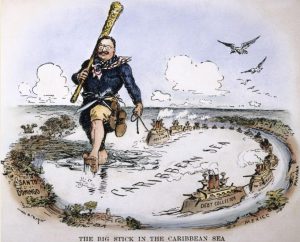
“Speak softly, and carry a big stick.” – Theodore Roosevelt, 26th US President

This is such illustrative language: Imagining a “stick”. It denotes the idea of negotiating peacefully, simultaneously threatening with the “big stick”, or the strength of the military. Now there is another imagery of building material and governing efficiency:

Iron, or “Big Iron” to be exact. Iron is also used to refer to something sturdy, strong and tough. But since the ancient Western Days – see Appendix VIDEO below – the term is said to be a slang, referring to a handgun. This Big Iron term has now come into fashion to apply to very large, expensive and extremely fast computers, or more so effective computer server farms that have resilient steel stands. – Technopedia. See full reference in Appendix below.

There is the need to transform the societal engines – economics, security and governance – of the Caribbean. The approach of “speaking softly and carrying a Big Stick” would be effective in forcing compliance among the regional stakeholders. The President Roosevelt application – in the foregoing photo – was clearly addressing security dynamics, but the same approach can apply to the other societal engines:

  • EconomicsImagine a big corporate entity with the need for a large work force, the decision-making of where to locate a plant would cause a lot of bidding among different communities. That company would be wielding a Big Stick.
  • Governance – There is also an application in governance; having a Big Stick or Big Iron can force compliance among the governing entities. Imagine large computer systems for e-Government applications …

This consideration is in harmony with the book Go Lean…Caribbean. The book serves as a roadmap for change in the region, affecting the economics, security and governing engines. It presents new measures and new empowerments as it introduces the Caribbean Union Trade Federation (CU) for the 30 Caribbean member-states to benefit from a super-national federal government with a lot of integrated solutions. This commentary is 4th of 4 parts, completing the series on the Caribbean’s Failure to Launch integrated solutions to elevate the societal engines in the region. The full series is catalogued as follows:

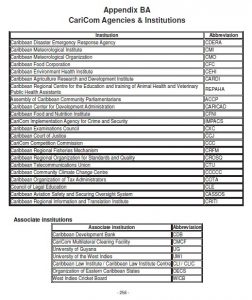
There are many Alphabet Organizations – listed here and from Page 256 of the Go Lean book – that transcend services to one Caribbean country after another. The Go Lean roadmap (book and accompanying blog-commentaries) calls for assembling them under the same government umbrella – the Trade Federation – and process their operations on the CU e-government systems, the CU‘s Big Iron.

Page 96: This roadmap constitutes the assessment required to forge change in the region. Upon understanding the needs of the Caribbean people and the current organization structures available, this roadmap pursues an assembly of these different institutions and then to supplement them with the creation of new super-national organizations. This approach allows the CU to “stand on the shoulders” of previous efforts and then reach greater heights.

This initial phase entails incorporating all the existing regional organizations (ACS and CariCom) into the umbrella organizations of the Caribbean Union Trade Federation. These organizations include, (but are not limited to) the identified Alphabet Organization this this photo here:

The foregoing disclosed the quest to “stand on the shoulders” of previous efforts; this includes efforts to integrate. This is what the Go Lean book presents, a workable roadmap to integrate efforts from the region and leverage the economies-of-scale of the 30 member-states so as to effect change in all societal engines, and to do so using as much technology as possible. In fact, the roadmap features Launching integrated solutions following these 3 prime directives:

  • Optimization of the economic engines in order to grow the regional economy to $800 Billion & create 2.2 million new jobs.
  • Establishment of a security apparatus to ensure public safety and protect the resultant economic engines.
  • Improve Caribbean governance to support these engines, including a separation-of-powers between the member-states and CU federal agencies.

The CU seeks to “speak softly and carry a Big Iron” by providing the e-Government processing for all of these Alphabet Organizations. There are some basics to this plan to elevate Caribbean society:

  • Leverage …
  • Economies-of-scale …
  • Integration …

These are important consideration for efficient and effective governance; and since in each Caribbean member-state, the government there is the largest employer, better efficiencies – as in computer systems – can improve Caribbean governance and bring real change to society.

With Internet and Communications Technologies, it is easy to link governmental systems from one country to another. (Big companies – i.e. airlines reservation systems – do this all the time).

  • Why have we fail to even consider this type of integration for our governmental entities in the past?
  • Too expensive?
  • So why have we Failed to Launch shared computer systems?

This Failure to Launch integrated e-Government systems across a shared network is now inexcusable!

The subject of e-Government has been a consistent subject for this movement behind the book Go Lean…Caribbean – available to download for free. In a previous commentary, the role and functionality of this Big Iron (unstated) was related:

Among the strategies, tactics and implementations in the Go Lean roadmap, is the deployment of e-Government services, systems and solutions. The Go Lean book explains how this implementation can streamline operations – lean, no heavy bureaucracy – for every level of government: municipal, state and the CU federal level. A type of computing implementation can leverage productivity against a very small level of staffing.

See how a lean structure is portrayed in the book (Page 51):

    A lot of office automation and data processing can be provided in-house for member-state governments by [the CU] simply installing / supporting computer mainframe/midrange systems, servers, and client workstations; plus supplementing infrastructural needs like power and mobile communications. The CU’s delivery of ICT [(Internet & Communications Technologies)] systems, e-Government, contact center and in-source services (i.e. property tax systems [and “www.myCaribbean.gov”]) can put the burden on systems continuity at the federal level and not the member-states. (This is the model of Canada with the federal delivery of provincial systems and services – some Provincial / Territorial presence / governance is completely “virtual”).

The Go Lean book presents the plan to deploy many e-Government provisions. There must therefore be an advanced structure of computer systems for Data Processing. This means Data Centers, our Big Iron for the Caribbean. The Go Lean book provides 370-pages of turn-by-turn instructions on “how” to adopt new community ethos, plus the strategies, tactics, implementations and advocacies to execute so as to reboot, reform and transform the societal engines of Caribbean society. One advocacy is optimizing the deployment of 6 strategically-located Data Centers. Consider some specific details, excerpts and headlines from the book on Page 106 entitled:

10 Trends in Implementing Data Centers

1 Lean-in for the Caribbean Single Market
The CU treaty unifies the Caribbean region into one single market of 42 million people across 30 member-states, thereby empowering the economic engines in and on behalf of the region. The CU embraces the cutting, “bleeding” edge concepts, systems and methodologies for data centers and computer server farms, as in high density computing, facilitating the maximum computing power with the least amount of space and power. The prerequisite for any serious data center deployment is power…stable, reliable electricity, with primary, secondary and tertiary solutions. The CU roadmap calls for deployment of a regional power grid, with above ground, underground & underwater cabling. Though data centers must launch now, power costs will be expected to decline with the grid. …
2 Fiber-Optics / Pipeline

Optical fibers are widely used in fiber-optic communications, which permits transmission over longer distances and at higher bandwidths (data rates) than other forms of communication. Fibers are used instead of metal wires because signals travel along them with less loss and are also immune to electromagnetic interference. The transparent fiber are made of high quality extruded glass, silica or plastic. The CU as a new Federation can apply a leap-frog approach to implement communication networks without having to contend with older methods or investments. Further the CU will embrace the strategy of installing elaborate pipelines thru out the region, enabling fiber-optics to traverse the network.

3 IP Convergence

Internet Protocol (IP) is now ubiquitous for data, voice, and video communications – they all operate on the same type of fiber. This indicates that data centers also function as telecom hubs – central switching offices are now bygones.

4 Cloud Computing

The CU will embrace cloud computing for many operational systems, thereby requiring optimal continuous processing.

The roadmap calls for citizens to interact with their federal government via web portals, kiosks or phone contact centers.

5 High Availability (HA)
6 Colocation Data Centers

A colocation center (colo, or coloc) is a type of data center where equipment space and bandwidth are available for rental to retail customers. Colocation facilities provide space, power, cooling, and physical security for the server, storage, and networking equipment of other firms—and connect them to a variety of telecommunications and network service providers—with a minimum of cost and complexity. Colocation has become a popular option for companies as it allows the company to focus its IT staff on the actual work being done, instead of the logistical. Significant benefits of scale (large power and mechanical systems) result in large colocation facilities, typically 50,000 to 100,000 square feet. The CU will assume a role of coloc landlord for member-states, municipalities and NGO’s for their data center needs.

7 [Limestone] Caves as Data Centers
8 Storage Solutions – No need for humans
9 Security Issues

Modern data centers require minimal human interaction, therefore physical security tend to be very restrictive. In some firms, even the CEO is not allowed access. The CU will implement biometric systems like fingerprints and iris scanning.

10 Unified Command & Control

The data center may be void of humans, but there is still the need for many professional analysis, programmers and engineers. These are normally stationed in command centers to facilitate monitoring and cyber-security functions.

The technology to leverage the governmental administrations of the Caribbean will be available Step One / Day One of the Go Lean roadmap. Though there would be some need for customization and specialty programming. This development effort can be leveraged across the entire region.

Under the Go Lean plan, the expressions of the Caribbean Big Iron would be manifested by systems in government offices, self-serve kiosks, various websites (i.e. www.myCaribbean.gov), Social Media channels and smart phone applications.

These types of e-Government manifestations have been discussed in previous blog-commentaries; consider this sample:

https://goleancaribbean.com/blog/?p=13524 The Future Focus of e-Government Portals
https://goleancaribbean.com/blog/?p=13466 The Future Focus of e-Learning in the Caribbean
https://goleancaribbean.com/blog/?p=11453 Location Matters, Even in a Virtual World
https://goleancaribbean.com/blog/?p=8823 Lessons from China – WeChat: Model for Caribbean Social Media
https://goleancaribbean.com/blog/?p=7991 Transformations: Caribbean Postal Union – Delivering the Future
https://goleancaribbean.com/blog/?p=6341 e-Commerce Strategies for Tourism Stewardship
https://goleancaribbean.com/blog/?p=5435 China Internet Policing – Model for Caribbean
https://goleancaribbean.com/blog/?p=888 How to Re-invent Government in a Digital Image – Book Review
https://goleancaribbean.com/blog/?p=459 Plan to Integrate CXC into the CU Trade Federation for e-Learning

Let’s do this Big Iron – deploying advanced computer systems – to facilitate the e-Governmental transformation of our CU Federal government agencies – the Alphabet Orgaanizations, member-state agencies and even Non-Government Organizations!

We can no longer Fail to Launch

We can “speak softly and carry a Big Iron“.

Our governing efficiencies depend on it.

Also, our economic and security engines can also benefit.

These efficiencies can help to reform and transform Caribbean governments and society in general. We urge all stakeholders to lean-in to this CU/Go Lean roadmap to make the Caribbean a better place to live, work and play. 🙂

Download the free e-Book of Go Lean … Caribbean – now!

Sign the petition to lean-in for this roadmap for the Caribbean Union Trade Federation.

———–

Appendix – Big Iron

Definition – What does Big Iron mean?

Big iron is a slang word commonly used to describe a very large, expensive and extremely fast computer. It is often used to refer to oversized computers such as Cray’s supercomputer or IBM’s mainframe.

The term big iron originated in the 1970s, when smaller computers known as minicomputers were introduced. To describe larger computers compared to the small minicomputers, the term big iron was coined by users and the industry.

Big iron computers are primarily used by large companies to process massive amounts of data such as bank transactions. They are designed with considerable internal memory, a high aptitude for external storage, top-quality internal engineering, superior technical support, fast throughput input/output and reliability.

Techopedia explains Big Iron

The term is said to be a derivative of the term “iron”; when used as slang, this term refers to a handgun. Iron is also used to refer to something sturdy, strong and tough. The term big iron is frequently applied to highly effective computer ranches and servers that have resilient steel stands.


In the 1960s and 1970s, the market for mainframes, or big iron, was mainly through IBM and companies like General Electric, RCA Corp., Honeywell International Inc., Burroughs Corporation, Control Data Corp., NCR Corp. and UNIVAC. Later servers based on the microcomputer design, or “dumb terminals”, were developed to cut costs and create greater availability for users. The dumb terminal was eventually replaced by the personal computer (PC). Subsequently, big iron was restricted to mostly government and financial institutions.

Source: Retrieved December 17, 2017 from Technopedia: https://www.techopedia.com/definition/2157/big-iron

———–

VIDEO –  Big Iron- Marty Robbins  –  https://youtu.be/999RqGZatPs

Published on Mar 28, 2011

All rights belong to their respective owners

Lyrics:

To the town of Agua Fria rode a stranger one fine day
Hardly spoke to folks around him, didn’t have too much to say,
No one dared to ask his business, no one dared to make a slip
The stranger there among them had a big iron on his hip,
Big iron on his hip …

Lyrics retrieved December 17, 2017 from: https://genius.com/Marty-robbins-big-iron-lyrics


Share this post:
, ,
[Top]

Miami’s Caribbean Marketplace Revisited – ENCORE

It’s time to celebrate all things Miami – during Miami Art Week 2017 – so that includes all the Caribbean Diaspora that adds to the fabric of this international metropolis and makes it a Magic City.

Spanish, Haitian, Indian Jamaican, Black/White Cuban or Asian … – Lyrics from song “Welcome to Miami” by Rapper Will Smith; featured in the VIDEO below.

Just look at this place now; in all of its glory!

This is the perfect time to encore this following – original blog-commentary – from July 20, 2014 when the Miami Caribbean Marketplace was re-opened in Little Haiti:

—————

Go Lean Commentary – Miami’s Caribbean Marketplace Re-opens

Make no mistake: having a warm welcome in a City of Refuge is not as good as being safe and secure at home. Yet, when conditions mandate that one take flight, a warm welcome is greatly appreciated.

According to the foregoing article, the City of Miami now extends a warm welcome … to the Caribbean Diaspora. While Miami profits from this embrace, the benefits for the Caribbean are not so great.

This is the American Immigrant experience, one of eventual celebration, but only after a “long train of abuses”: rejection, anger, protest, bargaining, toleration and eventual acceptance. The experience in Miami today is one of celebration.

The book Go Lean…Caribbean champions the cause of retaining Caribbean citizens in the Caribbean, even inviting the Diaspora back to their homelands. So the idea of celebrating a cultural contribution at a center in a foreign land is a paradox. Yes, we want the positive image, but no, we do not want to encourage more assimilation in the foreign land.

However, the book declares: It is what it is!

The book serves as a roadmap for the introduction and implementation of the Caribbean Union Trade Federation (CU), a technocratic federal government to administer and optimize the economic/security/ governing engines in the homeland of the region’s 30 member-states. The CU strives to elevate Caribbean image at home and abroad. There are many empowerments in the roadmap for the far-flung Diaspora to improve the interaction with the Caribbean community. So the cultural center in the foregoing article is germane to the Go Lean discussion.

The entire article is listed as follows:

CU Blog - Miami's Caribbean Marketplace Re-opens - Photo 1 Sub-title: The Caribbean Marketplace has become a cultural icon in the Little Haiti community and re-opens with much fanfare….

By: Fabiola Fleuranvil | Noire Miami

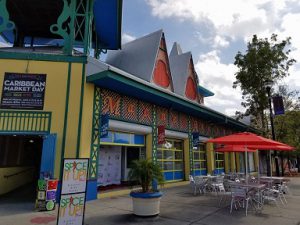
The long awaited re-opening of the Caribbean Marketplace (CMP) is back as a cultural marker in the vibrant Little Haiti community. For years, the venue has been a strong figure along Little Haiti’s main corridor and has been easily identified by its bright colors and vibrant activity of vendors as well as Haitian and Caribbean culture. After undergoing a lengthy renovation to transform this cultural gem into a community staple for unique arts and crafts, Caribbean culture, special events, and community events, the highly anticipated reopening positions the Caribbean Marketplace as a vibrant addition to the Little Haiti Cultural Center next door and the burgeoning arts and culture spirit in Little Haiti.

The re-establishment of this Marketplace is a collaborative effort of the City of Miami in partnership with the Miami-Dade Department of Cultural Affairs, the Little Haiti Cultural Complex (LHCC), the Northeast Second Avenue Partnership (NE2P) and District 5 Commissioner Keon Hardemon.

The 9,500-square-foot space includes a refreshment and concession area, gift shops, arts and crafts, retail vendors and space available for private events. The renovations reflect the beautiful diversity of the Caribbean. Low rates, technical and marketing assistance will be provided to all vendors. It is anticipated that new businesses will be created in this cultural hub, resulting in employment opportunities for the local community.

Physical Address for the Caribbean Marketplace: 5925   NE 2nd Ave, Miami (Besides the Little Haiti Cultural Center) Hours: Thursday – Sunday, 11AM – 11PM
Miami Herald Daily Newspaper  (Retrieved 07-16-2014) –
http://www.miami.com/little-haiti039s-caribbean-marketplace-reopens-article

The Miami community is doing even more to embrace the exile populations in its metropolis, (including jurisdictions up to West Palm Beach). They have declared an entire month (June) for celebrating Caribbean communities; the term “month” is a loose definition, it starts in the Spring and forwards deep into the Summer. The following is a sample of events planned for this year (2014).

Caribbean-American Heritage “Month” events around South Florida:

CU Blog - Miami's Caribbean Marketplace Re-opens - Photo 2

3rd Annual Colors of the Caribbean

Saturday, June 14, 4PM – 11PM – Hollywood Arts Park – Hollywood Blvd & US1

What do you get when you blend the diverse, authentic ingredients of the Caribbean? You get a Caribbean inspired day of food, arts and culture, entertainment and irie vibes. Colors of the Caribbean features: Junkanoo procession, Moko Jumbies (Stilt walkers), Steelpan music, and live performances by Wayne Wonder (Jamaica), Midnite (Virgin Islands), Kevin Lyttle (St Vincent), Harmoniq (Haiti), music by DJ Majestic (DC/Trinidad & Tobago), and more.

AllSpice: Flavors of the Caribbean

Friday, June 20, 6PM – 10PM – Borland Center, 4885PGABlvd,Palm BeachGardens

The Caribbean Democratic Club of Palm Beach County presents a Taste of the Caribbean in celebration of Caribbean American Month.

Caribbean Style Week

June 23-29 – Westfield Mall Broward, 8000 West Broward Blvd, Plantation

The Caribbean American Heritage Foundation hosts a week-long showcase featuring both popular and upcoming Caribbean fashion designers and brands. Fashion pieces will be available for purchase during the fashion expo.

Caribbean Heritage Month Travel Experience/Travel Expo

June 28-29 – Westfield Mall Broward, 8000 West Broward Blvd, Plantation

The Caribbean Travel Expo celebrates and promotes each individual as a destination for your next vacation. The expo experience will also showcase live music, cultural performances, and special surprise giveaways over the weekend.

Caribbean: Crossroads of the World Exhibit

April 18 – Aug 17 – PerezArt MuseumMiami (PAMM), 1103 Biscayne Blvd, Miami

Highlighting over two centuries of rarely seen works — from paintings and sculptures to prints, photographs, installations, films, and videos — dating from the Haitian Revolution to the present, this exhibition advances our understanding of the Caribbean and its artistic heritage and contemporary practices.
http://www.miami.com/caribbean-american-heritage-month-events-around-south-florida-article)

The Go Lean…Caribbean clearly recognizes the historicity of Cuban and Afro-Caribbean (Haitian, Jamaican, Dominican, Bahamian, etc) exiles in Miami. They went through the “long train of abuses”. But today, their communities dominate the culture of South Florida, resulting in a distinctive character that has made Miami unique as a travel/tourist destination; see VIDEO below. The expression “take my talents to South Beach” now resonates in American society.

This commentary previously featured subjects related to the Caribbean Diaspora in South Florida. The following here is a sample:

https://goleancaribbean.com/blog/?p=1433 Caribbean loses more than 70 percent of tertiary educated to brain drain
https://goleancaribbean.com/blog/?p=1148 Sports Bubble – Franchise values in basketball
https://goleancaribbean.com/blog/?p=689 eMerge conference aims to jump-start Miami   tech hub
https://goleancaribbean.com/blog/?p=235 Tourism’s changing profile

At the outset, the Go Lean roadmap recognizes the value and significance of Cuban and Haitian exile communities in the pantheon of Caribbean life. Any serious push for Caribbean integration must consider Diaspora communities, like the Cuban/Haitian exiles in Miami. This intent was pronounced early in the book with these statements in the Declaration of Interdependence (Pages 12 & 13):

xiii.      Whereas the legacy of dissensions in many member-states (for example: Haiti and Cuba) will require a concerted effort to integrate the exile community’s repatriation, the Federation must arrange for Reconciliation Commissions to satiate a demand for justice.

xix.      Whereas our legacy in recent times is one of societal abandonment, it is imperative that incentives and encouragement be put in place to first dissuade the human flight, and then entice and welcome the return of our Diaspora back to our shores. This repatriation should be effected with the appropriate guards so as not to imperil the lives and securities of the repatriated citizens or the communities they inhabit. The right of repatriation is to be extended to any natural born citizens despite any previous naturalization to foreign sovereignties.

xx.      Whereas the results of our decades of migration created a vibrant Diaspora in foreign lands, the Federation must organize interactions with this population into structured markets. Thus allowing foreign consumption of domestic products, services and media, which is a positive trade impact. These economic activities must not be exploited by others’ profiteering but rather harnessed by Federation resources for efficient repatriations.

It was commonly accepted that Cuban exiles and other Caribbean Diaspora were sitting, waiting in Miami for change in their homelands; then they would return to claim their earned positions of respect. Along the way, the Survive-then-Thrive strategy was supplanted with a new Thrive-in-America strategy – credited to the next generation’s assimilation of the American Dream and the long duration of Caribbean dysfunctions, i.e. the Castros still reign after 55 years. Miami subsequently emerged as the trading post for the Caribbean and all of Latin America. The Caribbean is now hereby urged to lean-in to the community ethos, strategies, tactics, implementations and advocacies to finally re-boot Caribbean society; as detailed in the book Go Lean … Caribbean sampled here:

Community   Ethos – Economic Systems Influence Individual Choices & Incentives Page 21
Community   Ethos – Voluntary Trade Creates Wealth Page 21
Community   Ethos – Anti-Bullying and Mitigation Page 23
Community   Ethos – Minority Equalization Page 24
Community   Ethos – Lean Operations Page 24
Community   Ethos – Return on Investments Page 24
Community   Ethos – Ways to Impact Turn-Arounds Page 33
Community   Ethos – Ways to Manage Reconciliations Page 34
Community   Ethos – Ways to Impact the Greater Good Page 37
Strategic – Vision – Integrating Region in to a Single Market Page 45
Strategic – Agents of Change – Globalization Page 57
Tactical – Fostering a Technocrary Page 64
Tactical – Separation of Powers – State Department – Culture Administration Page 81
Tactical – Separation of Powers – Federal Courts – Truth & Reconciliation Commissions Page 90
Implementation – Ways to Pay for Change Page 101
Implementation – Foreign Policy Initiatives at Start-up Page 102
Implementation – Ways to Deliver Page 109
Implementation – Trade Mission Objectives Page 117
Implementation – Reasons to Repatriate Page 118
Implementation – Ways to Benefit from Globalization Page 119
Planning – 10 Big Ideas – Cuba/Haiti Page 127
Planning – Ways to Make the Caribbean Better Page 131
Advocacy – Ways to Grow the Economy Page 151
Advocacy – Ways to Impact the Diaspora Page 217
Advocacy – Ways to Preserve Caribbean Heritage Page 218
Advocacy – Ways to Improve the Arts Page 230
Advocacy – Ways to Promote Music Page 231
Advocacy – Ways to Re-boot Cuba Page 236
Advocacy – Ways to Re-boot Haiti Page 238

The foregoing article addresses the story of the Caribbean Marketplace facility to promote Caribbean culture in the South Florida market, and even provide some economic benefits (trade, job, import/export options). The Go Lean book focuses on these economic issues to the Nth degree, and also addresses the important issues regarding Caribbean societal elevation: music, sports, art, education, repatriation and heritage. This cultural center in the foregoing article aligns with the Go Lean roadmap.

Just like Miami grew, and prospered so much over the last 50 years, with help from our people, the Caribbean can also be a better place to live, work and play. This is a new day for the Caribbean!

It’s time now for change; not just change for change sake, but the elevations that were identified, qualified and proposed in the book Go Lean…Caribbean. It’s time to lean-in. Then we can move from celebrating the Diaspora in a foreign land to celebrating their return to the Caribbean, the best address in the world.

Sign the petition to lean-in for this roadmap for the Caribbean Union Trade Federation.

Download the free e-Book of Go Lean … Caribbean – now!

Share this post:
, , , , , , ,
[Top]

Amazon: Then and Now

Go Lean Commentary

Time flies when you are …

Time just flies … PERIOD!

18 years can go by real fast.

It was only 18 years ago (1999) that Amazon was this small budding company in Seattle, Washington USA. Now today, they are huge … and transforming how America shops … for Christmas and beyond!

Notice the graphic here:

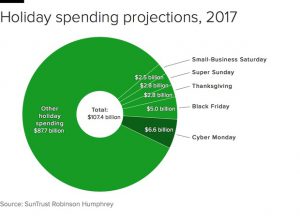
In a previous blog-commentary by the movement behind the book Go Lean … Caribbean, it was asserted that the retail industry – the greatest benefactor of the Christmas holiday shopping tradition with the estimate $107.4 Billion for 2017 – is being threatened by the Retail Apocalypse of e-Commerce in general and the internet-based mover-shaker company of Amazon in particular.

See the story here on Cyber Monday 2017 in the related VIDEO here:

Title Cyber Monday: Who won online shopping’s biggest day?

VIDEO – CNET Surveys Holiday Shopping Trends – https://www.cbsnews.com/videos/cnet-surveys-holiday-shopping-trends/


Published November 28, 2017 – Monday [(November 27)] broke shopping records, becoming America’s largest-ever online shopping day. Some $6.6 billion in sales were generated, according to Adobe Analytics, which tracks 80 percent of online shopping activity. By 10 a.m. Monday, $840 million had already been spent online, Adobe said — a jump of 17 percent from the year before.

Spending on Cyber Monday typically peaks in the evening, between 8 and 11 p.m., and shopping activity during that time on Monday exceeded that of a typical 24-hour day, according to Adobe Analytics.

So where are we spending all that money? In a word: Amazon (AMZN). The e-commerce giant accounts for somewhere between 45 percent and 50 percent of all sales by volume, according to separate estimates from SunTrust Robinson Humphrey and GBH Insights.
….
See the rest of the news article in the Appendix below.

How did they – Amazon – get here … so quickly?

Amazon: Then and Now

See here the width-and-breath of Amazon.com in 1999 in this 60 minutes Interview/Story:

VIDEO – What they said in 1999 about Amazon.com – https://youtu.be/6cTjhzSgdwE

Startup Cat

Published on Nov 20, 2017 – Interview look the year when the internet dotcom bubble burst dramatically. What they were saying about Amazon.com and Jeff Bezos?

Now see the width-and-breath of Amazon today … with this CNBC Feature/Story:

VIDEO – Inside Amazon Empire Documentary 2017 – https://youtu.be/_JnRzt8_YQc

Interesting Facts

Published on Sep 28, 2017 – Inside Amazon Empire Documentary 2017

———-

The Go Lean movement pays more than the usual attention to this “Amazon” business enterprise. We want to copy their good examples … and avoid their bad examples.

This company is a model for the Caribbean’s own venture into e-Commerce. The Go Lean book describes the design for the Caribbean Postal Union and the www.myCaribbean.gov web-portal so as to perform a lot of the same functionality that Amazon does in the USA.

The book Go Lean…Caribbean serves as a roadmap for the introduction and implementation of the technocratic Caribbean Union Trade Federation (CU) and the Caribbean Postal Union (CPU). These entities are designed to address the “Agents of Change“ in modern society, but for a Caribbean scope only.  The “Agents of Change” at play in the foregoing news sources, according to the book (Page 57), are defined as follows:

  • Technology
  • Globalization

Amazon and its CEO Jeff Bezos are role models that we can copy in the Caribbean. It is our assessment that one person can make a difference in society. Look at the impact of this one man – Jeff Bezos – in the fast-time of 18 years, since 1999. These above Agents-of-Change have disrupted Caribbean life in the past; now we need to be our own Change Agents. We need to forge our own change in our society so that we can survive as a culture on the world stage.

The future is not assured if we do not take a hold of our societal engines. We must reboot our industrial landscape to foster new opportunities (jobs, entrepreneurism and industrial development). This is the charter of the CU. In fact, the following 3 statements are identified as the prime directives of this CU charter:

  • Optimization of the economic engines in order to grow the regional economy to $800 Billion & create 2.2 million new jobs.
  • Establishment of a security apparatus to protect the resultant economic engines.
  • Improve Caribbean governance – as e-Commerce alters sales & border taxes – to support these engines.

What Amazon did and does, is the epitome of what the Caribbean Union Trade Federation needs to do to reboot Caribbean society. Amazon disrupted the status quo in so many industries – think: book retailers & movie rentals – and transformed markets to exploit opportunities and derive profits. This is the “Sum of All Caribbean Dreams“.

This reference to Caribbean Dreams is presented early in the Go Lean book with these opening pronouncements in the Declaration of Interdependence (Page 12 – 14):

xv. Whereas the business of the Federation and the commercial interest in the region cannot prosper without an efficient facilitation of postal services, the Caribbean Union must allow for the integration of the existing mail operations of the governments of the member-states into a consolidated Caribbean Postal Union, allowing for the adoption of best practices and technical advances to deliver foreign/domestic mail in the region.

xxiv. Whereas a free market economy can be induced and spurred for continuous progress, the Federation must install the controls to better manage aspects of the economy: jobs, inflation, savings rate, investments and other economic principles. Thereby attracting direct foreign investment because of the stability and vibrancy of our economy.

xxvii. Whereas the region has endured a spectator status during the Industrial Revolution, we cannot stand on the sidelines of this new economy, the Information Revolution. Rather, the Federation must embrace all the tenets of Internet Communications Technology (ICT) to serve as an equalizing element in competition with the rest of the world. The Federation must bridge the digital divide and promote the community ethos that research/development is valuable and must be promoted and incentivized for adoption.

The business models of Amazon have been further elaborated upon in previous blog-commentaries, as follows:

https://goleancaribbean.com/blog/?p=13091 Amazon Opens Search for HQ2
Amazon is accepting bids for a 2nd headquarters in North America. The city that lands HQ2 will have a lot to celebrate, as this enterprise can create many high-paying direct jobs – 50,000 – and have an indirect stimulus on the rest of the economy. This is a feature of Amazon that “we” want to model in the Caribbean.
https://goleancaribbean.com/blog/?p=12291 Big Tech’s Amazon – The Retailers’ Enemy
Big Tech companies like Amazon have the treasuries, talent and temperament (culture, values and commitment) to change the world, for good and for bad. The Amazon threat had been “all things internet”, but now they are attempting to dominate the physical retail space as well, with their acquisition of Whole Foods grocery stores.
https://goleancaribbean.com/blog/?p=11358 Retail Apocalypse – Preparing for the Inevitable
There is feast and famine “in the cards” for the retail eco-system. On one end of the spectrum , there will be prosperity for electronic commerce stakeholders, but on the other end, for brick-and-mortar establishments, there will be a Retail Apocalypse. This is not just a future problem as the, the threat has already manifested!
https://goleancaribbean.com/blog/?p=9839 Amazon and Alibaba’s Cloud allows for global reach
This model, with cutting-edge data centers, is the new colonialism. Amazon and Alibaba are people-intensive companies – lots of employment – but Information Technology (I.T.) companies too.
https://goleancaribbean.com/blog/?p=7297 Death of the ‘Department Store’: Exaggerated or Eventual
Modern technology and electronic commerce has transformed many aspects of society; much has been added and much taken away. Just consider: cameras, watches, pagers, maps, calculators, calendars, payphones, books, music and more. The related industries have also been affected: travel agencies, music retailers, book retailers, newspapers, travel agencies and Big Box retailers. Amazon is to blame for many of the transformations.
https://goleancaribbean.com/blog/?p=7023 Thanksgiving & American Commerce – Past, Present and Amazon
To better understand American commerce, one must understand Cyber Monday and its dominant player Amazon. This company demonstrates how to be lean and technocratic as it employs cutting-edge automation  and robotics. They are a great model for a new Caribbean.
https://goleancaribbean.com/blog/?p=1416 Model of an E-Commerce Fulfillment Company: Amazon
Amazon is the model for the Caribbean Postal Union (CPU): our means for delivering the mail. Considering the US, one might think that the American model would be the US Postal Service (USPS). No, the Go Lean book relates how the USPS is a failing enterprise, while Amazon flourishes with growth, capital and profits.

Understanding the Amazon business model is very important for the Caribbean’s effort to reform and transform the region. Creating the CPU and the Caribbean Cloud is “Step One, Day One” in the Go Lean roadmap. This will be a direct result of assembling and integrating the governmental agencies for postal mail for all 30 Caribbean member-states. The strategy calls for a separation-of-powers between the CU entities, like the CPU and the entities of the Caribbean member-states.

This is a win-win approach. Imagine the jobs! (See the indirect jobs production in the Appendix VIDEO below).

These postal agencies, under the current models, are inefficient, ineffective and unprofitable. But following the Amazon model can be transformative. We can do this; we can impact our communities and retail eco-systems in such positive ways.

We urge everyone in the Caribbean – citizens, businesses and governments – to lean-in to the empowerments in the CU/Go Lean roadmap. We can make our region better places to live, work and play. 🙂

Download the free e-book of Go Lean … Caribbean – now!

Sign the petition to lean-in for the roadmap for the Caribbean Union Trade Federation.

———-

AppendixCyber Monday: Who won online shopping’s biggest day? – Cont’d

By: Irina Ivanova, MoneyWatch

Amazon’s revenue take is somewhat smaller, thanks to the large number of third-party sellers on its platform. Amazon will have about 24 percent of the online shopping share this holiday season, STRH estimated, up from 20 percent last year.

eBay (EBAY), the online auction site, is the second-largest online shopping site, but its share of sales is in the “high single digits,” said Youssef Squali, managing director and senior analyst at STRH. Walmart (WMT) is No. 3.

Other factors feed into making this an exceptionally strong season for Amazon, not least of which is the availability of the Echo speaker and other “smart home” devices, which funnel shopping through the giant cybermerchant.

“Given a record breaking Prime Day in 2Q, continued momentum in 3Q, and the fact that this is just the second holiday season offering monthly Prime memberships (a service we view as most compelling during the holidays), we expect a record breaking holiday season for the company,” STRH analysts wrote in a note. Amazon’s market share typically peaks in the fourth quarter, they added.

The breakneck pace of Cyber Monday shopping comes on the heels of a strong retail showing over Thanksgiving day and Black Friday, the latter of which set an online sales record. Macy’s (M), JCPenney (JCP) and Kohl’s (KSS) each reported strong or record-setting sales over the weekend. Foot traffic in stores on Black Friday fell only about 1 percent from last year, according to ShopperTrak — less than many had feared.

Shoppers are bolstered by record stock market highs and soaring home values, analysts said.

“The economy is doing well, and when consumers feel confident, they’re going to spend,” said Aaron Shapiro, CEO of Huge, a digital marketing company.

“So far it’s been a really strong holiday season. The biggest winner has been the internet,” said Shapiro. “Combined with the fact that people tend to shop at the last minute, that portends a really strong holiday shopping season.”

Big as it may get, Cyber Monday is no match for the world’s largest shopping holiday. That would be China’s Singles’ Day, on Nov. 11, which this year generated a whopping $25 billion in sales (not to mention some 300,000 tons of carbon dioxide). Not bad for a holiday that’s less than a decade old.

Source: © 2017 CBS Interactive Inc. – Posted November 28; retrieved November 28, 2017 from: https://www.cbsnews.com/news/cyber-monday-who-won-the-biggest-day-in-online-shopping/

———-

Appendix VIDEO – Amazon Last Mile – https://www.cbsnews.com/videos/amazon-program-hires-self-employed-couriers/

Amazon’s FLEX, a little-known program to get your package to your doorstep.

Share this post:
, , , ,
[Top]

‘I Want You Back’: Caribbean to the Diaspora

Go Lean Commentary

If only all the islands and coastal states of the Caribbean region were integrated into a Single Market

… then our economy would be big. There would be 42 million people in this integrated Caribbean, counting all 30 member-states that caucus with the region.

If only there were even more …

This is a basic premise in the field of Economics, as reported in this prior blog-commentary from  the movement behind the book Go Lean…Caribbean:

We tend to think economic growth comes from working harder and smarter, but economists attribute up to a third of it [growth] to more people joining the workforce each year than leaving it. The result is more producing, earning and spending.

Many Caribbean natives love their homeland, but live abroad in the Diaspora – estimated at 10 to 25 million. Over the past decades, they had moved away looking for better opportunities or safe haven. The stakeholders of the Caribbean now need to declare to these people:

I Want You Back
(See the VIDEO of the Jackson 5 singing the song I Want You Back” and the Lyrics in the Appendix below.)

Yes, the Caribbean needs its Diaspora back. But being pragmatic, the young people who have left … are probably NOT coming back. 🙁

The opportunities they sought are still not available in our homelands, and the refuge they needed is still elusive here.

It is what it is!

Unfortunately, our best bet is hold out for their …

Retirement.

This brings forth some economic opportunities. Can we better prepare for our aging Diaspora to come home to enjoy their retirement?

Yes, we can.

This also includes the Diaspora that left 50, 40, 30 years ago. These ones are now primed to contribute now as retirees.

This was an original motivation for the book Go Lean…Caribbean – available to download for free. It serves as a roadmap for the introduction and implementation of the technocratic Caribbean Union Trade Federation (CU), for the elevation of Caribbean societal engines – economic, security and governance for all member-states. It surveyed the world and assessed that the Caribbean was being impact by Agents of Change. The book states (Page 57):

Assuming a role to “understand the market and plan the business” requires looking at the business landscape today and planning the strategic, tactical, and operational changes to keep pace with the market and ahead of competitors. Strategic changes that must be accounted for now, includes: Technology, Aging Diaspora, Globalization and Climate Change.

Aging Diaspora
The demographics of the world we inhabit were shaped by the events in the aftermath of World War II. Many members of the Diaspora avail themselves of opportunities in Europe and North America during their rebuilding effort. So those that repatriated in the 1950’s and 1960’s now comprise an aging Diaspora – with the desire to return to the “town of their boyhood”. They should be welcomed back and incentivized to repatriate.

The “Welcome Mat” comes with challenges; of which the CU is prepared to accommodate: health care, disabilities, elder-care, entitlements, etc. These are all missions for the CU.

Yes, to all of those of Caribbean heritage: We want you back!

The Go Lean book asserts that the region must work together – in a formal regional integration – to hold on to its populations, to invite the Diaspora back and to better prepare for their repatriation. To accomplish this objective, this CU/Go Lean roadmap presents these 3 prime directives:

  • Optimization of the economic engines in order to grow the regional economy to $800 Billion and create 2.2 million new jobs. There are limited economic (job creation and entrepreneurial) opportunities today, but a regional reboot can create a new industrial landscape with long-sought opportunities.
  • Establishment of a security apparatus to ensure public safety and protect the resultant economic engines. This includes the proactive and reactive empowerments to better prepare and respond to natural and man-made threats.
  • Improvement of Caribbean governance to support these engines, including regional integration with a separation-of-powers between each state and CU There is also a plan to engage NGO’s/foundations for advocacies for aging seniors. This stewardship will also aid-assist repatriates to fully consume their entitlement benefits from foreign countries.

We are hereby presenting ourselves to do the heavy-lifting of preparing our society to better accommodate these repatriates, in all phases of life, young, mature adults and senior citizens. The Go Lean book therefore provides 370-pages of turn-by-turn instructions on “how” to adopt new community ethos, plus the strategies, tactics, implementations and advocacies to execute so as to reboot the region’s societal engines. Consider the details and headlines here on how the region can better prepare to accommodate the repatriation of the Diaspora to the Caribbean (Page 118):

10 Reasons to Repatriate to the Caribbean

1 Lean-in for the Caribbean Single Market
This treaty allows for the unification of the region into one market, hereby expanding to an economy of 30 countries, 42 million people and a GDP of over $800 Billion (according to 2010 figures). This accedence creates a “new” land of opportunity for so many ventures, and so many protections – the Caribbean will be a better place to live, work and play. The economic engines of the CU should therefore “flash the signs of opportunity” to come back home. The CU will not ignore the reasons why a lot of people emigrated in the first place, in some cases there were political and human rights refugees. Therefore, integral to the repatriation plan is a mission for formal Reconciliation Commissions that will allow many issues to be settled and set aside – punishing the past short circuits the future.
2 “New Guards” for Public Safety
The CU implements the anti-crime measures and provides special protections for classes of repatriates and retirees. Crimes against these special classes are marshaled by the CU, superseding local police. Since the CU will also install a penal system, with probation and parole, the region can institute prisoner exchange programs and in-source detention for foreign governments, especially for detainees of Caribbean heritage.
3 “New Guards” for Economic Stability
A Single Market and currency union, with non-political, technocratic Caribbean Central Bank leadership, will allow for the long-term adoption of monetary and economic best practices. Plus, with a strong currency, viable capital markets, and consumer finance options, a prosperous life for the middle class would be easily sustainable.
4 Citizenship at the CU/Federal Level
Over the decades, many Caribbean expatriates renounced their indigenous citizenship. The CU would extend new citizenship rights to this group, and their children (legacies) which will entitle them to infinite residency, equal civil rights but conditional employment, requiring labor certification or self-owned businesses. They would be issued CU passports.
5 Gerontology Initiatives
The Diaspora is aging! They therefore have special needs germane to senior citizens. The CU will facilitate the needs of the aging repatriates and ensure that the proper institutions are in place and appropriately managed. This includes medical, housing, economic and social areas of responsibility. This issue will be coupled with the CU’s efforts for the host countries to extend entitlement benefits to this region, including medical and Social/National Insurance pensions.
6 US, Canada and EU Closing Doors
7 “No Child Left Behind” Lessons
8 Quick Recovery from Natural Disasters
9 Educational Inducements in the Region
The CU will facilitate e-Learning schemes for institution in the US, Canada and the EU. The repatriates will have an array of educational choices for themselves and their offspring (legacies). This will counter the previous bad experience of students emigrating for advanced educational opportunities and then never returning, resulting in a brain drain.
10 Import US, Canada and EU Cultural Institutions

There have been a number of blog-commentaries by the Go Lean promoters that have detailed the prospects for Caribbean repatriation. See a sample list here:

https://goleancaribbean.com/blog/?p=11314 Forging Change: Home Addiction
https://goleancaribbean.com/blog/?p=10566 Funding the Caribbean Security Pact to Better Protect Repatriates
https://goleancaribbean.com/blog/?p=9214 Time to Go: Spot-on for Protest
https://goleancaribbean.com/blog/?p=9219 Time to Go: Logic of Senior Immigration
https://goleancaribbean.com/blog/?p=9646 Time to Go: American Vices; Don’t Follow
https://goleancaribbean.com/blog/?p=7151 The Caribbean is Looking for Heroes … ‘to Return’
https://goleancaribbean.com/blog/?p=5695 Repenting, Forgiving and Reconciling the Past
https://goleancaribbean.com/blog/?p=665 Real Estate Investment Trusts explained for Repatriates Housing

More and more people have fled the Caribbean homeland. While the expansion of the Caribbean Diaspora is a real tragedy, it is not so improbable. Our region has societal defects and dysfunctions that have to be assuaged. We are not alarmed when people choose to leave. We are not surprised when/if they turn their back on any interest to help their former homelands. The Go Lean movement has consistently urged regional leaders not to invest valuable resources in trying to solicit investment from the Diaspora.

History shows that the Diaspora usually do not bite on most investment offers; all efforts to outreach the Diaspora are usually futile. It is a losing cause to try and fight for young ones to return.

But come retirement, it’s a different story! All of the Caribbean needs to double-down on the effort to invite the Diaspora back for retirement.

The Caribbean in general is a great place to retire … for the Diaspora or just anyone else – retirement and/or snowbird tourism. See this magazine article here citing great destinations in the region to consider for retirement options. Our region makes the Best Places list and the Worst Places list – stressing the work that still needs to be done: See the related news article here:

Title: 5 Best Caribbean Islands to Live On… and 2 to Avoid
By: International Living Magazine

Mention the word “Caribbean” and most people think of places like Aruba, the Turks and Caicos, the Bahamas, and other tourist-rich dollops of sand. The region conjures well-deserved images of crystal-clear waters and white-sand beaches.


And there’s no question: If you like sun and sand, these islands are great for a vacation. But move there? Most folks assume it’s just too expensive and don’t give it another thought.

But that’s too bad. Because the Caribbean is bigger than many people realize. And when you look beyond the mass-market shores the tourist brochures describe, you’ll find a variety of sun-splashed islands well worth your attention. They’re not only beautiful… but a lot more affordable than most people realize.

Belize, Nicaragua, Honduras, and Mexico all offer islands off their Caribbean coasts – islands that share the same turquoise-blue waters and powder-white beaches you expect when you hear “Caribbean” – only you won’t pay a fortune to live on any of them.

Read on to find out more about five Caribbean islands that won’t break the bank…and two that just might…

  1. Ambergris Caye, Belize
  2. Roatán, Honduras
  3. Isla Mujeres, Mexico
  4. Las Terrenas, Dominican Republic
  5. Corn Islands, Nicaragua

 Two to Avoid…Because Costs Are High

The beauty and tropical appeal of St. Thomas and Grand Bahama are impossible to deny. An expat traveling with unlimited funds might well choose either for his island getaway. But for anybody who’s a budget-conscious, these Caribbean retreats will prove hard on the wallet…

  1. Thomas, U.S. Virgin Islands

    Located in the Caribbean, the U.S. Virgin Islandsis made up of over 60 islands…most of them uninhabited. The three most populated, and most visited, are St. Thomas, St. John, and St. Croix. The U.S. Virgin Islands are an organized, unincorporated United States territory and their people are U.S. citizens.
    ..
    The appeal of these tropical islands is the mixture of the exotic and the recognizable—an island paradise with modern comforts and a balance of Caribbean culture and American practicality.
    ..
    St. Thomas is the island on which most of the population of the U.S. Virgin Island lives. It is also the most commercialized of the islands and a regular stopping off point for Caribbean cruise ships. This 30-square-mile island has jungle cliffs that soar high into the sky and the turquoise sea is dotted with yachts of all shapes and sizes. St. Thomas, and in particular the capital of Charlotte Amalie, can get overrun by tourists.
    ..
    While St. Thomas may be a nice place to live, we say “avoid” due to the high cost of living. Apartments rent for about $2,000 a month and to buy a two-bedroom house in a good neighborhood will cost about $225,000-plus.
  1. Grand Bahama Island, The Bahamas

    What do Nicolas Cage, Johnny Depp, Oprah Winfrey, Sean Connery, Bill Gates, and Tiger Woods have in common? Apart from being celebrities, they’re among thousands of North Americans and Europeans who own second homes in the Bahamas.
    ..
    Like other expats who live there for all or part of the year, these stars often think of the Bahamas as a paradise—an upscale group of islands with some of the most beautiful beaches in the world. The Bahamas are friendly to newcomers, there’s no foreign language to cope with, crime is relatively low, and the islands are positioned just off the Florida coast.
    ..
    That’s the good news. The bad news is that property on the islands usually isn’t cheap. Medium-size residences in exclusive gated communities with ocean views often cost more than $2 million.
    ..
    Even though Grand Bahama is the closest major Bahamian island to the U.S. (about 55 miles off the Florida coast), it was one of the least developed until only a few decades ago. In the middle of the last century, the population was about 500.
    ..
    Today Grand Bahama is the second most populous island, with more than 50,000 residents. Its major city, Freeport, has a population of about 27,000, making it the second-largest metropolitan area in the country, far eclipsing West End, the former capital of Grand Bahama.Grand Bahama Island has become a haven for beach-lovers as well as divers, fishermen, golfers, and sports enthusiasts of all kinds. It’s also a prime destination for people who enjoy world-class shopping. But living here costs a premium as it’s between 30% and 50% more expensive than in the U.S..
    Source: Posted July 18, 2016; retrieved November 21, 2017 from: https://internationalliving.com/5-affordable-caribbean-islands-to-live-on-and-2-to-avoid/

Planners of a new Caribbean are now saying to their Diaspora: We Want You Back!

We will do the work necessary to improve our prospects. As related in the song lyrics in the Appendix below:

Give me one more chance
(To show you that I love you)
Won’t you please let me back in your heart
Oh darlin’, I was blind to let you go

Trying to live without your love is one long sleepless night
Let me show you, girl, that I know wrong from right

In the Caribbean, we now need to do the heavy-lifting to reform and transform our societal engines to allow our people to prosper where planted here at home. If only we can get more and more of our Diaspora back. The Go Lean book made this urging in its conclusion … on Page 252:

Valediction – Bidding Farewell

To the Caribbean Resident: Count your blessings, while you work for improvement.

To the Caribbean Diaspora: Come in from the cold.


To the Caribbean Emigrant: Get yours, come home.


To the Caribbean Children, living at home: Help is on the way.

To the Caribbean Children, living aboard: You’re always welcome home.

To the Legacy Children of Caribbean parents: Come home, discover why your parents are so proud.

The Go Lean roadmap asserts that the Caribbean can assuage its defects and dysfunctions. The vision first calls for an interdependence among the 30 member-states in the region. This was the motivation for the CU/Go Lean roadmap, as pronounced in the opening Declaration of Interdependence (Pages 12 – 13) of the book:

x. Whereas we are surrounded and allied to nations of larger proportions in land mass, populations, and treasuries, elements in their societies may have ill-intent in their pursuits, at the expense of the safety and security of our citizens. We must therefore appoint “new guards” to ensure our public safety and threats against our society, domestic and foreign. …

xi. Whereas all men are entitled to the benefits of good governance in a free society, “new guards” must be enacted to dissuade the emergence of incompetence, corruption, nepotism and cronyism at the peril of the people’s best interest. The Federation must guarantee the executions of a social contract between government and the governed.

xix. Whereas our legacy in recent times is one of societal abandonment, it is imperative that incentives and encouragement be put in place to first dissuade the human flight, and then entice and welcome the return of our Diaspora back to our shores. This repatriation should be effected with the appropriate guards so as not to imperil the lives and securities of the repatriated citizens or the communities they inhabit. The right of repatriation is to be extended to any natural born citizens despite any previous naturalization to foreign sovereignties.

xx. Whereas the results of our decades of migration created a vibrant Diaspora in foreign lands, the Federation must organize interactions with this population into structured markets. Thus allowing foreign consumption of domestic products, services and media, which is a positive trade impact. These economic activities must not be exploited by others’ profiteering but rather harnessed by Federation resources for efficient repatriations.

xxiv.  Whereas a free market economy can be induced and spurred for continuous progress, the Federation must install the controls to better manage aspects of the economy: jobs, inflation, savings rate, investments and other economic principles. Thereby attracting direct foreign investment because of the stability and vibrancy of our economy.

The Caribbean is now begging for one more chance to prove that we love our citizens and can serve and protect them.

We want you back.

But what we want even more is to ensure that our young people do not have to leave in the first place.

Any policy that double-downs on the Diaspora is actually doubling-down on failure. We should never want our people to have to leave then hope they remember us for their retirement. No, we want and need them here at home at all times: in their youth, as young adults, middle age and senior citizens. We want and need them to “plant” … and prosper where planted.

We strongly urge Caribbean stakeholders – governmental leaders and citizens alike – to lean-in to this roadmap to make our homeland, all 30 member-states, better places to live, work and play. 🙂

Download the free e-book of Go Lean … Caribbean – now!

Sign the petition to lean-in for this roadmap for the Caribbean Union Trade Federation.

————

Appendix VIDEO – I Want You Back – The Jackson 5 – https://youtu.be/s3Q80mk7bxE

Published on Jan 10, 2010 – The Jackson 5 perform “I Want You Back” on their “Goin Back To Indiana” TV special in 1971. HQ sound.

  • Category: Music
  • License: Standard YouTube License

————

Appendix – I Want You Back – Lyrics
Sung by: The Jackson 5

When I had you to myself, I didn’t want you around
Those pretty faces always make you stand out in a crowd
But someone picked you from the bunch, one glance is all it took
Now it’s much too late for me to take a second look

Oh baby, give me one more chance
(To show you that I love you)
Won’t you please let me back in your heart
Oh darlin’, I was blind to let you go
(Let you go, baby)
But now since I’ve seen you it is on
(I want you back)
Oh I do now
(I want you back)
Ooh ooh baby
(I want you back)
Yeah yeah yeah yeah
(I want you back)
Na na na na

Trying to live without your love is one long sleepless night
Let me show you, girl, that I know wrong from right
Every street you walk on, I leave tear stains on the ground
Following the girl I didn’t even want around

Let me tell ya now
Oh baby, all I need is one more chance
(To show you that I love you)
Won’t you please let me back in your heart
Oh darlin’, I was blind to let you go
(Let you go, baby)
But now since I’ve seen you it is on

All I want
All I need
All I want!
All I need!

Oh, just one more chance
To show you that I love you
Baby baby baby baby baby baby!
(I want you back)
Forget what happened then
(I want you back)
And let me live again!

Oh baby, I was blind to let you go
But now since I’ve seen you it is on
(I want you back)
Spare me of this cost
(I want you back)
Give me back what I lost!

Oh baby, I need one more chance, hah
I’d show you that I love you
Baby, oh! Baby, oh! Baby, oh!
I want you back!
I want you back!

Songwriters: Freddie Perren / Alphonso Mizell / Deke Richards / Berry Gordy Jr

I Want You Back lyrics © Sony/ATV Music Publishing LLC

Share this post:
, , ,
[Top]

Future Focused – e-Government Portal 101

Go Lean Commentary

It is really important to transform the Caribbean for the future. It will require rebooting all societal engines: economics, security and governance.

In the course of this series of blog-commentaries on the Caribbean Future, we have addressed the economic issues, particularly related to education; we have addressed homeland security and we have addressed media (radio). This final submission is Part 5 of 5 in this series and it contemplates a preview of the future of government engagement. The full series is catalogued as follows:
  1. Future FocusedPersonal Development and the Internet
  2. Future FocusedCollege, Caribbean Style
  3. Future FocusedRadio is Dead
  4. Future FocusedPolicing the Police
  5. Future Focused – e-Government Portal 101

The Caribbean status quo is dire. But our future can be so much better. This is the power of hope!

The subject of hope has been a consistent subject for this movement behind the book Go Lean…Caribbean – available to download for free. In a previous commentary, it was related that “Hope and Change” is vital to engage the young people in society. Without change, young people will demand it! This is because a vital ingredient of youth is hope, if they see no hope, then they will just disengage and abandon their community. That blog included  this excerpt:

There are some protest movements – around the world  – in recent times where young people have engaged to get attention, to foment their prospects for Hope and Change:

  • Arab Spring – Young people in one Arab & North African country after another stood-up in protest of their status quo.
  • Occupy Wall Street – Young people in the US complained in enduring street protests outside Wall Street.

The book Go Lean…Caribbean … chronicled the rise of these protest movements. It showed how people at the grass-roots level are able to effect change on the policies and priorities of their country. This is the bottoms-up strategy for forging change; there is also the top-down strategy: getting the political leaders to propose new legislation. Both approaches could be effective in the quest to elevate the 30 member-states in the Caribbean region. The State of our Caribbean Union is that we are in need; we must reform and transform our region; it is not optional; it must be done in order to offer “Hope and Change” to the young people of the Caribbean. [Otherwise,] the book states in the opening (Page 3):

    Our youth, the next generation, may not be inspired to participate in the future workings of their country; they may measure success only by their exodus from their Caribbean homeland.

So without hope, we have no children – they will leave; without children, we have no future!

This is an important discussion. We must forge change in Caribbean society to dissuade our young people from leaving. This is what the Go Lean book presents, a workable roadmap to effect change in all societal engines. In fact, the roadmap features these 3 Future Focused prime directives:

  • Optimization of the economic engines in order to grow the regional economy to $800 Billion & create 2.2 million new jobs.
  • Establishment of a security apparatus to ensure public safety and protect the resultant economic engines.
  • Improve Caribbean governance to support these engines, including a separation-of-powers between the member-states and CU federal agencies.

In each Caribbean member-state, the government is the largest employer! So we must engage governing processes in order to foster change. How can we improve Caribbean governance so as to bring change to our society?

Among the strategies, tactics and implementations in the Go Lean roadmap, is the deployment of e-Government services, systems and solutions. The Go Lean book explains how this implementation can streamline operations – lean, no heavy bureaucracy – for every level of government: municipal, state and the CU federal level. A type of computing implementation can leverage productivity against a very small level of staffing. See how a lean structure is portrayed in the book (Page 51):

A lot of office automation and data processing can be provided in-house by [for] member-state governments by [the CU] simply installing / supporting computer mainframe/midrange systems, servers, and client workstations; plus supplementing infrastructural needs like power and mobile communications. The CU’s delivery of ICT [(Internet & Communications Technologies)] systems, e-Government, contact center and in-source services (i.e. property tax systems [and www.myCaribbean.gov]) can put the burden on systems continuity at the federal level and not the member-states. (This is the model of Canada with the federal delivery of provincial systems and services – some Provincial / Territorial presence / governance is completely “virtual”).

The Go Lean book presents the plan to deploy many e-Government provisions so as to deliver on the ICT promise. This is what it means to be Lean – maximize value while minimizing waste. The book references the roles and responsibilities of these e-Government models in many iterations; this shows the Future Focus of the Go Lean roadmap; see a sample here:

  • 10 Ways to Close the Digital Divide (Page 31)
    #9 – Smart Phones & Mobile Apps
    There are business drivers for the further development of mobile applications. With the proliferation of smart-phones, consumers have a computer in their pocket that is more powerful than mainframe computers from the 1970’s. Mobile applications allow for the coordination of “time and place” to convert internet browsing to real-time purchasing. The CU will capitalize on this growth and even deploy mobile apps of our own (i.e. appointments processing, bar codes) for myCaribbean.gov portal and e-government deliveries.
  • 10 Ways to Improve Sharing (Page 35)
    #2 – Data / Social Network
    The CU will deploy a MyCaribbean.gov web portal (including mobile) to allow every citizen access to e-Delivery of government services. The CU … will thereafter spearhead the effort to capture as much raw data as possible from the portal and other e-Government data repositories throughout the region. This will allow the sharing of economic, census, trade, consumption, macro performance and sociological data.
  • Separation of Powers (Page 74)
    A3 – Treasury Department: Union Revenue Administration
    The CU deployment of e-Government services for federal and member-state government functionality will allow economies of scale for all stakeholders. This is envisioned for property records-tax assessment-collections, income taxes, auto registrations, vital records, human resources-payroll, back-office (accounting), and regulatory-compliance-audit functionality. In addition, a lot of government services will be delivered electronically: email, cash disbursements on a card-based benefits card, ACH and electronic funds transfer measure for expenditures and revenue collections.
  • 10 Ways to Improve Mail Service (Page 108)
    #10 – Post Office Buildings with e-Government Kiosks
    Post Office (PO) facilities will have kiosks and access booths so that citizens can interact with different CU and State governmental agencies. (Similar to processing passports at US Post Offices). Time slots will have to be reserved or rationed. All CU e-Government interactions can be delivered via the web (e-Delivery) or at PO …
  • 10 Ways to Deliver (Page 109)
    #9 – Big Data Analysis
    The CU’s embrace of e-Government and e-Delivery models allows for a lot of data to be collected and analyzed so as to measure many aspects of Caribbean life, including: trade, economic, consumption, societal values and macro-performance, and media consumption. This way, “course adjustments” can be made to strategic and tactical pursuits.
  • 10 Ways to Impact Social Media (Page 111)
    #6 – Contact Center for e-Government Services
    The CU will deliver government services with the embrace of Internet & Communication Technologies (ICT). Caribbean stakeholders can interact with CU government (plus CU-enabled member-states) via web, social media and phone portals. When in-personal attention is needed, video conferencing options (Skype, Google+) will be a supplemental tool.
  • 10 Ways to Impact Elections (Page 116)
    #6 – e-Government – Registration
    The CU will allow for economies-of-scale with local government by deploying e-Government services. This is envisioned for voter registration and vital records system processing. While the CU does not have responsibility for local elections, the member-states can in-source the processing to the CU to enjoy the cost savings, & service optimizations.
  • 10 Big Ideas (Page 127)
    #8 – Cyber Caribbean
    Forge electronic commerce industries so that the internet communications technology (ICT) can be a great equalizer in economic battles of global trade. This includes e-Government (outsourcing and in-sourcing for member-states systems) and e-Delivery, Postal Electronic Last Leg mail, e-Learning and wireline/wireless/satellite initiatives.
  • 10 Ways to Measure Progress (Page 146)
    #7 – myCaribbean.gov Portal
    The www.myCaribbean.gov web/mobile portal will allow every citizen access to e-Delivery of government services. The Commerce Department will thereafter spearhead the effort to capture as much raw data as possible from the portal and other e-Government data repositories throughout the region. This allows for more consumption and sociological data.

The future – with the deployments of electronic government systems – is now! See the sample example of the US State of Florida here; most interactions with that government can be consumed via their http://www.myflorida.com/ portal:

< Click to Enlarge >

The technology is ready and the need is acute, so Caribbean people must get ready and deploy e-Government now.

It is easier than one may think – see a sample VIDEO demonstration here; instead of software, imagine this Perceptive Customer Portal for Government Services:

VIDEO – A Guide to Using the New Perceptive Software Customer Portal – https://youtu.be/40WDRhoQ6fY

Lexmark Enterprise Software

Published on Feb 16, 2015 – The new Perceptive Software Customer Portal is a single sign-on, one-stop shop for the Community, Cases, Knowledgebase, Product Documentation, Technical Overviews and more. This handy demo demonstrates how to navigate the new portal and its features to maximize your Perceptive experience and investment.

There would be no need to engage advanced computer programmers to launch the www.myCaribbean.gov portal. Complete software packages can be bought “off the shelf”; see an article on software package options in the Appendix below.

e-Government had been discussed in previous blog-commentaries, depicting the Future Focus of the CU/Go Lean roadmap:

https://goleancaribbean.com/blog/?p=13321 ICT Model: Making a Pluralistic Democracy and Multilingual Society
https://goleancaribbean.com/blog/?p=7991 Transformations: Caribbean Postal Union – Delivering the Future
https://goleancaribbean.com/blog/?p=888 How to Re-invent Government in a Digital Image – Book Review

Let’s do this; this e-Governmental transformation! Let’s do all of these Future Focused activities detailed in this 5-part series:

  1. Future FocusedPersonal Development and the Internet
  2. Future FocusedCollege, Caribbean Style
  3. Future FocusedRadio is Dead
  4. Future FocusedPolicing the Police
  5. Future Focused – e-Government Portal 101

This is the kind of Future Focused efforts that are needed to reform and transform Caribbean governments and society in general. We must transform our governments, and create the new CU Trade Federation – a federal government – now. We urge all stakeholders to lean-in to this CU/Go Lean roadmap to make the Caribbean a better place to live, work and play. 🙂

Download the free e-Book of Go Lean … Caribbean – now!

Sign the petition to lean-in for this roadmap for the Caribbean Union Trade Federation.

————-

Appendix – What is Portal Software?
By: Cathy Reisenwitz in IT Management

Y’all know what a portal looks like.

A portal provides selective access to information and people. It features, at a minimum, built-in content management functionality including document management and search.

Here are some things you might want to put behind your portal:

  • E-mail
  • Customer relationship management (CRM) tools
  • Company/organization information/news
  • Workgroups
  • Electronic bulletin boards
  • Group chat
  • Calendars

Here is an overview of what portal software is, what it does, where it’s going, and what to ask your vendors.

Portal software vs alternative kinds of software
Some people use intranet software for portal functionality. But portal software often offers more options, automation functionality, organization help, and interactivity, according to SearchCIO.

Many IT departments are looking accomplish their portal goals without using traditional portal software.  Similarly, vendors are abandoning the “portal” terminology. “The term ‘portal’ is outdated and holds negative associations for the many organizations where the portal initiatives have failed, or grown old or stale,” according to Gartner researchers Jim Murphy and Gene Phifer, writing in Elevate Your Horizontal Portal to a Digital Experience Platform.

“In addition, ‘portal’ lacks any appeal to an increasingly business- (versus IT-)savvy audience.” In Build an Enduring Portal Strategy for a Wave of Change on the Web Murphy points out that a “portal” doesn’t offer any inherent business value itself. Plus, many vendors don’t want to compete with established portal players.

More and more portal software vendors are using qualitative terms such as “experience” and “engagement” to describe their products, according to Murphy and Phifer.

Some organizations use web content management systems (WCMs), social platforms, and e-commerce platforms to create portals. “A WCM product is often a better choice as the anchor technology for an enterprise portal,” Murphy and Phifer write. Others use and extend other software, including ERP or CRM. The rest build their portal platforms using a multiple open-source tools and components. Murphy and Phifer recommend a digital experience platform.

Gartner no longer includes portal software in its Hype Cycles. The Hype Cycle for Human-Machine Interface, 2016 includes digital experience platform (DXP) frameworks, which evolved from portals and WCM. The change from portal to DXP began in 2009, when software vendors began to offer platforms for creating the digital experience because “traditional approaches for creating web, portal and mobile assets were not meeting end-user or IT needs.”

Whatever you want to call it, there’s still demand for an easy, reliable, authoritative, and accessible way to store and access relevant information to support decisions and activities.

Who’s buying portal software?
Many “digital experience” and “engagement” vendors are reaching out to chief marketing officers, heavily promoting the marketing use case because digital marketing is making the investments in digital experience.

The two types of portal software
Gartner categorizes portal software into “lean” and “robust.”

Murphy and Phifer contrast lean portals with comprehensive, robust suites. Lean portals can often pay for themselves with increased efficiencies faster than portal products from larger, more-established vendors. “While organizations adopting traditional, heavyweight portals or emerging UXPs may take years to avail themselves of even 20% of the full range of capabilities, organizations adopting lean portals employ 80% of the functionality they need within months,” Murphy and Phifer write.

However, if you’ve got complex, legacy systems in place that must integrate with your portal, you may not be able to go lean.

Popular portal software vendors

According to SearchCIO, Corechange, Epicentric, Hummingbird, and Plumtree are leading portal softwares.

The Hype Cycle for Human-Machine Interface, 2016 lists Adobe, Backbase, IBM, Liferay, Microsoft, Oracle, Oxcyon, Salesforce, SAP, and Sitecore as sample vendors in the DXP space.

Source: Posted December 14, 2016; retrieved November 14, 2017 from: https://blog.capterra.com/what-is-portal-software/

Share this post:
, , ,
[Top]

Future Focused – Radio is Dead … Almost

Go Lean Commentary

‘Focusing on the Future’ means letting go of the past!

This is easier said than done, but when it comes to investing time, talents and treasuries we should always focus our energies on going forward and not going backwards, on where the market is going and not where the market has been.

Alert: Radio, as a communications medium, is dead and dying. This applies in the advanced democracy of the US and in the Caribbean.

Doubtful about this actuality in the Caribbean? See the article in Appendix A below describing the closure of the state-run national radio station in St. Lucia.

Other media for communications – think newspapers, magazines and books – are also dead or dying. These are also identified as Old Media. In a previous blog-commentary, the following observance was made:

Print is not dead… yet? I almost didn’t notice!

If print is not dead yet, does that mean it is going to put up a fight? Will it make a comeback? I say “No”. It is just a matter of time. Print might experience only a slow death, but die … it will.

This has been the conclusion of the movement behind the book Go Lean…Caribbean – available to download for free. The point is that societies have been transformed; old strategies, old tactics. old implementations simply do not work anymore. Ignore this reality at your own peril.

Doubtful about this actuality in the US? See the article in Appendix B below describing the regulatory transformation to allow Old Media companies to consolidate to survive in the US. (Some media firms have a winning model; see Appendix VIDEO).

This fact – transformations in society – was an early motivation for the Go Lean book. It identified that the Caribbean region had been beset by these macro transformations, identified as Agents of Change in society:

  • Technology
  • Globalization
  • Aging Diaspora
  • Climate Change

The Caribbean region had not keep pace and suffered the peril … alluded to above. Our region is now in crisis.

Alas, the book asserts (Page 8) that this “crisis is a terrible thing to waste” and has provided new strategies, new tactics and new implementations so as to elevate Caribbean society. According to the book (Page 186), stewards of the Caribbean must embrace New Media – Internet and Communications Technologies – in order to communicate and engage Caribbean people in society. The book presents this Case Study:

The Bottom Line on Old Media versus New Media

The internet and mobile communications has changed the modern world; many industries that once flourished (music retailers, travel agencies, book sales, line telephone companies), now flounder. Media distribution via the internet or mobile devices are referred to as “new media”, while old distribution channels like newspapers, magazines, TV and radio are referred to as “old media”. The mainstream (“old”) media is pivotal for “freedom of the press” as they are effective at standing up to big institutions like governments and corporations. The art of “good” journalism requires the deeper pockets that mainstream media bring to the market, but old media is dying financially.

New media, on the other hand, is an aggregation of mainstream media. With the ubiquity of new media devices, people have freer, easier access and more options to news and information. On the plus side, there is now a greater diversity of ideas and viewpoints, on the minus side, with too many options, people tend to isolate their news consumption to only the views they want to hear. As new media matures, it is expected that it will take over the social responsibilities of old media, adopt the best practices of journalism, like fact checking (with the ease of information retrieval online), and finally return the industry to financial viability.

Old Media – radio, print (newspapers & magazines), etc. – is the past; New Media is the future.

This commentary continues this series on the Caribbean Future; this is Part 3 of 5 on this subject. The full series flows as:

  1. Future FocusedPersonal Development and the Internet
  2. Future FocusedCollege, Caribbean Style
  3. Future Focused – Radio is Dead
  4. Future FocusedPolicing the Police
  5. Future Focusede-Government Portal 101 – Available November 15

As initiated in the first blog-commentary in this series, a focus on the future mandates that we focus on reaching young people. Hint: they are not consuming Old Media.

So the stewards of a new Caribbean must engage New Media.

The Go Lean book provides a 370-page turn-by-turn guide for forging a new future; it details “how” to adopt new community ethos, plus the strategies, tactics, implementations and advocacies to engage Internet and Communications Technologies (ICT) and forge change in the region to foster a new future. This Go Lean book serves as a roadmap for the introduction and implementation of the technocratic Caribbean Union Trade Federation (CU). This is a Future Focused roadmap.

The Go Lean book also details that there must be a super-national management of the region’s airwave spectrum. Remember, some Caribbean member-states are only a few miles apart; two islands are actually shared by 2 different countries with a border within – Hispaniola with Haiti and the Dominican Republic; plus the Dutch and French sharing of Sint Maarten / Saint Martin. The book therefore states (Page 79) this excerpt:

D6 – Communications and Media Authority
The radio spectrum must be regulated on a regional level, beyond that of just one member-state. So as not to forge conflict with one radio/TV station from one member-state overriding the signal of another station in another state, the CU will be the overseer of all radio spectrum. This oversight will also extend to satellite regulations and broadband governance.

Though the current coordination among member-states is facilitated by national treaties, the accedence of the CU treaty will supersede all previous legal maneuvers. The scope and jurisdiction of this Agency will be exclusive to the region.

Auctions of radio spectrum can be a big source for garnering initial capital to launch the Trade Federation – this is how the CU can pay for change. But to monetize the management of radio spectrum will require one prerequisite step: convert all TV broadcasts to digital (from analog signals). This exercise is complex as it requires re-tooling all TV receptors for digital conversion – newer sets are already digital compliant. Countries like the US and the EU facilitated this conversion by granting decoding devices for the general public. This effort is too big for any one Caribbean member-state; it will require the coordination of a super-national agency, this Communications Authority.

This agency will also regulate other aspects of the media industry, promoting broadband acceptance and proliferations; plus serve as industry regulator for content issues. This agency will also liaison with an independent CU Agency for Public Broadcasting to facilitate/coordinate endeavors in the arena of public television and public radio. This includes providing funding.

Other than this Public Broadcasting functionality, this agency is modeled after the Federal Communications Commission (FCC) in the US.

Way Forward
Is there a Way Forward? Can the medium of radio be saved or maintained as a communication source to influence Caribbean minds?

Yes, but only for a little while; and perhaps only with the older generations. The Caribbean youth will require New Media.

There is a Way Forward; consider mobile (smart phones) and internet (browsers social media, search engines, etc.). But there is still some effective conscientizing taking place … on the radio. (See a previous conscientizing event here).

Consider this interview here with a “Radio Personality” in the Bahamas:

Title: Interview with a Radio Personality – Louby Georges
Radio is dying, yet many still depend on this medium for their livelihood, and as a means to engage the public. The promoters of the Go Lean movement conducted a structured interview with a “Radio Personality” in the Bahamas, Louby Georges, the Host of the show The Flipside on ZSR Sports Radio 103.5 in Nassau. He is on the frontlines of the battle of conscientizing the Caribbean market on the need to reform and transform our societal engines – he advocates for the Bahamas to better manage civil rights and human rights with the Haitian-Bahamian community; his quest is for the Bahamas to be a pluralistic democracy. (Louby is identified in this interview as LG; while the Author‘s questions are formatted in Bold). Consider his responses here as related to this endeavor to engage Caribbean people through the medium of “Radio”:

Tell me your story:

LG: I am a minority in a homogeneous society. I was born in the Bahamas after 1973, to parents that were not Bahamian citizens, (they were Haitian heritage). Therefore, I was Stateless for the first 19 years of my life. It was only at that age, that I was able to apply for my Bahamian citizenship. The award was not automatic, I had to jump through a lot of hoops, but in the end, my Bahamian citizenship was recognized. I am recognized as a “up and coming” young leader by International monitors.(I just attended  the World Festival of Youth and Students 2017 in Sochi, Russia this past October). Yet, in my own country, people would rather I “sit down and shut up”.

Tell me about your journey in radio:

LG: I started in television, as part of a entrepreneurial endeavor with some partners. It was a weekly 30 minute show on the local Cable TV channel; I provided insights of the Haitian-Bahamian community. I was subsequently offered to do “The Flipside” on the radio for every weekday. I have been doing this for 4 years now.

Though your advocacy is for the Bahamas to accept their eventuality of a pluralistic democracy, why  do you remain when it is so obvious that your presence as a pro-Haiti advocate is not welcomed?

LG: The Bahamas is the only home I know – though I speak Creole and have visited Haiti, the Bahamas is still my homeland – and I love this homeland and these people. If something is wrong in my home, then it is up to me – and other citizens –  to do the housekeeping. I have a passion for this home and a disdain for being a stranger in a foreign land.

Considering all your travels, where in the world would you consider the best place to live?

LG: I have truly travelled – though I have not lived anywhere else – before the World Youth Festival this year, I was also invited to Youth Leadership conferences in Latin America and in the US. I have seen the good, bad and ugly of the world, but for me the best place to live is here at home in the Bahamas. Is it perfect? No, but it could be “better in the Bahamas”; despite the cliché, I truly believe that.

As a businessman, how do you feel about the Bahamas economy?

LG: It is not good, some may even say the economy is dying. Many of the problems stem from the single source of economic activity, tourism. If only we can diversify then there would be so much more potential.

How do you feel about Caribbean security?

LG: This is sad. On a scale of 1 to 10, our homeland security can be rated as a 3. We must do better, be safer.

Accepting that the Caribbean in general and the Bahamas in particular is your homeland, what would you want to see there in … 5 years?

LG: More opportunities and more capital for local business minded people. Which comes first, the capital or the opportunities? Let’s work hard to solving that in the next 5 years.

What would you want to see in the Bahamas in … 10 years?

LG: We need population growth. We need a bigger market so that our economy and society can grow. It is that simple, if we want to make progress, we must grow.

But so many Caribbean people have fled their homelands; this problem persists. Your parents emigrated from Haiti; large number of Caribbean people emigrate everyday. How would you feel if your lovely daughter here, decides that she wants to live in the US, Canada or some European country?

LG: I wouldn’t feel bad, but I would hope that she would have the same love for our homeland as I do. But I would understand. My country seems to “push” people away more than they are being “pulled” by other countries. This is why some of us must fight to reform and transform our country. Count me in for the fight.

What would you want to see in the Bahamas in … … 20 years?

LG: Our country is more than just Nassau. I would like to see more Family Island development. Those islands would be perfect to try different economic diversification models.
——-
Thank you for your responses Louby and your commitment to the Bahamas, Haiti and the Caribbean. We see you; we hear you and we feel your passion. We entreat you to look here, going forward, for more solutions on making our homeland better places to live, work and play.

As related in the foregoing article, Louby Georges believes that radio can still be used to conscientize with the Bahamian population. But he cautious that this business model is failing more and more each day. See this article here depicting dissension within the media company / radio station (ZSR 103.5 FM) where he works:

Takeover of ZSR 103.5 ‘defective’, but URCA approves Sebas’s radio deal

In 2017, a focus on the future for interstate communications must also consider broadband, streaming and/or the Internet. This consideration is embedded in the Go Lean roadmap. In fact, the book presents the good stewardship – a new regime – so that ICT can be a great equalizing element for leveling the playing field in competition with the rest of the world.

This CU/Go Lean roadmap details many aspects of the societal reboot for the Caribbean, not just ICT alone. In fact, the roadmap features these 3 prime directives to reform and transform society – all Future Focused:

  • Optimization of the economic engines in order to grow the regional economy to $800 Billion & create 2.2 million new jobs.
  • Establishment of a security apparatus to ensure public safety and protect the resultant economic engines.
  • Improve Caribbean governance to support these engines, including a separation-of-powers between the member-states and CU federal agencies.

The Go Lean book stresses that transforming Caribbean communications-media “engines” must be a regional pursuit. This was an early motivation for the roadmap, as pronounced in the opening Declaration of Interdependence (Pages 12 – 13):

xi. Whereas all men are entitled to the benefits of good governance in a free society, “new guards” must be enacted to dissuade the emergence of incompetence, corruption, nepotism and cronyism at the peril of the people’s best interest. The Federation must guarantee the executions of a social contract between government and the governed.

xii. Whereas the legacy in recent times in individual states may be that of ineffectual governance with no redress to higher authority, the accedence of this Federation will ensure accountability and escalation of the human and civil rights of the people for good governance, justice assurances, due process and the rule of law. …

xxvii. Whereas the region has endured a spectator status during the Industrial Revolution, we cannot stand on the sidelines of this new economy, the Information Revolution. Rather, the Federation must embrace all the tenets of Internet Communications Technology (ICT) to serve as an equalizing element in competition with the rest of the world. The Federation must bridge the digital divide and promote the community ethos that research/development is valuable and must be promoted and incentivized for adoption.

The Go Lean book presents a detail plan for elevating existing tertiary education options and adding new ones. This federal government – CU Trade Federation – will NOT be academicians, but it will facilitate new and better education options. The motivation of this charter is the recognition that college education has failed the Caribbean region. We need to double-down on the intra-Caribbean strategy – promoting the many universities among the 30 member-states – and e-Learning options.

This Caribbean-style is Future Focused.

See the many considerations of this strategy in these previous blog-commentaries from the Go Lean movement:

https://goleancaribbean.com/blog/?p=13321 Making a ‘Pluralistic Democracy’ – Multilingual Realities
https://goleancaribbean.com/blog/?p=10750 Less and Less People Reading Newspapers
https://goleancaribbean.com/blog/?p=10052 Fake News? Welcome to America
https://goleancaribbean.com/blog/?p=8328 New Media Example: YouTube Millionaire – ‘Tipsy Bartender’
https://goleancaribbean.com/blog/?p=6464 Sports Role Model – ‘WWE Network’
https://goleancaribbean.com/blog/?p=5353 POTUS and the Internet
https://goleancaribbean.com/blog/?p=3974 Google and Mobile Phones – Here comes Change
https://goleancaribbean.com/blog/?p=1634 Chasing Youth Culture and Getting It Right – A Book Review
https://goleancaribbean.com/blog/?p=248 Print is dead … soon

The Go Lean movement has collected the insights of Caribbean media entrepreneurs … like Louby Georges in the foregoing interview. This book was the result. This movement declares that while “Radio is Dead or Dying”, there is the appealing opportunity for a new media landscape. Imagine a www.myCaribbean.gov network for 42 million people, 10 million Diaspora, and 80 million visitors. Imagine too, a Caribbean Union channel on Facebook, YouTube and Twitter. This prospect, and the benefits are before us if we prepare and forge a new unified, integrated Single Market for all of the Caribbean.

Yes, this vision is within reach.

Welcome to the future, to New Media. Say “Goodbye” to yesterday, to Old Media. Can we transform our Caribbean society?

Yes, we can! While this is not easy – it is heavy-lifting – it is conceivable, believable and achievable.

This is the kind of Future Focused efforts that are needed to reform and transform the Bahamas and all of Caribbean society; to make our homeland a better place to live, work, learn and play. 🙂

Sign the petition to lean-in for this roadmap for the Caribbean Union Trade Federation.

———

Appendix A – ECCO Boss believes more local radio stations could close

The General Manager of the  Eastern Caribbean Collective Organisation for Music Rights (ECCO), Steve Etienne,  has expressed the view that Saint Lucia could see the closure of more radio stations, following the recent announcement of the planned closure of state-owned Radio Saint Lucia.

He said the planned closure has come as no surprise to him.

“It should not be a surprise to anyone because RSL has operated in challenging situations that have been known to the public for some time,” Etienne observed.

However the ECCO official noted that the closure of the station will leave a void in the field of broadcasting because RSL played a unique role, despite its association with the government.

“They provided a lot of information and educational focus in lots of the areas that are not normally seen as attractive to radio,” Etienne stated.

He observed that ECCO has had a long relationship with RSL.

“We will miss that relationship,” Etienne said.

He noted that the station owed ECCO a substantial sum of money which the organisation will be seeking to recover.

Etienne explained that the closure of the station would be a loss to ECCO’s members because RSL provided a lot of air time for local music producers.

He stated that the station had a day set aside for playing local music.

“We will miss that, but I think that the slack will be picked up by other media houses – some have already started to focus on having specific segments for local music,” he remarked.

Etienne expressed the view that what is happening to RSL could befall  other broadcasting entities.

“We have far too many radio stations and we haven’t got the finance – our economy cannot sustain or support twenty  or so radio stations that we have and if business is done as business ought to be done, then  several other radio stations will go the same way as RSL,” the ECCO General Manager said.

He explained that because ECCO is funded by a percentage of advertising revenue, the organisation is aware that lots of radio stations are struggling.

“Or  at least they are telling us they are struggling and if that is the truth, then many would follow RSL,” he pointed out.

According to Etienne, Saint Lucia needs a thriving economy.

He declared that having radio stations that are unsustainable will not help the economy.

Source: Posted May 13, 2017; retrieved November 12, 2017 from: https://stluciatimes.com/2017/05/13/ecco-boss-believes-more-local-radio-stations-could-close

———

Appendix B – FCC Moves to End TV-Newspaper Ownership Ban

The chairman of the Federal Communications Commission said he’ll move to weaken or kill local media ownership restrictions next month, potentially clearing the way for more consolidation among companies that own TV and radio stations.

Chairman Ajit Pai told Congress he’ll ask the FCC, where he leads a Republican majority, to eliminate the rule barring common ownership of a newspaper and nearby broadcast station, and to revise restrictions on owning multiple broadcast outlets in a single market.

“If you believe, as I do, that the federal government has no business intervening in the news, then we must stop the federal government from intervening in the news business,” Pai said in a hearing of the House communications subcommittee. He said that’s why he offered his rules revision to “help pull the government once and for all out of the newsroom.”

Republicans have been calling, without success, to weaken or kill those rules for more than a decade, and Pai’s ascension to FCC chair as President Donald Trump’s choice gives the party a chance to accomplish that goal. He set a vote for Nov. 16.

Relaxed rules could help Sinclair Broadcast Group Inc., which earlier told the FCC that its proposed $3.9 billion purchase of Tribune Media Inc. would violate local-market ownership strictures in 10 cities.

Pai cast his ownership proposals as part of his commitment to the First Amendmentthat guarantees free speech — a live topic since Trump threatened broadcast licenses over news reports.

Democrats announced opposition even before Pai spoke.

“The already consolidated broadcast media market will become even more so, offering little to no discernible benefit for consumers,” Commissioner Mignon Clyburn, a Democrat, said in testimony prepared for the hearing where Pai and the other commissioners appeared.

Broadcasters eager to consider merger deals have chafed under the ownership restrictions. The rules were written to guarantee a diversity of voices for local communities, and broadcasters say they’re outdated in an era of media abundance featuring cable and internet programming.

The local rules are separate from the national audience cap that limits companies to owning stations that reach 39 percent of the U.S. audience, which Pai didn’t address. That rule could force Sinclair to sell some stations in return for approval of its proposed purchase of Tribune. The deal is before the FCC and antitrust officials for approval.

Pai’s proposed deregulation could set off local transactions, involving station swaps and other small-scale deals, Wells Fargo analyst Marci Ryvicker said in a note.

“We do NOT expect transformative M&A,” Ryvicker wrote, using a shorthand term for merger and acquisition activity. She said the broadcast industry would be strengthened because two-station sets are more profitable than stand-alone outlets.

Pai’s proposal needs to win a majority at the FCC, and will be subject to intense lobbying in the three weeks leading to the next monthly meeting when the vote is to take place.

Regulations to be revised include the local-TV rule. It allows a company to own two stations in a market if at least one of the stations is not ranked among the top four stations locally, and if the market still will have at least eight independently owned TV stations.

Pai told lawmakers he will propose to the commission that it eliminate the latter provision, known as the eight-voices test, and put in place a case-by-case review for allowing exceptions to the top-four prohibition.

Pai also said he’d seek to eliminate a rule restricting common ownership of a TV station and nearby radio station. The agency is to publish the proposed rules on Thursday, he said.

The National Association of Broadcasters said it “strongly supports” the proposal.

FCC restrictions have “punished free and local broadcasters at the expense of our pay TV and radio competitors,” said Dennis Wharton, a spokesman for the trade group. “We look forward to rational media ownership rules that foster a bright future for broadcasters and our tens of millions of listeners and viewers.”

The News Media Alliance, formerly called the Newspaper Association of America, focused on the newspaper-broadcast rule, put in place in the 1970s.

“Outdated regulations preventing investment in one sector of the media market do not make sense, particularly when newspapers compete with countless sources of news and information every day,” said the trade group’s president, David Chavern.

The Free Press policy group objected.

“We need to strengthen local voices and increase viewpoint diversity, not surrender our airwaves to an ever-smaller group of giant conglomerates,” said Craig Aaron, president of the group. “Pai is clearly committed to doing the bidding of companies like Sinclair and clearing any obstacles to their voracious expansion.”

Representatives of cable and satellite-TV companies wary of the negotiating clout of combined stations have said they will be concerned if the top-four restriction is relaxed or eliminated. Broadcasters are raising fees they charge to cable and satellite companies in return for permission to carry their signals.

“Pai’s statement to end media rules is most retrograde in FCC history,” Michael Copps, a former Democratic FCC commissioner, said in a tweet. “Halloween sweets for Big Media, paves way for huge Yule for Sinclair.”

Source: Bloomberg posted October 25, 2017 retrieved November 12, 2017 from: https://www.bloomberg.com/news/articles/2017-10-25/fcc-s-pai-sets-nov-16-vote-on-lifting-media-ownership-limits

———

Appendix VIDEO – Hearst CEO Says the Death of Old Media Is Not True – https://www.bloomberg.com/news/videos/2017-10-24/hearst-ceo-says-the-death-of-old-media-is-not-true-video

Share this post:
, , ,
[Top]

Future Focused – College, Caribbean Style

Go Lean Commentary

College is good!

College is bad!

This has been the conclusion of the movement behind the book Go Lean…Caribbean – available to download for free – from the beginning of our campaign to elevate Caribbean society. According to the book (Page 258), this bitter-sweet assessment is due to the fact that tertiary education in the Caribbean is:

  • Good for the individual (micro) – every additional year of schooling they increase their earnings by about 10%.
  • Good for the community (macro) – evidence of higher GDP growth in countries where the population has completed more years of schooling.
  • Bad for Brain Drain – if a person emigrates, all the micro and macro benefits transfer to the new country.

In the Caribbean status quo, our people do emigrate

… far too often. Of the 30 member-states that constitute the Caribbean region, some lands are suffering from an abandonment rate where the population is approaching a distribution where half of the citizens live in the homeland while the others live abroad – in the Diaspora. For some other countries, according to a World Bank report, the vast majority of the college-educated population – 70 to 81 percent – have fled.

This is the present; surely the future must be different, better. Surely “the pupil can become the master”.

The Go Lean book provides a 370-page turn-by-turn guide for forging a new future; it details “how” to adopt new community ethos, plus the strategies, tactics, implementations and advocacies so as to formulate change, to deviate from the current path and foster a new future. This would mean reforming and transforming the societal engines (education = economics) of Caribbean society. This Go Lean book serves as a roadmap for the introduction and implementation of the technocratic Caribbean Union Trade Federation (CU) for the elevation of Caribbean economic engines. This is a Future Focused roadmap.

This commentary continues this series on the Caribbean Future; this is Part 2 of 5 on this subject. The full series flows as:

  1. Future FocusedPersonal Development and the Internet
  2. Future Focused – College, Caribbean Style
  3. Future FocusedRadio is Dead
  4. Future FocusedPolicing the Police
  5. Future Focusede-Government Portal 101

As initiated in the previous commentary, a focus on the future mandates that we focus on young people and their educational and developmental needs. That consideration asserted that a new era of Internet and Communications Technologies (ICT) has transformed the delivery of Kindergarten to 12th Grade (K-to-12) offerings – Primary and Secondary. There are simple solutions in this sphere. But now we focus on the tertiary-level: College.

All of a sudden, it is not so simple anymore. This is because …

  • Primary-Secondary education is compulsory and mandated to be delivered by the government; college education is a privilege … and expensive.
  • State governments may fund an Education budget – for Primary-Secondary – with averages in the $4,000 range per student per year, while college tuition may average $4,000 per class per semester.
  • Student loans may be necessary and could burden students (and their families) for decades afterwards.
  • Peripheral activities forge their own industrial landscape, think textbooks and college athletics.
  • K-12 education caters to children, while college education caters to adults, therefore romantic entanglements can arise.
  • K-12 facilities may be around the corner, while college campuses may be around the world, thusly requiring visas, other travel authorization/documentation and relocations.

Can tertiary education be delivered better for the Caribbean without the travel/relocation?

Absolutely! We can study in the region, lowering the risks of abandoning the homeland.

This is not our opinion alone; see the recent news article/Press Relese here relating the new emphasis for regional college matriculation, by the facilitation of Intra-Caribbean College Fairs:

Title: St. Lucia College Fair 2017

PRESS RELEASE: The Department of Education, Innovation and Gender Relations will be staging the annual Saint Lucia College Fair at The Finance Administrative Centre, Pointe Seraphine, Castries on Wednesday 1st November from 10:00 a.m. to 6:00 p.m. and Thursday 2nd November from 9:00 a.m. to 6:00 p.m.

Participating in this year’s College Fair will be representatives from local educational institutions and institutions from the Caribbean Region.  The theme of this year’s College Fair is: “Empowering a Nation Through Education”.

The objectives of the Fair are to:

  • help prospective students and their parents make informed decisions about further education;
  • provide interested Saint Lucians with an opportunity to discover the diversity of higher education in the Caribbean;
  • provide interested participants with career guidance counseling which will be conducted through structured interviews that assesses the participants’ interests, skills, values, career decisions and lifestyle preferences;
  • limit the amount of time and money spent when applying to tertiary institutions; and
  • provide regional institutions with a unique opportunity to diversify their student population by recruiting a high calibre of students from St. [Lucia].

The public is was invited to attend the fair on the date and time specified to meet with the recruiters and advisors from the participating institutions. 

For further information please contact the Human Resource Development Unit of the Department of Education, Innovation and Gender Relations, 4th Floor, Francis Compton Building, Waterfront, Castries or at Telephone Numbers 468-5229/5434/5430/5431/.
Source: Posted October 20, 2017; retrieved November 9 from: https://stluciatimes.com/2017/10/20/st-lucia-college-fair-2017

The Go Lean book – published in November 2013 – also detailed the strategy of College Fairs, to showcase the local/ region offerings and also to introduce/highlight electronic learning (e-Learning) options. The book states (Page 85) this excerpt:

This Department in the Executive Branch [of the CU] coordinates the region’s educational initiatives across the member states. Education has been a losing proposition for the region in the past – many students studied abroad and never returned. Now, the CU posits that e-Learning initiatives are primed for ubiquitous deployment in the region. The CU will sponsor College Fairs for domestic and foreign colleges that deliver online education options. The CU’s focus will be to facilitate learning – without leaving.

In 2017, a focus on the future for college education must also consider “cyber reality” and/or the Internet. This consideration is embedded in the Go Lean roadmap. In fact, the book presents the good stewardship so that Internet & Communications Technologies (ICT) can be a great equalizing element for leveling the playing field in competition with the rest of the world.

Can tertiary education be delivered over the internet?

Absolutely! We can study here, without leaving; the future is now!

There are many offerings and options. See here, for an encyclopedic reference for “College Fairs”-like for Online Schools:

Quick Guide

Bottom of Form

Online colleges and online education are really just “distance learning” with a computer and wifi. And distance learning is now nearly 300 years old. The simple fact is that people have, for a very long time, needed to learn without being able to “go to school.”

Students needing to learn “offsite” and go “online” have included pioneers in far flung lands, persecuted minorities barred from conventional instruction for religious and other reasons, and ordinary folks like us with full-time responsibilities such as a day job and family.

Online colleges and universities make learning possible where otherwise it would be impossible: from the skills people need to advance in a job, to the subjects required for a college degree, to ideas that enrich their understanding of the world.

Using three different technologies—mail, TV, and telephone—allowed distance learning courses to meet all kinds of learning needs, but the hope existed that some newer technology would come along that could recreate the classroom experience.

A huge step in making that happen occurred with the development of the personal computer and the Internet. It took a while for modem technology to gain use in distance learning, but once it did, online educational platforms started popping up all over the place, first by connecting private computers directly, but later on the Internet. Add in the benefits of updated teleconferencing technologies, and it’s no wonder that six million postsecondary students take at least one fully online class every year.

Related:

Source: Retrieved November 9, 2017 from: https://thebestschools.org/online-colleges/guide-online-colleges/

This CU/Go Lean roadmap details many aspects of the economic eco-system, not just education alone. In fact, the roadmap features these 3 prime directives – all Future Focused:

  • Optimization of the economic engines in order to grow the regional economy to $800 Billion and create 2.2 million new jobs.
  • Establishment of a security apparatus to ensure public safety and protect the resultant economic engines.
  • Improve Caribbean governance to support these engines, including a separation-of-powers between the member-states and CU federal agencies.

The Go Lean book stresses that transforming Caribbean education “engines” must be a regional pursuit. This was an early motivation for the roadmap, as pronounced in the opening Declaration of Interdependence (Pages 12 – 13):

xi. Whereas all men are entitled to the benefits of good governance in a free society, “new guards” must be enacted to dissuade the emergence of incompetence, corruption, nepotism and cronyism at the peril of the people’s best interest. The Federation must guarantee the executions of a social contract between government and the governed.

xxi. Whereas the preparation of our labor force can foster opportunities and dictate economic progress for current and future generations, the Federation must ensure that educational and job training opportunities are fully optimized for all residents of all member-states, with no partiality towards any gender or ethnic group. The Federation must recognize and facilitate excellence in many different fields of endeavor, including sciences, languages, arts, music and sports. This responsibility should be executed without incurring the risks of further human flight, as has been the past history.

xxvii. Whereas the region has endured a spectator status during the Industrial Revolution, we cannot stand on the sidelines of this new economy, the Information Revolution. Rather, the Federation must embrace all the tenets of Internet Communications Technology (ICT) to serve as an equalizing element in competition with the rest of the world. The Federation must bridge the digital divide and promote the community ethos that research/development is valuable and must be promoted and incentivized for adoption.

The Go Lean book presents a detail plan for elevating existing tertiary education options and adding new ones. This federal government – CU Trade Federation – will NOT be academicians, but it will facilitate new and better education options. The motivation of this charter is the recognition that college education has failed the Caribbean region. We need to double-down on the intra-Caribbean strategy – promoting the many universities among the 30 member-states – and e-Learning options.

This Caribbean-style is Future Focused.

See the many considerations of this strategy in these previous blog-commentaries from the Go Lean movement:

https://goleancaribbean.com/blog/?p=12645 Back to the Future: Textbooks or Tablets in School?
https://goleancaribbean.com/blog/?p=11520 Managing the ‘Strong versus the Weak’ – Lower Ed.
https://goleancaribbean.com/blog/?p=10845 Need Collegiate Sports in the Caribbean: Model of March Madness
https://goleancaribbean.com/blog/?p=9724 Bahamas Welcomes the New University; Hoping to Meet Local Needs
https://goleancaribbean.com/blog/?p=8373 A Lesson in Economic Fallacies – Student Loans As Investments
https://goleancaribbean.com/blog/?p=4487 FAMU is No. 3 for Facilitating Economic Opportunity
https://goleancaribbean.com/blog/?p=1256 Is Traditional 4-year Degrees Terrible Investments for the Caribbean?

This effort, as detailed in this commentary, is not the first time Caribbean-style college education has been presented to the world. No, there are a number of Medical Schools in the Caribbean that invite foreign students from around the world to come and study – matriculate here; see VIDEO in the Appendix below. The “pupil has become the master”. We are saying:

Be our guest!

Now we want to expand that invitation to the Caribbean world.

We will open our arms … and our offering … and our quality … and our delivery (e-Learning).

Can we improve college education in the Caribbean? Yes, we can! This is not easy; it is heavy-lifting; but it is conceivable, believable and achievable.

We can also be the guests of colleges and universities abroad, with e-Learning! This is the kind of Future Focused efforts that are needed to reform and transform Caribbean society, to make our homelands better places to live, work, learn and play. 🙂

Download the free e-Book of Go Lean … Caribbean – now!

Sign the petition to lean-in for this roadmap for the Caribbean Union Trade Federation.

————-

Appendix VIDEO – Which Caribbean Med School Should You Go To? – https://youtu.be/1cza2RUkrmg

Buck Parker, M.D.

Published on Jul 25, 2017 – Which Caribbean Med School Should You Go To? What are the best med schools in the Caribbean that will help you get residency in the United States as an international medical graduate? SUBSCRIBE: https://www.youtube.com/user/JHSurgery

Dr. Buck tells his experience as an IMG and gives you advice on what medical schools in the Caribbean are the best for gaining a residency in the United States as a doctor, surgeon, nurse, etc. Where should you go to become and international medical graduate that plans on working in America? Dr. Buck Parker, MD is a Board Certified General Surgeon …

  • Category: Education 
  • License: Standard YouTube License
Share this post:
, , ,
[Top]

Future Focused – Personal Development and the Internet

Go Lean Commentary

A true fact of the past is that “we cannot change it”.
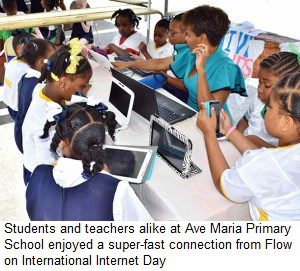
All we can do is learn from the past and change the future.

This quest has propelled the movement behind the book Go Lean…Caribbean – available to download for free. The book provides a 370-page turn-by-turn guide on “how” to adopt new community ethos, plus the strategies, tactics, implementations and advocacies so as to learn from Lessons in History then reform and transform the societal engines of Caribbean society for the future. In addition, there have been 31 previous blog-commentaries with the specific theme: Lessons in History; see the full list – to date – in the Appendix below.

The Go Lean book opened with this charter, to focus on the future (Page 3):

Our youth, the next generation, may not be inspired to participate in the future workings of their country; they may measure success only by their exodus from their Caribbean homeland.

We cannot ignore the past, as it defines who we are, but we do not wish to be shackled to the past either, for then, we miss the future. So we must learn from the past, our experiences and that of other states in similar situations, mount our feet solidly to the ground and then lean-in in, to reach for new heights; forward, upward and onward. This is what is advocated in this book: to Go Lean … Caribbean!

This Go Lean book serves as a roadmap for the introduction and implementation of the technocratic Caribbean Union Trade Federation (CU), for the elevation of Caribbean society – for all member-states. This CU/Go Lean roadmap has these 3 prime directives – all Future Focused:

  • Optimization of the economic engines in order to grow the regional economy to $800 Billion and create 2.2 million new jobs.
  • Establishment of a security apparatus to ensure public safety and protect the resultant economic engines.
  • Improve Caribbean governance to support these engines, including a separation-of-powers between the member-states and CU federal agencies.

This commentary introduces a series on the Caribbean Future; this is Part 1 of 5 on this subject. The full series is as follows:

  1. Future Focused – Personal Development and the Internet
  2. Future FocusedCollege, Caribbean Style 
  3. Future FocusedRadio is Dead
  4. Future FocusedPolicing the Police
  5. Future Focusede-Government Portal 101 – Available 11/15/2017

‘Focusing on the future’ mandates that the stewards of the Caribbean focus on our young people:

“I believe that children are the future; teach them well and let them lead the way” – See VIDEO in the Appendix below.

That is just a song; but this is life.

  • What is the hope for the Caribbean youth to be transformed in their development compared to past generations?
  • What transformations are transpiring in the region that shows willingness for the people and institutions to embrace the needed change?

In 2017, a focus on the future for young people must also consider “cyber reality” and/or the Internet. This consideration is embedded in the Go Lean roadmap. In fact, the book presents the good stewardship so that Internet & Communications Technologies (ICT) can be a great equalizing element for leveling the playing field in competition with the rest of the world.

See how these news articles (2) here have described certain ICT trends in the region, related to education and personal development:

Title #1: Flow and Ave Maria Mark World Internet Day
PRESS RELEASE: Castries, Saint Lucia, November 3rd, 2017 – On Wednesday November 1st 2017, the leading girls primary school in Saint Lucia celebrated International Internet Day with the nation’s and the Caribbean’s number one telecommunications service provider, Flow. Ave Maria Primary School hosted a number of activities for students, including encouraging them to come to school with internet-capable devices, which were powered with a free 100mMBps wireless internet connection.

The young ladies, guided by their teachers, were delighted to be able to do research online, including learning more about internet etiquette, online safety, the history, positives and negatives of the internet. Adriana Mitchel-Gideon, Flow’s product manager for broadband and TV, also met with Grade Six students to have an open and frank discussion about the internet, and to field their many questions.

The day has been celebrated worldwide on October 29th since 2005, to commemorate the first electronic message ever transferred from one computer to another, way back in 1969, in California, in the USA. International Internet Day is a reminder to all of us that this amazing invention started out with just two machines, long before we ever were able to login to trillions of websites put up by billions of users.

As part of its 2017 Christmas promotion, Flow is offering excellent kid-friendly deals on smartphones, TV and internet packages to delight any family.

Source: Posted November 3, 2017; retrieved November 8, 2017 from: https://stluciatimes.com/2017/11/03/flow-ave-maria-mark-world-internet-day 

———–

Title #2: Internet Week Guyana Advances Caribbean Technology Development Agenda
PRESS RELEASE: Around the world, the operations of cyber criminals far outstrip the sophistication of national legislative frameworks. Governments are facing constant pressure to assess global cyber threats and formulate appropriate local cyber security strategies.

Across the Caribbean, governments are building strategic partnerships with regional actors like the Caribbean Network Operators Group (CaribNOG) and the Caribbean Telecommunications Union (CTU). CaribNOG is the region’s largest volunteer-based community of network engineers, computer security experts and tech aficionados.

Recently, CaribNOG and the CTU were among the organisers of Internet Week Guyana, a five-day tech conference hosted by Guyana’s Ministry of Public Telecommunications, in collaboration with international bodies such as the Internet Society, the Internet Corporation for Assigned Names and Numbers (ICANN), the American Registry for Internet Numbers (ARIN), and the Latin America and Caribbean Internet Addresses Registry (LACNIC).

Catherine Hughes, Guyana’s first Minister of Public Telecommunications, said that the five-day event was part of the national agenda to build the country’s technology capacity in cybersecurity and other key areas.

“We encourage Caribbean governments to develop legislative agendas and increase intra-regional cooperation, in order to strengthen the region’s overall cyber security capability,” said Kevon Swift, Head of Strategic Relations and Integration at LACNIC.

“As law makers, governments play an important role in the regional response to cyber security challenges. But they cannot do their work alone,” said Bevil Wooding, Caribbean Outreach Manager at the American Registry for Internet Numbers (ARIN), and one of the founders of CaribNOG.

“The private sector, law enforcement, judiciary and civil society also have a responsibility to ensure that the region’s citizens and businesses are safer and more secure.”

Throughout the week, representatives from participating organisations also demonstrated practical ways in which stakeholders could work together to strengthen and secure Caribbean networks.

Stephen Lee, another CaribNOG founder, translated global cybersecurity issues into Caribbean priorities, outlining some of the challenges and opportunities of special relevance to the region.

Albert Daniels, Senior Manager for Stakeholder Engagement in the Caribbean at ICANN, outlined that organisation’s work in supporting secure network deployments around the world.

Shernon Osepa, Manager, Regional Affairs for Latin America and the Caribbean at the Internet Society, was on hand to formally launch the Internet Society Guyana Chapter, with Nancy Quiros, Manager of Chapter Development in Latin America and the Caribbean at the Internet Society, and Lance Hinds, Special Advisor to the Minister, who served as the chapter’s Interim President.

But it was a gathering of young people, hosted by the CTU on the conference’s closing day, that put the virtual exclamation mark on a highly impactful week. About 400 students from several secondary schools took part in the all-day agenda, which was packed with videos, interactive presentations and Q&A sessions, all designed to highlight the tangible dangers of unsafe online behaviour.

“The CTU continues to support the development of the Information and Communication Technologies (ICT) sector in the region including an emphasis on harnessing the potential of the youth. There’s a concerted effort to get the youth more involved in and make them aware of ICT issues which affect them, to cultivate a mindset of innovation and entrepreneurship, and to educate them on how to effectively use the power of technology that lies in their hands,” said Michelle Garcia, Communications Specialist at the CTU.

The day’s success was most evident in its aftermath. Even after the formal close, a tangible buzz lingered in the meeting room, with dozens of students staying back to introduce themselves to the expert panelists, many taking the opportunity to accost them with follow-up inquiries on the sidelines.

By all reports, this Internet Week will boost Guyana’s efforts to deliver on the promise locked up in that generation of future regional leaders. Now the real work must continue, in order to convert Caribbean potential into Caribbean reality.

Source: Posted October 17, 2017; retrieved November 8, 2017 from: https://stluciatimes.com/2017/10/17/internet-week-guyana-advances-caribbean-technology-development-agenda

The Go Lean book stresses that transforming Caribbean educational “engines” must be a regional pursuit. This was an early motivation for the roadmap, as pronounced in the opening Declaration of Interdependence (Pages 12 – 13):

xi. Whereas all men are entitled to the benefits of good governance in a free society, “new guards” must be enacted to dissuade the emergence of incompetence, corruption, nepotism and cronyism at the peril of the people’s best interest. The Federation must guarantee the executions of a social contract between government and the governed.

xxi. Whereas the preparation of our labor force can foster opportunities and dictate economic progress for current and future generations, the Federation must ensure that educational and job training opportunities are fully optimized for all residents of all member-states, with no partiality towards any gender or ethnic group. The Federation must recognize and facilitate excellence in many different fields of endeavor, including sciences, languages, arts, music and sports. This responsibility should be executed without incurring the risks of further human flight, as has been the past history.

xxiv. Whereas a free market economy can be induced and spurred for continuous progress, the Federation must install the controls to better manage aspects of the economy: jobs, inflation, savings rate, investments and other economic principles. Thereby attracting direct foreign investment because of the stability and vibrancy of our economy.

xxvi. Whereas the Caribbean region must have new jobs to empower the engines of the economy and create the income sources for prosperity, and encourage the next generation to forge their dreams right at home, the Federation must therefore foster the development of new industries … [and] invigorate the enterprises related to existing industries … impacting the region with more jobs.

xxvii. Whereas the region has endured a spectator status during the Industrial Revolution, we cannot stand on the sidelines of this new economy, the Information Revolution. Rather, the Federation must embrace all the tenets of Internet Communications Technology (ICT) to serve as an equalizing element in competition with the rest of the world. The Federation must bridge the digital divide and promote the community ethos that research/development is valuable and must be promoted and incentivized for adoption.

The Go Lean book presents the plan to deploy many e-Learning provisions so as to deliver on the ICT promise in educating our Caribbean youth. The book references the roles and responsibilities of e-Learning in many iterations; this shows the Future Focus of the Go Lean roadmap; see sample here:

  • 10 Ways to Foster Genius (Page 27)
    #2 – Starting Early – “HeadStart”
    One researcher that tried to provide a more complete view of intelligence is Psychologist Howard Gardner; his theory of Multiple Intelligences (MI), identified eight types of intelligence or abilities: musical – rhythmic, visual – spatial, verbal – linguistic, logical – mathematical, bodily – kinesthetic, interpersonal, intrapersonal and naturalistic. … Many parents and educators feel that these categories more accurately express the strengths of different children, for which the CU will implement HeadStart-like programs (academies, camps, e-Learning schemes and mentorships) to foster the early development of participants.
  • 10 Ways to Help Entrepreneurship (Page 28)
    #10 – e-Learning & Coaching – S.C.O.R.E.
    The CU advocates e-Learning schemes for tertiary (college), professional development and continuing education solutions. The CU will license/regulate these online programs at the regional level so as to certify and audit the practice. …
  • 10 Ways to Impact Research and Development (Page 30)
    #4 – STEM Education Facilitation
    The quest to excel in science, technology, engineering and mathematics will start at K-12 Magnate & charter schools. At the tertiary level, the CU will give grants, scholarships & loans (forgive-able), especially focusing on e-learning schemes.
  • 10 Ways to Close the Digital Divide (Page 31)
    #2 –
    Libraries & e-Learning
    The CU will facilitate the construction and refurbishing of community libraries, with the emphasis on delivering computer access. The CU’s Millennium Library (see Appendix OA on Page 293) design features a good quantity of computer workstations, conference rooms, video conferencing, and e-Whiteboards. These tools are required for e-Learning facilitations. So citizens can enroll in online classes even if they do not have computer access, as the libraries will fill the void.
  • 10 Tactics to Forge an $800 Billion Economy (Page 70)
    #10 – Education
    Basic economic principles, identified as early as with Adam Smith’s Wealth of Nation landmark literary publication [in 1776], dictate that every year of education raises a country’s GDP by a measurable amount. For the Caribbean, the benefits have been elusive in the past because of the unfortunate pattern of a brain drain, with students matriculating abroad and never returning – all of the investment but none of the return. – See Appendix C2 on Page 258.
    The CU’s new leanings of e-Learning will fulfill the education investment objectives without the risk of a brain drain. The end result: the educated work place will impact near-mid-long term benefits for the CU region, estimated in the 3% range for annual growth.
  • 10 Reasons to Repatriate to the Caribbean (Page 118)
    #9 – Educational Inducements in the Region
    The CU will facilitate e-Learning schemes for institutions in the US, Canada and the EU. The repatriates will have an array of educational choices for themselves and their offspring (legacies). This will counter the previous bad experience of students emigrating for advanced educational opportunities and then never returning, resulting in a brain drain.
  • 10 Ways to Create Jobs (Page 152)
    #6 – Steer More People to S.T.E.M. Education and Careers
    Education does not have to be matriculated abroad, as e-learning industries abound, lessening brain drain, online classes emerge for even the highest degrees. Standards, certifications & accreditations would dictate public-private investment in start-up ventures for educating science (including health & medical), technology, engineering and mathematics fields.
  • 10 Ways to Improve Education (Page 159)
    #2 – Promote Industries for e-Learning
    For 50 years the Caribbean has tolerated studying abroad; unfortunately many students never returned home. The CU’s focus will now be on facilitating learning without leaving. There have emerged many successful models for remote learning use electronic delivery or ICT. The CU will foster online/home school programs, for secondary education, to be licensed at the CU level so as to sanction, certify, and oversee the practice, especially for rural areas/islands. At the tertiary level, the CU will sponsor College Fairs for domestic and foreign colleges that deliver online education options.

The future – of electronic learning systems – is now! The technology is ready and the Caribbean youth is ready. We only need to deploy the delivery models to allow our students to matriculate online. See the profile of this American company that is currently available in many communities in the US:

http://www.k12.com/

We can do this ourselves … here and now.  We can use the internet to foster personal development for students, young and old. The foregoing news article related this quotation from the Caribbean Telecommunications Union (CTU):

“The CTU continues to support the development of the Information and Communication Technologies (ICT) sector in the region including an emphasis on harnessing the potential of the youth. There’s a concerted effort to get the youth more involved in and make them aware of ICT issues which affect them, to cultivate a mindset of innovation and entrepreneurship, and to educate them on how to effectively use the power of technology that lies in their hands,” said Michelle Garcia, Communications Specialist at the CTU.

This is the kind of Future Focused  effort that is needed to reform and transform Caribbean society. This is not easy – heavy-lifting – but it is necessary to make our homelands better places to live, work, learn and play. 🙂

Download the free e-Book of Go Lean … Caribbean – now!

Sign the petition to lean-in for this roadmap for the Caribbean Union Trade Federation.

———–

Appendix VIDEO – The Greatest Love Of All (lyrics) – Whitney Houston, A Tribute – https://youtu.be/hRX4ip6PVoo

TheMusic1022

Published on Feb 15, 2012

Whitney Elizabeth Houston (August 9, 1963 — February 11, 2012) was an American recording artist, actress, producer, and model. In 2009, the Guinness World Records cited her as the most-awarded female act of all time. Her awards include two Emmy Awards, six Grammy Awards, 30 Billboard Music Awards, and 22 American Music Awards, among a total of 415 career awards in her lifetime. Houston was also one of the world’s best-selling music artists, having sold over 170 million albums, singles and videos worldwide. … RIP Whitney, you and your wonderful music will always be in our hearts.

———–

Appendix – Lessons from History / Previous Blog-Commentaries

https://goleancaribbean.com/blog/?p=13420 A Lesson in History – Whaling Expeditions
https://goleancaribbean.com/blog/?p=12726 A Lesson in History – Colorado Black Ghost Towns
https://goleancaribbean.com/blog/?p=12722 A Lesson in History – ‘How the West Was Won’
https://goleancaribbean.com/blog/?p=12380 A Lesson in History – ‘4th of July’ and Slavery
https://goleancaribbean.com/blog/?p=10494 A Lesson in History – Ending the Military Draft
https://goleancaribbean.com/blog/?p=10336 A Lesson in History – Haiti’s Reasonable Doubt
https://goleancaribbean.com/blog/?p=9974 A Lesson in History – Pearl Harbor Realities
https://goleancaribbean.com/blog/?p=8767 A Lesson in History – Haiti 1804
https://goleancaribbean.com/blog/?p=7738 A Lesson in History – Buffalo Soldiers
https://goleancaribbean.com/blog/?p=7490 A Lesson in the History of Interpersonal Violence – Domestic
https://goleancaribbean.com/blog/?p=7485 A Lesson in the History of Interpersonal Violence – Street Crimes
https://goleancaribbean.com/blog/?p=7462 A Lesson in the History of Interpersonal Violence – Duels
https://goleancaribbean.com/blog/?p=6722 A Lesson in History – After the Civil War
https://goleancaribbean.com/blog/?p=6720 A Lesson in History – During the Civil War
https://goleancaribbean.com/blog/?p=6718 A Lesson in History – Before the Civil War
https://goleancaribbean.com/blog/?p=6531 A Lesson in History – Book Review of the ‘Exigency of 2008’
https://goleancaribbean.com/blog/?p=6189 A Lesson in History – ‘Katrina’ is Helping Today’s Crises
https://goleancaribbean.com/blog/?p=5183 A Lesson in History – Cinco De Mayo
https://goleancaribbean.com/blog/?p=5123 A Lesson in History – Royal Charter: Zimbabwe –vs- South Africa
https://goleancaribbean.com/blog/?p=5055 A Lesson in History – Royal Charter: Empowering Families
https://goleancaribbean.com/blog/?p=4971 A Lesson in History – Royal Charter: Truth & Consequence
https://goleancaribbean.com/blog/?p=4935 A Lesson in History – The ‘Grand Old Party’
https://goleancaribbean.com/blog/?p=4720 A Lesson in History – SARS in Hong Kong
https://goleancaribbean.com/blog/?p=4166 A Lesson in History – Panamanian Balboa
https://goleancaribbean.com/blog/?p=2809 A Lesson in History – Economics of East Berlin
https://goleancaribbean.com/blog/?p=2670 A Lesson in History – Rockefeller’s Pipeline
https://goleancaribbean.com/blog/?p=2585 A Lesson in History – Concorde SST
https://goleancaribbean.com/blog/?p=2480 A Lesson in History – Community Ethos of WW II
https://goleancaribbean.com/blog/?p=2297 A Lesson in History – Booker T –vs- Du Bois
https://goleancaribbean.com/blog/?p=1531 A Lesson in History – 100 Years Ago Today: World War I
https://goleancaribbean.com/blog/?p=789 A Lesson in History – America’s War on the Caribbean
Share this post:
, , ,
[Top]