Tag: Green Energy

After Irma, the Science of ‘Power Restoration’

Go Lean Commentary

The problem with hurricanes – and there are many – is that it takes a long time for the storm preparation and response (relief, recovery and rebuilding). On average, the storm’s preparation takes 3 days; this includes provisioning, installing protective shutters, hoarding water and gasoline. The response on the other hand can take days, weeks, months and dread-to-say, years.

The most uncomfortable part of the storm response is undeniable waiting for electrical power to be restored.

CU Blog - After Irma, the Science of Power Restoration - Photo 2

In general, the good-bad-ugly scale of memories of previous storms tend to be tied to the length of time it took for power to be restored. The peak of the hurricane season is the very hot months of August/September; there is the need for air-conditioning.

The Caribbean is in crisis now; our region has just been devastated by Hurricane Irma; it has wreaked catastrophic havoc in certain destinations: Barbuda, Saint BarthélemySaint MartinAnguilla, Puerto Rico, the Virgin Islands and Florida. Consider the encyclopedic details in Appendix A below and these questions:

  • How long did/will it take for power to be restored now after Hurricane Irma?
  • How can we reform and transform our Caribbean communities to ensure the efficiency of ‘Power Restoration’?

There is an art and science to the subject of ‘Power Restoration’; actually mostly science. The ‘art’ applies to the efficient deliveries of the management of the restoration process. The science considerations are extensive, starting with the entire eco-system of energy deliveries. As related in a previous blog-commentary

… no one doubts that the inventory of basic needs include “food, clothing and shelter”. But modernity has forced us to add another entry: “energy”. In fact, the availability and affordability of energy can impact the deliveries of these order basic needs.

… In our region, energy costs are among the highest in the world. The book Go Lean… Caribbean relates (Page 100) how the Caribbean has among the most expensive energy costs in the world, despite having abundant alternative energy natural resources (solar, wind, tidal, geo-thermal). The Caribbean eco-system focuses on imported petroleum to provide energy options and as a result retail electricity rates in the Caribbean average US$0.35/kWh, when instead it could be down to US$0.088/kWh. …

With such a 75% savings … there is definitely the need to adapt some of the scientific best practices for energy generation and consumption. In a previous blog-commentary, it was confessed that one of the reasons why people flee the Caribbean region, is the discomforts during the summer months … hot weather, and the lack of infrastructure to mitigate and remediate the discomfort, is identified as one of the reasons for the brain drain/societal abandonment.

One motivation of the movement behind the book Go Lean… Caribbean – available to download for free – is to facilitate a turn-around of economic, security and governing engines of the Caribbean region to do better with power generation, distribution and consumption. The Go Lean book serves as a roadmap for the introduction and implementation of the technocratic Caribbean Union Trade Federation (CU). This Go Lean roadmap has 3 prime directives:

This commentary continues the 4-part series – this is 3 of 4 – on the Aftermath of Hurricane Irma. There are a lot of mitigation and remediation efforts that can be done to lessen the impact of this and future storms. There are lessons that we must consider; there are reforms we must make; there are problems we must solve. The full list of the 4 entries of this series are detailed as follows:

  1. Aftermath of Hurricane Irma – America Should Scrap the ‘Jones Act’
  2. Aftermath of Hurricane Irma – Barbuda Becomes a ‘Ghost Town’
  3. Aftermath of Hurricane Irma – The Science of Power Restoration
  4. Aftermath of Hurricane Irma – Failed State Indicators: Destruction and Defection

Despite the manifested threats of Climate Change-fueled hurricanes, we want to make the Caribbean homeland a better place to live, work and play. This is going to take some heavy-lifting to accomplish, but we can be successful. Yes, we can. This quest is detailed early on in the Go Lean book’s Declaration of Interdependence, as follows (Page 11 – 13):

i. Whereas the earth’s climate has undeniably changed resulting in more severe tropical weather storms, it is necessary to prepare to insure the safety and security of life, property and systems of commerce in our geographical region. As nature recognizes no borders in the target of its destruction, we also must set aside border considerations in the preparation and response to these weather challenges.

xi. Whereas all men are entitled to the benefits of good governance in a free society, “new guards” must be enacted to dissuade the emergence of incompetence, corruption, nepotism and cronyism at the peril of the people’s best interest. The Federation must guarantee the executions of a social contract between government and the governed.

xvi. Whereas security of our homeland is inextricably linked to prosperity of the homeland, the economic and security interest of the region needs to be aligned under the same governance. Since economic crimes … can imperil the functioning of the wheels of commerce for all the citizenry, the accedence of this Federation must equip the security apparatus with the tools and techniques for predictive and proactive interdictions.

xix. Whereas our legacy in recent times is one of societal abandonment, it is imperative that incentives and encouragement be put in place to first dissuade the human flight, and then entice and welcome the return of our Diaspora back to our shores. This repatriation should be effected with the appropriate guards so as not to imperil the lives and securities of the repatriated citizens or the communities they inhabit. The right of repatriation is to be extended to any natural born citizens despite any previous naturalization to foreign sovereignties.

The Go Lean book asserts that Caribbean stakeholders must find a Way Forward; they must institute better systems, processes and utilities to deliver electrical power (energy) despite the reality of hurricanes. Though power will go off – electricity and water is a bad combination – ‘Power Restoration’ must be a priority. Therefore Caribbean communities must adopt different community ethos, plus execute key – and different – strategies, tactics, implementations and advocacies to reform and transform.

This Way Forward must therefore fulfill these 2 requirements:

  • Flood Management and Control
    CU Blog - After Irma, the Science of Power Restoration - Photo 3
    According to a previous blog-commentary: “there is a thesis that flooding could be prevented. Yes, indeed! This is the experience and historicity of the Dutch people, the European country of the Netherlands or Holland.”
    Even in the low-lying American city of New Orleans, Louisiana there is the practice of pumping out excess water to mitigate and remediate flooding; see this depicted in the VIDEO in Appendix B below.
  • Implementation of a Caribbean Regional Power Grid
    CU Blog - After Irma, the Science of Power Restoration - Photo 1
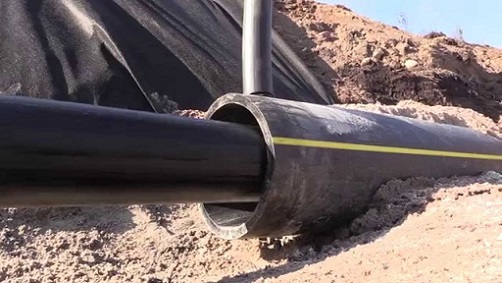
    Power distribution is important for any mitigation-remediation plan. The problem with hurricane toppling trees and power lines is unavoidable – it is what it is – a better solution is to deliver electricity underground or underwater, as illustrated in the above photo. The Go Lean roadmap calls for an extensive smart Power Grid and a region-wide Utility Cooperative. This would allow for alternate power generation and electrical distribution. See sample of an underground/underwater “Power Cable” product depicted in the VIDEO in Appendix C below.
Many other communities have done a good job of optimizing their electrical utility grid. They execute strategies, tactics and implementations to mitigate the risk of power outages; then remediate any crises with technocratic deliveries to facilitate ‘Power Restoration’.

Go Green 1

There will be heavy-lifting for our Caribbean region to have this disposition. The Go Lean roadmap details that heavy-lift, describing the community ethos, strategies, tactics, implementations and advocacies to foster progress for Caribbean energy distribution, our own Regional Power Grid. The following list of entries in the Go Lean book highlights this theme:

Community Ethos – Lean Operations Page 24
Community Ethos – Return on Investments Page 24
Community Ethos – Cooperatives Page 25
Community Ethos – Ways to Impact the Future Page 26
Community Ethos – Ways to Improve Negotiations Page 32
Anecdote – Pipeline Transport – Strategies, Tactics & Implementations Page 43
Strategy – Harness the power of the sun/winds Page 46
Tactical – Fostering a Technocracy Page 82
Tactical – Separation of Powers – Energy Commission Page 82
Anecdote – “Lean” in Government – Energy Permits Page 93
Implementation – Regional Grid as Economies-of-Scale benefit Page 97
Anecdote – Caribbean Energy Grid Implementation Page 100
Implementation – Start-up Benefits from the EEZ Page 104
Implementation – Ways to Develop Pipeline Industry Page 107
Implementation – Ways to Improve Energy Usage Page 113
Advocacy – Ways to Impact Public Works Page 175
Advocacy – Ways to Foster Cooperatives Page 176
Advocacy – Ways to Impact Monopolies Page 202
Appendix – Underwater High Intensity Power Lines Page 282

The experience of enduring hurricanes is never pleasant. As such, we do not invite people to fly down from northern locations to pass storms with us. In fact, when there is a Hurricane Watch, the practice is to evacuate tourists and visitors. We evacuate our high-risk residents as well; (kidney dialysis patients, senior citizens, anyone that cannot endure the loss of electronic-based health instruments). This is a best-practice.

Why do we only evacuate just a limited group from the islands?

We assume that everyone else can endure.

Hah, lol …

But actually, with such high post-hurricane abandonment rates, as reported previously, it is obvious that everyone loses patience. So any improvement in the ‘Power Restoration’ experience would be a win-win; it would improve our communities’ endurance and make our Caribbean homeland better places to live, work and play. 🙂

Download the free e-Book of Go Lean … Caribbean – now!

Sign the petition to lean-in for this roadmap for the Caribbean Union Trade Federation.

———–

Appendix A – Hurricane Irma Devastation

  • In Barbuda, Hurricane Irma caused catastrophic damage on the island; it damaged or destroyed 95% of the island’s buildings and infrastructure, leaving Barbuda “barely habitable” according to Prime Minister Gaston Browne. Everyone on the island was evacuated to Antigua, leaving Barbuda uninhabited for the first time in modern history.[3]
  • In St. Martin, on 6 and 7 September 2017 the island was hit by Hurricane Irma (Category 5 at landfall), which caused widespread and significant damage to buildings and infrastructure. A total of 11 deaths had been reported as of 8 September 2017.[12][13] France’s Minister of the InteriorGérard Collomb, said on 8 September 2017 that most of the schools were destroyed on the French half of the island. In addition to damage caused by high winds, there were reports of serious flood damage to businesses in the village of Marigot. Looting was also a serious problem. Both France and the Netherlands sent aid as well as additional police and emergency personnel to the island.[14][15][16] The Washington Post reported that 95% of the structures on the French side and 75% of the structures on the Dutch side were damaged or destroyed.[17][18] Some days after the storm had abated, a survey by the Dutch Red Cross estimated that nearly a third of the buildings in Sint Maarten had been destroyed and that over 90 percent of structures on the island had been damaged.[19] Princess Juliana Airport was extensively damaged but reopened on a partial basis in two days to allow incoming relief flights and for flights that would take evacuees to other islands.[20]
  • In Anguila, the eye of the storm pass over it on September 6. Many homes and schools were destroyed, and the island’s only hospital was badly damaged.[163] The devastation was particularly severe in East End, where the winds uprooted scores of trees and power poles and demolished a number of houses. … One death was reported on the island.[163] According to [sources], Anguilla’s economy could suffer at least $190 million in losses from the hurricane.[129]
  • Puerto Rico avoided a direct hit by the Category 5 Hurricane Irma on September 8, 2017, but high winds caused a loss of electrical power to some one million residents. Almost 50% of hospitals were operating with power provided by generators.[133]
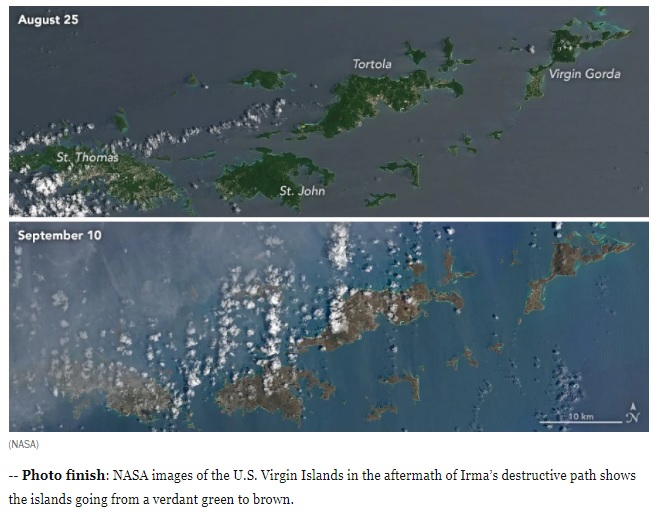
  • Damage in the British Virgin Islands was extensive. Numerous buildings and roads were destroyed on the island of Tortola, which bore the brunt of the hurricane’s core.[172] Irma’s effects in the U.S. Virgin Islands were most profound on Saint Thomas. Due to its normal reliance on electricity from Saint Thomas, the island [of St. John] was left without power.
  • In the Florida Keys, the hurricane caused major damage to buildings, trailer parks, boats, roads, the electricity supply, mobile phone coverage, internet access, sanitation, the water supply and the fuel supply. … As of 6:41 p.m. EDT on September 10 over 2.6 million homes in Florida were without power.[232]
CU Blog - After Irma, Barbuda Becomes a 'Ghost Town' - Photo 2

———–

Appendix B VIDEO – Here’s how the pumps in New Orleans move water out during heavy rainfall – https://youtu.be/hZvGVUZi9FU

Published on Mar 30, 2017 – WDSU News: Pumps Work During Thursday’s Flooding

———–

Appendix C VIDEO – ABB launches world´s most powerful extruded HVDC cable system –

Published on Aug 21, 2014

ABB Power Grids

525 kV voltage (previous highest installed 320 kV) sets world record more than doubling power flow to 2600 MW (from 1000 MW) and extending range to 1500 km for more cost effective, efficient and reliable underground and subsea transmission while keeping losses to below 5 percent. Major breakthrough for applications like underground HVDC transmission, sub-sea interconnections, offshore wind integration etc. More information: http://new.abb.com/systems/high-volta…


Share this post:
, ,

Disaster Preparation: ‘Rinse and Repeat’

Go Lean Commentary

The reality of Caribbean life: we must contend with natural disasters, not of our making, “again and again”. The situation can be described as “Rinse and Repeat“.

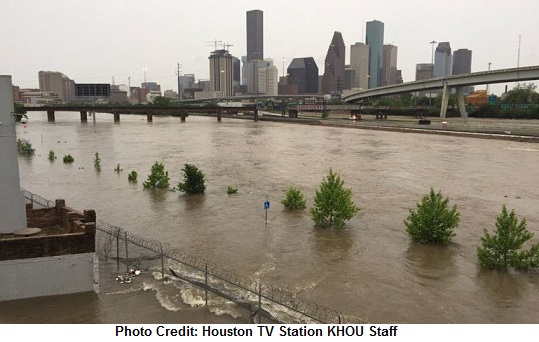
Climate Change is not of our making, but it is our problem. Truth be told, it is not just our problem alone; the whole planet is affected. Right now this moment, the Greater Metropolitan area of Houston, Texas USA is suffering “pangs of distress”; see the VIDEO in the Appendix below. CU Blog - Disaster Preparation - Rinse and Repeat - Photo 1

It is what it is!

Some communities have done a better job than others in preparing for the unavoidable:

“Some communities”? “Better job“? That is not us … in the Caribbean!

As related in a previous Go Lean commentary, our Caribbean region has failed … in our managing this Agent-of-Change:

… we do not have the luxury of “sticking our head in the sand” and pretending that these problems will simply go away. The region has been devastated with this dysfunction and mis-management. Some 70% of Caribbean college-educated citizens have already fled their homelands in an undisputed brain drain. It’s time now to manage change differently than the Caribbean has done as of late. It’s time now to “Go Lean”.

The book Go Lean…Caribbean – available to download for free – serves as a roadmap for the introduction and implementation of the technocratic Caribbean Union Trade Federation (CU), for the elevation of Caribbean society – for all member-states. This CU/Go Lean roadmap has these 3 prime directives for us to do a better job:

  • Optimization of the economic engines in order to grow the regional economy to $800 Billion and create 2.2 million new jobs. This includes an efficient Emergency Management apparatus to ensure business continuity.
  • Establishment of a security apparatus to ensure public safety and protect the resultant economic engines.
  • Improve Caribbean governance to support these engines, including a separation-of-powers between the member-states and CU federal agencies. We can “move” member-state governments simply through funding, rankings and ratings.

The book stresses that reforming and transforming the Caribbean societal engines must be a regional pursuit. This was an early motivation for the roadmap, as pronounced in the opening Declaration of Interdependence (Pages 12 – 13):

i. Whereas the earth’s climate has undeniably changed resulting in more severe tropical weather storms, it is necessary to prepare to insure the safety and security of life, property and systems of commerce in our geographical region. As nature recognizes no borders in the target of its destruction, we also must set aside border considerations in the preparation and response to these weather challenges.

xi. Whereas all men are entitled to the benefits of good governance in a free society, “new guards” must be enacted to dissuade the emergence of incompetence, corruption, nepotism and cronyism at the peril of the people’s best interest. The Federation must guarantee the executions of a social contract between government and the governed.

xvi. Whereas security of our homeland is inextricably linked to prosperity of the homeland, the economic and security interest of the region needs to be aligned under the same governance. Since economic crimes … can imperil the functioning of the wheels of commerce for all the citizenry, the accedence of this Federation must equip the security apparatus with the tools and techniques for predictive and proactive interdictions.

xxiv. Whereas a free market economy can be induced and spurred for continuous progress, the Federation must install the controls to better manage aspects of the economy: jobs, inflation, savings rate, investments and other economic principles. Thereby attracting direct foreign investment because of the stability and vibrancy of our economy.

The Go Lean book provides 370-pages of turn-by-turn instructions on “how” to adopt new community ethos, plus the strategies, tactics, implementations and advocacies to execute so as to reboot, reform and transform the societal engines of Caribbean society, for better preparation for natural disasters. Consider the Chapter excerpts and headlines here from this sample on Page 184 entitled:

10 Ways to Improve for Natural Disasters

1

Emergence of the Caribbean Union
Lean-in for the Caribbean Single Market & Economy initiative as the Caribbean Union Trade Federation. This allows for the unification of the 30 member-states into one market, thereby spreading the risk and premium base across a market of 42 million people. The Caribbean member-states have Hurricane Katrina styled disasters (relatively speaking) every year.

2

Caribbean Emergency Management Agency – Federal Disaster Declarations
Modeled after FEMA in the US, this agency will be charged with the preparation, response and reconstruction for the regions for the eventual manifestations of hurricanes, earthquakes, tsunamis, flooding and other declared disasters, natural and man-made like medical epidemic, drought, pollution, oil spills, terrorism, etc.

3

Support Services for First Responders
Training, licensing and standards for Emergency Managers, Paramedics, Firefighters, Search and Rescue resources. For major disasters, some of these resources will come from international origins; they will need the support services (language translation, guides, maps, etc.) and coordination to maximize their results.

4

Animal Partner Training and Development
Maintain plantations for the training, development and boarding of “search & rescue” dogs, cadavers dogs and other service animals (horses, mules, pigs, etc.) so that there will be local resources within the region. (We cannot always depend on international responses in light of other regions experiencing their own disasters). These animals need not be owned by any one member-state, they can be on loan from CU resources.

5

Siren Warnings & Notifications
The CU will install tornado-style alarms/sirens in all major municipalities. In addition, the CU will implement tsunami warning messaging (emails/text) in coastal areas & seismic meters throughout the region in the affected “fault-line” areas.

6

Airlift & Sealift Authorizations
The CU Emergency Management Agency can license, regulate and authorize (air & sea) vessels and vehicles for emergency deployment in a disaster zone, before during and after the disastrous event.

7

JUA-style Insurance Fund
The fiduciary management of premiums and claims to allow the immediate response for reconstruction after disasters. These financial services, sidecars traded in markets can be direct or indirect as in reinsurance or insurer-of-last-resort.

8

Economic Crime Enforcement During and After Disasters
The CU will police, investigate and prosecute price gouging, insurance red lining and other economic crimes of both the “white collar” and “blue collar” variety. Once a CU-member-state declares a Disaster Emergency, new rules (quasi-Marshall Law) goes into effect. The CU will review and prosecute the actions of civilians and institutions alike.

9

Disaster Declaration Loans
Once there’s a Federal Disaster Declaration, the CU will make funds available for low-interest loans for communities to fund reconstructions. With tourism as a major “cash crop” the goal will be to restore the locality as a tourist destination as soon as possible, as even the perception of prolonged disaster damage can affect future bookings and travel plans.

10

Building Codes and Standards
Through peer review, the CU will regionalize the standards of building codes to assuage the threat of hurricanes and earthquakes, ensuring a higher survivability rate in the Caribbean islands. Due to economic pressures, when buildings and homes cannot be retrofitted, they will be rated for evacuation during hurricane warnings, or earthquake after-shocks.

The Caribbean must foster a better disaster preparation and response apparatus. We must do it now! Lives are at stake.

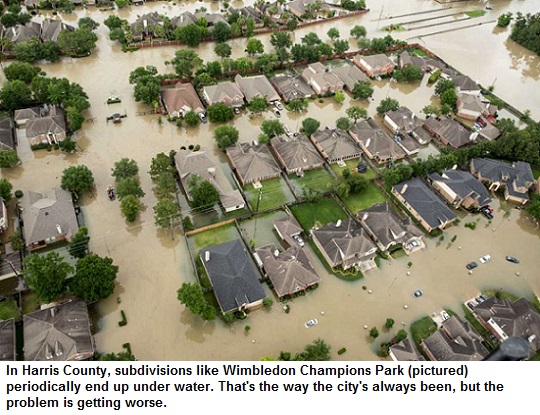
Just look at our American neighbors – they are suffering right now in the Greater Metropolitan area of Houston, Texas.

CU Blog - Hurricane Flooding - Who Knew - Photo 1b

While Climate Change is the underlying Agent-of-Change, it is outside of our control. This does not imply that there is no remediation for Climate Change; there is. In fact …

Fix ‘Climate Change’ – Yes, We Can

CU Blog - Disaster Preparation - Rinse and Repeat - Photo 2

We do not have the resources (time, talent and treasuries) to fix Climate Change for the planet ourselves, but we can fix it in our Caribbean region. This is a “Lesson in History” that our community has learned … from back in 1863:

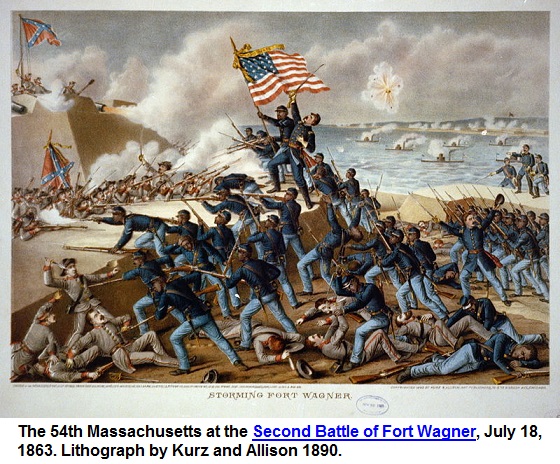
There is an important lesson to learn in considering the history of the American Civil War. The war was fought over the issue of slavery. This was an ugly institution for those condemned as slaves. In the United States, that ugly disposition extended beyond the slaves themselves to the entire Black race. Though individuals could be set free, laws in the country could push them back into slavery without any due process. This was the case with the “Fugitive Slave Act of 1850″. Any Black person could be detained as a runaway slave and returned to any alleged Slave Master in the South; no matter any proof or the truth, or lack there-of. In many jurisdictions, a Black man could not even testify against white people. (This was the basis for the autobiographical book – by Solomon Northup – and movie “12 Years A Slave”).

To be Black in the America of those days, one “could not win, could not break-even and could not get out of the game”. There was no neutral destination in America. The optimal option was the only option, to work towards the end of slavery.

For this reason many Blacks joined the war effort, at great sacrifice to themselves and their community. This was a matter of principle! There is an important lesson for the Caribbean from this history[1] :

    The 54th Regiment Massachusetts Volunteer Infantry was an infantry regiment that saw extensive service in the Union Army during the American Civil War. The regiment was one of the first official African-American units in the United States during the Civil War.

CU Blog - A Lesson in History - During the Civil War - Principle not Principal - Photo 1

Remediating and mitigating Climate Change will be a battle. We need our own “Voluntary Infantry“ in this fight.

“We have a dog in this fight” – English language slang.

In the Caribbean, we must confederate and implement the institutions to work to remediate and mitigate Climate Change. We must “join in this fight”; we must Go Green and we must Go Blue. We have to be prepared for natural disasters – they will come … assuredly every season, some Caribbean destination will be impacted. We must be prepared to:

Rinse and Repeat.

If we are ready, to quickly respond, offer relief and rebuild – so as to guarantee the business continuity – we would then do a better job in our quest to make our homeland a better place to live, work and play. 🙂

Download the free e-Book of Go Lean … Caribbean – now!

Sign the petition to lean-in for this roadmap for the Caribbean Union Trade Federation.

———–

Appendix VIDEO – Historic flooding inundates Texas, hampering rescue efforts – https://youtu.be/Da-VS39gdfQ

PBS NewsHour

Published on Aug 27, 2017 – Houston’s mayor on Sunday urged his constituents in the nation’s fourth-largest city to stay off roadways as the state of Texas continues to contend with unprecedented flooding from Hurricane Harvey, now classified as a tropical storm. Officials said rising waters would reach catastrophic proportions, with more than 2,500 emergency calls made overnight in Houston alone. Hari Sreenivasan has more.

Share this post:
, , , ,
[Top]

Hurricane Flooding – ‘Who Knew?’

Go Lean Commentary

“Just keep living” – Old Wives’ Tale by “my late Mother-in-law”

Those 3 words reflected the wisdom of an 80 year-old woman. It simply meant:

If you do not see the logic, common sense or best-practice of some advice, just keep living and life will eventually convince you.

This sage advice is presented in contrast to the new President of the United States, Donald J. Trump, who in the first 100 days of his administration encountered a failure with trying to introduce new Health Care legislation. His response was:

Who knew “Health Care” was so complicated. – CNN

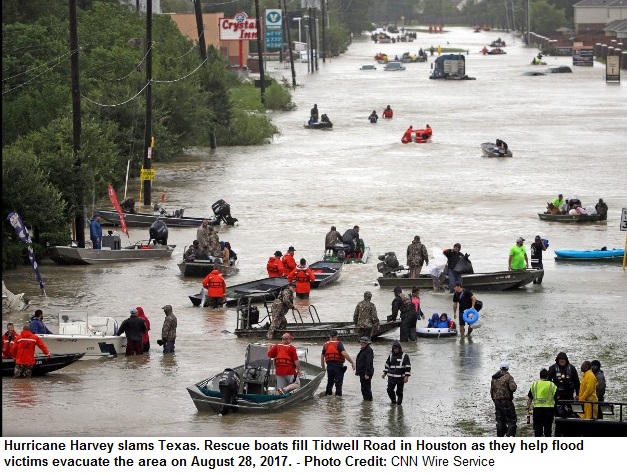
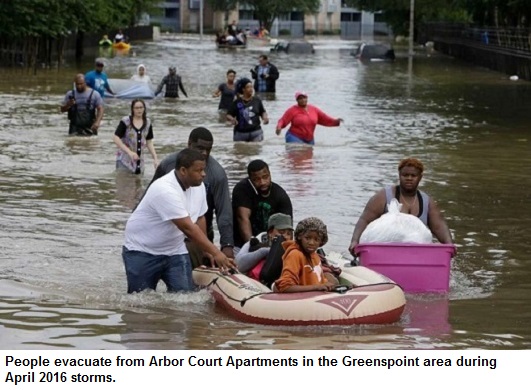
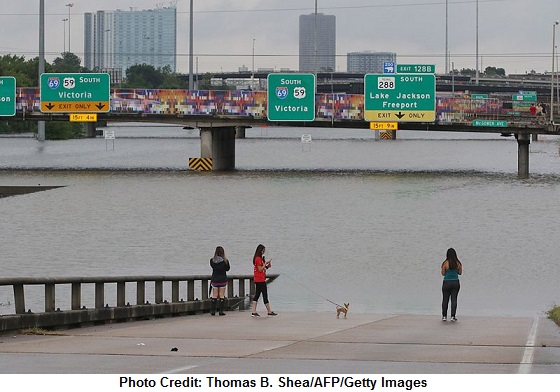
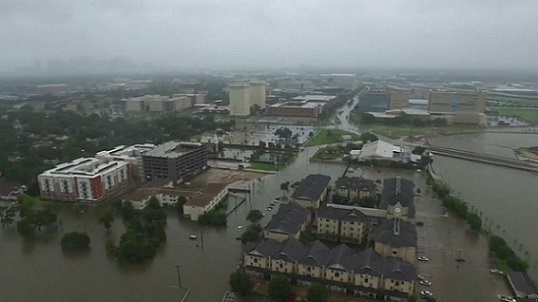
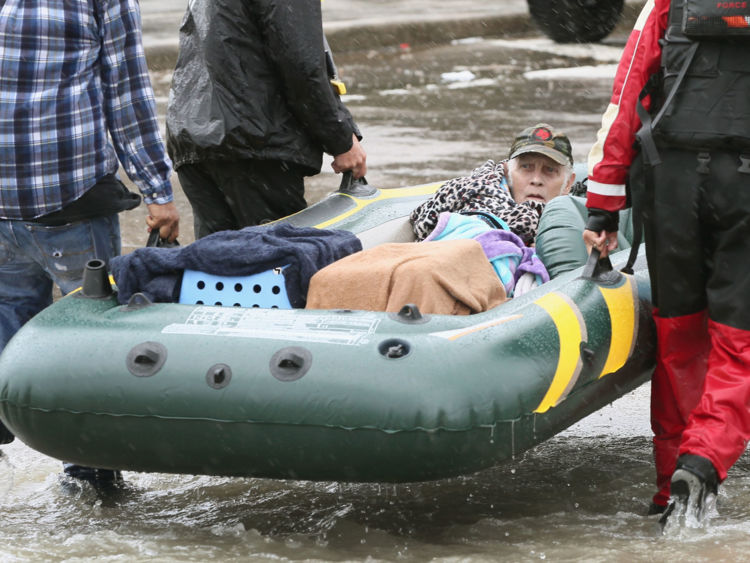
This is not a commentary about Health Care, but rather Hurricane Flooding preparation, response and mitigation. Once again, the American President has proven that he has not learned that wisdom exhibited by my now-deceased Mother-in-Law. On this occasion of a Category 4 storm – see photos and VIDEO’s of Hurricane Harvey in the Appendix below – drowning Southeast Texas with volumes and volumes of water (surge, rain and river flooding) – he exclaimed that this flooding was “unexpected”:

He told rescue organizers: “This was of epic proportion, nobody has ever seen anything like this.” – Sky News 29AUG17 19:23 GMT

CU Blog - Hurricane Flooding - Who Knew - Photo 1b

With all due respect Mr. President, it is the same with “Hurricane Flooding” as it was with Health Care:

Who Knew? Everybody – paying attention – knew!

Yes, this is “throwing shade” at President Trump, but this is a fair judgement as he made a cardinal mistake when assessing the seriousness of hurricanes and tropical storms; he is a Climate Change denier. This commentary previously related how this President declared – on June 1: the start of Hurricane Season – that he is withdrawing the US from the one international effort designed to abate Climate Change: the Paris Accord. That blog-commentary warned:

This is a matter of security; perhaps we [(Caribbean)] should not look to the US to take the lead for our own fate. This is so familiar … and a Hot Topic today as European member-states are contemplating how much they can look to the US for leadership for their security needs.

This was the assertion of the book Go Lean…Caribbean; available to download for free. It serves as a roadmap for the introduction and implementation of the technocratic Caribbean Union Trade Federation (CU), for the elevation of Caribbean society – for all member-states. The quest is that the Caribbean region convenes, collaborates and confederates to take their own lead – collectively – for their own fate. This CU/Go Lean roadmap has these 3 prime directives:

The book stresses that American self-interest is not necessarily the Caribbean’s best interest, even though there are two American territories (Puerto Rico & the Virgin Islands) in the Caribbean region. No, we must reform and transform our societal engines on our own. But this charter is too big for any one Caribbean member-state alone; there must be a regional effort. This was an early motivation for the roadmap, as pronounced in the opening Declaration of Interdependence(Pages 12 – 13):

i. Whereas the earth’s climate has undeniably changed resulting in more severe tropical weather storms, it is necessary to prepare to insure the safety and security of life, property and systems of commerce in our geographical region. As nature recognizes no borders in the target of its destruction, we also must set aside border considerations in the preparation and response to these weather challenges.

xi. Whereas all men are entitled to the benefits of good governance in a free society, “new guards” must be enacted to dissuade the emergence of incompetence, corruption, nepotism and cronyism at the peril of the people’s best interest. The Federation must guarantee the executions of a social contract between government and the governed.

xvi. Whereas security of our homeland is inextricably linked to prosperity of the homeland, the economic and security interest of the region needs to be aligned under the same governance. Since economic crimes … can imperil the functioning of the wheels of commerce for all the citizenry, the accedence of this Federation must equip the security apparatus with the tools and techniques for predictive and proactive interdictions.

xxiv. Whereas a free market economy can be induced and spurred for continuous progress, the Federation must install the controls to better manage aspects of the economy: jobs, inflation, savings rate, investments and other economic principles. Thereby attracting direct foreign investment because of the stability and vibrancy of our economy.

The Go Lean book provides 370-pages of turn-by-turn instructions on “how” to adopt new community ethos, plus the strategies, tactics, implementations and advocacies to execute so as to reboot, reform and transform the societal engines of Caribbean society; to better respond, relieve and rebuild from devastating hurricanes in all the 30 member-states in the region.

That previous blog-commentary declared:

The issue of Hurricane Season 2017 is bigger than initial appearances – there are BIG  issues afoot. …

The Caribbean status quo is unsustainable under the real threats of Climate Change. The region must reboot, reform and transform. We must do the heavy-lifting ourselves; we cannot expect relief and refuge from others, like the American Super-Power. We must find and “sail” under our own power.

The Go Lean book – and this commentary – calls on the region to master the art and science of water management.

We are saddened by all the death and destruction in Houston today; see Appendix. (Flooding is familiar in Houston, though more disastrous as of late). But believe it or not, there is a thesis that flooding could be prevented. Yes, indeed! This is the experience and historicity of the Dutch people, the European country of the Netherlands or Holland. See how their mitigations are portrayed in the news magazine here – an American news magazine:

VIDEO  – Sea change: How the Dutch confront the rise of the oceans – https://youtu.be/3J5ZoPFhSGM

Posted August 27, 2017 – Windmills are more than just a traditional part of the Dutch landscape; they have played a key role in the war the Dutch have been waging against the ocean for the past thousand years. Our Cover Story is reported by Martha Teichner. (This story was previously broadcast on May 21, 2017.)

The VIDEO’s transcript could be reviewed here: https://www.cbsnews.com/news/sea-change-how-the-dutch-confront-the-rise-of-the-oceans-2/

In addition, this commentary has visited the subject of water-flood management on many occasions; consider this sample of previous blogs:

https://goleancaribbean.com/blog/?p=12834 Hurricane Andrew – 25 Years of Hoopla in Water Management
https://goleancaribbean.com/blog/?p=12724 Lessons from Colorado: Water Management Arts & Sciences
https://goleancaribbean.com/blog/?p=12230 Managing Beach Erosion and Flooding Realities
https://goleancaribbean.com/blog/?p=7235 Flint, Michigan – A Cautionary Tale in Water Management
https://goleancaribbean.com/blog/?p=1656 Blue – Water Management – is the New Green
https://goleancaribbean.com/blog/?p=1817 Caribbean grapples with intense new cycles of flooding & drought
https://goleancaribbean.com/blog/?p=1516 Floods in Minnesota, Drought in California – Why Not Share?

The United States of America provides so many examples for the Caribbean: good, bad and ugly.

But we must make a separation between American power and American people.

To those of the American people languishing in the communities of Houston, Texas we send you our prayers and compassion and urge you to hold-on; it gets better.

To those American power brokers who continue to deny the obvious, we urge you to just keep living. You will soon realize the undeniable consequences of Climate Change:

Those who fail to plan; plan to fail!

CU Blog - Hurricane Flooding - Who Knew - Photo 2c

CU Blog - Hurricane Flooding - Who Knew - Photo 1c

In the Caribbean, we must be better and do better. This is our quest, to better serve the needs of our Caribbean people. Reforming and transforming America is out-of-scope for our efforts; we have our own storms to prepare and respond to. May we never “stick our head in the sand” and deny the obvious. No, rather, let’s always do the heavy-lifting to make our homelands better places to live, work and play. 🙂

Download the free e-Book of Go Lean … Caribbean – now!

Sign the petition to lean-in for this roadmap for the Caribbean Union Trade Federation. 

———–

Appendix VIDEO – Houston’s Flooding Crisis – https://youtu.be/uKAv_8lfjUw

Posted August 29, 2017 – Emergency responders in Houston have now rescued more than 6,000 people from Hurricane Harvey’s flooding. Harvey is still a tropical storm spinning off the Gulf Coast. It could make a second landfall Wednesday east of Houston. Mark Strassmann reports on rescue efforts.

Subscribe to the “CBS This Morning” Channel HERE: http://bit.ly/1Q0v2hE
Watch “CBS This Morning  – hosted by Charlie Rose, Norah O’Donnell and Gayle King” HERE: http://bit.ly/1T88yAR

———–

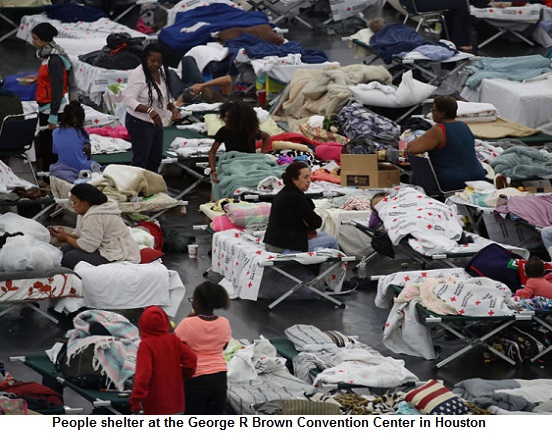
Hurricane Harvey – Houston August 2017 Photos

CU Blog - Hurricane Flooding - Who Knew - Photo 1a

CU Blog - Hurricane Flooding - Who Knew - Photo 2b

Epic Flooding Inundates Houston After Hurricane Harvey

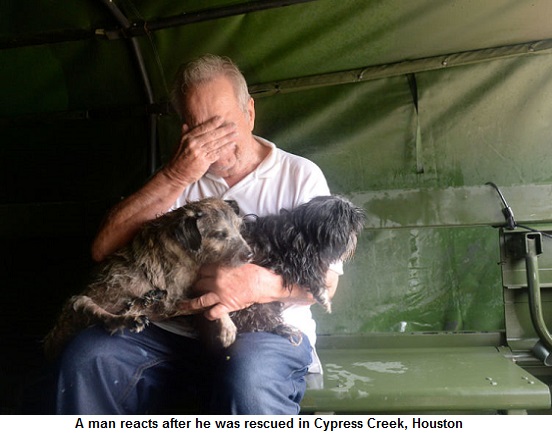
An evacuee holding two dogs reacts after his rescue by Texas National Guardsmen from severe flooding due to Hurricane Harvey in Cypress Creek

Epic Flooding Inundates Houston After Hurricane Harvey


Share this post:
, , ,
[Top]

Lessons from Colorado: Water Management Arts & Sciences

Go Lean Commentary

CU Blog - Lessons from Colorado - Water Management Art and Science - Photo 4Water is vital for the sustenance of life. So if you’re surrounded by water, then the assumption would be that you have an abundance of life?

Assumption?! The reality in the Caribbean … is just the opposite.

While it should be so easy – 27 of the 30 member-states are islands and the other 3 coastal states are embedded with rainforests – the actuality is the water management in the Caribbean is deficient and dysfunctional.

Say it ain’t so!

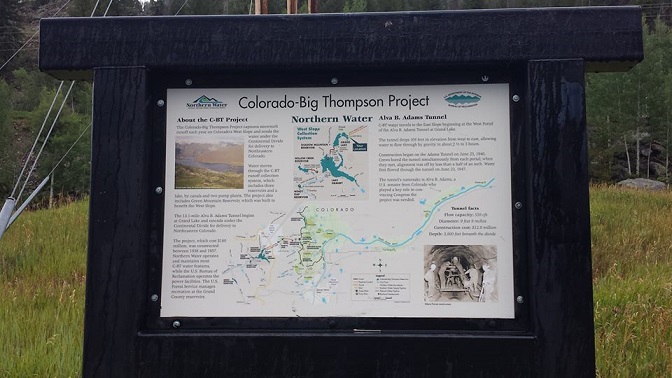
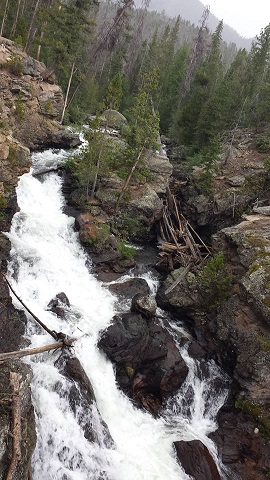
There are lessons to be learned by visiting, observing and reporting on other communities that do water management better. This commentary reflects that activity; some Caribbean stakeholders explored the US State of Colorado and discovered that we have so much to learn about how to facilitate the infrastructure of an optimized society. We have seen how water management is an art and a science. (All non-encyclopedic photos in this commentary were snapped in Colorado by Bahamian student Camille Lorraine).

CU Blog - Lessons from Colorado - Water Management Art and Science - Photo 1a

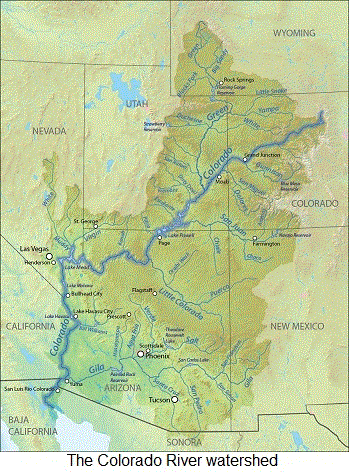
As reported previously, the Caribbean has so much in common and so much in contrast with Colorado. One contrast to consider is how Colorado’s lakes, rivers and waterways are structured to sustain the lives and systems of commerce of that State and … 6 other States plus 2 States in the foreign country of Mexico.

CU Blog - Lessons from Colorado - Water Management Art and Science - Photo 7

The 2013 book Go Lean…Caribbean visited Colorado’s water management. It detailed the strategies, tactics and implementation of the Colorado River Interstate Compact (an agreement between two or more states). This is reported on Page 278 of the book:

The Colorado River Compact is a 1922 agreement among seven US states (upper division: Colorado, New Mexico, Utah and Wyoming; lower division: (Nevada, Arizona and California) in the basin of the Colorado River in the American Southwest governing the allocation of the water rights to the river’s water among the parties of the interstate compact. The agreement was signed at a meeting at Bishop’s Lodge, near Santa Fe, New Mexico, by representatives of the seven states the Colorado river and its tributaries pass through on the way to Mexico.

The compact requires the UpperBasin states not to deplete the flow of the river below 7,500,000 acre feet during any period of ten consecutive years. Based on rainfall patterns observed in the years before the treaty’s signing in 1922, the amount specified in the compact was assumed to allow a roughly equal division of water between the two regions. The states within each basin were required to divide their 7,500,000-acre foot per year share allotment among themselves. In addition to this, 1,500,000-acre-foot per year of Colorado River water is allocated to Mexico, pursuant to the treaty relating to the use of waters of the Colorado and Tijuana rivers and of the Rio Grande, signed February 3, 1944, and its supplementary protocol signed November 14, 1944.

The compact enabled the widespread irrigation of the Southwest, as well as the subsequent development of state and federal water works projects under the United States Bureau of Reclamation. Such projects included the Hoover Dam, Lake Mead and Lake Powell, the 1st and 2nd largest man-made reservoirs in the US.

CU Blog - Lessons from Colorado - Water Management Art and Science - Photo 3

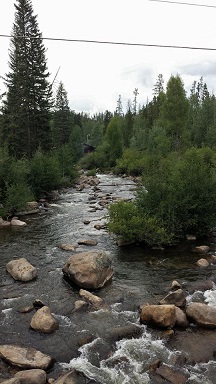
The headwaters of the Colorado River originate … in Colorado. This is the source.

CU Blog - Lessons from Colorado - Water Management Art and Science - Photo 6

CU Blog - Lessons from Colorado - Water Management Art and Science - Photo 5

CU Blog - Lessons from Colorado - Water Management Art and Science - Photo 2

CU Blog - Lessons from Colorado - Water Management Art and Science - Photo 8

This commentary continues the 5-part series – this is 4 of 5 – on the subject of Lessons from Colorado. There are so many lessons that we must consider from this land-locked US State; good ones and bad ones. In fact, the full list of 5 entries are detailed as follows:

  1. Lessons from Colorado – Common Sense of Eco-Tourism
  2. Lessons from Colorado – Legalized Marijuana – Heavy-lifting!
  3. Lessons from Colorado – How the West Was Won
  4. Lessons from Colorado – Water Management Art & Science
  5. Lessons from Colorado – Black Ghost Towns – “Booker T. turning in his grave”

The book Go Lean…Caribbean calls for the elevation of Caribbean society, to re-focus, re-boot, and optimize all the societal engines (economics, security and governance) so as to make the Caribbean a better place to live, work and play.  Water is connected to each of these facets of society. The purpose of Water Management is to ensure that the supply of fresh, clean water is steady and inexpensive.

This is an art and a science.

There is even a designating color that is used to brand this science: Blue. This point was identified and qualified in a previous Go Lean commentary, entitled “Blue is the new Green“. There, it stated:

First we said to “Go Green!” Now we are saying to “Go Blue”, because Blue is the new Green. While ‘Green’ is motivated for all-things-environmental, ‘Blue’ refers specifically to Water Conservation.

There is money in Green; there is money in Blue too! The references to Blue waters apply equally to fresh water and seawater. When we consider all the waterscapes in the Caribbean, (1,063,000 square-miles of the Caribbean seas and thousands of islands in the archipelago – The Bahamas has over 700 alone), we realize how much opportunity exists.

There is the chance to get lucky; where luck is defined as the intersection of preparation and opportunity.

Considering all the opportunities, how can the Caribbean prepare its economic engines to harvest all the fruitage from these Blue market conditions? This is the theme of the book Go Lean…Caribbean, that the world is struggling to contend with monumental changes related to technology, globalization and most importantly Climate Change.

Early in the book, the pressing need to be aware of climate change is pronounced in the Declaration of Interdependence (Page 11), with these words, (the first of many “causes of complaints”):

    i. Whereas the earth’s climate has undeniably changed resulting in more severe tropical weather storms, it is necessary to prepare to insure the safety and security of life, property and systems of commerce in our geographical region. As nature recognizes no borders in the target of its destruction, we also must set aside border considerations in the preparation and response to these weather challenges.

The Caribbean needs Blue Technology solutions to sustain our own lives, liberties and systems of commerce. But the Go Lean book posits that we cannot just consume, we must also create, produce, and foster. So we must foster industrial solutions for the rest of the world. This foregoing [embedded] magazine article summary highlighted the progression in this new Blue Technology industry-space in these areas:

  • Sourcing
  • Treating
  • Storing
  • Conserving
  • Keeping it Clean

So a study of Colorado allows us, in the Caribbean, the opportunity to see Blue Technology solutions at work, in motion and at success in sustaining millions of lives and their dependent systems of commerce. A specific lesson from Colorado is that the responsible parties for the mastery of this “art and science” in Colorado is not Colorado, but rather the US Federal government agency referred to as the United States Bureau of Reclamation (USBR). This agency …

… oversees water resource management, specifically as it applies to the oversight and operation of the diversion, delivery, and storage projects that it has built throughout the western United States for irrigation, water supply, and attendant hydroelectric power generation. Currently the USBR is the largest wholesaler of water in the country, bringing water to more than 31 million people, and providing one in five Western farmers with irrigation water for 10 million acres of farmland, which produce 60% of the nation’s vegetables and 25% of its fruits and nuts. The USBR is also the second largest producer of hydroelectric power in the western United States.[4] – Source: Wikipedia.

CU Blog - Lessons from Colorado - Water Management Art and Science - Photo 1b

The book Go Lean…Caribbean – available to download for free – serves as a roadmap for the introduction and implementation of the technocratic Caribbean Union Trade Federation (CU), for the elevation of Caribbean society – for all member-states. The CU would serve the Caribbean role of the USBR, the “new guards” of Caribbean Common Pool Resources; it would be staffed with water management professionals and scientists with the authority – vested by the CU treaty – to execute a master plan that facilitates water efficiencies in the region.

There are lives involved, as water is essential for life. There are also jobs involved, and societal efficiency. The lack of efficiency in the Caribbean status quo –  “push” and “pull” factors – is what is responsible for so much abandonment. (In fact, it has been reported that the professional classes of people in the region have abandoned their communities at a rate of 70 percent). So this CU/Go Lean roadmap seeks to reform and transform this bad trending; it has these 3 prime directives:

  • Optimization of the economic engines in order to grow the regional economy to $800 Billion and create 2.2 million new jobs.
  • Establishment of a security apparatus to ensure public safety and protect the resultant economic engines.
  • Improve Caribbean governance to support these engines, including a separation-of-powers between the member-states and CU federal agencies.

The book stresses that reforming and transforming the Caribbean societal engines must be a regional pursuit, at a federal level; (CU Federation = federal). This was an early motivation for the roadmap, as pronounced in the opening Declaration of Interdependence (Pages 12 – 13):

iii. Whereas the natural formation of the landmass for our society is that of an archipelago of islands, inherent to this nature is the limitation of terrain and the natural resources there in. We must therefore provide “new guards” and protections to ensure the efficient and effective management of these resources.

v. Whereas the natural formation of our landmass and coastlines entail a large portion of waterscapes, the reality of management of our interior calls for extended oversight of the waterways between the islands. The internationally accepted 12-mile limits for national borders must be extended by International Tribunals to encompass the areas in between islands. The individual states must maintain their 12-mile borders while the sovereignty of this expanded area, the Exclusive Economic Zone, must be vested in the accedence of this Federation.

vi. Whereas the finite nature of the landmass of our lands limits the populations and markets of commerce, by extending the bonds of brotherhood to our geographic neighbors allows for extended opportunities and better execution of the kinetics of our economies through trade. This regional focus must foster and promote diverse economic stimuli.

xi. Whereas all men are entitled to the benefits of good governance in a free society, “new guards” must be enacted to dissuade the emergence of incompetence, corruption, nepotism and cronyism at the peril of the people’s best interest. The Federation must guarantee the executions of a social contract between government and the governed.

xvi. Whereas security of our homeland is inextricably linked to prosperity of the homeland, the economic and security interest of the region needs to be aligned under the same governance. Since economic crimes … can imperil the functioning of the wheels of commerce for all the citizenry, the accedence of this Federation must equip the security apparatus with the tools and techniques for predictive and proactive interdictions.

xxiv. Whereas a free market economy can be induced and spurred for continuous progress, the Federation must install the controls to better manage aspects of the economy: jobs, inflation, savings rate, investments and other economic principles. Thereby attracting direct foreign investment because of the stability and vibrancy of our economy.

The Go Lean book provides 370-pages of turn-by-turn instructions on “how” to adopt new community ethos, plus the strategies, tactics, implementations and advocacies to execute so as to reboot, reform and transform the societal engines of Caribbean society.

Water management is not just vital for basic needs – quenching thirsts – it is also needed to advance the economy. Resorts (tourism) and factories alike, all depend on good water management. Imagine:

As previously detailed, water resources are not cheap. It is only free when it rains. The effort to source, treat, store, conserve and keep water clean takes a big investment on the part of community and governmental institutions.

Thank you Colorado – and your management of this principal river of the Southwestern United States and northern Mexico (the other one is the Rio Grande). This 1,450-mile-long river is the hardest working river in North America, as it sustains an arid watershed – (the western US states are considered desert wilderness) – that encompasses parts of 7 US States and 2 Mexican States (Sonora and Baja California). This great river gets its start in the central Rocky Mountains, in the heart of Colorado. See this VIDEO here:

VIDEO – Colorado River – I Am Red – https://youtu.be/mqYcC7jEe44

Published on Apr 16, 2013 – The Colorado River is a lifeline in the desert, its water sustaining tens of millions of people in seven states, as well as endangered fish and wildlife. However, demand on the river’s water now exceeds its supply, leaving the river so over-tapped that it no longer flows to the sea. (Video by Pete McBride. Flights by Lighthawk, Ecoflight.)

Learn more and be part of the solution: www.AmericanRivers.org/Colorado

Colorado is showing us in the Caribbean how hard work pays off; (all photos in this commentary here are from Colorado, and not the Caribbean, despite any leanings). We now know where we can find “best practices” to model effective and efficient water management. The successful application of this lesson from Colorado can help us to make our Caribbean homelands and waterways better places to live, work and play. 🙂

Download the free e-Book of Go Lean … Caribbean – now!

Sign the petition to lean-in for this roadmap for the Caribbean Union Trade Federation.

Share this post:
, ,
[Top]

Hurricane Season 2017 and ‘Climate Change’ Abatement

CU Blog - Hurricane Season 2017 - Photo 1

Go Lean Commentary

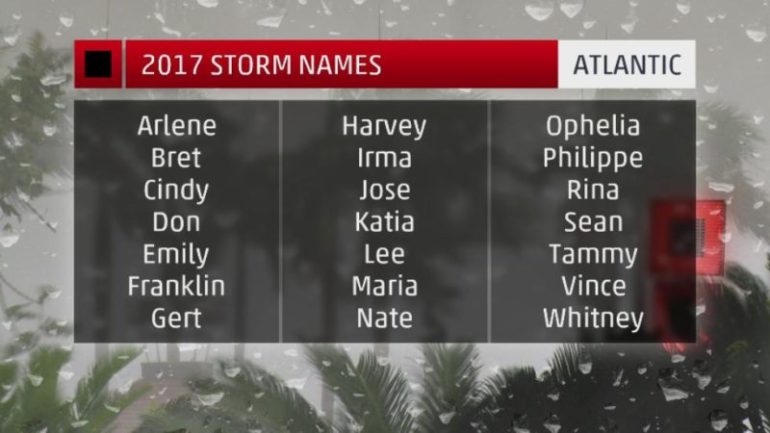
Its June 1st, the start of the Hurricane season. According to Weather Authorities, it is going to be a tumultuous season, maybe even more destructive than last year; see Appendix A below.

Thanks Climate Change.

What hope is there to abate the threats from Climate Change?

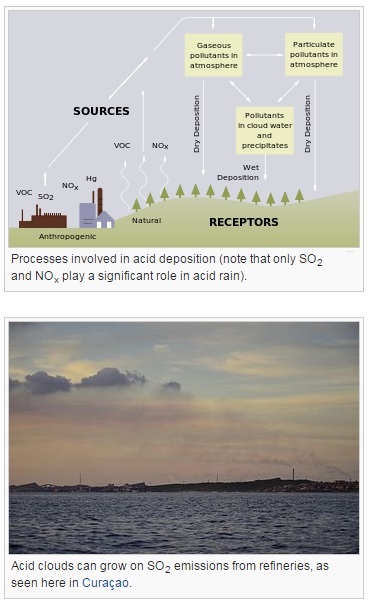
Thanks to the Paris Accord, there is now hope; (we remember the effectiveness of the accord to abate “Acid Rain”).

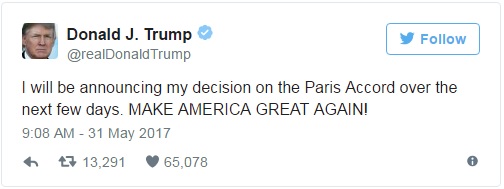
But wait! The American President – Donald Trump – announces that he is withdrawing the United States from the Paris Accord. (See the news article/link in Appendix B below).

CU Blog - Hurricane Season 2017 - Photo 3

W.T.H.?!?!

This is a matter of security; perhaps we should not look to the US to take the lead for our own fate. This is so familiar … and a Hot Topic today as European member-states are contemplating how much they can look to the US for leadership for their security needs; (see the VIDEO in the Appendix C below).

This is the assertion of the book Go Lean…Caribbean; available to download for free. It serves as a roadmap for the introduction and implementation of the technocratic Caribbean Union Trade Federation (CU), for the elevation of Caribbean society – for all member-states. The quest is that we take our own lead – collectively – for our own fate. This CU/Go Lean roadmap has these 3 prime directives:

The book stresses that reforming and transforming the Caribbean societal engines must be a regional pursuit; the issues at hand are too big for anyone member-state alone. This was an early motivation for the roadmap, as pronounced in the opening Declaration of Interdependence (Pages 12 – 13):

i. Whereas the earth’s climate has undeniably changed resulting in more severe tropical weather storms, it is necessary to prepare to insure the safety and security of life, property and systems of commerce in our geographical region. As nature recognizes no borders in the target of its destruction, we also must set aside border considerations in the preparation and response to these weather challenges.

xi. Whereas all men are entitled to the benefits of good governance in a free society, “new guards” must be enacted to dissuade the emergence of incompetence, corruption, nepotism and cronyism at the peril of the people’s best interest. The Federation must guarantee the executions of a social contract between government and the governed.

xvi. Whereas security of our homeland is inextricably linked to prosperity of the homeland, the economic and security interest of the region needs to be aligned under the same governance. Since economic crimes … can imperil the functioning of the wheels of commerce for all the citizenry, the accedence of this Federation must equip the security apparatus with the tools and techniques for predictive and proactive interdictions.

xxiv. Whereas a free market economy can be induced and spurred for continuous progress, the Federation must install the controls to better manage aspects of the economy: jobs, inflation, savings rate, investments and other economic principles. Thereby attracting direct foreign investment because of the stability and vibrancy of our economy.

The Go Lean book provides 370-pages of turn-by-turn instructions on “how” to adopt new community ethos, plus the strategies, tactics, implementations and advocacies to execute so as to reboot, reform and transform the societal engines of Caribbean society.

The issue of Hurricane Season 2017 is bigger than initial appearances – there are BIG  issues afoot. Many are issues that were addressed in previous Go Lean blog-commentaries; see a sample here:

https://goleancaribbean.com/blog/?p=11858 Welcome to Kiribati – Hello and Goodbye
https://goleancaribbean.com/blog/?p=11442 Caribbean Roots: Al Roker – ‘Climate Change’ Defender
https://goleancaribbean.com/blog/?p=9455 Fix ‘Climate Change’ – Yes, We Can
https://goleancaribbean.com/blog/?p=9334 Hurricane Categories – The Science
https://goleancaribbean.com/blog/?p=7449 Due to Climate Change, ‘Crap Happens’ – So What Now?
https://goleancaribbean.com/blog/?p=7103 COP21 – ‘Climate Change’ Acknowledged
https://goleancaribbean.com/blog/?p=6893 A Meteorologist’s View On Climate Change
https://goleancaribbean.com/blog/?p=6016 ‘Hotter than July’ – Reality in the Caribbean
https://goleancaribbean.com/blog/?p=4673 Climate Change‘ Merchants of Doubt … to Preserve Profits!!
https://goleancaribbean.com/blog/?p=2465 Book: ‘This Changes Everything: Capitalism vs. the Climate’
https://goleancaribbean.com/blog/?p=2276 Climate Change May Affect Food Supply Within a Decade
https://goleancaribbean.com/blog/?p=2119 Cooling Effect – Oceans and the Climate
https://goleancaribbean.com/blog/?p=1883 Climate Change May Bring More Kidney Stones
https://goleancaribbean.com/blog/?p=1817 Caribbean grapples with intense cycles of flooding & drought
https://goleancaribbean.com/blog/?p=926 Conservative heavyweights have solar industry in their sights
https://goleancaribbean.com/blog/?p=915 Go ‘Green’ … Caribbean

We endured a bitter Hurricane Season last year; Hurricane Matthew was devastating for a number of Caribbean islands in September/October; i.e. Haiti and the Bahamas. (In fact, the Bahamian city of Freeport was so severely impacted that one of its biggest Hotel-Casino resorts closed … permanently).

The Caribbean status quo is unsustainable under the real threats of Climate Change. The region must reboot, reform and transform. We must do the heavy-lifting ourselves; we cannot expect relief and refuge from others, like the American Super-Power. We must find and “sail” under our own power.

Hope and Change! Yes, we can …

… we can make our Caribbean homeland a better place to live, work and play. 🙂

Download the free e-Book of Go Lean … Caribbean – now!

Sign the petition to lean-in for this roadmap for the Caribbean Union Trade Federation.

————

Appendix A – Forecasters predict active 2017 hurricane season

With the start of the Atlantic hurricane season less than one week away, the National Oceanic and Atmospheric Administration, says it could be a busy one with five to nine hurricanes expected to form.

Overall, NOAA forecasts 11 to 17 named tropical storms will develop in the region, which includes the Atlantic, the Caribbean Sea and Gulf of Mexico, the agency announced Thursday.

The season officially begins June 1 and runs through Nov. 30.

Of the hurricanes, two to four could be major, with wind speeds of 111 mph or higher and rated as Category 3, 4 or 5 on the Saffir-Simpson Scale of Hurricane Intensity.

An average season typically produces 12 named tropical storms and six hurricanes and peaks in August and September.

A tropical storm contains wind speeds of 39 mph or higher and becomes a hurricane when winds reach 74 mph.

Factors contributing to the prediction include: A weak or non-existent El Nino, near- or above-average sea-surface temperatures, and average or weaker-than-average vertical wind shear, said Gerry Bell, Ph.D., lead seasonal hurricane forecaster with NOAA’s Climate Prediction Center.

Meteorologists at Colorado State University last month estimated 11 tropical storms will form, with four becoming hurricanes.

The late Colorado State University meteorologist William Gray was the first scientist to make seasonal hurricane forecasts back in the 1980s.

The Weather Channel predicts an average season, with 12 named storms, of which six will become hurricanes. AccuWeather forecasts 10 named storms, five of which are projected to become hurricanes.

Source: St. Lucia Times Daily Newspaper –  Posted May 25, 2017 retrieved June 1, 2017 from: https://stluciatimes.com/2017/05/26/forecasters-predict-active-2017-hurricane-season

————

Appendix B – Trump expected to withdraw from Paris Accord

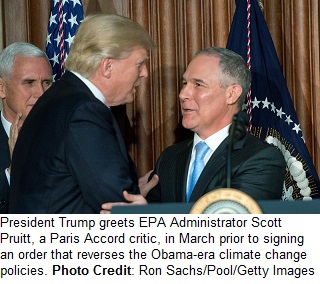
Washington (CNN) President Donald Trump is expected to withdraw from the Paris climate agreement, two senior US officials familiar with his plans told CNN Wednesday, a major break from international partners that would isolate the United States in global efforts to curb global warming.

CU Blog - Hurricane Season 2017 - Photo 2

The decision would put the US at odds with nearly every other nation on earth. It would reflect a major reversal of the Obama administration’s efforts on climate change. And it could trigger further efforts to erode the landmark climate accord.

Source: Posted and retrieved May 31, 2017 from http://www.cnn.com/2017/05/31/politics/trump-paris-accord/

——

In actuality, President Trump officially announces  the exit and former President Obama barks. See story and VIDEO here: http://www.independent.co.uk/news/world/americas/us-politics/paris-agreement-trump-obama-response-rejecting-future-climate-change-deal-latest-news-updates-a7768171.html

————

Appendix C VIDEO – Thanks to Trump, Germany says it can’t rely on the United Stateshttp://wapo.st/2qsrQHd

Share this post:
, , ,
[Top]

Welcome to Kiribati – Hello and Goodbye

Go Lean Commentary

Islands are the greatest places to live … until they are not.

There is nothing better than being surrounded by water on all sides: beach or bay, just having that vista is preferred. Until, higher tides come in … and stay.

CU Blog - Welcome to Kiribati - Hello and Goodbye - Photo 3

CU Blog - Welcome to Kiribati - Hello and Goodbye - Photo 4

CU Blog - Welcome to Kiribati - Hello and Goodbye - Photo 5

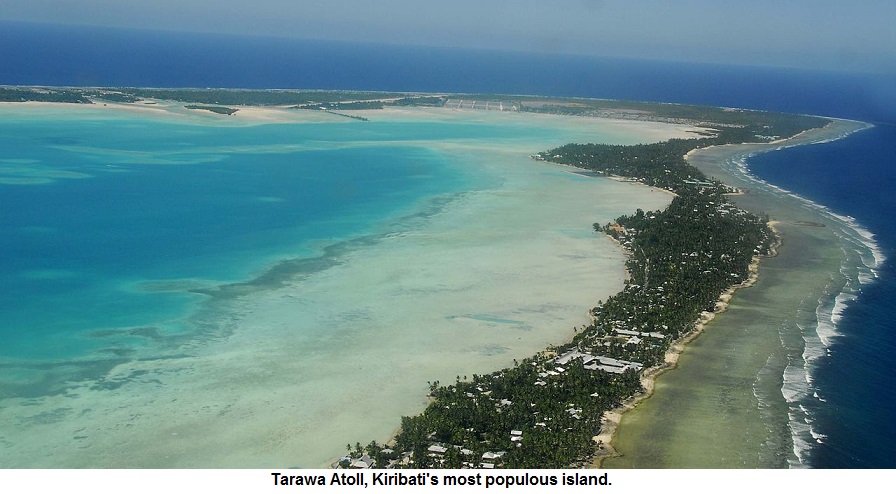
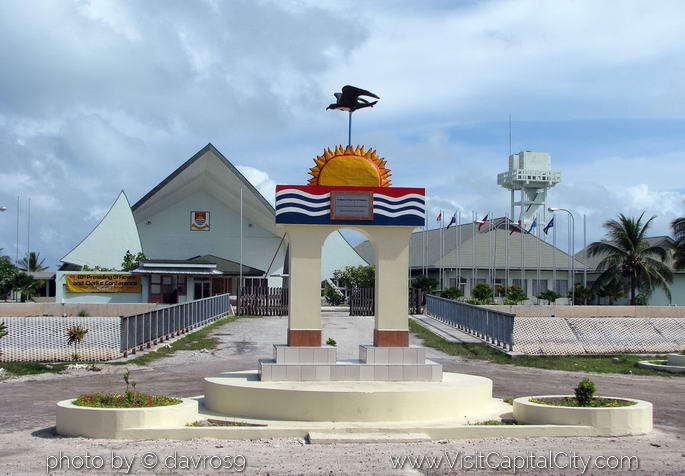
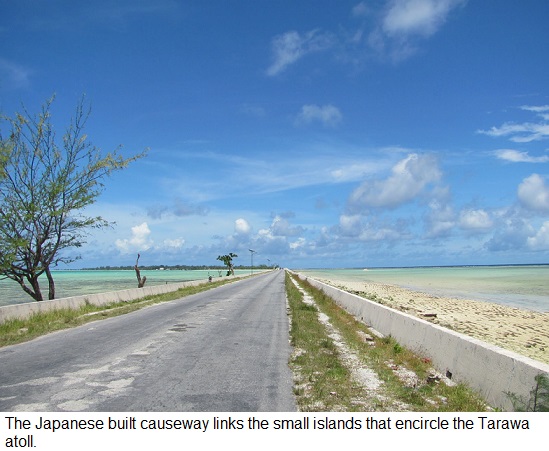
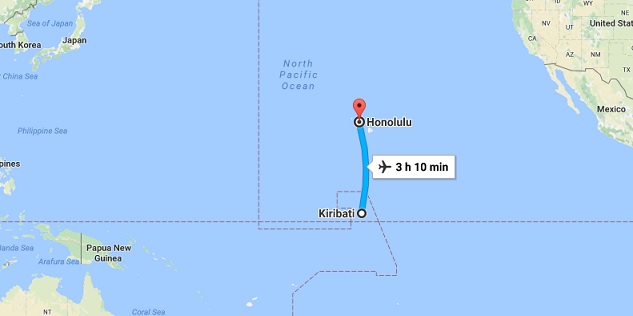
Welcome to Kiribati, an island nation (archipelago of 33 atolls and reef islands) in the central Pacific Ocean. This nation is strategically located at the crossroads of the Eastern and Western Hemispheres, straddling the equator and the International Date Line; so it is the only country in all 4 hemispheres. (Source: Wikipedia)

CU Blog - Welcome to Kiribati - Hello and Goodbye - Photo 1Say ‘Hello’ to Kiribati.

Kiribati is also the first country expected to lose all its land territory to global warming. In June 2008, the then-President Anote Tong said that the country has reached “the point of no return.” He added, “to plan for the day when you no longer have a country is indeed painful but I think we have to do that.”[31][32][33][34]

This just got real …

The book Go Lean…Caribbean and accompanying blogs have asserted that there is no guarantee that countries and/or cultures must survive. Some of them do not!

Remember the Babylonians, Mayans, Lucayans, and others. Despite the array of archeological evidence of their historicity, their culture (language and traditions) simply no longer exist.

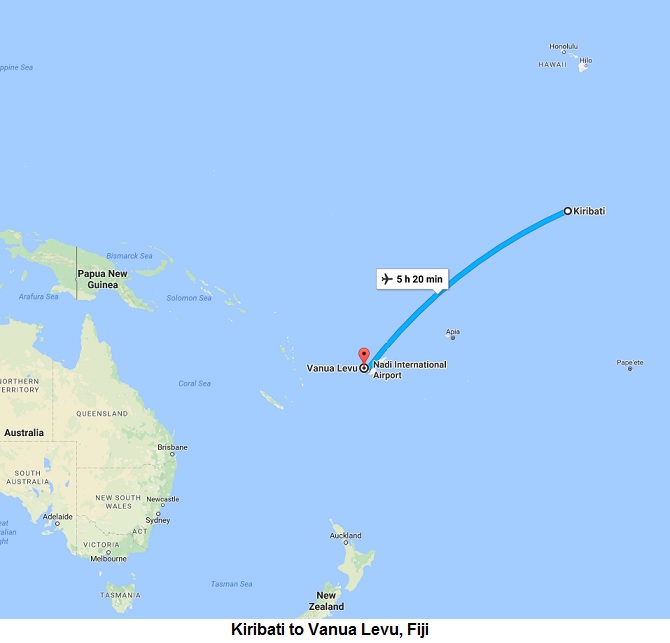
Kiribati can also no longer exist. In fact, in early 2012, the government of Kiribati purchased the 2,200-hectare Natoavatu Estate on the second largest island of Fiji, Vanua Levu. At the time it was widely reported[35][36][37] that the government planned to evacuate the entire population of Kiribati to Fiji. In April 2013, President Tong began urging citizens to evacuate the islands and migrate elsewhere.[38]

CU Blog - Welcome to Kiribati - Hello and Goodbye - Photo 2

We could … say ‘Goodbye’ to Kiribati. See the VIDEO here:

VIDEO – Kiribati: The country killed by Climate Change – Truthloader – https://youtu.be/-jMddhJNr9U

Published on Jun 18, 2014 – Kiribati is a tiny nation of 100,000 people living on dozens of islands over a huge area of the South Pacific. And it is set to become the first state completely destroyed by climate change. The government estimates the country will vanish beneath the waves by 2050 due to rising sea levels and coastal erosion, and has an official policy of evacuating the native population. At the same time, it is doing everything it can to protect the pristine ocean environments within its territorial waters, so that even once the country is gone the nature will survive. It’s a pretty sad story.
Subscribe to our channel: http://bit.ly/TRUsub

The fate of Kiribati is a cautionary tale for the Caribbean. “There but for the Grace of God go I”.

The Go Lean book anticipated the Agents of Change impacting the region, Climate Change is most prominent. This is the direct result of the excessive amount of carbon emitted into the planet’s atmosphere. The Small Islands States like Kiribati and the Caribbean are not the BIG polluters most responsible for this disposition – the US is #1 and China is #2 – but we are among the most affected. So we need to be front-and-center in the protests and advocacy for Climate Change mitigations.

The book Go Lean…Caribbean – available to download for free – prepares the Caribbean region for the heavy-lifting of monitoring, managing and mitigating the acute risks of Global Warming, Climate Change and rising sea-levels. We must act now!

The book serves as a roadmap for the introduction and implementation of the technocratic Caribbean Union Trade Federation (CU), for the elevation of Caribbean society – for all member-states. This CU/Go Lean roadmap has these 3 prime directives:

  • Optimization of the economic engines in order to grow the regional economy to $800 Billion and create 2.2 million new jobs.
  • Establishment of a security apparatus to ensure public safety and protect the resultant economic engines.
  • Improve Caribbean governance to support these engines, including a separation-of-powers between the member-states and CU federal agencies.

The book stresses that there are external and internal considerations. As any one country in the Caribbean region may be too small to get attention of the watching world, the whole region on the other hand – 30 member-states and 42 million people – operating as a Single Market and One Voice can have more of an impact.  Internally, we must “get our own house in order”, so the effort is to reform and transform the Caribbean societal engines as part of this regional pursuit. This was an early motivation for the roadmap, as pronounced in the opening Declaration of Interdependence (Pages 11 – 13):

i. Whereas the earth’s climate has undeniably changed resulting in more severe tropical weather storms, it is necessary to prepare to insure the safety and security of life, property and systems of commerce in our geographical region. As nature recognizes no borders in the target of its destruction, we also must set aside border considerations in the preparation and response to these weather challenges.

iii. Whereas the natural formation of the landmass for our society is that of an archipelago of islands, inherent to this nature is the limitation of terrain and the natural resources there in. We must therefore provide “new guards” and protections to ensure the efficient and effective management of these resources.

iv. Whereas the natural formation of the landmass is in a tropical region, the flora and fauna allows for an inherent beauty that is enviable to peoples near and far. The structures must be strenuously guarded to protect and promote sustainable systems of commerce paramount to this reality.

xi. Whereas all men are entitled to the benefits of good governance in a free society, “new guards” must be enacted to dissuade the emergence of incompetence, corruption, nepotism and cronyism at the peril of the people’s best interest. The Federation must guarantee the executions of a social contract between government and the governed.

xvi. Whereas security of our homeland is inextricably linked to prosperity of the homeland, the economic and security interest of the region needs to be aligned under the same governance. Since economic crimes … can imperil the functioning of the wheels of commerce for all the citizenry, the accedence of this Federation must equip the security apparatus with the tools and techniques for predictive and proactive interdictions.

xxiv. Whereas a free market economy can be induced and spurred for continuous progress, the Federation must install the controls to better manage aspects of the economy: jobs, inflation, savings rate, investments and other economic principles. Thereby attracting direct foreign investment because of the stability and vibrancy of our economy.

The Go Lean book provides 370-pages of turn-by-turn instructions on “how” to adopt new community ethos, plus the strategies, tactics, implementations and advocacies to execute so as to monitor, manage and mitigate the challenges of Climate Change.

In addition, these previous blog-commentaries detailed a lot of the issues and developments for the Caribbean’s Climate Change efforts:

https://goleancaribbean.com/blog/?p=11442 Caribbean Roots: Al Roker – ‘Climate Change’ Defender
https://goleancaribbean.com/blog/?p=9455 Fix ‘Climate Change’ – Yes, We Can
https://goleancaribbean.com/blog/?p=7449 Due to Climate Change, ‘Crap Happens’ – So What Now?
https://goleancaribbean.com/blog/?p=7103 COP21 – ‘Climate Change’ Acknowledged
https://goleancaribbean.com/blog/?p=6893 A Meteorologist’s View On Climate Change
https://goleancaribbean.com/blog/?p=6016 ‘Hotter than July’ – Reality in the Caribbean
https://goleancaribbean.com/blog/?p=4673 Climate Change‘ Merchants of Doubt … to Preserve Profits!!
https://goleancaribbean.com/blog/?p=2465 Book: ‘This Changes Everything: Capitalism vs. the Climate’
https://goleancaribbean.com/blog/?p=2276 Climate Change May Affect Food Supply Within a Decade
https://goleancaribbean.com/blog/?p=2119 Cooling Effect – Oceans and the Climate
https://goleancaribbean.com/blog/?p=1883 Climate Change May Bring More Kidney Stones
https://goleancaribbean.com/blog/?p=1817 Caribbean grapples with intense cycles of flooding & drought
https://goleancaribbean.com/blog/?p=926 Conservative heavyweights have solar industry in their sights
https://goleancaribbean.com/blog/?p=915 Go ‘Green’ … Caribbean

We must learn from Kiribati – and other locales – and prepare our homeland as well. We must prepare for the good, bad and the ugly (think extinction). Things can get better, we can make our homeland a better place to live, work and play – but this is not automatic; this quest will require a lot of heavy-lifting. 🙂

Download the free e-book of Go Lean … Caribbean – now!

Sign the petition to lean-in for this roadmap for the Caribbean Union Trade Federation.

Share this post:
,
[Top]

Caribbean Roots: Al Roker – ‘Climate Change’ Defender

Go Lean Commentary

Al Roker - Photo 1Make us proud ‘My Brother’; go fight our battles.

This is the message the Caribbean needs to send to one of its own, Al Roker, the on-air meteorologist for NBC and co-host of the morning newscast The Today Show.

Al Roker has Caribbean roots, as a legacy of parents from the Bahamas (and Jamaica; see Appendix A). He, himself has spent a lot of time there and reflect a lot of its values. Right now, he is being a Champion for a cause that is dear to the Bahamas, and all Caribbean for that matter:

Climate Change.

See how this Caribbean Champion battled prominent Climate Change deniers in this TV broadcast here. What’s sad is the actual denier in this case is Scott Pruitt, the Head of the American federal government environmental Watch-Dog, the EPA (Environmental Protection Agency).

America may have the luxury of “sticking its head in the sand” and not deal with Climate Change, but for those of us in the Caribbean, we do not have that luxury – we have a Clear-and-Present Danger right now.

See the news article and VIDEO of this champion’s defense:

Title: Al Roker Debunks EPA Head Scott Pruitt’s Stunning Denial On Human-Caused Climate Change
Sub-title: Roker: “No Credible Science Or Scientist” Would Support Pruitt’s Assertion CO2 Is Not A Primary Contributor To Global Warming
By: Media Matters Staff

NBC weatherman Al Roker debunked EPA head Scott Pruitt’s false claim that carbon dioxide is not a primary contributor to global warming during an appearance on MSNBC Live, explaining that there is “no credible science or scientist” to support Pruitt’s statement.

During the March 10 segment, Roker addressed Pruitt’s comments on the March 9 edition CNBC’s Squawk Box in which Pruitt said “I would not agree” that CO2 is “a primary contributor to the global warming that we see” — a statement completely at odds with the consensus among climate scientists that human activity is the primary cause of climate change.

To rebut Pruitt’s statements, Roker referenced an interview he recently conducted with climate scientist Dr. Marshall Shepherd, who explained that “greenhouse gases are in fact the primary forcing function on a warming climate system. … their fingerprint is there on our naturally varying climate in the same way steroids were on the naturally varying cycle of home runs during the Major League Baseball era.”

Roker also stated “there is no credible science or scientist” that would back up Pruitt’s assertion. Indeed, a number of climate scientists have weighed in on Pruitt’s statement, stating Pruitt’s denial “demonstrated that he is unqualified to run the EPA or any agency” and suggesting that Pruitt “talk with his own scientists and read the National Climate Assessment.”

Notably, however, NBC did not address Pruitt’s climate denial on the widely viewed Today show the same day, nor NBC Nightly News air a segment on Pruitt’s climate denial on March 9 — even though Pruitt’s denial received widespread attention across mainstream media.

————-

See full transcript of the interview between Al Roker and the MSNBC Host Katy Tur in Appendix B below.

————-

VIDEO – From the March 10 edition of MSNBC Livehttps://mediamatters.org/embed/clips/2017/03/10/52688/msnbc-msnbclive-20170310-alrokerpruitt

This issue of monitoring, messaging and managing the stakeholders for Climate Change is an important mission for the movement behind the book Go Lean … Caribbean. The book presents the Caribbean region a roadmap to elevate its societal engines – economics, security and governance – and to be prepared for the Agents of Change impacting daily life in the Caribbean homeland. In total, the book identified these 4 Change Agents:

  • Technology
  • Globalization
  • Aging Diaspora
  • Climate Change

As a region, we are able to employ mitigations and remediation for all of these agents except for Climate Change. We are all small countries, nowhere on the list of “Big Polluters”, like the US (#2) and China (#1). We have neither a voice nor a vote in those countries, yet we need them to take the issue of Climate Change remediation seriously. Messaging is key! We need people like “Al Roker” – daily audience of 4 to 9 million people – speaking truth to power … on our behalf.

This advocacy – to proclaim impending danger to life and limb – is part of a new effort to elevate the societal engines of the Caribbean. This started with the Go Lean…Caribbean book and is being followed up by this and many other blog-commentaries. See here a sample of previous submissions heralding the need for the Caribbean region to be “on guard” for the imminent threats from Climate Change:

https://goleancaribbean.com/blog/?p=9455 Fix ‘Climate Change’ – Yes, We Can
https://goleancaribbean.com/blog/?p=7103 COP21 – ‘Climate Change’ Acknowledged
https://goleancaribbean.com/blog/?p=6893 A Meteorologist’s View On Climate Change
https://goleancaribbean.com/blog/?p=4673 Merchants of Doubts – Dynamics of Climate Change Deniers
https://goleancaribbean.com/blog/?p=2465 Book Review: ‘This Changes Everything: Capitalism vs. the Climate’
https://goleancaribbean.com/blog/?p=2276 Climate Change May Affect Food Supply Within a Decade
https://goleancaribbean.com/blog/?p=2119 Cooling Effect – Oceans and the Climate
https://goleancaribbean.com/blog/?p=1883 Climate Change May Bring More Kidney Stones

The Go Lean book serves as a roadmap for the introduction and implementation of the Caribbean Union Trade Federation (CU) as an inter-government agency for 30 regional member-states. This confederation will provide a technocratic stewardship for all the societal engines in the Caribbean. In fact, the prime directives of the roadmap includes the following 3 statements:

  • Optimization of the economic engines in order to grow the regional economy to $800 Billion & create 2.2 million new jobs.
  • Establishment of a security apparatus to ensure public safety and to protect the resultant economic engines  – including an Emergency Management functionality.
  • Improve Caribbean governance to support these engines, including a separation-of-powers mantra between the member-states and CU federal agencies.

Overall, the Go Lean book stresses the community ethos, strategies, tactics, implementations and advocacies to reboot, reform and transform the economic engines of Caribbean society.

What do we do now?

While we hope, pray and lobby the big polluting nations to do more, we have to prepare our Caribbean communities for the imminent onslaughts.

In previous blogs, this commentary cautioned the stakeholders in the Caribbean region, as follows:

  • Crap Happens! Prepare – The peril of a Climate Change-fueled hurricane is now a constant threat for Caribbean life, for all 30 member-states. It is assured that some Caribbean location will be impacted every year. While there is no guarantee for a strike “here or there”, there is a guarantee that there will be a strike somewhere.
  • Do Not be Hypocritical – Go ‘Green’ – If excessive carbon in the atmosphere by the Big Polluters is the culprit for infusing Greenhouse Gases, then we, as a region of small countries, need to do our share and set a good example of lowering our carbon footprint. Though our numbers are too small to make an impact, it does send the message that we are willing to “swallow the hard pill/take the medicine” ourselves that we are asking the Big Polluting nations to endure.

The global crisis of Climate Change is impacting all aspects of Caribbean life: economics, security (disaster preparation and response) and governance. A comprehensive view of the challenges befalling our region is the charge of the Go Lean roadmap, opening with these pronouncements in the Declaration of Interdependence (Page 11 and 12):

i.  Whereas the earth’s climate has undeniably changed resulting in more severe tropical weather storms, it is necessary to prepare to insure the safety and security of life, property and systems of commerce in our geographical region. As nature recognizes no borders in the target of its destruction, we also must set aside border considerations in the preparation and response to these weather challenges.

viii. Whereas the population size is too small to foster good negotiations for products and commodities from international vendors, the Federation must allow the unification of the region as one purchasing agent, thereby garnering better terms and discounts.

x. Whereas we are surrounded and allied to nations of larger proportions in land mass, populations, and treasuries, elements in their societies may have ill-intent in their pursuits, at the expense of the safety and security of our citizens. We must therefore appoint “new guards” to ensure our public safety and threats against our society, both domestic and foreign. …

Now is the time for all stakeholders – residents, governments, Diaspora, scientists, disaster planners, etc. – in the Caribbean to lean-in for the empowerments described here-in and in the book Go Lean … Caribbean. Climate Change is the Number One threat for our society; for the whole world actually, but we are on the frontlines. “We must protect this house”. We must be better and do better and help to make our homelands better places to live, work and play. 🙂

Download the free e-book of Go Lean … Caribbean – now!

Sign the petition to lean-in for the roadmap for the Caribbean Union Trade Federation.

———-

Appendix A – Al Roker’s Earliy Life

Al Roker was born in Queens, New York,[4] the son of Isabel, of Jamaican descent, and Albert Lincoln Roker, Sr.,[5] a bus driver of Bahamian descent.[6] Roker initially wanted to be a cartoonist.[5] He was raised Catholic[5] (in the faith of his mother) and graduated from Xavier High School in Manhattan.[7] He worked on several projects as a member of the school’s Cartooning & Illustration Club. He attended the State University of New York at Oswego where he received a B.A. in communications in 1976.

According to the July 2011 issue of Us Weekly in “25 Things You Did Not Know About Me”, Roker is the first cousin once removed of the late actress Roxie Roker, who was most notable for her role as Helen Willis on the sitcom The Jeffersons and the mother of popular rock musician Lenny Kravitz. That makes Kravitz Roker’s second cousin.[8]
Source: Retrieved April 21, 2017 from: https://en.wikipedia.org/wiki/Al_Roker#Early_life

———-

Appendix B – Transcript: Al Roker Interview by Host Katy Tur

KATY TUR (HOST): The head of the Environment Protection Agency stunned many when he denied carbon dioxide is a primary contributor to global warming.

[…]

TUR: Today show host and weatherman, a man who needs no introduction, Al Roker joins me now. “Stunned many” is a bit of an understatement, said most almost all, gosh, CO2 is not a factor when it comes to climate change. Was all of the schooling that I had as a child and into my adult life completely wrong, Al Roker?

AL ROKER: No, it wasn’t wrong and there is no credible science or scientist who will tell you the contrary. The fact is, carbon dioxide, the greenhouse gases is responsible for climate change.

TUR: No scientist will say this, but we’re having the EPA head say this?

ROKER: Well, look, this is America and you can make whatever statements you want to, but everybody will pretty much agree — in fact, just about an hour ago I interviewed one of the leading climate scientists in this country, Dr. Marshall Shepherd, and here’s what he had to say about it.

[BEGIN VIDEO CLIP]

MARSHALL SHEPHERD (DIRECTOR FOR UNIVERSITY OF GEORGIA’S PROGRAM IN ATMOSPHERIC SCIENCES): The basic physics of the atmosphere suggest that greenhouse gases are in fact the primary forcing function on a warming climate system. Greenhouse gases and the impacts post-industrial age or –– industrial revolution are certainly — their fingerprint is there on our naturally varying climate in the same way steroids were on the naturally varying cycle of home runs during the Major League Bbaseball era.

[END VIDEO CLIP]

ROKER: I think that pretty much sums it it up.

TUR: Yeah, so where — if the EPA head is saying there needs to be more research, but the EPA is losing money to do research, give me the consequences. How important is it and how significant is it to have the EPA head deny something like this?

ROKER: Well I think hopefully cooler heads will prevail upon him to say we need to continue to research this. We need to continue what we’ve been doing because if you look, we’ve got a graphic that basically right around the industrial revolution, we had — there’s been no time in this history of our planet where CO2, even naturally occurring or not, was above 290 parts per million. Alright, now you look at the temperature, we put the temperature on top of that, you can see from the 1880s into the 1940s, temperatures are below average, below the global average, but once we really start to see that red line go up, as the CO2 starts to increase, you can see those average global temperatures continue to rise, and they peaked last year, the warmest temperature ever on record for this planet. So as we continue to add those greenhouse gases — now, that’s not to say that — the greenhouse gases allow us to live on this planet. Without them completely, we would freeze to death. At night we would die. So there has to be some small amount of greenhouse gases. We’re just adding too much.
Source: Retrieved 04-21-2017 from: https://mediamatters.org/blog/2017/03/10/al-roker-debunks-epa-head-scott-pruitt-s-stunning-denial-human-caused-climate-change/215635


Share this post:
, , , ,
[Top]

Science of Sustenance – CLT Housing

Go Lean Commentary

Believe it or not, the Caribbean is the “best of times and the worst of times”. – Charles Dickens.

We have the greatest address on the planet – in terms of terrain, fauna/flora, hospitality, festivities, food, rum and cigars – but we have near-Failed-States as well, to the point that 70 percent of the educated classes have fled the region. The above Dickensian quote emerges as a strong parallel:

This phrase has been taken from the famous opening paragraph of Charles Dickens’ novel, A Tale of Two Cities. The novel opens as, “It was the best of times, it was the worst of times, it was the age of wisdom, it was the age of foolishness, it was the epoch of belief, it was the epoch of incredulity. – LiteraryDevices.com

This age of radical opposites in the Caribbean must be assuaged. But how? How do we implement a reboot and turn-around?

The book Go Lean … Caribbean asserts that we re-focus on basic needs – food, clothing, shelter and energy – and their required delivery systems. The book quotes that we must:

  • Feed Ourselves
  • Clothe Ourselves
  • House Ourselves – in the US, the National Association of Realtors® trumpets that “housing creates jobs”.

A consideration of the science of housing solutions, is therefore important and apropos for rebooting societal engines as housing requires local jobs and building materials. So it is a study in economics, security and governance.

But rebooting the delivery of housing in this year 2017 must dictate at least one additional criteria:

Adherence to Green principles.

Enter CLT for meeting housing- shelter needs; CLT = Cross Latinate Timber. Green building practices have helped CLT’s popularity, with its combination of environmental performance, sustainability, design flexibility, cost-competitiveness and structural integrity.

CU Blog - Science of Sustenance - CLT Housing - Photo 7

CU Blog - Science of Sustenance - CLT Housing - Photo 6

The Timber label discloses that the based material is wood; naturally grown on trees. This is as green as green gets; every tree cut down can be replaced with seedling for a new tree. But CLT is driven by forces in emerging science – see Appendix.

This is the focus of this commentary: science for rebooting the delivery of basic needs. This is 4 of 4 in this series covering: energy, food, clothing and shelter-housing. It is possible to deliver all basic needs without science. But for our modern world, the advances of science make a positive impact on daily life. So the full series for our consideration follows this pattern:

  1.    Science of Sustenance: Energy
  2.    Science of Sustenance: Food
  3.    Science of Sustenance: Clothing
  4.    Science of Sustenance: Shelter

The book Go Lean…Caribbean promotes advanced science and technology for Caribbean housing solutions, specifically trumpeting Smart Homes – home automation for security, communications, energy optimization, and house work.

CLT is also a Smart Home option, in that its a smart building material. It is strong, safe and flexible. With CLT as building blocks, structures can actually be built tall … maybe even  skyscrapers. See a related new article here:

Title: Why a Wooden Office Tower may Symbolize the Future of Multi Story Construction
By: Patrick Sisson

CU Blog - Science of Sustenance - CLT Housing - Photo 1

“Office building goes up in Minneapolis” isn’t exactly a headline built to blow up Twitter. But the seven-story, 210,000-square-foot T3 commercial structure that broke ground at the end of July in the city’s North Loop neighborhood isn’t just any office.  A new home for the Hines development firm, T3 (Timber, Technology and Transit) will be the first tall-timber building of its type in the United States, a new spin on architecture utilizing a material that’s been a bedrock of construction for millennia. According to architect Michael Green, when it’s finished in late 2016, T3 will challenge assumptions many hold about wooden structures, and represent a massive technological leap beyond the old-school timber warehouses that surround it. Green, one of a number of architects worldwide specializing in tall-timber construction, sees buildings like this as part of a vanguard of sustainable construction technology that will be called upon to create taller and taller buildings going forward. With so much of our energy footprint going towards constructing and maintaining buildings, it only makes sense to move away from resource-intensive steel.

“It’s the beauty of what we’re doing here, incorporating modern technology with good, old ideas,” he says. “We’re not reinventing the wheel, we’re bringing back a very good wheel.

CU Blog - Science of Sustenance - CLT Housing - Photo 2

CU Blog - Science of Sustenance - CLT Housing - Photo 3

Green’s eponymous Canadian firm is perhaps best known for the seven-story Wood Innovation and Design Centre in Prince George, British Columbia, currently the tallest timber building in North America. For the T3 project, he’s been forced to start with a concrete foundation to meet code requirements, and the skeleton will be steel, but the vast majority of the structure will be wood sourced from the West Coast. The core and floorplates will be made from huge panels of engineered lumber that have been nailed and glued together, with support provided by engineered wooden columns (pressed together to replicate the load-bearing abilities previously provided by massive beams cut from old growth timber). The panels’ density actually means they won’t burn through completely, instead forming a protective layer of charcoal. It’s a marriage of old and new techniques, he says, that will provide a much more energy-efficient building due to the natural source materials. And, as opposed to concrete-and-steel structures that often draw in the cold, this wooden structure will provide insulation, a godsend in a cold climate such as Minneapolis.

While Europe has traditionally been the leader in re-developing timber as a building material for tall structures—The Stadthaus, a nine-story building in London built in 2008 with cross-laminated timber, was one of the forerunners of the modern wooden building boom—Green feels North America is starting to catch up.

“Height is happening, but it’s a slow process,” he says.  “There are a few projects in the U.S. being considered, and you’re starting to see innovation creep up.”

CU Blog - Science of Sustenance - CLT Housing - Photo 4

CU Blog - Science of Sustenance - CLT Housing - Photo 5

While there are scores of projects utilizing cross-laminated timber and heavy wood construction, one of the projects Green is most excited about is the recent $60M forestry school expansion at Oregon State University dedicated to advancing the technology behind timber construction. The concept reinforces the main ecological and economical advantages of the practice, the ability to harvest renewable resources for construction while concurrently redeveloping rural economies. As timber buildings get higher in cities across the country, different areas, such as the seismic West Coast or windy Midwest, will require unique systems and designs to start rising above 20 floors. Developing and sharing regional knowledge between builders, regulators and architects will be key to future acceptance, still a barrier to more widespread adoption.

“The U.S. government investment in building science technology represents .0001 percent of total innovation investment,” he says. “That’s a statistic that needs to be shouted from the roof tops.”

While the industry is just starting to get off the ground here, Green and his firm are aiming skyward. A perfect example is their recent proposal for a 35-story tower in Paris. Set to be submitted after the contentious battle over the Herzog & de Meuron tower, the first tall building of any type approved in Paris in decades, the MGA plan was abandoned. But that was because it was tall and in Paris, not tall and made of wood.

“We have a new means of building that can help us realize a new era of architecture, a post-climate era,” he says. “As this develops, we’ll see how this changes the look of our cities and buildings.

Related stories:

Source: Curbed.com – Urban Design Online Site – (Posted 08-12-2017; retrieved 02-02-2017) from: http://www.curbed.com/2015/8/12/9931212/minneapolis-t3-timber-construction-michael-green

———-

Appendix – About Curbed.com

Since 2004, Curbed has been an integral part of the online housing industry, and by providing analysis, coverage, and insight, we apply an editorial lens to the onslaught of information. Unlike a glossy shelter magazine, we see homes, architecture, interior design, cities, neighborhoods, and properties for sale as related points on a spectrum. An artfully styled home shoot isn’t the be-all-end-of-all in the life of a residence: It’s one station along a continuously evolving timeline.
Source: Retrieved February 3, 2017 from http://www.curbed.com/pages/about-curbed

A consideration of CLT raises a lot of questions:

  • What would CLT Housing mean for the Caribbean region?
  • Are CLT-made homes strong-safe for the tropical zone’s threat of hurricanes?
  • Are they strong-safe for earthquake threats?
  • Do they fit in with the traditional decor of Caribbean neighborhoods?

Answers:

  • CLT Housing in the Caribbean – This region is not known for tall skyscrapers, so 20 – 30 maximum stories would be ideal for urban areas.
  • Strong-safe for hurricanes – The options for 3, 5 or 7 layered timber blocks are just as strong as concrete and steel. These structures have been tested and graded for Category 4 storms.
  • Strong-safe for earthquakes – Wood is energy-absorbent; this flexibility allows buildings to withstand quakes better than concrete, brick or steel.
  • Traditional Caribbean Decor – The classic-colonial look of the region featured wooded homes and sharp colors; this is ideal for CLT.

The book Go Lean … Caribbean serves as a roadmap for the introduction and implementation of the technocratic Caribbean Union Trade Federation (CU), with a charter to elevate Caribbean society by optimizing the delivery of the region’s basic needs. With 144 missions, the dynamics of housing is identified specifically as one of the missions for the Go Lean/CU roadmap; so too the quest for Pre-Fab housing. The book highlights the CU’s prime directives, as described by these statements:

  • Optimization of the economic engines – including housing solutions – in order to grow the regional economy to $800 Billion & create 2.2 million new jobs.
  • Establishment of a security apparatus to protect the resultant economic engines.
  • Improvement of Caribbean governance to support these engines.

There are a lot of economic issues associated with the subject of building materials; this subject reflects heavily on the local availability of natural resources. The Caribbean member-states – many of them small islands – do not have a lot of iron ore for steel and limited quarry areas for concrete-cement. But trees are an inexhaustible resource. So a confederated union in the region or a cooperative could be a good solution for installing a factory to produce CLT products. See the manufacturing process  in the Appendix VIDEO below.

The Go Lean roadmap, and the foregoing article, calls for the region to double-down its efforts to ensure a quality delivery for housing and building materials. This need was identified early in the Go Lean book, in the opening pronouncement in the Declaration of Interdependence (Page 14), as follows:

xxvi. Whereas the Caribbean region must have new jobs to empower the engines of the economy and create the income sources for prosperity, and encourage the next generation to forge their dreams right at home, the Federation must therefore foster the development of new industries, like prefabricated housing .

The Go Lean … Caribbean roadmap constitutes a change for the region, a plan to consolidate 30 member-states into a Trade Federation with the tools/techniques to bring immediate change to the region to benefit one and all member-states. The roadmap calls for collaboration of the region’s housing needs at a CU federal agency. Though there is a separation-of-powers mandate between the member-states and federal agencies, the CU can still wield influence in this area by consolidating the purchasing of raw materials and equipment – think Group Purchasing Organizations. The CU empowerments would also allow for better coordination with commercial entities, non-governmental organizations (NGOs) and international stakeholders.

The book details the community ethos needed to effect change in this area, plus the executions of the following strategies, tactics, implementations and advocacies to impact the region’s housing solutions:

Community Ethos – Deferred Gratification Page 21
Community Ethos – People Choose For Greatest Benefits Despite Scarcity Page 21
Community Ethos – All Choices Involve Costs Page 21
Community Ethos – Economic Systems Influence Individual Choices Page 21
Community Ethos – Voluntary Trade Creates Wealth Page 21
Community Ethos – Lean Operations – Group Purchase Organization Page 24
Strategy – Vision – Confederate 30 Member-States Page 45
Strategy – Mission – Build and foster local economic engines Page 45
Strategy – Mission – Embrace the advances of technology Page 46
Strategy – Agents of Change – Globalization Page 57
Tactical – Fostering a Technocracy Page 64
Separation of Powers – Department of Housing and Urban Authority Page 83
Implementation – Ways to Deliver Page 109
Planning – Ways to Make the Caribbean Better – Housing solutions Page 131
Planning – Ways to Mitigate Failed-States Page 134
Advocacy – Ways to Create Jobs Page 152
Advocacy – Ways to Improve Housing – Smart Homes Page 161
Advocacy – Ways to Better Manage the Social Contract Page 170
Advocacy – Ways to Foster Cooperatives Page 176
Advocacy – Ways to Better Manage Natural Resources Page 183
Advocacy – Ways to Foster Technology Page 197
Advocacy – Ways to Develop a Pre-Fab Housing Industry Page 207
Appendix – Housing Solution: Pre-Fab Homes Page 289

This Go Lean book asserts that there is a direct correlation between housing and the economy. This viewpoint has been previously detailed in Go Lean blog/commentaries, as sampled here:

https://goleancaribbean.com/blog/?p=10140 Lessons Learned: Detroit demolishes thousands of structures
https://goleancaribbean.com/blog/?p=7659 Pre-Fab Housing and Elder-Care Conjunction
https://goleancaribbean.com/blog/?p=5155 Tesla unveils super-battery to power homes
https://goleancaribbean.com/blog/?p=4337 Study: Homes Marketed via the MLS Sell for More
https://goleancaribbean.com/blog/?p=1896 The Crisis in Black Homeownership
https://goleancaribbean.com/blog/?p=709 Student debt holds back many would-be home buyers

CLT methodology is a scientific advance for green building materials. Green is important for the Caribbean region. Among the benefits are the consequences, the mitigations for Climate Change. Some of the threats for this region are hurricanes; as of late, with global warming the storms have been more destructive. A 1 to 2 degree difference in ocean temperature can mean the difference of a Category 2 storm versus Category 3. So CLT buildings will help to assuage greenhouse gases and protect the homes from destructive storms. These are better protections for earthquakes too.

Win – Win! This is the effect of advancing the science of sustenance, for all our basic needs: energy, food, clothing & shelter.

All of these scientific solutions are the new best-practices. They make this Go Lean/CU roadmap conceivable, believable and achievable.

Everyone in Caribbean – residents, homeowners, home-builders, governments – are hereby urged to lean-in to the Go Lean roadmap for regional, societal empowerment. 🙂

Download the book Go Lean … Caribbean – now!

————

Appendix VIDEO – CLT production line from Kallesoe Machinery – https://youtu.be/BikISh6F1wo

Published on Apr 15, 2015 – This massive high frequency press from Kallesoe Machinery represents the most efficient installation on the marked for the production of CLT elements. The press is a highly efficient production unit with high capacity and very short pressing times.

This CLT press can press endless CLT elements up to 20 meters long and 3.2 meters wide.

  • Category – Science & Technology
  • License – Standard YouTube License
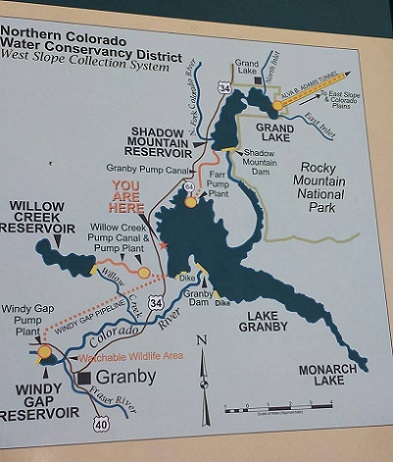
Share this post:
, , , ,
[Top]

Science of Sustenance – Green Batteries

Go Lean Commentary

Monkey see, monkey do …

CU Blog - Science of Sustenance - Green Batteries - Photo 0This is the expression; but this is science too: zoology, anthropology, animal husbandry. Monkeys are amazing creatures. They are in the same species as humans – primates. Monkeys are social creatures that live in family groups. Like many other animal species,  they adhere to an Alpha-Herd social order. Despite the fact that monkeys are generally considered to be intelligent, they tend to mimic the actions of their leaders more so than creating their own destinies. It is true, monkeys see, monkeys do.

If only the highest order of primates, us humans, worked the same way, then it would be easy to reform and transform society. To the contrary, the observation is that humans follow a different process:

Monkey see, monkey feel, monkey do. Sorry, make that “humans see, humans feel, humans do”.

As free moral agents, the human experience is that there must be a motivation to do something, like “change”, that we see others doing.

This point is developed more fully in the book Go Lean…Caribbean. It narrates the experience of smoking cessation. The book relates (Page 20):

Change is not easy …

Just ask anyone attempting to quit smoking. Not only are there physiological challenges, but psychological ones as well, to the extent that it can be stated with no uncertainty that “change begins in the head”. In psycho-therapy the approach to forge change for an individual is defined as “starting in the head (thoughts, visions), penetrating the heart (feelings, motivations) and then finally manifesting in the hands (actions).

There are a lot of things that Caribbean people and communities must change; there is the need to reform and transform. We must first develop the right attitudes and motivations for fostering our changes. We must penetrate the heart. The people of the Caribbean must change their feelings about elements of our society – elements that are in place and elements missing. The Go Lean book refers to this as “community ethos”, defined as:

the fundamental character or spirit of a culture; the underlying sentiment that informs the beliefs, customs, or practices of a group or society; dominant assumptions of a people or period.”

The Caribbean is in desperate straits. We have many societal dysfunctions and defects. We have challenges fulfilling even our basic needs. This is the focus of this commentary; it is 1 of 4 in a series on the modern advances in science for delivering basic needs. No one doubts that the inventory of basic needs include “food, clothing and shelter”. But modernity has forced us to add another entry: “energy”. In fact, the availability and affordability of energy can impact the deliveries of these order basic needs. The full series for our consideration will therefore follow this pattern:

  1.     Science of Sustenance: Energy
  2.     Science of Sustenance: Food
  3.     Science of Sustenance: Clothing
  4.     Science of Sustenance: Shelter

It is possible to deliver all basic needs without science. But for our modern world, the advances of science make a positive impact on daily life. In fact, one Anthropology study has concluded that the greatest scientific accomplishment for 20th Century society had been the invention, deployment and advances of the washing machine. Wow, remember the process to clean clothes before modern laundry equipment; it took all day. Women of the house had to be fulltime homemakers to satisfy this family need. This fact depicts the gravity of science in sustaining our modern life. Let’s consider all of the basic needs from this perspective.

Discussions about energy must consider a discussion on batteries. Battery = Stored Energy …

… despite all the scientific definitions, that is all it means, plain and simple. According to one source:

Batteries come in many shapes and sizes, from miniature cells used to power hearing aids and wristwatches to small, thin cells used in smartphones, to large lead acid batteries used in cars and trucks, and at the largest extreme, huge battery banks the size of rooms that provide standby or emergency power for telephone exchanges and computer data centers.

According to a 2005 estimate, the worldwide battery industry generates US$48 billion in sales each year,[5] with 6% annual growth. – Wikipedia.

Batteries traditionally store energy for later use. When we need it, we absolutely need it. Imagine a flashlight, when we “click” it on, we expect it to work. We spend a lot of money to ensure this functionality – according to the foregoing reference, $48 Billion/year.

But while batteries entail a lot of complicated chemicals – alkaline, lead-acid, lithium-ion, etc. – the underlying principle is to store the kinetic energy for future generation of electricity. There is a new recognition in this equation. The fact is that power grids create more power than they need at certain times; this creates the need for batteries; see here:

That’s the first reason we need batteries on the electrical grid: to even out the supply-and-demand, to time-shift the availability of power from nighttime to daytime.

But reason number two is even more important to our future: Power-plant batteries would eliminate the biggest problem with solar power and wind power, which is that they are both intermittent. “Clouds come over on a sunny day and, all of a sudden, it’s gone,” said Hopkins. “Wind stops blowing, all of a sudden, it’s gone. You need a way to store it.”

See full story in the VIDEO here:

Many experts in electricity are truly JUICED these days. They’re pursuing the “Search For The Super Battery” — the title of this Wednesday night’s [(February 1, 2017)] episode of “Nova” on PBS, hosted by our own David Pogue of Yahoo Tech.  Here is a preview:

VIDEO Making a better batteryhttp://www.cbsnews.com/videos/engineers-attempt-to-create-better-batteries

The science is progressing …

… green options are emerging; (green refers to natural, non-chemical solutions). According to the foregoing, green options  for storing energy include:

  • Gravity
  • Melting Ice
  • Magnetic Levitation

CU Blog - Science of Sustenance - Green Batteries - Photo 1

We need to consider these options in the Caribbean. In our region, energy costs are among the highest in the world. The book Go Lean… Caribbean relates (Page 100) how the Caribbean has among the most expensive energy costs in the world, despite having abundant alternative energy natural resources (solar, wind, tidal, geo-thermal). The Caribbean eco-system focuses on imported petroleum to provide energy options and as a result retail electricity rates in the Caribbean average US$0.35/kWh, when instead it could be down to US$0.088/kWh. A previous blog-commentary identified the societal defect that drives the regional governance for energy generation: rent-seeking. The local authorities depend on the fuel tax revenues to finance government operations. But alas, change is coming! The momentum for this change is big and getting bigger.

With such a 75% savings, we need the foregoing process: Monkey see, monkey feel, monkey do.

There is definitely the need to adapt some of the scientific best practices for energy generation and consumption. In a previous blog-commentary, it was confessed that one of the reasons why people flee the Caribbean region, is the discomforts during the summer months; (the Caribbean region has 8 – 10 warm months of the year) …

… hot weather, and the lack of infrastructure to mitigate and remediate the discomfort, is identified as one of the reasons for the brain drain/societal abandonment. (This previous blog-commentary appealed for cooperative refrigeration). If only we can turn on the air-conditioner – if we can afford the energy cost –  there would be the need to keep it running most of the time.

Many people find the current lack of energy options unbearable to live in their Caribbean ancestral homeland and thusly flee the region for North American and European destinations. The numbers are bad! We reported a 70 percent brain drain rate among the tertiary educated populations. (These are the ones who can best afford to leave; but the community can least afford to lose them).

Energy needs are undeniable 24-7-365; all the time. There is the need to deliver energy all of these times.

The delivery or fulfillment of these needs is a great target for lean, agile operations. Efficiency and technocratic executions will save a lot of money for the people and institutions of the Caribbean. But fossil fuels should not be the solution for the Caribbean.

  • First, with so many small islands, we do not have much natural resources.
  • Secondly, and most important, there is the matter of burning fossil fuels (oil, coal, wood pulp) and contributing to global warming and Climate Change.

The Go Lean book posits that the embrace of alternative energy generation sources to be more impactful on the quest to minimize the threats on the environment. Early in the book, the pressing need to be aware of Climate Change is pronounced in the Declaration of Interdependence (Page 11), with these words, (the first of many “causes of complaints”):

i. Whereas the earth’s climate has undeniably changed resulting in more severe tropical weather storms, it is necessary to prepare to insure the safety and security of life, property and systems of commerce in our geographical region. As nature recognizes no borders in the target of its destruction, we also must set aside border considerations in the preparation and response to these weather challenges.

With the innovative offering of Green Batteries, the quest to adapt to more clean/green energy options can be practical and more cost effective. Power generation from the sun or wind (free & renewable sources) is far cheaper that generation based on fossil fuels.

The book Go Lean… Caribbean serves as a roadmap for the introduction and implementation of the Caribbean Union Trade Federation (CU). This roadmap has 3 prime directives:

  • Optimization of the economic engines in order to grow the regional economy to $800 Billion GDP and create 2.2 million new jobs.
  • Establishment of a security apparatus to protect the resultant economic engines.
  • Improvement of Caribbean governance to support these engines.

This Go Lean/CU roadmap details a series of community ethos, strategies, tactics, implementations and advocacies to be early adopters of cutting-edge energy solutions, like Green Battery systems. The following list applies:

Community Ethos – Deferred Gratification Page 21
Community Ethos – Lean Operations Page 24
Community Ethos – Return on Investments Page 24
Community Ethos – Cooperatives Page 25
Community Ethos – Ways to Impact the Future Page 26
Community Ethos – Ways to Impact the Greater Good Page 37
Strategy – Harness the power of the sun/winds Page 46
Tactical – Fostering a Technocracy Page 82
Tactical – Separation of Powers – Energy Commission Page 82
Anecdote – “Lean” in Government – Energy Permits Page 93
Anecdote – Caribbean Energy Grid Implementation Page 100
Implementation – Ways to Develop Pipeline Industry Page 107
Implementation – Ways to Improve Energy Usage Page 113
Advocacy – Ways to Impact Public Works Page 175
Advocacy – Ways to Foster Cooperatives Page 176
Advocacy – Ways to Impact Monopolies Page 202

The Go Lean movement (book and blogs) asserts that we should fully embrace Green Energy solutions; its not a want, but a need for the region. This need had been further elaborated upon in these previous blog/commentaries:

https://goleancaribbean.com/blog/?p=7056 Electric Cars: ‘Necessity is the Mother of Invention’
https://goleancaribbean.com/blog/?p=6016 Hotter than July – A case for ‘Cooperative Refrigeration’
https://goleancaribbean.com/blog/?p=5155 Tesla unveils super-battery to power homes
https://goleancaribbean.com/blog/?p=4897 US Backs Natural Gas (LNG) Distribution Base in Jamaica
https://goleancaribbean.com/blog/?p=4294 Ambassadors to Caribbean discuss PetroCaribe-Energy, Security
https://goleancaribbean.com/blog/?p=2465 Book Review: ‘This Changes Everything: Capitalism vs. the Climate’
https://goleancaribbean.com/blog/?p=2338 Lessons: How Best to Welcome the Dreaded American ‘Plutocracy’
https://goleancaribbean.com/blog/?p=926 Conservative heavyweights have solar industry in their ‘kill’ sights
https://goleancaribbean.com/blog/?p=915 Go ‘Green’ … Caribbean

A focus of the Go Lean book is the economics of the Caribbean region. But the issues presented in this commentary – and the entire 4-part series – relate to Home Economics. Home Economics is an old field of study. At one point, this was a course in school systems for all levels, K through 12 and even in college curricula. The purpose of the formal “Home-Ec” education was to teach best practices in efficiency and effectiveness for  basic needs. Students learned more about food (cooking & nutrition), clothing (sewing & textiles) and housing (decorating, draperies and upholstery). Home-Ec lessons highlighted the technology of the day (before the 1980’s). Go back and re-visit those schools; the disposition will be that all those programs have been replaced with courses in Science, Technology, Engineering and Mathematics (STEM).

CU Blog - Science of Sustenance - Green Batteries - Photo 2

CU Blog - Science of Sustenance - Green Batteries - Photo 3

The Green Battery is an example of science guiding the future of the delivery of basic needs, in this case energy needs. Science is improving the delivery of all basic needs, all means of sustenance. There are many mountainous islands in the Caribbean; anyone of them can be a great candidate for the “pumped hydro” solution in the foregoing VIDEO. This will call for installing a dam and two reservoirs. During the periods when energy is abundant – mid day from solar panels – the water can be pumped uphill, then during the “off” times the water would flow downhill, using gravity to spin turbines and generate electricity.

CU Blog - Science of Sustenance - Green Batteries - Photo 8

CU Blog - Science of Sustenance - Green Batteries - Photo 5

CU Blog - Science of Sustenance - Green Batteries - Photo 4

CU Blog - Science of Sustenance - Green Batteries - Photo 7

Also consider that with the Caribbean hot-hot-hot summers, there is no doubt there is a need for air-conditioning. The energy hogging of the air-conditioning process is the compression to make refrigerated air. The approach in the foregoing VIDEO of making ice when energy is abundant – mid day from solar panels – then blowing the air from the “melting ice” is a technocratic solution – the simple science is depicted in these photos above. A solution based on this science – see sample product in photo below – can be deployed anywhere, everywhere.

CU Blog - Science of Sustenance - Green Batteries - Photo 6

These Green Battery deployments would be examples of the lean, agile operations, designed for the CU technocracy.

This and other innovations, once executed, would make the Caribbean a better place to live, work and play.

Now is the time for all of the Caribbean, the people, business, institutions and governments, to lean-in for the innovations and optimizations of the Go Lean roadmap. 🙂

Download the book Go Lean … Caribbean – now!


Share this post:
, , ,
[Top]

Fix ‘Climate Change’ – Yes, We Can

Go Lean Commentary

“Here I am, send me*“.

This is the declaration of Advocates wanting to abate the global problem of Climate Change. They have examined the science and are confident that they can make a difference. They are thereby further declaring that:

“We can fix Climate Change. Yes, we can…”

This is conceivable, believable and achievable.

cu-blog-fixing-climate-change-yes-we-can-photo-2Why is this so important? Climate Change is causing more and more severe hurricanes in the Caribbean region. We have just had to “batten down the hatches” and endure the passage of Hurricane Matthew.

Endure?

Not all survived! The death toll in Haiti in the wake of this tumultuous storm has counted 473 (with 75 people missing) .. so far.

The advocacy to arrest greenhouse gases (GHG) is therefore a matter of life-and-death; it has a successful track record to consider and provide encouragement and hope:

Remember Acid Rain?

That was a big deal in the 1970’s and 1980’s. It was a big environmental problem; the stakeholders came together – many kicking and screaming – to put in the remediation and mitigation and now the problem is greatly abated. See the encyclopedia details of the problem in the Appendix A below, where it is reported that Acid Rain levels have dropped 65% since 1976.

Climate Change is another area of atmospheric pollution that can also be abated with a lot of the same strategies, tactics and implementations as was employed to abate Acid Rain. But instead of the smoke stacks of factories and power plants, the problematic culprit this time is fossil fuels.

Fossil fuels and carbon emission = Climate Change!

Unlike Acid Rain, the “bad actors” for Climate Change are not just industrial installations; this time it is “almost everybody”. Cars are one of the biggest contributors. There is no denying this cause-effect any more. The problem is now globally acknowledged! There are new international agreements – Paris Conference of the Parties (COP) or COP21 – to curb fossil fuels / carbon dioxide emissions. 195 countries have signed on to these accords, including big polluters China (#1) and the US (#2).

The overall goal of these international accords is to achieve significant environmental benefits through reductions in emissions of greenhouse gases, the primary causes of Climate Change. The remediation and mitigations employ regulatory and market based approaches for controlling GHG elements. It should be noted that the COP21 accord is a non-binding agreement, but the biggest contribution is that the community will is now entrenched.

The book Go Lean … Caribbean uses an alternate technical term for “community will”; it identifies “community ethos”, as “the fundamental character or spirit of a culture; the underlying sentiment that informs the beliefs, customs, or practices of a society” (Page 20). So, in everyday practical terms, it will now be politically incorrect to pursue policies in denial of Climate Change.

The Go Lean book presents a 370-page roadmap for re-booting, re-organizing and restructuring the economic, security and governmental institutions of the 30 member-states in the Caribbean region, especially in light of the realities of Climate Change. Though this is a global battle, the Caribbean is on the front lines. As related in a previous blog-commentary, no Caribbean member-state appears high of the list of greenhouse gases emitters and yet we must still participate in the mitigations. We must “Go Green” to arrest our own carbon footprint, so that we may be less hypocritical – have moral authority – in calling for reform from the big polluting nations.

The Go Lean book serves as a roadmap for the introduction and implementation of the technocratic Caribbean Union Trade Federation (CU). The roadmap depicts how this CU federal government will take the lead in ensuring the Climate Change mitigation efforts are incentivized, executed and accounted for. There are economic (BIG dollar issues), security and governing implications to a lot of these measures. The CU/Go Lean roadmap allows for the leverage of a regional Single Market that would spread the burden across the 42 million people of the 30 member-states. Other Climate Change benefits were embedded in the motivation of the book, the opening Declaration of Interdependence stated these points (Pages 12-14):

xxvii. Whereas the region has endured a spectator status during the Industrial Revolution, we cannot stand on the sidelines of this new economy, the Information Revolution. Rather, the Federation must embrace all the tenets of Internet Communications Technology (ICT) to serve as an equalizing element in competition with the rest of the world. The Federation must bridge the digital divide and promote the community ethos that research/development is valuable and must be promoted and incentivized for adoption.

xxxiii. Whereas lessons can be learned and applied from the study of the recent history of other societies, the Federation must formalize statutes and organizational dimensions to avoid the pitfalls of communities like East Germany, Detroit, Indian (Native American) Reservations, Egypt and the previous West Indies Federation. On the other hand, the Federation must also implement the good examples learned from developments / communities like New York City, Germany, Japan, Canada, the old American West and tenants of the US Constitution.

The Go Lean book posits that the “whole is worth more than the sum of its parts”, that from this roadmap Caribbean economies will grow individually and even more collectively as a Single Market. The 3 CU prime directives of the roadmap include:

  • Optimization of the economic engines of the Caribbean to elevate the regional economy to grow to $800 Billion and create 2.2 million new jobs.
  • Establishment of a security apparatus to protect the resultant economic engines.
  • Improvement of Caribbean governance to support these engines.

The Go Lean roadmap calls for the CU to serve as the regional administration to optimize the societal engines for the Caribbean, especially in light of our Climate Change battleground frontline status. This is the first pronouncement (Page 11) of the same opening Declaration of Interdependence:

i. Whereas the earth’s climate has undeniably changed resulting in more severe tropical weather storms, it is necessary to prepare to insure the safety and security of life, property and systems of commerce in our geographical region. As nature recognizes no borders in the target of its destruction, we also must set aside border considerations in the preparation and response to these weather challenges.

The following details from the Go Lean…Caribbean book highlights the community ethos, strategies, tactics, implementation and advocacies necessary to elevate the regions stance in this global battle consequences on Climate Change:

Community Ethos – Deferred Gratification Page 21
Community Ethos – Economic Systems Influence Individual Choices / Incentives Page 21
Community Ethos – The Consequences of Choices Lie in the Future Page 21
Community Ethos – “Crap” Happens Page 23
Community Ethos – Lean Operations Page 24
Community Ethos – Cooperatives Page 24
Community Ethos – Non-Government Organizations Page 25
Community Ethos – Ways to Impact the Future Page 26
Community Ethos – Ways to Improve Sharing Page 35
Community Ethos – Impact the Greater Good Page 37
Strategy – Vision – Confederating 30 Member-States into a Single Market Page 45
Strategy – Vision – Foster Local Economic Engines for Basic Needs Page 45
Strategy – Mission – Prepare for Natural Disasters Page 45
Strategy – Agents of Change – Climate Change Page 57
Strategy – Agents of Change – Globalization Page 57
Tactical – Confederating a Permanent Union Page 63
Tactical – Fostering a Technocracy Page 64
Separation of Powers – Emergency Management Page 76
Separation of Powers – Interstate Commerce Administration Page 79
Separation of Powers – Meteorological & Geological Service Page 79
Separation of Powers – Fisheries Department – Regulator Page 88
Anecdote – “Lean” in Government Page 93
Implementation – Assemble Regional Organs into a Single Market Economy Page 96
Implementation – Ways to Pay for Change Page 101
Implementation – Security Initiatives at Start-up – Unified Command & Control Page 103
Implementation – Industrial Policy for CU Self Governing Entities Page 103
Implementation – Ways to Deliver Page 109
Implementation – Ways to Foster International Aid Page 115
Implementation – Ways to Benefit from Globalization Page 119
Planning – Big Ideas for the Caribbean Region Page 127
Planning – Ways to Make the Caribbean Better Page 131
Advocacy – Ways to Grow the Economy Page 151
Advocacy – Ways to Create Jobs Page 152
Advocacy – Ways to Improve Governance Page 168
Advocacy – Ways to Better Manage the Social Contract Page 170
Advocacy – Ways to Foster Cooperatives Page 176
Advocacy – Ways to Improve for Natural Disasters Page 184
Advocacy – Ways to Improve Emergency Management Page 196
Advocacy – Ways to Improve Transportation Page 205
Advocacy – Ways to Develop the Auto Industry Page 206

The quest to Go Green has frequently been detailed in previous blog-commentaries since the publication of the Go Lean book:

https://goleancaribbean.com/blog/?p=7449 Due to Climate Change, ‘Crap Happens’ – So What Now?
https://goleancaribbean.com/blog/?p=7103 COP21 – ‘Climate Change’ Acknowledged
https://goleancaribbean.com/blog/?p=7056 Electric Cars: ‘Necessity – Climate Change – is the Mother of Invention’
https://goleancaribbean.com/blog/?p=6893 A Meteorologist’s View On Climate Change
https://goleancaribbean.com/blog/?p=6016 ‘Hotter than July’ – Reality in the Caribbean
https://goleancaribbean.com/blog/?p=4673 Climate Change‘ Merchants of Doubt … to Preserve Profits!!
https://goleancaribbean.com/blog/?p=2465 Book Review: ‘This Changes Everything: Capitalism vs. the Climate’
https://goleancaribbean.com/blog/?p=2276 Climate Change May Affect Food Supply Within a Decade
https://goleancaribbean.com/blog/?p=2119 Cooling Effect – Oceans and the Climate
https://goleancaribbean.com/blog/?p=1883 Climate Change May Bring More Kidney Stones
https://goleancaribbean.com/blog/?p=1817 Caribbean grapples with intense new cycles of flooding & drought

https://goleancaribbean.com/blog/?p=1516 Floods in Minnesota, Drought in California – Why Not Share?
https://goleancaribbean.com/blog/?p=926 Conservative heavyweights have solar industry in their sights
https://goleancaribbean.com/blog/?p=915 Go ‘Green’ … Caribbean

The quest of the CU/Go Lean roadmap is to make the Caribbean region a more self-reliant society; to act more proactively and reactively for our own emergencies and natural disaster events; and to be more efficient in our governance. Hurricane Matthew was a natural disaster; a Climate Change-induced hurricane, that was a Category 5 at one point … for 6 hours. No technocracy can dissuade such an event.

Climate Change causes the temperature of the oceans to be a little warmer, even 1 or 2 degrees can intensify storms: from Category 1 to Category 2, or from Category 2 to Category 3, or Category 3 to Category 4, or Category 4 to Category 5.

The solution for Climate Change-induced storms is a “long game”. Lowering the GHG in the atmosphere will reverse the previous bad trend: increasing GHG has raised the ocean temperatures.
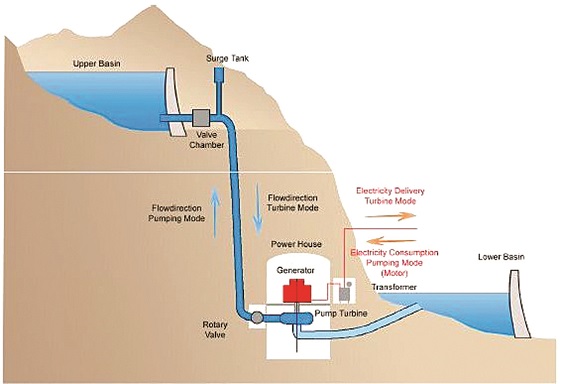
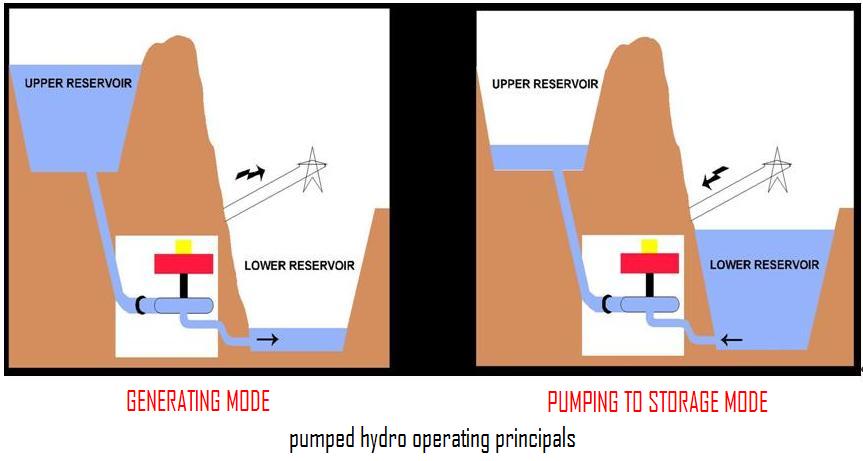
To fix Climate Change, we need to support the mandates of COP21 … and other accords; (see Appendix – VIDEO). We also need to use peer pressure to convince other nations to comply with the accords. We can get them to capitulate by appealing to their “better nature”.

If Climate Change is not arrested, then even more devastating storms will come – more Category 5 storms. There is the need for the Caribbean region to establish a permanent union to provide efficient stewardship for our economic, security and governing engines; and to champion the region’s participation and fulfillment of COP21 mandates.

Now is the time for all of the Caribbean, the people and governing institutions, to lean-in to the empowerments described in the book Go Lean … Caribbean. This is the course we must pursue, how we can fix Climate Change; and how we make the Caribbean homeland a better place to live, work and play. 🙂

Download the book Go Lean … Caribbean – now!

———

Appendix VIDEOCan We Fix Climate Change?https://youtu.be/sIpr0SwJncs

Published on Oct 29, 2015 – Bill Nye [the Science Guy] speaks on the ways in which we can mitigate Climate Change – National Geographic.
➡ Subscribe: http://bit.ly/NatGeoSubscribe
➡ Get More Explorer: http://bit.ly/MoreExplorer

———–

Appendix A – Reference Title: Acid Rain

cu-blog-fixing-climate-change-yes-we-can-photo-1Acid Rain is a rain or any other form of precipitation that is unusually acidic, meaning that it possesses elevated levels of hydrogen ions (low pH). It can have harmful effects on plants, aquatic animals and infrastructure. Acid rain is caused by emissions of sulfur dioxide and nitrogen oxide, which react with the water molecules in the atmosphere to produce acids. Some governments have made efforts since the 1970s to reduce the release of sulfur dioxide and nitrogen oxide into the atmosphere with positive results. Nitrogen oxides can also be produced naturally by lightning strikes, and sulfur dioxide is produced by volcanic eruptions. The chemicals in acid rain can cause paint to peel, corrosion of steel structures such as bridges, and weathering of stone buildings and statues.

Definition

Acid Rain is a popular term referring to the deposition of a mixture from wet (rain, snow, sleet, fog, cloudwater, and dew) and dry (acidifying particles and gases) acidic components. Distilled water, once carbon dioxide is removed, has a neutral pH of 7. Liquids with a pH less than 7 are acidic, and those with a pH greater than 7 are alkaline. “Clean” or unpolluted rain has an acidic pH, but usually no lower than 5.7, because carbon dioxide and water in the air react together to form the weak carbonic acid.

Carbonic acid then can ionize in water forming low concentrations of hydronium and carbonate ions.

[Water is H2O ; Acid Rain is represented as H2CO3.] Acid deposition as an environmental issue would include additional acids to H2CO3

Adverse effects

Acid rain has been shown to have adverse impacts on forests, freshwaters and soils, killing insect and aquatic life-forms as well as causing damage to buildings and having impacts on human health.

Other adverse effects
cu-blog-fixing-climate-change-yes-we-can-photo-3Acid rain can damage buildings, historic monuments, and statues, especially those made of rocks, such as limestone and marble, that contain large amounts of calcium carbonate. Acids in the rain react with the calcium compounds in the stones to create gypsum, which then flakes off.

History

Since the Industrial Revolution, emissions of sulfur dioxide and nitrogen oxides into the atmosphere have increased.[3][4] In 1852, Robert Angus Smith was the first to show the relationship between acid rain and atmospheric pollution in Manchester, England.[5]

Though acidic rain was discovered in 1853, it was not until the late 1960s that scientists began widely observing and studying the phenomenon.[6] The term “acid rain” was coined in 1872 by Robert Angus Smith.[7] Canadian Harold Harvey was among the first to research a “dead” lake. Public awareness of acid rain in the U.S increased in the 1970s after The New York Times published reports from the Hubbard Brook Experimental Forest in New Hampshire of the myriad deleterious environmental effects shown to result from it.[8][9]

Occasional pH readings in rain and fog water of well below 2.4 have been reported in industrialized areas.[3] Industrial acid rain is a substantial problem in China and Russia[10][11]and areas downwind from them. These areas all burn sulfur-containing coal to generate heat and electricity.[12]

The problem of acid rain has not only increased with population and industrial growth, but has become more widespread. The use of tall smokestacks to reduce local pollution has contributed to the spread of acid rain by releasing gases into regional atmospheric circulation.[13][14] Often deposition occurs a considerable distance downwind of the emissions, with mountainous regions tending to receive the greatest deposition (simply because of their higher rainfall). An example of this effect is the low pH of rain which falls in Scandinavia.

History of acid rain in the United States
In 1980, the U.S. Congress passed an Acid Deposition Act.[16] This Act established an 18-year assessment and research program under the direction of the National Acidic Precipitation Assessment Program (NAPAP). NAPAP looked at the entire problem from a scientific perspective. It enlarged a network of monitoring sites to determine how acidic the precipitation actually was, and to determine long-term trends, and established a network for dry deposition. It looked at the effects of acid rain and funded research on the effects of acid precipitation on freshwater and terrestrial ecosystems, historical buildings, monuments, and building materials. It also funded extensive studies on atmospheric processes and potential control programs.

From the start, policy advocates from all sides attempted to influence NAPAP activities to support their particular policy advocacy efforts, or to disparage those of their opponents.[16] For the U.S. Government’s scientific enterprise, a significant impact of NAPAP were lessons learned in the assessment process and in environmental research management to a relatively large group of scientists, program managers and the public.[17]

In 1991, DENR provided its first assessment of acid rain in the United States. It reported that 5% of New EnglandLakes were acidic, with sulfates being the most common problem. They noted that 2% of the lakes could no longer support Brook Trout, and 6% of the lakes were unsuitable for the survival of many species of minnow. Subsequent Reports to Congress have documented chemical changes in soil and freshwater ecosystems, nitrogen saturation, decreases in amounts of nutrients in soil, episodic acidification, regional haze, and damage to historical monuments.

Meanwhile, in 1989, the U.S. Congress passed a series of amendments to the Clean Air Act. Title IV of these amendments established the Acid Rain Program, a cap and trade system designed to control emissions of sulfur dioxide and nitrogen oxides. Title IV called for a total reduction of about 10 million tons of SO2 emissions from power plants. It was implemented in two phases. Phase I began in 1995, and limited sulfur dioxide emissions from 110 of the largest power plants to a combined total of 8.7 million tons of sulfur dioxide. One power plant in New England (Merrimack) was in Phase I. Four other plants (Newington, MountTom, Brayton Point, and SalemHarbor) were added under other provisions of the program. Phase II began in 2000, and affects most of the power plants in the country.

During the 1990s, research continued. On March 10, 2005, EPA issued the Clean Air Interstate Rule (CAIR). This rule provides states with a solution to the problem of power plant pollution that drifts from one state to another. CAIR will permanently cap emissions of SO2 and NOx in the eastern United States. When fully implemented, CAIR will reduce SO2 emissions in 28 eastern states and the District of Columbia by over 70% and NOx emissions by over 60% from 2003 levels.[18]

Overall, the program’s cap and trade program has been successful in achieving its goals. Since the 1990s, SO2 emissions have dropped 40%, and according to the Pacific Research Institute, Acid Rain levels have dropped 65% since 1976.[19][20] Conventional regulation was used in the European Union, which saw a decrease of over 70% in SO2emissions during the same time period.[21]

In 2007, total SO2 emissions were 8.9 million tons, achieving the program’s long-term goal ahead of the 2010 statutory deadline.[22]

Prevention methods
The overall goal of the Acid Rain [reduction] program is to achieve significant environmental and public health benefits through reductions in emissions of sulfur dioxide (SO2) and nitrogen oxides (NOx), the primary causes of acid rain[39]. To achieve this goal at the lowest cost to society, the program employs both regulatory and market based approaches for controlling air pollution.

Technical solutions

1. Many coal-firing power stations use flue-gas desulfurization (FGD) to remove sulfur-containing gases from their stack gases. For a typical coal-fired power station, FGD will remove 95% or more of the SO2 in the flue gases. An example of FGD is the wet scrubber which is commonly used. A wet scrubber is basically a reaction tower equipped with a fan that extracts hot smoke stack gases from a power plant into the tower. Lime or limestone in slurry form is also injected into the tower to mix with the stack gases and combine with the sulfur dioxide present. The calcium carbonate of the limestone produces pH-neutral calcium sulfate that is physically removed from the scrubber.

2. Fluidized bed combustion also reduces the amount of sulfur emitted by power production.

3. Vehicle emissions control reduces emissions of nitrogen oxides from motor vehicles.

International treaties

A number of international treaties on the long-range transport of atmospheric pollutants have been agreed for example, the 1985 Helsinki Protocol on the Reduction of Sulphur Emissions under the Convention on Long-Range Transboundary Air Pollution. Canada and the US signed the Air Quality Agreement in 1991. Most European countries and Canada have signed the treaties.

Emissions trading
This refers to a regulatory scheme where polluting facilities can purchase on an open market an emissions allowance for each unit of a designated pollutant it emits. Operators can then install pollution control equipment, and sell portions of their emissions allowances they no longer need for their own operations, thereby recovering some of the capital cost of their investment in such equipment. The intention is to give operators economic incentives to install pollution controls.

Source: Wikipedia.com Online Encyclopedia; retrieved October 12, 2016: https://en.wikipedia.org/wiki/Acid_rain

Share this post:
, ,
[Top]