Tag: Banks

Book Review on ‘Mitigating Income Inequality’

Go Lean Commentary

Income Inequality = the rich becoming richer while the middle classes shrink.
CU Blog - Mitigating Income Inequity - Photo 1

A phrase like Income Inequality, on the surface, would appear to be just about economics. But truthfully this is more a subject about governance, but yes, in alignment with economic and security concerns.

The book Go Lean…Caribbean and accompanying blogs constantly focus on economics, security and governance in the Caribbean region. The book serves as a roadmap for the introduction and implementation of the technocratic Caribbean Union Trade Federation (CU). If this effort is successful then it could result in some abatement of Income Inequality.

The subject of Income Inequality has been influx more and more as of late, especially after the Great Recession of 2008 – a frequent topic for the Go Lean book and accompanying blogs. The desire to eliminate or reduce Income Inequality is a practical argument for social cohesion and to reduce social unrest; as such eruptions can weaken society. Income Inequality has a slippery slope that can lead to down to Failed-State status. Now after waging global conflicts of World War I, World War II plus countless regional conflicts and sectarian violence, it is important for societies to be “on guard” for encroachments in this regard.

Thusly, Income Inequality is a “hot topic” … in many countries.

A 2011 OECD study investigated economic inequality in Argentina, Brazil, China, India, Indonesia, Russia and South Africa. It concluded that key sources of inequality in these countries include “a large, persistent informal sector (Black Markets), widespread regional divides (e.g. urban-rural), gaps in access to education, and barriers to employment and career progression for women.”[12] Here are some poignant tidbits on this subject from varied countries around the world (Wikipedia Online Encyclopedia; retrieved 09/16/2015 from: https://en.wikipedia.org/wiki/Economic_inequality):

Russia
A report by Credit Suisse in 2013 states that: Russia has the highest level of wealth inequality in the world, apart from small Caribbean nations with resident billionaires. Worldwide, there is one billionaire for every US$170 billion in household wealth; Russia has one for every US$11 billion. Worldwide, billionaires collectively account for 1–2% of total household wealth; in Russia today 110 billionaires own 35% of all wealth.[9]

Western Europe
A previous blog-commentary detailed how royal charters formal documents issued by monarch as letters patent, granting a right or power to individuals or corporate bodies – contributed to much of the Income Inequity legacy in Western European lands, and their former colonies. Among the past and present groups formed by royal charter are the British East India Company (1600), the Hudson’s Bay Company, Standard Chartered, the Peninsular and Oriental Steam Navigation Company (P&O), the British South Africa Company, and some of the former British colonies on the North American mainland, City livery companies, the Bank of England and the British Broadcasting Corporation (BBC).[2] Principals of these chartered companies became instant oligarchs; and their heirs inherited this wealth and status over the decades and centuries. In recent times however, more egalitarianism emerged, mostly because of an embrace of Neo-Socialism governmental policies and strong unions.

United States
Bernie Sanders (I-VT) opined in a 2010 The Nation article that an “upper-crust of extremely wealthy families are hell-bent on destroying the democratic vision of a strong middle-class which has made the United   States the envy of the world. In its place they are determined to create an oligarchy in which a small number of families control the economic and political life of our country.”[14] The top 1% in 2007 had a larger share of total income than at any time since 1928.[15] In 2011, according to PolitiFact and others, the top 400 wealthiest Americans “have more wealth than half of all Americans combined.”[16][17][18][19]

Economic researchers John Schmitt and Ben Zipperer (2006) of the CEPR (Center for Economic and Policy Research) point to economic liberalism and the reduction of business regulation along with the decline of union membership as one of the causes of economic inequality. In an analysis of the effects of intensive Anglo-American liberal policies in comparison to continental European liberalism, where unions have remained strong, they concluded “The U.S. economic and social model is associated with substantial levels of social exclusion, including high levels of income inequality, high relative and absolute poverty rates, poor and unequal educational outcomes, poor health outcomes, and high rates of crime and incarceration. At the same time, the available evidence provides little support for the view that U.S.-style labor-market flexibility dramatically improves labor-market outcomes. Despite popular prejudices to the contrary, the U.S. economy consistently affords a lower level of economic mobility than all the continental European countries for which data is available.”[68]

This lesson in economic history is presented in a consideration of the book Go Lean…Caribbean. In addition to the CU, the roadmap introduces the implementation of the technocratic Caribbean Central Bank (CCB). These two entities are designed to provide better economic stewardship (governance), to ensure that the economic failures of the past, in the Caribbean and other regions, do not re-occur here in the Caribbean homeland. The book posits that we must NOT fashion ourselves as parasites of these cited countries/regions, (US, Europe or Russia) but rather pursue a status as a protégé of these powers; benefiting from their lessons-learned but molding a better society.

Consider further the US model …

The Go Lean book cites the example of the Occupy Wall Street protests of 2011, with this quotation:

Ways to Impact Wall Street – Learn from Occupy Wall Street Protest MovementPage 200
This protest movement began on September 17, 2011, in Zuccotti Park, located in New York City’s Wall Street financial district. The main issues raised by the protests were social and economic inequality, greed, corruption and the perceived undue influence of financial service firms on the Federal government. The slogan, “We are the 99%”, referred to income inequality and wealth distribution in the U.S. between the wealthiest 1% and the rest of the population. In hindsight and as a lesson for the CU, these underlying concerns were legitimate as the 2008 Great Recession had its root causes tied to the many issues of Wall Street abuses against Main Street.

Ways to Impact Student Loans – Lessons from Occupy Wall Street (OWS)Page 160
The OWS protest movement highlighted some legitimate issues with the student loan industry. The US Federal government provides guarantees on student loans (direct and indirect), and the loans are non-dischargeable in any BK process, so private loan issuers were assured a profit. The issuers would therefore drive the industry to lend more and more to less capable students at high interest rates. As a result of the protest, the Obama Administration eliminated the indirect channel for student loan, taking the profit motive out of the process. The CU will [apply this lesson and] only direct lend.

For the most part, the people of the United States are good-natured and mean well. But there is a Shadow Influence in the US financial eco-system that undermines a lot of policies for the Greater Good. One theoretical framework of the field of Economics – neoclassical – has fully defined this. Neoclassical economics views inequalities in the distribution of income as arising from differences in value added by labor, capital and land. Within labor income distribution is due to differences in value added by different classifications of workers. In this perspective, wages and profits are determined by the marginal value added of each economic actor (worker, capitalist/business owner, landlord).[47] Thus rising inequalities are merely a reflection of the productivity gap between highly-paid professions and lower-paid professions.[48]

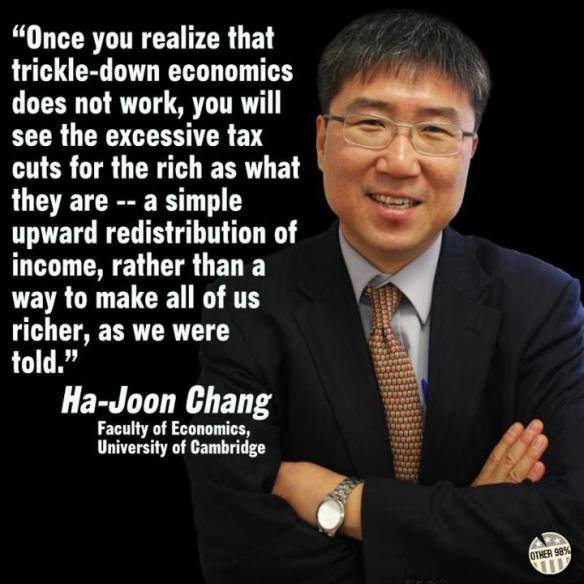
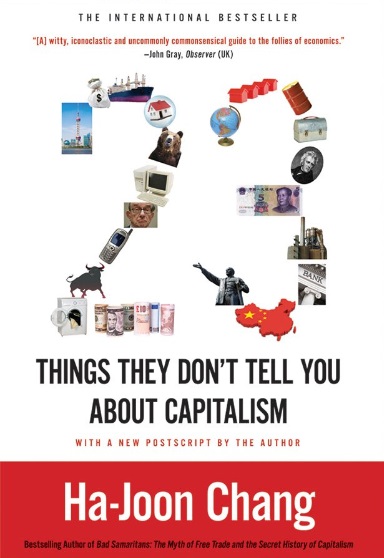
A prominent Neoclassical Economist, Cambridge University Professor Dr. Ha-Joon Chang, has emerged in recent years; he published this book 23 Things They Don’t Tell You About Capitalism. This publication addresses the width-and-breath of the subject of Income Inequality. Consider the related VIDEO and Book Reviews here:

VIDEO – “The Real News Network / TRNN” Interview with Ha-Joon Chang Part 1 – https://youtu.be/J7m9wfFnH6o

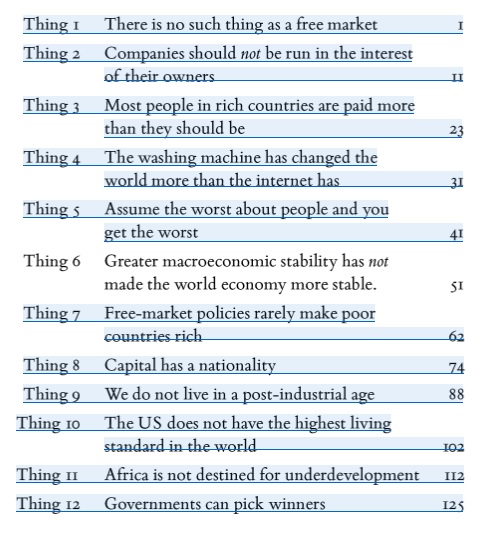
Posted April 4, 2011Part 1: Introducing the book 23 Things They Don’t Tell You About Capitalism with a summary of the first chapter/”Thing”: “There is no such thing as a free market”.

Part 2: https://youtu.be/4x3cS3F-SDM
Part 3: https://youtu.be/x_iLg00PuyU
Part 4: https://youtu.be/szoimtsFQEg
Part 5: https://youtu.be/RQ4Xzv9LsZs 
Part 6: https://youtu.be/EhjKVo-f6Zw
Part 7: https://youtu.be/f74NPSPFTjw 
Part 8: https://youtu.be/3bgcUPRnMls  

————-

Book Review: 23 Things They Don’t Tell You About Capitalism

Amazon Summary:

CU Blog - Mitigating Income Inequity - Photo 2

The acclaimed Ha-Joon Chang is a voice of sanity―and wit―in this lighthearted audiobook with a serious purpose: to question the assumptions behind the dogma and sheer hype that the dominant school of neoliberal economists have spun since the Age of Reagan. 23 Things They Don’t Tell You about Capitalism uses twenty-three short essays (a few great examples: “There Is No Such Thing as a Free Market,” “The Washing Machine Has Changed the World More than the Internet Has”) to equip listeners with an understanding of how global capitalism works, and doesn’t, while offering a vision of how we can shape capitalism to humane ends, instead of becoming slaves of the market.

Praise for the book 23 Things They Don’t Tell You about Capitalism:

“A lively, accessible and provocative book.” ―Sunday Times (UK)

“Chang, befitting his position as an economics professor at Cambridge University, is engagingly thoughtful and opinionated at a much lower decibel level. ‘The “truths” peddled by free-market ideologues are based on lazy assumptions and blinkered visions,’ he charges.” ―Time

Editorial Reviews
From Publishers Weekly
Chang (Bad Samaritans) takes on the “free-market ideologues,” the stentorian voices in economic thought and, in his analysis, the engineers of the recent financial catastrophe. Free market orthodoxy has inserted its tenterhooks into almost every economy in the world–over the past three decades, most countries have privatized state-owned industrial and financial firms, deregulated finance and industry, liberalized international trade and investments, and reduced income taxes and welfare payments. But these policies have unleashed bubbles and ever increasing income disparity. How can we dig ourselves out? By examining the many myths in the narrative of free-market liberalism, crucially that the name is itself a misnomer: there is nothing “free” about a market where wages are largely politically determined; that greater macroeconomic stability has not made the world economy more stable; and a more educated population itself won’t make a country richer. An advocate of big, active government and capitalism as distinct from a free market, Chang presents an enlightening précis of modern economic thought–and all the places it’s gone wrong, urging us to act in order to completely rebuild the world economy: “This will some readers uncomfortable… it is time to get uncomfortable.” (Jan.) (c)
Copyright © Reed Business Information, a division of Reed Elsevier Inc. All rights reserved. –This text refers to the Hardcover edition.

Review
Leading economist [Ha-Joon Chang] has likened the nation’s acceptance of free-market capitalism to that of the brainwashed characters in the film The Matrix, unwitting pawns in a fake reality. [Chang] debunks received wisdom on everything — Rachel Shields Independent A masterful debunking of some of the myths of capitalism … Witty, iconoclastic and uncommonly commonsensical … this book will be invaluable — John Gray Observer Lively and provocative book … Read this book — David Smith Sunday Times Incisive and entertaining … scathing about the conventional wisdom’ — Robert Skidelsky New Statesman Important .. persuasive … [an] engaging case for a more cautious and caring era of globalisation — James Crabtree Financial Times Myth-busting and nicely-written … the best economists are those who look around at our man-made world and ask themselves “why?”. Chang is one — Sean O’Grady Independent –This text refers to an out of print or unavailable edition of this title.

Sample Customer Review
By: William Podmore on November 2, 2010
Format: Kindle Edition

Ha-Joon Chang, Reader in the Political Economy of Development at Cambridge University, has written a fascinating book on capitalism’s failings. He also wrote the brilliant Bad Samaritans. Martin Wolf of the Financial Times says he is `probably the world’s most effective critic of globalisation’.

Chang takes on the free-marketers’ dogmas and proposes ideas like – there is no such thing as a free market; the washing machine has changed the world more than the internet has; we do not live in a post-industrial age; globalisation isn’t making the world richer; governments can pick winners; some rules are good for business; US (and British) CEOs are overpaid; more education does not make a country richer; and equality of opportunity, on its own, is unfair.

He notes that the USA does not have the world’s highest living standard. Norway, Luxemburg, Switzerland, Denmark, Iceland, Ireland, Sweden and the USA, in that order, had the highest incomes per head. On income per hours worked, the USA comes eighth, after Luxemburg, Norway, France, Ireland, Belgium, Austria and the Netherlands. Japan, Switzerland, Singapore, Finland and Sweden have the highest industrial output per person.

Free-market politicians, economists and media have pushed policies of de-regulation and pursuit of short-term profits, causing less growth, more inequality, more job insecurity and more frequent crises. Britain’s growth rate in income per person per year was 2.4 per cent in the 1960s-70s and 1.7 per cent 1990-2009. Rich countries grew by 3 per cent in the 1960s-70s and 1.4 per cent 1980-2009. Developing countries grew by 3 per cent in the 1960s-70s and 2.6 per cent 1980-2009. Latin America grew by 3.1 per cent in the 1960s-70s and 1.1 per cent 1980-2009, and Sub-Saharan Africa by 1.6 per cent in the 1960s-70s and 0.2 per cent 1990-2009. The world economy grew by 3.2 per cent in the 1960s-70s and 1.4 per cent 1990-2009.
So, across the world, countries did far better before Thatcher and Reagan’s `free-market revolution’. Making the rich richer made the rest of us poorer, cutting economies’ growth rates, and investment as a share of national output, in all the G7 countries.

Chang shows how free trade is not the way to grow and points out that the USA was the world’s most protectionist country during its phase of ascendancy, from the 1830s to the 1940s, and that Britain was one of world’s the most protectionist countries during its rise, from the 1720s to the 1850s.

He shows how immigration controls keep First World wages up; they determine wages more than any other factor. Weakening those controls, as the EU demands, lowers wages.

He challenges the conventional wisdom that we must cut spending to cut the deficit. Instead, we need controls capital, on mergers and acquisitions, and on financial products. We need the welfare state, industrial policy, and huge investment in industry, infrastructure, worker training and R&D.

As Chang points out, “Even though financial investments can drive growth for a while, such growth cannot be sustained, as those investments have to be ultimately backed up by viable long-term investments in real sector activities, as so vividly shown by the 2008 financial crisis.”

This book is a common-sense, evidence-based approach to economic life, which we should urge all our friends and colleagues to read.

Source: http://www.amazon.com/Things-They-Dont-About-Capitalism/dp/1501266306
So how do we mitigate Income Inequality?

After presenting 23 bold statements about Things They Didn’t Tell Us About Capitalism, Professor Ha-Joon Chang, provides one more chapter, a conclusion, answering this exact question. Everyone is urged to buy his book and consume his solutions.
CU Blog - Mitigating Income Inequity - Photo 3CU Blog - Mitigating Income Inequity - Photo 4

The book Go Lean … Caribbean, also answers a similar question: how do we mitigate Income Inequality in the Caribbean?

In summary, the Go Lean movement discourages the region from modeling the American brand of Free Market capitalism. The movement posits that America is plagued with Crony-Capitalism and institutional racism. It is therefore not the eco-system for the Caribbean to model.

On the other hand, we must give more priority to the Middle Class – as in creating 2.2 million new jobs – and less to the Rich – One Percent. (Though there is no plan to penalize their success or to forcibly redistribute any wealth).

In general, the CU will employ better strategies, tactics and implementations to impact its prime directives; identified with the following 3 statements:

  • Optimization of the economic engines in order to grow the regional economy to $800 Billion & create 2.2 million new jobs.
  • Establishment of a security apparatus to protect the resultant economic engines and mitigate internal and external threats.
  • Improvement of Caribbean governance to support these engines.

Early in the Go Lean book, this need for careful technocratic stewardship of the regional Caribbean economy was pronounced (Declaration of Interdependence – Page 12 – 13) with these acknowledgements and statements:

xi.   Whereas all men are entitled to the benefits of good governance in a free society, “new guards” must be enacted to dissuade the emergence of incompetence, corruption, nepotism and cronyism at the peril of the people’s best interest. The Federation must guarantee the executions of a social contract between government and the governed.

xii.   Whereas the legacy in recent times in individual states may be that of ineffectual governance with no redress to higher authority, the accedence of this Federation will ensure accountability and escalation of the human and civil rights of the people for good governance, justice assurances, due process and the rule of law. As such, any threats of a “failed state” status for any member state must enact emergency measures on behalf of the Federation to protect the human, civil and property rights of the citizens, residents, allies, trading partners, and visitors of the affected member state and the Federation as a whole.

xxiv.    Whereas a free market economy can be induced and spurred for continuous progress, the Federation must install the controls to better manage aspects of the economy: jobs, inflation, savings rate, investments and other economic principles. Thereby attracting direct foreign investment because of the stability and vibrancy of our economy.

xxv.    Whereas the legacy of international democracies had been imperiled due to a global financial crisis, the structure of the Federation must allow for financial stability and assurance of the Federation’s institutions. To mandate the economic vibrancy of the region, monetary and fiscal controls and policies must be incorporated as proactive and reactive measures. These measures must address threats against the financial integrity of the Federation and of the member-states.

The Go Lean book stressed the key community ethos, strategies, tactics, implementations and advocacies necessary to regulate and manage the regional economy and mitigate Income Inequality in the Caribbean. These points are detailed in the book, as in this sample list:

Community Ethos – Economic Principles – People Respond to Incentives Page 21
Community Ethos – Economic Principles – Economic Systems Influence Individual Choices Page 21
Community Ethos – Economic Principles – Voluntary Trade Creates Wealth Page 21
Community Ethos – Economic Principles – Consequences of Choices Lie in the Future Page 21
Community Ethos – Economic Principles – Money Multiplier Page 23
Community Ethos – Governing Principles – Lean Operations Page 24
Community Ethos – Ways to Impact the Future Page 26
Community Ethos – Ways to Impact the Greater Good Page 37
Strategy – Mission – Fortify the Stability of the Banking Institutions Page 45
Strategy – Provide Proper Oversight and Support for the Depository Institutions Page 46
Tactical – Ways to Foster a Technocracy Page 64
Tactical – Growing the Economy – Minimizing Bubbles Page 69
Tactical – Separation-of-Powers – Caribbean Central Bank Page 73
Tactical – Separation-of-Powers – Depository Institutions Regulatory Agency Page 73
Anecdote – Turning Around CARICOM – Effects of 2008 Financial Crisis Page 92
Implementation – Assemble Caribbean Central Bank as a Cooperative Page 96
Implementation – Ways to Better Manage Debt Page 114
Planning – 10 Big Ideas – Single Market / Currency Union Page 127
Planning – Ways to Improve Failed-State Indices Page 134
Planning – Lessons Learned from 2008 Page 136
Planning – Ways to Measure Progress Page 147
Anecdote – Caribbean Currencies Page 149
Advocacy – Ways to Grow the Economy Page 151
Advocacy – Ways to Create Jobs Page 152
Advocacy – Ways to Control Inflation Page 153
Advocacy – Ways to Mitigate Black Markets Page 165
Advocacy – Reforms for Banking Regulations Page 199
Advocacy – Ways to Impact Wall Street – Lessons from the “Occupy Wall Street” Protests Page 200
Advocacy – Ways to Impact Main Street Page 201
Advocacy – Battles in the War on Poverty Page 222
Advocacy – Ways to Help the Middle Class Page 223
Advocacy – Ways to Impact the One Percent Page 224
Appendix – Controlling Inflation – Technical Details Page 318

The points of effective, technocratic economic stewardship of the Caribbean have been detailed in these previous blog/commentaries:

https://goleancaribbean.com/blog/?p=6286 Managing the ‘Invisible Hand of the Market’
https://goleancaribbean.com/blog/?p=5733 Better than America? Yes, We Can!
https://goleancaribbean.com/blog/?p=5597 Economic Principle: Market Forces -vs- Collective Bargaining
https://goleancaribbean.com/blog/?p=3858 ECB unveils 1 trillion Euro stimulus program
https://goleancaribbean.com/blog/?p=3582 For Canadian Banks: Caribbean is a ‘Bad Bet’
https://goleancaribbean.com/blog/?p=3090 Introduction to Europe – All Grown Up
https://goleancaribbean.com/blog/?p=2930 ‘Too Big To Fail’ – Caribbean Version
https://goleancaribbean.com/blog/?p=1731 Role Model Warren Buffet
https://goleancaribbean.com/blog/?p=1309 5 Steps of a Bubble
https://goleancaribbean.com/blog/?p=1014 All is not well in the sunny Caribbean
https://goleancaribbean.com/blog/?p=782 Open the Time Capsule: The Great Recession of 2008
https://goleancaribbean.com/blog/?p=353 Book Review: ‘Wrong – Nine Economic Policy Disasters and What We Can Learn…’

The Go Lean book reports that the Caribbean is in crisis. There are movements on that “slippery slope”. Already the region is suffering a debilitating brain-drain estimated at 70% with some countries reporting up to 81%. This disposition is symptomatic of a Failed-State status. This roadmap attempts to reboot the Caribbean eco-systems, because we have this bad track record to contend with. The status quo must be assuaged.

It is time for change in the Caribbean! It is time to build a better society, for all: rich, poor and middle classes. Finally, the region is presented with a functional roadmap – the book Go Lean…Caribbean – where the strategies, tactics and implementations are conceivable, believable and achievable. Yes, we can make our homeland a better place to live, work and play.

Everyone in the Caribbean, the people, institutions and governments, are hereby urged to lean-in for this Go Lean roadmap.  🙂
Download the book Go Lean … Caribbean – now!

Share this post:
, , , , ,

Cash, Credit or iPhone …

Go Lean Commentary

Caribbean society is advancing; moving forward…

A previous blog/commentary demonstrated that the region’s banks are ready to accept electronic payments transactions, that their deployment of credit card terminals allow the introduction of the Caribbean Dollar (C$) as a regional currency. This is a good start!

But the world has already moved forward from that standard. The future of the credit card, debit card and payment card is missing … the card! Yet, still the Caribbean region must be ready.

Getting the region ready is the mission of the book Go Lean … Caribbean, a roadmap for the introduction and implementation of the Caribbean Union Trade Federation (CU) and the Caribbean Central Bank (CCB). This Go Lean roadmap depicts these entities as hallmarks of technocratic efficiency; therefore the agility will be part of the institutions’ DNA to not just keep pace with technology and market changes but also to drive change as well. In fact, these 3 statements are identified as prime directives for the CU/CCB effort:

  • Optimization of the economic engines in order to grow the regional economy to $800 Billion & create 2.2 million new jobs.
  • Establishment of a security apparatus to protect the resultant economic engines.
  • Improvement of Caribbean governance to support these engines.

So the electronic payment schemes being considered by the rest of the world, in the following article, must also be envisioned for deployment in the Caribbean region:

Title: Cash, Credit or iPhone?
By: Chris Clayton, Special Contributor

If one word summed the future of how we pay for things, it certainly wouldn’t be “plastics”. Mobile payments are emerging as the ultimate disrupter of cash and credit cards, with Apple Pay, Google Wallet and others competing in an ever crowded market.

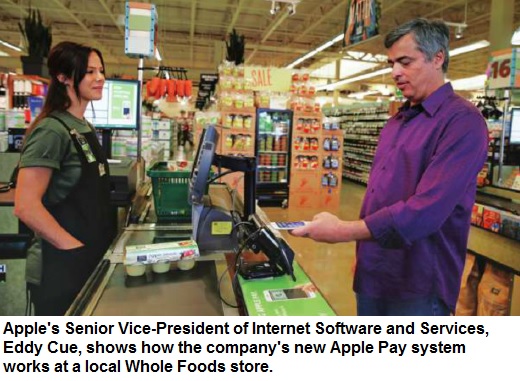
By nearly every psychographic measure, Elliot Payne is the ideal Apple customer. He lives in a hip city (Minneapolis), has a creative job (designer as a digital ad agency), moonlights as a DJ, blogs about tech and – most importantly – is a proud early adopter. So when Apple released its new mobile payment service on iPhone 6 in October, guess who tried it out at Whole Foods on the first day it was available? At checkout, Payne placed his thumb on his phone’s touch ID sensor, waved it in front of a reader on the payment terminal, and before he could say “expensive organic groceries,” he had used his fingerprint and smartphone to buy expensive organic groceries.

Not that swiping plastic is any more time-consuming than holding up your phone, but Payne argues that convenience isn’t Apple Pay’s main selling point. “Its more about security,” he says. Apple Pay uses something called “tokenization,” which replaces the card info stored on your phone with a special number used to make payments. That number is translated only when it reaches your credit card network, meaning the merchants never sees your financial information. It is not foolproof, but it’s a lot safer than swiping plastic, which leaves your identity exposed to hackers.

Innovations such as tokenization in the mobile space are slowly but surely pushing consumers away from cash, checks and physical cards

CU Blog - Cash, Credit or iPhone - Photo 1

According to a 2014 Business Insider report, in-store mobile payments in the United States (that is, using your phone to pay for goods rather than cash, check or plastic card) will grow by 153 percent from $1.8 billion in 2013 to $190 billion in 2018. Pair that with data from a 2014 Forrester Research eCommerce forecast predicting online retail sales to jump from $294 billion in 2014 to $414 billion in 2018, and its clear that our our growing love of smartphones and tablets is impacting how and where we shop. Predictably, banks, credit card networks, retailers and tech companies are clamoring to invent bells and whistles to make mobile payments easier, more secure, and – to borrow a phrase from a Square spokesperson when we asked how the merchant services outfit planned on winning at the point of sale – more “magical.”

Excerpt from: Delta SKY In-flight Magazine January 2015; retrieved from: http://msp.imirus.com/Mpowered/book/vds2015/i1/p70

———

Another article/VIDEO relating the Apple Pay innovation: Huntington Bank joins Key, PNC, US Bank and Chase with Apple Pay Deployment.

VIDEO – Apple Pay Demo  – http://youtu.be/4I9MbIrlEUw

Published on Sep 9, 2014 – Apple has revealed its mobile payments play, and it features NFC and Touch ID, as many expected. Essentially, with the new iPhones, a user holds their phone near a payment terminal, and the payment card they’ve set as a default is called up, prompting a Touch ID action where the user authenticates their transaction.

———

Apple Pay is not the only Mobile Payment Solution. Other options have emerged:

The Go Lean book posits that electronic payment schemes (card-based, NFC and internet) are very important in this strategy to elevating the Caribbean economy, security and governing engines.

This Go Lean/CU/CCB roadmap looks to employ electronic payments schemes to impact the growth of the regional economy in tourism and other domestic endeavors. One CU scheme is directly targeted to impact one segment of tourism eco-system: Cruise line passengers:

  • The cruise industry needs the Caribbean more than the Caribbean needs the industry. But the cruise lines have embedded rules/regulations designed to maximize their revenues at the expense of the port-side establishments. The CU solution is to deploy a scheme for smartcards (or smartphone applications) that function on the ships and at the port cities. This scheme will also employ NFC technology – (Near Field Communications; defined fully at Page 192 – so as to glean the additional security benefits of shielding private financial data of the guest and passengers.

The goal of electronic payments is to facilitate more electronic commerce (or e-Commerce). The Go Lean roadmap defines that the Caribbean Dollar (C$) will be mostly cashless, an accounting currency. So the CCB will settle all C$ electronic transactions (MasterCard-Visa style or ACH style) and charge interchange/clearance fees. Apple Pay is not a “free” service; card issuers have to pay about 15 basis points (.15%) to Apple, and merchants pay about 3% interchange fees for the e-Payment transaction (MC/Visa/AmEx) itself. Acquirers (sales and consolidation organizations) must be in place. So this scheme allows for the full emergence of the e-Commerce eco-system.

The benefits of these technologies, as related in the foregoing articles, cannot be ignored for their security benefits. Previously this commentary explored the perplexing issues associate with cyber-security in this internet age. We cannot invite millions of visitors to the Caribbean region and then show disregard for their protections; including information security.

In terms of governance, there is the urgent need for regional coordination of the Caribbean radio spectrum. This regulates mobile phones, Wifi and satellite communications. Again, we cannot invite millions of guests and then exploit them with roaming charges the moment they turned on their smartphones to complete a payment transaction. This issue was also raised and explored in a previous Go Lean blog commentary. This is why the Go Lean roadmap calls for a consolidated Communications and Media Authority, operating under the CU’s Department of Commerce, to lead the oversight of these attendant telecommunication endeavors. The consequences of mis-management in this regards are dire. Soon and very soon, we will have tourists arriving on our shores with no credit cards; armed only with their smartphones; ready to tap unquenchable sums of discretionary monies for their enjoyment of Caribbean hospitality.

Still yet, the greatest benefit of marshaling electronic payments systems is not governance, nor security, nor technology; it is economics.  These electronic payment schemes allow for more M1 in the regional economy; this is the measurement of currency/money in circulation (M0) plus overnight bank deposits. As M1 values increase, there is a dynamic to create money “from thin-air”, called the money multiplier. The more money in the system, the more liquidity for investment and industrial expansion opportunities. Lastly, there will be the additional economic benefit of mitigating Black Market “under-the-table” transactions, as all these electronic transactions must be processed through some clearing house, in the case of the Go Lean roadmap, this will be the role of the CCB, a cooperative of the region’s central banks.

The Go Lean book and accompanying blogs posit that the Caribbean is in crisis, and that this crisis will only worsen without some technocratic efficiency with currency and money supply (M1). The world is moving very fast, embracing one technological advancement after another; we cannot only consume these innovations, we must produce and guide advancements for ourselves:

The Best Way to Predict the Future is to Create it - Photo 1

The book posits that to adapt and thrive in the new global marketplace there must be more strenuous management and technocratic oversight of the region’s currencies, telecommunications (information security & spectrum) and governance. This is the charge of Go Lean roadmap, opening with these pronouncements; Declaration of Interdependence (Page 13 and 14):

xxiv.    Whereas a free market economy can be induced and spurred for continuous progress, the Federation must install the controls to better manage aspects of the economy: jobs, inflation, savings rate, investments and other economic principles. Thereby attracting direct foreign investment because of the stability and vibrancy of our economy.

xxv.    Whereas the legacy of international democracies had been imperiled due to a global financial crisis, the structure of the Federation must allow for financial stability and assurance of the Federation’s institutions. To mandate the economic vibrancy of the region, monetary and fiscal controls and policies must be incorporated as proactive and reactive measures. These measures must address threats against the financial integrity of the Federation and of the member-states.

xxvii. Whereas the region has endured a spectator status during the Industrial Revolution, we cannot stand on the sidelines of this new economy, the Information Revolution. Rather, the Federation must embrace all the tenets of Internet Communications Technology (ICT) to serve as an equalizing element in competition with the rest of the world. The Federation must bridge the digital divide and promote the community ethos that research/development is valuable and must be promoted and incentivized for adoption.

xxviii. Whereas intellectual property can easily traverse national borders, the rights and privileges of intellectual property must be respected at home and abroad. The Federation must install protections to ensure that no abuse of these rights go with impunity, and to ensure that foreign authorities enforce the rights of the intellectual property registered in our region.

xxx. Whereas the effects of globalization can be felt in every aspect of Caribbean life, from the acquisition of food and clothing, to the ubiquity of ICT, the region cannot only consume, it is imperative that our lands also produce and add to the international community, even if doing so requires some sacrifice and subsidy.

“Step One, Day One” in the Go Lean roadmap is the assembly of existing Caribbean organs under the regional administration of the CU. This includes the Caribbean Telecommunications Union (CTU), and the CCB governance; as a cooperative of existing central banks. The strategy is to implement the bank and C$ currency with the appropriate regulatory framework, tools and infrastructure, to facilitates the electronic schemes identified above.

The Go Lean book details a series of community ethos, strategies, tactics, implementations and advocacies to foster the proper controls for electronic/mobile payments in the Caribbean region:

Community Ethos – Economic Principles Page 21
Community Ethos – Money Multiplier Principle Page 22
Community Ethos – Security Principles – Privacy versus Public Protection Page 23
Community Ethos – Governing Principles – Lean Operations Page 24
Community Ethos – Governing Principles – Cooperatives Page 25
Community Ethos – Promote Intellectual Property Page 29
Community Ethos – Ways to Bridge the Digital Divide Page 31
Community Ethos – Ways to Improve Sharing Page 25
Strategy – Mission – Fortify the monetary needs through a Currency Union Page 45
Tactical – Separation of Powers – Central Banking Page 73
Implementation – Assemble Central Bank Cooperative Page 96
Implementation – Assemble Caribbean Regional Organs – like CTU Page 96
Implementation – Ways to Deliver Page 109
Implementation – Ways to Impact Social Media Page 111
Planning – 10 Big Ideas – #2: Currency Union / Single Currency Page 127
Anecdote – Caribbean Currencies Page 149
Advocacy – Ways to Grow the Economy Page 151
Advocacy – Ways to Create Jobs Page 152
Advocacy – Ways to Mitigate Black Markets Page 165
Advocacy – Ways to Foster Cooperatives Page 176
Advocacy – Ways to Impact Cruise Tourism – Smartcard scheme Page 193
Advocacy – Ways to Foster Technology Page 197
Advocacy – Ways to Foster e-Commerce Page 198
Advocacy – Reforms for Banking Regulations – Central Banking Efficiencies Page 199
Advocacy – Ways to Impact Main Street – Downtown Wi-Fi – Time and Place Page 201
Appendix – Assembling the Caribbean Telecommunications Union Page 256

The points of effective, technocratic banking/currency stewardship and dynamic change in the mobile communications space were further elaborated upon in these previous blog/commentaries:

https://goleancaribbean.com/blog/?p=4381 Net Neutrality: It Matters in the Caribbean
https://goleancaribbean.com/blog/?p=4308 Systems for Emergency Telephone Numbers in Crisis; need for Mobile App for Emergencies
https://goleancaribbean.com/blog/?p=3974 Google and Mobile Phones – Here comes Change
https://goleancaribbean.com/blog/?p=3814 Lessons from the Swiss unpegging the franc
https://goleancaribbean.com/blog/?p=3889 RBC EZPay – Ready for Change
https://goleancaribbean.com/blog/?p=3881 The Need for Regional Cooperation to Up Cyber-Security
https://goleancaribbean.com/blog/?p=3617 Bahamas roll-out of VAT leading more to Black Markets
https://goleancaribbean.com/blog/?p=3582 For Canadian Banks: Caribbean is a ‘Bad Bet’
https://goleancaribbean.com/blog/?p=2074 MetroCard – Model for the Caribbean Dollar
https://goleancaribbean.com/blog/?p=1350 PayPal expands payment services to 10 markets
https://goleancaribbean.com/blog/?p=906 Bitcoin virtual currency needs regulatory framework to change image
https://goleancaribbean.com/blog/?p=833 One currency, divergent economies
https://goleancaribbean.com/blog/?p=476 CARICOM urged on ICT, e-Commerce and e-Payments

The Caribbean ought to participate in more mobile smartphone development. There are so many benefits from efficient regional oversight of this technology: more cruise tourism spending, fostering more e-Commerce, increasing regional M1, mitigation of Black Markets, growing the economy, creating jobs, enhancing security and optimizing governance. Mobile smartphones are the future, and that future is now! (We, the Caribbean, have to play catch-up).

Now is the time for all stakeholders of the Caribbean – residents, visitors, bankers and governing institutions – to lean-in for the empowerments described in the book Go Lean … Caribbean. The benefits are many; but most important, the success of the roadmap can make the Caribbean a better place to live, work and play.  🙂

Download Go Lean … Caribbean – now!

Share this post:
, , , ,
[Top]

Getting Rich Slowly … in the Caribbean

Go Lean Commentary

The old practice was for couples to have a lot of children so that there would be assurances for their old age; the many children would be able to leverage caregiving roles among themselves. With a high infant-mortality rate, there was the need to hedge the risk with a few more children – an “heir and a spare” many times over.

(This writer is the youngest of 6 children).

Then “the road turned”… change came.

After World War II, modern medicine improved (i.e. childhood vaccines), more family planning options were introduced, governments adopted social safety-net strategies (Social Security, National Insurance and other pensions) and a consumer culture took hold. It was no longer necessary, in the First World (North American and Western Europe), to have so many children. Couples in these countries, during the decades of the 1970’s to 1990’s, averaged only 2.1 children; today that figure is down to 1.8.

(This writer has 3 children).

This standard is now universal, even in the Third World Caribbean.

Here is where the “rubber meets the road”; without those old-world family planning strategies, care for aging parents now becomes an issue, a cause and an advocacy.

Not everyone is prepared for change.

The book Go Lean … Caribbean addresses this issue head-on. It first declares that the Caribbean is in crisis, that most Caribbean citizens, residents in the homeland or the Diaspora, are not prepared for retirement and their “golden years”. Then with the propensity for societal abandonment, so many Caribbean citizens live abroad, away from their aging parents, so there is no practicality normally associated with a close proximity; (children cannot just simply cohabitate with their parents). To make matters worse, many Caribbean member-state governments have failing economic structures, so fulfilling their Social Contract responsibilities have been strained; consider currency devaluations, unchecked inflation, dependency on foreign imports and higher taxation with import Customs duties.

Alas, the book also declares that “a crisis is a terrible thing to waste”.

The Go Lean book serves as a roadmap for the introduction and implementation of the technocratic Caribbean Union Trade Federation (CU). This CU is proffered to provide economic, security and economic security solutions for the 30 member Caribbean states and their 42 million people. It is our quest to be prepared for the changed landscape. This mandate is detailed early on in the book’s Declaration of Interdependence with the following statements (Page 11 – 13):

viii.    Whereas the population size is too small to foster good negotiations for products and commodities from international vendors, the Federation must allow the unification of the region as one purchasing agent, thereby garnering better terms and discounts.

ix.    Whereas the realities of healthcare and an aging population cannot be ignored and cannot be afforded without some advanced mitigation, the Federation must arrange for health plans to consolidate premiums of both healthy and sickly people across the wider base of the entire Caribbean population. The mitigation should extend further to disease management, wellness, mental health, obesity and smoking cessation programs. The Federation must proactively anticipate the demand and supply of organ transplantation as developing countries are often exploited by richer neighbors for illicit organ trade.

xxiv.    Whereas a free market economy can be induced and spurred for continuous progress, the Federation must install the controls to better manage aspects of the economy: jobs, inflation, savings rate, investments and other economic principles. Thereby attracting direct foreign investment because of the stability and vibrancy of our economy.

While the Caribbean may be in crisis today, conditions would get even worse tomorrow (near future) if left unchecked; if there is no remediation and mitigation for retirement. The Go Lean roadmap posits that retirement is a community issue, and that the mandate for the CU is to manage economic security issues – strong messages and incentives – to encompass retirement planning as well.

It should be duly noted that this issue is not one that the US shows leadership with. Far too many American citizens have not fully developed solutions for their retirement, despite the myriad of financial products available in that advanced economy. This is not a community choice issue; this is a community ethos issue. The Go Lean book (Page 21) defines community ethos as the “fundamental character or spirit of a culture; the underlying sentiment that informs the beliefs, customs, or practices of a group or society”. The ethos associated with retirement planning is that of “deferred gratification”, setting aside immediate benefits for more long-term benefits.

“A good person leaves an inheritance for their children’s children, but a sinner’s wealth is stored up for the righteous”. – The Bible; Proverbs 13:22 – New International Version

While Americans need to adopt this ethos – Social Security benefits alone are grossly insufficient to satisfy retirees’ needs – Caribbean citizens need to “double-down” on this spirit all the more so. In either case, there must be supplemental retirement income. With a patient, future-focused attitude, the stage is set for individuals to glean the benefits of the time value of money. This concept is fundamental in finance – it allows for greater future rewards of monies invested today. The very approach for retirement is to glean returns tomorrow (after a person retires) on the investments made today (while the person is still working).

Compliance in this regards, does not require intellectual genius, just financial discipline. Consider here, the example of a simple man, a “blue-collar” worker in the US State of Vermont. He is a role model for us all for “how to get rich slowly”:

Title: Janitor bequeaths millions to library, hospital
(Retrieved from CNBC.com – Consumer News & Business Channel site – http://www.cnbc.com/id/102404530)

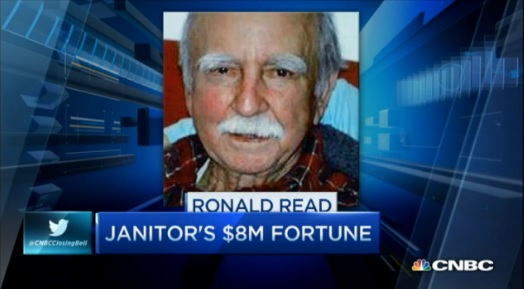
CU Blog - Getting Rich Slowly in the Caribbean - Photo 2Reuters; Friday, 6 Feb 2015 – Perhaps the only clue that Ronald Read, a Vermont gas station attendant and janitor who died last year at age 92, had been quietly amassing an $8 million fortune was his habit of reading the Wall Street Journal, his friends and family say.

It was not until last week that the residents of Brattleboro would discover Read’s little secret. That’s when the local library and hospital received the bulk of his estate, built up over the years with savvy stock picks. “Investing and cutting wood, he was good at both of them,” his lawyer Laurie Rowell said on Wednesday, noting that he read the Journal every day.

Most of those who knew Read, described as a frugal and extremely private person, were aware that he could handle an axe. But next to no one knew how well he was handling his financial portfolio.

Read, the first person in his family to graduate from high school, dressed in worn flannel shirts and spent his free time scavenging for fallen branches for his home wood stove. He drove a second-hand Toyota Yaris.

“You’d never know the man was a millionaire,” Rowell said. “The last time he came here, he parked far away in a spot where there were no meters so he could save the coins.”

CU Blog - Getting Rich Slowly in the Caribbean - Photo 1Read graduated from Brattleboro High School in 1940 and during World War II served in North Africa, Italy and the Pacific theater. Returning home, he worked at Haviland’s service station and then as a janitor at a JCPenney store, marrying a woman with two children.

Before his death on June 2, 2014, Read’s only indulgence was eating breakfast at the local coffee shop, where he once tried to pay his bill only to find that someone had already covered it under the assumption he did not have the means, Rowell said.

Last week, Brooks Memorial Library and Brattleboro Memorial Hospital each received their largest bequests ever. Read left $1.2 million to the library, founded in 1886, and $4.8 million to the hospital, founded in 1904.

“It was a thunderbolt from the sky,” said the library’s executive director, Jerry Carbone. While a surprise, he said the gift made sense once he learned more about the quiet, shy library patron appropriately named Read.

“Being a self-made man with his investments, he recognized the transformative nature of a library, what it can do for people,” Carbone said.

Read’s stepchildren survive him but were not immediately available for comment.

VIDEO 1: – Investing like Vermont’s secret millionaire stock-picker – http://video.cnbc.com/gallery/?video=3000353159

VIDEO 2: – Janitor’s $8 million fortune – http://video.cnbc.com/gallery/?video=3000353167

In a previous blog/commentary, it was reported that the US does not make a good role model for its administration of the elderly. The American standard is to delegate elderly family care to professionals, rather than to family, and that this is not an example we want in our region; the referenced quotation was entitled 10 Things We Do Not Want from the US:

# 7: Family Abandonment – Senior Living Facilities are a big industry in the US. This is due to the family habit of abandoning elderly parents to the care of professional strangers. The Caribbean way traditionally is to house their Senior Citizens with families, whether the economics apply or not.

On the other hand, we do admire the US capital markets, as the Go Lean book reports that Wall Street is the most liquid in the world (Page 200). So among the 10 Things We Want from the US, American capital is prominent:

# 3: Capital – There are many Financial Centers around the world (London, Zurich, Hong Kong, etc.) but none with the liquidity like Wall Street. They have the capital the Caribbean needs for Direct Foreign Investments. After the 2008 Financial Crisis, the US Federal Reserve Banks have maintained a policy of flooding the money supply to keep the cost of capital (borrowing) low.

The roadmap uses the model of Wall Street to structure more robust investment vehicles in the regional Caribbean securities markets – the book identifies 9 exchanges. Imagine this one great US product that a Caribbean Diaspora member, a CPA, Clifton Rodriquez, strongly campaigns for: Dividend Re-Investment Plans or DRIPs. His blog entry is attached in the Appendix with his strong urging.

The Go Lean book describes this heavy-lifting to empower Caribbean society to prepare for change and challenges that confront modern financial management, for the macro (national economy) and the micro (individuals and families). There is no “get rich quick” scheme in the roadmap, but rather a comprehensive plan for all Caribbean stakeholders to “get rich slowly” and ensure economic success at home, “prospering where they are planted”. The book describes the turn-by-turn directions for all the community stakeholders to follow to reach the 3 goals defined as the CU/Go Lean prime directives:

  • Optimization of economic engines in order to grow the regional economy to $800 Billion and create 2.2 million new jobs.
  • Establishment of a security apparatus to protect the resultant economic.
  • Improvement of Caribbean governance to support these engines.

The Go Lean roadmap calls for the emergence of the Caribbean Dollar (C$) managed by a regional technocratic Caribbean Central Bank. This structure allows for more liquidity in the existing stock exchanges in the regions. Products like DRIPs can be successfully promoted and regulated under the Go Lean’s vision for a more robust regional capital/securities market using Caribbean Dollars (C$).

The CU also embarks on a mission to encourage repatriation of the Diaspora back to the Caribbean homeland and assuage societal abandonment. The book asserts that, senior citizens should avoid the cold climates of North American and EU, especially in the winter months:

“Come in from the cold” – Song title of Caribbean Music Icon Bob Marley from 1980 Album Uprising.

The Go Lean/CU roadmap portrays the need for public messaging to encourage savings/investments, describing deferred gratification as a community ethos that is required to forge permanent change in the Caribbean homeland. In addition, these additional ethos, strategies, tactics and advocacies are trumpeted in the book to optimize financial/retirement planning:

Ethos – Deferred Gratification Page 21
Ethos – People Respond to Incentives in Predictable Ways Page 21
Ethos – Consequences of Choices Lie in the Future Page 21
Ways to Impact the Future Page 26
Ways to Better Manage Debt Page 114
Reasons to Repatriate Page 118
Ways to Control Inflation Page 153
Lessons from New York City – Wall Street Power Page 137
Ways to Improve Communications – Messaging Page 186
Reforms for Banking Regulations – Central Banking Page 199
Ways to Impact Wall Street Page 200
Ways to Impact Retirement Page 231
Ways to Improve Elder-Care Page 225

There are many Go Lean blog commentaries that previously stressed the dynamics of technocratic management of regional finances, at the micro level and at the macro level for the Greater Good of Caribbean communities. See sample here:

https://goleancaribbean.com/blog/?p=2930 ‘Too Big To Fail’ – Caribbean Version
https://goleancaribbean.com/blog/?p=2830 Jamaica’s Public Pension Under-funded
https://goleancaribbean.com/blog/?p=1433 Caribbean loses more than 70 percent of tertiary educated to brain drain
https://goleancaribbean.com/blog/?p=949 Inflation Matters
https://goleancaribbean.com/blog/?p=665 Great Investment Vehicle – Real Estate Investment Trusts explained
https://goleancaribbean.com/blog/?p=510 Canadian Retirees – Florida’s Snowbirds Chilly Welcome
https://goleancaribbean.com/blog/?p=467 Barbados Central Bank records $3.7m loss in 2013
https://goleancaribbean.com/blog/?p=372 Dominica Government raises EC$20 million on regional capital market
https://goleancaribbean.com/blog/?p=364 Time Value of Money – The basis for retirement planning
https://goleancaribbean.com/blog/?p=360 How to Create Money from Thin Air
https://goleancaribbean.com/blog/?p=273 10 Things We Want from the US: #3 – American Investment Options

The book Go Lean…Caribbean posits that many problems of the region are too big for any one member-state to solve alone, that there is the need for the technocracy of the Caribbean Union Trade Federation. The purpose of this Go Lean/CU roadmap is to make the Caribbean homeland, a better place to live, work, learn and play. This effort is more than academic; this involves many practical mitigations and heavy-lifting. While this charter is not easy, it is worth all effort.

The roadmap posits that to succeed as a society, the Caribbean region must arrange for economic, security and governance solutions. Any failure in this regard results in immediate abandonment – people leave – this undermines any empowerment efforts. We need to keep our people at home: the older retirees and the younger workers; they are all important for pension plans and actuarial tables.

Now is the time for all of the Caribbean, the people and governing institutions, to lean-in for the changes/empowerments described in the book Go Lean … Caribbean. We must all be able to prosper where we are planted at home.

Download the book Go Lean … Caribbean – now!

———-

APPENDIX – Successful Retirement Investment in the Caribbean – DRIPs

Title: Drip-a Proven Approach to Wealth Building
(Retrieved from: http://cliftonhrodriquez.hubpages.com/hub/DRIP-A-PROVEN-APPROACH-TO-WEALTH-BUILDING)
By: Clifton H. Rodriquez

What Are DRIPS?
Direct stock and dividend reinvestment plans, or to use the acronym, DRIP’s have been around for some eighty (80) years. As the name suggests, they permit investors to directly invest in any a significant number of public companies without going through a stock broker. Investors are able to buy stocks directly from the companies, or via a transfer agent. In general, the purchase would entail a modest down payment coupled with automatic monthly payments. The term “IRM 72’s” is also used to describe DRIPs. The two names are one in the same and should not be viewed as different investment vehicles.

CU Blog - Getting Rich Slowly in the Caribbean - Photo 3

WEALTH BUILDING OVER TIME
As aforementioned, DRIP’s maybe referred to as IRM 72’s as well. They are an efficient and effective mechanism for building substantial financial nest-eggs over time. They are efficient investment vehicles because they allow investors to pay a small investment fee, usually for administrative purposes, while investing substantially more of their money in a particular stock. In some cases, a number of companies will cover some of the administrative fees, especially ones involving reinvestment of dividends, associated with DRIP investing. It is a fact that even discount brokers cannot match the low costs associated with DRIP investing. Furthermore, greater efficiency is realized with DRIPs due to “dollar cost average” associated with purchasing risk assets (stocks) over time. In a nutshell, investors are able to acquire more of a particular stock when the market price declines, but less when the price increases. However, over the extended period of time, the actual costs averages out.

It is an effective mechanism because unlike investing lump sums of money and taking greater risk, DRIPs allow for gradual investing over time and investors tend not to feel the pain of the volatility that often arises from time to time in the market. Thus, DRIP investors are less likely to panic and pull money out of their DRIP portfolios whenever bad news hits the market and causes chaos and panic (i.e., the root cause of volatility in the stock market). DRIP investors tend to appreciate market dips because they view them as opportunities to pick up their stocks at bargained prices. Picking up the stocks at these bargained prices tend to add to DRIP investors capital appreciation whenever other investors return to the stock market and chase stocks to higher prices. This is merely one way in which DRIP investors make money on their investments, and the other way is in effect “icing on the cake”.

DRIP investors experience icing on their investment cakes from the high dividend yields that they get from their investments. It is not inconceivable for DRIP stocks to give dividend yields as high sixteen (16%) percent. The yield is determined by taking the annual dividend and dividing it by current market price. Of course the higher the annual dividend, and the lower the current stock price, the greater the dividend yield. The opposite also is true. Most DRIP stock pay quarterly dividends, but several also pay monthly dividends which provide a higher effective yield to investors. Even if a DRIP stock does not increase in market price, if it has a high single or double digit yield that maybe enough for investors to maintain their positions in the stocks. Thus, it is a rarity to see many of these stocks decline in value. Investors tend to chase them for their dividend yields.

Investors chase these stocks for their dividend yields because these yields tend to fuel geometric growth in DRIP accounts, especially when an investor re-invests their dividends (i.e., use their dividends to buy additional shares of stocks). The re-investment of the dividends coupled with automatic monthly investment tend to bring about a profound compounding effect in the DRIP accounts. This effect can only be described as geometric in nature, and the value of the account tend to quickly double in most cases over a short period of time. Thus, the dividend yield of any DRIP stock is very important. The higher the yield the less time it takes for the DRIP account to grow geometrically.

DRIPs are the only investment vehicle that can create a greater wealth effect. No other investment (i.e., real estate or anything else) is more effective at creating wealth than investing in stocks. However, only forty nine (49%) of Americans are actively trading stocks (December 2014 Issue of “DRIP Investor”). Thus, 51% of Americans have their money tied up in other investment vehicles like real estate, or in most cases, institutions (i.e., banks or insurance companies). Thus, the wealth gap will continue to widen as long as a minority of Americans is invested in the stock market. Why? Again, the US Stock Market creates more millionaires and billionaires than any other investment institution. The stock market, in effect, provides an effective way in which US and other investors can not only stay abreast of inflation, but soundly beat inflation.

Unfortunately, the majority of Americans will not beat inflation. They will continue to receive negative real returns on their investments because many of them simply do not understand “time value of money”. They are convinced that banks and insurance companies are the safest places for their money, despite the fact that banks in general pay as little as a 1/2 of one percent return on passbook savings, while insurance companies will pay about two point five (2.5) percent on their best financial vehicles (annuities). Treasury bonds yields are somewhere in between what a bank will pay on its passbook savings and certificate of deposit (COD) account. The dividend yield pickings are slight to none whenever investors look at alternative investments to the stock market. According to time value of money (future value of a lump sum and future value of an annuity), money will not grow well whenever simple interest is paid. Thus, banks and insurance companies are simply middlemen which must be cut out of the equation if an investor wants to realize geometric growth (compounding effect).

In most cases, the banks and insurance companies simply take the very dollars that investors entrust to them, and lend them out to other customers (in form of secured loans) at much higher rates. The banks in particular cannot directly invest depositors dollars into the US Stock Market, and they do have to maintain certain reserve balances in accordance with the Feds’ guidelines and regulations. Nevertheless, these banks and insurance companies, collectively known as institutional investors, do move the Markets with the huge amount of dollars that they invest in stocks. They realize tremendous returns, but continue to pay nominal returns on their passbook savings and CODs. They get away with it because 51% of American investors fear investing their money in the stock market. They believe that their money is “safe” in a bank because the banks will claim that they are “FDIC” insured up to $250,000.00 per bank account. This insurance actually comes from the American Taxpayer who ultimately foots the bill for any failed commercial depository, or savings and loans. This was the case in 1989-1991 when the U.S. taxpayers bailed out the savings and loans industry. What the banks do not tell their customers is that they are actually getting negative real returns on their passbook savings and COD accounts. Why is that? If inflation is running at 2.5% in the U.S.,and the banks are merely paying a half (1/2) of one (1) percent, then it stands to reasons that most investors are losing purchasing power by keeping their money in a passbook savings or COD account.

A bank customer will not experience any degree of wealth by simply putting money in a passbook savings or COD account. As a matter of fact, given time value of money concepts, it would be better for a bank customer to keep their money under their mattress, given the negative returns that they experience by putting it in a passbook saving or COD account. The only real way to build any meaningful wealth over time is by investing directly into stocks. Stocks are risk assets, but given the fact that the US Stock Market is down roughly 20% to 25% of the time and up 75% to 80% of the time, it is a “no-brainer” for investors to stay in the stock market, especially if their investment time horizon is long-term (1-30 years). It is a fact that substantial wealth in the stock market can be built over time with consistent investing and reinvesting of dividends and capital gains. Unfortunately for the 51% of Americans who look to bank and insurance companies, the stock market is the only profitable game in town.

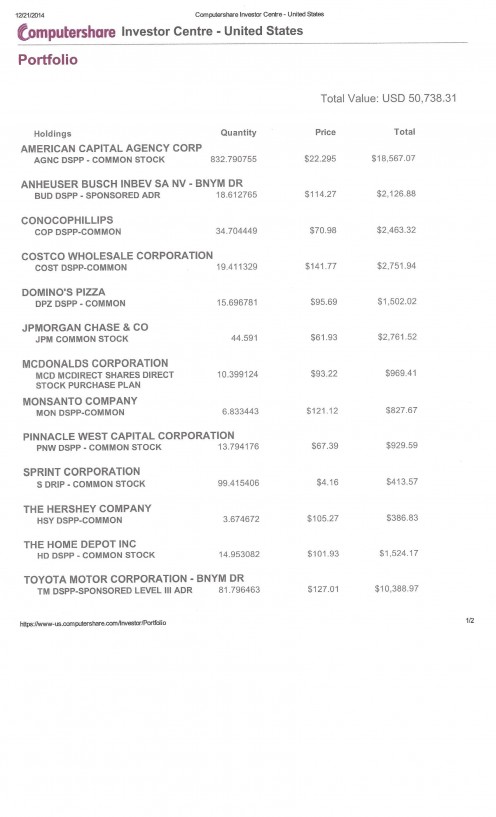
Anyone, even workers on minimum wages, can invest in the stock market via DRIP investing. This author started a DRIP portfolio back on November 1, 2012 with four stocks, AGNC, COP, COST, and TM (see below for details). The initial investment over the one year period amounted to $6,500.00. As of October 31, 2013, the DRIP Portfolio grew by five (5) additional stocks and had an accumulated market value of $13,078. The estimated return during the first year of investment was roughly 52.6%, most of the return came from the performance of Toyota Motor Corporation (TM), ConocoPhillips Corporation (COP) and JP Morgan Chase Bank (JPM) Over the next one year period that it grew to 15 stocks (AFLAC is not clearly shown in the depiction). Additional capital investment totaled $15,000, but most of the growth resulted from re-investment of dividends and capital gains. As of the close of the stock market on December 19th, 2014 the value of the author’s DRIP Portfolio is $50,700 plus. By this time next year (i.e., December 20, 2015), the projected value of the Portfolio will be around $80,000 to $85,000, given that the same investment strategy will be maintained, and additional capital investment of $15,000 to 20,000 will be made in American Capital Agency Corporation (AGNC), which has an effective dividend yield of 11.5%, a net book value of $25.25.

Investing in the U.S. Stock Market, or any of the capital markets entails considerable risk. Any potential investor exposing their capital to these markets need to do their homework prior to buying risk assets. This homework may entail in depth consultation with financial and investment advisers prior to any funds being committed to risk assets. An investor should never under any circumstances expose capital to the markets if they cannot afford to lose said capital. A potential investor should never rely solely upon anything that is written in this article, or any other article as the only source of prudent investment advice and basis for any decision making. Again, a proper research and consultation coupled with professional investment advice from reliable source should govern any investment decisions, regardless of the amount of capital involved, or the investment strategy employed.

My DRIP Portfolio

CU Blog - Getting Rich Slowly in the Caribbean - Photo 4

Share this post:
, , , , ,
[Top]

A Lesson in History – Panamanian Balboa

Go Lean Commentary

America has surely changed over the past century!

The people, institutions and governance of the US are now more tolerant of minorities and their communities. As such, there are no more American complexities in overthrowing Latin American & Caribbean governments.

Wink-wink

This hypothesis is validated with the lesson in history from 1941 in the Republic of Panama. This Central American country is a young nation; they were formed in 1903 after seceding from the Republic of Colombia, with US backing. The new country immediately signed a treaty with the US to allow the construction of the Panama Canal, by the US Army Corps of Engineers, and a perpetual lease* for its operations. The country’s separation from Colombia also included changing from the Colombian Peso currency. So in 1904 the Panamanian Balboa currency was launched, but as coins only; the country used the US Dollar as banknotes.

A basic tenant of macro-economics is that countries should issue their own currency and banknotes so as to better influence the economic engines in their communities. By manipulating the banknote quantity and the “Discount Rate” in a Fractional Central Banking System, monetary supply can be regulated, interest rates controlled; credit markets tamed; and yes, money can be created from “thin air”. Panama had none of this control, due to its lack of banknotes.

In 1941, the then-President Dr. Arnulfo Arias pushed the government to create the Central Bank and to issue paper currency. [2] The bank was authorized, constitutionally, to issue up to 6 million Balboas worth of paper notes, but only 2.7 million Balboas were issued on 2 October 1941. Seven days later, Arias was deposed in a military coup – supported by the United States – and replaced by Dr. Ricardo Adolfo de la Guardia Arango as President. The new government immediately closed the bank, withdrew the issued notes, and burned all unissued money stock. In the 74 years since then, the country has never re-attempted to issue its own paper money currency; they continue to use US Dollars, even today.

A bit extreme?

This lesson in history is presented in a consideration of the book Go Lean…Caribbean; it serves as a roadmap for the introduction and implementation of the technocratic Caribbean Union Trade Federation (CU) and Caribbean Central Bank (CCB) to provide better stewardship in ensuring that the currency and economic failures of the past, in the Caribbean and other regions, do not re-occur here in the homeland. The book posits that we must NOT fashion ourselves as an American parasite economy, but rather pursue a status as a protégé.

The full details of the Panamanian Balboa history is provided here:

Title: Panamanian Balboa
(Source: Wikipedia Online Encyclopedia (Retrieved 02/09/2015) – http://en.wikipedia.org/wiki/Panamanian_balboa)

The Balboa (sign: B/.; ISO 4217: PAB) is, along with the United States dollar, one of the official currencies of Panama. It is named in honor of the Spanish explorer / conquistador Vasco Núñez de Balboa. The Balboa is subdivided into 100 centésimos.

The history of the Panamanian Balboa

The Balboa replaced the Colombian Peso in 1904 following the country’s independence. The Balboa has been tied to the United States dollar (which is legal tender in Panama) at an exchange rate of 1:1 since its introduction and has always circulated alongside dollars.

Coins

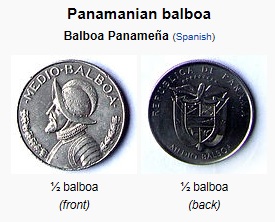
In 1904, silver coins in denominations of 2½, 5, 10, 25, and 50 centésimos were introduced. These coins were weight-related to the 25 gram 50 centésimos, making the 2½ centésimos coin 1¼ grams. Its small size led to it being known as the “Panama pill” or the “Panama pearl”. In 1907, copper-nickel ½ and 2½ centésimos coins were introduced, followed by copper-nickel 5 centésimos in 1929. In 1930, coins for 110, ¼, and ½ Balboa were introduced, followed by 1 balboa in 1931, which were identical in size and composition to the corresponding U.S. coins. In 1935, bronze 1 centésimo coins were introduced, with 1¼ centésimo pieces minted in 1940.

CU Blog - A Lesson in History - Panamanian Balboa - Photo 1

In 1966, Panama followed the U.S. in changing the composition of their silver coins, with copper-nickel clad 110 and ¼ Balboa, and .400 fineness ½ Balboa. 1 balboa coins, at .900 fineness silver, were issued that year for the first time since 1947. In 1973, copper-nickel clad ½ Balboa coins were introduced. 1973 also saw the revival of the 2½ centésimos coin, which had a size similar to that of the U.S. half dime, but these were discontinued two years later due to lack of popular demand. In 1983, 1 centésimo coins followed their U.S. counterpart by switching from copper to copper plated zinc. Further issues of the 1 Balboa coins have been made since 1982 in copper-nickel without reducing the size.

Modern 1 and 5 centésimos and 110, ¼, and ½ balboa coins are the same weight, dimensions, and composition as the U.S. cent, nickel, dime, quarter, and half-dollar, respectively. In 2011, new 1 and 2 balboa bi-metal coins were issued.[1]

In addition to the circulating issues, commemorative coins with denominations of 5, 10, 20, 50, 75, 100, 150, 200, and 500 Balboas have been issued.

Banknotes

In 1941, President Dr. Arnulfo Arias pushed the government to enact Article 156 to the constitution, authorizing official and private banks to issue paper money. As a result, on 30 September 1941, El Banco Central de Emission de la Republica de Panama was established.[2]

CU Blog - A Lesson in History - Panamanian Balboa - Photo 2

The bank was authorized to issue up to 6,000,000 Balboas worth of paper notes, but only 2,700,000 balboas were issued on 2 October 1941. A week later, Dr. Ricardo Adolfo de la Guardia Arango replaced Arias as president in a coup supported by the United States. The new government immediately closed the bank, withdrew the issued notes, and burned all unissued stocks of same. Very few of these so-called “Arias Seven Day” notes escaped incineration.

Reference Notes:
1. http://worldcoinnews.blogspot.com/search/label/panama
2. Linzmayer, Owen (2012). “Panama”. The Banknote Book. San Francisco, CA: www.BanknoteNews.com.

Panama is out-of-scope of this Go Lean empowerment roadmap. They are not a member-state that caucuses with the Caribbean Community (CariCom), and they do not even have an “Observer” representation/status within the trade bloc. But since a part of their territory-coastline is on the Caribbean Sea, their dealings should generate review and monitoring from Caribbean planners. There are many issues for the Caribbean to consider  – from an academic point-of-view – about this history of Panama: an obvious failed-state as recent as the 1980’s.

Is the American manipulations in Panama’s past reflective of the same America today? The assumption is No! The US no longer draws such “hard lines” in their interactions with peoples of different ethnicity. The country has endured deep soul-searching and reconciliation of its racial past, (Civil Rights Movement, Affirmative Action, etc.), and now even the President of the United States is a Black Man. On the surface today, America is a color-blind society.

On the surface!

Behind the scenes, under the covers, there is another reality. The current American experience is that Black-and-Brown is still institutionally disadvantaged and Wall Street, and by extension “Big American Business”, wields uncanny power over the socio-economic-political affairs of the country. For this and other reasons, the Go Lean movement advocates for Caribbean people and institutions to take their own lead for their own determination. We want to be a protégé of the US, not a parasite.

The roadmap calls for a cooperative entity of the existing regional Central Banks to foster interdependence for the regional Greater Good. We must issue Caribbean banknotes, branded Caribbean Dollars (C$). The totality of the regional market, 42 million people in 30 member-states, is large enough to allow for streamlining of the marketplace, creating the right climate for viable currency/financial/securities markets. While there might be some reticence for liberal currency operations, considering that so many Caribbean member-states had to learn hard lessons on currency over the decades – painful devaluations – the CU is to be structured as a technocracy, with the right mix of skilled talent, gifted genius and independent oversight to allow regional C$ currency markets to soar.

The strategy is not a pro-American stance, no pegging to the US Dollar, therefore no losses will be experienced when the US dollar drops value compared to other international currencies, a far too frequent an occurrence in the last 50 years. The US Dollar planners (Federal Reserve) do not have the Caribbean best-interest in mind for their technocratic decisions regarding their currency management; they have American self-interest in mind. Therefore the Caribbean region must overcome any “fear of math” because the C$ may become stronger, (see VIDEO below), in comparison to the US$. This is why e-Commerce and e-Payments schemes are strongly urged within the CU/Go Lean roadmap.

In general, the CU will employ strategies, tactics and implementations to impact its prime directives; identified with the following 3 statements:

  • Optimization of the economic engines in order to grow the regional economy to $800 Billion & create 2.2 million new jobs.
  • Establishment of a security apparatus to protect the resultant economic engines and mitigate internal and external threats.
  • Improve Caribbean governance to support these engines.

Early in the Go Lean book, this need for careful technocratic stewardship of the regional Caribbean economy was pronounced (Declaration of Interdependence – Page 12 – 13) with these acknowledgements and statements:

xi.   Whereas all men are entitled to the benefits of good governance in a free society, “new guards” must be enacted to dissuade the emergence of incompetence, corruption, nepotism and cronyism at the peril of the people’s best interest. The Federation must guarantee the executions of a social contract between government and the governed.

xii.   Whereas the legacy in recent times in individual states may be that of ineffectual governance with no redress to higher authority, the accedence of this Federation will ensure accountability and escalation of the human and civil rights of the people for good governance, justice assurances, due process and the rule of law. As such, any threats of a “failed state” status for any member state must enact emergency measures on behalf of the Federation to protect the human, civil and property rights of the citizens, residents, allies, trading partners, and visitors of the affected member state and the Federation as a whole.

xxiv.   Whereas a free market economy can be induced and spurred for continuous progress, the Federation must install the controls to better manage aspects of the economy: jobs, inflation, savings rate, investments and other economic principles. Thereby attracting direct foreign investment because of the stability and vibrancy of our economy.

xxv.   Whereas the legacy of international democracies had been imperiled due to a global financial crisis, the structure of the Federation must allow for financial stability and assurance of the Federation’s institutions. To mandate the economic vibrancy of the region, monetary and fiscal controls and policies must be incorporated as proactive and reactive measures. These measures must address threats against the financial integrity of the Federation and of the member-states.

The Go Lean book, and previous blog/commentaries, stressed the key community ethos, strategies, tactics, implementations and advocacies necessary to regulate and manage the regional financial eco-system for the Caribbean currency. These points are detailed in the book as follows:

Community Ethos – Economic Principles – Economic Systems Influence Individual Choices Page 21
Community Ethos – Economic Principles – Consequences of Choices Lie in the Future Page 21
Community Ethos – Economic Principles – Money Multiplier Page 23
Community Ethos – Governing Principles – Lean Operations Page 24
Community Ethos – Ways to Impact the Future Page 26
Community Ethos – Ways to Impact the Greater Good Page 37
Strategy – Mission – Fortify the Stability of the Banking Institutions Page 45
Strategy – Provide Proper Oversight and Support for the Depository Institutions Page 46
Tactical – Ways to Foster a Technocracy Page 64
Tactical – Growing the Economy – Minimizing Bubbles Page 69
Tactical – Separation-of-Powers – Caribbean Central Bank Page 73
Tactical – Separation-of-Powers – Depository Institutions Regulatory Agency Page 73
Anecdote – Turning Around CARICOM – Effects of 2008 Financial Crisis Page 92
Implementation – Assemble Caribbean Central Bank as a Cooperative Page 96
Implementation – Ways to Better Manage Debt Page 114
Planning –10 Big Ideas – Single Market / Currency Union Page 127
Planning – Ways to Improve Failed-State Indices Page 134
Planning – Lessons Learned from 2008 Page 136
Planning – Ways to Measure Progress Page 147
Anecdote – Caribbean Currencies Page 149
Advocacy – Ways to Grow the Economy Page 151
Advocacy – Ways to Control Inflation Page 153
Advocacy – Reforms for Banking Regulations Page 199
Advocacy – Ways to Impact Wall Street Page 200
Advocacy – Ways to Impact Main Street Page 201
Appendix – Controlling Inflation – Technical Details Page 318
Appendix – Jamaica’s International Perception – “High inflation and currency dysfunction” Page 297

The points of effective, technocratic banking/economic stewardship of regional currencies, were further elaborated upon in these previous blog/commentaries:

https://goleancaribbean.com/blog/?p=3889 RBC EZPay – Ready for Change
https://goleancaribbean.com/blog/?p=3858 ECB unveils 1 trillion Euro stimulus program
https://goleancaribbean.com/blog/?p=3814 Lessons from the Swiss unpegging the franc
https://goleancaribbean.com/blog/?p=3743 Trinidad cuts 2015 budget as oil prices tumble
https://goleancaribbean.com/blog/?p=3582 For Canadian Banks: Caribbean is a ‘Bad Bet’
https://goleancaribbean.com/blog/?p=3090 Lessons Learned – Europe Sovereign Debt Crisis of 2009
https://goleancaribbean.com/blog/?p=2930 ‘Too Big To Fail’ – Caribbean Version
https://goleancaribbean.com/blog/?p=949 Inflation Matters
https://goleancaribbean.com/blog/?p=833 One currency, divergent economies
https://goleancaribbean.com/blog/?p=518 Analyzing the Data – What Banks learn about financial risks
https://goleancaribbean.com/blog/?p=378 US Federal Reserve Releases Transcripts from 2008 Meetings/Stimulus
https://goleancaribbean.com/blog/?p=273 10 Things We Don’t Want from the US – #3: Quantitative Easing

Similar to Panama, there are a number of Caribbean member-states that use the US dollar as their sole paper currency:

  • British Virgin Island
  • Turks & Caicos Islands
  • Dutch Caribbean Territories: Bonaire, Sint Eustatius and Saba
  • US Territories of Puerto Rico & US Virgin Islands

The Go Lean book reports that previous Caribbean administrations have failed miserably in managing regional currencies. Consider Jamaica for example, despite being pegged 1-to-1 with the US dollar in 1960’s, the J$ was trading at 87-to-1 with the US$ at press time for the book (November 2013). Other countries (like Trinidad, Dominican Republic, and the Eastern Caribbean Currency Union states) experienced similar turmoil, though at lesser rates of devaluation. The book opens with the declaration that the Caribbean is in crisis because of episodes like these currency failings. In every case, the direct after-effect was increased societal abandonment, and now the reported brain-drain rate is estimated at 70%, with some countries even reporting up to 81%. This disposition is symptomatic of a Failed-State status.

Currency management includes details of more than just the paper-money people carry in their wallets. The book describes the 4 basic functions of money:

  • a medium of exchange
  • a unit of account
  • a store of value
  • a standard of deferred payment

These dynamics have an effect on inflation/deflation and trade facilitation with other countries. So Central Banks must strenuously manage currency issues to ensure economic progress and avoid financial dysfunction. This point is conveyed in the following VIDEO, as regards the Central Bank management of the Chinese Yuan.

VIDEO: Pegging the Yuan – http://youtu.be/S-9iY1OgbDE

Uploaded on Oct 25, 2010 – How the Chinese Central Bank could peg the Yuan to the dollar by printing Yuan and buying dollars (building up a dollar reserve). This lesson in macro-economics can be applied to any Central Bank, any other currency.

There are so many currency issues that have to be coordinated that the Go Lean book describes the effort as heavy-lifting. The roadmap (Page 5) declares that change has come to the Caribbean, and that new technocrats are ready to assume oversight of regional currency issues:

Please swallow your pride
If I have things you need to borrow
For no one can fill those of your needs
That you won’t let show
You just call on me brother, when you need a hand

(Chorus)
We all need somebody to lean on
I just might have a problem that you’d understand
We all need somebody to lean on

(Lyrics of song: Lean On Me, by Singer/Songwriter: Bill Withers)

This is not the same world as 1941 Panama, but still there are many lessons to learn and apply in the Caribbean. The goal is simple, to move the region to a new destination: a better homeland to live, work and play. Now is the time for all of the Caribbean, the people, banking establishments and the governing institutions, to lean-in for the changes described in the book Go Lean … Caribbean.

🙂

Download the free e-Book of Go Lean … Caribbean – now!

———

* Appendix Footnote: Subsequent treaties added an expiration date for 1999; the Canal is now fully Panamanian.

Share this post:
, , , ,
[Top]

RBC EZPay – Ready for Change

Go Lean Commentary

It’s time to introduce the Caribbean Dollar (C$) as a regional currency. Though there will be coins and notes, the primary focus will be on electronic transactions. This is the future!

Electronic Payments schemes (card-based & internet) are very important in the strategy to elevate the Caribbean economy, bring change and empower people, process and profits.

According to the subsequent news article, the regional banks – in this case the Royal Bank of Canada (RBC) – are ready for this change.

CU Blog - RBC EZPay - Ready for Change - Photo 3Roseau, Dominica – RBC Royal Bank today unveiled its new RBC EZ Pay Wireless Terminals, a wireless device that can be used to complete credit card transactions anywhere where a cellular phone can be used.

“This product is ideal for car rental companies, as well as for use at restaurants, tour and taxi operators, local outdoor markets, trade shows and even community and festive events,” said Mr. Yuri Lazare, Country Head, Dominica. “We are proud to be the pioneers of this technology in Dominica, providing a payment solution that is limitless in terms of where it can be used; effortless in that it is so easy to set up and use; and completely wireless, allowing merchants to accept payments wherever their customers are.”

RBC is the first financial services company in Dominica to offer this innovative product, which has many features. RBC EZ Pay is a high-speed, cordless point-of-sale terminal with an integrated antenna and printer. It has the ability to process Visa, MasterCard, Diners Club and Discover credit cards. It also has a backlit display, a secure network and a rechargeable/removable battery.

CU Blog - RBC EZPay - Ready for Change - Photo 1“Retailers who have previewed the RBC EZ Pay Wireless Terminal like it because it provides flexibility to set up temporary payment locations, such as at sidewalk sales and special events. The device also gives restaurant owners the flexibility to take payment from their customers wherever they are seated, even on outdoor patios or bars,” said Dave Legge, Manager for Commercial Financial Services, Eastern Caribbean. “With this system, car rental companies and other on-the-go vendors can now accept credit payments, which can help expand their business.”

This new product launch continues the long tradition of leadership that RBC has displayed in Dominica.  “In March this year, RBC celebrated 95 continuous years of doing business in Dominica and we look forward to continuing this partnership for many years to come” said Mr. Yuri Lazare, Country Head Dominica. “We appreciate the many opportunities we have had to play a role in the national development of the country.  Today’s launch is historic and evidence of our dedication to delivering innovative product solutions that create an environment in which Dominicans can maximize their entrepreneurial potential.”

Business persons interested in learning more about this new product and obtaining pricing can visit our Roseau branch or call Ermine Darroux at 255 – 1803.
Dominica News Online – Website for Daily Newspaper- (Posted 06/11/2010; Retrieved 01/23/2015) –
http://dominicanewsonline.com/news/homepage/news/business/rbc-unveils-rbc-ez-pay-wireless-terminals/

This point is detailed in the book Go Lean…Caribbean, a roadmap for the introduction of the Caribbean Union Trade Federation (CU) and the Caribbean Central Bank (CCB). This Go Lean roadmap has 3 prime directives:

  • Optimization of the economic engines in order to grow the regional economy to $800 Billion & create 2.2 million new jobs.
  • Establishment of a security apparatus to protect the resultant economic engines.
  • Improve Caribbean governance to support these engines.

This Go Lean/CU/CCB roadmap looks to employ electronic payments schemes to impact the growth of the regional economy. There are two CU schemes that relate to this foregoing news story, as they require the demonstrated POS terminals:

  • Cruise Passenger Smartcards – The Go Lean roadmap posits that the cruise industry needs the Caribbean more than the Caribbean needs the industry. But the cruise lines have embedded rules/regulations designed to maximize their revenues at the expense of the port-side establishments. The CU solution is to deploy a scheme for smartcards that function on the ships and at the port cities.
  • e-Commerce Facilitation – The Go Lean roadmap defines that the Caribbean Dollar (C$) will be mostly cashless, an accounting currency. So the Caribbean Central Bank (CCB) will settle all C$ electronic transactions (MasterCard-Visa style or ACH style) and charge interchange/clearance fees. This scheme allows for the emergence of full-throttle e-Commerce activities.

The focus of these schemes is not technology, its economics.  These electronic payments provide the impetus for M1, the economic measurement of currency/money in circulation (M0) plus overnight bank deposits. As M1 values increase, there is a dynamic to create money “from thin-air”, called the money multiplier. The more money in the system, the more liquidity for investment and industrial expansion opportunities.

An additional economic benefit is the mitigation of Black Market “under-the-table” transactions that proliferate in a cash-only environment. These neutralize government revenue schemes: sales tax, VAT, etc.

CU Blog - RBC EZPay - Ready for Change - Photo 2Though the foregoing article refers to the Royal Bank of Canada, the currency in focus here is not the Canadian dollar, but rather the new Caribbean dollar. This Canadian bank, along with others – Bank of Nova Scotia, Canadian Imperial Bank of Commerce (CIBC) / FirstCaribbean – support local currencies, like the Bahamian dollars, Jamaican dollars, T&T dollars, etc. In fact, in whichever country RBC operates, they transact in local currency. The Go Lean roadmap calls for that same participation with the new C$ regional currency.

If the Caribbean member-states already have currencies, why is there the need to transform to a new currency regime?

The Go Lean book posits that the Caribbean is in crisis, and that this “crisis is a terrible thing to waste”. The region has been devastated by currency mis-management over the decades; (for example, the Jamaica dollar was trading 87-to-1 at the end of 2009 and conditions have only worsened since then). In most cases, local Caribbean currencies have been pegged to the US Dollar, but even American stewardship have hurt Caribbean fortunes, the dollar has lost value compared to other bread-basket currencies (Euros, British Pound Sterling, Swiss Franc, Japanese Yen, Chinese Yuan, etc.), meaning that the global buying power has dwindled more and more for the average Caribbean resident due to no fault of his own. These internal and external currency factors have contributed to the Caribbean economic crisis, and the urgent need for reform, re-boot and remediation.

The book posits that to adapt and thrive in the new global marketplace there must be more strenuous management, technocratic optimizations, of the region’s currencies. This is the charge of Go Lean roadmap, opening with the Declaration of Interdependence (Page 13) and these pronouncements:

xxiv.    Whereas a free market economy can be induced and spurred for continuous progress, the Federation must install the controls to better manage aspects of the economy: jobs, inflation, savings rate, investments and other economic principles. Thereby attracting direct foreign investment because of the stability and vibrancy of our economy.

xxv.    Whereas the legacy of international democracies had been imperiled due to a global financial crisis, the structure of the Federation must allow for financial stability and assurance of the Federation’s institutions. To mandate the economic vibrancy of the region, monetary and fiscal controls and policies must be incorporated as proactive and reactive measures. These measures must address threats against the financial integrity of the Federation and of the member-states.

Creating the CU/CCB governance is “Step One, Day One” in the Go Lean roadmap. The strategy is to implement the bank and C$ currency with the appropriate regulatory framework, tools and infrastructure, to facilitate the electronic schemes identified above.

The foregoing article, demonstrates that this regional bank (RBC) is ready for this change, but evidence abounds that the other banks are equally competitive. See VIDEO sample below for the bank-neutral “The Square Credit Card Reader”.

The Go Lean book details a series of community ethos, strategies, tactics, implementations and advocacies to foster the proper controls for electronic payments/virtual money in the Caribbean region:

Community Ethos – Economic Principles Page 21
Community Ethos – Money Multiplier Principle Page 22
Community Ethos – “Light Up the Dark Places” Page 23
Community Ethos – Lean Operations Page 24
Community Ethos – Cooperatives Page 25
Community Ethos – Ways to Impact the Future Page 26
Community Ethos – Promote Intellectual Property Page 29
Community Ethos – Ways to Bridge the Digital Divide Page 31
Tactical – Separation of Powers – Central Banking Page 73
Implementation – Assemble Central Bank Cooperative Page 96
Implementation – Ways to Deliver Page 109
Implementation – Ways to Impact Social Media Page 111
Planning – Ways to Better Manage Image Page 129
Anecdote – Caribbean Currencies Page 149
Advocacy – Ways to Mitigate Black Markets Page 165
Advocacy – Ways to Foster Cooperatives Page 176
Advocacy – Ways to Impact Cruise Tourism – Smartcard scheme Page 193
Advocacy – Ways to Foster Technology Page 197
Advocacy – Ways to Foster e-Commerce Page 198
Advocacy – Reforms for Banking Regulations Page 199
Appendix – Alternative Remittance Modes Page 270

The points of effective, technocratic banking/currency stewardship, were further elaborated upon in these previous blog/commentaries:

https://goleancaribbean.com/blog/?p=3814 Lessons from the Swiss unpegging the franc
https://goleancaribbean.com/blog/?p=3582 For Canadian Banks: Caribbean is a ‘Bad Bet’
https://goleancaribbean.com/blog/?p=3090 Lessons Learned – Europe Sovereign Debt Crisis of 2009
https://goleancaribbean.com/blog/?p=2930 ‘Too Big To Fail’ – Caribbean Version
https://goleancaribbean.com/blog/?p=2074 MetroCard – Model for the Caribbean Dollar
https://goleancaribbean.com/blog/?p=1350 PayPal expands payment services to 10 markets
https://goleancaribbean.com/blog/?p=906 Bitcoin virtual currency needs regulatory framework to change image
https://goleancaribbean.com/blog/?p=833 One currency, divergent economies

There are so many benefits to deploying the e-Payment functionality of the C$:

  • More Cruise Tourism Spending
  • Fostering e-Commerce
  • Increase of M1
  • Mitigation of Black Markets

Now is the time for all of the Caribbean, the people, the banking establishments and governing institutions, to lean-in for these empowerments described in the Go Lean/CU/CCB roadmap. The benefits are too alluring, and far overdue, a better place to live, work and play. 🙂

Download Go Lean … Caribbean – now!

——-

VIDEO – How To Use The Square Credit Card Reader With Your Phone. Get It For Free. http://youtu.be/-RtmHsLxcrA

Published on Jun 28, 2014 – Using The Reader. Take Credit Card Payments With Your Phone. Signing up, getting and how to use the Square credit card reader by Square Up with a Samsung Galaxy Note III. Tutorial. Great for small businesses.

Share this post:
, , , , ,
[Top]

ECB unveils 1 trillion Euro stimulus program

Go Lean Commentary

Inflation is not always bad…

Rise in prices equal to a rise in the economic growth. In parallel, a drop in prices could translate to a drop in the economy. From a macro perspective, this scenario – deflation – is bad. Thus there is the need for a stimulus.

The following news article aligns with the book Go Lean…Caribbean; it serves as a roadmap for the introduction and implementation of the technocratic Caribbean Union Trade Federation (CU) and Caribbean Central Bank (CCB) to provide better stewardship, to ensure that the economic failures of the past, in the Caribbean and other regions, do not re-occur here in the homeland. The purpose of the Go Lean book/roadmap is economics, and important methods to elevate and empower Caribbean society. In total, the societal elevation roadmap has these 3 prime directives:

  • Optimization of the economic engines in order to grow the regional economy to $800 Billion & create 2.2 million new jobs.
  • Establishment of a security apparatus to protect the resultant economic engines.
  • Improve Caribbean governance and industrial policies to support these engines.

This AFP article here reports on the move by the European Central Bank (ECB) to mitigate negative movements in the regional economy. Economic news from Europe is germane for Caribbean consideration as that region is our largest trading partner after North America; plus the Dutch and French Caribbean member-states are directly impacted. Lastly, the Go Lean roadmap is modeled after the structures of the EU and the ECB. See the full story here and VIDEO below:

Title: ECB unveils 1 trln euro stimulus programme
By: AFP – Agence France-Presse – Paris-based Global News Agency – (Posted 01/22/2015) –
http://www.economist.com/blogs/economist-explains/2015/01/economist-explains-13

GERMANY-REAL ESTATE-SCULPTURE-EURO-ECBFrankfurt (AFP) – The European Central Bank on Thursday unveiled plans for a massive programme of bond purchases to avert the threat of deflation in the euro area.

After the ECB held its key interest rates at their current all-time lows at its first policy meeting of 2015, central bank chief Mario Draghi said a programme would be launched to buy 60 billion euros of private and public bonds per month starting in March.

“The combined monthly purchases of public and private sector securities will amount to 60 billion euros ($70 billion). They are intended to be carried out until end-September 2016 and will in any case be conducted until we see a sustained adjustment in the path of inflation,” Draghi told a news conference.

Critics had expressed concern that European taxpayers would have to foot the bill of such a programme, known as quantitative easing (QE), if any one country defaulted on its debt.

But the plan had been designed so that only 20 percent of those risks would be shared, with the other 80 percent to be shouldered by the national central banks of the countries concerned, Draghi said.

QE is regarded as the central bank’s most powerful tool yet to ward off deflation in the single currency area, where consumer prices actually started to fall in December.

These issues are huge in world economics.

The Switzerland Nation Bank made a controversial move last week of unpegging their currency (franc) from the Euro in anticipation of this move. Even oil prices are affected, as the wholesale price of oil rebounded in internal exchanges also in anticipation of this ECB move.

A previous blog/commentary delved into the topic of inflation, but this time, the issue is deflation. In economics*, deflation is a decrease in the general price level of goods and services.[1] Deflation occurs when the inflation rate falls below 0% (a negative inflation rate). Inflation reduces the real value of money over time; conversely, deflation increases the real value of money –- the currency of a national or regional economy. While on the micro basis, deflation allows one to buy more goods with the same amount of money over time, on the macro, Economists generally believe that deflation is a problem in a modern economy because it increases the real value of debt, and may aggravate recessions and lead to a deflationary spiral.[3]

Deflation is caused by a shift in the supply and demand curve for goods and services, particularly a fall in the aggregate level of demand. That is, there is a fall in how much the whole economy is willing to buy and the going price for goods. Because the price of goods is falling, consumers have an incentive to delay purchases and consumption until prices fall further, which in turn reduces overall economic activity. Since this disposition idles the productive capacity of a society, investment activity also falls, leading to further reductions in aggregate demand. This is the deflationary spiral.

Deflation was present during most economic depressions in US history. [23] A decline in production and investments always signals fewer jobs.

An answer to falling aggregate demand is a stimulus from a central bank authority, as being facilitated now by the ECB, by expanding the money supply.

Whether you realize it or not, the issues in this commentary have a bearing on the disposition of the Caribbean economy. The region is mostly a service economy with little manufacturing/production businesses, so the dynamics of supply-and-demand bare heavy on the dynamics of our society. Our trading markets consume our products and services when their economy is growing, but defer spending when the economy is unsteady – the Caribbean and much of the western world are still reeling from the Great Recession (2007 – 2009). Early in the Go Lean book, the need for careful technocratic stewardship of the regional Caribbean economy was pronounced (Declaration of Interdependence – Page 13) with these statements:

xxiv.    Whereas a free market economy can be induced and spurred for continuous progress, the Federation must install the controls to better manage aspects of the economy: jobs, inflation, savings rate, investments and other economic principles. Thereby attracting direct foreign investment because of the stability and vibrancy of our economy.

xxv.    Whereas the legacy of international democracies had been imperiled due to a global financial crisis, the structure of the Federation must allow for financial stability and assurance of the Federation’s institutions. To mandate the economic vibrancy of the region, monetary and fiscal controls and policies must be incorporated as proactive and reactive measures. These measures must address threats against the financial integrity of the Federation and of the member-states.

The Go Lean book, and previous blog/commentaries, stressed the key community ethos, strategies, tactics, implementations and advocacies necessary to regulate and manage the regional financial eco-systems for the Caribbean. These points are detailed in the book as follows:

Community Ethos – Economic Principles – Economic Systems Influence Individual Choices Page 21
Community Ethos – Economic Principles – Consequences of Choices Lie in the Future Page 21
Community Ethos – Economic Principles – Money Multiplier Page 23
Community Ethos – Governing Principles – Lean Operations Page 24
Community Ethos – Governing Principles – Cooperatives Page 25
Community Ethos – Ways to Impact the Future Page 26
Community Ethos – Ways to Impact the Greater Good Page 37
Strategy – Mission – Fortify the Stability of the Banking Institutions Page 45
Strategy – Provide Proper Oversight and Support for the Depository Institutions Page 46
Tactical – Ways to Foster a Technocracy Page 64
Tactical – Growing the Economy – Minimizing Bubbles Page 69
Tactical – Separation-of-Powers – Caribbean Central Bank Page 73
Tactical – Separation-of-Powers – Depository Institutions Regulatory Agency Page 73
Anecdote – Turning Around CARICOM – Effects of 2008 Financial Crisis Page 92
Implementation – Assemble Caribbean Central Bank as a Cooperative Page 96
Implementation – Ways to Better Manage Debt Page 114
Planning – 10 Big Ideas – Single Market / Currency Union Page 127
Planning – Ways to Model the EU Page 130
Planning – Ways to Improve Failed-State Indices Page 134
Planning – Lessons Learned from 2008 Page 136
Planning – Lessons Learned from the Bible Page 144
Planning – Ways to Measure Progress & Adapt for Forward Movement Page 147
Anecdote – Caribbean Currencies – Intergration Opportunities Page 150
Advocacy – Ways to Grow the Economy Page 151
Advocacy – Ways to Control Inflation Page 153
Advocacy – Ways to Improve Governance Page 168
Advocacy – Ways to Foster Cooperatives Page 176
Advocacy – Reforms for Banking Regulations Page 199
Advocacy – Ways to Impact Wall Street Page 200
Advocacy – Ways to Impact Main Street Page 201
Appendix – Controlling Inflation – Technical Details Page 318

The points of effective, technocratic banking/economic stewardship, were further elaborated upon in these previous blog/commentaries:

https://goleancaribbean.com/blog/?p=3814 Lessons from the Swiss unpegging the franc
https://goleancaribbean.com/blog/?p=3743 Trinidad cuts 2015 budget as oil prices tumble
https://goleancaribbean.com/blog/?p=3582 For Canadian Banks: Caribbean is a ‘Bad Bet’
https://goleancaribbean.com/blog/?p=3090 Lessons Learned – Europe Sovereign Debt Crisis of 2009
https://goleancaribbean.com/blog/?p=2930 ‘Too Big To Fail’ – Caribbean Version
https://goleancaribbean.com/blog/?p=949 Inflation Matters
https://goleancaribbean.com/blog/?p=833 One currency, divergent economies
https://goleancaribbean.com/blog/?p=518 Analyzing the Data – What Banks learn about financial risks
https://goleancaribbean.com/blog/?p=378 US Federal Reserve Releases Transcripts from 2008 Meetings/Stimulus
https://goleancaribbean.com/blog/?p=273 10 Things We Don’t Want from the US – #3: Quantitative Easing

Also, there is the assertion (blogged on previously), that there are 3 kinds of people in the world:

  1. Those who make things happen
  2. Those who watch things happen
  3. Those who wonder “What happened?”

Where does the Caribbean lie in these classifications? How did the region perform in the more recent crises? The Go Lean book reports that “we” failed miserably. The book opens with the declaration that the Caribbean is very much in crisis, many member-states suffered societal abandonment: the brain-drain rate is estimated at 70% with some countries reporting up to 81%; Puerto Rico and their fellow US territory, Virgin Islands, watched as more that 50% of the general population have fled those islands, and now all aspects of their society are in a “pickle”. This disposition is symptomatic of a Failed-State status. But alas, the book relates on Page 8: “a crisis is a terrible thing to waste”.

The concept of “lean” in the title Go Lean…Caribbean brings to the fore the agility and efficiency needed to shepherd the regional economy. The namesake draws reference to a popular 1970’s song entitled Lean On Me (artist: Bill Withers) and these key lyrics; quoted in the book on Page 5:

If there is a load you have to bear, that you can’t carry, I’m right up the road; I’ll share your load, if you just call me.

Needless to say, the issues derived from the foregoing news article about deflation/stimulus in Europe require strenuous monitoring of the world’s economic landscape by Caribbean stakeholders so as to mitigate the risks and threats to the regional Caribbean economy. There was no one performing this heavy-lifting for the run-up of the 2007 – 2009 Great Recession / Financial Crisis. Perhaps they were only watching things happen, or worse, caught off-guard and just “wondering” what happened.

No more! Change has come to the Caribbean. The quest of this Go Lean roadmap is to structure the unified Command-and-Control toolkits to better manage the economic affairs for the people of this region. This God-given responsibility for the leaders of these countries was stated in the Preamble of the aforementioned Declaration of Interdependence (Page 10):

While the laws of nature and of nature’s God entitle us to form a society and a brotherhood to foster manifestations of our hopes and aspirations and to forge solutions to the challenges that imperil us…

Continuing that devotional theme, the duties of Caribbean leaders can be likened to the role of a “Watchman Class”, described in scripture:

Ezekiel 3:17 – “Son of man, I have appointed you a watchman for the house … Whenever you hear a word from my mouth, you must give them a warning from me. (New English Translation).

The CU/Go Lean planners hereby report for duty in facilitating this heavy burden, the oversight of Caribbean economic concerns to facilitate proactive and reactive protections of regional fortunes. The roadmap calls for “watching” and doing – making things happen. The responsible party is the CCB or Caribbean Central Bank. This cooperative will combine the foreign reserves of all 30 member-states and issue Caribbean Dollars (C$) in their place. By technocratically controlling the C$ money supply, the CCB will be able to stimulate and/or curtail growth, inflation and deflation. This type of unified Command-and-Control was needed but missing during previous Caribbean crises.

The Caribbean’s 30 member-states, the people and institutions, are urged to lean-in to this Go Lean confederation roadmap.

Hebrews 13:17 – Have confidence in your leaders and submit to their authority, because they keep watch over you as those who must give an account. Do this so that their work will be a joy, not a burden, for that would be of no benefit to you.

The Go Lean roadmap does not claim any divine inspiration, but it is derived from wise principles codified in the Bible (Page 144); the roadmap serves as turn-by-turn directions, the heavy-lifting, to apply those principles, to move the region to a new destination: a better place to live, work and play. 🙂

Download the book Go Lean … Caribbean – now!

———

* Source Reference: Some information retrieved from http://en.wikipedia.org/wiki/Deflation.

———

VIDEO: ECB launches 60 billion Euro stimulus program (Preceding Advertisement) – http://www.nbcnews.com/video/cnbc/56842268/#56842256

The ECB’s Mario Draghi, reveals the central bank’s asset-buying program, and interest rate decision.

Share this post:
, ,
[Top]

Lessons from the Swiss unpegging the franc

 Go Lean Commentary

The financial world is all abuzz regarding the move by the Switzerland National Bank to unpeg their currency from their default value tied to the Euro.

Change is afoot:

o CNBC – VIDEO: Swiss franc soars, stocks tank as euro peg scrapped

o Business Insider-UK: The Swiss Franc Is Out of Control

o Bloomberg: Swiss Franc Stages Historic Rally as SNB Move Shocks Market

o Wall Street Journal: Swiss Franc Remains at Sky-High Levels; Swiss Stocks Regain Some Stability

o Financial Times (London): Swiss franc fallout claims more casualties

o Business Insider Editorial: The Decision To Let The Swiss Franc Cause Market Chaos

There are winners and losers from this new move.

How does it relate to the Caribbean?

The Swiss franc is not one of our focused currencies; we get little tourism from that country in particular and we do little trade. Yet this move is HUGE for Caribbean consideration.

This article is in consideration of the book Go Lean…Caribbean; it serves as a roadmap for the introduction and implementation of the technocratic Caribbean Union Trade Federation (CU) and Caribbean Central Bank (CCB) to provide better stewardship, to ensure that the economic/currency failures of the past, in the Caribbean and other regions, do not re-occur here in the homeland.

This Economist article here explains more fundamental dynamics from this global-currency strategy-play:

Title: The Economist explains: Why the Swiss unpegged the franc
By: C.W.
CU Blog - Lessons from the Swiss unpegging the franc - Photo 1IN THE world of central banking, slow and predictable decisions are the aim. So on January 15th, when the Swiss National Bank (SNB) suddenly announced that it would no longer hold the Swiss franc at a fixed exchange rate with the Euro, there was panic. The franc soared. On Wednesday one Euro was worth 1.2 Swiss francs; at one point on Thursday its value had fallen to just 0.85 francs. A number of hedge funds across the world made big losses. The Swiss stock market collapsed. Why did the SNB provoke such chaos?

The SNB introduced the exchange-rate peg in 2011, while financial markets around the world were in turmoil. Investors consider the Swiss franc as a “safe haven” asset, along with American government bonds: buy them and you know your money will not be at risk. Investors like the franc because they think the Swiss government is a safe pair of hands: it runs a balanced budget, for instance. But as investors flocked to the franc, they dramatically pushed up its value. An expensive franc hurts Switzerland because the economy is heavily reliant on selling things abroad: exports of goods and services are worth over 70% of GDP. To bring down the franc’s value, the SNB created new francs and used them to buy Euros. Increasing the supply of francs relative to Euros on foreign-exchange markets caused the franc’s value to fall (thereby ensuring a Euro was worth 1.2 francs). Thanks to this policy, by 2014 the SNB had amassed about $480 billion-worth of foreign currency, a sum equal to about 70% of Swiss GDP.

The SNB suddenly dropped the cap last week for several reasons. First, many Swiss are angry that the SNB has built up such large foreign-exchange reserves. Printing all those francs, they say, will eventually lead to hyperinflation. Those fears are probably unfounded: Swiss inflation is too low, not too high. But it is a hot political issue. In November there was a referendum which, had it passed, would have made it difficult for the SNB to increase its reserves. Second, the SNB risked irritating its critics even more, thanks to something that is happening this Thursday: many expect the European Central Bank to introduce “quantitative easing”. This entails the creation of money to buy the government debt of Euro-Zone countries. That will push down the value of the Euro, which might have required the SNB to print lots more francs to maintain the cap. But there is also a third reason behind the SNB’s decision. During 2014 the Euro depreciated against other major currencies. As a result, the franc (being pegged to the Euro) has depreciated too: in 2014 it lost about 12% of its value against the dollar and 10% against the Rupee (though it appreciated against both currencies following the SNB’s decision). A cheaper franc boosts exports to America and India, which together make up about 20% of Swiss exports. If the Swiss franc is not so overvalued, the SNB argues, then it has no reason to continue trying to weaken it.

The big question now is how much the removal of the cap will hurt the Swiss economy. The stock market fell because Swiss companies will now find it more difficult to sell their wares to European customers (high-rolling Europeans are already complaining about the price of this year’s skiing holidays). UBS, a bank, downgraded its forecast for Swiss growth in 2015 from 1.8% to 0.5%. Switzerland will probably remain in deflation. But the SNB should not be lambasted for removing the cap. Rather, it should be criticized for adopting it in the first place. When central banks try to manipulate exchange rates, it almost always ends in tears.

Source: The Economist Magazine – Financial Weekly (Posted 01/18/2015) –
 http://www.economist.com/blogs/economist-explains/2015/01/economist-explains-13

CU Blog - Lessons from the Swiss unpegging the franc - Photo 2The Swiss National Bank is unlike other central banks because it is not owned by the Swiss government but is a listed company with shareholders that include Swiss administrative regions, known as cantons, as well other public bodies and private individuals. This arrangement provides a cool 1 billion francs ($1.15 billion) annually split between Switzerland’s 26 cantons in proportion to their populations and, most importantly, was considered a safe and reliable stream of income. In fact, according to the Swiss Central Bank, the dividend had been paid every year for over 100 years until a 2013 collapse in the price of gold hurt the bank’s gold asset holdings.

Here is where the lessons for the Caribbean magnify. The Swiss National Bank is a confederation, much like the Go Lean roadmap for the Caribbean Union, Caribbean Central Bank (CCB) and the Caribbean Dollar (C$). The roadmap calls for a cooperative entity of the existing Central Banks in the region; fostering interdependence for the regional Greater Good. There is now interconnectivity of the financial systems, bank/currency troubles in foreign countries easily become trouble for the Caribbean region. Though there is elasticity from these foreign financial centers, the Caribbean is big enough (42 million people in 30 member-states) to streamline its own viable currency/financial/securities market – just like the Swiss (a country of 8 million people but with a $680 Billion economy).

The Caribbean has had to learn hard lessons on currency, as many of the CU member-states have had to endure painful devaluations over the past decades – on more than one occasions. Any attempt to reboot Caribbean economic landscape must first start with a strenuous oversight of the C$ currency. Oversight would imply actions in offense and defense of our own currency. This is what the Swiss (SNB) has done in the foregoing articles. They were at the mercy of the Euro Zone, being pegged to the Euro, as the Euro moved up, the franc would move up; as the Euro moved down, the franc moved down. This parasitical elasticity undermined their independence and any discipline on their part was neutralized by the Euro Zone.

This is the exact position of the Caribbean today. Most Caribbean currencies are pegged to the US dollar. As the dollar rises and falls, so do Caribbean currencies. The US Dollar planners (Federal Reserve) do not have the Caribbean best-interest in mind; they have American self-interest in mind. Good for them; bad for us! Change has now come. A strong currency is a good thing! The Go Lean book strongly urges the region to overcome any “fear of math” because the C$ may become stronger in comparison to the US$. This is why e-Commerce and e-Payments schemes are strongly urged within the CU/Go Lean roadmap.

Early in the book, this need for regional stewardship of Caribbean currencies was pronounced (Declaration of Interdependence – Page 13) with these statements:

xxiv.    Whereas a free market economy can be induced and spurred for continuous progress, the Federation must install the controls to better manage aspects of the economy: jobs, inflation, savings rate, investments and other economic principles. Thereby attracting direct foreign investment because of the stability and vibrancy of our economy.

xxv.    Whereas the legacy of international democracies had been imperiled due to a global financial crisis, the structure of the Federation must allow for financial stability and assurance of the Federation’s institutions. To mandate the economic vibrancy of the region, monetary and fiscal controls and policies must be incorporated as proactive and reactive measures. These measures must address threats against the financial integrity of the Federation and of the member-states.

The Go Lean book, and previous blog/commentaries, stressed the key community ethos, strategies, tactics, implementations and advocacies necessary to establish the regional financial eco-systems for Caribbean self-determination. These points are detailed in the book as follows:

Community Ethos – Economic Principles – Economic Systems Influence   Individual Choices Page 21
Community Ethos – Economic Principles – Voluntary Trade Creates Wealth Page 21
Community Ethos – Economic Principles – Consequences of Choices Lie in   the Future Page 21
Community Ethos – Economic Principles – Money Multiplier Page 23
Community Ethos – Governing Principles – Lean Operations Page 24
Community Ethos – Governing Principles – Return on Investments Page 24
Community Ethos – Governing Principles – Cooperatives Page 25
Community Ethos – Ways to Impact the Future – Count on the Greedy to   be Greedy Page 26
Community Ethos – Ways to Impact the Greater Good Page 37
Strategy – Mission – Fortify the Stability of   the Securities Markets Page 45
Strategy – Provide Proper Oversight and Support for the Depository   Institutions Page 46
Strategy – e-Payments and Card-based Transactions Page 49
Tactical – Summary of Swiss Confederation and Other Models Page 63
Tactical – Growing the Economy – Minimizing Bubbles Page 69
Tactical – Separation-of-Powers – Depository Insurance &   Regulatory Agency Page 73
Anecdote – Turning Around CARICOM – Effects of 2008 Financial Crisis Page 92
Implementation – Assemble Caribbean Central Bank as a Cooperative Page 96
Implementation – Ways to Better Manage Debt – Optimizing Wall Street   Role Page 114
Planning – 10 Big Ideas – Single Market / Currency Union Page 127
Planning – Ways to Model the European Union Page 130
Planning – Lessons Learned from 2008 Page 136
Planning – Lessons Learned from New York City – Wall Street Page 137
Planning – Ways to Measure Progress Page 147
Anecdote – Caribbean Currencies Page 149
Advocacy – Ways to Grow the Economy Page 151
Advocacy – Ways to Control Inflation Page 153
Advocacy – Ways to Better Manage Foreign Exchange Page 154
Advocacy – Ways to Foster Cooperatives – Caribbean Central Bank Page 176
Advocacy – Ways to Foster Electronic Commerce Page 198
Advocacy – Reforms for Banking Regulations Page 199
Advocacy – Ways to Impact Wall Street Page 200
Appendix – Tool-kits for Capital Controls Page 315
Appendix – Lessons Learned from Floating the Trinidad & Tobago   Dollar Page 316
Appendix – Controlling Inflation – Technical Details Page 318
Appendix – e-Government and e-Payments Example: EBT Page 353

The points of effective, technocratic banking/economic stewardship, were further elaborated upon in these previous blog/commentaries:

https://goleancaribbean.com/blog/?p=3582 For Canadian Banks: Caribbean is a ‘Bad Bet’
https://goleancaribbean.com/blog/?p=3397 A Christmas Present for the Banks from the Omnibus Bill
https://goleancaribbean.com/blog/?p=3090 Lessons Learned – Europe Sovereign Debt Crisis of 2009
https://goleancaribbean.com/blog/?p=3028 Why India is doing better than most emerging markets
https://goleancaribbean.com/blog/?p=2930 ‘Too Big To Fail’ – Caribbean Version
https://goleancaribbean.com/blog/?p=2090 The Depth & Breadth of Remediating 2008 – Need for Command-and-Control
https://goleancaribbean.com/blog/?p=1014 Canadian View: All is not well in the sunny Caribbean
https://goleancaribbean.com/blog/?p=833 One currency, divergent economies
https://goleancaribbean.com/blog/?p=518 Analyzing the Data – What Banks learn about financial risks
https://goleancaribbean.com/blog/?p=378 US Federal Reserve Releases Transcripts from 2008 Meetings

The Caribbean dream is the coveted role of protégé to our North American and European trading partners, not the parasite role we have thus far assumed. But this is easier said than done, as the doing part requires heavy-lifting. But this plan is conceivable, believable and achievable. The Swiss, while not a member of the EU nor Euro Zone, provides such a great role model for the Caribbean:

Switzerland comprises four main linguistic and cultural regions: German, French, Italian and the Romansh unique dialect. Therefore the Swiss, although predominantly German-speaking, do not form a nation in the sense of a common ethnicity or language; rather, Switzerland’s strong sense of identity and community is founded on a common historical background, shared values such as federalism and direct democracy,[10] and Alpine symbolism.[11] 

Switzerland ranks high in several metrics of national performance, including government transparency, civil liberties, economic competitiveness, and human development. It has the highest nominal wealth per adult (financial and non-financial assets) in the world according to Credit Suisse and the eighth-highest per capita gross domestic product (GDP)  on the IMF list.[12][13] Swiss citizens have the second-highest life expectancy in the world. Zürich and Geneva each have been ranked among the top cities with the highest quality of life in the world; (Source: http://en.wikipedia.org/wiki/Switzerland).

All in all, the country is a great place to live, work and play.

On the other hand, the Go Lean book declares to “count on greedy people to be greedy” (Page 26). This situation is manifested here in the foregoing articles; investors will always exploit opportunities to maximize profits. Globalization affords options to move money from one financial “bucket” in one country to another “bucket” in another country. This exercise has affected many middle-wage jobs in developed lands. The end result, increased profits for the decision-makers, less jobs for the workers; thus a growing income inequality: so the “Rich” get richer, but the “Middle Class” get shrunk.

CU Blog - Lessons from the Swiss unpegging the franc - Photo 3We have so many lessons to learn from the Swiss in this mission to elevate Caribbean economic-security-governing engines. The Swiss Confederacy (circa 1300 – 1798) facilitated management of common interests and ensured peace on their important trade routes. The Swiss has demonstrated that a Permanent Union can facilitate the Greater Good for multiple states (26) in a geographical region. That’s the Old Lesson; based on the foregoing articles, there are now many new lessons; some good, some bad. Foreign currency (Fx) brokerage houses are suffering financial setbacks because of these sudden changes with the Swiss franc; with leverage and derivatives, the Fx industry has become one big gamble. This point impresses the lesson of how Fx speculators can manipulate a country’s currency – this plight previously afflicted individual Caribbean currencies (Page 149). But now we see the Swiss using their unified command-and-control to set their currency standards for their own best interest, not the profit motives of some external stakeholders. The Swiss are no parasites! They are protégés!

Switzerland has hereby demonstrated that having command-and-control is required for economic success. Lesson learned!

The Caribbean’s 30 member-states are urged to lean-in to this Go Lean confederation roadmap. This is the turn-by-turn directions, the heavy-lifting, to move the region to its new destination: a better homeland to live, work and play.  🙂

Download the book Go Lean … Caribbean – now!

Share this post:
, , , ,
[Top]

For Canadian Banks: Caribbean is a ‘Bad Bet’

Go Lean Commentary

There is no one entity designated to regulate the Caribbean banking sector in its full entirety. There are however some financial institutions doing business in much of the region who thusly have to make regionalized assessments. This includes NGOs like the World Bank and the Inter-American Development Bank, plus for-profit institutions like the Royal Bank of Canada (RBC) and the Bank of Nova Scotia (Scotiabank).

The subsequent news articles reflect the assessment of Caribbean economics from the point-of-view of Canadian Bankers: RBC and Scotiabank. Their conclusion:

All is not well in the Caribbean.

These articles highlighting the need for regional stewardship and oversight of banking in the Caribbean. This is the siren call of the book Go Lean…Caribbean; it serves as a roadmap for the introduction and implementation of the technocratic Caribbean Union Trade Federation (CU) and Caribbean Central Bank (CCB) to provide better stewardship, to ensure that the economic failures of the past, in the Caribbean and other regions, do not re-occur here in the homeland.

According to these following articles, the need for this CU/CCB administration is past due:

Title # 1: RBC Wealth Management pulls out of Caribbean markets
Caribbean 360 – Regional News Site (Posted 11/21/2014; retrieved 12/30/2014) –
http://www.caribbean360.com/news/canadas-largest-bank-shutters-wealth-management-branches-in-the-bahamas-barbados-and-the-cayman-islands

BRIDGETOWN, Barbados – The Royal Bank of Canada (RBC) is now the latest Canadian bank to cut its losses in the Caribbean, following a decision to close its Caribbean wealth management divisions and several international advisory businesses in North America.

CU Blog - For Canadian Banks - Caribbean a Bad Bet - Photo 1The move follows RBC’s sale of its Jamaican operations earlier this year, and an announcement by The Bank of Nova Scotia earlier this month of its plans to close around 120 branches in Mexico and the Caribbean (35 in the Caribbean specifically).

Canadian bank CIBC also suffered a net-loss on its FirstCaribbean bank operations in April 2014, for which it incurred a CDN $420 million goodwill impairment charge primarily related to its under-performing operation in the Bahamas.

Speaking to media sources in Canada following the RBC developments, Craig Fehr – an analyst with Edward Jones – said:

What we’re seeing is the banks are doing a thorough evaluation of their business mix and figuring out what makes sense long term and what is probably best left in the hands of someone else.

Sources indicate that the closure of RBC’s regional wealth management divisions – domiciled in The Bahamas, Barbados and the Cayman Islands – as well as management teams in Toronto, Montreal and the United States, could affect over 300 employees.

While heads of RBC’s regional wealth management divisions in the Caribbean declined specific comment on the exit and its impacts, RBC spokesman Claire Holland has confirmed the closures, while declining to offer specifics on the bank’s exit strategy:

“As there are a number of strategic options being considered as part of the exit, it would be premature at this stage to estimate the number of employees that will be impacted”, she said, while adding that the focus of the bank’s international growth strategy will now be on operating in major financial centres where RBC has “competitive strengths.”

RBC’s Caribbean wealth management divisions manage a portion of over CDN$43.2 billion in assets under the affected US and international wealth management operations.

When contacted for comment, Director of the Barbados International Business Association (BIBA), Henderson Holmes, said that his organisation was still trying to ascertain the facts before making a full statement on the RBC exit.

Holmes however cautioned that an exit “would not be good for Barbados”, while stating that BIBA’s current considerations were in whether a purchaser has been identified for the Barbados business, and whether its assets would remain in the country.

According to the International Monetary Fund, RBC, CIBC and the Bank of Nova Scotia hold around 60% of total banking assets in the Caribbean – a fact which the Fund says places the region at an increased risk of exposure to foreign financial crises.

For its part, RBC indicates that the closures will allow the bank to place increased focus on high net-worth and ultra-high net worth clients in key expansion markets, including Canada, the United States, the British Isles and Asia.

————

Title # 2: Scotiabank loans to hospitality sector ‘impaired’
Nassau Guardian Daily Newspaper Website (Posted 11/07/2014; retrieved 12/30/2014) –
http://www.thenassauguardian.com/bahamas-business/40-bahamas-business/51574-scotiabank-loans-to-hospitality-sector-impaired
By:
K. Quincy Parker, Guardian Business Editor

Scotiabank loans to the Caribbean hospitality sector have apparently lost hundreds of millions of dollars in value; a portfolio worth $1.3 billion a year ago fell to a $1 billion before a restructuring which has led to write-downs in the region, and which may mean branch closures and job losses in The Bahamas.

It appears that Scotiabank’s Caribbean write-downs – or adjustment to the value of its business – largely stem from three “net impaired” loans to the hospitality sector in the region. In fact, Canadian financial publications note that “trouble in the Caribbean” is becoming a common refrain. Scotiabank’s write-down follows on the heels of an even bigger one by First Caribbean earlier this year.

After 125 years of operations in the region, Scotiabank’s Chief Executive Officer Brian Porter said during a call this week that the bank will close a significant number of branches in the Caribbean (35 branches was the estimate given) as part of the restructuring. The shift is expected to mean layoffs as well, but local representatives could not speak to the extent – if any – of closures or job cuts in The Bahamas.

Scotiabank’s spokespeople told Guardian Business on Thursday that the lender’s growth in the region has “created some overlap and duplication of services”.

“As a result, we undertook a review of our operating model and international distribution network and found opportunities to strengthen our retail presence by investing in areas that are going to improve the speed and quality of service for our customers,” the bank said in a statement released to this paper.

Porter has announced changes including branch closures, restructuring charges totaling more than $450 million, 1,500 layoffs – mostly in Canada – and loan losses of $109 million in the Caribbean. He also revealed that Scotiabank will either close or downsize 120 branches, largely in Mexico and the Caribbean, to focus on high-growth markets such as Chile and Colombia.

The Scotiabank Bahamas statement said: “The numbers announced relating to branch closures were across the Bank’s international network.

“The bank is still undergoing its review and while this process will take some time, it will be carefully planned with consideration given to all affected stakeholders including employees and our customers”.

The Caribbean has had to learn hard lessons on banking … abroad. Due to the interconnectivity of the financial systems, bank troubles in foreign countries easily become trouble for the region. This was definitely true for the 2008 Banking Crisis that spurred the Great Recession. (Eventually the middle classes were impacted and shrunk our tourism marketing prospects). The events of this period were the lynchpin for the Go Lean movement, (book and blogs). This Go Lean book, and the associated movement, posits that the effects of the 2008 Great Recession continue to linger in the Caribbean. Therefore the book advocates instituting the appropriate governance on the region’s banking sector so as to apply the learned lessons from 2008. We do not want to be vulnerable to any financial mis-management of our North American neighbors; or some “plutocratic” elements there-in.

2008 was all about Wall Street (New York City). Today’s headlines are all about Canada. Though there is elasticity from these foreign financial centers, the Caribbean is big enough (42 million people in 30 member-states) to streamline its own viable financial / securities market. We can exert some control over our own economic destiny. We must assume the coveted role of protégé to our North American partners, not parasites, as experienced … to date.

The CU’s prime directive is to elevate the Caribbean’s economic-security-governing engines. Early in the book, the need for a regional steward was pronounced (Declaration of Interdependence – Page 13) with these statements:

xxiv.    Whereas a free market economy can be induced and spurred for continuous progress, the Federation must install the controls to better manage aspects of the economy: jobs, inflation, savings rate, investments and other economic principles. Thereby attracting direct foreign investment because of the stability and vibrancy of our economy.

xxv.    Whereas the legacy of international democracies had been imperiled due to a global financial crisis, the structure of the Federation must allow for financial stability and assurance of the Federation’s institutions. To mandate the economic vibrancy of the region, monetary and fiscal controls and policies must be incorporated as proactive and reactive measures. These measures must address threats against the financial integrity of the Federation and of the member-states.

The Go Lean book, and previous blog/commentaries, stressed the key community ethos, strategies, tactics, implementations and advocacies necessary to establish the regional financial eco-systems for Caribbean self-determination. These pointed are detailed in the book as follows:

Community Ethos – Economic Principles – Economic Systems Influence   Individual Choices Page 21
Community Ethos – Economic Principles – Voluntary Trade Creates Wealth Page 21
Community Ethos – Economic Principles – Consequences of Choices Lie in   the Future Page 21
Community Ethos – Economic Principles – Money Multiplier Page 23
Community Ethos – Governing Principles – Lean Operations Page 24
Community Ethos – Governing Principles – Return on Investments Page 24
Community Ethos – Ways to Impact the Future Page 26
Community Ethos – Ways to Help Entrepreneurship Page 28
Community Ethos – Ways to Impact Turn-around – 2008 Crisis Page 33
Community Ethos – Ways to Impact the Greater Good Page 37
Strategy – Mission – Fortify the Stability of   the Securities Markets Page 47
Strategy – CU Stakeholders   to Protect – Banks & Depositors Page 47
Tactical – Growing the Economy – Minimizing Bubbles Page 69
Tactical – Separation-of-Powers – Depository Insurance &   Regulatory Agency Page 73
Anecdote – Turning Around CARICOM – Effects of 2008 Financial Crisis Page 92
Implementation – Assemble Caribbean Central Bank as Cooperative Page 96
Implementation – Ways to Better Manage Debt – Optimizing Wall Street   Role Page 114
Planning – 10 Big Ideas – Single Market / Currency Union Page 127
Planning – Lessons Learned from the old West Indies Federation – Canada’s   Help Page 135
Planning – Lessons Learned from 2008 Page 136
Planning – Lessons Learned from Canada’s History Page 146
Planning – Ways to Measure Progress Page 147
Advocacy – Ways to Grow the Economy Page 151
Advocacy – Ways to Improve Credit Ratings – 2008 Lessons Page 155
Advocacy – Ways to Improve Housing – 2008 Mortgage Crisis Lessons Page 161
Advocacy – Ways to Impact Labor Unions – 2008 Effects on Main Street   Jobs Page 164
Anecdote – Caribbean Industrialist – Growth and Success Page 189
Advocacy – Reforms for Banking Regulations Page 199
Advocacy – Ways to Impact Wall Street Page 200
Advocacy – Ways to Impact Main Street Page 201
Appendix – Offshore Financial Services Industry Developments Page 321
Appendix – Bahamas & Tax Info Exchange Agreements Page 322

The points of effective, technocratic regional stewardship, especially in response to the 2008 Great Recession / Financial Crisis, were further elaborated upon in these previous blog/commentaries:

https://goleancaribbean.com/blog/?p=3397 A Christmas Present for the Banks from the Omnibus Bill
https://goleancaribbean.com/blog/?p=3090 Lessons Learned – Europe Sovereign Debt Crisis of 2009
https://goleancaribbean.com/blog/?p=3028 Why India is doing better than most emerging markets since the crisis
https://goleancaribbean.com/blog/?p=2930 ‘Too Big To Fail’ – Caribbean Version
https://goleancaribbean.com/blog/?p=2090 The Depth & Breadth of Remediating 2008
https://goleancaribbean.com/blog/?p=1896 The Crisis in Black Homeownership since 2008
https://goleancaribbean.com/blog/?p=1014 Canadian View: All is not well in the sunny Caribbean
https://goleancaribbean.com/blog/?p=841 Post 2008 – Having Less Babies is Bad for the Economy?
https://goleancaribbean.com/blog/?p=782 Open/Review the Time Capsule: The Great Recession of 2008
https://goleancaribbean.com/blog/?p=709 Analyzing the Data – Student debt holds back home buyers
https://goleancaribbean.com/blog/?p=518 Analyzing the Data – What Banks learn about financial risks

Canada has been a dear friend to the Caribbean – see Appendices below. It is unfortunate that so many of their banks have experienced losses doing business in the Caribbean – we have been a ‘bad bet’. We want these Canadian banks and Canada in general to have good returns on their Caribbean investments and nothing but pleasurable experiences interacting with our culture and society. We want the Caribbean to be a better place to live, work and play for Canadians.

According to the foregoing news articles, our parasitic regional culture has not being gracious to our Canadian guest and direct investors. We need the proposed successes of the Go Lean roadmap for so many reasons; one strong motivation is to turn-around the results of the Canadian-Caribbean relationships. We must diversify our economy, fortify our security and improve our governance so that Canada would consider us in the role of a protégé, not a parasite again and again. This is the purpose of the Go Lean roadmap, to provide a turn-by-turn direction to move the region to that destination.

Don’t give up on us Canada!

🙂

Download the book Go Lean … Caribbean – now!

——————–

Appendix A – Scotiabank in the Caribbean and Central America
We have been part of the Caribbean and Central America region since 1889 when we opened our first office in Kingston, Jamaica to support the trade of rum sugar and fish. This was the first time a Canadian bank had opened a branch outside the U.K. or the U.S. Scotiabank had a branch in Kingston before opening a branch in Toronto, Canada, where the Executive Offices are now located.

Some 120 plus years later, Scotiabank is the leading bank in the Caribbean and Central America, with operations in 25 countries, including affiliates. We are the only Canadian bank with operations in four of the seven Central American countries, namely Costa Rica, Belize, Panama and El Salvador.

Scotiabank Facts:

  • Scotiabank employs 7,765 people in the region
  • Serves more than two million customers
  • About 99% of employees are hired locally
  • There are 294 branches and over 655 automated banking machines (ATMs) throughout the region

Our international strategy focuses on investing resources in high-potential markets where Scotiabank anticipates solid, long-term economic growth. We pride ourselves on leveraging the best Canadian sales and service practices to retain and attract high-value customers abroad. Our core purpose is to be the best at helping you become financially better off by providing relevant solutions to meet your unique needs.
(Source: http://www.scotiabank.com/jm/en/0,,37,00.html retrieved December 31, 2014)

VIDEOScotiabank Celebrates 125 Years in Jamaicahttp://youtu.be/17WPQTE4Lr8

————-

Appendix B – Scotiabank and the Diaspora

CU Blog - For Canadian Banks - Caribbean a Bad Bet - Photo 2The Scotiabank Caribbean Carnival Toronto is an exciting three-week cultural explosion of Caribbean music, cuisine, revelry as well as visual and performing arts. In its 45th year it has become a major international event and the largest cultural festival of its kind in North America.

As Carnival is an international cultural phenomenon, the great metropolis of Toronto and its environs will come alive as the city explodes with the pulsating rhythms and melodies of Calypso, Soca, Reggae, Hip Hop, Chutney, Steel Pan and Brass Bands. This colourful exhibition and display of genius is truly a musical panorama that is certain to bring a pleasing smile to the ancestral titans of Pan and Calypso music.

Share this post:
, , , , ,
[Top]

A Christmas Present for the Banks from the Omnibus Bill

Go Lean Commentary

What do you get for $5.3 Billion? There must be some return on that investment.

The book Go Lean … Caribbean asserts that the US Federal Election-Campaign system is not the model that the Caribbean should want to emulate.  This book relates that $5.3 Billion was spent for the 2008 Federal Elections (Page 116), a lot of it contributed by corporations, resulting in a lot of influence peddling. This drama was vividly demonstrated this Saturday evening when the “lame-duck” Congress (the Senate in particular), delayed the required Omnibus Spending Bill – just in time – to extort favorable legislation that would roll back some of the federal regulations enacted after the Great Recession of 2008 to protect against banking systemic risks.

Senate Minority Leader Mitch McConnell speaks to reporters on upcoming budget battle in Washington

The Shadow Influences spearheading these changes are known to adhere to the principle that “a crisis is a terrible thing to waste” – a quotation credited to famed American Economist Paul Romer. While others will think that this drama was just politics as usual, the following article depicts the more strategic nature of the new legislation, to foster the environment and industry for financial derivative trading – this is too specific for any life-long politician (the US Senate) to advocate on the sly. No, this has the fingerprints of Wall Street Shadow Influences all over it. (See Appendix below for encyclopedic references on derivatives and swaps). See the news article here:

Title: A Christmas Present For The Banks From The Omnibus Bill
Forbes Magazine Investing Online Blog (Posted 12/13/2014; retrieved 12/15/2014) –
http://www.forbes.com/sites/robertlenzner/2014/12/13/wall-street-reverses-ban-on-trading-derivatives-backed-by-uncle-sam/
By: Robert Lenzner, Contributor

Wall Street banks like Citigroup and JP Morgan Chase have flexed the power of their influence to pressure Congress and the White House into a key change in the law that will allow the trading of risky financial derivatives in bank operations that are insured by the Federal Deposit Insurance Corp. This means the nation’s largest banks used the deadline for passing the Omnibus spending bill as pressure to reverse a key section of the Dodd-Frank bill of 2010 that was meant to prohibit a federal government bailout of swaps entities.

It was the existence of over $500 billion of Credit Default Swaps on the balance sheet of AIG in 2008 that threatened to bankrupt the largest insurance company in the world. So, in effect, six years later, the same Wall Street banks that were bailed out by federal largesse, are being given a legislative gift that will enable them to freely trade the securities that brought Lehman Bros down in 2008 — and obtain access to the benefit of insurance and loans from the federal government.

Behind the scenes, unbenownst to the media or the public, the nation’s Too Big To Fail banks used the Omnibus spending bill that is necessary to finance federal spending in 2015 to undo this little-known Dodd Frank provision that might have restricted the volume of trading in financial derivatives that have been a major source of profits as well as controversy since the 2008 financial crisis. Most financial derivatives will be able to be traded in entities holding deposits guaranteed by the Federal Deposit Insurance Corp. and subject to borrowing at the Federal Reserve’s discount window. This is a key advantage for the banks that will enable them to increase their activity in these securities.

Former Rep. Barney Frank, who was a key sponsor of the Wall Street reform legislation, attacked the change in Dodd-Frank as “a road map for further attacks on our protection against financial instability.” Frank was incensed that the last-minute procedure was “inserted with no hearings, no chance for further modification, and no chance for debate into a mammoth bill in the last days of a lame-duck Congress.”

If President Obama signs the Omnibus spending bill, he will have effectively rewarded Wall Street by reversing a provision that prohibits any federal assistance from being provided to “swaps entities,” including registered swaps dealers, security-based swap dealers, major swap participants and major security-based swap participants, according to information obtained by Forbes. This measure required banks to remove their swaps dealing from the bank itself and do its trading in non-bank affiliates not eligible for deposit insurance. Access to the Fed’s discount window would also be denied in case of a financial crisis in the markets.

The net effect of the changes in the Omnibus spending bill would be to expand permissible swaps activities within a bank and to only exclude swaps based on asset-backed securities that are unregulated and not of a credit quality.

All very technical, but the net result is to allow Citigroup, JP Morgan Chase and others to use the Fed’s discount window to borrow money in case of a crisis that roiled the derivative market for credit swaps again as took place in September 2008. In effect, it means the major banks need not limit their trading of financial derivatives to non-bank operations that the market will never be fooled into thinking some future risk of danger has just been avoided. It is a complex holiday present for Wall Street. And it is a warning sign that other sections of the Dodd-Frank Wall Street reform may also be vulnerable to political rollback.

An additionally relevant blog by Robert Lenzer: http://www.forbes.com/sites/robertlenzner/2014/12/08/the-ten-reasons-why-there-will-be-another-systemic-financial-crisis/

The crisis of the 2008 Great Recession was the lynchpin for the Go Lean movement, (book and blogs). This book, serving as a roadmap for the introduction and implementation of the Caribbean Union Trade Federation (CU), posits that the effects of the 2008 Great Recession continue to linger in the Caribbean. Therefore the book advocates learning lessons from 2008 and to turn-around, reform, and reboot the region’s economic, security and governing engines to ensure that “never again” will our society be so vulnerable to the financial misgivings of our American neighbors; or the “plutocratic” elements there-in.

The field of economics is not always solutions-oriented; sometimes, they have been responsible for the problem. Consider this VIDEO snippet here:

Documentary Film “Inside Job” – http://youtu.be/CaXNqGgIc-g

Published on Apr 19, 2012 – Since the repeal of Glass-Steagall in 1999, the total notional value of derivatives has grown by over 700% for holdings companies and 674% for commercial banks. Even more alarming, since the third quarter of 2008 when the cracks in the financial system were clearly evident, derivatives at the commercial banks have grown from $175 TRILLION to $234 TRILLION ” a $59 TRILLION increase. To put this in perspective, the cumulative Gross Domestic Product in the United States over that same time frame (Q3 2008 through Q3 2010) was approximately $32 TRILLION.

Despite our region’s small size (42 million people in 30 member-states), we do have some control over our own destiny. We want to be a protégé, not a parasite.

The CU’s prime directives, elevating the Caribbean’s economic-security-governing engines, recognize that the changes the region needs must start first with the adoption of new community ethos and controls. Early in the book, the need for this shift is pronounced (Declaration of Interdependence – Page 13) with these statements:

xxiv.      Whereas a free market economy can be induced and spurred for continuous progress, the Federation must install the controls to better manage aspects of the economy: jobs, inflation, savings rate, investments and other economic principles. Thereby attracting direct foreign investment because of the stability and vibrancy of our economy.

xxv.      Whereas the legacy of international democracies had been imperiled due to a global financial crisis, the structure of the Federation must allow for financial stability and assurance of the Federation’s institutions. To mandate the economic vibrancy of the region, monetary and fiscal controls and policies must be incorporated as proactive and reactive measures. These measures must address threats against the financial integrity of the Federation and of the member-states.

The Go Lean book, and previous blog/commentaries, stressed the key community ethos, strategies, tactics, implementation and advocacies necessary to effect change in the region ourselves, to improve the stewardship over the economy. They are detailed as follows:

Who We Are – 2008 Internal Experiences Page 8
Community Ethos – Economic Principles Page 21
Community Ethos – Security Principles – Private Interest –vs- Public Protection Page 23
Community Ethos – Security Principles – “Light Up Dark Place” Page 23
Community Ethos – Governing Principles – Lean Operations Page 24
Community Ethos – Ways to Impact the Future Page 26
Community Ethos – Impact Research and Development Page 30
Community Ethos – Ways to Improve Negotiations Page 32
Community Ethos – Ways to Impact Turn-around – 2008 Crisis Page 33
Community Ethos – Ways to Impact the Greater Good Page 37
Strategy – Mission – Fortify   the Stability of the Securities Markets Page 47
Strategy – CU Stakeholders to Protect – Banks & Depositors Page 47
Tactical – Growing the Economy – Minimizing Bubbles Page 69
Tactical – Separation-of-Powers – Depository Insurance & Regulatory Agency Page 73
Anecdote – Turning Around CARICOM – Effects of 2008 Financial Crisis Page 92
Implementation – Assemble Caribbean Central Bank as Cooperative Page 96
Implementation – Assemble Constitutional Convention Page 97
Implementation – Ways to Better Manage Debt – Optimizing Wall Street Role Page 114
Implementation – Ways to Impact Elections Page 116
Planning – 10 Big Ideas – Single Market / Currency Union Page 127
Planning – Lessons Learned from 2008 Page 136
Planning – Ways to Measure Progress Page 147
Advocacy – Ways to Grow the Economy – Case Study of $5.3 Billion Influence Page 151
Advocacy – Ways to Improve Credit Ratings – 2008 Lessons Page 155
Advocacy – Ways to Improve Housing – 2008 Mortgage Crisis Lessons Page 161
Advocacy – Ways to Impact Labor Unions – 2008 Effects on Main Street Jobs Page 164
Anecdote – Caribbean Industrialist – Growing without Shadow Influence Page 189
Advocacy – Reforms for Banking Regulations Page 199
Advocacy – Ways to Impact Wall Street Page 200
Appendix – Whitepaper: The 2008 Financial Crisis and Its Aftermath Page 276
Appendix – Currency Capital Controls Page 325

The points of effective, technocratic regional stewardship, especially in response to the 2008 Great Recession / Financial Crisis, were further elaborated upon in these previous blog/commentaries:

https://goleancaribbean.com/blog/?p=3311 Detroit to exit historic bankruptcy – Finally recovering from 2008
https://goleancaribbean.com/blog/?p=3164 Michigan Unemployment – Then (2008/2009) and Now
https://goleancaribbean.com/blog/?p=3090 Lessons Learned – Europe Sovereign Debt Crisis of 2009
https://goleancaribbean.com/blog/?p=3028 Why India is doing better than most emerging markets since the crisis
https://goleancaribbean.com/blog/?p=2930 ‘Too Big To Fail’ – Caribbean Version
https://goleancaribbean.com/blog/?p=2448 ‘Consumer Reports’ Survey Finds the American Consumer is Back
https://goleancaribbean.com/blog/?p=2435 Korea’s Protégé Model – A Dream for Latin America / Caribbean
https://goleancaribbean.com/blog/?p=2338 Lesson Learned – How Best to Welcome the Dreaded ‘Plutocracy’
https://goleancaribbean.com/blog/?p=2259 The Criminalization of American Business – Big Banks Let Loose
https://goleancaribbean.com/blog/?p=2105 Recessions and Public Health – Lessons from the 2008 Crisis
https://goleancaribbean.com/blog/?p=2090 The Depth & Breadth of Remediating 2008
https://goleancaribbean.com/blog/?p=1896 The Crisis in Black Homeownership since 2008
https://goleancaribbean.com/blog/?p=1309 5 Steps of a Bubble
https://goleancaribbean.com/blog/?p=841 Post 2008 – Having Less Babies is Bad for the Economy?
https://goleancaribbean.com/blog/?p=782 Open/Review the Time Capsule: The Great Recession of 2008
https://goleancaribbean.com/blog/?p=709 Post 2008 – Student debt holds back home buyers
https://goleancaribbean.com/blog/?p=522 Financial Crisis Jokes – Reflecting the cultural impact on society
https://goleancaribbean.com/blog/?p=518 Post 2008 – What Banks learn about financial risks
https://goleancaribbean.com/blog/?p=378 Fed Releases Transcripts from 2008 Meetings
https://goleancaribbean.com/blog/?p=242 Post 2008 – The Erosion of the Middle Class

The 2008 Great Recession brought major upheaval to American and Caribbean societies, plus the rest of the world. Much of the world is interconnected; this is even more acute in our region. Our economy is structured as parasites on the US economy. According to the foregoing news article, our parasitic host is not worthy of our devotion. What qualifies the Go Lean promoters to make these assessments? Principals of this publishing foundation were also there in 2008, engaged with major stakeholders of the Global Financial crisis: Lehman Brothers, JPMorganChase, Citigroup, etc. They were on the inside looking out, not the outside looking in. They were equipped to discern the Shadow Influence.

The Go Lean movement advocates the role of protégé, not parasite. We must diversify our economy and additionally cater to other markets, other countries and other industries. This is the purpose of the Go Lean roadmap, to provide a turn-by-turn direction to accomplish this diversification.

If we want to make our homeland a better place to live, work and play then we cannot depend on the stewards of the US economy to shepherd the Caribbean. Look! Despite the cruel and harsh lessons from 2008, it appears – from the foregoing article and the Appendix below – that the Wall Street Shadow Influence wants to repeat the “Bubble” that lead up to 2008. When they succeed, they profit; but when they fail, the “low man” on Main Street – and parasite economies like the Caribbean – has to endure the pain, not Wall Street.

The Go Lean roadmap does not seek to change America, (though we lobby against these arbitrary “Derivative” rule changes in the Omnibus Budget Bill); only teach the lessons to the Caribbean. We can do so much better.

Download the free e-Book of Go Lean … Caribbean – now!

——————–

Appendix – Derivatives:
(Source: http://en.wikipedia.org/wiki/Derivative_(finance) )

In finance, a derivative is a contract that derives its value from the performance of an underlying entity. This underlying entity can be an asset, index, or interest rate, and is often called the “underlying”.[1][2] Derivatives can be used for a number of purposes – including insuring against price movements (hedging), increasing exposure to price movements for speculation or getting access to otherwise hard to trade assets or markets.[3]

Some of the more common derivatives include forwards, futures, options, swaps, and variations of these such as collateralized debt obligations, credit default swaps, and mortgage backed securities. Most derivatives are traded over-the-counter (off-exchange) or on an exchange such as the Chicago Mercantile Exchange, while most insurance contracts have developed into a separate industry. Derivatives are one of the three main categories of financial instruments, the other two being equities (i.e. stocks or shares) and debt (i.e. bonds and mortgages).

Speculation
Derivatives can be used to acquire risk, rather than to hedge against risk. Thus, some individuals and institutions will enter into a derivative contract to speculate on the value of the underlying asset, betting that the party seeking insurance will be wrong about the future value of the underlying asset. Speculators look to buy an asset in the future at a low price according to a derivative contract when the future market price is high, or to sell an asset in the future at a high price according to a derivative contract when the future market price is less.

Risks
The use of derivatives can result in large losses because of the use of leverage, or borrowing; (see VIDEO below). Derivatives allow investors to earn large returns from small movements in the underlying asset’s price. However, investors could lose large amounts if the price of the underlying moves against them significantly. There have been several instances of massive losses in derivative markets, such as the following:

  • American International Group (AIG) lost more than US$18 billion through a subsidiary over the preceding three quarters on credit default swaps (CDSs).[42] The United States Federal Reserve Bank announced the creation of a secured credit facility of up to US$85 billion, to prevent the company’s collapse by enabling AIG to meet its obligations to deliver additional collateral to its credit default swap trading partners.[43]
  • The loss of US$7.2 Billion by Société Générale in January 2008 through mis-use of futures contracts.
  • The loss of US$6.4 billion in the failed fund Amaranth Advisors, which was long natural gas in September 2006 when the price plummeted.
  • The loss of US$4.6 billion in the failed fund Long-Term Capital Management in 1998.
  • The loss of US$1.3 billion equivalent in oil derivatives in 1993 and 1994 by Metallgesellschaft AG.[44]
  • The loss of US$1.2 billion equivalent in equity derivatives in 1995 by Barings Bank.[45]
  • UBS AG, Switzerland’s biggest bank, suffered a $2 billion loss through unauthorized trading discovered in September 2011.[46]

This comes to a staggering $39.5 billion; the majority in the last decade after the Commodity Futures Modernization Act of 2000 was passed.

Financial Reform and Government Regulation
Under US law and the laws of most other developed countries, derivatives have special legal exemptions that make them a particularly attractive legal form to extend credit.[47] The strong creditor protections afforded to derivatives counterparties, in combination with their complexity and lack of transparency however, can cause capital markets to underprice credit risk. This can contribute to credit booms, and increase systemic risks.[47] Indeed, the use of derivatives to conceal credit risk from third parties while protecting derivative counterparties contributed to the financial crisis of 2008 in the United States.[47][48]

CU Blog - A Christmas Present for The Banks From The Omnibus Bill - Photo 2

In November 2012, the SEC and regulators from Australia, Brazil, the European Union, Hong Kong, Japan, Ontario, Quebec, Singapore, and Switzerland met to discuss reforming the OTC derivatives market, as had been agreed by leaders at the 2009 G-20 Pittsburgh summit (see Photo) in September 2009.[54] In December 2012, they released a joint statement to the effect that they recognized that the market is a global one and “firmly support the adoption and enforcement of robust and consistent standards in and across jurisdictions”, with the goals of mitigating risk, improving transparency, protecting against market abuse, preventing regulatory gaps, reducing the potential for arbitrage opportunities, and fostering a level playing field for market participants.[54] They also agreed on the need to reduce regulatory uncertainty and provide market participants with sufficient clarity on laws and regulations by avoiding, to the extent possible, the application of conflicting rules to the same entities and transactions, and minimizing the application of inconsistent and duplicative rules.[54] At the same time, they noted that “complete harmonization – perfect alignment of rules across jurisdictions” would be difficult, because of jurisdictions’ differences in law, policy, markets, implementation timing, and legislative and regulatory processes.[54]

VIDEO: Leverage Explained – https://youtu.be/GESzfA9odgE
When things turn out good, big risk means big return; but if it turns out bad, you lose everything and left with a debt.

Source References:
1.       Derivatives (Report). Office of the Comptroller of the Currency, U.S. Department of Treasury. http://www.occ.gov/topics/capital-markets/financial-markets/trading/derivatives/index-derivatives.html. Retrieved February 2013. “A derivative is a financial contract whose value is derived from the performance of some underlying market factors, such as interest rates, currency exchange rates, and commodity, credit, or equity prices. Derivative transactions include an assortment of financial contracts, including structured debt obligations and deposits, swaps, futures, options, caps, floors, collars, forwards, and various combinations thereof.”
2.       Derivative Definition Investopedia
3.       Koehler, Christian. “The Relationship between the Complexity of Financial Derivatives and Systemic Risk”. Working Paper: 10–11.
——
42.   Kelleher, James B. (September 18, 2008). “”Buffett’s Time Bomb Goes Off on Wall Street” by James B. Kelleher of Reuters”. Reuters.com. Retrieved August 29, 2010.
43.   “Fed’s $85 billion Loan Rescues Insurer”
44.   Edwards, Franklin (1995). “Derivatives Can Be Hazardous To Your Health: The Case of Metallgesellschaft”. Derivatives Quarterly (Spring 1995): 8–17
45.   Whaley, Robert (2006). Derivatives: markets, valuation, and risk management. John Wiley and Sons. p. 506. ISBN 0-471-78632-2.
46.   “UBS Loss Shows Banks Fail to Learn From Kerviel, Leeson”. Businessweek. September 15, 2011. Retrieved March 5, 2013.
47.   “Michael Simkovic, Secret Liens and the Financial Crisis of 2008.”. American Bankruptcy Law Journal, Vol. 83, p. 253. 2009. Retrieved March 5, 2013.
48.   Michael Simkovic (January 11, 2011). “Bankruptcy Immunities, Transparency, and Capital Structure, Presentation at the World Bank”. Ssrn.com. doi:10.2139/ssrn.1738539. Retrieved March 5, 2013.
——
54.   “Joint Press Statement of Leaders on Operating Principles and Areas of Exploration in the Regulation of the Cross-Border OTC Derivatives Market; 2012-251”. Sec.gov. December 4, 2012. Retrieved March 5, 2013.

Share this post:
, , ,
[Top]

‘Too Big To Fail’ – Caribbean Version

Go Lean Commentary

The book Go Lean…Caribbean serves as a roadmap to implement the technocratic Caribbean Union Trade Federation (CU) and Caribbean Central Bank (CCB) to provide better stewardship, to ensure that the economic failures of the past do not re-occur.

What economic failures?

There were crises on 2 levels: the Global Financial Crisis of 2007 – 2009 and regional financial banking dysfunctions.

Global – The banks labeled “Too Big To Fail” impacted the world’s economy during the Global Financial Crisis. (See the VIDEO below on the anatomy and consequence of the Credit Crisis). Though the epi-center was on Wall Street, the Caribbean was not spared; it was deeply impacted with onslaughts to every aspect of Caribbean life (think: Tourism decline). In many ways, the crisis has still not passed.

Regional – The Caribbean region has not been front-and-center to many financial crises in the past, compared to the 465 US bank failures between 2008 and 2012.[a] But over the past few decades, there have been some failures among local commercial banks and affiliated insurance companies where the institutions could not meet demands from depositors for withdrawal. Consider these examples from Jamaica and Trinidad:

  • There was a  banking crisis in Jamaica in the 1990s. In January 1997, the decision was made to establish the Financial Sector Adjustment Company (FINSAC) with a mandate to take control and restructure the financial sector. FINSAC took control of 5 of the 9 commercial banks, 10 merchant banks, 21 insurance companies, 34 securities firms and 15 hotels. It was also involved in the re-capitalization and restructuring of 2 life insurance companies, with the requirement that they relinquish their shares in 2 commercial banks.[b]
  • For Trinidad, the notable failure was the holding company CL Financial, with subsidiaries Colonial Life Insurance Company and the CLICO Investment Bank (CIB). In mid-January 2009, this group approached the Central Bank of Trinidad and   Tobago requesting financial assistance due to persistent liquidity problems. The global financial events of 2008 combined with other factors placed tremendous strain on the group’s Balance Sheet. The CL Financial lines of business ranged from the areas of finance and energy to manufacturing and real estate services. The group’s assets were estimated at US$16 billion at year-end 2007, and it had a presence in at least thirty countries worldwide, including Barbados. Most significantly, the company held investments in real estate in Trinidad and the United States of America, and in the world’s largest methanol plant prior to its difficulties.

Welcome to the new Caribbean economy.

With the advent of the CARICOM Single Market & Economy (CSME), a more integrated region is expected to lead to greater linkages among the member-states of this existing economic union. The Go Lean roadmap calls for the deployment of the Caribbean Central Bank. So the issue of financial contagions will now have to be a constant concern for this regional sentinel.

The biggest threat of global financial contagions for this region has been dilution of net worth for the citizens of the US, Canada and Western Europe, the primary source of Caribbean tourists.

The prime directive of the CU is to optimize economic, security and governing engines to impact the Caribbean’s Greater Good, for all stakeholders: residents, visitors, bank depositors and mortgage-holders. This need was pronounced early in the Go Lean book, in the Declaration of Interdependence – (Page 13):

xxv.      Whereas the legacy of international democracies had been imperiled due to a global financial crisis, the structure of the Federation must allow for financial stability and assurance of the Federation’s institutions. To mandate the economic vibrancy of the region, monetary and fiscal controls and policies must be incorporated as proactive and reactive measures. These measures must address threats against the financial integrity of the CU and of the member-states.

The foregoing news articles shows the type of functions executed by technocracies: monitoring risks, assessing risk factors, managing leverage and regulating industry performances. This first article considers and welcomes new stewardship for the global “too big to fail” banks:

Title #1: New bank rules proposed to end ‘too big to fail’
By: Joshua Franklin and Huw Jones

CU Blog - Too Big To Fail - Caribbean Version - Photo 1BASEL, Switzerland/LONDON (Reuters) – Banks may have to scrap dividends and rein in bonuses if they breach new rules designed to ensure that creditors rather than taxpayers pick up the bill when big lenders collapse.

Mark Carney, chairman of the Financial Stability Board and Bank of England governor, said the rules, proposed on Monday, marked a watershed in putting an end to taxpayer bailouts of banks considered too big to fail.

“Once implemented, these agreements will play important roles in enabling globally systemic banks to be resolved (wound down) without recourse to public subsidy and without disruption to the wider financial system,” Carney said in a statement.

After the financial crisis in 2007-2009, governments had to spend billions of dollars of taxpayer money to rescue banks that ran into trouble and could have threatened the global financial system if allowed to go under.

Since then, regulators from the Group of 20 economies have been trying to find ways to prevent this happening again.

The plans envisage that global banks like Goldman Sachs and HSBC should have a buffer of bonds or equity equivalent to at least 16 to 20 percent of their risk-weighted assets, such as loans, from January 2019.

These bonds would be converted to equity to help shore up a stricken bank. The banks’ total buffer would include the minimum mandatory core capital requirements banks must already hold to bolster their defences against future crises.

The new rule will apply to 30 banks the regulators have deemed to be globally “systemically important,” though initially three from China on that list of 30 would be exempt.

G2O leaders are expected to back the proposal later this week in Australia. It is being put out to public consultation until Feb. 2, 2015.

David Ereira, a partner at law firm Linklaters, said that on its own the new rule as proposed would not end “too big to fail” banks and that politically tricky details still had to be settled.

BASELTOWER

Carney was confident the new rule would be applied as central banks and governments had a hand in drafting them.

“This isn’t something that we cooked up in Basel tower and are just presenting to everybody,” he told a news conference, referring to the FSB’s headquarters in Switzerland.

Most of the banks would need to sell more bonds to comply with the new rules, the FSB said. Some bonds, known as “senior debt” that banks have already sold to investors, would need restructuring.

Senior debt was largely protected during the financial crisis, which meant investors did not lose their money. But Carney said it in future these bonds might have to bear losses if allowed under national rules and if investors were warned in advance.

The new buffer, formally known as total loss absorbing capacity or TLAC, must be at least twice a bank’s leverage ratio, a separate measure of capital to total assets regardless of the level of risk.

Globally, the leverage ratio has been set provisionally at 3 percent but it could be higher when finalised in 2015.

Some of the buffer must be held at major overseas subsidiaries to reassure regulators outside a bank’s home country. Banks may have to hold more than the minimum because of “add-ons” due to specific business models, Carney said.

Elke Koenig, president of German regulator Bafin, said supervisors should orient themselves more toward the upper end of the 16-20 percent range, though banks may be given more time to comply.

Fitch ratings agency said banks might end up with a buffer equivalent to as much as a quarter of their risk-weighted assets once other capital requirements were included. Analysts have estimated this could run to billions of dollars.

Analysts at Citi estimated the new rule could cost European banks up to 3 percent of profits in 2016.

Citi said European banks would be required to issue the biggest chunk of new bonds, including BNP Paribas , Deutsche Bank , BBVA and UniCredit , with Swiss and British banks the least affected in Europe.

(Additional reporting by Alexander Huebner in Bonn, Editing by Keiron Henderson and Jane Merriman)
Reuters Newswire Service – Online Site (Posted 11/10/2014; retrieved 11/13/2014) –
http://news.yahoo.com/g20-proposes-buffer-end-too-big-fail-banks-061252790–sector.html

Within the region, this second article considers the stewardship of one Caribbean financial institution in Jamaica and their lending practices:

Title #2: VMBS sees dramatic fall in foreclosures

CU Blog - Too Big To Fail - Caribbean Version - Photo 2VICTORIA Mutual Building Society (VMBS) recorded a three-quarters drop in property foreclosures last year.

It signals greater resilience by homeowners during an austere economy affected by heavy currency depreciation.

“The building society also enabled more members who were facing financial difficulties to retain ownership of their homes,” said VMBS in a statement about its year ended December 31, 2013. “Foreclosures on properties totalled 10 last year, compared to 37 the year before.”

Its non-performing loans, or loans unserviced for over 90 days, moved from 6.9 per cent at the beginning of the year to 5.6 per cent at the end.

“This improvement was the result of the continued drive to engage members who were having difficulty meeting their monthly mortgage payments, and working with them collaboratively, with the aim of helping them to bring their accounts current and retain ownership of their homes,” said Michael McMorris, chairman of Victoria Mutual, in his report for the group’s 135th annual general meeting held last month.

Greater focus was also placed on sales and services with mortgage disbursements up 133 per cent to $3.3 billion last year, the company indicated.

The Victoria Mutual Group, an amalgam of various financial, mortgage and insurance entities, made less after-tax surplus at $965.8 million for 2013 compared with $1 billion a year earlier.

The group’s pre-tax surplus actually increased year on year but its after-tax surplus dipped 4.2 per cent to $965.8 million as it was “adversely affected by the imposition of an asset tax on regulated financial institutions, which applied to both VMBS and VM Wealth Management,” stated the company.

The VM Group said that it aims to keep mortgage rates low by reducing administration costs, which augurs well for prospective homeowners.

Stated McMorris: “Internally, the year 2014 will see a continuation of a number of projects and initiatives geared towards improving efficiency and service delivery throughout the group.”

VM Group will seek to improve its financial advisory and brokerage services by growing the assets it manages on behalf of clients.

“To do this, Victoria Mutual Wealth Management Limited (VMWM) is working on new products to allow clients to customise their investment portfolios,” stated McMorris.

VMBS Money Transfer Services Limited (VMTS) plans to expand its services, both locally and overseas. The remittance company became profitable two years ago, and saw earnings grow by 61 per cent last year, due largely to an increase in fees, the company stated. VMTS also benefited from a 28 per cent increase in foreign exchange trading gains.

“Better gains on foreign exchange in part reflected a more challenging business environment last year, when depreciation of the Jamaican dollar was higher than 12 per cent,” stated the company.

VMBS allows its debit card holders free withdrawals at any of its teller machine or point-of-sale terminals.
Jamaica Observer Daily Newspaper – Online Site (Posted 08/20/2014; retrieved 11/13/2014) – http://www.jamaicaobserver.com/business/VMBS-sees-dramatic-fall-in-foreclosures_17381839

The related subjects of banking oversight and optimizing  financial governance have been a frequent topic for blogging by the Go Lean promoters, as sampled here:

5 Steps of a Bubble – Learning to make a resilient economy
Canadian Imperial Bank of Commerce failing investment in FirstCaribbean Bank
Bitcoin needs regulatory framework to change ‘risky’ image
Open the Time Capsule: The Great Recession of 2008
What Usain Bolt can teach banks about financial risk
Barbados Central Bank records $3.7m loss in 2013
US Federal Reserve Releases Transcripts from 2008 Meetings
Dominica raises EC$20 million on regional securities market
Fractional Banking System – How to Create Money from Thin Air
Book Review: ‘Wrong – Nine Economic Policy Disasters and What We Can Learn…’
10 Things We Want from the US – # 2: American Capital
The Erosion of the Middle Class

All Caribbean countries have experienced economic dysfunction: English, Dutch, French and Spanish territories. In line with the foregoing articles, the Go Lean book details many infrastructural enhancements/advocacies to the region’s financial eco-system; to facilitate efficient management of the economy … going forward:

Ethos-Strategy-Tactics-Implementation-Advocacy

Page

Anecdote – Caribbean Single Market & Economy

15

Anecdote – Puerto Rico – The Caribbean’s Greece

18

Economic Systems Influence Individual Choices

21

Improve Sharing

35

Confederating Non-Sovereignty

45

Facilitate Currency Union/Co-op of Caribbean Dollar

45

Fostering a Technocracy

64

Caribbean Central Bank

73

Deposit Insurance Regulations

73

Securities Regulatory Authority

74

Modeling the European Union / Central Bank

130

Lessons from 2008

136

Anecdote – Caribbean Currencies

149

Growing the Economy

151

Creating Jobs

152

Better Manage Foreign Exchange

154

Improve Credit Ratings

155

Foster Cooperatives

176

Banking Reforms

199

Wall Street – Capital/Securities Market

200

Impact the Diaspora

219

Impact Retirement – Need for Savings

221

Help the Middle Class

223

Re-boot Jamaica

239

Appendix – Alternative Remittance Modes

270

There is no doubt that there has been mis-management of the Caribbean economy in the past. Consider the example of Jamaica; their currency has suffered from many de-valuations and depreciations; an average amount of $2.50 a year since the 1970’s; trading at 87-to-1 US Dollar; (at the time that Go Lean was composed – November 2013). Social Anthropologist posit that when societies come under duress, the communities have 2 choices: ‘Fight” or “Flight”. How have the countries responded that are cited in this commentary? They have chosen “flight”. A previous blog reported an average of 70 percent brain-drain rate across the region; with Jamaica at 85% and Trinidad at 79%.

Now is the time for change; time for new stewards of the Caribbean economy, security and governing engines. It’s time for the CU/CCB. We must prove that we have learned from the past. See the VIDEO below on the anatomy and consequence of the Credit Crisis.

The purpose of this roadmap is to provide that new stewardship. A lot is at stake: the destination for the hopes and dreams of the Caribbean youth. No more flight! We must act now and make the Caribbean, a better place to live, work and play. 🙂

———-

Appendix Video: – The Short and Simple Story of the Credit Crisis – http://youtu.be/bx_LWm6_6tA

Source References:

[a]. https://news.yahoo.com/facts-numbers-us-bank-failures-183852568.html

[b]. http://www.centralbank.org.bb/WEBCBB.nsf/WorkingPapers/DB0CF759B9E97FB9042579D70047F645/$FILE/Exploring%20Liquidity%20Linkages%20among%20CARICOM%20Banking%20Systems.pdf

Share this post:
, , , , ,
[Top]