Tag: Disaster

Remembering Auschwitz – Still Relevant

Go Lean Commentary

75 years ago today – January 27, 1945 – was the Big Reveal …
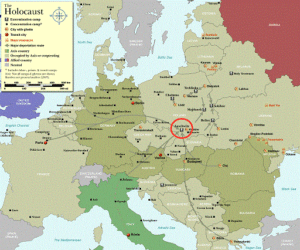
There were rumors, accusations and suspicions of cruel atrocities against victims behind the German lines during World War II. Nevertheless, there was also a degree of doubt as well. Nazi Germany had deniability … until this day 75 years ago. This is when Soviet troops liberated the Concentration Camp in Auschwitz, Poland:

“The cat was out the bag”.

See a summary and highlights of Auschwitz here:

Title: Auschwitz Concentration Camp
The camp was a complex of over 40 concentration and extermination camps operated by Nazi Germany in occupied Poland during World War II and the Holocaust. It consisted of Auschwitz I, the main camp (Stammlager) in OświęcimAuschwitz II–Birkenau, a concentration and extermination camp built with several gas chambersAuschwitz III–Monowitz, a labor camp created to staff a factory for the chemical conglomerate IG Farben; and dozens of subcamps.[3] The camps became a major site of the Nazis’ Final Solution to the Jewish Question.

After Germany invaded Poland in September 1939, sparking World War II, the Schutzstaffel (SS) converted Auschwitz I, an army barracks, into a prisoner-of-war camp for Polish political prisoners.[4] The first inmates, German criminals brought to the camp in May 1940 as functionaries, established the camp’s reputation for sadism. Prisoners were beaten, tortured, and executed for the most trivial reasons. The first gassings—of Soviet and Polish prisoners—took place in block 11 of Auschwitz I around August 1941. Construction of Auschwitz II began the following month, and from 1942 until late 1944 freight trains delivered Jews from all over German-occupied Europe to its gas chambers. Of the 1.3 million people sent to Auschwitz, 1.1 million died. The death toll includes 960,000 Jews (865,000 of whom were gassed on arrival), 74,000 non-Jewish Poles, 21,000 Roma, 15,000 Soviet prisoners of war, and up to 15,000 other Europeans.[5] Those not gassed died of starvation, exhaustion, disease, individual executions, or beatings. Others were killed during medical experiments.

At least 802 prisoners tried to escape, 144 successfully, and on 7 October 1944 two Sonderkommando units, consisting of prisoners who staffed the gas chambers, launched an unsuccessful uprising. Only 789 staff (no more than 15 percent) ever stood trial;[6] several, including camp commandant Rudolf Höss, were executed. The Allies‘ failure to act on early reports of atrocities in the camp by bombing it or its railways remains controversial.

As the Soviet Red Army approached Auschwitz in January 1945, toward the end of the war, the SS sent most of the camp’s population west on a death march to camps inside Germany and Austria. Soviet troops entered the camp on 27 January 1945, a day commemorated since 2005 as International Holocaust Remembrance Day. In the decades after the war, survivors such as Primo LeviViktor Frankl, and Elie Wiesel wrote memoirs of their experiences in Auschwitz, and the camp became a dominant symbol of the Holocaust. In 1947 Poland founded the Auschwitz-Birkenau State Museum on the site of Auschwitz I and II, and in 1979 it was named a World Heritage Site by UNESCO.

Table I – Auschwitz Death Estimates

Nationality/ethnicity
(Source: Franciszek Piper)
[2]
Registered deaths
(Auschwitz)
Unregistered deaths
(Auschwitz)
Total
Jews 95,000 865,000 960,000
Ethnic Poles 64,000 10,000 74,000 (70,000–75,000)
Roma and Sinti 19,000 2,000 21,000
Soviet prisoners of war 12,000 3,000 15,000
Other Europeans:
Soviet citizens (ByelorussiansRussiansUkrainians),
CzechsYugoslavsFrenchGermansAustrians
10,000–15,000 n/a 10,000–15,000
Total deaths in Auschwitz, 1940–1945 200,000–205,000 880,000 1,080,000–1,085,000

Source: Retrieved January 27, 2020 from: https://en.wikipedia.org/wiki/Auschwitz_concentration_camp
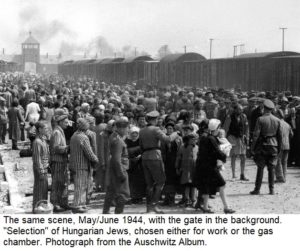
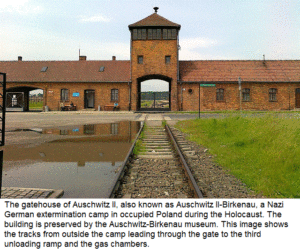
    

This was mankind’s lowest point, the “darkest chapter in human history” … or was it?

Never Again” became the mantra from this point forward for Holocaust victims and other stakeholders. These ones wanted to present Auschwitz as a Cautionary Tale so that “the world” would Never Again tolerate “man mistreating man” so egregiously.

Never Again lasted “for a minute”!

But “Never Again” has only been empty words. Within the days, weeks, months and years of this atrocity, more atrocities emerged. This is not just my assertion; this is the fact … as chronicled by historians, anthropologists, academicians, journalists and newscasters alike; see the highlights of a sample book on the subject here:

The Great Big Book of Horrible Things: The Definitive Chronicle of History’s 100 Worst Atrocities – a popular history book by Matthew White, an independent scholar and self-described atrocitologist. The book provides a ranking of the hundred worst atrocities of mankind based on the number of deaths.
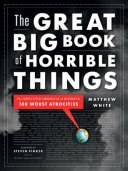
In the pages of his book, the author, Matthew White, details the 100 Worst Atrocities of Mankind from Antiquity to Modernity. Let’s pick up his ranking from World War II and present the detailed list since those atrocious events. See here-now:

Table II – White’s ranking of atrocities

Rank Event Place Start year End year Death toll
1 World War Two Europe, Asia, Africa 1939 1945 66,000,000
36 Expulsion of Germans from Eastern Europe Eastern Europe 1945 1947 2,100,000
88 French Indochina War French Indochina 1945 1954 393,000
70 Partition of India India and Pakistan 1947 1947 500,000
2 Mao Zedong‘s rule China 1949 1976 40,000,000
30 Korean War Korea 1950 1953 3,000,000
30 North Korea North Korea 1948 3,000,000
69 Algerian War of Independence Algeria 1954 1962 525,000
35 Sudanese Civil Wars Sudan, South Sudan 1955 2,600,000
24 Vietnam War Southeast Asia 1959 1975 4,200,000
81 Suharto’s purge Indonesia 1965 1966 400,000
46 Biafran War Nigeria 1966 1970 1,000,000
40 Bengali Genocide Bangladesh 1971 1971 1,500,000
96 Idi Amin‘s rule Uganda 1971 1979 300,000
37 Mengistu Haile‘s rule Ethiopia 1974 1991 2,000,000
91 Postwar Vietnam Vietnam 1975 1992 365,000
39 Democratic Kampuchea Cambodia 1975 1979 1,670,000
55 Mozambican Civil War Mozambique 1975 1992 800,000
70 Angolan Civil War Angola 1975 1994 500,000
70 Ugandan Bush War Uganda 1979 1986 500,000
40 Soviet–Afghan War Afghanistan 1979 1992 1,500,000
96 Saddam Hussein‘s peacetime rule Iraq 1979 2003 300,000
61 Iran–Iraq War Persian Gulf 1980 1988 700,000
94 Sanctions against Iraq Iraq 1990 2003 350,000
70 Anarchy in Somalia Somalia 1991 500,000
53 Rwandan genocide Rwanda 1994 1994 937,000
27 Second Congo War Central Africa 1998 2002 3,800,000

Source: Retrieved January 27, 2020 from: https://en.wikipedia.org/wiki/The_Great_Big_Book_of_Horrible_Things#White’s_ranking_of_atrocities

This is the lesson for us today. This is the relevance of Auschwitz 75 years later. This aligns with the 2013 book Go Lean…Caribbean. It asserts (Page 23) that “history teaches that with the emergence of new economic engines, ‘bad actors’ will also emerge thereafter to exploit the opportunities, with good, bad and evil intent. A Bible verse declares: ‘What has been will be again, what has been done will be done again; there is nothing new under the sun’” – Ecclesiastes 1:9 New International Version.

This is why we must always be On Guard for slight movements towards societal dysfunctions, tyranny and Failed-State status; this is when atrocities occur. Again, this is the lesson from Auschwitz by the victims of Auschwitz who still survive today; see this depiction in this VIDEO here from CBS News:

VIDEO Holocaust survivor opens up about Auschwitz https://www.cbsnews.com/video/holocaust-survivor-visits-auschwitz-for-first-time-since-camps-liberation/

Posted January 27, 2020 – Monday marks 75 years since the liberation of the Auschwitz concentration camp in Poland, the largest Nazi death camp. Around 200 Holocaust survivors are expected to be honored guests at a place where they were once sent to die. Mark Phillips spoke with a 91-year-old survivor who hasn’t talked about what happened to him in the camp until now.

The Go Lean book, serving as a roadmap for the introduction of the Caribbean Union Trade Federation (CU), asserts that in addition to economic empowerments, the stewards for a new Caribbean must also optimize the security apparatus in the region to ensure public safety and justice standards for all stakeholders: citizens, visitors and trading partners.

How do we go about empowering the economics and security engines? Throughout the 370 pages of the Go Lean book, the details are provided as turn-by-turn directions on how to mitigate against Failed-State encroachment. There is an Index Number that reflect Failed-State eventuality. The book defines this Index and the related eco-system, as follows (Page 134) :

The Bottom Line on the Failed States Index

The Failed States Index (Appendix F on Page 271) is an annual ranking of 177 nations based on their levels of stability and capacity. The Index is compiled by the Fund for Peace Institute, an independent, nonpartisan, 501(c)(3) non-profit research and educational organization, based in Washington DC, that works to prevent violent conflict and promote sustainable security.

As a leader in the conflict assessment and early warning field, the Fund for Peace focuses on the problems of weak and failing states. The strength of the Failed States Index is its ability to distill millions of pieces of information into a form that is relevant as well as easily digestible and informative, as an indicator code. Each Indicator is rated on a 1 to 10 scale with 1 (low) being the most stable and 10 (high) being the most at-risk of collapse and violence. Think of it as trying to bring down a fever, with high being dangerous, low being acceptable. An obvious example, consider Somalia, the state’s complete inability to provide public services for its citizens would warrant a score of 10 for the Public Service indicator. Conversely, Sweden’s extensive provision of health, education & other public services would produce a 1 or 2 for that indicator. – Fund For Peace®

This Go Lean roadmap includes the new community ethos (attitudes and values) that must be adopted; plus the executions of new strategies, tactics, implementations and advocacies to elevate the region’s security and justice institutions. In fact, this actual advocacy in the Go Lean book contains specific plans, excerpts and headlines here from Page 134, entitled:

10 Ways to Improve Failed-State Indices

1 Lean-in for the Caribbean Single Market Confederation Treaty
This will allow for the unification of the region into one market of 42 million people across 30 member-states, thereby creating an economic zone to protect the interest of the participant trading partner-member-states. The GDP of the region will amount to $800 Billion (circa 2010). In addition, the treaty calls for a collective security agreement of the member states so as to ensure homeland security and assuage against systemic threats. The CU will ensure that law-and-order persist during times of distress. When a member state declares a State of Emergency, due to natural disaster or civil unrest, this triggers an automatic CU response – this is equivalent to the governmental dialing 911.
2 Image and Defamation

When a country’s primary foreign currency generator is tourism/hospitality, just the perception of a weak or failing state could be devastating. The index is a number that can rise and fall, like a credit score, so any upward movement in the index triggers the negative perception. The pressures are not only internal; there may be external entities that can have a defaming effect: credit rating, country risk, threat assessment, K-n-R (Kidnap and Ransom) insurance rates. The CU will manage the image of the region’s member-states against defamation and work to promote a better image.

3 Local Government and the Social Contract
4 Law Enforcement Oversight
5 Military and Political Monitoring
6 Crime/Homeland Intelligence
7 Minority and Human Rights

The CU will protect the minority and human rights for the region’s population; this includes ethnic mixes of African, European, Amerindian, and Asian heritage; 4 languages, various religions, and 5 colonial legacies. The CU  strategizes this diversity as an asset, rather than a source of contention, to be exploited as cultural exchanges in music, festivals, events, and food services. This will have a positive effect on tourism (foreign & domestic) and media initiatives.

8 Election Outsourcing
9 War Against Poverty
10 Big Data

The CU will embrace an e-Government and e-Delivery model. There will be a lot of data to collect and analyze. In addition, the CU Commerce Department will function as a regional OECD (Organization of Economic Cooperation and Development), accumulating and measuring economic metrics and statistical analysis. Any decline in Failed-State indices will be detected, and managed in both a predictive and reactionary manner.

We never want to spiral down to the level of Auschwitz, so we must monitor early and often. The Go Lean movement addressed the subject of monitoring for the encroachment of Failed-State status on many occasions. See this sample of many previous blog-commentaries here:

https://goleancaribbean.com/blog/?p=15039 Failed-State “Venezuela” – ‘On the Menu’ in California
https://goleancaribbean.com/blog/?p=13974 The Spoken and Unspoken on Haiti’s Failed-State
https://goleancaribbean.com/blog/?p=13391 After Maria, Failed-State Indicators: Destruction & Defection for Puerto Rico
https://goleancaribbean.com/blog/?p=12996 After Irma, Failed State Indicators: Destruction and Defection
https://goleancaribbean.com/blog/?p=12274 State of the Union – Spanish Caribbean Failing
https://goleancaribbean.com/blog/?p=12098 Inaction on Venezuela: A Recipe for Failed-State Status
https://goleancaribbean.com/blog/?p=5818 Greece: From Bad to Worse

Never Again” has only been empty words in the modern world; but let’s do better here at home.

In truth, when people are victimized, they want the world to Never Forget; but when people are villainous, they want the world to Not Remember. The former European Jews repatriated to a homeland in Palestine and proceeded to bully, oppress and suppress their neighbors there, the Palestinian people. The drama of Israel and Palestine is complicated and difficult to solve; the solutions are out-of scope for this Caribbean focus. We simply wanted to study history and apply the lessons learned in the effort to reform our society.

Yes, we can … do better in protecting our citizen and ensuring “justice for all”. This is heavy-lifting, yes, but it is conceivable, believable and achievable.

We urge all Caribbean stakeholders to lean-in to this Go Lean roadmap … to do the heavy-lifting and elevating Caribbean society and making the homeland a better place to live, work and play. 🙂

About the Book
The book Go Lean…Caribbean serves as a roadmap for the introduction and implementation of the technocratic Caribbean Union Trade Federation (CU), for the elevation of Caribbean society – for all member-states. This CU/Go Lean roadmap has these 3 prime directives:

  • Optimization of the economic engines in order to grow the regional economy to $800 Billion & create 2.2 million new jobs.
  • Establishment of a security apparatus to ensure public safety and protect the resultant economic engines.
  • Improve Caribbean governance to support these engines, including a separation-of-powers between the member-states and CU federal agencies.

The Go Lean book provides 370-pages of turn-by-turn instructions on “how” to adopt new community ethos, plus the strategies, tactics, implementations and advocacies to execute so as to reboot, reform and transform the societal engines of Caribbean society.

Download the free e-Book of Go Lean … Caribbean – now!

Who We Are
The movement behind the Go Lean book – a non-partisan, apolitical, religiously-neutral Community Development Foundation chartered for the purpose of empowering and re-booting economic engines – stresses that reforming and transforming the Caribbean societal engines must be a regional pursuit. This was an early motivation for the roadmap, as pronounced in the opening Declaration of Interdependence (Pages 12 – 13):

xi. Whereas all men are entitled to the benefits of good governance in a free society, “new guards” must be enacted to dissuade the emergence of incompetence, corruption, nepotism and cronyism at the peril of the people’s best interest. The Federation must guarantee the executions of a social contract between government and the governed.

xii.  Whereas the legacy in recent times in individual states may be that of ineffectual governance with no redress to higher authority, the accedence of this Federation will ensure accountability and escalation of the human and civil rights of the people for good governance, justice assurances, due process and the rule of law. As such, any threats of a “failed state” status for any member state must enact emergency measures on behalf of the Federation to protect the human, civil and property rights of the citizens, residents, allies, trading partners, and visitors of the affected member state and the Federation as a whole.

xiii. Whereas the legacy of dissensions in many member-states (for example: Haiti and Cuba) will require a concerted effort to integrate the exile community’s repatriation, the Federation must arrange for Reconciliation Commissions to satiate a demand for justice.

xvi. Whereas security of our homeland is inextricably linked to prosperity of the homeland, the economic and security interest of the region needs to be aligned under the same governance. Since economic crimes … can imperil the functioning of the wheels of commerce for all the citizenry, the accedence of this Federation must equip the security apparatus with the tools and techniques for predictive and proactive interdictions.

xxiv. Whereas a free market economy can be induced and spurred for continuous progress, the Federation must install the controls to better manage aspects of the economy: jobs, inflation, savings rate, investments and other economic principles. Thereby attracting direct foreign investment because of the stability and vibrancy of our economy.

Sign the petition to lean-in for this roadmap for the Caribbean Union Trade Federation.
Share this post:
, , ,

After Dorian, Rebuilding Partners: China Versus America

Go Lean Commentary

There are a number of phases of post-Hurricane activities:
  • Rescue
  • Relief
  • Restoration
  • Recovery
  • Rebuilding

After Hurricane Dorian, the rescue operations in the Northern Bahamas is now done – 54 people have officially been counted as dead due to this storm – though it is widely accepted that the death toll will increase … once all the family notifications are complete.

Relief supplies are being funneled to the victims and displaced people have been relocated to temporary housing options. Power is being restored in some areas. The recovery is on the way; it is time now to think about rebuilding … and who will profit from it.

So for the Bahamas, its time to take stock of who are your friends and who are only “strangers”.

In your hour of need, the big Super Power, the United States of America, extended some help but drew a line, thereby making this statement:

You’re just a neighbor; you are not family.
[This translates to: “You’re Not Welcome”.]

See this exemplified in this news article here:

Title: US Official Says No Protected Status For People Fleeing The Bahamas
A senior official in the administration of President Donald Trump has been quoted by CBS News as saying that the US will not be granting protected status to people fleeing hurricane destruction in Bahamas.

It’s something the Trump administration had said was a possibility, as the White House seeks to restrict the flow of immigrants into the country.

Some persons are permitted to live and work in the United States under a program known as Temporary Protected Status (TPS).

It is estimated that some 300,000 have qualified after fleeing their countries because of war, hurricanes, earthquakes or other conditions that make life dangerous in their native countries.

According to NBC News the status would have allowed Bahamians to work and live in the U.S. until it is deemed safe to return home.

Bahamians will be permitted to enter the United States temporarily if they have the correct travel documents, but will not be granted work permits, it was reported.

See the full story here: Posted September 13, 2019; retrieved September 24, 2019 from: https://stluciatimes.com/us-official-says-no-protected-status-for-people-fleeing-the-bahamas/

Rebuilding will mean new budgets, supplies, equipment, construction labor and architectural-design services. So now is the time to start profit-taking from the rebuild activities. Who do we share that profit with: America or China; or maybe some other entity. Well, these same Americans, who quickly declared “Not Welcome” are quick to “call dibs” on a “piece of the profit pie”. See a related news story here:

Title: Rubio: U.S. must rebuild Bahamas
The United States cannot allow China to exploit the recovery and rebuilding of The Bahamas after Hurricane Dorian for its own nefarious purposes and gain “a foothold just 50 miles from the coast of Florida”, U.S. Senator Marco Rubio said on Saturday.

“By targeting the Bahamian government in this period of crisis, Beijing would be making the same opportunistic play to access critical foreign infrastructure,” Rubio wrote in an op-ed in the Miami Herald.

“But in this case, the national security threat is especially perilous, as it would give China a foothold just 50 miles from the coast of Florida.

“We cannot allow this to happen. It is on us to take the lead in helping the Bahamian people with their near-term, life-or-death struggle as only the U.S. and our military can, but also to be reliable partners over the long term.” …

See the full article here: The Nassau Guardian – Posted September 16, 2019; retrieved September 24, 2019 from: https://thenassauguardian.com/2019/09/16/rubio-u-s-must-rebuild-bahamas/

Concerns about China? There is reason for America to be competitive with China, as the Chinese are here in the Caribbean too; with their own agenda for national development. See this article petitioning for their help in rebuilding parts of the Bahamas:

Title: Speaker: China Should Consider Developing Southeast Bahamas
By: Khrisna Russell, Deputy Chief Reporter

HOUSE Speaker Halson Moultrie yesterday recommended to a People’s Republic of China delegation that its country consider developing the southeast region of the Bahamas to shift the population concentration from the northwest Bahamas.

It was also his suggestion that China help this country with relocating the Bahamas Department of Correctional Services from New Providence to Little Inagua.

Speaker Moultrie made the recommendations during a courtesy call with Dr Cai Dafend, vice chairman of the Standing Committee of the National People’s Congress of China.

Dr Dafend and a 14-member delegation held brief discussions in the Senate with the Speaker, his deputy Donald Saunders and Chief Clerk David Forbes Friday.

At the time, the Chinese official announced his government would give an additional $500,000US to the Bahamas for Hurricane Dorian relief efforts.

See the full article here: Bahamas Daily Newspaper The Tribune – Posted September 20, 2019; retrieved September 24, 2019 from: http://www.tribune242.com/news/2019/sep/20/speaker-china-should-consider-developing-southeast/

China versus America …

… can we be any more “lucky” to have admiring suitors – from competing Super Powers – willing to lend us a development hand.

We give China a “scholarship” that they may be viewed as a Super Power. While their Single Market GDP is smaller than the USA, only by a little, their transformation in the last 40 years cannot be ignored; nor their 1.3 billion population. – see this VIDEO here from a previous blog-commentary:

VIDEO – How China became the world’s second largest economy – https://youtu.be/_sV5P_F3frY

CNN Business
Published on Oct 6, 2015 – More than 500 million people have been lifted out of poverty since China’s economic reforms began in 1978.

What is America’s motive? ? According to a previous blog-commentary, the United States of America has always assumed that the Caribbean is in their sphere of influence … exclusively; (even going to war to ensure it; think Cuba, Grenada & Panama). This was the summary of that blog’s assertions:

  • … We can always count on America to pursue what’s in America’s best interest, and this may not always align with Caribbean objectives. So we must take our own lead for our own self-interest.
  • American priorities change with presidential administrations

What is China’s motive? According to this previous blog-commentary, China is simply executing America’s Expansionism Playbook:

… the same playbook of the United States of America in building the world’s largest Single Market economy. (Remember, with the Army Corp of Engineers, the US built the Panama Canal, but with more strings attached). China is simply following the same American script – minus the cronyism and militarism – of promoting trade of their products, services and capital.

Capital? Yes, many of the projects highlighted in the foregoing news articles are being financed by China’s state-owned banks and lending institutions. They are “putting their money, where their mouth is”. These are economic battles only!

So beyond America and China, where else can we turn?

It would be a nice thought if the Bahamas could turn to their neighbors, to come to their aid. This is the quest of the movement behind the 2013 book Go Lean…Caribbean: to consolidate, integrate and streamline Caribbean member-states so as to be prepared for and to respond after disasters in the region. The book declares that all of the Caribbean is in crisis, but that a “crisis is a terrible thing to waste”. It is only at the precipice do people change! We should now re-think any previous objection to regionalism.

Yes indeed, the Caribbean member-states should take the lead for our best self-determination. We should do the heavy-lifting ourselves!

While this quest is easier said than done, it is conceivable, believable and achievable to pursue this aspiration.

The Go Lean book asserts that a unified, integrated Single Market of all 30 Caribbean member-states would represent a $800 Billion economy. The solutions will be there for a leveraged entity – introduced as the Caribbean Union Trade Federation (CU) – to be “On Guard” for all regional challenges, including the new reality of Climate Change in the Caribbean. The book presents many strategies, tactics and implementations to address the development and funding (capital) needs in the region, before, during and after hurricanes.

This theme – standing up together to tackle the challenges of tropical life – aligns with previous Go Lean commentaries; see a sample list here:

https://goleancaribbean.com/blog/?p=17559 Dealing with Hurricane Seasons – Year after Year
https://goleancaribbean.com/blog/?p=17282 Way Forward – For True Independence: Territory Realities
https://goleancaribbean.com/blog/?p=17135 Way Forward – Caribbean States Learn their status with America
https://goleancaribbean.com/blog/?p=15996 Good Governance: Stepping Up in an Emergency
https://goleancaribbean.com/blog/?p=15886 Industrial Reboot for Caribbean Casualty Insurance & Reinsurance
https://goleancaribbean.com/blog/?p=15310 Industrial Reboot for Medical Emergencies – Trauma 101
https://goleancaribbean.com/blog/?p=12466 Being On Guard for Unstable ‘Volcano States’
https://goleancaribbean.com/blog/?p=9038 Post-Disaster Charity Management – Caribbean People Must Grow Up Already!
https://goleancaribbean.com/blog/?p=7963 ‘Like a Good Neighbor’ – Being there for each Caribbean Community
https://goleancaribbean.com/blog/?p=7449 ‘Crap Happens’ – Hurricanes, Earthquakes, etc. – So What Now?
https://goleancaribbean.com/blog/?p=6103 Sum of All Fears – ‘On Guard’ Against Deadly Threats

The Bahamas and other Caribbean member-states have consistently been parasites of the American hegemony…

… do we now want to be parasites of China.

The answer is an emphatic No! Rather than parasites, we want to be protégés.

This is the quest and the position of the Go Lean roadmap, that …

Yes, We Can

… we can work together to reboot our Caribbean homeland; we can rescue, relieve, restore, recover and rebuild … with own resources and on own our terms. We can do the heavy-lifting ourselves to make the Caribbean homeland a better place to live, work and play.  🙂

About the Book
The book Go Lean…Caribbean serves as a roadmap for the introduction and implementation of the technocratic Caribbean Union Trade Federation (CU), for the elevation of Caribbean society – for all member-states. This CU/Go Lean roadmap has these 3 prime directives:

  • Optimization of the economic engines in order to grow the regional economy to $800 Billion and create 2.2 million new jobs.
  • Establishment of a security apparatus to ensure public safety and protect the resultant economic engines.
  • Improve Caribbean governance to support these engines, including a separation-of-powers between the member-states and CU federal agencies.

The Go Lean book provides 370-pages of turn-by-turn instructions on “how” to adopt new community ethos, plus the strategies, tactics, implementations and advocacies to execute so as to reboot, reform and transform the societal engines of Caribbean society.

Download the free e-Book of Go Lean … Caribbean – now!

Who We Are
The movement behind the Go Lean book – a non-partisan, apolitical, religiously-neutral Community Development Foundation chartered for the purpose of empowering and re-booting economic engines – stresses that reforming and transforming the Caribbean societal engines must be a regional pursuit. This was an early motivation for the roadmap, as pronounced in the opening Declaration of Interdependence (Pages 11 – 13):

i. Whereas the earth’s climate has undeniably changed resulting in more severe tropical weather storms, it is necessary to prepare to insure the safety and security of life, property and systems of commerce in our geographical region. As nature recognizes no borders in the target of its destruction, we also must set aside border considerations in the preparation and response to these weather challenges.

xi. Whereas all men are entitled to the benefits of good governance in a free society, “new guards” must be enacted to dissuade the emergence of incompetence, corruption, nepotism and cronyism at the peril of the people’s best interest. The Federation must guarantee the executions of a social contract between government and the governed.

xvi. Whereas security of our homeland is inextricably linked to prosperity of the homeland, the economic and security interest of the region needs to be aligned under the same governance. Since economic crimes … can imperil the functioning of the wheels of commerce for all the citizenry, the accedence of this Federation must equip the security apparatus with the tools and techniques for predictive and proactive interdictions.

xxiv. Whereas a free market economy can be induced and spurred for continuous progress, the Federation must install the controls to better manage aspects of the economy: jobs, inflation, savings rate, investments and other economic principles. Thereby attracting direct foreign investment because of the stability and vibrancy of our economy.

Sign the petition to lean-in for this roadmap for the Caribbean Union Trade Federation.

Share this post:
, , ,
[Top]

After Dorian, Housing Needs: Coulda-Woulda-Shoulda – Encore

“We cannot wait for it to rain to buy an umbrella.” – Old Adage 

There is the need for housing … in rain and shine. This is why we put sound roofs on our homes. We fortify them to withstand unsavory conditions.

In everyone’s life, a little rain must fall.

So everyone needs to anticipate the delivery of basic needs despite the presence of inclement weather. This is doubly true for the Caribbean … during hurricane season.

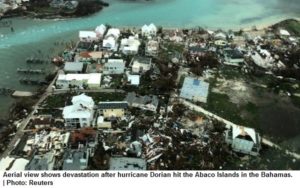
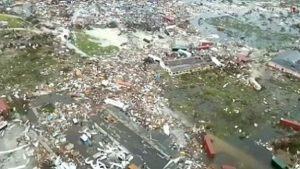
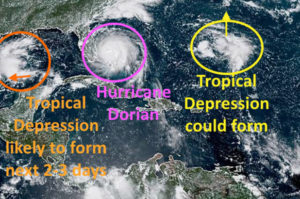
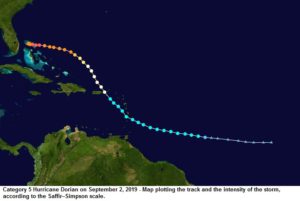
Category 5 Hurricane Dorian just devastated the Northern Bahama Islands of Abaco and Grand Bahama; some 70,000 people have directly been impacted; many of them are now homeless. What are they to do … now?

What are we to do? (The Bahamas is a “common”-wealth, so everyone is responsible for everyone – this is Democratic Socialism personified). It seems like the Bahamas is only now scrambling with this question, looking for answers. They are currently considering the housing solutions of:

Tents 

Say, it ain’t so!

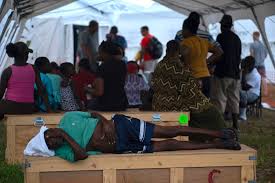
This solution is far from being welcomed. The people are responding. The best imagery of this experience is being conveyed to the watching world with a religious analogy. While the impact of Hurricane Dorian is being described as “Hell on Earth“, the prospect of the survivors now living in tents is being described as “Purgatory“; see the news story here:

Title: Purgatory in paradise: Bahamas tent cities to house Dorian survivors
By: Zachary Fagenson 

NASSAU, Bahamas (Reuters) – For some Bahamians who escaped death but lost their homes in Hurricane Dorian’s hellish rampage over the islands of Freeport and Great Abaco, life in the tent shelters erected this week seems like purgatory.

“We feel like we’re caged right now,” said Dana Lafrance, a 35-year-old mother of five, who is one of hundreds of people living in a massive tent set up to extend the capacity of a gymnasium housing storm evacuees in central Nassau, the capital of the former British colony.

As evacuees from the devastated islands continue to flow in, the Bahamas Gaming Operators Association said on Tuesday it had built more than 15,000 square feet (1,394 square meters) of air-conditioned, tent housing for more than 800 people. Some 295 people were staying in those tents on Wednesday, Bahamian officials said.

More will come, with officials planning to erect two “tent city” relief centers capable of housing around 4,000 people around hard-hit Marsh Harbour on Great Abaco Island, John Michael-Clark, co-chairman of the Bahamas’ disaster relief and reconstruction committee, told reporters this week.

See the full article here: Reuters News Source – Posted September 11, 2019; retrieved September 23, 2019 from: https://www.reuters.com/article/us-storm-dorian-tent-cities/purgatory-in-paradise-bahamas-tent-cities-to-house-dorian-survivors-idUSKCN1VW2BY

So looking at the issue of emergency housing for hurricane refugees in the Bahamas, clearly there is a “Coulda-Woulda-Shoulda” exercise now as to what to do. We needed to have a plan … in advance. We didn’t need “to wait until it rains to acquire an umbrella”.

This we did!

This was the quest of the movement behind the 2013 book Go Lean…Caribbean. The book presented the challenges and solutions – such as Prefab Housing (Page 207) – for the new reality of Climate Change in the Caribbean. The movement presented many strategies, tactics and implementations to address housing needs in the region, before, during and after hurricanes. See here, this previous Go Lean blog-commentary from July 14, 2018 that addressed the landscape of pre-fabricated housing.. It is only apropos to Encore that previous blog-commentary here-now:

———————-

Go Lean Commentary – Industrial Reboot – Prefab Housing 101 

Is housing just a commodity, available to the highest bidder, or a basic right that everyone is entitled to?

The answer to this question should be obvious: no matter the income level, there is the need for housing – basic needs are cataloged as food, clothing and shelter – so there must be housing solutions for all in society, the rich, middle class and the poor.

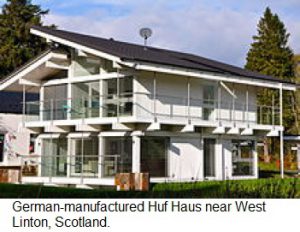
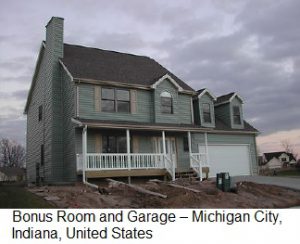
Here’s the disclosure: All housing types can benefit from pre-fabricated housing methods – see Photos below.

Prefabricated buildings consist of several factory-built components or units that are assembled on-site to complete the unit. The economic beauty of this method is the requirement for labor in the fabrication site and the assembly site. Fostering that labor means jobs and allows for an Industrial Reboot based on familiar techniques. Already, a popular prefabrication technique is utilized widely in the construction industry with Roof Trusses.

The book Go Lean … Caribbean – available to download for free – focuses on fostering Industrial Reboots for the Caribbean region. The book serves as a roadmap for the introduction and implementation of the technocratic Caribbean Union Trade Federation (CU). It identifies the strategic and tactical genius of Roof Trusses (Page 207):

The Bottom Line on Roof Trusses
In architecture a truss is a structure comprising one or more triangular units constructed with straight members whose ends are connected at joints referred to as nodes. Simple trusses are composed entirely of triangles because of the stability of this shape and the methods of analysis used to calculate the forces within them. The planar truss, pitched truss, or common truss is used primarily for roofs.Prefabrication is the practice of assembling components of a structure in a factory or other manufacturing site, and transporting complete assemblies or sub-assemblies to the construction site. Roof trusses are most commonly prefabricated. A prefabricated roof truss system is an engineered shop fabricated wood frame system that is installed on the building at the job site. It is installed on the typical timber or concrete belt beam and typically spans from one load bearing wall to another load bearing wall. Prefabricated roofs are used on almost any type of roof and are preferred when resistance to high wind speed is required because it can be quickly engineered, or when rapid site installation is required.This is the winning formula for acceptance of prefab homes. Despite objections to prefabrication strategies/concepts, no one objects to prefabricated roof trusses; the market acceptance for homes should “build-up” from this “juncture”.

The Go Lean book opened with a focus on basic needs. At the very beginning – Page 3 – the role for the CU was defined:

The CU should better provide for the region’s basic needs (food, clothing, energy and shelter), and then be in position to help supply the rest of the world. Previous Caribbean societies lived off the land and the sea; but today, the region depends extensively on imports …

For industries that depend on providing basic needs, there is an opportunity to reboot the industrial landscape and business model. There is the opportunity to launch a Prefab Housing industry.

Jobs are at stake.

According to the book Go Lean … Caribbean (Page 257) , there could be this many jobs:

Direct jobs in the design, fabrication and logistics for new pre-fab homes: 8,000

The Go Lean book prepares the business model of Prefab Housing for consumption in the Caribbean. Yes, business model refers to jobs, entrepreneurial opportunities, trade transactions, etc. In addition to these industry jobs; there is also the reality of indirect jobs – unrelated service and attendant functions – at a 3.75 multiplier rate would add another 30,000 jobs.

This constitutes an Industrial Reboot.

There is the need to supplement the housing deliveries in the Caribbean region; so factory-built homes should have a place. But, we are not talking manufactured homes, as in mobile homes or trailers. No, we are talking previously-made and fabulous, or pre-fab. Thus these homes can supply the demand for rich and middle class residents. See the samples from Appendix K; of the Go Lean book on Page 289. In addition, there are vast options for prefab homes from recycled shipping containers. These are ideal for affordable housing solutions, or even replacements for  “Shanty Towns”; see Appendix Commentary.

Providing quality housing for “pennies on the dollar” is an ideal objective for the Go Lean movement, or those pursuing the Greater Good. This Industrial Reboot pursues the Greater Good mandate; it is wise to try to please residents, advocates, entrepreneurs, bankers and governmental officials. This is in addition to the roadmap’s prime directive, defined as follows:

  • Optimization of the economic engines in order to grow the regional economy to $800 Billion & create 2.2 million new jobs.
  • Establishment of a security apparatus to ensure public safety and protect the resultant economic engines.
  • Improvement of Caribbean governance to support these engines, including a separation-of-powers between the member-states and CU federal agencies.

This Industrial Reboot is badly needed in the Caribbean region as our current economic landscape – based on Tourism – is in shambles!

Tourism is under assault in every Caribbean member-state due to the fact that many visitors shift from stay-overs to cruise arrivals. This means less economic impact to the local markets. So as a region, we must reboot our industrial landscape so as to create more jobs … from alternate sources. What options do we have?

This commentary has previously identified a number of different industries that can be rebooted under this Go Lean roadmap. See this list of previous submissions under the title Industrial Reboots:

  1. Industrial RebootsFerries 101 – Published June 27, 2017
  2. Industrial RebootsPrisons 101 – Published October 4, 2017
  3. Industrial RebootsPipeline 101 – Published October 6, 2017
  4. Industrial RebootsFrozen Foods 101 – Published October 6, 2017
  5. Industrial RebootsCall Centers 101 – Published July 2, 2018
  6. Industrial Reboots – Prefab Housing 101 – Published Today – July 14, 2018

The Go Lean book stresses that reforming and transforming the Caribbean economic engines must be a regional pursuit. This was an early motivation for the roadmap, as pronounced in the opening Declaration of Interdependence (Pages 12 – 13):

xxiv.  Whereas a free market economy can be induced and spurred for continuous progress, the Federation must install the controls to better manage aspects of the economy: jobs, inflation, savings rate, investments and other economic principles. Thereby attracting direct foreign investment because of the stability and vibrancy of our economy.

xxvi.  Whereas the Caribbean region must have new jobs to empower the engines of the economy and create the income sources for prosperity, and encourage the next generation to forge their dreams right at home, the Federation must therefore foster the development of new industries, like that of ship-building, automobile manufacturing, prefabricated housing, frozen foods, pipelines, call centers … – impacting the region with more jobs.

Accordingly, the CU will facilitate the eco-system for Self-Governing Entities (SGE), an ideal concept for Prefab Housing with its exclusive federal regulation/promotion activities. Imagine bordered campuses – with backup power generations, extra wide roads, railroad lines and shipping docks. The Go Lean movement (book and blogs) details the principles of SGE’s and job multipliers, how certain industries are better than others for generating multiple indirect jobs down the line (or off-campus) for each direct job on the SGE’s payroll.

This is the vision of an industrial reboot! This transformation is where and how the jobs are to be created.

The Go Lean book provides 370-pages of turn-by-turn instructions on “how” to adopt new community ethos, plus the strategies, tactics, implementations and advocacies to execute so as to reboot, reform and transform the societal engines of Caribbean society. One advocacy in rebooting the industrial landscape is to foster a Prefab Housing industry; consider the  specific plans, excerpts and headlines from the book on Page 207 entitled:

10 Ways to Develop a Prefab Housing Industry

1 Lean-in for the Caribbean Single Market
This treaty allows for the unification of the region into one market, thereby expanding to an economy of 30 countries, 42 million people and GDP of over $800 Billion (circa 2010). One mission of the CU is to enable the region to facilitate its own shelter (plus food & clothing). A successful campaign to repatriate the Diaspora, and attract Retirement/Medical Tourists creates a new demand level for housing. The supply of housing will be met with different solutions, including Prefabricated options. In terms of demand, Pre-Fab homes are becoming popular in the EU and North America as they are cheaper compared to many existing homes on the market. The 2007-2009 Global Financial crisis, however, deflated the cost of regular houses in North America and Europe, so the “cheaper” benefits was not so valued during/after this crisis period. But the CU is a different market than the North America or Europe, resembling the Third World more so than the developed world, so a lot of the current housing is sub-standard and need to be replaced anyway.
2 Fashionable Design
3 Energy Optimizations

To minimize the cost of energy, the CU will encourage design inclusions of solar panels, solar-water-heater, Energy-Star appliance in the Pre-fab-ulous homes. The CU region is also ideal for home “wind” turbines. The design of well air circulated ceilings, so that ceiling fans and the trade-winds alone, can satisfy artificial cooling needs (most of the times).

4 Raw Materials
5 Assembly Plants
6 Supply Chain Solutions (Contractors)
7 Transport/Logistics
8 Showrooms and Marketing
9 Mortgages – Retail and Secondary Markets

Traditionally, manufactured homes do not qualify for mortgages; they are treated as auto loans, not home mortgages. The CU will provide a secondary industry as an inducement for the retail mortgage firms to supply the direct demand.

10 Homeowners Casualty Insurance

Pre-Fab-ulous houses will be built with the structural integrity to withstand typical tropical storms/hurricanes. The CU will facilitate the Property Casualty insurance industry by offering Reinsurance sidecar options on the capital markets.

The subject of housing needs and deliveries is not new for this Go Lean roadmap; there have been a number of previous blog-commentaries by the Go Lean movement that referenced economic opportunities embedded in the housing industry. See a sample list here:

https://goleancaribbean.com/blog/?p=14250 Leading with Money Matters – As Goes Housing, Goes the Market
https://goleancaribbean.com/blog/?p=11737 Robots Building Houses – More than Fiction
https://goleancaribbean.com/blog/?p=11638 Righting a Wrong: The 2008 Housing Crisis
https://goleancaribbean.com/blog/?p=10373 Science of Sustenance – CLT Housing
https://goleancaribbean.com/blog/?p=7659 Pre-Fab Housing and Elder-Care Conjunction
https://goleancaribbean.com/blog/?p=1896 The Crisis in Black Homeownership

Prefab housing is a subset of the general housing industry; but there is a different kind of art and science for this economic endeavor! See the best practice and prospects for prefab manufacturing described in the Appendix VIDEO below.

The Caribbean has a lot of dysfunction when it comes to housing; this is indicative of our near-Failed-State status. We need all the help we can get! We have a constant risk of natural disasters (think: hurricanes and earthquakes) that consistently impact the homes in the region. There is always a need to build and rebuild. This creates the demand for Prefab Housing.

Even successful communities need creative housing solutions. Consider the sad experience of the working class in Silicon Valley, in Northern California (San Francisco Bay Area). People there cannot afford local homes on minimum wage jobs, even two or three jobs. So imagine some of the Prefab homes, discussed here-in, being offered in the Silicon Valley area. While this seems viable, the scope of the Go Lean movement is limited to the Caribbean, not San Francisco. This is just a lesson-learned for us. See more on the Silicon Valley problem in this Youtube VIDEO here: https://youtu.be/6dLo8ES4Bac.

The demand is there. We now need to be a part of the supply solution.

In summary, our Caribbean region need a better job-creation ability than is reflected in the regional status quo. If we are successful in creating more jobs, then boom, just like that, our homeland is a better place to live, work and play. With this success, we should be able to retain more of our Caribbean citizens, as one of the reasons why so many Caribbean citizens have emigrated away from the homeland is the job-creation dysfunction. Prefab Housing can also be a part of the housing solution for inviting the Diaspora to repatriate to the Caribbean homeland.

So rebooting the industrial landscape is necessary and wise; we can contribute to a reality where we can prosper where planted in the Caribbean homeland.

Yes, we can … do this: reboot our industrial landscape, and create new jobs – and provide better housing solutions, for our people, the rich, the poor and all classes in between.

We urge all Caribbean stakeholders to lean-in to this roadmap for economic empowerment. 🙂

Download the free e-Book of Go Lean … Caribbean – now!

Sign the petition to lean-in for this roadmap for the Caribbean Union Trade Federation.

—————-

APPENDIX Commentary – Bahamas Blogger Monte A. Pratt

AN ALTERNATE SOLUTION TO SHANTYTOWN HOUSING DILEMMA – Part 1

The Government has issued a July 31st deadline for all Shantytown persons to vacate their illegally built homes. However, there seems to be no planned relocation program to assist these persons. They are pretty much on their own.

These Shantytowns are a disaster just waiting to happen… they have been very lucky so far that many persons have not been killed in any of these Shantytown fires. Not to mention the health hazard these places are to the many surrounding residences.

Considering all of the above ‘negative’ factors, as a solution to this unwanted ‘vexing problem’, Government should seriously consider allowing the development ‘Container Home Parks’ to relocate and properly re-house these persons.

Container Homes (pictured below) are built from discarded (old) shipping containers is fast becoming a housing solution around the world… even in America. Not only as a clear solution to this problem, they can be a ‘quick solution that is ‘cost-effective’. These houses will be highly fire rated and they can withstand hurricanes.

In fact, once they are properly cleared, the government can give the same Shantytown ‘landowners’ to properly plan, install proper utility infrastructure and erect such ‘low cost’ container homes on these same site locations. Renting the same.

In fact, once they are properly cleared, the government can give the same Shantytown ‘landowners’ (and others) permission to properly plan, install proper utility infrastructure and erect such ‘low cost’ container homes on these same site locations. Renting the same.

This offered solution is by far better than the current situation. This move by Government is the first attempt by any administration to deal with this ‘decades’ old plaguing Shantytown problem throughout the country. (Click on photo to enlarge).

Source: Posted July 7, 2018; retrieved July 13, 2018 from: https://www.facebook.com/monte.a.pratt/posts/10156627694904059:27 )

—————

AN ALTERNATE SOLUTION TO SHANTYTOWN HOUSING DILEMMA – Part 2

It is interesting to see the many ‘negative responses’ from so many Bahamians to my Part-1 proposition for the building of Container Home Parks to replace Haitian Shantytowns. We, Bahamians are too ’emotional’ and that is why we are so easily ‘politically manipulated’. We are not analytic in our thoughts.

That being said, we should also look at the BIG PICTURE of the immigration dilemma that we are now confronted with. That is the ECONOMIC IMPACT of this ‘vexing’ immigration situation. The old saying: ‘When life gives a ‘lemon’ make lemonade. Can we turn this problem ‘lemon’ into ‘lemonade’?

The fact is, many of these (illegal or not) persons are essential to the development of our economy. Don’t be fooled, the fact is, our already fragile construction and agricultural industries will collapse without these KEY WORKERS … that’s because they are more reliable and are also willing to work hard.

Many of these persons are taking the jobs that Bahamians are NOT prepared to do – working in the ‘hot sun’ – especially in construction, agriculture and the landscaping business. Some are making more money than many Bahamians.

By taking on these jobs, they too are making money and many can afford to pay the rents charged. Many live in Shantytowns for economic reasons. That is to SAVE their money to send it home. Estimates are, Haitians send annually some $15 million dollars back home to Haiti from The Bahamas.

Haitian Shantytowns are a ‘fixture housing lifestyle’ that they are accustom to! Shantytowns will not change unless these persons, the residents are forced to change this LIFESTYLE… and/or they are educated about the dangers (fire and health hazard conditions – see pictures below) that they are now living in these clustered and poorly built ‘housing shacks’.

These folks ain’t going nowhere, the Government December 31st deadline has come and gone, and no one has left the country… Since government[s] seem not to have the inability to get them to leave the country, then we should regularize them and properly integrate them into civil society. As there are properly integrated into civic society – make them adhere to the ‘LAW’ of the land.

As most of these folks are already working, once regularized, they can now have ‘bank accounts’ and do business in a right and proper way. By letting them work legally, they can contribute by paying work permits, national insurance and other taxes – that which not now happens – just like everyone else, and the country’s economy will be positively impacted. It will grow to the benefit of the government and the country.

So based on my proposition concept, the creation of Container Home Parks is beyond JUST HOUSING these persons, it is far more. And that why it is more important to resolve this vexing problem in eliminating these Shantytowns and thereby improving these persons lifestyle, at the same time growing the economy via their too; also making their tax contributions.

The TRUTH is, any such ‘massive deportation’ loss will most certainly hurt the country’s economy. More importantly, these people are already a burden on our Medical and Education Systems. So why not regularize them and properly integrate them into the civil society and make them ‘Tax Payers’ too?

Footnote: In qualifying the above, I am not including those ‘illegal persons’ that just came in the last 5 years or so – they should be sent back home. But rather those persons that have been living in The Bahamas for decades, and persons that were born here and only know The Bahamas.

Source: Posted July 8, 2018; retrieved July 13, 2018 from: https://www.facebook.com/monte.a.pratt/posts/10156636669644059

—————-

Appendix VIDEO –  BBC News at 10 – 17.11.16 Prefab houses could solve housing crisis – https://youtu.be/ixMEUWQNFTU

Kieran Simmonds

Published on Nov 17, 2016

Share this post:
, ,
[Top]

After Dorian, ‘Fool Me Twice’ on Flooding

Go Lean Commentary

A Caribbean island – the Northern Bahamas island of Grand Bahama – just got hit with a once in a lifetime Category 5 Hurricane Dorian. Once in a lifetime for a dog (average life span 12 – 15 years), but not for a human (average lifespan 70 – 80 years). No, this island was equally devastated by the following storms:
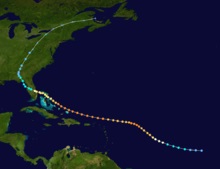
  • Hurricane Frances (August 2004) – Several feet of water flooded the international airport at Freeport.[28] In the Bahamas, insurers and reinsurers estimated industry insured losses at about $300 million (2004 dollars).[29]
  • Hurricane Jeanne (September 2004) – Because Hurricane Frances struck only about two weeks prior, numerous houses were still patched with plastic sheeting on their roofs, while other residents were still living with neighbors or relatives. Officials urged residents in low-lying homes to evacuate. Shelters were set up at the churches and schools on Abaco Islands, Eleuthera and Grand Bahama.
  • Hurricane Wilma (2005) – The hurricane produced hurricane-force winds[38] and a powerful storm surge, flooding southwestern coastal areas of Grand Bahama and destroying hundreds of buildings. In western settlements on the island of Grand Bahama, graves were washed up with skeletal remains lying in the streets. Damage totaled about $100 million almost entirely on the western half of the island. The central portion of Grand Bahama, including in and around Freeport, reported minor to moderate damage, while the eastern end received little to no damage.[39]

Get it?! Fool me once, shame on you; fool me twice, shame on me!

Who’s fooling who?

The culprit here is Mother Nature, yes, but there are other stakeholders to blame; think:

  • Public Works / Infrastructure – Surely with such a preponderance to flood, storm water management and solutions must be put in place. Think: levies, dykes, sea walls, and parks as storm retention ponds; see VIDEO below.
  • Insurance Companies – Reports are that insurance carriers are reticent to cover flood casualty; see Appendix below.

So ‘Shame on Freeport’ for not remediating the threats of storm surge, in the 15 years since Hurricane Frances. This is NOT the product of learning from the “Cautionary Tales” of the many low-lying urban areas around the world; think New Orleans, Louisiana, USA or the European country of Holland (or The Netherlands).

Flood control is not a luxury for those communities, nor should it be for Grand Bahama Island; it must be embedded in the Way Forward for Freeport. According to a previous blog-commentary, “there is a thesis that flooding could be prevented”. The Dutch experience and their historicity in flood control provides lessons-learned for us; (see the Appendix VIDEO on the lessons from The Netherlands).

More than just low-lying communities are affected; every coastal community needs to be On Guard. See the mitigation plans here being pursued in some communities, with the adoption of spill-ways and retention ponds to handle storm surges:

VIDEOStorm-resistant parks are helping cities defend themselves against floodinghttps://www.cbsnews.com/news/storm-resistant-parks-that-are-helping-cities-defend-themselves-from-flooding-2019-09-17/

Posted September 17, 2019 – Flooding from storm surges and heavy rainfall can be one of the most devastating effects of storms — and scientists say Climate Change is making those storms worse. Often, engineers build barriers like sea walls and levees to protect coastal cities. But now, there’s a new, prettier approach: public parks that are also storm-resistant.

One of those parks, Hunter’s Point South Park, sits on the edge of New York’s East River. The park boasts rows of seasonal plants, winding paths, and breathtaking views. But that’s not all: the flower beds disguise a ditch and filtration system that captures water and slowly releases it back into the river; synthetic turf absorbs water, too.

“In a big, heavy storm, we almost have a half a million gallons of water being held here, detained, until the tide or the storm leaves, and then it goes right back to the river,” said Tom Balsley, who designed the park with Michael Manfredi and Marion Weiss.

See the full transcript of this episode in this Series, in the link here: https://www.cbsnews.com/news/storm-resistant-parks-that-are-helping-cities-defend-themselves-from-flooding-2019-09-17/

About This Series
In our “Eye on Earth” series, we’re looking ahead to a landmark United Nations Climate Action Summit next week. CBS News is the only broadcast network participating in the “Covering Climate Now” Project, in partnership with 250 other news outlets. We’re highlighting the health of our planet with our own original reporting.

Climate Change is now our reality. One storm after another will always be a threat for Caribbean communities – Rinse and Repeat is more than just a “Shampoo Instruction” here, its our daily weather report. We would be fools not to be prepared. So being On Guard was the motivation for the 2013 book Go Lean…Caribbean. It identified these 4 Agents of Change affecting the Caribbean region …

  • Climate Change
  • Technology
  • Globalization
  • Aging Diaspora

… and prioritized Climate Change as the paramount threat.

This theme – Better Water Management and Flood Mitigation in the wake of Climate Change – aligns with many previous Go Lean commentaries; see a sample list here:

https://goleancaribbean.com/blog/?p=18228 After Dorian, The Science of Power Restoration
https://goleancaribbean.com/blog/?p=13155 Industrial Reboot – Pipelines and other Public Works
https://goleancaribbean.com/blog/?p=12856 Hurricane Flooding – ‘Who Knew?’
https://goleancaribbean.com/blog/?p=12724 Lessons from Colorado: Water Management Arts & Sciences
https://goleancaribbean.com/blog/?p=7235 Flint, Michigan – A Cautionary Tale in Water Management
https://goleancaribbean.com/blog/?p=1817 Caribbean grapples with intense new cycles of flooding & drought

The Go Lean book addressed the heavy-lighting that Caribbean communities need to do to strengthen their infrastructure for the realities of this new threatening world, where coastal flooding is a constant. There is the need to reboot our Public Works!

The book posits that a Caribbean region Public Works reboot may be too big for any one member-state alone; there is the need to consolidate and confederate a Single Market entity to successfully reform and transform our societal engines. That Single Market entity is the Caribbean Union Trade Federation (CU). This is the actual title of one advocacy in the Go Lean book. Consider the specific plans, excerpts and headlines here from Page 175, entitled:

10 Ways to Impact Public Works

1 Lean-in for the Caribbean Single Market entity: Caribbean Union Trade Federation (CU)
The CU is chartered to unify the Caribbean region into one single market of 42 million people across 30 member-states, thereby re-engineering the economic engines in and on behalf of the region, including a currency & monetary union. This new eco-system allows for the design, funding and construction of Public  Works and Infrastructural projects. …There are a number of inter-state projects that must be coordinated on the federal level. There will also be projects that are “Too Big for One State” that will be facilitated by the CU. …
2 Union Atlantic Turnpike
3 Pipelines and PCP (Pneumatic Capsule Pipeline)
4 Regional Power Grid
5 Self-Governing Entities (SGE)

The CU will promote and administer SGE’s throughout the region; these include industrial parks, hospitals, prisons, scientific labs, foreign military bases. SGE’s are only subject to CU laws, so they are self-regulated in terms of zoning and monopolies. Thus the SGE’s will yield many Public Works initiatives, spin-off jobs and economic activities.

6 Enterprise Zones
7 Empowerment Zones
8 Monopolies

The UN grants the CU the monopoly rights for an Exclusive Economic Zone, so the focus must be on quality delivery. The CU plan is to liberalize management of monopolies, with tools like ratings/rankings against best practices. Plus technological accommodations for ICT allows for cross-competition from different modes (satellite, cable, phone).

9 Cooperatives
10 Capital Markets

A Single Market and currency union will allow for the emergence of viable capital markets for stocks and bonds (public and private), thereby creating the economic engine to fuel growth and development. This forges financial products for “pre” disaster project funding (drainage, levies, dykes, sea walls) and post disaster recovery (reinsurance sidecars)

In summary, we do not want to be fools by NOT preparing for the next flood. It is coming! This should be a real concern for all Caribbean communities; this especially should be a priority for Freeport, Grand Bahama, Bahamas:

You have been hit with a 20 foot storm surge … twice! Now – no excuses – you must build levies, dykes, sea walls and storm-resistant parks as depicted in the foregoing VIDEO.

Insurance companies will be disinclined to write flood-casualty policies without such a mitigation – they are not fools. Their business model is all about identifying risks, mitigating and managing risk:

  • Hurricane Dorian is “definitely the biggest event” that we have encountered – See story in the Appendix below.
  • “Bahamian property and casualty insurers, which have relatively thin capital bases of their own compared to their developed country counterparts, buy huge quantities of reinsurance annually to help spread/minimize the risks they underwrite”. – Source.
  • “… we need to be aware of things like flooding, prepare accordingly and pay attention to it.” – Source.
  • Reinsurance‘ is a vital industrial strategy for the Caribbean Way Forward; see previous blog-commentary here.

So to Freeport, and the rest of the Caribbean, if you do NOT want to become a Ghost Town, you must engage these mitigations. This is how we can make our homeland a better place to live, work and play, by working together to reboot our infrastructure to ensure that after the inevitable storms, we can still rebuild, restore and recover. 🙂

About the Book
The book Go Lean…Caribbean serves as a roadmap for the introduction and implementation of the technocratic Caribbean Union Trade Federation (CU), for the elevation of Caribbean society – for all member-states. This CU/Go Lean roadmap has these 3 prime directives:

  • Optimization of the economic engines in order to grow the regional economy to $800 Billion & create 2.2 million new jobs.
  • Establishment of a security apparatus to ensure public safety and protect the resultant economic engines.
  • Improve Caribbean governance to support these engines, including a separation-of-powers between the member-states and CU federal agencies.

The Go Lean book provides 370-pages of turn-by-turn instructions on “how” to adopt new community ethos, plus the strategies, tactics, implementations and advocacies to execute so as to reboot, reform and transform the societal engines of Caribbean society.

Download the free e-Book of Go Lean … Caribbean – now!

Who We Are
The movement behind the Go Lean book – a non-partisan, apolitical, religiously-neutral Community Development Foundation chartered for the purpose of empowering and re-booting economic engines – stresses that reforming and transforming the Caribbean societal engines must be a regional pursuit. This was an early motivation for the roadmap, as pronounced in the opening Declaration of Interdependence (Pages 12 – 13):

i. Whereas the earth’s climate has undeniably changed resulting in more severe tropical weather storms, it is necessary to prepare to insure the safety and security of life, property and systems of commerce in our geographical region. As nature recognizes no borders in the target of its destruction, we also must set aside border considerations in the preparation and response to these weather challenges.

xi. Whereas all men are entitled to the benefits of good governance in a free society, “new guards” must be enacted to dissuade the emergence of incompetence, corruption, nepotism and cronyism at the peril of the people’s best interest. The Federation must guarantee the executions of a social contract between government and the governed.

xvi. Whereas security of our homeland is inextricably linked to prosperity of the homeland, the economic and security interest of the region needs to be aligned under the same governance. Since economic crimes … can imperil the functioning of the wheels of commerce for all the citizenry, the accedence of this Federation must equip the security apparatus with the tools and techniques for predictive and proactive interdictions.

xxiv. Whereas a free market economy can be induced and spurred for continuous progress, the Federation must install the controls to better manage aspects of the economy: jobs, inflation, savings rate, investments and other economic principles. Thereby attracting direct foreign investment because of the stability and vibrancy of our economy.

Sign the petition to lean-in for this roadmap for the Caribbean Union Trade Federation.

——————

Appendix – Title: $500m Dorian Payout ‘Biggest I Have Seen’
By NEIL HARTNELL, Tribune Business Editor
Insurers yesterday estimated that Hurricane Dorian claims payouts could “easily exceed” $500m, with one top executive revealing: “It’s definitely the biggest event I’ve ever seen.”

Tim Ingraham, Summit Insurance Company’s president, told Tribune Business that the industry wanted the damage assessment and claims process “to be moving a lot quicker” but had been frustrated by the difficulties associated with accessing the parts of Abaco hardest hit by the category five storm.

His counterpart at RoyalStar Assurance, Anton Saunders, added that the entire Bahamian property and casualty industry was “trying every possible solution” to get loss adjusters into Marsh Harbour and the surrounding Abaco cays so that the process of damages and claims assessment could begin in earnest more than a week after the battering from Dorian.

Pledging that claims will be “fairly paid” based on each individual insurance contract, Mr Saunders reassured Bahamian homeowners and businesses that RoyalStar and the other local underwriters would “stand by them through thick and thin”.

He also urged clients “not to be alarmed” by the release from AM Best, the international insurance credit rating agency, that placed four property and casualty insurers – Bahamas First, RoyalStar, Security and General Insurance and Summit – “under review” as a result of the likely nine-figure claims payouts that will result from the devastation inflicted by Dorian.

“There’s going to be a significant number of people uninsured or underinsured. In the past a large number of persons have been underinsured, but we can’t speak to this loss precisely because it’s very difficult to get into … ”

Mr Ingraham and Mr Saunders differed on whether Dorian’s payout will impact Bahamian property and casualty premium rates moving forward, with the former arguing it was likely to contribute to an increase and the latter deferring an answer until RoyalStar spoke to its reinsurers.

See the full story here, posted September 10, 2019 and retrieved September 18, 2019 from: http://www.tribune242.com/news/2019/sep/10/500m-dorian-payout-biggest-i-have-seen/

Related Story: Insurer’s Flood Claims Equal 30% Of Profits

——————

Appendix VIDEO  – Sea change: How the Dutch confront the rise of the oceans – https://youtu.be/3J5ZoPFhSGM

Posted August 27, 2017 – Windmills are more than just a traditional part of the Dutch landscape; they have played a key role in the war the Dutch have been waging against the ocean for the past thousand years. Our Cover Story is reported by Martha Teichner. (This story was previously broadcast on May 21, 2017.)

Share this post:
, , ,
[Top]

After Dorian, Regionalism – ‘How you like me now?’

Go Lean Commentary

The Caribbean region has come to the aid of the Bahamas, in this their time of distress after the strong devastation of Category 5 Hurricane Dorian.

But some stakeholders in this region would rather tell this country: “I told you so …”.

They had been so proud and loud in rejecting the tenants of regionalism. Now they need help.

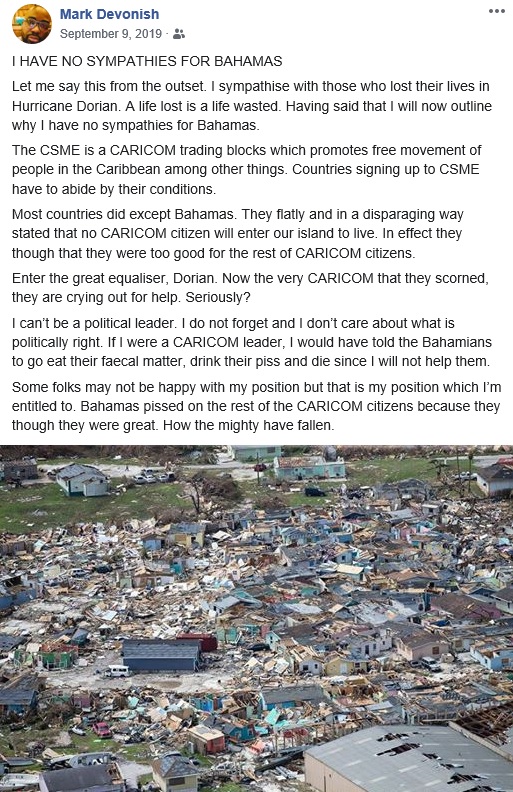
See the September 9, 2019 Facebook posting “I have no Sympathies for the Bahamas” by one commentator here; (Click to Enlarge or see the full text in Appendix C below).

Yes, the Bahamas rejected the Caribbean Single Market and Economy initiative – see Appendices A & B below – because they did not want the 42 million people in the region to just freely venture in-and-out of its borders for activities like “live, work and play”. A previous blog-commentary from July 10, 2018 reported:

According to the Bahamas Prime Minister’s [Hubert Minnis] issue with CSME is the Free Movement of People. The country would rather maintain its independence than to succumb to a new “free movement” regime whereby people can freely move from one Caribbean member-state to another for any activity: live, work or play. …

Now Hurricane Dorian happened and the country has been impacted; people have died (official toll at 51 as of today, but expected to rise into the hundreds); plus 60,000 people have been displaced. The country sent out an SOS and the most fervent response have come from those same scorned regional partners. Here are some examples:

Title: Guyana donating US$200,000 to hurricane-hit Bahamas
The Government of Guyana will be donating $41.6M (US$200,000) to The Bahamas to aid in relief following the battering by Hurricane Dorian.

This declaration was made last  evening, by the Minister of State, Dawn Hastings, during the ‘Rise Bahamas’ telethon programme, aired on the National Communications Network (NCN), according to the Department of Public Information (DPI). …
See the full story here, posted and retrieved September 16, 2019: https://www.stabroeknews.com/2019/09/16/news/guyana/guyana-donating-us200000-to-hurricane-hit-bahamas-hastings/

—————-

Title: CDEMA Pushes On
By:
Rachelle Agard
Dateline September 13, 2019 – The Caribbean Disaster Emergency Management Agency (CDEMA) continues to play an integral role in assisting the islands of Grand Bahama and Abaco which were devastated by Category 5 Hurricane Dorian earlier this month.

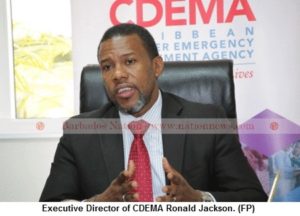
“At the moment, between the government of The Bahamas, the international military and/ or Caribbean military, we have over 1 000 boots on the ground, a quarter of which is from Caribbean troops.

“We must also recognise that The Bahamas is close to the US mainland and will also have a relationship with the US and would have benefitted from US resources. We signed an MOU recently with the Kingdom of the Netherlands. Part of the MOU sees CDEMA benefitting from the Dutch military capabilities, so we requested their support and they have deployed a vessel with 700 military artisans which arrived on Wednesday to provide a good boost,” he said of the organisation which is made up of 18 governments. …

See the full story here, retrieved September 16, 2019: https://www.nationnews.com/nationnews/news/241773/cdema-pushes

—————-

Title: Dominica to Assist Bahamas after Hurricane Dorian

The government of Dominica reported the actions taken to help the Bahamas and announced a contribution of US$100,000.

The government of Dominica announced a plan to help the Bahamian government and its people who were hit for three days by category 5 Hurricane Dorian on Sept. 1, seven people have been reported killed by the storm.

“From our experience with Hurricane Maria in 2017, we know that it will be a long and challenging road to recovery in the Bahamas. We encourage all Dominicans to continue to lift the Government and people of the Bahamas in their prayers and encourage the donor community to be proactive in responding to their needs,” said the country’s Prime Minister, Reginald Austrie. …

See the full store here, posted September 3, 2019; retrieved  September 16, 2019 from: https://www.telesurenglish.net/news/Dominican-Republic-to-Assist-Bahamas-after-Hurricane-Dorian-20190903-0025.html

—————
VIDEO – Ship Set To Leave Bermuda With Aid For Bahamas, Sept 8 2019 – https://youtu.be/9jWTQAiudPg

bernewsdotcom
http://bernews.com | Bermuda | Minister Wayne Caines press conference on board the Royal Navy HMS Protector

Regionalism has it benefits, people come to your aid when you send out an SOS. There is “give” and there is “take”.

The summary of the Caribbean Single Market & Economy (CSME) effort is that an integrated regional economy brings leverage, so “many hands make big job small”. In that previous blog-commentary from July 10, 2018 it related the benefits of the confederation roadmap as described in the 2013 book Go Lean…Caribbean:

Righting a Wrong: The Bahamas Needs to Re-think CSME
The Go Lean roadmap is designed to elevate the Caribbean region, to be better destinations to live, work and play. The movement therefore fosters strategies, tactics and implementation to better foment the region …

The Go Lean book was published in November 2013, projecting verbiage like “the Caribbean is in Crisis; alas a crisis is a terrible thing to waste” (Page 8). According to many observations in the Go Lean blogs-commentaries – click here – the Northern Bahamas was in a dire crisis, in need of immediate remediation, even before Hurricane Dorian. The crisis is exacerbated now. The recommendation of the movement behind the Go Lean book is to confederate now!

The Go Lean roadmap calls for a technocratic administration to allow the Caribbean region to embrace the economic benefits of a Single Market and a regional Security Pact – with the needed Disaster Preparation and Response organizations. The points of effective, technocratic stewardship for a regional security apparatus have thusly been elaborated upon in many previous blog-commentaries. Consider this sample here:

https://goleancaribbean.com/blog/?p=18182 Disaster Relief: Helping, Not Hurting
https://goleancaribbean.com/blog/?p=15996 Good Governance: Stepping Up in an Emergency
https://goleancaribbean.com/blog/?p=13746 Failure to Launch – Security: Caribbean Basin Security Dreams
https://goleancaribbean.com/blog/?p=12466 State of the Union: Unstable ‘Volcano States’
https://goleancaribbean.com/blog/?p=9455 Fix ‘Climate Change’ – Yes, We Can
https://goleancaribbean.com/blog/?p=7449 ‘Crap Happens’ – So What Now?
https://goleancaribbean.com/blog/?p=6103 Sum of All Fears – ‘On Guard’ Against Deadly Threats
https://goleancaribbean.com/blog/?p=5002 Managing a ‘Clear and Present Danger’

What should be the advocacy priority of a technocratic regional government? Guaranteeing safety and security of our people before, during and after any natural disaster.

The Bahamas must do better than in the past; the Caribbean must do better than in the past. We all need to lean on each other. Remember the 2nd Stanza of the 1971 song “Lean On Me” by Bill Withers:

If there is a load you have to bear
That you can’t carry
I’m right up the road
I’ll share your load
If you just call me


This is how we can make the Bahamas and all of the Caribbean a better place to live, work and play, by working together with our regional stakeholders to rebuild, restore and recover. 🙂

About the Book
The book Go Lean…Caribbean serves as a roadmap for the introduction and implementation of the technocratic Caribbean Union Trade Federation (CU), for the elevation of Caribbean society – for all member-states. This CU/Go Lean roadmap has these 3 prime directives:

  • Optimization of the economic engines in order to grow the regional economy to $800 Billion and create 2.2 million new jobs.
  • Establishment of a security apparatus to ensure public safety and protect the resultant economic engines.
  • Improve Caribbean governance to support these engines, including a separation-of-powers between the member-states and CU federal agencies.

The Go Lean book provides 370-pages of turn-by-turn instructions on “how” to adopt new community ethos, plus the strategies, tactics, implementations and advocacies to execute so as to reboot, reform and transform the societal engines of Caribbean society.

Download the free e-Book of Go Lean … Caribbean – now!

Who We Are
The movement behind the Go Lean book – a non-partisan, apolitical, religiously-neutral Community Development Foundation chartered for the purpose of empowering and re-booting economic engines – stresses that reforming and transforming the Caribbean societal engines must be a regional pursuit. This was an early motivation for the roadmap, as pronounced in the opening Declaration of Interdependence (Pages 12 – 13):

i. Whereas the earth’s climate has undeniably changed resulting in more severe tropical weather storms, it is necessary to prepare to insure the safety and security of life, property and systems of commerce in our geographical region. As nature recognizes no borders in the target of its destruction, we also must set aside border considerations in the preparation and response to these weather challenges.

xi. Whereas all men are entitled to the benefits of good governance in a free society, “new guards” must be enacted to dissuade the emergence of incompetence, corruption, nepotism and cronyism at the peril of the people’s best interest. The Federation must guarantee the executions of a social contract between government and the governed.

xvi. Whereas security of our homeland is inextricably linked to prosperity of the homeland, the economic and security interest of the region needs to be aligned under the same governance. Since economic crimes … can imperil the functioning of the wheels of commerce for all the citizenry, the accedence of this Federation must equip the security apparatus with the tools and techniques for predictive and proactive interdictions.

Sign the petition to lean-in for this roadmap for the Caribbean Union Trade Federation.

——————-

Appendix A – Bahamas maintains stance against CSME

By: Royston James

The Bahamas will maintain its stance against joining the Caribbean Single Market and Economy (CSME), despite increased pressure from certain regional heads to expand the initiative.

The CSME seeks to create a single, enlarged economic space by removing certain restrictions, the result of which would allow the free movement of goods and services, people and capital and technology.

“In spite of what you may read in the newspaper, we have discussed CSME, [but] The Bahamas is not and will not be a part of CSME,” Prime Minister Dr. Hubert Minnis said upon returning from Jamaica on Saturday.

“The Bahamas will not allow the free movement of people within our boundaries. So we are not a part of CSME. That must be clear, so that you do not feel that [because of] what has transpired there that Caribbean nationals would be able to move into The Bahamas quite regularly.

“We have our rules, our laws, and they will continue to apply.”

Full implementation of the CSME was high on the agenda of the CARICOM meeting held last Thursday. At least three CARICOM heads called for a review of the program by its member states and for regional leaders to find the political will to see the program expanded and made more efficient.

Addressing CARICOM, Barbados Prime Minister Mia Mottley opined that “psychological impediments and the closed mindsets in some quarters of officialdom” can be attributed to the slow progress of the CSME.

Antigua and Barbuda Prime Minister Gaston Browne and CARICOM Secretary General Irwin LaRocque also pushed for more to be achieved. CARICOM Chairman and Jamaican Prime Minister Andrew Holness said at a press conference following the CARICOM meeting that a special meeting on CSME will be held in Trinidad and Tobago in November.

Under the first Christie administration, the CSME issue featured prominently in local debates with strong opposition to The Bahamas joining the initiative being expressed in many quarters. Debate died down only after the government at the time publicly announced that The Bahamas would not join any bloc that would lead to the free movement of people in the country.

Source: Posted July 9, 2018 retrieved July 10, 2018 from: https://thenassauguardian.com/2018/07/09/bahamas-maintains-stance-against-csme/

——————-

Appendix B – No Caricom Without Referendum

By Sir Randol Fawkes – June 1993

I often wondered what The Caribbean Community’s Common Market (CARICOM) was up to. But now that I know, I wish to sound a warning to all true Bahamians to hold fast to the “Christian values and the Rules of Law” as enshrined in the Preamble to our Independence Constitution of July 10th, 1973, because some power-hungry politicians to the South are planning to invade our homeland and to steal our birthright away.

Simple enough? Dictatorship is always simple, monosyllabic and quick. Under a democracy we have a right to be properly briefed on CARICOM before being required to vote, “Yes” or “No” on whether the Bahamas should become a full Member State of the Caribbean Community’s CARICOM. The Rt. Hon. James F. Mitchell further expostulated, “One flag means we speak on the podium of the United Nations with one clear voice. One voice means one passport, one citizenship and all that flows from a single citizenship. Secondly, one Ministry of Finance is essential to provide the economic development which our people crave. This union will need to show results, and this authority which negotiates and secures financing must be responsible for the repayment of that finance.”

Make no mistake about it, These Caribbeans who will descend on Bahamian soil in July offering CARICOM as a panacea for all ills, intend to destroy our national flag: the Black, the Gold and the Aquamarine; silence our National Anthem, Lift Up Your Heads to the Rising Sun Bahama land, abolish Bahamian citizenship and our passports; eliminate Bahamian autonomy and thereafter superimpose upon us a leviathan dictatorship with a network of cells throughout the Caribbean – all done without first a people’s forum in which all voices – pro and con could be heard and ultimately expressed in a Constitutional Referendum.

Source: Retrieved July 10, 2018 from: http://www.sirrandolfawkes.com/yahoo_site_admin/assets/docs/No_Caricom_Without_Referendum1.216134242.pdf

——————-

Appendix C – Mark Devonish: I HAVE NO SYMPATHIES FOR BAHAMAS

Let me say this from the outset. I sympathise with those who lost their lives in Hurricane Dorian. A life lost is a life wasted. Having said that I will now outline why I have no sympathies for Bahamas.

The CSME is a CARICOM trading blocks which promotes free movement of people in the Caribbean among other things. Countries signing up to CSME have to abide by their conditions.

Most countries did except Bahamas. They flatly and in a disparaging way stated that no CARICOM citizen will enter our island to live. In effect they though that they were too good for the rest of CARICOM citizens.

Enter the great equaliser, Dorian. Now the very CARICOM that they scorned, they are crying out for help. Seriously?

I can’t be a political leader. I do not forget and I don’t care about what is politically right. If I were a CARICOM leader, I would have told the Bahamians to go eat their fecal matter, drink their piss and die since I will not help them.

Some folks may not be happy with my position but that is my position which I’m entitled to. Bahamas pissed on the rest of the CARICOM citizens because they though they were great. How the mighty have fallen.

Source: Posted September 9 at 7:27 PM; retrieved September 16, 2019.

Share this post:
, , ,
[Top]

Chef Jose Andres – Role Model for Hurricane Relief – “One Meal at a Time”

Go Lean Commentary

We gotta eat!

Even when a devastating Category 5 Hurricane impacts your homeland, that natural law applies: We gotta eat!

Thank you Chef José Andrés for pulling out all the stops to feed the people of the Bahamas during this, their most desperate hour.

Why does he help? Why does he do “this”? Just because: People gotta eat!

Even though he has help – he brings a team – it is with the full might of his will, reputation and connections that he is able to have this impact. He is proof-positive that one man – or woman – can make a difference in society. See this VIDEO news story here-now:

VIDEO – Chef José Andrés in the Bahamas, helping save lives “one meal at a time”  https://youtu.be/woeweQTXZRg

Posted September 4, 2019 – The renowned chef’s non-profit World Central Kitchen is one of the aid groups spearheading relief efforts in the stricken island nation. CBS Reports.

Chef José Andrés did the same thing in Puerto Rico, after Hurricane Maria; and in Haiti after the 2010 Earthquake. He has been a great benefactor for all of the Caribbean – and he does not even have a Caribbean heritage.

He is from Spain; see his profile in the Appendix below.

Yes, one man can make a difference! The 2013 book Go Lean…Caribbean posits that one person – an advocate – can change the world (Page 122). It relates:

An advocacy is an act of pleading for, supporting, or recommending a cause or subject. For this book, it’s a situational analysis, strategy or tactic for dealing with a narrowly defined subject.

Advocacies are not uncommon in modern history. There are many that have defined generations and personalities. Consider these notable examples from the last two centuries in different locales around the world:

  • Frederick Douglas
  • Mohandas Gandhi
  • Martin Luther King
  • Nelson Mandela
  • Cesar Chavez
  • Candice Lightner – (Mothers Against Drunk Driving)

This is a consistent theme from the movement behind the Go Lean book– available to download for free. We have repeatedly presented profiles of “1” persons who have made lasting impacts on their community and the whole world. Consider this sample list, of previous blog-commentaries where advocates and role models have been elaborated upon:

https://goleancaribbean.com/blog/?p=17871 ‘Ross Perot’, Political Role Model – He was right on Trade – RIP
https://goleancaribbean.com/blog/?p=16942 Sallie Krawcheck – Role Model for Women Economic Empowerment
https://goleancaribbean.com/blog/?p=16926 Viola Desmond – Canadian Role Model for Blacks and Women
https://goleancaribbean.com/blog/?p=16702 W.E.B. Du Bois – Role Model in Pan-Africana
https://goleancaribbean.com/blog/?p=16696 Marcus Garvey – An Ancient Role Model Still Relevant Today
https://goleancaribbean.com/blog/?p=14558 Being the Change in ‘Brown vs Board of Education’ – Role Model Linda Brown, RIP
https://goleancaribbean.com/blog/?p=14556 “March for Our Lives” Kids – Observing the Change … with Guns
https://goleancaribbean.com/blog/?p=14139 Carter Woodson – One Man Made a Difference … for Black History
https://goleancaribbean.com/blog/?p=8165 Role Models Muhammad Ali and Kevin Connolly – Their Greatest Fight
https://goleancaribbean.com/blog/?p=7682 Frederick Douglass: Role Model for Single Cause – Death or Diaspora
https://goleancaribbean.com/blog/?p=866 Bob Marley: The legend of this Role Model lives on!

The Go Lean roadmap seeks to reform and transform Caribbean life and culture. But first we have to make sure our people’s basic needs are covered.

We gotta eat!

So thank you Chef José Andrés for pitching in and feeding our Bahamian and Caribbean people.

The Go Lean roadmap calls on every man, woman and child in the Caribbean to be an advocate, and/or appreciate the efforts of other advocates. Their examples can truly help us today with our passions and purpose.

In summary, we conclude about Chef José Andrés the same as we do about all the other Caribbean advocates; we say (Go Lean book conclusion Page 252):

Thank you for your service, love and commitment to all Caribbean people. We will take it from here.

The movement behind Go Lean book – the planners of a new Caribbean – stresses that a ‘change is going to come’, one way or another. As depicted in the foregoing VIDEO, Chef José Andrés facilitated all the logistics himself for our post-Hurricane Dorian Rescue/Relief – i.e. boats, helicopters and the food – but the new Caribbean should really be matured enough to handle our own Hurricane Response:

  • Rescue 
  • Relief
  • Recovery
  • Rebuild

We must Grow Up, Already!

Haiti, Puerto Rico and now the Bahamas – these were the natural disasters of the past; but there will be more … in the future.

Climate Change guarantees it.

We must copy the patterns and good examples of our role models; Chef José Andrés has provided us a perfect example of how to make the Caribbean a better homeland to live, work and play. 🙂

About the Book
The book Go Lean…Caribbean serves as a roadmap for the introduction and implementation of the technocratic Caribbean Union Trade Federation (CU), for the elevation of Caribbean society – for all member-states. This CU/Go Lean roadmap has these 3 prime directives:

  • Optimization of the economic engines in order to grow the regional economy to $800 Billion and create 2.2 million new jobs.
  • Establishment of a security apparatus to ensure public safety and protect the resultant economic engines.
  • Improve Caribbean governance to support these engines, including a separation-of-powers between the member-states and CU federal agencies.

The Go Lean book provides 370-pages of turn-by-turn instructions on “how” to adopt new community ethos, plus the strategies, tactics, implementations and advocacies to execute so as to reboot, reform and transform the societal engines of Caribbean society.

Download the free e-Book of Go Lean … Caribbean – now!

Who We Are
The movement behind the Go Lean book – a non-partisan, apolitical, religiously-neutral Community Development Foundation chartered for the purpose of empowering and re-booting economic engines – stresses that reforming and transforming the Caribbean societal engines must be a regional pursuit. This was an early motivation for the roadmap, as pronounced in the opening Declaration of Interdependence (Pages 12 – 14):

i. Whereas the earth’s climate has undeniably changed resulting in more severe tropical weather storms, it is necessary to prepare to insure the safety and security of life, property and systems of commerce in our geographical region. As nature recognizes no borders in the target of its destruction, we also must set aside border considerations in the preparation and response to these weather challenges.

xi. Whereas all men are entitled to the benefits of good governance in a free society, “new guards” must be enacted to dissuade the emergence of incompetence, corruption, nepotism and cronyism at the peril of the people’s best interest. The Federation must guarantee the executions of a social contract between government and the governed.

xii. Whereas the legacy in recent times in individual states may be that of ineffectual governance with no redress to higher authority, the accedence of this Federation will ensure accountability and escalation of the human and civil rights of the people for good governance, justice assurances, due process and the rule of law. As such, any threats of a “failed state” status for any member state must enact emergency measures on behalf of the Federation to protect the human, civil and property rights of the citizens, residents, allies, trading partners, and visitors of the affected member state and the Federation as a whole.

xvi. Whereas security of our homeland is inextricably linked to prosperity of the homeland, the economic and security interest of the region needs to be aligned under the same governance. Since economic crimes … can imperil the functioning of the wheels of commerce for all the citizenry, the accedence of this Federation must equip the security apparatus with the tools and techniques for predictive and proactive interdictions.

xxiv. Whereas a free market economy can be induced and spurred for continuous progress, the Federation must install the controls to better manage aspects of the economy: jobs, inflation, savings rate, investments and other economic principles. Thereby attracting direct foreign investment because of the stability and vibrancy of our economy.

xxxiii. Whereas lessons can be learned and applied from the study of the recent history of other societies, the Federation must formalize statutes and organizational dimensions to avoid the pitfalls …. On the other hand, the Federation must also implement the good examples learned from [successful] developments/communities.

Sign the petition to lean-in for this roadmap for the Caribbean Union Trade Federation.

—————

Appendix Reference Title: José Andrés
José Ramón Andrés Puerta
 (born 13 July 1969) is a Spanish-American[1] chef often credited with bringing the small plates dining concept to America.[2] He owns restaurants in Washington, D.C.Los AngelesLas VegasSouth Beach, FloridaOrlandoNew York City, and Frisco, Texas. Andrés is the founder of World Central Kitchen, a non-profit devoted to providing meals in the wake of natural disasters.[3] He was awarded a 2015 National Humanities Medal at a 2016 White House ceremony.[4]

Trump Hotel restaurant and lawsuit
Andrés planned to open a restaurant in the Trump International Hotel in Washington, DC, in 2016. After Donald Trump made disparaging comments about Mexicans in June 2015, Andrés withdrew from the contract with the Trump Organization, which then sued him.[13] Andrés counter-sued, and the parties reached a settlement in April 2017.[14] Andrés remains an outspoken critic of Trump.[15][16]

World Central Kitchen
In response to the 2010 Haiti earthquake, Andrés formed World Central Kitchen which provides healthy food to families and individuals touched by disasters.[17] Since its founding, the NGO has organized meals in the Dominican RepublicNicaraguaZambiaPeruCubaUganda, and in Cambodia.[3]

In January 2019 Andrés opened a World Central Kitchen on Pennsylvania Ave, Washington DC to feed federal workers that were furloughed during the government shutdown.[18]

Puerto Rico Hurricane Maria response
Andrés emerged as a leader of the disaster relief efforts in Puerto Rico in the wake of Hurricane Maria in 2017. His efforts to provide assistance encountered obstacles from FEMAand government bureaucrats, so instead, “we just started cooking.”[19] He organized a grass-roots movement of chefs and volunteers to establish communications, food supplies, and other resources and started serving meals. Andrés and his organization World Central Kitchen (WCK)[20] served more than two million meals in the first month after the hurricane.[21][22][23] WCK received two short term FEMA contracts and served more meals than the Salvation Army or the Red Cross, but its application for longer term support was denied.[24][25]

For his efforts in Puerto Rico, Andrés was named the 2018 Humanitarian of the Year by the James Beard Foundation.[26] He wrote a book about the experience called We Fed an Island: The True Story of Rebuilding Puerto Rico, One Meal at a Time.[27]

Source: Retrieved September 4, 2019 from: https://en.wikipedia.org/wiki/Jos%C3%A9_Andr%C3%A9s

Share this post:
, ,
[Top]

More Storms: Rinse and Repeat – Encore

I have friends …

… that live in North America and Europe. They always ask about visiting the many beautiful islands of the Caribbean. I strongly urge them to come on down and “be our guest“; to consume our hospitality, enjoy our culture, food, spirits, cigars, festivals, fishing, resorts and cruises.

But, I caution them: Do not come between August 15 and September 15; this is the peak of our mean season! This is when we Rinse and Repeat.

This has often been the case over the years – see Table 1 below – and this is true this year as well. The Bahamas just endured Category 5 Hurricane Dorian and now … there are other storms on the radar screen, in the vicinity. See photo here:

Rinse and Repeat is more than just a shampoo instruction, it is what we endure in the Caribbean region every year during Hurricane Season. Lastly, it is also the title of a previous blog-commentary from August 30, 2017.

Table 1 – Highest Number of named storm occurrences by month
Month
Storms Season
January 1 1938195119782016
February 1 1952
March 1 1908
April 1 199220032017
May 2 18872012
June 3 188619361968
July 5 2005
August 8 20042012
September 8 20022010
October 8 1950
November 3 2005
December 2 18872003
Based on data from: U.S. NOAA Coastal Service Center – Historical Hurricane Tracks Tool
† – Highest number for month by virtue of being only known season to see a storm form

Again, imagine 8 named storms in the same month; that is truly Rinse and Repeat. This is our reality. It is only apropos to Encore that previous blog-commentary here-now:

———–

Go Lean Commentary – Disaster Preparation: ‘Rinse and Repeat’

The reality of Caribbean life: we must contend with natural disasters, not of our making, “again and again”. The situation can be described as “Rinse and Repeat“.

Climate Change is not of our making, but it is our problem. Truth be told, it is not just our problem alone; the whole planet is affected. Right now this moment, the Greater Metropolitan area of Houston, Texas USA is suffering “pangs of distress”; see the VIDEO in the Appendix below. CU Blog - Disaster Preparation - Rinse and Repeat - Photo 1

It is what it is!

Some communities have done a better job than others in preparing for the unavoidable:

“Some communities”? “Better job“? That is not us … in the Caribbean!

As related in a previous Go Lean commentary, our Caribbean region has failed … in our managing this Agent-of-Change:

… we do not have the luxury of “sticking our head in the sand” and pretending that these problems will simply go away. The region has been devastated with this dysfunction and mis-management. Some 70% of Caribbean college-educated citizens have already fled their homelands in an undisputed brain drain. It’s time now to manage change differently than the Caribbean has done as of late. It’s time now to “Go Lean”.

The book Go Lean…Caribbean – available to download for free – serves as a roadmap for the introduction and implementation of the technocratic Caribbean Union Trade Federation (CU), for the elevation of Caribbean society – for all member-states. This CU/Go Lean roadmap has these 3 prime directives for us to do a better job:

  • Optimization of the economic engines in order to grow the regional economy to $800 Billion and create 2.2 million new jobs. This includes an efficient Emergency Management apparatus to ensure business continuity.
  • Establishment of a security apparatus to ensure public safety and protect the resultant economic engines.
  • Improve Caribbean governance to support these engines, including a separation-of-powers between the member-states and CU federal agencies. We can “move” member-state governments simply through funding, rankings and ratings.

The book stresses that reforming and transforming the Caribbean societal engines must be a regional pursuit. This was an early motivation for the roadmap, as pronounced in the opening Declaration of Interdependence (Pages 12 – 13):

i. Whereas the earth’s climate has undeniably changed resulting in more severe tropical weather storms, it is necessary to prepare to insure the safety and security of life, property and systems of commerce in our geographical region. As nature recognizes no borders in the target of its destruction, we also must set aside border considerations in the preparation and response to these weather challenges.

xi. Whereas all men are entitled to the benefits of good governance in a free society, “new guards” must be enacted to dissuade the emergence of incompetence, corruption, nepotism and cronyism at the peril of the people’s best interest. The Federation must guarantee the executions of a social contract between government and the governed.

xvi. Whereas security of our homeland is inextricably linked to prosperity of the homeland, the economic and security interest of the region needs to be aligned under the same governance. Since economic crimes … can imperil the functioning of the wheels of commerce for all the citizenry, the accedence of this Federation must equip the security apparatus with the tools and techniques for predictive and proactive interdictions.

xxiv. Whereas a free market economy can be induced and spurred for continuous progress, the Federation must install the controls to better manage aspects of the economy: jobs, inflation, savings rate, investments and other economic principles. Thereby attracting direct foreign investment because of the stability and vibrancy of our economy.

The Go Lean book provides 370-pages of turn-by-turn instructions on “how” to adopt new community ethos, plus the strategies, tactics, implementations and advocacies to execute so as to reboot, reform and transform the societal engines of Caribbean society, for better preparation for natural disasters. Consider the Chapter excerpts and headlines here from this sample on Page 184 entitled:

10 Ways to Improve for Natural Disasters

1

Emergence of the Caribbean Union
Lean-in for the Caribbean Single Market & Economy initiative as the Caribbean Union Trade Federation. This allows for the unification of the 30 member-states into one market, thereby spreading the risk and premium base across a market of 42 million people. The Caribbean member-states have Hurricane Katrina styled disasters (relatively speaking) every year.

2

Caribbean Emergency Management Agency – Federal Disaster Declarations
Modeled after FEMA in the US, this agency will be charged with the preparation, response and reconstruction for the regions for the eventual manifestations of hurricanes, earthquakes, tsunamis, flooding and other declared disasters, natural and man-made like medical epidemic, drought, pollution, oil spills, terrorism, etc.

3

Support Services for First Responders
Training, licensing and standards for Emergency Managers, Paramedics, Firefighters, Search and Rescue resources. For major disasters, some of these resources will come from international origins; they will need the support services (language translation, guides, maps, etc.) and coordination to maximize their results.

4

Animal Partner Training and Development
Maintain plantations for the training, development and boarding of “search & rescue” dogs, cadavers dogs and other service animals (horses, mules, pigs, etc.) so that there will be local resources within the region. (We cannot always depend on international responses in light of other regions experiencing their own disasters). These animals need not be owned by any one member-state, they can be on loan from CU resources.

5

Siren Warnings & Notifications
The CU will install tornado-style alarms/sirens in all major municipalities. In addition, the CU will implement tsunami warning messaging (emails/text) in coastal areas & seismic meters throughout the region in the affected “fault-line” areas.

6

Airlift & Sealift Authorizations
The CU Emergency Management Agency can license, regulate and authorize (air & sea) vessels and vehicles for emergency deployment in a disaster zone, before during and after the disastrous event.

7

JUA-style Insurance Fund
The fiduciary management of premiums and claims to allow the immediate response for reconstruction after disasters. These financial services, sidecars traded in markets can be direct or indirect as in reinsurance or insurer-of-last-resort.

8

Economic Crime Enforcement During and After Disasters
The CU will police, investigate and prosecute price gouging, insurance red lining and other economic crimes of both the “white collar” and “blue collar” variety. Once a CU-member-state declares a Disaster Emergency, new rules (quasi-Marshall Law) goes into effect. The CU will review and prosecute the actions of civilians and institutions alike.

9

Disaster Declaration Loans
Once there’s a Federal Disaster Declaration, the CU will make funds available for low-interest loans for communities to fund reconstructions. With tourism as a major “cash crop” the goal will be to restore the locality as a tourist destination as soon as possible, as even the perception of prolonged disaster damage can affect future bookings and travel plans.

10

Building Codes and Standards
Through peer review, the CU will regionalize the standards of building codes to assuage the threat of hurricanes and earthquakes, ensuring a higher survivability rate in the Caribbean islands. Due to economic pressures, when buildings and homes cannot be retrofitted, they will be rated for evacuation during hurricane warnings, or earthquake after-shocks.

The Caribbean must foster a better disaster preparation and response apparatus. We must do it now! Lives are at stake.

Just look at our American neighbors – they are suffering right now in the Greater Metropolitan area of Houston, Texas.

CU Blog - Hurricane Flooding - Who Knew - Photo 1b

While Climate Change is the underlying Agent-of-Change, it is outside of our control. This does not imply that there is no remediation for Climate Change; there is. In fact …

Fix ‘Climate Change’ – Yes, We Can

CU Blog - Disaster Preparation - Rinse and Repeat - Photo 2

We do not have the resources (time, talent and treasuries) to fix Climate Change for the planet ourselves, but we can fix it in our Caribbean region. This is a “Lesson in History” that our community has learned … from back in 1863:

There is an important lesson to learn in considering the history of the American Civil War. The war was fought over the issue of slavery. This was an ugly institution for those condemned as slaves. In the United States, that ugly disposition extended beyond the slaves themselves to the entire Black race. Though individuals could be set free, laws in the country could push them back into slavery without any due process. This was the case with the “Fugitive Slave Act of 1850″. Any Black person could be detained as a runaway slave and returned to any alleged Slave Master in the South; no matter any proof or the truth, or lack there-of. In many jurisdictions, a Black man could not even testify against white people. (This was the basis for the autobiographical book – by Solomon Northup – and movie “12 Years A Slave”).

To be Black in the America of those days, one “could not win, could not break-even and could not get out of the game”. There was no neutral destination in America. The optimal option was the only option, to work towards the end of slavery.

For this reason many Blacks joined the war effort, at great sacrifice to themselves and their community. This was a matter of principle! There is an important lesson for the Caribbean from this history[1] :

    The 54th Regiment Massachusetts Volunteer Infantry was an infantry regiment that saw extensive service in the Union Army during the American Civil War. The regiment was one of the first official African-American units in the United States during the Civil War.

CU Blog - A Lesson in History - During the Civil War - Principle not Principal - Photo 1

Remediating and mitigating Climate Change will be a battle. We need our own “Voluntary Infantry“ in this fight.

“We have a dog in this fight” – English language slang.

In the Caribbean, we must confederate and implement the institutions to work to remediate and mitigate Climate Change. We must “join in this fight”; we must Go Green and we must Go Blue. We have to be prepared for natural disasters – they will come … assuredly every season, some Caribbean destination will be impacted. We must be prepared to:

Rinse and Repeat.

If we are ready, to quickly respond, offer relief and rebuild – so as to guarantee the business continuity – we would then do a better job in our quest to make our homeland a better place to live, work and play. 🙂

Download the free e-Book of Go Lean … Caribbean – now!

Sign the petition to lean-in for this roadmap for the Caribbean Union Trade Federation.

———–

Appendix VIDEO – Historic flooding inundates Texas, hampering rescue efforts – https://youtu.be/Da-VS39gdfQ

PBS NewsHour
Published on Aug 27, 2017 – Houston’s mayor on Sunday urged his constituents in the nation’s fourth-largest city to stay off roadways as the state of Texas continues to contend with unprecedented flooding from Hurricane Harvey, now classified as a tropical storm. Officials said rising waters would reach catastrophic proportions, with more than 2,500 emergency calls made overnight in Houston alone. Hari Sreenivasan has more.

Share this post:
, , , ,
[Top]

Disaster Relief: Helping, Not Hurting – Encore

It’s happened again …

… a Climate-Change-infused hurricane has devastated the Commonwealth of the Bahamas; every year there seems to be one Caribbean country after another who suffers this fate; think Barbuda, Puerto Rico, etc.. In this case, it is the deadly Category 5 Hurricane Dorian.

Now it is time for the response:

  • Rescue
  • Relief
  • Recovery
  • Rebuilding

The appeal has gone out for aid … and supplies…

… but the truth of the matter, the best way to help is to just write a check or submit a credit card. The call for supplies can be interpreted in “oh so many wrong ways”. This theme was thoroughly detailed in a previous blog-commentary from April 26, 2016 in support of Haiti’s 2010 Earthquake Relief; it is only appropriate to Encore that submission now because …

… the Bahamas needs all the help it can get; see the previous entry here-now:

————–
Go Lean CommentaryThe Logistics of Disaster Relief

It is during the worst of times that we see the best in people.

This statement needs to be coupled with the age old proverb: “The Road to Hell is Paved with Good Intentions“…

… especially when it comes to disaster relief.

In previous blog-commentaries promoting the book Go Lean…Caribbean, it was established that “bad things happen to good people”; (i.e. ‘Crap Happens’ – So What Now?, Managing a ‘Clear and Present Danger’). Yes, disasters are a reality for modern life. The Go Lean book posits that with the emergence of Climate Change  that natural disasters are more common place.

In addition there are earthquakes …

… these natural phenomena may not be associated with Climate Change, but alas, they too are more common and more destructive nowadays. (People with a Christian religious leanings assert that “an increase of earthquakes is a tell-tale sign that we are living in what the Bible calls the “Last Days” – Matthew 24: 7).

$500 Million In Haiti Relief - Photo 1The motives of the Go Lean book, and accompanying blogs is not to proselytize, but rather to prepare the Caribbean region for “bad actors”, natural or man-made. The book was written in response to the aftermath and deficient regional response following the great earthquake in Haiti on January 12, 2010. Many Non-Government Organizations (NGO) embarked on campaigns to shoulder a response, a relief and rebuilding of Haiti. Many people hold the view that those efforts did a lot of harm, along with some good.

In a previous blog-commentary, it was reported how the fundraising campaign by one group, the American Red Cross, raised almost US$500 million and yet only a “piddling” was spent on the victims and communities themselves.

Now we learn too that many good-intentioned people donated tons of relief supplies that many times turned out to be “more harm than help”. See the story here in this news VIDEO; (and/or the Narration Transcript/photos in the Appendix below):

VIDEO – When disaster relief brings anything but relief – http://www.cbsnews.com/videos/disaster-relief-donations-that-dont-bring-relief

Posted April 24, 2016 – Many of the well-meaning articles Americans donate in times of disaster turn out to be of no use to those in need. Sometimes, they even get in the way. That’s a message relief organizations very much want “us” to heed. This story is reported by Scott Simon, [on loan from] NPR. (VIDEO plays best in Internet Explorer).

This commentary asserts that more is needed in the Caribbean to facilitate good disaster relief, in particular a technocratic administration. This consideration is the focus of the strategies, tactics, implementations and advocacies of the Go Lean…Caribbean book. The declaration is that the Caribbean itself must be agile, lean, and optimized in providing its own solutions for disaster recovery. The alternative, from past experiences like in this foregoing VIDEO, is that others taking the lead for our solution seem to fall short in some way … almost every time!

The Caribbean must now stand up and be counted!

The Go Lean book declares (Page 115) that the “Caribbean should not be perennial beggars, [even though] we do need capital/money to get started”, we need technocratic executions even more.

What is a technocracy?

This is the quest of the Go Lean movement. The movement calls for a treaty to form a technocratic confederation of all the 30 member-states in the Caribbean region. This will form a Single Market of 42 million. The consolidation and integration allows for economies-of-scale and leverage that would not be possible otherwise. “Many hands make a big job … small”. But it is not just size that will define the Caribbean technocracy but quality, efficiency and optimization as well.

According to the Go Lean book (Page 64), the …

“… term technocracy was originally used to designate the application of the scientific method to solving social and economic problems, in counter distinction to the traditional political or philosophic approaches. The CU must start as a technocratic confederation – a Trade Federation – rather than evolving to this eventuality due to some failed-state status or insolvency.”

The book Go Lean…Caribbean serves as a roadmap for the introduction and implementation of the technocratic Caribbean Union Trade Federation (CU) to provide better stewardship for the Caribbean homeland. The foregoing VIDEO describes the efforts of non-governmental organizations (NGO) in shepherding disaster reliefs. These NGO’s are stakeholders in this Caribbean elevation roadmap. Even though many of the 30 member-states are independent nations, the premise of the Go Lean book is that there must be a resolve for interdependence among the governmental and non-governmental entities. This all relates to governance, the need for this new technocratic stewardship of regional Caribbean society. The need for this resolve was pronounced in the opening Declaration of Interdependence (Pages 11 & 14) with these acknowledgements and statements:

i.    Whereas the earth’s climate has undeniably changed resulting in more severe tropical weather storms, it is necessary to prepare to insure the safety and security of life, property and systems of commerce in our geographical region. As nature recognizes no borders in the target of its destruction, we also must set aside border considerations in the preparation and response to these weather challenges.

ii.    Whereas the natural formation of the landmass for our lands constitutes some extreme seismic activity, it is our responsibility and ours alone to provide, protect and promote our society to coexist, prepare and recover from the realities of nature’s occurrences.

x.   Whereas we are surrounded and allied to nations of larger proportions in land mass, populations, and treasuries, elements in their societies may have ill-intent in their pursuits, at the expense of the safety and security of our citizens. We must therefore appoint “new guards” to ensure our public safety and threats against our society, both domestic and foreign. The Federation must employ the latest advances and best practices … to assuage continuous threats against public safety.

xi.   Whereas all men are entitled to the benefits of good governance in a free society, “new guards” must be enacted to dissuade the emergence of incompetence, corruption, nepotism and cronyism at the peril of the people’s best interest. The Federation must guarantee the executions of a social contract between government and the governed.

xii. Whereas the legacy in recent times in individual states may be that of ineffectual governance with no redress to higher authority, the accedence of this Federation will ensure accountability and escalation of the human and civil rights of the people for good governance, justice assurances, due process and the rule of law. As such, any threats of a “failed state” status for any member state must enact emergency measures on behalf of the Federation to protect the human, civil and property rights of the citizens, residents, allies, trading partners, and visitors of the affected member state and the Federation as a whole.

xxxiii.   Whereas lessons can be learned and applied from the study of the recent history of other societies, the Federation must formalize statutes and organizational dimensions to avoid the pitfalls of [other] communities.

This is the quest of CU/Go Lean roadmap: to provide new guards for a more competent Caribbean administration … by governmental organizations and non-governmental organizations. (NGO would also be promoted, audited and overseen by CU administrators). The Caribbean must do better!

Our quest must start “in the calm”, before any storm (or earthquake). We must elevate the societal engines the Caribbean region through economic, security and governance empowerments. In general, the CU will employ better strategies, tactics and implementations to impact its prime directives; identified with the following 3 statements:

  • Optimization of the economic engines in order to grow the regional economy to $800 Billion & create 2.2 million new jobs.
  • Establishment of a security apparatus to protect the resultant economic engines and the Caribbean homeland.
  • Improvement of Caribbean governance to support these engines.

Former US President George W. Bush shares this advocacy!

He narrated this VIDEO here describing the efficiencies of the American logistics company, UPS, in delivering disaster relief:

VIDEO – Report Logistics and Haiti: Points of Light and President Bush – https://youtu.be/8-gmh1QyWTU

Uploaded on Mar 30, 2011 – [In 2009], Transportation Manager Chip Chappelle volunteered to help The UPS Foundation coordinate an ocean shipment of emergency tents from Indiana to Honduras. Since then, he has managed the logistics of humanitarian aid from every corner of the world to help the victims of floods, tsunamis, earthquakes, hurricanes and cyclones.

The Go Lean book stresses our own community ethos, strategies, tactics, implementations and advocacies necessary for the Caribbean to deliver, to provide the proactive and reactive public safety/security provisions in the region. See sample list here:

Community Ethos – Deferred Gratification Page 21
Community Ethos – Economic Principles – Respond to Incentives in Predictable Ways Page 21
Community Ethos – Economic Principles – Economic Systems Influence Individual Choices Page 21
Community Ethos – Economic Principles – Consequences of Choices Lie in the Future Page 21
Community Ethos – Security Principles – Whistleblower Protection Page 23
Community Ethos – Security Principles – Intelligence Gathering Page 23
Community Ethos – Security Principles – “Crap” Happens Page 23
Community Ethos – Governing Principles – Lean Operations Page 24
Community Ethos – Governing Principles – Return on Investments Page 24
Community Ethos – Governing Principles – Cooperatives Page 25
Community Ethos – Ways to Impact the Future Page 26
Community Ethos – Ways to Impact Turn-Arounds Page 33
Community Ethos – Ways to Improve Sharing – Emergency Response Page 35
Community Ethos – Ways to Impact the Greater Good Page 37
Strategy – Vision – Confederate all 30 member-states/ 4 languages into a Single Market Page 45
Strategy – Mission – Prepare for the eventuality of natural disasters Page 45
Strategy – Agents of Change – Climate Change Page 57
Tactical – Ways to Foster a Technocracy Page 64
Tactical – Growing the Economy – Post WW II European Marshall Plan/Recovery Model Page 68
Tactical – Separation-of-Powers – CU Federal Government versus Member-State Governance Page 71
Tactical – Separation-of-Powers – Homeland Security – Emergency Management Page 76
Tactical – Separation-of-Powers – State Department – Liaison/Oversight for NGO’s Page 80
Implementation – Assemble All Regionally-focus Organizations of All Caribbean Communities Page 96
Implementation – Ways to Pay for Change Page 101
Implementation – Ways to Foster International Aid Page 115
Planning – 10 Big Ideas – Homeland Security Pact Page 127
Planning – Ways to Make the Caribbean Better Page 131
Planning – Ways to Improve Failed-State Indices – Governance and the Social Contract Page 134
Advocacy – Ways to Grow the Economy Page 151
Advocacy – Ways to Create Jobs Page 152
Advocacy – Ways to Improve Housing – Hurricane Risk Reinsurance Fund Page 161
Advocacy – Ways to Improve Governance Page 168
Advocacy – Ways to Better Manage the Social Contract Page 170
Advocacy – Ways to Improve Homeland Security Page 180
Advocacy – Ways to Improve for Natural Disasters Page 184
Advocacy – Ways to Develop a Pre-Fab Housing Industry – One solution ideal for Haiti Page 207
Advocacy – Ways to Re-boot Haiti Page 238

The Go Lean roadmap seeks to empower and elevate Caribbean societal engines to be better prepared for the eventual natural disasters. The good intentions of Americans, as depicted in the foregoing VIDEO, is encouraging … but good intentions alone is not enough. We need good management! We need a technocracy! While it is out-of-scope for this roadmap to impact America, we can – and must – exercise good management in our Caribbean region. So what do we want from Americans in our time of need? See VIDEO here:

VIDEO – Donate Responsibly – https://youtu.be/14h9_9sopRA

Published on Nov 2, 2012 – A series of PSAs released by the Ad Council explain why cash is the best way to help. The campaign was launched on November 5, 2012 by the Ad Council and supported by the coalition — which includes CIDI, the U.S. Agency for International Development, InterAction, the UPS Foundation and National Voluntary Organizations Active in Disaster.

The Go Lean book calls on the Caribbean region to be more technocratic: collectively self-reliant, both proactively and reactively. Because of Climate Change or the Last Days, natural disasters (i.e. hurricanes and earthquakes) will occur again and again. Considering that our American neighbors may Pave our Road to Hell with Good Intentions, we need to prepare the right strategies, tactics and implementations ourselves, to make our region a better homeland to live, work and play. 🙂

Download the free e-Book of Go Lean … Caribbean – now!

——————

Appendix Transcript – When disaster relief brings anything but relief

When Nature grows savage and angry, Americans get generous and kind. That’s admirable. It might also be a problem.

“Generally after a disaster, people with loving intentions donate things that cannot be used in a disaster response, and in fact may actually be harmful,” said Juanita Rilling, director of the Center for International Disaster Information in Washington, D.C. “And they have no idea that they’re doing it.”

Rilling has spent more than a decade trying to tell well-meaning people to think before they give.

In 1998 Hurricane Mitch struck Honduras. More than 11,000 people died. More than a million and a half were left homeless.

And Rilling got a wake-up call: “Got a call from one of our logistics experts who said that a plane full of supplies could not land, because there was clothing on the runway. It’s in boxes and bales. It takes up yards of space. It can’t be moved.’ ‘Whose clothing is it?’ He said, ‘Well, I don’t know whose it is, but there’s a high-heeled shoe, just one, and a bale of winter coats.’ And I thought, winter coats? It’s summer in Honduras.”

Humanitarian workers call the crush of useless, often incomprehensible contributions “the second disaster.”

In 2004, following the Indian Ocean tsunami, a beach in Indonesia was piled with used clothing.

There was no time for disaster workers to sort and clean old clothes. So the contributions just sat and rotted.

CU Blog - Logistics of Disaster Relief - Photo 1“This very quickly went toxic and had to be destroyed,” said Rilling. “And local officials poured gasoline on it and set it on fire. And then it was out to sea.”

“So, rather than clothing somebody, it went up in flames?” asked Simon.

“Correct. The thinking is that these people have lost everything, so they must NEED everything. So people SEND everything. You know, any donation is crazy if it’s not needed. People have donated prom gowns and wigs and tiger costumes and pumpkins, and frostbite cream to Rwanda, and used teabags, ’cause you can always get another cup of tea.”

You may not think that sending bottles of water to devastated people seems crazy. But Rilling points out, “This water, it’s about 100,000 liters, will provide drinking water for 40,000 people for one day. This amount of water to send from the United States, say, to West Africa — and people did this — costs about $300,000. But relief organizations with portable water purification units can produce the same amount, a 100,000 liters of water, for about $300.”

And then there were warm-hearted American women who wanted to send their breast milk to nursing mothers in Haiti after the 2010 earthquake.

“It sounds wonderful, but in the midst of a crisis it’s actually one of the most challenging things,” said Rebecca Gustafson, a humanitarian aid expert who has worked on the ground after many disasters.

“Breast milk doesn’t stay fresh for very long. And the challenge is, what happens if you do give it to an infant who then gets sick?”

CU Blog - Logistics of Disaster Relief - Photo 2December 2012, Newtown, Connecticut: A gunman killed 20 children and six adults at Sandy Hook Elementary School. Almost instantaneously, stuff start arriving.

Chris Kelsey, who worked for Newtown at the time, said they had to get a warehouse to hold all the teddy bears.

Simon asked, “Was there a need for teddy bears?”

“I think it was a nice gesture,” Kelsey replied. “There was a need to do something for the kids. There was a need to make people feel better. I think the wave of stuff we got was a little overwhelming in the end.”

And how many teddy bear came to Newtown? “I think it was about 67,000,” Kelsey said. “Wasn’t limited to teddy bears. There was also thousands of boxes of school supplies, and thousands of boxes of toys, bicycles, sleds, clothes.”

Newtown had been struck by mass murder, not a tsunami. As Kelsey said, “I think a lot of the stuff that came into the warehouse was more for the people that sent it, than it was for the people in Newtown. At least, that’s the way it felt at the end.”

Every child in Newtown got a few bears. The rest had to be sent away, along with the bikes and blankets.

CU Blog - Logistics of Disaster Relief - Photo 3There are times when giving things works. More than 650,000 homes were destroyed or damaged in Hurricane Sandy in 2012. Thousands of people lost everything.

Tammy Shapiro is one of the organizers of Occupy Sandy, which grew out of the Occupy Wall Street movement.

“We were able to respond in a way that the big, bureaucratic agencies can’t,” Shapiro said.

When the hurricane struck, they had a network of activists, connected and waiting.

“Very quickly, we just stopped taking clothes,” Shapiro said. Instead, they created a “relief supply wedding registry.”

“We put the items that we needed donated on that registry,” said Shapiro. “And then people who wanted to donate could buy the items that were needed. I mean, a lot of what we had on the wedding registry was diapers. They needed flashlights.”

Simon asked, “How transportable is your experience here, following Hurricane Sandy?”

“For me, the network is key. Who has the knowledge? Where are spaces that goods can live if there’s a disaster? Who’s really well-connected on their blocks?”

Juanita Rilling’s album of disaster images shows shot after shot of good intentions just spoiling in warehouses, or rotting on the landscape.

“It is heartbreaking,” Rilling said. “It’s heartbreaking for the donor, it’s heartbreaking for the relief organizations, and it’s heartbreaking for survivors. This is why cash donations are so much more effective. They buy exactly what people need, when they need it.

“And cash donations enable relief organizations to purchase supplies locally, which ensures that they’re fresh and familiar to survivors, purchased in just the right quantities, and delivered quickly. And those local purchases support the local merchants, which strengthens the local economy for the long run.”

Disaster response worker Rebecca Gustafson says that most people want to donate something that is theirs: “Money sometimes doesn’t feel personal enough for people. They don’t feel enough of their heart and soul is in that donation, that check that they would send.

“The reality is, it’s one of the most compassionate things that people can do.”

Share this post:
, , , ,
[Top]

Nassau’s 2019 Self-Made Energy Crisis

Go Lean Commentary

It is seriously Hot-Hot-Hot out there …

So there is no intent here to be “cold and callous” … (callous = ‘feeling no emotion’).

But the Bahamas’s capital city – Nassau – is having an energy crisis right now:
The local power generation utility (Bahamas Power & Light or BPL) is not producing enough electricity to meet the needs of the community, so they have to load-share and force black-outs/brown-outs around the island to try and facilitate some delivery some time to all their customer base. They do not want to show favoritism to one group over another, so they are leveraging the load-sharing tactic on everybody. So now instead of some people being happy and some being angry, they have obtained universality …

… everybody is angry!

———-

VIDEO – B.P.L. Load Shedding Update – https://youtu.be/fW8JGGnlvzQ

ZNSNetwork
Published on May 15, 2019

Additionally, see this portrayal in this news article here (and the Appendix VIDEO below):

Title: BPL causing ‘chaos’
By: Jasper Ward, The Nassau Guardian Staff Reporter

Super Value food stores are taking a significant hit as a result of protracted power cuts, according to its owner Rupert Roberts.

Roberts said about six Super Value locations are impacted by outages daily and the company has spent around $100,000 recently on replacing equipment damaged by the outages.
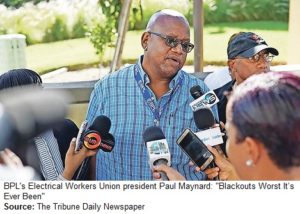
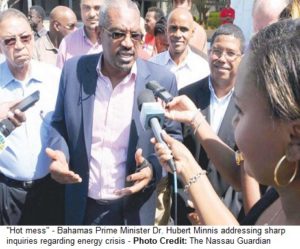
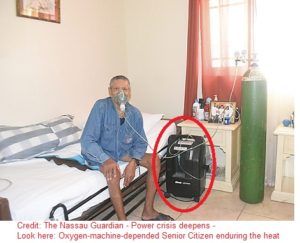
He described the outages as “a nuisance” and said they create “chaos”.

“This BEC (Bahamas Electricity Corporation) crisis is more than a crisis, it’s chaos,” Roberts said at the Nassau Street store.

“It’s costing us $250,000 a year from burning up our equipment.”

He said, “I suppose our biggest concern is burning up equipment.

“…[We] burn up a $10,000 or $20,000 air conditioning [unit and] we’re always burning up compressors. We’re using up spares so fast and we’re doing emergency imports.

“Fortunately, we’re able to get them in within three or four days without flying them in. But I noticed on Saturday we had a diary case down because we’re waiting on the compressor that burned out. That’s the biggest problem.”

Roberts said it will cost about $10,000 to replace a compressor in the dairy case at the Nassau Street location. He said it is unlikely that case will be operational before Saturday.

Roberts said dairy sales were up 14 percent before the case was damaged.

Since it was damaged, sales have gone down 17 percent, he said.

Roberts said the company has twice the amount of equipment needed “because of the serious problem” of the outages.

Although the food store chain is facing challenges with the outages, Roberts said the company is “managing quite well”.

“We’ve been in this business over 50 years and we’ve had power problems for the last 50 years,” he said.

“So, we learned how to cope. We don’t run out of fuel. Years ago, when I first started in the industry, we had generators because of hurricanes but for the past 25 years we’ve had to have generators because of power outages.”

For nearly two months, communities on New Providence have experienced hours-long blackouts as part of Bahamas Power and Light’s (BPL) load shedding exercise.

Over the last few weeks, BPL has conducted nearly four-hour-long load shedding.

On Sunday, BPL Chief Executive Officer Whitney Heastie said he could not guarantee an end to load shedding exercises in the immediate future, describing BPL as being “on a cliff”.

Heastie said BPL needs 250 megawatts of generation in order to meet the summer demand.

However, it is currently running on 210 megawatts, including 105 megawatts of rental generation.

Heastie said the 40-megawatt shortfall has led to load shedding across New Providence.

Source: Posted by The Nassau Guardian daily newspaper on August 13, 2019; retrieved August 14, 2019 from: https://thenassauguardian.com/2019/08/13/bpl-causing-chaos/

The need to explain that our statement is not “cold and callous” is due to the fact that the appearance is that “we” are ‘kicking the people when they are down’ when we make this assertion:

This energy crisis for Nassau is Self-Made!!

Wait, what?!

This is a matter of infrastructure and Nassau has had an inadequate infrastructure for a while. In fact, since the 1970’s residents on this island of New Providence (NP) have been encouraged to buy bottled-water and not consume the ‘tap’ water.

All of this is evident of the lacking municipal infrastructure. In fact, this is reminiscent of the US City of Flint, Michigan. Their infrastructure has become defective and the people there has to resort to bottled water. In Flint, that problem has now persisted for 4 years. In Nassau, it has been 40 years. (See an excerpt of our 2016 blog-commentary on the Flint crisis in the Appendix below).

Yep, self-made!

This is a BIGGER issue than water or electricity; this is an issue of the Social Contract.

The 2013 book Go Lean…Caribbean (Page 170) defines the Social Contract as the informal arrangement where citizens surrender some of their freedoms and submit to the authority of the State in exchange for protection of remaining natural and legal rights. This is why the State, in this case, the Commonwealth of the Bahamas, is allowed to operate monopolies for the water and power utilities. But any failures in these Social Contract deliveries causes repercussions and consequences. For example people leave and abandon their homeland. This relevance was detailed in a previous Go Lean commentary from July 28, 2015:

The issue of Caribbean citizens abandoning their homelands is one of the more dire threats to societal life in the region. Why do they do it?

“Push and Pull” reasons!

Push
Conditions at home drive Caribbean citizens to take flight and find refuge elsewhere. Many times these conditions are economic (jobs and entrepreneurial opportunities), security and governance related, but there are other reasons too; consider discriminations due to ethnic diversity or other lifestyle choices.

Lastly, there is the new threat of Climate Change. While this is a threat for the whole world, the Caribbean is on the frontline. Though there is some debate as to the causes of climate change, there is no question as to its outcome: temperatures are rising, droughts prevail, and most devastating, hurricanes are now more threatening. A Caribbean elevation plan must address the causes of climate change and most assuredly its consequences. …

Now, the anecdotal experience is that there is a need to mitigate excessive heat in the region for an even longer season. How do we mitigate excessive heat?

Air conditioning!

But this cure may at times be worse than the disease.

Air conditioning requires even greater energy consumption, (the Caribbean has among the highest energy costs in the Western Hemisphere); the Go Lean book posits that the average costs of energy can be decreased from an average of US$0.35/kWh to US$0.088/kWh in the course of the 5-year term of this roadmap; (Page 100).

In addition, the release of Chlorofluorocarbons (CFC’s) in the air-conditioning process is a contributor of greenhouse gases into the atmosphere.

The status quo needs remediation!

The Bahamas should have remediated these infrastructural problems years ago – the price is too high to allow it to linger. In addition to the societal abandonment threat; there are life-and-death issues associated with convalescing citizens needing continuous power supply – see photo here:

That’s the problem, now what is the solution?

In addition to the voluminous number of blog-commentaries on infrastructure – see this recent submission from July 26, 2019 – the Go Lean book presented strategies, tactics and implementations that must be pursued, not just for the Bahamas, but for the whole Caribbean region – all 30 member-states. In fact, the book presents one advocacy (Page 176) specifically focused on Public Works, entitled: “10 Ways to Impact Public Works“. These “10 Ways” include the following highlights, headlines and excerpts:

1 Lean-in for the Caribbean Union Trade Federation (CU).

The CU is chartered to unify the Caribbean region into one Single Market of 42 million people across 30 member-states, thereby re-engineering the economic engines in and on behalf of the region, including a currency & monetary union. This new eco-system allows for the design, funding and construction of Public Works and Infrastructural projects. The federal agency within the CU’s Department of the Interior has the scope for the Caribbean much like the Corps of Engineers has for the US. (Plus the CU will collaborate with the US Corps for projects related to Puerto Rico and the Virgin Islands).

There are a number of inter-state projects that must be coordinated on the federal level. There will also be projects that are “Too Big for One State” that will be facilitated by the CU. In addition, all CU efforts must comply with the Art in Public Places mandate, so sculptures and statutes will be embedded in projects or the project itself can be a work of art (bridges, water towers, building architecture). For existing projects that fail due to financial shortfalls, the CU will accommodate dissolution or reorganization in the federal courts, bringing balance to the process to all stakeholders.

2 Union Atlantic Turnpike
3 Pipelines and PCP (Pneumatic Capsule Pipeline)
4 Regional Power Grid

The CU will facilitate the installation of a regional power grid, and power sharing between member-states, with underwater and above-ground high-intensity wiring to alternate energy plants: wind/tidal turbines, solar panel & natural gas.

5 Self-Governing Entities (SGE)
6 Enterprise Zones
7 Empowerment Zones
8 Monopolies

The UN grants the CU the monopoly rights for an Exclusive Economic Zone, so the focus must be on quality delivery.

The CU plan is to liberalize management of monopolies, with tools like ratings/rankings against best practices. Plus

technological accommodations for ICT allows for cross-competition from different modes (satellite, cable, phone).

9 Cooperatives

The CU will task utility cooperatives with the delivery of some public utilities such as Air Chillers; Refrigerated Warehouses to its members. This strategy shares the cost of the “Works” installation across the full co-op membership.

10 Capital Markets

A single market and currency union will allow for the emergence of viable capital markets for stocks and bonds (public and private), thereby creating the economic engine to fuel growth and development. This forges financial products for “pre” disaster project funding (drainage, levies, dykes, sea walls) and post disaster recovery (reinsurance sidecars).

The Go Lean book doubles-down on the concept of leveraging across a larger population base so that BIGGER infrastructure projects can be facilitated in the region – on land or in the waters – see Photo here. Imagine large arrays of solar panels, wind turbines, tidal generators, geo-thermal energy captured at the volcanic hot zones, and even Natural Gas as a cleaner-cheaper fossil fuel. These energy options are realistic and should be available to us now in the Caribbean, so they should be explored and deployed. This, a regional power grid, is the energy prime directive for this Go Lean movement.

This theme – exploiting alternative options for the economic, security and governing empowerments in the region – aligns with many previous Go Lean commentaries; see a sample list here:

https://goleancaribbean.com/blog/?p=17925 ‘We’ have repeatedly failed the lessons from ‘Infrastructure 101’
https://goleancaribbean.com/blog/?p=17280 Way Forward – For Energy: ‘Trade’ Winds
https://goleancaribbean.com/blog/?p=13985 EU Assists Barbados in Renewable Energy Self-Sufficiency
https://goleancaribbean.com/blog/?p=12994 The Science of ‘Power Restoration’
https://goleancaribbean.com/blog/?p=12466 12 Caribbean Member-states have ‘Volcanic Energy’ to Exploit
https://goleancaribbean.com/blog/?p=10367 The Science of Sustenance – Green Batteries
https://goleancaribbean.com/blog/?p=5155 Green Energy Solution: Tesla unveils super-battery to power homes
https://goleancaribbean.com/blog/?p=4897 US Backs LNG Distribution for Caribbean Energy Solutions
https://goleancaribbean.com/blog/?p=915 Go ‘Green’ … Caribbean

Make no mistake, energy is a basic need!

The failure for a community to have continuous supply of energy is an energy crisis. (This means you Bahamas).

Enough already!

Now is the time for all Caribbean stakeholders to prepare for the empowerments of Green-Energy solutions. It is past-time for a regional power grid:

  • generation – Green options (solar, wind turbines, tidal, geo-thermal and natural gas)
  • distribution – Underwater cables to connect individual islands
  • consumption – efficient battery back-ups for home deployments.

These changes are coming … one way or another.

For you government revenue institutions who may be overly dependent of fuel taxes and surcharges – you are hereby put on notice:

Changes are afoot. We will succeed; we will make our Caribbean homeland a better place to live, work and play.

🙂

About the Book

The book Go Lean…Caribbean serves as a roadmap for the introduction and implementation of the technocratic Caribbean Union Trade Federation (CU), for the elevation of Caribbean society – for all member-states. This CU/Go Lean roadmap has these 3 prime directives:

  • Optimization of the economic engines in order to grow the regional economy to $800 Billion and create 2.2 million new jobs.
  • Establishment of a security apparatus to ensure public safety and protect the resultant economic engines.
  • Improve Caribbean governance to support these engines, including a separation-of-powers between the member-states and CU federal agencies.

The Go Lean book provides 370-pages of turn-by-turn instructions on “how” to adopt new community ethos, plus the strategies, tactics, implementations and advocacies to execute so as to reboot, reform and transform the societal engines of Caribbean society.

Download the free e-Book of Go Lean … Caribbean – now!

Who We Are
The movement behind the Go Lean book – a non-partisan, apolitical, religiously-neutral Community Development Foundation chartered for the purpose of empowering and re-booting economic engines – stresses that reforming and transforming the Caribbean societal engines must be a regional pursuit. This was an early motivation for the roadmap, as pronounced in the opening Declaration of Interdependence (Pages 12 – 13):

xi. Whereas all men are entitled to the benefits of good governance in a free society, “new guards” must be enacted to dissuade the emergence of incompetence, corruption, nepotism and cronyism at the peril of the people’s best interest. The Federation must guarantee the executions of a social contract between government and the governed.

xvi. Whereas security of our homeland is inextricably linked to prosperity of the homeland, the economic and security interest of the region needs to be aligned under the same governance. Since economic crimes … can imperil the functioning of the wheels of commerce for all the citizenry, the accedence of this Federation must equip the security apparatus with the tools and techniques for predictive and proactive interdictions.

xxiv. Whereas a free market economy can be induced and spurred for continuous progress, the Federation must install the controls to better manage aspects of the economy: jobs, inflation, savings rate, investments and other economic principles. Thereby attracting direct foreign investment because of the stability and vibrancy of our economy.

Sign the petition to lean-in for this roadmap for the Caribbean Union Trade Federation.

——————–

Appendix VIDEOAnother B.P.L. Blackouthttps://youtu.be/fOT0gfvSchM

ZNSNetwork
Published on Jul 2, 2019

——————–

Appendix – Excerpts from previous Commentary: Flint, Michigan – A Cautionary Tale – January 19, 2016

[The City of] Flint serves as a “cautionary tale” for other communities near “Failed City/Failed State” status. From this perspective, this community may be a valuable asset to the rest of the world and especially to the Caribbean.

CU Blog - Flint, Michigan - A cautionary tale - Photo 3The publishers of the book Go Lean…Caribbean are here in Detroit to “observe and report” the turn-around and rebirth of the once-great-but-now-distressed City of Detroit and its metropolitan areas, including Flint. (Previous commentaries featured the positive role model of the City of Ann Arbor).

What happened here?

According to the Timeline in the Appendix, Flint, MI suffered this fate as a chain reaction to its Failed-State status. Outside stakeholders – Emergency Managers – came into the equation to execute a recovery plan with focus only on the Bottom-Line. The consideration for people – the Greater Good – came second, if at all. They switched water sources, unwisely!

The assertion of the Go Lean book is that the Caribbean region can benefit from lessons learned from Good, Bad and Ugly governance. The book serves as a roadmap for the introduction and implementation of the technocratic Caribbean Union Trade Federation (CU). The Go Lean book and related commentaries call on citizens of the Caribbean member-states to lean-in to the empowerments described in the roadmap for elevation. This will require a constant vigil to ensure the Greater Good as opposed to personal gains.

See VIDEO here of the story in the national media …

VIDEO – Citizens’ Anger Continues Over Toxic Water in Flint, Michigan – http://abcnews.go.com/WNT/video/citizens-anger-continues-toxic-water-flint-michigan-36348795

This tragic story – cautionary tale of Flint – is an analysis of failure in the societal engines of economics, security and governance. These 3 facets are presented in the book Go Lean … Caribbean as the three-fold cord for societal harmony; for any society anywhere. The Caribbean wants societal harmony; we must therefore work to optimize all these three engines. As exhibited by Flint, this is easier said than done. This heavy-lifting is described in the book as both an art and a science.

The focus in this commentary is a continuation in the study of the societal engine of governance; previously, there was a series on economics and one on security. This commentary though, focuses on the bad eventually of Social Contract failures. The Social Contract refers to the unspoken expectations between citizens and the State. In many cases, State laws limit ownership of all mineral rights to the State; so citizens will be dependent on State systems to supply water. In the case of Flint, the City’s Water and Sewage Department has a monopoly; this supply is the only option for residents!

The Go Lean book describes “bad actors” wreaking havoc on the peace and security of the community. The book relates though that “bad actors” are not always human; they include bad events like natural disasters and industrial spills. Plus, actual “bad actors” may have started out with altruistic motives, good intentions. This is why the book and accompanying blogs design the organization structures for the new Caribbean with checks-and-balances, mandating a collaborative process, because sometimes even a well-intentioned individual may not have all the insight, hindsight and foresight necessary to pursue the Greater Good. This the defect of the Michigan Emergency Manager structure; it assigns too much power to just one person, bypassing the benefits of a collaborative process. This is one reason why this review is important: power corrupts…everyone … everywhere.

We must do better, than Flint! (Flint must do better; too many lives are involved).

We know that “bad actors and bad incidences” will always occur, even in government institutions, so we must be “on guard” against abusive influences and encroachments to Failed-State status. The Go Lean roadmap calls for engagement and participation from everyone, the people (citizens), institutions and government officials alike. We encouraged all with benevolent motives to lean-in to this roadmap, to get involved to effect a turnaround for the Caribbean Failed-States.
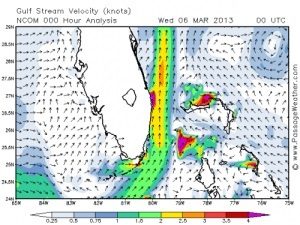
Our Caribbean stakeholders deserve the best … from their leaders.  🙂

Share this post:
, , , ,
[Top]

Regulating Plastics in the Bahamas – So Little; So Late – Encore

Plastics have been identified as “unbecoming” for the Caribbean environment. One country after another is now starting to regulate them and maybe even ban them.

Considering the 500 year history of Caribbean society, plastics are new …

… the proliferation emerged in the last 100 years. But the acknowledgement is now universal that they are destructive for the planet’s landscape and seascape.

While plastics are dutiful, plentiful and cheap, they are strictly optional; there are many viable alternatives; think glass, paper, wood and ceramics.

Here again:

  • plastic bags ==> paper bags
  • plastic bottles ==> glass bottles
  • plastic straws ==> paper straws
  • plastic cups ==> ceramic cups
  • plastic stirrers ==> wood stirrers

Plastics may be cheaper than all of these alternatives! But economically, plastics costs more … in the end! This is due to the disposal costs; or worse still: the destruction to the environment.

Caribbean communities that depend on the trade of touristic services must not jeopardize the sand and sea of the region. Tropical beauty is a strong selling point. Same too for the Fisheries.

One country after another is starting to implement regulations to eliminate plastic shopping bags, food utensils, straws and Styrofoam. Last year, August 21, 2018, the movement behind the book Go Lean…Caribbean related the efforts of the Caribbean country of Saint Lucia for their mitigation of plastics and Styrofoam. Now, we see that an additional country, the Bahamas, is also deploying their ban on plastics, starting in January 2020.

In fact, 40 other countries have already implemented such bans.

This is late for the Bahamas to only now be implementing this ban – they have always been vulnerable. In addition to their near-400,000 residents, they also hosts more than 3 million tourists annually (stay-overs and cruise passengers). But the location of the archipelago chain exposes it to unwanted marine debris (plastics) as a result of ocean currents and wave patterns – see the Gulfstream photo above.

The Bahamas is late! They should have been front-and-center with any mitigation efforts.

See this article here that describes the Bahamas plan for January 2020. Notice the emphasis on “plastic bags” and the little focus on other examples of single-use plastics. See the article here:

Title: Ferreira: Bahamas to join more than 40 countries that has banned plastic bags

NASSAU, BAHAMAS – Minister of Environment and Housing, Romauld Ferreira, during his contribution to the 2019/2020 Budget debate on Tuesday night, said the Bahamas is expected to join more than 40 countries that have introduced a ban on plastic bags.

The government’s proposed ban on plastic bags is set to take effect in January 2020.

Ferreira said the Government will ensure that the move offers minimal disruption to businesses and their operation.  He said his ministry will also inform and educate the public through a number of town hall meetings heading into 2020.

“The ministry’s education is also advancing the message of a healthier Bahamas through this initiative as the improper use of plastics is associated with various forms of environmental pollution and environmental degradation, which ultimately affects an individual’s health and well-being,” Ferreira said.

The proposed ban comes on the heels of several warnings issued by local environmental and climate experts who have stressed that non-biodegradable products such as plastic bags and Styrofoam have contributed to environmental issues.

Director of Energy and Environment with the Bahamas Chamber of Commerce, Debbie Deal, told Eyewitness News Online Wednesday that  back in April 2018, the Ministry of Environment signed a Memorandum of Understanding with The Bahamas Chamber of Commerce, to ensure that businesses would be prepared for enforcement of the 2020 ban.

Deal said the implementation of the ban should not be an issue.

“VAT was [pushed] from 7.5 to 12 per cent and  on July 1, 2019 it came into effect. We as a people were able to make that transition in a month’s time, so I personally think that a year and 9 months is sufficient to make that transition,” Deal said.

Meanwhile, Trevor Davis, the co-owner of Quality Home Center on Blue Hill Road said as his business prepares to replace plastic bags with reusable shopping bags, the move, while costly, will bring down the cost of bags for business owners as the new bags are reusable.

Source: Posted June 12, 2019; retrieved from: https://ewnews.com/ferreira-bahamas-to-join-more-than-40-countries-that-has-banned-plastic-bags

While we applaud the Bahamas for this tardy effort; it must be acknowledged that it is: so little; so late!

It is very apropos to Encore that previous blog-commentary from August 21, 2018. See that blog-commentary here-now:

——————–

Go Lean CommentaryPlastics and Styrofoam – A Mitigation Plan

So where do all the used plastics – and Styrofoam – go?

In a landfill …

… and may not degrade for a thousand years!

But for the ones that end up in the water (oceans and seas), they too do not degrade. They linger, pollute and disrupt eco-systems.

No one can just “stick their head in the sand”; this issue must be addressed, the crisis must be assuaged, the threat must be mitigated. See this crisis as depicted in this VIDEO here:

VIDEO – How Much Plastic is in the Ocean? – https://youtu.be/YFZS3Vh4lfI

It’s Okay To Be Smart

Published on Mar 28, 2017 – What can you do to make the oceans plastic-free?

Ocean plastic pollution is a massive environmental problem. Millions of tons of plastic waste enter the ocean every year, even plastic that goes in the trash can often ends up in the sea! This week we learn about the Great Pacific Garbage Patch and look at the dangers ocean plastic poses to ocean animals. Plus, a few tips for you to reduce your own plastic use!

Sample Resources

Plastic Oceans Foundation: http://www.plasticoceans.org/

United Nations “Clean Seas” program: http://www.cleanseas.org/

Ocean plastic pollution resources from Monterey Bay Aquarium: https://www.montereybayaquarium.org/c…

Welcome to the Caribbean! We are 30 member-states in an all-coastal region – with many archipelagos (i.e. the Bahamas alone features over 700 islands). We have a lot of waterways and seascapes to contend with … and manage! So this global problem of plastics and Styrofoam is a local problem too.

Think global; act local!

What are we doing in our Caribbean region to mitigate the problem of plastics and Styrofoam? One member-state, St. Lucia, has proposed something; see the full news story here:

Title: Saint Lucia to ban Styrofoam and plastics

August 13th, 2018 – Saint Lucia plans to phase-out Styrofoam food service containers and plastics, both plates and cups, beginning December 1, 2018, with a total ban on their importation before the end of next year.

The announcement came in a statement from Minister of Education, Innovation, Gender Relations and Sustainable Development, Doctor Gale Rigobert.

Rigobert said the Government of Saint Lucia is cognizant of the negative impact on the environment and human health from food service containers made from Polystyrene and Expanded Polystyrene, also known as Styrofoam, along with Plastics.

However, she observed that the administration recognises that the healthier alternative to these products, such as biodegradable and compostable food service containers, are more costly.

” We are doing our very best to alleviate this issue,” the minister explained.

She disclosed that over the last few months, the Department of Sustainable Development, in partnership with other key agencies such as the Saint Lucia Solid Waste Management Authority, the Department of Finance, the Ministry of Commerce and the Customs and Excise Department, has been working towards the development of a strategy to eliminate single use plastics, polystyrene and expanded polystyrene from the Saint Lucia market.

“To date, we have completed fiscal analyses, conducted a survey of the key suppliers of these products and we have also identified suppliers of the biodegradable and compostable food service containers, all this to ensure that Saint Lucia creates the enabling environment to facilitate this process,” Rigobert stated.

She explained that in light of this, the Department of Sustainable Development will be taking a phased approach to facilitate a smooth transition for all stakeholders.

“The phase-out, along with a ban on the importation of Styrofoam food service containers, and plastics, both plates and cups, will commence December 1, 2018 with a total ban culminating by November 30, 2019:”

Rigovert revealed that in order to ensure adequate sensitisation, the Department of Sustainable Development will continue its campaign to educate the general public on the options they have available to them during this phase.

“With respect to plastic bottles, discussions are ongoing with major stakeholders to finalize legislation that would curb and control their use,” the minister noted.

“I encourage you to join the fight to reduce your dependency on single use plastics and Styrofoam by utilizing re-useable bottles, food containers, cutlery and shopping bags. Let us act responsibly in our everyday consumption and production,”Rigobert stated.
Source: St. Lucia Times – Daily Newspaper – Posted 08-13-2018; retrieved 08-21-2018: https://stluciatimes.com/2018/08/13/saint-lucia-to-ban-styrofoam-and-plastics/

This problem is bigger than just the Caribbean member-state of St Lucia. They did not start this fight; nor can they finish it. This is BIG Deal that is too big for any one member-state or the full Caribbean region alone. This will require a global effort, including some Caribbean mitigation!

But here in the Caribbean, we cannot expect others to do all the heavy-lifting and clean-up; we must do our share; clean-up our own environment. This has been a frequent theme by the movement behind the book Go Lean … Commentaryavailable for download now. In the book, and in previous Go Lean blog-commentaries, it was asserted that we – the Caribbean region – must do our share to “Go Green” so as to assuage our own contributions to global pollution and greenhouse gases; yes, we must keep our own neighborhoods clean and optimize our own industrial footprint, so that we may be less hypocritical – have moral authority – in calling for reform from the big polluting nations. This sample – as follows – depicts some previous blog-commentaries that relates this theme:

https://goleancaribbean.com/blog/?p=14832 Counter-culture: Manifesting Change – Environmentalism
https://goleancaribbean.com/blog/?p=14174 Canada: “Follow Me” for Model on Environmental Action
https://goleancaribbean.com/blog/?p=12724 Lessons from Colorado: Water Management Arts & Sciences
https://goleancaribbean.com/blog/?p=12144 Book Review: ‘Sea Power’ – The Need for Good Oversight
https://goleancaribbean.com/blog/?p=9455 Fix ‘Climate Change’ and other Environmental Issues? Yes, We Can
https://goleancaribbean.com/blog/?p=2465 Book Review: ‘This Changes Everything: Capitalism vs. the Climate’
https://goleancaribbean.com/blog/?p=2276 Climate Change May Affect Food Supply Within a Decade
https://goleancaribbean.com/blog/?p=1656 Blue is the New Green
https://goleancaribbean.com/blog/?p=915 Go ‘Green’ … Caribbean

From the foregoing news articles and these previous blog-commentaries, we see the compelling need for a concerted anti-pollution-Go Green effort in our region. We must “Reduce, Re-use, Recycle”. Who will stand-up and lead this charge?

“Here I am, send me” – The Bible; Isaiah 6:8

This is the charter of the Go Lean book. It serves as a roadmap for the introduction and implementation of the technocratic Caribbean Union Trade Federation (CU). The roadmap depicts how this federal government is designed to stand-up and lead the charge to assuage and mitigate the threats on Caribbean life. The book identifies a list of crises as Agents of Change that are crippling our way of life. We can add pollution to that list. As a Single Market, we need a regional sentinel to be on guard and to tackle these “plastics pollution” problems.

Why regional?

Because the national effort has been unsuccessful; in many cases, even unknown, unavailable and unfunded.

No, individual member-states will not be able to succeed in this effort; we need a regional effort; it is too big to tackle alone; so we must acknowledge our regional dependency or interdependence to have any chance of success. This vision is embedded in the opening Declaration of Interdependence, pronouncing as follows, (Pages 11, 12):

vi. Whereas the finite nature of the landmass of our lands limits the populations and markets of commerce, by extending the bonds of brotherhood to our geographic neighbors allows for extended opportunities and better execution of the kinetics of our economies through trade. This regional focus must foster and promote diverse economic stimuli.

viii. Whereas the population size is too small to foster good negotiations for products and commodities from international vendors, the Federation must allow the unification of the region as one purchasing agent, thereby garnering better terms and discounts.

x. Whereas we are surrounded and allied to nations of larger proportions in land mass, populations, and treasuries, elements in their societies may have ill-intent in their pursuits, at the expense of the safety and security of our citizens. We must therefore appoint “new guards” to ensure our public safety and threats against our society, both domestic and foreign. …

xi. Whereas all men are entitled to the benefits of good governance in a free society, “new guards” must be enacted to dissuade the emergence of incompetence, corruption, nepotism and cronyism at the peril of the people’s best interest. The Federation must guarantee the executions of a social contract between government and the governed.

The Go Lean book and previous blog-commentaries posit that the “whole is worth more than the sum of its parts”, that from this roadmap disparate Caribbean nations can speak with “one voice” … collectively as a Single Market and be heard. The international community – the big polluters – would therefore have more respect and accountability to our regional Caribbean entity, rather than the many (30) Small Island Development States. But while contributing to the problem ourselves, though on a smaller scale, we cannot just say to these big polluters:

“You break it, you fix it”.

No, we must unite and take our stand in this fight … to mitigate plastics and Styrofoam … and advocate for change!

As related in the Go Lean roadmap, the CU Trade Federation is designed to elevate Caribbean society, but not just against pollution, rather these other engines in the regional construct as well. The roadmap therefore has these 3 prime directives:

  • Optimize the economic engines of the Caribbean to elevate the regional economy to grow to $800 Billion & create 2.2 million new jobs.
  • Establish a security apparatus to ensure public safety and protect the resultant economic engines over the seas & land.
  • Improve Caribbean governance to support these engines.

So the CU will serve as the regional administrator to optimize the economy, homeland security and governing engines for the Caribbean. These efforts are already important in the fight for Climate Change abatement; so the same can apply for the mitigation of polluting plastics and Styrofoam.

The Go Lean book provides 370-pages of turn-by-turn instructions on “how” to adopt new community ethos, plus the strategies, tactics, implementations and advocacies to execute so as to reboot, reform and transform the societal engines of Caribbean society. This is the heavy-lifting that we must do to sustain our planet, region, island and communities.

We can all do more!

Some hotel resorts in the Caribbean have already embraced the strategy of being early-adopters of plastics-Styrofoam bans. See a related article here from St Lucia:

Bay Gardens Resorts discontinues use of Expanded Polystyrene EPS (Styrofoam) products https://stluciatimes.com/2017/02/17/bay-gardens-resorts-discontinues-use-expanded-polystyrene-eps-styrofoam-products/

Change has come to the Caribbean region. This heavy-lifting is the quest of the CU/Go Lean roadmap; to make the Caribbean region more self-reliant collectively; to act more proactively and reactively for our own emergencies and natural disaster events; and to be more efficient in our governance.

If “plastics pollution” is not arrested, then even more devastating changes will come. So there is the need for our region to establish a regional Sentinel, a permanent union to provide efficient stewardship for our economic, security and governing engines.

Now is the time for all of the Caribbean, the people and governing institutions, to lean-in to the efforts and empowerments to mitigate and abate “plastics pollution”. It is also time to lean-in to this roadmap described in the book Go Lean … Caribbean. Plastic pollution is a Big Deal. We have other Big Deals too, so as to reform and transform our society. We must make our waterways and homelands better places to live, work and play. 🙂

Download the e-Book of Go Lean … Caribbean – now!

Sign the petition to lean-in for this roadmap for the Caribbean Union Trade Federation.

Share this post:
, , , , ,
[Top]