Tag: Transform

A Lesson in History – Rockefeller’s Pipeline

Go Lean Commentary

This book Go Lean…Caribbean was written in 2013 in Omaha, Nebraska, in the shadow of one of the world’s richest men, Warren Buffett. The book posits that location is very important for the proper perspective when developing an empowerment plan. The book quotes the Bible scripture at Proverbs 22:29: “Have you beheld a man skillful in his work? Before kings is where he will station himself”. (Page 137). If this was the time of the Roman Empire, an empowerment roadmap like Go Lean would have to be written in Rome.

On the other hand, if this roadmap was written in 1885, at the start of the American Industrial domination, the author would have to be in the shadow of Industrialist John D. Rockefeller in New York City. See VIDEO below.

The Go Lean book posits that one person can make a difference and positively impact their society; so the book advocates for a community ethos of investment in the “gifts” that individuals “bring to table”. The book identifies the quality of geniuses and relates worthwhile returns from their investments. This mode of study allows us to consider this example of contributions from the industrial role model of Mr. Rockefeller and his prudent implementation of pipelines:

JCU Blog - A Lesson in History - Rockefeller Pipeline - Photo 1ohn Davison Rockefeller, Sr. (July 8, 1839 – May 23, 1937) was an American business magnate and philanthropist. He was a co-founder of the Standard Oil Company, which dominated the oil industry and was the first great U.S. business trust. Rockefeller revolutionized the petroleum industry, and along with other key contemporary industrialists such as Andrew Carnegie, defined the structure of modern philanthropy. In 1870, he co-founded Standard Oil Company and actively ran it until he officially retired in 1897.[3]

Rockefeller founded Standard Oil as an Ohio partnership with his brother William along with Henry Flagler, Jabez A. Bostwick, chemist Samuel Andrews, and a silent partner, Stephen V. Harkness. As Kerosene and Gasoline grew in importance, Rockefeller’s wealth soared and he became the world’s richest man and the first American worth more than a billion dollars.[a] Adjusting for inflation, he is often regarded as the richest person in history.[4][5][6][7]

His fortune was mainly used to create the modern systematic approach of targeted philanthropy. He was able to do this through the creation of foundations that had a major effect on medicine, education and scientific research.[8] His foundations pioneered the development of medical research and were instrumental in the eradication of hookworm and yellow fever.

Rockefeller was also the founder of both the University of Chicago and RockefellerUniversity and funded the establishment of Central Philippine University in the Philippines. He was a devoted Northern Baptist and supported many church-based institutions. Rockefeller adhered to total abstinence from alcohol and tobacco throughout his life.[9] He was a faithful congregant of the Erie Street Baptist Mission Church, where he taught Sunday school, and served as a trustee, clerk, and occasional janitor.[10][11] Religion was a guiding force throughout his life, and Rockefeller believed it to be the source of his success. Rockefeller was also considered a supporter of capitalism based in a perspective of social Darwinism, and is often quoted saying “The growth of a large business is merely a survival of the fittest”.[12][13]
Wikipedia Online Encyclopedia  (Retrieved October 18, 2014) –
http://en.wikipedia.org/wiki/John_D._Rockefeller

Living for almost 98 years and accumulating vast wealth, Mr. Rockefeller was highly accomplished. He was an early adoptor of Kerosene oil and earned his initial fortune by fostering entrepreneurship and Research & Development (R&D) around the then-cutting-edge product; see VIDEO below. One accomplishment that aligns with this Go Lean roadmap is Mr. Rockefeller’s strategic, tactical and operational applications of pipelines; see Appendix below. He used pipelines to spur his production, acquire raw materials, deliver finished goods to customers, mitigate against threats, and neutralize competition and opposition.

The book Go Lean … Caribbean also asserts that pipelines can be strategic, tactical and operationally efficient for building community wealth in the Caribbean region. They can mitigate challenges from Mother Nature, create jobs and grow the economy at the same time. The book purports that a new technology-enhanced industrial revolution is emerging, in which there is more efficiency for installing-monitoring-maintaining pipelines. Caribbean society must participate in these developments, in order to “survive with the fittest”. This point is pronounced early in the book with this Declaration of Interdependence (Page 14), with these statements:

xxvi.      Whereas the Caribbean region must have new jobs to empower the engines of the economy and create the income sources for prosperity, and encourage the next generation to forge their dreams right at home, the Federation must therefore foster the development of new industries, like that of … pipelines …

xxvii.      Whereas the region has endured a spectator status during the Industrial Revolution, we cannot stand on the sidelines of this new economy, the Information Revolution. Rather, the Federation must embrace all the tenets of Internet Communications Technology (ICT) to serve as an equalizing element in competition with the rest of the world. The Federation must bridge the digital divide and promote the community ethos that research/development is valuable and must be promoted and incentivized for adoption.

This book Go Lean… Caribbean, serves as a roadmap for the introduction and implementation of the technocratic Caribbean Union Trade Federation (CU) to elevate the 30 Caribbean member-states. This Federation will assume jurisdiction for the 1,063,000 square-mile Caribbean Sea, in an Exclusive Economic Zone. This approach allows for cooperation and coordination for pipelines among the member-states; this will thusly effectuate change in the region by allowing these 3 prime directives:

  • Optimization of the economic engines in order to grow the regional economy to $800 Billion GDP and create 2.2 million new jobs.
  • Establishment of a security apparatus to protect the resultant economic engines.
  • Improve Caribbean governance to support these engines.

The subject of pipelines has been addressed and further elaborated upon in these previous blog/commentaries:

https://goleancaribbean.com/blog/?p=1817 Caribbean grapples with intense new cycles of flooding & drought
https://goleancaribbean.com/blog/?p=1516 Floods in Minnesota, Drought in California – Why Not Share?

The Go Lean book itself details the economic principles and community ethos to adopt, plus the executions of strategies, tactics, implementations and advocacies to forge pipelines, Research & Development and industrial growth in the Caribbean:

Economic Principles – People Choose because Resources are Limited Page 21
Economic Principles – All Choices Involve Costs Page 21
Economic Principles – People Respond to Incentives Page 21
Economic Principles – Economic Systems Influence Individual Choices Page 21
Economic Principles – Voluntary Trade Creates Wealth Page 21
Community Ethos – Job Multiplier Page 22
Community Ethos – “Crap” Happens Page 23
Community Ethos – Lean Operations Page 24
Community Ethos – Return on Investments (ROI) Page 24
Community Ethos – Cooperatives Page 25
Community Ethos – Ways to Help Entrepreneurship Page 28
Community Ethos – Ways to Promote Intellectual Property Page 29
Community Ethos – Ways to Impact Research & Development Page 30
Community Ethos – Ways to Improve Negotiations Page 32
Community Ethos – Impact the Greater Good Page 37
Anecdote – Pipeline Transport – Strategies, Tactics & Implementations Page 43
Strategy – Vision – Confederating 30 Member-states in a Union Page 45
Strategy – Agents of Change – Technology Page 57
Tactical – Fostering a Technocracy Page 64
Tactical – Growing Economy – New High Multiplier Industries Page 68
Separation of Powers – Interstate Commerce Administration Page 79
Separation of Powers – Interior Department – Exclusive Economic Zone Page 82
Implementation – Assemble – Pipeline as a Focused Activity Page 96
Implementation – Ways to Pay for Change Page 101
Implementation – Benefits from the Exclusive Economic Zone Page 104
Implementation – Ways to Develop a Pipeline Industry Page 107
Implementation – Ways to Deliver Page 109
Planning – 10 Big Ideas – Pipeline Projects Page 127
Planning – Ways to Improve Interstate Commerce Page 129
Planning – Lessons from New York City Page 137
Planning – Lessons from Omaha Page 138
Advocacy – Ways to Grow the Economy Page 151
Advocacy – Ways to Create Jobs Page 152
Advocacy – Ways to Better Manage the Social Contract – Infrastructure Page 170
Advocacy – Ways to Ways to Impact Public Works – Ideal for Pipelines Page 175
Advocacy – Ways to Foster Cooperatives Page 176
Advocacy – Ways to Better Manage Natural Resources – Water Resources Page 183
Anecdote – Caribbean Industrialist & Entrepreneur Role Model Page 189
Advocacy – Ways to Impact Extractions – Pipeline Strategy Alignment Page 195
Advocacy – Ways to Improve Emergency Management Page 196
Advocacy – Ways to Foster Technology Page 197
Advocacy – Ways to Impact Wall Street – Adopt Advanced Financial Products Page 200
Advocacy – Ways to Improve Monopolies – Foster Cooperatives Page 202
Advocacy – Ways to Improve Transportation – Pipeline Options Page 205
Appendix – Interstate Compacts Page 278
Appendix – Pipeline Maintenance Robots Page 283

The economic principles of pipelines are sound. Pipelines can be used to bring resources from a source to a destination in a steady consistency, fulfilling the economic supply-demand conundrum. The Go Lean roadmap envisions pipelines solutions for resources like water, natural gas, electricity cables, and telecommunication cables – above ground and underwater.

We have the pipeline example of the prudence and success of one of the world’s richest men (ever) as a model, that of John D. Rockefeller. He also provides a role model for us in the Caribbean in other endeavors of life:

Research & Development (Kerosene & Gasoline)
Cooperatives & Trusts
Creative Financing & Securities Oversight
Fostering Genius
Philanthropic Foundations
Educational Empowerments
Spiritual Guidance

The contributions of a committed person can be impactful indeed in this vision for the elevation and empowerment of the Caribbean homeland. The Go Lean … Caribbean roadmap invites these contributions; (the roadmap mitigates the threats of corporate abuse of a plutocracy). Like Mr. Rockefeller’s model describes, we also invite pipelines, with their strategic, tactical and operational implementations. With the right applications from people, tools and techniques any movement can have an impact in a changing society.

Change has come to the Caribbean. Everyone is hereby urged to lean-in to this roadmap to make the Caribbean a better place to live, work and play. 🙂

Download the book Go Lean…Caribbean now!

———

Video: Rockefeller’s Standard Oil

John D. Rockefeller built an oil empire by guaranteeing a uniform quality for his Standard Oil Kerosene – History Channel.

http://www.history.com/topics/john-d-rockefeller/videos/rockefellers-standard-oil

—————————————————————————————-

APPENDIX – Rockefeller and his Pipeline Reality

In 1877, Standard Oil clashed with the Pennsylvania Railroad, its chief hauler. Rockefeller had envisioned the use of pipelines as an alternative transport system for oil and began a campaign to build and acquire them.[40]

At this stage the company did not actually drill for oil; it merely refined it. In 1879 an association of producers completed the Tidewater Pipeline, running from oil fields in Bradford to the Reading Railroad at Williamsport, Pennsylvania. This innovation demonstrated that crude oil could be shipped cheaply over long distances by pipeline – much more cheaply than by rail, in fact. Standard Oil quickly responded by beginning construction of its own network of pipelines, [installing over 4,000 miles]. Before Tidewater, Standard Oil had made good profits refining oil in Cleveland and other points and shipping it by rail. But the cost-efficiency of pipeline transport made it imperative to ship crude oil to shipping points and refine it there.[39]

The railroads, seeing Standard’s incursion into the transportation and pipeline fields, struck back and formed a subsidiary to buy and build oil refineries and pipelines.[41] Standard countered and held back its shipments and, with the help of other railroads, started a price war that dramatically reduced freight payments and caused labor unrest as well. Rockefeller eventually prevailed and the railroad sold all its oil interests to Standard. But in the aftermath of that battle, in 1879 the Commonwealth of Pennsylvania indicted Rockefeller on charges of monopolizing the oil trade, starting an avalanche of similar court proceedings in other states and making a national issue of Standard Oil’s business practices.[42]

Monopoly – Cause and Effect
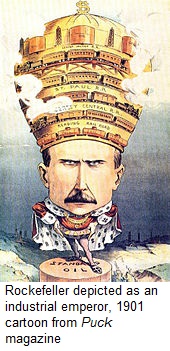
CU Blog - A Lesson in History - Rockefeller Pipeline - Photo 2Standard Oil gradually gained almost complete control of oil refining and marketing in the United States through horizontal integration. In the Kerosene industry, Standard Oil replaced the old distribution systems with its own vertical system. It supplied Kerosene by tank cars that brought the fuel to local markets, and tank wagons then delivered to retail customers, thus bypassing the existing network of wholesale jobbers.[43] Despite improving the quality and availability of Kerosene products while greatly reducing their cost to the public (the price of Kerosene dropped by nearly 80% over the life of the company), Standard Oil’s business practices created intense controversy; [this is typical plutocratic behavior]. Standard’s most potent weapons against competitors were underselling, differential pricing, and secret transportation rebates.[44] The firm was attacked by journalists and politicians throughout its existence, in part for these monopolistic methods, giving momentum to the antitrust movement. By 1880, according to the New York World newspaper, Standard Oil was “the most cruel, impudent, pitiless, and grasping monopoly that ever fastened upon a country.”[45] To the critics Rockefeller replied, “In a business so large as ours….. some things are likely to be done which we cannot approve. We correct them as soon as they come to our knowledge.”[45]

At that time, many legislatures had made it difficult to incorporate in one state and operate in another. As a result, Rockefeller and his associates owned dozens of separate corporations, each of which operated in just one state; the management of the whole enterprise was rather unwieldy. In 1882, Rockefeller’s lawyers created an innovative form of corporation to centralize their holdings, giving birth to the Standard Oil Trust.[46] The “trust” was a corporation of corporations, and the entity’s size and wealth drew much attention. Nine trustees, including Rockefeller, ran the 41 companies in the trust.[46] The public and the press were immediately suspicious of this new legal entity, but other businesses seized upon the idea and emulated it, further inflaming public sentiment. Standard Oil had gained an aura of invincibility, always prevailing against competitors, critics, and political enemies. It had become the richest, biggest, most feared business in the world, seemingly immune to the boom and bust of the business cycle, consistently racking up profits year after year.[47]

Standard Oil’s vast American empire included 20,000 domestic wells, 4,000 miles of pipeline, 5,000 tank cars, and over 100,000 employees.[47] Its share of world oil refining topped out above 90% but slowly dropped to about 80% for the rest of the century.[48] In spite of the formation of the trust and its perceived immunity from all competition, by the 1880s Standard Oil had passed its peak of power over the world oil market. Rockefeller finally gave up his dream of controlling all the world’s oil refining, he admitted later, “We realized that public sentiment would be against us if we actually refined all the oil.”[48] Over time foreign competition and new finds abroad eroded his dominance. In the early 1880s, Rockefeller created one of his most important innovations. Rather than try to influence the price of crude oil directly, Standard Oil had been exercising indirect control by altering oil storage charges to suit market conditions. Rockefeller then decided to order the issuance of certificates against oil stored in its pipelines. These certificates became traded by speculators, thus creating the first oil-futures market which effectively set spot market prices from then on. The National Petroleum Exchange opened in Manhattan in late 1882 to facilitate the oil futures trading.[49]

The invention of the light bulb gradually began to erode the dominance of Kerosene for illumination. But Standard Oil adapted, developing its own European presence, expanding into natural gas production [and distribution] in the U.S., then into Gasoline for automobiles, which until then had [only] been considered a waste product.[52]

In 1887, Congress created the Interstate Commerce Commission which was tasked with enforcing equal rates for all railroad freight, but by then Standard Oil depended more on pipeline transport.[54]

– (Retrieved October 18, 2014 from: http://en.wikipedia.org/wiki/John_D._Rockefeller)

Cited References:
a.      Fortune Magazine lists the richest Americans not by the changing value of the dollar but by percentage of GDP: Rockefeller is credited with a Wealth/GDP of 1/65.
———–
3.             “John D. and Standard Oil”. Bowling   GreenStateUniversity. Retrieved 2008-05-13.
4.             “The Richest Americans”. Fortune (CNN). Retrieved May 6, 2010.
5.             “Top 10 Richest Men of All Time”. AskMen.com. Retrieved 2007-05-29.
6.             “The Rockefellers”. PBS. Retrieved 2007-05-29.
7.             “The Wealthiest Americans Ever”. The New York Times. July 15, 2007. Retrieved 2007-07-17.
8.             Fosdick, Raymond Blaine (1989). The story of the Rockefeller Foundation. Transaction Publishers.
9.             Martin, Albro (1999), “John D. Rockefeller”, Encyclopedia Americana Page 23
10.         Chernow, Ron (1998). Titan: The Life of John D. Rockefeller, Sr. Random House, Page 52.
11.         “The 9 most amazing facts about John D. Rockefeller”. Oil Patch Asia.
12.         Richard Hofstadter et al. Sep 1, p. 45.
13.         Schultz, Duane P; Schultz, Sydney Ellen, A History of Modern Psychology, p. 128
———–
39.         Enclycopedia.com Online Resource. “Standard Oil Company – Pipelines. Retrieved October 19, 2014 from: http://www.encyclopedia.com/topic/Standard_Oil_Company.aspx
40.         Chernow 1998, p. 171.
41.         Segall, Grant (2001). John D. Rockefeller: Anointed With Oil. OxfordUniversity Press., p. 57.
42.         Segall 2001, p. 58.
43.         Chernow 1998, p. 253.
44.         Chernow 1998, p. 258.
45.         Segall 2001, p. 60.
46.         Segall 2001, p. 61.
47.         Chernow 1998, p. 249.
48.         Segall 2001, p. 67.
49.         Chernow 1998, p. 259.
50.         Chernow 1998, p. 242.
51.         Chernow 1998, p. 246.
52.         Segall 2001, p. 68.
53.         Segall 2001, pp. 62–63.
54.         Rockefeller, John D (1984) [1909]. Random Reminiscences of Men and Events. New York: Sleepy Hollow Press and Rockefeller Archive Center, Page 48.
Share this post:
, , , ,

More Business Travelers Flock to Airbnb

Go Lean Commentary

The internet has changed everything.

…especially in the hospitality industry. (Remember Travel Agents?!)

The book and accompanying blog/commentaries for Go Lean…Caribbean posit that the Sharing Economy can emerge more fully in the Caribbean. The Internet & Communications Technology (ICT) provides the tools and techniques. Visitors/tourists will be able to easily search and book houses, condominiums and apartments by connecting directly to the homeowner. This will be a win-win for the homeowner and their guests.

CU Blog - More Business Travelers Flock to Airbnb - Photo

This change is ecstasy for some, but agony for others.

Navigating the world of change is a mission of the Go Lean book. The book posits that the Bed & Breakfast (B&B) industry has evolved with the emerging internet culture and now allow families to share their high-end homes with strangers (and business travelers), in lieu of resort properties (Page 35). This development, like many agents-of-change, brings winners and losers. Hotel room nights and collection of municipal hotel taxes can all be imperiled if this ICT-Sharing development proceeds unchecked. This is why Go Lean promotes “sharing” as a community ethos, so as to mitigate the perils of this industry. We need online sharing tools to target the Caribbean, especially during the peaks of event tourism (festivals, carnivals, fairs). But we need our hotel taxes too.

The challenge with the Sharing Economy, for room rentals and many other areas of life, is one-step forward-two steps-backwards.

See the foregoing news article and the following VIDEO, that depicts the emergence of the company Airbnb:

Video Source: NBC News TODAY Show (Retrieved October 8, 2014)

Corporate travelers are getting creative, using the Internet and home rental sites like Airbnb to find alternative housing rather than checking into hotels. NBC’s Joe Fryer reports. http://on.today.com/2x9Sicg

————–

Title: Democratizing the Sharing Economy – The Center for Popular Economics
By: Anders Fremstad

The internet has sharply reduced the cost of peer-to-peer transactions.  In the 1990s and 2000s, Craigslist and eBay made it much easier to buy and sell secondhand goods, and these sites now facilitate over a million transactions a day.  More recently, online platforms associated with the “sharing economy” are helping friends, neighbors, and even strangers borrow, lend, and rent goods.  Travellers can reserve a spare room through Airbnb or find a free place to crash on Couchsurfing.  People can find a ride on Uber or rent a neighbor’s car on RelayRides.  Neighbors can increasingly borrow tools, gear, and appliances free-of-charge on NeighborGoods, Sharetribe, and similar sites.

Most observers celebrate how the sharing economy lowers the cost of accessing goods, but there is a growing debate over how these online platforms should be regulated.  Unfortunately, this debate ignores how many of the fundamental problems with the sharing economy arise from its corporate nature.  The solution may not be to simply regulate the corporate sharing economy but to also democratize the sharing economy by empowering the people who use these platforms to determine how they work.

Source: http://www.populareconomics.org/democratizing-the-sharing-economy/  Posted 06-24-2014; retrieved 10-10-2014

The book serves as a roadmap for the introduction and implementation of the technocratic Caribbean Union Trade Federation (CU). The roadmap posits that many issues and challenges for a Sharing Economy can only be managed with feasible economies-of-scale. The CU market size of 30 member-states and 42 million people will allow for the leverage to consolidate, collaborate and confederate the organizational dynamics to tackle these issues.

The book Go Lean…Caribbean anticipates the compelling issues associated with room sharing in the emerging new economy.

The book asserts that before the strategies, tactics and implementations of the roadmap can be deployed, the affected communities must first embrace a progressive community ethos. The book defines this “community ethos” as the fundamental character or spirit of a culture; the underlying sentiment that informs the beliefs, customs, or practices of society; dominant assumptions of a people or period. The Go Lean book stresses that the current community ethos must change and the best way to motivate people to adapt their values and priorities is in response to a crisis. The roadmap recognizes this fact with the pronouncement that the Caribbean is in crisis, and that “a crisis is a terrible thing to waste”. The region is devastated from external factors: global economic recession, globalization and rapid technology changes.

Cause and effect!

The Go Lean roadmap promotes development activity for the new ICT global economy, first in the anticipation and then in response of the demands of the Sharing Economy. Even if there is no international trade realization, these developments are needed for the integrated domestic “Single Market”. The roadmap incubates these industrial initiatives to promote the practice:

  • Caribbean Cloud – The Go Lean roadmap calls for the establishment of the Caribbean Cloud, an online community and social media initiative dubbed as myCaribbean.gov. This effort will be exerted by the Caribbean Postal Union (CPU) so as to impact allCaribbean stakeholders: residents, businesses, Diaspora, trading partners, visitors – a universe of 150 million people. TheCaribbean region accommodates 80 million visitors every year. The strategy of maintaining contact with previous visitors steadily increases the universe … and potential customer-base.
  • Mobile Applications – The Go Lean roadmap defines the mastery of time-&-space as strategic for succeeding in mobile apps development and deployment for the region (Page 35). Products like AirBnB and competitors, master mobile apps so that dynamic decisions and impulse buying can be exploited on behalf of touristic properties. Imagine a customer seeing an advertising billboard for a Caribbean resort in a North American city, in the middle of a snow storm, at the moment the desire to partake of Caribbean hospitality may be a great inclination.

The book asserts that to adapt to the new Sharing Economy, there must be a new internal optimization of the region’s strengths. This is defined in the following statement of the opening Declaration of Interdependence (Page 14):

xxvii. Whereas the region has endured a spectator status during the Industrial Revolution, we cannot stand on the sidelines of this new economy, the Information Revolution. Rather, the Federation must embrace all the tenets of Internet Communications Technology (ICT) to serve as an equalizing element in competition with the rest of the world. The Federation must bridge the digital divide and promote the community ethos that research/development is valuable and must be promoted and incentivized for adoption.

Something old, something new, something borrowed, something blue – Old Adage regarding marriage and weddings.

The quest to elevate Caribbean society includes embracing the “New Economy” and also optimizing ongoing economic engines; in this case tourism. This can be likened to a marriage. The CU will employ technologically innovative products and services to marry the “New Economy” with the “Old Economy”. This impact is pronounced in the CU‘s prime directives, identified with the following 3 statements:

  • Optimization of the economic engines in order to grow the regional economy to $800 Billion & create 2.2 million new jobs.
  • Establishment of a security apparatus to protect the resultant economic engines.
  • Improve Caribbean governance to support these engines.

The subject in this blog/commentary, of focusing on the intersection of the “Old Economy” with the “New Economy”, the 100-year old tourism product with the brand new internet, is a big challenge, requiring brand new leadership. This Agent-of-Change is impacting all aspects of commerce in the modern world, including the tourism product.

This subject of “New Economy’s” shared hospitality services has been previously covered in these Go Lean blogs, highlighted here in the following samples:

https://goleancaribbean.com/blog/?p=1364 Car-Sharing Uber Demonstrations Snarl Traffic from London to Berlin
https://goleancaribbean.com/blog/?p=486 Incubator firm (Temasek) backs Southeast Asia cab booking app GrabTaxi

In line with the foregoing article and VIDEO, the Go Lean book details the applicable community ethos, strategies, tactics, implementation and advocacies as a roadmap to foster this change/empowerment in the region for the Sharing Economy and to impact the tourism product:

Community Ethos – Ways to Impact the Future Page 26
Community Ethos – Ways to Help Entrepreneurship Page 28
Community Ethos – Promote Intellectual Property Page 29
Community Ethos – Ways to Bridge the Digital Divide Page 31
Community Ethos – Ways to Improve Sharing Page 35
Strategy – Confederate 30 Caribbean Member-States Page 45
Strategy – Customers – Citizens, Diaspora and Visitors Page 47
Strategy – Agents of Change – Technology Page 57
Tactical – Separation of Powers – Caribbean Cloud Page 74
Tactical – Separation of Powers – Caribbean Postal Union   (CPU) Page 78
Implementation – Year 1 / Assemble Phase – Establish CPU Page 96
Implementation – 10 Trends in Implementing Data Centers Page 106
Implementation – Improve Mail Services – Electronic Supplements Page 108
Implementation – Ways to Impact Social Media Page 111
Advocacy – Ways to Benefit from Globalization – Level Playing Field with ICT Page 129
Advocacy – Ways to Grow the Economy Page 151
Advocacy – Ways to Create Jobs Page 152
Advocacy – Revenue Sources for Regional Administrations Page 172
Advocacy – Ways to Enhance Tourism Page 190
Advocacy – Ways to Impact Events Page 191
Advocacy – Ways to Market Southern California Page 194
Advocacy – Ways to Foster Technology Page 197
Advocacy – Ways to Foster e-Commerce Page 198
Advocacy – Ways to Impact Main Street Page 201
Advocacy – Ways to Promote Call Centers Page 212
Advocacy – Ways to Impact the Diaspora Page 217
Appendix – Urban Bicycle Sharing Model Page 352

The roadmap posits that the CU will foster and incubate the Shared Economy and the Mobile Apps industry, thereby forging entrepreneurial incentives and jobs. Under the right climate, innovations can thrive. We need that climate here in the Caribbean; we must remain competitive, as a people and as a tourism market. As related in the foregoing article and VIDEO, the general market is embracing the Shared Economy.

The world has changed!

This change can be good. We can make the Caribbean, a better place to live, work and play.

Download the book Go Lean … Caribbean – now!

Share this post:
, , ,
[Top]

Miami’s Success versus Caribbean Failure

Go Lean Commentary

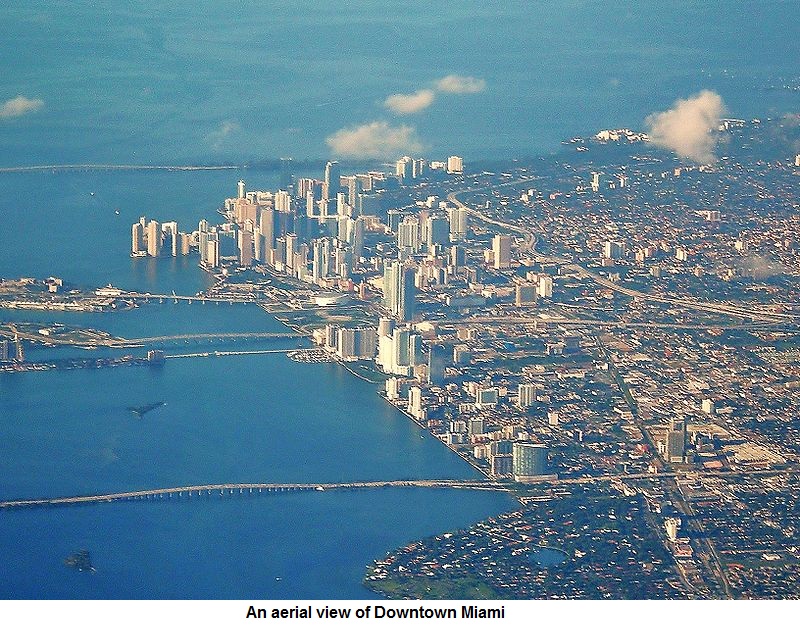
The Greater Miami Metropolitan Area has provided refuge to many of the Caribbean Diaspora.

Thank you Miami.

But make no mistake: Miami has benefited as well.

s Success versus Caribbean Failure - Photo 1

This fact is based on a proven economic principle that growth in population means growth in the economy. In parallel, declines in populations could lead to declines in economic growth. This point was vividly depicted in this previous blog commentary: Having Less Babies is Bad for the Economy; with this quoted reference:

We tend to think economic growth comes from working harder and smarter. But economists attribute up to a third of it to more people joining the workforce each year than leaving it. The result is more producing, earning and spending. – http://www.huffingtonpost.com/2014/05/07/birth-rate-economy_n_5281597.html

According to the below article (Appendix and VIDEOS below), the Miami Metropolitan Area has benefited greatly from the infusion of Caribbean refugees into its population. The benefits to the metropolitan area have been economic, cultural and also in governing leadership. This brings to the fore a compelling mission of the book Go Lean…Caribbean, to elevate Caribbean society so as to encourage the repatriation of the Diaspora back to their homelands.

Title: South Florida Caribbean’s – November 2006
The Caribbean Island Nations, has an overall population of over 40 million.

In the US, they number over 25 million (Strategy Research Corporation). The Caribbean population in the U.S. Diaspora has grown by over 6.4 million in the last decade.

SOUTH FLORIDA CARIBBEANS – November 2006
• An estimated 400,000 Caribbean nationals live in South Florida.

• More than 92,000 Jamaicans live in BrowardCounty and more than 32,000 Jamaicans live in Miami-Dade.

• Haitians make up the second-largest ethnic group in Miami-DadeCounty —109,817 — after Cubans, and are second to Jamaicans in Broward with 88,121.

North Miami, Dade County, Florida according to the 2000 census, has a population of 60,036 and is home to 18,656 Haitians, the most of any city in the county.

As at May 4, 2007 there are 10 Haitian elected officials now serving in the Florida Legislature and Miami-Dade municipalities. Another Haitian politician, North Miami Beach Councilman John Patrick Julien, won the primary but faces a runoff May 15, 2007 with developer Gary Goldman.

• Broward County added more new black residents (92,378) than any other county between 2000 and 2005, while Miami-Dade County added about 10,528, The surge is driven by Caribbeans.
• Broward’s black population grew 22 percent from 2000 to 2005; 34 percent among Caribbeans.
• Broward, Miami-Dade and Palm Beach counties are home to about one-fifth of the 785,771 Jamaicans living in the  United States.

Just as we argue that Cubans go to Miami and Mexicans to Texas for geographic and cultural blending in, we can make the same argument for West Indians in South Florida. It’s a natural habitat.”

SOURCE: U.S. Census
Editors note: The above figures are very conservative
Caribbean Business Community (North America) Inc.  (Retrieved 10-10-2014) –
http://www.caribbeanbusinesscommunity.com/newsletters/caribbeans_abroad.html

The book Go Lean…Caribbean champions the causes of retaining Caribbean citizens in the Caribbean, and inviting the Diaspora back to their homelands. These intentions were pronounced early in the book with these statements in the Declaration of Interdependence (Pages 13):

xix.      Whereas our legacy in recent times is one of societal abandonment, it is imperative that incentives and encouragement be put in place to first dissuade the human flight, and then entice and welcome the return of our Diaspora back to our shores. This repatriation should be effected with the appropriate guards so as not to imperil the lives and securities of the repatriated citizens or the communities they inhabit. The right of repatriation is to be extended to any natural born citizens despite any previous naturalization to foreign sovereignties.

xx.      Whereas the results of our decades of migration created a vibrant Diaspora in foreign lands, the Federation must organize interactions with this population into structured markets. Thus allowing foreign consumption of domestic products, services and media, which is a positive trade impact. These economic activities must not be exploited by others’ profiteering but rather harnessed by Federation resources for efficient repatriations.

Looking at this quest from the point-of-view of Miami introduces a paradox: Miami’s success versus Caribbean failure.

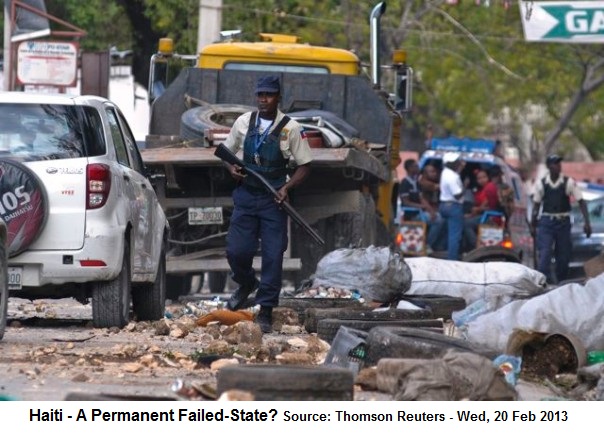
According to Miami’s history, the metropolitan area has benefited, population-wise, with every Failed-State episode in the Caribbean. This is describing a win-lose scenario, where the Caribbean losses resulted in Miami’s gains. The following list describes the Caribbean countries that experienced near-Failed-State status, detailed in the Go Lean book, that effected change (growth) in Miami:

Cuba (Page 236)
Dominican Republic (Pages 237, 306)
Haiti (Page 238)
Jamaica (Page 239)
Trinidad (Page 240)
US Territories – Puerto Rico & US Virgin Islands (Page 244)
British Caribbean Territories (Page 245)
Dutch Caribbean Territories (Page 246)
French Caribbean Territories (Page 247)

s Success versus Caribbean Failure - Photo 2

With Miami’s location at the bottom of the Florida peninsula, it protrudes into the tropics – 50 miles West from the Bahamas and 90 miles North from Cuba. For the local community, this Caribbean proximity was perceived as a disadvantage, a misfortune, but the Caribbean infusion instead has proven to be an asset, a win for Miami. As many Caribbean member-states flirted with failure, Miami succeeded, despite being on the frontlines and having to absorb many incoming refugees.

But now, change has now come to the Caribbean … as detailed in the Go Lean book.

The Go Lean book serves as a roadmap for the introduction and implementation of the technocratic Caribbean Union Trade Federation (CU) to bring positive change. The CU‘s prime directives are identified with the following 3 statements:

  • Optimization of the economic engines in order to grow the regional economy to $800 Billion & create 2.2 million new jobs.
  • Establishment of a security apparatus to protect the resultant economic engines.
  • Improve Caribbean governance to support these engines.

Will these changes reverse the patterns of success for Miami? Will more for Caribbean member-states mean less for Miami? Will Cuba’s return to democracy cause a crash for the Cuban-American investments in Miami? Will a stabilization of Haiti finally shift the successes of Haitian-Americans back to their homeland? Will an end of Caribbean Sclerosis (economic dysfunction) finally mean the English-speaking Caribbean will abandon Miami as their destination of hopes-and-dreams (see Appendix and VIDEOS below)? Will a successful execution of the Go Lean roadmap reverse the patterns of success for Miami? These ill-fated scenarios do not have to be the conclusion. The Go Lean roadmap for an elevated Caribbean, can be a win-win for Miami and the Caribbean.

The Go Lean book defines “luck” as the intersection of preparation and opportunity (Page 3). With the execution of the Go Lean roadmap, the change that comes to the Caribbean, and accompanying success should not mean failure for Miami. No, Miami can get “lucky” … purposely, with these impending changes. With Miami’s physical location it can continue to facilitate a lot of  trade and logistics for the Latin America and Caribbean region.

The Go Lean roadmap calls for elevating the Caribbean’s GDP from $378 Billion (2010) to $800 Billion. The Miami community can benefit from this regional growth, with some shrewd strategies on their part. (The Go Lean roadmap includes shrewd strategies for elevating the Caribbean, not Miami).

Caribbean stakeholders are hereby urged to lean-in to the community ethos, shrewd strategies, tactics, implementations and advocacies to finally re-boot Caribbean society; as detailed in the book Go Lean…Caribbean, sampled here:

Assessment – Anecdote – Caribbean Single Market & Economy Page 15
Assessment – Anecdote – Dutch Caribbean – Integration & Secessions Page 16
Assessment – Anecdote – French Caribbean – Organization & Discord Page 17
Assessment – Anecdote – Puerto Rico – The Greece of the Caribbean Page 18
Community Ethos – Economic Systems Influence Individual Choices & Incentives Page 21
Community Ethos – Voluntary Trade Creates Wealth Page 21
Community Ethos – Consequences of Choices Lie in the Future Page 21
Community Ethos – Minority Equalization Page 24
Community Ethos – Lean Operations Page 24
Community Ethos – Return on Investments Page 24
Community Ethos – Ways to Impact Turn-Arounds Page 33
Community Ethos – Ways to Manage Reconciliations Page 34
Community Ethos – Ways to Impact the Greater Good Page 37
Strategic – Vision – Integrating Region in to a Single Market Page 45
Strategic – Agents of Change – Globalization Page 57
Tactical – $800 Billion Economy – How and When Page 67
Tactical – Separation of Powers – State Department – Culture Administration Page 81
Implementation – Ways to Pay for Change Page 101
Implementation – Foreign Policy Initiatives at Start-up Page 102
Implementation – Ways to Deliver Page 109
Implementation – Trade Mission Objectives Page 117
Implementation – Reasons to Repatriate Page 118
Implementation – Ways to Benefit from Globalization Page 119
Planning – 10 Big Ideas – Cuba/Haiti Page 127
Planning – Ways to Make the Caribbean Better Page 131
Planning – Ways to Improve Failed-State Indices Page 134
Advocacy – Ways to Grow the Economy Page 151
Advocacy – Ways to Impact the Diaspora Page 217
Advocacy – Ways to Preserve Caribbean Heritage Page 218
Advocacy – Ways to Improve the Arts Page 230
Advocacy – Ways to Promote Music Page 231

This commentary previously featured subjects related to the Caribbean Diaspora in the Greater Miami Metropolitan Area. The following is a sample:

‘Raul Castro reforms not enough’, Cuba’s bishops say
Continued Discrimination for Latins/Caribbeans in Job Markets
Miami’s Caribbean Marketplace Re-opens
Caribbean loses more than 70 percent of tertiary educated to brain drain
Miami Sports – Franchise Values and Sports Bubbles in Basketball
eMerge conference aims to jump-start Miami tech hub

Today, Miami is a better place to live, work and play … due in many ways to the contributions of the Caribbean Diaspora. The Cuban, Dominican and Afro-Caribbean (Haitian, Jamaican, Bahamian) communities dominate the culture of South Florida, resulting in a distinctive character that has made Miami unique as a travel/tourist destination; see VIDEOS below that vividly describe the positive input of the Caribbean culture on Miami:

Video Title: The Miami Sound Machine – https://www.youtube.com/watch?v=CZkjeJKBI0M:

This is now a new day for the Caribbean; with the empowerments identified, qualified and proposed in the Go Lean book, the region will also be a better place to live, work and play. We urge all to lean-in to this roadmap, those residing in the region and the Diaspora, especially those in Miami.

The Caribbean and Miami. This can be a win-win!

Video Title: Miami-Broward Carnival – https://youtu.be/aT4hU85-lOk:

Download the book Go Lean … Caribbean – now!

—————

APPENDIX – Miami Demographic Analysis – http://en.wikipedia.org/wiki/Miami_metropolitan_area

Demographics

Miami Metropolitan Area Historical population
Census Pop.  
1900 4,955
1910 17,510 253.4%
1920 66,542 280.0%
1930 214,830 222.8%
1940 387,522 80.4%
1950 693,705 79.0%
1960 1,497,099 115.8%
1970 2,236,645 49.4%
1980 3,220,844 44.0%
1990 4,056,100 25.9%
2000 5,007,564 23.5%
2010 5,564,635 11.1%

Ethnicity:
The racial makeup of population of the Miami Area [5,334,685] as of 2010 [43]:

  • White: 70.3% [3,914,239]
    • White Non-Hispanic: 34.8% [1,937,939]
    • White Hispanic: 35.2% [1,976,300]
  • Black or African American (many from the Caribbean): 21% [1,075,174]
  • Native American: 0.3% [16,108]
  • Asian: 2.3% [125,564]; (0.7% Indian, 0.5% Chinese, 0.3% Filipino, 0.2% Vietnamese, 0.1% Korean, 0.1% Japanese, 0.4% Other Asian)
  • Pacific Islander: 0.0% [2,356]
  • Other races: 3.5% [197,183]
  • Two or more races: 2.5% [140,000]
  • Hispanic or Latino of any race were 41.6% [2,312,929] of the population

The city proper is home to less than one-thirteenth of the population of South Florida. Miami is the 42nd most populous city in the United States. [But] the Miami Metropolitan Area, which includes Miami-Dade, Broward and Palm Beach counties, had a combined population of more than 5.5 million people, ranked seventh largest in the United States,[44] and is the largest metropolitan area in the Southeastern United States. As of 2008, the United Nations estimates that the Miami Urban Agglomeration is the 44th-largest in the world.[45]

The 2010 US Census file for “Hispanic or Latino Origin” reports[46] that: 34.4% of the population had Cuban origin, 8.7% South American ( 3.2% Colombian), 7.2% Nicaraguan, 5.8% Honduran, and 2.4% Dominican origin. In 2004, the United Nations Development Program (UNDP) reported that Miami had the highest proportion of foreign-born residents of any major city worldwide (59%), followed by Toronto (50%).

As of 2010, there were 183,994 households of which 14.0% were vacant.[47] As of 2000, 26.3% had children under the age of 18 living with them, 36.6% were married couples living together, 18.7% have a female head of household with no husband present, and 37.9% were non-families. 30.4% of all households were made up of individuals and 12.5% had someone living alone who was 65 years of age or older. The average household size was 2.61 and the average family size was 3.25. The age distribution was 21.7% under the age of 18, 8.8% from 18 to 24, 30.3% from 25 to 44, 22.1% from 45 to 64, and 17.0% who were 65 years of age or older. The median age was 38 years. For every 100 females there were 98.9 males. For every 100 females age 18 and over, there were 97.3 males.

In 2009, the median income for a household in the city was $29,812, and the median income for a family was $33,814. The per capita income for the city was $19,846. About 21.7% of families and 26.3% of the population were below the poverty line.

In 1960, non-Hispanic whites represented 80% of Miami-Dade county’s population.[48] In 1970, the Census Bureau reported Miami’s population as 45.3% Hispanic, 32.9% non-Hispanic White, and 22.7% Black.[49] Miami’s explosive population growth has been driven by internal migration from other parts of the country, primarily up until the 1980s, as well as by immigration, primarily from the 1960s to the 1990s. Today, immigration to Miami has slowed significantly and Miami’s growth today is attributed greatly to its fast urbanization and high-rise construction, which has increased its inner city neighborhood population densities, such as in Downtown, Brickell, and Edgewater, where one area in Downtown alone saw a 2,069% increase in population in the 2010 Census. Miami is regarded as more of a multicultural mosaic, than it is a melting pot, with residents still maintaining much of, or some of their cultural traits. The overall culture of Miami is heavily influenced by its large population of Hispanics and blacks mainly from the Caribbean islands.

Source References:
43. American FactFinder, United States Census Bureau and Housing Narrative Profile: 2005. Factfinder.census.gov. Retrieved November 8, 2011.

44. “Annual Estimates of the Population of Metropolitan and Micropolitan Statistical Areas: April 1, 2000 to July 1, 2009” (XLS). 2009 Population Estimates. United States Census Bureau, Population Division. March 19, 2010. Retrieved October 18, 2010. 

45. “Table A.12. Population of urban agglomerations with 750,000 inhabitants or more in 2005, by country, 1950–2015” (PDF). World Urbanization Prospects: The 2005 Revision. United Nations Department of Economic and Social Affairs/Population Division. Retrieved January 1, 2008. 

46. “Race and Hispanic or Latino Origin: 2010 more information 2010 Census Summary File 1”. American FactFinder. US Census Bureau. Retrieved 2014-08-18. 

47. American FactFinder, United States Census Bureau. “Miami city, Florida – Census 2010:Florida – USATODAY.com –”. USA Today. Retrieved January 12, 2012. 

48. Demographic Profile, Miami-Dade County, Florida 1960–2000 ” (PDF). Miamidade.gov.

49. “Florida – Race and Hispanic Origin for Selected Cities and Other Places: Earliest Census to 1990”. U.S. Census Bureau. Retrieved April 21, 2012.

Share this post:
, , , , , ,
[Top]

A Lesson in History – Community Ethos of WW II

Go Lean Commentary

The publishers of the book Go Lean…Caribbean want to forge change in the Caribbean. Is it possible to change the attitudes of an entire community, country or region? Has that ever been done before for an entire community? When?

Yes, and yes. 1942…

The book relates a great case study, that of the history of the United States during World War II, where the entire country postponed immediate gratification, endured hard sacrifices, and became convinced that their future (after the war) would be better than their past (before the war).

The foregoing article is a scholarly work on that subject, the events of 1942, and the subsequent years of World War II.

Title: The Auto Industry Goes to War

CU Blog - A Lesson in History - Community Ethos of WW II - Photo 1

Did the U.S. manufacture of automobiles come to a halt during World War II?

Yes, it halted completely. No cars, commercial trucks, or auto parts were made from February 1942 to October 1945.

On January 1, 1942, all sales of cars, as well as the delivery of cars to customers who had previously contracted for them, were frozen by the government’s Office of Production Management. As a temporary measure, local rationing boards could issue permits allowing persons who had contracted for cars before January 1st to secure delivery.

President Roosevelt established the War Production Board on January 16, 1942. It superseded the Office of Production Management. The WPB regulated the industrial production and allocation of war materiel and fuel. That included coordinating heavy manufacturing, and the rationing of vital materials, such as metals, rubber, and oil. It also established wage and price controls.

All manufacturers ended their production of automobiles on February 22, 1942. The January 1942 production quota had been a little over 100,000 automobiles and light trucks. The units manufactured at the beginning of February would bring up the total number of vehicles in a newly established car stockpile to 520,000. These would be available during the duration of the war for rationed sales by auto dealers to purchasers deemed “essential drivers.”

Representatives from the auto industry formed the Automotive Council for War Production in April 1942, to facilitate the sharing of resources, expertise, and manpower in defense production contracting.

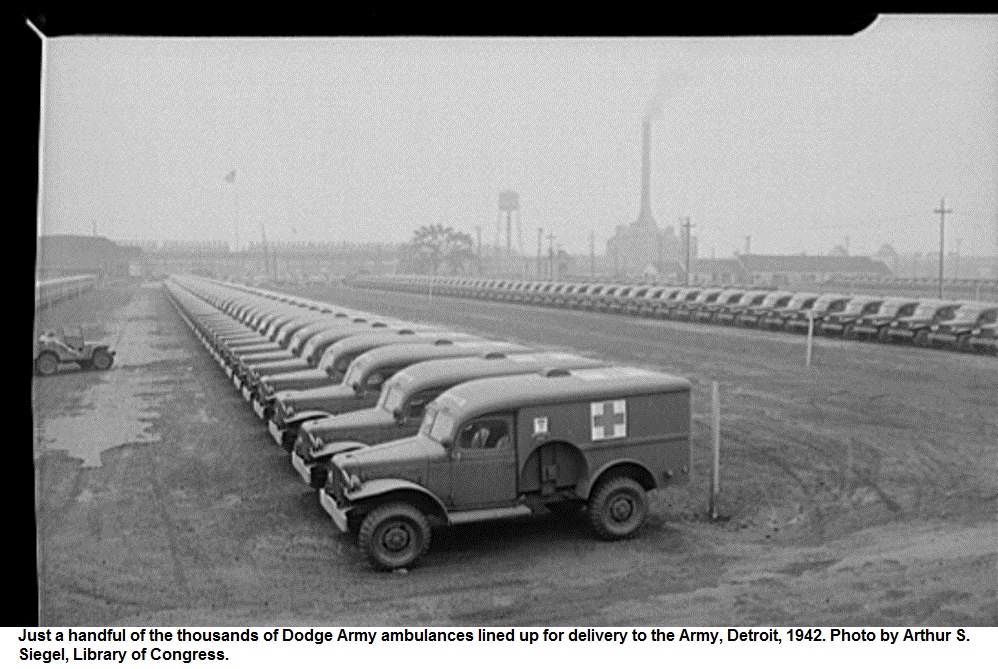
The auto industry retooled to manufacture tanks, trucks, jeeps, airplanes, bombs, torpedoes, steel helmets, and ammunition under massive contracts issued by the government. Beginning immediately after the production of automobiles ceased, entire factories were upended almost overnight. Huge manufacturing machines were jack hammered out of their foundations and new ones brought in to replace them. Conveyors were stripped away and rebuilt, electrical wires were bundled together and stored in the vast factory ceilings, half-finished parts were sent to steel mills to be re-melted, and even many of the dies that had been used in the fabrication of auto parts were sent to salvage.

The government’s Office of Price Administration imposed rationing of gasoline and tires and set a national speed limit of 35 mph.

By April 1944, only 30,000 new cars out of the initial stockpile were left. Almost all were 1942 models and customers required a permit to make the purchase. The Office of Price Administration set the price. The government contemplated rationing used car sales as well, but that was finally deemed unnecessary. The government estimated that about a million cars had been taken off the road by their owners, to reserve for their own use after the war.

In the autumn of 1944, looking then toward the end of the war, Ford, Chrysler, Nash, and Fisher Body of General Motors received authorization from the War Production Board to do preliminary work on experimental models of civilian passenger cars, on condition that it not interfere with war work and that employees so used be limited to planning engineers and technicians. Limits were also set on the amount of labor and materials the companies could divert to this.

During the war, the automobile and oil companies continued to advertise heavily to insure that the public did not forget their brand names. Companies also were proud to proclaim their patriotic role in war production, and their advertisements displayed the trucks, aircraft, and munitions that they were making to do their part in combat.

In addition, auto advertisements encouraged the public to patronize local auto dealers’ service departments so that car repairs could help extend the lives of the cars their customers had bought before the war. In the last couple of years of the war, the auto companies also used their advertisements to heighten public anticipation of the end of the war and the resumption of car and truck manufacturing, with advertising copy such as Ford’s “There’s a Ford in Your Future.”

About the Author

CU Blog - A Lesson in History - Community Ethos of WW II - Photo 2
Historian John Buescher is an author and professor who formerly headed Tibetan language broadcasts at Voice of America. His Ph.D. is from the University of Virginia and he has published extensively on the history of Tibetan and Indian Buddhism and on the history of 19th-century American spiritualism.

Bibliography
a. John Alfred Heitmann, The Automobile and American Life. Jefferson, NC: McFarland, 2009. pp. 119-130.
b. James J. Flink, The Automobile Age. Cambridge: MIT Press, 1988. pp. 275-76.
c. Automobile Manufacturers Association, Freedom’s Arsenal: The Story of the Automotive Council for War Production. Detroit: Automobile Manufacturers Association, 1950.
Teaching History.org – National History Education Clearinghouse (Retrieved 09/29/2014) –
http://www.teachinghistory.org/history-content/ask-a-historian/24088

This relates a commitment so vital to a community that everyone was willing to sacrifice and lean-in for the desired outcome. This requires effective messaging.

The book Go Lean…Caribbean serves as a roadmap for the introduction and implementation of the Caribbean Union Trade Federation (CU); an initiative to bring change, empowerment, to the Caribbean region; to make the region a better place to live, work and play. This Go Lean roadmap also has initiatives to foster a domestic (region-wide) automotive industry. So there are a lot of benefits to glean by studying the American track record, even the periods of halted production. The Go Lean book posits that permanent change for Caribbean society will only take root as a result of adjustments to the community attitudes, the national spirit that drives the character and identity of its people. This is identified in the book as “community ethos”.

The purpose of the book/roadmap though is not just the ethos changes, but rather the elevation/empowerment of Caribbean society. In total, the Caribbean empowerment roadmap has these 3 prime directives:

  • Optimization of the economic engines in order to grow the regional economy to $800 Billion & create 2.2 million new jobs.
  • Establishment of a security apparatus to protect the resultant economic engines.
  • Improve Caribbean governance and industrial policies to support these engines.

The roadmap details the following community ethos, plus the execution of these strategies, tactics, implementation and advocacies to forge the identified permanent change in the region:

Community Ethos – Deferred Gratification Page 21
Community Ethos – Economic Principles – People Choose Page 21
Community Ethos – Economic Principles – People Respond to Incentives in Predictable Ways Page 21
Community Ethos – Economic Principles – The Consequences of Choices Lie in the Future Page 21
Community Ethos – Governing Principles – Lean Operations Page 24
Community Ethos – Governing Principles – Cooperatives Page 25
Community Ethos – Ways to Impact the Future Page 26
Community Ethos – Ways to Help Entrepreneurship Page 28
Community Ethos – Ways to Impact Research & Development Page 30
Community Ethos – Ways to Impact Turn-Arounds Page 33
Community Ethos – Ways to Improve Sharing Page 35
Community Ethos – Ways to Promote Happiness Page 36
Community Ethos – Ways to Impact the Greater Good Page 37
Strategy – Vision – Confederate 30 Member-States Page 45
Strategy – Mission – Foster New Industries Page 46
Tactical – Confederating a Permanent Union Page 63
Tactical – Fostering a Technocracy Page 64
Implementation – Ways to Pay for Change Page 101
Implementation – Ways to Deliver Page 109
Planning – 10 Big Ideas for the Caribbean Page 127
Planning – Ways   to Make the Caribbean Better Page 131
Planning – Reasons   Why the CU Will Succeed Page 132
Planning – Lessons   Learned from 2008 Page 136
Advocacy – Ways to Grow the   Economy Page 151
Advocacy – Ways to Create Jobs Page 152
Advocacy – Ways   to Improve Communications Page 186
Advocacy – Ways   to Develop Auto Industry Page 206
Advocacy – Ways   to Preserve Caribbean Heritage Page 218

Previously Go Lean blog/commentaries have considered historic references and stressed fostering the proper and appropriate community ethos for the Caribbean to prosper. The following sample applies:

https://goleancaribbean.com/blog/?p=2297 A Lesson in History – Booker T   versus Du Bois – to Change a Bad Community Ethos
https://goleancaribbean.com/blog/?p=2201 Changing Bad Community Ethos – Students   Developing Nail Polish to Detect Date Rape Drugs
https://goleancaribbean.com/blog/?p=1918 Philadelphia Freedom – Some Restrictions Apply – One   Community’s Constant Quest to Change
https://goleancaribbean.com/blog/?p=1531 A Lesson in History: 100 Years Ago   Today – World War I – Cause and Effect in Community Ethos
https://goleancaribbean.com/blog/?p=841 Having   Less Babies is Bad for the Economy?
https://goleancaribbean.com/blog/?p=623 Only   at the Precipice, Do Communities Change
https://goleancaribbean.com/blog/?p=353 Book Review: ‘Wrong – Nine   Economic Policy Disasters and What We Can Learn…’
https://goleancaribbean.com/blog/?p=228 Egalitarianism versus Anarchism – Community   Ethos Debate

All in all, there is a certain community ethos associated with populations that have endured crises. It is a focus on the future, a deferred gratification as investment for future returns. These attributes have been promoted by the Go Lean book as necessary traits to forge change in the Caribbean region. We need our own Caribbean flavor of this community ethos, in our manifestation of industrial policy.

The world was at the precipice, near implosion, in 1942 (World War II) … (and again in 2008 during the Great Recession). In order to endure the crises, many people had to endure sacrifice; but the entire community had to adopt the community ethos of deferred gratification. The industrial policy adjusted accordingly, with little objection from the public in general. A lot of good came from these sacrifices.

There are lessons for the Caribbean today to consider from the development of industrial policy in US history during World War II:

• Priorities can change in times of crisis. A crisis is a terrible thing to waste.

• Having a domestic manufacturing industry gives control of domestic production capability.

• Efficiency and effectiveness in one industry can be transferred to other industries; it is disciplined competence that is the real asset.

• Lowest cost is not the only criteria for providing out-sourced contracts.

• Limited raw materials are valuable, even as recycled materials.

• Effective Command-and-Control accentuates front-line effectiveness – Lean operational principles.

• Interdependence with partners can avoid crisis in the first place, and mitigate the damage from realized threats.

Now the Caribbean is in crisis, still reeling from 2008; we must endure, we must sacrifice and we must defer gratification. Now is the time to lean-in to this roadmap for Caribbean change, as depicted in the book Go Lean…Caribbean. We cannot afford to standby and watch our world implode. This was the case in 1942 and again in 2008. We must have a hand in our own destiny; an integrated (Single) market of 42 million people is large enough to be consequential in world negotiations.

We urge all Caribbean stakeholders (residents, Diaspora, governmental leaders, visitors, investors, etc.) to lean-in to this roadmap for change. 🙂

Download the book Go Lean … Caribbean – now!


Share this post:
, , , ,
[Top]

‘Consumer Reports’ Survey Finds the American Consumer is Back

Go Lean Commentary

There are more lessons to learn from the Great Recession of 2007-2008. The lingering effects continue, right up to this day. According to the foregoing news article, only now, 7 years later, are Americans willing to start spending again… on big purchases. Too bad! Many aspects of the US economy depend on regular spending*.

According to the foregoing article, there is value to processing, defining and analyzing economic data associated with the Great Recession; this is the merit of Big Data Analysis. This point aligns with the book Go Lean… Caribbean in that a plan is envisioned to capture raw data, measuring many aspects of Caribbean society, including economic, trade, consumption, macro performance, and societal values. Much can be gleaned from this art and science, mastery of which allows for better stewardship of the Caribbean elevation effort. The news story follows:

SOURCE: Consumer Reports
Seven years after the Great Recession, consumers are finally opening their wallets, making long-delayed purchases and undertaking postponed life decisions

YONKERS, N.Y., Sept. 25, 2014 /PRNewswire-USNewswire/ — The Great Recession of 2007[/2008] caused the once-prolific American shopper to go into a prolonged scrimp mode.  Now, some seven years later – and more than 5 years after the recession officially ended — the tide has turned, according to a groundbreaking Consumer Reports study. A nationally representative survey of 1,006 adult Americans conducted by the ConsumerReportsNationalResearchCenter revealed that people are now in the market for major purchases like homes, cars, and appliances – and that they plan to spend even more money in the coming year.

The full report, “How America Shops Now,” is the cover story for the November 2014 issue of Consumer Reports magazine and is available on newsstands now and at ConsumerReports.org.

So traumatizing was the Great Recession that many Americans put off purchases and personal decisions such as marriage and divorce. Seven out of 10 people told Consumer Reports that they finally feel fiscally stable enough to make up for lost time. Other findings from the survey that point to shoppers’ improved outlook:

  • 64 percent said that they’d dropped big bucks on a major purchase in the past year
  • 46 percent said they bought a new or used vehicle in the past year or intend to buy one in the coming year
  • 12 percent said they’d bought a residence in the past year or intend to do so in the coming year
  • 34 percent said they recently completed or are ready to do a major home-remodeling project
  • 31 percent are holding fewer garage sales
  • 30 percent are taking fewer odd jobs
  • 26 percent of young Americans (aged 18-34) said they were ready to buy a new home; 32 percent believe they can buy a car

“Shoppers may be back, but they’re far from the profligate spenders they used to be. The harsh lessons of the prolonged downturn have had a major impact, perhaps a permanent one,” said Tod Marks, Senior Projects Editor for Consumer Reports.  “Our survey shows that Americans are spending their money very pragmatically, and even though the employment picture has improved, many are working scared – scared about their future job stability and earnings outlook.”

The report also features testimonials from real consumers about their new spending habits. Additional data from CR’s nationally representative survey includes what Americans are most reluctant to cut back on – regardless of the economy, and the pricier items many people feel are still out of reach.  The full report is available in the November issue of Consumer Reports magazine, and online at ConsumerReports.org.

CU Blog - Consumer Reports Survey Finds the American Consumer is Back - PhotoConsumer Reports is the world’s largest independent product-testing organization. Using its more than 50 labs, auto test center, and survey research center, the nonprofit rates thousands of products and services annually. Founded in 1936, Consumer Reports has over 8 million subscribers to its magazine, website and other publications. Its advocacy division, Consumers Union, works for health reform, food and product safety, financial reform, and other consumer issues in Washington, D.C., the states, and in the marketplace.

September 2014
The material above is intended for legitimate news entities only; it may not be used for advertising or promotional purposes. Consumer Reports® is an expert, independent nonprofit organization whose mission is to work for a fair, just, and safe marketplace for all consumers and to empower consumers to protect themselves.  We accept no advertising and pay for all the products we test. We are not beholden to any commercial interest. Our income is derived from the sale of Consumer Reports®, ConsumerReports.org® and our other publications and information products, services, fees, and noncommercial contributions and grants. Our Ratings and reports are intended solely for the use of our readers. Neither the Ratings nor the reports may be used in advertising or for any other commercial purpose without our permission.
CBS News Reporting on Consumer Reports – Thursday, September 25, 2014 – http://www.cbs19.tv/story/26623848/consumer-reports-survey-finds-the-american-consumer-is-back-and-ready-to-spend

VIDEO CBS This Morning: Back to buying: Americans’ spending habits change after recession

(VIDEO plays best in Internet Explorer).

This book Go Lean… Caribbean serves as a roadmap for the introduction and implementation of the technocratic Caribbean Union Trade Federation (CU), the regime to empower Caribbean society. The CU/Go Lean roadmap has 3 prime directives:

  • Optimization of the economic engines in order to grow the regional economy to $800 Billion GDP and create 2.2 million jobs.
  • Establishment of a security apparatus to protect the resultant economic engines against “bad actors”.
  • Improve Caribbean governance to support these engines.

These prime directives recognize that the changes the region needs, new economic engines, will start first with the adoption of new community ethos and controls. Early in the book, the need for this shift is pronounced, (Declaration of Interdependence – Page 13) with these statements:

xxiv. Whereas a free market economy can be induced and spurred for continuous progress, the Federation must install the controls to better manage aspects of the economy: jobs, inflation, savings rate, investments and other economic principles. Thereby attracting direct foreign investment because of the stability and vibrancy of our economy.

xxv. Whereas the legacy of international democracies had been imperiled due to a global financial crisis, the structure of the Federation must allow for financial stability and assurance of the Federation’s institutions. To mandate the economic vibrancy of the region, monetary and fiscal controls and policies must be incorporated as proactive and reactive measures. These measures must address threats against the financial integrity of the Federation and of the member-states.

The Go Lean book, and previous blog/commentaries stress that Big Data Analysis will be key, among the societal controls, in the roadmap for Caribbean elevation. The book references to this analysis are as follows:

Community Ethos – Impact Research and Development Page 30
Community Ethos – Ways to Improve Negotiations Page 32
Strategy – CU Stakeholders – NGO’s need for Big   Data Page 56
Implementation – Security Initiatives at Start-up Page 103
Implementation – Ways to Deliver Page 109
Implementation – Ways to Impact Social Media Page 111
Implementation – Ways to Foster International Aid Page 115
Implementation – Ways to Impact Elections Page 116
Planning – Ways to Improve Failed-State Indices Page 134
Planning – Lessons Learned from 2008 Page 136
Planning – Ways to Measure Progress Page 147
Advocacy – Ways to Mitigate Black Markets Page 165
Advocacy – Ways to Improve Leadership Page 171
Advocacy – Ways to Improve Gun Control Page 179
Advocacy – Ways to Promote Contact Centers Page 212
Advocacy – Ways to Impact Foundations Page 219
Appendix – Application of a Chapter, the Book Art   of War Page 325
Appendix – Electronic Benefits Transfer / e-Payments Page 353

The points of Big Data Analysis for Command-and-Control were further elaborated upon in these previous blog/commentaries:

https://goleancaribbean.com/blog/?p=2105 Recessions and Public Health – Lessons from the 2008 Crisis
https://goleancaribbean.com/blog/?p=2126 Analyzing the Data – Where Are the Jobs Now: Computers Reshaping Global Job Market
https://goleancaribbean.com/blog/?p=2003 Analyzing the Data – Where Are the Jobs Now – One Scenario: Ship-breaking
https://goleancaribbean.com/blog/?p=1763 Analyzing the Data – The World as 100 People – Showing the Gaps
https://goleancaribbean.com/blog/?p=1715 Analyzing the Data – Lebronomy: Economic Impact of the Return of the NBA Great to his Home  City
https://goleancaribbean.com/blog/?p=1433 Analyzing the Data – Caribbean loses more than 70 percent of tertiary educated to brain drain
https://goleancaribbean.com/blog/?p=1296 Analyzing the Data – Remittances to Caribbean Increased By 3 Percent in 2013
https://goleancaribbean.com/blog/?p=841 Analyzing the Data – Having Less Babies is Bad for the Economy?
https://goleancaribbean.com/blog/?p=782 Open/Review the Time Capsule: The Great Recession of 2008
https://goleancaribbean.com/blog/?p=709 Analyzing the Data – Student debt holds back home buyers
https://goleancaribbean.com/blog/?p=518 Analyzing the Data – What Banks learn about financial risks
https://goleancaribbean.com/blog/?p=493 Analyzing the Data – Nigeria’s economy grew by 89% overnight
https://goleancaribbean.com/blog/?p=356 Book Review: ‘How Numbers Rule the World: The Use & Abuse of Statistics in Politics’
https://goleancaribbean.com/blog/?p=242 Analyzing the Data – The Erosion of the Middle Class
https://goleancaribbean.com/blog/?p=235 Analyzing the Data – Tourism’s changing profile

The 2007/2008 Great Recession brought major upheaval to American society. Unfortunately, due to economic inter-connections, this upheaval extended to the Caribbean as well, our economy is structured as individual parasites on the US economy. According to the foregoing news article, the US is now finally returning to their spending habits of old, and yet the Caribbean continues to linger in economic upheaval. There is a need for a change in the Caribbean, from these individual parasite economies to a regional-unified interdependent protégé economy.

The CU/Go Lean roadmap is designed to drive change among the economic, security and governing engines of the region. The change requires new community ethos, strategies, tactics, implementations and advocates; this effort requires Command-and-Control because despite the best efforts and best-practices, success will not come on the first attempt, or second, or third. In fact it will take a continuous effort, again and again, combined with the measurement of the progress, course adjustment and more continuous effort to finally bring the desired result: a better homeland to live, work and play. This result is worth all this effort, all this heavy-lifting.

The foregoing article which discusses the role of of the Consumers Report organizational structure, depicts how technocratic stewardship can greatly impact a community. This is a fitting role model for the CU/Go Lean roadmap in a new Caribbean.

Big Data Analysis is not just for academic consumption, rather it must be for the stewardship, Command-and-Control, of regional economic, security and governing engines. The people and institutions of the region are hereby urged to lean-in to this Go Lean roadmap, to fulfill the vision of making the Caribbean a better place to live, work and play. 🙂

Download the book Go Lean … Caribbean – now!

———

* The Go Lean book details the economic impact of the housing (Pages 161, 207) and automotive (Page 206) industries; these are traditionally “big purchase” items.

Share this post:
, , ,
[Top]

Latin America’s Korean dream

Go Lean Commentary

“Trade and Marketplaces” are great strategies. So says the below news story and VIDEO.

The book Go Lean…Caribbean calls for the introduction and implementation of the Caribbean Union Trade Federation (CU). With that branding “Trade Federation”, obviously there is an emphasis on Trade activities. Why?

The book explained that the proper management of trade can increase wealth. The book relates the following on Page 21:

Voluntary Trade Creates Wealth: People specialize in the production of certain goods and services because they expect to gain from it. People trade what they produce with other people when they think they can gain something from the exchange. Some benefits of voluntary trade include higher standards of living and broader choices of goods and services.

The foregoing article stresses that there is a role model for modern industrial policy in the country/region for Latin America as a whole (and the Caribbean specifically): the East Asian Tigers, or South Korea more specifically.

Sub-title: The case for a modern industrial policy
ONCE again, Latin America has a growth problem. After a dozen golden years of economic expansion and falling poverty, the region is likely to grow by only around 1.5% this year. Argentina, Brazil and Venezuela are suffering recessions of varying severity. Even high-flyers like Peru and Chile have slowed to a crawl; growth in Mexico, where reforms promise much, has yet to take off.

The immediate reasons are not hard to divine. The commodity boom has waned and, in some places, years of fiscal populism are coming home to roost. Low unemployment and a population that is starting to age mean that growth can no longer come from adding workers. If the region is to return to faster expansion, it must raise productivity.

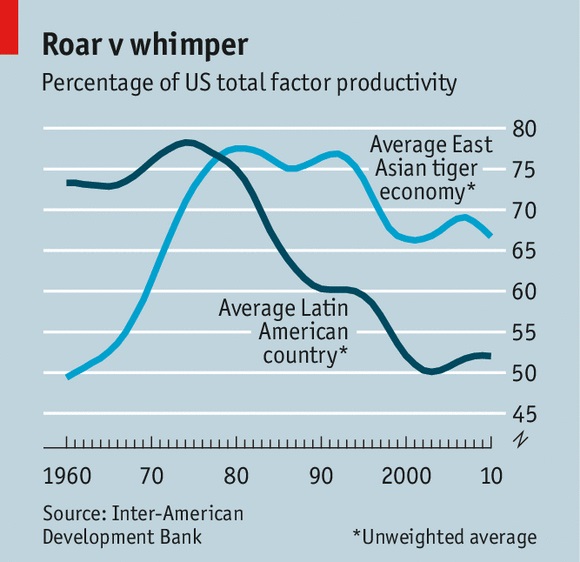
Korean Dream - Photo 1Yet here the region has a lamentable record (see chart) – and for familiar reasons: red tape and the informal economy, poor education and infrastructure, and a lack of competition and credit. But according to a new study* by the Inter-American Development Bank (IDB), there is another factor. Unlike many East Asian countries, Latin America has eschewed state action to stimulate the development of higher-productivity sectors and businesses.

Industrial policy, as it used to be called, went out of fashion in the region in the 1980s, and for good reason. In Latin America it was mainly deployed in the cause of import substitution. All too often, it sheltered favoured low-productivity firms from the foreign competition that would have made them more efficient. In South Korea, by contrast, industrial policy was more ruthless: state help for businesses was temporary and linked to performance in exports and innovation.

Because of this dismal history, the IDB rebrands “industrial policy” as “productive development policies”. That signals not only that such policies should apply to services and farming as well as manufacturing, but also that they should avoid past mistakes. They are justified, the authors caution, only when they aim to develop a latent or potential comparative advantage and when market forces have failed to do this. And the remedy should directly address the market failure.

There is much to do. Latin America is poor at innovation. Spending on research and development in the region, as a share of GDP, is less than half that in developed countries, which have seven times as many researchers per 1,000 workers. Tax breaks can stimulate innovation, especially when they reward the hiring of researchers and collaboration between universities and firms in competitive industries.

State intervention may also be justified in order to overcome “co-ordination failures”—where several firms would potentially benefit but no one will organise a scheme to pay for, say, setting up a temperature-controlled “cold chain” for the export of fruit and vegetables. Costa Rica’s investment agency helped to develop a surgical-devices industry by persuading an American firm to set up a sterilising service in the country. Argentina’s INTA, a public agricultural-technology institute, worked with local farmers to develop more productive strains of rice.

The biggest challenge is for the state to incubate new higher-value industries—without falling prey to special pleading. There are several such success stories in Latin America. The origins of Embraer, a Brazilian aircraft manufacturer, lie in a public aeronautical-technology institute. Fundación Chile, a private development agency with a public-policy remit, created a salmon-farming industry. But such initiatives will work only if governments have the technical and institutional capacity to carry them out, the IDB warns. It thinks projects should be subject to external evaluation. South   Korea’s example suggests that sunset clauses in state support and subjecting firms to the discipline of foreign competition is crucial.

Some chapters of the IDB study are indigestible, written for economists rather than politicians. It pulls some punches: although it criticises the protection of rice farmers in small Costa Rica, it is silent about the recent use of subsidies and protection in Brazil and Argentina to cosset declining or established industries.

But its argument for a modern industrial policy is timely. Indeed, it is already being applied. This year Peru’s production minister, Piero Ghezzi, unveiled a “productive diversification plan”, the first step of which is the opening of ten technological-innovation centres. Peruvian man cannot live by mining alone. Sensible government policies can help.
The Economist Magazine (Retrieved 09/20/2014) – http://www.economist.com/news/americas/21618785-case-modern-industrial-policy-latin-americas-korean-dream

——

* “Rethinking Productive Development: Sound Policies and Institutions for Economic Transformation”, edited by Gustavo Crespi, Eduardo Fernández-Arias and Ernesto Stein, IDB

The foregoing article indicates that Latin America countries can do better in managing their industrial policy and macro-economics. This point is stressed in the Go Lean book, pronounced in the opening Declaration of Interdependence – Page 13:

xxiv.Whereas a free market economy can be induced and spurred for continuous progress, the Federation must install the controls to better manage aspects of the economy: jobs, inflation, savings rate, investments and other economic principles. Thereby attracting direct foreign investment because of the stability and vibrancy of our economy.

The Go Lean roadmap calls for confederating 30 member-states of the Caribbean, despite their language and legacy, into an integrated “single market. The resulting entity will increase trade within the region and with the rest of the world, increasing the economy (GDP) from $378 Billion (per 2010) to $800 Billion. This growth is based on new jobs, industrial output and lean operational efficiency.

The Go Lean book posits that this growth is only possible with the integrated economy, not with individual member-states growing on their own, “the whole is worth more than the sum of its parts“. But economic issues alone do not complete the solution, in fact the CU roadmap cites these 3 prime directives:

  • Optimization of the economic engines so as to grow the regional economy to $800 Billion and create 2.2 million new jobs.
  • Establishment of a security apparatus (with prosecutorial powers for economic crimes) so as to mitigate the eventual emergence of “bad actors”.
  • Improve Caribbean governance.

Growth in the Caribbean is a strong theme for the Go Lean… Caribbean book and a frequent topic for these Go Lean blogs. These points of economy, security and governance have also been detailed in previous Go Lean blogs/commentaries. The following is a sample:

The following is a sample:

https://goleancaribbean.com/blog/?p=2372 Corporate Tax Dodging – Transfer Policing
https://goleancaribbean.com/blog/?p=2338 Welcoming New Business from the Dreaded Plutocracy
https://goleancaribbean.com/blog/?p=2126 Where the Jobs Are – Computers Reshaping Global Job Market
https://goleancaribbean.com/blog/?p=2003 Where the Jobs Are – One Scenario: Ship-breaking
https://goleancaribbean.com/blog/?p=1869 US Senate bill targets companies that move overseas
https://goleancaribbean.com/blog/?p=1731 Role Model Warren Buffet – An Ode to Omaha
https://goleancaribbean.com/blog/?p=1609 Cuba mulls economy in Parliament session
https://goleancaribbean.com/blog/?p=1554 Status of Forces Agreement = The Caribbean Approach for a Regional Security Pact
https://goleancaribbean.com/blog/?p=1416 Amazon, a model of a Trade Marketplace, and its new FIRE Smartphone
https://goleancaribbean.com/blog/?p=949 Inflation Matters – The CU‘s Approach for Macro-Economic Efficiency
https://goleancaribbean.com/blog/?p=888 Book Review: ‘Citizenville – Take the Town Square Digital and Reinvent Government’
https://goleancaribbean.com/blog/?p=833 CU Strategy: One currency, divergent economies
https://goleancaribbean.com/blog/?p=689 eMerge Conference Aims to Jump-start Miami Tech Hub in Exploiting Latin America Trade
https://goleancaribbean.com/blog/?p=476 Grenada PM Urges CARICOM on ICT to Grow Economy
https://goleancaribbean.com/blog/?p=360 How the CU/CCB will Create Money from Thin Air
https://goleancaribbean.com/blog/?p=308 CARCIP Urges Greater Innovation to Grow Economy

Now the foregoing news article points that there is value in analyzing the transformation of the East Asian nation-states. These countries provide great lessons, samples and examples of convergence, in which under-developed countries apply the catch-up principle to grow their economies to “developed” status. The Go Lean book details this progress (Page 69) for the sample countries of Singapore, Hong Kong, Taiwan and South Korea.

The CU roadmap likewise drives change among economic, security and governing engines to guide the Caribbean member-states to the destination of elevated societies – a better place to live, work and place. This change is based on new community ethos, strategies, tactics, implementations and advocates; sampled as follows:

Community Ethos – Economic Principles – People Choose Page 21
Community Ethos – Economic Principles – All Choices Involve Costs Page 21
Community Ethos – Economic Principles – People Respond to Incentives Page 21
Community Ethos – Economic Principles – Economic Systems Influence Choices Page 21
Community Ethos – Economic Principles – Voluntary Trade Creates Wealth Page 21
Community Ethos – Economic Principles – The Consequence of Choice Lie in Future Page 21
Community Ethos – Money Multiplier Page 22
Community Ethos – Job Multiplier Page 22
Community Ethos – Security Principles Page 22
Community Ethos – Governing Principles Page 24
Community Ethos – Lean Operations – GPO’s Page 24
Community Ethos – Return on Investments Page 24
Community Ethos – Cooperatives Page 25
Community Ethos – Ways to Help Entrepreneurship Page 28
Community Ethos – Ways to Impact Research and Development Page 30
Community Ethos – Ways to Close the Digital Divide Page 31
Community Ethos – Ways to Impact Turn-arounds Page 33
Community Ethos – Ways to Improve Sharing Page 35
Strategy – Agents of Change – Globalization Page 57
Tactical – Confederating a Permanent Union Page 63
Tactical – Growing the Economy to $800 Billion – Convergence of East Asian Tigers Page 67
Implementation – Ways to Pay for Change – GPO’s Page 101
Implementation – Foreign Policy Start-up Initiatives Page 102
Implementation – Security Initiatives at Start-up Page 103
Implementation – Ways to Optimize Mail Service & myCaribbean.gov Marketplace Page 108
Implementation – Ways to Improve Energy Usage Page 113
Implementation – Ways to Benefit from Globalization Page 119
Planning – Ways to Improve Trade – GPO’s Page 128
Planning – Ways to Improve Interstate Commerce Page 129
Planning – Ways to Measure Progress Page 147
Advocacy – Ways to Grow the Economy Page 151
Advocacy – Ways to Create Jobs Page 152
Advocacy – Ways to Control Inflation Page 153
Advocacy – Ways to Mitigate Black Markets Page 165
Advocacy – Ways to Improve Governance Page 168
Advocacy – Ways to Foster Cooperatives Page 176
Anecdote – Caribbean Industrialist Page 189
Advocacy – Ways to Foster Technology – Incubators   Strategy Page 197
Advocacy – Reforms for Banking Regulations Page 199
Advocacy – Ways to Impact Wall Street Page 200
Advocacy – Ways to Impact Main Street Page 201
Advocacy – Ways to Develop / Foster <specific> Industries Page 206

The foregoing news article identifies new industrial policies for Latin America. But the focus of the book Go Lean…Caribbean and accompanying blogs is the Caribbean alone, a sub-set of Latin America. Trade is very much critical to the strategies to grow the regional economy. Increased trade will undoubtedly mean increased job opportunities. The CU/Go Lean plan is to foster and incubate key industries for this goal, incorporating suggestions, recommendations and best-practices as related in the foregoing article. This too was pronounced early in the opening Declaration of Interdependence (Page 14), as follows:

xxvi. Whereas the Caribbean region must have new jobs to empower the engines of the economy and create the income sources for prosperity, and encourage the next generation to forge their dreams right at home, the Federation must therefore foster the development of new industries, like that of ship-building, automobile manufacturing, prefabricated housing, frozen foods, pipelines, call centers, and the prison industrial complex.

Despite many previous efforts to expand Caribbean trade, this new Go Lean effort takes a novel approach, that of the Trade Federation. This entity would do the heavy-lifting of elevating the Caribbean economy, security and governing engines. This roadmap would include a “marketplace”, with all the dimensions highlighted in the following VIDEO:

Video: https://www.youtube.com/watch?v=BUp3Q6O8IYg

For the Caribbean, the status quo cannot continue. It is time for the region, the people and institutions, to lean in to this roadmap for change, to make the Caribbean a better place to live, work and play. It is worth the effort and investment.  🙂

Download the free e-Book of Go Lean … Caribbean – now!

Share this post:
, ,
[Top]

How ‘The Lion King’ roared into history

Go Lean Commentary

There is money in the ‘Arts’.

One “Broadway” musical play, The Lion King has made $6.21 billion. That is significant. In fact that is a record, according to the foregoing news article:

By: Alison Boshoff

CU Blog - How the Lion King roared into history - Photo 1Title: How The Lion King roared into history: As show is crowned biggest box office earner ever, the secrets of its success emerge

Hakuna Matata!

Sir Elton John has long observed that The Lion King musical ‘is a law unto itself’ — and how so.

After more than a decade of performances in cities all over the world, it was confirmed this week that the stage show is the biggest beast in the jungle.

The Lion King — based on the 1994 Disney film of the same name — has taken more money at the box office than any other production in history.

Since its first night on Broadway in 1997, the show has made more than £3.8 billion ($6.21 billion) in ticket sales alone.

Not only has it conquered the stage, it has massively out-earned every cinema release — including blockbusters such as James Cameron’s Avatar, which took a mere £1.7 billion ($2.78 billion) globally after its 2009 release.

A further fortune has been made in souvenir T-shirts, posters and the rest. At the last count, there were eight different cast recordings of the show’s songs on sale.

Featuring music by Sir Elton John and lyrics by Sir Tim Rice, The Lion King opened in Minneapolis in July 1997 before moving to Broadway in November that year.

CU Blog - How the Lion King roared into history - Photo 2It arrived at the Lyceum Theatre in London’s West End in October 1999 and currently takes more than £30 million ($49 million) a year in the UK.

A STORY WITH BITE

The musical tells the story of Simba, a lion cub born on the Serengeti who runs away from his pride when his father Mufasa dies.

Aided by his friends, he must defeat his evil uncle Scar, who engineers Mufasa’s death in a stampede and convinces Simba he was to blame, to reclaim his rightful position as king.

THE MAGIC FORMULA

According to music historian Cary Ginell, the musical is a ‘spectacle that satisfies’ on many different levels.

‘For the kids, it’s the visual elements, the colours, the costumes and the puppetry,’ he says. ‘For the adults, it’s Hamlet.’

Many have noted the parallels between Disney’s and Shakespeare’s plots, which both feature a murdered king avenged by his rightful heir.

GOING GLOBAL

Disney says that the 22 Lion King productions around the world have been seen by an estimated 75 million people. That’s the entire population of the United Kingdom, plus the population of Belgium.

Last year, it was the highest-grossing musical on the New York stage, and it retains its number-one position so far in 2014. It has always been a sell-out in London.

MONEY MATTERS

Disney dipped its toe in the water with a Broadway version of its Oscar-winning Beauty And The Beast before pouring an estimated £6.5 million ($10.62 million) into staging The Lion King — the most expensive show ever staged.

THE STAGE GURU

CU Blog - How the Lion King roared into history - Photo 4In a colossal creative gamble, Disney hired Julie Taymor, an avant garde director who had trained in mime in Paris and spent years studying Japanese and Indonesian theatre.

Taymor thought the film ‘superficial’. She said: ‘I had to make The Lion King my own. Otherwise it’s a Disney product and I don’t like the way Disney looks.’

WE NEED A HEROINE!

Taymor’s great visual innovation was using puppetry, masks and mechanical headpieces to portray the animals. When the lions cry, they pull rolls of white silk from their masks’ eye holes; the actors playing giraffes walk on stilts.

The drought that ravages the savannah is illustrated by a dwindling waterhole — a circle of silvery material that shrinks as it is pulled across the stage.

There were other changes, too: the stage production has more songs than the film; and Rafiki, the baboon with mystic powers, became a ‘she’, as Taymor felt that the film lacked a leading female character.

CU Blog - How the Lion King roared into history - Photo 3A STAMPEDE FOR SEATS

In the immediate aftermath of its Broadway debut, there were reports of pushy New York parents putting their children’s names down for theatre tickets years in advance.

At one point seats were reselling for up to ten times their face value. Things have since calmed down, but a ticket to the London production costs at least £27.50 ($44.92) a seat.

THE CRITICS’ VERDICT

‘Visually breathtaking,’ said the New York Times. ‘Pure, exhilarating theatre, unlike anything ever seen on Broadway,’ cheered USA Today.

But not everyone was convinced. One critic who saw the show open in London’s West End wrote that once the last Zulu drum had fallen silent, a tiny part of him was left whispering: ‘So what?’

Catch it immediately, he said, thinking it was not destined to run and run. Oops.

And the late, great Sheridan Morley opined: ‘A lot of people say, “This is not real theatre. It’s theatre by way of the movies, or by way of the theme park.” It’s Disneyfication, if you like.’

STARS IN THEIR AISLES

Celebrities including Dame Judi Dench, Dame Shirley Bassey, model Claudia Schiffer and former Spice Girl Geri Halliwell attended the opening night in London.

All said that they had been moved to tears and ovations. Dame Judi said afterwards: ‘I don’t want to be in any play in the future where an elephant doesn’t walk down the aisle.’

But the show has not brought in big-name stars to fill seats, instead relying on talented ensemble casts.

SPOOKING THE PHANTOM

Even though twice as many paying punters have seen Andrew Lloyd Webber’s long-running The Phantom Of The Opera, The Lion King’s steeper ticket prices and larger theatres mean its earnings are greater.

THAT’S ENOUGH, ZAZU

Zazu the hornbill’s big musical number, The Morning Report, was cut from the show in 2010, making the show nine minutes shorter.

ELTON’S CASH COW

No one will say how much Sir Elton was paid for licensing his melodies for The Lion King film — such as the hit Can You Feel The Love Tonight — to be used in the stage version.

What can be noted is that pre-Lion King his annual income was said to stand at around £12 million ($19.6 million) a year. More recently, Forbes magazine put it at £48 million ($78.4 million) a year.

ONCE MORE WITH FEELING

Buoyed by The Lion King’s success, Sir Elton was then involved in two musicals: Aida, which had minor success, and Lestat, based on Anne Rice’s gothic novels about an 18th-century nobleman turned vampire. That was a thumping disaster and closed after 39 performances in 2005.

He stepped back into the world of musical theatre that year with the hugely popular Billy Elliot — though he did tell an interviewer in 2011: ‘Just between you, me and the gatepost, I’m not really a lover of musicals.’

MAN BEHIND THE MUSIC

The show is completed by the music of South African composer Lebo M, who was exiled to America in 1979 after student riots in Soweto.

He told the South Bank Show: ‘The Lion King is not necessarily political, but I could relate to the life of Simba, a young cub who grows up in exile and goes back to fight for his country.’
The Daily Mail – London’s Daily Newspaper (Posted September 23, 2014) – http://www.dailymail.co.uk/tvshowbiz/article-2767423/How-Lion-King-roared-history-As-crowned-biggest-box-office-earner-secrets-success.html

This news story aligns with the book Go Lean…Caribbean in stressing the economic impact of artistic and entertainment endeavors. The book asserts that Caribbean society can be elevated by improving the eco-system to live, work and play. Broadway-style theatrical productions come under the category of “play”.

The book Go Lean…Caribbean strives to accomplish this elevation vision by serving as a roadmap for the introduction and implementation of the technocratic Caribbean Union Trade Federation (CU). There is a lot involved in this vision; the prime directives are stated as follows:

  • Optimization of the economic engines in order to grow the regional economy to $800 Billion & create 2.2 million new jobs.
  • Establishment of a security apparatus to protect the resultant economic engines.
  • Improve Caribbean governance to support these engines.

“Art imitates Life and Life imitates Art” – Literary expression.

There is another message from this commentary/blog, that one person, a role model, can make a difference in transforming society. The Go Lean roadmap stresses the mission of creating jobs in the areas of Science, Technology, Engineering and Medicine (STEM), but it also recognizes that many people show ‘genius qualifiers’ in unrelated areas: music, visual arts, performing arts, sports and theatrical endeavors. This point is pronounced early in the following statements in the book’s Declaration of Interdependence (Page 14):

xxi. Whereas the preparation of our labor force can foster opportunities and dictate economic progress for current and future generations, the Federation must ensure that educational and job training opportunities are fully optimized for all residents of all member-states, with no partiality towards any gender or ethnic group. The Federation must recognize and facilitate excellence in many different fields of endeavor, including sciences, languages, arts, music and sports. This responsibility should be executed without incurring the risks of further human flight, as has been the past history.

xxxii. Whereas the cultural arts and music of the region are germane to the quality of Caribbean life, and the international appreciation of Caribbean life, the Federation must implement the support systems to teach, encourage, incentivize, monetize and promote the related industries for arts and music in domestic and foreign markets. These endeavors will make the Caribbean a better place to live, work and play.

There are economic and image considerations with this subject. The Go Lean book accepts that “show business” can have an impact on society and the world, as also depicted in the foregoing article. Already, this commentary has analyzed the Broadway play “Motown, The Musical” and contributions of role model Berry Gordy.

The Go Lean roadmap accepts that change has come to “show business” (Music, Film, Visual Art and Theater). This is due mostly to the convergence of technology (the internet to be exact). The book posits that [market] “size no longer matters”, that content can be created in any location in the world and then distributed to an appreciative audience anywhere. The first requirement is the community ethos of valuing Intellectual Property. This ethos would be new, a change, for the Caribbean.

Today, most Intellectual Property is consumed digitally with a lot of retailing via the World-Wide-Web. This changed landscape now requires new tools and protections, like electronic payment systems, digital rights management and Performance Rights Organizations. The Go Lean/CU roadmap details these solutions. With these efforts and investments, the returns will be undeniable.

To harvest these investment returns, there is the need for some technocratic facilitations. The book posits that this burden is too big for any one Caribbean member-state, and thus the collaboration efforts of the CU is necessary, as the strategy is to confederate all the 30 member-states of the Caribbean despite their language and legacy, into an integrated “single market”. This will allow for better leverage of the consumer market for the consumption of media.

The CU is designed to do the heavy-lifting of organizing Caribbean society. The following list details the ethos, strategies, tactics, implementations and advocacies to foster a similar successful path like The Lion King on the world stage:

Community Ethos – Forging Change Page 20
Community Ethos – Lean Operations Page 24
Community Ethos – Return on Investments Page 24
Community Ethos – Ways to Foster Genius Page 27
Community Ethos – Help Entrepreneurship Page 28
Community Ethos – Promote Intellectual Property Page 29
Anecdote – Valedictorian Experience Page 38
Strategy – Strategy – Caribbean Vision Page 45
Strategy – Agents of Change – Globalization Page 57
Separation of Powers – Central Bank – Electronic Payment Deployments Page 73
Tactical – Separation of Powers – Patents & Copyrights Office Page 78
Separation of Powers – Culture Administration Page 81
Planning – Ways to Make the Caribbean Better Page 131
Planning – Lessons Learned from New York City Page 137
Advocacy – Ways to Grow the Economy Page 151
Advocacy – Ways to Create Jobs Page 152
Advocacy – Education – Performing Arts Schools Page 159
Advocacy – Reforms for Banking Regulations Page 199
Advocacy – Ways to Impact Hollywood Page 203
Advocacy – Ways to Improve the Arts Page 230
Advocacy – Ways to Promote Music Page 231
Advocacy – Impact Urban Living – Art & Theaters Page 234
Appendix – New York / Broadway / Theater Jobs Page 277
Appendix – Caribbean Music Genres Page 347
Appendix – Protecting Music Copyrights Page 351

Considering the experience of Julie Taymor in the foregoing article, the Go Lean roadmap asserts that one man, or woman, can make a difference in the quest to elevate Caribbean society. We want to foster any ‘genius qualifiers’ found within the region. This refers to “on stage/on camera” talent and behind-the-scenes talent, like Ms. Taymor.

The Go Lean/CU roadmap represents the change that has come to the Caribbean. The people, institutions and governance of the region are all urged to “lean-in” to this roadmap for change. We know there is a “new” Julie Taymor somewhere in the Caribbean member-states, waiting to be fostered.

This will not be the first time a Caribbean artist has impacted the world with his/her artistic contributions. We have the proud legacy of Bob Marley and his musical genius. His songs are sung and hummed around the world:

i.e. Song: One Love – “Let’s get together and feel alright”

He is so recognizable that he is considered an icon.

The movie and Broadway play, The Lion King, is also iconic… and impactful. Consider the experience of this “Cast” flash-mob / song-and-dance depicted in this video:

THE LION KING Australia: Cast Sings Circle of Life on Flight Home from Brisbane
https://www.youtube.com/watch?v=wgSLxl1oAwA

Download the book Go Lean … Caribbean – now!

Share this post:
, , , , ,
[Top]

CARICOM calls for innovative ideas to finance SIDS development

Go Lean Commentary

“The pot calling the kettle black” – Old adage

It seems so out of place for Irwin LaRocque, the CEO of the Caribbean Community (CariCom) to lecture other nation-states on how they should restructure their finances, considering the fact that the CariCom organization admits that their own finances are ‘in shambles’.

But still, the purpose of this commentary is to first applaud Mr. LaRocque for identifying better options (in the news article here), and then to direct his attention (and by extension, the entire Caribbean and the rest of the world) to a published ‘better option’ for SIDS financing: the book Go Lean … Caribbean.

Title: CARICOM Secretary-General calls for innovative alternatives to finance SIDS development

SIDS Photo 1APIA, Samoa — Even as the Small Island Developing States (SIDS) examined the issue of financing sustainable development for SIDS in Apia, Samoa, CARICOM secretary-general Irwin LaRocque has suggested the need for new and innovative alternatives.

Moderating a side event titled “Financing for Sustainable Development in SIDS”, during the four-day international conference on Small Island Developing States, LaRocque said there may be a role for innovative public and private financial instruments such as counter-cyclical loans, which temporarily halt existing debt service payments when shocks strike.

He highlighted financing instruments such as the Caribbean Catastrophe Risk Insurance Facility (CCRIF) that provide cash flow support immediately following an insured catastrophe, as well as financing opportunities presented by the recent rise in South-South cooperation.

He stated: “Emerging donors have become increasingly important sources of both aid and loan finance for many Small Island Developing States. This development — which looks set to continue — provides SIDS with important opportunities to secure new and additional sources of development finance, as well as opportunities to learn from other countries’ recent development experiences.”

“It is important to foster greater transparency in such flows, and to ensure that debt sustainability concerns are also kept in view,” the Secretary-General cautioned however.

Continuing on the issue of resource mobilization, LaRocque acknowledged that improving domestic resource mobilization capacities was also important. He informed that several SIDS have established special funds or programmes to channel more domestic resources to environmental and conservation programmes but, despite progress, challenges remain, and for many SIDS, domestic investment will need to be supplemented by international funding given the high up-front costs of many investments.

According to the Secretary-General, financing for development to reach set multilateral development goals required innovating instruments to mobilise domestic and international development funding that involve traditional and non-traditional donors, so as to increase private sector investment and public-private capital flows in support of development.

Noting that the overall financing needs for SIDS were not only large, but were also “very difficult” to quantify based on their level of vulnerability and exposure to external shocks, the CARICOM Secretary-General said that the Caribbean had been plagued with losses equivalent to over one percent of GDP to natural disasters since the early 1960s. He referenced Saint Lucia, St Vincent and the Grenadines, and Dominica in which losses were estimated at US$108 million for St Vincent and the Grenadines and US$99 million for Saint   Lucia in December 2013.

He added that while Official Development Assistance (ODA) and climate finance were important sources of funds for many Small Island Developing States, the proportion of overall aid allocated to SIDS was small, on the decline and heavily concentrated in just a few countries. .

“Suffice it to say, more financing will be needed to support not only countries’ long-term development, but also to address sudden major shocks such as the extreme weather events,” he said.

The Secretary-General stressed that the debt challenges facing many SIDS were compounded by the stance of the multilateral financial institutions regarding access to concessional resources by those states classified as middle income developing countries.

“The use of the narrow criteria of per capita gross national income in excess of US$1,035 (in 2013) to confer ‘middle income status’ on developing countries does not take into account the peculiar vulnerabilities, economic fragilities and lack of resilience of many SIDS including those in the Caribbean,” LaRocque also said.

The Caribbean Community had a high-level delegation at the conference which included Freundel Stuart, Prime Minister of Barbados; Dr Keith Mitchell, Prime Minister of Grenada; Dr Denzil Douglas, Prime Minister of St Kitts and Nevis, and ministers of government of CARICOM member states.
———————
The Strategic Plan for Caribbean Community (2015-2019) can be found here: http://caricom.org/jsp/secretariat/caribbean-community-strategic-plan.jsp

Family Photo of the Third International Conference on Small Island Developing States

The foregoing news article strongly identified the need for public and private financial instruments which are innovative compared to the status quo. This point aligns with the book Go Lean … Caribbean that presents a 370-page roadmap for re-booting, re-organizing and restructuring the economic, homeland security and governmental institutions in the Caribbean region. Government revenue/finance issues are covered in great details in the roadmap; the following is just a sample of some of the innovative government funding/revenue products featured in the book:

Re-insurance sidecars
Marketable Warrants
Tax Liens

The ‘shambled’ state of CariCom has frequently been featured in previous Go Lean blog/commentaries. As sampled here:

https://goleancaribbean.com/blog/?p=1193 EU willing to fund study on cost of not having CARICOM
https://goleancaribbean.com/blog/?p=1014 Jack M. Mintz: All is not well in the sunny Caribbean
https://goleancaribbean.com/blog/?p=816 The Future of CariCom
https://goleancaribbean.com/blog/?p=451 CARICOM Chairman to deliver address on reparations
https://goleancaribbean.com/blog/?p=346 Caribbean leaders convene for CARICOM summit in St Vincent
https://goleancaribbean.com/blog/?p=308 CariCom Agency CARCIP Urges Greater Innovation

The Go Lean book delves into innovative ideas for funding member-states’ treasuries. The book serves as a roadmap for the introduction and implementation of the technocratic Caribbean Union Trade Federation (CU). While federal governments normally bring a new level of governmental overhead and thus a new thirst for public finances, this one is different. The CU pledges to “give, not take”. This pledge is embedded in the Declaration of Interdependence, pronouncing as follows, (Page 12):

xiv. Whereas government services cannot be delivered without the appropriate funding mechanisms, “new guards” must be incorporated to assess, accrue, calculate and collect revenues, fees and other income sources for the Federation and member-states. The Federation can spur government revenues directly through cross-border services and indirectly by fostering industries and economic activities not possible without this Union.

The Go Lean book posits that the “whole is worth more than the sum of its parts”, that from this roadmap Caribbean economies will grow individually and even more collectively as a Single Market. This roadmap advocates the optimization of the economic and security engines and projects that the region’s economy will grow from $378 Billion (2010) to $800 Billion in a 5 year time span. The natural result of this effort is that government revenues can and will grow.

As related in the roadmap, the 3 CU prime directives include the optimization of the economic engines, establishment of a security apparatus to protect the resultant economic engines, and also the improvement of Caribbean governance to support these new engines.

The Go Lean roadmap therefore accepts a mission to re-structure facets of Caribbean governance with these pronouncements at the outset of the book, in the Declaration of Interdependence, as follows (Page 12):

xiii. Whereas all men are entitled to the benefits of good governance in a free society, “new guards” must be enacted to dissuade the emergence of incompetence, corruption, nepotism and cronyism at the peril of the people’s best interest. The Federation must guarantee the executions of a social contract between government and the governed.

The book purports that many of the revenues systems (such as identified above) are too complex for many individual Small Island Development States (SIDS) alone, and so the CU would be better suited to provide the economies-of-scale necessary for efficient deployment. This is part-and-parcel of the technocracy of the CU.

The following details from Go Lean…Caribbean the community ethos, strategies, tactics, implementation and advocacies to deploy efficient and effective government revenue options:

Community   Ethos – Lean Operations Page 24
Community   Ethos – Cooperatives Page 25
Community   Ethos – Ways to Improve Sharing Page 35
Strategy –   Customers – Member-State Governments Page 51
Strategy –   Agents of Change – Technology Page 57
Tactical –   Fostering a Technocracy Page 64
Anecdote –   Turning Around the CARICOM construct Page 92
Anecdote –   “Lean” in Government Page 93
Implementation   – Ways to Pay for Change Page 101
Implementation   – Ways to Deliver Page 109
Implementation   – Ways to Foster International Aid Page 117
Advocacy –   Ways to Improve Governance Page 168
Advocacy –   Better Manage the Social Contract Page 170
Advocacy –   Revenue Sources … for Administration Page 172
Advocacy –   Ways to Foster Technology Page 197
Advocacy –   Ways to Foster e-Commerce Page 198

According to the foregoing news article, there is a preponderance of SIDS to look to the international community for aid. The Go Lean book describes this dependent attitude as “parasite” and instead advocates for change: a more “protégé” approach.

The Go Lean book calls on the Caribbean region to be collectively self-reliant, to act more proactively and responsively for our own emergencies and natural disaster events. This means better, more efficient governance.  A previous Go Lean commentary demonstrated how governments can be transformed through technology and efficient deliveries, by highlighting a review of the relevant book by the California Lieutenant Governor and former Mayor of San Francisco Gavin Newsom: Citizenville – How to Take the Town Square Digital and Reinvent Government.

Now is the time for all of the Caribbean, the people and governing institutions, to lean-in for these types of innovative changes described in the book Go Lean … Caribbean. The benefits are too alluring to ignore: dawn of new governing and economic engines… and dawn of new opportunities. With some success, this would simply mean: a better place to live, work and play. 🙂

Download the book Go Lean … Caribbean – now!


Share this post:
, ,
[Top]

Welcoming the Dreaded ‘Plutocracy’

Go Lean Commentary

 Plutocracy 2

It is not nice to be called a plutocracy, it’s almost considered a derogatory term – see Appendix below. It simply refers to the undue influence that a super-rich minority group can have on a nation.

The dread of plutocracies is not new, societies have contended with them since the dawn of civilization (Ancient Greece and Rome). Many countries in the Caribbean had de facto plutocracies during their colonial years (Montserrat, Belize and the Bahamas’s Bay Street Boys come to mind), just as a natural off-shoot from a mono-industrial economy (sugar, coffee, tobacco planters). Considering existing plutocracies today, like the City of London and Wall Street, we see that an appropriate strategy can allow a society to “bottle the plutocratic concept” and use it for good.

There is currency to this discussion. Award winning documentary film-maker Ken Burns is debuting his new production on The Roosevelts on PBS in the United States, starting tonight (Sunday September 14, 2014). When we consider the lives and advocacies of Theodore, Franklin and Eleanor Roosevelt, we see that there was a consistent urging to take on big business/special interest (plutocratic endeavors) to benefit the working-class man/woman of America. The following is the synopsis of the documentary:

Plutocracy 1The Roosevelts: An Intimate History chronicles the lives of Theodore, Franklin and Eleanor Roosevelt, three members of the most prominent and influential family in American politics. It is the first time in a major documentary television series that their individual stories have been interwoven into a single narrative.  This seven-part, fourteen hour film follows the Roosevelts for more than a century, from Theodore’s birth in 1858 to Eleanor’s death in 1962. Over the course of those years, Theodore would become the 26th President of the United States and his beloved niece, Eleanor, would marry his fifth cousin, Franklin, who became the 32nd President of the United States. Together, these three individuals not only redefined the relationship Americans had with their government and with each other, but also redefined the role of the United States within the wider world. The series encompasses the history the Roosevelts helped to shape: the creation of National Parks, the digging of the Panama Canal, the passage of innovative New Deal programs, the defeat of Hitler, and the postwar struggles for civil rights at home and human rights abroad. It is also an intimate human story about love, betrayal, family loyalty, personal courage and the conquest of fear.

A film by Ken Burns. Written by Geoffrey C. Ward. Produced by Paul Barnes, Pam Tubridy Baucom and Ken Burns.

The Roosevelts airs for a week starting September 14, 2014.

http://www.pbs.org/kenburns/films/the-roosevelts

The idea of “bottling” plutocratic institutions for the Greater Good is a “big idea” in the book Go Lean…Caribbean. How exactly is this envisioned? The answer provided in the book is that of Self-Governing Entities (SGE).

The Go Lean book delves into this approach of inviting the super-rich to establish industrial parks, corporate campuses and research parks in bordered territories in the Caribbean. These entities would be governed solely by the technocratic Caribbean Union Trade Federation (CU). The Go Lean book serves as a roadmap for the introduction and implementation of the CU and SGE’s.

The approach of the Go Lean roadmap is not to punish the super-rich for their success nor cower to any special interests group at the expense of the greater population.

Too bad this approach has not been employed in the US.

Many previous Go Lean blog/commentaries stressed the changes on American society (and by extension, other communities including the Caribbean) due to plutocratic abuses of corporations, super-rich individuals/institutions and special-interest groups, especially since 2008. The following sample applies:

https://goleancaribbean.com/blog/?p=2259 The Criminalization of American Business
https://goleancaribbean.com/blog/?p=2183 A Textbook Case of Price-gouging
https://goleancaribbean.com/blog/?p=2126 Where the Jobs Are – Computers Reshaping Global Job Market
https://goleancaribbean.com/blog/?p=1869 Senate bill targets companies that move overseas
https://goleancaribbean.com/blog/?p=926 Conservative heavyweights have solar industry in their sights
https://goleancaribbean.com/blog/?p=789 America’s War on the Caribbean
https://goleancaribbean.com/blog/?p=782 Open the Time Capsule: The Great Recession of 2008
https://goleancaribbean.com/blog/?p=546 Book Review: ‘The Divide’ – American Injustice in the Age of the Wealth Gap
https://goleancaribbean.com/blog/?p=273 10 Things We Want from the US and 10 Things We Don’t Want from the US: American Capital – Yes; Quantitative Easing – No.
https://goleancaribbean.com/blog/?p=242 The Erosion of the Middle Class

The charter of the CU, on the other hand, is to pursue the Greater Good for all of the Caribbean, to make the region a better place to live, work and play. This Go Lean roadmap aligns this charter with the following 3 prime directives:

  • Optimization of the economic engines in order to grow the regional economy to $800 Billion & create 2.2 million new jobs.
  • Establishment of a security apparatus to protect the resultant economic engines.
  • Improve Caribbean governance to support these engines.

The book describes the CU as a technocratic administration with 144 different missions to elevate the Caribbean homeland. The underlying goal to regulate the regional economy, and solicit (super-rich) investors, is stated early in the book with this pronouncement in the opening Declaration of Interdependence (Page 13):

xxiv. Whereas a free market economy can be induced and spurred for continuous progress, the Federation must install the controls to better manage aspects of the economy: jobs, inflation, savings rate, investments and other economic principles. Thereby attracting direct foreign investment because of the stability and vibrancy of our economy.

The Go Lean…Caribbean book challenges the reader, and the Caribbean as a whole, to create a structure that would be inviting to the super-rich and their resources. The SGE concept is a creative approach for that goal, but it is not so revolutionary – similar concepts already exists. Some examples of SGE-like structures are the city-states of Hong Kong, Liechtenstein (Europe), Vatican City (Italy), Panama City Zone (during the 20th Century, alluded to in the foregoing documentary synopsis) and many Free Trade Zones operating throughout the world.

The Go Lean/CU roadmap constitutes change for the Caribbean. The goal is to structure SGE’s at the federal level only, so as to incentivize the super-rich to consider this region. The plan calls for a Special Liaison Group within the CU Department of State just for the One Percent. Already this population enjoys the Caribbean for play, the plan now is to invite them to live and work in the region as well.

The Go Lean roadmap highlights the required community ethos, plus the execution of strategies, tactics, implementation and advocacies to construct the climate for the promotion of “plutocracies in a bottle”. The following is a sample of these specific details from the book:

Community Ethos – Economic Principles – People Respond to Incentives in Predictable Ways Page 21
Community Ethos – Economic Principles – Economic Systems Influence Individual Choices Page 21
Community Ethos – Economic Principles – Voluntary Trade Creates Wealth Page 21
Community Ethos – Economic Principles – Job Multipliers Page 22
Community Ethos – Security Principles – Privacy versus Public Protection Page 23
Community Ethos – Security Principles – Whistleblower Protection Page 23
Community Ethos – Security Principles – “Crap” Happens Page 23
Community Ethos – Governing Principles – Minority Equalization Page 24
Community Ethos – Governing Principles   – Lean Operations Page 24
Community Ethos – Governing Principles – Return on Investments Page 24
Community Ethos – Ways to Foster Genius Page 27
Community Ethos – Ways to Help Entrepreneurship Page 28
Community Ethos – Ways to Impact Research & Development Page 30
Community Ethos – Ways to Improve Negotiations Page 32
Community Ethos – Ways to Impact the Greater Good Page 37
Strategy – Vision – Confederation   of the 30 Caribbean Member-States into a   Single Market Page 45
Strategy – Mission – Invite empowering immigrants to help us move our society and economy Page 46
Strategy – Mission – Customers (Subjects/Citizens) – Foreign Direct Investors Page 48
Tactical – Confederating a Permanent Union Page 63
Tactical – Fostering a Technocracy Page 64
Tactical – How to Grow the Economy to $800 Billion – US Example of Economic Bubbles Page 69
Tactical –  Separation of Powers: – State Department – Special Interest Group Page 80
Tactical –  Separation of Powers: – State Department – Self Governing Entities Page 80
Implementation – Assemble Existing Regional Organizations into CU Page 96
Implementation – Ways to Pay for Change – SGE Licenses Page 101
Implementation – Steps to Implement Self-Governing Entities Page 105
Implementation – Ways to Deliver Page 109
Implementation – Trade Mission Objectives Page 117
Planning – 10 Big Ideas for the Caribbean Region – Self Governing Entities Page 127
Planning – Ways to Improve Trade – Trade Missions Page 131
Planning – Lessons Learned from 2008 Page 136
Advocacy – Ways to Grow the Economy Page 151
Advocacy – Ways to Create Jobs Page 152
Advocacy – Ways to Foster Empowering Immigration – SGE Labor Rules Page 174
Advocacy – Ways to Market Southern California Page 194
Advocacy – Ways to Impact Wall Street Page 200
Advocacy – Ways to Help the Middle Class Page 223
Advocacy – Ways to Impact the One Percent Page 224
Appendix – Job Multipliers Page 259
Appendix – List of One Percent Billionaires and Giving Pledge Signatories Page 292

Allowing a super-rich minority to wield unchecked influence could be destructive to a society – the rich would get richer while the poor gets poorer. But the structure of SGE’s would allow the participation of the super-rich class in a manner that would not foster conflict with democratic principles – of the people, by the people, for the people.

Imagine a parade of workers entering an industrial park in the morning, then returning to their individual communities in the evening. This is the exact model of the City of London, described in the Appendix below. This model creates direct jobs on the SGE campuses/parks and a multiplier-effect for indirect jobs in the neighboring communities.

“Keep your friends close and your enemies closer” – Old adage.

While the Go Lean book details these specifics, it also stands “on guard” as a Sentinel against possible abuses and threats to the economic/financial eco-systems. There it is: “plutocracy in a bottle”.

“Tame the market’s excesses” – Theodore Roosevelt.

According to the referenced documentary, the Presidency of Theodore Roosevelt made great gains in curtailing the market excesses of that day; (there was a Depression in the 1870’s and Recession in the 1890’s). The oil industry and railroads were dominated by a small number of individuals. This Roosevelt Administration presided over a divestiture of Standard Oil and the railroad barons.

In addition, the Presidency of Franklin Roosevelt also made great gains in curtailing the market excesses of Wall Street and the Big Banks, the dysfunctional source of the Great Depression (1929 – 1933). The New Deal initiatives balanced the scales of justice for rich versus poor Americans.

Is the US a plutocracy today? Not technically, but the trending has been leaning in that direction, especially with the downward pressures on the middle classes.

The purpose of this commentary is not to assess and fix the challenges of an America plutocracy trend, but rather to identify, qualify and propose arrangements for Direct Foreign Investments in the Caribbean without creating the dreaded plutocracy. The Go Lean book declares that the Caribbean can “count on the greedy to be greedy”, (Page 26).

Opportunities will abound in this new Caribbean … for the rich, the poor, and the middle classes. Everyone is urged to lean-in to this regional empowerment roadmap, to “go lean“. Everyone can contribute to make the Caribbean a better place to live, work and play. 🙂

Download the book Go Lean … Caribbean – now!

———————–

Appendix – Plutocracy Definition and Relevance

Retrieved from Wikipedia Online Encyclopedia; 09/14/2014: http://en.wikipedia.org/wiki/Plutocracy

Plutocracy defines a society or a system ruled and dominated by the small minority of the wealthiest citizens. The first known use of the term was in 1652.[1] Unlike systems such as democracy, capitalism, socialism or anarchism, plutocracy is not rooted in an established political philosophy. The concept of plutocracy may be advocated by the wealthy classes of a society in an indirect or surreptitious fashion, though the term itself is almost always used in a pejorative sense.[2]

The term plutocracy is generally used as a pejorative to describe or warn against an undesirable condition.[3][4] Throughout history, political thinkers such as Winston Churchill, 19th-century French sociologist and historian Alexis de Tocqueville, 19th-century Spanish monarchist Juan Donoso Cortés and today Noam Chomsky have condemned plutocrats for ignoring their social responsibilities, using their power to serve their own purposes and thereby increasing poverty and nurturing class conflict, corrupting societies with greed and hedonism.[5][6]

Examples

Examples of plutocracies include the Roman Empire, some city-states in Ancient Greece, the civilization of Carthage, the Italian city-states/merchant republics of Venice, Florence, Genoa, and pre-World War II Empire of Japan (the Zaibatsu).

One modern, formal example of what some critics have described as a plutocracy is the City of London.[7] The City (not the whole of modern London but the area of the ancient city, about 1 sq mile or 2.5 km2, which now mainly comprises the financial district) has a unique electoral system for its local administration. More than two-thirds of voters are not residents, but rather representatives of businesses and other bodies that occupy premises in the City, with votes distributed according to their numbers of employees. The principal justification for this arrangement is that most of the services provided by the Corporation are used by the businesses in the City. In fact about 450,000 non-residents constitute the city’s day-time population, far outnumbering the City’s 7,000 residents.[8]

Modern politics

Historically, wealthy individuals and organizations have exerted influence over the political arena. In the modern era, many democratic republics permit fundraising for politicians who frequently rely on such income for advertising their candidacy to the voting public.

Whether through individuals, corporations or advocacy groups, such donations are often believed to engender a cronyist or patronage system by which major contributors are rewarded on a quid pro quo basis. While campaign donations need not directly affect the legislative decisions of elected representatives, the natural expectation of donors is that their needs will be served by the person to whom they donated. If not, it is in their self-interest to fund a different candidate or political organization.

While quid pro quo agreements are generally illegal in most democracies, they are difficult to prove, short of a well-documented paper trail. A core basis of democracy, being a politician’s ability to freely advocate policies which benefit his or her constituents, also makes it difficult to prove that doing so might be a crime. Even the granting of appointed positions to a well-documented contributor may not transgress the law, particularly if the appointee appears to be suitably qualified for the post. Some systems even specifically provide for such patronage.

United States

Some modern historians, politicians and economists state that the United States was effectively plutocratic for at least part of the Gilded Age and Progressive Era periods between the end of the Civil War until the beginning of the Great Depression.[9][10][11][12][13][14] President Theodore Roosevelt became known as the “trust-buster” for his aggressive use of United States antitrust law, through which he managed to break up such major combinations as the largest railroad and Standard Oil, the largest oil company.[15]According to historian David Burton, “When it came to domestic political concerns, TR’s Bete Noire was the plutocracy.[16] In his autobiographical account of taking on monopolistic corporations as president, TR recounted:

’’ …we had come to the stage where for our people what was needed was a real democracy; and of all forms of tyranny the least attractive and the most vulgar is the tyranny of mere wealth, the tyranny of a plutocracy.’’[17]

The Sherman Antitrust Act had been enacted in 1890, with large industries reaching monopolistic or near-monopolistic levels of market concentration and financial capital increasingly integrating corporations, a handful of very wealthy heads of large corporations began to exert increasing influence over industry, public opinion and politics after the Civil War. Money, according to contemporary progressive and journalist Walter Weyl, was “the mortar of this edifice”, with ideological differences among politicians fading and the political realm becoming “a mere branch in a still larger, integrated business. The state, which through the party formally sold favors to the large corporations, became one of their departments.”[18]

In his book The Conscience of a Liberal, in a section entitled The Politics of Plutocracy, economist Paul Krugman says plutocracy took hold because of three factors: at that time, the poorest quarter of American residents (African-Americans and non-naturalized immigrants) were ineligible to vote, the wealthy funded the campaigns of politicians they preferred, and vote buying was “feasible, easy and widespread”, as were other forms of electoral fraud such as ballot-box stuffing and intimidation of the other party’s voters.[19]

Post World War II

In modern times, the term is sometimes used pejoratively to refer to societies rooted in state-corporate capitalism or which prioritize the accumulation of wealth over other interests. According to Kevin Phillips, author and political strategist to U.S. President Richard Nixon, the United States is a plutocracy in which there is a “fusion of money and government.”[20]

Chrystia Freeland, author of Plutocrats: The Rise of the New Global Super-Rich and the Fall of Everyone Else,[21] says that the present trend towards plutocracy occurs – and is self-justified – because the rich feel “[their] own personal self-interest is in the interests of everybody else.”[22][23]

Some researchers have said the US may be drifting towards a form of oligarchy, as individual citizens have less impact than economic elites and organized interest groups upon public policy.[24] A study conducted by political scientists Martin Gilens (Princeton University) and Benjamin Page (Northwestern University), which was released in April 2014,[25] stated that their “analyses suggest that majorities of the American public actually have little influence over the policies our government adopts.” that Gilens and Page do not characterize the US as an “oligarchy” or “plutocracy” per se; however, they do apply the concept of “civil oligarchy” as used by Jeffrey A. Winters[26] with respect to the US.

Most recently, Jeffrey Winters has posited a comparative theory of “Oligarchy,” in which the wealthiest citizens – even in a “civil oligarchy” like the United   States – dominate policy concerning crucial issues of wealth- and income-protection.[27]

On August 13, 2014, on Al Jazeera, in response to questions related to US responses to the Israeli/Gaza situation, professor Noam Chomsky of MIT effectively repeated the quote on American public influence over policies. When questioned further, he suggested that significant amounts of research indicated that the US was in effect a plutocracy.

As a propaganda term

In the political jargon and propaganda of Fascist Italy, Nazi Germany and the Communist International, western democratic states were referred to as plutocracies, with the implication being that a small number of extremely wealthy individuals were controlling the countries and holding them to ransom.[28][29] Plutocracy replaced democracy and capitalism as the principal fascist term for the United States and Great Britain during the Second World War.[29] For the Nazis, the term was often a code word for “the Jews”.[29]

Cited References

  1. “Plutocracy”. Merriam Webster. Retrieved 13 October 2012.
  2. “The study of attitudes is reasonably easy […] it’s concluded that for roughly 70% of the population – the lower 70% on the wealth/income scale – they have no influence on policy whatsoever. They’re effectively disenfranchised. As you move up the wealth/income ladder, you get a little bit more influence on policy. When you get to the top, which is maybe a tenth of one percent, people essentially get what they want, i.e. they determine the policy. So the proper term for that is not democracy; it’s plutocracy.” Extract from the transcript of a speech delivered by Noam Chomsky in Bonn, Germany, at DW Global Media Forum, 15 August 2013.
  3. Fiske, Edward B.; Mallison, Jane; Hatcher, David (2009). Fiske 250 words every high school freshman needs to know. Naperville, Ill.: Sourcebooks. p. 250. ISBN 1402218400.
  4. Coates, ed. by Colin M. (2006). Majesty in Canada: essays on the role of royalty. Toronto: Dundurn. p. 119. ISBN 1550025864.
  5. Conservative thinkers: from John Adams to Winston Churchill. New Brunswick, New Jersey: Transaction Publishers. 2006. pp. 19–68. ISBN 1412805260.
  6. Toupin, Alexis de Tocqueville; edited by Roger Boesche; translated by James; Boesche, Roger (1985). Selected letters on politics and society. Berkeley: University of California Press. pp. 197–198. ISBN 0520057511.
  7. The medieval, unaccountable Corporation of London is ripe for protest, The Guardian, retrieved 01/11/2011 from: http://www.guardian.co.uk/commentisfree/2011/oct/31/corporation-london-city-medieval.
  8. René Lavanchy (12 February 2009). “Labour runs in City of London poll against ‘get-rich’ bankers”. Tribune. Retrieved 14 February 2009 from: http://www.tribunemagazine.org/2009/02/labour-runs-in-city-of-london-poll-against-‘get-rich’-bankers/.
  9. Pettigrew, Richard Franklin (2010). Triumphant Plutocracy: The Story of American Public Life from 1870 to 1920. Nabu Press. ISBN 1146542747.
  10. Calvin Reed, John (1903). The New Plutocracy. Kessinger Publishing, LLC (2010 reprint). ISBN 1120909155.
  11. Brinkmeyer, Robert H. (2009). The fourth ghost: white Southern writers and European fascism, 1930-1950. Baton Rouge: Louisiana State University Press. p. 331. ISBN 0807133833.
  12. Allitt, Patrick (2009). The conservatives: ideas and personalities throughout American history. New Haven: Yale University Press. p. 143. ISBN 0300118945.
  13. Ryan, foreword by Vincent P. De Santis; edited by Leonard Schlup, James G. (2003). Historical dictionary of the Gilded Age. Armonk, N.Y.: M.E. Sharpe. p. 145. ISBN 0765603314.
  14. Conservative thinkers: from John Adams to Winston Churchill. New Brunswick, New Jersey: Transaction Publishers. 2006. p. 103. ISBN 1412805260.
  15. Schweikart, Larry (2009). American Entrepreneur: The Fascinating Stories of the People Who Defined Business in the United   States. AMACOM Div American Mgmt Assn.
  16. David Henry Burton: Theodore Rooselvelt, American Politician, An Assessment, Fairleigh Dickinson Univ Press, 1997
  17. Theodore Roosevelt: Theodore Roosevelt: an autobiography. New York, Macmillan, 1913
  18. Bowman, Scott R. (1996). The modern corporation and American political thought: law, power, and ideology. University Park, Pa.: Pennsylvania State University Press. pp. 92–103. ISBN 0271014733.
  19. Krugman, Paul (2009). The conscience of a liberal ([Pbk. ed.] ed.). New York: Norton. pp. 21–26. ISBN 0393333132.
  20. Transcript. Bill Moyers Interviews Kevin Phillips. NOW with Bill Moyers 4.09.04 | PBS. Retrieved from http://www.pbs.org/now/transcript/transcript_phillips.html.
  21. Freeland, Chrystia (2012). Plutocrats: the rise of the new global super-rich and the fall of everyone else. New York: Penguin. ISBN 9781594204098. OCLC 780480424.
  22. National Public Radio (October 15, 2012) “A Startling Gap Between Us And Them In ‘Plutocrats'”. Retrieved from: http://www.npr.org/2012/10/15/162799512/a-startling-gap-between-us-and-them-in-plutocrats
  23. See also the Chrystia Freeland interview for the Moyers Book Club (October12, 2012) Moyers & Company Full Show: Plutocracy Rising. Retrieved from: http://billmoyers.com/episode/full-show-plutocracy-rising/
  24. Piketty, Thomas (2014). Capital in the Twenty-First Century. Belknap Press. ISBN 067443000X p. 514: “the risk of a drift towards oligarchy is real and gives little reason for optimism about where the United States is headed.”
  25. Gilens & Page (2014) Testing Theories of American Politics: Elites, Interest Groups, and Average Citizens, Perspectives on Politics,PrincetonUniversity. Retrieved 18 April 2014.
  26. Winters, Jeffrey A. “Oligarchy” CambridgeUniversity Press, 2011, p. 208-254
  27. Gilens & Page (2014) p. 6
  28. http://www.marxists.org/history/etol/newspape/fi/vol02/no02/editors2.htm
  29. Blamires, Cyprian; Jackson, Paul (2006). World fascism: a historical encyclopedia, Vol. 1. ABC-CLIO. p. 522. ISBN 978-1-57607-940-9.


Share this post:
, , ,
[Top]

‘Raul Castro reforms not enough’, Cuba’s bishops say

Go Lean Commentary

s bishops say - Photo 1

“Too little, too late.”

This seems to be the verdict of the observers in the foregoing news article on the subject of Cuba’s societal reforms. As a summary, Raul Castro serves as the President of Cuba, succeeding his brother, Fidel. The old economic models instituted by Fidel no longer work – the world has changed – so Raul has applied some reforms to alleviate the Failed-State status.

It is easy to criticize Cuba from afar, from outside looking in, so instead this commentary features the criticism from within, from stakeholders with some leadership, albeit religious, among the Cuban people. The below article highlights the assessment of the Roman Catholic Bishops serving the country:

HAVANA (AFP) —Cuba’s Roman Catholic bishops pressed the Americas’ only Communist government to deepen economic reforms and hinted at a desire for political opening in a document obtained by AFP Wednesday.

In a country with a centrally planned economy where opposition political parties remain outlawed, the Church is the only sizeable non-state actor that has an ongoing dialogue with President Raul Castro’s government.

And in its Pastoral Plan for 2014-2020, the first such document since Argentine-born Pope Francis’s papacy began last year, the bishops were blunt.

The government’s limited “economic reforms have not jump-started the economy in such a way that all Cuba’s people can feel,” the document reads in part.

During the more than five decades that the Communist government has been in power, health care, education and sports “experienced major progress” but are now “stagnant and in some cases in decline,” the document said, referring to what the government sees as its key achievements.

Castro — who replaced his brother, longtime president Fidel Castro who stepped aside in 2006 for health reasons — has ruled out the idea of any political opening.

And on the economic front, he has refused to embrace market economics as China or Vietnam have.

Instead, the former military chief has cut the government payroll and allowed more categories of self-employment.

But the cash-strapped economy depends heavily on Venezuela’s economic aid, and has no access to international loans. Most Cubans earn the equivalent of $20 a month.

“Despite the changes there have been,” the bishops said, “we sense that many citizens urgently want deeper and more appropriate reforms implemented to solve pressing problems generated by their being overwhelmed, plagued by uncertainly and worn out.”

While not aggressive, the document is more frank than some in the past which came as bishops were planning visits to Cuba by former and more conservative popes John Paul II in 1998 and Benedict XVI in 2012.

The new document broached the issue of political opening saying that many Cubans want their state to be “less bureaucratic and more participatory.”

Some “others who do not accept that way of thinking… are confusing the meaning of nationhood with an ideology, or with a party,” the document said.

“Dialogue among the various groups that make up our society is the only path toward achieving and maintaining social transformations that happen in Cuba,” the bishops said.

While Cubans’ everyday concerns have begun to emerge in the island’s state-run media and many political prisoners have been freed, new dissident arrests and violent attacks against them “continue to be worrisome and not constructive,” they added.

The bishops also reiterated longstanding opposition to the US trade embargo against Cuba in place for more than four decades.
Yahoo Online News Source (Posted and retrieved 09-11-2014) –
http://news.yahoo.com/raul-castro-reforms-not-enough-cubas-bishops-222531446.html

The issue of Cuba is very important from a macro Caribbean perspective. Theirs is a big island in the middle of the region and they possess a large population, the biggest in the Caribbean, 11,236,444 people as of 2010. Any plan to empower the Caribbean cannot be credible if it ignores Cuba. But there is the reality of the US Trade Embargo against Cuba. The US will not negotiate, bargain or trade with this country. So any viable plan must therefore emerge independent of the United States.

Here is that plan: the book Go Lean…Caribbean declares an interdependence with Cuba. The book serves as a roadmap for the introduction and implementation of the technocratic  Caribbean Union Trade Federation (CU). This is a super-national federal government to administer and optimize the economic/security/ governing engines of the region’s 30 member-states – including Cuba.

At the outset, the Go Lean roadmap recognizes the value of significance of Cuban reconciliation into any Caribbean integration with this statement in the Declaration of Interdependence (Page 12):

xiii. Whereas the legacy of dissensions in many member-states (for example: Haiti and Cuba) will require a concerted effort to integrate the exile community’s repatriation, the Federation must arrange for Reconciliation Commissions to satiate a demand for justice.

The foregoing article recognized the fact that Raul Castro implemented economic, security, and governing reforms, to a failed consequence. This was inevitable! Go Lean takes a different approach. The book posits that the problems of Cuba, or the entire Caribbean for that matter, are too big for any one member-state to address alone, that there must be a regional solution, one agnostic of the colonial, language or political differences of the individual countries.

This is a tall-order; this is heavy-lifting.

The book maintains that confederating with Cuba is a “Big Idea” for the Caribbean. It therefore provides the turn-by-turn directions for elevating Cuban society and reconciling the 55 year-old rift in US-Cuban relations.

The premise of this roadmap is that Cuban President Raul Castro has announced that he will retire in 2017. We welcome a post-Castro Cuba.

This commentary is not the first to focus on Cuba. Previous blogs featured many subjects of Cuba’s eventual integration into the Caribbean brotherhood. See these points in the sample here:

https://goleancaribbean.com/blog/?p=1847 Cuban Cigars – Declared “Among the best in the world”
https://goleancaribbean.com/blog/?p=1609 Cuba mulls economy in Parliament session
https://goleancaribbean.com/blog/?p=789 America’s War on the Caribbean
https://goleancaribbean.com/blog/?p=554 Cuban cancer medication registered in 28 countries
https://goleancaribbean.com/blog/?p=436 Cuba Approves New “Law on Foreign Investment”

The book Go Lean … Caribbean purports that anyone named “Castro” administering Cuba would be a guaranteed deterrent for international cooperation; especially so in American circles, and even more abhorrent in the Miami Cuban Exile community. But 2017 is not far away. Go Lean is the planning, with the community ethos, strategies, tactics, implementations and advocacies to finally reform Cuba, and include “her” in the Caribbean brotherhood. See book samples here:

Community Ethos – Deferred Gratification Page 21
Community Ethos – Economic Systems Influence Individual Choices & Incentives Page 21
Community Ethos – Voluntary Trade Creates Wealth Page 21
Community Ethos – Lean Operations Page 24
Community Ethos – Return on Investments Page 24
Community Ethos – Cooperatives Page 25
Community Ethos – Non-Government Organizations (NGOs) Page 25
Community Ethos – Ways to Manage Reconciliations Page 34
Community Ethos – Ways to Impact the Greater Good Page 37
Strategic – Vision – Integrating Region in to a Single Market Page 45
Strategic – Core Competence – Specialty Agriculture Page 58
Tactical – Fostering a Technocracy Page 64
Tactical – Separation of Powers – Office of Trade Negotiations Page 80
Tactical – Separation of Powers – Federal Courts – Truth & Reconciliation Commissions Page 90
Implementation – Assemble & Create Super-Regional Organs to represent all Caribbean Page 96
Implementation – Ways to Pay for Change Page 101
Implementation – Foreign Policy Initiatives at Start-up Page 102
Implementation – Ways to Deliver Page 109
Implementation – Ways to Benefit from Globalization Page 119
Planning – 10 Big Ideas – Cuba Page 127
Planning – Ways to Improve Failed-State Indices Page 134
Planning – Lessons Learned from the Bible Page 143
Advocacy – Ways to Grow the Economy Page 151
Advocacy – Ways to Ways to Improve Governance in the Caribbean Region Page 168
Advocacy – Ways to Impact the Diaspora Page 217
Advocacy – Ways to Impact Foundations Page 219
Advocacy – Ways to Re-boot Cuba Page 236

The foregoing article addresses reform in Cuba from the point-of-view of religious leaders, the Roman Catholic Church. This is welcomed! While Go Lean is a roadmap for economic empowerment, it does highlight the wisdom gleaned from a study of the Bible. But, the CU declares a religious-neutral stance and invites participation from many aspects of society, including religious groups, civic agencies, social charities, foundations and other non-governmental organizations.

The roadmap is especially inviting to the Caribbean Diaspora; it presents a plan for the contribution of their time, talents and treasuries in the elevation of the entire region.

There will be the need for reconciliation of this Diaspora class, especially in Cuba. We invite that now!

This is a new day, it’s time now for change in Cuba and throughout the rest of the region. It is time to make the Caribbean a better place to live, work and play.

Cuba será libre!

Download the book Go Lean … Caribbean – now!

Share this post:
, , ,
[Top]