Tag: Foreign Policy

Gas Prices Drop Below $2

Go Lean Commentary

This is one of the year’s biggest economic stories; Gas Prices have dropped below $2.

The OnCue Drive Thru in Oklahoma sold gas for $1.99 a gallon Wednesday, a trend that many U.S. drivers are hoping will spread. – Published December 3rd 2014, 6:52 pm

Video: http://www.nbcnews.com/nightly-news/gas-prices-drop-below-2-gallon-oklahoma-n261101

It’s worth appreciating what’s going on here. The Power Player in this story is the Organization of the Petroleum Exporting Countries (better known as OPEC):

OPEC – a cartel of [12] oil producers that include Saudi Arabia, Iran, Iraq, and Venezuela – had a big meeting in Vienna on November 27. Before the gathering, there was speculation that OPEC countries might cut back on their own oil production in order to prop up prices. But in the end, the cartel couldn’t agree on how to respond and did nothing.

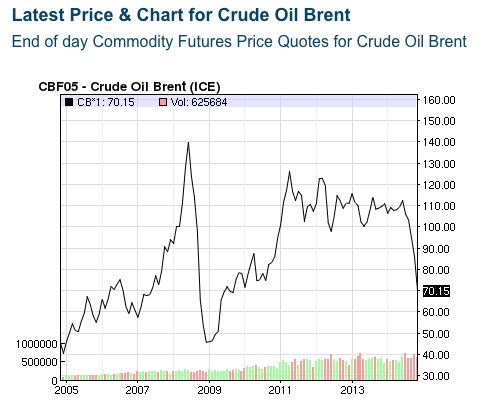
Oil prices promptly nosedived, with the price of Brent crude now hovering around $70 per barrel.

As recently as the summer, that price was over $100 per barrel.

CU Blog - Gas Prices Drop Below $2 - Photo 1

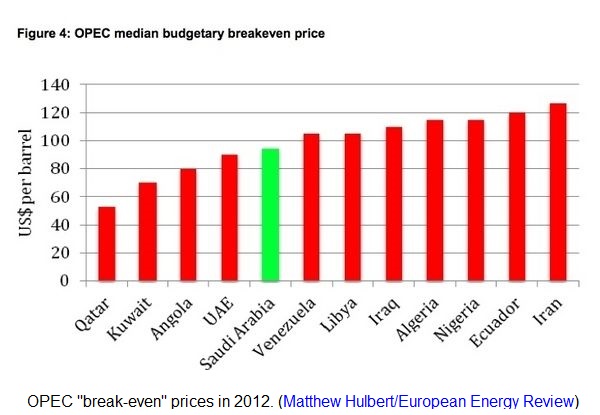
At this big meeting in Vienna, there was a lot of heated debate among OPEC members about how best to respond to this current drop in oil prices. Some countries, like Venezuela and Iran, wanted the cartel (mainly Saudi Arabia) to cut back on production in order to prop up the price of oil. The reason is that these countries need high prices in order to “break even” on their budgets and pay for all the government spending they’ve racked up:

CU Blog - Gas Prices Drop Below $2 - Photo 2

Source – Brad Plumer of Vox.com. Posted November 28, 2014; retrieved December 4, 2014 from: http://www.vox.com/2014/11/28/7302827/oil-prices-opec
OPEC is an international intergovernmental organization and economic cartel whose mission is to coordinate the policies of the oil-producing countries. This structure aligns with the book Go Lean… Caribbean, a roadmap for the introduction and implementation of the Caribbean Union Trade Federation (CU). This calls for the confederation, collaboration and convention of 30 member-states into one intergovernmental organization. The same as OPEC does for its 12 oil-producing nations – a proxy agency to represent all members – the CU seeks for the Caribbean region. But instead of elevating oil prices, the CU coalition has these 3 prime directives:

  • Optimization of the economic engines in order to grow the regional economy to $800 Billion & create 2.2 million new jobs.
  • Establishment of a security apparatus, including energy security, to protect the resultant economic engines.
  • Improve Caribbean governance to support these engines.

The goal of the CU is to optimize Caribbean society, allowing us to better compete globally and hopefully present more favorable options for our youth here in the homeland. (Previous generations sought refuge abroad).

The goal of OPEC is to secure a steady income to the member states and to collaborate in influencing world oil prices through economic means. Though this charter seems fairly benign, the reality of OPEC is vastly different; they have emerged as a monstrous entity! Autocratic leaders of OPEC countries – think Saddam Hussein – would constantly urge pushing world oil prices up; their claims were to help all OPEC members financially, but their motivation were purely nationalistic. The public view of OPEC now coincides with this dialogue from a movie, “art imitating life”:

“It can’t be bargained with, it can’t feel pain or mercy, and it will stop at absolutely nothing until you are dead!” – Movie dialogue from The Terminator (1984)

OPEC is not a monster, just protective of its own self-interest; many of their member-states feature a mono-industrial economy; it’s oil or bust! Plus, with 40 percent of global oil production, they do wield some power, influence and control of the eco-system of crude-oil pricing. But their power-influence-control is not absolute; there are always the laws of Economics!

Back to the foregoing article, the fact remains that oil prices were falling well before OPEC’s Friday announcement; this change was driven in large part by factors from Economics 101: less demand + higher supply = lower prices. In this case, economic slowdowns in much of the world have dampened demand, as supply has expanded considerably, especially within the U.S.

This premise directs the Energy Policy as communicated in the Go Lean book: the Caribbean region must lower crude oil demand.

This Go Lean/CU roadmap recognizes that modern life has expanded the definition of basic needs to now include food, clothing, shelter and energy. And thusly the book proposes many solutions for the region to optimize energy generation, distribution and consumption. No “stone is left unturned”. Go Lean posits that the average costs of energy can be decreased from an average of US$0.35/kWh to US$0.088/kWh in the course of the 5-year term of this roadmap. (Page 100).

Primary to this strategy of lowering the demand for crude oil is increasing options with alternative energy sources: natural gas, solar, wind and tidal. This will translate to more electric, hybrids, and fuel-efficient vehicles. The CU is a strong proponent of compressed-natural-gas vehicles (buses, trucks and passenger vehicles).

Lowering demand for energy works in lowering the costs.

In the US, the Obama administration’s improved fuel-efficiency standards have ultimately affected consumers, in that they are using less gas: “The sales-weighted fuel economy of vehicles in the U.S. increased from 20.8 miles per gallon in 2008 to 25.3 miles per gallon in 2014.” Other countries share the same experiences.

The Go Lean roadmap details a series of community ethos, strategies, tactics, implementations and advocacies to foster the progress in the wide fields of energy generation, distribution and consumption. The following list applies:

Community Ethos – Lean Operations Page 24
Community Ethos – Return on Investments Page 24
Community Ethos – Cooperatives Page 25
Community Ethos – Regional Taxi Commissions Page 25
Community Ethos – Non-Government Organizations Page 25
Community Ethos – Ways to Impact the Future Page 26
Community Ethos – Ways to Improve Negotiations Page 32
Anecdote – Pipeline Transport – Strategies, Tactics & Implementations Page 43
Strategy – Harness the power of the sun/winds Page 46
Tactical – Fostering a Technocracy Page 82
Tactical – Separation of Powers – Energy Commission Page 82
Anecdote – “Lean” in Government – Energy Permits Page 93
Anecdote – Caribbean Energy Grid Implementation Page 100
Implementation – Ways to Develop Pipeline Industry Page 107
Implementation – Ways to Improve Energy Usage Page 113
Advocacy – Ways to Impact Public Works Page 175
Advocacy – Ways to Foster Cooperatives Page 176
Advocacy – Ways to Impact Monopolies Page 202
Advocacy – Ways to Improve Transportation Page 205
Advocacy – Ways to Develop the Auto Industry Page 206
Appendix – North Dakota Oil Boom Economic-Societal Effects Page 334

This commentary asserts that energy needs are undeniable; and that OPEC may or may not be classified as a “monster”. The main take-away though is that monitoring and mitigating the realities of the global energy eco-system is a necessary role, a heavy-lifting task for the lean, agile operations of the CU technocracy.

So the message to the Caribbean region is clear: Help is on the way – the Terminator can be defeated – “life imitating art”!

Now is the time for all of the Caribbean, the people, business, institutions and governments, to lean-in for the optimizations and opportunities described in the book Go Lean … Caribbean. 🙂
Download the book Go Lean … Caribbean – now!

Share this post:
, , , ,

Obama’s immigration tweaks leave Big Tech wanting more

Go Lean Commentary

Caribbean stakeholders hereby comment on US President Barack Obama’s planned unilateral immigration reforms, and it’s not what you might naturally think:

We are hereby opposed!

Wait, wouldn’t a more liberal policy for Caribbean immigrants help our cause to improve the condition of many Caribbean families? “Yes” for the micro (individual), but “No” for the macro (community/country/region)!

Liberal US immigration practices are bad; they accentuate the “brain drain” for the Caribbean.

The focus in this discussion is on the STEM (Science, Technology, Engineering, and Mathematics) labor force. There is a demand for more workers with these qualifications; this demand is in the US and in the Caribbean. The US economy, and society, is more mature than all Caribbean countries; this makes it hard for Caribbean member-states to compete. And now…

… President Obama wants to extend invitations to STEM college students in the US to stay on in the US and NOT return to their home countries.

Say it ain’t so!

The publishers of the book Go Lean…Caribbean, which serves as a roadmap for elevating all 30 member-states of Caribbean society, calls for the need to fight the policy change that is depicted in this news article:

By: Noel Randewich and Roberta Rampton

s immigration tweaks leave Big Tech wanting more - Photo 1SAN FRANCISCO/WASHINGTON (Reuters) – President Barack Obama plans to make life a little easier for some foreign tech workers, but Silicon Valley representatives are disappointed his immigration rule changes will not satisfy longstanding demands for more visas and faster green cards.

In a speech on Thursday, Obama outlined plans to use executive authority to help millions of undocumented people. He also announced minor adjustments to cut red tape for visa holders and their families, including letting spouses of certain H-1B visa holders get work permits.

“I will make it easier and faster for high-skilled immigrants, graduates and entrepreneurs to stay and contribute to our economy, as so many business leaders have proposed,” Obama said.

The president’s moves will make it easier for entrepreneurs to work in the United States and extend a program letting foreign students who graduate with advanced degrees from U.S. universities to work temporarily in the United States.

But tech industry insiders said the changes, while positive, were limited.

“This holiday season, the undocumented advocacy community got the equivalent of a new car, and the business community got a wine and cheese basket,” complained one lobbyist, speaking on condition of anonymity.

Instead of more temporary H-1B visas, which allow non-U.S. citizens with advanced skills and degrees in “specialty occupations” to work in the country for up to six years, the 200,000-member U.S. chapter of the Institute of Electrical and Electronics Engineers (see VIDEO below) was hoping for measures to reduce the backlog of H-1B holders awaiting green cards.

“If this is all there is, then the president has missed a real opportunity,” said Russ Harrison, a senior legislative representative at the IEEE. “He could have taken steps to make it easier for skilled immigrants to become Americans through the green card system, protecting foreign workers and Americans in the process.”

For instance, IEEE and technology companies want spouses and children to be excluded from employment-based green-card allotments, thereby increasing availability for other foreign tech workers seeking green cards.

Tech companies from Microsoft Corp to Intel have complained about being unable to find enough highly skilled employees and want Washington to increase the availability of visas for programmers, engineers and other specialized foreign professionals.

“Our focus really is on H-1B visas and trying to expand the number of talented technical professionals that can come to the U.S.,” Qualcomm CFO George Davis said ahead of Obama’s announcement. “The way the regulations are drafted today there’s a lot of room for improvement.”

Major changes would require Congressional action, however, and tech industry executives are worried that partisan rancor over Obama’s unilateral action could set back chances for legislation.

“I don’t view this as a long-term solution, and I hope it doesn’t get in the way of a long-term solution,” said Dave Goldberg, chief executive of SurveyMonkey, a Palo Alto based company.

The AFL-CIO said in a statement it would seek to ensure visa workers are afforded rights and protections.

“We are concerned by the President’s concession to corporate demands for even greater access to temporary visas that will allow the continued suppression of wages in the tech sector,” the labor giant said.

While limited, Obama’s policy changes, such as letting more spouses work, will help some tech workers and their families.

Gayathri Kumar, 29, moved a year ago from India to Phoenix, Arizona, where her husband works at Intel. She has a masters degree in communications and wants to work in television, but Kumar spends much of her day at home, chatting with friends over social media.

“I really want to work. I came here with a passion to work, not to sit at home,” Kumar said. “I’m bored, I’m becoming depressed.”

(Reporting by Noel Randewich in San Francisco and Roberta Rampton in Washington. Additional reporting by Sarah McBride in San Francisco.; Editing by Eric Effron, Tom Brown and Ken Wills)

Reuters News Wire Online Source – Posted: November 21, 2014 –
http://news.yahoo.com/obamas-immigration-tweaks-leave-big-tech-wanting-more-002544241–finance.html

For this issue, “the enemy of my enemy is my friend”.

Caribbean stakeholders need to align with the opposition of Obama’s immigration policy, the Republicans. (The publishers of the Go Lean book, SFE Foundation, represent an apolitical, religiously-neutral, economic-focused movement, initiated at the grass-root
level to bring permanent change back to the Caribbean homeland – no one Caribbean member-state is favored over another). We need to pursue our own self-interest.

The book Go Lean…Caribbean posits that the Caribbean brain drain is already acute, (reported at exceeding 70%), due to “push and pull” factors. Many Caribbean STEM students matriculate in American universities, so allowing more liberal recruiting of our students to remain in the US would increase the “pull” factor. We cannot compete against this added pressure.

Why would the students want to concede to this pressure? Unfortunately, we have a variety of “push” conditions working against the Caribbean counter-defense; we have deficiencies. We have economic, security and governing deficiencies that “push” the native Caribbean student/worker to consider expatriating to the US, or to Canada and many EU countries.

But the Caribbean has its own needs for the STEM work force, and our needs cannot be ignored. This is war; (a Trade War).

The Caribbean is losing … every battle. We must not help our enemy. The book Go Lean…Caribbean serves as a roadmap for the introduction and implementation of the technocratic Caribbean Union Trade Federation (CU). The roadmap contains our battle plans, strategies and tactics for this Trade War. The roadmap’s states the prime directives of the CU as the following 3 statements:

  • Optimization of the economic engines in order to grow the regional economy to $800 Billion & create 2.2 million new jobs.
  • Establishment of a security apparatus to protect the resultant economic engines.
  • Improve Caribbean governance to support these engines.

The book posits that all of the Caribbean is in crisis with this brain drain problem, and so there is an urgent need to retain our existing STEM talent, and recruit even more. This point is stressed early in the book (Page 13) in the following pronouncements in the Declaration of Interdependence:

xix.   Whereas our legacy in recent times is one of societal abandonment, it is imperative that incentives and encouragement be put in place to first dissuade the human flight, and then entice and welcome the return of our Diaspora back to our shores. This repatriation should be effected with the appropriate guards so as not to imperil the lives and securities of the repatriated citizens or the communities they inhabit. The right of repatriation is to be extended to any natural born citizens despite any previous naturalization to foreign sovereignties.

xxi.   Whereas the preparation of our labor force can foster opportunities and dictate economic progress for current and future generations, the Federation must ensure that educational and job training opportunities are fully optimized for all residents of all member-states, with no partiality towards any gender or ethnic group. The Federation must recognize and facilitate excellence in many different fields of endeavor, including sciences, languages, arts, music and sports. This responsibility should be executed without incurring the risks of further human flight, as has been the past history.

This subject of mitigating the brain drain and adopting empowering immigration policies have been frequent topics for these Go Lean blogs, highlighted here in the following sample:

https://goleancaribbean.com/blog/?p=2907 Local Miami Haitian leaders protest Bahamian immigration policy
https://goleancaribbean.com/blog/?p=2809 A Lesson in History: Economics and Immigration Policy of East Berlin
https://goleancaribbean.com/blog/?p=1674 Obama’s Plans for $3.7 Billion Immigration Crisis Funds, stressing the need for reform in the US.
https://goleancaribbean.com/blog/?p=1596 Book Review: ‘Prosper Where You Are Planted’ – the Antithesis of Emigration
https://goleancaribbean.com/blog/?p=1470 College Of the Bahamas Master Plan 2025 – Lacking Response for Brain Drain
https://goleancaribbean.com/blog/?p=1296 Remittances from Diaspora to Caribbean Increased By 3 Percent in 2013 – Not a Good Economic Plan
https://goleancaribbean.com/blog/?p=1256 Is a Traditional 4-year College Degree a Terrible Investment? Yes, for Caribbean Communities Sending their Students Abroad.
https://goleancaribbean.com/blog/?p=1014 All is not well in the sunny Caribbean – Economic Deficiencies
https://goleancaribbean.com/blog/?p=599 Ailing Puerto Rico open to radical economic fixes – Need for Retention

As a counter-defense to the losing dispositions in the Caribbean Trade War with the US, the Go Lean book details a series of community ethos, strategies, tactics, implementations and advocacies to foster the best practices to incentivize STEM careers and mitigate further brain drain for the Caribbean region:

Community Ethos – Deferred Gratification Page 21
Community Ethos – Economic Systems Influence Choices & Incentives Page 21
Community Ethos – Job Multiplier Page 22
Community Ethos – Anti-Bullying and Mitigation – neutralizing STEM as Nerds Page 23
Community Ethos – Minority Equalization Page 24
Community Ethos – Return on Investments Page 24
Community Ethos – Ways to Impact the Future Page 27
Community Ethos – Ways to Foster Genius Page 26
Community Ethos – Ways to Help Entrepreneurship Page 28
Community Ethos – Promote Intellectual Property Page 29
Community Ethos – Ways to Impact Research & Development Page 30
Community Ethos – Ways to Close the Digital Divide Page 31
Community Ethos – Ways to Impact the Greater Good Page 37
Anecdote – Valedictorian and Caribbean Diaspora Member Page 38
Strategy – Customers – Citizens, Business Community & Diaspora Page 47
Strategy – Meeting Region’s Needs Today, Preparing For Future Page 58
Tactical – Separation of Powers – Patent, Standards, & Copyrights Page 78
Tactical – Separation of Powers – Education Department Page 85
Implementation – Assemble all Super-Regional Governing Entities Page 96
Implementation – Trends in Implementing Data Centers Page 106
Implementation – Ways to Deliver Page 109
Implementation – Better Manage Debt – Better Student Loans Dynamics Page 114
Planning – Ways to Improve Trade Page 128
Planning – Ways to Make the Caribbean Better Page 131
Advocacy – Ways to Grow the Economy Page 151
Advocacy – Ways to Create Jobs Page 152
Advocacy – Ways to Improve Education Page 159
Advocacy – Ways to Impact Student Loans – Forgivable Provisions Page 160
Advocacy – Ways to Foster Empowering Immigration – STEM Professionals Page 174
Advocacy – Ways to Foster Technology Page 197
Advocacy – Ways to Impact the Diaspora Page 217
Appendix – Alternative Remittance Modes Page 270

Now is the time for all of the Caribbean, the people and institutions, to lean-in for the elevations described in the book Go Lean … Caribbean. This means heavy-lifting to enhance the economic-security-governing engines to attract and retain our STEM graduates. We especially call on the Caribbean/Latin American chapters of the IEEE organization – depicted in the foregoing article and the VIDEO below – to join-in this empowerment effort. A CU mission aligns with this organization’s charter to promote STEM careers and developments in their members’ home regions. The Caribbean needs the regional delivery of this charter, and their lobbying efforts.

We must try and stop Obama’s unilateral policy reform; a liberal US immigration policy would accentuate the Caribbean brain drain.

The region needs the deliveries, described in the Go Lean roadmap. Otherwise, we have no hope to incite and retain our young people, especially those with STEM skill-sets. As a region, we would simply be condemned to a worsened future, simply “fattening frogs for snakes”. This Go Lean roadmap therefore is vital in the quest to make the Caribbean a better place to live, work and play. 🙂

Download the book Go Lean … Caribbean – now!

———–

Appendix VIDEO: What is IEEE? – http://youtu.be/fcmCpEpg0lQ
This is a short video presenting the overall organization of IEEE. This video was developed and published during the celebrations of IEEE Day 2012.

Share this post:
, , ,
[Top]

Why India is doing better than most emerging markets

Go Lean Commentary

BRICS = Brazil, Russia, India, China, South Africa …

There are no “push-pull” factors luring Caribbean citizens to emigrate to these countries, (though Caribbean member-states Trinidad and Guyana have a majority population of Indian descent), but still it is very important for the stewards of the Caribbean economy to study the BRICS countries. We need to learn from their lessons, good-bad-and-ugly, and try hard to keep pace.

This global assessment is part of the technocratic activities needed in comparative analysis, essential and strategic in the effort to ensure the region remains competitive. This effort is inclusive of the publishers of the book Go Lean…Caribbean; it urges the introduction and implementation of the technocratic Caribbean Union Trade Federation (CU). The book serves as a roadmap for the elevation of the region’s economy-security-governing engines; providing turn-by-turn directions to integrate the 30 member-states of the region and forge an $800 Billion economy.

A likely analogy would be navigating a vessel across a tumultuous ocean. As a humorous depiction, subject matter experts joke that “an economist is an expert who will know tomorrow why the things he predicted yesterday didn’t happen today”.

All joking aside, the incremental progress of one BRICS country, India, is not to be lambasted or readily dismissed. See this recent news article:

By: JO’s

CU Blog - Why India is doing better than most emerging markets - Photo 1MUMBAI – Investors have fallen out of love with emerging markets. Since the start of last year emerging-market stocks has trailed their rich-world peers. Currencies are falling. Worst-hit is the Russian Rouble, which has fallen by 30% against the Dollar this year. The currencies of other biggish emerging markets, such as Brazil, Turkey and South Africa, have also weakened. For such economies growth is harder to come by. The IMF recently cut its forecasts for emerging markets by more than for rich countries. But India is a notable exception to the general pessimism. Its stock market has touched new highs. The Rupee [currency] is stable. And the IMF nudged up its 2014 growth forecast for India to 5.8%. That figure is still quite low: growth rates of 8-9% have been more typical. But in comparison with others it is almost a boom. Why is India doing better than most emerging markets?

In part optimism about India owes to its newish government. In May Narendra Modi’s Baratiya Janata Party (BJP) won a thumping victory in elections on a pro-growth platform. Since then the BJP has strengthened its position in some key states. So far reform has been piecemeal. Procedures for government approvals have been streamlined. The powers of labour inspectors have been curbed. Civil servants now work harder. That has been enough to sustain hopes of further and bigger reforms. Yet much of the continued enthusiasm about India is down to luck. The currents that sway the global economy presently—the dollar’s strength; slowdown in China; aggressive money-printing in Japan; stagnation in the Euro Zone and falling oil prices—are less harmful to India than to most emerging markets.

Start with the dollar, which has been buoyed by a resilient American economy and the prospect of interest-rate increases by the Federal Reserve. Past episodes of rising interest rates and dollar strength (for instance in the early 1980s or mid-1990s) have not been kind to emerging markets. Bond yields rise and currencies fall as capital is drawn back to America. India has a bit less to fear from such a rush to the exits; its bond markets are tricky for foreigners to enter in the first place. India is less harmed by slowdown in China, as only around 5% of its exports go there. It is not part of the China’s supply-chain that takes in much of Southeast Asia. Nor is it a big exporter of industrial commodities, like Brazil. Equally a weaker yen in response to quantitative easing by the Bank of Japan hurts Asia’s manufacturing exporters more than service-intensive India. The misery in the Euro Zone is of greater concern to its local trading partners in Turkey and Russia than to faraway India. And the fall in the crude prices that hurts oil exporters, such as Russia and Nigeria, is a boon to a big oil importer like India. Indeed the deflation that is stalking large parts of the world is helpful to India, which has suffered from high inflation.

India is not impervious to bad news. Some of its recent economic data have looked a little soggy. Exports slumped in October. Car sales have fallen for two consecutive months and there is little sign yet of a meaningful recovery in business investment. This is in part why there have been growing calls (including from the finance minister) for the central bank to cut interest rates soon in response to a drop in consumer-price inflation. The troubles in other emerging markets ought to counsel caution. Any sign that policymakers might be ditching discipline in favour of quick fixes might see India crossed off the love list.
The Economist Magazine – Online Edition – November 18, 2014 –
http://www.economist.com/blogs/economist-explains/2014/11/economist-explains-11

Other BRICS countries are struggling with growth, at this moment; see story here:

As emerging economies hit hard times, Brazil and Russia look particularly weak.

CU Blog - Why India is doing better than most emerging markets - Photo 2

Considering the realities of the emerging economies, the BRICS countries, it is obvious that there is an ebb-and-flow associated with economic stewardship. This stewardship constitutes the prime directives of the CU:

  • Optimization of the economic engines in order to grow the regional economy and create 2.2 million new jobs.
  • Establishment of a security apparatus to protect the resultant economic engines.
  • Improve Caribbean governance/administration/oversight to support these engines.

The best practice for effective stewardship of an economy’s ebb-and-flow is the recovery; managing the ability to “bounce back” quickly. This fact is related in the Go Lean book (Page 69), chronicling the experiences in the US when the economy lost $11 Trillion in the 2008 Great Recession, but recovered $13.5 Trillion back a few years later, by December 2012. The US has 50 member-states and 320 million people. Shocks and dips can therefore be absorbed and leveraged across the entire region .The Go Lean roadmap is to integrate the Caribbean in such a structure with 30 member-states and 42 million people.

At the outset, the roadmap identified an urgent need to contend with, since the Caribbean is still in the throes of the financial crisis (commenced in 2008).  This is pronounced in this clause in the opening Declaration of Interdependence (Page 13):

xxv.   Whereas the legacy of international democracies had been imperiled due to a global financial crisis, the structure of the Federation must allow for financial stability and assurance of the Federation’s institutions. To mandate the economic vibrancy of the region, monetary and fiscal controls and policies must be incorporated as proactive and reactive measures. These measures must address threats against the financial integrity of the Federation and of the member-states.

The Go Lean roadmap signals change for the region. It introduces new measures, new opportunities and new recoveries. Economies will rise and fall, ebb-and-flow; the recovery is key. Currencies and inflation issues also factor in the economic stewardship. The foregoing article relates:

“the dollar … has been buoyed by a resilient American economy and the prospect of interest-rate increases by the Federal Reserve. Past episodes of rising interest rates and dollar strength … have not been kind to emerging (BRICS) markets”.

So the CU strategy also calls for the establishment of the allied Caribbean Central Bank (CCB) to manage the regional monetary and currency affairs. The Go Lean book describes the breath-and-width of the CCB. This stewardship of monetary-currency was envisioned and pronounced in the roadmap’s Declaration of Interdependence (Page 13):

xxiv.   Whereas a free market economy can be induced and spurred for continuous progress, the Federation must install the controls to better manage aspects of the economy: jobs, inflation, savings rate, investments and other economic principles. Thereby attracting direct foreign investment because of the stability and vibrancy of our economy.

The CU roadmap drives change among the economic, security and governing engines. These solutions are as new community ethos, strategies, tactics, implementations and advocates; sampled as follows:

Who We Are – Veterans of 2008 “Wars” & Financial Crisis Page 8
Community Ethos – Voluntary Trade Creates Wealth Page 21
Community Ethos – Consequences of Choices Lie in the Future Page 21
Community Ethos – Money Multiplier Page 22
Community Ethos – Job Multiplier Page 22
Community Ethos – Cooperatives Page 25
Community Ethos – Impact the Greater Good Page 37
Strategy – CU Vision and Mission Page 45
Strategy – Facilitating Currency Union, Caribbean   Dollar Page 45
Strategy – Collaborate for the Caribbean Central Bank Page 45
Anecdote – Caribbean Currencies Page 64
Tactical – Fostering a Technocracy Page 64
Tactical – $800 Billion Economy – How and When – Trade Page 67
Tactical – Recovering from Economic Bubbles Page 69
Tactical – Separation-of-Powers – Caribbean Central Bank Page 73
Implementation – Assemble Caribbean Central Bank Page 96
Implementation – Ways to Pay for Change Page 101
Implementation – Trade Mission Objectives Page 117
Implementation – Ways to Benefit Globalization Page 119
Planning – Ways to Improve Trade Page 128
Planning – Lessons Learned from 2008 Page 136
Advocacy – Ways to Grow the Economy Page 151
Advocacy – Ways to Create Jobs Page 152
Advocacy – Ways to Control Inflation Page 153
Advocacy – Ways to Better Manage Foreign Exchange Page 154
Advocacy – Foster Empowering Immigration – Indentured Indians Page 174
Advocacy – Reforms for Banking Regulations Page 199
Advocacy – Ways to Preserve Caribbean Heritage Page 218
Advocacy – Ways to Impact Trinidad & Tobago Page 240

The Caribbean region needs to learn from the lessons of the BRICS countries, (see VIDEO below). and do the work, the heavy-lifting, to compete with them, and the rest of the world in trade and culture. The subject of trade empowerment has been directly addressed and further elaborated upon in these previous blog/commentaries:

https://goleancaribbean.com/blog/?p=2887 Caribbean must work together to address rum subsidies
https://goleancaribbean.com/blog/?p=2488 Role Model Jack Ma brings Trade Marketplace Alibaba to America
https://goleancaribbean.com/blog/?p=2435 Latin America’s Dream and Trade Role-model: Korea
https://goleancaribbean.com/blog/?p=2090 Elaborating on the CU and CCB as Hallmarks of a Technocracy
https://goleancaribbean.com/blog/?p=1869 US Senate Bill Targets Companies for Dishonorable Trade Practices
https://goleancaribbean.com/blog/?p=1847 Caribbean Cigar Trade – Declared “Among the best in the World”
https://goleancaribbean.com/blog/?p=1416 Amazon – Role Model for Trade Marketplace, Introduces New Tablet
https://goleancaribbean.com/blog/?p=994 Bahamas Rejects US Trade Demand
https://goleancaribbean.com/blog/?p=273 10 Things We Don’t Want from the US – #3: De-Americanize World Money for Currency in Trade

The Caribbean is arguably the best address on the planet, but there are many deficiencies, as in jobs and economic empowerments. We have suffered as a result of these deficiencies, as a region losing a large share of human capital, one estimate of 70%, to the brain-drain.

No More! Change has now come to the Caribbean.

Shepherding the Caribbean economy is the job for technocrats, trained and accomplished from the battles of globalization and trade wars. This is the Go Lean roadmap. Everyone, the people and institutions are hereby urged to lean-in to this roadmap to make the Caribbean a better place to live, work and play. 🙂

Download the book Go Lean … Caribbean – now!

————

VIDEO: BRICS to change world economy – http://youtu.be/wmS11HnNbk0

Published on Mar 28, 2012 – The BRICS countries’ leaders were preparing for their annual meeting in 2012. These countries make up 42 percent of the world’s population and a quarter of its landmass. They are also responsible for 20 percent of the Global GDP and own a whopping 75 percent of the foreign reserve worldwide. In these tough times for world economics these countries are trying to find a solution for the situation. RT America’s Correspondent Priya Sridhar (the US based arm of Russia Today, a 24-hour English-language international broadcast news network based in Miscow) gave a sneak peak of the summit from India.

Share this post:
, , ,
[Top]

Local Miami Haitian leaders protest Bahamian immigration policy

Go Lean Commentary

“Why’s everybody always pickin’ on me?” – The Coasters – Charlie Brown Song; (see Appendix A).

It would seem that Haitians all around the world can sing the chorus to this above song. The history of Haiti is frequented with hardships in their own country and they have understandingly pursued a better life abroad. However, the Haitian Diaspora have also experienced oppression, discrimination and exclusionary treatment abroad and have had to endure a “hard welcome” in most foreign countries.

The book Go Lean…Caribbean serves as a roadmap for elevating Caribbean society, for all 30 member-states, including Haiti. As such there are direct references in the book regarding Haiti’s historicity; (Pages 238 & 306).

In addition to history, Haiti also has a different geography compared to most Caribbean nations. They share the same island with the Dominican Republic. The oppression, discrimination and exclusionary treatment of Haitians started on that island. Over the years, the governmental administrations of the Dominican Republic have favored “white” immigrant refugees over other races; Dominican troops often forcibly expelled illegal Haitians. Most notably, the 1937 Parsley Massacre of Haitian immigrants, a government-sponsored genocide in October 1937, at the direct order of then President Rafael Trujillo. He ordered the execution of the Haitian population living in the borderlands. The violence resulted in the killing of 20,000 ethnic Haitian civilians during approximately five days. (See Appendix B for additional historic references and inferences).

The US and other countries in the Caribbean neighborhood have also been harsh in their treatment of Haitian refugees. Consider this story of a conflict with the Bahamas, and the protests from the Haitian Diaspora in Miami:

1. News Article Title: Local Miami Haitian leaders protest Bahamian immigration policy
http://www.wsvn.com/story/27344225/local-haitian-leaders-protest-bahamian-immigration-policy – Posted: November 10, 2014

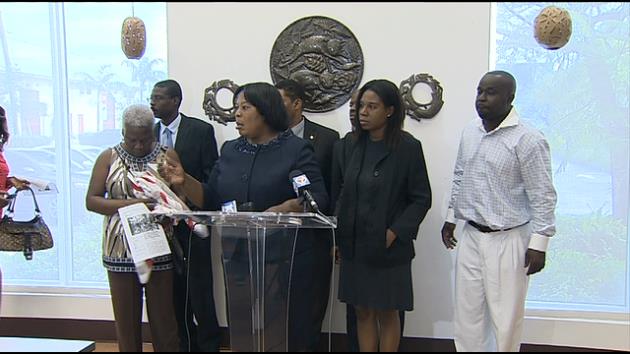
Miami Haitian Protesters 1

MIAMI (WSVN) — Local leaders are stepping up to stop a deportation dilemma regarding an immigration policy.

The policy forces families of Haitian descent out of the Bahamas.

Florida State Representative Daphne Campbell spoke out on the issue at a press conference in Little Haiti Monday morning. “I’m asking all, all cruises and all tourists, to make sure every industry boycotts the Bahamas to end discrimination against Haitian children,” Campbell stated. “Boycott Bahamas! Boycott Bahamas! Boycott Bahamas!”

Activists are now asking for the public’s support in helping to protect the future of Haitian families.
————

Video: WSVN Newscast – http://www.wsvn.com/story/27344225/local-haitian-leaders-protest-bahamian-immigration-policy?autoStart=true&topVideoCatNo=default&clipId=10832494

Though the leader of the accusing team has her detractors/problems, (South Florida state Rep. Daphne Campbell faces IRS investigation and she is already facing a Florida Medicaid fraud probe), the subject of her accusation may still have merit. What are the facts of the case regarding Haitian children in the Bahamas?

The Bahamas does not automatically grant citizenship to people born of foreign parentage in its homeland. There are special provisos even if one parent is a Bahamian citizen; many details of which are gender-biased. (There were attempts to correct these provisos in Parliament this past year, but this legislative reform was stalled).

This citizenship criteria is not standard … compared to the US, Canada, and most western European countries. Ironic as these countries are also the source of most tourists visiting the Bahamas, the #1 economic driver for the country. So any traction in this Boycott Bahamas campaign can potentially have a negative impact – remember “Boycott Apartheid in South Africa”.

What’s worse, the Universal Declaration of Human Rights or UDHR (as related in Go Lean book Page 220) have specific prohibitions against national governments enforcing laws that effectuate discrimination against minority groups.

(The UDHR was adopted by the United Nations General Assembly in 1948, partly in response to the atrocities of World War II, composed by a committee led by former American First Lady Eleanor Roosevelt. Although the UDHR was a non-binding resolution, it is now considered by some to have acquired the force of international customary law which may be invoked in appropriate circumstances by national and other judiciaries. The UDHR urges member nations to promote a number of human, civil, economic and social rights, asserting these rights as part of the “foundation of freedom, justice and peace in the world”).

This means you Bahamas! Are you ready to receive the onslaught of darts from the international community? Economic sanctions, formal or informal, are debilitating!

This is not just a Haitian -versus- Bahamian issue. The same immigration-border-encroaching issues are trending with the US, Dominican Republic and Puerto Rico. This following news article relates this controversy:

2. Title: Haitian Illegal Immigration Through Puerto Rico Is Skyrocketing Too  – http://news.yahoo.com/haitian-illegal-immigration-puerto-rico-skyrocketing-too-021611125.html;_ylt=AwrBJR6DB9dTyzoAHyzQtDMD – Posted: July 26, 2014

Haitians to PRWhile U.S. immigration agencies grapple with a recent surge of tens of thousands of illegal immigrants at the Mexican border, the number of Haitians trying to enter the U.S. illegally through Puerto Rico has skyrocketed as well.

In 2011, only 12 Haitians made the trek through the Dominican Republic to Puerto Rico, a U.S. territory in the Caribbean Sea. That number had ballooned to 1,760 as of last year, according to U.S. Coast Guard statistics, CBS News reports.

“That’s new, and that’s something we’re trying to target,” Capt. Mark Fedor, the Coast Guard’s chief of response for the Southeast and Caribbean, told CBS.

“Organized smugglers in the Dominican Republic are advertising their services to Haitians and saying, ‘We’ll smuggle you through the Dominican Republic, put you on a boat to Puerto Rico or to one of the islands in the Mona Pass – a much shorter journey and we can get you to the United States that way.’ And I think people are responding to that,” he said.

The Dominican smugglers often drop their Haitian charges off at Mona Island, an uninhabited Puerto Rican island 40 miles off of the Dominican coast in the Mona Pass.

“As soon as you’re in Puerto Rico, it’s like you’re in the United States,” Lolo Sterne, coordinator for Haiti’s Office of Migration, told the Associated Press last year.

Once in Puerto Rico, the illegal Haitian immigrants are able to fly to destinations in the U.S. without having to show a passport. All they need is a driver’s license, according to the Associated Press.

The new route through the Mona Pass is seen as more desirable as the U.S. Coast Guard has increased patrols of normal routes taken by immigrants from Haiti and the Dominican Republic. As the AP points out, it has become more difficult to travel directly to the U.S. mainland or through Miami, which has historically served as the choice destination for illegal immigrants from the Caribbean.

Haiti and its 9+ million residents need change. In fact, all of the Caribbean’s 42 million people need change/empowerment.

The purpose of the Go Lean roadmap is to turn-around the downward trends in the Caribbean today, to reverse course and elevate society in the Caribbean as a whole and Haiti in particular. The CU, applying best-practices for community empowerment has these 3 prime directives, pronounced as follows:

  • Optimization of the economic engines in order to grow the regional economy to $800 Billion & create 2.2 million new jobs.
  • Establishment of a security apparatus to protect the resultant economic engines.
  • Improve Caribbean governance, with consideration for minority equalization, to support these engines.

How exactly can the CU impact Haiti to reboot that failing state? The answer can be found in the history of post-war Europe, where the Marshall Plan was instrumental in rebooting that continent. The book Go Lean…Caribbean details a Marshall Plan-like roadmap for Haiti, and all other failing Caribbean institutions.

The related subjects of economic, security and governing dysfunction among European and Caribbean member-states have been a frequent topic for blogging by the Go Lean promoters, as sampled here:

https://goleancaribbean.com/blog/?p=2809 A Lesson in History: Economics of East Berlin
https://goleancaribbean.com/blog/?p=2480 A Lesson in History: Community Ethos of WW II
https://goleancaribbean.com/blog/?p=2330 ‘Raul Castro reforms not enough’, Cuba’s bishops say
https://goleancaribbean.com/blog/?p=1531 A Lesson in History: 100 Years Ago Today – World War I
https://goleancaribbean.com/blog/?p=1433 Caribbean loses over 70% of tertiary educated citizens to the brain drain
https://goleancaribbean.com/blog/?p=1014 All is not well in the sunny Caribbean
https://goleancaribbean.com/blog/?p=623 Only at the precipice, do they change
https://goleancaribbean.com/blog/?p=599 Ailing Puerto Rico open to radical economic fixes
https://goleancaribbean.com/blog/?p=451 CariCom Chairman to deliver address on slavery/colonization reparations

The goal of the Go Lean roadmap is simple: to make Haiti (and by extension the rest of the Caribbean) a better place to live, work and play so that citizens would not feel compelled to risk life-and-limb to flee for foreign shores. The goal extends further in the mission to reverse course and encourage the repatriation of the Haitian/Caribbean Diaspora. To accomplish these goals, the book details a series of community ethos, strategies, tactics, implementations and advocacies to empower all the factions of Haitian life in the Caribbean region and in the Diaspora:

Community Ethos – Economic Systems Influence Choices & Incentives Page 21
Community Ethos – Consequences of Choices Lie in the Future Page 21
Community Ethos – Anti-Bullying and Mitigation Page 23
Community Ethos – Minority Equalization Page 24
Community Ethos – Ways to Impact the Future Page 26
Community Ethos – Ways to Manage Reconciliations Page 34
Community Ethos – Ways to Impact the Greater Good Page 37
Strategy – Vision –  Integrate region into a Single Market Economy Page 45
Strategy – Agents of Change – Globalization Page 57
Tactical – Separation of Powers – Department of Homeland Security Page 75
Implementation – Ways to Foster International Aid Page 115
Planning – 10 Big Ideas … for the Caribbean Region – Haiti & Cuba Page 127
Planning – Ways to Ways to Model the EU Page 130
Planning – Reasons Why the CU Will Succeed – Germany Reconciliation Model Page 132
Planning – Ways to Improve Failed-State Indices – Haiti – first on the region list Page 134
Planning – Lessons from East Germany – European post-war rebuilding Page 139
Planning – Lessons from Canada’s History Page 146
Advocacy – Ways to Grow the Economy Page 151
Advocacy – Ways to Create Jobs Page 152
Advocacy – Ways to Foster Empowering Immigration Page 174
Advocacy – Ways to Impact Justice Page 178
Advocacy – Ways to Enhance Tourism Page 187
Advocacy – Ways to Impact the Diaspora – Haitians in Miami Page 217
Advocacy – Ways to Protect Human Rights Page 220
Advocacy – Ways to Help Women Page 226
Advocacy – Ways to Impact Youth Page 227
Advocacy – Ways to Impact the Dominican Republic Page 237
Advocacy – Ways to Re-boot Haiti Page 238
Advocacy – Ways to Impact US Territories Page 244
Appendix – Dominican Republic – Rafael Trujillo Regime Page 306

The conclusion of the Go Lean book relates the experiences and motivations of the US Supreme Court for the 1954 landmark decision Brown versus Board of Education. The unanimous wisdom of the 9 Justices on the Court should not be ignored, it was strewn from the experiences of modern society waging two world wars; they saw the rampage, devastation of 60 million deaths around the world and appreciated the wisdom that a downtrodden people would not stay down, that they would rise and revolt, that they would risk their lives and that of their children to pursue freedom.

How impactful is the Haitian Diaspora in the Bahamas? With a total national population of 320,000 and one estimate (July 2013) of 50,000 Haitian and/or Haitian-Bahamians, there is an imminent wave of dissent for the Bahamas to contend with. Don’t wait Bahamas, deal with your domestic issues now! Learn from the experiences of your neighbors, as depicted in the Go Lean book:

US: Lessons from the US Constitution (Page 145)
Canada: Reconciliation with First Nations (Page 146)
Guyana: Indo-Guyanese versus Afro-Guyanese (Page 174)
Trinidad: Indo-Trinidadians versus Afro-Trinidadians (Page 240)

Now is the time for all of the Caribbean to learn the lessons from [economic] history of other successful (US & Canada) and unsuccessful societies. The Go Lean book posits that the Caribbean is in a serious crisis, but asserts that this crisis would be a terrible thing to waste. The people and governing institutions of the Bahamas, Haiti and the region as a whole are hereby urged to lean-in for the empowerments described in the book Go Lean … Caribbean. This is a big deal for the region, we can all strive to make our Caribbean homeland a better place to live, work, and play.

Download the free e-book of Go Lean … Caribbean – now!

———–

Appendix A – The song: Charlie Brown by The Coasters – http://youtu.be/_UnPzp2lmNk

———–

Appendix B – Homework for additional credit: better understand the history of Haiti and its consequential impact on the world.

Video Title: Black In Latin America (Episode 1): Haiti and The Dominican Republic- The Roots of Division

This scholarly work was produced and narrated by noted Professor Henry Louis Gates. This was part of a series developed for the Public Broadcasting System (PBS) , a network of public TV stations in the US. The other features in the series, include:

Black In Latin America (Episode 2): Cuba: The Next Revolution
Black In Latin America (Episode 3): Brazil: A Racial Paradise?
Black In Latin America (Episode 4): Mexico & Peru: The Black Grandma in the Closet


Share this post:
, , , ,
[Top]

Caribbean must work together to address rum subsidies

Go Lean Commentary

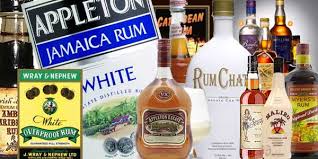
CU Blog - Caribbean must work together to address rum subsidies - Photo 1

Caribbean Rum, a product from island sugar cane, is among the best in the world.

This is a familiar focus of the Go Lean…Caribbean, movement, the book and accompanying blogs feature this and another Caribbean specialty agriculture: the best cigars in the world. The book posits that specialty agriculture is a core competence of the region (Page 58). This is part-and-parcel of the introduction and implementation of the technocratic Caribbean Union Trade Federation (CU).

With that branding of “Trade Federation”, obviously there is an emphasis on Trade activities.

With that branding of “Union”, obviously there is an emphasis on collective bargaining.

Mastery of these activities is what the following news article calls for:

CU Blog - Caribbean must work together to address rum subsidies - Photo 2THERE has been yet another call for rum-producing nations in the Caribbean to come together and confront the issues of subsidies which are affecting rum exports from this region to the United States.

Douglas Henderson, Executive Manager, Regional Sales and Marketing for Angostura, a leading rum producer in Trinidad and Tobago, said there has to be a collaborative effort to deal with the situation.

“Therefore, the challenge that we have is that in a lot of cases the Caribbean producers are having difficulties coming together to fight,” he told The Barbados Advocate.

The official pointed out that he is aware that some efforts were made to have the matter dealt with at the World Trade Organisation (WTO), in addition to the fact that both Barbados and Trinidad and Tobago are both trying to make inroads in having the subsidies removed.

“But until that happens, no company can stand still and wait. So we have to look to develop our business and do what we can,” he remarked.

CU Blog - Caribbean must work together to address rum subsidies - Photo 3Henderson was recently in Barbados where he participated in the launch of a range of Angostura Rums to the Barbados market. The launch was a co-operative effort between Angostura and Massy Distribution.

The USA is providing the subsidies to multinational spirits companies operating in the United States Virgin Islands and in Puerto Rico. Caribbean governments and producers who are members of the West Indies Rum and Spirit Producers Association (WIRSPA) have dubbed the subsidies inconsistent with trade rules of the WTO.

Just recently, the Barbados Ambassador to the United States, John Beale, issued a similar call for Barbados and the Caribbean producers to mount a campaign against the subsidies. He said that as a result of them, Barbados’ rum exports to the USA had declined by more than 20 per cent so far in 2014. Rum accounted for over $80 million in foreign exchange inflows into Barbados last year.

“Every Caribbean rum producer is affected by the subsidy and it is going to place those countries – US territories – at an advantage over us,” Henderson said.

He explained, “The USA market remains a huge market for any Caribbean producer of rum. Rums are growing in the USA and again when you come into the market and your price point is at a level that the majority of the market would choose not to try it, what you have to invest in advertising is so significant.”

The Angostura official further noted that every rum producer in the world is happy to compete on a level playing field. However, according to him, “a subsidy does not provide a level playing field, that’s where the concern is”, he added.
The Barbados Advocate – Daily Newspaper Online Site – (Posted 8/20/2014; retrieved 11/10/2014) – http://www.barbadosadvocate.com/newsitem.asp?more=business&NewsID=38272

The Go Lean book explained that the proper management of trade can increase wealth. The book relates the following on Page 21:

Voluntary Trade Creates Wealth: People specialize in the production of certain goods and services because they expect to gain from it. People trade what they produce with other people when they think they can gain something from the exchange. Some benefits of voluntary trade include higher standards of living and broader choices of goods and services.

The foregoing article alludes that the Caribbean member-states can do better in managing their trade negotiations (with the US regarding subsidies) with more efficient collective bargaining. This commentary asserts that it is a preferred option for the member-states to delegate this negotiation responsibility to the CU rather than going at it alone. The Go Lean book serves as a roadmap to empower the region’s trade engines. This effort is dubbed Trade SHIELD and defined in great details in the book. The acronym refers to:

Strategic
Harvest
Interdiction
Enforcement
Logistics
Delivery

All in all, this roadmap calls for more than just negotiations (inclusive under the Strategic functionality). The Go Lean roadmap calls for confederating 30 member-states of the Caribbean (including the US territories of Puerto Rico and the Virgin Islands – also rum-producing economies – think Bacardi*), despite their language and legacy, into an integrated Single Market. The resulting entity will increase trade with the US and with the rest of the world, increasing the economy (GDP) from $378 Billion (2010) to $800 Billion. This growth is based on new jobs, industrial output and lean operational efficiency.

Size does matter! The traditional rum-producing countries (Barbados, Guyana, Jamaica, Martinique, Trinidad, etc.) are considered Small Island Developing States. The CU on the other hand represents the Single Market of 42 million people, in which “the whole is worth more than the sum of its parts“. In addition, the SHIELD principles specify Logistics and Delivery functions in facilitating the Trade objectives. This is a microcosm of how the CU roadmap will impact all of Caribbean society. The 3 prime directives of the CU are listed as:

  • Optimization of the economic engines so as to grow the regional economy to $800 Billion and create 2.2 million new jobs.
  • Establishment of a security apparatus (with persecutory powers for economic crimes) so as to mitigate the eventual emergence of “bad actors”.
  • Improve Caribbean governance.

CU Blog - Caribbean must work together to address rum subsidies - Photo 4The roadmap creates some new Delivery options for Caribbean specialty agriculture (i.e. rum and cigars), namely electronic commerce and social media. Imagine subscribers on the myCaribbean.gov Marketplace or Facebook easily ordering auto-fill monthly shipments of the best products the Caribbean have to offer. The CU intends to trade with the 80 million annual visitors and 10 million Diaspora.

This export trade allows for the preservation of Caribbean heritage.

Facilitating Caribbean trade is a strong theme for the Go Lean… Caribbean book and a frequent topic for these Go Lean blogs. These points of trade against the back-drop of Caribbean economy, security and governance were detailed in these previous blogs/commentaries:

https://goleancaribbean.com/blog/?p=2435 Korean Model – Latin America’s Trade dreams
https://goleancaribbean.com/blog/?p=1965 America’s Navy – Model for protecting Caribbean trade routes
https://goleancaribbean.com/blog/?p=1847 Cuban Cigars – Declared “Among the best in the world”
https://goleancaribbean.com/blog/?p=1869 US Senate bill targets companies that move overseas for unfair trade
https://goleancaribbean.com/blog/?p=1609 Cuba mulls economy and trade in Parliament session
https://goleancaribbean.com/blog/?p=1416 Amazon, a model of a Trade Marketplace, and its new FIRE Smartphone
https://goleancaribbean.com/blog/?p=833 CU Strategy: One currency, divergent economies
https://goleancaribbean.com/blog/?p=689 eMerge Conference Aims to Jump-start Miami Tech Hub in Exploiting Latin America Trade

The foregoing news article relates that the US is the culprit for the unlevel “playing field” for rum import-export trade activities in the region. The Go Lean movement posits that despite the reassuring words, the US is not assuming exemplary leadership for Caribbean empowerment – due to its own self-interest – that instead the region must “stand up” for its own self-determination.

This is not independence, this is interdependence! This point was echoed in the following blog commentaries:

https://goleancaribbean.com/blog/?p=2259 The Criminalization of American Business – Big Agra
https://goleancaribbean.com/blog/?p=789 America’s War on the Caribbean
https://goleancaribbean.com/blog/?p=353 Book Review: ‘Wrong – Nine Economic Policy Disasters and What We Can Learn…’
https://goleancaribbean.com/blog/?p=273 10 Things We Don’t Want from the US – American Self-Interest Policies

The CU roadmap works to drive the needed change among the economic, security and governing engines to guide the Caribbean member-states to the destination of elevated societies. This change is based on new community ethos, strategies, tactics, implementations and advocates; sampled as follows:

Declaration of Interdependence Page 10
Community Ethos – Deferred Gratification Page 21
Community Ethos – Economic Principles – Voluntary Trade Creates Wealth Page 21
Community Ethos – Job Multiplier Page 22
Community Ethos – Security Principles Page 22
Community Ethos – Governing Principles Page 24
Community Ethos – Lean Operations – GPO’s Page 24
Community Ethos – Cooperatives Page 25
Community Ethos – Ways to Improve Negotiations Page 32
Strategy – Vision – Integrating Region in to a Single Market Page 45
Strategy – Agents of Change – Globalization Page 57
Strategy – Core Competence – Specialty Agriculture Page 58
Tactical – Confederating a Permanent Union Page 63
Tactical – Fostering a Technocracy Page 64
Tactical – Growing the Economy to $800 Billion – Convergence of East Asian Tigers Page 67
Tactical – Separation of Powers – Agriculture Department – Licensing/ Inspections Page 88
Implementation – Assemble & Create Super-Regional Organs to represent commerce Page 96
Implementation – CPU: Consolidate / Integrate the Member-states Postal Services Page 96
Implementation – Ways to Pay for Change – GPO’s Page 101
Implementation – Foreign Policy Start-up Initiatives Page 102
Implementation – Security Initiatives at Start-up Page 103
Implementation – Ways to Optimize Mail Service & myCaribbean.gov Marketplace Page 108
Implementation – Ways to Impact Social Media Page 111
Implementation – Ways to Benefit from Globalization Page 119
Planning – Ways to Improve Trade – GPO’s Page 128
Planning – Ways to Improve Interstate Commerce Page 129
Advocacy – Ways to Grow the Economy Page 151
Advocacy – Ways to Create Jobs Page 152
Advocacy – Ways to Better Manage Foreign Exchange – Caribbean Dollar realities Page 154
Advocacy – Ways to Improve Governance Page 168
Advocacy – Ways to Foster Cooperatives Page 176
Advocacy – Ways to Foster e-Commerce Page 198
Advocacy – Ways to Preserve Caribbean Heritage Page 218
Advocacy – Ways to Impact US Territories Page 244
Appendix – Trade SHIELD Principles Page 264

Trade is very much critical to the strategies to grow the regional economy. Increased trade will undoubtedly mean increased job opportunities. The CU/Go Lean plan is to foster and incubate key industries, such as rum industry, for this goal. One of the biggest rum producers in the Caribbean, Bacardi, originated in Cuba but have since located distillery plants in Puerto Rico, Bahamas and Mexico. They have endured and persevered despite much opposition. They are proud of their survival, depicting it in TV advertisements; see the following:

*VIDEO: Bacardi – Untamable since 1862 – Procession TV Ad: https://youtu.be/lXQcbS-TH7g

Discover how the Bacardí family had the irrepressible spirit to overcome fire, earthquakes, prohibition, revolution and exile — none of which could defeat their spirit, because True Passion Can’t Be Tamed. Find out more about the Bacardí family story at www.bacardi.com

The rest of the Caribbean’s rum producers must also endure dire obstacles, and can now do so because there is help. This Go Lean roadmap proposes a new model, that of the Trade Federation, an entity to do the heavy-lifting of elevating the Caribbean economy, security and governing engines.

For the Caribbean, the status quo cannot continue – the region is already mature as a great place to “play”: tourism, carnivals/fiestas/parties, great rum and great cigars – “all play and no work”. But now, it is time for the region, the people and institutions, to lean-in to this roadmap for change, to make the Caribbean a better place to live, work and play.

Download the free e-Book of Go Lean … Caribbean – now!

Share this post:
, , , ,
[Top]

Where the Jobs Are – Entrepreneurism in Junk

Go Lean Commentary

The dominant employment engine for the Caribbean involves tourism, but the regional tourism business models are being strained. The primary target market, American middle class have suffered crises and now harsh realities have come to fruition. The book Go Lean…Caribbean posits that there is a need to re-focus, re-boot, and optimize the engines of commerce so as to make the Caribbean a better place to live, work and play for all.

Where are the jobs … that the Caribbean people need today and will need even more so in the future?

A key answer is in the quotation: “One man’s trash is another man’s treasure”.

This is the underlying principle of the recycling-scrap-metal industry. This industry is a “destruction services” business model, a subset of the “turn-around” community ethos. Jobs can be created in the art and science of destruction (demolition, recycling and junkyards). But this industry does not “play well with others”, it makes a bad neighbor. It is dirty, wet, Blue-Collar and noisy. But, if done right, this model could be successful, and can impact a “turn-around” for many stakeholders.

This new focus on the “turn-around” community ethos, and the accompanying jobs, appears on the surface to be a win-win for all involved, but a more careful examination highlights some serious economic, security and governing obstacles/issues.

The Go Lean book calls for the optimization of these economic, security and governing engines for the Caribbean region:

  • Economics – Jobs, business models, industrial neighborhoods constitute the economic dimensions of this industry. Overall the roadmap calls for the optimization of the economic engines in order to grow the regional economy to $800 Billion GDP and create 2.2 million new jobs. There is another economic element to this recycling-scrap-metal industry sphere of activity, that of an entrepreneurial hustle – Scrapping. A person can generate self-employment income by gathering scrap-metal, recycled commodities, re-manufactured raw materials and transport them to junkyards. While this may be an occasional chore for some people, for others, this can be a daily hustle, their source of steady income. See photo examples here and VIDEO below:
  • CU Blog - Where the Jobs Are - Entrepreneurism in Junk - Photo 1-3
  • Security – The above trash-versus-treasure quotation introduces the security dimension of the commentary. The entire eco-system of recycling assumes that the “trash” holder of a commodity surrenders possession. If/when the commodity changes hands prematurely, the events are often associated with a crime: burglary, robbery, theft, vandalism, house-stripping, etc. For this reason, the Go Lean roadmap commandeers jurisdiction of salvage/recycling/scrap-metal functions for federal regulation/promotion. This stipulates that activities within the “turn-around” sphere will be marshaled by regional police authorities, with the application of best-practices: Verified Identification, Closed Circuit Surveillance Camera, Serial Number registration/tracking, etc.
  • Governance – In line with the Go Lean roadmap, many junkyards are identified as ideal for the structure of Self-Governing Entities (SGE), the bordered/fenced controlled campuses/compounds. This approach allows for initiation, cooperation and coordination of SGE’s to effectuate change in the region.

The alignment of strained economic-security-governance engines against the recycling-scrap-metal “turn-around” community ethos have been successfully championed before, particularly in the US during World War II. There is much to learn from this example and lesson in history.

Consider a modern example of this Los Angeles company, and imagine similar installations throughout the Caribbean region:

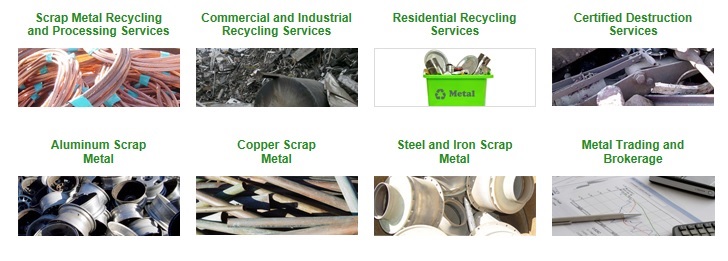
C & M Metals is a provider of Scrap-Metal Recycling and Metal Trading Services

1709 E. 24th St., Los Angeles, CA90058  |  Phone: 323-234-4662  |  Fax: 323-234-5844  |  sales@cmmetals.net

C&M Metals Inc. is a corporation dedicated to the, “Green Movement.” We have showed this by being one of the pioneers in the recycling of secondary metals and scrap metal waste for over 50 years. Our experience comes second to none and our long history speaks for itself. Call us today to inquire about how we could be of service to you.

Industries Served:

Metal Fabricators Demolitions Electricians
Machine Shops Networking Contractors
Electronic Manufactures Auto Repair Centers   Auto Wrecking
Plumbers Contractors Yards
Maintenance Contractors Radiator Repair Shops
Medical Industries Wheel and Tire Centers
Installers Auto Dealerships

CU Blog - Where the Jobs Are - Entrepreneurism in Junk - Photo 2
C & M Metals, Inc. – Los Angeles Premier Salvage Services – Retrieved
11-09-2014 –
http://www.cmmetals.net/index.html

The book Go Lean… Caribbean, serves as a roadmap for the introduction and implementation of the technocratic Caribbean Union Trade Federation (CU) with the charter to facilitate jobs in the region. Early in the Go Lean book, the responsibility to create jobs was identified as an important function for the CU with this pronouncement in the Declaration of Interdependence (Pages 14):

xxvi.  Whereas the Caribbean region must have new jobs to empower the engines of the economy and create the income sources for prosperity, and encourage the next generation to forge their dreams right at home, the Federation must therefore foster the development of new industries… In addition, the Federation must invigorate the enterprises related to existing industries … impacting the region with more jobs.

The Go Lean book also details the principle of job multipliers, how certain industries are better than others for generating multiple indirect jobs down-the-line for each direct job on a company’s payroll. The recycling-scrap-metal “turn-around” industries have impressive indirect job multiplier rates, hereby estimated at 5.0. This is important, as the Go Lean… Caribbean book details the creation of 2.2 million direct/indirect jobs in the region during the 5-year roadmap, including income-generation from entrepreneurial hustles.

The subject of SGE’s has been directly addressed and further elaborated upon in these previous blog/commentaries:

https://goleancaribbean.com/blog/?p=2750 Disney World – Example of SGE
https://goleancaribbean.com/blog/?p=2338 Using SGE’s to Welcome the Dreaded ‘Plutocracy’
https://goleancaribbean.com/blog/?p=2003 Where the Jobs Are – Ship-breaking under SGE Structure
https://goleancaribbean.com/blog/?p=1214 Fairgrounds as SGE and Landlords for Sports Leagues
https://goleancaribbean.com/blog/?p=286 Puerto Rico’s Comprehensive Cancer Center Project Breaks Ground – Model of Medical SGE

In addition, the subjects of self-employment opportunities and entrepreneurial hustle have been explored in previous blog/commentaries:

https://goleancaribbean.com/blog/?p=1325 Puerto Rico Governor Signs Bill on Small-Medium-Enterprises
https://goleancaribbean.com/blog/?p=599 Ailing Puerto Rico open to radical economic fixes – with focus on Informal Economy
https://goleancaribbean.com/blog/?p=398 Self-employment on the rise in the Caribbean – World Bank
https://goleancaribbean.com/blog/?p=214 LCD versus an Entrepreneurial Ethos

The adoption of new community ethos, plus the executions of the following strategies, tactics, implementations and advocacies will foster the returns on the “turn-around” investments:

Community Ethos – Deferred Gratification Page 21
Economic Principles – People Choose because Resources are Limited Page 21
Economic Principles – All Choices Involve Costs Page 21
Economic Principles – People Respond to Incentives Page 21
Economic Principles – Economic Systems Influence Choices & Incentives Page 21
Economic Principles – Voluntary Trade Creates Wealth Page 21
Community Ethos – Job Multiplier Page 22
Community Ethos – Lean Operations Page 24
Community Ethos – Return on Investments (ROI) Page 24
Community Ethos – Cooperatives Page 25
Community Ethos – Ways to Impact the Future Page 26
Community Ethos – Ways to Help Entrepreneurship Page 28
Community Ethos – Ways to Impact Research & Development (R&D) Page 30
Community Ethos – Ways to Impact Turn-Around: Recycling and Demolition Industries Page 33
Community Ethos – Ways to Impact the Greater Good Page 37
Strategy – Mission – Foster Local Economic Engines. Page 45
Tactical – Fostering a Technocracy Page 64
Tactical – Tactics to Forge an $800 Billion Economy – High Multiplier Industries Page 70
Tactical – Separation of Powers – Self-Governing Entities Page 80
Implementation – Ways to Pay for Change – SGE Licenses Page 101
Implementation – Steps to Implement Self-Governing Entities Page 105
Implementation – Ways to Deliver Page 109
Planning – 10 Big Ideas – Self-Governing Entities Page 127
Planning – Ways to Improve Trade Page 128
Planning – Ways to Make the Caribbean Better Page 131
Advocacy – Ways to Grow the Economy Page 151
Advocacy – Ways to Create Jobs Page 152
Advocacy – Ways to Foster Cooperatives Page 176
Advocacy – Ways to Improve Emergency Management Processes and Systems Page 196
Advocacy – Ways to Impact Main Street Page 201
Appendix – Job Multipliers Page 259

The CU will foster industrial developments in support of turn-around industries. While these industrial developments may feature physical-grounds like high-tech R&D campuses, medical parks, and technology bases, they will also include low-tech scrap-metal junkyards. So the Go Lean roadmap covers clean-and-dirty, wet-and-dry activities.

While STEM (Science, Technology, Engineering and Mathematics) attributes maybe the target activity for future-focused genius qualifiers, not all Caribbean stakeholders will be included among this grouping. In fact, STEM candidates are projected to only be a small minority in any community. Not everyone can be in the “Geek Squad”, or White Collar classes for that matter. So the Blue Collar classes must be accommodated as well in the Go Lean roadmap. This entrepreneurial hustle is an example of that total inclusion. As such, community investments must be made to facilitate the needs of Blue Collar workers. See below for Appendix – Cooperatives in Salvage.

The Caribbean is arguably the best address on the planet, but there are a lot of missing ingredients so as to be the best address for everyone. Some of the missing ingredients are jobs. The plan identified in the Go Lean book and blog/ commentaries is a good start to create employment opportunities for the region. This, the Go Lean roadmap, is where the jobs are! There are other benefits too; in general, the end result of this roadmap is a clearly defined destination: a better place to live, work and play. 🙂

Download the book Go Lean … Caribbean – now!

———-

Appendix – VIDEO: How to make money scrapping – http://youtu.be/6eggQxy4Tdk

Mike the Scrapper Introduction to Scrapping: “We all have to live and make money so this is for my new fellow scrappers and the one’s that have been already scrapping”.

———-

Appendix – Cooperatives in Salvage:

The CU will structure cooperative endeavors to marshal the economic and homeland security interest of the region. As such, the creation of “Worker” cooperatives will be incentivized for enterprises to assist the population to find gainful employment, even through entrepreneurial “hustles”.

Recycling-Scrap-Metal Industries are ideal for Worker cooperatives. But to facilitate these endeavors, large investments are needed to be made for industrial equipment, sampled as follows (from http://grindercrusherscreen.com/):

CU Blog - Where the Jobs Are - Entrepreneurism in Junk - Photo 4-6

Share this post:
, , , ,
[Top]

Latin America’s Korean dream

Go Lean Commentary

“Trade and Marketplaces” are great strategies. So says the below news story and VIDEO.

The book Go Lean…Caribbean calls for the introduction and implementation of the Caribbean Union Trade Federation (CU). With that branding “Trade Federation”, obviously there is an emphasis on Trade activities. Why?

The book explained that the proper management of trade can increase wealth. The book relates the following on Page 21:

Voluntary Trade Creates Wealth: People specialize in the production of certain goods and services because they expect to gain from it. People trade what they produce with other people when they think they can gain something from the exchange. Some benefits of voluntary trade include higher standards of living and broader choices of goods and services.

The foregoing article stresses that there is a role model for modern industrial policy in the country/region for Latin America as a whole (and the Caribbean specifically): the East Asian Tigers, or South Korea more specifically.

Sub-title: The case for a modern industrial policy
ONCE again, Latin America has a growth problem. After a dozen golden years of economic expansion and falling poverty, the region is likely to grow by only around 1.5% this year. Argentina, Brazil and Venezuela are suffering recessions of varying severity. Even high-flyers like Peru and Chile have slowed to a crawl; growth in Mexico, where reforms promise much, has yet to take off.

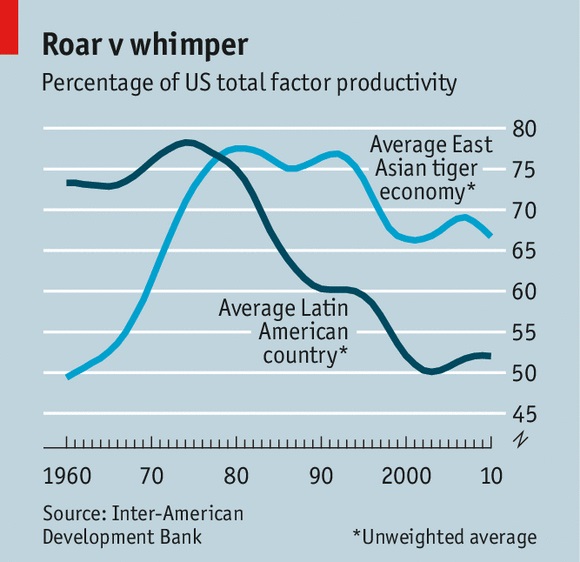
The immediate reasons are not hard to divine. The commodity boom has waned and, in some places, years of fiscal populism are coming home to roost. Low unemployment and a population that is starting to age mean that growth can no longer come from adding workers. If the region is to return to faster expansion, it must raise productivity.

Korean Dream - Photo 1Yet here the region has a lamentable record (see chart) – and for familiar reasons: red tape and the informal economy, poor education and infrastructure, and a lack of competition and credit. But according to a new study* by the Inter-American Development Bank (IDB), there is another factor. Unlike many East Asian countries, Latin America has eschewed state action to stimulate the development of higher-productivity sectors and businesses.

Industrial policy, as it used to be called, went out of fashion in the region in the 1980s, and for good reason. In Latin America it was mainly deployed in the cause of import substitution. All too often, it sheltered favoured low-productivity firms from the foreign competition that would have made them more efficient. In South Korea, by contrast, industrial policy was more ruthless: state help for businesses was temporary and linked to performance in exports and innovation.

Because of this dismal history, the IDB rebrands “industrial policy” as “productive development policies”. That signals not only that such policies should apply to services and farming as well as manufacturing, but also that they should avoid past mistakes. They are justified, the authors caution, only when they aim to develop a latent or potential comparative advantage and when market forces have failed to do this. And the remedy should directly address the market failure.

There is much to do. Latin America is poor at innovation. Spending on research and development in the region, as a share of GDP, is less than half that in developed countries, which have seven times as many researchers per 1,000 workers. Tax breaks can stimulate innovation, especially when they reward the hiring of researchers and collaboration between universities and firms in competitive industries.

State intervention may also be justified in order to overcome “co-ordination failures”—where several firms would potentially benefit but no one will organise a scheme to pay for, say, setting up a temperature-controlled “cold chain” for the export of fruit and vegetables. Costa Rica’s investment agency helped to develop a surgical-devices industry by persuading an American firm to set up a sterilising service in the country. Argentina’s INTA, a public agricultural-technology institute, worked with local farmers to develop more productive strains of rice.

The biggest challenge is for the state to incubate new higher-value industries—without falling prey to special pleading. There are several such success stories in Latin America. The origins of Embraer, a Brazilian aircraft manufacturer, lie in a public aeronautical-technology institute. Fundación Chile, a private development agency with a public-policy remit, created a salmon-farming industry. But such initiatives will work only if governments have the technical and institutional capacity to carry them out, the IDB warns. It thinks projects should be subject to external evaluation. South   Korea’s example suggests that sunset clauses in state support and subjecting firms to the discipline of foreign competition is crucial.

Some chapters of the IDB study are indigestible, written for economists rather than politicians. It pulls some punches: although it criticises the protection of rice farmers in small Costa Rica, it is silent about the recent use of subsidies and protection in Brazil and Argentina to cosset declining or established industries.

But its argument for a modern industrial policy is timely. Indeed, it is already being applied. This year Peru’s production minister, Piero Ghezzi, unveiled a “productive diversification plan”, the first step of which is the opening of ten technological-innovation centres. Peruvian man cannot live by mining alone. Sensible government policies can help.
The Economist Magazine (Retrieved 09/20/2014) – http://www.economist.com/news/americas/21618785-case-modern-industrial-policy-latin-americas-korean-dream

——

* “Rethinking Productive Development: Sound Policies and Institutions for Economic Transformation”, edited by Gustavo Crespi, Eduardo Fernández-Arias and Ernesto Stein, IDB

The foregoing article indicates that Latin America countries can do better in managing their industrial policy and macro-economics. This point is stressed in the Go Lean book, pronounced in the opening Declaration of Interdependence – Page 13:

xxiv.Whereas a free market economy can be induced and spurred for continuous progress, the Federation must install the controls to better manage aspects of the economy: jobs, inflation, savings rate, investments and other economic principles. Thereby attracting direct foreign investment because of the stability and vibrancy of our economy.

The Go Lean roadmap calls for confederating 30 member-states of the Caribbean, despite their language and legacy, into an integrated “single market. The resulting entity will increase trade within the region and with the rest of the world, increasing the economy (GDP) from $378 Billion (per 2010) to $800 Billion. This growth is based on new jobs, industrial output and lean operational efficiency.

The Go Lean book posits that this growth is only possible with the integrated economy, not with individual member-states growing on their own, “the whole is worth more than the sum of its parts“. But economic issues alone do not complete the solution, in fact the CU roadmap cites these 3 prime directives:

  • Optimization of the economic engines so as to grow the regional economy to $800 Billion and create 2.2 million new jobs.
  • Establishment of a security apparatus (with prosecutorial powers for economic crimes) so as to mitigate the eventual emergence of “bad actors”.
  • Improve Caribbean governance.

Growth in the Caribbean is a strong theme for the Go Lean… Caribbean book and a frequent topic for these Go Lean blogs. These points of economy, security and governance have also been detailed in previous Go Lean blogs/commentaries. The following is a sample:

The following is a sample:

https://goleancaribbean.com/blog/?p=2372 Corporate Tax Dodging – Transfer Policing
https://goleancaribbean.com/blog/?p=2338 Welcoming New Business from the Dreaded Plutocracy
https://goleancaribbean.com/blog/?p=2126 Where the Jobs Are – Computers Reshaping Global Job Market
https://goleancaribbean.com/blog/?p=2003 Where the Jobs Are – One Scenario: Ship-breaking
https://goleancaribbean.com/blog/?p=1869 US Senate bill targets companies that move overseas
https://goleancaribbean.com/blog/?p=1731 Role Model Warren Buffet – An Ode to Omaha
https://goleancaribbean.com/blog/?p=1609 Cuba mulls economy in Parliament session
https://goleancaribbean.com/blog/?p=1554 Status of Forces Agreement = The Caribbean Approach for a Regional Security Pact
https://goleancaribbean.com/blog/?p=1416 Amazon, a model of a Trade Marketplace, and its new FIRE Smartphone
https://goleancaribbean.com/blog/?p=949 Inflation Matters – The CU‘s Approach for Macro-Economic Efficiency
https://goleancaribbean.com/blog/?p=888 Book Review: ‘Citizenville – Take the Town Square Digital and Reinvent Government’
https://goleancaribbean.com/blog/?p=833 CU Strategy: One currency, divergent economies
https://goleancaribbean.com/blog/?p=689 eMerge Conference Aims to Jump-start Miami Tech Hub in Exploiting Latin America Trade
https://goleancaribbean.com/blog/?p=476 Grenada PM Urges CARICOM on ICT to Grow Economy
https://goleancaribbean.com/blog/?p=360 How the CU/CCB will Create Money from Thin Air
https://goleancaribbean.com/blog/?p=308 CARCIP Urges Greater Innovation to Grow Economy

Now the foregoing news article points that there is value in analyzing the transformation of the East Asian nation-states. These countries provide great lessons, samples and examples of convergence, in which under-developed countries apply the catch-up principle to grow their economies to “developed” status. The Go Lean book details this progress (Page 69) for the sample countries of Singapore, Hong Kong, Taiwan and South Korea.

The CU roadmap likewise drives change among economic, security and governing engines to guide the Caribbean member-states to the destination of elevated societies – a better place to live, work and place. This change is based on new community ethos, strategies, tactics, implementations and advocates; sampled as follows:

Community Ethos – Economic Principles – People Choose Page 21
Community Ethos – Economic Principles – All Choices Involve Costs Page 21
Community Ethos – Economic Principles – People Respond to Incentives Page 21
Community Ethos – Economic Principles – Economic Systems Influence Choices Page 21
Community Ethos – Economic Principles – Voluntary Trade Creates Wealth Page 21
Community Ethos – Economic Principles – The Consequence of Choice Lie in Future Page 21
Community Ethos – Money Multiplier Page 22
Community Ethos – Job Multiplier Page 22
Community Ethos – Security Principles Page 22
Community Ethos – Governing Principles Page 24
Community Ethos – Lean Operations – GPO’s Page 24
Community Ethos – Return on Investments Page 24
Community Ethos – Cooperatives Page 25
Community Ethos – Ways to Help Entrepreneurship Page 28
Community Ethos – Ways to Impact Research and Development Page 30
Community Ethos – Ways to Close the Digital Divide Page 31
Community Ethos – Ways to Impact Turn-arounds Page 33
Community Ethos – Ways to Improve Sharing Page 35
Strategy – Agents of Change – Globalization Page 57
Tactical – Confederating a Permanent Union Page 63
Tactical – Growing the Economy to $800 Billion – Convergence of East Asian Tigers Page 67
Implementation – Ways to Pay for Change – GPO’s Page 101
Implementation – Foreign Policy Start-up Initiatives Page 102
Implementation – Security Initiatives at Start-up Page 103
Implementation – Ways to Optimize Mail Service & myCaribbean.gov Marketplace Page 108
Implementation – Ways to Improve Energy Usage Page 113
Implementation – Ways to Benefit from Globalization Page 119
Planning – Ways to Improve Trade – GPO’s Page 128
Planning – Ways to Improve Interstate Commerce Page 129
Planning – Ways to Measure Progress Page 147
Advocacy – Ways to Grow the Economy Page 151
Advocacy – Ways to Create Jobs Page 152
Advocacy – Ways to Control Inflation Page 153
Advocacy – Ways to Mitigate Black Markets Page 165
Advocacy – Ways to Improve Governance Page 168
Advocacy – Ways to Foster Cooperatives Page 176
Anecdote – Caribbean Industrialist Page 189
Advocacy – Ways to Foster Technology – Incubators   Strategy Page 197
Advocacy – Reforms for Banking Regulations Page 199
Advocacy – Ways to Impact Wall Street Page 200
Advocacy – Ways to Impact Main Street Page 201
Advocacy – Ways to Develop / Foster <specific> Industries Page 206

The foregoing news article identifies new industrial policies for Latin America. But the focus of the book Go Lean…Caribbean and accompanying blogs is the Caribbean alone, a sub-set of Latin America. Trade is very much critical to the strategies to grow the regional economy. Increased trade will undoubtedly mean increased job opportunities. The CU/Go Lean plan is to foster and incubate key industries for this goal, incorporating suggestions, recommendations and best-practices as related in the foregoing article. This too was pronounced early in the opening Declaration of Interdependence (Page 14), as follows:

xxvi. Whereas the Caribbean region must have new jobs to empower the engines of the economy and create the income sources for prosperity, and encourage the next generation to forge their dreams right at home, the Federation must therefore foster the development of new industries, like that of ship-building, automobile manufacturing, prefabricated housing, frozen foods, pipelines, call centers, and the prison industrial complex.

Despite many previous efforts to expand Caribbean trade, this new Go Lean effort takes a novel approach, that of the Trade Federation. This entity would do the heavy-lifting of elevating the Caribbean economy, security and governing engines. This roadmap would include a “marketplace”, with all the dimensions highlighted in the following VIDEO:

Video: https://www.youtube.com/watch?v=BUp3Q6O8IYg

For the Caribbean, the status quo cannot continue. It is time for the region, the people and institutions, to lean in to this roadmap for change, to make the Caribbean a better place to live, work and play. It is worth the effort and investment.  🙂

Download the free e-Book of Go Lean … Caribbean – now!

Share this post:
, ,
[Top]

Stopping Ebola

Go Lean Commentary

CU Blog - Stopping Ebola - Photo 1What a cute little boy in this photo…

Look at that sly look. It’s as if he just doesn’t understand why he is expected to believe the “nonsense”. He will not “drink the Kool-Aid”.

From the mouths of babes -The Bible; Matthew 21:16

The below article by the Editorial Board of the Miami Herald newspaper seems to indicate that someone has been “drinking the Kool-Aid”. Ebola is not an American problem. As of this moment the figures reported by the World Health Organization is that 2,300 people have died during this recent spread of Ebola in West Africa (Sierra Leone, Liberia, Guinea and other neighboring countries). What’s more, that number afflicted is expected to rise to 20,000 by the end of November. What’s worse, 70% of the afflicted are expected to die, if nothing is done.

There is the need for leadership.

This editorial article therefore petitions for American leadership in this Ebola threat:

By: Miami Herald Editorial Board

CU Blog - Stopping Ebola - Photo 2 Rarely has the idea of the global village and the mantra that the world is one big neighborhood seemed as real as in the frightening case of the raging Ebola epidemic in Africa.

There was a time, not so long ago, that an outbreak of disease anywhere in the Third World would have seemed far removed from the daily concerns of Americans and the nation’s foreign-policy agenda. Safely protected from foreign plagues by vast oceans, U.S. leaders would not have felt compelled to order a rapid response along the lines announced last week by President Obama as a matter of self-protection.

There might have been a tardy and symbolic response, if any at all, but certainly it would not have been treated as a priority demanding presidential action, complete with a significant military deployment.

What makes Ebola different is the realization that the world is indeed smaller, that modern modes of transportation — with busier travel patterns and habits — have lowered the barriers against infection. In places like Miami, a major port of entry for overseas visitors, the threat is very real, and Ebola is a particularly scary virus.

The disease kills between 50 percent and 90 percent of people infected with the virus, and there is as yet no specific and effective treatment available. No vaccine exists. Senior U.N. officials say cases are rising at an almost exponential level, with 5,000 reported by the end of August and many more expected.

Officials in Africa are plainly scared, and should be. Over the weekend, the government in Sierra Leone confined the country’s entire population, some 6 million people, to their homes for three days, an action that one news report called “the most sweeping lockdown against disease since the Middle Ages.”

Some experts estimate that as many as 20,000 people could become infected before the epidemic is under control. Others said the number would be several times higher by year’s end.

“We don’t know where the numbers are going,” said Dr. Bruce Aylward, assistant director general of the World Health Organization. He said the virus was spreading faster than the (belated) escalation of the response by the international community.

Indeed, the international community could have responded more quickly, and more effectively. A major outbreak was reported in Guinea in March by WHO, but it was not until last week that President Obama announced action commensurate with the nature of the threat.

He ordered a deployment of medicine, equipment and soldiers to Liberia and Senegal. A contingent of 3,000 military personnel will help build emergency treatment centers and establish what Pentagon officials call “command and control” assistance to coordinate the overall effort with other countries. According to the White House, the Centers for Disease Control and Prevention has committed more than $100 million to the fight since the outbreak started, but months were lost before the alarm was sounded outside the borders of the affected countries.

As Mr. Obama explained, as a virus multiplies, it also mutates to fight human immunology and counter-measures. That adds to the urgency of the crisis and makes it imperative for the United   States to coordinate an effort on a scale large enough to make a difference.
Miami Herald Daily Newspaper (Posted 09-21-2014) – http://www.miamiherald.com/opinion/editorials/article2180670.html

Ebola is not an American problem but when American citizens have been afflicted, the US response has been inspiringly genius, deploying a potential cure within a week. (See caption on above photo). This is not the resume of a global leader, this is the resume of a nation playing favorites.

CU Blog - Stopping Ebola - Photo 3

The book Go Lean…Caribbean posits that the Caribbean region must promote its own interest and protect its own citizens. We cannot count on the US to pursue the Greater Good for the whole world, or the Caribbean for that matter. Assuredly, we must have our own preparation and response vehicle.

This is the goal of the Go Lean…Caribbean book.

The book serves as a roadmap for the introduction and implementation of that regional sentinel, the Caribbean Union Trade Federation (CU). The complete prime directives of the CU:

  • Optimize the economic engines of the Caribbean to elevate the regional economy.
  • Establish a security apparatus to protect the resultant economic engines.
  • Improve Caribbean governance to support these engines.

This CU roadmap declares that “Crap happens” (Page 23). The Go Lean roadmap immediately calls for the establishment of a Homeland Security Department, with an agency to practice the arts and sciences of Emergency Management. The emergencies include more than natural disasters (hurricanes, earthquakes, tsunamis, volcanoes, flooding, forest fires, and droughts), they include the man-made variety (industrial accidents, oil spills, factory accidents, chemical spills, explosions, terroristic attacks, prison riots) and epidemic threats. Of course, these types of emergencies, described in the foregoing article, require professional expertise, a medical discipline. Stopping Ebola therefore would require a hybrid response of the Emergency Management agency and the CU’s Department of Health Disease Control & Management agency. This agency of Medical experts would help contend with systemic threats of epidemic illness and infectious diseases.

The Go Lean roadmap immediately calls for the coordination of security monitoring and mitigation in the Caribbean; this point is declared early in the Go Lean book with a pronouncement in the Declaration of Interdependence (Page 12), as follows:

xvi. Whereas security of our homeland is inextricably linked to prosperity of the homeland, the economic and security interest of the region needs to be aligned under the same governance. …[to ensure] the functioning of the wheels of commerce for all the citizenry, the accedence of this Federation must equip the security apparatus with the tools and techniques for predictive and proactive interdictions.

The Go Lean roadmap calls for the integration of the viral sentinel responsibility of the 30 Caribbean member-states, despite the 4 different languages and 5 colonial legacies (American, British, Dutch, French, Spanish) into a Trade Federation with the tools/techniques to bring immediate change to the region to benefit one and all member-states. This includes the monitoring and epidemiological defense of common and emerging viruses. This empowered CU agency will liaison with foreign entities with the same scope, like the World Health Organization (WHO), and the US’s Center for Disease Control (CDC). The need for this empowerment had previously been discussed in a similar blog/commentary regarding the Chikungunya virus.

Embedded YouTube Video: https://www.youtube.com/watch?v=Ui8wMZpwnp0

Since the CU roadmap leads with economic reform, the primary economic driver of the region (tourism) would be a constant concern. A lot is at stake if the Ebola threat comes to Caribbean shores. The realization, or even the unsubstantiated rumor, of viral outbreaks can imperil the tourism product. We must therefore take proactive steps to protect our economic engines. So there are heavy responsibilities for the stewardship of the Caribbean economy, security and governing engines; the goal is to impact the Greater Good of the entire Caribbean region. There is the need for a Caribbean-based agency to do the heavy-lifting of epidemiology for the region – no such entity exists today.  The emerging CU will invite this role and will promote it as a community ethos.

The book details the community ethos, plus the executions of the following strategies, tactics, implementations and advocacies to impact the region’s public health security in protection of the economy:

Community Ethos – Privacy versus Public Protection Page 23
Community Ethos – “Crap” Happens Page 23
Community Ethos – Lean Operations Page 24
Community Ethos – Cooperatives Page 24
Community Ethos – Non-Government Organizations Page 25
Community Ethos – Ways to Improve Sharing Page 35
Community Ethos – Impact the Greater Good Page 37
Strategy – Vision – Confederate a Non-Sovereign Single Market Entity Page 45
Strategy – Customers – Residents & Visitors Page 47
Strategy – Agents of Change – Globalization Page 57
Tactical – Confederating a Permanent Union Page 63
Tactical – Fostering a Technocracy Page 64
Separation of Powers – Emergency Management Page 76
Separation of Powers – Disease Control & Management Page 86
Implementation – Ways to Pay for Change Page 101
Implementation – Security Initiatives at Start-up Page 103
Implementation – Ways to Deliver Page 109
Implementation – Ways to Foster International Aid Page 115
Implementation – Ways to Benefit from Globalization Page 119
Planning – Ways to Improve Failed-State Indices Page 134
Planning – Ways to Measure Progress Page 148
Advocacy – Ways to Grow the Economy Page 151
Advocacy – Ways to Improve Healthcare Page 156
Advocacy – Ways to Improve Governance Page 168
Advocacy – Ways to Better Manage the Social Contract Page 170
Advocacy – Ways to Foster Cooperatives Page 176
Advocacy – Ways to Improve for Natural Disasters Page 184
Advocacy – Ways to Improve Emergency Management Page 196

The foregoing news editorial assumes the US will be altruistic and only pursue the Greater Good for the rest of the world.

LOL…

Recent Go Lean blogs have reported that the US is still not an equal society for its own citizens; forget those in foreign lands looking to the US for leadership. See sample list here:

https://goleancaribbean.com/blog/?p=2297 A Lesson in US Racial History – Booker T versus Du Bois
https://goleancaribbean.com/blog/?p=2259 The Criminalization of American Business
https://goleancaribbean.com/blog/?p=2251 What’s In A Name… (American Job Discrimination for Minorities)
https://goleancaribbean.com/blog/?p=2183 A Textbook Case of Price-gouging
https://goleancaribbean.com/blog/?p=1896 The Unbalanced Crisis in Black Homeownership
https://goleancaribbean.com/blog/?p=1832 Many drug inmates who get break under new plan to be deported
https://goleancaribbean.com/blog/?p=1674 Obama’s Plans for $3.7 Billion Immigration Crisis Funds
https://goleancaribbean.com/blog/?p=1143 Health-care fraud in America; criminals take $272 billion a year
https://goleancaribbean.com/blog/?p=789 America’s War on the Caribbean
https://goleancaribbean.com/blog/?p=546 Book Review: ‘The Divide’ – American Injustice in the Age of the Wealth Gap
https://goleancaribbean.com/blog/?p=341 Hypocritical US slams Caribbean human rights practices
https://goleancaribbean.com/blog/?p=273 10 Things We Don’t Want from the US: #7 – Discrimination of Immigrants

The change now being fostered by this Go Lean roadmap (and blogs) is focused on the Caribbean member-states, not on the United States of America. The US is out-of-scope; the Caribbean, on the other hand is our home. According to the old adage: “charity begins at home”.

The region is hereby urged to lean-in to this Go Lean roadmap, to fulfill the vision of making the Caribbean region a better place to live, work and play.

Share this post:
, , , , , , ,
[Top]

‘Raul Castro reforms not enough’, Cuba’s bishops say

Go Lean Commentary

s bishops say - Photo 1

“Too little, too late.”

This seems to be the verdict of the observers in the foregoing news article on the subject of Cuba’s societal reforms. As a summary, Raul Castro serves as the President of Cuba, succeeding his brother, Fidel. The old economic models instituted by Fidel no longer work – the world has changed – so Raul has applied some reforms to alleviate the Failed-State status.

It is easy to criticize Cuba from afar, from outside looking in, so instead this commentary features the criticism from within, from stakeholders with some leadership, albeit religious, among the Cuban people. The below article highlights the assessment of the Roman Catholic Bishops serving the country:

HAVANA (AFP) —Cuba’s Roman Catholic bishops pressed the Americas’ only Communist government to deepen economic reforms and hinted at a desire for political opening in a document obtained by AFP Wednesday.

In a country with a centrally planned economy where opposition political parties remain outlawed, the Church is the only sizeable non-state actor that has an ongoing dialogue with President Raul Castro’s government.

And in its Pastoral Plan for 2014-2020, the first such document since Argentine-born Pope Francis’s papacy began last year, the bishops were blunt.

The government’s limited “economic reforms have not jump-started the economy in such a way that all Cuba’s people can feel,” the document reads in part.

During the more than five decades that the Communist government has been in power, health care, education and sports “experienced major progress” but are now “stagnant and in some cases in decline,” the document said, referring to what the government sees as its key achievements.

Castro — who replaced his brother, longtime president Fidel Castro who stepped aside in 2006 for health reasons — has ruled out the idea of any political opening.

And on the economic front, he has refused to embrace market economics as China or Vietnam have.

Instead, the former military chief has cut the government payroll and allowed more categories of self-employment.

But the cash-strapped economy depends heavily on Venezuela’s economic aid, and has no access to international loans. Most Cubans earn the equivalent of $20 a month.

“Despite the changes there have been,” the bishops said, “we sense that many citizens urgently want deeper and more appropriate reforms implemented to solve pressing problems generated by their being overwhelmed, plagued by uncertainly and worn out.”

While not aggressive, the document is more frank than some in the past which came as bishops were planning visits to Cuba by former and more conservative popes John Paul II in 1998 and Benedict XVI in 2012.

The new document broached the issue of political opening saying that many Cubans want their state to be “less bureaucratic and more participatory.”

Some “others who do not accept that way of thinking… are confusing the meaning of nationhood with an ideology, or with a party,” the document said.

“Dialogue among the various groups that make up our society is the only path toward achieving and maintaining social transformations that happen in Cuba,” the bishops said.

While Cubans’ everyday concerns have begun to emerge in the island’s state-run media and many political prisoners have been freed, new dissident arrests and violent attacks against them “continue to be worrisome and not constructive,” they added.

The bishops also reiterated longstanding opposition to the US trade embargo against Cuba in place for more than four decades.
Yahoo Online News Source (Posted and retrieved 09-11-2014) –
http://news.yahoo.com/raul-castro-reforms-not-enough-cubas-bishops-222531446.html

The issue of Cuba is very important from a macro Caribbean perspective. Theirs is a big island in the middle of the region and they possess a large population, the biggest in the Caribbean, 11,236,444 people as of 2010. Any plan to empower the Caribbean cannot be credible if it ignores Cuba. But there is the reality of the US Trade Embargo against Cuba. The US will not negotiate, bargain or trade with this country. So any viable plan must therefore emerge independent of the United States.

Here is that plan: the book Go Lean…Caribbean declares an interdependence with Cuba. The book serves as a roadmap for the introduction and implementation of the technocratic  Caribbean Union Trade Federation (CU). This is a super-national federal government to administer and optimize the economic/security/ governing engines of the region’s 30 member-states – including Cuba.

At the outset, the Go Lean roadmap recognizes the value of significance of Cuban reconciliation into any Caribbean integration with this statement in the Declaration of Interdependence (Page 12):

xiii. Whereas the legacy of dissensions in many member-states (for example: Haiti and Cuba) will require a concerted effort to integrate the exile community’s repatriation, the Federation must arrange for Reconciliation Commissions to satiate a demand for justice.

The foregoing article recognized the fact that Raul Castro implemented economic, security, and governing reforms, to a failed consequence. This was inevitable! Go Lean takes a different approach. The book posits that the problems of Cuba, or the entire Caribbean for that matter, are too big for any one member-state to address alone, that there must be a regional solution, one agnostic of the colonial, language or political differences of the individual countries.

This is a tall-order; this is heavy-lifting.

The book maintains that confederating with Cuba is a “Big Idea” for the Caribbean. It therefore provides the turn-by-turn directions for elevating Cuban society and reconciling the 55 year-old rift in US-Cuban relations.

The premise of this roadmap is that Cuban President Raul Castro has announced that he will retire in 2017. We welcome a post-Castro Cuba.

This commentary is not the first to focus on Cuba. Previous blogs featured many subjects of Cuba’s eventual integration into the Caribbean brotherhood. See these points in the sample here:

https://goleancaribbean.com/blog/?p=1847 Cuban Cigars – Declared “Among the best in the world”
https://goleancaribbean.com/blog/?p=1609 Cuba mulls economy in Parliament session
https://goleancaribbean.com/blog/?p=789 America’s War on the Caribbean
https://goleancaribbean.com/blog/?p=554 Cuban cancer medication registered in 28 countries
https://goleancaribbean.com/blog/?p=436 Cuba Approves New “Law on Foreign Investment”

The book Go Lean … Caribbean purports that anyone named “Castro” administering Cuba would be a guaranteed deterrent for international cooperation; especially so in American circles, and even more abhorrent in the Miami Cuban Exile community. But 2017 is not far away. Go Lean is the planning, with the community ethos, strategies, tactics, implementations and advocacies to finally reform Cuba, and include “her” in the Caribbean brotherhood. See book samples here:

Community Ethos – Deferred Gratification Page 21
Community Ethos – Economic Systems Influence Individual Choices & Incentives Page 21
Community Ethos – Voluntary Trade Creates Wealth Page 21
Community Ethos – Lean Operations Page 24
Community Ethos – Return on Investments Page 24
Community Ethos – Cooperatives Page 25
Community Ethos – Non-Government Organizations (NGOs) Page 25
Community Ethos – Ways to Manage Reconciliations Page 34
Community Ethos – Ways to Impact the Greater Good Page 37
Strategic – Vision – Integrating Region in to a Single Market Page 45
Strategic – Core Competence – Specialty Agriculture Page 58
Tactical – Fostering a Technocracy Page 64
Tactical – Separation of Powers – Office of Trade Negotiations Page 80
Tactical – Separation of Powers – Federal Courts – Truth & Reconciliation Commissions Page 90
Implementation – Assemble & Create Super-Regional Organs to represent all Caribbean Page 96
Implementation – Ways to Pay for Change Page 101
Implementation – Foreign Policy Initiatives at Start-up Page 102
Implementation – Ways to Deliver Page 109
Implementation – Ways to Benefit from Globalization Page 119
Planning – 10 Big Ideas – Cuba Page 127
Planning – Ways to Improve Failed-State Indices Page 134
Planning – Lessons Learned from the Bible Page 143
Advocacy – Ways to Grow the Economy Page 151
Advocacy – Ways to Ways to Improve Governance in the Caribbean Region Page 168
Advocacy – Ways to Impact the Diaspora Page 217
Advocacy – Ways to Impact Foundations Page 219
Advocacy – Ways to Re-boot Cuba Page 236

The foregoing article addresses reform in Cuba from the point-of-view of religious leaders, the Roman Catholic Church. This is welcomed! While Go Lean is a roadmap for economic empowerment, it does highlight the wisdom gleaned from a study of the Bible. But, the CU declares a religious-neutral stance and invites participation from many aspects of society, including religious groups, civic agencies, social charities, foundations and other non-governmental organizations.

The roadmap is especially inviting to the Caribbean Diaspora; it presents a plan for the contribution of their time, talents and treasuries in the elevation of the entire region.

There will be the need for reconciliation of this Diaspora class, especially in Cuba. We invite that now!

This is a new day, it’s time now for change in Cuba and throughout the rest of the region. It is time to make the Caribbean a better place to live, work and play.

Cuba será libre!

Download the book Go Lean … Caribbean – now!

Share this post:
, , ,
[Top]

Sports Role Model – US versus the World

Go Lean Commentary

This is a big weekend in the world of sports, its the US versus the World … again. This time, its the Little League World Series, the baseball tournament in Williamsport, Pennsylvania. Even though baseball is played in many countries around the world, the expectation is that it takes an All-Star team from the rest of the world to compete against one American team.

This is the tournament’s Final Four teams, (see Appendix-Bracket below):

US: Chicago* -vs- Las Vegas
World: South Korea* -vs- Japan
* = Winner

The attitude of the US versus the World is the attitude in many other sports endeavors as well; sampled as follows:

  • The NCAA College Baseball Championship Tournament is called the College World Series.
  • The NBA Playoff Champion is referred to as World Champions.
  • Major League Baseball Championship Best-of-Seven Match-up is branded the World Series.
  • National Hockey League All-Star Game is a Match-up of North America (US and Canada) versus the World.

It is evident that the sports eco-system is bigger in the US, than anywhere else in the world. Needless to say, the Caribbean region pales in comparison in accentuating the business of sports. Deficient would not even be a fitting adjective, as there is NO arrangement for intercollegiate sports in the region, despite having 42 million people in 30 different countries. The Caribbean misses out on many opportunities associated with the games people play – especially economic ones: jobs, event bookings, media coverage.

This is the assertion of the book Go Lean…Caribbean, that the Caribbean can be a better place to live, work and play; that the economy can be grown methodically by embracing progressive strategies in recognizing and fostering the genius qualifiers of many Caribbean athletes. So many times, those with talent have had to flee the region to garner the business returns on their athletic investments.

It does not have to be.

The following news article indicates that even amateur Little League baseball is big business:

Title: Little League means big business as revenues soar
By: Josh Peter, USA Today

CU Blog - Sports Role Model - US versus the World - Photo 1The images remain quaint — kids sprinting around the base-paths, fans watching from grass hills, Norman Rockwell-like scenes abound at the Little League World Series in Williamsport, Pa., which culminates Sunday with the championship game. But make no mistake, Little League is big business.

Little League Inc. reported revenue of almost $25 million and assets of more than $85 million in 2012, according to the most recent publicly available tax return it must file to maintain tax-exempt status as a 501(c)(3) non-profit organization.

Over a five-year period, compensation for Little League Inc.’s CEO, Steve Keener, nearly doubled to $430,000 a year. And in 2012, the 100-person full-time staff made almost $7.5 million in salaries — a year before ESPN agreed to more than double broadcast fees as part of an eight-year, $76 million contract to televise the games during the two-week tournament.

“That’s a lot of money when all the grunt work is volunteer,” said Randy Stevens, president of the Little League in Nashville, Tenn., whose all-star team qualified for the World Series each of the past two years. “Now I’m wondering where it’s all going.”

Keener, elected as CEO in 1996, said revenue has grown at a steady pace and said new money is going back into the program.

“I’m not going to apologize for generating revenue to support the programming issues of this organization,” he told USA TODAY Sports. “But I would apologize if I felt we were not using it to the best of our ability in a prudent manner and getting the most out of the money to benefit this program.”

Keener said the majority of the organization’s costs stem from maintaining the national headquarters in Williamsport, five regional centers — in Connectcut, Georgia, Texas, California, Indiana — a full-time facility in Poland and offices in Hong Kong, Puerto Rico and Canada.

When Little League signed its contract with ESPN in 2007, Keener said, it lowered affiliation fees for the local leagues. He also said Little League pays for 125 criminal background checks for each local league and provides training program for coaches.

“Those are ways we try direct the funds right back to the local programs,” he said.

Little League also pays for travel, lodging and food costs for 16 teams, each of which include 13 players and three coaches. But Stevens, affiliated with the Nashville-based league, said families of the players should receive financial help for travel costs.

He estimated the parents of his players needed up to $35,000 to cover those expenses. A father with the team from Chicago said parents were unsure how they would pay for the trip until five Major League Baseball players offered to cover all travel expenses for the parents.

Keener said the idea of travel assistance is not under consideration.

“I’ve learned never to say never, but it’s unlikely at this point,” he said. “Our responsibility is to provide the travel, the accommodations and all the expenses related to participating in the World Series for the players and the coaches and the umpires who are here working the World Series.”

Keener said giving the players money that could be used for scholarships is not under consideration.

“Anything we would do for one group of kids, we would do for all of the kids. And it’s just not feasible to think that they’re all going to head off to college when they’re getting out of high school, particularly with the kids from the international region,” he said. “It’s just not something we feel is necessary for us to be thinking about when they’re 12 or 13 years old.”

Little League does not charge admission for games at the World Series, but officials do solicit donations while passing around cans during games.

“Whatever money they’re getting, they’re looking for more,” said Ellen Siegel, affiliated with the team from Philadelphia.

But Keener said the $25 million a year pales in comparison to organizations such as the Boys Scouts of America, which reported revenue of $240 million in 2012. He said Little League could not operate without the support of about 1,250,000 volunteers in 7,500 communities.

As far as his salary is concerned, he declined to comment other than to say his compensation is set by a committee of Little League Inc. board members.

Davie Jane Gilmour, Little League International Board of Directors Chairman, said Keener’s salary — and that of the other senior staff members, who in 2012 earned between $100,000 and $250,000 apiece — are in line with salaries at comparable non-profits.

“To be perfectly honest with you, there are many board members on that (compensation) committee who think that our senior staff, and in particular Steve, are underpaid at this point in time,” Gilmour said. “There’s a a pretty strong feeling on the compensation committee that they are highly marketable based on their success here in their work here at Little League.”

The claim of the book Go Lean … Caribbean is that excellence in sports requires a genius qualifier and that genius ability can be found in abundance in the Caribbean. Further that there is something bigger than sports alone at play here, that this is the full effect of globalization in which the Caribbean can export products and services to benefit the homeland.

This commentary has previously promoted the monetary benefits of the sports eco-systems and how Caribbean progeny participate on the world stage:

https://goleancaribbean.com/blog/?p=1508 St Croix’s Tim Duncan to Return to Spurs For Another Season
https://goleancaribbean.com/blog/?p=1446 Caribbean Players in the 2014 World Cup
https://goleancaribbean.com/blog/?p=1341 Sports Landlord Model of the College World Series Time
https://goleancaribbean.com/blog/?p=1148 Sports Bubble – Franchise values in basketball
https://goleancaribbean.com/blog/?p=1214 Sports Landlord Model – The Art & Science of Temporary Stadiums
https://goleancaribbean.com/blog/?p=1020 Caribbean Sports Revolutionary & Advocate: FIFA’s Jeffrey Webb
https://goleancaribbean.com/blog/?p=498 Sports Nature -vs- Nurture: Book Review of ‘The Sports Gene’
https://goleancaribbean.com/blog/?p=334 Bahamians Basketballers Make Presence Felt In Libyan League
https://goleancaribbean.com/blog/?p=318 The Need for Collegiate Sports Eco-System in the Caribbean
https://goleancaribbean.com/blog/?p=60 Could the Caribbean Host the Olympic Games?

The Go Lean book serves as a roadmap for the introduction and implementation of the Caribbean Union Trade Federation (CU), a technocratic federal government to administer and optimize the economic/security/ governing engines of the region’s 30 member-states. At the outset, the roadmap recognizes the value of sports in the roadmap with these statements in the Declaration of Interdependence (Page 13 & 14):

xxvi.      Whereas the preparation of our labor force can foster opportunities and dictate economic progress for current and future generations, the Federation must ensure that educational and job training opportunities are fully optimized for all residents of all member-states, with no partiality towards any gender or ethnic group. The Federation must recognize and facilitate excellence in many different fields of endeavor, including sciences, languages, arts, music and sports. This responsibility should be executed without incurring the risks of further human flight, as has been the past history.

xxxi.      Whereas sports have been a source of great pride for the Caribbean region, the economic returns from these ventures have not been evenly distributed as in other societies. The Federation must therefore facilitate the eco-systems and vertical industries of sports as a business, recreation, national pastime and even sports tourism – modeling the Olympics.

The Go Lean roadmap calls for the market organizations to better explore the economic opportunities for sports. Sports can be big business! But even when money is not involved, other benefits abound. As such the CU will enhance the engines to elevate sports at all levels: amateur, intercollegiate and professional.

The Go Lean book’s economic empowerment roadmap features huge benefits for the region related to sports. The strategy is create leverage for a viable sports landscape by consolidate the region’s 30 member-states / 4 languages into a Single Market of 42 million people. The CU facilitation of applicable venues (stadia, arenas, fields, temporary structures) on CU-owned fairgrounds plus the negotiations for broadcast/streaming rights/licenses will elevate the art, science and genius of sports as an enterprise in the region. As depicted in the foregoing article/VIDEO, even young children, Little League, will participate/benefit in the sports eco-system.

Now is the time for all of the Caribbean to lean-in to the following community ethos, strategies, tactics, implementations and advocacies detailed in the book Go Lean … Caribbean to re-boot the delivery of the regional solutions to elevate the Caribbean region through sports:

Community Ethos – People Respond to Incentives in Predictable Ways Page 21
Community Ethos – Return on Investments Page 24
Community Ethos – Ways to Foster Genius Page 27
Community Ethos – Ways to Improve Negotiations Page 32
Community Ethos – Ways to Promote Happiness Page 36
Strategic – Vision – Integrating Region in to a Single Market Page 45
Strategic – Staffing – Sporting Events at Fairgrounds Page 55
Tactical – Fostering a Technocracy Page 64
Tactical – Separation of Powers – Sports & Culture Administration Page 81
Tactical – Separation of Powers – Fairgrounds Administration Page 83
Implementation – Steps to Implement Self-Governing Entities (Fairgrounds) Page 105
Implementation – Ways to Deliver Page 109
Planning – Ways to Make the Caribbean Better Page 131
Advocacy – Ways to Grow the Economy Page 151
Advocacy – Ways to Improve Local Government – Parks & Recreation Page 169
Advocacy – Ways to Impact Events Page 191
Advocacy – Ways to Promote Fairgrounds Page 192
Advocacy – Ways to Foster Technology Expositions Page 197
Advocacy – Ways to Impact Youth Page 227
Advocacy – Ways to Improve Sports Page 229
Advocacy – Ways to Impact Urban Living – Sports Leagues Page 234

The foregoing VIDEO features many sub-stories associated with this year’s Little League World Series (LLWS) tournament, the compelling stories of the rise from the despair of the Chicago inner-city, and Philadelphia’s Mo’ne Davis, the only girl in the tournament. The drama of sports is a microcosm for the drama in life.

Despite the presence of a Caribbean team in this LLWS tournament, no compelling Caribbean stories have emerged. This is an American drama: the United States versus the World. This is not just an attitude in sports, but in many other endeavors as well. The drama and challenges in the Caribbean are of no consequence in the US, we are just a playground for their world.

We need our own tournament to foster Caribbean sports drama and economic benefits.

We need to lean-in to the Go Lean roadmap to build the sports eco-systems to make the Caribbean a better place to live, work and play. We must elevate our own society.

Download the free e-Book of Go Lean … Caribbean – now!

———–

APPENDIX – LLWS BRACKETS   (Double-Click for a legible Viewer)

CU Blog - Sports Role Model - US versus the World - Photo 2

Share this post:
, , , ,
[Top]