Go Lean Commentary
If you need a new roof on your house – a traumatic event when it starts to rain – do you go to your doctor to do the work?
He might know something about roofing and he might be able to help; surely he can lift shingles up to the roof; spread hot tar; hammer in nails and tacks. As a homeowner, you may get some relief from the elements because of your new doctor-installed roof, but frankly, it is not best-practice. The service provided may not be the most efficient nor most effective.
A professional roofer may have better tools and techniques.
How about an economy?
Is there a professional for economic “roof jobs”? Yes, indeed! They are called Economists! Many times, they too are doctors; they may have a PhD in Economics.
A Doctor (Economist) in the Caribbean is looking at the regional economics as if a medical trauma and declaring:
The patient is “terminal” … dying, unless remediated in some way.
Welcome to the Caribbean 2017. This is the assessment: the Caribbean economy is moribund, due to defects in the region’s governing engines, with its mono-industrial service economy! See the full story of the Doctor’s assessment-diagnosis in the news article here:
Title: Saint Lucian Economist warns: “We are in trouble!”
Saint Lucian Economist, Doctor Adrian Augier, has sounded a grim warning that this country is in trouble economically.
Delivering a lecture on Tuesday to the 39th annual general meeting of the Elks Credit Union, Augier compared the national economy to an old farm that is under-fertilised, over exploited, ruined by bad farming and yielding smaller harvests every year.
He was speaking on the theme: “Time to Call a Spade – Why the Caribbean is digging its own economic grave.”
“ I want to frighten you; I want to shock you; I want to jolt you to the realization that we are in trouble – that you are in trouble along with your job, your family your savings your home and your sanity,” the Saint Lucian Economist told his audience at the National Cultural Centre.
He said he wanted to cause the kind of discomfort that prevents his listeners from sleeping at night and rise up, not only to demand that better be done to prevent development disaster, but to be part of a revolution in thought and action which causes this country to dramatically change its course.
“When I say the country I am not speaking about Mr. Chastanet or Doctor Antony, I am speaking of us – every one of us here who believes that the sun will rise tomorrow as it did today,” Augier said.
He disclosed that growth rates have been declining for the past three decades, with just a bit of growth in the past year or so.
“The world has changed and so must we,” Augier observed.
According to him, the return to normalcy will not be easy.
He said that many banks in the region have lent out money that was not theirs to people who cannot now pay.
Augier said they cannot pay not because they do not want to, but because jobs have disappeared, markets have shrunk and real property values have fallen.
He explained that in certain areas, crime and instability have diminished the value of properties.
Augier said the economic situation is not only true of Saint Lucia, but across the Caribbean as well.
“We have to look at these issues and not pretend that they are going to go away or suddenly improve because they are not,” the Economist said.
He noted that the social and economic structure of these Islands have changed.
“It is not only true of Saint Lucia but it is a problem across the Caribbean,” he told the Elks AGM.
Augier asserted that there are some things that can happen in the market such as a change of legislation so that banks and credit unions can dispose of assets.
By way of explanation, he spoke of a house with a mortgage that is not being serviced.
“You need to turn it over quickly, reduce the price, put it on the market and get it sold. That’s not nice when you have to put families out of their homes, but it’s your savings in the credit union underwriting the mortgage and if you don’t return the asset to the market you are going to hold an asset that is deteriorating,” Augier explained.
“We have to take some of the hard knocks and do what we have to do,” he declared, adding that banks have been unable to dump their bad loans which have stayed and corroded the balance sheets.
He explained that people save money in banks and credit unions in the hope of getting their investment back with some interest.
Augier, who is a Director of the First National Bank, said he is worried that the ability to bail out is dwindling.
“We wait and we hope and what is actually happening is that foreign interests are coming into the country and buying up things that we should be able to buy, investing in areas that we should be able to invest in,” he said.
According to him, it is a source of worry that Saint Lucia has a government apparatus designed to ‘help people to buy us out.’
“Foreign investment does not come here because they love us, foreign investment comes here because they see an opportunity which we cannot access or we have not begun to access or we are not positioned to access,” Augier observed.
He said the investors are looking for a return.
“If they are coming here to develop some brand new thing that we are not able to do for ourselves and they want to come in and help us do it or start it up with a possibility of Saint Lucians participating in that venture at some point in time, then that’s another matter,” Augier told his audience.
But the Saint Lucian Economist said when industries that are ‘exploitative’ are coming in to use unsustainable cheap labour and exploiting high unemployment by providing menial jobs, it is not good for this country.
Augier said there was need to contemplate what kind of investment is being encouraged here.
Source: Posted March 30, 2017; retrieved June 28, 2017 from: https://stluciatimes.com/2017/03/30/saint-lucian-economist-warns-trouble#comment-114747
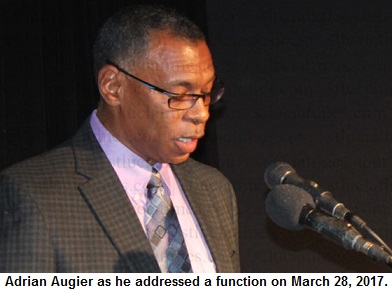
The foregoing news article quotes an Economist – Dr. Adrian Augier – in St. Lucia; speaking of the sad state of affairs for that country and all of the Caribbean. This is not a unique assessment-diagnosis; other countries and states are also suffering economic trauma, dire consequences from dysfunctional economic and governing stewardship. Nor is this assessment only to be found in the Third World (developing countries). No, even the First World or advanced economies have this disposition. Take for example the US State of Kansas. We have a fitting example of economic trauma and dysfunction, brewing there …
Kansas, Sam Brownback, and the Trickle-Down Implosion
The Kansas governor’s attempt to create Supply-side nirvana in Middle America not only failed to grow the economy — it created a crippling crisis of government that led to a statewide rejection of his politics.
See the excerpt of the news article in the Appendix below or the full article here: http://prospect.org/article/kansas-sam-brownback-and-trickle-down-implosion-0. The summary of the article in the Appendix, is that the State of Kansas experimented with a Supply-side Economic Model and the end-result is traumatic. See these headlines here:
“Brownback’s Kansas has produced one of the worst-performing state economies in the country”.
“The severely imbalanced budget led Moody’s to downgrade Kansas’s bond rating; three months later, Standard & Poor’s followed suit.”
“The failure to restore pre-recession funding has disproportionately impacted urban school districts like Kansas City’s and Wichita’s.”
“Throughout all this, Brownback’s trickle-down obsessions have continued to play out.”
“Many moderate Republicans were fed up with Brownback’s intransigence and eager to get something done.”
Consider also the rendition of this Kansas trauma-drama in this AUDIO-PODCAST from NPR’s All Things Considered show:
AUDIO-Podcast – Kansas Lawmakers Reverse Governor’s Massive Tax Cuts – http://www.npr.org/2017/06/07/531945495/kansas-lawmakers-reverse-governors-massive-tax-cuts
Posted June 7, 2017 As Heard on All Things Considered – Kansas lawmakers charted a major change of course Tuesday night when it comes to tax policy. Both the House and Senate voted to override a veto from Gov. Sam Brownback and roll back many of the 2012 tax cuts that were a model for conservatives across the country.
So Economy Doctors have assessed-diagnosed these 2 dysfunctional communities – lessons abound. The Caribbean economy (‘patient’) is terminal … and the ‘patient’ that is the State of Kansas is terminal.
This Governor Sam Brownback is now a tarnished brand in American politics. At one time he was a “Star on the Rise” of the national stage, even running for President in 2008. But his now-failed experiment in Tickle-down economics has shifted his reputation from fiscal conservatism to fiscal irresponsibility. This trauma and drama in Kansas should be a cautionary tale for other government leaders in the US and in the Caribbean – economic engines must be optimized; continuation of failed economic policies should not be tolerated. When a patient is in trauma – dying – drastic measures must be taken or the patient dies. This is true for medical trauma and economic trauma. This is the lesson from Kansas and the caution from the Economist – Dr. Adrian Augier – in St. Lucia.
“The world has changed and so must we,” Augier observed.
There is the need for change! Drastic measures must be pursued to reform and transform Caribbean society. But these changes must be planned, implemented (based on best-practices), reviewed and measured against success metrics. This is the methodology of Plan, Do and Review urged in the book Go Lean…Caribbean (Page 147). The book – available to download for free – serves as a roadmap for the introduction and implementation of the technocratic Caribbean Union Trade Federation (CU), for the elevation of Caribbean economy – for all member-states. This CU/Go Lean roadmap has these 3 prime directives:
- Optimization of the economic engines in order to grow the regional economy to $800 Billion and create 2.2 million new jobs.
- Establishment of a security apparatus to ensure public safety and protect the resultant economic engines.
- Improvement of Caribbean governance to support these engines, including a separation-of-powers between the member-states and CU federal agencies.
The mono-industrial service economy in the Caribbean and the failed Supply-side experiment in Kansas are 2 bad examples. But our scope for reforming communities is the Caribbean only!
The book stresses that reforming and transforming the Caribbean societal engines must be a regional pursuit. This was an early motivation for the roadmap, as pronounced in the opening Declaration of Interdependence (Pages 12 – 13):
xi. Whereas all men are entitled to the benefits of good governance in a free society, “new guards” must be enacted to dissuade the emergence of incompetence, corruption, nepotism and cronyism at the peril of the people’s best interest. The Federation must guarantee the executions of a social contract between government and the governed.
xvi. Whereas security of our homeland is inextricably linked to prosperity of the homeland, the economic and security interest of the region needs to be aligned under the same governance. Since economic crimes … can imperil the functioning of the wheels of commerce for all the citizenry, the accedence of this Federation must equip the security apparatus with the tools and techniques for predictive and proactive interdictions.
xxiv. Whereas a free market economy can be induced and spurred for continuous progress, the Federation must install the controls to better manage aspects of the economy: jobs, inflation, savings rate, investments and other economic principles. Thereby attracting direct foreign investment because of the stability and vibrancy of our economy.
xxxiii. Whereas lessons can be learned and applied from the study of the recent history of other societies, the Federation must formalize statutes and organizational dimensions to avoid the pitfalls of communities …
The Go Lean book provides 370-pages of turn-by-turn instructions on “how” to adopt new community ethos, plus the strategies, tactics, implementations and advocacies to execute so as to reboot, reform and transform the societal engines of Caribbean society. Our reform approach is not some Supply-side / Trickle-down experiment, whereby we exploit the working-classes to benefit the rich.
We can do better! We can deploy industrial solutions with no plutocratic abuses.
In response, the Go Lean roadmap presents a strategy of Self-Governing Entities (SGE’s). This scheme was fully detailed in the Go Lean book; see some headlines from this sample advocacy on Page 105:
10 Steps to Implement Self-Governing Entities
| 1 | Lean-in for the Caribbean Single Market The CU treaty unifies the Caribbean region into one single market of 42 million people across 30 member-states, there-by empowering the economic engines in and on behalf of the region. Many times, these engines will be independent, self-governing entities (SGE) that are only physically located in a member state, but not administered by the states. SGE’s are necessary features of the CU roadmap, allowing for industrial parks, technology labs, medical campuses, agricultural ventures, airport cities (see Appendix IJ) and even the Capital District. All aspects of their administration are managed by the CU, including monetary issues managed by the Caribbean Central Bank-CCB. |
| 2 | CU Constitution; SGE’s Bylaws |
| 3 | Negotiate With Local Municipalities for Resources The need for local resources is what makes SGE’s such an economic engine. They may have to acquire their basic needs (food, clothing, shelter, energy) from trade with their neighbors. The spirit of negotiations should reflect a partnering relationship as opposed to adversarial, but SGE’s have rights to supply every need internally or from abroad. With free market conditions the norm, price and quality is the determination; the neighbors must compete. |
| 4 | Ease-ways When the SGE physical plant is land-locked, there is a need for an ease-way to convey utilities and supplies in and out. When member-states accede to the CU treaty, they in effect declare that they are ready, willing and able to accommodate the needs of SGE’s. The rights-duty duality is at play, but financial-jobs benefits will be worth the effort. Ease-ways must be inclusive to the municipal negotiations, and may include above-ground and subterranean (pipeline) options. |
| 5 | Technology & Infrastructure The nature of a SGE means monopolies outside the perimeter do not apply inside the perimeter. It is the choice of the SGE whether or not to avail some monopolistic utility or “go solo”. This applies to energy, telecoms, water-sewage, and logistical technologies (transportation, pipeline, pneumatic tubes, etc) as long as the good neighbor status remains. |
| 6 | Housing Options |
| 7 | Security and JusticeThe CU accedence grants authority for homeland security in the SGE’s to CU institutions. There are Rangers that have direct patrol duties; CariPol that has the investigation responsibility and District Attorneys for federal prosecutions. |
| 8 | EmergenciesThough the SGE tenant has near-sovereign rights, there are special provisions for CU intrusions, limited to declared emergencies. This declaration can come from responsible parties internal to the SGE (as simple as dialing 911, or exigent circumstances) or external declarations from federal court orders or CU constitutional officers. |
| 9 | Jurisdictional Liaisons with CU State Department |
| 10 | Measuring Results |
The business models of SGE’s have been further elaborated upon in previous blog-commentaries. Consider this sample:
| https://goleancaribbean.com/blog/?p=12148 | Perfect SGE Application: Ship-breaking Model |
| https://goleancaribbean.com/blog/?p=12146 | Perfect SGE Application: Shipbuilding Model |
| https://goleancaribbean.com/blog/?p=8379 | Stewardship for Centers of Economic Activity |
| https://goleancaribbean.com/blog/?p=5921 | Socio-Economic Change: Impact Analysis of SGE’s |
| https://goleancaribbean.com/blog/?p=2750 | Disney World – Role Model for Self-Governing Entities |
| https://goleancaribbean.com/blog/?p=2338 | Using SGE’s to Welcome the Dreaded ‘Plutocracy’ |
| https://goleancaribbean.com/blog/?p=2003 | Ship-breaking under SGE Structure |
| https://goleancaribbean.com/blog/?p=1214 | Fairgrounds as SGE and Landlords for Sports Leagues |
SGE’s can bring new economic opportunities, and these opportunities must abound in the Caribbean … if we want to avert our terminal condition. The existing economic engines are not sustainable; the mono-industrial strategy – based on a service industry (i.e. tourism) – has led to a dying economy. Everyone is hereby urged to lean-in to this regional change.
The Go Lean roadmap advocates for a pluralistic democracy where all Caribbean stakeholders get a chance for life, liberty and the pursuit of happiness. This is an American ideal, but we can learn lessons from their failure – as in Kansas – to execute on these principles. In a previous blog-commentary, the role model of Hammurabi was disclosed as a missing functionality in the New World. This is where the “weak is protected from abuse from the strong in society” – this is truly missing in Kansas.
The purpose of this roadmap is not to fix the defects in Kansas nor the America political system, but rather to reform and transform the Caribbean, without engaging any unjust schemes, like the Supply-side economics depicted in this commentary.
Yes, we can make our homeland a better place to live, work and play. Let’s do this! 🙂
Download the free e-Book of Go Lean … Caribbean – now!
Sign the petition to lean-in for this roadmap for the Caribbean Union Trade Federation.
————
Appendix – Article Except: Kansas , Sam Brownback, and the Trickle-Down Implosion
Sub-title: The Kansas governor’s attempt to create supply-side nirvana in Middle America not only failed to grow the economy — it created a crippling crisis of government that led to a statewide rejection of his politics.
By: Justin Miller
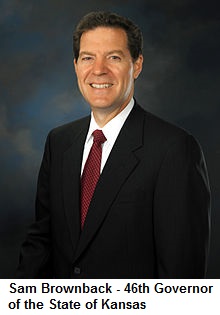 Near midnight on Tuesday, June 6, a number of Republicans in the Kansas legislature did something that few other elected Republicans had done in years: They acted responsibly. Joining with Democrats, they voted to roll back the huge tax cuts that Republican Governor Sam Brownback had inflicted on the state, which had devastated schools and other essential services while also depressing the state’s economy. But after five years of this exercise in trickle-down, the damage had been done.
THE ROBERT B. DOCKING State Office Building looms large amid the sparse downtown Topeka landscape. …
The decaying, hollowed-out building stands as a grim testament to the blunt-force trauma that Brownback’s 2012 tax cuts visited on his state, and to the ensuing budgetary crises that led lawmakers to cut government services to the bone.
For years, Brownback has called for Docking to be demolished rather than renovated. It’s an apt metaphor for his approach to government.
The state’s health-care system teeters on the verge of catastrophe, as Brownback’s privatization of state Medicaid services and further refusal to expand Medicaid has squeezed low-income Kansans and health-care providers alike. Dozens of struggling hospitals across the state are on the verge of closing. “We have to make decisions every day, on which bills to pay. I mean that literally,” one small-town hospital CEO says. Brownback’s decision to cut taxes rather than restore K–12 public education funding has strained both urban and rural school districts, compelling two districts to end the school year early. Meanwhile, he’s ushered in drastic cuts to social services and placed strict work requirements and other limits on welfare programs.
By last year, even Republicans in this heavily Republican state (which Donald Trump carried last November by 21.5 percentage points) had had it with their governor’s insistence on turning the SunflowerState into a Petri dish for radical conservative economics. A number of Republican candidates ousted Brownback supporters in legislative primaries, and this year they teamed up with the minority Democrats in the legislature (whose numbers increased after last year’s elections) to begin rolling back the Brownback catastrophe. Overturning the governor’s vetoes, which required a two-thirds majority in each house, legislators this June voted to repeal the tax cuts enacted by Brownback and a Tea Party–dominated legislature in 2012.
But the devastation has been profound.
IN 2010, SAM BROWNBACK rode the Tea Party wave into the Kansas governorship, pledging to turn the state into a bulwark against President Barack Obama’s big-government liberalism. By 2012, through aggressive backroom politicking, he pressured hesitant moderate Republicans in the legislature to join conservatives in passing a radical tax plan that eliminated the state’s top income tax bracket, drastically slashed rates, and instituted an outright income tax exemption for limited liability companies—a huge tax break for a tiny segment of the population. Conversely, in a nod to “fiscal responsibility,” the plan did away with a number of tax credits that benefited low- and middle-income Kansans. Moderate Republicans in the Senate had thought they’d be able to engineer a less-extreme version of the cuts while in a conference committee with the House. They didn’t, and days later, Brownback signed into law perhaps the most radical version of trickle-down economics any state had ever embraced.
…
Brownback’s promise that the cuts—particularly the LLC exemption—would be “a shot of adrenaline” for the Kansas economy will be written on his political headstone.
The LLC exemption, the crown jewel of the governor’s tax policy, has allowed some 330,000 independent business owners—almost double the original estimates—to avoid state tax on most, if not all, their income, costing the state roughly $500 million in revenue in 2015 alone. A recent report from a team of researchers who scoured Kansans’ income tax returns concludes that the exemption has fueled more tax evasion than job creation.
Though Brownback argued that exempting owner-operated businesses from taxes would increase investment and jobs in the state, the report found no such results. “We can’t, to the best of our ability, find support for real responses in terms of economic activity because of the tax cuts,” report co-author and University of South Carolina economics professor Jason DeBacker says. Instead, the policy drove more people to simply reclassify their income as a pass-through to avoid taxation.
The small-business owners who were the intended beneficiaries suddenly had no tax liabilities each year. But with average savings of about $1,000 a month, according to one estimate, it was hardly enough to hire more workers or expand operations. One lawyer in suburban JohnsonCounty told a Kansas City Star columnist in 2014 that he was saving as much as $10,000 a year—as were the 15 other partners in his practice—while the paralegals and other staffers with no ownership stake were still stuck paying income tax. He told the columnist that he planned to use his tax savings for a family vacation to Cancún. “I’m making out like a bandit, and it’s completely unfair,” he said.
Perhaps the most enlightening example of how the exemption worked came when a public radio station discovered in May 2016 that Bill Self, the head coach of the storied University of Kansas Jayhawks men’s basketball team, was not paying taxes on about 90 percent of his annual $3 million compensation.
…
WHAT BROWNBACK’S TAX CUTS have accomplished is to have created a crisis of catastrophic proportions for state residents. The tax cuts blew an immediate hole in the $6 billion state budget, as revenue levels fell an astounding $713 million from fiscal years 2013 to 2014. Those revenue shortfalls have not abated in the years since. To help plug the hole, Brownback has run through all the state’s reserve funds and has increased borrowing, adding $1.3 billion to the state’s debt. “We are essentially the poorest state by now, with no rainy day fund—nothing in the bank,” says Duane Goossen, the former Kansas budget director for both Democratic and Republican governors.
The severely imbalanced budget led Moody’s to downgrade Kansas’s bond rating; three months later, Standard & Poor’s followed suit. The hit to the credit rating, though, was an inadequate measure of the damage to Kansans’ lives.
…
BY PRIORITIZING HIS trickle-down tax cuts over all else, Brownback has also allowed a long-standing public school funding shortage to metastasize into a full-blown constitutional crisis.
…
The failure to restore pre-recession funding has disproportionately impacted urban school districts like Kansas City’s and Wichita’s. The state funding formula includes an “equalization” provision that helps even out funding between wealthy school districts that can rely more on a large base of property tax revenue and poorer districts that can’t. When the school cuts took effect, however, the poorer districts couldn’t take up the slack with higher property taxes.
…
Throughout all this, Brownback’s trickle-down obsessions have continued to play out. He has called for regressive increases to the sales tax and higher taxes on alcohol and cigarettes. At the same time, he continued his war on progressivity, asking the legislature to institute a flat tax—a proposal that garnered just three votes in a clearly fed-up state Senate earlier this year.
That vote reflected a sea change in Kansas politics. Last August, Kansan Republican primary voters across the state supported a group of moderate challengers to more than a dozen ultra-conservative incumbents in legislative elections. Last November, even as Trump took the state with 57 percent of the vote, Democrats managed a pick-up of 12 seats in the state’s House and one in the Senate. Heading into the January session, there was a new legislature with a class of freshmen determined to undo Brownback’s damage.
The budgetary implications of that damage were very clear. When the new legislators took their seats at the start of this year, they confronted a proposed budget with close to a $1 billion shortfall over the next two years. Soon after the session began, the state Supreme Court announced its ruling that mandated adequate school funding, which required the appropriation of an additional $750 million over the next several years.
The legislatures of the preceding six years had been complicit in creating these shortfalls, but those legislatures were gone. “The [new] legislature looks a lot like it did before 2010,” when there was a stronger bloc of moderates, says Burdett Loomis, a political science professor at the University of Kansas. “People understand that in order to get things done, you have to run through this moderate [Republican]-Democratic coalition.”
…
Passing a budget that accomplished these goals was anything but easy, since overcoming a Brownback veto requires two-thirds support in each house, and the House speaker and Senate president were both staunchly opposed to tax hikes. The moderates’ and Democrats’ task was eased, however, by a collapse in Brownback’s popular support. In 2016, a Morning Consult poll found him to be the least-popular governor in the country, with only 26 percent of the surveyed Kansans approving of his job performance. This year, the only governor less popular with his constituents was New Jersey Governor Chris Christie, bogged down in Bridgegate and the anti-Trump backlash.
…
Legislators still needed to pass a budget, and they needed to pass a school-financing bill that would meet the state Supreme Court’s call for adequate funding. To fund both the budget shortfall and the public school system, they were faced with the necessity of passing a tax reform plan even more far-reaching than the one Brownback had already vetoed. Many wanted to undo Brownback’s rate cuts by reinstituting a third bracket, raising rates closer to pre-2012 levels, and most of all, eliminating the LLC loophole. The challenge they faced was how to align enough Democrats and Republicans to vote for a package that was substantial enough to satisfy the former and frugal enough not to dissuade the latter.
…
Still, the political gymnastics required to cobble a veto-proof majority were daunting. …
…
As the session spilled into June, the legislature was approaching the record for longest legislative session in the state’s history. In the very early hours of June 5, the legislature passed a tax plan that rolled back Brownback’s tax policy and would raise about $1.2 billion over the next two years by doing away with the LLC exemption, ending the March to Zero, and reinstituting a third tax bracket with higher rates across the board. One factor that brought Ward and the Democrats on board was that the bill reinstated a number of tax credits benefiting poor and middle-income Kansans (including a child tax credit), which Brownback had scrapped. The legislature also passed a school-financing plan that would direct nearly $300 million more to schools over the next two years while tethering future aid to the rate of inflation.
In a matter of hours, Brownback announced that he would veto the tax rollback.
Later that night, the Senate approved a veto override by a one-vote margin. …
The lessons of Sam Brownback’s disastrous experiment have become all the more important nationally as President Trump, whose economic doctrine is cut from the same cloth napkin on which Arthur Laffer first sketched his supply-side curve more than 40 years ago, tries to advance a similarly radical series of tax cuts in Washington. (Indeed, Brownback flew Laffer out to Kansas in 2012, where he was paid $75,000 to advise the legislature on the wisdom of slashing taxes, promising astounding dividends of economic growth in exchange.) Trump’s proposed budget echoes the Kansas experiment, slashing income tax rates for the wealthiest few and calling for a drastic rate cut for pass-through entities—a move that would inflict Brownback’s LLC debacle on the nation.
Brownback’s should be a cautionary tale, of course, for the Republicans in Congress and the White House. Should they slash the provision of affordable health coverage to cut taxes for the rich, should they decimate government services while eliminating taxes on the wealthiest Americans, all their invocations of trickle-down economics—that the rich will invest their tax savings in job-creating enterprises, a theory disproved again, again, and again—ultimately won’t win them popular support. The fate of Sam Brownback—scorned by his state, overridden by his legislature, rejected by his party—should make that crystal clear.
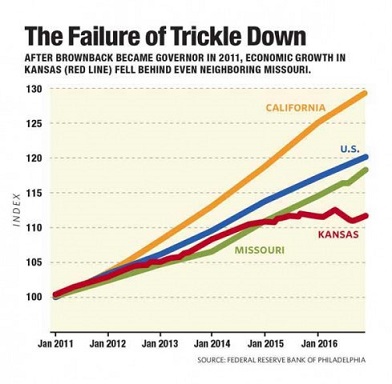
Tax Cuts for the rich. Deregulation for the powerful. Wage suppression for everyone else. These are the tenets of trickle-down economics, the conservatives’ age-old strategy for advantaging the interests of the rich and powerful over those of the middle class and poor. The articles in Trickle-Downers are devoted, first, to exposing and refuting these lies, but equally, to reminding Americans that these claims aren’t made because they are true. Rather, they are made because they are the most effective way elites have found to bully, confuse and intimidate middle- and working-class voters. Trickle-down claims are not real economics. They are negotiating strategies. Here at the Prospect, we hope to help you win that negotiation.
Source: Posted in “The American Prospect” on June 28, 2017; retrieved June 28, 2017 from: http://prospect.org/article/kansas-sam-brownback-and-trickle-down-implosion-0