100 Years of Mandela – ENCORE

Wow, time flies!

It is 100 years now that Nelson Mandela had come into this world, and though his life has ended, his impact continues to reverberate … up to today.

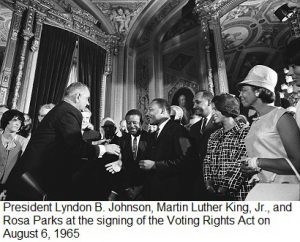
Nelson Rolihlahla Mandela (18 July 1918 – 5 December 2013) was a South African anti-apartheid revolutionarypolitical leader, and philanthropist, who served as President of South Africa from 1994 to 1999. He was the country’s first black head of state and the first elected in a fully representative democratic election. His government focused on dismantling the legacy of apartheid by tackling institutionalized racism and fostering racial reconciliation. Ideologically an African nationalist and socialist, he served as President of the African National Congress (ANC) party from 1991 to 1997.
Source: Retrieved July 17, 2018 from: https://en.wikipedia.org/wiki/Nelson_Mandela

There are so many lessons that the life and legacy of Nelson Mandela offers to the modern Caribbean. One such lesson was provided in a previous blog-commentary from April 30, 2015. See an Encore of that submission here/now:

———————————
Go Lean Commentary – A Lesson in History – Royal Charter: Zimbabwe -vs- South Africa
Zimbabwe - Photo 2If presented the choice, which would you rather be granted: riches or power?

Many would conclude riches, because of societal expressions like the “Golden Rule: He who has the Gold… rules”. Yet the truth is riches can be created and destroyed quickly. This was the experience just recently during the 2008 Great Recession, where people in the US – the richest country on the planet – lost $11 Trillion in net worth in short order.

On the other hand, there is power. History shows that with power, the rights to riches can be granted, exploited and passed on, from century to century, generation to generation. Consider for example the African continent (in particular the southern region) and the Royal Charters that granted abundant wealth to a privileged few:

The English had been the first to adopt the approach of bundling their resources into a monopoly enterprise, with the English East India Company in 1600. This threatened their Dutch competitors with ruin,[15] so in 1602 the Dutch monarchy followed suit and sponsored the creation of a single Dutch East Indies Company and granted it monopoly over the Asian trade. (Source: http://en.wikipedia.org/wiki/Dutch_East_India_Company#Formation_.281602.29)

CU Blog - A Lesson in History - Royal Charter - Zimbabwe -vs- South Africa - Photo 1The British monarchy has issued over 980 Royal Charters.[1] (A formal document issued by a monarch as letters patent, granting a right or power to an individual or a body corporate). A specific charter was issued for the South African region.

The British South Africa Company (BSAC) was established following the amalgamation of Cecil Rhodes‘ Central Search Association and the London-based Exploring Company Ltd which had originally competed to exploit the expected mineral wealth of Mashonaland but united because of common economic interests and to secure British government backing. The company received a Royal Charter in 1889 modeled on that of the English East India Company. Its first directors included the Duke of Abercorn, Rhodes himself and the South African financier Alfred Beit. Rhodes hoped BSAC would promote colonisation and economic exploitation across much of south-central Africa, as part of the “Scramble for Africa“. However, his main focus was south of the Zambezi, in Mashonaland and the coastal areas to its east, from which he believed the Portuguese could be removed by payment or force, and in the Transvaal, which he hoped would return to British control.[1] (Source: http://en.wikipedia.org/wiki/British_South_Africa_Company)
This historic information is being considered in conjunction with the book Go Lean…Caribbean; a publication designed to elevate the region’s economic (create 2.2 million new jobs), security and governing engines. Why would this “Lesson in History” matter in assessing today’s Caribbean status and fate?

It is of utmost importance. This discussion reveals how to reconcile the injustices of the past, and still build a better future. We have good models to consider, in this case the countries of Zimbabwe and South Africa.

In a previous blog/commentary, the issue of the origin of colonial entitlements was detailed at full length. A direct quote relates:

The most iconic of all the Papal Bulls [-“letters patent” or charters issued by a Pope, the Head of the Roman Catholic Church -] was the Inter caetera, a Papal Bull by Pope Alexander VI on 4 May 1493, which set a demarcation between the New Lands to Portugal and Spain; this granted to Spain all lands to the “west and south” … of the islands of the Azores … and all new lands to the East of this pole remained assigned to Portugal.

Just before this world-changing decree, there was an earlier Papal Bull that sealed the fate and would prejudice the African Diaspora for 500 years. The African Slave Trade and institution of “Slavery” was legally predicated on a Papal Bull from Pope Innocent VIII (Giovanni Battista Cybo) in 1491; just months before Christopher Columbus’s historic first voyage

From the origins of slavery, [colonialism] traversed the historic curves of social revolution and evolution. In the 1500, the Protestant movement took hold. As other European powers deviated from Catholicism, Papal Bulls carried no significance to them and compliance was ignored. England and Holland established their own Protestant Churches with their own monarch as head of Church and State; Papal decrees were replaced with Royal Decrees and Charters. The intent and end-result was still the same: territories and lands awarded (colonized) with the stroke of a pen by one European power after another. The Royal Decrees and Charters were then reinforced with a strong military presence and many battles…

[The resultant] “oligarchy” … power effectively rested with a small number of people. These people could be distinguished by royalty, wealth, family ties, education, corporate, religious or military affiliation.

In this discussion of oligarchy, focus is given to powerful families. There are encyclopedic references that relate that oligarchy structures are often controlled by a few prominent families, who typically pass their influence/wealth from one generation to the next, even though inheritance alone is not a necessary condition for oligarchies to prevail…

This is the challenge that belies Caribbean society. Most of the property and indigenous wealth of the Caribbean region is concentrated amongst the rich, powerful and yet small elite; an oligarchy. Many times these families received their property, corporate rights and/or monopolies by Royal Charter from the European monarchs of ancient times. These charters thus lingered in legacy from one generation to another … until …

The form of rulership that dominated these times in history is that of Oligarchy; empowered by Royal Charters/Decrees. Today, oligarchy – rule by the rich[4] – is synonymous with another term commonly used, plutocracy.

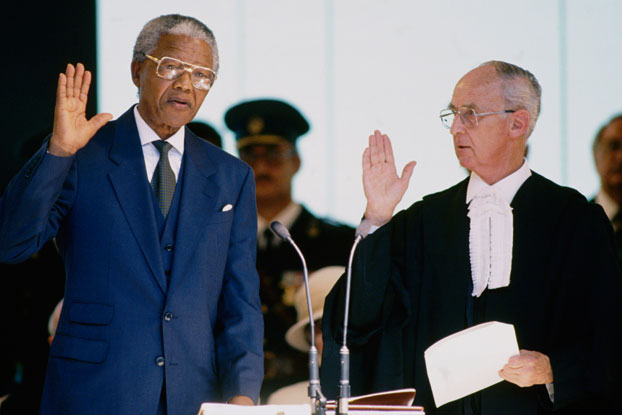
Zimbabwe Photo 3The subject of oligarchs is very familiar on the African continent. This has been a real issue there. In many countries after colonialism, like Zimbabwe (1980), the cure for the oligarch disease was nationalization – forfeiting and seizing commercial farms and mines. This turned out disastrously for this country; the cure was worse than the disease. But, next door in South Africa (14 years later), the strategy, tactics and implementation was different. This country did not ascend to majority-rule until 1994; the first majority-ruled President there, Nelson Mandela saw the futility of the nationalization strategy amongst the precedent independent African nations, so he pursued an alternate approach to assuage White Flight and keep the capital and skilled labor in the country. But the continuation of the oligarchs ill-gained, and public-perceived-stolen assets forged problems in the reality of economic/wealth inequality. Majority-rule therefore brought no revolutionary change for the average man.

All in all, change is not easy. It is heavy-lifting. This is abundantly clear in the examination of the independent majority-ruled Zimbabwe and majority-ruled South Africa. See Chart in the Appendix of the comparisons.

The details of the Republic of Zimbabwe (1980) evolution are as follows:

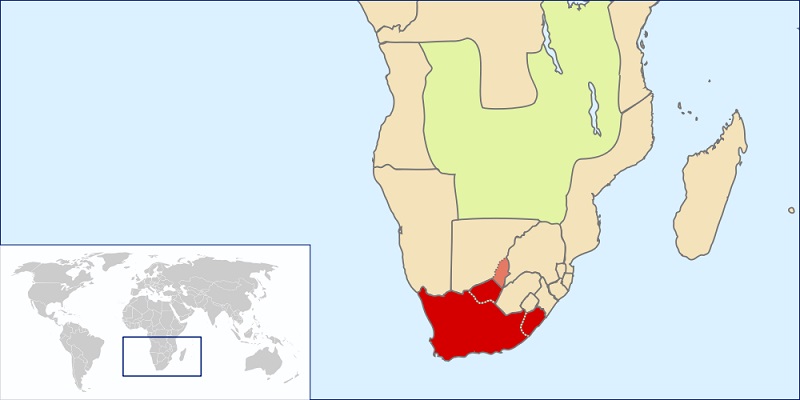
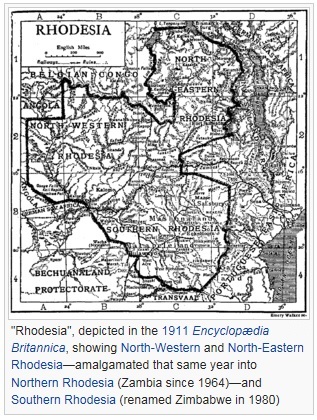
The British South Africa Company was a Royal Charter, to administer “North-Western Rhodesia” and “North-Eastern Rhodesia” for White settlement; it was not under those names, but the names of the geographic parts—”Mashonaland”, “Matabeleland”, “Barotseland”, and so on. The collective territories were initially referred to as “Zambesia” – the name origins of both Zambia and Zimbabwe – but became Rhodesia as an international brand. While the White minority community resisted the transition to black majority-rule, the change inevitably came, empowering revolutionary leader Robert Mugabe. The new regime – due to spite, revenge and broken promises – began confiscating White-owned farmlands. This is widely blamed for leading to the deterioration of the Zimbabwean economy (societal abandonment of human and financial capital); this has plagued the country even until this day.[113]

The details of the Republic of South Africa (1994) evolution are as follows:

The Cape Colony was a British colony in present-day South Africa and Namibia, named for the Cape of Good Hope. The British colony was preceded by an earlier Dutch colony of the same name, established in 1652 by the Dutch East India Company – granted by Royal Charter from the Dutch Monarchy. The Dutch lost the colony to Britain following the 1795 Battle of Muizenberg, but had it returned following the 1802 Peace Treaty of Amiens. It was re-occupied by the British following the Battle of Blaauwberg in 1806, and British possession affirmed with the Anglo-Dutch Treaty of 1814. The Cape Colony then remained in the British Empire, becoming self-governing in 1872, and uniting with three other colonies to form the Union of South Africa in 1910. Despite practicing racial segregation for most of its history, eventually integration and black majority-rule evolved in the Republic of South Africa. Despite their resistance to these changes, accommodations and reconciliations on the part of Nelson Mandela allowed for the continuation of the established societal engines; the minority White communities and business interests remained.
Zimbabwe - Photo 4Considering these case studies, the Failed-State status of Zimbabwe versus the economic successes of South Africa, we see a lesson in this history, an obvious appreciation for best-practices … for us to apply in the Caribbean. We can optimize these best-practices by applying regional strategies, tactics and implementations to benefit everyone – the Greater Good – and try not to disenfranchise any one group.

The masses of people in the democratic Caribbean now have the right to rule, not just some special group set aside by Royal Decree or granted power by a Royal Charter. Since there is the scientific fact that no one can go back in time and change history; we can only move forward, hopefully with wisdom from the lessons learned in history. The Go Lean book presents a roadmap on how to benefit from these lessons – good, bad and ugly – and how to empower communities anew; to use political power to impact the Greater Good. We therefore see a role for the Rich (One Percent – Page 224), the Poor (Page 222) and the Middle Classes (Page 223).

The consideration of the Go Lean book, as related to this subject is one of governance, the need for technocratic stewardship of the regional Caribbean society. This point was also pronounced in the opening Declaration of Interdependence (Page 12) with these acknowledgements and statements:

xi.   Whereas all men are entitled to the benefits of good governance in a free society, “new guards” must be enacted to dissuade the emergence of incompetence, corruption, nepotism and cronyism at the peril of the people’s best interest. The Federation must guarantee the executions of a social contract between government and the governed.

xii. Whereas the legacy in recent times in individual states may be that of ineffectual governance with no redress to higher authority, the accedence of this Federation will ensure accountability and escalation of the human and civil rights of the people for good governance, justice assurances, due process and the rule of law. As such, any threats of a “failed state” status for any member state must enact emergency measures on behalf of the Federation to protect the human, civil and property rights of the citizens, residents, allies, trading partners, and visitors of the affected member state and the Federation as a whole.

xiii. Whereas the legacy of dissensions in many member-states (for example: Haiti and Cuba) will require a concerted effort to integrate the exile community’s repatriation, the Federation must arrange for Reconciliation Commissions to satiate a demand for justice.

This Go Lean book serves as a roadmap for the introduction and implementation of the technocratic Caribbean Union Trade Federation (CU) to provide better stewardship for the 30 member-states of the Caribbean region, despite their European heritage. The book (and subsequent blog/commentaries) posits that we must not fashion ourselves as parasites of our previous European colonizers, but rather pursue a status as protégés.

Our past history feature much oppression and repression; European colonialism had been a villainous “dragon”. But we can train our dragons! We can make the most of previous bad history. This point was presented as a strategy for Direct Foreign Investments, asserting that we want to invite and attract investments. We can use their resources to elevate our own communities, while still providing a return/profit for the investors.

This is Pragmatism 101!

We, in the Caribbean, were not the only ones abused. Other indigenous people (Africans, Asians, Amerindians, etc.) also suffered, sometimes even more so. The goal should be to thrive despite the disabling legacy; (and if not for everyone, then make the most of the situation for the most number of people).

This is the community ethos of the Greater Good!

Globalization is now an ‘Agent of Change’ that we must contend with. We must “play nice in the sandbox” with people of other countries, especially those with capital resources. So if a minority group represents a faction that previously exploited our land and forefathers, we cannot expect to extract vengeance against them – Zimbabwe proved the futility of such a quest for justice and inequity. As related in the Go Lean book (Page 151), the best-practice for any governing entity to grow the economy is to protect all property rights; (real, personal or intellectual). This is the “new” New World; and the new formula for success.

Another formula, an economic principle, is that “voluntary trade creates wealth” (Page 21). This fact has often been overlooked in policy decisions for Africa. The following VIDEO portrays this dilemma, decrying the current migrant/refugee crisis in Europe, when the best-practice the continent can provide the African people is a more liberal trade policy, allowing markets for African agricultural produce. (Without this type of proactive strategies, the continent is being oppressed … all over again … by today’s Europe; this is a lesson learned from the Native American Reservations in the US).

VIDEO: UKIP Leader Nigel Farage Addressing European Parliament on African Culpability & Hyprocrisy – https://youtu.be/NTwOap7ohc4

Posted by Wednesday, April 29, 2015 – UKIP Leader Nigel Farage: speaks to the European Parliament on the EU suggestion that the continent should have a common asylum and migration policy. He felt it was important to represent the view that this is not just another attack on British sovereignty but also inherently dangerous.

In general, the Go Lean roadmap stresses key community ethos, strategies, tactics, implementations and advocacies necessary to transform and turn-around the eco-systems of Caribbean society. These points are detailed in the book as follows:

Community Ethos – Deferred Gratification Page 21
Community Ethos – Economic Principles – Economic Systems Influence   Individual Choices Page 21
Community Ethos – Economic Principles – Consequences of Choices Lie in   the Future Page 21
Community Ethos – Ways to Impact the Future Page 26
Community Ethos – Ways to Manage Reconciliations – South African Model Page 34
Community Ethos – Ways to Impact the Greater Good Page 37
Strategy – Vision – Confederate all 30 member-states/ 4 languages into a Single Market Page 45
Tactical – Separation-of-Powers – CU Federal Government versus Member-State Governance Page 71
Implementation – Ways to Pay for Change Page 101
Implementation – Ways to Foster International Aid Page 115
Planning – 10 Big Ideas – #4: Confederation Without Sovereignty Page 127
Planning – Ways to Improve Trade Page 128
Planning – Ways to Model the new European Union – Unified Economy Page 130
Planning – Ways to Make the Caribbean Better Page 131
Planning – Lessons Learned from 2008 Page 136
Planning – Lessons Learned from Indian Reservations – Audacity versus Absence of Hope Page 141
Advocacy – Ways to Grow the Economy – Protect Property Rights Page 151
Advocacy – Ways to Create Jobs Page 152
Advocacy – Ways to Improve Governance Page 168
Advocacy – Ways to Better Manage the Social Contract Page 170
Advocacy – Ways to Better Manage Natural Resources Page 183
Advocacy – Ways to Preserve Caribbean Heritage Page 218

In considering this history and re-addressing the opening question: given the choice between riches and power, we choose power!

With the proper stewardship, we can “create real money from thin air”; establish trade networks to grow the economy, educate our people to be global leaders, foster development of products and services that the world demands. The “world would beat a path to our doors”.

Adherence to these best-practices – gleaned from this lesson in history – would help us make our Caribbean community a better homeland to live, work and play.  🙂

Download the free e-Book of Go Lean … Caribbean – now!

———

Appendix – Comparative Analysis of Zimbabwe versus South Africa

Zimbabwe

South Africa

Economy – overview Zimbabwe’s economy is growing despite continuing political   uncertainty. Following a decade of contraction from 1998 to 2008, Zimbabwe’s   economy recorded real growth of roughly 10% per year in 2010-11, before   slowing in 2012-13 due poor harvests and low diamond revenues. The government   of Zimbabwe faces a number of difficult economic problems, including   infrastructure and regulatory deficiencies, ongoing indigenization pressure,   policy uncertainty, a large external debt burden, and insufficient formal   employment. Until early 2009, the Reserve Bank of Zimbabwe routinely printed money   to fund the budget deficit, causing hyperinflation. Dollarization in early   2009 – which allowed currencies such as the Botswana   pula, the South Africa   rand, and the US dollar to be used locally – ended hyperinflation and reduced   inflation below 10% per year, but exposed structural weaknesses that continue   to inhibit broad-based growth. South Africa is a middle-income, emerging market with an   abundant supply of natural resources; well-developed financial, legal,   communications, energy, and transport sectors and a stock exchange that is   the 16th largest in the world. Even though the country’s modern   infrastructure supports a relatively efficient distribution of goods to major   urban centers throughout the region, unstable electricity supplies retard   growth. The global financial crisis reduced commodity prices and world   demand. GDP fell nearly 2% in 2009 but has recovered since then, albeit   slowly with 2014 growth projected at about 2%. Unemployment, poverty, and   inequality – among the highest in the world – remain a challenge. Official   unemployment is at nearly 25% of the work force, and runs significantly   higher among black youth. Eskom, the state-run power company, has built two   new power stations and installed new power demand management programs to   improve power grid reliability. Construction delays at two additional plants,   however, mean South Africa   is operating on a razor thin margin; economists judge that growth cannot   exceed 3% until those plants come on line. South Africa’s economic policy   has focused on controlling inflation, however, the country has had   significant budget deficits that restrict its ability to deal with pressing   economic problems. The current government faces growing pressure from special   interest groups to use state-owned enterprises to deliver basic services to   low-income areas and to increase job growth.
Population 12,973,808 54,002,000
GDP (purchasing power parity) $7.496 billion (2013 est.) $595.7 billion (2013 est.)
$7.265 billion (2012 est.) $584 billion (2012 est.)
$6.957 billion (2011 est.) $569.5 billion (2011 est.)
note: data are in 2013 US dollars note: data are in 2013 US dollars
GDP – real growth rate 3.2% (2013 est.) 2% (2013 est.)
4.4% (2012 est.) 2.5% (2012 est.)
10.6% (2011 est.) 3.5% (2011 est.)
GDP – per capita (PPP) $600 (2013 est.) $11,500 (2013 est.)
$600 (2012 est.) $11,400 (2012 est.)
$500 (2011 est.) $11,300 (2011 est.)
note: data are in 2013 US dollars note: data are in 2013 US dollars
GDP – composition by sector agriculture: 20.1% agriculture: 2.6%
industry: 25.4% industry: 29%
services: 54.5% (2013 est.) services: 68.4% (2013 est.)
Population below poverty line 68% (2004) 31.3% (2009 est.)
Household income or consumption by   percentage share lowest 10%: 2% lowest 10%: 1.2%
highest 10%: 40.4% (1995) highest 10%: 51.7% (2009 est.)
Inflation rate (consumer prices) 8.5% (2013 est.) 5.8% (2013 est.)
8.2% (2012 est.) 5.7% (2012 est.)
Labor force 3.939 million (2013 est.) 18.54 million (2013 est.)
Labor force – by occupation agriculture: 66% agriculture: 9%
industry: 10% industry: 26%
services: 24% (1996) services: 65% (2007 est.)
Unemployment rate 95% (2009 est.) 24.9% (2013 est.)
80% (2005 est.) 25.1% (2012 est.)
note: figures include unemployment and underemployment;   true unemployment is unknown and, under current economic conditions,   unknowable
Distribution of family income – Gini   index 50.1 (2006) 63.1 (2005)
50.1 (1995) 59.3 (1994)
Budget revenues: $NA revenues: $88.53 billion
expenditures: $NA (2013 est.) expenditures: $105.5 billion (2013 est.)
Industries mining (coal, gold, platinum, copper,   nickel, tin, diamonds, clay, numerous metallic and nonmetallic ores), steel;   wood products, cement, chemicals, fertilizer, clothing and footwear, foodstuffs,   beverages mining (world’s largest producer of   platinum, gold, chromium), automobile assembly, metalworking, machinery,   textiles, iron and steel, chemicals, fertilizer, foodstuffs, commercial ship   repair
Industrial production growth rate 3.7% (2013 est.) 0.9% (2013 est.)
Agriculture – products corn, cotton, tobacco, wheat, coffee,   sugarcane, peanuts; sheep, goats, pigs corn, wheat, sugarcane, fruits,   vegetables; beef, poultry, mutton, wool, dairy products
Exports $3.144 billion (2013 est.) $91.05 billion (2013 est.)
$3.314 billion (2012 est.) $93.48 billion (2012 est.)
Exports – commodities platinum, cotton, tobacco, gold,   ferroalloys, textiles/clothing gold, diamonds, platinum, other metals   and minerals, machinery and equipment
Exports – partners China 21.1%, South Africa 15.1%,   Democratic Republic of the Congo 12.1%, Botswana 10.8%, Italy 4.6% (2012) China 11.8%, US 8.3%, Japan   6%, Germany 5.7%, India 4.2%   (2012)
Imports $4.571 billion (2013 est.) $99.55 billion (2013 est.)
$4.569 billion (2012 est.) $102.6 billion (2012 est.)
Imports – commodities machinery and transport equipment,   other manufactures, chemicals, fuels, food products machinery and equipment, chemicals,   petroleum products, scientific instruments, foodstuffs
Imports – partners South    Africa 51.9%, China 10%   (2012) China 14.4%, Germany   10.1%, Saudi Arabia 7.7%, US 7.4%, Japan   4.6%, India   4.5% (2012)
Debt – external $8.445 billion (31 December 2013 est.) $139 billion (31 December 2013 est.)
$8.765 billion (31 December 2012 est.) $130.4 billion (31 December 2012 est.)
Exchange rates Zimbabwean dollars (ZWD) per US dollar   – rand (ZAR) per US dollar –
234.25 (2010) 9.576 (2013 est.)
234.25 (2009) 8.2031 (2012 est.)
9,686.8 (2007) 7.3212 (2010 est.)
note: the dollar was adopted as a legal currency in 2009;   since then the Zimbabwean dollar has experienced hyperinflation and is   essentially worthless 8.42 (2009)
  7.9576 (2008)
Fiscal year calendar year 1 April – 31 March
Public debt 202.4% of GDP (2013 est.) 45.4% of GDP (2013 est.)
244.2% of GDP (2012 est.) 42.3% of GDP (2012 est.)
Reserves of foreign exchange and gold $437 million (31 December 2013 est.) $48.46 billion (31 December 2013 est.)
$575.6 million (31 December 2012 est.) $50.7 billion (31 December 2012 est.)
Current Account Balance -$576 million (2013 est.) -$23.78 billion (2013 est.)
-$416.5 million (2012 est.) -$24.07 billion (2012 est.)
GDP (official exchange rate) $10.48 billion (2013 est.) $353.9 billion (2013 est.)
Stock of direct foreign investment –   at home $NA $143.3 billion (31 December 2013 est.)


Share this post:
, , ,

Industrial Reboot – Prefab Housing 101

Go Lean Commentary

Is housing just a commodity, available to the highest bidder, or a basic right that everyone is entitled to?

The answer to this question should be obvious: no matter the income level, there is the need for housing – basic needs are cataloged as food, clothing and shelter – so there must be housing solutions for all in society, the rich, middle class and the poor.

Here’s the disclosure: All housing types can benefit from pre-fabricated housing methods – see Photos below.

Prefabricated buildings consist of several factory-built components or units that are assembled on-site to complete the unit. The economic beauty of this method is the requirement for labor in the fabrication site and the assembly site. Fostering that labor means jobs and allows for an Industrial Reboot based on familiar techniques. Already, a popular prefabrication technique is utilized widely in the construction industry with Roof Trusses.

The book Go Lean … Caribbean – available to download for free – focuses on fostering Industrial Reboots for the Caribbean region. The book serves as a roadmap for the introduction and implementation of the technocratic Caribbean Union Trade Federation (CU). It identifies the strategic and tactical genius of Roof Trusses (Page 207):

The Bottom Line on Roof Trusses
In architecture a truss is a structure comprising one or more triangular units constructed with straight members whose ends are connected at joints referred to as nodes. Simple trusses are composed entirely of triangles because of the stability of this shape and the methods of analysis used to calculate the forces within them. The planar truss, pitched truss, or common truss is used primarily for roofs.Prefabrication is the practice of assembling components of a structure in a factory or other manufacturing site, and transporting complete assemblies or sub-assemblies to the construction site. Roof trusses are most commonly prefabricated. A prefabricated roof truss system is an engineered shop fabricated wood frame system that is installed on the building at the job site. It is installed on the typical timber or concrete belt beam and typically spans from one load bearing wall to another load bearing wall. Prefabricated roofs are used on almost any type of roof and are preferred when resistance to high wind speed is required because it can be quickly engineered, or when rapid site installation is required.This is the winning formula for acceptance of prefab homes. Despite objections to prefabrication strategies/concepts, no one objects to prefabricated roof trusses; the market acceptance for homes should “build-up” from this “juncture”.

The Go Lean book opened with a focus on basic needs. At the very beginning – Page 3 – the role for the CU was defined:

The CU should better provide for the region’s basic needs (food, clothing, energy and shelter), and then be in position to help supply the rest of the world. Previous Caribbean societies lived off the land and the sea; but today, the region depends extensively on imports …

For industries that depend on providing basic needs, there is an opportunity to reboot the industrial landscape and business model. There is the opportunity to launch a Prefab Housing industry.

Jobs are at stake.

According to the book Go Lean … Caribbean (Page 257) , there could be this many jobs:

Direct jobs in the design, fabrication and logistics for new pre-fab homes: 8,000

The Go Lean book prepares the business model of Prefab Housing for consumption in the Caribbean. Yes, business model refers to jobs, entrepreneurial opportunities, trade transactions, etc. In addition to these industry jobs; there is also the reality of indirect jobs – unrelated service and attendant functions – at a 3.75 multiplier rate would add another 30,000 jobs.

This constitutes an Industrial Reboot.

There is the need to supplement the housing deliveries in the Caribbean region; so factory-built homes should have a place. But, we are not talking manufactured homes, as in mobile homes or trailers. No, we are talking previously-made and fabulous, or pre-fab. Thus these homes can supply the demand for rich and middle class residents. See the samples from Appendix K; of the Go Lean book on Page 289. In addition, there are vast options for prefab homes from recycled shipping containers. These are ideal for affordable housing solutions, or even replacements for  “Shanty Towns”; see Appendix Commentary.

Providing quality housing for “pennies on the dollar” is an ideal objective for the Go Lean movement, or those pursuing the Greater Good. This Industrial Reboot pursues the Greater Good mandate; it is wise to try to please residents, advocates, entrepreneurs, bankers and governmental officials. This is in addition to the roadmap’s prime directive, defined as follows:

  • Optimization of the economic engines in order to grow the regional economy to $800 Billion & create 2.2 million new jobs.
  • Establishment of a security apparatus to ensure public safety and protect the resultant economic engines.
  • Improvement of Caribbean governance to support these engines, including a separation-of-powers between the member-states and CU federal agencies.

This Industrial Reboot is badly needed in the Caribbean region as our current economic landscape – based on Tourism – is in shambles!

Tourism is under assault in every Caribbean member-state due to the fact that many visitors shift from stay-overs to cruise arrivals. This means less economic impact to the local markets. So as a region, we must reboot our industrial landscape so as to create more jobs … from alternate sources. What options do we have?

This commentary has previously identified a number of different industries that can be rebooted under this Go Lean roadmap. See this list of previous submissions under the title Industrial Reboots:

  1. Industrial RebootsFerries 101 – Published June 27, 2017
  2. Industrial RebootsPrisons 101 – Published October 4, 2017
  3. Industrial RebootsPipeline 101 – Published October 6, 2017
  4. Industrial RebootsFrozen Foods 101 – Published October 6, 2017
  5. Industrial RebootsCall Centers 101 – Published July 2, 2018
  6. Industrial Reboots – Prefab Housing 101 – Published Today – July 14, 2018

The Go Lean book stresses that reforming and transforming the Caribbean economic engines must be a regional pursuit. This was an early motivation for the roadmap, as pronounced in the opening Declaration of Interdependence (Pages 12 – 13):

xxiv.  Whereas a free market economy can be induced and spurred for continuous progress, the Federation must install the controls to better manage aspects of the economy: jobs, inflation, savings rate, investments and other economic principles. Thereby attracting direct foreign investment because of the stability and vibrancy of our economy.

xxvi.  Whereas the Caribbean region must have new jobs to empower the engines of the economy and create the income sources for prosperity, and encourage the next generation to forge their dreams right at home, the Federation must therefore foster the development of new industries, like that of ship-building, automobile manufacturing, prefabricated housing, frozen foods, pipelines, call centers … – impacting the region with more jobs.

Accordingly, the CU will facilitate the eco-system for Self-Governing Entities (SGE), an ideal concept for Prefab Housing with its exclusive federal regulation/promotion activities. Imagine bordered campuses – with backup power generations, extra wide roads, railroad lines and shipping docks. The Go Lean movement (book and blogs) details the principles of SGE’s and job multipliers, how certain industries are better than others for generating multiple indirect jobs down the line (or off-campus) for each direct job on the SGE’s payroll.

This is the vision of an industrial reboot! This transformation is where and how the jobs are to be created.

The Go Lean book provides 370-pages of turn-by-turn instructions on “how” to adopt new community ethos, plus the strategies, tactics, implementations and advocacies to execute so as to reboot, reform and transform the societal engines of Caribbean society. One advocacy in rebooting the industrial landscape is to foster a Prefab Housing industry; consider the  specific plans, excerpts and headlines from the book on Page 207 entitled:

10 Ways to Develop a Prefab Housing Industry

1 Lean-in for the Caribbean Single Market
This treaty allows for the unification of the region into one market, thereby expanding to an economy of 30 countries, 42 million people and GDP of over $800 Billion (circa 2010). One mission of the CU is to enable the region to facilitate its own shelter (plus food & clothing). A successful campaign to repatriate the Diaspora, and attract Retirement/Medical Tourists creates a new demand level for housing. The supply of housing will be met with different solutions, including Prefabricated options. In terms of demand, Pre-Fab homes are becoming popular in the EU and North America as they are cheaper compared to many existing homes on the market. The 2007-2009 Global Financial crisis, however, deflated the cost of regular houses in North America and Europe, so the “cheaper” benefits was not so valued during/after this crisis period. But the CU is a different market than the North America or Europe, resembling the Third World more so than the developed world, so a lot of the current housing is sub-standard and need to be replaced anyway.
2 Fashionable Design
3 Energy Optimizations

To minimize the cost of energy, the CU will encourage design inclusions of solar panels, solar-water-heater, Energy-Star appliance in the Pre-fab-ulous homes. The CU region is also ideal for home “wind” turbines. The design of well air circulated ceilings, so that ceiling fans and the trade-winds alone, can satisfy artificial cooling needs (most of the times).

4 Raw Materials
5 Assembly Plants
6 Supply Chain Solutions (Contractors)
7 Transport/Logistics
8 Showrooms and Marketing
9 Mortgages – Retail and Secondary Markets

Traditionally, manufactured homes do not qualify for mortgages; they are treated as auto loans, not home mortgages. The CU will provide a secondary industry as an inducement for the retail mortgage firms to supply the direct demand.

10 Homeowners Casualty Insurance

Pre-Fab-ulous houses will be built with the structural integrity to withstand typical tropical storms/hurricanes. The CU will facilitate the Property Casualty insurance industry by offering Reinsurance sidecar options on the capital markets.

The subject of housing needs and deliveries is not new for this Go Lean roadmap; there have been a number of previous blog-commentaries by the Go Lean movement that referenced economic opportunities embedded in the housing industry. See a sample list here:

https://goleancaribbean.com/blog/?p=14250 Leading with Money Matters – As Goes Housing, Goes the Market
https://goleancaribbean.com/blog/?p=11737 Robots Building Houses – More than Fiction
https://goleancaribbean.com/blog/?p=11638 Righting a Wrong: The 2008 Housing Crisis
https://goleancaribbean.com/blog/?p=10373 Science of Sustenance – CLT Housing
https://goleancaribbean.com/blog/?p=7659 Pre-Fab Housing and Elder-Care Conjunction
https://goleancaribbean.com/blog/?p=1896 The Crisis in Black Homeownership

Prefab housing is a subset of the general housing industry; but there is a different kind of art and science for this economic endeavor! See the best practice and prospects for prefab manufacturing described in the Appendix VIDEO below.

The Caribbean has a lot of dysfunction when it comes to housing; this is indicative of our near-Failed-State status. We need all the help we can get! We have a constant risk of natural disasters (think: hurricanes and earthquakes) that consistently impact the homes in the region. There is always a need to build and rebuild. This creates the demand for Prefab Housing.

Even successful communities need creative housing solutions. Consider the sad experience of the working class in Silicon Valley, in Northern California (San Francisco Bay Area). People there cannot afford local homes on minimum wage jobs, even two or three jobs. So imagine some of the Prefab homes, discussed here-in, being offered in the Silicon Valley area. While this seems viable, the scope of the Go Lean movement is limited to the Caribbean, not San Francisco. This is just a lesson-learned for us. See more on the Silicon Valley problem in this Youtube VIDEO here: https://youtu.be/6dLo8ES4Bac.

The demand is there. We now need to be a part of the supply solution.

In summary, our Caribbean region need a better job-creation ability than is reflected in the regional status quo. If we are successful in creating more jobs, then boom, just like that, our homeland is a better place to live, work and play. With this success, we should be able to retain more of our Caribbean citizens, as one of the reasons why so many Caribbean citizens have emigrated away from the homeland is the job-creation dysfunction. Prefab Housing can also be a part of the housing solution for inviting the Diaspora to repatriate to the Caribbean homeland.

So rebooting the industrial landscape is necessary and wise; we can contribute to a reality where we can prosper where planted in the Caribbean homeland.

Yes, we can … do this: reboot our industrial landscape, and create new jobs – and provide better housing solutions, for our people, the rich, the poor and all classes in between.

We urge all Caribbean stakeholders to lean-in to this roadmap for economic empowerment. 🙂

Download the free e-Book of Go Lean … Caribbean – now!

Sign the petition to lean-in for this roadmap for the Caribbean Union Trade Federation.

—————-

APPENDIX Commentary – Bahamas Blogger Monte A. Pratt

AN ALTERNATE SOLUTION TO SHANTYTOWN HOUSING DILEMMA – Part 1

The Government has issued a July 31st deadline for all Shantytown persons to vacate their illegally built homes. However, there seems to be no planned relocation program to assist these persons. They are pretty much on their own.

These Shantytowns are a disaster just waiting to happen… they have been very lucky so far that many persons have not been killed in any of these Shantytown fires. Not to mention the health hazard these places are to the many surrounding residences.

Considering all of the above ‘negative’ factors, as a solution to this unwanted ‘vexing problem’, Government should seriously consider allowing the development ‘Container Home Parks’ to relocate and properly re-house these persons.

Container Homes (pictured below) are built from discarded (old) shipping containers is fast becoming a housing solution around the world… even in America. Not only as a clear solution to this problem, they can be a ‘quick solution that is ‘cost-effective’. These houses will be highly fire rated and they can withstand hurricanes.

In fact, once they are properly cleared, the government can give the same Shantytown ‘landowners’ to properly plan, install proper utility infrastructure and erect such ‘low cost’ container homes on these same site locations. Renting the same.

In fact, once they are properly cleared, the government can give the same Shantytown ‘landowners’ (and others) permission to properly plan, install proper utility infrastructure and erect such ‘low cost’ container homes on these same site locations. Renting the same.

This offered solution is by far better than the current situation. This move by Government is the first attempt by any administration to deal with this ‘decades’ old plaguing Shantytown problem throughout the country. (Click on photo to enlarge).

Source: Posted July 7, 2018; retrieved July 13, 2018 from: https://www.facebook.com/monte.a.pratt/posts/10156627694904059:27 )

—————

AN ALTERNATE SOLUTION TO SHANTYTOWN HOUSING DILEMMA – Part 2

It is interesting to see the many ‘negative responses’ from so many Bahamians to my Part-1 proposition for the building of Container Home Parks to replace Haitian Shantytowns. We, Bahamians are too ’emotional’ and that is why we are so easily ‘politically manipulated’. We are not analytic in our thoughts.

That being said, we should also look at the BIG PICTURE of the immigration dilemma that we are now confronted with. That is the ECONOMIC IMPACT of this ‘vexing’ immigration situation. The old saying: ‘When life gives a ‘lemon’ make lemonade. Can we turn this problem ‘lemon’ into ‘lemonade’?
The fact is, many of these (illegal or not) persons are essential to the development of our economy. Don’t be fooled, the fact is, our already fragile construction and agricultural industries will collapse without these KEY WORKERS … that’s because they are more reliable and are also willing to work hard.

Many of these persons are taking the jobs that Bahamians are NOT prepared to do – working in the ‘hot sun’ – especially in construction, agriculture and the landscaping business. Some are making more money than many Bahamians.

By taking on these jobs, they too are making money and many can afford to pay the rents charged. Many live in Shantytowns for economic reasons. That is to SAVE their money to send it home. Estimates are, Haitians send annually some $15 million dollars back home to Haiti from The Bahamas.

Haitian Shantytowns are a ‘fixture housing lifestyle’ that they are accustom to! Shantytowns will not change unless these persons, the residents are forced to change this LIFESTYLE… and/or they are educated about the dangers (fire and health hazard conditions – see pictures below) that they are now living in these clustered and poorly built ‘housing shacks’.

These folks ain’t going nowhere, the Government December 31st deadline has come and gone, and no one has left the country… Since government[s] seem not to have the inability to get them to leave the country, then we should regularize them and properly integrate them into civil society. As there are properly integrated into civic society – make them adhere to the ‘LAW’ of the land.

As most of these folks are already working, once regularized, they can now have ‘bank accounts’ and do business in a right and proper way. By letting them work legally, they can contribute by paying work permits, national insurance and other taxes – that which not now happens – just like everyone else, and the country’s economy will be positively impacted. It will grow to the benefit of the government and the country.

So based on my proposition concept, the creation of Container Home Parks is beyond JUST HOUSING these persons, it is far more. And that why it is more important to resolve this vexing problem in eliminating these Shantytowns and thereby improving these persons lifestyle, at the same time growing the economy via their too; also making their tax contributions.

The TRUTH is, any such ‘massive deportation’ loss will most certainly hurt the country’s economy. More importantly, these people are already a burden on our Medical and Education Systems. So why not regularize them and properly integrate them into the civil society and make them ‘Tax Payers’ too?

Footnote: In qualifying the above, I am not including those ‘illegal persons’ that just came in the last 5 years or so – they should be sent back home. But rather those persons that have been living in The Bahamas for decades, and persons that were born here and only know The Bahamas.

Source: Posted July 8, 2018; retrieved July 13, 2018 from: https://www.facebook.com/monte.a.pratt/posts/10156636669644059

—————-

Appendix VIDEO –  BBC News at 10 – 17.11.16 Prefab houses could solve housing crisis – https://youtu.be/ixMEUWQNFTU

Kieran Simmonds

Published on Nov 17, 2016

Share this post:
, , ,
[Top]

Righting a Wrong: Re-thinking CSME

Go Lean Commentary

It could have been so good for the country, but the leaders had no vision and so the people suffered

The summary of the Caribbean Single Market & Economy (CSME) effort is that an integrated regional economy always grows! But the Bahamas suffered the malediction warned in the Bible scripture in Proverbs 29:18 (King James Version):

Where there is no vision, the people perish…

There is the need to look back at the Bahamas – and other Caribbean countries that waived off the initiative – and do a …

“Coulda, woulda, shoulda”.

What could have been accomplished had the progressive Single Market initiative gone forward, as it succeeded elsewhere?

How do we now Right that Wrong?

This is the continuation of a commentary series from May 2017 that considered how to “Right a Wrong”. Surely, missing out on the opportunity to transform Bahamian society is a “Wrong”. The ship (regional integration) sailed … without us! Other communities – think the European Union or EU – that integrated, grew, progressed and optimized – migrants are dying to get there – while the Bahamas regressed! So there are lessons that we need to glean from the effort to “Right our Wrongs”. Others can benefited, so can we! The full 2017 series were as follows:

As related in the first submission in the series, these “Wrongs” relate to bad actions and inaction by different actors. The Bahamas Intelligentsia was vocal in their opposition to CSME in 1993 – see a prominent White Paper at the time in the Appendix below. But since then, the societal indices in the Bahamas has only pointed to failure, regression and abandonment. The summary is that this country adopted a bad economic policy – by waiving off CSME – to preserve low-skilled jobs. “Righting that Wrong” would detour from this lack of economic planning and allow the country to finally reboot, reform and transform.

The book Go Lean…Caribbean addressed CSME from the beginning; starting with the opening assessment of the State of Caribbean integration. The book detailed CSME on Page 15 as follows:

What is the CSME?
The initials refer to the Caribbean Single Market & Economy, the attempted integrated development strategy envisioned at the 10th Meeting of the Conference of Heads of Government of the Caribbean Community which took place in July 1989 in Grand Anse, Grenada. The Grand Anse Declaration had three key features:
  1. Deepening economic integration by advancing beyond a common market towards a Single Market and Economy.
  2. Widening the membership and thereby expanding the economic mass of the Caribbean Community (e.g. Suriname and Haiti were admitted as full members in 1995 and 2002 respectively).
  3. Progressive insertion of the region into the global trading and economic system by strengthening trading links with non-traditional partners.

What was the hope for CSME?
Whereas CariCom started as a Common Market and Customs Union, to facilitate more intra-region trade, the CSME was intended to effect more integration of the economies of the member states. But this turned out to be mere talk, fanciful murmurings of politicians during their bi-annual Heads of Government meetings. No deployment plans ever emerged, even though up to 15 member-states signed on to the accord; (and 10 more as “Observers” only).

If this effort was started again, what would be done differently?
Make it real! There should have been funding first, then also a proposed constitution, an interstate compact for the US Territories participation, delivery schedules, implementation plans, and even project teams. Many “low hanging fruits” should have been “picked” and their successful deployment lauded throughout the region. Then there are the big projects, the heavy-lifting for the region: job creation, improved governance, security, emergency management, currency & monetary ascension, and support/promotion for many NGO’s in the region.

This Go Lean book was published in November 2013, projecting verbiage like “the Caribbean is in Crisis; alas a crisis is a terrible thing to waste” (Page 8). According to many observations in the Go Lean blogs-commentaries – see below – the Bahamas crisis is dire, in need of immediate remediation, yet the leaders are continuing to waive-off; see a news article here:

Title: Bahamas maintains stance against CSME
By: Royston James

The Bahamas will maintain its stance against joining the Caribbean Single Market and Economy (CSME), despite increased pressure from certain regional heads to expand the initiative.


The CSME seeks to create a single, enlarged economic space by removing certain restrictions, the result of which would allow the free movement of goods and services, people and capital and technology.

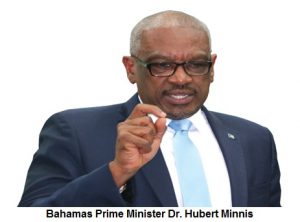
“In spite of what you may read in the newspaper, we have discussed CSME, [but] The Bahamas is not and will not be a part of CSME,” Prime Minister Dr. Hubert Minnis said upon returning from Jamaica on Saturday.

“The Bahamas will not allow the free movement of people within our boundaries. So we are not a part of CSME. That must be clear, so that you do not feel that [because of] what has transpired there that Caribbean nationals would be able to move into The Bahamas quite regularly.

“We have our rules, our laws, and they will continue to apply.”

Full implementation of the CSME was high on the agenda of the CARICOM meeting held last Thursday. At least three CARICOM heads called for a review of the program by its member states and for regional leaders to find the political will to see the program expanded and made more efficient.

Addressing CARICOM, Barbados Prime Minister Mia Mottley opined that “psychological impediments and the closed mindsets in some quarters of officialdom” can be attributed to the slow progress of the CSME.

Antigua and Barbuda Prime Minister Gaston Browne and CARICOM Secretary General Irwin LaRocque also pushed for more to be achieved. CARICOM Chairman and Jamaican Prime Minister Andrew Holness said at a press conference following the CARICOM meeting that a special meeting on CSME will be held in Trinidad and Tobago in November.

Under the first Christie administration, the CSME issue featured prominently in local debates with strong opposition to The Bahamas joining the initiative being expressed in many quarters. Debate died down only after the government at the time publicly announced that The Bahamas would not join any bloc that would lead to the free movement of people in the country.

Source: Posted July 9, 2018 retrieved July 10, 2018 from: https://thenassauguardian.com/2018/07/09/bahamas-maintains-stance-against-csme/

The recommendation of the movement behind the Go Lean book is to confederate now!

This is the purpose of the book Go Lean…Caribbean, to help reform and transform the societal engines of the Bahamas and all 30 member-states of the Caribbean region. The book serves as a roadmap for the introduction and implementation of the Caribbean Union Trade Federation (CU). The Go Lean/CU roadmap applies best-practices for community empowerment and features these 3 prime directives, proclaimed as follows:

Had the CU Single Market been in force, the arguments among the people would have been “which of the 2.2 million new jobs would land in the Bahamas”. Rather, according to the foregoing news article, the topics du jour is how to keep poorer people away from the measly resources in the Bahamas. This is happening while more and more Bahamian professionals are fleeing the islands for foreign shores and organizing their affairs in the Diaspora. See related photo here:

According to the Bahamas Prime Minister, the overriding issue with CSME is the Free Movement of People. The country would rather maintain its independence than to succumb to a new “free movement” regime whereby people can freely move from one Caribbean member-state to another for any activity: live, work or play. This is the defect of CSME!

Lesson learned!

The Go Lean roadmap is designed to elevate the Caribbean region, to be better destinations to live, work and play. The movement therefore fosters strategies, tactics and implementation to better foment the regional workplace. The roadmap asserts that Caribbean communities need the Free Movement of People under controlled employment rules-conditions. This is why the CU Trade Federation is a graduation from the CSME – something better. We accomplish Free Trade and Free Movement of People for Domestic (Intra-region) Tourism, but controlled Freedom of Movement for jobs … based on Labor Certification. Here is how the Go Lean book describes the Certification process:

CU Labor Relations Board
This agency coordinates the activities of labor certifications, labor unions and other organizational dimensions in the region. This effort will be collaborated and in cooperation with member-state Labor Relations agencies. The CU‘s focus will be towards interstate activities and enterprises, as opposed to intra-state.

Labor Certification is an important role for this agency as it requires monitoring the labor needs of the region to ascertain where skills are needed and where and who can supply the skills. The certification role involves rating the level of expertise needed for job and rating workers skill sets. (Consider a 10-point grading system for positions and personnel, where “apprentice” level ranges from 1 – 3, “journeyman” level ranges from 4 – 6, and “master” ranges from 7 – 10). This certification role is vital to the strategy of preserving Caribbean human capital in the region, even if this involves some movement among the member-states.  [When a high skilled job becomes available, it has to be rated so that if no local talents are available, workers with qualifying ratings in other CU member-states can apply and be engaged].

When a labor union from one country wants to represent workers in another country, this union will have to be registered and administered by this agency for the CU.

Outside of the labor unions, this agency also marshals the causes of labor abuses, job discrimination and equal opportunities for minority groups, women and persons with disabilities; [in conjunction with related agencies in the member-states].

This agency also maintains a Project Management Office to deliver on regional labor-specific projects. This includes training programs, continuing education and e-Learning schemes among the non-matriculating population. This agency will therefore be the regional authority for “on-the-job” training schemes.

This approach is more technocratic than the status quo, and allows the Caribbean region to embrace the benefits of a Single Market without endangering low-skilled jobs. Sad, the Bahamas is suffering from decline trying to preserve low-skilled jobs!

This issue was also the underlying complaint for Great Britain / United Kingdom desiring to exit the EU; this refers to Brexit. See the aligning issue in the Appendix VIDEO below. Again, lesson learned!

The points of effective, technocratic stewardship for a regional labor market have been elaborated upon in previous blog-commentaries. Consider this sample:

https://goleancaribbean.com/blog/?p=14954 Overseas Workers – Not the Panacea
https://goleancaribbean.com/blog/?p=14242 Leading with Money Matters – Follow the Jobs
https://goleancaribbean.com/blog/?p=14191 Scheduling in the ‘Gig Economy’ – The New Job Source
https://goleancaribbean.com/blog/?p=8377 Fallacy of Minimum Wage
https://goleancaribbean.com/blog/?p=5759 Pressed by Debt Crisis, Doctors Leave Greece in Droves
https://goleancaribbean.com/blog/?p=5597 Wage-Seeking Principles – Market Forces -vs- Collective Bargaining
https://goleancaribbean.com/blog/?p=1698 Professional STEM Jobs Are Filling Slowly

What should be the advocacy priority of a technocratic regional government? Low-skilled workers? Professional classes? High Net-Worth individuals? The answer: All of the above!

Overall, the Go Lean book stresses the community ethos, strategies, tactics, implementations and advocacies to reform and transform the economic, security and governing engines of Caribbean society. This effort will be technocratic! It will preserve low-skill jobs, foster professional careers and invite High Net-Worth individuals to bring their Time, Talent and Treasures to our region. This vision was pronounced in the opening Declaration of Interdependence (Pages 12-14) with these statements:

xi. Whereas all men are entitled to the benefits of good governance in a free society, “new guards” must be enacted to dissuade the emergence of incompetence, corruption, nepotism and cronyism at the peril of the people’s best interest. The Federation must guarantee the executions of a social contract between government and the governed.

xii. Whereas the legacy in recent times in individual states may be that of ineffectual governance with no redress to higher authority, the accedence of this Federation will ensure accountability and escalation of the human and civil rights of the people for good governance, justice assurances, due process and the rule of law. As such, any threats of a “failed state” status for any member state must enact emergency measures on behalf of the Federation to protect the human, civil and property rights of the citizens, residents, allies, trading partners, and visitors of the affected member state and the Federation as a whole.

xix. Whereas our legacy in recent times is one of societal abandonment, it is imperative that incentives and encouragement be put in place to first dissuade the human flight, and then entice and welcome the return of our Diaspora back to our shores. This repatriation should be effected with the appropriate guards so as not to imperil the lives and securities of the repatriated citizens or the communities they inhabit. The right of repatriation is to be extended to any natural born citizens despite any previous naturalization to foreign sovereignties.

xxiv. Whereas a free market economy can be induced and spurred for continuous progress, the Federation must install the controls to better manage aspects of the economy: jobs, inflation, savings rate, investments and other economic principles. Thereby attracting direct foreign investment because of the stability and vibrancy of our economy.

xxvi. Whereas the Caribbean region must have new jobs to empower the engines of the economy and create the income sources for prosperity, and encourage the next generation to forge their dreams right at home, the Federation must therefore foster the development of new industries …. In addition, the Federation must invigorate the enterprises related to existing industries … – impacting the region with more jobs.

Yes, the purpose of this commentary is to project the better plan for reforming and transforming the Caribbean societal engines. Yes, we need jobs, but doubling-down on bad economic policy to preserve low-skilled job is bad for society … and the low-skilled worker. Automation and globalization would diminish those jobs further anyway as time and technology progresses; consider the eventual example of robots performing construction in this previous blog-commentary from the Go Lean movement.

Now is the time for all stakeholders – leaders, citizens, low-skilled workers and professionals – in the Caribbean to lean-in for the empowerments described here-in and in the book Go Lean … Caribbean. We must do better that in the past; we must Right the Wrong of past generations “missing the boat” and benefits of regional integration. This is how we can make the Bahamas and all of the Caribbean a better place to live, work and play. 🙂

Download the free e-Book of Go Lean … Caribbean – now!

Sign the petition to lean-in for this roadmap for the Caribbean Union Trade Federation.

—————

Appendix – No Caricom Without Referendum

By Sir Randol Fawkes – June 1993

I often wondered what The Caribbean Community’s Common Market (CARICOM) was up to. But now that I know, I wish to sound a warning to all true Bahamians to hold fast to the “Christian values and the Rules of Law” as enshrined in the Preamble to our Independence Constitution of July 10th, 1973, because some power-hungry politicians to the South are planning to invade our homeland and to steal our birthright away.

Simple enough? Dictatorship is always simple, monosyllabic and quick. Under a democracy we have a right to be properly briefed on CARICOM before being required to vote, “Yes” or “No” on whether the Bahamas should become a full Member State of the Caribbean Community’s CARICOM. The Rt. Hon. James F. Mitchell further expostulated, “One flag means we speak on the podium of the United Nations with one clear voice. One voice means one passport, one citizenship and all that flows from a single citizenship. Secondly, one Ministry of Finance is essential to provide the economic development which our people crave. This union will need to show results, and this authority which negotiates and secures financing must be responsible for the repayment of that finance.”

Make no mistake about it, these Caribbeans who will descend on Bahamian soil in July offering CARICOM as a panacea for all ills, intend to destroy our national flag: the Black, the Gold and the Aquamarine; silence our National Anthem, Lift Up Your Heads to the Rising Sun Bahama land, abolish Bahamian citizenship and our passports; eliminate Bahamian autonomy and thereafter superimpose upon us a leviathan dictatorship with a network of cells throughout the Caribbean – all done without first a people’s forum in which all voices – pro and con could be heard and ultimately expressed in a Constitutional Referendum.

Source: Retrieved July 10, 2018 from: http://www.sirrandolfawkes.com/yahoo_site_admin/assets/docs/No_Caricom_Without_Referendum1.216134242.pdf

————–

Appendix VIDEOBrexit: UK-EU freedom of movement ‘to end in March 2019’- BBC Newshttps://youtu.be/qzlUNIJ0f_0

BBC News

BBC News
Published on Jul 27, 2017 – New immigration system will be in place by March 2019 when the free movement of people between the EU and the UK ends, a minister has said.
Immigration Minister Brandon Lewis was speaking as the government commissioned a “detailed assessment” of the costs and benefits of EU migrants.
That report is expected in September 2018, six months before Brexit.
Home Secretary Amber Rudd earlier reassured firms there would be no “cliff edge” on immigration. Writing in the Financial Times she said the UK would continue to attract “the brightest and the best” migrants from around the world – with the newspaper suggesting a work permit system for Europeans was being considered.
The CBI said businesses “urgently” needed to know what EU migration would look like, both in any “transitional” period after March 2019 and beyond. Ministers have also promised an “extensive” consultation to listen to the views of businesses, unions and universities.

Share this post:
, ,
[Top]

Should We Celebrate the ‘4th of July’? – ENCORE

This is a good question.

Think about America’s closest Ally, England, Great Britain or the United Kingdom; (same country, 3 names): Do they celebrate this American Holiday in London?

Should they?

Of course not!

This good question was asked a year ago on July 4th, 2017 in a previous blog-commentary. It is so important that Caribbean people should ask it every year. The Encore of that previous submission follows:

==================================================================

Go Lean Commentary – A Lesson in History – ‘4th of July’ and Slavery

CU Blog - A Lesson in History - Slavery and the 4th of July - Photo 1Today is a special day in the United States, it is the 241st anniversary of their Declaration of Independence from Great Britain on July 4, 1776. This day will be celebrated all over the country with parades, picnics, music and fireworks.

The celebrations of this day is a BIG deal!

What is buried in this annual celebration is the stark and sharp contrast on the different sides in the conflict of July 4, 1776. There were the British loyalists on one hand and those seeking freedom from the British, the patriots, on the other hand; see the opposing sides here:

Title #1: What two sides emerged in response to the Declaration of Independence? What did each side favor?

Answer:
The Patriots and Loyalists; Patriots favored independence and Loyalists favored staying as a British colony.

Explanation:
Tensions were simmering prior to the start of the Revolution, and the Declaration of Independence, signed in 1776 formally broadcasted to all that the United States was a new and independent nation. This led to two factions being formed: Patriots and Loyalists.

Patriots believed that the United States should be an independent nation separate from Britain. They felt that they were being treated unfairly as a colony and that their basic rights were being trampled upon. It was their view that the time for compromises was over and that the colonies needed to leave the British Empire.

Loyalists thought that the colonies were better off staying with England. Some did this out of loyalty for the king, but others feared instability and anarchy in the event of a change in government. In addition, many feared that the economic fallout with the mother country would destabilize the American economy.

All in all, these were the two groups that were formed, and as you know, the Patriots emerged as successful and formed a new nation.

Source: Retrieved July 4, 2017 from: https://socratic.org/questions/what-two-sides-emerged-in-response-to-the-declaration-of-independence-what-did-e

The patriots get to celebrate the 4th of July every year. But as there were 2 sides of this conflict, we sometimes forget the loyalists side of the conflict. They did not simply go away; they remained vocal and loyal to the Britain’s Crown.

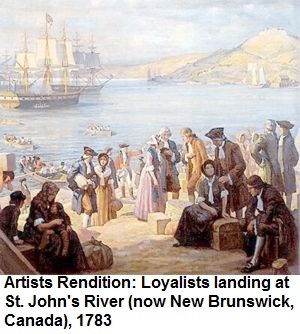
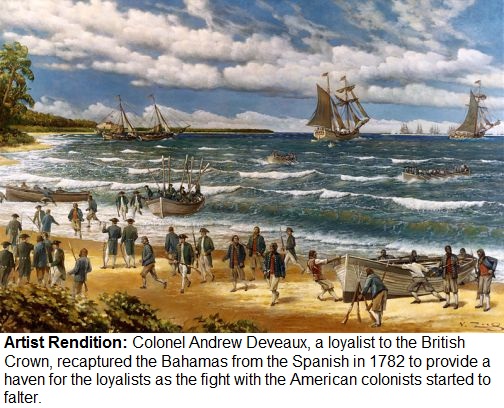
The category of loyalists have a big bearing on the history of the Caribbean. Of the 30 member-states that caucus as the Caribbean, 18 of them have British heritage. Many of these were impacted by the American Declaration of Independence; many loyalists fled America and relocated to these British West Indies. Consider these notes:

When their cause was defeated, about 15% of the Loyalists (65,000–70,000 people) fled to other parts of the British Empire, to Britain itself, or to British North America (now Canada). …

CU Blog - A Lesson in History - Slavery and the 4th of July - Photo 3a

CU Blog - A Lesson in History - Slavery and the 4th of July - Photo 2a

CU Blog - A Lesson in History - Slavery and the 4th of July - Photo 2b

The wealthiest and most prominent Loyalist exiles went to Great Britain to rebuild their careers; many received pensions. Many Southern Loyalists, taking along their slaves, went to the West Indies and the Bahamas, particularly to the Abaco Islands. – Source: Wikipedia

CU Blog - A Lesson in History - Slavery and the 4th of July - Photo 3b

Great Britain also responded … formally. See details of the response here:

Title #2: The British Reply

When Great Britain first received the Declaration of Independence, the country was silent. To them, this was another annoyance from the colonies. The colonists had sent previous letters to King George III that had been ignored, but this was the first time that they had declared themselves free from Great Britain. You know how you feel when a little child continues to ask you for the same thing over and over again, and eventually, you stop listening? This was how King George III viewed the colonies. They were a nuisance, but relatively harmless. Or so he thought.

The government hired John Lind, an English politician and pamphleteer, to write a rebuttal to the declaration. He wrote Answer to the Declaration of the American Congress, a reply that tried to pick apart the Declaration of Independence. Lind focused on the issue of slavery, saying that the colonists were actually angry that King George III had offered freedom to the slaves. Lind even mocked the writers for stating, ‘All men are created equal…’, yet they allowed slavery. Of course, all of this was just a distraction. The colonists really paid no attention to the pamphlet.

Following this, King George III officially declared the colonies to be in a state of rebellion. By August of 1776, the King ordered troops to the colonies.

Once the Revolutionary War began, the citizens of Great Britain became more concerned about the colonies and their fight for independence. In October, King George III addressed Parliament, hoping to ease some of the concerns. He opened the address wishing that he could inform them that the troubles were at an end and that the people had ‘recovered from their delusion’ and ‘returned to their duty.’ However, the colonists continued to fight and even ‘openly renounced all allegiance to the Crown.’ King George III accused the colonists of treason, but reassured the Parliament that England was still united.

The King ended his address singing his own praises saying, ‘No people ever enjoyed more Happiness, or lived under a milder Government, then those now revolted Provinces.’ Everything that the colonies have—their land, sea, wealth, and strength—was because of him. His desire was to return the colonies as a part of the British Empire and end the war.

As we know, King George III’s desire to end the war and keep the colonies did not go as planned. The Revolutionary War, the war for American Independence, continued until 1783, ending with more than 50,000 deaths, and the colonies freed as a new country, the United States of America.

Source: Retrieved July 4, 2017 from: http://study.com/academy/lesson/british-reply-to-the-declaration-summary-analysis.html

As related, slavery was not the cause of the US War of Independence … entirely. But the notion that “all men are created equal” was a laughable American hypocrisy. The continuation of slavery in the wake of a trend of liberalism in England became a boiling point of contention. In fact as reported here, many African Americans – 12,000 or so – fled to the side of the British for the promise of freedom:

Title #3: Slavery and Black Loyalists

As a result of the looming crisis in 1775 the Royal Governor of Virginia, Lord Dunmoreissued a proclamation that promised freedom to servants and slaves who were able to bear arms and join his Loyalist Ethiopian Regiment. Many of the slaves in the South joined the Loyalists with intentions of gaining freedom and escaping the South. About 800 did so; some helped rout the Virginia militia at the Battle of Kemp’s Landing and fought in the Battle of Great Bridge on the Elizabeth River, wearing the motto “Liberty to Slaves”, but this time they were defeated. The remains of their regiment were then involved in the evacuation of Norfolk [(Virginia)], after which they served in the Chesapeake area. Eventually the camp that they had set up there suffered an outbreak of smallpox and other diseases. This took a heavy toll, putting many of them out of action for some time. There was a slave by the name of Boston King who joined the Loyalists and wound up catching smallpox. Boston King and other soldiers who were sick were relocated to a different part of the camp so that they did not contaminate the healthy soldiers. The survivors joined other British units and continued to serve throughout the war. Black colonials were often the first to come forward to volunteer and a total of 12,000 African Americans served with the British from 1775 to 1783. This factor had the effect of forcing the rebels to also offer freedom to those who would serve in the Continental Army; however, such promises were often reneged upon by both sides.[31]

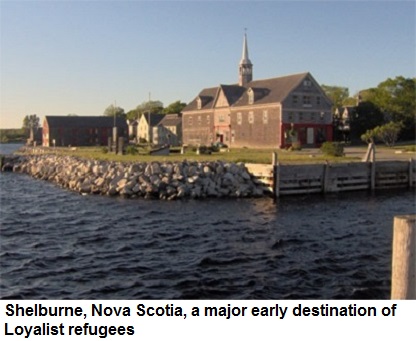
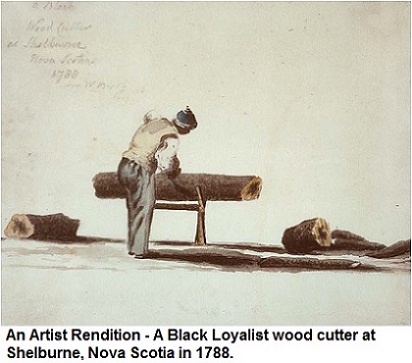
African Americans who gained their freedom by fighting for the British became known as Black Loyalists. The British honored the pledge of freedom in New York City through the efforts of General Guy Carleton who recorded the names of African Americans who had supported the British in a document called the Book of Negroes which granted freedom to slaves who had escaped and assisted the British. About 4,000 Black Loyalists went to the British colonies of Nova Scotia and New Brunswick, where the British promised them land. They founded communities across the two provinces, many of which still exist today. Over 2,500 settled in Birchtown, Nova Scotia, instantly making it the largest free black community in North America. However, the inferior grants of land they were given and the prejudices of white Loyalists in nearby Shelburne who regularly harassed the settlement in events such as the Shelburne Riots in 1784, made life very difficult for the community.[32] In 1791 Britain’s Sierra Leone Company offered to transport dissatisfied black Loyalists to the British colony of Sierra Leone in Africa, with the promise of better land and more equality. About 1,200 left Nova Scotia for Sierra Leone, where they named the capital Freetown.[32] After 1787 they became Sierra Leone’s ruling elite. About 400 to 1,000 free blacks who joined the British side in the Revolution went to London and joined the free black community of about 10,000 there.

Source: Retrieved July 4, 2017 from: https://en.wikipedia.org/wiki/Loyalist_(American_Revolution)#Slavery_and_Black_Loyalists

Wow, what a notion! An argument can be made that for the Black population – the majority ethnicity for 29 of the 30 Caribbean member-states – their celebration of the 4th of July should have been … for the other side!

Intriguing!

This is the lesson in history for the Caribbean; American historic accomplishments are NOT historic accomplishments for the majority of Caribbean people. Poor race relations tarnished so much of American history, that the country continues with this societal defect … even to this day.

This lesson from America’s initiation is presented by the movement behind the book Go Lean…Caribbean – available to download for free – which serves as a roadmap for the introduction and implementation of the technocratic Caribbean Union Trade Federation (CU), for the elevation of Caribbean society – for all member-states. This book features a declaration of its own, a Declaration of Interdependence (Pages 10 – 13):

Preamble: When, in the course of human events, it becomes necessary for one people to unite with others so as to connect them together to collaborate, confederate and champion the challenges that face them, we the people of Caribbean democracies find it necessary to accede and form a confederated Union, the Caribbean Union Trade Federation, with our geographic neighbors of common interest.

While the laws of nature and of nature’s God entitle us to form a society and a brotherhood to foster manifestations of our hopes and aspirations and to forge solutions to the challenges that imperil us, decent respect to the opinions of mankind requires that we declare the causes which imperil us and incite us to unite to assuage our common threats.

And while our rights to exercise good governance and promote a more perfect society are the natural assumptions among the powers of the earth, no one other than ourselves can be held accountable for our failure to succeed if we do not try to promote the opportunities that a democratic society fosters.

As the history of our region and the oppression, suppression and repression of its indigenous people is duly documented, there is no one alive who can be held accountable for the prior actions, and so we must put aside the shackles of systems of repression to instead formulate efficient and effective systems to steer our own destiny. …

xi. Whereas all men are entitled to the benefits of good governance in a free society, “new guards” must be enacted to dissuade the emergence of incompetence, corruption, nepotism and cronyism at the peril of the people’s best interest. The Federation must guarantee the executions of a social contract between government and the governed.

xvi. Whereas security of our homeland is inextricably linked to prosperity of the homeland, the economic and security interest of the region needs to be aligned under the same governance. Since economic crimes … can imperil the functioning of the wheels of commerce for all the citizenry, the accedence of this Federation must equip the security apparatus with the tools and techniques for predictive and proactive interdictions.

xxiv. Whereas a free market economy can be induced and spurred for continuous progress, the Federation must install the controls to better manage aspects of the economy: jobs, inflation, savings rate, investments and other economic principles. Thereby attracting direct foreign investment because of the stability and vibrancy of our economy.

The Go Lean book provides 370-pages of turn-by-turn instructions on this roadmap, on “how” to adopt new community ethos, plus the strategies, tactics, implementations and advocacies to execute so as to reboot, reform and transform the societal engines of Caribbean society. This CU/Go Lean roadmap has these 3 prime directives:

  • Optimization of the economic engines in order to grow the regional economy to $800 Billion and create 2.2 million new jobs.
  • Establishment of a security apparatus to ensure public safety and protect the resultant economic engines.
  • Improve Caribbean governance to support these engines, including a separation-of-powers between the member-states and CU federal agencies.

“Lessons in History” are a familiar theme for these Go Lean blog-commentaries; consider this sample of previous submissions:

https://goleancaribbean.com/blog/?p=12274 A Lesson in History – Spanish Caribbean
https://goleancaribbean.com/blog/?p=11870 A Lesson in History – Indian Termination Policy
https://goleancaribbean.com/blog/?p=10933 A Lesson in History – White is Right – Not!
https://goleancaribbean.com/blog/?p=10733 150 Years of Historically Black Colleges & Universities
https://goleancaribbean.com/blog/?p=9151 The New Smithsonian African – American Museum
https://goleancaribbean.com/blog/?p=8767 A Lesson in History – Haiti 1804
https://goleancaribbean.com/blog/?p=7769 History’s Effect of the Current Caribbean Disposition
https://goleancaribbean.com/blog/?p=7738 A Lesson in History – Legacy of the Buffalo Soldiers
https://goleancaribbean.com/blog/?p=5695 A Lesson in History – Repenting, Forgiving and Reconciling the Past
https://goleancaribbean.com/blog/?p=4971 A Lesson in History – Royal Charters: Truth & Consequence
https://goleancaribbean.com/blog/?p=451 CariCom position on Slavery/Colonization Reparations

There are so many lessons that we, in the Caribbean, can learn from this history of the initiation of the United States; the role of slavery was integral to the whole fabric of American society. Repercussions and consequences of this societal defect reverberated from those events in July 1776 right down to our day. In many ways, these repercussions and consequences are responsible for our region’s poor performance in our economic, security and governing engines. Our society was created as parasites of the American- European (British) eco-system, rather than protégés  of these advanced economies.

It is time for this disposition to end! It is not 1776 anymore; we must make the societal progress that 241 years of lessons should have taught us. America has reformed and transformed … some, but still needs more progress. But our goal is not to reform and transform America; our target is the Caribbean … only. We hereby urge everyone in the region – people, institutions and governments – to lean-in to this Go Lean roadmap.

We can do this, we can declare our interdependence and make our homeland a better place to live, work and play. 🙂

Download the free e-Book of Go Lean … Caribbean – now!

Sign the petition to lean-in for this roadmap for the Caribbean Union Trade Federation.

Share this post:
, ,
[Top]

Industrial Reboot – Call Centers 101

Go Lean Commentary

There used to be a time … when you called a place:

Call me at home, at work, or the private club.

Now, with mobile and smartphones, you call a person, not a place.

Everything has changed, and with it the business models of organizations that depend on the telephony activity.

Need to ‘Call a cab’?!
Nope, use an app!

For industries that depended on phone calls; they now have to reboot their industrial landscape and business model. This is bad! This is good! As it opens the opportunity for jobs in the Call Center industry.

With modern Internet Communications Technology (ICT) – think Voice-over-IP – a phone call can originate or terminate around the globe, but feel/sound like it is next door. The premise of this business model for the Caribbean is simple: Why not make those calls / answer the phone here in the Caribbean?

Jobs are at stake.

According to the book Go Lean … Caribbean (Page 257) , there could be this many jobs:

Direct and indirect jobs at physical and virtual call centers: 12,000

The Go Lean book prepares the business model of Call Centers for consumption in the Caribbean. Yes, business model refers to jobs, entrepreneurial opportunities, trade transactions, etc. In addition to these industry jobs; there is also the reality of indirect jobs – unrelated service and attendant functions – at a 3.75 multiplier rate would add another 45,000 jobs.

This constitutes an industrial reboot.

There are a number of call center installations currently in the region – see Appendix; but this Industrial Reboot measure is doubling-down on this business model. This is a wise strategy!

Notice the fine experiences being enjoyed right now in the Caribbean country of St. Lucia, with this news article here about one company – KM2 Solutions – that has expanded their Call Center footprint in this island, adding an additional 400 jobs:

Title: KM2 Solutions opens second call center in St Lucia, plans to add 400 new jobs

(PRESS RELEASE VIA SNO) – KM2 Solutions, a leading US-based, contact center services provider has opened a new facility in St. Lucia, expanding their footprint of service locations to 9 centers in 6 countries.

The 12,000 square feet Massade facility opened officially on June 19 in a ceremony graced by the Honourable Prime Minister.

Site Director Marvin Bartholomew said the company’s expansion here is an “exciting one that creates significant opportunities for an additional 400 brilliant and talented Saint Lucians. The spillover effect that the increased employment has on the economy is tremendous, and we are thrilled to be able to contribute to the island’s economic growth”.

KM2 Solutions first introduced its services to Saint Lucia in 2004 and has since continuously operated from its 20,000 square-foot office space, with capacity for 500 agents. Its new facility is about 25 minutes from the original center and is located firmly within the island’s tourism belt and population centre, providing the double positive of being able to attract excellent talent in large numbers while also hosting clients in an area known for beautiful beaches and wonderful hospitality.

Prime Minister of Saint Lucia the Honourable Allen Chastanet, who was present at Tuesday’s ceremony, lauded the investment of KM2 and thanked its principals for having confidence in the island’s economic standing and its talent.

Speaking at the official opening on Tuesday, KM2 President & CEO David Kreiss, said, “This is truly a tremendous occasion and opportunity. Our productivity and quality here is excellent, our clients love the island and are always impressed with our operations and the wonderful agents and management team. To be able to create capacity to do more of that is something we’ve always wanted to do. Naturally we’re thrilled to be able accomplish our goal of exceeding our clients’ expectations while providing an engaging and rewarding career to so many.

KM2 Solutions continues to provide clients with support in the areas of customer service and care, sales, retention, technical support, loan processing (pre-funding, originations, verifications, welcome calls), loan servicing and first-party collections, back-office services, and other functions for clients in a wide range of vertical markets.

The opening ceremony was held in at the new location on Tuesday, June 19th.

Source: Posted June 22, 2018; retrieved July 2, 2018 from: https://www.stlucianewsonline.com/km2-solutions-opens-second-call-center-in-st-lucia-plans-to-add-400-new-jobs/

The book Go Lean…Caribbean – available to download for free – serves as a roadmap for the introduction and implementation of the technocratic Caribbean Union Trade Federation (CU); this is a confederation of all 30 member-states to execute a reboot of the Caribbean economic eco-system. This CU/Go Lean roadmap has these 3 prime directives:

  • Optimization of the economic engines in order to grow the regional economy to $800 Billion & create 2.2 million new jobs.
  • Establishment of a security apparatus to ensure public safety and protect the resultant economic engines.
  • Improvement of Caribbean governance to support these engines, including a separation-of-powers between the member-states and CU federal agencies.

The Caribbean economic landscape is in shambles!

The primary driver in the region – Tourism – is under assault; more and more visitors shift from stay-overs to cruise arrivals. This means less economic impact to the local markets. As a region, we must reboot our industrial landscape and add more job-creating options.

This commentary has previously identified a number of different industries that can be rebooted under this Go Lean roadmap. See the list of previous submissions on Industrial Reboots here:

  1. Industrial RebootsFerries 101 – Published June 27, 2017
  2. Industrial RebootsPrisons 101 – Published October 4, 2017
  3. Industrial RebootsPipeline 101 – Published October 6, 2017
  4. Industrial RebootsFrozen Foods 101 – Published October 6, 2017
  5. Industrial Reboots – Call Centers 101– Published Today – July 2, 2018

The Go Lean book stresses that reforming and transforming the Caribbean economic engines must be a regional pursuit. This was an early motivation for the roadmap, as pronounced in the opening Declaration of Interdependence (Pages 12 – 13):

xxiv.  Whereas a free market economy can be induced and spurred for continuous progress, the Federation must install the controls to better manage aspects of the economy: jobs, inflation, savings rate, investments and other economic principles. Thereby attracting direct foreign investment because of the stability and vibrancy of our economy.

xxvi.  Whereas the Caribbean region must have new jobs to empower the engines of the economy and create the income sources for prosperity, and encourage the next generation to forge their dreams right at home, the Federation must therefore foster the development of new industries, like that of … the prison industrial complex. In addition, the Federation must invigorate the enterprises related to existing industries like tourism, fisheries and lotteries – impacting the region with more jobs.

xxvii. Whereas the region has endured a spectator status during the Industrial Revolution, we cannot stand on the sidelines of this new economy, the Information Revolution. Rather, the Federation must embrace all the tenets of Internet Communications Technology (ICT) to serve as an equalizing element in competition with the rest of the world. The Federation must bridge the digital divide and promote the community ethos that research/development is valuable and must be promoted and incentivized for adoption.

Accordingly, the CU will facilitate the eco-system for Self-Governing Entities (SGE), an ideal concept for Call Centers with its exclusive federal regulation/promotion activities. Imagine bordered campuses – with Internet Pop Hubs and backup power generations. The focus for the Go Lean roadmap is on Contact Center, not just Call Center. See the difference definition here:

The Bottom Line on Contact Centers
Contact Center refers to the next step in the evolution of Call Centers. With the advances in Internet and Communications Technologies (ICT), a service provider of tele-services functions can be located anywhere in the world. This is the case with the proliferation of this industry in the Philippines – employing 350,000 people in 2011, and India with 330,000 jobs.  (Jamaica and Antigua have a nascent industry). Contact Centers today do more than just phone calls, but rather business process outsourcing (BPO), including email, IM, web chat, social media and work flow processing on behalf of 3rd party clients.

Contact Centers require art and science! See the best practice described in the Appendix VIDEO below. (Though humorous, the strong point is made: there is an art to “blending in”).

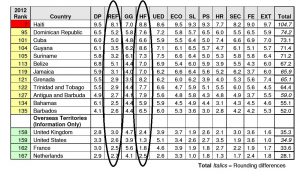
The Go Lean movement (book and blogs) details the principles of SGE’s and job multipliers, how certain industries are better than others for generating multiple indirect jobs down the line (or off-campus) for each direct job on the SGE’s payroll.

This is the vision of an industrial reboot! This transformation is where and how the jobs are to be created.

The Go Lean book provides 370-pages of turn-by-turn instructions on “how” to adopt new community ethos, plus the strategies, tactics, implementations and advocacies to execute so as to reboot, reform and transform the societal engines of Caribbean society. One advocacy in rebooting the industrial landscape is to foster the Contact Center industry; consider the  specific plans, excerpts and headlines from the book on Page 212 entitled:

10 Ways to Promote Contact Centers

1 Lean-in for the Caribbean Single Market
Lean-in for the Caribbean Single Market & Economy and the Caribbean Union Trade Federation (CU). This will allow for the unification of the region of 30 member-states into one market of 42 million people, thereby creating the economies-of-scale to deploy technological infrastructure like fiber optics wire-line networks, broadband, wireless (WiMax), and satellite capability to generate a recognizable return on investment; this roadmap projects 12,000 new jobs. The CU will embrace e-Delivery for government services thereby becoming one of the Contact Center industry’s biggest clients.
2 Laissez-fare Utility Regulations – in SGE’s
3 Enterprise and Empowerment Zones
The CU will promote Self Governing Entities (SGE) as specific limited geographical areas (Industrial Parks, Corporate Campuses) as Enterprise and Empowerment Zones for this contact center industry. Traditionally, Enterprise Zones allow for certain tax rebates and access to grant monies or low interest loans. (Empowerment Zones go a step further in promoting revitalization of under-privileged and/or blighted areas). A concentration of multiple players in defined and controlled areas will allow for communications bandwidth, secondary power supply systems, parking and commuter express options as viable solutions. There is a realistic consequence of thousands of jobs at the same place/same time.
4 Underwater Cables
5 Outreach
The CU will send trade missions to foreign markets to solicit clients for this industry, in fact the implementation of the federation specifies create Trade Mission Offices in key international cities. This outreach includes participation in Trade Shows and industry events around the world; (similar to “Thailand-branded goods and services” global promotions).
6 Capitalize on Multi-lingual Society
7 Consumer Rights
8 Promote Work-at-Home Options
9 Big Data – Analysis and Business Intelligence
The practice of data analysis must be promoted as a fine art in the region. Certifications and accreditations at the CU level will add value and financial benefits to this skill set for industry participants. Economic incentives (grants, forgive-able loans, tax rebates) will be in place to promote the related industries and spin the wheels of commerce in this area.
10 Presidential Medal of Recognition

Contact Centers are not new for this Go Lean roadmap; there have been a number of previous blog-commentaries by the Go Lean movement that referenced economic opportunities embedded in the Contact Center industry. See a sample list here:

https://goleancaribbean.com/blog/?p=15075 e-Government 3.0 – Call Centers to engage citizens
https://goleancaribbean.com/blog/?p=14191 Scheduling for Call Centers & ‘Gigs’
https://goleancaribbean.com/blog/?p=13524 Future Focused – e-Government Portals and Call Centers
https://goleancaribbean.com/blog/?p=13321 Making a ‘Pluralistic Democracy’ – Multilingual Realities
https://goleancaribbean.com/blog/?p=11184 JPMorganChase spent $10 billion on ‘Fintech’ for 1 year
https://goleancaribbean.com/blog/?p=8262 Role Model: UberEverything in Africa

In summary, our Caribbean region need jobs. A better job-creation ability would help us to make our homeland a better place to live, work and play. In fact, one of the reasons why so many Caribbean citizens have emigrated away from the homeland is the job-creation dysfunction. Creating a new economic landscape will require rebooting the industrial landscape.

Yes, we can … reboot our industrial landscape, and create new jobs – and other economic opportunities.

We urge all Caribbean stakeholders to lean-in to this roadmap for economic empowerment. The fact that Call Centers currently exists amplifies the fact that this Go Lean roadmap is viable. Make that conceivable, believable and achievable. 🙂

Download the free e-Book of Go Lean … Caribbean – now!

Sign the petition to lean-in for this roadmap for the Caribbean Union Trade Federation.

—————

APPENDIX – Company Profile: KM2 Solutions

Company KM² Solutions was founded on the idea that world-class outsourcing services could be conducted close to home.

KM2 Solutions was founded by David Kreiss (K) and Gary Meyers (M) in 2004 with its original facility in St. Lucia.

At the time, few companies were able to offer the diversified services at the competitive rates that KM2 was offering.  New business was quick to follow. By 2007 KM2 had opened facilities in Barbados and Grenada, utilizing the same model that had been so effective in St. Lucia.  As a small but growing company, KM2 Solutions was able to take on outsourcing ventures that the major players dismissed as too small or overly complicated.  The ability to adapt to client-specific needs while still delivering outstanding, industry-leading performance has been the cornerstone of the company’s success.

The Honduras and Dominican Republic sites were added in recent years to provide clients with technically adept, fully bilingual agents.  Today, KM2’s global footprint reaches 6 countries with over 3,000 employees, and continued plans for expansion into new geographic locations and business segments.

KM2 Solutions is privately held, thus eliminating the pressures of meeting shareholder and analyst expectations.  The company’s focus will always be on the client and developing long-term relationships through unparalleled service and attention to detail.

Source: Retrieved July 2, 2018 from: http://www.km2solutions.com/company/

—————

VIDEO – KM2 Solutions – Exceeding Your Expectations – https://youtu.be/k_7lBshw8IQ

Published on Jun 17, 2015 – About KM² Solutions KM² Solutions is a leading provider of nearshore business process outsourcing (BPO) services, specializing in the finance, telecom, media, and technology industries. With contact centers throughout the Caribbean and Central America (St. Lucia, Barbados, Grenada, Dominican Republic, and Honduras), KM² provides clients with cost-effective, bilingual solutions for customer care, sales and retention, collections, customer support, and back office processing, through voice, chat, mobile, and email.

For further information, please contact: Joe Wester VP Sales at (262) 790-2656 www.km2solutions.com

—————–

Appendix VIDEO – White Voice – https://www.imdb.com/title/tt5688932/videoplayer/vi184531737

Scene from the 2018 movie Sorry to Bother You.
In an alternate present-day version of Oakland (California), telemarketer Cassius Green discovers a magical key to professional success – White Voice – propelling him into a macabre universe.

Share this post:
, ,
[Top]

‘Time to Go’ – States must have ‘population increases’

Go Lean Commentary

“We need more people” – News Article conclusion below.

Economics is a complex social science. But it all boils now to advanced variations of this simple law:

Supply and demand

Whether it’s a product, service or population, there must be a good measure of supply and demand for eco-systems to work. When either side of the equation becomes dysfunctional, the supply or the demand, the stewards of the eco-system (company leaders or community leaders) must effect change in either the supply-side or demand-side, or both.

This is the actuality of the US State of Vermont today. They need more people! They need more supply and more demand. ‘Things’ are bad now, but will get even worse going forward if there are no mitigations to the current trends.

  • Vermont’s aging population … the median age nationally has increased by almost five years to 37.8 while Vermont’s has increased by 10 years
  • rapidly shrinking tax base
  • 16,000 fewer workers [now] than [they had] in 2009
  • “Must think outside the box …”

So that State is willing to pay $10,000 to people to move into the State.

Wait, what?

See the full news article and related VIDEO here:

Title: Vermont will pay you $10,000 to move there and work from home
By: Abigail Hess

Considering leaving the big city behind in favor of somewhere scenic? Now could be the right time.

On Wednesday, Quartz reports, Vermont Governor Phil Scott signed a bill into law that will pay people $10,000 if they move to Vermont and work remotely for an employer out of state. The Remote Worker Grant Program will take effect on January 1, 2019, and will help cover moving, living and working expenses. Grants can be used for relocation, computer software and hardware, broadband internet and access to a co-working space.

Currently, Vermont has budgeted funds to support 100 grants for the first three years and 20 additional workers each year from then on. Grant recipients will receive $10,000 over two years that will be distributed on a first-come, first-served basis.

This policy is intended to address Vermont’s aging population. While the state may be rich in beautiful landscapes and maple syrup, it has a rapidly shrinking tax base.

“Vermont continues to age, and age faster than the nation as a whole,” writes Art Woolf for the Burlington Free Press. “Over the past quarter of a century, the median age nationally has increased by almost five years to 37.8 while Vermont’s has increased by 10 years.”

This trend has made Vermont one of the oldest states in the nation.

In addition to the remote worker grant program, the bill also launches the state’s Stay-to-Stay initiative. The program, aimed at convincing the state’s 13 million annual tourists to permanently relocate to Vermont, will be organized by the Vermont Department of Tourism and Marketing and will connect visitors with local employers, entrepreneurs, community leaders and potential neighbors.

“We have about 16,000 fewer workers than we did in 2009. That’s why expanding our workforce is one of the top priorities of my administration,” Scott said in a statement. “We must think outside the box to help more Vermonters enter the labor force and attract more working families and young professionals to Vermont. That’s exactly what the Department of Tourism and Marketing did with this program for out-of-state visitors who may be interested in living full-time in Vermont, and I’m excited to see it move forward.”

The initiative will take place over four weekends and will be piloted in three communities. One of those selected communities is Brattleboro, Vermont. “The one thing we need more of in Vermont is people,” says Adam Grinold, executive director of the Brattleboro Development Credit Corporation. “We need more visitors, we need more employees, we need more business owners. We need more people.”

Source: CNBC Consumer & Business News – posted May 31, 2018; retrieved June 27, 2018 from: https://www.cnbc.com/2018/05/31/vermont-will-pay-you-10000-to-move-there-and-work-from-home.html

————

VIDEO – Move to Vermont, make $10,000 –  https://youtu.be/Q5Pum5HfNkQ


Published on Jun 1, 2018 – Fox Business News’ Tracee Carrasco on a new bill signed in Vermont allowing the state to offer $10,000 to those who move there and work remotely for out-of-state employers.

  • Category: News and Politics
  • License: Standard YouTube License

Vermont has a problem and they are willing to throw money at it for resolution. This just might work! Another observed-and-confirmed principle in Economics is that:

People Respond to Incentives in Predictable Ways

Think about the viability for Vermont. There are candidate individuals (and families) out there. These ones do work from home and can reside/live anywhere. Why not do it – reside – in Vermont and work from Vermont? Especially if “someone” will pay for it. These candidates have to live somewhere:

… an entity will pay you $10,000 to do something – Reside –  that you would otherwise have to do for free, or pay for!

This challenge for Vermont parallels with challenges for the Caribbean homeland. This commentary continues the series on Time to Go back to the Caribbean homeland as residents. In this instance, we are considering the reality for life in communities that constantly lose their population. Things will go from bad to worse. Considering the assessment of our Caribbean member-states:

Oops, too late! We are already Failing!
(See Appendix F below for references to Failed-State Indices for Caribbean member-states)

We have lost, and will continue to lose, so many of our professional population – one report measured the abandonment rate at 70 percent. Something must be done! Solutions must be sought!

This is commentary Number 11 in this series from the movement behind the book Go Lean … Caribbean which started in September 2016 with the first 6 issues. Now, this commentary, examines the actuality of an American State trying to recruit “good” people away from their current abodes. This is something we must be conscious of. Our advocacy is simple:

  • Our Caribbean Diaspora need to plan to repatriate to the region – we need them back!
  • While our young people, in the homeland, many times set their sights on foreign (American) shores – we need to dissuade this.

So, is this a competition? Are we trying to recruit people to come to the Caribbean instead of going to Vermont?

Ready or not, we have a battle on our hands.

The Go Lean book – available to download for free – serves as a roadmap for the technocratic Caribbean Union Trade Federation (CU). The book specifically states (Page 49):

Who are our competitors and how do we stack up against them?

Considering the customers of the CU (citizens, governments, business community, Diaspora, visitors, bank depositors, investors, monitors, NGOs), who else will be competing for their attention? From the Trade Federation perspective, this “attention” includes their time, talents, and their treasuries. Even as basic as the citizens of the region, though we’d like to think that we have a captive audience, the truth of the matter is that other role-players are campaigning to the same marketplace and audience. Consider the aspect of media: Caribbean citizens can listen to radio, watch television and read newspapers/magazines from anywhere around the world. Also, consider the City of Miami – Florida; they brand themselves as the “gateway to the Americas”. So they would rather provide most of the services – for profit – that the CU intends to provide for its citizens.

The world is flat … and as such, all societies are now competitors for the resources of Caribbean society. …

(The US State of Kansas is also incentivizing people to move there. See here: https://youtu.be/d7Gj1wDfKFM)

Vermont is cold … in the winter months! The same as Canada, the UK and Europe; they are all cold-weather locations during the winter season, yet the Caribbean has lost large numbers to those countries – our Diaspora. Weather is therefore nullified as a competitive disadvantage; it’s all about economics … and security … and governance. See more here:

The Go Lean roadmap posits that the Caribbean region is in crisis now, and so many are quick to flee for refuge in foreign countries. But the “grass is not necessarily greener on the other side”. Those destinations need our “new blood” the same as we need our people to remain. But in those countries, racial disparities continue to present challenges for new immigrants, especially those of Black-and-Brown characteristics. It is therefore easier and better for all stakeholders, that our people remain in the homeland; plus for those that have departed, that they would repatriate to the homeland.

But words alone will not suffice, we must also compete.

No, we do not need to give $10,000 to each individual. But we do need to invest … in our people and our infrastructure! We must give the effort to reform and transform our societies. We do have defects; we do have inadequacies; we are flirting with a Failed-State status. So we have heavy-lifting to do! The Go Lean/CU roadmap is designed for that heavy-lifting … to optimize Caribbean society through economic, security and governing empowerments. The Go Lean roadmap has these 3 prime directives for optimizing our societal engines:

This is the conclusion (for now) on this series of commentaries on this theme Time to Go! There are 11 in total, starting in September 2016; those 6 submissions were as follows:

  1. Time to Go: Spot-on for Protest
  2. Time to Go: No Respect for our Hair
  3. Time to Go: Logic of Senior Immigration
  4. Time to Go: Marginalizing Our Vote
  5. Time to Go: American Vices; Don’t Follow
  6. Time to Go: Public Schools for Black-and-Brown

Now, we consider these 5 new entries along that same theme:

  1. Time to Go: Windrush – 70th Anniversary
  2. Time to Go: Mandatory Guns – Say it Ain’t So
  3. Time to Go: Racist History of Loitering
  4. Time to Go: Blacks Get Longer Sentences From ‘Republican’ Judges
  5. Time to Go: States must have Population Increases

All of these commentaries relate to Caribbean people and their disposition in foreign lands and why they need to Go Back Home. Communities need their populations to grow! Our Caribbean member-states need our populations to grow. So many macro-economic programs – pensions, unemployment insurance, etc. – need gradual increases to remain solvent!

This subject is a familiar theme for this Go Lean commentary. This movement has consistently related the economic realities from societal abandonment. Less is not more! Consider these prior submissions:

https://goleancaribbean.com/blog/?p=14954 Overseas Workers Programs are not the Panacea; they create crises
https://goleancaribbean.com/blog/?p=14746 Calls for Repatriation Strategy to reverse Abandonment
https://goleancaribbean.com/blog/?p=13391 After Hurricane Maria : Destruction and Defection for Puerto Rico
https://goleancaribbean.com/blog/?p=12996 After Irma, Failed-State Indicators: Destruction and Defection
https://goleancaribbean.com/blog/?p=9203 Where the Jobs Are – Employers in the United States – They want our cheap labor
https://goleancaribbean.com/blog/?p=8155 Referendum Outcome: Impact on the ‘Brain Drain’
https://goleancaribbean.com/blog/?p=5759 Bad Role Model: Pressed by Debt Crisis, Doctors Leave Greece in Droves
https://goleancaribbean.com/blog/?p=4278 Businesses Try to Stave-off Brain Drain as “Baby Boomers” Retire
https://goleancaribbean.com/blog/?p=4185 Caribbean Ghost Towns: It Could Happen…Again
https://goleancaribbean.com/blog/?p=2547 Miami’s Success versus Caribbean Failure
https://goleancaribbean.com/blog/?p=841 Having Less Babies is Bad for the Economy

To Caribbean people: do not move to Vermont. While they are good people there – they are a great role model to emulate in terms of Green Energy initiative – it is not home. The Black-and-Brown of the Caribbean may forever be a minority there as their demographics feature 90.5% Non-Hispanic White with only 1.2% Black, 2.3% Hispanic and 2.7% Asian. This is still America; a society not built for the Caribbean’s Black-and-Brown. It is a dangerous proposition to be Black in America.

But to better compete, we must still “take care of our business” at home. The Go Lean book identifies the reasons why people abandon their homeland as “push and pull”. While the “push” refers to the societal defects that people take refuge from, the “pull” is mostly due to messaging. Our people perceive that the US is better for them, and that landing in the US will assuage all societal short-comings.

This is far from the truth. And it’s cold … in the winter!

You see! Good messaging will help mitigate our societal abandonment rate.

The Go Lean book asserts that it is easier for the Black-and-Brown populations in the Caribbean to prosper where planted in the Caribbean, rather than in Vermont or any American State, or Canada or Europe.

We need our Caribbean people to remain in the homeland, and they need to Stay Home! This is the quest of the Go Lean/CU roadmap. The book presents 370 pages of instructions for how to reform and transform our Caribbean member-states. It stresses the key community ethos that needs to be adopted, plus the strategies, tactics, implementations and advocacies necessary to optimize the societal engines in a community.

No doubt, it is Time to Go! We urge all Caribbean stakeholder, in the homeland and in the Diaspora to lean-in to this Go Lean/CU roadmap. This is our quest to reform and transform our society and make it better to live, work and play. 🙂

Download the free e-Book of Go Lean … Caribbean – now!

Sign the petition to lean-in for this roadmap for the Caribbean Union Trade Federation.

————-

APPENDIX F – CU Indicators & Definitions

The Bottom Line on the Failed States Index  – Go Lean … Caribbean (Page 134)
The Failed States Index (Appendix F) is an annual ranking of 177 nations based on their levels of stability and capacity. The Index is compiled by the Fund for Peace Institute, an independent, nonpartisan, 501(c)(3) non-profit research and educational organization, based in Washington DC, that works to prevent violent conflict and promote sustainable security. As a leader in the conflict assessment and early warning field, the Fund for Peace focuses on the problems of weak and failing states. The strength of the Failed States Index is its ability to distill millions of pieces of information into a form that is relevant as well as easily digestible and informative, as an indicator code.

Each Indicator is rated on a 1 to 10 scale with 1 (low) being the most stable and 10 (high) being the most at-risk of collapse and violence. Think of it as trying to bring down a fever, with high being dangerous, low being acceptable. An obvious example, consider Somalia, the state’s complete inability to provide public services for its citizens would warrant a score of 10 for the Public Service indicator. Conversely, Sweden’s extensive provision of health, education & other public services would produce a 1 or 2 for that indicator. – Fund For Peace®

Source: Appendix F of Go Lean … Caribbean (Pages 271 – 272)

For the Caribbean Failed-State rankings, some states are too small for consideration (i.e. Antigua, St. Kitts, etc.) and the Overseas Territories (Aruba, St. Martin, etc.) are not considered due to the fact that their legacy countries are ranked. The rankings for 2012 are as following:

Failing Indicator:

REF – Massive Movement of Refugees or IDPs
Forced uprooting of large communities as a result of random or targeted violence and/or repression, causing food shortages, disease, lack of clean water, land competition, and turmoil that can spiral into larger humanitarian and security problems, both within and between countries. This indicator refers to refugees leaving or entering a country.
This indicator include pressures and measures related to: Displacement, Refugee Camps, IDP (Internally Displaced Persons) Camps, Disease Related to Displacement, Refugees per capita, and IDPs per capita.

HF – Chronic and Sustained Human Flight and Brain Drain
When there is little opportunity, people migrate, leaving a vacuum of human capital. Those with resources often leave before, or just as, conflict erupts. This “brain drain” of professionals, intellectuals and political dissidents fearing persecution or repression is an indicating of the failing status of a state. Other features are voluntary emigration of “the middle class”, particularly economically productive segments of the population, such as entrepreneurs, businesspeople, artisans and traders, due to economic deterioration. The end result is the growth of exile communities and Diasporas.
This indicator include pressures and measures related to: Migration per capita, Human Capital, and Emigration of Educated Population

Share this post:
, ,
[Top]

‘Time to Go’ – Blacks get longer sentences from ‘Republican’ Judges

Go Lean Commentary

“Tell me who your friends are and I will tell you who you are” – Old Adage

This Old Adage was drummed in me as a youth; I may have wanted to question its validity, but time has proven its accuracy. As humans, we are affected by the people we associate with; their values, principles, character, aspirations – or lack thereof – will have an effect on us. This statement even harmonizes with the Bible scripture at 1 Corinthians 15:33, which states:

“Bad companions ruin good character.” – Today’s English Version

This commentary highlights a disturbing trend in American jurisprudence; it turns out that among judges that associates with the conservative political parties or the liberal political parties, one group consistently sentences Black defendants to longer prison sentences. This is indicative of more than just the tolerance of criminality; this shows some hidden bias, that severely endangers the Black populations in America. These judges, despite claims of non-partisanship, are affected by their party.

Say it ain’t so!

The party with the harsher sentences is the Republican Party or GOP (for Grand Old Party).

Sometimes, we need to step back and look at the whole picture before we can notice trends and leanings. This is the common sense in the old expression: “One cannot see the forest for the trees”. This was the purpose of a study on judicial bias; it looked at a range of 500,000 cases to summarize its findings. Intelligence and wisdom can be gleaned from this data.

The numbers – and conclusions – must not be ignored. See the full story here:

Title: Black Defendants Get Longer Sentences From Republican-Appointed Judges, Study Finds
By: Adam Liptak

WASHINGTON — Judges appointed by Republican presidents gave longer sentences to black defendants and shorter ones to women than judges appointed by Democrats, according to a new study that analyzed data on more than half a million defendants.

“Republican-appointed judges sentence black defendants to three more months than similar nonblacks and female defendants to two fewer months than similar males compared with Democratic-appointed judges,” the study found, adding, “These differences cannot be explained by other judge characteristics and grow substantially larger when judges are granted more discretion.”

The study was conducted by two professors at Harvard Law School, Alma Cohen and Crystal S. Yang. They examined the sentencing practices of about 1,400 federal trial judges over more than 15 years, relying on information from the Federal Judicial Center, the United States Sentencing Commission and the Transactional Records Access Clearinghouse at Syracuse University.

Douglas A. Berman, an authority on sentencing law at Ohio State University, said the study contained “amazing new empirical research.”

“It’s an extraordinarily important contribution to our statistical understanding of sentencing decision making in federal courts over the last two decades,” he said.

It has long been known that there is an overall racial sentencing gap, with judges of all political affiliations meting out longer sentences to black offenders. The new study confirmed this, finding that black defendants are sentenced to 4.8 months more than similar offenders of other races.

It was also well known, and perhaps not terribly surprising, that Republican appointees are tougher on crime over all, imposing sentences an average of 2.4 months longer than Democratic appointees.

But the study’s findings on how judges’ partisan affiliations affected the racial and gender gaps were new and startling.

“The racial gap by political affiliation is three months, approximately 65 percent of the baseline racial sentence gap,” the authors wrote. “We also find that Republican-appointed judges give female defendants two months less in prison than similar male defendants compared to Democratic-appointed judges, 17 percent of the baseline gender sentence gap.”

The two kinds of gaps appear to have slightly different explanations. “We find evidence that gender disparities by political affiliation are largely driven by violent offenses and drug offenses,” the study said. “We also find that racial disparities by political affiliation are largely driven by drug offenses.”

The authors of the study sounded a note of caution. “The precise reasons why these disparities by political affiliation exist remain unknown and we caution that our results cannot speak to whether the sentences imposed by Republican- or Democratic-appointed judges are warranted or ‘right,’” the authors wrote. “Our results, however, do suggest that Republican- and Democratic-appointed judges treat defendants differently on the basis of their race and gender given that we observe robust disparities despite the random assignment of cases to judges within the same court.”

The study is studded with fascinating tidbits. Black judges treat male and female offenders more equally than white judges do. Black judges appointed by Republicans treat black offenders more leniently than do other Republican appointees.

More experienced judges are less apt to treat black and female defendants differently. Judges in states with higher levels of racism, as measured by popular support for laws against interracial marriage, are more likely to treat black defendants more harshly than white ones.

The Trump administration has been quite successful in stocking the federal bench with its appointees, and by some estimates the share of Republican appointees on the federal district courts could rise to 50 percent in 2020, from 34 percent in early 2017.

The study said these trends were likely to widen the sentencing gaps.

“Our estimates suggest that a 10 percentage point increase in the share of Republican-appointed judges in each court would increase the racial sentencing gap by approximately 5 percent and the gender sentencing gap by roughly 2 percent,” the authors wrote. “During an average four-year term, a Republican president has the potential to alter the partisan composition of the district courts by over 15 percentage points, potentially increasing the racial and gender sentencing gap by 7.5 and 3 percent, respectively.”

There are a couple of reasons to question that prediction. The Trump administration has been more energetic in appointing appeals court judges than trial judges. And in recent years many conservatives have started to shift positions on sentencing policy. The very scope of the study, which considered sentences imposed from 1999 to 2015, could mask trends in the later years.

Supreme Court justices like to say that partisan affiliation plays no role in judicial decision making.

“There’s no such thing as a Republican judge or a Democratic judge,” Justice Neil M. Gorsuch, President Trump’s Supreme Court appointee, said at his confirmation hearing last year. “We just have judges in this country.”

Political scientists have disagreed, finding that Republican appointees are markedly more likely to vote in a conservative direction than Democratic ones. Senate Republicans, by refusing to hold hearings for Judge Merrick B. Garland, President Barack Obama’s Supreme Court nominee, seemed to agree.

So has Mr. Trump. “We need more Republicans in 2018 and must ALWAYS hold the Supreme Court!” he tweeted in March.

But judicial ideology is one thing. The race and gender gaps identified by the new study present a different and difficult set of questions.

Professor Berman said the study should prompt both research and reflection. “It only begins a conversation,” he said, “about what sets of factors really influence judges at sentencing in modern times.”

Follow Adam Liptak on Twitter: @adamliptak.

Source: New York Times – published May 28, 2018; retrieved June 26, 2018 from: https://www.nytimes.com/2018/05/28/us/politics/black-defendants-women-prison-terms-study.html

This article alludes to a stereotype; one where women are sentenced lighter, but Blacks harsher. This stereotype transcends the entire history of the United States … right up to this day. The more things change, the more they remain the same!

This commentary continues the series on Time to Go, considering the reality for life of the Caribbean’s Black-and-Brown population in the US. This entry is Number 10 in this series from the movement behind the book Go Lean … Caribbean which started in September 2016 with the first 6 issues. Now, this revisit, this commentary, examines a disturbing trend with the sentences of federal court judges; these ones are appointed by the President of the United States. Needless to say, Presidents appoint judges that reflect and respect their values – it’s a natural expectation that they would have the same (virtual) association. So “we” can tell a lot about federal judges, just by knowing which President appointed them.

These were the 2016 submissions in this series:

  1. Time to Go: Spot-on for Protest
  2. Time to Go: No Respect for our Hair
  3. Time to Go: Logic of Senior Immigration
  4. Time to Go: Marginalizing Our Vote
  5. Time to Go: American Vices; Don’t Follow
  6. Time to Go: Public Schools for Black-and-Brown

Now, we consider these 5 new entries along that same theme:

  1. Time to Go: Windrush – 70th Anniversary
  2. Time to Go: Mandatory Guns – Say it Ain’t So
  3. Time to Go: Racist History of Loitering
  4. Time to Go: Blacks Get Longer Sentences From ‘Republican’ Judges
  5. Time to Go: States must have Population Increases

All of these commentaries relate to Caribbean people and their disposition in foreign lands – in this case in the US – and why they need to Go Back Home. Surely, it is obvious and evident that institutional racism is “Alive & Well” in the US. We can and must do better at home. The Go Lean book – available to download for free – serves as a roadmap for the technocratic Caribbean Union Trade Federation (CU) to assuage the societal defects in this region. It is “out of scope” for our movement to fix America; our efforts to reform and transform is limited to the Caribbean.

‘Republican’ Judges???

This is as opposed to Democratic Judges! Yes, this is a reference to specific political parties in the US. Yet, we are not making these assessments with any political leaning. Rather, this movement behind the Go Lean book and blogs, the SFE Foundation, is an apolitical organization with no favoritism for one political party over the other. In fact, the first 6 commentaries in this Time to Go series were published during the presidential administration of Barack Obama, a Democrat.

The subject of Optimized Criminal Justice is a failing for all previous presidential administrations – though Blacks lean more to the Democrats – see/listen to the AUDIO-Podcast in the Appendix below. This is a familiar theme for this Go Lean commentary. This movement have consistently related the lack of respect for those in America fitting the Black-and-Brown description; consider these prior submissions:

https://goleancaribbean.com/blog/?p=14627 Cop-on-Black Shootings – In America’s DNA
https://goleancaribbean.com/blog/?p=14413 Repairing the Breach: Hurt People Hurt People
https://goleancaribbean.com/blog/?p=8202 Lessons Learned from American Dysfunctional Minority Relations
https://goleancaribbean.com/blog/?p=8200 Climate of Hate for American Minorities
https://goleancaribbean.com/blog/?p=7221 Street naming for Martin Luther King unveils the real America
https://goleancaribbean.com/blog/?p=5527 American Defects: Racism – Is It Over?
https://goleancaribbean.com/blog/?p=4863 Video of Police Shooting: Worth a Million Words
https://goleancaribbean.com/blog/?p=4447 Probe of Ferguson, Missouri shows cops & court bias
https://goleancaribbean.com/blog/?p=546 Book Review – ‘The Divide’ – Injustice in the Age of the Wealth Gap
https://goleancaribbean.com/blog/?p=341 Hypocritical US slams Caribbean human rights practices

It is a dangerous proposition to be Black in America. This is why this movement consistently urges the Black-and-Brown of the Caribbean to Stay Home! In fact, The Bahamas urged its majority Black population (and the young men) to exercise extreme caution when traveling to the US and dealing with police authorities. There is no doubt that the America of Old – would have been no place for Caribbean people to seek refuge. But now we are asserting that the disposition is still the same:

  • Our Black-and-Brown Diaspora should plan to repatriate back to the Caribbean
  • While our young people, in the homeland, should plan to prosper where planted rather than setting their sights on American shores.

Despite the fact that this society – modern America – is still no place for Black-and-Brown Caribbean people to seek refuge, all 30 member-states of the region continue to suffer from an abominable brain drain rate – one report proclaims 70 percent – in which so many Caribbean citizens have emigrated to the US (and other places). We must resist this bad trend! How?!

  • Good messaging
  • Heavy-lifting to reform and transform the societal engines

The Go Lean book identifies the reasons why people abandon their homeland as “push and pull”. While the “push” refers to the societal defects that people take refuge from, the “pull” is mostly due to messaging. Our people perceive that the US is better for them, and that landing in the US is the panacea – cure-all – for all societal short-comings. Good messaging will mitigate that trend. Yet, still, we must do the hard work for fixing our society.

The Go Lean book asserts that it is easier for the Black-and-Brown populations in the Caribbean to prosper where planted in the Caribbean, rather than in the United States. Plus, we need these people’s help to reform and transform our society. We need some to lead, and some just to follow. We need some to produce, and some just to consume. We need growth! So abandonment is counter-productive.

This is the quest of the Go Lean/CU roadmap. The book presents 370 pages of instructions for how to reform and transform our Caribbean member-states. It stresses the key community ethos that needs to be adopted, plus the strategies, tactics, implementations and advocacies necessary to optimize the societal engines in a community. The CU/Go Lean roadmap has these 3 prime directives for optimizing our societal engines:

As related in this blog series, it is Time to Go! We have a better chance of optimizing our society in the Caribbean for our Black-and-Brown majority populations than the US will do for our people; we can actually be better than America. Just look, their distinguished judges are still adjudicating like its 1868, and not 2018. America has gone “2 steps forward and 1 step backwards”.

Now is the Time to Go and now is the time to lean-in to this Go Lean/CU roadmap. This quest is conceivable, believable and achievable. Yes, we can … reform and transform our society. We can make our homeland a better place to live, work and play. 🙂

Download the free e-Book of Go Lean … Caribbean – now

Sign the petition to lean-in for this roadmap for the Caribbean Union Trade Federation.

————–

AUDIO Podcast – Why Did Black Voters Flee The Republican Party In The 1960s? – https://www.npr.org/sections/codeswitch/2014/07/14/331298996/why-did-black-voters-flee-the-republican-party-in-the-1960s


Posted July 14, 2014 – If you’d walked into a gathering of older black folks 100 years ago, you’d have found that most of them would have been Republican.

Wait… what?

Yep. Republican. Party of Lincoln. Party of the Emancipation. Party that pushed not only black votes but black politicians during that post-bellum period known as Reconstruction.

Today, it’s almost the exact opposite. That migration of black voters away from the GOP reached its last phase 50 years ago this week.

Share this post:
, , ,
[Top]

‘Time to Go’ – Racist History of Loitering

Go Lean Commentary 

The cruel, inhumane institution of slavery finally ended in the United States … on which date?

This was not meant to be a multiple choice! But rather, these answers demonstrate the continuous flow of racist oppression that had befallen the African-American experience, despite these identifiable dates ending the practices and legacy of America’s Original Sin.

Why so lingering here, when the practice was so much more easily disbanded elsewhere; think British Empire in 1834.

This commentary asserts than the Southern United States – the former Confederate States/Slave States – never embraced the end of slavery because of this philosophical premise here:

“An empire toppled by its enemies can rise again, but one which crumbles from within, is dead forever. ” – Popular Quotation from the Character Baron Zemo in the Marvel film Captain America: Civil Wars

Say it ain’t so! The Confederate South was toppled by its enemies (the non-Slave Northern States), their same spirit of racial superiority rose again. If the South had evolved on their own to assuage their societal defects, things may have been different for the Black minority there among the White majority.

While racial disparity in the US is a national reality, attitudes in the Southern States continued to reflect blatant White Supremacy. Since this was tolerated in the South, there was spin-off in the rest of the country. Truthfully, oppression, suppression and repression of the African race became the community ethos in the whole country: blatant in the South; subtle in the North and in the West. Community ethos is defined as:

The fundamental character or spirit of a culture; the underlying sentiment that informs the beliefs, customs, or practices of a group or society; dominant assumptions of a people or period.

Considering the foregoing historic timeline, loitering laws against African-Americans, is the focus of this commentary. There have been a number of high profile cases of Blacks being discriminated against in general society. See related VIDEO‘s here:

VIDEO 1 – Racist History of Loitering – https://youtu.be/jQuT0gO2X0o


Splinter

Published on May 16, 2018 – What is the line between “loitering” and just “hanging out”? Turns out, the enforcement of loitering laws often has less to do with committing the act and more to do with the skin color of the person who does:

Subscribe to Splinter: https://goo.gl/BwuJiy

————-

VIDEO 2 – Somebody Called The Cops On Me In My Own Building – https://youtu.be/LzQsYc_k4Tk


HuffPost
Published on May 18, 2018 – Someone called the police on him for suspected armed robbery. The reality? He was moving into his New York City apartment.

Subscribe to HuffPost today: http://goo.gl/xW6HG

Get More HuffPost Read: https://www.huffingtonpost.com/

Racial disparity in the US is still a reality. As related in the above VIDEO‘s, “you’re already criminalized when you have Black skin”.

This commentary asserts that it is easier for the Black-and-Brown populations in the Caribbean to prosper where planted in the Caribbean, rather than emigrating to foreign countries, like the United States. So the urging is as follows:

All Black-and-Brown Caribbean people exiling in the US, we entreat you: It’s Time to Go!

All Black-and-Brown people in the Caribbean wanting to emigrate to the US, we entreat you to Stay Home!

This point aligns with the book Go Lean…Caribbean, which states that while the blatant racist attitudes and actions may now be considered politically incorrect, the foundations of institutional racism in the US are entrenched. The book supports the notion that the Caribbean can be an even better place to live for the Caribbean’s Black-and-Brown, once we make the homeland a better place to live, work and play. Our quest is to optimize the economic, security and economic engines in the Caribbean region so as to dissuade our people from leaving and encourage the Diaspora to repatriate.

This commentary – Number 9 – continues a series from the movement behind the book Go Lean … Caribbean, in consideration of the rationale to return back to the Caribbean homeland. The other commentaries – published in September 2016 and beyond – detailed in this series are as follows:

  1. Time to Go: Spot-on for Protest
  2. Time to Go: No Respect for our Hair
  3. Time to Go: Logic of Senior Immigration
  4. Time to Go: Marginalizing Our Vote
  5. Time to Go: American Vices; Don’t Follow
  6. Time to Go: Public Schools for Black-and-Brown

Now, we consider 5 new entries along that same theme; they are identified as follows:

  1. Time to Go: Windrush – 70th Anniversary
  2. Time to Go: Mandatory Guns – Say it Ain’t So
  3. Time to Go: Racist History of Loitering
  4. Time to Go: Blacks Get Longer Sentences From ‘Republican’ Judges
  5. Time to Go: States must have Population Increases

All of these commentaries in this series relate to the disposition of the Caribbean Diaspora in foreign countries; in the case of this one, the United States of America. The Go Lean book and movement serves as a roadmap for the introduction of the technocratic Caribbean Union Trade Federation (CU). The CU is set to optimize Caribbean society through economic, security and governing optimizations. Therefore the Go Lean roadmap has 3 prime directives:

  • Optimization of the economic engines in order to grow the regional economy to $800 Billion & create 2.2 million new jobs.
  • Establishment of a security apparatus to ensure public safety and protect the economic engines.
  • Improve Caribbean governance to support these engines.

The Go Lean roadmap posits that the Caribbean region is in crisis now, and so many are quick to flee for refuge in foreign countries. But the “grass is not necessarily greener on the other side”. Here in the Caribbean, Black-and-Brown people are not arrested for being Black-and-Brown – they are the majority population. But they are a minority in the US; and that society is definitely not optimized for Caribbean people.

The Go Lean book asserts that every community has bad actors. The Caribbean has bad actors; and the US has bad actors. But because of the obvious need for reform and to transform the region, it may be easier to effect change at home, than in the foreign country of the US. Besides, many (non-Black) people in the US, don’t even think they need to change anything. They think there is no problem – they are perfectly allowed to call the police because a Black person is in their presence … loitering, or drinking coffee, or studying, or moving.

African Americans may have no where else to go, but the Black-and-Brown of the Caribbean can go back to the Caribbean. This is the urging now: It’s Time to Go!

This was a motivation of the Go Lean roadmap, we have to prepare for the Diaspora’s return; we have to fix our defects and mitigate for our “bad actors”; bad actors always emerge. This point is pronounced early in the book with the Declaration of Interdependence (Page 12) that claims:

x. Whereas we are surrounded and allied to nations of larger proportions in land mass, populations, and treasuries, elements in their societies may have ill-intent in their pursuits, at the expense of the safety and security of our citizens. We must therefore appoint “new guards” to ensure our public safety and threats against our society, both domestic and foreign. The Federation must employ the latest advances and best practices of criminology and penology to assuage continuous threats against public safety. The Federation must allow for facilitations of detention for [domestic and foreign] convicted felons of federal crimes, and should over-build prisons to house trustees from other jurisdictions.

xvi. Whereas security of our homeland is inextricably linked to prosperity of the homeland, the economic and security interest of the region needs to be aligned under the same governance. Since economic crimes, including piracy and other forms of terrorism, can imperil the functioning of the wheels of commerce for all the citizenry, the accedence of this Federation must equip the security apparatus with the tools and techniques for predictive and proactive interdictions.

The Caribbean appointing “new guards”, or a security pact to ensure public safety and justice assurance is part of the comprehensive effort of reforming the societal engines in our region. Security lapses are among the reasons why people left – they were pushed to seek refuge. So better delivering on the Social Contract – citizens surrender some of their freedoms and submit to the authority of the State in exchange for protection of remaining natural and legal rights – sends the message that we are readying the homeland for our far-flung Diaspora to finally come home.

The Go Lean book provides 370-pages of turn-by-turn instructions on “how” to adopt new community ethos, plus the strategies, tactics, implementations and advocacies to execute so as to reform and transform the societal engines of Caribbean society. Accepting that we have been inadequate in delivering security needs to our citizens in the past, we must now do better, not just in security promises, but in security deliveries. In addition, the Go Lean movement have presented many previous blog-commentaries on regional security and the assurance of public safety; consider this sample here:

https://goleancaribbean.com/blog/?p=14482 International Women’s Day – Protecting Rural Women
https://goleancaribbean.com/blog/?p=14424 Repairing the Breach: Crime – Need, Greed, Justice & Honor
https://goleancaribbean.com/blog/?p=13664 Managing High Profile Sexual Harassment Accusations
https://goleancaribbean.com/blog/?p=13476 Future Focused – Policing the Police
https://goleancaribbean.com/blog/?p=13126 The Requirement for Better Security – ‘Must Love Dogs’
https://goleancaribbean.com/blog/?p=12400 Accede the Caribbean Regional Arrest Treaty
https://goleancaribbean.com/blog/?p=10959 See Something, Say Something … Do Something
https://goleancaribbean.com/blog/?p=10566 Funding the Caribbean Security Pact
https://goleancaribbean.com/blog/?p=10222 Waging a Successful War on ‘Terrorism’
https://goleancaribbean.com/blog/?p=9072 Securing the Homeland – A Series featuring “On the Ground, Air and Sea”
https://goleancaribbean.com/blog/?p=5002 Managing a ‘Clear and Present Danger’
https://goleancaribbean.com/blog/?p=4360 Dreading the American: ‘Caribbean Basin Security Initiative’
https://goleancaribbean.com/blog/?p=4308 911 – Improving Emergency Response

The Go Lean roadmap was composed with the community ethos of the Greater Good – the greatest good for the greatest number of people – Black, Brown, White, Yellow or Red. We advocate for a pluralistic democracy

… and justice for all.

While this is an American concept … in words only, we have the opportunity to manifest this in the Caribbean. America does many things right, but they feature a lot of societal defects still, so we have the opportunity to do a pluralistic democracy Better than America.

This is the quest of the Go Lean/CU roadmap. We urge all Caribbean stakeholders to lean-in to this roadmap to elevate the Caribbean; to make our homeland a better place to live, work and play. 🙂

Download the book Go Lean … Caribbean – now!

Sign the petition to lean-in for this roadmap for the Caribbean Union Trade Federation.

————

APPENDIX – The Bottom Line on Peonage – Book: Go Lean … Caribbean (Page 211)

Peonage, involuntary servitude, existed historically during the colonial period, especially in Latin America and areas of Spanish rule, as well as in the Southern United States … after slavery was abolished. These States passed “Black Codes” to control the freed “Black” population. Peonage was essentially debt slavery, where a person was held against their will to work off an alleged debt to someone who had purchased them. This was the language, buying and selling, that was used for inmates purchased from county jails and state prison systems. They often declared as vagrant those who were [simply] unemployed.
Under such laws, local officials arbitrarily arrested tens of thousands, and charged them with fines and court costs. (By the beginning of the 20th century, 40% of blacks in the South were imprisoned in peonage). Merchants, farmers or business owners could pay their debts, and the prisoners had to work off the debt. Prisoners were “sold” or leased as forced laborers to operators of coal mines, lumber camps, brickyards, railroads, quarries and farm plantations, with the fees for their labor going to the States. Overseers often used severe deprivation, beatings and other abuses as “discipline”.

By 1942, the jail/prison peonage system came to an end with public exposure of the abuses and atrocities, advances of the American Communist movement, congressional hearings and public outcry.

Share this post:
, , ,
[Top]

‘Time to Go’ – Mandatory Guns: “Say it Ain’t So”

Go Lean Commentary

There is that Biblical directive:

Live by the Sword; Die by the Sword – Matthew 26:52

While the reference is here to the weapon of a sword, the truism of this statement applies to any weapon.

So for our American counterparts, this version is apropos: “Live by the Gun; Die by the Gun”.

Consider the recent school shootings and mass shootings, is there any doubt to the fulfillment of these words: America and guns go hand in hand.

Here’s proof! See this news article here; here this town in Georgia tried to mandate that every home own a gun. This is real! See the article & VIDEO here:

Title: Georgia City Loses Battle Over Mandatory Gun Ownership Law, Affirms Right Not To Bear Arms
By: Nick Wing

The small city of Nelson, [Georgia], agreed Thursday to revise an ordinance passed earlier this year that required every household to own a gun.

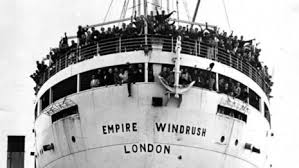
The measure, passed in April, drew nationwide attention for attempting to make gun and ammunition ownership mandatory. The Brady Center to Prevent Gun Violence, a national gun control group, sued Nelson over the law, claiming it was unconstitutional to make those demands of its citizens.

Nelson settled the suit this week when the city council unanimously approved a motion to amend the ordinance, the Atlanta Journal-Constitution reported. Here are the additions to the text:

    WHEREAS, many members of the City Council believe that possessing a firearm in the home is an effective means to defend residents and the community; and
    WHEREAS, the City Council also recognizes that there are other means available to defend families and homes, and the Constitution protects the rights of Americans to choose not to possess a firearm or bring one into the home….

The Brady Center applauded the city council’s decision in a statement:

“The Constitution protects not just the right to bear arms, but the right not to bear arms,” said Jonathan Lowy, Director of the Legal Action Project at the Brady Center. “The Brady Center brought this lawsuit to establish that the Constitution protects the rights of gun owners and non-gun owners alike, and all of us must be respectful of each other’s rights. We are pleased that as a result of our lawsuit the City of Nelson has recognized that the Second Amendment protects the rights of the hundreds of millions of Americans who believe that the best way to keep themselves and their families safe is by keeping guns out of their homes.”

While the idea of mandatory gun ownership is clearly a divisive one, many people on both sides of the issue pointed out that Nelson’s push was never likely to have been enforced. As the Associated Press reported in April, the ordinance had exemptions for convicted felons, those who suffer from certain physical or mental disabilities, and anyone who generally objects to gun ownership.

Lamar Kellett, a Brady Center member and one of Nelson’s 1,317 residents, was concerned that the law could lead to his being punished for opting not to own a firearm, so he sued. On Thursday, he called Nelson’s changes an “acceptable solution.”

Other mandatory gun ownership laws, meanwhile, remain in place largely without controversy. Kennesaw, Ga. has had such a measure on the books since 1982, though the law is rarely enforced, and some residents reportedly opt to ignore it.

Source: Huffington Post; Posted August 23, 2013; retrieved June 22, 2018: https://www.huffingtonpost.com/2013/08/23/nelson-georgia-guns_n_3805292.html

—————

VIDEO – Guns for everybody: Georgia town makes firearm ownership mandatory – https://youtu.be/e6DELdrYZuI

RT America
Published on Apr 2, 2013 – The city council in the town of Nelson, Georgia voted unanimously in favor of every resident possessing a gun at their homes. Now it’s compulsory for all of them, and Nelson isn’t the only US town to vote for a measure like this. RT’s Liz Wahl explains.

Find RT America in your area: http://rt.com/where-to-watch/
Or watch us online: http://rt.com/on-air/rt-america-air/

Say it Ain’t So! Is this the life that Caribbean people want? It should not be!

Yet, we are losing so many of our people to this eventuality. Our people leave due to “Push and Pull” reasons. “Push” refers to the societal defects in the Caribbean that moves people to want to get way; and “pull” factors refer to the impressions and perceptions that America is better. Surely a mandatory gun culture is not better!

The purpose of this commentary is to relate two strong points of contention:

  • We need to dissuade the high emigration rates of Caribbean citizens to the American homeland.
  • We need to encourage the Caribbean Diaspora to repatriate back to their ancestral homeland.

According to the foregoing article, American life is to “live by the sword/gun and die by the sword/gun”. Despite all the efforts to change this disposition, America’s consistency with guns continue, even now to the point that some communities want to mandate that every household have a gun. This is not the case in the Caribbean.

Yippee! If only, we can “prosper where planted” there.  Yes, we can!

This commentary and the movement behind the book Go Lean … Caribbean asserts that “yes, we can” reform and transform our Caribbean homeland so as to be better places to live, work and play. Where as, Caribbean communities can be elevated and improved, we already comply with common sense gun control, there is no hope for this in America – guns are in their DNA. (Good luck to American Youth demanding change).

For all Caribbean people in America who want a more sound life – gun wise – we entreat you: It is Time to Go.

This commentary is a continuation of a series from the Go Lean movement, in consideration of reasons why the Diaspora should repatriate back to the Caribbean homeland. There was an original 6-part series in 2016, with these submissions:

  1. Time to Go: Spot-on for Protest
  2. Time to Go: No Respect for our Hair
  3. Time to Go: Logic of Senior Immigration
  4. Time to Go: Marginalizing Our Vote
  5. Time to Go: American Vices; Don’t Follow
  6. Time to Go: Public Schools for Black-and-Brown

Now, we consider 5 new entries along that same theme; they are identified as follows:

  1. Time to Go: Windrush – 70th Anniversary
  2. Time to Go: Mandatory Guns – Say it Ain’t So
  3. Time to Go: Racist History of Loitering
  4. Time to Go: Blacks Get Longer Sentences From ‘Republican’ Judges
  5. Time to Go: States must have Population Increases

All of these commentaries relate to the disposition of the Caribbean Diaspora in foreign countries. The Go Lean book and movement serves as a roadmap for the introduction of the technocratic Caribbean Union Trade Federation (CU). The CU is set to optimize Caribbean society through economic, security and governing optimizations. Therefore the Go Lean roadmap has 3 prime directives:

  • Optimization of the economic engines in order to grow the regional economy to $800 Billion & create 2.2 million new jobs.
  • Establishment of a security apparatus to ensure public safety – including regional gun violence abatements – and protect the economic engines.
  • Improve Caribbean governance to support these engines, including a separation-of-powers between the member-states and CU federal agencies.

The “push and pull” factors do imperil Caribbean life. We push our citizens out. Then the resultant effect is a brain drain and even more endangerment to our society: less skilled workers, less entrepreneurs, less law-abiding citizens, less capable public servants – we lose our best and leave the communities with the rest. This create a crisis. The Go Lean roadmap posits that the entire Caribbean is now in crisis; so many of our citizens have fled for refuge in the US and other foreign countries, but the refuge is a mirage. The “grass is not necessarily greener on the other side”. Life in the US, is definitely not optimized – can you imagine living in a community where everyone is mandated to have a gun.

Yes, there is a challenge to reform and transform communities in the US; and there is a challenge to reform and transform communities in the Caribbean. It is easier though, to fix the Caribbean than to fix the American eco-system. So it is Time to Go, so our Caribbean people can do the work to prosper where planted in their Caribbean communities.

Why not simply try to fix America?

The history and DNA of America may be beyond our reach.

Just consider:

Who benefits from a mandatory gun ownership policy?

The Retail Stores and gun manufacturers!

This is Crony-Capitalism at work – exploiting the public good for private profit.

Also underlying the Second Amendment (of the US Constitution) is the white supremacy defect. This ignominious Second Amendment; is a product of the previous Slave Culture, as one original motivation in 1791 was to suppress insurrection, allegedly including slave revolts [60][61][62]. A previous blog-commentary entitled 10 Things We Want from the US and 10 Things We Don’t Want from the US detailed this rationale:

The “right to bear arms” has a personal application beyond the country’s entitlement to maintain a militia. This “right” has been interpreted in a manner in which any normal “man” can get possession of guns and other armament. This proliferation of guns in society results in the highest rate of gun violence in the world, even an unconscionable rate of school shootings.

The Go Lean roadmap purports that this status has also caused discord – a gross abuse and availability of illegal guns – in bordering communities of Mexico, and Caribbean states of the Bahamas, and the DR. This propels our gun-related crime.

The US still has some societal defects – racism and Crony-Capitalism for example – that are so imbrued that they are tied to the country’s DNA. This is why the Go Lean movement posits that it is easier to effect change at home in the Caribbean, than in the foreign country of the US.

In a previous blog-commentary, a thesis was presented that for Caribbean citizens, it is NOT better to live “fast & furious” in the US, but rather it is better to prosper where planted in the Caribbean homeland. Life in the US may experience a shorter mortality due to the riskier reality, like this dangerous gun culture – this is not just theory, a Caribbean Diaspora’s daughter was killed in the Parkland School Shooting in February 2018. And yet, our Caribbean communities are losing people more and more to the US with our atrocious societal abandonment rates.

While we are declaring that it is “Time to Go“, we are also preparing for the return – fixing our economic, security and governing defects. Our goal is to be an American protégé and not a parasite; maybe to even be Better Than America.

If this is going to be, it starts with me – being residential in the Caribbean homeland. Time to Go!

The vision of the CU is a confederation of the 30 member-states of the Caribbean to do the heavy-lifting of championing better economic and security policies. There is the structure of a separation-of-powers between CU agencies and the individual member-states. So the CU will be able to do more independently than the regional status quo, while also helping to elevate the status quo security deliveries in the 30 member-states.

The Go Lean roadmap provides turn-by-turn directions on how to reform the Caribbean security apparatus to better secure Caribbean society as a whole. This roadmap concedes that the Caribbean is in crisis, but that this “crisis would be a terrible thing to waste”. As a planning tool, the roadmap commences with a Declaration of Interdependence, pronouncing the approach of regional integration (Page 12 – 13) as a viable solution to elevate the region’s societal engines:

x. Whereas we are surrounded and allied to nations of larger proportions in land mass, populations, and treasuries, elements in their societies may have ill-intent in their pursuits, at the expense of the safety and security of our citizens. We must therefore appoint “new guards” to ensure our public safety and threats against our society, both domestic and foreign. The Federation must employ the latest advances and best practices … to assuage continuous threats against public safety.

xi. Whereas all men are entitled to the benefits of good governance in a free society, “new guards” must be enacted to dissuade the emergence of incompetence, corruption, nepotism and cronyism at the peril of the people’s best interest. The Federation must guarantee the executions of a social contract between government and the governed.

xvi. Whereas security of our homeland is inextricably linked to prosperity of the homeland, the economic and security interest of the region needs to be aligned under the same governance. Since economic crimes, including piracy and other forms of terrorism, can imperil the functioning of the wheels of commerce for all the citizenry, the accedence of this Federation must equip the security apparatus with the tools and techniques for predictive and proactive interdictions.

xix. Whereas our legacy in recent times is one of societal abandonment, it is imperative that incentives and encouragement be put in place to first dissuade the human flight, and then entice and welcome the return of our Diaspora back to our shores

Change has now come. The driver of this change is globalization. Caribbean people have been emigrating in their search for a better life. Nelson, Georgia – from the foregoing article – should not be that destination. Nor should any community that refuses to implement common sense gun control. The bottom-line should not include sacrificing our children. The bottom-line motive should be the Greater Good – “the greatest good for the greatest number of people which is the measure of right and wrong – not profit, prejudice nor emigration.

The Go Lean book provides 370-pages of turn-by-turn instructions on “how” to adopt new community ethos, plus the strategies, tactics, implementations and advocacies to execute so as to transform the societal engines of Caribbean society, regarding guns and gun control. In addition, the Go Lean movement have presented many previous blog-commentaries on regional security and common-sense provisions to remediate and mitigate crime and violence. See this sample here:

https://goleancaribbean.com/blog/?p=14596 Forging Change – Corporate Vigilantism To Help with Guns
https://goleancaribbean.com/blog/?p=14556 Observing the Change … with Guns
https://goleancaribbean.com/blog/?p=13746 Failure to Launch – Security: Caribbean Basin Security Dreams
https://goleancaribbean.com/blog/?p=13476 Future Focused – Policing the Police
https://goleancaribbean.com/blog/?p=13213 Caribbean People ‘Pulled’ – Despite American Guns
https://goleancaribbean.com/blog/?p=13126 “Must Love Dogs”  – Providing K9 Solutions for Better Security
https://goleancaribbean.com/blog/?p=12400 Accede the Caribbean Arrest Treaty
https://goleancaribbean.com/blog/?p=11332 Boston Bombing Anniversary – Learning Lessons
https://goleancaribbean.com/blog/?p=11244 Live Fast; Die Young – The Fast & Furious Life in the US
https://goleancaribbean.com/blog/?p=11048 Managing the ‘Strong versus the Weak’ Series – Mitigating Bullies
https://goleancaribbean.com/blog/?p=9072 Model: Shots-Fired Monitoring – Securing the Homeland on the Ground
https://goleancaribbean.com/blog/?p=7485 Mitigating Interpersonal Violence Series – Street Crimes

In the Caribbean, we need to dissuade our people from leaving … and incentivize many of the Diaspora to return. We need our people to help us reform and transform our societies. Fleeing to America is not the answer! The grass is not greener on the other side. There are far too many guns in America for that society to be inviting. No, America is not the panacea for all of the Caribbean ills. To the contrary, we must reform and transform our own society.

The Go Lean/CU roadmap asserts that now is the time for all of the Caribbean – residents and Diaspora – to lean-in for the empowerments described here in the book Go Lean … Caribbean. This is conceivable, believable and achievable that we can elevate our homeland and to make our communities better places to live, work and play.

Now is the Time to Go … home! 🙂

Download the book Go Lean … Caribbean – now!

Sign the petition to lean-in for this roadmap for the Caribbean Union Trade Federation.

Share this post:
, , ,
[Top]

‘Time to Go’ – Windrush: 70th Anniversary Today – ENCORE

On 22 June 1948, the ship HMT Empire Windrush brought a group of 802 migrants to the port of Tilbury, near London, England. – Wikipedia

Thus started the drain! 

The Brain Drain that is. What started as a “drip has now turned into a drizzle”.  After 70 years exactly, the jury is now in. The verdict is emphatic:

Time to Go!

“Frankly, the Caribbean Diaspora … can now do better at home … in the Caribbean.” – This was the assertion from this previous blog-commentary from July 10, 2014. Today, on the 70th anniversary of the Windrush landing with its African Caribbean arrivals; it is time now to Encore that submission – see below.

African Caribbean people may not be so welcomed in the British Isles right now, anyway. See the latest on the Windrush Controversy in the Appendix VIDEO below.

This Encore continues a series from 2016, with these entries:

  1. Time to Go: Spot-on for Protest
  2. Time to Go: No Respect for our Hair
  3. Time to Go: Logic of Senior Immigration
  4. Time to Go: Marginalizing Our Vote
  5. Time to Go: American Vices; Don’t Follow
  6. Time to Go: Public Schools for Black-and-Brown

Now, we consider 5 new entries along that same theme; they are identified as follows:

  1. Time to Go: Windrush – 70th Anniversary
  2. Time to Go: Mandatory Guns – Say it Ain’t So
  3. Time to Go: Racist History of Loitering
  4. Time to Go: Blacks Get Longer Sentences From ‘Republican’ Judges
  5. Time to Go: States must have Population Increases

All of these commentaries relate to the Caribbean Diaspora’s disposition in foreign lands, asserting that it is Time to Go … home! See that Encore now:

———————

Go Lean Commentary – British public sector workers strike over ‘poverty pay’

The grass is not greener on the other side.

Go from being a big fish in small pond, to small fish in big pond.

These expressions are relevant in considering the fate of so many Caribbean Diaspora that had fled their Caribbean homelands over the past decades to take residence in Great Britain. Many of them sought refuge as career civil servants; (one reason [a] was the acute racism and intolerance encountered in private enterprises). These ones are faced with the harsh reality that pay scales in the public sector have not kept pace with inflation; they are now at poverty level. See the news article here:

By: Tess Little (Editing by Stephen Addison)

British strike 1LONDON (Reuters) – Hundreds of thousands of public sector workers including teachers, council workers and firefighters staged a 24-hour pay strike on Thursday in a stoppage that has prompted Prime Minister David Cameron to pledge a crackdown on union powers.

Protesters marched through the streets of many of Britain’s main cities in one of the biggest co-ordinated labour stoppages for three years.

Denouncing what they called “poverty pay,” they demanded an end to restrictions on wage rises that have been imposed by the government over the past four years in an effort to help reduce Britain’s huge budget deficit.

In London, demonstrators marched towards Trafalgar Square at midday, chanting “Low pay, no way, no slave labour” to the beat of a drum. A giant pair of inflatable scissors, carried by members of the National Union of Teachers (NUT), read “Education cuts never heal.”

Firefighter Simon Amos, 47, marched wearing his uniform behind a flashing fire engine parading members of the Fire Brigades Union (FBU). “The government [is] making us pay more for our pension for it to be worth the same, and making us work longer,” he said.

British strike 2The biggest public sector union involved, Unison, said early reports showed the strike had led to 3,225 school closures with more than 1,000 others partially closed.

Refuse collectors, school support staff, cleaners, street sweepers, care workers, nursery assistants and social workers were joining the strike, it added.

Hot spots, it said, included the North East, Wales and East Midlands where most council offices had closed, while more than 60 picket lines have closed most services in Newcastle.

“It is a massive decision by local government and school support workers to sacrifice a day’s pay by going on strike, but today they are saying enough is enough,” said Unison General Secretary, Dave Prentis in a statement.

Britain’s coalition government has enforced a policy of pay restraint for public sector workers since coming to power in 2010, imposing a pay freeze until 2012 and then a one percent pay rise cap, resulting in a fall in income in real terms [compared to inflation].

The Cabinet Office played down the impact of the strike, saying that most schools in England and Wales were open and that fire services were operating throughout the country.

British strike 3On Wednesday, Cameron told parliament he planned to limit unions’ powers to call strikes.

“How can it possibly be right for our children’s education to be disrupted by trade unions acting in this way” he said.

Tough new laws would be proposed in the Conservative manifesto for next year’s general election, he added.

These would include the introduction of a minimum threshold in the number of union members who need to take part in a strike ballot for it to be legal.

The manifesto could also back the introduction of a time limit on how long a vote in favour of industrial action would remain valid.

The NUT mandate for Thursday’s strike, for example, came from a 2012 strike ballot based on a turnout of just 27 percent, Cameron said.

The issue of minimum voting thresholds last arose three months ago when a strike by London Underground train drivers caused huge disruption in the capital, prompting Mayor Boris Johnson to demand that at least half of a union’s members should vote in favour for a strike to go ahead.
Source: Reuters News Service; retrieved 07/10/2014 from: http://news.yahoo.com/public-sector-workers-strike-over-poverty-pay-105040672.html

Frankly, the Caribbean Diaspora employed in the British public sector can now do better at home … in the Caribbean.

This is the assertion of the book Go Lean…Caribbean. That once the proposed empowerments are put in place, the Caribbean Diaspora should consider repatriating to their ancestral homelands.

Unfortunately for the Caribbean, this societal abandonment has continued, since the early days of the “Windrush Generation”[a] right up to now. In a recent blog post, this commentary related analysis by the Inter-American Development Bank that the Caribbean endures a brain drain of 70% among the college educated population; (https://goleancaribbean.com/blog/?p=1433).

Change has now come to the Caribbean.

The book Go Lean…Caribbean serves as a roadmap for the introduction and implementation of the technocratic Caribbean Union Trade Federation (CU). This roadmap will spearhead the elevation of Caribbean society. The prime directives of the CU are presented as the following 3 statements:

  • Optimization of the economic engines in order to grow the regional economy & create 2.2 million new jobs at home.
  • Establishment of a security apparatus to protect the resultant economic engines.
  • Improve Caribbean governance to support these engines.

The book posits that the improved conditions projected over the 5 years of the roadmap will neutralize the impetus for Caribbean citizens to flee, identified as “push and pull” factors. This point is stressed early in the book (Page 13) in the following pronouncements in the opening Declaration of Interdependence:

xix.   Whereas our legacy in recent times is one of societal abandonment, it is imperative that incentives and encouragement be put in place to first dissuade the human flight, and then entice and welcome the return of our Diaspora back to our shores. This repatriation should be effected with the appropriate guards so as not to imperil the lives and securities of the repatriated citizens or the communities they inhabit. The right of repatriation is to be extended to any natural born citizens despite any previous naturalization to foreign sovereignties.

xx.   Whereas the results of our decades of migration created a vibrant Diaspora in foreign lands, the Federation must organize interactions with this population into structured markets. Thus allowing foreign consumption of domestic products, services and media, which is a positive trade impact. These economic activities must not be exploited by others’ profiteering but rather harnessed by Federation resources for efficient repatriations.

This foregoing article highlights other issues that have been prominently addressed in the Go Lean book, namely that of the Civil Service and Labor Relations. There is the need for a professional staff in the Federal Civil Service. They require marketable benefits and compensation. There is also a role for Labor Unions to play in the elevation of Caribbean society. The Go Lean roadmap envisions an inclusionary attitude towards unions. The Go Lean community ethos is that of being partners with unions, not competitors. The book features specific tools and techniques that can enhance management-labor relationships.

These issues constitute heavy-lifting for the regional administration of the Caribbean:

  • fostering best practices for federal civil service and labor unions,
  • minimizing the brain drain, and
  • facilitating repatriation to the homeland.

These issues cannot be glossed over or handled lightly; this is why the Go Lean book contains 370 pages of finite details for managing change in the region. The book contains the following sample of community ethos, strategies, tactics, implementations and advocacies to impact the Caribbean homeland:

Community Ethos – Economic Systems Influence Choices & Incentives Page 21
Community Ethos – The Consequences of Choices Lie in the Future Page 21
Community Ethos – Job Multiplier Page 22
Community Ethos – Lean Operations Page 24
Community Ethos – Return on Investments Page 24
Community Ethos – Ways to Impact the Future Page 26
Community Ethos – Ways to Improve Negotiations Page 32
Strategy – Competition – Remain home   –vs- Emigrate Page 49
Strategy – Agents of Change – Aging Diaspora Page 57
Tactical – Separation of Powers – Versus Member-States Governments Page 71
Implementation – Year 1 / Assemble Phase – Establish Civil Service Page 96
Implementation – Ways to Deliver Page 109
Implementation – Trade Mission Objectives Page 116
Implementation – Reasons to Repatriate Page 118
Anecdote – Experiences of a Repatriated Resident Page 126
Planning  – 10 Big Ideas for the Caribbean Region Page 127
Advocacy – Ways to Create Jobs Page 152
Advocacy – Ways to Impact Labor Unions Page 164
Advocacy – Ways to Manage Federal Civil Service Page 173
Anecdote – Experiences of Diaspora Member Living Abroad Page 216
Advocacy – Ways to Impact the Diaspora Page 217

The Go Lean roadmap has simple motives: fix the problems in the homeland to make the Caribbean a better place to live, work, learn and play. There should be no need to go abroad and try to foster an existence in a foreign land. So for those of Caribbean heritage working in the British Civil Service, we hear your pleas. Our response: Come home; come in from the cold.

Now is the time for all of the Caribbean, the people residing in the homeland and those of the Diaspora, to lean-in for the empowerments described in the book Go Lean … Caribbean. This Big Idea for the region is a dramatic change; one that is overdue. The policies & practices of the past have failed Caribbean society. Too many people left, yet have little to show for it.

Caribbean music icon Bob Marley advocated this same charter for the Caribbean Diaspora. He sang to “come in from the cold” in the opening song of his last album Uprisings in 1980. How “spot-on’ were his words in the following music/video:

Download the free e-Book of Go Lean … Caribbean – now!

———————

Appendix – Cited Reference
a: “There was plenty of work in post-war Britain and industries such as British Rail, the National Health Service and public transport recruited almost exclusively from Jamaica and Barbados”. Retrieved July 10, 2014 from: http://en.wikipedia.org/wiki/British_African-Caribbean_people#The_.22Windrush_generation.22

——————–

Appendix VIDEO – How will the UK solve the Windrush controversy? | Inside Story – https://youtu.be/GYUag4XYhFo

Al Jazeera English

Published on Apr 17, 2018 – They are called the “Windrush generation”. That is a refefence to the ship, the Empire Windrush, that carried the first wave of immigrants from the West Indies to Britain in 1948. Many arrvied as children on their parents’ passports – and have lived in the UK for over 70 years, paying taxes and insurance, but never formally becoming British Citizens. Now, as the government tightens its immigration rules, those without the proper documents are being denied services and could even face deportation. Some are calling it ‘cruel and inhumane’ treatment. The government has apologised and it’s promsing an investigation. But will that be enough?
Presenter: Peter Dobbie Guests Sally Daghlian – CEO of Praxis, an organisation that provides assistance to people affected by the Windrush controversy. Clive Foster – member of the Nottingham Citizens Group.
Share this post:
, ,
[Top]