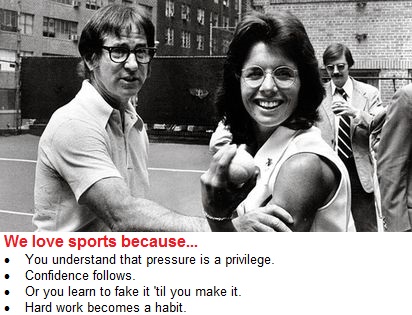
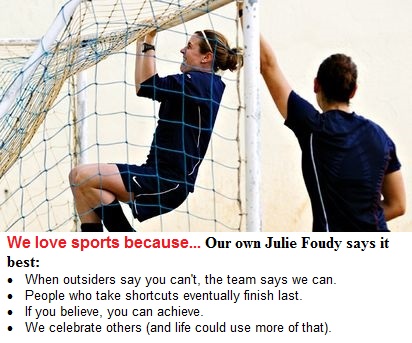
Sports Role Model – espnW.

Go Lean Commentary

Introducing a network without the “network”. This is espnW, the ESPN (see Appendix below) channel, without a channel, specifically catering to women’s sports; this network is delivered via the internet only. CU Blog - Sports Role Model - ESPN-W - Photo 3

Wow, how the world has changed.

So this commentary is a melding of ICT (Internet & Communications Technology), sports, television, gender equality and economics – this is a big deal for the Caribbean to consider.

espnW…

CU Blog - Sports Role Model - ESPN-W - Photo 2
espnW’s mission is to serve women as fans and athletes. espnW.com provides an engaging environment that offers total access to female athletes and the sports they play, takes fans inside the biggest events, and shares a unique point of view on the sports stories that matter most to women.

Founded in July, 2010, espnW lives across television, films, events, digital and social platforms. The annual espnW: Women + Sports Summit is the leading event of its kind in the sports industry. The Women’s Sports Foundation is a charity of choice for espnW.
ESPN W. – About Us Page – Official Website (Retrieved December 7, 2014) – http://espn.go.com/espnw/v1/about

VIDEO: espnW at the 2012 Olympic Games – http://youtu.be/z7vGVQAatig
Published on Aug 14, 2012
Alex Morgan sits down with Julie Foudy to talk about what it feels like to have her first Olympic gold


CU Blog - Sports Role Model - About ESPN-W - Photo 5

CU Blog - Sports Role Model - About ESPN-W - Photo 4

CU Blog - Sports Role Model - About ESPN-W - Photo 3

CU Blog - Sports Role Model - About ESPN-W - Photo 1

CU Blog - Sports Role Model - About ESPN-W - Photo 2

The Caribbean does not currently have an eco-system for sports business … for men nor women. There is no viable sporting enterprises, other than baseball development/winter leagues in Puerto Rico, Dominican Republic and Communist Cuba. There is absolutely no intercollegiate athletics arrangements. Only Amateur athletics abound in the region.

While so much of the sports business infrastructure is missing, the Caribbean is awash in the underlying assets: the athletes. The Caribbean supplies the world with the best-of-the-best in the sports genres of baseball, basketball, track-and-field, soccer-FIFA-football and other endeavors. This athletic supply applies equally to men and women.

The book Go Lean…Caribbean book serves as a roadmap for the introduction and implementation of the Caribbean Union Trade Federation (CU), a technocratic federal government to administer and optimize the economic/security/governing engines of the region’s 30 member-states. The roadmap recognizes and fosters the genius qualifiers of many Caribbean men and women. The goal now is to foster the local eco-system in the homeland so that  those with talent would not have to flee the region to garner the business returns on their athletic investments.

This Go Lean economic empowerment roadmap strategizes to create a Single Media Market to leverage the value of broadcast rights for the entire region, utilizing all the advantages of cutting edge ICT offerings. The result: an audience of 42 million residents (plus 10 million Diaspora) across 30 member-states and 4 languages. ESPN and espnW provides a great role model for this execution, see Appendix below, facilitating television, cable, satellite and internet streaming wherever economically viable.

At the outset, the roadmap recognizes the value of sports, for all genders, in the roadmap with these statements in the Declaration of Interdependence (Page 13 & 14):

xxvi.      Whereas the preparation of our labor force can foster opportunities and dictate economic progress for current and future generations, the Federation must ensure that educational and job training opportunities are fully optimized for all residents of all member-states, with no partiality towards any gender or ethnic group. The Federation must recognize and facilitate excellence in many different fields of endeavor, including sciences, languages, arts, music and sports. This responsibility should be executed without incurring the risks of further human flight, as has been the past history.

xxvii.      Whereas the region has endured a spectator status during the Industrial Revolution, we cannot stand on the sidelines of this new economy, the Information Revolution. Rather, the Federation must embrace all the tenets of Internet Communications Technology (ICT) to serve as an equalizing element in competition with the rest of the world. The Federation must bridge the digital divide and promote the community ethos that research/development is valuable and must be promoted and incentivized for adoption.

xxviii.      Whereas intellectual property can easily traverse national borders, the rights and privileges of intellectual property must be respected at home and abroad. The Federation must install protections to ensure that no abuse of these rights go with impunity, and to ensure that foreign authorities enforce the rights of the intellectual property registered in our region.

xxxi.      Whereas sports have been a source of great pride for the Caribbean region, the economic returns from these ventures have not been evenly distributed as in other societies. The Federation must therefore facilitate the eco-systems and vertical industries of sports as a business, recreation, national pastime and even sports tourism – modeling the Olympics.

The Go Lean roadmap calls for the market organizations and community investments to garner economic benefits of sports and talented athletes, men and women. One of the biggest contribution the CU will make is the facilitation of sports venues: arenas and stadia. Sports can be big business (and great educational opportunities) for the athletes, promoters, vendors and landlords. Still, even fans get great benefits: image, national pride, and entertainment. (The E in ESPN means Entertainment). The eco-system of sports is therefore inclusive in the roadmap’s quest to make the Caribbean region a better place to live, work and play.

Now is the time for all of the Caribbean to lean-in to the following community ethos, strategies, tactics, implementations and advocacies detailed in the book Go Lean…Caribbean to deliver the solutions to elevate the Caribbean region through sports:

Community Ethos – People Respond to Incentives in Predictable Ways Page 21
Community Ethos – Return on Investments Page 24
Community Ethos – Ways to Foster Genius Page 27
Community Ethos – Promote Intellectual Property Page 29
Community Ethos – Ways to Promote Happiness Page 36
Community Ethos – Ways to Impact the Greater Good Page 37
Strategic – Vision – Consolidating the Region in to a Single Market Page 45
Strategic – Staffing – Sporting Events at Fairgrounds Page 55
Tactical – Fostering a Technocracy Page 64
Tactical – Separation of Powers – Sports & Culture Administration Page 81
Tactical – Separation of Powers – Fairgrounds Administration Page 83
Implementation – Steps to Implement Self-Governing Entities (Fairgrounds) Page 105
Implementation – Ways to Deliver Page 109
Planning – 10 Big Ideas – #5 Four Languages in Unison / #8 Cyber Caribbean Page 127
Planning – Ways to Make the Caribbean Better Page 131
Advocacy – Ways to Grow the Economy Page 151
Advocacy – Ways to Create Jobs Page 152
Advocacy – Ways to Improve Education – Reduce Brain Drain Page 159
Advocacy – Ways to Improve Local Government – Parks & Recreation Page 169
Advocacy – Ways to Impact Events Page 191
Advocacy – Ways to Promote Fairgrounds Page 192
Advocacy – Ways to Foster Technology – Intellectual Property Protections Page 197
Advocacy – Ways to Empower Women Page 226
Advocacy – Ways to Impact Youth Page 227
Advocacy – Ways to Improve Sports Page 229
Advocacy – Ways to Impact Urban Living – Sports Leagues Page 234

The book Go Lean…Caribbean, and aligning blog commentaries (highlighted throughout this page in bold), asserts that the region can be a better place to live, work and play; that the economy can be grown methodically by embracing progressive strategies in sports and sports broadcasting/streaming at all levels: professional, amateur and intercollegiate.

The Go Lean…Caribbean roadmap is bigger than just sports, its a concerted effort to elevate all of Caribbean society, for all genders: men and women. The CU is the vehicle for this goal, this is detailed by the following 3 prime directives:

  • Optimization of the economic engines in order to grow the regional economy to $800 Billion & create 2.2 million new jobs (21,000 direct jobs at fairgrounds and sport venues).
  • Establishment of a security apparatus to protect the resultant economic engines.
  • Improve Caribbean governance to support these engines.

This roadmap adheres to economic principles of supply-and-demand. Similar to the foregoing website on espnW, the roadmap looks for the opportunities to foster interest that may exist in specific endeavors, in this case women’s sports, and then explore the business opportunities around servicing that demand. This is not limited to the domestic Caribbean, but rather can refer to local interest in sports abroad and foreign interest in Caribbean sports and athletes.

This is heavy-lifting. This is the quest of Go Lean/CU, to do the heavy-lifting to make the Caribbean homeland a better place to live, work and play. 🙂

Download the book Go Lean…Caribbean now!

———

AppendixEntertainment and Sports Programming Network (Source: http://en.wikipedia.org/wiki/ESPN)

ESPN is a U.S.-based global cable and satellite television channel that is owned by ESPN Inc., a joint venture between The Walt Disney Company (which operates the network, through its 80% controlling ownership interest) and Hearst Corporation (which holds the remaining 20% interest). The channel focuses on sports-related programming including live and recorded event telecasts, sports news and talk shows, and other original programming.

CU Blog - Sports Role Model - ESPN-W - Photo 1ESPN broadcasts primarily from studio facilities located in Bristol, Connecticut. The network also operates offices in Miami, New York City, Seattle, Charlotte, and Los Angeles. While ESPN is one of the most successful sports networks, it has been subject to criticism, which includes accusations of biased coverage[1] (not showing enough hockey or Women’s athletics), conflict of interest, and controversies with individual broadcasters and analysts.

As of August 2013, ESPN is available to approximately 97,736,000 pay television households (85.58% of households with at least one television set) in the United States.[2] In addition to the flagship channel and its seven related channels in the United States, ESPN broadcasts in more than 200 countries,[3] operating regional channels in Australia, Brazil, Latin America and the United Kingdom, and owning a 20% interest in The Sports Network (TSN) as well as its five sister networks and NHL Network in Canada.

Source References:

  1. Geography lesson: Breaking down the bias in ESPN’s coverage, ESPN.com, August 15, 2008.
  2. Seidman, Robert (August 23, 2013). “List of How Many Homes Each Cable Networks Is In – Cable Network Coverage Estimates As Of August 2013”. TV by the Numbers. Zap2it. Retrieved August 25, 2013.
  3. ESPN Inc Encyclopedia Britannica.
Share this post:
, , , ,

Caribbean less competitive due to increasing aviation taxes

Go Lean Commentary

The book Go Lean … Caribbean relates the significance of supporting the airline industry so as to facilitate the region’s primary economic driver: Tourism.

Tourism is a leisure activity; many times participants in leisure are in no hurry to get to their destinations, they often drive. This relates to countries on a continental mainland; but for islands, not so much. For 27 of the 30 Caribbean member-states, island life is the reality. (Belize is in Central America; Guyana and Suriname are in South America).

If speed is not the requirement then boating should be an option. But the only boating/transport options for Caribbean tourists are cruise lines.

This following article relates the biggest threat to Caribbean tourism is Caribbean governments. These ones are authorized to assess taxes, but for far too often they have targeted airline tickets to generate needed revenues. This is such a flawed strategy, a betrayal of the public trust. They “cut off their nose to spite their face”, as the article here relates:

By: Ernie Seon, Caribbean-360 Contributor

CU Blog - Caribbean less competitive due to increasing aviation taxes - Photo 1ST. THOMAS, US Virgin Islands – The International Air Transportation Association (IATA) Tuesday urged regional aviation authorities to adhere to the key principles set out by International Civil Aviation Organization.

IATA’s regional vice president for the Americas, Peter Cerda said it is unfortunate that many governments had chosen to ignore the principles, a global issue that was particularly acute in the Caribbean.

Addressing tourism and industry officials gathered here on the occasion of World Aviation Day, Cerda noted that aviation taxes continue to increase the cost of travelling to the Caribbean. He said this made the region less competitive to other destinations.

“Taking the islands as a whole, each dollar of ticket tax could lead to over 40,000 fewer foreign passengers,” he said, adding that US$20 million of reduced tourist expenditure meant 1,200 fewer jobs across the region.

“Caribbean countries must therefore consider the aviation industry as a key element for tourism development,” he advised.

The IATA official noted that in terms of charges, two airports in the region, Montego Bay and Kingston, both in Jamaica, recently proposed airport tariff increases of over 100 per cent so as to attain a return of capital of around 20 per cent a year in US dollars.

He said that measures such as these do not encourage or support the development of the industry in the region.

“The regulators must act strongly and swiftly against such big increases. Governments have to foster positive business environments through consultation with the industry and transparency in order to ensure win-win situations for all,” he warned.

Cerda said the issue of taxes and charges in the region transcends the formal breaches of global standards and recommended practices and that the simple truth is that this region is a very expensive place for airlines to do business.

In the Caribbean, tourism and the aviation sector facilitate and support some 140,000 jobs and contribute US$3.12 billion, roughly 7.2 per cent of the Caribbean’s gross domestic product (GDP).

The airline industry is celebrating its 100th anniversary year in the black, according to industry figures released here. Globally, airlines are expected to earn a net profit of US$18 billion in 2014.

Cerda noted that while that might sound impressive, on revenues of US$746 billion, this is equivalent to a net profit margin of 2.4 per cent or US$5.42 per passenger carried.

“Looking only at Latin America and the Caribbean, the airlines in this region are expected to earn $1.1 billion.”This is a profit of US$4.21 per passenger and a net margin of three per cent. We are in a tough and very competitive business,” he added.

The aviation official said fuel expense across the Caribbean is estimated at 14 per cent higher than the world average, adding that this represents about a third of an airline’s operating costs.

He noted that in the case of the Dominican Republic, although fuel charges were recently reduced, tax on international jet fuel still remains high at 6.5 per cent.

“Another example is the Bahamas applying a seven per cent import duty on Jet fuel. Jet fuel supply is an issue in the region, the complexity of the fuel supply and the seasonal demand is costly and difficult, making fuel costs in the region a challenge for airlines.”

In addition, Cerda noted that airports are using the fuel concession fees as a source of revenue and they are still waiting to see any of these monies re-invested in improving fuel facilities.

On the issue of safety, he said that this has been in the spotlight in recent months, with July being an especially sad month for all involved with aviation.

However, Cerda said despite the recent tragedies, flying remains by far the safest mode of transportation.

“Every day, approximately 100,000 flights take to the sky and land without incident. Nonetheless, accidents do happen. Every life lost recommits us to improve on our safety performance.

“It is no secret that safety has been an issue in this region. Even though it is still under performing the global average, performance is improving,” he said.

The IATA official said that the aviation industry has come a long way since the very first flight from St. Petersburg to Tampa 100 years ago, turning this large planet into one small world.

He said through it all, one thing has remained constant: when governments support the conditions for a thriving industry the economic benefits are felt by all.

However Cerda cautioned that for the industry to deliver the most benefits to the citizens in the Caribbean and spur additional tourism and trade, “we need to be able to compete on a level playing field and have the infrastructure capacity needed to grow.”

He said he remains confident that if the Caribbean governments continue to strengthen their partnership with the aviation industry, “we will deliver the unique transformative economic growth only our industry can deliver, making the second century of aviation in this region even more beneficial than the first”.
Caribbean-360 Online News (Posted 09/17/2014; retrieved 12/06/2014) –
http://www.caribbean360.com/news/caribbean-less-competitive-due-to-increasing-aviation-taxes-iata-warns

This foregoing article highlights a defective premise, predatory taxing, and so thusly depicts the need for improved regional oversight of economic and governing engines.

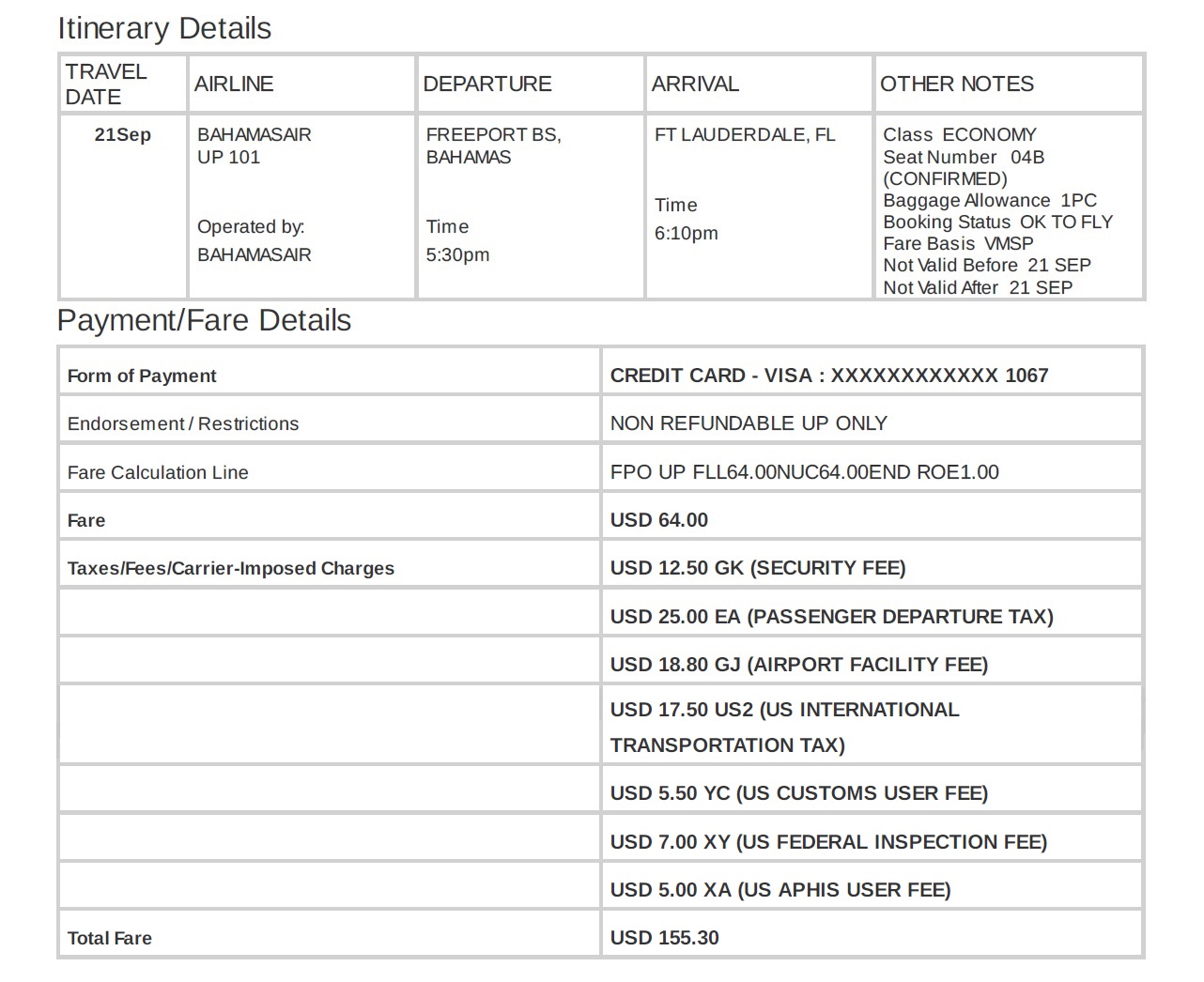
CU Blog - Caribbean less competitive due to increasing aviation taxes - Photo 2See this photo of a recent airline ticket (price breakdown), for one of the stakeholders in the Go Lean movement, who was travelling from a Caribbean island. The reality of these aviation taxes defies logic!

Yes, the governments need their revenues, but this should not be pursued at the expense of undermining viable economic engines; this is self-defeating. Likewise there was a recent conflict with British Aviation Authorities and their unilateral tax on Caribbean air transport. The solution there/then is the same as now: regional coordination and a heightened advocacy; see AppendixVIDEO.

Change has now come to the Caribbean. The book Go Lean … Caribbean serves as a roadmap for the introduction and implementation of the Caribbean Union Trade Federation (CU), an alliance of the 30 Caribbean member-states. This Go Lean roadmap has 3 prime directives:

  • Optimization of the economic engines in order to grow the regional economy to $800 Billion and create 2.2 million new jobs..
  • Establishment of a security apparatus to protect the resultant economic engines.
  • Improve Caribbean governance to support these engines.

The roadmap calls for the CU to navigate the changed landscape of the globalized air transport industry. There is the need for regional integration, administration, and promotion for Caribbean air travel among local and foreign carriers. The book posits that transportation and logistics empower the economic engines of a community. There must be air carrier solutions to service the transportation and tourism needs of the Caribbean islands. This point is fully appreciated by Caribbean tourism stakeholders; the book relates that the region’s Hotel and Tourism Association channel the vision of Robert Crandall, former Chairman of American Airlines, who remarked at a Caribbean Hotel and Tourism Investment Conference in May 2010 that the region is uniquely dependent on tourism:

“Everyone involved in travel and tourism knows that our [airline] industry is immensely important to the world economy, generating and supporting – either directly or indirectly – about one in eleven jobs worldwide. Here in the Caribbean, it is even more important. On a number of islands, travel and tourism accounts for more than 50% of all employment, and on some islands for more than 75%. Overall, about 20% of Caribbean employment is travel and tourism dependent – something on the order of 2.5 million jobs.” – Go Lean … Caribbean Page 60.

Go Lean asserts that air travel options must be optimized to impact Caribbean society – thus the need for more regional coordination, regulation and promotion of the Caribbean’s aviation industry. New models are detailed in the book in which tourism can be enhanced with “air lifts” to facilitate Caribbean events, and “Air Bridges” to allow for targeting High Net Worth markets. This roadmap also introduces the Union Atlantic Turnpike to offer more transportation solutions (ferries, toll roads, railways, and pipelines) to better facilitate the efficient movement of people and cargo.

This is one way the CU will empower the region’s economic engines. This is an example of the change that the CU technocracy will bring!

The Go Lean book presents a series of community ethos that must be adapted to forge this change. In addition, there are these specific strategies, tactics, implementation and advocacies to apply:

Community Ethos – Job Multiplier Page 22
Community Ethos – Lean Operations Page 24
Community Ethos – Cooperatives Page 25
Community Ethos – Ways to Improve Sharing Page 35
Community Ethos – Impacting the Greater Good Page 37
Strategy – Customers – Visitors Page 47
Strategy – Competitive Analysis – Event Patrons Page 55
Strategy – Core Competence – Tourism Page 58
Anecdote – Caribbean Hotel & Tourism Assoc. focus on Air Transport Page 60
Tactical – Fostering a Technocracy Page 64
Tactical – Commerce – Tourism Promotion Page 78
Tactical – Aviation Administration & Promotion Page 84
Implementation – Ways to Deliver Page 109
Implementation – Trade Mission Objectives Page 116
Planning – 10 Big Ideas for the Caribbean Region – #7: Virtual Turnpike Page 127
Planning – Ways to Improve Trade Page 128
Advocacy – Ways to Improve Governance Page 168
Advocacy – Ways to Optimize Government Revenue Sources Page 172
Advocacy – Ways to Enhance Tourism Page 190
Advocacy – Ways to Impact Events Page 191
Advocacy – Ways to Market Southern California – Air Bridge Page 194
Advocacy – Ways to Improve Transportation – Aviation Promotion Page 205
Appendix – Airport Cities – New Approach for Optimizing Business Model Page 287

This commentary posits that the status quo of Caribbean aviation taxes reflect a flawed economic policy, reflective of the dysfunction in the region. This commentary also relates to other lessons of economic optimizations and dysfunctions previously detailed in Go Lean blogs, as sampled here:

Caribbean must work together to address regional industry threats – Example of Rum Subsidies
A Lesson in Aviation History: Concorde SST and the Caribbean
New York-New Jersey Port Authority – Lessons from an Airport Landlord
Bahamas Re-organizing Government Revenues in 2015 with VAT Implementation
Lessons Learned from the American Airlines Merger
Book Review: ‘Wrong – Nine Economic Policy Disasters and What We Can Learn…’
Caribbean Changes – Air Antilles Launches St. Maarten Service
Tourism’s changing profile – Need for Competition and Comparative Analysis

The world loves the Caribbean; people want to come visit and enjoy our hospitality. It is better for them, and for us in the region that they come by air transport. But cruises are viable options, though the Caribbean communities get less benefits from cruise lines (Pages 61 & 193). We simply “fatten our frogs for snake”. The more dysfunction we create with air transport – like these excessive  aviation taxes – the more we push visitors to the cruise option; meaning less direct-indirect spending: hotels, taxis, restaurants, casinos, etc.

Now is the time to lean-in to this roadmap for Caribbean change, as depicted in the book Go Lean…Caribbean. We cannot afford to undermine our economic strengths with disabling tax policies. This is a public trust, betrayed. The Caribbean can – and must – do better.  🙂

Download the free e-Book of Go Lean … Caribbean – now!

APPENDIX Video: A Tax Too Far…? – http://youtu.be/Jbh8DJxUNC8

Uploaded on Oct 30, 2011 – A documentary on how the Air Passenger Duty instituted by the UK is affecting Caribbean Tourism, and the lobbying efforts of the Caribbean Tourism Organization to have it reduced, removed, or the Caribbean re-banded. Get more information about the APD on the CTO website: http://www.onecaribbean.org/our-work/advocacy/

Share this post:
, , , ,
[Top]

Gas Prices Drop Below $2

Go Lean Commentary

This is one of the year’s biggest economic stories; Gas Prices have dropped below $2.

The OnCue Drive Thru in Oklahoma sold gas for $1.99 a gallon Wednesday, a trend that many U.S. drivers are hoping will spread. – Published December 3rd 2014, 6:52 pm

Video: http://www.nbcnews.com/nightly-news/gas-prices-drop-below-2-gallon-oklahoma-n261101

It’s worth appreciating what’s going on here. The Power Player in this story is the Organization of the Petroleum Exporting Countries (better known as OPEC):

OPEC – a cartel of [12] oil producers that include Saudi Arabia, Iran, Iraq, and Venezuela – had a big meeting in Vienna on November 27. Before the gathering, there was speculation that OPEC countries might cut back on their own oil production in order to prop up prices. But in the end, the cartel couldn’t agree on how to respond and did nothing.

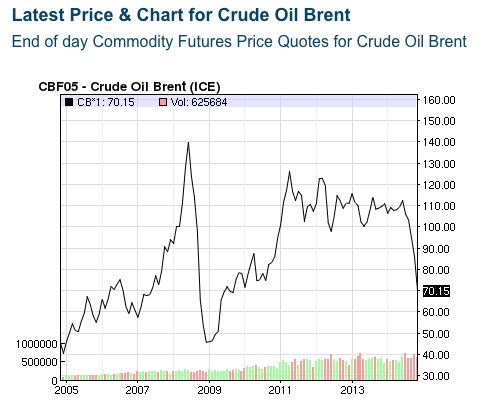
Oil prices promptly nosedived, with the price of Brent crude now hovering around $70 per barrel.

As recently as the summer, that price was over $100 per barrel.

CU Blog - Gas Prices Drop Below $2 - Photo 1

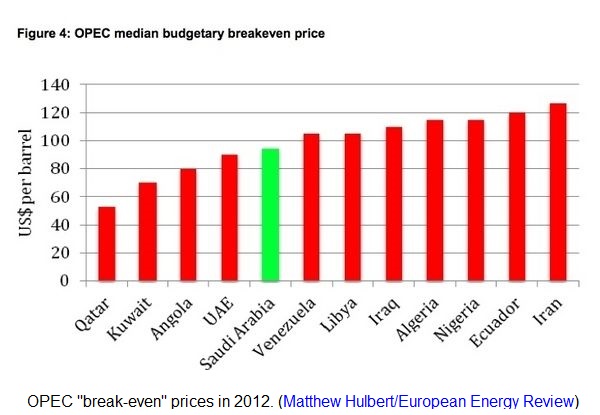
At this big meeting in Vienna, there was a lot of heated debate among OPEC members about how best to respond to this current drop in oil prices. Some countries, like Venezuela and Iran, wanted the cartel (mainly Saudi Arabia) to cut back on production in order to prop up the price of oil. The reason is that these countries need high prices in order to “break even” on their budgets and pay for all the government spending they’ve racked up:

CU Blog - Gas Prices Drop Below $2 - Photo 2

Source – Brad Plumer of Vox.com. Posted November 28, 2014; retrieved December 4, 2014 from: http://www.vox.com/2014/11/28/7302827/oil-prices-opec

OPEC is an international intergovernmental organization and economic cartel whose mission is to coordinate the policies of the oil-producing countries. This structure aligns with the book Go Lean… Caribbean, a roadmap for the introduction and implementation of the Caribbean Union Trade Federation (CU). This calls for the confederation, collaboration and convention of 30 member-states into one intergovernmental organization. The same as OPEC does for its 12 oil-producing nations – a proxy agency to represent all members – the CU seeks for the Caribbean region. But instead of elevating oil prices, the CU coalition has these 3 prime directives:

  • Optimization of the economic engines in order to grow the regional economy to $800 Billion & create 2.2 million new jobs.
  • Establishment of a security apparatus, including energy security, to protect the resultant economic engines.
  • Improve Caribbean governance to support these engines.

The goal of the CU is to optimize Caribbean society, allowing us to better compete globally and hopefully present more favorable options for our youth here in the homeland. (Previous generations sought refuge abroad).

The goal of OPEC is to secure a steady income to the member states and to collaborate in influencing world oil prices through economic means. Though this charter seems fairly benign, the reality of OPEC is vastly different; they have emerged as a monstrous entity! Autocratic leaders of OPEC countries – think Saddam Hussein – would constantly urge pushing world oil prices up; their claims were to help all OPEC members financially, but their motivation were purely nationalistic. The public view of OPEC now coincides with this dialogue from a movie, “art imitating life”:

“It can’t be bargained with, it can’t feel pain or mercy, and it will stop at absolutely nothing until you are dead!” – Movie dialogue from The Terminator (1984)

OPEC is not a monster, just protective of its own self-interest; many of their member-states feature a mono-industrial economy; it’s oil or bust! Plus, with 40 percent of global oil production, they do wield some power, influence and control of the eco-system of crude-oil pricing. But their power-influence-control is not absolute; there are always the laws of Economics!

Back to the foregoing article, the fact remains that oil prices were falling well before OPEC’s Friday announcement; this change was driven in large part by factors from Economics 101: less demand + higher supply = lower prices. In this case, economic slowdowns in much of the world have dampened demand, as supply has expanded considerably, especially within the U.S.

This premise directs the Energy Policy as communicated in the Go Lean book: the Caribbean region must lower crude oil demand.

This Go Lean/CU roadmap recognizes that modern life has expanded the definition of basic needs to now include food, clothing, shelter and energy. And thusly the book proposes many solutions for the region to optimize energy generation, distribution and consumption. No “stone is left unturned”. Go Lean posits that the average costs of energy can be decreased from an average of US$0.35/kWh to US$0.088/kWh in the course of the 5-year term of this roadmap. (Page 100).

Primary to this strategy of lowering the demand for crude oil is increasing options with alternative energy sources: natural gas, solar, wind and tidal. This will translate to more electric, hybrids, and fuel-efficient vehicles. The CU is a strong proponent of compressed-natural-gas vehicles (buses, trucks and passenger vehicles).

Lowering demand for energy works in lowering the costs.

In the US, the Obama administration’s improved fuel-efficiency standards have ultimately affected consumers, in that they are using less gas: “The sales-weighted fuel economy of vehicles in the U.S. increased from 20.8 miles per gallon in 2008 to 25.3 miles per gallon in 2014.” Other countries share the same experiences.

The Go Lean roadmap details a series of community ethos, strategies, tactics, implementations and advocacies to foster the progress in the wide fields of energy generation, distribution and consumption. The following list applies:

Community Ethos – Lean Operations Page 24
Community Ethos – Return on Investments Page 24
Community Ethos – Cooperatives Page 25
Community Ethos – Regional Taxi Commissions Page 25
Community Ethos – Non-Government Organizations Page 25
Community Ethos – Ways to Impact the Future Page 26
Community Ethos – Ways to Improve Negotiations Page 32
Anecdote – Pipeline Transport – Strategies, Tactics & Implementations Page 43
Strategy – Harness the power of the sun/winds Page 46
Tactical – Fostering a Technocracy Page 82
Tactical – Separation of Powers – Energy Commission Page 82
Anecdote – “Lean” in Government – Energy Permits Page 93
Anecdote – Caribbean Energy Grid Implementation Page 100
Implementation – Ways to Develop Pipeline Industry Page 107
Implementation – Ways to Improve Energy Usage Page 113
Advocacy – Ways to Impact Public Works Page 175
Advocacy – Ways to Foster Cooperatives Page 176
Advocacy – Ways to Impact Monopolies Page 202
Advocacy – Ways to Improve Transportation Page 205
Advocacy – Ways to Develop the Auto Industry Page 206
Appendix – North Dakota Oil Boom Economic-Societal Effects Page 334

This commentary asserts that energy needs are undeniable; and that OPEC may or may not be classified as a “monster”. The main take-away though is that monitoring and mitigating the realities of the global energy eco-system is a necessary role, a heavy-lifting task for the lean, agile operations of the CU technocracy.

So the message to the Caribbean region is clear: Help is on the way – the Terminator can be defeated – “life imitating art”!

Now is the time for all of the Caribbean, the people, business, institutions and governments, to lean-in for the optimizations and opportunities described in the book Go Lean … Caribbean. 🙂

Download the book Go Lean … Caribbean – now!

Share this post:
, , , ,
[Top]

Robots help Amazon tackle Cyber Monday

Go Lean Commentary

To understand American commerce, one must learn the BIG shopping “days of the week” – Friday, Saturday, Monday, Tuesday, as follows:

    • Black Friday – This is the Friday following the Thanksgiving Day holiday in the US (the fourth Thursday of November). Since the early 2000’s, it has been regarded as the beginning of the Christmas shopping season, and most major retailers open very early and offer promotional sales. Black Friday is not a public holiday, but some states observe “The Day After Thanksgiving” as a holiday for state government employees, sometimes in lieu of another federal holiday such as Columbus Day.[5] Many non-retail employees and schools have both Thanksgiving and the day after off, followed by a weekend, thereby increasing the number of potential shoppers. In 2014, $50.9 billion was spent during the 4-day Black Friday weekend. While approximately 133 million U.S. consumers shopped during the same period.[6]
    • Small Business Saturday – This refers to the Saturday after Thanksgiving during one of the busiest shopping periods of the year. First observed in 2010, it is a counterpart to Black Friday and Cyber Monday, which feature big box retail and e-commerce stores respectively. By contrast, Small Business Saturday encourages holiday shoppers to patronize brick-and-mortar businesses that are small and local. Small Business Saturday is a registered trademark of American Express Corporation. Small Business Saturday UK began in the UK in 2013 after the success of Small Business Saturday in America.[7]
    • Cyber Monday – This is a marketing term for the Monday after the Thanksgiving holiday. The term was created by marketing companies to persuade people to shop online. The term made its debut on November 28, 2005, in a Shop.org press release entitled “‘Cyber Monday Quickly Becoming One of the Biggest Online Shopping Days of the Year”.[2] According to the Shop.org/Bizrate Research 2005 eHoliday Mood Study, “77 percent of online retailers said that their sales increased substantially on the Monday after Thanksgiving, a trend that is driving serious online discounts and promotions on Cyber Monday this year (2005)”. In 2014, Cyber Monday online sales grew to a record $2.68 billion, compared with last year’s $2.29 billion. However, the average order value was $124, down slightly from 2013’s $128.[3] The deals on Cyber Monday are online-only and generally offered by smaller retailers that cannot compete with the big retailers. Black Friday generally offers better deals on technology; with nearly 85% more data storage deals than Cyber Monday. The past Black Fridays saw far more deals for small appliances, cutlery, and kitchen gadgets on average than Cyber Monday. Cyber Monday is larger for fashion retail. On the past two Cyber Mondays, there was an average of 45% more clothing deals than on Black Friday. There were also 50% more shoe deals on Cyber Monday than on Black Friday.[4] Cyber Monday has become an international marketing term used by online retailers in Argentina, Canada, Chile, China, Colombia, Denmark, Germany, Ireland, Uganda, Japan, Portugal, Sweden and the United Kingdom.
    • Giving Tuesday – refers to the Tuesday after Thanksgiving. It is a movement to create a national day of giving at the beginning of the Christmas and holiday season. Giving Tuesday was started in 2012 by the “92nd Street Y” (Young Men’s and Young Women’s Hebrew Association in New York, NY) and the United Nations Foundation as a response to commercialization and consumerism in the post-Thanksgiving season (Black Friday and Cyber Monday).[8][9] This occasion is often stylized as #GivingTuesday for purposes of hashtag activism.

That’s a lot of commerce … and philanthropy too!

This encyclopedic discussion is necessary for the Caribbean to model the best-practices of American commerce. The focus of this commentary is the role of one company in the pantheon of Cyber Monday, Amazon. This firm has previously been featured in a Go Lean blog, and is identified as a model for Caribbean logistics, our means for delivering the mail; this is the vision for the Caribbean Postal Union (CPU).

The focus of the book Go Lean…Caribbean and the CPU is not just postal mail, but rather logistics. Mail requires logistics, but logistics encompasses so much more than just mail. So we would want to model a successful enterprise in this industry space, like Amazon, not just another postal operation, like the US Postal Service (Page 99).

Amazon provides a good example of lean technocratic efficiency. So Amazon is a good model, not just for the CPU but the entire Caribbean Union Trade Federation (CU). The Go Lean book, serves as a roadmap for the introduction and implementation of the technocratic CU.

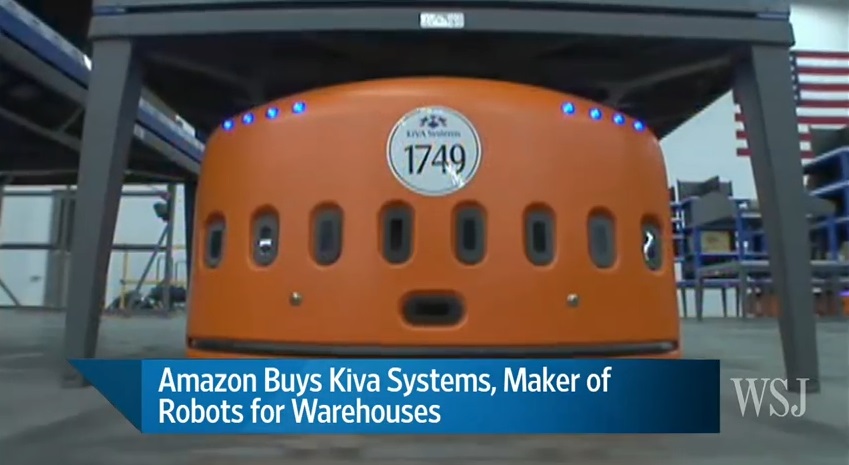
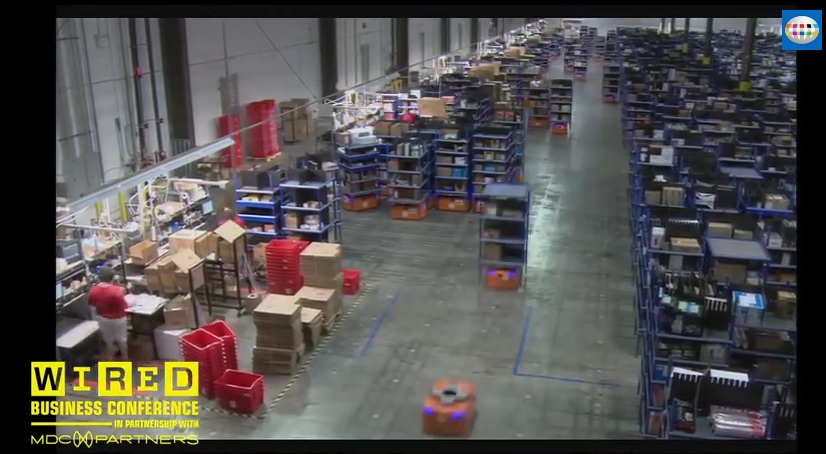
One reason why Amazon is modeled for their lean stature is their use of automation. This following VIDEO depicts the creative solution of using robots to facilitate logistics in a warehouse environment:

VIDEO: Robots help Amazon tackle Cyber Monday – http://www.cbsnews.com/videos/robots-help-amazon-tackle-cyber-monday/

December 1, 2014 – Cyber Monday is the biggest sales day of the year for online retail giant, Amazon. Last year, Amazon customers ordered 426 items every second on Cyber Monday, and this year that number is expected to grow. In addition to the 80-thousand seasonal workers they employ to fulfill orders, thousands of robots also crawl the warehouse floors. CNET.com’s KaraTsuboi takes us inside an Amazon fulfillment center to watch the robots in action. (VIDEO plays best in Internet Explorer).

Lean, automation, robotics, technocratic …

… welcome to the new Caribbean.

This is the mission of Go Lean roadmap, to elevate the economic engines of Caribbean society; industrial policy plays a key role in this roadmap. The region needs the jobs, so we need job creators: companies. These companies, or better stated, Direct Foreign Investors, need a pro-innovation environment to deploy their automated solutions. The Go Lean roadmap allows the structure of Self-Governing Entities (SGE) to incentivize industrial developments in the region. It is the expectation that robots and automated systems will flourish. The independence of the SGE structure neutralizes conflicts with “labor”.

Related issues have previously been detailed in these Go Lean commentaries listed here:

Disney World – Successful Role Model of a SGE
Using SGE’s to Welcome the Dreaded ‘Plutocracy’
Where the Jobs Are – Ship-breaking under SGE Structure
Fairgrounds as SGE and Landlords for Sports Leagues
Puerto Rico’s Comprehensive Cancer Center Project Breaks Ground – Model of Medical SGE

In addition to the roadmap encouraging robotic automation, the CU will directly employ such technologically innovative products and services to impact its own prime directives; the CPU is such a reflection; more automation and less labor. The CU’s prime directives are identified with the following 3 statements:

  • Optimization of the economic engines in order to grow the regional economy to $800 Billion & create 2.2 million new jobs.
  • Establishment of a security apparatus to protect the resultant economic engines.
  • Improve Caribbean governance to support these engines.

The CPU features economic, security and governing concerns.

The Go Lean roadmap seeks to change the entire eco-system of Caribbean logistics and resulting commerce  – the interaction with postal operations. This vision is defined early in the book (Page 12 & 14) in the following pronouncements in the Declaration of Interdependence:

xv. Whereas the business of the Federation and the commercial interest in the region cannot prosper without an efficient facilitation of postal services, the Caribbean Union must allow for the integration of the existing mail operations of the governments of the member-states into a consolidated Caribbean Postal Union, allowing for the adoption of best practices and technical advances to deliver foreign/domestic mail in the region.

xxvii. Whereas the region has endured a spectator status during the Industrial Revolution, we cannot stand on the sidelines of this new economy, the Information Revolution. Rather, the Federation must embrace all the tenets of Internet Communications Technology (ICT) to serve as an equalizing element in competition with the rest of the world. The Federation must bridge the digital divide and promote the community ethos that research/development is valuable and must be promoted and incentivized for adoption.

Amazon is not our only example. A previous blog/commentary identified Chinese company Alibaba as a fitting role model for Caribbean consideration. There are so many best-practices around the world for the region to study and glean insights and wisdom from. The successful application of this roadmap will foster such best-practices for the delivery of the CPU logistics in the Caribbean. The wisdom the Go Lean book gleans are presented as a series of community ethos, strategies, tactics, implementations and advocacies; a detailed sample is listed as follows:

Community Ethos – Deferred Gratification Page 21
Community Ethos – People Respond to Incentives Page 21
Community Ethos – Job Multiplier Page 22
Community Ethos – Intelligence Gathering Page 23
Community Ethos – Lean Operations Page 24
Community Ethos – Ways to Impact the Future Page 26
Community Ethos – Ways to Foster Genius Page 27
Community Ethos – Ways to Help Entrepreneurship Page 28
Community Ethos – Promote Intellectual Property Page 29
Community Ethos – Ways to Bridge the Digital Divide Page 31
Community Ethos – Ways to Improve Sharing Page 35
Strategy – Customers – Citizens and Member-states Governmental Page 47
Tactical – Separation of Powers – Postal Services Page 78
Tactical – Separation of Powers – Interstate Commerce Administration Page 79
Implementation – Year 1 / Assemble Phase – Establish   CPU Page 96
Anecdote – Implementation Plan – Mail Services – US Dilemma Page 99
Implementation – Steps to Implement   Self-Governing Entities Page 105
Implementation – Improve Mail Services – Electronic Supplements Page 108
Implementation – Ways to Deliver Page 109
Planning – 10 Big Ideas for the Caribbean Region Page 127
Advocacy – Ways to Improve Interstate Commerce Page 129
Advocacy – Ways to Grow the Economy Page 151
Advocacy – Ways to Create Jobs Page 152
Advocacy –Ways to Improve Governance Page 168
Advocacy – Ways to Foster Technology Page 197
Advocacy – Ways to Foster e-Commerce Page 198
Advocacy – Ways to Promote Call Centers Page 212
Advocacy – Ways to Impact Urban Living Page 234

Following the Amazon’s example (and Alibaba’s example) will spur the Caribbean to embrace more robotic technologies. This field is new, fresh and ready for innovation. There is a level-playing-field for any innovator to earn market share. The underlying company in the foregoing VIDEO is Kiva Systems – a Massachusetts based company that manufactures mobile robotic fulfillment systems.[10][11] They rolled out a great product, then “Lo-and-behold”, they were acquired by a major e-Commerce company. Today, they are a subsidiary of Amazon, yet their material-handling systems are currently used by many other retailers including: The Gap, Walgreens, Staples, Gilt Groupe, Office Depot, Crate & Barrel, Saks 5th Avenue, and more.[12]

CU Blog - Robots help Amazon tackle Cyber Monday - Photo 3

CU Blog - Robots help Amazon tackle Cyber Monday - Photo 2

CU Blog - Robots help Amazon tackle Cyber Monday - Photo 1

CU Blog - Robots help Amazon tackle Cyber Monday - Photo 4

This commentary therefore features the subjects of commerce, logistics and entrepreneurship. The Caribbean can emulate this model from Amazon. The biggest ingredient missing in the region is the ‘will’. But the ‘will’ can be fostered anew in the Caribbean. This is the heavy-lifting for the CU, instituting such new community ethos.

Now is the time for all of the Caribbean, the people and governing institutions, to lean-in for the empowerments in the book Go Lean … Caribbean. This is a Big Idea for the region; that of a Cyber Caribbean, in which Cyber Mondays may become a big deal for our region – not only as consumers, but producers as well. Therefore, this roadmap is not just a plan for delivering the mail/packages, but rather a plan for delivering the future.

We must employ whatever tools and techniques, robotics included, to make the region a better homeland to live, work and play.

Does “play“include Robots? Yes, indeed. Consider this fun VIDEO here.  🙂

Supplemental VIDEO – The Nutcracker performed by Dancing Kiva Order Fulfillment Robots: http://youtu.be/Vdmtya8emMw

Download the book Go Lean … Caribbean – now!

————–

AppendixSource References:

2.    “‘Cyber Monday’ Quickly Becoming One of the Biggest Online Shopping Days of the Year”. Shop.org.
3.    “Fundivo – Cyber Monday Statistics”. Fundivo.
4.    “What’s the difference between Black Friday and Cyber Monday?”. Mirror.co.uk. Mirror.co.uk. Nov 28, 2013. Retrieved 2014-11-25.
5.    “Pima County in Arizona Replaces Columbus Day with Black Friday”. BestBlackFriday.com. 2013-08-07.
6.    “”Fundivo – Black Friday Statistics””. Fundivo.
7.    Small Business Saturday Hailed as Success. The Telegraph. 8 December 2013″. Telegraph.co.uk. 8 December 2013. Retrieved 2 December 2014.
8.   Fox, Zoe (October 23, 2012). “6 Inspiring Organizations Joining in #GivingTuesday”. Retrieved February 15, 2014.
9.    “#GivingTuesday: About”. Giving Tuesday. Retrieved February 15, 2014.
10.  http://www.kivasystems.com/about-us-the-kiva-approach/
11.   http://www.boston.com/business/technology/innoeco/2012/03/amazon_buys_warehouse_robotics.html
12.  http://www.kivasystems.com/about-us-the-kiva-approach/history/

Share this post:
, , , , ,
[Top]

Michigan Unemployment – Then and Now

Go Lean Commentary

The tagline “a better place to live, work and play” is the focus for empowering the Caribbean, placing equal emphasis on all 3 spheres of activity. But the focus of work is easier said than done. Without work, the Caribbean will continue to suffer societal abandonment – our good people would simply leave to go elsewhere to find the missing work element. They will do this despite how pleasant the “live” and “play” elements may be in our society.

This is a lesson learned from Detroit, Michigan USA.

The book Go Lean…Caribbean serves as a roadmap to elevate the Caribbean “work” environment. It analyses the regional disposition and then seeks solutions by studying the performances of other global cities, especially in the US.

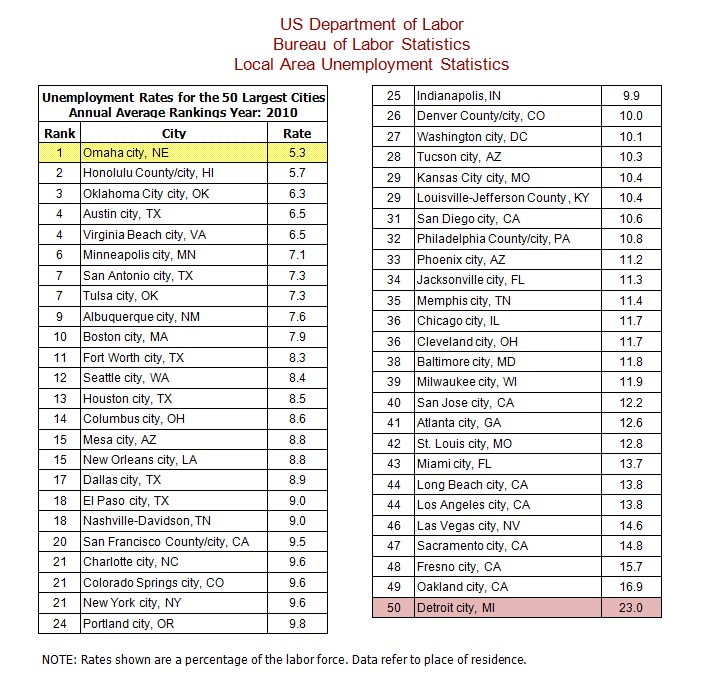
The following chart highlights 50 cities, 2 of which were studied for the Go Lean book, a good example, Number 1 on the chart: Omaha, Nebraska and Number 50 on the chart: Detroit, Michigan, the once great industrial city.

CU Blog - Michigan Unemployment - Then and Now - Photo 2

The lessons from Omaha have already been a subject of this commentary. Now we focus on the other end of the chart, Detroit; this city specifically and the overall State of Michigan in general.

The entire eco-system of jobs was crippled in Michigan during the recent Great Recession (2007 – 2009). In response to the crisis throughout the country, the US federal government began extending unemployment benefits as a safety-net. There was a federal program to provide additional weeks of unemployment benefits to people starting in 2008.[2] The program was then extended again and again; the most recent extension was provided by the American Taxpayer Relief Act of 2012, which continued the supplemental unemployment benefits until the end of 2013.[2] Only then was the comfort level established that the “recession was over”, and the recovery was well enough in hand.

The United States Department of Labor’s Bureau of Labor Statistics reports that in November 2013 the average (mean) duration of unemployment was 37.2 weeks. [3] The median duration was 17.0 weeks. 22.6% of people who were unemployed found a new job in less than 5 weeks, while 37.3% had been unemployed for 27 weeks or more.[3]

These numbers were very bad during the throes of the Great Recession. In line with the following article, which quotes statistics, the impact on the streets of Michigan were 1 million unemployed. See article here:

Michigan unemployment tops 15% – July 2009
Sub-title: Government says jobless rate is the highest for a state since 1984. Rate tops 10% in 15 states and District of Columbia.
By: Ben Rooney, CNNMoney.com staff writer
CU Blog - Michigan Unemployment - Then and Now - Photo 1NEW YORK (CNNMoney.com) — Michigan became the first state in 25 years to suffer an unemployment rate exceeding 15%, according to a report released Friday by the Labor Department.

The state’s unemployment rate rose to 15.2% in June (2009). It was the highest of any state since March 1984, when West Virginia’s unemployment rate exceeded 15%.

Michigan, which has been battered by the collapse of the auto industry and the housing crisis, has had the highest unemployment rate in the nation for 12 months in a row.

Rhode Island had the second highest unemployment rate at 12.4%, followed by Oregon at 12.2%.

A total of 15 states and the District of Columbia had unemployment rates of at least 10%.

Friday’s report from the U.S. Labor Department also showed that six states recorded record-high unemployment rates in June.

Over the month, jobless rates increased in 38 states and the District   of Columbia. Michigan’s 1.1 percentage point increase from May to June was the highest in the nation, followed by Wyoming’s 0.9 point increase.

On an annual basis, jobless rates where higher in all 50 states and the District of Columbia. Michigan also recorded the highest yearly increase at 7.1 percentage points. Oregon came in second with a year-over-year increase of 6.3 percentage points in its unemployment rate.

The national unemployment rate rose for the ninth straight month in June, climbing to 9.5% from 9.4%, and hitting another 26-year high. Nearly 3.4 million jobs have been lost during the first half of 2009, more than the 3.1 million lost in all of 2008.

Unemployment rates decreased in five states, and seven states had no rate change.

North Dakota’s 4.2% jobless rate was the lowest in the nation, followed by Nebraska at 5%.

The Midwest and West both had jobless rates of 10.2%. The jobless rate in the Northeast rose to 8.6% from 8.3% but was the lowest of any U.S. region. In the South, unemployment rose to 9.2%.

Non-farm payroll employment fell in 39 states and the District of   Columbia in June. California had the largest month-over-month decrease in jobs.

Payrolls increased in 10 states and were unchanged in one state. The largest over-the-month increase occurred in North Carolina.

Source: CNN Money Online Financial News Site (Posted July 17, 2009; retrieved 12-02-2014)http://money.cnn.com/2009/07/17/news/economy/state_unemployment_report/

The Great Recession was truly a crisis. That was then; this is now.

Detroit still has the highest unemployment rate of the 50 largest cities in the U.S., at more than three times the national average for May, which was 6.3%. The unemployment rate for Detroit hovered at 23%, six percentage points ahead of the nearest on the list — Oakland City, Calif., at 16.9%, according to the Bureau of Labor Statistics in June 24, 2014.[4]

Once the metrics fall so low, there is no place to go but up.

In the past year Michigan is starting to finally feel the beneficial effects of the recovery. From those ghastly numbers of 1 million in 2009, the numbers petitioning for the Extended Unemployment Compensation (EUC) at December 19, 2013 were slightly “over 43,000 people in Michigan”. (The extension measure failed in the US Congress – the economy was a victim of its own success).

The Go Lean publishers are here to observe and report. Detroit in specific and Michigan is general is starting now to experience a turn-around. While there may be an ongoing hardship for those 43,000 people, the overall economy of Michigan has greatly improved since 2009, as the foregoing article relates, when the state “recorded the highest yearly unemployment increase of 7.1 percentage points”.

Michigan unemployment rate edges toward pre-recession numbers
Sub-title: …but employment hasn’t recovered
By: Emily Lawler – elawler@mlive.com MLive.com

LANSING, MI – Michigan’s seasonally unadjusted unemployment rate dropped to 7.1 percent in October, according to data released by the state Department of Technology, Management and Budget.

October’s 7.1 number is a .1 percent decline from September and the third monthly decline in a row. A year ago, in October 2013, unemployment was more than a point higher at 8.6 percent.

That’s the lowest rate this year and in fact the lowest since January through March of 2008.

“October’s 7.1 percent jobless rate was the lowest in Michigan since the January thorugh March 2008 period, and close matched pre-recession rates from 2003 to 2007. However, Michigan employment remains far below pre-recession levels,” noted the Department in a press release.

In October 2007, total employment in the state was 4.6 million. In October 2014, total employment in the state was 4.4 million.

Gov. Rick Snyder issued a statement on the unemployment:

“There is optimism and opportunity in Michigan as our state’s economy continues to move forward. More people are working and our labor force is growing as companies create more and better jobs. Our reinvention is helping working families and we are seeing results.

“But while we can recognize this accomplishment, there is more to do to fulfill our goal of the brightest possible future. We need to continue creating an environment for success, and that includes building a workforce with in-demand skills – and making sure a pathway to those skills is available for Michigan students and adults.”

Emily Lawler is a Capitol/Lansing business reporter for MLive Media Group.
Source: http://www.mlive.com/lansing-news/index.ssf/2014/11/michigan_unemployment_rate_edg.html

The book Go Lean…Caribbean serves as a roadmap for the introduction and implementation of the technocratic Caribbean Union Trade Federation (CU). The CU is set to optimize Caribbean society, not Detroit, starting with economic empowerment. In fact, the Go Lean roadmap has 3 prime directives:

  • Optimization of the economic engines in order to grow the regional economy to $800 Billion & create 2.2 million new jobs.
  • Establishment of a security apparatus to protect the resultant economic engines.
  • Improve Caribbean governance to support these engines.

The CU will foster the right climate for Direct Foreign Investments, entrepreneurial initiatives, industrial development, and preparation for a ready, willing and able work force.

These points are pronounced early in the Go Lean book with the Declaration of Interdependence (Pages 12 – 14) with many statements that demonstrate the need to empower the Caribbean labor force:

xx. Whereas the preparation of our labor force can foster opportunities and dictate economic progress for current and future generations, the Federation must ensure that educational and job training opportunities are fully optimized for all residents of all member-states, with no partiality towards any gender or ethnic group. The Federation must recognize and facilitate excellence in many different fields of endeavor, including sciences, languages, arts, music and sports. This responsibility should be executed without incurring the risks of further human flight, as has been the past history.

xxiv. Whereas a free market economy can be induced and spurred for continuous progress, the Federation must install the controls to better manage aspects of the economy: jobs, inflation, savings rate, investments and other economic principles. Thereby attracting direct foreign investment because of the stability and vibrancy of our economy.

xxv. Whereas the legacy of international democracies had been imperiled due to a global financial crisis, the structure of the Federation must allow for financial stability and assurance of the Federation’s institutions. To mandate the economic vibrancy of the region, monetary and fiscal controls and policies must be incorporated as proactive and reactive measures. These measures must address threats against the financial integrity of the Federation and of the member-states.

xxvi. Whereas the Caribbean region must have new jobs to empower the engines of the economy and create the income sources for prosperity, and encourage the next generation to forge their dreams right at home, the Federation must therefore foster the development of new industries, like that of ship-building, automobile manufacturing, pre-fabricated housing, frozen foods, pipelines, call centers, and the prison industrial complex. In addition, the Federation must invigorate the enterprises related to existing industries like tourism, fisheries and lotteries – impacting the region with more jobs.

Despite the weaknesses of its current dilemma, Detroit does have strengths. The city is working hard to turn-around. See VIDEO here of a Job Fair for STEM (Science, Technology, Engineering, Math) jobs peculiar to the Motor City:

Engineering Society of Detroit job fair on Monday – Posted November 9, 2014

Video – http://www.wxyz.com/money/job-finder/engineering-society-of-detroit-job-fair-on-monday#Job%20fair%20today:

We must learn from Detroit. The Go Lean book details a series of community ethos, strategies, tactics, implementations and advocacies to impact jobs in the Caribbean region, member-states, cities and communities. Below is a sample:

Assessment – Anecdote – Caribbean Single Market & Economy Page 15
Assessment – Anecdote – Dutch Caribbean – Integration & Secessions Page 16
Assessment – Anecdote – French Caribbean – Organization & Discord Page 17
Assessment – Anecdote – Puerto Rico – The Greece of the Caribbean Page 18
Community Ethos – Economic Systems Influence Individual Choices & Incentives Page 21
Community Ethos – Voluntary Trade Creates Wealth Page 21
Community Ethos – Consequences of Choices Lie in the Future Page 21
Community Ethos – Minority Equalization Page 24
Community Ethos – Lean Operations Page 24
Community Ethos – Return on Investments Page 24
Community Ethos   – Ways to Foster Genius Page 27
Community Ethos – Ways to Help Entrepreneurship Page 28
Community Ethos – Ways to Impact Turn-Around Page 33
Community Ethos – Ways to Manage Reconciliations Page 34
Community Ethos – Ways to Impact the Greater Good Page 37
Strategic – Vision – Integrating Region in to a Single Market Page 45
Strategy – Mission –   Facilitate Job-Creating Industries Page 46
Strategic – Agents of Change – Globalization Page 57
Tactical – $800 Billion Economy – How and When – High Multiplier Industries Page 70
Tactical – Separation of Powers – State Department – Self-Governing Entities Page 80
Implementation – Ways to Pay for Change Page 101
Implementation – Foreign Policy Initiatives at Start-up Page 102
Implementation – Ways to Deliver Page 109
Implementation – Ways to Benefit from Globalization Page 119
Planning – 10 Big Ideas – Cuba/Haiti Page 127
Planning – Ways to Make the Caribbean Better Page 131
Planning – Lessons Learned from 2008 Page 136
Planning – Lessons from Omaha Page 138
Planning – Lessons from Detroit Page 140
Advocacy – Ways to Grow the Economy Page 151
Advocacy – Ways to Create Jobs Page 152
Advocacy – Battles in the War Against Poverty Page 222
Advocacy – Ways to Impact the Middle Class Page 223
Advocacy – Ways to Impact Urban Living Page 234

Other subjects related to the pros-and-cons of job empowerments for the region have been blogged in other Go Lean…Caribbean commentaries, as sampled here::

Making a Great Place to Work® – Detroit Employer Example
Where the Jobs Are – Entrepreneurism in Junk
The Geography of Joblessness
Continued Discriminationor Latins/Caribbeans in Job Markets
Where the Jobs Are – Computers Reshaping Global Job Market
Where the Jobs Are – One Scenario: Shipbreaking
Casino   Jobs – Changing/Failing Business Model
The Future of Golf; Vital for Tourism Jobs
STEM Jobs Are Filling   Slowly – High Demand, Low Supply
Where the Jobs Were – British public sector now strike over ‘poverty pay’
Where the Jobs Are – Fairgrounds as SGE & Landlords for Sports Leagues
Self-employment jobs on the rise in the Caribbean – World Bank

The purpose of this roadmap is to elevate Caribbean society. To succeed we must apply lessons from advanced economy countries like the US, and the cities there in; lessons from their good, bad and ugly experiences of the past.

The Go Lean movement (book and blog commentaries) posits that there is less effort to remediate the Caribbean homeland, than to flee to a city like Detroit and try to thrive as an alien in that land. So the book thusly advocates to “prosper where planted”. With the appropriate effort, as defined in the Go Lean book, the Caribbean can truly become a better place to live, work and play.

Download the book Go Lean…Caribbean now!

—————–

Source References:

  1. http://www.michigan.gov/uia/0,4680,7-118–318402–s,00.html
  2. Ayres, Sarah (20 November 2013). “Why Congress Must Extend Emergency Unemployment Benefits”. Center for American Progress. Retrieved 9 January 2014.
  3. “Economic News Release: Table A-12 Unemployed person by duration of unemployment”. Bureau of Labor Statistics. 6 December 2013. Retrieved 9 January 2014.
  4. http://www.marketwatch.com/story/should-you-move-to-detroit-2014-06-24. Retrieved December 2, 2014.
Share this post:
, , ,
[Top]

Making a Great Place to Work®

Go Lean Commentary

The book Go Lean…Caribbean represents a quest to make the Caribbean a better place to live, work and play. The focus on this commentary is on work. There is actually a formula to making an organization a Great Place to Work®; that formula is so regimented that it is copyrighted and patented, and thus the ® symbol. This effort is pursued by the Great Place to Work® Institute. Below is their corporate information and accompanying VIDEO:

Video: The Great Place to Work Institute Model – http://youtu.be/IneDx950xRA

Great Place to Work Institute co-founder Robert Levering discusses the history of the Institute and how after 25 years of researching the best companies to work for around the world, that high levels of trust between employees and managers is the main element found in great workplaces. – Uploaded on Nov 7, 2011

————————

CU Blog - Making a Great Place To Work - Photo 1For over 25 years we’ve studied and identified great workplaces around the world.

Your company can be a great workplace, and you have the power to make it happen. It begins with an investment in building trust throughout your organization. The return will be a more vibrant enterprise, more innovative products and more satisfying relationships. Employees who trust their managers give their best work freely, and their extra effort goes right to the company’s bottom line. Managers who trust their employees allow innovative ideas to bubble up from all levels of the company. Employees who trust each other report a sense of camaraderie and even the feeling of being part of a family. Together they deliver far more than the sum of their individual efforts.

We’ve built the Great Place to Work® Model on 25 years of research and surveys of millions of employees.

Many of the best performing companies have followed this insight and seen tremendous results. At the Great Place to Work® Institute, we’ve spent 25 years tracking these leaders and learning from their successes. By surveying millions of employees and studying thousands of businesses, we’ve created a model for building performance based on trust. It’s our contribution to a global shift in businesses that is changing the way the world works.

We know that trust is the single most important ingredient in making a workplace great.

Our data show that building workplace trust is the best investment your company can make, leading to better recruitment, lower turnover, greater innovation, higher productivity, more loyal customers and higher profits. Our model provides specific, actionable steps to get you there. While you’ll be the one to lead your company on this journey, we can provide steady guidance from one of our 40 offices around the world.

We know that great workplaces are better financial performers.

Companies of all sizes look to us for our assessment tools, trainings, advisory services, conferences and workshops. The world looks to us to identify the best workplaces through our renowned lists. It’s all part of our passion to create a better world by helping you create a great workplace. Wherever you are on your journey, we invite you to join us and create yours.

Our clients are those companies and organizations that wish to maintain Best Company environments, those that are ready to dramatically improve the culture within their workplaces, and those in between the two. We know that organizations that build trust and create a rewarding cycle of personal contribution and appreciation create workplace cultures that deliver outstanding business performance.
Great Place to Work® – Corporate Website (Retrieved 12/01/2014)http://www.greatplacetowork.com/about-us

CU Blog - Making a Great Place To Work - Photo 2

The Go Lean book stresses the need to create great work places. It serves as a roadmap for the introduction and implementation for the technocratic Caribbean Union Trade Federation (CU). As a federation or federal government, there will be the need to employ (and empower) a Civil Service workforce; this labor pool is projected to be only 30,000 people, thusly embracing lean (or agile) delivery methodologies.

Lean relates to management, the Great Place to Work® concept, on the other hand, relates more to character and organizational culture. In fact the foregoing source material highlights one attribute more so than any other: Trust. They relate that from the employee’s perspective, a great workplace is one where they:

  • TRUST the people they work for;
  • Have PRIDE in what they do; and
  • ENJOY the people they work with.

So “Trust” is the defining principle of great workplaces. Consider the example of one company, in the Detroit Metro area, Credit Acceptance Corporation in the Appendix below.

While federal employees, civil servants, are among the stakeholders for Caribbean empowerment, they are not the only stakeholders the CU must cater to; there are other stakeholders that cover other aspects of Caribbean life. In fact, the prime directives of the CU covers these 3 focus areas:

  • Optimization of the economic engines in order to grow the regional economy to $800 Billion & create 2.2 million new jobs.
  • Establishment of a security apparatus to protect the resultant economic engines.
  • Improve Caribbean governance to support these engines.

The roadmap identifies, qualifies and proposes the establishment of a technocratic civil service throughout the region (Page 173). The book posits that an empowered, effective labor force, coupled with advanced technology tools and processes can adequately meet the needs of the region’s super-national government. Imagine kiosks, websites, call centers and mobile applications (Page 197) as opposed to big-bulky edifices with bureaucratic staffers working a queue (think “permits/licensing” in any typical US state – see Page 93 for the example of Nebraska’s “lean” conversion with the Department of Environmental Quality). This technology-led vision is fully detailed in the book (Page 168), encompassing the tactical approach of a “separation-of-powers” with the member-states for specific governmental functionality that will be assumed under CU jurisdiction (Page 71).

In addition to these public sector employees, the Go Lean roadmap also focuses on private enterprises. While there is no plan to micro-manage private companies in the free market, there is the plan to rate/rank companies that are effective and efficient. Imagine: 10 Great Places to Work – Bahamas, 10 Great Places to Work – Dominican Republic, 10 Great Places to Work – Jamaica, so on and so on.

Previously, Go Lean blogs commented on job developments, in the public sector and also with industrial and entrepreneurial endeavors. These points were depicted in the following sample:

Funding Caribbean Entrepreneurs – The ‘Crowdfunding’ Way
Where the Jobs Are – Entrepreneurial Jobs
Jamaica’s Public Pension Under-funded
The Criminalization of American Business – Bad Examples
STEM Jobs Are Filling Slowly
British public sector workers strike over ‘poverty pay’
Puerto Rico Governor Signs Bill on Small-Medium-Enterprises
Self-employment on the rise in the Caribbean – World Bank

Now is the time for all Caribbean stakeholders, employees in the public and private sectors, to lean-in to this regional solution for Caribbean empowerment. The end result, a better workplace and a better homeland; in total, a better place to live, work and play.

Download the book Go Lean … Caribbean – now!

————

APPENDIX: Culture Without Compromise – One Case / One Company:

http://www.greatplacetowork.com/publications-and-events/blogs-and-news/2435-culture-without-compromise

This year, Credit Acceptance, a Michigan-based indirect finance company, secured one of the coveted spots on the FORTUNE 100 Best Companies to Work For list for the first time—a goal the company has actively been working toward since 2001 under the leadership of CEO Brett Roberts. While related efforts were numerous and spanned a 13-year period, there are 3 key takeaways to be learned from Credit Acceptance’s journey to greatness from our case study: Culture Without Compromise.

CU Blog - Making a Great Place To Work - Photo 3

Share this post:
, , ,
[Top]

Blog # 200 – Ignorance is no excuse – Milestone in Enlightenment

Go Lean Commentary – Number 200

We have now reached a new milestone in the distribution of the blogs from the publishers of the book Go Lean…Caribbean, 200 submissions. That’s a lot of blogs and a lot of enlightenment, (see Appendix below); there is now no excuse for ignorance in the Caribbean region. (Enlightenment is defined here as the opposite of ignorance).

The Go Lean book stresses the subject of the “Age of Enlightenment” (Page 170); relating the cultural movement of intellectuals in the 17th and 18th centuries, (between 1650 to 1700). Enlightenment thinkers used logic and reason to challenge ideas grounded in nothing more than ignorance, superstition, arbitrary tradition and dogmatic faith. There is now a new need for an Age of Enlightenment for Caribbean society as ignorance, superstition, arbitrary tradition and dogmatic faith has re-emerged as a negative community ethos.

CU Blog - Ignorance is no excuse - Milestone in Enlightenment - Photo 1

The Go Lean book posits that 2008 is the pivotal year for Caribbean enlightenment (Page 136) – see the VIDEO below. Our Age of Enlightenment unfurled since 2008. This acknowledgement is recognized at the outset of the book with this Declaration of Interdependence (Page 11) opening statement:

xxi. Whereas the legacy of international democracies had been imperiled due to a global financial crisis, the structure of the Federation must allow for financial stability and assurance of the Federation’s institutions. To mandate the economic vibrancy of the region, monetary and fiscal controls and policies must be incorporated as proactive and reactive measures. These measures must address threats against the financial integrity of the Federation and of the member-states.

This roadmap was constructed with assessments, community ethos, strategies, tactics, implementation and advocacies to mitigate the ignorance, superstitions, arbitrary traditions and dogmatic faith of the Caribbean status quo.

One example of dogmatic faith, the focus of this commentary, is the elevation of the view that the United States of America is the panacea of Caribbean ills. As a result, the book and aligned blog commentaries elaborate on how the countries of the Caribbean region emerged as parasites to American-ism, rather than protégés for an advanced society. (The assessment is that even the US territories of Puerto Rico and the Virgin Islands are dysfunctional in their societal engines).

The Go Lean book is not anti-American, on the contrary, we look to the US as a role model of democracy and seek to emulate provisions of the US Constitution (Page 145). The book simply asserts that the Caribbean member-states must “man up” and assume our own destiny, not look for someone else, the US, to solve our problems of economic, security and governing dysfunction. This theme has been a frequent topic for blogging by the Go Lean promoters, as sampled here:

American-ism – Miami’s Success versus Caribbean Failure
A Lesson in History: Deferred Gratification as a Community Ethos of WW II
Protégé Model for Caribbean/Latin America: Korean Example
Applying Lessons from 2008 – Depth and Breath of Crises
Sports Role Model – US versus the World
America’s Navy – 100 Percent – Model for Caribbean
American Self-Interest – Senate bill targets companies that move overseas
‘Prosper Where You Are Planted’ – Book Review and Community Ethos
Caribbean loses over 70% of tertiary educated citizens to the brain drain – Mostly to the US
Open the Time Capsule: The Great Recession of 2008
Caribbean Reality – Only at the precipice, do they change
Ailing Puerto Rico open to radical economic fixes
Book Review: ‘Wrong – Nine Economic Policy Disasters and What We Can Learn…’
10 Things We Want from the US and 10 Things We Don’t Want from the US

Change has come to the Caribbean region; an upgrade to the Caribbean intelligentsia.

The book Go Lean…Caribbean serves as a roadmap for the introduction and implementation of the Caribbean Union Trade Federation (CU) and the Caribbean Central Bank (CCB). This Caribbean empowerment roadmap has 3 prime directives:

  • Optimization of the economic engines in order to grow the regional economy to $800 Billion & create 2.2 million new jobs.
  • Establishment of a security apparatus to protect the resultant economic engines.
  • Improve Caribbean governance to support these engines.

The book described both the CU and CCB as hallmarks of technocracy, a commitment to efficiency and effectiveness. The book itself is 370 pages and covers 144 different missions.

The following is a sample of these specific details from the book related to this commentary:

Community Ethos – Deferred Gratification Page 21
Community Ethos – Consequences of Choices Lie in the Future Page 21
Community Ethos – Return on Investments (ROI) Page 23
Community Ethos – Lean Operations Page 24
Community Ethos – Ways to Impact the Future Page 26
Strategy – Vision – Confederate 30 Member-States Page 45
Strategy – Missions – 144 Advocacies Page 457
Tactical – Confederating a Permanent Union Page 63
Tactical – Fostering a Technocracy Page 64
Implementation – Ways to Pay for Change Page 101
Implementation – Ways to Deliver Page 109
Planning – 10 Big Ideas for the Caribbean Region Page 127
Planning – Lessons Learned from 2008 Page 136
Advocacy – Ways to Grow the Economy Page 151
Advocacy – Ways to Create Jobs Page 152
Advocacy – Reforms for Banking Regulations Page 199
Advocacy – Ways to Impact Wall Street Page 200
Advocacy – Ways to Impact Main Street Page 201
Appendix – Credit Ratings Agencies in 2008 Page 276

It is understandable that the reference to “parasite” is negative. The book describes positive community ethos that we advocate for adoption. But the “parasite” reference is appropriate; the disposition of the host, directly impacts the disposition of the parasite. The financial crisis of 2008, initiated by American financial defects, severely crippled Caribbean economies. Even now, despite the recovery in the US, Caribbean economic malaise lingers.

A protégé disposition is so much more preferred. We should apply the best practices of American society, and other cultures as well. (The Go Lean book directly refers to Canada – Page 146 – and the European Union – Page 130).

This quest for Go Lean…Caribbean is huge, making our homeland a better place to live, work and play. This is not easy, this is heavy-lifting!

It is time for enlightenment, Caribbean style – too much is at stake!

CU Blog - Ignorance is no excuse - Milestone in Enlightenment - Photo 2

Yes, “Hope and Change” has come to the Caribbean; see the 2008 version of “Hope and Change” manifested in America, in the VIDEO below:

Video: 2008 Presidential Election Acceptance Speech – http://youtu.be/GNtJRPcPCcw

The new President-Elected Obama declared that night on November 4, 2008: “A new dawn of American leadership is at hand”…

For the Caribbean, we say: Ditto!

Download the book Go Lean … Caribbean – now!

———————————–

Appendix – Categories and Counts of all Go Lean Blogs (as of November 28, 2014); 1 Blog = Many Categories

Economics 76
Ethos 66
Government 63
Implementation 39
Industries 53
Locations 34
Planning 63
Social 58
Strategy 40
Tactical 29


Share this post:
,
[Top]

Geek the Library

Go Lean Commentary

First, understand the definition of “Geek”.

geek as a VERB

  1. To love, to enjoy, to celebrate, to have an intense passion for.
  2. To express interest in.
  3. To possess a large amount of knowledge in.
  4. To promote.

The following source material describes how impactful libraries are to modern living:

Whatever you geek, serious or fun, the public library supports you.

The ‘Geek the Library’ project is a community public awareness campaign aimed at spreading the word about the vital and growing role of public libraries, and to raise awareness about the critical funding issues many U.S. libraries face.

The goal of the campaign is to inspire a conversation about incredible public libraries and their urgent need for increased support. It is hoped that people will tell what they “geek”, how the public library supports them and their community, and that everyone benefits from the services their local library provides.

The campaign is sponsored by OCLC, a nonprofit library cooperative (see below) that has provided services to help libraries deliver more to their users for four decades. The campaign, supported by a grant from the Bill & Melinda Gates Foundation, is partnered with Chicago-based marketing communications agency Leo Burnett USA; this is a professional, technocratic endeavor.

Public libraries inspire and empower. Everyone is welcome. Almost anything can be explored. And they play an important role for individuals and for communities. Consider this sample:

  • Job Center – As the economy continues to struggle, many libraries are transforming into job centers. Online job application assistance is only the tip of the iceberg. Some libraries are developing specific job searching areas with helpful resources such as classes and online portals to help people sort through the clutter and get back to work faster.
  • Access For All – Historically, ‘access for all’ is what drove the establishment of most public libraries. This mission still rings true today. For many Americans, their local library is an important source for free public access to computers and the Internet in their communities—and for some, it is their only access.
  • A Personal Touch – Last year, librarians helped millions of people find out more about what they geek, discover new interests and search for jobs online. Librarians are passionate about their communities; they are passionate about what you geek and they are passionate about you.
  • The Possibilities Place – In addition to traditional library resources, such as books and children’s programs, many libraries offer innovative geeking opportunities for teens and adults. Live online homework help, genealogy research or financial planning classes.
  • Community Center – The public library is often the heart of the community—bringing people together in a way no other community organization can. You can get your geek on. You can hold a formal meeting. And you can gather with colleagues, friends and neighbors.
  • Return on Investment – More jobs, higher property values, better schools, increased wages … the public library plays a role in all of it. Many studies support the idea that dollars spent on libraries provide solid economic returns to the community.

OCLC Project: Geek The Library – Online Source (Retrieved 11/26/2014)
http://geekthelibrary.org/geek-the-library/index.html

Video: Geek the Library – http://youtu.be/5K-gKNIuaxA

——————————

Source – OCLC = Online Computer Library Center (www.oclc.org):

This nonprofit library cooperative provides research, programs and services that help libraries share the world’s knowledge and the work of organizing it.

In 1967, a small group of library leaders founded the OCLC as the Ohio College Library Center with an ambitious public purpose to:

  • improve access to the information held in libraries around the globe, and;
  • find ways to reduce costs for libraries through collaboration.

This vision launched an effort to share the world’s information via library collaboration—first in Ohio, then across North America and today in 113 countries. The first step was to combine technology with library cooperation through shared, computerized cataloging. Today, the OCLC cooperative helps libraries define their place in the digital world with new cloud-based services that amplify and extend library collections and resources.

OCLC members represent a cohesive hub of library data, activities and interests. This helps increase the collective influence of libraries, making it possible to develop partnerships and programs that would be impossible for most libraries to achieve alone.

The book Go Lean…Caribbean posits that libraries must play a role in the roadmap to elevate Caribbean society, to help bridge the Digital Divide. The book is published by the SFE Foundation, a community development foundation chartered to bring change back to the Caribbean. The book serves as a roadmap for the introduction and implementation for the technocratic Caribbean Union Trade Federation (CU). The prime directives of the CU are declared as following 3 statements:

  • Optimization of the economic engines in order to grow the regional economy to $800 Billion & create 2.2 million new jobs.
  • Establishment of a security apparatus to protect the resultant economic engines.
  • Improve Caribbean governance to support these engines.

CU Blog - Geek the Library - Photo 1Libraries fit in the vision of a technocratic federal government. There is more focus on virtual structures and technology. Multi-functional libraries fit the vision to allow stakeholders access to CU government data/information technology services, and serve as a portal for e-Learning solutions.

The roadmap identifies, qualifies and proposes the establishment of community libraries throughout the region (Page 187). The book posits that these libraries can be a portal to the new world of Internet Communication Technologies (Page 197); a means to bridge the Digital Divide (Page 31) and a delivery outlet for many e-Government services (Page 168).

The foregoing campaign, ‘Geek the Library‘, is motivated to raise additional funding for public libraries in the US. There is also the need for funding for Caribbean library endeavors. The Go Lean roadmap leads first with an optimization of the region’s economic engines. The book then details how to pay for these changes (Page 101), then how to maintain a consistent well-funded governing engine (Page 172), including public libraries.

Previously, Go Lean blogs commented on other developments related to Caribbean library endeavors:

Antigua Completes Construction of New National Library
The World as 100 People – Showing the Gaps – Need for Cyber Caribbean – Gates Foundation
Is Print Dead? No, but dying! Digital Media is the Future

Now is the time for all Caribbean stakeholders, all Geeks, to lean-in to this regional solution for Caribbean empowerment. Considering the foregoing definition of ‘geek’, this regional effort could be dubbed: ‘Geek the Caribbean‘. The end result, a better homeland; a better place to live, work and play. 🙂

Download the book Go Lean … Caribbean – now!

Share this post:
, , ,
[Top]

Introduction to Europe – All Grown Up

Go Lean Commentary

CU Blog - Introduction to Europe - All Grown Up - Photo 1The countries in the western hemisphere are considered the New World. Why “new”? Because none of the independent nations in this hemisphere are older than 250 years. Despite previous civilizations in the lands; the hemisphere’s modernity started as colonies of their European forebears: England, France, Portugal, Spain, and The Netherlands. The European lands are thusly referred to as the Old Country.

Well now, the Old Country has a new lesson for the New World: economic, security and governing integration of the European Union (EU). This structure is such an advancement in democracy, that it is now presented as a model for the Caribbean region to explore.

This is the quest of the book Go Lean…Caribbean, to get the Caribbean region to model their society to incorporate the best practices of the EU. The book urges the introduction and implementation of the Caribbean Union Trade Federation (CU). The book therefore serves as a roadmap for this goal, with turn-by-turn directions to integrate the 30 member-states of the region, forge an $800 Billion economy and create 2.2 million new jobs.

While this is a big idea for the nascent Caribbean, this is just a microcosm of the EU’s width and breadth – Europe is all grown-up. The EU has the economies-of-scale of 508 million people and a GDP of $15 Trillion (2012) in 28 member-states; (the EuroZone Currency Union is a subset of 18 states, 333 million people and $13.1 Trillion GDP). The EU is even larger than the Caribbean’s neighbor, the US, with its 50 states, 320 million people, and $14 Trillion integrated economy.

There is an even more important number in the discussion of EU dynamics: 100 million. That’s how many lives were lost prematurely due to the wars of the 20th Century, all spurred from European conflicts, think World War I and World War II. Since the European integration began, after WW II and completing with the EU charter in 1992, there has been no full continental or global wars. This absence is a testament of European economic-security-governing integration.

The continent of Europe has now “grown up”, organizationally. In fact, because of the success of this integration, the EU was awarded the coveted Nobel Peace Prize for 2012. This fact was detailed in the Go Lean book (Page 130).

Considering the EU example, the economic benefits are undeniable; shocks and dips in economic performance can be more easily absorbed and leveraged across the entire region. (The US provides a similar lesson).  Despite recent crises in the US (2008) and in Europe (Sovereign Debt of 2009 – 2011), the US is still the #2 economy, while the EU is the world’s #1 economy.

At the outset, the Go Lean roadmap identified an urgent need to collaborate and consolidate for economic resilience. This is pronounced in this clause in the opening Declaration of Interdependence (Page 13):

xxv.   Whereas the legacy of international democracies had been imperiled due to a global financial crisis, the structure of the Federation must allow for financial stability and assurance of the Federation’s institutions. To mandate the economic vibrancy of the region, monetary and fiscal controls and policies must be incorporated as proactive and reactive measures. These measures must address threats against the financial integrity of the Federation and of the member-states.

The biggest lesson for the Caribbean to glean from a consideration of the EU is the need for compromise in consensus-building. This is why there are asterisks on so many confederation clauses. See the details in this VIDEO here:

Direct Link: http://youtu.be/O37yJBFRrfg

The CU is modeled from the EU – see Page 130 in the Go Lean…Caribbean book, so as to provide good stewardship and shepherding of the Caribbean economic, security and governing engines.

The theme of applying models and best-practices from other countries/regions has been elaborated on in these previous blog commentaries:

Why India is doing better than most emerging markets
‘Too Big To Fail’ – Caribbean Version
A Lesson in European Dysfunctional History: 100 Years Ago – World War I
EU willing to fund study on cost of not having CARICOM
European Model: One currency, divergent economies
How Nigeria’s economy grew by 89% overnight
Book Review: ‘Wrong – Nine Economic Policy Disasters and What We Can Learn…’

The CU roadmap drives change among the economic, security and governing engines of the Caribbean region. The book presents the solutions to elevate Caribbean society as new community ethos, strategies, tactics, implementations and advocates; as follows:

Community Ethos – Forging Change Page 20
Community Ethos – Economic Principles Page 21
Community Ethos – Security Principles Page 22
Community Ethos – Governing Principles Page 24
Community Ethos – Impact the Future Page 26
Community Ethos – Impact the Greater Good Page 37
Strategy – CU Vision – Integrate Caribbean member-states modeling the European Union Page 45
Strategy – Facilitate a Currency Union, the Caribbean Dollar (C$), and the Caribbean Central Bank, modeled after the Euro and European Central Bank Page 48
Tactical – Fostering a Technocracy Page 64
Tactical – $800 Billion Economy – How and When Page 67
Tactical – Separation-of-Powers – Central Bank Page 73
Implementation – Assemble Caribbean Central Bank Page 96
Implementation – Ways to Better Manage Debt Page 114
Planning – Ways to Model the EU Page 119
Planning – Lessons Learned from 2008 Page 136
Anecdote – Caribbean Currencies Page 149
Advocacy – Ways to Grow the Economy Page 151
Advocacy – Ways to Create Jobs Page 152
Advocacy – Reforms for Banking Regulations Page 199

The Go Lean roadmap posits that modeling the EU is easier said than done. On the one hand, the economic optimizations are easy, just show up with investments (money) and jobs and any Caribbean community will acquiesce. On the other hand, the attempts to introduce empowerments for security and/or governing engines are doomed to be more complicated, requiring a political process, with a lot of compromise and consensus-building.

See a dissenting view of the EU structure, expressed here:

Dissenting View: Some people object to the structure of the EU. Notice this comment added to the same foregoing YouTube VIDEO above:

By: aalexmary – 1 month ago (October 2014):
So, explained. The European Union is US’s pathetic slave. The European Union is an unsuccessful organisation who took the sovereignty of the nations away. the European union is a monster (I mean its leaders) who carries out coups and bloody wars. The EU, NATO, US destroyed and blooded Ukraine and Novorrosia with the purpose of starting WWIII and to destroy Russia. The European Union hurts its own nations (eg: the illegal insane sanctions against Russia, and this is not the only example). Obama, Merkel and all the leaders of the EU are just pathetic war criminals. Not to mention Pigosenko and his clique. The “democrat” EU brought back the cruel Nazism. EU is ugly. It is not the European “dream” anymore. It is about EU’s leaders greed for power. In EU the individuals do not count. I will be so happy when EU and NATO will disappear. Useless organisations. It is time for the countries to regain their sovereignty.
YouTube Video Sharing Online Site – Posted July 2, 2013; retrieved November 26, 2014
http://youtu.be/O37yJBFRrfg

This heavy-lifting, navigating the dissent and overcoming opposition, is worth the effort. This is the mission of the CU: built for the heavy-lifting of integration and collaboration. With the successful execution of the deliveries in the Go Lean roadmap, the effect will be undeniable: a better homeland to live, work and play. 🙂

Download the book Go Lean … Caribbean – now!

Share this post:
, ,
[Top]

Bill Cosby’s Accusers – Why They Weren’t Believed

Go Lean Commentary

It is hard to reconcile the accusations floating against Bill Cosby with his television characters: Dr. Huxtable, Jell-O Pudding Pitch-Man and the voice/persona of the animated do-gooder Fat Albert (and the Cosby Kids ; see Appendix below*). Or is it?

… that it’s easy to categorize personalities as good versus bad. “We don’t think good and evil can co-exist in the same person” – Psychologist David Adams.

The following article posits that those who do horrible things may still be talented in their gifts and notoriously good to people in their lives, like family members. While it maybe difficult to understand the complexities of personalities, it is very much necessary that society be receptive to the possibility of good people doing bad things. The entire article is presented here:

By: NO MORE Staff

Bill Cosby Photo 1America’s Dad is having a very bad week. A few days ago, Barbara Bowman wrote a personal essay in The Washington Post chronicling how Bill Cosby drugged and raped her 30 years ago.

The story went viral and inspired several others to echo her experiences.

Not so when the teenager spoke out soon after the alleged attacks: When she went to a lawyer after the assaults, she was accused of lying. Her agent did nothing, either. Eventually, she moved on. Years later, Andrea Constand accused Cosby of rape and Bowman was asked to speak in court, but the case was quietly settled.

At this writing, a grand total of 15 women have accused Cosby of assault, dating from the late 1960s. (Here’s a timeline of the accusations.) Despite all this, Cosby’s career had coasted along—in fact, he was awarded the Mark Twain Prize for American Humor not long ago and was planning a new TV show.

But things are changing.

Finally, the accusers’ stories are getting traction. Why now? Last month, comedian Hannibal Buress called Cosby a rapist in his stand-up routine, which went viral. The Twitter-verse responded in kind: Last week, Cosby’s tone-deaf invitation to “meme me!” resulted in people superimposing assault accusations over his photo. #Cosbymeme did not go according to plan, and things only got worse: Last weekend, NPR interviewed him about his African American art collection and then asked him to respond to the Post story. He went silent. Eventually, his lawyer issued a statement firmly denying the allegations and refusing to comment further.

But the damage has been done: New stories about Cosby’s behavior continue to surface, Netflix has put his upcoming comedy special on hold, and NBC has abandoned plans to develop a new sitcom with him.

Why Accusations About Celebrities Aren’t Believed

Cosby isn’t the first icon to be accused of sexual assault or domestic violence, and yet the question persists: Why aren’t these accusers heard or given any credence—not just Cosby’s alleged victims, but the countless other people who have dared to challenge a celebrity?

The answer lies in the American conflation of celebrity and security, says Ulester Douglas, executive director of Men Stopping Violence. “We are a celebrity culture. Seeing someone we idolize, revere, and idealize being accused of horrific crimes makes us wonder: Who are we? It makes us realize that our own families could be capable of it, too,” he says. It’s unsettling and even terrifying to associate an idol with evil, particularly because there are so many celebrities who are good people, capable of powerful, positive influence.

Dissonance Perpetuates Silence

David Adams is a psychologist and co-director of Emerge, a Boston-based abusers’ intervention and counseling program. He sees a difference in how we respond to a stereotypical criminal and a celebrity accused of bad behavior due to our preconceptions about abusers. “We tend to think of an abuser as someone who is easily detectable: someone who is crude, sexist, and boorish. A quarter of men who abuse women do fit this stereotype, and since that’s a substantial subgroup, we tend to spot those guys and not the ones who are more likable. If we don’t know what to do with bad information about someone we adore, it creates dissonance, and we sometimes choose to disbelieve or to ignore it,” he says.

“When we see someone likable accused of a crime, we have a choice to believe something bad about them or to discount it because it doesn’t fit our experience. In some ways it’s easier to do that than to think, oh God, the world really is unknowable—I might as well give up on knowing people,” he says. “If we don’t know what to do with information about someone we worship, we put it aside.”

Why Celebrities Feel Immune

Of course, Cosby is hardly the first famous person to be accused of rape or assault. When we think about any celebrity facing serious allegations, though, it’s difficult to believe that an image-conscious idol could be willing to engage in hugely risky behavior, throwing away the very image they need. What’s going through their mind?

“Any consequence is overridden by the high of the conquest,” Douglas says. And, on a purely logistical level, “They do it because they can. They truly think they can get away with it, based on the very fact that they have a certain image. They will be believed; the accusers will be laughed out of the room.”

Absorbing The Narcissism Factor

In many celebrity cases, narcissism also plays a starring role. “A hallmark of narcissism is exceptionality. You literally think you will not get caught. This personality takes chances, acts reckless, and even associates the behavior with success, because they’ve always been rewarded,” Adams says.

“We think narcissists are people nobody would like. But, in fact, they’re quite charismatic, with good social and image-maintenance skills”— which often allow them to get away with bad behavior, even more so when there’s a PR team on call. Narcissists are also skilled at compartmentalization, Adams says, and they choose to focus on the “part of their life that everybody adores. They don’t focus on other parts of their lives, and if they do something wrong, they think, ‘Gee, everybody loves me. What’s the problem?’” he says. “It’s a lack of character development.”

“Narcissists can engage in all sorts of psychological gymnastics not to feel empathy,” says Douglas.

The Changing Tide

Adams says that it’s easy to categorize personalities as good versus bad. “We don’t think good and evil can co-exist in the same person,” he says. “But look at the Mafia—these guys who do horrible things but are notoriously good to their mothers. And along comes a show like The Sopranos to paint them in a more nuanced light. There’s now less focus on ‘good guys’ and ‘bad guys,’” he says. Understanding the complexities of personalities—refusing to glorify a celebrity as all good, all the time—could help to close the dissonance gap.

“We can also go a long way toward preventing male sexual and domestic violence against women by stopping the pervasive and pernicious victim-blaming,” Douglas says. “The media, for example, should quit asking the toxic, ‘Why did you go back to your abuser?’ and ‘Why didn’t you leave?’ A reporter could say instead, ‘As you know, there are some who question your credibility because of some of the choices you made. What, if anything, would you want to say to them?’ That is respectful journalism. The [accuser] should never be made to feel like she has to justify the choices she made or makes.”

Finally, in his own work with Men Stopping Violence, Douglas sees firsthand the power of healing through sharing. “I see survivors who are finding peace through coming forward and telling their stories. One of the most powerful things that survivors can do is tell their own stories, on their own terms,” he says.
The NO MORE Project – Posted November 19, 2014; retrieved November 26, 2014–
http://nomore.org/why-cosby-victims-werent-believed/

The subject matter in the foregoing article relates to the attitudes that communities must foster so as to mitigate the toleration of domestic violence, rape and stalking. These points are being brought into focus in a consideration of the book Go Lean … Caribbean. The book serves as a roadmap for the introduction and implementation of the technocratic Caribbean Union Trade Federation (CU), for the economic optimization in the region.

The focus of the Go Lean book is Economics, not domestic violence, rape or stalking! And yet this commentary relates that there is an alignment of objectives. The Go Lean roadmap posits that the economy of the Caribbean is inextricably linked to the security (public safety) of the Caribbean.

This CU/Go Lean roadmap has 3 prime directives:

  • Optimization of the economic engines in order to grow the regional economy and create 2.2 million new jobs.
  • Establishment of a security apparatus to protect the resultant economic engines and their relevant stakeholders.
  • Improve Caribbean governance (Executive facilitations, Legislative oversight and Judicial prudence) to support these economic/security engines.

Among the objectives to accomplish the economic elevation is the mission to retain Caribbean citizens in their homelands and repatriate the far-flung Diaspora back to the region. Since many people may have fled the region to mitigate abuse, attitudes of victim-blaming or complacency among public safety authorities must be “weeded out”.

The subject of Celebrity Culture is also germane for the Caribbean empowerment effort (Pages 203 & 224). The Go Lean roadmap consolidates the region’s 30 member-states into a Single Market, media market included – with the caveat of multi-language “simul-casting”. Celebrities will surely emerge. From a governance perspective, the CU will oversee the jurisdiction of monitoring and metering (ratings, rankings, service levels, etc) local public safety institutions to ensure their delivery of the Social Contract. for all regardless of gender or race.

Change has now come to the Caribbean. As the foregoing article depicts, there is a changing tide. It is no longer acceptable to dismiss accusers, even against celebrities. The article relates that “we can go a long way toward preventing male sexual and domestic violence against women by stopping the pervasive and pernicious victim-blaming”. This is part of a new community ethos – the value of women is not undermined! Many related issues/ points were elaborated in previous blogs, sampled here:

Justice Strategy: Special Prosecutors … et al
Caribbean Study: 58% Of Boys Agree to Female ‘Discipline’
Sex Crimes Mitigations – Students developing nail polish to detect date rape drugs
Aereo Founder on the future of TV; Caribbean included
Bob Marley: The legend of a Caribbean Celebrity lives on!
Muslim officials condemn abductions of Nigerian girls
Caribbean/Latin countries still view women as lesser
Book Review: ‘The Divide’ – Differences in US Justice for Rich versus Poor
Jamaica to receive World Bank funds to help in crime fight

The above commentaries examined global developments in crime mitigations and gender based attitudes, then relate their synchronicity with the principles in the Go Lean book. There are a number of touch points that relate to domestic violence, rape and stalking; these blogs also cite the community attitude to dissuade such behavior. Most importantly, the Go Lean book depicts solutions. These are presented as community ethos, strategies, tactics, implementations and advocates; detailed as follows:

Community Ethos – Privacy –vs- Public Protection Page 23
Community Ethos – Whistleblower Protection Page 23
Community Ethos – Witness Security Page 23
Community Ethos – Anti Bullying & Mitigations Page 23
Community Ethos – Light Up the Dark Places Page 23
Community Ethos – “Crap” Happens Page 23
Community Ethos – Minority Equalization Page 24
Community Ethos – Lean Operations Page 24
Community Ethos – NGO’s Page 25
Community Ethos – Reconciliations Page 34
Strategy – Rule of Law –vs- Vigilantism Page 49
Tactical – Separation of Powers – CariPol Page 77
Implementation – Reasons to Repatriate Page 118
Planning – Ways to Improve Failed-State Indices Page 134
Advocacy – Ways to Improve Governance Page 168
Advocacy – Ways to Better Manage the Social Contract Page 170
Advocacy – Ways to Impact Justice Page 177
Advocacy – Ways to Remediate and Mitigate Crime Page 178
Advocacy – Ways to Improve Gun Control – Restraining Orders Automatic Restrictions Page 179
Advocacy – Ways to Improve Intelligence Gathering Page 182
Advocacy – Ways to Improve Communications – Messaging Page 186
Advocacy – Ways to Impact Hollywood Page 203
Advocacy – Ways to Impact the Prison Industrial Complex – Reduce Recidivism Page 211
Advocacy – Ways to Impact Foundations Page 219
Advocacy – Ways to Protect Human Rights Page 220
Advocacy – Ways to Impact the One Percent –    Balancing Justice Provisions for Celebrities Page 224
Advocacy – Ways to Empower Women Page 226
Advocacy – Ways to Impact Persons with Disabilities – including Mental Challenges Page 228

The book Go Lean…Caribbean was written by resources from an organized movement, by people (residents and Diaspora) with passion to change/elevate the Caribbean’s economic, security and governing engines. One principal within this Go Lean movement has a direct job function to dissuade crimes against women.

While there is always the need to give the accused the benefit of the doubt, as in the current case against Bill Cosby, we do not want 30 years of inaction on reported sex crimes by celebrities. The CU roadmap’s goal is to optimize “Justice” institutions in the region. Why? All members of society (celebrities and regular citizens alike) need to be protected, and not dismissed or ignored, especially related to serious allegations like sexually inappropriate behavior. Any “misfeasance, malfeasance or nonfeasance” in this regards reflects negatively on the region’s hospitality – think of the unsolved disappearance of Natalee Holloway in Aruba in 2005; (see Page 190).

Though this topic may be a security issue, community wealth is undoubtedly linked, affecting push-and-pull factors for citizens to flee their homelands. This is lose-lose for all concerned. To the contrast, the goal of the Go Lean effort is to make the Caribbean a better place to live work and play; with justice for all. Since the region failed in the past, the new messaging is simple: “No More“!

The foregoing article is sourced by the Not-For-Profit organization, the “No More” Project. Their goal is to neutralize public attitudes that had previously tolerated and thusly promoted domestic violence, rape and stalking. This is a great role model for the Caribbean to emulate, as attitude adjustment is among the heavy-lifting tasks that regional administrators must undertake to bring positive change to the Caribbean.

Download the book Go Lean … Caribbean – now!

————

* Appendix – Video – Fat Albert And The Cosby Kidshttp://youtu.be/ga7gflAUGCc

It’s Bill Cosby coming at you with music and fun, and if you’re not careful, you might learn something before its done.


Share this post:
, , , ,
[Top]