Category: Ethos

CARICOM calls for innovative ideas to finance SIDS development

Go Lean Commentary

“The pot calling the kettle black” – Old adage

It seems so out of place for Irwin LaRocque, the CEO of the Caribbean Community (CariCom) to lecture other nation-states on how they should restructure their finances, considering the fact that the CariCom organization admits that their own finances are ‘in shambles’.

But still, the purpose of this commentary is to first applaud Mr. LaRocque for identifying better options (in the news article here), and then to direct his attention (and by extension, the entire Caribbean and the rest of the world) to a published ‘better option’ for SIDS financing: the book Go Lean … Caribbean.

Title: CARICOM Secretary-General calls for innovative alternatives to finance SIDS development

SIDS Photo 1APIA, Samoa — Even as the Small Island Developing States (SIDS) examined the issue of financing sustainable development for SIDS in Apia, Samoa, CARICOM secretary-general Irwin LaRocque has suggested the need for new and innovative alternatives.

Moderating a side event titled “Financing for Sustainable Development in SIDS”, during the four-day international conference on Small Island Developing States, LaRocque said there may be a role for innovative public and private financial instruments such as counter-cyclical loans, which temporarily halt existing debt service payments when shocks strike.

He highlighted financing instruments such as the Caribbean Catastrophe Risk Insurance Facility (CCRIF) that provide cash flow support immediately following an insured catastrophe, as well as financing opportunities presented by the recent rise in South-South cooperation.

He stated: “Emerging donors have become increasingly important sources of both aid and loan finance for many Small Island Developing States. This development — which looks set to continue — provides SIDS with important opportunities to secure new and additional sources of development finance, as well as opportunities to learn from other countries’ recent development experiences.”

“It is important to foster greater transparency in such flows, and to ensure that debt sustainability concerns are also kept in view,” the Secretary-General cautioned however.

Continuing on the issue of resource mobilization, LaRocque acknowledged that improving domestic resource mobilization capacities was also important. He informed that several SIDS have established special funds or programmes to channel more domestic resources to environmental and conservation programmes but, despite progress, challenges remain, and for many SIDS, domestic investment will need to be supplemented by international funding given the high up-front costs of many investments.

According to the Secretary-General, financing for development to reach set multilateral development goals required innovating instruments to mobilise domestic and international development funding that involve traditional and non-traditional donors, so as to increase private sector investment and public-private capital flows in support of development.

Noting that the overall financing needs for SIDS were not only large, but were also “very difficult” to quantify based on their level of vulnerability and exposure to external shocks, the CARICOM Secretary-General said that the Caribbean had been plagued with losses equivalent to over one percent of GDP to natural disasters since the early 1960s. He referenced Saint Lucia, St Vincent and the Grenadines, and Dominica in which losses were estimated at US$108 million for St Vincent and the Grenadines and US$99 million for Saint   Lucia in December 2013.

He added that while Official Development Assistance (ODA) and climate finance were important sources of funds for many Small Island Developing States, the proportion of overall aid allocated to SIDS was small, on the decline and heavily concentrated in just a few countries. .

“Suffice it to say, more financing will be needed to support not only countries’ long-term development, but also to address sudden major shocks such as the extreme weather events,” he said.

The Secretary-General stressed that the debt challenges facing many SIDS were compounded by the stance of the multilateral financial institutions regarding access to concessional resources by those states classified as middle income developing countries.

“The use of the narrow criteria of per capita gross national income in excess of US$1,035 (in 2013) to confer ‘middle income status’ on developing countries does not take into account the peculiar vulnerabilities, economic fragilities and lack of resilience of many SIDS including those in the Caribbean,” LaRocque also said.

The Caribbean Community had a high-level delegation at the conference which included Freundel Stuart, Prime Minister of Barbados; Dr Keith Mitchell, Prime Minister of Grenada; Dr Denzil Douglas, Prime Minister of St Kitts and Nevis, and ministers of government of CARICOM member states.
———————
The Strategic Plan for Caribbean Community (2015-2019) can be found here: http://caricom.org/jsp/secretariat/caribbean-community-strategic-plan.jsp
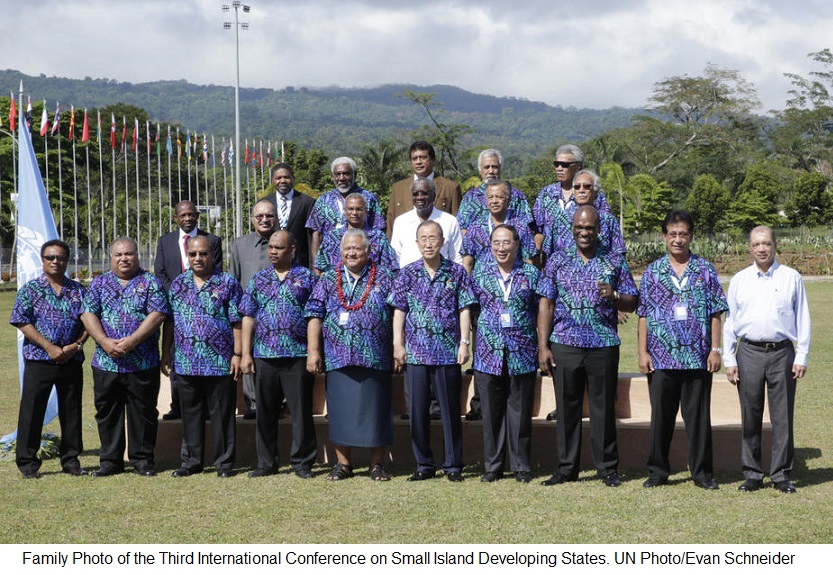
Family Photo of the Third International Conference on Small Island Developing States

The foregoing news article strongly identified the need for public and private financial instruments which are innovative compared to the status quo. This point aligns with the book Go Lean … Caribbean that presents a 370-page roadmap for re-booting, re-organizing and restructuring the economic, homeland security and governmental institutions in the Caribbean region. Government revenue/finance issues are covered in great details in the roadmap; the following is just a sample of some of the innovative government funding/revenue products featured in the book:

Re-insurance sidecars
Marketable Warrants
Tax Liens

The ‘shambled’ state of CariCom has frequently been featured in previous Go Lean blog/commentaries. As sampled here:

https://goleancaribbean.com/blog/?p=1193 EU willing to fund study on cost of not having CARICOM
https://goleancaribbean.com/blog/?p=1014 Jack M. Mintz: All is not well in the sunny Caribbean
https://goleancaribbean.com/blog/?p=816 The Future of CariCom
https://goleancaribbean.com/blog/?p=451 CARICOM Chairman to deliver address on reparations
https://goleancaribbean.com/blog/?p=346 Caribbean leaders convene for CARICOM summit in St Vincent
https://goleancaribbean.com/blog/?p=308 CariCom Agency CARCIP Urges Greater Innovation

The Go Lean book delves into innovative ideas for funding member-states’ treasuries. The book serves as a roadmap for the introduction and implementation of the technocratic Caribbean Union Trade Federation (CU). While federal governments normally bring a new level of governmental overhead and thus a new thirst for public finances, this one is different. The CU pledges to “give, not take”. This pledge is embedded in the Declaration of Interdependence, pronouncing as follows, (Page 12):

xiv. Whereas government services cannot be delivered without the appropriate funding mechanisms, “new guards” must be incorporated to assess, accrue, calculate and collect revenues, fees and other income sources for the Federation and member-states. The Federation can spur government revenues directly through cross-border services and indirectly by fostering industries and economic activities not possible without this Union.

The Go Lean book posits that the “whole is worth more than the sum of its parts”, that from this roadmap Caribbean economies will grow individually and even more collectively as a Single Market. This roadmap advocates the optimization of the economic and security engines and projects that the region’s economy will grow from $378 Billion (2010) to $800 Billion in a 5 year time span. The natural result of this effort is that government revenues can and will grow.

As related in the roadmap, the 3 CU prime directives include the optimization of the economic engines, establishment of a security apparatus to protect the resultant economic engines, and also the improvement of Caribbean governance to support these new engines.

The Go Lean roadmap therefore accepts a mission to re-structure facets of Caribbean governance with these pronouncements at the outset of the book, in the Declaration of Interdependence, as follows (Page 12):

xiii. Whereas all men are entitled to the benefits of good governance in a free society, “new guards” must be enacted to dissuade the emergence of incompetence, corruption, nepotism and cronyism at the peril of the people’s best interest. The Federation must guarantee the executions of a social contract between government and the governed.

The book purports that many of the revenues systems (such as identified above) are too complex for many individual Small Island Development States (SIDS) alone, and so the CU would be better suited to provide the economies-of-scale necessary for efficient deployment. This is part-and-parcel of the technocracy of the CU.

The following details from Go Lean…Caribbean the community ethos, strategies, tactics, implementation and advocacies to deploy efficient and effective government revenue options:

Community   Ethos – Lean Operations Page 24
Community   Ethos – Cooperatives Page 25
Community   Ethos – Ways to Improve Sharing Page 35
Strategy –   Customers – Member-State Governments Page 51
Strategy –   Agents of Change – Technology Page 57
Tactical –   Fostering a Technocracy Page 64
Anecdote –   Turning Around the CARICOM construct Page 92
Anecdote –   “Lean” in Government Page 93
Implementation   – Ways to Pay for Change Page 101
Implementation   – Ways to Deliver Page 109
Implementation   – Ways to Foster International Aid Page 117
Advocacy –   Ways to Improve Governance Page 168
Advocacy –   Better Manage the Social Contract Page 170
Advocacy –   Revenue Sources … for Administration Page 172
Advocacy –   Ways to Foster Technology Page 197
Advocacy –   Ways to Foster e-Commerce Page 198

According to the foregoing news article, there is a preponderance of SIDS to look to the international community for aid. The Go Lean book describes this dependent attitude as “parasite” and instead advocates for change: a more “protégé” approach.

The Go Lean book calls on the Caribbean region to be collectively self-reliant, to act more proactively and responsively for our own emergencies and natural disaster events. This means better, more efficient governance.  A previous Go Lean commentary demonstrated how governments can be transformed through technology and efficient deliveries, by highlighting a review of the relevant book by the California Lieutenant Governor and former Mayor of San Francisco Gavin Newsom: Citizenville – How to Take the Town Square Digital and Reinvent Government.

Now is the time for all of the Caribbean, the people and governing institutions, to lean-in for these types of innovative changes described in the book Go Lean … Caribbean. The benefits are too alluring to ignore: dawn of new governing and economic engines… and dawn of new opportunities. With some success, this would simply mean: a better place to live, work and play. 🙂

Download the book Go Lean … Caribbean – now!
 

Share this post:
, ,

A Lesson in History – Booker T versus Du Bois

Go Lean Commentary

2008 was a big year …

… in the history of mankind, the United States of America and the lessons learned for application in the Caribbean. This has been a familiar theme for the publishers of the book Go Lean…Caribbean; this theme has been exhausted in the book (Page 136) and in countless blog/commentaries (see list below). 2008 was only 6 years ago; that is considered recent; how inspiring could the lessons be with just a 6-year look-back? In answering, there is the need to go back even further, not to 2008, but back to the America of 1908, even more exacting to 1901; (the year Booker T. Washington was invited to the White House).

This was the strong point made by one of the key players in American history for 2008: John McCain, the Republican Nominee for US President against the eventual winner Barack Obama. In his concession speech on November 4, 2008, he painted a (word) picture of a landscape of America transcending over the past 100 years.

See the VIDEO here, now:

Video: John McCain 2008 Concession Speech
https://www.youtube.com/watch?v=bss6lTP8BJ8


A comment on this VIDEO in February 2014 truly capsulated the significance of this speech:

“One the most gracious and powerful speeches ever made. It deserves to go into the pantheon of great orations made by the likes of Winston Churchill, Martin Luther King, Jawaharlal Nehru and others” – Ravi Rajagopalan.

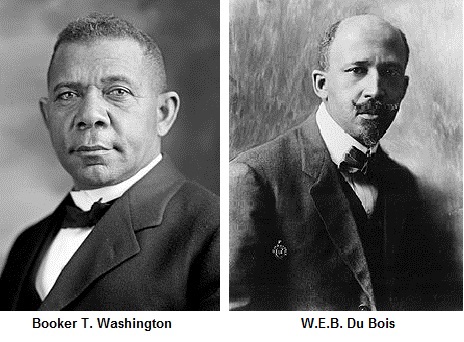
CU Blog - A Lesson in History - Booker T versus DuBois - Photo CombinedThe transcript from this video gives us the platform for the deep appreciation for our lesson in history: Booker T. Washington versus W.E.B. Du Bois. (See Appendix below).

Both men were very important in the history of civil rights for African-Americans. They both wanted the same elevation of their community in American society, but they both had different strategies, tactics and implementations.

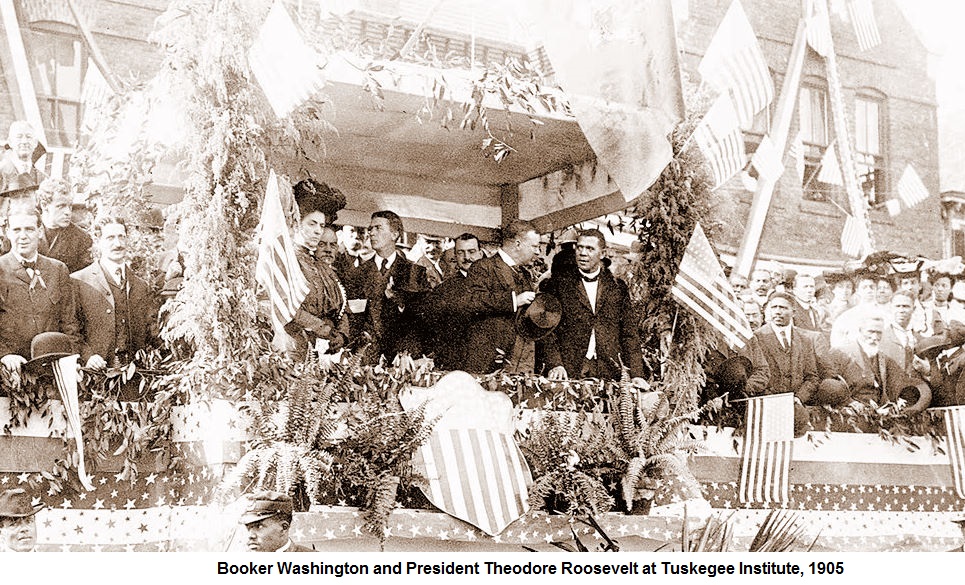
Washington’s biggest legacy is the Tuskegee University (Tuskegee Institute in his day). Du Bois’s legacy stems from his co-founding the NAACP (National Association for the Advancement of Colored People).

The conclusion from the above VIDEO, as stated by John McCain is that the journey for full citizenship for African-Americans took 100 years from the time of the Washington / Du Bois chasm. No matter the detailed approach, 100 years is still 100 years.

From the point of view of the Caribbean and the publishers of Go Lean…Caribbean, we side with both civil rights leaders in aspirations, but lean towards Booker T. Washington in strategies. Underlying to Mr. Washington’s advocacy, was for the Black Man to remain in the South, find a way to reconcile with his White neighbors and to prosper where he was planted.

The Caribbean has the same conundrum! Rather than fleeing our southern homes for northern opportunities, we advocate reconciling our conflicts, and managing the crises in our region so as to work out an effective future for all Caribbean people today, and tomorrow for our youth. (We also advocate a reconciliation of the past).

The book Go Lean…Caribbean serves as a roadmap for the introduction and implementation of the Caribbean Union Trade Federation (CU); an initiative to bring change, empowerment, to the Caribbean region; to make the region a better place to live, work and play. This Go Lean roadmap also has these 3 prime directives:

  • Optimization of the economic engines in order to grow the regional economy to $800 Billion & create 2.2 million new jobs.
  • Establishment of a security apparatus to protect the resultant economic engines.
  • Improve Caribbean governance to support these engines.

The book describes the CU as a technocratic administration with 144 different missions to elevate the Caribbean homeland. The underlying goal is stated early in the book with this pronouncement in the opening Declaration of Interdependence (Page 12):

xii. Whereas the legacy in recent times in individual states may be that of ineffectual governance with no redress to higher authority, the accedence of this Federation will ensure accountability and escalation of the human and civil rights of the people for good governance, justice assurances, due process and the rule of law…

Change has come to the Caribbean. But as depicted in the foregoing VIDEO, we will not have to wait 100 years, we will effectuate this change now. The Go Lean book declares that for permanent change to take place, there must first be an adoption of new community ethos, the national spirit that drives the character and identity of its people. This is what was missing in 1908 Black America. This point of community ethos is therefore our biggest lesson in the consideration of this history.

The Go Lean roadmap was constructed with these additional community ethos in mind, plus the execution of strategies, tactics, implementation and advocacies to forge the identified permanent change in the region. The following is a sample of these specific details from the book:

Community Ethos – Deferred Gratification Page 21
Community Ethos – Economic Principles – People Choose Page 21
Community Ethos – Economic Principles – All Choices Involve Costs Page 21
Community Ethos – Economic Principles – People Respond to Incentives in Predictable Ways Page 21
Community Ethos – Economic Principles – Economic Systems Influence Individual Choices Page 21
Community Ethos – Economic Principles – The Consequences of Choices Lie in the Future Page 21
Community Ethos – Security Principles – Anti-Bullying and Mitigation Page 23
Community Ethos – Governing Principles – Minority Equalization Page 24
Community Ethos – Governing Principles – Lean Operations Page 24
Community Ethos – Ways to Impact the Future Page 26
Community Ethos – Ways to Foster Genius Page 27
Community Ethos – Ways to Help Entrepreneurship Page 28
Community Ethos – Ways to Promote Intellectual Property Page 29
Community Ethos – Ways to Impact Research & Development Page 30
Community Ethos – Ways to Manage Reconciliations Page 34
Community Ethos – Ways to Improve Sharing Page 35
Community Ethos – Ways to Promote Happiness Page 36
Community Ethos – Ways to Impact the Greater Good Page 37
Anecdote – LCD versus an Entrepreneurial Ethos Page 39
Strategy – Vision – Confederation   of the 30 Caribbean Member-States into a Single Market Page 45
Strategy – Mission – Celebrate the Music, Sports, Art, People and Culture of the Caribbean Page 46
Tactical – Confederating a Permanent Union Page 63
Tactical – Fostering a Technocracy Page 64
Tactical – Separation of Powers: Federal Administration versus Member-States Governance Page 71
Implementation – Ways to Pay for Change Page 101
Implementation – Ways to Deliver Page 109
Planning – 10 Big Ideas for the Caribbean Region Page 127
Planning – Ways to Make the Caribbean Better Page 131
Planning – Ways to Better Manage Image Page 133
Planning – Lessons Learned from 2008 Page 136
Advocacy – Ways to Grow the Economy Page 151
Advocacy – Ways to Create Jobs Page 152
Advocacy – Ways to Improve Education Page 159
Advocacy – Ways to Improve Governance in the Caribbean Region Page 168
Advocacy – Ways to Better Manage the Social Contract Page 170
Advocacy – Ways to Mitigate Terrorism Page 181
Advocacy – Ways to Improve Communications Page 186
Advocacy – Ways Impact the Diaspora Page 217
Advocacy – Ways to Preserve Caribbean Heritage Page 218
Advocacy – Ways to Improve the Arts Page 230
Advocacy – Ways to Promote Music Page 231

There are other lessons for the Caribbean to learn from this consideration. The “clash and conflict” of the Booker T. Washington camp versus the W.E.B. Du Bois camp caused enmity in Black America since 1908 and continues even today. While some modern labeling may be “Old-School versus Nu School”, “Hip-Hop versus Bourgeois” , “Black Nationalists versus Accommodationists”, even “Thugs versus ‘Acting White'”, the underlying conflict is a  “deep divide”, a consistent reflection of two different approaches competing for dominance in the Black community.

Whereas life imitates art and art imitates life, this conflict was artfully depicted in the 1984 film A Soldier Story, directed by Norman Jewison, based upon playwright Charles Fuller’s Pulitzer Prize-winning Off-Broadway production A Soldier’s Play (1981). The movie was nominated for three Academy Awards (Best Picture, Supporting Actor – Adolph Caesar, and Best Screenplay Adaptation – Charles Fuller). See the VIDEO excerpt here:

A Solider’s Story: “The Day Of The Geechie Is Gone”
https://www.youtube.com/watch?v=CMk_16hT8Tk

A previous Go Lean blog/commentary identified this same conflict as Egalitarianism versus Anarchism.

Other blog/commentaries stressed related issues, such as learning from 2008 and the history of America’s 20th Century race relations. The following sample applies:

https://goleancaribbean.com/blog/?p=2222 Sports Role Model – Playing For Pride … And More
https://goleancaribbean.com/blog/?p=1918 Philadelphia Freedom – Some Restrictions Apply
https://goleancaribbean.com/blog/?p=1596 Book Review: ‘Prosper Where You Are Planted’
https://goleancaribbean.com/blog/?p=1531 A Lesson in History: 100 Years Ago Today – World War I
https://goleancaribbean.com/blog/?p=1037 Humanities & Civil Rights Advocate Maya Angelou – R.I.P.
https://goleancaribbean.com/blog/?p=789 America’s War on the Caribbean
https://goleancaribbean.com/blog/?p=782 Open the Time Capsule: The Great Recession of 2008
https://goleancaribbean.com/blog/?p=378 Fed Releases Transcripts from 2008 Meetings
https://goleancaribbean.com/blog/?p=341 Hypocritical US slams Caribbean human rights practices

Are the issues in this commentary strictly a historic reference? Unfortunately not! The opening VIDEO saw a conciliatory John McCain congratulating the newly elected President Barack Obama. The audience continued to “boo” time and again. This response was indicative of an continuing uneasiness in America’s race relations. This point is effectively made by another commentator, (YouTube Screen Name “eddude08”, posted January 2014) to the above John McCain YouTube VIDEO:

The crowd at John McCain’s concession speech said it all. While the noble Arizona Senator was committed to ending his campaign with grace and dignity, few knew at the time that [his Vice-Presidential Nominee] Sarah Palin had the audacity to prepare her own concession speech that night. Every time the Senator from Arizona would mention the newly elected Black President, the crowd erupted with boos. While mass media portrayed a nation wrapped in joy and celebration, anger and fear was well felt in the Heartland. John McCain, one of the greatest Senators of a generation, would be the sole man responsible for bringing a radical and unstoppable element into American politics. Sarah Palin’s nomination set the stage for political domination by a minority that had long been shunned by the mainstream.

Within Obama’s first year of presidency, the number of anti-government militias quadrupled. Within his first term, the nation witnessed the greatest number of legislative filibusters by any congress in the history of the country. 5 years into his presidency, he presided over the most ineffective Congress in American history. even with the deaths of 20 children in a mass shooting [in Newtown, Connecticut], conspiracy theories flourished and the people became distorted, millions of armed citizens convinced their weapons were needed for an inevitable clash with their government. A grassroots movement called the Tea Party became hijacked, fused with an established political party, what was a movement to stop the emerging fascism in the United States became the main force of recruitment for it. The nations budget and credit standing became fair game to advance political ideologies. America’s politics so radicalized a woman named Christine O’Donnell became a Senate nominee [in Delaware in 2010]. Even victims of hurricanes, even [in] the great states of New York and New Jersey could not be spared in the new age of American politics. Glenn Beck [(Political Commentator on cable channel FOX News)] became a national figure, and corporations were declared citizens.

A truly new America was emerging, and nothing would be able to stop what had become inevitable.

Is it the same America of 1908? Perhaps! The point from a Caribbean perspective is “the more things change, the more they remain the same”. We have problems in the Caribbean to contend with, many of which we are failing miserably. But our biggest crisis stems from the fact that so many of our citizens have fled their Caribbean homelands for foreign (including American) shores.

The purpose of this commentary is not to fix America, it is to fix the Caribbean. But the push-and-pull factors are too strong coming from the US. We must lower the glimmering light, the “pull factors”, that so many Caribbean residents perceive of the “Welcome” sign hanging at American ports-of-entry. A consideration of this commentary helps us to understand the DNA of American society: un-reconciled race relations in which Black-and-Brown are still not respected.

The logical conclusion: stay home in the Caribbean and work toward improving the homeland. The US should not be the panacea of Caribbean hopes and dreams.

Booker T. Washington advocated this strategy: prosper where you’re planted.

After 100 years, and despite an African-American President, we must say to Mr. Booker T. Washington: We concur!

Download the book Go Lean … Caribbean – now!
————————————————–

Appendix – Black America in 1908 – The Way Forward

Conditions were not good for the 4 million Black population in the Southern US after the Civil War. The blatant racism brought oppression, suppression and repression. Mob violence and injustice, even lynchings, became commonplace upon this American population. As lynchings in the South reached a peak in 1895, Booker T. Washington gave a speech in Atlanta that made him nationally famous. The speech called for black progress through education and entrepreneurship. His message was that it was not the time to challenge Jim Crow segregation and the disfranchisement of black voters in the South. Washington mobilized a nationwide coalition of middle-class blacks, church leaders, and white philanthropists and politicians, with a long-term goal of building the community’s economic strength and pride by a focus on self-help and schooling.

Washington’s 1895 Atlanta Exposition address was viewed as a “revolutionary moment”[17] by both African Americans and Whites across the country. At the time W. E. B. Du Bois supported him, but they grew apart as Du Bois sought more action to remedy disfranchisement and improve educational opportunities for Blacks. After their falling out, Du Bois and his supporters referred to Washington’s speech as the “Atlanta Compromise” to express their criticism that Mr. Washington was too accommodating to white interests.

Washington advocated a “go slow” approach to avoid a harsh white backlash.[17] The effect was that many youths in the South had to accept sacrifices of potential political power, civil rights and higher education.[18] His belief was that African Americans should “concentrate all their energies on industrial education, and accumulation of wealth, and the conciliation of the South.”[19] Washington valued the “industrial” education, as it provided critical skills for the jobs then available to the majority of African Americans at the time, as most lived in the South, which was overwhelmingly rural and agricultural. He thought these skills would lay the foundation for the creation of stability that the African-American community required in order to move forward. He believed that in the long term, “blacks would eventually gain full participation in society by showing themselves to be responsible, reliable American citizens.” His approach advocated for an initial step toward equal rights, rather than full equality under the law, gaining economic power to back up black demands for political equality in the future.[20] he believed that such achievements would prove to the deeply prejudiced white America that African Americans were not “‘naturally’ stupid and incompetent.”[21]

Well-educated blacks in the North, [of which Du Bois was most iconic], advocated a different approach, in part due to the differences they perceived in opportunities. Du Bois wanted blacks to have the same “classical” liberal arts education as upscale whites did, along with voting rights and civic equality, the latter two elements granted since 1870 by constitutional amendments after the Civil War. He believed that an elite, which he called the Talented Tenth, would advance to lead the race to a wider variety of occupations.[22] Du Bois and Washington were divided in part by differences in treatment of African Americans in the North versus the South; although both groups suffered discrimination, the mass of blacks in the South were far more constrained by legal segregation and exclusion from the political process. Many in the North rejected to being ‘led’, and authoritatively spoken for, by a Southern accommodationist strategy which they considered to have been “imposed on them [Southern blacks] primarily by Southern whites.”[23] Historian Clarence E. Walker wrote that, for white Southerners:

“Free black people were ‘matter out of place’. Their emancipation was an affront to southern white freedom. Booker T. Washington did not understand that his program was perceived as subversive of a natural order in which black people were to remain forever subordinate or unfree.”[24]

Both Washington and Du Bois sought to define the best means to improve the conditions of the post-Civil War African-American community through education.

Blacks were solidly Republican in this period, having gained emancipation and suffrage with the President Lincoln and his party. Southern states disfranchised most blacks and many poor whites from 1890–1908 through constitutional amendments and statutes that created barriers to voter registration and voting, such as poll taxes and literacy tests. By the late nineteenth century, Southern white Democrats defeated some biracial Populist-Republican coalitions and regained power in the state legislatures of the former Confederacy; they passed laws establishing racial segregation and Jim Crow. In the border states and North, blacks continued to exercise the vote; the well-established Maryland African-American community defeated attempts there to disfranchise them.

CU Blog - A Lesson in History - Booker T versus DuBois - Photo 3Washington worked and socialized with many national white politicians and industry leaders. He developed the ability to persuade wealthy whites, many of them self-made men, to donate money to black causes by appealing to values they had exercised in their rise to power. He argued that the surest way for blacks to gain equal social rights was to demonstrate “industry, thrift, intelligence and property.”[25] He believed these were key to improved conditions for African Americans in the United States. Because African Americans had only recently been emancipated and most lived in a hostile environment, Washington believed they could not expect too much at once. He said, “I have learned that success is to be measured not so much by the position that one has reached in life as by the obstacles which he has had to overcome while trying to succeed.”[15]

Along with Du Bois, Washington partly organized the “Negro exhibition” at the 1900 Exposition Universelle in Paris, where photos of Hampton Institute’s black students were displayed. These were taken by his friend Frances Benjamin Johnston.[26] The exhibition demonstrated African Americans’ positive contributions to United States’ society.[26]

Washington privately contributed substantial funds for legal challenges to segregation and disfranchisement, such as the case of Giles v. Harris, which was heard before the United States Supreme Court in 1903.[27] Even when such challenges were won at the Supreme Court, southern states quickly responded with new laws to accomplish the same ends, for instance, adding “grandfather clauses” that covered whites and not blacks.
Wikipedia Online Encyclopedia – Retrieved 09/09-2014 from:
http://en.wikipedia.org/wiki/Booker_T._Washington

Cited References:

15. Harlan, Louis R (1972), Booker T. Washington: volume 1: The Making of a Black Leader, 1856–1901 , the major scholarly biography
17.   Bauerlein, Mark (Winter 2004), The Journal of Blacks in Higher Education 46, JSTOR, p. 106.
18.   Pole, JR (Dec 1974), “Review: Of Mr. Booker T. Washington and Others; The Children of Pride”, The Historical Journal 17 (4) , p. 888.
19.   Du Bois, WEB (1903), The Souls of Black Folk, Bartleby ., pp. 41–59.
20.   Pole, JR (Dec 1974), “Review: Of Mr. Booker T. Washington and Others; The Children of Pride”, The Historical Journal 17 (4) , p. 107.
21.   Crouch, Stanley (2005).  The Artificial White Man: Essays on Authenticity, Basic Books, p. 96.
22.   Du Bois, WEB (1903), The Souls of Black Folk, Bartleby ., p. 189.
23.   Pole, JR (Dec 1974), “Review: Of Mr. Booker T. Washington and Others; The Children of Pride”, The Historical Journal 17 (4) , p. 980.
24.   Walker, Clarence E (1991), Deromanticising Black History, The University of Tennessee Press, p. 32 .
25.   Harlan, Louis R (1972), Booker T. Washington: volume 1: The Making of a Black Leader, 1856–1901 , the major scholarly biography, p. 68.
26.   Maxell, Anne (2002), “Montrer l’Autre: Franz Boas et les sœurs Gerhard”, in Bancel, Nicolas; Blanchard, Pascal; Boëtsch, Gilles; Deroo, Eric; Lemaire, Sandrine, Zoos humains. De la Vénus hottentote aux reality shows, La Découverte, pp. 331–39, in part. p. 338
27.   Harlan, Louis R (1971), “The Secret Life of Booker T. Washington”, Journal of Southern History 37 (2). Documents Booker T. Washington’s secret financing and directing of litigation against segregation and disfranchisement.


Share this post:
, , ,
[Top]

Forging Change: The Fun Theory

Go Lean Commentary

The publishers of the book Go Lean…Caribbean wants to forge change in the Caribbean. How do we go about doing that?

The book identifies a number of best practices.

Here, now is another…

Consider this theory:

Video: The Fun Theory – Piano Staircase

The Fun Theory – an initiative of Volkswagen (VW). This is one of a series of experiments for a new brand campaign of VW. Have a look – the piano stairs are really funny. Fun can obviously change behavior for the better.
YouTube Video Sharing Site (Retrieved 09/08/2014) –
https://www.youtube.com/watch?v=SByymar3bds

The forgoing VIDEO depicts the challenge to people in a city to take the stairs more as opposed to riding the escalator. While this appears to be a small thing, the issue is bigger than initial appearances. Walking up a flight of stairs could be “just what the doctor ordered” for many people. It’s a great wellness initiative.

The book Go Lean…Caribbean serves as a roadmap for the introduction and implementation of the Caribbean Union Trade Federation (CU); an initiative to bring change, empowerment, to the Caribbean region; to make the region a better place to live, work and play. This Go Lean roadmap also has initiatives to improve wellness in the region, and more. In fact, the Caribbean empowerment roadmap has these 3 prime directives:

  • Optimization of the economic engines in order to grow the regional economy to $800 Billion & create 2.2 million new jobs.
  • Establishment of a security apparatus to protect the resultant economic engines.
  • Improve Caribbean governance to support these engines.

The book describes the CU as a hallmark of a technocracy, a commitment to efficiency and effectiveness; and a commitment to fun. Among the 144 different missions for the CU are many fun related activities, such as music, arts, sports, libraries, Hollywood (media related), heritage and overall happiness.

As depicted in the foregoing VIDEO, “fun” can be used to forge change. The Go Lean book declares that before any real change takes root in the Caribbean that there must be an adoption of new community ethos, the national spirit that drives the character and identity of its people. We must therefore use effective and efficient drivers to forge this change.

The roadmap was constructed with the following community ethos in mind, plus the execution of these strategies, tactics, implementation and advocacies to forge the identified permanent change in the region. The following is a sample of these specific details from the book:

Community Ethos – Deferred Gratification Page 21
Community Ethos – Economic Principles – People Choose Page 21
Community Ethos – Economic Principles – People Respond to Incentives in Predictable Ways Page 21
Community Ethos – Economic Principles – The Consequences of Choices Lie in the Future Page 21
Community Ethos – Governing Principles – Minority Equalization Page 23
Community Ethos – Governing Principles – Lean Operations Page 24
Community Ethos – Governing Principles – Cooperatives Page 25
Community Ethos – Ways to Impact the Future Page 26
Community Ethos – Ways to Help Entrepreneurship Page 28
Community Ethos – Ways to Promote Intellectual Property Page 29
Community Ethos – Ways to Impact Research & Development Page 30
Community Ethos – Ways to Bridge the Digital Divide Page 31
Community Ethos – Ways to Impact Turn-Arounds Page 33
Community Ethos – Ways to Improve Sharing Page 35
Community Ethos – Ways to Promote Happiness Page 36
Community Ethos – Ways to Impact the Greater Good Page 37
Strategy – Vision – Confederate 30 Member-States Page 45
Strategy – Mission – Celebrate the Music, Sports, Art, People and Culture of the Caribbean Page 46
Tactical – Confederating a Permanent   Union Page 63
Tactical – Fostering a Technocracy Page 64
Implementation – Ways to Pay for Change Page 101
Implementation – Ways to Deliver Page 109
Planning – 10 Big Ideas for the Caribbean Region Page 127
Planning – Ways to Make the Caribbean Better Page 136
Planning – Reasons Why the CU Will Succeed Page 137
Advocacy – Ways to Grow the Economy Page 151
Advocacy – Ways to Create Jobs Page 152
Advocacy – Ways to Improve Communications Page 186
Advocacy – Ways to Improve Libraries Page 187
Advocacy – Ways to Impact Hollywood Page 202
Advocacy – Ways to Impact Beauty Pageants Page 203
Advocacy – Ways to Preserve Caribbean Heritage Page 218
Advocacy – Ways to Improve Sports Page 229
Advocacy – Ways to Improve the Arts Page 230
Advocacy – Ways to Promote Music Page 231

Previously Go Lean blog/commentaries have stressed having fun and impacting the community through the “games people play”. The following sample applies:

https://goleancaribbean.com/blog/?p=2222 Sports Role Model – Playing For Pride … And More
https://goleancaribbean.com/blog/?p=2171 Sports Role Model – Turn On the SEC Network
https://goleancaribbean.com/blog/?p=1943 The Future of Golf; Vital for Tourism
https://goleancaribbean.com/blog/?p=1909 Music Role Model Berry Gordy – No Town Like Motown
https://goleancaribbean.com/blog/?p=1596 Book Review: ‘Prosper Where You Are Planted’
https://goleancaribbean.com/blog/?p=522 Financial Crisis Jokes
https://goleancaribbean.com/blog/?p=318 Collegiate Sports in the Caribbean

CU Blog - Forging Change - The Fun Theory - Photo 1The quest to change the Caribbean is more complex than just doing some fun activities. This is serious, maybe even life-and-death. But who wants to live in a world that is all life-and-death all the time. No, let’s have some fun too.

People come to the Caribbean to have fun – we welcome them all. Let the good times roll!

We must use “fun” to reach our audience – our communities – then grab their attention to send a message of the need for change and to lean-in to this roadmap to elevate Caribbean society. The change being advocated includes having fun; it includes making the Caribbean a better place to live, work and play. 🙂

We encourage all of the Caribbean to lean-in to this roadmap.

Download the book Go Lean … Caribbean – now!

Share this post:
, , ,
[Top]

Students developing nail polish to detect date rape drugs

Go Lean Commentary

CU Blog - Students developing nail polish to detect date rape drugs - Photo

It’s back to school time! For K-12 and colleges. At the tertiary level, it’s time again for all the good, bad and ugly of the college experience.

The issue in the foregoing news article/VIDEO relates more to the ugly side of the college experience, especially for young girls on and near college campuses – sexual violence. But this issue is bigger than just college, date-rape, and university mitigations, this is about human rights.

By: NBC News – The Today Show
A group of male students at North Carolina State University is taking on a problem on campus, developing a nail polish that changes color to indicate the presence of date-rape drugs. NBC’s Gabe Gutierrez reports, as follows:


NBC News – The Today Show – August 26, 2014 –
http://www.today.com/video/today/55935260#55935260

This story is being brought into focus in a consideration of the book Go Lean … Caribbean. The book serves as a roadmap for the introduction and implementation of the technocratic Caribbean Union Trade Federation (CU), for the economic optimization in the region. How does this story relate?

Education
College Campuses
Justice Systems – Bad Actors
Women Rights
The Greater Good

This CU/Go Lean roadmap has 3 prime directives:

  • Optimization of the economic engines in order to grow the regional economy.
  • Establishment of a security apparatus to protect the resultant economic engines.
  • Improve Caribbean governance to support these engines.

The roadmap posits that the economy of the Caribbean is inextricably linked to the security of the Caribbean. The security scope of the CU is mostly focused on the “bad actors” that might emerge to exploit the new Caribbean economic engines. The book also focuses on traditional crime-and-punishment issues. The subject of date rape and sexual violence falls on the member-state side of the separation-of-powers divide, the CU does retain jurisdiction on Self-Governing Entities (SGE’s). A growth strategy of the roadmap is to invite, foster and incubate academic institutions to the region under the SGE scheme. The CU will also feature a jurisdiction of monitoring and metering (ratings, rankings, service levels, etc) the delivery of local governments in their execution of the Social Contract. For these reason, 3-prong focus of the CU prime directive is apropos: economic, security and governing engines.

Change has come to the Caribbean, but as the roadmap depicts, the problem of sexual violence (a human rights abuse) had persisted long before, so there is the need to mitigate recidivism in the region. Who are those most at risk for this behavior, and their victims? What efforts can be implemented to mitigate and protect our citizens, especially young innocent girls, venturing into the brave new world to foster their education and impact their communites.

Remember Natalee Holloway? (See the consideration on Page 190 of the Go Lean book).

“Serve and protect”. This is the new lean Caribbean!

The Go Lean roadmap posits that every woman has a right to a violence-free existence, on campus, in the family and in society; it is reprehensible that in so many Caribbean/Latin countries women are still viewed as lesser beings that can be abused at the whim of men.

What should be done to mitigate these bad practices? How does the Go Lean roadmap address this issue?

The solution in the foregoing VIDEO is “a good start”.

We made this issue personal, and interviewed a College Counselor for Freshman Women in one tertiary school in the Bahamas. (See Appendix).

There needs to be more research and development of more solutions.

This is the charge of the Go Lean…Caribbean roadmap: embrace R&D as a community ethos so as not to accept the status quo – keep moving forward. There are more ethos, strategies, tactics and operational advocacies presented in the Go Lean roadmap as well, so as to ensure that those vulnerable are protected and perpetrators are held accountable for their actions. The following are samples (with page numbers) from the book:

Community Ethos – Privacy –vs- Public Protection Page 23
Community Ethos – Whistleblower Protection Page 23
Community Ethos – Intelligence Gathering Page 23
Community Ethos – Witness Security Page 23
Community Ethos – Anti Bullying & Mitigations Page 23
Community Ethos – Light Up the Dark Places Page 23
Community Ethos – Minority Equalizations Page 24
Community Ethos – Impacting the Greater   Good Page 34
Strategy – Rule of Law –vs- Vigilantism Page 49
Separation of Powers – CariPol Page 77
Implementation – Ways to Pay for Change Page 101
Implementation – Steps to Implement SGE’s Page 105
Ways to Improve Education Page 159
Ways to Better Manage the Social Contract Page 170
Ways to Impact Justice Page 177
Ways to Remediate and Mitigate Crime Page 178
Ways to Improve Gun Control Page 179
Ways to Improve Intelligence Gathering Page 182
Ways to Improve Communications Page 186
Ways to Enhance Tourism – Mitigate Economic Crimes Page 190
Ways to Impact the Prison Industrial Complex – Recidivism Page 211
Ways to Impact Foundations Page 219
Ways to Protect Human Rights Page 220
Ways to Empower Women Page 226
Ways to Impact Youth Page 227
Ways to Impact Persons with Disabilities Page 228

In addition, many related issues/points were elaborated in previous blogs, sampled here:

https://goleancaribbean.com/blog/?p=1634 Book Review: ‘Chasing Youth Culture and Getting It Right’
https://goleancaribbean.com/blog/?p=809 Muslim officials condemn abductions of Nigerian girls
https://goleancaribbean.com/blog/?p=695 Brazil’s abused wives find help by going to ‘Dona Carmen’
https://goleancaribbean.com/blog/?p=392 Jamaica to receive World Bank funds to help in crime fight

For the CU’s deployment of SGE’s, we are front-and center in monitoring, managing and mitigating the issues in this foregoing article/VIDEO. For the Caribbean member-states in general, while the CU does not have sovereignty (its a deputized agency only), it can still provide support services to ensure compliance, accountability and service-level assurances. Yes, in addition to monitoring and metering, the CU can also provide ratings, funding, training, intelligence gathering, and cross border (fugitive) law enforcement.

The goal is simply to make the Caribbean a better place to live work, learn and play; with justice for all, regardless of gender. Simple goal, but heavy-lifting in the execution.

To the Caribbean communities, we say: “Bring it!”

This is not politics or feminism; this is law-and-order. This is just right!

Download the book Go Lean … Caribbean – now!

——————————————————————

Appendix – Interview

Camille Russell-Smith (CRS) is employed at the College of the Bahamas as a Counselor in the Counseling and Health Services Department. She pays it forward. One task among her duties that grabbed our attention is the “Violence in Interpersonal Relationships” workshops she conducts each semester for incoming freshmen.

Here is the interview with the Go Lean…Caribbean publishers (GLC):

GLC: In this day and age, do you find that it is difficult to reach young men and young women on proper behavior with regards to date-acquaintance-rape threats and risks?

CRS: Definitely a challenge exists in getting young people to realize proper attitudes they must have towards each other in order to foster healthy relationships It is important to raise their awareness of how they can easily abuse the rights of others. Further it is important to remind all students, particularly women, of the need to be ever vigilant, not to assume that a friend-date-acquaintance will respect their rights and not take advantage of any vulnerabilities.

GLC: Is there an ongoing problem on your campus with date- acquaintance rape?

CRS: There have been some related incidents between students of the College, though not necessarily on campus. However, I continue to counsel young women on the fallout and consequences of what happens when they go out at night. What I worry about the most is the fact that so many women believe that the rape may be their fault, for example if they went to a bar, but told their family/friends that they were going somewhere benign, like the library. However, the penalty for lying is definitely not being raped.

GLC: How do you hope to mitigate these threats?

CRS: Education, awareness, advocacies. But it is hard. I am going against a “tidal wave” in the other direction. The music, videos, images in the media, makes many young men feel as if they have some sense of entitlement. Then many women feel as if they can only be accepted if they allow, tolerate sexually abusive behavior without “making waves”.

GLC: How do you feel about the innovations in this foregoing VIDEO?

CRS: This innovation of a chemical that can detect the presence of a date-rape drug is a good start. We need more such innovations. The special glass, as mentioned in the foregoing article, sounds like another good innovation. I can imagine that other such developments will come soon.

GLC: What hope do you see for the future in our communities regarding these kinds of attitudes that can lead to unhealthy relationships?

CRS: We need to get our communities to the point that it is commonly accepted that “no means no”. Also, that those prosecuted for sex crimes would not be cuddled or excused and most importantly that women that report crimes would not be shunned. We can be successful. The acceptance in the community has changed regarding domestic violence and I believe that acceptance of date-acquaintance-rape will change also.

GLC: Thank you for your insights. Any final words?

CRS: We must do this. We must try to change our country and the Caribbean region as a whole. There are far too many “old views, old habits, and old philosophies” in our communities where some men think they can ignore the rights of women. Let’s please fix this…once and for all.

Share this post:
, , , , ,
[Top]

Blog # 150 – Why So Long? Can’t We Just…

Go Lean Commentary

CU Blog - Why so long - Can't we just - Photo 1We have now reached a milestone in the publishing of the (sometimes) daily blogs from the publishers of Go Lean…Caribbean, 150 submissions. This is a good time to address a consistent question we’ve gotten from some readers:

Why are the blog commentaries so long?
Can’t you accomplish the same objective with shorter blogs?

This submission here is meant to be a practice in active listening: We hear you! Consider this attribute of  one blog published on August 20, 2014:

3742 words: NYC’s MetroCard – A Model for the Caribbean Dollar – https://goleancaribbean.com/blog/?p=2074

So can we accomplish the same objectives with shorter commentaries? The answer: No!

The question is interpreted by us as “Can’t we just…?”

There is a serious reason why this is the answer: These are serious issues. We cannot, must not skim on the consideration of the solutions.

Our experience has taught us that serious problems require thorough and thoughtful consideration. There is no place for abbreviation in this exercise.

Our experience?

Consider these events from 2008, (a frequent topic of discussion in Go Lean…Caribbean blogs):

Video: Too Big To Fail – 2011 Movie (Pardon the adult language):
YouTube Video Sharing Site (Retrieved 08/20/2014) –
https://www.youtube.com/watch?v=Aqf97p1Rdm0

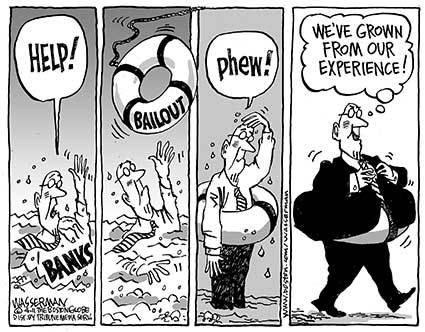
As the events of September 2008 unfolded where the financial system (Wall Street) was on the brink of collapse, stakeholders from the US Treasury Department assembled a representative body to conceive a remedy.

The resultant plan/proposal was introduced on September 20, by Treasury Secretary Henry Paulson and was later named the Troubled Asset Relief Program (TARP)[a].

The plan/proposal was only three pages long, intentionally short on details to facilitate quick passage by Congress.[b]

The plan called for the U.S. Treasury to acquire up to $700 billion worth of mortgage-backed securities…

… in the end, in an analysis by Bloomberg Business News Source, it was disclosed that the Federal Reserve had, by March 2009, committed $7.77 trillion to rescuing the financial system. This amount is more than half the value of everything produced in the U.S. that year.[c]
Wikipedia Online Encyclopedia Source (Retrieved 08/20/2014) –
http://en.wikipedia.org/wiki/Emergency_Economic_Stabilization_Act_of_2008

So can’t we just…?

The book Go Lean…Caribbean serves as a roadmap for the introduction and implementation of the Caribbean Union Trade Federation (CU) and the Caribbean Central Bank (CCB). This Caribbean empowerment roadmap has 3 prime directives:

  • Optimization of the economic engines in order to grow the regional economy to $800 Billion & create 2.2 million new jobs.
  • Establishment of a security apparatus to protect the resultant economic engines.
  • Improve Caribbean governance to support these engines.

The book described both the CU and CCB as hallmarks of technocracy, a commitment to efficiency and effectiveness. The book itself is 370 pages and covers 144 different missions.

As alluded above, principals in the Go Lean…Caribbean movement were front-and-center in the events that unfurled in 2008.

CU Blog - Why so long - Can't we just - Photo 2

The roadmap was constructed with the ethos to be thorough in the assessment, strategies, tactics, implementation and advocacies to understand the complexities of our time and forge permanent change in the Caribbean region. The following is a sample of these specific details from the book:

Community Ethos – Deferred Gratification Page 21
Community Ethos – Consequences of Choices Lie in the Future Page 21
Community Ethos – Intelligence Gathering Page 23
Community Ethos – “Crap” Happens Page 23
Community Ethos – Lean Operations Page 24
Community Ethos – Ways to Impact the Future Page 26
Strategy – Vision – Confederate 30 Member-States Page 45
Strategy – Missions – 144 Advocacies Page 457
Tactical – Confederating a Permanent Union Page 63
Tactical – Fostering a Technocracy Page 64
Implementation – Ways to Pay for Change Page 101
Implementation – Ways to Deliver Page 109
Planning – 10 Big Ideas for the Caribbean Region Page 127
Planning – Lessons Learned from 2008 Page 136
Planning – Lessons Learned from New York City Page 137
Advocacy – Ways to Grow the Economy Page 151
Advocacy – Ways to Create Jobs Page 152
Advocacy – Reforms for Banking Regulations Page 199
Advocacy – Ways to Impact Wall Street Page 200
Advocacy – Ways to Impact Main Street Page 201
Advocacy – Ways to Impact Hollywood Page 202
Appendix – Credit Ratings Agencies in 2008 Page 276

Imagine following a long complex and detailed recipe for baking a cake. To get the best results, it is important to include all the ingredients and follow the exacting instructions, the more detailed the better.

The quest for Go Lean…Caribbean is not as simple as baking a cake, rather a goal that is so much more important, to make the Caribbean region a better place to live, work and play.

We cannot skim on this effort – too much is at stake!

Download the free e-Book of Go Lean … Caribbean – now!

———————

Appendices:
a.  http://www.nytimes.com/2008/09/21/business/21draftcnd.html?_r=0; retrieved August 20, 2014.
b.  http://content.time.com/time/politics/article/0,8599,1843642,00.html; retrieved August 20, 2014.
c.  Ivry, Bob; Keoun, Bradley; Kuntz, Phil (November 28, 2011). “Secret Fed Loans Gave Banks $13 Billion Undisclosed to Congress”. Bloomberg Markets Magazine. Bloomberg L.P. Retrieved May 14, 2012 from: http://www.bloomberg.com/news/2011-11-28/secret-fed-loans-undisclosed-to-congress-gave-banks-13-billion-in-income.html.


Share this post:
,
[Top]

Sports Role Model – US versus the World

Go Lean Commentary

This is a big weekend in the world of sports, its the US versus the World … again. This time, its the Little League World Series, the baseball tournament in Williamsport, Pennsylvania. Even though baseball is played in many countries around the world, the expectation is that it takes an All-Star team from the rest of the world to compete against one American team.

This is the tournament’s Final Four teams, (see Appendix-Bracket below):

US: Chicago* -vs- Las Vegas
World: South Korea* -vs- Japan
* = Winner

The attitude of the US versus the World is the attitude in many other sports endeavors as well; sampled as follows:

  • The NCAA College Baseball Championship Tournament is called the College World Series.
  • The NBA Playoff Champion is referred to as World Champions.
  • Major League Baseball Championship Best-of-Seven Match-up is branded the World Series.
  • National Hockey League All-Star Game is a Match-up of North America (US and Canada) versus the World.

It is evident that the sports eco-system is bigger in the US, than anywhere else in the world. Needless to say, the Caribbean region pales in comparison in accentuating the business of sports. Deficient would not even be a fitting adjective, as there is NO arrangement for intercollegiate sports in the region, despite having 42 million people in 30 different countries. The Caribbean misses out on many opportunities associated with the games people play – especially economic ones: jobs, event bookings, media coverage.

This is the assertion of the book Go Lean…Caribbean, that the Caribbean can be a better place to live, work and play; that the economy can be grown methodically by embracing progressive strategies in recognizing and fostering the genius qualifiers of many Caribbean athletes. So many times, those with talent have had to flee the region to garner the business returns on their athletic investments.

It does not have to be.

The following news article indicates that even amateur Little League baseball is big business:

Title: Little League means big business as revenues soar
By: Josh Peter, USA Today

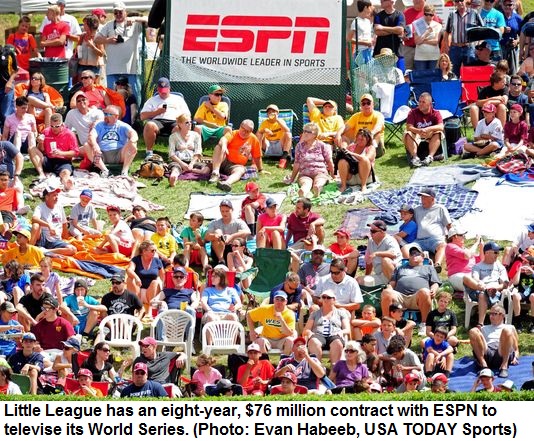
CU Blog - Sports Role Model - US versus the World - Photo 1The images remain quaint — kids sprinting around the base-paths, fans watching from grass hills, Norman Rockwell-like scenes abound at the Little League World Series in Williamsport, Pa., which culminates Sunday with the championship game. But make no mistake, Little League is big business.

Little League Inc. reported revenue of almost $25 million and assets of more than $85 million in 2012, according to the most recent publicly available tax return it must file to maintain tax-exempt status as a 501(c)(3) non-profit organization.

Over a five-year period, compensation for Little League Inc.’s CEO, Steve Keener, nearly doubled to $430,000 a year. And in 2012, the 100-person full-time staff made almost $7.5 million in salaries — a year before ESPN agreed to more than double broadcast fees as part of an eight-year, $76 million contract to televise the games during the two-week tournament.

“That’s a lot of money when all the grunt work is volunteer,” said Randy Stevens, president of the Little League in Nashville, Tenn., whose all-star team qualified for the World Series each of the past two years. “Now I’m wondering where it’s all going.”

Keener, elected as CEO in 1996, said revenue has grown at a steady pace and said new money is going back into the program.

“I’m not going to apologize for generating revenue to support the programming issues of this organization,” he told USA TODAY Sports. “But I would apologize if I felt we were not using it to the best of our ability in a prudent manner and getting the most out of the money to benefit this program.”

Keener said the majority of the organization’s costs stem from maintaining the national headquarters in Williamsport, five regional centers — in Connectcut, Georgia, Texas, California, Indiana — a full-time facility in Poland and offices in Hong Kong, Puerto Rico and Canada.

When Little League signed its contract with ESPN in 2007, Keener said, it lowered affiliation fees for the local leagues. He also said Little League pays for 125 criminal background checks for each local league and provides training program for coaches.

“Those are ways we try direct the funds right back to the local programs,” he said.

Little League also pays for travel, lodging and food costs for 16 teams, each of which include 13 players and three coaches. But Stevens, affiliated with the Nashville-based league, said families of the players should receive financial help for travel costs.

He estimated the parents of his players needed up to $35,000 to cover those expenses. A father with the team from Chicago said parents were unsure how they would pay for the trip until five Major League Baseball players offered to cover all travel expenses for the parents.

Keener said the idea of travel assistance is not under consideration.

“I’ve learned never to say never, but it’s unlikely at this point,” he said. “Our responsibility is to provide the travel, the accommodations and all the expenses related to participating in the World Series for the players and the coaches and the umpires who are here working the World Series.”

Keener said giving the players money that could be used for scholarships is not under consideration.

“Anything we would do for one group of kids, we would do for all of the kids. And it’s just not feasible to think that they’re all going to head off to college when they’re getting out of high school, particularly with the kids from the international region,” he said. “It’s just not something we feel is necessary for us to be thinking about when they’re 12 or 13 years old.”

Little League does not charge admission for games at the World Series, but officials do solicit donations while passing around cans during games.

“Whatever money they’re getting, they’re looking for more,” said Ellen Siegel, affiliated with the team from Philadelphia.

But Keener said the $25 million a year pales in comparison to organizations such as the Boys Scouts of America, which reported revenue of $240 million in 2012. He said Little League could not operate without the support of about 1,250,000 volunteers in 7,500 communities.

As far as his salary is concerned, he declined to comment other than to say his compensation is set by a committee of Little League Inc. board members.

Davie Jane Gilmour, Little League International Board of Directors Chairman, said Keener’s salary — and that of the other senior staff members, who in 2012 earned between $100,000 and $250,000 apiece — are in line with salaries at comparable non-profits.

“To be perfectly honest with you, there are many board members on that (compensation) committee who think that our senior staff, and in particular Steve, are underpaid at this point in time,” Gilmour said. “There’s a a pretty strong feeling on the compensation committee that they are highly marketable based on their success here in their work here at Little League.”

The claim of the book Go Lean … Caribbean is that excellence in sports requires a genius qualifier and that genius ability can be found in abundance in the Caribbean. Further that there is something bigger than sports alone at play here, that this is the full effect of globalization in which the Caribbean can export products and services to benefit the homeland.

This commentary has previously promoted the monetary benefits of the sports eco-systems and how Caribbean progeny participate on the world stage:

https://goleancaribbean.com/blog/?p=1508 St Croix’s Tim Duncan to Return to Spurs For Another Season
https://goleancaribbean.com/blog/?p=1446 Caribbean Players in the 2014 World Cup
https://goleancaribbean.com/blog/?p=1341 Sports Landlord Model of the College World Series Time
https://goleancaribbean.com/blog/?p=1148 Sports Bubble – Franchise values in basketball
https://goleancaribbean.com/blog/?p=1214 Sports Landlord Model – The Art & Science of Temporary Stadiums
https://goleancaribbean.com/blog/?p=1020 Caribbean Sports Revolutionary & Advocate: FIFA’s Jeffrey Webb
https://goleancaribbean.com/blog/?p=498 Sports Nature -vs- Nurture: Book Review of ‘The Sports Gene’
https://goleancaribbean.com/blog/?p=334 Bahamians Basketballers Make Presence Felt In Libyan League
https://goleancaribbean.com/blog/?p=318 The Need for Collegiate Sports Eco-System in the Caribbean
https://goleancaribbean.com/blog/?p=60 Could the Caribbean Host the Olympic Games?

The Go Lean book serves as a roadmap for the introduction and implementation of the Caribbean Union Trade Federation (CU), a technocratic federal government to administer and optimize the economic/security/ governing engines of the region’s 30 member-states. At the outset, the roadmap recognizes the value of sports in the roadmap with these statements in the Declaration of Interdependence (Page 13 & 14):

xxvi.      Whereas the preparation of our labor force can foster opportunities and dictate economic progress for current and future generations, the Federation must ensure that educational and job training opportunities are fully optimized for all residents of all member-states, with no partiality towards any gender or ethnic group. The Federation must recognize and facilitate excellence in many different fields of endeavor, including sciences, languages, arts, music and sports. This responsibility should be executed without incurring the risks of further human flight, as has been the past history.

xxxi.      Whereas sports have been a source of great pride for the Caribbean region, the economic returns from these ventures have not been evenly distributed as in other societies. The Federation must therefore facilitate the eco-systems and vertical industries of sports as a business, recreation, national pastime and even sports tourism – modeling the Olympics.

The Go Lean roadmap calls for the market organizations to better explore the economic opportunities for sports. Sports can be big business! But even when money is not involved, other benefits abound. As such the CU will enhance the engines to elevate sports at all levels: amateur, intercollegiate and professional.

The Go Lean book’s economic empowerment roadmap features huge benefits for the region related to sports. The strategy is create leverage for a viable sports landscape by consolidate the region’s 30 member-states / 4 languages into a Single Market of 42 million people. The CU facilitation of applicable venues (stadia, arenas, fields, temporary structures) on CU-owned fairgrounds plus the negotiations for broadcast/streaming rights/licenses will elevate the art, science and genius of sports as an enterprise in the region. As depicted in the foregoing article/VIDEO, even young children, Little League, will participate/benefit in the sports eco-system.

Now is the time for all of the Caribbean to lean-in to the following community ethos, strategies, tactics, implementations and advocacies detailed in the book Go Lean … Caribbean to re-boot the delivery of the regional solutions to elevate the Caribbean region through sports:

Community Ethos – People Respond to Incentives in Predictable Ways Page 21
Community Ethos – Return on Investments Page 24
Community Ethos – Ways to Foster Genius Page 27
Community Ethos – Ways to Improve Negotiations Page 32
Community Ethos – Ways to Promote Happiness Page 36
Strategic – Vision – Integrating Region in to a Single Market Page 45
Strategic – Staffing – Sporting Events at Fairgrounds Page 55
Tactical – Fostering a Technocracy Page 64
Tactical – Separation of Powers – Sports & Culture Administration Page 81
Tactical – Separation of Powers – Fairgrounds Administration Page 83
Implementation – Steps to Implement Self-Governing Entities (Fairgrounds) Page 105
Implementation – Ways to Deliver Page 109
Planning – Ways to Make the Caribbean Better Page 131
Advocacy – Ways to Grow the Economy Page 151
Advocacy – Ways to Improve Local Government – Parks & Recreation Page 169
Advocacy – Ways to Impact Events Page 191
Advocacy – Ways to Promote Fairgrounds Page 192
Advocacy – Ways to Foster Technology Expositions Page 197
Advocacy – Ways to Impact Youth Page 227
Advocacy – Ways to Improve Sports Page 229
Advocacy – Ways to Impact Urban Living – Sports Leagues Page 234

The foregoing VIDEO features many sub-stories associated with this year’s Little League World Series (LLWS) tournament, the compelling stories of the rise from the despair of the Chicago inner-city, and Philadelphia’s Mo’ne Davis, the only girl in the tournament. The drama of sports is a microcosm for the drama in life.

Despite the presence of a Caribbean team in this LLWS tournament, no compelling Caribbean stories have emerged. This is an American drama: the United States versus the World. This is not just an attitude in sports, but in many other endeavors as well. The drama and challenges in the Caribbean are of no consequence in the US, we are just a playground for their world.

We need our own tournament to foster Caribbean sports drama and economic benefits.

We need to lean-in to the Go Lean roadmap to build the sports eco-systems to make the Caribbean a better place to live, work and play. We must elevate our own society.

Download the free e-Book of Go Lean … Caribbean – now!

———–

APPENDIX – LLWS BRACKETS   (Double-Click for a legible Viewer)

CU Blog - Sports Role Model - US versus the World - Photo 2

Share this post:
, , , ,
[Top]

Where the Jobs Are – Computers Reshaping Global Job Market

Go Lean Commentary

The legend of John Henry [a] illustrated the struggle of man versus machine.

Man lost!

Was that story just an allegory or an anecdote of an actual person and actual events? While the setting of the story is true, the construction of the Chesapeake and Ohio Railway in the 1870s (shortly after the US Civil War), the rest of the account may be mere fiction and exaggeration. But the battle of man versus machine continues even today; and man continues to lose.

The below news article asserts that the next round of new jobs are to be found in the acceptance of that defeat, man conceding to the machine.

This point aligns with the book Go Lean…Caribbean which calls for the elevation of Caribbean economics. The book asserts that the Caribbean region has been losing the battle of globalization and technology. The consequences of our defeat is the sacrifice of our most precious treasure, our people. The assessment of all 30 Caribbean member-states is that every community has lost human capital to emigration. Some communities, like Puerto Rico and the US Virgin Islands have suffered with an abandonment rate of more than 50% and others have had no choice but to stand on the sideline and watch as more than 70% of college-educated citizens flee their homelands for foreign shores.

There are both “push and pull” factors as to why these ones leave. But the destination countries, North America and Western Europe, may not be such ideal alternatives. These communities have also been suffering from agents-of-change in the modern world and losing badly in the struggle of man-versus-machine, the industrial adoption of automation, and  the corporate assimilation of internet & communication technologies.

Everything has changed…everywhere! It is what it is! The poor is expanding, the middle class is shrinking, and the rich, the One Percent is growing in affluence, influence and power.

The Go Lean book therefore posits that there is a need to re-focus, re-boot, and optimize the engines of commerce so as to make the Caribbean a better place to live, work and play. Considering this article here, depicting that there is the opportunity to create jobs:

Title: Computers reshaping global job market, for better and worse
By: Ann Saphir (Editing by Lisa Shumaker)

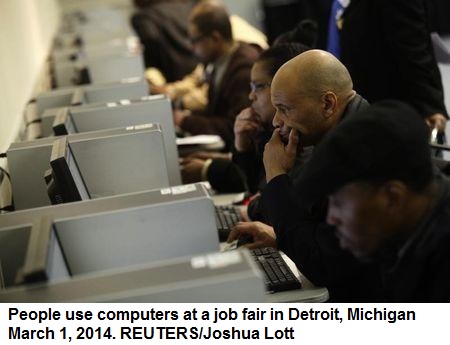
CU Blog - Where the Jobs Are - Computers reshaping global job martket - Photo 2(Reuters) – Automation and increasingly sophisticated computers have boosted demand for both highly educated and low-skilled workers around the globe, while eroding demand for middle-skilled jobs, according to research to be presented to global central bankers on Friday.

But only the highly educated workers are benefiting through higher wages, wrote MIT professor David Autor in the paper prepared for a central banking conference in Jackson Hole, Wyoming. Middle- and lower-skilled workers are seeing their wages decline.

That is in part because as middle-skilled jobs dry up, those workers are more likely to seek lower-skilled jobs, boosting the pool of available labor and putting downward pressure on wages.

“(W)hile computerization has strongly contributed to employment polarization, we would not generally expect these employment changes to culminate in wage polarization except in tight labor markets,” Autor wrote.

Any long-term strategy to take advantage of advances in computers should rely heavily on investments in human capital to produce “skills that are complemented rather than substituted by technology,” he said.

Recounting the long history of laborers vilifying technological advances, Autor argues that most such narratives underestimate the fact that computers often complement rather than replace the jobs of higher-skilled workers.

People with skills that are easily replaced by machines, such as 19th-century textile workers, do lose their jobs.

In recent years computer engineers have pushed computers farther into territory formerly considered to be human-only, like driving a car.

Still, computer-driven job polarization has a natural limit, Autor argues. For some jobs, such as plumbers or medical technicians who take blood samples, routine tasks are too intertwined with those requiring interpersonal and other human skills to be easily replaced.

“I expect that a significant stratum of middle skill, non-college jobs combining specific vocational skills with foundational middle skills – literacy, numeracy, adaptability, problem-solving and common sense – will persist in coming decades,” Autor wrote.

Autor, who has been studying technology and its impact on jobs since before the dot-com bubble burst, notes that some economists have pointed to the weak U.S. labor market since the 2000s as evidence of the adverse impact of computerization.

Such modern-day Luddites are mistaken, he suggested. U.S. investment in computers, which had been increasing strongly, dropped just as labor demand also fell, exactly the opposite of what ought to happen if technology is replacing labor.

More likely, he said, globalization is to blame, hurting demand for domestic labor and, like technology, helping to reshape the labor landscape. While in the long run both globalization and technology should in theory benefit the economy, he wrote, their effects are “frequently slow, costly, and disruptive.”

The book Go Lean… Caribbean, serves as a roadmap for the introduction and implementation of the technocratic Caribbean Union Trade Federation (CU) with the charter to facilitate jobs in the region. The book posits that ICT (Internet & Communications Technology) can be a great equalizer for the Caribbean to better compete with the rest of the world, relating the experiences of Japan – the #3 global economy – who have competed successfully with great strategies and technocratic execution despite being a small country of only 120+ million people. This modeling of Japan, and other successful communities, aligns with the CU charter; as defined by these 3 prime directives:

  • Optimization of economic engines in order to grow the regional economy to $800 Billion and create 2.2 million new jobs.
  • Establishment of a security apparatus to protect the resultant economic.
  • Improve Caribbean governance to support these engines.

Early in the Go Lean book, the responsibility to create jobs was identified as an important function for the CU with these pronouncements in the Declaration of Interdependence (Pages 14):

xxvi.  Whereas the Caribbean region must have new jobs to empower the engines of the economy and create the income sources for prosperity, and encourage the next generation to forge their dreams right at home, the Federation must therefore foster the development of new industries, like that of ship-building, automobile manufacturing, prefabricated housing, frozen foods, pipelines, call centers, and the prison industrial complex. In addition, the Federation must invigorate the enterprises related to existing industries tourism, fisheries and lotteries – impacting the region with more jobs.

xxvii. Whereas the region has endured a spectator status during the Industrial Revolution, we cannot stand on the sidelines of this new economy, the Information Revolution. Rather, the Federation must embrace all the tenets of Internet Communications Technology (ICT) to serve as an equalizing element in competition with the rest of the world. The Federation must bridge the digital divide and promote the community ethos that research/development is valuable and must be promoted and incentivized for adoption.

xxviii. Whereas intellectual property can easily traverse national borders, the rights and privileges of intellectual property must be respected at home and abroad. The Federation must install protections to ensure that no abuse of these rights go with impunity, and to ensure that foreign authorities enforce the rights of the intellectual property registered in our region.

xxx.  Whereas the effects of globalization can be felt in every aspect of Caribbean life, from the acquisition of food and clothing, to the ubiquity of ICT, the region cannot only consume, it is imperative that our lands also produce and add to the international community, even if doing so requires some sacrifice and subsidy.

According to the foregoing article, computers are reshaping the global job market, for better and worse. The Go Lean book, and previous blog/commentaries, detailed the principle of job multipliers, how certain industries are better than others for generating multiple indirect jobs down the line for each direct job on a company’s payroll. Industries relating to STEM (Science, Technology, Engineering and Mathematics/Medicine) fields have demonstrated high job-multiplier rates of 3.0 to 4.1 factors (Page 260).

The Go Lean… Caribbean book details the creation of 2.2 million new jobs for the Caribbean region, many embracing ICT skill-sets. How? By adoption of certain community ethos, plus the executions of key strategies, tactics, implementations and advocacies. The following is a sample from the book:

Assessment – Puerto Rico – The Greece of the Caribbean Page 18
Community Ethos – Deferred Gratification Page 21
Community Ethos – Economic Principle – Economic Systems Influence Choices & Incentives Page 21
Community Ethos – Economic Principle – Voluntary Trade Creates Wealth Page 21
Community Ethos – Consequences of Choices Lie in the Future Page 21
Community Ethos – Job Multiplier Page 22
Community Ethos – Anti-Bullying and Mitigation Page 23
Community Ethos – Lean Operations Page 24
Community Ethos – Return on Investments Page 24
Community Ethos – Ways to Impact the Future Page 26
Community Ethos – Ways to Foster Genius Page 27
Community Ethos – Ways to Help Entrepreneurship Page 28
Community Ethos – Ways to Promote Intellectual Property Page 29
Community Ethos – Ways to Impact Research & Development Page 30
Community Ethos – Ways to Bridge the Digital Divide Page 31
Strategy – Mission – Education Without Further Brain Drain Page 46
Strategy – Agents of Change – Technology Page 57
Strategy – Agents of Change – Globalization Page 57
Tactical – Fostering a Technocracy Page 64
Tactical – Tactics to Forge an $800 Billion Economy – Japanese Model Page 69
Tactical – Tactics to Forge an $800 Billion Economy – High Multiplier Industries Page 70
Tactical – Separation of Powers – Commerce Department – Patents & Copyrights Page 78
Implementation – Ways to Pay for Change Page 101
Implementation – Trends in Implementing Data Centers Page 106
Implementation – Ways to Deliver Page 109
Implementation – Ways to Impact ICT and Social Media Page 111
Planning – Ways to Improve Trade Page 128
Advocacy – Ways to Grow the Economy Page 151
Advocacy – Ways to Create Jobs Page 152
Advocacy – Ways to Improve Education Page 159
Advocacy – Ways to Impact Labor Markets and Unions Page 164
Advocacy – Ways to Foster Empowering Immigration – STEM Resources Page 174
Advocacy – Ways to Foster Technology Page 197
Advocacy – Ways to Foster e-Commerce Page 198
Advocacy – Lessons from America’s Peonage History – John Henry Historicity Page 211
Advocacy – Ways to Promote a Call Center Industry Page 212
Advocacy – Ways to Impact Youth Page 227
Appendix – Growing 2.2 Million Jobs in 5 Years Page 257
Appendix – Job Multipliers Page 259

The CU will foster job-creating developments, incentivizing many high-tech start-ups and incubating viable companies. The primary ingredient for CU success will be Caribbean people, so we must foster and incite participation of many young people into STEM fields, so as to impact their communities. A second ingredient will be the support of the community – the Go Lean roadmap recognizes the limitation that not everyone in the community will embrace the opportunity to lead in these endeavors. An apathetic disposition is fine-and-well, we simply must not allow that to be a hindrance to those wanting to progress. The community ethos or national spirit, must encourage and spur “achievers” into roles where “they can be all they can be”. The book posits that one person can make a difference.

The Caribbean is arguably the best address on the planet, but the missing pieces for many people are jobs. The Go Lean roadmap starts with the assessment of the true status of the region, then the development of the plan to remediate the status quo, and finally the turn-by-turn directions to get to a new destination: a better place to live, work and play.

This Go Lean roadmap describes that the Caribbean is in crisis, a war with many battlegrounds. Our effort is worth any sacrifice, but this time our battle is not man versus machine, but rather man with the machine.

Download the book Go Lean…Caribbean now!

—————————————————
Footnote – a: John Henry

John Henry is an American folk hero and tall tale. He worked as a “steel-driver”—a man tasked with hammering a steel drill into rock to make holes for explosives to blast the rock away. He died during the construction of a tunnel for a railroad. In the legend, John Henry’s prowess as a steel-driver was measured in a race against a [machine], steam powered hammer, which he won, only to die in victory with his hammer in his hand and heart giving out from stress. The story of John Henry has been the subject of numerous songs, stories, plays, books and novels.

Historicity
The historicity of many aspects of the John Henry legend is subject to debate. Until recently it was generally believed that the race between a man and a steam hammer described in the ballad occurred during the construction of the Chesapeake and Ohio (C&O) Railway in the 1870s.

In particular, the race was thought to have occurred during the boring of Big Bend tunnel near Talcott, West Virginia between 1869 and 1871. Talcott holds a yearly festival named for Henry and a statue and memorial plaque have been placed along a highway south of Talcott as it crosses over the Big Bend tunnel.

CU Blog - Where the Jobs Are - Computers reshaping global job market - Photo 1

In the 2006 book Steel Drivin’ Man: John Henry, the Untold Story of an American Legend, Scott Reynolds Nelson, an associate professor of history at the College of William and Mary, contends that the John Henry of the ballad was based on a real person, the 20-year-old New Jersey-born African-American freeman, John William Henry (prisoner #497 in the Virginia penitentiary). Nelson speculates that Henry, like many African Americans might have come to Virginia to work on the clean-up of the battlefields after the Civil War. Arrested and tried for burglary, he was among the many convicts released by the warden to work as leased labor on the C&O Railway.

According to Nelson, conditions at the Virginia prison were so terrible that the warden, an idealistic Quaker from Maine, believed the prisoners, many of whom had been arrested on trivial charges, would be better clothed and fed if they were released as laborers to private contractors (he subsequently changed his mind about this and became an opponent of the convict labor system). Nelson asserts that a steam drill race at the Big Bend Tunnel would have been impossible because railroad records do not indicate a steam drill being used there.

Instead, Nelson argues that the contest must have taken place 40 miles away at the Lewis Tunnel, between Talcott and Millboro,  Virginia, where records indicate that prisoners did indeed work beside steam drills night and day. Nelson also argues that the verses of the ballad about John Henry being buried near “the white house”, “in sand”, somewhere that locomotives roar, mean that Henry’s body was buried in the cemetery behind the main building of the Virginia penitentiary, which photos from that time indicate was painted white, and where numerous unmarked graves have been found.

Prison records for John William Henry stopped in 1873, suggesting that he was kept on the record books until it was clear that he was not coming back and had died. The evidence assembled by Nelson, though suggestive, is circumstantial; Nelson himself stresses that John Henry would have been representative of the many hundreds of convict laborers who were killed in unknown circumstances tunneling through the mountains or who died shortly afterwards of silicosis from dust created by the drills and blasting.
 Songs
The well-known narrative ballad of “John Henry” is usually sung in at an upbeat tempo. The hammer songs (or work songs) associated with the “John Henry” ballad, however, are not. Sung slowly and deliberately, these songs usually contain the lines “This old hammer killed John Henry / but it won’t kill me.” Nelson explains that:

…workers managed their labor by setting a “stint,” or pace, for it. Men who violated the stint were shunned … Here was a song that told you what happened to men who worked too fast: they died ugly deaths; their entrails fell on the ground. You sang the song slowly, you worked slowly, you guarded your life, or you died.

There is some controversy among scholars over which came first, the ballad or the hammer songs. Some scholars have suggested that the “John Henry” ballad grew out of the hammer songs, while others believe that the two were always entirely separate.

(Source: Retrieved August 22 from: http://en.wikipedia.org/wiki/John_Henry_(folklore))

Share this post:
, , , ,
[Top]

Caribbean Jobs – Attitudes & Images of the Diaspora

Go Lean Commentary

“Make fun of our work ethic. I dare you. I double dare you.”

The experience of new Caribbean Diaspora members is that their work ethic is appreciated by employers. So if an employer has a tie in decision-making to fill a job with Caribbean candidate or an African American candidate, the Caribbean prospects wins out. [a]

CU Blog - Caribbean Jobs - Attitudes - Images of the Diaspora - Photo 1The foregoing VIDEO/TV show from the 1990’s was a production by African Americans (Wayans brothers of Keenen, Damon, Kim, Shawn and others) for an African American audience. They laughed at Caribbean immigrants in Urban America. This is a population that have no basis to berate others. They have suffered since the 2008 Great Recession with a 21% unemployment rate [b]; even worse among Black youth where the unemployment rate is 49% [c].

This following video harmonizes with the book Go Lean…Caribbean which posits that Caribbean image should be monitored and guarded against defamation and disparaging stereotypes. While the VIDEO/TV show was produced in 1990, this Go Lean effort is recent, composed November 2013. The negative image aside, the following VIDEO is funny:

The sketch comedy television show In Living Color debuted on FOX-TV in September 1990. This skit emerged in Season 1 Episode 7 depicting a hardworking West Indian family (Father, Mother, Son and Daughter) all with multiple jobs.


The underlying issue in this consideration is jobs.  There is the need for more jobs – in the US urban communities and in the Caribbean. But there are more issues in consideration of this book. A compelling mission of the Go Lean book is to lower the “push and pull” factors that lead many to abandon the Caribbean homeland for American shores. The book posits that the region must create jobs so that its citizens do not have to leave to become aliens in a foreign land, to be ridiculed for their accents, hairstyles (dreadlocks) and work ethic. This goal is detailed in the Go Lean book as it serves as a roadmap for the introduction and implementation of the technocratic Caribbean Union Trade Federation (CU). So the CU would be set to optimize Caribbean society, starting with economic empowerment. In fact, the Go Lean roadmap has 3 prime directives:

  • Optimization of the economic engines in order to grow the regional economy to $800 Billion & create 2.2 million new jobs.
  • Establishment of a security apparatus to protect the resultant economic engines.
  • Improve Caribbean governance to support these engines.

The Go Lean roadmap calls for many changes and empowerments. One such example is the infrastructure of Self-Governing Entities (SGE), to allow for industrial developments in a controlled environment. There is so much that can be accomplished with the right climate, entrepreneurial spirit, access to capital and willing work force.

There are so many other defects of Caribbean life that need to be addressed. We do not want to be the “laughing stock” of the developed world. We want to be recognized as protégés, not parasites! This point is pronounced early in the book with the Declaration of Interdependence (Page 12) with many statements that demonstrate the need to remediate Caribbean communities and enhance the Caribbean world-wide image:

xix.      Whereas our legacy in recent times is one of societal abandonment, it is imperative that incentives and encouragement be put in place to first dissuade the human flight, and then entice and welcome the return of our Diaspora back to our shores. This repatriation should be effected with the appropriate guards so as not to imperil the lives and securities of the repatriated citizens or the communities they inhabit. The right of repatriation is to be extended to any natural born citizens despite any previous naturalization to foreign sovereignties.

xx.      Whereas the results of our decades of migration created a vibrant Diaspora in foreign lands, the Federation must organize interactions with this population into structured markets. Thus allowing foreign consumption of domestic products, services and media, which is a positive trade impact. These economic activities must not be exploited by others’ profiteering but rather harnessed by Federation resources for efficient repatriations.

xxi.      Whereas the preparation of our labor force can foster opportunities and dictate economic progress for current and future generations, the Federation must ensure that educational and job training opportunities are fully optimized for all residents of all member-states, with no partiality towards any gender or ethnic group. The Federation must recognize and facilitate excellence in many different fields of endeavor, including sciences, languages, arts, music and sports. This responsibility should be executed without incurring the risks of further human flight, as has been the past history.

xxiv.      Whereas a free market economy can be induced and spurred for continuous progress, the Federation must install the controls to better manage aspects of the economy: jobs, inflation, savings rate, investments and other economic principles. Thereby attracting direct foreign investment because of the stability and vibrancy of our economy.

xxv.      Whereas the legacy of international democracies had been imperiled due to a global financial crisis, the structure of the Federation must allow for financial stability and assurance of the Federation’s institutions. To mandate the economic vibrancy of the region, monetary and fiscal controls and policies must be incorporated as proactive and reactive measures. These measures must address threats against the financial integrity of the Federation and of the member-states.

xxvi.      Whereas the Caribbean region must have new jobs to empower the engines of the economy and create the income sources for prosperity, and encourage the next generation to forge their dreams right at home, the Federation must therefore foster the development of new industries, like that of ship-building, automobile manufacturing, pre-fabricated housing, frozen foods, pipelines, call centers, and the prison industrial complex. In addition, the Federation must invigorate the enterprises related to existing industries like tourism, fisheries and lotteries – impacting the region with more jobs.

CU Blog - Caribbean Jobs - Attitudes - Images of the Diaspora - Photo 2It is the strong urging of every Caribbean empowerment plan to minimize the size of the Diaspora. We would prefer to keep our people and our educated work force “home” in the homeland. But it is what it is. Wishing alone will not accomplish this goal – there must be real solutions. This is the purpose of the Go Lean…Caribbean roadmap: to compose, communicate and compel solutions back in the Caribbean homeland. How, what, when? The Go Lean book also details a series of community ethos, strategies, tactics, implementations and advocacies to impact the region, member-states, cities and communities economic prospects:

Community Ethos – Deferred Gratification Page 21
Community Ethos – Economic Principle – Economic Systems Influence Choices & Incentives Page 21
Community Ethos – Economic Principle – Voluntary Trade Creates Wealth Page 21
Community Ethos – Job Multiplier Page 22
Community Ethos – Lean Operations Page 24
Community Ethos – Ways to Impact the Future Page 26
Community Ethos – Ways to Foster Genius Page 27
Community Ethos – Ways to Help Entrepreneurship Page 28
Community Ethos – Ways to Impact Research & Development Page 30
Community Ethos – Ways to Promote Happiness Page 36
Community Ethos – Ways to Impact the Greater Good Page 37
Strategy – Mission – Facilitate Job-Creating Industries Page 46
Tactical – Fostering a Technocracy Page 64
Tactical – Tactics to Forge an $800 Billion Economy – High Multiplier Industries Page 70
Tactical – Separation of Powers – Self-Governing Entities Page 80
Implementation – Ways to Pay for Change Page 101
Implementation – Steps to Implement Self-Governing Entities Page 105
Implementation – Ways to Deliver Page 109
Implementation – Reasons to Repatriate to the Caribbean Page 118
Planning – Ways to Make the Caribbean Better Page 131
Planning – Ways to Better Manage Caribbean Image Page 133
Advocacy – Ways to Grow the Economy Page 151
Advocacy – Ways to Create Jobs Page 152
Advocacy – Ways to Improve Emergency Management Processes and Systems Page 196
Advocacy – Ways to Foster Technology Page 197
Advocacy – Ways to Impact Hollywood Page 203
Advocacy – Ways to Impact the Diaspora Page 217
Appendix – Job Multipliers Page 259

With some measure of success, we should be able to reduce the size of the Diaspora, repatriating many to return to the homeland. Even more so, we should reduce the “push and pull” factors that lead many to abandon the region in the first place. We want North America (and Europe) laughing with us, not at us!

Other subjects related to job empowerments (and job losses) for the region have been blogged in other Go Lean…Caribbean commentary, as sampled here:

https://goleancaribbean.com/blog/?p=2003 Where the Jobs Are – One Scenario for Creating Caribbean Jobs
https://goleancaribbean.com/blog/?p=1698 STEM Jobs Are Filling Slowly
https://goleancaribbean.com/blog/?p=1683 British public sector workers (Afro-Caribbeans) strike over ‘poverty pay’
https://goleancaribbean.com/blog/?p=1596 Book Review: ‘Prosper Where You Are Planted’
https://goleancaribbean.com/blog/?p=1433 Caribbean loses more than 70 percent of tertiary educated to brain drain
https://goleancaribbean.com/blog/?p=1256 Traditional 4-year Colleges – Terrible Investment for Region and Jobs
http://goleancaribbean.com/blog/?p=857   Caribbean Image: Dreadlocks
https://goleancaribbean.com/blog/?p=398 Self-employment on the rise in the Caribbean
https://goleancaribbean.com/blog/?p=273 10 Things We Don’t Want from the US – Discrimination of New Immigrations

CU Blog - Caribbean Jobs - Attitudes - Images of the Diaspora - Photo 3The purpose of this roadmap is to make the Caribbean homeland, a better place to live, work and play. Comedy falls under the “Play” category. With all the emphasis on jobs, work ethic, image and opportunities, there is room for fun too, or better stated: funny. This dialogue from the skit in the foregoing VIDEO is just plain funny:

Father: “What happened to that boy you were dating with those 100 jobs?”
Daughter: “Him dead now”
Father/Mother: “What?! That means there are 100 jobs open”.
Father: “Where’s my newspaper?”

If only we were not the “butt” of the joke!

Download the free e-Book of Go Lean … Caribbean – now!

—————————————————————————

Appendix – Cited References

a. Posted September 26, 2012; retrieved August 17, 2014 from:
http://m.ibtimes.com/caribbean-americans-invisible-minority-seeking-identity-affirmation-795709

b. Posted August 6, 2013; retrieved August 17, 2014 from: http://newsone.com/2662081/black-unemployment-rate-2/

c. Posted November 2013; retrieved August 17, 2014 from: http://www.laprogressive.com/african-american-teen-unemployment/


Share this post:
, , , ,
[Top]

Where the Jobs Are – One Scenario: Ship-breaking

Go Lean Commentary

Here is how the human psyche is wired:

We yawn at creation, yet wow at destruction.

With that accepted fact, comes the realization that there is a business model in destruction. Jobs can be created in the art and science of destruction (demolition, recycling and turn-arounds).

This is where the next round of new jobs are to be found …

… so says the book Go Lean…Caribbean which calls for the elevation of Caribbean economics. The book assesses the challenges of the tourism product in the Caribbean region, especially since 2008, where the influx of American tourists has slowed, due to economic realities in their homeland: the middle class is shrinking, the poor is expanding, and the One Percent is growing in affluence, influence and power.

It is what it is! According to recent blog commentaries, certain amenities of the tourism product, the mainstay of Caribbean economy, have now come under attack by social change: Golf and Casino Gambling.

So with the regional tourism business models being based on American middle class prosperity, these harsh realities have now come to fruition. The book therefore posits that there is a need to re-focus, re-boot, and optimize the engines of commerce so as to make the Caribbean a better place to live, work and play. And thus, this new focus on “destruction”, and the accompanying jobs.

Consider these two news articles that describe a business model in which opportunities exist and fulfilling those needs create jobs:

Title #1: International Shipbreaking Limited Wins Contract for Dismantle Constellation – June 13, 2014

Shipbreaking - Photo 4The [US] Navy competitively awarded a contract to International Shipbreaking Limited [a] of Brownsville, Texas, for the towing, dismantling and recycling of conventionally powered aircraft carriers stricken from service, June 13, 2014. Under the contract, the company will be paid $3 million for the dismantling and recycling of the decommissioned aircraft carrier Constellation (CV 64). The price reflects the net price proposed by International Shipbreaking, which considered the estimated proceeds from the sale of the scrap metal to be generated from dismantling. The Navy continues to own the ship during the dismantling process. The contractor takes ownership of the scrap metal as it is produced and sells the scrap to offset its costs of operations.

This is the third of three contracts for conventional aircraft carrier dismantling. All Star Metals of Brownsville was awarded the first contract Oct. 22, 2013, which included the towing and dismantling of ex-USS Forrestal (AVT 59). ESCO Marine of Brownsville was awarded the second contract May 8, 2014, for the scrapping of ex-USS Saratoga (CV 60). After the initial award of one carrier to each successful offeror, the Navy has the capability of scrapping additional conventionally-powered aircraft carriers over a five-year period under delivery orders competed between the three contractors.

Shipbreaking - Photo 4 NEWInternational Shipbreaking will now develop its final tow plan for the Navy’s approval for the tow of Constellation from its current berth at Naval Base Kitsap, Washington, to the company’s facility in Brownsville. The ship is expected to depart Kitsap this summer. Navy civilian personnel will be on site full time to monitor the contractor’s performance during dismantling of the ship.

Constellation was the second Kitty Hawk-class aircraft carrier to be built. She was laid down Sept. 14, 1957, at New York Naval Shipyard in Brooklyn, New York, and was the last U. S. aircraft carrier to be built at a yard outside of Newport News Shipbuilding and Drydock Company. The ship was commissioned Oct. 27, 1961. After nearly 42 years of commissioned service, Constellation was decommissioned at the NavalAirStationNorthIsland in San Diego Aug. 6, 2003. In September 2003, she was towed to the inactive ship maintenance facility in Bremerton to await its eventual disposal.
**************
Title #2: Muddy Waters – Are U.S. shipping companies still sending their clunkers to the toxic scrap yards of South Asia?

By: Jacob Baynham – Cincinnati, Ohio-based writer

When the 30-year-old cargo ship MV Anders cruised out of Norfolk, Va., at 11 p.m. on Wednesday, Aug. 26, it may have been sailing through one of the largest loopholes in U.S. maritime regulations.

CU Blog - Where the Jobs Are - One Scenario - Photo 1Three weeks earlier, the Anders was a U.S.-flagged vessel called the MV Pfc. James Anderson Jr., named for a young Marine who saved his platoon members’ lives by falling on a Viet Cong grenade. It had hauled cargo for the U.S. Navy for more than two decades and was now retiring. The ship’s new owners, Star Maritime Corp., had renamed it the Anders, painted over the excess letters on the hull, and raised the flag of its new registry—the Caribbean nation of St. Kitts and Nevis. The Anders left Virginia empty.

Its 29-year-old sister ship, the MVBonny (formerly the MV 1st Lt. Alex Bonnyman), followed two days later under the same flag and ownership. The Coast Guard listed the ships’ next port of call as Santos, Brazil. But environmental groups, trade journals, and industry watchdogs claim the ultimate destination for these aging vessels will be the Dickensian scrap yards of Bangladesh.

The Anders and the Bonny served in the U.S. Navy’s Military Sealift Command for 24 years. Stationed at Diego Garcia in the Indian Ocean, they delivered military cargo during both Iraq wars, as well as Operation Restore Hope in Somalia. But the Navy never actually owned the ships. They chartered them from Wilmington Trust, which sold them to Star Maritime earlier this summer. When Star Maritime renamed the ships and submitted an application to reflag them under St. Kitts and Nevis registration, environmental groups recognized the telltale signs of vessels about to be scrapped and cried foul.

The Basel Action Network, a Seattle-based environmental group leading the campaign to stop the export of old ships for scrap, monitors old vessels in U.S. waters and alerts the EPA when their owners attempt to recycle them overseas. There are several reliable warning signs. First, a ship is sold to an obscure company (which U.S. ship-breakers call a “Last Voyage Inc.”), which is sometimes a subsidiary of a larger company active in the scrapping business. Then it is renamed and registered under another nation’s flag before sailing to South Asia.

“It’s outrageous that these ships were allowed to sail,” says Colby Self, director of BAN’s Green Ship Recycling campaign. “In a sense, they were government vessels.” But once the ships’ contracts had expired, all legal responsibilities lay with their owners.

Most of the world’s old ships are sent to die on the shores of India, Pakistan, and Bangladesh. Vessels are beached there at high tide and cut into pieces by teams of poorly paid migrant workers. Heavy equipment and cranes are inoperable on the sand, so workers dismantle the ships by removing large portions, which drop to the beach. They use fire torches to cut through steel hulls—even those of old oil tankers. Dozens of workers die each year from explosions, falling steel, and disease. As for the asbestos, polychlorinated biphenyls (PCBs), tributyltin (TBT), and other toxic materials onboard the old ships, much of it washes out to sea. (PCBs and TBT are persistent organic pollutants that work their way up the marine food chain and damage the nervous systems of large mammals.)

If the Anders and Bonny are headed to Bangladesh, they won’t be alone. South Asia’s ship-breaking yards are experiencing an ironic boom in the middle of the global recession. Ship owners faced with shrinking cargo volumes are culling their fleets by scrapping old vessels rather than paying for them to sit empty. South Asia’s yards, which take advantage of cheap labor, scant regulations, and high regional demand for steel, will buy a vessel for twice the price a U.S. ship-breaker could offer. In Bangladesh, ships like the Anders and Bonny (which are two-and-a-half football fields long and weigh more than 23,000 tons) are worth at least $7 million apiece.

In 1998, the Clinton administration slapped a moratorium on scrapping U.S.-flagged vessels overseas after the Baltimore Sun ran a Pulitzer Prize-winning string of stories about the conditions of the South Asian scrap yards. But ship owners have dozens of so-called “flags of convenience” at their disposal to circumvent the ban. Most of these flags belong to small, poor countries with little maritime oversight—places like St. Kitts and Nevis.

Ship owners submit their reflagging requests to the U.S. Maritime Administration (MARAD), which considers whether the ships would be needed for national security in the event of war. For old vessels, this is seldom the case. MARAD began alerting the EPA of old ships attempting to reflag after the SS Oceanic, a former Norwegian Cruise Liner, slipped out of San Francisco last year with almost 500 tons of asbestos and PCBs onboard.

The Toxic Substances Control Act of 1976 prohibits the export of PCBs, asbestos, and lead-based paint—materials often used in the paint, cabling, and gaskets of older ships because of their fire-retardant qualities. If the EPA suspects a vessel applying for reflagging contains hazardous materials, it can order that vessel to be tested. But because ships are not required to inventory these materials, and the EPA has limited time and resources to devote to every old ship, environmentalists contend that each year many vessels slip through the cracks.

In the case of the Bonny and Anders, EPA spokesman David Sternberg says, “Based on the available information, the EPA has no sufficient reason to contain these ships.” Sternberg adds that the EPA received a letter from the new owners insisting the vessels will be used in trade and will not be scrapped.

This seems unlikely to Kevin McCabe, founder of International Shipbreaking Ltd. in Texas. He says buying two cargo ships at the end of their life spans for their utilitarian purposes alone would “belie the economics of the market today.” McCabe is convinced that the Bonny and Anders will be scrapped in Asia. And he doesn’t think they’re clean, either. “I’ll bet you dollars to doughnuts that there are PCBs on those ships,” he says. “No question about it.” The EPA would be singing a different tune if the ships were to be dismantled at his Brownsville recycling facility, he adds. “When we scrap a ship, we must assume it has hazardous material onboard until we can prove otherwise.”

Colby Self of BAN says he’s disappointed that the Obama administration could so easily let these ships slip away. “[The EPA] made a calculated decision based on their low-risk assessment, and they let them go,” he says. Under the Bush administration, the EPA was very diligent in following up on BAN’s warnings, he says.

But Self isn’t giving up hope that the ships can be stopped before they wash up on South Asian shores. “We will be warning Bangladesh to bar the entry of these renegade vessels,” he says. “This story is far from over.”

The above two articles depict “two sides of the same coin”: what happens when ship-breaking is done right, and done wrong.

The book Go Lean… Caribbean, serves as a roadmap for the introduction and implementation of the technocratic Caribbean Union Trade Federation (CU) with the charter to facilitate jobs in the region. We want to explore all the strong benefits of the shipbuilding (including ship-breaking) industry, by doing it right – more safety precautions than Bangladesh and lower labor costs than Brownsville-Texas. This aligns with the CU charter; as defined by these 3 prime directives:

  • Optimization of economic engines in order to grow the regional economy to $800 Billion and create 2.2 million new jobs.
  • Establishment of a security apparatus to protect the resultant economic.
  • Improve Caribbean governance to support these engines.

Early in the Go Lean book, the responsibility to create jobs was identified as an important function for the CU with this pronouncement in the Declaration of Interdependence (Pages 14):

xxvi.  Whereas the Caribbean region must have new jobs to empower the engines of the economy and create the income sources for prosperity, and encourage the next generation to forge their dreams right at home, the Federation must therefore foster the development of new industries, like that of ship-building, automobile manufacturing, prefabricated housing, frozen foods, pipelines, call centers, and the prison industrial complex. In addition, the Federation must invigorate the enterprises related to existing industries tourism, fisheries and lotteries – impacting the region with more jobs.

CU Blog - Where the Jobs Are - One Scenario - Photo 3According to the foregoing articles, ship-breaking activities in Third World countries, like Bangladesh, pose harm to the environment, workers and remaining systems of commerce. But when executed correctly, as in Brownsville-Texas, ship-breaking can be all positive. There are benefits in applying the appropriate best practices in handling hazardous materials. The tons of toxic waste (asbestos) can be properly managed and disposed of, with the proper eco-system surrounding the industry. The CU will facilitate the eco-system, especially with the Self-Governing Entities (SGE) concept for shipyards. This is covered in the Go Lean book under the auspices of “turn-around” industries, a federally regulated/promoted activity.

The Go Lean book also details the principle of job multipliers, how certain industries are better than others for generating multiple indirect jobs down the line for each direct job on a company’s payroll. The shipbuilding industry has a job-multiplier rate of 3.0. According to a report by the University of Strathclyde’s Fraser of Allander Institute in Scotland, a local reduction-in-force of 800 jobs at Govan & Scotstoun Shipyards will result in total job losses across Scotland of around 2,400 jobs, including those at the shipyards. (Source: http://www.scotsman.com/news/politics/top-stories/clyde-shipyard-cuts-may-lead-to-2-400-job-losses-1-3179593).

The Go Lean… Caribbean book details the creation of 15,000 direct jobs for the shipbuilding industry in the Caribbean region. Once the job multiplier is applied, the economic impact is that of 45,000 jobs.

How would the Caribbean advance from 0 to 45,000 jobs in the course of the 5-year roadmap? By adoption of empowering community ethos, plus the execution of key strategies, tactics, implementations and advocacies. The following is a sample:

Community Ethos – Deferred Gratification Page 21
Community Ethos – Economic Principle – Economic Systems Influence Choices & Incentives Page 21
Community Ethos – Economic Principle – Voluntary Trade Creates Wealth Page 21
Community Ethos – Job Multiplier Page 22
Community Ethos – Lean Operations Page 24
Community Ethos – Ways to Impact the Future Page 26
Community Ethos – Ways to Help Entrepreneurship Page 28
Community Ethos – Ways to Impact Research & Development Page 30
Community Ethos – Ways to Impact Turn-Around and Recycling and Demolition Industries Page 33
Community Ethos – Ways to Impact the Greater Good Page 37
Strategy – Mission – Facilitate a Shipbuilding Industry Page 46
Tactical – Fostering a Technocracy Page 64
Tactical – Tactics to Forge an $800 Billion Economy – High Multiplier Industries Page 70
Tactical – Separation of Powers – Self-Governing Entities Page 80
Implementation – Ways to Pay for Change Page 101
Implementation – Steps to Implement Self-Governing Entities Page 105
Implementation – Ways to Deliver Page 109
Planning – Ways to Make the Caribbean Better Page 131
Advocacy – Ways to Grow the Economy Page 151
Advocacy – Ways to Create Jobs Page 152
Advocacy – Ways to Improve Emergency Management Processes and Systems Page 196
Advocacy – Ways to Foster Technology Page 197
Advocacy – Ways to Develop/Grow a Ship-Building Industry Page 209
Appendix – Job Multipliers Page 259

The CU will foster industrial developments in support of tourism and as an alternative to tourism. Shipbuilding / ship-breaking is a prime-and-ready endeavor. The number one ingredient in the recipe for success in this industry is access to waterways, harbors and ports. The second most important ingredient is the willingness of the people to engage.

After the new pitfalls of tourism’s changing dynamics, the Caribbean people should now be ready for this industrial challenge of ship-breaking.

The Caribbean is arguable the best address on the planet, but a lot of infrastructure is missing; infrastructure like jobs. While this (Go Lean roadmap and accompanying blogs) is the start, the end of this roadmap is a clearly defined destination: a better place to live, work and play.

Download the book Go Lean … Caribbean – now!

—————————————————

Appendix a:

Company Overview: International Shipbreaking Limited LLC

International Shipbreaking Limited LLC provides dismantling and recycling services for maritime vessels and equipment. It offers various ferrous products, such as plate and structural steel, re-roll plate, cast iron, sheet metal, and scrap products; and non-ferrous products, including aluminum, brass, copper, cupro-nickel, lead, and non-ferrous scrap products. The company provides reusable equipment, such as propulsion systems, generators and engines, anchors, chains, and windlasses, as well as film projection machines, x-ray equipment, washing machines, kitchen galley tools, beds, lockers, gun racks, lighting fixtures, chairs, tables, and desks. It also offers artificial reefing.

Share this post:
, , ,
[Top]

The Future of Golf; Vital for Tourism

Go Lean Commentary

The book Go Lean…Caribbean calls for the elevation of Caribbean society, to re-focus, re-boot, and optimize all the engines of commerce so as to make the Caribbean a better place to live, work and play.  “The games people play” therefore have relevance for our consideration. Golf is one of those games. But golf is more than just a game, it is an eco-system; but this eco-system is in peril.

“The financial bubble burst and the Tiger bubble burst as well”.
“Even as the economy recovered, golf is still in a nose dive”.
“Your house is on fire”.

These (above) are among the key phrases from the narration of the following HBO Real Sports documentary story:

Host Bryant Gumbel speaks with industry leaders, including Jack Nicklaus, the most accomplished golfer of all time, and executive Mark King about the state of the sport and what innovations should be embraced.

Full Length VIDEO:

YouTube Online Video Site (Published July 23, 2014; Retrieved August 9, 2014) –
https://www.youtube.com/watch?v=QFEYC4Z44v0

This subject is pivotal in the roadmap for elevation of the Caribbean economy, which maintains that tourism will continue to be the primary economic driver in the region for the foreseeable future. The game of “golf” plays a significant role in the business model of tourist resorts. The publisher of the book Go Lean…Caribbean posits that understanding the macro-economic patterns of the game/sport of golf is critical in the roadmap to grow the region’s GDP and creating jobs (2.2 million new jobs projected).

Also important in this discussion is the functionality of economic planning.

According to the foregoing VIDEO, there are major issues in the eco-system of golf. There are 4 major events during the year: The Masters, US Open, British Open and the PGA Championship. The viewership numbers for all 4 events have been declining in the last 7 years, since 2007, the eve of the Great Recession. Stakeholders in this industry cannot ignore this downward trend. For many, this discussion is not just about their past-time, but rather their livelihoods.

For the Caribbean perspective, the subject of golf encapsulates the activities of live, work and play. (Some of the most prime residential properties are on or overlooking golf courses).

Change is constant. Change can be lateral, forward and backwards too. Empires rise and fall, past-time activities change; new sports come into fashion, while others fade into obsolescence. (In the US, boxing is on the decline while Mixed Martial Arts are on the rise).

This book Go Lean… Caribbean, serves as a roadmap for the introduction and implementation of the technocratic Caribbean Union Trade Federation (CU). The CU/Go Lean roadmap has 3 prime directives:

  • Optimization of the economic engines in order to grow the regional economy to $800 Billion and create 2.2 million new jobs.
  • Establishment of a security apparatus to protect the resultant economic engines and marshal against economic crimes.
  • Improve Caribbean governance to support these engines.

Early in the book, the benefit of the “business of sports for community empowerment” is pronounced in the Declaration of Interdependence (Pages 13 & 14), with these opening statements:

xxvi.  Whereas the Caribbean region must have new jobs to empower the engines of the economy and create the income sources for prosperity, and encourage the next generation to forge their dreams right at home, the Federation must therefore foster the development of new industries… In addition, the Federation must invigorate the enterprises related to existing industries like tourism… – impacting the region with more jobs.

xxxi.  Whereas sports have been a source of great pride for the Caribbean region, the economic returns from these ventures have not been evenly distributed as in other societies. The Federation must therefore facilitate the eco-systems and vertical industries of sports as a business, recreation, national pastime and even sports tourism – modeling the Olympics.

CU Blog - The Future of Golf; Vital for Tourism - Photo 1The Caribbean tourism resort properties depend on golf amenities. Many times too, golf courses are built as municipal establishments, so as to benefit citizens through the Parks & Recreation infrastructure. The issues of sufficient returns on the public investments in golf is an important discussion in the execution of this roadmap.

This commentary previously related details of the changing macro-economic factors (like demographics) that affect the region’s economic engines. The following are samples of earlier Go Lean blogs:

https://goleancaribbean.com/blog/?p=1715 Lebronomy – Economic Impact of One Superstar on a Sport/Team’s Viability
https://goleancaribbean.com/blog/?p=1148 Sports Business and Sports Bubbles – Franchise values in basketball
https://goleancaribbean.com/blog/?p=841 Declining Economic Trends – Having Less Babies is Bad for the Economy
https://goleancaribbean.com/blog/?p=782 Open/Review the Time Capsule: The Great Recession of 2008
https://goleancaribbean.com/blog/?p=709 Econometric Analysis – Student debt holds back many would-be home buyers
https://goleancaribbean.com/blog/?p=498 Book Review: ‘The Sports Gene’ – Identifying and Fostering Sports Genius Abilities
https://goleancaribbean.com/blog/?p=356 Book Review: ‘How Numbers Rule the World’ – How Demographic Studies Dictate Policies
https://goleancaribbean.com/blog/?p=318 Empowering Collegiate Sports in the Caribbean
https://goleancaribbean.com/blog/?p=273 10 Things We Want from the US and 10 Things We Don’t Want from the US – # 2: Tourists
https://goleancaribbean.com/blog/?p=254 Air Transport Industry Changes – Air Antilles Launches St. Maarten Service
https://goleancaribbean.com/blog/?p=242 The Erosion of the Middle Class
https://goleancaribbean.com/blog/?p=235 Tourism’s changing profile

According to the foregoing VIDEO, the opulence of golf has not fared well in today’s real economy. The game costs too much, and takes too much time. There is a real chance that this sport will die off with older generations, unless reform can be incorporated to attract and retain younger generations to the sport. Many revisions have been tried – as depicted in the video – there is no tolerating the status quo.

The Caribbean must do the same. Our societies are also in need of reform/reboot to attract and retain the youth to consider their future in their Caribbean homelands. The homelands have been losing at this … badly. There are validated reports of over 70% of the college educated population fleeing the region (https://goleancaribbean.com/blog/?p=1433); this constitutes an undeniable brain drain. The Go Lean… Caribbean book details the community ethos to adopt to proactively mitigate the dire effects of the changed landscape, plus the executions of the following strategies, tactics, implementations and advocacies:

Community Ethos – Deferred Gratification Page 21
Community Ethos – Economic Principle – People Respond to Incentives Page 21
Community Ethos – Economic Principle – Consequences of Choices Lie in the Future Page 21
Community Ethos – Job Multiplier Page 22
Community Ethos – Lean Operations Page 24
Community Ethos – Return on Investments (ROI) Page 24
Community Ethos – Ways to Impact the Future Page 26
Community Ethos – Ways to Foster Genius Page 27
Community Ethos – Impact Research & Development Page 30
Community Ethos – Ways to Impact the Greater Good Page 37
Strategy – Integrate Region in a Single Market Page 45
Tactical – Fostering a Technocracy Page 64
Tactical – Trade and Globalization Page 70
Separation of Powers – Sports and Culture Administration Page 81
Planning – Ways to Make the Caribbean Better Page 131
Planning – Lessons Learned from 2008 Page 136
Advocacy – Ways to Grow the Economy Page 151
Advocacy – Ways to Create Jobs Page 152
Advocacy – Ways to Enhance Tourism Page 190
Advocacy – Ways to Preserve Caribbean Heritage Page 218
Advocacy – Ways to Impact the One Percent Page 224
Advocacy – Ways to Impact Youth Page 227
Advocacy – Ways to Improve Sports Page 229

The CU will foster industrial developments to aid and abet tourism. This is not planning for 1995, but rather 2015. The assumptions of the past, simply no longer apply today. It is what it is!

CU Blog - The Future of Golf; Vital for Tourism - Photo 2“Earlier this year, at the PGA Merchandise Show in Orlando, Mark King, the CEO of the company TaylorMade Golf announced the launch of Hack Golf, a TaylorMade-sponsored initiative that is, at heart, a worldwide call for fresh ideas. Over the next five years, operating in alliance with the Professional Golf Association (PGA) of America, King plans to pump $5 million of his company’s money into what amounts to a global brainstorm session. This constitutes a concerted effort to seek solutions to a demographic problem.” – (http://www.golf.com/tour-and-news/hack-golf-aims-grow-game-taylormade-sponsored-brainstorm-session)

Golf may have a future.

The 2014 PGA Championship was won by Rory McIlroy, a 25 year old golf “phenom”. After Tiger Woods, this sports needs all the young stars they can get a hold off. If only they can attract young viewers.

For the Caribbean, this issue is bigger than just the game of golf; this is life – Caribbean life. We must have a better future, inclusive of all of our young people. How? With the concerted effort as detailed in the 5 year Go Lean roadmap, this region can and will be a better place to live, work and play.

Download the free e-Book of Go Lean … Caribbean – now!

Share this post:
, , ,
[Top]