Category: Social

White Paper: Repairing the Breach in the Caribbean

Repairing the Breach in the Caribbean

By: Donald M. McCartney, D.M., MPA, MSc.Ed. (Hons.), B.A., T.C.

On 16 April 1889, while speaking on the occasion of the 27th anniversary of the abolition of slavery, Frederick Douglass attempted to harness and clarify the defining questions that were of importance, at the time, with respect to Black men and boys.

“….Mark, if you please, the fact, for it is a fact, an ominous fact, that at no time in the history of conflict between slavery and freedom in this country has the character of the negro as a man been made the subject of a fiercer and more serious discussion in all the avenues of debate than during the past and present year. Against him have been marshaled the whole artillery of science, philosophy, and history; we are not controlled by open foes, but we are assailed in the guise of sympathy and friendship and presented as objects of pity.” – Frederick Douglass
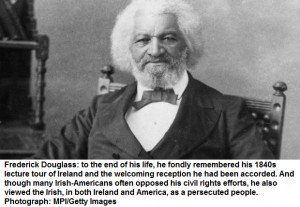
As we approach the 200th anniversary of the abolition of slavery in the British Empire, the same questions, regarding Black men and boys, are being raised again.

These questions are being revived because many, too many Black men and boys are not a part of the economic structure or the body politic. Upon close examination, it becomes clear that many of them are not in community with their ethnic group.

For the most part, Black men and boys live in isolation, better yet, they are marginalized. They find it difficult to connect with society in general and the significant persons in their lives in particular.

The spiraling  murder rate and other acts of violence (particularly against young men and the elderly), makes it clear, that many Black men and boys in the Caribbean, pose a serious and critical problem of interpersonal violence in every corridor and thoroughfare that Caribbean peoples and residents must cross. Consequently, Black men and boys in the Caribbean are feared, demonized and vilified.

When Frederick Douglass spoke in the late 19th Century, he raised the following crucial and defining questions:

  1. How does one protect a group from public dissection as if it existed as a mere aberration in the society?
  2. How does one create for that group a group concept so that it is able to sustain itself as a self-respecting group within (the Caribbean) a society, which views it as an aberration?

The answers to these questions must be sought as we search for a way out of the morass in which we, as a people, find ourselves.

The answers to these questions must be found; so that we can save our Black men and boys.

The answers to these questions must be found; so that we can free those Black men and boys who have become slaves to violence and crime. We must come to the realization that, that which impacts Black men and boys impacts all Caribbean people and those who reside among us.

The answers to these questions must be found as we continue to approach the 200th anniversary of the abolition of slavery.

Unless and until the answers to these questions are found, we will continue to be a people in a quandary.

There is a breach within the fabric of Caribbean society, which has led to a breach in the lives of Black Caribbean males. A serious attempt must be made to repair this breach at all cost.

All Caribbean people, who are concerned about the state of the Caribbean in general and the fate of the Black Caribbean male in particular, need to ponder, take to heart, and act upon Isaiah, chapter 58:9-12.

“Then you shall call and the Lord shall answer; you shall cry, and He will say, ‘Here I am.’ If you take away from the midst of you the yoke, the pointing of the finger, and speaking wickedness, If you pour yourself out for the hungry and satisfy the desire of the afflicted, then shall your light rise in darkness, and your gloom shall be as noon day. The Lord will continually guide you and satisfy your desire with good things. You shall be like a watered garden, like a spring of water whose waters fail not, and your ancient ruins shall be rebuilt. You shall raise up the foundations of many generations and you shall be called the repairer of the breach, the restorer of streets to dwell in.”

The message from Isaiah is powerful. It tells us that the only way to create a genuine community is to become repairers of the breach, restorers of safe streets in which to dwell.

Becoming repairers of the breach and restorers of the streets are the foundations for assisting Black men and boys who are in trouble to move from trouble, to engage their families and ultimately build solid citizens.

In this regard, all Caribbean people must become repairers of the breach and restorers of the streets. Our future depends upon it! It is the imperative of now!

There must be a regional response with respect to the issues confronting Black men and boys in the Caribbean. This is no time for throwing up our hands as a gesture of capitulation, (posing the useless question: “What is wrong with these young men?) and rolling our eyes. It is time for action…serious sustained, positive action!

Those who become engaged in this regional response must be individuals who are prepared to make a difference in the issues of Black men and boys in their communities. To this end, the Caribbean must move towards the establishment of a Regional Task Force on the State of Black Men and Boys in the Caribbean. This is the advocacy here-in. This Task Force is hereby branded the Thurston Foundation in honor of Charles Thurston (1910-1980), an influential community figure in the Bahamas and in the life of the author. He demonstrated the most effective and efficient training for “raising a boy in the way he must go” (Proverbs 22:6). According to scripture, “give men of that sort, double honor” – 1 Timothy 5:17

The work of the Thurston Foundation, as an NGO (Non-Government Organization), should and must be a joint venture between governments of Caribbean member-states and Corporate Caribbean.

The Thurston Foundation must be appointed post haste and without reference to political affiliation.

The Thurston Foundation must come from a broad spectrum of concerned citizens and residents from the public and private sectors.

While these persons should be qualified for the task at hand, the Thurston Foundation must be comprised of men, women and young persons who are committed to the task of repairing the breach and restoring the streets.

The purpose of the Thurston Foundation will be to provide ideas that Government, organizations and individuals in the Caribbean can use to change the lives of Black men and boys, change communities, and by extension change their nations.

The primary aim will be to create a long-term structure of sustained intervention for Black men and boys who find themselves in trouble. The emphasis of the Thurston Foundation will be on systemic change that will bring together a multiplicity of ideas in an effort to reduce violence and crime, thus making the Caribbean’ social life whole again.

The Thurston Foundation must not shape itself around the issue of violence. Violence, in the Caribbean, has been painted with a broad brush because Black men and boys are looked upon as the face of the violence.  This violence appears to have immobilized law abiding citizens into a state of panic and fear.

It must be understood by the Thurston Foundation that simplistic approaches and stereotypes are not the way forward in rendering assistance to men in general and boys in particular.

The Thurston Foundation must be mindful that there are other forms of violence that are the precursors of the violence that is perpetrated by some Black men and boys.  Among these forms of violence are violence of the heart, violence of the tongue, political violence, religious violence and racial violence. These forms of violence have created in some of our Black men and boys the culture of violence that the Caribbean is experiencing today.

The Thurston Foundation must understand that violence is a symptom of a deeper and pervasive problem. The members of the Thurston Foundation must understand that finding a cure or attempting to cure violence does not of itself cure anything.

Even though the question goes far beyond Black men and boys, it is directly related to our young men in particular and their inability to participate and develop within the body politic and the economic structure of the Caribbean.

Mindful of these broad concerns, the Thurston Foundation must seek answers to the following questions.

  • First: How do we bring relief and assistance to communities and families that are experiencing the great hurt and harm of violent behaviour?
  • Secondly: How do we find a way to reestablish community and make inroads into violent behaviour, the major social problem of the day? 
  • Thirdly: How do we expect to engage Black men and boys in constructive dialogue and participation within Caribbean society while, at the same time, refurbishing the image that has now been unfairly placed upon the entire population of Black men and boys?

These men and boys suffer as a consequence of media and political short-sightedness, stereotyping and the actions of those who commit violent acts without regard for society.  

The Thurston Foundation must endeavour to frame a public response to the Caribbean’s difficult policy issues regarding Black men and boys, while at the same time laying the groundwork for sustained approaches to put these issues to rest.

This could be accomplished by repairing the many breached relationships in our nation, communities and families. Members of the Thurston Foundation must acknowledge the fact that all of us have a role to play in the process of repairing the breach and restoring the streets.  By this inclusiveness, Black men and boys will be restored to their rightful places in the Caribbean.

The Thurston Foundation must give consideration to three broad areas, which can assist in the transformation of the Caribbean, and by extension Black men and boys.

  • The first of these is the human condition and human development. Consideration of the human condition and human development will give clarity to the common good as a working principle and establish a connection with one human to another.
    The idea of the human condition and human development embrace the concept of fair play, expanded opportunities and the necessity for each person to be able to contribute to development of the Caribbean.
  • Secondly, the ancient concept of polis states that members of a society have to honour their rights and responsibilities. One cannot have rights without responsibilities.
  • Thirdly, the concept of public works or the important contribution everyday people can make to the commonwealth, which is best exemplified (illustrated) by telling stories of common work, and celebrating our common life and heritage and our efforts in creating citizenship.

The concepts of the human condition and human development, polis and public works will provide the basic framework for the report of the Thurston Foundation.

The human condition and human development, polis and public work are the keys to strengthening families, restoring our streets to safety, and rebuilding civil societies in our communities.  These concepts must be embraced by communities, expanded upon, and put into practice in order to create safe havens for our children, the elderly, Caribbean people and residents generally.

The themes that should be detailed in the report of the Thurston Foundation should include polis, the common good, civic storytelling, grassroots civic leadership and restoring community institutions.

The concepts of the human condition and human development, polis and public work can be accomplished if civic, social, religious and professional organizations, as well as business, government and the philanthropic sector work together.

The Thurston Foundation should appeal to individuals and organizations to join in the effort to rescue the Caribbean and preserve it for all of its citizens and generations yet unborn.

The Thurston Foundation must see the need for wide ranging Regional Conversation and Dialogue if solutions are to be found.

As a part of this exercise, a Regional Conversation and Dialogue on Race, Ethnicity and Nationality must be a central part of the agenda. This is a major tool for assisting Black men and boys since public opinion is most vital when advocating change. Caribbean people can engage each other by learning to talk to each other and finding common cause.

This Conversation and Dialogue should take place over a period of several years. These facilitated discussions will begin with the Thurston Foundation members talking to neighbours, friends, peers and others in their homes, town halls, schools, churches and workplaces.

Boys and men in trouble or headed toward trouble have to decide for themselves that they wish to change. After all you can take a horse to water, but you cannot make it drink.

Men and boys must assume personal responsibility and be held accountable for their actions. Parents must be prepared to parent so as to give young men a chance to succeed.

This is the light in which the Thurston Foundation ought to frame its recommendations and responses. It is anticipated that this new way of looking at how to bring violence under control, to be repairers of the breach and restorers of the streets, brings with it a spiritual, a practical, a pragmatic and political element. All of these elements must work together if we are to create a better society for these men and boys and their families as well as for all Caribbean people.

In order to accomplish the goal of creating a better society for all stakeholders, there must be an integrated plan of action. For example, the loss of a social centre in some neighbourhoods, settlements and cities requires that all civic, social, religious and cultural organizations act with a sense of urgency to plan from the local to the regional levels, to study their individual areas jointly, to combine their efforts in programming, and to cooperate in long-range planning; so that damaged or lost infrastructure can be repaired or replaced. A coordinated approach to these activities will develop a sense of organized companionship toward the goal of restoring our social and economic future.

A general discussion of the goals, missions and aspirations of those affected will determine agenda building and planning. Our civic, social, religious, and cultural organizations must develop themselves into a working network. This would give impetus to a new Regional Dialogue, thus adding voices to existing organizations.  This new dialogue will focus on the bridges that must be built based on study and a sense of community mission.

The Thurston Foundation will have a life of eighteen (18) to twenty-four (24) months after which it will be expected to make its final report. There will be interim reports every six months.

The Thurston Foundation will be expected to make a number of recommendations in its interim and final reports.  These reports will be designed to keep the Government and people of the Caribbean abreast of its findings.

The information gathering meetings, of the Thurston Foundation, will be open to the general public, while its deliberative meeting will be held in private.

The recommendations of the Thurston Foundation will form the core of a ten (10) to twenty (20) year plan which will enable the Government and Corporate Caribbean to begin to assess and ameliorate the problems faced by Black men and boys in the Caribbean.

Discussion, of the issues laid out in this presentation, will go a long way in introducing the concept of polis, a comprehensive idea with respect to values, manners, morals, and etiquette that are required for structuring public life on both the social and political levels.

These areas present a broader and tougher vision of community.  The term community, as it is presently used, is indeed overused and has little meaning. It does not have the kind of force of intent that is now needed to rectify and restore our homes, communities and nation.

This concept, of repairing the breach and restoring the street, will give Black men and boys much more room to determine how they will participate actively in the social and political life of the Caribbean. They must not be alienated from a society that their parents, grandparents, and great grandparents helped to build and develop.

There is allowance made for a discussion about how one becomes a whole individual and citizen participating in Caribbean society under the rubric of both polis and community, and the dependent social contract that polis implies.

In order to commence addressing the many issues facing and surrounding Black men and boys in the Caribbean in the 21st Century and beyond, public policy and activity must become aligned with the work of the repairers of the breach and restorers of the streets.

🙂

———-
About the Author
Dr. Donald M. McCartney is a life-long educator and specialist in “Management and Organizational Leadership”. Though he is well-respected in his home country of The Bahamas – with success track records at every level of the education spectrum: K-12, Post-Secondary, Graduate and Post-Graduate – he has executed his professional vision throughout the Americas. He currently serves as an Adjunct Professor at Barry University in Miami Shores, Florida and Jose Maria Vargas University in Pembroke Pines, Florida.
Share this post:
, , ,

Legislating Morality – Yes, We Can

Go Lean Commentary

We have always heard: “No one can legislate morality”.

But truth be told, that is a fallacy. With the proper application of best-practices, we can legislate – pass laws – and change people’s attitudes and actions about habits and practices. Follow-up, messaging and enforcement is key! In modern society, we have seen this repeatedly in one community after another. Let’s examine … with the experiences with some common vices.

The book Go Lean…Caribbean – available to download for free – present numerous examples of advocates and their advocacies where they have labored to change their community (or nation) attitude and actions towards certain causes. The book addresses this whole subject under the topic of “community ethos”. This is defined as the fundamental character or spirit of a culture; the underlying sentiment that informs the beliefs, customs, or practices of society; dominant assumptions of a people or period. Think of the derivative term: “work ethic”.

Can we change community ethos?

Yes, indeed …

… but it is not easy; in fact the Go Lean book identifies the effort as heavy-lifting, but the movement behind the book volunteers for the task of executing change for the Caribbean.

The Go Lean book serves as a roadmap for the introduction and implementation of the technocratic Caribbean Union Trade Federation (CU), for the elevation of Caribbean society – for all member-states. This CU/Go Lean roadmap has these 3 prime directives:

  • Optimization of the economic engines in order to grow the regional economy to $800 Billion and create 2.2 million new jobs.
  • Establishment of a security apparatus to ensure public safety and protect the resultant economic engines.
  • Improve Caribbean governance to support these engines, including a separation-of-powers between the member-states and CU federal agencies.

We have seen changes to public morality: from bad to good; and from good to bad. We have seen the bad community ethos of “drunk driving” and “white supremacy” relegated to an “unbecoming” status in good citizenship. But we have also seen the good ethos of recreational drugs prohibition become accepted and demand for decriminalization and legalization. (In the US, Marijuana legalization is now the norm for 40 percent of the American population).

Change continues …

These changes have been duly documented by the movement behind the Go Lean book in these previous blog-commentaries:

https://goleancaribbean.com/blog/?p=13882 Managing ‘Change’ in California
https://goleancaribbean.com/blog/?p=12703 Lessons from Colorado: Legalized Marijuana – Heavy-lifting!
https://goleancaribbean.com/blog/?p=9646 ‘Time to Go’ – American Vices, i.e. Marijuana. Don’t Follow!
https://goleancaribbean.com/blog/?p=1386 Puff Peace – The Debate  for Marijuana in Jamaica

This is not just a phenomenon in the Americas; success in legislating morality have also been experienced in the Old Country; consider this European example in France.

Imagine the French and their affinity for Red Wine (Bordeaux), and Champagne and Cognac and Sherry … (There is also the traditions of the French Caribbean islands and their mastery of the rum eco-system). See Appendix VIDEO below.

These are export products for the Republic of France and indicative of the complex French culture. Yet, this country has legislated morality and reduce their alcohol consumption, by means of Evin Loi or Evan’s Law; see summary here from Wikipedia:

The loi Évin is the French alcohol and tobacco policy law passed in 1991. It takes its name from Claude Évin, then Minister of Health, who proposed it to Parliament. …

Before the law, French advertising laws discriminated against non-French producers. However, Scotch whisky producers challenged France in the European Court of Justice and won. France was condemned and required to change the law in 1980 but did not produce satisfactory legislation until 1991, with the enactment of Loi Evin, which affected both alcohol and tobacco policies. …

The provisions of the law reinforce the restrictions placed on tobacco and alcohol and their advertising by its predecessor Loi Veil (1976), legalising abortion. …

Alcohol advertisements are prohibited on television or in cinemas. The law requires strict control over messages and images and the inclusion in all advertisements of a message to the effect that alcohol abuse is dangerous to one’s health.

So this French law regulated alcohol advertising; advertising affected alcohol demand; so the end result on alcohol consumption are as reported in the following article:

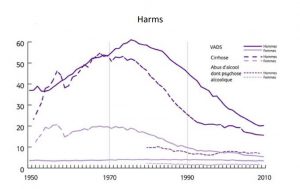
“It has had a huge impact on the consumption of alcohol in France,” says Dr Mick Loftus, the anti-drinks campaigner and a former president of the GAA. “In 1960, the average adult in France consumed 30 litres of alcohol. Today, that figure is down to 13.5 litres and it’s mainly thanks to Loi Evin.

See full article in Appendix below.

Related Article:
Alcohol policy in France – Between traditions and paradoxes
https://intra.tai.ee/images/eventlist/events/27-11-15-alkokonverents_4_Craplet.pdf

The movement behind the Go Lean book asserts that Caribbean community ethos can be changed; even further, that Caribbean societal defects can be assuaged. But before the strategies, tactics, implementations and advocacies of a roadmap to elevate a society can be deployed, the affected society must first embrace a progressive community ethos. This is where legislating morality becomes so important. Yes, we can effect change in our region.

The Go Lean book provides 370-pages of turn-by-turn instructions on “how” to adopt new community ethos, plus the strategies, tactics, implementations and advocacies to execute so as to transform the societal engines of Caribbean society, regarding a lot of matters of morality. The Go Lean book cites (Page 122) one particular example of an advocate campaigning to legislate America’s morality. See this quotation here:

Candice Lightner
Mothers Against Drunk Driving (MADD)
Ms. Lightner forged change in her country (United States) values and attitudes with her founding of this organization. She advocated change in attitudes, acceptance, laws and enforcement so that families would be spared the heartache she personally experienced with the tragic lost of her daughter to a drunk driver in the 1970’s. One woman made a difference!

The Go Lean book asserts that every community has bad actors – stemming from bad community ethos. There must be “new guards” to assuage any risks and threats in society. This point is pronounced early in the book with the Declaration of Interdependence (Pages 12 – 13) that claims:

x. Whereas we are surrounded and allied to nations of larger proportions in land mass, populations, and treasuries, elements in their societies may have ill-intent in their pursuits, at the expense of the safety and security of our citizens. We must therefore appoint new guards to ensure our public safety and threats against our society, both domestic and foreign. The Federation must employ the latest advances and best practices of criminology and penology to assuage continuous threats against public safety. The Federation must allow for facilitations of detention for [domestic and foreign] convicted felons of federal crimes, and should over-build prisons to house trustees from other jurisdictions.

xi. Whereas all men are entitled to the benefits of good governance in a free society, “new guards” must be enacted to dissuade the emergence of incompetence, corruption, nepotism and cronyism at the peril of the people’s best interest. The Federation must guarantee the executions of a social contract between government and the governed.

xvi. Whereas security of our homeland is inextricably linked to prosperity of the homeland, the economic and security interest of the region needs to be aligned under the same governance. Since economic crimes, including piracy and other forms of terrorism, can imperil the functioning of the wheels of commerce for all the citizenry, the accedence of this Federation must equip the security apparatus with the tools and techniques for predictive and proactive interdictions.

Societies change …

We have all seen it; think seat belts, smoking, high fat diets. Leaders can legislate change and morality. It works … eventually. There are heavy-lifting involved, like messaging and enforcement. But if the effort persists, the values, priorities and motivations of people in communities can transform, for the better or the worse. Let’s work for better!

The Caribbean wants (or should want) to be an elevated society; to be a better homeland and a better place to live, work and play. So we urged everyone in the region to lean-in to this roadmap for change, and to pay more than the usual attention to other communities and their developments and manifestations for change. Let’s study their successes and failures. 🙂

Download the free e-Book of Go Lean … Caribbean – now!

Sign the petition to lean-in for this roadmap for the Caribbean Union Trade Federation.

———

Appendix: Alcohol Action – Advocating to reduce alcohol harm in Ireland

Title: How To Tackle The Drink Link To Sport? Just Ask The French

We know it as the Heineken Cup, but in France they call European rugby’s leading club competition the H Cup.

And when Liverpool FC played there in the Europa Cup some years ago, they had to wear shirts free of their then sponsor Carlsberg.

These are just two examples of the very strict anti-alcohol policies that have been in place in France for more than two decades.

From Indpendent.ie

While Irish people are used to drinks companies sponsoring a diverse range of sports, music festivals and arts events, as well as extensive alcohol-related advertising across the media, a whole new generation in France has grown up never seeing a single drinks ad or attending an event sponsored by a drinks company.

It’s thanks to Loi Evin (Evin’s Law – named after the then health minister Claude Evin) and it has been a feature of life in France since 1991. Advocates keen to curb binge-drinking in this country believe it is a model that we should adopt.

“It has had a huge impact on the consumption of alcohol in France,” says Dr Mick Loftus, the anti-drinks campaigner and a former president of the GAA. “In 1960, the average adult in France consumed 30 litres of alcohol. Today, that figure is down to 13.5 litres and it’s mainly thanks to Loi Evin.

“If you go to France now, you’ll rarely see the sort of drink-to-get-drunk culture that’s so prevalent here. There, there isn’t the same emphasis on consuming alcohol in order to have a good time that’s long been the case in Ireland. The fact that alcohol is not associated with fun events like music festivals and sport has helped shift the perception French people have with alcohol. Generally speaking, drinking alcohol is seen as something to do with food.”

The origins of the law are rooted in old French protectionist polices of curbing the promotion of “foreign” goods in order to give their indigenous products an advantage.

UK drinks firms took the fight to European courts in the 1970s and ’80s, and French lawmakers were eventually forced to level the playing field by also banning the promotion of home-grown alcohol companies.

The ruling continues to outrage the country’s wine industry. “They treat us as if we were making a dangerous product,” Burgundy winemaker Pascale Chicotot told The New York Times. “We are not terrorists. Wine is not a dangerous product. Wine is a noble thing.”

Yet, anti-alcoholism advocates in France believe it is this very restriction that is helping to reduce consumption across the board. Leading campaigner Dr Alain Rigaud says Loi Evin has had a significant positive impact: “The law has been efficient in correcting excesses in the form and the content of advertising messages and it is essential for the implementation of an overall and coherent preventative effort.”

Yet, he contends that it is still too soon to gauge its full consequences.

“The effectiveness of the law on younger generations will not be felt for several decades,” he says.

Despite the restrictions, there is evidence of growing alcohol misuse among teenagers in France since Evin Law was introduced. A recent survey there shows a rise of 17pc in this age group who said they had consumed five or more drinks in one session in the previous 30 days.

It’s a problem that is causing French authorities considerable disquiet, especially as the 2009 ruling that raised the legal purchase age from 16 to 18 does not appear to have had an impact.

Meanwhile, some lobbyists who favour the retention of alcohol’s relationship with sport, argue that sponsorship simply gives one brand a competitive advantage over another but does not influence consumption trends.

“We analysed consumption, sponsorship spend and disposable income per head in all the major markets,” said the authors of a report on behalf of the Sponsorship Today consultancy.

“There was a very clear correlation between consumption and disposable income, but no clear pattern regarding sponsorship spend and consumption.

“In Germany, for example, beer consumption per capita is among the highest in the world, but sports sponsorship spending is comparatively low, whereas in Portugal sponsorship spend is high, but consumption is low. The findings are not definitive proof of no impact, but they add to the body of research that suggests that sponsorship is not a major contributory factor in increasing alcohol consumption.”

Mick Loftus does not agree.

“If we want to protect the health of our young people, we need to have a blanket ban on all promotion of alcohol, including the sponsorship of sports event and we should look to France for a model. We simply won’t be serious as a nation about coming to terms with our alcohol problem until we do that.”

Source: Alcohol Ireland – Posted June 2013; retrieved February 27, 2018 from: http://alcoholireland.ie/how-to-tackle-the-drink-link-to-sport-just-ask-the-french/

———

Appendix VIDEO – Is French Wine the Best in the World? | #WineWars | French Guy Cooking – https://youtu.be/4u_PRozZsWw 

Jamie Oliver – Drinks

Published on Jan 26, 2015 – Alex – AKA Food Tuber French Guy Cooking – enters the #WineWars ring to fight the corner for French wine. Alex thinks French wine is the best in the world – but is he right? In this video he shows us three of his favourite French wines – a red (J. Boutin Saint-Joseph), a white (Alsace Gewurztraminer) and a rosé (Coteaux du Cap Corse: Domaine Pieretti Rosé).

Which country do YOU think produces the best wine in the world?

Leave a comment and get involved on social media using the hashtag #WineWars.

Share this post:
, ,
[Top]

Wakanda Forever – Conceive, Believe and Achieve

Go Lean Commentary

Movies matter …

Though its fantasy, art and make-believe, they still have an image impact on modern life. This is the reality of all movies; even comic book hero movies.

After 10 years of the Marvel Cinematic Universe (MCU) – and 18 movies – it was time for the impact from/for people of African descent. It was time for the Black Panther movie…

… and the summary declaration from the movie’s critics and box office performance is a line from the movie:

Wakanda forever!

See the full story here:

Title: ‘Black Panther’ Tops $700M With Record-Breaking 2nd Weekend
By: Scott Mendelson , Contributor and Film Industry Analyst

Black Panther earned $108 million on its second Fri-Sun frame, a drop of just 46% from last weekend’s record-crushing $202m Fri-Sun opening. In terms of raw dollars, it is the second-biggest second weekend gross of all time between Universal/Comast Corp.’s Jurassic World ($106.5m) and Lucasfilm’s The Force Awakens ($149m). It has now earned $400m in ten days of release, which makes it the second-fastest grosser of all time (for now) behind only Jurassic World ($404m) and The Force Awakens ($540m). Even if you adjust for inflation, it’s still only behind Warner Bros./Time Warner Inc.’s The Dark Knight, Marvel’s The AvengersJurassic World and The Force Awakens among ten-day domestic totals.

It also joins fellow Walt Disney release The Force Awakens as the only other $200 million+ opener to avoid the “$100m-losers club,” as it fell only $94m between weekends. That 46% second-weekend drop is a record for an MCU flick, holding even better than Paramount/Viacom Inc.’s Iron Man (-49%), Paramount’s Thor (-47%), Walt Disney’s The Avengers (-50%) and Disney’s  Doctor Strange (-49%). Its $47 million Saturday (+66% from Friday) is the second-biggest “day 9” Friday ever behind The Force Awakens. Sure, it dropped more in weekend two than Wonder Woman (-43%) and Spider-Man (-38%), but the Disney tentpole is earning so much so quickly that it’ll be past Sony’s Spider-Man ($403m in 2002, sans 3D or IMAX) and WB’s Wonder Woman ($413m last year) in a matter of days.
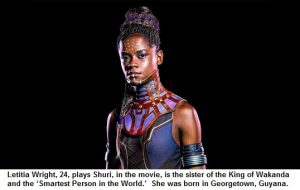

Once that happens, then Black Panther will be the third-biggest grossing solo superhero movie ever.  Once it gets past $413 million domestic, it’ll be behind only The Dark Knight Rises ($448m), Avengers: Age of Ultron ($458m), The Dark Knight ($534m) and The Avengers ($623m) among all superhero movies. Once it passes The Dark Knight (sans inflation), Black Panther will be the second-biggest superhero movie and the biggest solo superhero grosser ever in North America. Barring an unlikely comedown, Black Panther will end next weekend just past the $486m domestic total of Finding Dory to be the tenth-biggest North American earner ever and among the top 100 when adjusted for inflation.

Oh, and it may not stay ahead of The Last Jedi for very long. It had a (much) better hold and a larger overall second weekend, but Black Panther won’t have the advantage of Last Jedi’s post-Christmas weekdays. The Star Wars sequel made more on its second Mon-Thurs frame than its first. That’s somewhat normal for a big pre-Christmas release, which is why I wasn’t sounding the alarm bells after The Last Jedi dropped 67% in its second weekend. Now Black Panther may catch up yet again after next weekend, but we should note that The Last Jedi’s $620m domestic total isn’t remotely the bar for Black Panther’s success.

The only thing stopping Black Panther’s momentum is the sheer amount of “big” movies opening next month. And we’ll see just how big Red Sparrow, Walt Disney’s own A Wrinkle in Time (directed by Ava DuVernay and starring Storm Reid, natch), Tomb RaiderPacific Rim: Uprising (starring John Boyega) and Ready Player One turn out to be. Assuming Red Sparrow (which is pretty good but very much for adults and not remotely like Atomic Blonde or Mission: Impossible) doesn’t go crazy, then Black Panther will have at least the three weeks that The Avengers had to run the tables after Battleship and Dark Shadows bombed.

Age of Ultron had to deal with Mad Max: Fury Road and Pitch Perfect 2 in its third weekend, followed by Disney’s Tomorrowland over Memorial Day. Jurassic World ran into Inside Out on its second weekend and faced Minions in weekend four and Ant-Man in weekend five. Even Spider-Man had to contend with Star Wars Episode II: Attack of the Clones over its third frame. We know both that big movies can thrive alongside each other, and that a big and buzzy hit can hurt the competition. But there is something to be said for Black Panther getting relatively clear sailing for nearly a month.

That’s assuming A Wrinkle in Time breaks out, although I shouldn’t have to explain why many who worked on Black Panther will be rooting for A Wrinkle in Time even if it causes the MCU flick to take a big fourth-weekend drop. Heck, we could very well see a late March weekend where the top movies are (in random order) John Boyega’s Pacific Rim: Uprising, Alicia Vikander’s Tomb Raider, Storm Reid’s Wrinkle in Time, Chadwick Boseman’s Black Panther and Jennifer Lawrence’s Red Sparrow. It may be up to Ready Player One to prove that big-budget franchise flicks starring white male leads aren’t box office poison. But that’s a highly ironic conversation for another day.

With Japan and China still on tap, Ryan Coogler’s MCU action drama has already topped $300m overseas for a $704m global total. It should be just over/under $900m worldwide by the end of next weekend, and it has already topped the likes of Man of Steel, Logan and Justice League, with Captain Aor merica: The Winter Soldier ($714m) and The Amazing Spider-Man 2 ($709m) next in its sights. So, as noted above, Black Panther is well on its way to being the biggest solo superhero origin story/non-sequel ever. We’ll see if it can get past The Dark Knight ($1 billion), TheDark Knight Rises ($1.1b) and Iron Man 3 ($1.2b) to become Earth’s mightiest hero.

If you like what you’re reading, follow @ScottMendelson on Twitter, and “like” The Ticket Booth on Facebook. Also, check out my archives for older work HERE.

Source: Posted and retrieved February 25, 2018 from: https://www.forbes.com/sites/scottmendelson/2018/02/25/box-office-black-panther-tops-700m-with-record-breaking-2nd-weekend/#683907bb213f

For many people of color – the African Diaspora, Caribbean included – this movie is more than just a film, “it is an opportunity to reclaim a history that they have never seen”. These are the words of a Caribbean actor in the film, Winston Duke of Trinidad & Tobago; see his interview in the Appendix VIDEO below.

Caribbean actors?

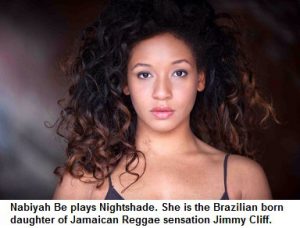
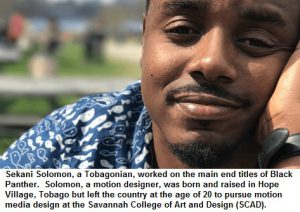
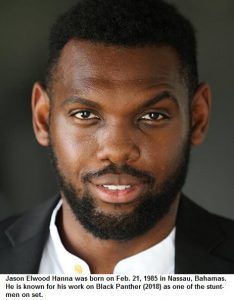
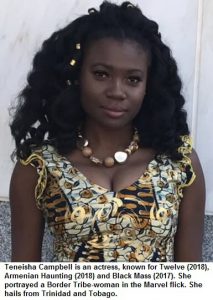
Indeed there are nine of them (actors, actresses, stunts and visual artists), as the story in the Appendix reports.

History not seen?

People of color in the New World have the same origin story…the African Slave Trade. Before this travesty, African society existed with proud culture and traditions among its many tribes. This movie assumes: what if a subset of the African people persisted undisturbed by European colonizers and fostered an advanced technological society. So cool!

That is Wakanda! This is a vision that all people of color can 1. conceive, 2. believe and 3. achieve. This is relevant for a Caribbean consideration as 29 of the 30 countries that caucus as the political Caribbean have a majority Black population. It is what it is! (The only exception is the French Caribbean territory of St. Bartholomew). This vision corresponds with the book Go Lean … Caribbean, which presents a roadmap to reform and transform the Caribbean member-states from our dysfunctional past so as to finally have a prosperous future.

Let’s consider these 3 verbs (conceive, believe and achieve) in relation to the Black Panther movie:

Conceive

This refers to the vision that was developed into comic books and now adapted into this record-breaking movie. Like other cultures around the world, African people also dream dreams, and envision heroes and saviors. In a prior blog-commentary, the Norwegian culture – Norse mythology – was examined in terms of hero story-telling with the movie Thor: Ragnarok.

(Recently, the much aligned president of the United States compared Norway to Africa; he inferred that Norwegian people and immigrants would be preferred to people from Africa – and Haiti – calling them “Shithole” countries).

So Marvel producing a Black-themed movie, with a Black Director and mostly Black cast members, set in Africa sends the message that “Africa and Africans” can produce heroes too. It is legitimate to conceive this vision.

This is the power of movies! They can impact the world by molding an image: positive or negative. This was highlighted in a previous blog/commentary regarding Caribbean Diaspora member and Hollywood great, Sidney Poitier, it stated:

“Movies are an amazing business model. People give money to spend a couple of hours watching someone else’s creation and then leave the theater with nothing to show for the investment; except perhaps a different perspective”.

This Black Panther movie does present some different perspectives. It highlight that the African Diaspora has been repressed worldwide, but it is possible to be heroic and overcome the obstacles facing our society. There is some “art imitating life” in these perspectives; the “art” of this movie does imitate the real life of African-descended people. This includes the Caribbean experience as well. Our history has clearly shown a repression in the societal engines, since the days of slavery right through colonialism. The “shackles” still remain, even today; there are many orthodoxy, and stupidity even, that persist in our Caribbean society and it will take heroic efforts to unseat. As portrayed in the Black Panther movie, there are different kinds of people who can all contribute heroically – in different kinds of ways – to help us reform and transform our society.

Believe

People are consuming this movie. People believe in the high principles of honor and pride that Wakanda stands for.

It had a record Box Office in Week 1. Plus, a record Box Office in Week 2. People believe! They have manifested this belief by their attendance and dollars.

See this portrayed in the VIDEO here.

VIDEO – DL Hughley Talks Black Panther Movie –  https://youtu.be/aQG7uNLp3Qs

DL Hughley

Published on Feb 19, 2018 – DL Hughley talks Black Panter Movie and its affect on our community. Family be sure to SUBSCRIBE LIKE AND FOLLOW me on all my social media. Thanks.

  • Category: Comedy
  • License: Standard YouTube License

In addition to believing that heroes can emerge from Africa, the Go Lean movement also believes that heroes can come from the Caribbean. The book asserts that one person can be a hero and impact their community, their country, the region and the whole world with their advocacy. The book details examples, samples and role models (Page 122), i.e. Frederick Douglass, Mohandas Gandhi, Dr. Martin Luther King, Nelson Mandela and Cesar Chavez.

Achieve

The movie Black Panther, is still just a movie. There is no expectation for a real Warrior-King to emerge from Wakanda.

But heroes can emerge from Black communities around the world and from Caribbean communities. Yes, we can achieve a hero’s journey for many of our citizen’s – residents and Diaspora.

This is the quest of the movement behind the book Go Lean … Caribbean, to achieve …

… to reform and transform the Caribbean member-states from our dysfunctional past so as to finally have a prosperous future. There are lots of lessons for us to consider; some from unusual places; consider the art world / comics book / film world.

As related previously, the edict of “life imitating art and art imitating life” provides a lot of teaching moments for the world in general and the Caribbean in particular. There is a lot we can learn from the art form of film and this newest blockbuster movie Black Panther. (The film has grossed over $700 million in US box office receipts after these first 2 weekends).

For Caribbean life to imitate this art – the Black Panther movie is a product of Caribbean art and artists too (Appendix) – our quest must be to elevate the societal engines so that Caribbean people can prosper where planted here in our region. How?

The Go Lean movement seeks to engage Caribbean heroes; the book serves as a roadmap to introduce the technocratic Caribbean Union Trade Federation (CU) to elevate the region’s societal engines – economics, security and governance – of the 30 Caribbean member-states. In fact, the prime directives of the roadmap includes the following 3 statements:

  • Optimize the economic engines in order to grow the regional economy to $800 Billion & create 2.2 million new jobs.
  • Establish a security apparatus to ensure public safety and protect the resultant economic.
  • Improve Caribbean governance to support these engines, including a separation-of-powers between the member-states and CU federal agencies.

Early in the Go Lean book, in the opening Declaration of Interdependence (Page 12), the point is made for the need for Caribbean heroes and heroics; it claims:

x. Whereas we are surrounded and allied to nations of larger proportions in land mass, populations, and treasuries, elements in their societies may have ill-intent in their pursuits, at the expense of the safety and security of our citizens. We must therefore appoint “new guards” to ensure our public safety and threats against our society, both domestic and foreign. The Federation must employ the latest advances and best practices … to assuage continuous threats against public safety.

xi. Whereas all men are entitled to the benefits of good governance in a free society, “new guards” must be enacted to dissuade the emergence of incompetence, corruption, nepotism and cronyism at the peril of the people’s best interest. The Federation must guarantee the executions of a social contract between government and the governed.

xii. Whereas the legacy in recent times in individual states may be that of ineffectual governance with no redress to higher authority, the accedence of this Federation will ensure accountability and escalation of the human and civil rights of the people for good governance, justice assurances, due process and the rule of law. …

xvi. Whereas security of our homeland is inextricably linked to prosperity of the homeland, the economic and security interest of the region needs to be aligned under the same governance. Since economic crimes, including piracy and other forms of terrorism, can imperil the functioning of the wheels of commerce for all the citizenry, the accedence of this Federation must equip the security apparatus with the tools and techniques for predictive and proactive interdictions.

xxxiii. Whereas lessons can be learned and applied from the study of the recent history of other societies, the Federation must formalize statutes and organizational dimensions to avoid the pitfalls of communities [and] … implement the good examples learned from developments [and] communities …

The Go Lean book describes the need for the Caribbean to appoint “new guards” to effect the necessary empowerments in the Caribbean. We need these “new guards” for our economic, homeland security and governing engines to better prepare our systems of commerce and to protect our homeland from threats and risks, foreign and domestic. The book therefore provides 370-pages of detail instructions of strategies, tactics, implementations and advocacies to achieve the needed societal elevation.

Only then, can we prosper where we are planted.

So we have conceived.

We believe …

Now, let’s achieve our objectives, according to this Go Lean roadmap. The urging here is not fantasy, not just “life imitating art”, but rather a visual demonstration of how our heroism can manifest; how we can make the Caribbean a better place to live, work and play.

We urge all Caribbean stakeholders to lean-in for the empowerments described here in the book Go Lean…Caribbean.

Wakanda forever! 🙂

Download the free e-book of Go Lean … Caribbean – now!

Sign the petition to lean-in for the roadmap for the Caribbean Union Trade Federation.

———

Appendix VIDEO – ‘Black Panther’ Star Winston Duke on Wakanda’s Warriors – http://www.imdb.com/list/ls025849840/videoplayer/vi1664202777

Winston Duke reveals the tradition behind his devastating fighting style in ‘Black Panther,’ and reflects on Ryan Coogler’s unique directing style.

———

Appendix – Caribbean Well Represented In Marvel’s Black Panther Movie

By: Karibbeankollective

Unless you’ve been living under a rock, you would know that the most anticipated movie of the year made it’s US premiere last night to the delight of comic book fans everywhere. Black Pantherheralded as a game changer for Africans in film has a pretty impressive lineup of Hollywood favorites including Chadwick Boseman, Michael, B. Jordan, Lupita Nyong’o, Danai Gurira, Martin Freeman, Forest Whitaker , Andy Serkis and Angela Bassett. Holly-wood big names aside, do you know who was all up and through that film? Caribbean people. From the Bahamas all the way down to Guyana and we are here for every bit of it.  Here’s the cast that’s about to fill you with so much Caribbean Pride:

Source: Posted February 17, 2018; retrieved February 25, 2018 from: https://www.thekaribbeankollective.com/caribbean-actors-black-panther-winston-duke-trinidad-tobago/

Share this post:
, , ,
[Top]

Forging Change: Soft Power – Clean-up or ‘Adios Amazon’

Go Lean Commentary

Speak softly and carry a Big Stick – West African Proverb pronounced by the 26th US President, Theodore Roosevelt

Speak softly and carry a Big Payroll – Modern New Twist 

Welcome to the concept of “soft power” … 2018 style.

There are a number of ways to forge change on a society; military power or hard power is perhaps the most effective. “Leading by the sword” is not in dispute. Anyone willing to protect their life, family and property will comply. But leading by Money Matters is also extremely effective. The prospect of acquiring money or losing money can be a great motivation. This “soft power” is now emerging as the preferred way to forge change on society. We are seeing clear choices presented to different communities:

Clean-up your societal defects or else … face the loss of some economic bonanza.

This is the situation right now in Atlanta, in the US State of Georgia. The issues are so blatant that it is bordering on a “soft power” reality.

Soft power is the ability to attract and co-opt, rather than by coercion (hard power), which is using force or giving money as a means of persuasion. Soft power is the ability to shape the preferences of others through appeal and attraction. A defining feature of soft power is that it is non-coercive; the currency of soft power is culture, political values, and foreign policies. – Source

“Hard power” = involuntary; “soft power” = voluntary.

See the full article here, wherein the Big Tech firm Amazon is weighing Atlanta’s values and community ethos to attract or repel Amazon to consider that location for their Second Headquarters and 50,000 high-paying jobs. See the story here:

Title: ‘Adios Amazon:’ Tech giant sparks Georgia Capitol debate
By:
 Ben Nadler, Associated Press

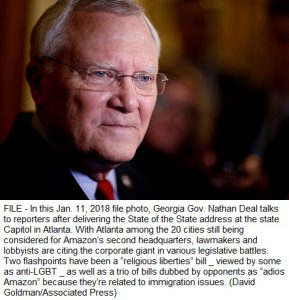
ATLANTA (AP) — With Atlanta among the 20 cities on the short list to become the home of Amazon’s second headquarters, the corporate giant’s name has become a contentious rallying cry inside the conservative Georgia Capitol.

Lawmakers and lobbyists in Georgia are viewing various pieces of legislation through the lens of how they will affect the city’s chances of winning Amazon’s business — and the estimated 50,000 jobs expected to be generated by the new headquarters.

Two flashpoints have been a “religious liberties” bill — viewed by some as anti-LGBT — as well as a trio of bills that opponents have dubbed “adios Amazon” because they’re related to immigration issues.

“It’s putting a target on our back,” Democratic Rep. Bee Nguyen said of the immigration-related bills, which she said would draw unnecessary scrutiny from the Amazon selection committee.

Amazon has yet to publicly release specific criteria it will use to judge the 20 finalist cities, but its initial call for proposals lists “Cultural Community Fit” as a priority, noting it requires a community with a “diverse population.” Amazon founder and CEO Jeff Bezos is a big-time donor to pro-LGBT causes and has given large amounts of money to fund scholarships for young immigrants.

The potential cost of legislation perceived to be discriminatory can be huge. North Carolina faced months of scrutiny and criticism after the passage of its “bathroom bill,” which effectively blocked the city of Charlotte from allowing transgender people to use restrooms aligned with their gender identity. An Associated Press analysis revealed backlash to the law would cost the state an estimated $3.76 billion over 12 years in business lost from Paypal, the NBA, Adidas, Deutsche Bank and other companies and organizations scuttling planned projects and events in the state.

But some lawmakers are skeptical that state legislation would have any effect on Amazon’s selection.

“It is a smart tactic to create this boogeyman of, ‘Oh, we are going to lose out on economic development,'” Republican Sen. Josh McKoon said. He said there was “zero evidence” that conservative policies make a state less likely to attract employers like Amazon and that state legislators should not be swayed by out-of-state companies that may not share the same values as the people of Georgia.

“Perhaps we should just have their board of directors come down and sit in our seats in the House and Senate,” McKoon said sarcastically.

McKoon is a sponsor of a resolution that would prevent the state government from issuing written driving tests and other official documents in any language other than English. That is one of three measures that opponents have dubbed “adios Amazon” legislation. The other two measures would require a special driver’s license for non-U.S. citizens and would tax out-of-state wire transfers, which are widely used by immigrants.

McKoon is also a supporter of another piece of controversial legislation that some people worry could derail Atlanta’s bid: a “religious liberties” bill that opponents say would allow individuals to deny services to LGBT people based on their religious convictions.

Republican Gov. Nathan Deal vetoed a similar measure in 2016 after pressure from corporate giants including Coca-Cola, a major employer based in Atlanta. But conservative legislators are pushing the measure forward again this year.

The veto highlights another important aspect of the Amazon debate: It’s not just Republican vs. Democrat.

In the run-up to November’s elections, conservative Republican legislators are pushing hot-button social issues that can win votes in rural parts of the state. But the party’s more centrist, business-friendly arm is worried that could turn off Amazon by seeming to be anti-immigrant or anti-LGBT.

Republican Sen. Michael Williams, who is running for governor, said in a statement to The Associated Press that he supported the “religious liberties” bill because his constituents support the measure. “I’ve made it clear that I’m not beholden to the establishment, Party leadership or big corporate,” Williams said.

But Republican House Speaker David Ralston told WABE Radio that he was interested in “growing economic opportunity for every part of Georgia” and that legislation such as the “religious liberties” bill didn’t fit into that plan.

“To the extent that any debate … creates headwinds for that, then I don’t have any interest in doing that, frankly,” he said.

William Hatcher, associate professor in the Department of Social Sciences at Augusta University, said that many of the bills being introduced will appeal to conservative voters, even if they don’t have much chance of becoming law. “There is a lot of symbolic politics going on,” Hatcher said.

“It really represents the conflict you have in the Republican party nationwide, but especially in a number of Southern states … between more economic conservatives and more social-religious conservatives,” he said.

Copyright 2018 The Associated Press. All rights reserved. This material may not be published, broadcast, rewritten or redistributed.

Source: US News & World Report – Posted February 13, 2018; Retrieved February 21, 2018 from: https://www.usnews.com/news/best-states/georgia/articles/2018-02-13/adios-amazon-tech-giant-sparks-georgia-capitol-debate

As related in the foregoing, Amazon HQ2 and the accompanying 50,000 high-paying jobs is the prize. Want it? Well, it will cost you! You have to … be nice.

You have to live … and let live.

This heavy-lifting burden is the price of the ticket … for consideration. Amazon has announced that their Selection Committee will be looking at cities with a “‘Cultural Community Fit’ as a priority, noting it requires a community with a ‘diverse population’.”

Wow, what an expensive price to pay. People in cities like Atlanta actually have to clean-up their societal engines; they have to try and get along or Amazon will not consider them. Plus, Amazon is only considering 1 city, so if a community double-downs on the effort to forge a pluralistic democracy – fair treatment to all despite diverse backgrounds and lifestyles – and they are not selected by Amazon, then they would have loved their neighbors … for nothing.


How sad! This satirical comment is the height of sarcasm, but true!

Companies prefer to inhabit a peaceful, prosperous community and they are willing to “put their money where their mouth is” to forge such communities. The business axiom is fully established: “Happy home life; happy work life”.

So as demonstrated here, the people of Atlanta are being urged to clean-up their society of all past bias, discriminatory practices and abusive behavior – towards minority groups – and there might be a BIG cash pay-out in the end. This is the premise of this recent series of blog-commentaries – from the movement behind the book Go Lean … Caribbean – considering the momentum that Money Matters can have on forging change in the 3 societal engines of a community – economics, security and governance. The conclusion was that it is so much easier to lead and get people to voluntarily follow – to lean-in – through economic means rather than by any security and governing directives. Atlanta – a major Southern city with the de jure segregation past and a de facto segregation present – had been under pressure to widen out its inclusion. (See Appendix VIDEO below). Now with the stakes of 50,000, jobs they are now more willing to capitulate.

This commentary follows up from the 5-part series in consideration of these Money Matters. The other commentaries in the series were cataloged as follows:

  1. Leading with Money Matters: Follow the Jobs
  2. Leading with Money Matters: Competing for New Industries
  3. Leading with Money Matters: Almighty Dollar
  4. Leading with Money Matters: As Goes Housing, Goes the Market
  5. Leading with Money Matters: Lottery Hopes and Dream

All of these previous commentaries related “how” to persuade the Caribbean region’s stakeholders to follow an empowerment roadmap. It is logical to conclude that if we “dangle money in front of our subjects”, we will get their attention; they will buy-in and lean-in because Money Matters.

There is no greater motivation than a crying baby – when hunger sets in and there is no economic solution for food, parents are willing to put aside their prejudices; they would do so willingly. Is it the desperation or is it a learning curve? We have seen the desperation, time and again. We have seen people risk their lives, and that of their children, to seek refuge; think Haiti, Cuba, etc..

The book Go Lean…Caribbean – available to download for free – declares that Caribbean society is in such dire straits, we are flirting with Failed-State status; we are at the precipice.

If people are money motivated – and they are – then economic incentives should work.

The book serves as a roadmap for the introduction and implementation of the technocratic Caribbean Union Trade Federation (CU), for the elevation of Caribbean society – for all member-states. This CU/Go Lean roadmap has these 3 prime directives:

  • Optimization of the economic engines in order to grow the regional economy to $800 Billion and create 2.2 million new jobs.
  • Establishment of a security apparatus to ensure public safety and protect the resultant economic engines.
  • Improve Caribbean governance to support these engines, including a separation-of-powers between the member-states and CU federal agencies.

Is the situation in Atlanta political or economic? (See Appendix VIDEO below). Politically in Georgia, the state is normally considered a RED state – social-religious conservatives – a Republican stronghold; but Republicans are normally also pro-business. Thusly, this conflict exists … in the Republican party nationwide, but especially in many Southern states … between more economic conservatives and more social-religious conservatives.

“Can’t we all just get along?” – Rodney King 1994

We can all get along … when 50,000 jobs hang in the balance.

The Go Lean book stresses this point; that reforming and transforming the Caribbean societal engines is easier when economic benefits are the result. To be successful in our region, we must leverage our regional economy and collaborate on regional solutions. See this portrayal early in the book, as pronounced in the opening Declaration of Interdependence (Pages 12 – 13):

xi. Whereas all men are entitled to the benefits of good governance in a free society, “new guards” must be enacted to dissuade the emergence of incompetence, corruption, nepotism and cronyism at the peril of the people’s best interest. The Federation must guarantee the executions of a social contract between government and the governed.

xvi. Whereas security of our homeland is inextricably linked to prosperity of the homeland, the economic and security interest of the region needs to be aligned under the same governance. Since economic crimes … can imperil the functioning of the wheels of commerce for all the citizenry, the accedence of this Federation must equip the security apparatus with the tools and techniques for predictive and proactive interdictions.

xxiv. Whereas a free market economy can be induced and spurred for continuous progress, the Federation must install the controls to better manage aspects of the economy: jobs, inflation, savings rate, investments and other economic principles. Thereby attracting direct foreign investment because of the stability and vibrancy of our economy.

The Go Lean book provides 370-pages of turn-by-turn instructions on “how” to adopt new community ethos, plus the strategies, tactics, implementations and advocacies to execute so as to reboot, reform and transform the societal engines of Caribbean society.

So religious conservatives are less tolerant of diversity…

The only thing to transcend it – forge change – is The Almighty Dollar

This thought of ‘forging change’ is a common theme by this Go Lean movement. See the full catalog here of this one, plus the previous 10 blog-commentaries that detailed approaches for forging change, in reverse chronological order:

  1. Forging Change – Soft Power (Today: February 21, 2018)
  2. Forging Change – Collective Bargaining (April 27, 2017)
  3. Forging Change – Addicted to Home (April 14, 2017)
  4. Forging Change – Arts & Artists (December 1, 2016)
  5. Forging Change – Panem et Circenses (November 15, 2016)
  6. Forging Change – Herd Mentality (October 11, 2016)
  7. Forging Change – ‘Something To Lose’ (November 18, 2015)
  8. Forging Change – ‘Food’ for Thought (April 29, 2015)
  9. Forging Change – Music Moves People (December 30, 2014)
  10. Forging Change – The Sales Process (December 22, 2014)
  11. Forging Change – The Fun Theory (September 9, 2014)

As related in these commentaries, forging change is how the Go Lean roadmap will make our Caribbean homeland a better place to live, work and play. Change will come! One way or another, so we urge every Caribbean stakeholder to lean-in and embrace the change … as envisioned in this roadmap to elevate the societal engines of the region. 🙂

Download the free e-book of Go Lean … Caribbean – now!

Sign the petition to lean-in for this roadmap for the Caribbean Union Trade Federation.

————

Appendix VIDEO – Atlanta: a segregated city – https://youtu.be/oeIntCp8EgQ

Vivien Morgan
Published on Apr 19, 2017 – The suburbs of Atlanta stretch for miles around the city centre. The affluent black middle classes have chosen residential segregation. It is a strange phenomenon in the city known for its black consciousness roots, birthplace of Martin Luther King and the civil rights movement.


Share this post:
, , , ,
[Top]

Leading with Money Matters – Lottery Hopes and Dreams

Go Lean Commentary

There is no doubt that gambling is a bad vice, but can a little gaming be tolerated in society?

There are parallels:

  • There is no doubt that alcoholism is vice-full,  but can social consumption be tolerated in society?
  • There is no doubt tobacco smoking is a dangerous habit, but can some cigarette or the world’s best cigars be good for Caribbean society?

Gambling, mildly permitted can be tolerated and even beneficial for society. Think State Lotteries …
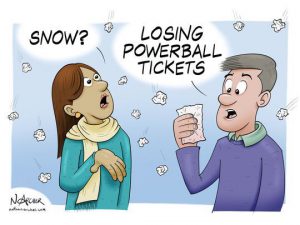

When the jackpot gets huge – millions, tens of millions, hundreds of millions – a lottery can inspire Hope and Dreams. It can even lead people, influence them, steer them to do and act accordingly. Yes, the Hope and Dreams of a Lottery Jackpot, like all other Money Matters, can lead people to a new destination.

Let’s use this power to inspire good, as in Hope and Dreams for our society. Consider this American model; see article here:

Title: Powerball and Mega Millions: What you need to know

By: Chris Sims and Channing King, IndyStar

The Mega Millions and Powerball jackpots now total more than $950 million combined after Wednesday’s drawing failed to produce a winner.

And this stretch is the first time that both multi-state lottery grand prizes have been at more than $400 million each. That makes Saturday’s Powerball $550 million jackpot potentially the eighth largest lottery prize ever and Friday’s Mega Millions $418 million pot potentially the 16th largest lottery prize.

The winning numbers for Wednesday night’s Powerball drawing were 2, 18, 37, 39, 42 and the Powerball was 12. The Power Play number was 3.

Wednesday’s Powerball jackpot worth $460 million was the game’s seventh largest and 10th largest for all lottery games in the United States, according to Dennis Rosebrough, public relations director for the Hoosier Lottery.

► Jan. 3: No one wins Powerball, Mega Millions drawings
► Jan. 2: Happier new year: $800 million in jackpots await lucky winners
► Dec. 31: Will you hit it rich in 2018 with soaring lottery jackpots?

Tuesday’s Mega Millions drawing would have netted a winner $361 million jackpot.

Here’s what you need to know if you play Powerball or Mega Millions:

What is a winning ticket worth?

The Powerball jackpot now stands at $550 million for Saturday’s drawing, payable in 30 annual installments, with a one-time cash option of $347.9 million before taxes.

The Mega Millions grand prize is $418 million for Friday night’s drawing with a cash value of $261 million before taxes.

► Dec. 30: What to do if you win the lottery in 2018
► Nov. 16: North Carolina woman wins lottery twice in one day

No matter how a winner chooses to go, lottery prizes that hefty are taxed as ordinary income and put a winner in the highest tax bracket. So that’s $128.7 million for the feds right off the top of that Powerball lump sum, not counting state and local taxes.

One benefit of winning now vs. last year: The new federal tax cut will allow the winner of Saturday’s Powerball jackpot who chooses the one-time cash option to keep about $9 million more for himself.

When are the drawings? 

Powerball numbers are drawn at 10:59 p.m. ET every Wednesday and Saturday. Mega Millions numbers are drawn at 11 p.m. every Tuesday and Friday.

Find out where to watch the drawings on your local TV station by heading to your state lottery’s webpage. (Sorry, Alabama, Alaska, Hawaii, Mississippi, Nevada and Utah; you can’t play unless you cross state lines.)

If you’d rather look online, Powerball’s drawing is streamed here; some websites offer live streaming video of Mega Millions drawings, and Mega Millions’ official YouTubechannel posts its video soon after the live event.

Odds of winning

The odds of buying a winning Powerball ticket are 1 in 25. The odds of hitting the jackpot are 1 in more than 292 million. The odds of becoming a millionaire by matching five numbers is 1 in more than 11.5 million.

Mega Millions’ odds of winning overall are a little better at 1 in 24. However, the odds of winning the grand prize are 1 in more than 302.5 million. A shot at matching five numbers for a $1 million is 1 in more than 12.5.

You have a better chance of achieving sainthood than winning either grand prize, 1 in 20 million, according to Gregory Baer, author of Life: The Odds.

How much does it cost to play?

Powerball and Mega Millions tickets sell for $2 each.

Powerball players can add Power Play for an extra $1 per ticket for a chance to multiply a non-jackpot prize up to five times.

Mega Millions players can purchase the Megaplier for an extra $1 a ticket for a chance to multiply a non-jackpot prize up to five times.

If you win …

Rosebrough recommends that players sign and secure their ticket. Winners should call the number on the back of their ticket when they are ready to claim their prize.

“First, you should pause and take a deep breath,” Rosebrough said. “Then, our experience with past winners says you should consult with some experts whether they be accounting, legal or whatever if you have a major prize.”

Rosenbrough has been impressed with most Indiana winners. Most have had a plan in place before they attempt to receive the money.

How long before you get paid?

Both Powerball and Mega Millions officials transfer the money from a central depository of all districts selling tickets — that includes 44 states, the District of Columbia, Puerto Rico and the U.S. Virgin Islands for Powerball; Mega Millions sells in all of those places except Puerto Rico — to respective state lotteries within 24 to 48 hours, Rosenbrough said.

However, the transfer sometimes can take longer because of things such as long holiday weekends.

Follow Chris Sims and Channing King on Twitter: @ChrisFSims and @ChanningKing

Source: USA Today Newspaper Website – Published, Jan. 4, 2018; retrieved February 20, 2018 from: https://www.usatoday.com/story/money/nation-now/2018/01/04/powerball-mega-millions-need-know/1002979001/

As related in the foregoing, this discussion does have a Caribbean footprint, as Powerball is featured in Puerto Rico and the U.S. Virgin Islands; though ‘Mega Millions’ sells only in the Virgin Island. So our Caribbean people can have lottery hopes and dreams.

Here’s to the losers , bless them all – Song by legendary crooner Frank Sinatra

Everybody will lose at these games, except one of two persons … maybe.

VIDEO – Why you wouldn’t win the lottery – https://www.usatoday.com/videos/money/2018/01/03/why-you-wont-win-lottery/109119580/

Posted January 3, 2018 – The odds of winning the Mega Millions jackpot are 1 in more than 302 million. You have a better chance at all these other extraordinary things. USA TODAY

Add among the list of losers: existing gaming establishments – Atlantic City, New Jersey is now a failing business model – horse racing and dog racing tracks, Jai Lai frontons and other pari-mutuels. There are only limited casino models that now work, mostly regional establishments – think Las Vegas, Mohegan Sun in Connecticut, etc. – with abundant entertainment options. Even in the Caribbean, more and more casino resort amenities are failing to lure guests and gamers.

Yes, the lottery eco-system spins many losers, but there are winners too: the State Governments and their designated beneficiaries. In some states, like Florida, the State Legislature guaranteed in statues that all monies – after prizes and overhead expenses – will go to education. Other states supplement education with other causes, like Elder-Care in Pennsylvania.

The foregoing news article and VIDEO aligns with the book Go Lean…Caribbean, which calls for the elevation of Caribbean economics. The book clearly states that gambling is a losing proposition, but concedes to the economic realities: if people will spend their money on gambling, then the structures should be put in place to limit and regulate these activities – see the Appendix below – this will minimize the vice-full effects on society and maximize the returns to the Greater Good. (This Greater Good was defined by Philosopher Jeremy Bentham – lived from 1748 to 1832 – as the “greatest good to the greatest number of people which is the measure of right and wrong”.

This commentary is the final part, 5 of 5 in a series from the movement behind the book Go Lean … Caribbean in consideration of Money Matters for leading the Caribbean down a different path from their status quo. The other commentaries in the series are cataloged as follows:

  1. Leading with Money Matters: Follow the Jobs
  2. Leading with Money Matters: Competing for New Industries
  3. Leading with Money Matters: Almighty Dollar
  4. Leading with Money Matters: As Goes Housing, Goes the Market
  5. Leading with Money Matters: Lottery Hopes and Dreams

All of these commentaries relate to “how” the stewards for a new Caribbean can persuade the region stakeholders to follow this empowerment roadmap for the region. The series has already establish that if we “dangle money in front of our subjects”, they will respond and react. Now, imagine dangling a big Lottery Jackpot – millions, tens of millions, hundreds of millions.

The book Go Lean… Caribbean, serves as a roadmap for the introduction and implementation of the technocratic Caribbean Union Trade Federation (CU) with the charter to effectuate change in the region with these 3 prime directives:

  • Optimization of the economic engines in order to grow the regional economy to $800 Billion and create 2.2 million new jobs.
  • Establishment of a security apparatus to protect the resultant economic engines and marshal against economic crimes.
  • Improve Caribbean governance to support these engines.

Early in the book, the responsibility to monitor, manage, and mitigate the risks and threats on Caribbean societal engines were identified as an important function for the CU. The plan therefore includes provisions for a regional lottery, even declaring the possibility of 2,500 direct new jobs from the ventures (installing, maintaining merchant network & administrative staff). The opening Declaration of Interdependence (Pages 13) stressed this model:

xxvi.  Whereas the Caribbean region must have new jobs to empower the engines of the economy and create the income sources for prosperity, and encourage the next generation to forge their dreams right at home, the Federation must therefore foster the development of new industries… In addition, the Federation must invigorate the enterprises related to existing industries like tourism, fisheries and lotteries – impacting the region with more jobs.

This commentary have previously looked at the vices of society – marijuana, cigars and rum – and prepared sober plans for managing change, risks and threats to Caribbean society. Consider this sample of earlier Go Lean blogs:

https://goleancaribbean.com/blog/?p=13882 Lessons Learned from Managing Marijuana Laws in California
https://goleancaribbean.com/blog/?p=12703 Lessons from Colorado: Legalized Marijuana – Heavy-lifting!
https://goleancaribbean.com/blog/?p=9646 ‘Time to Go’ – American Vices. Don’t Follow!
https://goleancaribbean.com/blog/?p=6680 Vegas Casinos Place Bets on Video Games
https://goleancaribbean.com/blog/?p=2887 Caribbean community must work together to address rum subsidies
https://goleancaribbean.com/blog/?p=1847 Caribbean Cigars – Declared “Among the best in the world”
https://goleancaribbean.com/blog/?p=1386 Marijuana in Jamaica – Puff Peace

The Go Lean book provides 370 pages of detailed instructions regarding the community ethos needed to effect change and empowerment in the societal engines. Lotteries will create a stark contrast for member-states to reconcile. In the past,they told their citizens to work hard, live a clean life and they will prosper where planted in the Caribbean region. Now the message changes to “Buy a Ticket; Get Rich Quick”. This transformation requires the right messaging, plus the executions of the required strategies, tactics, implementations and advocacies to shepherd these societal engines. One particular advocacy in the book relates directly to a regional lottery (Page 213); consider some of the specific plans, excerpts and headlines from that advocacy in the book:

10 Ways to Impact the Lottery

1 Lean-in for the Caribbean Single Market
This treaty allows for the unification of the region into one market, thereby expanding to an economy of 26 countries, 42 million people and a GDP of over $800 Billion (per 2010). The Trade Federation will function as a government “proxy”, a multi-national corporation to deliver the services for an integrated administration. The CU will generate revenues from its own sources, like a lottery, by developing and harvesting regional eco-systems for efforts too big for just one state. The CU is also the sole authority for Self Governing Entities, bordered sites, where lottery tickets can be sold & cashed.
2 Caribbean Dollars Only

The CU Lottery will transact in Caribbean Dollars, not US dollars, UK pounds nor Euros. This way the financial benefit and economic multiplier remains in the region. Consider this UK model: 12% of revenue proceeds go to the State Government, 5% goes to lottery retailers, 4% to Lottery operations, and the remainder (over 50%) paid out in winnings.

3 Powerball / Mega-Millions Models – where even the Retailers share in the Winnings

The CU will model the Caribbean Regional Lottery after the American examples of Powerball and Mega-Millions. These multi-state systems have melded ideally with state counterparts, by incentivizing more gaming due to extra large jackpots tied to more players. Most people, gamblers or not, have no qualms wagering $1-to-$2 on “surreal” jackpots.

4 Education as a Beneficiary

A lottery will be a “tough sell”, unless it’s for the greater good. Education as the beneficiary is the “winning” argument that has worked in some jurisdiction. In fact, in Florida, the Lottery Referendum failed to win majority support many times, until it was aligned with the state’s educational initiatives. Then it passed…overwhelmingly.

5 Elder-Care as a Beneficiary

Not everyone in a jurisdiction, (childless/empty-nesters), care about educational benefits. Pennsylvania-USA aligned their lottery operations to benefit Elder-Care. This too, is a winning inducement, as everyone hopes to be old someday.

6 Cooperation with National Lotteries

The CU’s Lottery will co-exist with State Lotteries, by not deploying CU scratchcard games. Jamaica, Trinidad, Aruba and St. Lucia have successful programs; the US Virgin Islands and Puerto Rico have US Dollar lotteries plus Powerball / Mega-Millions. The USVI Lottery is also a member of an existing small Caribbean Lottery with other islands, such as Sint Maarten, Saint Kitts and Nevis, and Barbados. The CU Lottery will assimilate this current regional effort.

7 Hurricane Risk Reinsurance Fund Merchant Network and Online Presence
8 Diaspora Purchasing
9 Prize: Annuity Pay-outs

Like most lotteries, the CU’s option will award large prizes as 20-year annuities, with no inheritance benefits. This approach allows more funds to be immediately applied to lotteries beneficiaries and promotes the CU’s capital markets.

10 Prize: Lump-Sum Pay-outs
Like most lotteries, the CU will also allow prize winners to take an immediate pay-out rather than elect the 20-year annuity. The rules of NPV (Net Present Value) apply, so the lump-sum payout averages 45 – 60% of the jackpot.

This Go Lean/CU roadmap is not advocating the abandonment of wholesome industrial values. No, in fact the regional government will actually message against gambling, even lotteries. But if people will still consume – and they do – then i is pragmatic to facilitate the consumption of lotteries and tax the revenues… and benefit the people (education, Elder-Care, etc.).

The Caribbean can be a better place to live, work and play; play will include lotteries. Our goal remains: to be the best address on the planet. This is not a lottery fantasy with long odds. No, while effectively leading with Money Matters, change can be fostered in the Caribbean homeland. This roadmap is conceivable, believable and achievable. 🙂

We urge everyone to lean-in to this vision.

Download the book Go Lean … Caribbean – now!

Sign the petition to lean-in for this roadmap for the Caribbean Union Trade Federation.

————

Appendix – The Bottom Line on Gambling

Gambling is a major international commercial activity, with the legal gambling market totaling an estimated US$335 billion in 2009. Religious perspectives on gambling have been mixed. The Catholic Church holds the position that there is no moral impediment to gambling, so long as it is fair, all bettors have a reasonable chance of winning, there is no fraud involved, and the parties involved do not have actual knowledge of the outcome of the bet. [Catholic Churches are notorious for BINGO fundraisers].

Gambling has often been seen as having social consequences. For these social and religious reasons, most legal jurisdictions limit [and regulate] gambling. Such regulation generally leads to gambling tourism and illegal gambling in areas where it is not allowed. The involvement of governments, through regulation and taxation, has led to close connections between many governments and gaming firms, where legal gambling provides significant government revenues.

Studies show that though many people participate in gambling as a form of recreation or even as a means to gain an income, gambling, like any behavior which involves variation in brain chemistry, can become harmful, psychologically addictive.

Online gambling, also known as Internet gambling, is a general term for gambling using the Internet. In 1994 the Caribbean nation of Antigua and Barbuda passed the Free Trade & Processing act, allowing licenses to be granted to organizations applying to open online casinos. [The practice continues, even fighting and winning legal bouts at the WTO against the US].

Many of the companies operating out of Antigua are publicly traded on various stock exchanges, specifically the London Stock Exchange. Antigua has met British regulatory standards and has been added to the UK’s “white list”, which allows licensed Antiguan companies to advertise in the UK. By 2001, the estimated number of people who had participated in online gambling rose to 8 million and the growth continued, despite legislation and lawsuit challenges to online gambling. By 2008, estimates for worldwide online gambling revenue were at $21 billion. Most lotteries are run by governments and are heavily protected from competition due to their ability to generate large taxable cash flows. The first online lotteries were run by private companies but these stop trading as governments passed new laws giving themselves and their own lotteries greater protection. Government controlled lotteries now offer their games online, as with the UK National Lottery.

References:

Source: Book Go Lean…Caribbean Page 213


Share this post:
, ,
[Top]

How the Youth are Consuming Media Today

Go Lean Commentary

The more things change, the more they remain the same.

People have always consumed media; the technology may change, but the consumption continues; see the flow of methods throughout history:

  • Scrolls
  • Books
  • Telegraphs
  • Newspapers/Magazines
  • Electronic Media: Radio, Television, Phonographs, etc.
  • Digital Media: Internet & Communications Technologies

Today, young people are consuming media as digital, but the ancient Bible prophecy still applies; maybe even more than ever right now:

Beyond this, my son, be warned: the writing of many books is endless, and excessive devotion to books is wearying to the body. – Ecclesiastes 12:12; The New American Standard Bible

So though technology may change, the consumption of media always continue: music is being played, stories are being told (on the screen), books are being read, hours upon hours are being spent (by each individual consumer). Only now, this consumption is transpiring with a digital transformation.

So make that e-Books, not just books.

… and make that music streamed and not just played.

… and make that a small screen (smartphones) and not just screen.

The world has changed, is changing now and will continue to change. Technology is an Agent of Change. For the Caribbean, this is not just a matter of “keeping up with the Joneses”; the problem now is that the “Joneses” have a competitive advantage; they are “eating our lunch”. Those best equipped to contend with this Agent of Change, our most educated ones, are abandoning us more and more as each day goes by. One report relates an average of 70 percent of the tertiary educated population fleeing. The abandonment is a direct result of our failure to compete.

See this Variety news article here relating the digital transformation for the music industry:

Title: With 70 Million Subscribers and a Risky IPO Strategy, Is Spotify Too Big to Fail?

By: Jem Aswad and Janko Roettgers

Manhattan’s Chelsea neighborhood has served as the home of Spotify’s U.S. headquarters since 2010, but not for much longer.

Mandatory Credit: Photo by Vesa Moilanen/REX/Shutterstock (7529625p)
Spotify co-founder and CEO Daniel Ek
Slush event, Helsinki, Finland – 30 Nov 2016
Slush is the focal point for startups and tech talent to meet with top-tier international investors, executives and media

Later this year, the streaming music company plans to move most of its 1,200 New York-based employees into 14 floors at 4 World Trade Center in the rejuvenated Financial District. As part of the deal for the 15-year lease, New York is granting an $11 million rent reduction in exchange for keeping more than 800 jobs in the state and adding 1,000 more employees.

But Spotify will make its presence felt in Lower Manhattan in 2018 in more ways than one. Sometime in the coming months at the New York Stock Exchange, just blocks away from its new home, the company will embark on what’s known as a direct listing, an unconventional initial public offering method that has never before been attempted on such a large scale.

Spotify and Wall Street aren’t the only ones that will be anxiously watching; count the music industry in as well. Its fortunes are largely bound with Spotify, which is becoming the industry’s top music distributor. Should the Sweden-based firm’s bold move backfire, its partners at the major record labels will feel the pain too.

“Just think about their depth of influence in the world,” says Capitol Music Group chairman-CEO Steve Barnett of Spotify. “[A recent Nielsen] report noted that Americans are spending more than 32 hours a week listening to music — up from [23.5] hours in two years. That tells you, for all the mistakes the industry made over a long period of time, things have been corrected.”

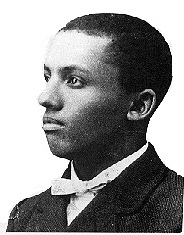
Spotify may draw some inspiration from Amazon, which lost hundreds of millions of dollars in its first few years as a public company, but investors stuck with the stock because the e-tailer reliably grew its business every quarter. On the other hand, Twitter and Snapchat stumbled not because of their monetary losses but primarily because of stalling user growth.

See the remainder of this article here: http://variety.com/2018/music/features/spotify-ipo-wall-street-music-industry-1202674266/ posted January 22, 2018; retrieved February 12, 2018.

In a previous Go Lean commentary, it was detailed how educational institutions are turning to tablets rather than textbooks. It is cheaper, faster to market and more engaging for young people. This is the point! Young people are more receptive to the efficiency of emerging (electronic) media outlets than the older generations. But that is the market that counts. Remember:

  • Young people are the ones that buy music
  • Young people go to the movies every weekend
  • Young people spur new trends
  • Young people will watch TV programming for young and older audiences, while older ones would not watch young programming; i.e. cartoons.

In addition to the efficiency of electronic or New Media, there is also the matter of effectiveness. Old Media has historically been a source for abuse and bullying, especially for young participants. New Media now allows for better options: direct-to-consumer deliveries and the bypass of the middle-man. The past Crony-Capitalism of media middle-men has often been the source of societal dysfunction. So the hope is that the effectiveness of New Media will bring more media productions.  This hope is realized! See this VIDEO here depicting the completion from direct-to-consumer streaming and the resultant decline on traditional television, Old Media:

VIDEO – The Real Reason Behind The Big Bang Theory’s Ratings Drop – https://youtu.be/aHvJkaGdY6A

Published on January 10, 2018 – After more than a decade as a CBS primetime mainstay, The Big Bang Theory remains one of the most popular shows on TV. However, fewer and fewer people are regularly tuning in to see what the most famous fictional nerds in the world are up to each week. So how come Big Bang isn’t popping the way it used to? Let’s explore …

TV ratings are down overall | 0:21
It’s hard to stream | 1:02
Blame football | 1:48
It’s part of a dying breed | 2:51
It’s a different show | 3:35
It’s inevitable | 4:19
Read more here → http://www.nickiswift.com/102976/real…

As related in the foregoing VIDEO, the Number One scripted television show is still Number One, but the audience is smaller, for television in general. Change is afoot!

So the media industry has moved forward, but with economic success “bad actors” always emerge. This consistent theme is presented by the movement behind the book Go Lean… Caribbean (Page 23). The book calls for the Caribbean to take its own lead in being “on guard” for bad actors and Crony-Capitalistic abuses. This means not being an American parasite.

As related in a previous commentary, the Go Lean movement asserts that the Caribbean region must not allow the US to take the lead for our own nation-building, that American capitalistic interest tends to highjack policies intended for the Greater Good. The recommendation in the roadmap is the key strategy of leveraging the needs of all 42 million people (4 languages) and become an American protégé, not parasite.

This Go Lean book serves as a roadmap for the introduction and implementation of the Caribbean Union Trade Federation (CU), to manage this change for New Media. We especially want to engage Caribbean young people with this foray into New Media. The youth of the Caribbean is the future of the Caribbean. The CU/Go Lean roadmap has 3 future-focused prime directives:

  • Optimization of the economic engines – and the educational apparatus – in order to grow the regional economy to $800 Billion and create 2.2 million new jobs.
  • Establishment of a security apparatus to protect the resultant economic engines.
  • Improve Caribbean governance to support these engines.

The Go Lean roadmap provides turn-by-turn directions on how to leverage the full Caribbean population, that’s a media market of 42 million people – in 4 languages. This roadmap is presented as a planning tool, pronouncing the collaborative benefits of a Single Market. This agenda was pronounced early in the book in the opening Declaration of Interdependence (Page 12 & 14):

viii.  Whereas the population size is too small to foster good negotiations for products and commodities from international vendors, the Federation must allow the unification of the region as one purchasing agent, thereby garnering better terms and discounts.

xi. Whereas all men are entitled to the benefits of good governance in a free society, “new guards” must be enacted to dissuade the emergence of incompetence, corruption, nepotism and cronyism at the peril of the people’s best interest. The Federation must guarantee the executions of a social contract between government and the governed.

xxi. Whereas the preparation of our labor force can foster opportunities and dictate economic progress for current and future generations, the Federation must ensure that educational and job training opportunities are fully optimized for all residents of all member-states, with no partiality towards any gender or ethnic group. The Federation must recognize and facilitate excellence in many different fields of endeavor, including sciences, languages, arts, music and sports. This responsibility should be executed without incurring the risks of further human flight, as has been the past history.

xxvii. Whereas the region has endured a spectator status during the Industrial Revolution, we cannot stand on the sidelines of this new economy, the Information Revolution. Rather, the Federation must embrace all the tenets of Internet Communications Technology (ICT) to serve as an equalizing element in competition with the rest of the world. The Federation must bridge the digital divide and promote the community ethos that research/development is valuable and must be promoted and incentivized for adoption.

The Go Lean book presents a roadmap for a confederation of the 30 Caribbean member-states doing the heavy-lifting of optimizing economic and media policies. Within its 370-pages, the Go Lean book details future-focused policies; and other ethos to adopt, plus the executions of strategies, tactics, implementations and advocacies to impact the media landscape in the region.

The Go Lean roadmap calls for bridging the Digital Divide, deploying a homegrown Social Media network and fostering technology in general. In addition to just communicating with 42 million people, we must do so in 4 general languages (Dutch, English, French and Spanish). So, the plan is for the CU to steer policy and capital to digital delivery and New Media.

Websites, music streaming, tablets and e-Books should be all the rage.

The foregoing news article and VIDEO relate to topics that should be of serious concern for Caribbean planners. We want to foster New Media and propel forward for the Caribbean’s best interest. No, we do not want to be parasites of America; we want to be better.

Many of these issues have been addressed in previous Go Lean blog-commentaries; consider this sample here:

https://goleancaribbean.com/blog/?p=13474 Future Focused – Radio is Dead … Almost
https://goleancaribbean.com/blog/?p=13321 Making a ‘Pluralistic Democracy’ – Multilingual Realities
https://goleancaribbean.com/blog/?p=10750 Less and Less People Reading Newspapers
https://goleancaribbean.com/blog/?p=9751 Where the Jobs Are – Animation and Game Design
https://goleancaribbean.com/blog/?p=8328 YouTube Millionaire: ‘Tipsy Bartender’
https://goleancaribbean.com/blog/?p=2126 Where the Jobs Are – Computers Reshaping Global Job Market
https://goleancaribbean.com/blog/?p=1698 STEM Jobs Are Filling Slowly
https://goleancaribbean.com/blog/?p=459 CXC and UK textbook publisher hosting CCSLC workshops in Barbados – Previewing e-Books

In general, the Go Lean book and movement projects a Cyber Caribbean (Page 127):

Forge electronic commerce industries so that the internet communications technology (ICT) can be a great equalizer in economic battles of global trade. This includes e-Government (outsourcing and in-sourcing for member-states systems) and e-Delivery, Postal Electronic Last Leg mail, e-Learning and wireline/wireless/satellite initiatives.

Strategically, the Go Lean roadmap posits that  we must compete as a homeland. We must keep our young people excited about their future prospect here in the region. To succeed in the competition of the global marketplace, our region must not only consume but rather also create, produce, and distribute intellectual property. We must be technocratic!

These are hallmarks of the CU technocracy: policies that reflect a future-focus.

Now is the time for all of the Caribbean, the people and school administrations, to lean-in for the changes described in the book Go Lean…Caribbean. 🙂

Download the book Go Lean … Caribbean – now!

Sign the petition to lean-in for this roadmap for the Caribbean Union Trade Federation.

Share this post:
, , , ,
[Top]

Carter Woodson – One Man Made a Difference … for Black History

Go Lean Commentary

Its February 1st – Black History Month commences…

Believe it or not, this was not always recognized or considered important. It was at the urging of one man that this cultural phenomenon came about. That one man is:

        Carter G. Woodson 

Yes, one man can make a difference. His research and archive accomplishments are fully recognized and celebrated, as is his subject – the contributions of the African-American people in the development of the United States. This high regard for Woodson is not just our opinion alone; today, Google has awarded Woodson with a Google Doodle – see above photo.

Also, see the full Wikipedia reference article on Carter Woodson in the Appendix below.

Though Woodson died in 1950 and the monthly observance started in 1970, he is still credited for the creation and fostering of this cultural phenomenon of Black History Month.

The movement behind the book Go Lean…Caribbean – available to download for free – tracks and monitors the developments of the African-American community. Since the majority population of 28 of the 30 Caribbean member-states is Black, we share the same ancestral heritage (Africa), same colonial origins (slave trade), and same history of societal oppression as American Blacks. Plus the vast majority of our Caribbean Diaspora who fled their homeland lives in the US – one estimate is 22 million.

The Go Lean book posits that one person – an advocate like Woodson – can make a difference (Page 122). It relates:

An advocacy is an act of pleading for, supporting, or recommending a cause or subject. For this book, it’s a situational analysis, strategy or tactic for dealing with a narrowly defined subject.

Advocacies are not uncommon in modern history. There are many that have defined generations and personalities. Consider these notable examples from the last two centuries in different locales around the world:

  • Frederick Douglas
  • Mohandas Gandhi
  • Martin Luther King
  • Nelson Mandela
  • Cesar Chavez
  • Candice Lightner

We must now consider Carter G. Woodson in this ilk; he is deserving of double honor:

Let the elders who preside in a fine way be considered worthy of double honor, especially those who work hard in speaking and teaching. – The Bible 1 Timothy 5:17

The Go Lean book seeks to advocate and teach the Caribbean – and the people who love it; it strives to learn lessons from history and direct regional stakeholders to a Way Forward from the dysfunctional past to a brighter future. The book serves as a roadmap for the introduction and implementation of the technocratic Caribbean Union Trade Federation (CU), for the elevation of Caribbean society – for all member-states. This CU/Go Lean roadmap has these 3 prime directives:

  • Optimization of the economic engines in order to grow the regional economy to $800 Billion and create 2.2 million new jobs.
  • Establishment of a security apparatus to ensure public safety and protect the resultant economic engines.
  • Improve Caribbean governance to support these engines, including a separation-of-powers between the member-states and CU federal agencies.

The book stresses that reforming and transforming the Caribbean societal engines must be a regional pursuit – we must unite all of the Caribbean: Black, White, Red and Yellow – that the problems are too big for any one Caribbean member-state alone. This was an early motivation for the roadmap, as pronounced in the opening Declaration of Interdependence (Pages 12 – 14):

xi. Whereas all men are entitled to the benefits of good governance in a free society, “new guards” must be enacted to dissuade the emergence of incompetence, corruption, nepotism and cronyism at the peril of the people’s best interest. The Federation must guarantee the executions of a social contract between government and the governed.

xix. Whereas our legacy in recent times is one of societal abandonment, it is imperative that incentives and encouragement be put in place to first dissuade the human flight, and then entice and welcome the return of our Diaspora …

xxxii. Whereas the cultural arts … of the region are germane to the quality of Caribbean life, and the international appreciation of Caribbean life, the Federation must implement the support systems to teach, encourage, incentivize, monetize and promote the related industries for arts … in domestic and foreign markets. These endeavors will make the Caribbean a better place to live, work and play.

xxxiii. Whereas lessons can be learned and applied from the study of the recent history of other societies, the Federation must formalize statutes and organizational dimensions to avoid the pitfalls of communities like East Germany, Detroit, Indian (Native American) Reservations, Egypt and the previous West Indies Federation. On the other hand, the Federation must also implement the good examples learned from developments/ communities …

The Go Lean book provides 370-pages of turn-by-turn instructions on “how” to adopt new community ethos, plus the strategies, tactics, implementations and advocacies to execute so as to reboot, reform and transform the societal engines of Caribbean society.

The Go Lean movement calls on every man, woman and child in the Caribbean to be an advocate, and/or appreciate the efforts of previous advocates. Their examples can truly help us today with our passions and purpose. Consider this sample of prior blog/commentaries where advocates and role models have been elaborated upon:

https://goleancaribbean.com/blog/?p=12542 Dr. Thomas W. Mason – FAMU Professor & STEM Influencer
https://goleancaribbean.com/blog/?p=11963 Oscar López Rivera – The ‘Nelson Mandela’ of the Caribbean?
https://goleancaribbean.com/blog/?p=11442 Caribbean Roots: Al Roker – ‘Climate Change’ Defender
https://goleancaribbean.com/blog/?p=10801 Caribbean Roots: John Carlos – The Man. The Moment. The Movement
https://goleancaribbean.com/blog/?p=10114 Caribbean Roots: Esther Rolle of ‘Good Times’
https://goleancaribbean.com/blog/?p=9948 Caribbean Roots: Sammy Davis, Jr.
https://goleancaribbean.com/blog/?p=9300 Edward Snowden – One Person Making a Difference
https://goleancaribbean.com/blog/?p=8724 Remembering Marcus Garvey: Still Relevant Today
https://goleancaribbean.com/blog/?p=8495 The NBA’s Tim Duncan – Champion On and Off the Court
https://goleancaribbean.com/blog/?p=8328 YouTube Millionaire: ‘Tipsy Bartender’
https://goleancaribbean.com/blog/?p=8165 Role Model Muhammad Ali’s Greatest Fight
https://goleancaribbean.com/blog/?p=7682 Frederick Douglass: Role Model for Single Cause – Death or Diaspora
https://goleancaribbean.com/blog/?p=866 Bob Marley: The legend lives on!

In summary, we conclude about Carter Woodson as we do about our own Caribbean historians and advocates; we say (Go Lean book conclusion Page 252):

Thank you for your service, love and commitment to all Caribbean people. We will take it from here.

The movement behind the Go Lean book, the planners of a new Caribbean stresses that a ‘change is going to come’, one way or another. We have endured failure for far too long; we have seen what works and what does not. We want to learn from history – the good, bad and ugly lessons. We have looked, listened, learned and lend-a-hand since then. We are now ready to lead our region to a better destination, to being a homeland that is better to live, work and play. 🙂

Download the free e-Book of Go Lean … Caribbean – now!

Sign the petition to lean-in for this roadmap for the Caribbean Union Trade Federation.

———-

Appendix Reference Title: Carter G. Woodson 

Carter Godwin Woodson (December 19, 1875 – April 3, 1950)[1] was an American historian, author, journalist and the founder of the Association for the Study of African American Life and History. He was one of the first scholars to study African-American history. A founder of The Journal of Negro History in 1916, Woodson has been cited as the “father of black history“.[2] In February 1926 he launched the celebration of “Negro History Week”, the precursor of Black History Month.[3]

[He] was born in Buckingham County, Virginia[4] on December 19, 1875, the son of former slaves, James and Eliza Riddle Woodson.[5] His father helped Union soldiers during the Civil War and moved his family to West Virginia when he heard that Huntington was building a high school for blacks.
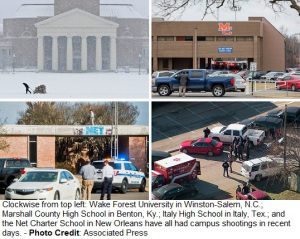
Coming from a large, poor family, Carter Woodson could not regularly attend school. Through self-instruction, he mastered the fundamentals of common school subjects by the age of 17. Wanting more education, he went to Fayette County to earn a living as a miner in the coal fields, and was able to devote only a few months each year to his schooling.

In 1895, at the age of 20, Woodson entered Douglass High School, where he received his diploma in less than two years.[6] From 1897 to 1900, Woodson taught at Winona in Fayette County. In 1900 he was selected as the principal of Douglass High School. He earned his Bachelor of Literature degree from Berea College in Kentucky in 1903 by taking classes part-time between 1901 and 1903. From 1903 to 1907, Woodson was a school supervisor in the Philippines.

Woodson later attended the University of Chicago, where he was awarded an A.B. and A.M. in 1908. He was a member of the first black professional fraternity Sigma Pi Phi[7] and a member of Omega Psi Phi. He completed his PhD in history at Harvard University in 1912, where he was the second African American (after W. E. B. Du Bois) to earn a doctorate.[8] His doctoral dissertation, The Disruption of Virginia, was based on research he did at the Library of Congress while teaching high school in Washington, D.C. After earning the doctoral degree, he continued teaching in public schools, later joining the faculty at Howard University as a professor, and served there as Dean of the College of Arts and Sciences.

Career
Convinced that the role of his own people in American history and in the history of other cultures was being ignored or misrepresented among scholars, Woodson realized the need for research into the neglected past of African Americans. Along with Alexander L. Jackson and three associates, he founded the Association for the Study of Negro Life and History on September 9, 1915, in Chicago.[9][10] That was the year Woodson published The Education of the Negro Prior to 1861. His other books followed: A Century of Negro Migration (1918) and The History of the Negro Church (1927). His work The Negro in Our History has been reprinted in numerous editions and was revised by Charles H. Wesley after Woodson’s death in 1950.

In January 1916, Woodson began publication of the scholarly Journal of Negro History. It has never missed an issue, despite the Great Depression, loss of support from foundations, and two World Wars. In 2002, it was renamed the Journal of African American History and continues to be published by the Association for the Study of African American Life and History (ASALH).

Woodson believed that education and increasing social and professional contacts among blacks and whites could reduce racism and he promoted the organized study of African-American history partly for that purpose. He would later promote the first Negro History Week in Washington, D.C., in 1926, forerunner of Black History Month.[13] The Bronzeville neighborhood declined during the late 1960s and 1970s like many other inner-city neighborhoods across the country, and the Wabash Avenue YMCA was forced to close during the 1970s, until being restored in 1992 by The Renaissance Collaborative.[14]

He served as Academic Dean of the West Virginia Collegiate Institute, now West Virginia State University, from 1920 to 1922.[15]

He studied many aspects of African-American history. For instance, in 1924, he published the first survey of free black slaveowners in the United States in 1830.[16]

He once wrote: “If you can control a man’s thinking, you don’t have to worry about his actions. If you can determine what a man thinks you do not have to worry about what he will do. If you can make a man believe that he is inferior, you don’t have to compel him to seek an inferior status, he will do so without being told and if you can make a man believe that he is justly an outcast, you don’t have to order him to the back door, he will go to the back door on his own and if there is no back door, the very nature of the man will demand that you build one.”

NAACP
Woodson became affiliated with the Washington, D.C. branch of the NAACP, and its chairman Archibald Grimké. On January 28, 1915, Woodson wrote a letter to Grimké expressing his dissatisfaction with activities and making two proposals:

  1. That the branch secure an office for a center to which persons may report whatever concerns the black race may have, and from which the Association may extend its operations into every part of the city; and
  2. That a canvasser be appointed to enlist members and obtain subscriptions for The Crisis, the NAACP magazine edited by W. E. B. Du Bois.

Du Bois added the proposal to divert “patronage from business establishments which do not treat races alike,” that is, boycott businesses. Woodson wrote that he would cooperate as one of the twenty-five effective canvassers, adding that he would pay the office rent for one month. [But] Grimké did not welcome Woodson’s ideas. …

[Woodson’s] difference of opinion with Grimké, who wanted a more conservative course, contributed to Woodson’s ending his affiliation with the NAACP.

Black History Month
Woodson devoted the rest of his life to historical research. He worked to preserve the history of African Americans and accumulated a collection of thousands of artifacts and publications. He noted that African-American contributions “were overlooked, ignored, and even suppressed by the writers of history textbooks and the teachers who use them.”[18] Race prejudice, he concluded, “is merely the logical result of tradition, the inevitable outcome of thorough instruction to the effect that the Negro has never contributed anything to the progress of mankind.”[18]

In 1926, Woodson pioneered the celebration of “Negro History Week”,[19] designated for the second week in February, to coincide with marking the birthdays of Abraham Lincoln and Frederick Douglass.[20] However, it was the Black United Students and Black educators at Kent State University that founded Black History Month, on February 1, 1970.[21] Six years later Black History Month was being celebrated all across the country in educational institutions, centers of Black culture and community centers, both great and small, when President Gerald Ford recognized Black History Month, during the celebration of the United States Bicentennial. He urged Americans to “seize the opportunity to honor the too-often neglected accomplishments of black Americans in every area of endeavor throughout our history.”[22]

Colleagues 
Woodson believed in self-reliance and racial respect, values he shared with Marcus Garvey, a Jamaican activist who worked in New York. Woodson became a regular columnist for Garvey’s weekly Negro World.

Death and legacy
Woodson died … within his home in … Washington, D.C., on April 3, 1950, at the age of 74.

The time that schools have set aside each year to focus on African-American history is Woodson’s most visible legacy. His determination to further the recognition of the Negro in American and world history, however, inspired countless other scholars. Woodson remained focused on his work throughout his life. Many see him as a man of vision and understanding. Although Woodson was among the ranks of the educated few, he did not feel particularly sentimental about elite educational institutions. The Association and journal that he started are still operating, and both have earned intellectual respect.

Source: Wikipedia Online Encyclopedia – retrieved February 1, 2018 from: https://en.wikipedia.org/wiki/Carter_G._Woodson


Share this post:
,
[Top]

School Shootings ‘R’ Us – 11 in 23 Days

Go Lean Commentary

Which is worse: the Frying Pan or the Fire?

This is the decision-making that Caribbean people seem to be doing. Which residential option is worse for them: remain in the Failing–States of their Caribbean homeland or emigrate to the United States of America where societal defects like mass shootings / school shootings persist?

The optics are that bad!

The American gun culture cannot be excused, rationalized or minimized. As of January 23rd, there were already 11 school shootings in the country.

Just think how our Caribbean people have fled their homelands – “Frying Pan” – to seek refuge in this society – “the Fire”.

See how the actuality of this American “fire” is conveyed in this New York Times news story here:

Title – School Shooting in Kentucky Was Nation’s 11th of Year. It Was Jan. 23

By: Alan Blinder and Daniel Victor

ATLANTA — On Tuesday, it was a high school in small-town Kentucky. On Monday, a school cafeteria outside Dallas and a charter school parking lot in New Orleans. And before that, a school bus in Iowa, a college campus in Southern California, a high school in Seattle.

Gunfire ringing out in American schools used to be rare, and shocking. Now it seems to happen all the time.

The scene in Benton, Ky., on Tuesday was the worst so far in 2018: Two 15-year-old students were killed and 18 more people were injured. But it was one of at least 11 shootings on school property recorded since Jan. 1, and roughly the 50th of the academic year.

Researchers and gun control advocates say that since 2013, they have logged school shootings at a rate of about one a week.

“We have absolutely become numb to these kinds of shootings, and I think that will continue,” said Katherine W. Schweit, a former senior F.B.I. official and the co-author of a study of 160 active shooting incidents in the United States.

Some of the shootings at schools this year were suicides that injured no one else; some did not result in any injuries at all. But in the years since the massacres at Columbine High School in Colorado, Virginia Tech and Sandy Hook Elementary School in Newtown, Conn., gun safety advocates say, all school shootings seem to have lost some of their capacity to shock.

Shannon Watts, the founder of Moms Demand Action, a gun safety group, said that’s because in 2012 in Newtown, “20 first graders and six educators were slaughtered in an elementary school.”

“The news cycles are so short right now in America, and there’s a lot going on,” she said. “But you would think that shootings in American schools would be able to clear away some of that clutter.”

Gov. Matt Bevin of Kentucky said the gunman who opened fire Tuesday morning at Marshall County High School in Benton, near the western tip of the state was a 15-year-old student. The authorities said the student entered the school just before 8 a.m., fired shots that struck 14 people, and set off a panicked flight in which five more were hurt.

One girl who was shot, Bailey Nicole Holt, died at the scene; a boy, Preston Ryan Cope, died of his injuries at a hospital.

Bryson Conkwright, a junior at the school, said he was talking with a friend on Tuesday morning when he spotted the gunman walking up near him. “It took me a second to process it,” Mr. Conkwright, 17, said in an interview. “One of my best friends got shot in the face, and then another one of my best friends was shot in the shoulder.”

He said he was part of a group of students who fled, kicked down a door to get outside and ran.

The suspect, who was not immediately identified, was taken into custody in “a nonviolent apprehension,” Mr. Bevin said, and officials said he would be charged with two counts of murder and several counts of attempted murder. But the authorities had not yet decided whether to charge the suspect, who was armed with a pistol, as a juvenile or as an adult.

Of the 18 people injured, five remained in critical condition, law enforcement officials said on Tuesday night.

“This is something that has struck in the heart of Kentucky,” Lt. Michael B. Webb of Kentucky State Police said at a news conference. “It’s not far away, it’s here.”

Not for the first time. The region was scarred about two decades ago by deadly school shooting in West Paducah, about a 40-minute drive away. Three people were killed when a student opened fire into a prayer circle, and five more were injured.

Benton is a small town about 200 miles southwest of Louisville, and its high school serves students from all over Marshall County, which has a population of about 31,000.

John Parks, who owns the Fisherman’s Headquarters store about a mile from the school, described the area as a “very close-knit community” where just about everyone would have known a student at the school. “It’s personal when it’s a small town like this,” he said.

About a mile from the high school, a large American flag flew at half-staff over a Ponderosa Steakhouse on Tuesday night. Taylor McCuiston, 21, a manager at the restaurant who graduated from Marshall County High School two years ago, was working when the shooting occurred down the road.

“It was very scary because, like, 90 percent of the staff that works here goes to that school,” she said. “So for the first hour we were just scrambling trying to make sure they were all O.K. and accounted for.”

The town of Italy, Tex., is not any bigger than Benton. On Monday, a 15-year-old girl there was hospitalized after she was shot by a 16-year-old classmate, according to local news reports. That suspect, a boy, was taken into custody by the Ellis County Sheriff’s Department. The authorities said on Tuesday that the victim was recovering.

The F.B.I. study that Ms. Schweit helped write examined active shooter episodes in the United States between 2000 and 2013. It found that nearly one-quarter of them occurred in educational environments, and they were on the rise.

In the first half of the study period, federal officials counted 16 active shooter incidents in educational settings, meaning instances of a person “actively engaged in killing or attempting to kill people in a confined and populated area.” In the second half, the number rose to 23. (Many, but not all, of the school shootings tallied by advocates so far this year meet that definition.)

“Any time there’s a school shooting, it’s more gut-wrenching, and I think we have a tendency to react in a more visceral way,” Ms. Schweit said in an interview on Tuesday. “But I really don’t think as a whole, in society, we’re taking shootings more seriously than we were before — and that’s wrong.”

Even so, jarred and fearful school administrators across the country have been placing greater emphasis on preparing for the possibility of an active shooter. According to a report issued by the Government Accountability Office in March 2016, 19 states were requiring individual schools to have plans for how to deal with an active shooter. Only 12 states required schools to conduct drills, but two-thirds of school districts reported that they had staged active shooter exercises.

School safety experts say steps like the drills are crucial, if imperfect, safeguards.

“I think we’ve become somewhat desensitized to the fact that these things happened, and it takes a thing like Sandy Hook to bring us back to our senses,” said William Modzeleski, a consultant who formerly led the Department of Education’s Office of Safe and Drug Free Schools.

“My fear is that if you don’t hear about a school shooting for a while, educators move on to other things,” he said. “Principals are busy. Teachers are busy. Superintendents are busy.”

In Kentucky, lawmakers have grappled with how to address the risk of school shootings. Last year, state legislators considered, but did not pass, a bill that would have allowed people with concealed-carry permits to bring weapons on to public school campuses, where proponents argue they could be used to respond to active shooters. A similar bill, limited to college campuses and certain other government buildings, has been introduced this year. It was not immediately clear how the shooting in Benton might affect the debate in Frankfort, the Kentucky capital.

But in Benton, “this is a wound that is going to take a long time to heal,” said Mr. Bevin, the governor, “ and for some in this community, will never fully heal.”

———-

Alan Blinder reported from Atlanta and Daniel Victor from New York. Steven Hale contributed reporting from Benton, Ky., and Timothy Williams and Matthew Haag from New York.

Source: New York Times – posted January 23, 2017; retrieved January 30, 2017: https://www.nytimes.com/2018/01/23/us/kentucky-school-shooting.html

RELATED COVERAGE:

Life in American schools is risky. Life in the US in general, may experience a shorter mortality due to the risky gun culture.

This is not an unfamiliar theme for this movement behind the book Go Lean…Caribbean; on October 11, 2017 a blog-commentary entitled: “Pulled” – Despite American Guns was published. That entry lamented how the US continues to draw the human capital out of the Caribbean, despite the unconscionable gun-death rate in the country. That commentary related:

… the US has far more gun deaths than most other advanced economy countries.

Reference: Visualizing gun deaths: Comparing the U.S. to rest of the world
Whenever a mass shooting occurs, a debate about gun violence ensues. An often-cited counter to the point about the United States’ high rates of gun homicides is that people in other countries kill one another at the same rate using different types of weapons. It’s not true.

Compared to other countries with similar levels of development or socioeconomic status, the United States has exceptional homicide rates, and it’s driven by gun violence.

Life in the US may be more prosperous, but it is “fast & furious” compared to the Caribbean homeland. If only, we can assuage our societal defects – Frying Pan – and foster more economic opportunities, then our people will be able to prosper where planted in the Caribbean homeland. They would not have to “jump into the Fire” as they do now – one report estimates 70 percent of the professional classes have fled to foreign destinations like the United States. To be clear, there are two reasons why are they leaving:

  • Push” refers to people who feel compelled to leave, to seek refuge in a foreign land. “Refuge” is an appropriate word; because of societal defects, many from the Caribbean must leave as refugees – think LGBTDisabilityDomestic-abuseMedically-challenged– for their life, liberty and pursuit of happiness.
  • Pull”, on the other hand refers to the lure of a more prosperous life abroad; many times our people are emigrating for economics solely.

It is the quest of this Go Lean movement that we reform and transform our societal engines so as to lower the “Push” factors. As for the “Pull” factors, this is all about messaging, knowledge-sharing and declaring the truth. Take a moment and acknowledge this truth:

Before this article, did you really know that there were 11 school-shootings in the US between January 1st and 23rd, 2018?

For most, that answer is no!

This is the truism that we must contend with in our region: The “grass is not necessarily greener” on the American side.

The Go Lean book serves as a roadmap for the introduction and implementation of the technocratic Caribbean Union Trade Federation (CU) to elevate the societal engines – economics, homeland security and governance – for all 30 Caribbean member-states in the region. In fact, the prime directives of the roadmap includes the following 3 statements:

  • Optimization of the economic engines in order to grow the regional economy to $800 Billion & create 2.2 million new jobs.
  • Establishment of a security apparatus to ensure public safety and protect the resultant economic engines with proactive and reactive measures.
  • Improvement of Caribbean governance to support these engines, including a separation-of-powers between the member-states and CU federal agencies.

The Go Lean quest is to minimize any paradox of future-planning/decision-making for Caribbean citizens. We want to make the Caribbean region better places to live, work and play; this way our citizens would not have to “jump in to the Fire” by relocating to American shores.

How would you live with yourself if your children or grandchildren die in a school shooting in some US location?!

This is not to say that there will never be any violence in the Caribbean. No, the Go Lean book contends that bad actors will always emerge just as a result of economic successes in society. Once the prospects of guns are factored it, the inevitable “bad guy with a gun” can do more damage than ordinary. The Way Forward from the book is real remediation and mitigation for minimizing incidents of gun violence.

Many times in the US, the post mass-shooting platitudes from Pro-Gun Advocacy groups – i.e. the NRA – is that the best way to stop a “bad guy with a gun” is with a “good guy with a gun”.

Platitudes – flat, dull, or trite remark –  indeed …

Remember the April 1999 Columbine High massacre – school shooting – in Colorado – Greater Denver Metropolitan area:

In addition to the shootings, the complex and highly planned attack involved a fire bomb to divert firefighters, propane tanks converted to bombs placed in the cafeteria, 99 explosive devices, and car bombs. The perpetrators, senior students Eric Harris and Dylan Klebold, murdered 12 students and one teacher. They injured 21 additional people, and three more were injured while attempting to escape the school. After exchanging fire with responding police officers, the pair subsequently committed suicide.[5][6]Wikipedia

See this dramatic portrayal for the documentary-movie Bowling for Columbine here with this Trailer and critical review:

VIDEO – Bowling for Columbine – Official Trailer – Michael Moore Movie (2002) – https://youtu.be/hH0mSAjp_Jw

Movieclips Trailer Vault
Published on Nov 15, 2011 – Bowling for Columbine Trailer – Michael Moore (Michael Moore) takes an inside-look at America’s fascination with firearms. MGM – 2002

  • Category: Film & Animation
  • License: Standard YouTube License

———–

Movie Review: Bowling for Columbine

By: Roger Eber

Michael Moore’s “Bowling for Columbine,” a documentary that is both hilarious and sorrowful, is like a two-hour version of that anecdote. We live in a nation of millions of handguns, but that isn’t really what bothers Moore. What bothers him is that we so frequently shoot them at one another. Canada has a similar ratio of guns to citizens, but a 10th of the shooting deaths. What makes us kill so many times more fellow citizens than is the case in other developed nations? Moore, the jolly populist rabble-rouser, explains that he’s a former sharpshooting instructor and a lifelong member of the National Rifle Association. No doubt this is true, but Moore has moved on from his early fondness for guns. In “Bowling for Columbine,” however, he is not so sure of the answers …
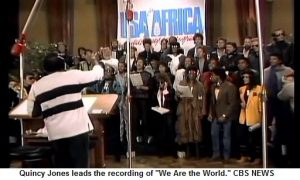
Moore’s thoughtfulness doesn’t inhibit the sensational set-pieces he devises to illustrate his concern. He returns several times to Columbine High School, at one point showing horrifying security-camera footage of the massacre. And Columbine inspires one of the great confrontations in a career devoted to radical grandstanding. Moore introduces us to two of the students wounded at Columbine, both still with bullets in their bodies. He explains that all of the Columbine bullets were freely sold to the teenage killers by Kmart, at 17 cents apiece. And then he takes the two victims to Kmart headquarters to return the bullets for a refund.

This is brilliant theater and would seem to be unanswerable for the hapless Kmart public relations spokespeople, who fidget and evade in front of Moore’s merciless camera. But then, on Moore’s third visit to headquarters, he is told that Kmart will agree to completely phase out the sale of ammunition. “We’ve won,” says Moore, not believing it. “This has never happened before.” For once, he’s at a loss for words.

The movie is a mosaic of Moore confrontations and supplementary footage. One moment that cuts to the core is from a standup routine by Chris Rock, who suggests that our problem could be solved by simply increasing the price of bullets–taxing them like cigarettes. Instead of 17 cents apiece, why not $5,000? “At that price,” he speculates, “you’d have a lot fewer innocent bystanders being shot.”

Source: RogerEbert.com E-Zine/Website – Posted October 18, 2002; retrieved January 30, 2018 from: https://www.rogerebert.com/reviews/bowling-for-columbine-2002

We can do better in the Caribbean!

We do not have the same gun culture, nor legal entanglements. The 2nd Amendment – gun rights guaranteed by the US Constitution – does not apply for most of the Caribbean and can even be curtailed more in the US Territories (Puerto Rico & US Virgin Islands) as opposed to the US mainland.

Doing better and being better than the US – a protégé , not a parasite – is a need pronounced early in the Go Lean book with the opening Declaration of Interdependence (Pages 12 – 13) that claims:

x. Whereas we are surrounded and allied to nations of larger proportions in land mass, populations, and treasuries, elements in their societies may have ill-intent in their pursuits, at the expense of the safety and security of our citizens. We must therefore appoint “new guards” to ensure our public safety and threats against our society, both domestic and foreign. The Federation must employ the latest advances and best practices … to assuage continuous threats against public safety.

xi. Whereas all men are entitled to the benefits of good governance in a free society, “new guards” must be enacted to dissuade the emergence of incompetence, corruption, nepotism and cronyism at the peril of the people’s best interest. The Federation must guarantee the executions of a social contract between government and the governed.

xvi. Whereas security of our homeland is inextricably linked to prosperity of the homeland, the economic and security interest of the region needs to be aligned under the same governance. Since economic crimes, including piracy and other forms of terrorism, can imperil the functioning of the wheels of commerce for all the citizenry, the accedence of this Federation must equip the security apparatus with the tools and techniques for predictive and proactive interdictions.

The Go Lean book provides 370 pages of turn-by-turn directions on how to adopt a more productive Public Safety ethos, plus the executions of strategies, tactics, implementations and advocacies to better secure the Caribbean homeland, school campus protections and gun control. The book details (Page 181) this sample mitigation for school bullying:

Consider Bullying as Junior Terrorism
The CU wants to “leave no child behind”. So bullying will be managed under a domestic terrorism and Juvenile Justice jurisdiction. The CU will conduct media campaigns for anti-bullying, life-coaching, and school-mentoring programs. The problem with teen distress is that violence can ensue from bullying perpetrators or in response to bullying.

In addition, there have been a number of previous blog-commentaries by the Go Lean movement that highlighted the eco-system of crime-domestic terrorism and homeland security initiatives. See this sample list here:

https://goleancaribbean.com/blog/?p=14087 Opioids – Another Example of America’s Deadly Culture
https://goleancaribbean.com/blog/?p=13999 First Steps – Deputize the CU to Monitor-Mitigate-Manage Threats
https://goleancaribbean.com/blog/?p=13126 “Must Love Dogs”  – Providing K9 Solutions for Better Security
https://goleancaribbean.com/blog/?p=12400 Accede the Caribbean Arrest Treaty
https://goleancaribbean.com/blog/?p=11332 Boston Bombing Anniversary – Learning Lessons
https://goleancaribbean.com/blog/?p=11244 Live Fast; Die Young – The Fast & Furious Life in the US
https://goleancaribbean.com/blog/?p=11048 Managing the ‘Strong versus the Weak’ Series – Mitigating Bullies
https://goleancaribbean.com/blog/?p=9072 Model: Shots-Fired Monitoring – Securing the Homeland on the Ground
https://goleancaribbean.com/blog/?p=7485 Mitigating Interpersonal Violence Series – Street Crimes

In summary, fleeing to a life of refuge in the US may be likened to “jumping from the Frying Pan to the Fire”. It seems so basic to protect our children so that they can study safely in school, and yet, there had been 11 gun attacks already in the US this month by the 23rd of the month. The repeated occurrences reflect a failure in American society and American stewardship. This view considers the premise of the implied Social Contract:

Citizens surrender some of their freedoms and submit to the authority of the State in exchange for protection of remaining natural and legal rights. – Go Lean book Page 170.

Yes, it is only natural, logical, and mature that any stewards of society would remediate any known risks and threats; yet this is not the case for guns in America. (The 2nd Amendment is a societal defect!)

In that previous blog-commentary, this was the simple conclusion:

… surely we can convince our Caribbean people to Stay Home and not be lured to this [dysfunctional-gun] madness in the first place; and for those of the Diaspora in the US: you are in harm’s way, just living an ordinary life. It is Time to Go … back home!

Now is the time for all of the Caribbean – in and out of schools – to lean-in for the empowerments of the Go Lean roadmap. It is conceivable, believable and achievable to prosper where planted here in the region; to make the Caribbean a better place to live, work and play. 🙂

Download the free e-book of Go Lean … Caribbean – now!

Sign the petition to lean-in for the roadmap for the Caribbean Union Trade Federation.

Share this post:
, , ,
[Top]

Wait, ‘We Are The World’

Go Lean Commentary

33 is an important number for music. This is the speed that a record-album spins on a record-player.

33 years ago, today – January 28th, 1985 – the record industry spun a new thread. The industry spun its biggest world charity endeavor, to date, to mitigate famine in Africa, in response to a drought in Ethiopia. This was the collaborative effort – by more than 40 artists – to record the song: We Are The World.

See the story in the Almanac entry here:

Almanac: “We Are the World”

… From our “Sunday Morning” Almanac: January 28th, 1985, 33 years ago today … the day more than 40 of the music world’s greatest stars gathered in a Los Angeles studio to record the song “We Are the World.”

Written by Lionel Richie and Michael Jackson, and produced by Quincy Jones, the song was a fundraiser for the relief group USA for Africa.
The artists were told, “Check your egos at the door.” And did they ever.

Twenty-one of them each got a turn singing a solo line, while more than 20 others made up the chorus.

More than nine million copies of the song have been sold or downloaded. It won four Grammys, including Song of the Year and Record of the Year.

And most important: USA for Africa says the song has generated more than $65 million for humanitarian relief.

For more info:

Source: CBS Sunday Morning – Almanac: This Day In History – Posted & Retrieved January 28, 2018 from: https://www.cbsnews.com/news/almanac-we-are-the-world/

———–

VIDEO – U.S.A. For Africa – We Are the World – https://youtu.be/9AjkUyX0rVw

USAforAfricaVEVO

Published on Apr 12, 2010 – Music video by U.S.A. For Africa performing ‘We Are the World’. USA For Africa

This moment, movement, momentum and music changed the world!

This super-group United Support of Artists (USA) for Africa played on the brand “USA”, but truthfully, they could have called themselves United States of America, as all the participants – see Appendix below –  were Americans … except for the Irish vocalist-producer Bob Geldof in the chorus, plus percussionist Phil Collins (England) and percussionist  Paulinho da Costa (Brazil).
Yet still, this collaborative effort made a difference!

They raised money and ensured the distribution of food stuffs to the ravaged areas of Africa. They used music to change the world!

Can we use music to change the world again? How about changing the Caribbean? How about shaping the culture?

Yes, we can! Why? ‘We Are The World‘.

Its ironic that despite all the available talent, there was no Caribbean representation in that assembly of artists that day, none except for Harry Belafonte. He boasts a legacy of a Caribbean parentage from a Jamaican mother and Martiniquan father; (though he himself was born in Harlem, New York). For ‘We Are The World‘, he sang in the chorus.

This consideration is in line with the 2013 book Go Lean … Caribbean. The book relates that music and a movement can change the world again. It serves as a roadmap for the introduction and implementation of the technocratic Caribbean Union Trade Federation (CU). This CU strives to advance Caribbean culture using the application of societal best-practices – and music – to engage these 3 prime directives:

  • Optimization of the economic engines in order to grow the regional economy to $800 Billion and create 2.2 million jobs.
  • Establishment of a security apparatus to protect the resultant economic engines.
  • Improvement of Caribbean governance to support these engines.

The Go Lean book – available for download now – prescribes a plan for each Caribbean country to grow their musical influence. The book further identifies 169 different musical/national combinations of genres throughout the region. So the complex music landscape in the region does not stand still; it evolves. So too their musical artists.

Music can indeed wield a great influence and impact on the world. (Previously, this blog-commentary detailed the influence of music icon Bob Marley). Natural disasters continue to happen, as ‘We Are The World‘ was in response to a natural disaster – a drought – in Africa 33 years ago. We continue to have natural disasters … today. Just recently, late September 2017, Hurricane Maria devastated several Caribbean member-states; Puerto Rico was gravely impacted. In the mode of ‘We Are The World‘, many artists – led by Lin-Manuel Miranda of Hamilton fame – assembled and recorded a song to aid Puerto Rico, entitled ‘Almost Like Praying‘ by Artists for Puerto Rico.

Lesson learned! The same as ‘We Are The World‘ was mostly an American art form, Puerto Rico was able to convey its brand.

See the VIDEO of the song ‘Almost Like Praying‘ by Artists for Puerto Rico here:

VIDEO – Like Praying feat Artists for Puerto Rico [Music Video] – https://youtu.be/D1IBXE2G6zw

Atlantic Records

Published on Oct 6, 2017 – Lin-Manuel Miranda’s “Almost Like Praying” was written and recorded to benefit hurricane relief efforts in Puerto Rico with proceeds benefiting The Hispanic Federation’s Unidos Disaster Relief Fund

Proceeds go to https://hispanicfederation.org/unidos/

For more information, please visit http://www.hispanicfederation.org and http://www.almostlikepraying.com

“Almost Like Praying” Lin-Manuel Miranda feat Artists for Puerto Rico Music and Lyrics by Lin-Manuel Miranda © 2017
“Contains elements of “Maria” Music by Leonard Bernstein, Lyrics by Stephen Sondheim ©1957, Renewed.

Vocals Performed by (listed alphabetically):

Marc Anthony Ruben Blades Camila Cabello
Pedro Capo Dessa Gloria Estefan
Fat Joe Luis Fonsi Juan Luis Guerra
Alex Lacamoire John Leguizamo Jennifer Lopez
Lin-Manuel Miranda Rita Moreno Ednita Nazario
Joell Ortiz Anthony Ramos Gina Rodriguez
Gilberto Santa Rosa PJ Sin Suela Tommy Torres
Ana Villafañe

Percussion by: Eric Bobo Correa

Executive Producer: Lin-Manuel Miranda

Proceeds to the Hispanic Federation UNIDOS Fund for Puerto Rico

  • Category: Music
  • License: Standard YouTube License

The movement behind the Go Lean book asserts that “one person can make a difference“, and that music can shape culture. So just like Bob Marley, Lin-Manuel Miranda should be recognized for his contributions to music, culture and Puerto Rican (Caribbean) identity. This one character has made a difference, he has shaped American culture and forged an example and a sample of how other Caribbean stakeholders can do more in the arts to impact the world – ‘We Are The World‘.

Yes, as related in a previous blog-commentary, we – in the Caribbean – can build a city on “rock-and-roll”.

Early in the Go Lean book (Page 15) in the Declaration of Interdependence, the contributions that music can make is pronounced as an community ethos for the entire region to embrace, with these statements:

  • Whereas the cultural arts and music of the region are germane to the quality of Caribbean life, and the international appreciation of Caribbean life, the Federation must implement the support systems to teach, encourage, incentivize, monetize and promote the related industries for arts and music in domestic and foreign markets. These endeavors will make the Caribbean a better place to live, work and play.

The Go Lean book, within its 370 pages, details the community ethos, strategies, tactics, implementations and advocacies to foster the next generation of artists. This roadmap recognizes that a prerequisite for advancing society is a change in the community ethos, defined as “the fundamental spirit of a culture that drives the beliefs, customs and practices” in society. Music should be appreciated for its ability to shape the culture of a community, country or even the whole world.

Thank you Quincy Jones and all the 40-plus United Support of Artists for the model for ‘We Are The World‘ 33 years ago; you set the pathway for success for new collaborations of talented, inspirational and influential artists who are sure to follow, even here in the Caribbean. We used that pattern for Puerto Rico; hopefully more Caribbean communities to follow.

We want “a change to come” to the Caribbean. So we need to accept the premise that was echoed musically 33 years ago, that ‘We Are The World‘. We hereby urge the people, institutions and governance of Caribbean region to “lean-in” to this Go Lean roadmap for change and empowerment. ‘We Are The World‘ and we want to make our part of the world – the Caribbean – a better place to live, work and play. 🙂

—————

Appendix – USA for Africa Artists-Musicians

Conductor: Quincy Jones 

Soloist – Order of Appearance Chorus – Alphabetically Instrument Players
Lionel Richie Dan Aykroyd David Paich – synthesizers
Stevie Wonder Harry Belafonte Michael Boddicker – synthesizers
Paul Simon Lindsey Buckingham Paulinho da Costa – percussion
Kenny Rogers Mario Cipollina Phil Collins – percussion
James Ingram Johnny Colla Louis Johnson – synth bass
Tina Turner Sheila E. Michael Omartian – keyboards
Billy Joel Bob Geldof Greg Phillinganes – keyboards
Michael Jackson Bill Gibson John Robinson – drums
Diana Ross Chris Hayes
Dionne Warwick Sean Hopper
Willie Nelson Jackie Jackson
Al Jarreau La Toya Jackson
Bruce Springsteen Marlon Jackson
Kenny Loggins Randy Jackson
Steve Perry Tito Jackson
Daryl Hall Waylon Jennings
Huey Lewis Bette Midler
Cyndi Lauper John Oates
Kim Carnes Jeffrey Osborne
Bob Dylan Pointer Sisters (June, Ruth, and Anita)
Ray Charles Smokey Robinson

Source: Wikipedia Online Encyclopedia Retrieved January 28, 2018 from: https://en.wikipedia.org/wiki/We_Are_the_World

Share this post:
, , , ,
[Top]

Opioids and the FDA – ‘Fox guarding the Henhouse’

Go Lean Commentary

“Absolutely criminal…” – US Senator reviewing the FDA handling of America’s Opioid crisis.

Saying “the grass is not greener on the other side” is just too simplistic a criticism of the American eco-system for pharmaceutical use … and abuse. Pain is real and need to be mitigated, but the American experience is one of dysfunction.

Yet, this is to be expected, when one places the ‘fox to guard the henhouse’.

This is not just our opinion alone. This aligns with the criticism of the FDA’s Former Head; they are supposed to be the Watch-Dog. (While the Watch-Dog for them is supposed to be the US Congress, providing checks-and-balances over the Executive Branch, FDA included). See this related story-criticism here:

VIDEO: Former FDA Head weighs in on Opioid epidemic – https://youtu.be/QEzSJRBQ9RU


CBS Evening News
Posted May 9, 2016 – Each day in America, 78 people die from overdosing on painkillers. Doctor David Kessler, former head of the FDA from 1990 to 1997, called the rise of America’s Opioid crisis “one of the great mistakes of modern medicine.” Jim Axelrod has more.

Yet, still we continue to say, despite the simplicity of the criticism:  the grass is not greener on the American side. Mature communities address the problems that they face; they monitor, manage and mitigate them. To allow a problem to persist, to take lives and then do nothing or little about it makes stakeholders blood-guilty. This is a direct indictment from the Judeo-Christian moral code, the Bible; see the justice standard here:

29 But if a bull was in the habit of goring and its owner had been warned but he would not keep it under guard and it killed a man or a woman, the bull is to be stoned and its owner is also to be put to death. 30 If a ransom* is imposed on him, he must give as the redemption price for his life* all that may be imposed on him. – Exodus 21: 29, 30

Analysis
[In Bible times], certain deliberate acts that indirectly caused or could have resulted in the death of another person were considered tantamount to deliberate murder. For example, the owner of a goring bull who disregarded previous warnings to keep the animal under guard could be put to death if his bull killed someone. In some cases, however, a ransom could be accepted in place of the life of the owner. Undoubtedly the judges would take circumstances into consideration in such a case. (Ex 21:29, 30) Also, an individual scheming to have another person killed by presenting false testimony was himself to be put to death.—Deuteronomy 19:18-21.

But this standard is not the reality of America, where the original 2 societal defects America was built on still persists:

Shockingly, this indictment of the FDA – who is supposed to protect American people – raises a Caribbean debate:

Is it better to emigrate to America or any other foreign destination for economic success, or prosper where planted in the Caribbean homeland?

The movement behind the book Go Lean … Caribbean campaigns to inform the people of the Caribbean that life is not idyllic in America, that death is more readily because of a greater disregard of life, especially of those of minority (non-white) ethnicities.

Some might argue that “this” charge is not fair, nor accurate!

And yet … as reported in a previous blog-commentary (and highlighted in the foregoing VIDEO), millions suffer from Opioid addictions – 33,000 die every year.  This is not new, as the evidence suggest this is decades old, and yet the FDA “slept”; truly, the ‘fox guarding the henhouse’.

🙁

The Go Lean book serves as a roadmap to introduce the technocratic Caribbean Union Trade Federation (CU) to elevate the region’s societal engines – economics, homeland security and governance – of the 30 Caribbean member-states. In fact, the prime directives of the roadmap includes the following 3 statements:

  • Optimization of the economic engines in order to grow the regional economy to $800 Billion & create 2.2 million new jobs.
  • Establishment of a security apparatus to ensure public safety and protect the resultant economic.
  • Improve Caribbean governance for all people, even minority groups, to support these engines.

The quest of the Go Lean book and movement is to minimize the lure for America to Caribbean citizens. We need our people to Stay Home, and so we want to make the Caribbean region better places to live, work and play. People only leave because they believe that life abroad will be better. So facts to the contrary should go far in quelling such misconceptions.

In this movement for a new Caribbean, we do not want to be like America, we want to be Better! While this is heavy-lifting, it is not impossible, just start without the two known societal defects: Institutional Racism, and Crony-Capitalism.

No one is being fooled, the Opioid crisis in the US has persisted because Big Pharma is profiting. This is what a previous Go Lean commentary lamented, “stupidity persists in society when ‘someone’ is getting rich and want to preserve their profits, even at the expense of human life. This is so familiar, as in the same playbook of Big Tobacco for the entire 20th Century; see/listen to the Podcast in the Appendix below.

When it comes to chronic pain relief, the CDC is asking doctors and patients to think about alternatives to opioids.

We do not want our people to die ignominiously in America due to some opioid overdose. And so, we do not want our citizens to have to leave … in the first place. But the truth is a two-sided coin…

… on the flipside, life in America is more prosperous than in any Caribbean member-state.

(Recently, the American President Donald J. Trump, even referred to the Caribbean member-state of Haiti as a “shit-hole” country).

As related previously, the Go Lean book, in its 370 pages, introduces the Caribbean Union Trade Federation as an inter-governmental agency for the 30 member-states, to provide a better – technocratic – stewardship for Caribbean life, to make it more prosperous … at home. The book identifies that we have a crisis – our failing societal engines – but asserts that this crisis would be a terrible thing to waste. We can use the urgency – we do not want to be bloodguilty –  to introduce and implement effective community ethos, strategies, tactics, implementations and advocacies to reboot, reform and transform the economic engines of Caribbean society.

The Go Lean book contends that as a people, we must be prepared for accidents and illnesses – pain is normal. It asserts that bad actors – and bad incidences – will emerge just as a result of economic successes in the region. This point is pronounced early in the book with the Declaration of Interdependence (Page 12) that claims:

xi. Whereas we are surrounded and allied to nations of larger proportions in land mass, populations, and treasuries, elements in their societies may have ill-intent in their pursuits, at the expense of the safety and security of our citizens. We must therefore appoint “new guards” to ensure our public safety and threats against our society, both domestic and foreign. The Federation must employ the latest advances and best practices … to assuage continuous threats against public safety.

xvi. Whereas security of our homeland is inextricably linked to prosperity of the homeland, the economic and security interest of the region needs to be aligned under the same governance. Since economic crimes, including piracy and other forms of terrorism, can imperil the functioning of the wheels of commerce for all the citizenry, the accedence of this Federation must equip the security apparatus with the tools and techniques for predictive and proactive interdictions.

As related above, for us to become a mature society, we must address the risks and problems that we face; we must monitor, manage and mitigate them. The Go Lean book describes the need for the Caribbean to appoint “new guards” to protect the people, not exploit them, this should be a lesson learned from the US. The purpose of the CU security pact will be to ensure public safety as a comprehensive endeavor, encapsulating the needs of all Caribbean stakeholders: residents and visitors alike.

Consider this sample of previous blog-commentaries that have expanded on this theme:

https://goleancaribbean.com/blog/?p=13746 Security Dreams for the Caribbean Basin
https://goleancaribbean.com/blog/?p=13251 A Better Way to Manage Hurricane Risks
https://goleancaribbean.com/blog/?p=12949 Being Mature to Handle Charity Management
https://goleancaribbean.com/blog/?p=12930 Managing Dangers, Disasters and Emergencies
https://goleancaribbean.com/blog/?p=11808 Not Ignoring the Public Health Risks of ‘Concussions’
https://goleancaribbean.com/blog/?p=11654 Righting A Wrong – A Series on Ensuring Public Safety: Air Bags
https://goleancaribbean.com/blog/?p=10959 See Something; Say Something; Do Something
https://goleancaribbean.com/blog/?p=10771 Logical Addresses – It Could Mean ‘Life or Death’
https://goleancaribbean.com/blog/?p=2105 Monitoring the Risks of Economics on Public Health

We want to “live long and prosper”. We want to prosper right here in the Caribbean. How sad it would be for a family to move to the US (and other countries) and fall victim to a voluntary opioid addiction … and overdose … and death.

So we urge all Caribbean stakeholders to lean-in for the empowerments of this Go Lean roadmap. It is conceivable, believable and achievable to plant here and prosper here in our Caribbean region.

Yes, we can make our homelands better places to live, work and play. 🙂

Download the free e-book of Go Lean … Caribbean – now!

Sign the petition to lean-in for the roadmap for the Caribbean Union Trade Federation.

———–

Appendix AUDIO – Opioids As The New Big Tobacco – https://www.npr.org/2017/06/30/534969884/opioids-as-the-new-big-tobacco

Posted June 30, 2017 – A wave of litigation by state attorneys general against the biggest opioid manufacturers and distributors feels reminiscent of lawsuits brought by states in the 1990s against the tobacco industry.


Share this post:
, ,
[Top]