Category: Strategy

‘Loose Lips Sink Ships’ – Leaders Undermine Tourism

Go Lean Commentary 

Loose Lips - Photo 2Loose lips sink ships …

… this is an American-English idiom meaning “beware of unguarded talk”. The phrase originated on propaganda posters during World War II.[4]  There are similar expressions in other cultures:

The British equivalent used “Careless Talk Costs Lives“, and variations on the phrase “Keep mum“,[5] while in neutral Sweden the State Information Board promoted the wordplay “en svensk tiger” (the Swedish word “tiger” means both “tiger” and “keeping silent”), and Germany used “Schäm Dich, Schwätzer!” (English: “Shame on you, blabbermouth!”).[6]
Source: Retrieved 04-07-2017 from: https://en.wikipedia.org/wiki/Loose_lips_sink_ships

Despite the land or the language, the thought is the same: Inappropriate talk can undermine societal engines.

Today, there is no war in the Caribbean, but we do have battles. We have trade wars and economic struggles to try and maintain our way of life and to improve it. For so many of our countries, tourism is the primary economic driver – our regional ship – we have to be on guard and aware of any kind of disparaging talk that can undermine the appeal of our destinations.

The United States is suffering the dire consequence of “loose lips sinking ships” right now. The new President – Donald Trump – has made disparaging remarks about certain foreign groups, and then introduced policies that reinforce his disdain for these foreigners.

As a result, more and more foreigners are refusing to come to the US for leisure travel. See the full article here:

Loose Lips - Photo 1

Title: NYC Expects fewer tourists, blames Trump

NYC & Company, New York’s tourism marketing organization, revised its 2017 travel forecast, stating that it expects 300,000 fewer international visitors than last year “in light of the recent travel ban and related rhetoric.”

“These updated figures take into account changing attitudes about travel and access to the U.S. since the previous forecast was announced in October 2016, prior to the new administration,” NYC & Company said in a statement issued on Tuesday. “This is the first drop in visitation since the start of the recession in 2008.”

The city anticipates that domestic visitation will remain strong, projected to increase to 49.3 million visitors this year, which would actually result in an overall visitor increase, from 60.7 million to 61.7 million.

“But, it’s important to note that it takes the spending power of four domestic visitors to equal what a single international visitor spends,” NYC & Company stated.

With the updated forecast, NYC & Company announced a new international communications and marketing campaign titled “New York City — Welcoming the World.” Beginning in March, the campaign will feature outdoor media valued at nearly $3 million targeting international source markets the United Kingdom, Mexico, Germany, and Spain, with more markets pending. International partners, including tour operators and airlines, are expected to help further the effort through their own channels and assets.

“The goal of the campaign is to reassure international travelers who may feel deterred about traveling to the U.S. and ensure them that New York City’s experiences and values remain the same and all are welcome,” the destination marketing organization stated.

The revised 2017 travel forecast was produced by the organization’s longtime data provider, Tourism Economics, an Oxford Economics Company.

USA
Interest in travel to the US has “fallen off a cliff” since Donald Trump’s election, according to travel companies who have reported a significant drop in flight searches and bookings since his inauguration and controversial travel ban.

Data released this week by travel search engine Kayak reported a 58% decline in searches for flights to Tampa and Orlando from the UK, and a 52% decline in searches for Miami. Searches for San Diego were also down 43%, Las Vegas by 36% and Los Angeles 32%.

Though flight prices are holding firm (they usually take weeks rather than days to adjust to consumer trends), Kayak has identified a knock-on effect on average hotel prices. It found prices in Las Vegas are down by 39% and New York City by 32%.
Source: Travel Trade Outbound Scandinavia; posted 03/05/2017; retrieved 04/07/2017 from: http://www.ttoscandinavia.com/expects-fewer-tourists-blames-trump/

————

See the related VIDEO in the Appendix below.

Nobody wants to spend their money in a place where they are not welcomed.

This lesson must be learned in the Caribbean. We have the same threats afoot. Unlike the US, who has the leverage and surety of “richest Single Market economy in the world” to absorb the fall, the Caribbean member-states are mostly Third World and failing. This movement has previous detailed how societal deficiency has resulted in a Brain Drain among the educated classes in the Caribbean homeland – all due to “push and pull” reasons. Yet, some leaders – Christian pastors in this case – have proclaimed, in a signed petition to this new American President, a heightened level of disdain for certain American tourists. They are protesting the US Human Rights agenda to seek relief for Caribbean populations with affinity for persons ascribing to the Lesbian, Gay, Bisexual and Trans-Gender (LGBT) lifestyles.

Rather than love and leisure … in the Caribbean, these community leaders are projecting “a climate of hate”.

So sad!

See the details on the signed petition in the Appendix below; advocating against liberal LGBT policies.

In general, neutralizing the anti-LGBT attitudes has been an ongoing theme for the movement behind the book Go Lean … Caribbean. The book presents the Caribbean region a roadmap to elevate all societal engines, including economics, homeland security and governance. In fact, the prime directives of the roadmap includes the following 3 statements:

  • Optimization of the economic engines in order to grow the regional economy to $800 Billion & create 2.2 million new jobs.
  • Establishment of a security apparatus to ensure public safety for all and protect the resultant economic engines.
  • Improve Caribbean governance for all people, even minority groups, to support these economic and security engines.

The Go Lean book introduces the Caribbean Union Trade Federation (CU) as an intergovernmental agency for 30 regional member-states, to provide a better – technocratic – stewardship for the regional economy.

But we need all community stakeholders to “not sink ships” with their unbridled hatred and disdain for people who may look, act and speak differently than them.

This is the hallmark of hospitality! See the full definition of “hospitality” here:

Etymology
Derives from the Latin hospes,[5] meaning “host”, “guest”, or “stranger”. Hospes is formed from hostis, which means “stranger” or “enemy” (the latter being where terms like “hostile” derive). By metonymy the Latin word ‘Hospital’ means a guest-chamber, guest’s lodging, an inn.[6] Hospes is thus the root for the English words “host” (where the p was dropped for convenience of pronunciation), hospitality, hospice, hostel and hotel.

Historical practice
In ancient cultures hospitality involved welcoming the stranger and offering him food, shelter, and safety.[7]
Source: Retrieved April 7, 2017 from https://en.wikipedia.org/wiki/Hospitality.

The Art and Science of Tourism – especially for American visitors – is very important to Caribbean communities. The related industrial activities bind all societal engines together. The Go Lean book explains (Page 190) that many enhancements are to be implemented under this roadmap:

10 Ways to Improve Tourism – Page 190

1 Lean-in for the CU to leverage a regional footprint for tourism promotion and infrastructure. The full scale of 30 member-states and 42 million people allows for expanded trade treaties with other countries and regional blocs to target markets and languages.
2 Special Festival Events
3 Fairgrounds/Amusement Parks Empowerment Zones
4 Dynamic Sea-lifts / Air lifts
5 Excess Inventory Auction
6 Medical Tourism
7 Eco-Tourism Promotions Board
8 Sports Tourism
9 Cruise Line Passenger Smart Card Currency
10 Tourist Hate Crime Sentence ExtenderAny crime against a tourist gets a “hate” crime designation that results in extended sentences. These types of crimes (petty misdemeanors to felonies like kidnapping) come under the category of economic crimes that are marshaled by the CU. (The 2005 Aruba case of Natalee Holloway shows the need for heightened attention. The investigation escalated to the Dutch National Police and the US FBI, but only after devastating effects on tourism bookings, for subsequent years).

Overall, the Go Lean book stresses the community ethos, strategies, tactics, implementations and advocacies to reboot, reform and transform the economic engines of Caribbean society.

There are a lot of new jobs that are at stake with the successful implementation of this Go Lean/CU roadmap. How many are projected?

In general the roadmap projects 2.2 million new jobs across the 30 Caribbean member states. But for the Tourism-related industries, the plan calls for:

Tourism – New markets, opening new opportunities and new traffic; sharing  –  30,000

Cruise Tourism – Jobs from increased functionality of e-Payments of cruise passengers  –  800

Events Tourism – Festivals and other event staff at CU Fairgrounds – 9,000

Fairgrounds – Direct & in-direct maintenance/support jobs at CU Fairgrounds – 10,000

World Heritage Sites/Eco-Tourism – Direct and indirect jobs for managing, promoting UNESCO sites   – 1,000

In total, the projection is for 50,800 new tourism-related jobs. This constitutes the “ship” that community leaders can “sink” with their “loose lips”.

The Go Lean book asserts that to thrive in the new global marketplace there must be an agile technocratic administration for the region’s tourism eco-systems; it will affect all aspects of Caribbean life. This comprehensive view – economics, security and governance – is the charge of the Go Lean roadmap, opening with these pronouncements in the Declaration of Interdependence (Page 11 – 13):

iv. Whereas the natural formation of the landmass is in a tropical region, the flora and fauna allows for an inherent beauty that is enviable to peoples near and far. The structures must be strenuously guarded to protect and promote sustainable systems of commerce paramount to this reality.

xii. Whereas the legacy in recent times in individual states may be that of ineffectual governance with no redress to higher authority, the accedence of this Federation will ensure accountability and escalation of the human and civil rights of the people for good governance, justice assurances, due process and the rule of law. As such, any threats of a “failed state” status for any member state must enact emergency measures on behalf of the Federation to protect the human, civil and property rights of the citizens, residents, allies, trading partners, and visitors of the affected member state and the Federation as a whole.

xxiv. Whereas a free market economy can be induced and spurred for continuous progress, the Federation must install the controls to better manage aspects of the economy: jobs, inflation, savings rate, investments and other economic principles. Thereby attracting direct foreign investment because of the stability and vibrancy of our economy.

The points of effective, technocratic stewardship of tourism were further elaborated upon in previous blog/commentaries. Consider this sample:

https://goleancaribbean.com/blog/?p=11208 Bahamas flawed model for Event Tourism – Junkanoo Carnival
https://goleancaribbean.com/blog/?p=11033 Dominican Republic’s flawed model for Medical Tourism
https://goleancaribbean.com/blog/?p=10585 Two Pies: Economic Plan for a New Caribbean
https://goleancaribbean.com/blog/?p=7977 Transformations: Perfecting Our Core Competence
https://goleancaribbean.com/blog/?p=7834 Martinique: Model for Sports Tourism
https://goleancaribbean.com/blog/?p=7628 ‘Make happy those who are near, and those who are far will come’
https://goleancaribbean.com/blog/?p=7327 Zika – A 4-Letter Word for Caribbean Tourism
https://goleancaribbean.com/blog/?p=7082 The Art and Science of ‘Play’
https://goleancaribbean.com/blog/?p=7034 The Future of Money for Tourism Commerce
https://goleancaribbean.com/blog/?p=6385 Wi-Fi Hot Spots Run By Hackers Are Targeting Tourists
https://goleancaribbean.com/blog/?p=6341 Tourism Commerce Administration and Coordination
https://goleancaribbean.com/blog/?p=5307 Crime Warnings for a Tourists to a Caribbean Member-State
https://goleancaribbean.com/blog/?p=5210 Cruise Ship Commerce – Getting Ready for Change
https://goleancaribbean.com/blog/?p=4145 Model of Monument and Eco-Tourism
https://goleancaribbean.com/blog/?p=4058 Bad Image in New York Times Hurts Caribbean Tourism
https://goleancaribbean.com/blog/?p=3225 Caribbean less competitive due to increasing aviation taxes
https://goleancaribbean.com/blog/?p=1984 Casinos Changing/Failing Business Model
https://goleancaribbean.com/blog/?p=235 Tourism’s changing profile

In a previous blog-commentary, the dynamic of Christian leadership in the Caribbean was fully explored:

Religious orthodoxy is responsible for a lot of harm in the world, and in the Caribbean. The Go Lean movement (book and blogs) have identified the foregoing defects, many bad values, attitudes and community ethos. The Caribbean region needs to desist and make amends of these practices. We need to pursue an alternative ethos, the Greater Good. The book defines this (Page 37) as follows:

    “It is the greatest good to the greatest number of people which is the measure of right and wrong”. –  Jeremy Bentham (1748-1832)

The Go Lean book (Page 20) and movement advocates the community ethos of the Greater Good for all of the Caribbean. The movement wants to help reform and transform the Caribbean. We see the defects; we recognize that status quo, including the root causes and orthodoxy of many of our influences; we perceive the harmful effects. Still, we don’t want to ban religion; we simply want a clear ‘Separation of Church and State’, because … we must not favor any one religion.

A “Separation of Church and State” is the standard in the advanced democracies; this is now embedded in the implied Social Contract. The Go Lean book defines (Page 170) the Social Contract as follows:

    “Citizens surrender some of their freedoms and submit to the authority of the State in exchange for protection of remaining natural and legal rights”.

The movement behind the Go Lean book hereby makes this urging to the Caribbean Pastors who signed the below petition to President Trump:

We urge you to follow the mandates of your founder and leader, Jesus Christ, when he urged the Apostle Simon-Peter:

  • Jesus asked a second time, “Simon son of John, do you love Me?” “Yes, Lord,” he answered, “You know I love You.” Jesus told him, “Shepherd My sheep”. – June 21:16 Berean Study Bible 

You are hereby admonished to support your flock that is in your care … and leave Foreign Policy alone. Your “going beyond the things that are written” actually hurts your flock by undermining their economic interests. Please, please “stay in your lane”.

Learn lessons from the  bad example of Donald Trump and American tourism … in the foregoing.

Now is the time for all of the Caribbean – the people and leaders – to lean-in for the empowerments described here-in and in the book Go Lean … Caribbean. This is about jobs and community welfare today and more so tomorrow; we need better engines to make our region more prosperous. We can elevate our communities and our tourism!

It is conceivable, believable and achievable to make the Caribbean a better place to live, work and play. 🙂

Sign the petition to lean-in for the roadmap for the Caribbean Union Trade Federation.

Download the free e-book of Go Lean … Caribbean – now!

———–

Appendix – Petition Letter to President Trump
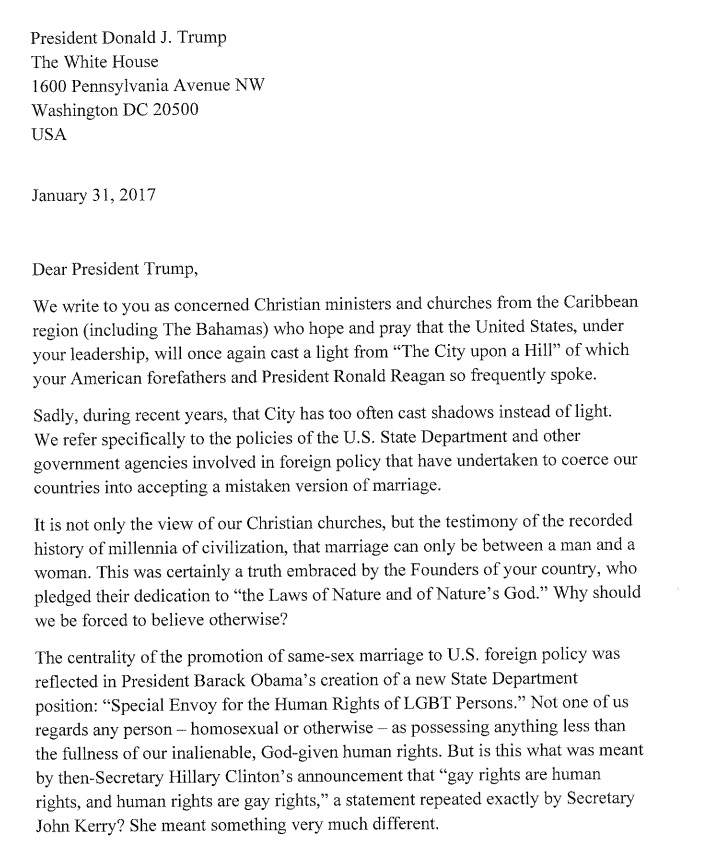
Loose Lips - Photo 3

Click on the Photo to Enlarge

The full letter and petition signatures can be viewed here:

https://world.wng.org/sites/default/files/assets/Caribbean%20church%20leaders%20letter%20to%20President%20Trump.pdf

———–

Appendix VIDEO – Tourists Avoiding USA Because Of Donald Trump, Costing Us Billions – https://youtu.be/kHD73jSM5Rs

Published on Apr 3, 2017 – Experts had predicted that Trump’s Muslim Ban would cost the United States tons of money in declining tourism, but what they didn’t count on were the number of people who refuse to travel to the U.S. just because Trump is the new president.  As it turns out, nobody wants to visit a country that is ruled by a hatemonger, and analysts are now referring to the decline in travel to the U.S. as the “Trump Slump.” Ring of Fire’s Farron Cousins discusses this.

Link – https://www.salon.com/2017/03/31/trum…

Spread the word! LIKE and SHARE this video or leave a comment to help direct attention to the stories that matter. And SUBSCRIBE to stay connected with Ring of Fire’s video content!

Watch America’s Lawyer featuring Mike Papantonio on RT: https://www.rt.com/shows/americas-law…

Order Mike Papantonio’s novel Law and Disorder today: https://www.amazon.com/Law-Disorder-M…

Follow more of our stories at http://www.TROFIRE.com

Subscribe to our podcast: http://www.ROFPodcast.com

Support Ring of Fire by subscribing to our YouTube channel: https://www.youtube.com/user/golefttv…

Be sociable! Follow us on:
Facebook: http://www.facebook.com/RingofFireRadio
Twitter: http://www.twitter.com/RingofFireRadio
Google+: http://plus.google.com/11841583157319…
Instagram: https://www.instagram.com/ringoffiren…

Share this post:
, ,

ENCORE: US Warnings on Low-cost Dominican Surgeries

UPDATE – Go Lean Commentary

The warning was sounded 3 years ago, today. What is the status now? Have the warnings been heeded?

Surely, we have paid attention and we have put in the risk mitigations so as to preserve life-and-limb in the activities of cosmetic surgeries in the Dominican Republic.

Sad to report, but the answer is “No”.

The risks continue; the disfigurements continue; the deaths continue.

Say it ain’t so!

See the news article in the Appendix relating the details of a fresh warning from the US Center for Disease Control and Prevention (CDC).

In this previous Go Lean blog-commentary – being ENCORED below – the prospects of Medical Tourism were heralded, with the caution for proper regulatory control. The appeal was made for the new Caribbean Union Trade Federation (CU) to serve as that regulator, under the guise of a Self-Governing Entity. That appeal is echoed again here-now. There is too much …

… money at stake.

… jobs at stake.

… lives at stake.

But while this original blog-commentary below published on April 1, 2014 related the death of Beverly Brignoni (28), there have been other deaths; as with these women:

See the related October 3, 2016 story: Pretty Hurts – Dishing on the dangers of Plastic Surgery 

CU Blog - US Warnings on Low-cost Dominican Surgeries - Photo 2
———–

ENCORE Title: Low-cost Dominican surgeries spark warnings by US

CU Blog - Low-cost Dominican surgeries spark warnings by US - PhotoTo the family of Beverly Brignoni, according to the foregoing news article, the publishers of the book Go Lean … Caribbean, SFE Foundation, extend condolences for the loss of their dearly departed loved one. This article – as follows – shows the down-side of medical tourism, an accidental death from an apparent lax oversight in a cosmetic surgery clinic.

By: Ben Fox and Ezequiel Abiu Lopez
Beverly Brignoni was a young New Yorker seeking a less expensive way to enhance her appearance and she did what many other people are now doing: travel to the Dominican Republic for cosmetic surgery; (see undated “selfie” photo posted to her Instagram account, courtesy of the Brignoni family).

It went horribly wrong. The 28-year-old died Feb. 20 from what the doctor told her family was a massive pulmonary embolism while getting a tummy tuck and liposuction at a clinic in the Dominican capital recommended by friends. Family members want local authorities to investigate.

“We want to know exactly what happened,” said Bernadette Lamboy, Brignoni’s godmother. “We want to know if there was negligence.”

The district attorney’s office for Santo Domingo says it has not yet begun an investigation because it has not received a formal complaint from Brignoni’s relatives. Family members say they plan to make one.

Shortly after Brignoni’s death, the Health Ministry inspected the Vista del Jardin Medical Center where she was treated and ordered the operating room temporarily closed, citing the presence of bacteria and violations of bio-sanitary regulations. The doctor who performed the procedure and the clinic have not responded to requests for comment.

Brignoni’s death is unusual, but it is not isolated. Concerns about the booming cosmetic surgery business in the Dominican Republic are enough of an issue that the State Department has posted a warning on its page for travel to that country, noting that in several cases U.S. citizens have suffered serious complications or died.

The U.S. Centers for Disease Control issued an alert March 7 after health authorities in the United States reported that at least 19 women in five states had developed serious mycobacterial wound infections over the previous 12 months following cosmetic procedures in the Dominican Republic such as liposuction, tummy tucks and breast implants.

There were no reported deaths in those cases, but treatment for these types of infections, which have been caused in the past by contaminated medical equipment, tend to involve long courses of antibiotics and can require new surgery to remove infected tissue and drain fluid, said Dr. Douglas Esposito, a CDC medical officer.

“Some of these patients end up going through one or more surgeries and various travels through the medical system,” Esposito said. “They take a long time typically to get better.”

The Dominican Republic, like countries such as Mexico, Costa Rica and Thailand, has promoted itself as a destination for medical tourism, so-called because people will often tack on a few days at a resort after undergoing surgery. The main allure is much lower costs along with the promise that conditions will be on par with what a patient

would encounter at home.

In 2013, there were more than 1,000 cosmetic procedures performed in the Dominican Republic, 60 percent of them on foreigners, according to the country’s Plastic Surgery Society.

The Internet is flooded with advertisements and testimonials from people who say they have had successful procedures in the Dominican Republic, and an industry of “recovery houses” has sprung up to serve clients, along with promoters who canvass for clients in the United States. The price is often about a third of the cost in the United States.

Dr. Braun Graham, a plastic surgeon in Sarasota, Florida, says he done corrective surgery on people for what he says were inferior procedures abroad. He warns that even if a foreign doctor is talented, nurses and support staff may lack adequate training.

“Clearly, the cost savings is certainly not worth the increased risk of a fatal complication,” said Graham, past president for Florida Society of Plastic Surgeons.

Brignoni was referred to the Vista del Jardin Medical Center by several acquaintances in the New York borough of the Bronx where she lived, said Lamboy and Lenny Ulloa, the father of the 4-year-old daughter she left behind.

“Supposedly, it was a high-end clinic, one of the best in the city,” Ulloa said.

The doctor who performed Brignoni’s procedure, Guillermo Lorenzo, is certified by the Plastic Surgery Society, but there

are at least 300 surgeons performing cosmetic procedures who are not, said Dr. Severo Mercedes, the organization’s director. He said the government knows about the problem but has not taken any action. “We complain but we can’t go after anyone because we’re not law enforcement,” Mercedes said.

The number of people pursuing treatment in the Dominican Republic doesn’t seem to have been affected by negative reports, including a previous CDC warning about a cluster of 12 infections in 2003-04.

In one recent case, the Dominican government in February closed a widely advertised clinic known as “Efecto Brush,” for operating without a license. Prosecutors opened a criminal case after at least six women accused the clinic of fraud and negligence. The director, Franklin Polanco, is free while awaiting trial. He denies wrongdoing.

There was also the case of Dr. Hector Cabral. New York prosecutors accused him of conducting examinations of women in health spas and beauty parlors in that state in 2006-09 without a license, then operating on them in the Dominican Republic, leaving some disfigured. Cabral pleaded guilty to one count of unauthorized practice of medicine in October 2011 and returned to the Dominican Republic, where he still practices.

In 2009, Dominican authorities charged Dr. Johan Tapia Bueno with illegally practicing plastic surgery at his apartment after several women, including a local television personality, accused him of malpractice that left them with infections. Awaiting trial, he has pleaded innocent to charges that include fraud.

Juan Linares, a lawyer hired by Brignoni’s boyfriend, said he is still awaiting an autopsy report.

Because she arrived in the country late at night on a delayed flight and was on the operating table early the next morning, a main concern is whether she received an adequate medical evaluation before the procedure. Graham, the Florida surgeon, said sitting on a plane for several hours can cause blood to stagnate in the legs and increase the risk of an embolism.

Brignoni paid the Dominican clinic $6,300 for a combination of liposuction, tummy tuck and breast surgery. Lamboy said she had decided not to have the work done on her breasts and was expecting a partial refund. The woman, who worked as a property manager, had lost about 80 pounds about a year earlier after gastric bypass surgery.

Brignoni was clearly excited about the procedure. Her final post on Facebook was a photo she took of her hands holding her passport and boarding pass for the flight from New York to Santo Domingo.

“She wanted it so bad,” her godmother said. “It felt like she was going to have a better outlook on life, getting this done.”

Associated Press writer Ben Fox reported this story from Miami and Ezequiel Abiu Lopez reported in Santo Domingo.

Source: Associated Press (AP); retrieved 03/31/2014 from: http://news.yahoo.com/low-cost-dominican-surgeries-spark-warnings-us-042418398.html

This is a very important issue for the planning and execution of the new inter-governmental agency: Caribbean Union Trade Federation (CU). First of all, someone died – life is too precious to skim over this issue with indifference. The Go Lean book serves as a roadmap to introduce and implement the CU, so as to re-boot the region’s economic engines, including avenues of medical tourism.

There are also peripheral issues associated with this news story, many of which are examined, as missions, in great details in the Go Lean book. The issues/missions are:

  • Image: Confidence in the competence of service providers is sometimes based on reputation and branding. This is para-mount in medical fields. While the Caribbean is home to many excellent medical schools, facilities and practitioners, there is no regional “sentinel” role-player. The CU mandate is to zealously protect and promote the image and branding for industrial developments. So now when the media portrays “negative” depiction of Caribbean life, culture and people, there is no formal response mechanism. But with the CU’s implementation, there will be an entity to effectuate an anti-defamation response and better manage the region’s image.
  • Health Administration: The Go Lean roadmap recognizes healthcare as a basic need for the people of the Caribbean. As such, there is the acknowledgement that health delivery systems generate excessive costs and risks for a community. As a planning tool, the roadmap commences with a Declaration of Interdependence, pronouncing regional integration (Page 11) as the strategy for optimized benefits:
      IX.   Whereas the realities of healthcare and an aging population cannot be ignored and cannot be afforded without some advanced mitigation, the Federation must arrange for health plans to consolidate premiums of both healthy and sickly people across the wider base of the entire Caribbean population. The mitigation should extend further to disease management, wellness, obesity and smoking cessation programs. The Federation must proactively anticipate the demand and supply of organ transplantation as developing countries are often exploited by richer neighbors for illicit organ trade.
  • Self-Government Entities: The foregoing news story involves a clinic regulated by a Caribbean member-state, the Dominican Republic. The Go Lean roadmap institutes an arrangement for medical/research campuses as SGE’s (Self-Governing Entities) that are only regulated by the CU federal authorities. Had this tragedy occurred on such a facility, the response would have been immediate and comprehensive, employing best-practices of trauma medicine arts and sciences, thusly requiring a post-mortem lessons-learned process that would be fully transparent and accountable.
  • Lean Government: The Go Lean roadmap also extends optimizations to the member-states governments, requiring a separation-of-powers dictum to transfer oversight and administration of certain state functions to federal authorities. This includes standards, licensing and administration of healthcare facilities. The application of best-practices would most assuredly minimize the risk of medical negligence.
  • US Exceptionalism: The Go Lean roadmap maintains that other countries have their own version of the American Dream. The quest for life, liberty and the pursuit of happiness is not exclusively American. Whereas there are millions of negligent deaths in the US hospitals/clinics every year, one American dying in a Caribbean facility does not constitute an exceptional event; bad things do happen to good people … everywhere, in the US, in the Caribbean and in the Dominican Republic. Having a tourism-based regional economy means we always want to extend hospitality to our American guests, but embarking on medical tourism, also means assuming some degree of risks, for the facilities, the doctors and most importantly the patients.

The foregoing article crystalizes the need for the CU Trade Federation, a super-national administration to regulate, protect, promote and foster quality delivery of the most vital public services. The publishers of the Go Lean roadmap will hereby “sit back”, observe-and-report on the manifestations of this case, hoping for the quest for justice and accountability to be fulfilled. And remembering the unconscionable loss of the beautiful 28-year-old woman, Beverly Brignoni; RIP.

Download the book Go Lean … Caribbean – now!

Sign the petition to lean-in for the roadmap for the Caribbean Union Trade Federation.

———–

Appendix – CDC warns of dangers of plastic surgery in Dominican Republic

(HealthDay) — U.S. health officials are warning about the dangers of “medical tourism” after at least 18 women from the East Coast became infected with a disfiguring bacteria following plastic surgery procedures they had in the Dominican Republic.

The infections, caused by a type of germ called mycobacteria, can be difficult to treat. At least several of the women had to be hospitalized, undergo surgery to treat the infection and take antibiotics for months, according to the report from the U.S. Centers for Disease Control and Prevention.

One expert said the effects can be devastating.

“It’s a very mutilating infection. They’re going for cosmetic surgery, and they will be scarred. It’s a terrible scenario for people to go down there, get surgery and come back worse than they imagined they could be,” said Dr. Charles Daley. He is a Denver infectious disease physician whose clinic has seen patients infected after undergoing these kinds of procedures in the Dominican Republic.

According to the CDC, 21 women from six Northeast and Mid-Atlantic states appear to have been affected by mycobacterial infections after visiting five plastic surgery clinics in the Dominican Republic, a nation in the Caribbean. (Eighteen of the cases are confirmed, and three are considered probable.)

Mycobacteria, which are found worldwide in the environment, “usually infect the skin or lungs, and are responsible for chronic and recurrent infections that are notoriously resistant to antibiotics and difficult to treat,” said report co-author Dr. Douglas Esposito. He is a medical officer and epidemiologist with the CDC’s Travelers’ Health Branch.

More than 80 percent of the infected women reported swelling, pain and scarring. Daley, who works at the National Jewish Health respiratory hospital in Denver, said infected people often need to undergo reconstructive surgery.

It’s not clear how the women were infected, although Daley said it’s possible the bacteria entered their plastic surgery wounds through tap water or instruments used in surgery. Most underwent liposuction and at least one other surgery, such as procedures to expand the size of the breasts and buttocks, or breast reduction.

Daley said his clinic has seen two patients infected after plastic surgery and consulted on a third case. It’s not clear how many, if any, are among those in the CDC report.

The risk of this kind of infection is higher in countries like the Dominican Republic and Brazil, he noted, but patients have become infected in the United States, too. “We are definitely seeing more of these postoperative infections, particularly ones that are related to cosmetic surgery,” Daley said.

The CDC report warns about the risks of medical tourism, a term that describes leaving the United States for medical procedures to save money. According to the report, many of the women—most of whom were born in the Dominican Republic—said they went to the country for plastic surgery to save money.

People who have undergone plastic surgery in the Dominican Republic should talk to their doctor about getting tested, Daley suggested. And, people who plan to go there for a procedure should ask the clinic whether they’ve had infections, he added.

“I would never go to one of those places,” he said. “I know too many stories about what’s happened to people. It has ruined people’s lives.”

The study was published online July 13 in Emerging Infectious Diseases.

Reporting by: Randy Dotinga, Healthday Reporter

Source: Posted July 14, 2016; retrieved March 30, 2017 from: https://medicalxpress.com/news/2016-07-cdc-dangers-plastic-surgery-dominican.html#jCp

Share this post:
, , , ,
[Top]

ENCORE – Legacy of the ‘Buffalo Soldier’ Song

Go Lean Commentary

“Now” is always the right time for great Reggae Music.

The world misses Bob Marley. Not only was he a great musician and entertainer, but a great educator as well. How many people in the Caribbean knew about the ‘Buffalo Soldiers’ in America before he recorded this song?

(Interesting tidbit: the song was released in 1983, after his death in 1981).

This Caribbean family got to stretch our knowledge and appreciation of American History and the Buffalo Soldier in our recent summer vacation to Washington, D.C.. We enjoyed this monument to the original segregated African-American fighting men in the US Army.
CU Blog - Legacy of Buffalo Soldier - Photo 1

CU Blog - Legacy of Buffalo Soldier - Photo 2

Related blog-commentary – A Lesson in History – During the Civil War: Principle over Principal

CU Blog - A Lesson in History - During the Civil War - Principle not Principal - Photo 2

This consideration is presented with an ENCORE of this previous blog-commentary from March 28, 2016 – exactly 1 year ago today. See the previous submission here-now:

————-

Title: A Lesson in History: Buffalo Soldier

Welcome to the New World.

Fighting on arrival; fighting for survival“. – Lyrics from song  Buffalo Soldier by Bob Marley.

CU Blog - A Lesson in History - Buffalo Soldiers - Photo 1This is the experience of the Pan-African Diaspora in all of the Americas. Truly a sad origin history, “Coming to America” as slaves. And yet, the African race has proliferated in much of the Americas, most notably in the Caribbean, where the one-time slaves emerged as the majority population in 29 of the 30 member-states; (the only other New World non-Caribbean country with a majority Black population is Brazil). After a few turns in world political developments, these majorities now run the governments in most of these Caribbean countries.

It took “blood, sweat and tears” to reach this accomplishment. This connotes military action, warfare and sacrifice. The most prominent of Black fighting men in the history of the New World is the Buffalo Soldier.

Caribbean Music legend Bob Marley is to be credited for educating much of the world with this history. In his landmark song Buffalo Soldier; he sang their praises – see lyrics in Appendix A.

See the VIDEO-AUDIO of the song here:

VIDEO-AUDIO – Bob Marley Buffalo Soldier – https://youtu.be/IEpSBsUjY-0

Uploaded on May 2, 2011 – This song was released post humorously in 1983, after Bob Marley’s death.

Just who were the Buffalo Soldiers and what are their connections to the Caribbean? See  this encyclopedia reference here:

From 1863 to the early 20th century, African American units were utilized by the Army to combat the Native Americans during the Indian Wars.[14] The most noted among this group were the Buffalo Soldiers:

This nickname was given to the “Negro Cavalry” by the Native American tribes they fought in the Indian Wars. The term eventually became synonymous with all of the African American regiments formed in 1866. At the end of the U.S. Civil War the army reorganized and authorized the formation of two regiments of black cavalry (the 9th and 10th US Cavalry). Four regiments of infantry (the 38th, 39th, 40th and 41st US Infantry) were formed at the same time. In 1869, the four infantry regiments were merged into two new ones (the 24th and 25th US Infantry). These units were composed of black enlisted men commanded by white officers such as Benjamin Grierson, and occasionally, an African-American officer such as Henry O. Flipper. The “Buffalo Soldiers” served a variety of roles along the frontier from building roads to guarding the U.S. mail.[15]

CU Blog - A Lesson in History - Buffalo Soldiers - Photo 2These regiments served at a variety of posts in the southwest United States and Great Plains regions. During this period they participated in most of the military campaigns in these areas and earned a distinguished record. Thirteen enlisted men and six officers from these four regiments earned the Medal of Honor during the Indian Wars.[16]

After the Indian Wars ended in the 1890s, the regiments continued to serve and participated in the Spanish–American War (including the Battle of San Juan Hill in Cuba), where five more Medals of Honor were earned.[17] 

Source: https://en.wikipedia.org/wiki/Military_history_of_African_Americans#Indian_Wars retrieved March 28, 2019.

All of the New World , despite their European colonizers – Dutch, English, French, Portuguese or Spanish – was developed on the same economic policy: slavery!

This ugly institution was so entrenched that only a model war would effectuate its abolition permanently. That war was waged in the United States (1861 – 1865) as a proxy to all the New World territories. Shortly thereafter, the institution was abolished in the remaining countries that still maintained it in the region, i.e. Brazil. (The US was not the first; that distinction belong to Haiti, which endured a slave rebellion and battles for emancipation; the Spanish colonies followed shortly there-after, then the French, then the British).

The Buffalo Soldiers are most noteworthy because they fought for dignity for all the African race in the New World, though this was not pronounced in their commission, only now gleaned from their legacy. See Trailer below for one of the many movies.

The movement and underlying book Go Lean … Caribbean asserts that Caribbean people must now consider the weight of history and re-assign these islands and coastal states as their only homeland. As a people, the African Diaspora have fought and paid for these lands; they have shed “blood, sweat and tears” for their New World homelands. The ancestral home of Africa is no longer relevant. We now need to “prosper where we are planted” here in the Caribbean. Bob Marley said it best:

I mean it, when I analyze the stench –
To me it makes a lot of sense:
How the Dreadlock Rasta was the Buffalo Soldier,
And he was taken from Africa, brought to America,
Fighting on arrival, fighting for survival.

The freedoms we enjoy today, were not free!

They cost our ancestors and predecessors all they had to offer: a full measure of sacrifice and devotion. They gave of their sons and daughters. This is the important lesson to learn in considering the history of these American fighting men. As our ancestors and predecessors, they paid a steep price – “they punched our tickets” – for progress. We must regard their sacrifice.

This is one reason why we must adopt a National Sacrifice community ethos. This vital quality has been missing for far too long. This is why the region has such a deplorable abandonment rate: no [perception of] pain, no gain; no comprehension of sacrifice, no sense of value.

As a region, we must do better. We must discourage the emigration, brain drain and further societal abandonment.

The book Go Lean…Caribbean and accompanying blogs provide lessons from history in considering the fighting men of the American Civil War. The Caribbean region’s debilitating societal abandonment rate – 70 percent of college educated had fled for foreign shores – is proof positive of the absence and lack of this National Sacrifice ethos.

Early in the Go Lean book, this need for careful review of the history of slavery was acknowledged and then placed into perspective with this pronouncement (Declaration of Interdependence – Page 10):

As the history of our region and the oppression, suppression and repression of its indigenous people is duly documented, there is no one alive who can be held accountable for the prior actions, and so we must put aside the shackles of systems of repression to instead formulate efficient and effective systems to steer our own destiny.

As the colonial history of our region was initiated to create economic expansion opportunities for our previous imperial masters, the structures of government instituted in their wake have not fostered the best systems for prosperity of the indigenous people.

So the consideration of the Go Lean book, is to identify and correct all bad community ethos – the fundamental spirit of our culture – and to foster positive community ethos (such as National Sacrifice and deferred gratification). This point was also pronounced in the opening Declaration of Interdependence (Page 13) with this statement:

xix. Whereas our legacy in recent times is one of societal abandonment, it is imperative that incentives and encouragement be put in place to first dissuade the human flight, and then entice and welcome the return of our Diaspora back to our shores. This repatriation should be effected with the appropriate guards so as not to imperil the lives and securities of the repatriated citizens or the communities they inhabit. The right of repatriation is to be extended to any natural born citizens despite any previous naturalization to foreign sovereignties.

This book  Go Lean…Caribbean serves as a roadmap for the introduction and implementation of the technocratic Caribbean Union Trade Federation (CU) to spearhead the elevation of Caribbean society. The book advocates learning lessons from many events and concepts in history, covering all societal engines: economics, security and governance. The roadmap seeks to reboot these engines to ensure that all Caribbean stakeholders have the opportunity for life, liberty and the pursuit of happiness with no abusive exploitation of any ethnic group; no suppression, repression or oppression of any people: African or not!

The Go Lean roadmap seeks to employ “best-practices” to impact the CU prime directives; identified with the following 3 statements:

  • Optimization of the economic engines in order to grow the regional economy to $800 Billion & create 2.2 million new jobs.
  • Establishment of a security apparatus to protect the resultant economic engines and ensure the respect of human rights and public safety.
  • Improve Caribbean governance to support these engines.

The Go Lean book stresses the community ethos, strategies, tactics, implementations and advocacies to reboot, reform and transform the eco-systems of Caribbean society. These points are detailed in the book as follows:

Community Ethos – Deferred Gratification Page 21
Community Ethos – Economic Principles – People Choose Page 21
Community Ethos – Economic Principles – People Respond to Incentives in Predictable Ways Page 21
Community Ethos – Economic Systems Influence Individual Choices Page 21
Community Ethos – Economic Principles – The Consequences of Choices Lie in the Future Page 21
Community Ethos – Governing Principles – Lean Operations Page 24
Community Ethos – Governing Principles – Cooperatives Page 25
Community Ethos – Ways to Impact the Future Page 26
Community Ethos – Ways to Impact a Turn-Around Page 33
Community Ethos – Ways to Promote Happiness Page 36
Community Ethos – Ways to Impact the Greater Good Page 37
Strategy – Vision – Confederate 30 Member-States Page 45
Strategy – Mission – Enact a Defense Pact with Militia and Naval Forces Page 45
Strategy – Mission – Keep the next generation at home Page 46
Tactical – Confederating a Permanent Union Page 63
Tactical – Fostering a Technocracy Page 64
Implementation – Assemble – Incorporating all the existing regional military organizations Page 96
Implementation – Ways to Pay for Change Page 101
Implementation – Security Initiatives at Start-up Page 103
Implementation – Ways to Deliver Page 109
Implementation – Reasons to Repatriate to the Caribbean Page 118
Planning – 10 Big Ideas for the Caribbean – Confederation Without Sovereignty Page 127
Planning – Ways to Make the Caribbean Better Page 131
Advocacy – Ways to Grow the Economy Page 151
Advocacy – Ways to Create Jobs Page 152
Advocacy – Ways to Better Manage the Social Contract Page 170
Advocacy – Ways to Improve Homeland Security Page 181
Advocacy – Ways to Impact the Diaspora Page 217
Advocacy – Ways to Preserve Caribbean Heritage Page 218
Advocacy – Ways to Protect Human Rights Page 220

There are other lessons for the Caribbean to learn from considering history; the following previous blog/commentaries apply:

https://goleancaribbean.com/blog/?p=7682 Frederick Douglass: Role Model for Single Cause – Abolition

https://goleancaribbean.com/blog/?p=6722 A Lesson in History – After the Civil War: Birthright Mandates
https://goleancaribbean.com/blog/?p=6720 A Lesson in History – During the Civil War: Principle over Principal
https://goleancaribbean.com/blog/?p=6718 A Lesson in History – Before the Civil War: Compromising Human Rights
https://goleancaribbean.com/blog/?p=5695 Repenting, Forgiving and Reconciling the Past
https://goleancaribbean.com/blog/?p=5333 A Lesson in History – Legacies: Cause and Effect
https://goleancaribbean.com/blog/?p=5183 A Lesson in History – Cinco De Mayo
https://goleancaribbean.com/blog/?p=5123 A Lesson in History – Royal Charter: Zimbabwe -vs- South Africa
https://goleancaribbean.com/blog/?p=4971 A Lesson in History – Royal Charter: Truth & Consequence
https://goleancaribbean.com/blog/?p=4935 A Lesson in History: the ‘Grand Old Party’ Abolition Roots
https://goleancaribbean.com/blog/?p=2480 A Lesson in History: Community Ethos of WW II
https://goleancaribbean.com/blog/?p=2297 A Lesson in History: Booker T versus Du Bois
https://goleancaribbean.com/blog/?p=1531 A Lesson in History: 100 Years Ago Today – World War I
https://goleancaribbean.com/blog/?p=789 A Lesson in History: America’s War on the Caribbean

The concepts in this commentary are more profound than just the lyrics of a reggae song. It is bigger than music, it relates to life and legacy. The recent legacy of the Afro-Caribbean community is one of dysfunction and abandonment. But the ancient history – Buffalo Soldiers in particular – should give us pause and cause to reflect and reform our commitment to a National Sacrifice ethos.

No appreciation, no sacrifice; no sacrifice, no victory!

The Go Lean roadmap seeks to reform and transform the Caribbean societal engines, urging the adoption of new positive community ethos, such as National Sacrifice. This is an expression of deferred gratification, choosing to focus more on the future than on the present. The Go Lean book relates that the “African Diaspora experience in the New World is one of future gratification, as the generations that sought freedom from slavery knew that their children, not them, would be the beneficiaries of that liberty. This ethos continued with subsequent generations expecting that their “children” would be more successful in the future than the parents may have been”. Deferred gratification is a form of sacrifice.

We should value this sacrifice. Such gratitude makes our community better, more resilient and more long suffering.

Now is the time for all stakeholders in the Caribbean to show proper appreciation for the sacrifices by leaning-in to this roadmap for Caribbean empowerment. All the empowerments in this roadmap require people to fight for their homeland. We can learn so much from the Buffalo Soldiers:

Fighting on arrival, fighting for survival;
Driven from the mainland to the heart of the Caribbean.

If you know your history,
Then you would know where you coming from,
Then you wouldn’t have to ask me,
Who the ‘eck do I think I am.

The Go Lean quest is simple, learn from history and work to make the Caribbean region a better place to live, work and play. 🙂

Download the book Go Lean … Caribbean – now!

Sign the petition to lean-in for the roadmap for the Caribbean Union Trade Federation.

———–

Appendix A – Song Buffalo Soldier Lyrics – Sang by Bob Marley

Buffalo Soldier, Dreadlock Rasta:
There was a Buffalo Soldier in the heart of America,
Stolen from Africa, brought to America,
Fighting on arrival, fighting for survival.

I mean it, when I analyze the stench –
To me it makes a lot of sense:
How the Dreadlock Rasta was the Buffalo Soldier,
And he was taken from Africa, brought to America,
Fighting on arrival, fighting for survival.

Said he was a Buffalo Soldier, Dreadlock Rasta –
Buffalo Soldier in the heart of America.

If you know your history,
Then you would know where you coming from,
Then you wouldn’t have to ask me,
Who the ‘eck do I think I am.

I’m just a Buffalo Soldier in the heart of America,
Stolen from Africa, brought to America,
Said he was fighting on arrival, fighting for survival;
Said he was a Buffalo Soldier win the war for America.

Dreadie, woy yoy yoy, woy yoy-yoy yoy,
Woy yoy yoy yoy, yoy yoy-yoy yoy!
Woy yoy yoy, woy yoy-yoy yoy,
Woy yoy yoy yoy, yoy yoy-yoy yoy!
Buffalo Soldier troddin’ through the land, wo-ho-ooh!
Said he wanna ran, then you wanna hand,
Troddin’ through the land, yea-hea, yea-ea.

Said he was a Buffalo Soldier win the war for America;
Buffalo Soldier, Dreadlock Rasta,
Fighting on arrival, fighting for survival;
Driven from the mainland to the heart of the Caribbean.

Singing, woy yoy yoy, woy yoy-yoy yoy,
Woy yoy yoy yoy, yoy yoy-yoy yoy!
Woy yoy yoy, woy yoy-yoy yoy,
Woy yoy yoy yoy, yoy yoy-yoy yoy!

Troddin’ through San Juan in the arms of America;
Troddin’ through Jamaica, a Buffalo Soldier# –
Fighting on arrival, fighting for survival:
Buffalo Soldier, Dreadlock Rasta.

Woy yoy yoy, woy yoy-yoy yoy,
Woy yoy yoy yoy, yoy yoy-yoy yoy!
Woy yoy yoy, woy yoy-yoy yoy,
Woy yoy yoy yoy, yoy yoy-yoy yoy! [fadeout]
———–

Appendix B – VIDEO – Buffalo Soldiers Trailer 1997 – https://youtu.be/Om_BrJhu4gQ

Published on Mar 9, 2015 – Buffalo Soldiers Trailer 1997; Director: Charles Haid; Starring: Danny Glover, Bob Gunton, Carl Lumbly, Tom Bower, Gabriel Casseus.
Official Content From Warner Home Video

Share this post:
, ,
[Top]

Trump’s Vision of the Caribbean: Yawn

Go Lean Commentary

Advice: When people tell you who they are, listen to them.

CU Blog - Trump's Vision of the Caribbean - Photo 1The new American President, Donald Trump, has announced, proclaimed and repeated that he is “for America First”. Yet the rest of the world seems to be surprised when he promotes policies that ignores, disregards and denigrates foreign people and countries; i.e. banning travel from 7 Muslim countries.

Come on people, the man said who he was and what is important to him. Why are we now surprised with stories like this, it is like he “yawns” at previous American empowerments that affected us in the Caribbean and Latin America – see the following article:

Title: Trump’s Big F-U To The Caribbean, Latin American
By:NAN Editorial Team

News Americas, NEW YORK, NY, Fri. Mar. 17, 2017: Donald Trump released his first “budget blueprint” Thursday morning, providing the clearest glimpse yet at his administration’s war on the so-called “administrative state.” He once again proved his administration cares nothing about the Americas – Latin America or the Caribbean – or the world for that matter. Here are a few big F-U’s from Trump that will see drastic cuts if this budget ever gets green lighted.

1: Cuts to fighting drug trafficking in Latin America & the Caribbean

The administration’s budget proposal calls for some US $1.3 billion in cuts to the US Coast Guard to eliminate its top counter-terrorism unit, the Maritime Security Response Team, and all of its regional Maritime Safety and Security Teams. This means fewer assets to interdict all suspected smuggling boats and to disrupt drug trafficking at sea in the Caribbean, especially.

2: The Inter-American Foundation

Donald Trump has sliced away US $22 million from The Inter-American Foundation which funds grass-roots groups and nongovernmental organizations (NGOs) in Latin America and the Caribbean.

3: The U.S. Trade and Development Agency

Some $60 million is being cut from the U.S. Trade and Development Agency, which works atpromoting U.S. exports in the Americas and the world and works to do things such as improve transportation infrastructure and otherwise facilitate trade in dozens of countries.

4: The Overseas Private Investment Corporation

The Overseas Private Investment Corporation promotes U.S. economic investment in the Americas and other developing nations by working with private partners but its budget of $83 million has been swiped away.

5: The Global Climate Change Initiative

The Global Climate Change Initiative that was aimed at supporting climate change fight globally per the Paris climate agreement has been wiped away.

6: The Emergency Refugee and Migration Assistance Fund

Gone in the wind will be the US $70 million that allows the US President to “provide humanitarian assistance for unexpected and urgent refugee and migration needs worldwide.”

7: Cuts To The State Department’s Bureau of International Organization Affairs

There is a 50 percent cut to the U.S. funding for the State Department’s Bureau of International Organization Affairs, which pays U.S. dues to the United Nations, the OAS and other international and regional groups, according to news reports disclosed by Foreign Policy magazine. The United States currently contributes $50 million a year to the OAS budget which will now mean a drastic cut to that organization’s budget.

Source: News America Now – posted-retrieved March 17, 2017 from: http://www.newsamericasnow.com/trumps-big-f-u-to-the-caribbean-latin-american/

———

About News America Now

News Americas Now is a daily newswire covering the Americas  – the Caribbean and Latin America and its Diasporas – whose content is syndicated across 21 plus news sites including on the Caribbean Today in Florida and on Irie Jam radio in New York City – the media company’s headquarters.

It is owned by Hard Beat Communications, a global media company with over a decade of experience on the Caribbean, Caribbean Diaspora and Latin American markets.

News Americas Now  and its 20 affiliated sites is the largest dedicated Caribbean news network covering the Caribbean, Caribbean Diaspora and Latin America news, business, travel, politics and executive interviews.

So Donald Trump’s America has it’s own priorities, and its not the Caribbean.

Charity begins at home – Old Adage

The policies of Donald Trump is consistent in being nonchalant towards other causes, not just Caribbean issues. He “yawns” at more than just our priorities. Consider this headline:

Trump To Planet: Drop Dead – see excerpt in the Appendix below.
CU Blog - Trump's Vision of the Caribbean - Photo 2

The days of a Good Neighbor policy emanating from Washington towards Latin America and the Caribbean appears to be over, at least for this administration.

This foregoing article relates to the ongoing theme from the publishers of the book Go Lean…Caribbean, that of America’s War on the Caribbean. Our goal and aspiration is for Caribbean people to take the lead ourselves for Caribbean elevation.

America has problems and challenges. It is only understandable that political leaders may be focusing on empowerments to help the American homeland first. This commentary had previously detailed some of the societal  threats; see this list that corresponds with Donald Trump’s 2016 campaign platform:

Jobs Loss of Jobs-Taxes to ‘Robots’ and Automation
Trade An Ode to Detroit – Good Luck on Trade!
Making America Great Going from ‘Good to Great’
Incomes Mitigating Income Inequality
ISIS Americans arrested for aiding ISIS
Climate Denial Capitalism -vs- the Climate
Winning Again The Erosion of the Middle Class

In addition, the Go Lean movement has previously detailed the American societal defects – institutional racism and Crony-Capitalism. Donald Trump, had previously been known to instigate racial hatred and business-wise, to be an abusive capitalist himself.

Therefore his first budget proposal, laying out his priorities, should be no surprise.

Expecting a liberal immigration policy for Caribbean people into the US?

Don’t count on it!

Really don’t! The US should not be the panacea for Caribbean ills. We have our own issues, problems and challenges that we need to deal with. This has been a consistent theme for the Go Lean book, which posits that one of the greatest threats to Caribbean society is the atrocious emigration rates. We have a high abandonment rate of our citizens to countries in North America (US & Canada) and Western Europe – especially among our professional classes.

Unfortunately, the leanings of Caribbean people to emigrate is still acute. The reasons why our people leave are identified as “Push” and “Pull”; they are fleeing from “home” and seeking “refuge” in countries like the US. “Refuge” is a good word; because of the many societal defects – the issues, problems and challenges referred above – many in the Caribbean must leave as refugees – think LGBTDisabilityDomestic-abuseMedically-challenged – for their life, liberty and pursuit of happiness. On the other hand, the lure of a more prosperous life in foreign countries, drive the “pull” side of the equation; these ones “pulled” are to be considered economic refugees.

See the VIDEO in the Appendix below regarding Caribbean expectations for immigration to the American mainland.

What parasites we are in the Caribbean!

The book Go Lean…Caribbean aspires to economic principles that dictate that “consequences of choices lie in the future”. America has to deal with the consequences of its electoral choice; and we in the Caribbean have to deal with ours – we must have our own vision … and values. This book serves as a roadmap for the introduction and implementation of the technocratic Caribbean Union Trade Federation (CU). The goal is to confederate the 30 member-states in the region to form a federal government and effect a turn-around in our  region. We should not leave it up to our colonial masters – or the American Super Power – to assuage our problems. We need our own expression of governance, to “formulate efficient and effective systems to steer our own destiny” (Page 10).

The Go Lean roadmap seeks to optimize the Caribbean governance. This vision is defined early in the book (Page 12) in the following pronouncements in the Declaration of Interdependence:

xi. Whereas all men are entitled to the benefits of good governance in a free society, “new guards” must be enacted to dissuade the emergence of incompetence, corruption, nepotism and cronyism at the peril of the people’s best interest.  The Federation must guarantee the executions of a social contract between government and the governed.

xii. Whereas the legacy in recent times in individual states may be that of ineffectual governance with no redress to higher authority, the accedence of this Federation will ensure accountability and escalation of the human and civil rights of the people for good governance, justice assurances, due process and the rule of law. As such, any threats of a “failed state” status for any member state must enact emergency measures on behalf of the Federation to protect the human, civil and property rights of the citizens, residents, allies, trading partners, and visitors of the affected member state and the Federation as a whole.

The purpose of the Go Lean roadmap is to turn-around the Caribbean in general; we have our own threats and societal defects. The CU thusly has these 3 prime directives, proclaimed as follows:

  • Optimization of the economic engines in order to grow the regional economy to $800 Billion & create 2.2 million new jobs.
  • Establishment of a security apparatus to ensure public safety and protect the resultant economic engines.
  • Improve Caribbean governance to support these engines.

Yes, empowerments in the security and governing spheres are equally important as economic ones. This focus is wise in the era of Donald Trump as he has expressed – and so far followed through on – an intent to deport our emigrants more readily that run afoul of “the law”. We now have to be prepared “for some bad hombres” coming back home involuntarily.

We repeat the opening “Advice”: When people tell you who they are, listen to them. Prepare accordingly!

The Go Lean book details the community ethos to adopt, plus the strategies, tactics, implementations and advocacies to execute to empower all the factions in the Caribbean region. Consider this sample:

Community Ethos – Ways to Impact the Future Page 26
Community Ethos – Ways to Impact the Greater Good Page 37
Strategy – Vision –  Integrate region for Economics & Security Page 45
Implementation – Security Initiatives at Start-up Page 103
Implementation – Ways to Deliver Page 109
Implementation – Ways to Promote Independence Page 120
Planning – Ways to Make the Caribbean Better Page 131
Advocacy – Ways to Mitigate Terrorism Page 181
Advocacy – Ways to Preserve Caribbean Heritage Page 218

Caribbean people do not have a voice nor a vote in Washington. We are only spectators!

The Go Lean/CU goal is to reform and transform our own society, not America. We no longer want to be considered parasites of the American eco-system, we want to be protégés. In fact, we want to be better than America. Yes, we can.

We hereby urge everyone in the Caribbean – people, institutions and governments – to lean-in to this Go Lean roadmap. It is time now to reboot our society. We must do the heavy-lifting ourselves, and not leave it up to any American decision-maker. This is what we all want: a new Caribbean that is a better homeland to live, work and play. 🙂

Download the book Go Lean … Caribbean – now!

Sign the petition to lean-in for the roadmap for the Caribbean Union Trade Federation.

——————

Appendix – Climate Schmimate – Trump To Planet: Drop Dead 😀

By: Doktor Zoom –  November 10, 2016

Donald Trump has big plans for America. He’s going to make all of us who are already rich even richer and more prosperous, and the only price we have to pay is four to eight more years of delay in doing something about global warming, which isn’t merely a Chinese plot to keep America from competing, but is also a complete hoax perpetrated by scientists for nefarious motives. What, you never heard of evil scientists who want to rule the world? There’s one bit of good news in all this: The rest of the nations who have signed on to the Paris Climate Agreement still plan to go ahead with reducing their carbon outputs, even as the nation that supposedly leads the world in science turns itself over to leadership by a party that doesn’t believe in science anymore — at least, not in science that you can’t drop from fighter jets on some “ay-rabs”.

Read more at https://wonkette.com/608451/trump-to-planet-drop-dead-d#rXqky6KLulRg7UiG.99

——————

Appendix VIDEO – In-Depth Trump and Caribbean Immigration – https://youtu.be/tKvfVQFkY30

Published on Jan 31, 2017 – CEEN Caribbean News discusses with Immigration Attorney, Wayne Golding on US President Donald’s Trumps Policy and its impact on Caribbean Immigration


Share this post:
, ,
[Top]

Caribbean Solidarity with the Irish People – ENCORE

Go Lean Commentary

Today is the annual St. Patrick’s Day observation. Celebrating it does not mean “we are Irish”, it means we have “Solidarity with the Irish People” and culture. This is a BIG deal …

… the Irish has endured a lot and now they thrive.

This is a lesson for the Caribbean to apply, as we too have endured … and want to thrive. See this Encore of the blog-commentary from March 17, 2015 here-now:

=============

Title: The ‘Luck of the Irish’ – Past, Present and Future

Today (March 17) is Saint Patrick’s Day. Why do people wear green?

It’s a move of solidarity for Irish people and culture.

This is a big deal considering the real history.

This subject also has relevance for the Caribbean as Saint Patrick’s Day is a public holiday in the British Caribbean Territory of Montserrat, in addition to the Republic of Ireland,[10] Northern Ireland,[11] and the Canadian province of Newfoundland and Labrador. While not a holiday elsewhere, this day is venerated by the Irish Diaspora around the world, especially in Great Britain, Canada, Argentina, Australia, New Zealand and the United States. See a tribute here from an American job site:

Title: Happy St. Patrick’s Day!
Southfield, Michigan – We hope you are showing your Irish spirit by wearing green!

Here are 5 fun facts about St. Patrick’s Day:

CU Blog - The Luck of the Irish - Past, Present and Future - Photo 2

1. Of course with St. Patrick’s Day comes the massive appearance of shamrocks. Shamrocks have definitely become a central symbol for this day. In the olden days in Ireland, the shamrock was seen as sacred. The four leaves of the clover represent faith, love, hope, and of course, luck.

2. Good luck finding a four-leaf clover. The odds of finding a four-leafer on your first try are 1 in 10,000.

3. St. Patrick’s Day was traditionally a dry holiday. Irish law between 1903 and 1970 made St. Patrick’s Day a religious holiday for the entire country, which meant pubs were closed for the day. Today, St. Patrick’s Day is arguably one of the largest drinking holidays with an estimated $245 million spent on beer for March 17.

4. Green or Blue? Though green is a very popular color on St. Patrick’s Day, the original color that was very popular and often related back to St. Patrick was not green, but blue. In Irish folklore, green is known as being worn by immortals, and often signified new life and crop growth.

5. The Irish flag. The flag representing Ireland is green, white and orange. The green symbolizes the people of the south, and orange, the people of the north. White represents the peace that brings them together as a nation.

CU Blog - The Luck of the Irish - Past, Present and Future - Photo 5

Source: Credit Acceptance Internal Staff Intranet site; retrieved March 17, 2015.

This subject also provides a case study for the Caribbean, as the Irish Diaspora is one of the most pronounced in the world. This is the model of what we, in the Caribbean, do not want to become.

According to information retrieved from Wikipedia, since 1700 between 9 and 10 million people born in Ireland have emigrated, including those that went to Great Britain. This is more than the population of Ireland at its historical peak in the 1830s of 8.5 million. From 1830 to 1914, almost 5 million went to the United States alone.

After 1840, emigration from Ireland became a massive, relentless, and efficiently managed national enterprise.[1] In 1890 40% of Irish-born people were living abroad. By the 21st century, an estimated 80 million people worldwide claimed some Irish descent; which includes more than 36 million Americans who claim Irish as their primary ethnicity. [2]

CU Blog - The Luck of the Irish - Past, Present and Future - Photo 1

The city of Chicago, Illinois dyes the river green in tribute for St. Patrick’s Day

CU Blog - The Luck of the Irish - Past, Present and Future - Photo 4

The White House in full St. Patrick Day tribute mode

CU Blog - The Luck of the Irish - Past, Present and Future - Photo 3

London; on the Thames River

The Diaspora, broadly interpreted, contains all those known to have Irish ancestors, i.e., over 100 million people, which is more than fifteen times the population of the island of Ireland, which was about 6.4 million in 2011.

In July 2014, the Irish Government appointed Jimmy Deenihan as Minister of State for the Diaspora.[3]

Why this history?

In 1801 Ireland acceded to the United Kingdom (UK).

The Irish Parliament, charged with the heavy burden of directing Ireland’s destiny, was abolished in 1801 in the wake of the Republican United Irishmen Rebellion and Ireland became an integral part of a new United Kingdom of Great Britain and Ireland under the Act of Union. Without the power to direct their own affairs, the island found itself victimized by fate and bad fortune.

The Great Famine of Ireland during the 1840s saw a significant number of people flee from the island to all over the world. Between 1841 and 1851 as a result of death and mass emigration (mainly to Great Britain and North America) Ireland’s population fell by over 2 million. In the western province of Connacht alone, the population fell by almost 30%.

The Go Lean … Caribbean book relates that this is also the current disposition of so many of the Caribbean Diaspora; (10 million abroad compared to 42 million in the region). These ones love their country and culture, but live abroad; they want conditions to be different (better) in their homelands to consider any repatriation. The book details where in Puerto Rico, their on-island population in 2010 was 3,725,789, but Puerto Ricans living abroad in the US mainland was 4,623,716; (Page 303).

In a previous blog/commentary, a review of a book highlighted some strong lessons from Ireland’s past that are illustrative for the Caribbean’s future. The book is by Professor Richard S. Grossman entitled: Wrong: Nine Economic Policy Disasters and What We Can Learn from Them. The following excerpt is extracted from the book review by the London School of Economics:

As an example, we can take a closer look at the chapter on the Irish Famine, (1 of the 9 lessons), which took place from 1845-1852. Grossman not only describes what happened, but puts it into the perspective of  other famines, starting from the BCE period. In terms of absolute numbers, the Great Hunger in Ireland was not the worst famine recorded but it did tragically lead to the death of twelve per cent of Irish population, forcing many others to emigrate. The author details how the potato – which originated in the Americas – arrived to a fertile Ireland, and that the poorest third of the Irish population consumed up to twelve pounds of potatoes per day (per capita). Only after this introduction the economic policy is mentioned. Grossman compares the responses of two Prime Ministers of the United Kingdom to the famine: Sir Robert Peel and Lord John Russell. Russell was so committed to the limited government intervention that he refused to buy food for the starving masses in order not to disturb the free formation of prices in the market. Similarly, he refused to increase the scale of public works that would give jobs to Irish workers so as not to disturb the free labour market. The paradox is that when the Great Famine occurred, Ireland was not a poor country. The Famine would not have been so ‘great’ if it were not for the free market ideology followed by the policymakers at that time. As it turns out, leaving things to the invisible hand of market is not always an optimal solution.

The Go Lean book serves as a roadmap for the introduction and implementation of the Caribbean Union Trade Federation (CU), a technocratic federal government to administer and optimize the economic/security/governing engines of the 30 member Caribbean states. The quest is to provide a better direct stewardship, applying lessons-learned from case studies like Ireland in the 1800’s.

Ireland has fared better since those dire days of the potato famine, but still its people, the Diaspora, endured a lot of misery, resistance and discrimination in their foreign homes. As reported in this previous commentary, the usual path for new immigrants is one of eventual celebration, but only after a “long train of abuses”: rejection, anger, protest, bargaining, toleration and eventual acceptance. Wearing green today – or any other March 17th’s – is a statement of acceptance and celebration of the Irish; as a proud heritage for what they have endured and accomplished.

The island of Ireland today is comprised of 2 countries: the independent Republic of Ireland and the territory of Northern Ireland, a member-state in the United Kingdom, with England, Wales and Scotland; (last year Scotland conducted a referendum in consideration of seceding from the UK; the referendum failed).

The Republic of Ireland ranks among the wealthiest countries in the world in terms of GDP per capita.[11] After joining the European Union, Ireland enacted a series of liberal economic policies that resulted in rapid economic growth. The country achieved considerable prosperity from 1995 to 2007, during which it became known as the Celtic Tiger. This was halted by an unprecedented financial crisis that began in 2008, in conjunction with the concurrent global economic crash.[12][13] Today, the primary source of tourism to Ireland – a primary economic driver – is from their Diaspora; see VIDEO in the Appendix below.

There are a lot of lessons in this issue for the Caribbean. Ireland did need better societal engines, economic-security-governance; this was accomplished with their assimilation into the EU. If only that option was available in the past.

This is the exact option being proposed now by the Go Lean roadmap, to emulate and model the successes of the European Union with the establishment of the Caribbean Union. It was not independence that brought success to Ireland, but rather interdependence with their neighboring countries “in the same boat”. This is the underlying theme behind the Go Lean movement, to “appoint new guards” to make the Caribbean homeland a better place to live, work and play. This Declaration of Interdependence is pronounced at the outset of the Go Lean book (Pages 11 & 13):

xi.  Whereas all men are entitled to the benefits of good governance in a free society, “new guards” must be enacted to dissuade the emergence of incompetence, corruption, nepotism and cronyism at the peril of the people’s best interest. The Federation must guarantee the executions of a social contract between government and the governed.

xix. Whereas our legacy in recent times is one of societal abandonment, it is imperative that incentives and encouragement be put in place to first dissuade the human flight, and then entice and welcome the return of our Diaspora back to our shores. This repatriation should be effected with the appropriate guards so as not to imperil the lives and securities of the repatriated citizens or the communities they inhabit. The right of repatriation is to be extended to any natural born citizens despite any previous naturalization to foreign sovereignties.

xx. Whereas the results of our decades of migration created a vibrant Diaspora in foreign lands, the Federation must organize interactions with this population into structured markets. Thus allowing foreign consumption of domestic products, services and media, which is a positive trade impact. These economic activities must not be exploited by others’ profiteering but rather harnessed by Federation resources for efficient repatriations.

xxv. Whereas the legacy of international democracies had been imperiled due to a global financial crisis, the structure of the Federation must allow for financial stability and assurance of the Federation’s institutions. To mandate the economic vibrancy of the region, monetary and fiscal controls and policies must be incorporated as proactive and reactive measures. These measures must address threats against the financial integrity of the Federation and of the member-states.

The Go Lean movement declares solidarity with the culture and the people of Ireland.

We too have endured a lot of misery in our foreign abodes. We would rather prosper where we were planted at home in our homeland, but due to economic, security and governing dysfunctions have had to emigrate.

The Go Lean book details a roadmap with turn-by-turn directions for transforming our homeland. The following is a sample of the community ethos, strategies, tactics, implementations and advocacies to impact the Caribbean region for this turnaround:

Community Ethos – Economic Principle – Economic Systems Influence Choices & Incentives Page 21
Community Ethos – Economic Principle – Consequences of Choices Lie in the Future Page 21
Community Ethos – Job Multiplier Page 22
Community Ethos – Lean Operations Page 24
Community Ethos – Ways to Promote Happiness Page 36
Community Ethos – Ways to Impact the Greater Good Page 37
Strategy – Vision – Confederating a Non-Sovereign Union Page 45
Strategy – Mission – Keep the next generation at home Page 46
Tactical – Fostering a Technocracy Page 64
Tactical – Tactics to Forge an $800 Billion Economy Page 67
Tactical – Separation of Powers Page 71
Implementation – Ways to Pay for Change Page 101
Implementation – Ways to Deliver Page 109
Implementation – Reasons to Repatriate to the Caribbean Page 118
Implementation – Ways to Promote Independence – Interdependence Page 120
Planning – 10 Big Ideas – A Single Market in the G-20 Page 127
Planning – Ways to Make the Caribbean Better Page 131
Planning – Ways to Better Manage Image – Not as Unwanted Aliens Page 133
Advocacy – Ways to Grow the Economy Page 151
Advocacy – Ways to Create Jobs Page 152
Advocacy – Ways to Improve Governance Page 168
Advocacy – Ways to Enhance Tourism Page 190
Advocacy – Ways to Impact the Diaspora Page 217
Advocacy – Ways to Impact the British Territories Page 245

The Go Lean book posits (Page 3) that the Caribbean islands are among the greatest addresses in the world. But instead of the world “beating a path” to these doors, the people of the Caribbean have “beat down their doors” to get out; despite the absence of any famine, or war for that matter. This abandonment must stop … now!

May we learned from the history of Ireland in our quest to make our homeland a better place to live, work and play. And may we have the luck of the Irish, as conveyed in this Classic Irish Blessing:

May you always have…
Walls for the winds
A roof for the rain
Tea beside the fire
Laughter to cheer you
Those you love near you
And all your heart might desire.

Download the book Go Lean … Caribbean – now!

Sign the petition to lean-in for the roadmap for the Caribbean Union Trade Federation.

——–

Appendix- VIDEO: Happy St Patrick’s Day from Discover Ireland – https://youtu.be/J680_aKF5zc

Uploaded on Mar 8, 2011 – This short film is an ode to Ireland on St. Patrick’s Day (which means we used a little bit of poetic licence!). Hope you all enjoy it. Happy St Patrick’s day!
http://www.discoverireland.com/


Share this post:
, , , ,
[Top]

Bill Gates: ‘Tax the Robots’

Go Lean Commentary

There is a fear – fueled by Hollywood – of a Robot Apocalypse. This is where the machines become self-aware – see Appendix VIDEO below – and ascertain that humans are a threat to their existence and so they seek to destroy all biological humans. This theme has been frequented  in movies like “The Terminator“, “The Matrix“, “I, Robot“, “West World“, “Avengers – Age of Ultron” and more.

CU Blog - Bill Gates - 'Tax the Robots' - Photo 2While enmity between humans and robots (Artificial Intelligence) may NOT be a legitimate fear today, one thing for sure, many robots, robotic systems, autonomous systems and automation systems are responsible for taking a lot of jobs IN REAL LIFE; there is no need for Hollywood make-believe with this threat.

From a governance perspective, this is bad! Humans pay taxes, social security, national insurance, pensions, healthcare and other community benefits. Robots do not!

Or should they?

Bill Gates, a billionaire whose fortunes were forged from the computer software industry asserts that robots should pay taxes. See the related news articles or editorials here:

Title #1: Robots that steal human jobs should pay taxes: Bill Gates

WASHINGTON: Robots that steal human jobs should pay taxes, Microsoft co-founder and philanthropist Bill Gates has said.

CU Blog - Bill Gates - 'Tax the Robots' - Photo 1“Certainly there will be taxes that relate to automation. Right now, the human worker who does, say, USD 50,000 worth of work in a factory, that income is taxed and you get income tax, social security tax, all those things,” Gates told Quartz website.

“If a robot comes in to do the same thing, you’d think that we’d tax the robot at a similar level,” said Gates, one of the world’s richest men.

Gates said he believes that governments should tax companies’ use of robots, as a way to at least temporarily slow the spread of automation and to fund other types of employment.

The 61-year-old philanthropist said a robot tax could finance jobs taking care of elderly people or working with kids in schools, for which needs are unmet and to which humans are particularly well suited.

He argued that governments must oversee such programmes rather than relying on businesses, in order to redirect the jobs to help people with lower incomes.

“If you can take the labour that used to do the things automation replaces, and financially and training-wise and fulfilment-wise have that person go off and do these other things, then you’re net ahead,” said Gates, one of the leading players in artificial-intelligence technology.

“But you can’t just give up that income tax, because that’s part of how you’ve been funding that level of human workers,” he said.

The web portal reported that the idea is not totally theoretical as EU lawmakers considered a proposal to tax robot owners to pay for training for workers who lose their jobs, though on February 16 the legislators ultimately rejected it.

“You ought to be willing to raise the tax level and even slow down the speed” of automation, Gates said.

“Exactly how you’d do it, measure it, you know, it’s interesting for people to start talking about now,” Gates said.

Talking about the tax on robots, Gates said, “Some of it can come on the profits that are generated by the labour- saving efficiency there. Some of it can come directly in some type of robot tax. I don’t think the robot companies are going to be outraged that there might be a tax. It’s OK.”

Source: Economic Times Magazine – Posted February 20, 2017; retrieved March 15, 2017 from:
http://economictimes.indiatimes.com/news/international/business/robots-that-steal-human-jobs-should-pay-taxes-bill-gates/articleshow/57234194.cms

—————

Title #2: What’s Wrong With Bill Gates’ Robot Tax
By: Noah Smith

Microsoft Corp. founder Bill Gates made a splash in a recent interview, when he suggested that robots should be taxed in order to help humans keep their jobs:

    “Right now, the human worker who does, say, $50,000 worth of work in a factory, that income is taxed and you get income tax, social security tax, all those things. If a robot comes in to do the same thing, you’d think that we’d tax the robot at a similar level.”

Gates is only one of many people in the tech world who have worried about automation and its threat to workers. YCombinator founder Sam Altman, for instance, is conducting an experiment with basic income — a regular cash payment to all households. That policy has gained popularity across Silicon Valley, if not in the rest of the country.

It’s easy to see why the tech world is worried. The rise of machine learning has increased the fear that many humans could simply become obsolete — for example, 3.5 million American truck drivers might soon find their jobs threatened by driverless trucks. Though in the past, technology usually complemented workers instead of replacing them, there’s no law of nature saying the technology of the future will work the same. A few economists even claim that cheap automation has already diverted income from workers to company owners.

The fear isn’t that all humans will become obsolete, but that automation will increase inequality among humans. Company owners and high-skilled workers — people who tell machines what to do — would be vastly enriched, while everyone else either works low-skilled jobs for meager wages or goes on welfare.

Another fear is that even if the mass of humanity ultimately does find new ways to add value by complementing new technology — to “race with the machines,” as economist Erik Brynjolfsson puts it — this transition could take a long time and hurt a lot of people. As Bloomberg View’s Tyler Cowen has noted, wages in Britain fell for four decades at the start of the Industrial Revolution. More recently, we’ve seen very slow and painful adjustment to the impact of globalization. If the machine learning revolution hurts workers for 40 years before ultimately helping them, it might be worth it to slow that revolution down and give them time to adjust.

The main argument against taxing the robots is that it might impede innovation. Growth in rich countries has slowed markedly in the past decade, suggesting that it’s getting harder and harder to find new ways of doing things. Stagnating productivity, combined with falling business investment, suggests that adoption of new technology is currently too slow rather than too fast — the biggest problem right now isn’t too many robots, it’s too few. Taxing new technology, however it’s done, could make that slowdown worse.

The problem with Gates’ basic proposal is that it’s very hard to tell the difference between new technology that complements humans and new technology that replaces them. This is especially true over the long term. Power looms replaced human weavers back in the Industrial Revolution, but people eventually became more productive, by learning to operate those looms. If taxes had slowed the development of power looms, the eventual improvements would have come later.

This is a powerful argument against the taxation of automation. Gates is right to say that we should start thinking ahead of time about how to use policy to mitigate the disruptions of automation. But given the importance of sustaining innovation, we should look at alternative policies.

One idea is a wage subsidy for low-income workers. This basically puts a thumb on the scale in the human-robot struggle, by making human workers cheaper. The easiest way to do that is to cut payroll taxes, which disproportionally fall on low earners. That would mean paying for Medicare and even Social Security out of other revenue sources, such as higher income taxes on the rich or a value-added tax.

Another idea is to simply redistribute capital income more broadly. Income from capital gains, land rents and dividends now is highly concentrated among the wealthy. But policy could change that. One idea, suggested by economist Miles Kimball, is a sovereign-wealth fund. The government could use tax revenue to buy stocks and real estate, and distribute the profits to the populace. This would essentially redistribute some of the income produced by the robots, giving every citizen a stake in the new automation economy. The wealth fund could be split into many smaller funds, each with different managers, in order to prevent concentration of ownership.

So there are probably better ways than taxing robots to help humans avoid the harms of automation. Instead of slowing innovation, the government should think about taxing humans less and redistributing the income of robots more.

This column does not necessarily reflect the opinion of the editorial board or Bloomberg LP and its owners.

Related story: Driverless Cars

About the Author: Noah Smith is a Bloomberg View columnist. He was an assistant professor of finance at Stony Brook University, and he blogs at Noahpinion.

Source: Posted February 28, 2017; retrieved March 15, 2017 from: https://www.bloomberg.com/view/contributors/AR3OYuAmvcU/noah-smith

This drama is aligned with the book Go Lean…Caribbean, which calls for the elevation of Caribbean economics, asserting that the region needs to better prepare and contribute in the fields of Science, Technology, Engineering and Mathematics (STEM) plus related fields of Internet & Communications Technologies (ICT). The book examines strategies, tactics, implementations and advocacies to foster more technologies and grow the economy. This quotation – from Page 57 – is most representative of the focus on technology:

Technological change is more than just internet & communications (ICT); though this field is dynamically shifting the world. There are also industrial changes taking place, as in more efficient manufacturing methods, automation/robotics, and transportation options

There are specific CU agencies will manage the other areas of technological change. The community ethos is no not just to consume technology products but to produce them as well. This allows us to better compete with the rest of the world, having both an “offense and on defense”.

But according to the foregoing articles, the raised concerns are our reality: there is no plan to tax robots-automation above and beyond to replace the lost human tax incomes.

Consider this simple scenario of self-driving/autonomous vehicles; the foregoing articles identified how truck drivers could be displaced by self-driving vehicles. The Go Lean movement have addressed these advances many times; consider this sample:

‘Olli’ – The Self-Driving Public Transit Vehicle
Drones to be used for Insurance Damage Claims
Pleas to Detroit on Technology in Cars
Here come the Drones … and the Concerns
The need for Google’s highway safety innovations
Autonomous Ghost Ships

Ah, the art and science of autonomous vehicles.

This is not science fiction; this is today’s science. It will take a technocratic administration to shepherd these advances through Caribbean society. The book Go Lean … Caribbean serves as a roadmap for the introduction and implementation of the technocratic Caribbean Union Trade Federation (CU). This book  is a complete roadmap, turn-by-turn guide for elevating Caribbean society. There is a plan for adapting government revenue options and for creating jobs to these global changes. Early in the Go Lean book, these responsibilities were identified as important functions for the CU with these pronouncements in the Declaration of Interdependence (Pages 12 & 14):

xiv. Whereas government services cannot be delivered without the appropriate funding mechanisms, “new guards” must be incorporated to assess, accrue, calculate and collect revenues, fees and other income sources for the Federation and member-states. The Federation can spur government revenues directly through cross-border services and indirectly by fostering industries and economic activities not possible without this Union.

xxvi.  Whereas the Caribbean region must have new jobs to empower the engines of the economy and create the income sources for prosperity, and encourage the next generation to forge their dreams right at home, the Federation must therefore foster the development of new industries, like that of ship-building, automobile manufacturing, prefabricated housing, frozen foods, pipelines, call centers, and the prison industrial complex. In addition, the Federation must invigorate the enterprises related to existing industries tourism, fisheries and lotteries – impacting the region with more jobs.

xxvii.  Whereas the region has endured a spectator status during the Industrial Revolution, we cannot stand on the sidelines of this new economy, the Information Revolution. Rather, the Federation must embrace all the tenets of Internet Communications Technology (ICT) to serve as an equalizing element in competition with the rest of the world. The Federation must bridge the digital divide and promote the community ethos that research/development is valuable and must be promoted and incentivized for adoption.

xxviii. Whereas intellectual property can easily traverse national borders, the rights and privileges of intellectual property must be respected at home and abroad. The Federation must install protections to ensure that no abuse of these rights go with impunity, and to ensure that foreign authorities enforce the rights of the intellectual property registered in our region.

The Caribbean fully understands the effect of losing large swaths of tax-paying citizens. We have an atrocious rate of societal abandonment, especially among our college-educated citizens; that figure has been reported at 70%. Even before talk of a Robot Apocalypse, the Caribbean region had suffered this dysfunction. We have fallen behind with all the ‘Agents of Change’ in society.

These ‘Agents of Change’ are affecting everyone, everywhere. The Go Lean book therefore posits that there is a need to re-focus, re-boot, and optimize the engines of commerce – fix the broken eco-systems – so as to make the Caribbean a better place to live, work and play. We need jobs; we need tax revenues (normally based on wages). The foregoing news articles therefore are very relevant … and fear-inspiring.

The book Go Lean/CU roadmap posits that ICT (Internet & Communications Technology) can be a great equalizer for the Caribbean to better compete with the rest of the world. This technology-job-creation focus is among these 3 prime directives of CU/Go Lean:

  • Optimization of economic engines in order to grow the regional economy to $800 Billion and create 2.2 million new jobs.
  • Establishment of a security apparatus to protect the resultant economic.
  • Improvement of Caribbean governance, including revenue systems, to support these engines.

According to previous blog/commentaries, computers are reshaping the global job market; also there is a great demand for STEM-related jobs. So we cannot just “stick our head in the sand” and ignore these issues. We are already affected. There are other communities that have already prepared themselves for tax revenues from other sources. The Go Lean book considers (Page 194) the example of Southern California (Los Angeles County). That one municipality collects tax revenues from real property (land) and personal property, and in 2007 they enjoyed a gross revenue stream of over $1 Trillion – see Appendix.

The book Go Lean…Caribbean details the effort of optimizing government revenue sources. It features the community ethos to adopt, plus the executions of key strategies, tactics, implementations and advocacies. Consider this preview (Page 172) of 10 Revenue Sources for the CU federal administration – the CU will generate-collect its own revenue streams – as follows:

  1. The Caribbean Single Market adds a new federal Economic Pie for distribution back to member-states.
  2. E-Payments Settlement
  3. In-sourcing e-Government Services
  4. Property Tax Surcharge
  5. Income/Sales Tax Add-ons
  6. Industry Licensing (Security, e-Learning, Health Care Monitoring, Postal)
  7. Regional Services: GPO, Lottery, Spectrum Auctions, Underwater Cables, Mining/Drilling Rights
  8. Prison Industrial Complex
  9. Natural Disaster Insurance Fund
  10. Capital Markets for Treasury Bonds

The primary ingredient for success in the Go Lean/CU roadmap will be Caribbean people, not Caribbean machines – robots have no personage or tax expectation in this roadmap. This community attitude would lead to fostering more development and growth with automated solutions in the region and for the rest of the world (export).

This is new for us. The Caribbean is arguably the best address on the planet, but jobs and government revenues are obviously missing. This Go Lean roadmap is conceivable, believable and achievable for turning around our dire disposition. Everyone is hereby urged to lean-in to this Go Lean roadmap. This provides the guidance to get to the region to its desired destination: a better place to live, work and play. 🙂

Download the book Go Lean … Caribbean – now!

Sign the petition to lean-in for the roadmap for the Caribbean Union Trade Federation.

—————–

Appendix – The Bottom Line on ‘$1 Trillion Dollar Budget’

CU Blog - Bill Gates - 'Tax the Robots' - Photo 3

The Los Angeles County Assessor Office establishes a taxable value for all property [real and personal] subject to property taxation. The 2007 Roll value in Los AngelesCounty was over $1 trillion dollars. That’s correct, 1 trillion dollars. This amount was greater than the gross national product (GNP) of all but 9 countries in the world. – www.assessor.lacounty.gov

Los Angeles County is commonly associated with the entertainment industry; all six major film studios—Paramount Pictures, 20th Century Fox, Sony, Warner Bros., Universal Pictures, and Walt Disney Studios—are located within the county. Beyond motion picture and television program production, other major industries of Los Angeles County are international trade supported by the Port of Los Angeles and the Port of Long Beach, music recording and production, aerospace, and professional services such as law and medicine.

—————–

Appendix VIDEO – Amazing Robot Becomes Self-Aware (Explained) – https://youtu.be/jx6kg0ZfhAI

Published on Jul 18, 2015 – Roboticists at the RPI in New York have built a trio of robots that were put through the classic ‘wise men puzzle’ test of self-awareness – and one of them passed.

Further details here: http://bit.ly/1HxmZrN

Video via: RAIR Lab

Music via: Ultimate Relax Club

Share this post:
, , ,
[Top]

March Madness 2017 – ENCORE

Go Lean Commentary

March Madness is not about the month of March; nor is it about Madness. It is about basketball, college basketball to be exact.

CU Blog - March Madness 2017 - Photo 2

This is the time for the NCAA Division I Basketball Tournament. This is where 68 teams come together in a single-elimination tournament to determine who would be the National Champion. It is one team playing against each other until the winner is crowned. The number 68 is deceptive; it is really a tournament of 64, with 60 secured teams and 8 teams having to compete in “play-in” games to determine the last 4.

Then it is simple math:

64 => 32 => Sweet 16 => Elite 8 => Final 4 => 2 Finalists => 1 Champion

This simple math is indicative of the simple sport of basketball; it is just 5 players on each side playing against each other with one ball and 2 baskets. The expense of fielding a basketball team is so low that in many places, there is organized play even at the Middle School level.

And yet … the eco-system for College Basketball in the Caribbean is … non-existent.

Too sad!

The book Go Lean…Caribbean – and accompanying blog-commentaries – posits that the eco-system of sports is deficient in the Caribbean region. There is so much more that can be done. This subject was divulged in full details in a previous blog on March 20, 2014. That submission is encored here below.

But first, enjoy the NCAA’s March Madness 2017. Submit your own bracket; mine is shown here.

CU Blog - March Madness 2017 - Photo 1

Also view a VIDEO here of a preview of this year’s tournament by legendary College Basketball Analyst Dick Vitale, “Dickie Baby”:

VIDEO – Dickie V breaks down March Madness – USA Today

Posted March 14, 2017 – Legendary broadcaster Dick Vitale was in our studios breaking down all the NCAA tournament story lines.

=================
CampionExcelsiorK20120911IA

ENCORE Title: Collegiate Sports in the Caribbean

Sports play a big role in Caribbean culture. Education plays a big role in the empowerment of communities. There is a junction between sports and academics; this is the sphere of college athletics.

Cuba has 37 universities…alone. In total, the Caribbean has 42 million people (2010 figures) in all 30 member-states. So surely there is enough of a student population to field sports teams.

More so, there is a fan base in the communities to complete the eco-system of sports spectators and community pride. Yet, there is very little college sports being facilitated in the region right now. Despite the breadth and talent base to form leagues and rivalries among the established universities within the Caribbean. Any system for college athletics is noticeably lacking.

This is the mission of the Caribbean Union Trade Federation (CU); to function as a Caribbean version of the National Collegiate Athletic Association (NCAA) in the US. We have much to learn from this organization’s history, successes & failures.

“The NCAA was founded in 1906 to protect young people from the dangerous and exploitive athletics practices of the time,” so states the NCAA on its official website.[a]

According to Dan Treadway, Associate Blog Editor for the Huffington Post online news magazine[b]:

The NCAA often likes to harp on tradition and the sanctity of the term “student-athlete,” but it fails to recognize its true roots.

The association in fact got its start because, at the time of its creation, football was in danger of being abolished as a result of being deemed too dangerous a sport. During the 1905 season alone, 18 college and amateur players died during games. In response to public outcry, Theodore Roosevelt, an unabashed fan of the sport, gathered 13 football representatives at the White House for two meetings at which those in attendance agreed on reforms to improve safety. What would later become known as the NCAA was formed shortly after on the heels of this unifying safety agreement.

Collegiate Sports is now big money; an economic eco-system onto itself. How much money does the NCAA make?

For the 2010-11 fiscal year, the NCAA revenue was $845.9 million, (not including College Football). Total rights (broadcast & licensing) payment for 2010-11 was $687 million, of all NCAA revenue. The remaining revenues are mostly event ticket sales.

How did the NCAA go from being an agreement to promote safety standards so as to prevent death on the playing field, to a multi-million dollar enterprise? Chalk that up to 100 years of social evolution.

The book Go Lean … Caribbean serves as a roadmap to advance to the end of the evolutionary process and establish the economic engines to empower the Caribbean region, even in areas like sports and culture.

So how to build sports franchises anew? How will colleges & universities create success from collegiate athletics? It’s a complex “art and science”, but first, it starts with facilities – the CU’s Fairground administration will fund, build and manage sports venues. The CU will be the landlord; the academic institutions, the tenants.

The Go Lean roadmap navigates the changed landscape of globalization and pronounces that change has come to the Caribbean but the region is not prepared. Despite the great appreciation for sports, and the excellent talent of its athletes, there is no business model for the consumption of Caribbean collegiate athletics.

Now, for much of the Caribbean, the population tunes in and pays for cable/satellite TV service to consume American collegiate athletic programming. But how many people in the region are watching Caribbean college sporting activities? None. Though there is a demand, undoubtedly, there is no supply process in place.

In the adjoining table in the Appendix, 36 schools are identified that are capable of fielding credible sports teams, if the appropriate facilitations were in place.

There is the demand. What’s missing is the organized market for consumption. The implementation of this Go Lean roadmap fills this void. This completes the supply!

Applying the model of the NCAA, much can be learned. We can copy their success, and learn from their pitfalls. The NCAA credits tremendous revenues for itself, but not necessarily for all of their members. Under NCAA supervision, the majority of athletic programs, in fact, lose money and are subsidized by funds from their respective university. While the NCAA is needed for academic integrity in college sports, many times, it fails at this responsibility. They lack the CU’s lean execution ethos.

After 100 years later, does the world still need the NCAA? Absolutely! For more than the collective bargaining/negotiations role for the business side of college athletics. They are also the governing body for college athletics, ensuring fairness and good sportsmanship. For the Caribbean Union, this role is to be assumed by the CU Sports Administration, to provide technocratic efficiencies. The resultant eco-system facilitates the CU mandate, to make the region a better place to live, work and play.

Download the book Go Lean … Caribbean – now!

Sign the petition to lean-in for the roadmap for the Caribbean Union Trade Federation.

———————-

APPENDIX A – References:
ahttp://www.ncaa.org/wps/wcm/connect/public/NCAA/About+the+NCAA/History
b – http://www.huffingtonpost.com/ daniel-treadway/johnny-manziel-ncaa-eligibility_b_3020985.html

———————-

APPENDIX B – Caribbean Regional Colleges & Universities

Member-state

Legacy

Name

Antigua and Barbuda

British

Antigua State College
Aruba

Dutch

University of Aruba
Bahamas

British

College of the Bahamas
Barbados

British

University of the West Indies – Cave Hill, American University
Belize

British

University of Belize
Galen University
Bermuda

British

Bermuda College (Community College)
Cuba

Spanish

University of Havana Universidad de Oriente, Polytechnic University José Antonio Echeverría
Dominican Republic

Spanish

Universidad Autónoma de Santo Domingo (UASD) – (English: Autonomous University of Santo Domingo)
French Caribbean

French

University of the French West Indies and Guiana Guadeloupe Campus, Martinique Campus, French Guiana Campus
Guyana

British

University of Guyana
Haiti

French

Caribbean University / Université Caraïbe, Université d’Haiti
Jamaica

British

University of the West Indies – Mona, University of Technology (U-Tech), Mico University College, Northern Caribbean University (NCU), University College of the Caribbean (UCC), International University of the Caribbean (IUC)
Netherlands Antilles

Dutch

University of Curaçao
Curaçao
Sint Maarten University of St. Martin
Puerto Rico

USA/

Spanish

Caribbean University, Metropolitan University, University of Puerto Rico, University of Turabo
Suriname

Dutch

University of Suriname Anton de Kom Universiteit van Suriname
Trinidad and Tobago

British

University of the West Indies – Saint Augustine University of Southern Caribbean (USC) University of Trinidad and Tobago (UTT)
US Virgin Islands

USA

University of the Virgin Islands

Share this post:
, ,
[Top]

Miami: Dominican’s ‘Home Away from Home’

Go Lean Commentary

There is something really wrong in the Dominican Republic (DR) in particular and all of the Caribbean in general:

Citizens are beating down the doors to get out!

This failing assessment is accelerating faster and faster as every year goes by. In 2010, there were approximately 1.41 million people of Dominican descent in the US; now the absolute latest number is an estimate from 2015: 1,873,097; see the full details in Appendix A below.

CU Blog - Dominican's Home Away from Home - Photo 3According to the book Go Lean…Caribbean, the population on the island for 2010 was reported at 9,523,209. So one-fifth of the population of Dominican heritage live in the US. There appears to be no progress in any movement for repatriation to the island, rather there is progress in movement to the South, to Florida. Of the Top 7 US states that the Dominican Diaspora lives in, Florida is the only one in the Sunbelt. The tropical landscapes in Greater Miami is reminiscent of the DR for many people. Now, the Miami neighborhood of Allapattah is emerging as the new Home away from Home and thusly branded: ‘Little Santo Domingo’ – see full details in Appendix B.

In a previous Go Lean blog-commentary, it was detailed how the Greater Miami area has benefited from failures in the Caribbean region. We saw this dynamic at work this weekend with the World Baseball Classic tournament in Miami.  For this round in the tournament, these 4 teams were assigned to Miami for “Pool C” play:

See this news article here detailing the game between the Dominican Republic and the US – this article shows that despite the address, playing in Miami was a Home Game for the Dominican National Team:

Title: Miami, WBC are big winners as Team USA, Dominicans set records for attendance … and volume
By: Greg Cote
How perfect that the World Baseball Classic’s only first-round games in the United States are happening at Marlins Park. This event is so Miami.

CU Blog - Dominican's Home Away from Home - Photo 1

CU Blog - Dominican's Home Away from Home - Photo 4

It beams us to the rest of the world so accurately and with splendor, and I mean beyond the tourism/postcard aspect we saw Saturday night with the ballpark roof open, fresh breeze wafting in from the ocean and the downtown skyline majestic as a Goodyear blimp and a full moon floated overhead.

This international event speaks our language(s), reflecting the multi-ethnic, multi-national flavor that defines us. While much of the rest of the country recoils from diversity and retreats to jingoism — or I should say as our new government does — Miami remains steadfastly a savory, year-round gumbo of personalities and backgrounds.

On Saturday night, Dominican fans cheered a first-inning strikeout of Team USA’s Adam Jones as if it were the final out in a World Series Game 7. The sound was sonic, numbing. U.S. (and Marlins) fans countered with a roar of their own as Christian Yelich doubled to right field. I’m not sure a I had heard (or felt) such high-pitch passion at a South Florida sports event since the last time the Heat hosted an NBA Finals game.

The ballpark concourses filled with celebrating Dominicans before the game, a carnival of whistles and horns and sporadic, erupting chats of “Ole’!”

During the game there was The Wave undulating around the park. Of course there was. All that joy gotta go someplace.

Before the game I met a “house divided” couple. Ken Oliver, a South Florida attorney, wore Team USA colors and his friend, Josie Pichardo, those of the Dominican team. By arrangement I texted them during the game to get a sense of the atmosphere in the middle of it. They sat in Section 206, among far more fans who agreed with Josie’s team preference. I asked what it was like down there.

“Banging drums!” Oliver texted back.

Edison Cruz, 28, of Miami, had arrived with a handful of buddies — all wearing Dominican shirts.

“It is because baseball is our true national pastime,” he said. “In American there are all sports to love.”

CU Blog - Dominican's Home Away from Home - Photo 5Team USA and the Dominican both are favored to be the two teams of four in this Pool C to advance to the WBC’s next round, each fielding lineups filled with major-league stars. How good were these batting orders Saturday? The Marlins’ Giancarlo Stanton, a threat to lead the majors in home runs, hit seventh for the United States.

There is a reason Miami attracts global sporting events like the WBC. It isn’t just our weather. It’s our welcome. It’s all the colors in our quilt. If sport truly is an international language, we are fluent.

It is why this same ballpark was reconfigured recently into a racetrack for a major annual auto race involving stars from NASCAR, Formula One and IndyCar — an international event choosing Miami for its first-ever U.S. appearance.

This week it was announced two of the most famous, celebrated club teams in global soccer, Real Madrid and Barcelona, would bring their El Clasico rivalry to Hard Rock Stadium this July. The place will be filled in a way the Dolphins rarely manage.

So Saturday it was Team USA and the Dominican Republic filling MarlinsPark with passion and fans.

Who won? You didn’t need a scoreboard to tell you.

Miami did.

This blog-submission is not just relating a newspaper article and commenting about events from a far. This writer was at the game, Section 32 – Left Field bleachers.

CU Blog - Dominican's Home Away from Home - Photo 2

The purpose of the book Go Lean…Caribbean (GLC) is NOT to celebrate Diaspora life in American cities; rather it is to champion the causes of retaining Caribbean citizens in the Caribbean, and inviting the Diaspora back to their homelands. These intentions were pronounced early in the book with these statements in the Declaration of Interdependence (Pages 13):

xix. Whereas our legacy in recent times is one of societal abandonment, it is imperative that incentives and encouragement be put in place to first dissuade the human flight, and then entice and welcome the return of our Diaspora back to our shores. This repatriation should be effected with the appropriate guards so as not to imperil the lives and securities of the repatriated citizens or the communities they inhabit. The right of repatriation is to be extended to any natural born citizens despite any previous naturalization to foreign sovereignties.

xx.  Whereas the results of our decades of migration created a vibrant Diaspora in foreign lands, the Federation must organize interactions with this population into structured markets. Thus allowing foreign consumption of domestic products, services and media, which is a positive trade impact. These economic activities must not be exploited by others’ profiteering but rather harnessed by Federation resources for efficient repatriations.

This quest – reversing the propensity for Dominican people to abandon their island home – is a “tall order”, heavy-lifting task. This was expressed by one fan at the WBC Baseball game on Saturday March 11. He – first name Pablo – explained the following:

Pablo: I completed high school in the DR and knew that I was to leave immediately at the end of high school. This was not just my scenario, but the majority of the students in my graduating class. I look back now and I personally know that at least 50 percent of the class is in the US, through legal or illegal means.

GLC: You are celebrating your love for the DR homeland by being here at this baseball game, so I assume your plan now is to just work in the US during your active years and then retire back in the DR. Is this correct?

Pablo: No. I would not want to retire in the DR. It is too costly a lifestyle. You spend a lot of money in the homeland but get very little to show for it. I simply wish to visit, but I would not live there again … ever.

GLC: We recognize that even with some success from our roadmap, repatriating to the DR may never appeal to Diaspora members like you; so our focus is on the next generation, we must dissuade future classes from leaving in the first place.

Pablo: Good luck…

The Go Lean book serves as a roadmap for the introduction and implementation of the technocratic Caribbean Union Trade Federation (CU) to bring positive change. The CU‘s prime directives are identified with the following 3 statements:

  • Optimization of the economic engines in order to grow the regional economy to $800 Billion & create 2.2 million new jobs.
  • Establishment of a security apparatus to protect the resultant economic engines.
  • Improve Caribbean governance to support these engines.

The Go Lean book posits that with the empowerments that come with this roadmap, the region will be a better place to live, work and play. But this quest is heavy-lifting. The book thusly details the community ethos, strategies, tactics, implementations and advocacies to finally re-boot Caribbean society. Consider this sample:

Community Ethos – Ways to Impact Turn-Arounds Page 33
Advocacy – Ways to Grow the Economy Page 151
Advocacy – Ways to Impact the Diaspora Page 217
Advocacy – Ways to Preserve Caribbean Heritage Page 218
Advocacy – Ways to Impact the Dominican Republic Page 237

This commentary previously featured subjects related to the DR; consider this sample:

DR President Medina on the economy: ‘God will provide’
Low-cost Dominican surgeries spark warnings by US

As related previously, Miami is a better place to live, work and play … due to the contributions of the Caribbean Diaspora, including Dominicans. The new Marlins Park had never seen such a baseball fandom before the Dominicans made their impact on Saturday. (The stadium and Marlins owner is extremely disliked in the Miami community).

SGE Impact Photo 3

Dominicans are good for Miami and Miami is good for Dominicans. See the related VIDEO here:

VIDEO –  http://www.miamiherald.com/sports/mlb/article137986623.html 

Dominican fans dance to the music before Saturday’s World Baseball Classic game between the United States and the Dominican Republic at Marlins Park on Saturday, March 11, 2017. Pedro Portal The Miami Herald

Now, the purpose of the Go Lean roadmap is to foster that exact same prosperous spirit among Dominicans, but to prosper where planted in their Caribbean homeland, not in this foreign city (Miami). We urge all Dominican stakeholders to lean-in to this roadmap, those residing in the region and those in the Diaspora. 🙂

Download the book Go Lean … Caribbean – now!

Sign the petition to lean-in for the roadmap for the Caribbean Union Trade Federation.

————

Appendix A – Dominican Americans

CU Blog - Dominican's Home Away from Home - Photo 7Dominican Americans are Americans who have full or partial origin from the Dominican Republic.[5] Although their emigration began in the sixteenth century,[6] thousands of Dominicans passed through the gates of Ellis Island in the 19th and early 20th centuries.[7]The most recent movement of emigration to the United States began in the 1960s, after the fall of the Trujillo regime. In 2010, there were approximately 1.41 million people of Dominican descent in the US, including both native and foreign-born.[8] Dominican Americans are the fifth-largest Hispanic group in the United States.

The absolute latest number in terms of size of this Diaspora is an estimate from 2015: 1,873,097[1][2]; this is 0.6% of the U.S. population (2015).[3]

As of the 2010 census, the top 10 US states with the largest Dominican populations are the following:[24]

  1. New York – 674,787 (3.5% of statal population)
  2. New Jersey – 197,922 (2.3% of statal population)
  3. Florida – 172,451 (0.9% of statal population)
  4. Massachusetts – 103,292 (1.6% of statal population)
  5. Pennsylvania – 62,348 (0.5% of statal population)
  6. Rhode Island – 35,008 (3.3% of statal population)
  7. Connecticut – 26,093 (0.7% of statal population)
  8. North Carolina – 15,225 (0.2% of statal population)
  9. Georgia – 14,941 (0.2% of statal population)
  10. Maryland – 14,873 (0.3% of statal population)

Source: Retrieved March 12, 2017 from: https://en.wikipedia.org/wiki/Dominican_Americans_(Dominican_Republic)

————

Appendix B – Allapattah

Allapattah is a neighborhood mostly in the city of Miami, Florida, and partly in metropolitan Miami, United States. As of May 2011, the county-owned portion of Allapattah, from State Road 9 to LeJeune Road, is being annexed by the city proper.[1]

The neighborhood was nicknamed Little Santo Domingo in 2003 … to honor the sizable Dominican American population in the community.[2]

History
CU Blog - Dominican's Home Away from Home - Photo 6
The name is derived from the Seminole Indian language word meaning alligator. The initial settlement of the Allapattah community began in 1856 when William P. Wagner, the earliest documented white American permanent settler, arrived from Charleston, South Carolina and established a homestead on a hammock along the Miami Rock Ridge, where Miami Jackson High School presently stands. Development ensued from 1896 and into the 20th century in the area with the completion of the Florida East Coast Railroad (FEC).[3] 

Allapattah was predominantly populated by whites from early in the 20th century until the late 1950s, when there was a large influx of black Americans displaced by the construction of I-95 (then, the North-South Expressway) in the 1950s and 1960s, leading to white flight to suburban Miami-Dade County and Broward County. Cubans migrated to Miami neighborhoods like Allapattah in large numbers following the Cuban Revolution of 1959, hosting one of Miami’s largest Cuban American populations. The 1980s brought influxes of Dominican Americans, Nicaraguans, Hondurans, and Haitians in the aftermath of various refugee crises in those nations. Now, a melting pot of residents from all across the Caribbean, Central America, and Latin America reside in the area.

Demographics
As of 2000,[5] Allapattah had a population between 40,406 and 43,860[6] residents, with 12,508 households, and 8,224 families residing in the neighborhood. The median household income was $19,141.53. The racial makeup of the neighborhood was 72.23% Hispanic or Latino of any race, 18.33% Black or African American, 6.89% White (non-Hispanic), and 2.55% Other races (non-Hispanic).

The zip codes for Allapattah include 33136, 33125, 33127, and 33142. The area covers 4.653 square miles (12.05 km2). As of 2000, there were 23,967 males and 19,894 females. The median age for males was 33.9 years old, while the median age for females was 36.0 years old. The average household size had 2.8 people, while the average family size had 3.4 members. The percentage of married-couple families (among all households) was 36.4%, while the percentage of married-couple families with children (among all households) was 16.6%, and the percentage of single-mother households (among all households) was 14.5%. 8.0% of the population were in correctional institutions, 1.0% of the population were in nursing homes, and 1.2% of the population were in other group homes. The percentage of never-married males 15 years old and over was 24.5%, while the percentage of never-married females 15 years old and over was 12.4%.[6]

As of 2000, the percentage of people that speak English not well or not at all made up 33.0% of the population. The percentage of residents born in Florida was 30.5%, the percentage of people born in another US state was 9.2%, and the percentage of native residents but born outside the US was 4.3%, while the percentage of foreign born residents was 56.1%[6]

Source: Retrieved March 12, 2017 from: https://en.wikipedia.org/wiki/Allapattah


Share this post:
, , , ,
[Top]

Less and Less People Reading Newspapers

Go Lean Commentary

The Fourth Estate is under attack … by Free Market forces and technology. We should all be alarmed!

The Fourth Estate (or fourth power)… most commonly refers to the news media, especially print journalism or “the press”. The term makes implicit reference to the earlier division of the three Estates of the Realm: the clergy, the nobility, and the commoners. – Wikipedia.

This title is a reference to a societal-political force or institution whose influence is undeniable though it may not be consistently or officially recognized. In the US and other countries, there is constitutional protections for Freedom of the Press.

The First Amendment of the United States Constitution states:

  • Congress shall make no law respecting an establishment of religion, or prohibiting the free exercise thereof; or abridging the freedom of speech, or of the press; or the right of the people peaceably to assemble, and to petition the government for a redress of grievances.

The United Nations‘ 1948 Universal Declaration of Human Rights states:

  • “Everyone has the right to freedom of opinion and expression; this right includes freedom to hold opinions without interference, and impart information and ideas through any media regardless of frontiers”.

A free press is important for modern societies. Despite all the news and information, it can also be an important sentinel against “bad actors” – yes, “bad actors” will always emerge. But this freedom is a two-edge sword: free to succeed and free to fail. So the entities of the Fourth Estate must adapt, like everyone else, to global changes and competitive shifts, otherwise they die.

In a previous blog-commentary, the following observance was made:

“Print is not dead… yet? I almost didn’t notice!”

“If print is not dead yet, does that mean it is going to put up a fight? Will it make a comback? I say “No”. It is just a matter of time. Print might experience only a slow death, but die … it will.”

Continuing the count, if there is a Fourth Estate, then to no one’s surprise, there is also a Fifth Estate:

The Fifth Estate is a socio-cultural reference to groupings of outlier viewpoints in contemporary society, and is most associated with bloggers, journalists publishing in non-mainstream media outlets, and the social media or “social license” . The “Fifth” Estate extends the sequence of the three classical Estates of the Realm and the preceding Fourth Estate, essentially the mainstream press. The use of “Fifth Estate” dates to the 1960s counterculture, and in particular the influential The Fifth Estate, an underground newspaper first published in Detroit in 1965. Web-based technologies have enhanced the scope and power of the Fifth Estate far beyond the modest and boutique[1] conditions of its beginnings. – Wikipedia

This commentary is a blog, thus representative of the Fifth Estate. This continues a long series on the theme of New Media:

https://goleancaribbean.com/blog/?p=10052 Fake News? Welcome to America
https://goleancaribbean.com/blog/?p=5353 POTUS and the Internet
https://goleancaribbean.com/blog/?p=4076 American Media Fantasies -vs- Weather Realities
https://goleancaribbean.com/blog/?p=3974 Google and Mobile Phones – Here comes Change
https://goleancaribbean.com/blog/?p=273 10 Things We Don’t Want from the US – #9: American Media Domination
https://goleancaribbean.com/blog/?p=248 Print is not dead yet

Welcome to the future. Say “Goodbye” to yesterday. Newspapers are representative of that yesterday. The daily newspaper in most communities are getting thinner, smaller in size, distribution and influence. This fact is born out in this news article:

Study: Less Than A Quarter Of Americans Read Newspapers
(CBS HOUSTON) — The number of Americans reading print newspapers, magazines and books is in rapid decline.

Only 29 percent of Americans now say they read a newspaper yesterday – with just 23 percent reading a print newspaper. Over the past decade, the percentage reading a print newspaper the previous day has fallen by 18 points (from 41 percent to 23 percent). Somewhat more (38 percent) say they regularly read a daily newspaper, although this percentage also has declined, from 54 percent in 2004.

Also according to the recent Pew Research Center poll, Americans enjoy reading as much as ever – 51 percent say they enjoy reading a lot. This is little changed over the past two decades, but a declining proportion gets news or reads other material on paper on a typical day. Many readers are now shifting to digital platforms to read the papers.

Substantial percentages of the regular readers of leading newspapers now read them digitally. Currently, 55 percent of regular New York Times readers say they read the paper mostly on a computer or mobile device, as do 48 percent of regular USA Today and 44 percent of Wall Street Journal readers.

Over the past decade, there have been smaller declines in the percentages of Americans reading a magazine or book in print (six points and four points, respectively) than for newspapers.

Print magazine reading is down by 7 percent from 2006, and book reading is down by 8 percent since 2006. Also, the percentage of people who wrote or received a personal letter declined 8 percent from 20 to 12 in the last six years.

And television viewership may be on the decline next.

While print sources have suffered readership losses in recent years, television news viewership has remained more stable. Currently, 55 percent say they watched the news or a news program on television yesterday, little changed from recent years. But there are signs this may also change. Only about a third (34 percent) of those younger than 30 say they watched TV news yesterday; in 2006, nearly half of young people (49 percent) said they watched TV news the prior day.

Among older age groups, the percentages saying they watched TV yesterday has not changed significantly over this period.

Source: CBS News; posted October 15, 2012; retrieved 03/05/2017 from: http://houston.cbslocal.com/2012/10/15/study-less-than-a-quarter-of-americans-read-newspapers/

The foregoing article is from 2012, but in the most recent episode of CBS Sunday Morning News Magazine (March 5, 2017), there was this “Pulse Poll”:

CU Blog - Less and Less People Reading Newspapers - Photo 1

CU Blog - Aereo Founder and CEO Chet Kanojia on the future of TV - Photo 1Many newspapers in major cities are “taking a hit”: circulation is down, advertising is down, the number of pages is down, but retail prices are up. The digital transformation is afoot. Consider the experience of the Miami Herald, in the Appendix below; (regrettably, a very long article).

So instead of newspapers, there is more reliance now on electronic media for news, information, and entertainment. The reference to electronic media does not only mean TV or radio, but rather, it includes the internet. A lot of consumers still read, just not in print, they now use internet websites, social media, e-Readers, blogs and email. This transformation does not only feature computer terminals and monitors, but smaller screens as well, as in mobile telephones or smart phones.

The change from the Fourth to the Fifth Estate is also affecting the legacy electronic media: TV and radio. These institutions are finding competition because of the internet.

As reported in that previous blog, “in the TV industry, more people are abandoning cable contracts for subscriptions services like Netflix and Hulu; they are still able to enjoy their favorite programming, just delivered by alternate means. For radio, the audience is shrinking due to the proliferation of mobile music options like Pandora, Rhapsody, Jango, Slacker, Roxio, etc.”

Are these future prospects true for the Caribbean as well?

The book Go Lean…Caribbean asserts that the “world is flat” and that globalization and technology has taken its toll on all aspects of Caribbean life. How are our media outlets doing in the region?

At first glance, the newspapers still thrive:

  • Circulation remain strong.
  • There are just as many pages – per section – compared to 10, 20 or 30 years ago.
  • The pages are still filled with advertising.
  • Retail prices has increased beyond inflation, close to $1 in equivalent US dollars.

This disposition is simply because there is less electronic delivery in the Caribbean. Alas, the same technology changes affecting the rest of the modern world will surely impact the Caribbean. Mobile-smartphone devices are becoming more ubiquitous, even in the Caribbean region in the countries normally considered Third World. The newspaper industry  in the region will be imperiled if there are no mitigations. The Go Lean book presents that mitigation.

The book Go Lean…Caribbean serves as a roadmap for the introduction and implementation of the technocratic Caribbean Union Trade Federation (CU). This empowerment effort is designed to move the region forward, to the corner of opportunity and preparation. This roadmap calls for confederating the 30 member-states in the region to provide optimization solutions in the areas of economics, security and governance. The Fourth Estate relates to all three areas. The CU/Go Lean roadmap has these prime directives:

  • Optimization of the economic engines in order to grow the regional economy and create 2.2 million new jobs.
  • Establishment of a security apparatus to enhance public safety and protect the economic engines against “bad actors”.
  • Improvement of Caribbean governance to support these engines.

There is no doubt, the Print-Journalism industry is in decline. In conflict with the medium over elements of truth, the new American President, Donald Trump, pejoratively refers to the New York Times as the failing New York Times.

The Go Lean book purports that the Caribbean must do better. The Go Lean book details the policies and other community ethos to adopt, plus the executions of strategies, tactics, implementations and advocacies to elevate Caribbean society, and protect the media industry. The book details how to Bridge the Digital Divide (Page 31), deploy a customized Social Media network  (Page 111) branded as www.myCaribbean.gov with tentacles in mobile technologies – and Ways to Foster e-Commerce (Page 198).

All in all, the Go Lean roadmap posits that as a region, we cannot only expect to consume, but that we must create/compose as well. The end result of this roadmap is a complete eco-system to foster a viable electronic media industry.

Download the book Go Lean … Caribbean – now!

Sign the petition to lean-in for the roadmap for the Caribbean Union Trade Federation.

————

Appendix – How The Miami Herald is getting to know its audience again

By: Kristen Hare

MIAMI — On the outside, the headquarters of the Miami Herald looks like any building in any part of town filled with wide warehouses, beige office plazas and chain restaurants. Inside, though, the values of the Herald are written on the walls.

Really.

On one teal green wall in slim white letters:

“Publish! Journalistic cowardliness is as evil as censorship.” — Gene Miller

CU Blog - Less and Less People Reading Newspapers - Photo 2

On another (from the adjacent newsroom of the Spanish daily El Nuevo Herald):

“El periódico es una espada y su empuñadura la razón.” — José Martí

CU Blog - Less and Less People Reading Newspapers - Photo 3

A few months ago, something new appeared on the big screen TVs hanging from cobalt blue walls in the middle of the newsroom: Chartbeat.

Newsrooms and journalists around the country have had access to real-time analytics for years. In March, the Herald joined in and gave everyone access to Chartbeat.

Then, every reporter was asked to raise total traffic to their stories by 7.5 percent. They got training in headline writing and search engine optimization. They started forming teams to function like startups, responsible for covering subjects such as Cuba, local government and food.

Change didn’t hit the newspaper industry in one big wallop. It has come, instead, in relentless small ones. The Herald didn’t just start making changes to adapt to digital, either. But for Aminda Marqués Gonzalez, the Herald’s executive editor and vice president, this year’s about accelerating those changes.

All of the shifts have one thing in common: They require everyone at the Herald to pay attention to its audience.

WELCOME TO MIAMI

In the middle of the newsroom, the big screens with Chartbeat tick along like departure boards at a train station. They serve a similar function, too. This story’s stalling, this one’s taking off, this one needs fuel.

The Herald is one of four legacy newspapers in the Knight-Temple Table Stakes Project, a $1.3 million initiative aimed at pushing regional news organizations toward the digital future. Here, analytics have been integral to that process.

But the Herald (and other McClatchy papers) didn’t wait until Table Stakes came along to get started. The company began working with the American Press Institute almost a year ago to try and get to know its audience better.

The institute’s Metrics for News program helps newsrooms figure out where their journalists are spending time, where their audiences are spending time and how to get the two to align more closely. Contrary to the typical notions of clickbait and virality, API has discovered that readers value actual reporting — enterprise work, local crime reporting and long-form journalism, among other things.

The Herald, for example, has found a strong and engaged audience for its local government coverage. But not every story resonates.

“It’s wonderful to say, we value enterprise, our focus is on enterprise, but if you’re a beat reporter, hey you make sources by going to meetings,” said Rick Hirsch, the Herald’s managing editor. “Part of this work is showing up.”

Add to this that Miami-Dade County has more than 30 municipalities, plus a big county and city government, and the Herald’s five local government reporters can’t possibly cover them all, even with a stable of freelancers. The challenge: How can the Herald structure coverage to build sources, keep track of what’s happening and make sure people find and read it?

In part, it’s about being less city-specific and focusing on topics everyone in the area cares about, Hirsch said. Should one reporter cover six cities, or should that reporter focus on transportation issues across them all? Should another focus on corruption? Another on spending and accountability?

“Are there ways to approach local government coverage that looks across city lines?” Hirsch asked. “I think there are, but it requires a little bit of a change in how we go about doing what we do, and it certainly means more of a team approach than we’ve had before.”

In the last few months, editors at the Herald began to see a way they just might be able make that happen.

MIAMI, INC

The Herald has launched several initiatives as part of the Table Stakes project. But one in particular ties in with all the rest: the formulation of “INCs,” (short for incorporated.) Basically, they’re meant to be self-contained startups within the newsroom.

“It’s a really different way of working,” Hirsch said. “The idea behind it is to develop a team approach with a leader who’s responsible to really focus on audience, to work with a team to develop coverage that responds to areas where we know there’s high engagement and at the same time look at other ways to reach people that aren’t just writing stories.”

CU Blog - Less and Less People Reading Newspapers - Photo 4

The people running INCs aren’t just in charge of coverage, but also getting that coverage to spread on social media. And that means thinking digitally.

So far, INCs include Spanish and English coverage of Cuba and the Herald’s food coverage. Other areas that will become INCs are crime and courts, local government, entertainment and coverage of sports that appeals to the Herald’s local and international readers.

Carlos Frías, food editor, is a one-man INC.

It took awhile for him to realize that it’s all about workflow. Now, he aggregates. He works on getting headlines and social media language right. He spends his time on in-depth features. And when Frías sees a story he can’t get to, he reaches out to other departments. Could a suburban reporter cover it? Someone in sports? He’s curating work from the rest of the Herald that makes sense for his audience.

“Before, I was kind of just shoveling coal, but now I’m at the point that I realize that the beauty of this INC idea is you can leverage the resources that you have at the paper,” he said.

In the past, for instance, a story about National Doughnut Day that wasn’t ready for the print edition wouldn’t have been published at all. But when Frías heard about a new doughnut shop, he contacted a suburban reporter and editor, published the story online that day and promoted it heavily on social media. It ended up running in the newspaper on Sunday. A story that previously had limited reach instead got the star treatment with an audience that loves food.

Not all the INCs are as clear or as straightforward, however. In Cuba Today is one of those. The Herald and El Nuevo Herald’s coverage of Cuba has readership in English and Spanish, and became a standalone site in each language in December, before the INCs debuted.

Now, it’s gone from a vertical to a startup within the newsroom.

The team, led by editor Nancy San Martin, has four staffers devoted to coverage of Cuba. Two are reporters, two are producers and translators. The audience for both sites are heavily bilingual. Original content does best.

The challenge, San Martin said, is maintaining two sites in two different languages as well as providing coverage for the Miami Herald and El Nuevo Herald in print and for digital. She’s considering combining them into one Spanglish site (using a mix of English and Spanish).

Fundamentally, INCs aren’t meant to be verticals but to harness the Herald’s audience, Marqués said. They start by figuring out who the audience is, how to reach it and how to help it grow. They all include aggregation and a strong focus on social media. They also all ask — what else? Beyond advertising, is there anything to monetize? Events? A custom database? A newsletter?

As with real startups, though, each INC has different needs, different expectations and different possibilities. Just like there’s really not one audience, there’s not one formula for reaching them.

NOT THE HUNGER GAMES

When Nicholas Nehamas started at the Herald two years ago, reporters weren’t paying attention to what people were reading, where they were reading it or for how long.

“Now, two years later, I look up and there’s a big monitor with Chartbeat on it,” said Nehamas, who covers real estate, which will eventually become an INC. “And that makes a big difference in the way we think about our coverage and the stories we write, so that’s been a big impact, I think.”

That’s also resulted in something a lot of newsrooms are already doing — deciding what they’ll stop covering. In the past, the business desk covered quarterly earnings reports from banks. No longer.

“There are things you have to cover, even if not many people read them, but this is not one of them,” he said.

Saying no to those reports means more time for enterprise. For Nehamas, that enterprise included being part of the team that investigated the Panama Papers.

One of his fears, when reporters were asked to figure out how readers were responding, was that their efforts would all boil down to clicks. And sure, if he spent all his time writing about J-Lo’s latest home sale, he could meet his traffic goals. But that’s not what’s happened.

“I think reporters are seeing that it’s not going to be ‘The Hunger Games,'” he said. “We’re not going to be out there finding the grossest stories we can to report. We’re still fulfilling the old mission.”

Marqués agreed.

“Listening to your readers doesn’t mean that you lose your journalism values,” she said.

It does mean making lots of adjustments, however. Here are some other changes happening at the Herald that focus on audience:

The morning breaking news team started working a digital schedule

“It sounds basic, but you can’t have a morning breaking news effort without moving people to the morning,” said Jeff Kleinman, day news editor.

Now, the team works from 7 a.m. to 4 p.m., (and their work includes a daily Facebook Live morning update.) They’re not thinking about print packages or print space, but updating stories as more information comes in. When a reporter recently asked Kleinman how long a story should be, it took him a minute to answer.

“I’m not thinking length first thing in the morning,” he said. “I’m thinking speed and video and how this story can develop.”

They’re trying to detach themselves from the print monster, he added, “and it’s a monster that we all love and that’s baked into our newsroom, but it sometimes can hold you back.”

They’re experimenting

The Herald’s sports desk is toying with the idea that its vast out-of-market readership will read coverage of sports in Spanglish. Instead of launching it as an INC or starting a new vertical, however, they’re testing to see if there’s an audience for it by using a Facebook group.

They’re betting all these changes will bring a valuable audience

Marqués started at the Herald as an intern in 1986. In 2002, she left to work as an editor at People Magazine. There, she found an industry very tuned in to its audience. Editors knew what stories readers responded to. They tested covers. It was still a print-centric business, but it was also an audience-centric one.

When she returned to the Herald in 2007, Marqués started asking questions about readers. Now, she has tools to answer those questions and to show how readers are responding.

For instance, in June of last year, the Herald had 5.6 million total unique visitors. This June, they hit 10.8 million.

And as the Herald’s newsroom has transformed during the last year or so, its advertising side has as well, said Orlando Comas, McClatchy’s director of sales.

“It’s really less about ‘we’re just a newspaper company’ and more that we are connecting to our local audiences and our local businesses,” he said.

Higher pageviews translate directly into increased revenue from display ads. Indirectly, he said, higher engagement turns into revenue by creating a local audience that stays around and is more valuable to advertisers.

Print is still a focus, and it still brings in money, Marqués said. But the future is digital, “so that’s where we have to be hyper-focused.”

“We say in shorthand, ‘audience first,'” said Suzanne Levinson, who worked for the Herald for more that 30 years and is now head of digital news at McClatchy. “It’s really about adjusting how we do journalism.”

Marqués agreed.

“It’s a new medium. It’s not just a new platform,” she said. “And for too long we all treated it like just another platform.”

TOWARD THE SUMMIT

At its biggest, the Miami Herald had a newsroom of about 435. Now, it’s about 115. The cuts here, like at other newspapers, have been as relentless as the industry changes.

Over the years, the Herald has been sluggish in response to shifts in the news business, said David Neal, a breaking news reporter who has been at the Herald for 27 years.

“I feel like we were like the entire industry,” he said, “we were slow to respond to a lot of changes that you could see coming on the horizon even 20 years ago.”

Chartbeat is great, Neal said. It’s a good tool to see how your work is doing. But, for him, it still comes back to instincts.

“You can still figure out what’s gonna hit: sports, animals, pets of sports stars, a sex cruise.”

Because of all the changes the newsroom has weathered, morale’s not great, Neal said, “but there are still a lot of people here doing good work who are still energized and inspired and doing their best.”

Nehamas, who’s been here for a few years, sees a newsroom more open to change than when he started, and one that’s producing high-quality local journalism.

To him, morale seems very strong right now.

Frías is fairly new to the Herald, so he’s not sure what it was like before Chartbeat and INCs were part of life here. There’s a fear that the newsroom is no longer capable of tackling the kind of journalism the Herald produced 15 or 20 years ago, he said.

“It’s just not true,” Frías said. “It’s just you have to pick and choose your spots.”

San Martin can’t speak for the whole newsroom, but on the Cuba INC, things are working.

“We’ve created a family-style camaraderie and thoroughly enjoy the challenge of going after an increasing and diversified audience,” she said. “There is great satisfaction in knowing that we are attracting national and international visitors to our Cuba sites, including those living on the island.”

They’re seeing more retweets, likes, comments, mentions and aggregations of their work, and that’s satisfying. That doesn’t mean it’s easy, though.

“For us, the future is like climbing a mountain that we know will provide a breathtaking view,” she said. “We just keep working hard to reach the summit.”

FOLLOWING THE SIGNS

The biggest challenges facing the Herald now aren’t really about what’s happening with its audience. Instead, Hirsch said, they’re about time, culture and focus.

“I think this is a hard shift,” he said, “and it is uncomfortable, and so part of the change that people have to make is working differently, and that’s really hard…We’re taking folks who have a lot of muscle memory and working a certain way and saying, let’s do this differently.”

Because of that, all the changes the Herald is pursuing are, for now and probably for good, a work in progress. And that’s tough for people used to waiting to publish, print and share big things until they’re just about perfect.

“I wish it was in our DNA,” Hirsch said, “but it’s going to have to be a learned skill for us.”

When the Herald first relocated to Doral from downtown Miami in 2013, the inside of its new home was one of cold gray walls, countless hallways and turns. Along with the bright colors and fortifying quotes (which, yes, are just paint and words,) the newsroom installed street signs. They hang from many corners.

Palmetto. Miracle Mile. Calle Ocho.

Now, everyone knows their way around. But early on, those signs reminded them of where they’d been and helped them figure out where they were going. It’s not exactly like figuring out a path into a digital future. But it’s not all that different, either.

Source: Posted July 11, 2016; retrieved March 6, 2017 from: https://www.poynter.org/2016/how-the-miami-herald-is-getting-to-know-its-audience-again/414525/

————

See the VIDEO of the Miami Herald Digital Edition here:

VIDEO – Miami Herald Digital Newspaper – https://youtu.be/01GWq9mZsMg

Published on Sep 17, 2012 – Learn about the Miami Herald Digital Newspaper. The Miami Herald Digital Newspaper is an exact replica of the daily paper, available on PC, Mac, iPad, iPhone, Android and most tablets. You’ll love the convenience, at home or on the go.
Features include:
– Easy to use and navigate
– Available anywhere in the world with data access
– Share via email, Facebook & Twitter
– Searchable 30 day archive
– Quick links to advertiser websites

http://www.miamiherald.com/digital

Share this post:
, , ,
[Top]

150 Years of HBCU’s – ENCORE

This is the 150 anniversary of Howard University, one of the original Historically Black Colleges & Universities (HBCU). This Washington, D.C. private, co-educational, non-sectarian institution was federally chartered on March 2, 1867.

Shortly after the end of the American Civil War, members of The First Congregational Society of Washington considered establishing a theological seminary for the education of African-American clergymen. Within a few weeks, the project expanded to include a provision for establishing a university. Within two years, the University consisted of the Colleges of Liberal Arts and Medicine. The new institution was named for General Oliver Otis Howard, a Civil War hero, who was both the founder of the University and, at the time, Commissioner of the Freedmen’s Bureau. Howard later served as President of the university from 1869–74.[14]

U.S. Congress chartered Howard on March 2, 1867, and much of its early funding came from endowment, private benefaction, and tuition. An annual congressional appropriation administered by the U.S. Department of Education funds Howard University and Howard University Hospital.[15] – Retrieved 03-02-2017 from Wikipedia.

US-POLITICS-TRUMP-HBCU

Congratulations Howard!

Listen to this AUDIO-PODCAST of a news-talk show discussing this 150-year anniversary commemoration.

AUDIO-PODCAST: http://the1a.org/audio/#/shows/2017-03-02/more-than-money-building-a-new-future-for-hbcus/

playbutton-300x300

This is a great opportunity to ENCORE a previous blog-commentary from March 6, 2015, regarding a different HBCU, Florida A. & M. University (in Tallahassee, FL) and the impact this and other HBCU’s have on economic opportunities.  See that submission here-now:

========================

Go Lean Commentary – FAMU is No. 3 for Facilitating Economic Opportunity

This commentary is a big proponent of a college education for Caribbean citizens.

This commentary is a big opponent of a college education for Caribbean citizens in American colleges and universities. The reason for the ambivalence on college education is consistent: the benefit of social mobility; facilitating new economic opportunities. We need this upward mobility for Caribbean citizens but in the Caribbean.

CU Blog - FAMU is No. 3 for Facilitating Economic Opportunity - Photo 1Some institutions are better at facilitating social mobility than others. On the National List of institutions, Florida Agriculture and Mechanical University (FAMU) stands out. It is #3 on the list.

In the interest of full disclosure, this writer is a Rattler, an alumnus of FAMU. (The mascot for FAMU athletics is ‘Rattlers’).

The chief goal of the Social Mobility Index (SMI), according to their website, is to stimulate policy changes within US higher education to help arrest the dangerous and growing economic divergence between rich and poor in the country. The gap in the US between rich and poor grew since the Great Recession, reaching proportions not seen since the period leading to and contributing to the onset of the Great Depression and two world wars. The common attributes include crumbling infrastructure, destroying asset values, and forcing high taxation to pay for war efforts.

If we learned anything from the global fallout of the Great Recession (in 2008 and beyond), it was that getting economic policy right in the US may be necessary for long-term world stability. So while the much publicized student debt overhang, now in excess of $1 trillion, imposes distress and financial burden on millions of students and families, it is a symptom of the much greater problem of economic and social divergence in the country. The good news is that colleges and universities carry great potential to powerfully address this problem.

Economist Thomas Piketty stated: “the principal force for convergence [reduction of inequality] – the diffusion of knowledge – …depends in large part on educational policies, access to training and to the acquisition of appropriate skills, and associated institutions.” – Capital in the 21st Century, pp. 21-2. The SMI asserts that if colleges can begin aggressively shifting policy towards increasing access to higher education, particularly for economically disadvantaged students and families, they will establish themselves as a key force for economic and social convergence.

FAMU has accomplished this feat; placing #3 on a ranking of universities pursuing this endeavor.

The full article of the recognition of FAMU’s SMI  is provided here:

Title: Social Mobility Index Ranks FAMU as No. 3 Institution in the Nation for Facilitating Economic Opportunity for Underserved Students
(Source: FAMU News and Events Site – Official Communications – Posted 11-01-2014; retrieved 03-05-2015 from http://www.famunews.com/?p=2153)
CU Blog - FAMU is No. 3 for Facilitating Economic Opportunity - Photo 3TALLAHASSEE, Fla. – The Social Mobility Index (SMI) has ranked Florida Agricultural and Mechanical University (FAMU) the No. 3 institution in the nation for facilitating economic opportunity for underserved students. The University outpaced the nation’s leading Ivy League institutions such as Princeton, Harvard and Yale, which placed 360th, 438th and 440th, respectively, on the rankings list.

The SMI is a new, data-driven ranking system, focused on the problem of economic mobility in the United   States. Rankings are based upon an institution’s tuition rate, student economic profile, graduation rate, average early career salary, and endowment.

According to SMI data analyses, FAMU ranks high in its contributions toward narrowing  socio-economic gaps by admitting and graduating more low-income students at lower tuition rates, yet with better economic outcomes following graduation. The University is noted on the SMI as having one of the lowest annual tuition rates in the nation.

“We are excited about the SMI recognition,” said President Elmira Mangum, Ph.D. “This new ranking speaks to FAMU’s 127-year legacy of providing access and opportunity to low-wealth citizens across the nation.”

“This ranking also speaks to our strong and unwavering commitment to economic empowerment. Many of our students come to FAMU with the odds stacked against them; however, they leave our institution with a high-quality education, a promising future, and the ability to be effective contributors to society, and, more specifically, to their families,” Dr. Mangum added.

Nearly 92 percent of FAMU students are considered low-income, according to SMI data. However, graduates are leaving the University earning an average salary of nearly $45,000 a year.

CU Blog - FAMU is No. 3 for Facilitating Economic Opportunity - Photo 2

For more information on the SMI ranking, visit: www.socialmobilityindex.org.

The book Go Lean…Caribbean posits, along with most economists, that education elevates individuals and entire communities. The book quotes that every year of additional community education raises GDP by 1 percent. Go Lean stakes the claim further that traditional college educated career paths have been disastrous policies for the Caribbean in whole, and for each specific country in particular, for the primary reason that so many students do not return home; or expatriate after returning for a short period. In fact, the World Bank has reported that the Caribbean has a 70% abandonment rate.

In line with the SMI ranking, the Go Lean book promotes education among the strategies to elevate Caribbean society. But this commentary previously asserted that college education has been a bad investment for the Caribbean.

From a strictly micro perspective, college education is great for the individual. The Go Lean book quotes proven economic studies showing the impact that every year of college education improves an individual’s earning power (Page 258). But from the macro perspective – the community – is different for the Caribbean; the region loses out because of an incontrovertible brain drain. Previously, the proverb was introduced of “fattening frogs for snake” referring to the preponderance for Caribbean college educated citizens to abandon their tropical homelands for foreign shores in the US, Canada and Europe, and take their Caribbean-funded education and skill-sets with them.

Change has now come. The driver of this change is technology and globalization. Under the tenants of globalization, institutions like FAMU are competing globally, and can rightly provide e-Learning and Distant Learning schemes. This ties to the other agent of change of technology. The internet allows for deliveries of education services anywhere around the world. The Go Lean book posits that small institutions and big institutions can complete equally on a global basis. If the regional education administrations could invest in more technological deliveries, it would be a win-win for all stakeholders. This type of impact would be more for the Greater Good.

The Go Lean roadmap provides turn-by-turn directions on how to reform the Caribbean tertiary education systems, economy, governance and Caribbean society as a whole. The roadmap commences with a Declaration of Interdependence, pronouncing the approach of regional integration (Page 12 & 14) as a viable solution to elevate the region’s educational opportunities:

xix. Whereas our legacy in recent times is one of societal abandonment, it is imperative that incentives and encouragement be put in place to first dissuade the human flight, and then entice and welcome the return of our Diaspora back to our shores

xxi. Whereas the preparation of our labor force can foster opportunities and dictate economic progress for current and future generations, the Federation must ensure that educational and job training opportunities are fully optimized for all residents of all member-states, with no partiality towards any gender or ethnic group. The Federation must recognize and facilitate excellence in many different fields of endeavor, including sciences, languages, arts, music and sports. This responsibility should be executed without incurring the risks of further human flight, as has been the past history.

xxvii. Whereas the region has endured a spectator status during the Industrial Revolution, we cannot stand on the sidelines of this new economy, the Information Revolution. Rather, the Federation must embrace all the tenets of Internet Communications Technology (ICT) to serve as an equalizing element in competition with the rest of the world. The Federation must bridge the digital divide and promote the community ethos that research/development is valuable and must be promoted and incentivized for adoption.

This book Go Lean… Caribbean, serves as a roadmap for the introduction and implementation of the Caribbean Union Trade Federation (CU). This represents change for the region. The CU/Go Lean roadmap has 3 prime directives:

  • Optimization of the economic engines in order to grow the regional economy.
  • Establishment of a security apparatus to protect the resultant economic engines.
  • Improve Caribbean governance to support these engines.

The Go Lean book details how education is a vital consideration for Caribbean economic empowerment, but with lessons-learned from all the flawed decision-making in the past, both individually and community-wise. The vision of the CU is a confederation of the 30 member-states of the Caribbean to do the heavy-lifting of championing better educational policies. No more government scholarships; forgive-able loans only from now on. The book details the policies; and other ethos to adopt, plus the executions of the following strategies, tactics, implementations and advocacies to deploy online education in the region:

Community Ethos – Deferred Gratification Page 21
Community Ethos – People Respond to Incentives Page 21
Community Ethos – Job Multiplier Page 22
Community Ethos – Lean Operations Page 24
Community Ethos – Return on Investments (ROI) Page 24
Community Ethos – Ways to Impact the Future Page 26
Community Ethos – Ways to Foster Genius Page 27
Community Ethos – Ways to Help Entrepreneurship Page 28
Strategy – Mission –   Facilitate Education without Risk of Abandonment Page 45
Tactical – Separation of Powers – Education Department Page 85
Tactical – Separation of Powers – Labor Department – Job   Training Page 89
Planning – Lessons Learned from 2008 Page 136
Advocacy – Ways to Grow the Economy Page 151
Advocacy – Ways to Create Jobs Page 152
Advocacy – Ways to Improve Education Page 159
Advocacy – Ways to Impact Student Loans Page 160
Advocacy – Ways to Improve Governance Page 168
Advocacy – Ways to Better Managed the Social Contract – Education Optimizations Page 170
Advocacy – Ways to Improve Libraries Page 187
Appendix – Education and Economic Growth Page 258
Appendix – Measuring Education Page 266
Appendix – Student Loan Crisis – Ripping Off America Page 286

FAMU is a model for the Caribbean tertiary educational endeavors.

FAMU has quite a reputation for other accomplishments as well – they are a great destination to live, work, learn and play. Their world famous band, the Marching 100 has been recognized as the “playingest band in the land”. They even shared the field with Prince as the Halftime performance for Super Bowl XLI in 2007 in Miami, Florida. See NewsVIDEO of their renown here; and also their 2011 Florida Classic Football Game Halftime Show in Orlando, Florida in the Appendix below.

VIDEOFAMU 2008 Segment on “CBS Evening News” – https://youtu.be/XqGvUg_rLNs


Posted November 27, 2008 – 2008 edition of the Marching 100… interview on Thanksgiving Night 2008 on CBS News… 11/27/08

Now is the time for all of the Caribbean, the people and governing institutions, to lean-in for the changes described in the book Go Lean … Caribbean. We welcome universities like FAMU in their desire to empower minorities in society; we only want that to be done in the Caribbean so as to mitigate societal abandonment. Suggestion: FAMU should develop a global campus presence, with satellite campuses and online matriculations.

Go Rattlers!!!

With the tune set by the Marching 100 band: “I’m so glad, I’m from FAMU”.

This is the win-win the Go Lean roadmap campaigns for. But it’s more than just talk; this is action too. The body part to focus on is not just the mouth; it is the heart – the seat of motivation. Without a doubt, the complete delivery for the Caribbean educational options would help to make the homeland a better place to live, work, learn and play. 🙂

Download the book Go Lean … Caribbean – now!

Sign the petition to lean-in for the roadmap for the Caribbean Union Trade Federation.

————–

Appendix VIDEO – FAMU Marching 100 Halftime Show @ Florida Classic 2011 – http://youtu.be/FrviGJ1Dvvk

Uploaded on Nov 21, 2011 – The FAMU Marching 100 Halftime Performance at The 2011 Florida Classic. Definitely the best band in the land.

Share this post:
, ,
[Top]