Category: Strategy

Science of Sustenance – Temperate Foods

Go Lean Commentary

The “bread basket” of _________ …
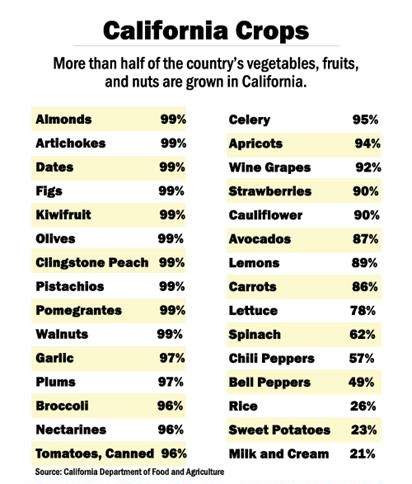
CU Blog - Science of Sustenance - Temperate Foods - Photo 0You can fill in the blanks with different regions around the world:

  • “Central Valley”, the bread basket of California
  • “Kansas”, the bread basket of America
  • “Alberta”, the bread basket of Canada
  • “Ukraine”, the bread basket of Eastern Europe

So who or where is the bread basket of the Caribbean?

Do we have an answer? Do we have a bread basket? Do we even have an organized region so as to collaborate on the responsibility of feeding our people?

No, No, and No!

This commentary is important for the Caribbean to contemplate. Every human in every land must arrange for the delivery of basic needs – “we gotta eat” and so food supply is paramount. Scientific developments have always been a major consideration for food supply, ever since the days of hunting-and gathering. Modern society is built on the premise that we would employ scientific best practices to harvest our food, or trade with people who employ these best practices.

The book Go Lean…Caribbean declares “enough already” with the trade; it is time to produce our own.

This was the original motivation for the publishing of this Go Lean book: to optimize the 30 Caribbean member-states into a Single Market so that we can be structured to do better in providing our basic needs. That structure would be the technocratic Caribbean Union Trade Federation (CU). The opening pages of the book feature this quotation (Page 3):

The CU should better provide for the region’s basic needs (food, clothing, energy and shelter), and then be in position to help supply the rest of the world. Previous Caribbean societies lived off the land and the sea; but today, the region depends extensively on imports, even acquiring large quantities of seafood, despite the 1,063,000 square miles of  the Caribbean Sea.

The CU Trade Federation is a technocracy, empowered to reboot the economic engines of the member-states, by fostering new industries (new “purse”) across the entire region and deploying solutions to better exploit the opportunities of the global trade market.

The Caribbean is in crisis for their dysfunctions in  delivering their own basic needs. This is the focus of this commentary; it is 2 of 4 in a series on the modern advances in science for delivering basic needs: energy, food, clothing and shelter. It is possible to deliver all these basic needs without science. But for our modern world, the advances of science make a positive impact on daily life. So the full series for our consideration follows this pattern:

  1.    Science of Sustenance: Energy
  2.    Science of Sustenance: Food
  3.    Science of Sustenance: Clothing
  4.    Science of Sustenance: Shelter

The book Go Lean…Caribbean asserts that “a crisis is a terrible thing to waste”. We must use our inadequate disposition to motivate stakeholders to forge change on our society; to implement the food supply solutions to do better at facilitating our own needs.

We are in the tropics…

… but science and technology allows us to deliver agricultural solutions for temperate produce (fruit and vegetables). Think:

  • Strawberries
  • Peaches
  • Apples
  • Spinach
  • Greens (Mustard, Collard, Kale, etc.)

Temperate produce need cooler temperatures to thrive. So the key is utilization of greenhouses, climate-controlled greenhouses. These allow for consistent temperatures of 20 to 30 degrees lower than the outside atmosphere. See a reference article on this subject here:

ARTICLE Grower 101: Using Evaporative Cooling, Part I
By John W. Bartok, Jr.
Find out what to use to keep your greenhouse ventilated and cool in the hot, humid summer.

On a bright, sunny summer day, a 30- x 100-foot greenhouse will gather about 32 million British Thermal Units (Btus) of heat. This is equivalent to burning 32 gallons of fuel oil or 320 therms of natural gas. If the greenhouse is full of plants, about one-half of this heat is used for transpiration and evaporation. The remainder of the cooling has to be conducted through ventilation. If the greenhouse is empty and closed, the temperature can exceed 150° F.

Understanding the basics
Shade on the outside of the greenhouse will keep some of the heat out. Shade on the inside, if it contains aluminum foil, will reflect some of the heat back out. Ventilation, either natural or fan, will remove a considerable amount of the heat that is collected. Still, on summer days, the temperature may exceed the desired level that promotes good plant growth by 10-20ºF. Excessive temperature results in delayed flowering and internode stretching. Evaporative cooling may be the best choice under these conditions.

Evaporative cooling, which uses the heat in the air to evaporate water from leaves and other wetted surfaces, can cool the greenhouse to 10-20° F below outside temperature. It takes one Btu of heat to raise the temperature of one pound of water 1° F, but it takes 1,060 Btus of heat to change the same amount of water to a vapor.

With an evaporated cooling system, humid air containing the heat that it picked up within the greenhouse is exhausted out through the vents or fans, and cooler, drier air is brought in. Evaporative cooling works best when the humidity of the outside air is low. For example, in Reno, Nev., the average summer dry bulb temperature is 96º F and the wet bulb is 61ºF. With an evaporative cooler having an efficiency of 80 percent, the temperature would be cooled to about 68° F. These conditions are most common in the dry Southwest, but even in the more humid sections of the United States, significant evaporative cooling can occur most days in the summer. In humid New Orleans, where the average summer dry bulb temperature is 93° F and the wet bulb is 78° F, the cooled air would be about 81° F, acceptable for the production of most plants.

Fan and pad system
Several evaporative cooling systems work well in commercial greenhouses. The most common is the fan and pad system. It contains a cellulose pad, overhead water supply pipe, gutter to collect excess water, a sump tank, pump, piping and control.

The 4- or 6-inch-thick pad is treated with anti-rot salts and stiffening and wetting agents. Pads are normally installed continuously along the side or end of the wall opposite the fans. The amount of pad area needed is calcuis the utillated by multiplying the floor area by 8 feet and dividing by 250 for a 4-inch pad or 400 for a 6-inch pad. For example, a 30- x 100-foot greenhouse with a 4-inch pad would require 96 sq. ft. of pads (30 x 100 x 8÷ 250 = 96 sq. ft.)

The overhead water supply pipe should distribute the water so the pad is wet uniformly. The minimum water flow rate is 0.5 gpm per sq. ft. for a 4-inch pad and 0.8 gpm per sq. ft. for a 6-inch pad.

Excess water is collected below the pad in a gutter and piped to a sump tank. Tank capacity needs to be 0.8 gallon per sq. ft. of pad for 4-inch pads and 1.0 gallon per sq. ft. for 6-inch pads. Water returning to the sump should be filtered to remove any debris. A make-up water supply and float valve keep the water level constant. In areas having water with a high mineral content, it is advisable to bleed 3-5 percent of the water to minimize salt buildup. Algae growth in the re-circulated water can be controlled with abiocide.

Modular pad systems of 5 and 6 feet are now available. These are self-contained and come completely assembled and ready to bolt to the wall. Installation time is reduced considerably. Only water and electrical connections have to be attached.

Next month, find out about swamp coolers, mist and fog systems and fan-generated fog and how they can work for you.

Source: Posted March 2003 from trade journal Greenhouse Product News; retrieved February 8, 2017 from: http://www.gpnmag.com/article/grower-101-using-evaporative-cooling-part-i/

CU Blog - Science of Sustenance - Temperate Foods - Photo 2

————-

VIDEO # 1 Best Thermal Cooled Greenhouse – https://youtu.be/HWXJ1ukEXa0

His Thermal Cooled Greenhouse in 1985 ran for 7 years, cooled itself day and night with 3 small Aquarium pumps, no fans or blowers; 14′ X 36′ ran on pennies a day – this worked!!! Now building a larger 24′ X 54′ Thermal Cooled Greenhouse. This works DAY OR NIGHT. Watch VIDEO !!!

  • Category – Science & Technology
  • License – Standard YouTube License

The science of greenhouses allows for temperate foods (fruit and vegetables) to be grown in a tropical zone – cold adds sweetness. This is what we want, what we need to fulfill our own basic needs. Other communities are doing this and we can as well. We have the role model of countries with colder climates supplying tropical fruit. Surely the reverse can be deployed as well, with strategic and tactical greenhouses.

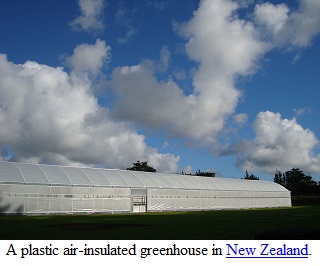
Greenhouses allow for greater control over the growing environment of plants. Depending upon the technical specification of a greenhouse, key factors which may be controlled include temperature, levels of light and shade, irrigation, fertilizer application, and atmospheric humidity. Greenhouses may be used to overcome shortcomings in the growing qualities of a piece of land, such as a short growing season or poor light levels, and they can thereby improve food production in marginal environments. Greenhouses in hot, dry climates used specifically to provide shade are sometimes called “shadehouses”.[42][43]

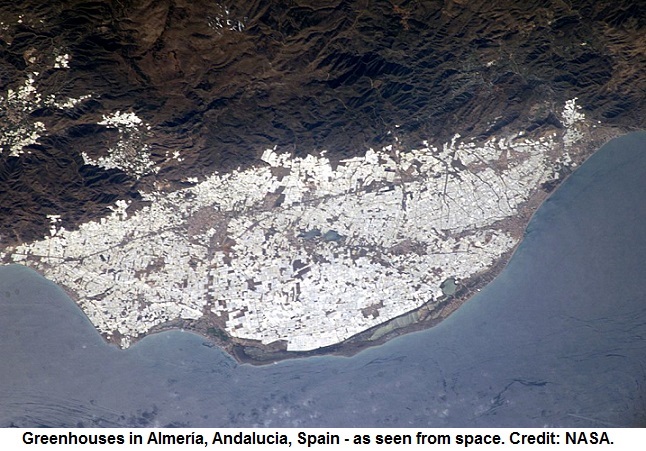
As they may enable certain crops to be grown throughout the year, greenhouses are increasingly important in the food supply of high-latitude countries. One of the largest complexes in the world is in Almería, Andalucía, Spain, where greenhouses cover almost 49,000 acres.
Source:
Retrieved February 8, 2017 from: https://en.wikipedia.org/wiki/Greenhouse
CU Blog - Science of Sustenance - Temperate Foods - Photo 3

The Caribbean is in crisis … we are not able to feed ourselves from the current food supply systems. We therefore have to expend foreign reserves to acquire food from foreign locations. This applies to food that, with the proper empowerments, can be grown locally in the Caribbean region.

This Go Lean book serves as a roadmap for the introduction and implementation of the technocratic Caribbean Union Trade Federation (CU). The goal is that the CU would adopt these food supply best practices to better delivery this basic need for the region. In fact, the prime directives of the CU are described as:

  • Optimize the economic engines – including food supply solutions – to elevate the regional economy to grow to $800 Billion and create 2.2 million new jobs.
  • Establish a security apparatus to protect the resultant economic engines.
  • Improve Caribbean governance to support these engines.

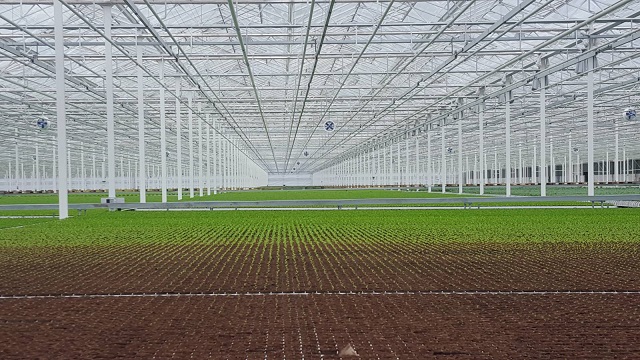
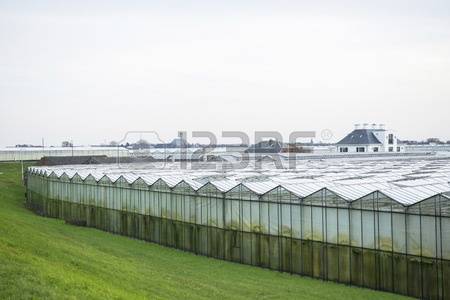
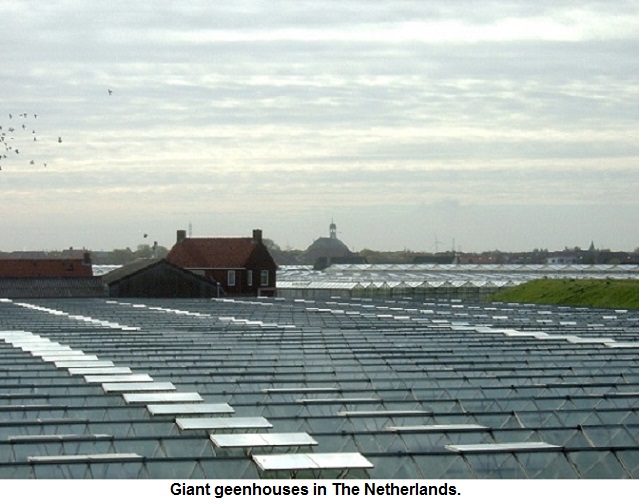
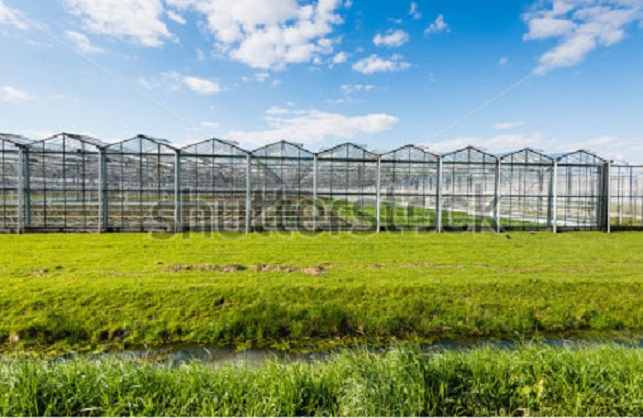
The Go Lean roadmap calls for the immediate adoption of best practices in food supply science (agriculture) and infrastructure. We do not have to re-invent the wheel in this quest; other communities are doing it already. Consider the photos here of giant greenhouses in The Netherlands:
CU Blog - Science of Sustenance - Temperate Foods - Photo 1

CU Blog - Science of Sustenance - Temperate Foods - Photo 1d

CU Blog - Science of Sustenance - Temperate Foods - Photo 1c

CU Blog - Science of Sustenance - Temperate Foods - Photo 1b

This vision of temperature controlled greenhouses in the Caribbean assumes a supply of energy for cooling and ventilation. See more here on ventilation:

Ventilation is one of the most important components in a successful greenhouse, specially in hot and humid tropical climate condition.[18] If there is no proper ventilation, greenhouses and their growing plants can become prone to problems. The main purposes of ventilation are to regulate the temperature, humidity and vapor pressure deficit [19] to the optimal level, and to ensure movement of air and thus prevent build-up of plant pathogens (such as Botrytis cinerea) that prefer still air conditions. Ventilation also ensures a supply of fresh air for photosynthesis and plant respiration, and may enable important pollinators to access the greenhouse crop.

Ventilation can be achieved via use of vents – often controlled automatically via a computer – and recirculation fans.
Source: Retrieved February 8, 2017 from: https://en.wikipedia.org/wiki/Greenhouse

All in all, the Go Lean book declares that “a crisis is a terrible thing to waste”. This siren call is for the establishment of a regional technocracy to facilitate the delivery of the region’s basic needs.  According to the foregoing articles/references, we can grow temperate foods in the tropical zone without exhausting foreign currency.

The vision here of climate-controlled greenhouses requires heavy-lifting on the part of Caribbean stakeholders (governments and business communities). We need this heavy-lifting. A lot is at stake: our ability to feed our populations. The Go Lean roadmap calls for a separation-of-powers between CU federal agencies and the member-state governments. The CU presents Cabinet departments for Agriculture, Fisheries and Health (Food/Nutrition). These departments will have to collaborate with parallel departments at the member-state level.

This was the original motivation of the Go Lean roadmap, an interdependence of the 30 member-states of the Caribbean to offset the effects of globalization. This was pronounced early in the book in the Declaration of Interdependence (Page 14), with this statement:

xxx. Whereas the effects of globalization can be felt in every aspect of Caribbean life, from the acquisition of food and clothing, to the ubiquity of ICT, the region cannot only consume, it is imperative that our lands also produce and add to the international community, even if doing so requires some sacrifice and subsidy.

The roadmap also calls for the installations of Exclusive Economic Zones (EEZ) and Self-Governing Entities (SGE) that operate in controlled bordered territories like campuses, industrial parks, research labs and industrial plants. These can be a target for the climate-controlled greenhouses.

The Go Lean book declares that we must adopt a community ethos, the appropriate attitude/spirit to forge change in our region; then details the executions of the following strategies, tactics, implementations and advocacies to better impact the region’s preparation for food resources. See this sample here:

Community Ethos – Deferred Gratification Page 21
Community Ethos – Economic Systems Influence Individual Choices / Incentives Page 21
Community Ethos – The Consequences of Choices Lie in the Future Page 21
Community Ethos – Lean Operations Page 24
Community Ethos – Cooperatives Page 24
Community Ethos – Non-Government Organizations Page 25
Community Ethos – Ways to Impact the Future Page 26
Community Ethos – Ways to Improve Sharing Page 35
Community Ethos – Impact the Greater Good Page 37
Strategy – Vision – Confederating 30 Member-States into a Single Market Page 45
Strategy – Vision – Foster Local Economic Engines Food, Clothing & Shelter Page 45
Strategy – Mission – Prepare for Natural Disasters Page 45
Strategy – Mission – Exploit the Benefits and Opportunities of Globalization Page 46
Strategy – Agents of Change – Climate Change Page 57
Strategy – Agents of Change – Globalization Page 57
Tactical – Confederating a Permanent Union Page 63
Tactical – Fostering a Technocracy Page 64
Separation of Powers – Food & Nutritional Administration Page 87
Separation of Powers – Agriculture and Fisheries Department Page 88
Implementation – Ways to Pay for Change Page 101
Implementation – Start-up Benefits from the EEZ Page 104
Implementation – Steps to Implement Self-Governing Entities Page 105
Implementation – Ways to Deliver Page 109
Implementation – Ways to Foster International Aid Page 115
Implementation – Ways to Benefit from Globalization Page 119
Planning – Ways to Make the Caribbean Better Page 131
Advocacy – Ways to Grow the Economy Page 151
Advocacy – Ways to Better Manage Food Page 162
Advocacy – Ways to Improve Governance Page 168
Advocacy – Ways to Better Manage the Social Contract Page 170
Advocacy – Ways to Foster Cooperatives Page 176
Advocacy – Ways to Improve for Natural Disasters Page 184
Advocacy – Ways to Improve Emergency Management Page 196
Advocacy – Ways to Improve Fisheries Page 210
Advocacy – Ways to Impact Rural Living – Agricultural eco-systems Page 235

There are a lot of models of agricultural and infrastructural delivery that the Caribbean can learn from foreign shores. Previous Go Lean blog-commentaries have cited these models, samples and examples:

https://goleancaribbean.com/blog/?p=8982 GraceKennedy: A Caribbean Transnational tackles Food Supply
https://goleancaribbean.com/blog/?p=6867 How to address high consumer prices
https://goleancaribbean.com/blog/?p=6819 Supplying Foods for ‘Western’ Diets – We can do better!
https://goleancaribbean.com/blog/?p=6016 Hotter than July – An Appeal for Cooperative Refrigeration
https://goleancaribbean.com/blog/?p=5098 Forging Change in Society Through Food
https://goleancaribbean.com/blog/?p=3594 Lessons Learned from Queen Conch – A Caribbean Food
https://goleancaribbean.com/blog/?p=2276 Climate Change May Affect Food Supply Within a Decade

Who or where will be the bread basket of the Caribbean? With the empowerments in this commentary, it could be all 30 member-states.

Change has come to the world of agricultural systems and sciences and change must come to the Caribbean region; we must be able to feed ourselves. We need to convene, collaborate and cooperate to satisfy our most basic needs. Yes, we can …

… come together to make the Caribbean a better homeland to live, work and play.

The people and institutions of the region are hereby urged to lean-in to this Go Lean roadmap, to embrace the empowerments to reboot and turn-around our region. 🙂

Download the book Go Lean … Caribbean – now!


Share this post:
,

Science of Sustenance – Green Batteries

Go Lean Commentary

Monkey see, monkey do …

CU Blog - Science of Sustenance - Green Batteries - Photo 0This is the expression; but this is science too: zoology, anthropology, animal husbandry. Monkeys are amazing creatures. They are in the same species as humans – primates. Monkeys are social creatures that live in family groups. Like many other animal species,  they adhere to an Alpha-Herd social order. Despite the fact that monkeys are generally considered to be intelligent, they tend to mimic the actions of their leaders more so than creating their own destinies. It is true, monkeys see, monkeys do.

If only the highest order of primates, us humans, worked the same way, then it would be easy to reform and transform society. To the contrary, the observation is that humans follow a different process:

Monkey see, monkey feel, monkey do. Sorry, make that “humans see, humans feel, humans do”.

As free moral agents, the human experience is that there must be a motivation to do something, like “change”, that we see others doing.

This point is developed more fully in the book Go Lean…Caribbean. It narrates the experience of smoking cessation. The book relates (Page 20):

Change is not easy …

Just ask anyone attempting to quit smoking. Not only are there physiological challenges, but psychological ones as well, to the extent that it can be stated with no uncertainty that “change begins in the head”. In psycho-therapy the approach to forge change for an individual is defined as “starting in the head (thoughts, visions), penetrating the heart (feelings, motivations) and then finally manifesting in the hands (actions).

There are a lot of things that Caribbean people and communities must change; there is the need to reform and transform. We must first develop the right attitudes and motivations for fostering our changes. We must penetrate the heart. The people of the Caribbean must change their feelings about elements of our society – elements that are in place and elements missing. The Go Lean book refers to this as “community ethos”, defined as:

the fundamental character or spirit of a culture; the underlying sentiment that informs the beliefs, customs, or practices of a group or society; dominant assumptions of a people or period.”

The Caribbean is in desperate straits. We have many societal dysfunctions and defects. We have challenges fulfilling even our basic needs. This is the focus of this commentary; it is 1 of 4 in a series on the modern advances in science for delivering basic needs. No one doubts that the inventory of basic needs include “food, clothing and shelter”. But modernity has forced us to add another entry: “energy”. In fact, the availability and affordability of energy can impact the deliveries of these order basic needs. The full series for our consideration will therefore follow this pattern:

  1.     Science of Sustenance: Energy
  2.     Science of Sustenance: Food
  3.     Science of Sustenance: Clothing
  4.     Science of Sustenance: Shelter

It is possible to deliver all basic needs without science. But for our modern world, the advances of science make a positive impact on daily life. In fact, one Anthropology study has concluded that the greatest scientific accomplishment for 20th Century society had been the invention, deployment and advances of the washing machine. Wow, remember the process to clean clothes before modern laundry equipment; it took all day. Women of the house had to be fulltime homemakers to satisfy this family need. This fact depicts the gravity of science in sustaining our modern life. Let’s consider all of the basic needs from this perspective.

Discussions about energy must consider a discussion on batteries. Battery = Stored Energy …

… despite all the scientific definitions, that is all it means, plain and simple. According to one source:

Batteries come in many shapes and sizes, from miniature cells used to power hearing aids and wristwatches to small, thin cells used in smartphones, to large lead acid batteries used in cars and trucks, and at the largest extreme, huge battery banks the size of rooms that provide standby or emergency power for telephone exchanges and computer data centers.

According to a 2005 estimate, the worldwide battery industry generates US$48 billion in sales each year,[5] with 6% annual growth. – Wikipedia.

Batteries traditionally store energy for later use. When we need it, we absolutely need it. Imagine a flashlight, when we “click” it on, we expect it to work. We spend a lot of money to ensure this functionality – according to the foregoing reference, $48 Billion/year.

But while batteries entail a lot of complicated chemicals – alkaline, lead-acid, lithium-ion, etc. – the underlying principle is to store the kinetic energy for future generation of electricity. There is a new recognition in this equation. The fact is that power grids create more power than they need at certain times; this creates the need for batteries; see here:

That’s the first reason we need batteries on the electrical grid: to even out the supply-and-demand, to time-shift the availability of power from nighttime to daytime.

But reason number two is even more important to our future: Power-plant batteries would eliminate the biggest problem with solar power and wind power, which is that they are both intermittent. “Clouds come over on a sunny day and, all of a sudden, it’s gone,” said Hopkins. “Wind stops blowing, all of a sudden, it’s gone. You need a way to store it.”

See full story in the VIDEO here:

Many experts in electricity are truly JUICED these days. They’re pursuing the “Search For The Super Battery” — the title of this Wednesday night’s [(February 1, 2017)] episode of “Nova” on PBS, hosted by our own David Pogue of Yahoo Tech.  Here is a preview:

VIDEO Making a better batteryhttp://www.cbsnews.com/videos/engineers-attempt-to-create-better-batteries

The science is progressing …

… green options are emerging; (green refers to natural, non-chemical solutions). According to the foregoing, green options  for storing energy include:

  • Gravity
  • Melting Ice
  • Magnetic Levitation

CU Blog - Science of Sustenance - Green Batteries - Photo 1

We need to consider these options in the Caribbean. In our region, energy costs are among the highest in the world. The book Go Lean… Caribbean relates (Page 100) how the Caribbean has among the most expensive energy costs in the world, despite having abundant alternative energy natural resources (solar, wind, tidal, geo-thermal). The Caribbean eco-system focuses on imported petroleum to provide energy options and as a result retail electricity rates in the Caribbean average US$0.35/kWh, when instead it could be down to US$0.088/kWh. A previous blog-commentary identified the societal defect that drives the regional governance for energy generation: rent-seeking. The local authorities depend on the fuel tax revenues to finance government operations. But alas, change is coming! The momentum for this change is big and getting bigger.

With such a 75% savings, we need the foregoing process: Monkey see, monkey feel, monkey do.

There is definitely the need to adapt some of the scientific best practices for energy generation and consumption. In a previous blog-commentary, it was confessed that one of the reasons why people flee the Caribbean region, is the discomforts during the summer months; (the Caribbean region has 8 – 10 warm months of the year) …

… hot weather, and the lack of infrastructure to mitigate and remediate the discomfort, is identified as one of the reasons for the brain drain/societal abandonment. (This previous blog-commentary appealed for cooperative refrigeration). If only we can turn on the air-conditioner – if we can afford the energy cost –  there would be the need to keep it running most of the time.

Many people find the current lack of energy options unbearable to live in their Caribbean ancestral homeland and thusly flee the region for North American and European destinations. The numbers are bad! We reported a 70 percent brain drain rate among the tertiary educated populations. (These are the ones who can best afford to leave; but the community can least afford to lose them).

Energy needs are undeniable 24-7-365; all the time. There is the need to deliver energy all of these times.

The delivery or fulfillment of these needs is a great target for lean, agile operations. Efficiency and technocratic executions will save a lot of money for the people and institutions of the Caribbean. But fossil fuels should not be the solution for the Caribbean.

  • First, with so many small islands, we do not have much natural resources.
  • Secondly, and most important, there is the matter of burning fossil fuels (oil, coal, wood pulp) and contributing to global warming and Climate Change.

The Go Lean book posits that the embrace of alternative energy generation sources to be more impactful on the quest to minimize the threats on the environment. Early in the book, the pressing need to be aware of Climate Change is pronounced in the Declaration of Interdependence (Page 11), with these words, (the first of many “causes of complaints”):

i. Whereas the earth’s climate has undeniably changed resulting in more severe tropical weather storms, it is necessary to prepare to insure the safety and security of life, property and systems of commerce in our geographical region. As nature recognizes no borders in the target of its destruction, we also must set aside border considerations in the preparation and response to these weather challenges.

With the innovative offering of Green Batteries, the quest to adapt to more clean/green energy options can be practical and more cost effective. Power generation from the sun or wind (free & renewable sources) is far cheaper that generation based on fossil fuels.

The book Go Lean… Caribbean serves as a roadmap for the introduction and implementation of the Caribbean Union Trade Federation (CU). This roadmap has 3 prime directives:

  • Optimization of the economic engines in order to grow the regional economy to $800 Billion GDP and create 2.2 million new jobs.
  • Establishment of a security apparatus to protect the resultant economic engines.
  • Improvement of Caribbean governance to support these engines.

This Go Lean/CU roadmap details a series of community ethos, strategies, tactics, implementations and advocacies to be early adopters of cutting-edge energy solutions, like Green Battery systems. The following list applies:

Community Ethos – Deferred Gratification Page 21
Community Ethos – Lean Operations Page 24
Community Ethos – Return on Investments Page 24
Community Ethos – Cooperatives Page 25
Community Ethos – Ways to Impact the Future Page 26
Community Ethos – Ways to Impact the Greater Good Page 37
Strategy – Harness the power of the sun/winds Page 46
Tactical – Fostering a Technocracy Page 82
Tactical – Separation of Powers – Energy Commission Page 82
Anecdote – “Lean” in Government – Energy Permits Page 93
Anecdote – Caribbean Energy Grid Implementation Page 100
Implementation – Ways to Develop Pipeline Industry Page 107
Implementation – Ways to Improve Energy Usage Page 113
Advocacy – Ways to Impact Public Works Page 175
Advocacy – Ways to Foster Cooperatives Page 176
Advocacy – Ways to Impact Monopolies Page 202

The Go Lean movement (book and blogs) asserts that we should fully embrace Green Energy solutions; its not a want, but a need for the region. This need had been further elaborated upon in these previous blog/commentaries:

https://goleancaribbean.com/blog/?p=7056 Electric Cars: ‘Necessity is the Mother of Invention’
https://goleancaribbean.com/blog/?p=6016 Hotter than July – A case for ‘Cooperative Refrigeration’
https://goleancaribbean.com/blog/?p=5155 Tesla unveils super-battery to power homes
https://goleancaribbean.com/blog/?p=4897 US Backs Natural Gas (LNG) Distribution Base in Jamaica
https://goleancaribbean.com/blog/?p=4294 Ambassadors to Caribbean discuss PetroCaribe-Energy, Security
https://goleancaribbean.com/blog/?p=2465 Book Review: ‘This Changes Everything: Capitalism vs. the Climate’
https://goleancaribbean.com/blog/?p=2338 Lessons: How Best to Welcome the Dreaded American ‘Plutocracy’
https://goleancaribbean.com/blog/?p=926 Conservative heavyweights have solar industry in their ‘kill’ sights
https://goleancaribbean.com/blog/?p=915 Go ‘Green’ … Caribbean

A focus of the Go Lean book is the economics of the Caribbean region. But the issues presented in this commentary – and the entire 4-part series – relate to Home Economics. Home Economics is an old field of study. At one point, this was a course in school systems for all levels, K through 12 and even in college curricula. The purpose of the formal “Home-Ec” education was to teach best practices in efficiency and effectiveness for  basic needs. Students learned more about food (cooking & nutrition), clothing (sewing & textiles) and housing (decorating, draperies and upholstery). Home-Ec lessons highlighted the technology of the day (before the 1980’s). Go back and re-visit those schools; the disposition will be that all those programs have been replaced with courses in Science, Technology, Engineering and Mathematics (STEM).

CU Blog - Science of Sustenance - Green Batteries - Photo 2

CU Blog - Science of Sustenance - Green Batteries - Photo 3

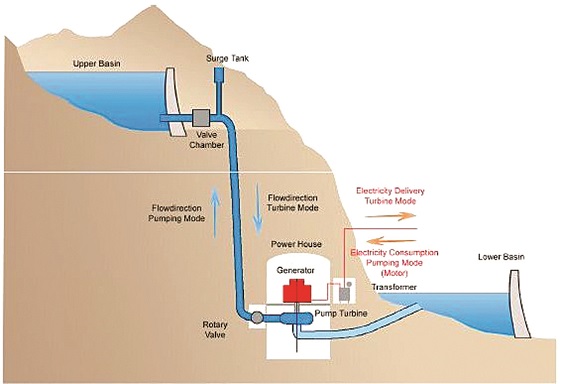
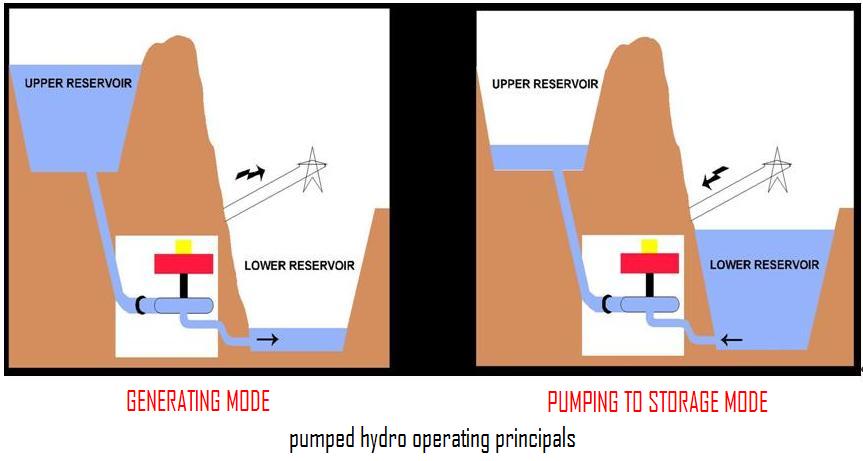
The Green Battery is an example of science guiding the future of the delivery of basic needs, in this case energy needs. Science is improving the delivery of all basic needs, all means of sustenance. There are many mountainous islands in the Caribbean; anyone of them can be a great candidate for the “pumped hydro” solution in the foregoing VIDEO. This will call for installing a dam and two reservoirs. During the periods when energy is abundant – mid day from solar panels – the water can be pumped uphill, then during the “off” times the water would flow downhill, using gravity to spin turbines and generate electricity.

CU Blog - Science of Sustenance - Green Batteries - Photo 8

CU Blog - Science of Sustenance - Green Batteries - Photo 5

CU Blog - Science of Sustenance - Green Batteries - Photo 4

CU Blog - Science of Sustenance - Green Batteries - Photo 7

Also consider that with the Caribbean hot-hot-hot summers, there is no doubt there is a need for air-conditioning. The energy hogging of the air-conditioning process is the compression to make refrigerated air. The approach in the foregoing VIDEO of making ice when energy is abundant – mid day from solar panels – then blowing the air from the “melting ice” is a technocratic solution – the simple science is depicted in these photos above. A solution based on this science – see sample product in photo below – can be deployed anywhere, everywhere.

CU Blog - Science of Sustenance - Green Batteries - Photo 6

These Green Battery deployments would be examples of the lean, agile operations, designed for the CU technocracy.

This and other innovations, once executed, would make the Caribbean a better place to live, work and play.

Now is the time for all of the Caribbean, the people, business, institutions and governments, to lean-in for the innovations and optimizations of the Go Lean roadmap. 🙂

Download the book Go Lean … Caribbean – now!
 

Share this post:
, , ,
[Top]

Day of Reckoning for NINJA Loans

Go Lean Commentary

Be not deceived … whatsoever a man soweth, that shall he also reap. – King James Version – The Bible

It is time for the Day of Reckoning for one of the players in the recent housing bubble and financial crisis, referred to as the Great Recession of 2008. Industry stakeholders had been “skimming of the public coffers for mortgage guarantees and giving unwise mortgages to people who had what was considered NINJA qualification:

  • No Income
  • No Job & Assets

LB 1Such activities in the retail mortgage industry, plus bad practices in the wholesale lending, credit ratings and mortgage-back securities industries had congealed to form a “perfect storm” for disaster in the financial markets (Wall Street, et al) in the US and around the world.

Many innocent people lost fortune and faith in the American eco-system. There had to be an accounting of the “sins and sinister plots”; there had to be a Day of Reckoning. That day came for one Michigan-based (Detroit area) company, United Shore Financial Services. See the full story here:

Title: United Shore Agrees to $48M Settlement with DOJ
By: Jacob Passy

CU Blog - Day of Reckoning for NINJA Loans - Photo 1United Shore Financial Services, a Troy, Mich.-based lender, has agreed to pay $48 million to settle allegations that it violated the False Claims Act.

The Department of Justice alleged that USFS did not comply with certain origination, underwriting and quality control requirements while participating in the Federal Housing Administration’s direct endorsement lender program. Consequently, the Department of Housing and Urban Development insured hundreds of loans that UnitedShore approved that should not have been eligible for FHA coverage, subsequently taking losses due to claims on those loans.

“USFS acknowledged that it failed to comply with FHA underwriting and quality control requirements, resulting in improperly originated mortgages,” John Vaudreuil, a U.S. attorney for the Western District of Wisconsin said in a news release. “While USFS deserves credit for acknowledging and resolving its conduct, that conduct not only resulted in substantial losses of public funds, but also put Wisconsin homeowners at risk of losing their homes or ruining their credit.”

United Shore, which is both a retail lender and the parent of United Wholesale Mortgage, did not immediately respond to a request for comment.

In particular, the DOJ said that UnitedShore admitted to pressuring underwriters to approve FHA mortgages under a compensation plan that tied pay to the percentage of loans approved. United Shore also falsely certified that direct endorsement underwriters reviewed appraisal reports prior to mortgages being approved for FHA insurance; under the DEL program, the FHA does not review that lenders are complying with the agency’s requirements.

The DOJ also identified other issues with UnitedShore’s compliance practices. The lender allegedly did not provide senior management with “meaningful information” regarding quality control findings. Additionally, UnitedShore did not meet HUD’s self-reporting requirements, only self-reporting three loans to the department despite quality control reviews finding hundreds of FHA-insured loans that were materially deficient at issuance.

The alleged activities occurred between from 2006 through 2011. The DOJ also said that United Shore “made certain discretionary distributions to a shareholder in the company” after the federal government began investigating the company in January 2014.
Source: National Mortgage News – Industry Trade Journal; posted 12/28/2016; retrieved 01/18/2017 from: http://www.nationalmortgagenews.com/news/compliance-regulation/united-shore-agrees-to-48m-settlement-with-doj-1093769-1.html

This story aligns with the book Go Lean…Caribbean; it serves as a roadmap to introduce and implement the technocratic Caribbean Union Trade Federation (CU) and Caribbean Central Bank (CCB) for better stewardship of the Caribbean banking eco-system, to ensure the economic failures of the past do not re-occur in the Caribbean. The book was inspired by the events of 2008, by people engaged in the mortgage-housing-investments industries. These ones engaged in the post-mortem analysis – dissection of the crisis – of all the bad community ethos, strategies, tactics and implementations leading up to 2008 and saw the need for this Day of Reckoning.

The goal of this roadmap is to apply the lessons-learned from 2008 in the stewardship of the economic engines in the Caribbean region. It turns out that we were affected by 2008 as well; we were devastated by the elasticity in the global markets.

Welcome to the Caribbean’s Day of Reckoning!

The Caribbean economy is a parasite of the US and so when the American market “catches a cold, we sneeze”. (This is referred to as “financial contagions”). We can – we must – do better and guide our own economy away from American dependence to a regional interdependence.

We are on the way…

With the proposal for the CARICOM Single Market & Economy (CSME), a more integrated region is expected to emerge with greater linkages among the member-states of the economic union. Issues of financial contagions will now have to be a constant concern for a regional sentinel. The Go Lean roadmap calls for the deployment of the Caribbean Central Bank as that sentinel, to proactively and reactively shepherd the financial institutional processes (wholesale and retail). We do not want to “get caught with our pants down” in our region. We do not want government loan guarantees for mortgagors that have NINJA qualifiers. (That money would be better placed in more substantial investments in Caribbean people and processes). The lesson from 2008 is to follow the money and discern those who profited from this bad behavior; see the VIDEO in the Appendix below.

Mortgages with a government-guarantee stamp of approval are readily sold in the secondary markets. Bad actors are able to glean quick profits from loan origination fees and then “wash their hands” of any inherent risk from deficient payment collection. (See the VIDEO in the Appendix below). This was the direct charge against United Shore Financial Services in the forgoing article: “[funding] hundreds of FHA-insured loans that were materially deficient at issuance”.

Bad actors … profiting from existing supplies of capital!?!?

This is so familiar! The Go Lean book details (Page 23):

… history teaches that with the emergence of new economic engines, “bad actors” will also emerge thereafter to exploit the opportunities, with good, bad and evil intent. A Bible verse declares: “What has been will be again, what has been done will be done again; there is nothing new under the sun” – Ecclesiastes 1:9 New International Version.

This roadmap for Caribbean integration declares that peace, security and public safety is tantamount to economic prosperity. This is why an advocacy for the Greater Good must be championed as a community ethos. A prime precept is that it is “better to know than to not know” – this implies that privacy is secondary to security. A secondary precept is that bad things will happen to good people and so the community needs to be prepared to contend with the risks that can imperil the homeland.

The prime directive of the Go Lean/CU/CCB roadmap is to optimize economic, security and governing engines to impact the Caribbean’s Greater Good, for all stakeholders: residents, visitors, bank depositors and mortgage-holders. This need was pronounced early in the Go Lean book, in the Declaration of Interdependence – (Page 13):

xxv.  Whereas the legacy of international democracies had been imperiled due to a global financial crisis, the structure of the Federation must allow for financial stability and assurance of the Federation’s institutions. To mandate the economic vibrancy of the region, monetary and fiscal controls and policies must be incorporated as proactive and reactive measures. These measures must address threats against the financial integrity of the CU and of the member-states.

The foregoing news article shows the type of functions executed by technocratic financial regulators: monitoring risks, policing the industry stakeholders, and reckoning bad practices. The “bad actor” in the article – United Shore Financial Services – had their Day of Reckoning.

The related subjects of banking oversight and optimizing financial governance have been a frequent topic for blogging by the Go Lean promoters, as sampled here:

For Canadian Banks: Caribbean is a ‘Bad Bet’
Christmas presents (2015) for American Banks
Bad Actors profiting from a supply of capital in private education
Too Big To Fail – Caribbean Version
5 Steps of a Bubble – Learning to make a resilient economy
Canadian Imperial Bank of Commerce failing investment in FirstCaribbean Bank
Bitcoin needs regulatory framework to change ‘risky’ image
Open the Time Capsule: The Great Recession of 2008
What Usain Bolt can teach banks about financial risk
Barbados Central Bank records $3.7m loss in 2013
US Federal Reserve Releases Transcripts from 2008 Meetings
Dominica raises EC$20 million on regional securities market
Fractional Banking System – How to Create Money from Thin Air
Book Review: ‘Wrong – Nine Economic Policy Disasters and What We Can Learn…’
10 Things We Want from the US – # 2: American Capital
The Erosion of the Middle Class

All the Caribbean has experienced economic dysfunction due to the 2008 Global Financial Crisis. In line with the foregoing news article, the Go Lean roadmap seeks to mitigate bad behavior from bad actors like United Shore Financial Services in our local region. The book details the many infrastructural enhancements/advocacies to the region’s financial eco-system; to facilitate efficient management of the economy, and policing of this important financial/banking industry-sector:

Ethos-Strategy-Tactics-Implementation-Advocacy

Page

Anecdote – Caribbean Single Market & Economy

15

Anecdote – Puerto Rico – “The Greece of the Caribbean”

18

Confederating Non-Sovereignty Inter-Governmental Entity

45

Facilitate Currency Union/Co-op of Caribbean Dollar

45

Fostering a Technocracy

64

Caribbean Central Bank

73

Deposit Insurance Regulations

73

Securities Regulatory Authority

74

Modeling the European Union / Central Bank

130

Lessons from 2008

136

Anecdote – Caribbean Currencies

149

Growing the Economy

151

Better Manage Foreign Exchange

154

Improve Credit Ratings

155

Improve Housing – Mortgage Standards Enforcement

161

Foster Cooperatives

176

Banking Reforms

199

Wall Street – Capital/Securities Market

200

Impact the Diaspora

219

Impact Retirement – Need for Savings

221

Help the Middle Class

223

Appendix – Credit Reporting and Ratings Good Governance

276

There is no doubt that there has been previous corruption of the American financial eco-system. They have “made themselves sick; given themselves colds”, and yet we, in the Caribbean, “have had to sneeze”. We hope that the new oversight methodology in the US is more effective for managing their stakeholders. But management of the US is out-of-scope for the movement behind the Go Lean book; our focus is limited strictly to the Caribbean economy. So now is the time for change to a new regulatory regime here in our region; now is the time for new stewards of the Caribbean economy, security and governing engines. It’s time for the CU/CCB. We must prove that we have learned from the bad American past. A lot is at stake: our financial security; our future.

We urge all stakeholders – residents, mortgage-holders, mortgage lenders, banks – to lean-in to this Go Lean roadmap to elevate Caribbean society. The destination is common and desired for all Caribbean men, women and children: a better place to live, work and play. 🙂

Download the book Go Lean … Caribbean – now!
———

Appendix VIDEO – NINJA Loans: The Big Shorthttps://youtu.be/os1Etuv_gDE

Published on Apr 27, 2016 – Clip from Academy Award Winning Best Picture “The Big Short”.

  • Category: People & Blogs
  • License: Standard YouTube License


Share this post:
, , ,
[Top]

ENCORE: Obama is the 3rd ‘Reconstruction’; Trump is the resulting ‘Redemption’

Reconstruction and Redemption?!?!

This deliberative analysis was carefully laid-out in this previous blog-commentary from June 15, 2016, where it presented the following periods of Reconstruction and Redemption for race relations in the United States of America:

  • First Reconstruction: 1865 – 1877
    First Redemption: 1890 – 1968
  • Second Reconstruction: 1954 – 1972
    Second Redemption: 1964 – 1994 (i.e. Covenant with America)

Now, with the drawing close (January 20, 2017) of the federal administration of the nation’s first Black President, Barack Obama, it seems logical to conclude that the surprising election of Donald Trump with a mandate to usurp many of the Obama Executive initiatives may be a Third Redemption (2017 – ) to the Obama years (2009 – 2017) being the Third Reconstruction. This is supported by the fact that during the Obama years, 1,030 elected seats (State & Federal Legislators plus governors) were lost to his opposition party.

See the full details of this developed thesis on the “2nd Redemption and 2nd Reconstruction” in the ENCORE below…

… and consider the consistent point of so many blog-commentaries from the movement behind the book Go Lean…Caribbean, that America, with its lack of respect for minority rights, should not be the Land of Refuge for the Black-and-Black people of the Caribbean.

🙁

——————

Go Lean Commentary – TitleRespect for Minorities: Reconstruction then Redemption – A Lesson in History

This subject of “Respect for Minorities” is dominant in the news right now. This commentary is 3 of 3 in this series on lamentations for defective social values. The complete series is as follows:

  1. Respect for Minorities: ‘All For One’
  2. Respect for Minorities: Climate of Hate – ‘It Gets Worse Before It Gets Worse’
  3. Respect for Minorities: Reconstruction then Redemption – A Lesson in History

There are these familiar proverbs:

1. What has been will be again, what has been done will be done again; there is nothing new under the sun. – The Bible; Ecclesiastes 1: 9

2. The more things change, the more they remain the same.

CU Blog - Respect for Minorities - Reconstruction, Then Redemption - Photo 4There is a lot of history in the United States regarding “Respect for Minorities”; and the lessons from that history apply for the Caribbean. In this case, there is the history of the 2nd Reconstruction and 2nd Redemption that applies directly to Caribbean people living in the US. Life in the US for our Diaspora has been a familiar theme for the publishers of the book Go Lean…Caribbean; this theme has been exhausted in the book (Page 118 – Reasons to Repatriate to the Caribbean) and in countless blog/commentaries (see list below), within the quest to dissuade Caribbean people from emigrating to the US and to encourage many of the existing Diaspora to return to their homelands, to repatriate.

Why is this so important? The Go Lean movement (book and blogs) have been consistent: it is easier for the people of the Caribbean – a majority Black and Brown demographic – to prosper where planted in their homelands than to endure as alien residents in foreign countries. This commentary asserts the key ingredient for reforming and transforming societies with diverse demographics: “Respect for Minorities”.  This commentary seeks to learn this lesson based on  life (and history) in the US; though the principles here can easily apply to Canada and the many western European countries that receive our citizens. Consider this analogy:

Do you want to go a party – that you hear is a lot of fun – uninvited? What if you hear the host really wants you at the party, and then when you get there you discovered that they want you to serve and work and cater to the other preferred guests; you are just there as support staff?
Want to go home yet?

This is the experience for so many Caribbean Diaspora when they ‘come to America’. Just take a quick tour at so many tourist/travel facilities at America’s principal cities. So many of the “serving” staff are of Caribbean heritage. One would talk to taxi drivers, hotel maids, waiters and retail store clerks and you discover that these ones descend from the Caribbean.

You think: They came here for “this”? They are minorities among a majority that has little respect for them.

There is this above scenario, and then … there is “prosper where you’re planted”:

Just like a tree planted by the rivers of water
That bring forth fruit in due season
Source: The BiblePsalms Chapter 1 verse 3 – King James Bible

CU Blog - Respect for Minorities - Reconstruction, Then Redemption - Photo 3This was the strong point made by one of the key figures in African-American history, Booker T Washington. He asserted that the African-American community must work to prosper in its own hometown, that they must seek reconciliation with their White neighbors and find a way to co-exist. This was a good plan for Black America, the minorities; but White America, the majority population didn’t always cooperate. The effort to reconcile was attempted before, immediately following the Civil War, during the period of Reconstruction; 1865 – 1877. This period of time actually featured some real progress in liberating and promoting the previous enslaved minority population – an enfranchisement of all freedmen. But then, at the end of the formal Reconstruction period, there was redemption…

… redemption: a return to American original values, that is “White supremacy” and the repression of the African-American race.

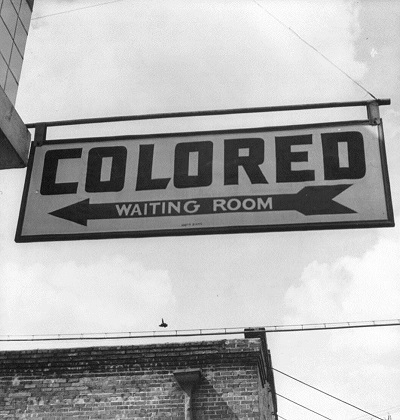
During this Redemption period: Jim Crow laws – segregation in public places – were implemented, as the follow details depict:

The end of Reconstruction … was followed by a period that White Southerners labeled Redemption, during which White-dominated state legislatures enacted Jim Crow laws and, beginning in 1890, disenfranchised most Blacks and many poor Whites through a combination of constitutional amendments and electoral laws. The White Democrat Southerners’ memory of Reconstruction played a major role in imposing the system of white supremacy and second-class citizenship for Blacks. – Sourced from Wikipedia.

CU Blog - Respect for Minorities - Reconstruction, Then Redemption - Photo 1

That was then, 130 years ago; how about now? The notion of an Encore/”Second Take” seems unthinkable; and yet this is the historicity of events and experiences after this 2nd Reconstruction – the Civil Rights movement of the 20th Century: think Rosa Parks, Martin Luther King, Civil Rights Act, Voting Rights Act, Affirmative Action, Minority Set-Asides, etc.. See the encyclopedic reference here:

Reference Title: Second Reconstruction
Second Reconstruction is a term that refers to the American Civil Rights Movement. In many respects, the mass movement against segregation and discrimination that erupted following World War II, shared many similarities with the period of Reconstruction which followed the American Civil War. The period of Second Reconstruction featured active participation on the part of African-Americans to regain their rights that they had lost during the period of Redemption and Jim Crow segregation in the latter part of the nineteenth century.

During Second Reconstruction, African-Americans once again began holding various political offices, and reasserting and reclaiming their civil and political rights as American citizens. Unlike Reconstruction, however, most African-Americans abandoned the Republican Party for the Democratic Party. A noteworthy feature of Second Reconstruction was the political realignment that occurred in 1965, which transformed the nature and composition of both the Republican and Democratic Party’s, eroding the Democratic Solid South.

In the same way, however, that Reconstruction was followed by Redemption, some have also claimed that period following Second Reconstruction could be termed a Second Redemption characterized by more conservatism on the part of the federal government, and several Supreme Court decisions that weakened the scope of civil rights reforms, especially in the Northern States

The years between 1954-1972 have often been called the Second Reconstruction, since it has noteworthy similarities with the First Black Reconstruction (1865-1877), which began with the abolition of slavery by the enactment of the Thirteenth Amendment. Both periods saw African Americans making tremendous gains in the fields of politics and civil rights. Three major Supreme Court decisions (the Brown decision on school desegregation (1954), desegregation of public transportation (1956); bussing to achieve school desegregation (April 1971), two legislative enactments (the Civil Rights Act, 1964, and the Voting Rights Act, 1965) and the March on Washington, D.C. (April 28, 1963), many demonstrations and riots, resulted in major alterations in race relations. There was “change within change,” and America would never be the same.

While the Second Reconstruction destroyed the legal foundations of the segregationist system, it also highlighted the further and more difficult challenge of translating legal victories into real change. Moreover, the 1968 assassination of Martin Luther King, Jr., removed a key symbol and source of unity in the nonviolent freedom struggle. According to one activist, King was “the one man of our race that this country’s older generations, the militants, and the revolutionaries and the masses of black people would still listen to.” As the limitations of the Civil Rights movement became more apparent, growing numbers of young African Americans advocated Black Power as an alternative to nonviolent direct-action strategies. Partly because revolutionary black organizations like the Black Panther party (formed in 1966) emphasized the mass mobilization of poor and working-class blacks, armed struggle, and opposition to the Vietnam War, they came under the combined assault of federal, state, and local authorities. Under the weight of official and unofficial white resistance, the Black Power movement fragmented and gradually dissipated by the early 1970s.

Late Twentieth Century Developments. As the civil rights and Black Power movements weakened, white resistance to the gains of the Second Reconstruction intensified. Opposition to affirmative-action policies in employment and education were closely related to the deindustrialization of the nation’s economy. The loss of jobs to mechanization and low-wage overseas factories affected all industrial workers, black and white, but the persistence of overt and covert discriminatory employment practices rooted in white kin and friendship networks made black workers and their communities especially vulnerable to economic down swings. African-American unemployment rates persisted at well over the white rate, especially among young black males. At the same time, the beneficiaries of existing affirmative-action programs–the middle class and better-educated members of the black working class–experienced a degree of upward mobility and moved into outlying urban and suburban neighborhoods. They left working-class and poor blacks, disproportionately single women with children, concentrated in the central cities, where violence, drug addiction, and class-stratified social spaces intensified, causing acute tensions in day-to-day intraracial as well as interracial relations.

Perhaps even more than in the industrial era, the post- industrial age challenged African Americans to develop new strategies for coping with social change and the persistence of inequality. Some of their emerging responses built upon earlier struggles. Institution-building, marches, participation in electoral politics, and migration in search of better opportunities all continued to express black activism and resistance to social injustice. Yet, much had changed in the nation and in African American life, and such time-tested strategies took on different meanings in the 1980s and 1990s. Rising numbers of southern- born blacks returned to the South during the 1970s. After declining for more than a century, the proportion of blacks living in the South increased by 1980. Other African Americans rallied behind the Rainbow Coalition and supported the Reverend Jesse Jackson’s bid for the Democratic party’s presidential nomination in 1984 and 1988. Still others endorsed Nation of Islam minister Louis Farrakhan’s Million Man March (MMM) in 1994. Calling the march a “day of atonement” for black men, leaders of the MMM encouraged black men to earn and reclaim a position of authority in their families and communities. Four years later, many black women responded to the MMM’s gender bias with their own Million Woman March, which emphasized the centrality of women in the ongoing black freedom struggle. Through these various actions and many more, African Americans continued to resist shifting forms of inequality and gave direction to their own lives as a new century began.

These same years saw the emergence of a new generation of African-American academics, musicians, performers, sports figures, and writers. Such diverse men and women as the scholars and public intellectuals Henry Louis Gates, Cornel West, and Stephen L. Carter; basketball superstar Michael Jordan and track-and-field athlete Jackie Joyner-Kersee; film actors Eddie Murphy and Denzel Washington; jazz musicians Joshua Redman, Herbie Hancock, and Wynton and Bradford Marsalis; television celebrity Oprah Winfrey; and an array of novelists and writers including Maya Angelou, Alice Walker, and Toni Morrison enriched American life and gave voice to the black experience.

By the 1990s, the nation’s more than 30 million African Americans, representing about 12 percent of the total population, had transformed themselves from a predominantly rural people into an overwhelmingly urban people; from a southern regional group to a national population living in every part of the nation; and, perhaps most importantly, from a group confined to southern agriculture, domestic service, and general labor to a work force with representation in every sector of the nation’s economy.
Source:  Wikipedia Online Encyclopedia – Retrieved May 26, 2016 from: https://en.wikipedia.org/wiki/Second_Reconstruction

——————

VIDEO 1Henry Louis Gates assesses the black community todayhttps://youtu.be/g8XcWodA47g

Uploaded on Oct 28, 2011 – www.twaintrip.com

——————

VIDEO 2 – Powell Comments On Gates Arrest, Admits Being Profiled “Many Times”https://youtu.be/sVelDpz5ZT0

Uploaded on Jul 28, 2009 – Gen. Colin Powell talks about the Henry Louis Gates arrest with Larry King. He said the story “went viral” when President Obama commented on the story. Also, Powell thinks that America “isn’t quite post-racial” at this time. “These problems still exist in post-racial America.” However, he suggested that Gates should not have argued with the policeman arresting him. “You don’t argue with a police officer,” he says.

Powell also called the arresting cop, Sergeant James Crowley, “an outstanding police officer.”

Also, at 5:10, Powell admits he’s been profiled “many times” [even] as the National Security Advisor.

CU Blog - Respect for Minorities - Reconstruction, Then Redemption - Photo 2This conclusion of a 2nd Redemption is not so far-fetched!

Just consider the current campaign of Republican Presidential candidate Donald Trump: “Make America Great Again“. It bears to mind the question: “just when was America great before”? Answer: After the first Redemption.

It should be hard to justify migrating to this American climate/eco-system, rather than the quest to prosper where planted in the homeland. The societal defects in the Caribbean – that “pushes” many to flee – must be that acute!

The book Go Lean…Caribbean declares that the “Caribbean is in crisis”; but asserts that this crisis is a terrible thing to waste. The book serves as a roadmap for the introduction and implementation of the technocratic Caribbean Union Trade Federation (CU); an initiative to bring change, empowerment, to the Caribbean region; to make the region a better place to live, work and play. This Go Lean roadmap has these 3 prime directives:

  • Optimization of the economic engines in order to grow the regional economy to $800 Billion & create 2.2 million new jobs.
  • Establishment of a security apparatus to protect the resultant economic engines.
  • Improve Caribbean governance to support these engines.

The book describes the CU as a technocratic administration with 144 different missions to elevate the Caribbean homeland. This underlying goal is stated early in the book with this pronouncement in the opening Declaration of Interdependence (Page 12):

xii. Whereas the legacy in recent times in individual states may be that of ineffectual governance with no redress to higher authority, the accedence of this Federation will ensure accountability and escalation of the human and civil rights of the people for good governance, justice assurances, due process and the rule of law…

CU Blog - Respect for Minorities - Reconstruction, Then Redemption - Photo 1Change has come to the Caribbean. The Go Lean book declares that for permanent change to take place, there must first be an adoption of new community ethos of the Greater Good; this term community ethos refers to the national spirit that drives the character and identity of its people. This Greater Good ethos, with genuine concern and respect for minority groups, is what was missing in previous American generations … and current Caribbean population. This point of “Respect for Minorities” is therefore our biggest lesson from this consideration in history – the foregoing encyclopedic reference.

The Go Lean roadmap was constructed with this and other community ethos in mind, plus the execution of strategies, tactics, implementation and advocacies to forge the identified permanent change in the region. The following is a sample of these specific details from the book:

Community Ethos – Deferred Gratification – Historic Motivation of Black America Page 21
Community Ethos – Economic Principles – People Choose Page 21
Community Ethos – Economic Principles – All Choices Involve Costs Page 21
Community Ethos – Economic Principles – People Respond to Incentives in Predictable Ways Page 21
Community Ethos – Economic Principles – Economic Systems Influence Individual Choices Page 21
Community Ethos – Economic Principles – The Consequences of Choices Lie in the Future Page 21
Community Ethos – Security Principles – Anti-Bullying and Mitigation Page 23
Community Ethos – Governing Principles – Minority Equalization Page 24
Community Ethos – Governing Principles – Lean Operations Page 24
Community Ethos – Ways to Impact the Future Page 26
Community Ethos – Ways to Foster Genius Page 27
Community Ethos – Ways to Help Entrepreneurship Page 28
Community Ethos – Ways to Promote Intellectual Property Page 29
Community Ethos – Ways to Impact Research & Development Page 30
Community Ethos – Ways to Manage Reconciliations Page 34
Community Ethos – Ways to Improve Sharing Page 35
Community Ethos – Ways to Promote Happiness Page 36
Community Ethos – Ways to Impact the Greater Good Page 37
Anecdote – LCD versus an Entrepreneurial Ethos Page 39
Strategy – Vision – Confederation of the 30 Caribbean Member-States into a Single Market Page 45
Strategy – Mission – Celebrate the Music, Sports, Art, People and Culture of the Caribbean Page 46
Tactical – Confederating a Permanent Union Page 63
Tactical – Fostering a Technocracy Page 64
Tactical –  Separation of Powers: Federal Administration versus Member-States Governance Page 71
Implementation – Ways to Pay for Change Page 101
Implementation – Foreign Policy Initiatives at Start-up Page 102
Implementation – Ways to Deliver Page 109
Implementation – Reasons to Repatriate to the Caribbean Page 118
Planning – 10 Big Ideas for the Caribbean Region Page 127
Planning – Ways to Make the Caribbean Better Page 131
Planning – Ways to Better Manage Image Page 133
Advocacy – Ways to Grow the Economy Page 151
Advocacy – Ways to Create Jobs Page 152
Advocacy – Ways to Improve Governance in the Caribbean Region Page 168
Advocacy – Ways to Better Manage the Social Contract Page 170
Advocacy – Ways to Mitigate Terrorism – Anti-Bullying Mitigations Page 181
Advocacy – Ways to Improve Communications Page 186
Advocacy – Ways Impact the Diaspora Page 217
Advocacy – Ways to Preserve Caribbean Heritage Page 218
Advocacy – Ways to Improve the Arts Page 230
Advocacy – Ways to Promote Music Page 231

Previous Go Lean blog/commentaries stressed issues relating to respect for minority rights and full societal inclusion. The following sample applies:

https://goleancaribbean.com/blog/?p=8099 Caribbean Image: ‘Less Than’?
https://goleancaribbean.com/blog/?p=7221 Street naming for Martin Luther King unveils the real America
https://goleancaribbean.com/blog/?p=7204 ‘The Covenant with Black America’ – Ten Years Later
https://goleancaribbean.com/blog/?p=6722 A Lesson in History – After the Civil War: Birthright Mandates
https://goleancaribbean.com/blog/?p=6434 ‘Good Hair’ and the Strong Black Woman
https://goleancaribbean.com/blog/?p=5784 Buggery in Jamaica – ‘Say It Ain’t So’!
https://goleancaribbean.com/blog/?p=5733 Better than America? Yes, We Can!
https://goleancaribbean.com/blog/?p=5527 American Defects: Racism – Is It Over?
https://goleancaribbean.com/blog/?p=5333 Racial Legacies: Cause and Effect
https://goleancaribbean.com/blog/?p=4935 A Lesson in History – the ‘Grand Old Party’
https://goleancaribbean.com/blog/?p=2222 Sports Role Model – Playing For Pride … And More
https://goleancaribbean.com/blog/?p=1918 Philadelphia Freedom – Some Restrictions Apply
https://goleancaribbean.com/blog/?p=1896 The Crisis in Black Homeownership
https://goleancaribbean.com/blog/?p=1596 Book Review: ‘Prosper Where You Are Planted’
https://goleancaribbean.com/blog/?p=1020 Lack of Respect in European Sports – A Lesson; A Role Model
https://goleancaribbean.com/blog/?p=789 America’s War on the Caribbean
https://goleancaribbean.com/blog/?p=546 Book Review: ‘The Divide in American Injustice’
https://goleancaribbean.com/blog/?p=341 Hypocritical US slams Caribbean human rights practices

The purpose of the Go Lean movement (book and blogs) is not to fix America; it is to fix the Caribbean. We want to learn important lessons from this advanced democracy who have endured a bitter history but has now emerged as the richest, strongest and most-prosperous nation in world history. The US is now a “frienemy” of the Caribbean. As we lose so many of our Caribbean citizens to life in the Diaspora in the US.

Some reports are that the Diaspora and their heirs amount to over 20 million American residents. America’s population and economy grows while our region is in crisis.

Our people leave our homelands due to “push and pull” reasons; “push” as in societal defects that cause many to seek refuge abroad, and “pull” in the presumption that American life is now optimized for the Black-and-Brown people. But a consideration of this commentary helps us to understand the “DNA” of American society, that while “Respect for Minorities” is improved, it is far from optimized.

The recommendation from this commentary and the Go Lean book in general is:

  • “stay home” in the Caribbean and work toward improving the Caribbean homeland.
  • And for those who have left, please consider repatriating home and bring us your “time, talent and treasuries”; help us reform and transform our society.

The US should not be considered the “panacea of Caribbean hopes and dreams”. With the adoption of the appropriate community ethos, strategies, tactics and implementations of the Go Lean roadmap, we can make all Caribbean member-states better places to live, work and play. 🙂

Download the book Go Lean … Caribbean – now!


Share this post:
, , ,
[Top]

Lessons Learned: Detroit demolishes thousands of structures

Go Lean Commentary

Lights, camera, action …

That expression is used to initiate a filming session on a movie set. It is symbolic of manifestation; “coming to a head” after a long series of planning steps.

“You have planned the work; now its time to work the plan”.

Engage!

This book Go Lean…Caribbean – published in November 2013 – analyzed the once-great-but-now-distressed City of Detroit (Michigan, USA); it embedded the lessons learned from Detroit in a page entitled:

10 Lessons Learned from Detroit (Page 140)

Afterwards, the book’s publishers went to Detroit (for almost 1 & 1/2 years) to “observe and report” on the turn-around and rebirth of the city. The motivation was that the Caribbean region could learn a lot from the strategies, tactics and implementations to mitigate this community’s “Failed-State/Failed-City” status. The recommendation of the book and countless blogs – 34 not including this submission – was always the same that Detroit can benefit by engaging in a demolition of so many of its blighted buildings. This is described as exercising the mastery of destruction arts and sciences – salvage, removal, recycle, redevelopment, rebirth, reboot and “right-sizing”.

Those pleas have been heard: Detroit has now commenced the recommended action of demolishing structures. See a full news article relating this here:

Title: Detroit demolishes thousands of structures; many more to go
By: Corey Williams

cu-blog-detroit-demolishes-thousands-of-structures-photo-1

cu-blog-detroit-demolishes-thousands-of-structures-photo-5

cu-blog-detroit-demolishes-thousands-of-structures-photo-4

————————
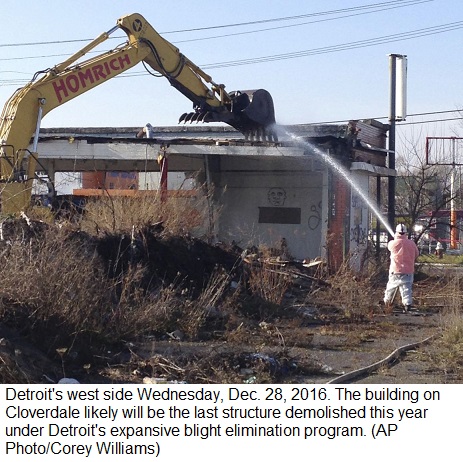
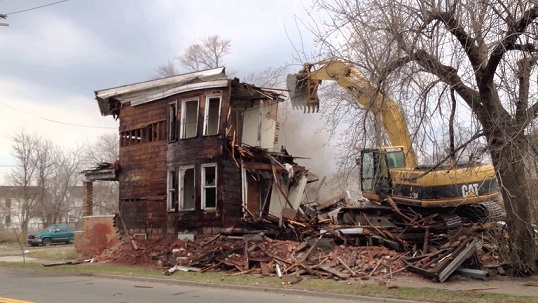
DETROIT (AP) — Remnants of the roof and walls creaked, groaned and then crumpled to the ground Wednesday from what once was an industrial building that covered an entire city block, likely the last structure demolished this year under Detroit’s massive blight elimination program.

Blows from an excavator methodically destroyed a portion of what had been a 60,000-square-foot building on Cloverdale Avenue in a west side neighborhood of homes, auto repair shops and other light industrial buildings.

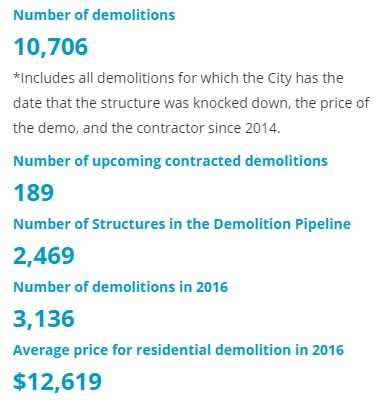
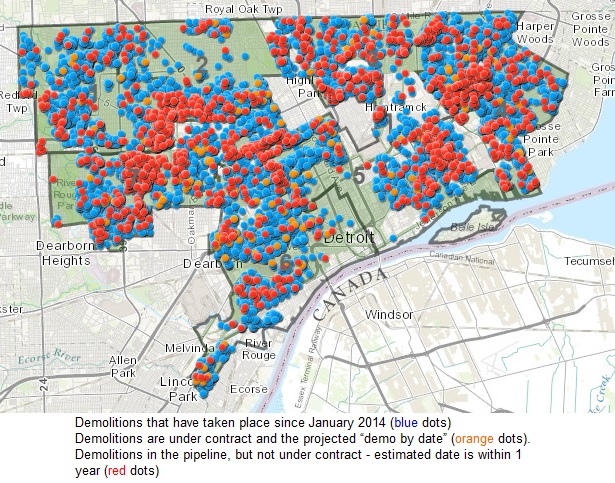
When leveled, the structure that a local resident said had once housed an industrial laundry or dry cleaners, will mark about 3,130 structures cleared in 2016 and about 10,700 — mostly houses — razed since 2014. The vast majority are owned by the city’s Land Bank Authority.

But the city has a long way to go. A blight task force in 2014 said 40,000 needed to be torn down and 38,000 others were falling apart in one of the nation’s poorest major cities that emerged in December 2014 from the largest municipal bankruptcy in U.S. history.

Many blocks have more abandoned houses and empty lots than lived-in homes, a result of the exodus of whites and much of the black middle class from the city. About 1.8 million people lived in Detroit in the 1950s. Fewer than 700,000 currently call Detroit home, according to the U.S. Census.

Mayor Mike Duggan has said the mass demolitions are necessary for Detroit to attract families to city neighborhoods and stop decades of population loss.

“I’m so excited about this,” said an almost gleeful Sandra Pickens as the excavator clawed at brick and wood.

Pickens is president of the Littlefield Community Association. The neighborhood group met over the summer with Duggan about the empty building and other concerns.

“This was an eyesore for us,” she told The Associated Press Wednesday. “I’ve seen people come and dump things here; come in at night and steal the beams. We shouldn’t have anything looking like this.”

Mike Douglas works in a muffler shop on Cloverdale. He remembers the neighborhood and small businesses in the area as “thriving” 20 or so years ago. He believes the building across the street has been empty a dozen or so years.

The area had “deteriorated to the point that we were having a tough time actually keeping our business here,” said Douglas, 55.

By removing dangerous buildings and empty houses, safety and quality of life in Detroit is improved, according to Fire Investigations Division Capt. Winston Farrow.

“It eliminates the opportunities for criminals to set fires in vacant houses,” Farrow said. “The problem was more just the sheer numbers of dwellings that we had.”

The average sale prices of over 100 houses sold in the city also has increased over the past three years, according to the Land Bank.

The problems haven’t been resolved completely, “but it’s much better,” said Linda Smith, a blight task force co-chair and executive director of a nonprofit that builds homes in Detroit and provides resources to city residents.

“Maintaining and securing all of the homes that need some work done to them is the next step,” Smith said.

Not everyone is as optimistic.

“You can tear down a house on one block and go back several months later and where houses were occupied (they) are now abandoned and need to be demolished,” said Sheila Dapremont, owner of Detroit demolition company 3D Wrecking.

“It just seems like it never ends,” she said.

On average, it costs Detroit $12,616 to knock down a house. More than $128 million in federal funds over the past three years have helped pay for the work. Another $130 million was approved this year.

About $40 million in the city’s general fund has been set aside for demolitions.

Federal funding was temporarily halted earlier this year and resumed after an audit determined demolition costs above a federal cap of $25,000 per house were redistributed to 350 other properties to have those houses appear to meet the cap. Amounts over the cap should have been billed to the city. The city says controls have since been tightened.

—-

Detroit Demolition Tracker: http://www.detroitmi.gov/demolition

Despite these events being in Detroit and not the Caribbean, the foregoing can still impact the Greater Good for the Caribbean. It provides us an exact role model of what to do … and not do. Lessons learned …

The Go Lean book serves as a roadmap for the introduction and implementation of the Caribbean Union Trade Federation (CU) to elevate Caribbean society. Detroit is not in scope for this effort, but as detailed in a previous blog-commentary, an examination of the details of Detroit can be productive for the Caribbean effort. The Go Lean roadmap therefore has these 3 prime directives:

  • Optimization of the economic engines in order to grow the regional economy to $800 Billion GDP and create 2.2 million new jobs.
  • Establishment of a security apparatus to protect the resultant economic engines.
  • Improve Caribbean governance to support these engines.

Early in the Go Lean book, the point of lessons from Detroit was pronounced in the opening Declaration of Interdependence (Page 14), with this opening statement:

xxxiii. Whereas lessons can be learned and applied from the study of the recent history of other societies, the Federation must formalize statutes and organizational dimensions to avoid the pitfalls of communities like … Detroit…

As a “failed-city”, Detroit has suffered abandonment; first “white flight”, then eventually everyone else; (the population peak was 1,849,568 in 1950, but only 713,777 in 2010). The need for demolition is tied to the fact that many of the buildings from that population peak were still standing in the city, though now blighted.

According to the foregoing article, the city has more to do to right-size to an optimized city. The city’s disposition is still dire (brain drain, unemployment, urban blight and acute hopelessness); but there is hope for a better future. This is very familiar for Caribbean communities. This is why the study of Detroit is such an ideal model for the Caribbean.

Previous Go Lean blogs highlighted some specific lessons from Detroit and other nearby Michigan cities, as sampled in this detailed list here:

Detroit makes Community College free
An Ode to Detroit – Good Luck on Trade!
Beware of Vulture Capitalists
Detroit giving schools their ‘Worst Shot’
Flint, Michigan – A Cautionary Tale
Secrecy, corruption and conflicts in State governance
Before and After Photos of Detroit’s Transformation
Education & Economics: Welcoming Obama to Detroit
Ann Arbor: Model for ‘Start-up’ Cities
Big Salt: Short-term Benefit; Long-term Damage
NEXUS: Facilitating Detroit-Windsor Commerce
M-1 Rail: Alternative Motion in the Motor City
JP Morgan Chase $100 million Detroit investment

The foregoing news article (and VIDEO in the Appendix below) relates more to the art and science of destruction-recycling than it does to Detroit. This has also been a consistent theme for the Go Lean movement. Consider these previous blog-commentaries that advocated developing business models around destruction/recycling/turn-around:

A Lesson in ‘Garbage’
Where the Jobs Are – Entrepreneurism in Junk
Where the Jobs Are – One Scenario: Ship-breaking
‘Only at the precipice, do they change’

The CU/Go Lean effort is focused on forging change in the region; this does not start with the demolition process, rather it starts with attitudes and motivations to reject the status quo. This positive attitude is defined in the Go Lean book as the community ethos for “turn-around”. Here is a sample of the text relating to turn-around practice (Page 33):

… dispositions of abandoned buildings in the member-states still relate to CU missions, as in the protection of image (“psychological trauma” is inflicted daily on neighbors of abandoned structures) and the quest for beauty. While beauty, aesthetics and preservation may be paramount for communities, these should only be a concern after basic needs are satisfied – housing is a basic need. The economics of housing can be impacted with the over-supply of abandoned buildings, as it brings the value down for other properties, and sends out the false vision, like Detroit’s abandoned structures, that just a “little rehab” and their new manifestations will be readily available. Learning from Detroit, it is more beneficial to raze abandoned buildings and build anew turn-around, rather than considering restoration or preservation.

Accordingly, demolition of blighted buildings can reinvigorate a community. The building materials can be re-purposed. Bricks can simply be re-used; scrap metal can be recycled; the wood can grind down to chip/saw-dust; concrete can grind down to sand-fill; and on and on.

  • Imagine the jobs.
  • Image the restoration, the renewal, the refresh … in the community.
  • Even the newly-razed land-lots can be put into service as community gardens; or just left as vacant land-lots, therefore posing no risk or dangers to the community – see VIDEO below.

The book details other ethos to adopt, plus the executions of the following strategies, tactics, implementations and advocacies to impact the reboot and turn-around of Caribbean communities:

Community Ethos – Deferred Gratification Page 21
Community Ethos – People Respond to Incentives Page 21
Community Ethos – Job Multiplier Page 22
Community Ethos – Light Up the Dark Places Page 23
Community Ethos – “Crap” Happens Page 23
Community Ethos – Lean Operations Page 24
Community Ethos – Return on Investments (ROI) Page 24
Community Ethos – Ways to Impact the Future Page 26
Community Ethos – Ways to Help Entrepreneurship Page 28
Community Ethos – Ways to Impact a Turn-Around Page 33
Community Ethos – Impact the Greater Good Page 37
Strategy – Customers – Foreign Direct Investors Page 48
Tactical – Fostering a Technocracy Page 64
Tactical – Modeling Post WW II Germany – Reboot with Marshall Plan Page 68
Tactical – Modeling Post WW II Japan – Reboot with no Marshall Plan Page 69
Separation of Powers – Public Works & Infrastructure Page 82
Separation of Powers – Housing and Urban Authority Page 83
Implementation – Ways to Pay for Change Page 101
Implementation – Ways to Re-boot Freeport – Sample Failed City Page 112
Planning – Ways to Improve Failed-State Indices Page 132
Planning – Lessons Learned from 2008 Page 136
Planning – Lessons from Detroit Page 140
Advocacy – Ways to Grow the Economy Page 151
Advocacy – Ways to Create Jobs Page 152
Advocacy – Ways to Improve Local Government Page 169
Advocacy – Ways to Better Manage the Social Contract Page 170
Advocacy – Ways to Reboot Cuba Page 226
Advocacy – Ways to Reboot Haiti Page 238
Advocacy – Ways to Reboot Jamaica Page 239

The foregoing news article aligns with the publishers of the Go Lean book for the purpose of empowering and rebooting economic engines. The roadmap calls for the heavy-lifting of working with individuals, families, communities and nation-states to turn-around and reboot the region’s future prospect. There is the need for this re-boot so as to make the Caribbean better.

The Caribbean is arguably the best address on the planet, but there is a lot missing; like Detroit we have blight and urban decay (with dangerous buildings). So the example from Detroit is a good model to reboot the societal engines in our region. There are benefits to demolition, but there is also the need for caution. Crony-Capitalism can easily seep in to exploit public funds for private gain. So there are security and governing concerns as well. See the photos here of the Detroit Demolition Tracker, attempting to provide transparency for better governance.

cu-blog-detroit-demolishes-thousands-of-structures-photo-2

cu-blog-detroit-demolishes-thousands-of-structures-photo-3

The Go Lean roadmap provides a complete plan to reboot Caribbean economic-security-governing engines. The region is hereby urged to lean-in to this roadmap, to make the homeland a better place to live, work and play. 🙂

Download the book Go Lean … Caribbean – now!

————

Appendix VIDEO – Watch Detroit Demolish 2 Houses in 2 Minuteshttps://youtu.be/ML5l8GrJEe0

Published on Jul 6, 2016 – Watch the time lapse video of two demolitions in Detroit. For more information, visit detroitmi.gov/demolition.

Share this post:
, ,
[Top]

How to make sense of 2016

Go Lean Commentary

The year 2016 is coming to a close. In retrospect, it has been a “year of living dangerously”.

So much of the institutional progress that have been made in past decades have come under “protest” this year – think alphabetical organizations that promote integration like the UN, EU, IMF, OECD, etc. – and think globalization / trade pacts (NAFTA, TPP, CBI, etc.).

It is that bad! All aspects of Caribbean life has become dysfunctional: economics, security and governance. Here are some snippets from this Caribbean Yearbook; (this is just a sample in chronological order):

Surely, it is the conclusion of most that 2016 has yielded a bitter harvest.

This assessment is presented by the publishers of the book Go Lean … Caribbean. This 370-page publication asserts that the Caribbean region is in crisis but alas, a “crisis is a terrible thing to waste”.

What does this mean? Here goes…

The conclusion is that from the “ashes of 2016”, the Phoenix – symbolic for the Caribbean community – can rise and create a Way Forward.

This is not just true in the Caribbean, but for most of the world as well. It is possible to make sense of this tumultuous year. See this point developed in this editorial-article in The Economist magazine, here:

Title: How to make sense of 2016
Sub-title: Liberals lost most of the arguments this year. They should not feel defeated so much as invigorated

cu-blog-how-to-make-sense-of-2016-photo-1For a certain kind of liberal, 2016 stands as a rebuke. If you believe, as The Economist does, in open economies and open societies, where the free exchange of goods, capital, people and ideas is encouraged and where universal freedoms are protected from state abuse by the rule of law, then this has been a year of setbacks. Not just over Brexit and the election of Donald Trump, but also the tragedy of Syria, abandoned to its suffering, and widespread support—in Hungary, Poland and beyond—for “illiberal democracy”. As globalisation has become a slur, nationalism, and even authoritarianism, have flourished. In Turkey relief at the failure of a coup was overtaken by savage (and popular) reprisals. In the Philippines voters chose a president who not only deployed death squads but bragged about pulling the trigger. All the while Russia, which hacked Western democracy, and China, which just last week set out to taunt America by seizing one of its maritime drones, insist liberalism is merely a cover for Western expansion.

Faced with this litany, many liberals (of the free-market sort) have lost their nerve. Some have written epitaphs for the liberal order and issued warnings about the threat to democracy. Others argue that, with a timid tweak to immigration law or an extra tariff, life will simply return to normal. That is not good enough. The bitter harvest of 2016 has not suddenly destroyed liberalism’s claim to be the best way to confer dignity and bring about prosperity and equity. Rather than ducking the struggle of ideas, liberals should relish it.

Mill wheels

In the past quarter-century liberalism has had it too easy. Its dominance following Soviet communism’s collapse decayed into laziness and complacency. Amid growing inequality, society’s winners told themselves that they lived in a meritocracy—and that their success was therefore deserved. The experts recruited to help run large parts of the economy marvelled at their own brilliance. But ordinary people often saw wealth as a cover for privilege and expertise as disguised self-interest.

After so long in charge, liberals, of all people, should have seen the backlash coming. As a set of beliefs that emerged at the start of the 19th century to oppose both the despotism of absolute monarchy and the terror of revolution, liberalism warns that uninterrupted power corrupts. Privilege becomes self-perpetuating. Consensus stifles creativity and initiative. In an ever-shifting world, dispute and argument are not just inevitable; they are welcome because they lead to renewal.

What is more, liberals have something to offer societies struggling with change. In the 19th century, as today, old ways were being upended by relentless technological, economic, social and political forces. People yearned for order. The illiberal solution was to install someone with sufficient power to dictate what was best—by slowing change if they were conservative, or smashing authority if they were revolutionary. You can hear echoes of that in calls to “take back control”, as well as in the mouths of autocrats who, summoning an angry nationalism, promise to hold back the cosmopolitan tide.

Liberals came up with a different answer. Rather than being concentrated, power should be dispersed, using the rule of law, political parties and competitive markets. Rather than putting citizens at the service of a mighty, protecting state, liberalism sees individuals as uniquely able to choose what is best for themselves. Rather than running the world through warfare and strife, countries should embrace trade and treaties.

Such ideas have imprinted themselves on the West—and, despite Mr Trump’s flirtation with protectionism, they will probably endure. But only if liberalism can deal with its other problem: the loss of faith in progress. Liberals believe that change is welcome because, on the whole, it is for the better. Sure enough, they can point to how global poverty, life expectancy, opportunity and peace are all improving, even allowing for strife in the Middle East. Indeed, for most people on Earth there has never been a better time to be alive.

Large parts of the West, however, do not see it that way. For them, progress happens mainly to other people. Wealth does not spread itself, new technologies destroy jobs that never come back, an underclass is beyond help or redemption, and other cultures pose a threat—sometimes a violent one.

If it is to thrive, liberalism must have an answer for the pessimists, too. Yet, during those decades in power, liberals’ solutions have been underwhelming. In the 19th century liberal reformers met change with universal education, a vast programme of public works and the first employment rights. Later, citizens got the vote, health care and a safety net. After the second world war, America built a global liberal order, using bodies such as the UN and the IMF to give form to its vision.

Nothing half so ambitious is coming from the West today. That must change. Liberals must explore the avenues that technology and social needs will open up. Power could be devolved from the state to cities, which act as laboratories for fresh policies. Politics might escape sterile partisanship using new forms of local democracy. The labyrinth of taxation and regulation could be rebuilt rationally. Society could transform education and work so that “college” is something you return to over several careers in brand new industries. The possibilities are as yet unimagined, but a liberal system, in which individual creativity, preferences and enterprise have full expression, is more likely to seize them than any other.

The dream of reason

After 2016, is that dream still possible? Some perspective is in order. This newspaper believes that Brexit and a Trump presidency are likely to prove costly and harmful. We are worried about today’s mix of nationalism, corporatism and popular discontent. However, 2016 also represented a demand for change. Never forget liberals’ capacity for reinvention. Do not underestimate the scope for people, including even a Trump administration and post-Brexit Britain, to think and innovate their way out of trouble. The task is to harness that restless urge, while defending the tolerance and open-mindedness that are the foundation stones of a decent, liberal world.

Source: Publish Date 12-24-2016; retrieved from: http://www.economist.com/news/leaders/21712128-liberals-lost-most-arguments-year-they-should-not-feel-defeated-so-much?cid1=cust/ednew/n/bl/n/20161220n/owned/n/n/nwl/n/n/NA/8415420/n

The foregoing article depicts that the magazine, The Economist, believes …

… “in open economies and open societies, where the free exchange of goods, capital, people and ideas is encouraged and where universal freedoms are protected from state abuse by the rule of law.”

Ditto for the movement behind Go Lean … Caribbean.

For the Caribbean, we now need a new way, a new year. We are looking forward to 2017.

The foregoing article is being brought into focus in a consideration of the Go Lean book; which serves as a roadmap for the introduction and implementation of the technocratic Caribbean Union Trade Federation (CU), for the elevation of Caribbean society. This CU/Go Lean roadmap has these 3 prime directives:

  • Optimization of economic engines in order to grow the regional economy to $800 Billion and create 2.2 million new jobs.
  • Establishment of a security apparatus to protect the resultant economic engines.
  • Improvement of Caribbean governance to support these engines.

The Go Lean book (Page 3), though written in 2013, makes the assertion that the Caribbean is in crisis. The book details that there is something wrong in the homeland, that while it is the greatest address in the world, instead of the world “beating a path” to these doors, the people of the Caribbean have “beat down their doors” to get out.

Why do people leave such an idyllic place? The book identifies a series of reasons, classified as “push and pull” factors. They are economic (jobs and entrepreneurial shortages), security deficiencies and governing misgivings.

The Go Lean book does not ignore these “push and pull” factors that cause our Caribbean people to flee. The book stresses (early at Page 13) the need to be on-guard for “push” factors in these Declaration of Interdependence statements:

xix. Whereas our legacy in recent times is one of societal abandonment, it is imperative that incentives and encouragement be put in place to first dissuade the human flight, and then entice and welcome the return of our Diaspora back to our shores. This repatriation should be effected with the appropriate guards so as not to imperil the lives and securities of the repatriated citizens or the communities they inhabit. The right of repatriation is to be extended to any natural born citizens despite any previous naturalization to foreign sovereignties.

xxi. Whereas the preparation of our labor force can foster opportunities and dictate economic progress for current and future generations, the Federation must ensure that educational and job training opportunities are fully optimized for all residents of all member-states, with no partiality towards any gender or ethnic group. The Federation must recognize and facilitate excellence in many different fields of endeavor, including sciences, languages, arts, music and sports. This responsibility should be executed without incurring the risks of further human flight, as has been the past history.

xxvi. Whereas the Caribbean region must have new jobs to empower the engines of the economy and create the income sources for prosperity, and encourage the next generation to forge their dreams right at home, the Federation must therefore foster the development of new industries, like that of ship-building, automobile manufacturing, prefabricated housing, frozen foods, pipelines, call centers, and the prison industrial complex. In addition, the Federation must invigorate the enterprises related to existing industries like tourism, fisheries and lotteries – impacting the region with more jobs.

This commentary previously related details of Caribbean dysfunction and how to effectuate a turn-around in the region’s societal engines. Here is a sample of such earlier blog-commentaries:

https://goleancaribbean.com/blog/?p=7179 How to Effectuate Change in Crime Fight? Change Leaders
https://goleancaribbean.com/blog/?p=7056 ‘Necessity is the Mother of Invention’
https://goleancaribbean.com/blog/?p=6563 Lessons from Iceland – Model of Recovery
https://goleancaribbean.com/blog/?p=5695 Repenting, Forgiving and Reconciling the Past
https://goleancaribbean.com/blog/?p=3929 Recipe for Successful Turn-arounds: Add Bacon to Eggs
https://goleancaribbean.com/blog/?p=3915 ‘Change the way you see the world; you change the world you see’
https://goleancaribbean.com/blog/?p=3662 Migrant flow into US from Caribbean spikes
https://goleancaribbean.com/blog/?p=2547 Miami’s Success versus Caribbean Failure
https://goleancaribbean.com/blog/?p=1596 Book Review: ‘Prosper Where You Are Planted’
https://goleancaribbean.com/blog/?p=841 Having Less Babies is Bad for the Economy
https://goleancaribbean.com/blog/?p=623 ‘Only at the precipice, do they change’

A turn-around of our failing societal engines is essential for the Way Forward.

Way Forward – an action, plan etc. that seems a good idea because it is likely to lead to success; i.e.:

  • A way forward lies in developing more economic links.
  • This treatment may be the way forward for many inherited disorders.

Source: Retrieved December 22, 2016 from: http://www.ldoceonline.com/dictionary/a-the-way-forward

An example of a Way Forward is the following VIDEO, highlighting the emergence of digital technologies as the lifeblood of today’s cities. They are applied widely in industry and society, from information and communications technology (ICT) to the Internet of Things (IoT), in which objects are connected to the Internet. As sensors turn any object into part of an intelligent urban network, and as computing power facilitates analysis of the data these sensors collect, elected officials and city administrators can gain an unparalleled understanding of the infrastructure and services of their city. However, to make the most of this intelligence, another ingredient is essential: citizen engagement. Thanks to digital technologies, citizens can provide a steady flow of feedback and ideas to city officials.

————————————— Start VIDEO Here —————————————————-

VIDEO Title: Economist Intelligence Unit (EIU) – http://link.brightcove.com/services/player/bcpid4855923448001?bckey=AQ~~,AAABDH-R__E~,dB4S9tmhdOoLUuQl3WENJQVceD9z2lER&bctid=5114134376001

See the highlights from the Empowering Cities research and hear how the City of Pittsburgh is using digital technology to put citizens in control in this short video, featuring EIU contributor Sarah Murray and Pittsburgh’s chief innovation and performance officer, Debra Lam.
find out how global businesses and citizens envision smart cities

Read the full report to find out how global businesses and citizens envision smart cities, with insights from 20 leading experts. Download the Whitepaper here.

—————————————- End VIDEO Here —————————————————-

This study by The Economist Intelligence Unit (EIU), investigates how citizens and businesses in 12 diverse cities around the world – Barcelona, Berlin, Buenos Aires, Chicago, London, Los Angeles, Mexico City, New York City, Rio de Janeiro, Shanghai, Singapore and Toronto – envision the benefits of smart cities.

For the Caribbean, we must succeed in our own action plan – Go Lean roadmap – for cities and communities so as to dissuade our own people from giving up and abandoning their native homelands. While no society is perfect, nor fully optimized, some countries have been better than others. Many countries in North America and Western Europe have become lands of refuge for our Caribbean Diaspora.

The Go Lean book and accompanying blogs posit that it will take less effort to remediate the Caribbean than to fix some other part of the planet. This is the charge of the Go Lean…Caribbean roadmap, to do the heavy-lifting, to implement the organization dynamics to impact Caribbean society here-now and make this region a better place to live, work and play. The following are the community ethos, strategies, tactics and operational advocacies to effectuate this goal:

Community Ethos – People Respond to Incentives Page 21
Community Ethos – Economic Systems Influences Choices & Incentives Page 21
Community Ethos – The Consequences of Choice Lie in the Future Page 21
Community Ethos – Job Multiplier Page 22
Community Ethos – Minority Equalization Page 24
Community Ethos – Lean Operations Page 24
Community Ethos – Ways to Impact the Greater Good Page 37
Strategy – Vision – Make the Caribbean the Best Address on the Planet Page 45
Strategy – Mission – Repatriate Diaspora Page 46
Strategy – Mission – Dissuade Human Flight/“Brain Drain” Page 46
Tactical – Separation of Powers – Union versus Member-States Page 71
Implementation – Assemble CariCom, Dutch, French, Cuba and US Territories Page 95
Implementation – Enact Territorial Compacts for PR & the Virgin Islands Page 96
Implementation – Ways to Pay for Change Page 101
Implementation – Steps for Self-Governing Entities – Laboratories for fresh policies Page 105
Implementation – Ways to Deliver Page 109
Implementation – Reasons to Repatriate Page 118
Implementation – Ways to Benefit from Globalization Page 119
Implementation – Ways to Promote Independence Page 120
Planning – 10 Big Ideas for the Caribbean Page 127
Planning – Lessons Learned from 2008 Page 136
Advocacy – Ways to Grow the Economy Page 151
Advocacy – Ways to Create Jobs Page 152
Advocacy – Ways to Improve Governance Page 168
Advocacy – Ways to Improve Homeland Security Page 180
Advocacy – Ways to Impact the Diaspora Page 217
Advocacy – Ways to Preserve Caribbean Heritage Page 218
Advocacy – Ways to Impact Urban Living Page 236
Advocacy – Ways to Impact US Territories Page 244
Appendix – Interstate Compacts for Puerto Rico and the USVirgin Islands Page 278

This Go Lean movement asserts that the current year (2016) was not so redeeming. We must do better… going forward, with our own Way Forward. From Day One/Step One, the roadmap calls for positive change; then it provides turn-by-turn directions for what-how-when-where-why to remediate, mitigate and empower our region forward.

Other communities will be making their own mitigation to make 2017 a better year (than 2016); our Caribbean will be in competition with them, in competition with rest of the world. Considering this competition as a race, we realize that we are behind, trailing our competitors. We have acute deficiencies in our societal engines: economics, security and governance. We must now fix these, so as to dissuade people from leaving their native homelands.

There are many empowerments that our Caribbean region needs to implement to mitigate bad years like 2016. But truth be told, 2016 was not as bad at 2008 – that year was so dire that it inspired the creation of this Go Lean roadmap. Many countries in North America and Western Europe have already applied their formal turn-around from 2008 and now enjoy productive economies; (i.e. Iceland is complaining about their 2% unemployment rate).

While the Caribbean have many problems to mitigate, our biggest crisis stem from the fact that so many of our citizens have fled their Caribbean homelands for foreign shores.

So the quest to fix the Caribbean, though noble, is easier said than done; but it is conceivable, believable and achievable! Now is the time for all of the Caribbean, the people and governing institutions, to lean-in to this Way Forward, the Go Lean … Caribbean roadmap. 🙂

Download the book Go Lean … Caribbean – now!
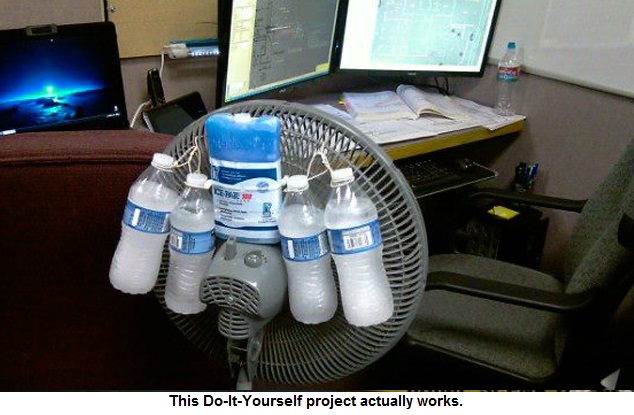
Share this post:
,
[Top]

Lessons Learned from Pearl Harbor

Go Lean Commentary

What would you do if backed into a corner and there’s a threat on your life?

For many people their natural impulse is to come out fighting. They say that this is not aggression, rather just a survival instinct.

Believe it or not, this depiction describes one of the biggest attacks in American history: the Japanese Attack on Pearl Harbor. See VIDEO here:

VIDEO – World War II History: Attack on Pearl Harbor – http://www.history.com/topics/world-war-ii/world-war-ii-history/videos/attack-pearl-harbor

Retrieved December 7, 2016 from History.com – On December 7, 1941, Japan launches a surprise attack on American soil at Pearl Harbor.

cu-blog-lessons-learned-from-pearl-harbor-photo-2

cu-blog-lessons-learned-from-pearl-harbor-photo-3

cu-blog-lessons-learned-from-pearl-harbor-photo-4

This is the 75th Anniversary of that attack – a few days ago: December 7. That’s a lot of years and a lot of lessons. Still, 75 is a pretty round number, like 25, 50 and 100. This commentary has been reserved for now, a few days late on purpose because of the best-practice to “not speak ill of the dead” at a funeral or memorial service. But a “lessons learned analysis” is still an important exercise for benefiting from catastrophic efforts. After 75 years since the Pearl Harbor Attack on December 7, 1941, this post-mortem analysis is just as shocking as it was on this “day of infamy”.

Consider the details of this maligning article here (and the Appendices below); notice that it assumes a conspiracy:

Title: How U.S. Economic Warfare Provoked Japan’s Attack on Pearl Harbor
By: Robert Higgs

cu-blog-lessons-learned-from-pearl-harbor-photo-1Ask a typical American how the United States got into World War II, and he will almost certainly tell you that the Japanese attacked Pearl Harbor and the Americans fought back. Ask him why the Japanese attacked Pearl Harbor, and he will probably need some time to gather his thoughts. He might say that the Japanese were aggressive militarists who wanted to take over the world, or at least the Asia-Pacific part of it. Ask him what the United States did to provoke the Japanese, and he will probably say that the Americans did nothing: we were just minding our own business when the crazy Japanese, completely without justification, mounted a sneak attack on us, catching us totally by surprise in Hawaii on December 7, 1941.

You can’t blame him much. For more than 60 years such beliefs have constituted the generally accepted view among Americans, the one taught in schools and depicted in movies—what “every schoolboy knows.” Unfortunately, this orthodox view is a tissue of misconceptions. Don’t bother to ask the typical American what U.S. economic warfare had to do with provoking the Japanese to mount their attack, because he won’t know. Indeed, he will have no idea what you are talking about.

In the late nineteenth century, Japan’s economy began to grow and to industrialize rapidly. Because Japan has few natural resources, many of the burgeoning industries had to rely on imported raw materials, such as coal, iron ore or steel scrap, tin, copper, bauxite, rubber, and petroleum. Without access to such imports, many of which came from the United States or from European colonies in southeast Asia, Japan’s industrial economy would have ground to a halt. By engaging in international trade, however, the Japanese had built a moderately advanced industrial economy by 1941.

At the same time, they also built a military-industrial complex to support an increasingly powerful army and navy. These armed forces allowed Japan to project its power into various places in the Pacific and east Asia, including Korea and northern China, much as the United States used its growing industrial might to equip armed forces that projected U.S. power into the Caribbean and Latin America, and even as far away as the Philippine Islands.

When Franklin D. Roosevelt became president in 1933, the U.S. government fell under the control of a man who disliked the Japanese and harbored a romantic affection for the Chinese because, some writers have speculated, Roosevelt’s ancestors had made money in the China trade.[1] Roosevelt also disliked the Germans (and of course Adolf Hitler), and he tended to favor the British in his personal relations and in world affairs. He did not pay much attention to foreign policy, however, until his New Deal began to peter out in 1937. Afterward, he relied heavily on foreign policy to fulfill his political ambitions, including his desire for reelection to an unprecedented third term.

When Germany began to rearm and to seek Lebensraum aggressively in the late 1930s, the Roosevelt administration cooperated closely with the British and the French in measures to oppose German expansion. After World War II commenced in 1939, this U.S. assistance grew ever greater and included such measures as the so-called destroyer deal and the deceptively named Lend-Lease program. In anticipation of U.S. entry into the war, British and U.S. military staffs secretly formulated plans for joint operations. U.S. forces sought to create a war-justifying incident by cooperating with the British navy in attacks on German U-boats in the north Atlantic, but Hitler refused to take the bait, thus denying Roosevelt the pretext he craved for making the United States a full-fledged, declared belligerent—an end that the great majority of Americans opposed.

In June 1940, Henry L. Stimson, who had been secretary of war under Taft and secretary of state under Hoover, became secretary of war again. Stimson was a lion of the Anglophile, northeastern upper crust and no friend of the Japanese. In support of the so-called Open Door Policy for China, Stimson favored the use of economic sanctions to obstruct Japan’s advance in Asia. Treasury Secretary Henry Morgenthau and Interior Secretary Harold Ickes vigorously endorsed this policy. Roosevelt hoped that such sanctions would goad the Japanese into making a rash mistake by launching a war against the United States, which would bring in Germany because Japan and Germany were allied.

Accordingly, the Roosevelt administration, while curtly dismissing Japanese diplomatic overtures to harmonize relations, imposed a series of increasingly stringent economic sanctions on Japan. In 1939 the United States terminated the 1911 commercial treaty with Japan. “On July 2, 1940, Roosevelt signed the Export Control Act, authorizing the President to license or prohibit the export of essential defense materials.” Under this authority, “[o]n July 31, exports of aviation motor fuels and lubricants and No. 1 heavy melting iron and steel scrap were restricted.” Next, in a move aimed at Japan, Roosevelt slapped an embargo, effective October 16, “on all exports of scrap iron and steel to destinations other than Britain and the nations of the Western Hemisphere.” Finally, on July 26, 1941, Roosevelt “froze Japanese assets in the United States, thus bringing commercial relations between the nations to an effective end. One week later Roosevelt embargoed the export of such grades of oil as still were in commercial flow to Japan.”[2] The British and the Dutch followed suit, embargoing exports to Japan from their colonies in southeast Asia.

An Untenable Position
cu-blog-lessons-learned-from-pearl-harbor-photo-6
Roosevelt and his subordinates knew they were putting Japan in an untenable position and that the Japanese government might well try to escape the stranglehold by going to war. Having broken the Japanese diplomatic code, the Americans knew, among many other things, what Foreign Minister Teijiro Toyoda had communicated to Ambassador Kichisaburo Nomura on July 31: “Commercial and economic relations between Japan and third countries, led by England and the United States, are gradually becoming so horribly strained that we cannot endure it much longer. Consequently, our Empire, to save its very life, must take measures to secure the raw materials of the South Seas.”[3]

Because American cryptographers had also broken the Japanese naval code, the leaders in Washington knew as well that Japan’s “measures” would include an attack on Pearl Harbor.[4] Yet they withheld this critical information from the commanders in Hawaii, who might have headed off the attack or prepared themselves to defend against it. That Roosevelt and his chieftains did not ring the tocsin makes perfect sense: after all, the impending attack constituted precisely what they had been seeking for a long time. As Stimson confided to his diary after a meeting of the war cabinet on November 25, “The question was how we should maneuver them [the Japanese] into firing the first shot without allowing too much danger to ourselves.”[5] After the attack, Stimson confessed that “my first feeling was of relief … that a crisis had come in a way which would unite all our people.[6]

Source: The Independent Institute – Online Community – Posted: May 1, 2006; retrieved December 7, 2016 from: http://www.independent.org/newsroom/article.asp?id=1930
——–
See Appendices below for cited references and profiles of the Author and the Organization.

So this establishes why the Japanese may have been motivated to attack Pearl Harbor in the first place. The motivation seems more complicated than initially reported.

The Bible declares that:

“For there is nothing hidden that will not become manifest” – Luke 8:17

cu-blog-lessons-learned-from-pearl-harbor-photo-7

cu-blog-lessons-learned-from-pearl-harbor-photo-5

After 75 years, the before-during-after facts associated with the Pearl Harbor Attack should be available for full disclosure. What are the lessons here for the Caribbean and today’s effort to secure the Caribbean homeland while expanding the regional economy? We truly want to consider these main points, these lessons; (the hyperlinks refer to previous Go Lean commentaries):

Lessons

Territories have a status of disregard Hawaii (Pearl Harbor) and Philippines were attacked by the Japanese. These were both US Territories at the same. The levels of protection and preparedness for territories are sub-standard compared to the American mainland. As a result there was no meaningful plan for the air defense of Hawaii.
Colonialism is/was really bad Japan protested the sub-standard reality of the native Asians under the European colonial schemes. A people oppressed, suppressed and repressed would not remain docile forever; “that a downtrodden people would not stay down, that they would rise and revolt, that they would risk their lives and that of their children to pursue freedom.” – Go Lean book Page 251.
White Supremacy is/was a really bad construct The US Territories (Hawaii and Philippines) were not the first targets for Japan. They targeted all European colonies (British, French and Dutch) territories. Their campaign was to rail against White Supremacy.
Bullies only respond to a superior force Japan avail themselves of expansion opportunities in Far-East Asia as the European powers became distracted in the time period during and after World War I. (Manchuria in China was occupied by Japan starting in 1931). Only a superior force, the US, was able to assuage their aggression.
Economic Warfare can back a Government into a corner When the supply of basic needs (food, clothing, shelter and energy) are curtailed, a crisis ensues. When people are in crisis, they consider “fight or flight” options. Japan chose to fight; Caribbean people choose flight.
Societies can double-down on a bad Community Ethos Japan’s aggression was a direct result of their community ethos that honored Samurai warrior and battle culture. Men would walk the streets with their swords, ready for a challenge. On the other hand, the US (and Western Europe) community ethos of racism was so ingrained that the natural response in the US, post-Pearl Harbor, was to intern Japanese Americans in camps.
All of these bad community ethos were weeded out with post-WWII Human Rights reconciliations. – Go Lean book Page 220.
Double Standards are hard to ignore Japan felt justified in their Pacific aggression because of the US’s regional aggression in the Americas. Before Pearl Harbor, they withdrew from the League of Nations in protest of double standards.
Even after WWII, this double standard continues with countries with Veto power on the UN Security Council.
People have short memories There are movements to re-ignite many of the same developments that led to the devastation of WWII: right wing initiatives in Japan and Germany; Human Rights disregard for large minority groups (Muslims, etc.).
The more things change, the more they remain the same.

This discussion is analyzing the concept of “fight or flight”. According to Anthropologists, individuals and societies facing a crisis have to contend with these two options for survival. The very concept of refugees indicate that most people choose to flee; they choose internal displacement or refuge status in foreign countries. This point is consistent with the theme in the book Go Lean … Caribbean that this region is in crisis and as a result people have fled from their beloved homelands to foreign destinations in North America and Europe. How bad? According to one report, we have lost 70 percent of our tertiary-educated population.

Enough said! Our indictment is valid. Rather than flee, we now want the region to fight. This is not advocating a change to a militaristic state, but rather this commentary, and the underlying Go Lean book, advocates devoting “blood, sweat and tears” to empowering change in the Caribbean region. The book states this in its introduction (Page 3):

We cannot ignore the past, as it defines who we are, but we do not wish to be shackled to the past either, for then, we miss the future. So we must learn from the past, our experiences and that of other states in similar situations, mount our feet solidly to the ground and then lean-in, to reach for new heights; forward, upward and onward. This is what is advocated in this book: to Go Lean … Caribbean!

The Go Lean book serves as a roadmap for the introduction and implementation of the Caribbean Union Trade Federation (CU). One mission of this roadmap is to reduce the “push and pull” factors that contributes to the high emigration rates. For the most part the “push and pull” factors relate to the societal defects among the economic, security and governing engines. Another mission is to incentivize the far-flung Diaspora to consider a return to the region. Overall, the Go Lean roadmap asserts that the economy of the Caribbean is inextricably linked to the security of the Caribbean. The roadmap therefore proposes an accompanying Security Pact to accompany the CU treaty’s economic empowerment efforts. The plan is to cooperate, collaborate and confer with all regional counterparts so as to provide an optimized Caribbean defense, against all threats, foreign and domestic. This includes the American Caribbean territories (just like Pearl Harbor was on the American territory of Hawaii) of Puerto Rico and the US Virgin Islands. These American protectorates are included in this CU regional plan.

This CU/Go Lean regional plan strives to advance all of Caribbean society with these 3 prime directives:

  • Optimization of the economic engines in order to grow the regional economy to a $800 Billion Single Market by creating 2.2 million new jobs.
  • Establishment of a security apparatus to protect the resultant economic engines.
  • Improvement of Caribbean governance in support of these endeavors.

The Go Lean book stresses the effectiveness and efficiency of protecting life and property of all Caribbean stakeholders: residents, trading partners, visitors, etc.. This is why the book posits that some deployments are too big for any one member-state to manage alone – especially with such close proximities of one island nation to another – there are times when there must be a cross-border multi-lateral coordination – a regional partnership. This is the vision that is defined in the book (Pages 12 – 14), starting with these statements in the opening Declaration of Interdependence:

x. Whereas we are surrounded and allied to nations of larger proportions in land mass, populations, and treasuries, elements in their societies may have ill-intent in their pursuits, at the expense of the safety and security of our citizens. We must therefore appoint “new guards” to ensure our public safety and threats against our society, both domestic and foreign.

xii. Whereas the legacy in recent times in individual states may be that of ineffectual governance with no redress to higher authority, the accedence of this Federation will ensure accountability and escalation of the human and civil rights of the people for good governance, justice assurances, due process and the rule of law. As such, any threats of a “failed state” status for any member state must enact emergency measures on behalf of the Federation to protect the human, civil and property rights of the citizens, residents, allies, trading partners, and visitors of the affected member state and the Federation as a whole.

xvi. Whereas security of our homeland is inextricably linked to prosperity of the homeland, the economic and security interest of the region needs to be aligned under the same governance.

The Go Lean roadmap is not a call for a revolt against the governments, agencies or institutions of the Caribbean region, but rather a petition for a peaceful transition and optimization of the economic, security and governing engines in the region. To establish the security optimization, the Go Lean book presents a series of community ethos that must be adapted to forge this change. In addition, there are these specific strategies, tactics, implementation and advocacies to apply:

Community Ethos – new Economic Principles Page 21
Community Ethos – new Security Principles Page 22
Community Ethos – Minority Equalization Page 24
Community Ethos – Impacting the Greater Good Page 34
Strategy – Mission – Enact a Defense Pact to defend the homeland Page 45
Tactical – Fostering a Technocracy Page 64
Tactical – Homeland Security – Naval Operations Page 75
Tactical – Homeland Security – Militias Page 75
Implementation – Assemble – US Overseas Territory into CU Page 96
Implementation – Foreign Policy Initiatives at Start-up Page 102
Implementation – Security Initiatives at Start-up Page 103
Implementation – Ways to Promote Independence Page 120
Planning – Ways to Model the EU – Constructs after WW II Page 130
Advocacy – Ways to Better Manage the Social Contract Page 170
Advocacy – Ways to Improve Homeland Security Page 180
Advocacy – Ways to Mitigate Terrorism Page 181
Advocacy – Ways to Improve Intelligence Gathering Page 182
Advocacy – Ways to Enhance Tourism – Mitigate Risky Image Page 190
Advocacy – Ways to Improve Emergency Management Page 196
Advocacy – Ways to Preserve Caribbean Heritage Page 218
Advocacy – Ways to Impact US Territories Page 244

Now is the time to lean-in to this roadmap and “fight” for Caribbean change, as depicted in the book Go Lean…Caribbean. At this time, there are no State Actor adversaries – like Imperial Japan – seeking to cause harm to our homeland, but that status quo can change very quickly. Some Caribbean member-states are still de facto “colonies”, so enemies of our colonial masters – France, Netherlands, US, UK – can quickly “pop up”. We must be ready and on guard to any possible threats and security risks.

The movement behind the Go Lean … Caribbean book seeks to make this homeland a better place to live, work and play. Since the Caribbean is arguably the best address of the planet, tourism is a primary concern. So security here in our homeland must take on a different priority. Tourists do not visit war zones – civil wars, genocides, active terrorism, Failed-States and rampant crime. Already our societal defects (economics) have created such crises that our people have chosen to flee as opposed to “fight”. We do not need security threats as well; we do not need Failed-States. We are now preparing to “fight” (exert great efforts), not flee, to wage economic war to elevate our  communities.

This will not be easy; this is heavy-lifting, but success is possible. The strategies, tactics and implementations in the Go Lean roadmap are conceivable, believable and achievable. 🙂

Download the book Go Lean … Caribbean – now!

———–

Appendix A – Reference Notes:
1.  Harry Elmer Barnes, “Summary and Conclusions,” in Perpetual War for Perpetual Peace:A Critical Examination of the Foreign Policy of Franklin Delano Roosevelt and Its Aftermath (Caldwell, Id.: Caxton Printers, 1953), pp. 682–83.
2.  All quotations in this paragraph from George Morgenstern, “The Actual Road to Pearl Harbor,” in Perpetual War for Perpetual Peace, pp. 322–23, 327–28.
3.  Quoted ibid., p. 329.
4.  Robert B. Stinnett, Day of Deceit: The Truth about FDR and Pearl Harbor (NewYork: Free Press, 2000).
5.  Stimson quoted in Morgenstern, p. 343.
6.  Stimson quoted ibid., p. 384.

 ——-

Appendix B – About the Author:

Robert Higgs is a Senior Fellow in Political Economy at the Independent Institute and Editor at Large of the Institute’s quarterly journal The Independent Review. He received his Ph.D. in economics from JohnsHopkinsUniversity, and he has taught at the University of Washington, LafayetteCollege, SeattleUniversity, the University of Economics, Prague, and GeorgeMasonUniversity.

——-

Appendix C – About the Independent Institute:

The Independent Institute is a non-profit, non-partisan, scholarly research and educational organization that sponsors in-depth studies of critical social and economic issues.

The mission of the Independent Institute is to boldly advance peaceful, prosperous, and free societies grounded in a commitment to human worth and dignity.

Today, the influence of partisan interests is so pervasive that public-policy debate has become too politicized and is largely confined to a narrow reconsideration of existing policies. In order to fully understand the nature of public issues and possible solutions, the Institute’s program adheres to the highest standards of independent scholarly inquiry.
Source: http://www.independent.org/aboutus/


Share this post:
, , , ,
[Top]

Art Walk – Its a ‘Real Thing’ in Wynwood

Go Lean Commentary

Forget the theory, this is real …

… the arts are empowering the economy in the Miami District of Wynwood. This can be measured … by “boots on the ground” and in dollars and cents.

Though we have been reporting that “the community rallies around the arts creating a unique energy; and art ‘dynamises’ the community, in a very unique way”, this was hard to visualize in practice. And then … we made a visit to Wynwood during Art Basel Art Week 2016 and wow! We felt the energy; see here in the following VIDEO:

VIDEO – CU Blog – Art Walk – It’s a Real Thing in Wynwood – https://youtu.be/iwuMUUFuXvs

Published on Dec 4, 2016 – Art Week 2016: “The community rallies around the arts creating a unique energy; and art ‘dynamises’ the community, in a very unique way”.

This commentary completes the 3-part series on the power of the visual arts. The series depicts how the arts can forge change in a community, where it can be an effective messaging tool to convey many important points. In the Caribbean, we need the type of transformation that can come from this power. The full entries in the series are as follows:

  1.  Forging Change: Arts & Artists
  2.  ENCORE: Art Basel 2016 – A Testament to the Business of the Arts
  3.  Art Walk – Its a Real Thing in Wynwood

This commentary goes further, conveying that there is also a good business model in the arts. This blog considers the model of a Miami-based company, branded WynwoodArtWalk.com. They promote the arts in this one district, and transact in the aligning tourism trade:

Website Title: Wynwood Art Walk
About WynwoodArtWalk.com

cu-blog-art-walk-its-a-real-thing-in-wynwood-photo-1“Wynwood Art Walk” is a tour company providing art tours in the Wynwood Art District. We advertise tours for groups but also provide customized private tours per request. Furthermore, we seek to support the Wynwood art community through our art directory and through banner advertisement space, our blog, and our community page.

WynwoodArtWalk.com has also an online directory showcasing art institutions operating within Wynwood. Wynwood is a section of Miami just north of Downtown, south of the Design District, east of I-95, and west of Biscayne Boulevard. There are currently over 60 art galleries, art complexes and art collection in Wynwood. Wynwood Art Guide provides advertising to institutions that exhibit/promote contemporary visual art (paintings, sculptures, installations, photography, multimedia, ceramics, etc.) in Wynwood. Advertising is available through the use of banners. Companies servicing the arts (eg. art dealers, framing companies, art supply sellers, etc.) are welcome to advertise through the use of banners exclusively.
———-
General Area

The main area of the Wynwood Art Walk is between 20 St & 36 St and from NW 2nd Ave to NE 2nd Ave. Prime hours are between 7pm and 11pm. Parking is best before 7pm.

The food trucks are located in a field on the corner of NW 23 St & NW 2nd Ave. Great food and drinks!
———-
History
Wynwood – originally spelled Wyndwood – is an old inner city neighborhood of Miami surrounded by Edgewater, Overtown, Liberty City… Wynwood was built as a working class residential neighborhood, connected to the Garment District just south of it. It attracted manufacturers from New York and elsewhere and retained some jobs, fueled by immigrant labor, but struggled against competition from cheap labor overseas. According to a different source, in the fifties, it was a white neighborhood of professionals, but a remembrance on History Miami’s website indicates that Cuban immigrants were moving into the neighborhood in the early sixties.
Source: Tour Company Website – Retrieved 12-03-2016 from: http://wynwoodartwalk.com/wynwood-art/

This commentary – from the publishers of the book Go Lean … Caribbean – is trying to forge change in the Caribbean region and advocate that the arts can be a great tool-tactic for societal elevation. As previously related “…there’s a transformative power to the arts”.

This commentary is urging Caribbean stakeholders to explore the production of artists and the effect their art can have on society. Considering that tourism is the primary industry in the entire Caribbean, there are a lot of benefits to examining the business model of the Wynwood Art District. Imagine an array of murals in Caribbean port cities – for our Cruise tourism. Imagine too, the “Walking Tours”, Art Galleries and Art Sales. Notice the manifestation of this plan in the photos here from the Art Walk (Tour) in Wynwood:

cu-blog-art-walk-its-a-real-thing-in-wynwood-photo-2  cu-blog-art-walk-its-a-real-thing-in-wynwood-photo-3

cu-blog-art-walk-its-a-real-thing-in-wynwood-photo-4  cu-blog-art-walk-its-a-real-thing-in-wynwood-photo-5

cu-blog-art-walk-its-a-real-thing-in-wynwood-photo-6

cu-blog-art-walk-its-a-real-thing-in-wynwood-photo-7

cu-blog-art-walk-its-a-real-thing-in-wynwood-photo-8


cu-blog-art-walk-its-a-real-thing-in-wynwood-photo-9

Feel the energy! Excitement enough?

Local media has often reported on the huge economic impact of Art Basel and Wynwood; see the links here to full stories:

http://www.miamiherald.com/news/business/biz-monday/article45702225.htmlArt Basel has been great for Miami, CEOs agree (Miami Herald Newspaper; November 20, 2015).

http://www.bizjournals.com/southflorida/news/2015/06/22/tristar-capital-turns-huge-profit-on-13m-sale.htmlTriStar Capital turns huge profit on $13M sale in Miami’s Wynwood (South Florida Business Journal; Jun 22, 2015).

https://theculturetrip.com/north-america/usa/florida/articles/miami-culture-guide-wynwood-s-10-must-visit-art-galleries/ – Culture Trip Web Portal (Retrieved Dec 4, 2016).

Count the profits! Commerce enough?

This commentary confirms that there is energy and money in the visual arts, whether it is murals or graffiti, (commissioned street art). While the messaging of the visual arts can be impactful, visual expressions can depict imagery and tales – fact or fiction; artists often “use fiction to tell the truth” – the business elements of the arts can be even more impactful. The Go Lean book serves as a roadmap for the introduction and implementation of the technocratic Caribbean Union Trade Federation (CU). The CU is set to elevate Caribbean society through empowerments for the economic, security and governing engines in society. Therefore the Go Lean roadmap has these 3 prime directives:

  • Optimization of the economic engines in order to grow the regional economy to $800 Billion & create 2.2 million new jobs.
  • Establishment of a security apparatus to ensure public safety and protect the economic engines.
  • Improve Caribbean governance to support these engines.

The Go Lean book posits that the genius qualifier to excel in the arts should be identified early in Caribbean youth and then their development should be fostered up to adulthood. The book thereafter details the mechanics of incubating a business climate for this and all areas of culture. This quest is detailed as an advocacy in the book (Page 230) as:

10 Ways to Improve the Arts

1. Emergence of the Caribbean Union Embrace the advent of the CariCom Single Market Initiative and the Caribbean Union Trade Federation. This will allow for the unification of the region into a single market of 42 million people. This size supports the proliferation of ‘art’ (visual/fine, music, performance & film) as an industry. The CU will promote the art exhibition eco-system – allowing marketplaces for artists to congregate and monetize their talents. Structures will also be deployed for media companies to monetize film & performance art. The CU will facilitate the marketing of travelling exhibitions, and touring companies of stage productions. For the region, art can be a business enabler, and expressions for civic pride and national identity.
2. CU Administered Museums Modeled after the Smithsonian, the CU “mother” (first-tier) museums will be placed in the Capital District. There will also be “child” museums scattered through out the regions with touring exhibitions.
3. Art, Music & Film Festival Tourism CU promoted events, utilizing the CU-owned fairgrounds, to encourage the development and advancement in artistic expressions. These events will be aimed at the foreign markets (US, Canada, Europe, Central and South America) so as to generate tourism traffic. The artists may be domestic but also foreign and world class performers. (Event examples include New Orleans Jazz & Heritage Festival, Art Deco in Miami, Cannes Film Festival, and Taos, New Mexico).
4. Fairgrounds as Arena and Theater Districts The CU Fairgrounds will fund, build and maintain civic arenas and theaters in local market Enterprise Zones. The designated areas fomented under the CU will qualify for tax (sales, property and income tax rebates) and economic incentives (low interest loans and grants) and stimuli (advertising and event promotions), empowering event tourism.
5. Electronic Payment Models The CU Central Bank will arrange for settlement of electronic payments transactions allowing electronic commerce to flourish in the region. Then music, film and other media can be paid for and downloaded legally from the internet.
6. Respect for Intellectual Property Any institutional disregard for the intellectual property of books, music, films and media will be severely prosecuted. The CU will also recognized and enforce the copyrights of other countries and work to have international markets respects the intellectual property rights of Caribbean artists. (This is a feature the of the Trade SHIELD principles defined in Appendix D (Page 264)). This effort requires close collaboration with criminal (Interpol) and civic enforcement agencies (ASCAP/BMI, MPAA). The end result would be that local/regional artists can make a “living” from their recorded works.
7. Art in Public Places The CU will spur initiatives to incentivize and directly commission artist to exhibit their creations (paintings, murals, sculptures, etc.) in public edifices. This will encourage national-state public-private deployments of themed sculptures like Bahamian Conch Shells, Barbados Flying Fish and Puerto Rico Tree Frogs. These can be modeled after US city examples, like “Painted” Bulls in Chicago, Mustangs in Denver, and Guitars in Nashville.
8. Performing & Fine Arts Schools A hybrid “Charter” school concept promotes the development and advancement in specific performing and fine arts while not forsaking the basic educational requirements. Similar to the secondary school (NYC Performing Arts) featured in the movie “Fame”. On the tertiary level, the CU will provide scholarships and endowments for programs in the Arts.
9. Agency for Public Broadcasting and National Touring Companies These public-private agencies will be chartered to produce and promote world class artistic companies (adult and youth) for Opera, Ballet, Modern Dance, Symphonic and Philharmonic Orchestras, despite whether they are popular or highly rated. The Arts must always be promoted as a necessary expression of a civilized society, despite profit or public acceptance. Likewise, a CU agency for Public Broadcasting will manage the region’s media efforts to bring world class art to the people, (with SAP-style options for all four languages) without considering popularity.
10. Professional Agents and Artists Management Oversight The CU will regulate, at the Cabinet level, and license the industry of Artists Agents/Managers, even though the artists can elect their own Agents & Managers. This management oversight is to be modeled after State Bars for lawyers. (This model is used for Sports Agents also).

While the Go Lean book relates (Page 291) the historicity of the pro-artist community in Taos, New Mexico, we now see a similar local model in Miami’s Wynwood District – a location with more Caribbean infusion. This Wynwood experience in particular and Art Basel Art Week in general is reinforcing that “art can drive” the economics, security and governance of a community.

While not everyone will be gifted artists, everyone can benefit from the accentuation of the arts and artists. So we should all work to make our homeland a better place to live, work and play by fostering the genius ability in Caribbean citizens. This is presented in the book as a “community ethos”:

“the fundamental character or spirit of a culture; the underlying sentiment that informs the beliefs, customs, or practices of a society; dominant assumptions of a people”. – (Page 20)

The Go Lean book presented the roadmap to imbrue the Caribbean region with new community ethos, plus new strategies, tactics, implementation and advocacies to foster the business climate for the arts. The following is a sample of these specific details from the book:

Community Ethos – Deferred Gratification Page 21
Community Ethos – Economic Principles – People Choose Page 21
Community Ethos – Economic Principles – People Respond to Incentives in Predictable Ways Page 21
Community Ethos – Economic Principles – Economic Systems Influence Individual Choices Page 21
Community Ethos – Economic Principles – The Consequences of Choices Lie in the Future Page 21
Community Ethos – Governing Principles – Minority Equalization Page 23
Community Ethos – Governing Principles – Lean Operations Page 24
Community Ethos – Governing Principles – Cooperatives Page 25
Community Ethos – Ways to Foster Genius Page 27
Community Ethos – Ways to Help Entrepreneurship Page 28
Community Ethos – Ways to Promote Intellectual Property Page 29
Community Ethos – Ways to Impact Turn-Arounds – Covering Urban Decay with Art Page 33
Community Ethos – Ways to Promote Happiness Page 36
Community Ethos – Ways to Impact the Greater Good Page 37
Strategy – Vision – Confederate 30 Member-States Page 45
Strategy – Mission – Celebrate the Music, Sports, Art and Culture of the Caribbean Page 46
Tactical – Confederating a Permanent Union Page 63
Tactical – Fostering a Technocracy Page 64
Tactical – Separation-of-Powers – CU Federal Agencies versus Member-State Governments Page 71
Implementation – Ways to Pay for Change Page 101
Implementation – Ways to Deliver Page 109
Implementation – National/Federal Museum in the Capital District Page 110
Planning – 10 Big Ideas for the Caribbean Region Page 127
Planning – Ways to Make the Caribbean Better Page 131
Advocacy – Ways to Grow the Economy Page 151
Advocacy – Ways to Create Jobs Page 152
Advocacy – Ways to Enhance Tourism Page 190
Advocacy – Ways to Impact Events Page 191
Advocacy – Ways to Impact Cruise Tourism Page 193
Advocacy – Ways to Preserve Caribbean Heritage – The business of fostering local culture Page 218
Advocacy – Ways to Improve the Arts Page 230
Advocacy – Ways to Promote Music Page 231
Appendix D – Trade SHIELD Principles Page 264
Appendix M – Taos Art Colony – New Mexico‘s Landmark Page 291
Appendix W – Mediating as French Culture and Economics Collide Page 311

The empowerments in the Go Lean book calls for the elevation of the arts as a permanent change. We want our youth to put their hopes and dreams in a Caribbean future, especially our youth who prove to be gifted in the arts. From the outset, the book recognized the significance of successfully fostering the arts with these statements in the opening Declaration of Interdependence (Page 12 & 14):

xxi.  Whereas the preparation of our labor force can foster opportunities and dictate economic progress for current and future generations, the Federation must ensure that educational and job training opportunities are fully optimized for all residents of all member-states, with no partiality towards any gender or ethnic group. The Federation must recognize and facilitate excellence in many different fields of endeavor, including sciences, languages, arts, music and sports. This responsibility should be executed without incurring the risks of further human flight, as has been the past history.

xxxii. Whereas the cultural arts and music of the region are germane to the quality of Caribbean life, and the international appreciation of Caribbean life, the Federation must implement the support systems to teach, encourage, incentivize, monetize and promote the related industries for arts and music in domestic and foreign markets. These endeavors will make the Caribbean a better place to live, work and play.

The Go Lean roadmap seeks to foster the eco-system for the business of the arts. This quest has been addressed in many previous Go Lean commentaries; see sample here:

https://goleancaribbean.com/blog/?p=9151 The New Smithsonian African-American Museum
https://goleancaribbean.com/blog/?p=4145 The African Renaissance Monument in Dakar, Senegal, Africa
https://goleancaribbean.com/blog/?p=3292 Art Basel Miami – a Testament to the Spread of Art & Culture
https://goleancaribbean.com/blog/?p=2415 How ‘The Lion King’ roared into Show-Business history

We can do our own “Wynwood” in the Caribbean. We have the artists and the talent waiting to be fostered. Let’s develop the business environment locally to fully explore the opportunities from the arts – the region should commission artists to paint murals.

We can do this; we can forge change here at home. This Go Lean roadmap is conceivable, believable and achievable. We can make the Caribbean a better place to live, work and play. 🙂

Download the book Go Lean … Caribbean – now!

Share this post:
, , , , ,
[Top]

Forging Change: Arts & Artists

Go Lean Commentary

Hell on Earth.

cu-blog-forging-change-arts-and-artists-photo-3There are a few destinations that can be assigned that designation right now; the country of South Sudan is perhaps one of the most prominent. (Other candidates include ISIS-controlled Syria and the hurricane-ravaged Caribbean member-state of Haiti).

So what’s happening in South Sudan?

South Sudan became the world’s newest nation in July 2011. But in December 2013, fighting between rebel militia and the government escalated into a civil war.

With several thousand killed and over a million people displaced by violence, South Sudan is facing a looming famine and is at high risk of genocide and mass atrocities. – United to End Genocide

How to forge change in an environment like South Sudan? Ouch!

Will it be a military solution, diplomatic, humanitarian, religious campaign? So many approaches and yet the failures persist.

This is heavy-lifting! One approach being considered is through the arts.

This commentary is part 1 of 3 in a series on the power of the visual arts. The series depicts how the arts can forge change in a community, where it can be an effective messaging tool to convey many important points. Africa needs this power; so too the Caribbean. Both regions need the type of transformation that can come from the power of the arts. The full entries in the series are as follows:

  1.  Forging Change: Arts & Artists
  2.  ENCORE: Art Basel 2016 – A Testament to the Business of the Arts
  3.  Art Walk – Its a Real Thing in Wynwood

Consider the details of the effort in South Sudan in the VIDEO and news story here:

VIDEO – South Sudanese artists call for end to violence through art – https://youtu.be/YMYPitDuayU

Published on Mar 15, 2016 – South Sudanese artists are calling for an end to violence in the world’s youngest nation, through works of art. Painters, designers and poets have been holding an exhibition in Juba aiming to remind leaders of South Sudan of the suffering in the country. The artists also call on their leaders to empower women and young people in society and ensure their active participation in the peace process.
———–
cu-blog-forging-change-arts-and-artists-photo-5

cu-blog-forging-change-arts-and-artists-photo-4

cu-blog-forging-change-arts-and-artists-photo-1

cu-blog-forging-change-arts-and-artists-photo-2
———-
Title: South Sudan Artists Protest Civil War With Peace Campaign
JUBA, SOUTH SUDAN — Musicians played lively tunes in South Sudan’s capital, and pedestrians and market shoppers watched the impromptu concert with curiosity. A soldier in desert camouflage walked around, surveying the scene.

As the drumming grew more insistent, the audience stood silent and motionless seemingly afraid to join the fun. Then the soldier started to breakdance.

That broke the ice and women swayed to the beat. Soon children and adults were dancing, enjoying a rare respite from South Sudan’s festering conflict.

For many in South Sudan, the arts have become a rare haven of peace in a young country that has known little but civil war. A group of artists are campaigning for peace, with pop-up street performances and murals across the capital, Juba. The activists have taken the name Ana Taban, or “I am tired,” in Arabic.

“We are tired of this, the constant fear, the war,” said Manas Mathiang, 32, a musician and artist who leads the movement.

Recently Mathiang met with nearly 30 artists who are part of Ana Taban. Members come from many of South Sudan’s main tribes. They say ethnicity has never been an issue, and they invite other artists “regardless of where they come from.”

The group has painted vibrant murals in Juba like one near the airport, a sky-blue wall depicting athletes, religious leaders and doctors under the slogan “Let us all do our part.” The artists also stage skits in street markets to promote reconciliation.

Ana Taban was started after fighting in Juba killed hundreds of people in July. A group of South Sudanese artists who had taken refuge in Kenya came together to create the movement. When it was safe to return to the capital, they brought home the campaign for peace.

Transcending tribe and politics, the artists use their work to try to unify South Sudan, the world’s newest nation, which won independence from Sudan in 2011. But then civil war broke out two years later, and tens of thousands have been killed amid concerns of ethnic violence.

A longing for an end to the fighting can be found in the country’s art and music. Some of the most popular songs on the radio are reggae because their lyrics of peace can be easily understood, said a local DJ, Daniel Danis.

Another member of Ana Taban, Deng Forbes, proudly held up his favorite work, a drawing of a child crying in the shape of a map of South Sudan.

“My people are diverse, 64 tribes,” Forbes said. “Art is a universal language, it’s a simple language.”

In some ways, South Sudan’s arts scene is like that in other countries, clustered in an offbeat section of the capital. Good equipment is rare. Artists say it is difficult to make money from their work. Feuds are common.

But much of South Sudan’s art is focused on the country’s political tensions.

Lual D’Awol, a popular rapper who appeared in an Ana Taban music video, said his songs about the lack of electricity and running water are banned from the radio by the government.

“It’s telling the truth that citizens of South Sudan feel, and I feel like I have to paint that picture and give a message that is genuinely happening,” D’Awol said.

Elsewhere in the capital, a nighttime concert a few weeks ago brought a rare feeling of ease. On a soccer field, roughly 1,000 South Sudanese danced and sang into the night, some climbing onto brick barriers for a better view.

On a makeshift stage, young women danced with men wearing the colors of South Sudan’s flag, members of the dancing troupe Sonzwgi, which roughly translates to “storytelling.”

The dance is a mashup of elements from different tribes across the country, said the group’s leader, Emmanuel Aban, saying it was choreographed to foster togetherness.

As Sonzwgi performed, women ran to the stage and danced, and men laughed freely. Aban smiled, saying: “It’s a way to send a message to the people.”
Source: Associated Press / Voice of America Posted November 25, 2016; retrieved 12-01-2016 from: http://www.voanews.com/a/south-sudan-artists-protest-civil-war-with-peace-campaign/3611357.html

This commentary – from the publishers of the book Go Lean … Caribbean – is NOT trying to forge change in South Sudan, nor Africa for that matter; (though we would be elated to see peace there). This commentary is trying to forge change in the Caribbean.

We have Failed and Failing-States too!

How will we forge this change? How will we transform our society? Perhaps that same “arts &  artists” approach can work here. Accordingly …

“… the transformative power of art” – see VIDEO in Appendix B below.

The challenges and strategies for forging change have been identified in a series of previous Go Lean blog-commentaries over the past 2 years, this is the eighth submission. These were presented as follows, in reverse chronological order:

  1.    Forging Change – Arts & Artists (Today)
  2.    Forging Change – Panem et Circenses (November 15, 2016)
  3.    Forging Change – Herd Mentality (October 11, 2016)
  4.    Forging Change – ‘Something To Lose’ (November 18, 2015)
  5.    Forging Change – ‘Food’ for Thought (April 29, 2015)
  6.    Forging Change – Music Moves People (December 30, 2014)
  7.    Forging Change – The Sales Process (December 22, 2014)
  8.    Forging Change – The Fun Theory (September 9, 2014)

This commentary is urging Caribbean stakeholders to allow the production of artists and their art to work on society. (Artists should be identified early and their development fostered up to adulthood). While the actual participants may only be a handful of artists, those with genius qualifiers in the arts, the impact can be great on the whole community. This is an expression of the Greater Good. This is defined in the Go Lean book (Page 37) by Jeremy Bentham (1748-1832, a British philosopher, jurist, and social reformer) as …

… “the greatest good to the greatest number of people which is the measure of right and wrong”.

While music is an art form, it is not the consideration in this commentary. Rather the focus  is on the visual arts. Think murals and graffiti, rather make that commissioned street art. These visual expressions can depict imagery and tales – fact or fiction. At times the fiction may just be portraying the ideal … the preferred landscape that would benefit the people. Artists often “use fiction to tell the truth”; see this point portrayed in the VIDEO in Appendix C. This is “art imitating life”!

The mechanics of “arts & artists” being used as a Change-Agent are already in place; there is an eco-system for the arts in the Caribbean, other than music or festivals, it is downplayed and subliminal, but there nonetheless.  The quest in the Go Lean roadmap is to do more than just subliminal. This was detailed as an advocacy in the book (Page 230) as:

10 Ways to Improve the Arts

That advocacy detailed the Business Model of Art Galleries, as follows here:

A contemporary art gallery, where contemporary art is shown for exhibition and/or for sale, is commercial or privately funded and usually has a second-tier status positioned between the first-tier status of a national, state-run or corporate museum, and the third-tier of minor galleries which include artist-run galleries, retail galleries, and artist’s co-operatives.

Commercial galleries are for-profit, privately owned businesses dealing in artworks by contemporary artists. Galleries run for the public good by cities, churches, art collectives, not-for-profit organizations, and local or national governments are usually termed Non-Profit Galleries. Many of these are arranged around a Trust or estate. Lastly, galleries run directly by artists may be temporary or otherwise different from the traditional gallery format. Contemporary art galleries are usually free and open to the public, however some are semi-private, more exclusive, and by appointment only. – sourced from Wikipedia.org.

Contemporary art galleries are often established together in urban centers, clustering for economic and practical reasons, mainly for the general public/buyers to view more art travelling by foot. This is the model of the Chelsea district in New York City, the center of the American contemporary art world. Other large urban areas have several art galleries, and most towns will be home to at least one. There are also successful models of small/remote locales attracting artist colonies [as in Taos, New Mexico].

In addition to the foregoing, the Go Lean book relates (Page 291) the historicity of Taos, New Mexico in the Southwest USA. This community is the most renown artist colony in the country. Art drives the economics, security and governance of that town.

The Go Lean book and movement presents this roadmap for the introduction and implementation of the technocratic Caribbean Union Trade Federation (CU). The CU is set to optimize Caribbean society through economic, security and governing empowerments. Therefore the Go Lean roadmap has 3 prime directives:

  • Optimization of the economic engines in order to grow the regional economy to $800 Billion & create 2.2 million new jobs.
  • Establishment of a security apparatus to ensure public safety and protect the economic engines.
  • Improve Caribbean governance to support these engines.

The Go Lean/CU roadmap asserts that forging change in the Caribbean will be a hard, heavy-lift task and many alternate strategies – the 8 from above – may have to be engaged. Any one person – think artists – can make a difference and positively impact society; such a person can be a champion for our Caribbean cause. We can all work to make our homeland a better place to live, work and play. Fostering the genius ability in Caribbean citizens is presented in the book (Page 27) as a community ethos.

The Go Lean book presented the roadmap to imbrue the Caribbean region with new community ethos, plus new strategies, tactics, implementation and advocacies to execute to forge change in the region. The following is a sample of these specific details from the book:

Community Ethos – Deferred Gratification Page 21
Community Ethos – Economic Principles – People Choose Page 21
Community Ethos – Economic Principles – People Respond to Incentives in Predictable Ways Page 21
Community Ethos – Economic Principles – Economic Systems Influence Individual Choices Page 21
Community Ethos – Economic Principles – The Consequences of Choices Lie in the Future Page 21
Community Ethos – Governing Principles – Minority Equalization Page 23
Community Ethos – Governing Principles – Lean Operations Page 24
Community Ethos – Governing Principles – Cooperatives Page 25
Community Ethos – Ways to Foster Genius Page 27
Community Ethos – Ways to Help Entrepreneurship Page 28
Community Ethos – Ways to Promote Intellectual Property Page 29
Community Ethos – Ways to Impact Turn-Arounds – Mitigating Urban Decay with Art Page 33
Community Ethos – Ways to Promote Happiness Page 36
Community Ethos – Ways to Impact the Greater Good Page 37
Strategy – Vision – Confederate 30 Member-States Page 45
Strategy – Mission – Celebrate the Music, Sports, Art and Culture of the Caribbean Page 46
Tactical – Confederating a Permanent Union Page 63
Tactical – Fostering a Technocracy Page 64
Tactical – Separation-of-Powers – CU Federal Agencies versus Member-State Governments Page 71
Implementation – Ways to Pay for Change Page 101
Implementation – Ways to Deliver Page 109
Implementation – National/Federal Museum in the Capital District Page 110
Planning – 10 Big Ideas for the Caribbean Region Page 127
Planning – Ways to Make the Caribbean Better Page 131
Planning – Reasons Why the CU Will Succeed Page 132
Advocacy – Ways to Grow the Economy Page 151
Advocacy – Ways to Create Jobs Page 152
Advocacy – Ways to Improve Homeland Security Page 180
Advocacy – Ways to Improve Communications – Community Messaging Page 186
Advocacy – Ways to Enhance Tourism Page 190
Advocacy – Ways to Preserve Caribbean Heritage Page 218
Advocacy – Ways to Improve the Arts Page 230
Advocacy – Ways to Promote Music Page 231
Appendix – Taos Art Colony – New Mexico‘s Landmark Page 291

The empowerments in the Go Lean book call for permanent change. This is possible. The people of the Caribbean want opportunities; they want peace & security and to be able to provide for their families. This is the expectation of anybody in any modern society.

The Go Lean roadmap offers the technocratic execution of these deliverables. Imagine identifying and fostering the genius abilities of artists and entertainers (singers, dancers, musicians, performers, etc.). The end-product of their genius may be a good time, and good impressions for all Caribbean stakeholders – residents and tourists alike. Art should not only mitigate ugly visuals (eye-sores), it can be a successful business model as well. From the outset, the book recognized the significance of successful models for the arts in this roadmap with these statements in the opening Declaration of Interdependence (Pages 13 & 14):

xxi.  Whereas the preparation of our labor force can foster opportunities and dictate economic progress for current and future generations, the Federation must ensure that educational and job training opportunities are fully optimized for all residents of all member-states, with no partiality towards any gender or ethnic group. The Federation must recognize and facilitate excellence in many different fields of endeavor, including sciences, languages, arts, music and sports. This responsibility should be executed without incurring the risks of further human flight, as has been the past history.

xxxii. Whereas the cultural arts and music of the region are germane to the quality of Caribbean life, and the international appreciation of Caribbean life, the Federation must implement the support systems to teach, encourage, incentivize, monetize and promote the related industries for arts and music in domestic and foreign markets. These endeavors will make the Caribbean a better place to live, work and play.

The Go Lean roadmap seeks to foster the eco-system for the business of the arts. The more lucrative the industry, the more participation from artists, the more impact the arts can have on society. This is a simple mission:

Forge change through the arts.

This quest – fostering the economic opportunities from artistic endeavors – has been addressed in many previous Go Lean commentaries; see sample here:

https://goleancaribbean.com/blog/?p=9151 The New Smithsonian African-American Museum
https://goleancaribbean.com/blog/?p=4145 The African Renaissance Monument in Dakar, Senegal, Africa
https://goleancaribbean.com/blog/?p=3999 Sidney Poitier – ‘Breaking New Ground’ in the Art of Movie-making
https://goleancaribbean.com/blog/?p=3292 Art Basel Miami – a Testament to the Spread of Art & Culture
https://goleancaribbean.com/blog/?p=2726 Caribbean Role Model for the Arts/Fashion – Oscar De La Renta: RIP
https://goleancaribbean.com/blog/?p=866 Caribbean Musical Artist & Businessman: Bob Marley – The legend lives on!

Good luck to South Sudan and the rest of Africa for transforming their communities for peace. But let’s be successful in the Caribbean.

We can do this; we can forge change here. Our roadmap is conceivable, believable and achievable. We can make the Caribbean a better place to live, work and play. 🙂

Download the book Go Lean … Caribbean – now!
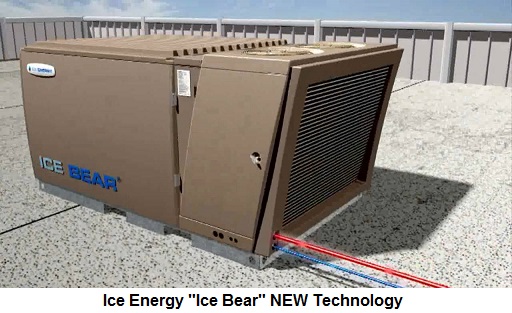
———

Appendix VIDEO A – South Sudan – http://www.aljazeera.com/news/2016/12/ethnic-cleansing-south-sudan-161201042114805.html

Aljazeera December 1, 2016 – UN says South Sedan is on brink of catastrophe as ethnic violence rises.

———

Appendix VIDEO B – Painting the town: Philly’s artful murals – https://youtu.be/OKemJytfNS0

Published on Jul 24, 2016 – Philadelphia has an iconic art museum but some of the city’s most impressive art is out on the street, thanks to the city’s mural program. Anthony Mason reports on how splashing some color on city streets has lifted the spirits of the community.
More info: Why Murals? | The Art Assignment | PBS Digital Studioshttps://youtu.be/TS1oPqP2qyY

———

Appendix VIDEO C – V for Vendetta – Artists Use Lies (Fiction) to Reveal the Truth – https://youtu.be/oncINP0OORQ

Share this post:
, ,
[Top]

Alibaba Cloud stretches global reach with four new facilities

Go Lean Commentary

For hundreds of years, empires expanded their reach by establishing colonies on foreign shores. The book Go Lean … Caribbean chronicles (Page 307) the pushing-and-shoving between European powers in the development of the Caribbean. But in 1960, after the atrocities of World War II were inventoried – credited to the complexities of colonialism in World War I and the period between the wars, the United Nations made a declaration that colonialism needed to be disbanded:

cu-blog-alibaba-cloud-stretches-global-reach-with-four-new-facilities-photo-4The “Declaration on the Granting of Independence to Colonial Countries and Peoples” was adopted by the UN General Assembly by resolution on 14 December 1960. Though some countries had already started their independence process (i.e. Ireland, Australia, India, Pakistan, Indonesia, etc.), this resolution established the standard for all dependent countries – even small ones – to become autonomous. – Source: UN-Wikisource

This is now the 21st Century. While colonialism is not dead … entirely, there is a new brand of colonies for trade. Colonies have gone from the physical world to the virtual world, referring to cyber-space or online communities. Chinese trading market-place Alibaba is providing us a model of colonizing their digital footprint in foreign countries. See the story here of Alibaba’s deployment of 4 new data centers in a potpourri of countries:

BEIJING (Reuters) – Alibaba Cloud plans to open four new data facilities outside China, the cloud unit of Alibaba Holdings Ltd said on Monday, as it seeks to grab global market share from leading players Amazon.com Inc and Microsoft.

cu-blog-alibaba-cloud-stretches-global-reach-with-four-new-facilities-photo-1

The data facilities in Dubai, Germany, Japan and Australia will extend the reach of China’s leading cloud computing service provider to every major continent, and marks the latest step in the unit’s $1 billion infrastructure investment drive.

Also known as Aliyun, the unit has flourished domestically thanks to Beijing’s strategic emphasis on building homegrown cloud technology, while foreign firms have grappled with stringent licensing restrictions in the country.

However, it accounts for a much smaller slice of the global market for cloud computing, defined as the storage of data on remote networks rather than local servers, which is expected to reach $135 billion by 2020, according to research firm Canalys.

Alibaba Cloud is forecast to take 7.8 percent of that market, while leading players Amazon.com Inc, Microsoft, International Business Machines Corp and Alphabet Inc are expected to account for 69.1 percent.

Yu Sicheng, general manager of Alibaba Cloud’s international business, said the unit’s strength in China was a significant advantage and a lynchpin in the company’s globalization plans.

“We have the U.S., Europe plus China, which is quite difficult,” he told Reuters in an interview.

The new additions bring Alibaba Cloud’s total number of foreign cloud facilities to eight, surpassing the six within China, though the majority of the company’s data volume remains squarely within China.

It will launch the data facilities through partnerships with Vodafone in Europe, Softbank Group Corp in Japan and YVOLV in Dubai, a joint venture between Alibaba Cloud and Meraas Holdings LLC.

Yu, however, declined to comment on when the unit will likely post a profit, even as it has seen six quarters of consecutive triple-digit growth, to become Alibaba’s fastest growing business sector.

“Our focus is to keep expanding our market leadership and presence and this is our priority for now,” he said.

(Corrects title of Alibaba Cloud executive Yu Sicheng)
(Reporting by Catherine Cadell; Editing by Stephen Coates)
Source: Yahoo News Source. Posted 11-21-2016; retrieved 11-28-2016 from: https://www.yahoo.com/news/alibaba-cloud-stretches-global-reach-four-facilities-061614009–finance.html?ref=gs

This commentary takes another look at colonialism; there is the need for a cyber footprint in countries where “you” may want to conduct online business – this is a feature of globalization. In the effort to deploy the Caribbean Postal Union (CPU)  as a logistics solution for delivering modern commerce, this commentary takes another look at the Alibaba Group; a company that had previously been identified as an excellent role model for the CPU. (American company Amazon was also identified as a fitting role model).

The book Go Lean…Caribbean serves as a roadmap for the introduction and implementation of the Caribbean Union Trade Federation (CU) and the CPU. The book describes a business model for the CPU in facilitating electronic commerce in the region. But it presents this business model as heavy-lifting; there is the need for data centers to power the cyber-functions and applications for online & mobile commerce. The Go Lean roadmap describes the need for 6 data centers strategically placed across the Caribbean region; we want to colonize our own region, following a similar business model to Alibaba’s plans to deploy its colonies throughout the world – in these 4 foreign countries.

More dynamic data centers deployed in a foreign country would mean more business-to-business commerce, including features like web portals, online retail, mobile functionality, payment services, a shopping search engine and data-centric cloud computing services.

cu-blog-alibaba-cloud-stretches-global-reach-with-four-new-facilities-photo-3

cu-blog-alibaba-cloud-stretches-global-reach-with-four-new-facilities-photo-2

As detailed in the previous blog-commentary, Alibaba is not just a China focused company. They also have a Caribbean footprint. In September 2014, the company held an Initial Public Offering (IPO) in the United States on the New York Stock Exchange (NYSE) – Ticker symbol “BABA.N” – looking to raise US$25 billion. The NYSE corporate entity is actually a shell corporation based in the Cayman Islands. So Alibaba extending their global business operations is actually benefiting a Caribbean corporate citizen.

The Go Lean roadmap (Page 106) presented an advocacy that described the trends in data center design and functionality; they are needed for the Cyber-Caribbean strategy. A trend depicted in the book is the Case Study of Hydrogen Fuel Cells as a reliable back-up power-battery source. This Case Study sets the stage for understanding Data Center trends:

Case Study – Bottom Line on Hydrogen Fuel Cells: A fuel cell is a device that converts the chemical energy from a fuel into electricity thru a chemical reaction with oxygen or another oxidizing agent. Hydrogen is the most common fuel. Hydrogen is not in and of itself an energy source, because it is not naturally occurring as a fuel. It is, however widely regarded as an ideal energy storage medium, due to the ease with which electric power can convert water into its hydrogen and oxygen components through electrolysis. Hydrogen technologies relate to the production and use of hydrogen. Hydrogen technologies are applicable for many uses. Some hydrogen technologies are carbon neutral and could have a role in preventing climate change and a possible future hydrogen economy. Fuel cells are different from batteries in that they require a constant source of fuel and oxygen/air to sustain the chemical reaction, they can however produce electricity continually for as long as these inputs are supplied.

There are a handful of US data center facilities that are powered either partially or fully by hydrogen fuel cells; see Appendix IG on Page 285.

The advocacy, branded 10 Trends in Implementing Data Centers, is detailed here:

1. Lean-in for the Caribbean Single Market & Economy (CSME) initiative: Caribbean Union Trade Federation. The CU treaty unifies the Caribbean region into one single market of 42 million people across 30 member-states, thereby empowering the economic engines in and on behalf of the region. The CU embraces the cutting, “bleeding” edge concepts, systems and methodologies for data centers and computer server farms, as in high density computing, facilitating the maximum computing power with the least about of space and power. The prerequisite for any serious data center deployment is power…stable, reliable electricity, with primary, secondary and tertiary solutions. The CU roadmap calls for deployment of a regional power grid, with above ground, underground & underwater cabling. Though data centers must launch now, power costs will be expected to decline with the grid; hydrogen fuel cells will fill the void..
2. Fiber-Optics / Pipeline Optical fibers are widely used in fiber-optic communications, which permits transmission over longer distances and at higher bandwidths (data rates) than other forms of communication. Fibers are used instead of metal wires because signals travel along them with less loss and are also immune to electromagnetic interference. The transparent fiber are made of high quality extruded glass, silica or plastic. The CU as a new Federation can apply a leap-frog approach to implement communication networks without having to contend with older methods or investments. Further the CU will embrace the strategy of installing elaborate pipelines thru out the region, enabling fiber-optics to traverse the network.
3. IP Convergence Internet Protocol (IP) is now ubiquitous for data, voice, and video communications – they all operate on the same type of fiber. This indicates that data centers also function as telecom hubs – central switching offices are now bygones.
4. Cloud Computing  The CU will embrace cloud computing for many operational systems, thereby requiring optimal continuous processing. The roadmap calls for citizens to interact with their federal government via web portals, kiosks or phone contact centers.
5. High Availability (HA) HA is a system design approach (hardware, software and networking) that ensures operational performance will be met, like parallel processing or mirroring. There are systems (i.e. hospitals, banking, electrical grid) that must maximize availability and minimize downtime. Recovery time or estimated time of repair is closely related to availability, optimizing the time to recover from planned or unplanned outages. A CU mission is to facilitate quick recoveries after hurricanes.
6. Colocation Data Centers A colocation center (colo, or coloc) is a type of data center where equipment space and bandwidth are available for rental to retail customers. Colocation facilities provide space, power, cooling, and physical security for the server, storage, and networking equipment of other firms—and connect them to a variety of telecommunications and network service providers—with a minimum of cost and complexity. Colocation has become a popular option for companies as it allows the company to focus its IT staff on the actual work being done, instead of the logistical. Significant benefits of scale (large power and mechanical systems) result in large colocation facilities, typically 50,000 to 100,000 square feet.
7. Caves as Data Centers There is a growing trend of building underground data bunkers. A market leader placed a coloc data center in a huge facility 220 feet underground in a limestone cave outside Pittsburgh-Pennsylvania. There are other limestone cave installations in places like Mammoth, Kentucky and Lenexa, Kansas. The advantage is cost savings, driven by cooling dynamics of an underground facility, where cooler temperature allows for saving money on air conditioning. The CU will identify limestone caverns, plentiful in the region, appropriate to construct data centers – the region needs 6 centers.
8. Storage Solutions – No need for humans Old data center models needed people to load/unload data storage devices (tapes, disk drives). Now with the low costs of storage, the CU can implement storage libraries for primary and back-up purposes. Plus with tools/techniques like Deep Store archive systems [51], it allows for cost-efficient solutions for data/records that are rarely retrieved.
9. Security Issues Modern data centers require minimal human interaction, therefore physical security tend to be very restrictive. In some firms, even the CEO is not allowed access. The CU will implement biometric systems like fingerprints and iris scanning.
10. Unified Command & Control The data center may be void of humans, but there is still the need for many professional analysis, programmers and engineers. These are normally stationed in command centers to facilitate monitoring and cyber-security functions.

Is a discussion of data center trends appropriate for a societal elevation plan for the Caribbean? Absolutely! How the world has changed! The Go Lean book posits that this technology-tinged eco-system is a winning strategy for creating jobs here in the 21st Century. The book explains that Internet & Communications Technologies (ICT) can serve as an equalizing element in competition with the rest of the world. The roadmap projects that 64,000 new jobs – 20,000 Direct & 44,000 Indirect – can be created with this strategy. This strategy is among the keys for elevating Caribbean society. In fact the prime directives of the roadmap is identified with the following 3 statements:

  • Optimization of the economic engines in order to grow the regional economy to $800 Billion & create 2.2 million new jobs.
  • Establishment of a security apparatus to protect the resultant economic engines.
  • Improve Caribbean governance to support these engines.

The foregoing article and the quotation from the Go Lean book depicts a vision of a new Caribbean industrial landscape. This vision was defined early in the book (Page 14) in the opening Declaration of Interdependence:

xxvi. Whereas the Caribbean region must have new jobs to empower the engines of the economy and create the income sources for prosperity, and encourage the next generation to forge their dreams right at home, the Federation must therefore foster the development of new industries, like that of ship-building, automobile manufacturing, prefabricated housing, frozen foods, pipelines, call centers, and the prison industrial complex. In addition, the Federation must invigorate the enterprises related to existing industries like tourism, fisheries and lotteries – impacting the region with more jobs.

xxvii. Whereas the region has endured a spectator status during the Industrial Revolution, we cannot stand on the sidelines of this new economy, the Information Revolution. Rather, the Federation must embrace all the tenets of Internet Communications Technology (ICT) to serve as an equalizing element in competition with the rest of the world. The Federation must bridge the digital divide and promote the community ethos that research/development is valuable and must be promoted and incentivized for adoption.

Beyond data centers, “where are the new jobs for the 21st Century”? This is a familiar question for the Go Lean movement (book and blogs). This question was examined in these previous blog-commentaries:

https://goleancaribbean.com/blog/?p=9751 Where the Jobs Are – Animation and Game Design
https://goleancaribbean.com/blog/?p=9203 Where the Jobs Are – Employer Models in the United States
https://goleancaribbean.com/blog/?p=6089 Where the Jobs Are – Futility of Minimum Wage
https://goleancaribbean.com/blog/?p=2857 Where the Jobs Are – Entrepreneurism in Junk
https://goleancaribbean.com/blog/?p=2126 Where the Jobs Are – Computers Reshaping Global Job Market
https://goleancaribbean.com/blog/?p=2003 Where the Jobs Are – One Scenario: Ship-breaking
https://goleancaribbean.com/blog/?p=1698 Where the Jobs Are – STEM Jobs Are Filling Slowly

ICT is a prominent feature of the Caribbean empowerment plan; creating a Caribbean Cloud is “Step One, Day One” in the Go Lean roadmap. This will facilitate electronic commerce and allow modern day colonies – data centers –  in foreign countries.

The Go Lean book details a series of community ethos, strategies, tactics, implementations and advocacies to foster the best practices for Data Centers in the Caribbean region:

Community Ethos – Economic Principles – Voluntary Trade Creates Wealth Page 21
Community Ethos – Economic Principles – The Consequence of Choice Lie in Future Page 21
Community Ethos – Job Multiplier Page 22
Community Ethos – Lean Operations Page 24
Community Ethos – Ways to Impact the Future Page 26
Community Ethos – Ways to Help Entrepreneurship – Incubators Page 28
Community Ethos – Promote Intellectual Property Page 29
Community Ethos – Ways to Bridge the Digital Divide – e-Government Services Page 31
Community Ethos – Ways to Improve Sharing – e-Government Scheme Page 35
Strategy – Mission – Embrace the Advances of Technology Page 46
Strategy – Competitors – Governments – Shared Systems –vs- Premise-based Page 51
Tactical – Fostering a Technocracy Page 64
Tactical – How to Grow the Economy to $800 Billion – Trade and Globalization Page 70
Tactical – Separation of Powers – Union Revenue Administration – e-Government for Revenue Systems Page 74
Implementation – Year 1 / Assemble Phase – Deploy Data Centers Page 96
Implementation – 10 Trends in Implementing Data Centers Page 106
Implementation – Ways to Deliver Page 109
Implementation – Ways to Impact Social Media Page 111
Implementation – Ways to Benefit from Globalization Page 119
Planning – Ways to Improve Trade – Electronic Commerce Page 128
Advocacy – Ways to Grow the Economy Page 151
Advocacy – Ways to Create Jobs Page 152
Ways to Foster Cooperatives – Co-located Data Centers for e-Government Page 176
Advocacy – Ways to Foster Technology – Incubators Strategy Page 197
Advocacy – Ways to Foster e-Commerce Page 198
Advocacy – Ways to Impact Main Street – e-Commerce as competition for Big-Box Page 201

This VIDEO here – Google’s Data Center – demonstrates a theme from the Go Lean book, that data center trends will influence the ICT eco-system; also see the VIDEO tour for Facebook and Microsoft in the Appendix below:

VIDEO – Inside a Google data center – https://youtu.be/XZmGGAbHqa0

Published on Dec 16, 2014 – Joe Kava, VP of Google’s Data Center Operations, gives a tour inside a Google data center, and shares details about the security, sustainability and the core architecture of Google’s infrastructure.

According to the foregoing article and VIDEOs, data centers are important business infrastructure for the new economy. As demonstrated by Alibaba’s example, these data centers are colonies in the virtual world. The CU/Go Lean plan is to foster and incubate such key industrial installations for the goal of elevating the region economic engines.

Now is the time for all of the Caribbean, the people and governing institutions, to lean-in for the changes in the book Go Lean … Caribbean. This is a Big Idea for the region, that of a Cyber Caribbean effort (Page 127), in which data centers play a major role. Welcome to 21st Century colonies. This is how we build a better future: a better place to live, work and play. 🙂

Download the book Go Lean … Caribbean – now!

————-

Appendix VIDEOs:

Facebook Data Center: https://www.youtube.com/watch?v=Y8Rgje94iI0
Microsoft Data Center: https://www.youtube.com/watch?v=0uRR72b_qvc


Share this post:
, , , , ,
[Top]