Category: Government

911 – Emergency Response: System in Crisis

Go Lean Commentary

Emergency management, as defined in the book Go Lean…Caribbean, is an art and a science.

The Go Lean book embarks on the strategy to consolidate the Emergency Management (preparation and response) for the entire Caribbean region. Therefore the issue of Emergency Telephone Numbers is of serious concern; sometimes it’s a life-or-death matter.

Despite all the attendant issues – technology, standards, geography, legacy, and language – this is first-and-foremost an issue of life-and-death. Failure in this area is not an option. Consider here this example of short-comings in the US system:

VIDEO Title: Some 911 systems can’t find you in an emergency due to dated technology – http://www.today.com/video/today/57011057#57011057

Published on Feb 23, 2015 – Some 911 systems can’t find you in an emergency

Many 911 centers around the country still rely on dated cell tower technology instead of something as widely used as Google Maps, which means dispatchers may not be able to locate you in an emergency – and the consequences can be tragic. TODAY’s national investigative correspondent Jeff Rossen reports; (see transcript in the Appendix below).

CU Blog - 911 System Crisis - Photo 3There is no one world standard for Emergency Telephone Numbers. But the number is always intuitive; normally just a 3-digit code and applicable on a land-line or a mobile phone – this is an issue of technology. Normally neighboring countries share the same number, even if a dual overlap applies; so as to assuage any confusion for people when they absolutely have an emergency.

In the Caribbean region, like most places, everyone expects to pick up a phone and dial a 3-digit code – like 911 – and within short order be able to talk with an Emergency Management First-Responder for Police, Ambulance and Fire incidences.

Unfortunately for the Caribbean, we have 5 different legacies that rule the standards of day-to-day life:  American, British, Dutch, French and the Spanish Caribbean. But geographically, since the region is physically located among all these cultures; all territories must comply with a consistent structure; that consistency is identified as the North American Numbering Plan.

So 911 rules…

But for countries with active European oversight, they normally go further and allow their European Emergency Phone Number configurations to also apply while in the Caribbean member-states. So the 3-digit code in the European Union – 112 – will also work in the Dutch and French member-states.

This issue reflects the regional oversight the book Go Lean…Caribbean envisions for the Caribbean region. The book serves as a roadmap for the introduction and implementation of the technocratic Caribbean Union Trade Federation (CU). This CU roadmap is designed to elevate Caribbean society by these prime directives:

  • Optimization of the economic engines; growing the regional economy.
  • Establishment of a security apparatus to protect the resultant economic engines.
  • Improvement of Caribbean governance to support these engines.

All 3 of these features of the Go Lean roadmap relate to this topic of Emergency Telephone Numbers. There is the need for effectiveness and efficiency so as to protect the life and property of all Caribbean stakeholders: residents and visitors alike. The book posits that some issues are too big for any one member-state to manage alone – especially with such close proximities – there are times when there must be cross-border, multilateral coordination. This vision is defined early in the book (Pages 12 – 14) with these statements in the  opening Declaration of Interdependence:

xi. Whereas all men are entitled to the benefits of good governance in a free society, “new guards” must be enacted to dissuade the emergence of incompetence, corruption, nepotism and cronyism at the peril of the people’s best interest. The Federation must guarantee the executions of a social contract between government and the governed.

xii. Whereas the legacy in recent times in individual states may be that of ineffectual governance with no redress to higher authority, the accedence of this Federation will ensure accountability and escalation of the human and civil rights of the people for good governance, justice assurances, due process and the rule of law. As such, any threats of a “failed state” status for any member state must enact emergency measures on behalf of the Federation to protect the human, civil and property rights of the citizens, residents, allies, trading partners, and visitors of the affected member state and the Federation as a whole.

xvi. Whereas security of our homeland is inextricably linked to prosperity of the homeland, the economic and security interest of the region needs to be aligned under the same governance. Since economic crimes … can imperil the functioning of the wheels of commerce for all the citizenry, the accedence of this Federation must equip the security apparatus with the tools and techniques for predictive and proactive interdictions.

xviii. Whereas all citizens in the Federation member-states may not have the same physical abilities, reasonable accommodations must be made so that individuals with physical and mental disabilities can still access public and governmental services so as to foster a satisfactory pursuit of life’s liberties and opportunities for happiness.

xxiii. Whereas many countries in our region are dependent Overseas Territory of imperial powers, the systems of governance can be instituted on a regional and local basis, rather than requiring oversight or accountability from distant masters far removed from their subjects of administration. The Federation must facilitate success in autonomous rule by sharing tools, systems and teamwork within the geographical region.

xxvii. Whereas the region has endured a spectator status during the Industrial Revolution, we cannot stand on the sidelines of this new economy, the Information Revolution. Rather, the Federation must embrace all the tenets of Internet Communications Technology (ICT) to serve as an equalizing element in competition with the rest of the world. The Federation must bridge the digital divide and promote the community ethos that research/development is valuable and must be promoted and incentivized for adoption.

Though the issue of “911” is primarily associated with the North American Numbering Plan; this discussion of emergency contacts is not just the focus for North America.

The following information is retrieved from Wikipedia regarding the universality of Emergency Telephone Numbers; (source: http://en.wikipedia.org/wiki/Emergency_telephone_number):

CU Blog - 911 System Crisis - Photo 2In many countries the public telephone network has a single emergency telephone number (sometimes known as the universal emergency telephone number or the emergency services number) that allows a caller to contact local emergency services for assistance. The emergency number differs from country to country; it is typically a three-digit number so that it can be easily remembered and dialed quickly. Some countries have a different emergency number for each of the different emergency services; these often differ only by the last digit. In the European Union, Russia, Turkey, Ukraine and others “112” was introduced as a common emergency call number during the 1990s, and as the GSM standard it is now a well known mobile telephone emergency number around the globe[1] alongside the North American “911“.

Mobile Telephones
Mobile phones can be used in countries with different emergency numbers. This means that a traveller visiting a foreign country does not have to know the local emergency numbers. The mobile phone and the SIM card have a preprogrammed list of emergency numbers. When the user tries to set up a call using an emergency number known by a GSM or 3G phone, the special emergency call setup takes place. The actual number is not even transmitted into the network, but the network redirects the emergency call to the local emergency desk. Most GSM mobile phones can dial emergency numbers even when the phone keyboard is locked, the phone is without a SIM card, emergency number is entered instead of the PIN or there isn’t a network signal (busy network).

Most GSM mobile phones have 112, 999 and 911 as pre-programmed emergency numbers that are always available.[15] The SIM card issued by the operator can contain additional country-specific emergency numbers that can be used even when roaming abroad. The GSM network can also update the list of well-known emergency numbers when the phone registers to it.

Some notable exceptions in the Caribbean neighborhood include:

Country

Police

Ambulance

Fire

Mexico

066

065

068

Bahamas

919 or 911

Haiti

114

118

115

Jamaica

119

110

Trinidad and Tobago

999

990

Guyana

911

913

912

Suriname

112
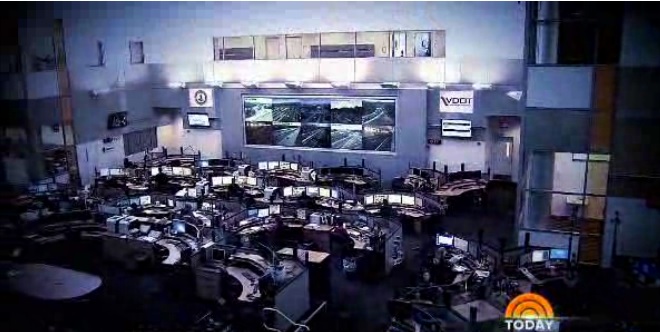
Considering the experiences from the foregoing VIDEO, the US needs better coordination with their Communications Regulator and Emergency Management Agencies. While it is out-of-scope for the Go Lean roadmap to change America, we can do better in the Caribbean. The CU is formed from a pledge for efficient, agile regional coordination. The Go Lean book describes this oversight as “lean”. The concept of “lean” is very prominent in the Go Lean book (and movement), even adopting the title, Go Lean, for this quest for excellence in Caribbean economic empowerment, security coordination and governing efforts. The label “lean” is therefore indicative of this quest; the word is used in the book as a noun, a verb and an adjective. This point is pronounced early in the book (Page 4) with these statements:

The CU will lean on, lean in, lean over backwards, and then lean towards…
The CU will embrace lean, agile, efficient organization structures – more virtual, less physical, more systems, less payroll.

This commitment to “lean” lends confidence to the coordination of the CU federal authorities. The Go Lean book hypothesizes that the Caribbean region can succeed in transforming our society in short order; the roadmap is a 5 year plan. Previous blogs/commentaries also exclaimed societal benefits from pursuits in regional coordination; consider this sample of previous blogs:

https://goleancaribbean.com/blog/?p=3881 Regional Coordination: Cyber Security Cooperation
https://goleancaribbean.com/blog/?p=3834 State of the Caribbean Union’s Regional Society
https://goleancaribbean.com/blog/?p=3760 Regional Proxy for Citizenship Programs
https://goleancaribbean.com/blog/?p=3713 NEXUS – Model of Regional Border Control
https://goleancaribbean.com/blog/?p=3594 Lessons for Regional Coordination for Queen Conch
https://goleancaribbean.com/blog/?p=3582 Better Coordination for Regional Banks
https://goleancaribbean.com/blog/?p=3432 Mitigating Regional Preponderance to Beg for Development Aid
https://goleancaribbean.com/blog/?p=3354 Regional Call to End the US Embargo on Cuba
https://goleancaribbean.com/blog/?p=3090 Model of Regionalism: Europe – All Grown Up
https://goleancaribbean.com/blog/?p=2887 Caribbean Region Must Work Together to Address Rum Subsidies
https://goleancaribbean.com/blog/?p=2614 The ‘Great ShakeOut’ Earthquake Drill for the Region’s Seismic Areas
https://goleancaribbean.com/blog/?p=2435 Role Model for Caribbean Economy: Korea
https://goleancaribbean.com/blog/?p=2359 Regional calls for innovative ideas to finance Small Island Development
https://goleancaribbean.com/blog/?p=2171 SEC Network – Role Model for Regional Sports Broadcast Networks
https://goleancaribbean.com/blog/?p=1965 America’s Navy – 100 Percent – Model for Caribbean Regional Security
https://goleancaribbean.com/blog/?p=1554 Status of Forces Agreement for a Regional Security Pact
https://goleancaribbean.com/blog/?p=833 One currency, divergent economies – Model for the Caribbean
https://goleancaribbean.com/blog/?p=479 PetroCaribe press ahead with plan to eradicate hunger & poverty in the region
https://goleancaribbean.com/blog/?p=318 Collegiate Sports Eco-System for the Caribbean Region
https://goleancaribbean.com/blog/?p=308 CARCIP – Regional Effort Can Foster Technology Innovations

The Go Lean book posits that communication technologies must be regulated at the regional level for the Greater Good of the Caribbean. There are too many instances with overlapping spectrum from one member-state to another. Citizens should not need to worry about border considerations during emergency incidences. There should be a smartphone mobile app for the Caribbean region from Step One/Day One of the CU implementation. In the present tense, this regional coordination is managed by bilateral treaties. A unitary confederation treaty – for all 30 member-states – would be better.

The Go Lean book details a series of community ethos, strategies, tactics, implementations and advocacies to foster better regional coordination within the Caribbean neighborhood. This list provides a sample, as follows:

Community Ethos – People Respond to Incentives Page 21
Community Ethos – Economic Systems Influence Individual Choices Page 21
Community Ethos – Security Principle – Privacy versus Public Protection Page 23
Community Ethos – Governing Principle – Lean Operations Page 24
Community Ethos – Ways to Bridge the Digital Divide Page 31
Community Ethos – Ways to Improve Sharing Page 35
Community Ethos – Ways to Impact the Greater Good Page 37
Strategy – Provide Emergency Management Arts and Sciences for Disasters Page 45
Strategy – Mission – Embrace the Advances of Technology Page 46
Strategy – Agents of Change – Technology Page 57
Strategy – Agents of Change – Climate Change Page 57
Tactical – Fostering a Technocracy Page 64
Tactical – Separation of Powers – Homeland Security – Emergency Management Page 76
Tactical – Separation of Powers – Communications and Media Authority Page 79
Implementation – Assemble Regional Organs Under Umbrella Confederation Page 96
Implementation – Security Initiatives at Start-up – Intelligence Collaboration Page 103
Implementation – Ways to Deliver Page 109
Implementation – Ways to Foster International Aid – Natural Disaster Relief Page 115
Planning – Big Ideas – Homeland Security Pact Page 127
Planning – Ways to Make the Caribbean Better Page 131
Advocacy – Ways to Grow the Economy Page 151
Advocacy – Ways to Create Jobs Page 152
Advocacy – Ways to Improve Governance Page 168
Advocacy – Ways to Better Manage the Social Contract Page 170
Advocacy – Ways to Improve for Natural Disasters Page 184
Advocacy – Ways to Improve Communications Page 186
Advocacy – Ways to Improve Emergency Management – Trauma Medicine Page 196
Advocacy – Ways to Foster Technology Page 197
Advocacy – Ways to Impact Main Street – Mobile Apps: Time and Place Page 201
Advocacy – Ways to Protect Human Rights Page 220
Advocacy – Ways to Impact Urban Living – Proximity to First Responders Page 234
Appendix – Interstate Compacts – Model: Great Lakes Compact Page 278
Appendix – Emergency Management – Service Continuity Management Page 338
Appendix – Emergency Management – Trauma Medicine Principles Page 339

The foregoing VIDEO and news article identifies the Federal Communications Commission (FCC) as the regulator for US land-line and mobile telephone systems. Who assumes this role for the Caribbean? While the same FCC has jurisdiction over 2 Caribbean member-states (Puerto Rico & US Virgin Islands), there is the need for a deputized agency for the other 28 Caribbean member-states. The Go Lean roadmap calls for an Interstate Compact among the US Territories that is also ratified as an international treaty for all the other member-states. This constitutes the Caribbean Union treaty. Also, as many Interstate Compacts create independent agencies to administer the tenants of the multi-party agreements – think the New York/New Jersey Port Authority – the CU treaty will be administered by the region-wide, deputized technocracy, that is the Trade Federation, specifically the Commerce Department’s Communications and Media Authority.

The CU – with an agency within the Homeland Security Department – also doubles as the regional Emergency Management Agency.

This allows for better coordination of Emergency Telephone Numbers – 911, 919, 112, etc. – for the region. The Communications regulator and Emergency Management under the same “umbrella”: a better pairing!

The region needs this delivery; it makes the Caribbean a better place for emergencies. Now is the time to lean-in to this Go Lean roadmap; now is the time to deliver the Caribbean as a better place to live, work and play… for today and for the future. 🙂

Download the book Go Lean … Caribbean – now!

———–

Appendix: 911 System Crisis – VIDEO Transcript
Jeff Rossen and Charlie McLravy TODAY – February 23, 2015

It was shortly after 4 a.m. on the foggy morning of December 29 when Shanell Anderson took a wrong turn in the dark in a suburban Atlanta neighborhood.

The 31-year-old supervisor for a newspaper delivery service was substituting for an employee who had called in sick when she accidentally drove her SUV into a large pond. Her Nissan Xterra began filling with water, its doors held shut by hundreds of pounds of water pressure.

Anderson had nothing to break the windows with, but she did have a cellphone. She dialed 911.

“911, what is the address of your emergency?” the dispatcher answered. “Where’s your emergency?”

“I’m in a car in a lake,” Anderson replied.

“Where?” said the dispatcher. “Where are you?”

“The Fairway!” Anderson answered.

“Give me the address again, make sure I have it right.”

“The Fairway and Batesville.”

“Batesville and what?” the dispatcher asked.

“The Fairway is a street, ma’am.”

“The Fairway?” the dispatcher repeated. “I don’t have that.”

“Ma’am, I’m losing air very quickly,” Anderson said.

“Give me the address one more time, it’s not working,” the dispatcher asked.

“The Fairway!” Anderson yelled, and spelled the name. “F-A-I-R-W-A-Y!”

The 911 recording captured the dispatcher saying “I lost her” before the line went dead.

It took first responders nearly 20 minutes to get to the location and almost another nine minutes to find Anderson’s car 8 feet underwater. By the time they dove into the lake, broke into the completely submerged SUV and removed her from it, she was unresponsive.

Paramedics were able to restart Anderson’s heart. She was taken to the hospital, where she clung to life in a coma for a week and a half before her organs failed and she died.
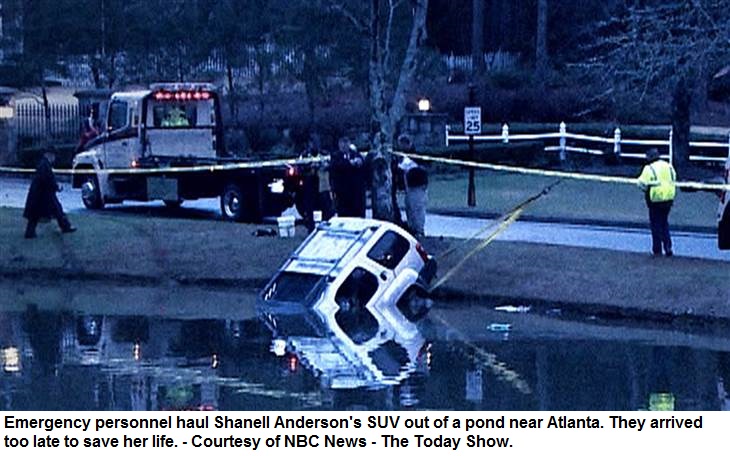
CU Blog - 911 System Crisis - Photo 1The reason it took responders so long to find Anderson is because she was sinking into a pond in the next county. Her desperate call to 911 was picked up by a cell tower in Fulton County, but the pond she was trapped in was actually in Cherokee County. The 911 dispatcher who took her call couldn’t find Anderson’s location because the map on her system only showed Fulton County, where she worked — not nearby Cherokee County, where Anderson was.

The 911 center Anderson’s call was routed to is one of many around the country that still rely on dated cell tower technology instead of something as widely used as Google Maps. Wireless 911 calls get routed to the wrong call centers so often that many dispatchers have dedicated buttons to transfer callers to neighboring departments.

Brendan Keefe, chief investigative reporter for NBC Atlanta affiliate WXIA, was the first to report on the problem with the 911 system there. His report prompted NBC News and Gannett-owned news outlets across the country to launch their own investigations into the issue.

“It has one fatal flaw; it stops at the city line,” Keefe said of Atlanta’s 911 system. “If you hit a cell tower outside their jurisdiction, they don’t know where you are.”

“If the phone had automatically routed to the correct jurisdiction, this very well may have had a different outcome,” Carl Hall, chief of technology at the Public Safety Department in Alpharetta, Georgia (in Fulton County), told Keefe in an recent interview. Hall oversees one of the most advanced 911 centers in the nation, accredited in the top 2 percent and equipped with the latest gear.

“The address of that tower determines which 911 center that call goes to,” Hall told Keefe. “It’s not based on the location of the telephone; it’s the physical address of the tower, not the physical address of the phone.”

Adding to the delay, Fulton County’s 911 follows the industry standard of using proprietary maps instead of technology like Google Maps, which most of us have installed on our cellphones.

“That’s the whole point of 911— finding you quickly,” said Anderson’s mother, Jacquene Curlee. “But when it matters, when someone’s life is in danger, they can’t find you. That is absolutely absurd.”

To demonstrate the problem, TODAY national investigative correspondent Jeff Rossen visited a 911 center in Fairfax, Virginia, with Steve Souder, director of the Fairfax County Department of Public Safety Communications. Rossen dialed 911 from inside the center and asked the responding dispatcher to identify his location.

Consulting a computer, the dispatcher replied: “Showing 4610 West Ox Road.”

“Absolutely not,” Souder said. “That’s about a quarter of a mile from where we are.”

“And we’re inside a 911 center,” Rossen said. “And they still can’t find us.”

Responsibility for fixing the problem falls to the Federal Communications Commission. “We need to concentrate on the technologies that make cellphone information and location available to 911 centers instantly,” said Jamie Barnett, a former FCC official who now represents a coalition of emergency responders and 911 dispatchers who are pushing the commission and Congress to improve 911 systems. “The technology exists that can provide it within seconds.”

“It is unacceptable that I can make a wireless call and people can’t find me,” FCC chairman Tom Wheeler acknowledged to Rossen. “Local government controls what happens with 911; the wireless carriers have the technology, and we have the oversight, with jurisdiction over the carriers, but not over local government.

“And so our job is: How do we keep pushing?” Wheeler continued. “And what we’ve recently done is to come up with a new set of rules that have pushed further.”

The new rules “demand 40 percent accuracy within the next two years,” Rossen pointed out. “How bad is it right now, if in two years the goal is 40 percent accuracy? Which I think we can agree is not a great number.”

“We have to push to make sure that both the wireless carriers and the local 911 folks are prepared to be able to exceed that and to give the kind of expectation that you and I have a right to have when we call 911,” Wheeler replied.

Wheeler also revealed that the FCC is developing a 911 app — like Uber for 911. He said that there is no timetable yet for when the app will be ready.

But that is not good enough or fast enough for Shanell Anderson’s mother.

“Her death was so senseless,” Jacquene Curlee said. “Our 911 system doesn’t work.”

Source: NBC News – The Today Show – Retrieved February 23, 2015 from:
http://www.today.com/news/some-911-systems-cant-find-you-emergency-2D80503362
 

Share this post:
, , ,

Ambassadors to Caribbean discuss PetroCaribe-Energy, Security

Go Lean Commentary

The problem with different independent nations coming together to build consensus is that each party may have its own self-interest. Independence and consensus-building are inherently opposed to each other.

The subsequent news article highlights this point, as it relates how 5 US ambassadors to Caribbean member-states had convened stakeholders to promote an agenda of American leadership in energy security.

Something about this initiative seems conflicting!

A lack of American leadership in the past has resulted in solutions originating elsewhere, from one neighbor in particular: Venezuela. That country’s PetroCaribe initiative had been valued by many Caribbean member-states as it was a vital lifeline throughout the global financial crisis, which had combined with cripplingly high oil and gas prices in 2008. But Venezuela-PetroCaribe is in enmity with US policy.

This brings to the fore a previous lesson in American foreign-policy history, from 25 years ago: Nelson Mandela’s unconditional support of enemies of the US that were unconditional supporters of the anti-Apartheid movement. Mr. Mandela’s direct comment was as follows:

“One mistake that some political analysts make is to think that their enemies should be our enemies. That [is something] we cannot and should never do. We have our own struggle that we are conducting. We are grateful to the world for supporting our struggle…but independence means we get to choose our friends and choose our enemies” – Nelson Mandela; June 21, 1990. (See Appendix A below).

The foregoing article speaks of the US Caribbean foreign policy initiative in campaigning against PetroCaribe et al:

Title: Ambassadors to Caribbean countries discuss energy, security
By: Jennifer Kay
MIAMI (AP) — Five U.S. ambassadors to the Caribbean on Thursday reinforced the U.S. government’s commitment to helping the cash-strapped region to reduce its dependence on Venezuelan oil while addressing multiple security issues.

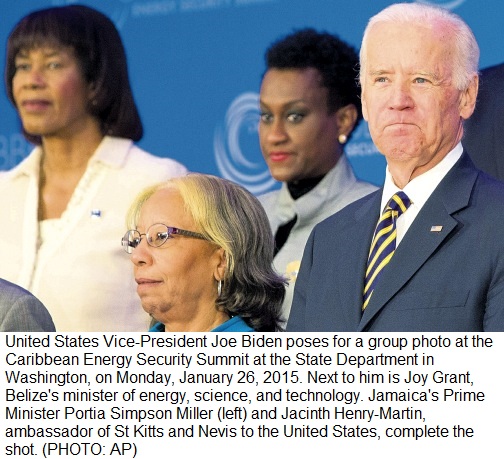
The panel at Florida International University followed last month’s Caribbean Energy Security Summit in Washington, where Vice President Joe Biden said the U.S. was poised to help Caribbean countries that could address corruption and make needed regulatory changes.

CU Blog - Ambassadors to Caribbean Discuss PetroCaribe-Energy and Security - Photo 1

The U.S. ambassadors to Haiti, the Dominican Republic, Jamaica, Suriname and Barbados and the eastern Caribbean participated in the panel hosted by FIU’s Latin American and CaribbeanCenter.

The U.S. wants to encourage more American investment in Caribbean energy projects, such as a new wind farm in Jamaica, “but we need to have and provide a safe and secure environment,” said Luis Moreno, the ambassador to Jamaica.

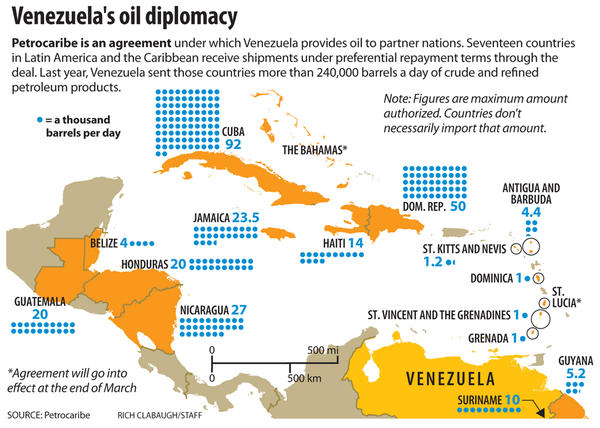
With falling oil prices shaking Venezuela’s economy, the Caribbean is interested in finding alternatives to Petrocaribe, a decade-old trade program created by the late President Hugo Chavez that requires member countries to pay only a small portion of the up-front costs for oil, allowing them to finance the rest under long-term debt agreements.

The ambassadors derided the program, though they acknowledged it wasn’t likely to end soon even as they push Caribbean countries to consider shifting to natural gas or other energy alternatives.

“We want to encourage individuality. We want to get these countries to sit up for themselves,” said Moreno, who called Petrocaribe “a blunt political instrument.”

Aside from Venezuela’s influence, the Caribbean faces a number of challenges that concern the U.S, such as border security, rising Chinese influence in the region, human rights, weak infrastructure, a lack of regional coordination and vulnerability to climate change and natural disasters.

There’s also been a rise in drug, arms and human trafficking in some eastern Caribbean islands as authorities put pressure on traffickers in South America, and some countries have begun essentially offering citizenship and easing travel for people who buy land or make other investments in the islands, said Larry Palmer, ambassador to Barbados and the eastern Caribbean.

Another problem is political instability in Haiti, in spite of strides the country has made in recovering from a 2010 earthquake. Long-delayed elections are scheduled later this year, but “it’s always rocky in Haiti,” said Pamela White, ambassador to Haiti.

“Let’s just pray we can get through those two days (of scheduled voting) this year so the Haitian people have the right, the democratic right, to vote in people they think will represent them,” she said.
Source: Associated Press News Wire Service (Retrieved 02/18/2015) – http://www.washingtontimes.com/news/2015/feb/12/ambassadors-to-caribbean-countries-discuss-energy-/ 

Night Earth. Bermuda Triangle Area

VIDEO – St Lucia Clip from Caribbean Energy Security Summit – http://youtu.be/0Ho_PmQThTQ

Published on Jan 29, 2015 – Dr. James Fletcher – Minister of Public Service & Energy – who attended the US Summit on Energy Security says the meeting was a precursor to the energy and climate partnership of the America’s meeting which will take place in March 2015.

What is PetroCaribe and how does it relate to the Caribbean economic empowerment effort? (See Appendix B below). Previously, this commentary detailed a discussion on PetroCaribe-ALBA-SUCRE, identifying these economic integration initiatives started by the late Venezuelan President Hugo Chavez (1954-2013). His advocacy of socialism often brought him at odds with the US. But still, there were benefits and benevolence in his actions.

The book Go Lean…Caribbean pursues an apolitical agenda; the only motive is the elevation of Caribbean society by optimizing the economic, security and governance engines. This serves as a roadmap for the introduction and implementation of the Caribbean Union Trade Federation (CU). Further, the book, and accompanying blog commentaries, posit that American leadership may not always have the Caribbean best interest in mind, even for US Territories. Societies do better in their American interactions when they relate as protégés, not parasites. This is a reality that we must accept. The Go Lean roadmap features 144 missions to accomplish this feat of elevating Caribbean society to protégé status.

The Go Lean roadmap does align with many of the objectives of these US ambassadors; it is important for the Caribbean to pursue energy independence. As such there is a focus on alternative energy options that can be easily deployed in the region: solar, wind turbines, tidal and yes, the natural gas option as the US advocates. The cause to combat climate change and mitigate natural disasters is welcomed from the US, as our Caribbean islands are on the front lines of this battle. But the Go Lean roadmap is not 100% concurring with the US policy; we also align with some objectives of PetroCaribe, especially negotiating group discounts and delivery terms for the Caribbean member-states. Early in the book, these pressing needs were pronounced in the Declaration of Interdependence (Page 11), with these statements:

i.      Whereas the earth’s climate has undeniably changed resulting in more severe tropical weather storms, it is necessary to prepare to insure the safety and security of life, property and systems of commerce in our geographical region. As nature recognizes no borders in the target of its destruction, we also must set aside border considerations in the preparation and response to these weather challenges.

vi.      Whereas the finite nature of the landmass of our lands limits the populations and markets of commerce, by extending the bonds of brotherhood to our geographic neighbors allows for extended opportunities and better execution of the kinetics of our economies through trade. This regional focus must foster and promote diverse economic stimuli.

viii.      Whereas the population size is too small to foster good negotiations for products and commodities from international vendors, the Federation must allow the unification of the region as one purchasing agent, thereby garnering better terms and discounts.

The Go Lean roadmap details a series of community ethos, strategies, tactics, implementations and advocacies to foster the progress in the wide fields of energy alternatives and group purchasing. The following list applies:

Community Ethos – Economic Systems Influence Individual Choices Page 21
Community Ethos – Lean Operations – Group Purchase Organizations Page 24
Community Ethos – Cooperatives Page 25
Community Ethos – Regional Taxi Commissions Page 25
Community Ethos – Ways to Improve Negotiations Page 32
Community Ethos – Ways to Impact the Greater Good Page 37
Strategy – Harness alternative power: Sun, Wind, and Natural Gas Page 46
Tactical – Fostering a Technocracy Page 82
Tactical – Separation of Powers – Energy Commission Page 82
Anecdote – “Lean” in Government – Energy Permits Page 93
Anecdote – Caribbean Energy Grid Implementation Page 100
Implementation – Foreign Policy Initiatives at Start-up Page 102
Implementation – Ways to Develop Pipeline Industry – Underwater Power Lines Page 107
Implementation – Ways to Improve Energy Usage Page 113
Implementation – Ways to Promote Independence Page 120
Planning – Lessons Learned from 2008 Page 136
Advocacy – Ways to Impact Public Works Page 175
Advocacy – Ways to Foster Cooperatives Page 176
Advocacy – Ways to Impact Monopolies Page 202
Advocacy – Ways to Impact US Territories Page 244

The planners of a new elevated Caribbean hereby thank the US foreign policy-makers for their dedication towards the Caribbean. This is friendly! But as matured independent nations, we accept the responsibility to “choose our own friends and our own enemies”.

We accept that in this case, the US may have altruistic motives, especially with declining oil prices possibly affecting Venezuela. But for far too often, American leadership has been motivated by crony-capitalistic intentions. The points of mitigating the risks of American Big Business were further elaborated upon in these previous blog/commentaries:

https://goleancaribbean.com/blog/?p=4076 US Big Media Fantasies versus Weather Realities
https://goleancaribbean.com/blog/?p=3397 A Christmas Present for the Banks from the Omnibus Bill
https://goleancaribbean.com/blog/?p=3326 Detroit’s M-1 Rail – Finally avoiding Plutocratic Auto Industry influence
https://goleancaribbean.com/blog/?p=2887 Caribbean must work together to address rum subsidies
https://goleancaribbean.com/blog/?p=2522 The Cost of Cancer Drugs
https://goleancaribbean.com/blog/?p=2465 Book Review: ‘This Changes Everything: Capitalism vs. the Climate’
https://goleancaribbean.com/blog/?p=2435 Korea’s Protégé Model – A Dream for Latin America / Caribbean
https://goleancaribbean.com/blog/?p=2338 Lesson Learned – How Best to Welcome the Dreaded ‘Plutocracy’
https://goleancaribbean.com/blog/?p=2259 The Criminalization of American Business – Big Banks Let Loose
https://goleancaribbean.com/blog/?p=2251 US Black-and-Brown populations are still institutionally disadvantaged
https://goleancaribbean.com/blog/?p=2183 A Textbook Case of Industry Price-gouging
https://goleancaribbean.com/blog/?p=1143 Health-care fraud in America; Criminals take $272 billion a year
https://goleancaribbean.com/blog/?p=789 America’s War on the Caribbean
https://goleancaribbean.com/blog/?p=709 Post 2008 Great Recession – Student debt holds back home buyers
https://goleancaribbean.com/blog/?p=242 Post 2008 Great Recession – The Erosion of the Middle Class
https://goleancaribbean.com/blog/?p=273 10 Things We Don’t Want from the US – #1: American Self-Interest

The Go Lean roadmap calls for integration of the regional member-states, a strategy of confederation with a tactic of separating powers between CU federal agencies and member-states’ governments. The roadmap calls for the regional integration of energy generation and energy distribution services – a regional grid. The separation-of-powers tactic also calls for assumption of Emergency Management agencies for the member-states. This allows for the regional mitigation and remediation of the affects of climate change. The roadmap posits that to succeed as a society, the Caribbean region must integrate and consolidate into a Single Market of 42 million people, so as to be able to compete with the rest of the world, and to facilitate better negotiations.

It is time to choose our own friends … and enemies.

Now is the time for all of the Caribbean, the people, business, institutions and governments, to lean-in for the optimizations and opportunities described in the book Go Lean … Caribbean. 🙂

————

Appendix A: Nelson Mandela’s Friends

The relationship between the United States and the anti-apartheid movement Mandela led was duplicitous. Some of his most fervent international supporters were leaders of countries sharply at odds with America.

The US Government criticized Nelson Mandela for going to Libya to visit Muammar Gaddafi, and in a speech that he gave Nelson Mandela said that “they could go and jump into a pool”. He said that he was not going to turn his back on the people that was there for him in his darkest hour.

Nelson Mandela was 100% man; he didn’t allow other people to tell him what to do, and he didn’t allow people to pick his friends [or his enemies]. [Many times,] America’s enemies were Mandela’s friends.
(Source: http://s1.zetaboards.com/Express_Yourself/topic/5312294/1/).

These “friends” referred to:

  • Fidel Castro of Cuba
  • Minister Louis Farrakhan of the Nation of Islam
  • Yasser Arafat of the Palestine Liberation Organization (PLO)
  • Ayatollah Khomeini of Iran

—–

Additional research: Mandela Town Hall Meeting, New   York City, June 21, 1990:
http://youtu.be/q6eE9BIUfBg  – 1990 video of Town Hall meeting with Nelson Mandela of South Africa anchored by Ted Koppel on ABC Nightline in New York.

————

Appendix B: PetroCaribe / ALBA / SUCRE

PetroCaribe is an oil alliance with Venezuela which allows the purchase of oil on conditions of preferential payment. The alliance was launched on 29 June 2005 in Puerto La Cruz, Venezuela. In 2013 PetroCaribe agreed to links with the Bolivarian Alliance for the Americas (ALBA), and to go beyond oil and promote economic cooperation. It is now considered an “economic zone”.

There are a total of 17 members, plus Venezuela; 12 of the members are from the 15 member CariCom (excluding, Barbados, Montserrat and Trinidad and Tobago). At the first summit, 14 countries joined the alliance. These were: Antigua and Barbuda, the Bahamas, Belize, Cuba, Dominica, Dominican Republic, Grenada, Guyana, Haití, Honduras, Jamaica, Nicaragua, St Lucia, St Kitts and Nevis, Saint Vincent and the Grenadines, Suriname and Venezuela.

ALBA – The Bolivarian Alliance for the Americas is an intergovernmental organization associated with socialist and social democratic governments wishing to consolidate regional economic integration based on a vision of social welfare, bartering and mutual economic aid. ALBA nations may conduct trade using a virtual regional currency known as the SUCRE.

SUCRE – A regional currency to be used in commercial exchanges between members of the regional ALBA trade bloc. It is intended to replace the US dollar as a medium of exchange in order to decrease US control of Latin American economies. The acronym is in Spanish, as: Sistema Único de Compensación Regional. In English, this means: Unified System for Regional Compensation. The plan is for the SUCRE to become a hard currency.

Venezuela Oil

Share this post:
, , , ,
[Top]

Immigration Policy Exacerbates Worker Productivity Crisis

Go Lean Commentary

The book Go Lean … Caribbean seeks to elevate society in the Caribbean homeland. The book is a 370-page roadmap with turn-by-turn directions on how to transform – remediate and mitigate – the engines of regional commerce, security and governance. While this type of advocacy is the normal sphere of Chambers of Commerce in their pledge to support the business communities, the Go Lean effort is different; it is not motivated by normal profit incentives, but rather the Greater Good for the Caribbean people.

 CU Blog - Immigration Policy Exacerbates Worker Productivity Crisis - Photo 3

(This commentary is not affiliated with any Chamber of Commerce)

Here’s a question for the Caribbean in general, and considering the subsequent news article, the Bahamas in particular:

What do you want from the world?

Do you want to have an advanced-modern society with all the latest “bells-and-whistles” of science, technology, engineering and medicine (STEM)? Or do you want a closed society, designated for reaping by your native people only?

“Oh island in the sun, willed to me by my father’s hand” – Classic Caribbean/Calypso folk song.

There is truly a choice to make. There are closed societies in the world, think North Korea. Even here in the Caribbean, there is Cuba, which was cut-off from US trade for 55 years. The end result, their society “stood still in time” in terms of technological developments; (1950-era American automobiles proliferate in Cuba even today).

The disposition of these aforementioned societies may not be too appealing for the rest of the Caribbean. So the answer being given is one of global citizenship. The Caribbean member-states have expressed, explicitly and implicitly, that they want to be an advanced-modern society. This means one thing:

Give-and-take with the rest of the world.

So there must be some give-and-take with immigration policy. We must “give” some allowances to immigrants to take the returns of their talents.

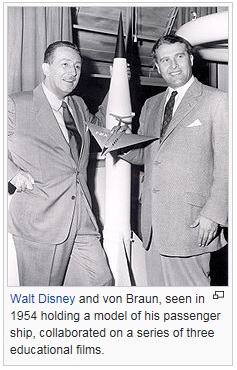
Look at the Caribbean’s biggest neighbor (to the north), the United States of America. Immigration is what made the US a great nation; let’s consider just one example. Much of America’s leadership in the Space Race during the Cold War years of 1950 to 1991 was due to the contributions of one empowering immigrant: Rocket Scientist Wernher von Braun; see summary VIDEO here and more details in the Appendix below.

Wernher Von Braun Vision: ” MAN IN SPACE ” Walt Disney TV production, March 9, 1955 – http://youtu.be/2fautyLuuvo


Uploaded on Sep 12, 2011 – Von Braun explain a future of space orbital mission with Space Shuttle rockets. A positive propagating for human voyage into space.

This discussion aligns with the book Go Lean … Caribbean. This book serves as a roadmap for the introduction and implementation of the Caribbean Union Trade Federation (CU); the purpose of which is to elevate Caribbean society, for all 30 member-states. The book stresses the need for empowering immigration (Page 174), recognizing that some of the skill-sets necessary to elevate our society may not currently exist in the homeland, so we may actually need to import the talent.

This is also the strong point being enunciated by the Bahamas Chamber of Commerce and Employers Confederation in the following news article:

By: Neil Hartnell, Business Editor, The Tribune Daily Newspaper – retrieved February 10, 2015 from:
http://www.tribune242.com/news/2015/feb/10/immigration-policy-exacerbates-worker-productivity/

The Immigration Department’s “closed door” work permit policies are exacerbating the Bahamas’ productivity crisis, a top private sector executive yesterday warning they were making it impossible for companies to hire the “unemployable”.

CU Blog - Immigration Policy Exacerbates Worker Productivity Crisis - Photo 2Robert Myers, the immediate past Bahamas Chamber of Commerce and Employers Confederation (BCCEC) chairman, told Tribune Business that restrictive Immigration policies were preventing businesses from recruiting middle management and skilled line staff essential to their smooth operation.

Apart from hindering the ability of local companies to expand, Mr Myers said they were also prevented from improving staff productivity and efficiency, as they could not “hire the educated to train the uneducated”.

Jerome Fitzgerald, minister of education, admitted last week that 40 per cent of the workforce lacked “a basic education”, with at least 35-38 per cent having failed to graduate from high school.

Mr Myers, though, pegged the number of high school leavers who were functionally illiterate and numerate [only] at 55 percent – a statistic that continues to limit business and GDP growth, and hinder government tax revenues.

“There’s a problem because the Immigration policies are only enabling these problems,” he told Tribune Business. “We have the wrong Immigration policies.

“There’s a desperate need to hire the educated to educate the uneducated and undereducated. We need to relax the Immigration policies, and do it with educated, not uneducated, people.

“The only way you can go out and hire this massive chunk in the economy is to bring in educated people capable of training those uneducated.”

Mr Myers said the Bahamas should tailor its work permit policies to reward, and incentivise, those companies who brought in expatriates to help train Bahamian staff.

“People like myself who could grow their businesses can’t, because it is cost prohibitive to bring in quality managers and line staff,” he told Tribune Business.

“It’s a layering effect. In order for me to grow and get uneducated people working, you need to bring in educated people.

“But you’ve made it so cost prohibitive to bring in line staff and middle managers, you’ve made it so expensive, that if I try to do that I become uncompetitive. So I can’t bring them in, and can’t hire uneducated people.”

Mr Myers said the Christie administration needed to “understand the connectivity of all this”, describing it as “reasonably complex but not rocket science”.

Arguing that the issue went to the heart of the Bahamas’ social fabric, he added: “If you have the wrong Immigration policies, you can’t improve education, the transfer of knowledge, employment and GDP growth. Crime goes up, and the uneducated are left to their own devices.”

Numerous Bahamian businesses have in the past complained to Tribune Business about what they have labelled “a dearth” of middle management talent in this nation, leaving them unable to fill positions essential to their smooth functioning with the right people.

However, in a bid to create employment for Bahamians, in a society struggling with a high 15.7 per cent jobless rate, the Immigration Department has tightened its work permit policies despite fears in some quarters it is trying to force ‘square pegs into round holes’ – forcing companies to take on unsuitable persons.

And several in the private sector have also suggested that it sometimes requires the hiring of one expatriate worker to create jobs for 10 or more Bahamians.

Mr Myers yesterday told Tribune Business that it was “so frustrating” that persons like himself and Mr Fitzgerald understood the problems, yet the Immigration Department was operating policies that were “completely contradictory” to the necessary solutions.

“When you have these problems lined up, teed up in education, crime and growth, stop making it more expensive for the educated to come in and teach the uneducated,” he added.

“Why does the Government not step in, and make it more competitive for businesses, increase the ease of doing business, increase GDP growth.

“I understand you’re trying to shut down Immigration to create employment, but these people are unemployable unless you open Immigration.”

Suggesting that Mr Fitzgerald’s comments, and Immigration policies, showed the Government’s ‘left hand and right hand’ did not know what each was doing, Mr Myers said the Bahamas’ “lack of governance is causing us to sink further”.

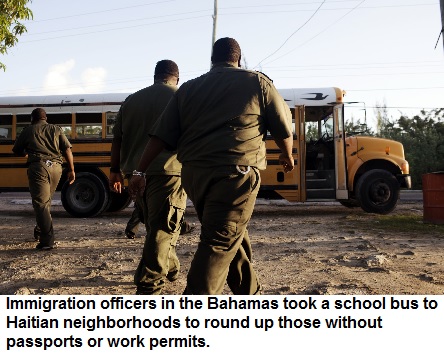
In a position paper he shared with Tribune Business yesterday, Mr Myers admitted that some businesses had resorted to hiring illegal Haitians in a bid to find productive workers for low income jobs.

“The Haitian workforce has also had a negative affect on businesses, as the Haitian workers are not always English literate, thus creating the same training and mobility problems for growth and development of businesses,” the ex-BCCEC chairman wrote.

“The Department of Immigration’s policies have caused further burden to businesses as they attempt to create more employment for Bahamians. While this may seem like a positive policy, it in fact negatively impacts Bahamian businesses for all the above said reasons and decreases productivity, making the Bahamas a more expensive and a less competitive nation.

“National security is at risk as we see direct correlations between the failing educational system and increases in violent crimes and drugs. The uneducated will fall victim to illegal activity if they have no hope or ability to become productive members of our society. People with no hope turn to drugs, in many cases for temporary relief. Our choices become one of two: Provide better education or build more courts, police stations and jails.”

So let’s repeat that question to the Caribbean: what kind of society do you want?

Do you want cutting-edge technology?

If so, then you must be prepared to welcome empowering immigrants!

There is no better alternative approach/strategy!

There are however many tactics that can align with this empowering immigration approach/strategy. The Go Lean book promotes a tactic of Separation-of-Powers between CU federal agencies and Caribbean member-state governments; offering the installation of Exclusive Economic Zones (EEZ) and Self-Governing Entities (SGE) to operate in controlled bordered territories like campuses, industrial parks, research laboratories, industrial plants and even aero-space launch facilities – much like advocate Wernher Von Braun campaigned and successfully implementated in the US in the 1950’s and 1960’s. Look today at all the economic spin-off benefits that the US has enjoyed because of the contributions of this one empowering immigrant: satellite communications, GPS, aero-space industrial developments, space exploration, etc.

(There is a Caribbean expression of aero-space initiatives in the European Space Agency in the Caribbean-leaning territory of French Guiana; this Agency would be a SGE under the CU/Go Lean scheme).

Under the EEZ/SGE scheme, the CU maintains exclusive jurisdiction and regulatory oversight for the employment of immigrants. This separation-of-powers will mitigate all the threats of negative immigration policies, as related in the foregoing article. This is technocratic: Just get it done! Just do it!

The CU – applying best-practices for agile deliveries – would facilitate the required elevation of society with these 3 prime directives:

  • Optimization of the economic engines in order to grow the regional economy to $800 Billion & create 2.2 million new jobs.
  • Establishment of a security apparatus to protect the resultant economic engines, specifically in EEZ’s and SGE’s.
  • Improvement of Caribbean governance, with the appropriate separation-of-powers, to support these engines.

The book Go Lean … Caribbean asserts that EEZ’s and SGE’s can be strategic, tactical and operationally efficient for elevating Caribbean society. These points are pronounced early in the book with this Declaration of Interdependence (Pages 11 and 14), with these statements:

v.        Whereas the natural formation of our landmass and coastlines entail a large portion of waterscapes, the reality of management of our interior calls for extended oversight of the waterways between the islands. The internationally accepted 12-mile limits for national borders must be extended by International Tribunals to encompass the areas in between islands. The individual states must maintain their 12-mile borders while the sovereignty of this expanded area, the Exclusive Economic Zone, must be vested in the accedence of this Federation.

xxvi.   Whereas the Caribbean region must have new jobs to empower the engines of the economy and create the income sources for prosperity, and encourage the next generation to forge their dreams right at home, the Federation must therefore foster the development of new industries… In addition, the Federation must invigorate the enterprises related to existing industries like tourism … impacting the region with more jobs.

The subjects of EEZ’s, SGE’s and empowering immigration jobs has been directly addressed and further elaborated upon in these previous blog/commentaries:

https://goleancaribbean.com/blog/?p=3760 Concerns about ‘Citizenship By Investment Programs’
https://goleancaribbean.com/blog/?p=3694 Jamaica-Canada employment programme pumps millions into local economy
https://goleancaribbean.com/blog/?p=3662 Migrant flow into US from Caribbean spikes
https://goleancaribbean.com/blog/?p=3050 Obama’s immigration tweaks in the US leave Big Tech wanting more
https://goleancaribbean.com/blog/?p=2750 Disney World – Role Model for Self Governing Entities
https://goleancaribbean.com/blog/?p=2338 Using SGE’s to Welcome the Dreaded ‘Plutocracy’
https://goleancaribbean.com/blog/?p=2003 Where the Jobs Are – Ship-breaking under SGE Structure
https://goleancaribbean.com/blog/?p=1214 Fairgrounds as SGE and Landlords for Sports Leagues
https://goleancaribbean.com/blog/?p=286 Puerto Rico’s Comprehensive Cancer Center Project Breaks Ground – Model of Medical SGE

The Go Lean book itself details the economic principles and community ethos to adopt, plus the executions of strategies, tactics, implementations and advocacies to forge benefits from empowering immigrants, Self-Governing Entities, and Exclusive Economic Zones in the Caribbean region:

Economic Principles – People Choose because Resources are Limited Page 21
Economic Principles – All Choices Involve Costs Page 21
Economic Principles – People Respond to Incentives Page 21
Economic Principles – Economic Systems Influence Individual Choices Page 21
Economic Principles – Voluntary Trade Creates Wealth Page 21
Economic Principles – Consequences of Choices Lie in the Future Page 21
Community Ethos – Job Multiplier Page 22

Community Ethos – Lean Operations Page 24
Community Ethos – Return on Investments (ROI) Page 24
Community Ethos – Cooperatives Page 25
Community Ethos – Ways to Impact the Future Page 26
Community Ethos – Ways to Help Entrepreneurship Page 28
Community Ethos – Ways to Impact Research & Development Page 30
Community Ethos – Ways to Improve Negotiations Page 32
Community Ethos – Impact the Greater Good Page 37
Strategy – Vision – Confederating 30 Member-states in a Union Page 45
Strategy – Mission – Build and Foster Local Economic Engines Page 45
Tactical – Fostering a Technocracy Page 64
Tactical – Growing Economy – New High Multiplier Industries Page 68
Tactical – Separation of Powers – Department of State – Self-Governing Entities Page 80
Tactical – Separation of Powers – Interior Department – Exclusive Economic Zone Page 82
Implementation – Ways to Pay for Change – SGE Licenses Page 101
Implementation – Steps to Implement Self-Governing Entities Page 103
Implementation – Anecdote – French Guiana Space Agency – Example of a SGE Page 103
Implementation – Benefits from the Exclusive Economic Zone Page 104
Planning – 10 Big Ideas – Self-Governing Entities Page 127
Planning – Ways to Improve Interstate Commerce Page 129
Planning – Lessons from New York City Page 137
Planning – Lessons from Omaha Page 138
Advocacy – Ways to Grow the Economy Page 151
Advocacy – Ways to Create Jobs Page 152
Advocacy – Ways to Impact Empowering Immigration Page 174
Advocacy – Ways to Better Manage Natural Resources – EEZ and SGE’s Page 183
Anecdote – Caribbean Industrialist & Entrepreneur Role Model Page 189
Advocacy – Ways to Promote Fairgrounds Page 192
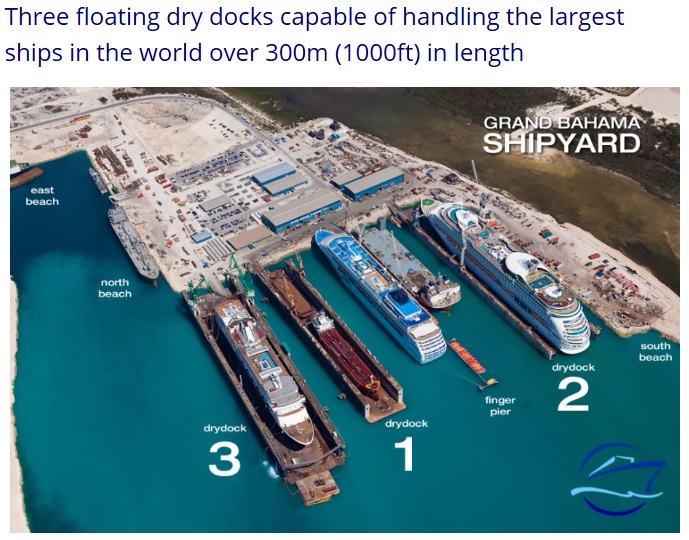
Advocacy – Ways to Develop Ship-Building as SGE’s Page 209
Advocacy – Ways to Impact the Prison Industrial Complex as SGE’s Page 211
Advocacy – Ways to Protect Human Rights Page 220
Advocacy – Ways to Impact the One Percent – Job Creators Inducements Page 224
Advocacy – Ways to Impact Urban Living – Self-Governing Entities Page 234
Advocacy – Ways to Impact Rural Living – Self-Governing Entities Page 235
Advocacy – Ways to Promote World-Heritage-Sites as SGE’s Page 248
Appendix – Job Multipliers Realities Page 259
Appendix – Airport Cities – Models for Self Governing Entities Page 287

There is a role for the contributions of many impactful and empowering immigrants in this vision for the elevation of the Caribbean homeland. Since the skills needed for today’s global economy are not plentiful in the Caribbean today, we must invite others to join us. These ones will only come initially for profit, not love of community, not the Greater Good. This Greater Good preferred community ethos only comes after some sacrifice; after these ones assimilate their Caribbean homelands and want to protect it as their home … and for their offspring and next generations.

This is why  empowering immigrants should give more than they take; they should not be looking for jobs, rather they should create jobs. In the case of the foregoing news article, the Chamber of Commerce estimates 1 empowering immigrant creates 10 jobs. This job multiplier reality should not be ignored. Especially in this era of empowering STEM careers. We need to build and retain that talent in the Caribbean homeland now.

The Caribbean, including the Bahamas, need to send this message:

  • Scientists – Welcome!
  • Technologists – Welcome!
  • Engineers – Welcome!
  • Medical Practitioners – Welcome!
  • Job Creators – Welcome!
  • Foreign Direct Investors – Welcome!

The Go Lean … Caribbean roadmap invites the contributions of empowering immigrants, especially under the guise of SGE’s. With the right applications from people, tools and techniques many SGE initiatives can have a positive impact in changing society, with minimal risks and threats of negative consequences – the roadmap mitigates the threats of corporate abuse of plutocracies. There are many examples and models to apply from other societies (i.e. Werner von Braun in the US Space program despite his Nazi past – see Appendix below).

Change has come to the Caribbean. Everyone is hereby urged to lean-in to this roadmap to make the Caribbean a better place to live, work and play. If Caribbean people want change, progress, empowerment, growth, jobs (STEM and otherwise), justice and security, then the move to welcome empowering immigrants must be normalized. These ones must be welcomed. 🙂

Download the book Go Lean … Caribbean – now!

————

Appendix: America’s most empowering immigrant: Wernher von Braun

CU Blog - Immigration Policy Exacerbates Worker Productivity Crisis - Photo 1Wernher Magnus Maximilian, Freiherr von Braun (March 23, 1912 – June 16, 1977) was a German and later American aerospace engineer and space architect. He was one of the leading figures in the development of rocket technology in Germany and the United States and is considered one of the “Fathers of Rocket Science”. He was also a member of the Nazi party and the Schutzstaffel (SS), and was suspected of perpetrating war crimes during World War II.

In his twenties and early thirties, Braun was already the central figure in the Nazis’ rocket development program, responsible for the design and realization of the V-2 rocket during World War II. After the war, he and selected members of his rocket team were taken to the United States as part of the secret Operation Paperclip. Braun worked on the United States Army’s intermediate range ballistic missile (IRBM) program before his group was assimilated by NASA. Under NASA, he served as director of the newly formed Marshall Space Flight Center and as the chief architect of the Saturn V launch vehicle, the super-booster that propelled the Apollo spacecraft to the Moon.[1] According to one NASA source, he is “without doubt, the greatest rocket scientist in history”.[2] In 1975 he received the National Medal of Science.

See full biography VIDEO here:

https://www.youtube.com/watch?v=4Ch0OgkkJKI


Share this post:
, ,
[Top]

Caribbean Ghost Towns: It Could Happen…Again

Go Lean Commentary

The Caribbean is in crisis today; but even more so, if left unchecked, the crisis gets worst tomorrow (near future). We are at the point, and have been here for some time, where we are completely dysfunctional as a society; we are at the precipice. How else would one explain why citizens from the most beautiful addresses on the planet are “breaking down the doors” to get out, either through legal means or illegal ones?

“Things will always work themselves out” – Popular fallacy.

There is no guarantee of our survival. Communities and societies do fail; success is not assured; the work must be done, we must “sow if we want to reap”.

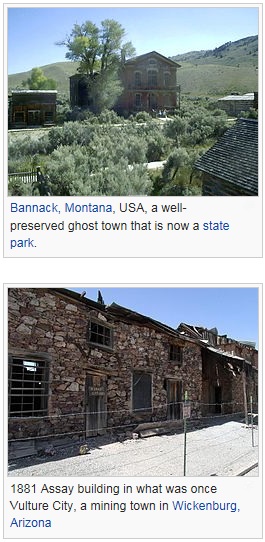
The reality of ghost towns, in the Caribbean and around the world, is a reminder to failing communities of where the road ends. Consider the definition of ghost towns here:

A ghost town is an abandoned village, town or city, usually one which contains substantial visible remains. A town often becomes a ghost town because the economic activity that supported it has failed, or due to natural or human-caused disasters such as floods, government actions, uncontrolled lawlessness, war, or nuclear disasters. The term can sometimes refer to cities, towns, and neighborhoods which are still populated, but significantly less so than in years past; for example those affected by high levels of unemployment and dereliction.[1]

CU Blog - Caribbean Ghost Towns - It Could Happen - Photo 1

Some ghost towns, especially those that preserve period-specific architecture, have become tourist attractions. Some examples are Bannack, Montana; Calico, California; Centralia, Pennsylvania; and Oatman, Arizona in the United States; Barkerville, British Columbia in Canada; Craco in Italy; ElizabethBay and Kolmanskop in Namibia; and Pripyat in Ukraine. Visiting, writing about, and photographing ghost towns is a minor industry. A recent modern-day example is Ōkuma, Fukushima, which was abandoned due to the Fukushima Daiichi nuclear disaster in 2011. (Also see Battleship or Hashima Island in the Appendix-VIDEO below).

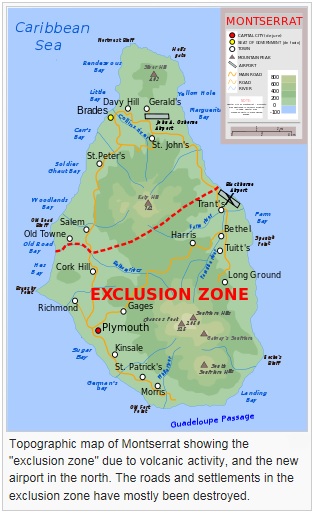
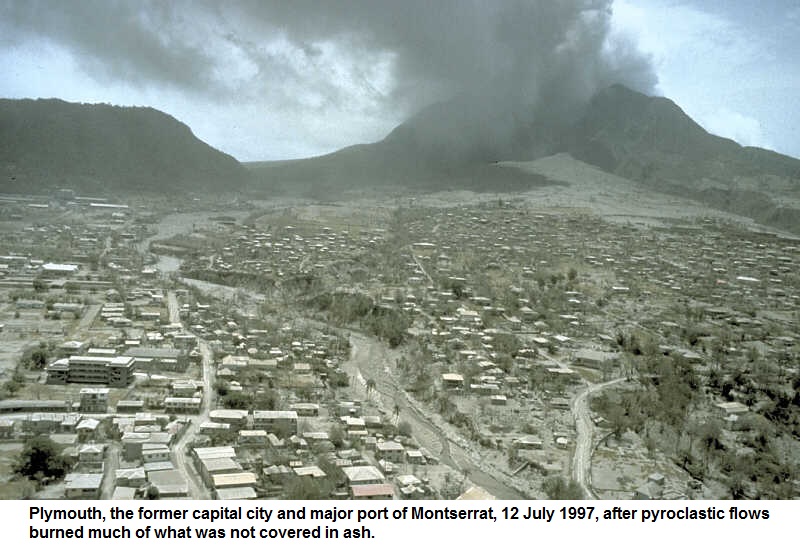
There is a ghost town that is an incumbent de jure capital: Plymouth in the Caribbean island of Montserrat*. This city was abandoned in 1997 due to volcanic eruptions and is now part of an Exclusion Zone.

CU Blog - Caribbean Ghost Towns - It Could Happen - Photo 2

CU Blog - Caribbean Ghost Towns - It Could Happen - Photo 6
(Source: http://en.wikipedia.org/wiki/Ghost_town retrieved February 11, 2015)

The book Go Lean … Caribbean stresses reboots, reorganizations and general turn-around of failing economic engines in favor of winning formulas. The book quotes a noted American Economist Paul Romer with this famous quotation:

“A crisis is a terrible thing to waste”.

The encyclopedic reference of ghost towns continues:

Ghost towns may result when the single activity or resource that created a boomtown (e.g., nearby mine, mill or resort) is depleted or the resource economy undergoes a “bust” (e.g., catastrophic resource price collapse). Boomtowns can often decrease in size as fast as they initially grew. Sometimes, all or nearly the entire population can desert the town, resulting in a ghost town.

The dismantling of a boomtown can often occur on a planned basis. Mining companies nowadays will create a temporary community to service a mine site, building all the accommodation shops and services, and then remove it as the resource is worked out. A gold rush would often bring intensive but short-lived economic activity to a remote village, only to leave a ghost town once the resource was depleted.

In some cases, multiple factors may remove the economic basis for a community; some former mining towns on U.S. Route 66 suffered both mine closures when the resources were depleted and loss of highway traffic as US 66 was diverted away from places like Oatman, Arizona onto a more direct path.

The Middle East has many ghost towns that were created when the shifting of politics or the fall of empires caused capital cities to be socially or economically non-viable, such as Ctesiphon, (a once great city of ancient Mesopotamia; today’s modern-day Iraq, Kuwait, and the northeastern section of Syria).

The Go Lean book posits that many Caribbean communities suffer from a mono-industrial complex (Page 3), therefore the risk is high for the same ghost town eventuality like so many other towns have experienced. Yes, ghost towns could happen in the Caribbean … again.

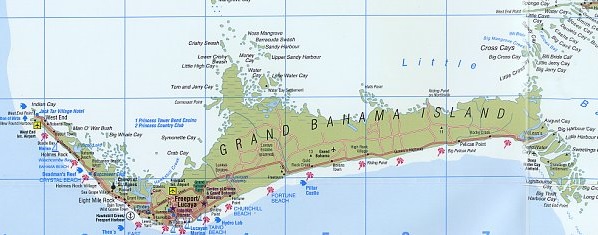
In fact, the 2nd city in the Bahamas, Freeport, on the island of Grand Bahama is experiencing a sharp decline in it’s economic output – where tourism is the primary industry – calculated at 66 percent decline from 2004 to 2013 for air arrivals. They are now near a failed-city status.

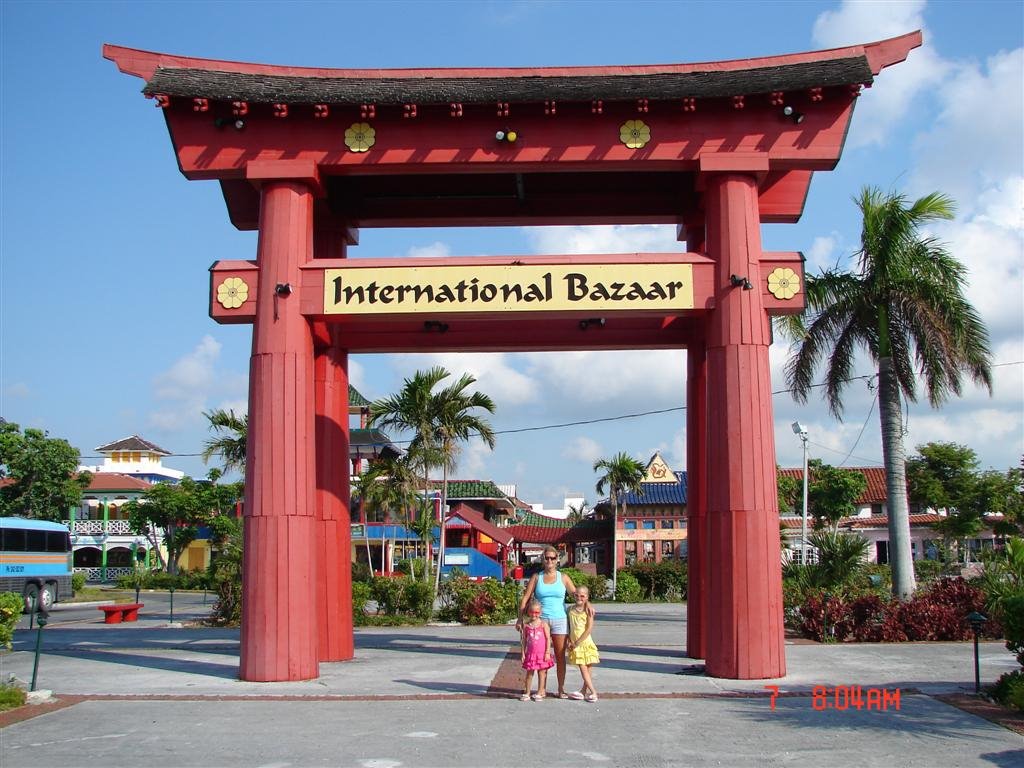
CU Blog - Caribbean Ghost Towns - It Could Happen - Photo 11Freeport’s tourism, which used to top over a million visitors a year – with air arrivals and cruise passengers – has considerably diminished since 2004, when two major hurricanes, Hurricane Frances and Hurricane Jeanne, hit the island; then the following year (2005), Hurricane Wilma reiterated more destruction to Freeport’s economic engines – many hotels shuttered their doors for good. Since then, several cruise ships also stopped their weekly visits to the island. Much of the remaining tourist industry is centered on the seaside suburb of Lucaya; in fact the city is often promoted as Freeport/Lucaya. Most remaining hotels on the island are located along the southern shore in Lucaya. The primary shopping venues for tourists used to be the popular International Bazaar near downtown Freeport, but now the focus has shifted to the Port Lucaya Marketplace, an outdoor mall-like complex near the beach-side hotel-resorts.

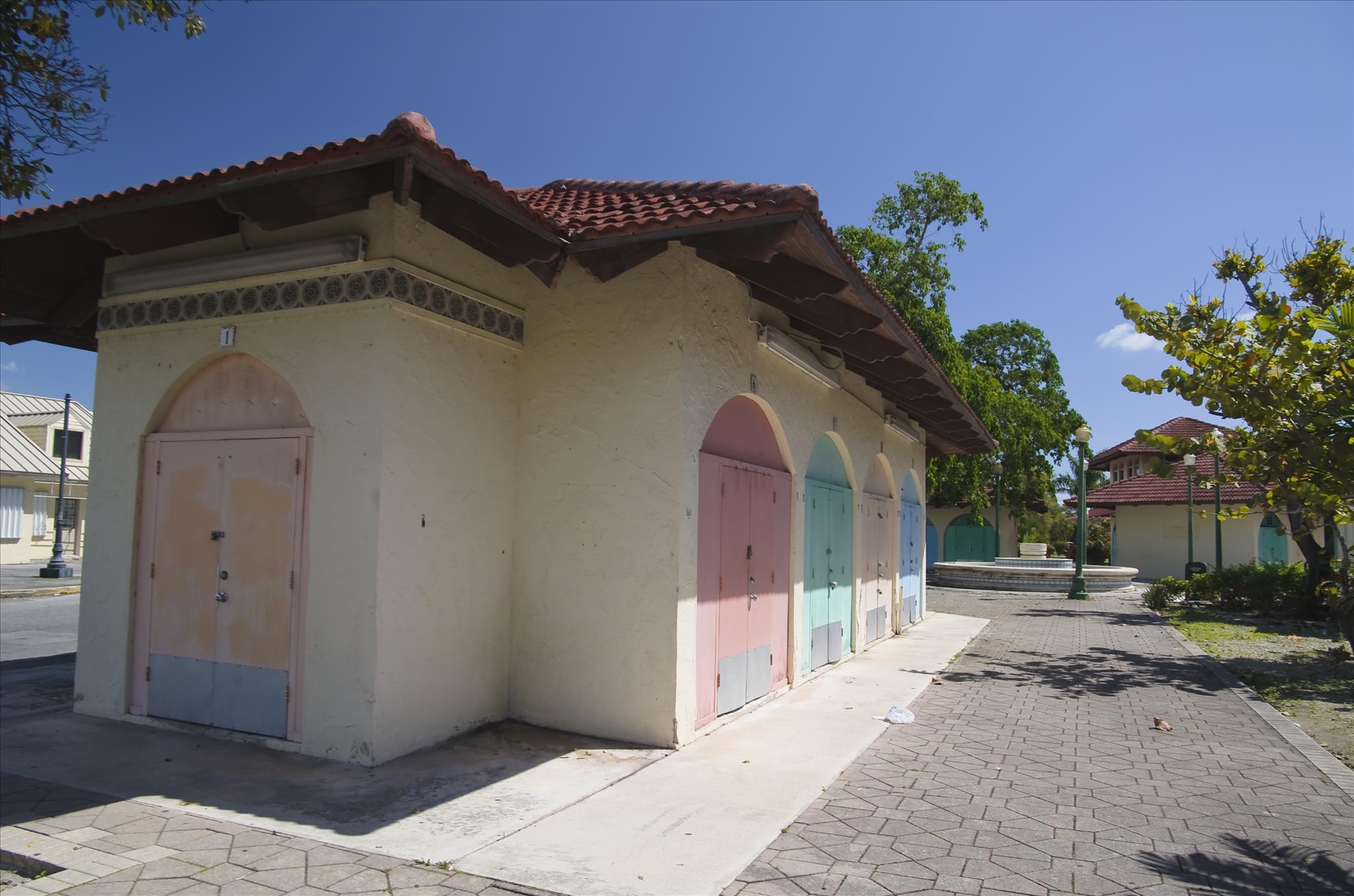
What of the current disposition of the International Bazaar in the downtown area? Unfortunately, the adjoining hotel-casino-resort, Royal Oasis, closed after the above hurricanes and never re-opened.  A local Bahamas photography magazine thusly dubbed the International Bazaar as a “ghost town”. (Retrieved February 11, 2015; article entitled: “The International Bazaar – The Lost Shopping Mecca”):

What happened to this marvelous structure? I do not know. What is its fate? I still do not know. What I do know: it is a sad day when one of the Bahamas’ greatest attractions has been reduced to a ghost town.  What I can tell you is that it seems as if the excitement has moved from the Bazaar to Port Lucaya. It is now the New Shopping Mecca of Grand Bahama.

Photo Caption: Freeport’s International Bazaar in it’s “Hey Day”

CU Blog - Caribbean Ghost Towns - It Could Happen - Photo 7

CU Blog - Caribbean Ghost Towns - It Could Happen - Photo 3

Photo Caption: Freeport’s International Bazaar Ghost Town Today

CU Blog - Caribbean Ghost Towns - It Could Happen - Photo 9

CU Blog - Caribbean Ghost Towns - It Could Happen - Photo 4

CU Blog - Caribbean Ghost Towns - It Could Happen - Photo 5

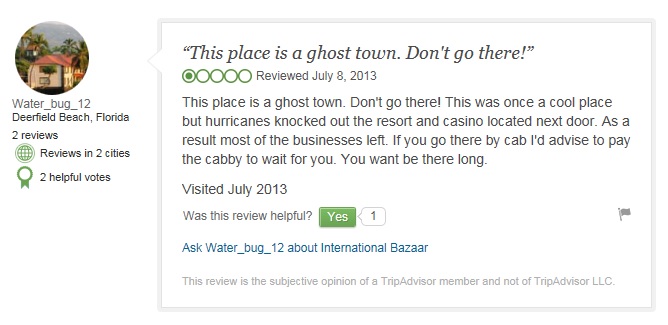
See TripAdvisor.com comments of disappointed visitors:

CU Blog - Caribbean Ghost Towns - It Could Happen - Photo 8

CU Blog - Caribbean Ghost Towns - It Could Happen - Photo 10

In fact, many more comments abound on the internet with “ghost town” comparisons for Freeport.

Freeport must now reboot, or face the eventuality: Ghost Town!

This sad reality of Montserrat and Freeport is an omen for the rest of the Caribbean.

The book Go Lean … Caribbean serves as a roadmap for the introduction and implementation of the technocratic Caribbean Union Trade Federation (CU). The CU is structured to turn-around failing Caribbean communities; it is proffered to provide economic, security and governance solutions for all 30 member Caribbean states, including Montserrat and Freeport. This mandate is detailed early on in the book’s Declaration of Interdependence, as follows (Page 12 & 13):

xii. Whereas the legacy in recent times in individual states may be that of ineffectual governance with no redress to higher authority, the accedence of this Federation will ensure accountability and escalation of the human and civil rights of the people for good governance, justice assurances, due process and the rule of law. As such, any threats of a “failed state” status for any member state must enact emergency measures on behalf of the Federation to protect the human, civil and property rights of the citizens, residents, allies, trading partners, and visitors of the affected member state and the Federation as a whole.

xix. Whereas our legacy in recent times is one of societal abandonment, it is imperative that incentives and encouragement be put in place to first dissuade the human flight, and then entice and welcome the return of our Diaspora back to our shores. This repatriation should be effected with the appropriate guards so as not to imperil the lives and securities of the repatriated citizens or the communities they inhabit…

The Go Lean book posits that failing Caribbean communities can be rescued, that if “we do what we have always done, we get what we have always got”. Therefore Caribbean communities must adopt different community ethos, plus the executions of key strategies, tactics, implementations and advocacies to bring about change, empowerment and turn-around . The following is a sample:

Community Ethos – Economic Principle – Economic Systems Influence Choices & Incentives Page 21
Community Ethos – Economic Principle – Voluntary Trade Creates Wealth Page 21
Community Ethos – Job Multiplier Page 22
Community Ethos – Lean Operations Page 24
Community Ethos – Ways to Impact the Future Page 26
Community Ethos – Ways to Help Entrepreneurship Page 28
Community Ethos – Ways to Impact Turn-Around – Recycling and Demolition Industries Page 33
Community Ethos – Ways to Impact the Greater Good Page 37
Strategy – Mission – Foster Local Economic Engines to Diversify the Economy Page 45
Tactical – Fostering a Technocracy Page 64
Tactical – Tactics to Forge an $800 Billion Economy – High Multiplier Industries Page 70
Tactical – Separation of Powers – Meteorological and Geological Service Page 79
Tactical – Separation of Powers – Self-Governing Entities Page 80
Implementation – Steps to Implement Self-Governing Entities Page 105
Implementation – Ways to Re-boot Freeport Page 112
Planning – Big Ideas – Virtual “Turnpike” Operations to Ensure Continued Relevance Page 127
Planning – Ways to Make the Caribbean Better Page 131
Planning – Ways to Improve Failed-State Indices Page 134
Planning – Lessons from East Germany Page 139
Planning – Lessons from Detroit – Model of City needing Turn-around Page 140
Advocacy – Ways to Grow the Economy Page 151
Advocacy – Ways to Create Jobs Page 152
Advocacy – Ways to Better Improve for Natural Disasters – Volcanoes and Hurricanes Page 184
Advocacy – Ways to Improve Emergency Management – Casualty Insurance to Rebuild Page 196
Advocacy – Ways to Impact Main Street Page 201
Appendix – Job Multipliers Page 259

Natural disasters are an inevitability in the Caribbean: earthquakes, volcanoes and hurricanes. We must insure and assure the business continuity of our communities’ economic engines. To recover, rebuild and reboot communities like Montserrat and Freeport after disasters, the burden or heavy-lifting should be spread across the full region, as leverage for all 30 member-states.

In order to avoid the pitfalls and eventuality of “ghost towns”, communities must diversify their economy. The Go Lean book also describes this heavy-lifting effort to facilitate this goal. The book describes the turn-by-turn directions for all the community stakeholders to follow to reach this goal, categorizing the effort as these 3 prime directives:

  • Optimization of economic engines in order to grow the regional economy to $800 Billion and create 2.2 million new jobs.
  • Establishment of a security apparatus to protect the resultant economic.
  • Improve Caribbean governance to support these engines.

In summary, ghost towns abound throughout the world, (see Appendix-VIDEO below), and can happen again here in the Caribbean region. A mono-industrial economy is bad; disaster  remediation and mitigations are good; diversity is good!

The CU will take the lead … for optimizing economic, security and governing engines. (Starting with a diversification from tourism). Everyone is hereby urged to lean-in to this CU/Go Lean roadmap to make the Caribbean a better place to live, work and play.  🙂

Download the book Go Lean … Caribbean – now!

———

Appendix*Plymouth, Montserrat

Montserrat is a British Overseas Territory located in the Caribbean. The island is located in the Leeward Islands chain of islands.[2] Montserrat is nicknamed The Emerald Isle of the Caribbean both for its resemblance to coastal Ireland and for the Irish ancestry of some of its inhabitants.[3]

Plymouth was the capital of the island of Montserrat. For centuries it had been the only port of entry to the island. On 18 July 1995, the previously dormant Soufrière Hills volcano, in the southern part of the island, became active.  Eruptions destroyed this Georgian era capital city and two-thirds of the island’s population was forced to flee.[6] The town was overwhelmed and was abandoned. The volcanic activity continues, even today, mostly affecting the vicinity of Plymouth, including its docking facilities, and the eastern side of the island around the former W.H. Bramble Airport, the remnants of which were buried by flows from volcanic activity on 11 February 2010.

An Exclusion Zone that extends from the south coast of the island north to parts of the BelhamValley was imposed because of the size of the existing volcanic dome and the resulting potential for pyroclastic activity. Visitors are generally not permitted entry into the exclusion zone, but an impressive view of the destruction of Plymouth can be seen from the top of Garibaldi Hill in IslesBay. Relatively quiet since early 2010, the volcano continues to be closely monitored by the Montserrat Volcano Observatory.

A new town and port is being developed at Little Bay, which is on the northwest coast of the island. While this construction proceeds, the centre of government and businesses rests new Village of Brades in the northen extremes of the island.

(Source: http://en.wikipedia.org/wiki/Montserrat retrieved February 11, 2015)

———

VIDEO: Battleship Island: Japan’s Ultimate Ghost Town – http://youtu.be/wHbQMhmsGPc

Uploaded on Dec 30, 2011 – This island – also known as Hashima Island is among the Japanese chain – sits 9 miles off the coast of Nagasaki. It was the administrative and residential base for undersea coal mines. As a ghost town it serves as a filming location for many projects, including serving as the inspiration for the external filming sets for the film Skyfall  – James Bond 007. For more stunning images of this Holy Grail of all industrial ruins, see: https://www.flickr.com/photos/picturenarrative/sets/72157628124548378/with/6388285131/


Share this post:
, , , , , ,
[Top]

A Lesson in History – Panamanian Balboa

Go Lean Commentary

America has surely changed over the past century!

The people, institutions and governance of the US are now more tolerant of minorities and their communities. As such, there are no more American complexities in overthrowing Latin American & Caribbean governments.

Wink-wink

This hypothesis is validated with the lesson in history from 1941 in the Republic of Panama. This Central American country is a young nation; they were formed in 1903 after seceding from the Republic of Colombia, with US backing. The new country immediately signed a treaty with the US to allow the construction of the Panama Canal, by the US Army Corps of Engineers, and a perpetual lease* for its operations. The country’s separation from Colombia also included changing from the Colombian Peso currency. So in 1904 the Panamanian Balboa currency was launched, but as coins only; the country used the US Dollar as banknotes.

A basic tenant of macro-economics is that countries should issue their own currency and banknotes so as to better influence the economic engines in their communities. By manipulating the banknote quantity and the “Discount Rate” in a Fractional Central Banking System, monetary supply can be regulated, interest rates controlled; credit markets tamed; and yes, money can be created from “thin air”. Panama had none of this control, due to its lack of banknotes.

In 1941, the then-President Dr. Arnulfo Arias pushed the government to create the Central Bank and to issue paper currency. [2] The bank was authorized, constitutionally, to issue up to 6 million Balboas worth of paper notes, but only 2.7 million Balboas were issued on 2 October 1941. Seven days later, Arias was deposed in a military coup – supported by the United States – and replaced by Dr. Ricardo Adolfo de la Guardia Arango as President. The new government immediately closed the bank, withdrew the issued notes, and burned all unissued money stock. In the 74 years since then, the country has never re-attempted to issue its own paper money currency; they continue to use US Dollars, even today.

A bit extreme?

This lesson in history is presented in a consideration of the book Go Lean…Caribbean; it serves as a roadmap for the introduction and implementation of the technocratic Caribbean Union Trade Federation (CU) and Caribbean Central Bank (CCB) to provide better stewardship in ensuring that the currency and economic failures of the past, in the Caribbean and other regions, do not re-occur here in the homeland. The book posits that we must NOT fashion ourselves as an American parasite economy, but rather pursue a status as a protégé.

The full details of the Panamanian Balboa history is provided here:

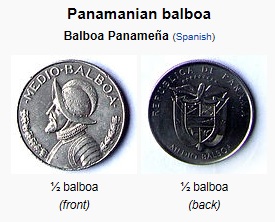
Title: Panamanian Balboa
(Source: Wikipedia Online Encyclopedia (Retrieved 02/09/2015) – http://en.wikipedia.org/wiki/Panamanian_balboa)

The Balboa (sign: B/.; ISO 4217: PAB) is, along with the United States dollar, one of the official currencies of Panama. It is named in honor of the Spanish explorer / conquistador Vasco Núñez de Balboa. The Balboa is subdivided into 100 centésimos.

The history of the Panamanian Balboa

The Balboa replaced the Colombian Peso in 1904 following the country’s independence. The Balboa has been tied to the United States dollar (which is legal tender in Panama) at an exchange rate of 1:1 since its introduction and has always circulated alongside dollars.

Coins

In 1904, silver coins in denominations of 2½, 5, 10, 25, and 50 centésimos were introduced. These coins were weight-related to the 25 gram 50 centésimos, making the 2½ centésimos coin 1¼ grams. Its small size led to it being known as the “Panama pill” or the “Panama pearl”. In 1907, copper-nickel ½ and 2½ centésimos coins were introduced, followed by copper-nickel 5 centésimos in 1929. In 1930, coins for 110, ¼, and ½ Balboa were introduced, followed by 1 balboa in 1931, which were identical in size and composition to the corresponding U.S. coins. In 1935, bronze 1 centésimo coins were introduced, with 1¼ centésimo pieces minted in 1940.

CU Blog - A Lesson in History - Panamanian Balboa - Photo 1

In 1966, Panama followed the U.S. in changing the composition of their silver coins, with copper-nickel clad 110 and ¼ Balboa, and .400 fineness ½ Balboa. 1 balboa coins, at .900 fineness silver, were issued that year for the first time since 1947. In 1973, copper-nickel clad ½ Balboa coins were introduced. 1973 also saw the revival of the 2½ centésimos coin, which had a size similar to that of the U.S. half dime, but these were discontinued two years later due to lack of popular demand. In 1983, 1 centésimo coins followed their U.S. counterpart by switching from copper to copper plated zinc. Further issues of the 1 Balboa coins have been made since 1982 in copper-nickel without reducing the size.

Modern 1 and 5 centésimos and 110, ¼, and ½ balboa coins are the same weight, dimensions, and composition as the U.S. cent, nickel, dime, quarter, and half-dollar, respectively. In 2011, new 1 and 2 balboa bi-metal coins were issued.[1]

In addition to the circulating issues, commemorative coins with denominations of 5, 10, 20, 50, 75, 100, 150, 200, and 500 Balboas have been issued.

Banknotes

In 1941, President Dr. Arnulfo Arias pushed the government to enact Article 156 to the constitution, authorizing official and private banks to issue paper money. As a result, on 30 September 1941, El Banco Central de Emission de la Republica de Panama was established.[2]

CU Blog - A Lesson in History - Panamanian Balboa - Photo 2

The bank was authorized to issue up to 6,000,000 Balboas worth of paper notes, but only 2,700,000 balboas were issued on 2 October 1941. A week later, Dr. Ricardo Adolfo de la Guardia Arango replaced Arias as president in a coup supported by the United States. The new government immediately closed the bank, withdrew the issued notes, and burned all unissued stocks of same. Very few of these so-called “Arias Seven Day” notes escaped incineration.

Reference Notes:
1. http://worldcoinnews.blogspot.com/search/label/panama
2. Linzmayer, Owen (2012). “Panama”. The Banknote Book. San Francisco, CA: www.BanknoteNews.com.

Panama is out-of-scope of this Go Lean empowerment roadmap. They are not a member-state that caucuses with the Caribbean Community (CariCom), and they do not even have an “Observer” representation/status within the trade bloc. But since a part of their territory-coastline is on the Caribbean Sea, their dealings should generate review and monitoring from Caribbean planners. There are many issues for the Caribbean to consider  – from an academic point-of-view – about this history of Panama: an obvious failed-state as recent as the 1980’s.

Is the American manipulations in Panama’s past reflective of the same America today? The assumption is No! The US no longer draws such “hard lines” in their interactions with peoples of different ethnicity. The country has endured deep soul-searching and reconciliation of its racial past, (Civil Rights Movement, Affirmative Action, etc.), and now even the President of the United States is a Black Man. On the surface today, America is a color-blind society.

On the surface!

Behind the scenes, under the covers, there is another reality. The current American experience is that Black-and-Brown is still institutionally disadvantaged and Wall Street, and by extension “Big American Business”, wields uncanny power over the socio-economic-political affairs of the country. For this and other reasons, the Go Lean movement advocates for Caribbean people and institutions to take their own lead for their own determination. We want to be a protégé of the US, not a parasite.

The roadmap calls for a cooperative entity of the existing regional Central Banks to foster interdependence for the regional Greater Good. We must issue Caribbean banknotes, branded Caribbean Dollars (C$). The totality of the regional market, 42 million people in 30 member-states, is large enough to allow for streamlining of the marketplace, creating the right climate for viable currency/financial/securities markets. While there might be some reticence for liberal currency operations, considering that so many Caribbean member-states had to learn hard lessons on currency over the decades – painful devaluations – the CU is to be structured as a technocracy, with the right mix of skilled talent, gifted genius and independent oversight to allow regional C$ currency markets to soar.

The strategy is not a pro-American stance, no pegging to the US Dollar, therefore no losses will be experienced when the US dollar drops value compared to other international currencies, a far too frequent an occurrence in the last 50 years. The US Dollar planners (Federal Reserve) do not have the Caribbean best-interest in mind for their technocratic decisions regarding their currency management; they have American self-interest in mind. Therefore the Caribbean region must overcome any “fear of math” because the C$ may become stronger, (see VIDEO below), in comparison to the US$. This is why e-Commerce and e-Payments schemes are strongly urged within the CU/Go Lean roadmap.

In general, the CU will employ strategies, tactics and implementations to impact its prime directives; identified with the following 3 statements:

  • Optimization of the economic engines in order to grow the regional economy to $800 Billion & create 2.2 million new jobs.
  • Establishment of a security apparatus to protect the resultant economic engines and mitigate internal and external threats.
  • Improve Caribbean governance to support these engines.

Early in the Go Lean book, this need for careful technocratic stewardship of the regional Caribbean economy was pronounced (Declaration of Interdependence – Page 12 – 13) with these acknowledgements and statements:

xi.   Whereas all men are entitled to the benefits of good governance in a free society, “new guards” must be enacted to dissuade the emergence of incompetence, corruption, nepotism and cronyism at the peril of the people’s best interest. The Federation must guarantee the executions of a social contract between government and the governed.

xii.   Whereas the legacy in recent times in individual states may be that of ineffectual governance with no redress to higher authority, the accedence of this Federation will ensure accountability and escalation of the human and civil rights of the people for good governance, justice assurances, due process and the rule of law. As such, any threats of a “failed state” status for any member state must enact emergency measures on behalf of the Federation to protect the human, civil and property rights of the citizens, residents, allies, trading partners, and visitors of the affected member state and the Federation as a whole.

xxiv.   Whereas a free market economy can be induced and spurred for continuous progress, the Federation must install the controls to better manage aspects of the economy: jobs, inflation, savings rate, investments and other economic principles. Thereby attracting direct foreign investment because of the stability and vibrancy of our economy.

xxv.   Whereas the legacy of international democracies had been imperiled due to a global financial crisis, the structure of the Federation must allow for financial stability and assurance of the Federation’s institutions. To mandate the economic vibrancy of the region, monetary and fiscal controls and policies must be incorporated as proactive and reactive measures. These measures must address threats against the financial integrity of the Federation and of the member-states.

The Go Lean book, and previous blog/commentaries, stressed the key community ethos, strategies, tactics, implementations and advocacies necessary to regulate and manage the regional financial eco-system for the Caribbean currency. These points are detailed in the book as follows:

Community Ethos – Economic Principles – Economic Systems Influence Individual Choices Page 21
Community Ethos – Economic Principles – Consequences of Choices Lie in the Future Page 21
Community Ethos – Economic Principles – Money Multiplier Page 23
Community Ethos – Governing Principles – Lean Operations Page 24
Community Ethos – Ways to Impact the Future Page 26
Community Ethos – Ways to Impact the Greater Good Page 37
Strategy – Mission – Fortify the Stability of the Banking Institutions Page 45
Strategy – Provide Proper Oversight and Support for the Depository Institutions Page 46
Tactical – Ways to Foster a Technocracy Page 64
Tactical – Growing the Economy – Minimizing Bubbles Page 69
Tactical – Separation-of-Powers – Caribbean Central Bank Page 73
Tactical – Separation-of-Powers – Depository Institutions Regulatory Agency Page 73
Anecdote – Turning Around CARICOM – Effects of 2008 Financial Crisis Page 92
Implementation – Assemble Caribbean Central Bank as a Cooperative Page 96
Implementation – Ways to Better Manage Debt Page 114
Planning –10 Big Ideas – Single Market / Currency Union Page 127
Planning – Ways to Improve Failed-State Indices Page 134
Planning – Lessons Learned from 2008 Page 136
Planning – Ways to Measure Progress Page 147
Anecdote – Caribbean Currencies Page 149
Advocacy – Ways to Grow the Economy Page 151
Advocacy – Ways to Control Inflation Page 153
Advocacy – Reforms for Banking Regulations Page 199
Advocacy – Ways to Impact Wall Street Page 200
Advocacy – Ways to Impact Main Street Page 201
Appendix – Controlling Inflation – Technical Details Page 318
Appendix – Jamaica’s International Perception – “High inflation and currency dysfunction” Page 297

The points of effective, technocratic banking/economic stewardship of regional currencies, were further elaborated upon in these previous blog/commentaries:

https://goleancaribbean.com/blog/?p=3889 RBC EZPay – Ready for Change
https://goleancaribbean.com/blog/?p=3858 ECB unveils 1 trillion Euro stimulus program
https://goleancaribbean.com/blog/?p=3814 Lessons from the Swiss unpegging the franc
https://goleancaribbean.com/blog/?p=3743 Trinidad cuts 2015 budget as oil prices tumble
https://goleancaribbean.com/blog/?p=3582 For Canadian Banks: Caribbean is a ‘Bad Bet’
https://goleancaribbean.com/blog/?p=3090 Lessons Learned – Europe Sovereign Debt Crisis of 2009
https://goleancaribbean.com/blog/?p=2930 ‘Too Big To Fail’ – Caribbean Version
https://goleancaribbean.com/blog/?p=949 Inflation Matters
https://goleancaribbean.com/blog/?p=833 One currency, divergent economies
https://goleancaribbean.com/blog/?p=518 Analyzing the Data – What Banks learn about financial risks
https://goleancaribbean.com/blog/?p=378 US Federal Reserve Releases Transcripts from 2008 Meetings/Stimulus
https://goleancaribbean.com/blog/?p=273 10 Things We Don’t Want from the US – #3: Quantitative Easing

Similar to Panama, there are a number of Caribbean member-states that use the US dollar as their sole paper currency:

  • British Virgin Island
  • Turks & Caicos Islands
  • Dutch Caribbean Territories: Bonaire, Sint Eustatius and Saba
  • US Territories of Puerto Rico & US Virgin Islands

The Go Lean book reports that previous Caribbean administrations have failed miserably in managing regional currencies. Consider Jamaica for example, despite being pegged 1-to-1 with the US dollar in 1960’s, the J$ was trading at 87-to-1 with the US$ at press time for the book (November 2013). Other countries (like Trinidad, Dominican Republic, and the Eastern Caribbean Currency Union states) experienced similar turmoil, though at lesser rates of devaluation. The book opens with the declaration that the Caribbean is in crisis because of episodes like these currency failings. In every case, the direct after-effect was increased societal abandonment, and now the reported brain-drain rate is estimated at 70%, with some countries even reporting up to 81%. This disposition is symptomatic of a Failed-State status.

Currency management includes details of more than just the paper-money people carry in their wallets. The book describes the 4 basic functions of money:

  • a medium of exchange
  • a unit of account
  • a store of value
  • a standard of deferred payment

These dynamics have an effect on inflation/deflation and trade facilitation with other countries. So Central Banks must strenuously manage currency issues to ensure economic progress and avoid financial dysfunction. This point is conveyed in the following VIDEO, as regards the Central Bank management of the Chinese Yuan.

VIDEO: Pegging the Yuan – http://youtu.be/S-9iY1OgbDE

Uploaded on Oct 25, 2010 – How the Chinese Central Bank could peg the Yuan to the dollar by printing Yuan and buying dollars (building up a dollar reserve). This lesson in macro-economics can be applied to any Central Bank, any other currency.

There are so many currency issues that have to be coordinated that the Go Lean book describes the effort as heavy-lifting. The roadmap (Page 5) declares that change has come to the Caribbean, and that new technocrats are ready to assume oversight of regional currency issues:

Please swallow your pride
If I have things you need to borrow
For no one can fill those of your needs
That you won’t let show
You just call on me brother, when you need a hand

(Chorus)
We all need somebody to lean on
I just might have a problem that you’d understand
We all need somebody to lean on

(Lyrics of song: Lean On Me, by Singer/Songwriter: Bill Withers)

This is not the same world as 1941 Panama, but still there are many lessons to learn and apply in the Caribbean. The goal is simple, to move the region to a new destination: a better homeland to live, work and play. Now is the time for all of the Caribbean, the people, banking establishments and the governing institutions, to lean-in for the changes described in the book Go Lean … Caribbean.

🙂

Download the free e-Book of Go Lean … Caribbean – now!

———

* Appendix Footnote: Subsequent treaties added an expiration date for 1999; the Canal is now fully Panamanian.

Share this post:
, , , ,
[Top]

Detroit-area Judge to Decide if Kids Need Vaccines

Go Lean Commentary

“What a tangled web we weave when first we practice to deceive” – Novelist and Poet Sir Walter Scott.

The viral debate regarding some parents refusal to vaccinate their children is not one that can be simply reduced to bad parenting; there are some heavy issues surrounding this topic. This is not 1950, where there were only 3 vaccines; the number has now grown voluminously. Consider the US standards:

Vaccination of 14 diseases by two years of age…
U.S. children receive as many as 24 vaccine injections …

Then in the 1990’s, a new deterrent arose, the sudden rise in the cases of Autism among children; 1 in every 160.

No wonder a growing number of parents apply for exemptions from vaccinating their kids; (see Forbes Magazine article below). It almost seems logical.

Though there is no conclusive evidence that Autism may be linked to vaccinations, the occurrence rate is ungodly, 1 in 160. This alarming Autism rate seemed to exceed any risk of exposure to “wild” pathogens targeted by vaccinations – until the Disneyland outbreak recently. It was hard to ignore these numbers, thusly parents were trying to protect their children from the cure, not the disease, and refusing to vaccinate their children. Consider this story from Metropolitan Detroit:

VIDEO – Oakland County judge to decide if 4 kids need vaccines – http://www.clickondetroit.com/news/oakland-county-judge-to-decide-if-4-kids-need-vaccines/31099632

While this may appear to be an issue of Public Health policy, it can be argued that actually this is an issue of capitalism.

The vaccine, the medicine comes from Pharmaceutical companies. When new drugs are introduced and then compelled for the entire population, it is a boon for the drug company. This is the kinetics of capitalism at full hilt. The below encyclopedic reference (Appendix #1) help us to appreciate the background of the economic dynamics of this issue.

This consideration aligns with the book Go Lean…Caribbean; this book serves as a roadmap for the introduction and implementation of the technocratic Caribbean Union Trade Federation (CU). This empowerment effort represents a change for the region, calling on all 30 member-state governments in the region to confederate and provide their own solutions – together – in the areas of economics, security and governance. The book directly advocates for a Group Purchasing Organization to facilitate better pricing and delivery options for Public Health medications – the vaccines that must be administered. This issue therefore relates to all three areas (economics, security and governance). The CU/Go Lean roadmap defines these 3 prime directives as follows:

  • Optimization of the economic engines in order to grow the regional economy.
  • Establishment of a security apparatus to protect the resultant economic engines against “bad actors”.
  • Improve Caribbean governance to support these engines.

The purpose of this commentary is to draw reference to the different governing bodies regulating these policies around the world, or at least in countries within scope of a Caribbean focus. The Center for Disease Control (CDC) in the US, European Medicines Agency (EMA) in Europe and the UN’s World Health Organization (WHO) hold sway over this issue.

Just what influence does the Pharmaceutical industry have in lobbying these agencies to steadily increase the vaccination requirements? This industry is pejoratively referred as Big Pharma. Why the negative reference?

More and more parents have not trusted Big Pharma’s assertions, motives and sponsored research into side-effects and repercussions of vaccinations. There is no doubt that this industry would have a profit motive to protect and deflect any criticism of their Public Health policies. The charges of Autism fit this mode. See Autism Reference in the Appendix #2 below.

Is there a conspiracy? While it would only be honorable to give Big Pharma the benefit of any doubt, odds like 1-in-160 is very hard to ignore. Besides, many sources, including this Go Lean book and accompanying blogs have reported on the “bad intent” in the American eco-system associated with crony-capitalism.

But vaccination is an honorable cause. Many of these “now” preventable diseases wreaked havoc on human society until the vaccines were developed and distributed. The sustainability of modern life has actually improved due to immunizations. This fact was re-affirmed with the recent Disneyland measles outbreak. See article here:

Title: Is The Disneyland Measles Outbreak A Turning Point In The Vaccine Wars?
By: Matthew Herper, Forbes Staff – February 4, 2015 Retrieved from: http://www.forbes.com/sites/matthewherper/2015/02/04/the-disneyland-measles-outbreak-is-a-turning-point-in-the-vaccine-wars/

“In an hour, she was unconscious. In twelve hours she was dead. The measles had turned into a terrible thing called measles encephalitis and there was nothing the doctors could do to save her.”

Those words were written by Roald Dahl, the author of Charlie and The Chocolate Factory and James the Giant Peach, about his seven-year-old daughter who died in 1962. In 1986, when he wrote them in an entreaty to his fellow Britons to vaccinate their children so that his little girl would not have died in vain, Dahl followed up with a taunt that played on his readers’ sense of national pride. “In America,” he wrote, “where measles immunization is compulsory, measles like smallpox, has been virtually wiped out.”

I saw Dahl’s 621-word pamphlet shared dozens of times this weekend, on sites like Io9 and DailyKos and by friends on Facebook who are frustrated and upset that Dahl’s statement is no longer true – that America, which led the eradication of smallpox, has snatched defeat from the jaws of victory. As a result of the growing number of parents who are applying for exemptions from vaccinating their kids, an outbreak that started in Disneyland in California has now spread. There have been 102 cases of measles reported in 14 states since January 1, more than in all of 2012.

What’s different now – and this is a reason for hope, even celebration – is that people are angry. This was clear Monday when Chris Christie, the New Jersey governor and likely Republican presidential candidate, when he told an MSNBC reporter that he vaccinates his own kids, but that “I also understand that parents need to have some measure of choice in things as well, so that’s the balance that the government has to decide.” The backlash was so fast and fierce that an hour-and-a-half later Christie’s office was walking the statement back, saying that “with a disease like measles there is no question kids should be vaccinated.”

CU Blog - Detroit-area Judge to Decide if Kids Need Vaccines - Photo 4Turning Walt Disney’s Happiest Place on Earth into the measles kingdom flipped a switch in our collective brain. The thought that thousands of people could have been exposed to a virus that was declared eliminated in the U.S. a decade-and-a-half-ago is scary. And it drives home the reality that vaccines only fully protect us if almost everyone uses them.

Between CNN’s tale of an infant quarantined due to measles and NPR’s profile of a little boy named Rhett who’d battled leukemia and whose father was angrily campaigning to require schoolmates to be vaccinated, we remembered that even amazingly powerful vaccines aren’t perfect, and that people with measles can spread the disease for four days before symptoms occur, and that at least 5 out of 100 vaccinated people will still catch measles if exposed to it.

Up until now, politicians frequently at least gave lip service to the very small but very vocal group of parents who believe that vaccines are harmful and that they should be able to opt-out. California Governor Jerry Brown, a Democrat, did more than that in 2012, signing a law that loosened vaccine exemptions, allowing parents who claim a religious reason for not vaccinating to leave a doctor’s office without even mandatory counseling. The reaction was subdued.

Now a few Republicans, including Kentucky Senator Rand Paul and Wisconsin Representative Sean Duffy, are arguing that vaccines should be voluntary. The nine out of ten of American parents who vaccinate their children should let their elected officials know that this isn’t acceptable – that we want the rules about vaccine exemptions tightened. We don’t need draconian measures (I’ve seen arguments that parents who don’t vaccinate should be jailed or sued, which is impractical and harsh) just the same fair rules we’ve had for years. Want to send your kid to school? Make sure he gets his shots, or have a very, very, very good reason not to have.

Measles is still a small problem. Even if there are 1,000 cases this year, it remains so. The high vaccination rates through most of the country mean it will burn out. But we’re also likely to face 28,000 cases of whooping cough, another vaccine-preventable illness that has been on the rise not so much because of patients who don’t get vaccinated but also because the new vaccine adopted in the 1990s is less effective than the old one. And every year there are between 3,000 to 49,000 deaths due to influenza; even though the flu vaccine is one of the least effective we have, if everyone got it each year it would reduce that number.

In a Roald Dahl story, a big friendly giant could visit people who choose not to vaccinate and give them nightmares of measles encephalitis. But this is the real world. The way for people to keep vaccine rates up is to write their elected representatives, and to be very public about the benefits of vaccines. Mention in conversations the way that vaccines have changed the world. Or get your flu shot, and brag about it as if you just shaved a ten seconds off the time it takes you to run a mile. That’s the way to turn the anger that’s been produced by the news about Disneyland into a happier world for everyone.

The book Go Lean…Caribbean asserts that the Caribbean Public Health must be strenuously protected. Like Disneyland, the Caribbean economic engines are based on extending hospitality to visitors; so (preventable) infectious diseases undermine the attractiveness of the destination.

So all stakeholders need to employ best-practices. Citizens need to embrace immunizations and Pharmaceutical companies need to “play nice” and not excessively pile on the vaccination formulas. The region must do better; we must not allow the US, or Big Pharma, to take the lead for our own nation-building. In America, capitalistic interest tends to hijack policies intended for the Greater Good. This assessment is logical considering the realities of so many of these Big Corporate Bullies, as follows, where public policy is set to benefit private parties:

Big Oil While lobbying for continuous tax subsidies, the industry have colluded to artificially keep prices high and garner rocket profits ($38+ Billion every quarter).
Big Box Retail chains impoverish small merchants on Main Street   with Antitrust-like tactics, thusly impacting community jobs.
Big Pharma Chemo-therapy cost $20,000+/month; and the War against Cancer is imperiled due to industry profit insistence.
Big Tobacco Cigarettes are not natural tobacco but rather latent with chemicals to spruce addiction.
Big Agra Agribusiness concerns bully family farmers and crowd out the market; plus fight common sense food labeling efforts.
Big Data Brokers for internet and demographic data clearly have no regards to privacy confines
Big Media Hollywood insists on big tax breaks/subsidies for on-location shooting; cable companies conspire to keep rates high; textbook publishers practice price gouging.
Big Banks Wall Street’s damage to housing and student loans in 2008 are incontrovertible.
Big Weather Overblown hype of “Weather Forecasts” to dictate commercial transactions.

The Go Lean book, and accompanying blog commentaries, go even deeper and hypothesize that American economic models are not always suitable for long-term Caribbean benefits. The American wheels of commerce stages the Caribbean in a “parasite” role; imperiling regional industrialization even further. The US foreign policy for the Caribbean is to incentivize consumption of American products, and serve as a playground for their leisure.

The book and blogs assert that this disposition of a “parasite” is not the only choice. Other communities have demonstrated how to forge a protégé relationship with the US.  Japan and South Korea, despite American pressure and having a small population-size, are examples of countries having trade surpluses for the US. They are protégés, not parasites, and thusly provide a role model for the Caribbean to emulate.

The broken Pharma eco-system in the US does not have to be modeled in the Caribbean. Parents should not have to demand exemptions from mandatory immunizations, nor should corporations be allowed to bully Public Health demands. Change has now come to the region. The Go Lean book posits that the governmental administrations must be open to full disclosure and accountability. Any encroachment into bullying should be easily detected and censured. Plus the ubiquity of the internet allows whistleblowers to expose “shady” practices to the general public; (WikiLeaks and Edward Snowden provide great examples).

The Go Lean roadmap provides turn-by-turn directions for forging change to reboot Caribbean societal engines. This roadmap is thusly viewed as more than just planning; this is pronounced early in the Declaration of Interdependence (Page 11 – 12):

viii.   Whereas the population size is too small to foster good negotiations for products and commodities from international vendors, the Federation must allow the unification of the region as one purchasing agent, thereby garnering better terms and discounts.

xvi.   Whereas security of our homeland is inextricably linked to prosperity of the homeland, the economic and security interest of the region needs to be aligned under the same governance. Since economic crimes…can imperil the functioning of the wheels of commerce for all the citizenry, the accedence of this Federation must equip the security apparatus with the tools and techniques for predictive and proactive interdictions.

The Go Lean book purports that the Caribbean can – and must – do better. The vision of the CU is a confederation of the 30 member-states of the Caribbean doing the heavy-lifting of optimizing economic-security-governing engines. We can weld more power and influence collaborating and consolidating Public Health acquisitions. The Go Lean book details the policies and other community ethos to adopt, plus the executions of the following strategies, tactics, implementations and advocacies to elevate Caribbean society, and make it a better place to live, work, play and heal:

Community Ethos – Deferred Gratification Page 21
Community Ethos – Economic Principles – People Choose Page 21
Community Ethos – Economic Principles – Choices Involve Costs: Page 21
Community Ethos – Economic Principles – People Respond to Incentives Page 21
Community Ethos – Economic Principles – Economic Systems Influence Individual Choices Page 21
Community Ethos – Economic Principles – Consequences of Choices Lie in the Future Page 21
Community Ethos – Privacy versus Public   Protection Page 23
Community Ethos – Whistleblower Protection Page 23
Community Ethos – Witness Security & Protection Page 23
Community Ethos – Anti-Bullying and Mitigation Page 23
Community Ethos – Intelligence Gathering Page 23
Community Ethos – Lean Operations – Group Purchasing Organization Page 24
Community Ethos – Ways to Manage Reconciliations Page 34
Community Ethos – Ways to Improve Sharing Page 35
Community Ethos – Ways to Impact the Greater Good Page 37
Strategy – Agents of Change – Technology Page 57
Strategy – Agents of Change – Globalization Page 57
Tactical – Separation of Powers – Emergency Management Page 76
Tactical – Separation of Powers – Justice Department – Trade/Antitrust Page 77
Tactical – Separation of Powers – Health Department – Disease Control Page 86
Tactical – Separation of Powers – Health Department – Drug Administration Page 86
Implementation – Ways to Pay for Change – GPO Logistic   Fees Page 101
Implementation – Security Initiatives at Start-up – Big Data Analysis Page 103
Implementation – Ways to Benefit from Globalization Page 119
Planning – Ways to Improve Failed-State Indices Page 134
Planning – Lessons Learned from 2008 Page 136
Advocacy – Ways to Measure Progress Page 147
Advocacy – Ways to Grow the Economy Page 151
Advocacy – Ways to Create Jobs Page 152
Advocacy – Ways to Improve Healthcare – Public Health Extension Page 156
Advocacy – Ways to Improve Governance Page 169
Advocacy – Ways to Better Manage the Social Contract Page 171
Advocacy – Ways to Impact Justice – Truth & Reconciliation Commissions Page 177
Advocacy – Ways to Improve Homeland Security Page 180
Advocacy – Ways to Improve Intelligence Gathering & Analysis Page 182
Advocacy – Ways to Ways to Protect Human Rights Page 220

The foregoing article/VIDEO relates to topics that are of serious concern, even for Caribbean communities. While the US is the world’s largest Single Market economy, we want to only model some of the American example. Instead we would rather foster a business climate to benefit the Greater Good, not just some special interest group.

There are many Go Lean blog commentaries that have echoed this point, addressing the subject of the Caribbean avoiding American crony-capitalism consequences. See sample here:

https://goleancaribbean.com/blog/?p=3760 Concerns about ‘Citizenship By Investment Programs’
https://goleancaribbean.com/blog/?p=3397 A Christmas Present for the Banks from the Omnibus Bill
https://goleancaribbean.com/blog/?p=3326 Detroit’s M-1 Rail – Finally avoiding Plutocratic Auto Industry Solutions
https://goleancaribbean.com/blog/?p=2887 Caribbean must work together to address rum subsidies
https://goleancaribbean.com/blog/?p=2522 The Cost of Cancer Drugs
https://goleancaribbean.com/blog/?p=2465 Book Review: ‘This Changes Everything: Capitalism vs. the Climate’
https://goleancaribbean.com/blog/?p=2435 Korea’s   Model – A dream for Latin America and the Caribbean
https://goleancaribbean.com/blog/?p=2338 How Caribbean can Mitigate the Dreaded ‘Plutocracy’
https://goleancaribbean.com/blog/?p=2259 The Criminalization of American Business
https://goleancaribbean.com/blog/?p=2183 A Textbook Case of Industry Price-gouging
https://goleancaribbean.com/blog/?p=1309 5 Steps to a Bubble
https://goleancaribbean.com/blog/?p=1256 Traditional 4-year Colleges – Terrible Investment for Region and Jobs
https://goleancaribbean.com/blog/?p=1143 Health-care fraud in America; Criminals take $272 billion a year
https://goleancaribbean.com/blog/?p=798 Lessons Learned from the American Airlines merger
https://goleancaribbean.com/blog/?p=709 Student debt holds back many would-be home buyers
https://goleancaribbean.com/blog/?p=658 Indian Reservation Advocates Push for Junk-Food Tax
https://goleancaribbean.com/blog/?p=353 Book Review: ‘Wrong – Nine Economic Policy Disasters and What We Can Learn…’
https://goleancaribbean.com/blog/?p=273 10 Things We Don’t Want from the US – American Self-Interest Policies

“Measles” is a serious, painful disease; death can result as well. This disease does not make an inviting call for our guests to visit the Caribbean destination for vacations and festivals. Not just the manifestation of measles but also any unsubstantiated rumors can curtail economic activity in the CU regional area.

What is the connection with vaccinations and Autism? Currently, a connection is not definitive; more research is needed. Autism must be monitored, tracked and catalogued. There is no cure; but the conditions can be managed as an chronic ailment…

The book Go Lean…Caribbean posits that many problems of the region are too big for any one member-state to solve alone; there is the need for the technocracy of the Caribbean Union Trade Federation. The purpose of this Go Lean/CU roadmap is to elevate the Caribbean homeland; and improve the lives for Caribbean citizens. We want our people to prosper where they are planted in the Caribbean.

The Go Lean roadmap calls for integration of the regional member-states drug acquisition and regulatory oversight. Further, the roadmap posits that to succeed as a society, the Caribbean region must not only consume, but also create, produce, and distribute intellectual property products (like medical innovations) to the rest of the world. We need our own Caribbean solutions.

Now is the time for all of the Caribbean, the people and governing institutions, to lean-in for the changes/empowerments described in the book Go Lean … Caribbean.

🙂

Download the free e-book of Go Lean … Caribbean – now!

———–

1. Appendix – Vaccination Schedule (http://en.wikipedia.org/wiki/Vaccination_schedule)

CU Blog - Detroit-area Judge to Decide if Kids Need Vaccines - Photo 1

(Click Photo to Enlarge)

A vaccination schedule is a series of vaccinations, including the timing of all doses, which may be either recommended or compulsory, depending on the country of residence.

A vaccine is an antigenic preparation used to produce active immunity to a disease, in order to prevent or reduce the effects of infection by any natural or “wild” pathogen.[1] Many vaccines require multiple doses for maximum effectiveness, either to produce sufficient initial immune response or to boost response that fades over time. For example, tetanus vaccine boosters are often recommended every 10 years.[2] Vaccine schedules are developed by governmental agencies or physicians groups to achieve maximum effectiveness using required and recommended vaccines for a locality while minimizing the number of health care system interactions. Over the past two decades, the recommended vaccination schedule has grown rapidly and become more complicated as many new vaccines have been developed.[3]

CU Blog - Detroit-area Judge to Decide if Kids Need Vaccines - Photo 2Some vaccines are recommended only in certain areas (countries, subnational areas, or at-risk populations) where a disease is common. For instance, yellow fever vaccination is on the routine vaccine schedule of French Guiana, is recommended in certain regions of Brazil but in the United States is only given to travelers heading to countries with a history of the disease.[4] In developing countries, vaccine recommendations also take into account the level of health care access, the cost of vaccines and issues with vaccine availability and storage. Sample vaccinations schedules discussed by the World Health Organization show a developed country using a schedule which extends over the first five years of a child’s life and uses vaccines which cost over $700 including administration costs while a developing country uses a schedule providing vaccines in the first 9 months of life and costing only $25.[5] This difference is due to the lower cost of health care, the lower cost of many vaccines provided to developing nations, and that more expensive vaccines, often for less common diseases, are not utilized.

In 1900, the smallpox vaccine was the only one administered to children. By the early 1950s, children routinely received three vaccines, for protection against (diphtheria, pertussis, tetanus and smallpox), and as many as five shots by two years of age.[3] Since the mid-1980s, many vaccines have been added to the schedule. As of 2009[update], the US Centers for Disease Control and Prevention (CDC) now recommends vaccination against at least fourteen diseases. By two years of age, U.S. children receive as many as 24 vaccine injections, and might receive up to five shots during one visit to the doctor.[3] The use of combination vaccine products means that, as of 2013[update], the United Kingdom’s immunization program consists of 10 injections by the age of two, rather than 25 if vaccination for each disease was given as a separate injection.[6]

2. Appendix – Autism Causes (http://en.wikipedia.org/wiki/Autism)

CU Blog - Detroit-area Judge to Decide if Kids Need Vaccines - Photo 3Autism is a neurodevelopmental disorder characterized by impaired social interaction, verbal and non-verbal communication, and restricted and repetitive behavior. Parents usually notice signs in the first two years of their child’s life.[2] The signs typically develop gradually, but some children with autism will reach their developmental milestones at a normal pace and then regress.[3]

It has long been presumed that the cause of Autism is genetic. But now environmental factors that have been claimed to contribute to or exacerbate autism, or may be important in future research, include certain foods, air pollution, infectious diseases, solvents, diesel exhaust, PCBs, phthalates and phenols used in plastic products, pesticides, brominated flame retardants, alcohol, smoking, illicit drugs, and … vaccines [19].

Controversies surround many of these environmental causes;[6] for example, medical stakeholders posit that the vaccine hypotheses are biologically implausible and have been disproven in scientific studies.


Share this post:
, , , ,
[Top]

Media Fantasies versus Weather Realities

Go Lean Commentary

Dateline Monday, February 2: It’s Groundhog Day again…and again…and again…*

CU Blog - Media Fantasies Versus Weather Realities - Photo 3

The media swarms around this hibernating animal for prognosticating signs of what to expect for the rest of the winter weather season. This is a fantasy; an American media fantasy. On the other hand, there are many effective meteorological models that do an effective job of forecasting the weather, but many people think these are ignored in place of media hype; case in point: a Groundhog.

VIDEO – Punxsutawney Phil See His Shadow and Predicts 6 More Weeks of Winter – http://wapo.st/1BU7s23

A Groundhog?

Groundhogs, whistlepigs, woodchucks, all names for the same animal. Depending on where you live, you might have heard all three of these names; however, woodchuck is the scientifically accepted common name for the species, Marmota monax. As the first word suggests, the woodchuck is a marmot, a genus comprised of 15 species of medium-sized, ground-dwelling squirrels. Although woodchucks are generally solitary and live in lowland areas, most marmot species live in social groups in mountainous parts of Europe, Asia, and North America. (Source: http://blog.oup.com/2015/02/groundhog-day-urban-wildlife-institute/#sthash.c41AKDvb.dpuf)

The concept of weather forecasting requires hardware and software, not rodent animals. The Europeans have provided a good example for the Caribbean to model. Their hardware: satellites, are collaborative efforts to deploy, maintain and support, referred to as the European Organization for the Exploitation of Meteorological Satellites or EUMETSAT; see Appendix below.

The software for weather forecasting is the application of science and technology to predict the state of the atmosphere for a given location. These forecasts are made by collecting quantitative data about the current state of the atmosphere at a given place and using scientific understanding of atmospheric processes to project how the atmosphere will change. The chaotic nature of the atmosphere, the massive computational power required to solve the equations that describe the atmosphere, error involved in measuring the initial conditions, and an incomplete understanding of atmospheric processes mean that forecasts become less accurate as the time range of the forecast increases. The use of ensembles and model consensus help narrow the error and pick the most likely outcome.

A major part of modern weather forecasting is the severe weather alerts and advisories which a governmental weather service may issue when severe or hazardous weather is expected. This is done to protect life and property.[75] Some of the most commonly known severe weather advisories are the severe thunderstorm, tornado warnings, as well as the severe tornado watches. Other forms of these advisories include those for winter weather, high wind, flood, tropical hurricanes, and fog.[76] Severe weather advisories and alerts are broadcasted through the media, including radio, using emergency systems as the Emergency Alert System which break into regular TV and radio programming.[77]

Among the notable models for Caribbean consideration are:

  1. American Model: National Oceanic and Atmospheric Administration (NOAA)
  2. European Model: European Centre for Medium-Range Weather Forecasts (ECMRWF).

The scope of the American Model is weather affecting the American mainland and aligned territories. The European Model, on the other hand, has a similar scope for Europe, but starts their focus earlier with weather patterns in the Americas and Caribbean. (The “Jet Stream” brings weather from West to East across the US and then continues across the Atlantic on to the European continent).

The American and European models assume different strategies. The American model runs a short, mid and long range forecast. The European model considers mid-range only, running out only 10 to 15 days into the future.

This consideration aligns with the book Go Lean…Caribbean; this book serves as a roadmap for the introduction and implementation of the technocratic Caribbean Union Trade Federation (CU). This empowerment effort represents a change for the region, calling on all 30 member-states in the region to confederate and provide their own solutions in the areas of economics, security and governance. Weather, as depicted in the foregoing VIDEOS, relates to all three areas. The CU/Go Lean roadmap has these prime directives:

  • Optimization of the economic engines in order to grow the regional economy.
  • Establishment of a security apparatus to protect the resultant economic engines against “bad actors” and natural disasters.
  • Improve Caribbean governance to support these engines, with a separation-of-powers between federal and state agencies.

The purpose of this commentary is to draw reference to the European Model, ECMWF, at a time when the American eco-system appears to be dysfunctional and filled with bad intent.

ECMRWF is renowned worldwide as providing the most accurate medium-range global weather forecasts to 15 days and seasonal forecasts to 12 months.[2] Its products are provided to the European National Weather Services, as a complement to the national short-range and climatological activities. The National Meteorological Services of member-states use ECMWF’s products for their own national duties, in particular to give early warning of potentially damaging severe weather.

While many things the US do are good, there is also “bad intent” in the American eco-system, often associated with crony-capitalism. Many believe that media hype over weather forecasts spurs retail spending (surplus food, gasoline, generators, and firewood) to benefit the same companies that contract media purchases (advertising) with the media outlets. Consider the “blown out of proportion” sense in the following article:

About Juno: The how and why of a blown forecast http://www.mcall.com/news/breaking/mc-juno-snow-dud-lehigh-valley-20150127-story.html

January 27, 2015 – Those Lehigh Valley commuters dusting the powder off their windshields Tuesday morning undoubtedly cast their thoughts back a day and concluded something had gone amiss in all the weather laboratories.

Wasn’t it supposed to snow 14 inches? Or was it six? Or two to four? They said something about a European model…

Well, off to work.

The storm that might have been is now the storm that wasn’t and no one will mention it again, at least until the next big miss by the weather services.

CU Blog - Media Fantasies Versus Weather Realities - Photo 2“Mother nature humbled us,” the Eastern PA Weather Authority wrote in a mea culpa Facebook post after its final call of 9 to 14 inches fell roughly 9 to 14 inches short.

What happened? As always, forecasters looked at a variety of models — the European model, famed for its precise forecasting of Superstorm Sandy, and many domestic models — and made predictions based on the data.

Mitchell Gaines, a meteorologist with the National Weather Service in Mount Holly, N.J., said there are about 10 commonly used models that make use of weather observations gathered around the world from satellites, balloons, ground stations and ships.

“We blew the call, and everyone blew it,” the Eastern PA Weather Authority post said. “(A)mending or lowering your original call is not nailing it either. No one got this right, plain and simple.”

Not quite no one. Adam Joseph, a meteorologist at the ABC station in Philadelphia, had predicted an underwhelming storm for the Philadelphia# region from early on, saying on Sunday it had “high bust potential.”

New York Mayor Bill DeBlasio spent a couple of days making pronouncements so foreboding that he was parodied as an end-times prophet by [humor magazine] The Onion.

But instead of three feet of snow and blizzard winds, the city got about 8 inches of snow in Central Park. “Snore-easter,” the Daily News called it.

“This is an imprecise science,” New York# Governor Andrew Cuomo said at a news briefing early Tuesday when asked about the forecast. He noted that last November, a storm that officials had not expected to be severe dropped seven feet of snow on Buffalo, in the western part of the state.

In New Jersey#, Governor Chris Christie said it was better to err on the side of caution: “I was being told as late as 9 o’clock (Monday) night that we were looking at 20-inch accumulations in parts of New Jersey,” he said. “We were acting based on what we were being told.”

There was, too, something of a New York-centric slant in the media coverage. The storm was declared a “dud” because it largely spared Manhattan. But it slammed New England as advertised, with wind gusts approaching hurricane strength and smothering snow.

VIDEO MONSTER BLIZZARD OF 2015 | New York Snow Storm Juno Forecast was an EPIC FAILhttps://youtu.be/Je6zr_K966A

Published on Jan 28, 2015 – Jan. 27, 2015 will go down in the annals of history as the day New Jersey came to a standstill for a blizzard in another state. Blizzard warnings have been lifted in the Garden State, projected snow totals more than cut in half and forecasters have apologized for what they’re describing as “big forecast miss.”

Conspiracy, anyone?

The book Go Lean…Caribbean asserts that the Caribbean region must not allow the US to take the lead for our own nation-building, that American Crony-Capitalistic interest tends to hijack policies intended for the Greater Good. This assessment is logical considering that despite the reality of the 2008 Great Recession and the Wall Street complexity, no one has gone to jail! This despite the blatant “lying, cheating and stealing”, the millions of victims and $11 Trillion in economic setbacks.

Be kind, rewind …

In the fall of 2012, Super Storm Sandy devastated the Northeast American coast despite warnings and accurate forecasts from the European Model.

US vs. European hurricane model: Which is better?
By:
Tamara Lush; posted May 29, 2013; retrieved February 3, 2015 from:
http://news.yahoo.com/us-vs-european-hurricane-model-better-164750199.html

When forecasters from the National Weather Service track a hurricane, they use models from several different supercomputers located around the world to create their predictions.

Some of those models are more accurate than others. During Hurricane Sandy last October, for instance, the model from the EuropeanCenter for Medium-range Weather Forecasting in the United Kingdom predicted eight days before landfall that the large storm would hit the East Coast, while the American supercomputer model showed Sandy drifting out to sea.

The American model eventually predicted Sandy’s landfall four days before the storm hit — plenty of time for preparation — but revealed a potential weakness in the American computer compared to the European system. It left some meteorologists fuming.

“Let me be blunt: the state of operational U.S. numerical weather prediction is an embarrassment to the nation and it does not have to be this way,” wrote Cliff Maas, a professor of atmospheric sciences at the University of Washington.

Experts also say the quality of a nation’s computer capability [for modeling] is emblematic of its underlying commitment to research, science and innovation.

Many felt that “the powers that be” did not want to overly alarm American citizens and affect the turnout for the Presidential Elections days later.

The foregoing articles/VIDEOs look at the repetition of Weather Forecast Dysfunction in 2012 with Super Storm Sandy and again, just last week with Winter Storm Juno. Compare this to the over-blown media hype of a Groundhog in Punxsutawney, Pennsylvania…for weather prognostication.

Something is wrong with this portrayal. This is American crony-capitalism all over again. Like the Groundhog Day movie, the same patterns are repeating again, and again …

The Caribbean must do better!

This issue on weather is not the first instance of a “Big Bad American Bully” in the business world. This is just another reflection of American Crony Capitalism – where public policy is set to benefit private parties. Consider this chart from a previous blog:

Big Oil While lobbying for continuous tax subsidies, the industry have colluded to artificially keep prices high and garner rocket profits ($38+ Billion every quarter).
Big Box Retail chains impoverish small merchants on Main Street with Antitrust-like tactics, thusly impacting community jobs.
Big Pharma Chemo-therapy cost $20,000+/month; and the War against Cancer is imperiled due to industry profit insistence.
Big Tobacco Cigarettes are not natural tobacco but rather latent with chemicals to spruce addiction.
Big Agra Agribusiness concerns bully family farmers and crowd out the market; plus fight common sense food labeling efforts.
Big Data Brokers for internet and demographic data clearly have no regards to privacy confines
Big Media Hollywood insists on big tax breaks/ subsidies for on-location shooting; cable companies conspire to keep rates high; textbook publishers practice price gouging.
Big Banks Wall Street’s damage to housing and student loans are incontrovertible.
NEW ENTRY
Big Weather Overblown hype of “Weather Forecasts” to dictate commercial transactions.

The Go Lean book, and accompanying blog commentaries, go even deeper and hypothesize that beyond weather alerts, the American economic models are dysfunctional for the Caribbean perspective. The American wheels of commerce portray the Caribbean in a “parasite” role; imperiling regional industrialization even further. The US foreign policy for the Caribbean is to incentivize consumption of American products and media, and to ensure that no other European powers exert undue influence in the region – Monroe Doctrine and Pax Americana (Page 180).

The disposition of a “parasite” is not the only choice, for despite American pressure, countries like Japan and South Korea, despite being small population-size, have trade surpluses with the US. They are protégés, not parasites, and thusly provide a model for the Caribbean to emulate.

This broken system in America does not have to be modeled in the Caribbean. Change has now come. The driver of this change is technology and globalization. The Go Lean book posits that the governmental administrations must be open to full disclosure and accountability. The ubiquity of the internet has allowed whistleblowers to expose “shady” practices to the general public; think WikiLeaks.

The Go Lean roadmap provides turn-by-turn directions on how to forge this change in the region for a reboot of these Caribbean societal systems, including justice institutions. This roadmap is thusly viewed as more than just a planning tool, pronouncing this point early in the Declaration of Interdependence (Page 13) with these statements:

xvi.    Whereas security [(Emergency/Disaster Management)] of our homeland is inextricably linked to prosperity of the homeland, the economic and security interest of the region needs to be aligned under the same governance. Since economic crimes…can imperil the functioning of the wheels of commerce for all the citizenry, the accedence of this Federation must equip the security apparatus with the tools and techniques for predictive and proactive interdictions.

The Go Lean book purports that the Caribbean can – and must – do better than our American counterparts. The vision of the CU is a confederation of the 30 member-states of the Caribbean to do the heavy-lifting of optimizing economic-security-governing engines. The book thusly details the policies and other community ethos to adopt, plus the executions of the following strategies, tactics, implementations and advocacies to protect Caribbean society with prudent weather forecasting:

Community Ethos – Deferred Gratification Page 21
Community Ethos – Consequences of Choices Lie in the Future Page 21
Community Ethos – Privacy versus Public Protection Page 23
Community Ethos – Whistleblower Protection Page 23
Community Ethos – Anti-Bullying and Mitigation Page 23
Community Ethos – Intelligence Gathering Page 23
Community Ethos – Lean Operations Page 24
Community Ethos – Ways to Impact the Greater Good Page 37
Strategy – Agents of Change – Technology Page 57
Strategy – Agents of Change – Globalization Page 57
Tactical – Separation of Powers – Emergency Management Page 76
Tactical – Separation of Powers – Meteorological and Geological Services Page 79
Implementation – Security Initiatives at Start-up Page 103
Implementation – Ways to Benefit from Globalization Page 119
Planning – Big Ideas – Integrating to a Single Market Page 127
Planning – Lessons Learned from 2008 Page 136
Advocacy – Ways to Grow the Economy Page 151
Advocacy – Ways to Create Jobs Page 152
Advocacy – Ways to Improve Governance Page 169
Advocacy – Ways to Better Manage the Social Contract Page 171
Advocacy – Ways to Improve Homeland Security Page 180
Advocacy – Ways to Improve Intelligence Gathering & Analysis Page 182
Advocacy – Ways to Improve for Natural Disasters Page 184
Advocacy – Ways to Improve Emergency Management Page 196

The foregoing article/VIDEO relates to topics that are of serious concern for Caribbean planners. While the US is the world’s largest Single Market economy, we want to only model some of the American example. We would rather foster a business climate to benefit the Greater Good, not just some special interest group.

The world is not fooled! “Tamarind, Sour Sap and Green Dilly, you musse think we silly” – Bahamian Folk Song

There are many Go Lean blog commentaries that have echoed this point, addressing the subject of the Caribbean avoiding American consequences. See sample here:

https://goleancaribbean.com/blog/?p=3397 A Christmas Present for the Banks from the Omnibus Bill
https://goleancaribbean.com/blog/?p=3326 Detroit’s M-1 Rail – Finally avoiding Plutocratic Auto Industry Solutions
https://goleancaribbean.com/blog/?p=2887 Caribbean must work together to address rum subsidies
https://goleancaribbean.com/blog/?p=2522 The Cost of Cancer Drugs
https://goleancaribbean.com/blog/?p=2465 Book Review: ‘This Changes Everything: Capitalism vs. the Climate’
https://goleancaribbean.com/blog/?p=2435 Korea’s Model – A dream for Latin America and the Caribbean
https://goleancaribbean.com/blog/?p=2338 How Caribbean can Mitigate the Dreaded ‘Plutocracy’
https://goleancaribbean.com/blog/?p=2259 The Criminalization of American Business
https://goleancaribbean.com/blog/?p=2183 A Textbook Case of Industry Price-gouging
https://goleancaribbean.com/blog/?p=1309 5 Steps to a Bubble
https://goleancaribbean.com/blog/?p=1256 Traditional 4-year Colleges – Terrible Investment for Region and Jobs
https://goleancaribbean.com/blog/?p=1143 Health-care fraud in America; Criminals take $272 billion a year
https://goleancaribbean.com/blog/?p=798 Lessons Learned from the American Airlines merger
https://goleancaribbean.com/blog/?p=789 America’s War on the Caribbean
https://goleancaribbean.com/blog/?p=782 Open the Time Capsule: The Great Recession of 2008
https://goleancaribbean.com/blog/?p=709 Student debt holds back many would-be home buyers
https://goleancaribbean.com/blog/?p=658 Indian Reservation Advocates Push for Junk-Food Tax
https://goleancaribbean.com/blog/?p=623 Book Review: “The Divide – American Injustice in the Age of the Wealth Gap”
https://goleancaribbean.com/blog/?p=353 Book Review: ‘Wrong – Nine Economic Policy Disasters and What We Can Learn…’
https://goleancaribbean.com/blog/?p=273 10 Things We Don’t Want from the US – #1: American Self-Interest Policies

The book Go Lean…Caribbean posits that many problems of the region are too big for any one member-state to solve alone, that there is the need for the technocracy of the Caribbean Union Trade Federation. The purpose of this Go Lean/CU roadmap is to make the Caribbean homeland, a better place to live, work, learn and play. This effort is more than academic; this involves many practical mitigations and heavy-lifting. While this charter is not easy, it is worth all effort.

Climate change is a reality … for the Caribbean; (despite many in denial, especially in the US).

In the Caribbean we need accurate weather forecasting and alerts. We need the public to respect these alerts and not question some commercial-profit ulterior motive. We need the European Model more so than the American one.

The Go Lean roadmap calls for some integration of the regional member-states, a strategy of confederation with a tactic of separating powers between CU federal agencies and member-states’ governments. The roadmap calls for the regional integration of all meteorological and geological professional services. The separation-of-powers tactic also calls for assumption of Emergency Management Agencies for the member-states. There is the need for weather and disaster preparation/response under the same umbrella, with a direct line of reporting. The roadmap posits that to succeed as a society, the Caribbean region must not only consume, (in this case weather forecasts), but also create, produce, and distribute intellectual products and services (property) to the rest of the world. We need our own Caribbean weather/forecast models, algorithms, calculations and formulas!

Now is the time for all of the Caribbean, the people and governing institutions, to lean-in for the changes and empowerments described in the book Go Lean … Caribbean.

🙂

Download the book Go Lean … Caribbean – now!

—————-

AppendixEUMETSAT: European Organization for the Exploitation of Meteorological Satellites

CU Blog - Media Fantasies versus Weather Realities - Photo 1EUMETSAT is an intergovernmental organization created through an international convention agreed by a current total of 30 European Member States: Austria, Belgium, Bulgaria, Croatia, the Czech Republic, Denmark, Estonia, Finland, France, Germany, Greece, Hungary, Ireland, Iceland, Italy, Latvia, Lithuania, Luxembourg, the Netherlands, Norway, Poland, Portugal, Romania, Slovakia, Slovenia, Spain, Serbia, Sweden, Switzerland, Turkey, and the United Kingdom. These States fund the EUMETSAT programs and are the principal users of the systems. The convention establishing EUMETSAT was opened for signature in 1983 and entered into force in 19 June 1986.

EUMETSAT’s primary objective is to establish, maintain and exploit European systems of operational meteorological satellites. EUMETSAT is responsible for the launch and operation of the satellites and for delivering satellite data to end-users as well as contributing to the operational monitoring of climate and the detection of global climate changes.

The activities of EUMETSAT contribute to a global meteorological satellite observing system coordinated with other space-faring nations.

Satellite observations are an essential input to numerical weather prediction systems and also assist the human forecaster in the diagnosis of potentially hazardous weather developments. Of growing importance is the capacity of weather satellites to gather long-term measurements from space in support of climate change studies.

EUMETSAT is not part of the European Union, but became a signatory to the International Charter on Space and Major Disasters in 2012, thus providing for the global charitable use of its space assets.[1]
Source Reference: 1. http://www.disasterscharter.org/c/document_library/get_file?p_l_id=23109&folderId=172718&name=DLFE-4704.pdf

—————-

Appendix – # Winter Storm Juno Overblown Preparationshttp://youtu.be/ivK6jtWfX-U

Blizzard 2015 !!! Winter Storm Juno Forecast “Northeast Snowstorm Ramping Up ” !!! Amazing Video

Published on Jan 27, 2015 – More than 35 million people along the Philadelphia-to-Boston corridor rushed to get home and settle in Monday as a fearsome storm swirled in with the potential for hurricane-force winds and 1 to 3 feet of snow that could paralyze the Northeast for days.

—————-

Appendix – * Movie Reference: 1993 Movie Groundhog Day

http://www.imdb.com/title/tt0107048/?ref_=nv_sr_2

A weatherman finds himself living the same day over and over again.

Trailer: http://www.imdb.com/title/tt0107048/?ref_=ext_shr_eml_vi#lb-vi1319829785

Share this post:
, , , ,
[Top]

New York Times Maledictions on The Bahamas

Go Lean Commentary

In this context, the word malediction simply means “bad” or “damning” words. It is not calling down a curse on a subject, but rather the reporting of an unbecoming characteristic. The Bahamas has done “bad” and the New York Times is telling the world.

But this is New York, not the Bahamas; why should this matter?

The New York Times is more than just the newspaper for the Tri-State metropolitan area surrounding New York City (35 million people); nicknamed for years as “The Gray Lady“, the New York Times is long regarded within the industry as a national “newspaper of record“.[6] The paper’s print version remains the largest metropolitan newspaper in the United States. Its motto is “All the News That’s Fit to Print”, which appears in the upper left-hand corner of the front page.CU Blog - NY Times Malecdiction on The Bahamas - Photo 7

If a student wants to do research on the 1892 American Recession for instance, (the paper has printed continuously since September 18, 1851), this one only has to retrieve the archives of the New York Times for that period.

Over its history, the New York Times has been awarded 114 different Pulitzer Prizes for Excellence in Journalism. Pulitzer Prizes have previously been awarded to journalists reporting on human trafficking and illegal migrations – See VIDEO below – it is an ignoble accomplishment to be put into this focus.

A front-page story, above the fold, about a small 320,000 populated nation in this paper is by all means an earth-shattering occurrence. Bahamas, you have done “bad” to garner this type of coverage, right in the middle of your #1 tourist market during the peak tourist season.

The article print date is Saturday January 31, only a few days after vicious Winter Storm Juno pelted the Northeast United States, (shutting down all of Manhattan), now to be followed by another (Artic Blast) storm currently lambasting the Mid-West (Chicago, Detroit, Cleveland, etc.) but heading eastward towards NYC. Drawing attention to a tropical resort destination like the Bahamas in the middle of such uninviting winter weather should be a bonus of free publicity. But alas, the New York Times article is a malediction!

This is also “on the heel” of a demand to “boycott Bahamas tourism” by certain fractions in Miami, Florida.

The purpose of this commentary is more than just newspapers and maledictions, but rather the acknowledgement that perhaps, the boycott-cause is gaining traction. Anyone from this Caribbean country, as is the case of this writer, may be timid with the characterization of supporting a cruel, inhumane – though legal – regime in his homeland. The constitution in the Bahamas do not award citizenship to babies born in the Bahamas to non-national parents. This is the standard – jus solis – in the US and in Canada. This standard obviously shades the American newspaper’s view of the Bahamas domestic policies.

There are so many issues with this New York Times story that aligns with the book Go Lean…Caribbean. The book serves as a roadmap for elevating Caribbean society and the economic, security and governing engines. The roadmap introduces the technocratic Caribbean Union Trade Federation (CU), asserting that the problems besetting the region are too big for any one Caribbean member-state to tackle alone. That rather, there is a need for a super-national solution. Considering the details of the following article, a number of countries have been struggling with this same issue: Bahamas, Turks & Caicos Island, Dominican Republic, etc. The actual New York Times story about Haitian immigrants is as follows:

Title 1: Immigration Rules in Bahamas Sweep Up Haitians
http://www.nytimes.com/2015/01/31/world/haitians-are-swept-up-as-bahamas-tightens-immigration-rules.html?mwrsm=Facebook&fb_ref=Default&_r=0
By: Frances Robles – January 30, 2015

NASSAU, BahamasKenson Timothee was walking down the street when a uniformed officer asked him a question that sends Bahamians of Haitian descent like him into a panic these days: Do you have a passport?

Mr. Timothee, who was born in the Bahamas to illegal Haitian immigrants, wound up jailed in immigration detention for six weeks. He is one of hundreds of people swept up in a fiercely debated new immigration policy in the Bahamas requiring everyone to hold a passport, a rule that human rights groups say unfairly targets people of Haitian descent.

CU Blog - NY Times Malecdiction on The Bahamas - Photo 2Mr. Timothee had proof that he was born in the Bahamas, but because he had trouble obtaining his absentee father’s birth certificate, his application for Bahamian citizenship was never completed.

“I showed them that I had applied for citizenship, but they said that wasn’t good enough; as far as they are concerned, you are not Bahamian, you are Haitian, and you need to get deported,” Mr. Timothee said. “I don’t know anything about Haiti.”

On Thursday, the Bahamian government announced that the new policy would go a step further: By next Fall, schools will be asked to ensure that every child has a student permit. The annual $125 permit and a passport with a residency stamp will be required even of children born in the Bahamas who do not hold Bahamian citizenship.

The tough new policy echoes similar stances around the region, where new citizenship policies and anti-immigration measures have overwhelmingly affected Haitians, who are fleeing the hemisphere’s poorest country and are the most likely group to migrate illegally in great numbers. The top court in the Dominican Republic ruled in 2013 that the children of illegal immigrants, even if they are born in the country, did not have the right to citizenship.

Facing an international backlash, the Dominican government came up with a plan to prevent tens of thousands of people from becoming stateless, but months later, few people had managed to complete the process. With few successes to tout, in October the Dominican government extended the application period for another three months.

In Turks and Caicos, a top immigration official vowed early in 2013 to hunt down and capture Haitians illegally in the country, promising to make their lives “unbearable.” The country had already changed its immigration policies in 2012, making it harder for children of immigrants to obtain residency. Last year, Turks and Caicos said it would deploy drones to stop Haitian migration.

In Brazil, politicians considered closing a border with Peru last year to stem the tide of Haitians, and last month, Canada announced that it would resume deporting Haitians.

Here in the Bahamas, Mr. Timothee’s arrest coincided with stepped-up immigration raids in predominantly Haitian shantytowns, where people who lacked passports or work permits were apprehended. When illegal immigrants ran from officers, the agents knocked down doors and took their children, and the photos of toddlers being carried away circulated widely on social media.

Since the policy took effect November 1, children born in the Bahamas have been deported with their parents, and others with Haitian-sounding names have been pulled from school classrooms, human rights observers said. The government acknowledges that even Bahamian citizens with French surnames are frequently arrested by mistake. In September alone, 241 Haitians were deported, according to government figures.

Though 85 percent of Bahamians support the new policy according to one poll, it has set off a round of international condemnation. A Florida legislator called for a tourism boycott of the Bahamas and organized a protest at the nation’s Miami consulate. Citing some of the more alarming cases, including that of a pregnant Haitian woman who gave birth on an immigration detention center floor aided only by other detainees, several international groups have asked the Inter-American Commission on Human Rights to intervene.

Immigration officials in the Bahamas say their policies do not target any particular group, provide a better sense of who is living in their country, and could deter thousands of Haitian migrants from taking to the high seas each year in boats that often sink.

“We had situations where 100 people were showing up every day; that’s unsustainable,” said Frederick A. Mitchell, the Bahamian foreign minister. “That situation had spiraled out of control.”

Annette M. Martínez Orabona, director of the Caribbean Institute for Human Rights, said she recently visited the Bahamas to investigate the new policy, arguing that it fit into a broad context of immigration crackdowns in the region.

“It’s all guided by discriminatory practices toward persons of Haitian origin,” she said.

Children like Mr. Timothee’s 5-year-old daughter are in a particularly precarious legal situation, she said. If nationality is passed down by blood and Mr. Timothee has no citizenship, then what passport would his daughter get?

“The third generation is in a black hole,” Ms. Martínez said.

In the Bahamas, the Constitution says that people born there to parents who were not citizens have the right to apply for citizenship between their 18th and 19th birthdays. In a country where one in 10 Bahamians is of Haitian descent, many people never apply, and others face years of administrative delays, leaving an untold number of people in the country without documentation.CU Blog - NY Times Malecdiction on The Bahamas - Photo 5

The new policy forces them to apply for a passport from their parents’ country of origin. Americans who have children in the Bahamas regularly get United States passports for them, and this is no different, Mr. Mitchell said.

“There’s nothing wrong with being Haitian,” Mr. Mitchell said.

But the people affected by the new policy are leery of obtaining citizenship from Haiti, a country most of them have never visited.

“It’s a trick,” said Fred R. Smith, a civil rights lawyer in the Bahamas who has become the policy’s most vocal critic. “Once you apply for a Haitian passport, you’re already a citizen of another country, and you no longer fit into a category where the Bahamas is under an obligation to give you citizenship. You are no longer stateless.”

He said the government had routinely descended on an area, apprehended a few hundred people, and “hauled off” anyone who could not produce papers on the spot. The majority of detainees are released when their relatives or employers come to the detention center with their paperwork.

CU Blog - NY Times Malecdiction on The Bahamas - Photo 3Some people have been deported even though they were born in the Bahamas. People like Mr. Timothee, whose citizenship status is pending, wind up in limbo. Others, like Rose St. Fleur, have been sent home with an admonishment to carry their paperwork.

Ms. St. Fleur, a 29-year-old Bahamian citizen, said she had been picked up twice since October. She was 32 weeks pregnant when neighbors watched agents drag her down the street onto a bus, she and her neighbors said.

“When they asked me my name and I told them, they said, ‘That’s a foreign last name,’ ” Ms. St. Fleur said. “I told them, ‘Yes, but I am a Bahamian citizen.’ ” She said they replied, “You still have to come with us.”

Many people have not been able to obtain documents because the paperwork required, including certified copies of both parents’ birth certificates, is difficult to obtain. The Haitian government, itself crippled by political infighting and a halting recovery from the earthquake five years ago, has been unable to speedily produce records for the hundreds of thousands of people in the Dominican Republic and the Bahamas who are suddenly in need of decades-old birth records.

Because of delays in obtaining Haitian passports, thousands of Bahamians are now at risk of having no nationality at all.

“The person who may have a delay in getting papers is not stateless,” Dwight L. Beneby, the Bahamas’ assistant director of immigration. “It’s not that we’re trying to get rid of people or trying to get out of giving them citizenship. If you are here, let’s know who you are.”

Francois Guillaume II, who was Haiti’s minister of Haitians living abroad when the policy was announced, said the new policy came without warning.

CU Blog - NY Times Malecdiction on The Bahamas - Photo 6“It’s troubling when we have cases of people who have never lived in Haiti and are sent to a country that is completely foreign to them,” said Mr. Guillaume, who lost his position in a recent ministerial shuffle. “It must be traumatizing for them.”

Most of the Bahamian-born deportees were children, but one was 18 years old, and it was unclear why she was not given the opportunity to seek legal residency, he said.

“I don’t think there is an anti-Haitian sentiment in the area; I believe there are countries experiencing social pressure and are trying to look for solutions,” Mr. Guillaume said. “Some solutions are rash. Sometimes they are politically motivated. Nonetheless, we hope the solutions respect international norms.”

Though the Bahamas immigration/nationality enforcement is “legal” per the country’s constitution, not everyone in the homeland approves of this policy. Note to the  New York Times: “The round-up of Bahamian-born Haitians is not universally concurred in the country”. This is a policy of the current government administration. There are non-government organizations (NGOs) and elected opposition officials that are vocal in their disagreements of this enforcement. (This Go Lean commentary remains apolitical). See a news article (snippet) here in that vein:

Title 2: Call To Bring Immigration Legislation to Parliament –
(Retrieved 01/30/2015 from: http://www.tribune242.com/news/2015/jan/30/call-bring-immigration-legislation/)

ST ANNE’S MP Hubert Chipman yesterday renewed calls for legislation to be brought to Parliament to support the government’s new immigration policy.

Mr. Chipman, shadow minister for foreign affairs and immigration, said the only person who had a clear understanding of the policy was Immigration Minister Fred Mitchell, and questioned how the new policy has affected the department’s backlog of citizenship applications.

He said officials have put the “cart before the horse” by targeting migrant communities before modernizing infrastructure to process individuals.

These articles reflect the heavy-lifting burdens that the Caribbean member-states must address regarding nationality and immigration. Underlying to this issue among all the affected Caribbean member-states is the failing disposition of Haiti. The Go Lean…Caribbean book presents a Marshall Plan to re-boot Haiti. The consequence: a better Haiti to live, work and play. Only then will the citizens of Haiti, and the Caribbean as a whole, be less inclined to flee the homeland.

The Go Lean roadmap provides perhaps the ultimate resolution to this perplexing nationality processing problem, that of a regional entity, the CU, to streamline application processing. This would be an extension of the current CariCom passport process.

A key problem with this nationality issue is the current sensitivities of Jus soli (Latin: right of the soil) versus Jus sanguinis (Latin: right of blood). These points were detailed in a previous blog.

In the middle of the winter, the New York Times should be inciting its readers to flee the bitter cold and enjoy the hospitality of the Bahamas, Turks & Caicos and the Dominican Republic, yet instead the front page article is exposing the human rights shortcomings of these states’ nationality policies.

The Go Lean book and blogs addresses ways to better protect human rights. While this subject is not tried-and-true economics – the usual focus of this roadmap –  there is a correlation of satisfactory human rights records and American trade. The roadmap seeks to elevate all the engines of Caribbean society for a better homeland for the 42 million residents and 80 million visitors, across the 30 member-states. The CU, applying best-practices for community empowerment and human rights, has the following 3 prime directives:

  • Optimization of the economic engines in order to grow the regional economy to $800 Billion & create 2.2 million new jobs.
  • Establishment of a security apparatus to protect the resultant economic engines.
  • Improve Caribbean governance, with consideration for minority equalization, to support these engines.

The Go Lean book details a series of community ethos, strategies, tactics, implementations and advocacies to optimize the region’s economic landscape:

Community Ethos – Economic Systems Influence Choices & Incentives Page 21
Community Ethos – Consequences of Choices Lie in the Future Page 21
Community Ethos – Anti-Bullying and Mitigation Page 23
Community Ethos – Minority Equalization Page 24
Community Ethos – Ways to Impact the Future Page 26
Community Ethos – Ways to Manage Reconciliations Page 34
Community Ethos – Ways to Impact the Greater Good Page 37
Strategy – Vision –  Integrate region into a Single Market Economy Page 45
Strategy – Agents of Change – Globalization Page 57
Tactical – Separation of Powers – Department of   Homeland Security Page 75
Implementation – Ways to Foster   International Aid Page 115
Planning – 10 Big Ideas … in the Caribbean Region – Haiti & Cuba Page 127
Planning – Ways to Ways to Model the EU – From Worst to First Page 130
Planning – Reasons Why the CU Will Succeed – Germany Reconciliation Model Page 132
Planning – Ways to Improve Failed-State Indices – Cuba & Haiti on the List Page 134
Planning – Lessons from East Germany – European post-war rebuilding Page 139
Planning – Lessons from the US Constitution Page 145
Planning – Lessons from Canada’s History Page 146
Advocacy – Ways to Grow the Economy Page 151
Advocacy – Ways to Create Jobs Page 152
Advocacy – Ways to Foster Empowering Immigration – Case Study of Indian Migrants Page 174
Advocacy – Ways to Impact Justice Page 178
Advocacy – Ways to Impact the Diaspora Page 217
Advocacy – Ways to Protect Human Rights Page 220
Advocacy – Ways to Re-boot Cuba Page 237
Advocacy – Ways to Impact the Dominican Republic Page 237
Advocacy – Ways to Re-boot Haiti Page 238

The message to the Caribbean leaders and planners is straight-forward: The US, New York Times and all American media, are watching and judging, based on their own standards. The goal of the Go Lean roadmap is to formulate the Caribbean region to be better American neighbors, a protégé status rather than the current parasite status. There is the need to re-focus on our populations in general – majority, minority, Black, White, French, English, etc.. Countries like the Bahamas, and Haiti for that matter, need “all hands on deck”, not less hands. Economic growth requires a growing population; (a previous report disclosed 70,000 Bahamians living illegally in the US).

We do not want to encourage migration nor facilitate it. Just the opposite, we simply want to encourage and facilitate citizens staying and contributing to their native homelands. We do not want to “fatten frogs for snake”, we want to elevate our own communities to be better places to live, work and play.

Now is the time for all the Caribbean to lean-in to this Go Lean roadmap for Caribbean economic, security and governance elevation. Now is the time for all of the Caribbean to learn the lessons from other communities, (think Apartheid in South Africa). It is guaranteed: once the human rights issues are resolved, your society/community will soar.

🙂

Download the book Go Lean … Caribbean – now!

———

APPENDIX – VIDEO: Pulitzer Prizes on Human Trafficking

Direct Link: http://www.nytimes.com/video/multimedia/100000002825879/reuters-journalist-jason-szep-celebrates-pulitzer-prize.html


Share this post:
, , ,
[Top]

How to Train Your ‘Dragon’ – Freeport Version

Go Lean Commentary

The term ‘dragon’ has a deep and rich meaning in all of literature; see Appendix A for a list of different cultures with dragon mythologies.

CU Blog - Freeport Version - How to Train My Dragon - Photo 6

Needless to say, there is no such creature, apart from the adorable Komodo Dragon, a big lizard native to South Pacific and Australasia region.

Even in scripture, the great Enemy, Satan the Devil is depicted as a Dragon; (Revelation 12:9). This commentary is not labeling any one person as a “Dragon”, but rather assigning the term “Dragon” to a “Dependence on Foreign Investors” or DFI.

So figuratively, the term “dragon” refers to an adversarial creature. This is where the relevance is to this commentary for the promotion of the book Go Lean…Caribbean. The book calls for the elevation of Caribbean economics, security and governance. It assesses many “dragon-like” challenges that stand in the way of progress and have resulted in near wholesale abandonment of so many communities.

One city of focus for this commentary is the 2nd city in the Bahamas, Freeport/Lucaya. This town is now undergoing a crisis in all three challenge factors (economics, security, and governance), and yet the book maintains that this “dragon can be trained’ see VIDEO below. Part of this crisis is the fact the certain tax-free provisions, real property tax and Business License, of the Hawksbill Creek Agreement (that led to the private development of Freeport) will expire on August 4, 2015. The national government is pondering renewal and extension; the ongoing stalemate, exacerbates the municipal crisis.

The book opens with the declaration that a crisis is a terrible thing to waste. For the Caribbean region there is not just one issue, but rather many negative/downward triggers, all which are addressed in the Go Lean book. While these challenges abound through out the region, Freeport’s exposure to these following triggers are more heightened than elsewhere:

  • Climate Change and threats from natural disasters
  • Decline of the American Middle Class, since the 2008 financial crisis
  • Decimation of the tourism product – measured decline in amenities like Golf and Casino Gambling.
  • Failure to diversify the economy with any industrial base
  • Emergence of powerful elite, the One Percent.
  • Bureaucratic hindrance of Foreign Direct Investors
  • Security threats from border encroachments of illegal immigrants.
  • Security threats of immigrants assimilating their adopted societies.

Harsh realities have now come to fruition in the Caribbean, but the town of Freeport have been hard hit with the full force of all of these dynamics. The book therefore posits that there is a need to re-focus, re-boot, and optimize the engines of commerce so as to make all the Caribbean a better place to live, work and play. While all the Caribbean needs to create jobs, this town of Freeport, has a greater need, more so than others.

Ship-building, in its many genres, is being promoted for adoption and incubation. This is just one of the advocacies identified, qualified and proposed in the Go Lean book. In total, there are 144 advocacies, catalogued in the areas of Community Ethos, Strategy, Tactics, Implementations, Planning, Economics, Government, Industries, Social, and Locations.

Normally DFI refer to Direct Foreign Investment, but in this case the “Dependence on Foreign Investors” is portrayed as a negative factor or pest – a dragon –  unless “trained”, caroled and controlled to harness the energy in a positive way.

Consider these news articles that describe the business climate and players for the Freeport landscape:

1. Freeport Plutocratic Benefactor – Sir Jack Hayward:

CU Blog - Freeport Version - How to Train My Dragon - Photo 5Sir Jack Hayward, British Businessman, Property Developer, Philanthropist and Sports Team Owner was memorialized by fans of his football team Wolverhampton Wanderers F.C.. He passed away last week (January 13) at age 91. He was loved and hated in different circles, some even compared his racism to Adolf Hitler – perhaps a hyperbole. Sir Jack was also a principal owner in the Grand Bahama Port Authority*. So he wielded power as to the municipal affairs and economic development of this city.

http://www.birminghammail.co.uk/sport/wolves-football-pundit-barry-glendenning-8481522

2. Fleeing a “sinking ship”:

Sir Jack Hayward Jack arrived in Grand Bahama in 1956 to promote the development of Freeport and became a Vice-President of the Grand Bahama Port Authority; eventually he assumed the Chairmanship of the Board of Directors (after 2004). Until the convalescence before his death, he continued to play an active role in Freeport. Sir Jack was in negotiations to sell his family’s 50 per cent stake in the GBPA Group of Companies. Now that provisions of the Hawksbill Creek Agreement (HCA) need renewal from the national government, multiple “dragons” are now circling the City of Freeport.

http://www.tribune242.com/news/2015/jan/28/sir-jack-port-sale-talks-passing/

3. At the precipice:

Community leaders in Freeport have declared that it would be “disastrous” if the national government fail to pursue HCA extension and allow the levy of real property taxes on GBPA licensees; “this would be another nail in Freeport’s coffin”. Freeport is now at the precipice – dragons are circling.

http://www.tribune242.com/news/2015/jan/08/freeport-disaster-if-property-tax-imposed/

4. Roadmap for economic empowerments:

CU Blog - Freeport Version - How to Train My Dragon - Photo 4The Go Lean roadmap is not a work of fiction or mythology; it is based on the reality of the Caribbean disposition. It is what it is, the book declares. It is only by accepting reality that real solutions can be forged: discovered, designed and deployed.  The book, and accompanying blogs posit that “dragons can be trained”. The sad state of affairs in Freeport can be turned around by the embrace of a “double down” strategy on the island’s nascent ship-building industry.

http://grandbahamashipyard.com/facilities/drydocks/

The current disposition for Freeport, Grand Bahama is dire. But there is a glimmer of hope with this industrial development of ship-building. A previous blog/commentary pushed hard on the idea of ship-building/ship-breaking for the Caribbean region; now this commentary advocates adding ship-breaking to the ship-building model for Freeport, and then “double-down” on this industry space … with incubators, stimulus grants, angel investors, R&D and other initiatives. This is the heavy-lifting described in the Go Lean book.

In this vein, the book Go Lean… Caribbean, serves as a roadmap for the introduction and implementation of the technocratic Caribbean Union Trade Federation (CU) with the charter to facilitate jobs in the region. We want to explore all the strong benefits of the ship-building/ship-breaking industry. This aligns with the CU charter; as defined by these 3 prime directives:

  • Optimization of economic engines in order to grow the regional economy to $800 Billion and create 2.2 million new jobs.
  • Establishment of a security apparatus to protect the resultant economic.
  • Improvement of Caribbean governance to support these engines.

Early in the Go Lean book, the responsibility to create jobs was identified as an important function for the CU with this pronouncement in the Declaration of Interdependence (Pages 14):

xxvi.  Whereas the Caribbean region must have new jobs to empower the engines of the economy and create the income sources for prosperity, and encourage the next generation to forge their dreams right at home, the Federation must therefore foster the development of new industries, like that of ship-building, automobile manufacturing, prefabricated housing, frozen foods, pipelines, call centers, and the prison industrial complex. In addition, the Federation must invigorate the enterprises related to existing industries tourism, fisheries and lotteries – impacting the region with more jobs.

The CU will facilitate the region’s eco-system for Self-Governing Entities (SGE) for shipyards. This approach calls for the establishment of industrial parks, corporate campuses and research parks in bordered territories; these structures would be inviting to the super-rich (One-Percent) and their resources. These entities would be governed solely by the technocratic CU. The approach is not to punish the One-Percent for their success nor cower to any special interests group at the expense of the greater population.

This roadmap explains how all 30 Caribbean member-states can elevate the economic engines (direct and indirect spin-off activities), by allowing the CU to assume jurisdiction for SGE’s in the region and the Exclusive Economic Zone (the 1,063,000 square miles of the Caribbean Sea). Freeport is ideal for SGE’s for ship-building/ship-breaking yards, with its vast array of canals and waterways.

The Go Lean book also details the principle of job multipliers, how certain industries are better than others for generating multiple indirect jobs down the line for each direct job on a company’s payroll. The shipyard industry has a job-multiplier rate of 3.0. So the creation of 15,000 direct jobs for the shipyard industry in the Caribbean region can have the multiplier effect of 45,000 jobs. That economic impact is the result of “training the dragons”.

How would the Caribbean create 45,000 jobs in the course of the 5-year roadmap? By adoption of different community ethos, plus the executions of key strategies, tactics, implementations and advocacies. The following is a sample:

Community Ethos – Economic Principle – Economic Systems Influence Choices & Incentives Page 21
Community Ethos – Economic Principle – Voluntary Trade Creates Wealth Page 21
Community Ethos – Job Multiplier Page 22
Community Ethos – Lean Operations Page 24
Community Ethos – Ways to Impact the Future Page 26
Community Ethos – Ways to Help Entrepreneurship Page 28
Community Ethos – Ways to Impact Research & Development Page 30
Community Ethos – Ways to Impact Turn-Around – Recycling and Demolition Industries Page 33
Community Ethos – Ways to Impact the Greater Good Page 37
Strategy – Mission – Facilitate   a Shipbuilding Industry Page 46
Tactical – Fostering a Technocracy Page 64
Tactical – Tactics to Forge an $800 Billion Economy – High Multiplier Industries Page 70
Tactical – Separation of Powers – Self-Governing Entities Page 80
Implementation – Steps to Implement Self-Governing Entities Page 105
Implementation – Ways to Re-boot Freeport Page 112
Planning – Big Ideas – Confederation with Sovereignty Page 127
Advocacy – Ways to Grow the Economy Page 151
Advocacy – Ways to Create Jobs Page 152
Advocacy – Ways to Improve Emergency Management – Processes and Systems Page 196
Advocacy – Ways to Foster Technology Page 197
Advocacy – Ways to Develop/Grow a Ship-Building Industry Page 209
Appendix – Job Multipliers Page 259

The CU will foster industrial developments in support of alternative options to tourism. An important ingredient is the willingness of the people to engage. The CU/Go Lean will message to the Caribbean people, that the region is ready for this industrial challenge of ship-breaking.

The Caribbean is arguably the best address on the planet, but jobs are missing. With jobs, communities like the City of Freeport will be able to retain more of their citizens and suffer less abandonment. It’s all about people; Freeport has lost people and populations in the last few decades. The imagery of pests – dragons – come to mind that sneak away with young people during the night.

Time now for a change; time to train the dragons!

Whereas dragons are mythical, the Caribbean disposition, and Freeport’s, is no fairytale, no myth; this is real life. 🙂

Download the free e-Book of Go Lean … Caribbean – now!

————-

Appendix VIDEO: How To Train Your Dragon: “Official Trailer” – http://www.imdb.com/video/imdb/vi1158218777/

This commentary asserts that Freeport, Grand Bahama would be analogous to the fictitious Town of Berk in the movie.

This movie/snippet is owned by Dreamworks Entertainment. No copyright infringement intended. Apologies for the references to Nordic Culture, and any negative stereotypes projected.

Appendix A – Cultures with Dragon Mythology

Nordic (Viking)
Greek
Slavic (Romania, Russia)
Egypt
Ancient India
Persian
Jewish
Chinese dragon
Japanese
Korean
Bhutan
Manipur
Vietnam

CU Blog - Freeport Version - How to Train My Dragon - Photo 1

CU Blog - Freeport Version - How to Train My Dragon - Photo 2

CU Blog - Freeport Version - How to Train My Dragon - Photo 3

————–

Appendix B* Grand Bahama Port Authority (GBPA)

The Port Authority is a privately held corporation that acts as the municipal authority for Freeport, Grand Bahama Island, The Bahamas. The GBPA was created by the Hawksbill Creek Agreement of 1955. The GBPA is horizontally integrated with property development, municipal services, airport ( world’s largest privately owned airport), harbor operations, and shipyard concerns.

The Grand Bahama Port Authority is jointly owned by Sir Jack Hayward (50%) and the family of the late Edward St. George (1928 – 2004).The Ownership Structure also features a partnership with Hong Kong-based Hutchison Whampoa on the container port operations, and the resort area in the Lucaya section of the City.


Share this post:
, , , , , , ,
[Top]

Art and Science of Collaboration

Go Lean Commentary

CU Blog - Art and Science of Collaboration - Photo 1The book Go Lean…Caribbean opens with the thesis (Page 3) that the problems of the Caribbean are too big for any one member-state. So rather, solutions should be sought by accepting interdependence; shifting the responsibility to a region-wide, professionally-managed, deputized technocracy that can result in greater production and greater accountability. This deputized agency is the Caribbean Union Trade Federation (CU). The book therefore advocates that all Caribbean member-states (independent & dependent-territory) lean-in to this plan for confederacy, convention and collaboration.

Confederacy  refers to the federation, the legal structure that will represent/include all 30 Caribbean member-states in an integrated entity to forge the required solutions.

Convention is easy! Convening … means “showing up”.

On the other hand, collaboration is hard! For the purpose of this commentary, collaboration is defined as “a group of people who represent different aspects of an issue, working together to explore their differences and come up with solutions that couldn’t be achieved on their own”. This effort is definitely heavy-lifting, especially in this age of complexity where it is difficult to build consensus and compromise. This effort is hard, but not impossible! To succeed, the required hard-work or heavy-lifting must be guided by prudence and best practices.

It is hereby acknowledged that collaboration is an art and a science. The following summary applies:

Art

Consider the perspective of a constitutive communication approach:

  • Everyone involved in a collaborative effort has a different perspective…
  • How we see ourselves and others, and how others see us…
  • What we say is less important than how we say it…

Science

  • Collaborative Advantage – Good things that come from the success of the effort
  • Collaborative Inertia – Bad things that can come from a lack of this effort, the natural state of affairs
  • Collaboration Design
    • Structure – Get the right people in the right setting
    • Process – How people interact

This Art and Science of Collaboration is gleaned from this featured VIDEO here:

VIDEOThe Collaborative Challenge: Making Quality Decisions Together in the Age of Complexityhttp://youtu.be/iN_A7keXtVg

Published on Dec 13, 2012 – This video was developed by Matt Koschmann, a professor in the Department of Communication at the University of Colorado Boulder. The purpose is to explore the topic of collaboration and explain a constitutive communication approach to enhance our understanding of collaboration.

This and many other blog/commentaries drill deeper, double-down, on this quest for collaboration as necessary for long-term Caribbean solutions. The book and blogs posit that collaboration in spirit equals sharing in action. As a result, a lot of focus has been concentrated on sharing schemes, the Sharing Economy, that would be apropos for Caribbean implementation.

The quest to elevate Caribbean society includes embracing collaboration and sharing tools. If we are able to marry the efforts of all member-states in unison, a lot can be accomplished and the impact can be profound. This impact is pronounced in the CU‘s prime directives, identified with the following 3 statements:

  • Optimization of the economic engines in order to grow the regional economy to $800 Billion & create 2.2 million new jobs.
  • Establishment of a security apparatus to protect the resultant economic engines.
  • Improve Caribbean governance to support these engines.

The Go Lean book promotes “sharing” and collaboration as a community ethos, so as to mitigate the perils of “going at it alone”. This alludes to the emergence of the Sharing Economy that now proliferates due to advances in technology. These previous blog/commentaries detailed some examples:

https://goleancaribbean.com/blog/?p=2571 More Business Travelers Flock to Airbnb
https://goleancaribbean.com/blog/?p=1364 Car-Sharing Uber Demonstrations Snarl Traffic from London to Berlin
https://goleancaribbean.com/blog/?p=486 Incubator firm (Temasek) backs Southeast Asia cab booking app GrabTaxi

CU Blog - Art and Science of Collaboration - Photo 3

The book serves as a roadmap for the introduction and implementation of the technocratic CU. This roadmap posits that many issues and challenges for a Sharing Economy can only be managed with feasible economies-of-scale; thusly there is the need to master the art and science of collaboration. While the stakeholders, 30 member-states and 42 million people, should be able to unify and resolve many common problems, it is not the general public that is expected to lean-in to these principles, but rather their leaders: politicians and civil servants. This is part of the Go Lean effort to improve leadership and foster better leaders.

This is the theme of another book, a Bible-like publication on collaboration, The Collaborative Organization by Jacob Morgan. This author is the principal and co-founder of Chess Media Group, a management consulting and strategic advisory firm on collaboration. This 2012 publication serves as a strategic guide for executives and decision makers seeking to deploy emerging technologies and strategies in the workplace.

The About the Book summary from the Author is published as follows:

I believe that Collaborative Organizations can make the world a better place. We keep talking about and hearing about the value of collaboration for businesses but that’s selling it short. Collaboration can positively impact the lives of people inside and outside of the workplace. If we can create greater engagement among employees, make their lives easier at work, connect them to people and information from anywhere, and provide a place of growth and learning then we go far beyond just business benefit. Employees will feel less stressed out at work and at home, argue less with their spouses, feel a greater sense of purpose and belonging at work, and have more time to spend with their loved ones and families.

I realized that while this idea was unique and powerful it was not enough to drive action within the enterprise. I knew that in order to go from idea to action that business leaders needed something more. This is why I wrote The Collaborative Organization which is the first comprehensive strategy guide to emergent collaboration in the workplace. This book was written not just to benefit the organizations but the employees as well.

The book is supported by data from a research project that Chess Media Group (my firm) conducted and includes dozens of case studies as well as mini guest contribution pieces from executives and leaders who are leading collaboration at their organizations. Inside this strategy guide you will learn:

  • How to map uses cases to feature requirements
  • How to evaluate and select the right collaboration tools for your organization
  • How to structure collaboration teams to lead this initiative
  • How to deploy tools and prioritize features
  • How to gain and sustain employee adoption
  • Measuring success
  • How to evaluate your organization’s maturity in collaboration
  • How to structure governance
  • How to market and roll out this initiative to your company
  • How to evaluate and mitigate risks
  • and much more

(Source: http://www.thecollaborativeorganization.com/about-the-book/)
CU Blog - Art and Science of Collaboration - Photo 2

In line with the foregoing VIDEO, the Go Lean book details the applicable community ethos, strategies, tactics, implementation and advocacies as a roadmap to foster this empowerment among the business and governmental leaders in the region to fully explore collaboration and the Sharing Economy:

Community Ethos – People Respond to Incentives in Predictable Ways Page 21
Community Ethos – Economic Systems Influence Individual Choices &   Incentives Page 21
Community Ethos – Consequences of Choices Lie in the Future Page 21
Community Ethos – Governing Principles – Lean Operations Page 24
Community Ethos – Governing Principles – Return on Investments (ROI) Page 24
Community Ethos – Governing Principles – Cooperatives Page 25
Community Ethos – Ways to Foster Genius – Nurturing Leaders Page 27
Community Ethos – Ways to Help Entrepreneurship – Incubator Support Page 28
Community Ethos – Ways to Improve Negotiations Page 32
Community Ethos – Ways to Improve Sharing Page 35
Community Ethos – Ways to Impact the Greater Good Page 37
Strategy – Confederate 30 Caribbean Member-States Page 45
Strategy – Customers / Stakeholders – Governments, Businesses, and Citizens Page 47
Strategy – Competition – Shared Systems –vs- Premise based Page 51
Strategy – Agents of Change – Technology Page 57
Strategy – Agents of Change – Globalization Page 57
Tactical – Foster a Technocracy Page 64
Tactical – Separation of Powers – Shared Portal: www.myCaribbean.gov Page 74
Tactical – Separation of Powers – Caribbean Postal Union (CPU) Page 78
Tactical – Separation of Powers – Bicameral Legislature – Compromise Conferences Page 91
Implementation – Year 1 / Assemble Phase – Consolidate Organs into CU Page 96
Implementation – Trends in Implementing Data Centers – CoLocation Operations Page 106
Implementation – Assume Mail Operations – Collaborate/Share for all Caribbean Page 108
Implementation – Ways to Impact Social Media Page 111
Implementation – Ways to Benefit from Globalization – Level Playing Field with ICT Page 129
Planning – 10 Big Ideas – Shared/Single   Currency – Cooperative Central Bank Page 127
Planning – Lessons Learned from the West Indies Federation – Collaboration Quest Page 135
Advocacy – Ways to Grow the Economy Page 151
Advocacy – Ways to Create Jobs Page 152
Advocacy – Ways to Improve Governance Page 168
Advocacy – Ways to Better Manage the Social Contract – Share e-Government   systems Page 170
Advocacy – Ways to Improve Leadership Page 171
Advocacy – Ways to Manage Federal Civil Service Page 173
Advocacy – Ways to Foster Cooperatives Page 176
Advocacy – Improve Homeland Security – Shared-Collaborative Defenses Page 180
Advocacy – Ways to Foster Technology Page 197
Advocacy – Ways to Foster e-Commerce Page 198
Advocacy – Ways to Reform Banking – Cooperative/Collaborative Central Bank Page 199
Advocacy – Ways to Impact Foundations – NGOs to Share Delivery of Social Agenda Page 219

The roadmap posits that the CU should foster and incubate features of the Sharing Economy and other expressions of collaboration. The Go Lean book quotes the assessment of a scholar (Kent State University Professor Emeritus Dr. Kwame Nantambu) on Caribbean affairs and the need for collaboration (Page 135): “History has shown that only when a people come together to address issues that affect them collectively can they ever hope to resolve their problems. Caribbean people have common problems so that common sense should dictate that the only way to solve those problems is to come together collectively to address them. There is no other option.”

The Caribbean must change … to adapt to a changing world. We cannot compete alone, but together, collaboratively, we stand a fighting-chance to “snatch victory out of the jaws of defeat”. Failure is not an option; our Caribbean children are counting on us. Otherwise, more and more of them will be Canadian children, and American children, and British children, and so on…

The trends are already there. The Go Lean book opens with the declaration (Page 3) that the Caribbean is already in crisis. For some member-states, their population has declined or been flat for the last 3 decades. This is only possible if despite new births and the absence of war, people are fleeing. This scenario, human flight, is a constant threat to prosperity for all the Caribbean despite their colonial legacies. Our youth, the next generation, may not be inspired to participate in the future workings of their country; they may measure success only by their exodus from their Caribbean homeland.

As echoed in the foregoing VIDEO: “if there was ever a time to think differently about how we do things, this is it!

A collaborative approach to forging solutions to this common problem is perhaps our best hope. We can do the heavy-lifting; we can make the Caribbean, a better place to live, work and play. 🙂

Download the book Go Lean … Caribbean – now!

Share this post:
, ,
[Top]