Month: December 2014

A Christmas Present for the Banks from the Omnibus Bill

Go Lean Commentary

What do you get for $5.3 Billion? There must be some return on that investment.

The book Go Lean … Caribbean asserts that the US Federal Election-Campaign system is not the model that the Caribbean should want to emulate.  This book relates that $5.3 Billion was spent for the 2008 Federal Elections (Page 116), a lot of it contributed by corporations, resulting in a lot of influence peddling. This drama was vividly demonstrated this Saturday evening when the “lame-duck” Congress (the Senate in particular), delayed the required Omnibus Spending Bill – just in time – to extort favorable legislation that would roll back some of the federal regulations enacted after the Great Recession of 2008 to protect against banking systemic risks.

Senate Minority Leader Mitch McConnell speaks to reporters on upcoming budget battle in Washington

The Shadow Influences spearheading these changes are known to adhere to the principle that “a crisis is a terrible thing to waste” – a quotation credited to famed American Economist Paul Romer. While others will think that this drama was just politics as usual, the following article depicts the more strategic nature of the new legislation, to foster the environment and industry for financial derivative trading – this is too specific for any life-long politician (the US Senate) to advocate on the sly. No, this has the fingerprints of Wall Street Shadow Influences all over it. (See Appendix below for encyclopedic references on derivatives and swaps). See the news article here:

Title: A Christmas Present For The Banks From The Omnibus Bill
Forbes Magazine Investing Online Blog (Posted 12/13/2014; retrieved 12/15/2014) –
http://www.forbes.com/sites/robertlenzner/2014/12/13/wall-street-reverses-ban-on-trading-derivatives-backed-by-uncle-sam/
By: Robert Lenzner, Contributor

Wall Street banks like Citigroup and JP Morgan Chase have flexed the power of their influence to pressure Congress and the White House into a key change in the law that will allow the trading of risky financial derivatives in bank operations that are insured by the Federal Deposit Insurance Corp. This means the nation’s largest banks used the deadline for passing the Omnibus spending bill as pressure to reverse a key section of the Dodd-Frank bill of 2010 that was meant to prohibit a federal government bailout of swaps entities.

It was the existence of over $500 billion of Credit Default Swaps on the balance sheet of AIG in 2008 that threatened to bankrupt the largest insurance company in the world. So, in effect, six years later, the same Wall Street banks that were bailed out by federal largesse, are being given a legislative gift that will enable them to freely trade the securities that brought Lehman Bros down in 2008 — and obtain access to the benefit of insurance and loans from the federal government.

Behind the scenes, unbenownst to the media or the public, the nation’s Too Big To Fail banks used the Omnibus spending bill that is necessary to finance federal spending in 2015 to undo this little-known Dodd Frank provision that might have restricted the volume of trading in financial derivatives that have been a major source of profits as well as controversy since the 2008 financial crisis. Most financial derivatives will be able to be traded in entities holding deposits guaranteed by the Federal Deposit Insurance Corp. and subject to borrowing at the Federal Reserve’s discount window. This is a key advantage for the banks that will enable them to increase their activity in these securities.

Former Rep. Barney Frank, who was a key sponsor of the Wall Street reform legislation, attacked the change in Dodd-Frank as “a road map for further attacks on our protection against financial instability.” Frank was incensed that the last-minute procedure was “inserted with no hearings, no chance for further modification, and no chance for debate into a mammoth bill in the last days of a lame-duck Congress.”

If President Obama signs the Omnibus spending bill, he will have effectively rewarded Wall Street by reversing a provision that prohibits any federal assistance from being provided to “swaps entities,” including registered swaps dealers, security-based swap dealers, major swap participants and major security-based swap participants, according to information obtained by Forbes. This measure required banks to remove their swaps dealing from the bank itself and do its trading in non-bank affiliates not eligible for deposit insurance. Access to the Fed’s discount window would also be denied in case of a financial crisis in the markets.

The net effect of the changes in the Omnibus spending bill would be to expand permissible swaps activities within a bank and to only exclude swaps based on asset-backed securities that are unregulated and not of a credit quality.

All very technical, but the net result is to allow Citigroup, JP Morgan Chase and others to use the Fed’s discount window to borrow money in case of a crisis that roiled the derivative market for credit swaps again as took place in September 2008. In effect, it means the major banks need not limit their trading of financial derivatives to non-bank operations that the market will never be fooled into thinking some future risk of danger has just been avoided. It is a complex holiday present for Wall Street. And it is a warning sign that other sections of the Dodd-Frank Wall Street reform may also be vulnerable to political rollback.

An additionally relevant blog by Robert Lenzer: http://www.forbes.com/sites/robertlenzner/2014/12/08/the-ten-reasons-why-there-will-be-another-systemic-financial-crisis/

The crisis of the 2008 Great Recession was the lynchpin for the Go Lean movement, (book and blogs). This book, serving as a roadmap for the introduction and implementation of the Caribbean Union Trade Federation (CU), posits that the effects of the 2008 Great Recession continue to linger in the Caribbean. Therefore the book advocates learning lessons from 2008 and to turn-around, reform, and reboot the region’s economic, security and governing engines to ensure that “never again” will our society be so vulnerable to the financial misgivings of our American neighbors; or the “plutocratic” elements there-in.

The field of economics is not always solutions-oriented; sometimes, they have been responsible for the problem. Consider this VIDEO snippet here:

Documentary Film “Inside Job” – http://youtu.be/CaXNqGgIc-g

Published on Apr 19, 2012 – Since the repeal of Glass-Steagall in 1999, the total notional value of derivatives has grown by over 700% for holdings companies and 674% for commercial banks. Even more alarming, since the third quarter of 2008 when the cracks in the financial system were clearly evident, derivatives at the commercial banks have grown from $175 TRILLION to $234 TRILLION ” a $59 TRILLION increase. To put this in perspective, the cumulative Gross Domestic Product in the United States over that same time frame (Q3 2008 through Q3 2010) was approximately $32 TRILLION.

Despite our region’s small size (42 million people in 30 member-states), we do have some control over our own destiny. We want to be a protégé, not a parasite.

The CU’s prime directives, elevating the Caribbean’s economic-security-governing engines, recognize that the changes the region needs must start first with the adoption of new community ethos and controls. Early in the book, the need for this shift is pronounced (Declaration of Interdependence – Page 13) with these statements:

xxiv.      Whereas a free market economy can be induced and spurred for continuous progress, the Federation must install the controls to better manage aspects of the economy: jobs, inflation, savings rate, investments and other economic principles. Thereby attracting direct foreign investment because of the stability and vibrancy of our economy.

xxv.      Whereas the legacy of international democracies had been imperiled due to a global financial crisis, the structure of the Federation must allow for financial stability and assurance of the Federation’s institutions. To mandate the economic vibrancy of the region, monetary and fiscal controls and policies must be incorporated as proactive and reactive measures. These measures must address threats against the financial integrity of the Federation and of the member-states.

The Go Lean book, and previous blog/commentaries, stressed the key community ethos, strategies, tactics, implementation and advocacies necessary to effect change in the region ourselves, to improve the stewardship over the economy. They are detailed as follows:

Who We Are – 2008 Internal Experiences Page 8
Community Ethos – Economic Principles Page 21
Community Ethos – Security Principles – Private Interest –vs- Public Protection Page 23
Community Ethos – Security Principles – “Light Up Dark Place” Page 23
Community Ethos – Governing Principles – Lean Operations Page 24
Community Ethos – Ways to Impact the Future Page 26
Community Ethos – Impact Research and Development Page 30
Community Ethos – Ways to Improve Negotiations Page 32
Community Ethos – Ways to Impact Turn-around – 2008 Crisis Page 33
Community Ethos – Ways to Impact the Greater Good Page 37
Strategy – Mission – Fortify   the Stability of the Securities Markets Page 47
Strategy – CU Stakeholders to Protect – Banks & Depositors Page 47
Tactical – Growing the Economy – Minimizing Bubbles Page 69
Tactical – Separation-of-Powers – Depository Insurance & Regulatory Agency Page 73
Anecdote – Turning Around CARICOM – Effects of 2008 Financial Crisis Page 92
Implementation – Assemble Caribbean Central Bank as Cooperative Page 96
Implementation – Assemble Constitutional Convention Page 97
Implementation – Ways to Better Manage Debt – Optimizing Wall Street Role Page 114
Implementation – Ways to Impact Elections Page 116
Planning – 10 Big Ideas – Single Market / Currency Union Page 127
Planning – Lessons Learned from 2008 Page 136
Planning – Ways to Measure Progress Page 147
Advocacy – Ways to Grow the Economy – Case Study of $5.3 Billion Influence Page 151
Advocacy – Ways to Improve Credit Ratings – 2008 Lessons Page 155
Advocacy – Ways to Improve Housing – 2008 Mortgage Crisis Lessons Page 161
Advocacy – Ways to Impact Labor Unions – 2008 Effects on Main Street Jobs Page 164
Anecdote – Caribbean Industrialist – Growing without Shadow Influence Page 189
Advocacy – Reforms for Banking Regulations Page 199
Advocacy – Ways to Impact Wall Street Page 200
Appendix – Whitepaper: The 2008 Financial Crisis and Its Aftermath Page 276
Appendix – Currency Capital Controls Page 325

The points of effective, technocratic regional stewardship, especially in response to the 2008 Great Recession / Financial Crisis, were further elaborated upon in these previous blog/commentaries:

https://goleancaribbean.com/blog/?p=3311 Detroit to exit historic bankruptcy – Finally recovering from 2008
https://goleancaribbean.com/blog/?p=3164 Michigan Unemployment – Then (2008/2009) and Now
https://goleancaribbean.com/blog/?p=3090 Lessons Learned – Europe Sovereign Debt Crisis of 2009
https://goleancaribbean.com/blog/?p=3028 Why India is doing better than most emerging markets since the crisis
https://goleancaribbean.com/blog/?p=2930 ‘Too Big To Fail’ – Caribbean Version
https://goleancaribbean.com/blog/?p=2448 ‘Consumer Reports’ Survey Finds the American Consumer is Back
https://goleancaribbean.com/blog/?p=2435 Korea’s Protégé Model – A Dream for Latin America / Caribbean
https://goleancaribbean.com/blog/?p=2338 Lesson Learned – How Best to Welcome the Dreaded ‘Plutocracy’
https://goleancaribbean.com/blog/?p=2259 The Criminalization of American Business – Big Banks Let Loose
https://goleancaribbean.com/blog/?p=2105 Recessions and Public Health – Lessons from the 2008 Crisis
https://goleancaribbean.com/blog/?p=2090 The Depth & Breadth of Remediating 2008
https://goleancaribbean.com/blog/?p=1896 The Crisis in Black Homeownership since 2008
https://goleancaribbean.com/blog/?p=1309 5 Steps of a Bubble
https://goleancaribbean.com/blog/?p=841 Post 2008 – Having Less Babies is Bad for the Economy?
https://goleancaribbean.com/blog/?p=782 Open/Review the Time Capsule: The Great Recession of 2008
https://goleancaribbean.com/blog/?p=709 Post 2008 – Student debt holds back home buyers
https://goleancaribbean.com/blog/?p=522 Financial Crisis Jokes – Reflecting the cultural impact on society
https://goleancaribbean.com/blog/?p=518 Post 2008 – What Banks learn about financial risks
https://goleancaribbean.com/blog/?p=378 Fed Releases Transcripts from 2008 Meetings
https://goleancaribbean.com/blog/?p=242 Post 2008 – The Erosion of the Middle Class

The 2008 Great Recession brought major upheaval to American and Caribbean societies, plus the rest of the world. Much of the world is interconnected; this is even more acute in our region. Our economy is structured as parasites on the US economy. According to the foregoing news article, our parasitic host is not worthy of our devotion. What qualifies the Go Lean promoters to make these assessments? Principals of this publishing foundation were also there in 2008, engaged with major stakeholders of the Global Financial crisis: Lehman Brothers, JPMorganChase, Citigroup, etc. They were on the inside looking out, not the outside looking in. They were equipped to discern the Shadow Influence.

The Go Lean movement advocates the role of protégé, not parasite. We must diversify our economy and additionally cater to other markets, other countries and other industries. This is the purpose of the Go Lean roadmap, to provide a turn-by-turn direction to accomplish this diversification.

If we want to make our homeland a better place to live, work and play then we cannot depend on the stewards of the US economy to shepherd the Caribbean. Look! Despite the cruel and harsh lessons from 2008, it appears – from the foregoing article and the Appendix below – that the Wall Street Shadow Influence wants to repeat the “Bubble” that lead up to 2008. When they succeed, they profit; but when they fail, the “low man” on Main Street – and parasite economies like the Caribbean – has to endure the pain, not Wall Street.

The Go Lean roadmap does not seek to change America, (though we lobby against these arbitrary “Derivative” rule changes in the Omnibus Budget Bill); only teach the lessons to the Caribbean. We can do so much better.

Download the free e-Book of Go Lean … Caribbean – now!

——————–

Appendix – Derivatives:
(Source: http://en.wikipedia.org/wiki/Derivative_(finance) )

In finance, a derivative is a contract that derives its value from the performance of an underlying entity. This underlying entity can be an asset, index, or interest rate, and is often called the “underlying”.[1][2] Derivatives can be used for a number of purposes – including insuring against price movements (hedging), increasing exposure to price movements for speculation or getting access to otherwise hard to trade assets or markets.[3]

Some of the more common derivatives include forwards, futures, options, swaps, and variations of these such as collateralized debt obligations, credit default swaps, and mortgage backed securities. Most derivatives are traded over-the-counter (off-exchange) or on an exchange such as the Chicago Mercantile Exchange, while most insurance contracts have developed into a separate industry. Derivatives are one of the three main categories of financial instruments, the other two being equities (i.e. stocks or shares) and debt (i.e. bonds and mortgages).

Speculation
Derivatives can be used to acquire risk, rather than to hedge against risk. Thus, some individuals and institutions will enter into a derivative contract to speculate on the value of the underlying asset, betting that the party seeking insurance will be wrong about the future value of the underlying asset. Speculators look to buy an asset in the future at a low price according to a derivative contract when the future market price is high, or to sell an asset in the future at a high price according to a derivative contract when the future market price is less.

Risks
The use of derivatives can result in large losses because of the use of leverage, or borrowing; (see VIDEO below). Derivatives allow investors to earn large returns from small movements in the underlying asset’s price. However, investors could lose large amounts if the price of the underlying moves against them significantly. There have been several instances of massive losses in derivative markets, such as the following:

  • American International Group (AIG) lost more than US$18 billion through a subsidiary over the preceding three quarters on credit default swaps (CDSs).[42] The United States Federal Reserve Bank announced the creation of a secured credit facility of up to US$85 billion, to prevent the company’s collapse by enabling AIG to meet its obligations to deliver additional collateral to its credit default swap trading partners.[43]
  • The loss of US$7.2 Billion by Société Générale in January 2008 through mis-use of futures contracts.
  • The loss of US$6.4 billion in the failed fund Amaranth Advisors, which was long natural gas in September 2006 when the price plummeted.
  • The loss of US$4.6 billion in the failed fund Long-Term Capital Management in 1998.
  • The loss of US$1.3 billion equivalent in oil derivatives in 1993 and 1994 by Metallgesellschaft AG.[44]
  • The loss of US$1.2 billion equivalent in equity derivatives in 1995 by Barings Bank.[45]
  • UBS AG, Switzerland’s biggest bank, suffered a $2 billion loss through unauthorized trading discovered in September 2011.[46]

This comes to a staggering $39.5 billion; the majority in the last decade after the Commodity Futures Modernization Act of 2000 was passed.

Financial Reform and Government Regulation
Under US law and the laws of most other developed countries, derivatives have special legal exemptions that make them a particularly attractive legal form to extend credit.[47] The strong creditor protections afforded to derivatives counterparties, in combination with their complexity and lack of transparency however, can cause capital markets to underprice credit risk. This can contribute to credit booms, and increase systemic risks.[47] Indeed, the use of derivatives to conceal credit risk from third parties while protecting derivative counterparties contributed to the financial crisis of 2008 in the United States.[47][48]
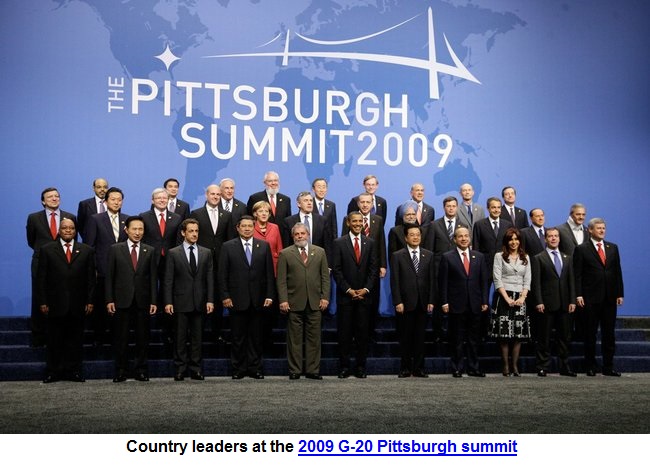
CU Blog - A Christmas Present for The Banks From The Omnibus Bill - Photo 2

In November 2012, the SEC and regulators from Australia, Brazil, the European Union, Hong Kong, Japan, Ontario, Quebec, Singapore, and Switzerland met to discuss reforming the OTC derivatives market, as had been agreed by leaders at the 2009 G-20 Pittsburgh summit (see Photo) in September 2009.[54] In December 2012, they released a joint statement to the effect that they recognized that the market is a global one and “firmly support the adoption and enforcement of robust and consistent standards in and across jurisdictions”, with the goals of mitigating risk, improving transparency, protecting against market abuse, preventing regulatory gaps, reducing the potential for arbitrage opportunities, and fostering a level playing field for market participants.[54] They also agreed on the need to reduce regulatory uncertainty and provide market participants with sufficient clarity on laws and regulations by avoiding, to the extent possible, the application of conflicting rules to the same entities and transactions, and minimizing the application of inconsistent and duplicative rules.[54] At the same time, they noted that “complete harmonization – perfect alignment of rules across jurisdictions” would be difficult, because of jurisdictions’ differences in law, policy, markets, implementation timing, and legislative and regulatory processes.[54]

VIDEO: Leverage Explained – https://youtu.be/GESzfA9odgE
When things turn out good, big risk means big return; but if it turns out bad, you lose everything and left with a debt.

Source References:
1.       Derivatives (Report). Office of the Comptroller of the Currency, U.S. Department of Treasury. http://www.occ.gov/topics/capital-markets/financial-markets/trading/derivatives/index-derivatives.html. Retrieved February 2013. “A derivative is a financial contract whose value is derived from the performance of some underlying market factors, such as interest rates, currency exchange rates, and commodity, credit, or equity prices. Derivative transactions include an assortment of financial contracts, including structured debt obligations and deposits, swaps, futures, options, caps, floors, collars, forwards, and various combinations thereof.”
2.       Derivative Definition Investopedia
3.       Koehler, Christian. “The Relationship between the Complexity of Financial Derivatives and Systemic Risk”. Working Paper: 10–11.
——
42.   Kelleher, James B. (September 18, 2008). “”Buffett’s Time Bomb Goes Off on Wall Street” by James B. Kelleher of Reuters”. Reuters.com. Retrieved August 29, 2010.
43.   “Fed’s $85 billion Loan Rescues Insurer”
44.   Edwards, Franklin (1995). “Derivatives Can Be Hazardous To Your Health: The Case of Metallgesellschaft”. Derivatives Quarterly (Spring 1995): 8–17
45.   Whaley, Robert (2006). Derivatives: markets, valuation, and risk management. John Wiley and Sons. p. 506. ISBN 0-471-78632-2.
46.   “UBS Loss Shows Banks Fail to Learn From Kerviel, Leeson”. Businessweek. September 15, 2011. Retrieved March 5, 2013.
47.   “Michael Simkovic, Secret Liens and the Financial Crisis of 2008.”. American Bankruptcy Law Journal, Vol. 83, p. 253. 2009. Retrieved March 5, 2013.
48.   Michael Simkovic (January 11, 2011). “Bankruptcy Immunities, Transparency, and Capital Structure, Presentation at the World Bank”. Ssrn.com. doi:10.2139/ssrn.1738539. Retrieved March 5, 2013.
——
54.   “Joint Press Statement of Leaders on Operating Principles and Areas of Exploration in the Regulation of the Cross-Border OTC Derivatives Market; 2012-251”. Sec.gov. December 4, 2012. Retrieved March 5, 2013.

Share this post:
, , ,

Plea to Detroit: Less Tech, Please

 Go Lean Commentary

It’s competition time for the cockpits of today’s automobiles.CU Blog - Plea to Detroit - Less Tech, Please - Photo 1

The appeal here is being made to Detroit. In this case the city is referenced as a metonym for the Automaker Planners and Decision-makers. Metonyms are frequent references in the book Go Lean…Caribbean, with the following considerations:

Silicon Valley – Page 30 – American High Tech Center
Wall Street – Page 155 – Big Banks/Financial Centers
Hollywood – Page 203 – US Movie/TV/Media Producers

This book Go Lean… Caribbean, serves as a roadmap for the introduction and implementation of the Caribbean Union Trade Federation (CU). This effort will marshal the region to avail the opportunities associated with technology and automobiles – there is a plan to foster a local automotive industry. In fact The CU/Go Lean roadmap has these 3 prime directives:

  • Optimization of the economic engines in order to grow the regional economy.
  • Establishment of a security apparatus to protect the resultant economic engines.
  • Improve Caribbean governance to support these engines.

Automakers are competing in a “space race” for more and more technology in the cockpits (Car decks and Heads-Up Display) of cars. This is not always good; as related by the following news/opinion writer:

By: John C. Abell, Senior Editor
Title: My Plea to Detroit: Less Tech, Please

CU Blog - Plea to Detroit - Less Tech, Please - Photo 2I once ranted that the only thing I wanted in a “smart” TV was Bluetooth. I was only half kidding. But car-markers are going down the same road as some TV set manufacturers by bloating their products with too much of the wrong tech, adding expense and complexity that we do not need. “We took a look from the ground up of what a self-driving car would look like,” Brin said.

“Smart” has become an overused modifier for devices that are better off dumb. Do you really need a connected refrigerator that tells you to buy milk and streams music?

You aren’t going to be forced to buy a smart fridge. There are too many other choices. But if automakers aren’t stopped they will install useless, redundant technology as standard equipment for you will have to buy, maintain and even keep paying subscription fees to justify the existence of something you didn’t need in the first place.

Consider today’s news of Ford’s latest attempt to market an in-dash tech system. Let’s leave aside the safety discussion about whether the driver should be messing around with pinch-to-zoom multitouch screens and looking for entertainment while operating a massive vehicle at highway speeds. Let’s also concede that voice control addresses much of the safety concern and that the quiet, serene environment that is a car interior is made for that kind of interface.

I’m still stuck on a basic question: What cabin technology can an automaker build into a car that I can’t bring myself, more cheaply? What I need, still, only, is Bluetooth and a comfortable seat for my smartphone, which is as smart as can be and always with me.

There’s ample history to push back against so-called tech advancement in cars.

In the year 2000 President Clinton opened up the satellite GPS tracking system to anybody at a resolution of down to 10 meters. That 10-fold improvement suddenly made military-grade tech practical for your family car. Companies like Garmin and Magellan, which had been catering to sporting folk, found a new market. And newcomers like TomTom and Dash got into the game.

As a chronic early adopter I have owned several stand-alone GPS units and have always resisted buying $2,000 in-dash GPS because I could always get $200 on-dash equivalents. And then smartphones became the only GPS device you needed, reducing the cost to about zero while also making the device infinitely portable. Goodbye Garmin.

Carmakers merely co-opted a good idea, charging us a stiff premium for what it presented as essentially style choice. Remember that theme …

Several automakers tout that their cars are “Pandora ready.” Who cares? Pandora is only one of more than 100 streaming music services, has fewer than half the subscribers of Spotify and about a million fewer songs than major rivals. And — oh yeah — Apple recently got into the game with a native iPhone service that oddly enough looks and feels exactly like its more established predecessors.

Detroit has also discovered hotspots and thinks it’s doing you a favor building that into your next car. GM and Ford, the Wall Street Journal reports, are convinced “technology offerings are increasingly important to new car buyers. A total of 38% of those buying domestic vehicles cite the latest technology features as a reason for their purchase, according to a recent survey by automotive consultants J.D. Power and Associates.”

Sigh. Here’s an opportunity for you to pay for yet another data plan, in addition to the one you use at home and the one you use on your phone. Or, instead, you can remember that your phone is a 4G hotspot, and that some plans don’t charge you more to use it. Want something even more robust? Get a MiFi for a hotspot that you also don’t have to leave in your car and has excellent battery life.

I’m a little less sure that OnStar has outlived its usefulness. This service — which pre-dates the GPS and mobile phone revolution — is a uniquely human-powered concierge service that many will find valuable for that kind of piece of mind. But if a panic button is all you need, it’s probably overkill. Plus, they are serious boosters of Bluetooth, so good for them.

Instead of adding to sticker shock with shiny things Detroit should take a look at what appliance companies like GE and Whirlpool are doing. Connected appliances leverage the smartphone their designers very safely assume you already have. So your smart oven won’t remind you that it’s your anniversary, but it will respond to a command to pre-heat that you might send as you leave the supermarket.

Like appliance makers, automaker need to realize that the smartphone has become the ultimate universal remote and gateway that they cannot and should not try to improve upon. Save the innovation for under the hood — and for making the cabin as smartphone friendly as possible.
——-
Are you among the 38% J.D. Powers say are enticed by “technology offerings” or does your car still have roll-up windows? Are you in the auto industry and convinced that in-cabin tech is the future?
Linked-In Blogger: John C Abell  (Posted 12-12-2014) –
https://www.linkedin.com/pulse/my-plea-detroit-less-tech-john-c-abell?trk=hp-feed-article-title

This assessment on Detroit is being made from … Detroit. In addition to the automotive industry, there is a lot of economic lessons to learn from the city itself. This once great industrial center has endured a failed-city status – 18 months under Bankruptcy Court oversight – and is now strategizing a turn-around. There is a lot of parallel with Caribbean communities, except for the lack of core competence in the automotive industry space. (The Go Lean book describes other core competencies related to the Caribbean – Page 58).

The Caribbean region cannot ignore technological advances and industrial developments. This means jobs; for today and tomorrow. The automotive industry have always been a source of high-paying jobs that transformed society. The Go Lean book relates the factor of high-job multipliers, where each direct job in a community creates multiple indirect jobs – the automotive industry is #1 for job multipliers. The roadmap’s quest to increase the regional economy and create 2.2 million new jobs, must consider all dimensions of this industry. We can  learn so much about job creation from Detroit.

This is the declaration of the book Go Lean…Caribbean. This purports that a new industrial revolution is emerging and Caribbean society must engage. This is  pronounced in the Declaration of Interdependence (Page 14), with these opening statements:

xxvii. Whereas the Caribbean region must have new jobs to empower the engines of the economy and create the income sources for prosperity, and encourage the next generation to forge their dreams right at home, the Federation must therefore foster the development of new industries, like that of ship-building, automobile manufacturing, pre-fabricated housing, frozen foods, pipelines, call centers, and the prison industrial complex. In addition, the Federation must invigorate the enterprises related to existing industries like tourism, fisheries and lotteries – impacting the region with more jobs.

xxviii. Whereas the region has endured a spectator status during the Industrial Revolution, we cannot stand on the sidelines of this new economy, the Information Revolution. Rather, the Federation must embrace all the tenets of Internet Communications Technology (ICT) to serve as an equalizing element in competition with the rest of the world. The Federation must bridge the digital divide and promote the community ethos that research/development is valuable and must be promoted and incentivized for adoption.

There is a lot at stake for the Caribbean in considering this subject area. One Caribbean icon/artist, Bob Marley, wrote not to be a “stock on the shelf” (“Pimpers Paradise” Uprising Album 1980). The region’s 42 million people demand a supply of innovative automobiles – real innovation, not just fluff to increase the sticker price as reported in the foregoing article. We do not only want to consume, we want to supply!

Producing and not only consuming has been a consistent theme in prior Go Lean blog/commentaries, sampled here:

Role Model Shaking Up the World of Cancer Research & Innovation
Where the Jobs Are – Computers Reshaping Global Job Market
Where the Jobs Are – One Scenario: Ship-breaking
STEM Jobs Are Filling Slowly; Despite High Demand
Google conducting research for highway safety innovations
Ghost ships – Autonomous cargo vessels without a crew

The Go Lean book provides a roadmap for developing and fostering a domestic automotive industry. The process starts with a spirit/attitude to not tolerate the status quo. This spirit is described in the book as a community ethos for research-and-development. The book details other ethos to adopt, plus the executions of the following strategies, tactics, implementations and advocacies to forge innovation and industrial growth in Caribbean communities:

Community Ethos – Deferred Gratification Page 21
Community Ethos – People Respond to Incentives Page 21
Community Ethos – Job Multiplier Page 22
Community Ethos – “Crap” Happens Page 23
Community Ethos – Lean Operations Page 24
Community Ethos – Return on Investments (ROI) Page 24
Community Ethos – Ways to Impact the Future Page 26
Community Ethos – Ways to Help Entrepreneurship Page 28
Community Ethos – Ways to Impact Research & Development Page 30
Community Ethos – Impact the Greater Good Page 37
Strategy – Agents of Change – Technology Page 48
Tactical – Fostering a Technocracy Page 64
Tactical – How to Calculate GDP Page 67
Tactical – Growing Economy – New High Multiplier Industries Page 68
Separation of Powers – Public Works & Infrastructure Page 82
Separation of Powers – Department of Transportation Page 84
Implementation – Ways to Pay for Change Page 101
Implementation – Ways to Deliver Page 109
Planning – 10 Big Ideas Page 127
Planning – Lessons from Detroit Page 140
Advocacy – Ways to Grow the Economy Page 151
Advocacy – Ways to Create Jobs Page 152
Advocacy – Ways to Foster Technology Page 197
Advocacy – Ways to Improve Transportation Page 205
Advocacy – Ways to Develop the Auto Industry Page 206
Appendix – Job Multipliers – Detroit 11.0 Rate #1 of all industries Page 260

The laws of supply and demand is the bedrock of economics. This roadmap to elevate Caribbean society must lead first with a strong economic plan. The goal is to increase the Gross Domestic Product (GDP), so this means more domestic consumption and less imports. This is possible in the automotive industry space if the new domestic automotive product offerings are appealing and innovative. The Caribbean region has historically been slow at adopting technological innovation. But change has now come to the Caribbean! This is bigger than just being the first to adopt new innovation; we want to be the innovators.

The focus is automotive and yet the topic featured in the foregoing article include phrases like Internet Wi-Fi, Bluetooth, GPS, music streaming (Pandora & Spotify) and satellite concierge. This is not your “grandfather’s Chevrolet”; yet this is not even the future; this is the present state of “Detroit”!

The insights from the foregoing article and the embedded VIDEO below, help us to appreciate that the future is now! We, the Caribbean region, want to be consequential in that future, not just “a stock on the shelf”. With the proper planning, preparation and participation, we help to make our homeland a better place to live, work and play. 🙂

Download the book Go Lean … Caribbean – now!

————–

Appendix VIDEO: CNET On Cars – Car Tech 101: The future of head-up displays – http://youtu.be/KWs9ucwO4Vo

Published on Nov 24, 2014 – Head-up displays are starting to show up everywhere. Brian Cooley tells you why HUDs may be the next revolution in car tech.


Share this post:
, , , ,
[Top]

CARICOM Chair calls for an end to US embargo on Cuba

Go Lean Commentary

Welcome to the fight Mr. Browne; welcome to the struggle to elevate Caribbean society.

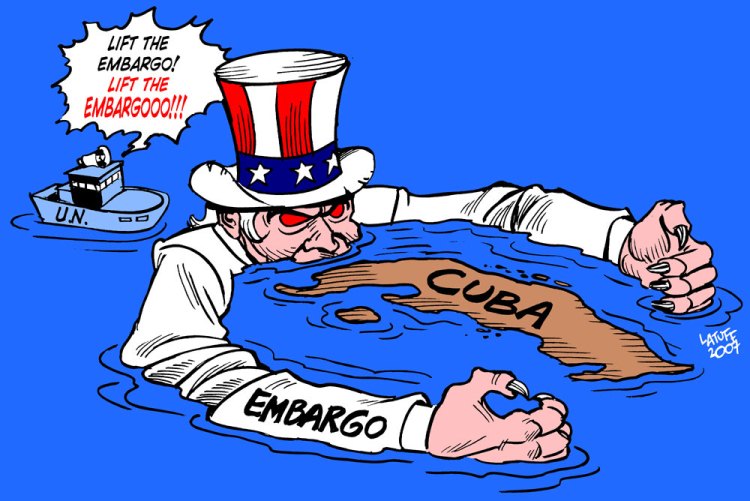
The publishers of the book Go Lean…Caribbean monitor the organizational developments of the Caribbean Community super-national organization. The Chairman position rotates among the Heads of Government for the 15 member-states. This year’s turn at the helm is Antigua & Barbuda; just in time after the June election of Gaston Browne as the new Prime Minister. This is a “baptism in fire” for Mr. Browne, as he is new in the leadership role for Antigua and also new for the CariCom. His latest regional salvo is a “shot across the bow” of American foreign policy, calling for the end of the US embargo on Cuba. See full article & VIDEO here:

 CU Blog - CARICOM chair calls for an end to US embargo on Cuba - Photo 1HAVANA, Cuba — Chairman of the Caribbean Community (CARICOM) Gaston Browne, prime minister of Antigua and Barbuda called on the United States president and congress to end its “senseless embargo of Cuba now.”

Browne was speaking at the opening ceremony of the fifth CARICOM-Cuba Summit in Havana, Cuba, on Monday. He said that CARICOM’s solidarity with Cuba was manifested by the region’s repeated calls “in every council in every part of the world” for an end to the embargo.

The CARICOM chairman also took the opportunity to express profound appreciation to the host for its role in the fight against Ebola disease.

“Cuban doctors, nurses and technicians have not only put their lives at risk to save lives in West Africa; they have saved lives around the world by helping to contain and control the spread of Ebola. They deserve our deep respect, our great gratitude and our enduring thanks,” he stated.

The prime minister noted that trade between the two sides had grown but was mindful of the challenges that existed for its expansion. He referred to the work being done on a protocol to widen the existing trade and development agreement and stated he had no doubt that a mutually satisfactory result would be achieved.

Browne said a practical machinery had to be established to expand trade and investment.

“Central to such machinery is effective and affordable transportation for the movement of goods and people between our countries. In this connection, I call on this summit meeting to place high priority on creating mechanisms to move goods, services and passengers throughout our countries. I am convinced that if Cuba and CARICOM countries can jointly build a transportation network, all our economies will benefit,” he added.
He pointed to the advantages particularly in the field of tourism that such a network could bring.

“If Cuba and CARICOM countries can establish the air transportation links and a network of collaboration between our hotels, multi-destination tourism — that offers the distinctiveness of our culturally-rich countries — could be a winner for all of us,” he said.

The CARICOM chairman suggested that CARICOM and Cuba share their knowledge and experience in sports, particular athletics.

He joked that “if we teach Cubans to play cricket, we might produce a Caribbean cricket team that would restore West Indian cricket to the heights it once majestically enjoyed.”
Browne said that areas for co-operation between CARICOM and Cuba existed at a broad level and it was up to “us to be creative and ingenious in the ways in which we bolster each other.”

“On matters such as climate change and global warming; on financial services and the dictates of the countries of the Organization for Economic Cooperation and development; on the marginalization of our concerns by the G20, we should be coordinating our positions and acting in unison. We may not be able to stand-up to them alone, but they cannot ignore us if we stand-up together,” the prime minister said.
Caribbean News Now – Regional News Source (Posted 12/11/2014) –
http://www.caribbeannewsnow.com/headline-CARICOM-chair-calls-for-an-end-to-US-embargo-on-Cuba-23985.html

———-

VIDEO – Has the US-Cuba trade embargo reached the end of the road? – BBC News – http://youtu.be/SR8CPBO6C8Q

Published on May 20, 2014 – America’s long-standing trade embargo with Cuba is facing calls to be eased from an unlikely source. President Obama’s administration has relaxed some of its provisions but there are growing calls to lift it completely.

The “acting in unison” rallying cry from Mr. Browne aligns with the assertions of the Go Lean book, that the challenges the Caribbean face are too big for any one Caribbean member-state to tackle alone. Rather, shifting the responsibility to a region-wide, professionally-managed, deputized technocracy will result in greater production and greater accountability. This deputized agency is the Caribbean Union Trade Federation (CU). The Go Lean book is a roadmap for the introduction and implementation of the CU.

Though this CU effort shares some similar goals, there is no association of the Go Lean publishers to the CariCom. Instead, the Go Lean movement is external to CariCom. In fact, the book assesses that most of CariCom executions have failed – Pages 92, 167, 255 – and proposes the CU as the next step of integration evolution for the Caribbean region.

In addition to the book, the publishers have previously addressed CariCom’s efforts and mis-firings in the following Go Lean blogs entries:

CARICOM calls for innovative ideas to finance SIDS development
EU willing to fund study on cost of not having CARICOM
The Future of CariCom
Grenada PM Urges CARICOM on ICT
CARICOM Chairman to deliver address on reparations
Caribbean leaders convene for CARICOM summit in St Vincent

The foregoing article stressed the potential for Caribbean elevation with the imminent re-integration of Cuba. The CariCom Chairman’s urging for the US to end the trade embargo is a great start – just talk – but the actions associated with Cuba’s full integration are weighty. The Go Lean book describes the heavy-lifting associated with this quest.

This book, Go Lean… Caribbean, details the step-by-step roadmap for elevating the entire Caribbean, including Cuba, into a confederation of 30 member-states of the region into a “single market”. Thusly, the prime directives of the CU are pronounced in these statements:

  • Optimization of the economic engines in order to grow the regional economy to $800 Billion & create 2.2 million new jobs.
  • Establishment of a security apparatus to protect the resultant economic engines.
  • Improve Caribbean governance to support these engines.

The Go Lean book details the series of community ethos, strategies, tactics, implementations and advocacies designed to re-boot and integrate Cuba in to an optimized Caribbean brotherhood:

Anecdote – Caribbean Single Market & Economy Page 15
Community Ethos – Economic Systems Influence Individual Choices & Incentives Page 21
Community Ethos – Job Multiplier Page 22
Community Ethos – “Crap” Happens Page 23
Community Ethos – Lean Operations Page 24
Community Ethos – Cooperatives Page 25
Community Ethos – Ways to Impact the Future Page 26
Community Ethos – Ways to Manage Reconciliations Page 34
Community Ethos – Ways to Impact the Greater Good Page 37
Strategic – Vision – Integrated Region in a Single Market Page 45
Strategic – Vision – Agents of Change Page 57
Tactical – Confederating a Non-sovereign Union Page 63
Tactical – Fostering a Technocracy Page 64
Tactical – Growing to $800 Billion Regional Economy Page 67
Tactical – Separation of Powers – Office of Trade Negotiations Page 80
Tactical – Separation of Powers – Federal Courts – Truth & Reconciliation   Commissions Page 90
Anecdote – Turning Around CariCom Page 92
Anecdote – “Lean” in Government Page 93
Implementation – Assemble & Create Super-Regional Organs to represent all Caribbean Page 96
Implementation – Ways to Pay for Change Page 101
Implementation – Foreign Policy Initiatives at Start-up Page 102
Implementation – Ways to Deliver Page 109
Implementation – Reasons to Repatriate to the Caribbean Page 118
Implementation – Ways to Benefit from Globalization Page 119
Planning – 10 Big Ideas – Cuba Page 127
Planning – Big Ideas for the Caribbean Region Page 127
Planning – Ways to Model the EU Page 130
Planning – Ways to Improve Failed-State Indices Page 134
Advocacy – Ways to Grow the Economy Page 151
Anecdote – Governmental Integration: CariCom Parliament Page 167
Advocacy – Ways to Improve Governance Page 168
Advocacy – Ways to Impact the Diaspora Page 217
Advocacy – Ways to Re-boot Cuba Page 236
Appendix – New CariCom Model Urged Page 255

The foregoing news article and this commentary is not the first call for the re-instatement of Cuba – 55 years is long enough. In a recent blog about the Big 3 automakers of Detroit, reference was made to the expansion of auto assembly plants of General Motors and Ford Motors in global cities. Both companies now have installations in Vietnam, a country that fought a bloody unpopular war with the US 40 years ago; (65,000 American deaths). Cuba has never shed American blood, and yet their embargo persists – this defies logic. This is why these previous blogs posit that it is only a matter of (short) time for this change, and so the blogs/commentaries feature subjects on Cuba’s eventual integration into the Caribbean brotherhood. These are detailed here:

‘Raul Castro reforms not enough’, Cuba’s bishops say
Cuban Cigars – Declared “Among the best in the world”
Cuba mulls economy in Parliament session
America’s War on the Caribbean
Cuban cancer medication registered in 28 countries
Cuba Approves New “Law on Foreign Investment”

CU Blog - CARICOM chair calls for an end to US embargo on Cuba - Photo 2Many entities in the international community have heralded a normalization of Cuban-American relations; see foregoing VIDEO and Appendix below.

The book Go Lean … Caribbean recognizes the historicity of Cuba and the polarization of the Castro Brothers (Fidel & Raul). But now that the current President, Raul, has announced that he will retire/step-down in 2017, it is reasonable to expect that the long-awaited change is imminent for the Republic of Cuba.

The CU roadmap is especially inviting to the Cuban and Caribbean Diaspora; it presents a comprehensive plan (370 pages) for the contribution of their time, talents and treasuries in the repatriation to their homeland.

Now is the time for Caribbean stakeholders, the residents, Diaspora, trading partners and governing institutions, to lean-in for this regional re-boot plan. Now is the time to end the embargo, re-instate Cuba and make all of the Caribbean a better place to live, work and play. 🙂

Download Go Lean … Caribbean – now!

———-

Appendix: UN Blasts US Embargo of Cuba – http://youtu.be/S5sZ5ZBlv4M
Published on Nov 6, 2013 – The US embargo against Cuba is being criticized by the UN, who are taking issue with the 50 year old sanctions against the socialist island nation just 90 miles from Florida’s southern shore. On October 29th, [2013] the UN voted 188-2 for a resolution to end the embargo, which it said “…lacks every ethical or legal ground.” We discuss the vote on this Buzzsaw news clip with Tyrel Ventura and Tabetha Wallace.

Share this post:
, , ,
[Top]

M-1 Rail: Alternative Motion in the Motor City

Go Lean Commentary

Buy local!

This is the first mandate for any economic empowerment plan. Applying this logic would influence the City of Detroit to deploy public transportation options utilizing products and services of their local home-grown industries: The Big 3 auto makers.

And yet, Detroit is celebrating their initiation of a streetcar system – with no Ford, General Motors (GM) or Chrysler contributions; (they do no produce streetcars).

Yet, this is indisputably wise!

CU Blog - M1 Rail - Alternative Motion in the Motor City - Photo 2Streetcars were a common mode of transportation in many American cities, then something villainous happened: most systems were dismantled in the 1950’s & 1960’s as part of a switch to bus service. Detroit ceased their service in 1956, while Philadelphia never stopped and still continue to operate the same streetcars, even today. (The buses were manufactured by the Michigan-area auto companies; the Big 3). This plutocratic behavior proved a “greedy monster that ultimately ate itself”.[1] (In 2008 GM & Chrysler had to file for Bankruptcy Protection; 5 years later Detroit filed for Bankruptcy Protection as well).

The once great City of Detroit has to re-boot, remake and revive its metropolitan area, and streetcars are now part of the solution. There is the need to efficiently move people forward to facilitate live, work and play activities. See the M-1 Rail story here:

CU Blog - M1 Rail - Alternative Motion in the Motor City - Photo 1 M-1 RAIL is a non-profit organization formed in 2007 to lead the design, construction, and future operation of a 3.3-mile circulating streetcar along Woodward Avenue between Congress Street and West Grand Boulevard in Detroit, Michigan. M-1 RAIL is an unprecedented public-private partnership and model for regional collaboration Notably, the first major transit project being led and funded by both private businesses, philanthropic organizations, in partnership with local government, the State of Michigan, and U.S. Department of Transportation.

Mission
The mission of M-1 RAIL is to create a catalyst for investment, economic development and urban renewal that positively impacts the entire region through the construction of a streetcar circulator system running along and connecting Woodward Avenue from the Riverfront to the NewCenter and North End neighborhoods.

Vision
The M-1 RAIL Woodward Avenue Streetcar project is envisioned to be one element of a future modern, world-class regional transit system where all forms of transportation, including rail, bus, vehicle, bicycle and pedestrian, are considered and utilized to build a vibrant, walkable region that includes a thriving Downtown Detroit. This city center is envisioned by supporters of M-1 RAIL to become a foundation for growth and prosperity throughout the surrounding neighborhoods adjacent to the Central Business District, Midtown, NewCenter and North End.

———-

Video: M-1 Rail: Moving Forward Togetherhttp://vimeo.com/106327746

M-1 RAIL: Moving Forward Together from M-1 Rail on Vimeo.

CU Blog - M1 Rail - Alternative Motion in the Motor City - Photo 3Dallas, Minneapolis, Seattle, Portland, Salt Lake City, and soon Detroit.  All home to modern streetcar lines that serve as connectors throughout their respective regions, as well as economic catalysts, spurring investment and growth along their routes.

Construction will soon be underway for the M-1 RAIL streetcar connecting 20 stations serving 12 locations between Congress Street in Detroit’s Central Business District up to West   Grand Boulevard at the North End.

Stretching 3.3 miles along Detroit’s famed, Woodward Avenue, A National Byway®, the modern streetcar will travel between Congress Street in Downtown to West Grand   Boulevard, in the North End, providing access to hundreds of businesses and connecting neighborhoods and points of interest along the way including major cultural landmarks, sports stadiums, entertainment venues, restaurants, hospitals and universities.

When completed, whether going to work, going to lunch, or going to a game, visitors and residents alike will have the option to ride the M-1 RAIL Streetcar.
M-1 RAIL Project – Website; About Us – Retrieved December 11, 2014
http://m-1rail.com/about-m-1-rail/

This consideration by the publishers of the book Go Lean … Caribbean, a roadmap for the Caribbean Union Trade Federation (CU), is part-and-parcel of the effort to “observe and report” on the turn-around of the once great City of Detroit. Previous commentaries alluded that streetcars are also being considered for Caribbean deployment, especially since these member-states report very high fuel costs. In addition to streetcars, light-rail, natural-gas powered vehicles and toll roads are all part of the effort to empower the region through mass transit (Page 205).

CU Blog - M1 Rail - Alternative Motion in the Motor City - Photo 4It is the conclusion that the American auto industry played a key role is dissuading cities from streetcar deployments, but now that the dynamics have changed (oil price inflation, declining city residential populations/tax base, and re-gentrification to repatriate a middle class back to the inner city); this mode of transit is now “all the rage”. This is the consensus despite any objections or lobbying on behalf of auto manufacturers. After careful analysis, this commentary asserts that Detroit has been very kind to the Big 3 auto makers, but these companies have not reciprocated to Detroit. The references show that GM, Ford and Chrysler have grown their manufacturing footprint, many times globally, while decreasing their presence in Michigan[2][3][4].

There is a matter of self-interest. Though there is some interdependence, the Big 3 auto makers must execute strategies and tactics for their best interest while Detroit must execute strategies and tactics for its best interest; though these may not align. The ethos, the Greater Good was missing in prior iterations of city administrations, but it is hoped now that this lesson is learned; and if not in Detroit, then surely we must practice this ethos in the Caribbean.

The Go Lean roadmap anticipates the challenges that communities like Detroit – failed-states/failed cities – have had to endure and pledges to pursue a course of action for better outcomes on our end. These points were pronounced early in the book, in the opening Declaration of Interdependence (Pages 12 & 14), with these statements:

xii.     Whereas the legacy in recent times in individual states may be that of ineffectual governance with no redress to higher authority, the accedence of this Federation will ensure accountability and escalation of the human and civil rights of the people for good governance, justice assurances, due process and the rule of law. As such, any threats of a “failed state” status for any member state must enact emergency measures on behalf of the Federation to protect the human, civil and property rights of the citizens, residents, allies, trading partners, and visitors of the affected member state and the Federation as a whole.

xiv.    Whereas government services cannot be delivered without the appropriate funding mechanisms, “new guards” must be incorporated to assess, accrue, calculate and collect revenues, fees and other income sources for the Federation and member-states. The Federation can spur government revenues directly through cross-border services and indirectly by fostering industries and economic activities not possible without this Union.

xxvi.  Whereas the Caribbean region must have new jobs to empower the engines of the economy and create the income sources for prosperity, and encourage the next generation to forge their dreams right at home, the Federation must therefore foster the development of new industries, like that of ship-building, automobile manufacturing, prefabricated housing, frozen foods, pipelines, call centers, and the prison industrial complex. In addition, the Federation must invigorate the enterprises related to existing industries like tourism, fisheries and lotteries – impacting the region with more jobs.

xxx.   Whereas the effects of globalization can be felt in every aspect of Caribbean life, from the acquisition of food and clothing, to the ubiquity of ICT, the region cannot only consume, it is imperative that our lands also produce and add to the international community, even if doing so requires some sacrifice and subsidy.

xxxiii.   Whereas lessons can be learned and applied from the study of the recent history of other societies, the Federation must formalize statutes and organizational dimensions to avoid the pitfalls of communities like … Detroit…

The CU mission is to implement the complete eco-system to deliver on market opportunities of streetcars, as related in the foregoing article/website. There are many strategies, tactics, implementations and advocacies that will facilitate this readiness; a sample is detailed here:

Economic Principles – Economic Systems Influence Individual Choices Page 21
Economic Principles – People Choose because Resources are Limited Page 21
Economic Principles – All Choices Involve Costs Page 21
Economic Principles – People Respond to Incentives Page 21
Economic Principles – Economic Systems Influence Individual Choices Page 21
Community Ethos – Job Multiplier Page 22
Community Ethos – Lean Operations Page 24
Community Ethos – Return on Investments Page 24
Community Ethos – Ways to Impact the Future Page 26
Community Ethos – Ways to Help Entrepreneurship Page 28
Community Ethos – Ways to Impact the Greater Good Page 37
Tactical – Separation of Powers – Department of State – SGE’s Page 80
Tactical – Separation of Powers – Department of Transportation Page 84
Implementation – Security Initiatives at Start-up – Command-and-Control Page 103
Implementation – Steps to Implement Self-Governing Entities Page 105
Implementation – Ways to Improve Energy Usage – Electrified Buses/Trains Page 113
Implementation – Ways to Benefit from Globalization Page 119
Advocacy – Ways to Improve Trade Page 128
Advocacy – Ways to Create Jobs Page 152
Advocacy – Ways to Improve Governance Page 168
Advocacy – Ways to Foster Cooperatives Page 176
Advocacy – Ways to Foster Technology Page 197
Advocacy – Ways to Impact Main Street Page 201
Advocacy – Ways to Improve Transportation Page 205
Advocacy – Ways to Develop the Auto Industry Page 206
Advocacy – Ways to Impact Urban Living – Transit Options Page 234

The world, including Detroit (for 2016), is preparing for the change to more efficient mass transit options to make transit to urban areas more appealing to live, work and play. This ethos of adapting to change has also now come to the Caribbean.

This blog commentary touches on many related issues and subjects that affect planning for Caribbean empowerment in this transportation industry-space. Many of these issues were elaborated upon in these previous blog/commentaries:

DC Streetcars – Model For Caribbean Re-development
Mitigating the Dreaded ‘Plutocracy’, as GM practiced in the US in the past to quash Streetcar enterprises
The Criminalization/Abuses of American Business – Applying Lessons Learned
Preparing for the automotive future – Google self-driving cars to mitigate highway safety concerns
Go Green Caribbean – Streetcars are electric, less carbon footprint
Trains and Trucks play well together

The Go Lean book relates that the “greatest good to the greatest number of people is the measure of right and wrong”. This Greater Good mandate has a different charter for a city-community versus a for-profit corporation. This logic was lost during the modern history of Detroit; but we must ensure this principle is adhered to in the Caribbean future.

The Caribbean needs help…with transportation, jobs, urban renewal, growing the economy, and motivating our youth to impact their future here at home… in the Caribbean; as opposed to the recent history of societal abandonment. We have much to learn from Detroit.

Let’s pay more than the usual attention to these lessons; too much is dependent on our efforts.

The people of the region are urged to “lean-in” for the Caribbean empowerments as described in the book Go Lean … Caribbean. The benefits of this roadmap are very alluring: emergence of an $800 Billion single market economy and 2.2 million new jobs. That is a great destination in which we need the right vehicle to get the whole community there. Like the M-1 Rail in the foregoing article, let’s Move Forward Together.

🙂

Download the book Go Lean … Caribbean – now!

————–

Appendix:
1.   Erysichthon – The monster that devoured everything and then itself. Retrieved December 11, 2014 from: http://sonjablignaut.wordpress.com/2013/05/08/a-monster-that-devours-itself-a-capitalists-parable/
2.  List of General Motors factories. Retrieved December 11, 2014 from: http://en.wikipedia.org/wiki/List_of_General_Motors_factories
3.  List of Ford Motors factories. Retrieved December 11, 2014 from: http://en.wikipedia.org/wiki/List_of_Ford_factories
4.  List of Chrysler factories. Retrieved December 11, 2014 from: http://en.wikipedia.org/wiki/List_of_Chrysler_factories


Share this post:
, ,
[Top]

Detroit to exit historic bankruptcy

Go Lean Commentary

The publishers of the book Go Lean…Caribbean are here to “observe and report” the turn-around and rebirth of the once-great but now distressed City of Detroit. The book posits that the Caribbean can learn a lot from the strategies, tactics and implementations to mitigate this community’s “failed-state” status.

The quest starts now, as Detroit is now emerging from the Bankruptcy Court’s oversight, according to the following article and VIDEO:

By: Serena Maria Daniels
CU Blog - Detroit to exit historic bankruptcy - Photo 1DETROIT (Reuters) – Detroit will officially exit the biggest-ever U.S. municipal bankruptcy later on Wednesday, officials said, allowing Michigan’s largest city to start a new chapter with a lighter debt load.

The city, which filed for bankruptcy in July 2013, will shed about $7 billion of its $18 billion of debt and obligations.

“We’re going to start fresh tomorrow and do the best we can to deliver the kind of services people deserve,” said Mayor Mike Duggan.

Once a symbol of U.S. industrial might, Detroit fell on hard times after decades of population loss, rampant debt and financial mismanagement left it struggling to provide basic services to residents.

Later on Wednesday, payments to city creditors will be triggered under a debt adjustment plan confirmed by a U.S. Bankruptcy Court judge last month.

Most of the settlements with major creditors, including Detroit’s pension funds and bondholders, will be paid with a distribution of about $720 million of bonds. The city will also reissue $287 million of existing bonds and borrow about $275 million from Barclays Capital to finance its exit from bankruptcy.

Along with the debt, the exit plan relies heavily on the “Grand Bargain,” where foundations, the state and the Detroit Institute of Art will contribute $816 million over time to ease pension cuts and protect city-owned art work from sale. The plan also aims to provide Detroit with $1.7 billion through June 30, 2023, to improve city services and infrastructure.

Wednesday also marks the end of Kevyn Orr’s 21-month term as Detroit’s state-appointed emergency manager. He told reporters that the city was wrapping up wire transfers, disbursements and other matters to end the historic bankruptcy.

“There may be some other administrative things the court may have to handle but the city will have emerged from bankruptcy,” Orr said. “12:01 a.m. tomorrow morning the city will be out of bankruptcy. I will no longer be the emergency manager. I will be unemployed.”

Orr’s departure returns complete control of Detroit to Duggan and the nine-member city council. However, the city will have a nine-member, state-created oversight board in place to approve financial matters.

In confirming the bankruptcy plan, Judge Steven Rhodes raised questions about possible conflicts of interest from having Duggan and a city council member sit on the board.

“The city is running the city, with some financial oversight on budgetary matters,” said Michigan Governor Rick Snyder about the financial review commission. “My goal is probably to have (the commission) be as least active as possible.”

The Republican governor told Reuters in an interview that the commission will help ensure Detroit does not slip back into bankruptcy. He also ruled out direct financial aid to the city in the future.

“We’re not really aiming to be there as a backup to the city in terms of financial resources,” Snyder said. “We’re there to be a supportive partner.”

He added that many of the other 16 local governments and school districts under state oversight in Michigan are “transitioning out of their problems” without the aid of bankruptcy.

“People should not be aspiring to go into bankruptcy to solve your problems. It’s tough process and it’s a last resort.”

Orr said court-ordered mediation on fees paid to consultants during the bankruptcy process was continuing on Wednesday. Outside lawyers and consultants charged the city more than $140 million, sparking protests from Duggan. Orr said some of the issues were “resolved last week.”

With the exit, “all of the consultants are being phased out pretty quickly,” Duggan said.

(Writing and additional reporting by Karen Pierog in Chicago and Lisa Lambert in Washington; editing by Matthew Lewis)
Reuters News Service (Posted and retrieved 12-10-2014) –
http://news.yahoo.com/detroit-exit-historic-bankruptcy-later-wednesday-162728907.html;_ylt=AwrBEiEC54hUwgYAliTQtDMD

The Go Lean book relates that economic empowerment can be heightened to alleviate distressed communities by exercising mastery of destruction arts and sciences – salvage, removal, recycle, redevelopment, rebirth and reboot – activities that can greatly benefit a city by “right-sizing” the infrastructure to the population.

This impacts the Greater Good.

The Go Lean book serves as a roadmap for the introduction and implementation of the Caribbean Union Trade Federation (CU) to elevate Caribbean society. While Detroit is not in scope for this effort, an examination of the details of Detroit – fall and rebound – can be productive for the Caribbean effort. The CU/Go Lean roadmap therefore has these 3 prime directives:

  • Optimization of the economic engines in order to grow the regional economy to $800 Billion GDP and create 2.2 million new jobs.
  • Establishment of a security apparatus to protect the resultant economic engines.
  • Improve Caribbean governance to support these engines.

Early in the Go Lean book, the point of lessons from Detroit is pronounced in the opening Declaration of Interdependence (Page 14), with this opening statement:

xxxiii.   Whereas lessons can be learned and applied from the study of the recent history of other societies, the Federation must formalize statutes and organizational dimensions to avoid the pitfalls of communities like … Detroit…

According to the foregoing article and VIDEO below, the City of Detroit is now emerging from the Bankruptcy (BK) protection commenced in July 2013. Though the BK proceedings are over, the crisis continues. The city still has to create opportunities for their citizens, present and future, or risk further abandonment by its population. The possibility is very real that Detroit will invest heavily in the education of their youth, only to watch them leave and prosper in other communities. This is a disposition (brain drain, unemployment, urban blight and acute hopelessness) that is too familiar for Caribbean communities. This is why the study of Detroit is such an ideal model for the Caribbean region.

The foregoing article relates that the financial crisis was not just a problem for the one City of Detroit but also “16 local governments and school districts[1] under state oversight in Michigan”. This was a Michigan/regional challenge; all exacerbated by the 2008 Great Recession financial crisis.

Previous Go Lean blogs highlighted Michigan, Detroit and other failed-state-city dynamics; as detailed here:

Michigan Unemployment – Then and Now
Making a Great Place to Work® – Model of a Michigan Company
Where the Jobs Are – Entrepreneurism in Turn-around
A Lesson in History: Lessons of the Failed East Berlin
Urban Crisis – The Geography of Joblessness
A Lesson in History: Community Ethos of Once Great Detroit During WW II
JP Morgan Chase $100 million Detroit investment not just for Public Relations

The foregoing news article also relates the financing options for Detroit’s recovery, which are heavy focused on municipal bonds in the securities market. The Go Lean roadmap likewise presents a plan, beyond banking, to generate funding to Pay for Change (Page 101). This CU/Go Lean effort is focused on forging change in the region; this does not start with BK proceedings (which are not available in the Caribbean), rather it must start with attitudes and motivations to reject the status quo. This positive attitude is defined in the book as a community ethos. One such ethos is “turn-around”, defined as having a collective vision, demand for change and appropriate steps and actions.

The book details other ethos to adopt, plus the executions of the following strategies, tactics, implementations and advocacies to impact the rebirths, reboots and turn-around of Caribbean communities:

Community Ethos – Deferred Gratification Page 21
Community Ethos – People Respond to Incentives Page 21
Community Ethos – Job Multiplier Page 22
Community Ethos – Light Up the Dark Places Page 23
Community Ethos – “Crap” Happens Page 23
Community Ethos – Lean Operations Page 24
Community Ethos – Return on Investments (ROI) Page 24
Community Ethos – Ways to Impact the Future Page 26
Community Ethos – Ways to Help Entrepreneurship Page 28
Community Ethos – Ways to Impact a Turn-Around Page 33
Community Ethos – Impact the Greater Good Page 37
Strategy – Customers – Foreign Direct Investors Page 48
Tactical – Fostering a Technocracy Page 64
Tactical – Modeling Post WW II Germany – Marshall Plan Page 68
Tactical – Modeling Post WW II Japan – with no Marshall Plan Page 69
Separation of Powers – Public Works & Infrastructure Page 82
Separation of Powers – Housing and Urban Authority Page 83
Separation of Powers – Exclusive Federal   Bankruptcy Courts Page 90
Implementation – Ways to Pay for Change Page 101
Implementation – Ways to Re-boot Freeport – Sample Failed City Page 112
Planning – Ways to Improve Failed-State Indices Page 132
Planning – Lessons Learned from 2008 Page 136
Planning – Lessons from Detroit Page 140
Advocacy – Ways to Grow the Economy Page 151
Advocacy – Ways to Create Jobs Page 152
Advocacy – Ways to Improve Local Government Page 169
Advocacy – Ways to Better Manage the Social Contract Page 170
Advocacy – Ways to Improve Leadership Page 171
Advocacy – Ways to Preserve Caribbean Heritage Page 218

The foregoing news article aligns with the publishers of the Go Lean book, the SFE Foundation, a community development foundation chartered for the purpose of empowering and re-booting economic engines. The foundation does the heavy-lifting of working with individuals, families, communities and nation-states to turn-around financial viability.

Bankruptcy is not an option for the failing Caribbean member-states, yet the region can still explore formal reboots. The Go Lean roadmap provides a complete plan to reboot Caribbean economic-security-governing engines. The region is hereby urged to lean-in to this roadmap, to make the homeland a better place to live, work and play. 🙂

Download the book Go Lean…Caribbean now!

————

APPENDICES:
1
. Source References
Michigan municipalities under Emergency Management oversight: Allen Park, Benton Harbor, Detroit, Ecorse, Flint, Hamtramck City, Highland Park, Pontiac, Three Oaks Village, Detroit Public School District, Muskegon Heights Public School District, and Highland Park School District. Retrieved December 10, 2014 from: http://en.wikipedia.org/wiki/Financial_emergency_in_Michigan.

2. VIDEO Detroit emerges from bankruptcyhttp://www.clickondetroit.com/consumer/detroit-exits-historic-bankruptcy/30165290

The City of Detroit will officially emerge from bankruptcy on Wednesday. Emergency Manager Kevyn Orr said the city no longer will be in a financial emergency when it officially exits bankruptcy. The governor, emergency manager and Mayor Mike Duggan joined to make the official announcement Wednesday morning.

Share this post:
, , , ,
[Top]

Art Basel Miami – A Testament to the Spread of Culture

Go Lean Commentary

There’s no business like ‘show business’. – Age Old Adage.

There is money in the ‘Arts’. – Go Lean…Caribbean precept.

And now, the subsequent news article posits: “the community rallies around art creating a unique energy. And art ‘dynamises’ the community, in a very unique way”.

The book Go Lean…Caribbean has a simple purpose: enable the Caribbean to be a better place to live, work and play. The book recognizes that the ‘genius qualifier’ is shown in different fields of endeavor, including the arts (fine, visual, performing, music, etc.). While the Go Lean roadmap has a focus on STEM [1] fields, it is accepted that not everyone possesses STEM skills, and yet many others can still contribute to society. Then when these other skills/talents are “gifted” beyond the extraordinary, they can truly impact their community, and maybe even the world.

The book relates that the arts can have a positive influence on the Caribbean. And that one man, or woman, can make a difference in this quest. We want to foster the next generation of “stars” in the arts and other fields of endeavor.

According to the following news article, the arts can truly ‘dynamise’ the community. The article relates to Art Basel, the movement to stage art shows for Modern and Contemporary works, sited annually in Basel (Switzerland), Hong Kong and Miami Beach. The focus of this article is Miami Beach:

Title: 13th Art Basel Miami Beach (December 4 – 7, 2014), a testament to the spread of culture
By:
Jane Wooldridge, and contributed Ricardo Mor

CU Blog - Art Basel Miami - a Testament to the Spread of Culture - Photo 1If “more” equals better, the 13th edition of Art Basel Miami Beach and the surrounding art week events may go down as the best ever. More new art fairs and just-to-see shows. More record-breaking sales at Art Basel Miami Beach. More CEOs — from watchmakers Hublot and Omega, luggage brand Rimowa, hotel companies Starwood and Marriott — opening luxury properties. And if not more — who can keep track? — then certainly plenty of celebrities, including actors Leonardo DiCaprio, James Marden and Owen Wilson; musicians Usher, Miley Cyrus, Russell Simmons and Joe Jonas; supermodel Heidi Klum and the world’s fastest man, Usain Bolt.

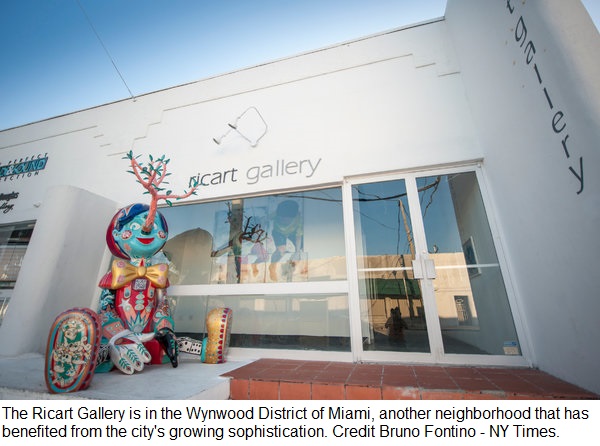
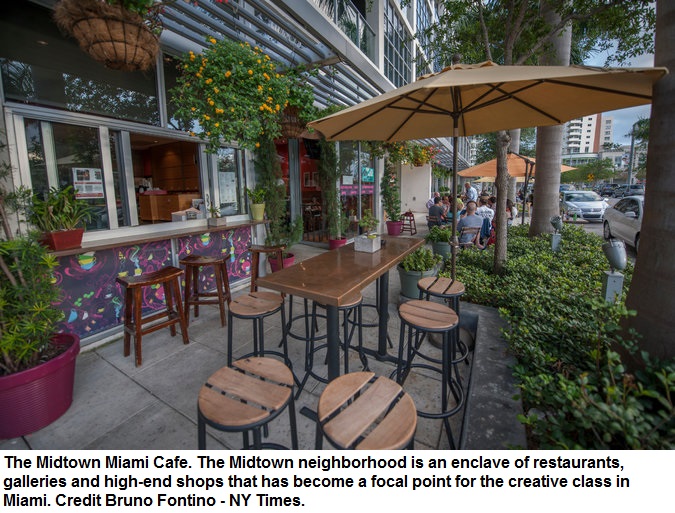
There was another kind of “more” as well — more spillovers, touch points and art for all manner of South Floridians, from entrepreneurs to pre-teen fashion designers, stretching from Pinecrest to Coconut Grove, Overtown to Fort Lauderdale.

If the aim is “to make art general,” as Knight Foundation President Alberto Ibargüen told attendees Monday at the foundation’s annual announcement of Knight Art Challenge awards, this year’s art week put South Florida well on its way. Proclaimed National Endowment for the Arts chairman Jane Chu on a whiplash art tour to downtown, Miami Beach and Opa-locka, “Art is entwined in Miami’s DNA.”

Even as the Pérez Art Museum Miami celebrated its first year anniversary, a new permanent museum building for the Institute for Contemporary Art Miami was announced for the Design District.

Overtown [historical Black neighborhood] hosted its first Art Africa fair of works created by artists from the African Diaspora. Joining it on the list of first-year events are an impressive exhibition of monumental works in the vast Mana-Miami Wynwood space on NW 23rd Street and Pinta, a fair focusing on Latin American art that moved from New York to Midtown.

The festivities reach far, far beyond the traditional art crowd. On the Mana campus, the Savannah College of Art and Design is presenting “i feel ya,” an exhibition that includes jumpsuits designed by André 3000 for Outkast’s reunion tour. The nearby ArtHaus tent is surrounded by food trucks and a sound program where Beethoven is definitely not on the playlist.

This year, more than a half-dozen student exhibits are on the art agenda. At FusionMIA, student photographs hang near works by masters Rashid Johnson and Al Loving; all were curated by Miami’s N’Namdi Contemporary gallery. A few blocks north, at Wynwood’s House of Art, a dozen students ages 5 to 15 from the DesignLab program showed off their creations at a Friday night “vernissage.”

Among them was 13-year-old Yael Bloom, wearing a flounced party dress she made from shrink wrap. No matter that the first-time event was a little-known spinoff. “Art Basel is pretty hard for adults to get into,” Bloom said. “For kids to get into it is very cool.”

As in years past, free events abound, from performances by Chinese artist Shen Wei at Miami-Dade College and artist Theo Jansen’s Strandbeest demonstrations on the sand to official Art Basel events, including films on the New World Center Wallcast and the Art Public sculptures in Collins Park. New is free Art Week shuttle service between Midtown and Miami Beach — a government cooperative effort — that dovetails with trolley service to art venues on both sides of Biscayne Bay.

In institutional quarters, Art Basel Miami Beach global sponsor UBS announced the creation of a $5 million loan fund for existing Florida small business owners. Sponsor BMW USA announced it would fund an “art journey” open to emerging artists exhibiting at Art Basel Miami Beach. And the City of Miami Beach and Miami-Dade County put out a call to artists, encouraging them to propose projects for the $4.33 million public art program associated with the Miami Beach Convention Center renovation. South Floridians are eligible to apply for all three initiatives.

Clearly, art week isn’t just about aesthetics, personal enrichment and community building. It is also about enterprise — which explains all those luxury CEOs, the ground-breaking of the Zaha Hadid-designed One Thousand Museum, and the announcement at Miami Ironside that designer Ron Arad will create the interiors for the revamped Watergate Hotel in Washington. (And no, there’s no real connection to Miami.)

Said Michael Spring, Miami-Dade’s cultural affairs director, “There’s a certain deepening, a realization not just that the Art Basel event but arts in general have a phenomenal effect on the image and economy of our entire region. We’ve talked about it before, but there seems to be more focus this year. It’s not an interesting footnote anymore; it’s the theme.”

That, says Miami Commissioner Keon Hardemon, was the thinking behind the city’s $50,000 grant supporting the Art Africa fair. “We need to encourage people to come now to Overtown. The cultural aspect helps them realize they can safely come here now. And then maybe they’ll come back later and spend money in the community, in our restaurants and stores,” he said.

In Miami, with commerce inevitably comes glamor, which is proving as glossy as ever. Hennessey V.S.O.P., Dom Perignon, Paper Magazine, Interview and B.E.T. have staged events all around town, at private “locations,” hotels, restaurants, the 1111 Lincoln Road garage and the ICA temporary space in the Moore Building. Developer Alan Faena threw a breezy beachside asado. Jeffrey Deitch, Tommy Hilfiger and V Magazine hosted a glitzy bash at the Raleigh featuring a performance by Miley Cyrus.

In the Design District, developer Craig Robins hosted a dinner honoring architect Peter Marino at a single, 142-yard candlelit table for 380 guests on a closed-off street amid the district’s luxury brand storefronts. Sculptor Jaume Plensa was the guest of honor at another long candlelit table — this one for 60 — in the Coconut Grove sales offices of Park Grove, which recently installed a series of his works along South Bayshore Drive.

Alas, once again, manners were not de rigueur among the glossy set. At some parties, guests of guests turned up with entirely uninvited guests. For other tony soirees, publicists emailed out “disinvitations” to previously invited guests, obliquely sending the message that someone more glamorous would be taking those seats.

Decorous or not, during art week, the energy all emanates from the week’s namesake fair, said Dennis Scholl, VP/Arts at the Knight Foundation. “The most important thing to remember is why this week exists, and that’s Art Basel in the Convention Center. If that wasn’t the core of what’s going on — if it weren’t a world-class event — nobody else would be interested in being involved. It continues to be the raison d’être of this week.”

In the Convention Center, at what Scholl called “the core of the nuclear reactor,” many gallerists were quite happy, thank you very much.

Veteran Art Basel Miami Beach gallerist Sean Kelly said Wednesday was his best first day ever at the fair. Newcomer Michael Jon Gallery also sold almost all of its available work — by rising stars like Sayre Gomez and JPW3 — on the first day.

For most dealers, sales remained lively, day after day. At Galerie Gmurzynska, co-CEO Mathias Rastorfer proclaimed it “successful indeed … . In terms of reception, it was an overwhelmingly enthusiastic response from collectors and colleagues alike. In terms of sales, we did several over $1 million sales and many within the $100,000 to $500,000 range, with a Picasso’s Venus and Love selling at near the asking price of $1.2 million.

Said Art Basel Director Marc Spiegler on Saturday, “I’ve gotten nothing but positive response from galleries,” not only because of strong sales, but also because new hours for VIPs gave gallerists more time to meet new collectors. “A lot of people were here and buying for the first time. Many galleries said they had their best fair ever.”

But like this week’s weather, the upbeat atmosphere suffered from uncharacteristic clouds. In Wynwood, a police car hit and critically injured a street artist. An $87,000 silver plate crafted by Pablo Picasso was reported stolen from the Art Miami satellite fair in Midtown. A partygoer at PAMM’s first anniversary fête on Thursday accidentally damaged an artwork installed on the floor. And Friday night, would-be art goers were stymied by traffic shutdowns into art-centric areas of Wynwood, Midtown and Miami Beach by protests against nationwide police-involved killings.

Though unfortunate and sometimes tragic, Spring said, the unrelated events were “a product of the incredible level of activity.” At Saturday’s annual brunch at the art-rich Sagamore Hotel in Miami Beach, the theft and damaged artwork uniformly were brushed off as inconsequential. Said one art insider, “s–t happens.”

Miami Art Week’s merry-go-round nature is surely born from Miami’s appreciation of a good time. And increasingly, perhaps from something deeper.

Said Miami gallerist Jumaane N’Namdi, “Art Basel has put art on everyone’s mind. Everyone wants to be involved somehow.”

And that’s not just about the parties, said N’Namdi, who had galleries in Chicago, New York and Detroit before opening in Miami. “I don’t think you could find a city that enjoys really looking at the art the way this city does. I came through the airport, and even the TSA guys were talking about it, asking each other if they got their Art Basel posters. Every level of art you want is here.”

Outsiders agree. “Miami is very special for its link between art and the community,” said Axelle de Buffévent, style director at champagne house Martell Mumm Perrier-Jouët. “It goes both ways. The community rallies around art creating a unique energy. And art dynamises the community, in a very unique way.”
Miami Herald – Daily Newspaper – (Posted December 6, 2014) –
http://www.miamiherald.com/entertainment/visual-arts/art-basel/article4313255.html

VIDEO: Art Basel Miami Beach 2014 – http://youtu.be/StkzLiBtDis

Published on Dec 4, 2014
The international art fair Art Basel returns to Miami Beach for its 13th edition, taking place at the Miami Beach Convention Center from December 4 to December 7, 2014. Art Basel  Miami Beach 2014 features 267 leading international galleries from 31 countries across North and South America, Europe, Asia and Africa, which present artworks ranging from Modern masters to the latest contemporary art pieces. With this edition, the fair debuts Survey, a new sector dedicated to art-historical projects. In this video, we attend the Private View of Art Basel Miami Beach 2014 at the Miami Beach Convention Center on December 3.

This story aligns with the book Go Lean…Caribbean in stressing the economic impact of artistic endeavors. The book pledges that Caribbean society will be elevated by improving the eco-system to live, work and play; and that “play” covers vast areas of culture.

“Culture” has emerged as a central concept in anthropology, encompassing the range of human phenomena that cannot be directly attributed to genetic inheritance. Specifically, the term “culture” in North American anthropology has two meanings:

  1. the evolved human capacity to classify and represent experiences with symbols, and to act imaginatively and creatively; and
  2. the distinct ways that people, who live differently, classified and represented their experiences, and acted creatively.[2]

Anthropologist Adamson Hoebel best describes culture as an integrated system of learned behavior patterns which are characteristic of the members of a society and which are not a result of biological inheritance.[3]

The Go Lean book stresses economic benefits from classic cultural expressions and popular cultural productions, including Caribbean music, paintings/art, sketches, sculptures, books, fashion and food. All the “skilled phenomena” that makes Caribbean life unique and appealing.

The book Go Lean…Caribbean serves as a roadmap for the introduction and implementation of the technocratic Caribbean Union Trade Federation (CU). There is a lot involved in this vision; the prime directives are stated as follows:

  • Optimization of the economic engines in order to grow the regional economy to $800 Billion & create 2.2 million new jobs.
  • Establishment of a security apparatus to protect the resultant economic engines.
  • Improve Caribbean governance to support these engines.

CU Blog - Art Basel Miami - a Testament to the Spread of Culture - Photo 2The foregoing article relates the economic impact that the Greater Miami area is enjoying for hosting the Art Basel event, for the 13th year now. At this point the benefits have spread throughout the community, (Art Fairs, museums, scholarships, foundations, etc.) not just one venue on Miami Beach. The spin-off benefit of art is a strong point of the Go Lean book, highlighting benefits as long as we keep the talent at home working in/for the community. This point is pronounced early in the following statements in the book’s opening Declaration of Interdependence (Page 14):

xxi. Whereas the preparation of our labor force can foster opportunities and dictate economic progress for current and future generations, the Federation must ensure that educational and job training opportunities are fully optimized for all residents of all member-states, with no partiality towards any gender or ethnic group. The Federation must recognize and facilitate excellence in many different fields of endeavor, including sciences, languages, arts, music and sports. This responsibility should be executed without incurring the risks of further human flight, as has been the past history.

xxxii. Whereas the cultural arts and music of the region are germane to the quality of Caribbean life, and the international appreciation of Caribbean life, the Federation must implement the support systems to teach, encourage, incentivize, monetize and promote the related industries for arts and music in domestic and foreign markets. These endeavors will make the Caribbean a better place to live, work and play.

The economic, cultural and image considerations for “show business” on a society have been well-detailed in these previous Go Lean blogs:

Caribbean Role Model – Oscar De La Renta – RIP
How ‘The Lion King’ roared into history
Forging Change – The Fun Theory
Role Model Berry Gordy – No Town Like Motown
Book Review: ‘Chasing Youth Culture and Getting It Right’
The Music, Art, Culture and Legend of Bob Marley lives on!

The Go Lean roadmap posits that change will come to the Caribbean “show business” (Visual and Performing Arts, Music, Film). This is due mostly to the convergence of a Single Market for the Caribbean region. If “size matters”, then the integration of 42 million people (plus the 10 million Diaspora and 80 million visitors) for the 30 member-states will create the consumer markets to promote and foster Caribbean artistic creations for their full appreciation. The first requirement in this goal is the community ethos of valuing intellectual property; to recognize that other people’s creations are valuable. (Then we can enforce on others to value and appreciate our creations).

This would truly be new for the Caribbean.

The CU is designed to do the heavy-lifting of organizing Caribbean society for the new world of art appreciation and “consumerization”. The following list details the ethos, strategies, tactics, implementations and advocacies to foster regional artists and showcase their wares to the world stage:

Community Ethos – Forging Change Page 20
Community Ethos – Lean Operations Page 24
Community Ethos – Return on Investments Page 24
Community Ethos – Ways to Foster Genius Page 27
Community Ethos – Help Entrepreneurship Page 28
Community Ethos – Promote Intellectual Property Page 29
Strategy – Caribbean Vision: Single Market Page 45
Separation of Powers – Central Bank – Electronic Payment Deployments Page 73
Tactical – Separation of Powers – Patents – Copyrights Page 78
Separation of Powers – Culture Administration Page 81
Planning – Ways to Make the Caribbean Better Page 131
Planning  – Lessons Learned from   New York City Page 137
Advocacy – Ways to Grow the Economy Page 151
Advocacy – Ways to Create Jobs Page 152
Advocacy – Education – Performing Arts Schools Page 159
Advocacy – Ways to Impact Hollywood Page 203
Advocacy – Ways to Improve the Arts Page 230
Advocacy – Ways to Promote Music Page 231
Advocacy – Impact Urban Living – Art & Theaters Page 234
Appendix – New York / Arts / Theater Jobs Page 277
Appendix – Taos New Mexico Art Colony Page 291
Appendix – Caribbean Music Genres Page 347
Appendix – Protecting Music Copyrights Page 351

There is BIG money in show business and in the world of the Arts. For the 10th edition of Art Basel in Miami in 2011, there was a record number of fifty thousand collectors, artists, dealers, curators, critics and art enthusiasts – including 150 museum and institutions from across the globe – participating in the show.[4]

This event requires a lot of community investments. Every year, Miami’s leading private collections – among them the Rubell Family Collection, Cisneros Fontanals Art Foundation, the De la Cruz Collection Contemporary Art Space, World Class Boxing, the Margulies Collection and the Dacra Collection – open their homes and warehouses to guests of Art Basel. Additionally, the museums of South Florida organize exhibitions including shows at the Miami Art Museum, Bass Museum of Art, Norton Museum, Wolfsonian-FIU and MOCA North Miami.

The community investment has been there for Miami, and so has the returns [5].For 2014, the attendance figures were 75,000, with an increase in hotel occupancy of 30,000 rooms on the days the Art Fair is in progress. The conservative estimates are that the Art Fair brings close to $13 million a year in economic impact to the region. (This figure does not include the purchases of artworks, some of which fetch millions of dollars).

The subject of the Miami Metropolitan area is very relevant for a Caribbean empowerment discussion. A previous blog asserted that Miami’s success, in many regards, is attributable to Caribbean’s failures. Many of our populations (including artists) have fled their homelands and have taken refuge in the Miami area. Where at first this disposition was begrudged, eventually it transformed to tolerance, but now it is even celebrated.

CU Blog - Art Basel Miami - a Testament to the Spread of Culture - Photo 3

Miami has been greatly impacted by both the Caribbean Diaspora and its assimilation of the “Arts”. Whole neighborhoods have been elevated due to this strategy of catering to the arts; (see photo here). This is a great role model for the Caribbean to emulate; our whole society can be elevated.

The Go Lean/CU roadmap represents the empowerment for the Caribbean communities to elevate – we now want to keep our artists at home. The people, institutions and governance of the region are therefore urged to “lean-in” to this roadmap for change. 🙂

Download the book Go Lean … Caribbean – now!

——-

Appendix – Source References:

1. STEM = Science, Technology, Engineering and Mathematics.

2. “What is culture?”. Bodylanguagecards.com. Retreived 2013-03-29.

3. Hoebel, Adamson (1966). Anthropology: Study of Man. McGraw-Hill.

4. http://www.nytimes.com/2011/12/03/arts/design/art-basel-miami-beach-review.html?_r=1&pagewanted=all

5. http://www.nytimes.com/2014/12/04/arts/international/art-fair-energizes-economy-of-region.html?_r=0


Share this post:
, , , , ,
[Top]

Role Model Shaking Up the World of Cancer

Go Lean Commentary:

The book Go Lean…Caribbean relates the statement that “if 1-in-3 Americans are at risk for cancer, Caribbean citizens cannot be far behind”. (Page 157). Though well qualified, this statement does not need to be verified; everyone knows people that have battled or is battling cancer; (more frequently that we would care to admit). The disease often wins.

The book does not posit to be a roadmap for curing cancer, but rather a roadmap for elevating Caribbean society by optimizing the economic, security and governing engines in the region. Yet, within this roadmap is the strategy to incentivize cancer research and facilitate treatment centers and workable solutions. In fact this roadmap invites role models like medical researcher, bio-technology entrepreneur and billionaire Dr. Patrick Soon-Shiong, featured here in the following VIDEO and article:

VIDEO Title: Disrupting Cancer
Sub-Title: Billionaire Dr. Patrick Soon-Shiong is turning heads with unconventional ways of treating the deadly disease

CBS News Magazine 60 MinutesPosted 12-07-2014 –
http://www.cbsnews.com/videos/disrupting-cancer

In this week’s 60 Minutes story, CNN’s Dr. Sanjay Gupta — on assignment for 60 Minutes — profiles Dr. Patrick Soon-Shiong, who has invested nearly a billion dollars of his own money to help find a better way to treat cancer. (VIDEO).


———————————–

Article Title: The Billionaire shaking up the world of cancer
Sub-title: Patrick Soon-Shiong: An owner of the L.A. Lakers, friend of Kobe Bryant, and a doctor who’s shaking up the world of cancer

CU Blog - Disrupting Cancer - Photo 1

60 Minutes producer Draggan Mihailovich tells 60 Minutes Overtime that the most challenging aspect of this profile was to give viewers a sense of what goes on in Dr. Pat’s brain.

The following is a script of the video produced for 60 Minutes Overtime by Magalie Laguerre-Wilkinson and Lisa Orlando.

[Dr. Patrick Soon-Shiong: We now have patients with pancreatic cancer that are free of metatheses for five years. How many people know of that?]

That’s Dr. Patrick Soon-Shiong. This week on 60 Minutes Dr. Sanjay Gupta profiles the renowned doctor and entrepreneur who is shaking up the cancer world with a revolutionary approach to treatment. Dr. Soon-Shiong, also known as Dr. Pat, is not just the wealthiest man in Los Angeles; he’s a partial owner of the Lakers. And a familiar face [at court-side and] in the team’s training room.

Draggan Mihailovich: You’re talking about a city that thrives on celebrity and status.

Magalie Laguerre-Wilkinson: He’s neither.

Draggan Mihailovich: He’s neither. You know, most people have no idea. They think it’s somebody involved in the entertainment industry. Or, you know, a movie producer or, you know, even an actor. And it’s Dr. Patrick Soon-Shiong.
Sanjay Gupta: I think Dr. Soon-Shiong is one of these guys who is probably used to having been the smartest guy in the room probably from a very young age.

One of the biggest challenges for Gupta and Mihailovich was how to give viewers a sense of what goes on in the mind of a medical genius.

They began by asking him about his ground-breaking cancer drug Abraxane.

Draggan Mihailovich: There was a white board there. He takes a marker and he starts, you know, as you saw at the beginning of the piece, and off he went. And this goes on for 45 minutes. I mean, it was as if your kid took, like, a bowl of spaghetti and threw it up against a white wall.

Sanjay Gupta: It was this idea that cancer patients lose weight. But why do they lose weight? Even if they eat the same number of calories or even double the calories that they used to eat, they could still be losing weight. Why? What Dr. Patrick Soon-Shiong was sort of thinking about was it’s the protein in the blood that is just sucked up by these cancers. So if the cancers love proteins so much, here’s an idea. Let’s stick the chemotherapy in the protein, and the protein’s now a Trojan horse around the chemo. So the cancer is happy. It’s being fed. It’s getting all this protein. Boom. Chemo goes off on the tumor. And all of a sudden, you got a very, very effective, potentially, therapy.

[Dr. Patrick Soon-Shiong: We have it approved in breast cancer, we have it approved in lung cancer and were talking about patients in pancreatic cancer, and melanoma.]

Sanjay Gupta: That’s Dr. Patrick’s mind.

Dr. Soon-Shiong believes that the conventional approach to classifying cancer according to its location in the body is short-sighted. He says it’s the mutation of the gene, what made it go haywire, that matters.

[Dr. Patrick Soon-Shiong: We need to reclassify cancers now to its molecular fingerprints.]

Magalie Laguerre-Wilkinson: He’s not just thinking out of the box. I mean, he’s creating a revolution.

Sanjay Gupta: He’s absolutely creating a revolution, and it involves so many different facets that are not just medicine. Quick example, when you’re talking about sequencing genomes of many, many patients — around the United States and around the world, that is a lot of data, you’re talking about 6 billion pieces of information for each patient. Right now, we move things through the Information Superhighway at about megabytes per second. He’s talking about wanting to do that in petabytes per second.

Magalie Laguerre-Wilkinson: Never heard of that.

Sanjay Gupta: You got megabytes. 1,000 megabytes is a gigabyte. 1,000 gigabytes is a terabyte. 1,000 terabytes is a petabyte. So you’re talking, you know, exponentially, more data per second. And he’s basically figured out ways and funded ways to make that happen. That’s part of what a revolution looks like.

[Dr. Patrick Soon-Shiong: Here we have the world’s fastest video camera, what we’ve done is to take the power of optics or the sun and created a rainbow from laser light.]

Draggan Mihailovich: He’s involved in the technology. He’s involved in immunotherapy.

[Sanjay Gupta: So you’re literally watching cancer cells die here?]

[Dr. Patrick Soon-Shiong: Correct.]

Draggan Mihailovich: He’s involved in circulating tumor cells. You know, he’s involved in metastatic cancers. He’s still involved in some respect with his original drug, Abraxane, and how that’s used in combination therapies. And the brain is always working with Patrick.

[Sanjay Gupta: Is there anything like this right now? I mean, is anyone doing this sort of.]

[Dr. Patrick Soon-Shiong: No, it’s in our lab. This is what you call the clinical translation world where 21st century exists today.]

Magalie Laguerre-Wilkinson: He comes across as incredibly confident and, if one has cancer, is he the only game in town?

Sanjay Gupta: I don’t think Doctor Pat is the only game in town, by any means. I think he’s someone who’s looking at trying to disrupt the whole system. I think there are a lot of great oncologists out there, and frankly, there are a lot of oncologists who not only believe what he’s doing is the right thing to do, but they’re doing it themselves. They’re doing it; it’s just its smaller scales. Patrick’s, sort of, belief is, “Look, I already think that this is what’s going to work.”

Magalie Laguerre-Wilkinson: He’s screaming it from the rooftops.

Sanjay Gupta: Screaming it from the rooftops, spending his own money.

[Dr. Patrick Soon-Shiong: Well, I haven’t really counted, but it’s close to a billion dollars.]

[Sanjay Gupta: A billion dollars?]

[Dr. Patrick Soon-Shiong: Billion dollars.]

[Sanjay Gupta: Where’s the government in all of this?]

[Dr. Patrick Soon-Shiong: Trust me, we tried. You know, since 2008, 2009, 2010, 2011, I was in Washington, I was at the White House, I was at Congress, I was everywhere. We have not received one penny of funding.]

Magalie Laguerre-Wilkinson: Is he an easily accessible physician?

Sanjay Gupta: There were times when I’d be riding along with him, his phone would ring and, it would be somebody who had been, sort of, referred to him by somebody, you know, one of those situations. And he’d be on the phone with them for 15-20 minutes. “Here’s what I think you need to do.”

Magalie Laguerre-Wilkinson: For the hundreds of thousands of people on chemotherapy, Dr. Soon-Shiong is not saying, “Stop what you’re doing.” But he’s pretty much on the edge of that.

Draggan Mihailovich: What he’s saying is, “Ask questions.” You know, is this the right thing to do. Because more and more what scientists and oncologists will tell you is that perhaps in some cancers, and I’m gonna qualify this. In some cancers, a heavy blast of chemotherapy may not necessarily be, you know, the long-term answer.
Source: http://www.cbsnews.com/news/the-billionaire-shaking-up-the-world-of-cancer/

The Go Lean book serves as a roadmap for the implementation and introduction of the technocratic Caribbean Union Trade Federation (CU). The CU‘s prime directives are identified with the following 3 statements:

  • Optimization of the economic engines in order to grow the regional economy to $800 Billion & create 2.2 million new jobs.
  • Establishment of a security apparatus to protect the resultant economic engines.
  • Improve Caribbean governance to support these engines.

The Go Lean book asserts that one person can make a difference and maybe even change the world. The innovations and passions of Dr. Patrick Soon-Shiong may very well fit this advocacy. He is a role model for Caribbean innovators and scientists. We invite him; and others of his ilk, to impact the world from a Caribbean domicile. How?

One feature of the Go Lean roadmap is the adoption of Self-Governing Entities (SGE). These dedicated, bordered grounds are ideal for medical research and treatment campuses for resources like Dr. Soon-Shiong. We hereby extend the invitation to him … and all like-minded individuals looking for cooperative and supportive governing structures to facilitate their impact on the world.

The Go Lean book strategizes a roadmap for economic empowerment in the region, clearly relating that healthcare, and pharmaceuticals/cancer drugs research are important in the quest to make the Caribbean a better place to live, work, heal and play. At the outset of the Go Lean book, in the Declaration of Interdependence (Pages 11 & 14), these points are pronounced:

 ix.  Whereas the realities of healthcare and an aging population cannot be ignored and cannot be afforded without some advanced mitigation, the Federation must arrange for health plans to consolidate premiums of both healthy and sickly people across the wider base of the entire Caribbean population. The mitigation should extend further to disease management, wellness, obesity and smoking cessation programs.

xxvii.  Whereas the region has endured a spectator status during the Industrial Revolution, we cannot stand on the sidelines of this new economy, the Information Revolution. Rather, the Federation must embrace all the tenets of Internet Communications Technology (ICT) to serve as an equalizing element in competition with the rest of the world. The Federation must bridge the digital divide and promote the community ethos that research/development is valuable and must be promoted and incentivized for adoption.

xxviii.  Whereas intellectual property can easily traverse national borders, the rights and privileges of intellectual property must be respected at home and abroad. The Federation must install protections to ensure that no abuse of these rights go with impunity, and to ensure that foreign authorities enforce the rights of the intellectual property registered in our region.

Previous blog/commentaries addressed issues of cancer and other medical research and practices, sampled here:

The Cost of Cancer Drugs
Antibiotics Misuse Linked to Obesity in the US
CHOP Research: Climate Change May Bring More Kidney Stones
Welcoming Innovators and Entrepreneurs under an SGE Structure
Big Pharma & Criminalization of American Business
Medical Research Associates Kidney Stones and Climate Change – Innovative!
New Research and New Hope in the Fight against Alzheimer’s Disease
Research in Diabetes Detection – Novartis and Google develop ‘smart’ contact lens
Health-care fraud in America; criminals take $272 billion a year
New Cuban Cancer medication registered in 28 countries
Puerto Rico’s Comprehensive Cancer Center Project Breaks Ground – Model of Medical SGE

Cancer is a crisis, and a “crisis would be a terrible thing to waste”.

This premise is loud-and-clear from the foregoing VIDEO. Dr. Soon-Shiong is already a billionaire from his development (and returns) of other cancer drugs (like Abraxane). This demonstrates that there is money to be made in this industry-space. Most importantly, however, there are lives to be saved.

The foregoing news article and VIDEO provides an inside glimpse into the cancer research discipline. Obviously, the innovators and developers of drugs have the right to glean the economic returns of their research. The Go Lean roadmap posits that more innovations will emerge in the region as a direct result of the CU prioritization on science, technology, engineering and medical (STEM) activities on Caribbean R&D campuses and educational institutions. This is based on the assumption that intellectual properties (IP) registered in the Caribbean region will be duly respected around the world.

This IP protection mandate, on behalf of all 30 member-states, is a heavy-lifting task for the Caribbean Union Trade Federation. (Cuban cancer drugs do enjoy this recognition at this time, despite the country’s irrelevance in American commerce).

This is an issue of economic, security and governance.

The CU has the prime directive of optimizing the economic, security and governing engines of the Caribbean region. The foregoing article and VIDEO depicts that research is very important to new medical innovations and break-throughs. This is the manifestation and benefits of Research & Development (R&D). The roadmap describes this focus as a community ethos and promotes R&D as valuable for the region. The following list details additional ethos, strategies, tactics, implementations and advocacies to optimize the region’s health deliveries and R&D investments:

Community Ethos – Deferred Gratification Page 21
Community Ethos – Economic Systems Influence Individual Choices and Incentives Page 21
Community Ethos – The Consequences of Choices Lie in the Future Page 21
Community Ethos – Governing Principles – Return on Investments Page 24
Community Ethos – Governing Principles – Cooperatives Page 25
Community Ethos – Non-Government Organizations Page 25
Community Ethos – Ways to Impact the Future Page 26
Community Ethos – Ways to Foster Genius Page 27
Community Ethos – Ways to Help Entrepreneurship Page 28
Community Ethos – Ways to Promote Intellectual Property Page 29
Community Ethos – Ways to Impact Research & Development (R&D) Page 30
Community Ethos – Ways to Promote Happiness Page 36
Community Ethos – Ways to Impact the Greater Good Page 37
Strategy – Integrate and unify region in a Single Market Page 45
Strategy – Agents of Change – Globalization Page 57
Tactical – Fostering a Technocracy Page 64
Tactical – Separation of Powers – Health Department Page 86
Tactical – Separation of Powers – Drug Administration Page 87
Implementation – Ways to Pay for Change Page 101
Implementation – Ways to Implement Self-Government Entities – R&D Campuses Page 105
Implementation – Ways to Deliver Page 109
Planning – Ways to Improve Trade Page 128
Planning – Ways to Make the Caribbean Better Page 131
Advocacy – Ways to Improve Healthcare Page 156
Advocacy – Ways to Impact Cancer Page 157
Advocacy – Ways to Better Manage the Social Contract Page 170
Advocacy – Ways Foster Cooperatives Page 176
Advocacy – Ways to Improve Emergency Management – Trauma Medicine Page 196
Advocacy – Ways to Impact Foundations Page 219
Advocacy – Ways to Impact Persons with Disabilities Page 228
Appendix – Emergency Management – Medical Trauma Centers Page 336

The Go Lean roadmap does not purport to be an authority on medical or cancer research best practices. The economic-security-governance empowerment plan should not direct the course of direction for cancer research and/or treatment. But the war on cancer has been stagnant for far too long; yet more can be done. As depicted in the foregoing article, the solutions are not coming from the governments, so the needed innovation must be incentivized from private enterprises. The SGE structure invites innovations like that of Dr. Soon-Shiong and many others with his passion…and genius.

Now is the time for all of the Caribbean, the people and governing institutions, to lean-in for the empowerments in the book Go Lean … Caribbean. This is a Big Idea for the region, that of Self-Government Entities (Page 127), in which R&D and Genius can take hold, and thrive. We can make the Caribbean a better place to live, work, heal and play. 🙂

Download the book Go Lean … Caribbean – now!

Share this post:
, , , , ,
[Top]

Sports Role Model – espnW.

Go Lean Commentary

Introducing a network without the “network”. This is espnW, the ESPN (see Appendix below) channel, without a channel, specifically catering to women’s sports; this network is delivered via the internet only. CU Blog - Sports Role Model - ESPN-W - Photo 3

Wow, how the world has changed.

So this commentary is a melding of ICT (Internet & Communications Technology), sports, television, gender equality and economics – this is a big deal for the Caribbean to consider.

espnW…

CU Blog - Sports Role Model - ESPN-W - Photo 2
espnW’s mission is to serve women as fans and athletes. espnW.com provides an engaging environment that offers total access to female athletes and the sports they play, takes fans inside the biggest events, and shares a unique point of view on the sports stories that matter most to women.

Founded in July, 2010, espnW lives across television, films, events, digital and social platforms. The annual espnW: Women + Sports Summit is the leading event of its kind in the sports industry. The Women’s Sports Foundation is a charity of choice for espnW.
ESPN W. – About Us Page – Official Website (Retrieved December 7, 2014) – http://espn.go.com/espnw/v1/about

VIDEO: espnW at the 2012 Olympic Games – http://youtu.be/z7vGVQAatig
Published on Aug 14, 2012
Alex Morgan sits down with Julie Foudy to talk about what it feels like to have her first Olympic gold

CU Blog - Sports Role Model - About ESPN-W - Photo 5

CU Blog - Sports Role Model - About ESPN-W - Photo 4

CU Blog - Sports Role Model - About ESPN-W - Photo 3

CU Blog - Sports Role Model - About ESPN-W - Photo 1

CU Blog - Sports Role Model - About ESPN-W - Photo 2

The Caribbean does not currently have an eco-system for sports business … for men nor women. There is no viable sporting enterprises, other than baseball development/winter leagues in Puerto Rico, Dominican Republic and Communist Cuba. There is absolutely no intercollegiate athletics arrangements. Only Amateur athletics abound in the region.

While so much of the sports business infrastructure is missing, the Caribbean is awash in the underlying assets: the athletes. The Caribbean supplies the world with the best-of-the-best in the sports genres of baseball, basketball, track-and-field, soccer-FIFA-football and other endeavors. This athletic supply applies equally to men and women.

The book Go Lean…Caribbean book serves as a roadmap for the introduction and implementation of the Caribbean Union Trade Federation (CU), a technocratic federal government to administer and optimize the economic/security/governing engines of the region’s 30 member-states. The roadmap recognizes and fosters the genius qualifiers of many Caribbean men and women. The goal now is to foster the local eco-system in the homeland so that  those with talent would not have to flee the region to garner the business returns on their athletic investments.

This Go Lean economic empowerment roadmap strategizes to create a Single Media Market to leverage the value of broadcast rights for the entire region, utilizing all the advantages of cutting edge ICT offerings. The result: an audience of 42 million residents (plus 10 million Diaspora) across 30 member-states and 4 languages. ESPN and espnW provides a great role model for this execution, see Appendix below, facilitating television, cable, satellite and internet streaming wherever economically viable.

At the outset, the roadmap recognizes the value of sports, for all genders, in the roadmap with these statements in the Declaration of Interdependence (Page 13 & 14):

xxvi.      Whereas the preparation of our labor force can foster opportunities and dictate economic progress for current and future generations, the Federation must ensure that educational and job training opportunities are fully optimized for all residents of all member-states, with no partiality towards any gender or ethnic group. The Federation must recognize and facilitate excellence in many different fields of endeavor, including sciences, languages, arts, music and sports. This responsibility should be executed without incurring the risks of further human flight, as has been the past history.

xxvii.      Whereas the region has endured a spectator status during the Industrial Revolution, we cannot stand on the sidelines of this new economy, the Information Revolution. Rather, the Federation must embrace all the tenets of Internet Communications Technology (ICT) to serve as an equalizing element in competition with the rest of the world. The Federation must bridge the digital divide and promote the community ethos that research/development is valuable and must be promoted and incentivized for adoption.

xxviii.      Whereas intellectual property can easily traverse national borders, the rights and privileges of intellectual property must be respected at home and abroad. The Federation must install protections to ensure that no abuse of these rights go with impunity, and to ensure that foreign authorities enforce the rights of the intellectual property registered in our region.

xxxi.      Whereas sports have been a source of great pride for the Caribbean region, the economic returns from these ventures have not been evenly distributed as in other societies. The Federation must therefore facilitate the eco-systems and vertical industries of sports as a business, recreation, national pastime and even sports tourism – modeling the Olympics.

The Go Lean roadmap calls for the market organizations and community investments to garner economic benefits of sports and talented athletes, men and women. One of the biggest contribution the CU will make is the facilitation of sports venues: arenas and stadia. Sports can be big business (and great educational opportunities) for the athletes, promoters, vendors and landlords. Still, even fans get great benefits: image, national pride, and entertainment. (The E in ESPN means Entertainment). The eco-system of sports is therefore inclusive in the roadmap’s quest to make the Caribbean region a better place to live, work and play.

Now is the time for all of the Caribbean to lean-in to the following community ethos, strategies, tactics, implementations and advocacies detailed in the book Go Lean…Caribbean to deliver the solutions to elevate the Caribbean region through sports:

Community Ethos – People Respond to Incentives in Predictable Ways Page 21
Community Ethos – Return on Investments Page 24
Community Ethos – Ways to Foster Genius Page 27
Community Ethos – Promote Intellectual Property Page 29
Community Ethos – Ways to Promote Happiness Page 36
Community Ethos – Ways to Impact the Greater Good Page 37
Strategic – Vision – Consolidating the Region in to a Single Market Page 45
Strategic – Staffing – Sporting Events at Fairgrounds Page 55
Tactical – Fostering a Technocracy Page 64
Tactical – Separation of Powers – Sports & Culture Administration Page 81
Tactical – Separation of Powers – Fairgrounds Administration Page 83
Implementation – Steps to Implement Self-Governing Entities (Fairgrounds) Page 105
Implementation – Ways to Deliver Page 109
Planning – 10 Big Ideas – #5 Four Languages in Unison / #8 Cyber Caribbean Page 127
Planning – Ways to Make the Caribbean Better Page 131
Advocacy – Ways to Grow the Economy Page 151
Advocacy – Ways to Create Jobs Page 152
Advocacy – Ways to Improve Education – Reduce Brain Drain Page 159
Advocacy – Ways to Improve Local Government – Parks & Recreation Page 169
Advocacy – Ways to Impact Events Page 191
Advocacy – Ways to Promote Fairgrounds Page 192
Advocacy – Ways to Foster Technology – Intellectual Property Protections Page 197
Advocacy – Ways to Empower Women Page 226
Advocacy – Ways to Impact Youth Page 227
Advocacy – Ways to Improve Sports Page 229
Advocacy – Ways to Impact Urban Living – Sports Leagues Page 234

The book Go Lean…Caribbean, and aligning blog commentaries (highlighted throughout this page in bold), asserts that the region can be a better place to live, work and play; that the economy can be grown methodically by embracing progressive strategies in sports and sports broadcasting/streaming at all levels: professional, amateur and intercollegiate.

The Go Lean…Caribbean roadmap is bigger than just sports, its a concerted effort to elevate all of Caribbean society, for all genders: men and women. The CU is the vehicle for this goal, this is detailed by the following 3 prime directives:

  • Optimization of the economic engines in order to grow the regional economy to $800 Billion & create 2.2 million new jobs (21,000 direct jobs at fairgrounds and sport venues).
  • Establishment of a security apparatus to protect the resultant economic engines.
  • Improve Caribbean governance to support these engines.

This roadmap adheres to economic principles of supply-and-demand. Similar to the foregoing website on espnW, the roadmap looks for the opportunities to foster interest that may exist in specific endeavors, in this case women’s sports, and then explore the business opportunities around servicing that demand. This is not limited to the domestic Caribbean, but rather can refer to local interest in sports abroad and foreign interest in Caribbean sports and athletes.

This is heavy-lifting. This is the quest of Go Lean/CU, to do the heavy-lifting to make the Caribbean homeland a better place to live, work and play. 🙂

Download the book Go Lean…Caribbean now!

———

AppendixEntertainment and Sports Programming Network (Source: http://en.wikipedia.org/wiki/ESPN)

ESPN is a U.S.-based global cable and satellite television channel that is owned by ESPN Inc., a joint venture between The Walt Disney Company (which operates the network, through its 80% controlling ownership interest) and Hearst Corporation (which holds the remaining 20% interest). The channel focuses on sports-related programming including live and recorded event telecasts, sports news and talk shows, and other original programming.

CU Blog - Sports Role Model - ESPN-W - Photo 1ESPN broadcasts primarily from studio facilities located in Bristol, Connecticut. The network also operates offices in Miami, New York City, Seattle, Charlotte, and Los Angeles. While ESPN is one of the most successful sports networks, it has been subject to criticism, which includes accusations of biased coverage[1] (not showing enough hockey or Women’s athletics), conflict of interest, and controversies with individual broadcasters and analysts.

As of August 2013, ESPN is available to approximately 97,736,000 pay television households (85.58% of households with at least one television set) in the United States.[2] In addition to the flagship channel and its seven related channels in the United States, ESPN broadcasts in more than 200 countries,[3] operating regional channels in Australia, Brazil, Latin America and the United Kingdom, and owning a 20% interest in The Sports Network (TSN) as well as its five sister networks and NHL Network in Canada.

Source References:

  1. Geography lesson: Breaking down the bias in ESPN’s coverage, ESPN.com, August 15, 2008.
  2. Seidman, Robert (August 23, 2013). “List of How Many Homes Each Cable Networks Is In – Cable Network Coverage Estimates As Of August 2013”. TV by the Numbers. Zap2it. Retrieved August 25, 2013.
  3. ESPN Inc Encyclopedia Britannica.
Share this post:
, , , ,
[Top]

Caribbean less competitive due to increasing aviation taxes

Go Lean Commentary

The book Go Lean … Caribbean relates the significance of supporting the airline industry so as to facilitate the region’s primary economic driver: Tourism.

Tourism is a leisure activity; many times participants in leisure are in no hurry to get to their destinations, they often drive. This relates to countries on a continental mainland; but for islands, not so much. For 27 of the 30 Caribbean member-states, island life is the reality. (Belize is in Central America; Guyana and Suriname are in South America).

If speed is not the requirement then boating should be an option. But the only boating/transport options for Caribbean tourists are cruise lines.

This following article relates the biggest threat to Caribbean tourism is Caribbean governments. These ones are authorized to assess taxes, but for far too often they have targeted airline tickets to generate needed revenues. This is such a flawed strategy, a betrayal of the public trust. They “cut off their nose to spite their face”, as the article here relates:

By: Ernie Seon, Caribbean-360 Contributor

CU Blog - Caribbean less competitive due to increasing aviation taxes - Photo 1ST. THOMAS, US Virgin Islands – The International Air Transportation Association (IATA) Tuesday urged regional aviation authorities to adhere to the key principles set out by International Civil Aviation Organization.

IATA’s regional vice president for the Americas, Peter Cerda said it is unfortunate that many governments had chosen to ignore the principles, a global issue that was particularly acute in the Caribbean.

Addressing tourism and industry officials gathered here on the occasion of World Aviation Day, Cerda noted that aviation taxes continue to increase the cost of travelling to the Caribbean. He said this made the region less competitive to other destinations.

“Taking the islands as a whole, each dollar of ticket tax could lead to over 40,000 fewer foreign passengers,” he said, adding that US$20 million of reduced tourist expenditure meant 1,200 fewer jobs across the region.

“Caribbean countries must therefore consider the aviation industry as a key element for tourism development,” he advised.

The IATA official noted that in terms of charges, two airports in the region, Montego Bay and Kingston, both in Jamaica, recently proposed airport tariff increases of over 100 per cent so as to attain a return of capital of around 20 per cent a year in US dollars.

He said that measures such as these do not encourage or support the development of the industry in the region.

“The regulators must act strongly and swiftly against such big increases. Governments have to foster positive business environments through consultation with the industry and transparency in order to ensure win-win situations for all,” he warned.

Cerda said the issue of taxes and charges in the region transcends the formal breaches of global standards and recommended practices and that the simple truth is that this region is a very expensive place for airlines to do business.

In the Caribbean, tourism and the aviation sector facilitate and support some 140,000 jobs and contribute US$3.12 billion, roughly 7.2 per cent of the Caribbean’s gross domestic product (GDP).

The airline industry is celebrating its 100th anniversary year in the black, according to industry figures released here. Globally, airlines are expected to earn a net profit of US$18 billion in 2014.

Cerda noted that while that might sound impressive, on revenues of US$746 billion, this is equivalent to a net profit margin of 2.4 per cent or US$5.42 per passenger carried.

“Looking only at Latin America and the Caribbean, the airlines in this region are expected to earn $1.1 billion.”This is a profit of US$4.21 per passenger and a net margin of three per cent. We are in a tough and very competitive business,” he added.

The aviation official said fuel expense across the Caribbean is estimated at 14 per cent higher than the world average, adding that this represents about a third of an airline’s operating costs.

He noted that in the case of the Dominican Republic, although fuel charges were recently reduced, tax on international jet fuel still remains high at 6.5 per cent.

“Another example is the Bahamas applying a seven per cent import duty on Jet fuel. Jet fuel supply is an issue in the region, the complexity of the fuel supply and the seasonal demand is costly and difficult, making fuel costs in the region a challenge for airlines.”

In addition, Cerda noted that airports are using the fuel concession fees as a source of revenue and they are still waiting to see any of these monies re-invested in improving fuel facilities.

On the issue of safety, he said that this has been in the spotlight in recent months, with July being an especially sad month for all involved with aviation.

However, Cerda said despite the recent tragedies, flying remains by far the safest mode of transportation.

“Every day, approximately 100,000 flights take to the sky and land without incident. Nonetheless, accidents do happen. Every life lost recommits us to improve on our safety performance.

“It is no secret that safety has been an issue in this region. Even though it is still under performing the global average, performance is improving,” he said.

The IATA official said that the aviation industry has come a long way since the very first flight from St. Petersburg to Tampa 100 years ago, turning this large planet into one small world.

He said through it all, one thing has remained constant: when governments support the conditions for a thriving industry the economic benefits are felt by all.

However Cerda cautioned that for the industry to deliver the most benefits to the citizens in the Caribbean and spur additional tourism and trade, “we need to be able to compete on a level playing field and have the infrastructure capacity needed to grow.”

He said he remains confident that if the Caribbean governments continue to strengthen their partnership with the aviation industry, “we will deliver the unique transformative economic growth only our industry can deliver, making the second century of aviation in this region even more beneficial than the first”.
Caribbean-360 Online News (Posted 09/17/2014; retrieved 12/06/2014) –
http://www.caribbean360.com/news/caribbean-less-competitive-due-to-increasing-aviation-taxes-iata-warns

This foregoing article highlights a defective premise, predatory taxing, and so thusly depicts the need for improved regional oversight of economic and governing engines.

CU Blog - Caribbean less competitive due to increasing aviation taxes - Photo 2See this photo of a recent airline ticket (price breakdown), for one of the stakeholders in the Go Lean movement, who was travelling from a Caribbean island. The reality of these aviation taxes defies logic!

Yes, the governments need their revenues, but this should not be pursued at the expense of undermining viable economic engines; this is self-defeating. Likewise there was a recent conflict with British Aviation Authorities and their unilateral tax on Caribbean air transport. The solution there/then is the same as now: regional coordination and a heightened advocacy; see AppendixVIDEO.

Change has now come to the Caribbean. The book Go Lean … Caribbean serves as a roadmap for the introduction and implementation of the Caribbean Union Trade Federation (CU), an alliance of the 30 Caribbean member-states. This Go Lean roadmap has 3 prime directives:

  • Optimization of the economic engines in order to grow the regional economy to $800 Billion and create 2.2 million new jobs..
  • Establishment of a security apparatus to protect the resultant economic engines.
  • Improve Caribbean governance to support these engines.

The roadmap calls for the CU to navigate the changed landscape of the globalized air transport industry. There is the need for regional integration, administration, and promotion for Caribbean air travel among local and foreign carriers. The book posits that transportation and logistics empower the economic engines of a community. There must be air carrier solutions to service the transportation and tourism needs of the Caribbean islands. This point is fully appreciated by Caribbean tourism stakeholders; the book relates that the region’s Hotel and Tourism Association channel the vision of Robert Crandall, former Chairman of American Airlines, who remarked at a Caribbean Hotel and Tourism Investment Conference in May 2010 that the region is uniquely dependent on tourism:

“Everyone involved in travel and tourism knows that our [airline] industry is immensely important to the world economy, generating and supporting – either directly or indirectly – about one in eleven jobs worldwide. Here in the Caribbean, it is even more important. On a number of islands, travel and tourism accounts for more than 50% of all employment, and on some islands for more than 75%. Overall, about 20% of Caribbean employment is travel and tourism dependent – something on the order of 2.5 million jobs.” – Go Lean … Caribbean Page 60.

Go Lean asserts that air travel options must be optimized to impact Caribbean society – thus the need for more regional coordination, regulation and promotion of the Caribbean’s aviation industry. New models are detailed in the book in which tourism can be enhanced with “air lifts” to facilitate Caribbean events, and “Air Bridges” to allow for targeting High Net Worth markets. This roadmap also introduces the Union Atlantic Turnpike to offer more transportation solutions (ferries, toll roads, railways, and pipelines) to better facilitate the efficient movement of people and cargo.

This is one way the CU will empower the region’s economic engines. This is an example of the change that the CU technocracy will bring!

The Go Lean book presents a series of community ethos that must be adapted to forge this change. In addition, there are these specific strategies, tactics, implementation and advocacies to apply:

Community Ethos – Job Multiplier Page 22
Community Ethos – Lean Operations Page 24
Community Ethos – Cooperatives Page 25
Community Ethos – Ways to Improve Sharing Page 35
Community Ethos – Impacting the Greater Good Page 37
Strategy – Customers – Visitors Page 47
Strategy – Competitive Analysis – Event Patrons Page 55
Strategy – Core Competence – Tourism Page 58
Anecdote – Caribbean Hotel & Tourism Assoc. focus on Air Transport Page 60
Tactical – Fostering a Technocracy Page 64
Tactical – Commerce – Tourism Promotion Page 78
Tactical – Aviation Administration & Promotion Page 84
Implementation – Ways to Deliver Page 109
Implementation – Trade Mission Objectives Page 116
Planning – 10 Big Ideas for the Caribbean Region – #7: Virtual Turnpike Page 127
Planning – Ways to Improve Trade Page 128
Advocacy – Ways to Improve Governance Page 168
Advocacy – Ways to Optimize Government Revenue Sources Page 172
Advocacy – Ways to Enhance Tourism Page 190
Advocacy – Ways to Impact Events Page 191
Advocacy – Ways to Market Southern California – Air Bridge Page 194
Advocacy – Ways to Improve Transportation – Aviation Promotion Page 205
Appendix – Airport Cities – New Approach for Optimizing Business Model Page 287

This commentary posits that the status quo of Caribbean aviation taxes reflect a flawed economic policy, reflective of the dysfunction in the region. This commentary also relates to other lessons of economic optimizations and dysfunctions previously detailed in Go Lean blogs, as sampled here:

Caribbean must work together to address regional industry threats – Example of Rum Subsidies
A Lesson in Aviation History: Concorde SST and the Caribbean
New York-New Jersey Port Authority – Lessons from an Airport Landlord
Bahamas Re-organizing Government Revenues in 2015 with VAT Implementation
Lessons Learned from the American Airlines Merger
Book Review: ‘Wrong – Nine Economic Policy Disasters and What We Can Learn…’
Caribbean Changes – Air Antilles Launches St. Maarten Service
Tourism’s changing profile – Need for Competition and Comparative Analysis

The world loves the Caribbean; people want to come visit and enjoy our hospitality. It is better for them, and for us in the region that they come by air transport. But cruises are viable options, though the Caribbean communities get less benefits from cruise lines (Pages 61 & 193). We simply “fatten our frogs for snake”. The more dysfunction we create with air transport – like these excessive  aviation taxes – the more we push visitors to the cruise option; meaning less direct-indirect spending: hotels, taxis, restaurants, casinos, etc.

Now is the time to lean-in to this roadmap for Caribbean change, as depicted in the book Go Lean…Caribbean. We cannot afford to undermine our economic strengths with disabling tax policies. This is a public trust, betrayed. The Caribbean can – and must – do better.  🙂

Download the free e-Book of Go Lean … Caribbean – now!

APPENDIX Video: A Tax Too Far…? – http://youtu.be/Jbh8DJxUNC8

Uploaded on Oct 30, 2011 – A documentary on how the Air Passenger Duty instituted by the UK is affecting Caribbean Tourism, and the lobbying efforts of the Caribbean Tourism Organization to have it reduced, removed, or the Caribbean re-banded. Get more information about the APD on the CTO website: http://www.onecaribbean.org/our-work/advocacy/

Share this post:
, , , ,
[Top]

Gas Prices Drop Below $2

Go Lean Commentary

This is one of the year’s biggest economic stories; Gas Prices have dropped below $2.

The OnCue Drive Thru in Oklahoma sold gas for $1.99 a gallon Wednesday, a trend that many U.S. drivers are hoping will spread. – Published December 3rd 2014, 6:52 pm

Video: http://www.nbcnews.com/nightly-news/gas-prices-drop-below-2-gallon-oklahoma-n261101

It’s worth appreciating what’s going on here. The Power Player in this story is the Organization of the Petroleum Exporting Countries (better known as OPEC):

OPEC – a cartel of [12] oil producers that include Saudi Arabia, Iran, Iraq, and Venezuela – had a big meeting in Vienna on November 27. Before the gathering, there was speculation that OPEC countries might cut back on their own oil production in order to prop up prices. But in the end, the cartel couldn’t agree on how to respond and did nothing.

Oil prices promptly nosedived, with the price of Brent crude now hovering around $70 per barrel.

As recently as the summer, that price was over $100 per barrel.

CU Blog - Gas Prices Drop Below $2 - Photo 1

At this big meeting in Vienna, there was a lot of heated debate among OPEC members about how best to respond to this current drop in oil prices. Some countries, like Venezuela and Iran, wanted the cartel (mainly Saudi Arabia) to cut back on production in order to prop up the price of oil. The reason is that these countries need high prices in order to “break even” on their budgets and pay for all the government spending they’ve racked up:

CU Blog - Gas Prices Drop Below $2 - Photo 2

Source – Brad Plumer of Vox.com. Posted November 28, 2014; retrieved December 4, 2014 from: http://www.vox.com/2014/11/28/7302827/oil-prices-opec

OPEC is an international intergovernmental organization and economic cartel whose mission is to coordinate the policies of the oil-producing countries. This structure aligns with the book Go Lean… Caribbean, a roadmap for the introduction and implementation of the Caribbean Union Trade Federation (CU). This calls for the confederation, collaboration and convention of 30 member-states into one intergovernmental organization. The same as OPEC does for its 12 oil-producing nations – a proxy agency to represent all members – the CU seeks for the Caribbean region. But instead of elevating oil prices, the CU coalition has these 3 prime directives:

  • Optimization of the economic engines in order to grow the regional economy to $800 Billion & create 2.2 million new jobs.
  • Establishment of a security apparatus, including energy security, to protect the resultant economic engines.
  • Improve Caribbean governance to support these engines.

The goal of the CU is to optimize Caribbean society, allowing us to better compete globally and hopefully present more favorable options for our youth here in the homeland. (Previous generations sought refuge abroad).

The goal of OPEC is to secure a steady income to the member states and to collaborate in influencing world oil prices through economic means. Though this charter seems fairly benign, the reality of OPEC is vastly different; they have emerged as a monstrous entity! Autocratic leaders of OPEC countries – think Saddam Hussein – would constantly urge pushing world oil prices up; their claims were to help all OPEC members financially, but their motivation were purely nationalistic. The public view of OPEC now coincides with this dialogue from a movie, “art imitating life”:

“It can’t be bargained with, it can’t feel pain or mercy, and it will stop at absolutely nothing until you are dead!” – Movie dialogue from The Terminator (1984)

OPEC is not a monster, just protective of its own self-interest; many of their member-states feature a mono-industrial economy; it’s oil or bust! Plus, with 40 percent of global oil production, they do wield some power, influence and control of the eco-system of crude-oil pricing. But their power-influence-control is not absolute; there are always the laws of Economics!

Back to the foregoing article, the fact remains that oil prices were falling well before OPEC’s Friday announcement; this change was driven in large part by factors from Economics 101: less demand + higher supply = lower prices. In this case, economic slowdowns in much of the world have dampened demand, as supply has expanded considerably, especially within the U.S.

This premise directs the Energy Policy as communicated in the Go Lean book: the Caribbean region must lower crude oil demand.

This Go Lean/CU roadmap recognizes that modern life has expanded the definition of basic needs to now include food, clothing, shelter and energy. And thusly the book proposes many solutions for the region to optimize energy generation, distribution and consumption. No “stone is left unturned”. Go Lean posits that the average costs of energy can be decreased from an average of US$0.35/kWh to US$0.088/kWh in the course of the 5-year term of this roadmap. (Page 100).

Primary to this strategy of lowering the demand for crude oil is increasing options with alternative energy sources: natural gas, solar, wind and tidal. This will translate to more electric, hybrids, and fuel-efficient vehicles. The CU is a strong proponent of compressed-natural-gas vehicles (buses, trucks and passenger vehicles).

Lowering demand for energy works in lowering the costs.

In the US, the Obama administration’s improved fuel-efficiency standards have ultimately affected consumers, in that they are using less gas: “The sales-weighted fuel economy of vehicles in the U.S. increased from 20.8 miles per gallon in 2008 to 25.3 miles per gallon in 2014.” Other countries share the same experiences.

The Go Lean roadmap details a series of community ethos, strategies, tactics, implementations and advocacies to foster the progress in the wide fields of energy generation, distribution and consumption. The following list applies:

Community Ethos – Lean Operations Page 24
Community Ethos – Return on Investments Page 24
Community Ethos – Cooperatives Page 25
Community Ethos – Regional Taxi Commissions Page 25
Community Ethos – Non-Government Organizations Page 25
Community Ethos – Ways to Impact the Future Page 26
Community Ethos – Ways to Improve Negotiations Page 32
Anecdote – Pipeline Transport – Strategies, Tactics & Implementations Page 43
Strategy – Harness the power of the sun/winds Page 46
Tactical – Fostering a Technocracy Page 82
Tactical – Separation of Powers – Energy Commission Page 82
Anecdote – “Lean” in Government – Energy Permits Page 93
Anecdote – Caribbean Energy Grid Implementation Page 100
Implementation – Ways to Develop Pipeline Industry Page 107
Implementation – Ways to Improve Energy Usage Page 113
Advocacy – Ways to Impact Public Works Page 175
Advocacy – Ways to Foster Cooperatives Page 176
Advocacy – Ways to Impact Monopolies Page 202
Advocacy – Ways to Improve Transportation Page 205
Advocacy – Ways to Develop the Auto Industry Page 206
Appendix – North Dakota Oil Boom Economic-Societal Effects Page 334

This commentary asserts that energy needs are undeniable; and that OPEC may or may not be classified as a “monster”. The main take-away though is that monitoring and mitigating the realities of the global energy eco-system is a necessary role, a heavy-lifting task for the lean, agile operations of the CU technocracy.

So the message to the Caribbean region is clear: Help is on the way – the Terminator can be defeated – “life imitating art”!

Now is the time for all of the Caribbean, the people, business, institutions and governments, to lean-in for the optimizations and opportunities described in the book Go Lean … Caribbean. 🙂

Download the book Go Lean … Caribbean – now!

Share this post:
, , , ,
[Top]