Tag: History

A Lesson in History – After the Civil War: Birthright Mandates

Go Lean Commentary

The subject of nationality is dominant in the news right now. This is due to many illegal migrants fleeing their homelands seeking a better life abroad, for themselves and/or their children, many times at great risk to their lives. The issue of “children of illegal immigrants” is where this simple desire becomes complicated politics, and draws on a complicated history.

Do children of illegal immigrants have the right to stay in their new country of birth or be deported back to the homelands of their parents? What if one parent is a citizen of the host country, should gender of the parent matter?

These questions so strongly parallel a different time and place: the Antebellum times (before the Civil War) of the United States of America.
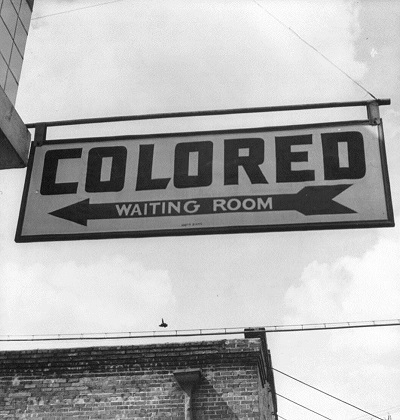
CU Blog - A Lesson in History - After the Civil War - Birthrights - Photo 2The US confronted these issues in a comprehensive way, giving a full measure, and a complete lesson to a watching world. The country had a bad legacy with the issues of racism, racial supremacy and discrimination. Even the Supreme Court’s decision in Dred Scott v. Sandford (1857), asserted that Americans descended from African slaves could not be citizens of the United States. American society never accepted a common definition of human rights. As a result, African-Americans suffered in this country, first slavery, then even after the abolition of slavery the oppression, suppression and repression continued with a Peonage system, Jim Crow and blatant discrimination practices. This dread was manifested in the impassioned chant:

Injustice anywhere is injustice everywhere!

Since the early colonial period in America, slavery had been a part of the socio-economic system of British North America and was recognized in the Thirteen Colonies at the time of the United StatesDeclaration of Independence (1776). Since then, events and statements by politicians and others brought forth differences, tensions and divisions between the people of the slave states of the Southern United States and the people of the free states of the Northern United States (including Western states) over the topics of slavery. The issue and divisions of slavery became so irreconcilable and contentious [1] that only a violent clash – a war – would resolve. The war was a “Come to Jesus!” A Big Day of Reckoning!

Without a doubt, the Civil War was conclusive! The conflict transpired between 1861 and 1865; 625,000[5] Americans died…on both sides (365,000 total dead [4] on the Union side; 260,000 total dead on the Confederacy side). This blood should not be forgotten.

The LORD said, “What have you done? Listen! Your brother’s blood cries out to me from the ground. – Genesis 4:10 New International Version

This backdrop was the basis for the 14th Amendment of the Constitution. Consider the encyclopedic details here:

Title: Fourteenth Amendment to the United States Constitution
Source: Wikipedia – Online Encyclopedia (Retrieved 10/14/2015) retrieved from: https://en.wikipedia.org/wiki/Fourteenth_Amendment_to_the_United_States_Constitution

CU Blog - A Lesson in History - After the Civil War - Birthrights - Photo 1The Fourteenth Amendment (Amendment XIV) to the United States Constitution was adopted on July 9, 1868, as one of the Reconstruction Amendments. The amendment addresses citizenship rights and equal protection of the laws, and was proposed in response to issues related to former slaves following the American Civil War. The amendment was bitterly contested, particularly by Southern states, which were forced to ratify it in order for them to regain representation in Congress. The Fourteenth Amendment, particularly its first section, is one of the most litigated parts of the Constitution, forming the basis for landmark decisions such as Roe v. Wade (1973) regarding abortion, Bush v. Gore (2000) regarding the 2000 presidential election, and Obergefell v. Hodges (2015) regarding same-sex marriage. The amendment limits the actions of all state and local officials, including those acting on behalf of such an official.

The amendment’s first section includes several clauses: the Citizenship Clause, Privileges or Immunities Clause, Due Process Clause, and Equal Protection Clause. The Citizenship Clause provides a broad definition of citizenship, overruling the Supreme Court’s decision in Dred Scott v. Sandford (1857), which had held that Americans descended from African slaves could not be citizens of the United States. The Privileges or Immunities Clause has been interpreted in such a way that it does very little.

The Due Process Clause prohibits state and local government officials from depriving persons of life, liberty, or property without legislative authorization. This clause has also been used by the federal judiciary to make most of the Bill of Rights applicable to the states, as well as to recognize substantive and procedural requirements that state laws must satisfy.

The Equal Protection Clause requires each state to provide equal protection under the law to all people within its jurisdiction. This clause was the basis for Brown v. Board of Education (1954), the Supreme Court decision that precipitated the dismantling of racial segregation, and for many other decisions rejecting irrational or unnecessary discrimination against people belonging to various groups.

The second, third, and fourth sections of the amendment are seldom litigated. However, the second section’s reference to “rebellion and other crime” has been invoked as a constitutional ground for felony disenfranchisement. The fifth section gives Congress the power to enforce the amendment’s provisions by “appropriate legislation”. However, under City of Boerne v. Flores (1997), Congress’s enforcement power may not be used to contradict a Supreme Court interpretation of the amendment.

There are lessons from this history to be learned and applied in the Caribbean relating to nationality and immigration.

This commentary is 3 of 3 considering lessons that are especially apropos for application in the Caribbean region of 2015. The lessons are cataloged as follows:

  1. Before the War: Human Rights Cannot Be Compromised
  2. During the War: Principle over Principal – Boycott Over a Difference in Pay
  3. After the War: Birth Right – Assigning Same Value to All Life

The Civil War is being commemorated now, at the 150th Anniversary of its conclusion. But there is no need for “pomp and circumstance” in acknowledging these events in the “rear view” mirror – this was an American crisis. There is only the need to look and learn, as there is such an important lesson for Caribbean nationality consideration.

The book Go Lean…Caribbean serves as a roadmap for elevating Caribbean society, for all 30 member-states, with the introduction and implementation of the Caribbean Union Trade Federation (CU). The book does not ignore the subject of citizenship and nationality. In fact the roadmap provides perhaps the ultimate resolution to this perplexing problem, that of a regional entity providing a regional solution.

According to the foregoing encyclopedic reference, the Fourteenth Amendment changed the American standard of citizenship and nationality. The US “Super Power” status now influences the “normalized” view for many people in the Caribbean neighborhood for what is right and what is wrong with nationality recognition. The 14th Amendment to the United States Constitution addressed citizenship rights and equal protection of the laws, and was proposed in response to issues related to former slaves following the Civil War. This lesson was harvested from the sowing in blood.

Can other communities benefit from this now simple definition of citizenship?

“all persons born or naturalized in the United States, and subject to the jurisdiction thereof, are citizens of the United States and of the State wherein they reside”[24]

This is in effect, a citizenship rendition of the acclaimed Declaration of Independence (1776):

“All men are created equal”.

Early in the Go Lean book, this need for careful review of history was acknowledged and then placed into perspective with this pronouncement in a similar Declaration of Interdependence (Page 10):

As the history of our region and the oppression, suppression and repression of its indigenous people is duly documented, there is no one alive who can be held accountable for the prior actions, and so we must put aside the shackles of systems of repression to instead formulate efficient and effective systems to steer our own destiny.

As the colonial history of our region was initiated to create economic expansion opportunities for our previous imperial masters, the structures of government instituted in their wake have not fostered the best systems for prosperity of the indigenous people.

The sensitivities of the issue of migration is so heightened now because countries in the Caribbean neighborhood have been harsh in their treatment of Cuban and Haitian refugees, many even considering changes to their constitutions in an effort to tighten immigration policies so as to end the automatic birthright citizenship for children of illegal immigrants.[12]

The Latin phrases, jus soli (‘right of the soil’) and jus sanguinis (‘right of blood’), explain the applicable legal concepts in our region. But Latin does not describe the pain and suffering the African Diaspora experienced over the centuries in the Americas. We need more than language.

To apply lessons from the painful Civil War, this commentary urges the jus soli standard for the Caribbean Union Trade Federation.

Caribbean member-states are badly in need of remediation, to lower the “push and pull” factors that drive so many to risk their ‘life and limb’, and those of their children, to take flight under dangerous circumstances to seek a better life.

This is not a problem just for Cuba, Haiti and the countries in the migrants’ path (Bahamas, Dominican Republic, Puerto Rico) to get to better living conditions. This is a problem for all the Caribbean. There is always someone doing better and someone doing worse.

The Go Lean book – and blogs – posits that the effort is less to cure the Caribbean homeland than to thrive as an alien in a foreign land. This is easier said than done! But this is the quest of the Go Lean roadmap, to make the Caribbean homeland a better place to live, work and play for its 42 million residents and 80 visitors, across the 30 member-states. The CU, applying best-practices for community empowerment has these 3 prime directives, proclaimed as follows:

  • Optimization of the economic engines in order to grow the regional economy to $800 Billion & create 2.2 million new jobs.
  • Establishment of a security apparatus to protect the resultant economic engines and ensure the respect of human rights and public safety.
  • Improve Caribbean governance to support these engines.

How exactly can the CU impact the most troubled countries that are the source of so many illegal migrants: Cuba and Haiti? The book relates the history of post-war Europe, where the Marshall Plan was instrumental in rebooting that continent, and also the Reconstruction Years for rebuilding the Southern US after the Civil War. The book Go Lean…Caribbean details a Marshall Plan-like / Reconstruction-like roadmap for Cuba and Haiti, and other failing Caribbean institutions.

The related subjects of economic, security and governing dysfunction among American, European and Caribbean communities have been a frequent topic for Go Lean blogs, as sampled below. These represent other lessons for the Caribbean to learn from considering history:

https://goleancaribbean.com/blog/?p=6531 A Lesson in History – Book Review of the ‘Exigency of 2008’
https://goleancaribbean.com/blog/?p=6189 A Lesson in History – ‘Katrina’ is helping today’s crises
https://goleancaribbean.com/blog/?p=5183 A Lesson in History – Cinco De Mayo
https://goleancaribbean.com/blog/?p=5123 A Lesson in History – Royal Charter: Zimbabwe -vs- South Africa
https://goleancaribbean.com/blog/?p=5055 A Lesson in History – Empowering Families
https://goleancaribbean.com/blog/?p=4971 A Lesson in History – Royal Charter: Truth & Consequence
https://goleancaribbean.com/blog/?p=4935 A Lesson in History – The ‘Grand Old Party’ of American Politics
https://goleancaribbean.com/blog/?p=4720 A Lesson in History – SARS in Hong Kong
https://goleancaribbean.com/blog/?p=4166 A Lesson in History – Panamanian Balboa
https://goleancaribbean.com/blog/?p=2809 A Lesson in History – Economics of East Berlin
https://goleancaribbean.com/blog/?p=2670 A Lesson in History – Rockefeller’s Pipeline
https://goleancaribbean.com/blog/?p=2585 A Lesson in History – Concorde SST
https://goleancaribbean.com/blog/?p=2480 A Lesson in History – Community Ethos of WW II Detroit
https://goleancaribbean.com/blog/?p=2297 A Lesson in History – Booker T versus Du Bois
https://goleancaribbean.com/blog/?p=1531 A Lesson in History – 100 Years Ago Today – World War I
https://goleancaribbean.com/blog/?p=789 A Lesson in History – America’s War on the Caribbean

The Go Lean book details a series of community ethos, strategies, tactics, implementations and advocacies to elevate Caribbean society so as to optimize the “push/pull” factors that currently send Caribbean citizens to the High Seas to flee their homeland. See this sample list of details from the book:

Community Ethos – Economic Systems Influence Choices & Incentives Page 21
Community Ethos – Consequences of Choices Lie in the Future Page 21
Community Ethos – Anti-Bullying and Mitigation Page 23
Community Ethos – Minority Equalization Page 24
Community Ethos – Ways to Impact the Future Page 26
Community Ethos – Ways to Manage Reconciliations Page 34
Community Ethos – Ways to Impact the Greater Good Page 37
Strategy – Vision – Integrate region into a Single Market Economy Page 45
Strategy – Agents of Change – Globalization Page 57
Tactical – Separation of Powers – Department of Homeland Security Page 75
Implementation – Security Initiatives at Start-up – Border, Immigration & Emigration Page 103
Planning – 10 Big Ideas … in the Caribbean Region – # 10 Cuba & Haiti Page 127
Planning – Ways to Ways to Model the EU – From Worst to First Page 130
Planning – Reasons Why the CU Will Succeed – Germany Reconciliation Model Page 132
Planning – Ways to Improve Failed-State Indices – Cuba & Haiti on the List Page 134
Planning – Lessons from East Germany – European post-war rebuilding Page 139
Planning – Lessons from the Detroit – Best Practices for Turn-Around Page 140
Planning – Lessons from the Bible Page 144
Planning – Lessons from the US Constitution Page 145
Advocacy – Ways to Grow the Economy Page 151
Advocacy – Ways to Create Jobs Page 152
Advocacy – Ways to Foster Empowering Immigration – Case Study of Indian Migrants Page 174
Advocacy – Ways to Impact Justice Page 178
Advocacy – Ways to Impact the Diaspora Page 217
Advocacy – Ways to Protect Human Rights Page 220
Advocacy – Ways to Impact Youth – Citizenship Clarity Page 227
Advocacy – Ways to Re-boot Cuba Page 236
Advocacy – Ways to Impact the Dominican Republic Page 237
Advocacy – Ways to Re-boot Haiti Page 238
Advocacy – Ways to Impact Trinidad & Tobago – Indo versus Afro Page 240
Advocacy – Ways to Impact Guyana – Indo versus Afro Page 241
Advocacy – Ways to Impact US Territories – All is not well Page 244
Appendix – Puerto Rico Migrations to New York Page 303

All of the Caribbean needs to learn from the experiences of our neighbor, the United States during the Civil War. Too much blood – brother on brother – has been shed to ignore. As depicted in the Go Lean book, there is the need to minimize the push-pull factors that lead to our societal abandonment. Our citizens are dying in the waters trying to flee our homelands. The US learned its lessons from a Civil War (Page 145). As depicted in the foregoing encyclopedic reference, Reconstruction provisions can help to forge a New Society; see Appendix-VIDEO below.

Birth rights clarification is crucial for future progress.

If all in a community sacrifice, then all in the community should have the same rights and privileges. That is the very definition of birthrights.

When will we (in the Caribbean) learn? When is enough, enough?

The Go Lean/CU roadmap has proposed solutions: CU citizenship; and facilitating the Lex soli process at the CU level – thereby removing the subjectivity and bias to the nationality process. As depicting in a previous blog, fragments of this proposed system is already in place with the issuance of CariCom passports. The Go Lean roadmap calls for the assembling of CariCom organs into the CU Trade Federation, the Caribbean passport practice would therefore continue.

Now is the time for all of the Caribbean to learn the lessons from history of the American Civil War. Though not directly our homeland, we can still benefit from their bloodshed. We can hear the blood crying out to God for reckoning and reconciliation.

The Go Lean book posits that the Caribbean is in a serious crisis of its own, but asserts that this crisis would be a terrible thing to waste. The same as the blood of 625,000 Americans (Civil War dead) would have been a terrible thing to waste, we too can harvest progress from sacrifice. The people and governing institutions of the Caribbean region are hereby urged to lean-in for the empowerments described in this Go Lean roadmap.

This quest is conceivable, believable and achievable … without a war, nor bloodshed!

🙂

Download the book Go Lean … Caribbean – now!

————-

Appendix – VIDEO: US 13th,14th, and 15th Amendments – https://youtu.be/89fU1HvZLfA

Published on Sep 9, 2013 – Category: People & Blogs
Share this post:
, , , ,

A Lesson in History – During the Civil War: Principle over Principal

Go Lean Commentary

Where do you consider to be home? How far are you willing to go to protect/defend that home?

Dating back to the Magna Carta, a concept emerged in jurisprudence in which a man’s home was considered his castle, and should thusly be vigorously defended – Stand Your Ground. For this reason foreign occupying armies have always encountered vicious insurgencies from citizens of a homeland.

The movement and underlying book Go Lean … Caribbean posits that it is better to “prosper where planted“, that natives of a land are willing to shed blood, sweat and tears to sustain their homelands. This is one additional reason to discourage emigration, brain drain and societal abandonment.

Even the Bible speaks of this paradigm in the Gospel account by John in Chapter 10, verses 11 – 13 as follows:

11“I am the good shepherd; the good shepherd lays down His life for the sheep. 12“He who is a hired hand, and not a shepherd, who is not the owner of the sheep, sees the wolf coming, and leaves the sheep and flees, and the wolf snatches them and scatters them. 13“He flees because he is a hired hand and is not concerned about the sheep.…

There is an important lesson to learn in considering the history of the American Civil War. The war was fought over the issue of slavery. This was an ugly institution for those condemned as slaves. In the United States, that ugly disposition extended beyond the slaves themselves to the entire Black race. Though individuals could be set free, laws in the country could push them back into slavery without any due process. This was the case with the “Fugitive Slave Act of 1850”. Any Black person could be detained as a runaway slave and returned to any alleged Slave Master in the South; no matter any proof or the truth, or lack there of. In many jurisdictions, a Black man could not even testify against white people. (This was the basis for the autobiographical book – by Solomon Northup – and movie “12 Years A Slave” – see trailer in the Appendix-VIDEO A below).

To be Black in the America of those days, one “could not win, could not break-even and could not get out of the game”. There was no neutral destination in America. The optimal option was the only option, to work towards the end of slavery.

For this reason many Blacks joined the war effort, at great sacrifice to themselves and their community. This was a matter of principle! There is an important lesson for the Caribbean from this history:

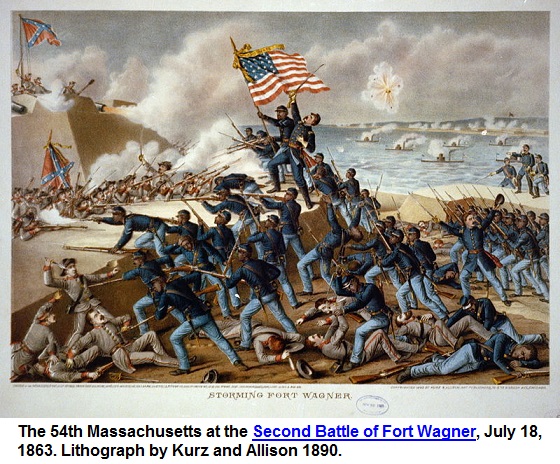
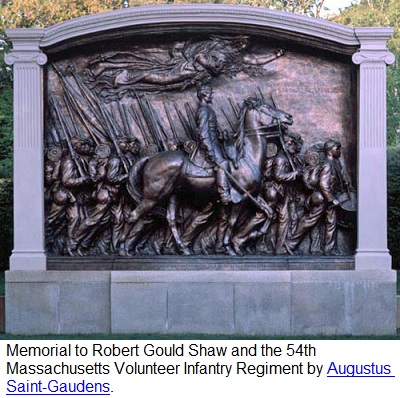
CU Blog - A Lesson in History - During the Civil War - Principle not Principal - Photo 2The 54th Regiment Massachusetts Volunteer Infantry was an infantry regiment that saw extensive service in the Union Army during the American Civil War. The regiment was one of the first official African-American units in the United States during the Civil War.[1] The regiment was authorized in March 1863 by the Governor of Massachusetts, John A. Andrew. Commanded by Colonel Robert Gould Shaw, it was commissioned after the passage of the Emancipation Proclamation.[2] Secretary of War Edwin M. Stanton decided white officers would be in charge of all “colored” units.[3] Andrew selected Robert Gould Shaw to be the regiment’s colonel and Norwood Penrose Hallowell to be its lieutenant colonel.[2] https://en.wikipedia.org/wiki/54th_Massachusetts_Infantry_Regiment retrieved October 14, 2015.

The Civil War was fought between 1861 and 1865; 625,000[5] Americans died…on both sides (365,000 total dead [4] on the Union side; 260,000 total dead on the Confederacy side). This spilled blood was a great sacrifice and should not be forgotten or undervalued. The vast majority of the deaths were White people. As many died, their surviving family members assigned blame to those of the Black community, as depicted here:

In July 13 – 16, 1863, African Americans on the New York City’s waterfront and Lower East Side were beaten, tortured, and lynched by white mobs angered over conscription for the Union war effort. [20] These mobs directed their animosity toward blacks because they felt the Civil War was caused by them. However, the bravery of the 54th would help to assuage anger of this kind…

CU Blog - A Lesson in History - During the Civil War - Principle not Principal - Photo 1The regiment gained recognition on July 18, 1863, when it spearheaded an assault on Fort Wagner near Charleston, South Carolina. 272 of the 600 men who charged Fort Wagner were “killed, wounded or captured.”[18] At this battle Colonel Shaw was killed, along with 29 of his men; 24 more later died of wounds, 15 were captured, 52 were missing in action and never accounted for, and 149 were wounded. The total regimental casualties of 272 would be the highest total for the 54th in a single engagement during the war. Although Union forces were not able to take and hold the fort (despite taking a portion of the walls in the initial assault), the 54th was widely acclaimed for its valor during the battle, and the event helped encourage the further enlistment and mobilization of African-American troops, a key development that President Abraham Lincoln once noted as helping to secure the final victory. This drama was portrayed in the 1989 Motion Picture “Glory“; see 2-minute clip in the VIDEO B below.

The Civil War is being commemorated now, at the 150th Anniversary of its conclusion. But there is no need for “pomp and circumstance” in acknowledging these events in the “rear view” mirror of history. There is only the need to look and learn, as there are lessons for the Caribbean to consider in its application of daily life. This commentary is 2 of 3 considering lessons that are especially apropos for application in the Caribbean region of 2015. The lessons are cataloged as follows:

  1. Before the War: Human Rights Cannot Be Compromised
  2. During the War: Principle over Principal – Boycott Over a Difference in Pay
  3. After the War: Birth Right – Assigning Same Value to All Life

During the Civil War, as in any war, soldiers get paid. But the societal defects of racism was so acute in the US that even this administrative action was fraught with dysfunction; the encyclopedic reference continues:

The enlisted men of the 54th were recruited on the promise of pay and allowances equal to their white counterparts. This was supposed to amount to subsistence and $14 a month.[22] Instead, they were informed upon arriving in South Carolina, the Department of the South would pay them only $7 per month ($10 with $3 withheld for clothing, while white soldiers did not pay for clothing at all).[23] Colonel Shaw and many others immediately began protesting the measure.[24] Although the state of Massachusetts offered to make up the difference in pay, on principle, a regiment-wide boycott of the pay tables on paydays became the norm.[25]

CU Blog - A Lesson in History - During the Civil War - Principle not Principal - Photo 3After Shaw’s death at Fort Wagner, Colonel Edward Needles Hallowell – his lieutenant and brother of the first Lieutenant Colonel Hallowell – took up the fight to get back full pay for the troops.[26]

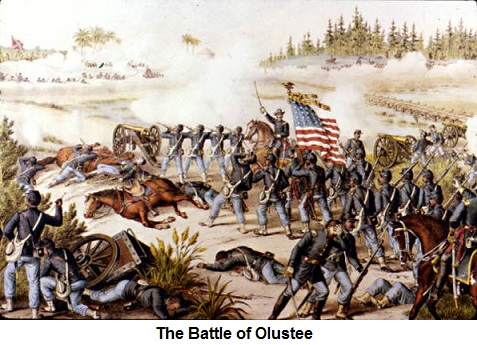
Refusing their reduced pay became a point of honor [(principle)] for the men of the 54th. In fact, at the Battle of Olustee, when ordered forward to protect the retreat of the Union forces, the men moved forward shouting, “Massachusetts and Seven Dollars a Month!”[2]

The Congressional bill, enacted on June 16, 1864, authorized equal and full pay to those enlisted troops who had been free men as of April 19, 1861. Of course not all the troops qualified. Colonel Hallowell, a Quaker, rationalized that because he did not believe in slavery he could therefore have all the troops swear that they were free men on April 19, 1861. Before being given their back pay the entire regiment was administered what became known as “the Quaker oath.”[26] Colonel Hallowell skillfully crafted the oath to say: “You do solemnly swear that you owed no man unrequited labor on or before the 19th day of April 1861. So help you God.”[26][28]

The book Go Lean…Caribbean and accompanying blogs provide lessons from history in considering the American Civil War. The Caribbean region has a debilitating societal abandonment rate; (70 percent of college educated had fled for foreign shores). The region needs a National Sacrifice ethos, where their own citizens sacrifice blood, sweat and tears on behalf of their homelands. Only then will people be less prone to abandon their homes; they will stake claim to principle over principal (money).

Early in the Go Lean book, this need for careful review of the history of slavery was acknowledged and then placed into perspective with this pronouncement (Declaration of Interdependence – Page 10):

As the history of our region and the oppression, suppression and repression of its indigenous people is duly documented, there is no one alive who can be held accountable for the prior actions, and so we must put aside the shackles of systems of repression to instead formulate efficient and effective systems to steer our own destiny.

As the colonial history of our region was initiated to create economic expansion opportunities for our previous imperial masters, the structures of government instituted in their wake have not fostered the best systems for prosperity of the indigenous people.

So the consideration of the Go Lean book, is to identify and correct any bad community ethos (fundamental spirit of our culture) and to foster positive community ethos (such as National Sacrifice and “Principle over Principal”). This point was also pronounced in the opening Declaration of Interdependence (Page 12 – 13) with these statements:

xvi. Whereas security of our homeland is inextricably linked to prosperity of the homeland, the economic and security interest of the region needs to be aligned under the same governance. Since economic crimes, including piracy and other forms of terrorism, can imperil the functioning of the wheels of commerce for all the citizenry, the accedence of this Federation must equip the security apparatus with the tools and techniques for predictive and proactive interdictions.

xix. Whereas our legacy in recent times is one of societal abandonment, it is imperative that incentives and encouragement be put in place to first dissuade the human flight, and then entice and welcome the return of our Diaspora back to our shores. This repatriation should be effected with the appropriate guards so as not to imperil the lives and securities of the repatriated citizens or the communities they inhabit. The right of repatriation is to be extended to any natural born citizens despite any previous naturalization to foreign sovereignties.

This Declaration of Interdependence opens the Go Lean…Caribbean book. The book serves as a roadmap for the introduction and implementation of the technocratic Caribbean Union Trade Federation (CU) to spearhead the elevation of Caribbean society. The book advocates learning lessons from many events and concepts in history, from as far back as the patriarchal Bible times, to as recent as the Great Recession of 2008. The roadmap seeks to reboot the region’s economic, security and governing engines to ensure that all Caribbean stakeholders have the opportunity for life, liberty and the pursuit of happiness with no abusive exploitation of any ethnic group. There is room for all people in the region to elevate and be elevated.

In this vein, the Go Lean roadmap seeks to employ “best-practices” with entitlements, labor, human rights and social safety nets to impact the CU prime directives; identified with the following 3 statements:

  • Optimization of the economic engines in order to grow the regional economy to $800 Billion & create 2.2 million new jobs.
  • Establishment of a security apparatus to protect the resultant economic engines and ensure the respect of human rights and public safety.
  • Improve Caribbean governance to support these engines.

The Caribbean is in crisis!

Alas, the Go Lean book asserts that a “crisis is a terrible thing to waste” and thereafter stresses the community ethos, strategies, tactics, implementations and advocacies to reboot, transform and turn-around the eco-systems of Caribbean society. These points are detailed in the book as follows:

Community Ethos – Deferred Gratification Page 21
Community Ethos – Economic Principles – People Choose Page 21
Community Ethos – Economic Principles – People Respond to Incentives in Predictable Ways Page 21
Community Ethos – Economic Principles – The Consequences of Choices Lie in the Future Page 21
Community Ethos – Governing Principles – Lean Operations Page 24
Community Ethos – Governing Principles – Cooperatives Page 25
Community Ethos – Ways to Impact the Future Page 26
Community Ethos – Ways to Impact a Turn-Around Page 33
Community Ethos – Ways to Improve Sharing Page 35
Community Ethos – Ways to Promote Happiness Page 36
Community Ethos – Ways to Impact the Greater Good Page 37
Strategy – Vision – Confederate 30 Member-States Page 45
Strategy – Mission – Enact a Defense Pact to Defend the Homeland Page 45
Strategy – Mission – Keep the next generation at home Page 46
Tactical – Confederating a Permanent Union Page 63
Tactical – Fostering a Technocracy Page 64
Implementation – Assemble – Incorporating all the existing regional organizations Page 96
Implementation – Ways to Pay for Change Page 101
Implementation – Security Initiatives at Start-up Page 103
Implementation – Ways to Deliver Page 109
Implementation – Reasons to Repatriate to the Caribbean Page 118
Planning – 10 Big   Ideas for the Caribbean – Confederation Without Sovereignty Page 127
Planning – Ways to Make the Caribbean Better Page 131
Advocacy – Ways to Grow the Economy Page 151
Advocacy – Ways to Create Jobs Page 152
Advocacy – Ways to Better Manage the Social Contract Page 170
Advocacy – Ways to Manage Federal Civil Service – Guaranteed Fair Treatment Page 173
Advocacy – Ways to Improve Homeland Security Page 181
Advocacy – Ways to Impact the Diaspora Page 217
Advocacy – Ways to Preserve Caribbean Heritage Page 218
Advocacy – Ways to Protect Human Rights Page 220
Advocacy – Ways to Impact Youth – Incentivize Prosperity at Home Page 227

There are other lessons for the Caribbean to learn from considering history; the following previous blog/commentaries have been detailed and considered:

https://goleancaribbean.com/blog/?p=6531 A Lesson in History – Book Review of the ‘Exigency of 2008’
https://goleancaribbean.com/blog/?p=6189 A Lesson in History – ‘Katrina’ is helping today’s crises
https://goleancaribbean.com/blog/?p=5183 A Lesson in History – Cinco De Mayo
https://goleancaribbean.com/blog/?p=5123 A Lesson in History – Royal Charter: Zimbabwe -vs- South Africa
https://goleancaribbean.com/blog/?p=5055 A Lesson in History – Empowering Families
https://goleancaribbean.com/blog/?p=4971 A Lesson in History – Royal Charter: Truth & Consequence
https://goleancaribbean.com/blog/?p=4935 A Lesson in History – The ‘Grand Old Party’ of American Politics
https://goleancaribbean.com/blog/?p=4720 A Lesson in History – SARS in Hong Kong
https://goleancaribbean.com/blog/?p=4166 A Lesson in History – Panamanian Balboa
https://goleancaribbean.com/blog/?p=2809 A Lesson in History – Economics of East Berlin
https://goleancaribbean.com/blog/?p=2670 A Lesson in History – Rockefeller’s Pipeline
https://goleancaribbean.com/blog/?p=2585 A Lesson in History – Concorde SST
https://goleancaribbean.com/blog/?p=2480 A Lesson in History – Community Ethos of WW II Detroit
https://goleancaribbean.com/blog/?p=2297 A Lesson in History – Booker T versus Du Bois
https://goleancaribbean.com/blog/?p=1531 A Lesson in History – 100 Years Ago Today – World War I
https://goleancaribbean.com/blog/?p=789 A Lesson in History – America’s War on the Caribbean

The Go Lean roadmap seeks to empower and elevate Caribbean societal engines, identifying the required community ethos. The ethos associated with populations that have endured change – National Sacrifice – is an expression of deferred gratification, choosing to focus more on the future than on the present, or the past. We should show proper application for the sacrifices these ones have endured. Such gratitude makes our community better, more resilient and more long-suffering.

We need more of this Principle over Principal!

No appreciation, no sacrifice; no sacrifice, no victory. It is that simple!

Now is the time to lean-in to this roadmap for Caribbean change, as depicted in the book Go Lean…Caribbean. All the mitigations and empowerments in this roadmap require people to fight for their homeland. This ethos will help forge change for the Greater Good. We need sacrifice; we need victories!

(This commentary is not advocating sacrificing the  Caribbean’s young men – and women – on the altar of some God of War. Nor is this a call for a revolt against the governments, agencies or institutions of the Caribbean region, but rather a petition to fight for change through the peaceful optimization of the economic, security and governing engines in the region).

Our quest is simple, learn from history and work to make the Caribbean region a better place to live, work and play. 🙂

Download the book Go Lean … Caribbean – now!

———–

Appendix VIDEO A – Movie Trailer: 12 Years A Slavehttp://www.imdb.com/video/imdb/vi302032921/

Retrieved October 14, 2015 – In the antebellum United States, Solomon Northup, a free black man from upstate New York, is abducted and sold into slavery.

———–

Appendix VIDEO B – Movie Clip Gloryhttps://youtu.be/q7qwqVbZSqE

Retrieved October 14, 2015 – Robert Gould Shaw leads the US Civil War’s first all-black volunteer company, fighting prejudices of both his own Union army and the Confederates.

Share this post:
, , , ,
[Top]

A Lesson in History – Before the Civil War: Compromising Human Rights

Go Lean Commentary

Despite the fact that there are historic events, many times “deniers” of the facts emerge. For example, the Nazi Holocaust: deniers exist even today of the actuality of the events or the 6 million Jews slaughtered in German Concentration Camps. Another major event before this was the American Civil War. Deniers abounded to the point that in many schools in the Jim Crow South, that event was taught as the “War of Northern Aggression” and the cause of “slavery” was supplanted for States’ Rights.

The pain of this academic dishonesty is not just the de-valuing of all the human sacrifices, but most importantly, the failure to learn and apply good lessons.

When someone denies an event, they cannot learn from the experiences.

Without a doubt, a Civil War was fought in the United States of America between 1861 and 1865; 625,000[5] Americans died…on both sides (365,000 total dead [4] on the Union side; 260,000 total dead on the Confederacy side). This blood should not be forgotten. There are lessons to learn from this history. This commentary is 1 of 3 considering lessons that are especially apropos for application in the Caribbean region of 2015. The lessons are cataloged as follows:

  1. Before the War: Human Rights Cannot Be Compromised
  2. During the War: Principle over Principal – Boycott Over a Difference in Pay
  3. After the War: Birth Right – Assigning Same Value to All Life

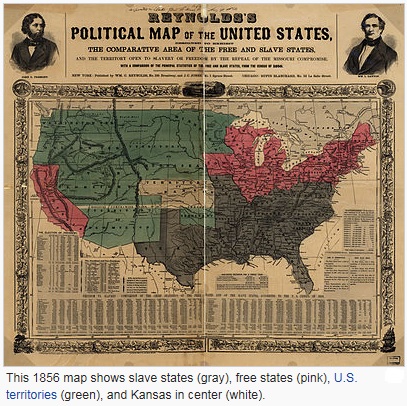
Since the early colonial period in America, slavery had been a part of the socio-economic system of British North America and was recognized in the Thirteen Colonies at the time of the United StatesDeclaration of Independence (1776). Since then, events and statements by politicians and others brought forth differences, tensions and divisions between the people of the slave states of the Southern United States and the people of the free states of the Northern United States (including Western states) over the topics of slavery. The large underlying issue from which other issues developed was whether slavery should be retained and even expanded to other areas or whether it should be contained and eventually abolished. Over many decades, these issues and divisions became increasingly irreconcilable and contentious.[1] But that last decade was pivotal; see encyclopedia reference here and VIDEO below:

CU Blog - A Lesson in History - Before the Civil War - Human Right Not Compromise - Photo 3Events in the 1850s culminated with the election of the anti-slavery-expansion Republican Abraham Lincoln as President on November 6, 1860. This provoked the first round of state secessions as leaders of the Deep South cotton states were unwilling to remain in a second class political status with their way of life threatened by the President himself. Initially, the seven Deep South states seceded, with economies based on cotton (then in heavy European demand with rising prices). They were Alabama, Florida, Georgia, Louisiana, Mississippi, South Carolina and Texas. After the Confederates attacked and captured Fort Sumter, President Lincoln called for volunteers to march south and suppress the rebellion. This pushed the four other Upper South States (Virginia, North Carolina, Tennessee, and Arkansas) also to secede. These states completed the formation of the Confederate States of America. Their addition to the Confederacy insured a war would be prolonged and bloody because they contributed territory and soldiers. – https://en.wikipedia.org/wiki/Timeline_of_events_leading_to_the_American_Civil_War retrieved October 14, 2015.

The Civil War is being commemorated now, at the 150th Anniversary of its conclusion. But there is no need for “pomp and circumstance” in acknowledging these events in the “rear view” mirror; as this was an American crisis. There is only the need to look and learn, as there is this one poignant lesson for Caribbean consideration:

    With a roaring institution of slavery, there was no premise for a concept of human rights. Without a commonality on the understanding and acceptance of human rights, differences will always be irreconcilable and contentious.

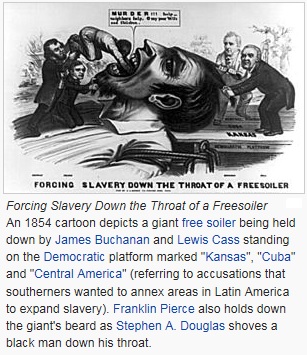
Before the Civil War, both sides continued to propagate one compromise after another. While neither side wanted the bloodshed of war, the compromises were just exercises in futility because at the root, there was no commonality on human rights. Notice this application in considering this one episode of Pre-War deliberation:

The Kansas–Nebraska Act of 1854 created the territories of Kansas and Nebraska, opening new lands for settlement, and had the effect of repealing the Missouri Compromise of 1820 by allowing white male settlers in those territories to determine through popular sovereignty whether they would allow slavery within each territory. The act was designed by Democratic Senator Stephen A. Douglas of Illinois. The initial purpose of the Kansas–Nebraska Act was to open up many thousands of new farms and make feasible a Midwestern Transcontinental Railroad. The popular sovereignty clause of the law led pro- and anti-slavery elements to flood into Kansas with the goal of voting slavery up or down, leading to Bloody Kansas[1]; (a series of violent political confrontations involving anti-slavery Free-Staters and pro-slavery “Border Ruffians”, taking place in the Kansas Territory and neighboring towns in the state of Missouri between 1854 and 1861). This Kansas–Nebraska Act used popular sovereignty so as to ignore the failures of the previous compromises. The Kansas–Nebraska Act divided the nation and pointed it toward civil war.[41] The turmoil over the act split both the Democratic and Whig parties and gave rise to the Republican Party, which split the United States into two major political camps, North (Republican) and South (Democratic). – Source: https://en.wikipedia.org/wiki/Kansas%E2%80%93Nebraska_Act retrieved October 14, 2015.
CU Blog - A Lesson in History - Before the Civil War - Human Right Not Compromise - Photo 2

The book Go Lean…Caribbean and accompanying blogs provide lessons from history in considering the American Civil War. The Caribbean has had Civil Wars and Revolutions; (think Haitian Revolution of 1791 and the Cuban Revolution of 1959). The book assessed the economic disposition of the region and then strategized how to elevate the societal engines. Among its many missions, the book advocates one simple way to grow the economy: concentrate on the basic needs of food, clothing and shelter. When analyzing clothing options, the book leans on the lessons from the pre-Civil War American South, where Cotton was King. This point was detailed in the book on Page 163:

The Bottom Line on King Cotton
The Southern United States had ideal conditions to grow cotton; the prospects where so successful, 60% of US exports, that they sought to have a world monopoly. They devoted the most valuable land and slave labor to this cause, even in place of necessities like food. They had the supply system optimized and they were willing to go to war to preserve the status quo. On the demand side, the Industrial Revolution brought innovations like mechanized spinning/weaving to Europe. This forged a vibrant apparel industry and revolutionized the world economy. Cotton was King. The term King Cotton was a slogan around 1860–61 to support secession from the United States, arguing that cotton exports would make an independent Confederate States of America economically prosperous, and – more importantly – force Great Britain and France to support the Confederacy in a Civil War. But the Union blockaded the South’s ports and harbors and shut down over 95% of cotton exports. Since the Europeans had hoarded large stockpiles of cotton, they were not injured by the boycott — the value of their stockpiles went up. So cotton production shifted to other locations in the world, like India (up 700%), Egypt and Argentina. King Cotton failed to save the South, their economy nor Confederacy.
CU Blog - A Lesson in History - Before the Civil War - Human Right Not Compromise - Photo 1

Early in the Go Lean book, this need for careful review of history was acknowledged and then placed into perspective with this pronouncement (Declaration of Interdependence – Page 10):

As the history of our region and the oppression, suppression and repression of its indigenous people is duly documented, there is no one alive who can be held accountable for the prior actions, and so we must put aside the shackles of systems of repression to instead formulate efficient and effective systems to steer our own destiny.

As the colonial history of our region was initiated to create economic expansion opportunities for our previous imperial masters, the structures of government instituted in their wake have not fostered the best systems for prosperity of the indigenous people.

So the consideration of the Go Lean book, as related to this subject is one of community ethos, defined in the book (Page 20) as the fundamental character or spirit of our culture; our underlying sentiment that informs our beliefs, customs, or practices; dominant assumptions of us, the Caribbean as a people.

    Do we now have a common premise, a concept of human rights?

This commentary, and the underlying Go Lean book asserts the answer is “No“! As a region, the Caribbean is doing particularly bad.

This point was pronounced in the opening Declaration of Interdependence (Page 12) with these acknowledgements and statements:

xii. Whereas the legacy in recent times in individual states may be that of ineffectual governance with no redress to higher authority, the accedence of this Federation will ensure accountability and escalation of the human and civil rights of the people for good governance, justice assurances, due process and the rule of law. As such, any threats of a “failed state” status for any member state must enact emergency measures on behalf of the Federation to protect the human, civil and property rights of the citizens, residents, allies, trading partners, and visitors of the affected member state and the Federation as a whole.

xiii. Whereas the legacy of dissensions in many member-states (for example: Haiti and Cuba) will require a concerted effort to integrate the exile community’s repatriation, the Federation must arrange for Reconciliation Commissions to satiate a demand for justice.

Continuing with the lessons from the American Civil War, we see that the US never accepted a common definition of human rights until … the United Nations was established (1945) and eventually codified a Human Rights Declaration for them … and the rest of the world in 1948. In the meanwhile, Blacks in the US continued to suffer – despite the abolition of slavery – with pains associated with a Peonage system, Jim Crow and blatant discriminatory practices. The oppression, suppression and oppression of Blacks (and other minorities) in the US meant that America was not a welcoming land for people of color.

Considering the Caribbean homeland, to apply lessons learned from the build-up of the American Civil War we must first accept as common: the basics of human rights.

The Go Lean book asserts the UN Declaration of Human Rights (Page 220) which provides this definition:

… standards of human behavior that are protected as legal rights in municipal and international law.[2] They are commonly understood as inalienable[3] fundamental rights “to which a person is inherently entitled simply because she or he is a human being.”[4]

This declaration aligns with the quest of the Go Lean…Caribbean book. The book serves as a roadmap for the introduction and implementation of the technocratic Caribbean Union Trade Federation (CU) to spearhead the elevation of Caribbean society. The book advocates learning lessons from many events and concepts in history, from as far back as the patriarchal Bible times, to as recent as the Great Recession of 2008. The roadmap simply seeks to reboot the region’s economic, security and governing engines to ensure that Caribbean stakeholders (citizens, guest-workers and visitors) have the opportunity for life, liberty and the pursuit of happiness. As gleaned from this lesson in history, without that common acceptance of human rights, this quest is easier said than done.

The planners of the new Caribbean, the promoters of the Go Lean book, hereby urge all in the Caribbean to make this declaration.

Just say it!

In general, the Go Lean roadmap posits that the hope for any permanent change in the Caribbean must start with this declaration and the underlying community ethos that promotes it: the Greater Good. With that in place, other progress – the needed societal elevation – can begin. The Go Lean roadmap seeks to employ “best-practices” with better strategies, tactics and implementations to impact the CU prime directives; identified with the following 3 statements:

  • Optimization of the economic engines in order to grow the regional economy to $800 Billion & create 2.2 million new jobs.
  • Establishment of a security apparatus to protect the resultant economic engines and ensure the respect of human rights and public safety in all member-states.
  • Improve Caribbean governance to support these engines.

The Go Lean book stresses key community ethos, strategies, tactics, implementations and advocacies necessary to transform and turn-around the eco-systems of Caribbean society. These points are detailed in the book as follows:

Community Ethos – Economic Principles – Economic Systems Influence   Individual Choices Page 21
Community Ethos – Economic Principles – Consequences of Choices Lie in   the Future Page 21
Community Ethos – Governing Principles – Lean Operations Page 24
Community Ethos – Ways to Impact the Future Page 26
Community Ethos – Ways to Manage   Reconciliations Page 34
Community Ethos – Ways to Impact the Greater Good Page 37
Strategy – Vision – Confederate all 30   member-states/ 4 languages into a Single   Market Page 45
Strategy – Mission – Build and foster local economic engines Page 45
Tactical – Ways to Foster a Technocracy Page 64
Tactical – Growing the Economy – Post   WW II European Marshall Plan Model Page 68
Tactical – Separation-of-Powers – CU Federal Government versus Member-State Governance Page 71
Implementation – Assemble All Regionally-focus Organizations of All Caribbean Communities Page 96
Implementation – Ways to Better Manage Debt Page 114
Planning – 10 Big Ideas – Single Market / Currency Union Page 127
Planning – Ways to Model the new European Union Page 130
Planning – Ways to Make the Caribbean Better Page 131
Planning – Ways to Improve Failed-State Indices – Minority and Human Rights Page 134
Planning – Lessons Learned from the previousWest Indies Federation Page 135
Planning – Lessons Learned from 2008 – Optimizing Economic-Financial-Monetary Engines Page 136
Planning – Lessons Learned New York City – Managing   as a “Frienemy” Page 137
Planning – Lessons Learned from Omaha – Human Flight Mitigations Page 138
Planning – Lessons Learned from East Germany – Bad Examples for Trade & Security Page 139
Planning – Lessons Learned from Detroit – Turn-around from Failure Page 140
Planning – Lessons Learned from Indian Reservations – See Photo Page 141
Planning – Lessons Learned from the American West – How to Win the Peace Page 142
Advocacy – Ways to Grow the Economy Page 151
Advocacy – Ways to Create Jobs Page 152
Advocacy – Ways to Improve Governance Page 168
Advocacy – Ways to Better Manage the Social Contract Page 170
Advocacy – Ways to Improve Homeland Security Page 180
Advocacy – Ways to Better Manage Natural Resources Page 183
Advocacy – Ways to Preserve Caribbean   Heritage Page 218
Appendix – Failed-State Index for Uneven Economic Development Page 272
Appendix – European Shuffling in the Guianas – Historic Timeline Page 307

There are other lessons for the Caribbean to learn from considering history; the following previous blog/commentaries have been detailed and considered:

https://goleancaribbean.com/blog/?p=6531 A Lesson in History – Book Review of the ‘Exigency of 2008’
https://goleancaribbean.com/blog/?p=6189 A Lesson in History – ‘Katrina’ is helping today’s crises
https://goleancaribbean.com/blog/?p=5183 A Lesson in History – Cinco De Mayo
https://goleancaribbean.com/blog/?p=5123 A Lesson in History – Royal Charter: Zimbabwe -vs- South Africa
https://goleancaribbean.com/blog/?p=5055 A Lesson in History – Empowering Families
https://goleancaribbean.com/blog/?p=4971 A Lesson in History – Royal Charter: Truth & Consequence
https://goleancaribbean.com/blog/?p=4935 A Lesson in History – The ‘Grand Old Party’ of American Politics
https://goleancaribbean.com/blog/?p=4720 A Lesson in History – SARS in Hong Kong
https://goleancaribbean.com/blog/?p=4166 A Lesson in History – Panamanian Balboa
https://goleancaribbean.com/blog/?p=2809 A Lesson in History – Economics of East Berlin
https://goleancaribbean.com/blog/?p=2670 A Lesson in History – Rockefeller’s Pipeline
https://goleancaribbean.com/blog/?p=2585 A Lesson in History – Concorde SST
https://goleancaribbean.com/blog/?p=2480 A Lesson in History – Community Ethos of WW II in Detroit
https://goleancaribbean.com/blog/?p=2297 A Lesson in History – Booker T versus Du Bois
https://goleancaribbean.com/blog/?p=1531 A Lesson in History – 100 Years Ago Today – World War I
https://goleancaribbean.com/blog/?p=789 A Lesson in History – America’s War on the Caribbean

The Go Lean roadmap seeks to empower and elevate Caribbean societal engines. It is out-of-scope to impact America (beyond the Diaspora living there); our focus is only here at home.

A lot of the pain related in this history stem from the flawed structure of colonialism. Though there is a movement to extract reparations from former colonizers, that effort is not supported by the Go Lean movement for the Caribbean.

It is NOT for the Greater Good.

It is what it is! The current assessment of the Caribbean region is dire, but yet remediation, reboot and turn-around is possible.

Our quest is simple, learn from history and work to make the Caribbean region a better place to live, work and play.  🙂

Download the book Go Lean … Caribbean – now!

———–

Appendix VIDEO – The Path to Civil War – http://www.history.com/topics/american-civil-war/american-civil-war-history/videos/us-inches-closer-to-war

The election of Abraham Lincoln was a tipping point on the path to Civil War. In the wake of Southern secession, would the new president defend the U.S. forts in rebel territory?

Share this post:
, , , ,
[Top]

Dr. Sybil Mobley – FAMU’s Business School Dean – RIP

Go Lean Commentary

CU Blog - Dr Sybil Mobley - FAMU Business School Dean - RIP - Photo 1The FAMU world mourns the passing of Dr. Sybil Mobley (1925 – 2015; age 90), the much-accomplished and celebrated Dean Emerita of the School of Business and Industry (SBI).

This Go Lean … Caribbean movement – book and accompanying blog-commentaries – stress the fact that one man or one woman can make a difference in their community. Dr. Mobley’s impact was societal elevation with her mission to embed Black Americans in the conference rooms and board rooms of major corporations. She molded, prepared, energized and guided the best-of-the-best of Black America (many of Caribbean heritage as well; this writer included) and sent them off to impact the corporate world.

She sowed the seeds …

… the entire Black community now reap from this harvest.

Dr. Mobley was born in Jim-Crow America in Shreveport, Louisiana. She came to Tallahassee, Florida – the home campus of Florida A&M University – in 1963, still in the era and location of the Deep South. Despite that debilitating environment for a Black woman, she thrived and got her disciples to thrive, as depicted in the following news-media obituary and VIDEO:

Title: FAMU’s Dr. Mobley Passes Away
By: Lanetra Bennett

TALLAHASSEE, Fla. – September 29, 2015 — Dr. Sybil C. Mobley passed away today. She’s the founder of the world renowned School of Business and Industry at FAMU.

Her students and those who knew her say she was much more.

Dr. Mobley’s family confirms she died early Tuesday morning after a brief illness.

Former students say they’re known as, “Sybil’s babies”. They marvel how she balanced power in the boardroom, with compassion for students.

Tallahassee businessman Clinton Byrd keeps a medallion on his desk with Dr. Sybil Mobley’s face on it.

He says, “The phone rings and you’re just hoping that it’s not that news. But, we knew that one day it would come.”

The news came Tuesday that Dr. Mobley had died. “It’s a sad day for us.” Byrd said.

Dr. Mobley started the School of Business and Industry at FAMU in 1974.

Byrd was one of her students. He said, “One day I was giving a presentation on Accounting Theory and the bright lights came on. I just lost it. When I got through, she said, boy that was fantastic. I said, doc, I can’t even remember what I said or what I did. She was always encouraging. She kept a paper that I wrote in 1967. She still has it about impact.”

Mobley had an impact on countless people in Tallahassee and beyond.

The Shreveport, Louisiana native started her career at FAMU in 1963, and is said to have put S.B.I. on the map alongside Yale, University of Chicago, and University of North Carolina. “People used to come here from all over the world to meet her, to spend time with her.” Said, Byrd.

Precious Tankard is a current sophomore. She said, “It’s a lot to say I am a business administration student or an S.B.I. period, in SBI. When we say we’re SBI, they know that greatness lies ahead.”

The current dean, Shawnta Friday-Stroud, is also a former student. She said, “I hope that I have done and that I continue to do her proud. It’s because of what she taught so many of us that I’m even standing in this position as dean today.”

Byrd said, “Some way, somehow we just all have to carry on.”

S.B.I. recently celebrated its 40th anniversary. Dr. Mobley was the founding dean until she retired in 2003. That’s when those special medallions that Byrd has were issued.
Source: Local CBS TV Affiliate WCTV  (Retrieved September 29, 2015) – http://www.wctv.tv/home/headlines/Dr-Sybil-Mobley-Former-FAMU-Business-School-Dean-Dies-329934011.html

CU Blog - Dr Sybil Mobley - FAMU Business School Dean - RIP - Photo 2

VIDEO – Rep. Gwen Graham Honors FAMU Leader Dr. Sybil Mobley – https://youtu.be/QCCk19vnKPU

Published on Oct 7, 2015 – “Today I rise to honor the life of Dr. Sybil Mobley, the founding dean of Florida A&M University’s School of Business and Industry.

“Dr. Mobley first worked at Florida A&M as a secretary in 1945 – she then went on to study at the Wharton School of Finance and earned her doctorate from the University of Illinois.

After graduating, Dr. Mobley returned to Florida A&M, and in 1974 she became the founding dean of the University’s School of Business and Industry.

“She held that position for 29 years, during which time she worked tirelessly to build the business school into a nationally recognized institution.

“Her rise from working as a secretary to sitting on the board of Fortune 500 companies and leading a business school serves as an inspiration for all of us.

“Today, we mourn Dr. Mobley’s passing – and celebrate her life. She was a treasure to FAMU, Tallahassee, the state of Florida and our nation.”

  • Category: People & Blogs
  • License: Standard YouTube License

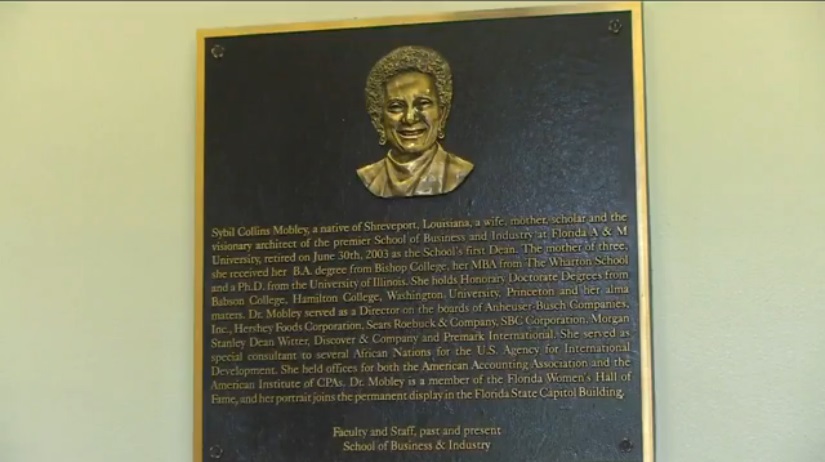
Dr. Sybil Mobley impacted the business world, not just the world of college education. She served on many corporate boards and received many awards and honors from around the world; (see plaque in photo above). While she was not of Caribbean heritage, she impacted many students who are; see the Facebook testimony here of two, one Jamaican-American and one Bahamian-American FAMU-SBI alumni:

Michelle Graham Day, SBI Class of 2008
Oh no, ‪#‎LEGEND! No matter how powerful a force to be reckoned with, you could walk in her office as an unknown freshman and get a one on one without an appointment! I remember feeling inspired because like me she had also graduated high school and started college at 16, and I remember her making clear that she was here to get us to play in the majors and said “when people say [why isn’t she using an HBCU business school to funnel students into] minority business what they [the critics, not the official definition!] really mean is minor business” meaning they were doubting her SBI students could hang in the big leagues. She pointed out that no company makes it onto the wall of plaques outside the main entrance without having invested $100k? (correct me if am off) in her vision…

I took 3 long internships that were real work not coffee fetching, one a year long, and graduated way off cycle, but my first big league company out the gate was IBM out west in Colorado (I was always willing to go anywhere while many were not even applying cause it wasn’t somewhere sexy to black people like New York or Miami) and even in the recession when on campus offers froze up, it is those 3 positions with Fortune 500 companies that led to my career which evolved from logistics/supply chain into data analysis into business intelligence and IT. It’s those 3-part PD questions with your premises and non-yes-or-no-answer follow-up question that had me stumping interviewers with my never-cliche questions and already-solid work experience standing out among other candidates even at internship stage. To this day I get compliments on the quality of my questions. The ability to multitask and speedread through 18 credit hours a semester (which I have also pulled off that load in SUMMER when full time is 6 credit hours), the logic picked up by being forced to take Physics I & II as our required sciences with much grumbling on our part, it all served me oh so well in skeleton crew workplaces where you wear many hats and the workload is intense as everyone is required to do more with less post-recession, and in learning how to experiment with the data and record different observations during data analysis and data mining/modeling, just like in the physics labs. She evolved with the needs of corporate and I’m constantly having to evolve to stay ahead of the demands of my field. I went on to work for some of the most established, storied corporations on earth and moved into Fortune 100 and it is all thanks in major part to applying what was learned in Dean Mobley’s program. Her passing is the passing of an era, she will be missed! ‪#‎RIP.‪#‎FAMU‪#‎SBI‪#‎visionary

Clifton H. Rodriguez, CPA, SBI Class of 1985
Probably [she] was the most influential woman in my life. I can still remember her teachings, and the lasting motto: “No effort is adequate until it is effective”. I remember in 1981 when she served on the Board of Anheuser Busch Companies, and had a meeting in St. Louis, Mo. She left her meeting with those important people, including August Busch, III to seek Anthony Glover and myself out to advise us about [a] murder that occurred on campus…. She did not have to do that, but deemed us that important to seek us out and advise us. She treated all of her students in that manner. She was not only our dean, but our nurturing mother, who cared deeply about her precious children.

These foregoing testimonies are such good reflections of Dr. Mobley’s character and quest: she wanted her students “playing in the ‘Major’ leagues” of Big Corporate businesses. She recognized that while minority business ownership is important in America today and for the recent past, minority businesses are just minor businesses.

The publishers of the book Go Lean…Caribbean recognize the life contributions of Dr. Sybil Mobley as an educator, industrialist and advocate for many causes that align with our quest for empowerment and elevation of Caribbean commerce and life. Her vision was for more self-determination for the role that business and economics play in the lives of Black America. This means participating, not just spectating, in the business processes of BIG business. There are now more African-Americans (and those of African-Caribbean heritage) engaged in the business processes with corporate America because of the efforts of Dr. Mobley.

Mission accomplished!

“You have fought the good fight, you have finished the race, and you have remained faithful”. – 2 Timothy 4:7 (The Bible New Living Translation).

Like Dr. Sybil Mobley, the prime directive of the Go Lean book is also to elevate society, but instead of impacting America, the roadmap focus is the Caribbean first. The book serves as a roadmap for the introduction and implementation of the Caribbean Union Trade Federation (CU). The CU seeks to empower the people of the Caribbean to lead more impactful lives in which they are better able to meet their needs and plan for a productive future. The Go Lean roadmap seeks to put Caribbean people in a place of better command-and-control of their circumstances, to develop the community ethos of fostering genius, innovation and entrepreneurship. In fact, the prime directive declarative statements in the Go Lean book are as follows:

  • Optimization of the economic engines in order to grow the regional economy to $800 Billion & create 2.2 million new jobs.
  • Establishment of a security apparatus to protect the resultant economic engines.
  • Improvement of Caribbean governance to support these engines.

Dr. Sybil Mobley is hereby recognized as a role model that the rest of the Caribbean can emulate. She provided a successful track record of forging change, overcoming incredible odds, managing crises to successful conclusions and paying forward to benefit the next generation. The Go Lean book posits that the economic, security and governing engines are all important for the sustenance of Caribbean life, so Dr. Mobley’s life course stands as a vanguard for many of these pursuits.

The book posits that one person, despite their field of endeavor, can make a difference in the Caribbean, and its impact on the world; that there are many opportunities where one champion, one advocate, can elevate society. In this light, the book features 144 different advocacies, so there is inspiration for the “next” Dr. Sybil Mobley to emerge, establish and excel right here at home in the Caribbean.

The roadmap specifically encourages the region, to lean-in and foster this “next” generation of Dr. Sybil Mobley’s with these specific community ethos, strategies, tactics, implementations and advocacies:

Community Ethos – Economic Systems Influence Individual Choices Page 21
Community Ethos – Consequences of Choices Lie in the Future Page 21
Community Ethos – Minority Equalization Page 24
Community Ethos – Ways to Impact the Future Page 26
Community Ethos – Ways to Foster Genius Page 27
Community Ethos – Ways to Help Entrepreneurship Page 30
Community Ethos – Ways to Bridge the Digital Divide Page 33
Community Ethos – Ways to Impact Turn-Arounds Page 35
Community Ethos – Ways to Impact the Greater Good Page 37
Strategy – Build and foster local economic engines Page 45
Strategy – Educate our children with the wisdom and knowledge to succeed Page 46
Tactical – Grow the Economy to $800 Billion – Elevate economy through Education Page 70
Tactical – Separation-of-Power – Federal Department of Education Page 85
Anatomy of Advocacies Page 122
Planning – Ways to Make the Caribbean Better Page 131
Advocacy – Ways to Grow the Economy Page 151
Advocacy – Ways to Create Jobs Page 152
Advocacy – Ways to Improve Education Page 159
Advocacy – Ways to Better Provide Clothing Page 163
Advocacy – Ways to Impact Wall Street Page 200
Advocacy – Ways to Impact Main Street Page 201
Advocacy – Ways to Preserve Caribbean Heritage Page 218
Appendix – Education and Economic Growth Page 258

Education is a priority in the Go Lean roadmap. Previously, this commentary has highlighted many other lessons that the region needs to apply to elevate the societal engines for education. See a sample list here:

https://goleancaribbean.com/blog/?p=6269 Education & Economics: Welcome Mr. President
https://goleancaribbean.com/blog/?p=5482 For-Profit American Education: Plenty of Profit; Little Education
https://goleancaribbean.com/blog/?p=4572 Role Model: Innovative Educator Ron Clark
https://goleancaribbean.com/blog/?p=4487 FAMU is No. 3 for Facilitating Economic Opportunity
https://goleancaribbean.com/blog/?p=1256 Is a Traditional 4-year Degree a Terrible Investment?

We need impactful role models like Dr. Sybil Mobley at home in the Caribbean. The formula of sending our “best-of-the-best” to North America and Europe has failed us – they rarely come back home; see sample testimonies above, both individuals currently live in the US. The quest of the Go Lean roadmap is to change that formula – we now want to educate our “best-of-the-best” right here in the Caribbean region, thereby increasing the likelihood that they will remain after their matriculation. This change will require a lot of contributions from a lot of different people. This quest is pronounced early in the roadmap in the Declaration of Interdependence at the outset of the book, declaring a need for regional solutions (Pages 13 & 14) with these statements:

xix. Whereas our legacy in recent times is one of societal abandonment, it is imperative that incentives and encouragement be put in place to first dissuade the human flight, and then entice and welcome the return of our Diaspora back to our shores

xxi. Whereas the preparation of our labor force can foster opportunities and dictate economic progress for current and future generations, the Federation must ensure that educational and job training opportunities are fully optimized for all residents of all member-states, with no partiality towards any gender or ethnic group. The Federation must recognize and facilitate excellence in many different fields of endeavor, including sciences, languages, arts, music and sports. This responsibility should be executed without incurring the risks of further human flight, as has been the past history.

xxx. Whereas the effects of globalization can be felt in every aspect of Caribbean life, from the acquisition of food and clothing, to the ubiquity of ICT, the region cannot only consume, it is imperative that our lands also produce and add to the international community, even if doing so requires some sacrifice and subsidy.

With the participation of many advocates on many different paths for progress, the Caribbean can truly become a better place to live, work, learn  and play.

Thank you for preparing us for this challenge, Dr. Mobley. Thank you for your service, commitment, nurturing and love. Now take your rest. Rest in Peace!

Download the free e-Book of Go Lean … Caribbean – now!

Share this post:
, , , , ,
[Top]

Lessons from Iceland – Model of Recovery

Go Lean Commentary

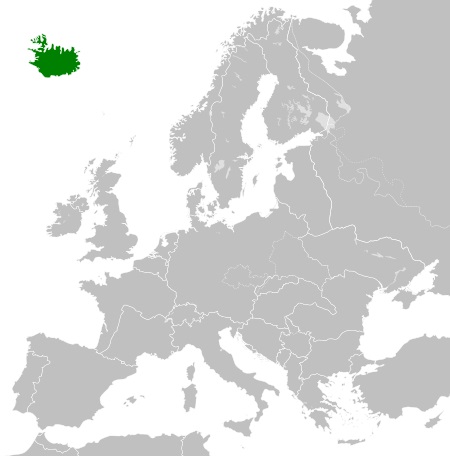
There are so many lessons the Caribbean region can learn from the island Republic of Iceland.

CU Blog - Lessons from Iceland - Model of Recovery - Photo 1First, it’s an island, Duh!!!

Just like with the Caribbean, logistics of trade is more difficult as it must be based on naval and aeronautical solutions.

They have natural disasters … volcanoes as opposed to hurricanes or earthquakes.

The population is 320,000 … the range of many Caribbean countries; (i.e. Bahamas, Barbados, Belize, Guadeloupe (Fr.), Martinique (Fr.) and Suriname). Yet, it is not grouped with the formal Small Island Developing States (SIDS) as is all the sovereign Caribbean territories. The following defines the common traits:

Small Island Developing States are low-lying coastal [sovereign] countries that tend to share similar sustainable development challenges, including small but growing populations, limited resources, remoteness, susceptibility to natural disasters, vulnerability to external shocks, excessive dependence on international trade, and fragile environments. Their growth and development is also held back by high communication, energy and transportation costs, irregular international transport volumes, disproportionately expensive public administration and infrastructure due to their small size, and little to no opportunity to create economies-of-scale. – Source: https://en.wikipedia.org/wiki/Small_Island_Developing_States

Iceland has done many things well so that everyone in the Caribbean, all SIDS countries for that matter, need to take notice.

During the bad days of the Great Recession – at the precipice of disaster – the country deviated from other troubled regions …

Iceland let its banks fail in 2008 because they proved too big to save.

How does it relate to the Caribbean? The Caribbean is at the precipice … now; many of the member-states are near Failed-State status, while others are still hoping to recover from the devastating Great Recession of 2008. Turn-around should not take this long – 7 years. Strategies, tactics and implementations of best-practices to effect a turn-around must be pursued now.

Iceland has now recovered, and complaining about a 2% unemployment rate. What did they do that was so radically different than other locations? For one, they changed course regarding economics, security and governing policies. An ultra-capitalist movement had taken hold of the country and business communities; they pursued an aggressive “boom-or-bust” strategy, that ultimately “busted”, rather than continue on that road, the country – all aspects of society – altered course and returned to a path of sound fundamentals.

They rebooted and turned-around! Iceland embraced all aspects of turn-around strategies, mandating bankruptcies and “wind-downs” so that the economy – and society in general – could start anew.

This article is in consideration of the book Go Lean…Caribbean; it serves as a roadmap for the introduction and implementation of the technocratic Caribbean Union Trade Federation (CU) and Caribbean Central Bank (CCB) to provide better stewardship, to ensure that the economic/currency failures of the past, in the Caribbean and other regions, do not re-occur here in the homeland.

We can learn so much from this episode in Icelandic history, the good, the bad and the ugly. See the encyclopedic details here:

Reference Title: Iceland’s Economy and Recovery
CU Blog - Lessons from Iceland - Model of Recovery - Photo 2In 2007, Iceland was the seventh most productive country in the world per capita (US$54,858), and the fifth most productive by GDP at purchasing power parity ($40,112). About 85 percent of total primary energy supply in Iceland is derived from domestically produced renewable energy sources.[93] Utilization of abundant hydroelectric and geothermal power has made Iceland the world’s largest electricity producer per capita.[94] … Historically, Iceland’s economy depended heavily on fishing, which still provides 40% of export earnings and employs 7% of the work force.[49] The economy is vulnerable to declining fish stocks and drops in world prices for its main material exports: fish and fish products, aluminum, and ferrosilicon.

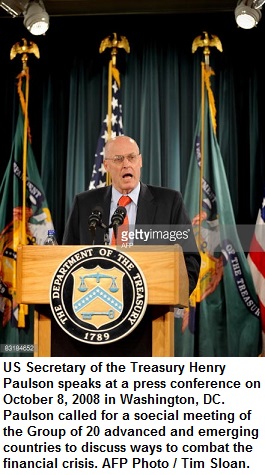
Iceland had been hit especially hard by the Great Recession that began in December 2007, because of the failure of its banking system and a subsequent economic crisis. Before the crash of the country’s three largest banks, Glitnir, Landsbanki and Kaupthing, their combined debt exceeded approximately six times the nation’s gross domestic product of €14 billion ($19 billion).[116][117] In October 2008, the Icelandic parliament passed emergency legislation to minimize the impact of the Financial crisis. The Financial Supervisory Authority of Iceland used permission granted by the emergency legislation to take over the domestic operations of the three largest banks.[118] Icelandic officials, including central bank governor Davíð Oddsson, stated that the state did not intend to take over any of the banks’ foreign debts or assets. Instead, new banks were established to take on the domestic operations of the banks, and the old banks will be run into bankruptcy.

On 28 October 2008, the Icelandic government raised interest rates to 18% (as of August 2010, it was 7%), a move which was forced in part by the terms of acquiring a loan from International Monetary Fund (IMF). After the rate hike, trading on the Icelandic króna finally resumed on the open market, with valuation at around 250 ISK per Euro, less than one-third the value of the 1:70 exchange rate during most of 2008, and a significant drop from the 1:150 exchange ratio of the week before.

CU Blog - Lessons from Iceland - Model of Recovery - Photo 3On 20 November 2008, in an effort to stabilize the situation, the Icelandic government stated that all domestic deposits in Icelandic banks would be guaranteed, imposed strict capital controls to stabilize the value of the Icelandic króna, and secured a US$5.1bn sovereign debt package from the IMF and the Nordic countries – Denmark, Finland, Norway, and Sweden agreed to lend $2.5 billion. [119] – in order to finance a budget deficit and the restoration of the banking system. (The international bailout support program led by IMF officially ended on August 31, 2011, while the capital controls which were imposed in November 2008 are still in place only recently ended in the last few weeks).

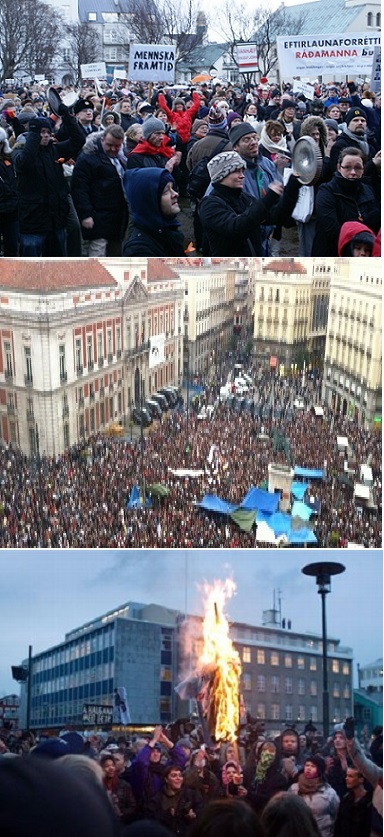
On 26 January 2009, the coalition government collapsed due to the public dissent over the handling of the financial crisis. A new left-wing government was formed a week later and immediately set about removing Central Bank governor Davíð Oddsson and his aides from the bank through changes in law. Davíð was removed on 26 February 2009 in the wake of protests outside the Central Bank.[120]

The financial crisis had a serious negative impact on the Icelandic economy. The national currency fell sharply in value, foreign currency transactions were virtually suspended for weeks, and the market capitalization of the Icelandic stock exchange fell by more than 90%. As a result of the crisis, Iceland underwent a severe economic depression; the country’s gross domestic product dropped by 10% in real terms between the third quarter of 2007 and the third quarter of 2010.[6] A new era with positive GDP growth started in 2011, and has helped foster a gradually declining trend for the unemployment rate. The government budget deficit has declined from 9.7% of GDP in 2009 and 2010 to 0.2% of GDP in 2014;[7] the central government gross debt-to-GDP ratio is expected to decline to less than 60% in 2018 from a maximum of 85% in 2011.[8]

[A post-mortem analysis helped to put the blame for Iceland’s crisis on a bad community ethos that had encapsulated the whole country related to debt]:

[Disregarding their] small domestic market, Iceland’s banks had financed their expansion with loans on the interbank lending market and, more recently, by deposits from outside Iceland (which are also a form of external debt). Households also took on a large amount of debt, equivalent to 213% of disposable income, which led to inflation.[117] This inflation was exacerbated by the practice of the Central Bank of Iceland issuing liquidity loans to banks on the basis of newly issued, uncovered bonds[118] – effectively, printing money on demand.

[Then the turn-around took hold …]

By mid-2012 Iceland was regarded as one of Europe’s recovery success stories. It has had two years of economic growth. Unemployment was down to 6.3% and Iceland was attracting immigrants to fill jobs. Currency devaluation effectively reduced wages by 50% making exports more competitive and imports more expensive. Ten-year government bonds were issued below 6%, lower than some of the PIIGS nations in the EU (Portugal, Italy, Ireland, Greece, and Spain). Tryggvi Thor Herbertsson, a member of parliament, noted that adjustments via currency devaluations are less painful than government labor policies and negotiations.

By June 2012, Landsbanki managed to repay about half of the Icesave debt.[124]

According to Bloomberg, Iceland was on the trajectory of 2% unemployment as a result of crisis-management decisions made back in 2008, including allowing the banks to fail.[125]. [Here are the highlighted bullets of this story posted January 27, 2014:]

    Iceland let its banks fail in 2008 because they proved too big to save.
    Now, the island is finding crisis-management decisions made half a decade ago have put it on a trajectory that’s turned 2 percent unemployment into a realistic goal.
    While the Euro area grapples with record joblessness, led by more than 25 percent in Greece and Spain …

[Iceland is NOT a member of the EU], nevertheless, while EU fervor has cooled [due to the crisis] the government continues to pursue membership.[246]
Source: Wikipedia Online Encyclopedia – Retrieved 09/23/2015 from: https://en.wikipedia.org/wiki/2008%E2%80%9311_Icelandic_financial_crisis

—–

VIDEO – What Can Greece (and the Caribbean) Learn From Iceland? – http://www.bloomberg.com/news/videos/2015-08-28/what-can-greece-learn-from-iceland-

Published on Aug 28, 2015 – Central Bank of Iceland Governor Mar Gudmundsson talks with Brendan Greeley about Iceland’s capital controls and what Greece can learn from Iceland in handling its credit crisis. He speaks on “Bloomberg Markets.”

The lessons from Iceland really magnify in reflection of the Caribbean considering the community ethos or attitudes regarding “debt”. The book described community ethos as:

“the fundamental character or spirit of a culture; the underlying sentiment that informs the beliefs, customs, or practices of a group or society; dominant assumptions of a people or period; practices of a group or society; dominant assumptions of a people or period” – Go Lean…Caribbean Page 20.

While Iceland featured a negative community ethos in this case, their model demonstrates that the spirit-beliefs-customs-practices of a community can be altered.

Yes, Iceland fixed their heart … first; then the recovery of the community’s economic, security and governing engines took root. It is very important that the Caribbean learn this lesson and apply the corrections to our community ethos, and then to our systems of commerce and governance. The Go Lean book opened with this pronouncement (Page 10), gleaning insight from the US Declaration of Independence:

We hold these truths to be self-evident, that all men are created equal, that they are endowed by their Creator with certain unalienable rights, that among these are life, liberty and the pursuit of happiness; that to secure these rights, governments are instituted among men, deriving their just powers from the consent of the governed. That whenever any form of government becomes destructive to these ends, it is the right of the people to alter or to abolish it, and to institute new government, laying its foundation on such principles and organizing its powers in such form, as to them shall seem most likely to effect their safety and happiness.

The Go Lean roadmap calls for instituting the CU Trade Federation and the Caribbean Central Bank (CCB) to take the lead in forging the needed changes to the region’s economic and financial eco-systems. Firstly, there is the need to foster the best practices in the region regarding debt. The roadmap calls for a cooperative among Central Banks to form the CCB to foster interdependence, sharing, economies-of-scale and collaboration across the region despite the divergent politics, culture and languages. The premise is simple: while we are all different, we are all “in the same boat”. So the underlying principle of this motivation is the regional Greater Good.

The realities of the Great Recession, and Iceland’s troubles in the foregoing reference source, prove the interconnectivity of the financial systems; bank/currency troubles in one country easily become trouble for another country. A larger Single Market (42 million people in 30 member-states) for the Caribbean would provide less elasticity and more shock-absorption here from eruptions in the global financial markets. The Caribbean is never spared; in fact we are directly affected as tourism – our primary economic driver – depends on the disposable income from our trading partners, mostly North American and Western European countries. This is why our region was so devastated with the events, repercussions and consequences of 2008.

Considering the past, the Caribbean has had to learn hard lessons on economic booms … and busts. Any attempt to reboot Caribbean economic landscape must first start with a strenuous oversight of regional currencies. Thusly, the strategy is to integrate to the single currency, the Caribbean Dollar (C$). The tactical approach is to provide technocratic oversight with the CCB pursuing only the Greater Good, and no special group’s special interest.

Also in the opening of the Go Lean book, this need for regional stewardship of Caribbean currencies was pronounced in the Declaration of Interdependence (Page 12 & 13) with these statements:

xi.    Whereas all men are entitled to the benefits of good governance in a free society, “new guards” must be enacted to dissuade the emergence of incompetence, corruption, nepotism and cronyism at the peril of the people’s best interest. The Federation must guarantee the executions of a social contract between government and the governed.

xii.   Whereas the legacy in recent times in individual states may be that of ineffectual governance with no redress to higher authority, the accedence of this Federation will ensure accountability and escalation of the human and civil rights of the people for good governance, justice assurances, due process and the rule of law. As such, any threats of a “failed state” status for any member state must enact emergency measures on behalf of the Federation to protect the human, civil and property rights of the citizens, residents, allies, trading partners, and visitors of the affected member state and the Federation as a whole.

xxiv.    Whereas a free market economy can be induced and spurred for continuous progress, the Federation must install the controls to better manage aspects of the economy: jobs, inflation, savings rate, investments and other economic principles. Thereby attracting direct foreign investment because of the stability and vibrancy of our economy.

xxv.    Whereas the legacy of international democracies had been imperiled due to a global financial crisis, the structure of the Federation must allow for financial stability and assurance of the Federation’s institutions. To mandate the economic vibrancy of the region, monetary and fiscal controls and policies must be incorporated as proactive and reactive measures. These measures must address threats against the financial integrity of the Federation and of the member-states.

The Go Lean book, and previous blog/commentaries, stressed the key community ethos, strategies, tactics, implementations and advocacies necessary to appoint new stewards for the regional financial eco-system. These points are detailed in the book as follows:

Community Assessment – Puerto – The Greece of the Caribbean Page 18
Community Ethos – Economic Principles – All Choices Involve Costs Page 21
Community Ethos – Economic Principles – Economic Systems Influence Individual Choices Page 21
Community Ethos – Economic Principles – Consequences of Choices Lie in the Future Page 21
Community Ethos – Economic Principles – Money Multiplier Page 23
Community Ethos – Governing Principles – Lean Operations Page 24
Community Ethos – Governing Principles – Return on Investments Page 24
Community Ethos – Governing Principles – Cooperatives Page 25
Community Ethos – Ways to Impact the Future – Count on the Greedy to be Greedy Page 26
Community Ethos – Ways to Impact Turn-Arounds – Bankruptcy Processing Page 33
Community Ethos – Ways to Improve Sharing Page 35
Community Ethos – Ways to Impact the Greater Good Page 37
Strategy – Vision – Confederate the region into a Single Market Page 45
Strategy – Mission – Fortify the Stability of the Securities Markets Page 45
Strategy – Provide Proper Oversight and Support for the Depository Institutions Page 46
Strategy – e-Payments and Card-based Transactions Page 49
Tactical – Confederating a Permanent Union Page 63
Tactical – Growing the Economy – Minimizing Bubbles Page 69
Tactical – Separation-of-Powers – Depository Insurance & Regulatory Agency Page 73
Anecdote – Turning Around CARICOM – Effects of 2008 Financial Crisis Page 92
Implementation – Assemble Caribbean Central Bank as a Cooperative Page 96
Implementation – Ways to Better Manage Debt Page 114
Planning – 10 Big Ideas – Single Market / Currency Union Page 127
Planning – Lessons Learned from 2008 Page 136
Planning – Lessons Learned from New York City – Wall Street Page 137
Planning – Ways to Measure Progress Page 147
Anecdote – Caribbean Currencies Page 149
Advocacy – Ways to Grow the Economy Page 151
Advocacy – Ways to Control Inflation Page 153
Advocacy – Ways to Better Manage Foreign Exchange Page 154
Advocacy – Ways to Improve Governance Page 168
Advocacy – Ways to Better Manage the Social Contract Page 170
Advocacy – Ways to Foster Cooperatives Page 176
Advocacy – Ways to Foster Electronic Commerce Page 198
Advocacy – Reforms for Banking Regulations Page 199
Advocacy – Ways to Impact Wall Street Page 200
Advocacy – Ways to Impact Main Street Page 201
Appendix – Tool-kits for Capital Controls Page 315

There is a lot to learn from the analysis of economic stewardship of other communities. The successes and failures of banking/economic stewardship were further elaborated upon in these previous blog-commentaries:

https://goleancaribbean.com/blog/?p=6531 A Lesson in History – Book Review of the ‘Exigency of 2008’
https://goleancaribbean.com/blog/?p=5818 Greece: From Bad to Worse
https://goleancaribbean.com/blog/?p=4166 A Lesson in History – Panamanian Balboa
https://goleancaribbean.com/blog/?p=3858 ECB unveils 1 trillion Euro stimulus program
https://goleancaribbean.com/blog/?p=3814 Lessons from the Swiss unpegging the franc
https://goleancaribbean.com/blog/?p=3582 For Canadian Banks: Caribbean is a ‘Bad Bet’
https://goleancaribbean.com/blog/?p=3397 A Christmas Present for the Banks from the Omnibus Bill
https://goleancaribbean.com/blog/?p=3090 Lessons Learned – Europe Sovereign Debt Crisis of 2009
https://goleancaribbean.com/blog/?p=3028 Why India is doing better than most emerging markets
https://goleancaribbean.com/blog/?p=2930 ‘Too Big To Fail’ – Caribbean Version
https://goleancaribbean.com/blog/?p=2090 The Depth & Breadth of Remediating 2008
https://goleancaribbean.com/blog/?p=1014 Canadian View: All is not well in the sunny Caribbean
https://goleancaribbean.com/blog/?p=833 One currency, divergent economies
https://goleancaribbean.com/blog/?p=518 Analyzing the Data – What Banks learn about financial risks

According to the foregoing article, and VIDEO, the origin of Iceland’s crisis was greed; the banks assuming more risk, to garner more profit, and consumers borrowing more credit so as to … consume more.

Greed – it is what it is.

The Go Lean book declares to “count on greedy people to be greedy” (Page 26). This situation is manifested time and again, all over the world. The Go Lean book provides the roadmap to anticipate greed, monitor and mitigate it. The book declares (Page 23):

… “bad actors” will also emerge thereafter to exploit the opportunities, with good, bad and evil intent. A Bible verse declares: “What has been will be again, what has been done will be done again; there is nothing new under the sun” – Ecclesiastes 1:9 New International Version.

We have so many lessons to learn from the Great Recession, and the disposition of Iceland.

Only at the precipice do they change!

Lesson learned!

The Caribbean is hereby urged to lean-in to this Go Lean confederation roadmap. Everyone – people, businesses, banks and governments – can benefit from the consideration of this roadmap. As this roadmap is the “turn-by-turn directions”, the heavy-lifting, to move the region to its new destination: a better homeland to live, work and play.  🙂

Download the book Go Lean … Caribbean – now!

Share this post:
, , , , , , ,
[Top]

A Lesson in History – Book Review of the ‘Exigency of 2008’

Go Lean Commentary

“Exigent circumstances” call for extraordinary measures.

The textbook definition is a situation that demands prompt action or remedy; an emergency. On the other hand, the actual legal definition:

An exigent circumstance, in the criminal procedure law of the United States, allows law enforcement, under certain circumstances, to enter a structure without a search warrant or, if they have a “knock and announce” warrant, without knocking and waiting for refusal. It must be a situation where people are in imminent danger, evidence faces imminent destruction, or a suspect’s imminent escape.  (Source: https://en.wikipedia.org/wiki/Exigent_circumstance)

What would constitute an “exigent circumstance” requiring national attention?

War (or any threat to national defense), of course …
… high-crime incidents and natural disasters.

CU Blog - Exigency of 2008 - Photo 2These are all physicals circumstances. In American jurisprudence, physical threats are categorized as a ‘Clear and Present Danger’ where a potential danger must be assuaged otherwise it will likely cause a catastrophe. (This point was detailed in a previous blog-commentary).

But as for economic exigent circumstances, these can also be catastrophic!

The prominent economic exigent circumstance of recent history is the Great Recession of 2008 – see VIDEO here. (The whole world has been shaped by the events of 2008).

The US Secretary of the Treasury at that time, Henry Paulson, recognized the urgency and emergency of the financial crisis early in 2008 and asked the President (George W. Bush) for a War Powers Declaration; (Appendix A). This refers to the federal law intended to allow the US Congress to declare war, while the President executes the war as Commander-in-Chief.

In 2008 historicity, Congress did approve legislation to declare and fund a defense against the financial crisis; and the President did command a Bail-out strategy to restore the integrity of the economy.

This was economic war! Not just some normal market correction.

But were the actions legal?

This was the premise for the new book by Philip Wallach “To the Edge: Legality, Legitimacy, and the Responses to the 2008 Financial Crisis“. The Amazon summary follows:

CU Blog - Exigency of 2008 - Photo 1Were the radical steps taken by the Treasury Department and Federal Reserve to avert the financial crisis legal? When and why did political elites and the general public question the legitimacy of the government’s responses to the crisis?

In [the book] To The Edge: Legality, Legitimacy, and the Responses to the 2008 Financial Crisis, Philip Wallach chronicles and examines the legal and political controversies surrounding the government’s responses to the recent financial crisis. The economic devastation left behind is well-known, but some allege that even more lasting harm was inflicted on America’s rule of law tradition and government legitimacy by the ambitious attempts to limit the fallout. In probing these claims, Wallach offers a searching inquiry into the meaning of the rule of law during crises.

The book provides a detailed analysis of the policies undertaken – from the rescue of Bear Stearns in March 2008 through the tumultuous events of September 2008, the passage of the TARP and its broad usage, the alphabet soup of emergency Federal Reserve programs, the bankruptcies of Chrysler and GM, and the extended public ownership of AIG, Fannie Mae, and Freddie Mac. Throughout, Wallach probes the legal bases of the government’s actions and explores why concerns about the legitimacy of government actions were only sporadically grounded in concerns about legality – and sometimes ran directly against them.

The public’s sense that government officials operated through ad hoc responses that favored powerful interests has helped bring the legitimacy of American governmental institutions to historic lows. Wallach’s book recommends constructive and sensible reforms policymakers should take to ensure accountability and legitimacy before the government faces another crisis.

Product Details

  • Paperback: 319 pages
  • Publisher: Brookings Institution Press (April 21, 2015)
  • Language: English
  • ISBN-10: 0815726236
  • ISBN-13: 978-0815726234

Source: http://www.amazon.com/dp/0815726236/ref=rdr_ext_tmb

The book Go Lean…Caribbean was written in the wake of this same 2008 Financial Crisis, but for the limited perspective for the Caribbean. Many lessons-learned from 2008 are considered and applied in appropriate strategies, tactics and implementations to re-boot the Caribbean region from the catastrophe of this crisis; many member-states of the region are still suffering; i.e. Puerto Rico. The foregoing Book Review highlights a publication that is a study of the depth-and-width of the legal maneuvering for the 2008 crisis; now the same writer, Philip Wallach, has composed a supplemental essay asserting a new label to the crisis “lawfare”; see Appendix B for definition and the essay in Appendix C below.

This lawfare consideration is presented in conjunction to mitigations and remediation for protecting the Caribbean homeland. The assertion in the book Go Lean … Caribbean (Page 23) is that with the emergence of new economic engines, “bad actors” will also emerge thereafter to exploit the opportunities, with good, bad and evil intent. But the book warns against more than just people, rather “bad or exigent circumstances”; thusly referring to corporate entities, natural disasters and other cross-border threats; 2008 would have fit this definition. The book relates that “bad actors” is a historical fact that will be repeated again and again.

This point is pronounced early in the book with the Declaration of Interdependence (Page 12) that claims:

i.       Whereas the earth’s climate has undeniably changed resulting in more severe tropical weather storms, it is necessary to prepare to insure the safety and security of life, property and systems of commerce in our geographical region. As nature recognizes no borders in the target of its destruction, we also must set aside border considerations in the preparation and response to these weather challenges.

ii.      Whereas the natural formation of the landmass for our lands constitutes some extreme seismic activity, it is our responsibility and ours alone to provide, protect and promote our society to coexist, prepare and recover from the realities of nature’s occurrences.

x.      Whereas we are surrounded and allied to nations of larger proportions in land mass, populations, and treasuries, elements in their societies may have ill-intent in their pursuits, at the expense of the safety and security of our citizens. We must therefore appoint new guards to ensure our public safety and threats against our society, both domestic and foreign. The Federation must employ the latest advances and best practices … to assuage continuous threats against public safety.

xii.    Whereas the legacy in recent times in individual states may be that of ineffectual governance with no redress to higher authority, the accedence of this Federation will ensure accountability and escalation of the human and civil rights of the people for good governance, justice assurances, due process and the rule of law…

xxv.  Whereas the legacy of international democracies had been imperiled due to a global financial crisis, the structure of the Federation must allow for financial stability and assurance of the Federation’s institutions. To mandate the economic vibrancy of the region, monetary and fiscal controls and policies must be incorporated as proactive and reactive measures. These measures must address threats against the financial integrity of the Federation and of the member-states.

The Caribbean appointing new guards (security pact) to ensure public safety must include many strategies, tactics and implementations considered “best-practices” for economic crimes and systemic threats. We must be on a constant vigil against “exigence”, man-made, natural and economic. This indicates being pro-active in monitoring, mitigating and managing risks. Then when “crap” happens – economic crises – the new guards will be prepared for “exigent circumstances”.

The Go Lean book is a petition for change, serving as a roadmap for the introduction and implementation of the technocratic Caribbean Union Trade Federation (CU). The CU is set to optimize Caribbean society through economic empowerment, and also homeland security in the region, since these are inextricably linked to this same endeavor.

Therefore the Go Lean roadmap has 3 prime directives:

  • Optimization of the economic engines in order to grow the regional economy to $800 Billion & create 2.2 million new jobs.
  • Establishment of a security apparatus to protect the resultant economic engines and the Caribbean homeland.
  • Improvement of Caribbean governance to support these engines.

This is not just academic, as in the case of the foregoing Book Review and supplemental essay in Appendix C. Principals among Go Lean planners were there in 2008, engaged with major stakeholders of the Global Financial crisis: Lehman Brothers, BearStearns, JPMorganChase, CitiGroup, etc. This is real experience from the real crisis; see documentary VIDEO here:

VIDEO – Meltdown – The Men Who Crashed the World – Part 1 – https://youtu.be/JYTyluv4Gws  

This 1st of 4 parts documentary elapses 2 and half hours in total. It is recommended that this be consumed at some point as extra-credit to this discussion.
Uploaded on Oct 13, 2011- In the first episode of Meltdown, we hear about four men who brought down the global economy: a billionaire mortgage-seller who fooled millions; a high-rolling banker with a fatal weakness; a ferocious Wall Street predator; and the power behind the throne.
The crash of September 2008 brought the largest bankruptcies in world history, pushing more than 30 million people into unemployment and bringing many countries to the edge of insolvency. Wall Street turned back the clock to 1929. But how did it all go so wrong?
Lack of government regulation; easy lending in the US housing market meant anyone could qualify for a home loan with no government regulations in place.
Also, London was competing with New York as the banking capital of the world. Gordon Brown, the British finance minister at the time, introduced ‘light touch regulation’ – giving bankers a free hand in the marketplace.
All this, and with key players making the wrong financial decisions, saw the world’s biggest financial collapse.

Part 2: https://youtu.be/Bp7c2Wo9YDc
Part 3: https://youtu.be/L20DhfgPugE
Part 4: https://youtu.be/osAYMnqZyZc

Planners of the Go Lean movement were there, on the inside looking out, not the outside looking in. They were among the movers-and-shakers of the macro economy, not just armchair “Monday-morning” quarterbacks.

Thusly the CU Trade Federation is set to be “on guard”, on alert for real or perceived economic threats. The legal concept is one of being deputized by the sovereign authority for a role/responsibility in the member-state. As a security apparatus, the CU must always be a sentinel to monitor known threats; this includes man-made, natural and economic threats. Many of these exigent circumstances would be designated as primarily assigned to the CU to assuage. And then the related CU agencies will be expected to aid, assist, and support local resources in the member-states.

This is more and better than the region’s prior response in 2008. “Step One, Day One” in the Go Lean roadmap is to assume this stewardship of the regional economy. The CU organizational structure must be empowered for proactive and reactive management of economic threats and exigent circumstances. The Go Lean book details this series of community ethos, strategies, tactics, implementations and advocacies to provide this better stewardship of the economic engines of the Caribbean region:

Who We Are – SFE Foundation – 2008 History Page 8
Assessment – Puerto Rico – ‘The Greece of the Caribbean’ Page 18
Community Ethos – Economic Principles – People Respond to Incentives Page 21
Community Ethos – Economic Principles – Economic Systems Influence Individual Choices Page 21
Community Ethos – Economic Principles – Voluntary Trade Creates Wealth Page 21
Community Ethos – Economic Principles – Consequences of Choices Lie in the Future Page 21
Community Ethos – Economic Principles – Money Multiplier Page 23
Community Ethos – Governing Principles – Lean Operations Page 24
Community Ethos – Ways to Impact Turn-arounds Page 33
Community Ethos – Ways to Improve Sharing Page 35
Community Ethos – Ways to Impact the Greater Good Page 37
Strategy – Mission – Fortify the Stability of the Banking Institutions Page 45
Strategy – Provide Proper Oversight and Support for the Depository Institutions Page 46
Strategy – Agents of Change – Globalization Page 57
Tactical – Confederating a permanent union Page 63
Tactical – Ways to Foster a Technocracy Page 64
Tactical – Growing the Economy – Minimizing Bubbles Page 69
Tactical – Separation-of-Powers – Caribbean Central Bank Page 73
Tactical – Separation-of-Powers – Depository Institutions Regulatory Agency Page 73
Anecdote – Turning Around CARICOM – Effects of 2008 Financial Crisis Page 92
Implementation – Assemble Caribbean Central Bank as a Cooperative Page 96
Implementation – Ways to Pay for Change Page 101
Implementation – Ways to Better Manage Debt Page 114
Implementation – Ways to Benefit from Globalization Page 119
Planning – 10 Big Ideas – #1: Single Market / Currency Union Page 127
Planning – Ways to Improve Trade Page 128
Planning – Lessons Learned from 2008 Page 136
Advocacy – Ways to Grow the Economy Page 151
Advocacy – Ways to Create Jobs Page 152
Advocacy – Ways to Control Inflation Page 153
Advocacy – Ways to Better Manage ForEx Page 154
Advocacy – Reforms for Banking Regulations Page 199
Advocacy – Ways to Impact Wall Street Page 200
Advocacy – Ways to Impact Main Street Page 201
Advocacy – Battles in the War on Poverty Page 222
Advocacy – Ways to Help the Middle Class Page 223
Advocacy – Ways to Impact the One Percent Page 224

This commentary has frequently focused on the lessons-learned from 2008. Some other blogs related to the challenge to Caribbean economic security and governance as a result of 2008 are listed here:

https://goleancaribbean.com/blog/?p=6399 Book Review on ‘Mitigating Income Inequality’
https://goleancaribbean.com/blog/?p=6260 Puerto Rico Bondholders Coalition Launches Ad Campaign
https://goleancaribbean.com/blog/?p=5482 For-Profit Education rise Post-2008: Plenty of Profit; Little Education
https://goleancaribbean.com/blog/?p=3858 ECB unveils 1 trillion Euro stimulus program
https://goleancaribbean.com/blog/?p=3582 For Canadian Banks: Caribbean has become a ‘Bad Bet’ Post-2008
https://goleancaribbean.com/blog/?p=3397 A Christmas Present for the Banks to Return to Pre-2008 Standards
https://goleancaribbean.com/blog/?p=3311 Detroit to exit historic bankruptcy – Finally recovering from 2008
https://goleancaribbean.com/blog/?p=3164 Michigan Unemployment – Then (2008) and Now
https://goleancaribbean.com/blog/?p=2930 ‘Too Big To Fail’ – Caribbean Version
https://goleancaribbean.com/blog/?p=2090 Why So Long? Can’t We Just… – Lesson from 2008
https://goleancaribbean.com/blog/?p=1309 5 Steps of the 2008 Mortgage-Bubble-Crisis
https://goleancaribbean.com/blog/?p=1296 Remittances to Caribbean Increasing since 2008
https://goleancaribbean.com/blog/?p=798 Lessons Learned from the American Airlines 2008 Recession Debacle
https://goleancaribbean.com/blog/?p=782 Open the Time Capsule: The Great Recession of 2008
https://goleancaribbean.com/blog/?p=623 ‘Only at the precipice, do they change’
https://goleancaribbean.com/blog/?p=599 Ailing Puerto Rico – from 2008 crisis – open to radical economic fixes
https://goleancaribbean.com/blog/?p=518 What Usain Bolt can teach banks about 2008 financial risk
https://goleancaribbean.com/blog/?p=378 Fed Releases Transcripts from 2008 Meetings
https://goleancaribbean.com/blog/?p=353 Book Review: ‘Wrong – Nine Economic Policy Disasters and What We Can Learn…’
https://goleancaribbean.com/blog/?p=273 10 Things We Don’t Want from the US – #3: Americanized World Economy

According to the foregoing blog references, the Caribbean parasitic regional economy has not being gracious to its citizens, and other stakeholders (visitors, lenders, Direct Foreign Investors). We need the empowerments of the Go Lean roadmap for so many reasons; one strong motivation is to turn-around this status quo; another reason is to diversify our economy. All of this will fortify our economic security and improve our governance. Considering the history of these North American and Western European powers, we do not want to be their parasites, rather their protégé.

This is the purpose of the Go Lean roadmap, to provide a turn-by-turn direction to move the region to that destination. The advocacy here is to adopt the structure of an economic technocracy. The term technocracy is used to designate the application of the scientific method to solving social and economic problems. The CU must start off as such a technocracy, not grow into being a technocracy – too much is at stake.

All of the Caribbean is hereby urged to lean-in to this roadmap for a technocracy, to make the Caribbean a better place to live, work and play. 🙂

Download the book Go Lean…Caribbean now!

———

Appendix A: War Powers Declaration

Article I, Section 8, Clause 11 of the United States Constitution, sometimes referred to as the War Powers Clause, vests in the Congress the power to declare war, in the following wording:

[The Congress shall have Power…] To declare War, grant Letters of Marque and Reprisal, and make Rules concerning Captures on Land and Water;

A number of wars have been declared under the United States Constitution, although there is some controversy as to the exact number, as the Constitution does not specify the form of such a declaration.
(Source: https://en.wikipedia.org/wiki/War_Powers_Clause; retrieved September 22, 2015)

———

Appendix B: Lawfareblog.com

Law + Warfae = Lawfare

This name Lawfare refers both to the use of law as a weapon of conflict and, perhaps more importantly, to the depressing reality that America remains at war with itself over the law governing its warfare with others. (It could apply equally to any other country). This blog by Benjamin Wittes, Robert Chesney, and Jack Goldsmith is devoted to that nebulous zone in which actions taken or contemplated to protect a nation interact with the nation’s laws and legal institutions. In addition, this term refers to a nation’s use of legalized international institutions to achieve strategic ends, so in effect the “use of law as a weapon of war”. – Source: https://www.lawfareblog.com/about-lawfare-brief-history-term-and-site

According to Wikipedia, Lawfare is asserted by some to be the illegitimate use of domestic or international law with the intention of damaging an opponent, winning a public relations victory, financially crippling an opponent, or tying up the opponent’s time so that they cannot pursue other ventures such as running for public office,[1][2] similar to a SLAPP (strategic lawsuit against public participation) lawsuit.

———

Appendix C – Essay Title: Hard Financial Crisis Choices    

By: Philip Wallach

Providing physical security to its citizens is undoubtedly the core function of the state. As readers of Lawfare well know, it is hard work to figure out how that security function should be reconciled with sometimes-conflicting imperatives of legal process, constitutional separation of powers, and transparent and accountable government. Especially challenging is the question of how much, and for how long, exigent circumstances should expand the sphere of legitimate government activities.

Not far behind physical security as a core function of the state is providing some baseline of financial stability and economic security, especially through the protection of a functional banking system and financial markets. Once again, it is hard to discern the appropriate relationship between this financial stability function and other mission-critical governmental activities. Because financial stability in a dynamic market economy includes the expectation that downturns are a healthy part of the process, it is often difficult to distinguish between a developing crisis and normal market corrections, making the balancing act between expedient action and a commitment to act through deliberate processes all the more difficult.

But while there are volumes enough on the question of why economies experience financial crises, and torrid debates on which responses are most effective, there is a striking absence of commentary about “hard financial crisis choices,” and especially their legal aspects. Applicable judicial precedents are few and far between, the Federal Reserve’s emergency decision-making processes are shrouded in mystery (in contrast to its monetary policy decisions), and the Treasury Department is accustomed to extraordinary deference. This vacuum has had some very unfortunate practical consequences for those who fashioned the responses to our financial crisis response, which I explain in my new book, To the Edge: Legality, Legitimacy, and the Responses to the 2008 Financial Crisis (Brookings Institution Press, 2015).

Why on earth should Lawfare readers care?

Treating national security as sui generis, while obviously appropriate in some contexts, unhelpfully narrows thinking in many others. If the question is how emergencies change the scope for government action, how legitimacy is achieved by crisis responders, or what the rule of law means in times of crisis, then adding financial crises to national security crises expands the material available for analysis. Doing so may also help clarify exactly what makes national security distinctive.

Some of my book’s analysis was directly inspired by Jack Goldsmith’s Power and Constraint. The latter explains how the government is actually empowered by various watchdogs and legal requirements that seem to constrain it, because they give it credibility and validation in a way that it could not otherwise produce. In the language of my book, such things provide legitimacy, which is often a necessary precondition for effective government action. If citizens had profound trust in their government (or a quasi-religious reverence for their leaders), legitimation might require very little other than some modicum of competence. But in the world of Snowden and Enron, Abu Ghraib and revolving doors, that trust is missing. Like Jack, I argue that accountability mechanisms provide at least a partial substitute by making citizens feel confident that leaders will be held to standards of reasonableness and propriety, if not immediately in the heat of a crisis response then at least afterwards, once the dust has settled.

American leaders once took this principle to its logical conclusion by openly acting extralegally and then seeking retroactive validation, either through a congressional indemnity or by appealing to a jury. The classic examples are antiques: Thomas Jefferson’s spending without appropriations in response to the HMS Leopard naval incident; General Andrew Jackson’s maintenance of martial law in New Orleans (vividly described in a classic article all Lawfare readers would enjoy); or Abraham Lincoln’s famous resort to constitutional dictatorship from March to July of 1861.

From the beginning of the twentieth century onward, Presidents and other crisis responders have unfailingly offered legal hooks for their emergency actions. Some academic theorists’ ambitions notwithstanding, openly extralegal declarations of prerogatives seem to have no place in our thoroughly legalized modern world (as Jack argues in a rather trenchant essay in this edited volume).

Instead of asking whether law will be the tool of legitimation, the question now becomes: just how reliable a check and a legitimator is the now-universally-obligatory exercise of legal justification? If justification is based on law that itself possesses no legitimacy, or if it misuses existing law, then it cannot provide much legitimacy. On the other hand, even in the era of ubiquitous legal justification, actions with poor legal pedigrees can be accepted as legitimate if they are acceptable to the public on other grounds. We can draw some useful analogies between national security and financial crises for both of these situations in which legality and legitimacy diverge.

Woodrow Wilson’s leadership during World War I provides an interesting instance in which poor legal justifications led to legitimacy problems. Congress gave Wilson’s administration unprecedented delegated powers through a number of enabling acts (the National Defense Act, Army Appropriations Act, Lever Act, and Overman Act), thus furnishing an easy way to legally justify most of his policies. But even in that context Wilson managed to push the envelope quite aggressively, both by using the vaguely defined powers as justifications for decisions that Congress refused to support (e.g., arming merchantmen, creating the Committee on Public Information—which was effectively a propaganda ministry—and censoring telegraphs) and by sustaining his wartime institutions past the end of the war against the desires of Congress. This willingness to aggressively wield emergency powers contributed to the public’s desire for a “return to normalcy” and Democrats’ resounding defeat in 1920.

Similarly, having the backing of an expansive enabling act—namely the Emergency Economic Stabilization Act of 2008, better known as TARP—proved no guarantee of legitimacy in recent years. The Act itself was bitterly contested, with bipartisan congressional leaders failing to persuade populist backbenchers of either party.  (This made TARP different from most enabling acts; the September 2001 AUMF, passed nearly unanimously, is far more typical.) There was also a sense that TARP was dangerously free of actual guidance for the executive branch, providing only a panicked sanction for whatever the Treasury Department found necessary. Such criticisms were well-founded: TARP was used in ways that wildly diverged from its original stated purpose of purchasing troubled assets, eventually including loans to GM and Chrysler when Congress failed to provide a separate pot of money for them in December 2008. Of course bank bailouts will tend to be unpopular in ways that defending the homeland will not, but even so the sense that the executive branch was doing as it pleased—even after Congress had belatedly acted—contributed to the crisis responses’ legitimacy problems. Neither in Wilson’s case nor in TARP’s were qualms about improper legal justifications the driving force behind dissatisfaction, but they served to intensify existing concerns. (Coincidentally, TARP’s most fervent opponents also yearned for a return to the normalcy of federal government circa 1921…)

Conversely, legal flaws don’t always entail legitimacy problems. Franklin Roosevelt’s Destroyer Deal in 1940 was supported by an at-best tendentious memorandum from Attorney General Robert Jackson, but it was widely popular and never caused Roosevelt any real political problems. In the boldest maneuver of the 2008 Financial Crisis, the Treasury Department used the Exchange Stabilization Fund to guarantee money market funds in September of that year—with only a paper-thin legal justification and absolutely no precedent to support such a strange use of an authority nominally dedicated to stabilizing international currency markets. But it was a striking success, so much so that the program it supported actually brought fees into the Treasury without ever paying any money out. The weakness of its legal justification is already nearly forgotten, of interest only to the very small handful of people interested Lawfare-like subjects.

A similarity between the Destroyer Deal and the money market rescue is worth noting: both involved the federal government giving rather than taking, which limits popular opposition and also the pool of potential litigants who might have standing to challenge the action. Acting so as to only cost taxpayers generally, rather than rights-holders specifically, offers a way to avoid the determined pryings of lawyers and the unpredictable rulings of judges—harder to pull off in the national security realm, but not impossible. It is worth considering how this desire to push policymaking into less heavily lawyered areas might shape the evolution of security policy in years to come.

One last musing here (if you’re eager for more, please get yourself the book!) in the form of a question, which I’d be eager to get the Lawfare community’s thoughts on. Early on during the crisis, the well-known economist and blogger Mark Thoma suggested that economists thinking about the balance between facilitating timely responses to emergencies and the need to honor the democratic process should learn from the compromise embedded in the War Powers Resolution, in which expedient action is allowed but time-limited. Sounds like a good idea…except for the whole history of the War Powers Resolution, which as I understand it is none too encouraging.

Financial crisis responders also sometimes figured out ways to circumvent rather clear time limits. Support for Fannie Mae and Freddie Mac under the Housing and Economic Recovery Act of 2008 was supposed to be cut off at the end of 2009, but the Treasury interpreted that to mean nothing more than that its maximum level of support had to be specified by that time. As they understood them, the commitments put in place by then were effectively unlimited and indefinite guarantees of the two firms.

What is it that makes putting hard time limits on executive branch unilateral actions so difficult? The obvious generic answer is enforceability. An enforcer must be both willing and able to meet violations with serious consequences, and it is hard to find institutional actors who are both. Courts may sometimes be willing—their tendency to defer to the executive in troubled times has limits, as Lawfare’s contributors have explored many times—but with neither purse nor sword judges’ ability to stand in the way of a determined executive branch is quite modest. With its power to withdraw funding, Congress is potent enough to enforce the limits put in force by its previous incarnations, but it seems generally unwilling to exercise that power, as doing so offers no political gain and considerable political risks. Are there other possible enforcers for time limits built into grants of extraordinary executive power? Are there ways to make limits genuinely self-enforcing, such that inaction will not render the limits nugatory? Thoughts about the War Powers Resolution or about the problem more generally would be greatly appreciated, as these questions are not rhetorical.
Phil Wallach is a Fellow in the Brookings Institution’s Governance Studies Program.
Source: LawFare Legal Analysis Online Community; posted May 21, 2015; retrieved September 22, 2015  from: https://www.lawfareblog.com/hard-financial-crisis-choices

Share this post:
, , , , ,
[Top]

Book Review on ‘Mitigating Income Inequality’

Go Lean Commentary

Income Inequality = the rich becoming richer while the middle classes shrink.

CU Blog - Mitigating Income Inequity - Photo 1

A phrase like Income Inequality, on the surface, would appear to be just about economics. But truthfully this is more a subject about governance, but yes, in alignment with economic and security concerns.

The book Go Lean…Caribbean and accompanying blogs constantly focus on economics, security and governance in the Caribbean region. The book serves as a roadmap for the introduction and implementation of the technocratic Caribbean Union Trade Federation (CU). If this effort is successful then it could result in some abatement of Income Inequality.

The subject of Income Inequality has been influx more and more as of late, especially after the Great Recession of 2008 – a frequent topic for the Go Lean book and accompanying blogs. The desire to eliminate or reduce Income Inequality is a practical argument for social cohesion and to reduce social unrest; as such eruptions can weaken society. Income Inequality has a slippery slope that can lead to down to Failed-State status. Now after waging global conflicts of World War I, World War II plus countless regional conflicts and sectarian violence, it is important for societies to be “on guard” for encroachments in this regard.

Thusly, Income Inequality is a “hot topic” … in many countries.

A 2011 OECD study investigated economic inequality in Argentina, Brazil, China, India, Indonesia, Russia and South Africa. It concluded that key sources of inequality in these countries include “a large, persistent informal sector (Black Markets), widespread regional divides (e.g. urban-rural), gaps in access to education, and barriers to employment and career progression for women.”[12] Here are some poignant tidbits on this subject from varied countries around the world (Wikipedia Online Encyclopedia; retrieved 09/16/2015 from: https://en.wikipedia.org/wiki/Economic_inequality):

Russia
A report by Credit Suisse in 2013 states that: Russia has the highest level of wealth inequality in the world, apart from small Caribbean nations with resident billionaires. Worldwide, there is one billionaire for every US$170 billion in household wealth; Russia has one for every US$11 billion. Worldwide, billionaires collectively account for 1–2% of total household wealth; in Russia today 110 billionaires own 35% of all wealth.[9]

Western Europe
A previous blog-commentary detailed how royal charters formal documents issued by monarch as letters patent, granting a right or power to individuals or corporate bodies – contributed to much of the Income Inequity legacy in Western European lands, and their former colonies. Among the past and present groups formed by royal charter are the British East India Company (1600), the Hudson’s Bay Company, Standard Chartered, the Peninsular and Oriental Steam Navigation Company (P&O), the British South Africa Company, and some of the former British colonies on the North American mainland, City livery companies, the Bank of England and the British Broadcasting Corporation (BBC).[2] Principals of these chartered companies became instant oligarchs; and their heirs inherited this wealth and status over the decades and centuries. In recent times however, more egalitarianism emerged, mostly because of an embrace of Neo-Socialism governmental policies and strong unions.

United States
Bernie Sanders (I-VT) opined in a 2010 The Nation article that an “upper-crust of extremely wealthy families are hell-bent on destroying the democratic vision of a strong middle-class which has made the United   States the envy of the world. In its place they are determined to create an oligarchy in which a small number of families control the economic and political life of our country.”[14] The top 1% in 2007 had a larger share of total income than at any time since 1928.[15] In 2011, according to PolitiFact and others, the top 400 wealthiest Americans “have more wealth than half of all Americans combined.”[16][17][18][19]

Economic researchers John Schmitt and Ben Zipperer (2006) of the CEPR (Center for Economic and Policy Research) point to economic liberalism and the reduction of business regulation along with the decline of union membership as one of the causes of economic inequality. In an analysis of the effects of intensive Anglo-American liberal policies in comparison to continental European liberalism, where unions have remained strong, they concluded “The U.S. economic and social model is associated with substantial levels of social exclusion, including high levels of income inequality, high relative and absolute poverty rates, poor and unequal educational outcomes, poor health outcomes, and high rates of crime and incarceration. At the same time, the available evidence provides little support for the view that U.S.-style labor-market flexibility dramatically improves labor-market outcomes. Despite popular prejudices to the contrary, the U.S. economy consistently affords a lower level of economic mobility than all the continental European countries for which data is available.”[68]

This lesson in economic history is presented in a consideration of the book Go Lean…Caribbean. In addition to the CU, the roadmap introduces the implementation of the technocratic Caribbean Central Bank (CCB). These two entities are designed to provide better economic stewardship (governance), to ensure that the economic failures of the past, in the Caribbean and other regions, do not re-occur here in the Caribbean homeland. The book posits that we must NOT fashion ourselves as parasites of these cited countries/regions, (US, Europe or Russia) but rather pursue a status as a protégé of these powers; benefiting from their lessons-learned but molding a better society.

Consider further the US model …

The Go Lean book cites the example of the Occupy Wall Street protests of 2011, with this quotation:

Ways to Impact Wall Street – Learn from Occupy Wall Street Protest MovementPage 200
This protest movement began on September 17, 2011, in Zuccotti Park, located in New York City’s Wall Street financial district. The main issues raised by the protests were social and economic inequality, greed, corruption and the perceived undue influence of financial service firms on the Federal government. The slogan, “We are the 99%”, referred to income inequality and wealth distribution in the U.S. between the wealthiest 1% and the rest of the population. In hindsight and as a lesson for the CU, these underlying concerns were legitimate as the 2008 Great Recession had its root causes tied to the many issues of Wall Street abuses against Main Street.

Ways to Impact Student Loans – Lessons from Occupy Wall Street (OWS)Page 160
The OWS protest movement highlighted some legitimate issues with the student loan industry. The US Federal government provides guarantees on student loans (direct and indirect), and the loans are non-dischargeable in any BK process, so private loan issuers were assured a profit. The issuers would therefore drive the industry to lend more and more to less capable students at high interest rates. As a result of the protest, the Obama Administration eliminated the indirect channel for student loan, taking the profit motive out of the process. The CU will [apply this lesson and] only direct lend.

For the most part, the people of the United States are good-natured and mean well. But there is a Shadow Influence in the US financial eco-system that undermines a lot of policies for the Greater Good. One theoretical framework of the field of Economics – neoclassical – has fully defined this. Neoclassical economics views inequalities in the distribution of income as arising from differences in value added by labor, capital and land. Within labor income distribution is due to differences in value added by different classifications of workers. In this perspective, wages and profits are determined by the marginal value added of each economic actor (worker, capitalist/business owner, landlord).[47] Thus rising inequalities are merely a reflection of the productivity gap between highly-paid professions and lower-paid professions.[48]

A prominent Neoclassical Economist, Cambridge University Professor Dr. Ha-Joon Chang, has emerged in recent years; he published this book 23 Things They Don’t Tell You About Capitalism. This publication addresses the width-and-breath of the subject of Income Inequality. Consider the related VIDEO and Book Reviews here:

VIDEO – “The Real News Network / TRNN” Interview with Ha-Joon Chang Part 1 – https://youtu.be/J7m9wfFnH6o

Posted April 4, 2011Part 1: Introducing the book 23 Things They Don’t Tell You About Capitalism with a summary of the first chapter/”Thing”: “There is no such thing as a free market”.

Part 2: https://youtu.be/4x3cS3F-SDM
Part 3: https://youtu.be/x_iLg00PuyU
Part 4: https://youtu.be/szoimtsFQEg
Part 5: https://youtu.be/RQ4Xzv9LsZs 
Part 6: https://youtu.be/EhjKVo-f6Zw
Part 7: https://youtu.be/f74NPSPFTjw 
Part 8: https://youtu.be/3bgcUPRnMls  

————-

Book Review: 23 Things They Don’t Tell You About Capitalism

Amazon Summary:

CU Blog - Mitigating Income Inequity - Photo 2

The acclaimed Ha-Joon Chang is a voice of sanity―and wit―in this lighthearted audiobook with a serious purpose: to question the assumptions behind the dogma and sheer hype that the dominant school of neoliberal economists have spun since the Age of Reagan. 23 Things They Don’t Tell You about Capitalism uses twenty-three short essays (a few great examples: “There Is No Such Thing as a Free Market,” “The Washing Machine Has Changed the World More than the Internet Has”) to equip listeners with an understanding of how global capitalism works, and doesn’t, while offering a vision of how we can shape capitalism to humane ends, instead of becoming slaves of the market.

Praise for the book 23 Things They Don’t Tell You about Capitalism:

“A lively, accessible and provocative book.” ―Sunday Times (UK)

“Chang, befitting his position as an economics professor at Cambridge University, is engagingly thoughtful and opinionated at a much lower decibel level. ‘The “truths” peddled by free-market ideologues are based on lazy assumptions and blinkered visions,’ he charges.” ―Time

Editorial Reviews
From Publishers Weekly
Chang (Bad Samaritans) takes on the “free-market ideologues,” the stentorian voices in economic thought and, in his analysis, the engineers of the recent financial catastrophe. Free market orthodoxy has inserted its tenterhooks into almost every economy in the world–over the past three decades, most countries have privatized state-owned industrial and financial firms, deregulated finance and industry, liberalized international trade and investments, and reduced income taxes and welfare payments. But these policies have unleashed bubbles and ever increasing income disparity. How can we dig ourselves out? By examining the many myths in the narrative of free-market liberalism, crucially that the name is itself a misnomer: there is nothing “free” about a market where wages are largely politically determined; that greater macroeconomic stability has not made the world economy more stable; and a more educated population itself won’t make a country richer. An advocate of big, active government and capitalism as distinct from a free market, Chang presents an enlightening précis of modern economic thought–and all the places it’s gone wrong, urging us to act in order to completely rebuild the world economy: “This will some readers uncomfortable… it is time to get uncomfortable.” (Jan.) (c)
Copyright © Reed Business Information, a division of Reed Elsevier Inc. All rights reserved. –This text refers to the Hardcover edition.

Review
Leading economist [Ha-Joon Chang] has likened the nation’s acceptance of free-market capitalism to that of the brainwashed characters in the film The Matrix, unwitting pawns in a fake reality. [Chang] debunks received wisdom on everything — Rachel Shields Independent A masterful debunking of some of the myths of capitalism … Witty, iconoclastic and uncommonly commonsensical … this book will be invaluable — John Gray Observer Lively and provocative book … Read this book — David Smith Sunday Times Incisive and entertaining … scathing about the conventional wisdom’ — Robert Skidelsky New Statesman Important .. persuasive … [an] engaging case for a more cautious and caring era of globalisation — James Crabtree Financial Times Myth-busting and nicely-written … the best economists are those who look around at our man-made world and ask themselves “why?”. Chang is one — Sean O’Grady Independent –This text refers to an out of print or unavailable edition of this title.

Sample Customer Review
By: William Podmore on November 2, 2010
Format: Kindle Edition

Ha-Joon Chang, Reader in the Political Economy of Development at Cambridge University, has written a fascinating book on capitalism’s failings. He also wrote the brilliant Bad Samaritans. Martin Wolf of the Financial Times says he is `probably the world’s most effective critic of globalisation’.

Chang takes on the free-marketers’ dogmas and proposes ideas like – there is no such thing as a free market; the washing machine has changed the world more than the internet has; we do not live in a post-industrial age; globalisation isn’t making the world richer; governments can pick winners; some rules are good for business; US (and British) CEOs are overpaid; more education does not make a country richer; and equality of opportunity, on its own, is unfair.

He notes that the USA does not have the world’s highest living standard. Norway, Luxemburg, Switzerland, Denmark, Iceland, Ireland, Sweden and the USA, in that order, had the highest incomes per head. On income per hours worked, the USA comes eighth, after Luxemburg, Norway, France, Ireland, Belgium, Austria and the Netherlands. Japan, Switzerland, Singapore, Finland and Sweden have the highest industrial output per person.

Free-market politicians, economists and media have pushed policies of de-regulation and pursuit of short-term profits, causing less growth, more inequality, more job insecurity and more frequent crises. Britain’s growth rate in income per person per year was 2.4 per cent in the 1960s-70s and 1.7 per cent 1990-2009. Rich countries grew by 3 per cent in the 1960s-70s and 1.4 per cent 1980-2009. Developing countries grew by 3 per cent in the 1960s-70s and 2.6 per cent 1980-2009. Latin America grew by 3.1 per cent in the 1960s-70s and 1.1 per cent 1980-2009, and Sub-Saharan Africa by 1.6 per cent in the 1960s-70s and 0.2 per cent 1990-2009. The world economy grew by 3.2 per cent in the 1960s-70s and 1.4 per cent 1990-2009.
So, across the world, countries did far better before Thatcher and Reagan’s `free-market revolution’. Making the rich richer made the rest of us poorer, cutting economies’ growth rates, and investment as a share of national output, in all the G7 countries.

Chang shows how free trade is not the way to grow and points out that the USA was the world’s most protectionist country during its phase of ascendancy, from the 1830s to the 1940s, and that Britain was one of world’s the most protectionist countries during its rise, from the 1720s to the 1850s.

He shows how immigration controls keep First World wages up; they determine wages more than any other factor. Weakening those controls, as the EU demands, lowers wages.

He challenges the conventional wisdom that we must cut spending to cut the deficit. Instead, we need controls capital, on mergers and acquisitions, and on financial products. We need the welfare state, industrial policy, and huge investment in industry, infrastructure, worker training and R&D.

As Chang points out, “Even though financial investments can drive growth for a while, such growth cannot be sustained, as those investments have to be ultimately backed up by viable long-term investments in real sector activities, as so vividly shown by the 2008 financial crisis.”

This book is a common-sense, evidence-based approach to economic life, which we should urge all our friends and colleagues to read.

Source: http://www.amazon.com/Things-They-Dont-About-Capitalism/dp/1501266306

So how do we mitigate Income Inequality?

After presenting 23 bold statements about Things They Didn’t Tell Us About Capitalism, Professor Ha-Joon Chang, provides one more chapter, a conclusion, answering this exact question. Everyone is urged to buy his book and consume his solutions.

CU Blog - Mitigating Income Inequity - Photo 3CU Blog - Mitigating Income Inequity - Photo 4

The book Go Lean … Caribbean, also answers a similar question: how do we mitigate Income Inequality in the Caribbean?

In summary, the Go Lean movement discourages the region from modeling the American brand of Free Market capitalism. The movement posits that America is plagued with Crony-Capitalism and institutional racism. It is therefore not the eco-system for the Caribbean to model.

On the other hand, we must give more priority to the Middle Class – as in creating 2.2 million new jobs – and less to the Rich – One Percent. (Though there is no plan to penalize their success or to forcibly redistribute any wealth).

In general, the CU will employ better strategies, tactics and implementations to impact its prime directives; identified with the following 3 statements:

  • Optimization of the economic engines in order to grow the regional economy to $800 Billion & create 2.2 million new jobs.
  • Establishment of a security apparatus to protect the resultant economic engines and mitigate internal and external threats.
  • Improvement of Caribbean governance to support these engines.

Early in the Go Lean book, this need for careful technocratic stewardship of the regional Caribbean economy was pronounced (Declaration of Interdependence – Page 12 – 13) with these acknowledgements and statements:

xi.   Whereas all men are entitled to the benefits of good governance in a free society, “new guards” must be enacted to dissuade the emergence of incompetence, corruption, nepotism and cronyism at the peril of the people’s best interest. The Federation must guarantee the executions of a social contract between government and the governed.

xii.   Whereas the legacy in recent times in individual states may be that of ineffectual governance with no redress to higher authority, the accedence of this Federation will ensure accountability and escalation of the human and civil rights of the people for good governance, justice assurances, due process and the rule of law. As such, any threats of a “failed state” status for any member state must enact emergency measures on behalf of the Federation to protect the human, civil and property rights of the citizens, residents, allies, trading partners, and visitors of the affected member state and the Federation as a whole.

xxiv.    Whereas a free market economy can be induced and spurred for continuous progress, the Federation must install the controls to better manage aspects of the economy: jobs, inflation, savings rate, investments and other economic principles. Thereby attracting direct foreign investment because of the stability and vibrancy of our economy.

xxv.    Whereas the legacy of international democracies had been imperiled due to a global financial crisis, the structure of the Federation must allow for financial stability and assurance of the Federation’s institutions. To mandate the economic vibrancy of the region, monetary and fiscal controls and policies must be incorporated as proactive and reactive measures. These measures must address threats against the financial integrity of the Federation and of the member-states.

The Go Lean book stressed the key community ethos, strategies, tactics, implementations and advocacies necessary to regulate and manage the regional economy and mitigate Income Inequality in the Caribbean. These points are detailed in the book, as in this sample list:

Community Ethos – Economic Principles – People Respond to Incentives Page 21
Community Ethos – Economic Principles – Economic Systems Influence Individual Choices Page 21
Community Ethos – Economic Principles – Voluntary Trade Creates Wealth Page 21
Community Ethos – Economic Principles – Consequences of Choices Lie in the Future Page 21
Community Ethos – Economic Principles – Money Multiplier Page 23
Community Ethos – Governing Principles – Lean Operations Page 24
Community Ethos – Ways to Impact the Future Page 26
Community Ethos – Ways to Impact the Greater Good Page 37
Strategy – Mission – Fortify the Stability of the Banking Institutions Page 45
Strategy – Provide Proper Oversight and Support for the Depository Institutions Page 46
Tactical – Ways to Foster a Technocracy Page 64
Tactical – Growing the Economy – Minimizing Bubbles Page 69
Tactical – Separation-of-Powers – Caribbean Central Bank Page 73
Tactical – Separation-of-Powers – Depository Institutions Regulatory Agency Page 73
Anecdote – Turning Around CARICOM – Effects of 2008 Financial Crisis Page 92
Implementation – Assemble Caribbean Central Bank as a Cooperative Page 96
Implementation – Ways to Better Manage Debt Page 114
Planning – 10 Big Ideas – Single Market / Currency Union Page 127
Planning – Ways to Improve Failed-State Indices Page 134
Planning – Lessons Learned from 2008 Page 136
Planning – Ways to Measure Progress Page 147
Anecdote – Caribbean Currencies Page 149
Advocacy – Ways to Grow the Economy Page 151
Advocacy – Ways to Create Jobs Page 152
Advocacy – Ways to Control Inflation Page 153
Advocacy – Ways to Mitigate Black Markets Page 165
Advocacy – Reforms for Banking Regulations Page 199
Advocacy – Ways to Impact Wall Street – Lessons from the “Occupy Wall Street” Protests Page 200
Advocacy – Ways to Impact Main Street Page 201
Advocacy – Battles in the War on Poverty Page 222
Advocacy – Ways to Help the Middle Class Page 223
Advocacy – Ways to Impact the One Percent Page 224
Appendix – Controlling Inflation – Technical Details Page 318

The points of effective, technocratic economic stewardship of the Caribbean have been detailed in these previous blog/commentaries:

https://goleancaribbean.com/blog/?p=6286 Managing the ‘Invisible Hand of the Market’
https://goleancaribbean.com/blog/?p=5733 Better than America? Yes, We Can!
https://goleancaribbean.com/blog/?p=5597 Economic Principle: Market Forces -vs- Collective Bargaining
https://goleancaribbean.com/blog/?p=3858 ECB unveils 1 trillion Euro stimulus program
https://goleancaribbean.com/blog/?p=3582 For Canadian Banks: Caribbean is a ‘Bad Bet’
https://goleancaribbean.com/blog/?p=3090 Introduction to Europe – All Grown Up
https://goleancaribbean.com/blog/?p=2930 ‘Too Big To Fail’ – Caribbean Version
https://goleancaribbean.com/blog/?p=1731 Role Model Warren Buffet
https://goleancaribbean.com/blog/?p=1309 5 Steps of a Bubble
https://goleancaribbean.com/blog/?p=1014 All is not well in the sunny Caribbean
https://goleancaribbean.com/blog/?p=782 Open the Time Capsule: The Great Recession of 2008
https://goleancaribbean.com/blog/?p=353 Book Review: ‘Wrong – Nine Economic Policy Disasters and What We Can Learn…’

The Go Lean book reports that the Caribbean is in crisis. There are movements on that “slippery slope”. Already the region is suffering a debilitating brain-drain estimated at 70% with some countries reporting up to 81%. This disposition is symptomatic of a Failed-State status. This roadmap attempts to reboot the Caribbean eco-systems, because we have this bad track record to contend with. The status quo must be assuaged.

It is time for change in the Caribbean! It is time to build a better society, for all: rich, poor and middle classes. Finally, the region is presented with a functional roadmap – the book Go Lean…Caribbean – where the strategies, tactics and implementations are conceivable, believable and achievable. Yes, we can make our homeland a better place to live, work and play.

Everyone in the Caribbean, the people, institutions and governments, are hereby urged to lean-in for this Go Lean roadmap.  🙂

Download the book Go Lean … Caribbean – now!

Share this post:
, , , , ,
[Top]

Tragic images show refugee crisis at a tipping point in Europe

Go Lean Commentary

You break it, you buy it!

Though this policy is not codified in law, this seems to be the de facto standard for handling other people’s property.

But the issue in this commentary is not property, it is people.

CU Blog - Tragic images show refugee crisis at a tipping point in Europe - Photo 3The people of the Failed-State countries of Syria, Iraq and Afghanistan are desperate and fleeing for their lives to get out of those war-torn countries to find relief. These ones risk their lives, and the lives of their children, to turn “sure defeat” into a fighting chance for life. It’s a bet – a gamble – and many times, these ones lose.

The name of a young toddler is now surfacing to give a name (and face) to his tragedy. Young Aylan Kurdi, a Syrian refugee, drowned in the waters of the Mediterranean Sea, trying to make it to shore with his parents. See the images here:

VIDEO: Tragic images show refugee crisis at a tipping point in Europe – http://www.today.com/video/tragic-images-show-refugee-crisis-at-a-tipping-point-in-europe-518578243727

Posted September 3, 2015 – Hundreds of thousands of refugees are risking their lives to reach Europe this year, 20,000 overwhelming a small Greek island in just the last week, with thousands drowning and dying in what’s become the biggest mass migration since WWII. NBC’s Bill Neely reports for TODAY.
CU Blog - Tragic images show refugee crisis at a tipping point in Europe - Photo 1

“There but for the Grace of God go I” – Old Expression

From the Caribbean perspective, we have seen this tragedy before, again and again. Just recently – in January – this commentary related the same tragedies in Caribbean member-states with refugees endangering their lives to leave places like Cuba, Haiti, Jamaica and the Dominican Republic. We understand the full breadth-and-width of Failed-States.

The toddler – Aylan Kurdi – in the foregoing photo deserves better. It is hoped that these images that were published Wednesday with his soaked red shirt, blue bottoms and tiny velcro-strap shoes that washed up on the beach in the Turkish resort of Bodrum, would ricochet across traditional and social media and be hailed as emblematic of the desperate and deadly refugee struggle to reach Europe.

These were plastered on international front pages on Thursday. This boy’s tragic life and death will not be in vain. CU Blog - Tragic images show refugee crisis at a tipping point in Europe - Photo 2The situation in these Failed-State countries (Syria, Iraq and Afghanistan) must be addressed. See Appendix below.
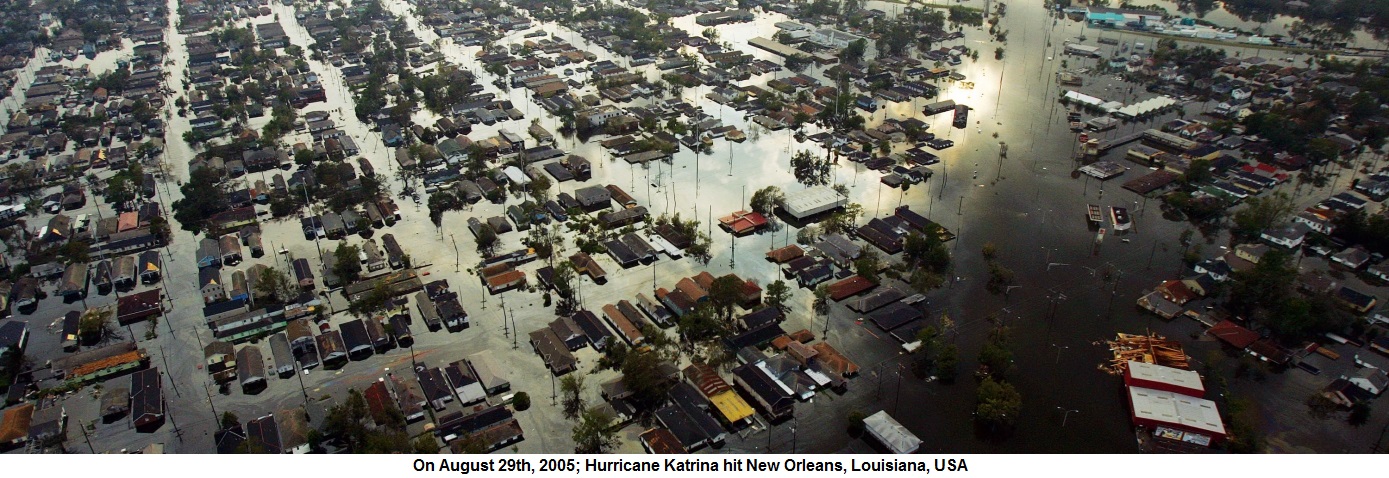
The book Go Lean…Caribbean serves as a roadmap for elevating the 30 member-states of the Caribbean, a few near Failed-State status. The book does not target Middle-East countries in its mitigation and remediation plans – Caribbean only – but we seek to learn lessons from the handling of this crisis.

The 5-Step leading-learning curve is normally:

1. Look, 2. Listen, 3. Learn, 4. Lend-a-hand and then 5. Lead.

We cannot lead in this case, but we can lend-a-hand, (contribute to any international relief campaign). We can also learn how to minimize Failed-State risks within our region.

So who should take the lead for fixing the Middle East Failed-State dysfunctions or the refugee crisis into Europe?

According to the opening quotation of this commentary: those who broke it. (Notice, in the foregoing VIDEO, that the refugees are targeting NATO countries).

The US and Western Europe are perhaps more directly responsible. They are the ones, in multi-national coalitions, that toppled the strong governments of Afghanistan and Iraq, then sat aside and allowed ISIS (Islamic State in Iraq and Syria) to form with the hope of overthrowing the oppressive regime of Bashar al-Assad in Syria. (So far, ISIS, has become its own “Frankenstein Monster”, to say the least, creating more distress and becoming its own threat). See Appendix below.

The Middle East is not easy!

In 2008 the newly elected US President, Barack Obama, vowed to exit US forces from Afghanistan and Iraq. He succeeded. The “laws of unintended consequences” may now have taken reign.

As for the Caribbean, we are on the periphery of this issue. Yes, we are allied to the United States and their enemies do tend to lash out at American allies. So we do have the “Sum of All Fears” that Al-Qaeda, ISIS or some other terrorist group would secure a “dirty bomb” nuclear device and detonate it in the Caribbean. But the biggest concern must be the slow creep of Failed-State status. This point was pronounced early in the Go Lean book as a motivation and a basis for confederation among Caribbean neighbors; there are the applicable statements in the opening Declaration of Interdependence (Page 12):

x.   Whereas we are surrounded and allied to nations of larger proportions in land mass, populations, and treasuries, elements in their societies may have ill-intent in their pursuits, at the expense of the safety and security of our citizens. We must therefore appoint “new guards” to ensure our public safety and threats against our society, both domestic and foreign. The Federation must employ the latest advances and best practices … to assuage continuous threats against public safety.

xi. Whereas all men are entitled to the benefits of good governance in a free society, “new guards” must be enacted to dissuade the emergence of incompetence, corruption, nepotism and cronyism at the peril of the people’s best interest. The Federation must guarantee the executions of a social contract between government and the governed.

xii. Whereas the legacy in recent times in individual states may be that of ineffectual governance with no redress to higher authority, the accedence of this Federation will ensure accountability and escalation of the human and civil rights of the people for good governance, justice assurances, due process and the rule of law. As such, any threats of a “failed-state” status for any member state must enact emergency measures on behalf of the Federation to protect the human, civil and property rights of the citizens, residents, allies, trading partners, and visitors of the affected member state and the Federation as a whole.

xiii. Whereas the legacy of dissensions in many member-states (for example: Haiti and Cuba) will require a concerted effort to integrate the exile community’s repatriation, the Federation must arrange for Reconciliation Commissions to satiate a demand for justice.

xvi. Whereas security of our homeland is inextricably linked to prosperity of the homeland, the economic and security interest of the region needs to be aligned under the same governance. Since economic crimes, including piracy and other forms of terrorism, can imperil the functioning of the wheels of commerce for all the citizenry, the accedence of this Federation must equip the security apparatus with the tools and techniques for predictive and proactive interdictions.

This Go Lean book serves as a roadmap for the introduction and implementation of the technocratic Caribbean Union Trade Federation (CU). With a branding name like Trade Federation, obviously the scope of elevating Caribbean society starts with economics. But the CU must seek to optimize the security dynamics in addition to economic empowerments. Therefore the Go Lean roadmap has these 3 prime directives:

  • Optimization of the economic engines in order to grow the regional economy and create 2.2 million new jobs.
  • Establishment of a security apparatus to protect the resultant economic engines and mitigate challenges/threats to ensure public safety for the region’s stakeholders.
  • Improvement of Caribbean governance to support these engines.

The book contends that though terrorism may not be a scourge on Caribbean life presently, new “bad actors” will eventually emerge to exploit the new economic successes envisioned in the Go Lean roadmap. The CU/Go Lean Strategy statement is quoted as follows (Page 46):

Fix the broken systems of governance in our region and deter against movements towards Failed-States, and any preying upon our people. We must protect the most vulnerable among us and guarantee the human/civil rights of our women and minorities.

The Go Lean book details a series of community ethos, strategies, tactics, implementations and advocacies to optimize the societal engines of the region, to stop any downward spiral into Failed-State status. See the lists here:

Community Ethos – Economic Systems Influence Choices & Incentives Page 21
Community Ethos – Consequences of Choices Lie in the Future Page 21
Community Ethos – Anti-Bullying and Mitigation Page 23
Community Ethos – Minority Equalization Page 24
Community Ethos – Ways to Impact the Future – Focus on Youth & Progress Page 26
Community Ethos – Ways to Manage Reconciliations Page 34
Community Ethos – Ways to Impact the Greater Good Page 37
Strategy – Vision –  Integrate region into a Single Market Economy Page 45
Strategy – Agents of Change – Globalization Page 57
Strategy – Agents of Change – Climate Change – Increase in Droughts and Floods Page 57
Tactical – Separation of Powers – Department of Homeland Security Page 75
Tactical – Separation of Powers – Federal Courts – Truth & Reconciliation Commissions Page 75
Implementation – Ways to Foster International Aid Page 115
Planning – 10 Big Ideas … in the Caribbean Region – Haiti & Cuba Page 127
Planning – Ways to Model the EU – From Worst to First Page 130
Planning – Reasons Why the CU Will Succeed – Germany Reconciliation Model Page 132
Planning – Ways to Improve Failed-State Indices – Cuba & Haiti on the List Page 134
Planning – Lessons from East Germany – European post-war rebuilding Page 139
Planning – Lessons from Egypt – Arab Spring Page 143
Planning – Lessons from the US Constitution – Gradual Optimization Page 145
Planning – Lessons from Canada’s History – Reconciliations with Indigenous Peoples Page 146
Advocacy – Ways to Grow the Economy Page 151
Advocacy – Ways to Create Jobs Page 152
Advocacy – Ways to Impact Justice Page 178
Advocacy – Ways to Impact the Diaspora Page 217
Advocacy – Ways to Protect Human Rights Page 220
Advocacy – Ways to Help Women Page 226
Advocacy – Ways to Impact Youth Page 227
Advocacy – Ways to Impact the Dominican Republic – Need for Reconciliations Page 237
Advocacy – Ways to Re-boot Haiti Page 238
Advocacy – Ways to Re-boot Jamaica – Mitigate Migrations & Brain Drain Page 239

In previous blog commentaries, the related issues of Caribbean migration and refugee-seeking were fully explored. See sample list here:

https://goleancaribbean.com/blog/?p=5759 Pressed by Debt Crisis, Doctors Leave Greece in Droves
https://goleancaribbean.com/blog/?p=4809 Americans arrested for aiding ISIS
https://goleancaribbean.com/blog/?p=3662 Migrant flow into US from Caribbean spikes
https://goleancaribbean.com/blog/?p=2907 Local Miami Haitian leaders protest Bahamian immigration policy
https://goleancaribbean.com/blog/?p=2809 A Lesson in History: Economics of East Germany
https://goleancaribbean.com/blog/?p=1531 A Lesson in History: World War I Ethnic Cleansing
https://goleancaribbean.com/blog/?p=1433 Caribbean loses over 70% of tertiary educated citizens to the   brain drain
https://goleancaribbean.com/blog/?p=623 Only at the precipice, do they change

All of the Caribbean needs to pay more-than-the-usual attention to the crisis with these Middle East Failed-States and the resultant refugee influx into Europe.

“There but for the Grace of God go I”

The remediation and mitigations in the Go Lean book are best-practices to minimize the push-pull factors for our own societal abandonment, and downward spirals into Failed-States. Now is the time for all of the Caribbean to lean-in this roadmap. Let’s show the world how to re-boot Failed-States and how to forge better conditions in a homeland. Let’s truly make the Caribbean better places to live, work, and play.  🙂

… and R.I.P. little Aylan Kurdi. We will not soon forget you. 🙁

Download the free e-Book of Go Lean … Caribbean – now!

——–

Appendix – Middle East Failed States

Afghanistan

A landlocked country, with a population of approximately 32 million people; it is located within South Asia and Central Asia between Iran and Pakistan. The recent history features a series of coups in the 1970s and was followed by a Soviet invasion and a series of civil wars that devastated much of Afghanistan.

The September 11 attacks on the United States were perpetrated by known terrorist Osama bin Laden and his al-Qaeda movement. The US demanded that the then-Taliban government hand him over.[122] After refusing to comply, the October 2001 Operation Enduring Freedom was launched by the US to topple the Taliban government. During the initial invasion, US and UK forces bombed al-Qaeda training camps. The United States began working with the Northern Alliance to remove the Taliban from power.[123] American forces remained until the official end of the war on December 28, 2014. However, thousands of US-led NATO troops have remained in the country to train and advise Afghan government forces.[138] The 2001-present war has resulted in between 185,000 and 249,000 deaths, which includes civilians, insurgents and government forces. A Taliban insurgency remains, to this day.

Iraq

This country is situated near the Arabian Peninsula and sits in between Saudi Arabia, Iran, Turkey, Jordan and Kuwait. The largest ethnic groups in Iraq are Arabs and Kurds. Other ethnic groups include Assyrians, Turkmen, Shabakis, Yazidis, Armenians, Mandeans, Circassians and Kawliya.[6] Around 95% of the country’s 36 million citizens are Shia or Sunni Muslims, with Christianity, Yarsan, Yezidism and Mandeanism also present.

Iraq was controlled by the Arab Socialist Ba’ath Party from 1968 until 2003. After an invasion by the United States and its allies in 2003, Saddam Hussein‘s Ba’ath Party was removed from power and multi-party parliamentary elections were held in 2005. The American presence in Iraq ended in 2011,[9] but the Iraqi insurgency continued and intensified as fighters from the Syrian Civil War spilled into the country. Civil strife continues to this day with conflicts among the ethnic and religious sects.

Syria

A country of 18 million people, on the coast of the Mediterranean; it is made up of fertile plains, high mountains, and deserts, it is home to diverse ethnic and religious groups, including Arabs, Greeks, Armenians, Assyrians, Kurds, Circassians,[8] Mandeans[9] and Turks. Religious groups include Sunnis, Christians, Alawites, Druze, Mandeans and Yazidis. Sunni Arabs make up the largest population group in Syria. Since March 2011, Syria has been embroiled in an uprising against Assad and the Ba’athist government as part of the Arab Spring, a crackdown which contributed to the Syrian Civil War and Syria becoming among the least peaceful countries in the world.[16]

Share this post:
, , , , ,
[Top]

A Lesson in History – ‘Katrina’ is helping today’s crises

Go Lean Commentary

As of this moment (August 28 – 29, 2015), there is a Tropical Storm – Erika – barreling through the Caribbean. So far, it has been deadly, with reports of fatalities in the islands of Dominica and Puerto Rico. See story/VIDEO here:

VIDEO 1: Tropical storm Erika nears US, destruction in its wake

Posted Friday Aug 28, 2015 from: http://www.today.com/video/tropical-storm-erika-nears-us-destruction-in-its-wake-514916419548

The effects of tropical storm Erika are already being felt in Puerto Rico, after the storm left four people dead and more missing on the Caribbean island of Dominica. Janet Shamlian reports and TODAY’s Al Roker takes us through the storm’s projected path.

s crisis - Photo 1

s crisis - Photo 2

This storm is not done yet, more damage to persons and property is expected – it is expected to elevate to hurricane status by Sunday.

Welcome to the Caribbean 2015 …
… the greatest address on the planet?!?!

Why would anyone campaign to assume the stewardship of this archipelago of islands?

This is the “siren song” of the book Go Lean … Caribbean. The publishers and underlying Foundation are petitioning for a leadership role in the economic, security and governing engines of the region. Why?

There is no insanity! This is an expression of love for the homeland. The 30 member-states of the Caribbean are home to 42 million people, and a Diaspora of 10 million; plus 80 million visitors annually.

This is the greatest address on the planet!

Plus, everywhere has natural disasters to contend with. This fact relates to rich countries and poor alike. For example, take the United States; they are the richest Single Market economy in the world and yet their coastal city of New Orleans Louisiana (NOLA) was devastated by Hurricane Katrina 10 years ago … to the day (August 29, 2005). Their riches did not spare their devastation, nor did the riches facilitate best-practices in terms of response, relief and rebuilding. New Orleans is marking the anniversary of Katrina’s devastation and the lessons learned from the aftermath. See story/VIDEO here:

VIDEO 2: Both Progress and Stumbling Blocks Linger a Decade After Katrina

Posted Friday, Aug 28, 2015 from: http://www.nbcnews.com/nightly-news/video/both-progress-and-stumbling-blocks-linger-a-decade-after-katrina-515371587753

Ten years later, after Hurricane Katrina many of those who left have returned and while tourist sections of the city have been rebuilt, recovery in areas like the Lower Ninth ward is slow.

There is a lesson for the Caribbean in considering the history of ‘Katrina’: There is a parallel cause-and-effect to Tropical Storm Erika and all subsequent storms: Climate Change.

In the last few decades, major devastating storms have proliferated every year … somewhere … in the Northern Hemisphere. This commentary has detailed other cases; see sample here:

https://goleancaribbean.com/blog/?p=4741 Vanuatu and Tuvalu – Inadequate response to post-storm suffering
https://goleancaribbean.com/blog/?p=2465 Book Review: ‘This Changes Everything: Capitalism vs. the Climate’
https://goleancaribbean.com/blog/?p=1817 Caribbean grapples with intense new cycles of flooding & drought

These commentaries, and the Go Lean book, all assert that Climate Change cannot be ignored. Even though there be deniers of any man-made causes, the reality of these storms challenge the realities of Caribbean life.

It is what it is!

The region has been warned: Prepare!

The book Go Lean … Caribbean delved into details of the Katrina lessons in application to the Caribbean. This is an excerpt from Page 184:

The Bottom Line on Hurricane Katrina
Katrina was the deadliest and most destructive hurricane of the 2005 Atlantic hurricane season. It was the costliest natural disaster, as well as one of the five deadliest hurricanes, in the history of the US. At least 1,833 people died in the hurricane and subsequent floods; total property damage was estimated at $81 billion. The hurricane strengthened to a Category 5 hurricane over the warm Gulf water, but weakened before making its landfall as a Category 3 hurricane on the morning of Monday, August 29 in southeast Louisiana. It caused severe destruction along the Gulf coast from central Florida to Texas, much of it due to the storm surge. The most significant number of deaths occurred in New Orleans, Louisiana, which flooded as the levee system catastrophically failed, 53 different breaches, in the hours after the storm had moved inland. Eventually 80% of the city and large tracts of neighboring parishes became flooded, and the floodwaters lingered for weeks.

The economic effects of the storm were far-reaching. The Administration of President George W. Bush sought $105 billion for repairs and reconstruction in the region, which did not account for damage to the economy caused by interruption of the oil & natural gas supply, destruction of the GulfCoast’s highway infrastructure, and exports of commodities such as forestry and grain. Plus, hundreds of thousands of local residents were left unemployed, Before the hurricane, the region supported over one million non-farm jobs, with 600,000 of them in New Orleans. It is estimated that the total economic impact in Louisiana and Mississippi exceeded $150 billion, as Katrina redistributed over one million people from the central Gulf coast elsewhere across the United States, which became the largest Diaspora in the history of the US.

Within days of Katrina’s August 29, 2005 landfall, public debate arose about the local, state and federal governments’ role in the preparations for and response to the hurricane. Criticism was initially prompted by televised images of visibly shaken and frustrated political leaders, and of residents who remained stranded by flood waters without water, food or shelter. Deaths from thirst, exhaustion, and violence, days after the storm had passed, fueled the criticism, as did the dilemma of the evacuees at ill-prepared shelter facilities (i.e. the Super Dome, LouisArmstrongInternationalAirport). Some alleged that race, class, and other factors could have contributed to delays in response. President Bush later called the criticism, directed towards him, (particularly by Hip-Hop recording artist Kanye West), the worst moment in his presidency, being unjustly accused of racism.

s crisis - Photo 3

 Katrina Photo 4

The Super Dome in New Orleans – The aftermath of Hurricane Katrina

s crisis - Photo 5

This is the purpose of the Go Lean roadmap. It introduces the technocratic Caribbean Union Trade Federation (CU) to prepare Caribbean society for the eventual devastation of these Climate-Change-induced weather systems, such as Katrina was for New Orleans, Louisiana. We do not have the luxury of “sticking our head in the sand” and pretending that these problems will simply go away – the conclusion of many observers of the Katrina Crisis on NOLA. This point is pronounced early in the book with this Declaration of Interdependence (Page 11), with this opening statement:

i.  Whereas the earth’s climate has undeniably changed resulting in more severe tropical weather storms, it is necessary to prepare to insure the safety and security of life, property and systems of commerce in our geographical region. As nature recognizes no borders in the target of its destruction, we also must set aside border considerations in the preparation and response to these weather challenges.

The CU will implement optimized Emergency Management schemes to provide better stewardship for the region’s preparation and response to natural disasters; (in addition to hurricanes, there is the need to monitor earthquakes, volcanoes, floods and droughts in the regions).  In addition, the CU will assume jurisdiction for the Caribbean Sea, the 1,063,000 square-mile international waters, as an Exclusive Economic Zone. These preparations and mitigations will allow for better cooperation, collaboration and equalization in the region. The CU/Go Lean roadmap has these 3 prime directives:

  • Optimization of the economic engines in order to grow the regional economy to $800 Billion and create 2.2 million new jobs.
  • Establishment of a security apparatus to protect the resultant economic engines, including the Emergency Management apparatus.
  • Improvement of Caribbean governance to support these engines.

The Go Lean book details the community ethos, strategies, tactics, implementations and advocacies necessary to impact the homeland in this age of Climate Change. Consider the list as follows:

Profile – Who We Are: SFE Foundation Page 8
Economic Principles – People Choose because Resources are Limited Page 21
Economic Principles – All Choices Involve Costs Page 21
Economic Principles – People Respond to Incentives Page 21
Economic Principles – Economic Systems Influence Individual Choices Page 21
Economic Principles – Consequences of Choices Lie in the Future Page 21
Community Ethos – Job Multiplier Page 22
Community Ethos – “Crap” Happens Page 23
Community Ethos – Lean Operations Page 24
Community Ethos – Return on Investments (ROI) Page 24
Community Ethos – Ways to Impact the Future Page 26
Community Ethos – Ways to Improve Sharing Page 35
Community Ethos – Impact the Greater Good Page 37
Anecdote – Pipeline Transport – Strategies, Tactics & Implementations Page 43
Strategy – Vision – Confederating 30 Member-states in a Union Page 45
Strategy – Agents of Change – Technology Page 57
Strategy – Agents of Change – Globalization Page 57
Strategy – Agents of Change – Climate Change Page 57
Tactical – Fostering a Technocracy Page 64
Tactical – Growing Economy – Quicker Recoveries; Less Economic Bubbles Page 69
Separation of Powers – Homeland Security Department – Emergency Management Agency Page 76
Separation of Powers – Interior Department – Exclusive Economic Zone Page 82
Assemble – Consolidating Disaster Preparation & Response Page 96
Implementation – Ways to Pay for Change – Homeland Security – Hurricane Insurance Fund Page 101
Implementation – Benefits from the Exclusive Economic Zone Page 104
Implementation – Ways to Develop a Pipeline Industry – To Mitigate Natural Disaster Effects Page 107
Implementation – Ways to Deliver Page 109
Planning – 10 Big Ideas – Integrated Homeland Security efforts Page 127
Advocacy – Ways to Grow the Economy – Quick Recovery from Natural Disasters Page 151
Advocacy – Ways to Create Jobs Page 152
Advocacy – Ways to Better Manage the Social Contract – Infrastructure Page 170
Advocacy – Ways to Ways to Impact Public Works – Inter-State Pipelines Page 175
Advocacy – Ways to Foster Cooperatives Page 176
Advocacy – Ways to Improve for Natural Disasters – Hurricane Katrina Case Study Page 184
Advocacy – Ways to Impact Extractions – Inter-State Pipeline Strategy Alignment Page 195
Advocacy – Ways to Improve Emergency Management Page 196
Advocacy – Ways to Foster Technology Page 197
Advocacy – Ways to Ways to Improve Monopolies – Foster Cooperatives for Better Recoveries Page 202
Advocacy – Ways to Improve Transportation – Pipeline Options Page 205

It is time for change in the Caribbean! It is time to change our preparations and our responses to these natural disasters. The strategies, tactics and implementations proposed in the book Go Lean…Caribbean are conceivable, believable and achievable. We must do these! We must do better.

Everyone in the Caribbean are hereby urged to lean-in for this Go Lean roadmap.  🙂

Download the free e-Book of Go Lean … Caribbean – now!

Share this post:
, , , ,
[Top]

Sum of All Fears – ‘On Guard’ Against Deadly Threats

Go Lean Commentary

It’s time for some serious talk:

There are people out there that would like to kill us, and destroy our way of life.

Doubtful? Consider ISIS, Al Qaeda or Boko Haram!

These groups are Terrorist organizations, and they are committed, even at the risk of their own lives to carry out what they consider “a sacred service to their God”. (This aligns with the Bible at John 16:2  – “the time cometh that whosoever killeth you will think that he doeth God service” – KJV).

From the Caribbean perspective, this is a scary proposition. This also considers that the people, institutions of the Caribbean may not be the Terrorists’ target; they are really at enmity with the United States, not the Caribbean.

The US has a massive security apparatus, with huge budgets, systems, hardware (ships, submarines, fighter jets, satellites, etc.) and military personnel; the largest in the world. These enemies may not be able to get to their ideal target, the American homeland, but will settle with successful attacks against its bordering neighbors, allies and defenseless island territories (Puerto Rico, and/or the US Virgin Islands).

God forbid, they may get their hands on nuclear materials and detonate a “dirty bomb” on our Caribbean homeland.

This is the sum of all our fears!

CU Blog - Sum of All Fears - Photo 2

This title, “Sum of All Fears”, comes from a quote by the late British Prime Minister Winston Churchill, quoted as follows:

Why, you may take the most gallant sailor, the most intrepid airman or the most audacious soldier, put them at a table together – what do you get? The sum of their fears.

In the modern lexicon however, the title draws reference to the movie based on the novel of the same name. These works of fiction portray a scenario where a nuclear bomb is exploded on US soil at a celebrated American football game. The movie truly depicted an ominous scenario. See the movie trailer here:

VIDEO – Sum of All Fears (2002) – Movie Trailer  – https://youtu.be/p4Y-0Pun2Eg

Published on Feb 22, 2013 – CIA analyst Jack Ryan must thwart the plans of a terrorist faction that threatens to induce a catastrophic conflict between the United States and Russia’s newly elected president by detonating a nuclear weapon at a football game in Baltimore.
Alternate Synopsis: When the president of Russia suddenly dies, a man whose politics are virtually unknown succeeds him. The change in political leaders sparks paranoia among American CIA officials, so CIA director Bill Cabot recruits a young analyst to supply insight and advice on the situation. Then the unthinkable happens: a nuclear bomb explodes in a U.S. city, and America is quick to blame the Russians.

Life imitating art; art imitating life.

Atomic bombs have been detonated before … twice, in World War II against Japan on the cities of  Hiroshima and Nagasaki. (Today, August 6, is the exact 70th Anniversary of the Hiroshima detonation).

CU Blog - Sum of All Fears - Photo 1

No one can therefore claim that this fear of an atomic, hydrogen or nuclear bomb is far-fetched.

This consideration is presented in conjunction to mitigations and remediation for protecting the Caribbean homeland. The assertion in the book Go Lean … Caribbean (Page 23) is that with the emergence of new economic engines, “bad actors” will also emerge thereafter to exploit the opportunities, with good, bad and evil intent. The book warns that this “bad actor” emergence is a historical fact; it is not inconceivable that it can be repeated, even on the Caribbean homeland.

This is the sum of our fears!

This point is pronounced early in the book with the Declaration of Interdependence (Page 12) that claims:

x.   Whereas we are surrounded and allied to nations of larger proportions in land mass, populations, and treasuries, elements in their societies may have ill-intent in their pursuits, at the expense of the safety and security of our citizens. We must therefore appoint “new guards” to ensure our public safety and threats against our society, both domestic and foreign. The Federation must employ the latest advances and best practices … to assuage continuous threats against public safety.

xii. Whereas the legacy in recent times in individual states may be that of ineffectual governance with no redress to higher authority, the accedence of this Federation will ensure accountability and escalation of the human and civil rights of the people for good governance, justice assurances, due process and the rule of law. As such, any threats of a “failed state” status for any member state must enact emergency measures on behalf of the Federation to protect the human, civil and property rights of the citizens, residents, allies, trading partners, and visitors of the affected member state and the Federation as a whole.

xvi. Whereas security of our homeland is inextricably linked to prosperity of the homeland, the economic and security interest of the region needs to be aligned under the same governance. Since economic crimes, including piracy and other forms of terrorism, can imperil the functioning of the wheels of commerce for all the citizenry, the accedence of this Federation must equip the security apparatus with the tools and techniques for predictive and proactive interdictions.

The Go Lean book serves as a roadmap for the introduction and implementation of the technocratic Caribbean Union Trade Federation (CU). The branding Trade connotes economics, but the roadmap also addresses Homeland Security. Thusly, ascending the CU treaty would also enact a Defense Pact for the region’s security interest. Therefore the Go Lean roadmap has these 3 prime directives:

  • Optimization of the economic engines in order to grow the regional economy and create new jobs.
  • Establishment of a security apparatus to protect the resultant economic engines and the Caribbean homeland.
  • Improvement of Caribbean governance to support these engines.

This structure heeds the pleas of the foregoing Declaration of Interdependence. The Caribbean appointing “new guards”, or a security pact to ensure public safety includes many strategies, tactics and implementations considered “best-practices”. We must be on a constant vigil against the eventual emergence of a “bad actor” that would be the “sum of our fears”. This indicates being pro-active in monitoring, mitigating and managing risks. The Go Lean book describes an organization structure with Intelligence Gathering and Analysis, a robust Emergency Management functionality, plus the Unified Command and Control for Caribbean Disaster Response, anti-crime and military preparedness.

This type of initiative was attempted before. Some Caribbean region member-states came together, starting in 1982, to establish the Regional Security System (RSS); it is an international accord for the defense and security of the eastern Caribbean region. The CU/Go Lean roadmap “stands on the shoulders” of that nascent beginning and extends the vision further with a Status of Forces Agreement (SOFA) embedded in the treaty to create the CU Trade Federation. It is past time now for some real assurances. The world has become a scarier place. The threat of an unknown, non-state-sponsored enemy, terrorism is real. The World Trade Center/Pentagon attack on September 11, 2001 was an undeniable game-changer. But in a recent blog/commentary, it was reported that 17 recent terrorist attacks against the American homeland was cited for this decade alone, since 2010.

The CU Homeland Security Pact would roll the charters of the RSS and other regional efforts, such as:

… into one consolidated apparatus, the SOFA, thusly creating one entity, under a Commander-in-Chief would be “on guard” 24-7-365 for real or perceived threats.

The CU‘s requirement for the SOFA is “Step One, Day One” in the Go Lean roadmap. The Go Lean book details the series of community ethos, strategies, tactics, implementations and advocacies to provide the proactive and reactive public safety/security in the Caribbean region:

Community Ethos – Economic Systems Influence Individual Choices Page 21
Community Ethos – Consequences of Choices Lie in Future Page 21
Community Ethos – Privacy –vs- Public Protection Page 23
Community Ethos – Intelligence Gathering Page 23
Community Ethos – Whistleblower Protection Page 23
Community Ethos – “Crap” Happens Page 23
Community Ethos – Cooperatives Page 25
Community Ethos – Ways to Manage Reconciliations Page 34
Community Ethos – Ways to Improve Sharing Page 35
Community Ethos – Ways to Promote Happiness Page 36
Community Ethos – Ways to Impact the Greater Good Page 37
Strategy – Vision – Confederating a non-sovereign permanent union Page 45
Tactical – Fostering a Technocracy Page 64
Tactical – Separation of Powers – Coast Guard & Naval Authorities Page 75
Tactical – Separation of Powers – Ground Militia Forces Page 75
Tactical – Separation of Powers – Emergency Management Agency Page 76
Tactical – Separation of Powers – CariPol: Marshals & Investigations Page 75
Implementation – Assemble Regional Organs into the CU Page 96
Implementation – Ways to Pay for Change Page 101
Implementation – Start-up Foreign Policy Initiatives Page 102
Implementation – Start-up Security Initiatives Page 103
Implementation – Ways to Foster International Aid – Military Aid Page 115
Planning – 10 Big Ideas – #3: Consolidated Homeland Security Pact Page 130
Planning – Ways to Make the Caribbean Better – Improved Public Safety Page 131
Planning – Ways to Improve Failed-State Indices – Escalation Role Page 134
Planning – Lessons from the American West – Needed Law & Order Page 142
Planning – Lessons from Egypt – Law & Order to not undermine Tourism Page 143
Advocacy – Ways to Grow the Economy – Quick Disaster Recovery Page 151
Advocacy – Ways to Improve Governance Page 168
Advocacy – Ways to Better Manage the Social Contract Page 170
Advocacy – Ways to Impact Justice – Policing the Security Forces Page 177
Advocacy – Ways to Reduce Crime – Regional Security Intelligence Page 178
Advocacy – Ways to Improve Gun Control Page 179
Advocacy – Ways to Improve Homeland Security Page 180
Advocacy – Ways to Mitigate Terrorism Page 181
Advocacy – Ways to Improve Intelligence Gathering & Analysis Page 182
Advocacy – Ways to Improve for Emergency Management Page 196
Advocacy – Ways to Protect Human Rights Page 220

Other subjects related to security and governing empowerments for the region’s defense have been blogged in other Go Lean…Caribbean commentaries, as sampled here:

https://goleancaribbean.com/blog/?p=5840 Computer Glitches – Cyber Attacks Maybe – Disrupt Business As Usual
https://goleancaribbean.com/blog/?p=5183 A Lesson in History – Cinco De Mayo and Mexico’s Security Lapses
https://goleancaribbean.com/blog/?p=5002 Managing a ‘Clear and Present Danger’
https://goleancaribbean.com/blog/?p=4809 Americans arrest 2 would-be terrorists – Mitigating threats
https://goleancaribbean.com/blog/?p=4360 Dreading the ‘Caribbean Basin Security Initiative’
https://goleancaribbean.com/blog/?p=3881 Intelligence Agencies to Up Cyber Security Cooperation
https://goleancaribbean.com/blog/?p=1965 America’s Navy – 100 Percent – Model for Caribbean
https://goleancaribbean.com/blog/?p=1554 Status of Forces Agreement = Security Pact
https://goleancaribbean.com/blog/?p=1531 A Lesson in History: 100 Years Ago – Root Causes of World War I
https://goleancaribbean.com/blog/?p=1076 Trinidad Muslims travel to Venezuela for Jihadist training
https://goleancaribbean.com/blog/?p=960 Lessons from NSA recording all phone calls in Bahamas
https://goleancaribbean.com/blog/?p=809 Muslim officials condemn abductions of Nigerian girls
https://goleancaribbean.com/blog/?p=535 Remembering and learning from Boston
https://goleancaribbean.com/blog/?p=273 10 Things We Want from the US – #4: Pax Americana

The Caribbean is arguably the best address of the planet. The people are kind, and hospitable. History shows that kindness is often disregarded as weakness. So we must project strength, underlying the regional smiles and touristic “welcome mat”.

Unfortunately, there are those out in the “mad-mad” world that will kill … with no qualms. What’s worst, they will overkill.

Overkill? See this Photo here:

CU Blog - Sum of All Fears - Photo 3

Nuclear/Hydrogen/Atomic weapons are overkill.

This is the formation of human society; any opening for exploitation will be explored. Someone must be “on guard” for these risks, threats and abuses.

Help is on the way; here comes the Caribbean Union Trade Federation, to help make the region a better, safer homeland to live, work and play.

Everyone in the Caribbean – citizens, institutions and governments – are hereby urged to lean-in to this Go Lean roadmap. 🙂

Download the free e-Book of Go Lean … Caribbean – now!

Share this post:
, , , ,
[Top]