Tag: Power

For-Profit Education: Plenty of Profit; Little Education

Go Lean Commentary

Follow the money…

This is a familiar plot-line in Hollywood Police dramas. Its “life imitating art” because this is the same eventuality for the American For-Profit education industry. There is a lot of money available in the US for post-secondary education of American students. Federal Student Loans are available to any American citizen regardless of credit or income. This constitutes a fertile ground for abuse.

According to the following news article, this one education company Corinthian College – see Appendix A below – is a bad example of For-Profit schools making a lot of profit but providing very little education to its customers: students.

“Scratch a liar, catch a thief”.

The article is presented here:

1. Title: My college degree is worthless
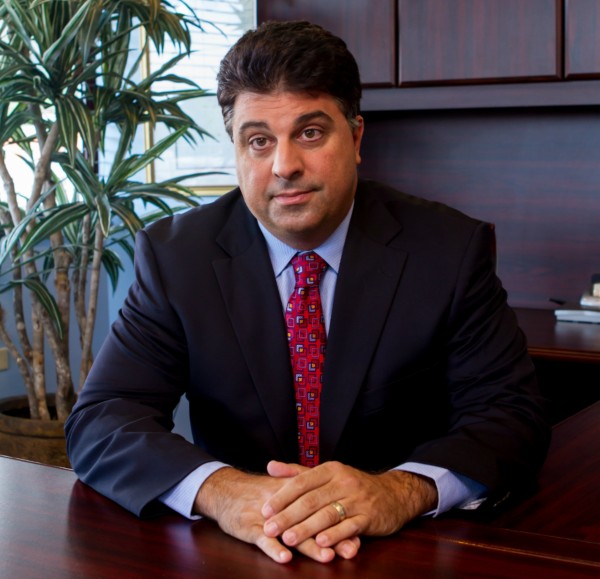
CU Blog - For-Profit Education - Plenty of Profit; Little Education - Photo 1
Sub-title:
Students across the country are shelling out tens of thousands of dollars for degrees that end up being completely worthless.

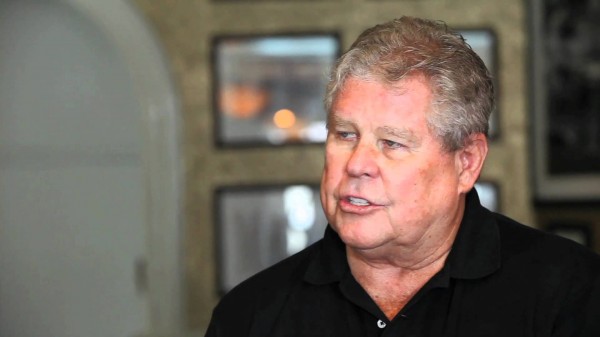
CU Blog - For-Profit Education - Plenty of Profit; Little Education - Photo 2Rosalyn Harris, an unemployed single mother who had never gone to college, thought getting a degree would be the ticket to a new life. So at age 23, she enrolled in a two-year criminal justice program at for-profit Everest College in Chesapeake, Va.

But the wealth of job opportunities the school had touted never transpired, and all she ended up with was more than $22,000 in student loan debt. She said classes were terrible, she didn’t receive any of the training she needed, and as a result, she spent months after graduation searching for criminal justice jobs without ever getting a call back.

Desperate to start paying some of her bills, Harris eventually applied for any entry-level job she could find. A full year after she graduated, she finally found a minimum wage job stocking shelves at Victoria’s Secret.

“My sole purpose of going to school was bettering my life for me and my son,” she said. “But now I wish I had never gone.”

Everest is a member of for-profit behemoth Corinthian Colleges, which has been accused by federal agencies of operating a predatory lending scheme, preying on low-income students and falsely inflating job placement numbers. Corinthian is currently closing and selling its schools, leaving thousands of graduates on the hook for loans they took out.

A Corinthian spokesman confirmed that Harris graduated in good standing, but it was unable to place her in a job. He said the school did provide her with career assistance and claims the criminal justice program has a 75% job placement rate, which he said is “a strong outcome for any educational program.”

He also disputed the allegations against the school, noting that Corinthian’s student loan default rate (of up to 27% for its EverestCollege campuses) is lower than other community colleges and its graduation and job placement rates are higher.

And while Corinthian has a particularly bad reputation, the for-profit college industry as a whole is often criticized for luring low-income students with false promises and failing to provide educations that qualify students for jobs.

Not only that but for-profit schools are generally double or triple the cost of public institutions like community colleges, and the default rate (19% last year) was the highest of all sectors.

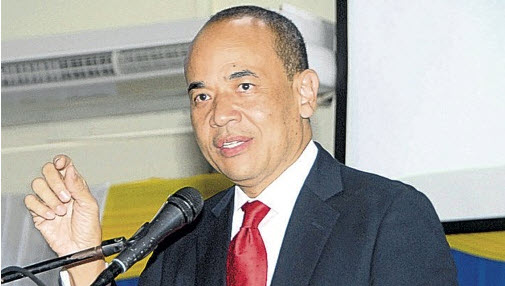
CU Blog - For-Profit Education - Plenty of Profit; Little Education - Photo 3Vantrell Echols, a 36-year-old from Georgia, wishes he never received a phone call from for-profit Lincoln College of Technology back in 2008. He said the school spent six months convincing him to enroll — promising to provide all the training and help he needed to find a high-paying computer science job. He had been unemployed for more than a year and he was desperate, so he gave it a shot.

But upon enrolling in the computer science program, he said the quality of education “was a complete joke” and job assistance was nonexistent.

“They sold many of us dreams about helping us, getting us qualified to work, to help us with jobs, [but] I had to ask fellow students to help me because the teachers wouldn’t. Many of us graduated with honors but didn’t learn anything in our fields,” he said.

Lincoln Educational Services president Scott Shaw defended the school’s reputation to CNNMoney, touting its 75% job placement rate and pointing to examples of successful graduates like the CEO of VMWare (who graduated in 1979).

But Echols said that after accumulating more than $20,000 in debt to attend the one-year program, he wasn’t able to find a single job in computer science. He’s still unemployed, is now homeless — and he is convinced he’d be better off without the degree even listed on his resume.

He says multiple employers have told him that they don’t view his degree as credible because of the for-profit industry’s reputation and because other people they’ve hired from the school haven’t had the necessary skills for the job.

“They’ve ruined my life and the lives of many of my classmates,” he said.

Shaw said extensive career assistance was provided to Echols and that he isn’t sure why Echols couldn’t find a job. “There’s only so much we can do — at some point the student has to partake,” he said.

But these kinds of stories are popping up so often that even the Obama Administration took action this week. Going forward, for-profit colleges will risk losing federal student aid if average loan payments of graduates exceed 20% of discretionary income or 8% of total earnings.

“Too many hard-working students find themselves buried in debt with little to show for it,” Secretary of Education Arne Duncan said in a statement.

Senators Jeff Merkley of Oregon and Tom Harkin of Iowa are pushing for legislation that goes a step further. They argue that a loophole in federal laws allow some institutions to offer programs that aren’t licensed or accredited at the state or federal level. That means graduates end up with degrees that may sound legitimate but are meaningless to many employers.

The two senators introduced legislation last month aimed at cracking down on these “worthless degrees.” The legislation would require courses to be licensed before allowing schools to accept federal money like student loan dollars or financial aid.

“Passing this bill will ensure that a college can no longer charge thousands of dollars for a degree that does not prepare them to work in the field they were promised‎,” according to a statement about the bill.

Related: U.S. sues Corinthian Colleges
2. Title: Embattled for-profit education behemoth Corinthian Colleges is facing yet another legal fight: This time, from the Consumer Financial Protection Bureau.

The consumer agency announced Tuesday it is suing Corinthian for “illegal predatory lending” and is demanding that the school forgive more than $500 million in private loans it has given to students since July of 2011.

According to the CFPB’s complaint, Corinthian convinced students to enroll in the school by inflating its job placement rates. It even paid employers to hire graduates for at least one day in order to boost its numbers.

Meanwhile, Corinthian’s tuition and fees — which can climb to as high as $75,000 for a bachelor’s degree — are higher than what federal loans generally cover, forcing many students to take out private loans from the school. These loans, called “Genesis loans,” came with origination fees of 6% and interest rates of around 15% as of 2011 — much higher than the 3% and 7% charged on federal loans.

CNNMoney (New York); posted September 16, 2014 from: http://money.cnn.com/2014/09/16/pf/college/cfpb-corinthian-lawsuit/index.html?iid=EL


The references to “low-income students” in the foregoing article are most commonly the “Black and Brown” of the American population. This is a frequent demographic for victimization in American life.

This issue in the article is just another example of Crony-Capitalism and institutional racism. The book Go Lean…Caribbean and subsequent blogs posit that the Caribbean must not be vulnerable to these negative American forces.

The dread of Crony-Capitalism and institutional racism have been highlighted and detailed in many previous blog commentaries; see the many Crony-Capitalism models in Appendix B below. Now we have to add the reality of Big Education to the discussion. The issue underpinning this dilemma is the easy availability of guaranteed student loans from the US federal government. Unfortunately this is not just an issue for For-Profit institutions, many not-for-profit colleges and university also exploit the federal student loan funds to garner revenues at the expense of innocent students. The Crony in this case is a direct consequence of a rich pool of federal monies.

Rich pool? This brings to mind the visual of an isolated pool/pond on the African Plain, a watering hole on the Serengeti where many animals seek hydration and refuge, but the terrain is endangered with predators: lions, crocodiles, hyenas, cheetahs, etc.. Yes, in the American commercial eco-system, “follow the money”, and you will find many “bad actors” looking to exploit the situation for unfair gain and quick profits.

CU Blog - For-Profit Education - Plenty of Profit; Little Education - Photo 4

VIDEO – Is the cost of college crippling? – http://money.cnn.com/video/news/2013/09/03/n-cost-of-college-rising-education-middle-class-jobs.cnnmoney/


The Caribbean must do better! We must also dissuade our citizens from emigrating to this American eco-system.

The consideration of Crony-Capitalism in the For-Profit Education industry aligns with the book Go Lean…Caribbean, a roadmap to elevate the economic, security and governing engines of the Caribbean. The Caribbean wants to model many of the good examples of the United States, and learn from the many bad models. Education is one such model. While optimization of education can systemically raise a country’s economy, the Caribbean experience has been more negative than positive. Too many of our students have left … to study abroad; then refused to return home, taking with them the return on community investments and repayment of their student loans. The Go Lean book has reported in detail on how traditional college career paths have been disastrous policies for the Caribbean in whole, and each specific country in particular.

This Go Lean book serves as a roadmap for the introduction and implementation of the technocratic Caribbean Union Trade Federation (CU). The CU has a complete education agenda, applying lessons learned from the consideration of the American models. This roadmap represents a big change for the region. The CU/Go Lean roadmap has 3 prime directives:

  • Optimization of the economic engines in order to grow the regional economy to $800 Billion & create 2.2 million new jobs..
  • Establishment of a security apparatus to police “bad actors” and protect the resultant economic engines.
  • Improvement of Caribbean governance, including a separation-of-powers, to support these engines.

The Go Lean roadmap provides turn-by-turn directions on how to reform the Caribbean tertiary education systems, economy, governance and Caribbean society as a whole. There is a plan for a regional student loan pool, where we mitigate the dangers that are so evident in the American eco-system. Our primary threat now is the constant abandonment rate among the college-educated populations. So as a planning tool, the roadmap commences with a Declaration of Interdependence, pronouncing the dread of societal threats and the Caribbean brain drain (Page 12):

xvi.  Whereas security of our homeland is inextricably linked to prosperity of the homeland, the economic and security interest of the region needs to be aligned under the same governance. Since economic crimes … can imperil the functioning of the wheels of commerce for all the citizenry, the accedence of this Federation must equip the security apparatus with the tools and techniques for predictive and proactive interdictions.

xix.  Whereas our legacy in recent times is one of societal abandonment, it is imperative that incentives and encouragement be put in place to first dissuade the human flight, and then entice and welcome the return of our Diaspora back to our shores

xxi.  Whereas the preparation of our labor force can foster opportunities and dictate economic progress for current and future generations, the Federation must ensure that educational and job training opportunities are fully optimized for all residents of all member-states, with no partiality towards any gender or ethnic group This responsibility should be executed without incurring the risks of further human flight, as has been the past history.

The Go Lean book posits that education is a vital consideration for Caribbean economic empowerment. The vision of the CU is a confederation of the 30 member-states of the Caribbean to do the heavy-lifting of championing better educational policies.  The book details those policies; and other ethos to adopt, plus the executions of the following strategies, tactics, implementations and advocacies to impact tertiary education in the region:

Community Ethos – Deferred Gratification Page 21
Community Ethos – Economic Systems Influence Individual Choices and Incentives Page 21
Community Ethos – Job Multiplier Page 22
Community Ethos – Lean Operations Page 24
Community Ethos – Return on Investments (ROI) Page 24
Community Ethos – Ways to Impact the Future – Apply Lessons of American Lax Oversight Page 26
Community Ethos – Ways to Foster Genius Page 27
Community Ethos – Ways to Help Entrepreneurship – Training & Mentoring Page 28
Tactical – Separation of Powers – Education Department Page 85
Tactical – Separation of Powers – Labor Department – On-the-Job-Training Regulator Page 89
Implementation – Ways to Better Manage Debt – Lessons of American Student Loan Crisis Page 114
Advocacy – Ways to Grow the Economy – Essential Role of Tertiary Education Page 151
Advocacy – Ways to Create Jobs – Vital Need for Better STEM Education Empowerments Page 152
Advocacy – Ways to Improve Education – Mitigating the Brain Drain Page 159
Advocacy – Ways to Impact Student Loans – Regional Pools for Cross-Border Enforcements Page 160
Advocacy – Ways to Improve Governance Page 169
Appendix – Education and Economic Growth Page 258
Appendix – Measuring Education Progress and Success Criteria Page 266
Appendix – New American Student Loan Debt Crisis – Now Over $1 Trillion in Debt Page 286

The American Tertiary Education Student Loan eco-system is badly broken; (tuition has increased 500% since 1985). The large pools of money has attracted “bad actors” or predators. The party in the foregoing news article – Corinthian Colleges – has been charged and adjudicated with predatory lending violations. Their victims: poor students who would have to repay these non-dischargeable federally-insured student loans. How sad? All of that time, talent and treasury and nothing to show for it. No wonder the economic effects of this affected population are now showing in other aspects of the economy, such as retarded home-buying output among the younger generations.

The Caribbean is urged to do better.

The people, educational and governing institutions in the region are urged to lean-in for the empowerments described in the book Go Lean … Caribbean. Education reform can suceed in elevating Caribbean society; we can make our Caribbean homeland a better place to live, work, learn and play. 🙂

Download the free e-Book of Go Lean … Caribbean – now!

———-

Appendix A – Corinthian Colleges, Inc.
(Source: http://en.wikipedia.org/wiki/Corinthian_Colleges)

Corinthian Colleges, Inc. (CCi) was a large for-profit post-secondary education company in North America. Its subsidiaries offered career-oriented diploma and degree programs in health care, business, criminal justice, transportation technology and maintenance, construction trades, and information technology.[1]

At its largest, CCi had over 100 Everest, Heald and WyoTech campuses throughout the United States and Canada.[2]

Corinthian’s campuses in Canada closed on February 19, 2015 after the Ontario government suspended their operation license. After a series of legal challenges by state and federal agencies, on April 26, 2015 Corinthian Colleges announced that they would cease operations at all remaining US locations effective April 27, 2015. The closure affected more than 16,000 students and employees.

Corinthian Colleges was founded in February 1995.[3] The five founders — David Moore, Paul   St. Pierre, Frank McCord, Dennis Devereux, and Lloyd Holland — were executives at National Education Centers, Inc. (NECI), a for-profit operator of vocational schools based in Irvine, California. The founders planned to acquire schools that were fundamentally sound, but which for one reason or another were performing below their potential.[4]

Historically, CCi grew rapidly through acquisitions and through organic growth, including opening new branch campuses, remodeling, expanding or relocating existing campuses, and adopting curricula into existing colleges.[3]

Acquired Schools
The following institutes and colleges were acquired [through the years]:[5]

  • American Motorcycle Institute
  • AshmeadCollege
  • Blair College
  • Bryman College
  • Bryman Institute
  • Duff’s Business Institute
  • Florida Metropolitan University
  • Georgia Medical Institute
  • Kee Business College
  • Las Vegas College
  • National Institute of Technology
  • National School of Technology
  • Olympia Career Training Institute
  • Olympia College
  • Parks College
  • Rochester Business Institute
  • Tampa College
  • Western Business College

Corinthian Colleges faced numerous investigations and lawsuits, including a federal criminal investigation.[6]

Financial Aid Financing
The Higher Education Act provides that a private, for-profit institution, such as CCi’s institutions, may derive no more than 90% of its revenue from the Title IV federal student aid programs.[39] In 2010, CCi reported that it received 81.9% of revenue from Title IV federal student aid programs. [40] Corinthian Colleges (CCI) acquired QuickStart Intelligence in summer 2012, an Irvine, California-based, privately held technology training company. As a B2B revenue stream; CCI acquired QuickStart Intelligence to leverage the 10%, non-government funding essential to back the additional student loans for CCi’s core adult learning programs.

Student Loan Default Rate
A significant requirement imposed by Congress is a limitation on participation in Title IV programs by institutions whose former students default on the repayment of federal student loans in excess of specified rates (“Cohort Default Rates”).[41] On March 25, 2013, CCi received a draft three-year Cohort Default Rates from the U.S. Department of Education for students who entered repayment during the federal fiscal year ending September 30, 2010 (the “2010 Cohort”), measured over three federal fiscal years of borrower repayment. The weighted average of CCi’s institutions was 19.0%, a 9.0 percentage point decrease from the 28.0% weighted average for the three-year cohort default rate for students who entered repayment during the prior fiscal year.[42] For the 2010 Cohort, none of CCi’s institutions exceeded the default threshold set by the U.S. Department of Education.[42]

———-

Appendix B – Models of American Crony-Capitalism

Big Defense Many theorists indicate that the “follow the money” approach reveals the Military Industrial Complex work to undermine peace, so as to increase defense spending for military equipment, systems and weapons.
Big Media Cable companies conspire to keep rates high; kill net neutrality; textbook publishers practice price gouging; Hollywood insists on big tax breaks/ subsidies for on-location shooting.
Big Oil While lobbying for continuous tax subsidies, the industry have colluded to artificially keep prices high and garner rocket profits ($38+ Billion every quarter).
Big Box Retail chains impoverish small merchants on Main Street with Antitrust-like tactics, thusly impacting community jobs. e-Commerce, an area of many future prospects, is the best hope of countering these bad business tactics.
Big Pharma Chemo-therapy cost $20,000+/month; and the War against Cancer is imperiled due to industry profit insistence.
Big Tobacco Cigarettes are not natural tobacco but rather latent with chemicals to spruce addiction.
Big Agra Agribusiness concerns bully family farmers and crowd out the market; plus fight common sense food labeling efforts.
Big Data Brokers for internet and demographic data clearly have no regards to privacy concerns.
Big Banks Wall Street’s damage to housing and student loans are incontrovertible.
Big Weather Overblown hype of “Weather Forecasts” to dictate commercial transactions.
Big Real Estate Preserving MLS for Real Estate brokers only, forcing 6% commission rates, when the buyers and sellers can meet without them.
Big Salt Despite the corrosiveness of salt on roads and the environment, it is the only tactic   used to de-ice roads. Immediately after the weather warms, the roads must be re-constructed, thus ensuring a continuous economic cycle.
Big Energy The For-Profit utility companies always lobby against regulations to “clean-up” fossil-fuel (coal) power plants or block small “Green” start-ups from sending excess power to the National Grid. Their motive is to preserve their century-long monopoly and their profits.
Big Legal Even though it is evident that the promotion of Intellectual Property can help   grow economies, the emergence of Patent Trolling parties (mostly lawyers) is squashing innovation. These ones are not focused on future innovations, rather just litigation. They go out and buy patents, then look for anyone that may consume any concepts close to those patents, then sue for settlements, quick gains.
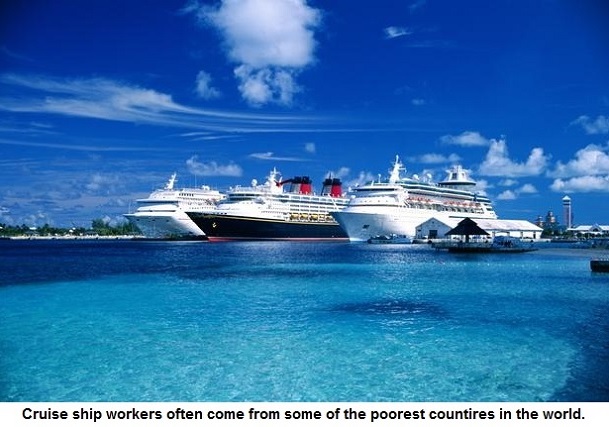
Big Cruise Cruise ships are the last bastion of segregation with descriptors like “modern-day-slavery” and “sweat-ships”. Working conditions are poor and wages are far below anyone’s standards of minimum. Many ship-domestic staff are “tip earners”, paid only about US$50 a month and expected to survive on the generosity of the passengers’ gratuity. The industry staff with personnel from Third World countries, exploiting those with desperate demands. Nowhere else in the modern world is this kind of job discrimination encouraged, accepted or tolerated.
Big Jails The private prison industry seem motivated more by profit than by public safety. They attempt to sue state governments when their occupancy levels go too low; a reduction in crime is bad for business.
Big Housing The American legacy is one of the institutional segregation in American cities. The practice was administered by real estate agents and housing officials executing policies to elevate property values and generational wealth for White families at the expense of a life of squalor for Non-Whites.
Big Charities Big Not-For-Profit organizations that fleece the public under the guise of charities but retain vast majorities of the funding as administrative costs, thusly benefiting mostly the charities’ executives and staff rather than the intended benefactors.
Share this post:
, , , ,

In Search Of The Red Cross’ $500 Million In Haiti Relief

Go Lean Commentary

“A crisis is a terrible thing to waste” – familiar expression coined by American Economist Paul Romer.

This expression is prominent in the introduction of the book Go Lean…Caribbean. The motives of the book publishers are to exploit the post-2008 economic crises to forge change in the Caribbean region. But in this case, it appears that another party has utilized a Caribbean crisis to exploit the public for monies for their own coffers; that party is the American Red Cross.

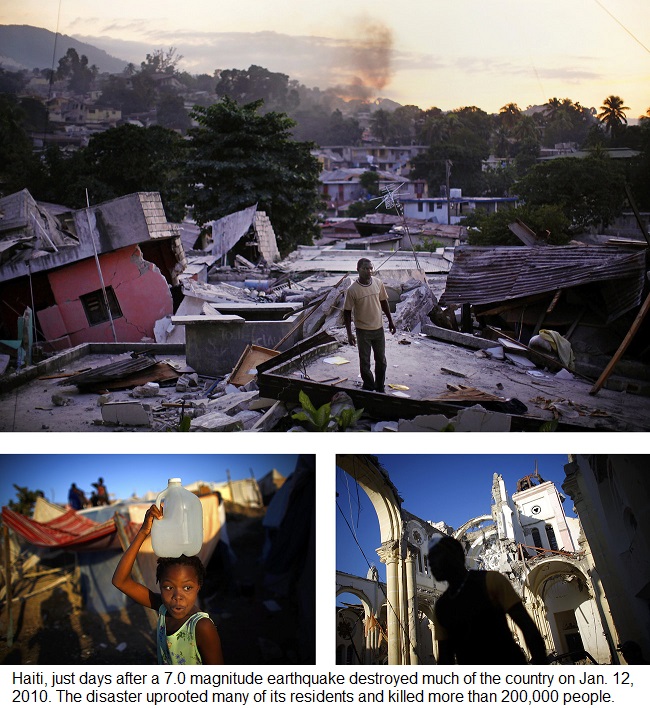
Immediately after the earthquake in Haiti on January 12, 2010 many Non-Government Organizations (NGO), including the American Red Cross, embarked on fundraising campaigns to raise money for the response, relief and rebuilding of Haiti. The Red Cross held a Telethon, complete with text message fundraising:

Text [the word] Haiti to 90999

… and boom, $10 would be billed to the respondent’s mobile phone account and encumbered for the American Red Cross’s Aid to Haiti. (Note: this writer contributed via text message in 2010).

$500 Million In Haiti Relief - Photo 1

How successful was this fundraising campaign? US$500 million! How successful was the relief and rebuilding of Haiti campaign? Still waiting…

VIDEO – Report highlights Red Cross aid failures in Haiti  https://youtu.be/cSAZ8cScwro

Published on Jun 3, 2015 – Following the devastating 2010 earthquake in Haiti, the American Red Cross raised close to 500 million dollars and promised to help rebuild the country’s communities. A new report by ProPublica and NPR unearth a number of confidential memos and insider accounts that stand in sharp contrast to the public picture painted by the organization. CBSN spoke to co-author of the report, Justin Elliott.

This consideration aligns with the strategies, tactics, implementations and advocacies of the book Go Lean…Caribbean. The declaration is that the Caribbean must be front-and-center in providing for our own solutions. The alternative, someone else taking the lead for our solution seems to be lacking…every time!

For us in the Caribbean, we need to grow up and more responsible ourselves! We need to stand up and be counted!

The Go Lean book declares (Page 115):

“Haiti should not be a perennial beggar; the Caribbean should not be perennial beggars, but we do need capital/money, especially to get started”.

There was the opportunity to raise $500 million to get started. We lost out!

Instead the American Red Cross provided the “adult supervision” and what do we have to show for it? According to the following AUDIO Podcast, next to nothing; (6 houses):

Appendix AUDIO Podcast: NPR’s ‘All Things Considered’ –  http://www.npr.org/player/v2/mediaPlayer.html?action=1&t=1&islist=false&id=411524156&m=411812821

By Laura Sullivan – When a devastating earthquake leveled Haiti in 2010, millions of people donated to the American Red Cross. The charity raised almost half a billion dollars. It was one of its most successful fundraising efforts ever.
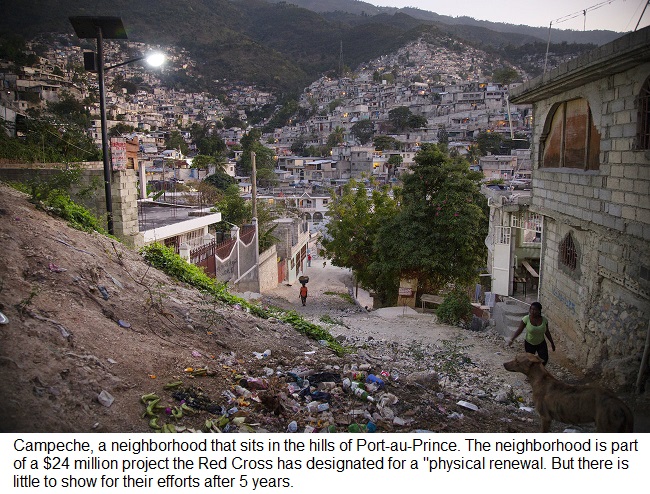
The American Red Cross vowed to help Haitians rebuild, but after five years the Red Cross’ legacy in Haiti is not new roads, or schools, or hundreds of new homes. It’s difficult to know where all the money went.
Source: National Public Radio (NPR) – Radio Podcast for Fresh Air; posted 06/03/2015; retrieved from: http://www.npr.org/2015/06/03/411524156/in-search-of-the-red-cross-500-million-in-haiti-relief

This is just another example of Crony-Capitalism.

This is not only the Go Lean commentary, but rather many of the general public voiced this same concern on the cited NPR website; see sample here:

Public Comment by “TheUnPossible” on June 3, 2015: Perhaps they should do what they do best. Serve coffee, give-out blankets and draw blood. This reminds me of a lot of the other high-profile charities like Susan G. Komen and United Way that just become a black-hole for donations. They’re like a church. They get people to give them tons of cash and promise salvation if people just believe in them.

Public Comment by “Unpartisan” on June 3, 2015: They’re like a church. They get people to give them tons of cash and promise salvation if people just believe in them.” Sounds like many politicians and government agencies as well, good analogy.

Public Comment by “James Hulsey” on June 3, 2015: I haven’t trusted the American Red Cross since 9/11, when they were fundraising for 9/11 relief efforts and then shunted the extra money into their general fund.

Public Comment by “TravelingOne” on June 4, 2015: No – the Red Cross: http://www.huffingtonpost.com/… And one of the reasons they no longer get any money from me; nor does United Way (UW) however.

Public Comment by “DCRich” on June 4, 2015: Local UW chapters often are worse. They coerce poorly paid employees of agencies they support to contribute with the implication that support to the agency is influenced by this. They try to engage new agencies with the same kind of appeal. Most of their money goes to orgs that have no trouble fundraising on their own like the Y and Scouts. Basically, they’re a middleman that allows the business community to interfere with and take credit or the work of “charity”. Giving money directly to some org[anization] you actually know something about is better than giving a cut to UW or CFC [(Combined Federal Campaign) for federal government employees].

The book and subsequent blogs posit that the Caribbean must not be vulnerable to American Crony-Capitalistic forces.

“We can do bad all by ourselves”.

The dread of Crony-Capitalism was highlighted and detailed in many previous blog commentaries; see Appendix below. Now we have to add the reality of Big Charity to the landscape; referring to the big organizations that fleece the public under the guise of charities but retain vast majorities of the funding as administrative costs, thusly benefiting mostly the charities’ executives and staff rather than the intended benefactors.

The Caribbean must do better! We need a Truth & Reconciliation Commission (TRC) on this issue.

The book Go Lean…Caribbean pursues the quest to elevate the Caribbean region through economic, security and governance empowerments. This includes oversight and guidance for NGO’s in the region. The book serves as a roadmap for the introduction and implementation of the technocratic Caribbean Union Trade Federation (CU) to provide better stewardship for the Caribbean homeland. The book describes that NGO’s are Caribbean stakeholders. Even though many of the 30 member-states may be considered independent nations, the premise of the book is that there must be an ethos of interdependence, rather than just independence. This all relates to governance, the need for technocratic – and better – stewardship of regional Caribbean society. This point was also pronounced in the opening Declaration of Interdependence (Pages 11 & 14) with these acknowledgements and statements:

xi. Whereas all men are entitled to the benefits of good governance in a free society, “new guards” must be enacted to dissuade the emergence of incompetence, corruption, nepotism and cronyism at the peril of the people’s best interest. The Federation must guarantee the executions of a social contract between government and the governed.

xii. Whereas the legacy in recent times in individual states may be that of ineffectual governance with no redress to higher authority, the accedence of this Federation will ensure accountability and escalation of the human and civil rights of the people for good governance, justice assurances, due process and the rule of law. As such, any threats of a “failed state” status for any member state must enact emergency measures on behalf of the Federation to protect the human, civil and property rights of the citizens, residents, allies, trading partners, and visitors of the affected member state and the Federation as a whole.

xxxiii. Whereas lessons can be learned and applied from the study of the recent history of other societies, the Federation must formalize statutes and organizational dimensions to avoid the pitfalls of [other] communities.

$500 Million In Haiti Relief - Photo 2This is the quest of CU/Go Lean roadmap: to provide new guards for a more competent Caribbean administration … by governmental organizations and non-governmental organizations. (NGO would be promoted, audited and overseen by CU administrators).

This crisis should not be wasted!

In general, the CU will employ better strategies, tactics and implementations to impact its prime directives; identified with the following 3 statements:

  • Optimization of the economic engines in order to grow the regional economy to $800 Billion & create 2.2 million new jobs.
  • Establishment of a security apparatus to protect the resultant engines and mitigate internal and external “bad actors”.
  • Improvement of Caribbean governance to support these engines.

The Go Lean book stresses key community ethos, strategies, tactics, implementations and advocacies necessary to turn-around the eco-systems of Caribbean governance. These points are detailed in the book as follows:

Community Ethos – Deferred Gratification Page 21
Community Ethos – Economic Principles – Respond to Incentives in   Predictable Ways Page 21
Community Ethos – Economic Principles – Economic Systems Influence   Individual Choices Page 21
Community Ethos – Economic Principles – Consequences of Choices Lie in   the Future Page 21
Community Ethos – Security Principles – Whistleblower Protection Page 23
Community Ethos – Security Principles – Intelligence Gathering Page 23
Community Ethos – Security Principles – “Crap” Happens Page 23
Community Ethos – Governing Principles – Lean Operations Page 24
Community Ethos – Governing Principles – Return on Investments Page 24
Community Ethos – Governing Principles – Cooperatives Page 25
Community Ethos – Ways to Impact the Future Page 26
Community Ethos – Ways to Impact Turn-Arounds Page 33
Community Ethos – Ways to Manage Reconciliations – South Africa TRC Model Page 34
Community Ethos – Ways to Improve Sharing – Emergency Response Page 35
Community Ethos – Ways to Impact the Greater Good Page 37
Strategy – Vision – Confederate all 30 member-states/ 4 languages into a Single Market Page 45
Strategy – Mission – Prepare for the eventuality of natural disasters Page 45
Strategy – Agents of Change – Climate Change Page 57
Tactical – Ways to Foster a Technocracy Page 64
Tactical – Growing the Economy – Post WW II European Marshall Plan/Recovery Model Page 68
Tactical – Separation-of-Powers – CU Federal Government versus Member-State Governance Page 71
Tactical – Separation-of-Powers – Treasury Department – Shared Property Recording Systems Page 74
Tactical – Separation-of-Powers – State Department – Liaison/Oversight for NGO’s Page 80
Tactical – Separation-of-Powers – Interior Department – Housing & Urban Authority Page 83
Tactical – Separation-of-Powers – Federal Courts – Truth & Reconciliation Commissions Page 90
Implementation – Assemble All Regionally-focus Organizations of All Caribbean Communities Page 96
Implementation – Ways to Pay for Change Page 101
Implementation – Ways to Foster International Aid Page 115
Planning – 10 Big Ideas – Homeland   Security Pact Page 127
Planning – Ways to Make the Caribbean Better Page 131
Planning – Ways to Improve Failed-State Indices – Governance and the Social Contract Page 134
Advocacy – Ways to Grow the Economy Page 151
Advocacy – Ways to Create Jobs Page 152
Advocacy – Ways to Improve Housing – Optimizing Property Registration Process Page 152
Advocacy – Ways to Improve Governance Page 168
Advocacy – Ways to Better Manage the Social Contract Page 170
Advocacy – Ways to Improve Homeland Security Page 180
Advocacy – Ways to Improve for Natural Disasters Page 184
Advocacy – Ways to Improve Technology Page 197
Advocacy – Ways to Develop a Pre-Fab Housing Industry – One solution ideal for Haiti Page 207
Advocacy – Ways to Impact Foundations – NGO’s can help deliver Social Contract Page 219
Advocacy – Ways to Re-boot Haiti Page 238
Appendix – Philanthropy Pledge Signatories – Billionaires willing to “give” to an optimized  technocracy Page 292

The Go Lean roadmap seeks to empower and elevate Caribbean societal engines. While it is out-of-scope to impact America, we do not want American institutions (or European or Asian for that matter) exploiting our crisis for their gain.

Charity begins at home. (And should be managed at home). Online crowd-sourcing may be a better tool.

The Go Lean book calls on the Caribbean region to be collectively self-reliant, both proactively and reactively. Natural disasters (i.e. earthquakes and hurricanes) will occur again. Considering our efforts in our disaster response, relief and rebuilding – there will be many opportunities to get it right. Once we do … get it right – with an optimized technocracy – there will be more philanthropic funds and charitable donations to help our Caribbean causes. NGO’s, billionaires and their well-funded foundations are attracted to efficiently managed entities:

Take care of the pennies and the dollars will take care of themselves – Old Adage.

Our quest is simple, a regional effort to make the Caribbean homeland a better place to live, work and play. 🙂

Download the book Go Lean … Caribbean – now!

————

Appendix – Models of American Crony-Capitalism

Big Defense Many theorists indicate that the “follow the money” approach reveals the Military Industrial Complex work to undermine peace, so as to increase defense spending for military equipment, systems and weapons.
Big Media Cable companies conspire to keep rates high; kill net neutrality; textbook publishers practice price gouging; Hollywood insists on big tax breaks/ subsidies for on-location shooting.
Big Oil While lobbying for continuous tax subsidies, the industry have colluded to artificially keep prices high and garner rocket profits ($38+ Billion every quarter).
Big Box Retail chains impoverish small merchants on Main Street with Antitrust-like tactics, thusly impacting community jobs. e-Commerce, an area of many future prospects, is the best hope of countering these bad business tactics.
Big Pharma Chemo-therapy cost $20,000+/month; and the War against Cancer is imperiled due to industry profit insistence.
Big Tobacco Cigarettes are not natural tobacco but rather latent with chemicals to spruce addiction.
Big Agra Agribusiness concerns bully family farmers and crowd out the market; plus fight common sense food labeling efforts.
Big Data Brokers for internet and demographic data clearly have no regards to privacy concerns.
Big Banks Wall Street’s damage to housing and student loans are incontrovertible.
Big Weather Overblown hype of “Weather Forecasts” to dictate commercial transactions.
Big Real Estate Preserving MLS for Real Estate brokers only, forcing 6% commission rates, when the buyers and sellers can meet without them.
Big Salt Despite the corrosiveness of salt on roads and the environment, it is the only tactic   used to de-ice roads. Immediately after the weather warms, the roads must be re-constructed, thus ensuring a continuous economic cycle.
Big Energy The For-Profit utility companies always lobby against regulations to “clean-up” fossil-fuel (coal) power plants or block small “Green” start-ups from sending excess power to the National Grid. Their motive is to preserve their century-long monopoly and their profits.
Big Legal Even though it is evident that the promotion of Intellectual Property can help   grow economies, the emergence of Patent Trolling parties (mostly lawyers) is squashing innovation. These ones are not focused on future innovations, rather just litigation. They go out and buy patents, then look for anyone that may consume any concepts close to those patents, then sue for settlements, quick gains.
Big Cruise Cruise ships are the last bastion of segregation with descriptors like “modern-day-slavery” and “sweat-ships”. Working conditions are poor and wages are far below anyone’s standards of minimum. Many ship-domestic staff are “tip earners”, paid only about US$50 a month and expected to survive on the generosity of the passengers’ gratuity. The industry staff with personnel from Third World countries, exploiting those with desperate demands. Nowhere else in the modern world is this kind of job discrimination encouraged, accepted or tolerated.
Big Jails The private prison industry seem motivated more by profit than by public safety. They attempt to sue state governments when their occupancy levels go too low; a reduction in crime is bad for business.
Big Housing The American legacy is one of the institutional segregation in American cities. The practice was administered by real estate agents and housing officials executing policies to elevate property values and generational wealth for White families at the expense of a life of squalor for Non-Whites.
Share this post:
, , , ,
[Top]

POTUS and the Internet

Go Lean Commentary

What is the requirement for the Office of the President of the United States; and why is this important to the Caribbean?

A candidate must be at least 35 years old; natural born citizen of the country (could not have been naturalized); must win the majority of votes (270) of the 538 total in the American Electoral College.

One more requirement: the candidate must have a “thick skin” and the uncanny ability to choose his/her battles. The President cannot pick a fight with just anyone that lobs unkind words, no matter how denigrating the insult.

This is not easy! Considering the free-for-all that is the internet; freedom of speech … is not free!

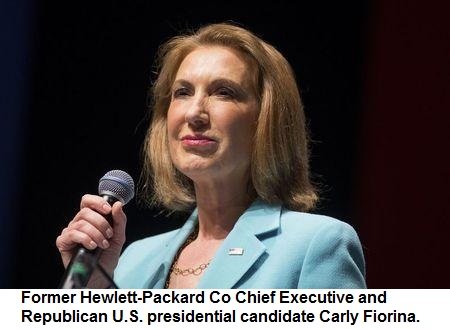
This actuality was dynamically illustrated in the past week; first with a number of 2016 potential candidates (Carly Fiorina, Ted Cruz, Jeb Bush and Hillary Clinton) in their quest to secure their own web domains (xxxxxxxxxx.com, xxxxxxxxxx.net, xxxxxxxxxx.org, etc.) and lastly with the current president’s first foray with the social media site Twitter. See stories here:

Title #1: U.S. presidential candidate Fiorina spins web around interviewer
By: Bill Trott, Reuters, May 10, 2015

WASHINGTON (Reuters) – Republican presidential candidate Carly Fiorina apparently has learned something about registering website domain names.

Former Hewlett-Packard Co Chief Executive and Republican U.S. presidential candidate Carly Fiorina speaks during the Freedom Summit in GreenvilleShortly after the former Hewlett-Packard chief executive announced her campaign last week, she found out that a cybersquatter had bought the rights to carlyfiorina.org and was using it to criticize her record.

Chuck Todd of NBC News brought up the issue while interviewing Fiorina on “Meet the Press” and showed the website, which features row after row of frowny-face emoticons representing 30,000 people laid off during her Hewlett-Packard tenure from 1999 to 2005.

Fiorina defended her record and after the interview sent a tweet thanking Todd for having her on the show and saying, “Btw, checkout chucktodd.org.” Her campaign had registered that domain and clicking on the link redirected traffic to her official campaign site, carlyforpresident.com.

Fiorina had done the same thing last week with sethmeyers.org when she appeared on NBC’s “The Late Show with Seth Meyers.”

Fiorina has acknowledged she made a mistake in not registering carlyfiorina.org first, but she is not the only 2016 presidential candidate bedeviled by cybersquatters.

Republican Ted Cruz must endure a rogue tedcruz.com site that says only “Support President Obama. Immigration Reform now”, while jebbushforpresident.com is being used by supporters of gay rights, not Jeb Bush.

The site hillaryclinton.org is not the work of Democratic candidate Hillary Clinton’s campaign and cyber security experts say it contains malicious software.

—————-

Title # 2: VIDEOPresident Obama @POTUShttp://wapo.st/1FkwKrX

May 19, 2015 (Reuters) – President Obama started his own Twitter account on Monday. Within 45 minutes of sending his first tweet, Obama gained more than 217,000 followers.

—————-

Title #3: ‘Welcome To Twitter, N*gger’: Righties Go FULL RACIST On POTUS Twitter Account (TWEETS)

Well, President Obama finally has his own twitter account, and conservatives didn’t waste any time showing just how racist they really are.

CU Blog - POTUS and the Internet - Photo 1

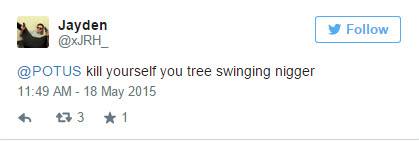
While the president was having fun posting about how his tweets would be his own words to the American people, righties were busy hurling racial slurs in @replies at the POTUS twitter account. For your viewing disgust, here are just a few of the so-called “welcome” messages President Obama received on his newly-created personal account (yes, these are screenshots and not actual tweets, in the event these trolls decide to delete their words like the cowards they are):

CU Blog - POTUS and the Internet - Photo 2

CU Blog - POTUS and the Internet - Photo 3

CU Blog - POTUS and the Internet - Photo 4

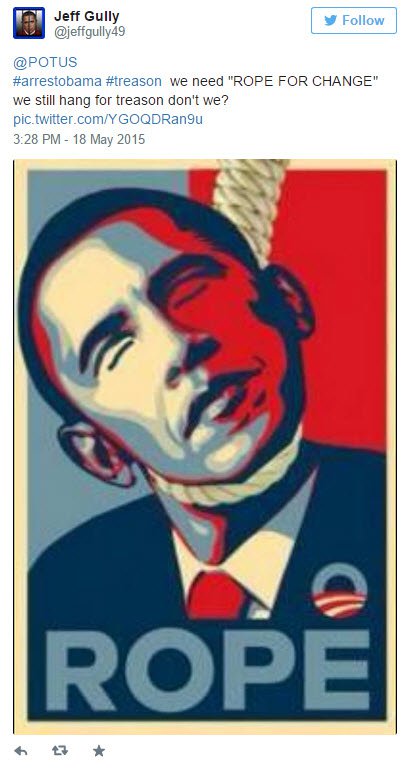
As if those initial messages weren’t bad enough, one person tweeted to the sitting President that he should be lynched, completed with image:

CU Blog - POTUS and the Internet - Photo 5

… I could go on, but you get the idea. If this doesn’t tell you that Barack Obama has handled the unprecedented disrespect and outright hatred directed at him from right-wing racists with the utmost grace and dignity, I don’t know what will.

The entire article is here: http://www.addictinginfo.org/2015/05/18/welcome-to-twitter-ngger-righties-go-full-racist-potus-twitter-account-tweets/; retrieved May 19, 2015.

—————-

Title #4: Uh, you probably don’t want to tweet to @POTUS, actually
By: Caitlin Dewey

Twitter, at first glance, is a magical fantasy land — a utopia where any old egg can freely converse with presidents, pop stars and kings. It is the great democratizer; the global water cooler; the one place where you can say anything to anyone and know it’ll be okay.

Consider this your monthly reminder that this is actually NOT the case: On the modern Internet, impressions of anonymity and ephemerality are, well … usually fake.

But the joke’s actually on them: Not only does the Secret Service already monitor Twitter for threats, but the White House is archiving each and every thing @POTUS tweeters say. Ashley Feinberg flagged this relevant piece of the White House Online Privacy Policy

when you tweet “leave Michelle for me @POTUS,” or something even more inappropriate/creepy, that lives in an official White House Archive for eternity (slash, for potential future scrutiny).

To be clear, this isn’t just a White House thing: The principle applies, in one form or another, to most types of social networking

Find the whole article at the Washington Post Online site – The Capital’s Daily Newspaper (Posted 05-19-2015) –

http://www.washingtonpost.com/news/the-intersect/wp/2015/05/19/uh-you-probably-dont-want-to-tweet-to-potus-actually/

The President of the United States (POTUS) is considered the most powerful Commander-in-Chief in the world; this is due to the fact that the US is the only remaining Super Power with the world’s largest Single Market economy and world’s largest military establishment. This country is the Caribbean largest trading partner. POTUS also has direct oversight over the US Federal Government functionalities in the 2 US Territories in the Caribbean (Puerto Rico and the US Virgin Islands).

This subject is a pivotal theme in the book Go Lean…Caribbean, which asserts that Internet & Communications Technologies (ICT) are critical for elevating Caribbean society. The art and science of this field is slated to impact the economic, security and governing engines. The internet makes things easy; it makes benevolent endeavors easier and malevolent endeavors easier. There must be the constant oversight.

The challenges of politicians and the Internet clearly demonstrate the need for technocratic oversight for the Caribbean’s foray into garnering more respect and benefits for intellectual property. There is the need for “Grievance Officers” to settle disputes related to cyber-squatting for Caribbean domains and the proposed Caribbean Cloud branded: www.myCaribbean.gov.

Change has come to the world of politicking and elections. The ubiquity of the internet cannot be ignored.

This book, Go Lean… Caribbean, serves as a roadmap for the introduction and implementation of the technocratic Caribbean Union Trade Federation (CU). The CU/Go Lean roadmap has 3 prime directives:

  • Optimization of the economic engines in order to grow the regional economy to $800 Billion GDP and create 2.2 million new jobs.
  • Establishment of a security apparatus to protect the societal engines and marshal against human and civil rights abuses.
  • Improvement of Caribbean governance to support these engines, plus facilitate a smooth transparent election process.

Early in the book, the benefits of optimizing governance through technology empowerments are pronounced in the opening Declaration of Interdependence (Pages 12 & 14), with these statements:

xi.  Whereas all men are entitled to the benefits of good governance in a free society, “new guards” must be enacted to dissuade the emergence of incompetence, corruption, nepotism and cronyism at the peril of the people’s best interest. The Federation must guarantee the executions of a social contract between government and the governed.

xii.  Whereas the legacy in recent times in individual states may be that of ineffectual governance with no redress to higher authority, the accedence of this Federation will ensure accountability and escalation of the human and civil rights of the people for good governance, justice assurances, due process and the rule of law…

xxvi.  Whereas the region has endured a spectator status during the Industrial Revolution, we cannot stand on the sidelines of this new economy, the Information Revolution. Rather, the Federation must embrace all the tenets of Internet Communications Technology (ICT) to serve as an equalizing element in competition with the rest of the world. The Federation must bridge the digital divide and promote the community ethos that research/development is valuable and must be promoted and incentivized for adoption.

xxvii.  Whereas intellectual property can easily traverse national borders, the rights and privileges of intellectual property must be respected at home and abroad. The Federation must install protections to ensure that no abuse of these rights go with impunity, and to ensure that foreign authorities enforce the rights of the intellectual property registered in our region.

The Go Lean book details the community ethos to adapt to the changed ICT landscape, plus the executions of the following strategies, tactics, implementations and advocacies:

Community Ethos – Economic Principle – People Respond to Incentives Page 21
Community Ethos – Job Multiplier Page 22
Community Ethos – Lean Operations Page 24
Community Ethos – Return on Investments (ROI) Page 24
Community Ethos – Ways to Impact the Future Page 26
Community Ethos – Promote Intellectual Property Page 29
Community Ethos – Impact Research & Development Page 30
Community Ethos – Bridge the Digital Divide Page 31
Strategy – Vision – Integrate 30 Caribbean member-states into a Single Market Economy Page 45
Strategy – Mission – Fix the broken systems of governance in our region Page 46
Tactical – Fostering a Technocracy Page 64
Tactical – Growing the Economy – Book: Nature and Causes of the Wealth of Nations by Adam Smith (1776) Page 70
Separation of Powers – Department of State – Federal Elections Administrators Page 70
Separation of Powers – Federal/Caribbean Police – Elections/Candidate Security Page 77
Separation of Powers – Film Promotion and Administration Page 78
Separation of Powers – Intellectual Property (Copyrights & Domains) Administration Page 78
Separation of Powers – Communications and Media Authority Page 79
Separation of Powers – Federal Legislature & Electoral Seats Page 91
Implementation – Ways to Impact Social Media Page 111
Implementation – Ways to Impact Elections Page 116
Advocacy – Ways to Grow the Economy Page 151
Advocacy – Ways to Create Jobs Page 152
Advocacy – Ways to Improve Communications Page 186
Advocacy – Ways to Foster Technology Page 197
Advocacy – Ways to Foster e-Commerce Page 198
Advocacy – Ways to Impact Hollywood Page 203
Advocacy – Ways to Promote Contact Centers – Ideal for Pre-Election Polling Page 212
Advocacy – Ways to Impact the Diaspora Page 217
Appendix – Puerto Rico Diaspora distribution in the mainland United States Page 304

This commentary is about the Caribbean, not about the United States. It is important for leaders in the US to be concerned with the Caribbean’s well-being. This point has been explicitly acknowledged by Caribbean stakeholders and relevant subjects have recently been extolled in these previous Go Lean…Caribbean blog/commentaries:

https://goleancaribbean.com/blog/?p=5183 Mexico Model – May 5th – US too occupied during Civil War to defend neighbor
https://goleancaribbean.com/blog/?p=5088 Caribbean Migrants among the accounting of 1 in 11 Black population in USA
https://goleancaribbean.com/blog/?p=4935 A Lesson in History – Grand Old Party – the Republicans – must be cuddled
https://goleancaribbean.com/blog/?p=4897 US Backs LNG Distribution Base in Jamaica as Caribbean Regional Hub
https://goleancaribbean.com/blog/?p=4793 Yelp.com Review Site – Model of CU Social Media Grievance Regulators
https://goleancaribbean.com/blog/?p=4551 US Territories – currently Between a ‘rock and a hard place’
https://goleancaribbean.com/blog/?p=4360 Dreading the American ‘Caribbean Basin Security Initiative’
https://goleancaribbean.com/blog/?p=4294 US Ambassadors to Caribbean push US Energy and Security Policies
https://goleancaribbean.com/blog/?p=3834 State of Caribbean Union compared to the State of the American Union
https://goleancaribbean.com/blog/?p=3662 Caribbean Migrants desperate to get to US as Promised Land destination
https://goleancaribbean.com/blog/?p=1965 America’s Navy – Protector for Caribbean waters and the World’s

Other interactions related to US government-to-Caribbean population have also been blogged in Go Lean commentaries, as sampled here:

https://goleancaribbean.com/blog/?p=4058 New York Times Maledictions on The Bahamas
https://goleancaribbean.com/blog/?p=3473 Haiti to Get $70 Million from US-AID to Expand Caracol  Industrial Park
https://goleancaribbean.com/blog/?p=3455 Restoration of US Diplomatic Relations with Cuba
https://goleancaribbean.com/blog/?p=2907 Miami Haitian-American leaders protest Bahamian immigration policy
https://goleancaribbean.com/blog/?p=341 US slams human rights practices among Caribbean nations

The CU seeks to re-boot the relationship with the US to an elevated “protégé” status, as opposed to the parasite status currently being maintained. For the Caribbean member-states, the CU will oversee the radio spectrum used for internet, radio, television and satellite communications in the region. (This radio spectrum must be regulated “by us and for us” … on a regional level due to the close-proximity of member-states). So the CU‘s coordination must be arranged in the manner of a Common Pool Resource, as the radio spectrum is limited. This oversight must also extend to internet broadband (wireless & wire-line) governance.

Also, the CU must conduct its own federal elections for all 30 member-states. This CU election process, detailed in the Go Lean roadmap, is a direct parallel to the election process in the US, alluded to at the start of this commentary. The US system defines 538 “electors”. This corresponds to the 435 members of the House of Representatives, 100 senators, and the three additional electors for the nation’s non-State capital city, Washington, DC. The same Electoral College design is proposed for the CU – so as to not trivialize the region’s Small Island States – where 250 House seats, and 60 Senate seats, amounts to a total 310 (Page 91). With the requirement of 156 electoral votes to win the CU presidency, no candidate can be elected without the inclusion of some Small Island States. This is logical; an effective application for the CU legal structure bred from the US model.

For the CU, ICT must also come into play more and more to facilitate efficient federal campaigns. We can do this!

We can apply best-practices – as communicated in the foregoing articles – so as to mitigate election-campaign abuses and remediate slanderous communication from “bad actors” who try to bully elected officials; these ones  will become more active as election passions intensify.

“Out with the old; in with the new” – the US President Obama has less than 2 years remaining in his constitutionally-mandated  term-limit. The candidates vying for Mr. Obama’s job for 2016 will have to feature many of the same qualifications as Mr. Obama; these ones, in particular, must be thick-skinned in tolerating scathing insults and cyber-bullying. They would do best to remember that there will always be a loud minority … and quiet majority. 🙂

Download the free e-Book of Go Lean … Caribbean – now!

Share this post:
, , , ,
[Top]

Mitigating the Eventual ‘Abuse of Power’

Go Lean Commentary

Power corrupts. Absolute power corrupts absolutely – Familiar secular prophesy.

The book Go Lean…Caribbean serves as a roadmap for the introduction and implementation of the technocratic Caribbean Union Trade Federation (CU) to elevate the region’s economic, security and governing engines. The roadmap covers 5 years. Once the roadmap succeed in its execution, there will be a lot of opportunities for stakeholders to acquire and wield power. The roadmap fully expects the eventual corrupting effects of that power, and thusly embed the required checks-and-balances from the outset.

The Go Lean roadmap covers so many aspects of Caribbean life that every one, in every nook-and-cranny, will sense the presence of the CU. The CU/Go Lean roadmap commences with these 3 prime directives:

  • Optimization of the economic engines in order to grow the regional economy to $800 Billion & create 2.2 million new jobs.
  • Establishment of a security apparatus to protect the resultant economic engines.
  • Improvement of Caribbean governance to support these engines.

During the course of these executions, there will be a constant focus on the exercise of power.

The assertion of the Go Lean book is that the Caribbean region must prepare for its own success, and its own eventual security threats. The book relates (Page 23) the historic references where the emergence of new economic engines were immediately followed by the emergence of “bad actors” to exploit the opportunities, with good, bad and evil intent. So we must proactively and reactively address crime, whether it is street crime, “White Collar” crime and/or also public corruption allegations. But doing so judiciously and with proper regard for human and civil rights.

Accordingly, the opening Declaration of Interdependence (Page 12) pronounced that we must take our own lead for our own security solutions; we must appoint our own “guardians” with our self-interest in mind; prioritizing the community ethos for the Greater Good. The actual declaration is pronounced as follows:

x.   Whereas we are surrounded and allied to nations of larger proportions in land mass, populations, and treasuries, elements in their societies may have ill-intent in their pursuits, at the expense of the safety and security of our citizens. We must therefore appoint “new guards” to ensure our public safety and threats against our society, both domestic and foreign. The Federation must employ the latest advances and best practices … to assuage continuous threats against public safety.

xvi. Whereas security of our homeland is inextricably linked to prosperity of the homeland, the economic and security interest of the region needs to be aligned under the same governance. Since economic crimes, including piracy and other forms of terrorism, can imperil the functioning of the wheels of commerce for all the citizenry, the accedence of this Federation must equip the security apparatus with the tools and techniques for predictive and proactive interdictions.

CU Blog - Mitigating the Eventual Abuse of Power - Photo 1The Caribbean appointing “new guards” or a security pact to ensure public safety, will call for permanent justice institutions, sanctioned by all 30 CU member-states. The CU Federation or federal justice’s institutions will operate under a separation-of-powers edict – between the member-states and CU agencies. This is radically different than other federal government scenarios – like the United States – because of the reality of sovereignty. The CU is only a trade and security bloc, so the sovereignty of member-states remains with its current possessors. Therefore the Go Lean roadmap requires CU agencies to be deputized by the duly authorities in the member-states. Then with CU funding comes CU “strings attached” to ensure compliance of governance mandates. (These strings include fair and equitable treatment of all citizens).

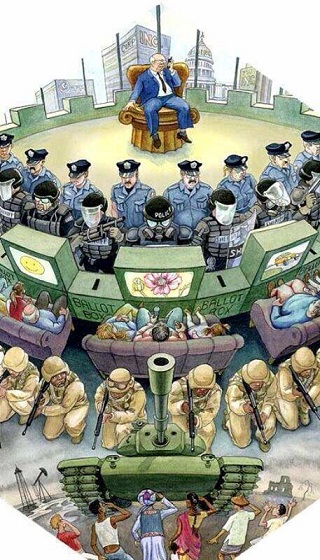
A previous commentary related how the citizens of the City of Ferguson, Missouri-USA – African-American more so than any other ethnic group – were abused and repressed by law enforcement and judicial officials in that community. The injustice and abuse-of-power was so blatant that the town burst into protest – (literally burst into flames) – when one of their unarmed citizens, Michael Brown, was killed by a police officer. Then the whole country burst into protest – in solidarity – when the subsequent Grand Jury decided not to indict the offending police officer. The constant outcry was: “No Justice; No Peace” and “Black Lives Matter”.

The events of this small Midwest American town – a suburb of St. Louis – can easily be joined in chorus with countless Caribbean anecdotes. Any elevation of Caribbean society must therefore include the optimization of Caribbean justice institutions. The Go Lean roadmap assumes the heavy-lifting for the CU Trade federation to transform Caribbean society. The CU will be empowered for its security role – deputized for law enforcement in all Caribbean member-states – by a Status of Forces Agreement (SOFA) embedded with the initial confederation treaty. (This effort also includes the US Territories as well, under the legal guise of an Interstate Compact). This point was strongly urged in the same opening Declaration of Interdependence (Page 12), as follows:

xii. Whereas the legacy in recent times in individual states may be that of ineffectual governance with no redress to higher authority, the accedence of this Federation will ensure accountability and escalation of the human and civil rights of the people for good governance, justice assurances, due process and the rule of law. As such, any threats of a “failed state” status for any member state must enact emergency measures on behalf of the Federation to protect the human, civil and property rights of the citizens, residents, allies, trading partners, and visitors of the affected member state and the Federation as a whole.

CU Blog - Mitigating the Eventual Abuse of Power - Photo 2The Go Lean roadmap identifies gangs, organized crime, narcotics trafficking, human trafficking, guns/explosive interdiction, piracy, and terrorism as threats to the law-and-order fabric of Caribbean society. But the community ethos for Go Lean roadmap must be based on the Greater Good, ensuring both the letter and the spirit of laws to serve-and-protect the community. So the relevant CU agencies must also police the Police. Just how does the roadmap propose this; (Page 177)?

  • The strings-attached in funding national police forces would force Internal Affairs compliance and reporting up-line to CU agencies.
  • Military justice institution, Judge Advocacy Generals, will also follow a reporting up-line to CU agencies.
  • The CU funding to member-states will required separate accounting ledgers – no deposit into General Treasury Funds. The CU therefore retains the rights to “audit the books”. Any malfeasance, misfeasance  or nonfeasance constitute federal crimes, criminal prosecution and federal prison sentences.
  • The CU will provide grants for equipment and investigative tools, like dashboard cameras and body cameras. The SOFA would legally grant authority to the CU to review police activity.
  • Every security-involved death (police, soldier, sailor, marine) will automatically initiate a federal investigative review.

In the Caribbean, “All Lives Matter”!

The Go Lean book details all the community ethos to ensure the right attitudes to serve and protect Caribbean communities; plus strategies, tactics, implementations and advocacies to provide increased public safety & security in the Caribbean region:

Economic Principle – Economic Systems Influence Individual Choices Page 21
Economic Principle – Consequences of Choices Lie in Future Page 21
Community Ethos – Security Principle – Privacy –vs- Public Protection Page 23
Community Ethos – Security Principle – Witness Security & Protection Page 23
Community Ethos – Security Principle – Anti-Bullying and Mitigation Page 23
Community Ethos – Security Principle – Intelligence Gathering Page 23
Community Ethos – Security Principle – Light Up the Dark Places Page 23
Community Ethos – Security Principle – “Crap” Happens Page 23
Community Ethos – Governing Principle – Minority Equalization Page 24
Community Ethos – Governing Principle – Cooperatives Page 25
Community Ethos – Ways to Improve Sharing Page 35
Community Ethos – Ways to Impact the Greater Good Page 37
Tactical – Confederating a non-sovereign union Page 63
Tactical – Fostering a Technocracy Page 64
Tactical – Separation of Powers – Homeland Security Page 75
Tactical – Separation of Powers – Justice Department – District Attorneys Page 77
Tactical – Separation of Powers – Justice Department – CariPol Page 77
Tactical – Separation of Powers – Labor Department – Regional   Relations Page 89
Tactical – Separation of Powers – Federal Courts – Court   of Justice Page 90
Implementation – Assemble “Organs” into a Security Apparatus Page 96
Implementation – Start-up Security Initiatives Page 103
Planning – Ways to Make the Caribbean Better Page 131
Planning – Ways to Improve Failed-State Indices Page 134
Planning – Lessons from the American West – Model   for Law-and-Order Page 142
Advocacy – Ways to Grow the Economy Page 151
Advocacy – Ways to Improve Governance Page 168
Advocacy – Ways to Better Manage the Social Contract Page 170
Advocacy – Ways to Impact Justice Page 177
Advocacy – Ways to Reduce Crime Page 178
Advocacy – Ways to Improve for Gun Control Page 179
Advocacy – Ways to Improve Homeland Security Page 180
Advocacy – Ways to Mitigate Terrorism Page 181
Advocacy – Ways to Improve Intelligence Gathering/Analysis Page 182
Advocacy – Ways to Impact the Prison Industrial Complex Page 211
Advocacy – Ways to Protect Human Rights Page 220
Appendix – CariCom Organs: IMPACS & Court of Justice Page 244

Other subjects related to crime remediation empowerments for the region have been blogged in other Go Lean…Caribbean commentary, as sampled here:

https://goleancaribbean.com/blog/?p=4809 Americans arrested for aiding ISIS
https://goleancaribbean.com/blog/?p=4447 Probe of Ferguson-Missouri finds bias from cops, courts
https://goleancaribbean.com/blog/?p=4360 Dreading the American ‘Caribbean Basin Security Initiative’
https://goleancaribbean.com/blog/?p=4308 911 – Emergency Response: System for First Responders in Crisis
https://goleancaribbean.com/blog/?p=3881 Intelligence Agencies to Up Cyber Security Cooperation
https://goleancaribbean.com/blog/?p=3662 Migrant flow / Border incursions / Threats from Caribbean into US spikes
https://goleancaribbean.com/blog/?p=2994 Justice Strategy: Special Prosecutors and Commissions of Inquiry
https://goleancaribbean.com/blog/?p=2782 Red Light Traffic Cameras, other CCTV Deployments can Impact Crime
https://goleancaribbean.com/blog/?p=2684 Role Model for Justice, Anti-Crime & Security: The Pinkertons
https://goleancaribbean.com/blog/?p=1674 Obama’s $3.7 Billion Immigration Crisis Funds – A Homeland Security Fix
https://goleancaribbean.com/blog/?p=1554 Status of Forces Agreement = Security Pact
https://goleancaribbean.com/blog/?p=1487 Here come the Drones … and the Concerns
https://goleancaribbean.com/blog/?p=960 NSA records all phone calls in Bahamas, according to Snowden
https://goleancaribbean.com/blog/?p=535 Remembering and learning from Boston
https://goleancaribbean.com/blog/?p=392 Jamaica to receive World Bank funds to help in crime fight
https://goleancaribbean.com/blog/?p=341 American Hypocritical Human Rights Leadership Slams Caribbean Poor Record

CU Blog - Mitigating the Eventual Abuse of Power - Photo 3The vision of the Go Lean roadmap is to make the Caribbean homeland, a better place to live, work and play. One, of many missions, is to lower the “push” factors (from “push-and-pull” reference) so that our citizens are not led to flee their homeland for foreign (North American and European) shores. Among the many reasons people emigrate, many times, there is a fear of life-and-limb. We must allow for “Justice”; and for “Peace”. All lives must matter!

We must do better!

We know that “bad actors” will emerge, from internal and external origins. We must be prepared and on-guard to defend our homeland against all threats, foreign and domestic. Yet we must maintain transparency, accountability, and constant commitment to due-process and the rule-of-law.

We do not want a Sheriff John Brown – see Appendix & VIDEO – emerging in the Caribbean region. Sheriff John Brown is a classic example of an Authority figure that abused his power at the peril of a common citizen:

John Brown always hated me, For what, I don’t know: Every time I plant a seed,  He said kill it before it grow.

Everyone, the people (residents and visitors), institutions and government officials are hereby encouraged to lean-in to this roadmap. 🙂

Download the free e-book of Go Lean … Caribbean – now!

—————-

Appendix – Relevant News Story: Amnesty International Calls for Accountability in Bahamas Police Abuses

http://bahamasnational.com/?q=node/2365

—————-

Appendix VIDEO – Bob Marley – I Shot The Sheriff – https://youtu.be/2XiYUYcpsT4

Uploaded on Aug 7, 2008 – Bob Marley- I shot the sheriff Music: (Google PlayiTunesAmazonMP3)

—————-

Appendix – I Shot the Sheriff – Lyrics by Bob Marley

Chorus:
(I shot the sheriff
But I didn’t shoot no deputy, oh no! Oh!
I shot the sheriff
But I didn’t shoot no deputy, ooh, ooh, oo-ooh.)

Yeah! All around in my home town,
They’re tryin’ to track me down;
They say they want to bring me in guilty
For the killing of a deputy,
For the life of a deputy.
But I say:

Oh, now, now. Oh!
(I shot the sheriff.) – the sheriff.
(But I swear it was in self-defence.)
Oh, no! (Ooh, ooh, oo-oh) Yeah!
I say: I shot the sheriff – Oh, Lord! –
(And they say it is a capital offence.)
Yeah! (Ooh, ooh, oo-oh) Yeah!

Sheriff John Brown always hated me,
For what, I don’t know:
Every time I plant a seed,
He said kill it before it grow –
He said kill them before they grow.
And so:

Read it in the news:
(I shot the sheriff.) Oh, Lord!
(But I swear it was in self-defence.)
Where was the deputy? (Oo-oo-oh)
I say: I shot the sheriff,
But I swear it was in selfdefence. (Oo-oh) Yeah!

Freedom came my way one day
And I started out of town, yeah!
All of a sudden I saw sheriff John Brown
Aiming to shoot me down,
So I shot – I shot – I shot him down and I say:
If I am guilty I will pay.

(I shot the sheriff,)
But I say (But I didn’t shoot no deputy),
I didn’t shoot no deputy (oh, no-oh), oh no!
(I shot the sheriff.) I did!
But I didn’t shoot no deputy. Oh! (Oo-oo-ooh)

Reflexes had got the better of me
And what is to be must be:
Every day the bucket a-go a well,
One day the bottom a-go drop out,
One day the bottom a-go drop out.
I say:

I – I – I – I shot the sheriff.
Lord, I didn’t shot the deputy. Yeah!
I – I (shot the sheriff) –
But I didn’t shoot no deputy, yeah! No, yeah!


Share this post:
, ,
[Top]

Prisoners for Profit – #ManifestJustice

Go Lean Commentary

“And justice for all” – ending verse in the American Pledge of Allegiance*

But the evidence is that these are more so just words than the actuality. Consider this article:

Title: White-owned Private Prisons are suing States for millions if they don’t stay full
Sub-title: Low crime rates bad for business for white-owned private prisons; they demand States keep them full
Source posted: May 3, 2015 – Retrieved May 12, 2015 from: http://earhustle411.com/white-owned-private-prisons-are-suing-states-for-millions-if-they-dont-stay-full/

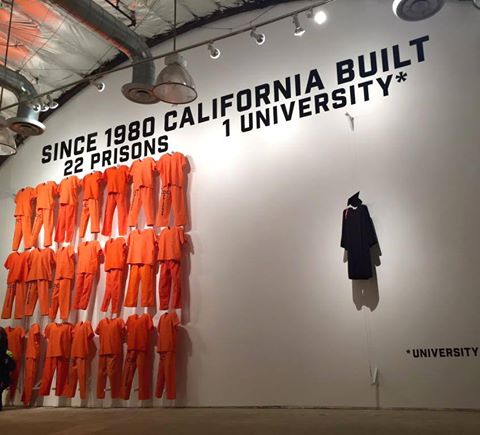
CU Blog - #ManifestJustice - Prisoners -vs- Co-eds - Photo 2The prison-industrial complex is so out of control that private prisons have the sheer audacity to order states to keep beds full or face their wrath with stiff financial penalties, according to reports. Private prisons in some states have language in their contracts that state if they fall below a certain percentage of capacity that the states must pay the private prisons millions of dollars, lest they face a lawsuit for millions more.

And guess what? The private prisons, which are holding cash-starved states hostage, are getting away with it, says advocacy group, “In the Public Interest”.

“In the Public Interest” has reviewed more than 60 contracts between private prison companies and state and local governments across the country, and found language mentioning “quotas” for prisoners in nearly two-thirds of those contracts reviewed. Those quotas can range from a mandatory occupancy of, for example, 70 percent occupancy in California to up to 100 percent in some prisons in Arizona.

It is very interesting and telling that so few major national news organization are willing to report on the monstrous, ravenous and criminal system that is devouring hundreds of thousands of black and brown boys. Even those who do not subscribe to conspiracy theories have looked askance at this shocking report.

Welcome to the greatest manifestation of modern-day slavery, ladies and gentlemen.

One of those private prisons, The Corrections Corporation of America, made an offer last year to the governors of 48 states to operate their prisons on 20-year contracts, according to “In the Public Interest”.

What makes these deals so odious and unscrupulous? Take a look:

1)  The offer included a demand that those prisons remain 90 percent full for the duration of the operating agreement. You know what that means: if there are not enough prisoners then there will be an unspoken push for police to arrest more people and to have the courts send more to prison for petty, frivolous and nonviolent crimes. There will also be a “nudge” for judges to hand down longer or maximum sentences to satisfy this “quota.”

2)  Private prison companies have also backed measures such as “three-strike” laws to maintain high prison occupancy.

3)  When the crime rate drops so low that the occupancy requirements can’t be met, taxpayers are left footing the bill for unused facilities.

The report found that 41 of 62 contracts reviewed contained occupancy requirements, with the highest occupancy rates found in Arizona, Oklahoma and Virginia.

In Colorado, Democratic Gov. John Hinklooper agreed to close down five state-run prisons and instead send inmates to CCA’s three corrections facilities. That cost taxpayers at least $2 million to maintain the unused facilities.

It is getting more difficult to rationalize the societal cost of keeping prisons full just to satisfy private investors who treat prisoners as commodity and cattle .
Source: Rolling Out

Welcome to America…

While at the same time, the eco-systems of Caribbean society are failing; many Caribbean citizens long for the opportunity to emigrate to the United States. There have been many that have taken to the seas on risky vessels to reach the land of their dreams. Many times these ones are interdicted and immediately returned. Sometimes even worse; the boats go “down”, with tragic consequences.

The reasons for emigration are “push-and-pull”. Failures in our society have compelled many to seek refuge abroad; that’s the “push”!

Propaganda in the media and community gossip within the region pronounces that American life is better – the “place to be”. This is the “pull”.

This commentary posits that “all that glitters is not gold”.

The publishers of the book Go Lean … Caribbean campaign that it would be better for Caribbean citizens to remain in their homeland and work to remediate conditions there. Considering the statistics and anecdotal evidence published in the embedded features/articles here, there are reasons why American life should be less than ideal for Caribbean people:

  • Crony Capitalism – America has a disease where much of its public policy is set based on some special interest benefiting from public resources. This is Crony Capitalism and it is defined as public interest being hijacked for private gain.
  • Institutional Racism – Racial discrimination still permeates much of American society, though not always blatant. Statistics and anecdotes prove that employment, housing and educational disenfranchisements still abound in many institutions, despite surpassing 150 years after the Civil War (1861 – 1865) and 50 years after the “bad old days” of the 100-year legal segregation policy; (think Jim Crow).

This foregoing article quotes dollar amounts that are so big that the malevolence of Crony-Capitalism cannot be ignored. It can be argued that this is actually the primary driver in the above average prison population per capita (compared to other industrialized countries, the US is Number 1 by a far margin). This commentary thereby asserts that there is a nefarious Big Business agenda in motion here. Many States have outsourced prison management to private companies. It is in those companies’ best interest to keep prison populations high.

A reduction in crime is bad for business.

This “Prison Industrial Complex” is compelled to lobby, cheerlead and tease both sides of any political divide to keep public policy focused on “being tough on crime / hard on criminals” so as to keep their prisons filled. There is too much money involved. The “bad actors” in this case would readily short-change the Greater Good for immediate gains or profits.

It is obvious from this review that one consequence of Crony-Capitalism is that it short-changes the future for immediate gains, or profits.

In the Caribbean, we hope to minimize the “push-and-pull” factors that draw our Caribbean youth away; and away from that American reality. This dilemma is not just due to the fact that the US population has increased or that crime has increased. No, just the opposite. This point was related in a previous Go Lean blog/commentary, that served as a review for a book by writer and Rolling Stone Magazine contributor Matt Taibbi entitled: “The Divide – American Injustice in the Age of the Wealth Gap“. The actual book quotation is:

Violent crime has fallen by 44 percent in America over the past two decades, but during that same period the prison population has more than doubled, skewing heavily black and poor.

This subject matter – and foregoing news article – align with the publication Go Lean … Caribbean, which serves as a roadmap for the introduction and implementation of the technocratic Caribbean Union Trade Federation (CU). The Go Lean roadmap calls for the optimization of Caribbean society by rebooting the eco-systems with prime directives for the region’s economic, security and governing engines.

We want a society based on sound justice, not the fake American model. We do not want to sacrifice our young people on the altar of corporate profits. We’d rather invest in them rather than sacrifice them; this means investing in (early) education and universities rather than prisons.

CU Blog - #ManifestJustice - Prisoners -vs- Co-eds - Photo 1

Title: #ManifestJustice Art Exhibit in Los Angeles
By:
Alexander Aplerku, AfroPunk Contributor
Source: AfroPunk Blog Site – Retrieved 05-12-2015 – http://www.afropunk.com/profiles/blogs/feature-manifestjustice-art-exhibit-in-los-angeles

“Enough is enough. We demand more empathy, more accountability, more economic opportunity, more compassion, more dignity, more power and more opportunity for all. We demand healthier communities, which means more from each other; more from our school systems and more from our judicial systems.” Those are the words of Manifest Justice, the creative community exhibition. The Exhibit, which took place last week [(May 2nd – 10)] – in Los Angeles’ gang affected Baldwin Village – featured protest posters, paintings, and three-dimensional works. Mostly focused on police brutality, the exhibition also touched on issues like education, racial justice, and LGBT rights. Programme coordinator Nijeul Porter says, “The idea is that art is at the center of social change”.

Related:
http://manifestjustice.org  (See VIDEO Below)
https://www.facebook.com/pages/Manifest-Exhibit-Manifest-Justice

This Go Lean roadmap first openly confesses that the Caribbean is in crisis, that we are not able to retain our young people. Many member-states (St Vincent, Puerto Rico, US Virgin Islands, etc.) have lost more than half of their populations to foreign shores. While others have lost more than 70 percent of their college educated populations. For many, the destination of choice is the United States. The situation is so impactful that now 1 out of 11 Black persons in the US is now of Caribbean (or African) descent, and these numbers are only expected to grow.

The goal of Go Lean is to forge a better society, to make the Caribbean a better place to live, work and play. This means optimizing our own justice institutions. We want to lower the “push” factors. These requirement were pronounced at the outset of the Go Lean book, in the Declaration of Interdependence (Page 12) with these statements:

xi.   Whereas all men are entitled to the benefits of good governance in a free society, “new guards” must be enacted to dissuade the emergence of incompetence, corruption, nepotism and cronyism at the peril of the people’s best interest. The Federation must guarantee the executions of a social contract between government and the governed.

xxi.    Whereas the legacy in recent times in individual states may be that of ineffectual governance with no redress to higher authority, the accedence of this Federation will ensure accountability and escalation of the human and civil rights of the people for good governance, justice assurances, due process and the rule of law. As such, any threats of a “failed state” status for any member state must enact emergency measures on behalf of the Federation to protect the human, civil and property rights of the citizens, residents, allies, trading partners, and visitors of the affected member state and the Federation as a whole.

How should the Caribbean be different than the United States in the pursuit of justice?

The Go Lean roadmap cautions that we do not want to repeat America’s mistakes in criminal justice; there are many. But rather we want to learn from history; the book cites the example and abuses of the Peonage system that emerged in the Southern US after the Civil War (Page 211). Without being considered a conspiracy theorist, it is obvious that many “bad actors” in American society wanted cheap labor even though slavery had just been outlawed in the country.

That was 1865; this is 2015 – 150 years later. Surely American society has transformed … finally. Yet there are vast reports of a continued Great Divide in the US Criminal Justice system, where those of Black-and-Brown heritage (including those from the Caribbean) get sentenced to long prison engagements while “White Collar” offenders get little-to-no jail time at all.

American “White Collar” offenders have perhaps caused more damage in the US than the other “Blue Collar” types. This is especially the case for cross-border criminal conduct in the US. In truth, the Caribbean – and other parts of the world – are still reeling from the effects of the Global Financial Crisis of 2008; spurned from financial mis-adventures on Wall Street.

What is worse, the US has…

“hardly marshaled any persecutions against the culprits and perpetrators of the mortgage fraud that de-stabilized the American securities markets and the world economy” (Matt Taibbi’s “The Divide – American Injustice in the Age of the Wealth Gap“).

To all those in the Caribbean desiring to emigrate to the US, take heed: the “grass is not greener” on that other side!

The book Go Lean … Caribbean, on the other hand, details strategies, tactics, implementations and advocacies to elevate Caribbean society, mitigating the “push” reasons:

Community Ethos – People Respond to Incentives in Predictable Ways Page 21
Community Ethos – Economic Systems Influence Individual Choices Page 21
Community Ethos – Anti-Bullying and Mitigation Page 23
Community Ethos – Governing Principles – Lean Operations Page 24
10 Ways to Manage Reconciliations Page 34
10 Ways to Impact the Greater   Good Page 37
Separation of Powers – Homeland Security Department – Bureau of Prisons Page 76
Separation of Powers – Justice Department Page 77
Separation of Powers – Judicial Branch Page 90
10 Steps to Implement Self-Governing Entities – Prisons as SGEs Page 103
10 Ways to Improve Failed-State Indices – Security Deficiencies Page 134
10 Ways to Improve Education – Promote Industries for e-Learning & Prisons Page 159
10 Ways to Impact Justice Page 177
10 Ways to Reduce Crime Page 178
10 Ways to Ways to Improve Homeland Security – CU Prisons Page 180
10 Ways to Mitigate Terrorism – Fight Narco-Terrorism Page 181
10 Ways to Improve Intelligence Gathering & Analysis – Probation and Parole Page 182
10 Ways to Impact Wall Street – Mitigate Economic Crimes Page 200
10 Ways to Impact Prison-Industrial Complex – Case Study on Peonage Page 211
10 Ways to Protect Human Rights – Mitigate Bad Prison Practices Page 220
10 Ways to Impact Youth – Deploy Crime Diversion Programs Page 227

This Go Lean roadmap asserts to all those desiring to flee to the US. That country is not so alluring … from a justice perspective, especially if you’re poor, Black-and-Brown. The admonition: Lower the “pull” factor for Coming to America.

There is another dimension of the prison industrial complex considered in the Go Lean book: the economic returns of a proper practice of this social responsibility of crime and punishment:

xxvi.  Whereas the Caribbean region must have new jobs to empower the engines of the economy and create the income sources for prosperity, and encourage the next generation to forge their dreams right at home, the Federation must therefore foster the development of new industries, like that of … the prison industrial complex… – impacting the region with more jobs.

It is the vision of this roadmap that modern-technocratic CU prisons can be located in appropriate rural communities and create a viable economic “through put” (jobs); especially when the CU facilities house prisoners for other jurisdictions. The CU would emerge as a benevolent player in the prison-industrial complex. But instead of profits, our motive would be the Greater Good.

More jobs would help to lower the “push” factor. We must do this; address all possible “push” factors. The region must address its issues, as to why its population is so inclined to emigrate. This is the purpose of the Go Lean roadmap. It features the assessments, strategies, tactics and implementations to make the Caribbean a better place to live, work and play.

Now is the time for the Caribbean region to lean-in for the empowerments described in the book Go Lean … Caribbean. The benefits of this roadmap are too alluring to ignore: emergence of our own $800 Billion (GDP) economy, 2.2 million new jobs, new industries (like our own prison industrial complex), services and optimized justice institutions.

The end result of the Go Lean roadmap – after the defined 5 year plan – is to lower both the “push-and-pull” factors. Instead we want to incentive our citizens to prosper where planted. 🙂

Download the free e-book of Go Lean … Caribbean – now!

————–

Appendix – *Pledge of Allegiance

I pledge allegiance to the Flag of the United States of America, and to the Republic for which it stands, one Nation under God, indivisible, with liberty and justice for all.

Originally composed by Francis Bellamy in 1892 and formally adopted by the US Congress as the official pledge in 1942.[1]

————–

Appendix – VIDEO – #ManifestJustice Art Show – https://youtu.be/Pyxqo4TBCFU

Published on May 7, 2015 – http://on.fb.me/URBN247 – Become a Fan! http://youtube.com/URBN247 – Click to Subscribe! http://Twitter.com/URBN247 – Follow Us!
Share this post:
, , , ,
[Top]

Cruise Ship Commerce – Getting Ready for Change

Go Lean Commentary

According to the following news article, Royal Caribbean Cruise Line (RCL) is presenting their new corporate executive for Human Resources (HR), Senior Vice-President Paul Parker.

Congratulations Mr. Parker; welcome to Caribbean Commerce. We are glad to have you participating in our regional marketplace and hope that you are ready for change; to make change and adapt to change.

Cruise 1

Title: Royal Caribbean Names New SVP
By: Caribbean Journal Staff

Royal Caribbean Cruises, Ltd has named Paul Parker its new senior vice president and chief human resources officer, the company announced.

Parker comes to the company after more than two decades of working in the human resources field, from Deloitte & Touche to Colgate Palmolive, among other stints.

Parker will report directly to the company’s president and COO, Adam Goldstein.

“What made Paul stand out for us during the interview process was his comprehensive knowledge of state-of-the-art best practices in human resources management,” Goldstein said. “His background and skills are ideally suited for the role of leading and managing our HR organization as we strive to identify, hire, develop, motivate and retain the best employees, both shipboard and shoreside, responsible for providing our guests with extraordinary vacations.”
Caribbean Journal – Regional News Magazine Site (Posted May 2, 2015; retrieved May 6, 2015) –
http://caribjournal.com/2015/05/02/royal-caribbean-names-new-svp/

VIDEO – Royal Caribbean’s “Oasis of the Seas”: The Biggest Cruise Ship in the World – https://youtu.be/uhLbFGYNDlI

Uploaded on Aug 22, 2011 – With twenty-one swimming pools, its own version of New York’s Central Park, and room for 5,400 passengers, the Oasis of the Seas is the most massive cruise ship ever built.

Mr. Parker will be based in the company’s headquarters* in Miami, FL#. So why is it that we say Caribbean commerce?

This is due to the fact that this cruise line “plies its trade” in the Caribbean region (waters and ports-of-call); even their name confesses this fact: Royal Caribbean. While the Port of Miami accommodated 4.8 million passengers in 2014, the truth is that these ones did not buy their cruise vacation to consume Miami, but rather to consume the Caribbean. We are the attraction!

In addition, many of the jobs on the ships are maintained by Caribbean workers.

This is good …

This is bad …

This is the focus of this commentary and advocacy. There are strict divisions of labor on cruise ships – wait staff and cabin stewards are reserved for citizens from Third World countries like the Caribbean and Asia – with terrible pay scales – while the officers/leadership roles are reserved for Europeans-only – Scandinavians proliferate. We appreciate the fact they set aside jobs for people of the Caribbean, but it is unacceptable that job advancements are unattainable. The resultant discrimination is real. Cruise ships, and other maritime vessels in general, are the last bastion of segregation. Descriptors like “modern-day-slavery”, “sweatships” and “extreme poverty” are far too common. Case in point, many ship-domestic staff are “tip earners”, paid only about US$50 a month and expected to survive on the generosity of the passengers’ gratuity. Another report have detailed this, here:

“The operation of the cruise ship is segregated by gender,” says Researcher Minghua Zhao, of the ITF-funded Seafarers’ International Research Centre at Cardiff University, “All the captains are men and no woman is found in deck and engine departments. Women concentrate in hotel, catering and other ‘non-technical’ sectors of the vessel.”

Nationality is another main factor in the allocation of jobs. Women from western and developed countries are far more likely to be found in a small number of management or administrative positions. They are also likely to be employed as entertainers, beauticians, nurses, aerobics leaders and receptionists.

On the other hand women from Asian and less developed countries are almost entirely employed in the “hotel” functions of the ship in catering, waiting and cabin staff positions.
Source: http://www.itfseafarers.org/dark-side.cfm

Cruise 2

This is a human resource matter and thusly will be within the sphere of influence for the new HR executive at RCL. While many ships are only governed by maritime laws, injustice is injustice. Good shepherding of Caribbean economic eco-system requires some focus to these bad practices.

The book Go Lean…Caribbean opens with the thesis (Page 3) that the problems of the Caribbean are too big for any one member-state to tackle alone. Some of the most popular cruise destinations include the Bahamas, Jamaica, Cayman Islands and Saint Martin. Alone, these port cities/member states cannot effect change on this cruise line industry. But together, as one unified front, the chances for success improves exponentially. The unified front is the Caribbean Union Trade Federation (CU). The term Union is more than a coincidence; it was branded as such by design. The Go Lean book serves as a roadmap for the introduction and implementation of the CU.

The vision of this integration movement is for the region to function as a Single Market. The quotation from the Go Lean book continues in advocating that the Caribbean member-states (independent & dependent) lean-in to this plan for confederacy, convention and collaboration. This is Collective Bargaining 101. From the outset, the book recognized the significance of our exercising authority over the Caribbean Seas. This point was pronounced in the opening Declaration of Interdependence (Page 11):

v.  Whereas the natural formation of our landmass and coastlines entail a large portion of waterscapes, the reality of management of our interior calls for extended oversight of the waterways between the islands. The internationally accepted 12-mile limits for national borders must be extended by International Tribunals to encompass the areas in between islands. The individual states must maintain their 12-mile borders while the sovereignty of this expanded area, the Exclusive Economic Zone, must be vested in the accedence of this Federation.

The confederacy goal entails accepting that there is interdependence among the Caribbean member-states. Implementation-wise, this shifts the responsibility for cruise line negotiations to a region-wide, professionally-managed, deputized technocracy that can result in greater production and greater accountability.

An advocacy, in this case collective bargaining, on behalf of the oppressed workers in Caribbean waters is a just and honorable cause. The quest of this Go Lean movement is to make the Caribbean region better to live, work and play. Labor practices on cruise ships are therefore within scope of the CU.

This is the change … that now confronts the new RCL HR executive. But the CU quest to elevate Caribbean society should not run afoul of this or any cruise line’s modus operandii. The CU sets out to be their trading partner, not adversarial opponent. This should be win-win.

Nowhere else in the modern world is job discrimination encouraged, accepted or tolerated. The Caribbean demanding fair employment opportunities are therefore aligned with the Greater Good community ethos. Besides, these ships are conducting commerce in our neighborhood, so our community standards should apply. This is the change; consolidating the region so as to be able to leverage as one, a Single Market.

The end result? The goal of the CU is cataloged in the stated prime directives, identified with the following 3 statements:

  • Optimization of the economic engines in order to grow the regional economy to $800 Billion & create 2.2 million new jobs.
  • Establishment of a security apparatus to protect the resultant economic engines.
  • Improvement of Caribbean governance to support these engines.

The issue – cruise ship division of labor – being presented in this commentary is not the only focus of the Go Lean movement (book and blogs) relating to cruise commerce. There are so many societal defects associated with this eco-system; the corporate abuses of Big Cruises have been duly documented. Clearly this another example of crony-capitalism. Already, these previous blog/commentaries stressed different issues within the cruise industry space:

https://goleancaribbean.com/blog/?p=4639 Tobago: A Model for Cruise Tourism
https://goleancaribbean.com/blog/?p=3889 Electronic Payments– Ready for Change in Cruise Commerce
https://goleancaribbean.com/blog/?p=3225 Regional aviation dysfunction leading to more cruise traffic
https://goleancaribbean.com/blog/?p=2207 Hotels charging resort fees leading to more cruise traffic
https://goleancaribbean.com/blog/?p=1003 Epidemiology (Virus) protections for Caribbean & Cruise Tourism

The elevation of cruise commerce in the region is a mission within the Go Lean roadmap. The book details the applicable community ethos, strategies, tactics, implementation and advocacies to derive more benefits of regional cruise ship commerce and promote collective bargaining within the region:

Community Ethos – Economic Principles – People Respond to Incentives in Predictable   Ways Page 21
Community Ethos – Economic Principles – Economic Systems Influence Individual Choices Page 21
Community Ethos – Economic Principles – Consequences of Choices Lie in the Future Page 21
Community Ethos – Security Principles – Anti-Bullying and Mitigation Page 23
Community Ethos – Security Principles – Light Up the Dark Places Page 23
Community Ethos – Governing Principles – Lean Operations Page 24
Community Ethos – Governing Principles – Return on Investments (ROI) Page 24
Community Ethos – Governing Principles – Cooperatives Page 25
Community Ethos – Ways to Improve Negotiations – Cruise Line Collective Bargaining Page 32
Community Ethos – Ways to Improve Sharing Page 35
Community Ethos – Ways to Impact the Greater Good Page 37
Strategy – Vision – Confederate 30 Caribbean   Member-States Page 45
Strategy – Mission – Facilitate Transportation Efficiencies for Passengers & Ships Page 46
Strategy – Customers / Stakeholders – Business Community and Employees Page 48
Strategy – Customers / Stakeholders – Cruise Passengers Page 48
Strategy – Competitors – Visitors – Summer Caribbean Cruise -vs- Northern Vacation Page 55
Strategy – Core Competence – Cruise Tourism Page 58
Anecdote – Carnival Cruise Lines Strategies Page 61
Tactical – Foster a Technocracy Page 64
Tactical – Separation of Powers – Homeland Security – Coast Guard and Naval Authority Page 75
Tactical – Separation of Powers – Homeland Security – Emergency Management Page 76
Tactical – Separation of Powers – Commerce Department – Regional Tourism Coordination Page 78
Tactical – Separation of Powers – Labor Department – Labor Relations Board Page 89
Implementation – Start-up Benefits from the Exclusive Economic Zone of Caribbean Sea Page 104
Implementation – Ways to Deliver – Embracing a Technocratic Ethos Page 109
Planning – 10 Big Ideas – Confederation Without Sovereignty Page 127
Advocacy – Ways to Grow the Economy Page 151
Advocacy – Ways to Create Jobs Page 152
Advocacy – Ways to Impact Labor Unions – Partnerships with Labor & Management Page 164
Advocacy – Ways to Improve Governance Page 168
Advocacy – Ways to Manage Federal Civil Service – Meritocracy Labor standards Page 173
Advocacy – Ways to Foster Cooperatives Page 176
Advocacy – Improve Homeland Security – Emergency Management Readiness Page 180
Advocacy – Ways to Impact Cruise Tourism Page 193
Advocacy – Ways to Improve Emergency Management Page 196
Advocacy – Ways to Foster Ship-Building – Cruise Ship Dry-Dock Opportunities Page 209

The roadmap posits that the Caribbean must change … to adapt to a changing world; also asserting that the cruise line industry must change. This commentary specifically declares that Royal Caribbean Cruises Lines must change. This means you “Paul Parker”.

In the end, these changes will be for the better; for the Greater Good and to promote a better partnership for all cruise industry stakeholders, including the lowly wait and cabin staff who usually have no voice. Is there a danger that these CU/Go Lean demands (fair labor practices) may drive up costs of the product? Yes, absolutely!

But this has always been the argument for those resisting labor reforms: slavery, labor unions, child labor, occupational safety and minimum wage. This current industry defense seems like a “throwback” to the days of 1850 – ironic, considering that Mr. Parker was applauded for his “knowledge of state-of-the-art best practices in human resources management”. “Win-win” is still possible with Cruise Commerce; the industry suffers from staff retention due to this bad labor practices; in the end cruise ship can optimize their cost of labor acquisition and retention by following best practices. This should be self-evident!

Why has this labor status quo persisted for so long in the cruise industry? Supply and demand. The demand for Caribbean exotic cruise ports are high, while the supply of staffers from Third World countries is also high. The economic principles therefore forces downward pressure on labor prices. This is Bullying 101. Remediation of this type of conduct, like any other form of bullying, requires a superior power. In this case, it will be the Caribbean confederation and the accompanying authority for the Exclusive Economic Zone of the Caribbean Sea.

While we will weld some power, the region should consider it more of an honor to host 10 million visitors – as reported in the Go Lean book (Page 55) – who want to enjoy our hospitality … in conjunction with cruise ships from many North American points of embarkation. Our plea to these tourists is echoed in unison: Be Our Guest.

But our warning to cruise operators bent on abuse and oppression on our waters: Get Ready for Change.

Let us show the world why the Caribbean is the best destination – via cruise or otherwise – to live, work and play. 🙂

Download the free e-book of Go Lean … Caribbean – now!

————-

Appendix * – Full Disclosure: At one point, this writer worked for Royal Caribbean Cruise Lines in Miami.

————-

Appendix # – About the Port of Miami

The Port of Miami is among America’s busiest ports and recognized across the globe with the dual distinction of being the Cruise Capital of the World and the Cargo Gateway of the Americas. Port of Miami contributes more than $27 billion annually to the South Florida economy and helps generate 207,000 direct, indirect, and induced jobs. For more information please visit www.portmiami.biz.

For Fiscal Year 2015, the Port is servicing 34 ships and 15 different cruise brands, including: Aida Cruises, Azamara Club Cruises, Carnival Cruise Lines, Celebrity Cruises, Costa Cruises, Crystal Cruises, Disney Cruise Line, Hapag-Lloyd Cruises, MSC Cruises, Norwegian Cruise Line, Oceania Cruises, P&O Cruises, Regent Seven Seas Cruises, Resorts World Bimini, and Royal Caribbean International.

Share this post:
, , , , , ,
[Top]

A Lesson in History – Cinco De Mayo

Go Lean Commentary

Today (May 5) is Cinco De Mayo – celebrating this is a move of solidarity with Mexico; its people and culture – Enjoy the festivities!

Enjoy the Mexican food, spirits, music and culture. The country and people of Mexico have so much to offer the world – see VIDEO below – this includes the Caribbean.

One thing more that they can offer us in our region: A Lesson in History!

The summary of this celebration is simple on the surface: Mexican forces commanded by General Ignacio Zaragoza defeated the French army in the Battle of Puebla on 5 May 1862. 4 days later, on 9 May 1862, The then-President Benito Juárez declared that the anniversary of the Battle of Puebla would be a national holiday,[14][15][16][17][18] regarded as “Battle of Puebla Day” or “Battle of Cinco de Mayo”. Although today it is recognized in some countries as a day of Mexican heritage celebration, it is not a federal holiday in Mexico.[19]

Considering the real history of Cinco De Mayo is a really big deal. For starters, while Mexico was not the aggressor in this war, they were not exactly blameless.

The 1858 – 1860 Mexican civil war known as The Reform War had caused distress throughout Mexico’s economy. When taking office as the newly-elected president of the Republic in 1861, Juárez was forced to suspend payments of interest on foreign debts for a period of two years. At the end of October 1861 diplomats from Spain, France, and Britain met in London to form the Tripartite Alliance, with the main purpose of launching an allied invasion of Mexico, taking control of Veracruz, its major port, and forcing the Mexican government to negotiate terms for repaying its debts and for reparations for alleged harm to foreign citizens in Mexico. In December 1861, Spanish troops landed in Veracruz; British and French followed in early January. The allied forces occupied Veracruz and advanced to Orizaba. However, the Tripartite Alliance fell apart by early April 1862, when it became clear the French wanted to impose harsh demands on the Juarez government and provoke a war. The British and Spanish withdrew, leaving the French to march alone on Mexico City. French Emperor-President Napoleon III – the first democratically elected French President – wanted to set up a puppet regime, the Mexican Empire.

Thus started this French Intervention in Mexico. The effects of these 5 years were far-reaching, even to this day – consider the similarities in flags for these countries.

CU Blog - A Lesson in History - Cinco De Mayo - Photo 1Title: French Intervention in Mexico 1862 – 1867
Emperor Napoleon III of France was the instigator, justifying military intervention by claiming a broad foreign policy of commitment to free trade. For him, a friendly government in Mexico would ensure European access to Latin American markets. Napoleon also wanted the silver that could be mined in Mexico to finance his empire. Napoleon built a coalition with Spain and Britain while the U.S. was deeply engaged in its own civil war from 1861 to 1865.

Here is the main timeline of this French Intervention period:

1. 1862: Arrival of the French
After the initial victory by the Mexicans at the Battle of Puebla, the war continued in a different direction. The pursuing Mexican army was contained by the French at Orizaba, Veracruz, on 14 June. More British troops arrived on 21 September, and General Bazaine arrived with French reinforcements on 16 October. The French occupied the port of Tamaulipas on 23 October, and unopposed by Mexican forces took control of Xalapa, Veracruz on 12 December.

2. 1863: The French take the capital
CU Blog - A Lesson in History - Cinco De Mayo - Photo 2The French army of General François Achille Bazaine defeated the Mexican army led by General Comonfort in its campaign to relieve the siege of Puebla, at San Lorenzo, to the south of Puebla. Puebla surrendered to the French shortly afterward, on 17 May. On 31 May, President Juárez fled the capital city (Mexico City) with his cabinet, retreating northward to Paso del Norte and later to Chihuahua. Having taken the treasure of the state with them, the government-in-exile remained in Chihuahua until 1867.

French troops under Bazaine entered Mexico City on 7 June 1863. The main army entered the city three days later, led by General Forey. General Almonte was appointed the provisional President of Mexico on 16 June, by the Superior Junta (which had been appointed by Forey). The Superior Junta with its 35 members met on 21 June, and proclaimed a Catholic Empire on 10 July. The crown was offered to Austrian Prince Archduke Ferdinand Maximilian, following pressures by Napoleon. Maximilian accepted the crown on 3 October.

3. 1864: Arrival of Maximilian
Further decisive French victories continued with the fall of Guadalajara, Zacatecas, Acapulco, Durango by 3 July, and the defeat of republicans in the states of Sinaloa and Jalisco in November.

Maximilian formally accepted the crown on 10 April, signing the Treaty of Miramar (between France and Mexico), and landed at Veracruz on 28 May. He was enthroned as Maximilian I, Emperor of Mexico, [under French occupation].

4. 1865: Beginning of Republican victories
CU Blog - A Lesson in History - Cinco De Mayo - Photo 3After many more French victories, finally on 11 April, republicans defeated Imperial forces at Tacámbaro in Michoacán. In April and May the republicans had many forces in the states of Sinaloa and Chihuahua. Most towns along the Rio Grande, [(the border with the US),] were also occupied by republicans.

The decree known as the “Black Decree” was issued by Maximilian on 3 October, which threatened any Mexican captured in the war with immediate execution.

5. 1859-1867: U.S. Diplomacy and Involvement
The United States did not condone the French occupation of Mexico but it had to use its resources for the American Civil War, which lasted 1861 to 1865. Then-President Abraham Lincoln expressed his sympathy to Latin American republics against any European attempt to establish a monarchy; and the Congress passed a resolution in disgust of these French actions. In 1865, The US supported the sale of Mexican bonds by Mexican agents in the US to fund the Juarez Administration, raising up to $18-million dollars for the purchase of American war material.[16] By 1867, American policy shifted from thinly veiled sympathy to the republican government of Juarez to open threat of war to induce a French withdrawal, invoking the Monroe Doctrine, a policy to thwart any aggression by European powers in the Americas.

6. 1866: French withdrawal and Republican victories
Choosing Franco-American relations over his Mexican monarchy ambitions, Napoleon III announced the withdrawal of French forces beginning 31 May. Taking advantage of the end of French military support to the Imperial troops, the Republicans won a series of crippling victories in Chihuahua on 25 March, Guadalajara, Matamoros, Tampico and Acapulco in July. Napoleon III urged Maximilian to abandon Mexico and evacuate with the French troops; [but he persisted]. The French evacuated Monterrey on 26 July, Saltillo on 5 August, and the whole state of Sonora in September. Maximilian’s French cabinet members resigned on 18 September. The Republicans defeated imperial troops in Oaxaca in October, occupying the whole of Oaxaca in November, as well as parts of Zacatecas, San Luis Potosí and Guanajuato.

7. 1867: Republicans take the capital
The Republicans occupied the rest of the states of Zacatecas, San Luis Potosí and Guanajuato in January. The French evacuated the capital on 5 February.

On 13 February 1867, Maximilian withdrew to Querétaro. The Republicans began a siege of the city on 9 March, and Mexico City on 12 April. On 11 May, Maximilian finally resolved to try to escape through the enemy lines. He was intercepted on 15 May. Following a court-martial, he was sentenced to death and executed on 19 June.
Source: http://en.wikipedia.org/wiki/French intervention_in_Mexico  

This subject has relevance for the Caribbean. Mexico is a stakeholder in Caribbean affairs. They have a vast coastline (Yucatan Peninsula) on the Caribbean Sea, plus a few Caribbean islands (Cozumel, Isla Mujeres, Isla Contoy, and Isla Blanca). This country is also a member of the ACS – Association of Caribbean States – one of the relevant entities that must be assembled for this regional integration movement championed in the book Go Lean…Caribbean.

The underlying theme of this Lesson in Mexican History is the lack of effective security for the people and societal engines of Mexico. Now, after 150 years, this historic pattern has continued; Mexico proceeded to endure one revolution-rebellion-overthrow-coup d’etat after another until recent times.

The Caribbean cannot afford this same disposition: the dread and damage endured from decades of dysfunction.

Today, Mexico is known as a lawless society in many pockets, especially along the US border. Considering the art and science of security, it is sad that they never got it right! They resemble a Failed-State in so many perspectives. This is where their history, especially those 5 years of the Franco-Mexican War, provides lessons for the Caribbean people and institutions. But this Go Lean movement does not seek to remediate Mexico; this is out of scope. Rather the focus is strictly on the 30 Caribbean member-states: islands of the Caribbean plus the Central & South American states that caucus with the Caribbean Community (Belize, Guyana and Suriname).

This effort to elevate Caribbean society fully recognizes that security mitigations must be prioritized equally with economic and governing remediation. This is an underlying theme of the book Go Lean…Caribbean. The book declares that the region is in crisis, at the precipice of Failed-State status. This is the assertion of the Go Lean book, that the region must prepare its own security apparatus for its own security needs.

This book serves as a roadmap for the introduction and implementation of the technocratic Caribbean Union Trade Federation (CU). So while the CU is set to optimize Caribbean society through economic empowerment, the security dynamics will be inextricably linked to this same endeavor. Therefore the Go Lean roadmap has 3 prime directives:

  • Optimization of the economic engines in order to grow the regional economy to $800 Billion & create 2.2 million new jobs.
  • Establishment of a security apparatus to protect the resultant economic engines.
  • Improvement of Caribbean governance to support these engines.

The book contends, just as the French proved to be a “bad actor” to Mexico in 1862, that new “bad actors” will emerge for the Caribbean to contend with. This will be as a by-product of new economic successes in the region. This point is pronounced early in the book with the Declaration of Interdependence (Page 12) that claims:

x.   Whereas we are surrounded and allied to nations of larger proportions in land mass, populations, and treasuries, elements in their societies may have ill-intent in their pursuits, at the expense of the safety and security of our citizens. We must therefore appoint “new guards” to ensure our public safety and threats against our society, both domestic and foreign. The Federation must employ the latest advances and best practices … to assuage continuous threats against public safety.

xvi. Whereas security of our homeland is inextricably linked to prosperity of the homeland, the economic and security interest of the region needs to be aligned under the same governance. Since economic crimes, including piracy and other forms of terrorism, can imperil the functioning of the wheels of commerce for all the citizenry, the accedence of this Federation must equip the security apparatus with the tools and techniques for predictive and proactive interdictions.

The need for the Caribbean to appoint “new guards” or a security pact to mitigate foreign and domestic threats in the region is the primary lesson to glean from the foregoing encyclopedic article – a consideration of the history of Cinco De Mayo. This security pact is to be legally constituted by a Status of Forces Agreement which would be enacted as a complement to the CU confederation treaty. The Go Lean roadmap provides 370-pages of turn-by-turn directions on how to deploy cutting-edge strategies, tactics and implementations to succeed in this goal.

In addition, there are other lessons – secondary – that we learn from this consideration of the history of Cinco De Mayo:

The Go Lean book details a roadmap with turn-by-turn directions for transforming the Caribbean homeland. The following is a sample of the community ethos, strategies, tactics, implementations and advocacies to impact the Caribbean region for this turnaround:

Community Ethos – Economic Principle – Economic Systems Influence Choices Page 21
Community Ethos – Economic Principle – Consequences of Choices Lie in the Future Page 21
Community Ethos – Anti-Bullying and Mitigation Page 23
Community Ethos – Minority Equalization Page 24
Community Ethos – Cooperatives Page 25
Community Ethos – Ways to Improve Sharing Page 35
Strategy – Vision – Confederating a Non-Sovereign Union Page 45
Strategy – Mission – Protect Economic Engines from threats Page 45
Tactical – Fostering a Technocracy Page 64
Tactical – Separation of Powers Page 71
Implementation – Start-up Foreign Policy Initiatives Page 102
Implementation – Security Initiatives at Start-up Page 103
Implementation – Ways to Deliver Page 109
Implementation – Ways to Better Manage Debt Page 118
Implementation – Ways to Promote Independence – Interdependence Page 120
Planning – 10 Big Ideas – Defense / Homeland Security Pact Page 127
Planning – Ways to Make the Caribbean Better Page 131
Planning – Ways to Better Manage Image Page 133
Planning – Ways to Improve Failed-State Indices Page 134
Planning – Lessons from the American West Page 142
Advocacy – Ways to Grow the Economy Page 151
Advocacy – Ways to Create Jobs Page 152
Advocacy – Ways to Improve Governance Page 168
Advocacy – Ways to Better Manage the Social Contract Page 170
Advocacy – Ways to Impact Justice Page 177
Advocacy – Ways to Improve Homeland Security Page 180
Advocacy – Ways to Mitigate Terrorism Page 181
Advocacy – Ways to Protect Human Rights Page 220

Mexico is a beautiful country, with a beautifully diverse population plus a lot of natural resources. They experience a vibrant tourism product where millions visit annually for Mexican hospitality – they are a fit competitor of Caribbean tourism, even for cruises. See VIDEO here:

VIDEO: Mexico: Live It to Believe It – Cultural Diversity 2015 – https://youtu.be/jciVmLL_UgY

Published on Feb 27, 2014 – A production of the Mexico Department of Tourism; commissioned for the Central American and Caribbean Games in Veracruz from November 14 to 30, 2014.

Many people visit Mexico, but few would consider moving there permanently. In fact just the opposite occurs, the societal abandonment problem in Mexico is very pronounced. Their northern neighbor, the United States, has constant security issues of illegal Mexican migrants. Mexico has been dysfunctional for their entire history as a Republic. They must do better! While this quest is out-of-scope for the CU/Go Lean roadmap, we can learn lessons from their actions and inactions.

The Go Lean book posits (Page 3) that the Caribbean islands are among the greatest addresses in the world. But like Mexico, instead of the world “beating a path” to our doors, the people of the Caribbean have “beat down their doors” to get out; despite the absence of any war or revolution … like our Mexican neighbors. Our abandonment is inexcusable.

May we learn from this history of Mexico! Mexican culture is great! Enjoy the festivities: their people, food, drink, music and dance. But let’s do better … than they have done. Let’s make the Caribbean even better, where our citizens can prosper where they are planted; let’s make our homeland better places to live, work and play.  🙂

Download the free e-Book of Go Lean … Caribbean – now!

Share this post:
, , , , , ,
[Top]

A Lesson in History – Royal Charter: Zimbabwe -vs- South Africa

Go Lean Commentary

Zimbabwe - Photo 2If presented the choice, which would you rather be granted: riches or power?

Many would conclude riches, because of societal expressions like the “Golden Rule: He who has the Gold… rules”. Yet the truth is riches can be created and destroyed quickly. This was the experience just recently during the 2008 Great Recession, where people in the US – the richest country on the planet – lost $11 Trillion in net worth in short order.

On the other hand, there is power. History shows that with power, the rights to riches can be granted, exploited and passed on, from century to century, generation to generation. Consider for example the African continent (in particular the southern region) and the Royal Charters that granted abundant wealth to a privileged few:

The English had been the first to adopt the approach of bundling their resources into a monopoly enterprise, with the English East India Company in 1600. This threatened their Dutch competitors with ruin,[15] so in 1602 the Dutch monarchy followed suit and sponsored the creation of a single Dutch East Indies Company and granted it monopoly over the Asian trade. (Source: http://en.wikipedia.org/wiki/Dutch_East_India_Company#Formation_.281602.29)

CU Blog - A Lesson in History - Royal Charter - Zimbabwe -vs- South Africa - Photo 1The British monarchy has issued over 980 Royal Charters.[1] (A formal document issued by a monarch as letters patent, granting a right or power to an individual or a body corporate). A specific charter was issued for the South African region.

The British South Africa Company (BSAC) was established following the amalgamation of Cecil Rhodes‘ Central Search Association and the London-based Exploring Company Ltd which had originally competed to exploit the expected mineral wealth of Mashonaland but united because of common economic interests and to secure British government backing. The company received a Royal Charter in 1889 modeled on that of the English East India Company. Its first directors included the Duke of Abercorn, Rhodes himself and the South African financier Alfred Beit. Rhodes hoped BSAC would promote colonisation and economic exploitation across much of south-central Africa, as part of the “Scramble for Africa“. However, his main focus was south of the Zambezi, in Mashonaland and the coastal areas to its east, from which he believed the Portuguese could be removed by payment or force, and in the Transvaal, which he hoped would return to British control.[1] (Source: http://en.wikipedia.org/wiki/British_South_Africa_Company)

This historic information is being considered in conjunction with the book Go Lean…Caribbean; a publication designed to elevate the region’s economic (create 2.2 million new jobs), security and governing engines. Why would this “Lesson in History” matter in assessing today’s Caribbean status and fate?

It is of utmost importance. This discussion reveals how to reconcile the injustices of the past, and still build a better future. We have good models to consider, in this case the countries of Zimbabwe and South Africa.

In a previous blog/commentary, the issue of the origin of colonial entitlements was detailed at full length. A direct quote relates:

The most iconic of all the Papal Bulls [-“letters patent” or charters issued by a Pope, the Head of the Roman Catholic Church -] was the Inter caetera, a Papal Bull by Pope Alexander VI on 4 May 1493, which set a demarcation between the New Lands to Portugal and Spain; this granted to Spain all lands to the “west and south” … of the islands of the Azores … and all new lands to the East of this pole remained assigned to Portugal.

Just before this world-changing decree, there was an earlier Papal Bull that sealed the fate and would prejudice the African Diaspora for 500 years. The African Slave Trade and institution of “Slavery” was legally predicated on a Papal Bull from Pope Innocent VIII (Giovanni Battista Cybo) in 1491; just months before Christopher Columbus’s historic first voyage

From the origins of slavery, [colonialism] traversed the historic curves of social revolution and evolution. In the 1500, the Protestant movement took hold. As other European powers deviated from Catholicism, Papal Bulls carried no significance to them and compliance was ignored. England and Holland established their own Protestant Churches with their own monarch as head of Church and State; Papal decrees were replaced with Royal Decrees and Charters. The intent and end-result was still the same: territories and lands awarded (colonized) with the stroke of a pen by one European power after another. The Royal Decrees and Charters were then reinforced with a strong military presence and many battles…

[The resultant] “oligarchy” … power effectively rested with a small number of people. These people could be distinguished by royalty, wealth, family ties, education, corporate, religious or military affiliation.

In this discussion of oligarchy, focus is given to powerful families. There are encyclopedic references that relate that oligarchy structures are often controlled by a few prominent families, who typically pass their influence/wealth from one generation to the next, even though inheritance alone is not a necessary condition for oligarchies to prevail…

This is the challenge that belies Caribbean society. Most of the property and indigenous wealth of the Caribbean region is concentrated amongst the rich, powerful and yet small elite; an oligarchy. Many times these families received their property, corporate rights and/or monopolies by Royal Charter from the European monarchs of ancient times. These charters thus lingered in legacy from one generation to another … until …

The form of rulership that dominated these times in history is that of Oligarchy; empowered by Royal Charters/Decrees. Today, oligarchy – rule by the rich[4] – is synonymous with another term commonly used, plutocracy.

Zimbabwe Photo 3The subject of oligarchs is very familiar on the African continent. This has been a real issue there. In many countries after colonialism, like Zimbabwe (1980), the cure for the oligarch disease was nationalization – forfeiting and seizing commercial farms and mines. This turned out disastrously for this country; the cure was worse than the disease. But, next door in South Africa (14 years later), the strategy, tactics and implementation was different. This country did not ascend to majority-rule until 1994; the first majority-ruled President there, Nelson Mandela saw the futility of the nationalization strategy amongst the precedent independent African nations, so he pursued an alternate approach to assuage White Flight and keep the capital and skilled labor in the country. But the continuation of the oligarchs ill-gained, and public-perceived-stolen assets forged problems in the reality of economic/wealth inequality. Majority-rule therefore brought no revolutionary change for the average man.

All in all, change is not easy. It is heavy-lifting. This is abundantly clear in the examination of the independent majority-ruled Zimbabwe and majority-ruled South Africa. See Chart in the Appendix of the comparisons.

The details of the Republic of Zimbabwe (1980) evolution are as follows:

The British South Africa Company was a Royal Charter, to administer “North-Western Rhodesia” and “North-Eastern Rhodesia” for White settlement; it was not under those names, but the names of the geographic parts—”Mashonaland”, “Matabeleland”, “Barotseland”, and so on. The collective territories were initially referred to as “Zambesia” – the name origins of both Zambia and Zimbabwe – but became Rhodesia as an international brand. While the White minority community resisted the transition to black majority-rule, the change inevitably came, empowering revolutionary leader Robert Mugabe. The new regime – due to spite, revenge and broken promises – began confiscating White-owned farmlands. This is widely blamed for leading to the deterioration of the Zimbabwean economy (societal abandonment of human and financial capital); this has plagued the country even until this day.[113]

The details of the Republic of South Africa (1994) evolution are as follows:

The Cape Colony was a British colony in present-day South Africa and Namibia, named for the Cape of Good Hope. The British colony was preceded by an earlier Dutch colony of the same name, established in 1652 by the Dutch East India Company – granted by Royal Charter from the Dutch Monarchy. The Dutch lost the colony to Britain following the 1795 Battle of Muizenberg, but had it returned following the 1802 Peace Treaty of Amiens. It was re-occupied by the British following the Battle of Blaauwberg in 1806, and British possession affirmed with the Anglo-Dutch Treaty of 1814. The Cape Colony then remained in the British Empire, becoming self-governing in 1872, and uniting with three other colonies to form the Union of South Africa in 1910. Despite practicing racial segregation for most of its history, eventually integration and black majority-rule evolved in the Republic of South Africa. Despite their resistance to these changes, accommodations and reconciliations on the part of Nelson Mandela allowed for the continuation of the established societal engines; the minority White communities and business interests remained.

Zimbabwe - Photo 4Considering these case studies, the Failed-State status of Zimbabwe versus the economic successes of South Africa, we see a lesson in this history, an obvious appreciation for best-practices … for us to apply in the Caribbean. We can optimize these best-practices by applying regional strategies, tactics and implementations to benefit everyone – the Greater Good – and try not to disenfranchise any one group.

The masses of people in the democratic Caribbean now have the right to rule, not just some special group set aside by Royal Decree or granted power by a Royal Charter. Since there is the scientific fact that no one can go back in time and change history; we can only move forward, hopefully with wisdom from the lessons learned in history. The Go Lean book presents a roadmap on how to benefit from these lessons – good, bad and ugly – and how to empower communities anew; to use political power to impact the Greater Good. We therefore see a role for the Rich (One Percent – Page 224), the Poor (Page 222) and the Middle Classes (Page 223).

The consideration of the Go Lean book, as related to this subject is one of governance, the need for technocratic stewardship of the regional Caribbean society. This point was also pronounced in the opening Declaration of Interdependence (Page 12) with these acknowledgements and statements:

xi.   Whereas all men are entitled to the benefits of good governance in a free society, “new guards” must be enacted to dissuade the emergence of incompetence, corruption, nepotism and cronyism at the peril of the people’s best interest. The Federation must guarantee the executions of a social contract between government and the governed.

xii. Whereas the legacy in recent times in individual states may be that of ineffectual governance with no redress to higher authority, the accedence of this Federation will ensure accountability and escalation of the human and civil rights of the people for good governance, justice assurances, due process and the rule of law. As such, any threats of a “failed state” status for any member state must enact emergency measures on behalf of the Federation to protect the human, civil and property rights of the citizens, residents, allies, trading partners, and visitors of the affected member state and the Federation as a whole.

xiii. Whereas the legacy of dissensions in many member-states (for example: Haiti and Cuba) will require a concerted effort to integrate the exile community’s repatriation, the Federation must arrange for Reconciliation Commissions to satiate a demand for justice.

This Go Lean book serves as a roadmap for the introduction and implementation of the technocratic Caribbean Union Trade Federation (CU) to provide better stewardship for the 30 member-states of the Caribbean region, despite their European heritage. The book (and subsequent blog/commentaries) posits that we must not fashion ourselves as parasites of our previous European colonizers, but rather pursue a status as protégés.

Our past history feature much oppression and repression; European colonialism had been a villainous “dragon”. But we can train our dragons! We can make the most of previous bad history. This point was presented as a strategy for Direct Foreign Investments, asserting that we want to invite and attract investments. We can use their resources to elevate our own communities, while still providing a return/profit for the investors.

This is Pragmatism 101!

We, in the Caribbean, were not the only ones abused. Other indigenous people (Africans, Asians, Amerindians, etc.) also suffered, sometimes even more so. The goal should be to thrive despite the disabling legacy; (and if not for everyone, then make the most of the situation for the most number of people).

This is the community ethos of the Greater Good!

Globalization is now an ‘Agent of Change’ that we must contend with. We must “play nice in the sandbox” with people of other countries, especially those with capital resources. So if a minority group represents a faction that previously exploited our land and forefathers, we cannot expect to extract vengeance against them – Zimbabwe proved the futility of such a quest for justice and inequity. As related in the Go Lean book (Page 151), the best-practice for any governing entity to grow the economy is to protect all property rights; (real, personal or intellectual). This is the “new” New World; and the new formula for success.

Another formula, an economic principle, is that “voluntary trade creates wealth” (Page 21). This fact has often been overlooked in policy decisions for Africa. The following VIDEO portrays this dilemma, decrying the current migrant/refugee crisis in Europe, when the best-practice the continent can provide the African people is a more liberal trade policy, allowing markets for African agricultural produce. (Without this type of proactive strategies, the continent is being oppressed … all over again … by today’s Europe; this is a lesson learned from the Native American Reservations in the US).

VIDEO: UKIP Leader Nigel Farage Addressing European Parliament on African Culpability & Hyprocrisy – https://youtu.be/NTwOap7ohc4

Posted by Wednesday, April 29, 2015 – UKIP Leader Nigel Farage: speaks to the European Parliament on the EU suggestion that the continent should have a common asylum and migration policy. He felt it was important to represent the view that this is not just another attack on British sovereignty but also inherently dangerous.

In general, the Go Lean roadmap stresses key community ethos, strategies, tactics, implementations and advocacies necessary to transform and turn-around the eco-systems of Caribbean society. These points are detailed in the book as follows:

Community Ethos – Deferred Gratification Page 21
Community Ethos – Economic Principles – Economic Systems Influence   Individual Choices Page 21
Community Ethos – Economic Principles – Consequences of Choices Lie in   the Future Page 21
Community Ethos – Ways to Impact the Future Page 26
Community Ethos – Ways to Manage Reconciliations – South African Model Page 34
Community Ethos – Ways to Impact the Greater Good Page 37
Strategy – Vision – Confederate all 30 member-states/ 4 languages into a Single Market Page 45
Tactical – Separation-of-Powers – CU Federal Government versus Member-State Governance Page 71
Implementation – Ways to Pay for Change Page 101
Implementation – Ways to Foster International Aid Page 115
Planning – 10 Big Ideas – #4: Confederation Without Sovereignty Page 127
Planning – Ways to Improve Trade Page 128
Planning – Ways to Model the new European Union – Unified Economy Page 130
Planning – Ways to Make the Caribbean Better Page 131
Planning – Lessons Learned from 2008 Page 136
Planning – Lessons Learned from Indian Reservations – Audacity versus Absence of Hope Page 141
Advocacy – Ways to Grow the Economy – Protect Property Rights Page 151
Advocacy – Ways to Create Jobs Page 152
Advocacy – Ways to Improve Governance Page 168
Advocacy – Ways to Better Manage the Social Contract Page 170
Advocacy – Ways to Better Manage Natural Resources Page 183
Advocacy – Ways to Preserve Caribbean Heritage Page 218

In considering this history and re-addressing the opening question: given the choice between riches and power, we choose power!

With the proper stewardship, we can “create real money from thin air”; establish trade networks to grow the economy, educate our people to be global leaders, foster development of products and services that the world demands. The “world would beat a path to our doors”.

Adherence to these best-practices – gleaned from this lesson in history – would help us make our Caribbean community a better homeland to live, work and play.  🙂

Download the free e-Book of Go Lean … Caribbean – now!

———

Appendix – Comparative Analysis of Zimbabwe versus South Africa

Zimbabwe

South Africa

Economy – overview Zimbabwe’s economy is growing despite continuing political   uncertainty. Following a decade of contraction from 1998 to 2008, Zimbabwe’s   economy recorded real growth of roughly 10% per year in 2010-11, before   slowing in 2012-13 due poor harvests and low diamond revenues. The government   of Zimbabwe faces a number of difficult economic problems, including   infrastructure and regulatory deficiencies, ongoing indigenization pressure,   policy uncertainty, a large external debt burden, and insufficient formal   employment. Until early 2009, the Reserve Bank of Zimbabwe routinely printed money   to fund the budget deficit, causing hyperinflation. Dollarization in early   2009 – which allowed currencies such as the Botswana   pula, the South Africa   rand, and the US dollar to be used locally – ended hyperinflation and reduced   inflation below 10% per year, but exposed structural weaknesses that continue   to inhibit broad-based growth. South Africa is a middle-income, emerging market with an   abundant supply of natural resources; well-developed financial, legal,   communications, energy, and transport sectors and a stock exchange that is   the 16th largest in the world. Even though the country’s modern   infrastructure supports a relatively efficient distribution of goods to major   urban centers throughout the region, unstable electricity supplies retard   growth. The global financial crisis reduced commodity prices and world   demand. GDP fell nearly 2% in 2009 but has recovered since then, albeit   slowly with 2014 growth projected at about 2%. Unemployment, poverty, and   inequality – among the highest in the world – remain a challenge. Official   unemployment is at nearly 25% of the work force, and runs significantly   higher among black youth. Eskom, the state-run power company, has built two   new power stations and installed new power demand management programs to   improve power grid reliability. Construction delays at two additional plants,   however, mean South Africa   is operating on a razor thin margin; economists judge that growth cannot   exceed 3% until those plants come on line. South Africa’s economic policy   has focused on controlling inflation, however, the country has had   significant budget deficits that restrict its ability to deal with pressing   economic problems. The current government faces growing pressure from special   interest groups to use state-owned enterprises to deliver basic services to   low-income areas and to increase job growth.
Population 12,973,808 54,002,000
GDP (purchasing power parity) $7.496 billion (2013 est.) $595.7 billion (2013 est.)
$7.265 billion (2012 est.) $584 billion (2012 est.)
$6.957 billion (2011 est.) $569.5 billion (2011 est.)
note: data are in 2013 US dollars note: data are in 2013 US dollars
GDP – real growth rate 3.2% (2013 est.) 2% (2013 est.)
4.4% (2012 est.) 2.5% (2012 est.)
10.6% (2011 est.) 3.5% (2011 est.)
GDP – per capita (PPP) $600 (2013 est.) $11,500 (2013 est.)
$600 (2012 est.) $11,400 (2012 est.)
$500 (2011 est.) $11,300 (2011 est.)
note: data are in 2013 US dollars note: data are in 2013 US dollars
GDP – composition by sector agriculture: 20.1% agriculture: 2.6%
industry: 25.4% industry: 29%
services: 54.5% (2013 est.) services: 68.4% (2013 est.)
Population below poverty line 68% (2004) 31.3% (2009 est.)
Household income or consumption by   percentage share lowest 10%: 2% lowest 10%: 1.2%
highest 10%: 40.4% (1995) highest 10%: 51.7% (2009 est.)
Inflation rate (consumer prices) 8.5% (2013 est.) 5.8% (2013 est.)
8.2% (2012 est.) 5.7% (2012 est.)
Labor force 3.939 million (2013 est.) 18.54 million (2013 est.)
Labor force – by occupation agriculture: 66% agriculture: 9%
industry: 10% industry: 26%
services: 24% (1996) services: 65% (2007 est.)
Unemployment rate 95% (2009 est.) 24.9% (2013 est.)
80% (2005 est.) 25.1% (2012 est.)
note: figures include unemployment and underemployment;   true unemployment is unknown and, under current economic conditions,   unknowable
Distribution of family income – Gini   index 50.1 (2006) 63.1 (2005)
50.1 (1995) 59.3 (1994)
Budget revenues: $NA revenues: $88.53 billion
expenditures: $NA (2013 est.) expenditures: $105.5 billion (2013 est.)
Industries mining (coal, gold, platinum, copper,   nickel, tin, diamonds, clay, numerous metallic and nonmetallic ores), steel;   wood products, cement, chemicals, fertilizer, clothing and footwear, foodstuffs,   beverages mining (world’s largest producer of   platinum, gold, chromium), automobile assembly, metalworking, machinery,   textiles, iron and steel, chemicals, fertilizer, foodstuffs, commercial ship   repair
Industrial production growth rate 3.7% (2013 est.) 0.9% (2013 est.)
Agriculture – products corn, cotton, tobacco, wheat, coffee,   sugarcane, peanuts; sheep, goats, pigs corn, wheat, sugarcane, fruits,   vegetables; beef, poultry, mutton, wool, dairy products
Exports $3.144 billion (2013 est.) $91.05 billion (2013 est.)
$3.314 billion (2012 est.) $93.48 billion (2012 est.)
Exports – commodities platinum, cotton, tobacco, gold,   ferroalloys, textiles/clothing gold, diamonds, platinum, other metals   and minerals, machinery and equipment
Exports – partners China 21.1%, South Africa 15.1%,   Democratic Republic of the Congo 12.1%, Botswana 10.8%, Italy 4.6% (2012) China 11.8%, US 8.3%, Japan   6%, Germany 5.7%, India 4.2%   (2012)
Imports $4.571 billion (2013 est.) $99.55 billion (2013 est.)
$4.569 billion (2012 est.) $102.6 billion (2012 est.)
Imports – commodities machinery and transport equipment,   other manufactures, chemicals, fuels, food products machinery and equipment, chemicals,   petroleum products, scientific instruments, foodstuffs
Imports – partners South    Africa 51.9%, China 10%   (2012) China 14.4%, Germany   10.1%, Saudi Arabia 7.7%, US 7.4%, Japan   4.6%, India   4.5% (2012)
Debt – external $8.445 billion (31 December 2013 est.) $139 billion (31 December 2013 est.)
$8.765 billion (31 December 2012 est.) $130.4 billion (31 December 2012 est.)
Exchange rates Zimbabwean dollars (ZWD) per US dollar   – rand (ZAR) per US dollar –
234.25 (2010) 9.576 (2013 est.)
234.25 (2009) 8.2031 (2012 est.)
9,686.8 (2007) 7.3212 (2010 est.)
note: the dollar was adopted as a legal currency in 2009;   since then the Zimbabwean dollar has experienced hyperinflation and is   essentially worthless 8.42 (2009)
  7.9576 (2008)
Fiscal year calendar year 1 April – 31 March
Public debt 202.4% of GDP (2013 est.) 45.4% of GDP (2013 est.)
244.2% of GDP (2012 est.) 42.3% of GDP (2012 est.)
Reserves of foreign exchange and gold $437 million (31 December 2013 est.) $48.46 billion (31 December 2013 est.)
$575.6 million (31 December 2012 est.) $50.7 billion (31 December 2012 est.)
Current Account Balance -$576 million (2013 est.) -$23.78 billion (2013 est.)
-$416.5 million (2012 est.) -$24.07 billion (2012 est.)
GDP (official exchange rate) $10.48 billion (2013 est.) $353.9 billion (2013 est.)
Stock of direct foreign investment –   at home $NA $143.3 billion (31 December 2013 est.)


Share this post:
, , ,
[Top]

A Lesson in History – Empowering Families

Go Lean Commentary

How do you eat an elephant? One bite at a time. – Source unknown

This familiar expression is not intended to give culinary instructions regarding “elephant” meat, but rather it relates a formula for taking on big goals. The answer is to attack the big goal with one small task at a time; taking one step after another in a journey towards a destination. The book Go Lean…Caribbean seeks to engage a big goal, that of elevating the Caribbean region through economic, security and governing empowerments.

This book declares this “elephant-size” goal is heavy-lifting; thusly the above advice applies. The book serves as a roadmap for the introduction and implementation of the technocratic Caribbean Union Trade Federation (CU) to provide better stewardship for the Caribbean homeland. The book posits that we can do this. We can look internally for solutions, rather than expecting some external “actor” to come in and provide answers. No, we must not fashion ourselves as parasites, but rather protégés of those communities that have already completed these heavy-lifting tasks.

Here is where we benefit from the lessons in history from other communities, families and individuals that have demonstrated unity-of-purpose. We are taught that “bite-size morsels” of the regional “elephant” can be well-handled by strong families; therefore the need exists to strengthen and empower families to optimize their societal contributions.

This strategy of family empowerment is very critical, and has a successful track record. In a previous blog/commentary, the issue of the origin of powerful families was detailed at full length. A direct quote relates:

From the origins of slavery, the region traversed the historic curves of social revolution and evolution. In the 1500, the Protestant movement took hold. As other European powers deviated from Catholicism, Papal Bulls [- which awarded territories in this New World -] carried no significance to them and compliance was ignored. England and Holland established their own Protestant Churches with their own monarchs as head of Church and State; Papal decrees were replaced with Royal Decrees and Charters. The intent and end-result was still the same: territories and lands awarded (colonized) with the stroke of a pen by one European power after another. The Royal Decrees and Charters were then reinforced with a strong military presence and many battles…

[The resultant] “oligarchy” … power effectively rested with a small number of people. These people could be distinguished by royalty, wealth, family ties, education, corporate, religious or military affiliation.

In this discussion of oligarchy, focus is given to powerful families. There are encyclopedic references that relate that oligarchy structures are often controlled by a few prominent families, who typically pass their influence/wealth from one generation to the next, even though inheritance alone is not a necessary condition for oligarchies to prevail.

The islands of the Caribbean fit the story-line in the [Caribbean-Calypso] song lyrics: “Islands in the sun; willed to me by my father’s hand”.

This is the challenge that belies Caribbean society. Most of the property and indigenous wealth of the Caribbean region is concentrated amongst the rich, powerful and yet small elite; an oligarchy. Many times these families received their property, corporate rights and/or monopolies by Royal Charter from the European monarchs of ancient times. These charters thus lingered in legacy from one generation to another … until …

The Go Lean book pushes further and deeper on this subject of family empowerment, stressing that success can still be derived in the Caribbean, even without the legacy of 500 years of entitlement. The book therefore stresses certain best-practices to apply to the regional strategies, tactics and implementations.

The book and subsequent Go Lean blogs prescribed new empowerments like investments in intellectual properties, controlled mineral exploration & extraction, strategic ship-building and outsourced security services. The book/blogs also call for best practices to optimize the current business models of tourism, financial services and specialty agriculture/fisheries.

The lesson of best practices comes from another community, of which we can be a protégé. This is the City of Detroit, Michigan USA. This community is notorious for its urban failures, even filing Bankruptcy in 2013. But from these ashes we have the following example of the pivotal and empowering Ilitch Family. Their Ilitch Holdings, Inc. operates as a holding company for restaurants, sports clubs, real estate, and entertainment businesses. With 17,000 direct employees and annual revenues of $1.8 billion (estimated in 2007; privately held companies are not required to disclose), this family enterprise truly impacts and empowers its community. (Detroit is voted #1 Sports City in the USA). The family operates and franchises the Little Caesars Pizza global chain plus this entertainment company branded Olympia Entertainment:

CU Blog - A Lesson in History - Empowering Families - Photo 1In 1982, Michael and Marian Ilitch purchased the Olympia Stadium Corporation, the management company for Olympia Stadium and renamed it Olympia Arenas, Inc. (In 1927, the Olympia Sports Arena was built in downtown Detroit to accommodate Detroit’s NHL franchise, and serve as the premier venue for a variety of entertainment). The newly purchased business was responsible for managing events at Joe Louis Arena (which had been completed in 1979 as the home of the Detroit Red Wings), Cobo Arena and the Glens FallsCivicCenter. That same year, Mr. and Mrs. Ilitch purchased the Detroit Red Wings.

In 1987, the Ilitches purchased Detroit’s iconic Fox Theatre (built in 1928) and renovated the 4,800+ seat venue, saving 80% of the original surfaces. In 1988, the Ilitches re-opened the Fox as the hub of the Foxtown Entertainment District and the building now houses the offices of Olympia Entertainment and Little Caesars Pizza. In 1989, the National Parks Service designated the Fox Theatre as a National Landmark.

The Olympia Stadium Corporation was renamed Olympia Entertainment in 1996 to reflect the management company’s expanded operations and venues.

In April 2000, Comerica Park, the new home of the Detroit Tigers hosted Opening Day and ushered in a new era of MLB baseball in Detroit. The 41,000+ seat ballpark is owned by the Detroit-Wayne County Stadium Authority, and Olympia Entertainment operates Comerica Park.
(Source: http://www.olympiaentertainment.com/about-olympia-entertainment/company-history)

Why consider the Ilitch Family as a model? They are impactful in business, sports, entertainment and philanthropy. This applies to the patriarch (Michael, Sr.) and the next generation; thus forging a family legacy. The family enterprises plus the Olympic Entertainment are detailed in the Appendix below. This is truly a family endeavor; in addition to parents Michael and Marian Ilitch, they have seven children: Christopher Ilitch (current CEO and President of Ilitch Holdings, Inc.); daughter Denise Ilitch, an attorney; Ron; Michael, Jr.; Lisa Ilitch Murray; Atanas; and Carole (Ilitch) Trepeck.

Needless to say, the City of Detroit had/has to engage, cooperate and collaborate with this family to induce their investment in the community. This is an example of impacting the Greater Good.

The Go Lean roadmap calls for engaging families in the Caribbean that are committed to elevating the Caribbean. There are truly Ilitch-like families here as well. Just consider this simple list of the most influential families in just one Caribbean member-state, Jamaica; as published by the highly regarded regional online publication, Pan-American World:

Title: 8 Wealthiest and Most Influential People From Jamaica
Pan-American World Online Magazine  – Retrieved 04/21/2015 from:
http://www.panamericanworld.com/en/article/8-wealthiest-and-most-influential-people-jamaica

1. Joseph M. Matalon
CU Blog - A Lesson in History - Empowering Families - MatalonMatalon is among the foremost leaders in Jamaica business, part of a family with a legacy of successful business practices for decades. He is the chairman of the ICD Group, a Jamaican investment holding company. For more than 20 years, his knowledge and expertise have been utilized in the areas of transactional finance, investments and banking in various institutions. He is the chairman of British Caribbean Insurance Co., the Development Bank of Jamaica and president of the Private Sector Organization of Jamaica (PSOJ). He also is a director of the Gleaner Co. and Commodity Service Co. and a former director of the Bank of Nova Scotia (Jamaica Limited). In addition, he has been involved with a number of special committees to advise the government on financial and economic matters.

2. Michael Lee-Chin
CU Blog - A Lesson in History - Empowering Families - Michael Lee-ChinHe is a self-made billionaire who started his career as a road engineer for the Jamaican government and gradually built his way up to chairman and founder of Portland Holdings, a thriving, privately held investment company in Jamaica. Additionally, Lee-Chin is executive chairman of AIC Limited and National Commercial Bank. Born in Port Antonio in the Portland Parish, the Jamaican-Canadian Lee-Chin also owns stakes in National Commercial Bank Jamaica and Total Finance in Trinidad and Tobago. His personal real estate portfolio includes 250 acres of beachfront property in Ocho Rios, Jamaica, and homes in Canada and Florida, according to Forbes. He has been off the magazine’s billionaire list for the last four years, topping out at a net worth of $2.5 billion in 2005.

3. Chris Blackwell
CU Blog - A Lesson in History - Empowering Families - BlackwellHe belongs to an affluent family that acquired its wealth through sugar and Appleton Rum. He established himself as a music mogul more than 50 years ago. His rise included introducing the world to reggae. He produced music for artists like Ike and Tina Turner, Bob Marley and the Wailers, Burning Spear and Black Uhuru, among others. He is also the founder of Palm Pictures and creator of the Golden Eye Film Festival that honors Jamaicans who excel in the arts and music. He was awarded the Order of Jamaica for his exemplary work in the entertainment industry in 2004. The Blackwell family name has been the inspiration for “Blackwell Fine Jamaican Rum.” Blackwell currently runs Island Outpost, which is a conglomerate set up to run a group of resorts in Jamaica and the Bahamas. He has an estimated net worth of $180 million, according to celebritynetworth.com.

4. Paula Kerr-Jarrett
CU Blog - A Lesson in History - Empowering Families - JarrettShe is an attorney, philanthropist and influential presence in the Jamaican society circle. She and her husband, Mark, are working to bolster Montego Bay tourism. They announced two months ago a multibillion-dollar partnership project to construct 1,200 homes, a 48-acre tech park with enormous space for information technology that would bring 30,000 jobs and a new University of the West Indies that would accommodate up to 10,000 students. They estimate the investment value of this project to be $500 million. Her great-grandmother, Marion Louise Reece Bovell, was the first woman in Jamaica to run in the general elections of 1944 as an independent candidate. Kerr-Jarrett is connected by marriage to the prominent Jarrett family.

5. Dr. Blossom O’Meally-Nelson
CU Blog - A Lesson in History - Empowering Families - NelsonO’Meally-Nelson is Jamaica’s first female postmaster general. She is the former pro-chancellor and chairman of Council for the University of Technology (UTECH). Against the background of her outstanding achievements in public service, O’Meally-Nelson is making inroads in the private sector with a family-owned logistics company, Aeromar Group.

6. Joseph John Issa
CU Blog - A Lesson in History - Empowering Families - IssaKnown mostly as Joe Issa, he is the founder of Cool Group, a multibillion-dollar entity that is made up of more than 50 companies; the chairman of the SuperClubs all-inclusive resort chain, and vice chairman of the Gleaner Co. Issa is credited with introducing the all-inclusive concept into Jamaica more than 30 years ago. He introduced the concept during the tourism slump in the 1970s when many hotels were struggling to break even. It was and remains a booming success. He also maintains a commitment to helping the community, especially children from underprivileged areas in education. He said, ”Born into a rich family, I cannot imagine what it would be like going to school without lunch or books.”

7. Gordon ‘Butch’ Stewart
CU Blog - A Lesson in History - Empowering Families - StewartStewart reigns as the chairman of Sandals Resorts International, The Jamaica Observer and more than 20 other companies that fall under the Appliance Traders empire, one of the largest private-sector conglomerates in the Caribbean. He has a net worth of $1 billion. His working life began at the age of 12, when he borrowed his father’s fishing boat and began selling his catch of the day and ferrying the rich and famous between their anchored yachts and the harbor front. It was during those times he said he learned the elements of success.

8. Wayne Chen
CU Blog - A Lesson in History - Empowering Families - Wayne ChenWayne Chen, the chief executive officer of Super Plus Food Stores, is also the man behind a massive expansion in the local supermarket business in Jamaica. Super Plus is a large supermarket chain with at least 30 stores across the island. He wears other hats, too: chairman of NCB Insurance Co. Limited and West Indies Trust Co. Limited. He is also a director of NCB (Cayman) Limited, AIC (Barbados) Limited and the Christiana Town Centre Limited. He is also a younger brother of billionaire Michael Lee-Chin.

So the consideration of the Go Lean book, as related to this subject is one of governance and economic empowerment. The book posits that empowerment does not only need to emanate from government, but rather individuals and empowering families can have a positive impact. These points were pronounced in the opening Declaration of Interdependence (Page 12) with these acknowledgements and statements:

xi.   Whereas all men are entitled to the benefits of good governance in a free society, “new guards” must be enacted to dissuade the emergence of incompetence, corruption, nepotism and cronyism at the peril of the people’s best interest. The Federation must guarantee the executions of a social contract between government and the governed.

xii. Whereas the legacy in recent times in individual states may be that of ineffectual governance with no redress to higher authority, the accedence of this Federation will ensure accountability and escalation of the human and civil rights of the people for good governance, justice assurances, due process and the rule of law. As such, any threats of a “failed state” status for any member state must enact emergency measures on behalf of the Federation to protect the human, civil and property rights of the citizens, residents, allies, trading partners, and visitors of the affected member state and the Federation as a whole.

xxiv.  Whereas a free market economy can be induced and spurred for continuous progress, the Federation must install the controls to better manage aspects of the economy: jobs, inflation, savings rate, investments and other economic principles. Thereby attracting direct foreign investment because of the stability and vibrancy of our economy.

xxxiii. Whereas lessons can be learned and applied from the study of the recent history of other societies, the Federation must formalize statutes and organizational dimensions to avoid the pitfalls of communities like … Detroit…

The same as empowering families ruled in colonial times, based on special favor granted to their forebears by Royal Decree, the family dynamic can help the region again; this time for the Greater Good. While collaboration is so much harder on a societal level – there is the need for buy-in, compromise and consensus – families are already attuned to instinctively trust each other, work together and foster unity-of-purpose. Lastly, families often invest with a deferred gratification ethos, expecting many times that only the next generation will reap the returns on these investment. This eco-system is the microcosm of societal progress.

This Go Lean roadmap calls for incentivizing and engaging many empowering families; and to do so on a regional basis.

In general, the CU/Go Lean roadmap will employ strategies, tactics and implementations to impact its prime directives; identified with the following 3 statements:

  • Optimization of the economic engines in order to grow the regional economy to $800 Billion & create 2.2 million new jobs.
  • Establishment of a security apparatus to protect the resultant economic engines and mitigate internal and external threats.
  • Improve Caribbean governance to support these engines.

In much the same way the Ilitch Family seeks to transform Detroit, the Go Lean book stresses key community ethos, strategies, tactics, implementations and advocacies necessary to transform and turn-around the eco-systems of Caribbean society. These points are detailed in the book; the following is a sample:

Community Ethos – Economic Principles – Deferred Gratification Page 21
Community Ethos – Economic Principles – People Choose Page 21
Community Ethos – Economic Principles – Choices Involve Costs Page 21
Community Ethos – Economic Principles – Economic Systems Influence Individual Choices Page 21
Community Ethos – Economic Principles – Consequences of Choices Lie in the Future Page 21
Community Ethos – Governing Principles – Minority Equalization Page 24
Community Ethos – Governing Principles – Return on Investments Page 24
Community Ethos – Governing Principles – Cooperatives Page 25
Community Ethos – Ways to Impact the Future Page 26
Community Ethos – Ways to Help Entrepreneurship Page 28
Community Ethos – Ways to Impact Turn-Arounds – Learning from Detroit Page 33
Community Ethos – Ways to Impact the Greater Good Page 37
Strategy – Vision – Confederate all 30 member-states/ 4 languages into a Single Market Page 45
Strategy – Mission – Build   and foster local & regional economic engines Page 45
Tactical – Ways to Foster a Technocracy Page 64
Tactical – Growing the Economy – Repatriate & Reunite Families Page 70
Tactical – Separation-of-Powers – CU Federal Government versus Member-State Governance Page 71
Implementation – Ways to Pay for Change Page 101
Implementation – Reasons to Repatriate Page 118
Planning – Anatomy of Advocacies – One person can make a difference Page 122
Planning – Ways to Make the Caribbean Better Page 131
Planning – Lessons Learned from Detroit – Turn-around from Failure Page 140
Advocacy – Ways to Grow the Economy Page 151
Advocacy – Ways to Create Jobs Page 152
Advocacy – Ways to Improve Governance Page 168
Advocacy – Ways to Better Manage the Social Contract Page 170
Anecdote – Caribbean Industrialist – Butch Stewart Page 189
Advocacy – Ways to Preserve Caribbean Heritage Page 218
Advocacy – Ways to Impact Retirement Page 221
Advocacy – Ways to Impact the One Percent Page 224
Advocacy – Ways to Improve Elder-Care Page 225
Advocacy – Ways to Empower Women – Focus on Families Page 226
Advocacy – Ways to Impact Youth Page 227
Advocacy – Ways to Re-boot Jamaica Page 239

There are other lessons for the Caribbean to learn from considering the historicity of empowering families, those in the past, present and future. Whether these families prospered due to their own business acumen and hard work, or were entitled by some Royal Decree, we must all be judged on what we do with the gifts we are blessed with.

Our region has experienced a lot of abandonment over the decades; this status quo cannot persist. We have suffered the same as many other failing communities – like Detroit.  But the families depicted in this commentary, in Detroit and in the Caribbean, prove that despite hardships, if there is some unity-of-purpose, success can still be fostered even in the most trial-some conditions. Looking and learning at these communities, we glean that we can confer, convene and collaborate with empowering families to positively impact our communities.

Let’s get started! Let’s make our Caribbean homeland – and our individual communities – better places to live, work and play. 🙂

Download the book Go Lean … Caribbean – now!

———–

Appendix – Ilitch Family Holdings and Olympia Entertainment Group

Fox Theatre Opened: September 21, 1928 Re-opened: November 19, 1988 after Michael and Marian Ilitch bought and restored the theatre to its original splendor; saving 80 percent of the original surfaces.Features: The Fox Theatre was the crown jewel of Detroit’s theater district during the first quarter of the 20th Century playing host to some of the biggest names in show business and showing first-runs of some of the greatest films in history. The Fox Theatre has played host to some of the greatest names in entertainment including Louis Armstrong, Cab Calloway, Frank Sinatra, Sammy Davis Jr., Stevie Wonder and Diana Ross. Designated a National Landmark in 1989, the Fox is the second largest surviving theatre (over 4,800 seats) in the nation and has the second largest functioning Wurlitzer organ.
Joe Louis Arena Opened: In December 1979. Joe Louis Arena (The Joe or JLA) became the home-ice of the Detroit Red Wings NHL hockey franchise, replacing Olympia Stadium, the former home of Detroit’s NHL team for 72 years.Features: The 20,058-seat arena is Detroit’s largest indoor venue and has hosted a wide variety of events in its 30-year existence including the NHL All-Star Game (February 5, 1980), the Republican National Convention (July 14-18, 1980) and six Stanley Cup Finals. The arena is named after boxing legend and long-time Detroit resident, Joe Louis.First event: December 23, 1979 — University of Detroit vs. University of Michigan basketball; First Red Wings Game: December 29, 1979
ComericaPark Opened: April 11, 2000 Features: The 45,010 seat, open-air ballpark is home to the Detroit Tigers Major League Baseball franchise. The ballpark has hosted more than 850 ball games as well as concerts with more than 80,000 fans. Comerica Park has hosted Bon Jovi, Sheryl Crow, Bruce Springsteen, Aerosmith, KISS, Eminem, Jay-Z, The Rolling Stones and Kid Rock.First Event: Detroit Tigers vs. Seattle Mariners on April 11, 2000 First Concert: The Dave Matthews Band on July 5, 2000
City Theatre Opened: September 15, 1993 as the Second City-Detroit Reopened: October 6, 2004 as renamed City Theatre. Features: An intimate, 472-seat theatre with the atmosphere of a Broadway house.
Affiliates
Little Caesars Pizza Little Caesars Pizza founders Michael and Marian Ilitch opened their first restaurant in Garden City, Michigan, in 1959. Little Caesars, the fastest growing pizza chain, built more stores in the   world in 2009 than any other pizza brand and today is the largest carry-out   chain globally with restaurants on five continents. Little Caesars is growing in prime markets across the country, and is offering strong franchisee candidates an opportunity for independence with a proven system. For the third year in a row, Little Caesars was named “Best Value in America”* of all quick-serve restaurant chains. In addition, Little Caesars offers strong brand awareness with one of the most recognized and appealing characters in   the country, Little Caesar.
“Highest-Rated Chain – Value for the Money” based on a nationwide survey of quick-service restaurant consumers conducted by Sandelman & Associates, 2009
Detroit Red Wings One of the Original Six franchises in the National Hockey League, the Detroit Red Wings have won more Stanley Cup Championships than any other American franchise. Purchased in 1982 by Mike and Marian Ilitch, the Red Wings have stood as one of professional sports’ premier franchises with the most recent Cup victories in 1997, 1998,   2002 and 2008. The Red Wings play in front of sellout crowds of 20,000-plus fans at Joe Louis Arena in downtown Detroit. Visit us at http://www.detroitredwings.com.
Detroit Tigers In 1992, Mike Ilitch purchased the Detroit Tigers, Detroit’s major league baseball team, which plays in Comerica Park. The ballpark is located directly across the street from the Fox Theatre. ComericaPark opened in 2000 to rave reviews. Sports Illustrated called Comerica Park a “brilliant ballpark”, among the top two or three in the country.
In 2005, the Detroit Tigers hosted the 76th All-Star game at Comerica Park. All-Star Week in Detroit produced the highest grossing revenue in the history of the All-Star Game. Comerica Park has also hosted numerous concerts and the 2006 World Series. Visit the Detroit Tigers website at www.detroittigers.com
Little Caesars Pizza Kits Since its introduction in the Detroit area in 1997, Pizza Kits has become the “Hottest Fundraiser in America” for all types of   nonprofit organizations. Pizza Kits contain all the ingredients to make delicious pizza at home. The Pizza Kit Program now offers a variety of family favorites: 9 Pizza Kits, 3 Breads, and 3 Specialty Items.
In Fall 2003, the Little Caesars Cookie Dough Program was launched with 8 great tasting varieties including: Chocolate Chip, White Chocolate Macadamia Nut, Peanut Butter and Oatmeal Raisin.
Today, Little Caesars Fundraising Programs proudly helps raise millions of dollars for thousands of schools, churches, sports teams and nonprofit organizations throughout the continental United States. Visit us at www.pizzakit.com or call us toll free at 1-888-4-LC-KITS.
Olympia Development Olympia Development, L.L.C. was established by the Ilitch organization in 1996 to cultivate and attract   development in downtown Detroit. The company was instrumental in negotiating the side-by-side Detroit Tigers and Detroit Lions stadiums. As a result, the 76th All-Star Game played at Comerica Park in 2005 and the XL Super Bowl that played at Ford Field in 2006. Olympia Development is dedicated to supporting further growth with the new Foxtown sports and entertainment district in downtown Detroit; see VIDEO below.
Uptown Entertainment Uptown Entertainment includes two of Detroit’s finest movie theatres – the historic Birmingham 8 and Ren Cen 4. In addition to featuring first-run movies, Uptown   Entertainment offers unparalleled event services in a variety of unique settings. Uptown is dedicated to faithfully providing our guests with the ultimate in theatre projection, sight, sound, and service. Special features of Uptown Entertainment theatres include stadium seating, digital surround sound, wall-to-wall curved screens and full bar service is available for any private theatre reservations.
In 2010, the Birmingham 8 theatre was one of the first in the area to offer Sony Digital Cinema 4K projection and RealD 3D, which provides the highest resolution projection   available, 3D capability and a superior viewing experience for guests. The technology also allows for a variety of alternative content such as live concerts, sporting events, operas and more! Visit UptownEntertainment.com. The Destination for an Exceptional Entertainment Experience.
Hockeytown Cafe Voted the No. 2 sports bar in the country week after week by ESPN2’s Cold Pizza,   Hockeytown Cafe is the hottest place to take part in the action before, during and after both Red Wings and Tigers games with live bands, great food and drink and the best view of Comerica Park in the MotorCity! Visit us at www.hockeytowncafe.com.
Blue Line Foodservice Distribution Blue Line Foodservice Distribution was established in 1971 in Farmington Hills, Michigan as a premier foodservice distribution company. With 14 distribution centers in North America and satellite locations within the U.S., the company distributes food and equipment to Little Caesars® stores as well as many other customers throughout the world. Through its West Coast centers, Blue Line provides exporting services to the Australia, New Zealand, the Pacific Rim and other territories; through its East Coast centers support is provided to the Caribbean, Europe, the Middle East and South America. Blue Line, with 700 employees, offers a single point of contact for product purchasing, replenishment, equipment, customer service and logistics. Learn more about Blue Line Foodservice Distribution at www.bluelinedist.com.
Champion Foods Champion Foods is a premier manufacturer of top quality private label and branded food   products. Its specialty products are high quality packaged retail pizzas and breadsticks, par-baked pizza crusts and premium cookie dough. Champion Foods services many customers including major grocery retailers, foodservice distributors, restaurant chains and industrial toppers. Its experienced and professional staff makes dozens of products, any of which can be customized to specific customer needs at their state-of-the-art manufacturing research center located in Metro Detroit. Champion Food offers an expansive distribution network to ship throughout North America.   www.championfoods.com
The Little Caesars Amateur Hockey   League Little Caesars Amateur Hockey League (LCAHL) is the nation’s largest amateur youth   hockey league, involving teams from all over America’s Midwest — Michigan, Ohio and Indiana including Nashville, Tennessee — with more than 700 Travel and House Teams and over 11,000 players in 45 affiliated Associations.
Little Caesars AAA Hockey Little Caesars AAA Hockey is one of the most recognized and respected organizations in amateur travel hockey. A cornerstone of the Midwest Elite Hockey League   since 1968, the program has captured numerous state championships and   tournament titles over its 30-plus year history. Mike and Marian Ilitch, owners of the Little Caesars Pizza chain, have been sponsoring amateur hockey teams since 1968 and are a major reason for the club’s success. Visit us at www.littlecaesarshockey.com.
Little Foxes Fine Gifts Little Foxes Fine Gifts, located in Downtown Detroit’s Fox Theatre Building, offers Metro   Detroiters unique gifts for every occasion. You’ll find one-of-a-kind gifts from around the world including pottery, fine crystal, art, jewelry and home furnishings. Established by Marian Ilitch in 1992, Little Foxes is the premiere downtown location for all your gift giving needs! Free Parking is available. Visit us at www.littlefoxes.com.
MotorCity Casino Hotel Motor City Casino Hotel has 400 rooms and suites. Dining options include Iridescence, Detroit’s only AAA Four Diamond Award-winning restaurant, Grand River Deli, and Assembly Line Buffet. With live entertainment nightly at Chromatics, Detroit’s only Radio Bar, Spectators sports bar to watch the game, and Amnesia, Detroit’s only ultra lounge, there’s something for everyone. For more information please visit www.motorcitycasino.com. Due to Sports league ownership rules, the casino is directly owned by Marian Ilitch.
Coming Development
The District Detroit (See VIDEO below) Ilitch Organization Achieves Zoning Approval for New Detroit Events CenterOur Vision for Affordable Housing and Plan for Renovation of Eddystone HotelDetroit Businesses Win Majority of Contract Awards for New Detroit Events Center The District Detroit: Six Job Fairs in 60 Days

(Source: http://www.olympiaentertainment.com/about-olympia-entertainment/company-history)

VIDEO – Ilitch Organization unveils sports and entertainment district plans – https://youtu.be/3fSVcsNWhjk

Published on Jul 21, 2014

Share this post:
, , , , ,
[Top]

Managing a ‘Clear and Present Danger’

Go Lean Commentary

A ‘Clear and Present Danger’ sounds ominous…

- Photo 4

There should be no question as to intent or consequence if the situation goes unimpeded.

The ‘Clear and Present Danger’ doctrine is a concept in jurisprudence, which has bearing on everyday life for everybody. It refers to not just a potential danger but one that will likely cause a catastrophe if not immediately obstructed or neutralized.

This phrase was suggested as a test of harmful speech by the US Supreme Court Justice Oliver Wendell Holmes in the 1919 case of Schenck v. United States. In delivering the court’s unanimous decision upholding the conviction of a Socialist Party Officer (who encouraged resistance to the World War 1 Draft) under the Espionage Act (which suppressed Free Speech), Justice Holmes noted that the “character of every act depends upon the circumstances in which it is done.” He went on to say that, “when a nation is at war many things that might be said in time of peace are such a hindrance to its effort that their utterance will not be endured so long as men fight and that no court could regard them as protected by any constitutional right.” (Source: http://www.businessdictionary.com/definition/clear-and-present-danger.html)

How would this concept in jurisprudence relate to the everyday life for the average person in the Caribbean?

This consideration is presented in conjunction to mitigations and remediation for protecting the Caribbean homeland. The assertion in the book Go Lean … Caribbean (Page 23) is that with the emergence of new economic engines, “bad actors” will also emerge thereafter to exploit the opportunities, with good, bad and evil intent. But the book warns against more than just bad people, rather “bad actors”; thusly referring to corporate entities, natural disasters (hurricanes are assigned people names) and other “random acts” (think “red tides”, pandemics, etc.). The book relates that this is a historical fact that is bound to be repeated … again and again.

This point is pronounced early in the book with the Declaration of Interdependence (Page 12) that claims:

i.     Whereas the earth’s climate has undeniably changed resulting in more severe tropical weather storms, it is necessary to prepare to insure the safety and security of life, property and systems of commerce in our geographical region. As nature recognizes no borders in the target of its destruction, we also must set aside border considerations in the preparation and response to these weather challenges.

ii.    Whereas the natural formation of the landmass for our lands constitutes some extreme seismic activity, it is our responsibility and ours alone to provide, protect and promote our society to coexist, prepare and recover from the realities of nature’s occurrences.

x.   Whereas we are surrounded and allied to nations of larger proportions in land mass, populations, and treasuries, elements in their societies may have ill-intent in their pursuits, at the expense of the safety and security of our citizens. We must therefore appoint “new guards” to ensure our public safety and threats against our society, both domestic and foreign. The Federation must employ the latest advances and best practices … to assuage continuous threats against public safety.

xii. Whereas the legacy in recent times in individual states may be that of ineffectual governance with no redress to higher authority, the accedence of this Federation will ensure accountability and escalation of the human and civil rights of the people for good governance, justice assurances, due process and the rule of law. As such, any threats of a “failed state” status for any member state must enact emergency measures on behalf of the Federation to protect the human, civil and property rights of the citizens, residents, allies, trading partners, and visitors of the affected member state and the Federation as a whole.

xvi. Whereas security of our homeland is inextricably linked to prosperity of the homeland, the economic and security interest of the region needs to be aligned under the same governance. Since economic crimes, including piracy and other forms of terrorism, can imperil the functioning of the wheels of commerce for all the citizenry, the accedence of this Federation must equip the security apparatus with the tools and techniques for predictive and proactive interdictions.

The Caribbean appointing “new guards”, or a security pact to ensure public safety includes many strategies, tactics and implementations considered “best-practices”. We must be on a constant vigil against these “bad actors”, man-made or natural. This necessitates being pro-active in monitoring, mitigating and managing risks. Then when “crap” does happen, the “new guards” will be prepared for any “Clear and Present Danger“. The Go Lean book describes an organization structure with Emergency Management functionality, including Unified Command-and-Control for Caribbean Disaster Response, Anti-crime and Military Preparedness.

Wait! Wasn’t this done before? Didn’t the Caribbean region member-states come together – September 1, 2005 – and establish a security apparatus so as to assuage public safety risks and threats?

Yes, this is part of the CariCom (Caribbean Community) effort. The Go Lean book and these blogs commentaries have consistency railed against the ineffectiveness and inefficiency of CariCom and its regional organs.

The Caribbean Disaster Emergency Management Agency (CDEMA)[1] is an inter-regional supportive network of independent emergency units throughout the Caribbean region; see Appendix below. Originally formed as the Caribbean Disaster Emergency Response Agency (CDERA) it under-went the name change to CDEMA in September 2009.

See Photo below for a listing of the CDEMA functionality:

- Photo 1

The participating member states and agencies of the CDEMA include:

Country

Organization

Anguilla Department of Disaster Management (DDM)
Antigua and Barbuda National Office of Disaster Services (NODS)
Bahamas Disaster Management Unit
Barbados Department of Emergency Management
Belize National Emergency Management Organisation (NEMO)
British Virgin Islands Department of Disaster Management
Dominica Office of Disaster Management (ODM)
Grenada National Disaster Management Agency (NaDMA)
Guyana Civil Defense Commission
Haiti Civil Protection Directorate
Jamaica Office of Disaster Preparedness and Emergency Management (ODPEM)
Montserrat Disaster Management Coordination Agency
Saint Kitts and Nevis National Emergency Management Agency (NEMA)
Saint Lucia National Emergency Management Organisation (NEMO)
Saint Vincent and the Grenadines National Emergency Management Organisation (NEMO)
Suriname National Coordination Center For Disaster Relief (NCCR)
Trinidad and Tobago Office of Disaster Preparedness and Management (ODPM)
Turks and Caicos Islands Department of Disaster Management & Emergencies

What about regional defense?

There is a regional initiative branded the Regional Security System (RSS); it is an international agreement for the defense and security of the eastern Caribbean region. The Regional Security System was created out of a need for collective response to security threats, which were impacting on the stability of the region in the late 1970s and early 1980s. On 29 October 1982 four members of the Organisation of Eastern Caribbean States—namely, Antigua & Barbuda, Dominica, St. Lucia, and St. Vincent & the Grenadines—signed a memorandum of understanding (MOU) with Barbados to provide for “mutual assistance on request”. The signatories agreed to prepare contingency plans and assist one another, on request, in national emergencies, prevention of smuggling, search and rescue, immigration control, fishery protection, customs and excise control, maritime policing duties, protection of off-shore installations, pollution control, national and other disasters and threats to national security. Saint Kitts & Nevis joined following independence in 1983, and Grenada joined two years later.

These two initiatives CDEMA and RSS constitutes the regional security solutions for the Caribbean. “Our thimble runneth over!”

What is the problem with CDEMA, RSS and CariCom? For starters these regional efforts, the Caribbean Community, does not represent the full community of the Caribbean; not even half of the Caribbean. Consider here:

CU Member states not included or participating in CDEMA, RSS or CariCom:

  • Cuba
  • Dominican Republic
  • US Territories (Puerto Rico, US Virgin Islands)
  • Dutch Territories (ABC Islands: Aruba, Bonaire, Curacao; SSS Islands: Saba, Saint Marteen; Saint Eustatius)
  • French Territories (Guadeloupe, Martinique, St. Barthélemy, St. Martin)

Secondly, CariCom has extreme funding challenges; the regional construct depends on income derived almost exclusively from grants from the American federal government (US-AID), Canadian agencies and the EU’s Development Fund (EDF). After 40 years of CariCom, it can be concluded that the CariCom Secretariat and regional organs fail to meet the needs of the Caribbean people, even for the people in its participating member-states. They are a great “talking head”; nothing more. The Go Lean book quotes an internal report (Page 92) complaining of the severe weaknesses of the regional construct, stating their tendency to announce decisions over new initiatives as if full implementation were imminent, resulting in a so-called “implementation deficit”.

Obviously, the established security solution is not fully established and does not really solve any threats; therefore the region is not secured.

This reality is pronounced early in the Go Lean book (Page 8) with this declaration regarding the promoters of the Go Lean movement, that they are …

… not affiliated with the CariCom or any of its agencies or institutions. This movement is not an attempt to re-boot the CariCom, but rather a plan to re-boot the Caribbean… This movement was bred from the frustrations of the Diaspora, longing to go home, to lands of opportunities. But this is not a call for a revolt against the governments, agencies or institutions of the Caribbean region, but rather a petition for a peaceful transition and optimization of the economic, security and governing engines in the region.

The Go Lean book is a petition for change and optimization, serving as a roadmap for the introduction and implementation of the technocratic Caribbean Union Trade Federation (CU). The CU would roll the charters of CDEMA, RSS and CariCom into one consolidated, integrated and collaborated effort. The CU is set to optimize Caribbean society through economic empowerment, and also homeland security in the region, since these are inextricably linked to this same endeavor.

Therefore the Go Lean roadmap has 3 prime directives:

  • Optimization of the economic engines in order to grow the regional economy to $800 Billion & create 2.2 million new jobs.
  • Establishment of a security apparatus to protect the resultant economic engines and theCaribbean homeland.
  • Improvement of Caribbean governance to support these engines.

The CU Homeland Security forces have to always be “on guard”, on alert for real or perceived threats. The legal concept is one of being deputized by the sovereign authority for a role/responsibility in a member-state. So when “crap” happens these CU forces are expected to aid, assist, and support local resources in these member-states when called on. But, when a member-state is the problem, in terms of malfeasance, misfeasance or nonfeasance, the “Clear and Present Danger” mandate should be invoked. As a security apparatus, there should also be certain defined threats that would be designated as primarily assigned to the CU; this would apply in a Declaration of War against a known state-sponsored enemy.

But the world has now changed; there is the new threat of an unknown, non-state-sponsored enemy: the scourge of terrorism. Consider the situation in the United States, we all know of the World Trade Center attacks on September 11, 2001, but since then terrorist attacks have actually been a constant threat in the US. In a recent blog/commentary, it was reported that there were 17  terrorist attacks against the American homeland in this decade alone, since 2010. Surely the threat of terrorism is a “clear and present danger” in the US.

The CU treaty calls for the mitigation of terrorism to be a constant charter for the CU Homeland Security forces.

For most of the Caribbean, we are allied with the US; we even have two US Territories “smack-dab” in the middle of our archipelago. So the American terrorist-enemies are very much our enemies. Therefore the CU/Go Lean roadmap posits that the region must prepare an optimized security apparatus for its own security needs. This time for real!

The request is that all Caribbean member-states empower a security force to execute a limited scope on their sovereign territories. The legal basis for this empowerment is a Status of Forces Agreement (SOFA), embedded at the CU treaty initiation, thereby authorizing the CU Homeland Security Department for its role and responsibility for all the “crap” that could happen to the peace and prosperity of the Caribbean people. The CU Trade Federation would lead, fund and facilitate a security force, even encapsulating existing armed forces (full-time or part-time/reserves) as needed, at the discretion of the CU Commander-in-Chief.

The existing Caribbean Security initiatives have failed the region. Despite the existence of agencies like the CDEMA and RSS, the CariCom has not ascended to prominence in local communities. Most people do not even know these agencies exist. It is not seen, heard or felt. This is not the level of governance the Caribbean region needs; we need more; we need better. Previous Go Lean commentaries have meticulously detailed the overall failure of CariCom.

Perhaps the problem is economics (funding)? Or perhaps the security enablement (legal authorization to act)? Or perhaps, its the governance and administration? There are many questions; the only answer that matters is the solutions must address the Clear and Present Dangers.

Consider these monumental episodes and events in the Caribbean region that have occurred in the recent past; the expectation is that they would have invoked the “Clear and Present Danger” clause for engagement from the CDEMA entity. The following list is the Top 20 disasters in CDERA member states, according to the CDEMA published database and sorted by total losses:

No

Date

Year

Country

Event

Killed

Affected

Losses US$

1

20-Dec

2005

Guyana Flood

37

274,774

2,674,322,175

(Details)

2

7-Sep

2004

Grenada Tropical Cyclone

28

81,883

895,199,567

(Details)

3

9-Sep

2004

Jamaica Tropical Cyclone

17

369,685

592,971,569

(Details)

4

2-Sep

2004

The Bahamas Tropical Cyclone

0

8,000

356,983,000

(Details)

5

25-Sep

2004

The Bahamas Tropical Cyclone

2

28,000

350,886,000

(Details)

6

4-Aug

1980

Saint Lucia Tropical Cyclone

9

0

92,592,593

(Details)

7

9-Sep

1994

Saint Lucia Tropical Cyclone

3

0

85,185,185

(Details)

8

14-Jul

2005

Grenada Tropical Cyclone

1

39,085

75,478,163

(Details)

9

21-Nov

2004

Dominica Earthquake

0

19,527

45,150,614

(Details)

10

12-Nov

2004

Trinidad
(Details)
Mudslide

2

1,200

33,333,333

11

7-Sep

2004

Saint Lucia Tropical Cyclone

0

0

10,464,720

(Details)

12

26-Oct

1996

Saint Lucia Tropical Cyclone

0

0

4,444,444

(Details)

13

7-Sep

2004

St Vincent Tropical Cyclone

0

0

4,110,037

(Details)

14

10-Jul

1960

Saint Lucia Tropical Cyclone

6

0

1,421,481

(Details)

15

7-Sep

1967

Saint Lucia Tropical Cyclone

1

0

740,741

(Details)

16

9-Jun

1955

Saint Lucia Fire

3

0

462,963

(Details)

17

1-Aug

1966

Saint Lucia Tropical Cyclone

0

0

277,778

(Details)

18

25-Sep

1963

Saint Lucia Tropical Cyclone

0

0

277,778

(Details)

19

21-Oct

1998

Saint Lucia Tropical Cyclone

1

0

230,185

(Details)

20

1-Feb

1990

Saint Lucia Earthquake

0

0

214,813

(Details)
Total

110

822,154

$5,224,747,139

Was there a noticeable Caribbean-Regional presence in response to these disastrous events?

There are also examples of Industrial Incidents – Chemical Spills – not on the CDEMA list; (the exclusion is inexcusably surprising). These would have gotten the attention of CU Emergency Management agencies, as these also pose a “Clear and Present Danger”. This sample list is just for Jamaica:

Year

Activity Location Details

2005

Use/Application Hotel Explosion from inflammable gas; cause due to management failure

2003

Road Transport Road Tanker Trailer Oil Spill in Montego Bay

1981

Storage Port Sabotage/Vandalism of the Oil Tanker Erodona at Port Kaiser

The presence of this regional construct has not been felt in most of the Caribbean member-states. They have emerged more as an after-the-fact data collector. The burden of direct remediation, beyond the direct member-state, is elusive in the Caribbean homeland. Consider this short-list of emphatic disasters that, to date, have remained unmanaged and unresolved, despite the  “Clear and Present Dangers”:

Member-State Event/Episode
Bahamas Freeport – Hawksbill-area Industrial Plants Spill-Closure-Relocation
Bahamas Nassau – 2013 Rubis Gas Station Underground Tank leakage; need for relocation and remediation.
Haiti January 2010 Earthquake – Long drawn-out inadequate response from local, national and foreign stakeholders.

There is a difference between effectiveness and efficiency. It is easy for an individual or small group to simply deliver on a plan; that is efficiency. Effectiveness would be to get the buy-in from all stakeholders, so as to complete the needed collaboration, consensus-building and compromise. That is heavy-lifting.

All in all, the failures of CariCom, CDEMA and RSS are attributable to this one premise: “Too little, too late”.

It is time for more and better. By contrast, the CU‘s requirement for the SOFA is “Step One, Day One” in the Go Lean roadmap. The CU organization must be empowered for proactive and reactive management of natural disasters, industrial accidents, bacterial & viral pandemics and terrorism-related events. The Go Lean book details the series of community ethos, strategies, tactics, implementations and advocacies to provide the proactive and reactive public safety/security in the Caribbean region:

Community Ethos – Economic Systems Influence Individual Choices Page 21
Community Ethos – Consequences of Choices Lie in Future Page 21
Community Ethos – Privacy –vs- Public Protection Page 23
Community Ethos – Intelligence Gathering Page 23
Community Ethos – Whistleblower Protection Page 23
Community Ethos – “Crap” Happens Page 23
Community Ethos – Cooperatives Page 25
Community Ethos – Ways to Manage Reconciliations Page 34
Community Ethos – Ways to Improve Sharing Page 35
Community Ethos – Ways to Promote Happiness Page 36
Community Ethos – Ways to Impact the Greater Good Page 37
Strategy – Vision – Confederating a non-sovereign permanent union Page 45
Tactical – Fostering a Technocracy Page 64
Tactical – Separation of Powers – Coast Guard & Naval Authorities Page 75
Tactical – Separation of Powers – Ground Militia Forces Page 75
Tactical – Separation of Powers – Emergency Management Agency Page 76
Tactical – Separation of Powers – CariPol: Marshals & Investigations Page 75
Implementation – Ways to Pay for Change Page 101
Implementation – Start-up Foreign Policy Initiatives Page 102
Implementation – Start-up Security Initiatives Page 103
Implementation – Ways to Foster International Aid Page 115
Planning – 10 Big Ideas – #3: Consolidated Homeland Security Pact Page 130
Planning – Ways to Make the Caribbean Better Page 131
Planning – Ways to Improve Failed-State Indices – Escalation Role Page 134
Planning – Lessons from the American West – Needed Law & Order Page 142
Planning – Lessons from Egypt – Law & Order for Tourism Page 143
Advocacy – Ways to Grow the Economy – Quick Disaster Recovery Page 151
Advocacy – Ways to Improve Governance Page 168
Advocacy – Ways to Better Manage the Social Contract Page 170
Advocacy – Ways to Impact Justice – Policing the Police Page 177
Advocacy – Ways to Reduce Crime – Regional Security Intelligence Page 178
Advocacy – Ways to Improve Homeland Security Page 180
Advocacy – Ways to Mitigate Terrorism Page 181
Advocacy – Ways to Improve Intelligence Gathering & Analysis Page 182
Advocacy – Ways to Improve for Natural Disasters Page 184
Advocacy – Ways to Improve for Emergency Management Page 196
Advocacy – Ways to Protect Human Rights – Watchful World Page 220

Other subjects related to security and governing empowerments for the region have been blogged in other Go Lean…Caribbean commentary, as sampled here:

https://goleancaribbean.com/blog/?p=4809 Americans arrest 2 would-be terrorists – a Clear and Present Danger
https://goleancaribbean.com/blog/?p=4741 Vanuatu and Tuvalu Cyclone – Inadequate response to human suffering
https://goleancaribbean.com/blog/?p=4720 A Lesson in History: SARS in Hong Kong
https://goleancaribbean.com/blog/?p=4360 Dreading the ‘Caribbean Basin Security Initiative’
https://goleancaribbean.com/blog/?p=2614 The ‘Great ShakeOut’ Earthquake Drill / Planning / Preparations
https://goleancaribbean.com/blog/?p=2397 Stopping a Clear and Present Danger: Ebola
https://goleancaribbean.com/blog/?p=1076 Trinidad Muslims travel to Venezuela for jihadist training
https://goleancaribbean.com/blog/?p=1003 Painful and rapid spread of new virus – Chikungunya – in Caribbean
https://goleancaribbean.com/blog/?p=960 Lessons from NSA recording all phone calls in Bahamas
https://goleancaribbean.com/blog/?p=809 Muslim officials condemn abductions of Nigerian girls
https://goleancaribbean.com/blog/?p=535 Remembering and learning from Boston
https://goleancaribbean.com/blog/?p=273 10 Things We Want from the US – #4: Pax Americana
https://goleancaribbean.com/blog/?p=87 Fact, not fiction: 6.5M Earthquake Shakes Eastern Caribbean

The concept of “Clear and Present Danger” is conveyed in the following VIDEO, a “trailer” for a movie of the same name. This is art imitating life:

Title: Clear and Present Danger – Movie Trailer  – https://youtu.be/900kPg1lomU

Published on Jun 19, 2012 – This is the third film based on Tom Clancy’s high-tech espionage potboilers starring CIA deputy director Jack Ryan. Harrison Ford, returning to the Ryan role after his first go-round in 1992’s Patriot Games, is assigned to a delicate anti-drug investigation after a close friend of the President (a Reaganesque Donald Moffat) is murdered by a Colombian drug cartel. When Ryan discovers that the President’s wealthy friend was in league with the cartel, the President’s devious national security adviser (Harris Yulin) and an ambitious CIA deputy director (Henry Czerny) send a secret paramilitary force into Colombia to wipe out the drug lords. The force is captured and then abandoned by the President’s lackeys. It falls to Ryan to enter Colombia and rescue them, aided only by a renegade operative named Clark (Willem Dafoe), with both his life and career on the line.

The adoption of a “Clear and Present Danger” mandate is reflective of a technocratic work edict and community ethos. We can and must do better!

The advocacy to adopt the structure of a technocracy is reflective of this commitment to do better. The term technocracy is used to designate the application of the scientific method to solving social and economic problems. The CU must start as a technocracy, not grow into a technocracy – too much is at stake – lives are involved; see Appendix B below of Haiti’s Earthquake Photos.

All of the Caribbean is hereby urged to lean-in to this roadmap, to make the Caribbean safer and make the region a better destination to live, work and play.

🙂

Download the book Go Lean … Caribbean – now!

————

Appendix – CDEMA Role / Responsibilities:

Specific Roles and Responsibilities of the CDM Coordination and Harmonization Council:

  • Contribute to and provide recommendations for the development and implementation of a CDM monitoring and evaluation framework.
  • To consider reports on CDM implementation and provide guidance towards sustainability.
  • Identify and Provide recommendations for the integration of ongoing initiatives as well as planned initiatives that will support the achievement of the outcomes enshrined in the enhanced CDM Strategy
  • Discuss and address issues and opportunities to further good governance of the CDM
  • Nurture opportunities for synergies between development partners, participating states, representatives of the private sector, civil society and other relevant stakeholders responsible for the mainstreaming of the CDM strategy in development planning.
  • Provide policy guidance for the maintenance of the CDM database to ensure effective sharing of CDM knowledge.
  • Share annually  with the CDM Programming Consultation meeting, progress on CDM implementation
  • Identify a technical committee to support the planning process for the CDM Conference

The CDM Coordination and Harmonization Council comprise development partner representatives, sector leaders, participating states and private sector. The group includes:

  1. Caribbean Disaster Emergency Management Agency (Chair),
  2. Caribbean Development Bank (CDB),
  3. Canadian International Development Agency (CIDA),
  4. United Nations Development Programme (UNDP),
  5. United States Agency for International Development (Development Arm and OFDA),
  6. United Kingdom Department for International Development (DFID),
  7. European Union (EU),
  8. CARICOM Secretariat,
  9. Organization of American States (OAS),
  10. Organization of Eastern Caribbean States (OECS),
  11. University of the West Indies (UWI),
  12. Food and Agriculture Organisation (FAO),
  13. Caribbean Tourism Organization (CTO),
  14. Pan American Health organization (PAHO),
  15. Caribbean Electric Utility Services Cooperation (CARILEC),
  16. Caribbean Policy Development Centre (CPDC),
  17. United Nations Development Fund for Women (UNIFEM),
  18. Caribbean Community Climate Change Centre (CCCCC),
  19. Caribbean Association of Industry and Commerce (CAIC),
  20. Four representatives of CDERA Participating States – one representative from each sub-region.

—————-

Appendix B – Haiti Earthquake Photos – Evidence of a Clear and Present Danger

- Photo 2

- Photo 3


Share this post:
, , , ,
[Top]