Tag: STEM

‘Change the way you see the world; you change the world you see’

Go Lean Commentary

- Photo 1

Drawing reference to this quotation:

“No flying cars, no dinners in a pill, and certainly no cool rocketing off to space cities in the required outfit of the future. We seem to have failed the expectations of the most wild-eyed seers from the past – futurologists who were for the most part in love with a supercharged, technologically sexy future where science would free us from the daily grind, for holidays on the moon or underseas. But here we remain, plodding along … in a familiar world that is neither utopia nor dystopia.” – Go Lean…Caribbean (Page 26)

As evident in the above quotation, the Go Lean book focuses heavily on the future. But now that it is 2015, many people are disappointed that the future they had envisioned has not materialized. “The future ain’t what it used to be” – the book quotes this phrase as originating from Yogi Berra, the iconic Baseball Hall-of-Famer known for his eclectic phraseology.

There are many organizations that are focusing on future innovations, one of them is computer software giant Microsoft. As follows is a VIDEO featuring the company’s new hologram offering. This will change the way we see the world and with it we can change the world we see.

This quest aligns with the Go Lean book, in its mission to change the Caribbean, to elevate its society by optimizing the economic, security and governing engines. See this related VIDEO:

VIDEO – Microsoft HoloLens Review, mind blowing Augmented Reality! – https://youtu.be/ihKUoZxNClA

Published on Jul 21, 2016 – Microsoft HoloLens review, AR- mind blowing! By James Mackey!

My expectations were already high, but when I tried the HoloLens, my mind was blown at how outrageously good it is.

I show you Microsoft Office 365 running through my HoloLens, accessing Excel and Word as Holograms. I then access Microsoft Edge for web browsing plus YouTube, just incredible; AR for business.

I run some extremely cool HoloLens apps such as LSrD (wow, imagine the DMT trips you could simulate on this!) and then Galaxy Explorer to see our Solar System including the Sun and Saturn at very close up range.

I then run a Beta 3D simulation of a shark, once again, absolutely incredible. I zoom into the shark hologram whilst it’s swimming around my living room.

It’s without doubt the hand gestures need some work as it’s hard to manipulate objects when at a distance. The only other problem is the field of view is small, but once this has been resolved through future iterations of the HoloLens, AR is set to change the world.

Then, to go a step further with my futurist hat on, consider the Softcell Lens (AR in a contact Lens) and the EyeTap and the future really looks exciting, I see AR impacting every part of our lives. If we want it to of course.

I also link to my blog in the video where I discuss AR street dating, volumetrically captured video conferencing, AR shopping, facial and emotion recognition, and much more; http://www.mackie.xyz/james-mackie-pu…

I discuss emails, text messages and phone calls delivered through AR, the replacement / death of mobile phones and the personal computer. Death of the mouse & keyboard, eye-tracking, field of view, Adaptive Focus (Magic Leap) and even, imaginary friends!

AR | HoloLens | Microsoft HoloLens | Augmented Reality | futurist

The book Go Lean…Caribbean champions the cause of building and optimizing the Caribbean eco-system. There are a lot of expectations for technology in the region, to aid and assist with all aspects of the Go Lean prime directives, defined as follows:

  • Optimization of the economic engines in order to grow the regional economy to $800 Billion & create 2.2 million new jobs.
  • Establishment of a security apparatus to protect the resultant economic engines.
  • Improve Caribbean governance to support these engines.

The book serves as a roadmap for the introduction and implementation of the Caribbean Union Trade Federation (CU), a technocratic federal government to administer and optimize the economic/security/governing engines in the homeland of the region’s 30 member-states. The CU strives to elevate all of Caribbean society and culture. The Go Lean…Caribbean clearly recognizes that holograms will contribute to cultural development of any society. The Caribbean does not only want to be on the consuming end of these developments; we want to create, develop and contribute to the innovations. This starts by fostering genius in Caribbean stakeholders who demonstrate competence in Science, Technology, Engineering and Mathematics (STEM). This may apply more to the youth markets.

At the outset, the Go Lean roadmap recognizes the value of harnessing STEM career options. This intent was pronounced early in the book with these statements in the Declaration of Interdependence (Page 12 & 14):

xiii.   Whereas the preparation of our labor force can foster opportunities and dictate economic progress for current and future generations, the Federation must ensure that educational and job training opportunities are fully optimized for all residents of all member-states, with no partiality towards any gender or ethnic group. The Federation must recognize and facilitate excellence in many different fields of endeavor, including sciences, languages, arts, music and sports. This responsibility should be executed without incurring the risks of further human flight, as has been the past history.

xxvi.  Whereas the Caribbean region must have new jobs to empower the engines of the economy and create the income sources for prosperity, and encourage the next generation to forge their dreams right at home, the Federation must therefore foster the development of new industries, like that of ship-building, automobile manufacturing, prefabricated housing, frozen foods, pipelines, call centers, and the prison industrial complex. In addition, the Federation must invigorate the enterprises related to existing industries like tourism, fisheries and lotteries – impacting the region with more jobs.

xxvii. Whereas the region has endured a spectator status during the Industrial Revolution, we cannot stand on the sidelines of this new economy, the Information Revolution. Rather, the Federation must embrace all the tenets of Internet Communications Technology (ICT) to serve as an equalizing element in competition with the rest of the world. The Federation must bridge the digital divide and promote the community ethos that research/development is valuable and must be promoted and incentivized for adoption.

xxviii. Whereas intellectual property can easily traverse national borders, the rights and privileges of intellectual property must be respected at home and abroad. The Federation must install protections to ensure that no abuse of these rights go with impunity, and to ensure that foreign authorities enforce the rights of the intellectual property registered in our region.

xxx.   Whereas the effects of globalization can be felt in every aspect of Caribbean life, from the acquisition of food and clothing, to the ubiquity of ICT, the region cannot only consume, it is imperative that our lands also produce and add to the international community, even if doing so requires some sacrifice and subsidy.

The hologram system in the foregoing VIDEO is a combination of hardware and software, an appliance from Microsoft. But according to their press release, Independent Software Vendors will be partnering with Microsoft to develop and deploy software solutions. The Go Lean roadmap posits that the Caribbean must contribute software solutions for applications in this industry space. We cannot only consume; so a recommended community ethos for the region to adapt, “Return on Investments” (Page 24), calls for embedding incentives and inducements to encourage students and apprenticeships in this field. Imagine forgive-able student loans, on-the-job training employment contracts, paid internships, signing bonuses, etc. This ethos also translates into governing principles for federally sponsored business incubators, R&D initiatives, grants, entrepreneurship programs and the regional implementation of Self-Governing Entities (SGE).

The book estimates 64,000 new direct and indirect technology/software jobs in the Caribbean marketplace.

The Go Lean roadmap was constructed with the community ethos in mind to forge change and build up communities, plus the execution of related strategies, tactics, implementations and advocacies to make the change permanent. The following is a sample of these specific details from the book:

Community Ethos – Deferred Gratification Page 21
Community Ethos – Economic Principles – People Choose Page 21
Community Ethos – Economic Principles – People Respond to Incentives in Predictable Ways Page 21
Community Ethos – Economic Principles – The Consequences of Choices Lie in the Future Page 21
Community Ethos – Economic Principles – Job Multiplier Page 22
Community Ethos – Governing Principles – Lean Operations Page 24
Community Ethos – Ways to Impact the Future Page 26
Community Ethos – Ways to Foster Genius Page 27
Community Ethos – Ways to Promote Intellectual Property Page 29
Community Ethos – Ways to Impact Research & Development Page 30
Community Ethos – Ways to Bridge the Digital Divide Page 31
Community Ethos – Ways to Impact Turn-Around Page 33
Community Ethos – Ways to Promote Happiness Page 36
Community Ethos – Ways to Impact the Greater Good Page 37
Strategy – Vision – Confederate 30 Member-States Page 45
Strategy – Vision – Invite Diaspora Back to the Caribbean Homeland Page 46
Strategy – Mission – Exploit the benefits and opportunities of globalization Page 46
Tactical – Confederating a Permanent Union Page 63
Tactical – Fostering a Technocracy Page 64
Implementation – Ways to Pay for Change Page 101
Implementation – Steps to Implement Self-Governing Entities Page 105
Implementation – Trends in Implementing Data Centers – Creating the ‘Cloud’ Page 106
Implementation – Ways to Deliver Page 109
Implementation – Ways to Impact Social Media – Caribbean Cloud Page 111
Implementation – Reasons to Repatriate to the Caribbean Page 118
Planning – 10 Big Ideas for the Caribbean Region – Cyber-Caribbean Page 127
Planning – Ways to Make the Caribbean Better Page 136
Advocacy – Ways to Grow the Economy Page 151
Advocacy – Ways to Create Jobs Page 152
Advocacy – Ways to Improve Education – STEM Promotion Page 159
Advocacy – Ways to Improve Governance – e-Government & e-Delivery Page 168
Advocacy – Ways to Improve Communications Page 186
Advocacy – Ways to Enhance Tourism – Internet Marketing Page 190
Advocacy – Ways to Foster Technology Page 197
Advocacy – Ways to Foster e-Commerce Page 198
Advocacy – Ways to Impact Main Street Page 201
Advocacy – Ways to Impact Youth Page 227
Advocacy – Ways to Improve the Arts Page 230
Appendix – CU Job Creations Page 257
Appendix – Copyright Infringement – Protecting Intellectual Businesses Page 351

This Go Lean roadmap calls for the heavy-lifting to build-up Caribbean communities, to shepherd important aspects of Caribbean life, so as to better prepare for the future, dissuade emigration and encourage repatriation.

These goals were previously featured in Go Lean blogs/commentaries, as sampled here:

https://goleancaribbean.com/blog/?p=3641 ‘We Built This City … on Music, Entertainment and Leisure Businesses’
https://goleancaribbean.com/blog/?p=3490 How One Internet Entrepreneur Can Rally a Whole Community
https://goleancaribbean.com/blog/?p=3384 Plea to Detroit: Less Tech, Please
https://goleancaribbean.com/blog/?p=3187 Robots help Amazon tackle Cyber Monday
https://goleancaribbean.com/blog/?p=2953 Funding Caribbean Entrepreneurs – The ‘Crowdfunding’ Way
https://goleancaribbean.com/blog/?p=2126 Where the Jobs Are – Computers Reshaping Global Job Market
https://goleancaribbean.com/blog/?p=1698 STEM Jobs Are Filling Slowly
https://goleancaribbean.com/blog/?p=1487 Here come the Drones … and the Concerns
https://goleancaribbean.com/blog/?p=1416 Amazon’s new FIRE Smartphone
https://goleancaribbean.com/blog/?p=1277 The need for highway safety innovations – here comes Google
https://goleancaribbean.com/blog/?p=673 Ghost Ships Emergence – Autonomous cargo vessels without a crew
https://goleancaribbean.com/blog/?p=308 CARCIP Urges Greater Innovation

The Go Lean book focuses primarily on economic issues, and it recognizes that computer hardware, software and appliances, like the hologram system in the foregoing VIDEO, is the future direction for industrial developments. This is where the jobs are to be found. The Go Lean roadmap describes the heavy-lifting for people, organizations and governments to forge these innovations here at home in the Caribbean. The Caribbean is no Silicon Valley nor Silicon Beach, but a nascent industry can still be fostered and nurtured into fruition.

A Big Dream? No, this is a conceivable, believable and achievable business plan. The Go Lean book offers the turn-by-turn directions for strategies, tactics and implementations. With the right commitment of time, talent and treasuries, we can make the region a better place to live, work and play. 🙂

Download the free e-Book of Go Lean … Caribbean – now!

Share this post:
, , , , ,

Plea to Detroit: Less Tech, Please

 Go Lean Commentary

It’s competition time for the cockpits of today’s automobiles.CU Blog - Plea to Detroit - Less Tech, Please - Photo 1

The appeal here is being made to Detroit. In this case the city is referenced as a metonym for the Automaker Planners and Decision-makers. Metonyms are frequent references in the book Go Lean…Caribbean, with the following considerations:

Silicon Valley – Page 30 – American High Tech Center
Wall Street – Page 155 – Big Banks/Financial Centers
Hollywood – Page 203 – US Movie/TV/Media Producers

This book Go Lean… Caribbean, serves as a roadmap for the introduction and implementation of the Caribbean Union Trade Federation (CU). This effort will marshal the region to avail the opportunities associated with technology and automobiles – there is a plan to foster a local automotive industry. In fact The CU/Go Lean roadmap has these 3 prime directives:

  • Optimization of the economic engines in order to grow the regional economy.
  • Establishment of a security apparatus to protect the resultant economic engines.
  • Improve Caribbean governance to support these engines.

Automakers are competing in a “space race” for more and more technology in the cockpits (Car decks and Heads-Up Display) of cars. This is not always good; as related by the following news/opinion writer:

By: John C. Abell, Senior Editor
Title: My Plea to Detroit: Less Tech, Please

CU Blog - Plea to Detroit - Less Tech, Please - Photo 2I once ranted that the only thing I wanted in a “smart” TV was Bluetooth. I was only half kidding. But car-markers are going down the same road as some TV set manufacturers by bloating their products with too much of the wrong tech, adding expense and complexity that we do not need. “We took a look from the ground up of what a self-driving car would look like,” Brin said.

“Smart” has become an overused modifier for devices that are better off dumb. Do you really need a connected refrigerator that tells you to buy milk and streams music?

You aren’t going to be forced to buy a smart fridge. There are too many other choices. But if automakers aren’t stopped they will install useless, redundant technology as standard equipment for you will have to buy, maintain and even keep paying subscription fees to justify the existence of something you didn’t need in the first place.

Consider today’s news of Ford’s latest attempt to market an in-dash tech system. Let’s leave aside the safety discussion about whether the driver should be messing around with pinch-to-zoom multitouch screens and looking for entertainment while operating a massive vehicle at highway speeds. Let’s also concede that voice control addresses much of the safety concern and that the quiet, serene environment that is a car interior is made for that kind of interface.

I’m still stuck on a basic question: What cabin technology can an automaker build into a car that I can’t bring myself, more cheaply? What I need, still, only, is Bluetooth and a comfortable seat for my smartphone, which is as smart as can be and always with me.

There’s ample history to push back against so-called tech advancement in cars.

In the year 2000 President Clinton opened up the satellite GPS tracking system to anybody at a resolution of down to 10 meters. That 10-fold improvement suddenly made military-grade tech practical for your family car. Companies like Garmin and Magellan, which had been catering to sporting folk, found a new market. And newcomers like TomTom and Dash got into the game.

As a chronic early adopter I have owned several stand-alone GPS units and have always resisted buying $2,000 in-dash GPS because I could always get $200 on-dash equivalents. And then smartphones became the only GPS device you needed, reducing the cost to about zero while also making the device infinitely portable. Goodbye Garmin.

Carmakers merely co-opted a good idea, charging us a stiff premium for what it presented as essentially style choice. Remember that theme …

Several automakers tout that their cars are “Pandora ready.” Who cares? Pandora is only one of more than 100 streaming music services, has fewer than half the subscribers of Spotify and about a million fewer songs than major rivals. And — oh yeah — Apple recently got into the game with a native iPhone service that oddly enough looks and feels exactly like its more established predecessors.

Detroit has also discovered hotspots and thinks it’s doing you a favor building that into your next car. GM and Ford, the Wall Street Journal reports, are convinced “technology offerings are increasingly important to new car buyers. A total of 38% of those buying domestic vehicles cite the latest technology features as a reason for their purchase, according to a recent survey by automotive consultants J.D. Power and Associates.”

Sigh. Here’s an opportunity for you to pay for yet another data plan, in addition to the one you use at home and the one you use on your phone. Or, instead, you can remember that your phone is a 4G hotspot, and that some plans don’t charge you more to use it. Want something even more robust? Get a MiFi for a hotspot that you also don’t have to leave in your car and has excellent battery life.

I’m a little less sure that OnStar has outlived its usefulness. This service — which pre-dates the GPS and mobile phone revolution — is a uniquely human-powered concierge service that many will find valuable for that kind of piece of mind. But if a panic button is all you need, it’s probably overkill. Plus, they are serious boosters of Bluetooth, so good for them.

Instead of adding to sticker shock with shiny things Detroit should take a look at what appliance companies like GE and Whirlpool are doing. Connected appliances leverage the smartphone their designers very safely assume you already have. So your smart oven won’t remind you that it’s your anniversary, but it will respond to a command to pre-heat that you might send as you leave the supermarket.

Like appliance makers, automaker need to realize that the smartphone has become the ultimate universal remote and gateway that they cannot and should not try to improve upon. Save the innovation for under the hood — and for making the cabin as smartphone friendly as possible.
——-
Are you among the 38% J.D. Powers say are enticed by “technology offerings” or does your car still have roll-up windows? Are you in the auto industry and convinced that in-cabin tech is the future?
Linked-In Blogger: John C Abell  (Posted 12-12-2014) –
https://www.linkedin.com/pulse/my-plea-detroit-less-tech-john-c-abell?trk=hp-feed-article-title

This assessment on Detroit is being made from … Detroit. In addition to the automotive industry, there is a lot of economic lessons to learn from the city itself. This once great industrial center has endured a failed-city status – 18 months under Bankruptcy Court oversight – and is now strategizing a turn-around. There is a lot of parallel with Caribbean communities, except for the lack of core competence in the automotive industry space. (The Go Lean book describes other core competencies related to the Caribbean – Page 58).

The Caribbean region cannot ignore technological advances and industrial developments. This means jobs; for today and tomorrow. The automotive industry have always been a source of high-paying jobs that transformed society. The Go Lean book relates the factor of high-job multipliers, where each direct job in a community creates multiple indirect jobs – the automotive industry is #1 for job multipliers. The roadmap’s quest to increase the regional economy and create 2.2 million new jobs, must consider all dimensions of this industry. We can  learn so much about job creation from Detroit.

This is the declaration of the book Go Lean…Caribbean. This purports that a new industrial revolution is emerging and Caribbean society must engage. This is  pronounced in the Declaration of Interdependence (Page 14), with these opening statements:

xxvii. Whereas the Caribbean region must have new jobs to empower the engines of the economy and create the income sources for prosperity, and encourage the next generation to forge their dreams right at home, the Federation must therefore foster the development of new industries, like that of ship-building, automobile manufacturing, pre-fabricated housing, frozen foods, pipelines, call centers, and the prison industrial complex. In addition, the Federation must invigorate the enterprises related to existing industries like tourism, fisheries and lotteries – impacting the region with more jobs.

xxviii. Whereas the region has endured a spectator status during the Industrial Revolution, we cannot stand on the sidelines of this new economy, the Information Revolution. Rather, the Federation must embrace all the tenets of Internet Communications Technology (ICT) to serve as an equalizing element in competition with the rest of the world. The Federation must bridge the digital divide and promote the community ethos that research/development is valuable and must be promoted and incentivized for adoption.

There is a lot at stake for the Caribbean in considering this subject area. One Caribbean icon/artist, Bob Marley, wrote not to be a “stock on the shelf” (“Pimpers Paradise” Uprising Album 1980). The region’s 42 million people demand a supply of innovative automobiles – real innovation, not just fluff to increase the sticker price as reported in the foregoing article. We do not only want to consume, we want to supply!

Producing and not only consuming has been a consistent theme in prior Go Lean blog/commentaries, sampled here:

Role Model Shaking Up the World of Cancer Research & Innovation
Where the Jobs Are – Computers Reshaping Global Job Market
Where the Jobs Are – One Scenario: Ship-breaking
STEM Jobs Are Filling Slowly; Despite High Demand
Google conducting research for highway safety innovations
Ghost ships – Autonomous cargo vessels without a crew

The Go Lean book provides a roadmap for developing and fostering a domestic automotive industry. The process starts with a spirit/attitude to not tolerate the status quo. This spirit is described in the book as a community ethos for research-and-development. The book details other ethos to adopt, plus the executions of the following strategies, tactics, implementations and advocacies to forge innovation and industrial growth in Caribbean communities:

Community Ethos – Deferred Gratification Page 21
Community Ethos – People Respond to Incentives Page 21
Community Ethos – Job Multiplier Page 22
Community Ethos – “Crap” Happens Page 23
Community Ethos – Lean Operations Page 24
Community Ethos – Return on Investments (ROI) Page 24
Community Ethos – Ways to Impact the Future Page 26
Community Ethos – Ways to Help Entrepreneurship Page 28
Community Ethos – Ways to Impact Research & Development Page 30
Community Ethos – Impact the Greater Good Page 37
Strategy – Agents of Change – Technology Page 48
Tactical – Fostering a Technocracy Page 64
Tactical – How to Calculate GDP Page 67
Tactical – Growing Economy – New High Multiplier Industries Page 68
Separation of Powers – Public Works & Infrastructure Page 82
Separation of Powers – Department of Transportation Page 84
Implementation – Ways to Pay for Change Page 101
Implementation – Ways to Deliver Page 109
Planning – 10 Big Ideas Page 127
Planning – Lessons from Detroit Page 140
Advocacy – Ways to Grow the Economy Page 151
Advocacy – Ways to Create Jobs Page 152
Advocacy – Ways to Foster Technology Page 197
Advocacy – Ways to Improve Transportation Page 205
Advocacy – Ways to Develop the Auto Industry Page 206
Appendix – Job Multipliers – Detroit 11.0 Rate #1 of all industries Page 260

The laws of supply and demand is the bedrock of economics. This roadmap to elevate Caribbean society must lead first with a strong economic plan. The goal is to increase the Gross Domestic Product (GDP), so this means more domestic consumption and less imports. This is possible in the automotive industry space if the new domestic automotive product offerings are appealing and innovative. The Caribbean region has historically been slow at adopting technological innovation. But change has now come to the Caribbean! This is bigger than just being the first to adopt new innovation; we want to be the innovators.

The focus is automotive and yet the topic featured in the foregoing article include phrases like Internet Wi-Fi, Bluetooth, GPS, music streaming (Pandora & Spotify) and satellite concierge. This is not your “grandfather’s Chevrolet”; yet this is not even the future; this is the present state of “Detroit”!

The insights from the foregoing article and the embedded VIDEO below, help us to appreciate that the future is now! We, the Caribbean region, want to be consequential in that future, not just “a stock on the shelf”. With the proper planning, preparation and participation, we help to make our homeland a better place to live, work and play. 🙂

Download the book Go Lean … Caribbean – now!

————–

Appendix VIDEO: CNET On Cars – Car Tech 101: The future of head-up displays – http://youtu.be/KWs9ucwO4Vo

Published on Nov 24, 2014 – Head-up displays are starting to show up everywhere. Brian Cooley tells you why HUDs may be the next revolution in car tech.


Share this post:
, , , ,
[Top]

Geek the Library

Go Lean Commentary

First, understand the definition of “Geek”.

geek as a VERB

  1. To love, to enjoy, to celebrate, to have an intense passion for.
  2. To express interest in.
  3. To possess a large amount of knowledge in.
  4. To promote.

The following source material describes how impactful libraries are to modern living:

Whatever you geek, serious or fun, the public library supports you.

The ‘Geek the Library’ project is a community public awareness campaign aimed at spreading the word about the vital and growing role of public libraries, and to raise awareness about the critical funding issues many U.S. libraries face.

The goal of the campaign is to inspire a conversation about incredible public libraries and their urgent need for increased support. It is hoped that people will tell what they “geek”, how the public library supports them and their community, and that everyone benefits from the services their local library provides.

The campaign is sponsored by OCLC, a nonprofit library cooperative (see below) that has provided services to help libraries deliver more to their users for four decades. The campaign, supported by a grant from the Bill & Melinda Gates Foundation, is partnered with Chicago-based marketing communications agency Leo Burnett USA; this is a professional, technocratic endeavor.

Public libraries inspire and empower. Everyone is welcome. Almost anything can be explored. And they play an important role for individuals and for communities. Consider this sample:

  • Job Center – As the economy continues to struggle, many libraries are transforming into job centers. Online job application assistance is only the tip of the iceberg. Some libraries are developing specific job searching areas with helpful resources such as classes and online portals to help people sort through the clutter and get back to work faster.
  • Access For All – Historically, ‘access for all’ is what drove the establishment of most public libraries. This mission still rings true today. For many Americans, their local library is an important source for free public access to computers and the Internet in their communities—and for some, it is their only access.
  • A Personal Touch – Last year, librarians helped millions of people find out more about what they geek, discover new interests and search for jobs online. Librarians are passionate about their communities; they are passionate about what you geek and they are passionate about you.
  • The Possibilities Place – In addition to traditional library resources, such as books and children’s programs, many libraries offer innovative geeking opportunities for teens and adults. Live online homework help, genealogy research or financial planning classes.
  • Community Center – The public library is often the heart of the community—bringing people together in a way no other community organization can. You can get your geek on. You can hold a formal meeting. And you can gather with colleagues, friends and neighbors.
  • Return on Investment – More jobs, higher property values, better schools, increased wages … the public library plays a role in all of it. Many studies support the idea that dollars spent on libraries provide solid economic returns to the community.

OCLC Project: Geek The Library – Online Source (Retrieved 11/26/2014)
http://geekthelibrary.org/geek-the-library/index.html

Video: Geek the Library – http://youtu.be/5K-gKNIuaxA

——————————

Source – OCLC = Online Computer Library Center (www.oclc.org):

This nonprofit library cooperative provides research, programs and services that help libraries share the world’s knowledge and the work of organizing it.

In 1967, a small group of library leaders founded the OCLC as the Ohio College Library Center with an ambitious public purpose to:

  • improve access to the information held in libraries around the globe, and;
  • find ways to reduce costs for libraries through collaboration.

This vision launched an effort to share the world’s information via library collaboration—first in Ohio, then across North America and today in 113 countries. The first step was to combine technology with library cooperation through shared, computerized cataloging. Today, the OCLC cooperative helps libraries define their place in the digital world with new cloud-based services that amplify and extend library collections and resources.

OCLC members represent a cohesive hub of library data, activities and interests. This helps increase the collective influence of libraries, making it possible to develop partnerships and programs that would be impossible for most libraries to achieve alone.

The book Go Lean…Caribbean posits that libraries must play a role in the roadmap to elevate Caribbean society, to help bridge the Digital Divide. The book is published by the SFE Foundation, a community development foundation chartered to bring change back to the Caribbean. The book serves as a roadmap for the introduction and implementation for the technocratic Caribbean Union Trade Federation (CU). The prime directives of the CU are declared as following 3 statements:

  • Optimization of the economic engines in order to grow the regional economy to $800 Billion & create 2.2 million new jobs.
  • Establishment of a security apparatus to protect the resultant economic engines.
  • Improve Caribbean governance to support these engines.

CU Blog - Geek the Library - Photo 1Libraries fit in the vision of a technocratic federal government. There is more focus on virtual structures and technology. Multi-functional libraries fit the vision to allow stakeholders access to CU government data/information technology services, and serve as a portal for e-Learning solutions.

The roadmap identifies, qualifies and proposes the establishment of community libraries throughout the region (Page 187). The book posits that these libraries can be a portal to the new world of Internet Communication Technologies (Page 197); a means to bridge the Digital Divide (Page 31) and a delivery outlet for many e-Government services (Page 168).

The foregoing campaign, ‘Geek the Library‘, is motivated to raise additional funding for public libraries in the US. There is also the need for funding for Caribbean library endeavors. The Go Lean roadmap leads first with an optimization of the region’s economic engines. The book then details how to pay for these changes (Page 101), then how to maintain a consistent well-funded governing engine (Page 172), including public libraries.

Previously, Go Lean blogs commented on other developments related to Caribbean library endeavors:

Antigua Completes Construction of New National Library
The World as 100 People – Showing the Gaps – Need for Cyber Caribbean – Gates Foundation
Is Print Dead? No, but dying! Digital Media is the Future

Now is the time for all Caribbean stakeholders, all Geeks, to lean-in to this regional solution for Caribbean empowerment. Considering the foregoing definition of ‘geek’, this regional effort could be dubbed: ‘Geek the Caribbean‘. The end result, a better homeland; a better place to live, work and play. 🙂
Download the book Go Lean … Caribbean – now!

Share this post:
, , ,
[Top]

Obama’s immigration tweaks leave Big Tech wanting more

Go Lean Commentary

Caribbean stakeholders hereby comment on US President Barack Obama’s planned unilateral immigration reforms, and it’s not what you might naturally think:

We are hereby opposed!

Wait, wouldn’t a more liberal policy for Caribbean immigrants help our cause to improve the condition of many Caribbean families? “Yes” for the micro (individual), but “No” for the macro (community/country/region)!

Liberal US immigration practices are bad; they accentuate the “brain drain” for the Caribbean.

The focus in this discussion is on the STEM (Science, Technology, Engineering, and Mathematics) labor force. There is a demand for more workers with these qualifications; this demand is in the US and in the Caribbean. The US economy, and society, is more mature than all Caribbean countries; this makes it hard for Caribbean member-states to compete. And now…

… President Obama wants to extend invitations to STEM college students in the US to stay on in the US and NOT return to their home countries.

Say it ain’t so!

The publishers of the book Go Lean…Caribbean, which serves as a roadmap for elevating all 30 member-states of Caribbean society, calls for the need to fight the policy change that is depicted in this news article:

By: Noel Randewich and Roberta Rampton

s immigration tweaks leave Big Tech wanting more - Photo 1SAN FRANCISCO/WASHINGTON (Reuters) – President Barack Obama plans to make life a little easier for some foreign tech workers, but Silicon Valley representatives are disappointed his immigration rule changes will not satisfy longstanding demands for more visas and faster green cards.

In a speech on Thursday, Obama outlined plans to use executive authority to help millions of undocumented people. He also announced minor adjustments to cut red tape for visa holders and their families, including letting spouses of certain H-1B visa holders get work permits.

“I will make it easier and faster for high-skilled immigrants, graduates and entrepreneurs to stay and contribute to our economy, as so many business leaders have proposed,” Obama said.

The president’s moves will make it easier for entrepreneurs to work in the United States and extend a program letting foreign students who graduate with advanced degrees from U.S. universities to work temporarily in the United States.

But tech industry insiders said the changes, while positive, were limited.

“This holiday season, the undocumented advocacy community got the equivalent of a new car, and the business community got a wine and cheese basket,” complained one lobbyist, speaking on condition of anonymity.

Instead of more temporary H-1B visas, which allow non-U.S. citizens with advanced skills and degrees in “specialty occupations” to work in the country for up to six years, the 200,000-member U.S. chapter of the Institute of Electrical and Electronics Engineers (see VIDEO below) was hoping for measures to reduce the backlog of H-1B holders awaiting green cards.

“If this is all there is, then the president has missed a real opportunity,” said Russ Harrison, a senior legislative representative at the IEEE. “He could have taken steps to make it easier for skilled immigrants to become Americans through the green card system, protecting foreign workers and Americans in the process.”

For instance, IEEE and technology companies want spouses and children to be excluded from employment-based green-card allotments, thereby increasing availability for other foreign tech workers seeking green cards.

Tech companies from Microsoft Corp to Intel have complained about being unable to find enough highly skilled employees and want Washington to increase the availability of visas for programmers, engineers and other specialized foreign professionals.

“Our focus really is on H-1B visas and trying to expand the number of talented technical professionals that can come to the U.S.,” Qualcomm CFO George Davis said ahead of Obama’s announcement. “The way the regulations are drafted today there’s a lot of room for improvement.”

Major changes would require Congressional action, however, and tech industry executives are worried that partisan rancor over Obama’s unilateral action could set back chances for legislation.

“I don’t view this as a long-term solution, and I hope it doesn’t get in the way of a long-term solution,” said Dave Goldberg, chief executive of SurveyMonkey, a Palo Alto based company.

The AFL-CIO said in a statement it would seek to ensure visa workers are afforded rights and protections.

“We are concerned by the President’s concession to corporate demands for even greater access to temporary visas that will allow the continued suppression of wages in the tech sector,” the labor giant said.

While limited, Obama’s policy changes, such as letting more spouses work, will help some tech workers and their families.

Gayathri Kumar, 29, moved a year ago from India to Phoenix, Arizona, where her husband works at Intel. She has a masters degree in communications and wants to work in television, but Kumar spends much of her day at home, chatting with friends over social media.

“I really want to work. I came here with a passion to work, not to sit at home,” Kumar said. “I’m bored, I’m becoming depressed.”

(Reporting by Noel Randewich in San Francisco and Roberta Rampton in Washington. Additional reporting by Sarah McBride in San Francisco.; Editing by Eric Effron, Tom Brown and Ken Wills)

Reuters News Wire Online Source – Posted: November 21, 2014 –
http://news.yahoo.com/obamas-immigration-tweaks-leave-big-tech-wanting-more-002544241–finance.html

For this issue, “the enemy of my enemy is my friend”.

Caribbean stakeholders need to align with the opposition of Obama’s immigration policy, the Republicans. (The publishers of the Go Lean book, SFE Foundation, represent an apolitical, religiously-neutral, economic-focused movement, initiated at the grass-root
level to bring permanent change back to the Caribbean homeland – no one Caribbean member-state is favored over another). We need to pursue our own self-interest.

The book Go Lean…Caribbean posits that the Caribbean brain drain is already acute, (reported at exceeding 70%), due to “push and pull” factors. Many Caribbean STEM students matriculate in American universities, so allowing more liberal recruiting of our students to remain in the US would increase the “pull” factor. We cannot compete against this added pressure.

Why would the students want to concede to this pressure? Unfortunately, we have a variety of “push” conditions working against the Caribbean counter-defense; we have deficiencies. We have economic, security and governing deficiencies that “push” the native Caribbean student/worker to consider expatriating to the US, or to Canada and many EU countries.

But the Caribbean has its own needs for the STEM work force, and our needs cannot be ignored. This is war; (a Trade War).

The Caribbean is losing … every battle. We must not help our enemy. The book Go Lean…Caribbean serves as a roadmap for the introduction and implementation of the technocratic Caribbean Union Trade Federation (CU). The roadmap contains our battle plans, strategies and tactics for this Trade War. The roadmap’s states the prime directives of the CU as the following 3 statements:

  • Optimization of the economic engines in order to grow the regional economy to $800 Billion & create 2.2 million new jobs.
  • Establishment of a security apparatus to protect the resultant economic engines.
  • Improve Caribbean governance to support these engines.

The book posits that all of the Caribbean is in crisis with this brain drain problem, and so there is an urgent need to retain our existing STEM talent, and recruit even more. This point is stressed early in the book (Page 13) in the following pronouncements in the Declaration of Interdependence:

xix.   Whereas our legacy in recent times is one of societal abandonment, it is imperative that incentives and encouragement be put in place to first dissuade the human flight, and then entice and welcome the return of our Diaspora back to our shores. This repatriation should be effected with the appropriate guards so as not to imperil the lives and securities of the repatriated citizens or the communities they inhabit. The right of repatriation is to be extended to any natural born citizens despite any previous naturalization to foreign sovereignties.

xxi.   Whereas the preparation of our labor force can foster opportunities and dictate economic progress for current and future generations, the Federation must ensure that educational and job training opportunities are fully optimized for all residents of all member-states, with no partiality towards any gender or ethnic group. The Federation must recognize and facilitate excellence in many different fields of endeavor, including sciences, languages, arts, music and sports. This responsibility should be executed without incurring the risks of further human flight, as has been the past history.

This subject of mitigating the brain drain and adopting empowering immigration policies have been frequent topics for these Go Lean blogs, highlighted here in the following sample:

https://goleancaribbean.com/blog/?p=2907 Local Miami Haitian leaders protest Bahamian immigration policy
https://goleancaribbean.com/blog/?p=2809 A Lesson in History: Economics and Immigration Policy of East Berlin
https://goleancaribbean.com/blog/?p=1674 Obama’s Plans for $3.7 Billion Immigration Crisis Funds, stressing the need for reform in the US.
https://goleancaribbean.com/blog/?p=1596 Book Review: ‘Prosper Where You Are Planted’ – the Antithesis of Emigration
https://goleancaribbean.com/blog/?p=1470 College Of the Bahamas Master Plan 2025 – Lacking Response for Brain Drain
https://goleancaribbean.com/blog/?p=1296 Remittances from Diaspora to Caribbean Increased By 3 Percent in 2013 – Not a Good Economic Plan
https://goleancaribbean.com/blog/?p=1256 Is a Traditional 4-year College Degree a Terrible Investment? Yes, for Caribbean Communities Sending their Students Abroad.
https://goleancaribbean.com/blog/?p=1014 All is not well in the sunny Caribbean – Economic Deficiencies
https://goleancaribbean.com/blog/?p=599 Ailing Puerto Rico open to radical economic fixes – Need for Retention

As a counter-defense to the losing dispositions in the Caribbean Trade War with the US, the Go Lean book details a series of community ethos, strategies, tactics, implementations and advocacies to foster the best practices to incentivize STEM careers and mitigate further brain drain for the Caribbean region:

Community Ethos – Deferred Gratification Page 21
Community Ethos – Economic Systems Influence Choices & Incentives Page 21
Community Ethos – Job Multiplier Page 22
Community Ethos – Anti-Bullying and Mitigation – neutralizing STEM as Nerds Page 23
Community Ethos – Minority Equalization Page 24
Community Ethos – Return on Investments Page 24
Community Ethos – Ways to Impact the Future Page 27
Community Ethos – Ways to Foster Genius Page 26
Community Ethos – Ways to Help Entrepreneurship Page 28
Community Ethos – Promote Intellectual Property Page 29
Community Ethos – Ways to Impact Research & Development Page 30
Community Ethos – Ways to Close the Digital Divide Page 31
Community Ethos – Ways to Impact the Greater Good Page 37
Anecdote – Valedictorian and Caribbean Diaspora Member Page 38
Strategy – Customers – Citizens, Business Community & Diaspora Page 47
Strategy – Meeting Region’s Needs Today, Preparing For Future Page 58
Tactical – Separation of Powers – Patent, Standards, & Copyrights Page 78
Tactical – Separation of Powers – Education Department Page 85
Implementation – Assemble all Super-Regional Governing Entities Page 96
Implementation – Trends in Implementing Data Centers Page 106
Implementation – Ways to Deliver Page 109
Implementation – Better Manage Debt – Better Student Loans Dynamics Page 114
Planning – Ways to Improve Trade Page 128
Planning – Ways to Make the Caribbean Better Page 131
Advocacy – Ways to Grow the Economy Page 151
Advocacy – Ways to Create Jobs Page 152
Advocacy – Ways to Improve Education Page 159
Advocacy – Ways to Impact Student Loans – Forgivable Provisions Page 160
Advocacy – Ways to Foster Empowering Immigration – STEM Professionals Page 174
Advocacy – Ways to Foster Technology Page 197
Advocacy – Ways to Impact the Diaspora Page 217
Appendix – Alternative Remittance Modes Page 270

Now is the time for all of the Caribbean, the people and institutions, to lean-in for the elevations described in the book Go Lean … Caribbean. This means heavy-lifting to enhance the economic-security-governing engines to attract and retain our STEM graduates. We especially call on the Caribbean/Latin American chapters of the IEEE organization – depicted in the foregoing article and the VIDEO below – to join-in this empowerment effort. A CU mission aligns with this organization’s charter to promote STEM careers and developments in their members’ home regions. The Caribbean needs the regional delivery of this charter, and their lobbying efforts.

We must try and stop Obama’s unilateral policy reform; a liberal US immigration policy would accentuate the Caribbean brain drain.

The region needs the deliveries, described in the Go Lean roadmap. Otherwise, we have no hope to incite and retain our young people, especially those with STEM skill-sets. As a region, we would simply be condemned to a worsened future, simply “fattening frogs for snakes”. This Go Lean roadmap therefore is vital in the quest to make the Caribbean a better place to live, work and play. 🙂

Download the book Go Lean … Caribbean – now!

———–

Appendix VIDEO: What is IEEE? – http://youtu.be/fcmCpEpg0lQ
This is a short video presenting the overall organization of IEEE. This video was developed and published during the celebrations of IEEE Day 2012.

Share this post:
, , ,
[Top]

Role Model Jack Ma brings Alibaba to America

Go Lean Commentary

The Chinese company Alibaba Group is another model for the Caribbean Postal Union (CPU): our logistics solution for delivering the mail … and modern commerce – 21st Century trade – to the Caribbean region.

The US Postal Service (USPS) is not the model for the Caribbean. The book Go Lean…Caribbean describes the USPS as a failing enterprise (Page 99). Alibaba, on the other hand, just went public on the New York Stock Exchange (NYSE), raising $25 Billion in the first week.

CU Blog - Role Model Jack Ma brings Alibaba to America - Photo 1Alibaba Group Holding Limited is a publicly traded Hangzhou-based group of Internet-based e-commerce businesses, including business-to-business online web portals, online retail and payment services, a shopping search engine and data-centric cloud computing services. The group began in 1999 when Jack Ma founded the website Alibaba.com, a business-to-business portal to connect Chinese manufacturers with overseas buyers. In 2012, two of Alibaba’s portals handled 1.1 trillion yuan ($170 Billion) in sales.[13] The company primarily operates in the People’s Republic of China (PRC), and at closing time, on the date of its historic initial public offering (IPO), 19 September 2014, Alibaba’s market value was measured as US$231 Billion.[14]. Analysts says that performance marketing will play a key role in meeting the financial markets’ expectations of such market valuation [15]

In September 2013, the company sought an IPO in the United States after a deal could not be reached with Hong Kong regulators.[16] Planning occurred over 12 months before the company’s market debut in September 2014. The NYSE Alibaba ticker symbol is “BABA.N”, while the pricing of the IPO initially raised US$21.8 billion,[17][14] which later increased to US$25 billion, making it the largest IPO in history.[18] However, buyers weren’t purchasing actual shares in the group, since China forbids foreign ownership, but rather just shares in a Cayman Islands shell corporation.[19]

Alibaba’s consumer-to-consumer portal Taobao Marketplace, similar to US-based eBay.com, features nearly a billion products and is one of the 20 most-visited websites globally. The Group’s websites accounted for over 60% of the parcels delivered in China by March 2013,[13] and 80% of the nation’s online sales by September 2014.[14] Alipay, an online payment escrow service, accounts for roughly half of all online payment transactions within China.[20]

Alipay.com is a third-party online payment platform with no transaction fees.[1] It was launched in China in 2004 by Alibaba Group and its founder Jack Ma. According to analyst research report, Alipay has the biggest market share in China with 300 million users and control of just under half of China’s online payment market in February 2014. According to Credit Suisse, the total value of online transactions in China grew from an insignificant size in 2008 to around RMB 4 trillion (US$660 billion) in 2012.[2]

Alipay provides an escrow service, in which consumers can verify whether they are happy with goods they have bought before releasing money to the seller. This service was offered for what the company says are China’s weak consumer protection laws, which have reduced consumer confidence in C2C (Consumer-to-Consumer) and even B2C (Business-to-Consumer) quality control.

The company says Alipay operates with more than 65 financial institutions including Visa and MasterCard[3] to provide payment services for Taobao and Tmall as well as more than 460,000 Chinese businesses. Internationally, more than 300 worldwide merchants use Alipay to sell directly to consumers in China. It currently supports transactions in 12 foreign currencies.

The payment methods are MasterCard, Visa, Boleto Bancário, Transferência Bancária, Maestro, WebMoney, and QIWI Кошелек as of May 2014.[4]

The PBOC (People’s Bank of China), China’s central bank, issued licensing regulations in June 2010 for third-party payment providers. It also issued separate guidelines for foreign-funded payment institutions. Because of this, Alipay, which accounts for half of China’s non-bank online payment market, was restructured as a domestic company controlled by Alibaba CEO Jack Ma in order to facilitate the regulatory approval for the license.[5] The 2010 transfer of Alipay’s ownership was controversial, with media reports in 2011 that Yahoo! and Softbank (Alibaba Group’s controlling shareholders) were not informed of the sale for nominal value. Chinese business publications Century Weekly criticised Ma, who stated that Alibaba Group’s board of directors was aware of the transaction.[6] The incident was criticized in foreign and Chinese media as harming foreign trust in making Chinese investments.[7] The ownership dispute was resolved by Alibaba Group, Yahoo!, and Softbank in July 2011.[8]

In 2013 Alipay launched a financial product platform called Yu’ebao.[9] As of June 2013 the company still had what it called “a minor paperwork problem” with the China Securities Regulatory Commission, but the company said that they planned to expand the product while these are sorted out.[10]
Wikipedia Online Encyclopedia – Retrieved October 2, 2014
http://en.wikipedia.org/wiki/Alipay

Source References:

  1. Zhe, Sun (Jan 2012). “From Stall to Mall”. News China.
  2. John Watling (14 February 2014). “China’s Internet Giants Lead in Online Finance”. The Financialist. Credit Suisse. Retrieved 15 February 2014.
  3. “About Alipay”. Alipay. Retrieved 10 October 2013.
  4. https://alipay.alibaba.com/checkout.htm (free registration required)
  5. Wang, Shanshan (27 May 2011). “Alipay Awarded Third-Party Payment License”. Caixin Online.
  6. “How Jack Ma’s Mistake Damaged China’s Market”. Caixin Online. 14 June 2011.
  7. “Jack Ma Talks To China Entrepreneur Magazine About The Alipay Case (UPDATED)”. DigiCha. 6 July 2011. Retrieved 10 October 2013.
  8. Rusli, Evelyn M. (29 July 2011). “Yahoo and Alibaba Resolve Dispute Over Alipay”. DealBook.
  9. Chohan, Usman W. “Financial Innovation in China: Alibaba’s Leftover Treasure – 余额宝”. McGillUniversity. Retrieved 14 May 2014.
  10. Hsu, Alex (27 June 2013). “Alipay’s Issue with CSRC Only a Paperwork Problem; Alipay Will Continue to Expand Yu E Bao”. BrightWire News.

Alibaba’s 2013 revenues amounted to USD 7.5 billion[11] with 22,000 employees (March 2014).[12] This Alibaba model relates to the Caribbean in so many ways, including the fact that it is a Cayman Islands incorporated business entity.

If the CPU can duplicate some of Alibaba’s success, that would be a win-win. The focus of the CPU is not just postal mail, but rather logistics. Alibaba does so much more than just sell Chinese manufactured goods online, it facilitates a complete eco-system for Small-Medium-Enterprises (SME’s) to thrive: finding customers for their wares and collecting payments. (The end result is the generation of $170 billion in commerce). We need that functionality in the Caribbean. Alibaba is therefore a good model, not just for the CPU but the entire Caribbean Union Trade Federation (CU). The book Go Lean…Caribbean, serves as a roadmap for the introduction and implementation of the technocratic CU.

Alibaba was the brainchild of just one person, Jack Ma.

This VIDEO demonstrates an additional theme from the Go Lean book, that one person can make a difference in transforming society:

VIDEO: CBS News 60 Minutes – (Posted 09-28-2014) –
http://www.cbsnews.com/news/alibaba-chairman-jack-ma-brings-company-to-america/

(VIDEO plays best in Internet Explorer).

Jack Ma and Alibaba have greatly impacted Chinese society, elevating the economic engines. This result synchronizes with the Go Lean roadmap for elevating Caribbean society. The CU will employ technologically innovative products and services to impact its prime directives; identified with the following 3 statements:

  • Optimization of the economic engines in order to grow the regional economy to $800 Billion & create 2.2 million new jobs.
  • Establishment of a security apparatus to protect the resultant economic engines.
  • Improve Caribbean governance to support these engines.

The Go Lean roadmap seeks to change the entire eco-system of Caribbean commerce and the interaction with postal operations. This vision is defined early in the book (Page 12 & 14) in the following pronouncements in the Declaration of Interdependence:

xv. Whereas the business of the Federation and the commercial interest in the region cannot prosper without an efficient facilitation of postal services, the Caribbean Union must allow for the integration of the existing mail operations of the governments of the member-states into a consolidated Caribbean Postal Union, allowing for the adoption of best practices and technical advances to deliver foreign/domestic mail in the region.

xxvii. Whereas the region has endured a spectator status during the Industrial Revolution, we cannot stand on the sidelines of this new economy, the Information Revolution. Rather, the Federation must embrace all the tenets of Internet Communications Technology (ICT) to serve as an equalizing element in competition with the rest of the world. The Federation must bridge the digital divide and promote the community ethos that research/development is valuable and must be promoted and incentivized for adoption.

Email and text messages have replaced “snail” mail in advanced economy countries for personal written communications. Electronic Bill Presentation & Payments (EBP&P) schemes are transforming business-to-consumer interactions, and electronic funds transfer/electronic commerce is the norm for payments. So ICT must be a prominent feature of any Caribbean empowerment plan. This is why creating the CPU and the Caribbean Cloud is “Step One, Day One” in the Go Lean roadmap. This is the by-product of assembling regional organs into a single entity with multilateral cooperation and a separation-of-powers (Page 71). The roadmap also includes establishment of the Caribbean Central Bank (CCB), as a cooperative among existing Central Banks, and its facilitation of electronic payments schemes so as to enable the region’s foray into electronic commerce and trade marketplaces, as depicted with the Alibaba/Alipay model in the foregoing article and VIDEO.

The Go Lean book details a series of community ethos, strategies, tactics, implementations and advocacies to foster the best practices for the delivery of the CPU and trade marketplaces in the Caribbean region:

Community Ethos – Deferred Gratification Page 21
Community Ethos – Economic Principles – All Choices Involve Costs Page 21
Community Ethos – Economic Principles – People Respond to   Incentives Page 21
Community Ethos – Economic Principles – Economic Systems Influence   Choices Page 21
Community Ethos – Economic Principles – Voluntary Trade Creates Wealth Page 21
Community Ethos – Economic Principles – The Consequence of Choice Lie   in Future Page 21
Community Ethos – Job Multiplier Page 22
Community Ethos – Lean Operations Page 24
Community Ethos – Cooperatives Page 25
Community Ethos – Ways to Impact the Future Page 26
Community Ethos – Ways to Help Entrepreneurship Page 28
Community Ethos – Promote Intellectual Property Page 29
Community Ethos – Ways to Bridge the Digital Divide Page 31
Strategy – Agents of Change – Technology Page 57
Strategy – Agents of Change – Globalization Page 57
Tactical – Fostering a Technocracy Page 64
Tactical – How to Grow the Economy to $800 Billion – ‘East Asian Tigers’ Model Page 67
Tactical – Separation of Powers – Postal Services Page 78
Tactical – Separation of Powers – Interstate Commerce Administration Page 79
Implementation – Year 1 / Assemble Phase – Establish CPU Page 96
Implementation – Anecdote – Mail Services – US Dilemma Page 99
Implementation – Ways to Pay for Change – Group Purchasing Organizations (GPO) Page 101
Implementation – Ways to Optimize Mail Service & myCaribbean.gov Marketplace Page 108
Implementation – Ways to Deliver Page 109
Implementation – Ways to Impact Social Media Page 111
Implementation – Ways to Benefit from Globalization Page 119
Planning – Ways to Improve Trade – GPO’s Page 128
Planning – Ways to Improve Interstate Commerce Page 129
Advocacy – Ways to Grow the Economy Page 151
Advocacy – Ways to Create Jobs Page 152
Advocacy – Ways to Mitigate Black Markets Page 165
Advocacy – Ways to Foster Cooperatives Page 176
Anecdote – Caribbean Industrialist – Role Model Butch Stewart Page 189
Advocacy – Ways to Foster Technology – Incubators Strategy Page 197
Advocacy – Ways to Foster e-Commerce Page 198
Advocacy – Reforms for Banking Regulations Page 199
Advocacy – Ways to Impact Wall Street Page 200
Advocacy – Ways to Impact Main Street Page 201

According to the foregoing article, trade business models can be very successful as a strategy to grow the regional economy. Increased trade will undoubtedly mean increased job opportunities. The CU/CPU/CCB/Go Lean plan is to foster and incubate key industries for this goal, incorporating many of the best practices as related in the foregoing article and VIDEO; imagine a Caribbean-based marketplace – www.myCaribbean.gov – with 150 million subscribers (Page 74). Alibaba is now worth over US$231 Billion, though it is a recent start-up. This is a role model for the CU/CPU/CCB/Go Lean roadmap to follow, a methodical start-up with technocratic efficiency.

Now is the time for all of the Caribbean, the people and governing institutions (like Postal Operations), to lean-in for the changes in the book Go Lean … Caribbean. This is a Big Idea for the region, that of a Cyber Caribbean effort (Page 127), in which trade marketplaces play a major role. This roadmap is not just a plan for delivering the mail; it is also the delivery of the hopes and dreams of generations of Caribbean stakeholders; it is about delivering the future: a better place to live, work and play.  🙂

Download the book Go Lean … Caribbean – now!

———————————

Appendix – Commentary References:

11. “Ali Group’s revenue in 2011 amounted to $ 2.8 billion over 40% profit margin”. Sohu.com – Chinese Internet Search Engine . Retrieved 2012-06-07 from: http://it.sohu.com/20120607/n344991768.shtml.

12. “Alibaba group FAQs”. Retrieved 2012-06-07 from: http://www.alibabagroup.com/en/about/faqs.

13. “E-commerce in China: The Alibaba phenomenon”. The Economist. Retrieved 23 March 2013 from: http://www.economist.com/news/leaders/21573981-chinas-e-commerce-giant-could-generate-enormous-wealthprovided-countrys-rulers-leave-it.

14. Lianna B. Baker, Jessica Toonkel, Ryan Vlastelica (19 September 2014). “Alibaba surges 38 percent on massive demand in market debut“. Reuters. Retrieved 20 September 2014 from: .

15. “How Alibaba can double sales“. Retrieved 30 September 2014.

16. “U.S. to get coveted Alibaba IPO after Hong Kong talks founder“. Reuters. 25 September 2013. Retrieved 26 September 2013 from: .

17. “IPO launch of Alibaba pushed back by a week“. China National News. 1 September 2014. Retrieved 1 September 2014.

18. Picker, Leslie; Chen, Lulu Yilun (22 September 2014). “Alibaba’s Banks Boost IPO Size to Record of $25 Billion“. Bloomberg. Retrieved 23 September 2014.

19. Solomon, Steven Davidoff (May 6, 2014). “Alibaba Investors Will Buy a Risky Corporate Structure“. New York Times (Dealbook blog).

20. “Alibaba: The world’s greatest bazaar“. The Economist. Retrieved 23 March 2013.


Share this post:
, , , ,
[Top]

Students developing nail polish to detect date rape drugs

Go Lean Commentary

CU Blog - Students developing nail polish to detect date rape drugs - Photo

It’s back to school time! For K-12 and colleges. At the tertiary level, it’s time again for all the good, bad and ugly of the college experience.

The issue in the foregoing news article/VIDEO relates more to the ugly side of the college experience, especially for young girls on and near college campuses – sexual violence. But this issue is bigger than just college, date-rape, and university mitigations, this is about human rights.

By: NBC News – The Today Show
A group of male students at North Carolina State University is taking on a problem on campus, developing a nail polish that changes color to indicate the presence of date-rape drugs. NBC’s Gabe Gutierrez reports, as follows:


NBC News – The Today Show – August 26, 2014 –
http://www.today.com/video/today/55935260#55935260

This story is being brought into focus in a consideration of the book Go Lean … Caribbean. The book serves as a roadmap for the introduction and implementation of the technocratic Caribbean Union Trade Federation (CU), for the economic optimization in the region. How does this story relate?

Education
College Campuses
Justice Systems – Bad Actors
Women Rights
The Greater Good

This CU/Go Lean roadmap has 3 prime directives:

  • Optimization of the economic engines in order to grow the regional economy.
  • Establishment of a security apparatus to protect the resultant economic engines.
  • Improve Caribbean governance to support these engines.

The roadmap posits that the economy of the Caribbean is inextricably linked to the security of the Caribbean. The security scope of the CU is mostly focused on the “bad actors” that might emerge to exploit the new Caribbean economic engines. The book also focuses on traditional crime-and-punishment issues. The subject of date rape and sexual violence falls on the member-state side of the separation-of-powers divide, the CU does retain jurisdiction on Self-Governing Entities (SGE’s). A growth strategy of the roadmap is to invite, foster and incubate academic institutions to the region under the SGE scheme. The CU will also feature a jurisdiction of monitoring and metering (ratings, rankings, service levels, etc) the delivery of local governments in their execution of the Social Contract. For these reason, 3-prong focus of the CU prime directive is apropos: economic, security and governing engines.

Change has come to the Caribbean, but as the roadmap depicts, the problem of sexual violence (a human rights abuse) had persisted long before, so there is the need to mitigate recidivism in the region. Who are those most at risk for this behavior, and their victims? What efforts can be implemented to mitigate and protect our citizens, especially young innocent girls, venturing into the brave new world to foster their education and impact their communites.

Remember Natalee Holloway? (See the consideration on Page 190 of the Go Lean book).

“Serve and protect”. This is the new lean Caribbean!

The Go Lean roadmap posits that every woman has a right to a violence-free existence, on campus, in the family and in society; it is reprehensible that in so many Caribbean/Latin countries women are still viewed as lesser beings that can be abused at the whim of men.

What should be done to mitigate these bad practices? How does the Go Lean roadmap address this issue?

The solution in the foregoing VIDEO is “a good start”.

We made this issue personal, and interviewed a College Counselor for Freshman Women in one tertiary school in the Bahamas. (See Appendix).

There needs to be more research and development of more solutions.

This is the charge of the Go Lean…Caribbean roadmap: embrace R&D as a community ethos so as not to accept the status quo – keep moving forward. There are more ethos, strategies, tactics and operational advocacies presented in the Go Lean roadmap as well, so as to ensure that those vulnerable are protected and perpetrators are held accountable for their actions. The following are samples (with page numbers) from the book:

Community Ethos – Privacy –vs- Public Protection Page 23
Community Ethos – Whistleblower Protection Page 23
Community Ethos – Intelligence Gathering Page 23
Community Ethos – Witness Security Page 23
Community Ethos – Anti Bullying & Mitigations Page 23
Community Ethos – Light Up the Dark Places Page 23
Community Ethos – Minority Equalizations Page 24
Community Ethos – Impacting the Greater   Good Page 34
Strategy – Rule of Law –vs- Vigilantism Page 49
Separation of Powers – CariPol Page 77
Implementation – Ways to Pay for Change Page 101
Implementation – Steps to Implement SGE’s Page 105
Ways to Improve Education Page 159
Ways to Better Manage the Social Contract Page 170
Ways to Impact Justice Page 177
Ways to Remediate and Mitigate Crime Page 178
Ways to Improve Gun Control Page 179
Ways to Improve Intelligence Gathering Page 182
Ways to Improve Communications Page 186
Ways to Enhance Tourism – Mitigate Economic Crimes Page 190
Ways to Impact the Prison Industrial Complex – Recidivism Page 211
Ways to Impact Foundations Page 219
Ways to Protect Human Rights Page 220
Ways to Empower Women Page 226
Ways to Impact Youth Page 227
Ways to Impact Persons with Disabilities Page 228

In addition, many related issues/points were elaborated in previous blogs, sampled here:

https://goleancaribbean.com/blog/?p=1634 Book Review: ‘Chasing Youth Culture and Getting It Right’
https://goleancaribbean.com/blog/?p=809 Muslim officials condemn abductions of Nigerian girls
https://goleancaribbean.com/blog/?p=695 Brazil’s abused wives find help by going to ‘Dona Carmen’
https://goleancaribbean.com/blog/?p=392 Jamaica to receive World Bank funds to help in crime fight

For the CU’s deployment of SGE’s, we are front-and center in monitoring, managing and mitigating the issues in this foregoing article/VIDEO. For the Caribbean member-states in general, while the CU does not have sovereignty (its a deputized agency only), it can still provide support services to ensure compliance, accountability and service-level assurances. Yes, in addition to monitoring and metering, the CU can also provide ratings, funding, training, intelligence gathering, and cross border (fugitive) law enforcement.

The goal is simply to make the Caribbean a better place to live work, learn and play; with justice for all, regardless of gender. Simple goal, but heavy-lifting in the execution.

To the Caribbean communities, we say: “Bring it!”

This is not politics or feminism; this is law-and-order. This is just right!

Download the book Go Lean … Caribbean – now!

——————————————————————

Appendix – Interview

Camille Russell-Smith (CRS) is employed at the College of the Bahamas as a Counselor in the Counseling and Health Services Department. She pays it forward. One task among her duties that grabbed our attention is the “Violence in Interpersonal Relationships” workshops she conducts each semester for incoming freshmen.

Here is the interview with the Go Lean…Caribbean publishers (GLC):

GLC: In this day and age, do you find that it is difficult to reach young men and young women on proper behavior with regards to date-acquaintance-rape threats and risks?

CRS: Definitely a challenge exists in getting young people to realize proper attitudes they must have towards each other in order to foster healthy relationships It is important to raise their awareness of how they can easily abuse the rights of others. Further it is important to remind all students, particularly women, of the need to be ever vigilant, not to assume that a friend-date-acquaintance will respect their rights and not take advantage of any vulnerabilities.

GLC: Is there an ongoing problem on your campus with date- acquaintance rape?

CRS: There have been some related incidents between students of the College, though not necessarily on campus. However, I continue to counsel young women on the fallout and consequences of what happens when they go out at night. What I worry about the most is the fact that so many women believe that the rape may be their fault, for example if they went to a bar, but told their family/friends that they were going somewhere benign, like the library. However, the penalty for lying is definitely not being raped.

GLC: How do you hope to mitigate these threats?

CRS: Education, awareness, advocacies. But it is hard. I am going against a “tidal wave” in the other direction. The music, videos, images in the media, makes many young men feel as if they have some sense of entitlement. Then many women feel as if they can only be accepted if they allow, tolerate sexually abusive behavior without “making waves”.

GLC: How do you feel about the innovations in this foregoing VIDEO?

CRS: This innovation of a chemical that can detect the presence of a date-rape drug is a good start. We need more such innovations. The special glass, as mentioned in the foregoing article, sounds like another good innovation. I can imagine that other such developments will come soon.

GLC: What hope do you see for the future in our communities regarding these kinds of attitudes that can lead to unhealthy relationships?

CRS: We need to get our communities to the point that it is commonly accepted that “no means no”. Also, that those prosecuted for sex crimes would not be cuddled or excused and most importantly that women that report crimes would not be shunned. We can be successful. The acceptance in the community has changed regarding domestic violence and I believe that acceptance of date-acquaintance-rape will change also.

GLC: Thank you for your insights. Any final words?

CRS: We must do this. We must try to change our country and the Caribbean region as a whole. There are far too many “old views, old habits, and old philosophies” in our communities where some men think they can ignore the rights of women. Let’s please fix this…once and for all.

Share this post:
, , , , ,
[Top]

Where the Jobs Are – Computers Reshaping Global Job Market

Go Lean Commentary

The legend of John Henry [a] illustrated the struggle of man versus machine.

Man lost!

Was that story just an allegory or an anecdote of an actual person and actual events? While the setting of the story is true, the construction of the Chesapeake and Ohio Railway in the 1870s (shortly after the US Civil War), the rest of the account may be mere fiction and exaggeration. But the battle of man versus machine continues even today; and man continues to lose.

The below news article asserts that the next round of new jobs are to be found in the acceptance of that defeat, man conceding to the machine.

This point aligns with the book Go Lean…Caribbean which calls for the elevation of Caribbean economics. The book asserts that the Caribbean region has been losing the battle of globalization and technology. The consequences of our defeat is the sacrifice of our most precious treasure, our people. The assessment of all 30 Caribbean member-states is that every community has lost human capital to emigration. Some communities, like Puerto Rico and the US Virgin Islands have suffered with an abandonment rate of more than 50% and others have had no choice but to stand on the sideline and watch as more than 70% of college-educated citizens flee their homelands for foreign shores.
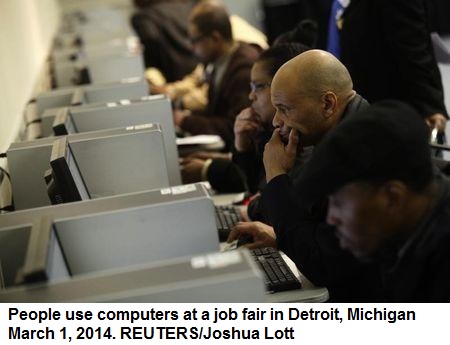
There are both “push and pull” factors as to why these ones leave. But the destination countries, North America and Western Europe, may not be such ideal alternatives. These communities have also been suffering from agents-of-change in the modern world and losing badly in the struggle of man-versus-machine, the industrial adoption of automation, and  the corporate assimilation of internet & communication technologies.

Everything has changed…everywhere! It is what it is! The poor is expanding, the middle class is shrinking, and the rich, the One Percent is growing in affluence, influence and power.

The Go Lean book therefore posits that there is a need to re-focus, re-boot, and optimize the engines of commerce so as to make the Caribbean a better place to live, work and play. Considering this article here, depicting that there is the opportunity to create jobs:

Title: Computers reshaping global job market, for better and worse
By: Ann Saphir (Editing by Lisa Shumaker)

CU Blog - Where the Jobs Are - Computers reshaping global job martket - Photo 2(Reuters) – Automation and increasingly sophisticated computers have boosted demand for both highly educated and low-skilled workers around the globe, while eroding demand for middle-skilled jobs, according to research to be presented to global central bankers on Friday.

But only the highly educated workers are benefiting through higher wages, wrote MIT professor David Autor in the paper prepared for a central banking conference in Jackson Hole, Wyoming. Middle- and lower-skilled workers are seeing their wages decline.

That is in part because as middle-skilled jobs dry up, those workers are more likely to seek lower-skilled jobs, boosting the pool of available labor and putting downward pressure on wages.

“(W)hile computerization has strongly contributed to employment polarization, we would not generally expect these employment changes to culminate in wage polarization except in tight labor markets,” Autor wrote.

Any long-term strategy to take advantage of advances in computers should rely heavily on investments in human capital to produce “skills that are complemented rather than substituted by technology,” he said.

Recounting the long history of laborers vilifying technological advances, Autor argues that most such narratives underestimate the fact that computers often complement rather than replace the jobs of higher-skilled workers.

People with skills that are easily replaced by machines, such as 19th-century textile workers, do lose their jobs.

In recent years computer engineers have pushed computers farther into territory formerly considered to be human-only, like driving a car.

Still, computer-driven job polarization has a natural limit, Autor argues. For some jobs, such as plumbers or medical technicians who take blood samples, routine tasks are too intertwined with those requiring interpersonal and other human skills to be easily replaced.

“I expect that a significant stratum of middle skill, non-college jobs combining specific vocational skills with foundational middle skills – literacy, numeracy, adaptability, problem-solving and common sense – will persist in coming decades,” Autor wrote.

Autor, who has been studying technology and its impact on jobs since before the dot-com bubble burst, notes that some economists have pointed to the weak U.S. labor market since the 2000s as evidence of the adverse impact of computerization.

Such modern-day Luddites are mistaken, he suggested. U.S. investment in computers, which had been increasing strongly, dropped just as labor demand also fell, exactly the opposite of what ought to happen if technology is replacing labor.

More likely, he said, globalization is to blame, hurting demand for domestic labor and, like technology, helping to reshape the labor landscape. While in the long run both globalization and technology should in theory benefit the economy, he wrote, their effects are “frequently slow, costly, and disruptive.”

The book Go Lean… Caribbean, serves as a roadmap for the introduction and implementation of the technocratic Caribbean Union Trade Federation (CU) with the charter to facilitate jobs in the region. The book posits that ICT (Internet & Communications Technology) can be a great equalizer for the Caribbean to better compete with the rest of the world, relating the experiences of Japan – the #3 global economy – who have competed successfully with great strategies and technocratic execution despite being a small country of only 120+ million people. This modeling of Japan, and other successful communities, aligns with the CU charter; as defined by these 3 prime directives:

  • Optimization of economic engines in order to grow the regional economy to $800 Billion and create 2.2 million new jobs.
  • Establishment of a security apparatus to protect the resultant economic.
  • Improve Caribbean governance to support these engines.

Early in the Go Lean book, the responsibility to create jobs was identified as an important function for the CU with these pronouncements in the Declaration of Interdependence (Pages 14):

xxvi.  Whereas the Caribbean region must have new jobs to empower the engines of the economy and create the income sources for prosperity, and encourage the next generation to forge their dreams right at home, the Federation must therefore foster the development of new industries, like that of ship-building, automobile manufacturing, prefabricated housing, frozen foods, pipelines, call centers, and the prison industrial complex. In addition, the Federation must invigorate the enterprises related to existing industries tourism, fisheries and lotteries – impacting the region with more jobs.

xxvii. Whereas the region has endured a spectator status during the Industrial Revolution, we cannot stand on the sidelines of this new economy, the Information Revolution. Rather, the Federation must embrace all the tenets of Internet Communications Technology (ICT) to serve as an equalizing element in competition with the rest of the world. The Federation must bridge the digital divide and promote the community ethos that research/development is valuable and must be promoted and incentivized for adoption.

xxviii. Whereas intellectual property can easily traverse national borders, the rights and privileges of intellectual property must be respected at home and abroad. The Federation must install protections to ensure that no abuse of these rights go with impunity, and to ensure that foreign authorities enforce the rights of the intellectual property registered in our region.

xxx.  Whereas the effects of globalization can be felt in every aspect of Caribbean life, from the acquisition of food and clothing, to the ubiquity of ICT, the region cannot only consume, it is imperative that our lands also produce and add to the international community, even if doing so requires some sacrifice and subsidy.

According to the foregoing article, computers are reshaping the global job market, for better and worse. The Go Lean book, and previous blog/commentaries, detailed the principle of job multipliers, how certain industries are better than others for generating multiple indirect jobs down the line for each direct job on a company’s payroll. Industries relating to STEM (Science, Technology, Engineering and Mathematics/Medicine) fields have demonstrated high job-multiplier rates of 3.0 to 4.1 factors (Page 260).

The Go Lean… Caribbean book details the creation of 2.2 million new jobs for the Caribbean region, many embracing ICT skill-sets. How? By adoption of certain community ethos, plus the executions of key strategies, tactics, implementations and advocacies. The following is a sample from the book:

Assessment – Puerto Rico – The Greece of the Caribbean Page 18
Community Ethos – Deferred Gratification Page 21
Community Ethos – Economic Principle – Economic Systems Influence Choices & Incentives Page 21
Community Ethos – Economic Principle – Voluntary Trade Creates Wealth Page 21
Community Ethos – Consequences of Choices Lie in the Future Page 21
Community Ethos – Job Multiplier Page 22
Community Ethos – Anti-Bullying and Mitigation Page 23
Community Ethos – Lean Operations Page 24
Community Ethos – Return on Investments Page 24
Community Ethos – Ways to Impact the Future Page 26
Community Ethos – Ways to Foster Genius Page 27
Community Ethos – Ways to Help Entrepreneurship Page 28
Community Ethos – Ways to Promote Intellectual Property Page 29
Community Ethos – Ways to Impact Research & Development Page 30
Community Ethos – Ways to Bridge the Digital Divide Page 31
Strategy – Mission – Education Without Further Brain Drain Page 46
Strategy – Agents of Change – Technology Page 57
Strategy – Agents of Change – Globalization Page 57
Tactical – Fostering a Technocracy Page 64
Tactical – Tactics to Forge an $800 Billion Economy – Japanese Model Page 69
Tactical – Tactics to Forge an $800 Billion Economy – High Multiplier Industries Page 70
Tactical – Separation of Powers – Commerce Department – Patents & Copyrights Page 78
Implementation – Ways to Pay for Change Page 101
Implementation – Trends in Implementing Data Centers Page 106
Implementation – Ways to Deliver Page 109
Implementation – Ways to Impact ICT and Social Media Page 111
Planning – Ways to Improve Trade Page 128
Advocacy – Ways to Grow the Economy Page 151
Advocacy – Ways to Create Jobs Page 152
Advocacy – Ways to Improve Education Page 159
Advocacy – Ways to Impact Labor Markets and Unions Page 164
Advocacy – Ways to Foster Empowering Immigration – STEM Resources Page 174
Advocacy – Ways to Foster Technology Page 197
Advocacy – Ways to Foster e-Commerce Page 198
Advocacy – Lessons from America’s Peonage History – John Henry Historicity Page 211
Advocacy – Ways to Promote a Call Center Industry Page 212
Advocacy – Ways to Impact Youth Page 227
Appendix – Growing 2.2 Million Jobs in 5 Years Page 257
Appendix – Job Multipliers Page 259

The CU will foster job-creating developments, incentivizing many high-tech start-ups and incubating viable companies. The primary ingredient for CU success will be Caribbean people, so we must foster and incite participation of many young people into STEM fields, so as to impact their communities. A second ingredient will be the support of the community – the Go Lean roadmap recognizes the limitation that not everyone in the community will embrace the opportunity to lead in these endeavors. An apathetic disposition is fine-and-well, we simply must not allow that to be a hindrance to those wanting to progress. The community ethos or national spirit, must encourage and spur “achievers” into roles where “they can be all they can be”. The book posits that one person can make a difference.

The Caribbean is arguably the best address on the planet, but the missing pieces for many people are jobs. The Go Lean roadmap starts with the assessment of the true status of the region, then the development of the plan to remediate the status quo, and finally the turn-by-turn directions to get to a new destination: a better place to live, work and play.

This Go Lean roadmap describes that the Caribbean is in crisis, a war with many battlegrounds. Our effort is worth any sacrifice, but this time our battle is not man versus machine, but rather man with the machine.

Download the book Go Lean…Caribbean now!

—————————————————
Footnote – a: John Henry

John Henry is an American folk hero and tall tale. He worked as a “steel-driver”—a man tasked with hammering a steel drill into rock to make holes for explosives to blast the rock away. He died during the construction of a tunnel for a railroad. In the legend, John Henry’s prowess as a steel-driver was measured in a race against a [machine], steam powered hammer, which he won, only to die in victory with his hammer in his hand and heart giving out from stress. The story of John Henry has been the subject of numerous songs, stories, plays, books and novels.

Historicity
The historicity of many aspects of the John Henry legend is subject to debate. Until recently it was generally believed that the race between a man and a steam hammer described in the ballad occurred during the construction of the Chesapeake and Ohio (C&O) Railway in the 1870s.

In particular, the race was thought to have occurred during the boring of Big Bend tunnel near Talcott, West Virginia between 1869 and 1871. Talcott holds a yearly festival named for Henry and a statue and memorial plaque have been placed along a highway south of Talcott as it crosses over the Big Bend tunnel.

CU Blog - Where the Jobs Are - Computers reshaping global job market - Photo 1

In the 2006 book Steel Drivin’ Man: John Henry, the Untold Story of an American Legend, Scott Reynolds Nelson, an associate professor of history at the College of William and Mary, contends that the John Henry of the ballad was based on a real person, the 20-year-old New Jersey-born African-American freeman, John William Henry (prisoner #497 in the Virginia penitentiary). Nelson speculates that Henry, like many African Americans might have come to Virginia to work on the clean-up of the battlefields after the Civil War. Arrested and tried for burglary, he was among the many convicts released by the warden to work as leased labor on the C&O Railway.

According to Nelson, conditions at the Virginia prison were so terrible that the warden, an idealistic Quaker from Maine, believed the prisoners, many of whom had been arrested on trivial charges, would be better clothed and fed if they were released as laborers to private contractors (he subsequently changed his mind about this and became an opponent of the convict labor system). Nelson asserts that a steam drill race at the Big Bend Tunnel would have been impossible because railroad records do not indicate a steam drill being used there.

Instead, Nelson argues that the contest must have taken place 40 miles away at the Lewis Tunnel, between Talcott and Millboro,  Virginia, where records indicate that prisoners did indeed work beside steam drills night and day. Nelson also argues that the verses of the ballad about John Henry being buried near “the white house”, “in sand”, somewhere that locomotives roar, mean that Henry’s body was buried in the cemetery behind the main building of the Virginia penitentiary, which photos from that time indicate was painted white, and where numerous unmarked graves have been found.

Prison records for John William Henry stopped in 1873, suggesting that he was kept on the record books until it was clear that he was not coming back and had died. The evidence assembled by Nelson, though suggestive, is circumstantial; Nelson himself stresses that John Henry would have been representative of the many hundreds of convict laborers who were killed in unknown circumstances tunneling through the mountains or who died shortly afterwards of silicosis from dust created by the drills and blasting.
 Songs
The well-known narrative ballad of “John Henry” is usually sung in at an upbeat tempo. The hammer songs (or work songs) associated with the “John Henry” ballad, however, are not. Sung slowly and deliberately, these songs usually contain the lines “This old hammer killed John Henry / but it won’t kill me.” Nelson explains that:

…workers managed their labor by setting a “stint,” or pace, for it. Men who violated the stint were shunned … Here was a song that told you what happened to men who worked too fast: they died ugly deaths; their entrails fell on the ground. You sang the song slowly, you worked slowly, you guarded your life, or you died.

There is some controversy among scholars over which came first, the ballad or the hammer songs. Some scholars have suggested that the “John Henry” ballad grew out of the hammer songs, while others believe that the two were always entirely separate.

(Source: Retrieved August 22 from: http://en.wikipedia.org/wiki/John_Henry_(folklore))

Share this post:
, , , ,
[Top]

New Hope in the Fight against Alzheimer’s Disease

 Go Lean Commentary

Be careful what you pray for. You just might be blessed with it.

This is the scenario to consider when campaigning to repatriate the Caribbean Diaspora. We just might succeed! And when we do, then we have to contend with the challenges of those blessings: the good, bad and ugly of the aging Diaspora.

Alzheimer’s disease is described as a “long goodbye”. It is one of those “challenges of blessings” that comes with an aging population.

Considering the attributes of life, liberty and the pursuit of happiness, this disease robs all three. But now, there is new hope, and some measurements for positive progress.

An eye exam that looks to detect plaque buildup in the brain is one of two new developments in the field of Alzheimer’s research.

These constitute New Hope. See VIDEO here:

NBC News Online Video – Retrieved 07-15-2014
http://www.nbcnews.com/nightly-news/new-hope-fight-against-alzheimers-disease-n155841

CU Blog - New Hope in the Fight Against Alzheimer's Disease - Photo 1Alzheimer’s disease (AD) is the most common form of dementia. There is no cure for the disease, which worsens as it progresses, and eventually leads to death. It was first described by German psychiatrist and neuro-pathologist Alois Alzheimer in 1906 and was named after him.[a]Most often, AD is diagnosed in people over 65 years of age,[b]although the less-prevalent early-onset Alzheimer’s can occur much earlier. In 2006, there were 26.6 million people worldwide with AD. Alzheimer’s is predicted to affect 1 in 85 people globally by 2050.[c][d]

This subject matter aligns with the publication Go Lean … Caribbean, which serves as a roadmap for the introduction and implementation of the Caribbean Union Trade Federation (CU). The Go Lean roadmap posits that expatriating to foreign lands should only ever be considered as a temporary measure. The book quotes (Page 144) the Bible examples of Jacob/Joseph emigrating to Egypt for refuge from the sever famine in their Promised Land of Canaan. Eventually the famine abated, and the Promised Land was “flowing with milk and honey” again. It was time to go home.

This situation parallels the Caribbean today. The region is arguable the best address on the planet. But so many of its citizens seek to flee because of the lack of economic opportunities. Something is clearly wrong, broken and must be fixed. The Go Lean roadmap specifies where we are as a region (with 70% brain drain among the college educated), where we want to go (elevation of Caribbean society in the homeland for all citizens to return and enjoy) and how we plan to get there. While the Go Lean book strategizes a roadmap for economic empowerment, it clearly relates that healthcare, disease management, and medicines are germane to the Caribbean quest for health, wealth and happiness. At the outset of the Go Lean book, in the Declaration of Interdependence (Page 10 & 11 respectively), these points are pronounced:

Preamble: And while our rights to exercise good governance and promote a more perfect society are the natural assumptions among the powers of the earth, no one other than ourselves can be held accountable for our failure to succeed if we do not try to promote the opportunities that a democratic society fosters.

ix.     Whereas the realities of healthcare and an aging population cannot be ignored and cannot be afforded without some advanced mitigation, the Federation must arrange for health plans to consolidate premiums of both healthy and sickly people across the wider base of the entire Caribbean population. The mitigation should extend further to disease management, wellness, obesity and smoking cessation programs. The Federation must proactively anticipate the demand and supply of organ transplantation as developing countries are often exploited by richer neighbors for illicit organ trade.

Alzheimer is pandemic, with the projections of 1 in 85 people globally by 2050. This scourge was not the motivation for composing the book Go Lean … Caribbean, but rather the bigger goal of elevating Caribbean society. The Caribbean Union Trade Federation has the prime directive of optimizing the economic, security and governing engines of the region. The foregoing article/VIDEO depicts the benefits that can emerge as a result of innovation in science, technology, engineering and medicine (STEM).

Under the Go Lean roadmap, these types of developments will also emerge from the Caribbean. The following list details the strategies, tactics, implementations and advocacies to optimize the region’s health deliveries:

Community Ethos – Cooperatives Page 25
Community Ethos – Non-Government Organizations Page 25
Community Ethos – Ways to Impact Research & Development (R&D) Page 30
Community Ethos – Ways to Impact the Greater Good Page 37
Separation of Powers – Patent, Standards & Copyrights Office Page 78
Separation of Powers – Health Department Page 86
Separation of Powers – Drug Administration Page 87
Implementation – Ways to Pay for Change Page 101
Implementation – Ways to Implement Self-Government Entities Page 105
Implementation – Ways to Deliver Page 109
Implementation – Trade Mission Objectives – Diaspora Outreach Page 116
Implementation –  Reasons to Repatriate Page 118
Implementation –  Ways to   Benefit from Globalization Page 119
Advocacy – Ways to Improve Healthcare Page 156
Advocacy – Ways to Impact Cancer Page 157
Advocacy – Ways to Impact Entitlements Page 158
Advocacy – Ways to Better Manage the Social   Contract Page 170
Advocacy – Ways Foster Cooperatives Page 176
Advocacy – Ways to Impact Foundations Page 219
Advocacy – Ways to Improve Elder-Care Page 225
Advocacy – Ways to Impact Persons with Disabilities Page 228
Appendix – Healthways Model – Disease Management Page 300

While dementia has been a constant among the elderly from the dawn of time, it does appear to be that Alzheimer’s disease is more prevalent today. Some studies have shown an increased risk of developing AD with environmental factors such as the intake of metals, particularly aluminum. [e] The quality of some of these studies has been criticized [f] and other studies have concluded that there is no relationship between these environmental factors and the development of AD. [g] Other studies suggest that extremely low frequency electromagnetic fields may also increase the risk for AD [h], but reviewers found that further epidemiological and laboratory investigations of this hypothesis are needed. [i] Smoking is undoubtedly a significant AD risk factor.[j] Lastly, systemic markers of the innate immune system are identified as risk factors for late-onset AD.

These questions/statements demonstrate that there is a need for more R&D on Alzheimer’s disease. Progress can emerge from anywhere around the world. In fact, the reports in the foregoing VIDEO depicted medical innovations fostered in the country of Finland. These innovations could easily have come from the Caribbean as well – for example, Cuba currently performs a lot of R&D into cancer, diabetes and other ailments. The Go Lean roadmap posits that more innovations will emerge as a direct result of the CU prioritization on science, technology, engineering and medical activities on Caribbean R&D campuses and educational institutions.

CU Blog - New Hope in the Fight Against Alzheimer's Disease - Photo 2This is the heavy-lifting that the CU is designed to bear, with investments made in R&D. Such investments are designed to benefit those who suffer from AD and the many caregivers who love them. This then is serving the Greater Good.

Download the book Go Lean … Caribbean – now!

——————————————————————————————————————————

Photo Credit: The Alzheimer’s Association … for care, support and research – http://www.alz.org/

References:

a.     Berchtold NC, Cotman CW. Evolution in the Conceptualization of Dementia and Alzheimer’s Disease: Greco-Roman Period to the 1960s. Neurobiology of Aging. 1998; Volume 19 Number 3; Pages 173–89.

b.     Brookmeyer R, Gray S, Kawas C. Projections of Alzheimer’s Disease in the United States and the Public Health Impact of Delaying Disease Onset. American Journal of Public Health. (1998) Volume 88 Number 9. Pages 1337–42. Retrieved from: http://www.ncbi.nlm.nih.gov/pmc/articles/PMC1509089/

c.     Brookmeyer R, Johnson E, Ziegler-Graham K, Arrighi HM. Forecasting the global burden of Alzheimer’s disease. Alzheimer’s & Dementia. 2007 Volume 3 Number 3; Pages186 – 91. Retrieved 18 June 2008 from: http://works.bepress.com/cgi/viewcontent.cgi?article=1022&context=rbrookmeyer

d.     2007 Report retrieved 27 August 2008 from: http://un.org/esa/population/publications/wpp2006/WPP2006_Highlights_rev.pdf.

e.     Shcherbatykh I, Carpenter DO. The Role of Metals in the Etiology of Alzheimer’s Disease. Journal of Alzheimer’s Disease. 2007;11(2):191–205. PMID 17522444.

f.      Santibáñez M, Bolumar F, García AM. Occupational Risk Factors in Alzheimer’s Disease: A Review Assessing the Quality of Published Epidemiological Studies. Occupational and Environmental Medicine. 2007;64(11):723–732. doi:10.1136/oem.2006.028209. PMID 17525096.

g.     Rondeau V. A Review of Epidemiologic Studies on Aluminum and Silica in Relation to Alzheimer’s Disease and Associated Disorders. Reviews on Environmental Health. 2002;17(2):107–21. doi:10.1515/REVEH.2002.17.2.107. PMID 12222737.

h.     Kheifets L, Bowman JD, Checkoway H, Feychting M, Harrington JM, Kavet R, Marsh G, Mezei G, Renew DC, van Wijngaarden E. Future needs of occupational epidemiology of extremely low frequency electric and magnetic fields: review and recommendations. Occupational and Environmental Medicine. February 2009. Volume 66 Number 2. Pages 72–80.

i.      Scientific Committee on Emerging and Newly Identified Health Risks (SCENIHR). Health Effects of Exposure to EMF. January 2009 Retrieved 27 April 2010 (Page 4–5) from: http://ec.europa.eu/health/ph_risk/committees/04_scenihr/docs/scenihr_o_022.pdf

j.      Cataldo JK, Prochaska JJ, Glantz SA. Cigarette smoking is a risk factor for Alzheimer’s disease: An analysis controlling for tobacco industry affiliation. Journal of Alzheimer’s Disease. 2010; Volume 19 Number 2: Pages 465–80.

Share this post:
, , , ,
[Top]

STEM Jobs Are Filling Slowly

Go Lean Commentary

Here comes more “pull pressure” on the Caribbean work force.

According to the foregoing article, there is a greater demand for STEM (Science, Technology, Engineering and Mathematics) workers in the United States. According to US Government immigration policies, employers can search outside the borders to find job applicants to fill roles that are hard to place. This constitutes additional demand for individuals in the Caribbean work force with this skill-set to avail themselves of opportunities in the US. This article depicted here, constitutes an additional “pull” factor:

By: Justin Kim
Money Economics – Finance e-Zine (Posted 07/01/2014; Retrieved 07/11/2014 from:
http://www.moneyeconomics.com/headlines/stem-jobs-are-filling-slowly/

CU Blog - STEM Jobs Are Filling Slowly - Photo 1According to a new study by Brookings Institution, there is a clear evidence of a skills gap in the US. The report stated that a high school graduate with a Science, Technology, Engineering, and Math (STEM) background seems to be in higher demand than a person with an undergraduate degree not in a STEM background. The study looked at all job openings which were advertised on the companies’ websites totaling 52,000 companies in Q1 2013. Jobs in healthcare sector that require technical skills such as positions for doctors, nurses, and radiologists, filled at the slowest rate. To fill those jobs, the advertisement lasted an average of 47 days with the next being architectural and engineering openings that took an average of 41 days to fill. Computer and math jobs did relatively better in 39 days. On the other hand, jobs that do necessarily require higher education—installation, maintenance and repair—were filled more rapidly as the opening averaged 33 days of advertisement. Some of the fastest-filling jobs were office and administrative support, manufacturing, and construction type of jobs that took about 24 to 28 days to fill up. The study also breaks down the rate into different geographic regions and showed that jobs in San Francisco and San Jose, right in the vicinity of Silicon Valley, were the hardest to fill.

CU Blog - STEM Jobs Are Filling Slowly - Photo 2This graph depicts the percentage of jobs that remain unfilled after a month of advertising in the major sectors. It displays the skill gap in which healthcare and STEM sectors have a much harder time filling their positions than construction, production, transport, repair as well as public service sectors. Some analysts have argued in the past that due to the skill gap, the unemployment rate will be slow to fall. The author states that such gap will increase as this survey results show earnings and unemployment rate for STEM and non-STEM workers will be enlarged.

The book Go Lean…Caribbean posits that the reasons why the Caribbean brain drain is so acute, reported at exceeding 70%, are “push and pull” factors. That North American, and European countries can appeal to Caribbean educated workers more enticingly that their homeland. This is the pull factor. In addition the economic, security and governing deficiencies in the Caribbean “push” the native workers to consider expatriating. This can be likened to casting a ballot. The well-educated, skilled STEM worker in the Caribbean can simply choose to vote for “none of the above”; they vote with their feet and their wallet and simply flee the region. Today, that pace is 70%. Since the Caribbean has its own needs for the STEM work force, these numbers cannot be ignored.

The Caribbean is in crisis. The book Go Lean…Caribbean serves as a roadmap for the introduction and implementation of the technocratic Caribbean Union Trade Federation (CU). The roadmap declares that a crisis is a terrible thing to waste, and thus will respond to minimize “push” factors while also creating more competitive environments to dampen the pull factors.

The roadmap, in total will elevate Caribbean society. The prime directives of the CU are presented as the following 3 statements:

  • Optimization of the economic engines in order to grow the regional economy to $800 Billion & create 2.2 million new jobs.
  • Establishment of a security apparatus to protect the resultant economic engines.
  • Improve Caribbean governance to support these engines.

The book posits that all of the Caribbean is in crisis with this brain drain problem, while at the same time we have the same urgent need for STEM talent. This point is stressed early in the book (Page 13) in the following pronouncements in the Declaration of Interdependence:

xix.   Whereas our legacy in recent times is one of societal abandonment, it is imperative that incentives and encouragement be put in place to first dissuade the human flight, and then entice and welcome the return of our Diaspora back to our shores. This repatriation should be effected with the appropriate guards so as not to imperil the lives and securities of the repatriated citizens or the communities they inhabit. The right of repatriation is to be extended to any natural born citizens despite any previous naturalization to foreign sovereignties.

xxi.   Whereas the preparation of our labor force can foster opportunities and dictate economic progress for current and future generations, the Federation must ensure that educational and job training opportunities are fully optimized for all residents of all member-states, with no partiality towards any gender or ethnic group. The Federation must recognize and facilitate excellence in many different fields of endeavor, including sciences, languages, arts, music and sports. This responsibility should be executed without incurring the risks of further human flight, as has been the past history.

This blog relates to the challenge of mitigating the brain drain. This has been a frequent topic for these Go Lean blogs, highlighted here in the following samples:

a. https://goleancaribbean.com/blog/?p=1683 Caribbean Diaspora subject to ‘poverty pay’ in Britain
b. https://goleancaribbean.com/blog/?p=1674 Obama’s Plans for $3.7 Billion Immigration Crisis Funds, stressing the need for reform in the US.
c. https://goleancaribbean.com/blog/?p=1596 Book Review: ‘Prosper Where You Are Planted’ – the antithesis of emigration
d. https://goleancaribbean.com/blog/?p=1470 College of the Bahamas Master Plan 2025 – Lacking response for brain drain
e. https://goleancaribbean.com/blog/?p=1433 Caribbean loses more than 70 percent of tertiary educated to brain drain
f. https://goleancaribbean.com/blog/?p=1296 Remittances from Diaspora to Caribbean Increased By 3 Percent in 2013
g. https://goleancaribbean.com/blog/?p=1256 Is a Traditional 4-year College Degree a Terrible Investment? Yes, for Caribbean students studying abroad.

The Go Lean roadmap is based on sound economic principles, of which a basic concept is supply-and-demand. For the US, according to the foregoing article, there are more demand than supply for STEM workers, In the past, demand-supply gaps have been filled with a liberal immigration policy, but there is no stomach for that in today’s political climate. So the family re-unification approach is the likely strategy to be employed imminently – ethnicities with larger immigrant populations already in the US will have an advantage but their homelands will have more brain drain.

This is the premise for this commentary, that more pressure will be created for Caribbean citizens with STEM skill-sets to consider relocation, by connecting with their vibrant diaspora and family members for applying for entry into the US.

This means war.

Actually, war has already ensued; this issue is just the latest battle in this trade war.

To assuage these fears, and counteract the Caribbean losing dispositions in this trade war, the Go Lean book details a series of community ethos, strategies, tactics, implementations and advocacies to foster the best practices to mitigate further brain drain for the Caribbean region:

Community Ethos – Deferred Gratification Page 21
Community Ethos – Economic Systems Influence Choices & Incentives Page 21
Community Ethos – Job Multiplier Page 22
Community Ethos – Anti-Bullying and Mitigation Page 23
Community Ethos – Minority Equalization Page 24
Community Ethos – Return on Investments Page 24
Community Ethos – Ways to Impact the Future Page 27
Community Ethos – Ways to Foster Genius Page 26
Community Ethos – Ways to Help Entrepreneurship Page 28
Community Ethos – Promote Intellectual Property Page 29
Community Ethos – Ways to Impact Research & Development Page 30
Community Ethos – Ways to Close the Digital Divide Page 31
Community Ethos – Ways to Impact the Greater Good Page 37
Anecdote – Valedictorian and Caribbean Diaspora Member Page 38
Strategy – Customers – Citizens, Business   Community & Diaspora Page 47
Strategy – Meeting Region’s Needs Today, Preparing For Future Page 58
Tactical – Separation of Powers – Patent,   Standards, & Copyrights Page 78
Tactical – Separation of Powers – Education   Department Page 85
Implementation – Assemble all   Super-Regional Governing Entities Page 96
Implementation – Trends in Implementing   Data Centers Page 106
Implementation – Ways to Deliver Page 109
Implementation – Better Manage Debt –   Better Student Loans Dynamics Page 114
Planning – Ways to Improve Trade Page 128
Planning – Ways to Make the Caribbean Better Page 131
Advocacy – Ways to Grow the Economy Page 151
Advocacy – Ways to Create Jobs Page 152
Advocacy – Ways to Improve Education Page 159
Advocacy – Ways to Impact Student Loans – Forgivable Provisions Page 160
Advocacy – Ways to Foster Empowering Immigration – STEM Professionals Page 174
Advocacy – Ways to Foster Technology Page 197
Advocacy – Ways to Impact the Diaspora Page 217

Now is the time for all of the Caribbean, the people and governing (education) institutions, to lean-in for the elevations described in the book Go Lean … Caribbean. This is a big deal for the region. This roadmap is not just a plan; it is also the delivery of the hopes and dreams of generations of Caribbean residents to finally assuage the brain drain.

The region needs the deliveries, described in the Go Lean roadmap. Otherwise, we have no hope to incite and retain our young people, especially those with STEM skill-sets. As a region, we would be condemned to a future of the status quo, or worse, simply “fattening frogs for snakes”. This roadmap therefore is vital in the quest to make the Caribbean a better place to live, work, learn and play.

Download the book Go Lean … Caribbean – now!

Share this post:
, , ,
[Top]

Book Review: ‘Chasing Youth Culture and Getting It Right’

Go Lean Commentary

One mission of the book Go Lean…Caribbean is to sell the youth of the region on future prospects in the Caribbean.

The publishers of this book therefore must assume the role of Marketing Brand Managers.

Why is this important?

  • 65% of Caribbean population is under the age of 30[b][c]; 30% under the age of 15.[c]
  • 70% percent of Caribbean tertiary educated abandon their homeland and migrate to foreign shores.[d]

The job description for the publishers of the Go Lean book therefore become part-Marketer, part-Demographer, part-Drum Major; much like theCU Blog - Book Review - Chasing Youth Culture and Getting It Right - Photo 1 resource in this article here, Tina Wells, a writer, blogger and marketing firm founder:

By Alfred Edmond, Jr.

Black Enterprise Magazine – Book Review – April 19, 2011; Retrieved 07-06-2014 – http://www.blackenterprise.com/small-business/book-review-chasing-youth-culture-and-getting-it-right/

Subject: Buzz Marketing Group CEO Tina Wells urges you to market to teens, tweens and young adults not by age alone, but by tribe

In her new book Chasing Youth Culture and Getting It Right: How Your Business Can Profit by Tapping Today’s Most Powerful Trendsetters and Tastemakers, Buzz Marketing Group (Wiley, $16). Buzz Marketing CEO Tina Wells urges you to market to teens, tweens and young adults not by age alone, but by “tribe.” Citing her company’s research, as well as the success and failures of company’s marketing their goods and services to young consumers, Wells identifies four primary tribes:

  • The Wired Techie, driven by the need to be the first to discover, use and recommend new tech devices and gadgets.
  • The Conformist Yet Somewhat Paradoxical Preppy, traditional yet trendy buyers who are driven to want to fit in and belong.
  • The Always Mellow Alternative, who deviate from mainstream buying habits in order to pursue and support causes they believe in.
  • The Cutting Edge Independent, who deviate from the mainstream just for the sake of it.

While it’s difficult to accept that Wells’ tribes truly represent the totality of the thinking of tweens, teens and young adults, her book underscores an important reality of sales and marketing in the age of The Long Tail: Why The Future of Business is Selling Less of More ($10, Hyperion)–Chris Anderson’s must-read book about the changing nature of consumer choice and tastes in a largely digital marketplace: targeting consumers by age, race, gender and other traditional demographic markers alone is no longer enough for a business to be effective and, ultimately, profitable.

When it comes to marketing to youth, [Tina Wells] comes with unimpeachable bona fides. Already a 15-year veteran in the marketing business, she started Buzz Marketing as an 18-year-old, quickly carving out a niche and establishing a knack for understanding the trends, tastes and influences driving young consumers. Eventually graduating with honors with a B.A. in communication art from Hood College in 2002, and currently earning a marketing management degree at the Wharton School of Business, Wells creates marketing strategies for clients in the beauty, entertainment, fashion, financial and lifestyle sectors. Her clients have ranged from Sesame Street Workshop and PBS to American Eagle Outfitters and SonyBMG. Today, Wells, an expert contributor on entrepreneurship to BlackEnterprise.com, is well established as one of America’s most honored and celebrated young entrepreneurs.

So it’s no surprise that Wells brings and authoritative voice to Chasing Youth Culture and Getting It Right, confidently explaining the diverse world views of young consumers while smartly taking into account parents, as both their primary financial resource and the people with the most influence on their values. Wells also breezily illustrates, using vignettes of real young people who were subjects of her company’s survey, the impact of social media, globalization and the Great Recession on the “new millennials”. She also courageously weighs in on how young consumers feel about everything from environmentalism and corporate America to hypersexual content and America’s two-party political system.

In fact, sometimes Wells is over confident, making bold, sweeping overstatements about this or that aspect of the way young people think. For example, her description of “Global Mobiles” —young people who “live in a world without geographic or cultural boundaries” —is a stretch, conveniently overlooking the millions of young people, particularly low-income rural and urban Americans, who are hardly conscious of how people live on the other side of the tracks, much less the other side of the world. (Think Shawn Carter in the Brooklyn’s Marcy Projects before he became Jay-Z, the mogul and global citizen). While global mobiles absolutely exist, it’s too early to categorize them as a dominant factor in marketing.

The other major weakness of the book is [the] many examples of companies’ failed and/or successful efforts to market to youth culture; Wells ends up quickly glossing over most of them, causing them to lose some of their illustrative impact. I wish she’d used fewer examples, which would have allowed her to more effectively use those that remained as more enlightening and instructive case studies.

That said, if you’re a marketer or entrepreneur who wants to tap into the spending power of the generations of consumers who will drive the national and global economies over the next several decades (and come on, who doesn’t?), then you cannot afford to not read Chasing Youth Culture and Getting It Right. The book is both confirmation of Well’s formidable track record as an expert on the trends and tastes of young people, and powerful evidence of her prowess at using her immersion in her chosen area of expertise to peer around the corner into a future consumer marketplace, one that is evolving as unpredictably as it is quickly. Chasing Youth Culture and Getting It Right does solve all of the mysteries of marketing to young consumers, but it most certainly provides the most necessary, fascinating and useful clues.

——

Tina Wells is CEO of Buzz Marketing Group and is a columnist for BlackEnterprise.com [and Huffington Post]. Follow her on Twitter at @tinacwells and check out her new book, Chasing Youth Culture and Getting It Right, available now on amazon.com. (See Photo here).
CU Blog - Book Review - Chasing Youth Culture and Getting It Right - Photo 2
——

About the Review Author:

Alfred Edmond Jr. is SVP/Editor-at-large of BLACK ENTERPRISE. He is a content leader, brand representative and expert resource for all media platforms under the BLACK ENTERPRISE brand, including the magazine, television shows, web site, social media and live networking events. From 2008 through 2010, Edmond was SVP/Editor-in-chief of BlackEnterprise.com, helping to lead the transition of BLACK ENTERPRISE from single-magazine publisher to digital-first multimedia company. From 1995 through 2008, Edmond was chief editor of BLACK ENTERPRISE magazine. He also hosts The Urban Business Roundtable on WVON-AM in Chicago and Money Matters, a syndicated radio feature of American Urban Radio Networks.

Follow him on Twitter: alfrededmondjr; Facebook: http://facebook.com/alfrededmondjr; BE Insider: http://beinsider.ning.com/profile/Alfred

VIDEO: Inc. Magazine Entrepreneurial Reference Source  – http://videos.inc.com/index.php/kwidget/wid/1_5jek9891/uiconf_id/22577421

The book  Go Lean…Caribbean, parallels Chasing Youth Culture as it serves as a roadmap for the introduction and implementation of the Caribbean Union Trade Federation (CU) to elevate Caribbean society and culture. The idea of the CU must be marketed and sold to Caribbean stakeholders, young and old. The CU has 3 prime directives:

  • Optimization of the economic engines in order to grow the regional economy to $800 Billion and create 2.2 million new jobs.
  • Establishment of a security apparatus to protect the resultant economic engines.
  • Improve Caribbean governance to support these engines.

The Go Lean/CU effort is that of the legendary “Piped Piper”, in reverse to lead the children back home.

From the outset of the book, in the Introduction, the Go Lean roadmap (Page 10) posits that a target for the CU’s empowerments is Caribbean youth:

Our youth, the next generation, may not be inspired to participate in the future workings of their country; they may measure success only by their exodus from their Caribbean homelands.

Thusly, the CU must channel its inner “Tina Wells” to reach, engage, and sell to this youthful market.

There are other pronouncements that bear a direct reference to this foregoing article and source book, included here on Pages 11 & 13 of the Declaration of Interdependence:

vii. Whereas our landmass is finite and therefore limited as to population growth potential, it is imperative that prudent growth management be practiced so as to protect our legacy and still foster future opportunities for the hopes and fulfillment of a prosperous future for our children.

xix. Whereas our legacy in recent times is one of societal abandonment, it is imperative that incentives and encouragement be put in place to first dissuade the human flight, and then entice and welcome the return of our Diaspora back to our shores…

xxi. Whereas the preparation of our labor force can foster opportunities and dictate economic progress for current and future generations, the Federation must ensure that educational and job training opportunities are fully optimized for all residents of all member-states, with no partiality towards any gender or ethnic group. The Federation must recognize and facilitate excellence in many different fields of endeavor, including sciences, languages, arts, music and sports. This responsibility should be executed without incurring the risks of further human flight, as has been the past history.

The source book, Chasing Youth Culture and Getting It Right identifies the target demographic of millennials. This subset of youth population is identified as those born between the decades of the 1980’s and 2000’s[a]. Why so special? While every age group has always contended with a generation gap (Depression-era, Baby Boomers, Generation X), this current millennial generation is at the frontline of the current Caribbean battles, of which the region is sorely losing. The issues/crises dumbfounding Caribbean governance include: the impact of social media, globalization and the Great Recession.

Go Lean…Caribbean trumpets a call to the world of technology to impact Caribbean life. In addition to economic and security empowerments, this roadmap advocates the launch of a social media site – www.myCaribbean.gov – for all Caribbean stakeholders (residents, Diaspora, young students, business entities, and even visitors). This can create a universe of over 160 million unique profiles. The Go Lean roadmap is to deliver many government services via electronic modes, including public safety fulfillments, like Reverse 911 and Emergency Alert messaging.

The following lists details from the book Go Lean…Caribbean that parallels the advocacies of the source book Chasing Youth Culture and Getting It Right:

Community Ethos – Lean Operations Page 24
Community Ethos – Cooperatives Page 25
Community Ethos – Ways to Impact the Future Page 26
Community Ethos – Ways to Bridge the Digital Divide Page 31
Community Ethos – Impact the Greater Good Page 37
Strategy – Customers – Member-State Governments Page 51
Strategy – Agents of Change – Technology Page 57
Strategy – Agents of Change – Globalization Page 57
Strategy – Agents of Change – Aging Diaspora Page 57
Tactical – Fostering a Technocracy Page 64
Tactical – Separation of Powers – Postal Union Page 78
Anecdote – Turning Around the CARICOM governance Page 92
Anecdote – “Lean” in Government Page 93
Implementation – Ways to Pay for Change Page 101
Implementation – Ways to Deliver Page 109
Implementation – Ways to Impact Social   Media Page 111
Implementation – Reasons to Repatriate Page 118
Advocacy – Ways to Improve Governance Page 168
Advocacy – Ways to Better Manage the Social Contract Page 170
Advocacy – Ways to Foster Technology Page 197
Advocacy – Ways to Foster e-Commerce Page 198
Advocacy – Ways to Impact the Diaspora Page 217

The source book Chasing Youth Culture and Getting It Right is a great guidebook for developing participatory, agile institutions, enabled by advanced technology – a recipe for the CU. The Go Lean roadmap is also a great guidebook!

Now is the time for all of the Caribbean, the people (teenagers, adults & senior citizens) and governing institutions, to lean-in for the empowerments described in the book Go Lean…Caribbean. We cannot expect the youth to take their own lead; they must be led, but they will only respond to a certain style of leadership. Understanding that dynamic is the heavy-lifting involved in impacting change in the Caribbean region.

This is an art and a science!

There will be costs to incur for this advocacy, yes, but there are a lot of benefits too. The benefits are far too alluring to ignore: dawn of a new economy and new opportunities to preserve Caribbean culture for the Caribbean youth … and future generations.

🙂

Download the free e-Book of Go Lean … Caribbean – now!

———————

Appendix – Cited References:
a. Millennials (also known as the Millennial Generation or Generation Y) are the demographic cohort following Generation X. There are no precise dates when the generation starts and ends. Researchers and commentators use birth years ranging from the early 1980s to the early 2000s.
b. Example of Haiti; retrieved from http://populationaction.org/wp-content/uploads/2011/12/Haiti_Summary.pdf
c. Latin America & Caribbean Population 2005 retrieved from: http://www.eclac.cl/celade/noticias/documentosdetrabajo/6/48786/ Demographic_Trends_in_LAC_PAULO_SAAD_ED_12_7_09.pdf
d. Inter-American Bank report featured in CU Blog; retrieved from: https://goleancaribbean.com/blog/?p=1433


Share this post:
, , , , , ,
[Top]