Tag: Model

Transformations: Caribbean Postal Union – Delivering the Future

Go Lean Commentary

“The stone the builders reject has become the chief cornerstone” – The Bible; Luke 20:17
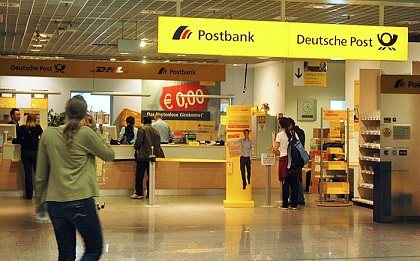
CU Blog - Transformations - Delivering the Future - Photo 1Now in the days of email, postal mail has become inconsequential;  affectionately called “snail mail”. Governments around the world provide the overhead of postal operations, though they are mostly unprofitable and sneered upon. There are some exceptions however …

  • Germany’s Deutsche Post
  • SwedenPostenAB
  • Finland’s Netpost

… these feature some of the business models in postal services that have become impactful to their local communities. From the best-practices gleaned from these above countries, the model of the Caribbean Postal Union (CPU) was forged. The CPU is a subset of the roadmap defined in the book Go Lean…Caribbean; this is the mission for physically and figuratively delivering the future. This roadmap, for the introduction and implementation of the technocratic Caribbean Union Trade Federation (CU), focuses on the political transformations and the practical transformations to elevate the Caribbean region, individually and collectively.

The Go Lean book details the Germany, Sweden and Finland experiences (Page 99) in contrast to the US Postal Service (USPS). The USPS is not the model for the Caribbean to emulate. The Go Lean book describes the USPS as a failing enterprise. Previous Go Lean commentaries have identified better role models for the CPU: logistics/e-Commerce giant Amazon in the US, and Alibaba in China. These companies provide logistical solutions to their marketplaces; the same as the CPU can deliver the logistical solution for the Caribbean’s modern commerce. This model can transform Caribbean society: its people and institutions. The USPS is an old-dying model; the CPU, on the other hand, is a new, transformative model. See the VIDEO here that relates the disposition of the USPS as an enterprise.

VIDEO 1 – US Postal Service Faces Big Changes Amid Struggle to Deliver on Profitability – https://youtu.be/Lnjfua5wY5U

Uploaded on Dec 5, 2011 – The likelihood that a stamped letter could reach its destination by the next day will be virtually eliminated due to billions in U.S. Postal Service cuts announced Monday. Postmaster General Patrick Donahoe joins Gwen Ifill to discuss the cuts and what’s next for the postal service and its customers.

This is commentary 3 of 4 – from the movement behind the Go Lean book – on the subject of transformations: how to move our region from the deficient-defective status quo to a new status, the undisputed title of “greatest address on the planet”. All these commentaries detail these issues, considering:

  1. Perfecting our Core Competence
  2. Money Matters – “Getting over” with “free money”
  3. Caribbean Postal Union (CPU) – Delivering the Future
  4. Civil Disobedience – Still Effective

The Go Lean book details this quest to transform the Caribbean; it features a how-to guide, a roadmap for elevating the region’s societal engines of economics, security and governance. It leads with economic issues, not political ones! But as established previously, there must be political transformations before practical transformations can take place. In order to explore the benefits of the CPU practical transformations – a consolidation of all existing postal entities – must take place in the region. This is a heavy-lifting task. Imagine the management and staff of those agencies in the member-state governments; they now become a part of the CU Federal Civil Service.

See Appendix below for the list of the National Postal entities – all members of the Universal Postal Union – that constitute the 30 Caribbean member-states.

The Go Lean/CU plan calls for this consolidation on Day One/Step One of the implementation of the roadmap, during the Assembly phase. This requires the type of political transformation that involves every stakeholder in the community: residents, businesses and institutions. But this effort can be communicated as a “labor of love”, with very little down-side. What is at risk? The rejected, ignored, expensive postal operations that is currently a drag on member-states resources. It is time now for these rejected entities to be the cornerstone of the Caribbean transformation.

To the everyday man on the street, he will see changes … on the street. There is the need for formal street names and house numbers. For all the regional member-states, except the US territories of Puerto Rico and the Virgin Islands, there is no mail door-to-door delivery. With the CPU business model, the streets will be structured as a marketplace with grid numbers and postal/ZIP codes, and with pick-up and delivery.

CU Blog - Transformations - Delivering the Future - Photo 3The focus of the CPU is not just to deliver postal mail, but rather to deliver logistics … and the future. Just like Amazon and Alibaba do so much more than just sell merchandise online, the CPU will facilitate a complete eco-system for Small-Medium-Enterprises (SME’s) to thrive in the region: finding customers for their wares and collecting payments. This is key to growing the regional economy to $800 Billion.

The CPU is designed to deliver the Caribbean’s future for Global Trade and Electronic Commerce. These activities have greatly impacted many societies around the world – think China – elevating their economic engines. The CU/CPU will employ technologically innovative products and services to impact its prime directives; identified with the following 3 statements:

  • Optimization of the economic engines in order to grow the regional economy to $800 Billion & create 2.2 million new jobs.
  • Establishment of a security apparatus to protect the resultant economic engines.
  • Improve Caribbean governance to support these engines, including the consolidation of the state-ran postal operations.

The VIDEO here demonstrates the theme from the Go Lean book, that one organization-institution – like the CPU – that facilitates e-Commerce can optimize the societal engines in the region and impact the transformation of the homeland. The facilitation role will include the attendant functions of order entry, payment settlement, inventory fulfillment, marketplace hosting, customer service contact center and mail pick-up/delivery.

VIDEO 2 – What is E-Commerce? – https://youtu.be/nxSDHBdsWqA

Uploaded on Nov 19, 2011 – What is E-Commerce?
This video provides an explanation of e-commerce, trends in online business, and how the internet has revolutionized the modern marketplace. It also identifies key factors responsible for e-commerce’s continued success.

The Go Lean roadmap seeks to change the entire eco-system of Caribbean commerce and the interaction with postal operations. This vision is defined early in the book (Page 12 & 14) in the following pronouncements in the Declaration of Interdependence:

xv. Whereas the business of the Federation and the commercial interest in the region cannot prosper without an efficient facilitation of postal services, the Caribbean Union must allow for the integration of the existing mail operations of the governments of the member-states into a consolidated Caribbean Postal Union, allowing for the adoption of best practices and technical advances to deliver foreign/domestic mail in the region.

xxvii. Whereas the region has endured a spectator status during the Industrial Revolution, we cannot stand on the sidelines of this new economy, the Information Revolution. Rather, the Federation must embrace all the tenets of Internet Communications Technology (ICT) to serve as an equalizing element in competition with the rest of the world. The Federation must bridge the digital divide and promote the community ethos that research/development is valuable and must be promoted and incentivized for adoption.
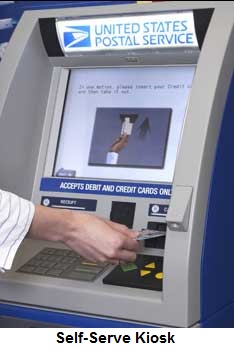
CU Blog - Transformations - Delivering the Future - Photo 2In a previous Go Lean blog, this commentary described how …

“… email and text messages have replaced “snail” mail in advanced economy countries for personal written communications. Electronic Bill Presentation & Payments (EBP&P) schemes are transforming business-to-consumer interactions, and electronic funds transfer/electronic commerce is the norm. So [Internet & Communications Technology] (ICT) must be a prominent feature of any Caribbean empowerment plan. This is why creating the CPU and the Caribbean Cloud (www.myCaribbean.gov) is “Step One / Day One” in the Go Lean roadmap. This is the by-product of assembling regional organs with multilateral cooperation and a separation-of-powers. The roadmap also includes establishment of the Caribbean Central Bank (CCB), as a cooperative among existing Central Banks, and its facilitation of electronic payment schemes so as to enable the region’s foray into electronic commerce and trade marketplaces.

The Go Lean book details a series of community ethos, strategies, tactics, implementations and advocacies to foster the best practices for the delivery of the CPU and trade marketplaces in the Caribbean region:

Community Ethos – Deferred Gratification Page 21
Community Ethos – Economic Principles – All Choices Involve Costs Page 21
Community Ethos – Economic Principles – People Respond to Incentives Page 21
Community Ethos – Economic Principles – Economic Systems Influence Choices Page 21
Community Ethos – Economic Principles – Voluntary Trade Creates Wealth Page 21
Community Ethos – Economic Principles – The Consequence of Choice Lie in Future Page 21
Community Ethos – Job Multiplier Page 22
Community Ethos – Lean Operations Page 24
Community Ethos – Cooperatives Page 25
Community Ethos – Ways to Impact the Future Page 26
Community Ethos – Ways to Help Entrepreneurship Page 28
Community Ethos – Promote Intellectual Property Page 29
Community Ethos – Ways to Bridge the Digital Divide Page 31
Strategy – Customers – Citizens and Member-states Governmental Page 47
Tactical – Fostering a Technocracy Page 64
Tactical – How to Grow the Economy to $800 Billion – Trade and Globalization Page 70
Tactical – Separation of Powers – Postal Services Page 78
Tactical – Separation of Powers – Interstate Commerce Administration Page 79
Implementation – Year 1 / Assemble Phase – Establish CPU Page 96
Implementation – Anecdote – Mail Services – USPS Dilemma Page 99
Implementation – Ways to Pay for Change – Group Purchase Organizations (GPO) Page 101
Implementation – Ways to Optimize Mail Service & myCaribbean.gov Marketplace Page 108
Implementation – Ways to Deliver Page 109
Implementation – Ways to Impact Social Media Page 111
Implementation – Ways to Benefit from Globalization Page 119
Planning – 10 Big Ideas for the Caribbean – # 8 Cyber-Caribbean Page 127
Planning – Ways to Improve Trade – GPO’s Page 128
Planning – Ways to Improve Interstate Commerce Page 129
Advocacy – Ways to Grow the Economy Page 151
Advocacy – Ways to Create Jobs Page 152
Advocacy – Ways to Mitigate Black Markets Page 165
Advocacy – Ways to Manage the Federal Civil Service Page 173
Advocacy – Ways to Foster Cooperatives Page 176
Advocacy – Ways to Foster Technology Page 197
Advocacy – Ways to Foster e-Commerce Page 198
Advocacy – Reforms for Banking Regulations Page 199
Advocacy – Ways to Impact Main Street Page 201

Issues related to the CPU business model have previously been detailed in these Go Lean commentaries, listed here:

Skipping School to become Tech Giants
The Future of Money
How to address high consumer prices
Truth in Commerce – Learning from Yelp
Net Neutrality: It matters here … in the Caribbean
Robots help Amazon tackle Cyber Monday
Role Model Jack Ma brings Alibaba to America
Where the Jobs Are – Computers Reshaping Global Job Market
Amazon’s new FIRE Smartphone
Grenada PM Urges CARICOM on ICT

Increasing trade is a successful strategy for growing the regional economy; this will undoubtedly mean increases in jobs and entrepreneurial opportunities. The CU/CPU/Go Lean plan is designed to foster and incubate key industries for the goal of transforming and elevating the regional economy.

But any transformation to the Caribbean societal engines must be permanent! The Go Lean book declares that for permanent change to take place, there must first be an adoption of new community ethos, the national spirit that drives the character and identity of its people. The roadmap was constructed with the primary community ethos of the Greater Good, not a profit motive and not a nationalistic motive; but rather a commitment for the “greatest good for the greatest number of people”.

Now is the time for all of the Caribbean, the people and governing institutions (like Postal Operations), to lean-in for the changes in the book Go Lean … Caribbean. This is a Big Idea for the region, that of a Cyber Caribbean effort (Page 127), in which trade marketplaces play a major role. This roadmap is not just a plan for delivering the mail; it is also the delivery of the hopes and dreams of generations of Caribbean stakeholders; it is about delivering the future: a better place to live, work and play. 🙂

Download the book Go Lean … Caribbean – now!

—————–

Appendix – Universal Postal Union (UPU) Members, as of 2009

Country

Governmental authority

Regulatory authority

Designated operator

 Antigua and Barbuda Antigua Post Office
 Aruba[N 1] Post Aruba – for Aruba, Bonaire, Curaçao and Sint Maarten and the Dutch SSS Islands.
 Bahamas[2009] Ministry of Public Works and Transport None Bahamas Postal Service
 Barbados[2009] Ministry of Home Affairs None Barbados Postal Service
 Belize Ministry of Public Utilities, Transport, Communications[2] Belize Postal Service[N 2]
 Cuba[2009] Ministry of Informatics and Communications None Empresa de Correos de Cuba
 Dominica Ministry of Public Works, Energy and Ports[4] General Post Office (GPO)[4][N 2]
 Dominican Republic[2009] Ministry of Public Works and Communications None Instituto Postal Dominicano (INPOSDOM) (Dominican Postal Institute)
 France[2009] Minister for the Economy, Industry and Employment Electronic Communications and Postal Regulation Authority (ARCEP) La Poste for Guadeloupe, Martinique, St Barts and St Martin
British Overseas Territories
 Grenada Grenada Postal Corporation[2]
 Guyana Guyana Post Office Corporation
 Haiti Office des Postes d’Haiti
 Jamaica Postal Corporation of Jamaica
 Netherlands Ministry of Economic Affairs OPTA/Authority for Consumers & Markets (ACM) PostNL for some of the Dutch SSS Islands (Saba, Sint Eustatius and Sint Maarten)
 Saint Christopher-Nevis-Anguilla St. Kitts & Nevis Postal Services
 Saint Lucia Saint Lucia Postal Service
 Saint Vincent & the Grenadines SVG Postal Corporation
 Suriname Surpost
 Trinidad and Tobago TTPost
 United States United States Postal Service[N 5] Postal Regulatory Commission United States Postal Service for Puerto Rico and US Virgin Islands

Source: Retrieved March 12, 2016 from: https://en.wikipedia.org/wiki/List_of_postal_entities
Share this post:
, , ,

ENCORE: Celebrating ‘Cinco De Mayo’

This Go Lean blog-commentary from May 5, 2015 is re-distributed on this occasion of Cinco De Mayo 2016. As always, this year’s commemoration is a celebration of Mexican culture, more so than Mexican history.

CU Blog - Celebrating Mexican Culture - Photo 1

Bienvenido Amigos …

————–

Go Lean Commentary

Today (May 5) is Cinco De Mayo – celebrating this is a move of solidarity with Mexico; its people and culture – Enjoy the festivities!

Enjoy the Mexican food, spirits, music and culture. The country and people of Mexico have so much to offer the world – see VIDEO below – this includes the Caribbean.

One thing more that they can offer us in our region: A Lesson in History!

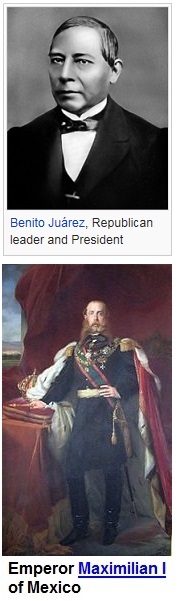
The summary of this celebration is simple on the surface: Mexican forces commanded by General Ignacio Zaragoza defeated the French army in the Battle of Puebla on 5 May 1862. 4 days later, on 9 May 1862, The then-President Benito Juárez declared that the anniversary of the Battle of Puebla would be a national holiday,[14][15][16][17][18] regarded as “Battle of Puebla Day” or “Battle of Cinco de Mayo”. Although today it is recognized in some countries as a day of Mexican heritage celebration, it is not a federal holiday in Mexico.[19]

Considering the real history of Cinco De Mayo is a really big deal. For starters, while Mexico was not the aggressor in this war, they were not exactly blameless.

The 1858 – 1860 Mexican civil war known as The Reform War had caused distress throughout Mexico’s economy. When taking office as the newly-elected president of the Republic in 1861, Juárez was forced to suspend payments of interest on foreign debts for a period of two years. At the end of October 1861 diplomats from Spain, France, and Britain met in London to form the Tripartite Alliance, with the main purpose of launching an allied invasion of Mexico, taking control of Veracruz, its major port, and forcing the Mexican government to negotiate terms for repaying its debts and for reparations for alleged harm to foreign citizens in Mexico. In December 1861, Spanish troops landed in Veracruz; British and French followed in early January. The allied forces occupied Veracruz and advanced to Orizaba. However, the Tripartite Alliance fell apart by early April 1862, when it became clear the French wanted to impose harsh demands on the Juarez government and provoke a war. The British and Spanish withdrew, leaving the French to march alone on Mexico City. French Emperor-President Napoleon III – the first democratically elected French President – wanted to set up a puppet regime, the Mexican Empire.

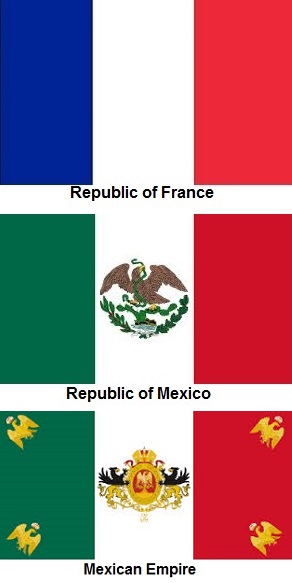
Thus started this French Intervention in Mexico. The effects of these 5 years were far-reaching, even to this day – consider the similarities in flags for these countries.

CU Blog - A Lesson in History - Cinco De Mayo - Photo 1Title: French Intervention in Mexico 1862 – 1867
Emperor Napoleon III of France was the instigator, justifying military intervention by claiming a broad foreign policy of commitment to free trade. For him, a friendly government in Mexico would ensure European access to Latin American markets. Napoleon also wanted the silver that could be mined in Mexico to finance his empire. Napoleon built a coalition with Spain and Britain while the U.S. was deeply engaged in its own civil war from 1861 to 1865.

Here is the main timeline of this French Intervention period:

1. 1862: Arrival of the French
After the initial victory by the Mexicans at the Battle of Puebla, the war continued in a different direction. The pursuing Mexican army was contained by the French at Orizaba, Veracruz, on 14 June. More British troops arrived on 21 September, and General Bazaine arrived with French reinforcements on 16 October. The French occupied the port of Tamaulipas on 23 October, and unopposed by Mexican forces took control of Xalapa, Veracruz on 12 December.

2. 1863: The French take the capital
CU Blog - A Lesson in History - Cinco De Mayo - Photo 2The French army of General François Achille Bazaine defeated the Mexican army led by General Comonfort in its campaign to relieve the siege of Puebla, at San Lorenzo, to the south of Puebla. Puebla surrendered to the French shortly afterward, on 17 May. On 31 May, President Juárez fled the capital city (Mexico City) with his cabinet, retreating northward to Paso del Norte and later to Chihuahua. Having taken the treasure of the state with them, the government-in-exile remained in Chihuahua until 1867.

French troops under Bazaine entered Mexico City on 7 June 1863. The main army entered the city three days later, led by General Forey. General Almonte was appointed the provisional President of Mexico on 16 June, by the Superior Junta (which had been appointed by Forey). The Superior Junta with its 35 members met on 21 June, and proclaimed a Catholic Empire on 10 July. The crown was offered to Austrian Prince Archduke Ferdinand Maximilian, following pressures by Napoleon. Maximilian accepted the crown on 3 October.

3. 1864: Arrival of Maximilian
Further decisive French victories continued with the fall of Guadalajara, Zacatecas, Acapulco, Durango by 3 July, and the defeat of republicans in the states of Sinaloa and Jalisco in November.

Maximilian formally accepted the crown on 10 April, signing the Treaty of Miramar (between France and Mexico), and landed at Veracruz on 28 May. He was enthroned as Maximilian I, Emperor of Mexico, [under French occupation].

4. 1865: Beginning of Republican victories
CU Blog - A Lesson in History - Cinco De Mayo - Photo 3After many more French victories, finally on 11 April, republicans defeated Imperial forces at Tacámbaro in Michoacán. In April and May the republicans had many forces in the states of Sinaloa and Chihuahua. Most towns along the Rio Grande, [(the border with the US),] were also occupied by republicans.

The decree known as the “Black Decree” was issued by Maximilian on 3 October, which threatened any Mexican captured in the war with immediate execution.

5. 1859-1867: U.S. Diplomacy and Involvement
The United States did not condone the French occupation of Mexico but it had to use its resources for the American Civil War, which lasted 1861 to 1865. Then-President Abraham Lincoln expressed his sympathy to Latin American republics against any European attempt to establish a monarchy; and the Congress passed a resolution in disgust of these French actions. In 1865, The US supported the sale of Mexican bonds by Mexican agents in the US to fund the Juarez Administration, raising up to $18-million dollars for the purchase of American war material.[16] By 1867, American policy shifted from thinly veiled sympathy to the republican government of Juarez to open threat of war to induce a French withdrawal, invoking the Monroe Doctrine, a policy to thwart any aggression by European powers in the Americas.

6. 1866: French withdrawal and Republican victories
Choosing Franco-American relations over his Mexican monarchy ambitions, Napoleon III announced the withdrawal of French forces beginning 31 May. Taking advantage of the end of French military support to the Imperial troops, the Republicans won a series of crippling victories in Chihuahua on 25 March, Guadalajara, Matamoros, Tampico and Acapulco in July. Napoleon III urged Maximilian to abandon Mexico and evacuate with the French troops; [but he persisted]. The French evacuated Monterrey on 26 July, Saltillo on 5 August, and the whole state of Sonora in September. Maximilian’s French cabinet members resigned on 18 September. The Republicans defeated imperial troops in Oaxaca in October, occupying the whole of Oaxaca in November, as well as parts of Zacatecas, San Luis Potosí and Guanajuato.

7. 1867: Republicans take the capital
The Republicans occupied the rest of the states of Zacatecas, San Luis Potosí and Guanajuato in January. The French evacuated the capital on 5 February.

On 13 February 1867, Maximilian withdrew to Querétaro. The Republicans began a siege of the city on 9 March, and Mexico City on 12 April. On 11 May, Maximilian finally resolved to try to escape through the enemy lines. He was intercepted on 15 May. Following a court-martial, he was sentenced to death and executed on 19 June.
Source: http://en.wikipedia.org/wiki/French intervention_in_Mexico  

This subject has relevance for the Caribbean. Mexico is a stakeholder in Caribbean affairs. They have a vast coastline (Yucatan Peninsula) on the Caribbean Sea, plus a few Caribbean islands (Cozumel, Isla Mujeres, Isla Contoy, and Isla Blanca). This country is also a member of the ACS – Association of Caribbean States – one of the relevant entities that must be assembled for this regional integration movement championed in the book Go Lean…Caribbean.

The underlying theme of this Lesson in Mexican History is the lack of effective security for the people and societal engines of Mexico. Now, after 150 years, this historic pattern has continued; Mexico proceeded to endure one revolution-rebellion-overthrow-coup d’etat after another until recent times.

The Caribbean cannot afford this same disposition: the dread and damage endured from decades of dysfunction.

Today, Mexico is known as a lawless society in many pockets, especially along the US border. Considering the art and science of security, it is sad that they never got it right! They resemble a Failed-State in so many perspectives. This is where their history, especially those 5 years of the Franco-Mexican War, provides lessons for the Caribbean people and institutions. But this Go Lean movement does not seek to remediate Mexico; this is out of scope. Rather the focus is strictly on the 30 Caribbean member-states: islands of the Caribbean plus the Central & South American states that caucus with the Caribbean Community (Belize, Guyana and Suriname).

This effort to elevate Caribbean society fully recognizes that security mitigations must be prioritized equally with economic and governing remediation. This is an underlying theme of the book Go Lean…Caribbean. The book declares that the region is in crisis, at the precipice of Failed-State status. This is the assertion of the Go Lean book, that the region must prepare its own security apparatus for its own security needs.

This book serves as a roadmap for the introduction and implementation of the technocratic Caribbean Union Trade Federation (CU). So while the CU is set to optimize Caribbean society through economic empowerment, the security dynamics will be inextricably linked to this same endeavor. Therefore the Go Lean roadmap has 3 prime directives:

  • Optimization of the economic engines in order to grow the regional economy to $800 Billion & create 2.2 million new jobs.
  • Establishment of a security apparatus to protect the resultant economic engines.
  • Improvement of Caribbean governance to support these engines.

The book contends, just as the French proved to be a “bad actor” to Mexico in 1862, that new “bad actors” will emerge for the Caribbean to contend with. This will be as a by-product of new economic successes in the region. This point is pronounced early in the book with the Declaration of Interdependence (Page 12) that claims:

x.   Whereas we are surrounded and allied to nations of larger proportions in land mass, populations, and treasuries, elements in their societies may have ill-intent in their pursuits, at the expense of the safety and security of our citizens. We must therefore appoint “new guards” to ensure our public safety and threats against our society, both domestic and foreign. The Federation must employ the latest advances and best practices … to assuage continuous threats against public safety.

xvi. Whereas security of our homeland is inextricably linked to prosperity of the homeland, the economic and security interest of the region needs to be aligned under the same governance. Since economic crimes, including piracy and other forms of terrorism, can imperil the functioning of the wheels of commerce for all the citizenry, the accedence of this Federation must equip the security apparatus with the tools and techniques for predictive and proactive interdictions.

The need for the Caribbean to appoint “new guards” or a security pact to mitigate foreign and domestic threats in the region is the primary lesson to glean from the foregoing encyclopedic article – a consideration of the history of Cinco De Mayo. This security pact is to be legally constituted by a Status of Forces Agreement which would be enacted as a complement to the CU confederation treaty. The Go Lean roadmap provides 370-pages of turn-by-turn directions on how to deploy cutting-edge strategies, tactics and implementations to succeed in this goal.

In addition, there are other lessons – secondary – that we learn from this consideration of the history of Cinco De Mayo:

The Go Lean book details a roadmap with turn-by-turn directions for transforming the Caribbean homeland. The following is a sample of the community ethos, strategies, tactics, implementations and advocacies to impact the Caribbean region for this turnaround:

Community Ethos – Economic Principle – Economic Systems Influence Choices Page 21
Community Ethos – Economic Principle – Consequences of Choices Lie in the Future Page 21
Community Ethos – Anti-Bullying and Mitigation Page 23
Community Ethos – Minority Equalization Page 24
Community Ethos – Cooperatives Page 25
Community Ethos – Ways to Improve Sharing Page 35
Strategy – Vision – Confederating a Non-Sovereign Union Page 45
Strategy – Mission – Protect Economic Engines from threats Page 45
Tactical – Fostering a Technocracy Page 64
Tactical – Separation of Powers Page 71
Implementation – Start-up Foreign Policy Initiatives Page 102
Implementation – Security Initiatives at Start-up Page 103
Implementation – Ways to Deliver Page 109
Implementation – Ways to Better Manage Debt Page 118
Implementation – Ways to Promote Independence – Interdependence Page 120
Planning – 10 Big Ideas – Defense / Homeland Security Pact Page 127
Planning – Ways to Make the Caribbean Better Page 131
Planning – Ways to Better Manage Image Page 133
Planning – Ways to Improve Failed-State Indices Page 134
Planning – Lessons from the American West Page 142
Advocacy – Ways to Grow the Economy Page 151
Advocacy – Ways to Create Jobs Page 152
Advocacy – Ways to Improve Governance Page 168
Advocacy – Ways to Better Manage the Social Contract Page 170
Advocacy – Ways to Impact Justice Page 177
Advocacy – Ways to Improve Homeland Security Page 180
Advocacy – Ways to Mitigate Terrorism Page 181
Advocacy – Ways to Protect Human Rights Page 220

Mexico is a beautiful country, with a beautifully diverse population plus a lot of natural resources. They experience a vibrant tourism product where millions visit annually for Mexican hospitality – they are a fit competitor of Caribbean tourism, even for cruises. See VIDEO here:

VIDEO: Mexico: Live It to Believe It – Cultural Diversity 2015 – https://youtu.be/jciVmLL_UgY

Published on Feb 27, 2014 – A production of the Mexico Department of Tourism; commissioned for the Central American and Caribbean Games in Veracruz from November 14 to 30, 2014.

Many people visit Mexico, but few would consider moving there permanently. In fact just the opposite occurs, the societal abandonment problem in Mexico is very pronounced. Their northern neighbor, the United States, has constant security issues of illegal Mexican migrants. Mexico has been dysfunctional for their entire history as a Republic. They must do better! While this quest is out-of-scope for the CU/Go Lean roadmap, we can learn lessons from their actions and inactions.

The Go Lean book posits (Page 3) that the Caribbean islands are among the greatest addresses in the world. But like Mexico, instead of the world “beating a path” to our doors, the people of the Caribbean have “beat down their doors” to get out; despite the absence of any war or revolution … like our Mexican neighbors. Our abandonment is inexcusable.

May we learn from this history of Mexico! Mexican culture is great! Enjoy the festivities: their people, food, drink, music and dance. But let’s do better … than they have done. Let’s make the Caribbean even better, where our citizens can prosper where they are planted; let’s make our homeland better places to live, work and play.  🙂

Download the free e-Book of Go Lean … Caribbean – now!

Share this post:
, , , , , ,
[Top]

Chambers’ Strategy: A Great Role Model

Go Lean Commentary

We normally do not think much about Chambers of Commerce, but they are important in the normal eco-systems that businesses operate in. Despite the community, a representative of a Chamber of Commerce – see Appendix A below – can almost always get an audience with the Mayor or other governmental executives. See this news reference here:

CU Blog - Chambers Strategy - A Great Role Model - Photo 2Mention the Chamber of Commerce, and most people think of a benign organization comprised mostly of small business owners who meet for networking and mutual support in local chapters across the U.S. But today’s Chamber is anything but that, according to Alyssa Katz’s extensive research, recently published as “The Influence Machine.”

Founded in 1912, the U.S. Chamber of Commerce has been shaped by its CEO Tom Donohue into a powerful lobbying and campaigning machine that pursues a fairly narrow special-interest agenda. It’s now the largest lobbying organization in the U.S. (ranked by budget). It mostly represents the interests of a handful of so-called “legacy industries” – industries like tobacco, banking and fossil fuels which have been around for generations and learned how to parley their earnings into political influence. The Chamber seeks favorable treatment for them, for example, through trade negotiations, tax treatment, regulations and judicial rulings.
Source: Retrieved April 30, 2016 from: http://www.usnews.com/opinion/economic-intelligence/2015/10/22/who-does-the-us-chamber-of-commerce-really-represent

The book Go Lean … Caribbean, a how-to guide for elevating the societal engines in the Caribbean homeland, owes its origin-motivation to the US Chamber of Commerce. On August 1, 2011 the US Chamber published a recommendation to American power brokers on how to recover from the recession and create jobs in the US. They provided a 10-Step advocacy for creating jobs in the US; in response, the Go Lean publishers created its own 10-Step advocacy for the Caribbean; this proved to be the first of 144 advocacies that constituted the 370-page book. See the side-by-side comparison in Appendix B below.

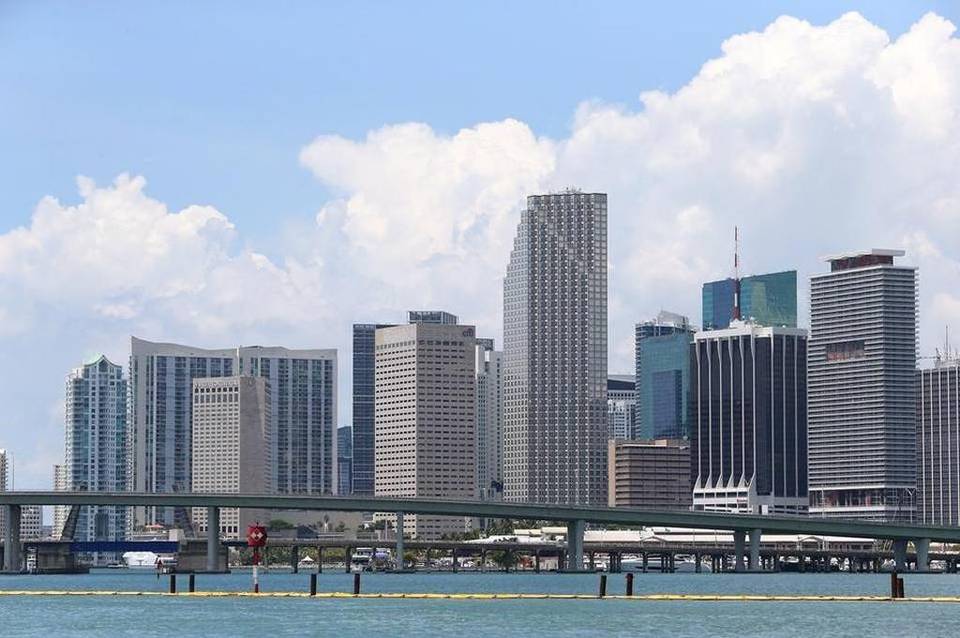
CU Blog - Chambers Strategy - A Great Role Model - Photo 1The Go Lean book was composed with many of the same strategies as pro-business Chambers of Commerce in the US. We therefore look to these organizations as a role model in our roadmap to transform – remediate and mitigate – the engines of regional economics, security and governance. Rather than just any Chamber in the US, this commentary considers the example of the 2 Chambers in South Florida (Greater Miami Chamber in Miami-Dade County and the Fort Lauderdale Chamber in Broward County). These entities are now embarking on a strategy that the Caribbean stewards should examine and apply in our region. See VIDEO in Appendix C below on the Greater Miami Chamber; the City of Miami is pictured here.

The publishers of the Go Lean book are now here in Greater Miami, (in from Detroit), to observe-and-report on the developments and progress of this neo-Caribbean community. Miami is notorious for its penetration of Caribbean people, culture and causes. It has a full scope of business and civic activities that traverse the breadth-and-depth of Caribbean interest. Miami’s success, with its potpourri of Caribbean Diaspora, comes as a consequence of many Caribbean failures; consider the experiences of Cubans, Haitians, Dominicans, Puerto Ricans, JamaicansBahamian and other nationalities from the region.

Therefore the strategies, tactics and implementations of the Miami-Dade-Broward Chambers of Commerce definitely apply to the Caribbean region. See related news article here:

Title: Greater Miami, Fort Lauderdale chambers may merge
By: Nancy Dahlberg and Jane Wooldridge ndahlberg@miamiherald.com

South Florida’s two largest chambers of commerce, the Greater Miami Chamber of Commerce and the Greater Fort Lauderdale Chamber of Commerce, are exploring a merger.

A memorandum of understanding was signed by the executive committees of each group, the chambers announced on Monday. A task force is being created to explore the structure and operational issues required for the combination to move ahead, and the chambers will decide by the end of the year whether to proceed, the chambers said.

“It’s a great opportunity for our business communities to evaluate this as many of the things we do discuss are very regionalized. … such as transportation, sea level rise and beach erosion,” said Heiko Dobrikow, chairman of the Greater Fort Lauderdale Chamber of Commerce and General Manager of the Riverside Hotel. “And when you have a larger, more regional representation, it gives our members certainly more growth potential for their businesses.”

Christine Barney, chairwoman of the Greater Miami Chamber of Commerce and CEO of Miami’s rbb Communications, concurred. “The potential combination gives more clout to the business community in shaping the future of South Florida,” she said.

“In the past we’ve done a lot of strategic alliances and that can only do so much,” Barney said. “We thought a more-aggressive approach was needed.”

Though membership in both Greater Miami and Greater Fort Lauderdale chambers has remained strong, nationwide, chambers of commerce have suffered declining membership and revenues.

“Even though we are acquiring new members it is probably not at the same rate as we wish, and there is probably a great opportunity that we have,” Dobrikow said.

The Greater Miami Chamber was founded in 1907 and now boasts about 4,100 members representing about 400,000 employees. The Greater Fort Lauderdale Chamber, founded in 1910, has 1,311 company-members that employ more than 500,000.

Both counties are also home to myriad smaller chambers focusing on specific geography or demographics. The idea rose from regular meetings between the president and CEOs of the two organizations, said Miami’s Barry Johnson, who announced recently he will retire at the end of this year.

Said Dan Lindblade, leader of the Greater Fort Lauderdale Chamber, “Barry Johnson and I have been talking over the years and we thought now would be a good time to begin these discussions to see if they lead us into the direction that we both feel is inevitable — a regional chamber with the size and scope of the two largest chambers in Broward and Miami-Dade.”

The Greater Miami chamber will continue the search for Johnson’s replacement during the evaluation period, Barney said.

As more small smartups emerge throughout South Florida, the traditional model of fee-based memberships has become less attractive to some members, who may have specific needs such as international introductions or skills training but not the full range of services now offered, said Barney. The ultimate goal, said both chamber chairs, is to bring more value to members.

Said Barney, “Miami is unique, Broward unique, Palm Beach is unique. … Whatever we do, we want to keep the strength of the local representation as front and center as possible.”
Source:  Posted April 26, 2016; retrieved April 30, 2016 from: http://www.miamiherald.com/news/business/article73800622.html

So the Greater Miami Chamber of Commerce and the Greater Fort Lauderdale Chamber of Commerce are considering merging, consolidating and integrating their efforts to elevate the business environment for the entire South Florida region. If successfully executed, this effort could be a role model for the Caribbean region to emulate. This discussion aligns with the book Go Lean … Caribbean, in its effort to serve as a roadmap for the introduction and implementation of the Caribbean Union Trade Federation (CU); the purpose of which is to elevate Caribbean society, for all 30 member-states. The book stresses the need to optimize the societal engines of economics, security and governance. Jobs is a very important goal of the Go Lean roadmap, with a prime directive to create 2.2 million new jobs in the Caribbean.

The stance of Chambers of Commerce is normally pro-business, anti-labor. So they are not always universally loved in their communities; they do and will “ruffle feathers”; sometimes they are even accused of promoting Crony-Capitalism. But the Go Lean focus here is “jobs” more so than Chambers of Commerce. The Go Lean book opens with pronouncements relating to the jobs-creating directive. Consider these statements early in the book in the Declaration of Interdependence (Page 12 – 14):

xxi. Whereas the preparation of our labor force can foster opportunities and dictate economic progress for current and future generations, the Federation must ensure that educational and job training opportunities are fully optimized for all residents of all member-states, with no partiality towards any gender or ethnic group. The Federation must recognize and facilitate excellence in many different fields of endeavor, including sciences, languages, arts, music and sports. This responsibility should be executed without incurring the risks of further human flight, as has been the past history.

xxiv. Whereas a free market economy can be induced and spurred for continuous progress, the Federation must install the controls to better manage aspects of the economy: jobs, inflation, savings rate, investments and other economic principles. Thereby attracting direct foreign investment because of the stability and vibrancy of our economy.

xxv. Whereas the legacy of international democracies had been imperiled due to a global financial crisis, the structure of the Federation must allow for financial stability and assurance of the Federation’s institutions. To mandate the economic vibrancy of the region, monetary and fiscal controls and policies must be incorporated as proactive and reactive measures. These measures must address threats against the financial integrity of the Federation and of the member-states.

xxvi.   Whereas the Caribbean region must have new jobs to empower the engines of the economy and create the income sources for prosperity, and encourage the next generation to forge their dreams right at home, the Federation must therefore foster the development of new industries… In addition, the Federation must invigorate the enterprises related to existing industries like tourism … impacting the region with more jobs.

The subject of job creation has been directly addressed and further elaborated upon in these previous blog/commentaries:

https://goleancaribbean.com/blog/?p=6760 Where the Jobs Are – A Lesson in ‘Garbage’
https://goleancaribbean.com/blog/?p=6680 Vegas Casinos Create New Jobs By Betting on Video Games
https://goleancaribbean.com/blog/?p=6089 Where the Jobs Are – Futility of Minimum Wage
https://goleancaribbean.com/blog/?p=4240 Immigration Policy Exacerbates Worker Productivity Crisis
https://goleancaribbean.com/blog/?p=3694 Job Option: Jamaica-Canada employment programme
https://goleancaribbean.com/blog/?p=3050 Obama’s immigration tweaks in the US leave Big Tech wanting more
https://goleancaribbean.com/blog/?p=2857 Where the Jobs Are – Entrepreneurism in Junk
https://goleancaribbean.com/blog/?p=2750 Disney World – Role Model for Self Governing Entities
https://goleancaribbean.com/blog/?p=2338 Using SGE’s to Welcome the Dreaded ‘Plutocracy’ and Jobs
https://goleancaribbean.com/blog/?p=2126 Where the Jobs Are – Computers Reshaping Global Job Market
https://goleancaribbean.com/blog/?p=2003 Where the Jobs Are – Ship-breaking under SGE Structure
https://goleancaribbean.com/blog/?p=1698 STEM Jobs Are Filling Slowly

The Go Lean book itself details the economic principles and community ethos to adopt, plus the executions of strategies, tactics, implementations and advocacies to create new jobs in Caribbean communities. See a sample list here:

Economic Principles – People Choose because Resources are Limited Page 21
Economic Principles – All Choices Involve Costs Page 21
Economic Principles – People Respond to Incentives Page 21
Economic Principles – Economic Systems Influence Individual Choices Page 21
Economic Principles – Voluntary Trade Creates Wealth Page 21
Economic Principles – Consequences of Choices Lie in the Future Page 21
Community Ethos – Job Multiplier Page 22
Community Ethos – Lean Operations Page 24
Community Ethos – Return on Investments Page 24
Community Ethos – Ways to Impact the Future Page 26
Community Ethos – Ways to Help Entrepreneurship Page 28
Community Ethos – Ways to Impact Research & Development – Create Local; Stay Local Page 30
Strategy – Vision – Integrate 30 member-states to a Single Market Economy Page 45
Strategy – Mission – Foster local economic engines Page 45
Tactical – Tactics to Forge an $800 Billion Economy – High Multiplier Industries Page 70
Tactical – Separation of Powers – Commerce Department – Promotions Role Page 78
Implementation – Ways to Deliver Page 109
Planning – Ways to Improve Trade Page 128
Advocacy – Ways to Create Jobs Page 152
Advocacy – Ways to Improve Education Page 159
Advocacy – Ways to Impact Labor Markets and Unions Page 164
Advocacy – Ways to Foster Technology Page 197
Advocacy – Ways to Foster e-Commerce Page 198
Advocacy – Ways to Help the Middle Class – Promote Entrepreneurship Page 223
Advocacy – Ways to Impact Youth – Early Start for STEM Page 227
Appendix – Growing 2.2 Million Jobs in 5 Years Page 257
Appendix – Job Multipliers Page 259

The Go Lean … Caribbean roadmap needs the effective modeling of South Florida’s business promotion, as in the regional Chambers of Commerce. Considering the 5 L‘s, (Look, Listen, Learn, Lend-a-hand & Lead), there will be much for us to look, listen and learn in the South Florida area. Eventually we may even be able to lend-a-hand to the South Florida cause – especially in regards to the Diaspora – but our focus is on the Caribbean. We do not look to lead in Florida; we are preparing to lead in the Caribbean.

Today, the Greater Miami / South Florida region is a better place to live, work and play … due in many ways to the contributions of the Caribbean Diaspora. These ones are active in the participation of the work-force, business promotion and culture of South Florida, resulting in a distinctive character that has made the Greater Miami region unique, and appealing.

We invite all of the Caribbean Diaspora in the Greater Miami / South Florida region to lean-in to this roadmap to make the Caribbean a better place to live, work and play. We also urge all stakeholders in the Caribbean to lean-in to this roadmap. 🙂

Download the book Go Lean … Caribbean – now!

———–

Appendix – Encyclopedic Reference: Chamber of Commerce

A chamber of commerce (or board of trade) is a form of business network, for example, a local organization of businesses whose goal is to further the interests of businesses. Business owners in towns and cities form these local societies to advocate on behalf of the business community. Local businesses are members, and they elect a board of directors or executive council to set policy for the chamber. The board or council then hires a President, CEO or Executive Director, plus staffing appropriate to size, to run the organization.

The first chamber of commerce was founded in 1599 in Marseille, France.[1][2][3][4] Another official chamber of commerce would follow 65 years later, probably in Bruges, then part of the Spanish Netherlands.[5]

The world’s oldest English-speaking chamber of commerce, in New York City, dates from 1768.[6] The oldest known existing chamber in the English-speaking world with continuous records, the Glasgow Chamber of Commerce,[7] was founded in 1783. However, Hull Chamber of Commerce[8] is the UK’s oldest, followed by those of Leeds and of Belfast in Northern Ireland.

As a non-governmental institution, a chamber of commerce has no direct role in the writing and passage of laws and regulations that affect businesses. It may however, lobby in an attempt to get laws passed that are favorable to businesses. They also work closely with a number of other youth organizations in the country about the value and role of business in our Source: Retrieved April 30, 2016 from: https://en.wikipedia.org/wiki/Chamber_of_commerce

———–

Appendix B – Creating Jobs: How?


US Chamber of Commerce – 2011

Go Lean … Caribbean (Page 152)

1

Steer more students into technical schools Lean-in for the Caribbean Single Market & Economy

2

Enhance the payoff of a college degree Feed Ourselves

3

Help small businesses find foreign customers Clothe Ourselves

4

Welcome more immigrants House Ourselves

5

Create a national jobs database Update Our Own Infrastructure and the Industries They Spun

6

Create “lean” regulatory agencies Steer More People to S.T.E.M. Education and Careers

7

Speed the foreclosure epidemic Help Regional Businesses Find Foreign Markets

8

Copy Germany’s Model for Jobs Preservation Welcome Home Emigrants

9

Draw more tourists Welcome “Empowering” Immigrants

10

Lure American companies back home Draw More Tourists

Source: Posted August 1, 2011; retrieved April 30, 2011 from http://www.usnews.com/news/slideshows/10-ways-to-create-jobs

———–

Appendix C VIDEO – Greater Miami Chamber of Commerce – https://youtu.be/igNL5An_VAo

Published on Jul 18, 2015 – Category: How To & Style
License: Standard YouTube License


Share this post:
, ,
[Top]

The Logistics of Disaster Relief

Go Lean Commentary

It is during the worst of times that we see the best in people.

This statement needs to be coupled with the age old proverb: “The Road to Hell is Paved with Good Intentions“…

… especially when it comes to disaster relief.

In previous blog-commentaries promoting the book Go Lean…Caribbean, it was established that “bad things happen to good people”; (i.e. ‘Crap Happens’ – So What Now?, Managing a ‘Clear and Present Danger’). Yes, disasters are a reality for modern life. The Go Lean book posits that with the emergence of Climate Change  that natural disasters are more common place.

In addition there are earthquakes …

… these natural phenomena may not be associated with Climate Change, but alas, they too are more common and more destructive nowadays. (People with a Christian religious leanings assert that “an increase of earthquakes is a tell-tale sign that we are living in what the Bible calls the “Last Days” – Matthew 24: 7).

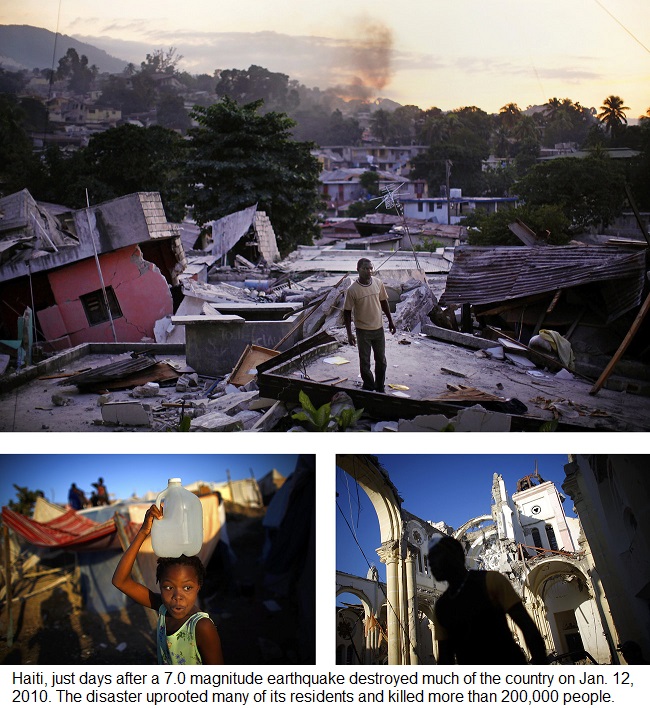
$500 Million In Haiti Relief - Photo 1The motives of the Go Lean book, and accompanying blogs is not to proselytize, but rather to prepare the Caribbean region for “bad actors”, natural or man-made. The book was written in response to the aftermath and deficient regional response following the great earthquake in Haiti on January 12, 2010. Many Non-Government Organizations (NGO) embarked on campaigns to shoulder a response, a relief and rebuilding of Haiti. Many people hold the view that those efforts did a lot of harm, along with some good.

In a previous blog-commentary, it was reported how the fundraising campaign by one group, the American Red Cross, raised almost US$500 million and yet only a “piddling” was spent on the victims and communities themselves.

Now we learn too that many good-intentioned people donated tons of relief supplies that many times turned out to be “more harm than help”. See the story here in this news VIDEO; (and/or the Narration Transcript/photos in the Appendix below):

VIDEO – When disaster relief brings anything but relief – http://www.cbsnews.com/videos/disaster-relief-donations-that-dont-bring-relief

Posted April 24, 2016 – Many of the well-meaning articles Americans donate in times of disaster turn out to be of no use to those in need. Sometimes, they even get in the way. That’s a message relief organizations very much want “us” to heed. This story is reported by Scott Simon, [on loan from] NPR. (VIDEO plays best in Internet Explorer).

This commentary asserts that more is needed in the Caribbean to facilitate good disaster relief, in particular a technocratic administration. This consideration is the focus of the strategies, tactics, implementations and advocacies of the Go Lean…Caribbean book. The declaration is that the Caribbean itself must be agile, lean, and optimized in providing its own solutions for disaster recovery. The alternative, from past experiences like in this foregoing VIDEO, is that others taking the lead for our solution seem to fall short in some way … almost every time!

The Caribbean must now stand up and be counted!

The Go Lean book declares (Page 115) that the “Caribbean should not be perennial beggars, [even though] we do need capital/money to get started”, we need technocratic executions even more.

What is a technocracy?

This is the quest of the Go Lean movement. The movement calls for a treaty to form a technocratic confederation of all the 30 member-states in the Caribbean region. This will form a Single Market of 42 million. The consolidation and integration allows for economies-of-scale and leverage that would not be possible otherwise. “Many hands make a big job … small”. But it is not just size that will define the Caribbean technocracy but quality, efficiency and optimization as well.

According to the Go Lean book (Page 64), the …

“… term technocracy was originally used to designate the application of the scientific method to solving social and economic problems, in counter distinction to the traditional political or philosophic approaches. The CU must start as a technocratic confederation – a Trade Federation – rather than evolving to this eventuality due to some failed-state status or insolvency.”

The book Go Lean…Caribbean serves as a roadmap for the introduction and implementation of the technocratic Caribbean Union Trade Federation (CU) to provide better stewardship for the Caribbean homeland. The foregoing VIDEO describes the efforts of non-governmental organizations (NGO) in shepherding disaster reliefs. These NGO’s are stakeholders in this Caribbean elevation roadmap. Even though many of the 30 member-states are independent nations, the premise of the Go Lean book is that there must be a resolve for interdependence among the governmental and non-governmental entities. This all relates to governance, the need for this new technocratic stewardship of regional Caribbean society. The need for this resolve was pronounced in the opening Declaration of Interdependence (Pages 11 & 14) with these acknowledgements and statements:

i.    Whereas the earth’s climate has undeniably changed resulting in more severe tropical weather storms, it is necessary to prepare to insure the safety and security of life, property and systems of commerce in our geographical region. As nature recognizes no borders in the target of its destruction, we also must set aside border considerations in the preparation and response to these weather challenges.

ii.    Whereas the natural formation of the landmass for our lands constitutes some extreme seismic activity, it is our responsibility and ours alone to provide, protect and promote our society to coexist, prepare and recover from the realities of nature’s occurrences.

x.   Whereas we are surrounded and allied to nations of larger proportions in land mass, populations, and treasuries, elements in their societies may have ill-intent in their pursuits, at the expense of the safety and security of our citizens. We must therefore appoint “new guards” to ensure our public safety and threats against our society, both domestic and foreign. The Federation must employ the latest advances and best practices … to assuage continuous threats against public safety.

xi.   Whereas all men are entitled to the benefits of good governance in a free society, “new guards” must be enacted to dissuade the emergence of incompetence, corruption, nepotism and cronyism at the peril of the people’s best interest. The Federation must guarantee the executions of a social contract between government and the governed.

xii. Whereas the legacy in recent times in individual states may be that of ineffectual governance with no redress to higher authority, the accedence of this Federation will ensure accountability and escalation of the human and civil rights of the people for good governance, justice assurances, due process and the rule of law. As such, any threats of a “failed state” status for any member state must enact emergency measures on behalf of the Federation to protect the human, civil and property rights of the citizens, residents, allies, trading partners, and visitors of the affected member state and the Federation as a whole.

xxxiii.   Whereas lessons can be learned and applied from the study of the recent history of other societies, the Federation must formalize statutes and organizational dimensions to avoid the pitfalls of [other] communities.

This is the quest of CU/Go Lean roadmap: to provide new guards for a more competent Caribbean administration … by governmental organizations and non-governmental organizations. (NGO would also be promoted, audited and overseen by CU administrators). The Caribbean must do better!

Our quest must start “in the calm”, before any storm (or earthquake). We must elevate the societal engines the Caribbean region through economic, security and governance empowerments. In general, the CU will employ better strategies, tactics and implementations to impact its prime directives; identified with the following 3 statements:

  • Optimization of the economic engines in order to grow the regional economy to $800 Billion & create 2.2 million new jobs.
  • Establishment of a security apparatus to protect the resultant economic engines and the Caribbean homeland.
  • Improvement of Caribbean governance to support these engines.

Former US President George W. Bush shares this advocacy!

He narrated this VIDEO here describing the efficiencies of the American logistics company, UPS, in delivering disaster relief:

VIDEO – Report Logistics and Haiti: Points of Light and President Bush – https://youtu.be/8-gmh1QyWTU

Uploaded on Mar 30, 2011 – [In 2009], Transportation Manager Chip Chappelle volunteered to help The UPS Foundation coordinate an ocean shipment of emergency tents from Indiana to Honduras. Since then, he has managed the logistics of humanitarian aid from every corner of the world to help the victims of floods, tsunamis, earthquakes, hurricanes and cyclones.

The Go Lean book stresses our own community ethos, strategies, tactics, implementations and advocacies necessary for the Caribbean to deliver, to provide the proactive and reactive public safety/security provisions in the region. See sample list here:

Community Ethos – Deferred Gratification Page 21
Community Ethos – Economic Principles – Respond to Incentives in Predictable Ways Page 21
Community Ethos – Economic Principles – Economic Systems Influence Individual Choices Page 21
Community Ethos – Economic Principles – Consequences of Choices Lie in the Future Page 21
Community Ethos – Security Principles – Whistleblower Protection Page 23
Community Ethos – Security Principles – Intelligence Gathering Page 23
Community Ethos – Security Principles – “Crap” Happens Page 23
Community Ethos – Governing Principles – Lean Operations Page 24
Community Ethos – Governing Principles – Return on Investments Page 24
Community Ethos – Governing Principles – Cooperatives Page 25
Community Ethos – Ways to Impact the Future Page 26
Community Ethos – Ways to Impact Turn-Arounds Page 33
Community Ethos – Ways to Improve Sharing – Emergency Response Page 35
Community Ethos – Ways to Impact the Greater Good Page 37
Strategy – Vision – Confederate all 30 member-states/ 4 languages into a Single Market Page 45
Strategy – Mission – Prepare for the eventuality of natural disasters Page 45
Strategy – Agents of Change – Climate Change Page 57
Tactical – Ways to Foster a Technocracy Page 64
Tactical – Growing the Economy – Post WW II European Marshall Plan/Recovery Model Page 68
Tactical – Separation-of-Powers – CU Federal Government versus Member-State Governance Page 71
Tactical – Separation-of-Powers – Homeland Security – Emergency Management Page 76
Tactical – Separation-of-Powers – State Department – Liaison/Oversight for NGO’s Page 80
Implementation – Assemble All Regionally-focus Organizations of All Caribbean Communities Page 96
Implementation – Ways to Pay for Change Page 101
Implementation – Ways to Foster International Aid Page 115
Planning – 10 Big Ideas – Homeland Security Pact Page 127
Planning – Ways to Make the Caribbean Better Page 131
Planning – Ways to Improve Failed-State Indices – Governance and the Social Contract Page 134
Advocacy – Ways to Grow the Economy Page 151
Advocacy – Ways to Create Jobs Page 152
Advocacy – Ways to Improve Housing – Hurricane Risk Reinsurance Fund Page 161
Advocacy – Ways to Improve Governance Page 168
Advocacy – Ways to Better Manage the Social Contract Page 170
Advocacy – Ways to Improve Homeland Security Page 180
Advocacy – Ways to Improve for Natural Disasters Page 184
Advocacy – Ways to Develop a Pre-Fab Housing Industry – One solution ideal for Haiti Page 207
Advocacy – Ways to Re-boot Haiti Page 238

The Go Lean roadmap seeks to empower and elevate Caribbean societal engines to be better prepared for the eventual natural disasters. The good intentions of Americans, as depicted in the foregoing VIDEO, is encouraging … but good intentions alone is not enough. We need good management! We need a technocracy! While it is out-of-scope for this roadmap to impact America, we can – and must – exercise good management in our Caribbean region. So what do we want from Americans in our time of need? See VIDEO here:

VIDEO – Donate Responsibly – https://youtu.be/14h9_9sopRA

Published on Nov 2, 2012 – A series of PSAs released by the Ad Council explain why cash is the best way to help. The campaign was launched on November 5, 2012 by the Ad Council and supported by the coalition — which includes CIDI, the U.S. Agency for International Development, InterAction, the UPS Foundation and National Voluntary Organizations Active in Disaster.

The Go Lean book calls on the Caribbean region to be more technocratic: collectively self-reliant, both proactively and reactively. Because of Climate Change or the Last Days, natural disasters (i.e. hurricanes and earthquakes) will occur again and again. Considering that our American neighbors may Pave our Road to Hell with Good Intentions, we need to prepare the right strategies, tactics and implementations ourselves, to make our region a better homeland to live, work and play. 🙂

Download the free e-Book of Go Lean … Caribbean – now!

——————

Appendix Transcript – When disaster relief brings anything but relief

When Nature grows savage and angry, Americans get generous and kind. That’s admirable. It might also be a problem.

“Generally after a disaster, people with loving intentions donate things that cannot be used in a disaster response, and in fact may actually be harmful,” said Juanita Rilling, director of the Center for International Disaster Information in Washington, D.C. “And they have no idea that they’re doing it.”

Rilling has spent more than a decade trying to tell well-meaning people to think before they give.

In 1998 Hurricane Mitch struck Honduras. More than 11,000 people died. More than a million and a half were left homeless.

And Rilling got a wake-up call: “Got a call from one of our logistics experts who said that a plane full of supplies could not land, because there was clothing on the runway. It’s in boxes and bales. It takes up yards of space. It can’t be moved.’ ‘Whose clothing is it?’ He said, ‘Well, I don’t know whose it is, but there’s a high-heeled shoe, just one, and a bale of winter coats.’ And I thought, winter coats? It’s summer in Honduras.”

Humanitarian workers call the crush of useless, often incomprehensible contributions “the second disaster.”

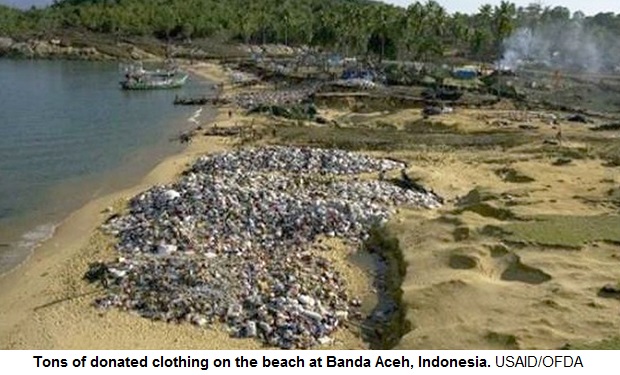
In 2004, following the Indian Ocean tsunami, a beach in Indonesia was piled with used clothing.

There was no time for disaster workers to sort and clean old clothes. So the contributions just sat and rotted.

CU Blog - Logistics of Disaster Relief - Photo 1“This very quickly went toxic and had to be destroyed,” said Rilling. “And local officials poured gasoline on it and set it on fire. And then it was out to sea.”

“So, rather than clothing somebody, it went up in flames?” asked Simon.

“Correct. The thinking is that these people have lost everything, so they must NEED everything. So people SEND everything. You know, any donation is crazy if it’s not needed. People have donated prom gowns and wigs and tiger costumes and pumpkins, and frostbite cream to Rwanda, and used teabags, ’cause you can always get another cup of tea.”

You may not think that sending bottles of water to devastated people seems crazy. But Rilling points out, “This water, it’s about 100,000 liters, will provide drinking water for 40,000 people for one day. This amount of water to send from the United States, say, to West Africa — and people did this — costs about $300,000. But relief organizations with portable water purification units can produce the same amount, a 100,000 liters of water, for about $300.”

And then there were warm-hearted American women who wanted to send their breast milk to nursing mothers in Haiti after the 2010 earthquake.

“It sounds wonderful, but in the midst of a crisis it’s actually one of the most challenging things,” said Rebecca Gustafson, a humanitarian aid expert who has worked on the ground after many disasters.

“Breast milk doesn’t stay fresh for very long. And the challenge is, what happens if you do give it to an infant who then gets sick?”

CU Blog - Logistics of Disaster Relief - Photo 2December 2012, Newtown, Connecticut: A gunman killed 20 children and six adults at Sandy Hook Elementary School. Almost instantaneously, stuff start arriving.

Chris Kelsey, who worked for Newtown at the time, said they had to get a warehouse to hold all the teddy bears.

Simon asked, “Was there a need for teddy bears?”

“I think it was a nice gesture,” Kelsey replied. “There was a need to do something for the kids. There was a need to make people feel better. I think the wave of stuff we got was a little overwhelming in the end.”

And how many teddy bear came to Newtown? “I think it was about 67,000,” Kelsey said. “Wasn’t limited to teddy bears. There was also thousands of boxes of school supplies, and thousands of boxes of toys, bicycles, sleds, clothes.”

Newtown had been struck by mass murder, not a tsunami. As Kelsey said, “I think a lot of the stuff that came into the warehouse was more for the people that sent it, than it was for the people in Newtown. At least, that’s the way it felt at the end.”

Every child in Newtown got a few bears. The rest had to be sent away, along with the bikes and blankets.

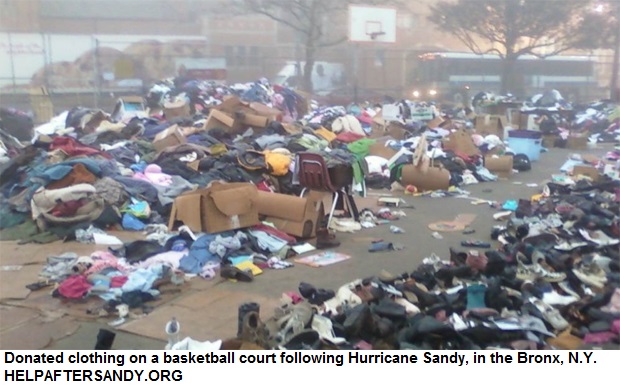
CU Blog - Logistics of Disaster Relief - Photo 3There are times when giving things works. More than 650,000 homes were destroyed or damaged in Hurricane Sandy in 2012. Thousands of people lost everything.

Tammy Shapiro is one of the organizers of Occupy Sandy, which grew out of the Occupy Wall Street movement.

“We were able to respond in a way that the big, bureaucratic agencies can’t,” Shapiro said.

When the hurricane struck, they had a network of activists, connected and waiting.

“Very quickly, we just stopped taking clothes,” Shapiro said. Instead, they created a “relief supply wedding registry.”

“We put the items that we needed donated on that registry,” said Shapiro. “And then people who wanted to donate could buy the items that were needed. I mean, a lot of what we had on the wedding registry was diapers. They needed flashlights.”

Simon asked, “How transportable is your experience here, following Hurricane Sandy?”

“For me, the network is key. Who has the knowledge? Where are spaces that goods can live if there’s a disaster? Who’s really well-connected on their blocks?”

Juanita Rilling’s album of disaster images shows shot after shot of good intentions just spoiling in warehouses, or rotting on the landscape.

“It is heartbreaking,” Rilling said. “It’s heartbreaking for the donor, it’s heartbreaking for the relief organizations, and it’s heartbreaking for survivors. This is why cash donations are so much more effective. They buy exactly what people need, when they need it.

“And cash donations enable relief organizations to purchase supplies locally, which ensures that they’re fresh and familiar to survivors, purchased in just the right quantities, and delivered quickly. And those local purchases support the local merchants, which strengthens the local economy for the long run.”

Disaster response worker Rebecca Gustafson says that most people want to donate something that is theirs: “Money sometimes doesn’t feel personal enough for people. They don’t feel enough of their heart and soul is in that donation, that check that they would send.

“The reality is, it’s one of the most compassionate things that people can do.”

Share this post:
, , , ,
[Top]

Switching Allegiances: Jamaican sprinters move on to represent other countries

Go Lean Commentary

“I’m going to take my talents to South Beach”.

CU Blog - Lebronomy - Economic Impact of the Return of the NBA GreatThese words – The Decision – proved to be among the most dramatic quotations in American Sports for the new 21st Century. These words were spoken by basketball superstar LeBron James in July 2010. He had been frustrated with the team management inefficiency in his hometown of Cleveland, Ohio where he played for the NBA’s Cleveland Cavaliers from 2003 to 2010. At the time of this utterance, he had elected to “opt-out” of his contract with the Cavaliers and become a free agent. After being aggressively recruited by a number of teams – including the incumbent club in Cleveland – he decided to join the NBA franchise in South Florida (South Beach), the Miami Heat.

For the fans in Cleveland, this was a betrayal! They asserted that he switched allegiances in taking his talents to South Beach.

This perceived act of betrayal is considered a “stab in the heart” for a community that loves its local athletes. While this foregoing anecdote is an American drama, the Caribbean island of Jamaica can relate and empathize with Cleveland. Or better stated, the community of Cleveland can empathize with Jamaica as the same anecdotes are being related there, again and again with their World-Class Track-and-Field athletes.

Consider these related news articles of events transpiring in the last year:

Title: Switching Allegiances: One More Jamaican Sprinter Moves On To Represent Another Country
By: Blogger – StephanieK
CU Blog - Switching Allegiances - Jamaican Sprinters - Photo 1Winston Barnes – in focus in the photo here – a former sprinter from Jamaica College, will now be representing Turkey in athletic competitions. Barnes, who will be known as Emre Zafer Barnes, joined three other Jamaican sprinters who decided to switch their allegiance to compete for various Arab countries. Former Wolmer’s Boys’ sprinter Jacques Harvey made the switch to Turkey earlier and is now known as Jak Ali Harvey. Following Jamaica’s Olympic Games, Shericka Williams, silver medalist, Andrew Fisher and Kemarley Brown all asked to move on to Bahrain, planning to represent that country at the 2016 Olympics in Brazil.

According to Commonwealth Games 100-metre champion Kemar Bailey-Cole, Jamaica could lose even more of its top athletes to countries who are willing to provide the financial support lacking from the Jamaica Athletics Administrative Association (JAAA), corporate Jamaica, and the government.
Source:  Jamaicans.com – Online Community – Retrieved 04-25-2016 from: http://jamaicans.com/one-more-jamaican-sprinter-moves-on/

——————————-

Title: Three Jamaican Athletes Plan to Represent Bahrain
July 22, 2015 – Three of Jamaica’s top athletes will be switching their allegiance from the island to the country of Bahrain, announced Dr. Warren Blake, the president of the Jamaica Athletics Administrative Association (JAAA). Shericka “Wire” Williams, 2008 Olympic 400-meter silver medallist, and sprinters Kemarley Brown and Andrew Fisher, submitted applications to the JAAA with the intention of competing for Bahrain.

The athletes said it has become difficult to represent Jamaica and want the chance to represent Bahrain as they consider moving to that country and becoming citizens. Williams received a silver medal for Jamaica at the Berlin world Championships in 2009, while Fisher is the latest Jamaican to run under the 10-second barrier. Brown also clocked below that mark with a personal best on July 20 of 9.93 seconds.
Source: Retrieved 04-25-2016 from: http://jamaicans.com/top-7-jamaican-caribbean-news-stories-for-the-week-ending-july-24th-2015/#ixzz46n7Z3doE

The decisions of these Jamaican athletes relate to the drama of Cleveland-Miami in 2010. The book Go Lean … Caribbean reported on these 2010 events, as follows (Page 42):

The National Basketball Association (NBA) franchise: Miami Heat is the league champion for the last 2 consecutive seasons; (composed November 2013). This is their 3rd championship, having won, in 2006, 2012, and 2013, to date. It is felt that this team can win many more. In fact, brewing some controversy when the team was assembled by the General Manager in 2010, one of the superstar players, LeBron James, pronounced that this team was built for multiple championships; the actual number: “not one, not, two, not three, not four, not five …”

Those words incited disgust from everyone…other than Miami Heat fans. But the team has lived up to its bragging and boasting, by succeeding to reach the Championship series (NBA Finals) all three years [to date] since the group was assembled.

The recent history of this Miami Heat drama does relate to the Caribbean and this roadmap for economic integration. First, with its base in Miami, Florida, it possesses the largest pocket of Caribbean Diaspora. So in many ways, the Miami Heat is the “home team” of the Caribbean.

This foregoing news articles also align with the Go Lean book in that it serves as a roadmap for the introduction and implementation of the Caribbean Union Trade Federation (CU). The Go Lean roadmap only has one interest in this subject of sports, fostering the economic opportunities that can be forged by professionalizing a regional sports eco-system. Dysfunction in this regards is exactly the issue in Jamaica today and why these athletes are “taking their talents to …” foreign shores.

This Go Lean roadmap assesses that not just Jamaica, but all of the Caribbean is in crisis. This is why athletes with any ability must seek refuge and opportunities in foreign lands. So this roadmap provides solutions to optimize the region’s economic, security and governing engines. The roadmap provides the facilitation to grow a professional, collegiate and amateur sports eco-system. Many times, the missing ingredients for organized sports are the facilities: stadia, arenas and playing fields. A previous blog-commentary reported that the sports eco-system void maybe considered as bigger than just sports, it is “life and death”. But the roadmap posits that sports, even though it is just “extra-curricular”, does bring benefits. In fact, Go Lean book (Page 229) quotes the Bible scripture at 1 Timothy 4:8 “For bodily exercise is profitable for a little …”.

Caribbean people are identified with excellence in sports; maybe even defined as geniuses. See the VIDEO here of a talented 10-year-old Jamaican football (soccer) sensation; his aspiration is to play professionally … in Europe in the future.

VIDEO – 10 year-old Jamaican Prodigy Brian Burketthttps://youtu.be/YJChu-Rwez0

Published on December 30, 2014 – Brian Burkett is a self motivated boy who has a dream to play football at the highest level in the world. His talent is immaculate for his age along with his love for the game. Brian started playing at age 3 and have grown in passion and discipline to learn more about the game.

While Caribbean athletic talent is recognized around the world, there is not enough economic rewards at home for these ones with genius abilities. These ones must leave their beloved homelands to maximize their talents and earn a living from them. (This also applies to matriculating college student-athletes).

Previous blogs established that sports genius alone will never yield the sought-after result of World-Class excellence, there is the need for skilled training, coaching with best-practices and an internal drive. In so many ways, this parallels the current effort to reboot the Caribbean economic engines: nature (birth-right) is critical, but training, experience, coaching and the technocratic application of best-practices are also needed to forge change. The most important though is the internal drive; first and foremost, this is identified in the roadmap as “community ethos”.

The Go Lean roadmap recognizes many different kinds of athletics, team sports and individual event. The unique “genius” qualifier is highlighted at the outset of the Go Lean book, in the Declaration of Interdependence (Pages 12 & 14), as follows:

xxi. Whereas the preparation of our labor force can foster opportunities and dictate economic progress for current and future generations, the Federation must ensure that educational and job training opportunities are fully optimized for all residents of all member-states, with no partiality towards any gender or ethnic group. The Federation must recognize and facilitate excellence in many different fields of endeavor, including sciences, languages, arts, music and sports. This responsibility should be executed without incurring the risks of further human flight, as has been the past history.

xxxi. Whereas sports have been a source of great pride for the Caribbean region, the economic returns from these ventures have not been evenly distributed as in other societies. The Federation must therefore facilitate the eco-systems and vertical industries of sports as a business, recreation, national pastime and even sports tourism – modeling the Olympics.

The book Go Lean … Caribbean highlights the community ethos, plus the strategies, tactics, implementation and advocacies to optimize the sports eco-system in the region; it posits that success is to be found at the intersection between opportunity and preparation. The following list shows samples from the book that detailed these points:

Community Ethos – People Respond to Incentives in Predictable Ways Page 21
Community Ethos – Consequences of Choices Lie in the Future Page 21
Community Ethos – Lean Operations Page 24
Community Ethos – Return on Investments Page 25
Community Ethos – Ways to Foster Genius Page 27
Community Ethos – Ways to Impact the Greater Good Page 37
Strategic – Staffing – Sporting Events at Fairgrounds Page 55
Tactical – Fostering a Technocracy Page 64
Tactical – Separation of Powers – Sports & Culture Administration Page 81
Tactical – Separation of Powers – Fairgrounds Administration Page 83
Implementation – Steps to Implement Self-Governing Entities (SGE) Page 105
Implementation – Ways to Deliver Page 109
Planning – Ways to Make the Caribbean Better Page 131
Advocacy – Ways to Grow the Economy Page 151
Advocacy – Ways to Create Jobs Page 152
Advocacy – Ways to Improve Local Government – Parks & Recreation Page 169
Advocacy – Ways to Impact Public Works Page 175
Advocacy – Ways to Impact Events Page 191
Advocacy – Ways to Promote Fairgrounds as Sporting Venues Page 192
Advocacy – Ways to Preserve Caribbean Heritage Page 218
Advocacy – Ways to Improve Sports Page 229
Advocacy – Ways to Impact Urban Living – Sports Leagues Page 234

The Go Lean book and accompanying blogs declare that the Caribbean needs to learn lessons from these Track-and-Field athletes taking their talents to other markets … elsewhere. This commentary is about the business of sports; and this subject is a familiar topic for the Go Lean movement, as was detailed in these previous blogs:

https://goleancaribbean.com/blog/?p=6464 WWE Network – Model for Caribbean
https://goleancaribbean.com/blog/?p=6202 ‘Concussions’ – The Movie; The Cause
https://goleancaribbean.com/blog/?p=5921 Socio-Economic Change: Impact Analysis of SGE’s
https://goleancaribbean.com/blog/?p=4879 Martinique – The New Caribbean Surfing Capital
https://goleancaribbean.com/blog/?p=4019 Melding of Sports & Technology; the Business of the Super Bowl
https://goleancaribbean.com/blog/?p=3414 Levi’s® Stadium: A Team Effort
https://goleancaribbean.com/blog/?p=3244 Sports Role Model – espnW
https://goleancaribbean.com/blog/?p=2222 Sports Role Model – Playing For Pride … And More
https://goleancaribbean.com/blog/?p=2171 Sports Role Model – Turn On the SEC Network
https://goleancaribbean.com/blog/?p=2152 Sports Role Model – US versus the World
https://goleancaribbean.com/blog/?p=1715 Lebronomy – Economic Impact of the Return of the NBA Great
https://goleancaribbean.com/blog/?p=1446 Caribbean Players in the 2014 World Cup
https://goleancaribbean.com/blog/?p=1341 College World Series Time – Lessons from Omaha
https://goleancaribbean.com/blog/?p=1214 Landlord of Temporary Stadiums
https://goleancaribbean.com/blog/?p=1148 Sports Bubble – Franchise values in basketball
https://goleancaribbean.com/blog/?p=1020 Sports Revolutionary: Advocate Jeffrey Webb
https://goleancaribbean.com/blog/?p=498 Book Review: ‘The Sports Gene’
https://goleancaribbean.com/blog/?p=318 Collegiate Sports in the Caribbean
https://goleancaribbean.com/blog/?p=60 Could the Caribbean Host the Olympic Games?

The end result for the Go Lean roadmap’s venture into regional sport professionalization is economic growth and “jobs” here at home. The Go Lean roadmap anticipates 21,000 direct jobs at sports enterprises throughout the region, not including the athletes.

CU Blog - Switching Allegiances - Jamaican Sprinters - Photo 2The benefits of the Go Lean roadmap are too alluring to ignore: emergence of an $800 Billion economy, 2.2. million new regional jobs, new industries, services and finally opportunities for the sports-playing youth of the Caribbean . The roadmap even extends an invitation to the Diaspora (and their legacies) to repatriate from North American, European and Middle-Eastern/Arab countries. This will help to preserve Caribbean culture here … in the Caribbean.

As for the latest developments of the opening anecdote of LeBron James and the Cleveland-Miami drama: after 4 years in Miami and 2 championships, he repatriated to Cleveland; (see photo above) … with a new resolve to bring a championship to Cleveland. In this vein, his quest – now fulfilled – serves as a role model for Caribbean athletes: excelling at home is “so much sweeter” than on the road. This is the precept to prosper where planted. 🙂

Download the book Go Lean … Caribbean – now!

Share this post:
, , , , , ,
[Top]

Cancer: Doing More

Go Lean Commentary:

If you had a lot of money and wanted to do good in the world, what causes would you pursue?

  • World hunger
  • Education of girls
  • Childhood vaccinations
  • Cancer

That last one is BIG. And noble. And maybe, just maybe viable.

CU Blog - Cancer - Doing More - Photo 1This is the hope of philanthropist-billionaire Sean Parker; (founder of Napster and onetime CEO of Facebook). He is investing his time, talent (business & entrepreneurship) and treasuries in this quest to impact the world of cancer research and treatment.

Kudos, Mr. Parker!

The book Go Lean…Caribbean relates (Page 157) the statement that:

“1-in-3 Americans are due to be diagnosed with cancer … at some point. If 1-in-3 Americans are at risk, then surely Caribbean citizens cannot be far behind”.

This book does not assert to be a roadmap for treating cancer, but rather a roadmap for elevating Caribbean society by optimizing the economic, security and governing engines in the region. Yet, within this roadmap is the strategy to incentivize cancer research and facilitate treatment centers and workable solutions. In fact this roadmap invites role models like this philanthropist-billionaire Sean Parker – featured here in the following VIDEO and article:

VIDEO: Napster Co-Founder Sean Parker Pledges $250M to Fight Cancer
http://www.nbcnews.com/nightly-news/video/napster-co-founder-sean-parker-pledges-250m-to-fight-cancer-665463363805

NBC Nightly News – Posted 04-13-2016 – The Silicon Valley billionaire and Napster co-founder is putting his money behind a new cancer institute focusing on the emerging field of cancer immunotherapy.

News Article Title: Sean Parker Donates $250 Million to Launch Cancer Immunotherapy Institute
By: Reuters
Silicon Valley billionaire Sean Parker – see photo here – will donate $250 million to launch a new institute aimed at developing more effective cancer treatments by fostering collaboration among leading researchers in the field.

“Any breakthrough made at one center is immediately available to another center without any kind of IP (intellectual property) entanglements or bureaucracy,” Parker, the co-founder of music-sharing website Napster and the first president of Facebook, told Reuters in an interview.

The new Parker Institute for Cancer Immunotherapy will focus on the emerging field of cancer immunotherapy, which harnesses the body’s immune system to fight cancer cells.

It will include over 40 laboratories and more than 300 researchers from six key cancer centers: New York’s Memorial Sloan Kettering, Stanford Medicine, the University of California, Los Angeles, the University of California, San Francisco, Houston’s University of Texas MD Anderson and the University of Pennsylvania in Philadelphia.

Recently approved drugs have helped some patients sustain remission. But those first-generation therapies do not work for everyone, and scientists are trying to understand how to make them more effective.

“Very little progress has been made over the last several decades,” Parker said, referring to cancer drug research. “Average life expectancy has only increased three to six months with some of these drugs that cost billions to develop.”

Parker said the current system of cancer drug development discouraged the kinds of risk-taking that could lead to a major breakthrough.

The new institute “is paradigm shifting,” said Dr. Jedd Wolchok, chief of the melanoma and immunotherapeutics unit at Memorial Sloan Kettering Cancer Center.

He said it would alleviate the need for scientists to secure grants, which he said took up at least 30 percent of his time, foster collaboration among accomplished scientists and provide access to the newest information processing and data technology.

“I have no doubt this will allow us to make progress, and to make it much more quickly,” Wolchok said.
Source: NBC Nightly News – Retrieved 04-13-2016 from: http://www.nbcnews.com/health/cancer/sean-parker-donates-250-million-launch-cancer-immunotherapy-institute-n555196 

Related: Mark Zuckerberg’s ‘Initiative’ Adds New Wrinkle to Tech Philanthropy

The Go Lean book serves as a roadmap for the implementation and introduction of the technocratic Caribbean Union Trade Federation (CU). The CU‘s prime directives are identified with the following 3 statements:

  • Optimization of the economic engines in order to grow the regional economy to $800 Billion & create 2.2 million new jobs.
  • Establishment of a security apparatus to protect the resultant economic engines.
  • Improve Caribbean governance to support these engines.

The Go Lean book asserts that healthcare covers all the above 3 facets of the prime directives. Healthcare costs can easily bankrupt a family, community or a nation; economic security, public safety and government entitlements are therefore embedded in any discussion about cancer and its community impact.

The book also posits that one person can make a difference and maybe even change the world. The efforts of Sean Parker may very well fit this advocacy. He is therefore a role model for Caribbean philanthropists; he is doing more! We invite this type of impact in the Caribbean.

The Go Lean roadmap calls for more medical R&D initiatives like what Mr. Parker is pursuing. The roadmap strategizes the adoption of Self-Governing Entities (SGE) to employ medical research and treatment campuses. These dedicated, bordered grounds are ideal for immuno-therapy research and treatment. We hereby extend the invitation to all innovators and facilitators who want to do more in cancer research to come to the Caribbean. These ones will find cooperative and supportive governing structures to facilitate their impact on the world. They can do more … against cancer.

The Go Lean book strategizes economic empowerment in the region, clearly relating that healthcare and pharmaceuticals research/developments are important in the quest to make the Caribbean a better place to live, work, heal and play. At the outset of the Go Lean book, in the Declaration of Interdependence (Page 11), these points are pronounced:

viii.  Whereas the population size is too small to foster good negotiations for products and commodities from international vendors, the Federation must allow the unification of the region as one purchasing agent, thereby garnering better terms and discounts.

ix.  Whereas the realities of healthcare and an aging population cannot be ignored and cannot be afforded without some advanced mitigation, the Federation must arrange for health plans to consolidate premiums of both healthy and sickly people across the wider base of the entire Caribbean population. The mitigation should extend further to disease management, wellness, obesity and smoking cessation programs.

xxviii.  Whereas intellectual property can easily traverse national borders, the rights and privileges of intellectual property must be respected at home and abroad. The Federation must install protections to ensure that no abuse of these rights go with impunity, and to ensure that foreign authorities enforce the rights of the intellectual property registered in our region.

Previous blog/commentaries addressed issues of cancer and other medical research and practices, sampled here:

Using Group Purchasing Organizations to lower HealthCare costs
Role Model Shaking Up the World of Cancer
The Cost of Cancer Drugs
Antibiotics Misuse Linked to Obesity in the US
CHOP Research: Climate Change May Bring More Kidney Stones
Welcoming Innovators and Entrepreneurs under an SGE Structure
Big Pharma & Criminalization of American Business
Medical Research Associates Kidney Stones and Climate Change – Innovative!
New Research and New Hope in the Fight against Alzheimer’s Disease
Research in Diabetes Detection – Novartis and Google develop ‘smart’ contact lens
Health-care fraud in America; criminals take $272 billion a year
New Cuban Cancer medication registered in 28 countries
Puerto Rico’s Comprehensive Cancer Center Project Breaks Ground – Model of Medical SGE

Cancer is a crisis! The Go Lean book declares that a “crisis is a terrible thing to waste”. This premise is loud-and-clear from the foregoing VIDEO, that there is money to be made in this industry-space. But most importantly, there are lives to be saved.

The Go Lean roadmap posits that more innovations will emerge in the region as a direct result of the CU prioritization on science, technology, engineering and medical (STEM) activities on Caribbean R&D campuses and educational institutions. This is based on the assumption that intellectual properties (IP) registered in the Caribbean region will be duly respected around the world.

This IP protection mandate is a heavy-lifting task for the Caribbean Union Trade Federation. This is an example of the issues related to economic, security and governance that need to be managed in a technocracy.

The CU has the prime directive of optimizing these economic, security and governing engines of the Caribbean region. The foregoing article and VIDEO depicts that R&D is very important to medical innovations. So the roadmap thusly focuses on the community ethos to promote R&D as valuable for the region. The following list details this and other community ethos, plus the strategies, tactics, implementations and advocacies to optimize the region’s healthcare deliveries and R&D investments:

Community Ethos – Deferred Gratification Page 21
Community Ethos – Economic Systems Influence Individual Choices and Incentives Page 21
Community Ethos – The Consequences of Choices Lie in the Future Page 21
Community Ethos – Governing Principles – Return on Investments Page 24
Community Ethos – Governing Principles – Cooperatives Page 25
Community Ethos – Non-Government Organizations Page 25
Community Ethos – Ways to Impact Research & Development (R&D) Page 30
Community Ethos – 10 Ways to Promote Happiness Page 36
Community Ethos – Ways to Impact the Greater Good Page 37
Strategy – Integrate and unify region in a Single Market Page 45
Strategy – Agents of Change – Globalization Page 57
Tactical – Fostering a Technocracy Page 64
Tactical – Separation of Powers – Health Department Page 86
Tactical – Separation of Powers – Drug Administration Page 87
Implementation – Ways to Pay for Change Page 101
Implementation – Ways to Implement Self-Government Entities – R&D Campuses Page 105
Implementation – Ways to Deliver Page 109
Planning – Big Ideas for the Caribbean Region Page 127
Planning – Ways to Make the Caribbean Better Page 131
Advocacy – Ways to Improve Healthcare Page 156
Advocacy – Ways to Better Manage the Social Contract Page 170
Advocacy – Ways Foster Cooperatives Page 176
Advocacy – Ways to Improve Emergency Management Page 196
Advocacy – Ways to Impact Foundations Page 219
Advocacy – Ways to Impact Persons with Disabilities Page 228
Appendix – Emergency Management – Medical Trauma Centers Page 336

The Go Lean book or movement does not purport to be an authority on cancer research or any medical best practices. No economic-security-governance empowerment plan should ever dictate the course of direction for cancer research and/or treatment. But the war on cancer has been stagnant for far too long; more needs be done. The solutions must be incentivized for private enterprises and private individuals – role models. The SGE structure invites innovations like that of Sean Parker and many others with this same passion … and some degree of genius.

Now is the time for all of the Caribbean, the people and governing institutions, to lean-in for the empowerments in the book Go Lean … Caribbean. This concept of Self-Government Entities (Page 127) is a Big Idea for the region. Change can really take hold, and thrive. We can do more … for cancer.  We can make the Caribbean a better place to live, work, heal and play. 🙂

Download the free e-book of Go Lean … Caribbean – now!

Share this post:
, , , ,
[Top]

An Ode to Detroit – Good Luck on Trade!

Go Lean Commentary

It’s now time to say “goodbye and good luck” to the City of Detroit with these passing words, lessons and advice …

A commonly accepted economic principle declares that “Voluntary Trade Creates Wealth”.

Really? The City of Detroit, Michigan seems to have not “gotten the memo”.

The actual principle is summarized in the book Go Lean … Caribbean (Page 21) as follows:

Voluntary Trade Creates Wealth – People specialize in the production of certain goods and services because they expect to gain from it. People trade what they produce with other people when they think they can gain something from the exchange. Some benefits of voluntary trade include higher standards of living and broader choices of goods and services.

Detroit is branded the Motor City or Motown for being the capital of the American Automotive industry, (all the Big 3 car-makers – General Motors, Ford and Chrysler – are based in this metropolitan area). From a trade perspective, automobiles are among the most successful American exports. According to this simple logic  – trade creates wealth and Detroit is home to one of America’s best trade products – there should be win-win for all stakeholders in the vertical automotive industry, including the local communities. Right?

Not quite! This is NOT the reality.

CU Blog - An Ode to Detroit - Good luck on Trade - Photo 1

CU Blog - An Ode to Detroit - Good luck on Trade - Photo 2

This article below, just in time for the US presidential elections – posted on March 8, 2016 – and the arrival of the main candidates for the Democratic and Republican nominations, reveal the truth of life in today’s Detroit … and the dire consequence of free trade:

The City of Detroit has gone from one of the country’s richest in the 1960s to one of the poorest [today].

The once-thriving automotive hub is pocked by blighted homes and crime and has more children living in extreme poverty than any of the nation’s 50 largest cities. Manufacturing job losses devastated neighboring communities, sowing more than 20 years of resentment among white, working-class Democrats over the North American Free Trade Agreement.
Source: MSN Social Media Site; (posted 03-08-2016; retrieved April 9, 2016) .

The publishers of the Go Lean book have been in Detroit to “observe and report” on the turn-around and rebirth of the once-great-but-now-distressed city and its nearby communities; (we have also considered the dysfunction of Flint and the promise of Ann Arbor). There have been so many lessons to learn from Michigan: good, bad and ugly. Consider this sample here conveyed in previous blogs/commentaries:

https://goleancaribbean.com/blog/?p=7601 Beware of Vulture Capitalists
https://goleancaribbean.com/blog/?p=7268 Detroit giving schools their ‘Worst Shot’
https://goleancaribbean.com/blog/?p=7235 Flint, Michigan – A Cautionary Tale
https://goleancaribbean.com/blog/?p=6965 Secrecy, corruption and ‘conflicts of interest’ pervade state governments
https://goleancaribbean.com/blog/?p=6609 Before and After Photos Showing Detroit’s Riverfront Transformation
https://goleancaribbean.com/blog/?p=6269 Education & Economics: Welcome to Detroit, Mr. President
https://goleancaribbean.com/blog/?p=6022 Caribbean Diaspora in Detroit … Celebrating Heritage
https://goleancaribbean.com/blog/?p=5597 The Dire Strait of Unions and Collective Bargaining
https://goleancaribbean.com/blog/?p=5055 A Lesson from an Empowering Family in Detroit
https://goleancaribbean.com/blog/?p=4913 Ann Arbor: Model for ‘Start-up’ Cities
https://goleancaribbean.com/blog/?p=4476 De-icing Detroit’s Winter Roads: Impetuous & Short Term
https://goleancaribbean.com/blog/?p=3713 NEXUS: Facilitating Detroit-Windsor Cross-Border Commerce
https://goleancaribbean.com/blog/?p=3326 M-1 Rail: Alternative Motion in the Motor City
https://goleancaribbean.com/blog/?p=3311 Detroit to exit historic bankruptcy
https://goleancaribbean.com/blog/?p=3164 Michigan Unemployment – Then and Now
https://goleancaribbean.com/blog/?p=2480 A Lesson in History: Community Ethos of WW II
https://goleancaribbean.com/blog/?p=1656 Blue is the New Green – Managing Michigan’s Water Resources
https://goleancaribbean.com/blog/?p=970 JP Morgan Chase’s $100 million Detroit investment – Not just for the Press

The full news article from the MSN Social Media Site is embedded here, retrieved from – http://www.msn.com/en-us/news/politics/michigan-a-critical-showdown-for-sanders-to-mount-comeback/ar-BBqsehO?li=BBnb7Kz&ocid=ieslice:

Title: Michigan ‘a critical showdown’ for Sanders to mount comeback
By: Heidi M. Przybyla

CU Blog - An Ode to Detroit - Good luck on Trade - Photo 3The State of Michigan could be Bernie Sanders’ last, best chance to challenge Hillary Clinton’s hold on the Democratic presidential race.

The Midwestern industrial state, which holds its primary Tuesday [(March 8, 2016)], is the ideal audience for Sanders’ campaign message about “unfair” trade agreements, income inequality and a “rigged economy.”

“This is ground zero for trade,” said Rep. Debbie Dingell, D-Mich. “People are frustrated. It’s been almost 15 years, and they’re not better off than they were,” said the first-term Democrat, who is backing Clinton.

Yet Clinton has consistently led in polls — a Monmouth University Poll out Monday showed her up 13 points. “If he can’t win in Michigan, where can he win besides these small caucus states?” said Susan Demas, publisher of Inside Michigan Politics, a political analysis newsletter. Sanders campaign manager Jeff Weaver is calling Michigan “a critical showdown.”

Mississippi also holds a primary on Tuesday, and Clinton is favored there.

The city of Detroit has gone from one of the country’s richest in the 1960s to one of the poorest.  The once-thriving automotive hub is pocked by blighted homes and crime and has more children living in extreme poverty than any of the nation’s 50 largest cities. Manufacturing job losses devastated neighboring communities, sowing more than 20 years of resentment among white, working-class Democrats over the North American Free Trade Agreement.

Sanders is hitting Clinton hard on the trade issue, including a recent ad picturing abandoned homes and factories. NAFTA was championed by her husband, former president Bill Clinton, though the former first lady is trying to distance herself from a number of those policies.

Michigan could expose some of Clinton’s longer-term vulnerabilities. Some of the state’s most powerful unions, including the Teamsters, the AFL-CIO and the United Auto Workers, traditional Democratic allies, haven’t endorsed a candidate. Many union rank-and-file backed her husband in 1992 and 1996 but are now supporting Sanders or Republican front-runner Donald Trump.

“She’s also competing with Donald Trump, who’s made this a strong issue and not backed down on the currency trade issue,” said Dingell. “There’s a lot of pent-up anger, and Donald Trump let’s them release it,” she said.

Sanders may be indirectly helping Trump. At campaign rallies, he has repeatedly slammed Clinton on trade, listing it as a key area where they disagree. Sanders says he led opposition to NAFTA and permanent normal trade relations with China, which he says resulted in the loss of millions of middle-class jobs and “a race to the bottom.” His campaign, in a March 3 news release, dubbed Clinton the “outsourcer-in-chief.”

Clinton has been trying to distance herself from the 1990s-era policy. In the Flint debate, she tried to distinguish her record from that of her husband’s.  As a senator, she voted against a Central American trade agreement, the only multinational pact that came before her, she said. More recently, she’s come out against the Trans-Pacific Partnership.

Nearing closer to the nomination, Clinton has begun to discuss the role Sanders would need to play in unifying the party. During a town hall forum Monday in Grand Rapids, she talked extensively about how she encouraged her voters to back Barack Obama in 2008.

“I had a lot of passionate supporters who did not feel like they wanted to support then-Sen. Obama. I worked as hard as I could. I nominated him at the convention. I made the case, because he and I shared a lot of the same views,” she said.

“We have differences, but those differences pale in comparison to what we see going on with the Republicans right now,” said Clinton.

Clinton’s supporters acknowledge a Michigan loss is unlikely to deter Sanders. Several testy exchanges in the Flint debate highlighted festering tensions between the two, and Sanders is flush with campaign donations to keep him going.

“I think Hillary Clinton will win Michigan,” said Dingell. “But I think Sen. Sanders plans on staying in this race for a while.”

Contributing writer: Nicole Gaudiano

News Update: Senator Bernie Sanders won the Michigan Democratic primary.

There is a strong current against free trade deals in big industrial cities in the American north. At this juncture (April 9, 2016), Bernie Sanders has won the last 7 state primaries with his “unfair trade” message:

  • Idaho
  • Utah
  • Alaska
  • Hawaii
  • Washington
  • Wisconsin
  • Wyoming

But chances are, these trade agreements will not disappear, even under a new president – to be elected later this year. (Listen to the related AUDIO podcast in the Appendix below).

These free trade agreements are ratified treaties with other countries that are not so easily dismantled. Plus, the US business interest has proven to be formidable in their obstructionism to radical changes to their status quo.

The Go Lean movement asserts that there is a Crony-Capitalistic influence in the US that creates a societal defect for forging change. In this case, trade deals like NAFTA allow big corporations to shift labor costs to alternate locales with lower payroll costs. This commentary has related that the money motivation with this strategy may be too much to overcome in the America of 2016.

Good luck to Detroit.

Hope and Change? Not here, not now.

The book Go Lean… Caribbean urges Caribbean citizens not to be swayed by the false perception of refuge in America. The grass is NOT greener on this side.

Yes, the status quo in the overall US is better than the status quo in the Caribbean, but change is afoot. This movement – book and blogs – posits that it is easier to reform and transform the Caribbean member-states than to attempt to change America. The Go Lean book serves as a roadmap for the introduction and implementation of the technocratic  Caribbean Union Trade Federation (CU). This represents a confederation of the 30 member-states of the Caribbean region, including the US Territories (2): Puerto Rico and the US Virgin Islands); the French Territories (5); 6 Dutch Territories constituted as 1 member; British Overseas Territories (5) and independent states and Republics (17).

This CU/Go Lean roadmap extols a priority of trade in the execution of its prime directives. Economic stability and progress is fundamental to forging an elevated society. As observed in Detroit, dysfunction in a community’s economic engine, brings about dysfunction in other facets of societal life. This explains why Detroit is also plagued with rampant crime. (During the course of the Go Lean movement’s observing-and-reporting on Detroit, there were some acute criminal activities, like the one case where a mother was adjudicated for killing and storing 2 dead children in her kitchen freezer). Likewise, the City has been plagued with one instance after another of ineffectual governance or municipal corruption. (A recent ex-Mayor – Kwame Kilpatrick – lingers in federal prison on federal corruption convictions). This is why the CU prime directives feature economics, security and governance, as defined by these 3 statements here:

  • Optimize the Caribbean economic engines of the region to grow the GDP of the economy to $800 billion and create 2.2 million new jobs.
  • Establish a security apparatus to protect the resultant economic engines in the Caribbean.
  • Improve Caribbean governance – including municipal, state and federal administrations – to support these engines.

The Go Lean roadmap seeks to reform the Caribbean, not the City of Detroit nor America. The roadmap opens with the call for the consolidation of trade negotiation for the region – treating everyone as equals. This point is echoed early, and often, in the book, commencing with these opening pronouncements in the Declaration of Interdependence (Pages 11 – 14), as follows:

viii.   Whereas the population size is too small to foster good negotiations for products and commodities from international vendors, the Federation must allow the unification of the region as one purchasing agent, thereby garnering better terms and discounts.

xi.   Whereas all men are entitled to the benefits of good governance in a free society, “new guards” must be enacted to dissuade the emergence of incompetence, corruption, nepotism and cronyism at the peril of the people’s best interest. The Federation must guarantee the executions of a social contract between government and the governed.

xvi. Whereas security of our homeland is inextricably linked to prosperity of the homeland, the economic and security interest of the region needs to be aligned under the same governance. Since economic crimes … can imperil the functioning of the wheels of commerce for all the citizenry, the accedence of this Federation must equip the security apparatus with the tools and techniques for predictive and proactive interdictions.

xxiv. Whereas a free market economy can be induced and spurred for continuous progress, the Federation must install the controls to better manage aspects of the economy: jobs, inflation, savings rate, investments and other economic principles. Thereby attracting direct foreign investment because of the stability and vibrancy of our economy.

xxx. Whereas the effects of globalization can be felt in every aspect of Caribbean life, from the acquisition of food and clothing, to the ubiquity of ICT, the region cannot only consume, it is imperative that our lands also produce and add to the international community, even if doing so requires some sacrifice and subsidy.

The Go Lean roadmap therefore constitutes a change for the Caribbean. This provides the tools/techniques to bring immediate elevation to the region to benefit one and all member-states. The book details the community ethos to forge such change; plus the executions of the following strategies, tactics, implementations and advocacies to make the changes permanent:

Community Ethos – Deferred Gratification Page 21
Community Ethos – Economic Systems Influence Individual Choices Page 21
Community Ethos – Voluntary Trade Creates Wealth Page 21
Community Ethos – Lean Operations Page 24
Community Ethos – Return on Investments Page 24
Community Ethos – Cooperatives Page 24
Community Ethos – Ways to Improve Negotiations Page 30
Community Ethos – Impact the Greater Good Page 37
Strategy – Unified Region in a Single Market Economy Page 45
Strategy – Customers – The Business Community Page 47
Strategy – Agents of Change – Globalization Page 57
Tactical – Confederating a Permanent Union Page 63
Tactical – Fostering a Technocracy Page 64
Tactical – Growth Approach – Trade and Globalization Page 70
Tactical – Separation of Powers – Interstate Commerce Admin Page 79
Tactical – Separation of Powers – Office of Trade Negotiations Page 80
Implementation – Ways to Pay for Change Page 101
Implementation – Foreign Policy Initiatives at Start-up Page 102
Implementation – Ways to Deliver Page 109
Implementation – Trade Mission Office Objectives Page 116
Planning – Ways to Improve Trade Page 128
Planning – Ways to Improve Interstate Commerce Page 129
Planning – Lessons Learned from Detroit Page 140
Advocacy – Ways to Grow the Economy Page 151
Advocacy – Ways to Create Job Page 152
Advocacy – Ways to Improve Housing – Lesson from Detroit to raze Dilapidated housing Page 161
Advocacy – Ways to Improve Governance Page 168
Advocacy – Ways to Improve Local Government Page 169
Advocacy – Ways to Better Manage the Social Contract Page 170
Advocacy – Ways to Foster Cooperatives Page 176
Advocacy – Ways to Impact Main Street Page 201

The issues in this commentary are important for the development of Caribbean region. There is the need to fully participate in trade agreements; it is the only way to fully compete in a globalized marketplace. But there is the need for a new regulatory regime for the Caribbean market, as free market dynamics are normally based on supply-and-demand. The Caribbean member-states, with their small population and market-sizes have not been able to compete with the voluminous demand nor voluminous supply of some of the bigger countries (i.e. China, India, EU, the US, etc). The consolidated CU market would be different … and better!

The Go Lean book is a detailed turn-by-turn, step-by-step roadmap for how to lean-in to a new trade regime. We now urge everyone in the region – all stakeholders: citizens, visitors, direct foreign investors, trading-partners, business establishments – to lean-in to this roadmap. With this plan, we would have reason to believe in “Hope and Change” for the Caribbean region, for it to be a better place to live, work and play.

So as we move onto another American locale (Miami) for final preparation for an eventual repatriation, here’s our advice to the Caribbean Diaspora living in Detroit: Go home and help with this Go Lean roadmap to elevate the Caribbean …

… and to the people of Detroit, we say: Good luck. We invite you too, to come and visit us in  the Caribbean … often. 🙂

Download the book Go Lean…Caribbean now!

————-

APPENDIX – AUDIO Podcast: Free Trade On The Campaign Trail – http://www.npr.org/podcasts/510053/on-point-with-tom-ashbrook#

Posted March 8, 2016 – From Trump to Sanders, free trade is getting a thumping on the campaign trail. Could, would the United States really turn it around? Plus: inspecting stalled millennial wage growth.

Share this post:
, , , ,
[Top]

Lessons from Regional Elections

Go Lean Commentary

Imagine spending $5.3 Billion dollars to buy a “service” and then the logistics fail in the final delivery.

Unfortunately, this can describe the election process in the United States. In 2008, according to the book Go Lean…Caribbean, that amount of money was spent on the Presidential campaign. Surely those spending that money, wanted to have their candidates win. It would be so unfortunate that when Election Day finally comes around that the delivery – balloting – is flawed:

  • hanging chads
  • long lines
  • computer glitches
  • incorrect registration
  • wrong polling stations
  • absentee ballots
  • provisional ballots
  • photo ID

These and many other issues persist…

… the biggest problem being voter apathy, especially among the young.

With this greatest threat – voter apathy – that $5.3 Billion investment (for 2008, even though more have been spent in 2012 and the current 2016 campaign) maybe in jeopardy. “Say it ain’t so”…

Here come the solutions. Perhaps technology offers some mitigation to these risks. Consider this:

Question: Will US citizens be able to cast their vote online during the 2016 presidential election?

Answer: Probably not on a mass scale. Currently, Alaska is the only state that allows any eligible voter to vote electronically.

It is unlikely that this will become commonplace across the country in the next two years.

However, perhaps this will change over time if online security measures improve and as popular opinion changes. Among all age groups, Millennials tend to be more interested in online voting.

By: Steve Johnston, (Worked on Political Campaigns and in Congress) Written 11 Feb 2015 ; retrieved April 4, 2016 from: https://www.quora.com/Will-US-citizens-be-able-to-cast-their-vote-online-during-the-2016-presidential-election

Online voting seems so logical. What are the obstacles? Why not now? Who is doing it? When will the US (as the world’s leading democracy) see this utility?

What?
Why?
Who?
When?

These are powerful questions; appropriate ones considering that “power” is the commodity at stake.

Consider this article here based on 2012, that answers a lot of these questions:

Article #1 Title: Why you can’t vote online yet
By: Julianne Pepitone

CNNMoney (New York) – Online voting is taking off in local elections, particularly overseas. But Americans shouldn’t expect to vote for the president on their laptop or iPad anytime soon.

The battle over whether to digitize the voting process has become a full-blown war in the United States, even as countries like Canada, Norway and Australia have increasingly adopted online systems. Proponents say going digital will boost voter turnout, while naysayers cite hacking and other security threats as risks too great to overcome in the near future.

“It’s such a different world than it was 20 years ago, and yet very little has changed in our voting process,” says Rob Weber, a former IT professional at IBM (IBM), who started the blog Cyber the Vote in 2010.

Like many supporters of online voting, Weber points out that many young Americans don’t vote. Bringing the voting process to a format they’re familiar with — a website on a PC, tablet, or even a mobile phone — would overcome the “enthusiasm gap,” he believes.

But that argument hasn’t been enough to bring online voting into the mainstream. For that, Weber places the blame squarely on election officials whom he says aren’t interested in changing the status quo.

“They find online voting culturally distasteful,” Weber says. “They bring up theoretical hacking situations in order to make people afraid of the concept of change. And unfortunately it works.”

Security researchers don’t think those concerns are merely theoretical. Michael Coates, chair of the Open Web Application Security Project (OWASP) and director of security assurance at Firefox maker Mozilla, says hackers will attack anything worth hacking.

“It’s guaranteed that such a system [online voting] would be attacked, for sure,” Coates says. “All important systems, from financial to government, face skilled hackers. There are security flaws in every system; it’s a matter of how you detect and respond to them.”

Home PCs, in particular, are susceptible to a myriad of cyberattacks that could be used to alter a user’s vote.

“Until we can reliably foil malware and viruses — and who knows when that will be — it’s hard to consider a system in which we vote from our home computers,” Coates says.

Such issues have felled some past attempts at online voting in the United States.

In 2004, the military began testing the Secure Electronic Registration and Voting Experiment (SERVE), which would have let service members stationed overseas vote online in the general election. But Deputy Defense Secretary Paul Wolfowitz scrapped the plan after government-commissioned studies warned of extensive security flaws.

Another oft-cited failure came in 2010, when Washington, D.C., conducted a pilot project to allow overseas or military voters to download and return absentee ballots over the Internet. Before opening the system to real voters, D.C. invited the public to evaluate whether the system could be hacked.

It was. Within 36 hours of going live.

A University of Michigan team “found and exploited a vulnerability that gave us almost total control of the server software, including the ability to change votes and reveal voters’ secret ballots,” professor J. Alex Halderman later wrote in a blog post about the hack.

Halderman termed the system “brittle” and proclaimed online voting too dangerous to implement anytime soon.

“It may someday be possible to build a secure method for submitting ballots over the Internet, but in the meantime, such systems should be presumed to be vulnerable based on the limitations of today’s security technology,” he wrote.

Such high-profile debacles are a difficult obstacle for online voting companies like Everyone Counts, says CEO Lori Steele.

“The problem with the D.C. hacking is that it was a less-than-mediocre system run by people who had no experience,” Steele says. “When people use it as an example, it’s like, c’mon — those issues were all security 101.”

Bad PR for any online voting attempt undermines the entire cause, Steele says. Still, California-based Everyone Counts has run online elections for local and municipal contests in U.S. locations including West Virginia, Honolulu, El Paso, Chicago and Washington state, in addition to the United Kingdom and Australia.

CU Blog - Lessons from Regional Elections - Photo 4Everyone Counts uses “military-grade encryption” for its ballots, and can also provide a paper trail for clients who want it, Steele says. A “transparent code” policy allows any client to inspect the company’s source code.

While Steele admits that online voting, like any system, is susceptible to attacks, she thinks the sheer number of devices in the wild would make it difficult for would-be hackers to hit their targets.

“They don’t know which PCs or tablets or phones will be used for voting,” Steele says. “Plus, people talk about paper being the Holy Grail of security, but that is so far from reality.”

The biggest limitation of paper ballots was on display last week, when Hurricane Sandy decimated parts of the northeastern United States. The storm’s destruction cut many voters off from their scheduled polling station.

On Saturday, New Jersey announced that displaced storm victims will qualify as “overseas voters,” meaning they are eligible to vote via e-mail or fax.

“The storm was awful, but it could serve as a wider reminder that we need to reform the system,” says Michelle Shafer, director of communications at Scytl USA.

Scytl’s Spanish parent company has conducted online voting in over 30 countries worldwide. In the U.S., it’s slowly gaining steam. The company has completed online “ballot delivery” — digitally delivering a paper-ballot-like form that voters can fill out and submit — in six U.S. states. Those digital ballots are typically used by military members and overseas residents. It has also run direct online voting for local elections in West Virginia, Florida and Alaska.

“I don’t think we’ll be voting online by [2016’s general election], but my hope is that we’ll continue to take slow and measured steps toward that eventuality,” she adds.

While the United States takes it slow, countries like Canada and Norway continue to expand online voting.

Dean Smith, president and founder of Canada’s leading online-voting firm, Intelivote, says the divide between his home country and the United States is vast. Popular Canadian labor unions have used online voting for years — which means users have grown accustomed to the process — and the country’s ballots tend to be far less complex than those in the United States.

“In general, people here see the benefits of online voting and there’s an acceptance,” Smith says of Canada. “The U.S. would be a great coup, but there are so many academics who made their name by being naysayers. There’s so much fighting about it. Right now, we don’t need the additional problems.”

Source: http://money.cnn.com/2012/11/06/technology/innovation/online-voting-election/ Posted November 6, 2012; retrieved April 4, 2016

VIDEO – How Your Vote Can Be Hacked – http://money.cnn.com/video/technology/2012/10/31/ts-voting-machine-hack.cnnmoney/

The experience in the US is that the politicians do not always represent the majority of the people, but rather the majority of the passionate. This country thusly provides good, bad and ugly examples as lessons for us in the Caribbean, where we do have our own challenges. Many times for Caribbean elections, there is the need for international monitors to observe and report on the fairness of our balloting. In the last few months, there have been elections in numerous Caribbean member-states, i.e. Jamaica and Haiti; (in fact every country must re-vote in 4 – 5 years). These have been fraught with contention and controversy.

We need to be better and do better. Facilitating an efficient election need not be “rocket science”.

The book Go Lean … Caribbean asserts that the current system for Federal campaigns and elections in the US is not the model that the Caribbean would want to emulate – we must do even better than our American counterparts.  This book relates that $5.3 Billion was spent for the 2008 US Federal Elections (Page 116), a lot of it contributed by corporations and Political Action Committees (PACs) so as to peddle influence. Then when the voter turn-out is discouraged or suppressed because of any lack of efficiency, this results in even more influence, as now only the passionate will participate in the election process, as most other people cannot tolerate the dysfunction. Consider the example in the Appendix below of long voting lines in Arizona, suppressing the vote – people cannot wait around for 5 hours – especially in the minority communities.

The model sought for the Caribbean is to facilitate the polling of every vote for everyone wanting to participate in the political process, no matter who they are, where they are, what they are voting for or when they vote. Yes, this means local polling stations in convenient places (private/public) – like the shopping mall example in these photos.

CU Blog - Lessons from Regional Elections - Photo 1 CU Blog - Lessons from Regional Elections - Photo 2 CU Blog - Lessons from Regional Elections - Photo 3

The Go Lean book serves as a roadmap for the introduction and implementation of the technocratic Caribbean Union Trade Federation (CU). It advocates learning lessons from other societies so as to optimize the societal engines of economics, security and governance. Elections are an expression of all three of these branches of society. It should be about the people and their will, not about the power and retaining it. This book, roadmap and movement therefore advocates the CU being deputized/in-sourced to facilitate elections, including online, electronic systems in physical polling and absentee balloting – i.e. Diaspora.

The lesson from regional elections, like Arizona in the Appendix and Florida in the photos, is that the election process must submit to a higher oversight. For the member-states in the US, that oversight is wielded by the US federal government (Executive Branch – Department of Justice – and the Courts). We need similar oversight in the Caribbean; this is embedded in the roadmap for the CU Federation, our regional federal government. Despite our region’s size (only 42 million people in 30 member-states), we can do better than our American neighbors in the election-campaign process. We can be a protégé, not just an American parasite.

The CU’s prime directive, elevating the Caribbean’s economic-security-governing engines, recognizes that the changes the region needs must start first with the adoption of new community ethos and controls: the people need to feel empowered, that  their voice and votes count, no matter their ethnicity, language or minority status. Early in the book, this need was pronounced in the opening Declaration of Interdependence  (Page 12) with these statements:

xi.  Whereas all men are entitled to the benefits of good governance in a free society, “new guards” must be enacted to dissuade the emergence of incompetence, corruption, nepotism and cronyism at the peril of the people’s best interest. The Federation must guarantee the executions of a social contract between government and the governed.

xii. Whereas the legacy in recent times in individual states may be that of ineffectual governance with no redress to higher authority, the accedence of this Federation will ensure accountability and escalation of the human and civil rights of the people for good governance, justice assurances, due process and the rule of law. As such, any threats of a “failed state” status for any member state must enact emergency measures on behalf of the Federation to protect the human, civil and property rights of the citizens, residents, allies, trading partners, and visitors of the affected member state and the Federation as a whole.

The Go Lean book, and previous blog/commentaries, stressed the key community ethos, strategies, tactics, implementation and advocacies necessary to effect change in the region, to improve the oversight of the governing process. They are detailed as follows:

Community Ethos – Economic Principles Page 21
Community Ethos – Security Principles – Private Interest –vs- Public Protection Page 23
Community Ethos – Security Principles – “Light Up Dark Place” Page 23
Community Ethos – Governing Principles – Lean Operations Page 24
Community Ethos – Ways to Impact the Future – Give the Youth a Voice & Vote Page 26
Community Ethos – Impact Research and Development – Develop Technology Page 30
Community Ethos – Ways to Impact Turn-around Page 33
Community Ethos – Ways to Impact the Greater Good Page 37
Strategy – Mission – Embrace the advances of technology Page 47
Strategy – CU Stakeholders to Protect – Diaspora Page 47
Tactical – Separation-of-Powers – Secretary of State – Elections Bureau Page 80
Anecdote – Turning Around CARICOM – Deputized for election oversight Page 92
Implementation – Assemble Caribbean Election Oversight as Cooperative Page 96
Implementation – Assemble Constitutional Convention – Start of federal elections Page 97
Implementation – Ways to Impact Elections Page 116
Planning – 10 Big Ideas – Cyber Caribbean Page 127
Planning – Ways to Improve Failed-State Indices – Election Outsourcing Page 134
Planning – Lessons Learned from US Constitution Page 145
Planning – Ways to Measure Progress Page 147
Advocacy – Ways to Grow the Economy Page 151
Advocacy – Ways to Foster Technology – Heavy focus on systems Page 197
Advocacy – Ways to Foster e-Commerce Page 198
Advocacy – Ways to Promote Contact Centers – Big Data Analysis Page 212

The points of effective, technocratic regional oversight and stewardship were further elaborated upon in these previous blog/commentaries:

https://goleancaribbean.com/blog/?p=7646 Going from ‘Good to Great’
https://goleancaribbean.com/blog/?p=7528 Sample Vision of 1 City, Freeport, as a Self-Governing Entity
https://goleancaribbean.com/blog/?p=7204 ‘The Covenant with Black America’ – Ten Years Later
https://goleancaribbean.com/blog/?p=6965 Secrecy, corruption and conflicts of interest pervade state governments
https://goleancaribbean.com/blog/?p=6937 Women in Politics – Yes, They Can!
https://goleancaribbean.com/blog/?p=5353 POTUS and the Internet
https://goleancaribbean.com/blog/?p=4935 A Lesson in History – the ‘Grand Old Party’
https://goleancaribbean.com/blog/?p=3397 Bankers Campaign Contributions-Lobbying End Game
https://goleancaribbean.com/blog/?p=356 The Use & Abuse of Statistics in Politics

If we want to make our homeland a better place to live, work and play then we must learn/apply lessons from other communities and societies. We can protect the right to vote and give all people a voice by implementing technologically advanced electoral solutions. We can learn from Arizona and do better. Let’s not be blinded to the truth:

Opinion: “In the US, there are 2 main political parties: one with the population (Democrats), and one with the passion (Republicans)”. The Republicans depend on vote suppression tactics (i.e. Voter ID requirements) to win elections – it is not how much support one have, it is how many turn up to vote. Online voting would scare these stakeholders. So the other lesson we can learn and apply from places like Canada, Norway and Australia, is to deploy the online voting, and let the “chips fall where they may”; parties will simply adjust, the people’s voices will be heard and the leaders – survival of the fittest – will respond in kind.

We must look beyond the US for protégé models. We must do better; we must be better!

The Go Lean movement advocates being a protégé, not parasite, of our North American and European trading partners. These places are “frienemies” of the Caribbean now; we get our tourism from these source countries, yes, but we also lose our emigrants to them as well – the Caribbean brain drain is estimated at 70 percent. We must now seek out solutions that encourage participation in the nation-building process. We have no other choice, the alternative is more abandonment of our society.

This is the purpose of the Go Lean roadmap, to provide a turn-by-turn direction to accomplish the needed turn-round. The Go Lean roadmap does not seek to change America and their voting strategies and systems; our only focus is to change the Caribbean. Yes, we can! 🙂

Download the free e-Book of Go Lean … Caribbean – now!

————-

Appendix -Article (#2): The DOJ Is Investigating Arizona’s Election Mess
By: Samantha Lachman, Staff Reporter and Ryan J Reilly, Senior Justice Reporter

People wait to vote in U.S. presidential primary election outside polling site in ArizonaWASHINGTON — The federal government is investigating Arizona’s most populous county after its dramatic decrease in voting sites led to long lines during the state’s primary last month.

Elizabeth Bartholomew, communications manager for the the Recorder’s Office in MaricopaCounty, said the office received a letter from the Justice Department’s Civil Rights Division on Friday. Bartholomew said the feds want specific data about the office’s reason for cutting the number of polling places. She said the office “absolutely” plans to cooperate with the investigation and to provide federal officials with the requested information in the coming weeks.

“We have no problem cooperating with them, so we should have that over to them over the next couple of weeks,” she told The Huffington Post on Monday.

The county cut its voting sites from 200 during the 2012 presidential primary to just 60 for this year’s March 22 primary. Some Arizona voters reported waiting in line for five hours to cast their ballot, long after the GOP race was called for reality television star Donald Trump and the Democratic primary was called for former Secretary of State Hillary Clinton.

Maricopa County Recorder Helen Purcell (R), who is in charge of the county’s elections, partially blamed “the voters, for getting in line,” but later admitted that the county made “bad decisions” and “miscalculated” how many voting sites it would need.

County officials argued earlier this year that having fewer sites would save money. Purcell recommended that the county’s Board of Supervisors reduce the number of polling sites because her office suspected more people would vote early by mail. However, fewer people voted by mail than the office had predicted.

The county probably wouldn’t have been able to cut as many polling places as it did if the full force of the Voting Rights Act was still in effect; the Supreme Court gutted the landmark civil rights legislation in a controversial 5-4 decision in 2013. Before that ruling, states with a long history of racial discrimination, such as Arizona, were required to get permission from the DOJ or in federal court to change their election procedures or laws. States asking for approval of their proposed election changes had to show that such measures wouldn’t leave voters of color worse off.

But, as Phoenix Mayor Greg Stanton (D) pointed out in a letter asking the DOJ to investigate the county, Maricopa “distributed fewer polling locations to parts of the county with higher minority populations.”

Stanton wrote that Phoenix, a majority-minority city, had one polling place for every 108,000 residents, while predominantly white communities hosted more polling sites for significantly smaller populations.

Arizona Gov. Doug Ducey (R) said in a statement after the primary that he wanted election officials to investigate why lines outside polling places were so long. He called for making the state’s primaries open, rather than closed, so independent voters could participate, without mentioning that the state should allocate more funds to open more polling sites.

Lines weren’t the only problem in Maricopa, however. Some voters reported that the county had switched their party registration, possibly due to a computer glitch. Thousands of voters were forced to cast provisional ballots as a result.
Source: Huffington Post Online News; posted and retrieved 04/04/2016 from: http://www.huffingtonpost.com/entry/justice-department-arizona_us_5702b720e4b083f5c6085933
Aligning VIDEO: https://youtu.be/y_6kaWYjwCk

Share this post:
, , ,
[Top]

A Lesson in History – Buffalo Soldiers

Go Lean Commentary

Welcome to the New World.

Fighting on arrival; fighting for survival“. – Lyrics from song  Buffalo Soldier by Bob Marley.

CU Blog - A Lesson in History - Buffalo Soldiers - Photo 1This is the experience of the Pan-African Diaspora in all of the Americas. Truly a sad origin history, “Coming to America” as slaves. And yet, the African race has proliferated in much of the Americas, most notably in the Caribbean, where the one-time slaves emerged as the majority population in 29 of the 30 member-states; (the only other New World non-Caribbean country with a majority Black population is Brazil). After a few turns in world political developments, these majorities now run the governments in most of these Caribbean countries.

It took “blood, sweat and tears” to reach this accomplishment. This connotes military action, warfare and sacrifice. The most prominent of Black fighting men in the history of the New World is the Buffalo Soldier.

Caribbean Music legend Bob Marley is to be credited for educating much of the world with this history. In his landmark song Buffalo Soldier; he sang their praises – see lyrics in Appendix A.

See the VIDEO-AUDIO of the song here:

VIDEO-AUDIO – Bob Marley Buffalo Soldier – https://youtu.be/IEpSBsUjY-0

Uploaded on May 2, 2011 – This song was released post humorously in 1983, after Bob Marley’s death.

Just who were the Buffalo Soldiers and what are their connections to the Caribbean? See  this encyclopedia reference here:

From 1863 to the early 20th century, African American units were utilized by the Army to combat the Native Americans during the Indian Wars.[14] The most noted among this group were the Buffalo Soldiers:

This nickname was given to the “Negro Cavalry” by the Native American tribes they fought in the Indian Wars. The term eventually became synonymous with all of the African American regiments formed in 1866. At the end of the U.S. Civil War the army reorganized and authorized the formation of two regiments of black cavalry (the 9th and 10th US Cavalry). Four regiments of infantry (the 38th, 39th, 40th and 41st US Infantry) were formed at the same time. In 1869, the four infantry regiments were merged into two new ones (the 24th and 25th US Infantry). These units were composed of black enlisted men commanded by white officers such as Benjamin Grierson, and occasionally, an African-American officer such as Henry O. Flipper. The “Buffalo Soldiers” served a variety of roles along the frontier from building roads to guarding the U.S. mail.[15]

CU Blog - A Lesson in History - Buffalo Soldiers - Photo 2These regiments served at a variety of posts in the southwest United States and Great Plains regions. During this period they participated in most of the military campaigns in these areas and earned a distinguished record. Thirteen enlisted men and six officers from these four regiments earned the Medal of Honor during the Indian Wars.[16]

After the Indian Wars ended in the 1890s, the regiments continued to serve and participated in the Spanish–American War (including the Battle of San Juan Hill in Cuba), where five more Medals of Honor were earned.[17] 

Source: https://en.wikipedia.org/wiki/Military_history_of_African_Americans#Indian_Wars retrieved March 28, 2019.

All of the New World , despite their European colonizers – Dutch, English, French, Portuguese or Spanish – was developed on the same economic policy: slavery!

This ugly institution was so entrenched that only a model war would effectuate its abolition permanently. That war was waged in the United States (1861 – 1865) as a proxy to all the New World territories. Shortly thereafter, the institution was abolished in the remaining countries that still maintained it in the region, i.e. Brazil. (The US was not the first; that distinction belong to Haiti, which endured a slave rebellion and battles for emancipation; the Spanish colonies followed shortly there-after, then the French, then the British).

The Buffalo Soldiers are most noteworthy because they fought for dignity for all the African race in the New World, though this was not pronounced in their commission, only now gleaned from their legacy. See Trailer below for one of the many movies.

The movement and underlying book Go Lean … Caribbean asserts that Caribbean people must now consider the weight of history and re-assign these islands and coastal states as their only homeland. As a people, the African Diaspora have fought and paid for these lands; they have shed “blood, sweat and tears” for their New World homelands. The ancestral home of Africa is no longer relevant. We now need to “prosper where we are planted” here in the Caribbean. Bob Marley said it best:

I mean it, when I analyze the stench –
To me it makes a lot of sense:
How the Dreadlock Rasta was the Buffalo Soldier,
And he was taken from Africa, brought to America,
Fighting on arrival, fighting for survival.

The freedoms we enjoy today, were not free!

They cost our ancestors and predecessors all their had to offer: a full measure of sacrifice and devotion. They gave of their sons and daughters. This is the important lesson to learn in considering the history of these American fighting men. As our ancestors and predecessors, they paid a steep price – “they punched our tickets” – for progress. We must regard their sacrifice.

This is one reason why we must adopt a National Sacrifice community ethos. This vital quality has been missing for far too long. This is why the region has such a deplorable abandonment rate: no [perception of] pain, no gain; no comprehension of sacrifice, no sense of value.

As a region, we must do better. We must discourage the emigration, brain drain and further societal abandonment.

The book Go Lean…Caribbean and accompanying blogs provide lessons from history in considering the fighting men of the American Civil War. The Caribbean region’s debilitating societal abandonment rate – 70 percent of college educated had fled for foreign shores – is proof positive of the absence and lack of this National Sacrifice ethos.

Early in the Go Lean book, this need for careful review of the history of slavery was acknowledged and then placed into perspective with this pronouncement (Declaration of Interdependence – Page 10):

As the history of our region and the oppression, suppression and repression of its indigenous people is duly documented, there is no one alive who can be held accountable for the prior actions, and so we must put aside the shackles of systems of repression to instead formulate efficient and effective systems to steer our own destiny.

As the colonial history of our region was initiated to create economic expansion opportunities for our previous imperial masters, the structures of government instituted in their wake have not fostered the best systems for prosperity of the indigenous people.

So the consideration of the Go Lean book, is to identify and correct all bad community ethos – the fundamental spirit of our culture – and to foster positive community ethos (such as National Sacrifice and deferred gratification). This point was also pronounced in the opening Declaration of Interdependence (Page 13) with this statement:

xix. Whereas our legacy in recent times is one of societal abandonment, it is imperative that incentives and encouragement be put in place to first dissuade the human flight, and then entice and welcome the return of our Diaspora back to our shores. This repatriation should be effected with the appropriate guards so as not to imperil the lives and securities of the repatriated citizens or the communities they inhabit. The right of repatriation is to be extended to any natural born citizens despite any previous naturalization to foreign sovereignties.

This book  Go Lean…Caribbean serves as a roadmap for the introduction and implementation of the technocratic Caribbean Union Trade Federation (CU) to spearhead the elevation of Caribbean society. The book advocates learning lessons from many events and concepts in history, covering all societal engines: economics, security and governance. The roadmap seeks to reboot these engines to ensure that all Caribbean stakeholders have the opportunity for life, liberty and the pursuit of happiness with no abusive exploitation of any ethnic group; no suppression, repression or oppression of any people: African or not!

The Go Lean roadmap seeks to employ “best-practices” to impact the CU prime directives; identified with the following 3 statements:

  • Optimization of the economic engines in order to grow the regional economy to $800 Billion & create 2.2 million new jobs.
  • Establishment of a security apparatus to protect the resultant economic engines and ensure the respect of human rights and public safety.
  • Improve Caribbean governance to support these engines.

The Go Lean book stresses the community ethos, strategies, tactics, implementations and advocacies to reboot, reform and transform the eco-systems of Caribbean society. These points are detailed in the book as follows:

Community Ethos – Deferred Gratification Page 21
Community Ethos – Economic Principles – People Choose Page 21
Community Ethos – Economic Principles – People Respond to Incentives in Predictable Ways Page 21
Community Ethos – Economic Systems Influence Individual Choices Page 21
Community Ethos – Economic Principles – The Consequences of Choices Lie in the Future Page 21
Community Ethos – Governing Principles – Lean Operations Page 24
Community Ethos – Governing Principles – Cooperatives Page 25
Community Ethos – Ways to Impact the Future Page 26
Community Ethos – Ways to Impact a Turn-Around Page 33
Community Ethos – Ways to Promote Happiness Page 36
Community Ethos – Ways to Impact the Greater Good Page 37
Strategy – Vision – Confederate 30 Member-States Page 45
Strategy – Mission – Enact a Defense Pact with Militia and Naval Forces Page 45
Strategy – Mission – Keep the next generation at home Page 46
Tactical – Confederating a Permanent Union Page 63
Tactical – Fostering a Technocracy Page 64
Implementation – Assemble – Incorporating all the existing regional military organizations Page 96
Implementation – Ways to Pay for Change Page 101
Implementation – Security Initiatives at Start-up Page 103
Implementation – Ways to Deliver Page 109
Implementation – Reasons to Repatriate to the Caribbean Page 118
Planning – 10 Big Ideas for the Caribbean – Confederation Without Sovereignty Page 127
Planning – Ways to Make the Caribbean Better Page 131
Advocacy – Ways to Grow the Economy Page 151
Advocacy – Ways to Create Jobs Page 152
Advocacy – Ways to Better Manage the Social Contract Page 170
Advocacy – Ways to Improve Homeland Security Page 181
Advocacy – Ways to Impact the Diaspora Page 217
Advocacy – Ways to Preserve Caribbean Heritage Page 218
Advocacy – Ways to Protect Human Rights Page 220

There are other lessons for the Caribbean to learn from considering history; the following previous blog/commentaries apply:

https://goleancaribbean.com/blog/?p=7682 Frederick Douglass: Role Model for Single Cause – Abolition
https://goleancaribbean.com/blog/?p=6722 A Lesson in History – After the Civil War: Birthright Mandates
https://goleancaribbean.com/blog/?p=6720 A Lesson in History – During the Civil War: Principle over Principal
https://goleancaribbean.com/blog/?p=6718 A Lesson in History – Before the Civil War: Compromising Human Rights
https://goleancaribbean.com/blog/?p=5695 Repenting, Forgiving and Reconciling the Past
https://goleancaribbean.com/blog/?p=5333 A Lesson in History – Legacies: Cause and Effect
https://goleancaribbean.com/blog/?p=5183 A Lesson in History – Cinco De Mayo
https://goleancaribbean.com/blog/?p=5123 A Lesson in History – Royal Charter: Zimbabwe -vs- South Africa
https://goleancaribbean.com/blog/?p=4971 A Lesson in History – Royal Charter: Truth & Consequence
https://goleancaribbean.com/blog/?p=4935 A Lesson in History: the ‘Grand Old Party’ Abolition Roots
https://goleancaribbean.com/blog/?p=2480 A Lesson in History: Community Ethos of WW II
https://goleancaribbean.com/blog/?p=2297 A Lesson in History: Booker T versus Du Bois
https://goleancaribbean.com/blog/?p=1531 A Lesson in History: 100 Years Ago Today – World War I
https://goleancaribbean.com/blog/?p=789 A Lesson in History: America’s War on the Caribbean

The concepts in this commentary are more profound than just the lyrics of a reggae song. It is bigger than music, it relates to life and legacy. The recent legacy of the Afro-Caribbean community is one of dysfunction and abandonment. But the ancient history – Buffalo Soldiers in particular – should give us pause and cause to reflect and reform our commitment to a National Sacrifice ethos.

No appreciation, no sacrifice; no sacrifice, no victory!

The Go Lean roadmap seeks to reform and transform the Caribbean societal engines, urging the adoption of new positive community ethos, such as National Sacrifice. This is an expression of deferred gratification, choosing to focus more on the future than on the present. The Go Lean book relates that the “African Diaspora experience in the New World is one of future gratification, as the generations that sought freedom from slavery knew that their children, not them, would be the beneficiaries of that liberty. This ethos continued with subsequent generations expecting that their “children” would be more successful in the future than the parents may have been”. Deferred gratification is a form of sacrifice.

We should value this sacrifice. Such gratitude makes our community better, more resilient and more long suffering.

Now is the time for all stakeholders in the Caribbean to show proper appreciation for the sacrifices by leaning-in to this roadmap for Caribbean empowerment. All the empowerments in this roadmap require people to fight for their homeland. We can learn so much from the Buffalo Soldiers:

Fighting on arrival, fighting for survival;
Driven from the mainland to the heart of the Caribbean.

If you know your history,
Then you would know where you coming from,
Then you wouldn’t have to ask me,
Who the ‘eck do I think I am.

The Go Lean quest is simple, learn from history and work to make the Caribbean region a better place to live, work and play. 🙂

Download the book Go Lean … Caribbean – now!

———–

Appendix A – Song Buffalo Soldier Lyrics – Sang by Bob Marley

Buffalo Soldier, Dreadlock Rasta:
There was a Buffalo Soldier in the heart of America,
Stolen from Africa, brought to America,
Fighting on arrival, fighting for survival.

I mean it, when I analyze the stench –
To me it makes a lot of sense:
How the Dreadlock Rasta was the Buffalo Soldier,
And he was taken from Africa, brought to America,
Fighting on arrival, fighting for survival.

Said he was a Buffalo Soldier, Dreadlock Rasta –
Buffalo Soldier in the heart of America.

If you know your history,
Then you would know where you coming from,
Then you wouldn’t have to ask me,
Who the ‘eck do I think I am.

I’m just a Buffalo Soldier in the heart of America,
Stolen from Africa, brought to America,
Said he was fighting on arrival, fighting for survival;
Said he was a Buffalo Soldier win the war for America.

Dreadie, woy yoy yoy, woy yoy-yoy yoy,
Woy yoy yoy yoy, yoy yoy-yoy yoy!
Woy yoy yoy, woy yoy-yoy yoy,
Woy yoy yoy yoy, yoy yoy-yoy yoy!
Buffalo Soldier troddin’ through the land, wo-ho-ooh!
Said he wanna ran, then you wanna hand,
Troddin’ through the land, yea-hea, yea-ea.

Said he was a Buffalo Soldier win the war for America;
Buffalo Soldier, Dreadlock Rasta,
Fighting on arrival, fighting for survival;
Driven from the mainland to the heart of the Caribbean.

Singing, woy yoy yoy, woy yoy-yoy yoy,
Woy yoy yoy yoy, yoy yoy-yoy yoy!
Woy yoy yoy, woy yoy-yoy yoy,
Woy yoy yoy yoy, yoy yoy-yoy yoy!

Troddin’ through San Juan in the arms of America;
Troddin’ through Jamaica, a Buffalo Soldier# –
Fighting on arrival, fighting for survival:
Buffalo Soldier, Dreadlock Rasta.

Woy yoy yoy, woy yoy-yoy yoy,
Woy yoy yoy yoy, yoy yoy-yoy yoy!
Woy yoy yoy, woy yoy-yoy yoy,
Woy yoy yoy yoy, yoy yoy-yoy yoy! [fadeout]
———–

Appendix B – VIDEO – Buffalo Soldiers Trailer 1997 – https://youtu.be/Om_BrJhu4gQ

Published on Mar 9, 2015 – Buffalo Soldiers Trailer 1997; Director: Charles Haid; Starring: Danny Glover, Bob Gunton, Carl Lumbly, Tom Bower, Gabriel Casseus.
Official Content From Warner Home Video

Share this post:
, ,
[Top]

Frederick Douglass: Role Model for Single Cause – Death or Diaspora

Go Lean Commentary

CU Blog - Frederick Douglass - Model for Single Cause - Death or Diaspora - Photo 1The Caribbean can learn an important lesson from a 150 year-old Role Model, Frederick Douglass. His is a powerful lesson for the advocacy of Single Causes. Despite the plethora of earth-shattering developments for human rights in the period of 1840 to 1880, (slavery, Empire-building-Colonialism, suffrage, feifdom-serfdom, Aboriginal genocide, etc.), Mr. Douglass remained steadfast and committed to one cause primarily: abolition of slavery and civil rights for African-Americans.

Who was Frederick Douglass? What did he do? See the Mini-Biography VIDEO of his life and legacy, here:

VIDEO – Frederick Douglass – Mini Bio – https://youtu.be/Su-4JBEIhXY

Uploaded on Jan 26, 2010 – A short biography of Frederick Douglass. The abolitionist who was born a slave not only worked towards the freedom of Blacks, but also advocated for women’s rights and education in general. He was one of the most prominent African-American voices during the Civil War.

The publishers of the book Go Lean…Caribbean recognize the contributions of Frederick Douglass in the historicity of human rights. The book serves as a roadmap for the introduction and implementation of the Caribbean Union Trade Federation (CU) to empower societal elevation (economics, security and governing engines) for the Caribbean region. The issues germane to Mr. Douglass life and legacy also relate to the Caribbean. Since 29 of the 30 Caribbean member-states (“St. Barths” is the only exception) have a majority Black population, the book posits that the 19th century effort is not finished; the legacy lingers as the Afro-Caribbean populations are still repressed, oppressed and suppressed, but now more so economically.

The legacy of Frederick Douglass, is that if an oppressed population didn’t find refuge, the only outcome would be Death or Diaspora.

The Diaspora prophecy happened, then in Ireland and today, especially here in the Caribbean! (In a previous blog, it was revealed that after 1840, emigration from Ireland became a massive, relentless, and efficiently managed national enterprise. In 1890 40% of Irish-born people were living abroad. By the 21st century, an estimated 80 million people worldwide claimed some Irish descent; which includes more than 36 million Americans who claim Irish as their primary ethnicity).

Caribbean citizens are also pruned to emigrate … to foreign shores (North America and Europe) seeking refuge. In a previous blog-commentary it was asserted that the US – the homeland  for Frederick Douglass – has experienced accelerated immigration in recent years. Published rates of societal abandonment among the college educated classes have reported an average of 70 percent in most member-states, with some countries (i.e. Guyana) tallying up to 89 percent. For this reason, there is solidarity for the Diaspora of Ireland and the Diaspora of the Caribbean.

The publishers of the Go Lean book are also steadfast and committed to one cause: arresting the societal abandonment of Caribbean communities. This would lessen the future Diaspora. This would be good!

In his advocacy, Frederick Douglass sought consult and consort with the “enemies of his enemies”, the oppressed people of Ireland.

In the modern day application, the Go Lean/CU movement seeks to consult with the lessons of history, such as this one of Frederick Douglass’ sojourn to Ireland. We now have the privilege of study of this role-model and his odyssey to Dublin and the cities and towns of pastoral Ireland. See the article here:

Title: Frederick Douglass’s Irish Odyssey
Sub-Title: Tom Chaffin, author of Giant’s Causeway, assesses the influence on the anti-slavery campaigner of his time in poverty-ridden and religiously divided Ireland

For young Frederick Douglass in August 1845, soon to leave Boston for a lecture tour of undetermined length of Ireland, Scotland and England, fame had proven a double-edged sword.

CU Blog - Frederick Douglass - Model for Single Cause - Death or Diaspora - Photo 2Tall and handsome, Douglass was in his late twenties then – just how late he did not know. Slavery had robbed him of knowledge of the exact circumstances of his birth – its precise date as well as certainty of his father’s identity.

He had escaped his bondage in Maryland in 1837 and soon found his way to the free soil of Massachusetts. Two years later, by then married and having started a family, he had established himself as a gifted orator on the abolitionist speaking circuit. Under the sponsorship of William Lloyd Garrison’s American Anti-Slavery Society, he travelled the states of the North, railing against human bondage and demanding that it be outlawed, activities that sparked frequent threats against him.

In spring 1845, Douglass published his first book– Narrative of the Life of Frederick Douglass, an American slave. The memoir stirred fresh hostilities. To avoid physical harm or being forcibly returned (by bounty-hungry “slave-catchers”) to his bondage in Maryland, it was decided that, until things cooled down, he would leave the United States for a while, for a hastily and incompletely planned lecture tour of the British Isles.

After landing in Liverpool, Douglass and his white travelling companion, fellow abolitionist James Buffum, were to ferry across the Irish Sea to Dublin. There they would commence Douglass’s lecture tour. While in Ireland, he would also work with Richard Webb, a Dublin printer, to publish a British Isles edition of the Narrative.

Still other motivations compelled Douglass’s overseas journey – personal desires left unspoken in public comments made before he sailed. His mother, from whom he was separated soon after his birth, was a slave. Although Douglass was never certain, he presumed that his father was a white man. And by travelling to the British Isles, the orator later wrote, he aspired “to increase my stock of information, and my opportunities for self-improvement, by a visit to the land of my paternal ancestors”.

The journey would transform the young man. Its impact upon him, particularly in Ireland, would be dramatic, lasting and, in the end, liberating. Put another way, in Ireland, Douglass found his own voice. “I can truly say,” he wrote home as he completed his travels there, “I have spent some of the happiest moments of my life since landing in this country, I seem to have undergone a transformation. I live a new life.”

Before leaving Belfast and Ireland, Douglass, on January 1st, 1 846, writing to William Lloyd Garrison, gathered his impressions of Ireland: “My opportunities,” he wrote, “for learning the character and condition of the people of this land have been very great. I have travelled almost from the hill of ‘Howth’ to the Giant’s Causeway and from the Giant’s Causeway to CapeClear.”

In Ireland, Douglass also met several individuals who made deep impressions on him – notably the “Liberator,” Daniel O’Connell; and Cork’s temperance movement leader, Father Theobald Mathew. As the tour progressed, Douglass anticipated – correctly, as it turned out – that newspaper coverage of his passage through Ireland and Great Britain would increase his stature as an international celebrity; and that publicity in foreign newspapers, refracted by the US press, would exponentially increase his renown in America: “My words, feeble as they are when spoken at home,” he told an audience in Cork, “will wax stronger in proportion to the distance I go from home, as a lever gains power by its distance from the fulcrum.” But little did Douglass calculate how that lever of publicity – by increasing the domestic renown that he had traveled to Europe to allow to wane – would, for him, soon nourish still greater worries over personal harm.

The tour of Ireland, Douglass’s first sojourn abroad, tested and transformed the young man’s still emerging identity – his private and public convictions; his self-reliance; his fealty to his wife, friends and colleagues; the depth of his courage; the mettle of his integrity; and the limits of his compassion for the world’s downtrodden. Indeed, as Douglass toured Ireland, a potato crop failure was shadowing the already impoverished island, a ruined harvest that would soon transmogrify into a catastrophe of unparalleled suffering, ruin, death and diaspora. Confronting that poverty, Douglass, writing home, noted that he found “much here to remind me of my former condition”. But he also found his compassion often undercut by repulsion before the island’s “human misery, ignorance, degradation, filth and wretchedness”.

Douglass’s tour consisted of extended stays, for multiple lectures, in Dublin, Cork, Limerick and Belfast. He also made brief stops in Wexford and Waterford. In a country then largely uncrossed by railroads, he conducted an alternately exhilarating and wearying forced-march of successive public performances. Yawning between each stop were long, cold, bone-rattling horse-and-carriage trips through wind- and rain-slashed, coastal mountains and other damp landscapes. In Ireland and Britain, no longer employed by others, Douglass fended for himself, organised his own itinerary and, to help finance the tour, sold copies of the book he had written – until then an impossibility due to a simple fact: most earlier tours had been conducted before the publication of his first book.

The Narrative, as it happened, had been published two months before Douglass’s British Isles tour. In Ireland, as planned, he oversaw the publication of a British Isles edition of the book; afterwards, he did more than stay abreast of accounts and sell the new edition. He also tended to the logistics of transporting the books, or otherwise arranging for them to be sent from his Dublin publisher to each stop – thanks to robust sales, an often urgent task; “Well all my Books went last night at one blow,” he pleaded from Belfast. “I want more[.] I want more.”

Equally important, the tour accelerated Douglass’s transformation from more than a teller of his own life-story into a commentator on contemporary issues – a transition discouraged during his early lecturing days, by white colleagues at the American Anti-Slavery Society: “Give us the facts,” he had been instructed, “we will take care of the philosophy.” “Be yourself,” he was also told. Even so, lest Douglass, in diction and matter, seemed too refined during those years, he was also advised, “Better have a little of the plantation manner of speech than not, ‘tis not best that you seem too learned.”

By the era in which Douglass arrived in Ireland, fewer than half of the island’s population were exclusively speakers of Irish. By then, the language was largely confined to poor, often illiterate and rural areas. Moreover, during his Irish travels, Douglass’s hosts and those who attended his lectures were English-speakers; and his hosts numbered among the island’s more prosperous residents.

In Ireland, Douglass confronted a Pandora’s box of contentious issues – some of immediate relevance to him, others unique to the island; among the latter, he often possessed only a general familiarity. The ever present tensions between Catholics and Protestants proved especially difficult to navigate. As recounted by a local newspaper, during one lecture, responding to an accusation by a Protestant attendee that at another lecture in that same city, Douglass had maligned Protestants, he answered that, “It was not to be expected he could tell a Roman Catholic from Methodist by looking him in the face.”

Attempting to win favour with particular audiences – variously, each dominated by Catholics, Protestants, Irish nationalists, or United Kingdom loyalists – Douglass often strayed into controversies removed from the anti-slavery message that he came to Ireland to impart. But eventually, he disciplined himself to avoid fights not his own and to focus on his campaign to end American slavery.

“I only claim,” he confided to an associate midway through the tour, “to be a man of one idea.” Indeed, challenged during a lecture to explain why the subordination of Ireland’s poor to English interests might also warrant use of the term slavery, he answered, “that if slavery existed here, it ought to be put down.” But, he insisted, “there was nothing like American slavery on the soil on which he now stood”.

After Douglass’s return to America, he resumed his fight against American slavery in the South and for full civil rights for black people living in the North. In that latter effort, Irish-Americans of the North’s cities often numbered among his staunchest opponents. In May 1863, speaking in Brooklyn, he observed, “I am told that the Irish element in this country is exceedingly strong, and that that element will never allow coloured men to stand upon an equal political footing with white men. I am pointed to the terrible outrages committed from time to time by Irishmen upon negroes. The mobs at Detroit, Chicago, Cincinnati, and New York are cited as proving the unconquerable aversion of the Irish toward the coloured race.”

Even so, to the end of his life, Douglass fondly remembered his 1840s lecture tour of Ireland and the welcoming reception he had been accorded. And though many Irish-Americans often opposed his civil rights efforts, he also viewed the Irish, in both Ireland and America, as a persecuted people. He even saw parallels between their plight and that of African Americans. Indeed, throughout his career, Douglass often invoked Daniel O’Connell and his struggles on behalf of Ireland as a cautionary tale for African Americans and, more broadly, the United States. In 1867, for instance, Douglass, in an Atlantic Monthly article observed that “what O’Connell said of the history of Ireland may with greater truth be said of the negro’s. It may be ‘traced like a wounded man through a crowd, by the blood.”

Moreover, during his sojourn in Ireland, Douglass had honed habits of independence, discretion, compromise, self-reliance and practical politics that served him over the coming decades. Those habits eventually empowered him to play his career’s most defining role on the stage of world history-providing counsel for and assisting President Lincoln’s elevation of the US military’s actions during the American civil war from a campaign to preserve the Union to a moral cause devoted to vanquishing American slavery.

— This article is adapted from the introduction to historian Tom Chaffin’s new book Giant’s Causeway: Frederick Douglass’s Irish Odyssey and the Making of an American Visionary (University of Virginia Press). Chaffin lives in Atlanta, Georgia. For more on Giant’s Causeway and his other books, go to tomchaffin.com. —
Source: The Irish Times: Dublin’s Daily Newspaper. Posted 02-02-2015; retrieved 03-17-2016 (St. Patrick’s Day) from: http://www.irishtimes.com/culture/books/frederick-douglass-s-irish-odyssey-1.2084550

Frederick Douglass was able to move his audience … through an appeal to their better nature. People questioned their conscience and the standards of their community. He urged the world – of his day – to do better.

One man … made a difference! And this one man impacted his country … and the whole world.

“The only thing necessary for the triumph of evil is for good men to do nothing” – Edmund Burke; 1729 – 1797; an Irish statesman and member of British Parliament.

The Go Lean/CU roadmap is designed to move the audience of Caribbean stakeholders, to make an impact on the region’s societal engines, corresponding with the prime directives, as follows:

  • Optimization of the economic engines in order to grow the regional economy to $800 Billion & create 2.2 million new jobs.
  • Establishment of a security apparatus to protect the resultant economic engines.
  • Improve Caribbean governance to support these engines.

The focus of this commentary, Frederick Douglass’ legacy, is relevant for our life and times and the Go Lean prime directives. Notice the parallels: The institution of slavery was initiated for economic purposes. In addition, there was no consideration to security principles for the enslaved population. But for the relevance to the Go Lean book, the subject of consideration is one of governance, the need for technocratic stewardship of the regional Caribbean society. This point of governance against the backdrop of the legacy of slavery was pronounced early in the book, in the opening Declaration of Interdependence (Pages 10 – 14) with these declarations:

Preamble:  As the history of our region and the oppression, suppression and repression of its indigenous people is duly documented, there is no one alive who can be held accountable for the prior actions, and so we must put aside the shackles of systems of repression to instead formulate efficient and effective systems to steer our own destiny.

xi.   Whereas all men are entitled to the benefits of good governance in a free society, “new guards” must be enacted to dissuade the emergence of incompetence, corruption, nepotism and cronyism at the peril of the people’s best interest. The Federation must guarantee the executions of a social contract between government and the governed.

xii. Whereas the legacy in recent times in individual states may be that of ineffectual governance with no redress to higher authority, the accedence of this Federation will ensure accountability and escalation of the human and civil rights of the people for good governance, justice assurances, due process and the rule of law. As such, any threats of a “failed state” status for any member state must enact emergency measures on behalf of the Federation to protect the human, civil and property rights of the citizens, residents, allies, trading partners, and visitors of the affected member state and the Federation as a whole.

xxxiii. Whereas lessons can be learned and applied from the study of the recent history of other societies, the Federation must formalize statutes and organizational dimensions to avoid the pitfalls of [other] communities.

The Go Lean book stresses key community ethos, strategies, tactics, implementations and advocacies necessary to transform and turn-around the eco-systems of Caribbean society and learn the lessons from history. The book details the following:

Community Ethos – Economic Principles – Economic Systems Influence Individual Choices Page 21
Community Ethos – Economic Principles – Consequences of Choices Lie in the Future Page 21
Community Ethos – Ways to Impact the Future Page 26
Community Ethos – Ways to Foster Genius – Developing leadership genius Page 27
Community Ethos – Ways to Impact the Greater Good Page 37
Strategy – Vision – Confederate all 30 member-states / 4 languages into aSingle Market Page 45
Strategy – Mission – Build and foster local economic engines Page 45
Tactical – Ways to Foster a Technocracy Page 64
Tactical – Growing the Economy – Post WW II European Marshall Plan Model Page 68
Tactical – Separation-of-Powers – CU Federal Government versus Member-State Governance Page 71
Planning – 10 Big Ideas – Failed States Marshall Plan Page 127
Planning – Ways to Make the Caribbean Better Page 131
Planning – Ways to Improve Failed-State Indices – Local Government and the Social Contract Page 134
Planning – Lessons Learned from the previous West Indies Federation Page 135
Planning – Lessons Learned from Detroit – Turn-around from Failure Page 140
Advocacy – Ways to Grow the Economy Page 151
Advocacy – Ways to Improve Governance Page 168
Advocacy – Ways to Better Manage the Social Contract Page 170
Advocacy – Ways to Improve Homeland Security Page 180
Advocacy – Ways to Impact the Diaspora Page 217
Advocacy – Ways to Preserve Caribbean Heritage Page 218
Advocacy – Ways to Protect Human Rights Page 220

Previous Go Lean blogs presented other lessons for the Caribbean to learn from considering history; the following previous blog/commentaries apply:

https://goleancaribbean.com/blog/?p=5333 A Lesson in History – Legacies: Cause and Effect
https://goleancaribbean.com/blog/?p=5183 A Lesson in History – Cinco De Mayo and the Mexican Experience
https://goleancaribbean.com/blog/?p=5123 A Lesson in History – Royal Charter: Zimbabwe -vs- South Africa
https://goleancaribbean.com/blog/?p=5055 A Lesson in History – Royal Charter: Empowering Families
https://goleancaribbean.com/blog/?p=4971 A Lesson in History – Royal Charter: Truth & Consequence
https://goleancaribbean.com/blog/?p=4935 A Lesson in History – The ‘Grand Old Party’ of American Politics
https://goleancaribbean.com/blog/?p=4613 A Lesson in History – Ireland’s Death And Diaspora Legacy
https://goleancaribbean.com/blog/?p=2297 A Lesson in History – Booker T versus Du Bois
https://goleancaribbean.com/blog/?p=1531 A Lesson in History – 100 Years Ago Today – World War I
https://goleancaribbean.com/blog/?p=789 A Lesson in History – America’s War on the Caribbean

There is the effort to remediate American and European societies now. They recognize the futility of the actions of their ancestors and predecessors with the legacy of slavery. They are now battling to try and weed-out the last vestiges of racism and discrimination. This is good!

But …

… the Go Lean roadmap focuses on the Caribbean homeland only. It is out-of-scope to impact America, Europe or Ireland. Our quest is simple, the future, a 21st century effort to model Frederick Douglass and make the Caribbean region a better place to live, work and play.  🙂

Download the free e-Book of Go Lean … Caribbean – now!

Share this post:
, , , ,
[Top]