This has been the case in the last 12 months. On this day – July 27 – in 2016, the facility to download the book Go Lean … Caribbean finally became available.
Hip Hip Hooray!
We have not stood still since then. We have re-published the main Go Lean website into all 4 Caribbean languages – Dutch, English, French and Spanish – and published 180 more blog-commentaries.
Well, this book purports to be the answer … for what ails the Caribbean.
The book asserts that the Caribbean is in crisis; that the region of 42 million people in the 30 member-states is dysfunctional … to the point of flirting with Failed-State status. It is that serious!
These alarming abandonment rates have been communicated to the governments and leaders of the region and yet still, the problem persists. They have not taken action to curb the problem.
Comes now the book Go Lean…Caribbean. This serves as a roadmap for the introduction and implementation of the technocratic Caribbean Union Trade Federation (CU). This 370-page publication presents the solutions for all the region, all the 4 language groups (Dutch, English, French and Spanish) by describing 144 different missions to elevate the economic, security and governing engines of the region. This is a serious answer to a serious crisis.
This book is published by a community development foundation made up of mostly Caribbean Diaspora. These ones have grown tired of waiting.
“Now I tired waiting”?
I’ve come to fix the …
This familiar refrain in the Caribbean has been repeated time and again, even sang in melody and rhyme. See/listen here, the classic Calypso song from the legendary Mighty Sparrow (and the lyrics in the Appendix below):
Published on Oct 22, 2012 – This song describes a frustrated man who was promised to marry a “not so beautiful” woman, but who was more prosperous economically than himself. This is presented here as a metaphor, of the frustration of waiting for change and finally taking positive action to effect the change oneself.
Album : Party Classics. 1986
All ownership belong to the copyright holder. There is no assumption of infringement here.
The Caribbean Diaspora – living abroad in the US, Canada and Western Europe – were always taught to believe that the Caribbean is the greatest address on the planet, and yet it was essential that they leave to forge an existence elsewhere. They have endured in these foreign lands, but they are still only alien residents. It is not home!
If only there were some solutions for their homeland?
Solutions for the Caribbean are the prime directives of the Go Lean/CU roadmap; just consider these:
Optimization of the economic engines in order to grow the regional economy to $800 Billion & create 2.2 million new jobs.
Establishment of a security apparatus to ensure public safety and protect the resultant economic engines.
Improve Caribbean governance to support these engines.
The quest of the Go Lean/CU roadmap is direct: to make the Caribbean a better place to live, work and play. The book presents how this quest is conceivable, believable and achievable. It posits that the foundation is now in place, and we only need some technocratic deliveries to move the Caribbean member-states from the current status quo to the new destination: a better homeland. This presents a solution where our youth will no longer have to leave, and our older generations can relish a return back home.
“Now I tired waiting”, I come to fix … “the situation”. We now present you the “fix”!
She ugly yes, but she wearing them expensive dress
The People say she ugly, but she father full a money
Oh Lord Mamma, woy woy
Good morning Mister Walker
I come to see your daughter
Oh, Mister Walker!
I come to see your daughter
Sweet Rosemarie, she promise she gone marry me And now I tired waiting!
I come to fix the wedding
After the wedding day, I don’t care what nobody say
Everytime I take a good look at she face I see a bankbook
Oh Lord Mamma, woy woy
Good morning Mister Walker
I come to see your daughter
Hmm, Mister Walker!
I come to see your daughter
Sweet Rosemarie, she promise she gone marry me And now I tired waiting!
I come to fix the wedding, woy
Apart from that, they say how she so big and fat
When she dress they tantalize she, saying monkey wearing mini
Oh Lord Mamma, woy woy
Good morning Mister Walker
I come to see your daughter
Oy, Mister Walker!
I come to see your daughter
Sweet Rosemarie, she promise she gone marry me And now I tired waiting!
I come to fix the wedding, Hmm
All I know, is I don’t intend to let she go
Cause if she was a beauty, nothing like me could get she
Oh Lord Mamma, woy woy
Good morning Mister Walker
I come to see your daughter
Oy, Mister Walker!
I come to see your daughter
Sweet Rosemarie, she promise she gone marry me And now I tired waiting!
I come to fix the wedding, oh
There are champions and there are challengers. When an old champion is surpassed by a young challenger, it is only a matter of time for the young to become old and another generation of challengers appears on the scene.
Just wait!
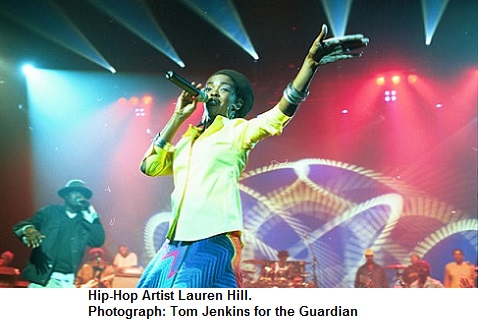
This scenario has happened again; this time in the world of consumed music: Rock-n-Roll is King … no more. The young upstart that took the throne in 1964 has now been supplanted by the new upstart Hip-Hop or Rap music; see story in Appendix below. Now the declaration can be:
… rap music is here to stay.
The qualitative evidence of this fact has been obvious to me for at least 20 of the last 40 years. But this study does more than just vindicate those of us who study rap music in the academy: it also validates the extraordinary cultural influence of what Bakari Kitwana has defined as the hip-hop generation: those of us born between the mid-1960s and the mid-1980s who have been wrestling with the rise of neoliberalism, the consequences of the prison-industrial complex and the withering effects of globalisation in the post-civil rights era. That struggle has, to some extent at least, has been articulated through rap music itself.
The key piece of information “discovered” by Mauch et al [(The Evolution of Popular Music: 1960-2010 by Matthias Mauch, Robert M. MacCallum, Mark Levy, Armand M. Leroi)] is that there were three major influential shifts in popular music in that 50-year period. One, in 1964, related to the decline of popular jazz/blues forms and the rise of rock music; one in 1983, reflected the emergence of pop/stadium rock; the final, most pronounced shift came in 1991, with the popular emergence of rap music. This final shift falls within the period known to scholars of hip-hop culture as the Golden Era; [where songs about fighting power structures could be as popular as songs that degrade women]. – The Guardian Newspaper posted May 8, 2015; retrieved July 25, 2017
This development is presented by the movement behind the book Go Lean…Caribbean. The book – available to download for free – tracks the Agents of Change that have impacted the Caribbean region and declares that:
Change is Good
Change is Bad
Change is Constant
The book urges a Caribbean audience – in the homeland and in the Diaspora – to better prepare for change, to act and move to the corner where opportunity meets preparation. This is how to generate “luck”; this is how to get to the conclusion: “Change is Good”, as opposed to the disposition of “Change is Bad”. Unfortunately for the Caribbean, we have only experienced the bad consequences of change.
We have not been ready. Going forward … let’s do better.
The intersection of music and change is familiar to this Go Lean movement; consider these previous blog-commentaries:
The Go Lean book provides turn-by-turn directions on “how” to do better in an atmosphere of intense change. It serves as a roadmap for the introduction and implementation of the technocratic Caribbean Union Trade Federation (CU), for the elevation of Caribbean society – for all member-states.
Over the past half century, the economic structures of many North American and Western European countries have changed dramatically, a mostly upward trajectory (growth) with occasional dips (recessions). During this same past half century, the economics of many Caribbean countries have also changed dramatically, but mostly towards poor or regressive conditions. This fact has forced a brain drain among many of the member-states’ professional classes.
…
As these changes took hold of society, the social effects on people, families, traditions, habits and values have been drastic; a lot has changed over the past decades.
So change has taken root! We see a parallel: Hip-Hop is now King, the reigning Champion in American music consumption (see sample in the VIDEO below) … while the Caribbean has been beset by these Agents of Change:
Globalization
Technology
Climate Change
Aging Diaspora
Music change; people change; values change; demographics change; society change!
This is the consistent theme in the Go Lean book and blogs; they describe the “push and pull” factors of societal change; these sources posit that life in North American communities (and Western European) serve as a “pull” factor for many Caribbean communities. Plus, the resultant failing economic conditions in the homeland further “push” many citizens away. Bad changes create repercussions of more bad changes.
To alleviate this crisis, there is the need to counteract with purposeful change. The Go Lean book serves as a roadmap to elevate the economics of the region; and it clearly describes the impact on other societal engines: security and governance. The Go Lean/CU roadmap therefore has these 3 prime directives:
Optimization of the economic engines in order to grow the regional economy to $800 Billion and create 2.2 million new jobs.
Improve Caribbean governance to support these engines, including a separation-of-powers between the member-states and CU federal agencies.
The Go Lean book stresses that reforming and transforming the Caribbean societal engines must be a regional pursuit. This goal was an early motivation for the roadmap, as pronounced in the opening Declaration of Interdependence (Pages 12 – 13):
xi. Whereas all men are entitled to the benefits of good governance in a free society, “new guards” must be enacted to dissuade the emergence of incompetence, corruption, nepotism and cronyism at the peril of the people’s best interest. The Federation must guarantee the executions of a social contract between government and the governed.
xvi. Whereas security of our homeland is inextricably linked to prosperity of the homeland, the economic and security interest of the region needs to be aligned under the same governance. Since economic crimes … can imperil the functioning of the wheels of commerce for all the citizenry, the accedence of this Federation must equip the security apparatus with the tools and techniques for predictive and proactive interdictions.
xxiv. Whereas a free market economy can be induced and spurred for continuous progress, the Federation must install the controls to better manage aspects of the economy: jobs, inflation, savings rate, investments and other economic principles. Thereby attracting direct foreign investment because of the stability and vibrancy of our economy.
Within these 370-pages of turn-by-turn instructions in the Go Lean book are the details of “how” to adopt new community ethos, plus “how” to execute new strategies, tactics, implementations and advocacies so as to reboot, reform and transform the societal engines of Caribbean communities. There is a parallel with the emergence of Hip-Hop and managing societal change:
Published on Jun 14, 2014 – I said a hip hop / Hippie to the hippie / The hip, hip a hop, and you don’t stop, a rock it out / Bubba to the bang bang boogie, boobie to the boogie…
While it was not the first single to includerapping, it is generally considered to be the song that introduced hip hop music to audiences in the United States and around the world (and the very first full-length rap song, which featured rapping parts throughout the entire song, unlike the first single). And for that reason, many refer to Rapper’s Delight as the first official rap song regardless. The song is ranked number 251 on the Rolling Stone magazine’s list of The 500 Greatest Songs of All Time and number 2 on VH1‘s 100 Greatest Hip-Hop Songs. It is also included in NPR‘s list of the 100 most important American musical works of the 20th century. It was preserved into the National Recording Registry by the Library of Congress in 2011.[2] Songs on the National Recording Registry are “culturally, historically, or aesthetically significant.”[3] –Source: Retrieved July 25, 2017 from: https://en.wikipedia.org/wiki/Rapper%27s_Delight
Change is like a bull; we have to “take the bull by the horn”. If Hip-Hop is not your favorite musical genre, it does not mean it will go away. This too is a constant! One generation never likes the music of the next generation:
“Turn off that noise”!
We can turn down, or turn off the music, but we cannot turn off Change. It’s a constant. We need to Rock with it! We must simply do the work – heavy-lifting as it might be – to adapt to change.
This Go Lean plan is conceivable, believable and achievable. We can transform … and make our homeland a better place to live, work and play. 🙂
For the first time ever, hip hop is the most consumed music genre in the U.S., Forbes reports, using numbers Nielsen Music recently released in a mid-year report.
While rock has long ruled, holding the top genre spot since Nielsen began to measure music consumption in the U.S. in 1991, the tables have turned, with R&B/hip hop now surpassing the popularity of rock and pop.
For the first six months of 2017, R&B/hip hop was responsible for 25.1% of all music consumption in the country, while rock claimed 23%. Hip hop also leads in digital song sales and on-demand streaming.
“It’s been an action-packed start to the year, with records broken, chart history made, and several categories growing quickly,” Nielsen stated.
Analysts at Forbes magazine believe the increasing popularity of R&B/hip hop is due to its influence on streaming services. The genre is as popular as rock and pop combined on Spotify and Apple Music.
Out of the 10 most consumed albums in the U.S. for the six-month period between January and June of this year, six were R&B/hip hop, according to Nielsen. Kendrick Lamar topped that list with his album, “DAMN.,” with nearly 1.8 million listeners. Drake’s record-breaking album, “More Life,” is the third most consumed album, with nearly 1.7 million listeners.
Hip hop was king of the song charts, too. Migos’ “Bad and Boujee” had the second-highest amount of streams in that six-month period, nearly 650 million. Seven other rap songs also made that list.
Its time to get the message out; to “say it from the roof-top and say it from the steeple”*.
But to be truly modern, the electronic media must also be engaged. This is the current effort of the movement behind the book Go Lean … Caribbean. The goal is to message to the Caribbean homeland, Caribbean Diaspora and the rest of the world. In other words, this goal is to conscientize …
Conscientize (verb) – to make somebody/yourself aware of important social or political issues. – Oxford Dictionary.
The message that this Go Lean movement wants to make people aware of is alarming:
There is something wrong in the Caribbean. It is the greatest address on the planet, but instead of the world “beating a path” to our doors, the people of the Caribbean have “beat down their doors” to get out. Our societal defects are so acute that our culture is in peril for future prospects.
This was the theme of the discussion on the Tampa Florida-based WMNF Radio Talk Show, The Sunday Forum, on July 9, 2017. The host, Walter Smith II#, invited a stakeholder from the Go Lean movement to conscientize the audience in their broadcast area about the perils of Caribbean life. The following AUDIO Podcast is the broadcast from that show:
Appendix AUDIO-VIDEO – “Go Lean … Caribbean” Movement: Conscientizing on the Radio on July 9, 2017 – https://youtu.be/9XCYbIIYZio
Published on July 12, 2017 – The term “conscientize” means to make aware of important social or political issues. This AUDIO-VIDEO features stakeholders of the Go Lean movement conscientizing to make people more aware of the alarming situation in the homeland:
“that while the Caribbean is the greatest address on the planet, its people are “beating down the doors” to get out”.
This was the theme of the interview on the Tampa Florida-based WMNF Radio Talk Show, The Sunday Forum, on July 9, 2017 with host Walter L. Smith II.
The AUDIO Podcast concludes with a reference to the Go Lean book, directing the audience to this 370-page guide that serves as a roadmap for the introduction and implementation of the Caribbean Union Trade Federation (CU). This entity is presented as a technocratic federal government to administer and optimize the economic-security-governing engines of all 30 member-states. The quest is to provide a better direct stewardship, applying lessons-learned from global best practices.
There is the need for our region to elevate these societal engines of our communities. This quest is presented with these prime directives:
Optimize the economic engines in order to grow the regional economy; there is a potential to create 2.2 million new jobs and to grow the regional GDP to $800 Billion. The deficiency of jobs is one of the reasons that Caribbean people have emigrated.
Improve Caribbean governance to support these above engines, including a separation-of-powers between member-state governments and CU federal agencies.
We – those who love the Caribbean – must do something and this roadmap for the CU – modeled after the European Union (EU) – has addressed the issues, strategies, tactics and implementations to reform and transform the region.
Many people love our tropical region – residents, Diaspora and visitors alike – and yet we understand why and how people have left. As related in the foregoing AUDIO Podcast, some Caribbean member-states now have a near-Failed-State status (Puerto Rico, Haiti, Jamaica, etc.). It is time now to work to elevate our communities, as our youth, the next generation for the Caribbean, may not be inspired to participate in the future workings of our communities.
The Go Lean movement – the book and all efforts to conscientize via traditional and electronic media – stresses that reforming and transforming the Caribbean societal engines must be a regional pursuit. This was an early motivation for the roadmap, as pronounced in the opening Declaration of Interdependence (Pages 12 – 13):
xi. Whereas all men are entitled to the benefits of good governance in a free society, “new guards” must be enacted to dissuade the emergence of incompetence, corruption, nepotism and cronyism at the peril of the people’s best interest. The Federation must guarantee the executions of a social contract between government and the governed.
xvi. Whereas security of our homeland is inextricably linked to prosperity of the homeland, the economic and security interest of the region needs to be aligned under the same governance. Since economic crimes … can imperil the functioning of the wheels of commerce for all the citizenry, the accedence of this Federation must equip the security apparatus with the tools and techniques for predictive and proactive interdictions.
xxiv. Whereas a free market economy can be induced and spurred for continuous progress, the Federation must install the controls to better manage aspects of the economy: jobs, inflation, savings rate, investments and other economic principles. Thereby attracting direct foreign investment because of the stability and vibrancy of our economy.
The Go Lean book provides 370-pages of turn-by-turn instructions on “how” to adopt new community ethos, plus the strategies, tactics, implementations and advocacies to execute so as to reboot, reform and transform the societal engines of Caribbean society.
The foregoing AUDIO Podcast stressed that these are desperate times in the Caribbean, calling for desperate measures. We hereby urge all Caribbean stakeholders to lean-in to this roadmap to introduce and implement the Caribbean Union Trade Federation (CU) among the 30 member-states of the region.
Our people – whether they are in the homeland or in the Diaspora – have a simple request, they simply want a better Caribbean; a better place to live, work and play. 🙂
Sign the petition to lean-in for this roadmap for the Caribbean Union Trade Federation.
————–
Appendix – Footnotes:
* – “Sing it from the roof-top and sing it from the steeple” – Lyrics from the 1976 Song “People to People” by Bahamian Artist Eddie Minnis.
# – Walter L Smith II is the host of the weekly radio show The Sunday Forum. Walter II stems from a legacy of great public service; he is the son of a former President of Florida A & M University, Walter L. Smith Sr.. Walter II has dedicated his time, talents and treasuries to this commitment to impact his community with progressive causes and advocacies. In 2016, he ran for the Democratic nomination for the Florida House of Representatives District 61 in the State Legislature.
150 years ago today, Canada – as a confederated country – got its start!
Canada Day (French: Fête du Canada) is the national day of Canada. A federal statutory holiday, it celebrates the anniversary of the July 1, 1867, enactment of the Constitution Act, 1867 (then called the British North America Act, 1867), which united the three separate colonies of Canada, Nova Scotia, and New Brunswick into a single Dominion within the British Empire called Canada.[1][2][3] Originally called Dominion Day (French: Le Jour de la Confédération), the holiday was renamed in 1982, the year the Canada Act was passed. Canada Day celebrations take place throughout the country, as well as in various locations around the world, attended by Canadians living abroad. – Source: Wikipedia.
Published on Jun 30, 2017 – Retrieved July 1, 2017 – Happy Canada Day 150
There are many Caribbean people in Canada; it is the Number 3 destination for our Diaspora (behind the US and the UK). So a celebration of Canada is relevant for this movement behind the book Go Lean … Caribbean; these ones are observing-reporting on the affairs of Canada, and its relevance to the Caribbean homeland. There are so many things we want from Canada, and so many things we do not want.
In fact, this was the actual title of a previous blog-commentary from October 14, 2016, encored here below.
“The Caribbean is the greatest address in the world”…
… so argues the book Go Lean…Caribbean in it’s opening (Page 3). Yet, a large number of Caribbean people live abroad. They live in places like the US, Canada, the UK and Europe. This commentary is Part 2 of 4 in a series examining the destinations of the Caribbean Diaspora. The full series is as follows:
So for Canada, we must ask the questions of our Diaspora there:
Why do they live in Canada and what can we learn from that experience?
What can we gather for the Pros and Cons of Canadian life?
There are “push and pull” reasons why Caribbean citizens have emigrated in the past – and continue to do so now – to places like Canada.
“In the 2006 census, 578,695 Canadians reported that they originated from the Caribbean, and the overwhelming majority of these people have immigrated to Canada since the 1970s. … the largest populations of Canadians of Caribbean origin were from Jamaica (231,110), followed by those from Haiti (102,430), Guyana (61,085) and Trinidad and Tobago (58,415).” – Historica Canada
To our chagrin, the extent of that societal abandonment is so acute that it is now at an atrocious 70% rate among the region’s college-educated classes. Yes, this is bad! The frank admission, in the Go Lean book, is that the Caribbean has societal defects … in the economic, security and governing engines of society.
In the course of these Go Lean blog-commentaries, we have looked inward and identified the defects of our society. Now we need to look at these refuge countries and glean the Good and Bad of those destinations. This can be considered a “competitive analysis” as the Caribbean region is competing with these foreign locales for the hopes and dreams of our young people. (See the full immersion of Caribbean culture in Toronto in the Appendix-VIDEO below).
Here is a laundry list of the Good and the Bad of Canada; and how the roadmap to elevate Caribbean society, the Go Lean book, describes how the lessons should be applied in the implementation of the Caribbean Union Trade Federation (CU):
Canadian Imports
10 GOOD Things We Want from Canada
10 BAD Things We Don’t Want from Canada
1
Free Market Economy Canada has always embraced Free Market capitalism; today, their brand is more Liberal Socialism than Conservative Republicanism. Many social programs are offered to Canadian residents as a result, so the government plays a BIG role in the lives of most citizens. The Go Lean roadmap promotes Free Market principles for the region’s industrial development. The structure of Self-Governing Entities allows for further Free Market expressions without local government constraints.
Massive Tax Burdens Many Canadians complain of high taxes. The governments defend the policy as necessary to support the many social programs (healthcare, subsidized college education, advanced infrastructure, etc). The Go Lean roadmap advocates deploying balanced tax schemes that mostly “skim off the top”. The CU will deploy systems to help member-state governments do better at collecting their tax revenues. Overall the Caribbean tax burden will increase, but only marginally.
2
Universal Healthcare Canada is a great example of successful healthcare for all of its citizens. They ensure that everyone has access and quality delivery. This minimizes the expensive repercussions of indigent care. The Go Lean roadmap calls for schemes to mandate healthcare insurance for every adult. With the leverage across the 30 member-states and 42 million people, the wholesale cost could be reduced.
Healthcare Egalitarianism The Canadian Health delivery is a Single Payer and not an insurance program. So everyone gets the same level of treatment. The realities of healthcare is that different people have different needs, so a “one size fits all” approach is not preferred. The Go Lean roadmap advocates for a mandated insurance solution. The key is that every adult will be required to select some insurance plan, of their choosing.
3
Weather – Cool Summers Climate Change is a reality. So the warm seasons in Canada now last longer, 8 months instead of 6 months. Summertime in Canadian cities is pleasant, without air-conditioning. The Go Lean roadmap promotes better infrastructure for Caribbean cities, developing refrigeration utilities for urban areas. This will leverage energy costs for cooling.
Weather – Cold Winters Canadian winters are not preferred, especially the months of January and February. The Caribbean Diaspora dread life there for those months. The Go Lean roadmap details the invitation to Canadian senior citizens to be Snowbirds in the Caribbean for the whole season. The economic returns of this strategy are too appealing to ignore.
4
Tourists There is a lot of competition for Canadian tourists; the Caribbean continues to make the case that its region is the best tourist destination in the world. The region wants to continue to appeal to Canadians of all demographic persuasions to come visit the islands for stay-overs (land-based hotels) and/or cruise ships. We want to forge vacation options and traffic for the upper, middle and lower classes of Canadian society.The CU forges plans, advocacies and re-boots to further enhance the Caribbean tourism product array.
Expatriate Workers During the early days of nation-building, many Canadians workers came to the English-speaking Caribbean to work jobs (teachers, nurses, bankers, etc.) that many locals could have done. This practice led to the ethos that “White” Canadians were “better” than local personnel. The Go Lean roadmap dictates a labor standard where local workers get priority for jobs, then regional citizens, then and only then foreign workers (like Canadians).The Single Market would have freedom of movement but with this labor-qualifying caveat.
5
Capital There is a long history of Canadian banks in the Caribbean region. (Think Scotiabank, Royal Bank of Canada, and the First Caribbean-CIBC (Canadian Imperial Bank of Commerce)). Despite recent losses for Canadian banks in the Caribbean region, there is still the need for these banks’ active participation in the region. The Go Lean roadmap calls for strenuous oversight for the Caribbean Dollar (C$) and regional banks participating in transactions using this currency.
Devalued Currency The Canadian dollar was 1-to-1 with the US dollar in the 1970’s. The currency has since been devalued, but only a little; between $.95 and $1.08. When a Caribbean financial transaction is executed in US dollars, a Canadian customer has to endure higher prices. The C$ is not designed to be pegged to the US dollar, rather a basket of foreign currencies including the Euro, British Pounds and Japanese Yen. So Canadians doing business in the Caribbean will not be as vulnerable to US$ fluctuations.
Canadian Imports (cont’d)
10 GOOD Things We Want from Canada
10 BAD Things We Don’t Want from Canada
6
Supportive Defense Canada is not a militarized state like their American neighbor, but they do feature a robust internationally respected Army, Navy, and Air Force in support of their homeland.The CU roadmap provide for a complete Homeland Security apparatus to defend the Caribbean region. In addition, there is a comprehensive Intelligence Gathering and Analysis functionality.
Deportees Canada repatriates Caribbean citizens guilty of criminality on Canadian soil. So these one become the concern for Caribbean authorities once deported.The Go Lean roadmap calls for proactive mitigations for “bad actors” that might bring a lawless ethos to the homeland. We seek a treaty with Canada for full intelligence sharing for those affiliated with organized crime (gangs) and low-level felons.
7
Foreign Aid Canada was one of the only foreign supporters for the defunct West Indies Federation; they have always shown our region “love”. Plus they always step up to aid the Caribbean in their “time of need” after natural disasters (earthquakes and hurricanes). But they prefer to help as a regional bloc rather than country by country.The CU/Go Lean roadmap is designed to process all foreign aid from Canada; from both the Canadian government and NGO’s.
Condition for Philanthropic Support Many Giving Organizations attach strings to their gifts. The burdens of compliance is so difficult that many times, public-private entities – think Red Cross – attach themselves to the gifts to ensure accountability. This adds an additional layer in administrative costs, and less funding goes to the beneficiaries.The CU envisions a federal agency for oversight of the NGO’s in the region. We must do the heavy-lifting ourselves, rather than submitting perils of “bad actors”.
8
‘First Nation’ Reconciliation Like other European settlers in the New World, Canada had a history of repression of the indigenous peoples, but this country has reconciled that bad history with many positive empowerments. The Go Lean roadmap calls for formal reconciliation commissions to settle a lot of bad treatment in the past.
Virtual Segregation Canada has the same history of racial divide as many other American Northern cities. While not a legal segregation, there is a de facto segregation with many ethnic migrants living in pockets. The CU proposes repatriation back to the Caribbean homeland. There is nothing like being home.
9
Bilingual Co-existence Canada is a bilingual society, with the majority French culture in Quebec Province. The English and French co-exist well and insist on bilingual media expressions. The Go Lean roadmap calls for multilingual media and government communications. There is also the need for Minority Equalization for different language groups.
Quebec Pull for French Caribbean Migrants Many French-speaking Caribbean people target Quebec as the destination for their emigration. In the 2006 Census, there were 102,430 people of Haitian descent living in Canada. The CU/Go Lean roadmap calls for managing the country of Canada as a competitor for the hearts of our youth.
10
Professional Sports Role Model Despite the regional domination of continental sports (baseball, football, basketball) by Americans, Canadians still dominate in their own rite – they are usually among the best hockey players in the world. They nurture the skills from youth participation up to the professional levels. The Go Lean roadmap calls for empowering the sports eco-system in the region, allowing for more opportunities for amateur, collegiate and professional participation. Other benefits of the regional focus will include better oversight of sports academies, agents and leagues.
Recruitment of Caribbean Athletes During the 2016 Rio Olympics, there were many Track and Field athletes representing Canada that were of Caribbean heritage. Canada extends a “welcome mat” to these ones, therefore encouraging more to naturalize and discouraging loyalty to the Caribbean homeland. The Go Lean roadmap seeks to reboot the Caribbean societal engines. This will lower the “push and pull” factors that cause citizens to flee to other countries and switch their allegiances. This will allow athletes to fully engage their professions without leaving home.
Canada has been a frequent topic for considerations from the Go Lean movement (book and blogs). The opening Declaration of Interdependence (Page 14) recognized that there is value in considering the Good and Bad examples of Canada, with this statement:
xxxiii. Whereas lessons can be learned and applied from the study of the recent history of other societies, the Federation must formalize statutes and organizational dimensions to avoid the pitfalls of communities … On the other hand, the Federation must also implement the good examples learned from developments/ communities like … Canada….
The book specifically addresses Canada with these direct references of community ethos, strategies, tactics, implementations and advocates:
Community Ethos – Deferred Gratification – Cold Weather Residents Must Wait Until Spring
Page 21
Community Ethos – Economic Systems Influence Individual Choices
Page 21
Community Ethos – Minority Equalizations – Model of Canada’s Territories
Page 24
Community Ethos – Ways to Help Entrepreneurship
Page 28
Strategy – Invite empowering immigrants – Like Canadians Snowbirds
Page 46
Tactical – Separation of Powers – Secretary of State – Trade Mission Offices
Page 80
Implementation – Reason to Repatriate – From Canada
Page 118
Planning – Lessons Learned from the previous West Indies Federation –Canada’s Support
Page 135
Planning – Lessons from Canada’s History
Page 146
Advocacy – Ways to Better Manage the Social Contract
Page 170
Advocacy – Ways to Impact the Diaspora – Toronto‘s Large Pocket
Page 218
Advocacy – Ways to Impact Foundations – Many Canadians NGO’s
Page 219
Advocacy – Ways to Protect Human Rights
Page 220
Advocacy – Ways to Improve Elder-Care – Snowbirds Invitations
Page 225
Advocacy – Ways to Empower Women – Canada‘s great example
Page 226
In addition, previous Go Lean blog/commentaries addressed many issues in regards to Canada and the interactions of Caribbean people and Canada; see sample list here:
Canada: The Best Address/Destination … per this Bahamian
The Go Lean book serves as a roadmap for the introduction and implementation of the CU. Our scope is to impact the Caribbean’s economic, security and governing engines, not Canada’s. But we do hope to engage the Caribbean Diaspora living there.
There are Good lessons and Bad lessons that we can learned from Canada. So let’s pay more than the usual attention to these insights. Everyone is urged to lean-in to this Go Lean/CU roadmap for the Caribbean Union Trade Federation, to make our region a better place to live, work and play. 🙂
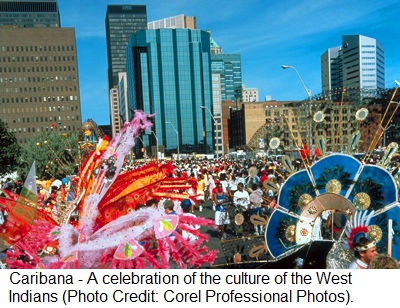
Published on Jun 18, 2016 – If you never had West Indian/Trini/Caribbean food, you are seriously missing out. They might not be the healthiest foods out there but it is definitely hot and delicious. Their foods are pretty much like their people, warm and welcoming. I’ve had doubles once before and it made me realize what I have been missing out my entire life. The aloo pie with tamarind sauce gave me the exact same shiver. No fancy complexity, just simple west Indian food.
So you have an opinion? Good! Now here are the facts.
Did that move your opinion? If not, you’re dogmatic. If, on the other hand, the clarification of facts causes you to adjust your thinking then you have been enlightened.
Welcome to the club!
For the movement behind the book Go Lean…Caribbean, the planners of a new Caribbean, it has always been our position that the Diaspora should preserve their voting rights back in the homeland. Now that we have considered the facts below, our relationship status – assuming the ‘romance between man and his hometown’ – must be changed to:
“It’s complicated“; not just “divorced” nor just “separated”.
The primary driver of this position comes from this basic principle of democracy:
No taxation without representation
If this basic principle is accepted then the opposite must also be true:
No representation without taxation.
This may be a fitting analogy for the issue of Diaspora Voting: Imagine a man that divorces his wife, then still tries to dictate who she can subsequently date or marry; that ex-husband’s prerogative should justifiably be revoked.
Can a member of the Caribbean Diaspora leave his/her homeland, stop paying taxes, stop contributing to the community and yet still dictate who should assume leadership in their absence? This would include how to spend the tax dollars that they no longer contribute. (See the Letter to Editor – “Diaspora voting is the people’s rights to decide” in the Appendix below).
Title: The History and Politics of Diaspora Voting in Home Country Elections
Prepared by Andy Sundberg, based on information from Andrew Ellis and others sources in: ”Voting from Abroad”: The International IDEA Handbook, 2007.
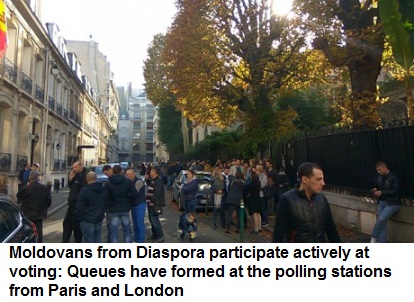
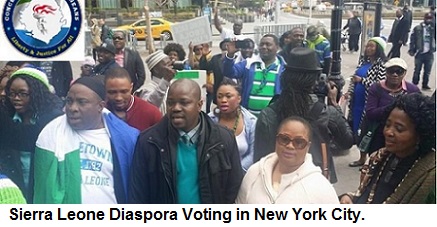
The case for external voting is usually presented as a question of principle, based on the universality of the right to vote. In reality, however, the introduction of external voting is enacted or enabled by legislation passed by elected politicians. Although there have been a variety of reasons for the enactment of external voting provisions, almost all have been the result of political impetus, and many have been controversial and even nakedly partisan.
1.
A Brief History of Diaspora Voting … The reasons for introducing external voting also differ according to the historical and political contexts. Thus, in several countries the introduction of the right to vote for overseas citizens was an acknowledgement of their active participation in World War I or World War II. …Outside the military context, New Zealand introduced absentee voting for seafarers in 1890, and Australia adopted it in 1902, although under operating arrangements which made its use outside Australia practically impossible. …
2.
Diaspora Voting In Democratic Transition Countries The importance of political factors in the adoption and design of external voting provisions was accentuated during the democratic transitions of the 1990s. The inclusion of citizens abroad was often seen as a key element in the process of nation-building, for example, in Namibia in 1989 and South Africa in 1994.Diaspora communities may be active in seeking a post-transition role, and may be particularly influential when they play a role in the domestic politics of major donor countries. However, such pressure is not always successful. …The international community frequently plays a leading or significant role in mediating transitions and even in implementing transitional elections. Transition agreements may therefore contain important and sometimes controversial external voting provisions. …
3.
Diaspora Voting and Electoral System Design Political considerations are not only important in determining whether external voting takes place: they are also influential in defining its form. Many decisions relating to external voting are linked to electoral system design, another highly political aspect of democratic reform and democratic transition.Electoral system design is one of the most important elements in the institutional framework of a country, influencing as it does the political party system. Electoral system reform may be on the agenda as a result of vision or a motivation to improve democracy, or for more short-term, sectoral or even venal reasons on the part of some political participants. This is mirrored by external voting, which may be placed on the democratic agenda by those who believe strongly in the equal right of all citizens to participate—or by political forces which see potential advantage in it.The desire to promote external voting may constrain the options for electoral system design. Conversely, the adoption of a particular electoral system may limit the options for external voting mechanisms. This can be illustrated by considering the three basic options for external voting— personal voting at an external polling site in a diplomatic mission, for example; remote voting by post, fax or some form of e-voting; and voting by proxy.
3.1
Diaspora Voting in Person and Electoral System Design
3.2
Diaspora Remote Voting and Electoral System Design
3.3
Diaspora Voting by Proxy and Electoral System Resign
3.4
Diaspora Voting Timing Issues
4.
Who Can Vote and How Voting Takes Place
4.1
The Number of National Diasporas Who Can Vote Today Voting from abroad is now possible for Diaspora communities from 115 home countries. Of these, 28 come from home countries in Africa; 16 in the Americas; 20 in Asia; 41 in Western, Central and Eastern Europe; and 10 in the Pacific. Provisions for voting by Diaspora communities have been adopted by five additional countries, but rules and voting methods have not yet been decided.
4.2
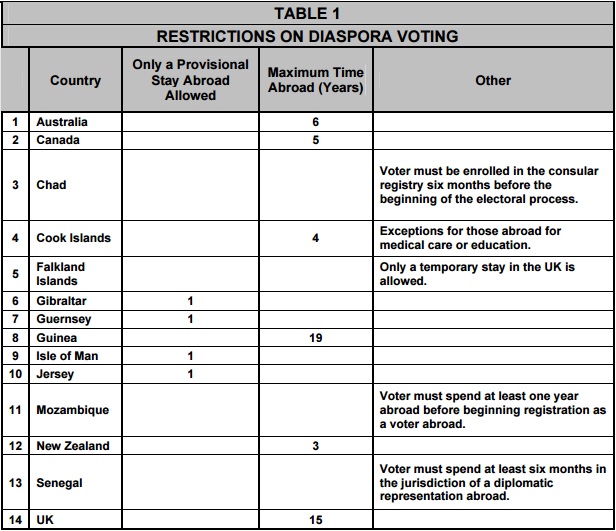
Restrictions on Diaspora Members Who Can Vote from Abroad Fourteen countries, who allow voting by their Diaspora communities, impose some time restrictions on such electoral participation. These restrictions are summarized in Table 1 below.
4.3
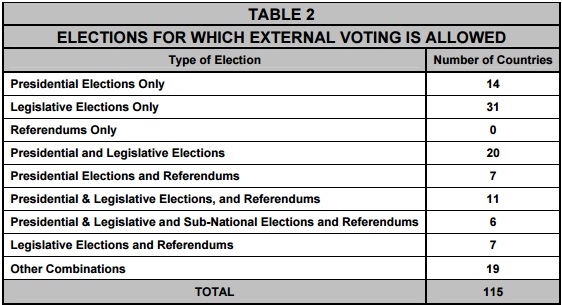
Different Types of Elections During Which Diaspora Voting is Currently Permitted There are four principal types of elections where voting by Diaspora members can take place so far.Presidential Elections: Diaspora members from 64 countries can participate in their home country presidential elections.
Legislative Elections: Diaspora members from 92 countries can participate in their home country legislative elections.
Sub-National Elections: Diaspora members from 25 countries can participate in their home country sub-national elections.
Referendums: Diaspora members from 38 countries can participate in their home country referendums.
Diaspora Voting in Different Combinations of Elections: Each country has a different selection of elections that permit vote from their Diaspora members. These elections are shown in Table 2 below.
4.4
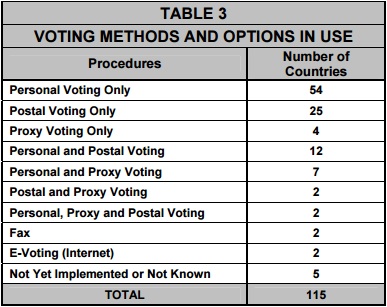
Different Types of Diaspora Voting Methods Used Countries use five different methods of voting for their Diaspora members today.Voting in Person: Diaspora members from 79 countries can vote in person.
Voting by Post: Diaspora members from 47 countries can vote by postal ballot.
Voting by Proxy: Diaspora members from 16 countries can vote by proxy.
Voting by Fax: Diaspora members from 2 countries (Australia and New Zealand) can vote by fax.
Voting by the Internet: Diaspora members from 2 countries (Estonia and the Netherlands) have been able to vote by the Internet so far. (Note: American Diaspora members of Democrats Abroad (DA) were also able to vote in the 2008 overseas primary election by Internet and 48% of the total DA primary votes were cast this way).Different Combinations of Voting Methods: Each country has a different selection of voting methods that are available for their Diaspora members. Some offer only one voting method, but some offer several options. These different options are shown in Table 3 below.
The book Go Lean…Caribbean – available to download for free – identified the Diaspora as stakeholders in the quest to reform and transform Caribbean society. The book serves as a roadmap for the introduction and implementation of the technocratic Caribbean Union Trade Federation (CU), for the elevation of Caribbean society – for all 30 member-states. This CU/Go Lean roadmap has these 3 prime directives:
Optimization of the economic engines in order to grow the regional economy to $800 Billion and create 2.2 million new jobs.
Improve Caribbean governance to support these engines, including a separation-of-powers between the member-states and CU federal agencies.
The failing of these above societal engines constitute one of the reasons why Caribbean people have left their homelands in the first place. This is identified as the “push” factor; in addition there is the “pull” factor, the lure that life may be more prosperous elsewhere, that the “grass is greener on the other side”. The book stresses that reforming and transforming the Caribbean societal engines must be engaged, and must be a regional pursuit, as the societal challenges are too big for any one Caribbean member-state alone to assuage. This regionalism was an early motivation for the roadmap, as pronounced in the opening Declaration of Interdependence (Pages 12 – 13):
xi. Whereas all men are entitled to the benefits of good governance in a free society, “new guards” must be enacted to dissuade the emergence of incompetence, corruption, nepotism and cronyism at the peril of the people’s best interest. The Federation must guarantee the executions of a social contract between government and the governed.
xvi. Whereas security of our homeland is inextricably linked to prosperity of the homeland, the economic and security interest of the region needs to be aligned under the same governance. Since economic crimes … can imperil the functioning of the wheels of commerce for all the citizenry, the accedence of this Federation must equip the security apparatus with the tools and techniques for predictive and proactive interdictions.
xxiv. Whereas a free market economy can be induced and spurred for continuous progress, the Federation must install the controls to better manage aspects of the economy: jobs, inflation, savings rate, investments and other economic principles. Thereby attracting direct foreign investment because of the stability and vibrancy of our economy.
xxxiii. Whereas lessons can be learned and applied from the study of the recent history of other societies, the Federation must formalize statutes and organizational dimensions to avoid the pitfalls of communities like …. On the other hand, the Federation must also implement the good examples learned from developments/communities like ….
The Go Lean book provides 370-pages of turn-by-turn instructions on “how” to adopt new community ethos, plus the strategies, tactics, implementations and advocacies to execute so as to reboot, reform and transform the societal engines of Caribbean society. Consider the importance the book (Page 110) highlights as to the aforementioned democratic principle:
The Bottom Line on Taxation without Representation “No taxation without representation” is a slogan originating during the late-1700s that summarized a primary grievance of the British colonists in the Thirteen American Colonies, which was one of the major causes of the American Revolution against Great Britain. Many in those colonies believed that as they were not directly represented in the distant British Parliament, any laws it passed taxing the colonists were illegal under the English Bill of Rights enacted in 1689 and were a denial of their rights. – http://www.notaxationwithoutrepresentation.com Retrieved September 2012.
Today, the phrase is used in Washington, DC, and in Ottawa, Canada as part of the campaign for a vote in Congress or Parliament, to publicize the fact that Capital District residents pay Federal taxes, but do not have a legislative vote. To alleviate this abuse, the CU intends to add 1 (voting) seat in the Legislative House of Assembly to represent residents of its Capital District.
What was your opinion? How has your opinion been altered based on the facts here? The overall assertion from the Go Lean movement (book and blog-commentaries) is that reforming politics-government alone will not reform Caribbean society – it is part-and-parcel with reforming economic and security engines – but we still do need to reform government. Reforming society is a heavy-lifting task; we must have “all hands on deck”, Diaspora included.
While we cannot just say “give us your money” and then “get lost” from our decision-making”, we must also accept that there is a difference for those that are “here” versus those that are not! The Go Lean book (Page 47) therefore identifies this role for the Diaspora as stakeholders in the Caribbean reform-transform heavy-lift:
Caribbean Diaspora
These emigrated citizens still identify with their homelands. Though they may live abroad, they congregate in pockets in urban areas. The CU will foster the development of this group so as to form them into an organized market; this includes individuals and institutions (for-profit companies, not-for-profit organizations and foundations). There is also the reality of the foreign-born children of the Diaspora, identified here as Legacies. These will be tapped for consumer products only.
In total, these stakeholders import foods and drink from the homeland; they demand expressions of Caribbean culture and they consume media produced by Caribbean artists targeting a Caribbean consumer-base. The number constituting the Diaspora is estimated between 6 and 8 million people – for some member-states, a majority of their citizenry lives abroad – this population is not to be ignored. A CU mission is to repatriate this group, for their time, talent and treasuries. Where this repatriation cannot be full-time, the CU proffers a part-time commitment: vacation homes, time-share condominiums, youth mentoring, community coaching, and season-ticket holders for sports and artistic events – in the islands or abroad for touring companies’ performances.
The CU will establish Trade Mission Offices closest to Diaspora pockets (for example: Flatbush in Brooklyn, NY, Jamaica Hill in Lauderhill, FL and Notting Hill, London) to allow efficient trade, visitor/convention promotion & planning and CU federal government interactions.
Yes, the Diaspora can help to make our homeland a better place to live, work and play. We urge them to lean-in to this effort.
Consider some previous blog-commentaries here, that elaborated on the role of the Diaspora in the Go Lean roadmap:
Sign the petition to lean-in for this roadmap for the Caribbean Union Trade Federation.
————–
Appendix – Letter to Editor – Diaspora voting is the people’s rights to decide
Dear Sir:
It is indeed one step closer to complete freedom of the Jamaican people the unshackling of the last vestige of slavery; a direct challenge to the ruling class who have openly opposed ordinary Jamaicans gaining significant political and economic power.
If you agree with me that ever since independence no government has actually sought to empower the people except under Michael Manley to some degree, then you must conclude that the country is not been governed in the interest of the ordinary people. Diaspora voting right is not an imposition of our will on the Jamaican people but rather the embodiment of the common man’s vision of the future for Jamaica outside of the colonial construct created to perpetuate the economic enslavement our people.
Crime in Jamaica is an instrument of social control to deplete the rising power of a middle-class by forcing them to “fly-out ” and oppress a captive underclass by using them as the dominant electorate subverted by criminal gangs and their “Don” leaders.
We, therefore, cannot assert our political and economic rights from within, our influence on transforming Jamaica can only be achieved under the protection of foreign democracies in which we live. There is no other solution to Jamaica’s crime problem than a political one. Diaspora Jamaicans must demand a vote and end the violence once and for all. This will strengthen our democratic institutions and shift the political dynamics away from garrison politics to allow for the repatriation of economic and human capital to Jamaica for economic development. Economic integration cannot be achieved without political and social integration.
One of the most frequent arguments against Diaspora voting is “they don’t have to live with the consequences”. But I say this, you are right! cause we don’t want to live with the consequences of continued poverty and crime, we want live with the consequences of Jamaica’s prosperity that is why we are demanding the vote.
We are not asking to change the laws, we are only demanding what the constitution guarantees us pursuant to the rights and duty of a citizen under the UN Charter of Rights and Freedom which Jamaica is a signatory. It is an agenda for change through the creation of a cooperative democracy (a real partnership) in which the poor is afforded a safety net, and government projects, programs, and policies are evaluated for sustainability goals.
Being cut-off, social development evolves and endures independent of the mainland’s influence. This is the case in the natural world – consider all the unique animals of Australia – and in the music world.
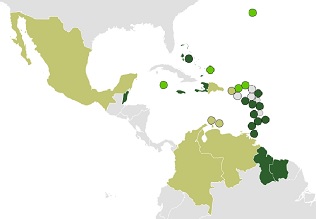
Most of the 30 member-states of the Caribbean are islands (notwithstanding Guyana, Suriname & Belize). As a result we have this amazing musical progeny that has developed … and endured: we have 169 different musical genres that have emerged.
So not only are islands distinct compared to the mainland, they are also distinct compared to each other.
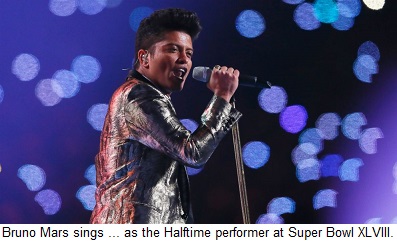
This explains the historicity of the musical artist Bruno Mars.
He is of Caribbean roots…
… his father has Puerto Rican heritage. But Bruno or Peter Hernandez, his given name, was born and raised on the island of Hawaii. (See Biography in Appendix A below).
His music reflects the richness of his island roots. See, feel the Caribbean “soul” in the VIDEO of “Billionaire” in the Appendix C below. A Caribbean legacy – in this case Puerto Rico – has so much good to offer the world, as one of the best-selling artists of all time.
This is a message the Caribbean needs to hear – we are the greatest address on the planet, in terms of terrain (flora, fauna and beaches), hospitality and culture, but we are at near-Failed-State status. We must endure and fix our broken societal engines.
Challenge accepted!
See how this champion of Caribbean Roots battled misfortune and adversity to emerge as one of the biggest musical stars of the day. See this 60 Minutes interview from November 2016 here (or the transcript in Appendix B below):
Posted November 20, 2016 – He’s been broke, busted and nearly homeless. Now, as 60 Minutes’ Lara Logan reports, he’s on top of the music world. (May require CBS All-Access Subscription).
Bruno Mars has the talent; he even had it early as a youth. He has earned many awards and nominations, like the Grammys (5), BRIT Awards (3), MTV Europe Music Awards (3), and Billboard Songwriter Award. In 2014, he became the artist with the most top five entries on the Billboard Hot 100 since his first week on the chart.[182] He is the first male artist to place two titles as a lead act in the Hot 100’s top 10 simultaneously.[184] Mars was the most played artist on “pop radio” in 2013 [185] and became the first solo male artist whose first 13 Top 40 hits all reached the Top 10 on the American Top 40.[186] In total, he has had six number-one singles on the Hot 100 chart.[187]
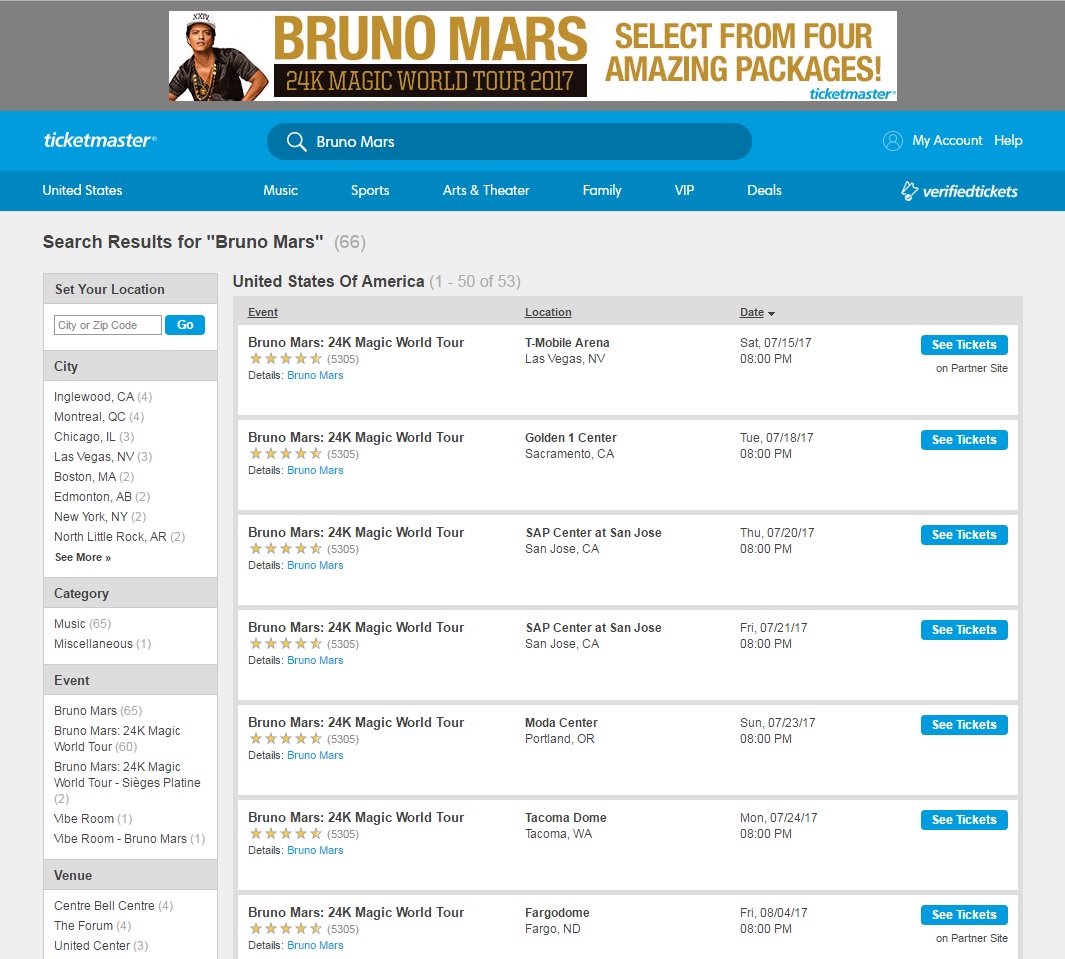
We are so proud that this talented American entertainer actually has Caribbean roots; it accentuates our image and reflects the positive contributions of our culture. But as related in this foregoing VIDEO, it has taken more than just talent alone for him to advance to these heights in the music industry. (He kicks off a major US Tour this summer; see initial dates in the Photo here).
Success for Bruno Mars has been based on the full measure of his character, the talent and that something else, the “X-Factor” that the music industry likes to classify as to why some artists succeed and some artists do not.
There is the need for endurance, resilience, vision and preparation for whatever available opportunity emerges.
This is where the long experience of this short life of Bruno Mars – thus far – teaches the Caribbean region, what we need to do to be successful in our quest to elevate our homeland to be a better place to live, work and play. Yes, we have shown that we have talent; we have endurance and resilience, but now we must show the vision and prepare for opportunities to execute change at home.
This is the quest of the book Go Lean…Caribbean; it serves as a roadmap for the introduction and implementation of the Caribbean Union Trade Federation (CU). The CU is designed to advance the Caribbean eco-systems for economics, security and governance. Every step along the way, with all the bread-and-butter considerations, there is the opportunity for the arts and artists (including music) to impact this region and the rest of the world with their contributions. These 3 statements constitute the prime directives of this Go Lean/CU roadmap:
Optimization of the economic engines in order to grow the regional economy.
Establishment of a security apparatus to protect the resultant economic engines.
Improvement of Caribbean governance to support these engines.
Endurance can be classified as a “community ethos” – the fundamental character or spirit of a culture; the underlying sentiment that informs the beliefs, customs, or practices of a society (Go Lean book Page 20). This roadmap recognizes that a prerequisite for advancing society is a change in the Caribbean community ethos; or an adoption of different community ethos, i.e. Deferred Gratification, a derivative of “endurance” (Page 21). Early in the book, in the opening Declaration of Interdependence, the contributions that culture (music, dance and artistic expressions) can make is pronounced as an ethos for the entire region to embrace (Page 14), with these statements:
xxxii. Whereas the cultural arts and music of the region are germane to the quality of Caribbean life, and the international appreciation of Caribbean life, the Federation must implement the support systems to teach, encourage, incentivize, monetize and promote the related industries for arts and music in domestic and foreign markets. These endeavors will make the Caribbean a better place to live, work and play.
Bruno Mars is the embodiment of the necessary ingredients to forge success in the music industry. He has impacted the music, culture and image of Island Life (albeit Hawaii); he has depicted that “despite the upbringing on a small, limited island”, one can still “move” the whole world – move it to dance and move it to change. Like Caribbean musical icon, Bob Marley, Bruno Mars is setting a pathway for success for other generations of talented, inspirational and influential artists to follow. Many other artists – of Caribbean heritage – are sure to emerge and “impact the world”. We are thusly preparing for it, as specified in the same Declaration of Interdependence –Page 13:
xxi. Whereas the preparation of our labor force can foster opportunities and dictate economic progress for current and future generations, the Federation must ensure that educational and job training opportunities are fully optimized for all residents of all member-states, with no partiality towards any gender or ethnic group. The Federation must recognize and facilitate excellence in many different fields of endeavor, including sciences, languages, arts, music and sports. This responsibility should be executed without incurring the risks of further human flight, as has been the past history.
Globally, the music industry is in shambles. This is true in the US and even more so in the Caribbean. It is difficult for musical artists to endure in professions tied to the music industry unless some fundamental changes are put in place…
… the Go Lean/CU roadmap represents the change that the Caribbean needs. The people, enterprises, institutions and governance of the region are all urged to “lean-in” to this roadmap for change. It is important to provide a structure for musicians and artists to get paid for their talents; otherwise they would abandon this industry. Alas, we need a striving music industry; it is important as these ones highlight positive contributions of Caribbean culture, life and people.
The following list details the community ethos, strategies, tactics, implementations and advocacies to foster a better business environment for future entertainers in the Caribbean:
Community Ethos – Ways to Foster Genius
Page 27
Community Ethos – Promote Intellectual Property
Page 29
Community Ethos – Ways to Promote Happiness
Page 36
Community Ethos – Impact the Greater Good
Page 37
Strategy – Caribbean Vision
Page 45
Tactical – Separation of Powers – Patents & Copyrights
Page 78
Tactical – Separation of Powers – Culture Administration
Page 81
Implementation – Ways to Impact Social Media
Page 111
Advocacy – Ways to Make the Caribbean Better
Page 131
Advocacy – Ways to Better Manage Image
Page 133
Advocacy – Ways to Impact Hollywood
Page 203
Advocacy – Ways to Improve the Arts
Page 230
Advocacy – Ways to Promote Music
Page 231
The changes being anticipated for the Caribbean music industry assumes an integration of the business eco-system. We must have a means by which the artists can get paid for their artistic expressions. The Go Lean book fully detailed this music business eco-system with this sample advocacy; see these headlines from Page 231:
10 Ways to Promote Music
1
Leverage the Single Market
Allow for the unification of the region into one market of 42 million people. There are numerous [Afro-Caribbean] music genres that are unique to the region (Appendix ZS on Page 347): Calypso, Reggae, Salsa, Mambo, Merengue, Conga, Junkanoo and others. The integrated market size of the CU can support the deployment and regulation of a music eco-system where artists, writers, performers, promoters, broadcasters and retailers can be duly compensated for their efforts; thereby fostering an internal music industry and encouraging new generations to share their talents and dream of stardom.
2
Payment Eco-System Arrange for settlement of electronic payments transactions allowing e-commerce (downloads) to flourish.
3
Level 1 – Music Fulfills Biological and Physiological needs Exposure to music and music education is one common denominator among successful, satisfied, articulate people and helps cement their basic education that guarantees them the ability to advance in society so as to secure their livelihoods. Moreover, an ongoing musical experience (ideally begun at a young age) provides the consumer demand base for peripheral industries (orchestras, operas, arts organizations, etc.). Although it may not sell tickets immediately, it is an investment in a future generation of musically-literate patrons and participants.
4
Level 2 – Security/Safety needs The CU will facilitate job security for talented musicians/artists by fostering a marketplace (real & virtual) to transact their occupations. Previously, the Internet had undermined the business models for the music industry, but there are now new paid services (like iTunes, Rhapsody, Pandora, etc.). Safety needs refer to protecting the industry to allow continuity of musical output and preventing the nullification of national art forms. “Music soothes the savage beast”.
5
Level 3 – Belongingness and Love needs
6
Level 4 – Esteem needs
7
Level 5 – Cognitive needs
8
Level 6 – Aesthetic needs
9
Level 7 – Self-Actualization needs
10
Level 8 – Transcendence needs
The power of music has been a familiar topic for previous Go Lean blog-commentaries. Consider this sample:
We salute those like Peter Hernandez (Senior) who left the Puerto Rican Diaspora of Brooklyn as a youth, looking for opportunities in the world of music-entertainment. We salute him and other such ones, even their descendants and legacies. We know there are “new” Peter Hernandez -types and “new” Bruno Mars-types throughout Caribbean member-states, waiting to be fostered. We hail them as our future.
Now is the time for all stakeholders – musicians and music lovers alike – in the Caribbean to lean-in for the empowerments described here-in and in the book Go Lean … Caribbean. Our society is failing; we can turn-around and reboot. Music helps to forge that change!
We can and must be better and do better and help to make our Caribbean homeland a better place to live, work and play. So we need a fully functional music industry because we need music, and the effects of music: the power to move people. 🙂
Sign the petition to lean-in for the roadmap for the Caribbean Union Trade Federation.
————-
Appendix A – Bruno Mars Biography Peter Gene Hernandez (born October 8, 1985), known professionally as Bruno Mars, is an American singer-songwriter, multi-instrumentalist, record producer, and choreographer. Born and raised in Honolulu, Hawaii, by a family of musicians, Mars began making music at a young age and performed in various musical venues in his hometown throughout his childhood. He graduated from high school and moved to Los Angeles to pursue a musical career. After being dropped by Motown Records, Mars signed a recording contract with Atlantic Records in 2009.
Mars has received many awards and nominations, including five Grammy Awards, and was named one of Time‘s 100 most influential people in the world in 2011. In December 2013, he ranked number one on the Forbes 30 under 30 list. Mars is known for his stage performances and retro showmanship. He is accompanied by his band, The Hooligans, who play a variety of instruments such as electric guitar, bass, piano, keyboards, drums and horns, and also serve as backup singers and dancers. Mars performs in a wide range of musical styles.
Early life and musical beginnings Peter Gene Hernandez was born on October 8, 1985,[1] in Honolulu, Hawaii to Peter Hernandez and Bernadette San Pedro Bayot, and was raised in the Waikiki neighborhood of Honolulu.[2]
His father is of half Puerto Rican and half Ashkenazi Jewish descent (from Ukraine and Hungary), and is originally from Brooklyn, New York.[3][4][5] His mother emigrated from the Philippines to Hawaii as a child, and was of Filipino, and some Spanish, ancestry.[4][6] His parents met while performing in a show in which his mother was a hula dancer and his father played percussion.[5] At the age of two, he was nicknamed “Bruno” by his father, because of his resemblance to professional wrestler Bruno Sammartino.[7][8][9]
Mars is one of six children and came from a musical family which exposed him to a diverse mix of genres including: reggae, rock, hip hop, and R&B.[10][11] His mother was both a singer and a dancer, and his father performed Little Richard rock and roll music.[12] Mars’ uncle was an Elvis impersonator, and also encouraged three-year-old Mars to perform on stage. Mars performed songs by artists such as Michael Jackson, The Isley Brothers, and The Temptations.[8] At age four, Mars began performing five days a week with his family’s band, The Love Notes, and became known on the island for his impersonation of Presley.[13] In 1990, Mars was featured in MidWeek as “Little Elvis”, and later appeared in a cameo role in the film Honeymoon in Vegas (1992),[8][14] and performed in the halftime show of the 1990 Aloha Bowl.[15]
Appendix B – Transcript: Bruno Mars 60 Minutes Story Transcript
The following script is from “Bruno Mars,” which aired on Nov. 20, 2016. Lara Logan is the correspondent. John Hamlin, producer.
Bruno Mars is one of the world’s biggest music stars and he’s one of the most driven people we’ve ever seen. Just 31, he’s the product of what he calls a “school of rock” education — a working class life of experiences that have taught him the music business. None of it came easily. He’s been broke, busted and nearly homeless. But this week, following the release of his first album in four years, he’s on top of the music world.
To show us how he got there, Bruno Mars did something he’s never done: he shared with us some of the toughest moments of his Hawaiian upbringing, and gave us the opportunity to witness his extraordinary skills as a songwriter and producer.
We begin with Bruno Mars, the entertainer.
This show in Connecticut last month was his first public concert of the year, and he used it as a tune-up for the release of his new album and world tour to follow. On every song and every note, from arenas to halftime of the Super Bowl, he and his band, The Hooligans, perform full throttle.
His standards are high because the legends of music set them.
Uploaded on May 6, 2010 – Travie McCoy’s music video for ‘Billionaire’ featuring Bruno Mars from his album, Lazarus – available now on DCD2 Records / Fueled By Ramen. SORRY!!! This is the profanity-laced version!
Income refers to wages, salaries, interest, rent and dividends while wealth refers to equity in assets. Those assets relate to stocks, bonds and most notably real estate, as in home ownership.
The US has a long bad history of racial discrimination. This allowed many Whites to build wealth through home equity, while this privilege and trend was not available (or extended) to Black-and-Brown Americans.
For much of the past century, the differing privileges were tied to a de jure segregation, but surprisingly, the patterns, trending and habits continue to this day mostly because of a de facto segregation ― through individual prejudices, income differences, or the actions of private institutions like banks and real estate agencies.
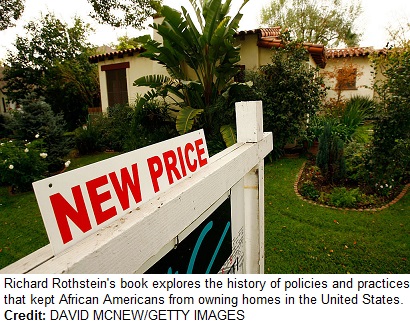
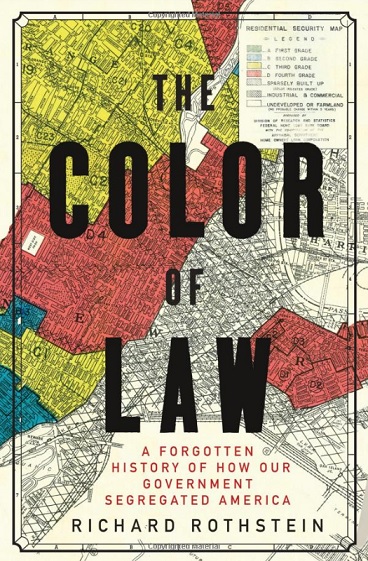
This is the claim of the new book The Color of Law: A Forgotten History of How Our Government Segregated America – by author Richard Rothstein. This is the America today. See the review of this book here:
Book Review: The Color of Law: A Forgotten History of How Our Government Segregated America – 1st EditionBy Author: Richard Rothstein
“Rothstein has presented what I consider to be the most forceful argument ever published on how federal, state, and local governments gave rise to and reinforced neighborhood segregation.” ― William Julius Wilson
In this groundbreaking history of the modern American metropolis, Richard Rothstein, a leading authority on housing policy, explodes the myth that America’s cities came to be racially divided through de facto segregation―that is, through individual prejudices, income differences, or the actions of private institutions like banks and real estate agencies. Rather, The Color of Law incontrovertibly makes clear that it was de jure segregation―the laws and policy decisions passed by local, state, and federal governments―that actually promoted the discriminatory patterns that continue to this day.
Through extraordinary revelations and extensive research that Ta-Nehisi Coates has lauded as “brilliant” (The Atlantic), Rothstein comes to chronicle nothing less than an untold story that begins in the 1920s, showing how this process of de jure segregation began with explicit racial zoning, as millions of African Americans moved in a great historical migration from the south to the north.
As Jane Jacobs established in her classic The Death and Life of Great American Cities, it was the deeply flawed urban planning of the 1950s that created many of the impoverished neighborhoods we know. Now, Rothstein expands our understanding of this history, showing how government policies led to the creation of officially segregated public housing and the demolition of previously integrated neighborhoods. While urban areas rapidly deteriorated, the great American suburbanization of the post–World War II years was spurred on by federal subsidies for builders on the condition that no homes be sold to African Americans. Finally, Rothstein shows how police and prosecutors brutally upheld these standards by supporting violent resistance to black families in white neighborhoods.
The Fair Housing Act of 1968 prohibited future discrimination but did nothing to reverse residential patterns that had become deeply embedded. Yet recent outbursts of violence in cities like Baltimore, Ferguson, and Minneapolis show us precisely how the legacy of these earlier eras contributes to persistent racial unrest. “The American landscape will never look the same to readers of this important book” (Sherrilyn Ifill, president of the NAACP Legal Defense Fund), as Rothstein’s invaluable examination shows that only by relearning this history can we finally pave the way for the nation to remedy its unconstitutional past.
The author was a guest on a radio-talk show NPR’s 1A, where he articulated a lot of these fine points from his book; he was joined by other guests that are Subject Matter Experts in this American drama. See-listen to the PODCAST here:
Posted May 10, 2017 – How more than a century of housing segregation has left the nation starkly divided by race.
This is the America that many Caribbean citizens – our Black-and-Brown – flee to looking for refuge from Caribbean life. The book Go Lean…Caribbean posits that these ones jump from the “frying-pan into the fire”.
What’s more the Go Lean book asserts – in the quest to lower the rate of societal abandonment – that it is easier to remediate social defects like these in the Caribbean homeland than to “Come to America” thinking that the “grass is greener”.
It is not!
This was the declaration from this previous blog-commentary from the movement behind the book Go Lean…Caribbean. This quotation from that previous blog is spot on:
The Caribbean Diaspora have fled their Caribbean homelands over past decades in search of better economic opportunities. It is now the conclusion that many of these “lands of refuge” are rigged in favor of certain ethnic groups; those groups do not include the “Black-and-Brown” of the Caribbean. This commentary has relayed, repeatedly, that this Caribbean-bred demographic can do better at home … in the Caribbean.
The United States of America has been the best economic manifestation in the history of mankind, (as declared in the book Go Lean…CaribbeanPage 67), yet the experience has not been the same for all of its citizens. This definitely applies to the “black and brown” populations. The Caribbean Diaspora fits this classification and their experience fits 100% to the events related in the foregoing news article.
The US is the “land of the free and the home of the brave”, but some restrictions apply. This reality is not new, as racial disparities have long existed in the history of America. But after a major social revolution in the 1960’s, positive change came to American minorities, following by decades of progress.
Then 2008 happened …
That year saw the crisis of the Great Recession where American society lost $11 Trillion in net worth; then later regained $13.5 Trillion; (Go Lean book Page 69). According to the foregoing article, the Great Recession losses were not evenly distributed; nor was the subsequent recovery – those who lost the net worth (Middle Class) were not the ones who recovered (One Percent).
How the recession turned owners into renters and obliterated Black American wealth.
In 2005, three years before the Great Recession, the median black household had a net worth of $12,124. Yes, this was far behind the median white household—which had a net worth of $134,992—but it was a huge improvement from previous decades, in which housing discrimination made wealth accumulation difficult (if not impossible) for the large majority of African-American families.
By the official end of the recession in 2009, median household net worth for blacks had fallen to $5,677—a generation’s worth of hard work and progress wiped out. (The number for whites, by comparison, was $113,149.) Overall, from 2007 to 2010, wealth for blacks declined by an average of 31 percent, home equity by an average of 28 percent, and retirement savings by an average of 35 percent. By contrast, whites lost 11 percent in wealth, lost 24 percent in home equity, and gained 9 percent in retirement savings. According to a 2013 report[a] by researchers at BrandeisUniversity, “half the collective wealth of African-American families was stripped away during the Great Recession.”
It was a startling retrenchment, creating the largest wealth, income, and employment gaps since the 1990s. And, if a new study[b] from researchers at CornellUniversity and RiceUniversity is any indication, these gaps are deep, persistent, and difficult to eradicate.
In the study, called “Emerging Forms of Racial Inequality in Homeownership Exit, 1968–2009,” sociologist Gregory Sharp and demographer Matthew Hall examine the relationship between race and risk in homeownership. Simply put, African-Americans are much more likely than whites to switch from owning homes to renting them.
“The 1968 passage of the Fair Housing Act outlawed housing market discrimination based on race,” explained Sharp in a press release. “African-American homeowners who purchased their homes in the late 1960s or 1970s were no more or less likely to become renters than were white owners. However, emerging racial disparities over the next three decades resulted in black owners who bought their homes in the 2000s being 50 percent more likely to lose their homeowner status than similar white owners.”
This wasn’t a matter of personal irresponsibility. Even after adjusting for socio-economic characteristics, debt loads, education, and life-cycle traits like divorce or job loss, blacks were more likely to lose their homes than whites.
If you’re familiar with American history and housing policy, this shouldn’t come as a surprise. The explicit housing discrimination of the mid-20th century has left a mark—arguably a scar—on the landscape of American homeownership. The combination of red-lining, block-busting, racial covenants, and other discriminatory measures means that, even now, a majority of blacks live in neighborhoods with relatively poor access to capital and mortgage loans. What’s more, this systematic discrimination has left many black households unable to afford down payments or other housing costs, even if loans are available.
And in the event that black households are able to save and afford a home, they aren’t as financially secure as their white counterparts. To wit, middle-class African-Americans are more likely to belong to the lower middle class of civil servants and government workers—professions that, in the last five years, have been slashed as a consequence of mass public-sector downsizing[c]. All else being equal, a black schoolteacher who loses her job to budget cuts is less likely to have savings—and thus a safety net—than her white counterpart.
But this isn’t just a story of legacies and effects. In addition to showing the consequences of past discrimination, Sharp and Hall argue that African-Americans have been victimized by a new system of market exploitation. Banks like Wells Fargo steered[d] blacks and other minorities into the worst subprime loans, giving them less favorable terms than whites and foreclosing on countless homes. In a 2012 lawsuit [e], the ACLU and National Consumer Law Center alleged that the now-defunct New Century Financial, working with Morgan Stanley, pushed thousands of black borrowers into the riskiest loans, leaving many in financial ruin. As early as 2005, the Wall Street Journal reported [f] that blacks were twice as likely to receive subprime loans. And in a New York University study published last year [g], researchers found that black and Hispanic families making more than $200,000 a year were more likely to receive subprime loans than white families making less than $30,000.
Together, all of this means that—according to Sharp and Hall—African-Americans are 45 percent more likely than whites to lose their homes. That means they’re more likely to lose their accumulated wealth and to slide down the income ladder, and less likely to pass the advantages of status and mobility to their children.
Apropos of that observation, recent data from the Bureau of Labor Statistics [h] shows an incredible level of youth unemployment for blacks and Latinos. More than 21 percent of African-Americans aged 16 to 24 are out of work, compared with a national average of 14.2 percent. For black teenagers in particular, joblessness soars to nearly 40 percent. It’s a catastrophe with serious economic consequences. The Center for American Progress estimates [i] that the young adults who experienced long-term unemployment during the worst of the recession will lose more than $20 billion in earnings over the next 10 years. And given the slow recovery, odds are good they’ll never recover those lost earnings.
It’s tempting to treat these as subsets of broader problems: poor assistance to homeowners and too much austerity. But they’re not. Even during the boom economy of the 1990s, black employment lagged behind the national average. And the racial wealth gap is a persistent fact of American life.
Likewise, the challenges of black homeownership are a function of discriminatory housing policy [j], as are a whole host of other problems, from mass incarceration and overly punitive policing to poor air quality [k] and food access. These challenges are heavily location-dependent, which is another way to say they are heavily racialized and most prevalent in the segregated, working-class or low-income communities that characterize life for most African-Americans [l], even those with middle-class incomes.
For reasons both political and ideological, it’s nearly verboten in mainstream conversation to argue that racialized problems require race-conscious solutions. Knowing what we know about the demographics of foreclosures, for example, we should ensure any program to help underwater homeowners includes a specific measure to assist black victims of predatory lending, who may need additional help to get on sure footing.
For more than anyone else, this is a message for liberals and progressives, who—for all of their racial sensitivity—are still reluctant to tackle the economic dimensions of racism, even as they represent the vast majority of nonwhite voters and draw critical support from African-American constituencies. It’s how Elizabeth Warren could give “11 Commandments for Progressives” [m] —and receive huge applause—without mentioning the deep problems of racial inequality. One of her commandments is “that no one should work full-time and still live in poverty, and that means raising the minimum wage.” But solving this problem for African-Americans and Latinos—who tend to live in areas that are segregated from job opportunities—is very different than solving it for whites.
While conservatives and Republicans can play a role here, it’s Democrats who are committed to reducing income inequality and bringing balance to our lopsided economic system. Success on those fronts requires a return to race-conscious policymaking, from programs to increase the geographic mobility of low-income workers—relocation grants for individuals or transportation grants for communities with a spatial mismatch between jobs and housing—to public works programs aimed at low-income minority communities, to race-based affirmative action as a way to boost a flagging black middle class.
There’s little in American life that escapes the still-powerful pull of past and present racism, and effective policymaking—to say nothing of effective problem-solving—requires a response to that racism. Otherwise, we entrench the same disparities for a new generation.
The points of this foregoing article aligns with the Go Lean book and the collection of blogs-commentaries. The book posits that the crisis persists for the Caribbean and their Diaspora in North America and Europe. What’s more, this movement asserts that this crisis, any crisis, is a terrible thing to waste.
The Caribbean Diaspora have fled their Caribbean homelands over past decades in search of better economic opportunities. It is now the conclusion that many of these “lands of refuge” are rigged in favor of certain ethnic groups; those groups do not include the “Black-and-Brown” of the Caribbean. This commentary has relayed, repeatedly, that this Caribbean-bred demographic can do better at home … in the Caribbean. The following are related previous posts:
Unfortunately for the Caribbean, this societal abandonment has continued. Analysis by the Inter-American Development Bank asserts that the Caribbean continues to endure a brain drain of 70% among the college educated population; (https://goleancaribbean.com/blog/?p=1433).
In addition to economics, there is the concern for security and justice. This blog entry (https://goleancaribbean.com/blog/?p=546) related the dual standards of justice in the US, where all men are treated as equals (wink-wink), just some are more equal than others.
Yes, as the old adage relates: “the grass is not greener on the other side”. See this VIDEO here (Part 1 of 2):
The assertion of the book Go Lean…Caribbean is that once the proposed empowerments are put in place, the Caribbean Diaspora should consider repatriating to their ancestral homelands.
Social Scientists maintain that when animals/mammals are confronted with threats, they have to choose between (stand and) fight or flight. For 50 years, the Caribbean citizens have defaulted to flight. Change has now come to the Caribbean. The book Go Lean…Caribbean serving as a roadmap for the introduction and implementation of the technocratic Caribbean Union Trade Federation (CU), hereby presents “stand and fight” options. This roadmap will spearhead the elevation of Caribbean society. The prime directives of the CU are presented as the following 3 statements:
Optimization of the economic engines in order to grow the regional economy & create 2.2 million new jobs at home.
Establishment of a security apparatus to protect the resultant economic engines.
Improve Caribbean governance to support these engines.
The book posits that the improved conditions projected over the 5 years of the roadmap will neutralize the impetus for Caribbean citizens to flee, identified as “push and pull” factors. This point is stressed early in the book (Page 13) in the following pronouncements in the Declaration of Interdependence:
xix. Whereas our legacy in recent times is one of societal abandonment, it is imperative that incentives and encouragement be put in place to first dissuade the human flight, and then entice and welcome the return of our Diaspora back to our shores. This repatriation should be effected with the appropriate guards so as not to imperil the lives and securities of the repatriated citizens or the communities they inhabit. The right of repatriation is to be extended to any natural born citizens despite any previous naturalization to foreign sovereignties.
xx. Whereas the results of our decades of migration created a vibrant Diaspora in foreign lands, the Federation must organize interactions with this population into structured markets. Thus allowing foreign consumption of domestic products, services and media, which is a positive trade impact. These economic activities must not be exploited by others’ profiteering but rather harnessed by Federation resources for efficient repatriations.
This foregoing article highlights the new realities ushered into the world as a result of the events of the Year 2008. The Go Lean book focuses heavy on this subject, even identifying this as a motivation in the same Declaration of Interdependence early in the book (Page 13):
xxv. Whereas the legacy of international democracies had been imperiled due to a global financial crisis, the structure of the Federation must allow for financial stability and assurance of the Federation’s institutions. To mandate the economic vibrancy of the region, monetary and fiscal controls and policies must be incorporated as proactive and reactive measures. These measures must address threats against the financial integrity of the Federation and of the member-states.
The Go Lean roadmap proposes a community ethos in which economic principles are recognized as playing a crucial role in the chain-of-events that led to fight-or-flight decisions for Caribbean Diaspora. (These principles were always the reality, just not professionally managed as such). These principles are identified and qualified (Page 21) as follows:
1. People Choose
2. All Choices Involve Costs
3. People Respond to Incentives in Predictable Ways
4. Economic Systems Influence Individual Choices and Incentives
5. Voluntary Trade Creates Wealth
6. The Consequences of Choices Lie in the Future
These principles cannot be glossed over or handled lightly; this is why the Go Lean book contains 370 pages of finite details for managing economic change in the region. In addition to the assessments of the region’s standings, the book contains the following sample of community ethos, strategies, tactics, implementations and advocacies to impact the Caribbean homeland:
Community Ethos – Job Multiplier
Page 22
Community Ethos – Lean Operations
Page 24
Community Ethos – Return on Investments
Page 24
Community Ethos – Ways to Impact the Future
Page 26
Strategy – Competition – Remain Home –vs- Emigrate
Page 49
Strategy – Agents of Change – Aging Diaspora
Page 57
Tactical – Growing the Caribbean Economy to $800 Billion
Page 67
Tactical – Separation of Powers – Versus Member-States Governments
Page 71
Implementation – Year 1 / Assemble Phase
Page 96
Implementation – Ways to Deliver
Page 109
Implementation – Ways to Better Manage Debt
Page 114
Implementation – Trade Mission Objectives
Page 116
Implementation – Reasons to Repatriate
Page 118
Anecdote – Experiences of a Repatriated Resident
Page 126
Planning – 10 Big Ideas for the Caribbean Region
Page 127
Planning – Lessons Learned from 2008
Page 136
Advocacy – Ways to Grow the Economy
Page 151
Advocacy – Ways to Create Jobs
Page 152
Advocacy – Ways to Improve Credit Ratings
Page 155
Advocacy – Ways to Improve Housing
Page 161
Advocacy – Ways to Impact Wall Street
Page 200
Anecdote – Experiences of Diaspora Member Living Abroad
Page 216
Advocacy – Ways to Impact the Diaspora
Page 217
Advocacy – Ways to Help the Middle Class
Page 223
Appendix – Caribbean Emigration Statistics
Page 269
Appendix – Credit Ratings Agencies Role in 2008
Page 276
The Go Lean roadmap has simple motives: fix the problems in the homeland to make the Caribbean a better place to live, work and play. We want to keep Caribbean citizens in the Caribbean. There should be no need to go abroad and try to foster an existence in a foreign land. There is heavy-lifting wherever a person resides. Let’s do the “lifting” here, where at least we are at home and we are treated equitably.
Too many people left, yet have too little to show for it. Now is the time for all of the Diaspora (those in the US, and other countries) to lean-in for the empowerments described in the book Go Lean … Caribbean. We understand your pain, we have been impacted too. (The publishers of the book were entrenched in the Wall Street culture in 2008). This Big Idea now is to use thesame energy and innovation to create solutions for Main Street – but not Main Street USA, rather Main Street Caribbean.
This is a dramatic change for the Caribbean, one that is overdue, an invitation to build an elevated society in the Caribbean that many had fled to find elsewhere, yet failed. We can make the Caribbean a better place to live, work and play. We can succeed here.
Sign the petition to lean-in for the roadmap for the Caribbean Union Trade Federation.
———————————————————————————————–
Appendices:
a. Retrieved from https://www.evernote.com/shard/s4/sh/2f378f98-d21b-4f5b-89d4-c3a47419b0ad/479f14e61917697b135246e01d20f85f
b. Retrieved from http://news.rice.edu/2014/07/22/african-american-homeownership-increasingly-less-stable-and-more-risky-2/
c. Retrieved from http://www.epi.org/publication/public-sector-job-losses-unprecedented-drag/
d. Retrieved from http://articles.baltimoresun.com/2012-07-12/news/bs-md-ci-wells-fargo-20120712_1_mike-heid-wells-fargo-home-mortgage-subprime-mortgages
e. Retrieved from http://www.citylab.com/housing/2012/10/did-big-banks-subprime-mortgage-crisis-violate-civil-rights-law/3598/
f. Retrieved from http://online.wsj.com/news/articles/SB111318092881303093
g. Retrieved from http://www.citylab.com/housing/2013/08/blacks-really-were-targeted-bogus-loans-during-housing-boom/6559/
h. Retrieved from http://www.npr.org/blogs/codeswitch/2014/07/21/329864863/the-youth-unemployment-crisis-hits-african-americans-hardest
i. Retrieved from http://www.americanprogress.org/issues/labor/report/2013/04/05/59428/the-high-cost-of-youth-unemployment/
j. Retrieved from http://www.thedailybeast.com/articles/2014/03/13/how-we-built-the-ghettos.html
k. Retrieved from http://grist.org/climate-energy/before-repairing-the-climate-well-have-to-repair-the-impacts-of-racism/
l. Retrieved from http://www.slate.com/articles/news_and_politics/politics/2014/04/desean_jackson_richard_sherman_and_ black_american_economic_mobility_why.html
m. Retrieved from http://www.vox.com/2014/7/21/5918063/elizabeth-warrens-11-commandments-for-progressives-show-democrats
… and you’ll hear the pun that Star Wars fans worldwide have turned into a rallying cry to proclaim their love of the saga. It’s the worldwide day to say “May the Force be with you” to all, and celebrate the beloved Star Wars story that binds our galaxy together.
One of the earliest known records of “May the 4th” used in popular culture is in 1979, as described here by author Alan Arnold while he was chronicling the making of The Empire Strikes Back for Lucasfilm:
Friday, May 4, 1979 – “Margaret Thatcher has won the election and become Britain’s first woman prime minister. To celebrate their victory her party took a half page of advertising space in the London Evening News. This message, referring to the day of victory, was ‘May the Fourth Be With You, Maggie. Congratulations,’ further proof of the extent to which ‘Star Wars’ has influenced us all.”
Once the Internet allowed Star Wars fans around the world to connect with one another, May the 4th soon became a grassroots tradition each year, with fans online and offline proclaiming it “Star Wars Day.”
While the idea of May the 4th did not start with Lucasfilm, the film company that created Star Wars has fully embraced the spirit of fandom that makes the day so special. StarWars.com as well as the official Star Wars social media channels (hashtag #StarWarsDay) help spread the word and showcase fan activity. More and more official partners have offered sales, giveaways and exclusives, and have hosted parties and other activities to mark the day.
In the Caribbean, we need a hero, we need lots of heroes …
… need a hero
I’m holding out for a hero ’til the end of the night
He’s gotta be strong
And he’s gotta be fast
And he’s gotta be fresh from the fight
I need a hero
I’m holding out for a hero ’til the morning light
He’s gotta be sure
And it’s gotta be soon
And he’s gotta be larger than life
(Song by Bonnie Tyler 1984; see VIDEO & Lyrics at https://youtu.be/OBwS66EBUcY; see Appendix)
We must reform and transform our Caribbean society. We know that one person – a hero – can make a difference, and we need to encourage those contributions.
Heroes are not born, they are forged. According to noted Mythologist Joseph Campbell, hero candidates go through a consistent pattern of a journey to become bona-fide heroes.
Who is Joseph Campbell and why does his opinion matter? He is the inspiration behind the big hit movie franchise Star Wars. All things Star Wars are en vogue right now. According to IMDB.com, this movie which opened just days ago – Star Wars Episode 7 “The Force Awakens”; (see Appendix) – had the biggest US box office opening of any movie … ever. See the box office results here in the photo, retrieved December 22, 2015.
This is an amazing feat, considering that Joseph Campbell has been dead since 1987. But Star Wars creator, George Lucas drew his story-line from Joseph Campbell’s inspirations in the cataloging of the “Hero’s Journey” in his writings. See article here:
Title: Role Model Joseph Campbell In 1949 Joseph Campbell (1904-1987) made a big splash in the field of mythology with his book The Hero With a Thousand Faces. This book built on the pioneering work of German anthropologist Adolph Bastian (1826-1905), who first proposed the idea that myths from all over the world seem to be built from the same “elementary ideas.” Swiss psychiatrist Carl Jung (1875-1961) named these elementary ideas “archetypes,” which he believed to be the building blocks not only of the unconscious mind, but of a collective unconscious. In other words, Jung believed that everyone in the world is born with the same basic subconscious model of what a “hero” is, or a “mentor” or a “quest,” and that’s why people who don’t even speak the same language can enjoy the same stories.
Jung developed his idea of archetypes mostly as a way of finding meaning within the dreams and visions of the mentally ill: if a person believes they are being followed by a giant apple pie, it’s difficult to make sense of how to help them. But if the giant apple pie can be understood to represent that person’s shadow, the embodiment of all their fears, then the psychotherapist can help guide them through that fear, just as Yoda guided Luke on Dagoba. If you think of a person as a computer and our bodies as “hardware,” language and culture seem to be the “software.” Deeper still, and apparently common to all homo sapians, is a sort of built-in “operating system” which interprets the world by sorting people, places, things and experiences into archetypes.
Campbell’s contribution was to take this idea of archetypes and use it to map out the common underlying structure behind religion and myth. He proposed this idea in The Hero With a Thousand Faces, which provides examples from cultures throughout history and all over the world. Campbell eloquently demonstrates that all stories are expressions of the same story-pattern, which he named the “Hero’s Journey,” or the “monomyth.” This sounds like a simple idea, but it suggests an incredible ramification, which Campbell summed up with his adage “All religions are true, but none are literal.” That is, he concluded that all religions are really containers for the same essential truth, and the trick is to avoid mistaking the wrappings for the diamond.
[Star Wars Creator George] Lucas had already written two drafts of Star Wars when he rediscovered Joseph Campbell’s The Hero With a Thousand Faces in 1975 (having read it years before in college). This blueprint for “The Hero’s Journey” gave Lucas the focus he needed to draw his sprawling imaginary universe into a single story.
Note that the Wachowski Brothers’ wonderful film The Matrix is carefully built on the same blueprint:
Campbell
Star Wars
The Matrix
I: Departure
The call to adventure
Princess Leia’s message
“Follow the white rabbit”
Refusal of the call
Must help with the harvest
Neo won’t climb out window
Supernatural aid
Obi-wan rescues Luke from sandpeople
Trinity extracts the “bug” from Neo
Crossing the first threshold
Escaping Tatooine
Neo is taken out of the Matrix for the first time
The belly of the whale
Trash compactor
Torture room
II: Initiation
The road of trials
Lightsaber practice
Sparring with Morpheus
The meeting with the goddess
Princess Leia (wears white, in earlier scripts was a “sister” of a mystic order)
The Oracle
Temptation away from the true path1
Luke is tempted by the Dark Side
Cypher (the failed messiah) is tempted by the world of comfortable illusions
Atonement with the Father
Darth and Luke reconcile
Neo rescues and comes to agree (that he’s The One) with his father-figure, Morpheus
Apotheosis (becoming god-like)
Luke becomes a Jedi
Neo becomes The One
The ultimate boon
Death Star destroyed
Humanity’s salvation now within reach
III: Return
Refusal of the return
“Luke, come on!” Luke wants to stay to avenge Obi-Wan
Neo fights agent instead of running
The magic flight
Millennium Falcon
“Jacking in”
Rescue from without
Han saves Luke from Darth
Trinity saves Neo from agents
Crossing the return threshold
Millennium Falcon destroys pursuing TIE fighters
Neo fights Agent Smith
Master of the two worlds
Victory ceremony
Neo’s declares victory over machines in final phone call
But one can argue, these are just movies, “make believe”; these are not real people nor real life. That would be a true statement of facts (there is no “Luke Skywalker” nor “Neo” as historical characters), but the principles of a “Hero’s Journey” is real, and present in real life. This is just another example of “life imitating art”. In a previous blog-commentary regarding Caribbean Diaspora member and Hollywood great, Sidney Poitier, it was declared that …
“Movies are an amazing business model. People give money to spend a couple of hours watching someone else’s creation and then leave the theater with nothing to show for the investment; except perhaps a different perspective”.
These movies do bring a different perspective. According to the foregoing, there are Three Acts to the “Hero’s Journey”:
I. Departure II. Initiation III. Return
The publishers of the book Go Lean…Caribbean recognize the one person can make positive, heroic contributions to his community; and that this role must be forged in society. The book serves asa roadmap for the introduction and implementation of the Caribbean Union Trade Federation (CU). The CU seeks to foster the genius qualifiers in Caribbean citizens. Not everyone can be heroes, but society must be structured to allow heroes to soar. Because …
… one man (or woman) can make a difference! Such a person can impact their community, country … and the whole world.
“The only thing necessary for the triumph of evil is for good men to do nothing” – Edmund Burke; 1729 – 1797; an Irish statesman, member of British Parliament and supporter of the American Revolution.
The Caribbean has fostered the hero process, but according to the Three Acts established by Joseph Campbell, our heroes stopped at Act II, they do not “Return”.
They make their heroic contributions to other communities and not their homeland. The Caribbean, thusly “fattens frogs for snakes”. Consider the bad consequences of this reality, as in our brain drain among the college-educated population, which is up to a 70% rate within the entire region.
A quest of the Go Lean/CU roadmap is to lower the “Push and Pull” factors that causes so many Caribbean citizens to flee their beloved homeland. In addition, another quest is to incentivize the far-flung Diaspora to return to the Caribbean. Success in these quests will take a “Hero’s Journey”.
The villain in this real-life story is the poor performing Caribbean economy. So the prime directive of the Go Lean book is to elevate Caribbean society, and its societal engines … defined in these declarative statements, as follows:
Optimization of the economic engines in order to grow the regional economy and create 2.2 million new jobs.
Establishment of a security apparatus to protect the resultant societal engines again foreign and domestic threats.
Improvement Caribbean governance to support these engines.
The Go Lean book posits that one person, despite their field of endeavor, can make a difference in the Caribbean, and its impact on the world; that there are many opportunities where one advocate, one champion, one “hero” can elevate society. In this light, the book features 144 different advocacies, so there is inspiration for the “next hero” to emerge and excel right here at home in the Caribbean.
The roadmap specifically encourages the region to lean-in, to foster heroes and champions with these specific community ethos, strategies, tactics, implementations and advocacies:
Community Ethos – Forging Change
Page 20
Community Ethos – People Respond to Incentives in Predictable Ways
Page 21
Community Ethos – Economic Systems Influence Individual Choices
Strategy – Mission – Protect Repatriates with heightened Public Safety
Page 45
Anatomy of Advocacies – Examples of Individuals Who Made Impact
Page 122
Planning – Ways to Make the Caribbean Better
Page 131
Advocacy – Ways to Improve Governance
Page 168
Advocacy – Ways to Better Manage the Social Contract
Page 170
Advocacy – Ways to Improve Leadership
Page 171
Advocacy – Ways to Impact Justice
Page 177
Advocacy – Ways to Remediate and Mitigate Crime
Page 178
Advocacy – Ways to Impact Hollywood – Global Box Office – Imitating Life
Page 203
Advocacy – Ways to Preserve Caribbean Heritage
Page 218
Advocacy – Ways to Improve the Arts
Page 230
The Caribbean region wants a more optimized society.
This book posits that “bad actors” – even villains: the “Dark Side of the Force” – will emerge to exploit inefficient economic, security and governing models. Early in the book, the pressing need to streamline protections – for citizens and institutions – was pronounced in the Declaration of Interdependence (Page 12), with these opening statements:
x. Whereas we are surrounded and allied to nations of larger proportions in land mass, populations, and treasuries, elements in their societies may have ill-intent in their pursuits, at the expense of the safety and security of our citizens. We must therefore appoint “new guards” to ensure our public safety and threats against our society, both domestic and foreign.
xi. Whereas all men are entitled to the benefits of good governance in a free society, “new guards” must be enacted to dissuade the emergence of incompetence, corruption, nepotism and cronyism at the peril of the people’s best interest. The Federation must guarantee the executions of a social contract between government and the governed.
xii. Whereas the legacy in recent times in individual states may be that of ineffectual governance with no redress to higher authority, the accedence of this Federation will ensure accountability and escalation of the human and civil rights of the people for good governance, justice assurances, due process and the rule of law. As such, any threats of a “failed state” status for any member state must enact emergency measures on behalf of the Federation to protect the human, civil and property rights of the citizens, residents, allies, trading partners, and visitors of the affected member state and the Federation as a whole.
xvi. Whereas security of our homeland is inextricably linked to prosperity of the homeland, the economic and security interest of the region needs to be aligned under the same governance. Since economic crimes, including … forms of terrorism, can imperil the functioning of the wheels of commerce for all the citizenry, the accedence of this Federation must equip the security apparatus with the tools and techniques for predictive and proactive interdictions.
The Go Lean book explicitly acknowledges that optimizing society is not easy; it requires strenuous, heroic efforts; heavy-lifting. That is the quest of the CU/Go Lean roadmap. Other subjects related to heroic efforts of role models have been blogged in other Go Lean…Caribbean commentaries, as sampled here:
The Go Lean roadmap posits that the CU should foster the genius potential in Caribbean citizens and incubate their potential to maximum production. We should let “heroes be heroes” in their fields of endeavor here at home, no matter how diverse. Many Caribbean Diaspora has done this exactly, abroad in benefiting other communities, while their homelands languish.
They have departed – Act I.
They have initiated as heroes – Act II.
But, they have NOT returned – no Act III.
Enough already!
The roadmap pronounces that we need the participation of many advocates on many different paths for progress. By facilitating, fostering and furthering these initiative, we can have our heroes return to be heroic at home. Only then, will the Caribbean truly become a better place to live, work and play. 🙂
This is the message the Caribbean needs to send to one of its own, Al Roker, the on-air meteorologist for NBC and co-host of the morning newscast The Today Show.
Al Roker has Caribbean roots, as a legacy of parents from the Bahamas (and Jamaica; see Appendix A). He, himself has spent a lot of time there and reflect a lot of its values. Right now, he is being a Champion for a cause that is dear to the Bahamas, and all Caribbean for that matter:
Climate Change.
See how this Caribbean Champion battled prominent Climate Change deniers in this TV broadcast here. What’s sad is the actual denier in this case is Scott Pruitt, the Head of the American federal government environmental Watch-Dog, the EPA (Environmental Protection Agency).
America may have the luxury of “sticking its head in the sand” and not deal with Climate Change, but for those of us in the Caribbean, we do not have that luxury – we have a Clear-and-Present Danger right now.
See the news article and VIDEO of this champion’s defense:
Title:Al Roker Debunks EPA Head Scott Pruitt’s Stunning Denial On Human-Caused Climate Change Sub-title: Roker: “No Credible Science Or Scientist” Would Support Pruitt’s Assertion CO2 Is Not A Primary Contributor To Global Warming By: Media Matters Staff
NBC weatherman Al Roker debunked EPA head Scott Pruitt’s false claim that carbon dioxide is not a primary contributor to global warming during an appearance on MSNBC Live, explaining that there is “no credible science or scientist” to support Pruitt’s statement.
During the March 10 segment, Roker addressed Pruitt’s comments on the March 9 edition CNBC’s Squawk Box in which Pruitt said “I would not agree” that CO2 is “a primary contributor to the global warming that we see” — a statement completely at odds with the consensus among climate scientists that human activity is the primary cause of climate change.
To rebut Pruitt’s statements, Roker referenced an interview he recently conducted with climate scientist Dr. Marshall Shepherd, who explained that “greenhouse gases are in fact the primary forcing function on a warming climate system. … their fingerprint is there on our naturally varying climate in the same way steroids were on the naturally varying cycle of home runs during the Major League Baseball era.”
Roker also stated “there is no credible science or scientist” that would back up Pruitt’s assertion. Indeed, a number of climate scientists have weighed in on Pruitt’s statement, stating Pruitt’s denial “demonstrated that he is unqualified to run the EPA or any agency” and suggesting that Pruitt “talk with his own scientists and read the National Climate Assessment.”
Notably, however, NBC did not address Pruitt’s climate denial on the widely viewedToday show the same day, nor NBC Nightly News air a segment on Pruitt’s climate denial on March 9 — even though Pruitt’s denial received widespreadattentionacrossmainstreammedia.
————-
See full transcript of the interview between Al Roker and the MSNBC Host Katy Tur in Appendix B below.
This issue of monitoring, messaging and managing the stakeholders for Climate Change is an important mission for the movement behind the book Go Lean … Caribbean. The book presents the Caribbean region a roadmap to elevate its societal engines – economics, security and governance – and to be prepared for the Agents of Change impacting daily life in the Caribbean homeland. In total, the book identified these 4 Change Agents:
Technology
Globalization
Aging Diaspora
Climate Change
As a region, we are able to employ mitigations and remediation for all of these agents except for Climate Change. We are all small countries, nowhere on the list of “Big Polluters”, like the US (#2) and China (#1). We have neither a voice nor a vote in those countries, yet we need them to take the issue of Climate Change remediation seriously. Messaging is key! We need people like “Al Roker” – daily audience of 4 to 9 million people – speaking truth to power … on our behalf.
This advocacy – to proclaim impending danger to life and limb – is part of a new effort to elevate the societal engines of the Caribbean. This started with the Go Lean…Caribbean book and is being followed up by this and many other blog-commentaries. See here a sample of previous submissions heralding the need for the Caribbean region to be “on guard” for the imminent threats from Climate Change:
The Go Lean book serves as a roadmap for the introduction and implementation of the Caribbean Union Trade Federation (CU) as an inter-government agency for 30 regional member-states. This confederation will provide a technocratic stewardship for all the societal engines in the Caribbean. In fact, the prime directives of the roadmap includes the following 3 statements:
Optimization of the economic engines in order to grow the regional economy to $800 Billion & create 2.2 million new jobs.
Establishment of a security apparatus to ensure public safety and to protect the resultant economic engines – including an Emergency Management functionality.
Improve Caribbean governance to support these engines, including a separation-of-powers mantra between the member-states and CU federal agencies.
Overall, the Go Lean book stresses the community ethos, strategies, tactics, implementations and advocacies to reboot, reform and transform the economic engines of Caribbean society.
What do we do now?
While we hope, pray and lobby the big polluting nations to do more, we have to prepare our Caribbean communities for the imminent onslaughts.
In previous blogs, this commentary cautioned the stakeholders in the Caribbean region, as follows:
Crap Happens! Prepare – The peril of a Climate Change-fueled hurricane is now a constant threat for Caribbean life, for all 30 member-states. It is assured that some Caribbean location will be impacted every year. While there is no guarantee for a strike “here or there”, there is a guarantee that there will be a strike somewhere.
Do Not be Hypocritical – Go ‘Green’ – If excessive carbon in the atmosphere by the Big Polluters is the culprit for infusing Greenhouse Gases, then we, as a region of small countries, need to do our share and set a good example of lowering our carbon footprint. Though our numbers are too small to make an impact, it does send the message that we are willing to “swallow the hard pill/take the medicine” ourselves that we are asking the Big Polluting nations to endure.
The global crisis of Climate Change is impacting all aspects of Caribbean life: economics, security (disaster preparation and response) and governance. A comprehensive view of the challenges befalling our region is the charge of the Go Lean roadmap, opening with these pronouncements in the Declaration of Interdependence (Page 11 and 12):
i. Whereas the earth’s climate has undeniably changed resulting in more severe tropical weather storms, it is necessary to prepare to insure the safety and security of life, property and systems of commerce in our geographical region. As nature recognizes no borders in the target of its destruction, we also must set aside border considerations in the preparation and response to these weather challenges.
viii. Whereas the population size is too small to foster good negotiations for products and commodities from international vendors, the Federation must allow the unification of the region as one purchasing agent, thereby garnering better terms and discounts.
x. Whereas we are surrounded and allied to nations of larger proportions in land mass, populations, and treasuries, elements in their societies may have ill-intent in their pursuits, at the expense of the safety and security of our citizens. We must therefore appoint “new guards” to ensure our public safety and threats against our society, both domestic and foreign. …
Now is the time for all stakeholders – residents, governments, Diaspora, scientists, disaster planners, etc. – in the Caribbean to lean-in for the empowerments described here-in and in the book Go Lean … Caribbean. Climate Change is the Number One threat for our society; for the whole world actually, but we are on the frontlines. “We must protect this house”. We must be better and do better and help to make our homelands better places to live, work and play. 🙂
Sign the petition to lean-in for the roadmap for the Caribbean Union Trade Federation.
———-
Appendix A – Al Roker’s Earliy Life
Al Roker was born in Queens, New York,[4] the son of Isabel, of Jamaican descent, and Albert Lincoln Roker, Sr.,[5] a bus driver of Bahamian descent.[6] Roker initially wanted to be a cartoonist.[5] He was raised Catholic[5] (in the faith of his mother) and graduated from Xavier High School in Manhattan.[7] He worked on several projects as a member of the school’s Cartooning & Illustration Club. He attended the State University of New York at Oswego where he received a B.A. in communications in 1976.
Appendix B – Transcript: Al Roker Interview by Host Katy Tur
KATY TUR (HOST): The head of the Environment Protection Agency stunned many when he denied carbon dioxide is a primary contributor to global warming.
[…]
TUR: Today show host and weatherman, a man who needs no introduction, Al Roker joins me now. “Stunned many” is a bit of an understatement, said most almost all, gosh, CO2 is not a factor when it comes to climate change. Was all of the schooling that I had as a child and into my adult life completely wrong, Al Roker?
AL ROKER: No, it wasn’t wrong and there is no credible science or scientist who will tell you the contrary. The fact is, carbon dioxide, the greenhouse gases is responsible for climate change.
TUR: No scientist will say this, but we’re having the EPA head say this?
ROKER: Well, look, this is America and you can make whatever statements you want to, but everybody will pretty much agree — in fact, just about an hour ago I interviewed one of the leading climate scientists in this country, Dr. Marshall Shepherd, and here’s what he had to say about it.
[BEGIN VIDEO CLIP]
MARSHALL SHEPHERD (DIRECTOR FOR UNIVERSITY OF GEORGIA’S PROGRAM IN ATMOSPHERIC SCIENCES): The basic physics of the atmosphere suggest that greenhouse gases are in fact the primary forcing function on a warming climate system. Greenhouse gases and the impacts post-industrial age or –– industrial revolution are certainly — their fingerprint is there on our naturally varying climate in the same way steroids were on the naturally varying cycle of home runs during the Major League Bbaseball era.
[END VIDEO CLIP]
ROKER: I think that pretty much sums it it up.
TUR: Yeah, so where — if the EPA head is saying there needs to be more research, but the EPA is losing money to do research, give me the consequences. How important is it and how significant is it to have the EPA head deny something like this?
ROKER: Well I think hopefully cooler heads will prevail upon him to say we need to continue to research this. We need to continue what we’ve been doing because if you look, we’ve got a graphic that basically right around the industrial revolution, we had — there’s been no time in this history of our planet where CO2, even naturally occurring or not, was above 290 parts per million. Alright, now you look at the temperature, we put the temperature on top of that, you can see from the 1880s into the 1940s, temperatures are below average, below the global average, but once we really start to see that red line go up, as the CO2 starts to increase, you can see those average global temperatures continue to rise, and they peaked last year, the warmest temperature ever on record for this planet. So as we continue to add those greenhouse gases — now, that’s not to say that — the greenhouse gases allow us to live on this planet. Without them completely, we would freeze to death. At night we would die. So there has to be some small amount of greenhouse gases. We’re just adding too much. Source: Retrieved 04-21-2017 from: https://mediamatters.org/blog/2017/03/10/al-roker-debunks-epa-head-scott-pruitt-s-stunning-denial-human-caused-climate-change/215635
Truth be told, a Black person speaking with a British accent gets more respect than a Black person speaking with a Caribbean slang or a ‘Hip-hop’ /‘Jive’ dialect.
It is what it is! Notice this portrayal in the Appendix VIDEO where many Afro-Caribbean citizens in Britain, seem to self-identify more as British than their Caribbean heritage; (POINT 5).
Does this mean that the Black British person is better off on the world stage? Sadly no! The actuality of Blackness still means “Less Than“.
The problem is not the Blackness, but rather Whiteness, the proliferation of White Supremacy … throughout the world.
This is the assertion of the movement behind the book Go Lean … Caribbean, in consideration of reasons why the Diaspora should repatriate back to the Caribbean homeland and why the Caribbean youth should not even depart their homelands in the first place. This thesis was presented in a 9-part series, with these submissions:
All of these prior commentaries related to the disposition of the Caribbean Diaspora in the United States; now we take a look at England, Britain or the United Kingdom. There is a difference … supposedly.
“Britain has done a great job as painting itself as the humanitarian, with the US being the torturer. But that shit ain’t true.” – Patrisse Cullors, co-founder of the Black Lives Matter movement.
The purpose of this commentary – considering these source materials below – is to relate the following 5 strong points of contention; (these labels are shown throughout this commentary where applicable):
POINT 1 – The world is not fair, equal or just; and if you are of the Black-and-Brown races, the injustice is even more pronounced.
POINT 2 – Charity begins at home! There is a need to reform and transform society wherever you are. No one else will reform your homeland; you must!
POINT 3 – Leaving home, hurts home.
POINT 4 – The children of the Diaspora identify more with their current home, than their parent’s ancestral home.
POINT 5 – When the children do not want to identify with your land of heritage, it is Time to Go, to take them back home.
See this interview here relating Black British reality, with VICE News (UK Desk), the provocative media outlet that exposes the harsh realities of daily life in the Third World and the “First World”; (find more on VICE in Appendix A):
Title: We Spoke to the Activist Behind #BlackLivesMatter About Racism in Britain and America By: Michael Segalov
… Patrisse Cullors is co-founder of Black Lives Matter — the movement and oft-trending hashtag. Based in LA ([Los Angeles]), she’s been on the front line at uprisings across the US in response to a wave of high-profile deaths of black people in police custody.
[While] on a speaking tour of the UK and Ireland, heading to communities, universities, and holding meetings in Parliament. VICE caught up with Patrisse on the train from Brighton to London in the midst of a hectic schedule. VICE chatted [with her] about how she’s spreading the Black Lives Matter movement across the globe, what’s happening in the States at the moment, and why that’s relevant to the UK.
VICE: Tell us about the origins of the Black Lives Matter movement.
Patrisse Cullors: After George Zimmerman was acquitted of the murder of Trayvon Martin, back in July 2013, myself and two friends came up with the hashtag. My friend Alicia had written a love letter to folks, saying, “Our Lives Matter, Black Lives Matter.”
I put a hashtag in front—within days people were using it across the world. We’re talking about all black lives; we weren’t just talking about black men dying in the hands of the police. We’re talking about black women, black trans people, black queer people. We want to show that under the current system of white supremacy, anti-blackness has major consequences. Inside the US, and around the world, anti-black racism has global consequences. Black Lives Matter is a call to action—it’s a mantra, a testimony.
How did you end up at the heart of it? I’ve been organizing since I was 16. I came out as queer, and was kicked out of home. Along with a bunch of other young queer women of color, we raised each other. We also dealt with poverty, being black and brown in the USA, and trying to figure out how to live our daily lives. My brother was incarcerated in LA county jails at 19, and he was almost killed by the sheriffs. They beat him. They tortured him and brutalized him. This was my awakening, seeing how far the state will go, and how they treat our families.
Most disturbing was the lack of support and absolute neglect that my brother and my family faced after he was brutalized. Part of my upbringing was a feeling of rage, but I also knew I could do something about it. With my mentors, and a civil rights organization, I learned my craft over 11 years. I focused on the school-to-prison pipeline [where young people go straight from school into the juvenile criminal justice system], environmental justice, and police violence.
… You’ve been in the UK for a week, how has it been, and how does the situation here relate to the USA?
In theory the UK has a significant amount of structures to allow for accountability, of law enforcement in particular. That’s the theory. But in the US we don’t really have these structures to allow for accountability. There aren’t really independent investigators; its just very rare for prosecutions for law enforcement. And so, being here, I’ve realized, there are some systems in place that might actually be good for the US. It just seems those systems don’t work.
Then there are the similarities, the ways in which black people are treated—it’s outright racism. From Christopher Alder being brutalized on tape, hearing the officers calling him racist slurs, to the G4S guards who killed Jimmy Mubenga with racist texts on their phones. You have that same hatred, these white supremacist ideologies coming out of both of our countries. And here too, justice is not being served. We have Mike Brown, no justice. We have Eric Garner, no justice. Here we see the same: Mark Duggan, Sean Rigg. The list is vast.
Is this stuff talked about in the States, like how in the UK we’re aware over here about what’s going on in Ferguson? Here’s the thing, black people in the US don’t know what’s happening here in the UK. I’m well read, well educated, and coming here and learning these stories I’m like, “Why don’t I know about this? Why haven’t we heard?” The US is very insular. The UK has an image of being better, a humane society in which there isn’t the same level of racism. But now I have a very different perspective that I’m going to take home and talk about. Britain has done a great job as painting itself as the humanitarian, with the US being the torturer. But that shit ain’t true.
Here in the UK there’ve been solidarity actions. People shut down the streets in London and Westfield shopping center too. What’s the impact of these things for people on the ground? Do you notice? Yes, it was noticed. We’ve seen all the work folks are doing on the ground. From here, where you guys shut down Westfield, to Spain and Brazil. In Israel, African refugees are using the Black Lives Matter mantra to talk about law enforcement violence by the Israeli police. We see it, and we’re in awe. We wanted and needed it to go global.
Where is this going? What happens next? There are 23 Black Lives Matter chapters right now, in the US, Canada, and Ghana. We need to uplift the local struggles across the country, as well as pushing for greater accountability for law enforcement.
We want legislation that will see divestment from law enforcement and investing in poor communities. We want to build a national project linking families who have been impacted by state violence, with a national database that looks at individual law enforcement officers and agencies. We also want to look at how to develop a system of independent investigation. We want to figure out a victim’s bill of rights, to counter the police bill of rights. Until then, we’re gonna shut shit down. Source: VICE (UK) News; Posted February 2 2015; retrieved April 20, 2017 from: https://www.vice.com/en_us/article/patrisse-cullors-interview-michael-segalov-188?utm_source=vicetwitterus
See related VIDEO’s here on Britain’s Black History; (POINT 1 and POINT 4):
For Caribbean people, the world thinks of us as “Less Than”, whether we are in the Caribbean or in the Diaspora in the UK, Europe or North America. We take the “Less Than” brand with us wherever we go. This is a crisis! The movement behind the book Go Lean…Caribbean seeks to use this crisis, to elevate the Caribbean brand …. globally.
Why is the Caribbean brand perceived as “Less Than”?
We – the Caribbean region as a collective – must do better; be better! We can reboot, reform and transform from this bad history and bad image; (POINT 2). How?
While easier said than done, this is the comprehensive action plan of the Go Lean book. The book serves as a roadmap for the introduction of the technocratic Caribbean Union Trade Federation (CU). The CU is designed to optimize Caribbean society in the homeland – though there are many benefits to the Diaspora as well – through economic, security and governing optimizations. Therefore the Go Lean roadmap has 3 prime directives:
Optimization of the economic engines in order to grow the regional economy to $800 Billion & create 2.2 million new jobs.
Establishment of a security apparatus to ensure public safety and protect the economic engines.
Improve Caribbean governance – including empowerments for image promotion – to support these engines.
Reforming or transforming the UK, Britain or England is not within scope of the Go Lean/CU effort, notwithstanding the impact on our Diaspora there. But the subject of “Image” is inseparable from any discussion of elevating the Caribbean brand. So this commentary is on image, the facts and fiction of being a minority in a majority world or being an immigrant to a foreign country. This applies to any consideration of the Caribbean Diaspora in the British Isles, where their numbers have been reported between 4 and 5 percent of the population; (POINT 4). Consider these encyclopedic details:
British African Caribbean (or Afro-Caribbean) people are residents of the United Kingdom who are of West Indian background and whose ancestors were primarily natives or indigenous to Africa. As immigration to the United Kingdom from Africa increased in the 1990s, the term has sometimes been used to include UK residents solely of African origin, or as a term to define all Black British residents, though the phrase “African and Caribbean” has more often been used to cover such a broader grouping. The most common and traditional use of the term African-Caribbean community is in reference to groups of residents’ continuing aspects of Caribbean culture, customs and traditions in the United Kingdom.
A majority of the African-Caribbean population in the UK is of Jamaican origin; other notable representation is from Trinidad and Tobago, Saint Kitts and Nevis, Barbados, Grenada, Antigua and Barbuda, Saint Lucia, Dominica, Montserrat, Anguilla, Saint Vincent and the Grenadines, Guyana (which although located on the South American mainland is culturally similar to the Caribbean and was historically considered to be part of the British West Indies), and Belize.
African-Caribbean people are present throughout the United Kingdom with by far the largest concentrations in London and Birmingham.[1] Significant communities also exist in other population centres, notably Manchester, Bradford, Nottingham, Coventry, Luton, Slough, Leicester, Bristol, Gloucester, Leeds, Huddersfield, Sheffield, Liverpool and Cardiff. In these cities, the community is traditionally associated with a particular area, such as Brixton, Harlesden, Stonebridge, Dalston, Lewisham, Tottenham, Peckham in London, West Bowling and Heaton in Bradford, Chapeltown in Leeds,[2] St. Pauls in Bristol,[3] or Handsworth and Aston in Birmingham or Moss Side in Manchester. According to the 2011 census, the largest number of African-Caribbean people are found in Croydon, south London. Source: Retrieved April 20, 2017 from: https://en.wikipedia.org/wiki/British_African-Caribbean_people
There are a number of insights to glean looking at the demographics of the Afro-Caribbean population in the UK. (See Appendix B below). All in all, the Afro-Caribbean populations in the UK prefer to identify themselves more as British than as Caribbean; (POINT 4).
See this portrayal in the Appendix VIDEO below.
Despite the 60 years of futility, our Caribbean people continue to leave, abandoning our homeland; (POINT 3). This is bad; bad for the people and bad for the homeland. Our people “jump from the frying pan to the fire”:
Distress continues …
Oppression persists …
Image: “Less Than”!
This commentary asserts that it is easier for the Black-and-Brown populations in the Caribbean to prosper where planted in the Caribbean, rather than emigrating to foreign countries, like the UK. The reasons for the emigration in the first place have been identified as “push and pull”. “Push” refers to the societal defects in the Caribbean that drive people to move away (POINT 2); and “pull” factors refer to the impressions and perceptions that life abroad, as in England, is better. More details apply regarding these elusive “pull” factors:
The UK is NOT the #1 destination for the English-speaking Caribbean Diaspora, not anymore; that distinction is now towards the US. Today’s trending is for more and more new immigration to the US as opposed to the UK; Canada is Number 2.
While the “pull” factor had been compelling in the past, the decision-making of Caribbean emigrants – looking to flee – now needs a reality check! (POINT 1)
“Pull” is further exacerbated by the “push” factors; all of these continue to imperil Caribbean life; we push our citizens out. Then the resultant effect is a brain drain and even more endangerment to our society: less skilled workers; less entrepreneurs; less law-abiding citizens; less capable public servants – we lose our best and leave the communities with the rest. This creates even more of a crisis; (POINT 2).
The Go Lean roadmap posits that the entire Caribbean is in crisis now (POINT 3); so many of our citizens have fled for refuge in the UK and other countries, but the refuge is a mirage. The “grass is not necessarily greener on the other side”. Life in the UK is not optimized for Caribbean people. It is easier to fix the Caribbean than to fix the British eco-system. For our Diaspora there: it is Time to Go! For our populations in the Caribbean, looking to depart: Stay! Our people can more easily prosper where planted in the Caribbean … with the identified mitigations and remediation here-in.
The Go Lean book posits that Caribbean stakeholders made many flawed decisions in the past, both individually and community-wise; (POINT 2). But now, the Go Lean/CU roadmap is new (and improved). This is a vision of the CU as a confederation of the 30 member-states of the Caribbean to do the heavy-lifting of championing better nation-building policies, to reboot the region’s economic-security-governing engines. For one, there is the structure of a separation-of-powers between CU agencies and the individual member-states. So there are “two pies”, so citizens get to benefit from both their member-states’ efforts and that of the CU Trade Federation.
The Go Lean roadmap provides turn-by-turn directions on how to reform the society as a whole. This roadmap admits that because the Caribbean is in crisis, this “crisis would be a terrible thing to waste”. As a planning tool, the roadmap commences with a Declaration of Interdependence, pronouncing the approach of regional integration (Page 10 – 14) as a viable solution to elevate the regional engines:
Preamble: And while our rights to exercise good governance and promote a more perfect society are the natural assumptions among the powers of the earth, no one other than ourselves can be held accountable for our failure to succeed if we do not try to promote the opportunities that a democratic society fosters.
As the history of our region and the oppression, suppression and repression of its indigenous people is duly documented, there is no one alive who can be held accountable for the prior actions, and so we must put aside the shackles of systems of repression to instead formulate efficient and effective systems to steer our own destiny.
xi. Whereas all men are entitled to the benefits of good governance in a free society, “new guards” must be enacted to dissuade the emergence of incompetence, corruption, nepotism and cronyism at the peril of the people’s best interest. The Federation must guarantee the executions of a social contract between government and the governed.
xii. Whereas the legacy in recent times in individual states may be that of ineffectual governance with no redress to higher authority, the accedence of this Federation will ensure accountability and escalation of the human and civil rights of the people for good governance, justice assurances, due process and the rule of law. As such, any threats of a “failed state” status for any member state must enact emergency measures on behalf of the Federation to protect the human, civil and property rights of the citizens, residents, allies, trading partners, and visitors of the affected member state and the Federation as a whole.
xix. Whereas our legacy in recent times is one of societal abandonment, it is imperative that incentives and encouragement be put in place to first dissuade the human flight, and then entice and welcome the return of our Diaspora back to our shores …
xx. Whereas the results of our decades of migration created a vibrant Diaspora in foreign lands, the Federation must organize interactions with this population into structured markets. Thus allowing foreign consumption of domestic products, services and media, which is a positive trade impact. These economic activities must not be exploited by others’ profiteering but rather harnessed by Federation resources for efficient repatriations.
The Go Lean book details the community ethos to adopt, plus the executions of the strategies, tactics, implementations and advocacies to impact the eco-systems in the Caribbean region.
The book provides these recommendations in regards to the dynamics of Diaspora living:
Encourage the Caribbean Diaspora to repatriate back to their ancestral homeland – (10 Reasons to Repatriate to the Caribbean – Page 118).
Dissuade the high emigration rates of Caribbean citizens to foreign stories – (10 Ways to Make the Caribbean Better – Page 131).
These subjects (Repatriation and Diaspora) have been frequently commented on in other Go Lean blogs (POINT 4); as sampled here with these entries:
British public sector workers strike over ‘poverty pay’
The book also relates the significance of image/brand management, as with this advocacy: “10 Ways to Better Manage Image” (Page 133):
The Bottom Line on Martin, Malcolm, Mandela, Muhammad and Marley The majority of the Caribbean population descends from an African ancestry – a legacy of slavery from previous centuries. Despite the differences in nationality, culture and language, the image of the African Diaspora is all linked hand-in-hand. And thus, when Martin Luther King, Malcolm X, Nelson Mandela, Muhammad Ali and Bob Marley impacted the world with their contributions, the reverberations were felt globally, not just in their homelands. It is hard for one segment of the black world to advance when other segments have a negative global image. This is exemplified with the election of Barack Obama as US President; his election was viewed as an ascent for the entire Black race.
Overall, we must elevate the Caribbean brand. There are active movements now to accentuate the image/brand; consider:
Underlying to the Go Lean/CU prime directive of elevating the economics, security and governing engines of the Caribbean, is the desire to make the Caribbean homeland better, to reform and transform our society. If we can do this, we will dissuade the high emigration rate for our young people. But saying that it is “Time to Go“, must mean that we are ready to receive our Caribbean Diaspora from London and other British cities. Are we?
We are not! But this Go Lean roadmap gets us started. This is the intent of the book Go Lean … Caribbean.
The Go Lean/CU roadmap asserts that Britain should not be presented as the panacea for Caribbean ills – we must reform and transform our own society. While Britain or the UK does some things well, that country does not always act justly towards Black-and-Brown people of Caribbean descent; (POINT 5). We must do this ourselves (POINT 2); our region needs the empowerments here-in (jobs, economic growth and brand/image enhancement).
Now is the time for all of the Caribbean, the people and governing institutions, to lean-in for the empowerments described in the book Go Lean … Caribbean. This is the roadmap to elevate the Caribbean; to make our homeland a better place to live, work and play. 🙂
Sign the petition to lean-in for this roadmap for the Caribbean Union Trade Federation.
———–
Appendix A – Vice News
Vice News (stylized as VICE News) is Vice Media, Inc.‘s current affairs channel, producing daily documentary essays and video through its website and YouTube channel. It promotes itself on its coverage of “under-reported stories”.[1] Vice News was created in December 2013 and is based in New York City, though it has bureaus worldwide.
Background In December 2013, Vice Media expanded its international news division into an independent division dedicated to news exclusively and created Vice News. Vice Media put $50 million into its news division, setting up 34 bureaus worldwide and drawing praise for its in-depth coverage of international news.[2] Vice News has primarily targeted a younger audience comprised predominantly of millennials, the same audience to which its parent company appeals.[3]
History Before Vice News was founded, Vice published news documentaries and news reports from around the world through its YouTube channel alongside other programs. Vice had reported on events such as crime in Venezuela, the Israeli-Palestinian conflict, protests in Turkey, the North Korean regime, and the Syrian Civil War through their own YouTube channel and website. After the creation of Vice News as a separate division, its reporting greatly increased with worldwide coverage starting immediately with videos published on YouTube and articles on its website daily.[5] Source: https://en.wikipedia.org/wiki/Vice_News
———–
Appendix B – British Afro-Caribbean Demographics
Based on a variety of official sources and extrapolating from figures for England alone, the estimates for the number of people in Britain born in the West Indies grew from 15,000 in 1951, to 172,000 in 1961 and 304,000 in 1971, and then fell slightly to 295,000 in 1981. The estimates for the population of ethnic West Indian in 1981 were between 500,000 and 550,000.[26]
In the UK Census of 2001, 565,876 people classified themselves in the category ‘Black Caribbean’, amounting to around 1 percent of the total population.[38] Of the “minority ethnic” population, which amounted to 7.9 percent of the total UK population, Black Caribbean people accounted for 12.2 percent.[38] In addition, 14.6 percent of the minority ethnic population (equivalent to 1.2 per cent of the total population) identified as mixed race, of whom around one third stated that they were of mixed Black Caribbean and White descent.[38]
In the latest, the 2011 Census of England and Wales, 594,825 individuals specified their ethnicity as “Caribbean” under the “Black/African/Caribbean/Black British” heading, and 426,715 as “White and Black Caribbean” under the “Mixed/multiple ethnic group” heading.[35] In Scotland, 3,430 people classified themselves as “Caribbean, Caribbean Scottish or Caribbean British” and 730 as “Other Caribbean or Black” under the broader “Caribbean or Black” heading.[36] In Northern Ireland, 372 people specified their ethnicity as “Caribbean”.[37] The published results for the “Mixed” category are not broken down into sub-categories for Scotland and Northern Ireland as they are for England and Wales.[36][37] The greatest concentration of Black Caribbean people is found in London, where 344,597 residents classified themselves as Black Caribbean in the 2011 Census, accounting for 4.2 per cent of the city’s population.[35]
The UK Census records respondents’ countries of birth and the 2001 Census recorded 146,401 people born in Jamaica, 21,601 from Barbados, 21,283 from Trinidad and Tobago, 20,872 from Guyana, 9,783 from Grenada, 8,265 from Saint Lucia, 7,983 from Montserrat, 7,091 from Saint Vincent and the Grenadines, 6,739 from Dominica, 6,519 from Saint Kitts and Nevis, 3,891 from Antigua and Barbuda and 498 from Anguilla.[39]
Detailed country-of-birth data from the 2011 Census is published separately for England and Wales, Scotland and Northern Ireland. In England and Wales, 160,095 residents reported their country of birth as Jamaica, 22,872 Trinidad and Tobago, 18,672 Barbados, 9,274 Grenada, 9,096 St Lucia, 7,390 St Vincent and the Grenadines, 7,270 Montserrat, 6,359 Dominica, 5,629 St Kitts and Nevis, 3,697 Antigua and Barbuda, 2,355 Cuba, 1,812 The Bahamas and 1,303 Dominican Republic. 8,301 people reported being born elsewhere in the Caribbean, bringing the total Caribbean-born population of England and Wales to 264,125. Of this number, 262,092 were resident in England and 2,033 in Wales.[40] In Scotland, 2,054 Caribbean-born residents were recorded,[41] and in Northern Ireland 314.[42]Guyana is categorised as part of South America in the Census results, which show that 21,417 residents of England and Wales, 350 of Scotland and 56 of Northern Ireland were born in Guyana. Belize is categorised as part of Central America. 1,252 people born in Belize were recorded living in England and Wales, 79 in Scotland and 22 in Northern Ireland.[41][42][40] Source: Retrieved April 20, 2017 from: https://en.wikipedia.org/wiki/British_African-Caribbean_people#Demography
 The book Go Lean … Caribbean is now available to download as an e-Book … for free.
 These alarming abandonment rates have been communicated to the governments and leaders of the region and yet still, the problem persists. They have not taken action to curb the problem.