Tag: Disaster

After Irma, Failed State Indicators: Destruction and Defection

Go Lean Commentary

CU Blog - After Irma, Barbuda Becomes a 'Ghost Town' - Photo 3What happens after a community is devastated by a catastrophic hurricane?

Many things; mostly all bad:

This is not just theoretical; this is the current disposition in the Caribbean after the recent Category 5 Hurricane Irma. These descriptors are all indicative of a Failed State status. This is a familiar theme for this movement behind the 2013 book Go Lean…Caribbean – available to download for free – (and the subsequent blog-commentaries). The book opens (Page 3) with this introduction to the subject of failure in the Caribbean:

Failure is just too familiar. Already we have member-states …  on the verge of a Failed-State status… . These states are not contending with the challenges of modern life: changing weather patterns, ever-pervasive technology, and the “flat world” of globalization. To reverse the fortunes of these failing states, and guide others in the opposite direction to a destination of prosperity, the Caribbean must re-boot the regional economy and systems of commerce.
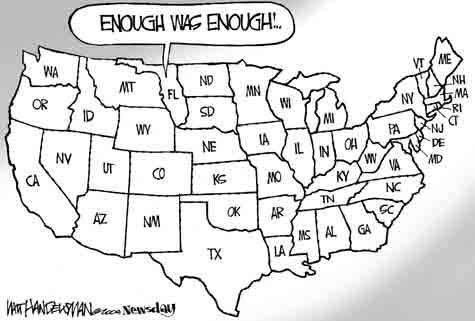
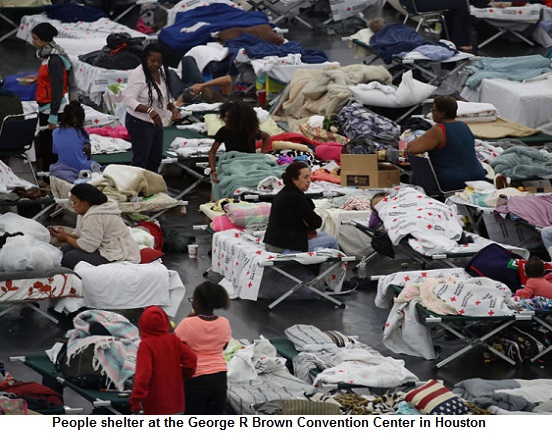
CU Blog - After Irma, Failed-State Indicator - Death or Diaspora - Photo 1Hurricanes are tied to failure and Failed-State Indicators. The consequences of hurricanes are more than just natural, there is also the preponderance for people to leave their homelands afterwards – to defect. See a related story (article & VIDEO) in the Appendix below in which a family sought asylum in Canada for refuge from their devastated community.

In Failed-State formal-speak, the Go Lean book (Page 271) details 2 indicators or indices: Mounting Demographic Pressures (DP) and Massive Movement of Refugees (REF). These downward movements are indicators of Failed-State status – a bad report on the Fail-State index is simply a reflection of a miserable existence in society:

  • Mounting Demographic Pressures
    Pressures on the population such as disease and natural disasters make it difficult for the government to protect its citizens or demonstrate a lack of capacity or will. This indicator include pressures and measures related to:
    Natural Disaster, Disease, Environment, Pollution, Food Scarcity, Malnutrition, Water Scarcity, Population Growth, Youth or Age Bulge, and Mortality
  • Massive Movement of Refugees or IDPs
    Forced uprooting of large communities as a result of random or targeted violence and/or repression, causing food shortages, disease, lack of clean water, land competition, and turmoil that can spiral into larger humanitarian and security problems, both within and between countries. This indicator refers to refugees leaving or entering a country. This indicator include pressures and measures related to:
    Displacement, Refugee Camps, IDP (Internally Displaced Persons) Camps, Disease Related to Displacement, Refugees per capita, and IDPs per capita.

This commentary completes the 4-part series on the Aftermath of Hurricane Irma. There are a lot of mitigation and remediation efforts that can be done to lessen the impact of this and future storms. There are lessons that we must consider; there are reforms we must make; there are problems we must solve. The full list of the 4 entries of this series are detailed as follows:

  1. Aftermath of Hurricane Irma – America Should Scrap the ‘Jones Act’
  2. Aftermath of Hurricane Irma – Barbuda Becomes a ‘Ghost Town’
  3. Aftermath of Hurricane Irma – The Science of Power Restoration
  4. Aftermath of Hurricane Irma – Failed State Indicators: Destruction and Defection

Despite the manifested threats of Climate Change-fueled hurricanes, we must engage the heavy-lifting to make the Caribbean homeland a better place to live, work and play. Otherwise people flee the oppression, repression and suppression of being “home”.

In a previous blog-commentary about 19th Century Slavery Abolition icon Frederick Douglass, it revealed his theme when he went to the British island of Ireland to commiserate with that people on their oppression-repression-suppression plight. He asserted …

… that if an oppressed population didn’t find refuge, the only outcome would be Death or Diaspora.

The Diaspora prophecy happened, then in Ireland and today, especially here in the Caribbean! (In a previous blog, it was revealed that after 1840, emigration from Ireland became a massive, relentless, and efficiently managed national enterprise. In 1890 40% of Irish-born people were living abroad. By the 21st century, an estimated 80 million people worldwide claimed some Irish descent; which includes more than 36 million Americans who claim Irish as their primary ethnicity).

Caribbean citizens are also pruned to emigrate … to foreign shores (North America and Europe) seeking refuge. In a previous blog-commentary it was asserted that the US – the homeland  for Frederick Douglass – has experienced accelerated immigration in recent years. Published rates of societal abandonment among the college educated classes have reported an average of 70 percent in most member-states, with some countries (i.e. Guyana) tallying up to 89 percent. For this reason, there is solidarity for the Diaspora of Ireland and the Diaspora of the Caribbean.

The publishers of the Go Lean book are also steadfast and committed to one cause: arresting the societal abandonment of Caribbean communities. This would lessen the future Diaspora. This would be good!

The book Go Lean…Caribbean serves as a roadmap for the introduction and implementation of the technocratic Caribbean Union Trade Federation (CU), for the elevation of Caribbean society – for all member-states. This CU/Go Lean roadmap has these 3 prime directives:

  • Optimization of the economic engines in order to grow the regional economy to $800 Billion and create 2.2 million new jobs.
  • Establishment of a security apparatus to ensure public safety and protect the resultant economic engines. This security pact encompasses an emergency planning/response apparatus to deal with the reality of natural disasters. Otherwise, the affected population becomes refugees and the member-state moves towards Failed-State status. The CU mandate is to protect against any Failed-State encroachments.
  • Improve Caribbean governance to support these engines, including a separation-of-powers between the member-states and CU federal agencies.

The book stresses that reforming and transforming the Caribbean societal engines must be a regional pursuit. This was an early motivation for the roadmap, as pronounced in the opening Declaration of Interdependence (Pages 12 – 13):

xi. Whereas all men are entitled to the benefits of good governance in a free society, “new guards” must be enacted to dissuade the emergence of incompetence, corruption, nepotism and cronyism at the peril of the people’s best interest. The Federation must guarantee the executions of a social contract between government and the governed.

xii. Whereas the legacy in recent times in individual states may be that of ineffectual governance with no redress to higher authority, the accedence of this Federation will ensure accountability and escalation of the human and civil rights of the people for good governance, justice assurances, due process and the rule of law. As such, any threats of a “failed state” status for any member state must enact emergency measures on behalf of the Federation to protect the human, civil and property rights of the citizens, residents, allies, trading partners, and visitors of the affected member state and the Federation as a whole.

xvi. Whereas security of our homeland is inextricably linked to prosperity of the homeland, the economic and security interest of the region needs to be aligned under the same governance. Since economic crimes … can imperil the functioning of the wheels of commerce for all the citizenry, the accedence of this Federation must equip the security apparatus with the tools and techniques for predictive and proactive interdictions.

The Go Lean book provides 370-pages of turn-by-turn instructions on “how” to adopt new community ethos, plus the strategies, tactics, implementations and advocacies to execute so as to reboot, reform and transform the societal engines of Caribbean society, to reverse the trending to Failed-State status. Consider the Chapter excerpts and headlines from this sample on Page 134 entitled:

10 Ways to Improve Failed-State Indices

1

Lean-in for the Caribbean Union Trade Federation
This will allow for the unification of the region into one market of 42 million people across 30 member-states, thereby creating an economic zone to protect the interest of the participant trading partner-member-states. The GDP of the region will amount to $800 Billion (circa 2010). In addition, the treaty calls for a collective security agreement of the member states so as to ensure homeland security and assuage against systemic threats. The CU will ensure that law-and-order persist during times of distress. When a member state declares a State of Emergency, due to natural disaster or civil unrest, this triggers an automatic CU response – this is equivalent to the governmental dialing 911.

2

Image and Defamation
When a country’s primary foreign currency generator is tourism/hospitality, just the perception of a weak or failing state could be devastating. The index is a number that can rise and fall, like a credit score, so any upward movement in the index triggers the negative perception. The pressures are not only internal; there may be external entities that can have a defaming effect: credit rating, country risk, threat assessment, K-n-R (Kidnap and Ransom) insurance rates. The CU will manage the image of the region’s member-states against defamation and work to promote a better image.

3

Local Government and the Social Contract
The Social Contract is the concept that individuals have consented, either explicitly or tacitly, to surrender some of their freedoms and submit to the authority of the State in exchange for protection of their remaining rights (natural and legal). People therefore expect their government (national or municipal) to provide public safety, health, education and other services. The CU will facilitate overhead services for local governments and access to financial markets to fund capital infrastructure investments. The member-states will therefore have more accountability and reporting to CU institutions.

4

Law Enforcement Oversight
The CU will maintain jurisdiction for economic crimes and regional threats. Plus, the CU will collaborate and facilitate local law enforcement with grants of equipment and training to better fulfill their roles. Lastly, the regional security treaty will grant the CU the audit and compliance responsibility for “use of force” investigations and internal affairs.

5

Military and Political Monitoring
The CU will carefully monitor the activities of the military units (Army, Navy and Coast Guard) – this accountability will be the by-product of increased CU funding. The CU will assume the Judge Advocate General role for military justice affairs. For cross border engagements, the National armed forces will be marshaled by the CU’s Commander-in-Chief.

6

Crime/Homeland Intelligence
The CU will install advanced systems, processes, and personnel for intelligence gathering and analysis to assist public safety institutions. This includes terrestrial and satellite surveillance systems, phone eavesdropping, data mining and predictive modeling. The findings will be used to mitigate risks and threats (gangs, anarchy, and organized crime).

7

Minority and Human Rights 

8

Election Outsourcing

9

War Against Poverty
As a Trade Federation charged with facilitating the economic engines for the region, the CU operations will have positive effect on jobs and growing the local economies. The CU has a complete battle plan for the War on Poverty.

10

Big Data
The CU will embrace an e-Government and e-Delivery model. There will be a lot of data to collect and analyze. In addition, the CU Commerce Department will function as a regional OECD (Organization of Economic Cooperation and Development), accumulating and measuring economic metrics and statistical analysis. Any decline in Failed-State indices will be detected, and managed in both a predictive and reactionary manner.

The Caribbean must foster a better disaster preparation and response apparatus. We cannot just count on the kindness of strangers. America – the Super Power in our region – is busy … with it’s own hurricane aftermath. Our Way Forward must come from our own making. Otherwise, our people will just leave. People abandon the Caribbean homeland after every storm, not because of the severity of storms but the encroachments towards Failed-States status.

Failed-States = oppression, suppression and repression of the citizens of a country. This rule was true in the days of Frederick Douglass and it is true today:

If an oppressed people don’t find relief and refuge, the only outcome would be Death or Diaspora.

We must do better here in the Caribbean; we must make our homeland a better place to live, work and play. 🙂

Download the free e-book of Go Lean … Caribbean – now!

Sign the petition to lean-in for this roadmap for the Caribbean Union Trade Federation.

———-

Appendix – Title: Family arrives in Ontario after fleeing Hurricane Irma
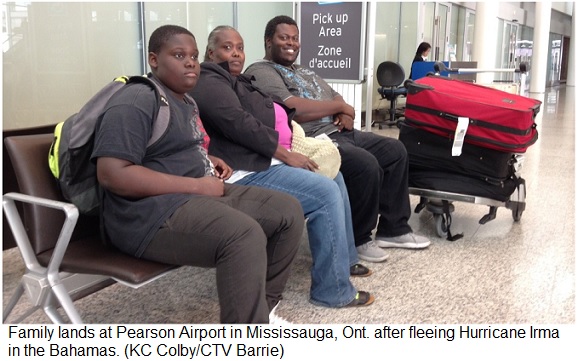
CU Blog - After Irma, Failed-State Indicator - Death or Diaspora - Photo 2

A family has abandoned their home in the Bahamas, and spent their life savings to escape the threat of Hurricane Irma.

Desiree Johnson and her two sons fled without a plan. They say they know they made an impulsive decision, but felt they had no other choice. The Johnsons arrived at PearsonInternationalAirport around 10:30 p.m. on Thursday.

“I didn’t sleep at all, I paced the floor, I walked, I tried to call. It was not a good feeling”, Johnson told CTV Barrie.

The family of three doesn’t have any relatives or friends in Toronto, but they say they know Canada is a country with a caring reputation.  They don’t know what tomorrow will bring, but they have already reached out to several community agencies looking for help.

Irma’s pounding of the southern Bahamas also brings back terrifying memories of a previous storm.

“It was very scary, we were out for about 2 months – no water, no lights, some places no food”, Johnson recalls. Her 35-year-old son, Jevon Johnson, says he found the meaning of terror during Hurricane Matthew.

The family is now planning on asking the federal government to remain in Canada. Johnson says she wants an opportunity for two of her three sons to start a new life. Her third son was left behind in Bahamas, as the family didn’t have enough money to escape all together.

Source: CTV News Posted September 8, 2017 from: http://barrie.ctvnews.ca/family-arrives-in-ontario-after-fleeing-hurricane-irma-1.3581810

———–

VIDEO – Bahamian Family Flee to Canada Seeking Refuge from Hurricane Irma – https://youtu.be/g25cywl7V-w
Share this post:
, , ,

After Irma, Barbuda Becomes a ‘Ghost Town’

Go Lean Commentary

CU Blog - After Irma, Barbuda Becomes a 'Ghost Town' - Photo 1a

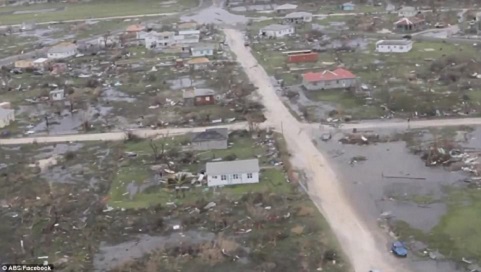
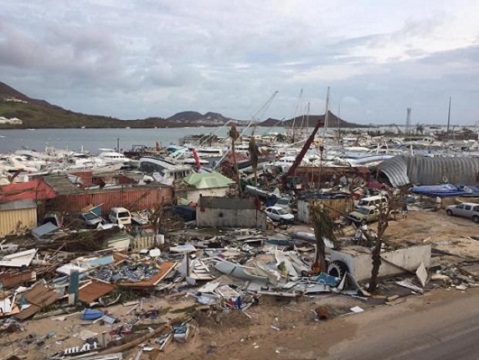
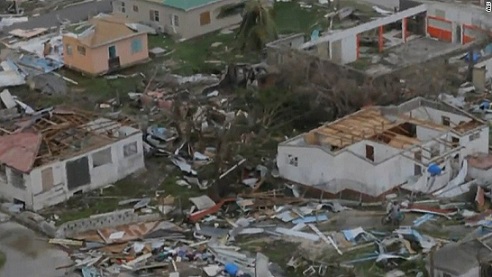
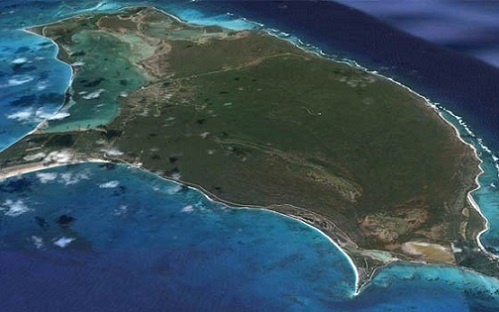
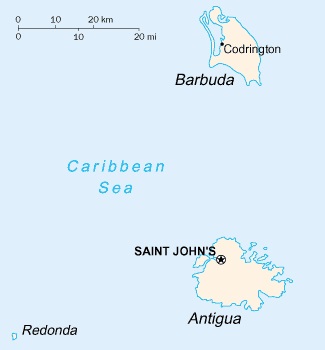
The Caribbean is in crisis today; we have just been devastated by Hurricane Irma; it has wreaked catastrophic havoc in certain islands, of which Barbuda is most notable. This is an official declaration; the Prime Minister of the country of Antigua and Barbuda has identified  90 percent of the structures on the island of Barbuda as uninhabitable and can now only be razed; see story in Appendix A below. See the news VIDEO here:
VIDEO – Barbuda, Destroyed By Hurricane Irma, Faces Jose Next | Rachel Maddow | MSNBChttps://youtu.be/2ewVgVDSuKg

Published on Sep 8, 2017 MSNBC
Michael Joseph, Red Cross president for Antigua and Barbuda, talks with Rachel Maddow about the utter devastation of the island of Barbuda by Hurricane Irma with Hurricane Jose just a day away. » Subscribe to MSNBC: http://on.msnbc.com/SubscribeTomsnbc About: MSNBC is the premier destination for in-depth analysis of daily headlines, insightful political commentary and informed perspectives. Reaching more than 95 million households worldwide, MSNBC offers a full schedule of live news coverage, political opinions and award-winning documentary programming — 24 hours a day, 7 days a week. Connect with MSNBC Online Visit msnbc.com: http://on.msnbc.com/Readmsnbc Find MSNBC on Facebook: http://on.msnbc.com/Likemsnbc Follow MSNBC on Twitter: http://on.msnbc.com/Followmsnbc Follow MSNBC on Google+: http://on.msnbc.com/Plusmsnbc Follow MSNBC on Instagram: http://on.msnbc.com/Instamsnbc Follow MSNBC on Tumblr: http://on.msnbc.com/LeanWithmsnbc Barbuda, Destroyed By Hurricane Irma, Faces Jose Next | Rachel Maddow | MSNBC

(Other impacted locales include Saint BarthélemySaint MartinAnguilla, Puerto Rico, the Virgin Islands and Florida).

Barbuda is a cautionary tale because it fulfills the forecast (prophecy) of this previous commentary, that if left unchecked, Caribbean crises get worse, completely dysfunctional, at the precipice of Failed-State status and communities emerge as …

Ghost Towns

A ghost town is an abandoned village, town or city, usually one which contains substantial visible remains. A town often becomes a ghost town because the economic activity that supported it has failed, or due to natural or human-caused disasters such as floods, government actions, uncontrolled lawlessness, war, or nuclear disasters. …

    “Things will always work themselves out” – Popular fallacy.

There is no guarantee of our survival. Communities and societies do fail; success is not assured; the work must be done, we must “sow if we want to reap”. …

How else would one explain why citizens from the most beautiful addresses on the planet are “breaking down the doors” to get out, either through legal means or illegal ones?

The book Go Lean … Caribbean stresses reboots, reorganizations and general turn-around of failing economic engines in favor of winning formulas. The book quotes a noted American Economist Paul Romer with this famous quotation:

    “A crisis is a terrible thing to waste”.

CU Blog - After Irma, Barbuda Becomes a 'Ghost Town' - Photo 1b

CU Blog - After Irma, Barbuda Becomes a 'Ghost Town' - Photo 1c

The movement behind the Go Lean book have often raised the subject of Ghost Towns. Just last month (August 22), this commentary was published:

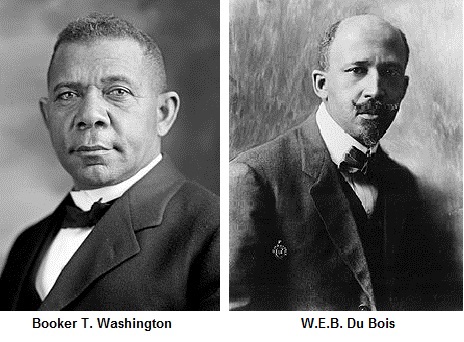
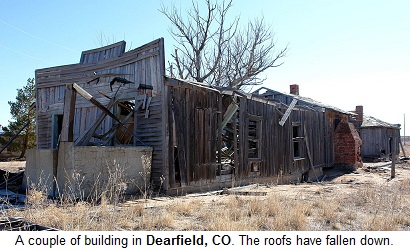
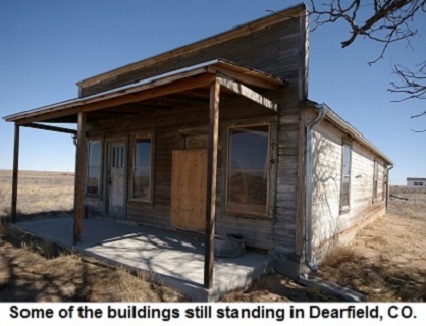
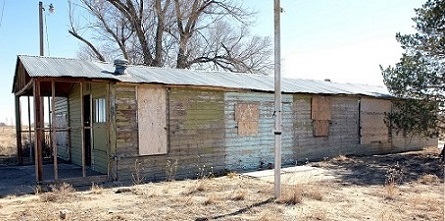
Lessons from Colorado: Black Ghost Towns – “Booker T. turning in his grave”

So the future is not guaranteed for any Caribbean community. While our people may survive, our culture may not! We may have to supplant ourselves to some foreign destination. We may have to “take our talents to South Beach” … or South New York… or South Toronto, etc..

Prophecy: If we migrate to a foreign country, our grandchildren born there will NOT be identified as Caribbean.

So Ghost Towns have occurred and could happen in the Caribbean … again.

This commentary continues the 4-part series on the Aftermath of Hurricane Irma. This storm was devastating to the Atlantic tropical region, the Caribbean and US State of Florida. There are a lot of mitigation and remediation efforts that can be done to lessen the impact of storms. There are lessons that we must consider; there are reforms we must make; there are problems we must solve. The full list of the 4 entries of this series are detailed as follows:

  1. Aftermath of Hurricane Irma – America Should Scrap the ‘Jones Act’
  2. Aftermath of Hurricane Irma – Barbuda Becomes a ‘Ghost Town’
  3. Aftermath of Hurricane Irma – The Science of Power Restoration
  4. Aftermath of Hurricane Irma – Failed State Indicators: Destruction and Defection

We want to make the Caribbean homeland a better place to live, work and play. This is the quest of the book Go Lean … Caribbean – available to download for free – which serves as a roadmap for the introduction and implementation of the technocratic Caribbean Union Trade Federation (CU). Despite the threats of Climate Change, the CU is structured to turn-around failing Caribbean communities; it is proffered to provide economic, security and governance solutions for all 30 member Caribbean states. This mandate is detailed early on in the book’s Declaration of Interdependence, as follows (Page 11 – 13):

i. Whereas the earth’s climate has undeniably changed resulting in more severe tropical weather storms, it is necessary to prepare to insure the safety and security of life, property and systems of commerce in our geographical region. As nature recognizes no borders in the target of its destruction, we also must set aside border considerations in the preparation and response to these weather challenges.

xii. Whereas the legacy in recent times in individual states may be that of ineffectual governance with no redress to higher authority, the accedence of this Federation will ensure accountability and escalation of the human and civil rights of the people for good governance, justice assurances, due process and the rule of law. As such, any threats of a “failed state” status for any member state must enact emergency measures on behalf of the Federation to protect the human, civil and property rights of the citizens, residents, allies, trading partners, and visitors of the affected member state and the Federation as a whole.

xix. Whereas our legacy in recent times is one of societal abandonment, it is imperative that incentives and encouragement be put in place to first dissuade the human flight, and then entice and welcome the return of our Diaspora back to our shores. This repatriation should be effected with the appropriate guards so as not to imperil the lives and securities of the repatriated citizens or the communities they inhabit. The right of repatriation is to be extended to any natural born citizens despite any previous naturalization to foreign sovereignties.

The Go Lean book posits that failing Caribbean communities can be rescued, butt if “we do what we have always done, we get what we always got”. Therefore Caribbean communities must adopt different community ethos, plus the executions of key – and different – strategies, tactics, implementations and advocacies to reform and transform.

There is a Way Forward!

Consider this News Article in Appendix B relating the Prime Minister’s fundamental change in property laws for Barbuda:

Ownership is prohibited on the island of Barbuda; all lands in Barbuda are vested in the Crown on behalf of the people on the sister island. … “Whatever land they are occupying now, rather than having a license to occupy, we are saying that we will give … freehold ownership”.

Why should people invest in property they do not own?

Duh! This is such a basic societal factor; it is illogical that the government had not implemented this reform before.

In order to avoid the pitfalls and eventuality of “Ghost Towns”, the Go Lean book describes the heavy-lifting that all the community stakeholders must engage. These efforts are described as 3 prime directives:

Heavy-lifting and leverage!!!

Yes, since natural disasters – hurricanes, earthquakes and even volcanoes – are an inevitability in the Caribbean, we can better insure and assure the continuity of our communities’ societal engines, by spreading the risk across the wider region, not just one member-state. For relief-recovery-rebuilding communities like Barbuda after disasters, the goal is to spread the burden or heavy-lifting across the 30 member-states.

If there is a load you have to bear
That you can’t carry
I’m right up the road
I’ll share your load
If you just call me
Song: Lean On Me by Bill Withers – Go Lean Book (Page 5)

In summary, ghost towns could abound more and more if we continue with the status quo. Let’s not … continue with the more-of-the-same approach.

Let’s commit to this pledge to foster change in our region; we must reform and transform our societal engines. Everyone is hereby urged to lean-in to this CU/Go Lean roadmap to make the Caribbean a better place to live, work and play. 🙂

Download the free e-Book of Go Lean … Caribbean – now!

Sign the petition to lean-in for this roadmap for the Caribbean Union Trade Federation.

———-

Appendix ATitle: PM: 90 Percent of Barbuda ‘Destroyed’ by Hurricane Irma

Hurricane Irma has done catastrophic damage to “90 percent of Barbuda,” according to Gaston Browne, the Prime Minister of Antigua and Barbuda, after it barreled past the island nation and through the Caribbean on Wednesday. An official from the country’s Office of Disaster Services told ABC News said there was “widespread damage” across the island, which is home to 1,600 people. Authorities in St. Martin said 95 percent of the French part of the island was destroyed, with one local official saying the storm caused an “enormous catastrophe.” Irma made landfall as a Category 5 hurricane with sustained winds above 185 mph, and is expected to hit Florida on Saturday night.

Source: The Daily Beast Online Newswire posted September 7, 2017 from: http://www.thedailybeast.com/hurricane-irma-destroys-90-percent-of-barbuda

CU Blog - After Irma, Barbuda Becomes a 'Ghost Town' - Photo 3

CU Blog - After Irma, Barbuda Becomes a 'Ghost Town' - Photo 6

CU Blog - After Irma, Barbuda Becomes a 'Ghost Town' - Photo 5

CU Blog - After Irma, Barbuda Becomes a 'Ghost Town' - Photo 4

———-

Appendix BTitle: Barbudans to get title ownerships of lands they occupy

Antigua Observer – Barbudans will get the opportunity to own the lands they previously occupied as the island seeks to rebuild following the devastation caused by the passage of Hurricane Irma last week.

Prime Minister Gaston Browne made the disclosure yesterday during a special sitting of Parliament.

He said Barbudans would be given a crown grant of one dollar to obtain legal ownership of the lands on the 62-square mile island.

Currently, land ownership is prohibited on the island of Barbuda; all lands in Barbuda are vested in the crown on behalf of the people on the sister island.

The Land Department under the Barbuda Council is the main governing body.

“Whatever land they are occupying now, rather than having a license to occupy, we are saying that we will give you freehold ownership,” Browne said, noting that residents of the sister island are elated over the idea.

“When you give a Barbudan a freehold, they can go into the bank, they can borrow monies, they can get a mortgage, they can build. They can get a loan for student purposes, to do businesses, it is a form of empowerment,” Browne said.

The nation’s leader also suggested that protective mechanisms could be instituted to prevent Barbudans from transferring the freehold ownership without the approval of the Barbuda Council.

Browne told Parliamentarians in the Lower House that it is untenable for Barbuda to be exclusively dependent on Antigua.

According to Browne, it was never the intent of the central government to take full responsibility for the payment of salaries and wages and other expenses on the sister island.

He said the intention was for Barbuda to be able to generate some level of revenue while Antigua would provide a subsidy.

“It has become a dependent relationship. Now I know that the Barbudans are proud people and they don’t want to be coming, cap in hand, to Antigua begging for a salary cheque on a weekly or monthly basis when they can generate their income,” the PM concluded.

Over 1,000 people on Barbuda had to be evacuated from the island last week after the country’s leader described the situation as “uninhabitable” following the hurricane that has also been blamed for the death of a two-year old child.

The PM said the sister island could not progress until the land tenure question is settled, adding that no country can move forward without a proper rights system.

He said consultations would be held with the people of Barbuda on the way forward.

Meanwhile, the government has announced a tentative agreement with the United Arab Emirates to assist with the installation of 800-megawatt solar power  facility on Barbuda, as well as a medical health system.

Prime Minister Browne also said that he had instructed his bank to transfer EC$100,000  from his savings to a fund for the rehabilitation of the island.

Other Antigua & Barbuda Labour Party members have also pledged to dip into their pockets to fund the rebuilding effort.

PM Browne said that he expects other residents and businesses to step up to the plate.

Source: Posted September 12, 2017; retrieved September 16, 2017 from: https://stluciatimes.com/2017/09/12/barbudans-get-title-ownerships-lands-occupy

Share this post:
, ,
[Top]

After Irma, America Should Scrap the ‘Jones Act’

Go Lean Commentary

The Caribbean has just been devastated by Hurricane Irma – the longest Category 5 storm recorded in modern times – it wreaked catastrophic havoc in BarbudaSaint BarthélemySaint MartinAnguilla, Puerto Rico and the Virgin Islands as a Category 5 hurricane[4][5] .

CU Blog - After Irma, America Should Scrap the Jones Act - Photo 2

There is the need for relief, recovery and rebuilding!

This title, “After Irma, America Should Scrap the Jones Act” – in the news article in the below Appendix referring to the temporary waiver of the law – is also a familiar advocacy from this commentary, from the movement behind the book Go Lean…Caribbean – available to download for free. A previous blog-commentary declared:

Stupidity of the Jones Act
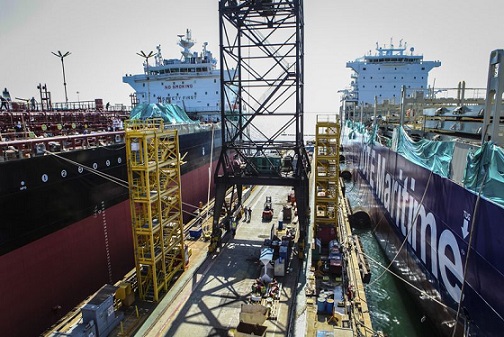
The Jones Act mandates that for a ship to go from one US port to another US port it must be American-made and American flagged. Also, for foreign ships to trade in US Territories, they must first journey to a foreign port before they could journey to another American port to transport goods. This seems “stupid”; but the adherence to this law keeps American maritime commerce options afloat; this means someone is getting paid; … a distortion in the reality of Puerto Rico-[Virgin Islands]-to-US Mainland trade.

The Go Lean movement asserts that the US Territories in the Caribbean deserve better; they deserve the full exercise of the free market, not just now for the hurricane relief-recovery-rebuilding but all the time. This is why we call the ‘Jones Act’ stupid and strongly urge for its repeal. These US Territories – make that colonies – are pressed between a rock and a hard place, their best hope for survival and prosperity is to grow-up from their American neo-colonial status.

What? How? When? Where? All these questions and more are answered in the Go Lean book. The book serves as a roadmap for the introduction and implementation of the technocratic Caribbean Union Trade Federation (CU), for the elevation of Caribbean society – for all member-states. This CU/Go Lean roadmap has these 3 prime directives:

  • Optimization of the economic engines in order to grow the regional economy to $800 Billion and create 2.2 million new jobs.
  • Establishment of a security apparatus to ensure public safety and protect the resultant economic engines.
  • Improve Caribbean governance to support these engines, including a separation-of-powers between the member-states and CU federal agencies.

The Go Lean book posits that devastating hurricanes – like Irma – will now be the norm. This problem is too big for any one Caribbean member-state alone to contend with. The book therefore stresses that reforming and transforming the Caribbean societal engines must be a regional pursuit. This was an early motivation for the roadmap, as pronounced in the opening Declaration of Interdependence (Pages 12 – 13):

i. Whereas the earth’s climate has undeniably changed resulting in more severe tropical weather storms, it is necessary to prepare to insure the safety and security of life, property and systems of commerce in our geographical region. As nature recognizes no borders in the target of its destruction, we also must set aside border considerations in the preparation and response to these weather challenges.

xi. Whereas all men are entitled to the benefits of good governance in a free society, “new guards” must be enacted to dissuade the emergence of incompetence, corruption, nepotism and cronyism at the peril of the people’s best interest. The Federation must guarantee the executions of a social contract between government and the governed.

xvi. Whereas security of our homeland is inextricably linked to prosperity of the homeland, the economic and security interest of the region needs to be aligned under the same governance. Since economic crimes … can imperil the functioning of the wheels of commerce for all the citizenry, the accedence of this Federation must equip the security apparatus with the tools and techniques for predictive and proactive interdictions.

xxiii. Whereas many countries in our region are dependent OverseasTerritory of imperial powers, the systems of governance can be instituted on a regional and local basis, rather than requiring oversight or accountability from distant masters far removed from their subjects of administration. The Federation must facilitate success in autonomous rule by sharing tools, systems and teamwork within the geographical region.

xxiv. Whereas a free market economy can be induced and spurred for continuous progress, the Federation must install the controls to better manage aspects of the economy: jobs, inflation, savings rate, investments and other economic principles. Thereby attracting direct foreign investment because of the stability and vibrancy of our economy.

The Go Lean book provides 370-pages of turn-by-turn instructions on “how” to adopt new community ethos, plus the strategies, tactics, implementations and advocacies to execute so as to reboot, reform and transform the societal engines of the American Caribbean Territories and all of Caribbean society. Puerto Rico and the USVI had problems before Irma; their daily life is filled with troubles and strife. While they need the ‘Jones Act’ to be waived for this hurricane relief-recovery-rebuilding effort, even more they need the ‘Jones Act’ repealed for everyday life.

This is not just our opinion alone, as attested by the Editorial – in the Appendix below – from Bloomberg News. This media organization is not just criticizing from afar; they truly care about the Greater Good of the US Territories; see Appendix VIDEO below.

This commentary commences a 4-part series on the Aftermath of Hurricane Irma. This storm was devastating to the Atlantic tropical region, the Caribbean and US State of Florida. There are a lot of mitigation and remediation efforts that can be done to lessen the impact of storms. There are lessons that we must consider; there are changes we must make; there are problems we must solve. The full list of the 4 entries in this series are detailed as follows:

  1. Aftermath of Hurricane Irma – America Should Scrap the ‘Jones Act’
  2. Aftermath of Hurricane Irma – Barbuda Becomes a ‘Ghost Town’
  3. Aftermath of Hurricane Irma – The Science of Power Restoration
  4. Aftermath of Hurricane Irma – Failed State Indicators: Destruction and Defection

Yes, we can do better in the future, even after devastating hurricanes; we can make all of the Caribbean homeland better places to live, work and play. 🙂

Download the free e-book of Go Lean … Caribbean – now!

Sign the petition to lean-in for this roadmap for the Caribbean Union Trade Federation. 

———–

Appendix – Title: After Irma, America Should Scrap the Jones Act
Sub-Title: The century-old law restricting trade between U.S. ports is a costly failure.

CU Blog - After Irma, America Should Scrap the Jones Act - Photo 1Another big hurricane, another temporary waiver of the Jones Act — the 1920 law mandating that goods and passengers shipped between U.S. ports be carried in U.S.-flagged ships, constructed primarily in the U.S., owned by U.S. citizens, and crewed by them or by U.S. legal permanent residents.

Circumstances did indeed demand a new stay on this dumb law — but it would be better to get rid of it altogether, as Senator John McCain and others have argued.

The Jones Act was meant to ensure that the U.S. has a reliable merchant marine during times of national emergency. It has devolved into a classic protectionist racket that benefits a handful of shipbuilders and a dwindling number of U.S. mariners. It causes higher shipping costs that percolate throughout the economy, especially penalizing the people of Alaska, Guam, Hawaii and Puerto Rico.

Despite the law, the U.S. merchant fleet has continued to shrink. Today there are only about 100 large ships that meet its requirements — and many of them are past their best. In part because of the high cost of using Jones Act vessels, coastal shipping has steadily declined, even though it would otherwise be more efficient in many cases than trucks and railroads. The act distorts trade flows, giving imports carried by foreign ships an edge over goods shipped from within the U.S. Proposed extensions of the law could threaten the development of offshore energy resources as well as exports of U.S. oil and natural gas.

Defenders of the law say its effects are uncertain because there’s too little data. The Federal Reserve Bank of New York suggests a way to put that right: Give a five-year Jones Act waiver to Puerto Rico. That would provide data for a more rigorous analysis while giving the island’s battered economy a lift. Short of outright repeal, Congress could also revisit the law’s ancient, burdensome rules on crew sizes and much else. If the law remains, its focus should be on restoring the vibrancy of coastal maritime commerce, not on counting ships and sailors.

Economics aside, one might ask, isn’t the Jones Act vital for national security? Hardly. Much of the U.S. Ready Reserve Fleet is foreign-built. Very few Jones Act ships are the roll-on, roll-off kind that the military wants. To be sure, the U.S. has sound strategic reasons for maintaining some shipbuilding capability — but smarter support narrowly directed to that purpose would be cheaper and fairer than a trade law that does so much pointless collateral harm.

The latest waiver is slated to expire this week. Modernizing the law would be a step forward. But the best thing to do with the Jones Act is scrap it.

To contact the senior editor responsible for Bloomberg View’s editorials: David Shipley at davidshipley@bloomberg.net .

Source: Posted September 13, 2017 from Bloomberg News Service; retrieved September 14, 2017 from: https://www.bloomberg.com/view/articles/2017-09-13/after-irma-america-should-scrap-the-jones-act

———–

Appendix VIDEO – After Irma, Bloomberg Helps With Recovery In U.S. Virgin Islands http://www.msnbc.com/mtp-daily/watch/after-irma-bloomberg-helps-with-recovery-in-u-s-virgin-islands-1047755843759

Posted September 15, 2017 – Chuck Todd traveled to the U.S. Virgin Islands to interview Fmr. New York City Mayor Michael Bloomberg and NBA All-Star Tim Duncan, who are both helping with the recovery effort after Hurricane Irma.

Share this post:
, , , , ,
[Top]

ENCORE: Hurricane Categories – The Science

Go Lean Commentary

Category 5

… that term has become one of the most dreaded phases in modern times in the Western Hemisphere, and especially in the Caribbean.

A Category 5 Hurricane – with its maximum sustained winds in excess of 156 miles per hour – is the Sum of All of Our Fears and a Clear & Present Danger. (See the full list of their historicity in the Appendix below). The most powerful one on record featured 215 mph winds – Hurricane Patricia – was just recently in October 2015 off the coast of Mexico.

Hurricanes – tropical cyclones in the Atlantic Ocean and Eastern Pacific Ocean – are the exclusive brand for the Northern Hemisphere. Considering the rotation of the earth, the majority travel East to West, from Africa over to North America. That’s the majority; but the minority is nothing to ignore either.  These can start in the Caribbean Sea or the Gulf of Mexico and travel at will: north, south, east, or west.

Welcome to our Caribbean, the greatest address on the planet!

Hurricanes are our reality. A hurricane is a meteorological phenomena that cannot be ignored; its science is a marvel.

Hurricanes are scientifically measured by the Saffir–Simpson scale. This scale was developed in 1971 by civil engineer Herbert Saffir and meteorologist Robert Simpson, who at the time was director of the U.S. National Hurricane Center (NHC).[1] The scale was introduced to the general public in 1973,[2] and saw widespread use after a new Director Neil Frank replaced Mr. Simpson in 1974 at the helm of the NHC, as a tribute to Mr. Simpson.[3]

See full details on this hurricane scale here:

Title: Saffir–Simpson Scale
The Saffir–Simpson hurricane wind scale, formerly the Saffir–Simpson hurricane scale (SSHS), classifies hurricanes –Western Hemisphere tropical cyclones that exceed the intensities of tropical depressions, and tropical storms – into five categories distinguished by the intensities of their sustained winds. To be classified as a hurricane,  a tropical cyclone must have maximum sustained winds of:

  • 74–95 mph –  Category 1.
    cu-blog-hurricane-categories-the-science-photo-1
  • 96–110 mph – Category 2.
    cu-blog-hurricane-categories-the-science-photo-2
  • 111–129 mph – Category 3.
    cu-blog-hurricane-categories-the-science-photo-3
  • 130–156 mph – Category 4.
    cu-blog-hurricane-categories-the-science-photo-4
  • ≥ 157 mph – Category 5.
    cu-blog-hurricane-categories-the-science-photo-5

So the highest classification in the scale, Category 5, is reserved for storms with winds exceeding 156 mph (70 m/s; 136 kn; 251 km/h). [There have been a number of these since 1924. See full list in the Appendix below].

The classifications can provide some indication of the potential damage and flooding a hurricane will cause upon landfall.

Officially, the Saffir–Simpson hurricane wind scale is used only to describe hurricanes forming in the Atlantic Ocean and northern Pacific Ocean east of the International Date Line. Other areas use different scales to label these storms, which are called “cyclones” or “typhoons“, depending on the area.

There is some criticism of the SSHS for not taking rain, storm surge, and other important factors into consideration, but SSHS defenders say that part of the goal of SSHS is to be straightforward and simple to understand.
Source: Wikipedia Online Reference – Retrieved October 7, 2016 from: https://en.wikipedia.org/wiki/Saffir%E2%80%93Simpson_scale

We are thankful to these two pioneering scientists, Mr. Saffir and Mr. Simpson; they lived full and impactful lives – R.I.P..

Mr. Simpson died on December 18, 2014 at age 102.

Mr. Saffir died on November 21, 2007 at age 90.

These scientists have given us the numbers 1 through 5 to indicate an extent of our misery. But misery is more than just a number. Misery is an experience; an unpleasant one. See here the VIDEO visually depicting damage along the Saffir-Simpson scale:

VIDEO – Why Hurricane Categories Make a Difference – https://youtu.be/lqfExHpvLRY

Published on Aug 8, 2013 – During a hurricane you usually hear meteorologists refer to its intensity by categories. If you don’t know the difference between a category 1 and a category 5 hurricane, The Weather Channel meteorologist Mark Elliot breaks it down for you.

Hurricanes are reminders that “Crap Happens“. They affect the everyday life for everyday people. This discussion is presented in conjunction with the book Go Lean … Caribbean. It addresses the challenges facing life in the Caribbean and then presents strategies, tactics and implementations for optimizing the regional community.

Hurricanes are a product of ‘Mother Nature’ – natural disasters – but communities can be more efficient and effective in mitigating the risks associated with these natural disasters (hurricanes, earthquakes, volcanoes, floods, forest fires, etc.). In addition, there are bacterial & viral pandemics. Lastly, there are industrial incidents (chemical & oil spills) and other man-made disasters: i.e. terrorism-related events.

The Go Lean book asserts that bad things (and bad actors), like hurricanes, will always emerge to disrupt the peace and harmony in communities. Crap Happens … therefore all Caribbean member-states need to be “on guard” and prepared for this possibility. The Go Lean book (Page 23) prepares the Caribbean for many modes of “bad things/actors” with proactive and reactive mitigations. This point is pronounced early in the book with the opening Declaration of Interdependence (Page 12) that claims:

i. Whereas the earth’s climate has undeniably changed resulting in more severe tropical weather storms, it is necessary to prepare to insure the safety and security of life, property and systems of commerce in our geographical region. As nature recognizes no borders in the target of its destruction, we also must set aside border considerations in the preparation and response to these weather challenges.

ii. Whereas the natural formation of the landmass for our lands constitutes some extreme seismic activity, it is our responsibility and ours alone to provide, protect and promote our society to coexist, prepare and recover from the realities of nature’s occurrences.

x. Whereas we are surrounded and allied to nations of larger proportions in land mass, populations, and treasuries, elements in their societies may have ill-intent in their pursuits, at the expense of the safety and security of our citizens. We must therefore appoint “new guards” to ensure our public safety and threats against our society, both domestic and foreign. The Federation must employ the latest advances and best practices … to assuage continuous threats against public safety.

xii. Whereas the legacy in recent times in individual states may be that of ineffectual governance with no redress to higher authority, the accedence of this Federation will ensure accountability and escalation of the human and civil rights of the people for good governance, justice assurances, due process and the rule of law. As such, any threats of a “failed state” status for any member state must enact emergency measures on behalf of the Federation to protect the human, civil and property rights of the citizens, residents, allies, trading partners, and visitors of the affected member state and the Federation as a whole.

xvi. Whereas security of our homeland is inextricably linked to prosperity of the homeland, the economic and security interest of the region needs to be aligned under the same governance. Since economic crimes, including piracy and other forms of terrorism, can imperil the functioning of the wheels of commerce for all the citizenry, the accedence of this Federation must equip the security apparatus with the tools and techniques for predictive and proactive interdictions.

So the Go Lean book relates that the Caribbean must appoint “new guards”, or a security apparatus, to ensure public safety and to include many strategies, tactics and implementations considered “best-practices” for Emergency Management (Preparation and Response). We must be on a constant vigil against these “bad actors”, man-made or natural. The Go Lean book serves as a roadmap for the introduction and implementation of the technocratic Caribbean Union Trade Federation (CU).

The Go Lean/CU roadmap has a focus of optimizing Caribbean society through economic empowerment, and homeland security. Emergency preparedness and response is paramount for this quest. In fact, the Go Lean roadmap has the following 3 prime directives:

  • Optimization of the economic engines in order to grow the regional economy to $800 Billion & create 2.2 million new jobs.
  • Establishment of a security apparatus – a new guard – to protect the resultant economic engines and the Caribbean homeland.
  • Improvement of Caribbean governance to support these engines.

The CU would serve as the “new guard“, a promoter and facilitator of all the Emergency Management agencies in the region. The strategy is to provide a Unified Command and Control for emergency operations to share, leverage and collaborate the “art and science” of this practice across the whole region.

The regional vision is that all Caribbean member-states empower a CU Homeland Security force to execute a limited scope on their sovereign territories. The legal basis for this empowerment is a Status of Forces Agreement (SOFA), embedded in the CU treaty from Step One/Day One. The CU Trade Federation would lead, fund and facilitate the Emergency Management functionality under the oversight of a regionally elected Commander-in-Chief for the CU.

As cited above, the Caribbean is the “greatest address on the planet”, but there is risk associated with living deep in a tropical zone. With the reality of Climate Change, we must not be caught unprepared.

In our immediate past, the Caribbean region has failed at the need for readiness and response. We have even failed to properly coordinate the “cry for help” and the collection of international-charitable support. We have suffered dire consequences as a result: loss of life, damage to property, disruption to economic systems, corruption … and abandonment. Many of our citizens have fled their Caribbean homeland, as a result, after each natural disaster. We have even created Ghost Towns.

We want something better, something more. We want our people to prosper where they are planted in the Caribbean. So as a community, we must provide assurances. No assurance that there will be no hurricanes, but rather the assurance that we can respond, recover, repair and rebuild:

“Yes, we can … “.

The Go Lean book details the series of community ethos, strategies, tactics, implementations and advocacies to provide the proactive and reactive public safety/security in the Caribbean region:

Community Ethos – Economic Systems Influence Individual Choices Page 21
Community Ethos – Consequences of Choices Lie in Future Page 21
Community Ethos – “Crap” Happens Page 23
Community Ethos – Cooperatives Page 25
Community Ethos – Ways to Impact the Future Page 26
Community Ethos – Ways to Improve Sharing Page 35
Community Ethos – Ways to Promote Happiness Page 36
Community Ethos – Ways to Impact the Greater Good Page 37
Strategy – Vision – Confederating a non-sovereign permanent union Page 45
Strategy – Agents of Change – Climate Change Page 57
Tactical – Fostering a Technocracy Page 64
Tactical – How to Grow the Economy – Recover from Disasters Page 70
Tactical – Separation of Powers – Homeland Security Department Page 75
Tactical – Separation of Powers – Emergency Management Agency Page 76
Tactical – Separation of Powers – Meteorological and Geological Service Page 79
Implementation – Ways to Pay for Change Page 101
Implementation – Start-up Homeland Security Initiatives Page 103
Implementation – Ways to Re-boot Freeport Page 112
Implementation – Ways to Foster International Aid Page 115
Planning – 10 Big Ideas – #3: Consolidated Homeland Security Pact Page 130
Planning – Ways to Make the Caribbean Better Page 131
Planning – Ways to Improve Failed-State Indices – Escalation Role Page 134
Advocacy – Ways to Grow the Economy – Quick Disaster Recovery Page 151
Advocacy – Ways to Improve Governance Page 168
Advocacy – Ways to Better Manage the Social Contract Page 170
Advocacy – Ways to Improve Homeland Security Page 180
Advocacy – Ways to Improve Intelligence Gathering & Analysis Page 182
Advocacy – Ways to Improve for Natural Disasters Page 184
Advocacy – Ways to Improve for Emergency Management Page 196
Advocacy – Ways to Impact Wall Street – Adopt Advanced Recovery Products Page 200

Other subjects related to Emergency Management, Homeland Security and governing empowerments for the region have been blogged in other Go Lean…Caribbean commentaries, as sampled here:

https://goleancaribbean.com/blog/?p=9070 Securing the Homeland – From the Seas
https://goleancaribbean.com/blog/?p=9038 Doing Better with Charity Management
https://goleancaribbean.com/blog/?p=7896 The Logistics of Disaster Relief
https://goleancaribbean.com/blog/?p=7449 The Art and Science of Emergency Management
https://goleancaribbean.com/blog/?p=7327 Zika – An Epidemiology Crisis – A 4-Letter Word
https://goleancaribbean.com/blog/?p=7235 Flint, Michigan – A Cautionary Tale
https://goleancaribbean.com/blog/?p=6893 A Meteorologist’s View On Climate Change
https://goleancaribbean.com/blog/?p=6563 Lessons from Iceland – Model of Recovery
https://goleancaribbean.com/blog/?p=6189 A Lesson in History – Hurricane ‘Katrina’ is helping today’s crises
https://goleancaribbean.com/blog/?p=4741 Vanuatu and Tuvalu Cyclone – Inadequate response to human suffering
https://goleancaribbean.com/blog/?p=2614 The ‘Great ShakeOut’ Earthquake Drill / Planning / Preparations
https://goleancaribbean.com/blog/?p=2397 Stopping a Clear and Present Danger: Ebola
https://goleancaribbean.com/blog/?p=1817 Caribbean grapples with intense new cycles of flooding & drought

The Caribbean is on the frontline of this battle: man versus Climate Change. While we are not the only ones, we have to be accountable and responsible for our own people and property. The book Go Lean…Caribbean posits that this “Agent of Change” is too big for just any one member-state to tackle alone, that there must be a regional solution; and presents this roadmap.

Climate Change has produced winners (consider northern cities with milder than normal winters) and losers. The Caribbean has found itself on the losing side. This means life-and-death for the people and the economic engines of the Caribbean communities.

While hurricanes are our reality, there is a science to these meteorological phenomena, and an art to our response. We can plan, monitor, alert, prepare and recover. We can do it better than in the recent past. We can provide assurances that “no stone” will be unturned in protecting people, property and systems of commerce. The watching world – our trading partners – needs this assurance!

The people and institutions of the region are therefore urged to lean-in to this Go Lean roadmap to make the Caribbean a better, safer, place to live, work and play. This plan is conceivable, believable and achievable. Yes, we can. 🙂

Download the book Go Lean … Caribbean – now!

Sign the petition to lean-in for this roadmap for the Caribbean Union Trade Federation. 


————–

Appendix – List of Category 5 Atlantic Hurricanes

Storm
name

Season

Dates as a
Category 5

Time as a
Category 5 (hours)

Peak one-minute
sustained winds

Pressure

mph

km/h

hPa

inHg

Matthew 2016 September 30 – October 1 6 160 260

934

27.58

Felix 2007 September 3–4† 24 175 280

929

27.43

Dean 2007 August 18–21† 24 175 280

905

26.72

Wilma 2005 October 19 18 185 295

882

26.05

Rita 2005 September 21–22 24 180 285

895

26.43

Katrina 2005 August 28–29 18 175 280

902

26.64

Emily 2005 July 16 6 160 260

929

27.43

Ivan 2004 September 9–14† 60 165 270

910

26.87

Isabel 2003 September 11–14† 42 165 270

915

27.02

Mitch 1998 October 26–28 42 180 285

905

26.72

Andrew 1992 August 23–24† 16 175 280

922

27.23

Hugo 1989 September 15 6 160 260

918

27.11

Gilbert 1988 September 13–14 24 185 295

888

26.22

Allen 1980 August 5–9† 72 190 305

899

26.55

David 1979 August 30–31 42 175 280

924

27.29

Anita 1977 September 2 12 175 280

926

27.34

Edith 1971 September 9 6 160 260

943

27.85

Camille 1969 August 16–18† 30 175 280

900

26.58

Beulah 1967 September 20 18 160 260

923

27.26

Hattie 1961 October 30–31 18 160 260

920

27.17

Carla 1961 September 11 18 175 280

931

27.49

Janet 1955 September 27–28 18 175 280

914

27.0

Carol 1953 September 3 12 160 260

929

27.43

“New England” 1938 September 19–20 18 160 260

940

27.76

“Labor Day” 1935 September 3 18 185 295

892

26.34

“Tampico” 1933 September 21 12 160 260

929

27.43

“Cuba–Brownsville” 1933 August 30 12 160 260

930

27.46

“Cuba” 1932 November 5–8 78 175 280

915

27.02

“Bahamas” 1932 September 5–6 24 160 260

921

27.20

San Felipe II-“Okeechobee” 1928 September 13–14 12 160 260

929

27.43

“Cuba” 1924 October 19 12 165 270

910

26.87

Reference=[1] †= Attained Category 5 status more than once

Source: Retrieved October 7, 2016 from https://en.wikipedia.org/wiki/List_of_Category_5_Atlantic_hurricanes

Share this post:
, , , ,
[Top]

ENCORE: The Logistics of Disaster Relief

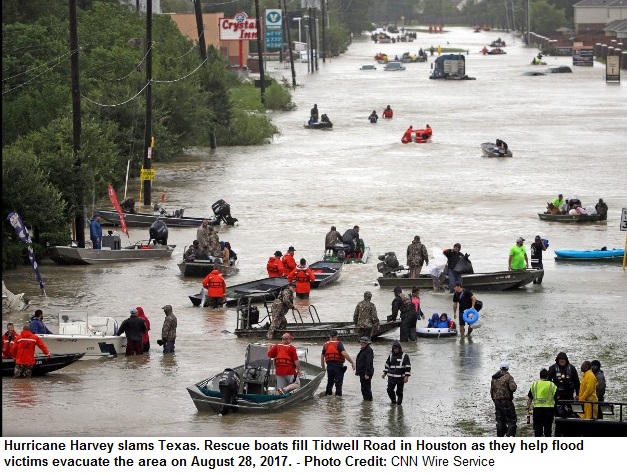
There has been a major natural disaster – Hurricane Harvey and subsequent flooding – in the US State of Texas this week. Many individuals and institutions are now scrambling to provide relief to the victims in the area.

“Do unto others as you would have them do unto you” – The Golden Rule

This is very neighborly. Those of you who can give, please give of your “time, talent and treasuries”.

But please be logical in your giving. Certain items would really be inappropriate at this time; think: clothes, toys, etc.. In fact, this previous Go Lean commentary detailed the entire discussion of inappropriate disaster relief gifts. Consider here-now, this Encore of that previous commentary:

—————

Go Lean CommentaryThe Logistics of Disaster Relief

It is during the worst of times that we see the best in people.

This statement needs to be coupled with the age old proverb: “The Road to Hell is Paved with Good Intentions“…

… especially when it comes to disaster relief.

In previous blog-commentaries promoting the book Go Lean…Caribbean, it was established that “bad things happen to good people”; (i.e. ‘Crap Happens’ – So What Now?, Managing a ‘Clear and Present Danger’). Yes, disasters are a reality for modern life. The Go Lean book posits that with the emergence of Climate Change  that natural disasters are more common place.

In addition there are earthquakes …

… these natural phenomena may not be associated with Climate Change, but alas, they too are more common and more destructive nowadays. (People with a Christian religious leanings assert that “an increase of earthquakes is a tell-tale sign that we are living in what the Bible calls the “Last Days” – Matthew 24: 7).

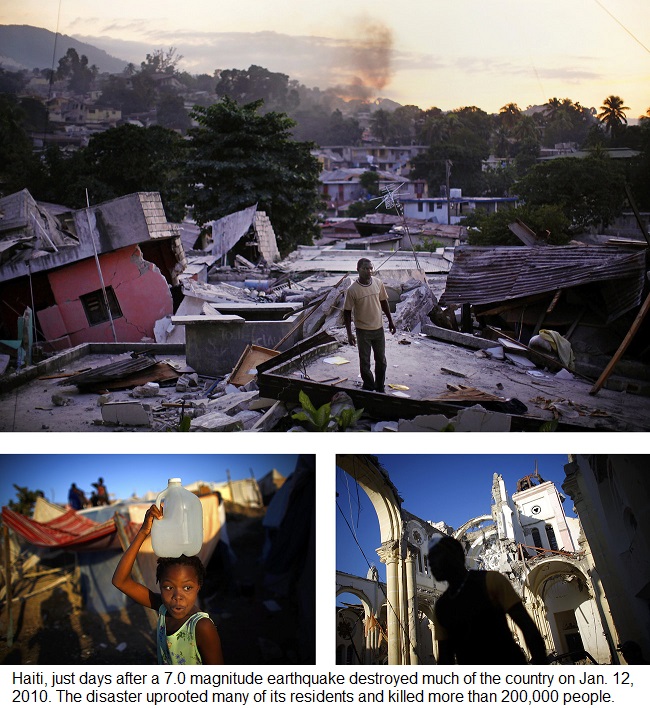
$500 Million In Haiti Relief - Photo 1The motives of the Go Lean book, and accompanying blogs is not to proselytize, but rather to prepare the Caribbean region for “bad actors”, natural or man-made. The book was written in response to the aftermath and deficient regional response following the great earthquake in Haiti on January 12, 2010. Many Non-Government Organizations (NGO) embarked on campaigns to shoulder a response, a relief and rebuilding of Haiti. Many people hold the view that those efforts did a lot of harm, along with some good.

In a previous blog-commentary, it was reported how the fundraising campaign by one group, the American Red Cross, raised almost US$500 million and yet only a “piddling” was spent on the victims and communities themselves.

Now we learn too that many good-intentioned people donated tons of relief supplies that many times turned out to be “more harm than help”. See the story here in this news VIDEO; (and/or the Narration Transcript/photos in the Appendix below):

VIDEO – When disaster relief brings anything but relief – http://www.cbsnews.com/videos/disaster-relief-donations-that-dont-bring-relief

Posted April 24, 2016 – Many of the well-meaning articles Americans donate in times of disaster turn out to be of no use to those in need. Sometimes, they even get in the way. That’s a message relief organizations very much want “us” to heed. This story is reported by Scott Simon, [on loan from] NPR. (VIDEO plays best in Internet Explorer).

This commentary asserts that more is needed in the Caribbean to facilitate good disaster relief, in particular a technocratic administration. This consideration is the focus of the strategies, tactics, implementations and advocacies of the Go Lean…Caribbean book. The declaration is that the Caribbean itself must be agile, lean, and optimized in providing its own solutions for disaster recovery. The alternative, from past experiences like in this foregoing VIDEO, is that others taking the lead for our solution seem to fall short in some way … almost every time!

The Caribbean must now stand up and be counted!

The Go Lean book declares (Page 115) that the “Caribbean should not be perennial beggars, [even though] we do need capital/money to get started”, we need technocratic executions even more.

What is a technocracy?

This is the quest of the Go Lean movement. The movement calls for a treaty to form a technocratic confederation of all the 30 member-states in the Caribbean region. This will form a Single Market of 42 million. The consolidation and integration allows for economies-of-scale and leverage that would not be possible otherwise. “Many hands make a big job … small”. But it is not just size that will define the Caribbean technocracy but quality, efficiency and optimization as well.

According to the Go Lean book (Page 64), the …

“… term technocracy was originally used to designate the application of the scientific method to solving social and economic problems, in counter distinction to the traditional political or philosophic approaches. The CU must start as a technocratic confederation – a Trade Federation – rather than evolving to this eventuality due to some failed-state status or insolvency.”

The book Go Lean…Caribbean serves as a roadmap for the introduction and implementation of the technocratic Caribbean Union Trade Federation (CU) to provide better stewardship for the Caribbean homeland. The foregoing VIDEO describes the efforts of non-governmental organizations (NGO) in shepherding disaster reliefs. These NGO’s are stakeholders in this Caribbean elevation roadmap. Even though many of the 30 member-states are independent nations, the premise of the Go Lean book is that there must be a resolve for interdependence among the governmental and non-governmental entities. This all relates to governance, the need for this new technocratic stewardship of regional Caribbean society. The need for this resolve was pronounced in the opening Declaration of Interdependence (Pages 11 & 14) with these acknowledgements and statements:

i.    Whereas the earth’s climate has undeniably changed resulting in more severe tropical weather storms, it is necessary to prepare to insure the safety and security of life, property and systems of commerce in our geographical region. As nature recognizes no borders in the target of its destruction, we also must set aside border considerations in the preparation and response to these weather challenges.

ii.    Whereas the natural formation of the landmass for our lands constitutes some extreme seismic activity, it is our responsibility and ours alone to provide, protect and promote our society to coexist, prepare and recover from the realities of nature’s occurrences.

x.   Whereas we are surrounded and allied to nations of larger proportions in land mass, populations, and treasuries, elements in their societies may have ill-intent in their pursuits, at the expense of the safety and security of our citizens. We must therefore appoint “new guards” to ensure our public safety and threats against our society, both domestic and foreign. The Federation must employ the latest advances and best practices … to assuage continuous threats against public safety.

xi.   Whereas all men are entitled to the benefits of good governance in a free society, “new guards” must be enacted to dissuade the emergence of incompetence, corruption, nepotism and cronyism at the peril of the people’s best interest. The Federation must guarantee the executions of a social contract between government and the governed.

xii. Whereas the legacy in recent times in individual states may be that of ineffectual governance with no redress to higher authority, the accedence of this Federation will ensure accountability and escalation of the human and civil rights of the people for good governance, justice assurances, due process and the rule of law. As such, any threats of a “failed state” status for any member state must enact emergency measures on behalf of the Federation to protect the human, civil and property rights of the citizens, residents, allies, trading partners, and visitors of the affected member state and the Federation as a whole.

xxxiii.   Whereas lessons can be learned and applied from the study of the recent history of other societies, the Federation must formalize statutes and organizational dimensions to avoid the pitfalls of [other] communities.

This is the quest of CU/Go Lean roadmap: to provide new guards for a more competent Caribbean administration … by governmental organizations and non-governmental organizations. (NGO would also be promoted, audited and overseen by CU administrators). The Caribbean must do better!

Our quest must start “in the calm”, before any storm (or earthquake). We must elevate the societal engines the Caribbean region through economic, security and governance empowerments. In general, the CU will employ better strategies, tactics and implementations to impact its prime directives; identified with the following 3 statements:

  • Optimization of the economic engines in order to grow the regional economy to $800 Billion & create 2.2 million new jobs.
  • Establishment of a security apparatus to protect the resultant economic engines and the Caribbean homeland.
  • Improvement of Caribbean governance to support these engines.

Former US President George W. Bush shares this advocacy!

He narrated this VIDEO here describing the efficiencies of the American logistics company, UPS, in delivering disaster relief:

VIDEO – Report Logistics and Haiti: Points of Light and President Bush – https://youtu.be/8-gmh1QyWTU

Uploaded on Mar 30, 2011 – [In 2009], Transportation Manager Chip Chappelle volunteered to help The UPS Foundation coordinate an ocean shipment of emergency tents from Indiana to Honduras. Since then, he has managed the logistics of humanitarian aid from every corner of the world to help the victims of floods, tsunamis, earthquakes, hurricanes and cyclones.

The Go Lean book stresses our own community ethos, strategies, tactics, implementations and advocacies necessary for the Caribbean to deliver, to provide the proactive and reactive public safety/security provisions in the region. See sample list here:

Community Ethos – Deferred Gratification Page 21
Community Ethos – Economic Principles – Respond to Incentives in Predictable Ways Page 21
Community Ethos – Economic Principles – Economic Systems Influence Individual Choices Page 21
Community Ethos – Economic Principles – Consequences of Choices Lie in the Future Page 21
Community Ethos – Security Principles – Whistleblower Protection Page 23
Community Ethos – Security Principles – Intelligence Gathering Page 23
Community Ethos – Security Principles – “Crap” Happens Page 23
Community Ethos – Governing Principles – Lean Operations Page 24
Community Ethos – Governing Principles – Return on Investments Page 24
Community Ethos – Governing Principles – Cooperatives Page 25
Community Ethos – Ways to Impact the Future Page 26
Community Ethos – Ways to Impact Turn-Arounds Page 33
Community Ethos – Ways to Improve Sharing – Emergency Response Page 35
Community Ethos – Ways to Impact the Greater Good Page 37
Strategy – Vision – Confederate all 30 member-states/ 4 languages into a Single Market Page 45
Strategy – Mission – Prepare for the eventuality of natural disasters Page 45
Strategy – Agents of Change – Climate Change Page 57
Tactical – Ways to Foster a Technocracy Page 64
Tactical – Growing the Economy – Post WW II European Marshall Plan/Recovery Model Page 68
Tactical – Separation-of-Powers – CU Federal Government versus Member-State Governance Page 71
Tactical – Separation-of-Powers – Homeland Security – Emergency Management Page 76
Tactical – Separation-of-Powers – State Department – Liaison/Oversight for NGO’s Page 80
Implementation – Assemble All Regionally-focus Organizations of All Caribbean Communities Page 96
Implementation – Ways to Pay for Change Page 101
Implementation – Ways to Foster International Aid Page 115
Planning – 10 Big Ideas – Homeland Security Pact Page 127
Planning – Ways to Make the Caribbean Better Page 131
Planning – Ways to Improve Failed-State Indices – Governance and the Social Contract Page 134
Advocacy – Ways to Grow the Economy Page 151
Advocacy – Ways to Create Jobs Page 152
Advocacy – Ways to Improve Housing – Hurricane Risk Reinsurance Fund Page 161
Advocacy – Ways to Improve Governance Page 168
Advocacy – Ways to Better Manage the Social Contract Page 170
Advocacy – Ways to Improve Homeland Security Page 180
Advocacy – Ways to Improve for Natural Disasters Page 184
Advocacy – Ways to Develop a Pre-Fab Housing Industry – One solution ideal for Haiti Page 207
Advocacy – Ways to Re-boot Haiti Page 238

The Go Lean roadmap seeks to empower and elevate Caribbean societal engines to be better prepared for the eventual natural disasters. The good intentions of Americans, as depicted in the foregoing VIDEO, is encouraging … but good intentions alone is not enough. We need good management! We need a technocracy! While it is out-of-scope for this roadmap to impact America, we can – and must – exercise good management in our Caribbean region. So what do we want from Americans in our time of need? See VIDEO here:

VIDEO – Donate Responsibly – https://youtu.be/14h9_9sopRA

Published on Nov 2, 2012 – A series of PSAs released by the Ad Council explain why cash is the best way to help. The campaign was launched on November 5, 2012 by the Ad Council and supported by the coalition — which includes CIDI, the U.S. Agency for International Development, InterAction, the UPS Foundation and National Voluntary Organizations Active in Disaster.

The Go Lean book calls on the Caribbean region to be more technocratic: collectively self-reliant, both proactively and reactively. Because of Climate Change or the Last Days, natural disasters (i.e. hurricanes and earthquakes) will occur again and again. Considering that our American neighbors may Pave our Road to Hell with Good Intentions, we need to prepare the right strategies, tactics and implementations ourselves, to make our region a better homeland to live, work and play. 🙂

Download the book Go Lean … Caribbean – now!

——————

Appendix Transcript – When disaster relief brings anything but relief

When Nature grows savage and angry, Americans get generous and kind. That’s admirable. It might also be a problem.

“Generally after a disaster, people with loving intentions donate things that cannot be used in a disaster response, and in fact may actually be harmful,” said Juanita Rilling, director of the Center for International Disaster Information in Washington, D.C. “And they have no idea that they’re doing it.”

Rilling has spent more than a decade trying to tell well-meaning people to think before they give.

In 1998 Hurricane Mitch struck Honduras. More than 11,000 people died. More than a million and a half were left homeless.

And Rilling got a wake-up call: “Got a call from one of our logistics experts who said that a plane full of supplies could not land, because there was clothing on the runway. It’s in boxes and bales. It takes up yards of space. It can’t be moved.’ ‘Whose clothing is it?’ He said, ‘Well, I don’t know whose it is, but there’s a high-heeled shoe, just one, and a bale of winter coats.’ And I thought, winter coats? It’s summer in Honduras.”

Humanitarian workers call the crush of useless, often incomprehensible contributions “the second disaster.”

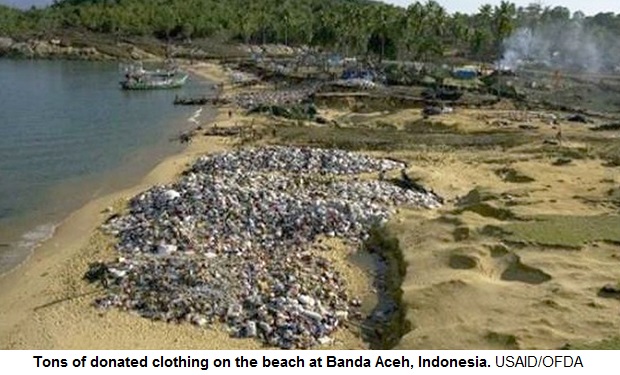
In 2004, following the Indian Ocean tsunami, a beach in Indonesia was piled with used clothing.

There was no time for disaster workers to sort and clean old clothes. So the contributions just sat and rotted.

CU Blog - Logistics of Disaster Relief - Photo 1“This very quickly went toxic and had to be destroyed,” said Rilling. “And local officials poured gasoline on it and set it on fire. And then it was out to sea.”

“So, rather than clothing somebody, it went up in flames?” asked Simon.

“Correct. The thinking is that these people have lost everything, so they must NEED everything. So people SEND everything. You know, any donation is crazy if it’s not needed. People have donated prom gowns and wigs and tiger costumes and pumpkins, and frostbite cream to Rwanda, and used teabags, ’cause you can always get another cup of tea.”

You may not think that sending bottles of water to devastated people seems crazy. But Rilling points out, “This water, it’s about 100,000 liters, will provide drinking water for 40,000 people for one day. This amount of water to send from the United States, say, to West Africa — and people did this — costs about $300,000. But relief organizations with portable water purification units can produce the same amount, a 100,000 liters of water, for about $300.”

And then there were warm-hearted American women who wanted to send their breast milk to nursing mothers in Haiti after the 2010 earthquake.

“It sounds wonderful, but in the midst of a crisis it’s actually one of the most challenging things,” said Rebecca Gustafson, a humanitarian aid expert who has worked on the ground after many disasters.

“Breast milk doesn’t stay fresh for very long. And the challenge is, what happens if you do give it to an infant who then gets sick?”

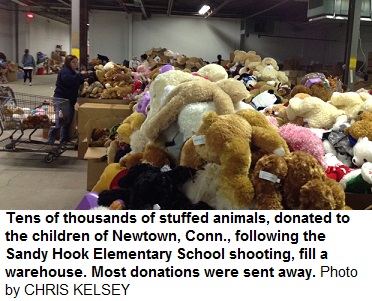
CU Blog - Logistics of Disaster Relief - Photo 2December 2012, Newtown, Connecticut: A gunman killed 20 children and six adults at Sandy Hook Elementary School. Almost instantaneously, stuff start arriving.

Chris Kelsey, who worked for Newtown at the time, said they had to get a warehouse to hold all the teddy bears.

Simon asked, “Was there a need for teddy bears?”

“I think it was a nice gesture,” Kelsey replied. “There was a need to do something for the kids. There was a need to make people feel better. I think the wave of stuff we got was a little overwhelming in the end.”

And how many teddy bear came to Newtown? “I think it was about 67,000,” Kelsey said. “Wasn’t limited to teddy bears. There was also thousands of boxes of school supplies, and thousands of boxes of toys, bicycles, sleds, clothes.”

Newtown had been struck by mass murder, not a tsunami. As Kelsey said, “I think a lot of the stuff that came into the warehouse was more for the people that sent it, than it was for the people in Newtown. At least, that’s the way it felt at the end.”

Every child in Newtown got a few bears. The rest had to be sent away, along with the bikes and blankets.

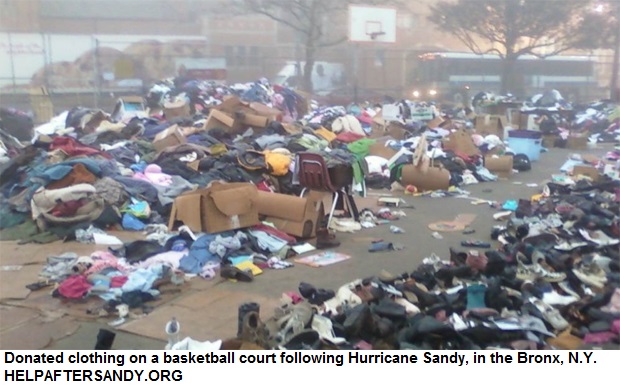
CU Blog - Logistics of Disaster Relief - Photo 3There are times when giving things works. More than 650,000 homes were destroyed or damaged in Hurricane Sandy in 2012. Thousands of people lost everything.

Tammy Shapiro is one of the organizers of Occupy Sandy, which grew out of the Occupy Wall Street movement.

“We were able to respond in a way that the big, bureaucratic agencies can’t,” Shapiro said.

When the hurricane struck, they had a network of activists, connected and waiting.

“Very quickly, we just stopped taking clothes,” Shapiro said. Instead, they created a “relief supply wedding registry.”

“We put the items that we needed donated on that registry,” said Shapiro. “And then people who wanted to donate could buy the items that were needed. I mean, a lot of what we had on the wedding registry was diapers. They needed flashlights.”

Simon asked, “How transportable is your experience here, following Hurricane Sandy?”

“For me, the network is key. Who has the knowledge? Where are spaces that goods can live if there’s a disaster? Who’s really well-connected on their blocks?”

Juanita Rilling’s album of disaster images shows shot after shot of good intentions just spoiling in warehouses, or rotting on the landscape.

“It is heartbreaking,” Rilling said. “It’s heartbreaking for the donor, it’s heartbreaking for the relief organizations, and it’s heartbreaking for survivors. This is why cash donations are so much more effective. They buy exactly what people need, when they need it.

“And cash donations enable relief organizations to purchase supplies locally, which ensures that they’re fresh and familiar to survivors, purchased in just the right quantities, and delivered quickly. And those local purchases support the local merchants, which strengthens the local economy for the long run.”

Disaster response worker Rebecca Gustafson says that most people want to donate something that is theirs: “Money sometimes doesn’t feel personal enough for people. They don’t feel enough of their heart and soul is in that donation, that check that they would send.

“The reality is, it’s one of the most compassionate things that people can do.”

Share this post:
, , , ,
[Top]

Disaster Preparation: ‘Rinse and Repeat’

Go Lean Commentary

The reality of Caribbean life: we must contend with natural disasters, not of our making, “again and again”. The situation can be described as “Rinse and Repeat“.

Climate Change is not of our making, but it is our problem. Truth be told, it is not just our problem alone; the whole planet is affected. Right now this moment, the Greater Metropolitan area of Houston, Texas USA is suffering “pangs of distress”; see the VIDEO in the Appendix below. CU Blog - Disaster Preparation - Rinse and Repeat - Photo 1

It is what it is!

Some communities have done a better job than others in preparing for the unavoidable:

“Some communities”? “Better job“? That is not us … in the Caribbean!

As related in a previous Go Lean commentary, our Caribbean region has failed … in our managing this Agent-of-Change:

… we do not have the luxury of “sticking our head in the sand” and pretending that these problems will simply go away. The region has been devastated with this dysfunction and mis-management. Some 70% of Caribbean college-educated citizens have already fled their homelands in an undisputed brain drain. It’s time now to manage change differently than the Caribbean has done as of late. It’s time now to “Go Lean”.

The book Go Lean…Caribbean – available to download for free – serves as a roadmap for the introduction and implementation of the technocratic Caribbean Union Trade Federation (CU), for the elevation of Caribbean society – for all member-states. This CU/Go Lean roadmap has these 3 prime directives for us to do a better job:

  • Optimization of the economic engines in order to grow the regional economy to $800 Billion and create 2.2 million new jobs. This includes an efficient Emergency Management apparatus to ensure business continuity.
  • Establishment of a security apparatus to ensure public safety and protect the resultant economic engines.
  • Improve Caribbean governance to support these engines, including a separation-of-powers between the member-states and CU federal agencies. We can “move” member-state governments simply through funding, rankings and ratings.

The book stresses that reforming and transforming the Caribbean societal engines must be a regional pursuit. This was an early motivation for the roadmap, as pronounced in the opening Declaration of Interdependence (Pages 12 – 13):

i. Whereas the earth’s climate has undeniably changed resulting in more severe tropical weather storms, it is necessary to prepare to insure the safety and security of life, property and systems of commerce in our geographical region. As nature recognizes no borders in the target of its destruction, we also must set aside border considerations in the preparation and response to these weather challenges.

xi. Whereas all men are entitled to the benefits of good governance in a free society, “new guards” must be enacted to dissuade the emergence of incompetence, corruption, nepotism and cronyism at the peril of the people’s best interest. The Federation must guarantee the executions of a social contract between government and the governed.

xvi. Whereas security of our homeland is inextricably linked to prosperity of the homeland, the economic and security interest of the region needs to be aligned under the same governance. Since economic crimes … can imperil the functioning of the wheels of commerce for all the citizenry, the accedence of this Federation must equip the security apparatus with the tools and techniques for predictive and proactive interdictions.

xxiv. Whereas a free market economy can be induced and spurred for continuous progress, the Federation must install the controls to better manage aspects of the economy: jobs, inflation, savings rate, investments and other economic principles. Thereby attracting direct foreign investment because of the stability and vibrancy of our economy.

The Go Lean book provides 370-pages of turn-by-turn instructions on “how” to adopt new community ethos, plus the strategies, tactics, implementations and advocacies to execute so as to reboot, reform and transform the societal engines of Caribbean society, for better preparation for natural disasters. Consider the Chapter excerpts and headlines here from this sample on Page 184 entitled:

10 Ways to Improve for Natural Disasters

1

Emergence of the Caribbean Union
Lean-in for the Caribbean Single Market & Economy initiative as the Caribbean Union Trade Federation. This allows for the unification of the 30 member-states into one market, thereby spreading the risk and premium base across a market of 42 million people. The Caribbean member-states have Hurricane Katrina styled disasters (relatively speaking) every year.

2

Caribbean Emergency Management Agency – Federal Disaster Declarations
Modeled after FEMA in the US, this agency will be charged with the preparation, response and reconstruction for the regions for the eventual manifestations of hurricanes, earthquakes, tsunamis, flooding and other declared disasters, natural and man-made like medical epidemic, drought, pollution, oil spills, terrorism, etc.

3

Support Services for First Responders
Training, licensing and standards for Emergency Managers, Paramedics, Firefighters, Search and Rescue resources. For major disasters, some of these resources will come from international origins; they will need the support services (language translation, guides, maps, etc.) and coordination to maximize their results.

4

Animal Partner Training and Development
Maintain plantations for the training, development and boarding of “search & rescue” dogs, cadavers dogs and other service animals (horses, mules, pigs, etc.) so that there will be local resources within the region. (We cannot always depend on international responses in light of other regions experiencing their own disasters). These animals need not be owned by any one member-state, they can be on loan from CU resources.

5

Siren Warnings & Notifications
The CU will install tornado-style alarms/sirens in all major municipalities. In addition, the CU will implement tsunami warning messaging (emails/text) in coastal areas & seismic meters throughout the region in the affected “fault-line” areas.

6

Airlift & Sealift Authorizations
The CU Emergency Management Agency can license, regulate and authorize (air & sea) vessels and vehicles for emergency deployment in a disaster zone, before during and after the disastrous event.

7

JUA-style Insurance Fund
The fiduciary management of premiums and claims to allow the immediate response for reconstruction after disasters. These financial services, sidecars traded in markets can be direct or indirect as in reinsurance or insurer-of-last-resort.

8

Economic Crime Enforcement During and After Disasters
The CU will police, investigate and prosecute price gouging, insurance red lining and other economic crimes of both the “white collar” and “blue collar” variety. Once a CU-member-state declares a Disaster Emergency, new rules (quasi-Marshall Law) goes into effect. The CU will review and prosecute the actions of civilians and institutions alike.

9

Disaster Declaration Loans
Once there’s a Federal Disaster Declaration, the CU will make funds available for low-interest loans for communities to fund reconstructions. With tourism as a major “cash crop” the goal will be to restore the locality as a tourist destination as soon as possible, as even the perception of prolonged disaster damage can affect future bookings and travel plans.

10

Building Codes and Standards
Through peer review, the CU will regionalize the standards of building codes to assuage the threat of hurricanes and earthquakes, ensuring a higher survivability rate in the Caribbean islands. Due to economic pressures, when buildings and homes cannot be retrofitted, they will be rated for evacuation during hurricane warnings, or earthquake after-shocks.

The Caribbean must foster a better disaster preparation and response apparatus. We must do it now! Lives are at stake.

Just look at our American neighbors – they are suffering right now in the Greater Metropolitan area of Houston, Texas.

CU Blog - Hurricane Flooding - Who Knew - Photo 1b

While Climate Change is the underlying Agent-of-Change, it is outside of our control. This does not imply that there is no remediation for Climate Change; there is. In fact …

Fix ‘Climate Change’ – Yes, We Can

CU Blog - Disaster Preparation - Rinse and Repeat - Photo 2

We do not have the resources (time, talent and treasuries) to fix Climate Change for the planet ourselves, but we can fix it in our Caribbean region. This is a “Lesson in History” that our community has learned … from back in 1863:

There is an important lesson to learn in considering the history of the American Civil War. The war was fought over the issue of slavery. This was an ugly institution for those condemned as slaves. In the United States, that ugly disposition extended beyond the slaves themselves to the entire Black race. Though individuals could be set free, laws in the country could push them back into slavery without any due process. This was the case with the “Fugitive Slave Act of 1850″. Any Black person could be detained as a runaway slave and returned to any alleged Slave Master in the South; no matter any proof or the truth, or lack there-of. In many jurisdictions, a Black man could not even testify against white people. (This was the basis for the autobiographical book – by Solomon Northup – and movie “12 Years A Slave”).

To be Black in the America of those days, one “could not win, could not break-even and could not get out of the game”. There was no neutral destination in America. The optimal option was the only option, to work towards the end of slavery.

For this reason many Blacks joined the war effort, at great sacrifice to themselves and their community. This was a matter of principle! There is an important lesson for the Caribbean from this history[1] :

    The 54th Regiment Massachusetts Volunteer Infantry was an infantry regiment that saw extensive service in the Union Army during the American Civil War. The regiment was one of the first official African-American units in the United States during the Civil War.

CU Blog - A Lesson in History - During the Civil War - Principle not Principal - Photo 1

Remediating and mitigating Climate Change will be a battle. We need our own “Voluntary Infantry“ in this fight.

“We have a dog in this fight” – English language slang.

In the Caribbean, we must confederate and implement the institutions to work to remediate and mitigate Climate Change. We must “join in this fight”; we must Go Green and we must Go Blue. We have to be prepared for natural disasters – they will come … assuredly every season, some Caribbean destination will be impacted. We must be prepared to:

Rinse and Repeat.

If we are ready, to quickly respond, offer relief and rebuild – so as to guarantee the business continuity – we would then do a better job in our quest to make our homeland a better place to live, work and play. 🙂

Download the free e-Book of Go Lean … Caribbean – now!

Sign the petition to lean-in for this roadmap for the Caribbean Union Trade Federation.

———–

Appendix VIDEO – Historic flooding inundates Texas, hampering rescue efforts – https://youtu.be/Da-VS39gdfQ

PBS NewsHour

Published on Aug 27, 2017 – Houston’s mayor on Sunday urged his constituents in the nation’s fourth-largest city to stay off roadways as the state of Texas continues to contend with unprecedented flooding from Hurricane Harvey, now classified as a tropical storm. Officials said rising waters would reach catastrophic proportions, with more than 2,500 emergency calls made overnight in Houston alone. Hari Sreenivasan has more.

Share this post:
, , , ,
[Top]

Hurricane Flooding – ‘Who Knew?’

Go Lean Commentary

“Just keep living” – Old Wives’ Tale by “my late Mother-in-law”

Those 3 words reflected the wisdom of an 80 year-old woman. It simply meant:

If you do not see the logic, common sense or best-practice of some advice, just keep living and life will eventually convince you.

This sage advice is presented in contrast to the new President of the United States, Donald J. Trump, who in the first 100 days of his administration encountered a failure with trying to introduce new Health Care legislation. His response was:

Who knew “Health Care” was so complicated. – CNN

This is not a commentary about Health Care, but rather Hurricane Flooding preparation, response and mitigation. Once again, the American President has proven that he has not learned that wisdom exhibited by my now-deceased Mother-in-Law. On this occasion of a Category 4 storm – see photos and VIDEO’s of Hurricane Harvey in the Appendix below – drowning Southeast Texas with volumes and volumes of water (surge, rain and river flooding) – he exclaimed that this flooding was “unexpected”:

He told rescue organizers: “This was of epic proportion, nobody has ever seen anything like this.” – Sky News 29AUG17 19:23 GMT

CU Blog - Hurricane Flooding - Who Knew - Photo 1b

With all due respect Mr. President, it is the same with “Hurricane Flooding” as it was with Health Care:

Who Knew? Everybody – paying attention – knew!

Yes, this is “throwing shade” at President Trump, but this is a fair judgement as he made a cardinal mistake when assessing the seriousness of hurricanes and tropical storms; he is a Climate Change denier. This commentary previously related how this President declared – on June 1: the start of Hurricane Season – that he is withdrawing the US from the one international effort designed to abate Climate Change: the Paris Accord. That blog-commentary warned:

This is a matter of security; perhaps we [(Caribbean)] should not look to the US to take the lead for our own fate. This is so familiar … and a Hot Topic today as European member-states are contemplating how much they can look to the US for leadership for their security needs.

This was the assertion of the book Go Lean…Caribbean; available to download for free. It serves as a roadmap for the introduction and implementation of the technocratic Caribbean Union Trade Federation (CU), for the elevation of Caribbean society – for all member-states. The quest is that the Caribbean region convenes, collaborates and confederates to take their own lead – collectively – for their own fate. This CU/Go Lean roadmap has these 3 prime directives:

The book stresses that American self-interest is not necessarily the Caribbean’s best interest, even though there are two American territories (Puerto Rico & the Virgin Islands) in the Caribbean region. No, we must reform and transform our societal engines on our own. But this charter is too big for any one Caribbean member-state alone; there must be a regional effort. This was an early motivation for the roadmap, as pronounced in the opening Declaration of Interdependence(Pages 12 – 13):

i. Whereas the earth’s climate has undeniably changed resulting in more severe tropical weather storms, it is necessary to prepare to insure the safety and security of life, property and systems of commerce in our geographical region. As nature recognizes no borders in the target of its destruction, we also must set aside border considerations in the preparation and response to these weather challenges.

xi. Whereas all men are entitled to the benefits of good governance in a free society, “new guards” must be enacted to dissuade the emergence of incompetence, corruption, nepotism and cronyism at the peril of the people’s best interest. The Federation must guarantee the executions of a social contract between government and the governed.

xvi. Whereas security of our homeland is inextricably linked to prosperity of the homeland, the economic and security interest of the region needs to be aligned under the same governance. Since economic crimes … can imperil the functioning of the wheels of commerce for all the citizenry, the accedence of this Federation must equip the security apparatus with the tools and techniques for predictive and proactive interdictions.

xxiv. Whereas a free market economy can be induced and spurred for continuous progress, the Federation must install the controls to better manage aspects of the economy: jobs, inflation, savings rate, investments and other economic principles. Thereby attracting direct foreign investment because of the stability and vibrancy of our economy.

The Go Lean book provides 370-pages of turn-by-turn instructions on “how” to adopt new community ethos, plus the strategies, tactics, implementations and advocacies to execute so as to reboot, reform and transform the societal engines of Caribbean society; to better respond, relieve and rebuild from devastating hurricanes in all the 30 member-states in the region.

That previous blog-commentary declared:

The issue of Hurricane Season 2017 is bigger than initial appearances – there are BIG  issues afoot. …

The Caribbean status quo is unsustainable under the real threats of Climate Change. The region must reboot, reform and transform. We must do the heavy-lifting ourselves; we cannot expect relief and refuge from others, like the American Super-Power. We must find and “sail” under our own power.

The Go Lean book – and this commentary – calls on the region to master the art and science of water management.

We are saddened by all the death and destruction in Houston today; see Appendix. (Flooding is familiar in Houston, though more disastrous as of late). But believe it or not, there is a thesis that flooding could be prevented. Yes, indeed! This is the experience and historicity of the Dutch people, the European country of the Netherlands or Holland. See how their mitigations are portrayed in the news magazine here – an American news magazine:

VIDEO  – Sea change: How the Dutch confront the rise of the oceans – https://youtu.be/3J5ZoPFhSGM

Posted August 27, 2017 – Windmills are more than just a traditional part of the Dutch landscape; they have played a key role in the war the Dutch have been waging against the ocean for the past thousand years. Our Cover Story is reported by Martha Teichner. (This story was previously broadcast on May 21, 2017.)

The VIDEO’s transcript could be reviewed here: https://www.cbsnews.com/news/sea-change-how-the-dutch-confront-the-rise-of-the-oceans-2/

In addition, this commentary has visited the subject of water-flood management on many occasions; consider this sample of previous blogs:

https://goleancaribbean.com/blog/?p=12834 Hurricane Andrew – 25 Years of Hoopla in Water Management
https://goleancaribbean.com/blog/?p=12724 Lessons from Colorado: Water Management Arts & Sciences
https://goleancaribbean.com/blog/?p=12230 Managing Beach Erosion and Flooding Realities
https://goleancaribbean.com/blog/?p=7235 Flint, Michigan – A Cautionary Tale in Water Management
https://goleancaribbean.com/blog/?p=1656 Blue – Water Management – is the New Green
https://goleancaribbean.com/blog/?p=1817 Caribbean grapples with intense new cycles of flooding & drought
https://goleancaribbean.com/blog/?p=1516 Floods in Minnesota, Drought in California – Why Not Share?

The United States of America provides so many examples for the Caribbean: good, bad and ugly.

But we must make a separation between American power and American people.

To those of the American people languishing in the communities of Houston, Texas we send you our prayers and compassion and urge you to hold-on; it gets better.

To those American power brokers who continue to deny the obvious, we urge you to just keep living. You will soon realize the undeniable consequences of Climate Change:

Those who fail to plan; plan to fail!

CU Blog - Hurricane Flooding - Who Knew - Photo 2c

CU Blog - Hurricane Flooding - Who Knew - Photo 1c

In the Caribbean, we must be better and do better. This is our quest, to better serve the needs of our Caribbean people. Reforming and transforming America is out-of-scope for our efforts; we have our own storms to prepare and respond to. May we never “stick our head in the sand” and deny the obvious. No, rather, let’s always do the heavy-lifting to make our homelands better places to live, work and play. 🙂

Download the free e-Book of Go Lean … Caribbean – now!

Sign the petition to lean-in for this roadmap for the Caribbean Union Trade Federation. 

———–

Appendix VIDEO – Houston’s Flooding Crisis – https://youtu.be/uKAv_8lfjUw

Posted August 29, 2017 – Emergency responders in Houston have now rescued more than 6,000 people from Hurricane Harvey’s flooding. Harvey is still a tropical storm spinning off the Gulf Coast. It could make a second landfall Wednesday east of Houston. Mark Strassmann reports on rescue efforts.

Subscribe to the “CBS This Morning” Channel HERE: http://bit.ly/1Q0v2hE
Watch “CBS This Morning  – hosted by Charlie Rose, Norah O’Donnell and Gayle King” HERE: http://bit.ly/1T88yAR

———–

Hurricane Harvey – Houston August 2017 Photos

CU Blog - Hurricane Flooding - Who Knew - Photo 1a

CU Blog - Hurricane Flooding - Who Knew - Photo 2b

Epic Flooding Inundates Houston After Hurricane Harvey

An evacuee holding two dogs reacts after his rescue by Texas National Guardsmen from severe flooding due to Hurricane Harvey in Cypress Creek

Epic Flooding Inundates Houston After Hurricane Harvey


Share this post:
, , ,
[Top]

Hurricane Andrew – 25 Years of Hoopla

Go Lean Commentary

Want to rumble? Want a piece of this?

Surely anyone vying for a leadership role in the Caribbean must be prepared for a fight. A fight with “Mother Nature”.

Expect to lose!

CU Blog - Hurricane Andrew - 25 Years of Hoopla - Photo 1

CU Blog - Hurricane Andrew - 25 Years of Hoopla - Photo 2

This was the contention from this previous blog-commentary on August 28, 2015, on the 10th anniversary commemorating 2005’s Hurricane Katrina:

Title: A Lesson in History – ‘Katrina’ is helping today’s crises
Welcome to the Caribbean  …

… the greatest address on the planet?!?!

Why would anyone campaign to assume the stewardship of this archipelago of islands?

This is the “siren song” of the book Go Lean … Caribbean. The publishers … are petitioning for a leadership role in the economic, security and governing engines of the region. Why?

There is no insanity! This is an expression of love for the homeland. The 30 member-states of the Caribbean are home to 42 million people, and a Diaspora of 10 million; plus 80 million visitors annually.

This is the greatest address on the planet!

Plus, everywhere has natural disasters to contend with. This fact relates to rich countries and poor alike. For example, take the United States; they are the richest Single Market economy in the world and yet their coastal city of New Orleans Louisiana (NOLA) was devastated by Hurricane Katrina 10 years ago … to the day (August 29, 2005). Their riches did not spare their devastation, nor did the riches facilitate best-practices in terms of response, relief and rebuilding. New Orleans is marking the anniversary of Katrina’s devastation and the lessons learned from the aftermath.

Remembering Hurricane Andrew

Now it is the time to remember a different, earlier storm, as it is the 25th anniversary of August 24, 1992 when Hurricane Andrew devastated the Caribbean region and the Greater Miami area; think almost $30 Billion in damages after 65 fatalities in the region. (This writer endured Andrew as a Miami resident). There are even more lessons to consider, contemplate and correlate to Caribbean stakeholders. As previously detailed, Miami has a pivotal connection with the Caribbean; as our member-states fail more and more, Miami becomes the beneficiary of our human and capital flight:

Miami’s Success versus Caribbean Failure

The “hoopla“ – historicity and actuality – of storms like Hurricane Andrew and Katrina reminds us …

… that Climate Change cannot be ignored. Even though there are deniers of any man-made causes, the reality of these storms challenge the realities of Caribbean life.

See this theme portrayed here in this current news article from USA Today, an American daily newspaper:

Title: In booming South Florida, another Hurricane Andrew could be a $300 billion catastrophe

CU Blog - Hurricane Andrew - 25 Years of Hoopla - Photo 3MIAMI — Twenty-five years ago this month, Hurricane Andrew unleashed its Category 5 wrath on South Florida, sending a catastrophic reminder about the dangers of living in the heart of “hurricane alley.”

But drive along any coastline in Florida today and you’ll find construction cranes as plentiful as palm trees as developers rush to build high-rises in the most beautiful, and vulnerable, corners of the state.

Florida has improved standards for new construction to prevent the level of damage wrought by hurricanes, but an Andrew-like storm hitting downtown Miami and its ever-growing collection of sparkling skyscrapers could exact a hefty price: $300 billion, according to one insurance underwriter.

“And that number doesn’t include loss of taxes or tourism,” said Monica Ningen, chief property underwriter for the U.S. and Canada for Swiss Re, one of the largest reinsurance companies in the world.

In the 25 years since Andrew made landfall on Aug. 24, 1992, nearly 1 in 10 homes built in the United States were built in Florida, according to an analysis of building permits conducted for USA TODAY by the real estate web site Trulia. That’s second only to Texas.

The trend is even more pronounced for larger condo buildings. Florida accounts for 11.5% of new residential buildings with at least five residences over the past 25 years, trailing only Texas’ 12.7%, according to the Trulia analysis.

“We’re like lemmings going to the sea, except that we build condos, hotels, and houses,” said Richard Olson, director of the International Hurricane Research Center at Florida International University.

The dangers of Florida’s post-Andrew growth is clearly illustrated in a report from Swiss Re that examined Florida’s vulnerability to hurricanes.

Andrew caused $24.5 billion in insured property damage when it hit the working class suburb of Homestead about 20 miles south of downtown Miami, becoming the most expensive catastrophe in U.S. history. Since then, Miami-Dade County’s population has increased by more than a third. Now, if a similar storm hit the same spot, Swiss Re estimates it would cause closer to $60 billion in insured damage.

High-rise condos could be Florida’s weak spot

Part of the reason for those massive numbers is the explosion of high-rise condos throughout the state.

Florida toughened up its building codes after Andrew and saw good results with the spate of four hurricanes that struck the state in 2004. But in 2005, Hurricane Wilma revealed a glaring weakness.

Wilma, as a Category 2 hurricane, was far weaker than Andrew when it crossed over Miami, but its 100 mph winds shattered windows throughout downtown. One reason: Wind speeds grow drastically the higher you go.

Wilma’s 75 mph winds on the ground grew to 115 mph on the 30th floor, according to a hurricane wind model created by Florida International University in Miami. No condos collapsed, but the window failures caused massive damage.

“The structure looks great from the outside, and yet, the building has to be gutted because of the water damage inside,” said Shahid Hamid, director of the Laboratory for Insurance, Financial and Economic Research at FIU.

Price of paradise

So with a catastrophic risk looming, why do Floridians continue to build such high structures right on the coast?

For developers, the answer is simple.

“Anybody that owns a piece of property should be able to do what they like with it, as long as they’re complying with the laws,” said Jeremy Stewart, a Crestview, Fla., developer and chairman of the Florida Home Builders Association.

CU Blog - Hurricane Andrew - 25 Years of Hoopla - Photo 4But developers aren’t just interested in the principles of individual freedom or property rights, says Craig Fugate, the former head of the Federal Emergency Management Agency. It comes down to money, Fugate says.

With each new glass-covered skyscraper that goes up along Florida’s coasts, developers reap a windfall of profits. The money drives businesses and puts taxes into government coffers.

Real estate attorneys, realtors, agents, architects, and contractors all get a piece. Every new condo that goes up in Pensacola or Tampa or Jacksonville means more tax revenues for those city governments. Florida is one of seven states that doesn’t collect personal income tax, so real estate taxes and fees included in every home purchase are critical to keep the state’s finances afloat.

Fugate said that has created a “vicious cycle” of transactions that the state has grown to rely on.

“Our economy is building houses, apparently,” said Fugate, who lives in northern Florida and used to run the state’s emergency management division before heading up FEMA. “Our bias now seems to be to the benefit of the transaction, not the homeowner.”

Some city leaders say it’s not that nefarious. In Miami Beach, the tourist mecca that is at the front line of Florida’s battles against climate change, leaders say the tax revenues from new developments are the only way they can afford to make the long-term improvements to gird the barrier island from rising water.

The city is in the midst of a $500 million project to raise roads, raise seawalls and install 80 pumps to push out floods that occur even on sunny days.

New York and New Jersey received billions in federal funding following Superstorm Sandy, just as New Orleans did following Hurricane Katrina. But since a hurricane hasn’t hit Miami and Miami Beach directly in decades, they are left to improve their infrastructure mostly on their own.

“On the one hand, we have to be responsible with our development,” said Miami Beach City Manager Jimmy Morales. “But on the other hand, we need that revenue. We’ve got to figure out how to pay for all that.”

Then there’s the way residents ponder the question. Ask Floridians why they’re willing to endure the threat of hurricanes and they’ll usually give some version of the same answer: They raise their arms and say, “Look around.”

Maria Lopez, 38, moved out of her home in Little Havana just outside downtown Miami 10 years ago as the rent increased and the neighborhood endured more and more flooding. Lopez said she never even considered leaving the city or the state, opting instead to find a home in nearby Liberty City that was elevated to avoid flooding and built to hurricane-proof building codes.

Lopez, a customs broker with two young sons, loves “the food, the culture, the climate.” But, she says, “You just have to know that a hurricane can hit.”

James Murley, the chief resilience officer for Miami-Dade County, agreed, saying the dangers of hurricanes and sea level rise are simply the price of living in paradise, just as Californians are willing to deal with the occasional earthquake.

“You have to live with the risk,” he said. “Why are they still building in San Francisco? Why are they still building in Los Angeles? They’re on established fault lines. Communities that have a history, they’re going to grow one way or the other.”

Grow smarter or inland?

With no slowdown in sight, experts say Florida has two remaining choices: grow farther from the coast or grow smarter.

Jean-Pierre Bardet, dean of the college of engineering at the University of Miami, said the only way that developers will stop building skyscrapers right along the water will come down to money.

Florida’s building codes have made construction more expensive over the years. And some developers have gone beyond those codes to create safer, and costlier, buildings.

For example, many new high-rises in Florida don’t have a street-level entrance for pedestrians. They begin with several floors of parking on the ground floors, then a lobby higher up, topped off by apartments or offices. That means only cars parked at those levels will be damaged if a hurricane pushes in storm surge or rising sea levels create more regular flooding.

Those kinds of measures are expensive, though, and Bardet said their prices will only increase as the projects become harder to engineer.

“The economic consideration will be what puts the brakes on this expansion,” he said.

Some cities and counties, including St. Petersburg, Palm Beach County and Miami, are taking a “smart growth” approach by hiring “resilience officers” or “sustainability managers” who devise growth plans that account for the potential environmental impacts of climate change.

James Cloar, an urban development consultant and former chairman of the Urban Land Institute Tampa Bay, said the people in those positions need broad power to control how a city grows.

“These offices are being created with good intentions, but I don’t think universally they’re at the level that they need to be,” he said.

Jane Gilbert, who became the city of Miami’s first chief resilience officer in 2015, said it’s been tough to persuade everyone of the value of such planning, but some government officials and private developers do see a long-term benefit.

“Luckily we have some progressively-minded developers, architects and land-use attorneys that get it,” she said. “(They understand) that if we don’t start building with a long term view, their investments are at risk.”

More: As Hurricane Andrew memories fade, Florida weakens building codes

More: ‘Extremely active’ hurricane season now likely, federal forecasters say

Source: Retrieved August 24, 2017 from: https://www.usatoday.com/story/news/2017/08/22/hurricane-cost-florida/560846001/

———-

VIDEO – Hurricane Season is getting more intense – https://usat.ly/2utG8JA

Posted August 22, 2017 – Forecasters at the National Oceanic and Atmospheric Administration have upped their predictions of the number of and severity of upcoming storms during hurricane season. Newslook.

The book Go Lean…Caribbean – available to download for free – serves as a roadmap for the introduction and implementation of the technocratic Caribbean Union Trade Federation (CU), for the elevation of Caribbean society, to better respond, relieve and rebuild from devastating hurricanes in all the 30 member-states in the region.

Remember? We cannot win in a battle with “Mother Nature”; we can only respond, relieve and rebuild.

This CU/Go Lean roadmap therefore has these 3 prime directives:

  • Optimization of the economic engines in order to grow the regional economy to $800 Billion and create 2.2 million new jobs.
  • Establishment of a security apparatus to ensure public safety and protect the resultant economic engines.
  • Improve Caribbean governance to support these engines, including a separation-of-powers between the member-states and CU federal agencies.

The book stresses that the problems of the Caribbean are too big for any one member-state alone to contend with, that reforming and transforming the Caribbean societal engines – to mitigate the risks of disasters – must be a regional pursuit. This was an early motivation for the roadmap, as pronounced in the opening Declaration of Interdependence (Pages 12 – 13):

i.  Whereas the earth’s climate has undeniably changed resulting in more severe tropical weather storms, it is necessary to prepare to insure the safety and security of life, property and systems of commerce in our geographical region. As nature recognizes no borders in the target of its destruction, we also must set aside border considerations in the preparation and response to these weather challenges.

xi. Whereas all men are entitled to the benefits of good governance in a free society, “new guards” must be enacted to dissuade the emergence of incompetence, corruption, nepotism and cronyism at the peril of the people’s best interest. The Federation must guarantee the executions of a social contract between government and the governed.

xvi. Whereas security of our homeland is inextricably linked to prosperity of the homeland, the economic and security interest of the region needs to be aligned under the same governance. Since economic crimes … can imperil the functioning of the wheels of commerce for all the citizenry, the accedence of this Federation must equip the security apparatus with the tools and techniques for predictive and proactive interdictions.

xxiv. Whereas a free market economy can be induced and spurred for continuous progress, the Federation must install the controls to better manage aspects of the economy: jobs, inflation, savings rate, investments and other economic principles. Thereby attracting direct foreign investment because of the stability and vibrancy of our economy.

The Go Lean book provides 370-pages of turn-by-turn instructions on “how” to adopt new community ethos, plus the strategies, tactics, implementations and advocacies to execute so as to reboot, reform and transform the societal engines of Caribbean society. The book details that the CU will implement an optimized Emergency Management scheme to provide better stewardship for the region’s preparation and response to natural disasters; (in addition to hurricanes, there is the need to monitor and manage earthquakesvolcanoes, floods and droughts in the regions).  In addition, the CU will assume jurisdiction for the Caribbean Sea, the 1,063,000 square-mile international waters, as an Exclusive Economic Zone. These preparations and mitigations will allow for better cooperation, collaboration and equalization in the region.

This commentary has previously detailed other discussions related to managing Caribbean society’s preparation and response to hurricanes; see sample here:

https://goleancaribbean.com/blog/?p=12068 Trump Denies ‘Climate Change’ and Ends Federal Abatements
https://goleancaribbean.com/blog/?p=11442 Caribbean Roots: Al Roker – ‘Climate Change’ Defender
https://goleancaribbean.com/blog/?p=9455 Fix ‘Climate Change’ – Yes, We Can
https://goleancaribbean.com/blog/?p=9334 Hurricane Categories – The Science
https://goleancaribbean.com/blog/?p=7896 The Logistics of Disaster Relief
https://goleancaribbean.com/blog/?p=7449 ‘Crap Happens’ – So What Now?
https://goleancaribbean.com/blog/?p=4741 Vanuatu and Tuvalu – Inadequate response to post-storm suffering
https://goleancaribbean.com/blog/?p=2465 Book Review: ‘This Changes Everything: Capitalism vs. the Climate’
https://goleancaribbean.com/blog/?p=1817 Caribbean grapples with intense new cycles of flooding & drought

Hurricane Andrew was not the first, nor the last hurricane to devastate the tropical region. Truth be told, this is a product of Climate Change. Though there are deniers of any man-made causes, the actuality of these storms is the new Caribbean reality.

It is what it is!

Yet still, with better stewardship and shepherding, our communities can be better and do better. We urge all Caribbean stakeholders to lean-in to this Go Lean roadmap to make our homeland a better place to live, work and play. 🙂

Download the free e-Book of Go Lean … Caribbean – now!

Sign the petition to lean-in for this roadmap for the Caribbean Union Trade Federation.

Share this post:
, , , ,
[Top]

Lessons from Colorado: Black Ghost Towns – “Booker T. turning in his grave”

Go Lean Commentary

CU Blog - Lessons from Colorado - Black Ghost Towns - Photo 0This precept is straight-forward, natural and moral:

Whatever a man sows, that he will also reap. – The Bible – Galatians 6:7

Or stated otherwise:

If you sow wheat, you will reap wheat … during the harvest.

Barring any extra-natural intervention, a roadmap that is based on this natural law should indeed experience success. And yet, Booker T. Washington – one of the most influential African-American leaders in the history of the country – is probably “turning in his grave”, when considering the actuality of so many Black townships that were formed in his wake.

The book Go Lean…Caribbean makes an important point about the African experience in the US; it is one of deferred gratification, not to expect an immediate return, result and consequence; the reap-what-you-sow mantra had been irrelevant.

There is a Lesson in History that Caribbean communities must consider. One commentator, activist and comedian summarized it as the “home court advantage”:

The world is mourning the passing of this comedian, Dick Gregory at age 84 (October 12, 1932 – August 19, 2017). Among the many accomplishments in his full life was this one declaration – quoted in a previous Go Lean commentary – on November 27, 1963 when President Lyndon Johnson announced at a Joint-Session of Congress that he would continue with the recently assassinated John Kennedy’s Civil Rights agenda:

“Twenty million American Negroes unpacked”.

He thereby acknowledged that until that moment – in the 1960’s – the United States of America was really not home for the minority African-American populations. No, White America had the “home-court advantage”.

This “home-court advantage” is in contrast with the straight-forward, natural and moral precept … mentioned at the outset. That precept was vocalized by Booker T. Washington. He advocated an economic empowerment plan to “prosper where planted”. This was sound, if not for the actuality of White Supremacy in early 20th Century America.

The details of Booker T.’s advocacy was fully detailed in a previous Go Lean blog-commentary:

A Lesson in History – Booker T versus Du Bois

Booker T. Washington and W.E.B. Du Bois … were [both] very important in the history of civil rights for African-Americans. They both wanted the same elevation of their community – [the “Way Forward”] – in American society, but they both had different strategies, tactics and implementations.

CU Blog - A Lesson in History - Booker T versus DuBois - Photo Combined

Washington’s biggest legacy is the Tuskegee University (Tuskegee Institute in his day). Du Bois’s legacy stems from his co-founding the NAACP (National Association for the Advancement of Colored People).

The conclusion … is that the journey for full citizenship for African-Americans took 100 years from the time of the Washington / Du Bois chasm. No matter the detailed approach, 100 years is still 100 years.

From the point of view of the Caribbean and the publishers of Go Lean…Caribbean, we side with both civil rights leaders in aspirations, but lean towards Booker T. Washington in strategies. Underlying to Mr. Washington’s advocacy, was for the Black Man to remain in the South, find a way to reconcile with his White neighbors and to prosper where he was planted.

The point from a Caribbean perspective is “the more things change, the more they remain the same”. We have problems in the Caribbean to contend with, many of which we are failing miserably. But our biggest crisis stems from the fact that so many of our citizens have fled their Caribbean homelands for foreign (including American) shores.

The purpose of this commentary is not to fix America, it is to fix the Caribbean. But the push-and-pull factors are too strong coming from the US. We must lower the glimmering light, the “pull factors”, that so many Caribbean residents perceive of the “Welcome” sign hanging at American ports-of-entry. A consideration of this commentary helps us to understand the DNA of American society: un-reconciled race relations in which Black-and-Brown are still not respected.

The logical conclusion: stay home in the Caribbean and work toward improving the homeland. The US should not be the panacea of Caribbean hopes and dreams.

Booker T. Washington advocated this strategy: prosper where you’re planted.

After 100 years, and despite an African-American President, we must say to Mr. Booker T. Washington: We concur!

The history and legacy of one of the Booker T’s inspired Black townships – Dearfield, Colorado – is commemorated in the Black American West Museum and Heritage Center in Denver, Colorado. This historicity – see encyclopedic details here – is one of the lessons learned from developments in Denver and the State of Colorado. This is the theme of this series of commentaries on lessons that have been learned by Caribbean stakeholders visiting, observing and reporting on this US State of Colorado.

Reference – Dearfield, Colorado

CU Blog - Lessons from Colorado - Black Ghost Towns - Photo 1

Dearfield is a “ghost town” and a historically black majority settlement in Weld County, Colorado, United States. It is 30 miles (48 km) east of Greeley. The town was formed by Oliver T. Jackson who desired to create a colony for African Americans; [he was inspired by the ideals set forth in Booker T. Washington’s book “Up from Slavery”; see Appendix below]. In 1910, Jackson, a successful businessman from Boulder, filed on the homestead that later became the town and began to advertise for “colonists.” The name Dearfield was suggested by one of the town’s citizens, Dr. J.H.P. Westbrook who was from Denver. The word dear was chosen as the foundation for the town’s name due to the precious value of the land and community to the town’s settlers.[2]

The first settlers of Dearfield had great difficulty farming the surrounding pasture and endured several harsh seasons. However, by 1921, 700 people lived in Dearfield. The town’s net worth was appraised at $1,075,000. After several prosperous years, the Great Depression arrived and the town’s agricultural success significantly declined. Settlers began to leave Dearfield in order to find better opportunities. By 1940, the town population had decreased to 12, only 2% of the town’s 1921 population. Jackson desperately attempted to spur interest in the town, even offering it for sale. However, there was little interest in Dearfield. Jackson died on February 18, 1948.

CU Blog - Lessons from Colorado - Black Ghost Towns - Photo 2

CU Blog - Lessons from Colorado - Black Ghost Towns - Photo 2b

CU Blog - Lessons from Colorado - Black Ghost Towns - Photo 2c

A few deserted buildings remain in Dearfield: a gas station, a diner, and the founder’s home. In 1998, the Black American West Museum in Denver began to make attempts to preserve the town’s site. It is a Colorado Registered Historic Landmark. A 2010 monument next to one of the remaining buildings contains information about the history of the site.

A 2001 state historical marker [3] at U.S. Route 85 mile marker 264 near Evans, Colorado, includes a panel with the history of Dearfield.
Source: Retrieved August 20, 2017 from: https://en.wikipedia.org/wiki/Dearfield,_Colorado

There were other Black townships as well; consider: Allensworth, California, Boley, Oklahoma, and Nicodemus, Kansas.

What befell these towns?

Agents of Change

This is a strong point of contention in the Go Lean book (Page 45). It asserts that the modern world does NOT stand-still; change is ever-present. The Agents of Change that befell the Black townships of that era were mostly:

  • Geo-political – An early round of globalization where focus, investments and jobs  shifted away from the farms to the factories in the cities.
  • Technology – Agricultural science and methods changed; i.e. fertilizers, seeds, etc.
  • Climate Change – In the early 1930’s, a pervasive drought afflicted the High Plains of the Mid-West United States, creating the Dust Bowl; this was exacerbated by bad farming practices, that cause the disaster to linger longer than best-practices dictated.
    CU Blog - Lessons from Colorado - Black Ghost Towns - Photo 3
  • Racism and White Supremacy could have been considered among these Agents of Change, though this societal defect remained unresolved and un-reconciled in American society, no matter the location, North-South or Urban-Rural. Whenever Black townships made progress, malicious acts from the White Majority curtailed any advances. See here:
    VIDEO – How Black Communities Were Destroyed | Sincere History – https://youtu.be/jRZ6o0W_pHI
    Published on Dec 21, 2015 – A hundred years ago, in communities across the U.S., white residents forced thousands of black families to flee their homes. Even a century later, these towns remain almost entirely white. BANISHED tells the story of three of these communities and their black descendants, who return to learn their shocking histories.”
    Reason TV: Urban Renewal – https://www.youtube.com/watch?v=mWGws…
    For more, go to http://sincereignorance.com/2014/08/0…
    Sincere Ignorance Social Media
    Facebook: https://www.facebook.com/sincereignor…
    Twitter: https://twitter.com/sincereignorant

In the Caribbean, we have so much in common and so much in contrast with this community of Dearfield, and the other towns who suffered the same Ghost Town fate. For starters, we have our own Ghost Towns. We also have Agents of Change (Globalization, Technology, Climate Change and the Aging Diaspora) to contend with. So we have to build-up our Caribbean homeland so that our people can “prosper where planted”. But we do have a home-court advantage that Dearfield et al never enjoyed; we have a majority Black population.

This commentary completes the 5-part series on the subject of Lessons from Colorado. There are so many lessons that we have considered from this land-locked US State; good ones and bad ones. In fact, the full list of 5 entries are detailed as follows:

  1. Lessons from Colorado – Common Sense of Eco-Tourism
  2. Lessons from Colorado – Legalized Marijuana: Heavy-lifting!
  3. Lessons from Colorado – How the West Was Won
  4. Lessons from Colorado – Water Management Art and Science
  5. Lessons from Colorado – Black Ghost Towns

This book Go Lean… Caribbean, serves as a roadmap for the introduction and implementation of the Caribbean Union Trade Federation (CU), which represents change for the region. The CU/Go Lean roadmap has 3 prime directives:

  • Optimization of the economic engines in order to grow the regional economy and create 2.2 million new jobs.
  • Establishment of a security apparatus to ensure public safety and protect the resultant economic engines.
  • Improve Caribbean governance – including best practices in town planning and agricultture – to support these engines.

The Go Lean roadmap provides turn-by-turn directions on how to forge this change in the region for a reboot of the Caribbean societal engines: economy, security and governance. This roadmap is presented as a planning tool, pronouncing this point early in the Declaration of Interdependence with these statements: (Pages 12 – 13):

xi. Whereas all men are entitled to the benefits of good governance in a free society, “new guards” must be enacted to dissuade the emergence of incompetence, corruption, nepotism and cronyism at the peril of the people’s best interest. The Federation must guarantee the executions of a social contract between government and the governed.

xvi. Whereas security of our homeland is inextricably linked to prosperity of the homeland, the economic and security interest of the region needs to be aligned under the same governance. Since economic crimes … can imperil the functioning of the wheels of commerce for all the citizenry, the accedence of this Federation must equip the security apparatus with the tools and techniques for predictive and proactive interdictions.

xxiv.  Whereas a free market economy can be induced and spurred for continuous progress, the Federation must install the controls to better manage aspects of the economy: jobs, inflation, savings rate, investments and other economic principles. Thereby attracting direct foreign investment because of the stability and vibrancy of our economy.

The Go Lean book calls for the elevation of Caribbean society, to re-focus, re-boot, and optimize all the societal engines so as to make the 30 member-states of the Caribbean a better place to live, work and play.  Thank you Colorado for these lessons from your past, present and future on how we can better shepherd our society.

Your land is a great place to visit, but it is not our home. But still, you have shown us that nation-building is heavy-lifting and that we need good role models to follow.

There have been other Go Lean blog-commentaries that presented good role models for nation-building, especially in the light of societal defects; see this sample here:

https://goleancaribbean.com/blog/?p=12369 Happy Canada Day 150 to a Pluralistic Democracy
https://goleancaribbean.com/blog/?p=11386 Building Better Cities
https://goleancaribbean.com/blog/?p=10513 Transforming ‘Money’ Countrywide
https://goleancaribbean.com/blog/?p=6563 Lessons from Iceland – Model of Recovery

If we do not learn from history, we are forced to repeat it.

This also applies to other people’s history. There are so many lessons that the Caribbean can learn from other communities: best practices and bad practices. Let’s pay more than the usual attention to these lessons.

We need all the help we can get. The bad old days of Caribbean dysfunction must end. We must work to do better, to be better.

These lands are our home! (Unlike our African-American brothers and sisters of olden times, we have the home-court advantage):

This is my island in the sun
Where my people have toiled since time begun
I may sail on many a sea
Her shores will always be home to me

Song: Island in the Sun by Harry Belafonte

Yes, we can! We can make our homelands better places to live, work and play. 🙂

… and RIP Dick Gregory.

Download the book Go Lean … Caribbean – now!

Sign the petition to lean-in for this roadmap for the Caribbean Union Trade Federation.

———–

Book Review: Up from Slavery 

CU Blog - Lessons from Colorado - Black Ghost Towns - Photo 4Up from Slavery is the 1901 autobiography of Booker T. Washington sharing his personal experience of having to work to rise up from the position of a slave child during the Civil War, to the difficulties and obstacles he overcame to get an education at the new Hampton Institute, to his work establishing vocational schools—most notably the Tuskegee Institute in Alabama—to help black people and other disadvantaged minorities learn useful, marketable skills and work to pull themselves, as a race, up by the bootstraps. He reflects on the generosity of both teachers and philanthropists who helped in educating blacks and Native Americans. He describes his efforts to instill manners, breeding, health and a feeling of dignity to students. His educational philosophy stresses combining academic subjects with learning a trade (something which is reminiscent of the educational theories of John Ruskin). Washington explained that the integration of practical subjects is partly designed to reassure the white community as to the usefulness of educating black people.

This book was first released as a serialized work in 1900 through The Outlook, a Christian newspaper of New York. This work was serialized because this meant that during the writing process, Washington was able to hear critiques and requests from his audience and could more easily adapt his paper to his diverse audience.[1]

Washington was a controversial figure in his own lifetime, and W. E. B. Du Bois, among others, criticized some of his views. The book was, however, a best-seller, and remained the most popular African American autobiography until that of Malcolm X.[2] In 1998, the Modern Librarylisted the book at No. 3 on its list of the 100 best nonfiction books of the 20th century, and in 1999 it was also listed by the conservative Intercollegiate Review as one of the “50 Best Books of the Twentieth Century”.[3]

Plot summary

Up from Slavery chronicles more than forty years of Washington’s life: from slave to schoolmaster to the face of southern race relations. In this text, Washington climbs the social ladder through hard, manual labor, a decent education, and relationships with great people. Throughout the text, he stresses the importance of education for the black population as a reasonable tactic to ease race relations in the South (particularly in the context of Reconstruction).

Source: Retrieved August 21, 2017 from: https://en.wikipedia.org/wiki/Up_from_Slavery

Share this post:
, , , , ,
[Top]

Lessons from Colorado: Water Management Arts & Sciences

Go Lean Commentary

CU Blog - Lessons from Colorado - Water Management Art and Science - Photo 4Water is vital for the sustenance of life. So if you’re surrounded by water, then the assumption would be that you have an abundance of life?

Assumption?! The reality in the Caribbean … is just the opposite.

While it should be so easy – 27 of the 30 member-states are islands and the other 3 coastal states are embedded with rainforests – the actuality is the water management in the Caribbean is deficient and dysfunctional.

Say it ain’t so!

There are lessons to be learned by visiting, observing and reporting on other communities that do water management better. This commentary reflects that activity; some Caribbean stakeholders explored the US State of Colorado and discovered that we have so much to learn about how to facilitate the infrastructure of an optimized society. We have seen how water management is an art and a science. (All non-encyclopedic photos in this commentary were snapped in Colorado by Bahamian student Camille Lorraine).

CU Blog - Lessons from Colorado - Water Management Art and Science - Photo 1a

As reported previously, the Caribbean has so much in common and so much in contrast with Colorado. One contrast to consider is how Colorado’s lakes, rivers and waterways are structured to sustain the lives and systems of commerce of that State and … 6 other States plus 2 States in the foreign country of Mexico.

CU Blog - Lessons from Colorado - Water Management Art and Science - Photo 7

The 2013 book Go Lean…Caribbean visited Colorado’s water management. It detailed the strategies, tactics and implementation of the Colorado River Interstate Compact (an agreement between two or more states). This is reported on Page 278 of the book:

The Colorado River Compact is a 1922 agreement among seven US states (upper division: Colorado, New Mexico, Utah and Wyoming; lower division: (Nevada, Arizona and California) in the basin of the Colorado River in the American Southwest governing the allocation of the water rights to the river’s water among the parties of the interstate compact. The agreement was signed at a meeting at Bishop’s Lodge, near Santa Fe, New Mexico, by representatives of the seven states the Colorado river and its tributaries pass through on the way to Mexico.

The compact requires the UpperBasin states not to deplete the flow of the river below 7,500,000 acre feet during any period of ten consecutive years. Based on rainfall patterns observed in the years before the treaty’s signing in 1922, the amount specified in the compact was assumed to allow a roughly equal division of water between the two regions. The states within each basin were required to divide their 7,500,000-acre foot per year share allotment among themselves. In addition to this, 1,500,000-acre-foot per year of Colorado River water is allocated to Mexico, pursuant to the treaty relating to the use of waters of the Colorado and Tijuana rivers and of the Rio Grande, signed February 3, 1944, and its supplementary protocol signed November 14, 1944.

The compact enabled the widespread irrigation of the Southwest, as well as the subsequent development of state and federal water works projects under the United States Bureau of Reclamation. Such projects included the Hoover Dam, Lake Mead and Lake Powell, the 1st and 2nd largest man-made reservoirs in the US.

CU Blog - Lessons from Colorado - Water Management Art and Science - Photo 3

The headwaters of the Colorado River originate … in Colorado. This is the source.

CU Blog - Lessons from Colorado - Water Management Art and Science - Photo 6

CU Blog - Lessons from Colorado - Water Management Art and Science - Photo 5

CU Blog - Lessons from Colorado - Water Management Art and Science - Photo 2

CU Blog - Lessons from Colorado - Water Management Art and Science - Photo 8

This commentary continues the 5-part series – this is 4 of 5 – on the subject of Lessons from Colorado. There are so many lessons that we must consider from this land-locked US State; good ones and bad ones. In fact, the full list of 5 entries are detailed as follows:

  1. Lessons from Colorado – Common Sense of Eco-Tourism
  2. Lessons from Colorado – Legalized Marijuana – Heavy-lifting!
  3. Lessons from Colorado – How the West Was Won
  4. Lessons from Colorado – Water Management Art & Science
  5. Lessons from Colorado – Black Ghost Towns – “Booker T. turning in his grave”

The book Go Lean…Caribbean calls for the elevation of Caribbean society, to re-focus, re-boot, and optimize all the societal engines (economics, security and governance) so as to make the Caribbean a better place to live, work and play.  Water is connected to each of these facets of society. The purpose of Water Management is to ensure that the supply of fresh, clean water is steady and inexpensive.

This is an art and a science.

There is even a designating color that is used to brand this science: Blue. This point was identified and qualified in a previous Go Lean commentary, entitled “Blue is the new Green“. There, it stated:

First we said to “Go Green!” Now we are saying to “Go Blue”, because Blue is the new Green. While ‘Green’ is motivated for all-things-environmental, ‘Blue’ refers specifically to Water Conservation.

There is money in Green; there is money in Blue too! The references to Blue waters apply equally to fresh water and seawater. When we consider all the waterscapes in the Caribbean, (1,063,000 square-miles of the Caribbean seas and thousands of islands in the archipelago – The Bahamas has over 700 alone), we realize how much opportunity exists.

There is the chance to get lucky; where luck is defined as the intersection of preparation and opportunity.

Considering all the opportunities, how can the Caribbean prepare its economic engines to harvest all the fruitage from these Blue market conditions? This is the theme of the book Go Lean…Caribbean, that the world is struggling to contend with monumental changes related to technology, globalization and most importantly Climate Change.

Early in the book, the pressing need to be aware of climate change is pronounced in the Declaration of Interdependence (Page 11), with these words, (the first of many “causes of complaints”):

    i. Whereas the earth’s climate has undeniably changed resulting in more severe tropical weather storms, it is necessary to prepare to insure the safety and security of life, property and systems of commerce in our geographical region. As nature recognizes no borders in the target of its destruction, we also must set aside border considerations in the preparation and response to these weather challenges.

The Caribbean needs Blue Technology solutions to sustain our own lives, liberties and systems of commerce. But the Go Lean book posits that we cannot just consume, we must also create, produce, and foster. So we must foster industrial solutions for the rest of the world. This foregoing [embedded] magazine article summary highlighted the progression in this new Blue Technology industry-space in these areas:

  • Sourcing
  • Treating
  • Storing
  • Conserving
  • Keeping it Clean

So a study of Colorado allows us, in the Caribbean, the opportunity to see Blue Technology solutions at work, in motion and at success in sustaining millions of lives and their dependent systems of commerce. A specific lesson from Colorado is that the responsible parties for the mastery of this “art and science” in Colorado is not Colorado, but rather the US Federal government agency referred to as the United States Bureau of Reclamation (USBR). This agency …

… oversees water resource management, specifically as it applies to the oversight and operation of the diversion, delivery, and storage projects that it has built throughout the western United States for irrigation, water supply, and attendant hydroelectric power generation. Currently the USBR is the largest wholesaler of water in the country, bringing water to more than 31 million people, and providing one in five Western farmers with irrigation water for 10 million acres of farmland, which produce 60% of the nation’s vegetables and 25% of its fruits and nuts. The USBR is also the second largest producer of hydroelectric power in the western United States.[4] – Source: Wikipedia.

CU Blog - Lessons from Colorado - Water Management Art and Science - Photo 1b

The book Go Lean…Caribbean – available to download for free – serves as a roadmap for the introduction and implementation of the technocratic Caribbean Union Trade Federation (CU), for the elevation of Caribbean society – for all member-states. The CU would serve the Caribbean role of the USBR, the “new guards” of Caribbean Common Pool Resources; it would be staffed with water management professionals and scientists with the authority – vested by the CU treaty – to execute a master plan that facilitates water efficiencies in the region.

There are lives involved, as water is essential for life. There are also jobs involved, and societal efficiency. The lack of efficiency in the Caribbean status quo –  “push” and “pull” factors – is what is responsible for so much abandonment. (In fact, it has been reported that the professional classes of people in the region have abandoned their communities at a rate of 70 percent). So this CU/Go Lean roadmap seeks to reform and transform this bad trending; it has these 3 prime directives:

  • Optimization of the economic engines in order to grow the regional economy to $800 Billion and create 2.2 million new jobs.
  • Establishment of a security apparatus to ensure public safety and protect the resultant economic engines.
  • Improve Caribbean governance to support these engines, including a separation-of-powers between the member-states and CU federal agencies.

The book stresses that reforming and transforming the Caribbean societal engines must be a regional pursuit, at a federal level; (CU Federation = federal). This was an early motivation for the roadmap, as pronounced in the opening Declaration of Interdependence (Pages 12 – 13):

iii. Whereas the natural formation of the landmass for our society is that of an archipelago of islands, inherent to this nature is the limitation of terrain and the natural resources there in. We must therefore provide “new guards” and protections to ensure the efficient and effective management of these resources.

v. Whereas the natural formation of our landmass and coastlines entail a large portion of waterscapes, the reality of management of our interior calls for extended oversight of the waterways between the islands. The internationally accepted 12-mile limits for national borders must be extended by International Tribunals to encompass the areas in between islands. The individual states must maintain their 12-mile borders while the sovereignty of this expanded area, the Exclusive Economic Zone, must be vested in the accedence of this Federation.

vi. Whereas the finite nature of the landmass of our lands limits the populations and markets of commerce, by extending the bonds of brotherhood to our geographic neighbors allows for extended opportunities and better execution of the kinetics of our economies through trade. This regional focus must foster and promote diverse economic stimuli.

xi. Whereas all men are entitled to the benefits of good governance in a free society, “new guards” must be enacted to dissuade the emergence of incompetence, corruption, nepotism and cronyism at the peril of the people’s best interest. The Federation must guarantee the executions of a social contract between government and the governed.

xvi. Whereas security of our homeland is inextricably linked to prosperity of the homeland, the economic and security interest of the region needs to be aligned under the same governance. Since economic crimes … can imperil the functioning of the wheels of commerce for all the citizenry, the accedence of this Federation must equip the security apparatus with the tools and techniques for predictive and proactive interdictions.

xxiv. Whereas a free market economy can be induced and spurred for continuous progress, the Federation must install the controls to better manage aspects of the economy: jobs, inflation, savings rate, investments and other economic principles. Thereby attracting direct foreign investment because of the stability and vibrancy of our economy.

The Go Lean book provides 370-pages of turn-by-turn instructions on “how” to adopt new community ethos, plus the strategies, tactics, implementations and advocacies to execute so as to reboot, reform and transform the societal engines of Caribbean society.

Water management is not just vital for basic needs – quenching thirsts – it is also needed to advance the economy. Resorts (tourism) and factories alike, all depend on good water management. Imagine:

As previously detailed, water resources are not cheap. It is only free when it rains. The effort to source, treat, store, conserve and keep water clean takes a big investment on the part of community and governmental institutions.

Thank you Colorado – and your management of this principal river of the Southwestern United States and northern Mexico (the other one is the Rio Grande). This 1,450-mile-long river is the hardest working river in North America, as it sustains an arid watershed – (the western US states are considered desert wilderness) – that encompasses parts of 7 US States and 2 Mexican States (Sonora and Baja California). This great river gets its start in the central Rocky Mountains, in the heart of Colorado. See this VIDEO here:

VIDEO – Colorado River – I Am Red – https://youtu.be/mqYcC7jEe44

Published on Apr 16, 2013 – The Colorado River is a lifeline in the desert, its water sustaining tens of millions of people in seven states, as well as endangered fish and wildlife. However, demand on the river’s water now exceeds its supply, leaving the river so over-tapped that it no longer flows to the sea. (Video by Pete McBride. Flights by Lighthawk, Ecoflight.)

Learn more and be part of the solution: www.AmericanRivers.org/Colorado

Colorado is showing us in the Caribbean how hard work pays off; (all photos in this commentary here are from Colorado, and not the Caribbean, despite any leanings). We now know where we can find “best practices” to model effective and efficient water management. The successful application of this lesson from Colorado can help us to make our Caribbean homelands and waterways better places to live, work and play. 🙂

Download the free e-Book of Go Lean … Caribbean – now!

Sign the petition to lean-in for this roadmap for the Caribbean Union Trade Federation.

Share this post:
, ,
[Top]