Tag: Image

Jack M. Mintz: ‘All is not well in the sunny Caribbean’

Go Lean Commentary

Jack Mintz 1“All that glitters is not gold” – Old adage.
This is a similar expression as the title of the below commentary by Canadian Public Policy Professor Dr. Jack Mintz:

“All is not well in the sunny Caribbean”.

The opinions of Canadian stakeholders are and have always been important from a Caribbean perspective. “Look to the Northern Star!” – the book Go Lean…Caribbean relates the hope and refuge that Canada always provided to this region (Page 146).

This book purports that an examination of the history of Canada can be productive for the Caribbean. Despite the different geographic address, Canada has had to contend with a lot of challenges similar to the Caribbean; Canada has succeeded while the Caribbean has failed. Early in the book, the point of lessons from Canada is pronounced in the Declaration of Interdependence (Page 14), with these opening statements:

xxxiii.   Whereas lessons can be learned and applied from the study of the recent history of other societies, the Federation must formalize statutes and organizational dimensions … to implement the good examples learned from developments/ communities like … Canada.

Canada recognizes that the Caribbean is in crisis; and despite billions and billions ($$$) in Canadian investments, the region is still in crisis.

Commentary By: Dr. Jack M. Mintz
Economic problems in the Caribbean should be a wake-up call for governments and businesses operating there.

As a middling power, Canada has limited influence in most areas of the world — save for the Caribbean countries. To escape the winter, three million Canadians trek annually to one of the islands to enjoy the sun and relaxation. Roughly 600,000 Caribbean [expatriates] have migrated over the years to Canada, with the largest contingents coming from Jamaica, Guyana, Haiti and Trinidad.

Canada has also invested over $140-billion in capital in the Caribbean islands, especially in Bahamas, Barbados, Bermuda and Cayman Islands. Capital stock held in Barbados alone is over $60-billion, more than any other country except for the United States.  The money does not stay there but moves on to other countries so that Canadian multi-national companies can take advantage of the Canada-Barbados tax treaty to achieve lower global effective corporate tax rates through tax-efficient financial structures.

Jack Mintz 3So when Canadian Imperial Bank of Commerce announced a $420-million write-down in goodwill invested in CIBC FirstCaribbean, it should attract attention, given our deep ties to the region. All is not well in the Caribbean region with its bloated, over-indebted governments operating in slow-growth environments. The economic and fiscal problems in the region raise critical economic and security concerns for Canada.

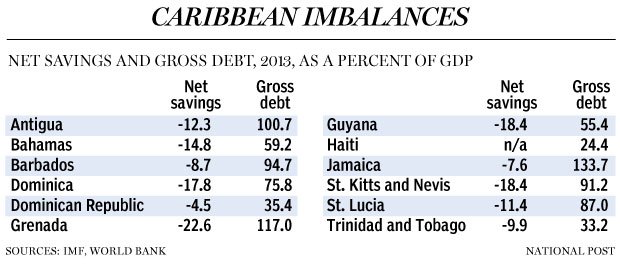
Many Caribbean governments face financial instability. Gross public debt has risen to over 80% of GDP in 2013 for Antigua, Barbados, Grenada, Jamaica, St. Kitts and Nevis, and St. Lucia. Many of these countries are also heavily exposed to global markets with the current account deficit over 20% of GDP in the Caribbean region. Foreign direct investment inflows are more than 8% of GDP for Antigua, Bahamas, Barbados, Grenada, Guyana, St. Kitts and Nevis, St. Lucia and Trinidad-Tobago.

At a flick of the switch, international lenders could turn off the spigots, resulting in a financial crisis and hefty devaluation of currencies. The implications of a severe economic contraction in the region would put the Caribbean countries in limbo and have important consequences to Canada, given our relationships in the region.

The outlook for the Caribbean countries is not exactly cheerful. Overall, economic growth has been poor, about 1.5% for the region, and close to stagnant for Bahamas, Barbados, Grenada and Jamaica. Many of the Caribbean countries face competitiveness problems with some of the highest electricity rates in the world, unionized wage costs and high real interest costs. The business climate is weak with poor regulatory practices, enforcement of contracts and crime.

With the global economic slowdown, tourism has been relatively flat, lagging most regions of the world in 2013. Tourism, after all, is not a necessity and more money is spent on it only when people are better off. The outlook is not looking much better in the near future with little income growth in North America and Europe. Should there ever be reconciliation between the United States and Cuba, U.S. tourism could significantly shift from other islands.

Nor are commodity prices expected to be booming as China and the rest of Asia slow down, with little take up from the rest of the world. Only oil and gas prices seem to be firm, which is good news for Trinidad and Tobago.

With the G20 and OECD countries focused on curbing tax evasion and avoidance, several Caribbean countries – Bermuda, Barbados and Cayman Islands – would be subject to a tightening tax noose. These countries could face a deceleration in economic activity if international tax structures are to be dismantled.

Thus, economic and fiscal problems in the Caribbean should be a wake-up call for governments and businesses operating there. The CIBC write-down is just the tip of the iceberg.

A financial crisis will heavily impact many Canadian businesses that have turned to the Caribbean islands to set up financing and insurance structures. A major economic slowdown in the Caribbean islands would also raise security issues for Canada as crime, including drug trade, could become more problematical to control.

The Canadian government should therefore work with other major countries and international organizations to stabilize Caribbean economies. Attempts to build capacity for good governance in the past years have not been easy but it cannot be abandoned. Some new initiatives should be considered that would help the Caribbean islands improve their fortunes.

Certainly, trying to harmonize policies and merge certain institutions to achieve economies-of-scale across the region would be a useful step. This includes post-secondary education, financial markets and transportation. A shift by Caribbean countries away from oil to natural gas from Trinidad-Tobago and North America would reduce their cost of oil imports.

At the same time, Canada and other Western countries should invest in improving the judiciary and security forces in the [Caribbean] region. The reduction in crime would also benefit our economies by reducing risks faced by tourists and investors. Drug trade with Canada would be curbed.

Debt relief for some of the countries would be appropriate so long as certain commitments are made to reform governance and economic policy. This has been the role of the IMF over the years but Canada should itself pay more attention to the region.

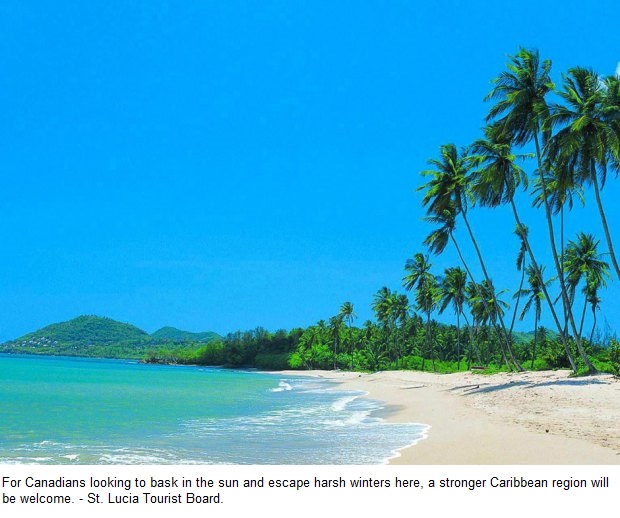
For Canadians looking to bask in the sun and escape harsh winters here, a stronger Caribbean region will be welcome.

Jack M. Mintz is the Palmer Chair, School of Public Policy, University of Calgary. Contact: policy@ucalgary.ca

Source: Financial Post – Canadian Daily; retrieved 05-23-2014 from: http://business.financialpost.com/2014/05/22/jack-m-mintz-all-is-not-well-in-the-sunny-caribbean/
Jack Mintz 2The underlying theme of Jack Mintz commentary is that Caribbean society needs a reboot. The book Go Lean… Caribbean serves as a roadmap for the introduction and implementation of Caribbean Union Trade Federation (CU), a reboot for Caribbean society with these 3 prime directives:

  • Optimize the economic engines of the Caribbean to grow the economy to $800 Billion and create 2.2 million new jobs.
  • Establish a security apparatus to protect the resultant economic engines and stakeholders.
  • Improve Caribbean governance with technocratic excellence.

The foregoing article highlights the mis-management of credit/debt of the governments of the region. The commentary specifically warns:

At a flick of the switch, international lenders could turn off the spigots, resulting in a financial crisis and hefty devaluation of currencies.

Why such poor financial planning? It is obvious that there is a lot of success missing in terms of fiscal expedience. It is not reasonable to expect that current administrations can solve Caribbean fiscal problems with the same tools and techniques of the present. The Go Lean roadmap calls for a different toolbox and different techniques.

If beauty is in the eye of the beholder, then perhaps this commentary is just one person’s assessment of ugly – just a perception. But unfortunately, the facts are the facts. Dr. Mintz relates ugly examples, such as the fact the region has the “highest electricity rates in the world”. There is no denying the “Amount Due” figures on actual electric utility bills.

This is the present, as perceived by Dr. Mintz. Plus, his assessment of the near future is even more “gloom-and-doom”.

True, there is work to be done. But not the job of a Calgary professor, or any other Canadian stakeholder, to do the heavy-lifting. No, this is the job of the Caribbean for the Caribbean. Who is up to the task?

The Caribbean Union Trade Federation hereby “reports for duty” for the job to forge this change.

The Go Lean book details that solutions must come from all aspects of society. There are community values/attitudes that must be in place to ensure that any quest for permanent change would have some measure of success. Those attitudes are referred to as community ethos. There must first be the adoption of many such ethos, followed by the executions of strategies, tactics, implementations and advocacies to impact the region’s prospects, as detailed here:

Community Ethos – Lean Operations Page 24
Community Ethos – Ways to Impact the Future Page 26
Community Ethos – Ways to Help Entrepreneurship Page 28
Anecdote – Entrepreneur’s Best Place To Live? Canada Page 39
Strategy – Vision – Integrate Region into Single Market Page 45
Strategy – Agents of Change – Globalization Page 57
Tactical – Confederating a Permanent Union Page 63
Tactical – Fostering a Technocracy Page 64
Separation of Powers – Banking Regulatory Authority Page 73
Separation of Powers – Justice Institutions Page 77
Implementation – Foreign Policy Initiatives at Start-up Page 102
Implementation – Security Initiatives at Start-up Page 103
Implementation – Ways to Deliver Page 109
Implementation – Ways to Improve Energy Usage Page 113
Implementation – Ways to Better Manage Debt Page 114
Implementation – Ways to Foster International Aid Page 115
Implementation – Ways to Benefit from Globalization Page 119
Planning – Lessons from Canada’s History Page 146
Advocacy – Ways to Grow the Economy Page 151
Advocacy – Ways to Better Manage ForEx Page 154
Advocacy – Ways to Improve Governance Page 168
Advocacy – Ways to Enhance Tourism Page 190
Advocacy – Reforms for Banking Regulations Page 199
Advocacy – Ways to Impact the Diaspora Page 217
Advocacy – Ways to Preserve Caribbean Heritage Page 218
Appendix – Offshore Tax & Financial Services Industry Developments Page 321

The Go Lean roadmap calls for a different entrepreneurial approach than some of the tax avoidance industries promoted in the past. These strategies have actually failed. Most offshore financial centers have modernized their lax laws to mitigate terrorism financing, thus lowering their attraction to tax evaders. The hold-outs, (Bermuda, Barbados and the Cayman Islands), are now being forced to cow-tail to the New World Order. The people of the Caribbean deserve better than waiting for “illicit bread to fall from the table” of rich nations (G-20). We have the world’s best address, for goodness sake, people should be beating a path to our doors (like the 3 million Canadians annually), not the 600,000 Caribbean citizens who have beaten down our doors to get out.

Time for change! The Go Lean roadmap is hereby presented.

The region is hereby urged to lean-in to this Go Lean roadmap, to fulfill the vision of making the Caribbean region a better place to live, work and play. 🙂
Download the book Go Lean … Caribbean – now!

Share this post:
, , , , ,

Painful and rapid spread of new virus in Caribbean

Go Lean Commentary

“Crap happens”, declares the book Go Lean…Caribbean (Page 23).

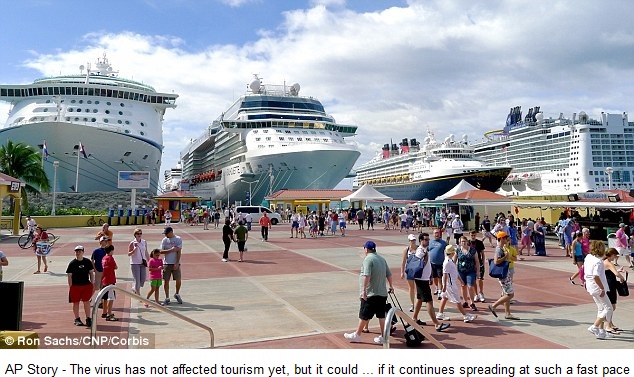
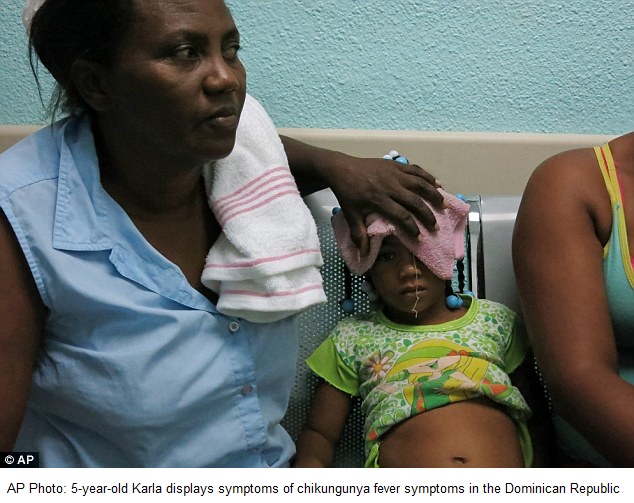
Virus 1The Chikungunya virus scare in the foregoing news article represents the sum of all fears for the Caribbean in terms of tourism and public health threats. This emphatically highlights the need for a regional security pact for Caribbean assurances.

The virus in this article has been identified in the Dominican Republic, Dominica, Saint Martin, and French Guiana; therefore, this is a cross-border threat. This re-enforces that there is a need for a super-national disease-medical sentinel in this security pact.

While other security pacts (for example NATO – North Atlantic Treaty Organization) may be based on defense against military aggression, the Caribbean security pact must focus more on public safety measures. This is one of the prime directives of the proposed Caribbean Union Trade Federation (CU). Naturally, the focus starts with economics, but the resultant engines can be seriously impacted by public safety/health threats. The book Go Lean… Caribbean, serves as a roadmap for the introduction and implementation of that regional sentinel, the CU. The complete prime directives are described as:

  • Optimize the economic engines of the Caribbean to elevate the regional economy.
  • Establish a security apparatus to protect the resultant economic engines.
  • Improve Caribbean governance to support these engines.

The Go Lean roadmap immediately calls for the establishment of a Homeland Security Department, with an agency to practice the arts and sciences of Emergency Management. The emergencies include natural disasters like hurricanes, earthquakes, tsunamis, volcanoes, flooding, forest fires, and droughts. Emergencies also include the man-made variety as in industrial accidents (oil spills, factory accidents and chemical spills), explosions, terroristic attacks and prison riots. The type of emergency described in the foregoing article requires a hybrid response of the Emergency Management agency and the CU’s Department of Health Disease Control & Management agency. Medical expertise would be required to contend with systemic threats of epidemic illness and infectious diseases.

The CU does not possess sovereignty for Caribbean member-states; so CU participation must be invited. This is why the CU is described as a deputized proxy organization. This invitation is equivalent to dialing “911”, a declaration of an emergency – thus granting a timed lease of limited authority to the CU agency, terminating with an “all clear” determination.

By: Ben Fox, AP

SAN CRISTOBAL, Dominican Republic (AP) — They suffer searing headaches, a burning fever and so much pain in their joints they can barely walk or use their hands. It’s like having a terrible flu combined with an abrupt case of arthritis.

Hospitals and clinics throughout the Caribbean are seeing thousands of people with the same symptoms, victims of a virus with a long and unfamiliar name that has been spread rapidly by mosquitoes across the islands after the first locally transmitted case was confirmed in December.

“You feel it in your bones, your fingers and your hands. It’s like everything is coming apart,” said 34-year-old Sahira Francisco as she and her daughter waited for treatment at a hospital in San Cristobal, a town in the southern Dominican Republic that has seen a surge of the cases in recent days.

The virus is chikungunya, derived from an African word that loosely translates as “contorted with pain.” People encountering it in the Caribbean for the first time say the description is fitting. While the virus is rarely fatal it is extremely debilitating.

“It is terrible, I have never in my life gotten such an illness,” said Maria Norde, a 66-year-old woman confined to bed at her home on the lush eastern Caribbean island of Dominica. “All my joints are in pain.”

Outbreaks of the virus have long made people miserable in Africa and Asia. But it is new to the Caribbean, with the first locally transmitted case documented in December in French St. Martin, likely brought in by an infected air traveler. Health officials are now working feverishly to educate the public about the illness, knock down the mosquito population, and deal with an onslaught of cases.

Authorities are attempting to control mosquitoes throughout the Caribbean, from dense urban neighborhoods to beach resorts. There have been no confirmed cases of local transmission of chikungunya on the U.S. mainland, but experts say the high number of travelers to the region means that could change as early as this summer.

So far, there are no signs the virus is keeping visitors away though some Caribbean officials warn it might if it is not controlled. “We need to come together and deal with this disease,” said Dominica Tourism Minister Ian Douglas.

One thing is certain: The virus has found fertile ground in the Caribbean. The Pan American Health Organization reports more than 55,000 suspected and confirmed cases since December throughout the islands. It has also reached French Guiana, the first confirmed transmission on the South American mainland.

The Pan American Health Organization says seven people in the Caribbean with chikungunya have died during the outbreak but they had underlying health issues that likely contributed to their death.

“It’s building up like a snowball because of the constant movement of people,” said Jacqueline Medina, a specialist at the Instituto Technologico university in the Dominican Republic, where some hospitals report more than 100 new cases per day.

Virus 3Chikungunya was identified in Africa in 1953 and is found throughout the tropics of the Eastern Hemisphere. It is spread by two species of mosquitoes, aedes aegypti and aedes albopictus. It’s also a traveler-borne virus under the right circumstances.

It can spread to a new area if someone has it circulating in their system during a relatively short period of time, roughly 2-3 days before the onset of symptoms to 5 days after, and then arrives to an area with the right kind of mosquitoes.

For years, there have been sporadic cases of travelers diagnosed with chikungunya but without local transmission. In 2007, there was an outbreak in northern Italy, so health authorities figured it was just a matter of time before it spread to the Western Hemisphere, said Dr. Roger Nasci, of the U.S. Centers for Disease Control and Prevention.

“With the increase in travelers the likelihood that something like this would happen goes up and eventually it did,” said Nasci, chief of a CDC branch that tracks insect-borne diseases. “We ended up with somebody at the right time and the right place infecting mosquitoes.”

The two species of mosquitoes that spread chikungunya are found in the southern and eastern United States and the first local transmissions could occur this summer given the large number of U.S. travelers to the Caribbean, Nasci said. Already, the Florida Department of Health has reported at least four imported cases from travelers to Haiti, the Dominican Republic and Dominica.

“What we’re seeing now is an increase in the number of infected travelers coming from the Caribbean, which is expected because there’s a lot of U.S. travel, a lot of vacation travel, a lot of work travel,” he said.

Around the Caribbean, local authorities have been spraying fogs of pesticides and urging people to remove standing pools of water where mosquitoes breed.

An estimated 60-90 percent of those infected show symptoms, compared to around 20 percent for dengue, which is common in the region. There is no vaccine and the only cure is treatment for the pain and fluid loss.

One consolation for those suffering from the illness is that unlike dengue, which has several variants, people only seem to get chikungunya once.

“The evidence suggests that once you get it and recover, once your immune system clears the virus you are immune for life,” Nasci said.

Associated Press writers Ben Fox in Miami; P. Solomon Banda in Fort Collins, Colorado; David McFadden in Kingston, Jamaica; and Carlisle Jno Baptiste in Roseau, Dominica, contributed to this report.

Associated Press News Wire (Retrieved 05-22-2014) –          http://news.yahoo.com/painful-rapid-spread-virus-caribbean-040106421.html

The Go Lean roadmap immediately calls for the coordination of security monitoring and mitigation in the Caribbean; referring to viruses as well. This point is declared early in the Go Lean book, commencing with this opening pronouncement in the Declaration of Interdependence (Page 12), as follows:

xvi. Whereas security of our homeland is inextricably linked to prosperity of the homeland, the economic and security interest of the region needs to be aligned under the same governance. …[to ensure] the functioning of the wheels of commerce for all the citizenry, the accedence of this Federation must equip the security apparatus with the tools and techniques for predictive and proactive interdictions.

Go Lean … Caribbean therefore constitutes a change for the Caribbean. This is a roadmap to consolidate 30 member-states of 4 different languages and 5 colonial legacies (American, British, Dutch, French, Spanish) into a Trade Federation with the tools/techniques to bring immediate change to the region to benefit one and all member-states. This includes the monitoring/tracking/studying the origins of common and emerging viruses. This empowered CU agency will liaison with foreign entities with the same scope, like the Pan American Health Organization, US’s Center for Disease Control (CDC) and the World Health Organization (WHO).

Virus 2A lot is at stake!

Tourism is the primary economic driver in the region. The realization, or even the unsubstantiated rumor, of viral outbreaks can imperil the tourism product. We must therefore take proactive steps to protect our economic engines. But, we must not curtail freedom of movement among our visitors. We are, in effect, extending an “Open House” to the world to come enjoy our hospitality. Come… they will. So there are additional responsibilities for the stewards of the Caribbean economy, to impact the Greater Good. The CU invites this role, to promote this community ethos.

The book details that there must first be adoption of such a community ethos, the appropriate attitude/spirit to forge change in the region. Go Lean details this and other ethos; plus the executions of the following strategies, tactics, implementations and advocacies to impact the region’s public health:

Community Ethos – Privacy versus Public Protection Page 23
Community Ethos – “Crap” Happens Page 23
Community Ethos – Lean Operations Page 24
Community Ethos – Cooperatives Page 24
Community Ethos – Non-Government Organizations Page 25
Community Ethos – Ways to Improve Sharing Page 35
Community Ethos – Impact the Greater Good Page 37
Strategy – Vision – Non-Sovereign “Unified” Proxy Entity Page 45
Strategy – Customers – Residents & Visitors Page 47
Strategy – Agents of Change – Globalization Page 57
Tactical – Confederating a Permanent Union Page 63
Tactical – Fostering a Technocracy Page 64
Separation of Powers – Emergency Management Page 76
Separation of Powers – Disease Control & Management Page 86
Implementation – Ways to Pay for Change Page 101
Implementation – Security Initiatives at Start-up Page 103
Implementation – Ways to Deliver Page 109
Implementation – Ways to Foster International Aid Page 115
Implementation – Ways to Benefit from Globalization Page 119
Planning – Ways to Improve Failed-State Indices Page 134
Planning – Ways to Measure Progress Page 148
Advocacy – Ways to Grow the Economy Page 151
Advocacy – Ways to Improve Healthcare Page 156
Advocacy – Ways to Improve Governance Page 168
Advocacy – Ways to Better Manage the Social Contract Page 170
Advocacy – Ways to Foster Cooperatives Page 176
Advocacy – Ways to Improve for Natural Disasters Page 184
Advocacy – Ways to Improve Emergency Management Page 196

The foregoing news article introduces the threats of the Chikungunya virus. This is today’s issue. New issues will emerge tomorrow and the days after. This establishes that there is need for a permanent union – a sentinel – to provide efficient stewardship for Caribbean economy, security and governing engine. Change has come to the region.

How would the region pay for this change, these elevations? The Caribbean Union Trade Federation hereby submits for this job, no payment necessary! The region is hereby urged to lean-in to this Go Lean roadmap, to fulfill the vision of making the Caribbean region a better place to live, work and play.

Download the Book- Go Lean…Caribbean Now!!!

Share this post:
, , , ,
[Top]

Bitcoin needs regulatory framework to change ‘risky’ image

Go Lean Commentary

Bitcoin PhotoElectronic Payments / Virtual Money schemes are very important in the strategy for elevating the Caribbean economy.

Bitcoin can be good for the Caribbean, but we need the regulatory framework in place to change any “risky” image of such schemes.

This point is detailed in the book Go Lean…Caribbean, a roadmap for the introduction of the Caribbean Union Trade Federation (CU) and the Caribbean Central Bank (CCB). This Go Lean roadmap has 3 prime directives:

  • Optimization of the economic engines in order to grow the regional economy to $800 Billion & create 2.2 million new jobs.
  • Establishment of a security apparatus to protect the resultant economic engines.
  • Improve Caribbean governance to support these engines.

This Go Lean/CU/CCB roadmap looks to employ electronic payments / virtual money schemes to impact the growth of the regional economy. Similar to Bitcoin, there are two CU schemes that relate to this foregoing news story:

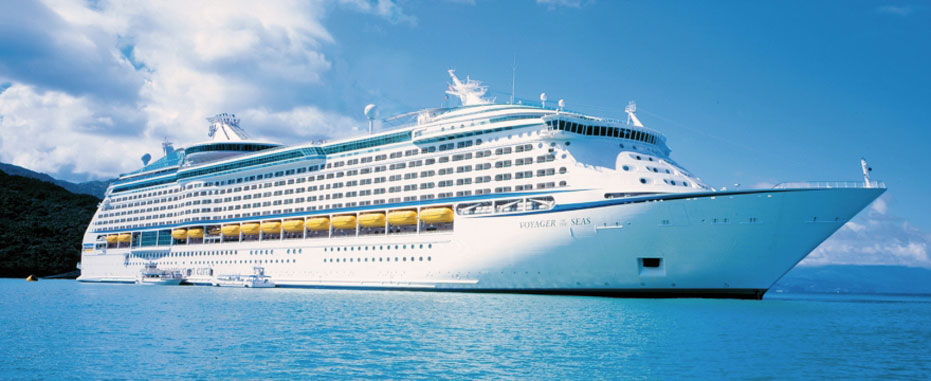
  • Cruise Passenger Smartcards – The Go Lean roadmap posits that the cruise industry needs the Caribbean more than the Caribbean needs the industry. But the cruise lines have embedded rules/ regulations designed to maximize their revenues at the expense of the port-side establishments. The CU solution is to deploy a scheme for smartcards that function on the ships and at the port cities (Page 193).
  • e-Commerce Facilitation – The Go Lean roadmap defines that the Caribbean Dollar (C$) will be mostly cashless, an accounting currency. So the Caribbean Central Bank (CCB) will settle all C$ electronic transactions (MasterCard-Visa style or ACH style) and charge interchange/clearance fees (Page 198). This scheme allows for the emergence of full-throttle e-Commerce activities.

These electronic payments provides the impetus for M1, the measurement of currency/money in circulation (M0) plus overnight bank deposits (like demand deposits, travelers’ checks & other checkable deposits). As M1 values increase, there is a dynamic to create money “from thin-air”, called the money multiplier. The more money in the system, the more liquidity for investment and industrial expansion opportunities.

By: Clare Hutchison

LONDON (Reuters) – Regulators should create a framework of rules to help to make virtual currencies such as bitcoin more attractive to ordinary consumers, a lawyer from the Bitcoin Foundation said on Tuesday.

Bitcoin made headlines earlier this year when Tokyo-based bitcoin exchange Mt. Gox filed for bankruptcy after saying it might have lost some 750,000 bitcoins in hacking attack.

Patrick Murck, general counsel at the Bitcoin Foundation, said cooperation was needed between authorities to create rules that would support those using the digital currency responsibly.

“There’s an opportunity to work together to stop people saying it’s scary and risky,” he said. “The challenge is just to get a framework out there that makes sense for people,” said Murck, speaking at an event on the state of digital economy.

Launched in 2009, bitcoin offers a way for people to conduct transactions over the Internet. Supporters say the anonymity that bitcoin offers lowers the risk of fraud, while critics say that same anonymity and lack of central oversight make it easier to commit crimes.

The Bitcoin Foundation aims to standardise the currency, protect it from theft or counterfeiting and provide education.

Some companies involved in bitcoin, including investment firms and those providing services for the currency’s users, have also called for regulation to ensure their customers feel more comfortable about virtual money.

A number of regulators, including the U.S. Securities and Exchange Commission, have warned investors about the risks of scams related to virtual currencies.

Murck said there were a handful of well-funded companies working towards making bitcoin more attractive and safer for ordinary consumers by trying to insure bitcoin holdings and to reduce the currency’s volatility.

Those companies have learned from the collapse of Mt. Gox and have more knowledge about how the industry works that was not available before, he said.

Bitcoin could be ready for the mass market by the end of the year, Murck added. “I feel much more confident today than I did 12 months ago. The wind is definitely blowing at our backs.”

The banking industry also has a role to play in opening the bitcoin market up, Murck said, by providing finance to companies involved in bitcoin or integrating bitcoin services into its own products.

Reuters News Source (Retrieved 05/13/2014) –http://news.yahoo.com/bitcoin-needs-regulatory-framework-change-risky-image-163727371–sector.html

Cruise shipOverall, the Bitcoin concept is in crisis; the dissolution of the Mt. Gox exchange dealt this industry a near-fatal blow. With virtual money, there is no association with hard currency, commodity or chattel goods. It is just the “good faith” and credit of the currency – eWallet – issuer. A bankruptcy filing undermines that “faith”.

The people and institutions of the Caribbean understand this plight all too well. There is little faith in Caribbean monetary institutions either. All interstate trade in the region must take place in US dollars, British pounds or Euros. There is no faith in indigenous Caribbean currencies. The roadmap commences with the statement that the Caribbean also is in crisis, and that this “crisis is a terrible thing to waste”. The region is devastated from external factors: global economic recession, globalization and rapid technology changes. The book then posits that to adapt, there must be a new internal optimization of the region’s strengths. This is defined in Verse XXIV (Page 13) of the Declaration of Interdependence, with these words:

Whereas a free market economy can be induced and spurred for continuous progress, the Federation must install the controls to better manage aspects of the economy: jobs, inflation, savings rate, investments and other economic principles…

Creating the CU/CCB governance is “Step One, Day One” in the Go Lean roadmap. Implementing this, the appropriate regulatory framework, as requested in the foregoing news article, allows rock-solid monetarily integrity for the local financial systems. This would provide the foundation, so that the regional society can be elevated, economically and governmentally.

The Go Lean book details a series of community ethos, strategies, tactics, implementations and advocacies to foster the proper controls for electronic payments/virtual money in the Caribbean region:

Community Ethos – Money Multiplier Principle Page 22
Community Ethos – “Light Up the Dark Places” Page 23
Community Ethos – Lean Operations Page 24
Community Ethos – Cooperatives Page 25
Community Ethos – Promote Intellectual Property Page 29
Community Ethos – Ways to Bridge the Digital Divide Page 31
Tactical – Separation of Powers – Central Banking Page 73
Implementation – Assemble Central Bank Cooperative Page 96
Implementation – Ways to Deliver Page 109
Implementation – Ways to Impact Social Media Page 111
Planning – Ways to Better Manage Image Page 129
Anecdote – Caribbean Currencies Page 149
Advocacy – Ways to Mitigate Black Markets Page 165
Advocacy – Ways to Foster Cooperatives Page 176
Advocacy – Ways to Foster Technology Page 197
Advocacy – Ways to Foster e-Commerce Page 198
Advocacy – Reforms for Banking Regulations Page 199
Appendix – Alternative Remittance Modes Page 270

Now is the time for all of the Caribbean, the people and governing institutions, to lean-in for the changes described in the book Go Lean … Caribbean. The benefits are too alluring, a better place to live, work and play.

Download the free e-book of Go Lean … Caribbean – now!

Share this post:
, ,
[Top]

Bob Marley: The legend lives on!

Go Lean Commentary

Bob Marley - The legend lives on“Let’s get together and feel alright” – Bob Marley’s Song: One Love

This song is identified in the below article as being designated Song of the Millennium by the BBC (British Broadcasting Corporation). Today, 11 May 2014, is the 33rd anniversary of Bob Marley’s death. (The number 33 is the “rev” speed for music-album playback).

The book Go Lean … Caribbean identifies 169 different musical/national combinations of genres throughout the Caribbean. Of them all, Reggae is by far the most impactful of a Caribbean sound; even more so than Calypso, Soca, Merengue or any of the many Afro-Cuban varieties (Conga, Mambo, Salsa, etc). One cannot speak of Reggae music though without recognizing the iconic role of Bob Marley. The Go Lean book speaks directly of Bob Marley in recognizing him, along with other advocates, in the way in which his contributions resonated in the world. As follows, an excerpt from that rendering (Page 133):

The majority of the Caribbean population descends from an African ancestry – a legacy of slavery from previous centuries. Despite the differences in nationality, culture and language, the image of the African Diaspora is all linked hand-in-hand. And thus, when Martin Luther King, Malcolm X, Nelson Mandela, Muhammad Ali and Bob Marley impacted the world with their contributions, the reverberations were felt globally, not just in their homelands. It is hard for one segment of the black world to advance when other segments have a negative global image. This is exemplified with the election of Barack Obama as US President; his election was viewed as an ascent for the entire Black race.*

The following article, from the Daily Independent Newspaper of Nigeria, posits that the legend and legacy of Bob Marley lives on, to this day and beyond.

“My music will go on forever. Maybe it’s a fool say that, but when me know facts me can say facts. My music will go on forever.” – Bob Marley

The above statement made by Bob Marley of his music, is a living testimony of his continued legacy and legend. Since his demise on May 11, 1981, the influence of his music on global culture has become unparalleled as evidenced by ever increasing list of accomplishments, honours and awards.

In June 1978, he was awarded the ‘Peace Medal of the Third World ’ from the United Nations. He was voted as one of the greatest lyricists of all time by a BBC poll. In 2006, a blue plaque was unveiled at his first UK residence in Ridgmount Gardens, London, dedicated to him by Nubian Jak community trust and supported by Her Majesty’s Foreign Office.

Bob Marley was posthumously inducted into the Rock and Roll Hall of Fame in 1994; in December 1999, his 1977 album “Exodus” was named Album of the Century by Time Magazine and his song “One Love” was designated Song of the Millennium by the BBC.

Since its release in 1984, Marley’s “Legend” compilation has annually sold over 250,000 copies, according to Nielsen Sound Scan, and it is only the 17th album to exceed sales of 10 million copies since SoundScan began its tabulations in 1991.

Bob Marley’s music was never recognised with a Grammy nomination, but in 2001 he was bestowed The Grammy Lifetime Achievement Award. That same year, a feature length documentary about Bob Marley’s life, ‘Rebel Music’, directed by Jeremy Marre, was nominated for a Grammy for ‘Best Long Form Music Video’ documentary. In 2001 Bob Marley was accorded the 2171st star on the Hollywood Walk of Fame by the Hollywood Historic Trust and the Hollywood Chamber of Commerce, in Hollywood, California. As a recipient of this distinction, Bob Marley joined musical legends, including Carlos Santana, Stevie Wonder and The Temptations.

In 2006, the State of New York renamed a portion of Church Avenue in the section of Brooklyn, “Bob Marley Boulevard “.

Recently, the popular TV show, Late Night with Jimmy Fallon, commemorated the 30th anniversary of Bob Marley’s passing with an entire week (May 9-13) devoted to his music, as performed by Bob’s eldest son, Ziggy, Jennifer Hudson, Lauryn Hill, Lenny Kravitz and the show’s house band, The Roots. These triumphs are all the more remarkable considering Bob Marley’s humble beginnings and numerous challenges he overcame attempting to gain a foothold in Jamaica ‘s chaotic music industry while skillfully navigating the politically partisan violence that abounded in Kingston throughout the 1970s.

In celebration of what would have been his 68th birthday, the 2013 Grammys featured an all-star Bob Marley tribute including some of music’s hottest stars.

One of the 20th century’s most charismatic and challenging performers, Bob Marley’s renown now transcends the role of reggae luminary: he is regarded as a cultural icon who implored his people to know their history “coming from the root of King David, through the line of Solomon,” as he sang on “Blackman Redemption”; Bob urged his listeners to check out the “Real Situation” and to rebel against the vampiric “Babylon System”. “Bob had a rebel type of approach, but his rebelliousness had a clearly defined purpose to it,” acknowledges Chris Blackwell, the founder of Island Records, who played a pivotal role in the Bob Marley biography by introducing Marley and the Wailers to an international audience.

Two influences of Marley’s music are his Rastafarian belief and his love for marijuana. The pan-African consciousness, progressive political ideologies and deep spiritual convictions heard in Bob Marley’s music were derived from his firmly rooted commitment to Rastafarian beliefs and its attendant lifestyle. Marley did not just enjoy weed as a recreational habit. He was instead a staunch supporter of the plant’s meditational, spiritual and healing abilities, and a fierce opponent to those who tried using marijuana as a vehicle for oppression, and to keep certain groups of people out of the societal mainstream.

In his early years, February 1962, Marley recorded four songs, Judge Not, One Cup of Coffee, Do You Still Love Me? And Terror. One Cup of Coffee was released under the pseudonym, Bobby Martell.

The following year, Bob Marley, Bunny Wailer, Peter Tosh,Junior Braithwaite, Beverly Kelso and Cherry Smith called The Teenagers, later changed the name to The Wailing Rudeboys, then to The Wailing Wailers and finally to The Wailers. In 1966, Smith, Kelso and Braithwaite left the Wailers leaving Bob Marley, Peter Tosh and Bunny Wailer. Marley, that same year married, Rita Anderson.

In an attempt to commercialise The Wailers sound, between 1968 and 1972, Bob and Rita Marley, Peter Tosh and Bunny Wailer re-cut some old tracks with JAD Records in Kingston and London.

After signing with CBS Records in London, Marley in 1972 embarked on a UK tour with American musician, Johnny Nash. The Wailers returned to Jamaica to release its first album, Catch a Fire. The eight track album was followed the same year by the album, Burnin, which included the song, I Shot the Sheriff. Eric Clapton was given the album by his guitarist, George Terry, for his enjoyment, but Clapton was so impressed that he recorded a cover version of, I Shot the Sheriff, which became his first US hit after [the song] Layla.

It is pertinent to note that during this period, Blackwell, Marley’s record company, gifted his Kingston residence and company headquarters to Marley. The property housing Tuff Gong studios, became not only his office, but also his home. Finally, The Wailers broke up in 1974 with each of the three members pursuing solo careers.

Though born a Catholic, Marley converted to Rastafari and began to grow dreadlocks. With new members in his solo career, Marley continued recording as ‘Bob Marley and The Wailers’ as the ‘I Threes’ comprising Marcia Griffiths, Judy Mowatt and Marley’s wife, Rita provided backing vocals.

Marley rose to fame internationally in 1975 with his first hit track, No Woman No Cry from the Natty Dread album. This was followed by Rastaman Vibration, his breakthrough album in the US.

Of significance was an assassination attempt by unknown gunmen on December 3, 1976, two days before, a free concert, tagged, ‘Smile Jamaica’, organised by the Jamaican Prime Minister, Michael Manley in an attempt to ease tension between two warring political factions. Marley, his wife and manager, Don Taylor were wounded in the assault. However, injured Marley performed after the attack. At the end of 1976, Marley left Jamaica and after a month of recovery and writing, he arrived [in] England, where he spent two years in self imposed exile. While in Queen Elizabeth’s country, he recorded the albums, Kaya and Exodus. For 56 consecutive weeks, Exodus stayed on the British album charts. It also included four UK hit singles – Exodus, Waiting in Vain, Jamming and One Love (a rendition of Curtis Mayfield’s hit, People get Ready).

In an effort to calm warring parties, when Marley returned to Jamaica in 1978, he performed at another political concert, the One Love Peace Concert which saw the two heads of the factions shook hands on stage.

A defiant and politically charged album, Survival, was released in 1979 with such tracks as, Zimbabwe, Africa Unite, Wake Up and Live and Survival reflected his struggle for Africans. Bob Marley’s final studio album, Uprising in 1980 is regarded as one of his most religious productions. It includes, Redemption Song and Forever Loving Jah.

Confrontation was released posthumously in 1983, contained unreleased songs recorded during Marley’s lifetime. It includes the hit song, Buffalo Soldier and new mixes of singles previously available only in Jamaica. 11 albums, four live albums and seven studio albums were achieved under the name Bob Marley and the Wailers.

In July 1977, Marley was found to have a type of malignant melanoma under the nail of a toe. Citing his religious beliefs, he turned down his doctors’ advice to have his toe amputated. Despite his illness, he continued touring.

His Redemption Song track is in particular considered to be about Marley’s coming to terms with his mortality. He appeared at the Stanley Theatre in Pittsburg, Pennsylvania on September 23 1980, unfortunately, it would be his last concert.

Shortly afterwards, his health deteriorated, the cancer had [spread] to his lungs and brains. Marley sought treatment at the Bavarian clinic of Josef Issels where he received an unusual therapy. After fighting the disease unsuccessfully for eight months, he boarded a plane for his home in Jamaica but he never made it. He landed in Miami, Florida, USA and was taken to Cedars of Lebanon, hospital for immediate medical attention.

On May 11, 1981, Robert Nesta Marley, born on February 6, 1945 on the farm of his maternal grandfather in Nine Mile, Saint Ann Parish, Jamaica to Norval Sinclair Marley and Cedella Booker gave up the ghost. He was aged 36.

After his death, he seems to loom larger than life as his legacy continues to grow. Marley received a state funeral in Jamaica on May 21, 1981 which combined elements of Ethiopian Orthodoxy and Rastafari tradition. On his religious life, Marley was a vegetarian who was affiliated with the Twelve Tribes Mansion. He was in the denomination of the Tribe of Joseph. Shortly before his death, Marley was baptised into Christianity by Archbishop Abuna Yesehaq of the Ethiopian Orthodox church in Kingston, Jamaica on November 4, 1980.

In April 1981 Bob Marley was awarded Jamaica’s third highest honor, the Order of Merit, for his outstanding contribution to his country’s culture.

Marley had a number of children: three with his wife Rita, two adopted from Rita’s previous relationships and several other others with different women.

Irrespective of race, colour, creed, the Bob Marley’s revolutionary yet unifying music, challenging colonialism, racism, and the rest has had profound effects even in country’s where English is not widely spoken.

In August 2008, two artists from Serbia and Croatia , unveiled a statue of Bob Marley during a rock music festival in Serbia; the monument’s inscription read “Bob Marley Fighter for Freedom Armed with A Guitar”.

A statue was inaugurated, next to the national stadium on Arthur Wint Drive in Kingston to commemorate him.

Internationally, Marley’s message also continues to reverberate among various indigenous communities.

The Daily Independent – Nigerian Daily Newspaper – Retrieved May 11, 2014 from: http://dailyindependentnig.com/2014/05/bob-marley-legend-lives/

The book Go Lean…Caribbean serves as a roadmap for the introduction and implementation of the Caribbean Union Trade Federation (CU). This CU strives to advance the Caribbean culture with these 3 prime directives:

  • Optimization of the economic engines in order to grow the regional economy to $800 Billion and create 2.2 million new jobs.
  • Establishment of a security apparatus to protect the resultant economic engines.
  • Improve Caribbean governance.

This roadmap recognizes that a prerequisite for advancing society is a change in the Caribbean community ethos. Early in the book, the contributions that music can make is pronounced as an ethos for the entire region to embrace, (Declaration of Interdependence – DOI – Pages 14) with these statements:

xxxii. Whereas the cultural arts and music of the region are germane to the quality of Caribbean life, and the international appreciation of Caribbean life, the Federation must implement the support systems to teach, encourage, incentivize, monetize and promote the related industries for arts and music in domestic and foreign markets. These endeavors will make the Caribbean a better place to live, work and play.

Bob Marley was the embodiment of all of these above values. He impacted the music, culture and economics of the region. He set a pathway for success for other generations of talented, inspirational and influential artists – musical geniuses – to follow. Other artists of Caribbean heritage are sure to emerge and “rock the world”; we are hereby “banking” on it, with these CU preparations (DOI – Page 13):

xxi. Whereas the preparation of our labor force can foster opportunities and dictate economic progress for current and future generations, the Federation must ensure that educational and job training opportunities are fully optimized for all residents of all member-states, with no partiality towards any gender or ethnic group. The Federation must recognize and facilitate excellence in many different fields of endeavor, including sciences, languages, arts, music and sports. This responsibility should be executed without incurring the risks of further human flight, as has been the past history.

Bob Marley - UprisingThe CU represents the change that has come to the Caribbean. The people, institutions and governance of the region are all urged to “lean-in” to this roadmap for change. We know there is a “new” Bob Marley somewhere in the Caribbean member-states, waiting to be fostered. We salute this one with the words of this Bob Marley composition Redemption Song, (from this writer’s favorite album “Uprising”):

But my hand was made strong
By the hand of the Almighty.
We forward in this generation
Triumphantly.

Won’t you help to sing
These songs of freedom?
‘Cause all I ever had,
Redemption songs,
Redemption songs.

Emancipate yourself from mental slavery,
None but our self can free our minds.
Have no fear for atomic energy,
‘Cause none of them can stop the time.
How long shall they kill our prophets,
While we stand aside and look?
Some say it’s just a part of it,
We’ve got to fulfill de book.

The following list details the community ethos, strategies, tactics, implementations and advocacies to foster the next Bob Marley:

Community Ethos – Ways to Foster Genius Page 27
Community Ethos –Promote Intellectual Property Page 29
Community Ethos – Ways to Promote Happiness Page 36
Community Ethos – Impact the Greater Good Page 37
Strategy – Caribbean Vision Page 45
Separation of Powers – Patents & Copyrights Page 78
Separation of Powers – Culture Administration Page 81
Implementation – Ways to Impact Social Media Page 111
Advocacy – Ways to Make the Caribbean Better Page 131
Advocacy – Ways to Impact Hollywood Page 203
Advocacy – Ways to Promote Music Page 231
Advocacy – Ways to Re-boot Jamaica Page 239

For this occasion, the reader is hereby admonished to put on your favorite Bob Marley album, sit back, and feel the love, the “One Love”.

Download the e-Book of Go Lean … Caribbean – free … now!

————–

Appendix Reference:

* Rampersad, Dr. Arnold (2008). “Race, History, and the Emergence of Obama”. Florida International University Dr. Eric E. Williams Memorial Lecture Series. BBC-Caribbean.com. Retrieved November 2013 from: http://www.bbc.co.uk/caribbean/news/story/2008/11/printable/081111_obama_rampersad.shtml


Share this post:
, , , , , , , , , , ,
[Top]

Caribbean Image: Dreadlocks

Go Lean Commentary

Dread Locks“You don’t get a second chance for a first impression” – Old Adage.

Think quick! A family member is involved in a traumatic accident and is rushed to emergency surgery. The surgeon comes out to greet you; he is wearing dreadlocks. How confident are you of his surgical skills? On a scale of 1-to-10, are you anywhere near a 10? Is it the dreadlocks? Without the surgeon speaking a word, what are the chances he is of Caribbean heritage?

This scenario depicts why image is so impactful in the management of Caribbean economic and cultural affairs.

Caribbean image is in crisis! Many people (not a majority) in the region, despite their occupation, wear dreadlocks. As stated in the encyclopedic reference below, these “locks” can be an expression of deep religious or spiritual convictions, ethnic pride, a political statement, or be simply a fashion preference.

Consider the above medical drama again, but now substitute a Sikh Indian turban, or a Jewish yarmulke (beanie hat), or an taqiyah (Muslim beanie cap). Look, there is little question of competence or defamation in these scenarios, despite their religious connotations. Consider this …

… Encyclopedia Definition:

Dreadlocks, also called locks, dreads, or Jata (Hindi), are matted coils of hair. Most dreadlocks are usually intentionally formed; because of the variety of different hair textures, various methods are used to encourage the formation of locks such as backcombing. Additionally, leaving long hair to its own devices by not brushing or cutting the hair will encourage it to tangle together as it grows, leading to twisted, matted ropes of hair known as dreadlocks. The latter method is typically referred to as the neglect, natural, organic, or freeform method. A common misconception is that those who have dreadlocks do not wash their hair, but this is usually not the case. Many dreadlock care regimens require the wearer to wash their hair up to twice a week.[1]

Dreadlocks are associated most closely with the Rastafari movement, but people from many ethnic groups have worn dreadlocks, including many ancient Hamitic people of North Africa and East Africa (notably the Oromo of Ethiopia, and the Maasai of northern Kenya); Semitic people of West Asia; Indo-European people of Europe and South Asia (notably the ancient Spartan warriors of Greece, and the Sadhus of India and Nepal); Turkic people of Anatolia and Central Asia; the Sufi Rafaees; and the Sufi malangs and fakirs of Pakistan. Some Neanderthals and Cro-Magnon were also known to have worn locks as described in paleolithic cave art in Europe, perhaps for spiritual reasons.

Dread locks #4

The book Go Lean … Caribbean recognizes that image is an important intangible factor that must be managed to optimize value of Caribbean contributions. As such the book is submitted as a complete roadmap to advance the Caribbean economy and culture with the introduction and implementation of the Caribbean Union Trade Federation (CU). This will be the sentinel for “Image”.

The CU strives to improve image & impressions that the world gets of Caribbean life/people. Sometimes, the “world” only needs the facts. There is no agenda to curb freedoms of speech or the press, but there are many opportunities to elevate the impressions that the wide-world gets of the Caribbean, including dreadlock hair styles.

Consider the experiences of an actor on Yahoo-Answers.com:

Q. Can actors with dreads get a lot of work in Hollywood?

My cousin has dreads that are at his neck and wants to become an movie or tv star, he is a very good actor and has even won a few local awards for his performances, but he does NOT wanna play a gang member or drug dealer or any role like that, just the normal roles, how likely is that?

A1. “Starry Eyed Fred” answered – 4 years ago
“[So] he does NOT wanna play a gang member or drug dealer or any role like that. Guess what? You/he have already pretty much answered the question… dudes with dreads are ‘typecast’ as mentioned above: his looks are going to be what gets him auditions for specific roles, such as “a gang member or drug dealer or any role like that”.

A2. “wickedjacob” answered – 4 years ago
Anyone who is serious about becoming an actor is going to have to be prepared to change their appearance to fit the role. So even though he might have dreads right now, there will come a time sooner or later where a job will require that they be cut off.

A3. “Me not you” answered – 4 years ago
He might get roles because of his talent, but they will probably make him cut his hair if its not appropriate for the part.

(Source: Retrieved May 10, 2014 from: https://answers.yahoo.com/question/index?qid= 20100617064412AARJkBh)

The Go Lean roadmap has a heavy focus on media. The plan calls for consolidating the 42 million residents of the region, despite the 4 languages, into a Single Market. This size allows for some leverage and economies-of-scale, fostering a professional media industry. This allows the CU to electronically send our culture to the world, 10 million-strong Diaspora first, controlling the image and impressions that the world gets of Caribbean life and people. Consider more of the encyclopedia definition here:

History 

Dread Locks #2The first known examples of dreadlocks date back to North Africa and the Horn of Africa. In ancient Egypt examples of Egyptians wearing locked hairstyles and wigs have appeared on bas-reliefs, statuary and other artifacts[2]. Mummified remains of ancient Egyptians with locks, as well as locked wigs, have also been recovered from archaeological sites.[3]

Maasai men found in the regions of northern Kenya claim that they have been wearing dreadlocks for as long as they have survived. According to their oral history, the Maasai originated from the lower Nile valley north of Lake Turkana (Northwest Kenya) and began migrating south around the 15th century, arriving in a long trunk of land stretching from what is now northern Kenya between the 17th and late 18th century. Even today, Maasai men can be found donning their dreadlocks, with a tint of red color from the soil.

The Hindu deity Shiva and his followers were described in the scriptures as wearing “Jataa”, meaning “twisted locks of hair”. The Greeks and several ascetic groups within various major religions have at times worn their hair in locks, including the monks of the Ethiopian Orthodox Tewahedo Church, the Nazirites of Judaism, Qalandari Sufi’s, the Sadhus of Hinduism, and the Dervishes of Islam, among others. The very earliest Christians also may have worn this hairstyle. Particularly noteworthy are descriptions of James the Just, first Bishop of Jerusalem, who is said to have worn them to his ankles.[4]

Pre-Columbian Aztec priests were described in Aztec codices (including the Durán Codex, the Codex Tudela and the Codex Mendoza) as wearing their hair untouched, allowing it to grow long and matted.[5]

In Senegal, the Baye Fall, followers of the Mouride movement, a Sufi movement of Islam founded in 1887 by Shaykh Aamadu Bàmba Mbàkke, are famous for growing locks and wearing multi-colored gowns.[6] Cheikh Ibra Fall, founder of the Baye Fall school of the Mouride Brotherhood, popularized the style by adding a mystic touch to it. It’s important to note that for centuries warriors among the Fulani, Wolof and Serer in Mauritania, and Mandinka in Mali and Niger were also known to have dreadlocks when old and cornrows when young.

Culture

There are many reasons among various cultures for wearing locks. Locks can be an expression of deep religious or spiritual convictions, ethnic pride, a political statement, or be simply a fashion preference. In response to the derogatory history of the term dreadlocks, an alternative name for the style is locks (sometimes spelled “locs”).

Africa and the Western World; Caribbean, North and South America

Members of various African ethnic groups wear locks and the styles and significance may change from one group to another.

Maasai warriors are famous for their long, thin, red locks. Many people dye their hair red with root extracts or red ochre. In various cultures what are known as shamans, spiritual men or women who serve and speak to spirits or deities, often wear locks. In Nigeria[7], some Yoruba children are born with naturally locked hair and are given a special name: “Dada”. Yoruba priests of Olokun, the Orisha of the deep ocean, wear locks. Another group is the Turkana people of Kenya.

Rastafarian’s locks are symbolic of the Lion of Judah which is sometimes centered on the Ethiopian flag. Rastafari hold that Haile Selassie is a direct descendant of King Solomon and the Queen of Sheba, through their son Menelik I.

Hinduism

Dread Locks #3Similarly, among some Sadhus and Sadhvis, Hindu holy men and women, locks are sacred, considered to be a religious practice, an expression of disregard for profane vanity. The public symbol of matted hair, known as jata, is re-created each time an individual goes through these unique experiences. In almost all myths about Shiva and his flowing locks, there is a continual interplay of extreme asceticism and virile potency, which link the elements of destruction and creation, whereas the full head of matted hair symbolizes the control of power. Gangadhara Shiva captures and controls the river Ganges with his locks, whose descent from the heavens would have deluged the world. The river is released through the locks of his hair, which

prevents the river from destroying earth. As the Lord of Dance, Nataraja, Shiva performs the tandava, which is the dance in which the universe is created, maintained, and resolved. Shiva’s long, matted tresses, usually piled up in a kind of pyramid, loosen during the dance and crash into the heavenly bodies, knocking them off course or destroying them utterly.

Locks in South Asia are reserved nearly exclusively for holy people. According to the ‘Hymn of the longhaired sage’ in the ancient Vedas, long jatas express a spiritual significance which implies the wearer has special relations with spirits, is an immortal traveler between two worlds and the master over fire:

The long-haired one endures fire, the long-haired one endures poison, the long-haired one endures both worlds. The long-haired one is said to gaze full on heaven, the long-haired one is said to be that light … Of us, you mortals, only our bodies do you behold. …For him has the Lord of life churned and pounded the unbendable, when the long-haired one, in Rudra’s company, drank from the poison cup (The Keshin Hymn, Rig-veda 10.136)

The Shaiva Nagas, ascetics of South Asia, wear their jatas in a twisted knot or bundle on top of the head and let them down only for special occasions and rituals. The strands are then rubbed with ashes and cow dung, considered both sacred and purifying, then scented and adorned with flowers.

Buddhism

Within Tibetan Buddhism and other more esoteric forms of Buddhism, dreadlocks have occasionally been substituted for the more traditional shaved head. The most recognizable of these groups are knowns as the Ngagpas of Tibet. For many practicing Buddhists, dreadlocks are a way to let go of material vanity and excessive attachments.[8]

Western Styles

When reggae music gained popularity and mainstream acceptance in the 1970s, the locks (often called “dreads”) became a notable fashion statement; they were worn by prominent authors, actors, athletes and rappers, and were even portrayed as part of gang culture in such movies as Marked for Death. Dreadlocks aren’t always worn for religious or cultural reasons. People may wear them just for “style” which is primarily popular among the youth.

With the Rasta style in vogue, the fashion and beauty industries capitalized on the trend. A completely new line of hair care products and services in salons catered to a White clientele, offering all sorts of dreadlocks hair care items such as wax (considered unnecessary and even harmful by many)[9], shampoo, and jewelry. Hairstylists created a wide variety of modified locks, including multi-colored synthetic lock hair extensions and “dread perms”, where chemicals are used to treat the hair.

Locked models appeared at fashion shows, and Rasta clothing with a Jamaican-style reggae look was sold. Even exclusive fashion brands like Christian Dior created whole Rasta-inspired collections worn by models with a variety of lock hairstyles.

In the West, dreadlocks have gained particular popularity among counterculture adherents such as hippies (from the 1990s onwards), crust punks, New Age travellers, goths and many members of the Rainbow Family. Many people from these cultures wear dreadlocks for similar reasons: symbolizing a rejection of government-controlled, mass-merchandising culture or to fit in with the people and crowd they want to be a part of. Members of the cybergoth subculture also often wear blatantly artificial synthetic dreads or “dreadfalls” made of synthetic hair, fabric or plastic tubing.

Since the rise of the popularity of dreadlocks, Blacks in the Americas have developed a large variety of ways to wear dreadlocked hair. Specific elements of these styles include the flat-twist, in which a section of locks are rolled together flat against the scalp to create an effect similar to the cornrows, and braided dreadlocks. Examples include flat-twisted half-back styles, flat-twisted mohawk styles, braided buns and braid-outs (or lock crinkles). Social networking websites, web forums, web-logs and especially online video-logs like YouTube have become popular methods for people with dreadlocks to transmit ideas, pictures and tutorials for innovative styles.

The book Go Lean … Caribbean introduces the CU to take oversight of’ much of the Caribbean economic, security and governing functionality. In summary, this roadmap promotes the Caribbean as a better place to live, work and play. We must therefore change the opinions of the world towards dreadlock-wearing Caribbean people. Jobs are at stake; jobs in the Caribbean homeland (and maybe jobs in foreign locales for the Diaspora). We need Foreign Direct Investors to be comfortable with industrial engagements in the region, knowing that the workforce is there, ready, willing and able to work, competently and confidently.

Change has come to the Caribbean. The people, institutions and governance of the region are all urged to “lean-in” to this roadmap for change. We need to educate and persuade people – everywhere -that there is excellence among Caribbean people; that a tropical accent or “locks” hairstyle does not automatically dictate sub-standard quality. The benefits of this roadmap, emergence of an $800 Billion regional economy and 2.2 million new jobs, become imperiled if business cannot proceed because domestic/foreign stakeholders have uncontested preconceived negative biases. This, image management, is among the community ethos the CU targets for elevation. The following list also details the strategies, tactics, implementations and advocacies to optimize the region’s image:

Community Ethos – Ways to Impact the Future Page 26
Community Ethos – Ways to Foster Genius Page 27
Community Ethos – Ways to Impact Turn-Arounds Page 33
Community Ethos – Impact the Greater Good Page 37
Strategy – Caribbean Core Competence Page 58
Separation of Powers – Tourism and Film Promotion Page 78
Separation of Powers – Communications and Media Page 79
Separation of Powers – Truth & Reconciliation Courts Page 90
Implementation – Ways to Impact Social Media Page 111
Implementation – Trade Mission Objectives Page 116
Implementation –  Ways to Benefit from Globalization Page 119
Advocacy – Ways to Better Manage Image Page 133
Advocacy – Improve Failed-State Indices Page 134
Advocacy – Ways to Grow the Economy Page 151
Advocacy – Ways to Improve Leadership Page 171
Advocacy – Ways to Enhance Tourism Page 190
Advocacy – Ways to Impact Hollywood Page 203
Advocacy – Ways to Preserve Caribbean Heritage Page 218

The foregoing encyclopedic source conveys that many cultures around the world practice the hair-grooming habits of locks, this should not just be a Caribbean image issue – but it is what it is. So change is needed on the world stage; not the change of hairstyles, but rather changes to the world’s impression of the hairstyle.

There is reason to believe that these empowerment efforts can be successful. The Go Lean roadmap conveys how single causes/advocacies have successfully been forged throughout the world (Page 122 – Anatomy of Advocacies). We, in the Caribbean, can do the same; we can succeed in our advocacy to improve the Caribbean image. 🙂

Download the e-Book of Go Lean … Caribbean – free … now!

————————–

Appendix – Citation References

In general: Wikipedia Online Encyclopedia – Retrieved 05-10-2014 http://en.wikipedia.org/wiki/Dreadlocks

1. “Making, growing, maintaining, and understanding dredlocks”; retrieved 16 July 2012 from http://www.dreadlocks.com/facts_rumors.html.

2. “Image of Egyptian with locks”. retrieved 9 May 2014 from http://www.freemaninstitute.com/Gallery/Egyp233_big_copy.jpg

3. Egyptian Museum -“Return of the Mummy. Toronto Life – 2002.” Retrieved 01-26-2007 from: http://www.egyptianmuseum.com/article16_torlife.html

4. Glazier, Stephen D., Encyclopedia of African and African-American Religions, Taylor & Francis, 2001, ISBN 0-415-92245-3, ISBN 978-0-415-92245-6, p. 279.

5. Berdán, Frances F. and Rieff Anawalt, Patricia (1997). The Essential Codex Mendoza. London, England: University of California Press. pp 149.

6. “Locs By Yannie – The History of Locs and Rastas”. Retrieved May 10, 2014 from http://www.locsbyyannie.com/

7. “Dada or dreds”. “…the word ‘dreads’ is of Jamaican origin and was used to refer to the Rasta men who people feared and ‘dreaded.’”. Retrieved May 10, 2014 from: http://neologisms.rice.edu/index.php?a=term&d=1&t=2896

8. The Dreadlocks Treatise: On Tantric Hairstyles in Tibetan Buddhism. Retrieved May 10, 2014 from http://www.jstor.org/stable/10.1086/596567

9. Beeswax Dreadlocks Controversy. Retrieved from http://fromgrandmaskitchen.com/Natural-Hair-Beauty/articles/3337/1/Beeswax-Extended/Page1.html

10. Photo Credit – Actor Uti Nwachukwu – http://laudomedia.com/2013/05/25/i-can-only-cut-my-dreadlocks-for-millions/

Share this post:
,
[Top]

Lessons Learned from the American Airlines merger

Go Lean Commentary – Lessons on Delivery Arts & Sciences

Lessons Learned 1Tourism is the number one economic driver in the Caribbean region. But the eco-system has cracks …

More and more tourists are travelling to the Caribbean…by cruise ships. Less and less are travelling to the region by airplane. Therefore no air-flights, no hotels, no restaurants, no taxi cabs, no job multipliers, and no full economic “chain-link”.

The 2008 financial crisis placed a heavy strain on the US’s largest carrier: American Airlines. On July 2, 2008, American announced furloughs of up to 950 flight attendants, in addition to the furlough of 20 MD-80 aircraft. American’s hub at Luiz Muñoz Marin Airport in San Juan, Puerto Rico (PR) was truncated from 38 to 18 daily inbound flights. The holding company, AMR Corporation, filed for Chapter 11 bankruptcy protection on November 29, 2011, and the airline made cuts in July 2012 due to the grounding of several aircraft associated with its bankruptcy and lack of pilots due to retirements. American Eagle, the regional carrier, (the Caribbean’s largest), was to retire 35 to 40 regional jets as well as its entire Saab turboprop fleet. [b] American Eagle PR ceased operation in March 2013. This status created dysfunction for the entire Eastern Caribbean region.

This dysfunction has created the urgency for permanent change. This is a prime directive of the book Go Lean … Caribbean, to optimize the region’s economic engines, including enhancements for Caribbean tourism, cruise and “long stay” visitors.

The delivery story continues…

By summer 2012, American Airlines considered merging with another airline as part of a restructuring plan.

On February 14, 2013, AMR Corporation and US Airways Group officially announced that the two companies would merge to form the largest airline (and airline holding company) in the world, with bondholders of American Airlines parent AMR owning 72% of the new company and US Airways shareholders owning the remaining 28%. The combined airline would carry the American Airlines name and branding, while US Airways’ management team, including CEO Doug Parker, would retain most operational management positions, and the headquarters would be consolidated at American’s current headquarters in Fort Worth, Texas. The merger would create the world’s largest airline, which, along with United and Delta Air Lines, would control three-quarters of the US market. US Federal Bankruptcy judge Sean Lane approved the merger in March 2013.

The United States Department of Justice filed a lawsuit in August 2013 seeking to block the merger, arguing that it would mean less competition and higher prices. On November 12, the airlines reached a settlement (eliminating certain routes and hubs) with the US Justice Department to settle the lawsuit and allow the merger to be finalized. Thus restoring the public “trusts”.

AMR and US Airways Group completed the merger on December 9, 2013, with the new holding company American Airlines Group, Inc. being listed on NASDAQ that day. [b]

In a January 2014 letter [a] to frequent flyers of both airlines, it was announced: “It’s an exciting time at American Airlines, and we’re kicking off the new year with you — our most loyal customers in mind. For now, we’ll continue to maintain our separate loyalty programs — Dividend Miles and AAdvantage® — with rules and benefits of each program still applying, but rest assured your mileage balance and elite status are safe, secure and will continue to be honored”.

There remains a lot of work to do as both airlines are combined, and since the close of the merger, the two airlines have been working to deliver the first phases of enhanced benefits to their customers … and communities. Here are some highlights:

1. Pick “low-hanging fruit”

Lessons Learned 2Earning and redeeming miles – Members can now earn and redeem Dividend Miles (US Airways) when flying on American or US Airways with their Dividend Miles number. All miles and segments earned when flying on either airline will count toward elite status qualification in the program of your choice.

Elite benefits – Elite members of each airline can now enjoy select reciprocal benefits when flying on either airline, including First and Business Class check-in, complimentary checked bags, priority security and boarding, and many more.

More lounge access – In addition to the US Airways Clubs, club members can now access 35 Admirals Club® locations in major airports worldwide.

2. Intermediate goals and plans

On March 30, US Airways exited the competing Star Alliance. The initiation with the oneworld® alliance started on March 31, giving customers opportunities to access the widest array of destinations around the globe. More and more benefits will emerge as the merger (and the oneworld alliance) consummates. Coming soon, customers will enjoy access to an enhanced network through the American/US Airways code-share, allowing for the seamlessly booking of travel on either airline.

3. Long-term objectives

The actual integration of the airlines under a single air operator’s certificate will not be completed until a much later date. The combined airline will carry the American Airlines name and branding, and will maintain the existing US Airways hubs in Charlotte, Philadelphia, Phoenix, and Washington DC for a period of at least five years under the terms of a settlement with the US Department of Justice.

4. End Game

The resultant single-branded airline will operate an extensive international and domestic network, with scheduled flights throughout North America, the Caribbean, South America, Europe, and Asia. Its route network will center around the five American “cornerstone” hubs in Dallas/Fort Worth, New York, Los Angeles, Miami, and Chicago; plus some US Airways hubs.

oneworld Alliance

What exactly is an airline alliance? It’s an agreement among multiple airlines to streamline, make customers travel experience more seamless. The oneworld alliance is particularly good at this. So much so that it’s been named the Best Airline Alliance by Global Traveler magazine’s 2013 Reader Survey for the fourth year in a row. A passenger can be checked (boarding passes and luggage) right through to the final destination when traveling on oneworld carriers. Other benefits include airport lounge access, priority check-in and priority boarding, and of course, a large number of destination choices.

The new alliance means more ways to get to top destinations. Here are the summary options…by the numbers:

981 destinations served
151 countries
14,244 daily departures
3,283 aircrafts in the fleet
474,825 million passengers flown annually

The oneworld Alliance Member Airlines:

Airline Base Country / Region
Airberlin Germany – Central Europe
American Airlines USA – North America
British Airways United Kingdom, Western Europe
Cathay Pacific Airways Hong Kong (China), Far East Asia
Finnair Finland – North Europe
Iberia Spain / Portugal – Southern Europe
Japan Airlines Japan – Far East Asia
LAN Airlines Chile/Peru – South America
Malaysia Airlines Malaysia – Southeast Asia
Qantas Australia – Austra-Asia
Qatar Airways Middle East
Royal Jordanian Middle East
S7 Airlines Russia – Siberia
TAM Airlines Brazil – South America
US Airways USA – North America

Go Lean Commentary … cont’d

Considering one specific country, there is now something wrong in Barbados. [d] In July 2013, Barbados recorded the lowest number of long stay visitors (47,953) during the same period for 13 consecutive years. This is thusly expected to affect the traffic for the annual festival of Crop Over (a traditional harvest celebration connected with Barbados sugar cane plantation culture) [e] for 2014. Long stay visitors usually travel by airplane. This is the issue; there is a supply problem with air travel in the Eastern Caribbean and there is a demand problem. The end result: airline dysfunction and higher prices.

The issue of declining tourism spending is tied to dysfunction in the airline industry. Has the Crop Over event become less attractive or is the blame on the higher airfares that has resulted due to the airline (American Airlines) dysfunction? The analytical conclusion is the problem is with the airline industry.

The 2008 Financial Crisis continues to wreak havoc on the economy of the Caribbean. This is a consistent theme in the book Go Lean … Caribbean; it serves as a roadmap for the introduction and implementation of the Caribbean Union Trade Federation (CU), an alliance of 30 Caribbean member-states.

The Go Lean roadmap calls for regulating and promoting the Caribbean’s aviation industry. We need American Airline and US Airways to deliver on their merger, and then deliver on facilitating air passengers to the Caribbean region.

This is how the CU will optimize the region’s economic engines. This is change!

The Go Lean book presents a series of community ethos that must be adapted to forge this change. In addition, there are these specific strategies, tactics, implementation and advocacies to apply:

Community Ethos – Job Multiplier Page 22
Community Ethos – Lean Operations Page 24
Community Ethos – Cooperatives Page 25
Community Ethos – Ways to Help Entrepreneurship Page 28
Community Ethos – Impacting the Greater Good Page 37
Strategy – Customers – Visitors Page 47
Strategy – Competitive Analysis –  Event Patrons Page 55
Strategy – Core Competence – Tourism Page 58
Strategy – Anecdote – Caribbean Hotel & Tourism Assoc. Page 60
Tactical – Fostering a Technocracy Page 64
Tactical – Commerce – Tourism Promotion Page 78
Tactical – Aviation Administration & Promotion Page 84
Implementation – Ways to Deliver Page 109
Implementation – Trade Mission Objectives Page 116
Planning – Ways to Improve Trade Page 128
Planning – Lessons Learned from 2008 Page 136
Planning – Lessons from Egypt Page 143
Advocacy – Ways to Enhance Tourism Page 190
Advocacy – Ways to Impact Events Page 191
Advocacy – Ways to Market Southern California Page 194
Advocacy – Ways to Promote World-Heritage-Sites Page 248

There are lessons from the evolution and delivery of the American Airlines / US Airways merger in considering the quest for Caribbean optimization:

• When possible, Caribbean solutions should come from the Caribbean.

• When not possible, Caribbean solutions should be serviced by alternate sources, with no one player holding more than 50% of market share.

• Many Caribbean islands have close proximity, so there must always be alternative transportation modes, like ferry-boats.

• Do not “bite the hand that feeds you”; the Caribbean region must protect the engines that drive the economy.

Now is the time to lean-in to this roadmap for Caribbean change, as depicted in the book Go Lean…Caribbean. We cannot afford another American corporate giant, (i.e. Lehman Brothers) mishandling their public trusts. The Caribbean can – and must – be less elastic to American woes.

The Caribbean should be less of an American parasite and more of a protégé.

Download the book Go Lean … Caribbean – now!

————————-

References:

a. Andrew Nocella, American Airlines Senior Vice President and Chief Marketing Officer. AAdvantage Frequent Flyer Status Email. Retrieved January 5, 2014.

b. Wikipedia treatment on American Airlines. Retrieved May 6, 2014 from: https://en.wikipedia.org/wiki/American_Airlines

c. Titcombe, Tara. “The World at your fingertips”. US Airways Magazine. Retrieved May 6, 2014 from: http://tjt0325no2pencil.files.wordpress.com/2014/04/aprilfeature_oneworld_final.pdf

d. “Commentary: Tourism Matters: A better analysis is needed”. Caribbean News Now Online Magazine. Retrieved May 6, 2014 from: http://www.caribbeannewsnow.com/topstory-Commentary%3A-Tourism-Matters%3A-A-better-analysis-is-needed-20985.html

e. Wikipedia treatment on American Airlines. Retrieved May 6, 2014 from: https https://en.wikipedia.org/wiki/Crop_Over


Share this post:
, , , , , , ,
[Top]

A Lesson in History – America’s War on the Caribbean

Go Lean Commentary
War on Caribbean 1

“Never kill yourself for someone who is willing to watch you die” – Inspired Expression.

The United States of America fought an actual war, for 10 weeks, in the Caribbean theater in 1898. This was the war against the Spanish Empire, or more commonly known as the Spanish American War.

This is a lesson from an actual history:

These events transpired during the decline of the Spanish Empire. After centuries of vast colonial expansion, at this point, only a few of its vast territories remained. Revolts against Spanish rule had occurred for some years, in the Caribbean territories (Cuba, Dominican Republic and Puerto Rico), especially in Cuba. There had been war scares before. But in the late 1890s, American public opinion became agitated by an anti-Spanish propaganda; led by influential journalists such as Joseph Pulitzer and William Randolph Hearst, who used yellow journalism to criticize Spanish administration of Cuba.

Then there was the mysterious sinking of the American battleship USS Maine in Havana harbor on February 15, 1898, which was believed to be and reported as a sabotage attack by Spanish forces. This created political pressure, from Congress and certain industrialists, to push the administration of Republican President William McKinley into a war he had hoped to avoid.[a]

The US Constitution (Article 1 Section 8) forbids that the country can NOT go to war unless provoked. With the sinking of the USS Maine, the government had its constitutional provocation.

Compromise was sought by Spain, but rejected by the United States which sent an ultimatum to Spain demanding it surrender control of Cuba. Consequently war was formally declared, first by Madrid, then by Washington on April 25, 1898.[a]

The ten-week war was fought in both the Caribbean and the Pacific, but the main issue that emerged was that of Cuban independence. American naval power proved decisive, allowing US expeditionary forces to disembark in Cuba against a Spanish garrison already brought to its knees by nationwide Cuban insurgent attacks and further wasted by yellow fever. With two obsolete Spanish squadrons sunk in Santiago de Cuba and Manila Bay and a third, more modern fleet recalled home to protect Spain’s coasts, Madrid sued for peace.[b] As a result, today, Cuba and the Dominican Republic enjoy independence, and Puerto Rico is an American territory, by choice – after many public referendums on the question of independence.

What was the motivation for this war?

Earlier, in 1823, US President James Monroe enunciated the Monroe Doctrine, which stated that the United States would not tolerate further efforts by European governments to colonize land or interfere with states in the Americas; however, Spain’s colony in Cuba was exempted. Before the Civil War Southern interests attempted to have the US purchase Cuba and make it new slave territory. The proposal failed, and subsequently the national attention shifted to the build-up towards the Civil War.[c]

But the “dye had been cast”. Cuba attracted America’s attention; little note was made of the Philippines, Guam, or Puerto Rico. The Spanish Government regarded Cuba as a province of Spain rather than a colony, and depended on it for prestige and trade. It would only be extracted with a war.

In 1976, the US Navy’s own historian (Admiral Hyman G. Rickover’s published book How the Battleship Maine Was Destroyed) declared that the sinking of the USS Maine — the justification for America’s entry into the Spanish-American War — was probably caused by an internal explosion of coal, rather than an attack by Spanish forces.[d]
Sources: See Citations in the Appendix below.

What is the lesson here for the Caribbean and today’s effort to integrate and unify the Caribbean economy? First, there are these principles, that should not be ignored, if we truly want progress/success:

  • In 1918 US Senator Hiram Warren Johnson is purported to have said: “The first casualty when war comes is truth”.
  • “War is a racket” – Smedley Butler, one of the most highly-decorated military men of all time, and the man who prevented a coup against Franklin D. Roosevelt.
  • The Bible declares that: “For there is nothing hidden that will not become manifest” – Luke 8:17

War on Caribbean 2There will be no chance for success in the Caribbean region if this effort goes against American security/foreign policy interest. This is a consistent theme in the book Go Lean … Caribbean, it serves as a roadmap for the introduction and implementation of the Caribbean Union Trade Federation (CU); it asserts that the economy of the Caribbean is inextricably linked to the security of the Caribbean. The roadmap therefore proposes an accompanying Security Pact to accompany the CU treaty’s economic empowerment efforts. The plan is to cooperate, collaborate and confer with American counterparts, not oppose them. In fact, two American territories (Puerto Rico and the US Virgin Islands) are included in this CU roadmap.

To establish a better American-Caribbean partnership, the Go Lean book presents a series of community ethos that must be adapted to forge this change. In addition, there are these specific strategies, tactics, implementation and advocacies to apply:

Community Ethos – new Economic Principles Page 21
Community Ethos – new Security Principles Page 22
Community Ethos – Minority Equalization Page 24
Community Ethos – Lean Operations Page 24
Community Ethos – Cooperatives Page 25
Community Ethos – Manage Reconciliations Page 25
Community Ethos – Impacting the Greater Good Page 34
Strategy – Customers – Public and Governments Page 47
Tactical – Fostering a Technocracy Page 64
Tactical – Homeland Security – Naval Operations Page 75
Tactical – Homeland Security – Militias Page 75
Implementation – Assemble – US Overseas Territory Page 96
Implementation – Foreign Policy Initiatives at Start-up Page 102
Implementation – Security Initiatives at Start-up Page 103
Implementation – Ways to Improve Mail Service Page 108
Implementation – Trade Mission Objectives Page 116
Implementation – Ways to Promote Independence Page 120
Planning – Ways to Model the EU Page 130
Planning – Lessons Learned from the W.I. Federation Page 135
Planning – Lessons from the US Constitution Page 145
Advocacy – Ways to Better Manage the Social Contract Page 170
Advocacy – Ways to Foster Cooperatives Page 176
Advocacy – Ways to Improve Homeland Security Page 180
Advocacy – Ways to Improve Intelligence Gathering Page 182
Advocacy – Ways to Enhance Tourism Page 190
Advocacy – Ways to Market Southern California Page 194
Advocacy – Ways to Preserve Caribbean Heritage Page 218
Advocacy – Ways to Re-boot Cuba Page 236
Advocacy – Ways to Impact the Dominican Republic Page 237
Advocacy – Ways to Impact US Territories Page 244

After this consideration, the conclusions are straight forward:

  • The Caribbean should take the lead for our best self-determination. We must do the heavy-lifting. We can always count on America to pursue what’s in America’s best interest, and this may not always align with Caribbean objectives. So we must take our own lead for our own self-interest.
  • American priorities change with presidential administrations.

Now is the time to lean-in to this roadmap for Caribbean change, as depicted in the book Go Lean…Caribbean. At this time, there is no American agenda or contrarian policy that may dissuade us – but that’s only today. We need to act fast before a new American crisis emerges, (or one is created artificially).

Download the book Go Lean … Caribbean – now!

————-

Appendix References

a. Beede, Benjamin R., ed. (1994), The War of 1898 and U.S. Interventions, 1898–1934, Taylor & Francis, ISBN 978-0-8240-5624-7. An encyclopedia. Pages 120; 148.

b. Dyal, Donald H; Carpenter, Brian B.; Thomas, Mark A. (1996), Historical Dictionary of the Spanish American War, Greenwood Press, ISBN 0-313-28852-6. Pages 108 – 109.

c. Wikipedia treatment on the Spanish American Way. Retrieved May 5, 2014 from: http://en.wikipedia.org/wiki/Spanish_American_War

d. “The Destruction of USS Maine”. Department of the Navy — Naval History and Heritage Command. Retrieved May 5, 2014 from: http://www.history.navy.mil/faqs/faq71-1.htm

Share this post:
, , , , ,
[Top]

Why not … a profit center?

Go Lean Commentary

Most Caribbean countries have embassies, consular offices and/or trade mission offices in world capitals. These are normally cost centers, where the governments have to maintain the cost burden for these facilities. But why do they have to be cost centers, why not profit centers?

Why not … a profit center? As in one integrated, consolidated center on behalf of all the Caribbean member-states – a classic “cooperative” model. This strategy meets a basic requirement of retail design: traffic. All the embassy, consular and trade mission activities would create impactful retail traffic demands.

This vision comes into focus as a result of the emergence of the Caribbean Union Trade Federation (CU), and the news article[c] below. The book Go Lean…Caribbean serves as a roadmap for the introduction and implementation of the CU. The roadmap fully anticipated integrating and consolidating Trade Mission Offices (Page 116) to advance the causes of the Caribbean people in foreign countries; eight (8) cities are specified in details.

The resultant facility, and accompanying eco-system, would fulfill a CU mandate, global outreach to expand Caribbean trade within the source country, city and regional area.

From the outset of the roadmap, the intent to leverage Trade Mission Offices was pronounced in the Declaration of Interdependence (Page 13), as follows:

xix. Whereas our legacy in recent times is one of societal abandonment, it is imperative that incentives and encouragement be put in place to first dissuade the human flight, and then entice and welcome the return of our Diaspora back to our shores. … The right of repatriation is to be extended to any natural born citizens despite any previous naturalization to foreign sovereignties.

xx. Whereas the results of our decades of migration created a vibrant Diaspora in foreign lands, the Federation must organize interactions with this population into structured markets. Thus allowing foreign consumption of domestic products, services and media, which is a positive trade impact. These economic activities must not be exploited by others’ profiteering but rather harnessed by Federation resources for efficient repatriations.

The roadmap also urges the urban design approach for mixed-use developments; (Page 234). This dictates a structure designed as retail (ground floor), mezzanine for offices, and higher levels/floors for residences (apartments, condominiums, and hotels). See a sample site in a US Midwestern city here – Photos & VIDEO:

Why Not ... a profit center - Photo 1 (2)

Why Not ... a profit center - Photo 2

Why Not ... a profit center - Photo SPECIAL

VIDEO Midtown Crossing Commercial – https://youtu.be/3Ua3FjWLfKk

A model of a successful mixed-use development is the Omaha-Nebraska Midtown Crossing[a].

Consider New York City; it is one of 8 mission cities envisioned. This  map below and the Appendix Table lists all the addresses of the Caribbean embassies, consulates, and outreach offices in New York City[b] – all within a 5 mile radius. Imagine if all those facilities were in one property – a mixed-use development.

Why Not ... a profit center - Photo 4 (3)

Imagine too, a climate-controlled atrium with Caribbean fauna & flora; a food court showcasing cuisines from all the participating Caribbean countries, (up to 30); art galleries, convention/banquet facilities, exhibit halls, night clubs, performing arts theaters and maybe even an indoor entertainment center (for instance, modeling the legacy of Caribbean Pirates). This vision would generate multiple streams of revenue – a profit center as opposed to 30 cost centers.

This vision would benefit a lot of Caribbean stakeholders with support and outreach services – those desiring to live, work, learn, heal and play in the Caribbean. These stakeholders include:

  • Visitors
  • Caribbean Citizens (travelling abroad)
  • Diaspora
  • Foreign Direct Investors
  • Students

There is the need for this manifestation right now in London, England (another designated Trade Mission Office – Page 116 ); as depicted in this referenced news story[c]:

LONDON, England (May 1, 2014) — Overseas Territory representatives from the British Virgin Islands, Bermuda, Montserrat, the Cayman Islands and Anguilla met with United Kingdom business networking specialists, CaribDirect International Business Network (CIBN) in London last week, as the first networking session focusing on trade and investment gathers momentum.

These discussions, held at the offices of the Bermuda representative, focused on introducing the CaribDirect International Business Network (CIBN) concept; outlining its broad scope; revealing the economic and political opportunities available for the Caribbean Overseas Territories (OTs); and examining practical ways to work together for the benefit of the dependent territories of the Caribbean.

CIBN is an agency designed to facilitate and connect entrepreneurs and business people in the UK with Caribbean government and business representatives for trade and investment.

Representatives attending the meeting were Cayman Islands’ deputy director Charles Parchment, Montserrat director Janice Panton, BVI London Office director Kedrick Malone, Bermuda director Kimberley Durrant, CaribDirect director of policy Ron Belgrave and CaribDirect multi-media CEO David Roberts.

If only this profit center concept existed now … in London … and in New York.

The CU roadmap is designed to bring change to the Caribbean region. This commentary demonstrates that a lean, nimble organization structure can also be “at the corner of preparation and opportunity” and that opportunity can be made in turning a cost center into a profit center. This structure can optimize the Caribbean’s economic, security and governing engines – no matter the location. If the Trade Mission Offices were constituted as profit centers, the following details from the book Go Lean…Caribbean would manifest, with impacted community ethos, strategies, tactics, implementations and advocates; listed as follows:

Community Ethos – Lean Operations Page 24
Community Ethos – Cooperatives Page 25
Community Ethos – Ways to Improve Sharing Page 37
Strategy – Repatriating Caribbean Diaspora Page 47
Strategy – Inviting Foreign Direct Investments Page 48
Tactical – Separation of Powers – State Department Page 80
Tactical – Design Requirements for the Capital District Page 110
Implementation – Trade Mission Objectives Page 116
Implementation – Reasons to Repatriate Page 118
Implementation – Ways to Benefit from Globalization Page 119
Advocacy – Ways to Improve Trade Page 128
Advocacy – Lessons from New York City Page 137
Advocacy – Ways to Enhance Tourism Page 190
Advocacy – Impact the Diaspora Page 217
Advocacy – Ways to Impact Urban Living Page 234

The Go Lean roadmap will make the outreach, and foreign support, for Caribbean stakeholders more efficient and effective. This plan would impact and change the Caribbean and the foreign world we reach out to.

All Caribbean stakeholders – citizens, businesses and governments alike – are urged to lean-in to this Go Lean roadmap.

Download the free e-Book of Go Lean … Caribbean – now!

———————

Appendix – References

a. http://www.midtowncrossing.com/about/default.aspx
b. http://michaelbenjamin2012.com/2012/06/21/caribbean-region-consulates-in-nyc/
c. http://www.caribbeannewsnow.com/topstory-Caribbean-overseas-territories-meet-with-UK-networking-specialists-20934.html

———————

Appendix – TABLE – Caribbean States Mission Offices – New York City

Member-State

Address

Anguilla 845 Third Avenue, New York, NY 10022  Phone: 212-745-0277
Antigua & Barbuda 610 Fifth Avenue, Ste 311, New York, NY 10020  Phone: 212-541-4117
Aruba 666 Third Avenue, 19th floor, New York, NY 10017 Phone 877-388-2443
Bahamas 231 East 46th Street, New York, NY 10017  Phone: 212-421-6420
Barbados 820 Second Avenue, 5th Fl, New York, NY 10017  Phone: 212-551-4325
Belize 675 Third Avenue, Ste 1911, New York, NY 10017  Phone: 212-593-0999
Bermuda 845 Third Avenue, New York, NY 10022 Phone: 212-745-8272
British Virgin Islands 845 Third Avenue, New York, NY 10022 Phone: 212-745-8272
Cayman Islands 845 Third Avenue, New York, NY 10022 Phone: 212-745-8272
Cuba 315 Lexington Ave 38th Street New York, NY 10016 Ph. 212-689-7215
Dominica 800 Second Ave, Ste 400H, New York, NY 10017 Phone: 212-949-0853
Dominican Republic 1500 Broadway, Ste 410, New York, NY 10036  Phone: 212-768-2480
Grenada 800 Second Ave, Ste 400K, New York, NY 10017 Phone 212-599-0301
Guadeloupe 45 W 34th Street, Suite 703, New York, NY 10001 Phone  877-203-2551
Guyana 370 Seventh Avenue, 4th Fl, New York, NY 10001  Phone: 212-947-5110
Haiti 271 Madison Avenue, 17th Fl, New York, NY 10016 Phone: 212-967-9767
Jamaica 767 Third Avenue, New York, NY 10017  Phone: 212-935-9000
Martinique 444 Madison Avenue, 16th Fl, New York, NY 10022 Phone: 212-838-6887
Monserrat 845 Third Avenue, New York, NY 10022  Phone: 212-745-0200
Netherland Antilles:Bonaire, Curaçao, Sint Eustatius, Saba 1 Rockefeller Plaza 11th Floor, New York, NY 10020 212-246-1429
Puerto Rico 666 5th Avenue # 15l, New York, NY, 10103-1599. Phone: 212-333-0300
St. Barthelemy 934 Fifth Ave, New York, NY 10021 Phone: 212-606-3601
St. Kitts & Nevis 414 East 75th Street, New York, NY 10103 – 212-535-5521
St. Lucia 800 Second Avenue, 9th Fl, New York, NY 10017 – 212-697-9360
St. Maarten 675 Third Avenue, Ste 1807, New York, NY 10017 – 800-786-2278
St. Vincent & The Grenadines 801 Second Avenue, 21st Fl, New York, NY – 212-687-4490
Suriname 1 UN Plaza, 26th Fl, New York, NY 10017 – 212-826-0660
Trinidad & Tobago 125 Maiden Lane, Unit 4A, 4th Fl, New York, NY 10038 Ph. 212-682-7272
Turks & Caicos Island 845 Third Avenue, New York, NY 10022 Phone: 212-745-8272
US Virgin Islands 45 W 34th Street, Suite 703, New York, NY 10001 Phone 877-203-2551
Share this post:
, , , , , , , , ,
[Top]

Turks and Caicos Premier’s disclosures raises conflict questions

Go Lean Commentary

Money IssuesThese are the lyrics of a previously popular Bahamian folk song:

Show & Tell what your family got
Show & Tell what your family got, from the top of your head to the tip of your toe.
Mr. MP, Mr. Senator…
Oh, Mr. MP, let me see your money. Show the world you ain’t no crook. Let me see your bank book.
My people, oh my people. You know I “is” your MP. But “yinna” does hardly see me, how you expect to see my money.
— Chorus –
Different strokes for different folks
Different egg got different yokes
Different man take different stand
Dog like road and cat like sand
Show & Tell – Eddie Minnis
(MP = Member of Parliament)

This above song tells the story of the introduction of a Financial Disclosure law in the Bahamas in the 1970’s. The concept of open financial disclosures, as is related in the song and below news article, encountered resistance and apprehension. The above song duly captured the public fears and scrutiny of the process.

The advantage of public disclosures is that it mitigates corruption and bribery temptation in the government contract bidding process. The disadvantage is that capable, competent technocrats may shy away from public service because their business – personal and family finances – is “put out there in the streets”.

Personal financial disclosure requirements are standard among the First World, but scorned in the Third World. It is what it is! See the story here:

By: Caribbean News Now contributor
PROVIDENCIALES, Turks and Caicos Islands — The recent publication of an extract from Turks and Caicos Islands (TCI) Premier Rufus Ewing’s statement of registrable interests has raised conflict of interest questions regarding a controversial healthcare contract with Interhealth Canada.

Under the heading “Income Sources”, line item number two in Ewing’s statement lists “Salaries, benefits and allowances – Interhealth Canada TCI Ltd”.

Under section 25 of the Integrity Commission Ordinance 2008, all persons in public life (including members of the House of Assembly) are required to file with the Integrity Commission declarations of their incomes, assets and liabilities and those of their spouses and dependent children once every two years. This is otherwise referred to as “Section 25 Declaration”, and it is strictly confidential and may not be divulged to any person. Any breach of this confidentiality by any member of the commission or a third party and attracts stiff criminal sanctions under the ordinance.

However, the published excerpt of the Register has nothing to do with the section 25 Declaration of Financial Affairs but relates to an additional requirement under the constitution and the ordinance for members of the House of Assembly to file with the commission, once every year, statements of registrable interests of themselves and those of their spouses and dependent children.

According to Eugene Otuonye QC, director of the Integrity Commission, the published extract of Ewing’s statement of registrable interests appears genuine. He also pointed out that the register of such interests is available in the public domain and is not therefore confidential.

Otuonye went on to say that it is common and public knowledge that Dr. Dawn Perry, a gynecologist and the spouse of Premier Ewing, is legitimately employed in her own right at the Cheshire Hall Medical Centre (Interhealth Canada). She receives salaries, allowances and benefits for being so employed and these are part of the interests that the Ewing has disclosed to the public as part of his registrable interests.

However, as one observer commented, the mere fact that Ewing’s household is receiving a financial benefit from Interhealth Canada is bound to raise presumptions of a conflict of interest and may therefore explain, amongst other things, an apparent ongoing reluctance on the part of Ewing and his government to conduct or release the findings of either a financial and/or clinical audit of the operations of Interhealth Canada.

In addressing this issue, Otuonye said that any conflict of interest (perceived or actual) this scenario may present is a matter for the premier to manage within and guided by the existing legal framework, including the standing orders of the House of the Assembly and the code of conduct for persons in public life.

“As guardian of the code of conduct, the commission is interested not only in how a conflict of interest is managed but in providing such assistance as would enable the relevant conflict of interest to be effectively managed. The commission is committed to this responsibility,” he said.

It is not clear at this time how Ewing is managing this conflict of interest, whether real or perceived, except to try to distance himself from the health portfolio, which may be ineffectual given that he is ultimately the head of the elected government.

The financial cost of the $120 million debt for building two small hospitals at a cost of $4 million dollars per bed and outsourcing secondary healthcare to Interhealth Canada that together will cost the TCI around $1 billion over the course of 20 years has been the subject of ongoing controversy and concern since the contract was signed in 2009.

In response to Ewing’s earlier attempts in 2012 to distance himself from what was described by former chief financial officer Hugh McGarel Groves as a “financial disaster”, former TCI government CEO Patrick Boyle pointed out that Ewing had a “central role in developing the policy that led to the creation of the NHIP [National Health Insurance Plan]”.

A sworn statement by former health minister Karen Delancy also confirmed that Ewing made relevant decisions without consulting her and agreed the hospital construction contract without the benefit of competitive bids.

According to earlier reports, a number of civil servants (believed to be five) received payments of as much as $20,000 each — described as an “honorarium” — for doing a “good job” in negotiating and concluding the health care contract with Interhealth Canada. As then director of medical services, Ewing was said to be one of the five civil servants that received such payments.

The opposition Peoples Democratic Movement (PDM) has called for a review of the Interhealth Canada contract and the release of the relevant audits.

What has magnified the problem is that the Ewing-led government continues to raise taxes and fees while ignoring numerous calls for renegotiating the Interhealth Canada contract at a lower cost and refinancing the hospital mortgage, which is reported to have an exceptionally high rate of interest of 12%. The potential savings from such renegotiated healthcare costs could eliminate and/or reduce the need for the increase in taxation.
Source: http://www.caribbeannewsnow.com/topstory-Turks-and-Caicos-premier%27s-statement-of-interests-raises-conflict-questions-20931.html

Turks and Caicos Premier'sThe book Go Lean … Caribbean focuses on economic issues, governance and optimizing the civil service administration for the Caribbean region and for the 30 member-states. This book is a roadmap for the introduction and implementation of the Caribbean Union Trade Federation (CU), proffered as a super-national administration, a federal government for these states. There are 3 prime directives of the CU:

  1. Optimize the economic engines so as to grow the regional economy to $800 Billion and create 2.2 million new jobs.
  2. Establish a security apparatus (including persecution of economic and public integrity crimes) so as to mitigate the eventual emergence of “bad actors”.
  3. Improve Caribbean governance.

The tactical plan for this roadmap is a separation-of-powers for this federal government versus the governmental administrations of the member-states. Based on issues and cases similar to the foregoing news story, there is the need for accountability of public integrity.

(We are not levelling any accusation of towards Mr. Rufus Ewing, the Premier of the Turks & Caicos Islands. This commentary is simply in response, and as an analysis of the foregoing news article. There is due-process and an assumption of innocence).

There is also a CU mission to marshal against encroachments of Failed-State indicators. Any allegation of corruption or appearance of conflicts-of-interest by a Head of Government may undermine faith in that jurisdiction’s government. This might dissuade Foreign Direct Investors or efforts to repatriate the Diaspora or invite empowering immigrants. There must be a continuous sentinel; this role is assumed by applicable CU agencies.

This function is paramount in the vision of the Caribbean Union Trade Federation. The specific public integrity requirement is pronounced early in the Go Lean roadmap, in the opening Declaration of Interdependence (Page 12) with these statements:

xi. Whereas all men are entitled to the benefits of good governance in a free society, “new guards” must be enacted to dissuade the emergence of incompetence, corruption, nepotism and cronyism at the peril of the people’s best interest. The Federation must guarantee the executions of a social contract between government and the governed.

xii. Whereas the legacy in recent times in individual states may be that of ineffectual governance with no redress to higher authority, the accedence of this Federation will ensure accountability and escalation of the human and civil rights of the people for good governance, justice assurances, due process and the rule of law. As such, any threats of a “failed state” status for any member state must enact emergency measures on behalf of the Federation to protect the human, civil and property rights of the citizens, residents, allies, trading partners, and visitors of the affected member state and the Federation as a whole.

The people may cry: “How dare you, Caribbean Union, get into our business here in the TCI? This is not your concern”.

This argument is true, based on the status quo, but change has come to the Caribbean. The CU treaty compels a Security Pact for all the member-states, enacted even with the legacy sovereign countries of the United Kingdom, United States of America, Kingdom of the Netherlands and the Republic of France – the CU serves as their proxy. But this CU administration is executed by the Caribbean, for the Caribbean. The pronouncement continues:

xvi. Whereas security of our homeland is inextricably linked to prosperity of the homeland, the economic and security interest of the region needs to be aligned under the same governance. Since economic crimes … can imperil the functioning of the wheels of commerce for all the citizenry, the accedence of this Federation must equip the security apparatus with the tools and techniques for predictive and proactive interdictions.

The goal of the CU is to elevate Caribbean life, culture, economy, security and governing engine. Federal authorities would therefore have jurisdiction under a Good Governance mandate to review this case in consideration of the allegations. This is new for the region.  This new community ethos in this case is lean government.

The CU roadmap affects economics, security and governance. Based on the blatant needs depicted in the forgoing news article, the CU solutions will impact change in the region. These solutions are detailed in this book Go Lean … Caribbean as new community ethos, strategies, tactics, implementations and advocates; as follows:

Community Ethos – Privacy versus Public Protection Page 23
Community Ethos – Whistleblower Protection Page 23
Community Ethos – Witness Security & Protection Page 23
Community Ethos – Light Up the Dark Places Page 23
Community Ethos – Lean Operations Page 24
Community Ethos – Ways to Improve Negotiations Page 32
Community Ethos – Ways to Impact the Greater Good Page 37
Strategy – Repatriating Caribbean Diaspora Page 47
Strategy – Inviting Foreign Direct Investments Page 48
Strategy – Promoting Good/Clean Government Image Page 48
Tactical – Fostering a Technocracy Page 64
Tactical – Separation of Powers – Justice / District Attorneys Page 90
Implementation – Assemble – UK Territories Oversight Page 96
Implementation – Security Initiatives at Start-up Page 103
Implementation – Reasons to Repatriate Page 118
Implementation – Ways to Promote Independence Page 120
Planning – Ways to Improve Failed-State Indices Page 134
Advocacy – Ways to Improve Healthcare Page 156
Advocacy – Ways to Improve Governance Page 168
Advocacy – Ways to Better Manage the Social Contract Page 170
Advocacy – Ways to Improve Leadership Page 171
Advocacy – 10 Ways to Impact Justice Page 177
Advocacy – Ways to Improve Communications Page 186
Advocacy – Ways to Impact British Territories Page 245

The Go Lean roadmap will make the Caribbean a better place to live work, and play. The role of government is not divorced from this process, rather the member-states governing administrations are primary stakeholders, customers of the CU.

Change has come to the Caribbean. This is illustrated as a moving freight train. It cannot – must not – be stopped. Everyone must be “on board”. 🙂

Download the book Go Lean … Caribbean – now!


Share this post:
, , , ,
[Top]

The Pope as a ‘Turnaround CEO’ – The Francis effect

Go Lean Commentary

Every Caribbean country elevates and respects the Christian celebration of Easter. On this occasion, we consider a review of the Roman Catholic leader, Pope Francis, and his management style in relation to a ‘Turnaround CEO’. (Technically, the Pope is a CEO, and a King; see VIDEO in the Appendix).

Pope Francis

The subject of religion is very important to the SFE Foundation, publishers of the book Go Lean … Caribbean. While the foundation is apolitical and religiously neutral, it does draw insight from the underlying guide that Pope Francis embraces, the Holy Bible. In fact, Go Lean features an advocacy applying the insight from the Bible on economic and governing matters:

10 Lessons from the Bible – Page 144.

As for this ‘Turnaround CEO’, Jorge Bergoglio of RC Global (RC = Roman Catholic), assumes this position at a time of crisis (of faith) for his organization, the Church. There are lessons and application here for the object of devotion for the SFE Foundation, turn-around for the Caribbean, since this region is also in crisis! (Also, a crisis of faith, in which people are quick to flee their beloved homelands for distant shores).

***About to take over a crisis-ridden company with a demoralised workforce? Turn to this Roman case study***
Business schools regularly teach their students about great “turnaround CEOs” who breathe new life into dying organisations: figures such as IBM’s Lou Gerstner, Fiat’s Sergio Marchionne and Apple’s Steve Jobs. Now Harvard Business School needs to add another case study: Jorge Bergoglio, the man who has rebranded RC Global in barely a year.

When Pope Francis celebrated his first Easter as CEO, just after being appointed, the world’s oldest multinational was in crisis. Pentecostal competitors were stealing market share in the emerging world, including in Latin America, where Francis ran the Argentine office. In its traditional markets, scandals were scaring off customers and demoralising the salesforce. Recruitment was difficult, despite the offer of lifetime employment in a tough economy. The firm’s finances were also a mess. Leaked documents revealed the Vatican bank as a vortex of corruption and incompetence. The board was divided and weak. Francis’s predecessor, Benedict XVI, was the first Pope to resign for 600 years, amid dark rumours that the founder and chairman, a rarely seen elderly bearded figure whose portrait adorns the Sistine boardroom, had intervened.

Operating Prophet
In just a year, the business has recovered a lot of its self-confidence. The CEO is popular: 85% of American Catholics—a tough audience—approve of him. Footfall in RC Global’s retail outlets is rising again. The salesforce now talks about a “Francis effect”. How has a [70 year old] Argentinian succeeded in galvanising one of the world’s stodgiest outfits? Essentially by grasping three management principles.

The first is a classic lesson in core competences. Francis has refocused his organisation on one mission: helping the poor. One of his first decisions was to forsake the papal apartments in favour of a boarding house which he shares with 50 other priests and sundry visitors. He took the name of a saint who is famous for looking after the poor and animals. He washed and kissed the feet of 12 inmates of a juvenile-detention centre. He got rid of the fur-trimmed velvet capes that Popes have worn since the Renaissance, swapped Benedict’s red shoes for plain black ones and ignored his fully loaded Mercedes in favour of a battered Ford.

This new focus has allowed the company to spend fewer resources on ancillary businesses, such as engaging in doctrinal disputes or staging elaborate ceremonies. The “poor-first strategy” is also aimed squarely at emerging markets, where the potential for growth is greatest but competition fiercest.

Along with the new strategic focus, the Pope is employing two management tools to good effect. One is a brand repositioning. He clearly continues to support traditional teaching on abortion and gay marriage, but in a less censorious way than his predecessors (“Who am I to judge?” he asked of homosexuals). The other is a restructuring. He has appointed a group of eight cardinals (“the C8”) to review the church’s organisation and brought in McKinsey and KPMG (“God’s consultants”) to look at the church’s administrative machinery and overhaul the Vatican bank.

Will it work? Established critics, notably the corporate raider Lou Siffer, maintain it is all incense-smoke and mirrors. Others insist that more sweeping change, including a bigger role for women, is needed. The chairman’s attitude is unknown. Some analysts interpret the absence of plagues of boils and frogs as approbation; others point out that He moves in mysterious ways, his wonders to perform.

The Economist Magazine – Retrieved Apr 19th 2014 from: http://www.economist.com/news/leaders/21600980-about-take-over-crisis-ridden-company-demoralised-workforce-turn-roman-case

The foregoing article identified the Pope’s 3 management principles:

  1. Re-focusing on Core Competence
  2. Brand Re-positioning
  3. Restructuring

The book Go Lean … Caribbean serves as a roadmap for change in the Caribbean, with the introduction and implementation of the Caribbean Union Trade Federation (CU). It identifies the same 3 management principles (and then more), for contending with the crises that befalls the Caribbean member-states. Specifically the above 3 principles are identified, qualified and proposed with these detailed pages from the book:

  1. Strategy – What are we best at doing? (Page 58)
  2. Ways to Better Manage Image (Page 133)
  3. Ways to Impact Turn-arounds (Page 33); Re-boot Freeport (Page 112); Re-boot Cuba (Page 236); Re-boot Haiti (Page 238); Re-boot Jamaica (Page 239)

What are the management training and influences of Pope Francis? Is he influenced by his successful accomplishment of other crisis?

In an earlier article on the accomplishments of Pope Francis, the same Economist magazine (March 8, 2014 edition) associated Pope Francis management style with Peronist philosophies:

The political landscape of Francis’s homeland, however, offers a more accurate, and nuanced, understanding of his views. For most of his life Argentina has plotted a kind of third way between Marxism and liberalism—albeit one with disastrous political and economic results. “[Francis] only knows one style of politics,” says a diplomat accredited to the Holy See. “And that is Peronism.”

The creed bequeathed by Argentina’s former dictator, General Juan Perón, with its “three flags” of social justice, economic independence and political sovereignty, has been endlessly reinterpreted since. Conservatives and revolutionaries alike have been proud to call themselves Peronist. But at its heart it is corporatist, assigning to the state the job of resolving conflicts between interest groups, including workers and employers. In that respect it resembles fascism and Nazism—and also Catholic social doctrine.

The Pope’s Peronist side shows in his use of a classic populist technique: going over the heads of the elite to the people with headline-grabbing gestures and comments. And it is visible in his view of political economy, which also has much in common with post-Marxist protest movements such as Occupy Wall Street, the Spanish indignados and Italy’s Five Star Movement.

“While the earnings of a minority are growing exponentially, so too is the gap separating the majority from the prosperity enjoyed by the happy few,” he has written. “This imbalance is the result of ideologies which defend the absolute autonomy of the marketplace and financial speculation. Consequently, they reject the right of states, charged with vigilance for the common good, to exercise any form of control.”

(http://www.economist.com/news/international/21598677-how-modest-canny-man-approaching-complex-task-leading-roman-catholic)

Conversely, consider the management influences of the architects of the Go Lean roadmap. Are they influenced by successful management of other crises?

The answer is a resounding Yes! At the outset of the book (Page 8), the publishers are identified and qualified with these statements:

The peak day of the recent global financial crisis was September 15, 2008. On this day, Wall Street giant Lehman Brothers filed for bankruptcy protection, and eventual dissolution, after succumbing to the weight of over-leverage in mortgage-backed securities. There is an old observation/expression that states that “there are 3 kinds of people in the world, those who make things happen, those who watch things happen and those who wonder ‘what happened?’“ Principals of SFE Foundation were there in 2008 … engaged with Lehman Brothers (and subsequently BearStearns and JPMorganChase); on the inside looking out, not the outside looking in. Understanding the anatomy of the modern macro economy, allows the dissection of the processes and the creation of viable solutions.

The Pope wants errant members of his flock, the Catholic Church, to return to worship in the pews and at the altars of local parishes. The same as he assumes an oversight position to turn-around “the fortunes” of RC Global – the Catholic Church, so too the CU, following the Go Lean roadmap, has to assume oversight of much of the Caribbean economic, security and governing functionality.

In summary, this plan’s execution will make the Caribbean, a better place to live, work and play.

Change has come to the Caribbean. There is a new vehicle for turning-around the region’s economic, security and governmental drivers. The people and institutions are urged to “lean-in” for this change. The benefits: emergence of an $800 Billion regional economy, 2.2 million new jobs and the lure for millions of Diaspora members to set their sights on a return to their homelands. 🙂

Download the book Go Lean … Caribbean – now!

———

Appendix – VIDEO: Vatican City Explained – https://youtu.be/OPHRIjI3hXs


Share this post:
, , ,
[Top]